EP0800855A1 - Method for the catalytic oxidation of off-gases - Google Patents
Method for the catalytic oxidation of off-gases Download PDFInfo
- Publication number
- EP0800855A1 EP0800855A1 EP97201065A EP97201065A EP0800855A1 EP 0800855 A1 EP0800855 A1 EP 0800855A1 EP 97201065 A EP97201065 A EP 97201065A EP 97201065 A EP97201065 A EP 97201065A EP 0800855 A1 EP0800855 A1 EP 0800855A1
- Authority
- EP
- European Patent Office
- Prior art keywords
- catalyst
- gases
- metal oxide
- noble metal
- bed
- Prior art date
- Legal status (The legal status is an assumption and is not a legal conclusion. Google has not performed a legal analysis and makes no representation as to the accuracy of the status listed.)
- Ceased
Links
- 239000007789 gas Substances 0.000 title claims abstract description 42
- 238000000034 method Methods 0.000 title claims abstract description 22
- 230000003197 catalytic effect Effects 0.000 title description 9
- 230000003647 oxidation Effects 0.000 title 1
- 238000007254 oxidation reaction Methods 0.000 title 1
- 239000003054 catalyst Substances 0.000 claims abstract description 98
- 229910000510 noble metal Inorganic materials 0.000 claims abstract description 31
- 229910044991 metal oxide Inorganic materials 0.000 claims abstract description 27
- 150000004706 metal oxides Chemical class 0.000 claims abstract description 27
- 238000004140 cleaning Methods 0.000 claims abstract description 10
- 230000001590 oxidative effect Effects 0.000 claims abstract description 6
- MYMOFIZGZYHOMD-UHFFFAOYSA-N Dioxygen Chemical compound O=O MYMOFIZGZYHOMD-UHFFFAOYSA-N 0.000 claims abstract description 5
- 238000007084 catalytic combustion reaction Methods 0.000 claims abstract description 5
- 229910001882 dioxygen Inorganic materials 0.000 claims abstract description 5
- 150000002897 organic nitrogen compounds Chemical class 0.000 claims abstract description 5
- GWEVSGVZZGPLCZ-UHFFFAOYSA-N Titan oxide Chemical compound O=[Ti]=O GWEVSGVZZGPLCZ-UHFFFAOYSA-N 0.000 claims description 6
- BASFCYQUMIYNBI-UHFFFAOYSA-N platinum Chemical compound [Pt] BASFCYQUMIYNBI-UHFFFAOYSA-N 0.000 claims description 6
- XEEYBQQBJWHFJM-UHFFFAOYSA-N Iron Chemical compound [Fe] XEEYBQQBJWHFJM-UHFFFAOYSA-N 0.000 claims description 4
- KDLHZDBZIXYQEI-UHFFFAOYSA-N Palladium Chemical compound [Pd] KDLHZDBZIXYQEI-UHFFFAOYSA-N 0.000 claims description 4
- VYPSYNLAJGMNEJ-UHFFFAOYSA-N Silicium dioxide Chemical compound O=[Si]=O VYPSYNLAJGMNEJ-UHFFFAOYSA-N 0.000 claims description 4
- MCMNRKCIXSYSNV-UHFFFAOYSA-N Zirconium dioxide Chemical compound O=[Zr]=O MCMNRKCIXSYSNV-UHFFFAOYSA-N 0.000 claims description 4
- PNEYBMLMFCGWSK-UHFFFAOYSA-N aluminium oxide Inorganic materials [O-2].[O-2].[O-2].[Al+3].[Al+3] PNEYBMLMFCGWSK-UHFFFAOYSA-N 0.000 claims description 4
- 229910052751 metal Inorganic materials 0.000 claims description 4
- 239000002184 metal Substances 0.000 claims description 4
- 229910052697 platinum Inorganic materials 0.000 claims description 3
- 239000010457 zeolite Substances 0.000 claims description 3
- VYZAMTAEIAYCRO-UHFFFAOYSA-N Chromium Chemical compound [Cr] VYZAMTAEIAYCRO-UHFFFAOYSA-N 0.000 claims description 2
- RYGMFSIKBFXOCR-UHFFFAOYSA-N Copper Chemical compound [Cu] RYGMFSIKBFXOCR-UHFFFAOYSA-N 0.000 claims description 2
- RTAQQCXQSZGOHL-UHFFFAOYSA-N Titanium Chemical compound [Ti] RTAQQCXQSZGOHL-UHFFFAOYSA-N 0.000 claims description 2
- 229910052804 chromium Inorganic materials 0.000 claims description 2
- 239000011651 chromium Substances 0.000 claims description 2
- 229910052802 copper Inorganic materials 0.000 claims description 2
- 239000010949 copper Substances 0.000 claims description 2
- 229910052742 iron Inorganic materials 0.000 claims description 2
- WPBNNNQJVZRUHP-UHFFFAOYSA-L manganese(2+);methyl n-[[2-(methoxycarbonylcarbamothioylamino)phenyl]carbamothioyl]carbamate;n-[2-(sulfidocarbothioylamino)ethyl]carbamodithioate Chemical compound [Mn+2].[S-]C(=S)NCCNC([S-])=S.COC(=O)NC(=S)NC1=CC=CC=C1NC(=S)NC(=O)OC WPBNNNQJVZRUHP-UHFFFAOYSA-L 0.000 claims description 2
- 229910052763 palladium Inorganic materials 0.000 claims description 2
- 229910052703 rhodium Inorganic materials 0.000 claims description 2
- 239000010948 rhodium Substances 0.000 claims description 2
- MHOVAHRLVXNVSD-UHFFFAOYSA-N rhodium atom Chemical compound [Rh] MHOVAHRLVXNVSD-UHFFFAOYSA-N 0.000 claims description 2
- 239000000377 silicon dioxide Substances 0.000 claims description 2
- 239000010936 titanium Substances 0.000 claims description 2
- 229910052719 titanium Inorganic materials 0.000 claims description 2
- WFKWXMTUELFFGS-UHFFFAOYSA-N tungsten Chemical compound [W] WFKWXMTUELFFGS-UHFFFAOYSA-N 0.000 claims description 2
- 229910052721 tungsten Inorganic materials 0.000 claims description 2
- 239000010937 tungsten Substances 0.000 claims description 2
- 229910052720 vanadium Inorganic materials 0.000 claims description 2
- 229910021536 Zeolite Inorganic materials 0.000 claims 1
- 239000004927 clay Substances 0.000 claims 1
- 229910052570 clay Inorganic materials 0.000 claims 1
- HNPSIPDUKPIQMN-UHFFFAOYSA-N dioxosilane;oxo(oxoalumanyloxy)alumane Chemical compound O=[Si]=O.O=[Al]O[Al]=O HNPSIPDUKPIQMN-UHFFFAOYSA-N 0.000 claims 1
- 229910052741 iridium Inorganic materials 0.000 claims 1
- GKOZUEZYRPOHIO-UHFFFAOYSA-N iridium atom Chemical compound [Ir] GKOZUEZYRPOHIO-UHFFFAOYSA-N 0.000 claims 1
- LEONUFNNVUYDNQ-UHFFFAOYSA-N vanadium atom Chemical compound [V] LEONUFNNVUYDNQ-UHFFFAOYSA-N 0.000 claims 1
- MWUXSHHQAYIFBG-UHFFFAOYSA-N nitrogen oxide Inorganic materials O=[N] MWUXSHHQAYIFBG-UHFFFAOYSA-N 0.000 description 55
- UGFAIRIUMAVXCW-UHFFFAOYSA-N Carbon monoxide Chemical compound [O+]#[C-] UGFAIRIUMAVXCW-UHFFFAOYSA-N 0.000 description 10
- 229910002091 carbon monoxide Inorganic materials 0.000 description 10
- IJGRMHOSHXDMSA-UHFFFAOYSA-N Atomic nitrogen Chemical compound N#N IJGRMHOSHXDMSA-UHFFFAOYSA-N 0.000 description 9
- 230000015572 biosynthetic process Effects 0.000 description 7
- 239000000463 material Substances 0.000 description 7
- 239000011368 organic material Substances 0.000 description 7
- 238000006243 chemical reaction Methods 0.000 description 6
- QJGQUHMNIGDVPM-UHFFFAOYSA-N nitrogen group Chemical group [N] QJGQUHMNIGDVPM-UHFFFAOYSA-N 0.000 description 5
- 239000011149 active material Substances 0.000 description 4
- QVGXLLKOCUKJST-UHFFFAOYSA-N atomic oxygen Chemical compound [O] QVGXLLKOCUKJST-UHFFFAOYSA-N 0.000 description 4
- 230000008901 benefit Effects 0.000 description 4
- 229910052757 nitrogen Inorganic materials 0.000 description 4
- 239000001301 oxygen Substances 0.000 description 4
- 229910052760 oxygen Inorganic materials 0.000 description 4
- 239000000126 substance Substances 0.000 description 4
- 238000005265 energy consumption Methods 0.000 description 3
- OKTJSMMVPCPJKN-UHFFFAOYSA-N Carbon Chemical compound [C] OKTJSMMVPCPJKN-UHFFFAOYSA-N 0.000 description 2
- 239000000919 ceramic Substances 0.000 description 2
- 238000002485 combustion reaction Methods 0.000 description 2
- 150000001875 compounds Chemical class 0.000 description 2
- GNTDGMZSJNCJKK-UHFFFAOYSA-N divanadium pentaoxide Chemical compound O=[V](=O)O[V](=O)=O GNTDGMZSJNCJKK-UHFFFAOYSA-N 0.000 description 2
- 230000000694 effects Effects 0.000 description 2
- 230000007613 environmental effect Effects 0.000 description 2
- 229930195733 hydrocarbon Natural products 0.000 description 2
- 150000002430 hydrocarbons Chemical class 0.000 description 2
- -1 nitrogen-containing organic compounds Chemical class 0.000 description 2
- 150000002894 organic compounds Chemical class 0.000 description 2
- 239000002245 particle Substances 0.000 description 2
- 230000008569 process Effects 0.000 description 2
- QPLDLSVMHZLSFG-UHFFFAOYSA-N Copper oxide Chemical compound [Cu]=O QPLDLSVMHZLSFG-UHFFFAOYSA-N 0.000 description 1
- 239000005751 Copper oxide Substances 0.000 description 1
- 230000009471 action Effects 0.000 description 1
- 239000003463 adsorbent Substances 0.000 description 1
- 239000002361 compost Substances 0.000 description 1
- 229910000431 copper oxide Inorganic materials 0.000 description 1
- 230000001419 dependent effect Effects 0.000 description 1
- 238000001035 drying Methods 0.000 description 1
- 238000003912 environmental pollution Methods 0.000 description 1
- 238000002474 experimental method Methods 0.000 description 1
- 238000001125 extrusion Methods 0.000 description 1
- 230000002349 favourable effect Effects 0.000 description 1
- 235000013305 food Nutrition 0.000 description 1
- 239000008187 granular material Substances 0.000 description 1
- 238000011068 loading method Methods 0.000 description 1
- 238000004519 manufacturing process Methods 0.000 description 1
- 239000000203 mixture Substances 0.000 description 1
- QGLKJKCYBOYXKC-UHFFFAOYSA-N nonaoxidotritungsten Chemical compound O=[W]1(=O)O[W](=O)(=O)O[W](=O)(=O)O1 QGLKJKCYBOYXKC-UHFFFAOYSA-N 0.000 description 1
- 238000012856 packing Methods 0.000 description 1
- 230000009257 reactivity Effects 0.000 description 1
- 230000009467 reduction Effects 0.000 description 1
- 238000001179 sorption measurement Methods 0.000 description 1
- 229910001220 stainless steel Inorganic materials 0.000 description 1
- 239000010935 stainless steel Substances 0.000 description 1
- 238000012619 stoichiometric conversion Methods 0.000 description 1
- 229910001930 tungsten oxide Inorganic materials 0.000 description 1
- GPPXJZIENCGNKB-UHFFFAOYSA-N vanadium Chemical compound [V]#[V] GPPXJZIENCGNKB-UHFFFAOYSA-N 0.000 description 1
- 239000005418 vegetable material Substances 0.000 description 1
- 239000002699 waste material Substances 0.000 description 1
Classifications
-
- B—PERFORMING OPERATIONS; TRANSPORTING
- B01—PHYSICAL OR CHEMICAL PROCESSES OR APPARATUS IN GENERAL
- B01D—SEPARATION
- B01D53/00—Separation of gases or vapours; Recovering vapours of volatile solvents from gases; Chemical or biological purification of waste gases, e.g. engine exhaust gases, smoke, fumes, flue gases, aerosols
- B01D53/34—Chemical or biological purification of waste gases
- B01D53/74—General processes for purification of waste gases; Apparatus or devices specially adapted therefor
- B01D53/86—Catalytic processes
- B01D53/8621—Removing nitrogen compounds
Definitions
- Noble metal catalysts have a high activity, so that low emissions of organic material and carbon monoxide can be achieved with a small volume of catalyst.
- a disadvantage of noble metal catalysts is the high purchase price per volume unit.
- noble metals especially platinum and palladium, and to a lesser extent rhodium, are employed for oxidative gas cleaning.
- Metal oxide catalysts are clearly less active than noble metal catalysts, so that, given the conventional loadings, a greater volume of catalyst must be used than with noble metal catalysts to achieve the same emission level of organic material. In that case, however, the emission of carbon monoxide is much higher than if noble metal catalysts are used.
- An advantage of metal oxide catalysts is their lower price per volume unit, which advantage, however, is (partly) annulled by the large volume of catalyst that is needed.
- catalytically active components especially the oxides of copper, manganese, tungsten, titanium, chromium, vanadium and iron are used.
- the off-gases In processes where materials which contain nitrogen-containing compounds are processed, such as the drying or roasting of vegetable materials such as coffee, the off-gases often contain nitrogen-containing organic compounds. When subjected to after-burning, these compounds can form a considerable amount of nitrogen oxides (NO x ), which is undesirable from an environmental point of view.
- NO x nitrogen oxides
- Experiments with off-gases from coffee roasters have shown that, surprisingly, the choice of the catalyst has a major influence on the formation of nitrogen oxides (given an equal conversion of organic compounds). While over noble metal catalysts the greater part (50 to 90%) of the nitrogen from the nitrogen-containing compounds is converted to nitrogen oxides, this proportion is considerably lower with metal oxide catalysts. This effect is further enhanced by the much lower operating temperature of metal oxide catalysts, so that the formation of nitrogen oxides is limited to virtually nil.
- the object of the present invention is to clean off-gases to a lowest possible emission level of both organic material, carbon monoxide and nitrogen oxides, at the lowest possible costs. This object can be achieved by making optimum use of the advantages and disadvantages of the different types of catalysts.
- metal oxide catalysts form the cheapest alternative, though with a high emission of carbon monoxide resulting.
- the more expensive alternative of noble metal catalysts gives low emissions of organic material and carbon monoxide, but an unacceptable emission of nitrogen oxides. Lowering the nitrogen emission must then be effected with a downstream (catalytic) reduction unit, at high cost.
- the object of the invention is to provide a method for the catalytic combustion of off-gases containing organic nitrogen compounds, in which the above-mentioned disadvantages do not occur or do so to a lesser extent. More particularly, it is an object to provide a method whereby an optimum balance between CO- and NO x -emission is obtained.
- the invention relates to a method for cleaning off-gases which contain organic nitrogen compounds, by catalytic combustion of the off-gases in the presence of excess molecular oxygen at elevated temperature, using two catalysts, wherein the off-gases are first passed through a catalyst bed with a metal oxide catalyst and then are passed through a catalyst bed with a noble metal catalyst, and wherein oxidizing conditions prevail in both catalyst beds.
- the off-gas to be cleaned must first be passed over a metal oxide cacalyst, whereby the greater part of the organic material is converted with a minimal formation of nitrogen oxides from the nitrogen-containing components.
- a metal oxide cacalyst whereby the greater part of the organic material is converted with a minimal formation of nitrogen oxides from the nitrogen-containing components.
- the partly cleaned off-gas is passed over a noble metal catalyst, whereby the remainder of the organic material and the carbon monoxide are converted. Because the greater part of the nitrogen in the nitrogen-containing organic components has already been converted to molecular nitrogen over the metal oxide catalyst, without formation of large amounts of nitrogen oxides, the formation of nitrogen oxides over the noble metal catalyst is slight. It is therefore not necessary to take special measures to counteract the formation of nitrogen oxides, or, as according to many publications, to even create reducing conditions in the second bed to reduce nitrogen oxides which have formed, to nitrogen.
- a second advantage of such a two-stage catalyst is the low energy consumption.
- the optimum inlet temperature for the catalyst bed is about 250 450°C with metal oxide catalysts; about 300-500°C, by contrast, for noble metal catalysts.
- 'Inlet temperature' is understood to mean the temperature with which the off-gas to be cleaned enters the catalyst bed.
- the inlet temperature can be tuned to the optimum operating temperature of the metal oxide catalyst, for instance 325°C.
- the gas Over the first layer of catalyst the gas, given a sufficient conversion over this catalyst, is heated up to about 400°C, which is sufficient for a good action of the second layer of (noble metal) catalyst.
- the saving of energy thereby achieved obviously depends on the temperature of the off-gas to be cleaned. In the above-given example, given an off-gas temperature of 200°C, the energy saving compared with a single noble metal catalyst is about 35%. Given an off-gas temperature of 250°C, the saving is even about 50%.
- the combustion takes place in the presence of an excess of molecular oxygen.
- the off-gas to be combusted will by origin already contain sufficient oxygen for the combustion of the components to CO 2 , H 2 O and N 2 .
- additional oxygen can be added, for instance in the form of air.
- a suitable amount of oxygen is a minimum of 100% excess over the stoichiometric conversion of the combustible components to CO 2 , H 2 O and N 2 .
- the addition of additional oxygen can occur before the metal oxide catalyst, or before the noble metal catalyst. The latter, however, is not preferred because it entails the risk of additional NO x formation. It is noted that according to the invention oxidizing conditions are required in both catalyst beds.
- the amount of each of the two types of catalyst must be selected with care.
- the amount of metal oxide catalyst must be so large that the amount of unreacted nitrogen-containing components in the partly cleaned off-gas is so low that no unacceptable amount of nitrogen oxides is formed over the noble metal catalyst.
- the amount of noble metal catalyst must be so large that the residual emissions of organic material and carbon monoxide are at an acceptable level.
- the volume of the two types of catalyst must be as small as possible in view of the investment in catalyst material and the volume of the after-burning unit.
- catalytically active materials preferably the metal oxides and noble metals mentioned in the introduction are used.
- the catalytically active materials to be used are generally applied to a support material.
- Suitable support materials are inter alia metal supports, ceramic oxides such as silica, alumina, titania and/or zirconia, various natural or synthetic clays, zeolites and the like.
- the content of catalytically active material that is present on the support is, for metal oxide catalysts, generally 0.5 to 50% by weight, calculated as metal oxide with respect to the weight of support and metal oxide together.
- noble metal catalysts the content of metal is much lower. What usually suffices is 0.01 to 10% by weight of metal, with respect to the weight of the support and the catalytically active component together.
- the catalysts to be used according to the invention are known per se and commercially available.
- the type and the structure of the catalyst bed are not critical. These are substantially determined by the nature of the off-gases to be treated and any limitations regarding pressure drop and/or type of catalyst.
- Current systems are based on a fixed bed of catalyst particles, such as extrusions, granulate material, packings provided with a catalytic material and the like. It is also possible to use a whirling bed of catalyst particles.
- a suitable form of catalyst bed is based on honeycomb or monolithic support materials, with a catalytically active material applied to the surface of the support material, optionally with a wash coat as intermediate layer.
- the invention is presently elucidated in and by an example, which is not intended to be limitative.
- the off-gases were first fed to a catalyst bed based on a ceramic titania monolith (100 channels/inch 2 , cpsi), having applied thereto vanadium pentoxide, copper oxide and tungsten oxide.
- the monolith had a free passage of about 70% and a specific surface area of about 1250 m 2 /m 3 .
- the gas temperature rose from 330° to 400°C.
- the gas coming from the first bed was then fed to a bed of a noble metal catalyst, 0.4% by weight of platinum on a sinusoidal stainless steel support provided with an alumina wash coat.
- the free passage of the bed was about 92%, while the specific surface area of the catalyst was about 1600 m 2 /m 3 .
- This table also includes the data for the conversion of the off-gas over a noble metal catalyst alone and over a metal oxide catalyst alone.
Landscapes
- Engineering & Computer Science (AREA)
- Environmental & Geological Engineering (AREA)
- Chemical & Material Sciences (AREA)
- Health & Medical Sciences (AREA)
- Biomedical Technology (AREA)
- Analytical Chemistry (AREA)
- General Chemical & Material Sciences (AREA)
- Oil, Petroleum & Natural Gas (AREA)
- Chemical Kinetics & Catalysis (AREA)
- Catalysts (AREA)
- Exhaust Gas Treatment By Means Of Catalyst (AREA)
Abstract
The invention relates to a method for cleaning off-gases which contain organic nitrogen compounds, by catalytic combustion in the presence of excess molecular oxygen at elevated temperature, using two catalysts, wherein the off-gases are first passed through a catalyst bed with a metal oxide catalyst and then are passed through a catalyst bed with a noble metal catalyst, and wherein oxidizing conditions prevail in both catalyst beds.
Description
- In many production processes, for instance in the food processing industry, off-gases are released, in which often unacceptable amounts of environmentally harmful substances occur. A second problem is the odor nuisance caused by highly odorous off-gases.
- In these cases, to limit environmental pollution and/or odor nuisance, a good off-gas cleaning is necessary. Widely used methods are, for instance, the removal of the components causing the nuisance with the aid of gas scrubbers or through adsorption to, for instance, activated carbon or zeolites. These methods have the disadvantage that the adsorbent with the removed substances yields a new kind of waste, which must be processed in turn.
- Methods that break down the substances to be removed are therefore preferable from an environmental point of view. Examples of such methods are conversion over biofilters or compost filters, and after-burning. In after-burning, a distinction is made between thermal and catalytic after-burning. Which cleaning method is most suitable must be considered for each individual case, and is dependent on the process conditions such as the amount and temperature of the off-gas and the nature and amount of the substances to be removed. In cases where the off-gas stream is of medium size, with a fairly high temperature (75-200°C or higher), after-burning is mostly the most efficient method. In view of the considerably lower energy consumption, catalytic after-burning is generally more favorable than thermal after-burning.
- In catalytic after-burning, the choice of the catalyst is extremely important for achieving an optimum cleaning at minimal cost. In general, for the purpose of off-gas cleaning by after-burning (so-called oxidative off-gas cleaning), two kinds of catalysts are used: noble metal and metal oxide catalysts.
- Noble metal catalysts have a high activity, so that low emissions of organic material and carbon monoxide can be achieved with a small volume of catalyst. A disadvantage of noble metal catalysts is the high purchase price per volume unit. Of the noble metals, especially platinum and palladium, and to a lesser extent rhodium, are employed for oxidative gas cleaning.
- Metal oxide catalysts are clearly less active than noble metal catalysts, so that, given the conventional loadings, a greater volume of catalyst must be used than with noble metal catalysts to achieve the same emission level of organic material. In that case, however, the emission of carbon monoxide is much higher than if noble metal catalysts are used. An advantage of metal oxide catalysts is their lower price per volume unit, which advantage, however, is (partly) annulled by the large volume of catalyst that is needed. As catalytically active components, especially the oxides of copper, manganese, tungsten, titanium, chromium, vanadium and iron are used.
- In processes where materials which contain nitrogen-containing compounds are processed, such as the drying or roasting of vegetable materials such as coffee, the off-gases often contain nitrogen-containing organic compounds. When subjected to after-burning, these compounds can form a considerable amount of nitrogen oxides (NOx), which is undesirable from an environmental point of view. Experiments with off-gases from coffee roasters have shown that, surprisingly, the choice of the catalyst has a major influence on the formation of nitrogen oxides (given an equal conversion of organic compounds). While over noble metal catalysts the greater part (50 to 90%) of the nitrogen from the nitrogen-containing compounds is converted to nitrogen oxides, this proportion is considerably lower with metal oxide catalysts. This effect is further enhanced by the much lower operating temperature of metal oxide catalysts, so that the formation of nitrogen oxides is limited to virtually nil.
- The object of the present invention is to clean off-gases to a lowest possible emission level of both organic material, carbon monoxide and nitrogen oxides, at the lowest possible costs. This object can be achieved by making optimum use of the advantages and disadvantages of the different types of catalysts.
- As outlined hereinbefore, in most cases metal oxide catalysts form the cheapest alternative, though with a high emission of carbon monoxide resulting. The more expensive alternative of noble metal catalysts gives low emissions of organic material and carbon monoxide, but an unacceptable emission of nitrogen oxides. Lowering the nitrogen emission must then be effected with a downstream (catalytic) reduction unit, at high cost.
- Accordingly, the object of the invention is to provide a method for the catalytic combustion of off-gases containing organic nitrogen compounds, in which the above-mentioned disadvantages do not occur or do so to a lesser extent. More particularly, it is an object to provide a method whereby an optimum balance between CO- and NOx-emission is obtained.
- Thus the invention relates to a method for cleaning off-gases which contain organic nitrogen compounds, by catalytic combustion of the off-gases in the presence of excess molecular oxygen at elevated temperature, using two catalysts, wherein the off-gases are first passed through a catalyst bed with a metal oxide catalyst and then are passed through a catalyst bed with a noble metal catalyst, and wherein oxidizing conditions prevail in both catalyst beds.
- Surprisingly, it has been found that with a combination of the two types of catalysts a low emission of all three components mentioned can be achieved, whereby in particular an optimum balance between the emissions of the three components is obtained.
- To that end, the off-gas to be cleaned must first be passed over a metal oxide cacalyst, whereby the greater part of the organic material is converted with a minimal formation of nitrogen oxides from the nitrogen-containing components. In practice, it has been found that substantially no nitrogen oxides are formed. Then the partly cleaned off-gas is passed over a noble metal catalyst, whereby the remainder of the organic material and the carbon monoxide are converted. Because the greater part of the nitrogen in the nitrogen-containing organic components has already been converted to molecular nitrogen over the metal oxide catalyst, without formation of large amounts of nitrogen oxides, the formation of nitrogen oxides over the noble metal catalyst is slight. It is therefore not necessary to take special measures to counteract the formation of nitrogen oxides, or, as according to many publications, to even create reducing conditions in the second bed to reduce nitrogen oxides which have formed, to nitrogen.
- A second advantage of such a two-stage catalyst is the low energy consumption. The optimum inlet temperature for the catalyst bed is about 250 450°C with metal oxide catalysts; about 300-500°C, by contrast, for noble metal catalysts. 'Inlet temperature' is understood to mean the temperature with which the off-gas to be cleaned enters the catalyst bed. As a result of the catalytic conversion of the organic compounds, heat is released in the catalyst, so that the temperature rises. Depending on the amount of compounds to be converted, such heat-up can run up to 100°C or more.
- When a two-stage catalyst system is used, the inlet temperature can be tuned to the optimum operating temperature of the metal oxide catalyst, for instance 325°C. Over the first layer of catalyst the gas, given a sufficient conversion over this catalyst, is heated up to about 400°C, which is sufficient for a good action of the second layer of (noble metal) catalyst. The saving of energy thereby achieved obviously depends on the temperature of the off-gas to be cleaned. In the above-given example, given an off-gas temperature of 200°C, the energy saving compared with a single noble metal catalyst is about 35%. Given an off-gas temperature of 250°C, the saving is even about 50%.
- The combustion takes place in the presence of an excess of molecular oxygen. In practice, the off-gas to be combusted will by origin already contain sufficient oxygen for the combustion of the components to CO2, H2O and N2.
- If desired, additional oxygen can be added, for instance in the form of air. A suitable amount of oxygen is a minimum of 100% excess over the stoichiometric conversion of the combustible components to CO2, H2O and N2. The addition of additional oxygen can occur before the metal oxide catalyst, or before the noble metal catalyst. The latter, however, is not preferred because it entails the risk of additional NOx formation. It is noted that according to the invention oxidizing conditions are required in both catalyst beds.
- It will be clear that the amount of each of the two types of catalyst must be selected with care. The amount of metal oxide catalyst must be so large that the amount of unreacted nitrogen-containing components in the partly cleaned off-gas is so low that no unacceptable amount of nitrogen oxides is formed over the noble metal catalyst. The amount of noble metal catalyst must be so large that the residual emissions of organic material and carbon monoxide are at an acceptable level. On the other hand, the volume of the two types of catalyst must be as small as possible in view of the investment in catalyst material and the volume of the after-burning unit.
- In view of the differences in reactivity of different catalysts (also of the same type) and of different organic components, no general directions for the ratio of the amounts of catalyst can be given; the optimum catalyst configuration must therefore be separately determined for each case. In general terms, however, it can be indicated that the ratio of the volumes is between 1:9 and 9:1.
- As catalytically active materials, preferably the metal oxides and noble metals mentioned in the introduction are used. The catalytically active materials to be used are generally applied to a support material. Suitable support materials are inter alia metal supports, ceramic oxides such as silica, alumina, titania and/or zirconia, various natural or synthetic clays, zeolites and the like. The content of catalytically active material that is present on the support is, for metal oxide catalysts, generally 0.5 to 50% by weight, calculated as metal oxide with respect to the weight of support and metal oxide together. For noble metal catalysts the content of metal is much lower. What usually suffices is 0.01 to 10% by weight of metal, with respect to the weight of the support and the catalytically active component together.
- The catalysts to be used according to the invention are known per se and commercially available.
- The type and the structure of the catalyst bed are not critical. These are substantially determined by the nature of the off-gases to be treated and any limitations regarding pressure drop and/or type of catalyst. Current systems are based on a fixed bed of catalyst particles, such as extrusions, granulate material, packings provided with a catalytic material and the like. It is also possible to use a whirling bed of catalyst particles.
- A suitable form of catalyst bed is based on honeycomb or monolithic support materials, with a catalytically active material applied to the surface of the support material, optionally with a wash coat as intermediate layer.
- The invention is presently elucidated in and by an example, which is not intended to be limitative.
- Off-gases from a coffee roaster with a temperature of 200°C were heated to 330°C and then fed to a catalytic after-burning unit which was based on a metal oxide catalyst and a noble metal catalyst. The volume composition of the gases was substantially as follows:
N2: 61.5% O2: 8% H2O 30% Hydrocarbons 0.5%, of which organic nitrogen compounds: 25% - The off-gases were first fed to a catalyst bed based on a ceramic titania monolith (100 channels/inch2, cpsi), having applied thereto vanadium pentoxide, copper oxide and tungsten oxide. The monolith had a free passage of about 70% and a specific surface area of about 1250 m2/m3.
- As a result of the catalytic conversion, the gas temperature rose from 330° to 400°C. The gas coming from the first bed was then fed to a bed of a noble metal catalyst, 0.4% by weight of platinum on a sinusoidal stainless steel support provided with an alumina wash coat. The free passage of the bed was about 92%, while the specific surface area of the catalyst was about 1600 m2/m3.
- The residual emission of carbon monoxide and nitrogen oxides in the gas coming from the second bed was determined and is included in the table. This table also includes the data for the conversion of the off-gas over a noble metal catalyst alone and over a metal oxide catalyst alone.

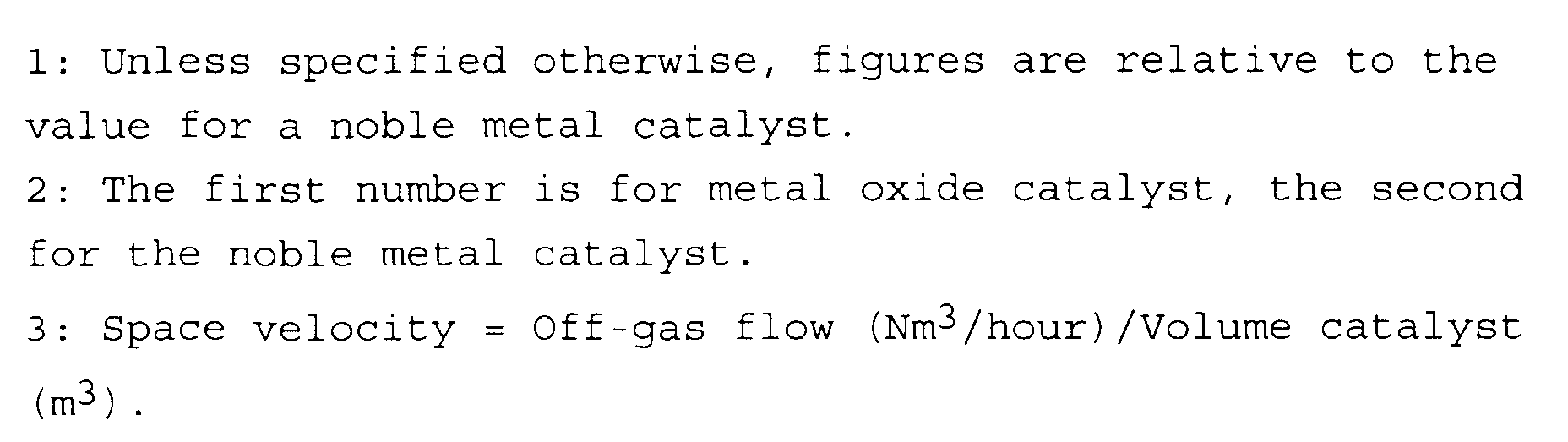
- From the example it appears that with a two-stage catalyst according to the invention the emission of nitrogen oxides can be clearly reduced compared with the noble metal catalyst. A considerable saving of energy is achieved, owing to the lower inlet temperature.
- Compared with the metal oxide catalyst, the emission of nitrogen oxides, true, is slightly higher, but the carbon monoxide emission in turn is clearly lower. The energy consumption is the same for both types of catalyst. The balance between the various emissions is much more optimal according to the invention than if a single catalyst is used.
- From the example it appears that the two-stage catalyst is an attractive alternative if the total emission of hydrocarbons, carbon monoxide and nitrogen oxides is considered.
Claims (9)
- A method for cleaning off-gases which contain organic nitrogen compounds, by catalytic combustion in the presence of excess molecular oxygen at elevated temperature, using two catalysts, wherein the off-gases are first passed through a catalyst bed with a metal oxide catalyst and then are passed through a catalyst bed with a noble metal catalyst, and wherein oxidizing conditions prevail in both catalyst beds.
- A method according to claim 1, wherein the metal oxide catalyst and/or the noble metal catalyst are provided on a support.
- A method according to claim 1 or 2, wherein the metal oxide is selected from the group consisting of oxides of copper, manganese, tungsten, titanium, chromium, vanadium and iron.
- A method according to claims 1-3, wherein the noble metal is selected from the group consisting of platinum, palladium, iridium and rhodium.
- A method according to claims 1-4, wherein as support, metal, silica, alumina, silica-alumina, titania, zirconia, clay and/or zeolite are used.
- A method according to claims 1-5, wherein the inlet temperature of the off-gas for the metal oxide catalyst lies between 250 and 450°C.
- A method according to claims 1-6, wherein the inlet temperature for the noble metal catalyst bed lies between 300 and 500°C.
- A method according to claim 1-7, wherein the temperature rise of the off-gas in the bed of the metal oxide catalyst is sufficient to yield the desired inlet temperature for the noble metal catalyst bed.
- A method for cleaning off-gases coming from the roasting of coffee, by catalytic combustion in the presence of excess molecular oxygen at elevated temperature, using two catalysts, wherein the off-gases are first passed through a catalyst bed with a metal oxide catalyst and then are passed through a catalyst bed with a noble metal catalyst.
Applications Claiming Priority (2)
| Application Number | Priority Date | Filing Date | Title |
|---|---|---|---|
| NL1002847 | 1996-04-11 | ||
| NL1002847A NL1002847C2 (en) | 1996-04-11 | 1996-04-11 | Process for the catalytic combustion of waste gases. |
Publications (1)
| Publication Number | Publication Date |
|---|---|
| EP0800855A1 true EP0800855A1 (en) | 1997-10-15 |
Family
ID=19762663
Family Applications (1)
| Application Number | Title | Priority Date | Filing Date |
|---|---|---|---|
| EP97201065A Ceased EP0800855A1 (en) | 1996-04-11 | 1997-04-10 | Method for the catalytic oxidation of off-gases |
Country Status (2)
| Country | Link |
|---|---|
| EP (1) | EP0800855A1 (en) |
| NL (1) | NL1002847C2 (en) |
Cited By (4)
| Publication number | Priority date | Publication date | Assignee | Title |
|---|---|---|---|---|
| WO2006006702A1 (en) | 2004-07-15 | 2006-01-19 | Nikki-Universal Co., Ltd. | Catalyst for purifying exhaust gas containing organic nitrogen compound and method for purifying such exhaust gas |
| WO2006020647A1 (en) * | 2004-08-14 | 2006-02-23 | Sud-Chemie Inc. | Catalyst for purifying diesel engine exhaust emissions |
| WO2013004711A1 (en) * | 2011-07-04 | 2013-01-10 | Clausthaler Umwelttechnik-Institut Gmbh (Cutec-Institut) | Method for oxidizing fuel-nitrogen compounds while generating low levels of nitrogen oxides, and devices therefor |
| WO2017064654A1 (en) * | 2015-10-16 | 2017-04-20 | Luigi Lavazza S.P.A. | Process for treating gaseous effluents developed in coffee roasting installation |
Citations (8)
| Publication number | Priority date | Publication date | Assignee | Title |
|---|---|---|---|---|
| DE2424142A1 (en) * | 1974-05-17 | 1975-11-27 | Gimborn Probat Werke | Heat- and mass-transfer processes - applied to flowable solid products e.g. coffee, cocoa, malt |
| JPS6030641A (en) * | 1983-07-29 | 1985-02-16 | Kondo Unyu Kiko Kk | Cleaning of roasting gas exhausted from roaster |
| GB2167396A (en) * | 1984-11-24 | 1986-05-29 | Kali Chemie Ag | Method for the treatment of exhaust gas |
| EP0308789A2 (en) * | 1987-09-21 | 1989-03-29 | Degussa Aktiengesellschaft | Process for the catalytic conversion of exhaust gases containing hydrocarbon, halogenated hydrocarbon and carbon monoxide |
| GB2208482A (en) * | 1987-08-12 | 1989-04-05 | Secretary Trade Ind Brit | Dual-bed catalyst process |
| EP0630681A1 (en) * | 1993-06-24 | 1994-12-28 | MANNESMANN Aktiengesellschaft | Process for the elimination of unwanted impurities from a gas |
| WO1995030623A1 (en) * | 1994-05-04 | 1995-11-16 | Petrocon Technologies, Inc. | HYBRID LOW NOx PROCESS FOR DESTRUCTION OF BOUND NITROGEN COMPOUNDS |
| EP0682973A1 (en) * | 1993-02-08 | 1995-11-22 | Institut Français du Pétrole | Process for the catalytic deodorising and reduction of the nitrogen content of the exhaust from a manure vessel |
-
1996
- 1996-04-11 NL NL1002847A patent/NL1002847C2/en not_active IP Right Cessation
-
1997
- 1997-04-10 EP EP97201065A patent/EP0800855A1/en not_active Ceased
Patent Citations (8)
| Publication number | Priority date | Publication date | Assignee | Title |
|---|---|---|---|---|
| DE2424142A1 (en) * | 1974-05-17 | 1975-11-27 | Gimborn Probat Werke | Heat- and mass-transfer processes - applied to flowable solid products e.g. coffee, cocoa, malt |
| JPS6030641A (en) * | 1983-07-29 | 1985-02-16 | Kondo Unyu Kiko Kk | Cleaning of roasting gas exhausted from roaster |
| GB2167396A (en) * | 1984-11-24 | 1986-05-29 | Kali Chemie Ag | Method for the treatment of exhaust gas |
| GB2208482A (en) * | 1987-08-12 | 1989-04-05 | Secretary Trade Ind Brit | Dual-bed catalyst process |
| EP0308789A2 (en) * | 1987-09-21 | 1989-03-29 | Degussa Aktiengesellschaft | Process for the catalytic conversion of exhaust gases containing hydrocarbon, halogenated hydrocarbon and carbon monoxide |
| EP0682973A1 (en) * | 1993-02-08 | 1995-11-22 | Institut Français du Pétrole | Process for the catalytic deodorising and reduction of the nitrogen content of the exhaust from a manure vessel |
| EP0630681A1 (en) * | 1993-06-24 | 1994-12-28 | MANNESMANN Aktiengesellschaft | Process for the elimination of unwanted impurities from a gas |
| WO1995030623A1 (en) * | 1994-05-04 | 1995-11-16 | Petrocon Technologies, Inc. | HYBRID LOW NOx PROCESS FOR DESTRUCTION OF BOUND NITROGEN COMPOUNDS |
Non-Patent Citations (1)
| Title |
|---|
| PATENT ABSTRACTS OF JAPAN vol. 009, no. 153 (C - 288) 27 June 1985 (1985-06-27) * |
Cited By (8)
| Publication number | Priority date | Publication date | Assignee | Title |
|---|---|---|---|---|
| WO2006006702A1 (en) | 2004-07-15 | 2006-01-19 | Nikki-Universal Co., Ltd. | Catalyst for purifying exhaust gas containing organic nitrogen compound and method for purifying such exhaust gas |
| EP1787720A4 (en) * | 2004-07-15 | 2011-08-31 | Nikki Universal Co Ltd | CATALYST FOR PURIFYING AN EXHAUST GAS CONTAINING AN ORGANIC NITROGEN COMPOUND AND PROCESS FOR PURIFYING SUCH AN EXHAUST GAS |
| US8575054B2 (en) | 2004-07-15 | 2013-11-05 | Nikki-Universal Co., Ltd. | Catalyst for purifying organic nitrogen compound-containing exhaust gas and method for purifying the exhaust gas |
| WO2006020647A1 (en) * | 2004-08-14 | 2006-02-23 | Sud-Chemie Inc. | Catalyst for purifying diesel engine exhaust emissions |
| WO2013004711A1 (en) * | 2011-07-04 | 2013-01-10 | Clausthaler Umwelttechnik-Institut Gmbh (Cutec-Institut) | Method for oxidizing fuel-nitrogen compounds while generating low levels of nitrogen oxides, and devices therefor |
| WO2017064654A1 (en) * | 2015-10-16 | 2017-04-20 | Luigi Lavazza S.P.A. | Process for treating gaseous effluents developed in coffee roasting installation |
| AU2016337566B2 (en) * | 2015-10-16 | 2020-03-26 | Luigi Lavazza S.P.A. | Process for treating gaseous effluents developed in coffee roasting installation |
| US10773208B2 (en) | 2015-10-16 | 2020-09-15 | Luigi Lavazza S.P.A | Process for treating gaseous effluents developed in coffee roasting installation |
Also Published As
| Publication number | Publication date |
|---|---|
| NL1002847C2 (en) | 1997-10-15 |
Similar Documents
| Publication | Publication Date | Title |
|---|---|---|
| EP1874441B1 (en) | Ammonia oxidation catalyst for coal fired utilities | |
| US6207120B1 (en) | Catalytic vent gas treatment system for abatement of volatile chemical emissions | |
| CN102247867B (en) | Catalytic oxidation catalyst for methyl acetate in organic waste gas and preparation method thereof | |
| US6022826A (en) | Composition for oxidizing carbon monoxide in the presence of sulfur compounds with reduced formation of SO3 from SO2 | |
| EP3356040B1 (en) | Method for preparing a catalyst-containing ceramic filter for off-gas or exhaust gas cleaning | |
| CA1313825C (en) | Exhaust gas processing apparatus for paint drying oven | |
| JPH0687950B2 (en) | Method and apparatus for catalytically reacting waste gas containing hydrocarbon, halogenated hydrocarbon and carbon monoxide | |
| US6051198A (en) | Catalyst for purifying fumigation exhaust gases and a method of purifying fumigation exhaust gases | |
| JPH11319559A (en) | Catalyst and method for purifying exhaust gas containing methane | |
| EP0533228A1 (en) | Process for the activation of a catalyst | |
| NL1002847C2 (en) | Process for the catalytic combustion of waste gases. | |
| US6921594B2 (en) | Exhaust treatment and filtration system for molten carbonate fuel cells | |
| US6203596B1 (en) | Process and apparatus for removing hydrogen and/or carbon monoxide from an air stream | |
| JPH09313935A (en) | Lower aldehyde compound removal catalyst and removal method | |
| KR100206489B1 (en) | Chromia / Titania catalyst for removing volatile organic compounds and method of removing volatile organic compounds using same | |
| KR100428564B1 (en) | W-cr-tio2 catalysts and method for the removal of chlorinated organic compounds | |
| RU96101527A (en) | METHOD FOR INTEGRATED CLEANING OF GAS EMISSIONS | |
| EP0993857B1 (en) | Method for the catalytic oxidation of VOC/CO in the presence of organosilicate compounds | |
| KR100511564B1 (en) | Catalyst for simultaneous removing poisonous gas and odor material exhausted from chemical process, preparing method for the same, and use thereof | |
| EP0673282B1 (en) | Catalyst for the purification of diesel engine exhaust gases | |
| Noordally et al. | Catalytic oxidation processes for odour and VOC control | |
| WO2000025901A1 (en) | Process for low temperature removal of volatile organic compounds from industrial exhaust gas | |
| JPH06154601A (en) | Catalyst for decomposition of ozone | |
| KR100406364B1 (en) | Cromia/zeolite catalyst for removing nitrogen oxides and chlorinated organic compounds from waste gases | |
| JPH0120982Y2 (en) |
Legal Events
| Date | Code | Title | Description |
|---|---|---|---|
| PUAI | Public reference made under article 153(3) epc to a published international application that has entered the european phase |
Free format text: ORIGINAL CODE: 0009012 |
|
| AK | Designated contracting states |
Kind code of ref document: A1 Designated state(s): BE DE DK ES FR IT NL SE |
|
| 17P | Request for examination filed |
Effective date: 19970918 |
|
| GRAG | Despatch of communication of intention to grant |
Free format text: ORIGINAL CODE: EPIDOS AGRA |
|
| 17Q | First examination report despatched |
Effective date: 20020612 |
|
| STAA | Information on the status of an ep patent application or granted ep patent |
Free format text: STATUS: THE APPLICATION HAS BEEN REFUSED |
|
| 18R | Application refused |
Effective date: 20021207 |