EP0799852B1 - Preparation of polyorganosiloxanes by interfacial polymerization - Google Patents
Preparation of polyorganosiloxanes by interfacial polymerization Download PDFInfo
- Publication number
- EP0799852B1 EP0799852B1 EP97104743A EP97104743A EP0799852B1 EP 0799852 B1 EP0799852 B1 EP 0799852B1 EP 97104743 A EP97104743 A EP 97104743A EP 97104743 A EP97104743 A EP 97104743A EP 0799852 B1 EP0799852 B1 EP 0799852B1
- Authority
- EP
- European Patent Office
- Prior art keywords
- potassium
- silanolate
- radical
- sio
- organic solvent
- Prior art date
- Legal status (The legal status is an assumption and is not a legal conclusion. Google has not performed a legal analysis and makes no representation as to the accuracy of the status listed.)
- Expired - Lifetime
Links
Classifications
-
- C—CHEMISTRY; METALLURGY
- C08—ORGANIC MACROMOLECULAR COMPOUNDS; THEIR PREPARATION OR CHEMICAL WORKING-UP; COMPOSITIONS BASED THEREON
- C08G—MACROMOLECULAR COMPOUNDS OBTAINED OTHERWISE THAN BY REACTIONS ONLY INVOLVING UNSATURATED CARBON-TO-CARBON BONDS
- C08G77/00—Macromolecular compounds obtained by reactions forming a linkage containing silicon with or without sulfur, nitrogen, oxygen or carbon in the main chain of the macromolecule
- C08G77/04—Polysiloxanes
- C08G77/06—Preparatory processes
-
- C—CHEMISTRY; METALLURGY
- C08—ORGANIC MACROMOLECULAR COMPOUNDS; THEIR PREPARATION OR CHEMICAL WORKING-UP; COMPOSITIONS BASED THEREON
- C08G—MACROMOLECULAR COMPOUNDS OBTAINED OTHERWISE THAN BY REACTIONS ONLY INVOLVING UNSATURATED CARBON-TO-CARBON BONDS
- C08G77/00—Macromolecular compounds obtained by reactions forming a linkage containing silicon with or without sulfur, nitrogen, oxygen or carbon in the main chain of the macromolecule
- C08G77/42—Block-or graft-polymers containing polysiloxane sequences
- C08G77/44—Block-or graft-polymers containing polysiloxane sequences containing only polysiloxane sequences
Definitions
- This invention is directed to silicone copolymers prepared by nonaqueous interfacial polymerization, where polycondensation takes place at the interface between reactive starting materials dissolved in separate and immiscible solvents.
- a major advantage of interfacial polymerization of silicon containing monomers is the ability to control the structure of the resulting polymer chain and the composition of the copolymer, without the need for a conventional catalyst and without problems associated with rearrangement during polymerization.
- Interfacial polymerization of certain organic monomers is a known polycondensation reaction wherein monomers are dissolved in immiscible solvents. Polymerization occurs when the monomer in one phase diffuses from the bulk of the solution into the interface and reacts with the monomer from the other phase. The polymerization rate depends on the diffusion rate and reactivity of the functional groups on the monomers.
- a nonaqueous interfacial polymerization is conducted using a dihalopolysiloxane (preferably a dichloropolysiloxane) dissolved in one phase and a potassium silanolate or other metal silanolate is dissolved in the other phase.
- a dihalopolysiloxane preferably a dichloropolysiloxane
- a potassium silanolate or other metal silanolate is dissolved in the other phase.
- High molecular weight polysiloxanes and potassium chloride, or other chloride salt, are formed at the interface.
- the inorganic salt by-product is not soluble in the organic solvent phases, it precipitates and does not interfere with polycondensation. If the copolymer is insoluble in either solvent phase, it also precipitates and is removed from the interface.
- interfacial polymerization reactions are the polycondensation of amines with acetyl chloride to form nylon (i.e., polyamides) and the reaction of alcohols with acids to form polyesters.
- Interfacial polymerization of these organic monomers typically provides faster polymerization rates than other types of polymerization reactions such as bulk or solution polymerization. Even more important is the fact that because stoichiometry between the monomers need not be precise, a higher number average molecular weight polymer is obtained.
- Another advantage of interfacial polymerization is the formation of high number average molecular weight polymers at the interface, regardless of the overall percent conversion of the bulk amounts of the two monomeric reactants still in solution.
- Our invention relates to a method of making block copolymers by (A) reacting (i) a first nonaqueous organic solvent solution of an alpha, omega-dihalopolydiorganosiloxane at an interface formed with (ii) a second immiscible nonaqueous organic solvent solution of a silanolate or an organosilanolate of the formula R'' x Si(OM) 4-x or MO(R'' 2 SiO) n M, where R'' is an alkyl radical of 1-6 carbon atoms, an aryl radical, an alkenyl radical or an alkylamino radical; x is 0-2; n is at least one; and M is an alkali metal; and (B) recovering a block copolymer from the interface.
- a process for manufacturing high number average molecular weight polysiloxane copolymers by interfacial polymerization These polysiloxanes contain phenylmethyl siloxane blocks and dimethyl siloxane blocks, alternately polymerized together to form an (A m B n ) x type copolymer.
- Our interfacial polymerization process is fast, proceeds smoothly at room temperature and is not reversible, i.e., no cyclic siloxane species are generated.
- the polysiloxanes are formed as thermoplastic elastomers suitable for use as sealants, fillers and films.
- Block copolymers contain linear sequences of comonomer or oligomer A joined to linear sequences of comonomer or oligomer B.
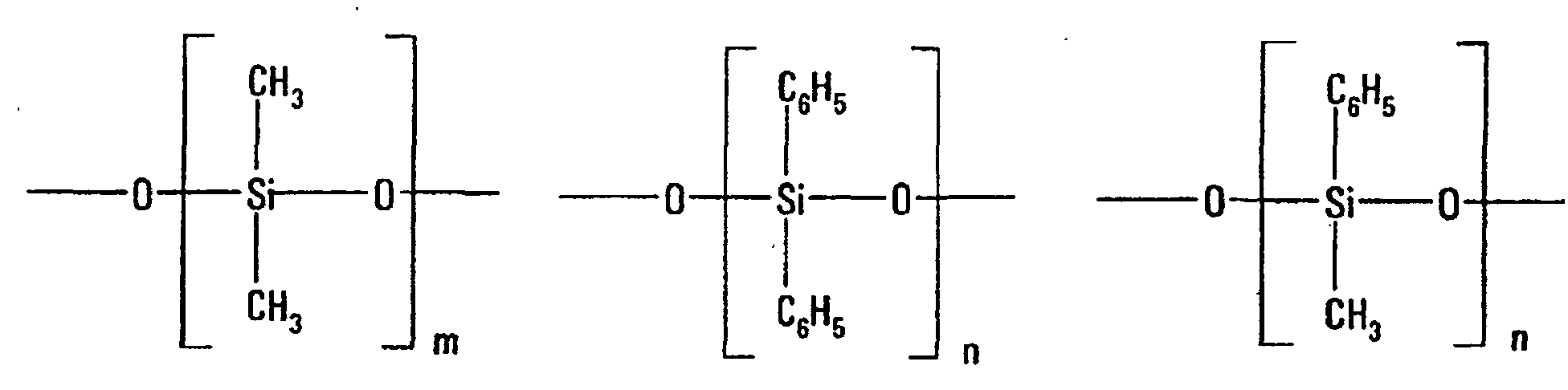
- block copolymer we mean a sequence distribution in copolymers of the type (A m B n ) x or -BBBAABBBAABBBBAAABBBBAAA-, where AA is a dimethyl block and BBB is a diphenyl block or a phenylmethyl block.
- dimethyl block dimethyl block
- diphenyl block and phenylmethyl block we mean a sequence of siloxane units shown below:
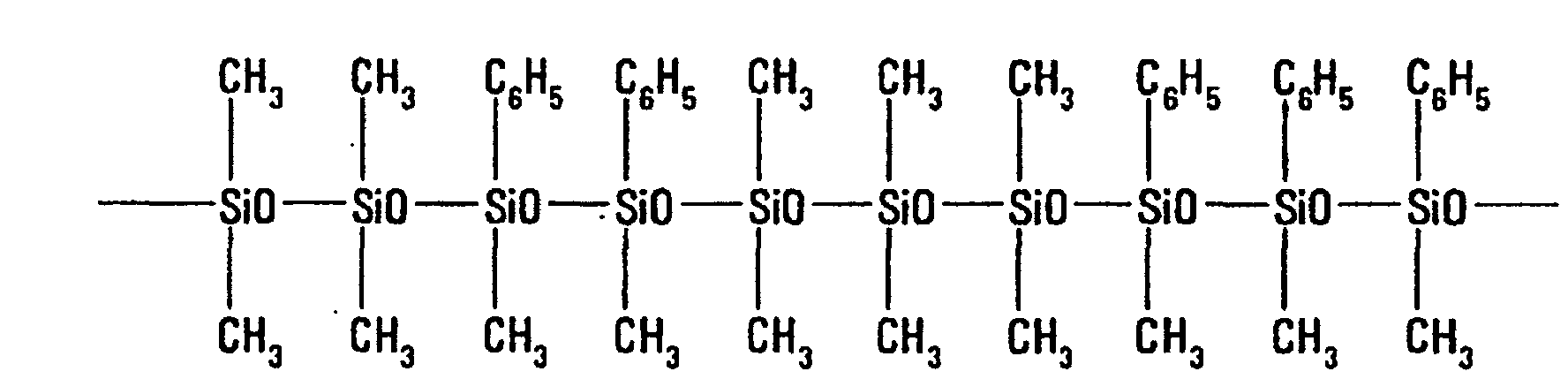
- One representative example of a block copolymer is:
- the overall rate of conversion to the polymers herein is higher than by bulk polymerization, provided the polymer is continuously removed from the interface to sustain a constant rate.
- Removal of the polymer formed at the interface is relatively simple if the polymer has sufficient mechanical strength. In that case, it can be pulled out of the interface as with polyamides and polyesters. However, removal is more difficult if the polymer is a viscous liquid or a low modulus solid.
- an alpha, omega-dihaloorganosiloxane i.e., an alpha, omega-dichloropolydiorgano-siloxane
- a silanolate or an organosilanolate are alkali-metal salts of organosilanols having the formula R'' x Si(OM) 4-x or the formula MO(R'' 2 SiO) n M.
- R'' is an alkyl radical of 1-6 carbon atoms, an aryl radical, an alkenyl radical or an alkylamino radical; x is 0-2; and n is at least one.
- Suitable alkyl and aryl radicals of R'' are methyl, ethyl and phenyl.
- Suitable alkenyl R'' radicals are vinyl, allyl, butenyl and hexenyl.
- Suitable aminoalkyl R'' radicals are aminopropyl and ethylene diaminopropyl.
- M is an alkali metal such as lithium, sodium, potassium, rubidium and cesium. Sodium and potassium are the preferred alkali metals.
- the value of x is preferably 2; and the value of n is preferably to 20, more preferably 3-10, and most preferably 4-8.
- silanolate compounds examples include disodium diphenylsilanolate (C 6 H 5 ) 2 Si(ONa) 2 , disodium dimethylsilanolate (CH 3 ) 2 Si(ONa) 2 , disodium methylaminopropylsilanolate (CH 3 ) [H 2 NCH 2 CH 2 CH 2 ]Si (ONa) 2 , their potassium equivalents, potassium dimethylsilanolate KO[(CH 3 ) 2 SiO] n K and potassium phenylmethylsilanolate KO[(C 6 H 5 )(CH 3 )SiO] n K where n is defined above.
- Silanolates are obtained by the reaction of diorganoalkoxysilanes with alkali-metal hydroxides or diorganosilanols with alkali metals or alkali-metal hydroxides. Such methods and their details are found, for example, in British Patent 631,506 (November 3, 1949) and in US Patent 3,641,090 (February 8, 1972).
- Synthesis of potassium dimethylsilanolates are also achieved by the equilibration reaction of octamethylcyclotetrasiloxane with potassium hydroxide. While high viscosities are common when preparing potassium dimethylsilanolates having K:Si mole ratios greater than 1:6, significant lower viscosity silanolates are made by the incremental addition of the metal hydroxide.
- This method has the advantage that it is possible to prepare relatively short chain sizes of potassium dimethylsilanolate polymers. This is accomplished with a 2K:8Si ratio (16 mole % K) or with a siloxane chain length of eight dimethylsiloxy units.
- Other potassium dimethylsilanolates can be prepared with lower ratios, i.e., 2K:5Si, 2K:4Si and 2K:3Si.
- Potassium phenylmethylsilanolate polymers are prepared in a similar fashion to that described above for potassium dimethylsilanolate.
- potassium phenylmethylsilanolate polymers are prepared by condensing KOH with phenylmethylsiloxane hydrolysates, i.e., HO((C 6 H 5 ) (CH 3 )SiO] x H.
- Silanolates were prepared by the equilibration reaction of potassium hydroxide or lithium hydroxide with octamethylcyclotetrasiloxane or tetraphenyltetramethylcyclotetrasiloxane for use in our interfacial polymerization reactions. These silanolates are shown in Table I. In the table, the abbreviations "diMe” and PhMe” indicate dimethylsilanolate and phenylmethylsilanolate, respectively.
- alpha, omega-dichloropolydiorganosiloxanes usable herein are l,3-dichloro-1,3-dimethyl-1,3-diphenyldisiloxane, 1,5-dichlorohexamethyltrisiloxane, 1,71,7-dichlorooctamethyltetrasiloxane, 1,3-dichlorotetraisopropyldisiloxane, 1, 3-dichlorotetramethyldisiloxane and 1,3-dichlorotetramethyldisiloxane
- solvent I and solvent II are not miscible.
- solvent I and solvent II are nonaqueous.
- solvent I is a good solvent for monomer or oligomer I but not for monomer or oligomer II.
- solvent II is a good solvent for monomer or oligomer II but not for monomer or oligomer I.
- the resulting products are insoluble in at least one of the phases.
- a polar solvent in combination with a non-polar solvent may satisfy these five conditions.
- a suitable polar solvent for the alpha, omega-dihaloorganosiloxane phase was acetonitrile CH 3 CN and a suitable non-polar solvent for the silanolate or organosilanolate phase was cyclohexane C 6 H 12 .
- reaction of organohalosiloxanes with metal silanolates proceed according to the scheme: ⁇ Si-X + MO-Si ⁇ ⁇ ⁇ Si-O-Si ⁇ + MX where M is a Group IA metal such as Na or K and X is halogen.
- M is Na and X is Cl
- the reaction is: ⁇ Si-Cl + NaO-Si ⁇ ⁇ ⁇ Si-O-Si ⁇ + NaCl
- Such reactions when performed by our methods are conducted without stirring and at temperatures generally in the range of 10-95°C.
- interfacial polymerization reactions are carried out when the alpha,omega-dichloropolydiorganosiloxane solution is slowly added to the alkali metal silanolate solution. The solutions are then allowed to stand at room temperature for 24 hours.
- a potassium phenylmethylsilanolate having the ratio 2K:8Si of potassium to silicon was prepared by adding to a flask 157.7 grams of phenylmethylsiloxane hydrolysate HO[(C 6 H 5 )(CH 3 )SiO] 8 H, 60 grams of cyclohexane and 19 grams of 45% potassium hydroxide (8.55 grams KOH, 0.153 M). After reaction, water was removed and the flask was cooled to 60°C. Using a syringe, 60 milliliters of dry acetonitrile was added to the flask as a top layer.
- Example I using phenylmethylsiloxane hydrolysate HO[(C 6 H 5 ) (CH 3 )SiO] 5 H and adjusted the amount of KOH to prepare a potassium phenylmethylsilanolate containing two potassium species to five silicon units (2K:5Si) in cyclohexane.
- This silanolate yielded a very viscous polymeric fluid when reacted with 1,5-dichlorohexamethyltrisiloxane in acetonitrile.
- An exotherm was noted during the interfacial polymerization reaction.
- a polymer number average molecular weight of 95,500 was determined by Gel Permeation Chromatography (GPC) analysis.
- Example I using phenylmethylsiloxane hydrolysate HO[(C 6 H 5 ) (CH 3 )SiO] 4 H and again adjusted the amount of KOH to prepare a potassium phenylmethylsilanolate containing two potassium species to four silicon units (2K:4Si) in cyclohexane.
- This silanolate when reacted with a solution of 64.1 grams (0.231 M or 0.463 equivalents Cl - ) of 1,5-dichlorohexamethyltrisiloxane in 30 milliliters of acetonitrile, yielded a polymer that was a clear gel.
- This elastomeric product was soluble in N-methylpyrrolidone. An exotherm due to the formation of potassium chloride was observed during the reaction.
Landscapes
- Chemical & Material Sciences (AREA)
- Health & Medical Sciences (AREA)
- Chemical Kinetics & Catalysis (AREA)
- Medicinal Chemistry (AREA)
- Polymers & Plastics (AREA)
- Organic Chemistry (AREA)
- Silicon Polymers (AREA)
Description
- This invention is directed to silicone copolymers prepared by nonaqueous interfacial polymerization, where polycondensation takes place at the interface between reactive starting materials dissolved in separate and immiscible solvents.
- A major advantage of interfacial polymerization of silicon containing monomers is the ability to control the structure of the resulting polymer chain and the composition of the copolymer, without the need for a conventional catalyst and without problems associated with rearrangement during polymerization.
- Interfacial polymerization of certain organic monomers is a known polycondensation reaction wherein monomers are dissolved in immiscible solvents. Polymerization occurs when the monomer in one phase diffuses from the bulk of the solution into the interface and reacts with the monomer from the other phase. The polymerization rate depends on the diffusion rate and reactivity of the functional groups on the monomers.
- With respect to our invention, a nonaqueous interfacial polymerization is conducted using a dihalopolysiloxane (preferably a dichloropolysiloxane) dissolved in one phase and a potassium silanolate or other metal silanolate is dissolved in the other phase. High molecular weight polysiloxanes and potassium chloride, or other chloride salt, are formed at the interface.
- Since the inorganic salt by-product is not soluble in the organic solvent phases, it precipitates and does not interfere with polycondensation. If the copolymer is insoluble in either solvent phase, it also precipitates and is removed from the interface.
- Among conventional interfacial polymerization reactions are the polycondensation of amines with acetyl chloride to form nylon (i.e., polyamides) and the reaction of alcohols with acids to form polyesters. Interfacial polymerization of these organic monomers typically provides faster polymerization rates than other types of polymerization reactions such as bulk or solution polymerization. Even more important is the fact that because stoichiometry between the monomers need not be precise, a higher number average molecular weight polymer is obtained.
- This is particularly critical for organic polycondensation reactions where an imbalance of a fraction of a percent causes the extent of polymerization to be greatly affected. Another advantage of interfacial polymerization is the formation of high number average molecular weight polymers at the interface, regardless of the overall percent conversion of the bulk amounts of the two monomeric reactants still in solution.
- Among other of the advantages offered by interfacial polymerization reactions in the synthesis of organic polymers are (i) the ability to prepare infusible polymers; (ii) the ability to synthesize polymers with chemically active substituents as well as heteroatoms; (iii) controlled crosslinking of the polymer structure; (iv) the ability to use cis- and trans- conformation without rearrangement; (v) the ability to prepare optically active polymers without decomposition of the intermediates; (vi) the ability to use short-chain and ortho-substituted ring intermediates; (vii) the ability to use thermally unstable intermediates to form thermally stable polymers; (viii) the ability to form block and ordered copolymers; (ix) the ability to form synthetic elastomers; (x) a direct method of forming polymer solutions and dispersions; (xi) a direct method for the polymerization and formation of polymer coatings and encapsulants; and (xii) a direct method for polymerization of monomers into fibrous particulates, fibers and films.
- We have unexpectedly found that many of these advantages are directly correlated and applied to the interfacial polymerization of silicon containing monomers in forming siloxane copolymers.
- Our invention relates to a method of making block copolymers by (A) reacting (i) a first nonaqueous organic solvent solution of an alpha, omega-dihalopolydiorganosiloxane at an interface formed with (ii) a second immiscible nonaqueous organic solvent solution of a silanolate or an organosilanolate of the formula R''xSi(OM)4-x or MO(R''2SiO)nM, where R'' is an alkyl radical of 1-6 carbon atoms, an aryl radical, an alkenyl radical or an alkylamino radical; x is 0-2; n is at least one; and M is an alkali metal; and (B) recovering a block copolymer from the interface.
- A process is disclosed for manufacturing high number average molecular weight polysiloxane copolymers by interfacial polymerization. These polysiloxanes contain phenylmethyl siloxane blocks and dimethyl siloxane blocks, alternately polymerized together to form an (AmBn)x type copolymer. Our interfacial polymerization process is fast, proceeds smoothly at room temperature and is not reversible, i.e., no cyclic siloxane species are generated. The polysiloxanes are formed as thermoplastic elastomers suitable for use as sealants, fillers and films.
- Our interfacial polymerization of organosilicon monomer and oligomer reactants provides structures and combinations of structures which cannot be obtained by other routes. One example is a well-defined structure of a dimethyldimethyl/phenylmethyl siloxane block copolymer.
- Block copolymers contain linear sequences of comonomer or oligomer A joined to linear sequences of comonomer or oligomer B. By "block copolymer" we mean a sequence distribution in copolymers of the type (AmBn)x or -BBBAABBBAABBBBAAABBBBAAA-, where AA is a dimethyl block and BBB is a diphenyl block or a phenylmethyl block. By "dimethyl block", "diphenyl block and "phenylmethyl block", we mean a sequence of siloxane units shown below:
- One representative example of a block copolymer is:
- However, a major difference exists between interfacial polymerization of organosilicon reactants according to our invention, compared to previous methods used to polymerize organic monomers and that is in the use of water as one of the solvents. Although water has been used in many organic systems, no water is used in our interfacial polymerization method.
- This is because the use of water in the polycondensation of organosilicon monomers could be detrimental and lead to a low number average molecular weight, a complete loss of control over the polymer structure due to rearrangement and re-equilibration of the polymer in the presence of any residual soluble acid or base. Thus, water is detrimental if either an acid or base is formed, which leads to rearrangement and equilibrium polymerization, i.e., including some formation of cyclic siloxane species. Further, excess water can lead to low molecular weight silanol terminated end products.
- Another difference between our method and previous methods is the fact that if water is present, organosilicon monomers such as those used in this invention react with themselves; whereas in previous methods of organic polymer synthesis, the water soluble organic reactants were stable in the aqueous solution and reacted only across the interface.
- But, similar to organic polymers prepared by interfacial polymerization, the overall rate of conversion to the polymers herein is higher than by bulk polymerization, provided the polymer is continuously removed from the interface to sustain a constant rate.
- Removal of the polymer formed at the interface is relatively simple if the polymer has sufficient mechanical strength. In that case, it can be pulled out of the interface as with polyamides and polyesters. However, removal is more difficult if the polymer is a viscous liquid or a low modulus solid.
- As noted, we react an alpha, omega-dihaloorganosiloxane, (i.e., an alpha, omega-dichloropolydiorgano-siloxane) in mutually immiscible solvents across the interface with a silanolate or an organosilanolate. The silanolates are alkali-metal salts of organosilanols having the formula R''xSi(OM)4-x or the formula MO(R''2SiO)nM. In the formulas, R'' is an alkyl radical of 1-6 carbon atoms, an aryl radical, an alkenyl radical or an alkylamino radical; x is 0-2; and n is at least one.
- Suitable alkyl and aryl radicals of R'' are methyl, ethyl and phenyl. Suitable alkenyl R'' radicals are vinyl, allyl, butenyl and hexenyl. Suitable aminoalkyl R'' radicals are aminopropyl and ethylene diaminopropyl. M is an alkali metal such as lithium, sodium, potassium, rubidium and cesium. Sodium and potassium are the preferred alkali metals. For purposes of our invention, the value of x is preferably 2; and the value of n is preferably to 20, more preferably 3-10, and most preferably 4-8.
- Examples of some suitable silanolate compounds are disodium diphenylsilanolate (C6H5)2Si(ONa)2, disodium dimethylsilanolate (CH3)2Si(ONa)2, disodium methylaminopropylsilanolate (CH3) [H2NCH2CH2CH2]Si (ONa)2, their potassium equivalents, potassium dimethylsilanolate KO[(CH3)2SiO]nK and potassium phenylmethylsilanolate KO[(C6H5)(CH3)SiO]nK where n is defined above.
- Silanolates are obtained by the reaction of diorganoalkoxysilanes with alkali-metal hydroxides or diorganosilanols with alkali metals or alkali-metal hydroxides. Such methods and their details are found, for example, in British Patent 631,506 (November 3, 1949) and in US Patent 3,641,090 (February 8, 1972).
- Synthesis of potassium dimethylsilanolates are also achieved by the equilibration reaction of octamethylcyclotetrasiloxane with potassium hydroxide. While high viscosities are common when preparing potassium dimethylsilanolates having K:Si mole ratios greater than 1:6, significant lower viscosity silanolates are made by the incremental addition of the metal hydroxide. This method has the advantage that it is possible to prepare relatively short chain sizes of potassium dimethylsilanolate polymers. This is accomplished with a 2K:8Si ratio (16 mole % K) or with a siloxane chain length of eight dimethylsiloxy units. Other potassium dimethylsilanolates can be prepared with lower ratios, i.e., 2K:5Si, 2K:4Si and 2K:3Si.
- Potassium phenylmethylsilanolate polymers are prepared in a similar fashion to that described above for potassium dimethylsilanolate. In addition, potassium phenylmethylsilanolate polymers are prepared by condensing KOH with phenylmethylsiloxane hydrolysates, i.e., HO((C6H5) (CH3)SiO]xH.
- Silanolates were prepared by the equilibration reaction of potassium hydroxide or lithium hydroxide with octamethylcyclotetrasiloxane or tetraphenyltetramethylcyclotetrasiloxane for use in our interfacial polymerization reactions. These silanolates are shown in Table I. In the table, the abbreviations "diMe" and PhMe" indicate dimethylsilanolate and phenylmethylsilanolate, respectively.

- Some alpha, omega-dichloropolydiorganosiloxanes usable herein are l,3-dichloro-1,3-dimethyl-1,3-diphenyldisiloxane, 1,5-dichlorohexamethyltrisiloxane, 1,71,7-dichlorooctamethyltetrasiloxane, 1,3-dichlorotetraisopropyldisiloxane, 1, 3-dichlorotetramethyldisiloxane and 1,3-dichlorotetramethyldisiloxane
- There are several criteria for establishing the suitability of any solvent for use in our invention. First, solvent I and solvent II are not miscible. Second, solvent I and solvent II are nonaqueous. Third, solvent I is a good solvent for monomer or oligomer I but not for monomer or oligomer II. Fourth, solvent II is a good solvent for monomer or oligomer II but not for monomer or oligomer I. Fifth, the resulting products are insoluble in at least one of the phases. Generally, a polar solvent in combination with a non-polar solvent may satisfy these five conditions.
- Given these criteria, we found that a suitable polar solvent for the alpha, omega-dihaloorganosiloxane phase was acetonitrile CH3CN and a suitable non-polar solvent for the silanolate or organosilanolate phase was cyclohexane C6H12.
- Generally, reactions of organohalosiloxanes with metal silanolates proceed according to the scheme:
- Such reactions when performed by our methods are conducted without stirring and at temperatures generally in the range of 10-95°C. Typically, interfacial polymerization reactions are carried out when the alpha,omega-dichloropolydiorganosiloxane solution is slowly added to the alkali metal silanolate solution. The solutions are then allowed to stand at room temperature for 24 hours.
- Quite unexpectedly, we found that in some of the reactions of potassium phenylmethylsilanolate in cyclohexane and 1,5-dichlorohexamethyltrisiloxane in acetonitrile, elastomeric products (gels) were produced. Further, the polymers contained only low amounts of cyclic siloxane species which were present in the silanolate prior to polymerization. However, in other interfacial polymerizations utilizing potassium phenylmethylsilanolate in cyclohexane with 1,5-dichlorohexamethyltrisiloxane in acetonitrile, the yield was an oil, depending upon the amount of ionic character of the silanolate.
- In these reactions, we used various potassium phenylmethylsilanolate chain lengths containing different amounts of ionic character such as 2K:8Si, 2K:5Si and 2K:4Si. We surprisingly found that the larger silanolate chain species (i.e., 2K:85i) formed viscous oily products, while the smaller silanolate chain species formed elastomeric products, i.e., gels, after interfacial polymerization. In all cases, the by-product potassium chloride precipitated and was analyzed by X-Ray Diffraction (XRD).
- The following examples illustrate our use of potassium phenylmethylsilanolates in an interfacial polymerization reaction.
- A potassium phenylmethylsilanolate having the ratio 2K:8Si of potassium to silicon, was prepared by adding to a flask 157.7 grams of phenylmethylsiloxane hydrolysate HO[(C6H5)(CH3)SiO]8H, 60 grams of cyclohexane and 19 grams of 45% potassium hydroxide (8.55 grams KOH, 0.153 M). After reaction, water was removed and the flask was cooled to 60°C. Using a syringe, 60 milliliters of dry acetonitrile was added to the flask as a top layer. Then a solution of 32.32 grams (0.117 M or 0.233 equivalents C1-) of 1,5-dichlorohexamethyltrisiloxane in 20 milliliters of acetonitrile, was slowly transferred to the top layer of the flask. Upon reaction of the potassium phenylmethylsilanolate in cyclohexane with the 1,5-dichlorohexamethyltrisiloxane in acetonitrile, there was obtained a clear polymeric oil with a number average molecular weight of 9,455. Nuclear Magnetic Resonance (NMR) and Fourier-Transform Infrared Spectroscopy (FTIR) analysis confirmed formation of the polymer. Infrared analysis showed an increase in methyl groups to phenyl groups, which evidences addition of the trisiloxane backbone to the silanolate. NMR showed only a small amount of polymer branching (i.e., 0.5 mole %) and 16 % of cyclic siloxane species. The polymer contained two different difunctional R2SiO2/2 "D" blocks. One block was (CH3)2SiO2/2 and the other block was (C6H5) (CH3)SiO2/2, in a ratio of three to eight, respectively.
- We repeated Example I using phenylmethylsiloxane hydrolysate HO[(C6H5) (CH3)SiO]5H and adjusted the amount of KOH to prepare a potassium phenylmethylsilanolate containing two potassium species to five silicon units (2K:5Si) in cyclohexane. This silanolate yielded a very viscous polymeric fluid when reacted with 1,5-dichlorohexamethyltrisiloxane in acetonitrile. An exotherm was noted during the interfacial polymerization reaction. A polymer number average molecular weight of 95,500 was determined by Gel Permeation Chromatography (GPC) analysis. NMR showed that the polymer contained (CH3)2SiO2/2 and (C6H5) (CH3)SiO2/2 blocks in the ratio 3:5, with some polymer branching (i.e., 0.92%) and no new formation of cyclic siloxane species over the 8.5% cyclic siloxane species present in the silanolate prior to the reaction.
- We repeated Example I using phenylmethylsiloxane hydrolysate HO[(C6H5) (CH3)SiO]4H and again adjusted the amount of KOH to prepare a potassium phenylmethylsilanolate containing two potassium species to four silicon units (2K:4Si) in cyclohexane. This silanolate, when reacted with a solution of 64.1 grams (0.231 M or 0.463 equivalents Cl- ) of 1,5-dichlorohexamethyltrisiloxane in 30 milliliters of acetonitrile, yielded a polymer that was a clear gel. This elastomeric product was soluble in N-methylpyrrolidone. An exotherm due to the formation of potassium chloride was observed during the reaction.
- By using the above procedures and reacting potassium dimethylsilanolate or potassium phenylmethylsilanolate in cyclohexane with an alpha, omega-dichloropolydiorganosiloxane in acetonitrile, one can prepare block copolymers of various block sizes. This is achieved by using potassium silanolates of various ratios of Si:K.
Claims (7)
- A method of making a block copolymer comprising(A) reacting (i) a first nonaqueous organic solvent solution of an alpha, omega-dihalopolydiorganosiloxane at or near an interface formed by the first nonaqueous organic solvent solution and (ii) a second immiscible nonaqueous organic solvent solution of a silanolate or organosilanolate of formula R''xSi(OM)4-x or MO(R''2SiO)nM where R'' is an alkyl radical of 1-6 carbon atoms, an aryl radical, an alkenyl radical or an alkylamino radical; x is 0-2; n is at least one; and M is an alkali metal; the second solvent being immiscible in the first solvent and organic groups on the alpha,omegaalpha,omega-dihalopolydiorganosiloxane being different from organo groups on the silanolate or organosilanolate, and (B) recovering the block copolymer at or near the interface.
- A method according to Claim 1 in which the first organic solvent is acetonitrile and the second organic solvent is cyclohexane.
- A method according to claims 1 or 2 in which the alpha,omega-dihalopolydiorganosiloxane is selected from the group consisting of 1,3-dichloro-1,3-dimethyl-1,3-diphenyldisiloxane. 1,5-dichlorohexamethyltrisiloxane, 1,71,7-dichlorooctamethyltetrasiloxane, 1,3-dichlorotetra-isopropyldisiloxane, 1,3-dichlorotetramethyldisiloxane and 1,3-dichlorotetraphenyldisiloxane.
- A method according to claims 1 or 2 in which the silanolate or organosilanolate has the formula MO(R" 2SiO)nM where R'' is an alkyl radical of 1-6 carbon atoms, an aryl radical, an alkenyl radical or an alkylamino radical; n is 1-20; and M is an alkali metal.
- A method according to claim 4 in which the silanolate or organosilanolate is potassium phenylmethylsilanolate of the formula KO[(C6H5)(CH3)SiO]nK where n is 4-8.
- A block copolymer obtainable by the method defined in any of claims 1 to 5.
- Sealants, fillers or films obtainable from the block copolymer in claim 6.
Applications Claiming Priority (2)
| Application Number | Priority Date | Filing Date | Title |
|---|---|---|---|
| US625983 | 1984-06-29 | ||
| US08/625,983 US5637668A (en) | 1996-04-01 | 1996-04-01 | Preparation of polyorganosiloxanes by interfacial polymerization |
Publications (3)
| Publication Number | Publication Date |
|---|---|
| EP0799852A2 EP0799852A2 (en) | 1997-10-08 |
| EP0799852A3 EP0799852A3 (en) | 1998-04-01 |
| EP0799852B1 true EP0799852B1 (en) | 2003-09-24 |
Family
ID=24508457
Family Applications (1)
| Application Number | Title | Priority Date | Filing Date |
|---|---|---|---|
| EP97104743A Expired - Lifetime EP0799852B1 (en) | 1996-04-01 | 1997-03-20 | Preparation of polyorganosiloxanes by interfacial polymerization |
Country Status (4)
| Country | Link |
|---|---|
| US (1) | US5637668A (en) |
| EP (1) | EP0799852B1 (en) |
| JP (1) | JPH107799A (en) |
| DE (1) | DE69725040D1 (en) |
Cited By (1)
| Publication number | Priority date | Publication date | Assignee | Title |
|---|---|---|---|---|
| RU2471818C1 (en) * | 2011-11-25 | 2013-01-10 | Федеральное государственное унитарное предприятие "Государственный ордена Трудового Красного Знамени научно-исследовательский институт химии и технологии элементоорганических соединений" (ФГУП ГНИИХТЭОС) | METHOD OF PRODUCING α,ω-BIS(METHYL DIPHENYLSILYL)-OLIGODIORGANOSILOXANES |
Families Citing this family (7)
| Publication number | Priority date | Publication date | Assignee | Title |
|---|---|---|---|---|
| US6046293A (en) * | 1998-12-01 | 2000-04-04 | University Of South Australia | Solid-liquid phase interfacial polymerization |
| US5969173A (en) * | 1998-12-01 | 1999-10-19 | Dow Corning Corporation | Method of making dialkali metal silanolates and siloxanolates |
| US6805809B2 (en) * | 2002-08-28 | 2004-10-19 | Board Of Trustees Of University Of Illinois | Decal transfer microfabrication |
| WO2005088759A2 (en) * | 2004-03-08 | 2005-09-22 | The Board Of Trustees Of The University Of Illinois | Microfluidic electrochemical reactors |
| US7662545B2 (en) * | 2004-10-14 | 2010-02-16 | The Board Of Trustees Of The University Of Illinois | Decal transfer lithography |
| US8030423B2 (en) * | 2008-01-25 | 2011-10-04 | Salamone Joseph C | Multi-armed macromonomers |
| JP6786716B2 (en) * | 2017-04-04 | 2020-11-18 | ワッカー ケミー アクチエンゲゼルシャフトWacker Chemie AG | Reactive siloxane and its production method |
Family Cites Families (10)
| Publication number | Priority date | Publication date | Assignee | Title |
|---|---|---|---|---|
| GB631506A (en) * | 1946-11-25 | 1949-11-03 | Dow Corning | Production of organosilicon compounds |
| US3328323A (en) * | 1963-02-04 | 1967-06-27 | Gen Electric | Organopolysiloxane copolymers containing polydiarylsiloxane blocks and a process for making them |
| US3453304A (en) * | 1966-12-19 | 1969-07-01 | Gen Electric | Process for preparing siloxane diolates |
| US3578726A (en) * | 1969-10-13 | 1971-05-11 | Gen Electric | Condensation method for making multiple sequence organopolysiloxane block polymers |
| US3641090A (en) * | 1969-10-13 | 1972-02-08 | Gen Electric | Silanolate-complexes and use thereof |
| US4371670A (en) * | 1981-02-26 | 1983-02-01 | Atlantic Richfield Company | Copolymers having a backbone of alternating polymer blocks and silicon units |
| US4493714A (en) * | 1982-05-06 | 1985-01-15 | Teijin Limited | Ultrathin film, process for production thereof, and use thereof for concentrating a specified gas in a gaseous mixture |
| US4518547A (en) * | 1983-09-15 | 1985-05-21 | Board Of Regents, The University Of Texas System | Microencapsulation process |
| US4604442A (en) * | 1985-03-29 | 1986-08-05 | General Electric Company | Organopolysiloxane-polyamide block polymers and method for making |
| JPH07258416A (en) * | 1994-03-23 | 1995-10-09 | Dow Corning Kk | Both-end-functional diphenylsiloxane oligomer compound and method for producing the same |
-
1996
- 1996-04-01 US US08/625,983 patent/US5637668A/en not_active Expired - Fee Related
-
1997
- 1997-03-20 EP EP97104743A patent/EP0799852B1/en not_active Expired - Lifetime
- 1997-03-20 DE DE69725040T patent/DE69725040D1/en not_active Expired - Lifetime
- 1997-03-27 JP JP9075150A patent/JPH107799A/en not_active Withdrawn
Cited By (1)
| Publication number | Priority date | Publication date | Assignee | Title |
|---|---|---|---|---|
| RU2471818C1 (en) * | 2011-11-25 | 2013-01-10 | Федеральное государственное унитарное предприятие "Государственный ордена Трудового Красного Знамени научно-исследовательский институт химии и технологии элементоорганических соединений" (ФГУП ГНИИХТЭОС) | METHOD OF PRODUCING α,ω-BIS(METHYL DIPHENYLSILYL)-OLIGODIORGANOSILOXANES |
Also Published As
| Publication number | Publication date |
|---|---|
| EP0799852A3 (en) | 1998-04-01 |
| DE69725040D1 (en) | 2003-10-30 |
| US5637668A (en) | 1997-06-10 |
| EP0799852A2 (en) | 1997-10-08 |
| JPH107799A (en) | 1998-01-13 |
Similar Documents
| Publication | Publication Date | Title |
|---|---|---|
| US5169920A (en) | Method for preparing diphenylsiloxane/dimethylsiloxane copolymers | |
| Köhler et al. | Industrial synthesis of reactive silicones: reaction mechanisms and processes | |
| US5028679A (en) | Method for preparing perfluoroalkyl group-containing organopolysiloxanes | |
| US5118775A (en) | Fluoroorganopolysiloxane and a process for preparing the same | |
| US5965683A (en) | Process for preparing hydrogen siloxane copolymers | |
| US5317072A (en) | Condensation process for preparation of organofunctional siloxanes | |
| KR100203251B1 (en) | Method of making organopolysiloxanes | |
| US6284859B1 (en) | Polymerization of siloxanes | |
| US4341888A (en) | Diorganopolysiloxane copolymers and process for the preparation thereof | |
| US5637668A (en) | Preparation of polyorganosiloxanes by interfacial polymerization | |
| US5254658A (en) | Method for the preparation of branched organopolysiloxane | |
| JP2003517072A (en) | Process for producing polyorganosiloxanes by polymerization catalyzed by a catalyst system based on triflic acid or a triflic acid derivative | |
| US6136938A (en) | Silicone terpolymers containing dimethyl higher alkyl and repeating units | |
| US3361714A (en) | Branched polysiloxanes | |
| GB2252969A (en) | Phosphonitrile halide adducts as polymerisation catalysts | |
| US4874881A (en) | Method for producing a polydiorganosiloxane having a pendent alkenyl radical at its molecular center | |
| EP1172397B1 (en) | Method for preparation of organopolysiloxane having branched molecular structure | |
| EP0693521A1 (en) | Method for the preparation of diphenylsiloxane-dimethylsiloxane copolymers | |
| US5629401A (en) | Preparation of polyorganosiloxanes by interfacial polymerization | |
| EP0693520B1 (en) | Method for the preparation of organopolysiloxanes | |
| EP1006117A2 (en) | Method of making dialkali metal silanolates and siloxanolates | |
| US6046293A (en) | Solid-liquid phase interfacial polymerization | |
| GB2234517A (en) | Silethynyl-siloxane copolymers and method of making them | |
| JPH0931199A (en) | Organosiloxane copolymer and method for producing the same | |
| Elsbernd | Synthesis, kinetics and supercritical fluid fractionation studies of functional organosiloxanes and their incorporation into segmented copolymers |
Legal Events
| Date | Code | Title | Description |
|---|---|---|---|
| PUAI | Public reference made under article 153(3) epc to a published international application that has entered the european phase |
Free format text: ORIGINAL CODE: 0009012 |
|
| AK | Designated contracting states |
Kind code of ref document: A2 Designated state(s): DE FR GB NL |
|
| PUAL | Search report despatched |
Free format text: ORIGINAL CODE: 0009013 |
|
| AK | Designated contracting states |
Kind code of ref document: A3 Designated state(s): DE FR GB NL |
|
| 17P | Request for examination filed |
Effective date: 19980617 |
|
| 17Q | First examination report despatched |
Effective date: 20001214 |
|
| GRAH | Despatch of communication of intention to grant a patent |
Free format text: ORIGINAL CODE: EPIDOS IGRA |
|
| GRAS | Grant fee paid |
Free format text: ORIGINAL CODE: EPIDOSNIGR3 |
|
| GRAA | (expected) grant |
Free format text: ORIGINAL CODE: 0009210 |
|
| AK | Designated contracting states |
Kind code of ref document: B1 Designated state(s): DE FR GB NL |
|
| REG | Reference to a national code |
Ref country code: GB Ref legal event code: FG4D |
|
| REF | Corresponds to: |
Ref document number: 69725040 Country of ref document: DE Date of ref document: 20031030 Kind code of ref document: P |
|
| PG25 | Lapsed in a contracting state [announced via postgrant information from national office to epo] |
Ref country code: DE Free format text: LAPSE BECAUSE OF FAILURE TO SUBMIT A TRANSLATION OF THE DESCRIPTION OR TO PAY THE FEE WITHIN THE PRESCRIBED TIME-LIMIT Effective date: 20031225 |
|
| PG25 | Lapsed in a contracting state [announced via postgrant information from national office to epo] |
Ref country code: GB Free format text: LAPSE BECAUSE OF NON-PAYMENT OF DUE FEES Effective date: 20040320 |
|
| ET | Fr: translation filed | ||
| PLBE | No opposition filed within time limit |
Free format text: ORIGINAL CODE: 0009261 |
|
| STAA | Information on the status of an ep patent application or granted ep patent |
Free format text: STATUS: NO OPPOSITION FILED WITHIN TIME LIMIT |
|
| 26N | No opposition filed |
Effective date: 20040625 |
|
| PG25 | Lapsed in a contracting state [announced via postgrant information from national office to epo] |
Ref country code: NL Free format text: LAPSE BECAUSE OF NON-PAYMENT OF DUE FEES Effective date: 20041001 |
|
| GBPC | Gb: european patent ceased through non-payment of renewal fee |
Effective date: 20040320 |
|
| NLV4 | Nl: lapsed or anulled due to non-payment of the annual fee |
Effective date: 20041001 |
|
| REG | Reference to a national code |
Ref country code: FR Ref legal event code: ST Effective date: 20080229 |
|
| PG25 | Lapsed in a contracting state [announced via postgrant information from national office to epo] |
Ref country code: FR Free format text: LAPSE BECAUSE OF NON-PAYMENT OF DUE FEES Effective date: 20040331 |