EP0799834A1 - Modified nucleotides - Google Patents
Modified nucleotides Download PDFInfo
- Publication number
- EP0799834A1 EP0799834A1 EP96810216A EP96810216A EP0799834A1 EP 0799834 A1 EP0799834 A1 EP 0799834A1 EP 96810216 A EP96810216 A EP 96810216A EP 96810216 A EP96810216 A EP 96810216A EP 0799834 A1 EP0799834 A1 EP 0799834A1
- Authority
- EP
- European Patent Office
- Prior art keywords
- compound according
- arom
- compound
- formula
- phenyl
- Prior art date
- Legal status (The legal status is an assumption and is not a legal conclusion. Google has not performed a legal analysis and makes no representation as to the accuracy of the status listed.)
- Withdrawn
Links
- 125000003729 nucleotide group Chemical group 0.000 title abstract description 27
- 238000000034 method Methods 0.000 claims abstract description 22
- 102100034343 Integrase Human genes 0.000 claims abstract description 9
- 108010092799 RNA-directed DNA polymerase Proteins 0.000 claims abstract description 9
- 238000003786 synthesis reaction Methods 0.000 claims abstract description 7
- 230000015572 biosynthetic process Effects 0.000 claims abstract description 6
- 150000001875 compounds Chemical class 0.000 claims description 95
- 125000002496 methyl group Chemical group [H]C([H])([H])* 0.000 claims description 36
- OKKJLVBELUTLKV-UHFFFAOYSA-N Methanol Chemical group OC OKKJLVBELUTLKV-UHFFFAOYSA-N 0.000 claims description 15
- 125000001997 phenyl group Chemical group [H]C1=C([H])C([H])=C(*)C([H])=C1[H] 0.000 claims description 13
- RWQNBRDOKXIBIV-UHFFFAOYSA-N thymine Chemical compound CC1=CNC(=O)NC1=O RWQNBRDOKXIBIV-UHFFFAOYSA-N 0.000 claims description 12
- 150000003839 salts Chemical class 0.000 claims description 11
- 229910052739 hydrogen Inorganic materials 0.000 claims description 10
- 229940002612 prodrug Drugs 0.000 claims description 9
- 239000000651 prodrug Substances 0.000 claims description 9
- 229940113082 thymine Drugs 0.000 claims description 9
- KDCGOANMDULRCW-UHFFFAOYSA-N 7H-purine Chemical compound N1=CNC2=NC=NC2=C1 KDCGOANMDULRCW-UHFFFAOYSA-N 0.000 claims description 8
- ISAKRJDGNUQOIC-UHFFFAOYSA-N Uracil Chemical compound O=C1C=CNC(=O)N1 ISAKRJDGNUQOIC-UHFFFAOYSA-N 0.000 claims description 8
- OPTASPLRGRRNAP-UHFFFAOYSA-N cytosine Chemical compound NC=1C=CNC(=O)N=1 OPTASPLRGRRNAP-UHFFFAOYSA-N 0.000 claims description 8
- 125000001495 ethyl group Chemical group [H]C([H])([H])C([H])([H])* 0.000 claims description 8
- UYTPUPDQBNUYGX-UHFFFAOYSA-N guanine Chemical compound O=C1NC(N)=NC2=C1N=CN2 UYTPUPDQBNUYGX-UHFFFAOYSA-N 0.000 claims description 8
- 239000001257 hydrogen Substances 0.000 claims description 8
- 125000004435 hydrogen atom Chemical group [H]* 0.000 claims description 7
- 125000004178 (C1-C4) alkyl group Chemical group 0.000 claims description 6
- CBOIHMRHGLHBPB-UHFFFAOYSA-N hydroxymethyl Chemical compound O[CH2] CBOIHMRHGLHBPB-UHFFFAOYSA-N 0.000 claims description 6
- 241001430294 unidentified retrovirus Species 0.000 claims description 6
- QUPDWYMUPZLYJZ-UHFFFAOYSA-N ethyl Chemical compound C[CH2] QUPDWYMUPZLYJZ-UHFFFAOYSA-N 0.000 claims description 5
- 238000002360 preparation method Methods 0.000 claims description 5
- 239000001226 triphosphate Substances 0.000 claims description 5
- 235000011178 triphosphate Nutrition 0.000 claims description 5
- OIVLITBTBDPEFK-UHFFFAOYSA-N 5,6-dihydrouracil Chemical compound O=C1CCNC(=O)N1 OIVLITBTBDPEFK-UHFFFAOYSA-N 0.000 claims description 4
- 208000030507 AIDS Diseases 0.000 claims description 4
- 229930024421 Adenine Natural products 0.000 claims description 4
- GFFGJBXGBJISGV-UHFFFAOYSA-N Adenine Chemical compound NC1=NC=NC2=C1N=CN2 GFFGJBXGBJISGV-UHFFFAOYSA-N 0.000 claims description 4
- 229930010555 Inosine Natural products 0.000 claims description 4
- UGQMRVRMYYASKQ-KQYNXXCUSA-N Inosine Chemical compound O[C@@H]1[C@H](O)[C@@H](CO)O[C@H]1N1C2=NC=NC(O)=C2N=C1 UGQMRVRMYYASKQ-KQYNXXCUSA-N 0.000 claims description 4
- 229960000643 adenine Drugs 0.000 claims description 4
- 229940104302 cytosine Drugs 0.000 claims description 4
- 150000002148 esters Chemical class 0.000 claims description 4
- FDGQSTZJBFJUBT-UHFFFAOYSA-N hypoxanthine Chemical compound O=C1NC=NC2=C1NC=N2 FDGQSTZJBFJUBT-UHFFFAOYSA-N 0.000 claims description 4
- 230000002401 inhibitory effect Effects 0.000 claims description 4
- 229960003786 inosine Drugs 0.000 claims description 4
- 125000000449 nitro group Chemical group [O-][N+](*)=O 0.000 claims description 4
- UNXRWKVEANCORM-UHFFFAOYSA-N triphosphoric acid Chemical compound OP(O)(=O)OP(O)(=O)OP(O)(O)=O UNXRWKVEANCORM-UHFFFAOYSA-N 0.000 claims description 4
- 229940035893 uracil Drugs 0.000 claims description 4
- 238000001727 in vivo Methods 0.000 claims description 3
- 239000008194 pharmaceutical composition Substances 0.000 claims description 3
- 230000035755 proliferation Effects 0.000 claims description 3
- 125000000714 pyrimidinyl group Chemical group 0.000 claims description 3
- 125000000954 2-hydroxyethyl group Chemical group [H]C([*])([H])C([H])([H])O[H] 0.000 claims description 2
- CFIBTBBTJWHPQV-UHFFFAOYSA-N 2-methyl-n-(6-oxo-3,7-dihydropurin-2-yl)propanamide Chemical compound N1C(NC(=O)C(C)C)=NC(=O)C2=C1N=CN2 CFIBTBBTJWHPQV-UHFFFAOYSA-N 0.000 claims description 2
- FXGXEFXCWDTSQK-UHFFFAOYSA-N 2-methylsulfanyl-7h-purin-6-amine Chemical compound CSC1=NC(N)=C2NC=NC2=N1 FXGXEFXCWDTSQK-UHFFFAOYSA-N 0.000 claims description 2
- LQLQRFGHAALLLE-UHFFFAOYSA-N 5-bromouracil Chemical compound BrC1=CNC(=O)NC1=O LQLQRFGHAALLLE-UHFFFAOYSA-N 0.000 claims description 2
- ZFTBZKVVGZNMJR-UHFFFAOYSA-N 5-chlorouracil Chemical compound ClC1=CNC(=O)NC1=O ZFTBZKVVGZNMJR-UHFFFAOYSA-N 0.000 claims description 2
- LRSASMSXMSNRBT-UHFFFAOYSA-N 5-methylcytosine Chemical compound CC1=CNC(=O)N=C1N LRSASMSXMSNRBT-UHFFFAOYSA-N 0.000 claims description 2
- QQJXZVKXNSFHRI-UHFFFAOYSA-N 6-Benzamidopurine Chemical compound N=1C=NC=2N=CNC=2C=1NC(=O)C1=CC=CC=C1 QQJXZVKXNSFHRI-UHFFFAOYSA-N 0.000 claims description 2
- RYYIULNRIVUMTQ-UHFFFAOYSA-N 6-chloroguanine Chemical compound NC1=NC(Cl)=C2N=CNC2=N1 RYYIULNRIVUMTQ-UHFFFAOYSA-N 0.000 claims description 2
- CKOMXBHMKXXTNW-UHFFFAOYSA-N 6-methyladenine Chemical compound CNC1=NC=NC2=C1N=CN2 CKOMXBHMKXXTNW-UHFFFAOYSA-N 0.000 claims description 2
- YEGKYFQLKYGHAR-UHFFFAOYSA-N 6-methylthioguanine Chemical compound CSC1=NC(N)=NC2=C1NC=N2 YEGKYFQLKYGHAR-UHFFFAOYSA-N 0.000 claims description 2
- MSSXOMSJDRHRMC-UHFFFAOYSA-N 9H-purine-2,6-diamine Chemical compound NC1=NC(N)=C2NC=NC2=N1 MSSXOMSJDRHRMC-UHFFFAOYSA-N 0.000 claims description 2
- 241000714266 Bovine leukemia virus Species 0.000 claims description 2
- LCGLNKUTAGEVQW-UHFFFAOYSA-N Dimethyl ether Chemical group COC LCGLNKUTAGEVQW-UHFFFAOYSA-N 0.000 claims description 2
- GHASVSINZRGABV-UHFFFAOYSA-N Fluorouracil Chemical compound FC1=CNC(=O)NC1=O GHASVSINZRGABV-UHFFFAOYSA-N 0.000 claims description 2
- 241000598436 Human T-cell lymphotropic virus Species 0.000 claims description 2
- UFHFLCQGNIYNRP-UHFFFAOYSA-N Hydrogen Chemical compound [H][H] UFHFLCQGNIYNRP-UHFFFAOYSA-N 0.000 claims description 2
- 241000713666 Lentivirus Species 0.000 claims description 2
- 241000713333 Mouse mammary tumor virus Species 0.000 claims description 2
- 241000714177 Murine leukemia virus Species 0.000 claims description 2
- 241000713675 Spumavirus Species 0.000 claims description 2
- 201000010099 disease Diseases 0.000 claims description 2
- 208000037265 diseases, disorders, signs and symptoms Diseases 0.000 claims description 2
- 229960002949 fluorouracil Drugs 0.000 claims description 2
- 230000005764 inhibitory process Effects 0.000 claims description 2
- 125000002023 trifluoromethyl group Chemical group FC(F)(F)* 0.000 claims description 2
- 241000580858 Simian-Human immunodeficiency virus Species 0.000 claims 1
- 108091034117 Oligonucleotide Proteins 0.000 abstract description 12
- JLCPHMBAVCMARE-UHFFFAOYSA-N [3-[[3-[[3-[[3-[[3-[[3-[[3-[[3-[[3-[[3-[[3-[[5-(2-amino-6-oxo-1H-purin-9-yl)-3-[[3-[[3-[[3-[[3-[[3-[[5-(2-amino-6-oxo-1H-purin-9-yl)-3-[[5-(2-amino-6-oxo-1H-purin-9-yl)-3-hydroxyoxolan-2-yl]methoxy-hydroxyphosphoryl]oxyoxolan-2-yl]methoxy-hydroxyphosphoryl]oxy-5-(5-methyl-2,4-dioxopyrimidin-1-yl)oxolan-2-yl]methoxy-hydroxyphosphoryl]oxy-5-(6-aminopurin-9-yl)oxolan-2-yl]methoxy-hydroxyphosphoryl]oxy-5-(6-aminopurin-9-yl)oxolan-2-yl]methoxy-hydroxyphosphoryl]oxy-5-(6-aminopurin-9-yl)oxolan-2-yl]methoxy-hydroxyphosphoryl]oxy-5-(6-aminopurin-9-yl)oxolan-2-yl]methoxy-hydroxyphosphoryl]oxyoxolan-2-yl]methoxy-hydroxyphosphoryl]oxy-5-(5-methyl-2,4-dioxopyrimidin-1-yl)oxolan-2-yl]methoxy-hydroxyphosphoryl]oxy-5-(4-amino-2-oxopyrimidin-1-yl)oxolan-2-yl]methoxy-hydroxyphosphoryl]oxy-5-(5-methyl-2,4-dioxopyrimidin-1-yl)oxolan-2-yl]methoxy-hydroxyphosphoryl]oxy-5-(5-methyl-2,4-dioxopyrimidin-1-yl)oxolan-2-yl]methoxy-hydroxyphosphoryl]oxy-5-(6-aminopurin-9-yl)oxolan-2-yl]methoxy-hydroxyphosphoryl]oxy-5-(6-aminopurin-9-yl)oxolan-2-yl]methoxy-hydroxyphosphoryl]oxy-5-(4-amino-2-oxopyrimidin-1-yl)oxolan-2-yl]methoxy-hydroxyphosphoryl]oxy-5-(4-amino-2-oxopyrimidin-1-yl)oxolan-2-yl]methoxy-hydroxyphosphoryl]oxy-5-(4-amino-2-oxopyrimidin-1-yl)oxolan-2-yl]methoxy-hydroxyphosphoryl]oxy-5-(6-aminopurin-9-yl)oxolan-2-yl]methoxy-hydroxyphosphoryl]oxy-5-(4-amino-2-oxopyrimidin-1-yl)oxolan-2-yl]methyl [5-(6-aminopurin-9-yl)-2-(hydroxymethyl)oxolan-3-yl] hydrogen phosphate Polymers Cc1cn(C2CC(OP(O)(=O)OCC3OC(CC3OP(O)(=O)OCC3OC(CC3O)n3cnc4c3nc(N)[nH]c4=O)n3cnc4c3nc(N)[nH]c4=O)C(COP(O)(=O)OC3CC(OC3COP(O)(=O)OC3CC(OC3COP(O)(=O)OC3CC(OC3COP(O)(=O)OC3CC(OC3COP(O)(=O)OC3CC(OC3COP(O)(=O)OC3CC(OC3COP(O)(=O)OC3CC(OC3COP(O)(=O)OC3CC(OC3COP(O)(=O)OC3CC(OC3COP(O)(=O)OC3CC(OC3COP(O)(=O)OC3CC(OC3COP(O)(=O)OC3CC(OC3COP(O)(=O)OC3CC(OC3COP(O)(=O)OC3CC(OC3COP(O)(=O)OC3CC(OC3COP(O)(=O)OC3CC(OC3COP(O)(=O)OC3CC(OC3CO)n3cnc4c(N)ncnc34)n3ccc(N)nc3=O)n3cnc4c(N)ncnc34)n3ccc(N)nc3=O)n3ccc(N)nc3=O)n3ccc(N)nc3=O)n3cnc4c(N)ncnc34)n3cnc4c(N)ncnc34)n3cc(C)c(=O)[nH]c3=O)n3cc(C)c(=O)[nH]c3=O)n3ccc(N)nc3=O)n3cc(C)c(=O)[nH]c3=O)n3cnc4c3nc(N)[nH]c4=O)n3cnc4c(N)ncnc34)n3cnc4c(N)ncnc34)n3cnc4c(N)ncnc34)n3cnc4c(N)ncnc34)O2)c(=O)[nH]c1=O JLCPHMBAVCMARE-UHFFFAOYSA-N 0.000 abstract description 8
- 230000008569 process Effects 0.000 abstract description 5
- -1 hydroxyl radicals Chemical class 0.000 description 77
- HEDRZPFGACZZDS-MICDWDOJSA-N Trichloro(2H)methane Chemical compound [2H]C(Cl)(Cl)Cl HEDRZPFGACZZDS-MICDWDOJSA-N 0.000 description 72
- YMWUJEATGCHHMB-UHFFFAOYSA-N Dichloromethane Chemical compound ClCCl YMWUJEATGCHHMB-UHFFFAOYSA-N 0.000 description 63
- 229910021419 crystalline silicon Inorganic materials 0.000 description 39
- XEKOWRVHYACXOJ-UHFFFAOYSA-N Ethyl acetate Chemical compound CCOC(C)=O XEKOWRVHYACXOJ-UHFFFAOYSA-N 0.000 description 33
- CSNNHWWHGAXBCP-UHFFFAOYSA-L Magnesium sulfate Chemical compound [Mg+2].[O-][S+2]([O-])([O-])[O-] CSNNHWWHGAXBCP-UHFFFAOYSA-L 0.000 description 30
- 239000000203 mixture Substances 0.000 description 24
- 238000005160 1H NMR spectroscopy Methods 0.000 description 22
- 229910001868 water Inorganic materials 0.000 description 21
- 238000001644 13C nuclear magnetic resonance spectroscopy Methods 0.000 description 20
- OKKJLVBELUTLKV-MZCSYVLQSA-N Deuterated methanol Chemical compound [2H]OC([2H])([2H])[2H] OKKJLVBELUTLKV-MZCSYVLQSA-N 0.000 description 20
- 238000004992 fast atom bombardment mass spectroscopy Methods 0.000 description 20
- RTZKZFJDLAIYFH-UHFFFAOYSA-N Diethyl ether Chemical compound CCOCC RTZKZFJDLAIYFH-UHFFFAOYSA-N 0.000 description 19
- 238000003818 flash chromatography Methods 0.000 description 18
- 239000011541 reaction mixture Substances 0.000 description 18
- 238000003756 stirring Methods 0.000 description 17
- UIIMBOGNXHQVGW-UHFFFAOYSA-M Sodium bicarbonate Chemical compound [Na+].OC([O-])=O UIIMBOGNXHQVGW-UHFFFAOYSA-M 0.000 description 16
- ZMANZCXQSJIPKH-UHFFFAOYSA-N Triethylamine Chemical compound CCN(CC)CC ZMANZCXQSJIPKH-UHFFFAOYSA-N 0.000 description 16
- 239000006260 foam Substances 0.000 description 16
- FPGGTKZVZWFYPV-UHFFFAOYSA-M tetrabutylammonium fluoride Chemical compound [F-].CCCC[N+](CCCC)(CCCC)CCCC FPGGTKZVZWFYPV-UHFFFAOYSA-M 0.000 description 16
- 229910052943 magnesium sulfate Inorganic materials 0.000 description 15
- TWRXJAOTZQYOKJ-UHFFFAOYSA-L Magnesium chloride Chemical compound [Mg+2].[Cl-].[Cl-] TWRXJAOTZQYOKJ-UHFFFAOYSA-L 0.000 description 14
- 235000002639 sodium chloride Nutrition 0.000 description 14
- LFQSCWFLJHTTHZ-UHFFFAOYSA-N Ethanol Chemical compound CCO LFQSCWFLJHTTHZ-UHFFFAOYSA-N 0.000 description 12
- 125000001449 isopropyl group Chemical group [H]C([H])([H])C([H])(*)C([H])([H])[H] 0.000 description 11
- WEVYAHXRMPXWCK-UHFFFAOYSA-N Acetonitrile Chemical compound CC#N WEVYAHXRMPXWCK-UHFFFAOYSA-N 0.000 description 10
- RKOTXQYWCBGZLP-UHFFFAOYSA-N N-[(2,4-difluorophenyl)methyl]-2-ethyl-9-hydroxy-3-methoxy-1,8-dioxospiro[3H-pyrido[1,2-a]pyrazine-4,3'-oxolane]-7-carboxamide Chemical compound CCN1C(OC)C2(CCOC2)N2C=C(C(=O)NCC3=C(F)C=C(F)C=C3)C(=O)C(O)=C2C1=O RKOTXQYWCBGZLP-UHFFFAOYSA-N 0.000 description 10
- QKNYBSVHEMOAJP-UHFFFAOYSA-N 2-amino-2-(hydroxymethyl)propane-1,3-diol;hydron;chloride Chemical compound Cl.OCC(N)(CO)CO QKNYBSVHEMOAJP-UHFFFAOYSA-N 0.000 description 9
- 125000006239 protecting group Chemical group 0.000 description 9
- XLYOFNOQVPJJNP-UHFFFAOYSA-N water Substances O XLYOFNOQVPJJNP-UHFFFAOYSA-N 0.000 description 9
- OFBQJSOFQDEBGM-UHFFFAOYSA-N Pentane Chemical compound CCCCC OFBQJSOFQDEBGM-UHFFFAOYSA-N 0.000 description 8
- FAPWRFPIFSIZLT-UHFFFAOYSA-M Sodium chloride Chemical compound [Na+].[Cl-] FAPWRFPIFSIZLT-UHFFFAOYSA-M 0.000 description 8
- 125000000956 methoxy group Chemical group [H]C([H])([H])O* 0.000 description 8
- 229910000030 sodium bicarbonate Inorganic materials 0.000 description 8
- 229910001629 magnesium chloride Inorganic materials 0.000 description 7
- 239000002773 nucleotide Substances 0.000 description 7
- QTBSBXVTEAMEQO-UHFFFAOYSA-N Acetic acid Chemical compound CC(O)=O QTBSBXVTEAMEQO-UHFFFAOYSA-N 0.000 description 6
- CSCPPACGZOOCGX-UHFFFAOYSA-N Acetone Chemical compound CC(C)=O CSCPPACGZOOCGX-UHFFFAOYSA-N 0.000 description 6
- IAZDPXIOMUYVGZ-UHFFFAOYSA-N Dimethylsulphoxide Chemical compound CS(C)=O IAZDPXIOMUYVGZ-UHFFFAOYSA-N 0.000 description 6
- 229910002808 Si–O–Si Inorganic materials 0.000 description 6
- 239000000872 buffer Substances 0.000 description 6
- NLXLAEXVIDQMFP-UHFFFAOYSA-N Ammonia chloride Chemical compound [NH4+].[Cl-] NLXLAEXVIDQMFP-UHFFFAOYSA-N 0.000 description 5
- 239000002253 acid Substances 0.000 description 5
- 150000007513 acids Chemical class 0.000 description 5
- 239000004480 active ingredient Substances 0.000 description 5
- FGNLEIGUMSBZQP-UHFFFAOYSA-N cadaverine dihydrochloride Chemical compound Cl.Cl.NCCCCCN FGNLEIGUMSBZQP-UHFFFAOYSA-N 0.000 description 5
- SUYVUBYJARFZHO-RRKCRQDMSA-N dATP Chemical compound C1=NC=2C(N)=NC=NC=2N1[C@H]1C[C@H](O)[C@@H](COP(O)(=O)OP(O)(=O)OP(O)(O)=O)O1 SUYVUBYJARFZHO-RRKCRQDMSA-N 0.000 description 5
- SUYVUBYJARFZHO-UHFFFAOYSA-N dATP Natural products C1=NC=2C(N)=NC=NC=2N1C1CC(O)C(COP(O)(=O)OP(O)(=O)OP(O)(O)=O)O1 SUYVUBYJARFZHO-UHFFFAOYSA-N 0.000 description 5
- RGWHQCVHVJXOKC-SHYZEUOFSA-J dCTP(4-) Chemical compound O=C1N=C(N)C=CN1[C@@H]1O[C@H](COP([O-])(=O)OP([O-])(=O)OP([O-])([O-])=O)[C@@H](O)C1 RGWHQCVHVJXOKC-SHYZEUOFSA-J 0.000 description 5
- HAAZLUGHYHWQIW-KVQBGUIXSA-N dGTP Chemical compound C1=NC=2C(=O)NC(N)=NC=2N1[C@H]1C[C@H](O)[C@@H](COP(O)(=O)OP(O)(=O)OP(O)(O)=O)O1 HAAZLUGHYHWQIW-KVQBGUIXSA-N 0.000 description 5
- 229960004132 diethyl ether Drugs 0.000 description 5
- GRVDJDISBSALJP-UHFFFAOYSA-N methyloxidanyl Chemical compound [O]C GRVDJDISBSALJP-UHFFFAOYSA-N 0.000 description 5
- 229910052757 nitrogen Inorganic materials 0.000 description 5
- QGZKDVFQNNGYKY-UHFFFAOYSA-N Ammonia Chemical compound N QGZKDVFQNNGYKY-UHFFFAOYSA-N 0.000 description 4
- KCXVZYZYPLLWCC-UHFFFAOYSA-N EDTA Chemical compound OC(=O)CN(CC(O)=O)CCN(CC(O)=O)CC(O)=O KCXVZYZYPLLWCC-UHFFFAOYSA-N 0.000 description 4
- ZHNUHDYFZUAESO-UHFFFAOYSA-N Formamide Chemical compound NC=O ZHNUHDYFZUAESO-UHFFFAOYSA-N 0.000 description 4
- 125000000217 alkyl group Chemical group 0.000 description 4
- IMNFDUFMRHMDMM-UHFFFAOYSA-N anhydrous n-heptane Natural products CCCCCCC IMNFDUFMRHMDMM-UHFFFAOYSA-N 0.000 description 4
- 125000001797 benzyl group Chemical group [H]C1=C([H])C([H])=C(C([H])=C1[H])C([H])([H])* 0.000 description 4
- 239000012074 organic phase Substances 0.000 description 4
- 150000003254 radicals Chemical class 0.000 description 4
- 239000011780 sodium chloride Substances 0.000 description 4
- 239000000725 suspension Substances 0.000 description 4
- 125000000999 tert-butyl group Chemical group [H]C([H])([H])C(*)(C([H])([H])[H])C([H])([H])[H] 0.000 description 4
- 229940104230 thymidine Drugs 0.000 description 4
- WSFSSNUMVMOOMR-UHFFFAOYSA-N Formaldehyde Chemical compound O=C WSFSSNUMVMOOMR-UHFFFAOYSA-N 0.000 description 3
- PEDCQBHIVMGVHV-UHFFFAOYSA-N Glycerine Chemical compound OCC(O)CO PEDCQBHIVMGVHV-UHFFFAOYSA-N 0.000 description 3
- 229920002472 Starch Polymers 0.000 description 3
- 125000002777 acetyl group Chemical group [H]C([H])([H])C(*)=O 0.000 description 3
- 239000002671 adjuvant Substances 0.000 description 3
- 230000000840 anti-viral effect Effects 0.000 description 3
- 125000003236 benzoyl group Chemical group [H]C1=C([H])C([H])=C(C([H])=C1[H])C(*)=O 0.000 description 3
- 125000001584 benzyloxycarbonyl group Chemical group C(=O)(OCC1=CC=CC=C1)* 0.000 description 3
- 125000004063 butyryl group Chemical group O=C([*])C([H])([H])C([H])([H])C([H])([H])[H] 0.000 description 3
- 238000006243 chemical reaction Methods 0.000 description 3
- KRKNYBCHXYNGOX-UHFFFAOYSA-N citric acid Chemical compound OC(=O)CC(O)(C(O)=O)CC(O)=O KRKNYBCHXYNGOX-UHFFFAOYSA-N 0.000 description 3
- 238000000576 coating method Methods 0.000 description 3
- 238000001704 evaporation Methods 0.000 description 3
- 230000008020 evaporation Effects 0.000 description 3
- 239000000499 gel Substances 0.000 description 3
- RAXXELZNTBOGNW-UHFFFAOYSA-N imidazole Natural products C1=CNC=N1 RAXXELZNTBOGNW-UHFFFAOYSA-N 0.000 description 3
- 125000000959 isobutyl group Chemical group [H]C([H])([H])C([H])(C([H])([H])[H])C([H])([H])* 0.000 description 3
- 125000004108 n-butyl group Chemical group [H]C([H])([H])C([H])([H])C([H])([H])C([H])([H])* 0.000 description 3
- 125000004123 n-propyl group Chemical group [H]C([H])([H])C([H])([H])C([H])([H])* 0.000 description 3
- HYIMSNHJOBLJNT-UHFFFAOYSA-N nifedipine Chemical compound COC(=O)C1=C(C)NC(C)=C(C(=O)OC)C1C1=CC=CC=C1[N+]([O-])=O HYIMSNHJOBLJNT-UHFFFAOYSA-N 0.000 description 3
- 239000002777 nucleoside Substances 0.000 description 3
- 125000006678 phenoxycarbonyl group Chemical group 0.000 description 3
- ANRQGKOBLBYXFM-UHFFFAOYSA-M phenylmagnesium bromide Chemical compound Br[Mg]C1=CC=CC=C1 ANRQGKOBLBYXFM-UHFFFAOYSA-M 0.000 description 3
- UYWQUFXKFGHYNT-UHFFFAOYSA-N phenylmethyl ester of formic acid Natural products O=COCC1=CC=CC=C1 UYWQUFXKFGHYNT-UHFFFAOYSA-N 0.000 description 3
- 239000001267 polyvinylpyrrolidone Substances 0.000 description 3
- 235000013855 polyvinylpyrrolidone Nutrition 0.000 description 3
- 229920000036 polyvinylpyrrolidone Polymers 0.000 description 3
- 125000001325 propanoyl group Chemical group O=C([*])C([H])([H])C([H])([H])[H] 0.000 description 3
- 125000001436 propyl group Chemical group [H]C([*])([H])C([H])([H])C([H])([H])[H] 0.000 description 3
- 230000002285 radioactive effect Effects 0.000 description 3
- AKHNMLFCWUSKQB-UHFFFAOYSA-L sodium thiosulfate Chemical compound [Na+].[Na+].[O-]S([O-])(=O)=S AKHNMLFCWUSKQB-UHFFFAOYSA-L 0.000 description 3
- 239000002904 solvent Substances 0.000 description 3
- 235000019698 starch Nutrition 0.000 description 3
- 235000000346 sugar Nutrition 0.000 description 3
- 125000001981 tert-butyldimethylsilyl group Chemical group [H]C([H])([H])[Si]([H])(C([H])([H])[H])[*]C(C([H])([H])[H])(C([H])([H])[H])C([H])([H])[H] 0.000 description 3
- 125000002221 trityl group Chemical group [H]C1=C([H])C([H])=C([H])C([H])=C1C([*])(C1=C(C(=C(C(=C1[H])[H])[H])[H])[H])C1=C([H])C([H])=C([H])C([H])=C1[H] 0.000 description 3
- 125000000229 (C1-C4)alkoxy group Chemical group 0.000 description 2
- 125000004169 (C1-C6) alkyl group Chemical group 0.000 description 2
- JBWYRBLDOOOJEU-UHFFFAOYSA-N 1-[chloro-(4-methoxyphenyl)-phenylmethyl]-4-methoxybenzene Chemical compound C1=CC(OC)=CC=C1C(Cl)(C=1C=CC(OC)=CC=1)C1=CC=CC=C1 JBWYRBLDOOOJEU-UHFFFAOYSA-N 0.000 description 2
- 238000004679 31P NMR spectroscopy Methods 0.000 description 2
- VHYFNPMBLIVWCW-UHFFFAOYSA-N 4-Dimethylaminopyridine Chemical compound CN(C)C1=CC=NC=C1 VHYFNPMBLIVWCW-UHFFFAOYSA-N 0.000 description 2
- 0 CC(C[C@]1(*)OCCC1)(C(CO)=O)OC(*)* Chemical compound CC(C[C@]1(*)OCCC1)(C(CO)=O)OC(*)* 0.000 description 2
- 102000004190 Enzymes Human genes 0.000 description 2
- 108090000790 Enzymes Proteins 0.000 description 2
- 238000003747 Grignard reaction Methods 0.000 description 2
- VEXZGXHMUGYJMC-UHFFFAOYSA-N Hydrochloric acid Chemical compound Cl VEXZGXHMUGYJMC-UHFFFAOYSA-N 0.000 description 2
- 241001465754 Metazoa Species 0.000 description 2
- AFVFQIVMOAPDHO-UHFFFAOYSA-N Methanesulfonic acid Chemical compound CS(O)(=O)=O AFVFQIVMOAPDHO-UHFFFAOYSA-N 0.000 description 2
- JGFZNNIVVJXRND-UHFFFAOYSA-N N,N-Diisopropylethylamine (DIPEA) Chemical compound CCN(C(C)C)C(C)C JGFZNNIVVJXRND-UHFFFAOYSA-N 0.000 description 2
- 206010028980 Neoplasm Diseases 0.000 description 2
- NBIIXXVUZAFLBC-UHFFFAOYSA-N Phosphoric acid Chemical compound OP(O)(O)=O NBIIXXVUZAFLBC-UHFFFAOYSA-N 0.000 description 2
- 239000002202 Polyethylene glycol Substances 0.000 description 2
- JUJWROOIHBZHMG-UHFFFAOYSA-N Pyridine Chemical compound C1=CC=NC=C1 JUJWROOIHBZHMG-UHFFFAOYSA-N 0.000 description 2
- 206010039491 Sarcoma Diseases 0.000 description 2
- VYPSYNLAJGMNEJ-UHFFFAOYSA-N Silicium dioxide Chemical compound O=[Si]=O VYPSYNLAJGMNEJ-UHFFFAOYSA-N 0.000 description 2
- 235000021355 Stearic acid Nutrition 0.000 description 2
- QAOWNCQODCNURD-UHFFFAOYSA-N Sulfuric acid Chemical compound OS(O)(=O)=O QAOWNCQODCNURD-UHFFFAOYSA-N 0.000 description 2
- GWEVSGVZZGPLCZ-UHFFFAOYSA-N Titan oxide Chemical compound O=[Ti]=O GWEVSGVZZGPLCZ-UHFFFAOYSA-N 0.000 description 2
- XSQUKJJJFZCRTK-UHFFFAOYSA-N Urea Chemical compound NC(N)=O XSQUKJJJFZCRTK-UHFFFAOYSA-N 0.000 description 2
- 235000011054 acetic acid Nutrition 0.000 description 2
- 150000001299 aldehydes Chemical class 0.000 description 2
- 108010058966 bacteriophage T7 induced DNA polymerase Proteins 0.000 description 2
- 125000006278 bromobenzyl group Chemical group 0.000 description 2
- 239000001506 calcium phosphate Substances 0.000 description 2
- 201000011510 cancer Diseases 0.000 description 2
- 125000004432 carbon atom Chemical group C* 0.000 description 2
- 210000004027 cell Anatomy 0.000 description 2
- 239000001913 cellulose Substances 0.000 description 2
- 229920002678 cellulose Polymers 0.000 description 2
- 230000008878 coupling Effects 0.000 description 2
- 238000010168 coupling process Methods 0.000 description 2
- 238000005859 coupling reaction Methods 0.000 description 2
- 239000013078 crystal Substances 0.000 description 2
- 125000006182 dimethyl benzyl group Chemical group 0.000 description 2
- 125000005982 diphenylmethyl group Chemical group [H]C1=C([H])C([H])=C(C([H])=C1[H])C([H])(*)C1=C([H])C([H])=C([H])C([H])=C1[H] 0.000 description 2
- 239000001177 diphosphate Chemical class 0.000 description 2
- XPPKVPWEQAFLFU-UHFFFAOYSA-J diphosphate(4-) Chemical class [O-]P([O-])(=O)OP([O-])([O-])=O XPPKVPWEQAFLFU-UHFFFAOYSA-J 0.000 description 2
- 235000011180 diphosphates Nutrition 0.000 description 2
- 239000008298 dragée Substances 0.000 description 2
- 239000003937 drug carrier Substances 0.000 description 2
- 230000000694 effects Effects 0.000 description 2
- 238000004108 freeze drying Methods 0.000 description 2
- 210000004051 gastric juice Anatomy 0.000 description 2
- IPCSVZSSVZVIGE-UHFFFAOYSA-N hexadecanoic acid Chemical compound CCCCCCCCCCCCCCCC(O)=O IPCSVZSSVZVIGE-UHFFFAOYSA-N 0.000 description 2
- 125000003104 hexanoyl group Chemical group O=C([*])C([H])([H])C([H])([H])C([H])([H])C([H])([H])C([H])([H])[H] 0.000 description 2
- 238000010348 incorporation Methods 0.000 description 2
- 238000001802 infusion Methods 0.000 description 2
- JVTAAEKCZFNVCJ-UHFFFAOYSA-N lactic acid Chemical compound CC(O)C(O)=O JVTAAEKCZFNVCJ-UHFFFAOYSA-N 0.000 description 2
- 229910052749 magnesium Inorganic materials 0.000 description 2
- 229910052751 metal Inorganic materials 0.000 description 2
- 239000002184 metal Substances 0.000 description 2
- 125000006178 methyl benzyl group Chemical group 0.000 description 2
- 150000004712 monophosphates Chemical class 0.000 description 2
- 229910000069 nitrogen hydride Inorganic materials 0.000 description 2
- 125000003835 nucleoside group Chemical group 0.000 description 2
- QIQXTHQIDYTFRH-UHFFFAOYSA-N octadecanoic acid Chemical compound CCCCCCCCCCCCCCCCCC(O)=O QIQXTHQIDYTFRH-UHFFFAOYSA-N 0.000 description 2
- OQCDKBAXFALNLD-UHFFFAOYSA-N octadecanoic acid Natural products CCCCCCCC(C)CCCCCCCCC(O)=O OQCDKBAXFALNLD-UHFFFAOYSA-N 0.000 description 2
- 238000007911 parenteral administration Methods 0.000 description 2
- 239000000825 pharmaceutical preparation Substances 0.000 description 2
- 238000006303 photolysis reaction Methods 0.000 description 2
- 230000015843 photosynthesis, light reaction Effects 0.000 description 2
- 229920001223 polyethylene glycol Polymers 0.000 description 2
- 238000000746 purification Methods 0.000 description 2
- 239000000741 silica gel Substances 0.000 description 2
- 229910002027 silica gel Inorganic materials 0.000 description 2
- 239000008107 starch Substances 0.000 description 2
- 239000008117 stearic acid Substances 0.000 description 2
- 239000007940 sugar coated tablet Substances 0.000 description 2
- 239000006228 supernatant Substances 0.000 description 2
- 239000000454 talc Substances 0.000 description 2
- 235000012222 talc Nutrition 0.000 description 2
- 229910052623 talc Inorganic materials 0.000 description 2
- ILMRJRBKQSSXGY-UHFFFAOYSA-N tert-butyl(dimethyl)silicon Chemical group C[Si](C)C(C)(C)C ILMRJRBKQSSXGY-UHFFFAOYSA-N 0.000 description 2
- 125000000037 tert-butyldiphenylsilyl group Chemical group [H]C1=C([H])C([H])=C([H])C([H])=C1[Si]([H])([*]C(C([H])([H])[H])(C([H])([H])[H])C([H])([H])[H])C1=C([H])C([H])=C([H])C([H])=C1[H] 0.000 description 2
- JOXIMZWYDAKGHI-UHFFFAOYSA-N toluene-4-sulfonic acid Chemical compound CC1=CC=C(S(O)(=O)=O)C=C1 JOXIMZWYDAKGHI-UHFFFAOYSA-N 0.000 description 2
- 125000004665 trialkylsilyl group Chemical group 0.000 description 2
- QORWJWZARLRLPR-UHFFFAOYSA-H tricalcium bis(phosphate) Chemical class [Ca+2].[Ca+2].[Ca+2].[O-]P([O-])([O-])=O.[O-]P([O-])([O-])=O QORWJWZARLRLPR-UHFFFAOYSA-H 0.000 description 2
- QAEDZJGFFMLHHQ-UHFFFAOYSA-N trifluoroacetic anhydride Chemical compound FC(F)(F)C(=O)OC(=O)C(F)(F)F QAEDZJGFFMLHHQ-UHFFFAOYSA-N 0.000 description 2
- 125000000026 trimethylsilyl group Chemical group [H]C([H])([H])[Si]([*])(C([H])([H])[H])C([H])([H])[H] 0.000 description 2
- 125000003774 valeryl group Chemical group O=C([*])C([H])([H])C([H])([H])C([H])([H])C([H])([H])[H] 0.000 description 2
- 239000003981 vehicle Substances 0.000 description 2
- MEFKFJOEVLUFAY-UHFFFAOYSA-N (2,2,2-trichloroacetyl) 2,2,2-trichloroacetate Chemical compound ClC(Cl)(Cl)C(=O)OC(=O)C(Cl)(Cl)Cl MEFKFJOEVLUFAY-UHFFFAOYSA-N 0.000 description 1
- CCCLCXSGKVUXQV-QSOCVKKASA-N (2r,3s,5r)-3-[tert-butyl(dimethyl)silyl]oxy-2-[[tert-butyl(diphenyl)silyl]oxymethyl]-5-(5-methyl-2,4-dioxopyrimidin-1-yl)oxolane-2-carbaldehyde Chemical compound O=C1NC(=O)C(C)=CN1[C@@H]1O[C@@](CO[Si](C=2C=CC=CC=2)(C=2C=CC=CC=2)C(C)(C)C)(C=O)[C@@H](O[Si](C)(C)C(C)(C)C)C1 CCCLCXSGKVUXQV-QSOCVKKASA-N 0.000 description 1
- BJEPYKJPYRNKOW-REOHCLBHSA-N (S)-malic acid Chemical compound OC(=O)[C@@H](O)CC(O)=O BJEPYKJPYRNKOW-REOHCLBHSA-N 0.000 description 1
- RYHBNJHYFVUHQT-UHFFFAOYSA-N 1,4-Dioxane Chemical compound C1COCCO1 RYHBNJHYFVUHQT-UHFFFAOYSA-N 0.000 description 1
- WNUYRLLXKFKXMW-PBFPGSCMSA-N 1-[(2r,4r,5r)-5-benzoyl-4-hydroxy-5-(hydroxymethyl)oxolan-2-yl]-5-methylpyrimidine-2,4-dione Chemical compound O=C1NC(=O)C(C)=CN1[C@@H]1O[C@@](CO)(C(=O)C=2C=CC=CC=2)[C@H](O)C1 WNUYRLLXKFKXMW-PBFPGSCMSA-N 0.000 description 1
- MCKCNFZRGJIKFF-KQDQWFAOSA-N 1-[(2r,4s,5r)-4-[tert-butyl(dimethyl)silyl]oxy-5-[[tert-butyl(diphenyl)silyl]oxymethyl]-5-propanoyloxolan-2-yl]-5-methylpyrimidine-2,4-dione Chemical compound C([C@]1(C(=O)CC)[C@H](C[C@@H](O1)N1C(NC(=O)C(C)=C1)=O)O[Si](C)(C)C(C)(C)C)O[Si](C(C)(C)C)(C=1C=CC=CC=1)C1=CC=CC=C1 MCKCNFZRGJIKFF-KQDQWFAOSA-N 0.000 description 1
- HSPHLBAUUYZRFW-ZZMKVXQQSA-N 1-[(2r,4s,5r)-5-acetyl-4-[tert-butyl(dimethyl)silyl]oxy-5-[[tert-butyl(diphenyl)silyl]oxymethyl]oxolan-2-yl]-5-methylpyrimidine-2,4-dione Chemical compound C([C@]1(C(=O)C)[C@H](C[C@@H](O1)N1C(NC(=O)C(C)=C1)=O)O[Si](C)(C)C(C)(C)C)O[Si](C(C)(C)C)(C=1C=CC=CC=1)C1=CC=CC=C1 HSPHLBAUUYZRFW-ZZMKVXQQSA-N 0.000 description 1
- IXPNQXFRVYWDDI-UHFFFAOYSA-N 1-methyl-2,4-dioxo-1,3-diazinane-5-carboximidamide Chemical compound CN1CC(C(N)=N)C(=O)NC1=O IXPNQXFRVYWDDI-UHFFFAOYSA-N 0.000 description 1
- HKJAWHYHRVVDHK-UHFFFAOYSA-N 15,16,17-trihydroxyhentriacontane-14,18-dione Chemical compound CCCCCCCCCCCCCC(=O)C(O)C(O)C(O)C(=O)CCCCCCCCCCCCC HKJAWHYHRVVDHK-UHFFFAOYSA-N 0.000 description 1
- KMEMIMRPZGDOMG-UHFFFAOYSA-N 2-cyanoethoxyphosphonamidous acid Chemical class NP(O)OCCC#N KMEMIMRPZGDOMG-UHFFFAOYSA-N 0.000 description 1
- ASJSAQIRZKANQN-CRCLSJGQSA-N 2-deoxy-D-ribose Chemical group OC[C@@H](O)[C@@H](O)CC=O ASJSAQIRZKANQN-CRCLSJGQSA-N 0.000 description 1
- VKIGAWAEXPTIOL-UHFFFAOYSA-N 2-hydroxyhexanenitrile Chemical compound CCCCC(O)C#N VKIGAWAEXPTIOL-UHFFFAOYSA-N 0.000 description 1
- PCECHDZCEYEEJE-UHFFFAOYSA-N 3,4,5-trimethoxy-n-[4-[[4-[(3,4,5-trimethoxybenzoyl)amino]phenyl]methyl]phenyl]benzamide Chemical compound COC1=C(OC)C(OC)=CC(C(=O)NC=2C=CC(CC=3C=CC(NC(=O)C=4C=C(OC)C(OC)=C(OC)C=4)=CC=3)=CC=2)=C1 PCECHDZCEYEEJE-UHFFFAOYSA-N 0.000 description 1
- QWTBDIBOOIAZEF-UHFFFAOYSA-N 3-[chloro-[di(propan-2-yl)amino]phosphanyl]oxypropanenitrile Chemical compound CC(C)N(C(C)C)P(Cl)OCCC#N QWTBDIBOOIAZEF-UHFFFAOYSA-N 0.000 description 1
- 125000002103 4,4'-dimethoxytriphenylmethyl group Chemical group [H]C1=C([H])C([H])=C(C([H])=C1[H])C(*)(C1=C([H])C([H])=C(OC([H])([H])[H])C([H])=C1[H])C1=C([H])C([H])=C(OC([H])([H])[H])C([H])=C1[H] 0.000 description 1
- 229960000549 4-dimethylaminophenol Drugs 0.000 description 1
- 244000215068 Acacia senegal Species 0.000 description 1
- 101710159080 Aconitate hydratase A Proteins 0.000 description 1
- 101710159078 Aconitate hydratase B Proteins 0.000 description 1
- HRPVXLWXLXDGHG-UHFFFAOYSA-N Acrylamide Chemical compound NC(=O)C=C HRPVXLWXLXDGHG-UHFFFAOYSA-N 0.000 description 1
- 229920001817 Agar Polymers 0.000 description 1
- GUBGYTABKSRVRQ-XLOQQCSPSA-N Alpha-Lactose Chemical compound O[C@@H]1[C@@H](O)[C@@H](O)[C@@H](CO)O[C@H]1O[C@@H]1[C@@H](CO)O[C@H](O)[C@H](O)[C@H]1O GUBGYTABKSRVRQ-XLOQQCSPSA-N 0.000 description 1
- CIWBSHSKHKDKBQ-JLAZNSOCSA-N Ascorbic acid Natural products OC[C@H](O)[C@H]1OC(=O)C(O)=C1O CIWBSHSKHKDKBQ-JLAZNSOCSA-N 0.000 description 1
- 241000416162 Astragalus gummifer Species 0.000 description 1
- 108010006654 Bleomycin Proteins 0.000 description 1
- 108091003079 Bovine Serum Albumin Proteins 0.000 description 1
- OYPRJOBELJOOCE-UHFFFAOYSA-N Calcium Chemical compound [Ca] OYPRJOBELJOOCE-UHFFFAOYSA-N 0.000 description 1
- 229910004664 Cerium(III) chloride Inorganic materials 0.000 description 1
- VEXZGXHMUGYJMC-UHFFFAOYSA-M Chloride anion Chemical compound [Cl-] VEXZGXHMUGYJMC-UHFFFAOYSA-M 0.000 description 1
- FBPFZTCFMRRESA-FSIIMWSLSA-N D-Glucitol Natural products OC[C@H](O)[C@H](O)[C@@H](O)[C@H](O)CO FBPFZTCFMRRESA-FSIIMWSLSA-N 0.000 description 1
- FBPFZTCFMRRESA-KVTDHHQDSA-N D-Mannitol Chemical compound OC[C@@H](O)[C@@H](O)[C@H](O)[C@H](O)CO FBPFZTCFMRRESA-KVTDHHQDSA-N 0.000 description 1
- FBPFZTCFMRRESA-JGWLITMVSA-N D-glucitol Chemical compound OC[C@H](O)[C@@H](O)[C@H](O)[C@H](O)CO FBPFZTCFMRRESA-JGWLITMVSA-N 0.000 description 1
- 102000052510 DNA-Binding Proteins Human genes 0.000 description 1
- 101710096438 DNA-binding protein Proteins 0.000 description 1
- FEWJPZIEWOKRBE-JCYAYHJZSA-N Dextrotartaric acid Chemical compound OC(=O)[C@H](O)[C@@H](O)C(O)=O FEWJPZIEWOKRBE-JCYAYHJZSA-N 0.000 description 1
- KRHYYFGTRYWZRS-UHFFFAOYSA-M Fluoride anion Chemical compound [F-] KRHYYFGTRYWZRS-UHFFFAOYSA-M 0.000 description 1
- 240000005702 Galium aparine Species 0.000 description 1
- 235000014820 Galium aparine Nutrition 0.000 description 1
- 108010010803 Gelatin Proteins 0.000 description 1
- 229920000084 Gum arabic Polymers 0.000 description 1
- 241000725303 Human immunodeficiency virus Species 0.000 description 1
- 241000713772 Human immunodeficiency virus 1 Species 0.000 description 1
- DGAQECJNVWCQMB-PUAWFVPOSA-M Ilexoside XXIX Chemical compound C[C@@H]1CC[C@@]2(CC[C@@]3(C(=CC[C@H]4[C@]3(CC[C@@H]5[C@@]4(CC[C@@H](C5(C)C)OS(=O)(=O)[O-])C)C)[C@@H]2[C@]1(C)O)C)C(=O)O[C@H]6[C@@H]([C@H]([C@@H]([C@H](O6)CO)O)O)O.[Na+] DGAQECJNVWCQMB-PUAWFVPOSA-M 0.000 description 1
- GUBGYTABKSRVRQ-QKKXKWKRSA-N Lactose Natural products OC[C@H]1O[C@@H](O[C@H]2[C@H](O)[C@@H](O)C(O)O[C@@H]2CO)[C@H](O)[C@@H](O)[C@H]1O GUBGYTABKSRVRQ-QKKXKWKRSA-N 0.000 description 1
- 206010025323 Lymphomas Diseases 0.000 description 1
- FYYHWMGAXLPEAU-UHFFFAOYSA-N Magnesium Chemical compound [Mg] FYYHWMGAXLPEAU-UHFFFAOYSA-N 0.000 description 1
- 229930195725 Mannitol Natural products 0.000 description 1
- BZLVMXJERCGZMT-UHFFFAOYSA-N Methyl tert-butyl ether Chemical compound COC(C)(C)C BZLVMXJERCGZMT-UHFFFAOYSA-N 0.000 description 1
- 101710204212 Neocarzinostatin Proteins 0.000 description 1
- 101710163270 Nuclease Proteins 0.000 description 1
- 240000007594 Oryza sativa Species 0.000 description 1
- 235000007164 Oryza sativa Nutrition 0.000 description 1
- 235000021314 Palmitic acid Nutrition 0.000 description 1
- ZLMJMSJWJFRBEC-UHFFFAOYSA-N Potassium Chemical compound [K] ZLMJMSJWJFRBEC-UHFFFAOYSA-N 0.000 description 1
- 102000044126 RNA-Binding Proteins Human genes 0.000 description 1
- 101710105008 RNA-binding protein Proteins 0.000 description 1
- 229930006000 Sucrose Natural products 0.000 description 1
- CZMRCDWAGMRECN-UGDNZRGBSA-N Sucrose Chemical compound O[C@H]1[C@H](O)[C@@H](CO)O[C@@]1(CO)O[C@@H]1[C@H](O)[C@@H](O)[C@H](O)[C@@H](CO)O1 CZMRCDWAGMRECN-UGDNZRGBSA-N 0.000 description 1
- FEWJPZIEWOKRBE-UHFFFAOYSA-N Tartaric acid Natural products [H+].[H+].[O-]C(=O)C(O)C(O)C([O-])=O FEWJPZIEWOKRBE-UHFFFAOYSA-N 0.000 description 1
- 229920001615 Tragacanth Polymers 0.000 description 1
- 241000209140 Triticum Species 0.000 description 1
- 235000021307 Triticum Nutrition 0.000 description 1
- 241000700605 Viruses Species 0.000 description 1
- 240000008042 Zea mays Species 0.000 description 1
- 235000005824 Zea mays ssp. parviglumis Nutrition 0.000 description 1
- 235000002017 Zea mays subsp mays Nutrition 0.000 description 1
- SMEGJBVQLJJKKX-HOTMZDKISA-N [(2R,3S,4S,5R,6R)-5-acetyloxy-3,4,6-trihydroxyoxan-2-yl]methyl acetate Chemical compound CC(=O)OC[C@@H]1[C@H]([C@@H]([C@H]([C@@H](O1)O)OC(=O)C)O)O SMEGJBVQLJJKKX-HOTMZDKISA-N 0.000 description 1
- 235000010489 acacia gum Nutrition 0.000 description 1
- 239000000205 acacia gum Substances 0.000 description 1
- 229940081735 acetylcellulose Drugs 0.000 description 1
- 239000013543 active substance Substances 0.000 description 1
- 239000008272 agar Substances 0.000 description 1
- 235000010419 agar Nutrition 0.000 description 1
- 238000013019 agitation Methods 0.000 description 1
- 235000010443 alginic acid Nutrition 0.000 description 1
- 239000000783 alginic acid Substances 0.000 description 1
- 229920000615 alginic acid Polymers 0.000 description 1
- 229960001126 alginic acid Drugs 0.000 description 1
- 150000004781 alginic acids Chemical class 0.000 description 1
- 125000004453 alkoxycarbonyl group Chemical group 0.000 description 1
- 125000005907 alkyl ester group Chemical group 0.000 description 1
- BJEPYKJPYRNKOW-UHFFFAOYSA-N alpha-hydroxysuccinic acid Natural products OC(=O)C(O)CC(O)=O BJEPYKJPYRNKOW-UHFFFAOYSA-N 0.000 description 1
- 229910052782 aluminium Inorganic materials 0.000 description 1
- 229910000147 aluminium phosphate Inorganic materials 0.000 description 1
- 125000003277 amino group Chemical group 0.000 description 1
- 229910021529 ammonia Inorganic materials 0.000 description 1
- 150000003863 ammonium salts Chemical class 0.000 description 1
- 239000003708 ampul Substances 0.000 description 1
- 239000003242 anti bacterial agent Substances 0.000 description 1
- 229940088710 antibiotic agent Drugs 0.000 description 1
- 235000010323 ascorbic acid Nutrition 0.000 description 1
- 239000011668 ascorbic acid Substances 0.000 description 1
- 229960005070 ascorbic acid Drugs 0.000 description 1
- 125000004429 atom Chemical group 0.000 description 1
- 238000000211 autoradiogram Methods 0.000 description 1
- 238000000376 autoradiography Methods 0.000 description 1
- RQPZNWPYLFFXCP-UHFFFAOYSA-L barium dihydroxide Chemical compound [OH-].[OH-].[Ba+2] RQPZNWPYLFFXCP-UHFFFAOYSA-L 0.000 description 1
- SRSXLGNVWSONIS-UHFFFAOYSA-N benzenesulfonic acid Chemical compound OS(=O)(=O)C1=CC=CC=C1 SRSXLGNVWSONIS-UHFFFAOYSA-N 0.000 description 1
- KGNDCEVUMONOKF-UGPLYTSKSA-N benzyl n-[(2r)-1-[(2s,4r)-2-[[(2s)-6-amino-1-(1,3-benzoxazol-2-yl)-1,1-dihydroxyhexan-2-yl]carbamoyl]-4-[(4-methylphenyl)methoxy]pyrrolidin-1-yl]-1-oxo-4-phenylbutan-2-yl]carbamate Chemical compound C1=CC(C)=CC=C1CO[C@H]1CN(C(=O)[C@@H](CCC=2C=CC=CC=2)NC(=O)OCC=2C=CC=CC=2)[C@H](C(=O)N[C@@H](CCCCN)C(O)(O)C=2OC3=CC=CC=C3N=2)C1 KGNDCEVUMONOKF-UGPLYTSKSA-N 0.000 description 1
- 239000011230 binding agent Substances 0.000 description 1
- 229940098773 bovine serum albumin Drugs 0.000 description 1
- 239000011575 calcium Substances 0.000 description 1
- 229910052791 calcium Inorganic materials 0.000 description 1
- FUFJGUQYACFECW-UHFFFAOYSA-L calcium hydrogenphosphate Chemical compound [Ca+2].OP([O-])([O-])=O FUFJGUQYACFECW-UHFFFAOYSA-L 0.000 description 1
- 235000011010 calcium phosphates Nutrition 0.000 description 1
- CJZGTCYPCWQAJB-UHFFFAOYSA-L calcium stearate Chemical compound [Ca+2].CCCCCCCCCCCCCCCCCC([O-])=O.CCCCCCCCCCCCCCCCCC([O-])=O CJZGTCYPCWQAJB-UHFFFAOYSA-L 0.000 description 1
- 235000013539 calcium stearate Nutrition 0.000 description 1
- 239000008116 calcium stearate Substances 0.000 description 1
- 239000004202 carbamide Substances 0.000 description 1
- 125000003178 carboxy group Chemical group [H]OC(*)=O 0.000 description 1
- 150000001735 carboxylic acids Chemical class 0.000 description 1
- 125000002057 carboxymethyl group Chemical group [H]OC(=O)C([H])([H])[*] 0.000 description 1
- 239000000969 carrier Substances 0.000 description 1
- 230000003197 catalytic effect Effects 0.000 description 1
- 229920002301 cellulose acetate Polymers 0.000 description 1
- VYLVYHXQOHJDJL-UHFFFAOYSA-K cerium trichloride Chemical compound Cl[Ce](Cl)Cl VYLVYHXQOHJDJL-UHFFFAOYSA-K 0.000 description 1
- 239000003795 chemical substances by application Substances 0.000 description 1
- 235000015165 citric acid Nutrition 0.000 description 1
- 238000003776 cleavage reaction Methods 0.000 description 1
- 239000011248 coating agent Substances 0.000 description 1
- 239000003086 colorant Substances 0.000 description 1
- 229940125833 compound 23 Drugs 0.000 description 1
- 238000001816 cooling Methods 0.000 description 1
- 235000005822 corn Nutrition 0.000 description 1
- 230000001419 dependent effect Effects 0.000 description 1
- 238000010511 deprotection reaction Methods 0.000 description 1
- 238000001212 derivatisation Methods 0.000 description 1
- 238000001514 detection method Methods 0.000 description 1
- 238000011161 development Methods 0.000 description 1
- 235000019700 dicalcium phosphate Nutrition 0.000 description 1
- 239000003085 diluting agent Substances 0.000 description 1
- UXGNZZKBCMGWAZ-UHFFFAOYSA-N dimethylformamide dmf Chemical compound CN(C)C=O.CN(C)C=O UXGNZZKBCMGWAZ-UHFFFAOYSA-N 0.000 description 1
- XPPKVPWEQAFLFU-UHFFFAOYSA-N diphosphoric acid Chemical compound OP(O)(=O)OP(O)(O)=O XPPKVPWEQAFLFU-UHFFFAOYSA-N 0.000 description 1
- 239000007884 disintegrant Substances 0.000 description 1
- CETRZFQIITUQQL-UHFFFAOYSA-N dmso dimethylsulfoxide Chemical compound CS(C)=O.CS(C)=O CETRZFQIITUQQL-UHFFFAOYSA-N 0.000 description 1
- 229940079593 drug Drugs 0.000 description 1
- 239000003814 drug Substances 0.000 description 1
- 238000001962 electrophoresis Methods 0.000 description 1
- 239000000945 filler Substances 0.000 description 1
- 238000011049 filling Methods 0.000 description 1
- 235000019256 formaldehyde Nutrition 0.000 description 1
- 229960004279 formaldehyde Drugs 0.000 description 1
- 125000002485 formyl group Chemical group [H]C(*)=O 0.000 description 1
- 239000008273 gelatin Substances 0.000 description 1
- 229920000159 gelatin Polymers 0.000 description 1
- 229940014259 gelatin Drugs 0.000 description 1
- 235000019322 gelatine Nutrition 0.000 description 1
- 235000011852 gelatine desserts Nutrition 0.000 description 1
- 239000011521 glass Substances 0.000 description 1
- 229940093915 gynecological organic acid Drugs 0.000 description 1
- 125000006277 halobenzyl group Chemical group 0.000 description 1
- 125000005059 halophenyl group Chemical group 0.000 description 1
- 238000004128 high performance liquid chromatography Methods 0.000 description 1
- 125000002887 hydroxy group Chemical group [H]O* 0.000 description 1
- 229920003132 hydroxypropyl methylcellulose phthalate Polymers 0.000 description 1
- 229940031704 hydroxypropyl methylcellulose phthalate Drugs 0.000 description 1
- 238000003780 insertion Methods 0.000 description 1
- 230000037431 insertion Effects 0.000 description 1
- 230000010354 integration Effects 0.000 description 1
- 235000015110 jellies Nutrition 0.000 description 1
- 239000008274 jelly Substances 0.000 description 1
- 150000002576 ketones Chemical class 0.000 description 1
- TYQCGQRIZGCHNB-JLAZNSOCSA-N l-ascorbic acid Chemical compound OC[C@H](O)[C@H]1OC(O)=C(O)C1=O TYQCGQRIZGCHNB-JLAZNSOCSA-N 0.000 description 1
- 239000004310 lactic acid Substances 0.000 description 1
- 235000014655 lactic acid Nutrition 0.000 description 1
- 239000008101 lactose Substances 0.000 description 1
- 208000032839 leukemia Diseases 0.000 description 1
- 239000007788 liquid Substances 0.000 description 1
- 239000003589 local anesthetic agent Substances 0.000 description 1
- 239000000314 lubricant Substances 0.000 description 1
- 239000011777 magnesium Substances 0.000 description 1
- 159000000003 magnesium salts Chemical class 0.000 description 1
- HQKMJHAJHXVSDF-UHFFFAOYSA-L magnesium stearate Substances [Mg+2].CCCCCCCCCCCCCCCCCC([O-])=O.CCCCCCCCCCCCCCCCCC([O-])=O HQKMJHAJHXVSDF-UHFFFAOYSA-L 0.000 description 1
- 235000019359 magnesium stearate Nutrition 0.000 description 1
- CCERQOYLJJULMD-UHFFFAOYSA-M magnesium;carbanide;chloride Chemical compound [CH3-].[Mg+2].[Cl-] CCERQOYLJJULMD-UHFFFAOYSA-M 0.000 description 1
- FRIJBUGBVQZNTB-UHFFFAOYSA-M magnesium;ethane;bromide Chemical compound [Mg+2].[Br-].[CH2-]C FRIJBUGBVQZNTB-UHFFFAOYSA-M 0.000 description 1
- 239000001630 malic acid Substances 0.000 description 1
- 235000011090 malic acid Nutrition 0.000 description 1
- 239000000594 mannitol Substances 0.000 description 1
- 235000010355 mannitol Nutrition 0.000 description 1
- 238000001840 matrix-assisted laser desorption--ionisation time-of-flight mass spectrometry Methods 0.000 description 1
- 238000005259 measurement Methods 0.000 description 1
- 230000010534 mechanism of action Effects 0.000 description 1
- 229910052753 mercury Inorganic materials 0.000 description 1
- 229940098779 methanesulfonic acid Drugs 0.000 description 1
- 229920000609 methyl cellulose Polymers 0.000 description 1
- 239000001923 methylcellulose Substances 0.000 description 1
- 235000010981 methylcellulose Nutrition 0.000 description 1
- 229960002900 methylcellulose Drugs 0.000 description 1
- 150000007522 mineralic acids Chemical class 0.000 description 1
- 238000012986 modification Methods 0.000 description 1
- 230000004048 modification Effects 0.000 description 1
- PEECTLLHENGOKU-UHFFFAOYSA-N n,n-dimethylpyridin-4-amine Chemical compound CN(C)C1=CC=NC=C1.CN(C)C1=CC=NC=C1 PEECTLLHENGOKU-UHFFFAOYSA-N 0.000 description 1
- WQEPLUUGTLDZJY-UHFFFAOYSA-N n-Pentadecanoic acid Natural products CCCCCCCCCCCCCCC(O)=O WQEPLUUGTLDZJY-UHFFFAOYSA-N 0.000 description 1
- QZGIWPZCWHMVQL-UIYAJPBUSA-N neocarzinostatin chromophore Chemical compound O1[C@H](C)[C@H](O)[C@H](O)[C@@H](NC)[C@H]1O[C@@H]1C/2=C/C#C[C@H]3O[C@@]3([C@@H]3OC(=O)OC3)C#CC\2=C[C@H]1OC(=O)C1=C(O)C=CC2=C(C)C=C(OC)C=C12 QZGIWPZCWHMVQL-UIYAJPBUSA-N 0.000 description 1
- 230000007935 neutral effect Effects 0.000 description 1
- 150000003833 nucleoside derivatives Chemical class 0.000 description 1
- 239000002674 ointment Substances 0.000 description 1
- 150000007524 organic acids Chemical class 0.000 description 1
- 235000005985 organic acids Nutrition 0.000 description 1
- 150000007530 organic bases Chemical class 0.000 description 1
- 125000001477 organic nitrogen group Chemical group 0.000 description 1
- 239000003960 organic solvent Substances 0.000 description 1
- 239000003791 organic solvent mixture Substances 0.000 description 1
- 230000003647 oxidation Effects 0.000 description 1
- 238000007254 oxidation reaction Methods 0.000 description 1
- 238000007248 oxidative elimination reaction Methods 0.000 description 1
- 230000036542 oxidative stress Effects 0.000 description 1
- 230000000144 pharmacologic effect Effects 0.000 description 1
- 239000012071 phase Substances 0.000 description 1
- 239000008363 phosphate buffer Substances 0.000 description 1
- SAZNRXNIZCTZBO-UHFFFAOYSA-N phosphonomethoxymethylphosphonic acid Chemical compound OP(O)(=O)COCP(O)(O)=O SAZNRXNIZCTZBO-UHFFFAOYSA-N 0.000 description 1
- 150000008298 phosphoramidates Chemical class 0.000 description 1
- 150000008300 phosphoramidites Chemical class 0.000 description 1
- XNGIFLGASWRNHJ-UHFFFAOYSA-L phthalate(2-) Chemical compound [O-]C(=O)C1=CC=CC=C1C([O-])=O XNGIFLGASWRNHJ-UHFFFAOYSA-L 0.000 description 1
- 239000000049 pigment Substances 0.000 description 1
- 229920002401 polyacrylamide Polymers 0.000 description 1
- 239000011591 potassium Substances 0.000 description 1
- 229910052700 potassium Inorganic materials 0.000 description 1
- 229920001592 potato starch Polymers 0.000 description 1
- 229940116317 potato starch Drugs 0.000 description 1
- 238000002953 preparative HPLC Methods 0.000 description 1
- 239000003755 preservative agent Substances 0.000 description 1
- 230000002035 prolonged effect Effects 0.000 description 1
- UMJSCPRVCHMLSP-UHFFFAOYSA-N pyridine Natural products COC1=CC=CN=C1 UMJSCPRVCHMLSP-UHFFFAOYSA-N 0.000 description 1
- JUJWROOIHBZHMG-UHFFFAOYSA-O pyridinium Chemical compound C1=CC=[NH+]C=C1 JUJWROOIHBZHMG-UHFFFAOYSA-O 0.000 description 1
- 229940005657 pyrophosphoric acid Drugs 0.000 description 1
- 238000011160 research Methods 0.000 description 1
- 235000009566 rice Nutrition 0.000 description 1
- 229940100486 rice starch Drugs 0.000 description 1
- 230000007017 scission Effects 0.000 description 1
- 238000007789 sealing Methods 0.000 description 1
- 150000003346 selenoethers Chemical class 0.000 description 1
- RMAQACBXLXPBSY-UHFFFAOYSA-N silicic acid Chemical compound O[Si](O)(O)O RMAQACBXLXPBSY-UHFFFAOYSA-N 0.000 description 1
- 235000012239 silicon dioxide Nutrition 0.000 description 1
- 229910052708 sodium Inorganic materials 0.000 description 1
- 239000011734 sodium Substances 0.000 description 1
- 235000010413 sodium alginate Nutrition 0.000 description 1
- 239000000661 sodium alginate Substances 0.000 description 1
- 229940005550 sodium alginate Drugs 0.000 description 1
- 239000007787 solid Substances 0.000 description 1
- 238000010532 solid phase synthesis reaction Methods 0.000 description 1
- 239000000243 solution Substances 0.000 description 1
- 238000000527 sonication Methods 0.000 description 1
- 239000000600 sorbitol Substances 0.000 description 1
- 239000003381 stabilizer Substances 0.000 description 1
- 238000010561 standard procedure Methods 0.000 description 1
- 239000000126 substance Substances 0.000 description 1
- 239000005720 sucrose Substances 0.000 description 1
- 150000008163 sugars Chemical class 0.000 description 1
- 239000004094 surface-active agent Substances 0.000 description 1
- 230000002194 synthesizing effect Effects 0.000 description 1
- 239000003826 tablet Substances 0.000 description 1
- 238000009492 tablet coating Methods 0.000 description 1
- 239000011975 tartaric acid Substances 0.000 description 1
- 235000002906 tartaric acid Nutrition 0.000 description 1
- MHYGQXWCZAYSLJ-UHFFFAOYSA-N tert-butyl-chloro-diphenylsilane Chemical compound C=1C=CC=CC=1[Si](Cl)(C(C)(C)C)C1=CC=CC=C1 MHYGQXWCZAYSLJ-UHFFFAOYSA-N 0.000 description 1
- WHRNULOCNSKMGB-UHFFFAOYSA-N tetrahydrofuran thf Chemical compound C1CCOC1.C1CCOC1 WHRNULOCNSKMGB-UHFFFAOYSA-N 0.000 description 1
- 239000004408 titanium dioxide Substances 0.000 description 1
- 238000011200 topical administration Methods 0.000 description 1
- 235000010487 tragacanth Nutrition 0.000 description 1
- 239000000196 tragacanth Substances 0.000 description 1
- 229940116362 tragacanth Drugs 0.000 description 1
- 229940078499 tricalcium phosphate Drugs 0.000 description 1
- 235000019731 tricalcium phosphate Nutrition 0.000 description 1
- 229910000391 tricalcium phosphate Inorganic materials 0.000 description 1
- 125000002264 triphosphate group Chemical class [H]OP(=O)(O[H])OP(=O)(O[H])OP(=O)(O[H])O* 0.000 description 1
- 210000004881 tumor cell Anatomy 0.000 description 1
- 238000009827 uniform distribution Methods 0.000 description 1
- 239000000080 wetting agent Substances 0.000 description 1
- 229940100445 wheat starch Drugs 0.000 description 1
- 238000010626 work up procedure Methods 0.000 description 1
- 229910052725 zinc Inorganic materials 0.000 description 1
- 229950009268 zinostatin Drugs 0.000 description 1
Classifications
-
- C—CHEMISTRY; METALLURGY
- C07—ORGANIC CHEMISTRY
- C07H—SUGARS; DERIVATIVES THEREOF; NUCLEOSIDES; NUCLEOTIDES; NUCLEIC ACIDS
- C07H19/00—Compounds containing a hetero ring sharing one ring hetero atom with a saccharide radical; Nucleosides; Mononucleotides; Anhydro-derivatives thereof
- C07H19/02—Compounds containing a hetero ring sharing one ring hetero atom with a saccharide radical; Nucleosides; Mononucleotides; Anhydro-derivatives thereof sharing nitrogen
- C07H19/04—Heterocyclic radicals containing only nitrogen atoms as ring hetero atom
Definitions
- Antibiotics from the enediyne family like neocarzinostatin and esperamycin as well as metal complexes of bleomycin glycopeptides induce the oxidative cleavage of DNA by generation of highly reactive DNA radicals.
- chemical nucleases and drugs can generate oxidative stress by damage of DNA via radicals.
- the research in this area is focused on the development of new selective DNA cleavers and on the elucidation of the mechanism of action of these compounds.
- hydroxyl radicals react rather unselectively, several agents whose active center are bound to the minor groove preferentially abstract H-atoms from the 4 -and/or 5 -position of the deoxyribose.
- nucleotide analogs are their use as antiviral compounds, as for example in the treatment of AIDS or some sarcomas.
- nucleotide analogues like 3 -azido-2 ,3 -didesoxythymidine (AZT); 2 ,3 -didesoxy-2 ,3 -didehydrothymidine (d4T); 2 ,3 -didesoxyinosine (ddI) or 2 ,3 -didesoxycytidine (ddC) that are accepted by reverse transcriptases are also accepted, to a lower extent, by eukaryotic polymerases. Accordingly, when used in higher concentrations over a prolonged period the limited selectivity of these nucleotide analogues cause severe side effects.
- new modified nucleotides have been found that are accepted by reverse transcriptases and incorporated in to a growing oligonucleotide but not by polymerases. Usually the synthesis stops after incorporation of the inventive nucleotides. However, under certain conditions, the reverse transcriptase can be forced to continue chain elongation after incorporation of the inventive nucleotide to create an oligonucleotide that can be cleaved by light irradiation.
- the current invention concerns a compound of formula 1 or 2 wherein R 1 is CH 3 , C 2 H 5 , CH 2 X, CHX 2 , CX 3 , C(O)H, C(O)C 1 -C 4 alkyl, CH 2 OH, CH 2 -O-C 1 -C 4 alkyl, CH 2 -O-phenyl, phenyl, or phenyl substituted with nitro or X; preferred are CH 3 , C 2 H 5 , CF 3 , CH 3 OH, CH 3 -O-CH 3 , phenyl and phenyl substituted with nitro; more preferred are CH 3 ; C 2 H 5 and phenyl; most preferred is CH 3 ; R 2 is OR 7 , mono-, di-, or triphosphate, or esters or prodrugs thereof; preferred are HO and mono-, di-, or triphosphate; one of the residues R 3 and R 3 is a purine or pyrimidine residue or an analogue thereof,
- the inventive compound is of formula 1.
- Purine or pyrimidine residues or analogues thereof are well known in the art as for example in WO-A-9520597 and Périgaud et al , Nucleosides and Nucleotides (1992), 11 , 903-945.
- Protective groups and processes for derivatisation of hydroxyl groups with such protective groups are generally known in sugar and nucleotide chemistry and described, for example, by B. T. Greene, Protective Groups in Organic Synthesis, Wiley Interscience, New York (1991).
- Examples of such protective groups are: linear or branched C 1 -C 8 alkyl, particularly C 1 -C 4 alkyl, for example methyl, ethyl, n- and i-propyl, n-, i- and t-butyl; C 7 -C 18 aralkyl, for example benzyl, methylbenzyl, dimethylbenzyl, methoxybenzyl, dimethoxybenzyl, bromobenzyl, diphenylmethyl, di(methylphenyl)methyl, di(dimethylphenyl)methyl, di(methoxyphenyl)methyl, di(dimethoxyphenyl)methyl, trityl, tri(methylphenyl)methyl, tri(dimethylphenyl)methyl, methoxyphenyl(diphenyl)methyl, di(methoxyphenyl)phenylmethyl, tri(dimethoxyphenyl)methyl, tri(methoxyphenyl)methyl; triphenyls
- the protecting group is alkyl, it can be substituted by F, Cl, Br, C 1 -C 4 alkoxy, phenoxy, chlorophenoxy, methoxyphenoxy, benzyloxy, methoxybenzyloxy or chlorophenoxy.
- the protective groups are, independently of one another, linear or branched C 1 -C 4 alkyl, C 7 -C 18 aralkyl, trialkylsilyl having 1 to 12 C atoms in the alkyl groups; -(C 1 -C 4 alkyl) 2 Si-O-Si(C 1 -C 4 alkyl) 2 like (CH 3 ) 2 Si-O-Si(CH 3 ) 2 - and -(i-C 3 H 7 ) 2 Si-O-Si(iC 3 H 7 ) 2 -; C 2 -C 8 acyl, R 12 -SO 2 -, in which R 12 is C 1 -C 6 alkyl; phenyl or benzyl unsubstituted or substituted with F, Cl or Br; C 1 -C 4 alkylphenyl; C 1 -C 4 alkylbenzyl; C 1 -C 8 alkoxycarbonyl; phenoxycarbonyl; benzyl; benz
- the protective groups are methyl, ethyl, n-or i-propyl, n-, i- or t-butyl; benzyl, methylbenzyl, dimethylbenzyl, methoxybenzyl, dimethoxybenzyl, bromobenzyl; diphenylmethyl, di(methylphenyl)methyl, di(dimethylphenyl)methyl, di(methoxyphenyl)methyl, di(methoxyphenyl)(phenyl)methyl, trityl, tri(methylphenyl)methyl, tri(dimethylphenyl)methyl, tri(methoxyphenyl)methyl, tri(dimethoxyphenyl)methyl; trimethylsilyl, triethylsilyl, tri-n-propylsilyl, i-propyldimethylsilyl, t-butyldimethylsilyl, t-butyldiphenylsilyl, n
- Even more preferred protective groups are C 1 -C 8 acyl groups, for example acetyl, propanoyl, butanoyl and benzoyl.
- the inventive compounds may be used also in form of pro-drugs, that are converted within the organism to an active agent.
- suitable prodrugs are modified mono- and diphosphates. These prodrugs are altered in vivo (by the cells) to mono- or diphosphates and than converted to triphosphates.
- Suitable prodrugs are described, for example, in Jones & Bischofsberger, Antiviral Res. (1995), 27, 1-17; Meier, Angew. Chem. (1996), 108 , 77-78; Nillroth et al ., Antiviral Res.
- Some examples are phosphonomethyl ether, S-acyl-2-thioethyl esters (SATE), dithioethyl esters, acyloxybenzyl derivates, phosphoramidates, triaryl esters, activated alkylesters, glucosyl triester, 2-nucleos-5 -O-yl-4H-1,3,2-benzodioxaphosphinin-2-oxids, dimyristoylglycerol and the like.
- SATE S-acyl-2-thioethyl esters
- dithioethyl esters dithioethyl esters
- acyloxybenzyl derivates phosphoramidates
- triaryl esters activated alkylesters
- glucosyl triester 2-nucleos-5 -O-yl-4H-1,3,2-benzodioxaphosphinin-2-oxids
- dimyristoylglycerol dimyristoyl
- compositions with conventional therapeutically acceptable acids or bases.
- inorganic acids are hydrohalic acids (such as hydrochloric acid), and also sulfuric acid, phosphoric acid and pyrophosphoric acid.
- Representative organic acids are in particular arene-sulfonic acids (such as benzenesulfonic or p-toluenesulfonic acid), or lower alkanesulfonic acids (such as methanesulfonic acid), as well as carboxylic acids such as acetic acid, lactic acid, palmitic acid, stearic acid, malic acid, tartaric acid, ascorbic acid and citric acid.
- Representative organic bases are, e.g.
- inventive compound contains at the same time free carboxyl groups and free amino groups, it can also be obtained in the form of an inner salt.
- a pharmacologically acceptable salt can be obtained from the free compound by reaction with acids, e.g. with those acids which form the above-mentioned salts, and by evaporation or lyophilization, or by adjusting the pH to a suitable neutral point, and by evaporation or lyophilization.
- Another embodiment of the invention concerns the use of the inventive compound in a method of treatment.
- one possible application is the integration of the modified nucleotides via the increased activity of tumor cells into the newly synthesized DNA and to kill the cells afterwards by irradiation with light at a certain wave length (by cleaving the newly synthesized DNA into pieces).
- Another possibility is the treatment of retro virus induced diseases like AIDS and some cancer.
- the inventive compounds are used in a method of treating AIDS and retrovirus dependent cancer like, virus induced leukemia, lymphoma and sarcoma.
- the claimed active inventive compound may be administered directly or it is formed in vivo from a prodrug, as already explained above.
- retrovirus are, for example, MMTV, MLV, spumavirus, HTLV, BLV, lentivirus, HIV, SIV and HSV.
- the invention likewise relates to a pharmaceutical composition
- a pharmaceutical composition comprising a compound according to the invention or pharmaceutically acceptable salts thereof as active ingredients, optionally together with pharmaceutically acceptable carrier and to processes for their preparation.
- compositions according to the invention which contain the compound according to the invention or pharmaceutically acceptable salts thereof are those for enteral, such as oral, furthermore rectal, and parenteral administration to a warm-blooded animal, the pharmacological active ingredient being present on its own or together with a pharmaceutically acceptable carrier.
- enteral such as oral, furthermore rectal, and parenteral administration to a warm-blooded animal
- the pharmacological active ingredient being present on its own or together with a pharmaceutically acceptable carrier.
- the daily dose of the active ingredient depends on the age and the individual condition and also on the manner of administration.
- compositions according to the invention which contain the compound according to the invention or pharmaceutically acceptable salts thereof may be administered to a patient in various ways, e.g. parenterally, topically, enteral, such as oral, rectal or nasal.
- enteral such as oral, rectal or nasal.
- the compositions will be formulated using adjuvants and diluents suitable for the desired method of administration.
- the compositions may be administered intravenously as bolus or by continued infusion, intramuscularly - including paravertebrally and periarticularly - subcutaneously, intracutaneously, intra-articularly, intrasynovially, intrathecally, intra-lesionally or periostally.
- Parenteral compositions are preferably administered intravenously either in a bolus form or as a constant infusion.
- the inventive compound may be either suspended or dissolved in a sterile vehicle, optionally together with other components, and sterilized before filling into a suitable vial or ampoule and sealing.
- Adjuvants such as a local anesthetic, preservatives, stabilizers, solution promoters may also and/or buffers be dissolved in the vehicle.
- the composition may then be frozen and lyophilized to enhance stability.
- a surfactant or wetting agent and/or other adjuvant as mentioned above may be included in the composition to facilitate uniform distribution of its components.
- compositions formulated for topical administration may, for example, be in aqueous jelly, oily suspension or emulsified ointment form.
- Suitable carriers are, in particular, fillers, such as sugars, for example lactose, sucrose, mannitol or sorbitol, cellulose preparations and/or calcium phosphates, for example tricalcium phosphate or calcium hydrogen phosphate, furthermore binders, such as starch paste, using, for example, corn, wheat, rice or potato starch, gelatin, tragacanth, methylcellulose and/or polyvinylpyrrolidone, if desired, disintegrants, such as the abovementioned starches, furthermore carboxymethyl starch, crosslinked polyvinylpyrrolidone, agar, alginic acid or a salt thereof, such as sodium alginate; auxiliaries are primarily glidants, flow-regulators and lubricants, for example silicic acid, talc, stearic acid or salts thereof, such as magnesium or calcium stearate, and/or polyethylene glycol.
- fillers such as sugars, for example lactos
- Sugar-coated tablet cores are provided with suitable coatings which, if desired, are resistant to gastric juice, using, inter alia, concentrated sugar solutions which, if desired, contain gum arabic, talc, polyvinylpyrrolidone, polyethylene glycol and/or titanium dioxide, coating solutions in suitable organic solvents or solvent mixtures or, for the preparation of gastric juice-resistant coatings, solutions of suitable cellulose preparations, such as acetylcellulose phthalate or hydroxypropylmethylcellulose phthalate. Colorants or pigments, for example to identify or to indicate different doses of active ingredient, may be added to the tablets or sugar-coated tablet coatings.
- the dose of the active ingredient depends on the warm-blooded animal species, the age and the individual condition and on the manner of administration.
- a further embodiment of the invention concerns the use of the inventive compound for the inhibition of reverse transcriptase like, for example, AMV RT, M-MuLV RT, HSV-RT and HIV-RT.
- Another embodiment of the invention is the use of the inventive compound in a screen as for example in a screen for the presence or absence of reverse transcriptase like AMV RT, M-MuLV RT, HSV-RT and HIV-RT.
- the modified nucleotide may be further modified in order to ease the detection.
- a suitable modification in this respect is, for example, the insertion of a radioactive atom like 14 C, 32 P, 3 H and 35 S.
- Another embodiment of the invention is the use of the inventive compound for the generation of photolytically cleavable DNA and RNA and analogues thereof.
- This can be used, for example, to generate linker with a photolytically cleavable restriction site, which are also part of the invention.
- This linker may be synthesized, e.g., with the aid of PCR techniques and chemically synthesized primer, comprising the inventive compound.
- the inventive compounds may be used also to generate single-strand gaps or to generate RNA and DNA that can be photolytically connected with a RNA or DNA binding protein as shown below.
- the introduction of the inventive nucleotide into the RNA or DNA may be performed by a reverse transcriptase or by chemically synthesizing oligos that can be elongated with PCR techniques.
- 1,1,1-Triacetoxy-1,1-dihydro-1,2-benzodioxol-3(1 H )-one (0.43 g, 1.02 mmol) is dissolved in CH 2 Cl 2 (7 ml) and a solution of 6 (0.32 g, 0.51 mmol) in CH 2 Cl 2 (3 ml) is added at 25°C. After stirring for 1 h the reaction mixture is poured in a mixture of a sat. aq. NaHCO 3 soln. (10 ml) and a sat. aq. Na 2 S 2 O 3 soln.
- a mixture of a compound of formula 7 (0.05 g, 0.16 mmol), DMTrCl (2 eq.) and a catalytic amount of DMAP are stirred in pyridine (4 ml/mmol) at 25°C for 24 h. After the reaction is completed, CH 3 OH (1 ml/mmol) is added. The reaction mixture is poured onto a sat. aq. NaHCO 3 soln. (100 ml/mmol) and extracted three times with CH 2 Cl 2 (50 ml each), dried over MgSO 4 and evaporated in vacuo . Flash chromatography (ethyl acetate/pentane/triethylamine 1:1:0.01) gives 0.07 g (72%) of a compound of formula 8 as a pale yellow foam.
- oligonucleotides of formula 10 The synthesis of oligonucleotides of formula 10 is carried out on an ABI 392 DNA/RNA synthesizer in a 1 ⁇ mol scale (20 mol equiv. phosphoramidite per cycle, 500 ⁇ CPG support). The standard procedure for ⁇ -cyanoethylphosphoramidites is used, except that the coupling time of the modified nucleoside e3 is extended to 30 min. The coupling efficiencies of the modified building blocks e3 are similar to those of the commercially available amidites (98%, assigned by conductivity measurements of the trityl salt released on each cycle). Concentrated NH 3 is used to remove the oligonucleotides from the solid support (55°C, 8 h).
- oligonucleotides are detritylated and desalted on oligonucleotide cartridges (OPC, MWG-Biotech ).
- MALDI-TOF MS 3629.2 (calc. 3929.6) (M-H + ) - for 10.
- 1,1,1-Triacetoxy-1,1-dihydro-1,2-benzodioxol-3(1 H )-one (0.43 g, 1.02 mmol) is dissolved in CH 2 Cl 2 (10 ml) and a solution of a compound of formula 11 (0.46 g, 0.66 mmol) in CH 2 Cl 2 (5 ml) is added at 25°C. After stirring for 1 h the reaction mixture is poured in a mixture of a sat. aq. NaHCO 3 soln. (10 ml) and a sat. aq.
- Phenylmagnesium bromide (1.7 ml of a 1 M solution in THF, 1.70 mmol) is added slowly to the resulting suspension whereupon the color of the solution changes from white to yellow. After 2 h at -5°C and 1 h at 10°C, the mixture is quenched with a sat. aq. NH 4 Cl soln. (25 ml), the resulting pale yellow suspension is poured onto water (100 ml) and extracted three times with diethylether (100 ml each), dried over MgSO 4 and evaporated in vacuo . Flash chromatography (dichloromethane/ethanol 20:1) gives 0.20 g (82%) of a diastereomeric mixture of the compound of formula 15 as a colorless foam.
- Example 13 1-(3-O-tert-butyldimethylsilyl-2-deoxy-5-oxo-5-C-phenyl- ⁇ -D-erythro-pento-1,4-furanosyl)-thymine
- Example 15 4'-C-Benzoyl-2'-deoxy-thymidine, 1-(4-benzoyl-2-deoxy- ⁇ -L-threo-pento-1,4-furanosyl)-thymine, and 1-(4-benzoyl-2-deoxy- ⁇ -D-threo-pento-1,4-furanosyl)-thymine
- Example 17 O- ⁇ 3-[4-benzoyl-2-deoxy-5-O-(4,4'-dimethoxytriohenylmethyl)-1-(1-thymyl)]- ⁇ -D-erythro-pento-1,4-furanosyl ⁇ -O-(2-cyanoethyl)-N,N'-diisopropyl-phosphoramidite
- the compound of formula 20 (50 mg, 0.077 mmol) is converted into 50 mg (76%) of a compound of formula 21 as described in example 7 and purified using flash chromatography (ethyl acetate/pentane/triethylamine 2:1:0.01).
- Example 21 Use of modified nucleotide in chain elongation
- triposphates of the modified nucleotides are synthesized as described by Kovács & ⁇ tvös (Tetrahedron Lett. (1988), 29 , 4525-2528)
- a solution of template (3.0 pmol of SEQ ID NO:2) and radioactive primer (0.8 pmol of SEQ ID NO:1) in 72 ⁇ l buffer (20 mM Tris-HCl, pH 7.5; 6 mM MgCl 2 ; 40 mM KCl; 0.5 mM DTT) are heated to 80°C and allowed to cool down to 25°C within one hour.
- polymerase see table 1 is added.
- Table 1 Enzyme Amount of enzyme Buffer Concentration of dATP, dGTP, dCTP Klenow 1.5 units 10 mM Tris-HCl (pH 7.5), 5 mM MgCl 2 , 7.5 mM DTT 0.5 ⁇ M each T7 sequenase version 2 0.13 units 40 mM Tris-HCl (pH 7.5), 20 mM MgCl 2 , 50 mM NaCl 2.5 ⁇ M each AMV RT 2.0 units 50 mM Tris-HCl (pH 8.3), 8 mM MgCl 2 , 30 mM KCl 0.5 ⁇ M each M-MuLV RT 9 units 50 mM Tris-HCl (pH 8.3), 8 mM MgCl 2 , 10 mM DTT 15.0 ⁇ M each HIV-1RT 0.13 units 20 mM Tris-HCl (pH 7.5), 6 mM MgCl 2 , 40 mM KCl,
- a solution of template (3.0 pmol of SEQ ID NO:2) and radioactive primer (0.8 pmol of SEQ ID NO:1) in 72 ⁇ l buffer (20 mM Tris-HCl, pH 7.5; 6 mM MgCl 2 ; 40 mM KCl; 0.5 mM DTT) are heated to 80°C and allowed to cool down to 25°C within one hour.
- 2.4 units of HIV-1 RT 24 ⁇ l of a 0.1 units/ ⁇ l solution in 20 mM Tris-HCl (pH 7.5), 1 mM EDTA (pH 8.0), 1 mM DTT, 15 % Glycerol, 0,2 % Bovine serum albumin) is added.
- the solution is added to 64 ⁇ l of a solution comprising dATP, dGTP, dCTP and the modified nucleotide 25 wherein R 1 is CH 3 , resulting in a final concentration of dATP, dGTP and dCTP of 1.25 ⁇ l each and a final concentration of the modified nucleotide of 100 ⁇ M.
- a solution comprising dATP, dGTP, dCTP and the modified nucleotide 25 wherein R 1 is CH 3 , resulting in a final concentration of dATP, dGTP and dCTP of 1.25 ⁇ l each and a final concentration of the modified nucleotide of 100 ⁇ M.
- the solution is centrifuged at 20800g, the supernatant is decanted and the residue resolved in 200 ⁇ l buffer (100 mM NaCl, 1 mM phosphate-buffer (pH 7.0), 0.01 mM EDTA).
- the solution is irradiated at 15°C (Osram Hochdrucklampe, 500 W, 295 nm filter). After irradiation for 40 min. 20 ⁇ l 3M NaOCOCH 3 and 800 ⁇ l ethanol are added at - 20°C for 1h. The solution is centrifuged at 20800 g, the supernatant decanted and the residue resolved in 100 ⁇ l buffer (10mM Tris-HCl, pH 8.3). A 5 gl aliquot of this solution is mixed with 5 ⁇ l of a solution of formamide comprising 5 mM EDTA (pH 8.0) and loaded on a gel as described above. The autoradiogram shows the complete cleavage of the enzymatically synthesized oligonucleotides.
Landscapes
- Chemical & Material Sciences (AREA)
- Organic Chemistry (AREA)
- Health & Medical Sciences (AREA)
- Life Sciences & Earth Sciences (AREA)
- Engineering & Computer Science (AREA)
- Biochemistry (AREA)
- Biotechnology (AREA)
- General Health & Medical Sciences (AREA)
- Genetics & Genomics (AREA)
- Molecular Biology (AREA)
- Saccharide Compounds (AREA)
- Pharmaceuticals Containing Other Organic And Inorganic Compounds (AREA)
Abstract
The current invention concerns new modified nucleotides that are accepted by reverse transcriptases and incorporated in to a growing oligonucleotide but are not accepted by polymerases. Oligonucleotides comprising the new modified nucleotides can be cleaved photolytically. Also embraced is a process for the synthesis of the new modified nucleotides, and their use.
Description
- Antibiotics from the enediyne family like neocarzinostatin and esperamycin as well as metal complexes of bleomycin glycopeptides induce the oxidative cleavage of DNA by generation of highly reactive DNA radicals. In a similar way, chemical nucleases and drugs can generate oxidative stress by damage of DNA via radicals. The research in this area is focused on the development of new selective DNA cleavers and on the elucidation of the mechanism of action of these compounds. Whereas hydroxyl radicals react rather unselectively, several agents whose active center are bound to the minor groove preferentially abstract H-atoms from the 4-and/or 5
 -position of the deoxyribose. Recently it has been demonstrated that 4-deoxyribosyl radicals can be generated selectively from selenides (Giese et al., Synthesis (1994) 1310-1312) or ketones (Giese et al., Synlett (1994), 1003) by photolysis. These artificial oligonucleotides could be synthesized by solid-phase synthesis with suitable substituted mononucleotides. Now, different synthetic strategies towards 4-acyl-2-deoxy-nucleotides with improved properties have been worked out.
 - Another important feature of nucleotide analogs is their use as antiviral compounds, as for example in the treatment of AIDS or some sarcomas. Currently used nucleotide analogues like 3-azido-2,3-didesoxythymidine (AZT); 2,3-didesoxy-2,3-didehydrothymidine (d4T); 2,3-didesoxyinosine (ddI) or 2,3-didesoxycytidine (ddC) that are accepted by reverse transcriptases are also accepted, to a lower extent, by eukaryotic polymerases. Accordingly, when used in higher concentrations over a prolonged period the limited selectivity of these nucleotide analogues cause severe side effects.
- Surprisingly, new modified nucleotides have been found that are accepted by reverse transcriptases and incorporated in to a growing oligonucleotide but not by polymerases. Usually the synthesis stops after incorporation of the inventive nucleotides. However, under certain conditions, the reverse transcriptase can be forced to continue chain elongation after incorporation of the inventive nucleotide to create an oligonucleotide that can be cleaved by light irradiation.
- The current invention concerns a compound of formula 1 or 2

R1 is CH3, C2H5, CH2X, CHX2, CX3, C(O)H, C(O)C1-C4alkyl, CH2OH, CH2-O-C1-C4alkyl, CH2-O-phenyl, phenyl, or phenyl substituted with nitro or X; preferred are CH3, C2H5, CF3, CH3OH, CH3-O-CH3, phenyl and phenyl substituted with nitro; more preferred are CH3; C2H5 and phenyl; most preferred is CH3;
R2 is OR7, mono-, di-, or triphosphate, or esters or prodrugs thereof; preferred are HO and mono-, di-, or triphosphate;
one of the residues R3 and R3is a purine or pyrimidine residue or an analogue thereof, and the other is hydrogen; preferred purine or pyrimidine radicals or an analogues thereof are adenine, inosine, N-methyladenine, N-benzoyladenine, 2-methylthioadenine, 2-aminoadenine, 6-hydroxypurine, 2-amino-6-chloropurine, 2-amino-6-methylthiopurine, guanine, N-isobutyrylguanine, uracil, thymine, cytosine, 5-fluorouracil, 5-chlorouracil, 5-bromouracil, dihydrouracil and 5-methylcytosine; and their base-protected derivatives; more preferred are adenine, inosine, guanine, uracil, thymine or cytosine; and most preferred is thymine; in a further preferred embodiment R3is hydrogen;
R4 and R5 are independent of one another H, OR7, O-C1-C4alkylNHR7, O-C1-C4alkylNR7 2,-O-(CH2-CH2-O)1-4R7 or -O-CH2-C(OR7)H-CH2-OR7; preferred are H, and OR7; in a more preferred embodiment R4 is OH and R5 is H;
R6 is H, OH, CH2OH, CH3, CH2CH3, CH2CH2OH; and preferably H, OH or CH2OH;
R7 is H or an NH or OH-protecting group; preferred is H or C1-C4alkyl; more preferred is H;
X is F, Cl, Br or I; preferably F or Cl; and more preferably F;
or a pharmaceutically acceptable salt or a prodrug thereof. - In a preferred embodiment of the invention the inventive compound is of formula 1.
- Purine or pyrimidine residues or analogues thereof are well known in the art as for example in WO-A-9520597 and Périgaud et al, Nucleosides and Nucleotides (1992), 11, 903-945.
- Protective groups and processes for derivatisation of hydroxyl groups with such protective groups are generally known in sugar and nucleotide chemistry and described, for example, by B. T. Greene, Protective Groups in Organic Synthesis, Wiley Interscience, New York (1991). Examples of such protective groups are: linear or branched C1-C8alkyl, particularly C1-C4alkyl, for example methyl, ethyl, n- and i-propyl, n-, i- and t-butyl; C7-C18aralkyl, for example benzyl, methylbenzyl, dimethylbenzyl, methoxybenzyl, dimethoxybenzyl, bromobenzyl, diphenylmethyl, di(methylphenyl)methyl, di(dimethylphenyl)methyl, di(methoxyphenyl)methyl, di(dimethoxyphenyl)methyl, trityl, tri(methylphenyl)methyl, tri(dimethylphenyl)methyl, methoxyphenyl(diphenyl)methyl, di(methoxyphenyl)phenylmethyl, tri(dimethoxyphenyl)methyl, tri(methoxyphenyl)methyl; triphenylsilyl, alkyldiphenylsilyl, dialkylphenylsilyl and trialkylsilyl having 1 to 20, preferably 1 to 12 and particularly preferably 1 to 8, C atoms in the alkyl groups, for example trimethylsilyl, triethylsilyl, tri-n-propylsilyl, i-propyldimethylsilyl, t-butyldimethylsilyl, t-butyldiphenylsilyl, n-octyldimethylsilyl, (1,1,2,2-tetramethylethyl)dimethylsilyl; -(C1-C8alkyl)2Si-O-Si(C1-C8alkyl)2-, in which alkyl is, e.g., methyl, ethyl, n- or i-propyl, n-, i- or t-butyl; C2-C12acyl, particularly C2-C8acyl, for example acetyl, propanoyl, butanoyl, pentanoyl, hexanoyl, benzoyl, methoxybenzoyl, methylbenzoyl, chlorobenzoyl and bromobenzoyl; R12-SO2-, in which R12 is C1-C12alkyl, particularly C1-C6alkyl, C5- or C6cycloalkyl, phenyl, benzyl, C1-C12alkylphenyl and particularly C1-C4alkylphenyl, or C1-C12alkylbenzyl and particularly C1-C4alkylbenzyl, or halophenyl or halobenzyl, for example methyl-, ethyl-, propyl-, butyl-, phenyl-, benzyl-, p-bromo-, p-methoxy- or p-methylphenylsulfonyl; unsubstituted or F-, Cl-, Br-, C1-C4alkoxy-, tri(C1-C4alkyl)silyl- or C1-C4alkylsulfonyl-substituted C1-C12alkoxycarbonyl, preferably C1-C8alkoxycarbonyl, for example methoxy-, ethoxy-, n- or -propoxy- or n-, i- or t-butoxycarbonyl, 2-trimethylsilylethoxycarbonyl, 2-methylsulfonylethoxycarbonyl, or phenoxycarbonyl or benzyloxycarbonyl which is unsubstituted or substituted as for alkoxycarbonyl, for example methyl-or methoxy-or chlorophenoxycarbonyl or -benzyloxycarbonyl, and also 9-fluorenylmethyloxycarbonyl.
- If the protecting group is alkyl, it can be substituted by F, Cl, Br, C1-C4alkoxy, phenoxy, chlorophenoxy, methoxyphenoxy, benzyloxy, methoxybenzyloxy or chlorophenoxy.
- In a preferred embodiment, the protective groups are, independently of one another, linear or branched C1-C4alkyl, C7-C18aralkyl, trialkylsilyl having 1 to 12 C atoms in the alkyl groups; -(C1-C4alkyl)2Si-O-Si(C1-C4alkyl)2 like (CH3)2Si-O-Si(CH3)2- and -(i-C3H7)2Si-O-Si(iC3H7)2-; C2-C8acyl, R12-SO2-, in which
R12 is C1-C6alkyl; phenyl or benzyl unsubstituted or substituted with F, Cl or Br; C1-C4alkylphenyl; C1-C4alkylbenzyl; C1-C8alkoxycarbonyl; phenoxycarbonyl; benzyloxycarbonyl or 9-fluorenylmethoxycarbonyl. - In a particularly preferred embodiment, the protective groups are methyl, ethyl, n-or i-propyl, n-, i- or t-butyl; benzyl, methylbenzyl, dimethylbenzyl, methoxybenzyl, dimethoxybenzyl, bromobenzyl; diphenylmethyl, di(methylphenyl)methyl, di(dimethylphenyl)methyl, di(methoxyphenyl)methyl, di(methoxyphenyl)(phenyl)methyl, trityl, tri(methylphenyl)methyl, tri(dimethylphenyl)methyl, tri(methoxyphenyl)methyl, tri(dimethoxyphenyl)methyl; trimethylsilyl, triethylsilyl, tri-n-propylsilyl, i-propyldimethylsilyl, t-butyldimethylsilyl, t-butyldiphenylsilyl, n-octyldimethylsilyl, (1,1,2,2-tetramethylethyl)dimethylsilyl, -(i-C3H7)2Si-O-Si(i-C3H7)2-,-(CH3)2-Si-O-Si(CH3)2-; C1-C8acyl groups like acetyl, propanoyl, butanoyl, pentanoyl, hexanoyl, benzoyl, methylbenzoyl, methoxybenzoyl, chlorobenzoyl and bromobenzoyl; methyl-, ethyl-, propyl-, butyl-, phenyl-, benzyl-, p-bromo-, p-methoxy- and p-methylphenylsulfonyl; methoxy-, ethoxy-, n- or i-propoxy- or n-, i- or t-butoxycarbonyl, or phenoxycarbonyl, benzyloxycarbonyl, methyl- or methoxy- or chlorophenoxycarbonyl or -benzyloxycarbonyl or 9-fluorenylmethoxycarbonyl.
- Even more preferred protective groups are C1-C8acyl groups, for example acetyl, propanoyl, butanoyl and benzoyl.
- To increase the bioavailability, the inventive compounds may be used also in form of pro-drugs, that are converted within the organism to an active agent. Usually, suitable prodrugs are modified mono- and diphosphates. These prodrugs are altered in vivo (by the cells) to mono- or diphosphates and than converted to triphosphates. Suitable prodrugs are described, for example, in Jones & Bischofsberger, Antiviral Res. (1995), 27, 1-17; Meier, Angew. Chem. (1996), 108, 77-78; Nillroth et al., Antiviral Res. (1995), 6, 50-64; Shimizu et al., Nucleosides and nucleotides (1992) 11, 583-594; Hostetler et al, Proc. Natl. Acad. Sci. USA (1993), 90, 11835-11839. Some examples are phosphonomethyl ether, S-acyl-2-thioethyl esters (SATE), dithioethyl esters, acyloxybenzyl derivates, phosphoramidates, triaryl esters, activated alkylesters, glucosyl triester, 2-nucleos-5-O-yl-4H-1,3,2-benzodioxaphosphinin-2-oxids, dimyristoylglycerol and the like.
- Also embraced by the scope of the invention are pharmaceutically acceptable salts with conventional therapeutically acceptable acids or bases. Representative inorganic acids are hydrohalic acids (such as hydrochloric acid), and also sulfuric acid, phosphoric acid and pyrophosphoric acid. Representative organic acids are in particular arene-sulfonic acids (such as benzenesulfonic or p-toluenesulfonic acid), or lower alkanesulfonic acids (such as methanesulfonic acid), as well as carboxylic acids such as acetic acid, lactic acid, palmitic acid, stearic acid, malic acid, tartaric acid, ascorbic acid and citric acid. Representative organic bases are, e.g. sodium, potassium, calcium or magnesium salts, or also ammonium salts derived from ammonia or a pharmacologically acceptable organic nitrogen-containing base. However, if the inventive compound contains at the same time free carboxyl groups and free amino groups, it can also be obtained in the form of an inner salt.
- A pharmacologically acceptable salt can be obtained from the free compound by reaction with acids, e.g. with those acids which form the above-mentioned salts, and by evaporation or lyophilization, or by adjusting the pH to a suitable neutral point, and by evaporation or lyophilization.
- Another embodiment of the invention concerns the use of the inventive compound in a method of treatment. For example, one possible application is the integration of the modified nucleotides via the increased activity of tumor cells into the newly synthesized DNA and to kill the cells afterwards by irradiation with light at a certain wave length (by cleaving the newly synthesized DNA into pieces). Another possibility is the treatment of retro virus induced diseases like AIDS and some cancer. In a preferred embodiment of the invention the inventive compounds are used in a method of treating AIDS and retrovirus dependent cancer like, virus induced leukemia, lymphoma and sarcoma. For this purpose, the claimed active inventive compound may be administered directly or it is formed in vivo from a prodrug, as already explained above.
- Another embodiment of the invention concerns the use of the inventive compound in a method of inhibiting the proliferation of retro viruses. Typical retrovirus are, for example, MMTV, MLV, spumavirus, HTLV, BLV, lentivirus, HIV, SIV and HSV.
- The invention likewise relates to a pharmaceutical composition comprising a compound according to the invention or pharmaceutically acceptable salts thereof as active ingredients, optionally together with pharmaceutically acceptable carrier and to processes for their preparation.
- The pharmaceutical preparations according to the invention which contain the compound according to the invention or pharmaceutically acceptable salts thereof are those for enteral, such as oral, furthermore rectal, and parenteral administration to a warm-blooded animal, the pharmacological active ingredient being present on its own or together with a pharmaceutically acceptable carrier. The daily dose of the active ingredient depends on the age and the individual condition and also on the manner of administration.
- The pharmaceutical preparations according to the invention which contain the compound according to the invention or pharmaceutically acceptable salts thereof may be administered to a patient in various ways, e.g. parenterally, topically, enteral, such as oral, rectal or nasal. The compositions will be formulated using adjuvants and diluents suitable for the desired method of administration. Thus the compositions may be administered intravenously as bolus or by continued infusion, intramuscularly - including paravertebrally and periarticularly - subcutaneously, intracutaneously, intra-articularly, intrasynovially, intrathecally, intra-lesionally or periostally.
- Parenteral compositions are preferably administered intravenously either in a bolus form or as a constant infusion. For parenteral administration, the inventive compound may be either suspended or dissolved in a sterile vehicle, optionally together with other components, and sterilized before filling into a suitable vial or ampoule and sealing. Adjuvants such as a local anesthetic, preservatives, stabilizers, solution promoters may also and/or buffers be dissolved in the vehicle. The composition may then be frozen and lyophilized to enhance stability. In the case of suspensions, a surfactant or wetting agent and/or other adjuvant as mentioned above may be included in the composition to facilitate uniform distribution of its components.
- Compositions formulated for topical administration may, for example, be in aqueous jelly, oily suspension or emulsified ointment form.
- Suitable carriers are, in particular, fillers, such as sugars, for example lactose, sucrose, mannitol or sorbitol, cellulose preparations and/or calcium phosphates, for example tricalcium phosphate or calcium hydrogen phosphate, furthermore binders, such as starch paste, using, for example, corn, wheat, rice or potato starch, gelatin, tragacanth, methylcellulose and/or polyvinylpyrrolidone, if desired, disintegrants, such as the abovementioned starches, furthermore carboxymethyl starch, crosslinked polyvinylpyrrolidone, agar, alginic acid or a salt thereof, such as sodium alginate; auxiliaries are primarily glidants, flow-regulators and lubricants, for example silicic acid, talc, stearic acid or salts thereof, such as magnesium or calcium stearate, and/or polyethylene glycol. Sugar-coated tablet cores are provided with suitable coatings which, if desired, are resistant to gastric juice, using, inter alia, concentrated sugar solutions which, if desired, contain gum arabic, talc, polyvinylpyrrolidone, polyethylene glycol and/or titanium dioxide, coating solutions in suitable organic solvents or solvent mixtures or, for the preparation of gastric juice-resistant coatings, solutions of suitable cellulose preparations, such as acetylcellulose phthalate or hydroxypropylmethylcellulose phthalate. Colorants or pigments, for example to identify or to indicate different doses of active ingredient, may be added to the tablets or sugar-coated tablet coatings.
- The dose of the active ingredient depends on the warm-blooded animal species, the age and the individual condition and on the manner of administration.
- A further embodiment of the invention concerns the use of the inventive compound for the inhibition of reverse transcriptase like, for example, AMV RT, M-MuLV RT, HSV-RT and HIV-RT.
- Another embodiment of the invention is the use of the inventive compound in a screen as for example in a screen for the presence or absence of reverse transcriptase like AMV RT, M-MuLV RT, HSV-RT and HIV-RT. In order to determine the amount of modified nucleotide that is inserted, the modified nucleotide may be further modified in order to ease the detection. A suitable modification in this respect is, for example, the insertion of a radioactive atom like 14C, 32P, 3H and 35S.
- Another embodiment of the invention is the use of the inventive compound for the generation of photolytically cleavable DNA and RNA and analogues thereof. This can be used, for example, to generate linker with a photolytically cleavable restriction site, which are also part of the invention. This linker may be synthesized, e.g., with the aid of PCR techniques and chemically synthesized primer, comprising the inventive compound. The inventive compounds may be used also to generate single-strand gaps or to generate RNA and DNA that can be photolytically connected with a RNA or DNA binding protein as shown below.

- The introduction of the inventive nucleotide into the RNA or DNA may be performed by a reverse transcriptase or by chemically synthesizing oligos that can be elongated with PCR techniques.
- Also embraced by the scope of the invention is a process for the synthesis of the inventive compounds. In a preferred embodiment of the invention the process comprises the following steps:

- X, R1, R2, R3, R3,, R4 and R5 are as defined above;
- M is a metal radical that can be used in Grignard reactions like Al, Hg, Mg and Zn;
- R8, H8 , H8
 , are. independent of one another, protecting groups; and
- R9 is hydrogen or OH8
- Suitable methods for oxidation, Grignard reactions and deprotection are well known to one skilled in the art.
- The following examples illustrate the invention and should not be construed as a limitation thereof.
-
- DMF
- dimethylformamide
- DMSO
- dimethylsulfoxide
- DMTrCl
- 4,4-dimethoxytriphenylmethyl chloride
- DMTr
- 4,4-dimethoxytriphenylmethyl
- DMAP
- 4-dimethyl-aminopyridine
- TBAF
- tetrabutylammonium fluoride
- TBDMS
- tert-butyldimethylsilyl
- TBDPS
- tert-butyldiphenylsilyl
- THF
- tetrahydrofurane
- 2.71 g (3.93 mmol) of a compound with formula 3 (Yang et al, Tetrahedron Lett. (1992), 33, 37-40; Yang et al, Tetrahedron Lett. (1992), 33, 41-44).


- IR (NaCl): 3052, 2955, 2931, 2858, 1693, 1471, 1428, 1264, 1113, 835, 739, 703.
- 1H-NMR (CDCl3): 0.07 (s, CH3―Si), 0.11 (s, CH3―Si), 0.91 (s, t-Bu―Si), 1.10 (s, t-Bu―Si), 1.62 (s, CH3―C(5)), 2.27 (m, H―C(2b'), OH), 2.36 (ddd, J=3.0, J=6.0, J=13.4, H―C(2a')), 3.63 (dd, J=8.7, J=12.1, H―C(5a')), 3.77 (dd, J=5.0, J=12.1, H―C(5b')), 3.80 (d, J=11.1, H―C(5c')), 3.88 (d, J=11.1, H―C(5d')), 4.67 (dd, J=3.0, J=6.4, H―C(3')), 6.41 (dd, J=6.0, J=7.8, H― C(1')), 7.42 (m, Harom, H―C(6)), 7.66 (m, Harom), 9.15 (s, NH).
- 13C-NMR (CDCl3): -5.2 (CH3―Si), -5.0 (CH3―Si), 12.0 (CH3―C(5)), 17.9 (Me3 C―Si), 19.3 (Me3 C―Si), 25.6 ((CH3)3―C-Si), 27.0 ((CH3)3―C), 41.8(C(2')), 63.6 (C(5a')), 65.6 (C(5b')), 73.6 (C(3')), 84.2 (C(1')), 89.0 (C(4')), 111.1(C(5)), 127.9-135.5 (Carom, C(6)), 150.3 (C(2)), 163.8 (C(4)).
- FAB-MS: 625 (2, [M+1]+). Anal. calc. for C33H48N2O6Si2 (624.93):
C 63.43, H 7.74, N 4.48; found: C 63.31, H 7.83, N 4.49. - To a solution of trichloroacetic anhydride (0.40 ml, 2.14 mmol) in CH2Cl2 (6 ml) DMSO (0.20 ml, 2.98 mol) is added at -70°C. After stirring for 15 min at -70°C a solution of the compound of formula 4 (0.92 g, 1.46 mmol) in CH2Cl2 (2 ml) is added. After stirring for another 30 min at -70°C triethylamine (0.99 ml, 7.01 mmol) is added and the reaction mixture is warmed to 25°C within 30 min. The reaction mixture is poured onto water (60 ml), extracted three times with CH2Cl2 (40 ml each), dried over MgSO4 and evaporated in vacuo. Flash chromatography (ethyl acetate/pentane 1:1) gives 0.86 g (95%) of a compound of formula 5 as a pale yellow foam.

- IR (NaCl): 3071, 2931, 2858, 1694, 1472, 1428, 1363, 1281, 1263, 1114, 829.
- 1H-NMR (CDCl3): 0.02 (s, CH3―Si), 0.04 (s, CH3―Si), 0.85 (s, t-Bu―Si), 1.10 (s, t-Bu―Si), 1.64 (s, CH3―C(5)), 2.31 (m, H―C(2')), 3.91 (d, J=11.5, H―C(5a')), 4.11 (d, J=11.5, H―C(5b')), 4.66 (dd, J=4.8, H―C(3')), 6.70 (dd, J=8.2, H―C(1')), 7.43 (m, Harom), 7.53 (s, H―C(6), 7.64 (m, Harom), 9.09 (s, NH), 9.53 (s, C(O)H).
- 13C-NMR (CDCl3): -5.4 (CH3―Si), -4.9 (CH3―Si), 12.0 (CH3―C(5)), 17.9 (Me3 C―Si), 19.3 (Me3 C―Si), 25.5 (2x(CH3)3―C-Si), 41.3(C(2')), 64.5 (C(5')), 76.2 (C(3')), 86.1(C(1')), 92.8 (C(4')), 111.5(C(5)), 127.9-135.5 (Carom, C(6)), 150.3 (C(2)), 163.7 (C(4)), 200.2 (CHO).
- FAB-MS: 623 (2, [M+1]+). Anal. calc. for C33H46N2O6Si2 (622.91):
C 63.63, H 7.44, N 4.50; found: C 63.28, H 7.40, N 4.39 - To a solution of a compound of formula 5 (0.60 g, 0.96 mmol) in THF (10 ml) a 3 M solution of CH3MgCl (1.20 ml, 3.60 mmol) in THF is added at 0°C. After stirring for 2 h at 0°C a sat. aq. NH4Cl soln. (20 ml) is added and extracted three times with CH2Cl2 (100 ml each). The combined organic phases are washed with water (100 ml), dried over MgSO4 and evaporated in vacuo to give 0.60 g (97%) of a compound of formula 6 as a colorless foam, which is used in the next step without further purification.

- IR (KBr): 3448, 3071, 2954, 2931, 1744, 1686, 1472, 1252, 1228.
- 1H-NMR (CDCl3), diastereomer a: 0.13 (s, CH3―Si), 0.17 (s, CH3―Si), 0.93 (s, t-Bu―Si), 1.12 (s, t-Bu―Si), 1.17 (d, J=6.7, CH 3―CHOH), 1.54 (d, J=1.1, CH3―C(5)), 2.35 (m, H―C(2')), 2.87 (s, OH), 4.00 (d, J=11.5, H―C(5a')), 4.10 (d, J=11.5, H―C(5b')), 4.14 (d, J=6.7, H―COH), 4.84 (dd, J=3.8, J=6.7, H―C(3')), 6.33 (dd, J=7.2, H―C(1')), 7.44 (m, Harom, H―C(6)), 7.66 (m, Harom), 8.52 (s, NH), diastereomer b: 0.11 (s, CH3―Si), 0.15 (s, CH3―Si), 0.93 (s, t-Bu―Si), 1.00 (s, t-Bu―Si), 1.25 (d, J=4.7, CH3―CHOH), 1.61 (d, J=1.2, CH3―C(5)), 2.36 (m, H―C(2')), 3.38 (s, OH), 3.60 (d, J=11.2, H―C(5a')), 3.80 (d, J=11.2, H―C(5b')), 3.84 (d, J=4.7, H― COH), 4.84 (dd, J=2.4, J=6.9, H―C(3')), 6.49 (dd, J=6.0, J=8.2, H―C(1')), 7.44 (m, Harom, H― C(6)), 7.66 (m, Harom), 8.52 (s, NH).
- 13C-NMR (CDCl3), diastereomer a: -5.1 (CH3―Si), -4.3 (CH3―Si), 12.0 (CH3―C(5)), 17.1 (CH3―CHOH), 17.9 (Me3 C―Si), 19.5 (Me3 C―Si), 25.7 ((CH3)3―C-Si), 27.2 ((CH3)3―C-Si), 41.6 (C(2')), 63.6 (C(5')), 68.2 (CH3―CHOH), 73.6 (C(3')), 83.6 (C(1')), 89.3 (C(4')), 111.3 (C(5)), 128.0-135.5 (Carom, C(6)), 150.3 (C(2)), 163.7 (C(4)), diastereomer b: - 5.1 (CH3―Si), -4.5 (CH3―Si), 12.1 (CH3―C(5)), 16.8 (CH3―CHOH), 18.8 (Me3 C―Si), 19.4 (Me3 C―Si), 27.1 ((CH3)3―C-Si), 27.2 ((CH3)3―C-Si), 42.7 (C(2')), 65.1 (CH3―CHOH), 69.0 (C(5')), 74.5 (C(3')), 84.6 (C(1')), 90.8 (C(4')), 111.1(C(5)), 128.0-135.6 (Carom, C(6)), 150.2 (C(2)), 163.9 (C(4)).
- FAB-MS: 639 (1, [M+1]+). Anal. calc. for C34H50N2O6Si2(638.96):
C 63.91, H 7.89, N 4.38; found: C 63.74, H 8.04, N 4.23. - 1,1,1-Triacetoxy-1,1-dihydro-1,2-benzodioxol-3(1H)-one (0.43 g, 1.02 mmol) is dissolved in CH2Cl2 (7 ml) and a solution of 6 (0.32 g, 0.51 mmol) in CH2Cl2 (3 ml) is added at 25°C. After stirring for 1 h the reaction mixture is poured in a mixture of a sat. aq. NaHCO3 soln. (10 ml) and a sat. aq. Na2S2O3 soln. (50 ml, 1/1, v/v), extracted three times with diethylether (100 ml each), dried over MgSO4 and evaporated in vacuo. Flash chromatography (ethyl acetate/pentane 1:3) gives 0.24 g (75%) of a compound of formula 7 as a colorless foam.

- 1H-NMR (CDCl3): 0.01 (s, CH3―Si), 0.04 (s, CH3―Si), 0.86 (s, t-Bu―Si), 1.10 (s, t-Bu―Si), 1.59 (s, CH3―C(5)), 2.28 (m, H―C(2'), CH3―C(O)), 3.95 (d, J=11.3, H―C(5')), 4.50 (m, H―C(3')), 6.66 (dd, J=6.3, J=8.7, H―C(1')), 7.42 (m, Harom), 7.61 (m, H―C(6), Harom), 8.98 (s, NH).
- 13C-NMR (CDCl3): -5.4 (CH3―Si), -5.1 (CH3―Si), 12.0 (CH3―C(5)), 17.9 (Me3 C―Si), 19.5 (Me3 C―Si), 25.7 ((CH3)3―C-Si), 27.1 ((CH3)3―C-Si), 28.7 (CH3―C(O)), 41.6 (C(2')), 66.7 (C(5')), 76.2 (C(3')), 86.3 (C(1')), 96.3 (C(4')), 111.4 (C(5)), 128.0-135.5 (Carom, C(6)), 150.4 (C(2)), 163.8 (C(4)), 208.8.4 (CH3―C(O)).
- FAB-MS: 637 (3, [M+1]+). Anal. calc. for C34H48N2O6Si2 (636.94):
C 64.11, H 7.60, N 4.40; found: C 64.12, H 7.78, N 4.24. - To a solution of 7 (0.48 g, 0.75 mmol) in THF (15 ml) a 1M solution of TBAF (1.92 ml, 1.92 mmol) is added at 25°C and stirred for 3 h. Then, silica gel (2 g) is added to the reaction mixture and the solvent is evaporated in vacuo. Flash chromatography (ethyl acetate/acetonitrile 4:1) gives 0.18 g (84%) of a compound of formula 7 as a colorless foam.

- IR (KBr): 3420, 3062, 1701, 1474, 1413, 1357, 1275, 1102, 1054, 1010.
- 1H-NMR (CD3OD): 1.88 (d, J=1.0, CH3―C(5)), 2.25 (s, CH3―C(O)), 2.30 (m, H―C(2')), 3.86 (s, H―C(5')), 4.46 (m, H―C(3')), 6.58 (dd, J=5.9, J=9.0, H―C(1')), 7.86 (d, J=1.0, H―C(6)).
- 13C-NMR (CD3OD): 12.5 (CH3―C(5)), 28.9 (CH3―C(O)), 41.3 (C(2')), 65.5 (C(5')), 75.5 (C(3')), 87.8 (C(1')), 97.8 (C(4')), 111.8 (C(5)), 138.2 (C(6)), 152.4 (C(2)), 166.4 (C(4)), 211.7 (CH3― C(O)).
- FAB-MS: 285 (46, [M+1]+). Anal. calc. for C12H16N2O6•0.8 H20 (298.69):
C 48.21, H 5.95, N 9.48; found: C 48.18, H 5.90, N 9.12. - A mixture of a compound of formula 7 (0.05 g, 0.16 mmol), DMTrCl (2 eq.) and a catalytic amount of DMAP are stirred in pyridine (4 ml/mmol) at 25°C for 24 h. After the reaction is completed, CH3OH (1 ml/mmol) is added. The reaction mixture is poured onto a sat. aq. NaHCO3 soln. (100 ml/mmol) and extracted three times with CH2Cl2 (50 ml each), dried over MgSO4 and evaporated in vacuo. Flash chromatography (ethyl acetate/pentane/triethylamine 1:1:0.01) gives 0.07 g (72%) of a compound of formula 8 as a pale yellow foam.

- IR (KBr): 3447, 3064, 2955, 1688, 1607, 1509, 1297, 1177, 1092, 1034, 830.
- 1H-NMR (CDCl3): 1.42 (s, CH3―C(5)), 2.30 (CH3―C(O)), 2.43 (m, H―C(2')), 3.12 (s, HO― C(3')), 3.42 (d, J=9.9, H―C(5a')), 3.55 (d, J=9.9, H―C(5b')), 3.79 (s, CH3O), 4.65 (d, J=3.8, H―C(3')), 6.68 (dd, J=5.7, J=8.9, H―C(1')), 6.84 (m, Harom), 7.30 (m, Harom), 7.56 (s, H―C(6)), 9.20 (s, NH).
- 13C-NMR (CDCl3): 11.7 (CH3―C(5)), 28.7 (CH3―C(O)), 40.1 (C(2')), 55.3 (CH3―O), 66.4 (C(5')), 75.0 (C(3')), 86.0 (C(1')), 87.6 (CAr3), 95.7 (C(4')), 111.7 (C(5)), 113.4 (C arom―ortho to OMe), 127.3-144.0 (Carom. C(6)), 150.5 (C(2)), 158.9 (C ipso―OMe), 163.8 (C(4)), 211.6 (CH3― C(O)).
- FAB-MS: 587 (2, [M+1]+). Anal. calc. for C33H34N2O8 (586.65):
C 67.56, H 5.84, N 4.78; found: C 67.22, H 6.37, N 4.29. - The compound of formula 8 (0.06 g, 0.09 mmol), N,N-diisopropylethylamine (5.5 eq) and 2-cyanoethyl N,N-diisopropylchlorophosphoramidite (2.3 eq) are dissolved in CH2Cl2 (4 ml / mmol) and stirred for 2 h at 25°C. The reaction mixture is diluted with CH2Cl2 (20 ml) and hydrolyzed with a sat. aq. NaHCO3 soln. (100 m/mmol), extracted twice with CH2Cl2 (50 ml each), dried over MgSO4 and evaporated in vacuo. Flash chromatography (ethyl acetate/pentane/triethylamine 2:1:0.01) gives 0.06 g (78%) of the 3'-O-phosphoramidite of formula 9 as a pale yellow foam.
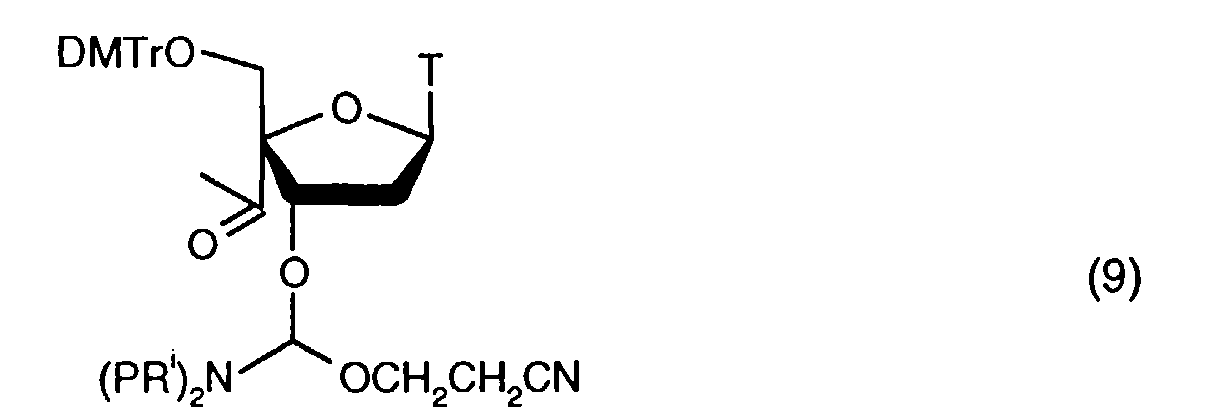
- IR (KBr): 3447, 3059, 2967, 2931, 1700, 1654, 1509, 1509, 1466, 1252, 1179, 1032, 831.
- 1H-NMR (CDCl3), mixture of diastereomers: 1.25 (m, CH(CH 3)2, CH3―C(5)), 2.45 (m, H-C(2'), CH2CN, CH3―C(O)), 3.60 (m, CH2―OP, CH―N, H―C(5'), CH3O), 4.76 (m, H―C(3')), 6.66 (m, H―C(1')), 6.85 (m, Harom), 7.31 (m, Harom), 7.58 and 7.60 (d, J=1.0, H―C(6)).
- 13C-NMR (CDCl3), mixture of diastereomers: 11.7 (CH3―C(5)), 20.3-20.5 (CH2CN), 24.3-24.7 (N(CH(CH3)2), 28.6 (CH3―C(O)), 39.7 (N(CH(CH3)2), 43.4 and 43.62 (2d, J a=12.4, J b=12.5, C(2')), 55.3 (CH3―O), 58.0 and 58.66 (2d, J a=20.4, J b=19.0, CH2―OP), 65.9 and 66.0 (C(5')), 76.8 (C(3')), 86.0 and 86.1 (C(1')), 87.6 (CAr3), 94.4 (d, J=5.8, C(4')), 111.5 (C(5)), 113.4 (C arom―ortho to OMe), 117.5 (CN), 127.3-144.0 (Carom, (C(6)), 150.3 (C(2)), 158.9 (Cipso― OMe), 163.8 (C(4)), 208.0 and 208.2 (CH3―C(O)).
- 31P-NMR (CDCl3), diastereomer a: 150.1, diastereomer b: 150.0.
- FAB-MS: 787 (2, [M+1]+). Anal. calc. for C42H51N4O9P•0.5 H2O (795.87):
C 63.32, H 6.52, N 7.00; found: C 62.97, H 6.50, N 6.85. - The synthesis of oligonucleotides of formula 10

- Cul (0.04 g, 0.20 mmol) is suspended in a solution of a compound of formula 5 (0.70 g, 1.12 mmol) in THF (50 ml) at -5°C and a 1 M solution of phenylmagnesium bromide (6.00 ml, 6.00 mmol) is added slowly. The reaction mixture is stirred for 2 h at - 5°C and for 1 h at 0°C. Then, a sat. aq. NH4Cl soln. (20 ml) is added, the water phase is extracted seven times with diethylether (50 ml each). The organic phase is dried over MgSO4 and evaporated in vacuo. Flash chromatography (ethyl acetate/pentane 1:2) yields 0.62g (79%) of a compound of formula 11 as a colorless foam.

- 1H-NMR (CDCl3): 0.17 (s, CH3―Si), 0.18 (s, CH3―Si), 0.97 (s, t-Bu―Si), 1.07 (s, t-Bu―Si), 1.57 (d, J=1.2, CH3―C(5)), 2.15 (m, H―C(2')), 2.34 (m, H―C(2')), 3.26 (d, J=11.1, H―C(5')), 3.46 (d, J=11.1, H―C(5')), 4.04 (d, J=2.7, OH), 4.82 (d, J=2.9, H―C(3')), 4.94 (dd, J=7.5, J=2.1, H-C(5')), 6.59 (dd, J=7.8, J=6.3, H―C(1')), 7.40 (m, C6H5 and H―C(6)), 8.6 (s, NH).
- 13C-NMR (CDCl3): -4.7 (CH3―Si), -4.2 (CH3―Si), 12.3 (CH3―C(5)), 18.2 ((CH3)3 C―Si) 19.9 ((CH3)3 C―Si), 26.0 ((CH3)3―C-Si), 27.4 ((CH3)3―C-Si), 42.5 (C(2')), 66.4 (C(5')), 75.6 (C(5')) 75.9 (C(3')), 85.5 (C(1')), 90.5 (C(4')), 111.3 (C(5)), 128.2-139.0 (C(6), Carom), 150.2 (C(2)), 163.6 (C(4)).
- FAB-MS: 701 (1.5, [M+1]+). Anal. calc. for C39H52N2O5Si2•0.25 H2O (703.51):
C 66.82, H 7.48, N 4.00; found: C 66.82, H 7.47, N 3.84. - 1,1,1-Triacetoxy-1,1-dihydro-1,2-benzodioxol-3(1H)-one (0.43 g, 1.02 mmol) is dissolved in CH2Cl2 (10 ml) and a solution of a compound of formula 11 (0.46 g, 0.66 mmol) in CH2Cl2 (5 ml) is added at 25°C. After stirring for 1 h the reaction mixture is poured in a mixture of a sat. aq. NaHCO3 soln. (10 ml) and a sat. aq. Na2S2O3 soln (60 ml, 1/1, v/v), extracted three times with diethylether (100 ml each), dried over MgSO4 and evaporated in vacuo to give 0.45 g (99%) of a compound of formula 12

- 1H-NMR (CDCl3): -0.06 (s, CH3―Si), 0.06 (s, CH3―Si), 0.74 (s, t-Bu―Si), 1.61 (d, J=1.2, CH3― C(5)), 2.33 (m, H―C(2')), 2.40 (m, H―C(2')), 4.21 (d, J=11.1, H―C(5')), 4.22 (d, J=11.1, H― C(5')), 4.64 (d, J=4.8, H―C(3')), 6.64 (dd, J=9.3, J=6.3, H―C(1')), 7.59 (m, H―C(6), Harom), 8.16 (s, NH).
- 13C-NMR (CDCl3): -5.2 (CH3―Si), -4.9 (CH3―Si), 12.0 (CH3―C(5)), 17.9 (Me3 C―Si), 19.4 (Me3 C―Si), 25.6 ((CH3)3―C-Si), 27.0 ((CH3)3―C-Si), 41.7 (C(2')), 68.4 (C(5')), 77.2 (C(3')), 86.5 (C(1')), 98.5 (C(4')), 110.9 (C(5)), 127.9-135.6 (C(6), Carom), 150.0 (C(2)), 163.4 (C(4)), 201.4 (C(5')).
- FAB-MS: 699 (2.6, [M+1]+). Anal. calc. for C39H50N2O6Si (698.32):
C 66.50, H 7.17, N 3.98; found: C 66.45, H 7.11, N 4.04. - To a solution of a compound of formula 12 (6.50 mg, 0.01 mmol) in THF (2 ml) a 1 M solution of TBAF (0.01 ml, 0.01 mmol) is added at 0°C. After stirring for 1 h at 0°C the reaction mixture is directly chromatographed (dichloromethane/methanol 16:1) to remove TBAF. After evaporation in vacuo, the residue is dissolved in THF (2 ml) and pyridinium polyhydrogen fluoride (0.07 ml, 70% HF) is added at 25°C. After stirring for 2 d the reaction mixture is poured onto a sat. aq. NaHCO3 soln. (25 ml), extracted four times with ethyl acetate (50 ml each), dried over MgSO4 and evaporated in vacuo. Flash chromatography (dichloromethane/methanol 16:1) gives 0.60 mg (18%) of a compound of formula 13.

- CeCl3 • 7 H2O (0.63 g, 1.70 mmol) is placed in a 100 ml three-necked flask and heated under stirring at 140°C in vacuo (0.1 Torr) for 10 h. After cooling to 0°C, THF (10 ml) is added and stirring is continued for 15 h. The mixture is then agitated at - 5°C for 10 min and a solution of aldehyde of formula 14 (Yang et al., Tetrahedron Lett. (1992), 33, 41)


- An alternative procedure to synthesize the compound of formula 15 is:
The aldehyde of formula 4 (2.00 g, 5.60 mmol) is dissolved in THF (80 ml) and cooled to -5°C. Cu (0.21 g, 1.10 mmol) is added to the resulting colorless solution, the mixture is agitated for 10 min and phenylmagnesium bromide (3.40 ml of a 1 M solution in THF, 3.40 mmol) is added. After stirring for 2 hours at -5°C the reaction mixture is hydrolyzed with a sat. NH4Cl soln. (100 ml) and extracted eight times with diethylether (100 ml each), dried over MgSO4 and evaporated in vacuo. Flash chromatography (methylene chloride/ethanol 20:1) gives 1.90 g (78%) of a diastereomeric mixture of the compound of formula 15 as a colorless foam. - 1H-NMH (CDCl3), diastereomer a: 0.02 (s, CH3―Si), 0.86 (s, CH3―Si), 1.92 (s, t-Bu―Si), 1.92 (s, CH3―C5), 2.13-2.21 (ddd, J=2.8, J=5.5, J=10.3, H―C(2b')), 2.30-2.39 (m, H―C(2a')), 3.43 (d, J=4.9, HO―C(5')), 4.08 (dd, J=3.3, J=3.8 H―C(4')), 4.52 (m, H―C(3')), 4.81 (dd, J=3.8, J=4.9, H―C(5')), 6.11 (dd, J=5.5, J=8.0, H―C(1')), 7.28-7.52 (m, Harom, H―C(6)), 9.24 (s, NH)) diastereomer b: 0.09 (s, CH3―Si), 0.10 (s, CH3―Si), 0.90 (s, t-Bu―Si), 1.01 (s, t-Bu―C), 1.93 (d, J=1.2, CH3―C(5)), 2.05-2.22 (m, H―C(2b')), 2.36-2.38 (m, H―C(2a')), 2.82-2.83 (m, HO― C(5')), 3.50 (m, H―C(5')), 4.07 (t, J=2.2, H―C(4')), 4.61 (dt, J=5.7, J=2.1, H―C(3')), 6.09 (dd, J=8.7, J=5.8, H―C(1')), 7.28-7.52 (m, Harom, H―C(6)), 8.22 (s, NH).
- 13C-NMR (CDCl3), diastereomer a: -4.7 (CH3―Si), -4.6 (CH3―Si), 12.5 (CH3―C(5)), 18.0 (Me3 C―Si), 26.5 ((CH3)3―C), 39.7 (C(2')), 74.3 (C(5')), 78.3 (C(3')), 86.2 (C(1')), 87.1 (C(4')), 111.0 (C(5)), 125.9-128.8 (Carom), 137.4 (C(6)), 150.6 (C(2)), 164.1 (C(4)), diastereomer b: - 4.9 (CH3―Si), -4.0 (CH3―Si), 12.4 (CH3―C(5)), 17.9 (Me3 C―Si), 25.7 ((CH3)3―C-Si), 40.7 (C(2')), 72.4 (C(5')), 80.5 (C(3')), 86.0 (C(1')), 88.7 (C(4')), 110.9 (C(5)), 125.9-128.8 (Carom), 136.9 (C(6)), 150.4 (C(2)), 163.95 (C(4)).
- FAB-MS: 433 (11, [M+1]+). Anal. calc. for C22H32N2O5Si (432.60):
C 61.08, H 7.46, N 6.48; found: C 60.76, H 7.70, N 6.48. - To a solution of trifluoroacetic anhydride (0.30 ml, 2.23 mmol) in CH2Cl2 (5 ml), DMSO (0.30 ml, 4.14 mmol) in CH2Cl2 (4 ml) is added dropwise at -60°C. The mixture is stirred for 30 min at -60°C. Then, a solution of compound of formula 15 (0.27 g, 0.62 mmol) in CH2Cl2 (10 ml) is added slowly. Agitation for one hour at -60°C is followed by the addition of NEt3 (0.5 ml, 165 mmol). The reaction mixture is diluted with CH2Cl2 (20 ml) hydrolyzed with a sat. aq. NaHCO3 soln. (50 ml), extracted four times with CH2Cl2 (75 ml each), dried over MgSO4 and evaporated in vacuo. Flash chromatography (pentane/ether/dichloromethane 3:3:4) yields 0.23 g (85%) of a compound of formula 16 as a colorless foam.

- IR (KBr): 3325, 3185, 3065, 2954, 2923, 2855, 1695, 1471, 1278, 1218, 1133, 1085, 982, 837, 777, 692.
- 1H-NMR (CDCl3): 0.07 (s, CH3―Si), 0.08 (s, CH3―Si), 0.95 (s, t-Bu―Si), 2.02 (s, CH3―C(5)), 2.01 (ddd, J=3.5, J=5.5, J=11.6, H-C(2b')), 2.35 (dd, J=5.4, J=11.6, H―C(2a')), 4.57 (d, J=5.4, H―C(3')), 5.45 (d, J=1.4, H―C(4')), 6.59 (dd, J=5.4, J=8.8, H―C(1')), 7.55 (t, J=7.7, m-Harom), 7.68 (t, J=7.1, p-Harom), 8.02 (d, J=7.2, o-Harom), 8.23 (s, H―C(6)).
- 13C-NMR (CDCl3): -4.99 (CH3―Si), -4.64 (CH3―Si), 12.69 (CH3―C(5)), 17.83 (Me3 C―Si), 25.60 ((CH3)3―C-Si), 39.99 (C(2')), 74.63 (C(3')), 86.12 (C(1')), 87.60 (C(4')), 111.2 (C(5)), 128.5-134.5 (Carom), 136.2 (C(6)), 150.4 (C(2)), 163.8 (C(4)), 197.0 (PhCO). FAB-MS: 431 (31, [M+1]+). Anal. calc. for C22H30N2O5Si (430.57): C 61.37, H 7.02, N 6.51; found: C 61.05, H 7.12, N 6.36.
- A solution of the compound of formula 16 (0.15 g, 0.36 mmol) in THF (10 ml) is treated with a 1 M solution of TBAF (0.40 ml, 0.40 mmol) in THF at 0°C. After stirring for 45 min at 0°C the reaction mixture is directly chromatographed without previous work up. Flash chromatography (dichloromethane/methanol 20:1) gives 0.10 g (89%) of a compound of formula 17 as a colorless foam.

- IR (KBr): 3325, 3185, 3065, 2954, 2923, 2855, 1695, 1471, 1278, 1218, 1133, 1085, 982, 837, 777, 692.
- 1H-NMR (CDCl3+10% CD3OD): 1.93 (ddd, J=2.8, J=5.0, J=13.6, H―C(2b')), 2.01 (s, CH3― C(5)), 2.42 (dd, J=5.2, J=13.6, H―C(2a')), 4.59 (d, J=5.0, H―C(3')), 5.52 (d, J=1.1, H―C(4')), 6.58 (dd, J=5.0, J=9.3, H―C(1')), 7.55 (dd, J=7.3, J=7.6, m-Harom), 7.67 (t, J=7.4, p-Harom), 8.07 (d, J=7.2, o-Harom), 8.37 (s, H―C(6)).
- 13C-NMR (CDCl3 +10% CD3OD): 12.27 (CH3―C(5)), 39.04 (C(2')), 73.47 (C(3')), 86.02 (C(1')), 87.45 (C(4')), 111.0 (C(5)), 128.1-134.3 (Carom), 136.6 (C(6)), 150.1 (C(2)), 164.5 (C(4)), 197.1 (PhCO).
- FAB-MS: 317 (15, [M+1]+). Anal. calc. for C16H16N2O5 (316.32):
C 60.75, H 5.10, N 8.86; found: C 61.19, H 5.48, N 8.55. - Ba(OH)2•8 H2O (0.12g, 0.68 mmol) is suspended in a solution of a compound of formula 17 (0.18 g, 0.56 mmol) in dioxane/water 10:1 (3.6 ml). After addition of a 36% aq. form-aldehyde soln. (0.30 ml, 3.60 mmol), the mixture is sonicated for 30 sec (sonication bath). Stirring at 25°C is continued for 1 h. Then, the reaction mixture is frozen with liquid N2 and lyophylized in vacuo. Flash chromatography of the white residue (dichloromethane/methanol 20:1) gives 38 mg (22 %) of a compound of formula 19 and 126 mg (73%) of the mixture of compounds of formulae 18:13 (2.5:1) as colorless crystals.

- Prep. HPLC (Knauer, RP-18, 7µm; length 250mm, diameter 15mm; flow: 6ml/min; H2O/CH3CN = 81:19) gives 38 mg compound of formula 13 (22%) and 72 mg compound of formula 18 (42%) as colorless crystals.
-
- IR (KBr): 3442, 3065, 2935, 1692, 1633, 1512, 1141, 1042, 953, 752.
- 1H-NMR (CDCl3 + 10% CD3OD):1.92 (s, CH3―C(5)), 2.39 (ddd, J=1.5, J=5.6, J=9.0, H-C(2b')), 2.47 (ddd, J=4.0, J=5.2, J=9.0, H―C(2a')), 3.96 (d, J=11.6, H―C(5b')), 4.06 (d, J=11.6, H―C(5a')), 4.94 (m, H―C(3')), 6.46 (dd, J=4.0, J=5.6, H―C(1')), 7.45 (t, J=7.9, m-Harom), 7.51 (t, J=6.7, p-Harom), 7.82 (s, H―C(6)), 7.92 (d, J=7.2, o-Harom). NOE (1H-NMR DMSO-d 6): (irradiated H → affected H; ++ = strong, + = medium, (+) = weak): H―C(6)→H―C(5')(+) and H―C(1')(++); o-Harom→H―C(5')(+) and H―C(1')((+)); H―C(1')→ o-Harom(+) and H―C(6)(+); H―C(3')→H-C(5')(+); H―C(5')→o-H-Ph(+) and H―C(6)(+) and H―C(3'); H―(C2'a)→H―C(6)(+).
- 13C-NMR (CDCl3 + 10% CD3OD): 12.35 (CH3―C(5)), 40.07 (C(2')), 65.31 (C(5')), 74.19 (C(3')), 85.12 (C(1')), 97.67 (C(4')), 109.6 (C(5)), 127.8-136.1 (Carom), 138.3 (C(6)), 150.5 (C(2)), 163.7 (C(4)), 202.3 (PhCO).
- FAB-MS: 347 (33, [M+1]+). Anal. calc. for C17H18N2O6·0.75 H2O (359.85):
C 56.67, H 5.60, N 7.78; found: C 56.61, H 5.54, N 7.74. -
- IR (KBr): 3454, 3041, 2899, 1701, 1687, 1537, 1049, 953, 752, 672.
- 1H-NMR (DMSO-d 6): 1.36 (s, CH3―C(5)), 2.03 (m, H―C(2b'), H―C(2a')), 3.84 (dd, J=3.3, J=11.6, H―C(5b')), 4.00 (dd, J=4.9, J=11.6, H―C(5a')), 4.75 (m, H―C(3')), 5.13 (m, OH), 5.75 (m, -OH), 6.39 (dd, J=6.2, J=8.5, H―C(1')), 6.59 (s, H―C(6)), 7.44 (t, J=7.9, m-Harom), 7.56 (t, J=7.3, p-Harom), 7.92 (d, J=7.1, o-Harom), 11.2 (s, -NH-).
- NOE (1H-NMR DMSO-d 6): (irradiated H → affected H; ++ = strong, + = medium, (+) = weak): o-Harom→H―C(6)(+); H―C(6)→H―C(3')(+) and o-Harom((+)) and H―C(1')(++); H―C(1')→H-C(5')((+)); H―C(3')→H-C(6)((+)); H-C(5')→o-Harom. (+) and H―C(1')((+)) and HO―C(3')(+).
- 13C-NMR (DMSO-d 6):12.07 (CH3―C(5)), 38.22 (C(2')), 64.65 (C(5')), 74.45 (C(3')), 84.92 (C(1')), 97.00 (C(4')), 108.9 (C(5)), 127.7-135.7 (Carom), 138.8 (C(6)), 150.5 (C(2)), 163.4 (C(4)), 203.7 (PhCO).
- FAB-MS: 347 (32, [M+1]+). Anal. calc. for C17H18N2O6•0.75 H2O (359.85):
C 56.67, H 5.60, N 7.78; found: C 56.55, H 5.68, N 7.71. -
- IR (KBr): 3418, 3066, 2929, 1685, 1596, 1279, 1104, 1052, 953, 786, 693.
- 1H-NMR (CDCl3 + 10% CD3OD):1.95 (s, CH3―C(5)), 2.06 (ddd, J=2.6, J=3.9, J=14.8, H― C(2b')), 2.49 (dd, J=5.8, J=14.8, H―C(2a')), 4.21 (d, J=11.8, H―C(5b')), 4.29 (d, J=11.8, H― C(5a')), 4.94 (m, H―C(3')), 6.07 (dd, J=3.9, J=8.0, H―C(1')), 7.45 (dd, J=7.7, J=8.0, m-Harom), 7.56 (t, J=7.5, p-Harom), 7.95 (s, H―C(6)), 8.12 (d, J=7.2, o-Harom).
- NOE (1H-NMR DMSO-d 6): (irradiated H→affected H; ++ = strong, + = medium, (+) = weak): o-H arom →H―C(5')(+) and H―C(1')((+)); H―C(6)→H―C(5')(+) and H―C(1')(++); H―C(1')→ o-Harom (+) and H-C(6) (+); H―C(3')→o-Harom ((+)) and H―C(1') ((+)); H―C(5') → o-Harom (+) and H―C(6) ((+)); H―C(2'a)→H-C(5') (+).
- 13C-NMR (CDCl3 + 10% CD3OD):12.48 (CH3―C(5)), 40.07 (C(2')), 63.94 (C(5')), 72.36 (C(3')), 83.20 (C(1')), 98.19 (C(4')), 109.3 (C(5)), 128.1-136.2 (Carom), 136.8 (C(6)), 150.4 (C(2)), 163.6 (C(4)), 195.3 (PhCO).
- FAB-MS: 347 (59, [M+1]+). Anal. calc. for C17H18N2O6•0.75 H2O (359.85):
C 56.67, H 5.60, N 7.78; found: C 56.57, H 5.52, N 7.75. - Compound of formula 13 (38 mg, 0.109 mmol) is converted into 56 mg (80%) of a compound of formula 20 as described in example 6 and purified using flash chromatography (ethyl acetate/pentane/triethylamine 1:3:0.01).
- IR (KBr): 3392, 3059, 2954, 2835, 1685, 1607, 1508, 1465, 1446, 1278, 1251, 1177, 1074, 1033, 829, 696.

- 1H-NMR (CDCl3): 1.50 (s, CH3―C(5)), 2.40 (m, H―C(2'b), H―C(2'a)), 3.55 (d, J=9.9, H― C(5'b)), 3.69 (d, J=9.9, H―C(5'a)), 3.78 (s, CH3O), 4.75 (dd, J=1.9, J=3.6, H―C(3')), 6.51 (dd, J=5.7, J=8.8, H―C(1')), 6.79-7.45 (m, Harom), 7.50 (s, H―C(6)), 7.96 (d, J=6.2, o-Harom).
- 13C-NMR (CDCl3): 11.86 (CH3―C(5)), 39.08 (C(2')), 55.22 (CH3―O), 67.61 (C(5')), 75.55 (C(3')), 85.81 (C(1')), 87.95 (CAr3), 95.92 (C(4')), 111.4 (C(5)), 113.3 (C arom―ortho to OMe), 127.2-143.8 (Carom), 135.4 (C(6)), 150.2 (C(2)), 158.7 (C ipso―OMe), 163.6 (C(4)), 202.8 (PhCO).
- FAB-MS: 648 (1.7, [M+1]+). Anal. calc. for C38H36N2O8•0.5 H2O (657.72):
C 69.12, H 5.62, N 4.26; found: C 69.02, H 5.55, N 4.18. - The compound of formula 20 (50 mg, 0.077 mmol) is converted into 50 mg (76%) of a compound of formula 21 as described in example 7 and purified using flash chromatography (ethyl acetate/pentane/triethylamine 2:1:0.01).

- IR (KBr) mixture of diastereomers: 3177.8, 3066.7, 2966.7, 1686.3, 1605.6, 1511.1, 1466.7, 1250.0, 1177.8, 1122.2, 1072.2, 1033.3, 827.8, 755.6, 700.0.
- 1H-NMR (CDCl3), diastereomer a: 1.17 (m, CH(CH 3)2), 1.48 (s, CH3―C(5)), 2.42 (m, CH2CN), 2.65 (dd, J=5.0, J=13.2, H―C(2b'), 2.78 (dd, J=3.7, J=13.2, H―C(2a'), 3.45 (m, CH2―OP, CH―N, H―C(5'), CH3O), 4.90 (dd, J=4.6, J=8.8, H―C(3')), 6.60 (dd, J=3.7, J=5.0, H―C(1')), 6.83 (m, Harom), 7.12-7.52 (m, Harom), 7.66 (s, H―C(6)), 7.82 (d, J=7.1, o-Harom), 8.67 (s, NH), diastereomer b: 1.17 (m, CH(CH 3)2), 1.55 (s, CH3―C(5)), 2.37 (m, CH2CN, H―C(2'), 3.61 (m, CH2―OP, CH―N, H―C(5'), CH3O), 5.00 (dd, J=4.1, J=11.9, H―C(3')), 6.68 (dd, J=2.3, J=7.7, H―C(1')), 6.75 (m, Harom), 7.14-7.61 (m, Harom), 7.62 (s, H―C(6)), 8.09 (d, J=7.3, o-Harom), 8.67 (s, NH).
- 13C-NMR (CDCl3). diastereomer a: 11.70 (CH3―C(5)), 20.19 (d, J=7.1, CH2CN), 24.13 (d, J=7.0, N(CH(CH3)2), 24.29 (d, J=7.0, N(CH(CH3)2), 43.54 (d, J=12.5, N(CH(CH3)2), 47.64 (d, J=7.0, C(2')), 55.24 (CH3―O), 58.50 (d, J=18.9, CH2―OP), 67.33 (C(5')), 77.50 (d, J=18.9, C(3')), 85.83 (C(1')), 87.69 (CAr3), 96.21 (d, J=6.1, C(4')), 112.9 (C(5)), 113.3 (Carom ortho to OMe), 117.5 (CN), 127.1-143.9 (Carom), 135.7 (C(6)), 150.2 (C(2)), 158.7 (C ipso―OMe), 163.7 (C(4)), 199.5 (Ph-CO), diastereomer b: 12.35 (CH3―C(5)), 19.94 (d, J=7.8, CH2CN), 24.18 (d, J=7.2, N(CH(CH3)2), 24.39 (d, J=7.2, N(CH(CH3)2), 43.49 (d, J=12.9, N(CH(CH3)2), 47.41 (d, J=7.2, C(2')), 55.18 (CH3-O), 58.35 (d, J=19.1, CH2―OP), 67.33 (C(5')), 77.47 (d, J=19.2, C(3')), 85.65 (C(1')), 87.69 (CAr3), 96.52 (d, J=6.3, C(4')), 111.1 (C(5)), 113.3 (Carom ortho to OMe), 117.5 (CN), 127.1-143.9 (Carom), 135.6 (C(6)), 150.1 (C(2)), 158.4 (C ipso― OMe), 163.8 (C(4)), 200.1 (Ph-CO).
- 31P-NMR (CDCl3), diastereomer a: 149.8, diastereomer b: 149.4.
- FAB-MS mixture of diastereomers: 849 (1.1, [M+1]+). Anal. calc. for mixture of diastereomers C47H53N4O9P·H2O (866.49):
C 65.60, H 6.39, N 6.46; found: C 65.57, H 6.42, N 6.61. - To a solution of a compound of formulas (62 mg, 0.10 mmol) in THF (2 ml) a 1.5 M solution of EtMgBr (0.3 ml, 0.45 mmol) in ether is added at -78°C. After stirring for 1.5 h at - 78°C a sat. aq. NH4Cl soln. is added (20 ml) and extracted three times with CH2Cl2 (50/20/20 ml). The combined organic phases are washed with water (20 ml), dried over MgSO4, and evaporated in vacuo. Flash-chromatography (pentane : acetone 3:1) yields 41 mg (63 %) diastereomer a of formula 22 as a colorless glass. Diastereomer b is obtained as a mixture with an Isomer, where the TBDMS group has moved from the 3'-position (12 mg, 18 %, ratio (22) : Isomer= 1 : 2).

- IR (KBr): 3323, 3233, 3074, 2954, 2931, 2893, 2857, 1718, 1702, 1683, 1472, 1428, 1273, 1205, 1086, 1036, 832, 778, 710, 700, 505.
- 1H-NMR (CDCl3): diastereomer a: 0.12 (s, CH3―Si), 0.16 (s, CH3―Si), 0.93 (s, t-Bu―Si), 0.96 (t, J=7.2, CH3), 1.10 (s, t-Bu―Si), 1.20 (m, CH 2(a)―CHOH), 1.54 (d, J=1.2, CH3―C(5)), 1.66 (m, CH 2(b)―CHOH), 2.30 (m, H―C(2a')), 2.38 (ddd, J=3.9, J=6.3, J=13.4, H―C(2b')), 2.80 (dd, 4 J=1.2, J=4.1, OH), 3.78 (ddd, J=2.0, J=4.1, J=10.8, H―COH), 3.96 (d, J=11.4, H― C(5a')), 4.10 (d, J=11.4, H―C(5b')), 4.81 (dd, J=3.9, J=6.3, H―C(3')), 6.31 (dd, J=6.3, J=7.3, H―C(1')), 7.42 (m, Harom, H―C(6)), 7.65 (m, Harom), 8.96 (s, NH). diastereomer b: 0.09 (s, CH3―Si), 0.13 (s, CH3―Si), 0.91 (s, t-Bu―Si), 0.94 (t, J=7.2, CH3), 1.09 (s, t-Bu―Si), 1.40 (m, CH 2―CHOH), 1.57 (s, CH3―C(5)), 2.30 (m, H―C(2')), 3.03 (dd, J=1.5, J=2.9, OH), 3.67 (d, J=11.0, H―C(5a')), 3.85 (d, J=11.2, H―C(5b')), 3.95 (m, H―COH), 4.75 (dd, J=2.7, J=6.8, H― C(3')), 6.45 (dd, J=6.1, J=8.1, H―C(1')), 7.40 (m, Harom, H―C(6)), 7.64 (m, Harom), 8.46 (s, NH).
- 13C-NMR (CDCl3), diastereomer a: -5.1 (CH3―Si), -4.4 (CH3―Si), 11.3 (CH3―CH2), 11.9 (CH3―C(5)), 17.8 (Me3 C―Si), 19.4 (Me3 C―Si), 23.7 (CH2―CHOH), 25.7 ((CH3)3―C-Si), 27.1 ((CH3)3-C-Si), 41.5 (C(2')), 63.6 (C(5')), 73.5, 73.8 (Et-CHOH, C(3')), 83.4 (C(1')), 89.4 (C(4')), 111.3 (C(5)), 127.9, 128.0 (m-Carom), 130.0, 130.2 (p-Carom), 132.3, 132.9 (i-Carom), 135.1 (C(6)), 135.2, 135.4 (o-Carom), 150.3 (C(2)), 163.7 (C(4)).
- FAB-MS: 653 (3, [M+1]+).
- 1,1,1-Triacetoxy-1,1-dihydro-1,2-benzodioxol-3(1H)-one (156 mg, 2.12 mmol) and the compound of formula 22 (diastereomer a, 96 mg, 0.15 mmol) are dissolved in CH2Cl2 (5 ml) at 25°C. After stirring for 1 h the reaction mixture is poured in a mixture of a sat. aq. NaHCO3 soln. (10 ml) and a sat. aq. Na2S2O3 son. (10 ml), extracted three times with tert-butyl methyl ether (20 ml each), dried over MgSO4, and evaporated in vacuo. Flash chromatography (acetone/pentane 1:3) gives 75 mg (78 %) of compound (23) as a colorless foam.

- IR (KBr): 3414, 3192, 3072, 2955, 2931, 2886, 2858, 1718, 1700, 1472, 1428, 1279, 1254, 1114, 1076, 1035, 958, 834, 779, 703, 505.
- 1H-NMR (CDCl3): -0.03 (s, CH3―Si), 0.03 (s, CH3―Si), 0.84 (s, t-Bu―Si), 0.96 (t, J=7.1, CH2― CH 3), 1.10 (s, t-Bu―Si), 1.59 (s, CH3―C(5)), 2.28 (m, H―C(2')), 2.58 (qd, J=7.1, J=19.4, CH2(a)―C(O)), 2.82 (qd, J=7.1, J=19.4, CH2(b)―C(O)), 3.94 (d, J=11.2, H―C(5'a)), 4.11 (d, J=11.2, H―C(5'b)), 4.49 (d, J=3.6, H―C(3')), 6.65 (dd, J=5.7, J=8.9, H―C(1')), 7.42 (m, Harom), 7.63 (m, H―C(6), Harom), 9.05 (s, NH).
- 13C-NMR (CDCl3): -5.3 (CH3―Si), -5.2 (CH3―Si), 6.6 (CH3―CH2), 12.0 (CH3―C(5)), 17.9 (Me3 C―Si), 19.4 (Me3 C―Si), 25.6 ((CH3)3―C-Si), 27.0 ((CH3)3―C-Si), 33.6 (CH2―C(O)), 41.6 (C(2')), 67.0 (C(5')), 76.0 (C(3')), 86.2 (C(1')), 96.5 (C(4')), 111.3 (C(5)), 128.0, 128.1 (m-Carom), 130.1, 130.3 (p-Carom), 132.0, 132.6 (i-Carom), 135.26 (C(6)), 135.31, 135.5 (o-Carom), 150.3 (C(2)), 163.8 (C(4)), 210.8 (Et-C(O)).
- FAB-MS: 651 (3, [M+1]+). Anal. calc. for C35H50N2O6Si2 (650.97):
C 64.58, H 7.74, N 4.30; found: C 64.46, H 7.61, N 4.11. - To a solution of compound 23 (0.23 g, 0.35 mmol) in THF (15 ml) a 1M solution of tetrabutylammonium fluoride (TBAF) (0.9 ml, 0.9 mmol) is added at 25°C and stirred for 5 h. Then, silica gel (5 g) is added to the reaction mixture and the solvent is evaporated in vacuo. Flash chromatography (ethyl acetate/acetonitrile 4:1), removing of the solvent in vacuo, dissolving in water and lyophylization gives 72 mg (67%) of compound of formula 24 as a colorless foam.

- IR (KBr): 3412, 3063, 2979, 2939, 1700, 1474, 1406, 1376, 1115, 1047, 962, 779, 572.
- 1H-NMR (CD3OD): 0.99 (t, J=7.2, CH2―CH3), 1.89 (d, J=1.2, CH3―C(5)), 2.30 (m, H―C(2')), 2.68 (m, CH2―C(O)), 3.84 (d, J=11.7 H―C(5'a)), 3.89 (d, J=11.7 H―C(5'b)), 4.46 (m, H― C(3')), 6.57 (dd, J=6.1, J=8.5, H―C(1')), 7.85 (d, J=1.2, H―C(6)).
- 13C-NMR (CD3OD): 7.3 (CH2―CH3), 12.5 (CH3―C(5)), 34.8 (CH2―(O)), 41.2 (C(2')), 65.6 (C(5')), 75.5 (C(3')), 87.8 (C(1')), 98.0 (C(4')), 112.0 (C(5)), 138.2 (C(6)), 152.5 (C(2)), 166.6 (C(4)), 214.3 (CH3―C(O)).
- FAB-MS: 299 (31, [M+1]+). Anal. calc. for C13H18N2O6•0.35 H20 (304.61):
C 51.26, H 6.19, N 9.20, O 33.35; found: C 51.13, H 6.24, N 9.05, O 33.05. - The triposphates of the modified nucleotides are synthesized as described by Kovács & Ötvös (Tetrahedron Lett. (1988), 29, 4525-2528)
- 5' P32-GTGGTGCGAATTCTGTGGAT-OH SEQ ID NO:1
- 3' HO-CACCACGCTTAAGACACCTAGTCGTTCCTACTTGCTGGCT-OH SEQ ID NP:2
- A solution of template (3.0 pmol of SEQ ID NO:2) and radioactive primer (0.8 pmol of SEQ ID NO:1) in 72 µl buffer (20 mM Tris-HCl, pH 7.5; 6 mM MgCl2; 40 mM KCl; 0.5 mM DTT) are heated to 80°C and allowed to cool down to 25°C within one hour. To this solution polymerase (see table 1) is added. Aliquots of thereof are mixed with 4 µl of a solution comprising dATP, dGTP, dCTP and the modified nucleotide (see table 1), resulting in a final concentration of dATP, dGTP and dCTP as provided in table 1 and a final concentration of the modified nucleotide of 100 µM. The solutions are incubated at 37°C and the elongation reaction is stopped by addition of 5 µl of a solution of formamide comprising 5 mM EDTA (pH 8.0).
Table 1 Enzyme Amount of enzyme Buffer Concentration of dATP, dGTP, dCTP Klenow 1.5 units 10 mM Tris-HCl (pH 7.5), 5 mM MgCl2, 7.5 mM DTT 0.5 µM each T7 sequenase version 2 0.13 units 40 mM Tris-HCl (pH 7.5), 20 mM MgCl2, 50 mM NaCl 2.5 µM each AMV RT 2.0 units 50 mM Tris-HCl (pH 8.3), 8 mM MgCl2, 30 mM KCl 0.5 µM each M-MuLV RT 9 units 50 mM Tris-HCl (pH 8.3), 8 mM MgCl2, 10 mM DTT 15.0 µM each HIV-1RT 0.13 units 20 mM Tris-HCl (pH 7.5), 6 mM MgCl2, 40 mM KCl, 0.5 mM DTT 1.0 µM each - 3-5 µl of these solutions are subjected to a polyacrylamide gel (19 % acrylamide, 7 M urea). After electrophoresis the gel is transferred to a filter paper, dried and analyzed using autoradiography (see table 2).
Table 2 25, modified nucleotide Klenow T7 sequenase version 2 AMV RT M-MuLV RT HIV-1RT R1=CH3 ++ ++ ++ ++ ++ and elongation R1=CH3CH2 + ++ ++ ++ ++ R1=C6H5 - - ++ - ++ R1=t-butyl - - - - - + = slow addition of modified nucleotide to the primer
++ = good addition of modified nucleotide to the primer
- = no addition of modified nucleotide to the primer
- A solution of template (3.0 pmol of SEQ ID NO:2) and radioactive primer (0.8 pmol of SEQ ID NO:1) in 72 µl buffer (20 mM Tris-HCl, pH 7.5; 6 mM MgCl2; 40 mM KCl; 0.5 mM DTT) are heated to 80°C and allowed to cool down to 25°C within one hour. To this solution 2.4 units of HIV-1 RT (24 µl of a 0.1 units/µl solution in 20 mM Tris-HCl (pH 7.5), 1 mM EDTA (pH 8.0), 1 mM DTT, 15 % Glycerol, 0,2 % Bovine serum albumin) is added. The solution is added to 64µl of a solution comprising dATP, dGTP, dCTP and the modified nucleotide 25 wherein R1 is CH3, resulting in a final concentration of dATP, dGTP and dCTP of 1.25 µl each and a final concentration of the modified nucleotide of 100 µM. After 4 h 160 µl of a 5 M NH4OCOCH3 solution and 1000 µl ethanol are added an cooled at -20°C for 1 h. The solution is centrifuged at 20800g, the supernatant is decanted and the residue resolved in 200 µl buffer (100 mM NaCl, 1 mM phosphate-buffer (pH 7.0), 0.01 mM EDTA).
- The solution is irradiated at 15°C (Osram Hochdrucklampe, 500 W, 295 nm filter). After irradiation for 40 min. 20 µl 3M NaOCOCH3 and 800 µl ethanol are added at - 20°C for 1h. The solution is centrifuged at 20800 g, the supernatant decanted and the residue resolved in 100 µl buffer (10mM Tris-HCl, pH 8.3). A 5 gl aliquot of this solution is mixed with 5 µl of a solution of formamide comprising 5 mM EDTA (pH 8.0) and loaded on a gel as described above. The autoradiogram shows the complete cleavage of the enzymatically synthesized oligonucleotides.





Claims (34)
- A compound of formula 1 or 2
 R1 is CH3, C2H5, CH2X, CHX2, CX3, C(O)H, C(O)C1-C4alkyl, CH2OH, CH2-O-C1-C4alkyl, CH2-O-phenyl, phenyl, or phenyl substituted with nitro or X;R2 is OR7, mono-, di-, or triphosphate, or esters or prodrugs thereof;
one of the residues R3 and R3is a purine or pyrimidine residue or an analogue thereof, and the other is hydrogen; R4 and R5 are independent of one another H, OR7, O-C1-C4alkylNHR7, O-C1-C4alkylNR7 2, -O-(CH2-CH2-O)1-4R7 or -O-CH2-C(OR7)H-CH2-OR7;R6 is H, OH, CH2OH, CH3, CH2CH3, CH2CH2OH;R7 is H or an NH or OH-protecting group;R8 is H or an OH-protecting group;X is F, Cl, Br or I;
or a pharmaceutically acceptable salt or prodrug thereof. - A compound according to claim 1, wherein R1 is CH3, C2H5, CF3, CH3OH, CH3-O-CH3, phenyl and phenyl substituted with nitro.
- A compound according to claim 1, wherein R1 is CH3, C2H5 phenyl.
- A compound according to claim 1, wherein R1 is CH3.
- A compound according to claim 1, wherein R2 is mono-, di-, or triphosphate; or HO.
- A compound according to claim 1, wherein one of the residues R3 and R3is adenine, inosine, N-methyladenine, N-benzoyladenine, 2-methylthioadenine, 2-aminoadenine, 6-hydroxypurine, 2-amino-6-chloro purine, 2-amino-6-methylthiopurine, guanine, N-isobutyrylguanine, uracil, thymine, cytosine, 5-fluorouracil, 5-chlorouracil, 5-bromouracil, dihydrouracil and 5-methylcytosine; or their base-protected derivatives; and the other residue is hydrogen.

- A compound according to claim 1, wherein one of the residues R3 and R3is adenine, inosine, guanine, uracil, thymine or cytosine; and the other residue is hydrogen.
- A compound according to claim 1, wherein one of the residues R3 and R3is thymine; and the other residue is hydrogen.
- A compound according to claim 1, wherein R4 and R5 are independent of one another H, or OR7.
- A compound according to claim 1, wherein R4 is OH.
- A compound according to claim 1, wherein R5 is H.
- A compound according to claim 1, wherein R6 is H, OH or CH2OH.
- A compound according to claim 1, wherein R7 is H or C1-C4alkyl.
- A compound according to claim 1, wherein R7 is H.
- A compound according to claim 1, wherein X is F or Cl.
- A compound according to claim 1, wherein X is F.
- A compound according to claim 1, which has formula 1.
- A compound according to claim 1, wherein R3is hydrogen
- Use of a compound according to claim 1 in a method of treatment.
- Use of a compound according to claim 1 in a method of treatment, wherein the active compound according to claim 1 is formed in vivo.
- Use of a compound according to claim 1 in a method of treatment of retro virus induced diseases.
- Use of a compound according to claim 1 in a method of treating AIDS.
- Use of a compound according to claim 1 in a method of inhibiting the proliferation of retro viruses.
- Use of a compound according to claim 1 in a method of inhibiting the proliferation of MMTV, MLV, spumavirus, HTLV, BLV, lentivirus, HIV, HSV and SIV.
- Use of a compound according to claim 1 in a method of inhibiting HIV.
- Pharmaceutical composition comprising a compound according to claim 1 optionally together with pharmaceutical acceptable carrier.
- Method for the preparation of a pharmaceutical composition according to claim 26.
- Use of the compound according to claim 1 for the inhibition of reverse transcriptase.
- Use of a compound according to claim 1 in a screen.
- Use of a compound according to claim 29 in a screen for the identification of the presence or absence of reverse transcriptase.
- Use of a compound according to claim 29 in a screen for the identification of HIV-1RT.
- Use of a compound according to claim 1 for the generation of photolytically cleavable DNA and RNA and analogues thereof.
- A photocleavable linker comprising a compound according to claim 1.
- Method for the synthesis of a compound according to claim 1.
Priority Applications (1)
| Application Number | Priority Date | Filing Date | Title |
|---|---|---|---|
| EP96810216A EP0799834A1 (en) | 1996-04-04 | 1996-04-04 | Modified nucleotides |
Applications Claiming Priority (1)
| Application Number | Priority Date | Filing Date | Title |
|---|---|---|---|
| EP96810216A EP0799834A1 (en) | 1996-04-04 | 1996-04-04 | Modified nucleotides |
Publications (1)
| Publication Number | Publication Date |
|---|---|
| EP0799834A1 true EP0799834A1 (en) | 1997-10-08 |
Family
ID=8225582
Family Applications (1)
| Application Number | Title | Priority Date | Filing Date |
|---|---|---|---|
| EP96810216A Withdrawn EP0799834A1 (en) | 1996-04-04 | 1996-04-04 | Modified nucleotides |
Country Status (1)
| Country | Link |
|---|---|
| EP (1) | EP0799834A1 (en) |
Cited By (7)
| Publication number | Priority date | Publication date | Assignee | Title |
|---|---|---|---|---|
| WO2002100415A3 (en) * | 2001-06-12 | 2003-08-07 | Hoffmann La Roche | 4'-substituted nucleosides for the treatment of diseases mediated by the hepatitis c virus |
| WO2005026374A2 (en) | 2003-09-14 | 2005-03-24 | Noxxon Pharma Ag | Method for synthesizing nucleic acids, and application thereof |
| WO2007082713A1 (en) * | 2006-01-18 | 2007-07-26 | Novartis Ag | Oligonucleotide synthesis using photocleavable linkers |
| US8871737B2 (en) | 2010-09-22 | 2014-10-28 | Alios Biopharma, Inc. | Substituted nucleotide analogs |
| US8916538B2 (en) | 2012-03-21 | 2014-12-23 | Vertex Pharmaceuticals Incorporated | Solid forms of a thiophosphoramidate nucleotide prodrug |
| US8980865B2 (en) | 2011-12-22 | 2015-03-17 | Alios Biopharma, Inc. | Substituted nucleotide analogs |
| US9012427B2 (en) | 2012-03-22 | 2015-04-21 | Alios Biopharma, Inc. | Pharmaceutical combinations comprising a thionucleotide analog |
Citations (4)
| Publication number | Priority date | Publication date | Assignee | Title |
|---|---|---|---|---|
| DE2244215A1 (en) * | 1971-09-10 | 1973-03-15 | Abbott Lab | ADENOSINE 5'-CARBOXYLATE DERIVATIVES |
| EP0222330A2 (en) * | 1985-11-06 | 1987-05-20 | Warner-Lambert Company | N6-Substituted-5'-oxidized adenosine analogs |
| EP0515156A1 (en) * | 1991-05-21 | 1992-11-25 | Biochem Pharma Inc | Processes for the diastereo-selective synthesis of nucleosides |
| US5192749A (en) * | 1990-05-21 | 1993-03-09 | Syntex (U.S.A.) Inc. | 4'-substituted nucleosides |
-
1996
- 1996-04-04 EP EP96810216A patent/EP0799834A1/en not_active Withdrawn
Patent Citations (4)
| Publication number | Priority date | Publication date | Assignee | Title |
|---|---|---|---|---|
| DE2244215A1 (en) * | 1971-09-10 | 1973-03-15 | Abbott Lab | ADENOSINE 5'-CARBOXYLATE DERIVATIVES |
| EP0222330A2 (en) * | 1985-11-06 | 1987-05-20 | Warner-Lambert Company | N6-Substituted-5'-oxidized adenosine analogs |
| US5192749A (en) * | 1990-05-21 | 1993-03-09 | Syntex (U.S.A.) Inc. | 4'-substituted nucleosides |
| EP0515156A1 (en) * | 1991-05-21 | 1992-11-25 | Biochem Pharma Inc | Processes for the diastereo-selective synthesis of nucleosides |
Non-Patent Citations (4)
| Title |
|---|
| C.M.RICHARDS ET AL.: "Synthesis of 4'-Methoxyadenosine and Related Compounds", CARBOHYDRATE RESEARCH, vol. 100, 1982, AMSTERDAM NL, pages 315 - 329, XP002011882 * |
| C.O-YANG ET AL.: "4'-Substituted Nucleosides as Inhibitors of HIV : An Unusual Oxetane Derivative.", TETRAHEDRON LETTERS, vol. 33, no. 1, 1992, OXFORD GB, pages 41 - 44, XP002011885 * |
| E.DIEKMANN ET AL.: "Didesoxy-Ribonucleoside durch Schmelzkondensation.", JOURNAL FÜR PRAKTISCHE CHEMIE CHEMIKER-ZEITUNG, vol. 335, 1993, pages 415 - 424, XP002011883 * |
| J.J.BAKER ET AL.: "Thymidine 5' Variants as Inhibitors of Thymidylate Kinase", JOURNAL OF MEDICINAL CHEMISTRY, vol. 17, no. 7, July 1974 (1974-07-01), WASHINGTON US, pages 764 - 766, XP002011884 * |
Cited By (18)
| Publication number | Priority date | Publication date | Assignee | Title |
|---|---|---|---|---|
| CZ306042B6 (en) * | 2001-06-12 | 2016-07-13 | Riboscience Llc | Medicament for the treatment of hepatitis C virus-mediated diseases |
| US6784166B2 (en) | 2001-06-12 | 2004-08-31 | Syntex (U.S.A.) Llc | 4′-substituted nucleoside derivatives as inhibitors of HCV RNA replication. |
| WO2002100415A3 (en) * | 2001-06-12 | 2003-08-07 | Hoffmann La Roche | 4'-substituted nucleosides for the treatment of diseases mediated by the hepatitis c virus |
| AU2002317782B2 (en) * | 2001-06-12 | 2007-11-22 | Riboscience Llc | 4'-substituted nucleosides for the treatment of diseases mediated by the hepatitis C virus |
| RU2322989C2 (en) * | 2001-06-12 | 2008-04-27 | Ф.Хоффманн-Ля Рош Аг | 4'-substituted nucleosides and pharmaceutical composition comprising thereof for preparing drug for treatment of hepatitis c virus (hcv)-mediated diseases |
| US7608601B2 (en) | 2001-06-12 | 2009-10-27 | Roche Palo Alto Llc | 4′-Substituted nucleoside derivatives as inhibitors of HCV RNA replication |
| US8071567B2 (en) | 2001-06-12 | 2011-12-06 | Roche Palo Alto Llc | 4′-substituted nucleoside derivatives as inhibitors of HCV RNA replication |
| WO2005026374A2 (en) | 2003-09-14 | 2005-03-24 | Noxxon Pharma Ag | Method for synthesizing nucleic acids, and application thereof |
| WO2005026374A3 (en) * | 2003-09-14 | 2005-11-10 | Noxxon Pharma Ag | Method for synthesizing nucleic acids, and application thereof |
| WO2007082713A1 (en) * | 2006-01-18 | 2007-07-26 | Novartis Ag | Oligonucleotide synthesis using photocleavable linkers |
| US9278990B2 (en) | 2010-09-22 | 2016-03-08 | Alios Biopharma, Inc. | Substituted nucleotide analogs |
| US8871737B2 (en) | 2010-09-22 | 2014-10-28 | Alios Biopharma, Inc. | Substituted nucleotide analogs |
| US8980865B2 (en) | 2011-12-22 | 2015-03-17 | Alios Biopharma, Inc. | Substituted nucleotide analogs |
| US9605018B2 (en) | 2011-12-22 | 2017-03-28 | Alios Biopharma, Inc. | Substituted nucleotide analogs |
| US8916538B2 (en) | 2012-03-21 | 2014-12-23 | Vertex Pharmaceuticals Incorporated | Solid forms of a thiophosphoramidate nucleotide prodrug |
| US9394330B2 (en) | 2012-03-21 | 2016-07-19 | Alios Biopharma, Inc. | Solid forms of a thiophosphoramidate nucleotide prodrug |
| US9856284B2 (en) | 2012-03-21 | 2018-01-02 | Alios Biopharma, Inc. | Solid forms of a thiophosphoramidate nucleotide prodrug |
| US9012427B2 (en) | 2012-03-22 | 2015-04-21 | Alios Biopharma, Inc. | Pharmaceutical combinations comprising a thionucleotide analog |
Similar Documents
| Publication | Publication Date | Title |
|---|---|---|
| US6833361B2 (en) | Nucleosides having bicyclic sugar moiety | |
| EP3904365B1 (en) | Chemical compounds | |
| US5672697A (en) | Nucleoside 5'-methylene phosphonates | |
| EP0980377B1 (en) | Anti-viral pyrimidine nucleoside analogues | |
| CA2421040C (en) | Methods for synthesizing nucleosides, nucleoside derivatives and non-nucleoside derivatives | |
| KR100279953B1 (en) | L-2 ', 3'-dideoxy nucleoside analogs as anti-hepatitis B virus and anti-human immunodeficiency virus agents | |
| US5969116A (en) | Nucleosides and oligonucleotides having 2'-ether groups | |
| US6403566B1 (en) | Nucleosides having bicyclic sugar moiety | |
| US6479651B1 (en) | Modified oligonucleotides, their preparation and their use | |
| AU2003217863B2 (en) | Nucleotide mimics and their prodrugs | |
| KR0155574B1 (en) | Back bone modified oligonucleotide analogs | |
| EP1013661B2 (en) | 2'-O,4'-C-methylene bicyclonucleosides | |
| CN1066456C (en) | Nucleosides and oligonucleotides having 2'-ether groups | |
| US5883237A (en) | Oligonucleotides having Rp and Sp linkages at predetermined locations | |
| US20020013287A1 (en) | Polymeric compounds useful as prodrugs | |
| US5631239A (en) | L-2',3'-dideoxy nucleoside analogs as anti-Hepatitis B (HBV) agents | |
| Azuma et al. | Nucleosides and nucleotides. 122. 2'-C-Cyano-2'-deoxy-1-. beta.-D-arabinofuranosylcytosine and its derivatives. A new class of nucleoside with a broad antitumor spectrum | |
| WO2003062255A2 (en) | Sugar modified nucleosides as viral replication inhibitors | |
| HU217036B (en) | A method for preparing compounds for inhibiting gene expression | |
| JPH05186495A (en) | Cyclic oligonucleotide phosphorothioate | |
| CZ295706B6 (en) | 5 -Deoxycytidine derivative, process for its preparation and pharmaceutical composition and kit containing thereof | |
| WO1990012022A1 (en) | Polynucleotide phosphorodithioates as therapeutic agents for retroviral infections | |
| Raju et al. | Synthesis and biological properties of purine and pyrimidine 5'-deoxy-5'-(dihydroxyphosphinyl)-. beta.-D-ribofuranosyl analogs of AMP, GMP, IMP, and CMP | |
| Herdewijn et al. | Nucleotides. Part. XXXII. Synthesis of 2′–5′ Connected oligonucleotides. Prodrugs for antiviral and antitumoral nucleosides | |
| US6143882A (en) | Urea nucleosides as therapeutic and diagnostic agents |
Legal Events
| Date | Code | Title | Description |
|---|---|---|---|
| PUAI | Public reference made under article 153(3) epc to a published international application that has entered the european phase |
Free format text: ORIGINAL CODE: 0009012 |
|
| AK | Designated contracting states |
Kind code of ref document: A1 Designated state(s): DE |
|
| STAA | Information on the status of an ep patent application or granted ep patent |
Free format text: STATUS: THE APPLICATION IS DEEMED TO BE WITHDRAWN |
|
| 18D | Application deemed to be withdrawn |
Effective date: 19980409 |