EP0799289B1 - Synthetic lubricant antioxidant from monosubstituted diphenylamines - Google Patents
Synthetic lubricant antioxidant from monosubstituted diphenylamines Download PDFInfo
- Publication number
- EP0799289B1 EP0799289B1 EP95937522A EP95937522A EP0799289B1 EP 0799289 B1 EP0799289 B1 EP 0799289B1 EP 95937522 A EP95937522 A EP 95937522A EP 95937522 A EP95937522 A EP 95937522A EP 0799289 B1 EP0799289 B1 EP 0799289B1
- Authority
- EP
- European Patent Office
- Prior art keywords
- diphenylamines
- oligomeric
- monosubstituted
- polysubstituted
- mole percent
- Prior art date
- Legal status (The legal status is an assumption and is not a legal conclusion. Google has not performed a legal analysis and makes no representation as to the accuracy of the status listed.)
- Expired - Lifetime
Links
- -1 monosubstituted diphenylamines Chemical class 0.000 title claims abstract description 54
- 239000000314 lubricant Substances 0.000 title claims abstract description 28
- 230000003078 antioxidant effect Effects 0.000 title claims abstract description 12
- 239000003963 antioxidant agent Substances 0.000 title claims description 27
- DMBHHRLKUKUOEG-UHFFFAOYSA-N diphenylamine Chemical class C=1C=CC=CC=1NC1=CC=CC=C1 DMBHHRLKUKUOEG-UHFFFAOYSA-N 0.000 claims abstract description 90
- 125000005266 diarylamine group Chemical group 0.000 claims abstract description 37
- 239000010687 lubricating oil Substances 0.000 claims abstract description 5
- 239000000047 product Substances 0.000 claims description 24
- 238000006243 chemical reaction Methods 0.000 claims description 17
- 125000004432 carbon atom Chemical group C* 0.000 claims description 16
- 239000007795 chemical reaction product Substances 0.000 claims description 15
- 125000000217 alkyl group Chemical group 0.000 claims description 14
- 238000000034 method Methods 0.000 claims description 12
- 125000001424 substituent group Chemical group 0.000 claims description 11
- 150000002978 peroxides Chemical class 0.000 claims description 10
- 125000003710 aryl alkyl group Chemical group 0.000 claims description 8
- 125000004435 hydrogen atom Chemical class [H]* 0.000 claims description 8
- 125000003342 alkenyl group Chemical group 0.000 claims description 6
- 239000001257 hydrogen Substances 0.000 claims description 6
- 229910052739 hydrogen Inorganic materials 0.000 claims description 6
- 238000006116 polymerization reaction Methods 0.000 claims description 6
- 230000008878 coupling Effects 0.000 claims description 5
- 238000010168 coupling process Methods 0.000 claims description 5
- 238000005859 coupling reaction Methods 0.000 claims description 5
- BQLZCNHPJNMDIO-UHFFFAOYSA-N n-(4-octylphenyl)naphthalen-1-amine Chemical compound C1=CC(CCCCCCCC)=CC=C1NC1=CC=CC2=CC=CC=C12 BQLZCNHPJNMDIO-UHFFFAOYSA-N 0.000 claims description 4
- 239000010696 ester oil Substances 0.000 claims description 2
- 125000001997 phenyl group Chemical group [H]C1=C([H])C([H])=C(*)C([H])=C1[H] 0.000 claims 2
- 150000002148 esters Chemical class 0.000 abstract description 31
- 238000006384 oligomerization reaction Methods 0.000 abstract description 15
- 239000000376 reactant Substances 0.000 abstract description 6
- 239000000203 mixture Substances 0.000 description 17
- 239000002904 solvent Substances 0.000 description 13
- 150000001298 alcohols Chemical class 0.000 description 8
- 125000003118 aryl group Chemical group 0.000 description 8
- 239000012530 fluid Substances 0.000 description 8
- 150000001451 organic peroxides Chemical class 0.000 description 7
- 238000007254 oxidation reaction Methods 0.000 description 7
- 239000003921 oil Substances 0.000 description 6
- 230000003647 oxidation Effects 0.000 description 6
- 238000000354 decomposition reaction Methods 0.000 description 5
- JYEUMXHLPRZUAT-UHFFFAOYSA-N 1,2,3-triazine Chemical compound C1=CN=NN=C1 JYEUMXHLPRZUAT-UHFFFAOYSA-N 0.000 description 4
- 239000004215 Carbon black (E152) Substances 0.000 description 4
- DKGAVHZHDRPRBM-UHFFFAOYSA-N Tert-Butanol Chemical compound CC(C)(C)O DKGAVHZHDRPRBM-UHFFFAOYSA-N 0.000 description 4
- 239000002253 acid Substances 0.000 description 4
- 150000001335 aliphatic alkanes Chemical class 0.000 description 4
- LSXWFXONGKSEMY-UHFFFAOYSA-N di-tert-butyl peroxide Chemical compound CC(C)(C)OOC(C)(C)C LSXWFXONGKSEMY-UHFFFAOYSA-N 0.000 description 4
- 229930195733 hydrocarbon Natural products 0.000 description 4
- 150000002430 hydrocarbons Chemical class 0.000 description 4
- 150000007513 acids Chemical class 0.000 description 3
- QVGXLLKOCUKJST-UHFFFAOYSA-N atomic oxygen Chemical compound [O] QVGXLLKOCUKJST-UHFFFAOYSA-N 0.000 description 3
- 150000004985 diamines Chemical class 0.000 description 3
- 239000000539 dimer Substances 0.000 description 3
- 239000007789 gas Substances 0.000 description 3
- 238000010438 heat treatment Methods 0.000 description 3
- 150000002763 monocarboxylic acids Chemical class 0.000 description 3
- 239000000178 monomer Substances 0.000 description 3
- 239000001301 oxygen Substances 0.000 description 3
- 229910052760 oxygen Inorganic materials 0.000 description 3
- WXZMFSXDPGVJKK-UHFFFAOYSA-N pentaerythritol Chemical class OCC(CO)(CO)CO WXZMFSXDPGVJKK-UHFFFAOYSA-N 0.000 description 3
- 150000002976 peresters Chemical class 0.000 description 3
- 125000000999 tert-butyl group Chemical group [H]C([H])([H])C(*)(C([H])([H])[H])C([H])([H])[H] 0.000 description 3
- IJGRMHOSHXDMSA-UHFFFAOYSA-N Atomic nitrogen Chemical compound N#N IJGRMHOSHXDMSA-UHFFFAOYSA-N 0.000 description 2
- NUPSHWCALHZGOV-UHFFFAOYSA-N Decyl acetate Chemical compound CCCCCCCCCCOC(C)=O NUPSHWCALHZGOV-UHFFFAOYSA-N 0.000 description 2
- UFHFLCQGNIYNRP-UHFFFAOYSA-N Hydrogen Chemical compound [H][H] UFHFLCQGNIYNRP-UHFFFAOYSA-N 0.000 description 2
- OWYWGLHRNBIFJP-UHFFFAOYSA-N Ipazine Chemical compound CCN(CC)C1=NC(Cl)=NC(NC(C)C)=N1 OWYWGLHRNBIFJP-UHFFFAOYSA-N 0.000 description 2
- OIZXRZCQJDXPFO-UHFFFAOYSA-N Octadecyl acetate Chemical compound CCCCCCCCCCCCCCCCCCOC(C)=O OIZXRZCQJDXPFO-UHFFFAOYSA-N 0.000 description 2
- PPBRXRYQALVLMV-UHFFFAOYSA-N Styrene Chemical compound C=CC1=CC=CC=C1 PPBRXRYQALVLMV-UHFFFAOYSA-N 0.000 description 2
- 239000000654 additive Substances 0.000 description 2
- 150000001412 amines Chemical class 0.000 description 2
- 229910052799 carbon Inorganic materials 0.000 description 2
- 150000001735 carboxylic acids Chemical class 0.000 description 2
- 239000003153 chemical reaction reagent Substances 0.000 description 2
- DOIRQSBPFJWKBE-UHFFFAOYSA-N dibutyl phthalate Chemical compound CCCCOC(=O)C1=CC=CC=C1C(=O)OCCCC DOIRQSBPFJWKBE-UHFFFAOYSA-N 0.000 description 2
- 150000001991 dicarboxylic acids Chemical class 0.000 description 2
- 230000000694 effects Effects 0.000 description 2
- 229910052751 metal Inorganic materials 0.000 description 2
- 239000002184 metal Substances 0.000 description 2
- 150000002739 metals Chemical class 0.000 description 2
- ZAZKJZBWRNNLDS-UHFFFAOYSA-N methyl tetradecanoate Chemical compound CCCCCCCCCCCCCC(=O)OC ZAZKJZBWRNNLDS-UHFFFAOYSA-N 0.000 description 2
- 239000010705 motor oil Substances 0.000 description 2
- 229910052757 nitrogen Inorganic materials 0.000 description 2
- 125000004433 nitrogen atom Chemical group N* 0.000 description 2
- YLYBTZIQSIBWLI-UHFFFAOYSA-N octyl acetate Chemical compound CCCCCCCCOC(C)=O YLYBTZIQSIBWLI-UHFFFAOYSA-N 0.000 description 2
- 239000007800 oxidant agent Substances 0.000 description 2
- 230000001590 oxidative effect Effects 0.000 description 2
- 229920000728 polyester Polymers 0.000 description 2
- 150000003254 radicals Chemical class 0.000 description 2
- 239000007787 solid Substances 0.000 description 2
- 239000003381 stabilizer Substances 0.000 description 2
- 239000007858 starting material Substances 0.000 description 2
- 150000003918 triazines Chemical class 0.000 description 2
- 239000003039 volatile agent Substances 0.000 description 2
- AHSZBZTYLKTYJI-UHFFFAOYSA-N (2,2-dimethyl-3-nonanoyloxypropyl) nonanoate Chemical compound CCCCCCCCC(=O)OCC(C)(C)COC(=O)CCCCCCCC AHSZBZTYLKTYJI-UHFFFAOYSA-N 0.000 description 1
- FVQMJJQUGGVLEP-UHFFFAOYSA-N (2-methylpropan-2-yl)oxy 2-ethylhexaneperoxoate Chemical compound CCCCC(CC)C(=O)OOOC(C)(C)C FVQMJJQUGGVLEP-UHFFFAOYSA-N 0.000 description 1
- QEQBMZQFDDDTPN-UHFFFAOYSA-N (2-methylpropan-2-yl)oxy benzenecarboperoxoate Chemical compound CC(C)(C)OOOC(=O)C1=CC=CC=C1 QEQBMZQFDDDTPN-UHFFFAOYSA-N 0.000 description 1
- RIPYNJLMMFGZSX-UHFFFAOYSA-N (5-benzoylperoxy-2,5-dimethylhexan-2-yl) benzenecarboperoxoate Chemical compound C=1C=CC=CC=1C(=O)OOC(C)(C)CCC(C)(C)OOC(=O)C1=CC=CC=C1 RIPYNJLMMFGZSX-UHFFFAOYSA-N 0.000 description 1
- BLKRGXCGFRXRNQ-SNAWJCMRSA-N (z)-3-carbonoperoxoyl-4,4-dimethylpent-2-enoic acid Chemical compound OC(=O)/C=C(C(C)(C)C)\C(=O)OO BLKRGXCGFRXRNQ-SNAWJCMRSA-N 0.000 description 1
- QMMJWQMCMRUYTG-UHFFFAOYSA-N 1,2,4,5-tetrachloro-3-(trifluoromethyl)benzene Chemical compound FC(F)(F)C1=C(Cl)C(Cl)=CC(Cl)=C1Cl QMMJWQMCMRUYTG-UHFFFAOYSA-N 0.000 description 1
- PAOHAQSLJSMLAT-UHFFFAOYSA-N 1-butylperoxybutane Chemical compound CCCCOOCCCC PAOHAQSLJSMLAT-UHFFFAOYSA-N 0.000 description 1
- VFQLXEJMJXFMLY-UHFFFAOYSA-N 1-phenylnaphthalen-2-amine Chemical compound NC1=CC=C2C=CC=CC2=C1C1=CC=CC=C1 VFQLXEJMJXFMLY-UHFFFAOYSA-N 0.000 description 1
- DSCFFEYYQKSRSV-UHFFFAOYSA-N 1L-O1-methyl-muco-inositol Natural products COC1C(O)C(O)C(O)C(O)C1O DSCFFEYYQKSRSV-UHFFFAOYSA-N 0.000 description 1
- QQGBDFMKLXCNHD-UHFFFAOYSA-N 2,2-bis(decanoyloxymethyl)butyl decanoate Chemical compound CCCCCCCCCC(=O)OCC(CC)(COC(=O)CCCCCCCCC)COC(=O)CCCCCCCCC QQGBDFMKLXCNHD-UHFFFAOYSA-N 0.000 description 1
- HFWHTGSLDKKCMD-UHFFFAOYSA-N 2,2-bis(octanoyloxymethyl)butyl octanoate Chemical compound CCCCCCCC(=O)OCC(CC)(COC(=O)CCCCCCC)COC(=O)CCCCCCC HFWHTGSLDKKCMD-UHFFFAOYSA-N 0.000 description 1
- HQOVXPHOJANJBR-UHFFFAOYSA-N 2,2-bis(tert-butylperoxy)butane Chemical compound CC(C)(C)OOC(C)(CC)OOC(C)(C)C HQOVXPHOJANJBR-UHFFFAOYSA-N 0.000 description 1
- DMWVYCCGCQPJEA-UHFFFAOYSA-N 2,5-bis(tert-butylperoxy)-2,5-dimethylhexane Chemical compound CC(C)(C)OOC(C)(C)CCC(C)(C)OOC(C)(C)C DMWVYCCGCQPJEA-UHFFFAOYSA-N 0.000 description 1
- XMNIXWIUMCBBBL-UHFFFAOYSA-N 2-(2-phenylpropan-2-ylperoxy)propan-2-ylbenzene Chemical compound C=1C=CC=CC=1C(C)(C)OOC(C)(C)C1=CC=CC=C1 XMNIXWIUMCBBBL-UHFFFAOYSA-N 0.000 description 1
- JJRDRFZYKKFYMO-UHFFFAOYSA-N 2-methyl-2-(2-methylbutan-2-ylperoxy)butane Chemical compound CCC(C)(C)OOC(C)(C)CC JJRDRFZYKKFYMO-UHFFFAOYSA-N 0.000 description 1
- PHIGUQOUWMSXFV-UHFFFAOYSA-N 2-methyl-2-[2-(2-methylbutan-2-ylperoxy)propan-2-ylperoxy]butane Chemical compound CCC(C)(C)OOC(C)(C)OOC(C)(C)CC PHIGUQOUWMSXFV-UHFFFAOYSA-N 0.000 description 1
- IFXDUNDBQDXPQZ-UHFFFAOYSA-N 2-methylbutan-2-yl 2-ethylhexaneperoxoate Chemical compound CCCCC(CC)C(=O)OOC(C)(C)CC IFXDUNDBQDXPQZ-UHFFFAOYSA-N 0.000 description 1
- RFSCGDQQLKVJEJ-UHFFFAOYSA-N 2-methylbutan-2-yl benzenecarboperoxoate Chemical compound CCC(C)(C)OOC(=O)C1=CC=CC=C1 RFSCGDQQLKVJEJ-UHFFFAOYSA-N 0.000 description 1
- FSGAMPVWQZPGJF-UHFFFAOYSA-N 2-methylbutan-2-yl ethaneperoxoate Chemical compound CCC(C)(C)OOC(C)=O FSGAMPVWQZPGJF-UHFFFAOYSA-N 0.000 description 1
- VCPUPPVDZCTSMI-UHFFFAOYSA-N 2-n,2-n,4-n,4-n,6-n,6-n-hexabutyl-1,3,5-triazine-2,4,6-triamine Chemical compound CCCCN(CCCC)C1=NC(N(CCCC)CCCC)=NC(N(CCCC)CCCC)=N1 VCPUPPVDZCTSMI-UHFFFAOYSA-N 0.000 description 1
- BIISIZOQPWZPPS-UHFFFAOYSA-N 2-tert-butylperoxypropan-2-ylbenzene Chemical compound CC(C)(C)OOC(C)(C)C1=CC=CC=C1 BIISIZOQPWZPPS-UHFFFAOYSA-N 0.000 description 1
- JLBJTVDPSNHSKJ-UHFFFAOYSA-N 4-Methylstyrene Chemical compound CC1=CC=C(C=C)C=C1 JLBJTVDPSNHSKJ-UHFFFAOYSA-N 0.000 description 1
- CMGDVUCDZOBDNL-UHFFFAOYSA-N 4-methyl-2h-benzotriazole Chemical compound CC1=CC=CC2=NNN=C12 CMGDVUCDZOBDNL-UHFFFAOYSA-N 0.000 description 1
- OMPJBNCRMGITSC-UHFFFAOYSA-N Benzoylperoxide Chemical compound C=1C=CC=CC=1C(=O)OOC(=O)C1=CC=CC=C1 OMPJBNCRMGITSC-UHFFFAOYSA-N 0.000 description 1
- NEHDRDVHPTWWFG-UHFFFAOYSA-N Dioctyl hexanedioate Chemical compound CCCCCCCCOC(=O)CCCCC(=O)OCCCCCCCC NEHDRDVHPTWWFG-UHFFFAOYSA-N 0.000 description 1
- 239000005069 Extreme pressure additive Substances 0.000 description 1
- XQVWYOYUZDUNRW-UHFFFAOYSA-N N-Phenyl-1-naphthylamine Chemical class C=1C=CC2=CC=CC=C2C=1NC1=CC=CC=C1 XQVWYOYUZDUNRW-UHFFFAOYSA-N 0.000 description 1
- 229910019142 PO4 Inorganic materials 0.000 description 1
- YUGHSWSVZKPPEG-UHFFFAOYSA-N [3-dodecanoyloxy-2,2-bis(dodecanoyloxymethyl)propyl] dodecanoate Chemical compound CCCCCCCCCCCC(=O)OCC(COC(=O)CCCCCCCCCCC)(COC(=O)CCCCCCCCCCC)COC(=O)CCCCCCCCCCC YUGHSWSVZKPPEG-UHFFFAOYSA-N 0.000 description 1
- CFRNDJFRRKMHTL-UHFFFAOYSA-N [3-octanoyloxy-2,2-bis(octanoyloxymethyl)propyl] octanoate Chemical compound CCCCCCCC(=O)OCC(COC(=O)CCCCCCC)(COC(=O)CCCCCCC)COC(=O)CCCCCCC CFRNDJFRRKMHTL-UHFFFAOYSA-N 0.000 description 1
- 230000002378 acidificating effect Effects 0.000 description 1
- 150000001338 aliphatic hydrocarbons Chemical class 0.000 description 1
- 125000003282 alkyl amino group Chemical group 0.000 description 1
- XYLMUPLGERFSHI-UHFFFAOYSA-N alpha-Methylstyrene Chemical compound CC(=C)C1=CC=CC=C1 XYLMUPLGERFSHI-UHFFFAOYSA-N 0.000 description 1
- 239000007866 anti-wear additive Substances 0.000 description 1
- 150000004982 aromatic amines Chemical class 0.000 description 1
- 150000004984 aromatic diamines Chemical class 0.000 description 1
- 239000012298 atmosphere Substances 0.000 description 1
- 230000005540 biological transmission Effects 0.000 description 1
- ZDWGXBPVPXVXMQ-UHFFFAOYSA-N bis(2-ethylhexyl) nonanedioate Chemical compound CCCCC(CC)COC(=O)CCCCCCCC(=O)OCC(CC)CCCC ZDWGXBPVPXVXMQ-UHFFFAOYSA-N 0.000 description 1
- BXIQXYOPGBXIEM-UHFFFAOYSA-N butyl 4,4-bis(tert-butylperoxy)pentanoate Chemical compound CCCCOC(=O)CCC(C)(OOC(C)(C)C)OOC(C)(C)C BXIQXYOPGBXIEM-UHFFFAOYSA-N 0.000 description 1
- 239000006227 byproduct Substances 0.000 description 1
- 230000015556 catabolic process Effects 0.000 description 1
- 239000003795 chemical substances by application Substances 0.000 description 1
- 238000002485 combustion reaction Methods 0.000 description 1
- 238000009833 condensation Methods 0.000 description 1
- 230000005494 condensation Effects 0.000 description 1
- 239000007859 condensation product Substances 0.000 description 1
- 238000005260 corrosion Methods 0.000 description 1
- 230000007797 corrosion Effects 0.000 description 1
- 125000004122 cyclic group Chemical group 0.000 description 1
- 238000006731 degradation reaction Methods 0.000 description 1
- 239000003599 detergent Substances 0.000 description 1
- VJHINFRRDQUWOJ-UHFFFAOYSA-N dioctyl sebacate Chemical compound CCCCC(CC)COC(=O)CCCCCCCCC(=O)OCC(CC)CCCC VJHINFRRDQUWOJ-UHFFFAOYSA-N 0.000 description 1
- 150000002009 diols Chemical class 0.000 description 1
- 239000002270 dispersing agent Substances 0.000 description 1
- QZYRMODBFHTNHF-UHFFFAOYSA-N ditert-butyl benzene-1,2-dicarboperoxoate Chemical compound CC(C)(C)OOC(=O)C1=CC=CC=C1C(=O)OOC(C)(C)C QZYRMODBFHTNHF-UHFFFAOYSA-N 0.000 description 1
- QYDYPVFESGNLHU-UHFFFAOYSA-N elaidic acid methyl ester Natural products CCCCCCCCC=CCCCCCCCC(=O)OC QYDYPVFESGNLHU-UHFFFAOYSA-N 0.000 description 1
- NICWAKGKDIAMOD-UHFFFAOYSA-N ethyl 3,3-bis(2-methylbutan-2-ylperoxy)butanoate Chemical compound CCOC(=O)CC(C)(OOC(C)(C)CC)OOC(C)(C)CC NICWAKGKDIAMOD-UHFFFAOYSA-N 0.000 description 1
- HARQWLDROVMFJE-UHFFFAOYSA-N ethyl 3,3-bis(tert-butylperoxy)butanoate Chemical compound CCOC(=O)CC(C)(OOC(C)(C)C)OOC(C)(C)C HARQWLDROVMFJE-UHFFFAOYSA-N 0.000 description 1
- 239000000706 filtrate Substances 0.000 description 1
- 238000001914 filtration Methods 0.000 description 1
- 239000000446 fuel Substances 0.000 description 1
- 125000000524 functional group Chemical group 0.000 description 1
- UWESSIHJZPFMBC-UHFFFAOYSA-N hexanoic acid 2-(hydroxymethyl)-2-propylpropane-1,3-diol Chemical compound CCCCCC(O)=O.CCCCCC(O)=O.CCCCCC(O)=O.CCCC(CO)(CO)CO UWESSIHJZPFMBC-UHFFFAOYSA-N 0.000 description 1
- 230000003301 hydrolyzing effect Effects 0.000 description 1
- 239000011261 inert gas Substances 0.000 description 1
- 239000012442 inert solvent Substances 0.000 description 1
- 239000003112 inhibitor Substances 0.000 description 1
- 239000002198 insoluble material Substances 0.000 description 1
- 239000007788 liquid Substances 0.000 description 1
- 238000005461 lubrication Methods 0.000 description 1
- QYDYPVFESGNLHU-KHPPLWFESA-N methyl oleate Chemical compound CCCCCCCC\C=C/CCCCCCCC(=O)OC QYDYPVFESGNLHU-KHPPLWFESA-N 0.000 description 1
- 229940073769 methyl oleate Drugs 0.000 description 1
- ZLUHLPGJUZHFAR-UHFFFAOYSA-N n-[4-(2,4,4-trimethylpentan-2-yl)phenyl]naphthalen-1-amine Chemical compound C1=CC(C(C)(C)CC(C)(C)C)=CC=C1NC1=CC=CC2=CC=CC=C12 ZLUHLPGJUZHFAR-UHFFFAOYSA-N 0.000 description 1
- 125000005483 neopentyl alcohol group Chemical group 0.000 description 1
- 239000003960 organic solvent Substances 0.000 description 1
- 238000010525 oxidative degradation reaction Methods 0.000 description 1
- MMCOUVMKNAHQOY-UHFFFAOYSA-L oxido carbonate Chemical compound [O-]OC([O-])=O MMCOUVMKNAHQOY-UHFFFAOYSA-L 0.000 description 1
- 150000002990 phenothiazines Chemical class 0.000 description 1
- NBIIXXVUZAFLBC-UHFFFAOYSA-K phosphate Chemical compound [O-]P([O-])([O-])=O NBIIXXVUZAFLBC-UHFFFAOYSA-K 0.000 description 1
- 239000010452 phosphate Substances 0.000 description 1
- 229920013639 polyalphaolefin Polymers 0.000 description 1
- 229920000642 polymer Polymers 0.000 description 1
- 229920005862 polyol Polymers 0.000 description 1
- 150000003077 polyols Chemical class 0.000 description 1
- 239000012286 potassium permanganate Substances 0.000 description 1
- 239000002243 precursor Substances 0.000 description 1
- 238000010926 purge Methods 0.000 description 1
- 238000000746 purification Methods 0.000 description 1
- 238000005057 refrigeration Methods 0.000 description 1
- 239000010802 sludge Substances 0.000 description 1
- 238000013112 stability test Methods 0.000 description 1
- 239000000126 substance Substances 0.000 description 1
- 125000000547 substituted alkyl group Chemical group 0.000 description 1
- SWAXTRYEYUTSAP-UHFFFAOYSA-N tert-butyl ethaneperoxoate Chemical compound CC(=O)OOC(C)(C)C SWAXTRYEYUTSAP-UHFFFAOYSA-N 0.000 description 1
- 238000010998 test method Methods 0.000 description 1
- 238000012360 testing method Methods 0.000 description 1
- 239000013638 trimer Substances 0.000 description 1
- 150000004072 triols Chemical class 0.000 description 1
- 239000004034 viscosity adjusting agent Substances 0.000 description 1
Classifications
-
- C—CHEMISTRY; METALLURGY
- C10—PETROLEUM, GAS OR COKE INDUSTRIES; TECHNICAL GASES CONTAINING CARBON MONOXIDE; FUELS; LUBRICANTS; PEAT
- C10M—LUBRICATING COMPOSITIONS; USE OF CHEMICAL SUBSTANCES EITHER ALONE OR AS LUBRICATING INGREDIENTS IN A LUBRICATING COMPOSITION
- C10M169/00—Lubricating compositions characterised by containing as components a mixture of at least two types of ingredient selected from base-materials, thickeners or additives, covered by the preceding groups, each of these compounds being essential
- C10M169/04—Mixtures of base-materials and additives
- C10M169/044—Mixtures of base-materials and additives the additives being a mixture of non-macromolecular and macromolecular compounds
-
- C—CHEMISTRY; METALLURGY
- C07—ORGANIC CHEMISTRY
- C07C—ACYCLIC OR CARBOCYCLIC COMPOUNDS
- C07C211/00—Compounds containing amino groups bound to a carbon skeleton
- C07C211/43—Compounds containing amino groups bound to a carbon skeleton having amino groups bound to carbon atoms of six-membered aromatic rings of the carbon skeleton
- C07C211/54—Compounds containing amino groups bound to a carbon skeleton having amino groups bound to carbon atoms of six-membered aromatic rings of the carbon skeleton having amino groups bound to two or three six-membered aromatic rings
-
- C—CHEMISTRY; METALLURGY
- C07—ORGANIC CHEMISTRY
- C07C—ACYCLIC OR CARBOCYCLIC COMPOUNDS
- C07C211/00—Compounds containing amino groups bound to a carbon skeleton
- C07C211/43—Compounds containing amino groups bound to a carbon skeleton having amino groups bound to carbon atoms of six-membered aromatic rings of the carbon skeleton
- C07C211/54—Compounds containing amino groups bound to a carbon skeleton having amino groups bound to carbon atoms of six-membered aromatic rings of the carbon skeleton having amino groups bound to two or three six-membered aromatic rings
- C07C211/55—Diphenylamines
-
- C—CHEMISTRY; METALLURGY
- C10—PETROLEUM, GAS OR COKE INDUSTRIES; TECHNICAL GASES CONTAINING CARBON MONOXIDE; FUELS; LUBRICANTS; PEAT
- C10M—LUBRICATING COMPOSITIONS; USE OF CHEMICAL SUBSTANCES EITHER ALONE OR AS LUBRICATING INGREDIENTS IN A LUBRICATING COMPOSITION
- C10M105/00—Lubricating compositions characterised by the base-material being a non-macromolecular organic compound
- C10M105/08—Lubricating compositions characterised by the base-material being a non-macromolecular organic compound containing oxygen
- C10M105/32—Esters
- C10M105/34—Esters of monocarboxylic acids
-
- C—CHEMISTRY; METALLURGY
- C10—PETROLEUM, GAS OR COKE INDUSTRIES; TECHNICAL GASES CONTAINING CARBON MONOXIDE; FUELS; LUBRICANTS; PEAT
- C10M—LUBRICATING COMPOSITIONS; USE OF CHEMICAL SUBSTANCES EITHER ALONE OR AS LUBRICATING INGREDIENTS IN A LUBRICATING COMPOSITION
- C10M105/00—Lubricating compositions characterised by the base-material being a non-macromolecular organic compound
- C10M105/08—Lubricating compositions characterised by the base-material being a non-macromolecular organic compound containing oxygen
- C10M105/32—Esters
- C10M105/36—Esters of polycarboxylic acids
-
- C—CHEMISTRY; METALLURGY
- C10—PETROLEUM, GAS OR COKE INDUSTRIES; TECHNICAL GASES CONTAINING CARBON MONOXIDE; FUELS; LUBRICANTS; PEAT
- C10M—LUBRICATING COMPOSITIONS; USE OF CHEMICAL SUBSTANCES EITHER ALONE OR AS LUBRICATING INGREDIENTS IN A LUBRICATING COMPOSITION
- C10M105/00—Lubricating compositions characterised by the base-material being a non-macromolecular organic compound
- C10M105/08—Lubricating compositions characterised by the base-material being a non-macromolecular organic compound containing oxygen
- C10M105/32—Esters
- C10M105/38—Esters of polyhydroxy compounds
-
- C—CHEMISTRY; METALLURGY
- C10—PETROLEUM, GAS OR COKE INDUSTRIES; TECHNICAL GASES CONTAINING CARBON MONOXIDE; FUELS; LUBRICANTS; PEAT
- C10M—LUBRICATING COMPOSITIONS; USE OF CHEMICAL SUBSTANCES EITHER ALONE OR AS LUBRICATING INGREDIENTS IN A LUBRICATING COMPOSITION
- C10M105/00—Lubricating compositions characterised by the base-material being a non-macromolecular organic compound
- C10M105/08—Lubricating compositions characterised by the base-material being a non-macromolecular organic compound containing oxygen
- C10M105/32—Esters
- C10M105/42—Complex esters, i.e. compounds containing at least three esterified carboxyl groups and derived from the combination of at least three different types of the following five types of compound: monohydroxy compounds, polyhydroxy compounds, monocarboxylic acids, polycarboxylic acids and hydroxy carboxylic acids
-
- C—CHEMISTRY; METALLURGY
- C10—PETROLEUM, GAS OR COKE INDUSTRIES; TECHNICAL GASES CONTAINING CARBON MONOXIDE; FUELS; LUBRICANTS; PEAT
- C10M—LUBRICATING COMPOSITIONS; USE OF CHEMICAL SUBSTANCES EITHER ALONE OR AS LUBRICATING INGREDIENTS IN A LUBRICATING COMPOSITION
- C10M133/00—Lubricating compositions characterised by the additive being an organic non-macromolecular compound containing nitrogen
- C10M133/02—Lubricating compositions characterised by the additive being an organic non-macromolecular compound containing nitrogen having a carbon chain of less than 30 atoms
- C10M133/04—Amines, e.g. polyalkylene polyamines; Quaternary amines
- C10M133/12—Amines, e.g. polyalkylene polyamines; Quaternary amines having amino groups bound to a carbon atom of a six-membered aromatic ring
-
- C—CHEMISTRY; METALLURGY
- C10—PETROLEUM, GAS OR COKE INDUSTRIES; TECHNICAL GASES CONTAINING CARBON MONOXIDE; FUELS; LUBRICANTS; PEAT
- C10M—LUBRICATING COMPOSITIONS; USE OF CHEMICAL SUBSTANCES EITHER ALONE OR AS LUBRICATING INGREDIENTS IN A LUBRICATING COMPOSITION
- C10M133/00—Lubricating compositions characterised by the additive being an organic non-macromolecular compound containing nitrogen
- C10M133/02—Lubricating compositions characterised by the additive being an organic non-macromolecular compound containing nitrogen having a carbon chain of less than 30 atoms
- C10M133/38—Heterocyclic nitrogen compounds
- C10M133/40—Six-membered ring containing nitrogen and carbon only
- C10M133/42—Triazines
-
- C—CHEMISTRY; METALLURGY
- C10—PETROLEUM, GAS OR COKE INDUSTRIES; TECHNICAL GASES CONTAINING CARBON MONOXIDE; FUELS; LUBRICANTS; PEAT
- C10M—LUBRICATING COMPOSITIONS; USE OF CHEMICAL SUBSTANCES EITHER ALONE OR AS LUBRICATING INGREDIENTS IN A LUBRICATING COMPOSITION
- C10M133/00—Lubricating compositions characterised by the additive being an organic non-macromolecular compound containing nitrogen
- C10M133/02—Lubricating compositions characterised by the additive being an organic non-macromolecular compound containing nitrogen having a carbon chain of less than 30 atoms
- C10M133/38—Heterocyclic nitrogen compounds
- C10M133/44—Five-membered ring containing nitrogen and carbon only
-
- C—CHEMISTRY; METALLURGY
- C10—PETROLEUM, GAS OR COKE INDUSTRIES; TECHNICAL GASES CONTAINING CARBON MONOXIDE; FUELS; LUBRICANTS; PEAT
- C10M—LUBRICATING COMPOSITIONS; USE OF CHEMICAL SUBSTANCES EITHER ALONE OR AS LUBRICATING INGREDIENTS IN A LUBRICATING COMPOSITION
- C10M137/00—Lubricating compositions characterised by the additive being an organic non-macromolecular compound containing phosphorus
- C10M137/02—Lubricating compositions characterised by the additive being an organic non-macromolecular compound containing phosphorus having no phosphorus-to-carbon bond
- C10M137/04—Phosphate esters
-
- C—CHEMISTRY; METALLURGY
- C10—PETROLEUM, GAS OR COKE INDUSTRIES; TECHNICAL GASES CONTAINING CARBON MONOXIDE; FUELS; LUBRICANTS; PEAT
- C10M—LUBRICATING COMPOSITIONS; USE OF CHEMICAL SUBSTANCES EITHER ALONE OR AS LUBRICATING INGREDIENTS IN A LUBRICATING COMPOSITION
- C10M149/00—Lubricating compositions characterised by the additive being a macromolecular compound containing nitrogen
- C10M149/12—Macromolecular compounds obtained otherwise than by reactions only involving carbon-to-carbon unsaturated bonds
-
- C—CHEMISTRY; METALLURGY
- C10—PETROLEUM, GAS OR COKE INDUSTRIES; TECHNICAL GASES CONTAINING CARBON MONOXIDE; FUELS; LUBRICANTS; PEAT
- C10M—LUBRICATING COMPOSITIONS; USE OF CHEMICAL SUBSTANCES EITHER ALONE OR AS LUBRICATING INGREDIENTS IN A LUBRICATING COMPOSITION
- C10M169/00—Lubricating compositions characterised by containing as components a mixture of at least two types of ingredient selected from base-materials, thickeners or additives, covered by the preceding groups, each of these compounds being essential
- C10M169/04—Mixtures of base-materials and additives
-
- C—CHEMISTRY; METALLURGY
- C10—PETROLEUM, GAS OR COKE INDUSTRIES; TECHNICAL GASES CONTAINING CARBON MONOXIDE; FUELS; LUBRICANTS; PEAT
- C10M—LUBRICATING COMPOSITIONS; USE OF CHEMICAL SUBSTANCES EITHER ALONE OR AS LUBRICATING INGREDIENTS IN A LUBRICATING COMPOSITION
- C10M169/00—Lubricating compositions characterised by containing as components a mixture of at least two types of ingredient selected from base-materials, thickeners or additives, covered by the preceding groups, each of these compounds being essential
- C10M169/04—Mixtures of base-materials and additives
- C10M169/041—Mixtures of base-materials and additives the additives being macromolecular compounds only
-
- C—CHEMISTRY; METALLURGY
- C10—PETROLEUM, GAS OR COKE INDUSTRIES; TECHNICAL GASES CONTAINING CARBON MONOXIDE; FUELS; LUBRICANTS; PEAT
- C10M—LUBRICATING COMPOSITIONS; USE OF CHEMICAL SUBSTANCES EITHER ALONE OR AS LUBRICATING INGREDIENTS IN A LUBRICATING COMPOSITION
- C10M2207/00—Organic non-macromolecular hydrocarbon compounds containing hydrogen, carbon and oxygen as ingredients in lubricant compositions
- C10M2207/28—Esters
- C10M2207/281—Esters of (cyclo)aliphatic monocarboxylic acids
-
- C—CHEMISTRY; METALLURGY
- C10—PETROLEUM, GAS OR COKE INDUSTRIES; TECHNICAL GASES CONTAINING CARBON MONOXIDE; FUELS; LUBRICANTS; PEAT
- C10M—LUBRICATING COMPOSITIONS; USE OF CHEMICAL SUBSTANCES EITHER ALONE OR AS LUBRICATING INGREDIENTS IN A LUBRICATING COMPOSITION
- C10M2207/00—Organic non-macromolecular hydrocarbon compounds containing hydrogen, carbon and oxygen as ingredients in lubricant compositions
- C10M2207/28—Esters
- C10M2207/281—Esters of (cyclo)aliphatic monocarboxylic acids
- C10M2207/2815—Esters of (cyclo)aliphatic monocarboxylic acids used as base material
-
- C—CHEMISTRY; METALLURGY
- C10—PETROLEUM, GAS OR COKE INDUSTRIES; TECHNICAL GASES CONTAINING CARBON MONOXIDE; FUELS; LUBRICANTS; PEAT
- C10M—LUBRICATING COMPOSITIONS; USE OF CHEMICAL SUBSTANCES EITHER ALONE OR AS LUBRICATING INGREDIENTS IN A LUBRICATING COMPOSITION
- C10M2207/00—Organic non-macromolecular hydrocarbon compounds containing hydrogen, carbon and oxygen as ingredients in lubricant compositions
- C10M2207/28—Esters
- C10M2207/282—Esters of (cyclo)aliphatic oolycarboxylic acids
-
- C—CHEMISTRY; METALLURGY
- C10—PETROLEUM, GAS OR COKE INDUSTRIES; TECHNICAL GASES CONTAINING CARBON MONOXIDE; FUELS; LUBRICANTS; PEAT
- C10M—LUBRICATING COMPOSITIONS; USE OF CHEMICAL SUBSTANCES EITHER ALONE OR AS LUBRICATING INGREDIENTS IN A LUBRICATING COMPOSITION
- C10M2207/00—Organic non-macromolecular hydrocarbon compounds containing hydrogen, carbon and oxygen as ingredients in lubricant compositions
- C10M2207/28—Esters
- C10M2207/282—Esters of (cyclo)aliphatic oolycarboxylic acids
- C10M2207/2825—Esters of (cyclo)aliphatic oolycarboxylic acids used as base material
-
- C—CHEMISTRY; METALLURGY
- C10—PETROLEUM, GAS OR COKE INDUSTRIES; TECHNICAL GASES CONTAINING CARBON MONOXIDE; FUELS; LUBRICANTS; PEAT
- C10M—LUBRICATING COMPOSITIONS; USE OF CHEMICAL SUBSTANCES EITHER ALONE OR AS LUBRICATING INGREDIENTS IN A LUBRICATING COMPOSITION
- C10M2207/00—Organic non-macromolecular hydrocarbon compounds containing hydrogen, carbon and oxygen as ingredients in lubricant compositions
- C10M2207/28—Esters
- C10M2207/283—Esters of polyhydroxy compounds
-
- C—CHEMISTRY; METALLURGY
- C10—PETROLEUM, GAS OR COKE INDUSTRIES; TECHNICAL GASES CONTAINING CARBON MONOXIDE; FUELS; LUBRICANTS; PEAT
- C10M—LUBRICATING COMPOSITIONS; USE OF CHEMICAL SUBSTANCES EITHER ALONE OR AS LUBRICATING INGREDIENTS IN A LUBRICATING COMPOSITION
- C10M2207/00—Organic non-macromolecular hydrocarbon compounds containing hydrogen, carbon and oxygen as ingredients in lubricant compositions
- C10M2207/28—Esters
- C10M2207/283—Esters of polyhydroxy compounds
- C10M2207/2835—Esters of polyhydroxy compounds used as base material
-
- C—CHEMISTRY; METALLURGY
- C10—PETROLEUM, GAS OR COKE INDUSTRIES; TECHNICAL GASES CONTAINING CARBON MONOXIDE; FUELS; LUBRICANTS; PEAT
- C10M—LUBRICATING COMPOSITIONS; USE OF CHEMICAL SUBSTANCES EITHER ALONE OR AS LUBRICATING INGREDIENTS IN A LUBRICATING COMPOSITION
- C10M2207/00—Organic non-macromolecular hydrocarbon compounds containing hydrogen, carbon and oxygen as ingredients in lubricant compositions
- C10M2207/28—Esters
- C10M2207/284—Esters of aromatic monocarboxylic acids
- C10M2207/2845—Esters of aromatic monocarboxylic acids used as base material
-
- C—CHEMISTRY; METALLURGY
- C10—PETROLEUM, GAS OR COKE INDUSTRIES; TECHNICAL GASES CONTAINING CARBON MONOXIDE; FUELS; LUBRICANTS; PEAT
- C10M—LUBRICATING COMPOSITIONS; USE OF CHEMICAL SUBSTANCES EITHER ALONE OR AS LUBRICATING INGREDIENTS IN A LUBRICATING COMPOSITION
- C10M2207/00—Organic non-macromolecular hydrocarbon compounds containing hydrogen, carbon and oxygen as ingredients in lubricant compositions
- C10M2207/28—Esters
- C10M2207/285—Esters of aromatic polycarboxylic acids
- C10M2207/2855—Esters of aromatic polycarboxylic acids used as base material
-
- C—CHEMISTRY; METALLURGY
- C10—PETROLEUM, GAS OR COKE INDUSTRIES; TECHNICAL GASES CONTAINING CARBON MONOXIDE; FUELS; LUBRICANTS; PEAT
- C10M—LUBRICATING COMPOSITIONS; USE OF CHEMICAL SUBSTANCES EITHER ALONE OR AS LUBRICATING INGREDIENTS IN A LUBRICATING COMPOSITION
- C10M2207/00—Organic non-macromolecular hydrocarbon compounds containing hydrogen, carbon and oxygen as ingredients in lubricant compositions
- C10M2207/28—Esters
- C10M2207/286—Esters of polymerised unsaturated acids
-
- C—CHEMISTRY; METALLURGY
- C10—PETROLEUM, GAS OR COKE INDUSTRIES; TECHNICAL GASES CONTAINING CARBON MONOXIDE; FUELS; LUBRICANTS; PEAT
- C10M—LUBRICATING COMPOSITIONS; USE OF CHEMICAL SUBSTANCES EITHER ALONE OR AS LUBRICATING INGREDIENTS IN A LUBRICATING COMPOSITION
- C10M2207/00—Organic non-macromolecular hydrocarbon compounds containing hydrogen, carbon and oxygen as ingredients in lubricant compositions
- C10M2207/28—Esters
- C10M2207/30—Complex esters, i.e. compounds containing at leasst three esterified carboxyl groups and derived from the combination of at least three different types of the following five types of compounds: monohydroxyl compounds, polyhydroxy xompounds, monocarboxylic acids, polycarboxylic acids or hydroxy carboxylic acids
-
- C—CHEMISTRY; METALLURGY
- C10—PETROLEUM, GAS OR COKE INDUSTRIES; TECHNICAL GASES CONTAINING CARBON MONOXIDE; FUELS; LUBRICANTS; PEAT
- C10M—LUBRICATING COMPOSITIONS; USE OF CHEMICAL SUBSTANCES EITHER ALONE OR AS LUBRICATING INGREDIENTS IN A LUBRICATING COMPOSITION
- C10M2207/00—Organic non-macromolecular hydrocarbon compounds containing hydrogen, carbon and oxygen as ingredients in lubricant compositions
- C10M2207/28—Esters
- C10M2207/30—Complex esters, i.e. compounds containing at leasst three esterified carboxyl groups and derived from the combination of at least three different types of the following five types of compounds: monohydroxyl compounds, polyhydroxy xompounds, monocarboxylic acids, polycarboxylic acids or hydroxy carboxylic acids
- C10M2207/301—Complex esters, i.e. compounds containing at leasst three esterified carboxyl groups and derived from the combination of at least three different types of the following five types of compounds: monohydroxyl compounds, polyhydroxy xompounds, monocarboxylic acids, polycarboxylic acids or hydroxy carboxylic acids used as base material
-
- C—CHEMISTRY; METALLURGY
- C10—PETROLEUM, GAS OR COKE INDUSTRIES; TECHNICAL GASES CONTAINING CARBON MONOXIDE; FUELS; LUBRICANTS; PEAT
- C10M—LUBRICATING COMPOSITIONS; USE OF CHEMICAL SUBSTANCES EITHER ALONE OR AS LUBRICATING INGREDIENTS IN A LUBRICATING COMPOSITION
- C10M2207/00—Organic non-macromolecular hydrocarbon compounds containing hydrogen, carbon and oxygen as ingredients in lubricant compositions
- C10M2207/28—Esters
- C10M2207/34—Esters having a hydrocarbon substituent of thirty or more carbon atoms, e.g. substituted succinic acid derivatives
-
- C—CHEMISTRY; METALLURGY
- C10—PETROLEUM, GAS OR COKE INDUSTRIES; TECHNICAL GASES CONTAINING CARBON MONOXIDE; FUELS; LUBRICANTS; PEAT
- C10M—LUBRICATING COMPOSITIONS; USE OF CHEMICAL SUBSTANCES EITHER ALONE OR AS LUBRICATING INGREDIENTS IN A LUBRICATING COMPOSITION
- C10M2215/00—Organic non-macromolecular compounds containing nitrogen as ingredients in lubricant Compositions
- C10M2215/02—Amines, e.g. polyalkylene polyamines; Quaternary amines
- C10M2215/06—Amines, e.g. polyalkylene polyamines; Quaternary amines having amino groups bound to carbon atoms of six-membered aromatic rings
-
- C—CHEMISTRY; METALLURGY
- C10—PETROLEUM, GAS OR COKE INDUSTRIES; TECHNICAL GASES CONTAINING CARBON MONOXIDE; FUELS; LUBRICANTS; PEAT
- C10M—LUBRICATING COMPOSITIONS; USE OF CHEMICAL SUBSTANCES EITHER ALONE OR AS LUBRICATING INGREDIENTS IN A LUBRICATING COMPOSITION
- C10M2215/00—Organic non-macromolecular compounds containing nitrogen as ingredients in lubricant Compositions
- C10M2215/02—Amines, e.g. polyalkylene polyamines; Quaternary amines
- C10M2215/06—Amines, e.g. polyalkylene polyamines; Quaternary amines having amino groups bound to carbon atoms of six-membered aromatic rings
- C10M2215/064—Di- and triaryl amines
-
- C—CHEMISTRY; METALLURGY
- C10—PETROLEUM, GAS OR COKE INDUSTRIES; TECHNICAL GASES CONTAINING CARBON MONOXIDE; FUELS; LUBRICANTS; PEAT
- C10M—LUBRICATING COMPOSITIONS; USE OF CHEMICAL SUBSTANCES EITHER ALONE OR AS LUBRICATING INGREDIENTS IN A LUBRICATING COMPOSITION
- C10M2215/00—Organic non-macromolecular compounds containing nitrogen as ingredients in lubricant Compositions
- C10M2215/02—Amines, e.g. polyalkylene polyamines; Quaternary amines
- C10M2215/06—Amines, e.g. polyalkylene polyamines; Quaternary amines having amino groups bound to carbon atoms of six-membered aromatic rings
- C10M2215/064—Di- and triaryl amines
- C10M2215/065—Phenyl-Naphthyl amines
-
- C—CHEMISTRY; METALLURGY
- C10—PETROLEUM, GAS OR COKE INDUSTRIES; TECHNICAL GASES CONTAINING CARBON MONOXIDE; FUELS; LUBRICANTS; PEAT
- C10M—LUBRICATING COMPOSITIONS; USE OF CHEMICAL SUBSTANCES EITHER ALONE OR AS LUBRICATING INGREDIENTS IN A LUBRICATING COMPOSITION
- C10M2215/00—Organic non-macromolecular compounds containing nitrogen as ingredients in lubricant Compositions
- C10M2215/02—Amines, e.g. polyalkylene polyamines; Quaternary amines
- C10M2215/06—Amines, e.g. polyalkylene polyamines; Quaternary amines having amino groups bound to carbon atoms of six-membered aromatic rings
- C10M2215/066—Arylene diamines
-
- C—CHEMISTRY; METALLURGY
- C10—PETROLEUM, GAS OR COKE INDUSTRIES; TECHNICAL GASES CONTAINING CARBON MONOXIDE; FUELS; LUBRICANTS; PEAT
- C10M—LUBRICATING COMPOSITIONS; USE OF CHEMICAL SUBSTANCES EITHER ALONE OR AS LUBRICATING INGREDIENTS IN A LUBRICATING COMPOSITION
- C10M2215/00—Organic non-macromolecular compounds containing nitrogen as ingredients in lubricant Compositions
- C10M2215/02—Amines, e.g. polyalkylene polyamines; Quaternary amines
- C10M2215/06—Amines, e.g. polyalkylene polyamines; Quaternary amines having amino groups bound to carbon atoms of six-membered aromatic rings
- C10M2215/067—Polyaryl amine alkanes
-
- C—CHEMISTRY; METALLURGY
- C10—PETROLEUM, GAS OR COKE INDUSTRIES; TECHNICAL GASES CONTAINING CARBON MONOXIDE; FUELS; LUBRICANTS; PEAT
- C10M—LUBRICATING COMPOSITIONS; USE OF CHEMICAL SUBSTANCES EITHER ALONE OR AS LUBRICATING INGREDIENTS IN A LUBRICATING COMPOSITION
- C10M2215/00—Organic non-macromolecular compounds containing nitrogen as ingredients in lubricant Compositions
- C10M2215/02—Amines, e.g. polyalkylene polyamines; Quaternary amines
- C10M2215/06—Amines, e.g. polyalkylene polyamines; Quaternary amines having amino groups bound to carbon atoms of six-membered aromatic rings
- C10M2215/068—Amines, e.g. polyalkylene polyamines; Quaternary amines having amino groups bound to carbon atoms of six-membered aromatic rings having amino groups bound to polycyclic aromatic ring systems, i.e. systems with three or more condensed rings
-
- C—CHEMISTRY; METALLURGY
- C10—PETROLEUM, GAS OR COKE INDUSTRIES; TECHNICAL GASES CONTAINING CARBON MONOXIDE; FUELS; LUBRICANTS; PEAT
- C10M—LUBRICATING COMPOSITIONS; USE OF CHEMICAL SUBSTANCES EITHER ALONE OR AS LUBRICATING INGREDIENTS IN A LUBRICATING COMPOSITION
- C10M2215/00—Organic non-macromolecular compounds containing nitrogen as ingredients in lubricant Compositions
- C10M2215/22—Heterocyclic nitrogen compounds
-
- C—CHEMISTRY; METALLURGY
- C10—PETROLEUM, GAS OR COKE INDUSTRIES; TECHNICAL GASES CONTAINING CARBON MONOXIDE; FUELS; LUBRICANTS; PEAT
- C10M—LUBRICATING COMPOSITIONS; USE OF CHEMICAL SUBSTANCES EITHER ALONE OR AS LUBRICATING INGREDIENTS IN A LUBRICATING COMPOSITION
- C10M2215/00—Organic non-macromolecular compounds containing nitrogen as ingredients in lubricant Compositions
- C10M2215/22—Heterocyclic nitrogen compounds
- C10M2215/221—Six-membered rings containing nitrogen and carbon only
-
- C—CHEMISTRY; METALLURGY
- C10—PETROLEUM, GAS OR COKE INDUSTRIES; TECHNICAL GASES CONTAINING CARBON MONOXIDE; FUELS; LUBRICANTS; PEAT
- C10M—LUBRICATING COMPOSITIONS; USE OF CHEMICAL SUBSTANCES EITHER ALONE OR AS LUBRICATING INGREDIENTS IN A LUBRICATING COMPOSITION
- C10M2215/00—Organic non-macromolecular compounds containing nitrogen as ingredients in lubricant Compositions
- C10M2215/22—Heterocyclic nitrogen compounds
- C10M2215/221—Six-membered rings containing nitrogen and carbon only
- C10M2215/222—Triazines
-
- C—CHEMISTRY; METALLURGY
- C10—PETROLEUM, GAS OR COKE INDUSTRIES; TECHNICAL GASES CONTAINING CARBON MONOXIDE; FUELS; LUBRICANTS; PEAT
- C10M—LUBRICATING COMPOSITIONS; USE OF CHEMICAL SUBSTANCES EITHER ALONE OR AS LUBRICATING INGREDIENTS IN A LUBRICATING COMPOSITION
- C10M2215/00—Organic non-macromolecular compounds containing nitrogen as ingredients in lubricant Compositions
- C10M2215/22—Heterocyclic nitrogen compounds
- C10M2215/223—Five-membered rings containing nitrogen and carbon only
-
- C—CHEMISTRY; METALLURGY
- C10—PETROLEUM, GAS OR COKE INDUSTRIES; TECHNICAL GASES CONTAINING CARBON MONOXIDE; FUELS; LUBRICANTS; PEAT
- C10M—LUBRICATING COMPOSITIONS; USE OF CHEMICAL SUBSTANCES EITHER ALONE OR AS LUBRICATING INGREDIENTS IN A LUBRICATING COMPOSITION
- C10M2215/00—Organic non-macromolecular compounds containing nitrogen as ingredients in lubricant Compositions
- C10M2215/22—Heterocyclic nitrogen compounds
- C10M2215/225—Heterocyclic nitrogen compounds the rings containing both nitrogen and oxygen
-
- C—CHEMISTRY; METALLURGY
- C10—PETROLEUM, GAS OR COKE INDUSTRIES; TECHNICAL GASES CONTAINING CARBON MONOXIDE; FUELS; LUBRICANTS; PEAT
- C10M—LUBRICATING COMPOSITIONS; USE OF CHEMICAL SUBSTANCES EITHER ALONE OR AS LUBRICATING INGREDIENTS IN A LUBRICATING COMPOSITION
- C10M2215/00—Organic non-macromolecular compounds containing nitrogen as ingredients in lubricant Compositions
- C10M2215/22—Heterocyclic nitrogen compounds
- C10M2215/225—Heterocyclic nitrogen compounds the rings containing both nitrogen and oxygen
- C10M2215/226—Morpholines
-
- C—CHEMISTRY; METALLURGY
- C10—PETROLEUM, GAS OR COKE INDUSTRIES; TECHNICAL GASES CONTAINING CARBON MONOXIDE; FUELS; LUBRICANTS; PEAT
- C10M—LUBRICATING COMPOSITIONS; USE OF CHEMICAL SUBSTANCES EITHER ALONE OR AS LUBRICATING INGREDIENTS IN A LUBRICATING COMPOSITION
- C10M2215/00—Organic non-macromolecular compounds containing nitrogen as ingredients in lubricant Compositions
- C10M2215/24—Organic non-macromolecular compounds containing nitrogen as ingredients in lubricant Compositions having hydrocarbon substituents containing thirty or more carbon atoms, e.g. nitrogen derivatives of substituted succinic acid
- C10M2215/30—Heterocyclic compounds
-
- C—CHEMISTRY; METALLURGY
- C10—PETROLEUM, GAS OR COKE INDUSTRIES; TECHNICAL GASES CONTAINING CARBON MONOXIDE; FUELS; LUBRICANTS; PEAT
- C10M—LUBRICATING COMPOSITIONS; USE OF CHEMICAL SUBSTANCES EITHER ALONE OR AS LUBRICATING INGREDIENTS IN A LUBRICATING COMPOSITION
- C10M2217/00—Organic macromolecular compounds containing nitrogen as ingredients in lubricant compositions
-
- C—CHEMISTRY; METALLURGY
- C10—PETROLEUM, GAS OR COKE INDUSTRIES; TECHNICAL GASES CONTAINING CARBON MONOXIDE; FUELS; LUBRICANTS; PEAT
- C10M—LUBRICATING COMPOSITIONS; USE OF CHEMICAL SUBSTANCES EITHER ALONE OR AS LUBRICATING INGREDIENTS IN A LUBRICATING COMPOSITION
- C10M2217/00—Organic macromolecular compounds containing nitrogen as ingredients in lubricant compositions
- C10M2217/02—Macromolecular compounds obtained from nitrogen containing monomers by reactions only involving carbon-to-carbon unsaturated bonds
-
- C—CHEMISTRY; METALLURGY
- C10—PETROLEUM, GAS OR COKE INDUSTRIES; TECHNICAL GASES CONTAINING CARBON MONOXIDE; FUELS; LUBRICANTS; PEAT
- C10M—LUBRICATING COMPOSITIONS; USE OF CHEMICAL SUBSTANCES EITHER ALONE OR AS LUBRICATING INGREDIENTS IN A LUBRICATING COMPOSITION
- C10M2217/00—Organic macromolecular compounds containing nitrogen as ingredients in lubricant compositions
- C10M2217/04—Macromolecular compounds from nitrogen-containing monomers obtained otherwise than by reactions only involving carbon-to-carbon unsaturated bonds
-
- C—CHEMISTRY; METALLURGY
- C10—PETROLEUM, GAS OR COKE INDUSTRIES; TECHNICAL GASES CONTAINING CARBON MONOXIDE; FUELS; LUBRICANTS; PEAT
- C10M—LUBRICATING COMPOSITIONS; USE OF CHEMICAL SUBSTANCES EITHER ALONE OR AS LUBRICATING INGREDIENTS IN A LUBRICATING COMPOSITION
- C10M2219/00—Organic non-macromolecular compounds containing sulfur, selenium or tellurium as ingredients in lubricant compositions
- C10M2219/10—Heterocyclic compounds containing sulfur, selenium or tellurium compounds in the ring
- C10M2219/104—Heterocyclic compounds containing sulfur, selenium or tellurium compounds in the ring containing sulfur and carbon with nitrogen or oxygen in the ring
- C10M2219/108—Phenothiazine
-
- C—CHEMISTRY; METALLURGY
- C10—PETROLEUM, GAS OR COKE INDUSTRIES; TECHNICAL GASES CONTAINING CARBON MONOXIDE; FUELS; LUBRICANTS; PEAT
- C10M—LUBRICATING COMPOSITIONS; USE OF CHEMICAL SUBSTANCES EITHER ALONE OR AS LUBRICATING INGREDIENTS IN A LUBRICATING COMPOSITION
- C10M2223/00—Organic non-macromolecular compounds containing phosphorus as ingredients in lubricant compositions
- C10M2223/02—Organic non-macromolecular compounds containing phosphorus as ingredients in lubricant compositions having no phosphorus-to-carbon bonds
- C10M2223/04—Phosphate esters
-
- C—CHEMISTRY; METALLURGY
- C10—PETROLEUM, GAS OR COKE INDUSTRIES; TECHNICAL GASES CONTAINING CARBON MONOXIDE; FUELS; LUBRICANTS; PEAT
- C10M—LUBRICATING COMPOSITIONS; USE OF CHEMICAL SUBSTANCES EITHER ALONE OR AS LUBRICATING INGREDIENTS IN A LUBRICATING COMPOSITION
- C10M2223/00—Organic non-macromolecular compounds containing phosphorus as ingredients in lubricant compositions
- C10M2223/02—Organic non-macromolecular compounds containing phosphorus as ingredients in lubricant compositions having no phosphorus-to-carbon bonds
- C10M2223/04—Phosphate esters
- C10M2223/041—Triaryl phosphates
-
- C—CHEMISTRY; METALLURGY
- C10—PETROLEUM, GAS OR COKE INDUSTRIES; TECHNICAL GASES CONTAINING CARBON MONOXIDE; FUELS; LUBRICANTS; PEAT
- C10N—INDEXING SCHEME ASSOCIATED WITH SUBCLASS C10M RELATING TO LUBRICATING COMPOSITIONS
- C10N2040/00—Specified use or application for which the lubricating composition is intended
-
- C—CHEMISTRY; METALLURGY
- C10—PETROLEUM, GAS OR COKE INDUSTRIES; TECHNICAL GASES CONTAINING CARBON MONOXIDE; FUELS; LUBRICANTS; PEAT
- C10N—INDEXING SCHEME ASSOCIATED WITH SUBCLASS C10M RELATING TO LUBRICATING COMPOSITIONS
- C10N2040/00—Specified use or application for which the lubricating composition is intended
- C10N2040/08—Hydraulic fluids, e.g. brake-fluids
-
- C—CHEMISTRY; METALLURGY
- C10—PETROLEUM, GAS OR COKE INDUSTRIES; TECHNICAL GASES CONTAINING CARBON MONOXIDE; FUELS; LUBRICANTS; PEAT
- C10N—INDEXING SCHEME ASSOCIATED WITH SUBCLASS C10M RELATING TO LUBRICATING COMPOSITIONS
- C10N2040/00—Specified use or application for which the lubricating composition is intended
- C10N2040/135—Steam engines or turbines
-
- C—CHEMISTRY; METALLURGY
- C10—PETROLEUM, GAS OR COKE INDUSTRIES; TECHNICAL GASES CONTAINING CARBON MONOXIDE; FUELS; LUBRICANTS; PEAT
- C10N—INDEXING SCHEME ASSOCIATED WITH SUBCLASS C10M RELATING TO LUBRICATING COMPOSITIONS
- C10N2040/00—Specified use or application for which the lubricating composition is intended
- C10N2040/25—Internal-combustion engines
-
- C—CHEMISTRY; METALLURGY
- C10—PETROLEUM, GAS OR COKE INDUSTRIES; TECHNICAL GASES CONTAINING CARBON MONOXIDE; FUELS; LUBRICANTS; PEAT
- C10N—INDEXING SCHEME ASSOCIATED WITH SUBCLASS C10M RELATING TO LUBRICATING COMPOSITIONS
- C10N2040/00—Specified use or application for which the lubricating composition is intended
- C10N2040/25—Internal-combustion engines
- C10N2040/251—Alcohol-fuelled engines
-
- C—CHEMISTRY; METALLURGY
- C10—PETROLEUM, GAS OR COKE INDUSTRIES; TECHNICAL GASES CONTAINING CARBON MONOXIDE; FUELS; LUBRICANTS; PEAT
- C10N—INDEXING SCHEME ASSOCIATED WITH SUBCLASS C10M RELATING TO LUBRICATING COMPOSITIONS
- C10N2040/00—Specified use or application for which the lubricating composition is intended
- C10N2040/25—Internal-combustion engines
- C10N2040/255—Gasoline engines
-
- C—CHEMISTRY; METALLURGY
- C10—PETROLEUM, GAS OR COKE INDUSTRIES; TECHNICAL GASES CONTAINING CARBON MONOXIDE; FUELS; LUBRICANTS; PEAT
- C10N—INDEXING SCHEME ASSOCIATED WITH SUBCLASS C10M RELATING TO LUBRICATING COMPOSITIONS
- C10N2040/00—Specified use or application for which the lubricating composition is intended
- C10N2040/25—Internal-combustion engines
- C10N2040/255—Gasoline engines
- C10N2040/28—Rotary engines
-
- C—CHEMISTRY; METALLURGY
- C10—PETROLEUM, GAS OR COKE INDUSTRIES; TECHNICAL GASES CONTAINING CARBON MONOXIDE; FUELS; LUBRICANTS; PEAT
- C10N—INDEXING SCHEME ASSOCIATED WITH SUBCLASS C10M RELATING TO LUBRICATING COMPOSITIONS
- C10N2040/00—Specified use or application for which the lubricating composition is intended
- C10N2040/30—Refrigerators lubricants or compressors lubricants
-
- C—CHEMISTRY; METALLURGY
- C10—PETROLEUM, GAS OR COKE INDUSTRIES; TECHNICAL GASES CONTAINING CARBON MONOXIDE; FUELS; LUBRICANTS; PEAT
- C10N—INDEXING SCHEME ASSOCIATED WITH SUBCLASS C10M RELATING TO LUBRICATING COMPOSITIONS
- C10N2040/00—Specified use or application for which the lubricating composition is intended
- C10N2040/32—Wires, ropes or cables lubricants
-
- C—CHEMISTRY; METALLURGY
- C10—PETROLEUM, GAS OR COKE INDUSTRIES; TECHNICAL GASES CONTAINING CARBON MONOXIDE; FUELS; LUBRICANTS; PEAT
- C10N—INDEXING SCHEME ASSOCIATED WITH SUBCLASS C10M RELATING TO LUBRICATING COMPOSITIONS
- C10N2040/00—Specified use or application for which the lubricating composition is intended
- C10N2040/34—Lubricating-sealants
-
- C—CHEMISTRY; METALLURGY
- C10—PETROLEUM, GAS OR COKE INDUSTRIES; TECHNICAL GASES CONTAINING CARBON MONOXIDE; FUELS; LUBRICANTS; PEAT
- C10N—INDEXING SCHEME ASSOCIATED WITH SUBCLASS C10M RELATING TO LUBRICATING COMPOSITIONS
- C10N2040/00—Specified use or application for which the lubricating composition is intended
- C10N2040/36—Release agents or mold release agents
-
- C—CHEMISTRY; METALLURGY
- C10—PETROLEUM, GAS OR COKE INDUSTRIES; TECHNICAL GASES CONTAINING CARBON MONOXIDE; FUELS; LUBRICANTS; PEAT
- C10N—INDEXING SCHEME ASSOCIATED WITH SUBCLASS C10M RELATING TO LUBRICATING COMPOSITIONS
- C10N2040/00—Specified use or application for which the lubricating composition is intended
- C10N2040/38—Conveyors or chain belts
-
- C—CHEMISTRY; METALLURGY
- C10—PETROLEUM, GAS OR COKE INDUSTRIES; TECHNICAL GASES CONTAINING CARBON MONOXIDE; FUELS; LUBRICANTS; PEAT
- C10N—INDEXING SCHEME ASSOCIATED WITH SUBCLASS C10M RELATING TO LUBRICATING COMPOSITIONS
- C10N2040/00—Specified use or application for which the lubricating composition is intended
- C10N2040/40—Generators or electric motors in oil or gas winning field
-
- C—CHEMISTRY; METALLURGY
- C10—PETROLEUM, GAS OR COKE INDUSTRIES; TECHNICAL GASES CONTAINING CARBON MONOXIDE; FUELS; LUBRICANTS; PEAT
- C10N—INDEXING SCHEME ASSOCIATED WITH SUBCLASS C10M RELATING TO LUBRICATING COMPOSITIONS
- C10N2040/00—Specified use or application for which the lubricating composition is intended
- C10N2040/42—Flashing oils or marking oils
-
- C—CHEMISTRY; METALLURGY
- C10—PETROLEUM, GAS OR COKE INDUSTRIES; TECHNICAL GASES CONTAINING CARBON MONOXIDE; FUELS; LUBRICANTS; PEAT
- C10N—INDEXING SCHEME ASSOCIATED WITH SUBCLASS C10M RELATING TO LUBRICATING COMPOSITIONS
- C10N2040/00—Specified use or application for which the lubricating composition is intended
- C10N2040/44—Super vacuum or supercritical use
-
- C—CHEMISTRY; METALLURGY
- C10—PETROLEUM, GAS OR COKE INDUSTRIES; TECHNICAL GASES CONTAINING CARBON MONOXIDE; FUELS; LUBRICANTS; PEAT
- C10N—INDEXING SCHEME ASSOCIATED WITH SUBCLASS C10M RELATING TO LUBRICATING COMPOSITIONS
- C10N2040/00—Specified use or application for which the lubricating composition is intended
- C10N2040/50—Medical uses
Definitions
- the present invention relates to an oligomeric antioxidant desirable for use in synthetic oil lubricants.
- the oligomeric antioxidant is the reaction product of chemically coupling one or more monosubstituted diphenylamines with themselves and optionally with other di-aromatic amines.
- Amine antioxidants have been known and are widely used to improve the thermal-oxidative stability of synthetic ester lubricants used in the lubrication of moving parts operated at very high temperature, such as jet engines and hydraulic systems for military and commercial aircraft. In operation at high temperature in the presence of oxygen and catalytically active metals, the antioxidants are depleted. Oxidative oil degradation can create acidic by-products that degrade nearby metals and can form polymers which undesirably increase the viscosity of the lubricant. This oxidative degradation can also lead to undesirable oil insoluble sludge and deposits.
- U.S. -A- 3,655,559 discloses alkylated diphenylamines.
- Disubstituted diphenylamines are preferred as antioxidants over monosubstituted diphenylamines because of their enhanced activity as antioxidants.
- Disubstituted diphenylamines are commercially available.
- Monosubstituted diphenylamines are not known to be commercially available in pure form because of their reduced activity.
- Vanlube® 848 from R. T. Vanderbilt having from about 20 to about 30 mole % of monosubstituted diphenylamines in monomer form along with a variety of other diphenylamines (nonsubstituted, disubstituted, etc.) became commercially available only as recently as 1987.
- Oligomeric antioxidants tend to have better performance at higher temperatures than their monomeric precursors.
- WO-A-95/16765 which constitutes a disclosure according to Article 54 (3)/(4) EPC discloses in Example 6 an oligomeric reaction product of 0.8 mole of p-octyl-diphenylamine with 0.2 mole of N-(p-octylphenyl)-1-naphthylamine.
- oligomeric antioxidants from at least monosubstituted diphenylamine which may be used in lubricating oils to provide better oxidation resistance.
- the present invention relates to an oligomeric reaction product comprising repeat units from a monosubstituted diphenylamine, wherein said monosubstituted diphenylamine before coupling is one or more monosubstituted diphenylamines having the formula where R 1 is independently an alkyl, alkenyl, or aralkyl group having from 1 to 20 carbon atoms; wherein said oligomeric reaction product has from 10 to 100 mole percent of the repeat units from said one or more monosubstituted diphenylamines, under the proviso that the oligomeric reaction product of 0.8 mole of p-octyl-diphenylamine with 0.2 mole of N-(p-octylphenyl)-1-naphthylamine is excluded.
- the present invention relates to a process for making said oligomeric reaction product and the use thereof as an oxidant.
- Monosubstituted diphenylamines were found to readily oligomerize under a variety of conditions to produce higher molecular weight oligomers with enhanced performance in thermal oxidation tests. Disubstituted and polysubstituted diphenylamines could not be oligomerized to a large extent to form oligomers higher than dimers. Blends of monosubstituted diphenylamines with di or polysubstituted diphenylamines were also found to easily oligomerize to useful antioxidants.
- Diphenylamines without substituents are readily oligomerized, but will eventually crosslink into insoluble material.
- Disubstituted diphenylamines are more effective antioxidants than diphenylamines having only hydrogen substituents.
- Disubstituted and polysubstituted diphenylamines, although very active as antioxidants, are not easily homooligomerized and usually in oligomerization reactions only dimers can be formed from disubstituted diphenylamines having one or more nonhydrogen substituent present on each aromatic ring.
- Monosubstituted diphenylamines which are not generally commercially available were found to easily oligomerize forming generally linear oligomers with number average degrees of polymerization from 2 to 50 and desirably from 2 to 10. These are desirable antioxidants. Monosubstituted diphenylamines also can be oligomerized with di and polysubstituted diphenylamines having one or more nonhydrogen substituent on each aromatic ring. The cross-oligomers of mono substituted diphenylamines with di or polysubstituted diphenylamines are desirable as antioxidants.
- Nonsubstituted diphenylamines may be included in small amounts such as less than 20 or less than 10 mole percent of the total diphenylamines.
- N-aryl naphthylamines in non, mono, di, or polysubstituted form (wherein the substituents can be the same as R 1 ) be present in amounts less than 25 mole percent based on the total of N-aryl naphthylamines and diphenylamines, more desirably having less than 10 mole percent or no N-aryl naphthylamines present at all.
- the monosubstituted diphenylamine readily oligomerizes, it is considered to be a difunctional reactant in oligomerization reactions.
- the di and polysubstituted diphenylamines having one or more nonhydrogen substituent on each aromatic ring are considered monofunctional reactants in oligomerization reactions.
- the diphenylamines having only hydrogen substituents are considered trifunctional or polyfunctional (3 or more) in oligomerization reactions of diphenylamines.
- Diarylamines will be used to describe diphenylamines with any number of substituent group and to describe other diarylamines such as N-aryl naphthylamine.
- the preferred monosubstituted diphenylamine has the following structure: where R 1 can be a linear or branched alkyl, alkenyl, or aralkyl having from 1 to 20 carbon atoms, more desirably from 4 to 16.
- the aralkyl substituents can be created by reacting, e.g., styrene, alphamethylstyrene, or paramethylstyrene, with diphenylamines.
- R 1 is preferably a tertiary alkyl group, e.g., t-octyl.
- R 1 groups entering the side of a ring structure indicate the R 1 groups may be ortho, meta, or para to the nitrogen.
- the monosubstituted diphenylamines form from 10, 15, or 20 to 100 mole percent of the repeat units of the oligomeric antioxidants, more desirably from 20, 25 or 40 to 90 percent, and most desirably from 60 to 75 mole percent.
- these oligomers are produced from diarylamine solutions wherein said one or more monosubstituted diphenylamines are from 10, 15 or 20 mole percent to 100 mole percent, more desirably from 20, 25 or 40 mole percent to 90 mole percent and preferably from 60 to 75 mole percent of the total diarylamines of said solution.
- the preferred di- or polysubstituted diphenylamines have the following structure: where each R 2 , R 3 , R 4 , and R 5 is independently a hydrogen or the groups of R 1 as described above, provided that at least one of R 2 and R 3 must be other than hydrogen and one of R 4 and R 5 must be other than hydrogen. Desirably from 5 to 80, 85 or 90 percent of the repeat units of the oligomeric antioxidant are the di- or polysubstituted diphenylamine, more desirably from 10 to 60, 75 or 80 mole percent and preferably from about 25 to 40 mole percent. Desirably the di- or polysubstituted diphenylamine is disubstituted diphenylamine.
- these oligomers are produced from diarylamine solutions wherein said one or more di or polysubstituted diphenylamines are present in amounts from 5 to 80, 85 or 90 mole percent, of the total diarylamines more desirably from 10 to 60, 75, or 80 mole percent and preferably from 25 to 40 mole percent.
- diarylamines may be present in the oligomeric antioxidant and in the diarylamine solutions used to form the oligomers in the residual amounts to those recited.
- These diarylamines include nonsubstituted diphenylamines, and phenothiazines with zero, one or two substituents.
- the bonding between the one or more monosubstituted diphenylamine (DPA) and optionally disubstituted or polysubstituted diphenylamine (DPA) or optionally other diarylamines may occur between two nitrogen atoms, between a nitrogen atom in one diarylamine and a carbon atom in another diarylamine or between carbon atoms in two different aryl rings.
- DPA monosubstituted diphenylamine
- DPA disubstituted or polysubstituted diphenylamine
- optionally other diarylamines may occur between two nitrogen atoms, between a nitrogen atom in one diarylamine and a carbon atom in another diarylamine or between carbon atoms in two different aryl rings.
- the possible linkages of aromatic diamines are described in detail in U.S.-A-3,509,214.
- the antioxidant of the present invention is made by reacting one or more monosubstituted diphenylamines (DPA) with themselves or optionally with one or more other diarylamines to form oligomeric products which are effective antioxidants at elevated temperatures.
- DPA monosubstituted diphenylamines
- the reaction can be generalized as follows.
- the oligomeric antioxidant is formed by the reaction of a monosubstituted diphenylamine with itself or with one or more di or polysubstituted diphenylamine having one or more nonhydrogen substituent group per ring thereof), and optionally with other diarylamines at temperatures from 40°C to 200°C, more desirably from 70 to 200°C, preferably from 90 or 110 to 180°C and most preferably from 130 to 150°C for from about 30 minutes to 30 hours, desirably from 1 to 10 hours, and preferably from 2 to 6 hours.
- Any solvent may be used but preferably the solvent is a synthetic ester lubricant or one or more alkanes.
- an organic peroxide is present at these temperatures to cause oligomerization.
- a supply of N 2 or other gas inert to peroxides and radicals therefrom is desirably used to purge air from the reactor.
- the reaction may be conducted in bulk or solution by simply heating the one or more monosubstituted diphenylamines optionally with one or more other arylamines at a temperature desirably in the range of from 150° to 300°C and preferably from 200 to 275°C.
- the one or more diphenylamines may be dissolved in a suitable inert or organic solvent such as an aromatic hydrocarbon ketone and the like.
- a stream of gas such as air, oxygen, or N 2 or another inert gas can be circulated through the liquid mixture during the heating step.
- the heating step may occur from 30 minutes to 80 hours.
- the oxidation and coupling of the one or more diphenylamines may be performed using a chemical reagent.
- useful chemical reagents include potassium permanganate and alkyl or aryl peroxides. These oxidations may be performed at any suitable temperature using known techniques. As above, various gases can be added during the reaction to provide oxygen or an inert environment. The residue from the oxidizing agent is removed if necessary. Filtration may be used to remove solid residue, and the filtrate may be stripped of solvent if desired as the final purification step.
- the simple alkyl peroxides like butyl peroxide are preferred because their decomposition products can be easily removed as aliphatic alcohols at reasonably low temperatures.
- the individual components (reactants) may be added in any order, in increments, or metered into other components.
- the reaction may be carried out under vacuum to remove volatiles from the decomposition of the organic peroxides.
- the reaction can also be carried out under pressure to keep the volatiles in.
- Solvents such as aliphatic hydrocarbons and synthetic ester lubricants having abstractable hydrogens can be used with the organic peroxide oligomerization method.
- the synthetic ester lubricants are produced from condensation of one or more monohydroxy alcohols and/or one more polyhydroxy alcohols with at least one monocarboxylic and/or at least one polycarboxylic acids. These ester fluid lubricants are described in detail later in this specification.
- ester lubricants are disclosed in U.S.-A-3,492,233 and can become chemically bonded through dehydrocondensation reactions to the one or more diphenylamines (DPA) or oligomers thereof during the oligomerization reaction of the DPA.
- DPA diphenylamines
- the amount of dehydrocondensation bonding between the ester lubricant and diphenylamine or other diarylamine is minimized. Desirably less than 30, more desirably less than 20, and preferably less than 10 mole % of the total diarylamines chemically are condensed with the ester lubricants or alkane solvents.
- alkane solvents having from 6 to 16 carbon atoms having linear, branched, or cyclic structure. These are also known to form dehydrocondensation products with diphenylamines, but this dehydrocondensation reaction with solvents is limited in the organic peroxide method by the reaction conditions. The alkane solvents are easily removed by volatilization.
- this peroxide decomposition is conducted at temperatures from 140 to 200°C, and desirably from 160 to 180°C for from 5 minutes to 2 hours, more desirably from 30 minutes to 1 hour, and desirably at pressures below atmospheric pressure.
- At least 70 mole percent of the diphenylamine and other diarylamine reactants are converted into oligomeric form with less than 30 mole percent remaining in monomer form.
- Oligomers or oligomeric form for the purpose of this application will desirably include dimers, trimers, etc. up through a number average degree of polymerization of 10 or 50.
- Any organic peroxide may be used as a free radical source which has a half-life of about one hour at a temperature between from 70°C to 200°C. Desirably, the half-life of one hour is at a temperature between from 90 to 160°C, and preferably between from 130 to 150°C. Included in this group are the acyl peroxides, peresters, peroxyketals, and alkyl peroxides, all of which are commercially available from Lucidol Penwalt, U.S.A. Atochem or Akzo Chemicals, Inc., by the trademarks or common names indicated.
- the amount of peroxide used is desirably from 0.5 to 2.5 mole/mole of the diphenylamines and other diarylamines and is preferably from 0.6 to 1.5, and most preferred from 0.8 to 1.3 mole/mole of diphenylamines and other diarylamines.
- peroxides include acyl peroxides of the formula peroxyketals of the formula (R 6 ) 2 C(OOR 7 ) 2 , alkyl peroxides of the formula R 6 -O-O-R 7 , and peresters of the formula wherein R 6 and R 7 can be the same or different and may be an alkyl, aromatic, alkyl substituted aromatic, or aromatic substituted alkyl groups having from 1 to 10 carbon atoms.
- Suitable peresters include t-amylperoxy-2-ethylhexanoate, t-butylperoxy-2-ethylhexanoate (t-butyl peroctoate), t-butylperoxy-isobutylrate, t-butylperoxy-maleic acid, OO-t-butyl O-isopropyl monoperoxycarbonate, 2,5-dimethyl-2,5-di(benzoylperoxy)hexane, OO-t-butyl-O-(2-ethyl-hexyl)mono peroxycarbonate, OO-t-amyl O-(2-ethylhexyl)mono peroxy-carbonate, t-butyl-peroxy acetate, t-amyl-peroxy-acetate, t-butylperoxy benzoate, t-amyl-peroxybenzoate and di-t-butyl-diperoxyphthalate
- Suitable peroxyketals include n-butyl-4,4-bis(t-butylperoxy)valerate, 2,2-di(t-butylperoxy)butane, ethyl-3,3-di(t-butylperoxy)butyrate, 2,2-di(t-amylperoxy)propane and ethyl-3,-3-di(t-amylperoxy) butyrate.
- Suitable dialkyl peroxides include dicumyl peroxide, 2,5-dimethyl-2,5-di(t-butylperoxy)hexane, t-butyl cumyl peroxide ⁇ -bis(t-butylperoxy)diisopropylbenzene, di-t-butyl peroxide, di-t-amyl peroxide and 2,5-dimethyl-2,5-di(t-butylperoxy)hexane-3.
- the preferred peroxide is di-t-butyl peroxide.
- the antioxidants of this invention are useful in ester fluids including lubricating oils, fuels, hydraulic fluids, transmission fluids, compressor lubricant (such as compressors used in refrigeration units), and especially those synthetic ester fluids useful in high temperature avionic (turbine engine oils) applications and/or internal combustion reciprocating or rotary engine oils.
- the antioxidants are also useful in blended oils for similar purposes that desirably have at least 10, 20, or 30 or more desirably at least 50 weight percent synthetic ester fluids with the remainder being predominantly other lubricants such as hydrocarbon oils or poly- ⁇ -olefin oils.
- the synthetic ester fluid lubricants which may be used with this invention are esters produced from monohydroxy alcohols and monocarboxylic acids, from polyhydroxy alcohols and monocarboxylic acids, and/or from monohydroxy alcohols and dicarboxylic acids.
- esters are well known, having been described for example in U.S. -A- 3,432,433.
- Each of the alcohols and acids used in preparing the ester may contain from 1 to 4 functional groups thereby producing mono-, di-, tri-, and tetraesters.
- esters of alcohols, diols, triols, and pentaerythritols said alcohols or polyols having from 2 to 20 carbon atoms, and mono- and dicarboxylic acids having from 2 to 20 carbon atoms and preferably from 4 to 12.
- esters may include the monoesters from octyl acetate, decyl acetate, octadecyl acetate, methyl myristate, butyl stearate, methyl oleate, and the like and the polyesters from dibutyl phthalate, di-octyl adipate, di-2-ethylhexyl azelate, di-2-ethylhexyl sebacate, and the like.
- esters are produced from hindered or neopentyl alcohols and pentaerythritol, that is, those in which the beta carbon atom is completely substituted by other carbon atoms.
- These esters have the structure wherein each of R 8 and R 9 is individually an alkyl or aryl of 1 to 19 carbon atoms and each of R 10 and R 11 is individually hydrogen, alkyl of 1 to 5 carbon atoms or and each of the R 8 and R 9 groups are as described above.
- esters include 2,2-dimethylpropane-1,3-diol dipelargonate, trimethylolpropane trioctanoate, trimethylolpropane tridecanoate, trimethylolbutane trihexanoate, pentaerythritol tetraoctanoate and pentaerythritol tetradodecanoate.
- Mixtures of acids may be used in producing the di-, tri- and tetraesters.
- a preferred pentaerythritol ester contains a mixture of C 4 through C 10 carboxylic acids.
- the esters in accordance with this invention include any ester fluid having an abstractable hydrogen atom, although the preferred reaction conditions result in minimal dehydrocondensation between the polyesters and the amines.
- the oligomeric antioxidant stabilizer made from one or more monosubstituted diphenylamines and optionally other diarylamines is efficient at concentrations from 0.1 to 20 weight percent, desirably from 0.5 to 10 weight percent, more desirably from 0.5 to 5 wt. % percent and preferably from 1.5 to 2.0 weight percent in a lubricant based upon the total weight of the formulated lubricant.
- weight percents are of the diphenylamines and other diarylamines in the oligomers and do not include the synthetic ester lubricants even if they are used as a solvent for the reaction.
- the weight percents recited above are the calculated weight percents of said one or more diphenylamine and optional diarylamine reactants in the final lubricant product.
- the stabilizer can be used in conjunction with other additives such as detergents, dispersants, other antioxidants, corrosion inhibitors, antifoamants, antiwear additives, extreme pressure additives, hydrolytic stability agents, load additives or viscosity modifiers.
- One such antioxidant can be the DPA monomer or other oligomeric products having DPA repeat units.
- a triazine for example an alkylamino symmetrical triazine such as hexabutyl melamine or a coupled triazine such as N 1 ,N 4 -piperazine-bis-(2-[4,6-bis-dibutylamine-1,3,5-triazine]).
- alkylamino symmetrical triazine such as hexabutyl melamine
- a coupled triazine such as N 1 ,N 4 -piperazine-bis-(2-[4,6-bis-dibutylamine-1,3,5-triazine]
- These triazines are prepared by methods known in the art.
- U.S. -A- 3,322,763 discloses how to prepare coupled triazines.
- the amount of triazine is desirably from about 0.01 to about 5 grams per 100 grams of lubricant.
- Diarylamine A (X mole), diarylamine B (Y mole) were mixed with an ester lubricant or a hydrocarbon solvent under inert atmosphere.
- the weight of ester lubricant or hydrocarbon solvent was the same as the total weight of diarylamines starting materials.
- the mixture was heated at 140 to 145°C and a t-butyl peroxide [in amount of 1.3 (X+Y) mole] was added dropwise over a 30 min. to a one hour period.
- the t-butyl alcohol formed from the decomposition of t-butyl peroxide was distilled off while maintaining the temperature at 140 to 145°C for 1 to 5 hours.
- the temperature was raised to a temperature of 170 to 175°C to remove most of the t -butyl alcohol and any hydrocarbon solvent.
- the resulting mixture was either a 50 percent product in ester lubricant, a 100 percent neat product, or a powdered solid after being ground.
- Oligomer 184 is the oligomerization product from V-848 which is a physical blend of ⁇ 0-5% diphenylamine, ⁇ 35-45% p,p'-di( t -butyl and/or t-octyl) diphenylamine, ⁇ 20-30% p(t-butyl or t -octyl) diphenylamine, ⁇ 5-15% p-(t-butyl-p'-t-octyldiphenylamine) and 5-40% unidentified alkylated diphenylamines with V-81 which is p,p'-di- t -octyldiphenylamine in the mole ratio of V-848 to V-81 diarylamines of 2 to 1.
- Oligomer 186 is the oligomerization product of V-81 (already described) and MOD which is p- t -octyldiphenylamine in the mole ratio of diarylamines from the two starting materials of 2 to 1.
- Oligomer 188 is the oligomerization product of the same two diamines as was oligomer 186 but the oligomerization reaction was conducted in an ester lubricant.
- Oligomer 185 has the same starting diamines as oligomer 184 but was oligomerized in the presence of a synthetic ester lubricant.
- Oligomer 190 is an oligomerization product of V-848 (already described) with itself.
- Oligomer 197 is a homooligomer of MOD which is p-t-ocytldiphenylamine.
- Oligomer 198 is an oligomerization product of V-81 (an already described disubstituted diphenylamine) and MOD is a monosubstituted diphenylamine reacted in a mole ratio of monosubstituted to disubstituted of 2 to 1.
- Control 1 is an oligomerization product of a disubstituted diphenylamine with an N-aryl naphthylamine.
- Control 2 is a physical blend of disubstituted diphenylamine with an N-aryl naphthylamine.
- Irganox® from Ciba Geigy (LO-6) is N-p-t-octylphenyl-1-naphthylamine.
- Table I shows the performance of the above recited oligomers of diphenylamines in a standardized oxidation stability test Federal Test Method Standard No. 791B,5308.6 at 400°F (204°C) for 72 hours.
- the tested samples contain the specified weight percent of the oligomeric diamine reaction product, 2 wt. % triaryl phosphate, and 0.1 wt. % tolyltriazole in a synthetic ester lubricant made from a mixture of C 5 to C 10 carboxylic acids and pentaerythritol.
- Oxidation stability was measured by the percentage change in viscosity (centistokes at 40°C) ( ⁇ Vis) and change in total acid number ( ⁇ TAN).
- the ⁇ TAN is calculated from the moles of additional base required to titrate or neutralize 100 g of sample multiplied by 561.
- Oligomers 184 and 185 contains mixtures of monosubstituted and disubstituted diphenylamines in a mole ratio of 0.25 to 1.
- Oligomer 186 and 188 contain mixtures of monosubstituted and disubstituted diphenylamines in a mole ratio of 1 to 2.
- Oligomer 190 contains mixtures of monosubstituted and disubstituted diphenylamines in a mole ratio of 1 to 2.
- Oligomer 197 contains monosubstituted diphenylamines only.
- Oligomer 198 contains mixtures of monosubstituted and disubstituted diphenylamines in a mole ratio of 2 to 1.
- the control 1 oligomer contains mixtures of disubstituted diphenylamines and 1-phenylnaphthylamine in a mole ratio of 2 to 1.
- the control 2 is a blend of disubstituted diphenylamine and a substituted phenylnaphthylamine.
Landscapes
- Chemical & Material Sciences (AREA)
- Organic Chemistry (AREA)
- Chemical Kinetics & Catalysis (AREA)
- General Chemical & Material Sciences (AREA)
- Oil, Petroleum & Natural Gas (AREA)
- Health & Medical Sciences (AREA)
- Emergency Medicine (AREA)
- Lubricants (AREA)
- Organic Low-Molecular-Weight Compounds And Preparation Thereof (AREA)
- Anti-Oxidant Or Stabilizer Compositions (AREA)
- Polyoxymethylene Polymers And Polymers With Carbon-To-Carbon Bonds (AREA)
- Macromolecular Compounds Obtained By Forming Nitrogen-Containing Linkages In General (AREA)
Abstract
Description
- The present invention relates to an oligomeric antioxidant desirable for use in synthetic oil lubricants. The oligomeric antioxidant is the reaction product of chemically coupling one or more monosubstituted diphenylamines with themselves and optionally with other di-aromatic amines.
- Amine antioxidants have been known and are widely used to improve the thermal-oxidative stability of synthetic ester lubricants used in the lubrication of moving parts operated at very high temperature, such as jet engines and hydraulic systems for military and commercial aircraft. In operation at high temperature in the presence of oxygen and catalytically active metals, the antioxidants are depleted. Oxidative oil degradation can create acidic by-products that degrade nearby metals and can form polymers which undesirably increase the viscosity of the lubricant. This oxidative degradation can also lead to undesirable oil insoluble sludge and deposits.
- U.S. -A- 3,655,559 discloses alkylated diphenylamines.
- Disubstituted diphenylamines are preferred as antioxidants over monosubstituted diphenylamines because of their enhanced activity as antioxidants. Disubstituted diphenylamines are commercially available. Monosubstituted diphenylamines are not known to be commercially available in pure form because of their reduced activity. Vanlube® 848 from R. T. Vanderbilt having from about 20 to about 30 mole % of monosubstituted diphenylamines in monomer form along with a variety of other diphenylamines (nonsubstituted, disubstituted, etc.) became commercially available only as recently as 1987. Oligomeric antioxidants tend to have better performance at higher temperatures than their monomeric precursors.
- WO-A-95/16765 which constitutes a disclosure according to Article 54 (3)/(4) EPC discloses in Example 6 an oligomeric reaction product of 0.8 mole of p-octyl-diphenylamine with 0.2 mole of N-(p-octylphenyl)-1-naphthylamine.
- It is the object of this disclosure to prepare one or more oligomeric antioxidants from at least monosubstituted diphenylamine which may be used in lubricating oils to provide better oxidation resistance.
- The present invention relates to an oligomeric reaction product comprising repeat units from a monosubstituted diphenylamine, wherein said monosubstituted diphenylamine before coupling is one or more monosubstituted diphenylamines having the formulawhere R1 is independently an alkyl, alkenyl, or aralkyl group having from 1 to 20 carbon atoms;

wherein said oligomeric reaction product has from 10 to 100 mole percent of the repeat units from said one or more monosubstituted diphenylamines,
under the proviso that the oligomeric reaction product of 0.8 mole of p-octyl-diphenylamine with 0.2 mole of N-(p-octylphenyl)-1-naphthylamine is excluded. - Furthermore, the present invention relates to a process for making said oligomeric reaction product and the use thereof as an oxidant.
- Monosubstituted diphenylamines were found to readily oligomerize under a variety of conditions to produce higher molecular weight oligomers with enhanced performance in thermal oxidation tests. Disubstituted and polysubstituted diphenylamines could not be oligomerized to a large extent to form oligomers higher than dimers. Blends of monosubstituted diphenylamines with di or polysubstituted diphenylamines were also found to easily oligomerize to useful antioxidants.
- Diphenylamines without substituents are readily oligomerized, but will eventually crosslink into insoluble material. Disubstituted diphenylamines are more effective antioxidants than diphenylamines having only hydrogen substituents. Disubstituted and polysubstituted diphenylamines, although very active as antioxidants, are not easily homooligomerized and usually in oligomerization reactions only dimers can be formed from disubstituted diphenylamines having one or more nonhydrogen substituent present on each aromatic ring.
- Monosubstituted diphenylamines which are not generally commercially available were found to easily oligomerize forming generally linear oligomers with number average degrees of polymerization from 2 to 50 and desirably from 2 to 10. These are desirable antioxidants. Monosubstituted diphenylamines also can be oligomerized with di and polysubstituted diphenylamines having one or more nonhydrogen substituent on each aromatic ring. The cross-oligomers of mono substituted diphenylamines with di or polysubstituted diphenylamines are desirable as antioxidants. In reactions forming oligomers from diphenylamines, it is easy to control the degree of polymerization by the relative amounts of monosubstituted diphenylamine to di and polysubstituted diphenylamine having one-or more nonhydrogen substituent per ring. Nonsubstituted diphenylamines may be included in small amounts such as less than 20 or less than 10 mole percent of the total diphenylamines. It is desirable that N-aryl naphthylamines in non, mono, di, or polysubstituted form (wherein the substituents can be the same as R1) be present in amounts less than 25 mole percent based on the total of N-aryl naphthylamines and diphenylamines, more desirably having less than 10 mole percent or no N-aryl naphthylamines present at all.
- In that the monosubstituted diphenylamine readily oligomerizes, it is considered to be a difunctional reactant in oligomerization reactions. The di and polysubstituted diphenylamines having one or more nonhydrogen substituent on each aromatic ring are considered monofunctional reactants in oligomerization reactions. The diphenylamines having only hydrogen substituents are considered trifunctional or polyfunctional (3 or more) in oligomerization reactions of diphenylamines. Diarylamines will be used to describe diphenylamines with any number of substituent group and to describe other diarylamines such as N-aryl naphthylamine.
- The preferred monosubstituted diphenylamine has the following structure:where R1 can be a linear or branched alkyl, alkenyl, or aralkyl having from 1 to 20 carbon atoms, more desirably from 4 to 16. The aralkyl substituents can be created by reacting, e.g., styrene, alphamethylstyrene, or paramethylstyrene, with diphenylamines. R1 is preferably a tertiary alkyl group, e.g., t-octyl. One skilled in the art will appreciate that the designation of the R1 groups entering the side of a ring structure indicate the R1 groups may be ortho, meta, or para to the nitrogen. Desirably the monosubstituted diphenylamines form from 10, 15, or 20 to 100 mole percent of the repeat units of the oligomeric antioxidants, more desirably from 20, 25 or 40 to 90 percent, and most desirably from 60 to 75 mole percent. Desirably these oligomers are produced from diarylamine solutions wherein said one or more monosubstituted diphenylamines are from 10, 15 or 20 mole percent to 100 mole percent, more desirably from 20, 25 or 40 mole percent to 90 mole percent and preferably from 60 to 75 mole percent of the total diarylamines of said solution.
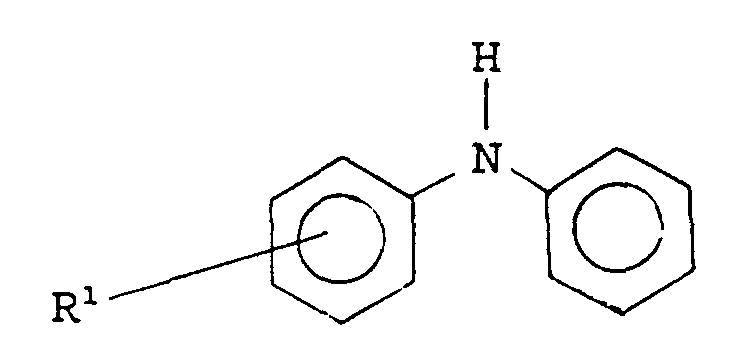
- The preferred di- or polysubstituted diphenylamines have the following structure:where each R2, R3, R4, and R5 is independently a hydrogen or the groups of R1 as described above, provided that at least one of R2 and R3 must be other than hydrogen and one of R4 and R5 must be other than hydrogen. Desirably from 5 to 80, 85 or 90 percent of the repeat units of the oligomeric antioxidant are the di- or polysubstituted diphenylamine, more desirably from 10 to 60, 75 or 80 mole percent and preferably from about 25 to 40 mole percent. Desirably the di- or polysubstituted diphenylamine is disubstituted diphenylamine. Desirably these oligomers are produced from diarylamine solutions wherein said one or more di or polysubstituted diphenylamines are present in amounts from 5 to 80, 85 or 90 mole percent, of the total diarylamines more desirably from 10 to 60, 75, or 80 mole percent and preferably from 25 to 40 mole percent.

- Other diarylamines may be present in the oligomeric antioxidant and in the diarylamine solutions used to form the oligomers in the residual amounts to those recited. These diarylamines include nonsubstituted diphenylamines, and phenothiazines with zero, one or two substituents.
- It is theorized that the bonding between the one or more monosubstituted diphenylamine (DPA) and optionally disubstituted or polysubstituted diphenylamine (DPA) or optionally other diarylamines may occur between two nitrogen atoms, between a nitrogen atom in one diarylamine and a carbon atom in another diarylamine or between carbon atoms in two different aryl rings. The possible linkages of aromatic diamines are described in detail in U.S.-A-3,509,214.
- The antioxidant of the present invention is made by reacting one or more monosubstituted diphenylamines (DPA) with themselves or optionally with one or more other diarylamines to form oligomeric products which are effective antioxidants at elevated temperatures. The reaction can be generalized as follows.
- Preferably the oligomeric antioxidant is formed by the reaction of a monosubstituted diphenylamine with itself or with one or more di or polysubstituted diphenylamine having one or more nonhydrogen substituent group per ring thereof), and optionally with other diarylamines at temperatures from 40°C to 200°C, more desirably from 70 to 200°C, preferably from 90 or 110 to 180°C and most preferably from 130 to 150°C for from about 30 minutes to 30 hours, desirably from 1 to 10 hours, and preferably from 2 to 6 hours. Any solvent may be used but preferably the solvent is a synthetic ester lubricant or one or more alkanes. Preferably an organic peroxide is present at these temperatures to cause oligomerization. A supply of N2 or other gas inert to peroxides and radicals therefrom is desirably used to purge air from the reactor.
- Alternatively, the reaction may be conducted in bulk or solution by simply heating the one or more monosubstituted diphenylamines optionally with one or more other arylamines at a temperature desirably in the range of from 150° to 300°C and preferably from 200 to 275°C. The one or more diphenylamines may be dissolved in a suitable inert or organic solvent such as an aromatic hydrocarbon ketone and the like. A stream of gas such as air, oxygen, or N2 or another inert gas can be circulated through the liquid mixture during the heating step. The heating step may occur from 30 minutes to 80 hours.
- Alternatively the oxidation and coupling of the one or more diphenylamines may be performed using a chemical reagent. Useful chemical reagents include potassium permanganate and alkyl or aryl peroxides. These oxidations may be performed at any suitable temperature using known techniques. As above, various gases can be added during the reaction to provide oxygen or an inert environment. The residue from the oxidizing agent is removed if necessary. Filtration may be used to remove solid residue, and the filtrate may be stripped of solvent if desired as the final purification step.
- The simple alkyl peroxides like butyl peroxide are preferred because their decomposition products can be easily removed as aliphatic alcohols at reasonably low temperatures. The individual components (reactants) may be added in any order, in increments, or metered into other components. The reaction may be carried out under vacuum to remove volatiles from the decomposition of the organic peroxides. The reaction can also be carried out under pressure to keep the volatiles in. Solvents such as aliphatic hydrocarbons and synthetic ester lubricants having abstractable hydrogens can be used with the organic peroxide oligomerization method.
- The synthetic ester lubricants are produced from condensation of one or more monohydroxy alcohols and/or one more polyhydroxy alcohols with at least one monocarboxylic and/or at least one polycarboxylic acids. These ester fluid lubricants are described in detail later in this specification.
- These ester lubricants are disclosed in U.S.-A-3,492,233 and can become chemically bonded through dehydrocondensation reactions to the one or more diphenylamines (DPA) or oligomers thereof during the oligomerization reaction of the DPA. However, with careful control of the amount of peroxide used and the reaction temperature, the amount of dehydrocondensation bonding between the ester lubricant and diphenylamine or other diarylamine is minimized. Desirably less than 30, more desirably less than 20, and preferably less than 10 mole % of the total diarylamines chemically are condensed with the ester lubricants or alkane solvents.
- Another useful solvent for the reaction is the alkane solvents having from 6 to 16 carbon atoms having linear, branched, or cyclic structure. These are also known to form dehydrocondensation products with diphenylamines, but this dehydrocondensation reaction with solvents is limited in the organic peroxide method by the reaction conditions. The alkane solvents are easily removed by volatilization.
- Subsequent to the reaction of the organic peroxides, it is desirable to raise the temperature to fully decompose the residual organic peroxides. This minimizes undesirable oxidation reactions later. Under optimized conditions as disclosed herein, most of the desired reactions which form oligomers and cross oligomers have occurred prior to the residual peroxide decomposition step. Desirably, this peroxide decomposition is conducted at temperatures from 140 to 200°C, and desirably from 160 to 180°C for from 5 minutes to 2 hours, more desirably from 30 minutes to 1 hour, and desirably at pressures below atmospheric pressure. Desirably, at least 70 mole percent of the diphenylamine and other diarylamine reactants are converted into oligomeric form with less than 30 mole percent remaining in monomer form. Oligomers or oligomeric form for the purpose of this application will desirably include dimers, trimers, etc. up through a number average degree of polymerization of 10 or 50.
- Any organic peroxide may be used as a free radical source which has a half-life of about one hour at a temperature between from 70°C to 200°C. Desirably, the half-life of one hour is at a temperature between from 90 to 160°C, and preferably between from 130 to 150°C. Included in this group are the acyl peroxides, peresters, peroxyketals, and alkyl peroxides, all of which are commercially available from Lucidol Penwalt, U.S.A. Atochem or Akzo Chemicals, Inc., by the trademarks or common names indicated. The amount of peroxide used is desirably from 0.5 to 2.5 mole/mole of the diphenylamines and other diarylamines and is preferably from 0.6 to 1.5, and most preferred from 0.8 to 1.3 mole/mole of diphenylamines and other diarylamines.
- Included as peroxides are acyl peroxides of the formulaperoxyketals of the formula (R6)2C(OOR7)2,

alkyl peroxides of the formula R6-O-O-R7,
and peresters of the formulawherein R6 and R7 can be the same or different and may be an alkyl, aromatic, alkyl substituted aromatic, or aromatic substituted alkyl groups having from 1 to 10 carbon atoms.
- Suitable peresters include t-amylperoxy-2-ethylhexanoate, t-butylperoxy-2-ethylhexanoate (t-butyl peroctoate), t-butylperoxy-isobutylrate, t-butylperoxy-maleic acid, OO-t-butyl O-isopropyl monoperoxycarbonate, 2,5-dimethyl-2,5-di(benzoylperoxy)hexane, OO-t-butyl-O-(2-ethyl-hexyl)mono peroxycarbonate, OO-t-amyl O-(2-ethylhexyl)mono peroxy-carbonate, t-butyl-peroxy acetate, t-amyl-peroxy-acetate, t-butylperoxy benzoate, t-amyl-peroxybenzoate and di-t-butyl-diperoxyphthalate.
- Suitable peroxyketals include n-butyl-4,4-bis(t-butylperoxy)valerate, 2,2-di(t-butylperoxy)butane, ethyl-3,3-di(t-butylperoxy)butyrate, 2,2-di(t-amylperoxy)propane and ethyl-3,-3-di(t-amylperoxy) butyrate.
- Suitable dialkyl peroxides include dicumyl peroxide, 2,5-dimethyl-2,5-di(t-butylperoxy)hexane, t-butyl cumyl peroxide α-bis(t-butylperoxy)diisopropylbenzene, di-t-butyl peroxide, di-t-amyl peroxide and 2,5-dimethyl-2,5-di(t-butylperoxy)hexane-3. The preferred peroxide is di-t-butyl peroxide.
- The antioxidants of this invention are useful in ester fluids including lubricating oils, fuels, hydraulic fluids, transmission fluids, compressor lubricant (such as compressors used in refrigeration units), and especially those synthetic ester fluids useful in high temperature avionic (turbine engine oils) applications and/or internal combustion reciprocating or rotary engine oils. The antioxidants are also useful in blended oils for similar purposes that desirably have at least 10, 20, or 30 or more desirably at least 50 weight percent synthetic ester fluids with the remainder being predominantly other lubricants such as hydrocarbon oils or poly-α-olefin oils.
- The synthetic ester fluid lubricants which may be used with this invention are esters produced from monohydroxy alcohols and monocarboxylic acids, from polyhydroxy alcohols and monocarboxylic acids, and/or from monohydroxy alcohols and dicarboxylic acids. Such esters are well known, having been described for example in U.S. -A- 3,432,433. Each of the alcohols and acids used in preparing the ester may contain from 1 to 4 functional groups thereby producing mono-, di-, tri-, and tetraesters. Contemplated within this invention are esters of alcohols, diols, triols, and pentaerythritols, said alcohols or polyols having from 2 to 20 carbon atoms, and mono- and dicarboxylic acids having from 2 to 20 carbon atoms and preferably from 4 to 12.
- The above esters may include the monoesters from octyl acetate, decyl acetate, octadecyl acetate, methyl myristate, butyl stearate, methyl oleate, and the like and the polyesters from dibutyl phthalate, di-octyl adipate, di-2-ethylhexyl azelate, di-2-ethylhexyl sebacate, and the like.
- The most preferred esters are produced from hindered or neopentyl alcohols and pentaerythritol, that is, those in which the beta carbon atom is completely substituted by other carbon atoms. These esters have the structurewherein each of R8 and R9 is individually an alkyl or aryl of 1 to 19 carbon atoms and each of R10 and R11 is individually hydrogen, alkyl of 1 to 5 carbon atoms or
 and each of the R8 and R9 groups are as described above. Such esters include 2,2-dimethylpropane-1,3-diol dipelargonate, trimethylolpropane trioctanoate, trimethylolpropane tridecanoate, trimethylolbutane trihexanoate, pentaerythritol tetraoctanoate and pentaerythritol tetradodecanoate. Mixtures of acids may be used in producing the di-, tri- and tetraesters. For example, a preferred pentaerythritol ester contains a mixture of C4 through C10 carboxylic acids. The esters in accordance with this invention include any ester fluid having an abstractable hydrogen atom, although the preferred reaction conditions result in minimal dehydrocondensation between the polyesters and the amines.
- The oligomeric antioxidant stabilizer made from one or more monosubstituted diphenylamines and optionally other diarylamines is efficient at concentrations from 0.1 to 20 weight percent, desirably from 0.5 to 10 weight percent, more desirably from 0.5 to 5 wt. % percent and preferably from 1.5 to 2.0 weight percent in a lubricant based upon the total weight of the formulated lubricant. These weight percents are of the diphenylamines and other diarylamines in the oligomers and do not include the synthetic ester lubricants even if they are used as a solvent for the reaction. In the case of synthetic ester lubricants coreacted with one or more diphenylamines forming co-condensation products, the weight percents recited above are the calculated weight percents of said one or more diphenylamine and optional diarylamine reactants in the final lubricant product. The stabilizer can be used in conjunction with other additives such as detergents, dispersants, other antioxidants, corrosion inhibitors, antifoamants, antiwear additives, extreme pressure additives, hydrolytic stability agents, load additives or viscosity modifiers. One such antioxidant can be the DPA monomer or other oligomeric products having DPA repeat units.
- The effectiveness of the oligomeric antioxidant composition in synthetic ester oils is enhanced by adding a triazine, for example an alkylamino symmetrical triazine such as hexabutyl melamine or a coupled triazine such as N1,N4-piperazine-bis-(2-[4,6-bis-dibutylamine-1,3,5-triazine]). These triazines are prepared by methods known in the art. U.S. -A- 3,322,763 discloses how to prepare coupled triazines. The amount of triazine is desirably from about 0.01 to about 5 grams per 100 grams of lubricant.
- The following non-limiting examples will provide the reader with a more detailed understanding of the invention.
- Diarylamine A (X mole), diarylamine B (Y mole) were mixed with an ester lubricant or a hydrocarbon solvent under inert atmosphere. The weight of ester lubricant or hydrocarbon solvent was the same as the total weight of diarylamines starting materials. The mixture was heated at 140 to 145°C and a t-butyl peroxide [in amount of 1.3 (X+Y) mole] was added dropwise over a 30 min. to a one hour period. The t-butyl alcohol formed from the decomposition of t-butyl peroxide was distilled off while maintaining the temperature at 140 to 145°C for 1 to 5 hours. The temperature was raised to a temperature of 170 to 175°C to remove most of the t-butyl alcohol and any hydrocarbon solvent. The resulting mixture was either a 50 percent product in ester lubricant, a 100 percent neat product, or a powdered solid after being ground.
- The oligomers and blends in the following Table I are identified below. Oligomer 184 is the oligomerization product from V-848 which is a physical blend of ∼0-5% diphenylamine, ∼35-45% p,p'-di(t-butyl and/or t-octyl) diphenylamine, ∼20-30% p(t-butyl or t-octyl) diphenylamine, ∼5-15% p-(t-butyl-p'-t-octyldiphenylamine) and 5-40% unidentified alkylated diphenylamines with V-81 which is p,p'-di-t-octyldiphenylamine in the mole ratio of V-848 to V-81 diarylamines of 2 to 1. Oligomer 186 is the oligomerization product of V-81 (already described) and MOD which is p-t-octyldiphenylamine in the mole ratio of diarylamines from the two starting materials of 2 to 1. Oligomer 188 is the oligomerization product of the same two diamines as was oligomer 186 but the oligomerization reaction was conducted in an ester lubricant. Oligomer 185 has the same starting diamines as oligomer 184 but was oligomerized in the presence of a synthetic ester lubricant. Oligomer 190 is an oligomerization product of V-848 (already described) with itself. Oligomer 197 is a homooligomer of MOD which is p-t-ocytldiphenylamine. Oligomer 198 is an oligomerization product of V-81 (an already described disubstituted diphenylamine) and MOD is a monosubstituted diphenylamine reacted in a mole ratio of monosubstituted to disubstituted of 2 to 1. Control 1 is an oligomerization product of a disubstituted diphenylamine with an N-aryl naphthylamine. Control 2 is a physical blend of disubstituted diphenylamine with an N-aryl naphthylamine. Irganox® from Ciba Geigy (LO-6) is N-p-t-octylphenyl-1-naphthylamine.
- The following Table I shows the performance of the above recited oligomers of diphenylamines in a standardized oxidation stability test Federal Test Method Standard No. 791B,5308.6 at 400°F (204°C) for 72 hours. The tested samples contain the specified weight percent of the oligomeric diamine reaction product, 2 wt. % triaryl phosphate, and 0.1 wt. % tolyltriazole in a synthetic ester lubricant made from a mixture of C5 to C10 carboxylic acids and pentaerythritol. Oxidation stability was measured by the percentage change in viscosity (centistokes at 40°C) (Δ Vis) and change in total acid number (Δ TAN). The Δ TAN is calculated from the moles of additional base required to titrate or neutralize 100 g of sample multiplied by 561.
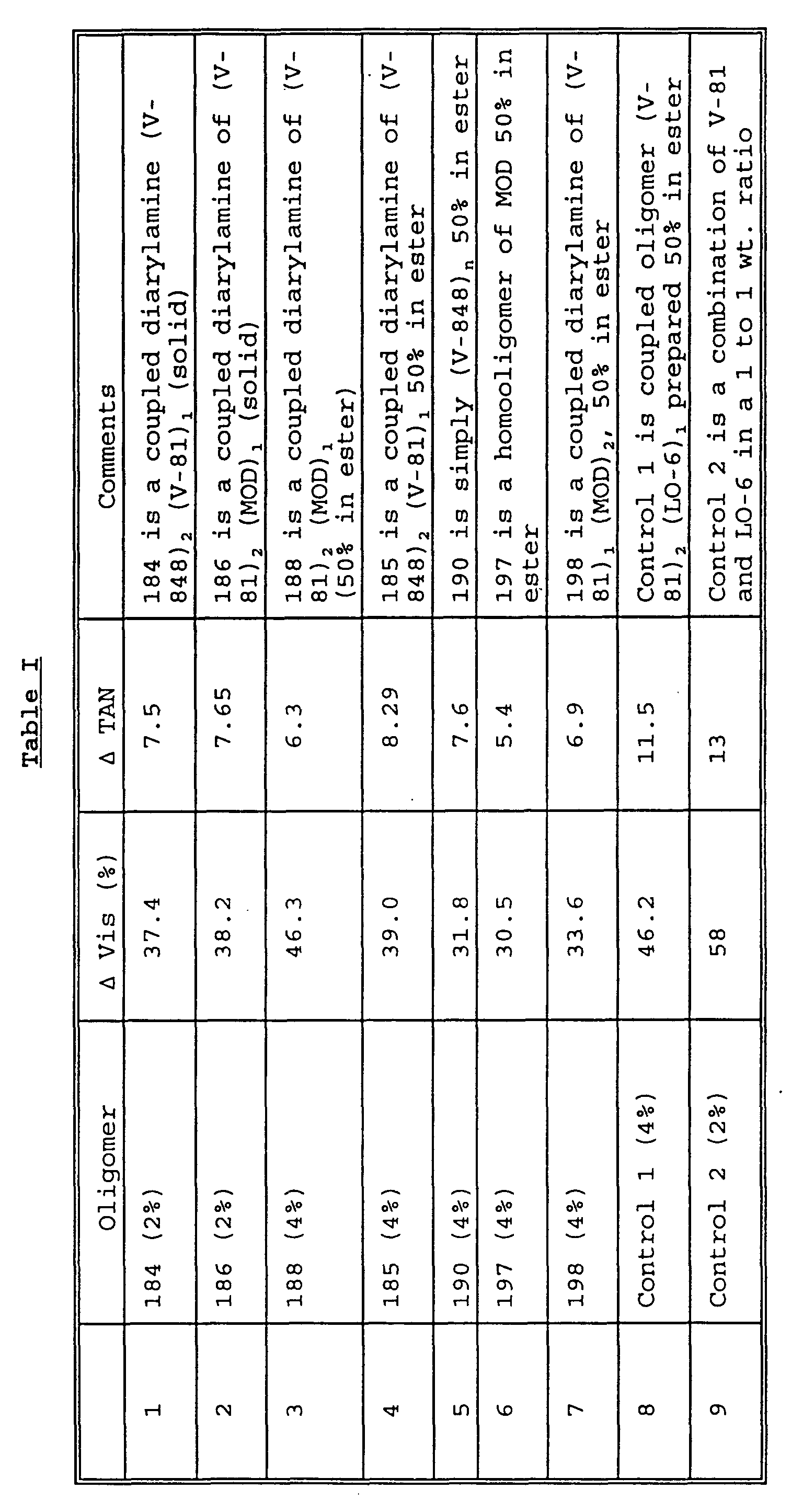
- Oligomers 184 and 185 contains mixtures of monosubstituted and disubstituted diphenylamines in a mole ratio of 0.25 to 1.
- Oligomer 186 and 188 contain mixtures of monosubstituted and disubstituted diphenylamines in a mole ratio of 1 to 2.
- Oligomer 190 contains mixtures of monosubstituted and disubstituted diphenylamines in a mole ratio of 1 to 2.
- Oligomer 197 contains monosubstituted diphenylamines only.
- Oligomer 198 contains mixtures of monosubstituted and disubstituted diphenylamines in a mole ratio of 2 to 1.
- The control 1 oligomer contains mixtures of disubstituted diphenylamines and 1-phenylnaphthylamine in a mole ratio of 2 to 1.
- The control 2 is a blend of disubstituted diphenylamine and a substituted phenylnaphthylamine.
Claims (16)
- An oligomeric reaction product comprising repeat units from a monosubstituted diphenylamine, wherein said monosubstituted diphenylamine before coupling is one or more monosubstituted diphenylamines having the formulawhere R1 is independently an alkyl, alkenyl, or aralkyl group having from 1 to 20 carbon atoms;

wherein said oligomeric reaction product has from 10 to 100 mole percent of the repeat units from said one or more monosubstituted diphenylamines,
under the proviso that the oligomeric reaction product of 0.8 mole of p-octyl-diphenylamine with 0.2 mole of N-(p-octylphenyl)-1-naphthylamine is excluded. - An oligomeric reaction product according to claim 1, further comprising repeat units from
one or more di or polysubstituted diphenylamines having one or more nonhydrogen substituent on each phenyl ring, said di or polysubstituted diphenylamine before coupling being of the formulasaid R2 through R5 independently of each other and independently on subsequent repeat units being a hydrogen, a linear or branched alkyl, alkenyl, or aralkyl group having 1 to 20 carbon atoms,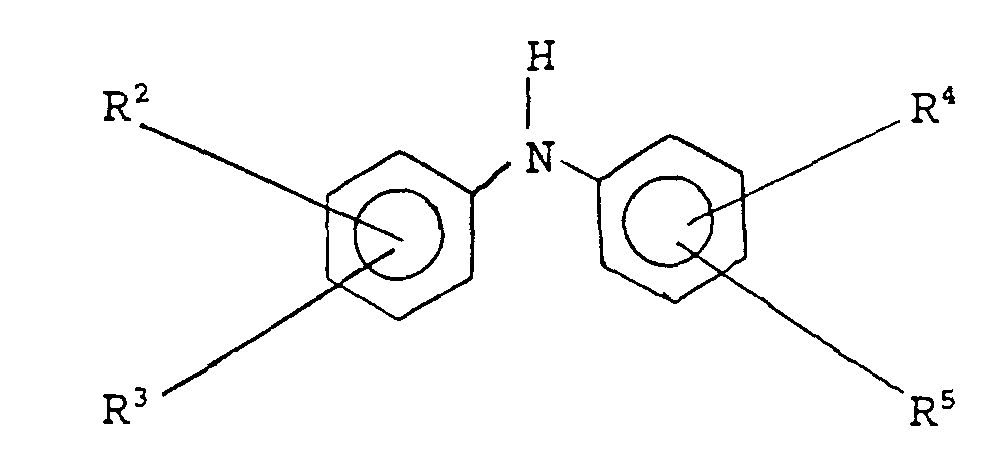
wherein said di or polysubstituted diphenylamines are from 5 to 90 mole percent of the repeat units of said oligomeric product. - An oligomeric product according to claim 1, having a number average degree of polymerization of from 2 to 10.
- An oligomeric product according to claim 2, having a number average degree of polymerization from 2 to 10.
- An oligomeric product according to claim 4, wherein said di or polysubstituted diphenylamines are from 10 to 80 mole percent and said monosubstituted diphenylamines are from 20 to 90 mole percent of the repeat units of said oligomeric product.
- An oligomeric product according to claim 2, wherein said di or polysubstituted diphenylamines are from 10 to 80 mole percent and said monosubstituted diphenylamines are from 20 to 90 mole percent of the repeat units of said oligomeric product.
- An oligomeric product according to claim 1, wherein said one or more monosubstituted diphenylamines are from 60 to 75 mole percent of the repeat units of said oligomeric product.
- An oligomeric product according to claim2, wherein said di or polysubstituted diphenylamines are from 25 to 40 mole percent of the repeat units of said oligomers, and wherein said R1 on said monosubstituted diphenylamines and said R2, R3, R4 and R5 groups of said polysubstituted diphenylamines when present comprise tertiary alkyl groups or aralkyl groups.
- An oligomeric product according to claim 1, present from 0.1 to 20 weight percent in a lubricating oil which lubricating oil comprises at least 20 wt. % synthetic ester oil based on the total lubricant weight.
- A process for making the oligomeric reaction product as defined in any one of claims 1 to 9 the oligomeric reaction product comprising;
reacting a diarylamine solution comprising from 10 to 100 mole percent of one or more monosubstituted diphenylamines based on the total diarylamines of said solution;
said one or more monosubstituted diphenylamines having the formulawhere R1 is an alkyl, alkenyl, or aralkyl group having from 1 to 20 carbon atoms;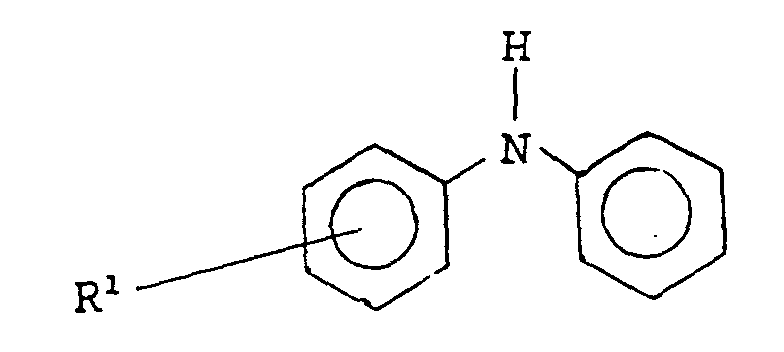
in a dehydrocondensation reaction to form one or more oligomers, wherein the oligomeric reaction product of 0.8 mole p-octyl-diphenylamine with 0.2 mole N-(p-octylphenyl)-1-naphthyl-amine is excluded. - A process according to claim 10, wherein said diarylamine solution further comprises one or more di or polysubstituted diphenylamines having one or more nonhydrogen substituent on each phenyl ring, wherein said one or more di or polysubstituted diphenylamines have the formulasaid R2 through R5 independently of each other and independently on subsequent repeat units being a hydrogen, a linear or branched alkyl, alkenyl, or aralkyl group having from 1 to 20 carbon atoms,

wherein said di or polysubstituted diphenylamines are from 5 to 90 mole percent said diarylamines of said diarylamine solution. - A process according to claim 11, wherein said one or more monosubstituted diphenylamines and said one or more di or polysubstituted diphenylamines are reacted at a temperatures from 70 to 200°C in the presence of a peroxide to form said one or more oligomers.
- A process according to claim 11, wherein said one or more oligomers have a number average degree of polymerization from 2 to 10.
- A process according to claim 13, wherein said one or more monosubstituted diphenylamines are present from 20 to 90 mole percent and said one or more di or polysubstituted diphenylamines are present from 10 to 80 mole percent in said diarylamine solution.
- A process according to claim 10, wherein said diarylamine solution is reacted at a temperature from 70 to 200°C in the presence of a peroxide to form said oligomers, and wherein said R1, R2, R3, R4, and R5 groups, when present, comprise tertiary alkyl groups or aralkyl groups.
- Use of the oligomeric reaction product as defined in any one of claims 1 to 9 as an antioxidant.
Applications Claiming Priority (3)
| Application Number | Priority Date | Filing Date | Title |
|---|---|---|---|
| US359679 | 1989-05-31 | ||
| US08/359,679 US5489711A (en) | 1994-12-20 | 1994-12-20 | Synthetic lubricant antioxidant from monosubstituted diphenylamines |
| PCT/US1995/013419 WO1996019549A1 (en) | 1994-12-20 | 1995-10-10 | Synthetic lubricant antioxidant from monosubstituted diphenylamines |
Publications (2)
| Publication Number | Publication Date |
|---|---|
| EP0799289A1 EP0799289A1 (en) | 1997-10-08 |
| EP0799289B1 true EP0799289B1 (en) | 2002-07-31 |
Family
ID=23414845
Family Applications (1)
| Application Number | Title | Priority Date | Filing Date |
|---|---|---|---|
| EP95937522A Expired - Lifetime EP0799289B1 (en) | 1994-12-20 | 1995-10-10 | Synthetic lubricant antioxidant from monosubstituted diphenylamines |
Country Status (7)
| Country | Link |
|---|---|
| US (1) | US5489711A (en) |
| EP (1) | EP0799289B1 (en) |
| JP (1) | JP4210327B2 (en) |
| AT (1) | ATE221568T1 (en) |
| CA (1) | CA2208057C (en) |
| DE (1) | DE69527652T2 (en) |
| WO (1) | WO1996019549A1 (en) |
Families Citing this family (19)
| Publication number | Priority date | Publication date | Assignee | Title |
|---|---|---|---|---|
| DE69405410T2 (en) * | 1993-12-15 | 1998-03-19 | Goodrich Co B F | STABILIZER MIXTURE FOR SYNTHETIC ESTER LUBRICANTS |
| US6194360B1 (en) | 1998-12-22 | 2001-02-27 | International Business Machines Corporation | Magnetic recording device |
| CA2403540A1 (en) * | 2001-11-20 | 2003-05-20 | Bp Corporation North America Inc. | Synergystic combination of aryl amine antioxidants in aviation turbine oils |
| US7413682B2 (en) * | 2006-08-15 | 2008-08-19 | Anderol, Inc. | Antioxidants and methods of making antioxidants |
| FR2924122B1 (en) * | 2007-11-28 | 2009-12-25 | Nyco Sa | ANTI-OXIDANT AND / OR ANTI-CORROSION AGENT, LUBRICATING COMPOSITION CONTAINING SAID AGENT AND PROCESS FOR PREPARING THE SAME |
| FR2937047B1 (en) * | 2008-10-10 | 2012-07-27 | Nyco Sa | USE OF OLIGOMERIC ADDITIVE FOR STABILIZING LUBRICATING COMPOSITION FOR CONVEYOR CHAIN |
| FR2946983B1 (en) | 2009-06-23 | 2011-12-23 | Nyco | ANTI-WEAR AGENTS WITH REDUCED NEUROTOXICITY |
| CN105733740A (en) * | 2014-12-08 | 2016-07-06 | 中国石油天然气股份有限公司 | A kind of amine oligomer antioxidant and preparation method thereof |
| EP3320060A1 (en) | 2015-07-07 | 2018-05-16 | ExxonMobil Research and Engineering Company | Composition and method for preventing or reducing engine knock and pre-ignition in high compression spark ignition engines |
| US20170009179A1 (en) * | 2015-07-07 | 2017-01-12 | Exxonmobil Research And Engineering Company | Composition and method for preventing or reducing engine knock and pre-ignition in high compression spark ignition engines |
| US20190127656A1 (en) * | 2017-10-31 | 2019-05-02 | Exxonmobil Research And Engineering Company | Lubricant compositions comprising polymeric diphenylamine antioxidants |
| US20190144776A1 (en) * | 2017-10-31 | 2019-05-16 | Exxonmobil Research And Engineering Company | Lubricant grease compositions comprising polymeric diphenylamine antioxidants |
| US20190127526A1 (en) * | 2017-10-31 | 2019-05-02 | Basf Se | Antioxidant Polymeric Diphenylamine Compositions |
| CN108165350A (en) * | 2017-12-06 | 2018-06-15 | 常州富思通管道有限公司 | A kind of preparation method of wear-resisting anti-oxidant lubricating oil |
| CN109942435B (en) * | 2019-04-12 | 2021-08-20 | 江苏飞亚化学工业有限责任公司 | Oxidation coupling high-temperature antioxidant solvent-free preparation method |
| FR3114816B1 (en) | 2020-10-06 | 2022-10-21 | Nyco | Continuous process for the polymerization or oligomerization of diphenylamines |
| FR3135091B1 (en) * | 2022-04-27 | 2025-11-14 | Nyco | Use of an antioxidant to reduce and/or prevent the toxicity of a lubricating composition |
| FR3142505A1 (en) | 2022-11-29 | 2024-05-31 | Safran Aircraft Engines | CHECKING THE OIL QUALITY OF A LUBRICATION OIL CIRCUIT IN AN AIRCRAFT TURBOMACHINE |
| US20250136889A1 (en) | 2023-10-27 | 2025-05-01 | Infineum International Limited | Lubricant Compositions Containing High C9 Disubstituted Diphenylamine Antioxidant Content |
Family Cites Families (13)
| Publication number | Priority date | Publication date | Assignee | Title |
|---|---|---|---|---|
| US3206405A (en) * | 1962-01-02 | 1965-09-14 | Socony Mobil Oil Co Inc | Synthetic lubricants comprising dehydrocondensation products of polyesters |
| US3247111A (en) * | 1963-04-08 | 1966-04-19 | Socony Mobil Oil Co | High temperature jet lubricant |
| US3509214A (en) * | 1966-03-28 | 1970-04-28 | Mobil Oil Corp | Oil soluble oxidized naphthylamine compositions |
| US3573206A (en) * | 1966-03-28 | 1971-03-30 | Mobil Oil Corp | Lubricant compositions |
| US3492233A (en) * | 1967-12-12 | 1970-01-27 | Mobil Oil Corp | Lubricant compositions containing dehydrocondensation products |
| GB1236740A (en) * | 1969-04-11 | 1971-06-23 | Geigy Uk Ltd | Tertiary alkylated diphenylamines and their uses as antioxidants |
| BE756024A (en) * | 1969-09-22 | 1971-03-11 | Shell Int Research | ALKYL-SUBSTITUTED PHENYLNAFTYLAMINS AND LUBRICANT COMPOSITIONS THESE CONTAIN |
| US3759996A (en) * | 1971-01-13 | 1973-09-18 | Mobil Oil Corp | Process for dimerizing diarylamines |
| GB1393366A (en) * | 1971-10-06 | 1975-05-07 | Exxon Research Engineering Co | Antioxidants |
| US3773665A (en) * | 1971-11-17 | 1973-11-20 | Mobil Oil Corp | Lubricants containing amine antioxidants |
| EP0083871A3 (en) * | 1982-01-04 | 1985-02-06 | Mobil Oil Corporation | Arylamine-aldehyde lubricant antioxidants |
| US5321159A (en) * | 1992-12-18 | 1994-06-14 | The B. F. Goodrich Company | Decolorization of alkylated diarylamines |
| DE69405410T2 (en) * | 1993-12-15 | 1998-03-19 | Goodrich Co B F | STABILIZER MIXTURE FOR SYNTHETIC ESTER LUBRICANTS |
-
1994
- 1994-12-20 US US08/359,679 patent/US5489711A/en not_active Expired - Lifetime
-
1995
- 1995-10-10 WO PCT/US1995/013419 patent/WO1996019549A1/en not_active Ceased
- 1995-10-10 AT AT95937522T patent/ATE221568T1/en not_active IP Right Cessation
- 1995-10-10 DE DE69527652T patent/DE69527652T2/en not_active Expired - Fee Related
- 1995-10-10 EP EP95937522A patent/EP0799289B1/en not_active Expired - Lifetime
- 1995-10-10 JP JP51976796A patent/JP4210327B2/en not_active Expired - Lifetime
- 1995-10-10 CA CA002208057A patent/CA2208057C/en not_active Expired - Fee Related
Also Published As
| Publication number | Publication date |
|---|---|
| JP4210327B2 (en) | 2009-01-14 |
| WO1996019549A1 (en) | 1996-06-27 |
| DE69527652D1 (en) | 2002-09-05 |
| EP0799289A1 (en) | 1997-10-08 |
| CA2208057A1 (en) | 1996-06-27 |
| ATE221568T1 (en) | 2002-08-15 |
| JPH10511091A (en) | 1998-10-27 |
| US5489711A (en) | 1996-02-06 |
| DE69527652T2 (en) | 2003-04-03 |
| CA2208057C (en) | 2006-02-21 |
Similar Documents
| Publication | Publication Date | Title |
|---|---|---|
| US5489711A (en) | Synthetic lubricant antioxidant from monosubstituted diphenylamines | |
| EP0734432B1 (en) | Synthetic ester lubricant stabilizer composition | |
| CA2179169C (en) | Synthetic ester lubricant stabilizer composition | |
| EP1019463B1 (en) | Poly(neopentyl polyol) ester based coolants and improved additive package | |
| JP3964471B2 (en) | Heat resistant lubricating oil composition | |
| US4087386A (en) | Triaryl phosphate ester functional fluids | |
| WO1995016765A9 (en) | Synthetic ester lubricant stabilizer composition | |
| EP2791292B1 (en) | Cross products and co-oligomers of phenylenediamines and aromatic amines as antioxidants for lubricants | |
| US20100305011A1 (en) | Anti-oxidation and/or anti-corrosion agent, lubricating composition containing said agent and method for preparing the same | |
| US3573206A (en) | Lubricant compositions | |
| US3509214A (en) | Oil soluble oxidized naphthylamine compositions | |
| EP1137747B1 (en) | Lubricant compositions comprising multiple antioxidants | |
| US3850824A (en) | Synthetic aircraft turbine oil | |
| CA2175569C (en) | Lubricant composition containing a polymeric antioxidant | |
| EP0523561A1 (en) | Lubricating oil composition | |
| US5726135A (en) | Phosphorus-free and ashless oil for aircraft and turbo engine application | |
| US3634238A (en) | Organic compositions containing amines and metals or salts thereof | |
| NL1021556C2 (en) | Synergistic combination of arylamine antioxidants in aviation turbine oils. | |
| EP0089844B1 (en) | Boron-containing esters, their preparation and use as antioxidants | |
| US3429813A (en) | Synthetic lubricants containing phosphorothionates and arylamines | |
| US4335006A (en) | Method of stabilizing lubricating fluids | |
| US3493511A (en) | Organic compositions containing antioxidants | |
| US5798321A (en) | Rust resistant turbo oils containing monobasic amino phosphates and dicarboxylic acids | |
| EP0083871A2 (en) | Arylamine-aldehyde lubricant antioxidants | |
| EP0019985B1 (en) | A method for stabilizing a lubricating oil |
Legal Events
| Date | Code | Title | Description |
|---|---|---|---|
| PUAI | Public reference made under article 153(3) epc to a published international application that has entered the european phase |
Free format text: ORIGINAL CODE: 0009012 |
|
| 17P | Request for examination filed |
Effective date: 19970716 |
|
| AK | Designated contracting states |
Kind code of ref document: A1 Designated state(s): AT BE CH DE DK ES FR GB GR IE IT LI LU MC NL PT SE |
|
| RIN1 | Information on inventor provided before grant (corrected) |
Inventor name: LAI, JOHN, TA-YUAN |
|
| 17Q | First examination report despatched |
Effective date: 19971212 |
|
| GRAG | Despatch of communication of intention to grant |
Free format text: ORIGINAL CODE: EPIDOS AGRA |
|
| RAP1 | Party data changed (applicant data changed or rights of an application transferred) |
Owner name: NOVEON IP HOLDINGS CORP. |
|
| RIC1 | Information provided on ipc code assigned before grant |
Free format text: 7C 10M 133/12 A, 7C 10M 149/12 B, 7C 07C 211/54 B, 7C 07C 211/55 B, 7C 09K 15/18 B, 7C 10M 169/04 B, 7C 10M 133/12 J, 7C 10M 133:12 J, 7C 10M 169/04 K, 7C 10M 105:34 K, 7C 10M 133:12 K, 7C 10N 30:10 Z |
|
| GRAG | Despatch of communication of intention to grant |
Free format text: ORIGINAL CODE: EPIDOS AGRA |
|
| GRAH | Despatch of communication of intention to grant a patent |
Free format text: ORIGINAL CODE: EPIDOS IGRA |
|
| RIC1 | Information provided on ipc code assigned before grant |
Free format text: 7C 10M 133/12 A, 7C 10M 149/12 B, 7C 07C 211/54 B, 7C 07C 211/55 B, 7C 09K 15/18 B, 7C 10M 169/04 B, 7C 10M 133/12 J, 7C 10M 133:12 J, 7C 10M 169/04 K, 7C 10M 105:34 K, 7C 10M 133:12 K, 7C 10N 30:10 Z |
|
| GRAH | Despatch of communication of intention to grant a patent |
Free format text: ORIGINAL CODE: EPIDOS IGRA |
|
| GRAA | (expected) grant |
Free format text: ORIGINAL CODE: 0009210 |
|
| AK | Designated contracting states |
Kind code of ref document: B1 Designated state(s): AT BE CH DE DK ES FR GB GR IE IT LI LU MC NL PT SE |
|
| PG25 | Lapsed in a contracting state [announced via postgrant information from national office to epo] |
Ref country code: NL Free format text: LAPSE BECAUSE OF FAILURE TO SUBMIT A TRANSLATION OF THE DESCRIPTION OR TO PAY THE FEE WITHIN THE PRESCRIBED TIME-LIMIT Effective date: 20020731 Ref country code: IT Free format text: LAPSE BECAUSE OF FAILURE TO SUBMIT A TRANSLATION OF THE DESCRIPTION OR TO PAY THE FEE WITHIN THE PRESCRIBED TIME-LIMIT;WARNING: LAPSES OF ITALIAN PATENTS WITH EFFECTIVE DATE BEFORE 2007 MAY HAVE OCCURRED AT ANY TIME BEFORE 2007. THE CORRECT EFFECTIVE DATE MAY BE DIFFERENT FROM THE ONE RECORDED. Effective date: 20020731 Ref country code: GR Free format text: LAPSE BECAUSE OF FAILURE TO SUBMIT A TRANSLATION OF THE DESCRIPTION OR TO PAY THE FEE WITHIN THE PRESCRIBED TIME-LIMIT Effective date: 20020731 Ref country code: AT Free format text: LAPSE BECAUSE OF FAILURE TO SUBMIT A TRANSLATION OF THE DESCRIPTION OR TO PAY THE FEE WITHIN THE PRESCRIBED TIME-LIMIT Effective date: 20020731 |
|
| REF | Corresponds to: |
Ref document number: 221568 Country of ref document: AT Date of ref document: 20020815 Kind code of ref document: T |
|
| REG | Reference to a national code |
Ref country code: GB Ref legal event code: FG4D Ref country code: CH Ref legal event code: EP |
|
| REG | Reference to a national code |
Ref country code: IE Ref legal event code: FG4D |
|
| REF | Corresponds to: |
Ref document number: 69527652 Country of ref document: DE Date of ref document: 20020905 |
|
| PG25 | Lapsed in a contracting state [announced via postgrant information from national office to epo] |
Ref country code: LU Free format text: LAPSE BECAUSE OF NON-PAYMENT OF DUE FEES Effective date: 20021010 Ref country code: IE Free format text: LAPSE BECAUSE OF NON-PAYMENT OF DUE FEES Effective date: 20021010 |
|
| PG25 | Lapsed in a contracting state [announced via postgrant information from national office to epo] |
Ref country code: SE Free format text: LAPSE BECAUSE OF FAILURE TO SUBMIT A TRANSLATION OF THE DESCRIPTION OR TO PAY THE FEE WITHIN THE PRESCRIBED TIME-LIMIT Effective date: 20021031 Ref country code: DK Free format text: LAPSE BECAUSE OF FAILURE TO SUBMIT A TRANSLATION OF THE DESCRIPTION OR TO PAY THE FEE WITHIN THE PRESCRIBED TIME-LIMIT Effective date: 20021031 |
|
| PG25 | Lapsed in a contracting state [announced via postgrant information from national office to epo] |
Ref country code: PT Free format text: LAPSE BECAUSE OF FAILURE TO SUBMIT A TRANSLATION OF THE DESCRIPTION OR TO PAY THE FEE WITHIN THE PRESCRIBED TIME-LIMIT Effective date: 20021113 |
|
| ET | Fr: translation filed | ||
| REG | Reference to a national code |
Ref country code: CH Ref legal event code: NV Representative=s name: KATZAROV S.A. |
|
| NLV1 | Nl: lapsed or annulled due to failure to fulfill the requirements of art. 29p and 29m of the patents act | ||
| PG25 | Lapsed in a contracting state [announced via postgrant information from national office to epo] |
Ref country code: ES Free format text: LAPSE BECAUSE OF FAILURE TO SUBMIT A TRANSLATION OF THE DESCRIPTION OR TO PAY THE FEE WITHIN THE PRESCRIBED TIME-LIMIT Effective date: 20030130 |
|
| PG25 | Lapsed in a contracting state [announced via postgrant information from national office to epo] |
Ref country code: MC Free format text: LAPSE BECAUSE OF NON-PAYMENT OF DUE FEES Effective date: 20030501 |
|
| PLBE | No opposition filed within time limit |
Free format text: ORIGINAL CODE: 0009261 |
|
| STAA | Information on the status of an ep patent application or granted ep patent |
Free format text: STATUS: NO OPPOSITION FILED WITHIN TIME LIMIT |
|
| 26N | No opposition filed |
Effective date: 20030506 |
|
| REG | Reference to a national code |
Ref country code: IE Ref legal event code: MM4A |
|
| REG | Reference to a national code |
Ref country code: CH Ref legal event code: PUE Owner name: EMERALD POLYMER ADDITIVES, LLC Free format text: NOVEON IP HOLDINGS CORP.#9911 BRECKSVILLE ROAD#CLEVELAND, OH 44141-3247 (US) -TRANSFER TO- EMERALD POLYMER ADDITIVES, LLC#240 W. EMERLING AVENUE#AKRON, OHIO 44301 (US) |
|
| REG | Reference to a national code |
Ref country code: GB Ref legal event code: 732E |
|
| REG | Reference to a national code |
Ref country code: FR Ref legal event code: TP |
|
| PGFP | Annual fee paid to national office [announced via postgrant information from national office to epo] |
Ref country code: FR Payment date: 20080731 Year of fee payment: 14 |
|
| PGFP | Annual fee paid to national office [announced via postgrant information from national office to epo] |
Ref country code: DE Payment date: 20081125 Year of fee payment: 14 |
|
| PGFP | Annual fee paid to national office [announced via postgrant information from national office to epo] |
Ref country code: BE Payment date: 20080723 Year of fee payment: 14 |
|
| PGFP | Annual fee paid to national office [announced via postgrant information from national office to epo] |
Ref country code: GB Payment date: 20081008 Year of fee payment: 14 Ref country code: CH Payment date: 20090122 Year of fee payment: 14 |
|
| BERE | Be: lapsed |
Owner name: *EMERALD POLYMER ADDITIVES LLC Effective date: 20091031 |
|
| REG | Reference to a national code |
Ref country code: CH Ref legal event code: PL |
|
| REG | Reference to a national code |
Ref country code: FR Ref legal event code: ST Effective date: 20100630 |
|
| PG25 | Lapsed in a contracting state [announced via postgrant information from national office to epo] |
Ref country code: FR Free format text: LAPSE BECAUSE OF NON-PAYMENT OF DUE FEES Effective date: 20091102 Ref country code: DE Free format text: LAPSE BECAUSE OF NON-PAYMENT OF DUE FEES Effective date: 20100501 |
|
| PG25 | Lapsed in a contracting state [announced via postgrant information from national office to epo] |
Ref country code: LI Free format text: LAPSE BECAUSE OF NON-PAYMENT OF DUE FEES Effective date: 20091031 Ref country code: CH Free format text: LAPSE BECAUSE OF NON-PAYMENT OF DUE FEES Effective date: 20091031 Ref country code: BE Free format text: LAPSE BECAUSE OF NON-PAYMENT OF DUE FEES Effective date: 20091031 |
|
| PG25 | Lapsed in a contracting state [announced via postgrant information from national office to epo] |
Ref country code: GB Free format text: LAPSE BECAUSE OF NON-PAYMENT OF DUE FEES Effective date: 20091010 |