EP0797776B1 - Combinatorial libraries having a predetermined frequency of each species of test compound - Google Patents
Combinatorial libraries having a predetermined frequency of each species of test compound Download PDFInfo
- Publication number
- EP0797776B1 EP0797776B1 EP95942579A EP95942579A EP0797776B1 EP 0797776 B1 EP0797776 B1 EP 0797776B1 EP 95942579 A EP95942579 A EP 95942579A EP 95942579 A EP95942579 A EP 95942579A EP 0797776 B1 EP0797776 B1 EP 0797776B1
- Authority
- EP
- European Patent Office
- Prior art keywords
- solid phase
- subunits
- phase support
- support
- species
- Prior art date
- Legal status (The legal status is an assumption and is not a legal conclusion. Google has not performed a legal analysis and makes no representation as to the accuracy of the status listed.)
- Expired - Lifetime
Links
- 150000001875 compounds Chemical class 0.000 title claims abstract description 65
- 238000012360 testing method Methods 0.000 title claims abstract description 61
- 238000000034 method Methods 0.000 claims abstract description 59
- 239000007790 solid phase Substances 0.000 claims abstract description 54
- 229920000742 Cotton Polymers 0.000 claims abstract description 37
- 239000012528 membrane Substances 0.000 claims abstract description 25
- -1 polypropylene Polymers 0.000 claims abstract description 16
- 125000006239 protecting group Chemical group 0.000 claims description 28
- 150000001413 amino acids Chemical class 0.000 claims description 12
- 230000001588 bifunctional effect Effects 0.000 claims description 8
- 238000004519 manufacturing process Methods 0.000 claims description 7
- 229920001343 polytetrafluoroethylene Polymers 0.000 claims description 7
- 125000001424 substituent group Chemical group 0.000 claims description 4
- 239000004810 polytetrafluoroethylene Substances 0.000 claims description 2
- 125000003275 alpha amino acid group Chemical group 0.000 claims 2
- 239000011159 matrix material Substances 0.000 abstract description 10
- 239000004743 Polypropylene Substances 0.000 abstract description 5
- 229920001155 polypropylene Polymers 0.000 abstract description 5
- 241000894007 species Species 0.000 description 32
- YMWUJEATGCHHMB-UHFFFAOYSA-N Dichloromethane Chemical compound ClCCl YMWUJEATGCHHMB-UHFFFAOYSA-N 0.000 description 24
- 108090000765 processed proteins & peptides Proteins 0.000 description 21
- 230000008878 coupling Effects 0.000 description 17
- 238000010168 coupling process Methods 0.000 description 17
- 238000005859 coupling reaction Methods 0.000 description 17
- 229920000136 polysorbate Polymers 0.000 description 16
- 230000015572 biosynthetic process Effects 0.000 description 15
- 239000000203 mixture Substances 0.000 description 15
- 238000003786 synthesis reaction Methods 0.000 description 15
- 235000001014 amino acid Nutrition 0.000 description 14
- 108010010803 Gelatin Proteins 0.000 description 12
- 229920000159 gelatin Polymers 0.000 description 12
- 239000008273 gelatin Substances 0.000 description 12
- 235000019322 gelatine Nutrition 0.000 description 12
- 235000011852 gelatine desserts Nutrition 0.000 description 12
- 125000003088 (fluoren-9-ylmethoxy)carbonyl group Chemical group 0.000 description 11
- YBJHBAHKTGYVGT-ZKWXMUAHSA-N (+)-Biotin Chemical compound N1C(=O)N[C@@H]2[C@H](CCCCC(=O)O)SC[C@@H]21 YBJHBAHKTGYVGT-ZKWXMUAHSA-N 0.000 description 10
- 102000004196 processed proteins & peptides Human genes 0.000 description 9
- 239000002245 particle Substances 0.000 description 8
- 238000012216 screening Methods 0.000 description 8
- QGZKDVFQNNGYKY-UHFFFAOYSA-N Ammonia Chemical compound N QGZKDVFQNNGYKY-UHFFFAOYSA-N 0.000 description 7
- 238000010511 deprotection reaction Methods 0.000 description 7
- 238000011534 incubation Methods 0.000 description 7
- 239000000758 substrate Substances 0.000 description 7
- 238000005406 washing Methods 0.000 description 7
- DHMQDGOQFOQNFH-UHFFFAOYSA-N Glycine Chemical compound NCC(O)=O DHMQDGOQFOQNFH-UHFFFAOYSA-N 0.000 description 6
- OKKJLVBELUTLKV-UHFFFAOYSA-N Methanol Chemical compound OC OKKJLVBELUTLKV-UHFFFAOYSA-N 0.000 description 6
- 108010090804 Streptavidin Proteins 0.000 description 6
- UCMIRNVEIXFBKS-UHFFFAOYSA-N beta-alanine Chemical compound NCCC(O)=O UCMIRNVEIXFBKS-UHFFFAOYSA-N 0.000 description 6
- 238000001514 detection method Methods 0.000 description 6
- 239000000463 material Substances 0.000 description 6
- 108090000623 proteins and genes Proteins 0.000 description 6
- 239000000243 solution Substances 0.000 description 6
- 239000007787 solid Substances 0.000 description 5
- 102000004160 Phosphoric Monoester Hydrolases Human genes 0.000 description 4
- 108090000608 Phosphoric Monoester Hydrolases Proteins 0.000 description 4
- FAPWRFPIFSIZLT-UHFFFAOYSA-M Sodium chloride Chemical compound [Na+].[Cl-] FAPWRFPIFSIZLT-UHFFFAOYSA-M 0.000 description 4
- 239000004809 Teflon Substances 0.000 description 4
- 229920006362 Teflon® Polymers 0.000 description 4
- DTQVDTLACAAQTR-UHFFFAOYSA-N Trifluoroacetic acid Chemical compound OC(=O)C(F)(F)F DTQVDTLACAAQTR-UHFFFAOYSA-N 0.000 description 4
- 229960002685 biotin Drugs 0.000 description 4
- 235000020958 biotin Nutrition 0.000 description 4
- 239000011616 biotin Substances 0.000 description 4
- 239000000872 buffer Substances 0.000 description 4
- 239000012634 fragment Substances 0.000 description 4
- NPZTUJOABDZTLV-UHFFFAOYSA-N hydroxybenzotriazole Substances O=C1C=CC=C2NNN=C12 NPZTUJOABDZTLV-UHFFFAOYSA-N 0.000 description 4
- 230000003993 interaction Effects 0.000 description 4
- 229920000642 polymer Polymers 0.000 description 4
- 235000018102 proteins Nutrition 0.000 description 4
- 102000004169 proteins and genes Human genes 0.000 description 4
- 238000012163 sequencing technique Methods 0.000 description 4
- 238000006467 substitution reaction Methods 0.000 description 4
- BFKJFAAPBSQJPD-UHFFFAOYSA-N tetrafluoroethene Chemical compound FC(F)=C(F)F BFKJFAAPBSQJPD-UHFFFAOYSA-N 0.000 description 4
- LINBWYYLPWJQHE-UHFFFAOYSA-N 3-(9h-fluoren-9-ylmethoxycarbonylamino)propanoic acid Chemical compound C1=CC=C2C(COC(=O)NCCC(=O)O)C3=CC=CC=C3C2=C1 LINBWYYLPWJQHE-UHFFFAOYSA-N 0.000 description 3
- URLZCHNOLZSCCA-VABKMULXSA-N Leu-enkephalin Chemical compound C([C@@H](C(=O)N[C@@H](CC(C)C)C(O)=O)NC(=O)CNC(=O)CNC(=O)[C@@H](N)CC=1C=CC(O)=CC=1)C1=CC=CC=C1 URLZCHNOLZSCCA-VABKMULXSA-N 0.000 description 3
- 108010022337 Leucine Enkephalin Proteins 0.000 description 3
- 108010067902 Peptide Library Proteins 0.000 description 3
- 229910021529 ammonia Inorganic materials 0.000 description 3
- 229940000635 beta-alanine Drugs 0.000 description 3
- 230000027455 binding Effects 0.000 description 3
- UDSAIICHUKSCKT-UHFFFAOYSA-N bromophenol blue Chemical compound C1=C(Br)C(O)=C(Br)C=C1C1(C=2C=C(Br)C(O)=C(Br)C=2)C2=CC=CC=C2S(=O)(=O)O1 UDSAIICHUKSCKT-UHFFFAOYSA-N 0.000 description 3
- 238000003776 cleavage reaction Methods 0.000 description 3
- 238000010276 construction Methods 0.000 description 3
- 230000007017 scission Effects 0.000 description 3
- 102000002260 Alkaline Phosphatase Human genes 0.000 description 2
- 108020004774 Alkaline Phosphatase Proteins 0.000 description 2
- 238000002965 ELISA Methods 0.000 description 2
- 239000004471 Glycine Substances 0.000 description 2
- 150000008575 L-amino acids Chemical class 0.000 description 2
- JGFZNNIVVJXRND-UHFFFAOYSA-N N,N-Diisopropylethylamine (DIPEA) Chemical compound CCN(C(C)C)C(C)C JGFZNNIVVJXRND-UHFFFAOYSA-N 0.000 description 2
- NQRYJNQNLNOLGT-UHFFFAOYSA-N Piperidine Chemical compound C1CCNCC1 NQRYJNQNLNOLGT-UHFFFAOYSA-N 0.000 description 2
- 229920001213 Polysorbate 20 Polymers 0.000 description 2
- 230000004913 activation Effects 0.000 description 2
- 238000004458 analytical method Methods 0.000 description 2
- RDOXTESZEPMUJZ-UHFFFAOYSA-N anisole Chemical compound COC1=CC=CC=C1 RDOXTESZEPMUJZ-UHFFFAOYSA-N 0.000 description 2
- 238000013459 approach Methods 0.000 description 2
- 238000003556 assay Methods 0.000 description 2
- 239000011324 bead Substances 0.000 description 2
- 230000015556 catabolic process Effects 0.000 description 2
- 229940068840 d-biotin Drugs 0.000 description 2
- 238000006731 degradation reaction Methods 0.000 description 2
- 238000011161 development Methods 0.000 description 2
- 238000011156 evaluation Methods 0.000 description 2
- 238000002474 experimental method Methods 0.000 description 2
- 239000007789 gas Substances 0.000 description 2
- 229960000789 guanidine hydrochloride Drugs 0.000 description 2
- PJJJBBJSCAKJQF-UHFFFAOYSA-N guanidinium chloride Chemical compound [Cl-].NC(N)=[NH2+] PJJJBBJSCAKJQF-UHFFFAOYSA-N 0.000 description 2
- 230000005764 inhibitory process Effects 0.000 description 2
- 235000010486 polyoxyethylene sorbitan monolaurate Nutrition 0.000 description 2
- 239000000256 polyoxyethylene sorbitan monolaurate Substances 0.000 description 2
- 238000002360 preparation method Methods 0.000 description 2
- 230000008569 process Effects 0.000 description 2
- 239000011780 sodium chloride Substances 0.000 description 2
- 238000010532 solid phase synthesis reaction Methods 0.000 description 2
- 238000012916 structural analysis Methods 0.000 description 2
- 230000002194 synthesizing effect Effects 0.000 description 2
- SNZIFNXFAFKRKT-NSHDSACASA-N (2s)-2-azaniumyl-3-[4-[(2-methylpropan-2-yl)oxy]phenyl]propanoate Chemical compound CC(C)(C)OC1=CC=C(C[C@H]([NH3+])C([O-])=O)C=C1 SNZIFNXFAFKRKT-NSHDSACASA-N 0.000 description 1
- QRXMUCSWCMTJGU-UHFFFAOYSA-L (5-bromo-4-chloro-1h-indol-3-yl) phosphate Chemical compound C1=C(Br)C(Cl)=C2C(OP([O-])(=O)[O-])=CNC2=C1 QRXMUCSWCMTJGU-UHFFFAOYSA-L 0.000 description 1
- ZPGDWQNBZYOZTI-UHFFFAOYSA-N 1-(9h-fluoren-9-ylmethoxycarbonyl)pyrrolidine-2-carboxylic acid Chemical compound OC(=O)C1CCCN1C(=O)OCC1C2=CC=CC=C2C2=CC=CC=C21 ZPGDWQNBZYOZTI-UHFFFAOYSA-N 0.000 description 1
- MCTWTZJPVLRJOU-UHFFFAOYSA-N 1-methyl-1H-imidazole Chemical compound CN1C=CN=C1 MCTWTZJPVLRJOU-UHFFFAOYSA-N 0.000 description 1
- PCDWFBFHIIKIPM-UHFFFAOYSA-N 3-ethyl-2h-1,3-benzothiazole-2-sulfonic acid Chemical compound C1=CC=C2N(CC)C(S(O)(=O)=O)SC2=C1 PCDWFBFHIIKIPM-UHFFFAOYSA-N 0.000 description 1
- NIXVAPHNPNMUIX-UHFFFAOYSA-N 6-amino-2-methylhex-2-enamide Chemical compound NC(=O)C(C)=CCCCN NIXVAPHNPNMUIX-UHFFFAOYSA-N 0.000 description 1
- 108091003079 Bovine Serum Albumin Proteins 0.000 description 1
- 241000283707 Capra Species 0.000 description 1
- JOYRKODLDBILNP-UHFFFAOYSA-N Ethyl urethane Chemical compound CCOC(N)=O JOYRKODLDBILNP-UHFFFAOYSA-N 0.000 description 1
- PNMUAGGSDZXTHX-BYPYZUCNSA-N Gly-Gln Chemical compound NCC(=O)N[C@H](C(O)=O)CCC(N)=O PNMUAGGSDZXTHX-BYPYZUCNSA-N 0.000 description 1
- XJFITURPHAKKAI-SRVKXCTJSA-N His-Pro-Gln Chemical compound C([C@H](N)C(=O)N1[C@@H](CCC1)C(=O)N[C@@H](CCC(N)=O)C(O)=O)C1=CN=CN1 XJFITURPHAKKAI-SRVKXCTJSA-N 0.000 description 1
- 108010001336 Horseradish Peroxidase Proteins 0.000 description 1
- 239000007836 KH2PO4 Substances 0.000 description 1
- 125000000998 L-alanino group Chemical group [H]N([*])[C@](C([H])([H])[H])([H])C(=O)O[H] 0.000 description 1
- ROHFNLRQFUQHCH-YFKPBYRVSA-N L-leucine Chemical compound CC(C)C[C@H](N)C(O)=O ROHFNLRQFUQHCH-YFKPBYRVSA-N 0.000 description 1
- COLNVLDHVKWLRT-QMMMGPOBSA-N L-phenylalanine Chemical compound OC(=O)[C@@H](N)CC1=CC=CC=C1 COLNVLDHVKWLRT-QMMMGPOBSA-N 0.000 description 1
- GKZIWHRNKRBEOH-HOTGVXAUSA-N Phe-Phe Chemical compound C([C@H]([NH3+])C(=O)N[C@@H](CC=1C=CC=CC=1)C([O-])=O)C1=CC=CC=C1 GKZIWHRNKRBEOH-HOTGVXAUSA-N 0.000 description 1
- 108091081062 Repeated sequence (DNA) Proteins 0.000 description 1
- 241001290864 Schoenoplectus Species 0.000 description 1
- 239000007983 Tris buffer Substances 0.000 description 1
- XSQUKJJJFZCRTK-UHFFFAOYSA-N Urea Chemical compound NC(N)=O XSQUKJJJFZCRTK-UHFFFAOYSA-N 0.000 description 1
- 238000002835 absorbance Methods 0.000 description 1
- 238000000862 absorption spectrum Methods 0.000 description 1
- 150000001408 amides Chemical class 0.000 description 1
- 150000003862 amino acid derivatives Chemical class 0.000 description 1
- 229940098773 bovine serum albumin Drugs 0.000 description 1
- 239000007853 buffer solution Substances 0.000 description 1
- 239000004202 carbamide Substances 0.000 description 1
- CREMABGTGYGIQB-UHFFFAOYSA-N carbon carbon Chemical compound C.C CREMABGTGYGIQB-UHFFFAOYSA-N 0.000 description 1
- 239000011203 carbon fibre reinforced carbon Substances 0.000 description 1
- 238000006243 chemical reaction Methods 0.000 description 1
- 239000013626 chemical specie Substances 0.000 description 1
- 239000007979 citrate buffer Substances 0.000 description 1
- 238000006482 condensation reaction Methods 0.000 description 1
- 238000005520 cutting process Methods 0.000 description 1
- 235000018417 cysteine Nutrition 0.000 description 1
- XUJNEKJLAYXESH-UHFFFAOYSA-N cysteine Natural products SCC(N)C(O)=O XUJNEKJLAYXESH-UHFFFAOYSA-N 0.000 description 1
- 230000003247 decreasing effect Effects 0.000 description 1
- 238000010790 dilution Methods 0.000 description 1
- 239000012895 dilution Substances 0.000 description 1
- BNIILDVGGAEEIG-UHFFFAOYSA-L disodium hydrogen phosphate Chemical compound [Na+].[Na+].OP([O-])([O-])=O BNIILDVGGAEEIG-UHFFFAOYSA-L 0.000 description 1
- 229910000397 disodium phosphate Inorganic materials 0.000 description 1
- 239000012154 double-distilled water Substances 0.000 description 1
- 229940079593 drug Drugs 0.000 description 1
- 239000003814 drug Substances 0.000 description 1
- 230000000694 effects Effects 0.000 description 1
- 150000002148 esters Chemical class 0.000 description 1
- 238000000605 extraction Methods 0.000 description 1
- 125000000524 functional group Chemical group 0.000 description 1
- 108010010147 glycylglutamine Proteins 0.000 description 1
- 238000010348 incorporation Methods 0.000 description 1
- 239000003446 ligand Substances 0.000 description 1
- 238000004949 mass spectrometry Methods 0.000 description 1
- 238000005259 measurement Methods 0.000 description 1
- UZKWTJUDCOPSNM-UHFFFAOYSA-N methoxybenzene Substances CCCCOC=C UZKWTJUDCOPSNM-UHFFFAOYSA-N 0.000 description 1
- 238000002156 mixing Methods 0.000 description 1
- 238000012544 monitoring process Methods 0.000 description 1
- 229910000402 monopotassium phosphate Inorganic materials 0.000 description 1
- ZIUHHBKFKCYYJD-UHFFFAOYSA-N n,n'-methylenebisacrylamide Chemical compound C=CC(=O)NCNC(=O)C=C ZIUHHBKFKCYYJD-UHFFFAOYSA-N 0.000 description 1
- 229940088644 n,n-dimethylacrylamide Drugs 0.000 description 1
- YLGYACDQVQQZSW-UHFFFAOYSA-N n,n-dimethylprop-2-enamide Chemical compound CN(C)C(=O)C=C YLGYACDQVQQZSW-UHFFFAOYSA-N 0.000 description 1
- 230000009871 nonspecific binding Effects 0.000 description 1
- 108010073025 phenylalanylphenylalanine Proteins 0.000 description 1
- 229940058401 polytetrafluoroethylene Drugs 0.000 description 1
- 239000011148 porous material Substances 0.000 description 1
- 239000013641 positive control Substances 0.000 description 1
- GNSKLFRGEWLPPA-UHFFFAOYSA-M potassium dihydrogen phosphate Chemical compound [K+].OP(O)([O-])=O GNSKLFRGEWLPPA-UHFFFAOYSA-M 0.000 description 1
- 238000000159 protein binding assay Methods 0.000 description 1
- 238000000746 purification Methods 0.000 description 1
- 239000010453 quartz Substances 0.000 description 1
- 230000009257 reactivity Effects 0.000 description 1
- 238000004064 recycling Methods 0.000 description 1
- 238000012552 review Methods 0.000 description 1
- VYPSYNLAJGMNEJ-UHFFFAOYSA-N silicon dioxide Inorganic materials O=[Si]=O VYPSYNLAJGMNEJ-UHFFFAOYSA-N 0.000 description 1
- 239000002904 solvent Substances 0.000 description 1
- 238000001179 sorption measurement Methods 0.000 description 1
- 238000010186 staining Methods 0.000 description 1
- 239000000126 substance Substances 0.000 description 1
- WROMPOXWARCANT-UHFFFAOYSA-N tfa trifluoroacetic acid Chemical compound OC(=O)C(F)(F)F.OC(=O)C(F)(F)F WROMPOXWARCANT-UHFFFAOYSA-N 0.000 description 1
- 239000013638 trimer Substances 0.000 description 1
- LENZDBCJOHFCAS-UHFFFAOYSA-N tris Chemical compound OCC(N)(CO)CO LENZDBCJOHFCAS-UHFFFAOYSA-N 0.000 description 1
- 239000003656 tris buffered saline Substances 0.000 description 1
- 230000000007 visual effect Effects 0.000 description 1
- XLYOFNOQVPJJNP-UHFFFAOYSA-N water Substances O XLYOFNOQVPJJNP-UHFFFAOYSA-N 0.000 description 1
Images


Classifications
-
- C—CHEMISTRY; METALLURGY
- C40—COMBINATORIAL TECHNOLOGY
- C40B—COMBINATORIAL CHEMISTRY; LIBRARIES, e.g. CHEMICAL LIBRARIES
- C40B30/00—Methods of screening libraries
- C40B30/04—Methods of screening libraries by measuring the ability to specifically bind a target molecule, e.g. antibody-antigen binding, receptor-ligand binding
-
- B—PERFORMING OPERATIONS; TRANSPORTING
- B01—PHYSICAL OR CHEMICAL PROCESSES OR APPARATUS IN GENERAL
- B01J—CHEMICAL OR PHYSICAL PROCESSES, e.g. CATALYSIS OR COLLOID CHEMISTRY; THEIR RELEVANT APPARATUS
- B01J19/00—Chemical, physical or physico-chemical processes in general; Their relevant apparatus
- B01J19/0046—Sequential or parallel reactions, e.g. for the synthesis of polypeptides or polynucleotides; Apparatus and devices for combinatorial chemistry or for making molecular arrays
-
- C—CHEMISTRY; METALLURGY
- C07—ORGANIC CHEMISTRY
- C07K—PEPTIDES
- C07K1/00—General methods for the preparation of peptides, i.e. processes for the organic chemical preparation of peptides or proteins of any length
- C07K1/04—General methods for the preparation of peptides, i.e. processes for the organic chemical preparation of peptides or proteins of any length on carriers
- C07K1/047—Simultaneous synthesis of different peptide species; Peptide libraries
-
- G—PHYSICS
- G01—MEASURING; TESTING
- G01N—INVESTIGATING OR ANALYSING MATERIALS BY DETERMINING THEIR CHEMICAL OR PHYSICAL PROPERTIES
- G01N33/00—Investigating or analysing materials by specific methods not covered by groups G01N1/00 - G01N31/00
- G01N33/48—Biological material, e.g. blood, urine; Haemocytometers
- G01N33/50—Chemical analysis of biological material, e.g. blood, urine; Testing involving biospecific ligand binding methods; Immunological testing
- G01N33/53—Immunoassay; Biospecific binding assay; Materials therefor
- G01N33/543—Immunoassay; Biospecific binding assay; Materials therefor with an insoluble carrier for immobilising immunochemicals
- G01N33/54353—Immunoassay; Biospecific binding assay; Materials therefor with an insoluble carrier for immobilising immunochemicals with ligand attached to the carrier via a chemical coupling agent
-
- G—PHYSICS
- G01—MEASURING; TESTING
- G01N—INVESTIGATING OR ANALYSING MATERIALS BY DETERMINING THEIR CHEMICAL OR PHYSICAL PROPERTIES
- G01N33/00—Investigating or analysing materials by specific methods not covered by groups G01N1/00 - G01N31/00
- G01N33/48—Biological material, e.g. blood, urine; Haemocytometers
- G01N33/50—Chemical analysis of biological material, e.g. blood, urine; Testing involving biospecific ligand binding methods; Immunological testing
- G01N33/68—Chemical analysis of biological material, e.g. blood, urine; Testing involving biospecific ligand binding methods; Immunological testing involving proteins, peptides or amino acids
- G01N33/6803—General methods of protein analysis not limited to specific proteins or families of proteins
- G01N33/6845—Methods of identifying protein-protein interactions in protein mixtures
-
- B—PERFORMING OPERATIONS; TRANSPORTING
- B01—PHYSICAL OR CHEMICAL PROCESSES OR APPARATUS IN GENERAL
- B01J—CHEMICAL OR PHYSICAL PROCESSES, e.g. CATALYSIS OR COLLOID CHEMISTRY; THEIR RELEVANT APPARATUS
- B01J2219/00—Chemical, physical or physico-chemical processes in general; Their relevant apparatus
- B01J2219/00274—Sequential or parallel reactions; Apparatus and devices for combinatorial chemistry or for making arrays; Chemical library technology
- B01J2219/00277—Apparatus
- B01J2219/00279—Features relating to reactor vessels
- B01J2219/00306—Reactor vessels in a multiple arrangement
- B01J2219/00313—Reactor vessels in a multiple arrangement the reactor vessels being formed by arrays of wells in blocks
- B01J2219/00315—Microtiter plates
-
- B—PERFORMING OPERATIONS; TRANSPORTING
- B01—PHYSICAL OR CHEMICAL PROCESSES OR APPARATUS IN GENERAL
- B01J—CHEMICAL OR PHYSICAL PROCESSES, e.g. CATALYSIS OR COLLOID CHEMISTRY; THEIR RELEVANT APPARATUS
- B01J2219/00—Chemical, physical or physico-chemical processes in general; Their relevant apparatus
- B01J2219/00274—Sequential or parallel reactions; Apparatus and devices for combinatorial chemistry or for making arrays; Chemical library technology
- B01J2219/00277—Apparatus
- B01J2219/00497—Features relating to the solid phase supports
- B01J2219/00513—Essentially linear supports
- B01J2219/00515—Essentially linear supports in the shape of strings
-
- B—PERFORMING OPERATIONS; TRANSPORTING
- B01—PHYSICAL OR CHEMICAL PROCESSES OR APPARATUS IN GENERAL
- B01J—CHEMICAL OR PHYSICAL PROCESSES, e.g. CATALYSIS OR COLLOID CHEMISTRY; THEIR RELEVANT APPARATUS
- B01J2219/00—Chemical, physical or physico-chemical processes in general; Their relevant apparatus
- B01J2219/00274—Sequential or parallel reactions; Apparatus and devices for combinatorial chemistry or for making arrays; Chemical library technology
- B01J2219/00277—Apparatus
- B01J2219/00497—Features relating to the solid phase supports
- B01J2219/00527—Sheets
-
- B—PERFORMING OPERATIONS; TRANSPORTING
- B01—PHYSICAL OR CHEMICAL PROCESSES OR APPARATUS IN GENERAL
- B01J—CHEMICAL OR PHYSICAL PROCESSES, e.g. CATALYSIS OR COLLOID CHEMISTRY; THEIR RELEVANT APPARATUS
- B01J2219/00—Chemical, physical or physico-chemical processes in general; Their relevant apparatus
- B01J2219/00274—Sequential or parallel reactions; Apparatus and devices for combinatorial chemistry or for making arrays; Chemical library technology
- B01J2219/00277—Apparatus
- B01J2219/0054—Means for coding or tagging the apparatus or the reagents
- B01J2219/00545—Colours
-
- B—PERFORMING OPERATIONS; TRANSPORTING
- B01—PHYSICAL OR CHEMICAL PROCESSES OR APPARATUS IN GENERAL
- B01J—CHEMICAL OR PHYSICAL PROCESSES, e.g. CATALYSIS OR COLLOID CHEMISTRY; THEIR RELEVANT APPARATUS
- B01J2219/00—Chemical, physical or physico-chemical processes in general; Their relevant apparatus
- B01J2219/00274—Sequential or parallel reactions; Apparatus and devices for combinatorial chemistry or for making arrays; Chemical library technology
- B01J2219/00277—Apparatus
- B01J2219/0054—Means for coding or tagging the apparatus or the reagents
- B01J2219/00554—Physical means
-
- B—PERFORMING OPERATIONS; TRANSPORTING
- B01—PHYSICAL OR CHEMICAL PROCESSES OR APPARATUS IN GENERAL
- B01J—CHEMICAL OR PHYSICAL PROCESSES, e.g. CATALYSIS OR COLLOID CHEMISTRY; THEIR RELEVANT APPARATUS
- B01J2219/00—Chemical, physical or physico-chemical processes in general; Their relevant apparatus
- B01J2219/00274—Sequential or parallel reactions; Apparatus and devices for combinatorial chemistry or for making arrays; Chemical library technology
- B01J2219/00583—Features relative to the processes being carried out
- B01J2219/0059—Sequential processes
-
- B—PERFORMING OPERATIONS; TRANSPORTING
- B01—PHYSICAL OR CHEMICAL PROCESSES OR APPARATUS IN GENERAL
- B01J—CHEMICAL OR PHYSICAL PROCESSES, e.g. CATALYSIS OR COLLOID CHEMISTRY; THEIR RELEVANT APPARATUS
- B01J2219/00—Chemical, physical or physico-chemical processes in general; Their relevant apparatus
- B01J2219/00274—Sequential or parallel reactions; Apparatus and devices for combinatorial chemistry or for making arrays; Chemical library technology
- B01J2219/00583—Features relative to the processes being carried out
- B01J2219/00592—Split-and-pool, mix-and-divide processes
-
- B—PERFORMING OPERATIONS; TRANSPORTING
- B01—PHYSICAL OR CHEMICAL PROCESSES OR APPARATUS IN GENERAL
- B01J—CHEMICAL OR PHYSICAL PROCESSES, e.g. CATALYSIS OR COLLOID CHEMISTRY; THEIR RELEVANT APPARATUS
- B01J2219/00—Chemical, physical or physico-chemical processes in general; Their relevant apparatus
- B01J2219/00274—Sequential or parallel reactions; Apparatus and devices for combinatorial chemistry or for making arrays; Chemical library technology
- B01J2219/00583—Features relative to the processes being carried out
- B01J2219/00596—Solid-phase processes
-
- B—PERFORMING OPERATIONS; TRANSPORTING
- B01—PHYSICAL OR CHEMICAL PROCESSES OR APPARATUS IN GENERAL
- B01J—CHEMICAL OR PHYSICAL PROCESSES, e.g. CATALYSIS OR COLLOID CHEMISTRY; THEIR RELEVANT APPARATUS
- B01J2219/00—Chemical, physical or physico-chemical processes in general; Their relevant apparatus
- B01J2219/00274—Sequential or parallel reactions; Apparatus and devices for combinatorial chemistry or for making arrays; Chemical library technology
- B01J2219/00583—Features relative to the processes being carried out
- B01J2219/00603—Making arrays on substantially continuous surfaces
- B01J2219/00605—Making arrays on substantially continuous surfaces the compounds being directly bound or immobilised to solid supports
-
- B—PERFORMING OPERATIONS; TRANSPORTING
- B01—PHYSICAL OR CHEMICAL PROCESSES OR APPARATUS IN GENERAL
- B01J—CHEMICAL OR PHYSICAL PROCESSES, e.g. CATALYSIS OR COLLOID CHEMISTRY; THEIR RELEVANT APPARATUS
- B01J2219/00—Chemical, physical or physico-chemical processes in general; Their relevant apparatus
- B01J2219/00274—Sequential or parallel reactions; Apparatus and devices for combinatorial chemistry or for making arrays; Chemical library technology
- B01J2219/00583—Features relative to the processes being carried out
- B01J2219/00603—Making arrays on substantially continuous surfaces
- B01J2219/00605—Making arrays on substantially continuous surfaces the compounds being directly bound or immobilised to solid supports
- B01J2219/0061—The surface being organic
-
- B—PERFORMING OPERATIONS; TRANSPORTING
- B01—PHYSICAL OR CHEMICAL PROCESSES OR APPARATUS IN GENERAL
- B01J—CHEMICAL OR PHYSICAL PROCESSES, e.g. CATALYSIS OR COLLOID CHEMISTRY; THEIR RELEVANT APPARATUS
- B01J2219/00—Chemical, physical or physico-chemical processes in general; Their relevant apparatus
- B01J2219/00274—Sequential or parallel reactions; Apparatus and devices for combinatorial chemistry or for making arrays; Chemical library technology
- B01J2219/00583—Features relative to the processes being carried out
- B01J2219/00603—Making arrays on substantially continuous surfaces
- B01J2219/00605—Making arrays on substantially continuous surfaces the compounds being directly bound or immobilised to solid supports
- B01J2219/00614—Delimitation of the attachment areas
- B01J2219/00621—Delimitation of the attachment areas by physical means, e.g. trenches, raised areas
-
- B—PERFORMING OPERATIONS; TRANSPORTING
- B01—PHYSICAL OR CHEMICAL PROCESSES OR APPARATUS IN GENERAL
- B01J—CHEMICAL OR PHYSICAL PROCESSES, e.g. CATALYSIS OR COLLOID CHEMISTRY; THEIR RELEVANT APPARATUS
- B01J2219/00—Chemical, physical or physico-chemical processes in general; Their relevant apparatus
- B01J2219/00274—Sequential or parallel reactions; Apparatus and devices for combinatorial chemistry or for making arrays; Chemical library technology
- B01J2219/00583—Features relative to the processes being carried out
- B01J2219/00603—Making arrays on substantially continuous surfaces
- B01J2219/00605—Making arrays on substantially continuous surfaces the compounds being directly bound or immobilised to solid supports
- B01J2219/00623—Immobilisation or binding
- B01J2219/00626—Covalent
-
- B—PERFORMING OPERATIONS; TRANSPORTING
- B01—PHYSICAL OR CHEMICAL PROCESSES OR APPARATUS IN GENERAL
- B01J—CHEMICAL OR PHYSICAL PROCESSES, e.g. CATALYSIS OR COLLOID CHEMISTRY; THEIR RELEVANT APPARATUS
- B01J2219/00—Chemical, physical or physico-chemical processes in general; Their relevant apparatus
- B01J2219/00274—Sequential or parallel reactions; Apparatus and devices for combinatorial chemistry or for making arrays; Chemical library technology
- B01J2219/00583—Features relative to the processes being carried out
- B01J2219/00603—Making arrays on substantially continuous surfaces
- B01J2219/00605—Making arrays on substantially continuous surfaces the compounds being directly bound or immobilised to solid supports
- B01J2219/00632—Introduction of reactive groups to the surface
- B01J2219/00637—Introduction of reactive groups to the surface by coating it with another layer
-
- B—PERFORMING OPERATIONS; TRANSPORTING
- B01—PHYSICAL OR CHEMICAL PROCESSES OR APPARATUS IN GENERAL
- B01J—CHEMICAL OR PHYSICAL PROCESSES, e.g. CATALYSIS OR COLLOID CHEMISTRY; THEIR RELEVANT APPARATUS
- B01J2219/00—Chemical, physical or physico-chemical processes in general; Their relevant apparatus
- B01J2219/00274—Sequential or parallel reactions; Apparatus and devices for combinatorial chemistry or for making arrays; Chemical library technology
- B01J2219/00583—Features relative to the processes being carried out
- B01J2219/00603—Making arrays on substantially continuous surfaces
- B01J2219/00639—Making arrays on substantially continuous surfaces the compounds being trapped in or bound to a porous medium
- B01J2219/00644—Making arrays on substantially continuous surfaces the compounds being trapped in or bound to a porous medium the porous medium being present in discrete locations, e.g. gel pads
-
- B—PERFORMING OPERATIONS; TRANSPORTING
- B01—PHYSICAL OR CHEMICAL PROCESSES OR APPARATUS IN GENERAL
- B01J—CHEMICAL OR PHYSICAL PROCESSES, e.g. CATALYSIS OR COLLOID CHEMISTRY; THEIR RELEVANT APPARATUS
- B01J2219/00—Chemical, physical or physico-chemical processes in general; Their relevant apparatus
- B01J2219/00274—Sequential or parallel reactions; Apparatus and devices for combinatorial chemistry or for making arrays; Chemical library technology
- B01J2219/00583—Features relative to the processes being carried out
- B01J2219/00603—Making arrays on substantially continuous surfaces
- B01J2219/00657—One-dimensional arrays
-
- B—PERFORMING OPERATIONS; TRANSPORTING
- B01—PHYSICAL OR CHEMICAL PROCESSES OR APPARATUS IN GENERAL
- B01J—CHEMICAL OR PHYSICAL PROCESSES, e.g. CATALYSIS OR COLLOID CHEMISTRY; THEIR RELEVANT APPARATUS
- B01J2219/00—Chemical, physical or physico-chemical processes in general; Their relevant apparatus
- B01J2219/00274—Sequential or parallel reactions; Apparatus and devices for combinatorial chemistry or for making arrays; Chemical library technology
- B01J2219/00583—Features relative to the processes being carried out
- B01J2219/00603—Making arrays on substantially continuous surfaces
- B01J2219/00659—Two-dimensional arrays
-
- B—PERFORMING OPERATIONS; TRANSPORTING
- B01—PHYSICAL OR CHEMICAL PROCESSES OR APPARATUS IN GENERAL
- B01J—CHEMICAL OR PHYSICAL PROCESSES, e.g. CATALYSIS OR COLLOID CHEMISTRY; THEIR RELEVANT APPARATUS
- B01J2219/00—Chemical, physical or physico-chemical processes in general; Their relevant apparatus
- B01J2219/00274—Sequential or parallel reactions; Apparatus and devices for combinatorial chemistry or for making arrays; Chemical library technology
- B01J2219/00718—Type of compounds synthesised
- B01J2219/0072—Organic compounds
- B01J2219/00725—Peptides
-
- C—CHEMISTRY; METALLURGY
- C07—ORGANIC CHEMISTRY
- C07B—GENERAL METHODS OF ORGANIC CHEMISTRY; APPARATUS THEREFOR
- C07B2200/00—Indexing scheme relating to specific properties of organic compounds
- C07B2200/11—Compounds covalently bound to a solid support
-
- C—CHEMISTRY; METALLURGY
- C40—COMBINATORIAL TECHNOLOGY
- C40B—COMBINATORIAL CHEMISTRY; LIBRARIES, e.g. CHEMICAL LIBRARIES
- C40B40/00—Libraries per se, e.g. arrays, mixtures
- C40B40/04—Libraries containing only organic compounds
- C40B40/10—Libraries containing peptides or polypeptides, or derivatives thereof
-
- C—CHEMISTRY; METALLURGY
- C40—COMBINATORIAL TECHNOLOGY
- C40B—COMBINATORIAL CHEMISTRY; LIBRARIES, e.g. CHEMICAL LIBRARIES
- C40B60/00—Apparatus specially adapted for use in combinatorial chemistry or with libraries
- C40B60/14—Apparatus specially adapted for use in combinatorial chemistry or with libraries for creating libraries
-
- C—CHEMISTRY; METALLURGY
- C40—COMBINATORIAL TECHNOLOGY
- C40B—COMBINATORIAL CHEMISTRY; LIBRARIES, e.g. CHEMICAL LIBRARIES
- C40B70/00—Tags or labels specially adapted for combinatorial chemistry or libraries, e.g. fluorescent tags or bar codes
Definitions
- the structures of the encoding molecules attached to a solid phase support are, firstly, arbitrarily and systematically related to the species of the test compound attached to the support so as to identify the test compound and, secondly, selected so as to be readily determinable.
- the selection and use of arbitrary coding molecules in combinatorial libraries is described in co-pending commonly assigned patent application Serial No. 08/249,830, (WO-A-9428028) filed May 24, 1994, which is hereby incorporated by reference.
- Cotton string (5 m, 6m/g) was treated for lh in 25% trifluoroacetic acid (TFA) in dichloromethane (DCM). It was washed by DCM (3x), neutralized by 5% diisopropylethylamine in DCM (5min) and washed by DCM and DMF (3x). Fmoc- ⁇ -Ala (2mmol) was coupled overnight by DIC (2mmol) and HOBt (2mmol) activation with addition of N-methylimidazole (3.5 mmol). Cotton was washed by DMF and substitution was determined by photometrical determination of cleaved Fmoc group - 0.41 mmol/g (683 nmol/cm).
- TFA trifluoroacetic acid
Landscapes
- Health & Medical Sciences (AREA)
- Life Sciences & Earth Sciences (AREA)
- Chemical & Material Sciences (AREA)
- Molecular Biology (AREA)
- Immunology (AREA)
- Engineering & Computer Science (AREA)
- Organic Chemistry (AREA)
- Biomedical Technology (AREA)
- Biochemistry (AREA)
- General Health & Medical Sciences (AREA)
- Urology & Nephrology (AREA)
- Medicinal Chemistry (AREA)
- Hematology (AREA)
- Analytical Chemistry (AREA)
- Physics & Mathematics (AREA)
- Chemical Kinetics & Catalysis (AREA)
- General Physics & Mathematics (AREA)
- Pathology (AREA)
- Biotechnology (AREA)
- Cell Biology (AREA)
- Biophysics (AREA)
- Microbiology (AREA)
- Food Science & Technology (AREA)
- Proteomics, Peptides & Aminoacids (AREA)
- General Chemical & Material Sciences (AREA)
- Bioinformatics & Computational Biology (AREA)
- Bioinformatics & Cheminformatics (AREA)
- Genetics & Genomics (AREA)
- Investigating Or Analysing Biological Materials (AREA)
- Peptides Or Proteins (AREA)
- Investigating, Analyzing Materials By Fluorescence Or Luminescence (AREA)
- Organic Low-Molecular-Weight Compounds And Preparation Thereof (AREA)
- Medicinal Preparation (AREA)
- Acyclic And Carbocyclic Compounds In Medicinal Compositions (AREA)
Abstract
Description
- The present invention concerns the field of combinatorial libraries of species of test compound that are synthesized on solid phase supports. A combinatorial library is a collection of multiple species of chemical compounds that consist of randomly selected subunits. Such libraries are useful because they can be screened to identify a ligand for an acceptor of interest. More particularly the invention concerns methods for constructing such libraries when the solid phase support is a material that can be readily fashioned into further divisible pieces.
- Techniques in combinatorial chemistry are gaining wide acceptance among modern methods for the generation of new pharmaceutical leads (Gallop, M.A. et al., 1994, J. Med. Chem. 37:1233-1251; Gordon, E.M. et al., 1994, J. Med. Chem. 37:1385-1401.). One combinatorial approach in use is based on a strategy involving the synthesis of libraries containing a different structure on each particle of the solid phase support, interaction of the library with a soluble receptor, identification of the 'bead' which interacts with the macromolecular target, and determination of the structure carried by the identified 'bead' (Lam, K.S. et al., 1991, Nature 354:82-84). An alternative to this approach is the sequential release of defined aliquots of the compounds from the solid support, with subsequent determination of activity in solution, identification of the particle from which the active compound was released, and elucidation of its structure by direct sequencing (Salmon, S.E. et al., 1993, Proc.Natl.Acad.Sci.USA 90:11708-11712), or by reading its code (Kerr, J.M. et al., 1993, J.Am.Chem.Soc. 115:2529-2531; Nikolaiev, V. et al., 1993, Pept. Res. 6:161-170; Ohlmeyer, M.H.J. et al., 1993, Proc.Natl.Acad.Sci.USA 90:10922-10926).
- Soluble random combinatorial libraries can be synthesized using a simple principle for the generation of equimolar mixtures of peptides which was first described by Furka (Furka, A. et al., 1988, Xth International Symposium on Medicinal Chemistry, Budapest 1988; Furka, A. et al., 1988, 14th International Congress of Biochemistry, Prague 1988; Furka, A. et al., 1991, Int. J. Peptide Protein Res. 37:487-493). The construction of soluble libraries for iterative screening have also been described (Houghten, R.A. et al.1991, Nature 354:84-86). K.S. Lam disclosed the novel and unexpectedly powerful technique of using insoluble random combinatorial libraries. Lam synthesized random combinatorial libraries on solid phase supports, so that each support had a test compound of uniform molecular structure, and screened the libraries without prior removal of the test compounds from the support by solid phase binding protocols (Lam, K.S. et al., 1991, Nature 354:82-84).
- When random combinatorial libraries are synthesized, however, representation of all possible structures can be achieved with near certainty only in cases in which the number of particles used for the synthesis is at least an order of magnitude higher than the number of synthesized structures (Burgess, K. et al., 1994, J. Med. Chem. 37:2985-2987).
- For library construction, it would be desirable to perform the synthesis on a defined number of solid phase particles exactly matching the number of compounds of which the library is composed. This number is, generally, the product of the number of types of subunits at each of the predetermined number of "randomized" positions. For example, a library of three positions (trimers) in which each position can be occupied by one of five types of subunit has 5 x 5 x 5= 125 species. With this ideal situation, we would be able to eliminate the statistical uncertainty of library generation by the split and mix procedure. An assay of the library might then be performed without "missing" an active compound or detecting the identical structure several times, which would be especially advantageous in the case of small libraries (the range of tens of thousands structures), where it is not unusual to find only single active compound (see e.g. (Stanková, M et al., 1994, Drug. Develop. Res. 33:146-156)). Thus, there is a need in the art of synthesizing combinatorial libraries of a method to synthesize a library having each of the potential species of the library a predetermined number of times, preferably once.
- EP-A-0459093 discloses an example of a library obtained on a single piece of a readibly and continuously divisible matrix such as a cotton strip with an appropriate covalent linking means. Active components are successively bonded to functional groups anchored on a carrier in the form of a planar functionalized porous material divided into compartments, into which the needed activated component is introduced. Common operations of the synthesis are carried out in all compartments of the carrier at the same time.
- The present invention encompasses a method of making a combinatorial library on a solid phase support, the matrix of which can be readily and continuously fashioned into separate pieces by cutting. The test compounds of a combinatorial library are comprised of subunits at various positions. The species of test compounds of the combinatorial library are synthesized by the stepwise addition of subunits at each position of the test compound. The subunits are selected from a set of types of subunits for that position. According to the invention, prior to each stepwise addition, the support matrix is divided into a number of pieces which is equal to the number of types of subunits to be added at that step. This process can be performed repetitively until the piece of support matrix becomes impractically small.
- Following the method of the invention, the practitioner can construct a combinatorial library having a predetermined number of species and a predetermined number of pieces of solid phase supports. In the library there is only a single species of test compound attached to any single piece of solid support. A library constructed according to the invention contains each of the predetermined species of test compounds on a predetermined number of pieces of solid phase support. In a preferred embodiment, each species will be present on one and only one support.
- The present invention differs from the previously employed methods of synthesizing combinatorial libraries because the method of the present invention employs a predetermined scheme of division to replace the steps of mixing and random reassortment. These libraries are thus termed "nonrandom" or "directed" libraries.
- The methods of division can be devised so that the resultant pieces are grossly recognizable, e.g., having different lengths, widths or, in the case wherein the pieces are planar, the pieces can be fashioned to have distinct shapes of their sides and ends. By coordination of the stepwise addition of the type of subunit and the gross characteristics of the supports, the type of subunit can be identified.
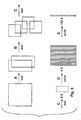
- Figure 1: General scheme for the synthesis of directed libraries. Example of the library with three positions randomized by two amino acids in each step, generating the library of eight tripeptides.
- Figure 2: Scheme of the synthesis of model library of 125 tetrapeptide mixtures on cotton string.
- Figure 3: Scheme of the synthesis of membrane library of 2888 pentapeptides. "n" = Number of amino acids randomized in the particular position.
- As used herein a species of test compound can be a single defined molecular structure. Alternatively, a species of test compound can be a motif species, which is a mixture of defined molecules wherein multiple species of subunits are present at one or more of the positions of the species of test compound. Motif libraries are combinatorial libraries wherein the species of test compounds are motif species. As used herein, when motif libraries are constructed, the term "type of subunit" refers either to a chemical species of subunit or to a defined mixture of species of subunits. Regarding a motif library, the position of a species of test compound wherein a mixture of species of subunits has been added is called a "mixed position". In keeping with the nomenclature of random combinatorial libraries, the position of a species of test compound of a motif library or a nonmotif library wherein a single species of subunit is present is called a "random position", except when all species of the library have the same species of subunit at a given position, in which case that position is called an invariant or a fixed position. Motif libraries are described in co-pending, commonly assigned patent application Serial No. 08/246,435 (US-A-5846841) filed May 20, 1994, which is hereby incorporated by reference.
- To permit the synthesis of the species of test compound attached to the support matrix, a linking means is provided. The linking means can have multiple reactive sites for attachment of subunits. In one embodiment the subunits are bifunctional subunits having removable protecting groups; amino acids are the familiar example. Under these circumstances the test compounds are polymers.
- In an alternative embodiment the linking means comprise multiple, orthogonally blocked reactive sites, and are termed scaffolds. In this embodiment, the subunits provide substituents of the scaffold. Thus, the species of test compounds are species of substituted scaffolds. The subunit added at each site of the scaffold can be bifunctional or monofunctional and the substituent attached to a reactive site of the scaffold can be comprised of one or more subunits.
- According to the invention the bifunctional and monofunctional subunits of a library of substituted scaffolds and the bifunctional subunits of a library of polymers can be joined to the growing test compound by a variety of chemical bonds of which the following are non-limiting examples: amide, ester, urea, urethane, carbon-carbonyl bonds, carbon-nitrogen bonds, carbon-carbon single bonds, olefine bonds, thioether bonds, and disulfide bonds. The chemistries of the production of test compounds in scaffold and non-peptide polymer libraries are described in co-pending commonly assigned patent application Serial No. 08/249,830, filed May 24, 1994, which is hereby incorporated by reference.
- Solid phase synthesis of peptides is normally performed on a beaded polymer (Merrifield, R.B., 1963, J.Am.Chem.Soc. 85:2149-2154), however, alternative forms of solid support can be employed. The solid supports include membranes (Daniels, S.B. et al., 1989, Tetrahedron Lett. 30:4345-4348), sheets of paper (Frank, R., 1992, Tetrahedron 48:9217-9232; Frank, R. and R. Döring, 1988, Tetrahedron 44:6031-6040), or cotton (Eichler, J. and R.A. Houghten, 1993, Biochemistry 32:11035-11041; Lebl, M. and J. Eichler, 1989, Pept. Res. 2:232-235). For the review of multiple synthetic techniques see (Frank, R., 1993, Bioorg. Med. Chem. Lett. 3:425-430; Jung, G. and A.G. Beck-Sickinger, 1992, Angew. Chem. Int. Ed. Engl. 31:367-383). Prior experience with cotton (Eichler, J. et al., 1991, Pept. Res. 4:296-307) led to the selection of cotton threads as one experimental solid support for the synthesis of "directed" or "nonrandom" libraries. The principle of such libraries is simple and is illustrated in Figure 1. The continuous support is divided into as many parts as the number of types of subunits utilized in the first randomization step, and the pieces are individually reacted with the appropriate residue. After completion of the reaction, each fragment of the support matrix is then divided into as many parts as the number of types of subunits used in the second randomization step, with the appropriate pieces from each fragment pooled for coupling.
- In this manner, the synthesis can continue until subunits are added at all the positions of the test compound or until the mechanical limit of handling the support is reached. The convenient mechanical limit of cotton thread is achieved at a dimension of several millimeters, which defines the practical capacity of a library of cotton thread at between 10 test compounds to 50,000 test compounds. Libraries of these proportions are of substantial value, especially in the case of nonpeptidic libraries. Thus, libraries having as few as two, three, four and five random positions for which the number of types of subunits can be between 2 or 3 and 19 or more are within the scope of the invention.
- In an alternative embodiment the matrix can be a functionalized membranes. Non-limiting examples of a suitable support matrix include polypropylene and polytetrafluoro ethylene (TEFLON) The smallest practical area is about 1 mm2, and since the membrane is only 10 µm thick, a library of several million compounds can be constructed most readily when automation of this process is employed. The size of a library constructed using a membraneous support matrix is limited only by considerations of economy, efficiency and the expense of screening the library and not by any technical considerations of its synthesis.
- A third embodiment of the invention is a "restructurable toothbrush" having bunches of threads of functionalized material with better mechanical properties than cotton. The bunches of threads from different brushes can be disassembled and reassembled in different combination for the next stepwise addition of subunits. The individual bunches of threads can be disassembled after two or three rounds of step wise addition and recombined for the next step. For the last randomization step the threads can be cut into pieces according to the above-described method of the invention.
- The disclosed method for the construction of 'directed' libraries allows for the incorporation of simple coding schemes, that employ simple (i.e., grossly visual) identification of important structural features in the library, based on the physical characteristics of the support, such as the color (Campian, E. et al., 1993, 13th APS, Edmonton, Canada) size and shape of the material (length in the case of thread).
- In contrast to libraries the species of which are constructed in a fixed array, wherein the position of each species identifies its structure, in the preferred embodiments of the present invention the complete structure of a species of test compound is not encoded by a grossly observable characteristic. Rather, the structures of the species of test compounds selected after the screening test are determined by structural analysis. The structural analysis can be conducted by using such techniques as Edman degradation, in the case of peptide test compounds, or mass spectroscopy. The structure which is analyzed can be the test compound itself or the structure can be an encoding molecule which is attached to each solid phase support in addition to the test compound. The structures of the encoding molecules attached to a solid phase support are, firstly, arbitrarily and systematically related to the species of the test compound attached to the support so as to identify the test compound and, secondly, selected so as to be readily determinable. The selection and use of arbitrary coding molecules in combinatorial libraries is described in co-pending commonly assigned patent application Serial No. 08/249,830, (WO-A-9428028) filed May 24, 1994, which is hereby incorporated by reference.
- The following examples are provided as illustrative examples of certain embodiments of the invention and are not intended as a limitation on the scope of the present invention.
- We have prepared two model "nonrandom" peptide libraries. The preparation and screening of each of these libraries is first summarized briefly below. A more detailed description of the materials and methods, the synthesis and screening of each of these two libraries follows in Sections 6.1 - 6.5.
- The first library was prepared on cotton thread and contained only 125 peptide mixtures (see Figure 2). Cotton thread (125 cm) was modified by beta alanine (Eichler, J. et al., 1991, Pept. Res. 4:296-307) and glycine was attached to it. The thread was then divided into five pieces and Gly, Ala, Leu, Phe, and Tyr were coupled to each piece, respectively. After complete coupling and Fmoc deprotection, a mixture of L-amino acids was coupled to every thread. Thereafter, for two successive steps, each thread fragment was sectioned into 5 pieces and each piece was acylated with one amino acid selected from the above-noted set of five amino acids. Thereafter the resultant 125 fragments were combined, deprotected, neutralized, washed and dried; resulting in the generation of a motif library of 125 tetrapeptide motif species (mixtures of 19 species of peptides on each
particle having positions - Each piece was then cut in half and both halves were placed into two matching microtiter plates, one of them equipped with a filter. The filter plate was then exposed to ammonia gas in a desiccator to release the peptides from the cotton. Gas ammonolytical cleavage, described earlier (Bray, A.M. et al., 1994, J.Org.Chem. 59:2197-2203; Bray, A.M. et al., 1993, Tetrahedron Lett. 34:4411-4414), was chosen as a cleavage method because, after cleavage, the peptide remains on the surface of the dry support particle. The peptides can be dissolved into the testing buffer.
- After extraction of the peptide with buffer, the peptide was transferred to another plate and an anti-β-endorphin antibodies binding assay was performed. One well was observed to react positively, and sequencing of the corresponding cotton fraction, identified the sequence Tyr-Gly-Mix-Phe (Mix is a mixture of all amino acids), corresponding to the known motif for anti-β-endorphin antibodies. Further analysis revealed that a one centimeter of cotton thread can yield 400 nmol of released peptide, allowing for the preparation of 40 ml of a 10 µM solution of test compound, more than enough for multiple assays.
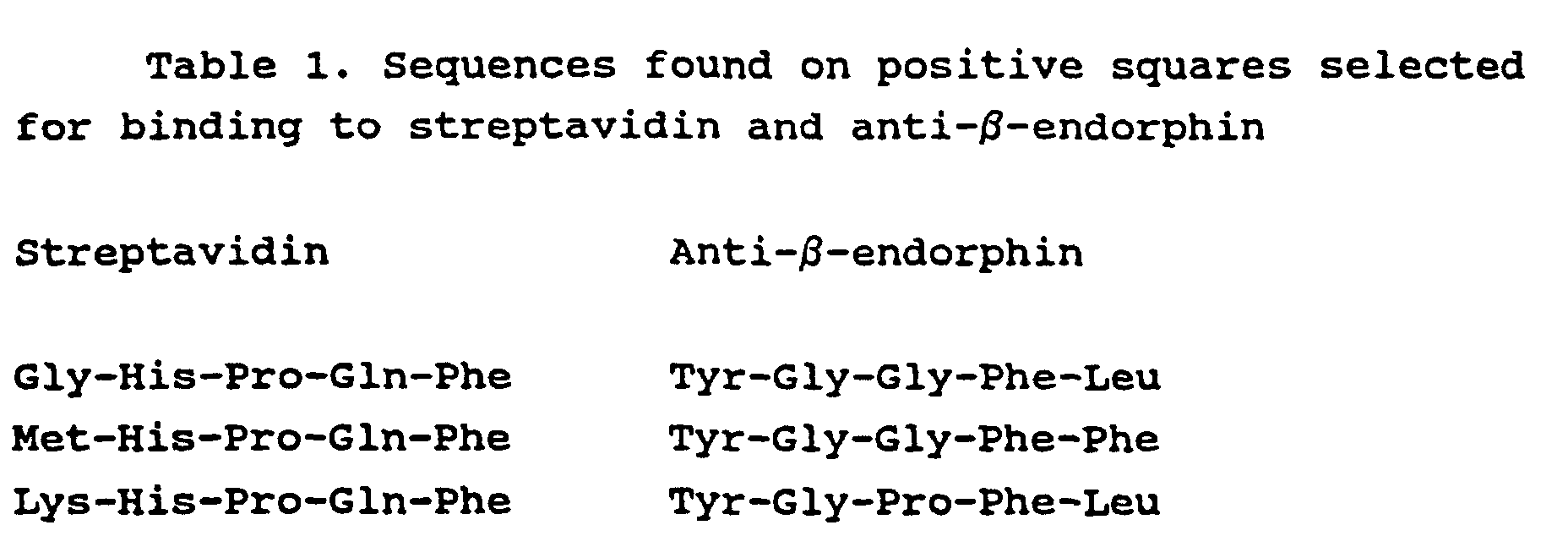
- The second example was a 2888 peptide library, which was synthesized using a 16x16 cm sheet of functionalized polytetrafluoroethylene ("TEFLON") membrane. The membrane was acylated by a N-protected β-alanine, and a linker composed of a repeated sequence of β-alanine and glycine was constructed. The scheme of synthesis is given in Figure 3. The species of test compounds of the library had the structure Xxx-Xxx-Pro/Gly-Gln/Phe-Phe/Leu (Xxx is one of 19 L amino acids used for the randomization), which contained one copy of the sequence Leu-His-Pro-Gln-Phe (38 copies of Xxx-His-Pro-Gln-Xxx), with His-Pro-Gln being the known motif for streptavidin, and one copy of Tyr-Gly-Gly-Phe-Leu, containing Tyr-Gly-Xxx-Phe sequence, the known motif for an anti-β-endorphin monoclonal antibody (Barrett, R.W. et al., 1992, Anal. Biochem. 204:357-364; Cwirla, S.E. et al., 1990, Proc.Natl.Acad.Sci.USA 87:6378-6382; Devlin, J.J. et al., 1990, Science 249:404-40625; Lam, K.S. et al., 1993, Bioorg. Med. Chem. Lett. 3:419-424; Lam, K.S. et al., 1991, Nature 354:82-84; McLafferty, M.A., 1993, Gene 128:29-36; Pinilla, C., 1993, Gene 128:71-76). The library was then screened with two model targets, streptavidin and anti-β-endorphin, using the solid phase binding protocol.
- Screening with streptavidin yielded 55 positive squares. The specificity of the peptides was determined by addition of the known competitor biotin. Seventeen of the squares contained peptides that did not react with streptavidin in the presence of biotin, however, all 17 of the squares again stained positively in the absence of biotin with approximately equal intensity. The peptides on three squares were sequenced individually with the results given in Table 1. Small pieces of all squares were cut and sequenced at once. This multiple sequencing experiment (Lebl, M. et al., 1993, In C.H. Schneider and A.N. Eberle, Peptides 1992, Proc.22.EPS Eds. ESCOM, Leiden) revealed the requirements of individual positions of the peptide chain.
- Incubation with anti-β-endorphin provided 21 stained squares. These positively interacting particles were destained, and reincubated with anti-β-endorphin antibody using alternative detection scheme. In the first staining the antibody was labelled by biotin and detection of bound target was achieved by incubation with streptavidin-alkaline phosphatase complex. The second round of detection was performed by incubation with anti-mouse antibody-alkaline phosphatase complex. In this way the nonspecific interactions of the first detection scheme were eliminated and since the second detection was done only with selected particles, the probability of detecting the nonspecific interactions (specific interactions of the detection system) was significantly decreased. The second incubation detected only three positive squares. They were sequenced and sequences found are given in Table 1. Predicted sequences with the motif Tyr-Gly-Xxx-Phe were found.
- Instrumentation : UV/VIS absorption spectra were recorded on a Hewlett Packard HP 8452A Diode-Array spectrophotometer using a 1 cm quartz cuvette. Sequencing by Edman degradation was performed on an ABI 4778 protein sequencer (Applied Biosystems, Foster City, CA) and Porton PI 3010 instrument (Porton Instruments, Tarzana, CA).
Materials: Commercial-grade solvents were used without further purification. Protected amino acids were obtained from Bachem (Torrance, CA), Advanced ChemTech (Louisville, KY), or Propeptide (Vert-le-Petit, France). Monoclonal anti-β-endorphin antibodies (clone 3-E7) were purchased from Boehringer Mannheim. Streptavidin conjugated to alkaline phosphatase was obtained from Pierce (Rockford, IL), and the goat-anti-mouse alkaline phosphatase complex was obtained from Bio-Rad (Richmond, CA). d-Biotin was purchased from Sigma (St. Louis, MO).
General Procedures : Solid phase synthesis was performed manually in polypropylene syringes (Krchák, V. and J. Vágner, 1990, Pept. Res. 3:182-193). Fmoc protecting groups were cleaved with 50% piperidine/DMF for 1x10min. DIC in DMF was used for the activation of Na-Fmoc amino acids. The completeness of each condensation reaction was monitored by the bromophenol blue method (Krch
- Cotton string (5 m, 6m/g) was treated for lh in 25% trifluoroacetic acid (TFA) in dichloromethane (DCM). It was washed by DCM (3x), neutralized by 5% diisopropylethylamine in DCM (5min) and washed by DCM and DMF (3x). Fmoc-β-Ala (2mmol) was coupled overnight by DIC (2mmol) and HOBt (2mmol) activation with addition of N-methylimidazole (3.5 mmol). Cotton was washed by DMF and substitution was determined by photometrical determination of cleaved Fmoc group - 0.41 mmol/g (683 nmol/cm). Five pieces of the cotton string (25 cm each) were placed into five polypropylene syringes and Fmoc protected amino acids (Phe, Tyr(But), Ala, Leu, Gly) were coupled by DIC/HOBt protocol. After coupling completion (monitored by bromophenol blue method), the strings were washed by DMF, placed in one syringe and Fmoc group was cleaved. After washing with DMF and 2%solution of HOBt in DMF the mixture of 19 L (cysteine excluded) Fmoc amino acids with molar ratio (determined in pilot experiments) adjusted for different reactivities (Eichler, J. and R.A. Houghten, 1993, Biochemistry 32:11035-11041; Geysen, H.M. et al., 1986, Mol. Immun. 23:709-715; Pinilla, C. et al., 1992, BioTechniques 13:901-905) was coupled to all cotton pieces. After completion of this coupling the cotton was washed, Fmoc group was cleaved and washed cotton string was divided into five syringes in the following way. From each string five cm of the cotton was cut and placed in the different syringe. In this way all syringes have only one 5cm piece of cotton cut from each 25cm string and none have more than one. Coupling of five amino acid derivatives (same as above) was performed, cotton was washed, Fmoc group was removed and cotton was subdivided again. In this case 1cm pieces were cut from all 5cm pieces and placed in five syringes. Coupling of the same five amino acids was performed, Fmoc group was cleaved and side chain protecting group were cleaved by mixture of TFA, DCM and anisole (50:45:5) for 2h. Cotton pieces were washed by DCM, MeOH and dried. Quantitative amino acid analysis of a sample of one string revealed the substitution of 400 nmol/cm.
- Cotton pieces were cut in half and placed into matching positions of the two matching microtiter plates (one equipped with a filter bottom and one regular plate - "structure evaluation plate"). Filter plate was placed into the desiccator which was repeatedly evacuated and filled with gas ammonia. After 20 h exposure to ammonia the desiccator was evacuated and ammonia removed. Release buffer PBS/Tween was added to each well (100 µl) and plates were shaken overnight at room temperature. Solution was filtered to the test plates.
- For the inhibition ELISA, 96-well Immulon plates (Dynatech) were used. Each well was initially coated with 50µl of streptavidin (20 µg/ml) in bicarbonate buffer (pH 9.4) (Pierce) overnight, followed by three washes with PBS. Wells were treated with 200 µl of bovine serum albumin (BSA, 3 mg/ml) in PBS to prevent nonspecific adsorption and washed three times with PBS/Tween, and 50 µl of biotinylated Tyr-Gly-Gly-Phe-Leu (Salmon, S.E. et al., 1993, Proc.Natl.Acad.Sci.USA 90:11708-11712) (10 ng/ml) was added. After 1 hr, plates were washed with PBS/Tween, and 50 µl of solution released from cotton pieces (or Tyr-Gly-Gly-Phe-Leu, positive control) was added, followed by 50 µl of anti-β-endorphin (40 ng/ml). After 1 hr of incubation at room temperature, plates were washed with PBS/Tween, and 50 µl of a 1:1000 dilution of goat anti-mouse IgG horseradish peroxidase conjugate (Bio-Rad) was added. One hour later, the plates were washed, and 100 µl of solution of 30 µl of 30% H2O2 in 10 ml of 2,2'-azidobis(3-ethylbenzthiazolinesulfonic acid) substrate in citrate buffer (pH 4.2) was added. Fifteen minutes later, the ELISA plates were read at 405 nm. Only one well has shown significant inhibition. Sample of the cotton piece (0.3mm) from the matching well in the "structure evaluation plate" was sequenced and sequence Tyr-Gly-Mix-Phe was found.
- Hydrophilic aminopropyl functionalized membrane (UV crosslinked aminopropyl methacrylamide, N,N-dimethylacrylamide and methylene-bis-acrylamide on TEFLON membrane, 16 x 16 cm, Perseptive Biosystems, Bedford, MA) with approximate 35 nmol/cm2 substitution was placed into 50mL Falcon tube and acylated by Fmoc-β-Ala using DIC/HOBt procedure in DMF. Fmoc-Gly, Fmoc-β-Ala, and Fmoc-Gly were coupled consecutively. After deprotection the membrane was divided into two parts and Fmoc-Phe and Fmoc-Leu were coupled to them, respectively. After coupling completion (bromophenol blue monitoring) and deprotection, the pieces were divided again into two halves and recombined for the coupling of Fmoc-Gln and Fmoc-Phe. For the next coupling the membrane was divided again into two pieces and recombined for coupling of Fmoc-Pro and Fmoc-Gly. The pieces resulting from these couplings (8 x 4 cm) were now divided into 19 strips (8 x 0.21 cm) and the strips were placed into 19 small polypropylene tubes. Nineteen natural amino acids (excluding Cys) were used for coupling in this stage. After coupling completion and Fmoc deprotection, The strips were cut into 19 pieces (4 x 2.1 mm) and divided into 19 vessels again. The same set of 19 Fmoc amino acids was used for the last coupling. All pieces were combined, Fmoc group was removed and side chain protecting groups were cleaved by mixture K (King, D.S. et al., 1990, Int. J. Peptide Protein Res. 36:255-266). Membrane pieces were washed by TFA (2x), DCM (5x), MeOH (3x), water (5x). Substitution based on measurement of the absorbance of the last Fmoc release was 43.3 nmol/cm2.
- The peptide library was screened according to published protocol (Lam, K.S. and M. Lebl, 1992, Immunomethods 1:11-15). The peptide squares were first washed with double-distilled water. After thorough washing, the squares were washed and coated with 0.05% gelatin (w/v) to block nonspecific binding. Washing with PBS/Tween (137 mM NaCl, 2.7 mM KCl, 4.3 Na2HPO4, 1.4mM KH2PO4, pH 7.2 with 0.1% Tween-20) and 2xPBS/Tween/gelatin ( 2x PBS, 0.1% Tween-20 (v/v), and 0.05% gelatin (w/v)) was followed by an incubation with a 20nM streptavidin-alkaline phosphatase in 2x PBS/Tween/gelatin. Again the library was washed with PBS/Tween, 2xPBS/Tween/gelatin and with TBS (137mM NaCl, 2.7mM KCl, 25mM Tris base, pH7.4). The standard substrate 5-bromo-4-chloro-3-indolyl phosphate was added then added. The library and substrate were then transferred to petri dishes for color development. Fifty-five color squares were collected, washed with 6M guanidine hydrochloride, pH 1.0, decolorized with DMF, gelatin coated and competed with 100nM d-Biotin with 20nM streptavidin-AP in 2xPBS/Tween/gelatin. Incubation with substrate yielded 17 colorless, competed squares. Reincubation with 20nM streptavidin-AP produced 17 positively reacting squares following treatment with substrate.
- The remaining library was then recycled with 6M guanidine hydrochloride, pH1.0, DMF, and gelatin coated. After washing with PBS/Tween and 2xPBS/Tween/gelatin, 250ng/ml biotinylated anti-β-endorphin antibody in 2xPBS/Tween/gelatin was added. Following thorough washing, streptavidin-alkaline phosphatase was added. The library was then washed, substrate was added, and color development proceeded as described above. Twenty one squares developed color, and subsequent recycling prepared them for specificity determination. Using 2xPBS/Tween/gelatin as the buffer, 200ng/ml anti-β-endorphin antibody was added, and thorough washing was followed with 1.5nM goat-anti-mouse-AP. The squares were then washed with PBS/Tween, 2xPBS/Tween/gelatin and TBS, and substrate was added. As a result, 3 squares developed the color that indicates binding.
Claims (36)
- A method of making a combinatorial library of test compounds which comprises at least two successive iterations of the steps of:thereby providing at least two subunits attached to each piece of solid phase support, and wherein each piece of solid phase support has a single species of test compound of selected subunits attached to it and each species of test compound is represented on a predetermined number of pieces of solid phase support.(a) selecting a set consisting of two or more types of subunits;(b) dividing a continuous solid phase support having a linker, said linker having reactive sites and having one or more protecting groups, into a number of physically separate pieces of support equal to an integral multiple of the number of selected types of subunits;(c) attaching one type of subunit to substantially all the reactive sites attached to a corresponding piece of solid phase support; and thereafter(d) removing a protecting group from the linker so that reactive sites are provided,
- The method of claim 1 wherein the linker of the solid phase support is a scaffold, said scaffold being comprised of multiple, orthogonally protected reactive sites.
- The method of claim 1 further comprising a step, following the last iteration, of releasing the attached subunits from the solid phase support.
- The method of claim 1 wherein the solid phase support is selected from the group consisting of a membrane, a sheet of paper and cotton.
- The method of claim 4 wherein the membrane is a functionalized crosslinked polytetrafluorethylene.
- The method of claim 4 wherein the cotton is in the form of a string or a thread.
- The method of claim 1 wherein the subunits have one or more protecting groups being releasable independently of at least one of the protecting groups of the linker.
- The method of claim 1 wherein the number of pieces of support in step (b) is equal to the number of selected types of subunits, so that each species of test compound is represented on exactly one piece of solid phase support.
- A method of making a combinatorial library of test compounds which comprises the steps of:and further comprising at least two successive iterations of the steps of:(a) attaching a linker having more than one protecting groups to a continuous solid phase support; and(b) removing one type of protecting group from the linker so that reactive sites are provided;thereby providing at least two subunits attached to each piece of solid phase support, and wherein each piece of solid phase support has a single species of test compound of selected subunits attached to it and each species of test compound is represented on a predetermined number of pieces of solid phase support.(c) selecting a set consisting of two or more types of subunits;(d) dividing the continuous solid phase support into a number of physically separate pieces of support equal to an integral multiple of the number of selected types of subunits;(e) attaching one type of subunit to substantially all the reactive sites attached to a corresponding piece of solid phase support; and thereafter(f) removing a protecting group from the linker so that reactive sites are provided,
- The method of claim 9 wherein the linker of the solid phase support is a scaffold, said scaffold being comprised of multiple, orthogonally protected reactive sites.
- The method of claim 9 wherein the subunit is a bifunctional subunit and the protecting group is a substituent of the subunit.
- The method of claim 11 wherein the bifunctional subunit is an amino acid.
- The method of claim 9 further comprising a step, following the last iteration, of releasing the attached subunits from the solid phase support.
- The method of claim 9 wherein the solid phase support is selected from the group consisting of a membrane, a sheet of paper and cotton.
- The method of claim 14 wherein the membrane is a functionalized crosslinked polytetrafluorethylene.
- The method of claim 14 wherein the cotton is in the form of a string or a thread.
- The method of claim 9 wherein the subunits have one or more protecting groups releasable independently from at least one of the protecting groups of the linker.
- The method of claim 9 wherein the number of pieces of support in step (d) is equal to the number of selected types of subunits, so that each species of test compound is represented on exactly one piece of solid phase support.
- A method of making a combinatorial library of test compounds which comprises at least two successive iterations of the steps of:thereby providing at least two subunits attached to each piece of solid phase support, and wherein each piece of solid phase support has a single species of test compound of selected subunits attached to it and each species of test compound is represented on a predetermined number of pieces of solid phase support.(a) selecting a set consisting of two or more types of subunits having one or more protecting groups;(b) dividing a continuous solid phase support having a linker, said linker having reactive sites, into a number of physically separate pieces of support equal to an integral multiple of the number of selected types of subunits;(c) attaching one type of subunit to substantially all the reactive sites attached to a corresponding piece of solid phase support; and thereafter(d) removing a protecting group from the subunit so that reactive sites are provided,
- The method of claim 19 wherein the subunit is a bifunctional subunit and the protecting group is a substituent of the subunit.
- The method of claim 20 wherein the bifunctional subunit is an amino acid.
- The method of claim 19 wherein the linker has one or more protecting groups, the protecting groups of the linker being releasable independently of the protecting groups of the subunits.
- The method of claim 19 wherein the solid phase support is selected from the group consisting of a membrane, a sheet of paper and cotton.
- The method of claim 23 wherein the membrane is a functionalized crosslinked polytetrafluorethylene.
- The method of claim 19 wherein the number of pieces of support in step (b) is equal to the number of selected types of subunits, so that each species of test compound is represented on exactly one piece of solid phase support.
- A method of making a combinatorial library of test compounds which comprises the steps of:and further comprising at least two successive iterations of the steps of:(a) attaching a linker having one or more protecting groups to a continuous solid phase support;(b) removing a protecting group from the linker so that reactive sites are provided;thereby providing at least two subunits attached to each piece of solid phase support, and wherein each piece of solid phase support has a single species of test compound of selected subunits attached to it and each species of test compound is represented on a predetermined number of pieces of solid phase support.(c) selecting a set consisting of two or more types of subunits having one or more protecting groups;(d) dividing the continuous solid phase support into a number of physically separate pieces of support equal to an integral multiple of the number of selected types of subunits;(e) attaching one type of subunit to substantially all the reactive sites attached to a corresponding piece of solid phase support; and thereafter(f) removing a protecting group from the subunit so that reactive sites are provided,
- The method of claim 26 wherein the linker has more than one protecting group releasable independently of the protecting groups on the subunits.
- The method of claim 26 wherein the solid phase support is selected from the group consisting of a membrane, a sheet of paper and cotton.
- The method of claim 28 wherein the membrane is a functionalized crosslinked polytetrafluorethylene.
- The method of claim 26 wherein the number of pieces of support in step (d) is equal to the number of selected types of subunits, so that each species of test compound is represented on exactly one piece of solid phase support.
- A method of making a combinatorial library of test compounds, the method comprising the steps of:(a) selecting two or more pieces of a physically and repetitively divisible solid phase support to each of which is attached only one type of a number of types of subunits, wherein the subunits have a reactive group protected with a protecting group, the number of types of subunits is equal to the number of pieces of selected support, and each type of subunit is attached to only one piece of support;(b) removing the protecting group thereby providing the reactive group;(c) dividing each piece of support into a number of physically separate pieces, the number of pieces being equal to the number of types of subunits; and(d) attaching one type of subunit of the number of types of subunits to each type of subunit attached to each piece of support so that a number of different species of test compounds is formed, each species of test compound being formed on only one piece of support, each test compound comprising a plurality of subunits, wherein the number of types of subunits of the test compounds is equal to the number of pieces of support selected in step (a), only one type of species of test compound is formed on each support, and the number of species of test compounds is equal to the number of pieces of support.
- The method of claim 31, further comprising the step of performing one or more reiterations of steps (c) and (d) .
- The method of claim 31, wherein the subunits are amino acids.
- The method of claim 31, wherein the solid phase support is selected from the group consisting of a membrane, a sheet of paper, and cotton.
- The method of claim 34, wherein the membrane is a functionalized crosslinked polytetrafluoroethylene.
- The method of claim 34, wherein the cotton is in the form of a string or a thread.
Applications Claiming Priority (3)
| Application Number | Priority Date | Filing Date | Title |
|---|---|---|---|
| US08/354,199 US5688696A (en) | 1994-12-12 | 1994-12-12 | Combinatorial libraries having a predetermined frequency of each species of test compound |
| US354199 | 1994-12-12 | ||
| PCT/US1995/015895 WO1996018903A1 (en) | 1994-12-12 | 1995-12-07 | Combinatorial libraries having a predetermined frequency of each species of test compound |
Publications (3)
| Publication Number | Publication Date |
|---|---|
| EP0797776A1 EP0797776A1 (en) | 1997-10-01 |
| EP0797776A4 EP0797776A4 (en) | 1998-07-01 |
| EP0797776B1 true EP0797776B1 (en) | 2002-06-12 |
Family
ID=23392276
Family Applications (1)
| Application Number | Title | Priority Date | Filing Date |
|---|---|---|---|
| EP95942579A Expired - Lifetime EP0797776B1 (en) | 1994-12-12 | 1995-12-07 | Combinatorial libraries having a predetermined frequency of each species of test compound |
Country Status (15)
| Country | Link |
|---|---|
| US (2) | US5688696A (en) |
| EP (1) | EP0797776B1 (en) |
| CN (1) | CN1150403C (en) |
| AR (1) | AR000334A1 (en) |
| AT (1) | ATE219101T1 (en) |
| AU (1) | AU706091B2 (en) |
| CA (1) | CA2207435A1 (en) |
| DE (1) | DE69527084T2 (en) |
| DK (1) | DK0797776T3 (en) |
| ES (1) | ES2177675T3 (en) |
| IL (1) | IL116360A (en) |
| PT (1) | PT797776E (en) |
| TW (1) | TW544454B (en) |
| WO (1) | WO1996018903A1 (en) |
| ZA (1) | ZA9510550B (en) |
Families Citing this family (69)
| Publication number | Priority date | Publication date | Assignee | Title |
|---|---|---|---|---|
| US20060229824A1 (en) | 1993-10-26 | 2006-10-12 | Affymetrix, Inc. | Arrays of nucleic acid probes for analyzing biotransformation genes |
| US5985356A (en) | 1994-10-18 | 1999-11-16 | The Regents Of The University Of California | Combinatorial synthesis of novel materials |
| US5688696A (en) * | 1994-12-12 | 1997-11-18 | Selectide Corporation | Combinatorial libraries having a predetermined frequency of each species of test compound |
| US6149869A (en) * | 1996-10-23 | 2000-11-21 | Glaxo Wellcome Inc. | Chemical synthesizers |
| US6042789A (en) * | 1996-10-23 | 2000-03-28 | Glaxo Group Limited | System for parallel synthesis of organic compounds |
| US6875620B1 (en) * | 1996-10-31 | 2005-04-05 | Agilent Technologies, Inc. | Tiling process for constructing a chemical array |
| US6054325A (en) * | 1996-12-02 | 2000-04-25 | Glaxo Wellcom Inc. | Method and apparatus for transferring and combining distinct chemical compositions with reagents |
| US6083761A (en) * | 1996-12-02 | 2000-07-04 | Glaxo Wellcome Inc. | Method and apparatus for transferring and combining reagents |
| IL134702A (en) * | 1997-09-11 | 2004-03-28 | Bioventures Inc | High density arrays and methods of making the same |
| DE19741716A1 (en) * | 1997-09-22 | 1999-03-25 | Hoechst Ag | Recognition system |
| US6083682A (en) | 1997-12-19 | 2000-07-04 | Glaxo Group Limited | System and method for solid-phase parallel synthesis of a combinatorial collection of compounds |
| AU2871299A (en) * | 1998-02-21 | 1999-09-06 | Alan W. Schwabacher | One dimensional chemical compound arrays and methods for assaying them |
| US6541211B1 (en) * | 1998-05-20 | 2003-04-01 | Selectide Corporation | Apparatus and method for synthesizing combinational libraries |
| US6872535B2 (en) | 1998-05-20 | 2005-03-29 | Aventis Pharmaceuticals Inc. | Three-dimensional array of supports for solid-phase parallel synthesis and method of use |
| US6420123B1 (en) * | 1999-04-06 | 2002-07-16 | Arpad Furka | Spatially defined synthesis |
| HUP0200798A3 (en) * | 1999-04-09 | 2003-01-28 | Glaxo Group Ltd | Solid phase chemical libraries and encoding scheme for solid phase chemical libraries |
| US6908737B2 (en) * | 1999-04-15 | 2005-06-21 | Vitra Bioscience, Inc. | Systems and methods of conducting multiplexed experiments |
| US20030207249A1 (en) * | 1999-04-15 | 2003-11-06 | Beske Oren E. | Connection of cells to substrates using association pairs |
| JP2002542463A (en) * | 1999-04-15 | 2002-12-10 | バーチャル・アレイズ・インコーポレーテッド | Combinatorial chemical library with indices at code locations |
| US20030129654A1 (en) * | 1999-04-15 | 2003-07-10 | Ilya Ravkin | Coded particles for multiplexed analysis of biological samples |
| US20030134330A1 (en) * | 1999-04-15 | 2003-07-17 | Ilya Ravkin | Chemical-library composition and method |
| US20030166015A1 (en) * | 1999-04-15 | 2003-09-04 | Zarowitz Michael A. | Multiplexed analysis of cell-substrate interactions |
| US7253435B2 (en) | 1999-04-15 | 2007-08-07 | Millipore Corporation | Particles with light-polarizing codes |
| US6399394B1 (en) | 1999-06-30 | 2002-06-04 | Agilent Technologies, Inc. | Testing multiple fluid samples with multiple biopolymer arrays |
| AU2001234779A1 (en) * | 2000-02-03 | 2001-08-14 | Nanoscale Combinatorial Synthesis, Inc. | Structure identification methods using mass measurements |
| US7244572B1 (en) | 2000-03-24 | 2007-07-17 | Wisys Technology Foundation, Inc. | One-dimensional arrays on optical fibers |
| US7052659B1 (en) | 2000-07-18 | 2006-05-30 | General Electric Company | Sequential high throughput screening method and system |
| AU9684601A (en) | 2000-10-12 | 2002-04-22 | Univ Rochester | Compositions that inhibit proliferation of cancer cells |
| JP2004537712A (en) * | 2000-10-18 | 2004-12-16 | バーチャル・アレイズ・インコーポレーテッド | Multiple cell analysis system |
| US6879915B2 (en) | 2001-01-31 | 2005-04-12 | Agilent Technologies, Inc. | Chemical array fabrication and use |
| US6608196B2 (en) | 2001-05-03 | 2003-08-19 | Galileo Pharmaceuticals, Inc. | Process for solid supported synthesis of pyruvate-derived compounds |
| US20030219800A1 (en) * | 2001-10-18 | 2003-11-27 | Beske Oren E. | Multiplexed cell transfection using coded carriers |
| US7811992B2 (en) | 2002-02-06 | 2010-10-12 | Stasys Technologies, Inc. | Anti-infarction molecules |
| US20040126773A1 (en) * | 2002-05-23 | 2004-07-01 | Beske Oren E. | Assays with coded sensor particles to sense assay conditions |
| WO2003100100A1 (en) * | 2002-05-24 | 2003-12-04 | Somagenics, Inc. | Methods and compositions for production of directed sequence libraries |
| US7537936B2 (en) * | 2002-05-31 | 2009-05-26 | Agilent Technologies, Inc. | Method of testing multiple fluid samples with multiple biopolymer arrays |
| EP2116604A1 (en) | 2002-08-05 | 2009-11-11 | University of Rochester | Protein transducing domain/deaminase chimeric proteins, related compounds, and uses thereof |
| US20050208468A1 (en) * | 2003-09-15 | 2005-09-22 | Beske Oren E | Assays with primary cells |
| US7488451B2 (en) * | 2003-09-15 | 2009-02-10 | Millipore Corporation | Systems for particle manipulation |
| EP1874950B1 (en) | 2005-04-05 | 2015-06-03 | Corning Incorporated | Label free biosensors |
| CN102379684B (en) | 2005-04-28 | 2014-11-19 | 普罗透斯数字保健公司 | Pharma-informatics system |
| EP2371843B1 (en) | 2005-05-19 | 2014-09-17 | THE GOVERNMENT OF THE UNITED STATES OF AMERICA, as represented by the Secretary, Department of Health and Human Services | Functional epitopes of streptococcus pneumoniae psaA antigen and uses thereof |
| EP2395076A1 (en) | 2005-10-14 | 2011-12-14 | MUSC Foundation For Research Development | Targeting PAX2 for the induction of DEFB1-mediated tumor immunity and cancer therapy |
| US8080534B2 (en) | 2005-10-14 | 2011-12-20 | Phigenix, Inc | Targeting PAX2 for the treatment of breast cancer |
| GB0605584D0 (en) * | 2006-03-20 | 2006-04-26 | Olink Ab | Method for analyte detection using proximity probes |
| EP3034083B1 (en) | 2006-09-21 | 2020-12-09 | University of Rochester | Antisense oligonucleotides for use in treating myotonic dystrophy |
| EP2104516B1 (en) | 2006-11-01 | 2015-01-07 | University of Rochester | Methods and compositions related to the structure and function of apobec3g |
| JP2010514839A (en) | 2007-01-03 | 2010-05-06 | バーナム インスティテュート フォー メディカル リサーチ | Methods and compositions relating to clot binding compounds |
| CA2677665C (en) | 2007-02-08 | 2019-11-05 | University Of Utah Research Foundation | Methods and compositions related to inhibition of viral entry |
| DK2192946T3 (en) | 2007-09-25 | 2022-11-21 | Otsuka Pharma Co Ltd | In-body device with virtual dipole signal amplification |
| CA2734322A1 (en) * | 2008-08-15 | 2010-02-18 | Georgetown University | Na channels, disease, and related assays and compositions |
| US20120070443A1 (en) | 2008-12-02 | 2012-03-22 | University Of Utah Research Foundation | Pde1 as a target therapeutic in heart disease |
| NZ596292A (en) | 2009-04-28 | 2014-04-30 | Proteus Digital Health Inc | Highly reliable ingestible event markers and methods for using the same |
| WO2011022502A1 (en) | 2009-08-18 | 2011-02-24 | Georgetown University | Boronic acid compositions and methods related to cancer |
| US20110081293A1 (en) | 2009-10-07 | 2011-04-07 | Sanford-Burnham Medical Research Institute | Methods and compositions related to clot-binding lipid compounds |
| WO2011075725A1 (en) | 2009-12-18 | 2011-06-23 | Sanford-Burnham Medical Research Institute | Methods and compositions related to clot-binding compounds |
| GB201004292D0 (en) * | 2010-03-15 | 2010-04-28 | Olink Ab | Assay for localised detection of analytes |
| GB201101621D0 (en) | 2011-01-31 | 2011-03-16 | Olink Ab | Method and product |
| JP6205345B2 (en) | 2011-03-28 | 2017-09-27 | ユニヴァーシティー オブ ユタ リサーチ ファウンデーション | Methods and compositions for inhibition of viral entry |
| GB201201547D0 (en) | 2012-01-30 | 2012-03-14 | Olink Ab | Method and product |
| US12025615B2 (en) | 2017-09-15 | 2024-07-02 | Arizona Board Of Regents On Behalf Of Arizona State University | Methods of classifying response to immunotherapy for cancer |
| CA3084824A1 (en) | 2017-12-15 | 2019-06-20 | Flagship Pioneering Innovations Vi, Llc | Compositions comprising circular polyribonucleotides and uses thereof |
| EP3930683A1 (en) | 2019-03-01 | 2022-01-05 | Flagship Pioneering Innovations VI, LLC | Compositions, methods, and kits for delivery of polyribonucleotides |
| EP3946466A2 (en) | 2019-03-25 | 2022-02-09 | Flagship Pioneering Innovations VI, LLC | Compositions comprising modified circular polyribonucleotides and uses thereof |
| AU2020292427A1 (en) | 2019-06-14 | 2022-01-06 | Flagship Pioneering Innovations Vi, Llc | Circular RNAs for cellular therapy |
| MA56538A (en) | 2019-06-19 | 2022-04-27 | Flagship Pioneering Innovations Vi Llc | METHODS FOR ASSAYING CIRCULAR POLYRIBONUCLEOTIDES |
| EP4038222A4 (en) | 2019-10-02 | 2023-10-18 | Arizona Board of Regents on behalf of Arizona State University | METHODS AND COMPOSITIONS FOR IDENTIFYING NEOANTIGENS FOR USE IN THE TREATMENT AND PREVENTION OF CANCER |
| US20230104113A1 (en) | 2020-01-29 | 2023-04-06 | Flagship Pioneering Innovations Vi, Llc | Delivery of compositions comprising circular polyribonucleotides |
| WO2022165234A1 (en) | 2021-01-29 | 2022-08-04 | The Regents Of The University Of California | Implantable imagers for in vivo imaging |
Family Cites Families (7)
| Publication number | Priority date | Publication date | Assignee | Title |
|---|---|---|---|---|
| US5010175A (en) * | 1988-05-02 | 1991-04-23 | The Regents Of The University Of California | General method for producing and selecting peptides with specific properties |
| US5424186A (en) * | 1989-06-07 | 1995-06-13 | Affymax Technologies N.V. | Very large scale immobilized polymer synthesis |
| CZ280777B6 (en) * | 1990-02-02 | 1996-04-17 | Ústav Organické Chemie A Biochemie Avčr | Process of multistep synthesis of peptides on planar carriers and apparatus for making the same |
| US5650489A (en) * | 1990-07-02 | 1997-07-22 | The Arizona Board Of Regents | Random bio-oligomer library, a method of synthesis thereof, and a method of use thereof |
| HU9201687D0 (en) * | 1992-05-21 | 1992-08-28 | Arpad Furka | Preparation of sets from peptid mixtures with polycomponents and their use for the identification of biologically active peptides |
| US5556752A (en) * | 1994-10-24 | 1996-09-17 | Affymetrix, Inc. | Surface-bound, unimolecular, double-stranded DNA |
| US5688696A (en) * | 1994-12-12 | 1997-11-18 | Selectide Corporation | Combinatorial libraries having a predetermined frequency of each species of test compound |
-
1994
- 1994-12-12 US US08/354,199 patent/US5688696A/en not_active Expired - Fee Related
-
1995
- 1995-12-07 WO PCT/US1995/015895 patent/WO1996018903A1/en not_active Ceased
- 1995-12-07 PT PT95942579T patent/PT797776E/en unknown
- 1995-12-07 ES ES95942579T patent/ES2177675T3/en not_active Expired - Lifetime
- 1995-12-07 AU AU43760/96A patent/AU706091B2/en not_active Ceased
- 1995-12-07 EP EP95942579A patent/EP0797776B1/en not_active Expired - Lifetime
- 1995-12-07 DK DK95942579T patent/DK0797776T3/en active
- 1995-12-07 CA CA002207435A patent/CA2207435A1/en not_active Abandoned
- 1995-12-07 DE DE69527084T patent/DE69527084T2/en not_active Expired - Fee Related
- 1995-12-07 CN CNB951973509A patent/CN1150403C/en not_active Expired - Fee Related
- 1995-12-07 AT AT95942579T patent/ATE219101T1/en not_active IP Right Cessation
- 1995-12-12 IL IL11636095A patent/IL116360A/en not_active IP Right Cessation
- 1995-12-12 ZA ZA9510550A patent/ZA9510550B/en unknown
- 1995-12-13 AR AR33458895A patent/AR000334A1/en unknown
- 1995-12-28 TW TW084114061A patent/TW544454B/en not_active IP Right Cessation
-
1997
- 1997-11-17 US US08/971,775 patent/US6127190A/en not_active Expired - Fee Related
Also Published As
| Publication number | Publication date |
|---|---|
| IL116360A0 (en) | 1996-03-31 |
| ATE219101T1 (en) | 2002-06-15 |
| PT797776E (en) | 2002-11-29 |
| AU706091B2 (en) | 1999-06-10 |
| US5688696A (en) | 1997-11-18 |
| EP0797776A4 (en) | 1998-07-01 |
| TW544454B (en) | 2003-08-01 |
| CA2207435A1 (en) | 1996-06-20 |
| ES2177675T3 (en) | 2002-12-16 |
| DK0797776T3 (en) | 2002-10-07 |
| AR000334A1 (en) | 1997-06-18 |
| AU4376096A (en) | 1996-07-03 |
| EP0797776A1 (en) | 1997-10-01 |
| WO1996018903A1 (en) | 1996-06-20 |
| CN1150403C (en) | 2004-05-19 |
| ZA9510550B (en) | 1996-06-13 |
| US6127190A (en) | 2000-10-03 |
| CN1173225A (en) | 1998-02-11 |
| IL116360A (en) | 2000-06-01 |
| DE69527084D1 (en) | 2002-07-18 |
| DE69527084T2 (en) | 2003-01-16 |
Similar Documents
| Publication | Publication Date | Title |
|---|---|---|
| US5688696A (en) | Combinatorial libraries having a predetermined frequency of each species of test compound | |
| Pavia et al. | The generation of molecular diversity | |
| Lebl et al. | One‐bead–one‐structure combinatorial libraries | |
| EP0705279B1 (en) | Topologically segregated, encoded solid phase libraries | |
| Früchtel et al. | Organic chemistry on solid supports | |
| US5591646A (en) | Method and apparatus for peptide synthesis and screening | |
| US5556762A (en) | Scanning synthetic peptide combinatorial libraries: oligopeptide mixture sets having a one predetermined residue at a single, predetermined position, methods of making and using the same | |
| US5840485A (en) | Topologically segregated, encoded solid phase libraries | |
| US5541061A (en) | Methods for screening factorial chemical libraries | |
| EP0675873A1 (en) | Synthesis of encoded polymers | |
| Frank | Simultaneous and combinatorial chemical synthesis techniques for the generation and screening of molecular diversity | |
| Williard et al. | Combinatorial chemistry: a rational approach to chemical diversity | |
| Beck-Sickinger et al. | Combinatorial strategies in biology and chemistry | |
| Groth et al. | PEG based resins for protease drug discovery synthesis, screening and analysis of combinatorial on-bead libraries | |
| US20060134697A1 (en) | Method of preparing coded compound libraries | |
| US20010021513A1 (en) | Test device comprising a plate containing a multiplicity of wells with an associated metering device, as well as a kit which comprises these devices and use of the devices | |
| Beck-Sickinger et al. | From multiple peptide synthesis to peptide libraries | |
| Shin | Recent Development of Analytical Methods for the Biopolymers Built on a Solid Support | |
| Andrews et al. | Multiple and Combinatorial Peptide Synthesis: Chemical Development and Biological Applications | |
| Furka | Combinatorial chemistry | |
| Krämer et al. | Encoding technologies | |
| Lebl et al. | Felder zyxwvutsrqponmlkj | |
| Kundu et al. | Polymer supported | |
| Miertus et al. | Combinatorial Chemistry: From Split-Mix to Discrete A´ rpa´ d Furka | |
| Lebl | Combinatorial/library peptide synthesis |
Legal Events
| Date | Code | Title | Description |
|---|---|---|---|
| PUAI | Public reference made under article 153(3) epc to a published international application that has entered the european phase |
Free format text: ORIGINAL CODE: 0009012 |
|
| 17P | Request for examination filed |
Effective date: 19970703 |
|
| AK | Designated contracting states |
Kind code of ref document: A1 Designated state(s): AT BE CH DE DK ES FR GB GR IE IT LI LU MC NL PT SE |
|
| A4 | Supplementary search report drawn up and despatched |
Effective date: 19980518 |
|
| AK | Designated contracting states |
Kind code of ref document: A4 Designated state(s): AT BE CH DE DK ES FR GB GR IE IT LI LU MC NL PT SE |
|
| 17Q | First examination report despatched |
Effective date: 20000620 |
|
| GRAG | Despatch of communication of intention to grant |
Free format text: ORIGINAL CODE: EPIDOS AGRA |
|
| RIC1 | Information provided on ipc code assigned before grant |
Free format text: 7C 07K 1/04 A, 7G 01N 33/543 B |
|
| GRAG | Despatch of communication of intention to grant |
Free format text: ORIGINAL CODE: EPIDOS AGRA |
|
| GRAH | Despatch of communication of intention to grant a patent |
Free format text: ORIGINAL CODE: EPIDOS IGRA |
|
| GRAH | Despatch of communication of intention to grant a patent |
Free format text: ORIGINAL CODE: EPIDOS IGRA |
|
| GRAA | (expected) grant |
Free format text: ORIGINAL CODE: 0009210 |
|
| AK | Designated contracting states |
Kind code of ref document: B1 Designated state(s): AT BE CH DE DK ES FR GB GR IE IT LI LU MC NL PT SE |
|
| REF | Corresponds to: |
Ref document number: 219101 Country of ref document: AT Date of ref document: 20020615 Kind code of ref document: T |
|
| REG | Reference to a national code |
Ref country code: GB Ref legal event code: FG4D |
|
| REG | Reference to a national code |
Ref country code: CH Ref legal event code: EP |
|
| REF | Corresponds to: |
Ref document number: 69527084 Country of ref document: DE Date of ref document: 20020718 |
|
| REG | Reference to a national code |
Ref country code: IE Ref legal event code: FG4D |
|
| REG | Reference to a national code |
Ref country code: CH Ref legal event code: NV Representative=s name: KIRKER & CIE SA |
|
| REG | Reference to a national code |
Ref country code: DK Ref legal event code: T3 |
|
| REG | Reference to a national code |
Ref country code: GR Ref legal event code: EP Ref document number: 20020402641 Country of ref document: GR |
|
| ET | Fr: translation filed | ||
| REG | Reference to a national code |
Ref country code: PT Ref legal event code: SC4A Free format text: AVAILABILITY OF NATIONAL TRANSLATION Effective date: 20020909 |
|
| REG | Reference to a national code |
Ref country code: ES Ref legal event code: FG2A Ref document number: 2177675 Country of ref document: ES Kind code of ref document: T3 |
|
| PLBE | No opposition filed within time limit |
Free format text: ORIGINAL CODE: 0009261 |
|
| STAA | Information on the status of an ep patent application or granted ep patent |
Free format text: STATUS: NO OPPOSITION FILED WITHIN TIME LIMIT |
|
| 26N | No opposition filed |
Effective date: 20030313 |
|
| PGFP | Annual fee paid to national office [announced via postgrant information from national office to epo] |
Ref country code: NL Payment date: 20031120 Year of fee payment: 9 |
|
| PGFP | Annual fee paid to national office [announced via postgrant information from national office to epo] |
Ref country code: AT Payment date: 20031121 Year of fee payment: 9 |
|
| PGFP | Annual fee paid to national office [announced via postgrant information from national office to epo] |
Ref country code: MC Payment date: 20031124 Year of fee payment: 9 |
|
| PGFP | Annual fee paid to national office [announced via postgrant information from national office to epo] |
Ref country code: PT Payment date: 20031125 Year of fee payment: 9 |
|
| PGFP | Annual fee paid to national office [announced via postgrant information from national office to epo] |
Ref country code: GB Payment date: 20031203 Year of fee payment: 9 |
|
| REG | Reference to a national code |
Ref country code: GB Ref legal event code: 732E |
|
| PGFP | Annual fee paid to national office [announced via postgrant information from national office to epo] |
Ref country code: FR Payment date: 20031218 Year of fee payment: 9 |
|
| PGFP | Annual fee paid to national office [announced via postgrant information from national office to epo] |
Ref country code: SE Payment date: 20031219 Year of fee payment: 9 |
|
| PGFP | Annual fee paid to national office [announced via postgrant information from national office to epo] |
Ref country code: DK Payment date: 20031222 Year of fee payment: 9 |
|
| PGFP | Annual fee paid to national office [announced via postgrant information from national office to epo] |
Ref country code: IE Payment date: 20031223 Year of fee payment: 9 Ref country code: CH Payment date: 20031223 Year of fee payment: 9 |
|
| PGFP | Annual fee paid to national office [announced via postgrant information from national office to epo] |
Ref country code: GR Payment date: 20031229 Year of fee payment: 9 |
|
| PGFP | Annual fee paid to national office [announced via postgrant information from national office to epo] |
Ref country code: LU Payment date: 20031231 Year of fee payment: 9 |
|
| PGFP | Annual fee paid to national office [announced via postgrant information from national office to epo] |
Ref country code: ES Payment date: 20040108 Year of fee payment: 9 |
|
| PGFP | Annual fee paid to national office [announced via postgrant information from national office to epo] |
Ref country code: BE Payment date: 20040128 Year of fee payment: 9 |
|
| PGFP | Annual fee paid to national office [announced via postgrant information from national office to epo] |
Ref country code: DE Payment date: 20040202 Year of fee payment: 9 |
|
| REG | Reference to a national code |
Ref country code: PT Ref legal event code: PC4A Free format text: AVENTIS PHARMACEUTICALS INC. US Effective date: 20040308 |
|
| NLS | Nl: assignments of ep-patents |
Owner name: AVENTIS PHARMACEUTICALS INC. |
|
| PG25 | Lapsed in a contracting state [announced via postgrant information from national office to epo] |
Ref country code: LU Free format text: LAPSE BECAUSE OF NON-PAYMENT OF DUE FEES Effective date: 20041207 Ref country code: IE Free format text: LAPSE BECAUSE OF NON-PAYMENT OF DUE FEES Effective date: 20041207 Ref country code: GB Free format text: LAPSE BECAUSE OF NON-PAYMENT OF DUE FEES Effective date: 20041207 Ref country code: AT Free format text: LAPSE BECAUSE OF NON-PAYMENT OF DUE FEES Effective date: 20041207 |
|
| PG25 | Lapsed in a contracting state [announced via postgrant information from national office to epo] |
Ref country code: SE Free format text: LAPSE BECAUSE OF NON-PAYMENT OF DUE FEES Effective date: 20041208 |
|
| PG25 | Lapsed in a contracting state [announced via postgrant information from national office to epo] |
Ref country code: ES Free format text: LAPSE BECAUSE OF NON-PAYMENT OF DUE FEES Effective date: 20041209 |
|
| PG25 | Lapsed in a contracting state [announced via postgrant information from national office to epo] |
Ref country code: MC Free format text: LAPSE BECAUSE OF NON-PAYMENT OF DUE FEES Effective date: 20041231 Ref country code: LI Free format text: LAPSE BECAUSE OF NON-PAYMENT OF DUE FEES Effective date: 20041231 Ref country code: CH Free format text: LAPSE BECAUSE OF NON-PAYMENT OF DUE FEES Effective date: 20041231 Ref country code: BE Free format text: LAPSE BECAUSE OF NON-PAYMENT OF DUE FEES Effective date: 20041231 |
|
| PG25 | Lapsed in a contracting state [announced via postgrant information from national office to epo] |
Ref country code: DK Free format text: LAPSE BECAUSE OF NON-PAYMENT OF DUE FEES Effective date: 20050103 |
|
| PG25 | Lapsed in a contracting state [announced via postgrant information from national office to epo] |
Ref country code: PT Free format text: LAPSE BECAUSE OF NON-PAYMENT OF DUE FEES Effective date: 20050607 |
|
| BERE | Be: lapsed |
Owner name: *SELECTIDE CORP. Effective date: 20041231 |
|
| PG25 | Lapsed in a contracting state [announced via postgrant information from national office to epo] |
Ref country code: NL Free format text: LAPSE BECAUSE OF NON-PAYMENT OF DUE FEES Effective date: 20050701 Ref country code: DE Free format text: LAPSE BECAUSE OF NON-PAYMENT OF DUE FEES Effective date: 20050701 |
|
| PG25 | Lapsed in a contracting state [announced via postgrant information from national office to epo] |
Ref country code: GR Free format text: LAPSE BECAUSE OF NON-PAYMENT OF DUE FEES Effective date: 20050704 |
|
| REG | Reference to a national code |
Ref country code: DK Ref legal event code: EBP |
|
| GBPC | Gb: european patent ceased through non-payment of renewal fee |
Effective date: 20041207 |
|
| EUG | Se: european patent has lapsed | ||
| REG | Reference to a national code |
Ref country code: CH Ref legal event code: PL |
|
| PG25 | Lapsed in a contracting state [announced via postgrant information from national office to epo] |
Ref country code: FR Free format text: LAPSE BECAUSE OF NON-PAYMENT OF DUE FEES Effective date: 20050831 |
|
| REG | Reference to a national code |
Ref country code: PT Ref legal event code: MM4A Effective date: 20050607 |
|
| NLV4 | Nl: lapsed or anulled due to non-payment of the annual fee |
Effective date: 20050701 |
|
| REG | Reference to a national code |
Ref country code: IE Ref legal event code: MM4A |
|
| REG | Reference to a national code |
Ref country code: FR Ref legal event code: ST |
|
| PG25 | Lapsed in a contracting state [announced via postgrant information from national office to epo] |
Ref country code: IT Free format text: LAPSE BECAUSE OF NON-PAYMENT OF DUE FEES;WARNING: LAPSES OF ITALIAN PATENTS WITH EFFECTIVE DATE BEFORE 2007 MAY HAVE OCCURRED AT ANY TIME BEFORE 2007. THE CORRECT EFFECTIVE DATE MAY BE DIFFERENT FROM THE ONE RECORDED. Effective date: 20051207 |
|
| REG | Reference to a national code |
Ref country code: ES Ref legal event code: FD2A Effective date: 20041209 |
|
| BERE | Be: lapsed |
Owner name: *SELECTIDE CORP. Effective date: 20041231 |