EP0795553B1 - Production of isoflavone enriched fractions from soy protein extracts - Google Patents
Production of isoflavone enriched fractions from soy protein extracts Download PDFInfo
- Publication number
- EP0795553B1 EP0795553B1 EP97301595A EP97301595A EP0795553B1 EP 0795553 B1 EP0795553 B1 EP 0795553B1 EP 97301595 A EP97301595 A EP 97301595A EP 97301595 A EP97301595 A EP 97301595A EP 0795553 B1 EP0795553 B1 EP 0795553B1
- Authority
- EP
- European Patent Office
- Prior art keywords
- permeate
- isoflavones
- process according
- starting material
- precipitate
- Prior art date
- Legal status (The legal status is an assumption and is not a legal conclusion. Google has not performed a legal analysis and makes no representation as to the accuracy of the status listed.)
- Expired - Lifetime
Links
- CJWQYWQDLBZGPD-UHFFFAOYSA-N isoflavone Natural products C1=C(OC)C(OC)=CC(OC)=C1C1=COC2=C(C=CC(C)(C)O3)C3=C(OC)C=C2C1=O CJWQYWQDLBZGPD-UHFFFAOYSA-N 0.000 title claims description 78
- 235000008696 isoflavones Nutrition 0.000 title claims description 78
- GOMNOOKGLZYEJT-UHFFFAOYSA-N isoflavone Chemical compound C=1OC2=CC=CC=C2C(=O)C=1C1=CC=CC=C1 GOMNOOKGLZYEJT-UHFFFAOYSA-N 0.000 title claims description 22
- 238000004519 manufacturing process Methods 0.000 title description 8
- 108010073771 Soybean Proteins Proteins 0.000 title description 6
- 229940001941 soy protein Drugs 0.000 title description 6
- 239000000284 extract Substances 0.000 title description 5
- 150000002515 isoflavone derivatives Chemical class 0.000 claims description 55
- ZCOLJUOHXJRHDI-CMWLGVBASA-N genistein 7-O-beta-D-glucoside Chemical compound O[C@@H]1[C@@H](O)[C@H](O)[C@@H](CO)O[C@H]1OC1=CC(O)=C2C(=O)C(C=3C=CC(O)=CC=3)=COC2=C1 ZCOLJUOHXJRHDI-CMWLGVBASA-N 0.000 claims description 47
- 239000012466 permeate Substances 0.000 claims description 47
- LFQSCWFLJHTTHZ-UHFFFAOYSA-N Ethanol Chemical compound CCO LFQSCWFLJHTTHZ-UHFFFAOYSA-N 0.000 claims description 45
- ZCOLJUOHXJRHDI-FZHKGVQDSA-N Genistein 7-O-glucoside Natural products O([C@H]1[C@H](O)[C@@H](O)[C@H](O)[C@H](CO)O1)c1cc(O)c2C(=O)C(c3ccc(O)cc3)=COc2c1 ZCOLJUOHXJRHDI-FZHKGVQDSA-N 0.000 claims description 42
- CJPNHKPXZYYCME-UHFFFAOYSA-N Genistin Natural products OCC1OC(Oc2ccc(O)c3OC(=CC(=O)c23)c4ccc(O)cc4)C(O)C(O)C1O CJPNHKPXZYYCME-UHFFFAOYSA-N 0.000 claims description 42
- YCUNGEJJOMKCGZ-UHFFFAOYSA-N Pallidiflorin Natural products C1=CC(OC)=CC=C1C1=COC2=CC=CC(O)=C2C1=O YCUNGEJJOMKCGZ-UHFFFAOYSA-N 0.000 claims description 42
- 238000000034 method Methods 0.000 claims description 42
- 238000000108 ultra-filtration Methods 0.000 claims description 42
- 230000008569 process Effects 0.000 claims description 38
- XLYOFNOQVPJJNP-UHFFFAOYSA-N water Substances O XLYOFNOQVPJJNP-UHFFFAOYSA-N 0.000 claims description 25
- 235000010469 Glycine max Nutrition 0.000 claims description 23
- 229920005989 resin Polymers 0.000 claims description 23
- 239000011347 resin Substances 0.000 claims description 23
- 239000002244 precipitate Substances 0.000 claims description 17
- 239000007858 starting material Substances 0.000 claims description 17
- 239000012528 membrane Substances 0.000 claims description 15
- 239000012465 retentate Substances 0.000 claims description 15
- 239000000047 product Substances 0.000 claims description 13
- 239000013078 crystal Substances 0.000 claims description 10
- 244000068988 Glycine max Species 0.000 claims description 9
- OKKJLVBELUTLKV-UHFFFAOYSA-N Methanol Chemical compound OC OKKJLVBELUTLKV-UHFFFAOYSA-N 0.000 claims description 9
- 235000013379 molasses Nutrition 0.000 claims description 8
- 235000013311 vegetables Nutrition 0.000 claims description 8
- 239000007787 solid Substances 0.000 claims description 7
- 239000006228 supernatant Substances 0.000 claims description 7
- KFZMGEQAYNKOFK-UHFFFAOYSA-N Isopropanol Chemical compound CC(C)O KFZMGEQAYNKOFK-UHFFFAOYSA-N 0.000 claims description 6
- HEMHJVSKTPXQMS-UHFFFAOYSA-M Sodium hydroxide Chemical compound [OH-].[Na+] HEMHJVSKTPXQMS-UHFFFAOYSA-M 0.000 claims description 6
- 238000001914 filtration Methods 0.000 claims description 6
- 238000002425 crystallisation Methods 0.000 claims description 5
- 230000008025 crystallization Effects 0.000 claims description 5
- 238000005406 washing Methods 0.000 claims description 5
- 239000000469 ethanolic extract Substances 0.000 claims description 4
- 235000000346 sugar Nutrition 0.000 claims description 4
- 150000008163 sugars Chemical class 0.000 claims description 4
- SFRUVBWDAJNXSB-UHFFFAOYSA-N 1,2-bis(ethenyl)benzene;but-1-enylbenzene Chemical compound CCC=CC1=CC=CC=C1.C=CC1=CC=CC=C1C=C SFRUVBWDAJNXSB-UHFFFAOYSA-N 0.000 claims description 3
- CHRJZRDFSQHIFI-UHFFFAOYSA-N 1,2-bis(ethenyl)benzene;styrene Chemical compound C=CC1=CC=CC=C1.C=CC1=CC=CC=C1C=C CHRJZRDFSQHIFI-UHFFFAOYSA-N 0.000 claims description 3
- 239000004793 Polystyrene Substances 0.000 claims description 3
- 230000000274 adsorptive effect Effects 0.000 claims description 3
- 238000005119 centrifugation Methods 0.000 claims description 3
- 238000001704 evaporation Methods 0.000 claims description 3
- 239000012535 impurity Substances 0.000 claims description 3
- 229920000642 polymer Polymers 0.000 claims description 3
- 229920002223 polystyrene Polymers 0.000 claims description 3
- 239000002002 slurry Substances 0.000 claims description 3
- 230000004907 flux Effects 0.000 claims description 2
- 238000004811 liquid chromatography Methods 0.000 claims description 2
- 238000010992 reflux Methods 0.000 claims description 2
- 238000001179 sorption measurement Methods 0.000 claims description 2
- 238000003756 stirring Methods 0.000 claims description 2
- 238000001035 drying Methods 0.000 claims 4
- 238000001816 cooling Methods 0.000 claims 3
- 238000010438 heat treatment Methods 0.000 claims 3
- 238000007865 diluting Methods 0.000 claims 1
- 238000011010 flushing procedure Methods 0.000 claims 1
- 238000003306 harvesting Methods 0.000 claims 1
- 238000012856 packing Methods 0.000 claims 1
- 239000002952 polymeric resin Substances 0.000 claims 1
- 229920003002 synthetic resin Polymers 0.000 claims 1
- 238000001291 vacuum drying Methods 0.000 claims 1
- KYQZWONCHDNPDP-QNDFHXLGSA-N daidzein 7-O-beta-D-glucoside Chemical compound O[C@@H]1[C@@H](O)[C@H](O)[C@@H](CO)O[C@H]1OC1=CC=C2C(=O)C(C=3C=CC(O)=CC=3)=COC2=C1 KYQZWONCHDNPDP-QNDFHXLGSA-N 0.000 description 18
- ZQSIJRDFPHDXIC-UHFFFAOYSA-N daidzein Chemical compound C1=CC(O)=CC=C1C1=COC2=CC(O)=CC=C2C1=O ZQSIJRDFPHDXIC-UHFFFAOYSA-N 0.000 description 15
- GMTUGPYJRUMVTC-UHFFFAOYSA-N Daidzin Natural products OC(COc1ccc2C(=O)C(=COc2c1)c3ccc(O)cc3)C(O)C(O)C(O)C=O GMTUGPYJRUMVTC-UHFFFAOYSA-N 0.000 description 13
- KYQZWONCHDNPDP-UHFFFAOYSA-N Daidzoside Natural products OC1C(O)C(O)C(CO)OC1OC1=CC=C2C(=O)C(C=3C=CC(O)=CC=3)=COC2=C1 KYQZWONCHDNPDP-UHFFFAOYSA-N 0.000 description 13
- 235000006539 genistein Nutrition 0.000 description 6
- TZBJGXHYKVUXJN-UHFFFAOYSA-N genistein Natural products C1=CC(O)=CC=C1C1=COC2=CC(O)=CC(O)=C2C1=O TZBJGXHYKVUXJN-UHFFFAOYSA-N 0.000 description 6
- 229940045109 genistein Drugs 0.000 description 6
- 239000007864 aqueous solution Substances 0.000 description 5
- 238000011084 recovery Methods 0.000 description 5
- 206010006187 Breast cancer Diseases 0.000 description 4
- HVYWMOMLDIMFJA-DPAQBDIFSA-N cholesterol Chemical compound C1C=C2C[C@@H](O)CC[C@]2(C)[C@@H]2[C@@H]1[C@@H]1CC[C@H]([C@H](C)CCCC(C)C)[C@@]1(C)CC2 HVYWMOMLDIMFJA-DPAQBDIFSA-N 0.000 description 4
- 238000001953 recrystallisation Methods 0.000 description 4
- 239000000243 solution Substances 0.000 description 4
- 206010028980 Neoplasm Diseases 0.000 description 3
- 235000005911 diet Nutrition 0.000 description 3
- 239000002198 insoluble material Substances 0.000 description 3
- 239000000203 mixture Substances 0.000 description 3
- 235000003687 soy isoflavones Nutrition 0.000 description 3
- MYRTYDVEIRVNKP-UHFFFAOYSA-N 1,2-Divinylbenzene Chemical compound C=CC1=CC=CC=C1C=C MYRTYDVEIRVNKP-UHFFFAOYSA-N 0.000 description 2
- 208000026310 Breast neoplasm Diseases 0.000 description 2
- 241000196324 Embryophyta Species 0.000 description 2
- 102000007330 LDL Lipoproteins Human genes 0.000 description 2
- 108010007622 LDL Lipoproteins Proteins 0.000 description 2
- WUADCCWRTIWANL-UHFFFAOYSA-N biochanin A Chemical compound C1=CC(OC)=CC=C1C1=COC2=CC(O)=CC(O)=C2C1=O WUADCCWRTIWANL-UHFFFAOYSA-N 0.000 description 2
- 201000011510 cancer Diseases 0.000 description 2
- 208000029078 coronary artery disease Diseases 0.000 description 2
- 230000001419 dependent effect Effects 0.000 description 2
- 238000010586 diagram Methods 0.000 description 2
- 230000000378 dietary effect Effects 0.000 description 2
- 235000015872 dietary supplement Nutrition 0.000 description 2
- 230000000694 effects Effects 0.000 description 2
- 230000008020 evaporation Effects 0.000 description 2
- 238000000605 extraction Methods 0.000 description 2
- 235000013305 food Nutrition 0.000 description 2
- 235000008466 glycitein Nutrition 0.000 description 2
- NNUVCMKMNCKPKN-UHFFFAOYSA-N glycitein Natural products COc1c(O)ccc2OC=C(C(=O)c12)c3ccc(O)cc3 NNUVCMKMNCKPKN-UHFFFAOYSA-N 0.000 description 2
- DXYUAIFZCFRPTH-UHFFFAOYSA-N glycitein Chemical compound C1=C(O)C(OC)=CC(C2=O)=C1OC=C2C1=CC=C(O)C=C1 DXYUAIFZCFRPTH-UHFFFAOYSA-N 0.000 description 2
- OZBAVEKZGSOMOJ-MIUGBVLSSA-N glycitin Chemical compound COC1=CC(C(C(C=2C=CC(O)=CC=2)=CO2)=O)=C2C=C1O[C@@H]1O[C@H](CO)[C@@H](O)[C@H](O)[C@H]1O OZBAVEKZGSOMOJ-MIUGBVLSSA-N 0.000 description 2
- 229930182470 glycoside Natural products 0.000 description 2
- -1 isoflavone glycosides Chemical class 0.000 description 2
- 239000000463 material Substances 0.000 description 2
- 239000008188 pellet Substances 0.000 description 2
- 239000000843 powder Substances 0.000 description 2
- 230000002265 prevention Effects 0.000 description 2
- 238000000926 separation method Methods 0.000 description 2
- 235000013597 soy food Nutrition 0.000 description 2
- 235000013322 soy milk Nutrition 0.000 description 2
- RMZNXRYIFGTWPF-UHFFFAOYSA-N 2-nitrosoacetic acid Chemical group OC(=O)CN=O RMZNXRYIFGTWPF-UHFFFAOYSA-N 0.000 description 1
- FRAUJUKWSKMNJY-UHFFFAOYSA-N 5-hydroxy-3-(4-hydroxyphenyl)-7-(6-malonyl-beta-D-glucopyranosyloxy)-4H-1-benzopyran-4-one Natural products OC1C(O)C(O)C(COC(=O)CC(O)=O)OC1OC1=CC(O)=C2C(=O)C(C=3C=CC(O)=CC=3)=COC2=C1 FRAUJUKWSKMNJY-UHFFFAOYSA-N 0.000 description 1
- 102000004190 Enzymes Human genes 0.000 description 1
- 108090000790 Enzymes Proteins 0.000 description 1
- XJTZHGNBKZYODI-UHFFFAOYSA-N Glycitin Natural products OCC1OC(Oc2ccc3OC=C(C(=O)c3c2CO)c4ccc(O)cc4)C(O)C(O)C1O XJTZHGNBKZYODI-UHFFFAOYSA-N 0.000 description 1
- 241000282412 Homo Species 0.000 description 1
- 238000008214 LDL Cholesterol Methods 0.000 description 1
- 238000005684 Liebig rearrangement reaction Methods 0.000 description 1
- OFOBLEOULBTSOW-UHFFFAOYSA-L Malonate Chemical compound [O-]C(=O)CC([O-])=O OFOBLEOULBTSOW-UHFFFAOYSA-L 0.000 description 1
- 241001465754 Metazoa Species 0.000 description 1
- 241000288906 Primates Species 0.000 description 1
- 206010060862 Prostate cancer Diseases 0.000 description 1
- 208000000236 Prostatic Neoplasms Diseases 0.000 description 1
- 102000001708 Protein Isoforms Human genes 0.000 description 1
- 108010029485 Protein Isoforms Proteins 0.000 description 1
- 102000004022 Protein-Tyrosine Kinases Human genes 0.000 description 1
- 108090000412 Protein-Tyrosine Kinases Proteins 0.000 description 1
- 235000019764 Soybean Meal Nutrition 0.000 description 1
- 239000003098 androgen Substances 0.000 description 1
- 230000033115 angiogenesis Effects 0.000 description 1
- 239000003963 antioxidant agent Substances 0.000 description 1
- 230000003078 antioxidant effect Effects 0.000 description 1
- 235000006708 antioxidants Nutrition 0.000 description 1
- 238000003287 bathing Methods 0.000 description 1
- MPMBRWOOISTHJV-UHFFFAOYSA-N but-1-enylbenzene Chemical compound CCC=CC1=CC=CC=C1 MPMBRWOOISTHJV-UHFFFAOYSA-N 0.000 description 1
- 239000003795 chemical substances by application Substances 0.000 description 1
- 235000012000 cholesterol Nutrition 0.000 description 1
- 238000004587 chromatography analysis Methods 0.000 description 1
- 229920006026 co-polymeric resin Polymers 0.000 description 1
- 150000001875 compounds Chemical class 0.000 description 1
- 235000007240 daidzein Nutrition 0.000 description 1
- 238000011026 diafiltration Methods 0.000 description 1
- 230000037213 diet Effects 0.000 description 1
- 230000004069 differentiation Effects 0.000 description 1
- 201000010099 disease Diseases 0.000 description 1
- 208000037265 diseases, disorders, signs and symptoms Diseases 0.000 description 1
- 238000009826 distribution Methods 0.000 description 1
- 239000000262 estrogen Substances 0.000 description 1
- 229940011871 estrogen Drugs 0.000 description 1
- 239000012467 final product Substances 0.000 description 1
- 229930003935 flavonoid Natural products 0.000 description 1
- 235000017173 flavonoids Nutrition 0.000 description 1
- 150000002215 flavonoids Chemical class 0.000 description 1
- 235000012041 food component Nutrition 0.000 description 1
- 239000005417 food ingredient Substances 0.000 description 1
- 239000011521 glass Substances 0.000 description 1
- 230000036541 health Effects 0.000 description 1
- 235000006486 human diet Nutrition 0.000 description 1
- 230000000871 hypocholesterolemic effect Effects 0.000 description 1
- 238000007654 immersion Methods 0.000 description 1
- 238000000338 in vitro Methods 0.000 description 1
- 239000004615 ingredient Substances 0.000 description 1
- 238000002955 isolation Methods 0.000 description 1
- 150000002576 ketones Chemical class 0.000 description 1
- 238000000464 low-speed centrifugation Methods 0.000 description 1
- 230000014759 maintenance of location Effects 0.000 description 1
- 230000003211 malignant effect Effects 0.000 description 1
- FRAUJUKWSKMNJY-RSEYPYQYSA-N malonylgenistin Chemical compound O[C@@H]1[C@@H](O)[C@H](O)[C@@H](COC(=O)CC(O)=O)O[C@H]1OC1=CC(O)=C2C(=O)C(C=3C=CC(O)=CC=3)=COC2=C1 FRAUJUKWSKMNJY-RSEYPYQYSA-N 0.000 description 1
- 238000012986 modification Methods 0.000 description 1
- 230000004048 modification Effects 0.000 description 1
- 238000005192 partition Methods 0.000 description 1
- 239000003075 phytoestrogen Substances 0.000 description 1
- 229920002492 poly(sulfone) Polymers 0.000 description 1
- 238000001556 precipitation Methods 0.000 description 1
- 238000002360 preparation method Methods 0.000 description 1
- 210000002307 prostate Anatomy 0.000 description 1
- 238000000746 purification Methods 0.000 description 1
- 150000003839 salts Chemical class 0.000 description 1
- 210000002966 serum Anatomy 0.000 description 1
- 239000004455 soybean meal Substances 0.000 description 1
- 229910001220 stainless steel Inorganic materials 0.000 description 1
- 239000010935 stainless steel Substances 0.000 description 1
- 230000009469 supplementation Effects 0.000 description 1
- 239000008399 tap water Substances 0.000 description 1
- 235000020679 tap water Nutrition 0.000 description 1
- 235000013548 tempeh Nutrition 0.000 description 1
- 230000005740 tumor formation Effects 0.000 description 1
- 230000005751 tumor progression Effects 0.000 description 1
- 238000005292 vacuum distillation Methods 0.000 description 1
Images


Classifications
-
- C—CHEMISTRY; METALLURGY
- C07—ORGANIC CHEMISTRY
- C07D—HETEROCYCLIC COMPOUNDS
- C07D311/00—Heterocyclic compounds containing six-membered rings having one oxygen atom as the only hetero atom, condensed with other rings
- C07D311/02—Heterocyclic compounds containing six-membered rings having one oxygen atom as the only hetero atom, condensed with other rings ortho- or peri-condensed with carbocyclic rings or ring systems
- C07D311/04—Benzo[b]pyrans, not hydrogenated in the carbocyclic ring
- C07D311/22—Benzo[b]pyrans, not hydrogenated in the carbocyclic ring with oxygen or sulfur atoms directly attached in position 4
- C07D311/26—Benzo[b]pyrans, not hydrogenated in the carbocyclic ring with oxygen or sulfur atoms directly attached in position 4 with aromatic rings attached in position 2 or 3
- C07D311/34—Benzo[b]pyrans, not hydrogenated in the carbocyclic ring with oxygen or sulfur atoms directly attached in position 4 with aromatic rings attached in position 2 or 3 with aromatic rings attached in position 3 only
- C07D311/36—Benzo[b]pyrans, not hydrogenated in the carbocyclic ring with oxygen or sulfur atoms directly attached in position 4 with aromatic rings attached in position 2 or 3 with aromatic rings attached in position 3 only not hydrogenated in the hetero ring, e.g. isoflavones
-
- A—HUMAN NECESSITIES
- A61—MEDICAL OR VETERINARY SCIENCE; HYGIENE
- A61P—SPECIFIC THERAPEUTIC ACTIVITY OF CHEMICAL COMPOUNDS OR MEDICINAL PREPARATIONS
- A61P3/00—Drugs for disorders of the metabolism
- A61P3/06—Antihyperlipidemics
-
- A—HUMAN NECESSITIES
- A61—MEDICAL OR VETERINARY SCIENCE; HYGIENE
- A61P—SPECIFIC THERAPEUTIC ACTIVITY OF CHEMICAL COMPOUNDS OR MEDICINAL PREPARATIONS
- A61P35/00—Antineoplastic agents
Definitions
- the invention relates to process for separating isoflavone fractions from a vegetable starting material.
- Isoflavones are a unique class of plant flavonoids that have a limited distribution in the plant kingdom and may be physically described as colorless, crystalline ketones.
- the most common and important dietary source of these isoflavones are soybeans which contain the following twelve isoflavone isomers: genistein, genistin, 6"-0-malonylgenistin, 6"-0-acetylgenistin; daidzein, daidzin, 6"-0-malonyldaidzin, 6"-0-acetyl genistin; glycitein, glycitin, 6"-0-malonylglycitin, 6"-0-acetylglycitin (Kudou, Agric. Biol. Chem. 1991, 55, 2227-2233).
- Ninety-seven to ninety-eight percent of the soybean isoflavones are in the glycosylated form.
- the isoflavone, genistin was first isolated from soybean meal in 1931 by Walz (Justus Liebigs Ann. Chem 489, 118) and later confirmed in 1941 by Walter (J. Amer. Chem. Soc. 63, 3273).
- Patents have described the production of isoflavone enriched soy-protein products (WO 95/10512; WO 95/10529; WO 95/10530), genistin malonate and daidzin malonate (U.S. Patent 5,141,746), pharmaceutical-type compositions containing isoflavones (U.S. Patents 5,424,331; 4,883,788), and isolation and modification of isoflavones from tempeh (U.S. Patents 4,390,559; 4,366,248; 4,366,082; 4,264,509; 4,232,122; 4,157,984).
- JP-A-07304655 describes the preparation of soya milk, which can be used as a bathing agent, from soya bean material containing intra alia isoflavones. The content of isoflavones in the soya milk fraction is not disclosed.
- JP-A-4 283 518 relates to a process of obtaining isoflavones from soybeans by using an aqueous extraction at a high pH between 8 to 11.
- WO 95/10512 also discloses the separation of isoflavones by aqueous extraction at high pH and subsequent enzyme treatment.
- JP-A-2 031 912 uses a high pH separation method and filtration for obtaining isoflavone fractions.
- the present patent relates to the manufacture of highly enriched isoflavone products containing either a wide-range of soy isoflavones or highly-purified genistin gained from an ethanol extract of defatted soybean flakes which can be directly used as a food supplement.
- soy protein products appear to lower serum total cholesterol levels by. an average of about 9.3% and to lower low-density lipoprotein (LDL) cholesterol by an average of about 12.9% when consumed at an average intake level of 47 g soy protein per day ( Anderson et al., NEJM, 333:276-282, 1995).
- LDL low-density lipoprotein
- Isoflavones are implicated as a class of compounds in soy protein products which is at least partly responsible for this cholesterol-lowering effect in animals (Setchell, in McLachlan JA, ed. Estrogens in the Environment II:69-85, 1985).
- soy isoflavones may account for up to about 60-70% of the hypocholesterolemic properties of soy protein (Anthony et al., Circulation, 90:Suppl:I-235. (abstract), 1994; Anthony et al., J. Nutr., 125:Suppl 3S:803S-804S. (abstract), 1995; Anthony et al., Circulation, 91:925. (abstract), 1995).
- isoflavones have an ability to play a role in the prevention of certain. cancers.
- Japanese women who have consumed diets rich in isoflavones appear to have a very low incidence of breast cancer (Adlercreutz et al., J. Nutr. 125:757S-770S, 1995).
- Soy products have also been shown to decrease mammary tumor formation or to inhibit mammary tumor progression in rat breast cancer models (Barnes et al., Clin. Biol. Res. 347:239-253; Hawrylewicz et al., J. Nutr. 121:1693-1698, 1991).
- Genistein has been shown to inhibit protein tyrosine kinase (Akiyama et al., J. Biol. Chem. 262:5592-5595, 1987), to inhibit angiogenesis (Fotsis et al., Proc. Natl. Acad. Sci. USA 90:2690-2694, 1993), and to induce differentiation in several malignant cell lines (Peterson, J. Nutr. 125:784S-789S, 1995), all of which may be important risk factors in cancer development. Genistein and glycitein (Biochanin A) also appear to inhibit the growth of androgen-dependent and independent prostatic cancer cells in vitro (Peterson and Barnes, Prostate 22:335-345, 1993). Genistein may act as an antioxidant (Wei et al., Nutr. Cancer 20: 1-12, 1993).
- an object of this invention is to provide a isoflavone fractions from a vegetable starting material for individuals to consume isoflavones either as a nutritional supplement or as an ingredient in more traditional types of food.
- an object of this invention is to isolate purified forms of genistin, such as the glycone form of genistein, with or without subsequent recrystallization as a further purification step.
- Another object is to produce a product which is enriched in the entire range of soy isoflavones in order to provide isoflavone products for human diet supplementation or to enrich food products or food ingredients.
- This object is achieved by a method as claimed in claim 1.
- Preferred embodiments of the invention are disclosed in dependent claims 2 to 24.
- selected isoflavones are extracted based on the differentials of the solubilities of isoflavones in aqueous solutions.
- Alcohol is removed from an extract of defatted soybean flakes by evaporation.
- the remaining aqueous solution is subjected to ultrafiltration (UF) at an elevated temperature in order to separate soluble isoflavones from other and insoluble materials.
- UF ultrafiltration
- the UF permeate containing the soluble isoflavones may be treated in either one of two ways: 1) the permeate is treated with an adsorptive resin for enabling a recovery of a broad range of isoflavone isoforms while removing soluble sugars and salts; of 2) the permeate cools to promote a crystallization ot genistin. Then, genistin is isolated in a highly purified form by either centrifugation or filtration. The genistin may be further purified by a subsequent recrystallization from aqueous alcohol solutions.
- This invention employs methods based on the differential of solubilities of isoflavones in aqueous solutions.
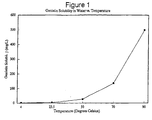
- Genistin is the least water soluble of the isoflavone glycosides, is insoluble in cold water, and is only slightly soluble in hot water (Fig. 1).
- Fig. 1 shows that the solubility of genistin is practically unchanged as the temperature increases from 4°C to 50°C, but that the solubility increases rapidly as the temperature increases from 70° to 90°C. Therefore, if the manufacturing process is to recover genistin, the recovery step should be carried out at the high temperature end of the scale.
- isoflavone glycosides other than genistin have higher solubilities in water and readily pass through an ultrafiltration membrane, along with other water soluble components.
- genistin and all other isoflavones can be separated from insoluble materials.
- the isoflavones in the ultrafiltration permeate can be recovered by treating the solution with a resin, washing the resin with water to remove soluble sugars, and eluting the isoflavones with a mixture of ethanol and water.
- the starting material for the inventive processes is derived from an aqueous ethanol extract of hexanedetatted soybean flakes.
- the defatted soybean flakes are extracted with aqueous ethanol (approximately 60-80% ethanol by volume) at temperatures in the range about 44°-63°C or 120-150°F.
- This aqueous ethanol extract is then subjected to a vacuum distillation in order to remove ethanol.
- the alcohol-stripped extract is also known as "soy molasses" or "soy solubles.”
- the extract is adjusted within an appropriate temperature range (about 65-95°C) and subjected to ultrafiltration preferably by using a 10,000 molecular weight cut off (MWC0) membrane.
- MWC0 molecular weight cut off
- the process is not limited to this 10,000 cut-off membrane since any membrane which enables a filtration of the desired isoflavones may be used.
- the smallest cut-off membrane suitable for the inventive procedures should pass a molecular weight of 532, which provides a sufficient retention of insoluble material and passage of isoflavones.
- Fig. 2 The effect of temperature on the concentration of two principle isoflavones, daidzin and genistin, in the UF permeate, is shown in Fig. 2. Cooler temperatures result in lower concentrations of genistin in the UF permeate. Daidzin concentrations are much less affected by temperature. To achieve optimal concentrations of isoflavones in the UF permeate, ultrafiltration should be carried out at a temperature above 65°C.
- Fig. 2 shows the differential between the concentration of daidzin and genistin in an aqueous solution permeate subjected to ultrafiltration.
- Ultrafiltration at 24°C produces a high concentration of daidzin and a low concentration of genistin. Therefore, if the manufacturing step is to recover daidzin and reject genistin, perhaps the recovery should be carried out at the relatively low temperature of 24°C, although the exact temperature may be selected on a basis of how much genistin can be located in the permeate.
- the manufacturing process is designed to recover both daidzin and genistin, perhaps it would be better to operate at the crossover point of about 78°C. For genistin, recovery should be carried out at a higher temperature.
- FIG. 3 A flow diagram representing one example of a manufacturing processes is shown in Fig- 3.
- Fig. 3 shows at 20 that the preferred starting material is soy molasses which is subjected to ultrafiltration at 22.
- the retentate of the ultrafiltration is further processed, recycled, or otherwise used in another process.
- the volume of the UF retentate fraction 24 is reduced during the ultrafiltration process by about one-third to two-thirds of the original alcohol-stripped extract volume, or stated otherwise is up to 12-15% solids.
- the UF retentate may be diafiltered with about one to three retentate volumes of water, which has been previously adjusted to be within a temperature range of about 65-95°C in order to recover a greater percentage of isoflavones in the permeate.
- the ultrafiltration permeate at 26 contains a variety of isoflavones and is adjusted to an appropriate temperature (45-95°C). Then, it is treated with an adsorptive resin at 20 in either a batch or chromatography column type process, followed by washing the resin with water at 30. Next, the isoflavones are eluted at 32 with aqueous alcohol (20-100% by volume, at 25-85°C) as either a gradient or single percentage process. The resulting material is dried (not shown in Fig. 3), preferably by evaporation, in order to produce a product which is approximately 30% isoflavones on a solids basis.
- the alcohol which is used at 32 may be ethanol, methanol, or isopropanol.
- the resin may be, but is not limited to, ethylvinylbenzene-divinylbenzene, styrene-divinylbenzene or polystyrene polymers, and may be either ionic or non-ionic.
- the ultrafiltration permeate 26 is adjusted to an appropriate temperature (about 4-45°C) in order to promote genistin crystallization at 34.
- Highly purified genistin crystals are then removed at 36 by a low-speed centrifugation or filtration and are finally washed with cold water (not shown in Fig. 3).
- the final product is between 70-90% pure genistin, measured on a dry basis.
- the genistin crystals can be further purified by recrystallization from aqueous alcohol solutions, such as aqueous ethanol, methanol, or isopropanol.
- soy solubles (15.26 kg) were heated to a constant temperature of about 80°C.
- the soy solubles were then passed through a model 92-HFK-131-UYU spiral wound, polysulfone, 10,000 nominal molecular weight cut off ultrafiltration membrane (Koch Membrane Systems, Inc., St. Charles, IL) by using a parastaltic pump.
- Back pressure on the exit side of the membrane was adjusted by means of a hand-lightened clamp to provide a permeate flow of 70 mL/minute. Ultrafiltration was continued until 9.4 kg of permeate was collected leaving 4.8 kg of retentate.
- Ultrafiltration retentate (80°C initial temperature) was subjected to ultrafiltration as described in Example 1, except that 4.8 kg of tap water (25°C) was fed into the retentate at a feed rate which is the same as the permeate rate or flux of the permeate that was being produced. The retentate was then further ultrafiltered to a final weight of 1.93 kg. Isoflavone profiles of the various fractions is shown below: Sample Weight %Solids Total Isoflavones Genistin Daidzin (kg) (g) (g) (g) Retentate 4.8 11.5 4.63 1.75 1.67 Diafilt. Permeate 7.25 4.28 2.12 0.72 0.96 Diafilt. Retentate 1.93 12.26 2.14 0.91 0.58
- a glass liquid-chromatography column (2.54 cm i.d.) was slurry packed in 70% ethanol with Dow XUS 40323 divinylbenzene, ethylvinylbenzene copolymer resin.
- the resin was cleaned with an additional 500 mL of 70% wt ethanol followed by 0.1% wt NaOH (500 mL) and water (500 mL).
- the resin was then back-flushed with water until the resin bed volume had expanded by about one half of its originally packed volume in order to partition the resin by size.
- the final packed volume was 100 mL.
- Fresh UF permeate 2000 mL or 20 column volumes
- 60°C was fed through the resin bed at 6 column volumes/hour or 10 mL/minute.
- a volume of 80% ethanol (50 mL) was slowly added to 1 g of permeate precipitate while refluxing until the precipitate dissolved. Then, the solution was filtered through Whatman 42 filter paper and slowly cooled (22°C) to produce fine yellow-white crystals. The crystals were harvested by centrifugation at 900 x G for 10 minutes. The supernatant was poured off. Next, the crystals were mixed with 50 mL of water (4°C) and recentrifuged to remove any residual supernatant.
Landscapes
- Chemical & Material Sciences (AREA)
- Organic Chemistry (AREA)
- Health & Medical Sciences (AREA)
- General Health & Medical Sciences (AREA)
- Pharmacology & Pharmacy (AREA)
- Veterinary Medicine (AREA)
- Public Health (AREA)
- Chemical Kinetics & Catalysis (AREA)
- General Chemical & Material Sciences (AREA)
- Medicinal Chemistry (AREA)
- Nuclear Medicine, Radiotherapy & Molecular Imaging (AREA)
- Animal Behavior & Ethology (AREA)
- Life Sciences & Earth Sciences (AREA)
- Hematology (AREA)
- Bioinformatics & Cheminformatics (AREA)
- Engineering & Computer Science (AREA)
- Diabetes (AREA)
- Obesity (AREA)
- Pharmaceuticals Containing Other Organic And Inorganic Compounds (AREA)
- Pyrane Compounds (AREA)
- Coloring Foods And Improving Nutritive Qualities (AREA)
- Medicines Containing Plant Substances (AREA)
- Separation Using Semi-Permeable Membranes (AREA)
Description
- The invention relates to process for separating isoflavone fractions from a vegetable starting material.
- Isoflavones are a unique class of plant flavonoids that have a limited distribution in the plant kingdom and may be physically described as colorless, crystalline ketones. The most common and important dietary source of these isoflavones are soybeans which contain the following twelve isoflavone isomers: genistein, genistin, 6"-0-malonylgenistin, 6"-0-acetylgenistin; daidzein, daidzin, 6"-0-malonyldaidzin, 6"-0-acetyl genistin; glycitein, glycitin, 6"-0-malonylglycitin, 6"-0-acetylglycitin (Kudou, Agric. Biol. Chem. 1991, 55, 2227-2233). Ninety-seven to ninety-eight percent of the soybean isoflavones are in the glycosylated form.
- Traditionally, individuals have been limited in their use of soy foods to increase their levels of dietary isoflavones because the number and variety of soy foods available in the U.S. marketplace is limited.
- The isoflavone, genistin, was first isolated from soybean meal in 1931 by Walz (Justus Liebigs Ann. Chem 489, 118) and later confirmed in 1941 by Walter (J. Amer. Chem. Soc. 63, 3273). Patents have described the production of isoflavone enriched soy-protein products (WO 95/10512; WO 95/10529; WO 95/10530), genistin malonate and daidzin malonate (U.S. Patent 5,141,746), pharmaceutical-type compositions containing isoflavones (U.S. Patents 5,424,331; 4,883,788), and isolation and modification of isoflavones from tempeh (U.S. Patents 4,390,559; 4,366,248; 4,366,082; 4,264,509; 4,232,122; 4,157,984).
- JP-A-07304655 describes the preparation of soya milk, which can be used as a bathing agent, from soya bean material containing intra alia isoflavones. The content of isoflavones in the soya milk fraction is not disclosed.
- JP-A-4 283 518 relates to a process of obtaining isoflavones from soybeans by using an aqueous extraction at a high pH between 8 to 11.
WO 95/10512 also discloses the separation of isoflavones by aqueous extraction at high pH and subsequent enzyme treatment. JP-A-2 031 912 uses a high pH separation method and filtration for obtaining isoflavone fractions. - However, the present patent relates to the manufacture of highly enriched isoflavone products containing either a wide-range of soy isoflavones or highly-purified genistin gained from an ethanol extract of defatted soybean flakes which can be directly used as a food supplement.
- Since coronary heart disease (CHD) is a leading cause of death, especially in the United States and other industrialized nations, an elevated total and LDL cholesterol levels are important risk factors affecting human health. In humans, soy protein products appear to lower serum total cholesterol levels by. an average of about 9.3% and to lower low-density lipoprotein (LDL) cholesterol by an average of about 12.9% when consumed at an average intake level of 47 g soy protein per day (Anderson et al., NEJM, 333:276-282, 1995).
- Isoflavones (Phytoestrogens) are implicated as a class of compounds in soy protein products which is at least partly responsible for this cholesterol-lowering effect in animals (Setchell, in McLachlan JA, ed. Estrogens in the Environment II:69-85, 1985). In addition, studies with primates suggest that soy isoflavones may account for up to about 60-70% of the hypocholesterolemic properties of soy protein (Anthony et al., Circulation, 90:Suppl:I-235. (abstract), 1994; Anthony et al., J. Nutr., 125:Suppl 3S:803S-804S. (abstract), 1995; Anthony et al., Circulation, 91:925. (abstract), 1995).
- It has also been suggested that isoflavones have an ability to play a role in the prevention of certain. cancers. Japanese women who have consumed diets rich in isoflavones appear to have a very low incidence of breast cancer (Adlercreutz et al., J. Nutr. 125:757S-770S, 1995). Soy products have also been shown to decrease mammary tumor formation or to inhibit mammary tumor progression in rat breast cancer models (Barnes et al., Clin. Biol. Res. 347:239-253; Hawrylewicz et al., J. Nutr. 121:1693-1698, 1991). Genistein has been shown to inhibit protein tyrosine kinase (Akiyama et al., J. Biol. Chem. 262:5592-5595, 1987), to inhibit angiogenesis (Fotsis et al., Proc. Natl. Acad. Sci. USA 90:2690-2694, 1993), and to induce differentiation in several malignant cell lines (Peterson, J. Nutr. 125:784S-789S, 1995), all of which may be important risk factors in cancer development. Genistein and glycitein (Biochanin A) also appear to inhibit the growth of androgen-dependent and independent prostatic cancer cells in vitro (Peterson and Barnes, Prostate 22:335-345, 1993). Genistein may act as an antioxidant (Wei et al., Nutr. Cancer 20: 1-12, 1993).
- Accordingly, an object of this invention is to provide a isoflavone fractions from a vegetable starting material for individuals to consume isoflavones either as a nutritional supplement or as an ingredient in more traditional types of food.
- In light of the potentially positive role of isoflavones and particularly genistein in the prevention of human disease, an object of this invention is to isolate purified forms of genistin, such as the glycone form of genistein, with or without subsequent recrystallization as a further purification step.
- Another object is to produce a product which is enriched in the entire range of soy isoflavones in order to provide isoflavone products for human diet supplementation or to enrich food products or food ingredients. This object is achieved by a method as claimed in claim 1. Preferred embodiments of the invention are disclosed in dependent claims 2 to 24.
- In keeping with an aspect of the invention, selected isoflavones are extracted based on the differentials of the solubilities of isoflavones in aqueous solutions. Alcohol is removed from an extract of defatted soybean flakes by evaporation. Then, the remaining aqueous solution is subjected to ultrafiltration (UF) at an elevated temperature in order to separate soluble isoflavones from other and insoluble materials. The UF permeate containing the soluble isoflavones may be treated in either one of two ways: 1) the permeate is treated with an adsorptive resin for enabling a recovery of a broad range of isoflavone isoforms while removing soluble sugars and salts; of 2) the permeate cools to promote a crystallization ot genistin. Then, genistin is isolated in a highly purified form by either centrifugation or filtration. The genistin may be further purified by a subsequent recrystallization from aqueous alcohol solutions.
- These and other objects of this invention will become more apparent from the following specification taken with the attached drawings, in which:
- Fig. 1 is a graph showing the solubility of genistin in water vs. temperature;
- Fig. 2 is a graph showing the concentration of isoflavone in a UF permeate vs. temperature; and
- Fig. 3 is a process flow diagram showing the production of the inventive product.
-
- This invention employs methods based on the differential of solubilities of isoflavones in aqueous solutions. Genistin is the least water soluble of the isoflavone glycosides, is insoluble in cold water, and is only slightly soluble in hot water (Fig. 1).
- In greater detail, Fig. 1 shows that the solubility of genistin is practically unchanged as the temperature increases from 4°C to 50°C, but that the solubility increases rapidly as the temperature increases from 70° to 90°C. Therefore, if the manufacturing process is to recover genistin, the recovery step should be carried out at the high temperature end of the scale.
- All isoflavone glycosides other than genistin have higher solubilities in water and readily pass through an ultrafiltration membrane, along with other water soluble components. By increasing the temperature of the aqueous solution prior to ultrafiltration, genistin and all other isoflavones can be separated from insoluble materials. The isoflavones in the ultrafiltration permeate can be recovered by treating the solution with a resin, washing the resin with water to remove soluble sugars, and eluting the isoflavones with a mixture of ethanol and water.
- The starting material for the inventive processes is derived from an aqueous ethanol extract of hexanedetatted soybean flakes. The defatted soybean flakes are extracted with aqueous ethanol (approximately 60-80% ethanol by volume) at temperatures in the range about 44°-63°C or 120-150°F. This aqueous ethanol extract is then subjected to a vacuum distillation in order to remove ethanol. The alcohol-stripped extract is also known as "soy molasses" or "soy solubles."
- Then the extract is adjusted within an appropriate temperature range (about 65-95°C) and subjected to ultrafiltration preferably by using a 10,000 molecular weight cut off (MWC0) membrane. However, the process is not limited to this 10,000 cut-off membrane since any membrane which enables a filtration of the desired isoflavones may be used. The smallest cut-off membrane suitable for the inventive procedures should pass a molecular weight of 532, which provides a sufficient retention of insoluble material and passage of isoflavones.
- The effect of temperature on the concentration of two principle isoflavones, daidzin and genistin, in the UF permeate, is shown in Fig. 2. Cooler temperatures result in lower concentrations of genistin in the UF permeate. Daidzin concentrations are much less affected by temperature. To achieve optimal concentrations of isoflavones in the UF permeate, ultrafiltration should be carried out at a temperature above 65°C.
- For example, Fig. 2 shows the differential between the concentration of daidzin and genistin in an aqueous solution permeate subjected to ultrafiltration. Ultrafiltration at 24°C produces a high concentration of daidzin and a low concentration of genistin. Therefore, if the manufacturing step is to recover daidzin and reject genistin, perhaps the recovery should be carried out at the relatively low temperature of 24°C, although the exact temperature may be selected on a basis of how much genistin can be located in the permeate. On the other hand, if the manufacturing process is designed to recover both daidzin and genistin, perhaps it would be better to operate at the crossover point of about 78°C. For genistin, recovery should be carried out at a higher temperature.
- A flow diagram representing one example of a manufacturing processes is shown in Fig- 3.
- In greater detail, Fig. 3 shows at 20 that the preferred starting material is soy molasses which is subjected to ultrafiltration at 22. At 24, the retentate of the ultrafiltration is further processed, recycled, or otherwise used in another process.
- If a batch type process is employed, the volume of the
UF retentate fraction 24 is reduced during the ultrafiltration process by about one-third to two-thirds of the original alcohol-stripped extract volume, or stated otherwise is up to 12-15% solids. The UF retentate may be diafiltered with about one to three retentate volumes of water, which has been previously adjusted to be within a temperature range of about 65-95°C in order to recover a greater percentage of isoflavones in the permeate. - With or without the diafiltered permeate, the ultrafiltration permeate at 26 contains a variety of isoflavones and is adjusted to an appropriate temperature (45-95°C). Then, it is treated with an adsorptive resin at 20 in either a batch or chromatography column type process, followed by washing the resin with water at 30. Next, the isoflavones are eluted at 32 with aqueous alcohol (20-100% by volume, at 25-85°C) as either a gradient or single percentage process. The resulting material is dried (not shown in Fig. 3), preferably by evaporation, in order to produce a product which is approximately 30% isoflavones on a solids basis. The alcohol which is used at 32 may be ethanol, methanol, or isopropanol. The resin may be, but is not limited to, ethylvinylbenzene-divinylbenzene, styrene-divinylbenzene or polystyrene polymers, and may be either ionic or non-ionic.
- Alternatively or in addition, with or without a diafiltered permeate, the ultrafiltration permeate 26 is adjusted to an appropriate temperature (about 4-45°C) in order to promote genistin crystallization at 34. Highly purified genistin crystals are then removed at 36 by a low-speed centrifugation or filtration and are finally washed with cold water (not shown in Fig. 3). The final product is between 70-90% pure genistin, measured on a dry basis. The genistin crystals can be further purified by recrystallization from aqueous alcohol solutions, such as aqueous ethanol, methanol, or isopropanol.
- Using a stainless steel steam-heated immersion coil, soy solubles (15.26 kg) were heated to a constant temperature of about 80°C. The soy solubles were then passed through a model 92-HFK-131-UYU spiral wound, polysulfone, 10,000 nominal molecular weight cut off ultrafiltration membrane (Koch Membrane Systems, Inc., St. Charles, IL) by using a parastaltic pump. Back pressure on the exit side of the membrane was adjusted by means of a hand-lightened clamp to provide a permeate flow of 70 mL/minute. Ultrafiltration was continued until 9.4 kg of permeate was collected leaving 4.8 kg of retentate. Isoflavone profiles of the various fractions are shown below:
Sample Weight %Solids Total Isoflavones Genistin Daidzin (kg) (g) (g) (g) Solubles 15.26 8.65 11.45 4.01 4.30 Retentate 4.8 11.5 4.63 1.75 1.67 Permeate 9.4 7.7 6.6 2.29 2.68 - Ultrafiltration retentate (80°C initial temperature) was subjected to ultrafiltration as described in Example 1, except that 4.8 kg of tap water (25°C) was fed into the retentate at a feed rate which is the same as the permeate rate or flux of the permeate that was being produced. The retentate was then further ultrafiltered to a final weight of 1.93 kg. Isoflavone profiles of the various fractions is shown below:
Sample Weight %Solids Total Isoflavones Genistin Daidzin (kg) (g) (g) (g) Retentate 4.8 11.5 4.63 1.75 1.67 Diafilt. Permeate 7.25 4.28 2.12 0.72 0.96 Diafilt. Retentate 1.93 12.26 2.14 0.91 0.58 - A glass liquid-chromatography column (2.54 cm i.d.) was slurry packed in 70% ethanol with Dow XUS 40323 divinylbenzene, ethylvinylbenzene copolymer resin. The resin was cleaned with an additional 500 mL of 70% wt ethanol followed by 0.1% wt NaOH (500 mL) and water (500 mL). The resin was then back-flushed with water until the resin bed volume had expanded by about one half of its originally packed volume in order to partition the resin by size. The final packed volume was 100 mL. Fresh UF permeate (2000 mL or 20 column volumes) at an initial temperature of 60°C was fed through the resin bed at 6 column volumes/hour or 10 mL/minute. The resin bed was washed with 500 mL of water at 10 mL/minute to remove residual sugars and other impurities. Isoflavones were then eluted from the resin with a linear gradient of 20-95% ethanol (500 mL total) at 10 mL/minute. Next, the entire ethanolic isoflavone containing fraction was vacuum dried to obtain a product with the following profile:
Sample Weight Total Isoflavones Genistin Daidzin (g) (g) (g) (g) Column Product 6.56 2.2 0.92 0.83 - A 7.69 kg volume of ultrafiltration permeate (85°C initial temperature) was allowed to cool gradually to an ambient temperature (22°C) during a 16 hour period, with constant stirring. The cooled permeate was then centrifuged at 900 x g for 10 minutes in order to pelletize the genistin precipitate. The supernatant was poured off. The white pellet was diluted with water (100 mL) and recentrifuged at 900 x g for 10 minutes in order to remove any residual supernatant. The white pellet was then vacuum dried to produce 1.02 g of a dried powder. The isoflavone composition of the dried powder was as follows:
Sample Weight Total Isoflavones Genistin Daidzin (g) (g) (g) (g) Genistin Precipitate 1.02 1.00 0.77 0.17 - A volume of 80% ethanol (50 mL) was slowly added to 1 g of permeate precipitate while refluxing until the precipitate dissolved. Then, the solution was filtered through Whatman 42 filter paper and slowly cooled (22°C) to produce fine yellow-white crystals. The crystals were harvested by centrifugation at 900 x G for 10 minutes. The supernatant was poured off. Next, the crystals were mixed with 50 mL of water (4°C) and recentrifuged to remove any residual supernatant. The water was then poured off and the crystals were vacuum dried to produce a product with the following isoflavone profile:
Sample Weight Total Isoflavones Genistin Daidzin (g) (g) (g) (g) Genistin Crystals 0.52 0.52 0.45 0.05 - Those who are skilled in the art will readily perceive how to modify the invention. Therefore, the appended claims are to be construed to cover all equivalent structures which fall within the true scope and spirit of the invention.
Claims (24)
- A process for separating isoflavone fractions from an aqueous vegetable starting material, the process comprising the steps of:(a) heating an aqueous vegetable starting material to a constant temperature selected on a basis of an aqueous solubility for given isoflavone fractions that are to be recovered;(b) passing the heated starting material of step (a) through an ultrafiltration membrane to obtain a retentate and a permeate, the membrane having a cutoff which passes the given isoflavone fractions;(c) adjusting back pressure in the retentate acting on the membrane of step (b) to adjust flow of the permeate while continuing the ultrafiltration; and(d) collecting isoflavone fractions from the permeate.
- A process according to claim 1, wherein the starting material is soy molasses.
- A process according to claim 2, wherein step (a) includes the further process step of making an aqueous ethanol extract of hexane-defatted soybean flakes at a temperature in the range from 44° to 63°C.
- A process according to claim 2 or 3, wherein the ultrafiltration of step (b) is carried out at a temperature in the range from 65° to 95°C.
- A process according to any one of claims 2 to 4, wherein the ultrafiltration membrane of step (b) has a nominal molecular weight cut-off range of from 600 to 100,000.
- A process according to any one of claims 2 to 4, wherein the ultrafiltration membrane of step (b) has a nominal molecular weight cut-off point of 10,000 nominal molecular weight.
- A process according to any preceding claim, which includes the further step of adding water to the retentate of step (b) at a flow rate which is the same as the permeate rate of flux of the permeate, and the step of again passing the permeate with the added water through an ultrafiltration membrane.
- A process according to any of claims 2 to 7, wherein the collection of isoflavones from the permeate, of step (d), comprises the steps of:(d1) treating the permeate with an adsorptive resin;(d2) washing the resin of step (d1) in water; and(d3) eluting adsorbed isoflavones from the washed resin of step (d2) with aqueous alcohol.
- A process according to claim 8, wherein the resin of step (d1) is selected from ionic ethylvinylbenzene-divinylbenzene, non-ionic ethylvinylbenzene-divinylbenzene, ionic styrene-divinylbenzene, non-ionic styrenedivinylbenzene, ionic polystyrene polymers, and non-ionic polystyrene polymers; and the aqueous alcohol of step (d3) is selected from ethanol, methanol, and isopropanol.
- A process according to claim 8, wherein step (d) includes the further step of:(d4) drying the isoflavones eluted with aqueous alcohol in step (d3) to reduce the isoflavones to a solid basis.
- A process according to claim 10, wherein the drying is effected by evaporating the aqueous alcohol eluate of step (d3) to reduce the isoflavones to a solid basis.
- A process according to claim 8, wherein the step (d) includes the added steps of:(e) packing a liquid-chromatography column with a slurry of ethanol and a polymeric resin;(f) back flushing the column with water until the resin expands by approximately fifty percent;(g) feeding the permeate of step (b) through the column;(h) eluting isoflavones from the resin by use of ethanol; and(i) drying the isoflavones eluted in step (h).
- A process according to claim 12, wherein the slurry of step (e) is about 50-100% wt ethanol followed by about 1-5 column volumes of 0.1% wt. NaOH and 1-5 column volumes of water.
- A process according to claim 12 or 13, wherein the temperature of the permeate during step (g) is in the range from 45-95°C.
- A process according to claim 12, 13 or 14, which includes an additional step, after step (g), of washing the resin with water to remove residual sugars and other impurities therefrom.
- A process according to any one of claims 12 to 15, wherein step (i) is a vacuum drying step.
- A process according to claim 1 for separating isoflavones in an aqueous vegetable starting material, said process comprising the steps of:(1) heating a vegetable starting material to an initial constant temperature in the order of about 65-95°C;(2) passing vegetable solubles produced in step (1) through an ultrafiltration membrane to provide a permeate;(3) gradually cooling the ultrafiltration permeate of step (2) from said initial hot temperature of about 85°C to a cooled temperature of about 22°C while constantly stirring said permeate,(4) centrifuging the cooled permeate of step (3) at about 900 x g for a period which is long enough to pelletize an isoflavones precipitate produced in step (4);(5) pouring off a supernatant;(6) diluting the precipitate with water;(7) recentrifuging the diluted precipitate of step (6) at about 900 x g to remove a residual supernatant; and(8) drying the recentrifugated precipitate of step (7).
- The process of claim 17 wherein said vegetable starting material is soy molasses.
- The process of claim 18 and the further steps of adding ethanol to the washed precipitate of step (6) while refluxing until the precipitate is dissolved, filtering the refluxed precipitate through a filter; and slowly cooling the filtered precipitate until fine crystals are formed.
- The process of claim 19 and the added step of centrifuging said cooled and filtered precipitate to harvest the fine crystals, then pouring off the resulting supernatant, and finishing the process with said steps (7) and (8).
- A process according to claim 1, comprising the steps of separating insoluble solids from isoflavones in a soy molasses starting material by using ultrafiltration, a permeate stream resulting from said ultrafiltration containing an isoflavone profile corresponding to a profile of soy in the soy molasses starting material, and controlling a temperature throughout said process to select an isoflavone from said profile in order to separate and recover said selected isoflavone from said starting material.
- A process according to claim 21, comprising the steps of ultrafiltering a feed stream of soy molasses starting material to isolate isoflavones in an ultrafiltration permeate, recovering the isoflavones by adsorption of the isoflavones on a resin, washing said resin with water in order to remove residual-impurities from the adsorbed isoflavones, and eluting the washed isoflavones with aqueous alcohol.
- A process according to claim 1 for recovering isoflavones from a starting material feed stream of soy molasses, said process comprising the steps of: heating said feed stream to a temperature which solubilizes genistin; ultrafiltering said heated feed stream to separate a purified genistin product in a permeate of said starting material, cooling said permeate of said filtered feed stream to promote genistin crystallization, and separating genistin crystals by a centrifugation or filtration of said cooled permeate.
- The process of claim 23 comprising the further steps of recrystallizing the genistin crystallization by forming a genistin precipitate from said crystallization of the ultrafiltration permeate, then making a heated aqueous alcohol solution containing said precipitate, and next recrystallizing the precipitate from a heated aqueous alcohol solution by allowing the solution to cool.
Applications Claiming Priority (2)
| Application Number | Priority Date | Filing Date | Title |
|---|---|---|---|
| US08/614,545 US5702752A (en) | 1996-03-13 | 1996-03-13 | Production of isoflavone enriched fractions from soy protein extracts |
| US614545 | 1996-03-13 |
Publications (2)
| Publication Number | Publication Date |
|---|---|
| EP0795553A1 EP0795553A1 (en) | 1997-09-17 |
| EP0795553B1 true EP0795553B1 (en) | 2002-01-09 |
Family
ID=24461715
Family Applications (1)
| Application Number | Title | Priority Date | Filing Date |
|---|---|---|---|
| EP97301595A Expired - Lifetime EP0795553B1 (en) | 1996-03-13 | 1997-03-11 | Production of isoflavone enriched fractions from soy protein extracts |
Country Status (5)
| Country | Link |
|---|---|
| US (2) | US5702752A (en) |
| EP (1) | EP0795553B1 (en) |
| JP (1) | JP3919871B2 (en) |
| DE (1) | DE69709472T2 (en) |
| IL (1) | IL120409A (en) |
Cited By (2)
| Publication number | Priority date | Publication date | Assignee | Title |
|---|---|---|---|---|
| US7015339B2 (en) | 2001-07-24 | 2006-03-21 | Cargill, Incorporated | Process for isolating phenolic compounds |
| EP2133080A1 (en) | 2008-06-13 | 2009-12-16 | Haelan Schweiz GmbH | Compounds containing equol |
Families Citing this family (140)
| Publication number | Priority date | Publication date | Assignee | Title |
|---|---|---|---|---|
| USRE40792E1 (en) * | 1992-05-19 | 2009-06-23 | Novogen Research Pty Ltd | Health supplements containing phyto-oestrogens, analogues or metabolites thereof |
| US6171638B1 (en) * | 1996-03-13 | 2001-01-09 | Archer Daniels Midland Company | Production of isoflavone enriched fractions from soy protein extracts |
| US6261565B1 (en) | 1996-03-13 | 2001-07-17 | Archer Daniels Midland Company | Method of preparing and using isoflavones |
| US6565912B1 (en) * | 1996-03-13 | 2003-05-20 | Archer-Daniels-Midland | Production of isoflavone enriched fractions from soy protein extracts |
| US6033714A (en) * | 1996-03-13 | 2000-03-07 | Archer Daniels Midland Company | Process for production of isoflavone fractions from soy |
| US6391310B1 (en) | 1996-03-13 | 2002-05-21 | Archer Daniels Midland Company | Method of preparing and using isoflavones for the treatment of neurological symptoms |
| ZA972978B (en) * | 1996-04-09 | 1998-10-23 | Du Pont | Isoflavone-enriched soy protein product and method for its manufacture |
| US5821361A (en) * | 1996-06-11 | 1998-10-13 | Protein Technologies International, Inc. | Recovery of isoflavones from soy molasses |
| US6579561B2 (en) | 1996-08-09 | 2003-06-17 | Protein Technologies International, Inc. | Aglucone isoflavone enriched vegetable flour and vegetable grit and process for making the same from a vegetable material containing isoflavone |
| US6521282B1 (en) | 1996-08-09 | 2003-02-18 | Protein Technologies International, Inc. | Aglucone isoflavone enriched vegetable flour and grit |
| IL119107A (en) * | 1996-08-21 | 1999-05-09 | Chajuss Daniel | Modified soy molasses |
| AUPO203996A0 (en) * | 1996-08-30 | 1996-09-26 | Novogen Research Pty Ltd | Therapeutic uses |
| US6146668A (en) | 1997-04-28 | 2000-11-14 | Novogen, Inc. | Preparation of isoflavones from legumes |
| US6340703B1 (en) * | 1997-05-01 | 2002-01-22 | Novogen, Inc. | Treatment or prevention of osteoporosis |
| US5855892A (en) * | 1997-09-19 | 1999-01-05 | Potter; Susan M. | Method for decreasing LDL-cholesterol concentration and increasing HDL-cholesterol concentration in the blood to reduce the risk of atherosclerosis and vascular disease |
| US6320028B1 (en) | 1997-10-15 | 2001-11-20 | Central Soya Company, Inc. | Soy isoflavone concentrate process and product |
| US6228993B1 (en) | 1998-10-12 | 2001-05-08 | Central Soya Company, Inc. | Soy isoflavone concentrate process and product |
| US6369200B2 (en) | 1997-10-15 | 2002-04-09 | Central Soya Company, Inc. | Soy isoflavone concentrate process and product |
| US5932221A (en) * | 1997-10-30 | 1999-08-03 | Day; Charles E. | Genistin-enriched fraction from soy meal |
| US6022477A (en) * | 1997-11-14 | 2000-02-08 | New Jersey Institute Of Technology | Method and apparatus for isolation purification of biomolecules |
| AUPP112497A0 (en) * | 1997-12-24 | 1998-01-22 | Novogen Research Pty Ltd | Compositions and method for protecting skin from UV induced immunosupression and skin damage |
| ATE282032T1 (en) * | 1998-01-12 | 2004-11-15 | Nichimo Kabushiki Kaisha | METHOD FOR PRODUCING ISOFLAVONE COMPOUNDS |
| US6132795A (en) * | 1998-03-15 | 2000-10-17 | Protein Technologies International, Inc. | Vegetable protein composition containing an isoflavone depleted vegetable protein material with an isoflavone containing material |
| AUPP260798A0 (en) * | 1998-03-26 | 1998-04-23 | Novogen Research Pty Ltd | Treatment of medical related conditions with isoflavone containing extracts of clover |
| US5994508A (en) * | 1998-04-13 | 1999-11-30 | Protein Technologies International, Inc. | Isoflavone rich protein isolate and process for producing |
| US6083553A (en) * | 1998-06-05 | 2000-07-04 | Protein Technologies International, Inc. | Recovery of isoflavones from soy molasses |
| US6013771A (en) * | 1998-06-09 | 2000-01-11 | Protein Technologies International, Inc. | Isoflavone rich protein isolate and process for producing |
| WO1999066915A2 (en) * | 1998-06-23 | 1999-12-29 | Southern Illinois University At Carbondale | Therapeutic applications of estrogenic carboxylic acids |
| IT1299191B1 (en) * | 1998-06-23 | 2000-02-29 | Sigma Tau Healthscience Spa | COMPOSITION TO PREVENT AND TREAT OSTEOPOROSIS AND ALTERATIONS RELATED TO MENOPAUSE |
| US6150399A (en) * | 1998-06-30 | 2000-11-21 | Abbott Laboratories | Soy-based nutritional products |
| JP2000095792A (en) | 1998-09-21 | 2000-04-04 | Showa Sangyo Co Ltd | Method for obtaining isoflavone composition comprising genistin |
| US6703051B1 (en) | 1998-10-13 | 2004-03-09 | Solae, Llc | Process for separating and recovering protein and isoflavones from a plant material |
| HK1041635A1 (en) | 1998-11-25 | 2002-07-19 | Nutri Pharma Asa | Composition comprising soy protein, dietary fibres and a phytoestrogen compound and use thereof in the prevention and/or treatment of cardiovascular diseases |
| WO2000030664A1 (en) | 1998-11-25 | 2000-06-02 | Nutri Pharma Asa | Composition comprising soy protein, dietary fibres and a phytoestrogen compound and use thereof in the prevention and/or treatment of pulmonary diseases |
| IL143173A0 (en) * | 1998-12-02 | 2002-04-21 | Cognis Corp | A process for the recovery of isoflavone values from natural sources |
| US6833149B2 (en) * | 1999-01-14 | 2004-12-21 | Cargill, Incorporated | Method and apparatus for processing vegetable oil miscella, method for conditioning a polymeric microfiltration membrane, membrane, and lecithin product |
| JP4006133B2 (en) | 1999-05-17 | 2007-11-14 | 松谷化学工業株式会社 | Soluble isoflavone composition and method for producing the same |
| US20090233999A1 (en) * | 1999-09-06 | 2009-09-17 | Novogen Research Pty Ltd | Compositions and therapeutic methods involving isoflavones and analogues thereof |
| AUPQ266199A0 (en) * | 1999-09-06 | 1999-09-30 | Novogen Research Pty Ltd | Compositions and therapeutic methods involving isoflavones and analogues thereof |
| KR100733056B1 (en) * | 1999-12-17 | 2007-06-27 | 미츠노리 오노 | Water Soluble Bean Extract |
| AUPQ520300A0 (en) * | 2000-01-21 | 2000-02-17 | Novogen Research Pty Ltd | Food product and process |
| AU776131B2 (en) * | 2000-01-21 | 2004-08-26 | Novogen Research Pty Ltd | Food product and process |
| GB2348371B (en) * | 2000-03-14 | 2001-04-04 | Soares Da Silva Patricio | Compositions comprising blockers of L-DOPA renal cell transfer for the treatment of Parkinson's disease |
| PL357822A1 (en) | 2000-04-14 | 2004-07-26 | Mars Incorporated | Compositions and methods for improving vascular health |
| CA2358321A1 (en) * | 2000-09-29 | 2002-03-29 | Kraft Foods Holdings, Inc. | Method and composition which inhibits the oxidation of omega-3- and omega-6 polyunsaturated lipids |
| US20040219281A1 (en) * | 2000-11-21 | 2004-11-04 | Cargill, Incorporated | Modified oilseed material |
| US7429399B2 (en) * | 2001-06-18 | 2008-09-30 | Solae, Llc | Modified oilseed material |
| JP2002179647A (en) * | 2000-12-11 | 2002-06-26 | Kikkoman Corp | Method for producing nicotianamine or nicotianamine-containing substance |
| FR2817866B1 (en) * | 2000-12-13 | 2005-01-07 | Theramex | METHOD FOR EXTRACTING FLAVONIC MIXTURES AND USE OF MIXTURES THUS OBTAINED IN DERMOCOSMAL, FOOD AND PHARMACY |
| IL140953A (en) * | 2001-01-17 | 2003-07-06 | Solbar Plant Extracts Agricult | Process for obtaining solid soy isoflavone-containing products |
| AUPR363301A0 (en) * | 2001-03-08 | 2001-04-05 | Novogen Research Pty Ltd | Dimeric isoflavones |
| US6818246B2 (en) * | 2001-04-09 | 2004-11-16 | Solae, Llc | Soy protein concentrate having high isoflavone content and process for its manufacture |
| US20030100830A1 (en) | 2001-11-27 | 2003-05-29 | Sheng-Ping Zhong | Implantable or insertable medical devices visible under magnetic resonance imaging |
| EP1472206A1 (en) * | 2002-02-05 | 2004-11-03 | Hormos Medical Corporation | Lignan derivatives |
| AU2003222286A1 (en) * | 2002-03-13 | 2003-09-29 | Solae, Llc | Soy protein concentrate with low non-digestible oligosaccharides and process for its production |
| US7084263B2 (en) | 2002-03-26 | 2006-08-01 | Wiley Organics, Inc. | Process for isolating genistin from mixtures of soy isoflavones |
| US7306821B2 (en) * | 2002-04-03 | 2007-12-11 | Solae, Llc | Process for producing a high solubility, low viscosity, isoflavone-enriched soy protein isolate and the products thereof |
| US7524526B2 (en) * | 2002-04-10 | 2009-04-28 | Archer-Daniels-Midland Company | Process for producing high purity isoflavones |
| ATE460474T1 (en) | 2002-04-30 | 2010-03-15 | Nestle Sa | USE OF A SOY CELL LINE WITH HIGH ISOFLAVONE CONTENT |
| US20040033903A1 (en) * | 2002-05-02 | 2004-02-19 | Volker Kuellmer | Coated, agglomerated phytochemicals |
| RU2004135371A (en) * | 2002-05-07 | 2006-02-27 | Солае, Ооо (Us) | SOYA PROTEIN MATERIAL WITH A LOW CONTENT OF ISOPHLAVONS AND A HIGH CONTENT OF SAPONINS AND A METHOD FOR PRODUCING IT |
| US20040009872A1 (en) * | 2002-07-15 | 2004-01-15 | Gordon Cohen | Method using solvents for improved microporous polymeric adsorbents |
| WO2004037020A1 (en) * | 2002-10-24 | 2004-05-06 | Solae, Llc | Soy isoflavone concentrate process and product |
| WO2004043945A1 (en) * | 2002-11-12 | 2004-05-27 | Wiley Organics, Inc. | Method for purifying and separating soy isoflavones |
| AU2003298659A1 (en) * | 2002-11-15 | 2004-06-15 | Cargill, Incorporated | Soluble isoflavone compositions |
| US7025998B2 (en) | 2003-05-30 | 2006-04-11 | Rotta Research Laboratorium S.P.A. | Phytoestrogens and probiotic for women's health |
| US7763588B2 (en) * | 2003-06-13 | 2010-07-27 | The Salk Institute For Biological Studies | Method for increasing cognitive function and neurogenesis |
| US7618671B2 (en) * | 2003-11-05 | 2009-11-17 | E.I. Du Pont De Nemours And Company | Recovery of isoflavones and removal of oligosaccharides from aqueous mixtures using zeolites |
| US20050202139A1 (en) * | 2003-11-05 | 2005-09-15 | Corbin David R. | Recovery of isoflavones from aqueous mixtures using zeolites or molecular sieves |
| WO2005077930A1 (en) * | 2004-02-09 | 2005-08-25 | Cargill, Incorporated | Phenolic compound purification |
| WO2005077929A1 (en) * | 2004-02-09 | 2005-08-25 | Cargill, Incorporated | Phenolic compound purification |
| US20050214367A1 (en) * | 2004-03-22 | 2005-09-29 | Volker Kuellmer | Processes for making coated phytochemicals and tocopherols and products formed therefrom |
| JP2005281251A (en) * | 2004-03-30 | 2005-10-13 | Tama Seikagaku Kk | Separation recovery method for isoflavone |
| KR100858280B1 (en) | 2006-08-29 | 2008-09-11 | (주)엔앤비 | Method for culturing red yeast bacteria with Genistein containing Monacholine K using Genistin and method for preparing powder, gel and rice using the same |
| RU2508631C2 (en) | 2007-01-09 | 2014-03-10 | Новозаймс Байолоджиклз Холдинг А/С | Compositions based on combination of lipo-chitooligosaccharide for plant growth and yield enhancement |
| TW200841826A (en) * | 2007-04-20 | 2008-11-01 | Bion Tech Inc | Composition comprising five kinds of process fruit/vegetable |
| US20090176871A1 (en) * | 2008-01-07 | 2009-07-09 | Schoenwetter Phillip E | Treatments for Domestic Animals Having Sex Hormone Deficiencies Using Soy Germ Isoflavones |
| US8466195B2 (en) | 2009-03-13 | 2013-06-18 | Salk Institute For Biological Studies | Methods and compositions for treating complications of diabetes and vascular diseases using flavones |
| US20120070520A1 (en) | 2009-05-26 | 2012-03-22 | Hyun Jung Shin | Composition containing a bean extract for improving blood circulation and increasing vascular health |
| US8597712B2 (en) | 2009-09-28 | 2013-12-03 | Whitewave Services, Inc. | Soy beverage substantially free of isoflavones and method of production |
| KR20110138001A (en) * | 2010-06-18 | 2011-12-26 | (주)아모레퍼시픽 | Composition comprising colored-bean extracts |
| KR20110138000A (en) * | 2010-06-18 | 2011-12-26 | (주)아모레퍼시픽 | Composition containing colored soybean extract |
| US8404293B2 (en) * | 2010-09-23 | 2013-03-26 | Graceland Fruit, Inc. | Method for separating and concentrating bioactive phenolics |
| RU2611199C2 (en) | 2011-03-31 | 2017-02-21 | Новозаймз Байолоджикалз, Инк | Competitive and effective strains of bacteria |
| EP3058826A1 (en) | 2011-09-08 | 2016-08-24 | Novozymes BioAG A/S | Seed treatment methods and compositions |
| PL2748123T3 (en) | 2011-09-14 | 2024-05-13 | Novozymes Bioag A/S | Use of lipochito-oligosaccharides and/or chito-oligosaccharides in combination with phosphate-solubilizing microorganisms for improving plant growth |
| CA2849889C (en) | 2011-09-23 | 2020-01-07 | Novozymes Biologicals, Inc. | Combinations of lipo-chitooligosaccharides and methods for use in enhancing plant growth |
| CA2849898C (en) | 2011-09-23 | 2020-10-27 | Novozymes Bioag A/S | Chitooligosaccharides and methods for use in enhancing plant growth |
| AU2012312006B2 (en) | 2011-09-23 | 2015-10-29 | Novozymes Bioag A/S | Chitooligosaccharides and methods for use in enhancing corn growth |
| CN105746517A (en) | 2011-09-23 | 2016-07-13 | 诺维信生物农业公司 | Chitooligosaccharides And Methods For Use In Enhancing Soybean Growth |
| AU2012351899B2 (en) | 2011-12-16 | 2015-04-23 | Novozymes Bioag A/S | Bradyrhizobium strains |
| WO2014049546A2 (en) | 2012-09-27 | 2014-04-03 | Institut National De La Recherche Agronomique | Compositions and methods for enhancing plant growth and development |
| US9365464B2 (en) | 2012-11-16 | 2016-06-14 | Novozymes Bioag A/S | Microbial strains, compositions, and methods for increasing available phosphate for plants |
| JP2016522678A (en) | 2013-03-28 | 2016-08-04 | ノボザイムス バイオアーゲー アクティーゼルスカブ | Compositions and methods for increasing microbial stability |
| UA119331C2 (en) | 2013-11-08 | 2019-06-10 | Новозімес Біоаґ А/С | COMPOSITIONS AND METHODS FOR TREATMENT OF PESTS |
| AR098482A1 (en) | 2013-11-20 | 2016-06-01 | Novozymes Bioag As | COMPOSITIONS AND METHODS THAT INCLUDE CHROMOBACTERIUM FOR THE CONTROL OF NEMATODES AND INSECTS PLANT PESTS |
| MX2016011413A (en) | 2014-03-05 | 2017-02-28 | Novozymes As | Formulations comprising polymeric xyloglucan as a carrier for agriculturally beneficial agents. |
| UA124920C2 (en) | 2014-07-23 | 2021-12-15 | Новозімес Біоаґ А/С | COMPOSITION CONTAINING LIPOCHITO-OLIGOSACHARIDE AND MICROORGANISM FOR ENHANCING PLANT GROWTH |
| RU2730863C2 (en) | 2015-09-11 | 2020-08-26 | Новозимс Биоаг А/С | Stable compositions with inoculant and methods for production thereof |
| EA201891171A1 (en) | 2015-12-28 | 2018-11-30 | Новозимс Биоаг А/С | STABLE COMPOSITIONS WITH INOCULATOR AND METHODS FOR THEIR PRODUCTION |
| KR102867240B1 (en) | 2015-12-28 | 2025-10-01 | 노보네시스 플랜트 바이오솔루션즈 에이/에스 | Stable inoculant compositions and methods for producing same |
| EP3462880A1 (en) | 2016-05-31 | 2019-04-10 | Novozymes BioAG A/S | Stable liquid inoculant compositions and coated plant propagation materials comprising same |
| WO2017210163A1 (en) | 2016-05-31 | 2017-12-07 | Novozymes Bioag A/S | Stable inoculant compositions and methods for producing same |
| WO2018118740A1 (en) | 2016-12-20 | 2018-06-28 | Novozymes Bioag A/S | Stable inoculant compositions and methods for producing same |
| CA3048994A1 (en) | 2017-01-03 | 2018-07-12 | Monsanto Technology Llc | Microbial compositions and methods |
| CA3048997A1 (en) | 2017-01-03 | 2018-07-12 | Monsanto Technology Llc | Microbial compositions and methods |
| CA3049029A1 (en) | 2017-01-04 | 2018-07-12 | Novozymes Bioag A/S | Bacillus isolates and uses thereof |
| UY37564A (en) | 2017-01-05 | 2018-07-31 | Novozymes Bioag As | ISOLATED FROM LYSINIBACILLUS AND USES OF THE SAME |
| US11089776B2 (en) | 2017-02-28 | 2021-08-17 | Monsanto Technology Llc | Containerized liquid formulations |
| US11716994B2 (en) | 2017-03-24 | 2023-08-08 | Novozymes Bioag A/S | Combinations of Yersinia entomophaga and pesticides or other substances |
| WO2018218016A1 (en) | 2017-05-26 | 2018-11-29 | Novozymes Bioag A/S | Stable inoculant compositions comprising paraffin oils/waxes |
| CA3065297A1 (en) | 2017-05-26 | 2018-11-29 | Monsanto Technology Llc | Stable inoculant compositions comprising methylated plant oils |
| WO2018218008A1 (en) | 2017-05-26 | 2018-11-29 | Novozymes Bioag A/S | Stable liquid inoculant compositions comprising dodecane |
| US20200288627A1 (en) | 2017-06-29 | 2020-09-17 | Monsanto Technology Llc | Seed treatment process for large liquid volumes |
| EP3681290A4 (en) | 2017-09-12 | 2021-06-16 | Monsanto Technology LLC | PROCESSES FOR THE PREPARATION OF TREATED SEEDS |
| UA126979C2 (en) | 2018-01-08 | 2023-03-01 | Новозімес Біоаґ А/С | AQUEOUS COMPOSITION CONTAINING SOLUBILIZED LIPOHYTOOLIGOSACCHARIDE |
| WO2019147660A1 (en) | 2018-01-23 | 2019-08-01 | Novozymes Bioag A/S | Method of enhancing seed germination under abiotic stress with chitin oligosaccharides |
| CA3097942A1 (en) | 2018-05-07 | 2019-11-14 | Novozymes Bioag A/S | Microbacterium isolates and uses thereof |
| AU2019345125B2 (en) | 2018-09-21 | 2025-09-04 | Novonesis Plant Biosolutions A/S | Pesticidal combinations of Yersinia and Bacillus |
| AR116492A1 (en) | 2018-09-24 | 2021-05-12 | Novozymes Bioag As | YERSINIA PESTICIDE AND INSECT VIRUS COMBINATIONS |
| US12052942B2 (en) | 2018-11-01 | 2024-08-06 | Monsanto Technology Llc | Seed treater |
| JP7513291B2 (en) | 2019-06-24 | 2024-07-09 | 国立研究開発法人農業・食品産業技術総合研究機構 | Erwinia isolates and their uses |
| EP3701796A1 (en) | 2019-08-08 | 2020-09-02 | Bayer AG | Active compound combinations |
| WO2021030400A1 (en) | 2019-08-13 | 2021-02-18 | Novozymes Bioag A/S | Pesticidal combinations of yersinia and proteases |
| EP3818829A3 (en) | 2019-10-16 | 2021-07-21 | Monsanto Technology LLC | Granular nematicide compositions |
| WO2021086695A1 (en) | 2019-10-29 | 2021-05-06 | Novozymes Bioag A/S | Microbacterium isolates and uses thereof |
| WO2021101937A1 (en) | 2019-11-20 | 2021-05-27 | Novozymes Bioag A/S | Pseudomonas isolates and uses thereof |
| BR112022009600A2 (en) | 2019-11-22 | 2022-08-16 | Novozymes Bioag As | PAENIBACILLUS PEORIAE NITROGEN-FIXING ISOLATED, BIOLOGICALLY PURE CULTURE OF A NITROGEN-FIXING PAENIBACILLUS PEORIAE, USE OF ONE OR MORE NITROGEN-FIXING PAENIBACILLUS PEORIAE AND THE SYNTHETIC MICROBIAL CONSORTIUM, METHOD, INOCULANT COMPOSITION, AND NON-OCCURRENCE CONSORTIUM SEEDS SYNTHETIC |
| WO2022125639A1 (en) | 2020-12-08 | 2022-06-16 | Monsanto Technology Llc | Modified plant-associated bacteria and methods of their use |
| BR112023019788A2 (en) | 2021-03-30 | 2023-11-07 | Bayer Ag | 3-(HETERO)ARYL-5-CHLORODIFLOROMETHYL-1,2,4-OXADIAZOLE AS A FUNGICIDE |
| BR112023019400A2 (en) | 2021-03-30 | 2023-12-05 | Bayer Ag | 3-(HETERO)ARYL-5-CHLORODIFLOROMETHYL-1,2,4-OXADIAZOLE AS A FUNGICIDE |
| AU2022326207A1 (en) | 2021-08-13 | 2024-02-15 | Bayer Aktiengesellschaft | Active compound combinations and fungicide compositions comprising those |
| JP2025516326A (en) | 2022-05-03 | 2025-05-27 | バイエル、アクチエンゲゼルシャフト | Crystalline form of (5S)-3-[3-(3-chloro-2-fluorophenoxy)-6-methylpyridazin-4-yl]-5-(2-chloro-4-methylbenzyl)-5,6-dihydro-4H-1,2,4-oxadiazine |
| CA3256572A1 (en) | 2022-05-03 | 2023-11-09 | Bayer Aktiengesellschaft | Use of (5s)-3-[3-(3-chloro-2-fluorophenoxy)-6-methylpyridazin-4-yl]-5-(2-chloro-4-methylbenzyl)-5,6-dihydro-4h-1,2,4-oxadiazine for controlling unwanted microorganisms |
| WO2024068519A1 (en) | 2022-09-28 | 2024-04-04 | Bayer Aktiengesellschaft | 3-(hetero)aryl-5-chlorodifluoromethyl-1,2,4-oxadiazole as fungicide |
| WO2024068520A1 (en) | 2022-09-28 | 2024-04-04 | Bayer Aktiengesellschaft | 3-(hetero)aryl-5-chlorodifluoromethyl-1,2,4-oxadiazole as fungicide |
| WO2024068517A1 (en) | 2022-09-28 | 2024-04-04 | Bayer Aktiengesellschaft | 3-(hetero)aryl-5-chlorodifluoromethyl-1,2,4-oxadiazole as fungicide |
| WO2024068518A1 (en) | 2022-09-28 | 2024-04-04 | Bayer Aktiengesellschaft | 3-heteroaryl-5-chlorodifluoromethyl-1,2,4-oxadiazole as fungicide |
| EP4295688A1 (en) | 2022-09-28 | 2023-12-27 | Bayer Aktiengesellschaft | Active compound combination |
| WO2024104643A1 (en) | 2022-11-17 | 2024-05-23 | Bayer Aktiengesellschaft | Use of isotianil for controlling plasmodiophora brassica |
Family Cites Families (21)
| Publication number | Priority date | Publication date | Assignee | Title |
|---|---|---|---|---|
| US4157984A (en) * | 1977-06-08 | 1979-06-12 | Z-L Limited | Antioxidants, antioxidant compositions and methods of preparing and using same |
| US4264509A (en) * | 1977-06-08 | 1981-04-28 | Z-L Limited Partnership | Isoflavones and related compounds, methods of preparing and using and antioxidant compositions containing same |
| US4232122A (en) * | 1979-01-17 | 1980-11-04 | Z-L Limited Partnership | Antioxidants, antioxidant compositions and methods of preparing and using same |
| US4366248A (en) * | 1979-04-11 | 1982-12-28 | Z-L Limited Partnership | Fermentation method of preparing antioxidants |
| US4390559A (en) * | 1979-04-11 | 1983-06-28 | Z-L Limited Partnership | Isoflavones and related compounds, methods of preparing and using and antioxidant compositions containing same |
| US4366082A (en) * | 1979-04-11 | 1982-12-28 | Z-L Limited Partnership | Isoflavones and related compounds, methods of preparing and using and antioxidant compositions containing same |
| JPS5985265A (en) * | 1982-11-04 | 1984-05-17 | Naganoken Kooridoufu Kogyo Kyodo Kumiai | Preparation of nutrient enriched food raw material |
| JPS61100524A (en) * | 1984-10-19 | 1986-05-19 | Junichi Iwamura | Method of separating saponin and flavone |
| US4883788A (en) * | 1986-06-06 | 1989-11-28 | Hauser-Kuhrts, Inc. | Method and composition for reducing serum cholesterol |
| JPH01175942A (en) * | 1987-12-28 | 1989-07-12 | Sanyo Kokusaku Pulp Co Ltd | Antiviral composition for pharmaceutical use |
| IT1219732B (en) * | 1988-06-28 | 1990-05-24 | Tecnofarmaci Spa | PROCYANIDOLIC OLIGOMERIC FRACTIONS, THEIR PREPARATION PROCEDURE AND PHARMACEUTICAL COMPOSITIONS CONTAINING THEM |
| CH679584A5 (en) * | 1989-11-10 | 1992-03-13 | Nestle Sa | |
| JPH04283518A (en) * | 1991-03-12 | 1992-10-08 | Kikkoman Corp | Agent for alleviating periodontosis |
| DE4325532A1 (en) * | 1993-07-29 | 1995-02-02 | Schwabe Willmar | Preparations of Crataegus species, medicinal products and their use for the prevention of sudden cardiac death and reperfusion-related cardiovascular damage |
| EP0794960B2 (en) * | 1993-10-12 | 2006-03-15 | Solae, Llc | An aglucone isoflavone enriched vegetable protein concentrate and process for producing |
| CA2173743A1 (en) * | 1993-10-12 | 1995-04-20 | Jerome L. Shen | An aglucone isoflavone enriched vegetable protein extract and isolate and process for producing |
| BR9407822A (en) * | 1993-10-12 | 1997-05-06 | Protein Tech Int | Process for the production of a vegetable protein whey enriched with isoflavone agglucone whey enriched with isoflavone agglucone whey protein enriched with isoflavone agglucone and a process for the recovery in a 50% monkeys curdled milk protein of an isoflavone from a vegetable protein material |
| US5506211A (en) * | 1994-05-09 | 1996-04-09 | The Uab Research Foundation | Genistein for use in inhibiting osteroclasts |
| JPH07304655A (en) * | 1994-05-13 | 1995-11-21 | Kikkoman Corp | Bathing agent and its production |
| US5424331A (en) * | 1994-06-10 | 1995-06-13 | Bio-Virus Research Incorporated | Pharmaceutical compositions and dietary soybean food products for the prevention of osteoporosis |
| US5554519A (en) * | 1995-08-07 | 1996-09-10 | Fermalogic, Inc. | Process of preparing genistein |
-
1996
- 1996-03-13 US US08/614,545 patent/US5702752A/en not_active Expired - Lifetime
-
1997
- 1997-03-10 IL IL12040997A patent/IL120409A/en not_active IP Right Cessation
- 1997-03-11 DE DE69709472T patent/DE69709472T2/en not_active Expired - Lifetime
- 1997-03-11 EP EP97301595A patent/EP0795553B1/en not_active Expired - Lifetime
- 1997-03-13 JP JP07670297A patent/JP3919871B2/en not_active Expired - Lifetime
- 1997-06-04 US US08/868,629 patent/US5792503A/en not_active Expired - Lifetime
Cited By (2)
| Publication number | Priority date | Publication date | Assignee | Title |
|---|---|---|---|---|
| US7015339B2 (en) | 2001-07-24 | 2006-03-21 | Cargill, Incorporated | Process for isolating phenolic compounds |
| EP2133080A1 (en) | 2008-06-13 | 2009-12-16 | Haelan Schweiz GmbH | Compounds containing equol |
Also Published As
| Publication number | Publication date |
|---|---|
| DE69709472T2 (en) | 2002-11-07 |
| IL120409A0 (en) | 1997-07-13 |
| JP3919871B2 (en) | 2007-05-30 |
| IL120409A (en) | 2001-05-20 |
| US5792503A (en) | 1998-08-11 |
| US5702752A (en) | 1997-12-30 |
| DE69709472D1 (en) | 2002-02-14 |
| EP0795553A1 (en) | 1997-09-17 |
| JPH1023878A (en) | 1998-01-27 |
Similar Documents
| Publication | Publication Date | Title |
|---|---|---|
| US5792503A (en) | Production of isoflavone enriched fractions from soy protein extracts | |
| US6033714A (en) | Process for production of isoflavone fractions from soy | |
| US6171638B1 (en) | Production of isoflavone enriched fractions from soy protein extracts | |
| EP0647408B1 (en) | Process for producing a protein isolate having an increased level of isoflavone compounds | |
| RU2152434C1 (en) | Method of preparing extract enriched with isoflavone aglycons from plant material (variants), method of extraction of material with high content of genistein or daidzein from material enriched with isoflavone aglycons | |
| EP0943245B2 (en) | Process for forming a vegetable protein composition containing an isoflavone- depleted vegetable protein material with an isoflavone- containing material | |
| US5789581A (en) | Process for obtaining malonyl isoflavone glycosides and obtaining isoflavone glycosides or isoflavone aglycons from malonyl isoflavone glycosides | |
| US5994508A (en) | Isoflavone rich protein isolate and process for producing | |
| US5851792A (en) | Aglucone isoflavone enriched vegetable protein whey whey protein material aglucone isoflavone material high genistein content material and high daidzein content material and process for producing the same from a vegetable protein whey | |
| JPH1067770A (en) | Recovery of isoflavone from soybean molasses | |
| US6013771A (en) | Isoflavone rich protein isolate and process for producing | |
| US6565912B1 (en) | Production of isoflavone enriched fractions from soy protein extracts | |
| NZ531462A (en) | Food product and process | |
| JP2000095792A (en) | Method for obtaining isoflavone composition comprising genistin | |
| IL130611A (en) | Production of isoflavone enriched fractions from soy protein extracts | |
| RU2309603C2 (en) | Method for production of plant whey material enriched with aglucon isoflavone (variants), method for production of material with high content of genisteine and daidzeine | |
| US20040121059A1 (en) | Soy isoflavone concentrate process and product | |
| KR100409054B1 (en) | Method for preparing highly purified isoflavone aglucone |
Legal Events
| Date | Code | Title | Description |
|---|---|---|---|
| PUAI | Public reference made under article 153(3) epc to a published international application that has entered the european phase |
Free format text: ORIGINAL CODE: 0009012 |
|
| AK | Designated contracting states |
Kind code of ref document: A1 Designated state(s): DE FR GB NL |
|
| 17P | Request for examination filed |
Effective date: 19971120 |
|
| 17Q | First examination report despatched |
Effective date: 19980116 |
|
| GRAG | Despatch of communication of intention to grant |
Free format text: ORIGINAL CODE: EPIDOS AGRA |
|
| GRAG | Despatch of communication of intention to grant |
Free format text: ORIGINAL CODE: EPIDOS AGRA |
|
| GRAH | Despatch of communication of intention to grant a patent |
Free format text: ORIGINAL CODE: EPIDOS IGRA |
|
| GRAH | Despatch of communication of intention to grant a patent |
Free format text: ORIGINAL CODE: EPIDOS IGRA |
|
| GRAA | (expected) grant |
Free format text: ORIGINAL CODE: 0009210 |
|
| REG | Reference to a national code |
Ref country code: GB Ref legal event code: IF02 |
|
| AK | Designated contracting states |
Kind code of ref document: B1 Designated state(s): DE FR GB NL |
|
| REF | Corresponds to: |
Ref document number: 69709472 Country of ref document: DE Date of ref document: 20020214 |
|
| ET | Fr: translation filed | ||
| PLBE | No opposition filed within time limit |
Free format text: ORIGINAL CODE: 0009261 |
|
| STAA | Information on the status of an ep patent application or granted ep patent |
Free format text: STATUS: NO OPPOSITION FILED WITHIN TIME LIMIT |
|
| 26N | No opposition filed | ||
| REG | Reference to a national code |
Ref country code: FR Ref legal event code: PLFP Year of fee payment: 20 |
|
| PGFP | Annual fee paid to national office [announced via postgrant information from national office to epo] |
Ref country code: NL Payment date: 20160326 Year of fee payment: 20 |
|
| PGFP | Annual fee paid to national office [announced via postgrant information from national office to epo] |
Ref country code: GB Payment date: 20160329 Year of fee payment: 20 Ref country code: FR Payment date: 20160328 Year of fee payment: 20 |
|
| PGFP | Annual fee paid to national office [announced via postgrant information from national office to epo] |
Ref country code: DE Payment date: 20160331 Year of fee payment: 20 |
|
| REG | Reference to a national code |
Ref country code: DE Ref legal event code: R071 Ref document number: 69709472 Country of ref document: DE |
|
| REG | Reference to a national code |
Ref country code: NL Ref legal event code: MK Effective date: 20170310 |
|
| REG | Reference to a national code |
Ref country code: GB Ref legal event code: PE20 Expiry date: 20170310 |
|
| PG25 | Lapsed in a contracting state [announced via postgrant information from national office to epo] |
Ref country code: GB Free format text: LAPSE BECAUSE OF EXPIRATION OF PROTECTION Effective date: 20170310 |