EP0793666B1 - Silylation process - Google Patents
Silylation process Download PDFInfo
- Publication number
- EP0793666B1 EP0793666B1 EP95940215A EP95940215A EP0793666B1 EP 0793666 B1 EP0793666 B1 EP 0793666B1 EP 95940215 A EP95940215 A EP 95940215A EP 95940215 A EP95940215 A EP 95940215A EP 0793666 B1 EP0793666 B1 EP 0793666B1
- Authority
- EP
- European Patent Office
- Prior art keywords
- acid
- amino
- silylated
- desacetoxy
- silylation
- Prior art date
- Legal status (The legal status is an assumption and is not a legal conclusion. Google has not performed a legal analysis and makes no representation as to the accuracy of the status listed.)
- Expired - Lifetime
Links
- 238000000034 method Methods 0.000 title claims abstract description 45
- 238000006884 silylation reaction Methods 0.000 title claims abstract description 36
- NGHVIOIJCVXTGV-ALEPSDHESA-N 6-aminopenicillanic acid Chemical compound [O-]C(=O)[C@H]1C(C)(C)S[C@@H]2[C@H]([NH3+])C(=O)N21 NGHVIOIJCVXTGV-ALEPSDHESA-N 0.000 claims abstract description 60
- NGHVIOIJCVXTGV-UHFFFAOYSA-N 6beta-amino-penicillanic acid Natural products OC(=O)C1C(C)(C)SC2C(N)C(=O)N21 NGHVIOIJCVXTGV-UHFFFAOYSA-N 0.000 claims abstract description 60
- NVIAYEIXYQCDAN-CLZZGJSISA-N 7beta-aminodeacetoxycephalosporanic acid Chemical compound S1CC(C)=C(C(O)=O)N2C(=O)[C@@H](N)[C@@H]12 NVIAYEIXYQCDAN-CLZZGJSISA-N 0.000 claims abstract description 48
- 238000004519 manufacturing process Methods 0.000 claims abstract description 33
- 229940124587 cephalosporin Drugs 0.000 claims abstract description 14
- 150000001733 carboxylic acid esters Chemical class 0.000 claims abstract description 12
- 239000003795 chemical substances by application Substances 0.000 claims description 23
- 150000001244 carboxylic acid anhydrides Chemical class 0.000 claims description 15
- 125000000217 alkyl group Chemical group 0.000 claims description 14
- LSQZJLSUYDQPKJ-NJBDSQKTSA-N amoxicillin Chemical compound C1([C@@H](N)C(=O)N[C@H]2[C@H]3SC([C@@H](N3C2=O)C(O)=O)(C)C)=CC=C(O)C=C1 LSQZJLSUYDQPKJ-NJBDSQKTSA-N 0.000 claims description 14
- 150000003839 salts Chemical class 0.000 claims description 13
- 238000006243 chemical reaction Methods 0.000 claims description 12
- 125000002496 methyl group Chemical group [H]C([H])([H])* 0.000 claims description 11
- 230000010933 acylation Effects 0.000 claims description 10
- 238000005917 acylation reaction Methods 0.000 claims description 10
- 229960003022 amoxicillin Drugs 0.000 claims description 10
- LSQZJLSUYDQPKJ-UHFFFAOYSA-N p-Hydroxyampicillin Natural products O=C1N2C(C(O)=O)C(C)(C)SC2C1NC(=O)C(N)C1=CC=C(O)C=C1 LSQZJLSUYDQPKJ-UHFFFAOYSA-N 0.000 claims description 10
- DKPFZGUDAPQIHT-UHFFFAOYSA-N Butyl acetate Natural products CCCCOC(C)=O DKPFZGUDAPQIHT-UHFFFAOYSA-N 0.000 claims description 9
- 125000003277 amino group Chemical group 0.000 claims description 9
- 150000001408 amides Chemical class 0.000 claims description 8
- -1 chlorcarbonic acid ester Chemical class 0.000 claims description 8
- 229910052757 nitrogen Inorganic materials 0.000 claims description 8
- 235000008206 alpha-amino acids Nutrition 0.000 claims description 6
- MASDFXZJIDNRTR-UHFFFAOYSA-N 1,3-bis(trimethylsilyl)urea Chemical compound C[Si](C)(C)NC(=O)N[Si](C)(C)C MASDFXZJIDNRTR-UHFFFAOYSA-N 0.000 claims description 5
- 150000001370 alpha-amino acid derivatives Chemical class 0.000 claims description 5
- VTACLVUOTMPORB-UHFFFAOYSA-N n,n-bis(trimethylsilyl)acetamide Chemical compound CC(=O)N([Si](C)(C)C)[Si](C)(C)C VTACLVUOTMPORB-UHFFFAOYSA-N 0.000 claims description 5
- JMMWKPVZQRWMSS-UHFFFAOYSA-N isopropanol acetate Natural products CC(C)OC(C)=O JMMWKPVZQRWMSS-UHFFFAOYSA-N 0.000 claims description 4
- 229940011051 isopropyl acetate Drugs 0.000 claims description 4
- 229940049954 penicillin Drugs 0.000 claims description 3
- YKYONYBAUNKHLG-UHFFFAOYSA-N n-Propyl acetate Natural products CCCOC(C)=O YKYONYBAUNKHLG-UHFFFAOYSA-N 0.000 claims description 2
- 229940043232 butyl acetate Drugs 0.000 claims 1
- FUZZWVXGSFPDMH-UHFFFAOYSA-N hexanoic acid Chemical compound CCCCCC(O)=O FUZZWVXGSFPDMH-UHFFFAOYSA-N 0.000 claims 1
- GWYFCOCPABKNJV-UHFFFAOYSA-N isovaleric acid Chemical compound CC(C)CC(O)=O GWYFCOCPABKNJV-UHFFFAOYSA-N 0.000 claims 1
- 229940090181 propyl acetate Drugs 0.000 claims 1
- NQPDZGIKBAWPEJ-UHFFFAOYSA-N valeric acid Chemical group CCCCC(O)=O NQPDZGIKBAWPEJ-UHFFFAOYSA-N 0.000 claims 1
- 239000000203 mixture Substances 0.000 description 40
- ZMXDDKWLCZADIW-UHFFFAOYSA-N N,N-Dimethylformamide Chemical compound CN(C)C=O ZMXDDKWLCZADIW-UHFFFAOYSA-N 0.000 description 23
- 239000002904 solvent Substances 0.000 description 18
- 239000007858 starting material Substances 0.000 description 15
- FKNQCJSGGFJEIZ-UHFFFAOYSA-N 4-methylpyridine Chemical compound CC1=CC=NC=C1 FKNQCJSGGFJEIZ-UHFFFAOYSA-N 0.000 description 14
- FFUAGWLWBBFQJT-UHFFFAOYSA-N hexamethyldisilazane Chemical compound C[Si](C)(C)N[Si](C)(C)C FFUAGWLWBBFQJT-UHFFFAOYSA-N 0.000 description 14
- 150000008064 anhydrides Chemical class 0.000 description 13
- VEXZGXHMUGYJMC-UHFFFAOYSA-N Hydrochloric acid Chemical compound Cl VEXZGXHMUGYJMC-UHFFFAOYSA-N 0.000 description 11
- QMWWAEFYIXXXQW-UHFFFAOYSA-M potassium;2-[(4-ethoxy-4-oxobut-2-en-2-yl)amino]-2-phenylacetate Chemical compound [K+].CCOC(=O)C=C(C)NC(C([O-])=O)C1=CC=CC=C1 QMWWAEFYIXXXQW-UHFFFAOYSA-M 0.000 description 11
- AVKUERGKIZMTKX-NJBDSQKTSA-N ampicillin Chemical compound C1([C@@H](N)C(=O)N[C@H]2[C@H]3SC([C@@H](N3C2=O)C(O)=O)(C)C)=CC=CC=C1 AVKUERGKIZMTKX-NJBDSQKTSA-N 0.000 description 10
- 239000012453 solvate Chemical group 0.000 description 9
- 239000000725 suspension Substances 0.000 description 9
- 229960004841 cefadroxil Drugs 0.000 description 8
- NBFNMSULHIODTC-CYJZLJNKSA-N cefadroxil monohydrate Chemical compound O.C1([C@@H](N)C(=O)N[C@H]2[C@@H]3N(C2=O)C(=C(CS3)C)C(O)=O)=CC=C(O)C=C1 NBFNMSULHIODTC-CYJZLJNKSA-N 0.000 description 8
- 239000000047 product Substances 0.000 description 8
- 239000011541 reaction mixture Substances 0.000 description 8
- 238000010992 reflux Methods 0.000 description 7
- ZLMJMSJWJFRBEC-UHFFFAOYSA-N Potassium Chemical compound [K] ZLMJMSJWJFRBEC-UHFFFAOYSA-N 0.000 description 6
- HEMHJVSKTPXQMS-UHFFFAOYSA-M Sodium hydroxide Chemical compound [OH-].[Na+] HEMHJVSKTPXQMS-UHFFFAOYSA-M 0.000 description 6
- 229960003311 ampicillin trihydrate Drugs 0.000 description 6
- 239000008346 aqueous phase Substances 0.000 description 6
- 229910052700 potassium Inorganic materials 0.000 description 6
- 239000011591 potassium Substances 0.000 description 6
- PASDCCFISLVPSO-UHFFFAOYSA-N benzoyl chloride Chemical class ClC(=O)C1=CC=CC=C1 PASDCCFISLVPSO-UHFFFAOYSA-N 0.000 description 5
- 239000011369 resultant mixture Substances 0.000 description 5
- YNJBWRMUSHSURL-UHFFFAOYSA-N trichloroacetic acid Chemical compound OC(=O)C(Cl)(Cl)Cl YNJBWRMUSHSURL-UHFFFAOYSA-N 0.000 description 5
- DLFVBJFMPXGRIB-UHFFFAOYSA-N Acetamide Chemical compound CC(N)=O DLFVBJFMPXGRIB-UHFFFAOYSA-N 0.000 description 4
- DGAQECJNVWCQMB-PUAWFVPOSA-M Ilexoside XXIX Chemical compound C[C@@H]1CC[C@@]2(CC[C@@]3(C(=CC[C@H]4[C@]3(CC[C@@H]5[C@@]4(CC[C@@H](C5(C)C)OS(=O)(=O)[O-])C)C)[C@@H]2[C@]1(C)O)C)C(=O)O[C@H]6[C@@H]([C@H]([C@@H]([C@H](O6)CO)O)O)O.[Na+] DGAQECJNVWCQMB-PUAWFVPOSA-M 0.000 description 4
- 239000002253 acid Substances 0.000 description 4
- 229960004920 amoxicillin trihydrate Drugs 0.000 description 4
- 229960000723 ampicillin Drugs 0.000 description 4
- 230000015572 biosynthetic process Effects 0.000 description 4
- 150000001875 compounds Chemical class 0.000 description 4
- 239000006184 cosolvent Substances 0.000 description 4
- 125000002887 hydroxy group Chemical group [H]O* 0.000 description 4
- 239000005457 ice water Substances 0.000 description 4
- 229910052708 sodium Inorganic materials 0.000 description 4
- 239000011734 sodium Substances 0.000 description 4
- 238000003756 stirring Methods 0.000 description 4
- XLYOFNOQVPJJNP-UHFFFAOYSA-N water Substances O XLYOFNOQVPJJNP-UHFFFAOYSA-N 0.000 description 4
- OKKJLVBELUTLKV-UHFFFAOYSA-N Methanol Chemical compound OC OKKJLVBELUTLKV-UHFFFAOYSA-N 0.000 description 3
- MUBZPKHOEPUJKR-UHFFFAOYSA-N Oxalic acid Chemical compound OC(=O)C(O)=O MUBZPKHOEPUJKR-UHFFFAOYSA-N 0.000 description 3
- 150000001343 alkyl silanes Chemical class 0.000 description 3
- QGZKDVFQNNGYKY-UHFFFAOYSA-N ammonia Natural products N QGZKDVFQNNGYKY-UHFFFAOYSA-N 0.000 description 3
- 125000004432 carbon atom Chemical group C* 0.000 description 3
- 229940106164 cephalexin Drugs 0.000 description 3
- ZAIPMKNFIOOWCQ-UEKVPHQBSA-N cephalexin Chemical compound C1([C@@H](N)C(=O)N[C@H]2[C@@H]3N(C2=O)C(=C(CS3)C)C(O)=O)=CC=CC=C1 ZAIPMKNFIOOWCQ-UEKVPHQBSA-N 0.000 description 3
- 229940047526 cephalexin monohydrate Drugs 0.000 description 3
- 238000001816 cooling Methods 0.000 description 3
- 238000010511 deprotection reaction Methods 0.000 description 3
- GWYFCOCPABKNJV-UHFFFAOYSA-M isovalerate Chemical compound CC(C)CC([O-])=O GWYFCOCPABKNJV-UHFFFAOYSA-M 0.000 description 3
- YGZIWEZFFBPCLN-UHFFFAOYSA-N n,3-bis(2-chloroethyl)-4-hydroperoxy-2-oxo-1,3,2$l^{5}-oxazaphosphinan-2-amine Chemical compound OOC1CCOP(=O)(NCCCl)N1CCCl YGZIWEZFFBPCLN-UHFFFAOYSA-N 0.000 description 3
- 239000012074 organic phase Substances 0.000 description 3
- IUGYQRQAERSCNH-UHFFFAOYSA-N pivalic acid Chemical compound CC(C)(C)C(O)=O IUGYQRQAERSCNH-UHFFFAOYSA-N 0.000 description 3
- VXLHFWHJVCLKPT-GFCCVEGCSA-N (2r)-2-(4-hydroxyphenyl)-2-[(4-methoxy-4-oxobut-2-en-2-yl)amino]acetic acid Chemical compound COC(=O)C=C(C)N[C@@H](C(O)=O)C1=CC=C(O)C=C1 VXLHFWHJVCLKPT-GFCCVEGCSA-N 0.000 description 2
- SDGOHFKMDLYFMZ-CYBMUJFWSA-N (2r)-2-[(4-ethoxy-4-oxobut-2-en-2-yl)amino]-2-phenylacetic acid Chemical compound CCOC(=O)C=C(C)N[C@@H](C(O)=O)C1=CC=CC=C1 SDGOHFKMDLYFMZ-CYBMUJFWSA-N 0.000 description 2
- 125000004178 (C1-C4) alkyl group Chemical group 0.000 description 2
- NFKAWBGFIMBUMB-UHFFFAOYSA-N 1-phenylpentan-2-one Chemical compound CCCC(=O)CC1=CC=CC=C1 NFKAWBGFIMBUMB-UHFFFAOYSA-N 0.000 description 2
- JVSFQJZRHXAUGT-UHFFFAOYSA-N 2,2-dimethylpropanoyl chloride Chemical compound CC(C)(C)C(Cl)=O JVSFQJZRHXAUGT-UHFFFAOYSA-N 0.000 description 2
- HWWYDZCSSYKIAD-UHFFFAOYSA-N 3,5-dimethylpyridine Chemical compound CC1=CN=CC(C)=C1 HWWYDZCSSYKIAD-UHFFFAOYSA-N 0.000 description 2
- IHFHKLORHNUNPO-QWRGUYRKSA-N 4-[(3s,4s)-3,4-dimethoxy-1-azacyclooct-5-yn-1-yl]-4-oxobutanoic acid Chemical compound CO[C@H]1CN(C(=O)CCC(O)=O)CCC#C[C@@H]1OC IHFHKLORHNUNPO-QWRGUYRKSA-N 0.000 description 2
- CSCPPACGZOOCGX-UHFFFAOYSA-N Acetone Chemical compound CC(C)=O CSCPPACGZOOCGX-UHFFFAOYSA-N 0.000 description 2
- ZHNUHDYFZUAESO-UHFFFAOYSA-N Formamide Chemical compound NC=O ZHNUHDYFZUAESO-UHFFFAOYSA-N 0.000 description 2
- KFZMGEQAYNKOFK-UHFFFAOYSA-N Isopropanol Chemical compound CC(C)O KFZMGEQAYNKOFK-UHFFFAOYSA-N 0.000 description 2
- FXHOOIRPVKKKFG-UHFFFAOYSA-N N,N-Dimethylacetamide Chemical compound CN(C)C(C)=O FXHOOIRPVKKKFG-UHFFFAOYSA-N 0.000 description 2
- 230000006181 N-acylation Effects 0.000 description 2
- DTQVDTLACAAQTR-UHFFFAOYSA-N Trifluoroacetic acid Chemical compound OC(=O)C(F)(F)F DTQVDTLACAAQTR-UHFFFAOYSA-N 0.000 description 2
- XSQUKJJJFZCRTK-UHFFFAOYSA-N Urea Chemical compound NC(N)=O XSQUKJJJFZCRTK-UHFFFAOYSA-N 0.000 description 2
- 235000013877 carbamide Nutrition 0.000 description 2
- 239000003054 catalyst Substances 0.000 description 2
- 229960002588 cefradine Drugs 0.000 description 2
- YGBFLZPYDUKSPT-MRVPVSSYSA-N cephalosporanic acid Chemical compound S1CC(COC(=O)C)=C(C(O)=O)N2C(=O)C[C@H]21 YGBFLZPYDUKSPT-MRVPVSSYSA-N 0.000 description 2
- RDLPVSKMFDYCOR-UEKVPHQBSA-N cephradine Chemical compound C1([C@@H](N)C(=O)N[C@H]2[C@@H]3N(C2=O)C(=C(CS3)C)C(O)=O)=CCC=CC1 RDLPVSKMFDYCOR-UEKVPHQBSA-N 0.000 description 2
- IJOOHPMOJXWVHK-UHFFFAOYSA-N chlorotrimethylsilane Chemical compound C[Si](C)(C)Cl IJOOHPMOJXWVHK-UHFFFAOYSA-N 0.000 description 2
- RPBAFSBGYDKNRG-NJBDSQKTSA-N epicillin Chemical compound C1([C@@H](N)C(=O)N[C@H]2[C@H]3SC([C@@H](N3C2=O)C(O)=O)(C)C)=CCC=CC1 RPBAFSBGYDKNRG-NJBDSQKTSA-N 0.000 description 2
- 229960002457 epicillin Drugs 0.000 description 2
- 239000012467 final product Substances 0.000 description 2
- 239000001257 hydrogen Substances 0.000 description 2
- 229910052739 hydrogen Inorganic materials 0.000 description 2
- 125000004435 hydrogen atom Chemical group [H]* 0.000 description 2
- RBKMMJSQKNKNEV-RITPCOANSA-N penicillanic acid Chemical compound OC(=O)[C@H]1C(C)(C)S[C@@H]2CC(=O)N21 RBKMMJSQKNKNEV-RITPCOANSA-N 0.000 description 2
- 239000012071 phase Substances 0.000 description 2
- SCVFZCLFOSHCOH-UHFFFAOYSA-M potassium acetate Chemical compound [K+].CC([O-])=O SCVFZCLFOSHCOH-UHFFFAOYSA-M 0.000 description 2
- CVHZOJJKTDOEJC-UHFFFAOYSA-N saccharin Chemical compound C1=CC=C2C(=O)NS(=O)(=O)C2=C1 CVHZOJJKTDOEJC-UHFFFAOYSA-N 0.000 description 2
- 229940081974 saccharin Drugs 0.000 description 2
- 235000019204 saccharin Nutrition 0.000 description 2
- 239000000901 saccharin and its Na,K and Ca salt Substances 0.000 description 2
- 125000001424 substituent group Chemical group 0.000 description 2
- SIOVKLKJSOKLIF-HJWRWDBZSA-N trimethylsilyl (1z)-n-trimethylsilylethanimidate Chemical compound C[Si](C)(C)OC(/C)=N\[Si](C)(C)C SIOVKLKJSOKLIF-HJWRWDBZSA-N 0.000 description 2
- GGGUKEUZOYLABH-CYBMUJFWSA-N (2r)-2-[(4-ethoxy-4-oxobut-2-en-2-yl)amino]-2-(4-hydroxyphenyl)acetic acid Chemical compound CCOC(=O)C=C(C)N[C@@H](C(O)=O)C1=CC=C(O)C=C1 GGGUKEUZOYLABH-CYBMUJFWSA-N 0.000 description 1
- FMONNRDZPPUEOZ-GFCCVEGCSA-N (2r)-2-[(4-methoxy-4-oxobut-2-en-2-yl)amino]-2-phenylacetic acid Chemical compound COC(=O)C=C(C)N[C@@H](C(O)=O)C1=CC=CC=C1 FMONNRDZPPUEOZ-GFCCVEGCSA-N 0.000 description 1
- AVQQQNCBBIEMEU-UHFFFAOYSA-N 1,1,3,3-tetramethylurea Chemical compound CN(C)C(=O)N(C)C AVQQQNCBBIEMEU-UHFFFAOYSA-N 0.000 description 1
- JYOQNYLFMVKQHO-UHFFFAOYSA-N 1,1-bis(trimethylsilyl)urea Chemical compound C[Si](C)(C)N(C(N)=O)[Si](C)(C)C JYOQNYLFMVKQHO-UHFFFAOYSA-N 0.000 description 1
- AVFZOVWCLRSYKC-UHFFFAOYSA-N 1-methylpyrrolidine Chemical compound CN1CCCC1 AVFZOVWCLRSYKC-UHFFFAOYSA-N 0.000 description 1
- VHUUQVKOLVNVRT-UHFFFAOYSA-N Ammonium hydroxide Chemical compound [NH4+].[OH-] VHUUQVKOLVNVRT-UHFFFAOYSA-N 0.000 description 1
- AHVYPIQETPWLSZ-UHFFFAOYSA-N N-methyl-pyrrolidine Natural products CN1CC=CC1 AHVYPIQETPWLSZ-UHFFFAOYSA-N 0.000 description 1
- OHLUUHNLEMFGTQ-UHFFFAOYSA-N N-methylacetamide Chemical compound CNC(C)=O OHLUUHNLEMFGTQ-UHFFFAOYSA-N 0.000 description 1
- LPHRTQQOKYRTQS-UHFFFAOYSA-N NC(=O)C([SiH3])[SiH3] Chemical compound NC(=O)C([SiH3])[SiH3] LPHRTQQOKYRTQS-UHFFFAOYSA-N 0.000 description 1
- 229930182555 Penicillin Natural products 0.000 description 1
- QAOWNCQODCNURD-UHFFFAOYSA-N Sulfuric acid Chemical compound OS(O)(=O)=O QAOWNCQODCNURD-UHFFFAOYSA-N 0.000 description 1
- 230000002378 acidificating effect Effects 0.000 description 1
- 150000001298 alcohols Chemical class 0.000 description 1
- 125000005907 alkyl ester group Chemical group 0.000 description 1
- 150000001412 amines Chemical class 0.000 description 1
- 229910021529 ammonia Inorganic materials 0.000 description 1
- BFNBIHQBYMNNAN-UHFFFAOYSA-N ammonium sulfate Chemical compound N.N.OS(O)(=O)=O BFNBIHQBYMNNAN-UHFFFAOYSA-N 0.000 description 1
- 229910052921 ammonium sulfate Inorganic materials 0.000 description 1
- 239000001166 ammonium sulphate Substances 0.000 description 1
- 235000011130 ammonium sulphate Nutrition 0.000 description 1
- 125000003236 benzoyl group Chemical group [H]C1=C([H])C([H])=C(C([H])=C1[H])C(*)=O 0.000 description 1
- 239000004202 carbamide Substances 0.000 description 1
- 125000002915 carbonyl group Chemical group [*:2]C([*:1])=O 0.000 description 1
- 150000003857 carboxamides Chemical class 0.000 description 1
- 239000003153 chemical reaction reagent Substances 0.000 description 1
- 239000013078 crystal Substances 0.000 description 1
- 150000003950 cyclic amides Chemical class 0.000 description 1
- 125000000753 cycloalkyl group Chemical group 0.000 description 1
- 239000003759 ester based solvent Substances 0.000 description 1
- 150000002148 esters Chemical class 0.000 description 1
- 150000002168 ethanoic acid esters Chemical class 0.000 description 1
- 235000019439 ethyl acetate Nutrition 0.000 description 1
- 238000001914 filtration Methods 0.000 description 1
- 238000010438 heat treatment Methods 0.000 description 1
- 238000004128 high performance liquid chromatography Methods 0.000 description 1
- 150000004677 hydrates Chemical class 0.000 description 1
- 239000000543 intermediate Substances 0.000 description 1
- 238000002955 isolation Methods 0.000 description 1
- CGJMROBVSBIBKP-UHFFFAOYSA-N malonamic acid Chemical compound NC(=O)CC(O)=O CGJMROBVSBIBKP-UHFFFAOYSA-N 0.000 description 1
- 150000007522 mineralic acids Chemical class 0.000 description 1
- FPNJKRJJAMPSNX-UHFFFAOYSA-N n,n'-bis(trimethylsilyl)butanediamide Chemical compound C[Si](C)(C)NC(=O)CCC(=O)N[Si](C)(C)C FPNJKRJJAMPSNX-UHFFFAOYSA-N 0.000 description 1
- LQLFATDAZWOBHS-UHFFFAOYSA-N n,n'-bis(trimethylsilyl)propanediamide Chemical compound C[Si](C)(C)NC(=O)CC(=O)N[Si](C)(C)C LQLFATDAZWOBHS-UHFFFAOYSA-N 0.000 description 1
- 125000004433 nitrogen atom Chemical group N* 0.000 description 1
- 150000007524 organic acids Chemical class 0.000 description 1
- 235000006408 oxalic acid Nutrition 0.000 description 1
- 150000002960 penicillins Chemical class 0.000 description 1
- 235000011056 potassium acetate Nutrition 0.000 description 1
- 238000002360 preparation method Methods 0.000 description 1
- 238000004064 recycling Methods 0.000 description 1
- DCKVNWZUADLDEH-UHFFFAOYSA-N sec-butyl acetate Chemical class CCC(C)OC(C)=O DCKVNWZUADLDEH-UHFFFAOYSA-N 0.000 description 1
- 150000004756 silanes Chemical class 0.000 description 1
- 230000003381 solubilizing effect Effects 0.000 description 1
- 239000001117 sulphuric acid Substances 0.000 description 1
- 235000011149 sulphuric acid Nutrition 0.000 description 1
- JOXIMZWYDAKGHI-UHFFFAOYSA-N toluene-4-sulfonic acid Chemical compound CC1=CC=C(S(O)(=O)=O)C=C1 JOXIMZWYDAKGHI-UHFFFAOYSA-N 0.000 description 1
- 125000005270 trialkylamine group Chemical group 0.000 description 1
- ZDHXKXAHOVTTAH-UHFFFAOYSA-N trichlorosilane Chemical compound Cl[SiH](Cl)Cl ZDHXKXAHOVTTAH-UHFFFAOYSA-N 0.000 description 1
- 239000005052 trichlorosilane Substances 0.000 description 1
- 239000005051 trimethylchlorosilane Substances 0.000 description 1
- 150000003672 ureas Chemical class 0.000 description 1
- 229920002554 vinyl polymer Polymers 0.000 description 1
- 238000010626 work up procedure Methods 0.000 description 1
Classifications
-
- C—CHEMISTRY; METALLURGY
- C07—ORGANIC CHEMISTRY
- C07F—ACYCLIC, CARBOCYCLIC OR HETEROCYCLIC COMPOUNDS CONTAINING ELEMENTS OTHER THAN CARBON, HYDROGEN, HALOGEN, OXYGEN, NITROGEN, SULFUR, SELENIUM OR TELLURIUM
- C07F7/00—Compounds containing elements of Groups 4 or 14 of the Periodic Table
- C07F7/02—Silicon compounds
- C07F7/08—Compounds having one or more C—Si linkages
- C07F7/18—Compounds having one or more C—Si linkages as well as one or more C—O—Si linkages
- C07F7/1804—Compounds having Si-O-C linkages
- C07F7/1872—Preparation; Treatments not provided for in C07F7/20
- C07F7/188—Preparation; Treatments not provided for in C07F7/20 by reactions involving the formation of Si-O linkages
-
- C—CHEMISTRY; METALLURGY
- C07—ORGANIC CHEMISTRY
- C07F—ACYCLIC, CARBOCYCLIC OR HETEROCYCLIC COMPOUNDS CONTAINING ELEMENTS OTHER THAN CARBON, HYDROGEN, HALOGEN, OXYGEN, NITROGEN, SULFUR, SELENIUM OR TELLURIUM
- C07F7/00—Compounds containing elements of Groups 4 or 14 of the Periodic Table
- C07F7/02—Silicon compounds
- C07F7/08—Compounds having one or more C—Si linkages
- C07F7/18—Compounds having one or more C—Si linkages as well as one or more C—O—Si linkages
-
- C—CHEMISTRY; METALLURGY
- C07—ORGANIC CHEMISTRY
- C07D—HETEROCYCLIC COMPOUNDS
- C07D499/00—Heterocyclic compounds containing 4-thia-1-azabicyclo [3.2.0] heptane ring systems, i.e. compounds containing a ring system of the formula:, e.g. penicillins, penems; Such ring systems being further condensed, e.g. 2,3-condensed with an oxygen-, nitrogen- or sulfur-containing hetero ring
-
- C—CHEMISTRY; METALLURGY
- C07—ORGANIC CHEMISTRY
- C07D—HETEROCYCLIC COMPOUNDS
- C07D501/00—Heterocyclic compounds containing 5-thia-1-azabicyclo [4.2.0] octane ring systems, i.e. compounds containing a ring system of the formula:, e.g. cephalosporins; Such ring systems being further condensed, e.g. 2,3-condensed with an oxygen-, nitrogen- or sulfur-containing hetero ring
-
- C—CHEMISTRY; METALLURGY
- C07—ORGANIC CHEMISTRY
- C07F—ACYCLIC, CARBOCYCLIC OR HETEROCYCLIC COMPOUNDS CONTAINING ELEMENTS OTHER THAN CARBON, HYDROGEN, HALOGEN, OXYGEN, NITROGEN, SULFUR, SELENIUM OR TELLURIUM
- C07F7/00—Compounds containing elements of Groups 4 or 14 of the Periodic Table
- C07F7/02—Silicon compounds
- C07F7/08—Compounds having one or more C—Si linkages
- C07F7/18—Compounds having one or more C—Si linkages as well as one or more C—O—Si linkages
- C07F7/1804—Compounds having Si-O-C linkages
Definitions
- the present invention provides a process for the production of a silylated 7-amino-desacetoxy-cephalosporanic acid or a silylated 6-aminopenicillanic acid by silylation of 7-amino-desacetoxy-cephalosporanic acid, or 6-aminopenicillanic acid in iso-propylacetate or n-butylacetate.
- a small amount of a co-solvent may be present, for example those known in the art, including organic amides, e.g. formamide or an acetamide, or their N-mono or N,N-dimethyl derivatives, e.g. dimethyl formamide, or N-methylacetamide, N,N-dimethylacetamide, or N-methylpyrrolidine or tetramethylurea.
- organic amides e.g. formamide or an acetamide
- their N-mono or N,N-dimethyl derivatives e.g. dimethyl formamide, or N-methylacetamide, N,N-dimethylacetamide, or N-methylpyrrolidine or tetramethylurea.
- the co-solvent comprises about 10 to 50 per cent by weight of the solvent system. In particular, however, a co-solvent is not necessarily used.
- the reaction may be carried out under normal pressure or a vacuum may be applied.
- the reaction mixture may be worked up in conventional manner.
- the final product may be isolated in conventional manner, e.g. using processes for removing solvents under mild conditions so as not to affect the stability of the silylated 6-aminopenicillanic acid or of the silylated 7-amino-desacetoxy-cephalosporanic acid. Purity may be very high, e.g. above 95 or 98%.
- the silylated 6-aminopenicillanic acid or the silylated 7-amino-desacetoxy-cephalosporanic acid may be used without working up the reaction mixture and/or without isolation of the silylated product from the reaction mixture, for example in solution, e.g. as starting material in the production of penicillins or desacetoxy-cephalosporins according to the processes of EP 439 096.
- the amino group thereof protected as an N-enamine such as a mixed anhydride of a Dane salt; and deprotecting if appropriate.
- the term "derivative" denotes, e.g. analogues such as a compound which may bear a substituent at the amino group and/or wherein the carboxylic group is esterified.
- Suitable conditions and reagents in the production of a mixed carboxylic acid anhydride e.g. from a Dane salt, and in the production of 6-alpha-aminoacyl-penicillins and 7-alpha-aminoacyl-desacetoxy-cephalosporins by reaction with 6-APA or 7-ADCA with the mixed anhydride are further disclosed in EP 439 096.
- a solvent of formula I as defined above is used, e.g. the same, which is used also in the silylation of 6-APA or 7-ADCA, optionally in the presence of a co-solvent as described in EP 439 096.
- Deprotection, salt and/or solvate formation may be carried out according to known processes and are not restricted to the processes of EP 439 096.
- step a) The mixture obtained in step a) is added dropwise to the mixture obtained in step b) at a temperature of -45/-35°.
- the resultant mixture is stirred for 2 hours at a temperature of -15/-35°.
- the resultant crude protected ampicillin mixture is worked up by treating with a mixture of ice-water and concentrated hydrochloric acid and stirred for 20 minutes while cooling with ice.
- the aqueous phase is separated off and the organic phase is reextracted with a mixture of water and concentrated hydrochloric acid.
- the combined aqueous phases are treated with concentrated aqueous sodium hydroxide to a pH of 4.5/5.5.
- Ampicillin trihydrate crystallizes out of the reaction mixture overnight in a refrigerator, the crystals are isolated, washed with IPA 88% and dried. Yield 89.0 %, Purity 98.4 %
- Step a is carried out in analogous manner as described in Example 11 a), but heating to 80 to 90° (instead of 70 to 80°). A clear yellow solution containing bissilylated 6-APA is obtained. No further starting material is detected.
Landscapes
- Chemical & Material Sciences (AREA)
- Organic Chemistry (AREA)
- Chemical Kinetics & Catalysis (AREA)
- Cephalosporin Compounds (AREA)
- Steroid Compounds (AREA)
- Medicines Containing Material From Animals Or Micro-Organisms (AREA)
- Treatment Of Liquids With Adsorbents In General (AREA)
- Pharmaceuticals Containing Other Organic And Inorganic Compounds (AREA)
- Preparation Of Compounds By Using Micro-Organisms (AREA)
- Silicates, Zeolites, And Molecular Sieves (AREA)
- Vibration Prevention Devices (AREA)
Abstract
Description
- This invention relates to a process for the production of silylated 7-amino-desacetoxy-cephalosporanic acid or 6-aminopenicillanic acid by silylation of a 7-amino-desacetoxy-cephalosporanic acid or 6-aminopenicillanic acid and use of the silylated intermediates in the production of a 7-alpha-aminoacyl-desacetoxy-cephalosporin or a 6-alpha-aminoacylpenicillin.
- In EP 439 096 a mixed anhydride process for the production of i.a. ampicillin, amoxicillin, epicillin, cephradine, cephalexin, cefadroxil is described, starting from 6-aminopenicillanic acid (6-APA), or 7-amino-desacetoxy-cephalosporanic acid (7-ADCA).
According to this publication water-immiscible, halogen-free solvents are used in the production of the mixed anhydride resulting in good yields and purities of the products. It is stated that the penicillanic or cephalosporanic acid used as starting material therein may also be silylated, but a process for the silylation of the starting material is not specifically exemplified.
Japanese Kokai No. 54-59296 discloses a process for the production of amoxicillin is starting from 6-aminopenicillanic acid. High yields are obtained if certain specific conditions are met, i.e. if a trimethylsilylated product of acetamide, urea or malonic acid amide is used as a silylation agent and a mixed acid anhyride as an acylation agent and the entire process is carried out in an acetic acid ester solvent. Especially lower alkylesters or acetic esters with divalent or trivalent alcohols are suitable as solvents. - It has now surprisingly been found that silylated starting material used in the process of EP 439 096 for the preparation of products mentioned above results in extremely high yields and purities of the products obtained, if the silylation of the starting material 7-ADCA or 6-APA is carried out in certain carboxylic acid ester solvents.
- The invention therefore provides in one aspect a process for the production of a silylated 7-amino-desacetoxy-cephalosporanic acid by silylation of a 7-amino-desacetoxy-cephalosporanic acid in a carboxylic acid ester of formula
X denotes methyl and Y denotes (C3-C8)-alkyl. - In another aspect the present invention provides a process for the production of a silylated 6-aminopenicillanic acid by silylation of 6-aminopenicillanic acid in a carboxyic acid ester of formula
in the presence of a silylation agent other than N,N-bistrimethylsilyl acetamide, N,N'-bistrimethylsilylmalonic acid amide and N,N'-bistrimethylsilyl urea. - Alkyl includes, for example, straight chain or branched (C3-8)alkyl or (C5-6)cycloalkyl, in particular straight chain or branched alkyl. Examples include alkyl acetates wherein Y has at least 3 carbon atoms, e.g. 3 to 8 C-atoms and X denotes C1-8, preferably C1-6, more preferably C1-4 alkyl. X may, for example, denote methyl and Y alkyl of 3 to 8 carbon atoms.
Preferred solvents include propyl acetates or butyl acetates, for example n-butyl acetate or isopropyl acetate. - In a further aspect the present invention provides a process for the production of a silylated 7-amino-desacetoxy-cephalosporanic acid or a silylated 6-aminopenicillanic acid by silylation of 7-amino-desacetoxy-cephalosporanic acid, or 6-aminopenicillanic acid in iso-propylacetate or n-butylacetate.
- A compound of formula (I) is used at least as part of the solvent system. The solvent system used may contain more than one compound of formula (I).
- The silylation process may be carried out as follows:
The starting material, i.e. 6-APA or 7-ADCA, may be suspended or dissolved in a solvent of formula I as defined above. - If desired a small amount of a co-solvent may be present, for example those known in the art, including organic amides, e.g. formamide or an acetamide, or their N-mono or N,N-dimethyl derivatives, e.g. dimethyl formamide, or N-methylacetamide, N,N-dimethylacetamide, or N-methylpyrrolidine or tetramethylurea.
Conveniently the co-solvent comprises about 10 to 50 per cent by weight of the solvent system. In particular, however, a co-solvent is not necessarily used. - Silylation agents which are common for the silylation of 7-ADCA or 6-APA may be used; including silanes, such as trichlorosilane or alkylsilanes, such as trialkylmonochlorsilane, e.g. trimethylchlorosilane, dialkyldichlorosilanes; silylated amides, such as bissilylacetamide, e.g. N,O-bis(trimethylsilyl)acetamide, N,N'-bis-trimethylsilylmalonic acid amide, N,N'-bis-trimethylsilylsuccinic acid amide, N-methyl-N-trimethylsilyltrifluoroacatamide; N,N'-bistrimethylsilylmalonic acid diamide, N,N'-bistrimethylsilylsuccinic acid diamide; silylated ureas such as bissilylurea, e.g. N,N-bis(trimethylsilyl)urea, hexamethyl-disilazane. For example, alkylsilanes, hexamethyldisilazane or bissilylacetamides, e.g. alkylsilanes or hexamethyldisilazane, e.g. hexamethyldisilazane are used. The silylation agent may contain one or more silylation agents.
- In the case of 6-APA, the process is carried out in one aspect in the presence of a silylation agent other than of N,N-bistrimethylsilyl acetamide, N,N'-bistrimethylsilylmalonic acid amide and N,N'-bistrimethylsilyl urea.
- A catalyst common in the field of silylation, such as an amine, in particular a trialkylamine; an amide, for example a cyclic amide, e.g. saccharin; an acidic catalyst, for example an organic acid, e.g. trichloroacetic acid, trifluoroacetic acid, oxalic acid, p-toluenesulphonic acid or an inorganic acid, e.g. hydrochloric acid, sulphuric acid; or a salt, e.g. ammonium sulphate, potassium acetate; may be present in the reaction mixture. It is, however, not necessarily used.
- The reaction may be carried out under normal pressure or a vacuum may be applied.
- The amount of the silylation agent may depend on whether monosilylated or bissilylated 7-ADCA or 6-APA is desired. In bissilylated 7-ADCA or 6-APA the carboxylic group in position 4 as well as the nitrogen atom in positions 6 or 7, respectively, are silylated. For example an approximately equivalent amount or an excess of the silylating agent may be used, i.e. about 1 to 2 equivalents for each group of the penicillanic acid or of the cephalosporanic acid which is to be silylated. For acylation of the amine group in position 6 or 7, for example monosilylated, or bissilylated, or a mixture of monosilylated and bissilylated 7-ADCA or 6-APA may be used as starting material.
- Suitable reaction temperatures include those conventionally used in this field, e.g. from about 0°C to the refluxing temperature of the solvent used, for example from room temperature to the refluxing temperature. Optionally the starting material may be cooled to lower temperatures when adding the silylation agent, e.g. to -40, -30, -20 or -10°C.
- The reaction mixture may be worked up in conventional manner.
The final product may be isolated in conventional manner, e.g. using processes for removing solvents under mild conditions so as not to affect the stability of the silylated 6-aminopenicillanic acid or of the silylated 7-amino-desacetoxy-cephalosporanic acid. Purity may be very high, e.g. above 95 or 98%. The silylated 6-aminopenicillanic acid or the silylated 7-amino-desacetoxy-cephalosporanic acid may be used without working up the reaction mixture and/or without isolation of the silylated product from the reaction mixture, for example in solution, e.g. as starting material in the production of penicillins or desacetoxy-cephalosporins according to the processes of EP 439 096. - The process of the invention as described above is useful in the production of a wide variety of 6-alpha-aminoacyl-penicillins and 7-alpha-aminoacyl-desacetoxy-cephalosporins, such as, for example, ampicillin, amoxicillin, epicillin, cephradine, cephalexin, cefadroxil by N-acylation of silylated 6-APA or 7-ADCA with an acylation agent, including a mixed carboxylic acid anhydride, for example a mixed carboxylic acid anhydride of an alpha-amino acid, which may be a N-substituted vinyl alpha-amino acid, e.g. having the amino group thereof protected as an N-enamine; such as a mixed anhydride of a Dane salt; and deprotecting if appropriate. Included are 6-alpha-aminoacyl-penicillins and 7-alpha-aminoacyl-desacetoxy-cephalosporins in free form or, where such forms exist, in salt and/or solvate form; e.g. substituted 6-acetamidopenicillanic acid derivatives and 7-acetamido-3-desacetoxy-cephem-4-carboxylic acid derivatives and salts and solvates thereof, such as acid addition salts or salts with a base, hydrates or other solvent solvates, e.g. the dimethylformamide solvate. For the purpose of this specification, the term "derivative" denotes, e.g. analogues such as a compound which may bear a substituent at the amino group and/or wherein the carboxylic group is esterified.
- In another aspect the invention relates therefore to the use of the process of the invention, i.e. to the use of a process of claim 1 in a process for the production of a 7-alpha-amino-acyl-desacetoxy-cephalosporin and to the use of a process of claim 2 in a process for the production of a 6-alpha-aminoacylpenicillin. The process of claim 1 is, for example useful in the N-acylation of the amine group in position 7 of the silylated 7-ADCA, or in position 6 of the silylated 6-APA, for example in the acylation with a mixed anhydride. In one aspect the product is other than amoxycillin.
- In another aspect the present invention provides therefore a process for the production of an 7-aminoacyl-desacetoxy-cephalosporin or an 6-aminacyl-penicillin other than amoxicillin, which comprises
- (i) producing a silylated 7-amino-desacetoxy-cephalosporanic acid or a silylated 6-aminopenicillanic
acid by silylation of a 7-amino-desacetoxy-cephalosporanic acid or a 6-aminopenicillanic
acid in a carboxylic acid ester of formula
X denotes methyl and Y denotes (C3-C8)-alkyl, and - (ii) acylating the silylated 7-amino-desacetoxy-cephalosporanic acid or silylated 6-aminopenicillanic acid with an appropriate acylating agent, for example with a mixed carboxylic acid anhydride, produced by reaction of a salt of an alpha-amino acid, having the amine group thereof protected as an N-enamine with an apropriate acylation agent.
-
- The present invention provides in another aspect a process for the production of amaxicillin which comprises the steps of
- (i) producing a silylated 7-amino-desacetoxy-cephalosporanic acid or a silylated 6-aminopenicillanic
acid by silylation of a 7-amino-desacetoxy-cephalosporanic acid or a
6-aminopenicillanic acid in a carboxylic acid ester of formula
X denotes methyl and Y denotes (C3-C8)-alkyl in the presence of a silylation agent other than N,N-bistrimethylsilyl acetamide, N,N'-bistrimethylsilyl-malonic acid amide and N,N'-bistrimethylsilyl urea, and - (ii) acylating the silylated 7-amino-desacetoxy-cephalosporanic acid or silylated 6-aminopenicillanic acid with an appropriate acylating agent, for example with a mixed carboxylic acid anhydride, produced by reaction of a salt of an alpha-amino acid, having the amine group thereof protected as an N-enamine with an appropriate acylation agent; and in another aspect, a process for the production of amoxicillin which comprises the steps of
- (i) producing a silylated 7-amino-desacetoxy-cephalosporanic acid or a silylated 6-aminopenicillanic
acid by silylation of a 7-amino-desacetoxy-cephalosporanic acid or a 6-aminopenicillanic
acid in a carboxylic acid ester of formula
X denotes methyl and Y denotes (C3-C8)-alkyl, and - (ii) acylating the silylated 7-amino-desacetoxy-cephalosporanic acid or silylated 6-aminopenicillanic acid with a mixed carboxylic acid anhydride, produced by reaction of a salt of an alpha-amino acid, having the amine group thereof protected as an N-enamine, with an appropriate acylation agent other than a chlorcarbonic acid ester.
-
- A compound. of formula I as defined above may be used as solvent also in further steps of the production of a 7-alpha-aminoacyl-cephalosporin or a 6-aminoacylpenicillin, for example in the production of the mixed anhydride, and/or in the acylation of the silylated 6-aminopenicillanic acid or 7-amino-desacetoxy-cephalosporanic acid with the mixed anhydride, and/or in an appropriate deprotection step; for example, the same solvent may be used which is used in step (i).
- The product of reaction step (ii) may be, if appropriate, deprotected. If appropriate, a free form of a 6-alpha-aminoacyl-penicillin or a 7-alpha-aminoacyl-desacetoxy-cephalo-sporin obtained may be converted into a salt and/or solvate form or vice versa.
- Suitable conditions and reagents in the production of a mixed carboxylic acid anhydride e.g. from a Dane salt, and in the production of 6-alpha-aminoacyl-penicillins and 7-alpha-aminoacyl-desacetoxy-cephalosporins by reaction with 6-APA or 7-ADCA with the mixed anhydride are further disclosed in EP 439 096. For example, a solvent of formula I as defined above is used, e.g. the same, which is used also in the silylation of 6-APA or 7-ADCA, optionally in the presence of a co-solvent as described in EP 439 096. Instead of solubilizing 6-APA or 7-ADCA by salt formation as described in EP 439 096, silylated, preferably bissilylated 6-APA or 7-ADCA is used according to the present invention. Preferred acylation agents in the production of the mixed anhydride include such mentioned in EP 439 096 and further substituted or unsubstituted benzoyl chlorides. Substituted benzoyl chlorides include those having substituents which are inert under the reaction conditions, for example alkyl, preferably C1-4, e.g. toluoyl chlorides, for example o-toluoyl chloride. Free hydroxy groups of a Dane salt used may be silylated before the formation of the mixed anhydride and free hydroxy groups of the mixed anhydride may be silylated in the reaction of the mixed anhydride with silylated 6-APA or 7-ADCA as well. Silylation of such hydroxy groups may be effected according to known processes.
- The mixed anhydride may be of formula
R1 is a (C1-3)alkyl group,
R2 is hydrogen or a (C1-3)alkyl group,
R3 is a (C1-4)alkyl group,
R4 is a (C3-8)alkyl group or the -CO-R4 group is a benzoyl group, and
R5 is hydrogen or an optionally silylated hydroxy group.
The amino group and the carbonyl group attached to the double bond may have the cis configuration.
Usable Dane salts include sodium or potassium D-N-(1-methoxy-carbonylpropen-2-yl)-α-aminophenylacetate, sodium or potassium D-N-(1-ethoxycarbonylpropen-2-yl)--α-aminophenylacetate, sodium or potassium D- N-(1-methoxycarbonylpropen-2-yl)--α-amino-p-hydroxyphenylacetate, or sodium or potassium D-N-(1-ethoxycarbonylpropen--2-yl)-α-amino-p-hydroxyphenylacetate. - Insofar as the production of any starting material used in the process of the invention is not particularly described herein this is known or may be made in analogous manner to known processes.
- Deprotection, salt and/or solvate formation may be carried out according to known processes and are not restricted to the processes of EP 439 096.
- The use of the silylation process according to the present invention in a process for the production of a 7-aminoacyl-desacetoxy-cephalosporin or for the production of a silylated 6-aminoacylpenicillin has the following advantages:
The starting material is provided in solution in a solvent which, if desired, may be used for all further steps described, for example, in EP 439 096. Throughout the whole process the same solvent may be used, thus avoiding mixtures of solvents which are difficult to separate in a recycling process. The solvent need not be evaporated during the course of the reaction because the final product generally crystallizes and may be filtered off. High yields of, for example at least 88%, for example 90% and high purities, 97% and more, for example 99% and more may be obtained in the production of 6-alpha-aminoacyl-penicillins and 7-alpha-aminoacyl-desacetoxy-cephalosporins. - The following non-limitative examples illustrate the invention. All temperatures are in degrees Centigrade and are uncorrected.
- In the examples the following abbreviations are used:
- ACI =
- isopropyl acetate
- 7-ADCA =
- 7-aminodesacetoxycephalosporanic acid
- 6-APA =
- 6-aminopenicillanic acid
- BSA =
- N,O-bis(trimethylsilyl)acetamide
- Dane salt A =
- Potassium D-N-(1-ethoxycarbonylpropen-2-yl)-α-aminophenylacetate
- Dane salt B =
- Potassium D-N-(1-methoxycarbonylpropen-2-yl)-α-amino-p-hydroxyphenylacetate
- DIMAC =
- N,N-dimethylacetamide
- DMF =
- N,N-dimethylformamide
- HMDS =
- 1,1,1,3,3,3-hexamethyldisilazane
- IPA =
- isopropanol
- NBA =
- n-butyl acetate
- The yields are based on 6-APA or 7-ADCA used as starting material, if not otherwise stated. Purity is detected by HPLC on anhydrous basis.
- The examples illustrate in step
- a) silylation of 6-APA or 7-ADCA
- b) mixed carboxylic acid anhydride formation
- c) reaction of silylated 6-APA or 7-ADCA of step a) with mixed anhydride of step b) including work up and deprotection to give the product.
-
- 15.0 g of 7-ADCA, 73.5 ml of NBA, 15.39 ml of HMDS and 0.05 g of sacccharin are mixed and the mixture is heated to 70 - 75°. Vacuum is applied until the mixture starts refluxing. The mixture is kept under reflux at 70 - 75° for 30 minutes and is cooled to 10 - 20°. A clear pale brown solution is obtained containing the bissylilated 6-APA. No further starting material is detected.
- 22.55 g of Dane salt A, 75 ml of NBA and 0.012 ml of 4-picoline are mixed and the mixture is cooled to -30°. 8.53 ml of benzoyl chloride are added. The mixture is stirred for 45 minutes at -20/-25° and cooled to -45° to give a mixture containing the mixed carboxylic anhydride.
- The solution obtained in step a) is added dropwise to the solution obtained in step b) at a temperature of -45 to -30° over 45 minutes and the reaction mixture is stirred for a further 90 minutes at a temperature of -30 to -35°.
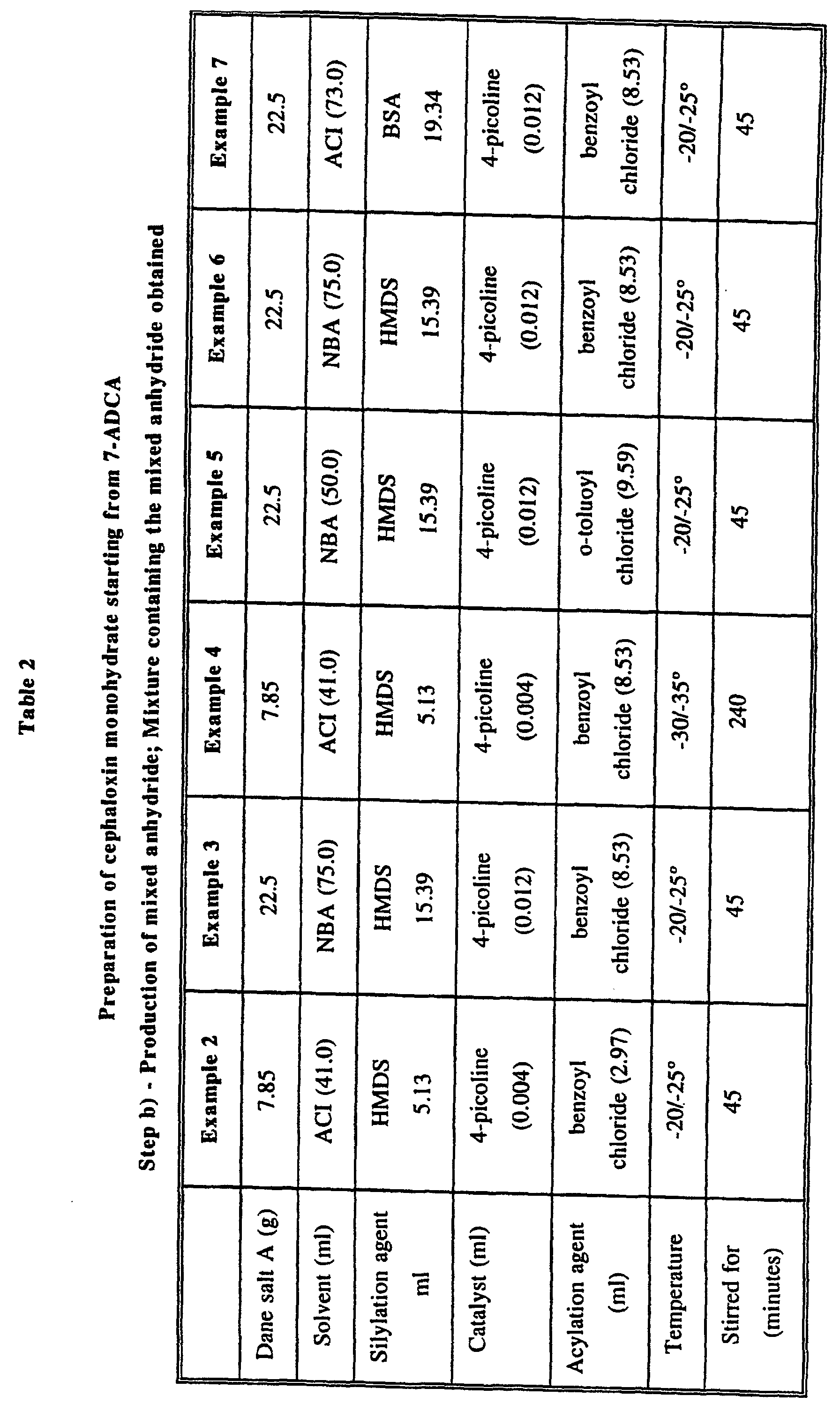
The resultant crude mixture containing protected cephalexin is worked up by treatment with a mixture of ice water and concentrated HCI and stirring the reaction mixture for 30 minutes under ice cooling. The aqueous phase is separated off and the organic phase is reextracted with a mixture of concentrated HCl and water. The combined phases are filtered through a filtering aid. The pH value is adjusted to 4.5 to 5.0 by addition of concentrated aqueous ammonia. Crystallized cephalexin monohydrate which is filtrated off, washed with 90% ammonia and dried is obtained. Yield: 89.9%. Purity: 98.2%. - In analogous manner as described in Example 1 but with changes as indicated in the following tables 1 to 3 cephalexin monohydrate is obtained according to Examples 2 to 7:


- Step a) is carried out in analogous manner as described in Example 1 a), but using 50 ml ACI (instead of 73.5 ml NBA) and 0.03 g of trichloroacetic acid (instead of 0.05 g of saccharin). A clear pale brown solution is obtained containing the bissylilated 7-ADCA. No further starting material is detected.
- 25.00 g of Dane salt B, 95 ml of ACI, 95 ml of DMF and 10.28 ml of BSA are mixed and the mixture is stirred vigorously at 25° for 30 minutes. 0.025 ml 4-picoline are added, the mixture is cooled to -50° and 9.50 ml of benzoyl chloride are added. The mixture is stirred for 60 minutes at -45/-50 °. A slightly yellow suspension containing the mixed carboxylic acid anhydride is obtained.
- The solution obtained in step a) is added dropwise to the solution obtained in step b) at a temperature of -45/-35° over 20 minutes and the reaction mixture is stirred for a 3 hours at a temperature of -35/-25°.
The resultant crude mixture containing protected cefadroxil is worked up by treatment with a mixture of ice water and concentrated HCl. The phases are separated and Reextraction with water/HCl is carried out. The combined aqueous phases are treated with additional DMF, the solution is filtered and left overnight in a refrigerator. Crystalline cefadroxil dimethylformamide solvate is obtained, filtered off, washed with acetone and dried. Yield: 83 %.
This solvate may be converted into cefadroxil by treatment in aqueous methanol. - Repeating example 8, but with the following step b) instead of step b) of example 8:
- 25.00 g of Dane salt B, 75 ml of ACI, 8.7 ml of HMDS and 0.015 g of trichloroacetic acid are mixed. The mixture is heated and kept under reflux for 6 hours. A pale yellow suspension is obtained, cooled to room temperature and treated with 75 ml of DMF. After stirring for 15 minutes the mixture is cooled to -50° and 0.025 ml of 4-picoline and 9.50 ml of benzoyl chloride are added. The mixture is stirred for 60 minutes at -45/-50 °. A slightly yellow suspension containing the mixed carboxylic acid anhydride is obtained.
crystalline cefadroxil dimethylformamide solvate is obtained. Yield: 81 %. - 14.0 g of 6-APA, 32 ml of NBA, 13.84 g of BSA and 0.02 g of trichloroacetic acid are mixed and heated to 40°. The mixture is stirred at 40° for 60 minutes and cooled to 25°. A slightly turbid solution containing the bissilylated 6-APA is obtained. No further starting material is detected.
- 0.01 ml of 4-picoline are added to a suspension of 21.1 g of Dane salt A and 0.18 g of pivalic acid in 46 ml NBA. The resultant mixture is stirred for 15 minutes at room temperature and cooled to -30°; 8.31 g of pivaloyl chloride are added. The resultant milky suspension is stirred at -15 °C for 60 minutes. 1.8 g of pivalic acid are added and the mixture is cooled to -45°. A mixture containing the mixed carboxylic acid anhydride is obtained.
- The mixture obtained in step a) is added dropwise to the mixture obtained in step b) at a temperature of -45/-35°. The resultant mixture is stirred for 2 hours at a temperature of -15/-35°. The resultant crude protected ampicillin mixture is worked up by treating with a mixture of ice-water and concentrated hydrochloric acid and stirred for 20 minutes while cooling with ice. The aqueous phase is separated off and the organic phase is reextracted with a mixture of water and concentrated hydrochloric acid. The combined aqueous phases are treated with concentrated aqueous sodium hydroxide to a pH of 4.5/5.5. Ampicillin trihydrate crystallizes out of the reaction mixture overnight in a refrigerator, the crystals are isolated, washed with IPA 88% and dried. Yield 89.0 %, Purity 98.4 %
- Step a) 14.0 g of 6-APA, 32 ml of NBA, 14.2 ml of HMDS and 0.03 g of trichloroacetic acid are mixed and heated to 70-80°. Vacuum is applied until the mixture starts refluxing. The mixture is kept under reflux at 70-80° for 60 minutes and then cooled to 10°. A clear yellow solution containing bissylilated 6-APA is obtained.
- 0.01 ml of 4-picoline are added to a suspension of 21.1 g of Dane salt A in 51 ml of NBA. The resultant mixture is stirred for 15 minutes at room temperature and cooled to -30°; 10.65 g of o-toluoyl chloride are added. The resultant suspension is stirred at a temperature of -20 to -25° for 60 minutes and cooled to -45°. A mixture containing the mixed carboxylic acid anhydride is obtained.
- The mixture obtained in step a) is added dropwise to the mixture obtained in step b) at a temperature of -45/-30°. The resultant mixture is stirred for 90 minutes at a temperature of -35/-20°. The resultant crude protected ampicillin mixture is worked up analogous as described in Example 10 c). Crystalline ampicillin trihydrate is obtained. Yield 88.5%. Purity 98.0 %.
- Repeating Example 10, but using in step b) 0.01 ml of 3,5-lutidine instead of 0.01 ml of 4-picoline and carrying out step c in analogous manner as described in Example 11 c), but stirring the mixture for 150 minutes (instead for 90 minutes), crystalline ampicillin trihydrate is obtained. Yield 89%, Purity 98.1 %.
- Step a) is carried out in analogous manner as described in Example 11 a), but heating to 80 to 90° (instead of 70 to 80°). A clear yellow solution containing bissilylated 6-APA is obtained. No further starting material is detected.
- 0.03 ml of 4-picoline are added to a suspension of 21.8 g of Dane salt B in 64 ml of NBA and 5 ml of DIMAC. The resultant mixture is stirred for 15 minutes at room temperature, cooled to -25° and 8.62 g of pivaloyl chloride are added. The resultant suspension is stirred at a temperature of -20° for 45 minutes. 3 g pivalic acid are added and the mixture is cooled to -40°. A mixture containing the mixed carboxylic acid anhydride is obtained.
- The solution obtained in step a) is added dropwise to the mixture obtained in step b) at a temperature of -45/-30 °. The mixture is stirred for 90 minutes at a temperature of -30/-15°. The resultant crude protected amoxicillin mixture is worked up by treatment with a mixture of ice-water and concentrated hydrochloric acid and stirring for 30 minutes while cooling with ice. The aqueous phase is separated off and the organic phase reextracted with water. The combined aqueous phases are treated with concentrated aqueous sodium hydroxide to a pH of 4.5/5.5. Crystalline amoxicillin trihydrate is isolated as described in Example 10 c). Yield 88.4 %. Purity 99.3 %.
- Carrying out step a) in analogous manner as described in Example 10 a), but using 32 ml ACI instead of 32 ml NBA, step b) in analogous manner as described in Example 13 b), but using 64 ml of ACI instead of NBA and step c) in analogous manner as described in Example 10 c), crystalline amoxicillin trihydrate is obtained. Yield 87.8 %, Purity 99.1 %
Claims (9)
- A process for the production of a silylated 7-amino-desacetoxy-cephalosporanic acid which comprises silylation of a 7-amino-desacetoxy-cephalosporanic acid in a carboxylic acid ester of formula
- A process for the production of a silylated 6-aminopenicillanic acid which comprises silylation of 6-amino-penicillanic acid in a carboxylic acid ester of formula
in the presence of a silylation agent other than N,N-bistrimethylsilyl acetamide, N,N'-bistrimethyl-silylmalonic acid amide and N,N'-bistrimethylsilyl urea. - A process according to claim 1 or 2 wherein the carboxylic acid ester is a propyl acetate or a butylacetate.
- A process for the production of a silylated 7-amino-desacetoxy-cephalosporanic acid or a silylated 6-aminopenicillanic acid by silylation of 7-amino-desacetoxy-cephalosporanic acid, or 6-aminopenicillanic acid in iso-propylacetate or n-butylacetate.
- A process for the production of an 7-aminoacyl-desacetoxy-cephalosporin or an 6-aminoacyl-penicillin other than amoxicillin, which comprises(i) producing a silylated 7-amino-desacetoxy-cephalosporanic acid or a silylated 6-amino-penicillanic acid by silylation of a 7-amino-desacetoxy-cephalosporanic acid or a 6-amino-penicillanic acid in a carboxylic acid ester of formula
X denotes methyl and Y denotes (C3-8)alkyl, and(ii) acylating the silylated 7-amino-desacetoxy-cephalosporanic acid or silylated 6-amino-penicillanic acid with an appropriate acylating agent. - A process for the production of amoxicillin which comprises the steps of(i) producing a silylated 6-amino-penicillanic acid by silylation of a 6-aminopenicillanic acid in a carboxylic acid ester of formula
X denotes methyl and Y denotes (C3-8)alkyl in the presence of a silylation agent other than N,N-bistrimethylsilyl acetamide, N,N'-bistrimethylsilylmalonic acid amide and N,N'-bistrimethylsilyl urea, and(ii) acylating the silylated 6-amino-penicillanic acid with a mixed carboxylic acid anhydride with an appropriate acylating agent. - A process for the production of amoxicillin which comprises the steps of(i) producing a silylated 6-amino-penicillanic acid by silylation of a 6-aminopenicillanic acid in a carboxylic acid ester of formula
X denotes methyl and Y denotes (C3-8)alkyl, and(ii) acylating the silylated 6-amino-penicillanic acid with a mixed carboxylic acid anhydride, produced by reaction of a salt of an alpha-amino acid, having the amine group thereof protected as an N-enamine, with an appropriate acylation agent other than a chlorcarbonic acid ester. - Use of a process of claim 1 in a process for the production of a 7-alpha-aminoacyl-desacetoxy-cephalosporin.
- Use of a process of claim 2 in a process for the production of a 6-alpha-aminoacylpenicillin.
Applications Claiming Priority (3)
| Application Number | Priority Date | Filing Date | Title |
|---|---|---|---|
| GB9423459A GB9423459D0 (en) | 1994-11-21 | 1994-11-21 | Silylation process |
| GB9423459 | 1994-11-21 | ||
| PCT/EP1995/004562 WO1996016067A1 (en) | 1994-11-21 | 1995-11-20 | Silylation process |
Publications (2)
| Publication Number | Publication Date |
|---|---|
| EP0793666A1 EP0793666A1 (en) | 1997-09-10 |
| EP0793666B1 true EP0793666B1 (en) | 2002-04-24 |
Family
ID=10764738
Family Applications (1)
| Application Number | Title | Priority Date | Filing Date |
|---|---|---|---|
| EP95940215A Expired - Lifetime EP0793666B1 (en) | 1994-11-21 | 1995-11-20 | Silylation process |
Country Status (16)
| Country | Link |
|---|---|
| US (1) | US5998610A (en) |
| EP (1) | EP0793666B1 (en) |
| JP (2) | JP3072857B2 (en) |
| KR (1) | KR100416673B1 (en) |
| CN (2) | CN1062272C (en) |
| AT (1) | ATE216702T1 (en) |
| AU (1) | AU4174496A (en) |
| DE (1) | DE69526519T2 (en) |
| ES (1) | ES2176349T3 (en) |
| GB (1) | GB9423459D0 (en) |
| HU (1) | HUT77102A (en) |
| PL (1) | PL184270B1 (en) |
| PT (1) | PT793666E (en) |
| SI (1) | SI0793666T1 (en) |
| TW (1) | TW432070B (en) |
| WO (1) | WO1996016067A1 (en) |
Families Citing this family (7)
| Publication number | Priority date | Publication date | Assignee | Title |
|---|---|---|---|---|
| WO2001023393A1 (en) * | 1999-09-30 | 2001-04-05 | Otsuka Kagaku Kabushiki Kaisha | 3-cephem derivative crystal and method for preparing the same |
| US20040077849A1 (en) * | 2002-10-16 | 2004-04-22 | Orchid Chemicals & Pharmaceuticals Limited | Process for the preparation of cefadroxil |
| WO2004082661A1 (en) * | 2003-03-21 | 2004-09-30 | Dsm Ip Assets B.V. | Crystalline amoxicillin trihydrate powder |
| US7534781B2 (en) * | 2003-03-21 | 2009-05-19 | Dsm Ip Assets B.V. | Crystalline amoxicillin trihydrate powder |
| WO2009016170A1 (en) * | 2007-07-30 | 2009-02-05 | Dsm Ip Assets B.V. | Process for the silylation of beta-lactam compounds |
| CN101845053B (en) * | 2010-03-09 | 2012-07-25 | 河北科技大学 | Method for separating and purifying amoxicillin trihydrate |
| CN103183685B (en) * | 2011-12-30 | 2016-03-30 | 浙江新和成股份有限公司 | The preparation method of 6 α-amide group penicillanic acid sulfoxide compound |
Family Cites Families (27)
| Publication number | Priority date | Publication date | Assignee | Title |
|---|---|---|---|---|
| SE311519B (en) * | 1962-12-14 | 1969-06-16 | Astra Ab | |
| US4138555A (en) * | 1971-05-14 | 1979-02-06 | Glaxo Laboratories, Limited | (6R,7R)-7-[2-aryl-2-(etherified oximino)acetamido]-3-carbamoyloxymethylceph-3-em-4-carboxylic acid 1-oxides |
| US4093803A (en) * | 1971-05-14 | 1978-06-06 | Glaxo Laboratories Limited | 7β-[2-Etherified oximino-2-(thienyl-, furyl- or pyridylacetamido)] cephalosporins |
| DK154939C (en) * | 1974-12-19 | 1989-06-12 | Takeda Chemical Industries Ltd | METHOD OF ANALOGUE FOR THE PREPARATION OF THIAZOLYLACETAMIDO-CEPHEM COMPOUNDS OR PHARMACEUTICAL ACCEPTABLE SALTS OR ESTERS THEREOF |
| GB1459807A (en) * | 1975-05-27 | 1976-12-31 | Proter Spa | Process for the production of 7-d-a-amino-phenyl-acetamido-3- desacetoxy-cephalosporanic acid |
| US4196205A (en) * | 1976-01-23 | 1980-04-01 | Roussel Uclaf | 3-Acetoxymethyl-7-(iminoacetamido)-cephalosporanic acid derivatives |
| US5336776A (en) * | 1976-01-23 | 1994-08-09 | Roussel Uclaf | 3-acetoxymethyl-7-(iminoacetamideo)-cephalosporanic acid |
| US5079369A (en) * | 1976-04-12 | 1992-01-07 | Fujisawa Pharmaceutical Company, Ltd. | Syn-isomer of 3,7-disubstituted-3-cephem-4-carboxylic acid compounds and processes for the preparation thereof |
| DE2715385A1 (en) * | 1976-04-14 | 1977-11-10 | Takeda Chemical Industries Ltd | CEPHALOSPORIN DERIVATIVES, THE PROCESS FOR THEIR MANUFACTURING AND MEDICINAL PRODUCTS CONTAINING THEM |
| GB1532682A (en) * | 1976-04-27 | 1978-11-22 | Bristol Myers Co | Process for the preparation of cephadroxil |
| DE2714880A1 (en) * | 1977-04-02 | 1978-10-26 | Hoechst Ag | CEPHEMDER DERIVATIVES AND PROCESS FOR THEIR PRODUCTION |
| GB2001985B (en) * | 1977-08-05 | 1982-07-07 | Lark Spa | Process for the preparation of penicillanic and cephalosporanic acid derivatives |
| FR2400519A1 (en) * | 1977-08-17 | 1979-03-16 | Roussel Uclaf | CRYSTALLINE FORM OF SODIUM SALT OF AN OXIMIN DERIVATIVE OF 7-AMINO-THIAZOLYL ACETAMIDO CEPHALOSPORANIC, ITS PREPARATION PROCESS AND ITS APPLICATION AS A MEDICINAL PRODUCT |
| NL162387C (en) * | 1977-09-06 | 1980-05-16 | Gist Brocades Nv | PROCESS FOR PREPARING 6- (D-ALPHA-AMINO-P- HYDROXYPHENYLACETAMIDO) PENICILLANIC ACID. |
| JPS5459296A (en) * | 1977-10-14 | 1979-05-12 | Toshin Chemical Co | Production of alphaaaminoo paraahydroxybenzylpeniciline |
| CA1125745A (en) * | 1978-11-20 | 1982-06-15 | Joseph Kaspi | PROCESS FOR PREPARING .beta.-LACTAM ANTIBIOTICS |
| IT1126544B (en) * | 1979-12-07 | 1986-05-21 | Dobfar Spa | PROCEDURE FOR THE PREPARATION OF 7-AMINO-DESACETOXY CEPHALOSPORANIC ACID DERIVATIVES |
| DE3165922D1 (en) * | 1980-03-28 | 1984-10-18 | Biochemie Gmbh | New process for the production of cephalosporin antibiotics, and novel intermediates used in such process and their production |
| IT1180207B (en) * | 1984-07-30 | 1987-09-23 | Istituto Biochimico Italiano | PROCEDURE FOR THE PREPARATION, WITH HIGH YIELD AND PURITY, OF BETA-LACTAMIC ANTIBIOTICS |
| DE3539901A1 (en) * | 1985-11-11 | 1987-05-14 | Hoechst Ag | CEPHALOSPORINE DERIVATIVES AND METHOD FOR THEIR PRODUCTION |
| IT1214587B (en) * | 1986-12-23 | 1990-01-18 | Giovanni Bonfanti | METHOD FOR THE PRODUCTION OF PURE CRYSTALLINE PRODUCTS. |
| ES2006988A6 (en) * | 1988-06-20 | 1989-05-16 | Gema Sa | Process for preparing cephalosporins and intermediates therefor. |
| US5034522A (en) * | 1988-08-02 | 1991-07-23 | Biocraft Laboratories, Inc. | Method for the production of 3-methyl cephem derivatives |
| HU221200B1 (en) * | 1990-01-22 | 2002-08-28 | Biochemie Gmbh | Process for producing beta-lactames |
| CA2033692A1 (en) * | 1990-01-25 | 1991-07-26 | Wilhelm Bannwarth | Energy transfer systems |
| US5142043A (en) * | 1990-05-10 | 1992-08-25 | Biocraft Laboratories, Inc. | Process for preparing cephalexin monohydrate |
| US5574154A (en) * | 1994-09-29 | 1996-11-12 | Alnejma Bulk Pharmaceutical Co. A.B.P.C. | Process for the preparation of cephalosporanic compounds |
-
1994
- 1994-11-21 GB GB9423459A patent/GB9423459D0/en active Pending
-
1995
- 1995-11-02 US US08/836,776 patent/US5998610A/en not_active Expired - Fee Related
- 1995-11-20 SI SI9530598T patent/SI0793666T1/en unknown
- 1995-11-20 DE DE69526519T patent/DE69526519T2/en not_active Expired - Fee Related
- 1995-11-20 ES ES95940215T patent/ES2176349T3/en not_active Expired - Lifetime
- 1995-11-20 TW TW084112300A patent/TW432070B/en not_active IP Right Cessation
- 1995-11-20 AU AU41744/96A patent/AU4174496A/en not_active Abandoned
- 1995-11-20 HU HU9701868A patent/HUT77102A/en unknown
- 1995-11-20 EP EP95940215A patent/EP0793666B1/en not_active Expired - Lifetime
- 1995-11-20 PL PL95319752A patent/PL184270B1/en not_active IP Right Cessation
- 1995-11-20 KR KR1019970703336A patent/KR100416673B1/en not_active Expired - Fee Related
- 1995-11-20 JP JP08516566A patent/JP3072857B2/en not_active Expired - Fee Related
- 1995-11-20 PT PT95940215T patent/PT793666E/en unknown
- 1995-11-20 AT AT95940215T patent/ATE216702T1/en not_active IP Right Cessation
- 1995-11-20 CN CN95196352A patent/CN1062272C/en not_active Expired - Fee Related
- 1995-11-20 WO PCT/EP1995/004562 patent/WO1996016067A1/en not_active Ceased
-
1999
- 1999-11-24 JP JP11333242A patent/JP2000229986A/en active Pending
- 1999-12-30 CN CN99127526A patent/CN1124277C/en not_active Expired - Fee Related
Also Published As
| Publication number | Publication date |
|---|---|
| GB9423459D0 (en) | 1995-01-11 |
| KR100416673B1 (en) | 2004-03-18 |
| JPH10507773A (en) | 1998-07-28 |
| WO1996016067A1 (en) | 1996-05-30 |
| TW432070B (en) | 2001-05-01 |
| SI0793666T1 (en) | 2002-10-31 |
| HUT77102A (en) | 1998-03-02 |
| KR970707135A (en) | 1997-12-01 |
| CN1164235A (en) | 1997-11-05 |
| AU4174496A (en) | 1996-06-17 |
| PL184270B1 (en) | 2002-09-30 |
| DE69526519D1 (en) | 2002-05-29 |
| CN1062272C (en) | 2001-02-21 |
| EP0793666A1 (en) | 1997-09-10 |
| CN1280982A (en) | 2001-01-24 |
| PT793666E (en) | 2002-09-30 |
| JP2000229986A (en) | 2000-08-22 |
| ATE216702T1 (en) | 2002-05-15 |
| PL319752A1 (en) | 1997-08-18 |
| DE69526519T2 (en) | 2002-10-31 |
| ES2176349T3 (en) | 2002-12-01 |
| CN1124277C (en) | 2003-10-15 |
| US5998610A (en) | 1999-12-07 |
| JP3072857B2 (en) | 2000-08-07 |
Similar Documents
| Publication | Publication Date | Title |
|---|---|---|
| EP0019345A1 (en) | Process for the preparation of a (D-alpha-amino-(p-hydroxyphenyl)-acetamido) group containing cephalosporanic acid derivatives | |
| US5998610A (en) | Silylation process | |
| CA1125745A (en) | PROCESS FOR PREPARING .beta.-LACTAM ANTIBIOTICS | |
| US5840885A (en) | Processes for the production of 6-α-aminoacyl-penicillin and 7-.alpha. | |
| WO2002083634A2 (en) | Process for the preparation of cefpodoxime acid | |
| KR0178280B1 (en) | Method for preparing cephalosporin antibiotic | |
| RO109652B1 (en) | PROCEDURE FOR PREPARING AN ANTIBIOTIC CEFEPIM HYDROCHLORIDE DIHYDROCARORIDE | |
| PL172176B1 (en) | Method of obtaining 7-alpha-aminoacyl cephalosporines | |
| CA2519853A1 (en) | Process for the preparation of 7-amino (p-hydroxyphenylglycylamido) cephem compounds | |
| JPH07501072A (en) | Method for producing cephem derivatives | |
| US5821362A (en) | Method of desilylating silylether compounds | |
| WO2005040175A2 (en) | Process for the preparation of cephem carboxylic acids | |
| JPS5965094A (en) | Preparation of cephalosporin compound | |
| AU2002307885A1 (en) | Process for the preparation of cefpodoxime acid | |
| KR810000858B1 (en) | Method for preparing β-lactam antibiotics | |
| JPH05140170A (en) | New method for preparing 7-amino-3-azidomethyl-3-cefem- 4-carboxylic acid | |
| JPH0232082A (en) | Preparation of penicillin derivative |
Legal Events
| Date | Code | Title | Description |
|---|---|---|---|
| PUAI | Public reference made under article 153(3) epc to a published international application that has entered the european phase |
Free format text: ORIGINAL CODE: 0009012 |
|
| 17P | Request for examination filed |
Effective date: 19970318 |
|
| AK | Designated contracting states |
Kind code of ref document: A1 Designated state(s): AT BE CH DE DK ES FR GB GR IE IT LI LU NL PT SE |
|
| AX | Request for extension of the european patent |
Free format text: SI PAYMENT 970318 |
|
| 17Q | First examination report despatched |
Effective date: 19991102 |
|
| GRAG | Despatch of communication of intention to grant |
Free format text: ORIGINAL CODE: EPIDOS AGRA |
|
| GRAG | Despatch of communication of intention to grant |
Free format text: ORIGINAL CODE: EPIDOS AGRA |
|
| GRAG | Despatch of communication of intention to grant |
Free format text: ORIGINAL CODE: EPIDOS AGRA |
|
| GRAH | Despatch of communication of intention to grant a patent |
Free format text: ORIGINAL CODE: EPIDOS IGRA |
|
| GRAH | Despatch of communication of intention to grant a patent |
Free format text: ORIGINAL CODE: EPIDOS IGRA |
|
| REG | Reference to a national code |
Ref country code: GB Ref legal event code: IF02 |
|
| GRAA | (expected) grant |
Free format text: ORIGINAL CODE: 0009210 |
|
| AK | Designated contracting states |
Kind code of ref document: B1 Designated state(s): AT BE CH DE DK ES FR GB GR IE IT LI LU NL PT SE |
|
| AX | Request for extension of the european patent |
Free format text: SI PAYMENT 19970318 |
|
| PG25 | Lapsed in a contracting state [announced via postgrant information from national office to epo] |
Ref country code: GR Free format text: LAPSE BECAUSE OF FAILURE TO SUBMIT A TRANSLATION OF THE DESCRIPTION OR TO PAY THE FEE WITHIN THE PRESCRIBED TIME-LIMIT Effective date: 20020424 |
|
| REF | Corresponds to: |
Ref document number: 216702 Country of ref document: AT Date of ref document: 20020515 Kind code of ref document: T |
|
| REG | Reference to a national code |
Ref country code: GB Ref legal event code: FG4D |
|
| RIN1 | Information on inventor provided before grant (corrected) |
Inventor name: LUDESCHER, JOHANNES Inventor name: DIAGO, JOSE Inventor name: CENTELLAS, VICTOR |
|
| REG | Reference to a national code |
Ref country code: CH Ref legal event code: EP |
|
| REF | Corresponds to: |
Ref document number: 69526519 Country of ref document: DE Date of ref document: 20020529 |
|
| REG | Reference to a national code |
Ref country code: IE Ref legal event code: FG4D |
|
| PG25 | Lapsed in a contracting state [announced via postgrant information from national office to epo] |
Ref country code: SE Free format text: LAPSE BECAUSE OF FAILURE TO SUBMIT A TRANSLATION OF THE DESCRIPTION OR TO PAY THE FEE WITHIN THE PRESCRIBED TIME-LIMIT Effective date: 20020724 Ref country code: DK Free format text: LAPSE BECAUSE OF FAILURE TO SUBMIT A TRANSLATION OF THE DESCRIPTION OR TO PAY THE FEE WITHIN THE PRESCRIBED TIME-LIMIT Effective date: 20020724 |
|
| REG | Reference to a national code |
Ref country code: PT Ref legal event code: SC4A Free format text: AVAILABILITY OF NATIONAL TRANSLATION Effective date: 20020620 |
|
| ET | Fr: translation filed | ||
| PG25 | Lapsed in a contracting state [announced via postgrant information from national office to epo] |
Ref country code: LU Free format text: LAPSE BECAUSE OF NON-PAYMENT OF DUE FEES Effective date: 20021120 |
|
| REG | Reference to a national code |
Ref country code: ES Ref legal event code: FG2A Ref document number: 2176349 Country of ref document: ES Kind code of ref document: T3 |
|
| PLBE | No opposition filed within time limit |
Free format text: ORIGINAL CODE: 0009261 |
|
| STAA | Information on the status of an ep patent application or granted ep patent |
Free format text: STATUS: NO OPPOSITION FILED WITHIN TIME LIMIT |
|
| 26N | No opposition filed |
Effective date: 20030127 |
|
| REG | Reference to a national code |
Ref country code: CH Ref legal event code: PFA Owner name: SANDOZ G.M.B.H Free format text: BIOCHEMIE GESELLSCHAFT M.B.H.##6250 KUNDL (AT) -TRANSFER TO- SANDOZ G.M.B.H#BIOCHEMIESTRASSE10#6250 KUNDL (AT) |
|
| REG | Reference to a national code |
Ref country code: CH Ref legal event code: PUE Owner name: SANDOZ AG Free format text: SANDOZ G.M.B.H#BIOCHEMIESTRASSE10#6250 KUNDL (AT) -TRANSFER TO- SANDOZ AG#LICHTSTRASSE 35#4056 BASEL (CH) |
|
| PGFP | Annual fee paid to national office [announced via postgrant information from national office to epo] |
Ref country code: BE Payment date: 20040930 Year of fee payment: 10 |
|
| PGFP | Annual fee paid to national office [announced via postgrant information from national office to epo] |
Ref country code: IE Payment date: 20041006 Year of fee payment: 10 |
|
| PGFP | Annual fee paid to national office [announced via postgrant information from national office to epo] |
Ref country code: AT Payment date: 20041011 Year of fee payment: 10 |
|
| PGFP | Annual fee paid to national office [announced via postgrant information from national office to epo] |
Ref country code: CH Payment date: 20041012 Year of fee payment: 10 |
|
| PGFP | Annual fee paid to national office [announced via postgrant information from national office to epo] |
Ref country code: PT Payment date: 20041013 Year of fee payment: 10 |
|
| REG | Reference to a national code |
Ref country code: SI Ref legal event code: SP73 Owner name: SANDOZ AG; CH Effective date: 20041021 |
|
| NLS | Nl: assignments of ep-patents |
Owner name: SANDOZ AG |
|
| NLT1 | Nl: modifications of names registered in virtue of documents presented to the patent office pursuant to art. 16 a, paragraph 1 |
Owner name: SANDOZ GMBH |
|
| REG | Reference to a national code |
Ref country code: SI Ref legal event code: IF |
|
| REG | Reference to a national code |
Ref country code: FR Ref legal event code: TP Ref country code: FR Ref legal event code: CD |
|
| PGFP | Annual fee paid to national office [announced via postgrant information from national office to epo] |
Ref country code: FR Payment date: 20051003 Year of fee payment: 11 |
|
| PG25 | Lapsed in a contracting state [announced via postgrant information from national office to epo] |
Ref country code: AT Free format text: LAPSE BECAUSE OF NON-PAYMENT OF DUE FEES Effective date: 20051120 |
|
| PG25 | Lapsed in a contracting state [announced via postgrant information from national office to epo] |
Ref country code: IE Free format text: LAPSE BECAUSE OF NON-PAYMENT OF DUE FEES Effective date: 20051121 |
|
| PG25 | Lapsed in a contracting state [announced via postgrant information from national office to epo] |
Ref country code: LI Free format text: LAPSE BECAUSE OF NON-PAYMENT OF DUE FEES Effective date: 20051130 Ref country code: CH Free format text: LAPSE BECAUSE OF NON-PAYMENT OF DUE FEES Effective date: 20051130 Ref country code: BE Free format text: LAPSE BECAUSE OF NON-PAYMENT OF DUE FEES Effective date: 20051130 |
|
| PG25 | Lapsed in a contracting state [announced via postgrant information from national office to epo] |
Ref country code: PT Free format text: LAPSE BECAUSE OF NON-PAYMENT OF DUE FEES Effective date: 20060522 |
|
| REG | Reference to a national code |
Ref country code: CH Ref legal event code: PL |
|
| PG25 | Lapsed in a contracting state [announced via postgrant information from national office to epo] |
Ref country code: FR Free format text: LAPSE BECAUSE OF NON-PAYMENT OF DUE FEES Effective date: 20060731 |
|
| REG | Reference to a national code |
Ref country code: PT Ref legal event code: MM4A Effective date: 20060522 |
|
| REG | Reference to a national code |
Ref country code: IE Ref legal event code: MM4A |
|
| REG | Reference to a national code |
Ref country code: SI Ref legal event code: KO00 Effective date: 20060731 |
|
| REG | Reference to a national code |
Ref country code: FR Ref legal event code: ST Effective date: 20060731 |
|
| PGFP | Annual fee paid to national office [announced via postgrant information from national office to epo] |
Ref country code: NL Payment date: 20061105 Year of fee payment: 12 |
|
| PGFP | Annual fee paid to national office [announced via postgrant information from national office to epo] |
Ref country code: GB Payment date: 20061115 Year of fee payment: 12 |
|
| PGFP | Annual fee paid to national office [announced via postgrant information from national office to epo] |
Ref country code: DE Payment date: 20061116 Year of fee payment: 12 |
|
| PGFP | Annual fee paid to national office [announced via postgrant information from national office to epo] |
Ref country code: IT Payment date: 20061130 Year of fee payment: 12 |
|
| PGFP | Annual fee paid to national office [announced via postgrant information from national office to epo] |
Ref country code: ES Payment date: 20061222 Year of fee payment: 12 |
|
| REG | Reference to a national code |
Ref country code: FR Ref legal event code: RN Ref country code: FR Ref legal event code: FC |
|
| BECH | Be: change of holder |
Owner name: *SANDOZ A.G. Effective date: 20060131 |
|
| BERE | Be: lapsed |
Owner name: *SANDOZ A.G. Effective date: 20051130 |
|
| PGRI | Patent reinstated in contracting state [announced from national office to epo] |
Ref country code: FR Effective date: 20070124 |
|
| GBPC | Gb: european patent ceased through non-payment of renewal fee |
Effective date: 20071120 |
|
| NLV4 | Nl: lapsed or anulled due to non-payment of the annual fee |
Effective date: 20080601 |
|
| PG25 | Lapsed in a contracting state [announced via postgrant information from national office to epo] |
Ref country code: NL Free format text: LAPSE BECAUSE OF NON-PAYMENT OF DUE FEES Effective date: 20080601 Ref country code: DE Free format text: LAPSE BECAUSE OF NON-PAYMENT OF DUE FEES Effective date: 20080603 |
|
| REG | Reference to a national code |
Ref country code: FR Ref legal event code: ST Effective date: 20080930 |
|
| PG25 | Lapsed in a contracting state [announced via postgrant information from national office to epo] |
Ref country code: GB Free format text: LAPSE BECAUSE OF NON-PAYMENT OF DUE FEES Effective date: 20071120 |
|
| REG | Reference to a national code |
Ref country code: ES Ref legal event code: FD2A Effective date: 20071121 |
|
| PG25 | Lapsed in a contracting state [announced via postgrant information from national office to epo] |
Ref country code: FR Free format text: LAPSE BECAUSE OF NON-PAYMENT OF DUE FEES Effective date: 20071130 Ref country code: ES Free format text: LAPSE BECAUSE OF NON-PAYMENT OF DUE FEES Effective date: 20071121 |
|
| PGRI | Patent reinstated in contracting state [announced from national office to epo] |
Ref country code: FR Effective date: 20070124 |
|
| PG25 | Lapsed in a contracting state [announced via postgrant information from national office to epo] |
Ref country code: IT Free format text: LAPSE BECAUSE OF NON-PAYMENT OF DUE FEES Effective date: 20071120 |