EP0793500B1 - Pharmaceutical compositions comprising nitric oxide-releasing polysaccharides - Google Patents
Pharmaceutical compositions comprising nitric oxide-releasing polysaccharides Download PDFInfo
- Publication number
- EP0793500B1 EP0793500B1 EP95941444A EP95941444A EP0793500B1 EP 0793500 B1 EP0793500 B1 EP 0793500B1 EP 95941444 A EP95941444 A EP 95941444A EP 95941444 A EP95941444 A EP 95941444A EP 0793500 B1 EP0793500 B1 EP 0793500B1
- Authority
- EP
- European Patent Office
- Prior art keywords
- nitric oxide
- group
- releasing
- pharmaceutically acceptable
- polymeric composition
- Prior art date
- Legal status (The legal status is an assumption and is not a legal conclusion. Google has not performed a legal analysis and makes no representation as to the accuracy of the status listed.)
- Expired - Lifetime
Links
- 0 CC1CCN(*)CC1 Chemical compound CC1CCN(*)CC1 0.000 description 5
Classifications
-
- A—HUMAN NECESSITIES
- A61—MEDICAL OR VETERINARY SCIENCE; HYGIENE
- A61K—PREPARATIONS FOR MEDICAL, DENTAL OR TOILETRY PURPOSES
- A61K31/00—Medicinal preparations containing organic active ingredients
- A61K31/74—Synthetic polymeric materials
- A61K31/785—Polymers containing nitrogen
-
- A—HUMAN NECESSITIES
- A61—MEDICAL OR VETERINARY SCIENCE; HYGIENE
- A61K—PREPARATIONS FOR MEDICAL, DENTAL OR TOILETRY PURPOSES
- A61K31/00—Medicinal preparations containing organic active ingredients
- A61K31/655—Azo (—N=N—), diazo (=N2), azoxy (>N—O—N< or N(=O)—N<), azido (—N3) or diazoamino (—N=N—N<) compounds
-
- A—HUMAN NECESSITIES
- A61—MEDICAL OR VETERINARY SCIENCE; HYGIENE
- A61K—PREPARATIONS FOR MEDICAL, DENTAL OR TOILETRY PURPOSES
- A61K47/00—Medicinal preparations characterised by the non-active ingredients used, e.g. carriers or inert additives; Targeting or modifying agents chemically bound to the active ingredient
- A61K47/50—Medicinal preparations characterised by the non-active ingredients used, e.g. carriers or inert additives; Targeting or modifying agents chemically bound to the active ingredient the non-active ingredient being chemically bound to the active ingredient, e.g. polymer-drug conjugates
- A61K47/51—Medicinal preparations characterised by the non-active ingredients used, e.g. carriers or inert additives; Targeting or modifying agents chemically bound to the active ingredient the non-active ingredient being chemically bound to the active ingredient, e.g. polymer-drug conjugates the non-active ingredient being a modifying agent
- A61K47/56—Medicinal preparations characterised by the non-active ingredients used, e.g. carriers or inert additives; Targeting or modifying agents chemically bound to the active ingredient the non-active ingredient being chemically bound to the active ingredient, e.g. polymer-drug conjugates the non-active ingredient being a modifying agent the modifying agent being an organic macromolecular compound, e.g. an oligomeric, polymeric or dendrimeric molecule
-
- A—HUMAN NECESSITIES
- A61—MEDICAL OR VETERINARY SCIENCE; HYGIENE
- A61K—PREPARATIONS FOR MEDICAL, DENTAL OR TOILETRY PURPOSES
- A61K47/00—Medicinal preparations characterised by the non-active ingredients used, e.g. carriers or inert additives; Targeting or modifying agents chemically bound to the active ingredient
- A61K47/50—Medicinal preparations characterised by the non-active ingredients used, e.g. carriers or inert additives; Targeting or modifying agents chemically bound to the active ingredient the non-active ingredient being chemically bound to the active ingredient, e.g. polymer-drug conjugates
- A61K47/51—Medicinal preparations characterised by the non-active ingredients used, e.g. carriers or inert additives; Targeting or modifying agents chemically bound to the active ingredient the non-active ingredient being chemically bound to the active ingredient, e.g. polymer-drug conjugates the non-active ingredient being a modifying agent
- A61K47/56—Medicinal preparations characterised by the non-active ingredients used, e.g. carriers or inert additives; Targeting or modifying agents chemically bound to the active ingredient the non-active ingredient being chemically bound to the active ingredient, e.g. polymer-drug conjugates the non-active ingredient being a modifying agent the modifying agent being an organic macromolecular compound, e.g. an oligomeric, polymeric or dendrimeric molecule
- A61K47/59—Medicinal preparations characterised by the non-active ingredients used, e.g. carriers or inert additives; Targeting or modifying agents chemically bound to the active ingredient the non-active ingredient being chemically bound to the active ingredient, e.g. polymer-drug conjugates the non-active ingredient being a modifying agent the modifying agent being an organic macromolecular compound, e.g. an oligomeric, polymeric or dendrimeric molecule obtained otherwise than by reactions only involving carbon-to-carbon unsaturated bonds, e.g. polyureas or polyurethanes
-
- A—HUMAN NECESSITIES
- A61—MEDICAL OR VETERINARY SCIENCE; HYGIENE
- A61K—PREPARATIONS FOR MEDICAL, DENTAL OR TOILETRY PURPOSES
- A61K47/00—Medicinal preparations characterised by the non-active ingredients used, e.g. carriers or inert additives; Targeting or modifying agents chemically bound to the active ingredient
- A61K47/50—Medicinal preparations characterised by the non-active ingredients used, e.g. carriers or inert additives; Targeting or modifying agents chemically bound to the active ingredient the non-active ingredient being chemically bound to the active ingredient, e.g. polymer-drug conjugates
- A61K47/51—Medicinal preparations characterised by the non-active ingredients used, e.g. carriers or inert additives; Targeting or modifying agents chemically bound to the active ingredient the non-active ingredient being chemically bound to the active ingredient, e.g. polymer-drug conjugates the non-active ingredient being a modifying agent
- A61K47/62—Medicinal preparations characterised by the non-active ingredients used, e.g. carriers or inert additives; Targeting or modifying agents chemically bound to the active ingredient the non-active ingredient being chemically bound to the active ingredient, e.g. polymer-drug conjugates the non-active ingredient being a modifying agent the modifying agent being a protein, peptide or polyamino acid
- A61K47/64—Drug-peptide, drug-protein or drug-polyamino acid conjugates, i.e. the modifying agent being a peptide, protein or polyamino acid which is covalently bonded or complexed to a therapeutically active agent
-
- A—HUMAN NECESSITIES
- A61—MEDICAL OR VETERINARY SCIENCE; HYGIENE
- A61P—SPECIFIC THERAPEUTIC ACTIVITY OF CHEMICAL COMPOUNDS OR MEDICINAL PREPARATIONS
- A61P1/00—Drugs for disorders of the alimentary tract or the digestive system
-
- A—HUMAN NECESSITIES
- A61—MEDICAL OR VETERINARY SCIENCE; HYGIENE
- A61P—SPECIFIC THERAPEUTIC ACTIVITY OF CHEMICAL COMPOUNDS OR MEDICINAL PREPARATIONS
- A61P11/00—Drugs for disorders of the respiratory system
-
- A—HUMAN NECESSITIES
- A61—MEDICAL OR VETERINARY SCIENCE; HYGIENE
- A61P—SPECIFIC THERAPEUTIC ACTIVITY OF CHEMICAL COMPOUNDS OR MEDICINAL PREPARATIONS
- A61P11/00—Drugs for disorders of the respiratory system
- A61P11/08—Bronchodilators
-
- A—HUMAN NECESSITIES
- A61—MEDICAL OR VETERINARY SCIENCE; HYGIENE
- A61P—SPECIFIC THERAPEUTIC ACTIVITY OF CHEMICAL COMPOUNDS OR MEDICINAL PREPARATIONS
- A61P15/00—Drugs for genital or sexual disorders; Contraceptives
- A61P15/06—Antiabortive agents; Labour repressants
-
- A—HUMAN NECESSITIES
- A61—MEDICAL OR VETERINARY SCIENCE; HYGIENE
- A61P—SPECIFIC THERAPEUTIC ACTIVITY OF CHEMICAL COMPOUNDS OR MEDICINAL PREPARATIONS
- A61P15/00—Drugs for genital or sexual disorders; Contraceptives
- A61P15/10—Drugs for genital or sexual disorders; Contraceptives for impotence
-
- A—HUMAN NECESSITIES
- A61—MEDICAL OR VETERINARY SCIENCE; HYGIENE
- A61P—SPECIFIC THERAPEUTIC ACTIVITY OF CHEMICAL COMPOUNDS OR MEDICINAL PREPARATIONS
- A61P25/00—Drugs for disorders of the nervous system
-
- A—HUMAN NECESSITIES
- A61—MEDICAL OR VETERINARY SCIENCE; HYGIENE
- A61P—SPECIFIC THERAPEUTIC ACTIVITY OF CHEMICAL COMPOUNDS OR MEDICINAL PREPARATIONS
- A61P35/00—Antineoplastic agents
-
- A—HUMAN NECESSITIES
- A61—MEDICAL OR VETERINARY SCIENCE; HYGIENE
- A61P—SPECIFIC THERAPEUTIC ACTIVITY OF CHEMICAL COMPOUNDS OR MEDICINAL PREPARATIONS
- A61P35/00—Antineoplastic agents
- A61P35/04—Antineoplastic agents specific for metastasis
-
- A—HUMAN NECESSITIES
- A61—MEDICAL OR VETERINARY SCIENCE; HYGIENE
- A61P—SPECIFIC THERAPEUTIC ACTIVITY OF CHEMICAL COMPOUNDS OR MEDICINAL PREPARATIONS
- A61P37/00—Drugs for immunological or allergic disorders
-
- A—HUMAN NECESSITIES
- A61—MEDICAL OR VETERINARY SCIENCE; HYGIENE
- A61P—SPECIFIC THERAPEUTIC ACTIVITY OF CHEMICAL COMPOUNDS OR MEDICINAL PREPARATIONS
- A61P43/00—Drugs for specific purposes, not provided for in groups A61P1/00-A61P41/00
-
- A—HUMAN NECESSITIES
- A61—MEDICAL OR VETERINARY SCIENCE; HYGIENE
- A61P—SPECIFIC THERAPEUTIC ACTIVITY OF CHEMICAL COMPOUNDS OR MEDICINAL PREPARATIONS
- A61P7/00—Drugs for disorders of the blood or the extracellular fluid
- A61P7/02—Antithrombotic agents; Anticoagulants; Platelet aggregation inhibitors
-
- A—HUMAN NECESSITIES
- A61—MEDICAL OR VETERINARY SCIENCE; HYGIENE
- A61P—SPECIFIC THERAPEUTIC ACTIVITY OF CHEMICAL COMPOUNDS OR MEDICINAL PREPARATIONS
- A61P9/00—Drugs for disorders of the cardiovascular system
-
- A—HUMAN NECESSITIES
- A61—MEDICAL OR VETERINARY SCIENCE; HYGIENE
- A61P—SPECIFIC THERAPEUTIC ACTIVITY OF CHEMICAL COMPOUNDS OR MEDICINAL PREPARATIONS
- A61P9/00—Drugs for disorders of the cardiovascular system
- A61P9/10—Drugs for disorders of the cardiovascular system for treating ischaemic or atherosclerotic diseases, e.g. antianginal drugs, coronary vasodilators, drugs for myocardial infarction, retinopathy, cerebrovascula insufficiency, renal arteriosclerosis
-
- C—CHEMISTRY; METALLURGY
- C08—ORGANIC MACROMOLECULAR COMPOUNDS; THEIR PREPARATION OR CHEMICAL WORKING-UP; COMPOSITIONS BASED THEREON
- C08F—MACROMOLECULAR COMPOUNDS OBTAINED BY REACTIONS ONLY INVOLVING CARBON-TO-CARBON UNSATURATED BONDS
- C08F8/00—Chemical modification by after-treatment
- C08F8/30—Introducing nitrogen atoms or nitrogen-containing groups
Definitions
- the present invention relates to polymeric compositions capable of releasing nitric oxide.
- the present invention relates to polymeric compositions comprising a biopolymer, which is a polysaccharide to which is bound a nitric oxide-releasing N 2 O 2 - functional group, pharmaceutical compositions comprising such polymeric compositions, and the use in the manufacture of a medicament.
- Nitric oxide has recently been implicated in a variety of bioregulatory processes, including normal physiological control of blood pressure, macrophage-induced cytostasis and cytotoxicity, and neurotransmission (Moncada et al., "Nitric Oxide from L-Arginine: A Bioregulatory System,” Excerpta Medica, International Congress Series 897 (Elsevier Science Publishers B.V.: Amsterdam, 1990); Marletta et al., “Unraveling the Biological Significance of Nitric Oxide," Biofactors , 2 , 219-225 (1990); Ignarro, "Nitric Oxide.
- nitric oxide upon being metabolized include the widely used nitrovasodilators glyceryl trinitrate and sodium nitroprusside (Ignarro et al., J. Pharmacol. Exp. Ther., 218 , 739-749 (1981); Ignarro, Annu. Rev. Pharmacol. Toxicol. , 30 , 535-560 (1990); Kruszyna et al., Toxicol. Appl. Pharmacol. , 91 , 429-438 (1987); Wilcox et al., Chem. Res. Toxicol. , 3 , 71-76 (1990).
- nitric oxide-nucleophile complexes Numerous nitric oxide-nucleophile complexes have been described, e.g., Drago, ACS Adv. Chem. Ser., 36, 143-149 (1962). See also Longhi and Drago, Inorg. Chem., 2 , 85 (1963). Some of these complexes are known to evolve nitric oxide on heating or hydrolysis, e.g., Maragos et al., J. Med. Chem. 34 , 3242-3247 (1991).
- Endothelium-derived relaxing factor is a labile humoral agent which is part of a cascade of interacting agents involved in the relaxation of vascular smooth muscle. EDRF is thus important in the control of vascular resistance to blood flow and in the control of blood pressure. Some vasodilators act by causing EDRF to be released from endothelial cells. (See Furchgott, Ann. Rev. Pharmacol. Toxicol.
- Nitric oxide in its pure form is a highly reactive gas having limited solubility in aqueous media (WHO Task Group on Environmental Health criteria for Oxides of Nitrogen, Oxides of Nitrogen, Environmental Health Criteria 4 (World Health Organization: Geneva, 1977)). Nitric oxide, therefore, is difficult to introduce reliably into most biological systems without premature decomposition.
- the difficulty in administering nitric oxide can be overcome in some cases by administering nitric oxide pharmacologically in prodrug form.
- the compounds glyceryl trinitrate and sodium nitroprusside are relatively stable and release nitric oxide only on activation (Ignarro et al., J. Pharmacol. Exp. Ther., 218 , 739-749 (1981); Ignarro, Annu. Rev. Pharmacol. Toxicol. , 30 , 535-560 (1990); Kruszyna et al., Toxicol. Appl. Pharmacol. , 91 , 429-438 (1987); Wilcox et al., Chem. Res. Toxicol.
- nitric oxide-nucleophile complexes A very important class of such agents is the nitric oxide-nucleophile complexes. Recently, a method for treating cardiovascular disorders in a mammal with certain nitric oxide-nucleophile complexes was disclosed, e.g. in U.S. Patent No. 4,954,526. These compounds contain the anionic N 2 O 2 - group or derivatives thereof. See also, Maragos et al., J. Med. Chem. , 34 , 3242-3247 (1991).
- N 2 O 2 - containing compounds are thus advantageous among drugs currently known in that they decompose at any given pH via a cleanly first order reaction to provide doses of nitric oxide that can be predicted, quantified, and controlled. See, e.g., Maragos et al., J. Med. Chem. , 34 , 3242-3247 (1991).
- Nitric oxide/nucleophile complexes which release nitric oxide in aqueous solution are also disclosed in U.S. Patent Nos. 5,039,705, 5,185,376, 5,155,137, 5,208,233, 5,212,204, 5,250,550, 5,366,997, 5389675 5405919 and 5525357 as well as in pending U.S. patent applications 07/764,908 (filed September 24, 1991), 07/867,759 (filed April 13, 1992), and 08/017,270 (filed February 12, 1993) as useful therapeutic agents (see also Maragos et al., J. Med. Chem. , 34 , 3242-3247 (1991)).
- nitric oxide/nucleophile adducts Despite the promise of the nitric oxide/nucleophile adducts that have been investigated, their pharmacological application has been limited by their tendency to distribute evenly throughout the medium. Such even distribution is a great advantage in many research applications, but tends to compromise their selectivity of action. Another limitation to the application of these nitric oxide/nucleophile adducts is their propensity for relatively rapid release of nitric oxide which may necessitate frequent dosing to achieve a prolonged biological effect. Thus there remains a need for nitric oxide-releasing compositions which are capable of concentrating the effect of the nitric oxide release to a situs of application and for which nitric oxide release may be controlled for effective dosing.
- a principal object of the present invention to provide a polymeric composition comprising a polysaccharide to which is bound a N 2 O 2 - functional group and which is capable of releasing NO under physiological conditions.
- Another object of the invention is to provide a polymeric composition comprising a polysaccharide to which is bound a N 2 O 2 - functional group whose release of NO can be controlled such that local or cell/tissue specific release can be effected.
- Yet another object of the present invention is to provide pharmaceutical compositions comprising such polysaccharide compositions. It is also an object of the present invention to use such compositions in the manufacture of a medicament.
- the present invention provides a polymeric composition capable of spontaneously releasing nitric oxide under physiological conditions.
- the polymeric composition comprises a polysaccharide to which is bound a nitric oxide-releasing N 2 O 2 - functional group.
- the preferred nitric oxide-releasing N 2 O 2 - functional group which is used to form the biopolymer-bound NONOates of the present invention is defined by the formula: wherein X is an organic or inorganic moiety and X' may be the same as X, or it may be a pharmaceutically acceptable metal center, a pharmaceutically acceptable cation, or the like.
- the N 2 O 2 - group is bonded to the biopolymer through either or both the linking groups X and X'.
- bonds of the N 2 O 2 - functional group to the polymer can be achieved by covalent bonding of the N 2 O 2 - group to the biopolymer through a linking group X or X'.
- Chemical bonding of the N 2 O 2 - functional group to the polysaccharide may be by, for example, covalent bonding of the linking group X or X' to the biopolymer such that the linking group forms part of the biopolymer itself, i.e., is in the biopolymer backbone or is attached to pendant groups on the biopolymer backbone.
- nitric oxide-releasing N 2 O 2 - functional group is associated with, part of, incorporated with or contained within, i.e., "bound,” to the polymer is inconsequential to the present invention and all means of association, incorporation and bonding are contemplated herein.
- the polysaccharide bound nitric oxide-releasing compositions of the present invention can be bound to or physically associated with polymers that are not biopolymers (referred to hereinafter as "non-biopolymers").
- the present invention also provides a pharmaceutical composition which includes a pharmaceutically acceptable carrier and a polymeric composition comprising a polysaccharide to which is bound a nitric oxide-releasing N 2 O 2 - functional group.
- the invention further provides the use of the claimed polysaccharide composition in the manufacture of a medicament for the treatment of a biological disorder in a mammal in which dosage with nitric oxide would be therapeutic
- the present invention is predicated on the discovery that useful pharmacological agents can be provided by incorporating nitric oxide-releasing N 2 O 2 - functional groups into a biopolymer. Accordingly, the N 2 O 2 - functional group is "bound to the polymer" as that term has been defined herein.
- NONOate is used herein as a shorthand to refer to the nitric oxide-releasing N 2 O 2 - group.
- a NONOate into a biopolymer provides a biopolymer-bound NONOate composition that can be applied with specificity to a biological site of interest.
- Site specific application of the biopolymer-bound NONOate enhances the selectivity of action of the nitric oxide-releasing NONOate. If N 2 O 2 - functional groups attached to the biopolymer are necessarily localized, then the effect of their nitric oxide release will be concentrated in the tissues with which they are in contact. If the biopolymer is soluble, selectivity of action can still be arranged, for example, by attachment to or derivatization of an antibody specific to the target tissue.
- N 2 O 2 - groups attachment of N 2 O 2 - groups to small peptides that mimic the recognition sequences of ligands for important receptors provides localized concentrated effect of nitric oxide release, as would attachment to oligonucleotides capable of site-specific interactions with target sequences in a nucleic acid.
- Other proteins, peptides, polypeptides, nucleic acids and polysaccharides, including hormones and motility, chemotactic and extravasating factors or agents, can be similarly utilized.
- a piperazine monoNONOate derivative can be covalently attached to a polypeptide containing the IKVAV recognition sequence important in tumor cell chemotaxis.
- a polypeptide containing the IKVAV recognition sequence important in tumor cell chemotaxis Through retention of both the capacity to regenerate NO as an antichemotactic agent and the affinity of the IKVAV sequence for tumor cells and/or sites in the vascular and lymphatic systems where the tumor cells tend to attach, metastasis can be reduced or even prevented.
- nitric oxide release in the biopolymer-bound NONOate compositions of the present invention is to be attributed both to the physical structure of the composition and to electrostatic effects.
- the biopolymer is an insoluble solid, N 2 O 2 - groups near the surface of the particle should be available for rapid release while those that are more deeply imbedded are sterically shielded, requiring more time and/or energy for the nitric oxide to work its way into the medium.
- increasing positive charge in the vicinity of an N 2 O 2 - functional group also tends to increase the halflife of nitric oxide generation.
- the mechanism of this rate retardation may be attributable simply to repulsive electrostatic interactions, i.e., increasing the number of H +- repelling positive charges in the vicinity of the N 2 O 2 - groups inhibits attack of positively charged H + ions on the N 2 O 2 - functional group and slows the rate of its H +- catalyzed decomposition.
- partially converted structures can be produced on less-than-exhaustive treatment with nitric oxide that after exposure to water contain a large number of positively charged ammonium centers surrounding the N 2 O 2 - group that electrostatically inhibit the approach of H + ions capable of initiating nitric oxide loss from the nitric oxide-releasing N 2 O 2 - functional group.
- nitric oxide-releasing N 2 O 2 - functional groups that are bound to the biopolymer generally are capable of releasing nitric oxide in an aqueous environment spontaneously upon contacting an aqueous environment, i.e., they do not require activation through a redox reaction or electron transfer such as is required for glyceryl trinitrate and sodium nitroprusside.
- Some of the nitric oxide/nucleophile complexes useful in the context of the present invention do require activation by particular means, but only as necessary to free the nitric oxide-releasing X[N(O)NO] - group in the vicinity of the particular cells of interest.
- covalent attachment of a protecting group to the anionic [N(O)NO] - function provides a means of postponing nitric oxide release until the molecule reaches an organ capable of metabolically removing the protecting group.
- a protecting group that is selectively cleaved by enzymes specific to a tumor, biological disorder, cell, or tissue of interest, for example, the action of the nitric oxide/nucleophile complex can be targeted to maximize the desired effect.
- the biopolymer-bound NONOate compositions of the present invention are capable of releasing nitric oxide in an aqueous solution, such a compound preferably releases nitric oxide under physiological conditions.
- a NONOate functionality can be attached to a tumor-specific antibody or other protein which has one or more lysine side chain amino groups that are unnecessary to the function of the protein by reacting said lysine group(s) with a derivatizing agent capable of covalently attaching first to the lysine amino nitrogen then in a subsequent step to the sulfur atom of an O -functionalized NONOate containing a free thiol grouping elsewhere in the molecule.
- a derivatizing agent capable of covalently attaching first to the lysine amino nitrogen then in a subsequent step to the sulfur atom of an O -functionalized NONOate containing a free thiol grouping elsewhere in the molecule.
- the preferred nitric oxide-releasing N 2 O 2 - functional group which is used to form the biopolymer-bound NONOates of the present invention is defined by the formula: wherein X is an organic or inorganic moiety and X' is an organic or inorganic substituent, a pharmaceutically acceptable metal center, a pharmaceutically acceptable cation, or the like.
- the N 2 O 2 - group is bonded to the biopolymer through either or both the linking groups X and X'.
- the nitric oxide-releasing N 2 O 2 - functional group is preferably a nitric oxide/nucleophile adduct, e.g., a complex of nitric oxide and a nucleophile, most preferably a nitric oxide/nucleophile complex which contains the anionic moiety X[N(O)NO] - , where X is any suitable nucleophile residue.
- a nitric oxide/nucleophile adduct e.g., a complex of nitric oxide and a nucleophile, most preferably a nitric oxide/nucleophile complex which contains the anionic moiety X[N(O)NO] - , where X is any suitable nucleophile residue.
- nitric oxide/nucleophile complexes include those having the following formulas: wherein J is an organic or inorganic moiety, M +x is a pharmaceutically acceptable cation, where x is the valence of the cation, a is an integer of at least one, and b and c are the smallest integers that result in a neutral compound, as described in U.S. Patent No.
- R 1 , R 2 , R 3 , R 4 , and R 5 are the same or different and may be hydrogen, C 3-8 cycloalkyl, C 1-12 straight or branched chain alkyl, benzyl, benzoyl, phthaloyl, acetyl, trifluoroacetyl, p-toluyl, t-butoxycarbonyl, or 2,2,2-trichloro-t-butoxycarbonyl, and x, y, and z are the same or different and are integers from 2 to 12, as described in U.S. Patent No.
- B is and R 7 are the same or different and may be hydrogen, C 3-8 cycloalkyl, C 1-12 straight or branched chain alkyl, benzyl, benzoyl, phthaloyl, acetyl, trifluoroacetyl, p-toluyl, t-butoxycarbonyl, or 2,2,2-trichloro-t-butoxycarbonyl, f is an integer from 0 to 12, with the proviso that when B is the substituted piperazine moiety then f is an integer from 2 to 12, as described in U.S.
- Patent 5,155,137 incorporated herein by reference; wherein R 8 is hydrogen, C 3-8 cycloalkyl, C 1-12 straight or branched chain alkyl, benzyl, benzoyl, phthaloyl, acetyl, trifluoroacetyl, p-toluyl, t-butoxycarbonyl, or 2,2,2-trichloro-t-butoxycarbonyl, R 9 is hydrogen or a C 1- C 12 straight or branched chain alkyl, and g is 2 to 6, as described in U.S. Patent No.
- R 1 and R 2 are independently selected from the group consisting of a straight chain or branched chain C 1- C 12 alkyl group and a benzyl group, or else R 1 and R 2 , together with the nitrogen atom, are bonded to form a heterocyclic group, preferably a pyrrolidino, piperidino, piperazino or morpholino group, M +x is a pharmaceutically acceptable cation, and x is the valence of the cation, as described in U.S. Patent Nos. 5,039,705 and 5,208,233 and U.S. patent application Serial No.
- R 1 and R 2 are independently chosen from C 1-12 straight chain alkyl, C 1-12 alkoxy or acyloxy substituted straight chain alkyl, C 2-12 hydroxy or halo substituted straight chain alkyl, C 3-12 branched chain alkyl, C 3-12 hydroxy, halo, alkoxy, or acyloxy substituted branched chain alkyl, C 3-12 straight chain olefinic and C 3-12 branched chain olefinic which are unsubstituted or substituted with hydroxy, alkoxy, acyloxy, halo or benzyl, or R 1 and R 2 together with the nitrogen atom to which they are bonded form a heterocyclic group, preferably a pyrrolidino, piperidino, piperazino or morpholino group, and R 3 is a group selected from C 1-12 straight chain and C 3-12 branched chain alkyl which are unsubstituted or
- the nitric oxide-releasing N 2 O 2 - functional groups may be bound to the biopolymer by formation of a nitric oxide/nucleophile complex of the type and having the formulas of those described above, in situ on the biopolymer.
- the N 2 O 2 - functional group may be attached to an atom in the backbone of the biopolymer, or it may be attached to a group pendant to the biopolymer backbone, or it may simply be entrapped in the biopolymer matrix.
- the biopolymer includes in its backbone sites which are capable of reacting with nitric oxide to bind the nitric oxide for future release.
- the biopolymer can include nucleophilic nitrogen atoms which react with nitric oxide to form the N 2 O 2 - functional group at the nitrogen in the backbone.
- the N 2 O 2 - functional group is a group pendant to the polymer backbone
- the biopolymer contains, or is derivatized with, a suitable pendant nucleophile residue capable of reacting with nitric oxide to form the N 2 O 2 - functionality. Reaction of the biopolymer which contains a suitable nucleophilic residue, or of the suitably derivatized biopolymer, with nitric oxide thus provides a biopolymer-bound nitric oxide-releasing N 2 O 2 - functional group.
- biopolymer-bound nitric oxide releasing N 2 O 2 - functional group it is generally preferred to impart a net charge to the polymer near the site on the biopolymer where the N 2 O 2 - functional group is to be formed.
- N 2 O 2 - functional group is to be formed.
- several general means are available for synthesizing a biopolymeric composition comprising a biopolymer to which is attached a NONOate functional group.
- a nucleophile residue that is already part of (or that can be attached to) the biopolymer can be reacted with NO under basic conditions to give a nitric oxide complex containing a N 2 O 2 - functional group.
- a simple amino acid bearing a secondary amino group can be reacted with nitric oxide to generate a compound in accordance with the present invention.
- biopolymer-bound nitric oxide-releasing compositions of the present invention will find utility in a wide variety of applications and in a wide variety of forms depending on the biological disorder to be treated.
- the biopolymer-bound NONOate may itself be structurally sufficient to serve as implants, patches, stents, liposomes, microparticles, microspheres, beads, powders, liquids, gels, monolithic resins, disks, or the like, or the biopolymer-bound NONOate can be attached to a non-biopolymer, or the like, suitable for such purpose.
- non-biopolymer is used herein to mean any polymer that is not a biopolymer.
- the biopolymer-bound NOROate composition can be incorporated into other polymer matrices, substrates or the like, or it may be microencapsulated, or the like.
- the biopolymer-bound nitric oxide/nucleophile compositions of the present invention have a wide range of biological utility.
- nitric oxide is an especially versatile and important bioeffector species, having been implicated mechanistically in such critical bodily functions as vasorelaxation, neurotransmission and the immunological response (Moncada et al., Pharmacol. Rev. , 43 , 109-142 (1991)
- the compositions of the present invention find utility in applications where nitric oxide release is needed.
- the biopolymer-bound NONOates may be used to reduce the risk of restenosis after angioplasty.
- biopolymer-bound compositions of this invention are further illustrative of, and not in any way in limitation of, the broad uses and applications of the biopolymer-bound compositions of this invention.
- administration of biopolymer-bound nitric oxide/nucleophile adduct compositions into the lungs in aerosolized form may be used in treating a variety of pulmonary disorders.
- biopolymer-bound nitric oxide/nucleophile adduct compositions of the present invention may be incorporated into suitable penile implants, preparations for transurethral injection, dermal patches or condoms for treatment of impotence in men.
- stents fabricated with polymer-bound nitric oxide-releasing N 2 O 2 - functional group compositions may be used both to inhibit cell division in areas with damaged endothelium and to prevent adhesion of platelets at these locations as well, minimizing the risk of recurring blockage.
- polymer-bound nitric oxide/nucleophile compositions can be used to reduce the risk of metastasis in cancer patients.
- biopolymer-bound nitric oxide-releasing compositions of the present invention can be used to coat prostheses and medical implants, such as breast implants, prior to surgical connection to the body as a means of reducing the risk of solid state carcinogenesis associated therewith.
- Tumor-specific antibodies containing the N 2 O 2 - functional group can be used to sensitize cancer cells to radiotherapy.
- the N 2 O 2 - functional group can be attached to hormones that concentrate in the uterus, where the release of NO can halt premature labor.
- the compositions of this invention can be used for those applications as well.
- a polymer-bound nitric oxide-releasing composition which comprises the novel biopolymer-bound nitric oxide-releasing compositions of the present invention and a non-biopolymer as disclosed in US patent no 5 405 919.
- the biopolymer-bound NONOates described herein are incorporated into or bonded to a non-biopolymer.
- any of a wide variety of polymers can be used. It is only necessary that the polymer selected is biologically acceptable.
- polymers suitable for use in the present invention are polyolefins, such as polystyrene, polypropylene, polyethylene, polytetrafluorethylene, polyvinylidene difluoride, and polyvinylchloride, polyethylenimine or derivatives thereof, polyethers such as polyethyleneglycol and polysaccharides, polyesters such as poly(lactide/glycolide), polyamides such as nylon, polyurethanes, colestipol and derivatives thereof.
- polyolefins such as polystyrene, polypropylene, polyethylene, polytetrafluorethylene, polyvinylidene difluoride, and polyvinylchloride, polyethylenimine or derivatives thereof, polyethers such as polyethyleneglycol and polysaccharides, polyesters such as poly(lactide/glycolide), polyamides such as nylon, polyurethanes, colestipol and derivatives thereof.
- the biopolymer-bound NONOates may be bound to the non-biopolymer by coprecipitation of the biopolymer with the non-biopolymer. Coprecipitation involves, for example, solubilizing both the non-biopolymer and the biopolymer-bound NONOate and evaporating the solvent.
- the biopolymer-bound NONOates can be chemically bonded to the non-biopolymer.
- non-biopolymers suitable for use in the present invention are not narrowly critical, but rather will depend on the end use application. It will be appreciated by those skilled in the art that where the resulting polymeric composition is intended for topical, dermal, percutaneous, or similar use, it need not be biodegradable. For some uses, such as ingestion or the like, it may be desirable that the non-biopolymer slowly dissolve in a physiological environment or that it is biodegradable. The resulting polymeric forms can be bioerodible, durable or instantly soluble in physiological fluids.
- compositions of the present invention suitable methods of administering the biopolymer-bound nitric oxide-releasing N 2 O 2 - functional group compositions of the present invention to an animal are available, and, although more than one route can be used to administer a particular composition, a particular route can provide a more immediate and more effective reaction than another route.
- Pharmaceutically acceptable carriers are also well-known to those who are skilled in the art. The choice of carrier will be determined in part by the particular composition, as well as by the particular method used to administer the composition. Accordingly, there is a wide variety of suitable formulations of the pharmaceutical composition of the present invention.
- Formulations suitable for oral administration can consist of (a) liquid solutions, such as an effective amount of the biopolymer-bound composition dissolved in diluents, such as water or saline, (b) capsules, sachets or tablets, each containing a predetermined amount of the active ingredient, as solids or granules, (c) suspensions in an appropriate liquid, and (d) suitable emulsions.
- liquid solutions such as an effective amount of the biopolymer-bound composition dissolved in diluents, such as water or saline
- diluents such as water or saline
- capsules, sachets or tablets each containing a predetermined amount of the active ingredient, as solids or granules
- suspensions in an appropriate liquid and (d) suitable emulsions.
- Tablet forms can include one or more of lactose, mannitol, corn starch, potato starch, microcrystalline cellulose, acacia, gelatin, colloidal silicon dioxide, croscarmellose sodium, talc, magnesium stearate, stearic acid, and other excipients, colorants, diluents, buffering agents, moistening agents, preservatives, flavoring agents, and pharmacologically compatible carriers.
- Lozenge forms can comprise the active ingredient in a flavor, usually sucrose and acacia or tragacanth, as well as pastilles comprising the active ingredient in an inert base, such as gelatin and glycerin or sucrose and acacia emulsions, gels, and the like containing, in addition to the active ingredient, such carriers as are known in the art.
- a flavor usually sucrose and acacia or tragacanth
- pastilles comprising the active ingredient in an inert base, such as gelatin and glycerin or sucrose and acacia emulsions, gels, and the like containing, in addition to the active ingredient, such carriers as are known in the art.
- biopolymer-bound nitric oxide-releasing compositions of the present invention can be made into aerosol formulations to be administered via inhalation.
- aerosol formulations can be placed into pressurized acceptable propellants, such as dichlorodifluoromethane, propane, nitrogen, and the like.
- Formulations suitable for parenteral administration include aqueous and non-aqueous, isotonic sterile injection solutions, which can contain anti-oxidants, buffers, bacteriostats, and solutes that render the formulation isotonic with the blood of the intended recipient, and aqueous and non-aqueous sterile suspensions that can include suspending agents, solubilizers, thickening agents, stabilizers, and preservatives.
- the formulations can be presented in unit-dose or multi-dose sealed containers, such as ampules and vials, and can be stored in a freeze-dried (lyophilized) condition requiring only the addition of the sterile liquid carrier, for example, water, for injections, immediately prior to use.
- Extemporaneous injection solutions and suspensions can be prepared from sterile powders, granules, and tablets of the kind previously described.
- the dose administered to an animal, particularly a human, in the context of the present invention should be sufficient to effect a therapeutic response in the animal over a reasonable time frame.
- the dose will be determined by the strength of the particular compositions employed and the condition of the animal, as well as the body weight of the animal to be treated.
- the size of the dose also will be determined by the existence, nature, and extent of any adverse side-effects that might accompany the administration of a particular composition.
- NO adducts i.e., polymers containing the nitric oxide-releasing N 2 O 2 - functional group
- a reactor vessel fitted with a septum was charged with a small aliquot of the polymer to be studied and the system was purged with helium for several minutes to remove traces of oxygen.
- Two milliliters of 10 mM sulfuric acid was added by injection through the septum to begin reaction.
- Gaseous effluent was swept continuously via a fritted glass bubbler positioned at the bottom of the reactor vessel (i.e., immersed in the acid solution) into a chemiluminescence detector (Thermal Energy Analyzer Model 502LC, Thermedics, Inc., Woburn, MA).
- Thermal Energy Analyzer Model 502LC, Thermedics, Inc., Woburn, MA Thermal Energy Analyzer Model 502LC, Thermedics, Inc., Woburn, MA.
- the area of the resulting chemiluminescence signal versus time curve was electronically computed and compared with that of a known quantity of nitric oxide gas standard to determine the amount of nitric oxide produced by acid treatment of the polymer aliquot.
- This example illustrates the preparation of 1-[(2-carboxylato)pyrrolidin-1-yl]diazen-1-ium-1,2-diolate, disodium salt, as shown schematically as follows:
- This example illustrates the preparation of 1-hydroxy-2-oxo-3-carboxymethyl-3-methyl-1-triazene, disodium salt, as shown schematically as follows:
- Oligopeptides and proteins of increasing chain length can be similarly derivatized with NO.
- This example demonstrates the attachment of a preformed NONOate containing a nucleophilic nitrogen atom to the C-terminus of a peptide, polypeptide or protein as shown schematically as follows:
Landscapes
- Health & Medical Sciences (AREA)
- Chemical & Material Sciences (AREA)
- Life Sciences & Earth Sciences (AREA)
- Medicinal Chemistry (AREA)
- Public Health (AREA)
- Pharmacology & Pharmacy (AREA)
- Animal Behavior & Ethology (AREA)
- General Health & Medical Sciences (AREA)
- Veterinary Medicine (AREA)
- Engineering & Computer Science (AREA)
- Bioinformatics & Cheminformatics (AREA)
- General Chemical & Material Sciences (AREA)
- Organic Chemistry (AREA)
- Chemical Kinetics & Catalysis (AREA)
- Nuclear Medicine, Radiotherapy & Molecular Imaging (AREA)
- Epidemiology (AREA)
- Proteomics, Peptides & Aminoacids (AREA)
- Pulmonology (AREA)
- Gynecology & Obstetrics (AREA)
- Polymers & Plastics (AREA)
- Cardiology (AREA)
- Heart & Thoracic Surgery (AREA)
- Molecular Biology (AREA)
- Reproductive Health (AREA)
- Endocrinology (AREA)
- Neurology (AREA)
- Hematology (AREA)
- Pregnancy & Childbirth (AREA)
- Diabetes (AREA)
- Biomedical Technology (AREA)
- Vascular Medicine (AREA)
- Urology & Nephrology (AREA)
- Immunology (AREA)
- Oncology (AREA)
- Neurosurgery (AREA)
- Pharmaceuticals Containing Other Organic And Inorganic Compounds (AREA)
- Medicines That Contain Protein Lipid Enzymes And Other Medicines (AREA)
- Medicines Containing Antibodies Or Antigens For Use As Internal Diagnostic Agents (AREA)
- Medicines Containing Material From Animals Or Micro-Organisms (AREA)
- Acyclic And Carbocyclic Compounds In Medicinal Compositions (AREA)
Abstract
Description
- The present invention relates to polymeric compositions capable of releasing nitric oxide. In particular, the present invention relates to polymeric compositions comprising a biopolymer, which is a polysaccharide to which is bound a nitric oxide-releasing N2O2 - functional group, pharmaceutical compositions comprising such polymeric compositions, and the use in the manufacture of a medicament.
- Nitric oxide (NO) has recently been implicated in a variety of bioregulatory processes, including normal physiological control of blood pressure, macrophage-induced cytostasis and cytotoxicity, and neurotransmission (Moncada et al., "Nitric Oxide from L-Arginine: A Bioregulatory System," Excerpta Medica, International Congress Series 897 (Elsevier Science Publishers B.V.: Amsterdam, 1990); Marletta et al., "Unraveling the Biological Significance of Nitric Oxide," Biofactors, 2, 219-225 (1990); Ignarro, "Nitric Oxide. A Novel Signal Transduction Mechanism for Transcellular Communication," Hypertension (Dallas), 16, 477-483 (1990)). A number of compounds have been developed which are capable of delivering nitric oxide, including compounds which release nitric oxide upon being metabolized and compounds which release nitric oxide spontaneously in aqueous solution.
- Those compounds which release nitric oxide upon being metabolized include the widely used nitrovasodilators glyceryl trinitrate and sodium nitroprusside (Ignarro et al., J. Pharmacol. Exp. Ther., 218, 739-749 (1981); Ignarro, Annu. Rev. Pharmacol. Toxicol., 30, 535-560 (1990); Kruszyna et al., Toxicol. Appl. Pharmacol., 91, 429-438 (1987); Wilcox et al., Chem. Res. Toxicol., 3, 71-76 (1990). Another compound, S-nitroso-N-acetylpenicillamine, has been reported to release nitric oxide in solution and to be effective at inhibiting DNA synthesis (Garg et al., Biochem. and Biophys. Res. Comm., 171, 474-479 (1990)).
- Numerous nitric oxide-nucleophile complexes have been described, e.g., Drago, ACS Adv. Chem. Ser., 36, 143-149 (1962). See also Longhi and Drago, Inorg. Chem., 2, 85 (1963). Some of these complexes are known to evolve nitric oxide on heating or hydrolysis, e.g., Maragos et al., J. Med. Chem. 34, 3242-3247 (1991).
- The cytostatic effect of nitric oxide solutions on tumor cells in vitro has been demonstrated. In particular, it has been shown that solutions of nitric oxide inhibit DNA synthesis and mitochondrial respiration of tumor cells in vitro (Hibbs et al., Biochem. and Biophys. Res. Comm., 157, 87-94 (1988); Stuehr et al., J. Exp. Med., 169, 1543-1555 (1989)).
- Endothelium-derived relaxing factor (EDRF) is a labile humoral agent which is part of a cascade of interacting agents involved in the relaxation of vascular smooth muscle. EDRF is thus important in the control of vascular resistance to blood flow and in the control of blood pressure. Some vasodilators act by causing EDRF to be released from endothelial cells. (See Furchgott, Ann. Rev. Pharmacol. Toxicol., 24, 175-197 (1984).) In 1987, Palmer et al., presented evidence that EDRF is identical to the simple molecule, nitric oxide, NO (Nature, 317, 524-526 (1987)), though more recently, that conclusion has been challenged (Myers et al., Nature, 345, 161-163, 1990)).
- Nitric oxide in its pure form, however, is a highly reactive gas having limited solubility in aqueous media (WHO Task Group on Environmental Health criteria for Oxides of Nitrogen, Oxides of Nitrogen, Environmental Health Criteria 4 (World Health Organization: Geneva, 1977)). Nitric oxide, therefore, is difficult to introduce reliably into most biological systems without premature decomposition.
- The difficulty in administering nitric oxide can be overcome in some cases by administering nitric oxide pharmacologically in prodrug form. The compounds glyceryl trinitrate and sodium nitroprusside are relatively stable and release nitric oxide only on activation (Ignarro et al., J. Pharmacol. Exp. Ther., 218, 739-749 (1981); Ignarro, Annu. Rev. Pharmacol. Toxicol., 30, 535-560 (1990); Kruszyna et al., Toxicol. Appl. Pharmacol., 91, 429-438 (1987); Wilcox et al., Chem. Res. Toxicol., 3, 71-76 (1990)) . While this feature may be an advantage in some applications, it can also be a significant liability, as in the development of tolerance to glyceryl trinitrate via the exhaustion of the relevant enzyme/cofactor system (Ignarro et al., Annu. Rev. Pharmacol. Toxicol., 25, 171-191 (1985); Kuhn et al., J. Cardiovasc. Pharmacol., 14 (Suppl. 11), S47-S54 (1989)) and toxicity from metabolically produced cyanide during prolonged administration of nitroprusside (Smith et al., "A Potpourri of Biologically Reactive Intermediates" in Biological Reactive Intermediates IV. Molecular and Cellular Effects and Their Impact on Human Health (Witmer et al., eds.), Advances in Experimental Medicine and Biology Volume 283 (Plenum Press: New York, 1991), pp. 365-369).
- Evidence that nitric oxide is released from the endothelial cells and is responsible for the relaxation of the vascular smooth muscle, and hence the control of blood pressure, has resulted in the development of artificial agents that can deliver nitric oxide in vivo. A very important class of such agents is the nitric oxide-nucleophile complexes. Recently, a method for treating cardiovascular disorders in a mammal with certain nitric oxide-nucleophile complexes was disclosed, e.g. in U.S. Patent No. 4,954,526. These compounds contain the anionic N2O2 - group or derivatives thereof. See also, Maragos et al., J. Med. Chem., 34, 3242-3247 (1991). Many of these compounds have proven especially promising pharmacologically because, unlike nitrovasodilators such as nitroprusside and nitroglycerin, they release nitric oxide without first having to be activated. The only other series of drugs currently known to be capable of releasing nitric oxide purely spontaneously is the S-nitrosothiol series, compounds of structure R-S-NO (Stamler et al., Proc. Natl. Acad. Sci. U.S.A., 89, 444-448 (1992); Stamler et al., Proc. Natl. Acad. Sci. U.S.A., 89, 8087-8091 (1992)); however, the R-S-NO→NO reaction is kinetically complicated and difficult to control (Morley et al., J. Cardiovasc. Pharmacol., 21, 670-676 (1993)). The N2O2 - containing compounds are thus advantageous among drugs currently known in that they decompose at any given pH via a cleanly first order reaction to provide doses of nitric oxide that can be predicted, quantified, and controlled. See, e.g., Maragos et al., J. Med. Chem., 34, 3242-3247 (1991).
- Nitric oxide/nucleophile complexes which release nitric oxide in aqueous solution are also disclosed in U.S. Patent Nos. 5,039,705, 5,185,376, 5,155,137, 5,208,233, 5,212,204, 5,250,550, 5,366,997, 5389675 5405919 and 5525357 as well as in pending U.S. patent applications 07/764,908 (filed September 24, 1991), 07/867,759 (filed April 13, 1992), and 08/017,270 (filed February 12, 1993) as useful therapeutic agents (see also Maragos et al., J. Med. Chem., 34, 3242-3247 (1991)).
- Despite the promise of the nitric oxide/nucleophile adducts that have been investigated, their pharmacological application has been limited by their tendency to distribute evenly throughout the medium. Such even distribution is a great advantage in many research applications, but tends to compromise their selectivity of action. Another limitation to the application of these nitric oxide/nucleophile adducts is their propensity for relatively rapid release of nitric oxide which may necessitate frequent dosing to achieve a prolonged biological effect. Thus there remains a need for nitric oxide-releasing compositions which are capable of concentrating the effect of the nitric oxide release to a situs of application and for which nitric oxide release may be controlled for effective dosing.
- It is, therefore, a principal object of the present invention to provide a polymeric composition comprising a polysaccharide to which is bound a N2O2 - functional group and which is capable of releasing NO under physiological conditions. Another object of the invention is to provide a polymeric composition comprising a polysaccharide to which is bound a N2O2 - functional group whose release of NO can be controlled such that local or cell/tissue specific release can be effected. It is another object of the present invention to provide a polymeric composition comprising a polysaccharide to which is bound a N2O2 - functional group whose release of NO is such that a prolonged biological effect can be attained. Yet another object of the present invention is to provide pharmaceutical compositions comprising such polysaccharide compositions. It is also an object of the present invention to use such compositions in the manufacture of a medicament. These and other objects and advantages of the present invention, as well as additional inventive features, will be apparent from the description of the invention provided herein.
- The present invention provides a polymeric composition capable of spontaneously releasing nitric oxide under physiological conditions. The polymeric composition comprises a polysaccharide to which is bound a nitric oxide-releasing N2O2 - functional group. The preferred nitric oxide-releasing N2O2 - functional group which is used to form the biopolymer-bound NONOates of the present invention is defined by the formula:

- By "bound to a polymer," it is meant that the N2O2 - functional group is associated with, part of, incorporated with or contained within the biopolymer physically or chemically. Bonding of the N2O2 - functional group to the polymer can be achieved by covalent bonding of the N2O2 - group to the biopolymer through a linking group X or X'. Chemical bonding of the N2O2 - functional group to the polysaccharide may be by, for example, covalent bonding of the linking group X or X' to the biopolymer such that the linking group forms part of the biopolymer itself, i.e., is in the biopolymer backbone or is attached to pendant groups on the biopolymer backbone. The manner in which the nitric oxide-releasing N2O2 - functional group is associated with, part of, incorporated with or contained within, i.e., "bound," to the polymer is inconsequential to the present invention and all means of association, incorporation and bonding are contemplated herein.
- In another aspect of the invention, the polysaccharide bound nitric oxide-releasing compositions of the present invention can be bound to or physically associated with polymers that are not biopolymers (referred to hereinafter as "non-biopolymers").
- The present invention also provides a pharmaceutical composition which includes a pharmaceutically acceptable carrier and a polymeric composition comprising a polysaccharide to which is bound a nitric oxide-releasing N2O2 - functional group.
- The invention further provides the use of the claimed polysaccharide composition in the manufacture of a medicament for the treatment of a biological disorder in a mammal in which dosage with nitric oxide would be therapeutic
- The present invention is predicated on the discovery that useful pharmacological agents can be provided by incorporating nitric oxide-releasing N2O2 - functional groups into a biopolymer. Accordingly, the N2O2 - functional group is "bound to the polymer" as that term has been defined herein. The term NONOate is used herein as a shorthand to refer to the nitric oxide-releasing N2O2 - group.
- It has been discovered that incorporation of a NONOate into a biopolymer provides a biopolymer-bound NONOate composition that can be applied with specificity to a biological site of interest. Site specific application of the biopolymer-bound NONOate enhances the selectivity of action of the nitric oxide-releasing NONOate. If N2O2 - functional groups attached to the biopolymer are necessarily localized, then the effect of their nitric oxide release will be concentrated in the tissues with which they are in contact. If the biopolymer is soluble, selectivity of action can still be arranged, for example, by attachment to or derivatization of an antibody specific to the target tissue. Similarly, attachment of N2O2 - groups to small peptides that mimic the recognition sequences of ligands for important receptors provides localized concentrated effect of nitric oxide release, as would attachment to oligonucleotides capable of site-specific interactions with target sequences in a nucleic acid. Other proteins, peptides, polypeptides, nucleic acids and polysaccharides, including hormones and motility, chemotactic and extravasating factors or agents, can be similarly utilized.
- By way of illustration, a piperazine monoNONOate derivative can be covalently attached to a polypeptide containing the IKVAV recognition sequence important in tumor cell chemotaxis. Through retention of both the capacity to regenerate NO as an antichemotactic agent and the affinity of the IKVAV sequence for tumor cells and/or sites in the vascular and lymphatic systems where the tumor cells tend to attach, metastasis can be reduced or even prevented.
- While not being bound to any particular theory, it is believed that longevity of nitric oxide release in the biopolymer-bound NONOate compositions of the present invention is to be attributed both to the physical structure of the composition and to electrostatic effects. Thus, it is believed that if the biopolymer is an insoluble solid, N2O2 - groups near the surface of the particle should be available for rapid release while those that are more deeply imbedded are sterically shielded, requiring more time and/or energy for the nitric oxide to work its way into the medium. Unexpectedly, it has been found that increasing positive charge in the vicinity of an N2O2 - functional group also tends to increase the halflife of nitric oxide generation. The mechanism of this rate retardation may be attributable simply to repulsive electrostatic interactions, i.e., increasing the number of H+-repelling positive charges in the vicinity of the N2O2 - groups inhibits attack of positively charged H+ ions on the N2O2 - functional group and slows the rate of its H+-catalyzed decomposition. For example, by attaching amino groups to the polymeric support that are capable of forming the nitric oxide-releasing N2O2 - functional group on reaction with nitric oxide, partially converted structures can be produced on less-than-exhaustive treatment with nitric oxide that after exposure to water contain a large number of positively charged ammonium centers surrounding the N2O2 - group that electrostatically inhibit the approach of H+ ions capable of initiating nitric oxide loss from the nitric oxide-releasing N2O2 - functional group.
- The nitric oxide-releasing N2O2 - functional groups that are bound to the biopolymer generally are capable of releasing nitric oxide in an aqueous environment spontaneously upon contacting an aqueous environment, i.e., they do not require activation through a redox reaction or electron transfer such as is required for glyceryl trinitrate and sodium nitroprusside. Some of the nitric oxide/nucleophile complexes useful in the context of the present invention do require activation by particular means, but only as necessary to free the nitric oxide-releasing X[N(O)NO]- group in the vicinity of the particular cells of interest. As an example, covalent attachment of a protecting group to the anionic [N(O)NO]- function provides a means of postponing nitric oxide release until the molecule reaches an organ capable of metabolically removing the protecting group. By choosing a protecting group that is selectively cleaved by enzymes specific to a tumor, biological disorder, cell, or tissue of interest, for example, the action of the nitric oxide/nucleophile complex can be targeted to maximize the desired effect. While the biopolymer-bound NONOate compositions of the present invention are capable of releasing nitric oxide in an aqueous solution, such a compound preferably releases nitric oxide under physiological conditions.
- For example, a NONOate functionality can be attached to a tumor-specific antibody or other protein which has one or more lysine side chain amino groups that are unnecessary to the function of the protein by reacting said lysine group(s) with a derivatizing agent capable of covalently attaching first to the lysine amino nitrogen then in a subsequent step to the sulfur atom of an O-functionalized NONOate containing a free thiol grouping elsewhere in the molecule. Once such a protein arrives at the desired target tissue after systemic application, enzymatic or hydrolytic removal of the substituent bound to oxygen frees the anionic NONOate function to concentrate NO release at that site.
- The preferred nitric oxide-releasing N2O2 - functional group which is used to form the biopolymer-bound NONOates of the present invention is defined by the formula:

- The nitric oxide-releasing N2O2 - functional group is preferably a nitric oxide/nucleophile adduct, e.g., a complex of nitric oxide and a nucleophile, most preferably a nitric oxide/nucleophile complex which contains the anionic moiety X[N(O)NO]-, where X is any suitable nucleophile residue. The nucleophile residue is preferably that of a primary amine (e.g., X = (CH3)2CHNH, as in (CH3)2CHNH[N(O)NO]Na), a secondary amine (e.g., X = (CH3CH2)2N, as in (CH3CH2)2N[N(O)NO]Na), a polyamine (e.g., X = spermine, as in the zwitterion H2N(CH2)3NH2 +(CH2)4N[N(O)NO]-(CH2)3NH2, X = 2-(ethylamino)ethylamine, as in the zwitterion CH3CH2N[N(O) NO]-CH2CH2NH3 +, or X = 3-(n-propylamino)propylamine, as in the zwitterion CH3CH2CH2N[N(O)NO]-CH2CH2CH2NH3 +), or oxide (i.e., X = O-, as in NaO[N(O)NO]Na), or a derivative thereof. Such nitric oxide/nucleophile complexes are capable of delivering nitric oxide in a biologically usable form at a predictable rate.
- Other suitable nitric oxide/nucleophile complexes include those having the following formulas:


K[(M)x' x(L)y(R1N2-N2O2)z] (VI)
wherein M is a pharmaceutically acceptable metal, or, where x is at least two, a mixture of two different pharmaceutically acceptable metals, L is a ligand different from (R1R2N-N2O2) and is bound to at least one metal, R1 and R2 are each organic moieties and may be the same or different, x is an integer of from 1 to 10, x' is the formal oxidation state of the metal M, and is an integer of from 1 to 6, y is an integer of from 1 to 18, and where y is at least 2, the ligands L may be the same or different, z is an integer of from 1 to 20, and K is a pharmaceutically acceptable counterion to render the compound neutral to the extent necessary, as described in U.S. patent no 5389675
[R-N(H)N(NO)O-]yX (VII)
wherein R is C2-8 lower alkyl, phenyl, benzyl, or C3-8 cycoloalkyl, any of which R groups may be substituted by one to three substituents, which are the same or different, selected from the group consisting of halo, hydroxy, C1-8 alkoxy, -NH2, -C(O)NH2, -CH(O), -C(O)OH, and -NO2, X is a pharmaceutically acceptable cation, a pharmaceutically acceptable metal center, or a pharmaceutically acceptable organic group selected from the group consisting of C1-8 lower alkyl, -C(O)CH3, and -C(O)NH2, and y is one to three, consistent with the valence of X, as described in U.S. Patent No. 4,954,526 and incorporated herein by reference; and
- The nitric oxide-releasing N2O2 - functional groups may be bound to the biopolymer by formation of a nitric oxide/nucleophile complex of the type and having the formulas of those described above, in situ on the biopolymer. The N2O2 - functional group may be attached to an atom in the backbone of the biopolymer, or it may be attached to a group pendant to the biopolymer backbone, or it may simply be entrapped in the biopolymer matrix. Where the N2O2 - functional group is attached to the biopolymer backbone, the biopolymer includes in its backbone sites which are capable of reacting with nitric oxide to bind the nitric oxide for future release. For example, the biopolymer can include nucleophilic nitrogen atoms which react with nitric oxide to form the N2O2 - functional group at the nitrogen in the backbone. Where the N2O2 - functional group is a group pendant to the polymer backbone, the biopolymer contains, or is derivatized with, a suitable pendant nucleophile residue capable of reacting with nitric oxide to form the N2O2 - functionality. Reaction of the biopolymer which contains a suitable nucleophilic residue, or of the suitably derivatized biopolymer, with nitric oxide thus provides a biopolymer-bound nitric oxide-releasing N2O2 - functional group.
- To form the biopolymer-bound nitric oxide releasing N2O2 - functional group, it is generally preferred to impart a net charge to the polymer near the site on the biopolymer where the N2O2 - functional group is to be formed. By way of illustration, several general means are available for synthesizing a biopolymeric composition comprising a biopolymer to which is attached a NONOate functional group. As one example, an ion of structure X-N2O2 - is reacted with an electrophilic agent (an [X']+-donor) to generate a covalently bonded NONOate of formula X-N(O)=NOX'; this protected complex is then attached to the desired biopolymer via the nucleophile residue, X, or the electrophile residue, X'. Alternatively, a nucleophile residue that is already part of (or that can be attached to) the biopolymer can be reacted with NO under basic conditions to give a nitric oxide complex containing a N2O2 - functional group. As a specific example, a simple amino acid bearing a secondary amino group can be reacted with nitric oxide to generate a compound in accordance with the present invention.
- The biopolymer-bound nitric oxide-releasing compositions of the present invention will find utility in a wide variety of applications and in a wide variety of forms depending on the biological disorder to be treated. For example, the biopolymer-bound NONOate may itself be structurally sufficient to serve as implants, patches, stents, liposomes, microparticles, microspheres, beads, powders, liquids, gels, monolithic resins, disks, or the like, or the biopolymer-bound NONOate can be attached to a non-biopolymer, or the like, suitable for such purpose. The term non-biopolymer is used herein to mean any polymer that is not a biopolymer. Further, by way of illustration, the biopolymer-bound NOROate composition can be incorporated into other polymer matrices, substrates or the like, or it may be microencapsulated, or the like.
- The biopolymer-bound nitric oxide/nucleophile compositions of the present invention have a wide range of biological utility. In view of the growing awareness that nitric oxide is an especially versatile and important bioeffector species, having been implicated mechanistically in such critical bodily functions as vasorelaxation, neurotransmission and the immunological response (Moncada et al., Pharmacol. Rev., 43, 109-142 (1991), the compositions of the present invention find utility in applications where nitric oxide release is needed. For example, the biopolymer-bound NONOates may be used to reduce the risk of restenosis after angioplasty.
- The following are further illustrative of, and not in any way in limitation of, the broad uses and applications of the biopolymer-bound compositions of this invention. Thus, for example, in view of dramatic but short-lived pulmonary vaso- and bronchodilatory properties exhibited by nitric oxide (Roberts et al., Circulation (Suppl. II), 84, A1279 (1991)), administration of biopolymer-bound nitric oxide/nucleophile adduct compositions into the lungs in aerosolized form may be used in treating a variety of pulmonary disorders. Since natural, endogenous nitric oxide has been identified as an effector of penile erection (Blakeslee, New York Times, Jan. 9, 1992, page A1), the biopolymer-bound nitric oxide/nucleophile adduct compositions of the present invention may be incorporated into suitable penile implants, preparations for transurethral injection, dermal patches or condoms for treatment of impotence in men. The ability of certain monomeric nitric oxide/nucleophile adducts to inhibit platelet aggregation coupled with their demonstrated cytostatic activity allows for an invaluable two-pronged approach to prevention of restenosis following angioplasty; stents fabricated with polymer-bound nitric oxide-releasing N2O2 - functional group compositions may be used both to inhibit cell division in areas with damaged endothelium and to prevent adhesion of platelets at these locations as well, minimizing the risk of recurring blockage. With an inverse relationship between generation of nitric oxide by tumor cells and their metastatic potential having been proposed (Radomski et al., Cancer Res., 51, 6073-6078 (1991), polymer-bound nitric oxide/nucleophile compositions can be used to reduce the risk of metastasis in cancer patients. Similarly, it is contemplated that the biopolymer-bound nitric oxide-releasing compositions of the present invention can be used to coat prostheses and medical implants, such as breast implants, prior to surgical connection to the body as a means of reducing the risk of solid state carcinogenesis associated therewith. Tumor-specific antibodies containing the N2O2 - functional group can be used to sensitize cancer cells to radiotherapy. The N2O2 - functional group can be attached to hormones that concentrate in the uterus, where the release of NO can halt premature labor. With nitric oxide being additionally implicated in gastric motility, neurotransmission, nociception, and other natural roles, the compositions of this invention can be used for those applications as well.
- In another aspect of the invention, there is provided a polymer-bound nitric oxide-releasing composition which comprises the novel biopolymer-bound nitric oxide-releasing compositions of the present invention and a non-biopolymer as disclosed in US patent no 5 405 919. In accordance with this aspect of the invention, the biopolymer-bound NONOates described herein are incorporated into or bonded to a non-biopolymer. For this use, any of a wide variety of polymers can be used. It is only necessary that the polymer selected is biologically acceptable. Illustrative of polymers suitable for use in the present invention are polyolefins, such as polystyrene, polypropylene, polyethylene, polytetrafluorethylene, polyvinylidene difluoride, and polyvinylchloride, polyethylenimine or derivatives thereof, polyethers such as polyethyleneglycol and polysaccharides, polyesters such as poly(lactide/glycolide), polyamides such as nylon, polyurethanes, colestipol and derivatives thereof. The biopolymeric nitric oxide-releasing compositions described above may be bound to a non-biopolymer support in a number of different ways. For example, the biopolymer-bound NONOates may be bound to the non-biopolymer by coprecipitation of the biopolymer with the non-biopolymer. Coprecipitation involves, for example, solubilizing both the non-biopolymer and the biopolymer-bound NONOate and evaporating the solvent. Alternatively, the biopolymer-bound NONOates can be chemically bonded to the non-biopolymer.
- The physical and structural characteristics of the non-biopolymers suitable for use in the present invention are not narrowly critical, but rather will depend on the end use application. It will be appreciated by those skilled in the art that where the resulting polymeric composition is intended for topical, dermal, percutaneous, or similar use, it need not be biodegradable. For some uses, such as ingestion or the like, it may be desirable that the non-biopolymer slowly dissolve in a physiological environment or that it is biodegradable. The resulting polymeric forms can be bioerodible, durable or instantly soluble in physiological fluids.
- One skilled in the art will appreciate that suitable methods of administering the biopolymer-bound nitric oxide-releasing N2O2 - functional group compositions of the present invention to an animal are available, and, although more than one route can be used to administer a particular composition, a particular route can provide a more immediate and more effective reaction than another route. Pharmaceutically acceptable carriers are also well-known to those who are skilled in the art. The choice of carrier will be determined in part by the particular composition, as well as by the particular method used to administer the composition. Accordingly, there is a wide variety of suitable formulations of the pharmaceutical composition of the present invention.
- Formulations suitable for oral administration can consist of (a) liquid solutions, such as an effective amount of the biopolymer-bound composition dissolved in diluents, such as water or saline, (b) capsules, sachets or tablets, each containing a predetermined amount of the active ingredient, as solids or granules, (c) suspensions in an appropriate liquid, and (d) suitable emulsions. Tablet forms can include one or more of lactose, mannitol, corn starch, potato starch, microcrystalline cellulose, acacia, gelatin, colloidal silicon dioxide, croscarmellose sodium, talc, magnesium stearate, stearic acid, and other excipients, colorants, diluents, buffering agents, moistening agents, preservatives, flavoring agents, and pharmacologically compatible carriers. Lozenge forms can comprise the active ingredient in a flavor, usually sucrose and acacia or tragacanth, as well as pastilles comprising the active ingredient in an inert base, such as gelatin and glycerin or sucrose and acacia emulsions, gels, and the like containing, in addition to the active ingredient, such carriers as are known in the art.
- The biopolymer-bound nitric oxide-releasing compositions of the present invention, alone or in combination with other suitable components, can be made into aerosol formulations to be administered via inhalation. These aerosol formulations can be placed into pressurized acceptable propellants, such as dichlorodifluoromethane, propane, nitrogen, and the like.
- Formulations suitable for parenteral administration include aqueous and non-aqueous, isotonic sterile injection solutions, which can contain anti-oxidants, buffers, bacteriostats, and solutes that render the formulation isotonic with the blood of the intended recipient, and aqueous and non-aqueous sterile suspensions that can include suspending agents, solubilizers, thickening agents, stabilizers, and preservatives. The formulations can be presented in unit-dose or multi-dose sealed containers, such as ampules and vials, and can be stored in a freeze-dried (lyophilized) condition requiring only the addition of the sterile liquid carrier, for example, water, for injections, immediately prior to use. Extemporaneous injection solutions and suspensions can be prepared from sterile powders, granules, and tablets of the kind previously described.
- The dose administered to an animal, particularly a human, in the context of the present invention should be sufficient to effect a therapeutic response in the animal over a reasonable time frame. The dose will be determined by the strength of the particular compositions employed and the condition of the animal, as well as the body weight of the animal to be treated. The size of the dose also will be determined by the existence, nature, and extent of any adverse side-effects that might accompany the administration of a particular composition.
- The following examples further illustrate the present invention, but do not limit the scope thereof.
- In the Examples, chemiluminescence analysis for total recoverable nitric oxide from polymers containing the nitric oxide-releasing N2O2 - functional group by acid treatment was carried out as follows:
- The analysis of NO adducts, i.e., polymers containing the nitric oxide-releasing N2O2- functional group, was done on a nitric oxide analyzer and was patterned after the procedure of Maragos et al., J. Med. Chem., 34, 3242-3247 (1991). A reactor vessel fitted with a septum was charged with a small aliquot of the polymer to be studied and the system was purged with helium for several minutes to remove traces of oxygen. Two milliliters of 10 mM sulfuric acid was added by injection through the septum to begin reaction. Gaseous effluent was swept continuously via a fritted glass bubbler positioned at the bottom of the reactor vessel (i.e., immersed in the acid solution) into a chemiluminescence detector (Thermal Energy Analyzer Model 502LC, Thermedics, Inc., Woburn, MA). The area of the resulting chemiluminescence signal versus time curve was electronically computed and compared with that of a known quantity of nitric oxide gas standard to determine the amount of nitric oxide produced by acid treatment of the polymer aliquot.
- This procedure was used to estimate the total amount of nitric oxide recoverable from the polymer. To estimate the rate of nitric oxide generation under physiological conditions, the inventive polymers were subjected to a procedure identical to that described above except that 2 ml of 10 mM phosphate buffer, pH 7.4, at 37°C was injected into the reactor vessel in place of the sulfuric acid solution to start the reaction.
- The preparation and characterization of biopolymers containing the nitric oxide-releasing N2O2 - functional group are illustrated in the following examples:
- This example illustrates the preparation of 1-[(2-carboxylato)pyrrolidin-1-yl]diazen-1-ium-1,2-diolate, disodium salt, as shown schematically as follows:

- A solution of 10 g (0.087 mol) of L-proline in 39 ml (0.18 mol) of 25% sodium methoxide in methanol and 20 ml of methanol was degassed and exposed to 40 psi of NO for 20 h. The pressure was released and the solid residue was collected by filtration, washed with ether, and dried under vacuum to give 17 g of a white solid: UV (0.01 M NaOH) λmax (ε) 250 nm (ε = 4.9 mM-1 cm-1) ; NMR (D2O) δ 1.71 (m, 1 H), 1.91 (m, 2 H), 2.27 (m, 1 H), 3.27-3.43 (m, 2 H), 4.04 (m, 1 H). A methanol peak was also present, but the solid was free of both proline and N-nitrosoproline.
- This example illustrates the preparation of 1-hydroxy-2-oxo-3-carboxymethyl-3-methyl-1-triazene, disodium salt, as shown schematically as follows:

- To a solution of 8 g (0.2 mol) of sodium hydroxide in 100 ml of methanol and 20 ml of water was added 8.9 g (0.1 mol) of sarcosine. The solution was charged with 40 psi of NO and stirred at 25°C for 48 h. The pressure was released, and the solution was evaporated in vacuo to give a white solid: UV λmax 250 nm. The distillate had a strong amine odor, which was determined to be methylamine on derivatization with benzoyl chloride.
- The solid residue was dried under high vacuum, then analyzed by NMR in D2O. Five products were detected by NMR: methylamine, δ 2.28, 36%; 1-dimethylamino-1-oxa-2-hydroxydiazene, sodium salt, δ 2.79, 15%; N-nitrosodimethylamine, δ 3.11 and 3.91, 8%; N-nitrososarcosine, sodium salt, δ 3.15 (s, E methyl), 3.84 (s, Z methyl), 4.21 (s, Z methylene), 4.80 (s, E methylene), 10%. The title compound was present as 32% of the mixture: δ 3.11 (s, 3 H) and 3.60 (s, 2 H).
- This example illustrates the preparation of 1-hydroxy-2-oxo-3-carboxymethyl-3-methyl-1-triazene N-methylamide, sodium salt, as shown schematically as follows:

- A solution of 150 ml (1.9 mol) of 40% aqueous methylamine was cooled to 0°C. To the solution was added 40 ml of 10 M sodium hydroxide followed by the careful addition over a 2-h period at 0°C of α-chloroacetyl chloride (27 g, 0.24 mol).
- Stirring was continued at room temperature overnight. The resulting solution was saturated with sodium chloride and extracted with dichloromethane, dried over sodium sulfate, and filtered through a layer of magnesium sulfate. Most of the solvent was removed on a rotary evaporator and the residue was distilled at 1 atm then under moderate vacuum. The product distilled at 90-2°C at 125 mm Hg to yield 15 g (61%) of sarcosine N-methylamide: IR (film) 3318, 2952, 2889, 1659, 1553, 1462, 1413, 1166 cm-1; NMR (CDCl3) δ 2.42 (s, 3 H), 2.86 (s, 1.5 H), 2.83 (s, 1.5 H), 3.23 (s, 2 H).
- A solution of 1.7 g (0.0167 mol) of sarcosine N-methylamide in 3.5 ml (0.016 mol) of 25% sodium methoxide in methanol was placed in a pressure bottle, flushed with nitrogen and charged with 40 psi of nitric oxide. The solution was kept at 25°C for 48 h, giving a thick paste. The pressure was released. The residue was washed with ether and dried under vacuum to give 1.4 g of a solid: UV λmax (ε) 250 nm (2.4 mM-1 cm-1).
- This example illustrates the preparation of the bis(nitric oxide) adduct of L-prolyl-L-leucylglycinamide, as shown schematically as follows:

- To a slurry of 120 mg (0.423 mmol) of L-prolyl-L-leucylglycinamide (Sigma) in 4 ml of acetonitrile was added 100 µl of 25% sodium methoxide in methanol. The resulting gel was treated with a few drops of methanol until a homogeneous solution was obtained. The solution was transferred into a micro-Parr bottle and bubbled with nitrogen for 5 min, followed by exposure to 40 psi of NO for 72 h. The reaction mixture was dried under vacuum to give 187 mg of a solid: λmax (ε) 250 nm (6.2 mM-1 cm-1) in pH 7.4 buffer. It released 0.86 moles of NO (per mole of tripeptide decomposed at this pH) with a half-life of 7 min at 37°C.
- Oligopeptides and proteins of increasing chain length can be similarly derivatized with NO.
- This example demonstrates the attachment of a nucleophilic center to a protein that does not contain a nucleophilic center that will readily react with NO, shown schematically as follows:

- A solution of 4.78 g (0.025 mol) of N-acetyl-L-methionine in CH2Cl2: acetonitrile (120 ml) was cooled to 0°C. To this solution was added 5.36 g (0.025 mol) of dicyclohexylcarbodiimide (DCC) followed by the rapid addition of 3.90 g (0.021 mol) of N-t-butoxycarbonylpiperazine in 6 ml of dichloromethane. The progress of the reaction was followed on silica gel TLC plates developed with 4:1 acetonitrile: tetrahydrofuran and visualized with either iodine or ninhydrin spray. The reaction was complete within 2 h. A few drops of glacial acetic acid were added to the reaction mixture and the solvent was removed on a rotary evaporator. The residue was taken up in ether and filtered. The clear filtrate was washed with dilute acid followed by dilute base. The organic layer was separated, dried over anhydrous sodium sulfate, filtered, and evaporated to give 8.2 g of 1-(t-butoxycarbonyl)-4-(N-acetyl-L-methionyl)piperazine, a colorless oil which required no further purification: IR (film) 3304, 3058, 2973, 2931, 2868, 1701, 1645, 1539, 1420, 1237, 1173 cm-1; NMR (CDCl3) δ 1.47 (s, 9 H), 1.80 (m, 2 H), 2.02 (s, 3 H), 2.10 (s, 3 H), 2.46 (m, 2 H), 3.53 (m, 8 H), 5.10 (M, 1 H), 6.35 (b, 0.5 H), 6.43 (b, 0.5 H).
- To a solution of 8.6 g (0.024 mol) of 1-(t-butoxycarbonyl)-4-(N-acetyl-L-methionyl)piperazine in 60 ml of dichloromethane was added 10 ml of trifluoroacetic acid and the mixture was stirred at room temperature overnight. The solution was extracted with water and the resulting aqueous solution was made basic with sodium hydroxide. The product was extracted with dichloromethane, dried over sodium sulfate, and filtered. Evaporation of the solvent gave 2.1 g of 1-(N-acetyl-L-methionyl)piperazine, as an oil: IR (film) 3304, 3051, 2917, 2861, 1645, 1546, 1448, 1377 cm-1; NMR (CDCl3) δ 1.95 (m, 2 H), 2.02 (s, 3 H), 2.10 (s, 3 H), 2.54 (m, 2 H), 2.98 (m, 4 H), 3.74 (m, 4 H), 5.10 (m, 1 H), 6.40 (b, 0.5 H), 6.48 (b, 0.5 H).
- To a solution of 510 mg (1.97 mmol) of 1-(N-acetyl-L-methionyl)piperazine in 1 ml of methanol was added 428 µl (1.97 mmol) of 25% sodium methoxide in methanol. The system was degassed and charged with 40 psi of nitric oxide. After exposure of the solution to NO for 120 h, the pressure was released and the solid product was collected by filtration, washed with ether, and dried to give 27 mg of 1-[4-(N-acetyl-L-methionyl)piperazin-1-yl]-1-oxo-2-hydroxydiazene, sodium salt, as a white solid: UV λmax (ε) 252 nm (12.0 mM-1 cm-1) . The product decomposed with a half-life of 6.9 min at pH 7 and 25°C to produce 1.72 moles of NO per mole of test agent.
- This example demonstrates the attachment of a preformed NONOate containing a nucleophilic nitrogen atom to the C-terminus of a peptide, polypeptide or protein as shown schematically as follows:

- A solution of 20 g (0.126 mol) of ethyl 1-piperazinecarboxylate in 60 ml of methanol was placed in a Parr bottle. The solution was treated with 27.4 ml (0.126 mol) of 25% sodium methoxide in methanol. The system was evacuated, charged with 40 psi of nitric oxide and kept at 25°C for 48 h. The white crystalline product was collected by filtration and washed with cold methanol as well as with copious amounts of ether. The product was dried under vacuum to give a 14.5 g (48%) yield of 1-(4-carbethoxypiperazin-1-yl)-1-oxo-2-hydroxydiazene, sodium salt: mp 184-5°C; UV (0.01 M NaOH) λmax (ε) 252 nm (10.4 mM-1 cm-1) ; NMR (D2O) δ 1.25 (t, 3 H), 3.11 (m, 2 H), 3.68 (m, 2 H), 4.15 (q, 2 H). Anal Calcd. for C6H13N4O4Na: C, 35.00%; H, 5.42%; N, 23.33%; Na, 9.58%. Found: C, 34.87%; H, 5.53%; N, 23.26%; Na, 9.69%. The half-life of this compound at pH 7 and 25°C was 5 min. This measurement was based on the loss of the 252-nm chromophore in the ultraviolet spectrum.
- A solution of 1.3 g (5.4 mmol) of 1-(4-carbethoxypiperazin-1-yl)-1-oxo-2-hydroxydiazene, sodium salt, in 10 ml of 0.01 M aqueous sodium hydroxide was cooled in an ice bath. A solution of 2 ml of dimethyl sulfate in 10 ml of methanol was added dropwise. The resulting solution was stirred at 0°C for 1 h, then allowed to warm gradually to room temperature. After 24 h the solution was concentrated on a rotary evaporator. The residue was extracted with dichloromethane, dried over sodium sulfate, and filtered through a layer of magnesium sulfate. The solvent was evaporated under reduced pressure and the residue was chromatographed on silica gel. Elution with 2:1 dichloromethane:ethyl acetate provided 683 mg (55%) of 1-(4-carbethoxypiperazin-1-yl)-1-oxo-2-methoxydiazene as an oil, which crystallized on standing: mp 46°C; UV λ max (ε) 240 nm (8.4 mM-1 cm-1) ; IR (film) 2988, 2945, 2875, 1707, 1504, 1068 cm-1; NMR δ 3.38 (m, 4 H), 3.67 (m, 4 H), 4.03 (s, 3 H), 4.16 (q, 2 H); MS m/z (relative intensity, %), 232 (M+, 3), 217 (16), 187 (10), 157 (100), 142 (5), 98 (4), 85 (27), 70 (26), 56 (94), 54 (19); exact mass calcd for C8H16N4O4 (M+) 232.1171, found 232.1172. Anal Calcd for C8H16N4O4: C, 41.38%; H, 6.90%; N, 24.14%. Found C, 41.23%; H, 6.82%; N, 24.05%.
- A mixture of 1.8 g (0.0078 mol) of 1-(4-carbethoxypiperazin-1-yl)-1-oxo-2-methoxydiazene and 20 ml of 5 M aqueous sodium hydroxide was heated at reflux. After 45 min no starting material remained in the mixture, as assessed from qualitative thin layer chromatography. The solution was allowed to cool to room temperature and evaporated to a viscous residue, which was extracted with ethyl acetate, dried over sodium sulfate, filtered, and evaporated. The product was chromatographed on silica gel and eluted with 1:1 dichloromethane:acetone giving 820 mg (66%) of 1-(piperazin-1-yl)-1-oxo-2-methoxydiazene as a pale yellow oil: UV λmax (ε) 234 nm (7.0 mM-1 cm-1) ; NMR δ 3.03 (m, 4 H), 3.38 (m, 4 H), 4.06 (s, 3 H); IR (film) 3318, 2945, 2854, 1447, 1364, 1286, 1230, 1046, 1004 cm-1; MS m/z (relative intensity, %) 160 (M+, 2), 145 (7), 143 (10), 115 (9), 85 (56), 58 (7), 56 (100); exact mass calcd for C5H12N4O2 (M+) 160.0960, found 160.0966.
- To a solution of 164 mg (0.856 mmol) of N-acetyl-L-methionine in 10 ml of 1:1 dichloromethane:acetonitrile was added 206 mg (1 mmol) of dicyclohexylcarbodiimide (DCC) followed by the rapid introduction of 137 mg (0.856 mmol) of 1-(piperazin-1-yl)-1-oxo-2-methoxydiazene in 3 ml of dichloromethane. The reaction mixture was stirred at 25°C for 4 h. A few drops of glacial acetic acid were added to decompose excess DCC. The mixture was filtered and evaporated. The residue was extracted with ethyl acetate, which in turn was washed with dilute hydrochloric acid, followed by dilute aqueous sodium hydroxide. The organic layer was dried over sodium sulfate, filtered through a layer of magnesium sulfate, and evaporated in vacuo. Purification of 1-(4-[N-acetyl]-L-methionylpiperazin-1-yl)-1-oxo-2-methoxydiazene was accomplished on silica gel using 4:1 acetonitrile:tetrahydrofuran as the eluant: UV λmax (ε) 230 nm (8.7 mM-1 cm-1) ; NMR δ 2.02 (s, 3 H), 2.07 (m, 2 H), 2.11 (s, 3 H), 3.46 (m, 4 H), 3.83 (m, 4 H), 4.03 (s, 3 H), 5.15 (m, 1 H), 6.28 (b, 0.5 H), 6.35 (b, 0.5 H); IR 3297, 2931, 2847, 1645, 1546, 1497, 1441, 1223 cm-1; MS m/z (relative intensity, %), 333 (M+, 4), 318 (2), 304 (3), 303 (16), 288 (12), 260 (11), 259 (100), 258 (9), 214 (78), 184 (37), 183 (10), 174 (5), 146 (26), 142 (56), 141 (5), 104 (63), 61 (60); exact mass calcd for C12H23N5O4S (M+) 333.1470, found 333.1471.
- While this invention has been described with emphasis upon preferred embodiments, it will be obvious to those of ordinary skill in the art that the preferred embodiments may be varied.
Claims (16)
- A polymeric composition capable of releasing nitric oxide under physiological conditions, said composition comprising a polysaccharide and a nitric oxide-releasing N2O2 - functional group bound to said polysaccharide.
- The polymeric composition of claim 1, wherein said nitric oxide-releasing N2O2 - group is of the formula

- The polymeric composition of claim 1, wherein said nitric oxide-releasing N2O2 - functional group is of the formula:

- The composition of claim 3, wherein J is a moiety which is linked to the nitrogen of the remainder of the complex through an atom other than a carbon atom.
- The polymeric composition of claim 3, wherein the nitric-oxide releasing group is a compound other than a salt of alanosine or dopastin.
- The polymeric composition of claim 1, wherein said nitric oxide-releasing N2O2 - functional group is of the formula:

- The polymeric composition of claim 1, wherein said nitric oxide-releasing N2O2 - functional group is of the formula:

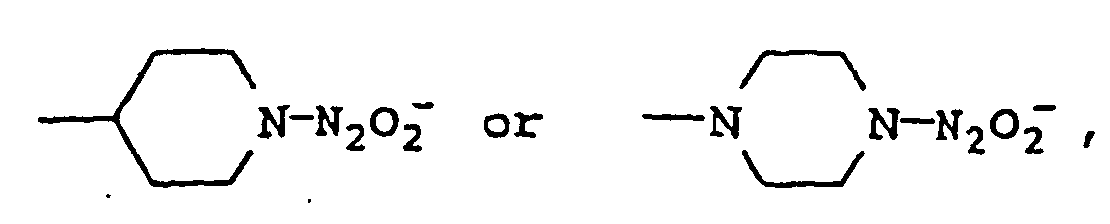

- The polymeric composition of claim 1, wherein said nitric oxide-releasing N2O2 - functional group is of the formula:

- The polymeric composition of claim 1, wherein said nitric oxide-releasing N2O2 - functional group is of the formula:

- The polymeric composition of claim 1, wherein said nitric oxide-releasing N2O2 - functional group is of the formula:
K(M)x' x(L)y(R1R2N-N2O2)z] (VI)
wherein M is a pharmaceutically acceptable metal, or, where x is at least two, a mixture of two different pharmaceutically acceptable metals, L is a ligand different from (R1R2N-N2O2) and is bound to at least one metal, R1 and R2 are each organic moieties and may be the same or different, x is an integer of from 1 to 10, x' is the formal oxidation state of the metal M, and is an integer of from 1 to 6, y is an integer of from 1 to 18, and where y is at least 2, the ligands L may be the same or different, z is an integer of from 1 to 20, and K is a pharmaceutically acceptable counterion to render the compound neutral to the extent necessary. - The polymeric composition of claim 1, wherein said nitric oxide-releasing N2O2 - functional group is of the formula:
[R-N(H)N(NO)O-]yX (VII)
wherein R is C2-8 lower alkyl, phenyl, benzyl, or C3-8 cycoloalkyl, any of which R groups may be substituted by one to three substituents, which are the same or different, selected from the group consisting of halo, hydroxy, C1-8 alkoxy, -NH2, -C(O)NH2, -CH(O), -C(O)OH, and -NO2, X is a pharmaceutically acceptable cation, a pharmaceutically acceptable metal center, or a pharmaceutically acceptable organic group selected from the group consisting of C1-8 lower alkyl, -C(O)CH3, and -C(O)NH2, and y is one to three, consistent with the valence of X. - The polymeric composition of claim 1, wherein said nitric oxide-releasing N2O2 - functional group is of the formula:

- A polymeric composition according to claim 1 wherein said nitric oxide-releasing N2O2 - functional group is of the formula:

- A pharmaceutical composition comprising a pharmaceutically acceptable carrier and the polymeric composition of any of claims 1 to 13.
- The use of a polymeric composition according to any of claims 1 to 13 in the manufacture of a medicament.
- The use according to claim 15 wherein said medicament is for use in a mammal in one of the following applications:a) reducing the risk of restenosis after angioplasty;b) treatment of pulmonary disorders;c) treatment of impotence in men;d) reducing the risk of metastasis in cancer patients;e) reducing the risk of solid stake carcinogenesis associated with protheses and medical implants;f) influancing gastric motility, neurotransmission, and nociception.
Priority Applications (1)
| Application Number | Priority Date | Filing Date | Title |
|---|---|---|---|
| EP06002227A EP1666047A1 (en) | 1994-11-22 | 1995-11-20 | Pharmaceutical compositions comprising nitric oxide-releasing pyrrolidones |
Applications Claiming Priority (3)
| Application Number | Priority Date | Filing Date | Title |
|---|---|---|---|
| US344157 | 1994-11-22 | ||
| US08/344,157 US5632981A (en) | 1992-08-24 | 1994-11-22 | Biopolymer-bound nitric oxide-releasing compositions, pharmaceutical compositions incorporating same and methods of treating biological disorders using same |
| PCT/US1995/015180 WO1996015797A1 (en) | 1994-11-22 | 1995-11-20 | Pharmaceutical compositions comprising nitric oxide-releasing biopolymers |
Related Child Applications (1)
| Application Number | Title | Priority Date | Filing Date |
|---|---|---|---|
| EP06002227A Division EP1666047A1 (en) | 1994-11-22 | 1995-11-20 | Pharmaceutical compositions comprising nitric oxide-releasing pyrrolidones |
Publications (2)
| Publication Number | Publication Date |
|---|---|
| EP0793500A1 EP0793500A1 (en) | 1997-09-10 |
| EP0793500B1 true EP0793500B1 (en) | 2006-05-03 |
Family
ID=23349296
Family Applications (2)
| Application Number | Title | Priority Date | Filing Date |
|---|---|---|---|
| EP06002227A Withdrawn EP1666047A1 (en) | 1994-11-22 | 1995-11-20 | Pharmaceutical compositions comprising nitric oxide-releasing pyrrolidones |
| EP95941444A Expired - Lifetime EP0793500B1 (en) | 1994-11-22 | 1995-11-20 | Pharmaceutical compositions comprising nitric oxide-releasing polysaccharides |
Family Applications Before (1)
| Application Number | Title | Priority Date | Filing Date |
|---|---|---|---|
| EP06002227A Withdrawn EP1666047A1 (en) | 1994-11-22 | 1995-11-20 | Pharmaceutical compositions comprising nitric oxide-releasing pyrrolidones |
Country Status (7)
| Country | Link |
|---|---|
| US (1) | US5632981A (en) |
| EP (2) | EP1666047A1 (en) |
| JP (3) | JP3731899B2 (en) |
| AT (1) | ATE324911T1 (en) |
| AU (1) | AU4286496A (en) |
| DE (1) | DE69534974T2 (en) |
| WO (1) | WO1996015797A1 (en) |
Families Citing this family (116)
| Publication number | Priority date | Publication date | Assignee | Title |
|---|---|---|---|---|
| US6515009B1 (en) | 1991-09-27 | 2003-02-04 | Neorx Corporation | Therapeutic inhibitor of vascular smooth muscle cells |
| US5811447A (en) * | 1993-01-28 | 1998-09-22 | Neorx Corporation | Therapeutic inhibitor of vascular smooth muscle cells |
| US6200558B1 (en) * | 1993-09-14 | 2001-03-13 | The United States Of America As Represented By The Department Of Health And Human Services | Biopolymer-bound nitric oxide-releasing compositions, pharmaceutical compositions incorporating same and methods of treating biological disorders using same |
| US6855691B1 (en) | 1995-09-15 | 2005-02-15 | Duke University | Methods for producing and using S-nitrosohemoglobins |
| US6153186A (en) * | 1995-09-15 | 2000-11-28 | Duke University Medical Center | Red blood cells loaded with S-nitrosothiol and uses therefor |
| US6197745B1 (en) | 1995-09-15 | 2001-03-06 | Duke University | Methods for producing nitrosated hemoglobins and therapeutic uses therefor |
| US6627738B2 (en) | 1995-09-15 | 2003-09-30 | Duke University | No-modified hemoglobins and uses therefor |
| US6916471B2 (en) | 1995-09-15 | 2005-07-12 | Duke University | Red blood cells loaded with S-nitrosothiol and uses therefor |
| US6911427B1 (en) | 1995-09-15 | 2005-06-28 | Duke University | No-modified hemoglobins and uses therefore |
| US5770645A (en) * | 1996-08-02 | 1998-06-23 | Duke University Medical Center | Polymers for delivering nitric oxide in vivo |
| US6232434B1 (en) | 1996-08-02 | 2001-05-15 | Duke University Medical Center | Polymers for delivering nitric oxide in vivo |
| CA2266908C (en) | 1996-09-27 | 2010-07-20 | Joseph E. Saavedra | O2-arylated or o2-glycosylated 1-substituted diazen-1-ium-1,2-diolates and o2-substituted 1-[(2-carboxylato)pyrrolidin-1-yl]diazen-1-ium-1,2-diolates |
| FR2764802A1 (en) * | 1996-12-24 | 1998-12-24 | Standa Lab Sa | ADSORBABLE COMPOSITION CONTAINING PROPIONIC BACTERIA LIKELY TO RELEASE NITROGEN MONOXIDE IN THE HUMAN OR ANIMAL DIGESTIVE TUBE |
| US7914814B2 (en) * | 1997-09-17 | 2011-03-29 | Strategic Science & Technologies, Llc | Topical delivery of arginine of cause beneficial effects |
| US6207713B1 (en) * | 1997-09-17 | 2001-03-27 | Eric T. Fossel | Topical and oral delivery of arginine to cause beneficial effects |
| US7629384B2 (en) * | 1997-09-17 | 2009-12-08 | Strategic Science & Technologies, Llc | Topical delivery of L-arginine to cause beneficial effects |
| GB9720797D0 (en) * | 1997-09-30 | 1997-12-03 | Rhodes John | Pharmaceutical composition for the treatment of inflammatory bowel disease and irritable bowel syndrome |
| US5994444A (en) * | 1997-10-16 | 1999-11-30 | Medtronic, Inc. | Polymeric material that releases nitric oxide |
| US5962520A (en) * | 1998-04-02 | 1999-10-05 | The University Of Akron | Hydrolytically unstable, biocompatible polymer |
| US20040043068A1 (en) * | 1998-09-29 | 2004-03-04 | Eugene Tedeschi | Uses for medical devices having a lubricious, nitric oxide-releasing coating |
| CA2254645A1 (en) * | 1998-11-23 | 2000-05-23 | Pulmonox Medical Corporation | Method and apparatus for treatment of respiratory infections by nitric oxide inhalation |
| US20070086954A1 (en) * | 1998-11-23 | 2007-04-19 | Miller Christopher C | Method and apparatus for treatment of respiratory infections by nitric oxide inhalation |
| US7052711B2 (en) * | 1999-09-02 | 2006-05-30 | Rice University | Nitric oxide-producing hydrogel materials |
| US7279176B1 (en) * | 1999-09-02 | 2007-10-09 | Rice University | Nitric oxide-producing hydrogel materials |
| US7516742B2 (en) * | 1999-11-24 | 2009-04-14 | Cardinal Health 207, Inc. | Method and apparatus for delivery of inhaled nitric oxide to spontaneous-breathing and mechanically-ventilated patients with intermittent dosing |
| US6491617B1 (en) * | 1999-12-30 | 2002-12-10 | St. Jude Medical, Inc. | Medical devices that resist restenosis |
| US6270779B1 (en) * | 2000-05-10 | 2001-08-07 | United States Of America | Nitric oxide-releasing metallic medical devices |
| US7820420B2 (en) * | 2000-08-11 | 2010-10-26 | Whitlock David R | Compositions including ammonia oxidizing bacteria to increase production of nitric oxide and nitric oxide precursors and methods of using same |
| JP4841066B2 (en) * | 2000-09-01 | 2011-12-21 | ライスユニバーシティ | Nitric oxide-forming hydrogel materials |
| SE0004026D0 (en) * | 2000-11-03 | 2000-11-03 | Peter Wiklund | New use |
| US7335181B2 (en) * | 2000-12-26 | 2008-02-26 | Pulmonox Technologies Corporation | Nitric oxide decontamination of the upper respiratory tract |
| US6432077B1 (en) * | 2000-12-26 | 2002-08-13 | Sensormedics Corporation | Device and method for treatment of surface infections with nitric oxide |
| US7122018B2 (en) * | 2000-12-26 | 2006-10-17 | Sensormedics Corporation | Device and method for treatment of wounds with nitric oxide |
| WO2003026717A1 (en) * | 2001-09-26 | 2003-04-03 | The Government Of The United States Of America, Represented By The Secretary, Department Of Health And Human Services | Nitric oxide-releasing coated medical devices and method of preparing same |
| US6703046B2 (en) | 2001-10-04 | 2004-03-09 | Medtronic Ave Inc. | Highly cross-linked, extremely hydrophobic nitric oxide-releasing polymers and methods for their manufacture and use |
| EP1472021A4 (en) * | 2002-01-11 | 2008-04-16 | David R Whitlock | AMMONIAX OXIDIZING BACTERIA CONTAINING COMPOSITIONS AND USER METHOD THEREFOR |
| WO2003080039A1 (en) * | 2002-03-21 | 2003-10-02 | The University Of Utah Research Foundation | In vivo use of glutathionone s-transferase activated nitric oxide donors |
| WO2004012874A1 (en) | 2002-08-02 | 2004-02-12 | The Government Of The United States Of America, Represented By The Secretary, Dept. Of Health And Human Services | Cross-linked nitric oxide-releasing polyamine coated substrates, compositions comprising same and method of making same |
| US7531133B2 (en) * | 2002-09-10 | 2009-05-12 | Pulmonox Technologies Corporation | Use of nitric oxide gas in an extracorporeal circuitry to treat blood plasma |
| US20090136410A1 (en) * | 2003-07-25 | 2009-05-28 | Smith Daniel J | Stabilization and ionic triggering of nitric oxide release |
| US20090281067A1 (en) * | 2004-01-30 | 2009-11-12 | The John Hopkins University | Nitroxyl progenitor compounds and methods of use |
| WO2005081752A2 (en) * | 2004-02-09 | 2005-09-09 | Amulet Pharmaceuticals, Inc. | Nitric oxide-releasing polymers |
| US7569559B2 (en) * | 2004-02-09 | 2009-08-04 | Noxilizer, Inc. | Nitric oxide-releasing molecules |
| CA2556967A1 (en) * | 2004-02-23 | 2005-09-09 | Strategic Science & Technologies, Llc | Topical delivery of a nitric oxide donor to improve body and skin appearance |
| US9226909B2 (en) | 2004-04-19 | 2016-01-05 | Strategic Science & Technologies, Llc | Beneficial effects of increasing local blood flow |
| US20110028548A1 (en) * | 2004-04-19 | 2011-02-03 | Strategic Science & Technologies, Llc | Beneficial effects of increasing local blood flow |
| JP2007532697A (en) | 2004-04-19 | 2007-11-15 | ストラテジック サイエンス アンド テクノロジーズ, エルエルシー | The beneficial effects of increased local blood flow |
| US20090105336A1 (en) * | 2004-04-19 | 2009-04-23 | Strategic Science & Technologies, Llc | Beneficial Effects of Increasing Local Blood Flow |
| CN1950120B (en) * | 2004-05-11 | 2010-10-20 | 伟亚医疗森迪斯公司 | intermittent metering of nitric oxide gas |
| US8518457B2 (en) * | 2004-05-11 | 2013-08-27 | Pulmonox Technologies Corporation | Use of inhaled gaseous nitric oxide as a mucolytic agent or expectorant |
| US20060039950A1 (en) * | 2004-08-23 | 2006-02-23 | Zhengrong Zhou | Multi-functional biocompatible coatings for intravascular devices |
| AU2005289414B2 (en) | 2004-09-27 | 2010-12-09 | Government Of The United States Of America, Represented By The Secretary Department Of Health And Human Services | Nitric oxide-releasing diazeniumdiolated acrylonitrile-based polymers, and compositions, medical devices, and uses thereof |
| US20070154570A1 (en) * | 2004-09-29 | 2007-07-05 | Miller Christopher C | Use of nitric oxide in the treatment and disinfection of biofilms |
| WO2006084914A2 (en) * | 2005-02-11 | 2006-08-17 | Nolabs Ab | Device for gastric treatment and manufacturing process for the same |
| EP1846058B1 (en) * | 2005-02-11 | 2009-07-15 | NOLabs AB | Device method, and use for treatment of neuropathy involving nitric oxide |
| DK1871433T3 (en) | 2005-03-24 | 2009-08-10 | Nolabs Ab | Cosmetic treatment with nitric oxide, device for performing this treatment and manufacturing process therefor |
| AU2006249323B2 (en) | 2005-05-27 | 2012-08-30 | The University Of North Carolina At Chapel Hill | Nitric oxide-releasing particles for nitric oxide therapeutics and biomedical applications |
| WO2007005910A2 (en) * | 2005-06-30 | 2007-01-11 | Mc3, Inc. | Nitric oxide coatings for medical devices |
| WO2007005759A2 (en) * | 2005-06-30 | 2007-01-11 | Mc3, Inc. | Analyte sensors and compositions for use therein |
| WO2007005758A2 (en) * | 2005-06-30 | 2007-01-11 | Mc3, Inc. | Methods , compositions and devices for promoting angiogenesis |
| US8021679B2 (en) | 2005-08-25 | 2011-09-20 | Medtronic Vascular, Inc | Nitric oxide-releasing biodegradable polymers useful as medical devices and coatings therefore |
| AU2006309212B2 (en) * | 2005-10-31 | 2011-09-15 | Government Of The United States Of America, Represented By The Secretary Department Of Health And Human Services | Polysaccharide-derived nitric oxide-releasing carbon-bound diazeniumdiolates |
| WO2007057763A2 (en) * | 2005-11-18 | 2007-05-24 | Pulmonox Technologies Corporation | Nitric oxide as an anti-viral agent, vaccine and vaccine adjuvant |
| CA2632224A1 (en) * | 2005-12-02 | 2007-06-07 | The Regents Of The University Of Michigan | Polymer compositions, coatings and devices, and methods of making and using the same |
| EP1968615A4 (en) * | 2005-12-06 | 2010-08-04 | Amulet Pharmaceuticals Inc | Nitric oxide-releasing polymers |
| US8241619B2 (en) | 2006-05-15 | 2012-08-14 | Medtronic Vascular, Inc. | Hindered amine nitric oxide donating polymers for coating medical devices |
| US8079998B2 (en) * | 2006-10-20 | 2011-12-20 | Pulmonox Technologies Corporation | Methods and devices for the delivery of therapeutic gases including nitric oxide |
| US20080193566A1 (en) * | 2007-02-09 | 2008-08-14 | Miller Christopher C | Use of high dose concentrations of gaseous nitric oxide |
| US7811600B2 (en) | 2007-03-08 | 2010-10-12 | Medtronic Vascular, Inc. | Nitric oxide donating medical devices and methods of making same |
| US8273828B2 (en) | 2007-07-24 | 2012-09-25 | Medtronic Vascular, Inc. | Methods for introducing reactive secondary amines pendant to polymers backbones that are useful for diazeniumdiolation |
| EP2262478B1 (en) * | 2008-03-07 | 2014-11-05 | University of Utah Research Foundation | Activated nitric oxide donors and methods of making and using thereof |
| US8158187B2 (en) | 2008-12-19 | 2012-04-17 | Medtronic Vascular, Inc. | Dry diazeniumdiolation methods for producing nitric oxide releasing medical devices |
| JP5694964B2 (en) | 2009-02-23 | 2015-04-01 | ノクシライザー, インコーポレイテッドNoxilizer, Incorporated | Gas sterilization apparatus and gas sterilization method |
| US8709465B2 (en) | 2009-04-13 | 2014-04-29 | Medtronic Vascular, Inc. | Diazeniumdiolated phosphorylcholine polymers for nitric oxide release |
| US8613958B2 (en) | 2009-06-22 | 2013-12-24 | Geno Llc | Nitric oxide therapies |
| RU2505291C2 (en) | 2009-06-24 | 2014-01-27 | СТРАТЕДЖИК САЙЕНС ЭНД ТЕКНОЛОДЖИЗ, ЭлЭлСи | Topical composition containing ibuprofen |
| WO2010151241A1 (en) | 2009-06-24 | 2010-12-29 | Strategic Science & Technologies, Llc | Topical composition containing naproxen |
| US12138268B2 (en) | 2009-06-24 | 2024-11-12 | Strategic Science & Technologies, Llc | Treatment of erectile dysfunction and other indications |
| US11684624B2 (en) | 2009-06-24 | 2023-06-27 | Strategic Science & Technologies, Llc | Treatment of erectile dysfunction and other indications |
| US9919072B2 (en) | 2009-08-21 | 2018-03-20 | Novan, Inc. | Wound dressings, methods of using the same and methods of forming the same |
| CA3062005C (en) | 2009-08-21 | 2022-02-15 | Novan, Inc. | Topical gels comprising nitric oxide-releasing polysiloxane macromolecules and uses thereof |
| US20130178475A1 (en) | 2010-03-17 | 2013-07-11 | Ironwood Pharmaceuticals, Inc. | sGC STIMULATORS |
| WO2012003405A1 (en) | 2010-06-30 | 2012-01-05 | Ironwood Pharmaceuticals, Inc. | Sgc stimulators |
| NZ609955A (en) | 2010-11-09 | 2015-05-29 | Ironwood Pharmaceuticals Inc | Sgc stimulators |
| US8591876B2 (en) | 2010-12-15 | 2013-11-26 | Novan, Inc. | Methods of decreasing sebum production in the skin |
| ES2811515T3 (en) | 2010-12-29 | 2021-03-12 | Strategic Science & Tech Llc | Erectile dysfunction treatment and other indications |
| JP2014501283A (en) | 2010-12-29 | 2014-01-20 | ストラテジック サイエンス アンド テクノロジーズ, エルエルシー | Systems and methods for the treatment of allergies and other indications |
| WO2012118829A2 (en) | 2011-02-28 | 2012-09-07 | Novan, Inc. | Tertiary s-nitrosothiol-modified nitricoxide-releasing xerogels and methods of using the same |
| EP2729131B1 (en) | 2011-07-05 | 2020-04-15 | Novan, Inc. | Topical compositions |
| CN104066731B (en) | 2011-12-27 | 2016-06-15 | 铁木医药有限公司 | 2-Benzyl, 3-(pyrimidin-2-yl)-substituted pyrazoles useful as SGC stimulators |
| EP3421042B1 (en) | 2012-03-07 | 2024-04-17 | Beyond Air Ltd | Inhalation of nitric oxide for treating respiratory diseases |
| CA2879843C (en) | 2012-07-17 | 2021-05-04 | The United States Of America, As Represented By The Secretary, Department Of Health And Human Services | Nitric oxide-releasing diazeniumdiolated polyvinylpyrrolidone-based polymers, and compositions, medical devices, and uses thereof |
| US9309235B2 (en) | 2012-09-18 | 2016-04-12 | Ironwood Pharmaceuticals, Inc. | SGC stimulators |
| US9487508B2 (en) | 2012-09-19 | 2016-11-08 | Ironwood Pharmaceuticals, Inc. | SGC stimulators |
| US9855211B2 (en) | 2013-02-28 | 2018-01-02 | Novan, Inc. | Topical compositions and methods of using the same |
| SI2970243T1 (en) | 2013-03-15 | 2020-04-30 | Cyclerion Therapeutics, Inc. | Sgc stimulators |
| EP3030266B1 (en) | 2013-08-08 | 2020-10-28 | Novan Inc. | Topical compositions and methods of using the same |
| EP3092231B1 (en) | 2013-12-11 | 2018-06-27 | Ironwood Pharmaceuticals, Inc. | Sgc stimulators |
| EP3094327A1 (en) | 2014-01-13 | 2016-11-23 | Ironwood Pharmaceuticals, Inc. | USE OF sGC STIMULATORS FOR THE TREATMENT OF NEUROMUSCULAR DISORDERS |
| US11225640B2 (en) | 2014-04-15 | 2022-01-18 | Aobiome Llc | Ammonia oxidizing bacteria for treatment of psoriasis |
| JP2017519486A (en) | 2014-04-15 | 2017-07-20 | エーオーバイオーム, エルエルシー.AOBiome, LLC. | Ammonia oxidation Nitrosomonas eutropha strain D23 |
| EP3177262A4 (en) | 2014-08-08 | 2018-04-18 | Novan Inc. | Topical emulsions |
| CA2959757A1 (en) | 2014-09-17 | 2016-03-24 | Ironwood Pharmaceuticals, Inc. | Pyrazole derivatives as sgc stimulators |
| US20170298055A1 (en) | 2014-09-17 | 2017-10-19 | Ironwood Pharmaceuticals, Inc. | sGC STIMULATORS |
| CA2961489A1 (en) | 2014-09-17 | 2016-03-24 | Glen Robert RENNIE | Sgc stimulators |
| EP3423100A4 (en) | 2016-03-02 | 2019-10-16 | Novan, Inc. | COMPOSITIONS FOR TREATING INFLAMMATION AND ASSOCIATED METHODS OF TREATMENT |
| WO2017180822A1 (en) | 2016-04-13 | 2017-10-19 | Novan, Inc. | Compositions, systems, kits, and methods for treating an infection |
| KR102513343B1 (en) | 2016-07-07 | 2023-03-22 | 사이클리온 테라퓨틱스, 인크. | Phosphorus prodrugs of sGC stimulators |
| BR112019000293A2 (en) | 2016-07-07 | 2019-04-16 | Ironwood Pharmaceuticals, Inc. | solid forms of an sgc stimulator |
| US11186681B2 (en) | 2016-10-07 | 2021-11-30 | The University Of North Carolina At Chapel Hill | S-Nitrosothiol-mediated hyperbranched polyesters |
| AU2018205823A1 (en) | 2017-01-03 | 2019-07-18 | The University Of North Carolina At Chapel Hill | Nitric oxide-releasing alginates as biodegradable antibacterial scaffolds and methods pertaining thereto |
| CN110461338A (en) | 2017-03-28 | 2019-11-15 | 北卡罗来纳大学查佩尔希尔分校 | Nitric oxide-releasing polyaminoglycosides as biodegradable antibacterial scaffolds and methods for their preparation |
| JP2021503029A (en) | 2017-11-15 | 2021-02-04 | ザ ユニバーシティ オブ ノース カロライナ アット チャペル ヒルThe University Of North Carolina At Chapel Hill | Nitric oxide-releasing superbranched compounds as antibacterial scaffolds and related methods |
| WO2019173539A1 (en) | 2018-03-06 | 2019-09-12 | The University Of North Carolina At Chapel Hill | Nitric oxide-releasing cyclodextrins as biodegradable antibacterial scaffolds and methods pertaining thereto |
| KR102112783B1 (en) * | 2018-11-08 | 2020-05-19 | 연세대학교 산학협력단 | A crystal releasing nitric oxide and a method for manufacturing the same |
| WO2020139857A1 (en) | 2018-12-28 | 2020-07-02 | The University Of North Carolina At Chapel Hill | Nitric oxide-releasing antibacterial polymers and scaffolds fabricated therefrom and methods pertaining thereto |
Citations (1)
| Publication number | Priority date | Publication date | Assignee | Title |
|---|---|---|---|---|
| WO1996013164A1 (en) * | 1994-10-28 | 1996-05-09 | University Of Akron, The | Polymeric wound healing accelerators |
Family Cites Families (6)
| Publication number | Priority date | Publication date | Assignee | Title |
|---|---|---|---|---|
| US4954526A (en) | 1989-02-28 | 1990-09-04 | The United States Of America As Represented By The Department Of Health And Human Services | Stabilized nitric oxide - primary amine complexes useful as cardiovascular agents |
| US5208233A (en) * | 1989-09-15 | 1993-05-04 | The United States Of America As Represented By The Department Of Health And Human Services | Anti-hypertensive compositions of secondary amine-nitric oxide adducts and use thereof |
| US5212204A (en) * | 1989-10-18 | 1993-05-18 | The United States Of America As Represented By The Department Of Health And Human Services | Antihypertensive compositions and use thereof |
| US5155137A (en) * | 1990-09-20 | 1992-10-13 | The United States Of America As Represented By The Secretary Of The Department Of Health And Human Services | Complexes of nitric oxide with polyamines |
| US5650447A (en) * | 1992-08-24 | 1997-07-22 | The United States Of America As Represented By The Secretary Of The Department Of Health And Human Services | Nitric oxide-releasing polymers to treat restenosis and related disorders |
| US5405919A (en) * | 1992-08-24 | 1995-04-11 | The United States Of America As Represented By The Secretary Of Health And Human Services | Polymer-bound nitric oxide/nucleophile adduct compositions, pharmaceutical compositions and methods of treating biological disorders |
-
1994
- 1994-11-22 US US08/344,157 patent/US5632981A/en not_active Expired - Lifetime
-
1995
- 1995-11-20 AT AT95941444T patent/ATE324911T1/en not_active IP Right Cessation
- 1995-11-20 JP JP51704896A patent/JP3731899B2/en not_active Expired - Fee Related
- 1995-11-20 DE DE69534974T patent/DE69534974T2/en not_active Expired - Fee Related
- 1995-11-20 WO PCT/US1995/015180 patent/WO1996015797A1/en not_active Ceased
- 1995-11-20 AU AU42864/96A patent/AU4286496A/en not_active Abandoned
- 1995-11-20 EP EP06002227A patent/EP1666047A1/en not_active Withdrawn
- 1995-11-20 EP EP95941444A patent/EP0793500B1/en not_active Expired - Lifetime
-
2001
- 2001-03-16 JP JP2001076404A patent/JP2001247465A/en not_active Ceased
-
2005
- 2005-08-17 JP JP2005236706A patent/JP4327135B2/en not_active Expired - Fee Related
Patent Citations (1)
| Publication number | Priority date | Publication date | Assignee | Title |
|---|---|---|---|---|
| WO1996013164A1 (en) * | 1994-10-28 | 1996-05-09 | University Of Akron, The | Polymeric wound healing accelerators |
Also Published As
| Publication number | Publication date |
|---|---|
| JP2005325144A (en) | 2005-11-24 |
| JP4327135B2 (en) | 2009-09-09 |
| EP1666047A1 (en) | 2006-06-07 |
| JPH10510249A (en) | 1998-10-06 |
| JP3731899B2 (en) | 2006-01-05 |
| ATE324911T1 (en) | 2006-06-15 |
| AU4286496A (en) | 1996-06-17 |
| DE69534974T2 (en) | 2007-01-04 |
| JP2001247465A (en) | 2001-09-11 |
| WO1996015797A1 (en) | 1996-05-30 |
| EP0793500A1 (en) | 1997-09-10 |
| US5632981A (en) | 1997-05-27 |
| DE69534974D1 (en) | 2006-06-08 |
Similar Documents
| Publication | Publication Date | Title |
|---|---|---|
| US6379660B1 (en) | Nitric oxide-releasing 1-[(2-carboxylato)pyrrolidin-1-yl] diazen-1-ium-1,2-diolates and composition comprising same | |
| US5632981A (en) | Biopolymer-bound nitric oxide-releasing compositions, pharmaceutical compositions incorporating same and methods of treating biological disorders using same | |
| US5525357A (en) | Polymer-bound nitric oxide/nucleophile adduct compositions, pharmaceutical compositions incorporating same and methods of treating biological disorders using same | |
| US5676963A (en) | Implants, prostheses, and stents comprising polymer-bound nitric oxide/nucleophile adducts capable of releasing nitric oxide | |
| CA2216696C (en) | Polysaccharide-bound nitric oxide-nucleophile adducts | |
| CA2205555C (en) | Use of nitric oxide-releasing agents for reducing metastasis risk | |
| US6290981B1 (en) | Use of nitric oxide-releasing agents to treat impotency | |
| AU698525B2 (en) | Use of nitric oxide-releasing polymers to treat restenosis and related disorders | |
| CA2106105C (en) | Polymer-bound nitric oxide/nucleophile adduct compositions, pharmaceutical compositions incorporating same and methods of treating biological disorders using same | |
| CA2205564C (en) | Pharmaceutical compositions comprising nitric oxide-releasing biopolymers | |
| AU695579C (en) | Polysaccharide-bound nitric oxide-nucleophile adducts |
Legal Events
| Date | Code | Title | Description |
|---|---|---|---|
| PUAI | Public reference made under article 153(3) epc to a published international application that has entered the european phase |
Free format text: ORIGINAL CODE: 0009012 |
|
| 17P | Request for examination filed |
Effective date: 19970623 |
|
| AK | Designated contracting states |
Kind code of ref document: A1 Designated state(s): AT BE CH DE DK ES FR GB GR IE IT LI LU MC NL PT SE |
|
| 17Q | First examination report despatched |
Effective date: 20020213 |
|
| GRAP | Despatch of communication of intention to grant a patent |
Free format text: ORIGINAL CODE: EPIDOSNIGR1 |
|
| RIC1 | Information provided on ipc code assigned before grant |
Ipc: 7A 61K 47/36 A |
|
| RTI1 | Title (correction) |
Free format text: PHARMACEUTICAL COMPOSITIONS COMPRISING NITRIC OXIDE-RELEASING POLYSACCHARIDES |
|
| GRAS | Grant fee paid |
Free format text: ORIGINAL CODE: EPIDOSNIGR3 |
|
| GRAA | (expected) grant |
Free format text: ORIGINAL CODE: 0009210 |
|
| AK | Designated contracting states |
Kind code of ref document: B1 Designated state(s): AT BE CH DE DK ES FR GB GR IE IT LI LU MC NL PT SE |
|
| PG25 | Lapsed in a contracting state [announced via postgrant information from national office to epo] |
Ref country code: NL Free format text: LAPSE BECAUSE OF FAILURE TO SUBMIT A TRANSLATION OF THE DESCRIPTION OR TO PAY THE FEE WITHIN THE PRESCRIBED TIME-LIMIT Effective date: 20060503 Ref country code: IT Free format text: LAPSE BECAUSE OF FAILURE TO SUBMIT A TRANSLATION OF THE DESCRIPTION OR TO PAY THE FEE WITHIN THE PRESCRIBED TIME-LIMIT;WARNING: LAPSES OF ITALIAN PATENTS WITH EFFECTIVE DATE BEFORE 2007 MAY HAVE OCCURRED AT ANY TIME BEFORE 2007. THE CORRECT EFFECTIVE DATE MAY BE DIFFERENT FROM THE ONE RECORDED. Effective date: 20060503 Ref country code: AT Free format text: LAPSE BECAUSE OF FAILURE TO SUBMIT A TRANSLATION OF THE DESCRIPTION OR TO PAY THE FEE WITHIN THE PRESCRIBED TIME-LIMIT Effective date: 20060503 |
|
| REG | Reference to a national code |
Ref country code: GB Ref legal event code: FG4D |
|
| REG | Reference to a national code |
Ref country code: CH Ref legal event code: EP |
|
| REF | Corresponds to: |
Ref document number: 69534974 Country of ref document: DE Date of ref document: 20060608 Kind code of ref document: P |
|
| REG | Reference to a national code |
Ref country code: IE Ref legal event code: FG4D |
|
| PG25 | Lapsed in a contracting state [announced via postgrant information from national office to epo] |
Ref country code: SE Free format text: LAPSE BECAUSE OF FAILURE TO SUBMIT A TRANSLATION OF THE DESCRIPTION OR TO PAY THE FEE WITHIN THE PRESCRIBED TIME-LIMIT Effective date: 20060803 Ref country code: DK Free format text: LAPSE BECAUSE OF FAILURE TO SUBMIT A TRANSLATION OF THE DESCRIPTION OR TO PAY THE FEE WITHIN THE PRESCRIBED TIME-LIMIT Effective date: 20060803 |
|
| PG25 | Lapsed in a contracting state [announced via postgrant information from national office to epo] |
Ref country code: ES Free format text: LAPSE BECAUSE OF FAILURE TO SUBMIT A TRANSLATION OF THE DESCRIPTION OR TO PAY THE FEE WITHIN THE PRESCRIBED TIME-LIMIT Effective date: 20060814 |
|
| PG25 | Lapsed in a contracting state [announced via postgrant information from national office to epo] |
Ref country code: PT Free format text: LAPSE BECAUSE OF FAILURE TO SUBMIT A TRANSLATION OF THE DESCRIPTION OR TO PAY THE FEE WITHIN THE PRESCRIBED TIME-LIMIT Effective date: 20061003 |
|
| NLV1 | Nl: lapsed or annulled due to failure to fulfill the requirements of art. 29p and 29m of the patents act | ||
| PG25 | Lapsed in a contracting state [announced via postgrant information from national office to epo] |
Ref country code: MC Free format text: LAPSE BECAUSE OF NON-PAYMENT OF DUE FEES Effective date: 20061130 |
|
| ET | Fr: translation filed | ||
| PLBE | No opposition filed within time limit |
Free format text: ORIGINAL CODE: 0009261 |
|
| STAA | Information on the status of an ep patent application or granted ep patent |
Free format text: STATUS: NO OPPOSITION FILED WITHIN TIME LIMIT |
|
| 26N | No opposition filed |
Effective date: 20070206 |
|
| PG25 | Lapsed in a contracting state [announced via postgrant information from national office to epo] |
Ref country code: GR Free format text: LAPSE BECAUSE OF FAILURE TO SUBMIT A TRANSLATION OF THE DESCRIPTION OR TO PAY THE FEE WITHIN THE PRESCRIBED TIME-LIMIT Effective date: 20060804 |
|
| PG25 | Lapsed in a contracting state [announced via postgrant information from national office to epo] |
Ref country code: LU Free format text: LAPSE BECAUSE OF NON-PAYMENT OF DUE FEES Effective date: 20061120 |
|
| PGFP | Annual fee paid to national office [announced via postgrant information from national office to epo] |
Ref country code: IE Payment date: 20081125 Year of fee payment: 14 Ref country code: CH Payment date: 20081125 Year of fee payment: 14 |
|
| PGFP | Annual fee paid to national office [announced via postgrant information from national office to epo] |
Ref country code: IT Payment date: 20081126 Year of fee payment: 14 |
|
| PGFP | Annual fee paid to national office [announced via postgrant information from national office to epo] |
Ref country code: FR Payment date: 20081117 Year of fee payment: 14 |
|
| PGFP | Annual fee paid to national office [announced via postgrant information from national office to epo] |
Ref country code: DE Payment date: 20081223 Year of fee payment: 14 |
|
| PGFP | Annual fee paid to national office [announced via postgrant information from national office to epo] |
Ref country code: GB Payment date: 20081128 Year of fee payment: 14 |
|
| PGFP | Annual fee paid to national office [announced via postgrant information from national office to epo] |
Ref country code: BE Payment date: 20090128 Year of fee payment: 14 |
|
| BERE | Be: lapsed |
Owner name: THE *GOVERNMENT OF THE UNITED STATES OF AMERICA AS Effective date: 20091130 |
|
| REG | Reference to a national code |
Ref country code: CH Ref legal event code: PL |
|
| GBPC | Gb: european patent ceased through non-payment of renewal fee |
Effective date: 20091120 |
|
| REG | Reference to a national code |
Ref country code: FR Ref legal event code: ST Effective date: 20100730 |
|
| PG25 | Lapsed in a contracting state [announced via postgrant information from national office to epo] |
Ref country code: LI Free format text: LAPSE BECAUSE OF NON-PAYMENT OF DUE FEES Effective date: 20091130 Ref country code: IE Free format text: LAPSE BECAUSE OF NON-PAYMENT OF DUE FEES Effective date: 20091120 Ref country code: FR Free format text: LAPSE BECAUSE OF NON-PAYMENT OF DUE FEES Effective date: 20091130 Ref country code: CH Free format text: LAPSE BECAUSE OF NON-PAYMENT OF DUE FEES Effective date: 20091130 Ref country code: BE Free format text: LAPSE BECAUSE OF NON-PAYMENT OF DUE FEES Effective date: 20091130 |
|
| PG25 | Lapsed in a contracting state [announced via postgrant information from national office to epo] |
Ref country code: DE Free format text: LAPSE BECAUSE OF NON-PAYMENT OF DUE FEES Effective date: 20100601 |
|
| PG25 | Lapsed in a contracting state [announced via postgrant information from national office to epo] |
Ref country code: GB Free format text: LAPSE BECAUSE OF NON-PAYMENT OF DUE FEES Effective date: 20091120 |
|
| PG25 | Lapsed in a contracting state [announced via postgrant information from national office to epo] |
Ref country code: IT Free format text: LAPSE BECAUSE OF NON-PAYMENT OF DUE FEES Effective date: 20091120 |