EP0793136A1 - Optical apparatus such as a camera - Google Patents
Optical apparatus such as a camera Download PDFInfo
- Publication number
- EP0793136A1 EP0793136A1 EP97300556A EP97300556A EP0793136A1 EP 0793136 A1 EP0793136 A1 EP 0793136A1 EP 97300556 A EP97300556 A EP 97300556A EP 97300556 A EP97300556 A EP 97300556A EP 0793136 A1 EP0793136 A1 EP 0793136A1
- Authority
- EP
- European Patent Office
- Prior art keywords
- light
- eye
- reflecting
- optical apparatus
- optical
- Prior art date
- Legal status (The legal status is an assumption and is not a legal conclusion. Google has not performed a legal analysis and makes no representation as to the accuracy of the status listed.)
- Granted
Links
- 230000003287 optical effect Effects 0.000 title claims abstract description 104
- 238000003384 imaging method Methods 0.000 claims abstract description 21
- 230000000007 visual effect Effects 0.000 claims description 35
- 239000007787 solid Substances 0.000 claims description 17
- 238000001514 detection method Methods 0.000 claims description 11
- 238000005452 bending Methods 0.000 claims description 10
- 210000001508 eye Anatomy 0.000 description 21
- 210000005252 bulbus oculi Anatomy 0.000 description 19
- 238000010276 construction Methods 0.000 description 6
- 239000011248 coating agent Substances 0.000 description 4
- 238000000576 coating method Methods 0.000 description 4
- 239000011521 glass Substances 0.000 description 4
- 238000000034 method Methods 0.000 description 4
- 230000000694 effects Effects 0.000 description 3
- 230000008020 evaporation Effects 0.000 description 3
- 238000001704 evaporation Methods 0.000 description 3
- 230000011514 reflex Effects 0.000 description 3
- 230000004075 alteration Effects 0.000 description 2
- 230000008859 change Effects 0.000 description 2
- 210000004087 cornea Anatomy 0.000 description 2
- 238000006073 displacement reaction Methods 0.000 description 2
- 206010010071 Coma Diseases 0.000 description 1
- 230000009471 action Effects 0.000 description 1
- 230000008901 benefit Effects 0.000 description 1
- 230000008021 deposition Effects 0.000 description 1
- 239000000428 dust Substances 0.000 description 1
- 238000004519 manufacturing process Methods 0.000 description 1
- 210000001747 pupil Anatomy 0.000 description 1
- 230000009467 reduction Effects 0.000 description 1
- 229910052709 silver Inorganic materials 0.000 description 1
- 239000004332 silver Substances 0.000 description 1
Images



Classifications
-
- G—PHYSICS
- G03—PHOTOGRAPHY; CINEMATOGRAPHY; ANALOGOUS TECHNIQUES USING WAVES OTHER THAN OPTICAL WAVES; ELECTROGRAPHY; HOLOGRAPHY
- G03B—APPARATUS OR ARRANGEMENTS FOR TAKING PHOTOGRAPHS OR FOR PROJECTING OR VIEWING THEM; APPARATUS OR ARRANGEMENTS EMPLOYING ANALOGOUS TECHNIQUES USING WAVES OTHER THAN OPTICAL WAVES; ACCESSORIES THEREFOR
- G03B19/00—Cameras
- G03B19/02—Still-picture cameras
- G03B19/12—Reflex cameras with single objective and a movable reflector or a partly-transmitting mirror
-
- G—PHYSICS
- G03—PHOTOGRAPHY; CINEMATOGRAPHY; ANALOGOUS TECHNIQUES USING WAVES OTHER THAN OPTICAL WAVES; ELECTROGRAPHY; HOLOGRAPHY
- G03B—APPARATUS OR ARRANGEMENTS FOR TAKING PHOTOGRAPHS OR FOR PROJECTING OR VIEWING THEM; APPARATUS OR ARRANGEMENTS EMPLOYING ANALOGOUS TECHNIQUES USING WAVES OTHER THAN OPTICAL WAVES; ACCESSORIES THEREFOR
- G03B2213/00—Viewfinders; Focusing aids for cameras; Means for focusing for cameras; Autofocus systems for cameras
- G03B2213/02—Viewfinders
- G03B2213/025—Sightline detection
Definitions
- This invention relates to an optical apparatus such as a photographic camera, a video camera or an SV camera, and particularly to an optical apparatus such as a photographic camera, a video camera or an SV camera having a function of forming an image of a photographer's eye looking into a finder through the finder, and extracting the information of the photographer's eye on the basis of the image of the eye.
- Japanese Laid-Open Patent Application No. 61-61135 proposes a camera designed such that the distance measuring direction of a focus detecting device is mechanically controlled on the basis of an output signal from the visual axis detecting device to thereby adjust a focus state of a phototaking optical system.
- Japanese Laid-Open Patent Application No. 3-171122 proposes a camera having a visual axis detecting device designed such that infrared light from light source means provided in a portion of a finder optical system of a single-lens reflex camera is directed onto an optical axis of the finder optical system by the use of a dichroic mirror to thereby project the infrared light onto an eyeball of a photographer observing the field of view of the finder, and the infrared light reflected by a cornea of the eyeball is directed to an outside of a solid pentagonal prism through an eyepiece and an inclined reflecting surface of the solid pentagonal prism and is directed to a light receiving element of the visual axis detecting device.
- a method of causing the reflected light from the photographer's eyeball to pass through the eyepiece, a light emergence surface of the solid pentagonal prism and an interior and the inclined reflecting surface thereof and emerge to the outside of the solid pentagonal prism, and thereafter directing it to the light receiving element and detecting it is characterized in that visual axis information can be obtained by a relatively simple construction.
- the method of directing the reflected light from the eyeball passed through the inclined reflecting surface (the final reflecting surface) of the solid pentagonal prism to a visual axis detecting system provided in the upper portion of the camera which is the opposite side to a photo-taking optical system mechanically interferes with a stroboscopic lamp contained in the portion above the solid pentagonal prism.
- each element for visual axis detection is disposed in a certain degree of spaced apart relationship with the solid pentagonal prism, there arises the first problem that the portion around the solid pentagonal prism becomes bulky and afterall, the entire camera becomes bulky.
- a first aspect of the present invention has been made chiefly in view of the above-noted second problem and is an optical apparatus such as one of various cameras having an eyepiece, a focusing screen onto which an image is projected, a reflecting device for reflecting the light from the focusing screen to thereby cause it to enter the eyepiece in order to show the image, illuminating means for illuminating an eye, an imaging optical system for receiving the light from the eye through the eyepiece and a certain portion of the reflecting device, and forming an image of the eye by the light from the eye, and photoelectric converting means for receiving the image of the eye, the reflecting device comprising a hollow optical part, the light from the eye being designed to pass through the hollow portion and the mirror portion of the hollow optical part, and according to an optical apparatus, the variation in the imaging magnification of the image of the eye by due to displacement of the eye with respect to the direction of the optical axis can be made small and the accuracy when the information regarding the eye such as the direction of the visual axis is detected on the basis of the output from the photo
- a second aspect of the present invention has been made chiefly in view of the above-noted first problem and is an optical apparatus such as one of various cameras having an eyepiece, a focusing screen onto which an image by a projection optical system is projected, a reflecting device for reflecting the light from the focusing screen to thereby cause it to enter the eyepiece in order to show the image, illuminating means for illuminating an eye, an imaging optical system for receiving the light from the eye through the eyepiece and a certain portion of the reflecting device, and forming an image of the eye by the light from the eye, and photoelectric converting means for receiving the image of the eye, the imaging optical system being provided with a bending mirror for reflecting the light from the eye and bending the optical path thereof toward the optical axis side of the projection optical system, and according to this optical apparatus, the imaging optical system can be disposed in a vacant space in the apparatus to thereby prevent or mitigate the balkiness of the optical apparatus.
- Fig. 1 is a cross-sectional view of the essential portions of Embodiment 1 of the present invention.
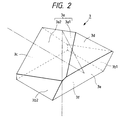
- Fig. 2 is an enlarged illustration of the pentagonal prism of Fig. 1.
- Fig. 3 is a cross-sectional view of the essential portions of Embodiment 2 of the present invention.
- Fig. 4 is an enlarged illustration of the pentagonal prism of Fig. 3.
- Fig. 1 is a schematic view of the essential portions of Embodiment 1 when the present invention is applied to a single-lens reflex camera
- Fig. 2 is an enlarged perspective view of the pentagonal prism of Fig. 1.
- the reference numeral 101 designates the body of a single-lens reflex camera.
- the reference numeral 100 denotes a mount for interchangeably mounting a phototaking lens, not shown, on the camera body 101
- the reference numeral 1 designates a quick return mirror adapted to be retracted out of an optical path when an object image is exposed on film (photosensitive surface) 12 and to direct an object light from the phototaking lens to a focusing screen 2 of a finder system during the other time.
- the quick return mirror 1 has a half mirror surface.
- the object image projected by the phototaking lens is formed on the focusing screen 2 via the mirror 1.
- the reference numeral 3 denotes an optical member for the erection of a finder image which is the object image on the focusing screen.
- the optical member 3 comprises a solid pentagonal prism as shown in Fig. 2.
- the definition of each surface of the pentagonal prism 3 will now be described with reference to Fig. 2.
- the surface 3a of the pentagonal prism 3 is a roof surface (roof mirror surface) formed by two reflecting surfaces 3a1 and 3a2 at an angle of 90°, surfaces 3b (3b1 and 3b2) are right and left side walls, and a surface 3c is an exit surface for finder light, and provides an entrance surface for infrared light reflected from an eyeball 102, of infrared light emitted from light source means 5 which will be described later, and in the present embodiment, the surface 3c is subjected to an anti-reflection coating against infrared light.
- a surface 3d is a non-functional surface
- a surface 3e is an inclined reflecting surface for making an optical axis fa of an eyepiece 4 and an optical axis 103 of the phototaking lens coincident with each other, and this surface reflects the visible light from the phototaking lens and transmits therethrough the infrared light reflected from the eyeball 102. That is, the surface 3e comprises a dichroic mirror (surface) for reflecting visible light and for transmitting infrared light therethrough.
- a surface 3f is an entrance surface for a light beam from the object image on the focusing screen 2 (the finder image).
- the reference numeral 4 designates an eyepiece, the opposite surfaces of which are provided with anti-reflection film against infrared light.
- Groups 5a, 5b, 5c and 5d are light source means emitting infrared light, and comprise a plurality of light emitting diodes (IRED's) 5a, 5b, 5c and 5d which are disposed around the eyepiece 4.
- the light source means 5 illuminates the eyeball 102 of an observer observing a field of view of the finder with infrared light so that the image of the observer's pupil and a Purkinje's image formed by the reflected light on the surface of the cornea can be detected by a light receiving element 9 which will be described later.
- the reference numeral 6 denotes a mirror (an optical path bending mirror) which reflects the infrared reflected light from the eyeball 102 passed through the inclined reflecting surface 3e toward the optical axis 103 side of the phototaking lens which is below the camera body 101.
- the reference numeral 7 designates a stop
- the reference numeral 8 denotes a condensing (imaging) lens
- the reference numeral 9 designates the light receiving element (image sensor).
- design is made such that the infrared light passed through the inclined reflecting surface 3e is downwardly reflected by the mirror 6, and the elements 6, 7, 8 and 9 for visual axis detection are disposed in a space defined by a plane extended from the surface of the focusing screen 2 and the inclined reflecting surface 3e to thereby achieve the effective utilization of the space near the pentagonal prism, thus achieving the downsizing of the entire apparatus.
- the reference numeral 10 denotes a rotatable sub-mirror provided to the mirror 1 and directing a light beam passed through the light transmitting area (half mirror surface) of the mirror 1, of the light beam from the phototaking lens, to a conventional automatic focus detecting apparatus (AF apparatus) 11.
- the conventional AF apparatus 11 detects the in-focus state of the phototaking lens with respect to one or more distance measuring areas on the basis of visual axis information from the visual axis detecting means by a conventional detecting method.
- the reference numeral 13 designates the Xe tube of a strobe (lamp) contained in the camera body
- the reference numeral 14 denotes the reflector of the stroboscopic lamp
- the reference numeral 15 designates the front panel of the strobe
- the reference numeral 16 denotes the hinge shaft of the contained strobe.
- the reference numeral 17 designates an accessory shoe which is installed on the appear portion of the camera body 101 and on which an extraneous strobe (lamp) is mountable.
- a light beam from an object passed through the phototaking lens (not shown) is reflected by the quick return mirror 1 and forms an object image on or near the focal plane of the focusing screen 2.
- the light beam concerned with the object image formed on or near the focal plane of the focusing screen 2 is reflected by the roof surface 3a and inclined reflecting surface 3e of the pentagonal prism 3 and enters the photographer's eyeball 102 through the exit surface 3c and the eyepiece 4.
- the observer observes the erect image of the object (the finder image) formed on or near the focusing screen 2.
- a light beam passed through the quick return mirror 1 which is the half mirror enters the AF apparatus 11 via the sub-mirror 10.
- the in-focus state of the phototaking lens is detected by the use of the AF apparatus 11 with respect to a distance measuring area designated on the basis of the visual axis information from the visual axis detecting means, from among a plurality of distance measuring areas.
- the photographer half-depresses a release button, not shown, an infrared light is projected from some of the infrared light emitting diodes 5a to 5d to the photographer's eyeball 102.
- the infrared reflected light from the eyeball 102 passes through the eyepiece 4 having its opposite surfaces subjected to anti-reflection coating, the exit surface 3c of the pentagonal prism 3, the interior of the pentagonal prism 3 and the inclined reflecting surface 3e of the pentagonal prism 3 in succession and emerges out of the pentagonal prism 3 toward the front of the camera body.
- the infrared reflected light is then bent toward the optical axis 103 of the phototaking lens (downwardly) by the mirror 6 and forms an eyeball image on the sensor 9 for visual axis detection through the stop 7 and condensing lens 8 for visual axis detection.
- the visual axis position (visual axis information) of the photographer's eyeball 102 is detected on the basis of the output signal from the sensor 9 for visual axis detection.
- the sensor 9 use is made of a two-dimensional CCD or a two-dimensional light receiving element array of other type.
- the method of detecting the visual axis position may be a conventional one.
- the focusing lens of the phototaking lens is driven by the AF apparatus 11 so that the object image lying at the visual axis position in the finder field of view of the finder may be in focus, whereby focusing is effected.
- the release button When the photographer fully depresses the release button, the mirror 1 is retracted from the phototaking light beam and the sub-mirror 10 is also retracted from the phototaking light beam in operative association with the mirror 1.
- a shutter curtain not shown, is opened to thereby effect exposure on film 12.
- other phototaking operations e.g., automatic exposure adjustment, etc., than automatic focus adjustment can be effected by the use of the visual axis information.
- Fig. 3 is a schematic view of the essential portions of Embodiment 2 of the present invention
- Fig. 4 is an enlarged perspective view of the pentagonal prism of Fig. 3.
- Embodiment 2 differs from Embodiment 1 of Fig. 1 in that an optical member 31 for forming an erect image of an object image formed on the focusing screen (finder image) 2 is comprised of a hollow roof mirror, a reflecting member 18 comprising a plane parallel plate having an inclined reflecting surface 18a, and an aperture 31a for light emergence, and is the same as Embodiment 1 in the other points of construction and operation. Accordingly, these same points of construction and operation need not be described.
- the optical member 31 has a roof mirror (roof surface) 31b comprising two reflecting members 31bl and 31b2 for reflecting a light beam from the object image on the screen 2 and converting it reversely into left and right beams, a reflecting member 18 having an inclined reflecting surface (effective reflecting surface) 18a which is the last reflecting surface inclined with respect to the finder optical axis fa to reflect the reflected light from the roof mirror 31b in the finder observation direction, and a transparent plane parallel plate 31a for light emergence of which the light entrance and exit surfaces are provided with anti-reflection film.
- a roof mirror (roof surface) 31b comprising two reflecting members 31bl and 31b2 for reflecting a light beam from the object image on the screen 2 and converting it reversely into left and right beams
- a reflecting member 18 having an inclined reflecting surface (effective reflecting surface) 18a which is the last reflecting surface inclined with respect to the finder optical axis fa to reflect the reflected light from the roof mirror 31b in the finder observation direction
- the inclined reflecting surface 18a comprises a dichroic mirror (surface) for reflecting visible light and for transmitting infrared light therethrough.
- the reflecting member 18 is mounted in the front opening portion of the optical member 31.
- the roof mirror 31b (31b1 and 31b2) and the reflecting member 18 are constructed discretely from each other to thereby enable a dichroic film to be deposited by evaporation singly on the inclined reflecting surface 18a.
- the optical member 31 for erection of the finder image is made into the hollow pentagonal prism using the hollow roof mirror 31b and an inclined reflecting mirror 18 comprising a glass plate formed with deposited film having a dichroic mirror characteristic, whereby the following effects are obtained.
- the length of the optical path to the imaging lens of the optical system for visual axis detection as it is converted in terms of optical air can be secured greatly as compared with a solid pentagonal prism. Accordingly, when the imaging magnification on the light receiving element is made the same, the change in the imaging magnification by the displacement of the eye to be examined in the direction of the optical axis is small and highly accurate visual axis detection can be effected.
- the inclined reflecting mirror is provided by a glass plate which is a plane parallel plate and therefore, these aberrations are not much created and the take-out prism is unnecessary.
- the inclined reflecting surface is masked when silver is deposited by evaporation on the roof surface, and the other surface is masked when deposited film (dichroic film) having a dichroic mirror characteristic is formed on the inclined reflecting surface, and this is cumbersome.
- the deposition by evaporation of film having a dichroic mirror characteristic can be effected singly by the glass plate for the inclined reflecting mirror, and manufacture becomes easy.
- the present invention can adopt a construction in which a plane parallel plate is provided in lieu of the aperture 31a.
- anti-reflection coating is necessary for surfaces of the plane parallel plate, but there is the advantage that no dust comes into the hollow pentagonal prism.
- the eyeball of the observer looking into the field of view of the finder is illuminated with infrared light and the reflected infrared light from the eyeball is directed to the light receiving element through a portion of the optical member for the erection of the finder image and visual axis information is to be detected by the use of eyeball image information obtained from the output of the light receiving element, the elements such as the optical member for the erection of the finder image and the eyeball image detecting system are appropriately constructed, whereby there can be achieved a camera having visual axis detecting means for detecting visual axis information easily and highly accurately while the entire apparatus is simplified, thereby effecting various kinds of phototaking operations.
- design is made such that the reflected light passed through the inclined reflecting surface of the solid pentagonal prism or the inclined reflecting surface 18a of the reflecting mirror 18 is reflected toward the phototaking optical axis (downwardly) by the mirror 6 and is imaged on the light receiving element 9 and therefore, it becomes easy to dispose the contained stroboscopic lamp forwardly of the inclined reflecting surface of the solid pentagonal prism or the inclined reflecting surface of the reflecting mirror.
- other optical system can be disposed near it and therefore, the distance between the eyepiece and the mirror 6 can be set short, and the optical system can be made bright and accuracy can be heightened.
- any reduction in quantity of light and the creation of ghost can be prevented by providing anti-reflection coating not only on the opposite surfaces of the eyepiece but also on the surfaces of the other optical elements, and thus there is obtained the effect that a highly accurate visual axis detecting apparatus can be realized.
Landscapes
- Physics & Mathematics (AREA)
- General Physics & Mathematics (AREA)
- Viewfinders (AREA)
Abstract
Description
- This invention relates to an optical apparatus such as a photographic camera, a video camera or an SV camera, and particularly to an optical apparatus such as a photographic camera, a video camera or an SV camera having a function of forming an image of a photographer's eye looking into a finder through the finder, and extracting the information of the photographer's eye on the basis of the image of the eye.
- There have heretofore been proposed various cameras in which a direction of a visual axis (a gazing direction) of a photographer is detected by a visual axis detecting device provided in the camera to thereby detect which area in a field of view of a finder the photographer is observing and various photographing functions such as automatic focus adjustment and automatic exposure adjustment are controlled on the basis of a signal from the visual axis detecting device.
- For example, Japanese Laid-Open Patent Application No. 61-61135 proposes a camera designed such that the distance measuring direction of a focus detecting device is mechanically controlled on the basis of an output signal from the visual axis detecting device to thereby adjust a focus state of a phototaking optical system.
- Japanese Laid-Open Patent Application No. 3-171122 proposes a camera having a visual axis detecting device designed such that infrared light from light source means provided in a portion of a finder optical system of a single-lens reflex camera is directed onto an optical axis of the finder optical system by the use of a dichroic mirror to thereby project the infrared light onto an eyeball of a photographer observing the field of view of the finder, and the infrared light reflected by a cornea of the eyeball is directed to an outside of a solid pentagonal prism through an eyepiece and an inclined reflecting surface of the solid pentagonal prism and is directed to a light receiving element of the visual axis detecting device.
- A method of causing the reflected light from the photographer's eyeball to pass through the eyepiece, a light emergence surface of the solid pentagonal prism and an interior and the inclined reflecting surface thereof and emerge to the outside of the solid pentagonal prism, and thereafter directing it to the light receiving element and detecting it is characterized in that visual axis information can be obtained by a relatively simple construction. However, the method of directing the reflected light from the eyeball passed through the inclined reflecting surface (the final reflecting surface) of the solid pentagonal prism to a visual axis detecting system provided in the upper portion of the camera which is the opposite side to a photo-taking optical system mechanically interferes with a stroboscopic lamp contained in the portion above the solid pentagonal prism. Also, when in order to avoid the mechanical interference at this time, each element for visual axis detection is disposed in a certain degree of spaced apart relationship with the solid pentagonal prism, there arises the first problem that the portion around the solid pentagonal prism becomes bulky and afterall, the entire camera becomes bulky.
- Also, when an image of an eye is formed through the solid pentagonal prism, there has been the second problem that the variation of imaging magnification due to a positional change of the photographer's eye in a direction of an optical axis is not little and in some cases, the visual axis (gazing) direction cannot be accurately detected.
- A first aspect of the present invention has been made chiefly in view of the above-noted second problem and is an optical apparatus such as one of various cameras having an eyepiece, a focusing screen onto which an image is projected, a reflecting device for reflecting the light from the focusing screen to thereby cause it to enter the eyepiece in order to show the image, illuminating means for illuminating an eye, an imaging optical system for receiving the light from the eye through the eyepiece and a certain portion of the reflecting device, and forming an image of the eye by the light from the eye, and photoelectric converting means for receiving the image of the eye, the reflecting device comprising a hollow optical part, the light from the eye being designed to pass through the hollow portion and the mirror portion of the hollow optical part, and according to an optical apparatus, the variation in the imaging magnification of the image of the eye by due to displacement of the eye with respect to the direction of the optical axis can be made small and the accuracy when the information regarding the eye such as the direction of the visual axis is detected on the basis of the output from the photoelectric converting means is enhanced.
- A second aspect of the present invention has been made chiefly in view of the above-noted first problem and is an optical apparatus such as one of various cameras having an eyepiece, a focusing screen onto which an image by a projection optical system is projected, a reflecting device for reflecting the light from the focusing screen to thereby cause it to enter the eyepiece in order to show the image, illuminating means for illuminating an eye, an imaging optical system for receiving the light from the eye through the eyepiece and a certain portion of the reflecting device, and forming an image of the eye by the light from the eye, and photoelectric converting means for receiving the image of the eye, the imaging optical system being provided with a bending mirror for reflecting the light from the eye and bending the optical path thereof toward the optical axis side of the projection optical system, and according to this optical apparatus, the imaging optical system can be disposed in a vacant space in the apparatus to thereby prevent or mitigate the balkiness of the optical apparatus.
- Fig. 1 is a cross-sectional view of the essential portions of Embodiment 1 of the present invention.
- Fig. 2 is an enlarged illustration of the pentagonal prism of Fig. 1.
- Fig. 3 is a cross-sectional view of the essential portions of
Embodiment 2 of the present invention. - Fig. 4 is an enlarged illustration of the pentagonal prism of Fig. 3.
- Fig. 1 is a schematic view of the essential portions of Embodiment 1 when the present invention is applied to a single-lens reflex camera, and Fig. 2 is an enlarged perspective view of the pentagonal prism of Fig. 1.
- In these figures, the
reference numeral 101 designates the body of a single-lens reflex camera. Thereference numeral 100 denotes a mount for interchangeably mounting a phototaking lens, not shown, on thecamera body 101, and the reference numeral 1 designates a quick return mirror adapted to be retracted out of an optical path when an object image is exposed on film (photosensitive surface) 12 and to direct an object light from the phototaking lens to a focusingscreen 2 of a finder system during the other time. The quick return mirror 1 has a half mirror surface. The object image projected by the phototaking lens is formed on the focusingscreen 2 via the mirror 1. Thereference numeral 3 denotes an optical member for the erection of a finder image which is the object image on the focusing screen. Theoptical member 3 comprises a solid pentagonal prism as shown in Fig. 2. - The definition of each surface of the
pentagonal prism 3 will now be described with reference to Fig. 2. The surface 3a of thepentagonal prism 3 is a roof surface (roof mirror surface) formed by two reflecting surfaces 3a1 and 3a2 at an angle of 90°,surfaces 3b (3b1 and 3b2) are right and left side walls, and asurface 3c is an exit surface for finder light, and provides an entrance surface for infrared light reflected from aneyeball 102, of infrared light emitted from light source means 5 which will be described later, and in the present embodiment, thesurface 3c is subjected to an anti-reflection coating against infrared light. Asurface 3d is a non-functional surface, and asurface 3e is an inclined reflecting surface for making an optical axis fa of an eyepiece 4 and anoptical axis 103 of the phototaking lens coincident with each other, and this surface reflects the visible light from the phototaking lens and transmits therethrough the infrared light reflected from theeyeball 102. That is, thesurface 3e comprises a dichroic mirror (surface) for reflecting visible light and for transmitting infrared light therethrough. Asurface 3f is an entrance surface for a light beam from the object image on the focusing screen 2 (the finder image). - The reference numeral 4 designates an eyepiece, the opposite surfaces of which are provided with anti-reflection film against infrared light.
Groups eyeball 102 of an observer observing a field of view of the finder with infrared light so that the image of the observer's pupil and a Purkinje's image formed by the reflected light on the surface of the cornea can be detected by a light receivingelement 9 which will be described later. - The
reference numeral 6 denotes a mirror (an optical path bending mirror) which reflects the infrared reflected light from theeyeball 102 passed through the inclined reflectingsurface 3e toward theoptical axis 103 side of the phototaking lens which is below thecamera body 101. Thereference numeral 7 designates a stop, thereference numeral 8 denotes a condensing (imaging) lens, and thereference numeral 9 designates the light receiving element (image sensor). Theseelements - In the present embodiment, design is made such that the infrared light passed through the inclined reflecting
surface 3e is downwardly reflected by themirror 6, and theelements screen 2 and the inclined reflectingsurface 3e to thereby achieve the effective utilization of the space near the pentagonal prism, thus achieving the downsizing of the entire apparatus. - The
reference numeral 10 denotes a rotatable sub-mirror provided to the mirror 1 and directing a light beam passed through the light transmitting area (half mirror surface) of the mirror 1, of the light beam from the phototaking lens, to a conventional automatic focus detecting apparatus (AF apparatus) 11. Theconventional AF apparatus 11 detects the in-focus state of the phototaking lens with respect to one or more distance measuring areas on the basis of visual axis information from the visual axis detecting means by a conventional detecting method. - The
reference numeral 13 designates the Xe tube of a strobe (lamp) contained in the camera body, thereference numeral 14 denotes the reflector of the stroboscopic lamp, thereference numeral 15 designates the front panel of the strobe, and thereference numeral 16 denotes the hinge shaft of the contained strobe. Thereference numeral 17 designates an accessory shoe which is installed on the appear portion of thecamera body 101 and on which an extraneous strobe (lamp) is mountable. - In Fig. 1, a light beam from an object passed through the phototaking lens (not shown) is reflected by the quick return mirror 1 and forms an object image on or near the focal plane of the focusing
screen 2. The light beam concerned with the object image formed on or near the focal plane of the focusingscreen 2 is reflected by the roof surface 3a and inclined reflectingsurface 3e of thepentagonal prism 3 and enters the photographer'seyeball 102 through theexit surface 3c and the eyepiece 4. Thus, the observer observes the erect image of the object (the finder image) formed on or near the focusingscreen 2. - On the other hand, of the light beam from the object, a light beam passed through the quick return mirror 1 which is the half mirror enters the
AF apparatus 11 via thesub-mirror 10. At this time, the in-focus state of the phototaking lens is detected by the use of theAF apparatus 11 with respect to a distance measuring area designated on the basis of the visual axis information from the visual axis detecting means, from among a plurality of distance measuring areas. - On the other hand, when in the above-described construction, the photographer (finder observer) half-depresses a release button, not shown, an infrared light is projected from some of the infrared
light emitting diodes 5a to 5d to the photographer'seyeball 102. The infrared reflected light from theeyeball 102 passes through the eyepiece 4 having its opposite surfaces subjected to anti-reflection coating, theexit surface 3c of thepentagonal prism 3, the interior of thepentagonal prism 3 and the inclined reflectingsurface 3e of thepentagonal prism 3 in succession and emerges out of thepentagonal prism 3 toward the front of the camera body. The infrared reflected light is then bent toward theoptical axis 103 of the phototaking lens (downwardly) by themirror 6 and forms an eyeball image on thesensor 9 for visual axis detection through thestop 7 andcondensing lens 8 for visual axis detection. The visual axis position (visual axis information) of the photographer'seyeball 102 is detected on the basis of the output signal from thesensor 9 for visual axis detection. As thesensor 9, use is made of a two-dimensional CCD or a two-dimensional light receiving element array of other type. The method of detecting the visual axis position may be a conventional one. - Then the focusing lens of the phototaking lens is driven by the
AF apparatus 11 so that the object image lying at the visual axis position in the finder field of view of the finder may be in focus, whereby focusing is effected. When the photographer fully depresses the release button, the mirror 1 is retracted from the phototaking light beam and thesub-mirror 10 is also retracted from the phototaking light beam in operative association with the mirror 1. When the mirror 1 is retracted from the phototaking light beam, a shutter curtain, not shown, is opened to thereby effect exposure onfilm 12. Also, in the present embodiment, other phototaking operations e.g., automatic exposure adjustment, etc., than automatic focus adjustment can be effected by the use of the visual axis information. - Fig. 3 is a schematic view of the essential portions of
Embodiment 2 of the present invention, and Fig. 4 is an enlarged perspective view of the pentagonal prism of Fig. 3. -
Embodiment 2 differs from Embodiment 1 of Fig. 1 in that anoptical member 31 for forming an erect image of an object image formed on the focusing screen (finder image) 2 is comprised of a hollow roof mirror, a reflectingmember 18 comprising a plane parallel plate having an inclined reflectingsurface 18a, and anaperture 31a for light emergence, and is the same as Embodiment 1 in the other points of construction and operation. Accordingly, these same points of construction and operation need not be described. - The construction of the
optical member 31 inEmbodiment 2 will now be described. - The
optical member 31 has a roof mirror (roof surface) 31b comprising two reflecting members 31bl and 31b2 for reflecting a light beam from the object image on thescreen 2 and converting it reversely into left and right beams, a reflectingmember 18 having an inclined reflecting surface (effective reflecting surface) 18a which is the last reflecting surface inclined with respect to the finder optical axis fa to reflect the reflected light from the roof mirror 31b in the finder observation direction, and a transparent planeparallel plate 31a for light emergence of which the light entrance and exit surfaces are provided with anti-reflection film. - The inclined reflecting
surface 18a comprises a dichroic mirror (surface) for reflecting visible light and for transmitting infrared light therethrough. The reflectingmember 18 is mounted in the front opening portion of theoptical member 31. In the present embodiment, the roof mirror 31b (31b1 and 31b2) and the reflectingmember 18 are constructed discretely from each other to thereby enable a dichroic film to be deposited by evaporation singly on the inclined reflectingsurface 18a. - In
Embodiment 2, theoptical member 31 for erection of the finder image is made into the hollow pentagonal prism using the hollow roof mirror 31b and an inclined reflectingmirror 18 comprising a glass plate formed with deposited film having a dichroic mirror characteristic, whereby the following effects are obtained. - Since there is not the undesirable refracting action of the reflected light from the eyeball due to the inclination error of the light emergence portion (
aperture 31a) of theoptical member 31, visual axis detection accuracy is good. Also, the light only passes and therefore, it is not necessary to provide anti-reflection film. - The length of the optical path to the imaging lens of the optical system for visual axis detection as it is converted in terms of optical air can be secured greatly as compared with a solid pentagonal prism. Accordingly, when the imaging magnification on the light receiving element is made the same, the change in the imaging magnification by the displacement of the eye to be examined in the direction of the optical axis is small and highly accurate visual axis detection can be effected.
- In the solid pentagonal prism, when a light beam is taken out from the inclined reflecting surface thereof which is the last reflecting surface, the light beam is refracted by the inclined reflecting surface and therefore, chromatic aberration and coma which cannot be neglected are created and thus, a take-out prism becomes necessary to correct these. In contrast with this, the inclined reflecting mirror is provided by a glass plate which is a plane parallel plate and therefore, these aberrations are not much created and the take-out prism is unnecessary.
- When a solid pentagonal prism is used and an inclined reflecting surface which is the last reflecting surface thereof is made into a dichroic mirror surface, the inclined reflecting surface is masked when silver is deposited by evaporation on the roof surface, and the other surface is masked when deposited film (dichroic film) having a dichroic mirror characteristic is formed on the inclined reflecting surface, and this is cumbersome. In contrast with this, in the case of a system of a hollow roof mirror and a glass plate, the deposition by evaporation of film having a dichroic mirror characteristic can be effected singly by the glass plate for the inclined reflecting mirror, and manufacture becomes easy.
- Also, the present invention can adopt a construction in which a plane parallel plate is provided in lieu of the
aperture 31a. In this case, anti-reflection coating is necessary for surfaces of the plane parallel plate, but there is the advantage that no dust comes into the hollow pentagonal prism. - When as in
Embodiments 1 and 2 described above, the eyeball of the observer looking into the field of view of the finder is illuminated with infrared light and the reflected infrared light from the eyeball is directed to the light receiving element through a portion of the optical member for the erection of the finder image and visual axis information is to be detected by the use of eyeball image information obtained from the output of the light receiving element, the elements such as the optical member for the erection of the finder image and the eyeball image detecting system are appropriately constructed, whereby there can be achieved a camera having visual axis detecting means for detecting visual axis information easily and highly accurately while the entire apparatus is simplified, thereby effecting various kinds of phototaking operations. - Also, design is made such that the reflected light passed through the inclined reflecting surface of the solid pentagonal prism or the inclined reflecting
surface 18a of the reflectingmirror 18 is reflected toward the phototaking optical axis (downwardly) by themirror 6 and is imaged on thelight receiving element 9 and therefore, it becomes easy to dispose the contained stroboscopic lamp forwardly of the inclined reflecting surface of the solid pentagonal prism or the inclined reflecting surface of the reflecting mirror. Also, without caring about the vertex of the roof surface or the inclined reflecting surface of the solid pentagonal prism or the protrusion of the hollow roof mirror or the reflectingmirror 18, other optical system can be disposed near it and therefore, the distance between the eyepiece and themirror 6 can be set short, and the optical system can be made bright and accuracy can be heightened. - Also, when the infrared reflected light from the eyeball is received by the light receiving element for visual axis detection, any reduction in quantity of light and the creation of ghost can be prevented by providing anti-reflection coating not only on the opposite surfaces of the eyepiece but also on the surfaces of the other optical elements, and thus there is obtained the effect that a highly accurate visual axis detecting apparatus can be realized.
Claims (24)
- An optical apparatus comprising:an eyepiece;a focusing screen onto which an image is projected;a reflecting device for reflecting the light from said focusing screen to thereby cause it to enter said eyepiece in order to show said image;illuminating means for illuminating an eye;an imaging optical system for receiving the light from said eye through said eyepiece and said reflecting device, and forming the image of said eye by the light from said eye; andphotoelectric converting means for receiving the image of said eye;said reflecting device comprising a hollow optical part;the light from said eye passing through the hollow portion and the mirror portion of said hollow optical part.
- An optical apparatus according to Claim 1, wherein said reflecting device has:a roof type mirror for reflecting the light from said focusing screen; anda flat mirror for reflecting the light from said two reflecting surfaces to thereby direct it to said eyepiece, the light from said eye being transmitted through said flat mirror and entering said imaging optical system.
- An optical apparatus according to Claim 2, wherein said illuminating means applies infrared light to the eye, and said flat mirror is a dichroic mirror reflecting visible light and transmitting infrared light therethrough.
- An optical apparatus according to Claim 3, wherein said illuminating means is provided near said eyepiece.
- An optical apparatus according to Claim 4, wherein said illuminating means is provided with a plurality of light emitting diodes.
- An optical apparatus according to Claim 2, wherein said imaging optical system is provided with a bending mirror for reflecting the light from said eye transmitted through said flat mirror and bending the optical path thereof, and a condensing lens for receiving the light from said eye from said bending mirror.
- An optical apparatus according to Claim 6, wherein said bending mirror bends the optical path of the light from said eye toward the optical axis side of a projection optical system for projecting said image onto said focusing screen.
- An optical apparatus according to Claim 2, wherein said eyepiece has anti-reflection film against infrared light.
- An optical apparatus according to Claim 2, wherein said reflecting device is provided with a transparent plate in the optical path of the reflected light from said flat mirror, and the light from said eye passes through said transparent plate, said hollow portion and said flat mirror and enters said imaging optical system.
- An optical apparatus according to Claim 9, wherein said transparent plate has anti-reflection film against infrared light.
- An optical apparatus according to Claim 1, wherein said reflecting device is a hollow pentagonal prism.
- An optical apparatus according to Claim 1, wherein the direction of the visual axis of said eye is detected by the use of the output of said photoelectric converting means, and said optical apparatus is controlled in conformity with the result of the detection.
- An optical apparatus comprising:an eyepiece;a focusing screen onto which an image by a projection optical system is projected;a reflecting device for reflecting the light from said focusing screen to thereby cause it to enter said eyepiece in order to show said image;illuminating means for illuminating an eye;an imaging optical system for receiving the light from said eye through said eyepiece and a certain portion of said reflecting device, and forming the image of said eye by the light from said eye; andphotoelectric converting means for receiving the image of said eye;said imaging optical system being provided with a bending mirror for reflecting the light from said eye and bending the optical path thereof toward the optical axis side of said projection optical system.
- An optical apparatus according to Claim 13, wherein said imaging optical system is provided with a condensing lens for condensing the reflected light from said bending mirror onto said photoelectric converting means.
- An optical apparatus according to Claim 13, wherein said reflecting device is a solid or hollow pentagonal prism.
- An optical apparatus according to Claim 13, wherein said reflecting device has:a roof type mirror for reflecting the light from said focusing screen; anda flat mirror for reflecting the light from said two reflecting surfaces to thereby direct it to said eyepiece, the light from said eye being transmitted through said flat mirror and entering said imaging optical system.
- An optical apparatus according to Claim 16, wherein said illuminating means applies infrared light to the eye, and said flat mirror is a dichroic mirror reflecting visible light and transmitting infrared light therethrough.
- An optical apparatus according to Claim 17, wherein said illuminating means is provided near said eyepiece.
- An optical apparatus according to Claim 18, wherein said illuminating means is provided with a plurality of light emitting diodes.
- An optical apparatus according to Claim 17, wherein said eyepiece has anti-reflection film against infrared light.
- An optical apparatus according to Claim 17, wherein said reflecting device is provided with a transparent plate in the optical path of the reflected light from said flat mirror, and the light from said eye passes through said transparent plate, said hollow portion and said flat mirror and enters said imaging optical system.
- An optical apparatus according to Claim 21, wherein said transparent plate has anti-reflection film against infrared light.
- An optical apparatus according to Claim 13, wherein a stroboscopic device is contained in the side opposite to the optical axis side of said projection optical system with said imaging optical system as the reference.
- An optical apparatus according to Claim 13, wherein the direction of the visual axis of said eye is detected by the use of the output of said photoelectric converting means, and said optical apparatus is controlled in conformity with the result of the detection.
Applications Claiming Priority (6)
| Application Number | Priority Date | Filing Date | Title |
|---|---|---|---|
| JP35476/96 | 1996-01-30 | ||
| JP3547796 | 1996-01-30 | ||
| JP3547696A JPH09211309A (en) | 1996-01-30 | 1996-01-30 | Camera with line-of-sight detection means |
| JP3547796A JPH09211310A (en) | 1996-01-30 | 1996-01-30 | camera |
| JP3547696 | 1996-01-30 | ||
| JP35477/96 | 1996-01-30 |
Publications (2)
| Publication Number | Publication Date |
|---|---|
| EP0793136A1 true EP0793136A1 (en) | 1997-09-03 |
| EP0793136B1 EP0793136B1 (en) | 2002-09-18 |
Family
ID=26374475
Family Applications (1)
| Application Number | Title | Priority Date | Filing Date |
|---|---|---|---|
| EP97300556A Expired - Lifetime EP0793136B1 (en) | 1996-01-30 | 1997-01-29 | Optical apparatus such as a camera |
Country Status (3)
| Country | Link |
|---|---|
| US (1) | US6052533A (en) |
| EP (1) | EP0793136B1 (en) |
| DE (1) | DE69715488T2 (en) |
Families Citing this family (1)
| Publication number | Priority date | Publication date | Assignee | Title |
|---|---|---|---|---|
| JP4974780B2 (en) * | 2007-06-22 | 2012-07-11 | キヤノン株式会社 | Optical observation apparatus and imaging apparatus |
Citations (4)
| Publication number | Priority date | Publication date | Assignee | Title |
|---|---|---|---|---|
| US5041854A (en) * | 1989-07-03 | 1991-08-20 | Asahi Kogaku Kogyo Kabushiki Kaisha | View finder in single-lens reflex camera |
| JPH05107595A (en) * | 1991-12-18 | 1993-04-30 | Minolta Camera Co Ltd | Camera device |
| JPH05107604A (en) * | 1991-12-18 | 1993-04-30 | Minolta Camera Co Ltd | Camera |
| US5485241A (en) * | 1992-09-07 | 1996-01-16 | Canon Kabushiki Kaisha | Optical equipment with device for detecting direction of visual axis |
Family Cites Families (8)
| Publication number | Priority date | Publication date | Assignee | Title |
|---|---|---|---|---|
| JPS5039128A (en) * | 1973-08-09 | 1975-04-11 | ||
| JPH0241613Y2 (en) * | 1979-02-01 | 1990-11-06 | ||
| JPS6161135A (en) * | 1984-09-03 | 1986-03-28 | Omron Tateisi Electronics Co | Automatic focusing camera |
| JP2787489B2 (en) * | 1989-11-30 | 1998-08-20 | 旭光学工業株式会社 | Eye gaze detection device |
| US5260734A (en) * | 1989-11-30 | 1993-11-09 | Asahi Kogaku Kogyo Kabushiki Kaisha | Determining a direction in which an eye gazes |
| US5245374A (en) * | 1990-12-04 | 1993-09-14 | Asahi Kogaku Kogyo Kabushiki Kaisha | Camera having strobe incorporated therein |
| JPH0720537A (en) * | 1993-07-05 | 1995-01-24 | Canon Inc | Single-lens reflex camera viewfinder device |
| JPH07333689A (en) * | 1994-06-14 | 1995-12-22 | Canon Inc | Observation device and camera equipped with the observation device |
-
1997
- 1997-01-24 US US08/788,292 patent/US6052533A/en not_active Expired - Fee Related
- 1997-01-29 DE DE69715488T patent/DE69715488T2/en not_active Expired - Lifetime
- 1997-01-29 EP EP97300556A patent/EP0793136B1/en not_active Expired - Lifetime
Patent Citations (4)
| Publication number | Priority date | Publication date | Assignee | Title |
|---|---|---|---|---|
| US5041854A (en) * | 1989-07-03 | 1991-08-20 | Asahi Kogaku Kogyo Kabushiki Kaisha | View finder in single-lens reflex camera |
| JPH05107595A (en) * | 1991-12-18 | 1993-04-30 | Minolta Camera Co Ltd | Camera device |
| JPH05107604A (en) * | 1991-12-18 | 1993-04-30 | Minolta Camera Co Ltd | Camera |
| US5485241A (en) * | 1992-09-07 | 1996-01-16 | Canon Kabushiki Kaisha | Optical equipment with device for detecting direction of visual axis |
Non-Patent Citations (1)
| Title |
|---|
| PATENT ABSTRACTS OF JAPAN vol. 017, no. 461 (P - 1598) 23 August 1993 (1993-08-23) * |
Also Published As
| Publication number | Publication date |
|---|---|
| DE69715488T2 (en) | 2003-02-27 |
| EP0793136B1 (en) | 2002-09-18 |
| DE69715488D1 (en) | 2002-10-24 |
| US6052533A (en) | 2000-04-18 |
| HK1002774A1 (en) | 1998-09-18 |
Similar Documents
| Publication | Publication Date | Title |
|---|---|---|
| JP2859270B2 (en) | Camera gaze direction detection device | |
| US4572627A (en) | Eye fundus camera | |
| JPH067218B2 (en) | Autofocus device | |
| US4527869A (en) | Microscope provided with a photographing device | |
| US5526083A (en) | Finder system of a camera | |
| US5761543A (en) | Apparatus for measuring anterior eye portion | |
| US5784656A (en) | Camera with light dividing devices | |
| US20050265706A1 (en) | Optical apparatus | |
| JPH01277533A (en) | Optical apparatus | |
| US6052533A (en) | Optical apparatus such as a camera | |
| US5576796A (en) | Optical apparatus having function to detect visual axis | |
| US6097892A (en) | Viewfinder system and optical apparatus having the same | |
| HK1002774B (en) | Optical apparatus such as a camera | |
| JPH09211310A (en) | camera | |
| US5426483A (en) | Camera with a line of sight detecting device | |
| JP3184542B2 (en) | camera | |
| US4428653A (en) | Mirror reflex camera with an electronic range finder | |
| JPH06148511A (en) | Line-of-sight detector and optical device with the same | |
| JP3272634B2 (en) | Camera viewfinder device | |
| JPH09211309A (en) | Camera with line-of-sight detection means | |
| JPH06118300A (en) | Single lens and optical device using the same | |
| JPH03107909A (en) | Optical device provided with line of sight detector | |
| JP3272636B2 (en) | Camera viewfinder device | |
| JP3272635B2 (en) | Camera viewfinder device | |
| JPS63229439A (en) | automatic focusing device |
Legal Events
| Date | Code | Title | Description |
|---|---|---|---|
| PUAI | Public reference made under article 153(3) epc to a published international application that has entered the european phase |
Free format text: ORIGINAL CODE: 0009012 |
|
| AK | Designated contracting states |
Kind code of ref document: A1 Designated state(s): DE FR GB |
|
| 17P | Request for examination filed |
Effective date: 19980114 |
|
| 17Q | First examination report despatched |
Effective date: 20000215 |
|
| GRAG | Despatch of communication of intention to grant |
Free format text: ORIGINAL CODE: EPIDOS AGRA |
|
| GRAG | Despatch of communication of intention to grant |
Free format text: ORIGINAL CODE: EPIDOS AGRA |
|
| GRAH | Despatch of communication of intention to grant a patent |
Free format text: ORIGINAL CODE: EPIDOS IGRA |
|
| GRAH | Despatch of communication of intention to grant a patent |
Free format text: ORIGINAL CODE: EPIDOS IGRA |
|
| GRAA | (expected) grant |
Free format text: ORIGINAL CODE: 0009210 |
|
| AK | Designated contracting states |
Kind code of ref document: B1 Designated state(s): DE FR GB |
|
| REG | Reference to a national code |
Ref country code: GB Ref legal event code: FG4D |
|
| REF | Corresponds to: |
Ref document number: 69715488 Country of ref document: DE Date of ref document: 20021024 |
|
| ET | Fr: translation filed | ||
| PLBE | No opposition filed within time limit |
Free format text: ORIGINAL CODE: 0009261 |
|
| STAA | Information on the status of an ep patent application or granted ep patent |
Free format text: STATUS: NO OPPOSITION FILED WITHIN TIME LIMIT |
|
| 26N | No opposition filed |
Effective date: 20030619 |
|
| PGFP | Annual fee paid to national office [announced via postgrant information from national office to epo] |
Ref country code: FR Payment date: 20110209 Year of fee payment: 15 Ref country code: DE Payment date: 20110131 Year of fee payment: 15 |
|
| PGFP | Annual fee paid to national office [announced via postgrant information from national office to epo] |
Ref country code: GB Payment date: 20110125 Year of fee payment: 15 |
|
| GBPC | Gb: european patent ceased through non-payment of renewal fee |
Effective date: 20120129 |
|
| REG | Reference to a national code |
Ref country code: FR Ref legal event code: ST Effective date: 20120928 |
|
| PG25 | Lapsed in a contracting state [announced via postgrant information from national office to epo] |
Ref country code: GB Free format text: LAPSE BECAUSE OF NON-PAYMENT OF DUE FEES Effective date: 20120129 Ref country code: DE Free format text: LAPSE BECAUSE OF NON-PAYMENT OF DUE FEES Effective date: 20120801 |
|
| REG | Reference to a national code |
Ref country code: DE Ref legal event code: R119 Ref document number: 69715488 Country of ref document: DE Effective date: 20120801 |
|
| PG25 | Lapsed in a contracting state [announced via postgrant information from national office to epo] |
Ref country code: FR Free format text: LAPSE BECAUSE OF NON-PAYMENT OF DUE FEES Effective date: 20120131 |