EP0791972A1 - Lithium secondary battery - Google Patents
Lithium secondary battery Download PDFInfo
- Publication number
- EP0791972A1 EP0791972A1 EP97300907A EP97300907A EP0791972A1 EP 0791972 A1 EP0791972 A1 EP 0791972A1 EP 97300907 A EP97300907 A EP 97300907A EP 97300907 A EP97300907 A EP 97300907A EP 0791972 A1 EP0791972 A1 EP 0791972A1
- Authority
- EP
- European Patent Office
- Prior art keywords
- lithium
- carbonaceous material
- exothermic peak
- temperature
- thermal analysis
- Prior art date
- Legal status (The legal status is an assumption and is not a legal conclusion. Google has not performed a legal analysis and makes no representation as to the accuracy of the status listed.)
- Granted
Links
- WHXSMMKQMYFTQS-UHFFFAOYSA-N Lithium Chemical compound [Li] WHXSMMKQMYFTQS-UHFFFAOYSA-N 0.000 title claims abstract description 107
- 229910052744 lithium Inorganic materials 0.000 title claims abstract description 107
- 239000003575 carbonaceous material Substances 0.000 claims abstract description 92
- 238000002076 thermal analysis method Methods 0.000 claims abstract description 21
- 230000000630 rising effect Effects 0.000 claims abstract description 14
- 238000002411 thermogravimetry Methods 0.000 claims abstract description 12
- 238000010438 heat treatment Methods 0.000 claims description 31
- 238000000034 method Methods 0.000 claims description 31
- -1 polyphenylene Polymers 0.000 claims description 31
- 238000004455 differential thermal analysis Methods 0.000 claims description 19
- 229920000265 Polyparaphenylene Polymers 0.000 claims description 15
- OKTJSMMVPCPJKN-UHFFFAOYSA-N Carbon Chemical compound [C] OKTJSMMVPCPJKN-UHFFFAOYSA-N 0.000 abstract description 35
- 229910002804 graphite Inorganic materials 0.000 abstract description 11
- 239000010439 graphite Substances 0.000 abstract description 11
- 229910003481 amorphous carbon Inorganic materials 0.000 abstract description 4
- 239000000835 fiber Substances 0.000 description 41
- 229910052799 carbon Inorganic materials 0.000 description 23
- 238000006243 chemical reaction Methods 0.000 description 19
- 229920000620 organic polymer Polymers 0.000 description 15
- 239000000126 substance Substances 0.000 description 15
- 239000011230 binding agent Substances 0.000 description 14
- 238000003763 carbonization Methods 0.000 description 12
- 239000011347 resin Substances 0.000 description 12
- 229920005989 resin Polymers 0.000 description 12
- 230000000052 comparative effect Effects 0.000 description 11
- 229910001416 lithium ion Inorganic materials 0.000 description 11
- 229920000642 polymer Polymers 0.000 description 10
- HBBGRARXTFLTSG-UHFFFAOYSA-N Lithium ion Chemical compound [Li+] HBBGRARXTFLTSG-UHFFFAOYSA-N 0.000 description 9
- 239000000203 mixture Substances 0.000 description 9
- 239000002904 solvent Substances 0.000 description 9
- IJGRMHOSHXDMSA-UHFFFAOYSA-N Atomic nitrogen Chemical compound N#N IJGRMHOSHXDMSA-UHFFFAOYSA-N 0.000 description 8
- XTHFKEDIFFGKHM-UHFFFAOYSA-N Dimethoxyethane Chemical compound COCCOC XTHFKEDIFFGKHM-UHFFFAOYSA-N 0.000 description 8
- 210000004027 cell Anatomy 0.000 description 8
- 239000003792 electrolyte Substances 0.000 description 7
- 239000005011 phenolic resin Substances 0.000 description 7
- 239000000843 powder Substances 0.000 description 7
- 229920001187 thermosetting polymer Polymers 0.000 description 7
- UHOVQNZJYSORNB-UHFFFAOYSA-N Benzene Chemical compound C1=CC=CC=C1 UHOVQNZJYSORNB-UHFFFAOYSA-N 0.000 description 6
- LFQSCWFLJHTTHZ-UHFFFAOYSA-N Ethanol Chemical compound CCO LFQSCWFLJHTTHZ-UHFFFAOYSA-N 0.000 description 6
- WMFOQBRAJBCJND-UHFFFAOYSA-M Lithium hydroxide Chemical compound [Li+].[OH-] WMFOQBRAJBCJND-UHFFFAOYSA-M 0.000 description 6
- OKKJLVBELUTLKV-UHFFFAOYSA-N Methanol Chemical compound OC OKKJLVBELUTLKV-UHFFFAOYSA-N 0.000 description 6
- 150000001450 anions Chemical class 0.000 description 6
- 239000012298 atmosphere Substances 0.000 description 6
- 239000011255 nonaqueous electrolyte Substances 0.000 description 6
- 238000001228 spectrum Methods 0.000 description 6
- 238000004286 7Li NMR spectroscopy Methods 0.000 description 5
- 229910000733 Li alloy Inorganic materials 0.000 description 5
- 238000010521 absorption reaction Methods 0.000 description 5
- 125000003118 aryl group Chemical group 0.000 description 5
- 239000003054 catalyst Substances 0.000 description 5
- 239000001257 hydrogen Substances 0.000 description 5
- 229910052739 hydrogen Inorganic materials 0.000 description 5
- 239000001989 lithium alloy Substances 0.000 description 5
- 238000005259 measurement Methods 0.000 description 5
- 239000000243 solution Substances 0.000 description 5
- KMTRUDSVKNLOMY-UHFFFAOYSA-N Ethylene carbonate Chemical compound O=C1OCCO1 KMTRUDSVKNLOMY-UHFFFAOYSA-N 0.000 description 4
- UFHFLCQGNIYNRP-UHFFFAOYSA-N Hydrogen Chemical compound [H][H] UFHFLCQGNIYNRP-UHFFFAOYSA-N 0.000 description 4
- 229910001290 LiPF6 Inorganic materials 0.000 description 4
- WYURNTSHIVDZCO-UHFFFAOYSA-N Tetrahydrofuran Chemical compound C1CCOC1 WYURNTSHIVDZCO-UHFFFAOYSA-N 0.000 description 4
- 238000003795 desorption Methods 0.000 description 4
- 238000009830 intercalation Methods 0.000 description 4
- 230000002687 intercalation Effects 0.000 description 4
- KWGKDLIKAYFUFQ-UHFFFAOYSA-M lithium chloride Chemical compound [Li+].[Cl-] KWGKDLIKAYFUFQ-UHFFFAOYSA-M 0.000 description 4
- 239000000463 material Substances 0.000 description 4
- 238000002156 mixing Methods 0.000 description 4
- 229910052757 nitrogen Inorganic materials 0.000 description 4
- 239000003960 organic solvent Substances 0.000 description 4
- 230000002829 reductive effect Effects 0.000 description 4
- WEVYAHXRMPXWCK-UHFFFAOYSA-N Acetonitrile Chemical compound CC#N WEVYAHXRMPXWCK-UHFFFAOYSA-N 0.000 description 3
- VHUUQVKOLVNVRT-UHFFFAOYSA-N Ammonium hydroxide Chemical compound [NH4+].[OH-] VHUUQVKOLVNVRT-UHFFFAOYSA-N 0.000 description 3
- 229920003043 Cellulose fiber Polymers 0.000 description 3
- WSFSSNUMVMOOMR-UHFFFAOYSA-N Formaldehyde Chemical compound O=C WSFSSNUMVMOOMR-UHFFFAOYSA-N 0.000 description 3
- ZMXDDKWLCZADIW-UHFFFAOYSA-N N,N-Dimethylformamide Chemical compound CN(C)C=O ZMXDDKWLCZADIW-UHFFFAOYSA-N 0.000 description 3
- 239000004698 Polyethylene Substances 0.000 description 3
- HEMHJVSKTPXQMS-UHFFFAOYSA-M Sodium hydroxide Chemical compound [OH-].[Na+] HEMHJVSKTPXQMS-UHFFFAOYSA-M 0.000 description 3
- XAGFODPZIPBFFR-UHFFFAOYSA-N aluminium Chemical compound [Al] XAGFODPZIPBFFR-UHFFFAOYSA-N 0.000 description 3
- 239000007864 aqueous solution Substances 0.000 description 3
- 150000001768 cations Chemical class 0.000 description 3
- 230000008602 contraction Effects 0.000 description 3
- ORTQZVOHEJQUHG-UHFFFAOYSA-L copper(II) chloride Substances Cl[Cu]Cl ORTQZVOHEJQUHG-UHFFFAOYSA-L 0.000 description 3
- 238000004132 cross linking Methods 0.000 description 3
- 230000000694 effects Effects 0.000 description 3
- 239000007772 electrode material Substances 0.000 description 3
- 239000002245 particle Substances 0.000 description 3
- 229920000573 polyethylene Polymers 0.000 description 3
- 238000006116 polymerization reaction Methods 0.000 description 3
- 239000007858 starting material Substances 0.000 description 3
- 239000002966 varnish Substances 0.000 description 3
- XLYOFNOQVPJJNP-UHFFFAOYSA-N water Substances O XLYOFNOQVPJJNP-UHFFFAOYSA-N 0.000 description 3
- WNXJIVFYUVYPPR-UHFFFAOYSA-N 1,3-dioxolane Chemical compound C1COCO1 WNXJIVFYUVYPPR-UHFFFAOYSA-N 0.000 description 2
- RYHBNJHYFVUHQT-UHFFFAOYSA-N 1,4-Dioxane Chemical compound C1COCCO1 RYHBNJHYFVUHQT-UHFFFAOYSA-N 0.000 description 2
- JWUJQDFVADABEY-UHFFFAOYSA-N 2-methyltetrahydrofuran Chemical compound CC1CCCO1 JWUJQDFVADABEY-UHFFFAOYSA-N 0.000 description 2
- 229910000838 Al alloy Inorganic materials 0.000 description 2
- XKRFYHLGVUSROY-UHFFFAOYSA-N Argon Chemical compound [Ar] XKRFYHLGVUSROY-UHFFFAOYSA-N 0.000 description 2
- IAZDPXIOMUYVGZ-UHFFFAOYSA-N Dimethylsulphoxide Chemical compound CS(C)=O IAZDPXIOMUYVGZ-UHFFFAOYSA-N 0.000 description 2
- 238000004435 EPR spectroscopy Methods 0.000 description 2
- 229910000552 LiCF3SO3 Inorganic materials 0.000 description 2
- PXHVJJICTQNCMI-UHFFFAOYSA-N Nickel Chemical compound [Ni] PXHVJJICTQNCMI-UHFFFAOYSA-N 0.000 description 2
- 239000002033 PVDF binder Substances 0.000 description 2
- ISWSIDIOOBJBQZ-UHFFFAOYSA-N Phenol Chemical compound OC1=CC=CC=C1 ISWSIDIOOBJBQZ-UHFFFAOYSA-N 0.000 description 2
- 229920003171 Poly (ethylene oxide) Polymers 0.000 description 2
- 239000004372 Polyvinyl alcohol Substances 0.000 description 2
- 229920000297 Rayon Polymers 0.000 description 2
- XUIMIQQOPSSXEZ-UHFFFAOYSA-N Silicon Chemical compound [Si] XUIMIQQOPSSXEZ-UHFFFAOYSA-N 0.000 description 2
- 238000002441 X-ray diffraction Methods 0.000 description 2
- 238000002835 absorbance Methods 0.000 description 2
- VSCWAEJMTAWNJL-UHFFFAOYSA-K aluminium trichloride Chemical compound Cl[Al](Cl)Cl VSCWAEJMTAWNJL-UHFFFAOYSA-K 0.000 description 2
- 150000001408 amides Chemical class 0.000 description 2
- 238000004458 analytical method Methods 0.000 description 2
- 239000006183 anode active material Substances 0.000 description 2
- 239000010405 anode material Substances 0.000 description 2
- 230000008901 benefit Effects 0.000 description 2
- 230000015572 biosynthetic process Effects 0.000 description 2
- 239000006182 cathode active material Substances 0.000 description 2
- 239000010406 cathode material Substances 0.000 description 2
- 150000001875 compounds Chemical class 0.000 description 2
- 239000013078 crystal Substances 0.000 description 2
- 229960003280 cupric chloride Drugs 0.000 description 2
- 210000001787 dendrite Anatomy 0.000 description 2
- 238000000113 differential scanning calorimetry Methods 0.000 description 2
- 238000009792 diffusion process Methods 0.000 description 2
- 238000005868 electrolysis reaction Methods 0.000 description 2
- 239000000839 emulsion Substances 0.000 description 2
- 239000011888 foil Substances 0.000 description 2
- 239000011521 glass Substances 0.000 description 2
- 230000005364 hyperfine coupling Effects 0.000 description 2
- 230000002401 inhibitory effect Effects 0.000 description 2
- 230000000977 initiatory effect Effects 0.000 description 2
- 230000003993 interaction Effects 0.000 description 2
- 150000002500 ions Chemical class 0.000 description 2
- AMXOYNBUYSYVKV-UHFFFAOYSA-M lithium bromide Chemical compound [Li+].[Br-] AMXOYNBUYSYVKV-UHFFFAOYSA-M 0.000 description 2
- 229910001547 lithium hexafluoroantimonate(V) Inorganic materials 0.000 description 2
- MHCFAGZWMAWTNR-UHFFFAOYSA-M lithium perchlorate Chemical compound [Li+].[O-]Cl(=O)(=O)=O MHCFAGZWMAWTNR-UHFFFAOYSA-M 0.000 description 2
- 229910001486 lithium perchlorate Inorganic materials 0.000 description 2
- 229910001496 lithium tetrafluoroborate Inorganic materials 0.000 description 2
- NUJOXMJBOLGQSY-UHFFFAOYSA-N manganese dioxide Chemical compound O=[Mn]=O NUJOXMJBOLGQSY-UHFFFAOYSA-N 0.000 description 2
- 238000004519 manufacturing process Methods 0.000 description 2
- LQNUZADURLCDLV-UHFFFAOYSA-N nitrobenzene Chemical compound [O-][N+](=O)C1=CC=CC=C1 LQNUZADURLCDLV-UHFFFAOYSA-N 0.000 description 2
- VLTRZXGMWDSKGL-UHFFFAOYSA-M perchlorate Inorganic materials [O-]Cl(=O)(=O)=O VLTRZXGMWDSKGL-UHFFFAOYSA-M 0.000 description 2
- 229920000553 poly(phenylenevinylene) Polymers 0.000 description 2
- 229920001721 polyimide Polymers 0.000 description 2
- 229920001343 polytetrafluoroethylene Polymers 0.000 description 2
- 239000004810 polytetrafluoroethylene Substances 0.000 description 2
- 229920002451 polyvinyl alcohol Polymers 0.000 description 2
- RUOJZAUFBMNUDX-UHFFFAOYSA-N propylene carbonate Chemical compound CC1COC(=O)O1 RUOJZAUFBMNUDX-UHFFFAOYSA-N 0.000 description 2
- 150000003254 radicals Chemical class 0.000 description 2
- 239000002964 rayon Substances 0.000 description 2
- 230000002787 reinforcement Effects 0.000 description 2
- 239000010703 silicon Substances 0.000 description 2
- 229910052710 silicon Inorganic materials 0.000 description 2
- 239000007784 solid electrolyte Substances 0.000 description 2
- 239000004094 surface-active agent Substances 0.000 description 2
- 230000002194 synthesizing effect Effects 0.000 description 2
- 229920003002 synthetic resin Polymers 0.000 description 2
- 239000000057 synthetic resin Substances 0.000 description 2
- YLQBMQCUIZJEEH-UHFFFAOYSA-N tetrahydrofuran Natural products C=1C=COC=1 YLQBMQCUIZJEEH-UHFFFAOYSA-N 0.000 description 2
- 238000005979 thermal decomposition reaction Methods 0.000 description 2
- PLFFHJWXOGYWPR-HEDMGYOXSA-N (4r)-4-[(3r,3as,5ar,5br,7as,11as,11br,13ar,13bs)-5a,5b,8,8,11a,13b-hexamethyl-1,2,3,3a,4,5,6,7,7a,9,10,11,11b,12,13,13a-hexadecahydrocyclopenta[a]chrysen-3-yl]pentan-1-ol Chemical compound C([C@]1(C)[C@H]2CC[C@H]34)CCC(C)(C)[C@@H]1CC[C@@]2(C)[C@]4(C)CC[C@@H]1[C@]3(C)CC[C@@H]1[C@@H](CCCO)C PLFFHJWXOGYWPR-HEDMGYOXSA-N 0.000 description 1
- SCYULBFZEHDVBN-UHFFFAOYSA-N 1,1-Dichloroethane Chemical compound CC(Cl)Cl SCYULBFZEHDVBN-UHFFFAOYSA-N 0.000 description 1
- ZZXUZKXVROWEIF-UHFFFAOYSA-N 1,2-butylene carbonate Chemical compound CCC1COC(=O)O1 ZZXUZKXVROWEIF-UHFFFAOYSA-N 0.000 description 1
- 229920000178 Acrylic resin Polymers 0.000 description 1
- 239000004925 Acrylic resin Substances 0.000 description 1
- 229910017048 AsF6 Inorganic materials 0.000 description 1
- IAYPIBMASNFSPL-UHFFFAOYSA-N Ethylene oxide Chemical compound C1CO1 IAYPIBMASNFSPL-UHFFFAOYSA-N 0.000 description 1
- YCKRFDGAMUMZLT-UHFFFAOYSA-N Fluorine atom Chemical compound [F] YCKRFDGAMUMZLT-UHFFFAOYSA-N 0.000 description 1
- DGAQECJNVWCQMB-PUAWFVPOSA-M Ilexoside XXIX Chemical compound C[C@@H]1CC[C@@]2(CC[C@@]3(C(=CC[C@H]4[C@]3(CC[C@@H]5[C@@]4(CC[C@@H](C5(C)C)OS(=O)(=O)[O-])C)C)[C@@H]2[C@]1(C)O)C)C(=O)O[C@H]6[C@@H]([C@H]([C@@H]([C@H](O6)CO)O)O)O.[Na+] DGAQECJNVWCQMB-PUAWFVPOSA-M 0.000 description 1
- 229910013350 LiBCl4 Inorganic materials 0.000 description 1
- 229910013458 LiC6 Inorganic materials 0.000 description 1
- 229920000877 Melamine resin Polymers 0.000 description 1
- FXHOOIRPVKKKFG-UHFFFAOYSA-N N,N-Dimethylacetamide Chemical compound CN(C)C(C)=O FXHOOIRPVKKKFG-UHFFFAOYSA-N 0.000 description 1
- 229910019142 PO4 Inorganic materials 0.000 description 1
- 239000004952 Polyamide Substances 0.000 description 1
- 239000004962 Polyamide-imide Substances 0.000 description 1
- 239000004642 Polyimide Substances 0.000 description 1
- 239000004743 Polypropylene Substances 0.000 description 1
- 239000004793 Polystyrene Substances 0.000 description 1
- NINIDFKCEFEMDL-UHFFFAOYSA-N Sulfur Chemical compound [S] NINIDFKCEFEMDL-UHFFFAOYSA-N 0.000 description 1
- 229920001807 Urea-formaldehyde Polymers 0.000 description 1
- XHCLAFWTIXFWPH-UHFFFAOYSA-N [O-2].[O-2].[O-2].[O-2].[O-2].[V+5].[V+5] Chemical compound [O-2].[O-2].[O-2].[O-2].[O-2].[V+5].[V+5] XHCLAFWTIXFWPH-UHFFFAOYSA-N 0.000 description 1
- 238000000862 absorption spectrum Methods 0.000 description 1
- 239000011149 active material Substances 0.000 description 1
- 239000003513 alkali Substances 0.000 description 1
- 229910052782 aluminium Inorganic materials 0.000 description 1
- QGZKDVFQNNGYKY-UHFFFAOYSA-N ammonia Natural products N QGZKDVFQNNGYKY-UHFFFAOYSA-N 0.000 description 1
- 229910052786 argon Inorganic materials 0.000 description 1
- QVGXLLKOCUKJST-UHFFFAOYSA-N atomic oxygen Chemical compound [O] QVGXLLKOCUKJST-UHFFFAOYSA-N 0.000 description 1
- 238000005452 bending Methods 0.000 description 1
- 150000001642 boronic acid derivatives Chemical class 0.000 description 1
- 125000004432 carbon atom Chemical group C* 0.000 description 1
- 229920006319 cationized starch Polymers 0.000 description 1
- 229920002678 cellulose Polymers 0.000 description 1
- 239000001913 cellulose Substances 0.000 description 1
- 239000007795 chemical reaction product Substances 0.000 description 1
- 229910001914 chlorine tetroxide Inorganic materials 0.000 description 1
- 238000006482 condensation reaction Methods 0.000 description 1
- 229920000547 conjugated polymer Polymers 0.000 description 1
- 230000003247 decreasing effect Effects 0.000 description 1
- 238000005695 dehalogenation reaction Methods 0.000 description 1
- 230000018044 dehydration Effects 0.000 description 1
- 238000006297 dehydration reaction Methods 0.000 description 1
- 230000006866 deterioration Effects 0.000 description 1
- SBZXBUIDTXKZTM-UHFFFAOYSA-N diglyme Chemical compound COCCOCCOC SBZXBUIDTXKZTM-UHFFFAOYSA-N 0.000 description 1
- IEJIGPNLZYLLBP-UHFFFAOYSA-N dimethyl carbonate Chemical compound COC(=O)OC IEJIGPNLZYLLBP-UHFFFAOYSA-N 0.000 description 1
- VAYGXNSJCAHWJZ-UHFFFAOYSA-N dimethyl sulfate Chemical compound COS(=O)(=O)OC VAYGXNSJCAHWJZ-UHFFFAOYSA-N 0.000 description 1
- USIUVYZYUHIAEV-UHFFFAOYSA-N diphenyl ether Chemical compound C=1C=CC=CC=1OC1=CC=CC=C1 USIUVYZYUHIAEV-UHFFFAOYSA-N 0.000 description 1
- 239000006185 dispersion Substances 0.000 description 1
- 238000001035 drying Methods 0.000 description 1
- 239000008151 electrolyte solution Substances 0.000 description 1
- 238000000921 elemental analysis Methods 0.000 description 1
- 230000003028 elevating effect Effects 0.000 description 1
- 230000008030 elimination Effects 0.000 description 1
- 238000003379 elimination reaction Methods 0.000 description 1
- 230000002708 enhancing effect Effects 0.000 description 1
- 230000008020 evaporation Effects 0.000 description 1
- 238000001704 evaporation Methods 0.000 description 1
- 239000004744 fabric Substances 0.000 description 1
- 229910052731 fluorine Inorganic materials 0.000 description 1
- 239000011737 fluorine Substances 0.000 description 1
- 239000007789 gas Substances 0.000 description 1
- 239000003365 glass fiber Substances 0.000 description 1
- 229910052736 halogen Inorganic materials 0.000 description 1
- 125000000623 heterocyclic group Chemical group 0.000 description 1
- 150000002431 hydrogen Chemical class 0.000 description 1
- 238000007654 immersion Methods 0.000 description 1
- 230000001771 impaired effect Effects 0.000 description 1
- 230000006872 improvement Effects 0.000 description 1
- 239000012535 impurity Substances 0.000 description 1
- 229910001410 inorganic ion Inorganic materials 0.000 description 1
- 229910052909 inorganic silicate Inorganic materials 0.000 description 1
- 229910003480 inorganic solid Inorganic materials 0.000 description 1
- 239000012948 isocyanate Substances 0.000 description 1
- 150000002513 isocyanates Chemical class 0.000 description 1
- 150000002596 lactones Chemical class 0.000 description 1
- 239000011968 lewis acid catalyst Substances 0.000 description 1
- 229920005610 lignin Polymers 0.000 description 1
- 239000006123 lithium glass Substances 0.000 description 1
- 229910001540 lithium hexafluoroarsenate(V) Inorganic materials 0.000 description 1
- HSZCZNFXUDYRKD-UHFFFAOYSA-M lithium iodide Inorganic materials [Li+].[I-] HSZCZNFXUDYRKD-UHFFFAOYSA-M 0.000 description 1
- 229910003002 lithium salt Inorganic materials 0.000 description 1
- 159000000002 lithium salts Chemical class 0.000 description 1
- 229910001537 lithium tetrachloroaluminate Inorganic materials 0.000 description 1
- 230000005291 magnetic effect Effects 0.000 description 1
- 238000004949 mass spectrometry Methods 0.000 description 1
- 239000011159 matrix material Substances 0.000 description 1
- 238000002844 melting Methods 0.000 description 1
- 230000008018 melting Effects 0.000 description 1
- 229910021645 metal ion Inorganic materials 0.000 description 1
- 229910044991 metal oxide Inorganic materials 0.000 description 1
- 150000004706 metal oxides Chemical class 0.000 description 1
- GKTNLYAAZKKMTQ-UHFFFAOYSA-N n-[bis(dimethylamino)phosphinimyl]-n-methylmethanamine Chemical compound CN(C)P(=N)(N(C)C)N(C)C GKTNLYAAZKKMTQ-UHFFFAOYSA-N 0.000 description 1
- 229910052759 nickel Inorganic materials 0.000 description 1
- 150000002825 nitriles Chemical class 0.000 description 1
- LYGJENNIWJXYER-UHFFFAOYSA-N nitromethane Chemical compound C[N+]([O-])=O LYGJENNIWJXYER-UHFFFAOYSA-N 0.000 description 1
- 229920003986 novolac Polymers 0.000 description 1
- 238000000655 nuclear magnetic resonance spectrum Methods 0.000 description 1
- 229920002114 octoxynol-9 Polymers 0.000 description 1
- 150000002894 organic compounds Chemical class 0.000 description 1
- 239000007800 oxidant agent Substances 0.000 description 1
- 230000001590 oxidative effect Effects 0.000 description 1
- 239000001301 oxygen Substances 0.000 description 1
- 229910052760 oxygen Inorganic materials 0.000 description 1
- 230000005298 paramagnetic effect Effects 0.000 description 1
- 230000036961 partial effect Effects 0.000 description 1
- 239000012466 permeate Substances 0.000 description 1
- 125000001997 phenyl group Chemical group [H]C1=C([H])C([H])=C(*)C([H])=C1[H] 0.000 description 1
- 235000021317 phosphate Nutrition 0.000 description 1
- 150000003013 phosphoric acid derivatives Chemical class 0.000 description 1
- 229920001643 poly(ether ketone) Polymers 0.000 description 1
- 229920002401 polyacrylamide Polymers 0.000 description 1
- 229920002647 polyamide Polymers 0.000 description 1
- 229920002312 polyamide-imide Polymers 0.000 description 1
- 229920000728 polyester Polymers 0.000 description 1
- 239000009719 polyimide resin Substances 0.000 description 1
- 229920001155 polypropylene Polymers 0.000 description 1
- 229920001451 polypropylene glycol Polymers 0.000 description 1
- 229920000128 polypyrrole Polymers 0.000 description 1
- 229920002223 polystyrene Polymers 0.000 description 1
- 239000004800 polyvinyl chloride Substances 0.000 description 1
- 229920000915 polyvinyl chloride Polymers 0.000 description 1
- 229920002981 polyvinylidene fluoride Polymers 0.000 description 1
- 239000011148 porous material Substances 0.000 description 1
- 239000000047 product Substances 0.000 description 1
- 150000005838 radical anions Chemical class 0.000 description 1
- 230000009257 reactivity Effects 0.000 description 1
- 230000009467 reduction Effects 0.000 description 1
- 239000012925 reference material Substances 0.000 description 1
- 238000000985 reflectance spectrum Methods 0.000 description 1
- 230000004044 response Effects 0.000 description 1
- 238000005096 rolling process Methods 0.000 description 1
- 239000012266 salt solution Substances 0.000 description 1
- 150000003839 salts Chemical class 0.000 description 1
- 239000011734 sodium Substances 0.000 description 1
- 229910052708 sodium Inorganic materials 0.000 description 1
- 239000007787 solid Substances 0.000 description 1
- 238000004611 spectroscopical analysis Methods 0.000 description 1
- 239000010935 stainless steel Substances 0.000 description 1
- 229910001220 stainless steel Inorganic materials 0.000 description 1
- HXJUTPCZVOIRIF-UHFFFAOYSA-N sulfolane Chemical compound O=S1(=O)CCCC1 HXJUTPCZVOIRIF-UHFFFAOYSA-N 0.000 description 1
- 239000011593 sulfur Substances 0.000 description 1
- 229910052717 sulfur Inorganic materials 0.000 description 1
- 150000003464 sulfur compounds Chemical class 0.000 description 1
- 239000000725 suspension Substances 0.000 description 1
- 229920005992 thermoplastic resin Polymers 0.000 description 1
- 230000007704 transition Effects 0.000 description 1
- AJSTXXYNEIHPMD-UHFFFAOYSA-N triethyl borate Chemical compound CCOB(OCC)OCC AJSTXXYNEIHPMD-UHFFFAOYSA-N 0.000 description 1
- DQWPFSLDHJDLRL-UHFFFAOYSA-N triethyl phosphate Chemical compound CCOP(=O)(OCC)OCC DQWPFSLDHJDLRL-UHFFFAOYSA-N 0.000 description 1
- RIUWBIIVUYSTCN-UHFFFAOYSA-N trilithium borate Chemical compound [Li+].[Li+].[Li+].[O-]B([O-])[O-] RIUWBIIVUYSTCN-UHFFFAOYSA-N 0.000 description 1
- BHZCMUVGYXEBMY-UHFFFAOYSA-N trilithium;azanide Chemical compound [Li+].[Li+].[Li+].[NH2-] BHZCMUVGYXEBMY-UHFFFAOYSA-N 0.000 description 1
- 229920006312 vinyl chloride fiber Polymers 0.000 description 1
Images

Classifications
-
- H—ELECTRICITY
- H01—ELECTRIC ELEMENTS
- H01M—PROCESSES OR MEANS, e.g. BATTERIES, FOR THE DIRECT CONVERSION OF CHEMICAL ENERGY INTO ELECTRICAL ENERGY
- H01M4/00—Electrodes
- H01M4/02—Electrodes composed of, or comprising, active material
- H01M4/36—Selection of substances as active materials, active masses, active liquids
- H01M4/58—Selection of substances as active materials, active masses, active liquids of inorganic compounds other than oxides or hydroxides, e.g. sulfides, selenides, tellurides, halogenides or LiCoFy; of polyanionic structures, e.g. phosphates, silicates or borates
- H01M4/583—Carbonaceous material, e.g. graphite-intercalation compounds or CFx
- H01M4/587—Carbonaceous material, e.g. graphite-intercalation compounds or CFx for inserting or intercalating light metals
-
- H—ELECTRICITY
- H01—ELECTRIC ELEMENTS
- H01M—PROCESSES OR MEANS, e.g. BATTERIES, FOR THE DIRECT CONVERSION OF CHEMICAL ENERGY INTO ELECTRICAL ENERGY
- H01M4/00—Electrodes
- H01M4/02—Electrodes composed of, or comprising, active material
- H01M2004/021—Physical characteristics, e.g. porosity, surface area
-
- H—ELECTRICITY
- H01—ELECTRIC ELEMENTS
- H01M—PROCESSES OR MEANS, e.g. BATTERIES, FOR THE DIRECT CONVERSION OF CHEMICAL ENERGY INTO ELECTRICAL ENERGY
- H01M4/00—Electrodes
- H01M4/02—Electrodes composed of, or comprising, active material
- H01M4/13—Electrodes for accumulators with non-aqueous electrolyte, e.g. for lithium-accumulators; Processes of manufacture thereof
- H01M4/133—Electrodes based on carbonaceous material, e.g. graphite-intercalation compounds or CFx
-
- Y—GENERAL TAGGING OF NEW TECHNOLOGICAL DEVELOPMENTS; GENERAL TAGGING OF CROSS-SECTIONAL TECHNOLOGIES SPANNING OVER SEVERAL SECTIONS OF THE IPC; TECHNICAL SUBJECTS COVERED BY FORMER USPC CROSS-REFERENCE ART COLLECTIONS [XRACs] AND DIGESTS
- Y02—TECHNOLOGIES OR APPLICATIONS FOR MITIGATION OR ADAPTATION AGAINST CLIMATE CHANGE
- Y02E—REDUCTION OF GREENHOUSE GAS [GHG] EMISSIONS, RELATED TO ENERGY GENERATION, TRANSMISSION OR DISTRIBUTION
- Y02E60/00—Enabling technologies; Technologies with a potential or indirect contribution to GHG emissions mitigation
- Y02E60/10—Energy storage using batteries
Definitions
- the present invention relates to a lithium secondary battery using a carbonaceous material as an anode, said carbonaceous material being able to reversibly absorb and desorb lithium.
- lithium secondary batteries have previously been known in which metallic lithium, lithium alloys represented by aluminum/lithium alloys, or carbon anodes are used as anodes for nonaqueous electrolyte batteries,
- the lithium secondary batteries in which metallic lithium is used as anodes have been known to be inferior in cycle stability due to formation of dendrites.
- lithium secondary batteries in which the lithium alloys represented by the aluminum/lithium alloys are used as anodes can not be said to fully take out the performance of the lithium secondary batteries, although an improvement in cycle stability is observed compared with metallic lithium.
- lithium secondary batteries have been proposed in which carbonaceous materials utilizing that carbon intercalation compounds of lithium are electrochemically easily formed are used as anode materials.
- Graphite and amorphous carbon absorbing lithium as a cluster are used as the carbonaceous materials.
- the conventional carbonaceous materials such as graphite have the problems with regard to the performance of the anode-active materials, that the capacity is extremely low, compared with the theoretical capacity (assuming that the state of LiC 6 is the maximum capacity in charging), that the capacity is sharply lowered by repetition of charge and discharge, even if the initial capacity is relatively large, and that the performance is violently deteriorated by repetition of charge and discharge at high current density, even if the charge and discharge capacity is relatively large.
- the present inventors have studied cause from which the conventional carbonaceous materials bring about the rapid exothermic reaction by an increase in temperature. As a result, the present inventors have discovered that for graphite, lithium is absorbed as a stable ion, but a negatively charged graphite matrix is increased in reactivity with an electrolysis solution. On the other hand, for amorphous carbon absorbing lithium as a cluster, the lithium cluster having a high specific surface area has an activity identical to or higher than that of metallic lithium. From these facts, the present inventors have found out that such a high activity contributes to the rapid exothermic reaction.
- a lithium secondary battery comprising a carbonaceous material as an electrode, said carbonaceous material having a rise temperature of an exothermic peak higher than that of a carbonaceous material which can not absorb lithium as a lithium molecule, said exothermic peak appearing in a thermal analysis curve obtained by thermal analysis of the carbonaceous material in which lithium is charged, and showing the largest decrease in weight of the carbonaceous material measured by thermogravimetry, and a gradient of a rising portion of the exothermic peak smaller than that of the carbonaceous material which can not absorb lithium as a lithium molecule.
- a carbonaceous material used as an electrode has a rise temperature of an exothermic peak which appears in a thermal analysis curve obtained by thermal analysis of the carbonaceous material in which lithium is charged, and which shows the largest decrease in weight of the carbonaceous material measured by thermogravimetry, said rise temperature being higher than that of a carbonaceous material which can not absorb lithium as a lithium molecule, and having a gradient of a rising portion of the exothermic peak, said gradient being smaller than that of the carbonaceous material which can not absorb lithium as a lithium molecule.
- the exothermic peak appearing in the thermal analysis curve obtained by thermal analysis indicates an exothermic reaction due to thermal decomposition or primary transition by an increase in temperature
- the gradient of a rising portion of the exothermic peak shows the degree of rapidness of the exothermic reaction caused by the thermal decomposition or the like.
- carbonaceous material which can not absorb lithium as a lithium molecule is the general term for the carbonaceous materials including graphite and amorphous carbon absorbing lithium as a cluster, as described above.
- thermal analysis methods include differential thermal analysis (DTA) and differential scanning calorimetry (DSC), but there is no particular limitation thereon.
- the thermal analysis is conducted by DTA, it is preferred to give the quantitative property to results of measurements by making the amount of samples constant. Further, when the thermal analysis is carried out by DSC, the calorific value is quantitatively measured by normal methods.
- Methods for allowing lithium to be carried on the carbonaceous materials may be any methods which have previously been employed.
- Methods for electrochemically doping the carbonaceous materials with lithium include, for example, a method of using metallic lithium as a counter electrode and allowing the carbonaceous material to stand in the state electrically short-circuited outside, thereby charging it (hereinafter referred to as the short-circuit method).
- the programming rate in thermal analysis is preferably 30°C/minute or more, and more preferably 50°C/minute to 100°C/minute.
- the rise temperature and the gradient are determined for an exothermic peak which is largest in a decrease in weight measured by thermogravimetry (TG), because the exothermic peak largest in a decrease in weight shows the most violent exothermic reaction.
- TG thermogravimetry
- the carbonaceous material having a rise temperature of an exothermic peak which appears in a thermal analysis curve obtained by thermal analysis of the carbonaceous material in which lithium is charged, and which shows the largest decrease in weight of the carbonaceous material measured by thermogravimetry, said rise temperature being higher than that of a carbonaceous material which can not absorb lithium as a lithium molecule, and having a gradient of a rising portion of the exothermic peak, said gradient being smaller than that of the carbonaceous material which can not absorb lithium as a lithium molecule, said carbonaceous material is not thermally decomposed until it is elevated to a higher temperature, compared with the carbonaceous material which can not absorb lithium as a lithium molecule, and the exothermic reaction can be said to be gentler.
- Such a carbonaceous material can therefore be considered to be difficult to react with an electrolyte and gentler in reaction.
- such a carbonaceous material corresponds to a carbonaceous material having a rise temperature of an exothermic peak of 141°C or more, said exothermic peak appearing in a thermal analysis curve obtained by thermal analysis conducted at a programming rate of 60°C/minute for 5 mg ⁇ 0.5 mg of a sample, and having a gradient of a rising portion of said exothermic peak of 30 ⁇ V/(s ⁇ mg) or less.
- Preferred examples of the carbonaceous materials satisfying the conditions as described above include carbonaceous materials having condensed aromatic ring structures, and composed of randomly stacked structures.
- randomly stacked structure as used herein means a structure which is entirely random in orientation of a plane of a condensed aromatic ring or has no stacked structure exceeding four layers, preferably exceeding three layers.
- the carbonaceous materials having condensed aromatic ring structures and composed of randomly stacked structures are preferred is that the carbonaceous materials having such structures absorb lithium not only between layers by intercalation, but also as covalent Li 2 molecules, which causes less charge transfer to carbon net faces than for carbonaceous materials by which lithium is only absorbed by intercalation, resulting in structural stability even with lithium carried thereon.
- One peak (B) exists at 0 ⁇ 2 ppm and another peak (A) exists on the plus side of the peak (B), wherein an observation nucleus is 7 Li, and the basis of the chemical shift is a value at the time when the peak of a 1 mol/liter aqueous solution of LiCl is taken as 0.
- This positive chemical shift is caused by a paramagnetic shift due to a radical of the carbonaceous material.
- the carbonaceous material receives an electron to keep electrical neutrality at the same time. Carbon which has received the electron is turned to a radical anion. Accordingly, the carbonaceous material which has absorbed lithium has an unpaired electron, and the chemical shift is generated by an interaction between magnetic moments of the electron and a nucleus.
- the sign of the chemical shift due to an interaction with an electron spin agrees with the sign of the hyperfine coupling coefficient of the electron with the nucleus.
- the sign of the hyperfine coupling coefficients of 7 Li is positive, and the radical-induced chemical shift becomes positive.
- the degree of the chemical shift is proportional to the density of unpaired ions on the observation nucleus.
- the intercalated lithium ions are trapped between graphite layers. When the graphite layers are changed to the radial anions, therefore, the density of unpaired electrons exists on the lithium ions to some extent, which causes the positive chemical shift.
- the peak (A) exists preferably at 4 to 100 ppm, and more preferably at 10 ⁇ 7 ppm.
- the carbonaceous materials having condensed aromatic ring structures and composed of randomly stacked structures can be obtained by heat treatment of organic polymers having factors for inhibiting the stack structures of the carbonaceous materials.
- the organic polymers having factors for inhibiting the stack structures of the carbonaceous materials include, for example, organic polymers having aromatic structures each containing at least one structure selected from the group consisting of a bending structure including o-bonding or m-bonding, a branching structure and a crosslinking structure. Further, organic polymers containing organic compounds having 5-membered or 7-membered rings may also be used.
- organic polymers examples include heat-resistant organic polymers such as polyamides, polyimides, polyesters, polyetherketones, polybenzyls, polyamideimides and phenol resins, and non-heterocyclic polymers in which conjugated polymer structures are developed are preferred among others.
- organic polymers include heat-resistant organic polymers such as polyamides, polyimides, polyesters, polyetherketones, polybenzyls, polyamideimides and phenol resins, and non-heterocyclic polymers in which conjugated polymer structures are developed are preferred among others.
- Such polymers are polyphenylene, poly(p-phenylenevinylene) (PPV), poly(p-phenylenexylene) (PPX), polystyrene and novolak resins, and polyphenylene is particularly preferred.
- the organic polymers contain quinoid structures.
- the inclusion of the quinoid structure can be confirmed by observation of an absorption edge within the range of 600 to 900 nm in a diffuse reflectance spectrum of the powdered organic polymer.
- organic polymers include polyphenylene which is high in the degree of polymerization to some extent.
- the R value defined by the following equation is applied as a measure of the polymerization degree of polyphenylene. This R value is preferably 2 or more, and more preferably 2.3 to 20, among others.
- R A[ ⁇ (para)]/ ⁇ A[ ⁇ (mono1)] + A[ ⁇ (mono2)] ⁇
- A[ ⁇ (para)] represents the absorbance of an absorption band of an out-of-plane deformation vibration mode of C-H in the vicinity of 804 cm -1 in an infrared absorption spectrum
- A[ ⁇ (monol)] and A[ ⁇ (mono2)] represent the absorbance of absorption bands of the terminal phenyl groups in the vicinity of 760 cm -1 and 690 cm -1 , respectively.
- Various methods are known as methods for synthesizing polyphenylene. Examples thereof include a method of variously combining Lewis acid catalysts with oxidizing agents to polymerize benzene under mild reaction conditions, thereby obtaining polyphenylene (P. Kovacic and A. Kyriakis, J. Am. Chem. Soc. , 85 , 454-458, 1963) (hereinafter referred to as the Kovacic method), a method of dehydrogenating poly(l,3-cyclohexadiene) to obtain polyphenylene ( J. Am. Chem. Soc.
- the Kovacic method is suitable for the reasons that the production cost is low, and that the carbonization efficiency is excellent because of partial crosslinking. It has been proved by ESR (electron spin resonance) spectroscopy (G. Froyer et al., Polymer , 23 , 1103, 1982) and mass spectrometric analysis (C. E. Brown et al., J. Polymer Science, Polym. Chem. Ed. , 24 , 255, 1986) that polyphenylene having the condensed ring structure is obtained by the Kovacic method.
- ESR electron spin resonance
- poly(p-phenylene) obtained by the Yamamoto method has no condensed ring structure, and an amorphous carbonaceous material obtained by heat treatment of this polymer can not absorb lithium as a covalent Li 2 molecule. This polymer is therefore unfavorable.
- the organic polymer is heat treated preferably in the vicinity of the carbonization temperature thereof, namely within the range of the carbonization temperature to the carbonization temperature + 300°C.
- the carbonization temperature is a temperature at which elimination of hydrogen and the like from the organic polymer of a starting material occurs, and can be measured by TG (thermogravimetry) or DTA (differential thermal analysis).
- the heat treatment temperature is lower than the carbonization temperature, carbonization is not performed. On the other hand, if the heat treatment temperature exceeds this range, carbonization proceeds too much to leave organic components. The heat treatment within this range results in incomplete carbonization to provide carbonaceous materials in which carbon components and organic components are present as a mixture.
- the heat treatment temperature is 650°C to 900°C, and preferably 670°C to 780°C. If the heat treatment temperature is less than 650°C, carbonization is too insufficient to absorb lithium. On the other hand, if the heat treatment temperature exceeds 900°C, carbonization proceeds too much to absorb lithium as a covalent Li 2 molecule.
- the carbon components are contained preferably in an amount of 80 to 99% by weight, and more preferably in an amount of 90 to 99% by weight.
- the organic components are contained preferably in an amount of 1 to 20% by weight, and more preferably in an amount of about 1 to about 10% by weight.
- the amount of the carbon components as used herein is the amount of carbon determined by elementary analysis.
- the amount of the organic components is the amount of elements contained in the starting materials, such as hydrogen, nitrogen, sulfur and oxygen, except for carbon.
- the organic polymers may be heat treated either in an inactive atmosphere or a reducing atmosphere.
- the atmospheres include nitrogen, argon and hydrogen atmospheres.
- the heat treatment time is preferably 0.5 to 3 hours, wherein the heat treatment time is a time after arrival at an established temperature.
- the temperature may be elevated to the weight decrease initiating temperature at any programming rate, but the temperature is preferably raised from the weight decrease initiating temperature to the heat treatment temperature preferably at a programming rate of 5°C/hour to 200°C/hour, more preferably 20°C/hour to 100°C/hour.
- the hydrogen/carbon atomic ratio (H/C) of the carbonaceous material obtained by the heat treatment is preferably 0.05 to 0.6, and more preferably 0.15 to 0.6.
- the material having a ratio of less than 0.05 develops the graphite structure and destructs the crystal structure by expansion and contraction of crystals upon the doping-dedoping reaction of lithium corresponding to charge and discharge, which results in deterioration of cycle stability.
- the material having a ratio exceeding 0.6 is markedly decreased in discharge capacity.
- the carbonaceous materials thus obtained by heat treatment are usually powdery or solid.
- the carbonaceous materials are mechanically pulverized for use.
- the particle size is not necessarily restricted.
- high-performance electrodes can be obtained by reducing the average particle size to 5 ⁇ m or less.
- Electrode bodies can be obtained by mixing binders with these carbonaceous material powders, followed by rolling with rolls.
- the amount of the binder compounded is 5 to 50 parts by weight, and preferably 5 to 30 parts by weight, per 100 parts by weight of electrode material.
- either organic or inorganic binders can be used as the binders.
- organic binders in addition to polyethylene described above, a number of binders such as fluorine resins such as polytetrafluoroethylene and polyvinylidene fluoride, polyvinyl alcohol and polyvinyl chloride can be used. In this case, heat treatment in the vicinity of the carbonization temperature is required after mixture with the binders, except for polyethylene.
- silicon binders such as silicon glass can be used. Also in this case, heat treatment at a temperature exceeding a melting point is required to allow them to exhibit the performance as the binders.
- the production of the electrode bodies is not limited to the above-mentioned methods.
- the binders can be mixed with the organic polymers which are starting materials, and the resulting mixtures can be formed and heat treated to directly obtain the electrode bodies.
- organic fibers can also be mixed with the carbonaceous materials obtained by heat treatment to obtain the electrode bodies, as described below.
- organic fibers to be mixed with the carbonaceous materials examples include cellulose fiber, rayon fiber, pitch fiber, lignin fiber, phenol fiber and acrylic resin fiber.
- Cellulose fiber dispersible in water and low in cost is preferably used among others.
- organic fibers there in no particular limitation on the form of the organic fibers, and fibers variously shaped such as chopped yarns, strands and wavy fibers can be used.
- Such organic fibers not only act as supports when the carbonaceous materials are formed into films or sheets, but also have the function of giving a definite thickness to the films or the sheets.
- the length of the organic fibers is preferably 0.2 to 10 mm, and more preferably 0.2 to 2 mm.
- the organic fibers having a length of less than 0.2 mm do not exhibit their bulkiness, whereas exceeding 10 mm results in fear of reduced formability.
- the organic fibers are well dried at the tim of use.
- Preliminary heat treatment of the organic fibers can give contraction to the organic fibers to decrease contraction in subsequent heating.
- the heating temperature is required to be a temperature at which the strength of the organic fibers is not impaired, and it is preferably within the range of 120°C to 250°C.
- the paper making method is a method in which the carbonaceous material and the organic fiber are suspended in an organic solvent to prepare a suspended solution, which is spread to a specified thickness, and then, the organic solvent is evaporated to form the film or the sheet.
- the mixing ratio of the organic fiber to the carbonaceous material is preferably 10 to 70% by weight, and more preferably 15 to 40% by weight. If the organic fiber is contained in a ratio of less than 10% by weight, the formability is reduced. On the other hand, exceeding 70% by weight results in fear of reduced discharge capacity as an electrode.
- the carbonaceous material is first mixed with the organic fiber in the solvent to prepare the suspension.
- the solvent used herein can be appropriately selected.
- cellulose fiber is used as the organic fiber, water, ethanol or a mixture thereof is preferably used.
- the total of the carbonaceous material and the organic fiber preferably accounts for 1 to 5% by weight of the dispersion, particularly 1.7 to 3.3% by weight. If the ratio is less than 1% by weight, the emulsion is difficult to be homogenized. On the other hand, if the ratio exceeds 5% by weight, the viscosity is increased too much, resulting in fear of difficulty to form the film or the sheet uniform in thickness.
- a ball mill or a mixer is preferably used.
- a surfactant a binder or a fiber for reinforcement may be added to the organic solvent, if necessary.
- the surfactants include, for example, polyoxyethylene phenyl ether, polyoxyoctyl phenyl ether, ethanol and methanol.
- the binders include synthetic resin emulsions, as well as cationized starch, cationized or anionized polyacryl amide, melamine resins, urea resins, epoxidated amides and carboxyl-modified polyvinyl alcohol.
- the fibers for reinforcement include vinyl chloride fiber and rayon for paper making.
- the film or the sheet thus obtained is dried at a temperature of 50°C to 80°C to evaporate the solvent (the film or the sheet after drying is hereinafter referred to as a "fiber film or sheet").
- the thickness of the fiber film or sheet is preferably 0.05 to 1 mm, and more preferably 0.2 to 1 mm. In the present invention, it becomes possible to control the thickness of the fiber film or sheet by changing the weight of the fiber film or sheet per unit area in a manner similar to that of the conventional paper making methods.
- the fiber film or sheet contains the above-mentioned organic fiber, so that the thickness thereof does not vary so much even when the solvent is removed by evaporation, and voids are formed in the fiber film or sheet.
- the fiber film or sheet thus obtained is impregnated with a thermosetting resin, followed by heating to harden the resin.
- the impregnated thermosetting resin is hardened by heating to form a thin plate (hereinafter referred to as a "fiber thin plate").
- thermosetting resins include phenol resins and polyimide resins
- resolic phenol resins are preferred because of their low cost.
- the resolic phenol resins which are produced by the addition condensation reaction under alkaline conditions, are preferably synthesized in the presence of LiOH catalyst or NH 4 OH.
- LiOH catalyst or NH 4 OH impurities are slightly contained in the electrodes, or not harmful if they are present.
- NaOH catalyst sodium components unfavorably remain in the electrodes.
- thermoplastic resins unfavorably fails to retain the form of thin plates in heat treatment described below.
- the fiber film or sheet is impregnated with the thermosetting resin preferably in an amount of 10 to 200% by weight, and particularly in an amount of 50 to 150% by weight, as a non-volatile component, based on the fiber film or sheet. If the amount of the thermosetting resin is less than 10% by weight, it is difficult to obtain the effect as the binder. On the other hand, if the amount of the thermosetting resin exceeds 200% by weight, it covers the carbonaceous material too much, resulting in fear of a reduction in function as an active material.
- the fiber thin plates are heat treated to prepare the carbon thin plates used as the electrodes of the lithium secondary batteries.
- the heat treatment is conducted to such a degree that the organic fibers and the thermosetting resins constituting the fiber thin plates are carbonized in the amorphous state.
- the heat treatment is therefore carried out preferably at 600°C to 1,200°C for 0 to 4 hours, and more preferably at 650°C to 800°C for 0.5 to 2 hours. At this time, it is preferred that the temperature is gradually elevated, preferably at 3°C/minute or less.
- the heat treatment is preferably conducted in a non-oxidative atmosphere, particularly in an inactive gas atmosphere. In order to keep the carbon thin plate flat, it is preferred that the heat treatment is performed with the carbon thin plate put between flat graphite plates.
- Lithium is allowed to be carried on the electrode bodies thus obtained, thereby preparing the electrodes for lithium secondary batteries.
- Methods for allowing lithium to be carried on the electrode bodies include any methods which have previously been employed, such as thermal diffusion by contact with lithium foil, electrochemical doping of lithium in lithium salt solutions, and diffusion of lithium in carbon by immersion in molten lithium.
- the lithium ions do not go in and out between the layers, so that the structure of the material is little changed by absorption and desorption. Furthermore, since the stacked structure is not developed, the paths of absorbing/desorbing lithium ions are not restricted to one direction parallel to the plane, and can permeate from any directions. The electrodes have therefore the advantage of having a high absorption-desorption reaction rate.
- cathode-active materials used in the lithium secondary batteries of the present invention
- various cathodes for example, metal oxides such as manganese dioxide and vanadium pentaoxide or organic polymers such as polypyrrole can be used.
- any nonaqueous substances may be employed as long as they are chemically stable to cathode materials and anode materials, and lithium ions can move therein to electrochemically react with the cathode-active materials.
- the electrolytes compounds composed of combinations of cations and anions are particularly used.
- the cations include Li +
- examples of the anions include halide anions of the group Va elements such as PF 6 - , AsF 6 - and SbF 6 - ; halogen anions such as I - , I 3 - , Br - and Cl - ; perchlorate anions such as ClO 4 - ; and anions such as HF 2 - , CF 3 SO 3 - and SCN - .
- the anions include halide anions of the group Va elements such as PF 6 - , AsF 6 - and SbF 6 - ; halogen anions such as I - , I 3 - , Br - and Cl - ; perchlorate anions such as ClO 4 - ; and anions such as HF 2 - , CF 3 SO 3 - and SCN - .
- they are not necessarily limited to these anions.
- electrolytes having such cations and anions include LiPF 6 , LiAsF 6 , LiSbF 6 , LiBF 4 , LiClO 4 , LiI, LiBr, LiCl, LiAlCl 4 , LiHF 2 , LiSCN and LiCF 3 SO 3 .
- LiPF 6 , LiASF 6 , LiSbF 6 , LiBF 4 , LiClO 4 and LiCF 3 SO 3 are particularly preferred.
- the nonaqueous electrolytes are usually used in the state where they are dissolved in solvents.
- the solvents there is no particular limitation on the solvents.
- the solvents having a relatively large polarity are favorably used. Specifically, they include propylene carbonate, ethylene carbonate, tetrahydrofuran, 2-methyltetrahydrofuran, dioxolane, dioxane, ethylene glycol dimethyl ether, glymes such as diethylene glycol dimethyl ether, lactones such as ⁇ -butylolactone, phosphates such as triethyl phosphate, borates such as triethyl borate, sulfur compounds such as sulfolane and dimethyl sulfoxide, nitriles such as acetonitrile, amides such as dimethylformamide and dimethylacetamide, dimethyl sulfate, nitromethane, nitrobenzene and dichloroethane, which may be used alone or as
- propylene carbonate ethylene carbonate, butylene carbonate, tetrahydrofuran, 2-methyltetrahydrofuran, dioxane, ethylene glycol dimethyl ether, dioxolane and ⁇ -butylolactone, or a mixture of at least two kinds of them is particularly preferred.
- nonaqueous electrolytes there can be used organic solid electrolytes in which polymers such as polyethylene oxide, polypropylene oxide, polyethylene oxide crosslinking with isocyanates and phosphazene polymers having ethylene oxide oligomers as side chains are impregnated with the above-mentioned nonaqueous electrolytes; and inorganic solid electrolytes such as inorganic ion derivatives such as Li 3 N and LiBCl 4 , and lithium glass such as Li 4 SiO 4 and Li 3 BO 3 .
- polymers such as polyethylene oxide, polypropylene oxide, polyethylene oxide crosslinking with isocyanates and phosphazene polymers having ethylene oxide oligomers as side chains are impregnated with the above-mentioned nonaqueous electrolytes
- inorganic solid electrolytes such as inorganic ion derivatives such as Li 3 N and LiBCl 4 , and lithium glass such as Li 4 SiO 4 and Li 3 BO 3 .
- the lithium secondary battery using the electrode material comprising the alkali metal-absorbing/desorbing carbonaceous material of the present invention will be described in more detail with reference to the drawing.
- a button-shaped cathode case 10 whose opening 10a is sealed with an anode cap 20 is partitioned with a separator 30 having fine pores, and a cathode 50 having a cathode collector 40 arranged on the side of the cathode case 10 is accommodated in the partitioned space on the cathode side, whereas an anode 70 having an anode collector 60 arranged on the side of the anode cap 20 is accommodated in the space on the anode side.
- separator 30 one which is porous and through which the electrolytes can be passed or which can contain them, for example, a nonwoven, woven or knitted fabric made of a synthetic resin such as polytetrafluoroethylene, polypropylene or polyethylene, or a glass film can be used.
- a nonwoven, woven or knitted fabric made of a synthetic resin such as polytetrafluoroethylene, polypropylene or polyethylene, or a glass film
- the carbonaceous materials used in the lithium secondary batteries of the present invention are structurally stable even with lithium carried thereon, and can be substantially increased in the amount of lithium ions absorbed. Further, no changes in structure are observed in absorption and desorption, and the rate of the absorption-desorption reaction of lithium ions is also high.
- the lithium secondary batteries of the present invention are high in capacity, excellent in cycle stability and able to comply with charge and discharge at high current density, thus providing lithium secondary batteries which are always stable.
- the lithium secondary batteries of the present invention are very effective, particularly for more enhancing the stability of large-sized nonaqueous electrolytic solution secondary batteries such as those for use in electric vehicles.
- Benzene was polymerized in the presence of cupric chloride and aluminum chloride by the Kovacic method to obtain polyphenylene. This was dried and classified to obtain a powder having a particle size of 300 ⁇ m or less. The temperature of this powder was elevated in an atmosphere of nitrogen from room temperature to 500°C for 2 hours, and thereafter elevated from 500°C to 700°C for 5 hours. Then, the powder is kept at 700°C for 1 hour to conduct heat treatment. Results of elemental analysis indicated that the heat-treated powder thus obtained consisted of hydrogen and carbon atoms, and had an H/C atomic ratio of 0.24 and a true density of 2.02 g/cm 3 . No peak was observed by X-ray diffraction, which proved that the heat-treated powder was amorphous.
- the carbon film was impregnated with 4 ml of the above-mentioned varnish, and maintained at 80°C for a day to harden the varnish. After hardening, the film was further maintained at 160°C for 10 minutes while applying a pressure of 100 kgf/cm 2 . The resulting film was put between graphite plates, and the temperature thereof was elevated in an atmosphere of nitrogen from room temperature to 160°C for 30 minutes. Then, the film was elevated in temperature to 640°C for 3 hours, and maintained at 640°C for 1 hour to conduct heat treatment. After the heat treatment, the film was cut out to a size of 40 mm X 40 mm to obtain a carbon electrode.
- Discharge was carried out at a constant current discharge of 1.6 mA/cm 2 and at a discharge cut-off potential of 3 V (to Li/Li + ), and the assembly of the cell and the charge by short circuit were performed in an argon-replaced glove box.
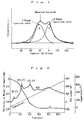
- Fig. 1 A 7 Li-NMR spectrum is shown in Fig. 1.
- the waveform was tried to be separated into a Gaussian curve and a Lorenzian curve.
- a band having the waveform of the Lorenzian curve with a chemical shift of -0.62 ppm corresponds to a covalent Li 2 molecule.
- a band having the waveform of the Gaussian curve with a chemical shift of 9.85 ppm corresponds to ionic lithium.
- the charged electrode 5 mg of a sample was subjected to DTA measurement at a programming rate of 60°C/minute.
- the electrode was taken out of the cell in the argon-replaced glove box and immediately subjected to TG-DTA measurement so that the difference from the state in the cell did not arise. Accordingly, the amount of the electrolyte absorbed by the carbon electrode was also similar to that in the cell.
- the thermal analysis was conducted by use of a differential thermal analyzer (TAS-200 manufactured by Rigaku Corporation).
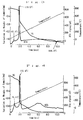
- DTA curve Variation with the lapse of time of a DTA signal of this example are shown as a DTA curve in Fig. 2.
- the DTA signal shows the potential difference produced in a thermocouple by the temperature difference between the sample and a reference material.
- the rise temperature was determined by the program for analysis belonging to the DTA equipment.
- the gradient was calculated from an enlarged view of the corresponding portion of the DTA curve, and converted to a value per unit weight of the sample.
- the initial discharge capacity was 330 Ah/kg.
- a cell was assembled and charged by the short-circuit method in the same manner as with Example 1 with the exception that a 40 mm X 40 mm electrode was prepared by use of an amorphous carbonaceous material of the type of absorbing lithium as a cluster, which was produced from pitch.
- the initial discharge capacity was 550 Ah/kg.
- the DTA measurement was made in the same manner as with Example 1.
- the DTA curve obtained is shown in Fig. 4.
- Example 1 shows that the gradient of the rising portion of the exothermic peak of Example 1 is extremely low, compared with those of Comparative Examples 1 and 2. Further, Example 1 also shows the highest exothermic peak rise temperature.
- Example 1 The above indicates that the carbonaceous material of Example 1 greatest in the amount of lithium absorbed reacts gently even by a rapid increase in temperature.
Landscapes
- Chemical & Material Sciences (AREA)
- Inorganic Chemistry (AREA)
- Chemical Kinetics & Catalysis (AREA)
- Electrochemistry (AREA)
- General Chemical & Material Sciences (AREA)
- Battery Electrode And Active Subsutance (AREA)
- Secondary Cells (AREA)
Abstract
Description
- The present invention relates to a lithium secondary battery using a carbonaceous material as an anode, said carbonaceous material being able to reversibly absorb and desorb lithium.
- In recent years, miniaturization of electronic devices has proceeded, which causes a demand for increased energy density of batteries, and various nonaqueous electrolyte batteries have been proposed.
- For example, lithium secondary batteries have previously been known in which metallic lithium, lithium alloys represented by aluminum/lithium alloys, or carbon anodes are used as anodes for nonaqueous electrolyte batteries,
- However, the lithium secondary batteries in which metallic lithium is used as anodes have been known to be inferior in cycle stability due to formation of dendrites.
- Further, the lithium secondary batteries in which the lithium alloys represented by the aluminum/lithium alloys are used as anodes can not be said to fully take out the performance of the lithium secondary batteries, although an improvement in cycle stability is observed compared with metallic lithium.
- For solving such problems, lithium secondary batteries have been proposed in which carbonaceous materials utilizing that carbon intercalation compounds of lithium are electrochemically easily formed are used as anode materials. Graphite and amorphous carbon absorbing lithium as a cluster are used as the carbonaceous materials.
- Compared with metallic lithium and the lithium alloys, such carbonaceous materials are sufficiently gentle in reaction with water also in the charged state, namely in the state where lithium is intercalated in carbon, and the formation of dendrites with charge and discharge is also hardly observed. They are therefore excellent.
- However, these carbonaceous materials bring about a rapid exothermic reaction by an increase in temperature in some cases, when they coexist with electrolysis solutions with lithium absorbed.
- Such a rapid exothermic reaction significantly deteriorates the performance of anode-active materials. For large-sized lithium secondary batteries used in electric vehicles, the rapid exothermic reaction is particularly required to be prevented.
- Further, the conventional carbonaceous materials such as graphite have the problems with regard to the performance of the anode-active materials, that the capacity is extremely low, compared with the theoretical capacity (assuming that the state of LiC6 is the maximum capacity in charging), that the capacity is sharply lowered by repetition of charge and discharge, even if the initial capacity is relatively large, and that the performance is violently deteriorated by repetition of charge and discharge at high current density, even if the charge and discharge capacity is relatively large.
- Accordingly, the development of lithium secondary batteries which do not bring about such a rapid exothermic reaction and excellent in the performance of the secondary batteries have been strongly desired.
- Contemplating such situations, the present inventors have studied cause from which the conventional carbonaceous materials bring about the rapid exothermic reaction by an increase in temperature. As a result, the present inventors have discovered that for graphite, lithium is absorbed as a stable ion, but a negatively charged graphite matrix is increased in reactivity with an electrolysis solution. On the other hand, for amorphous carbon absorbing lithium as a cluster, the lithium cluster having a high specific surface area has an activity identical to or higher than that of metallic lithium. From these facts, the present inventors have found out that such a high activity contributes to the rapid exothermic reaction.
- It is therefore an object of the present invention to provide a lithium secondary batteries which is high in capacity and excellent in cycle stability, which can comply with charge and discharge at high current density, and which is always stable.
- In accordance with the present invention, there is provided a lithium secondary battery comprising a carbonaceous material as an electrode, said carbonaceous material having a rise temperature of an exothermic peak higher than that of a carbonaceous material which can not absorb lithium as a lithium molecule, said exothermic peak appearing in a thermal analysis curve obtained by thermal analysis of the carbonaceous material in which lithium is charged, and showing the largest decrease in weight of the carbonaceous material measured by thermogravimetry, and a gradient of a rising portion of the exothermic peak smaller than that of the carbonaceous material which can not absorb lithium as a lithium molecule.
- These and other objects and advantages of this invention will become more apparent and more readily appreciated from the following detailed description of the presently preferred exemplary embodiments of the invention taken in conjunction with accompanying drawings, of which:
- Fig. 1 is a chart showing a 7Li-NMR spectrum of a carbonaceous material in Example 1;
- Fig. 2 is a chart showing a DTA curve and a TG curve in Example 1;
- Fig. 3 is a chart showing a DTA curve and a TG curve in Comparative Example 1;
- Fig. 4 is a chart showing a DTA curve and a TG curve in Comparative Example 2;
- Fig. 5 is a view partially containing a cross sectional view showing one embodiment of a lithium secondary battery of the present invention; and
- Fig. 6 is a 7Li-NMR spectrum chart of an amorphous material of Comparative Example 2 by which 300 Ah/kg of lithium is absorbed.
- In a lithium secondary battery of the present invention, a carbonaceous material used as an electrode has a rise temperature of an exothermic peak which appears in a thermal analysis curve obtained by thermal analysis of the carbonaceous material in which lithium is charged, and which shows the largest decrease in weight of the carbonaceous material measured by thermogravimetry, said rise temperature being higher than that of a carbonaceous material which can not absorb lithium as a lithium molecule, and having a gradient of a rising portion of the exothermic peak, said gradient being smaller than that of the carbonaceous material which can not absorb lithium as a lithium molecule.
- Here, the exothermic peak appearing in the thermal analysis curve obtained by thermal analysis indicates an exothermic reaction due to thermal decomposition or primary transition by an increase in temperature, and the gradient of a rising portion of the exothermic peak shows the degree of rapidness of the exothermic reaction caused by the thermal decomposition or the like.
- The term "carbonaceous material which can not absorb lithium as a lithium molecule" is the general term for the carbonaceous materials including graphite and amorphous carbon absorbing lithium as a cluster, as described above. Examples of the thermal analysis methods include differential thermal analysis (DTA) and differential scanning calorimetry (DSC), but there is no particular limitation thereon.
- When the thermal analysis is conducted by DTA, it is preferred to give the quantitative property to results of measurements by making the amount of samples constant. Further, when the thermal analysis is carried out by DSC, the calorific value is quantitatively measured by normal methods.
- In the electrodes of the lithium secondary batteries, the stability of the carbonaceous materials with lithium carried thereon comes into question. The thermal analysis is therefore required to be conducted to the carbonaceous materials with lithium carried thereon.
- Methods for allowing lithium to be carried on the carbonaceous materials may be any methods which have previously been employed. Methods for electrochemically doping the carbonaceous materials with lithium include, for example, a method of using metallic lithium as a counter electrode and allowing the carbonaceous material to stand in the state electrically short-circuited outside, thereby charging it (hereinafter referred to as the short-circuit method).
- In the present invention, for observing thermal response to a rapid increase in temperature, the programming rate in thermal analysis is preferably 30°C/minute or more, and more preferably 50°C/minute to 100°C/minute.
- When a plurality of exothermic peaks are present, the rise temperature and the gradient are determined for an exothermic peak which is largest in a decrease in weight measured by thermogravimetry (TG), because the exothermic peak largest in a decrease in weight shows the most violent exothermic reaction.
- With respect to the carbonaceous material having a rise temperature of an exothermic peak which appears in a thermal analysis curve obtained by thermal analysis of the carbonaceous material in which lithium is charged, and which shows the largest decrease in weight of the carbonaceous material measured by thermogravimetry, said rise temperature being higher than that of a carbonaceous material which can not absorb lithium as a lithium molecule, and having a gradient of a rising portion of the exothermic peak, said gradient being smaller than that of the carbonaceous material which can not absorb lithium as a lithium molecule, said carbonaceous material is not thermally decomposed until it is elevated to a higher temperature, compared with the carbonaceous material which can not absorb lithium as a lithium molecule, and the exothermic reaction can be said to be gentler.
- Such a carbonaceous material can therefore be considered to be difficult to react with an electrolyte and gentler in reaction.
- For example, from Example 1 and Comparative Examples 1 and 2 of this application, such a carbonaceous material corresponds to a carbonaceous material having a rise temperature of an exothermic peak of 141°C or more, said exothermic peak appearing in a thermal analysis curve obtained by thermal analysis conducted at a programming rate of 60°C/minute for 5 mg ± 0.5 mg of a sample, and having a gradient of a rising portion of said exothermic peak of 30 µV/(s·mg) or less.
- Preferred examples of the carbonaceous materials satisfying the conditions as described above include carbonaceous materials having condensed aromatic ring structures, and composed of randomly stacked structures. The term "randomly stacked structure" as used herein means a structure which is entirely random in orientation of a plane of a condensed aromatic ring or has no stacked structure exceeding four layers, preferably exceeding three layers.
- The reason why the carbonaceous materials having condensed aromatic ring structures and composed of randomly stacked structures are preferred is that the carbonaceous materials having such structures absorb lithium not only between layers by intercalation, but also as covalent Li2 molecules, which causes less charge transfer to carbon net faces than for carbonaceous materials by which lithium is only absorbed by intercalation, resulting in structural stability even with lithium carried thereon.
- It can be confirmed by the NMR spectra of carbonaceous materials with lithium carried thereon whether the carbonaceous materials absorb lithium as covalent Li2 molecules or not. That is, the carbonaceous material by which lithium is absorbed as a covalent Li2 molecule has at least two peaks of the chemical shift δ in a 7Li-NMR spectrum.
- One peak (B) exists at 0±2 ppm and another peak (A) exists on the plus side of the peak (B), wherein an observation nucleus is 7Li, and the basis of the chemical shift is a value at the time when the peak of a 1 mol/liter aqueous solution of LiCl is taken as 0.
- The presence of the peak (B) of the chemical shift δ within the above-mentioned range means that the density of unpaired electrons on lithium ions have become almost 0, namely that the lithium ions have been converted to covalent Li2 molecules.
- On the other hand, the chemical shift of intercalated lithium takes a positive value, and this corresponds to the above-mentioned peak (A) (Tanaka et al., Collected Summaries of Autumn Meeting of Electrochemical Society, Japan, 1992, page 129).
- This positive chemical shift is caused by a paramagnetic shift due to a radical of the carbonaceous material. When lithium is absorbed in the carbonaceous material, the carbonaceous material receives an electron to keep electrical neutrality at the same time. Carbon which has received the electron is turned to a radical anion. Accordingly, the carbonaceous material which has absorbed lithium has an unpaired electron, and the chemical shift is generated by an interaction between magnetic moments of the electron and a nucleus. According to the theory, the sign of the chemical shift due to an interaction with an electron spin agrees with the sign of the hyperfine coupling coefficient of the electron with the nucleus. The sign of the hyperfine coupling coefficients of 7Li is positive, and the radical-induced chemical shift becomes positive. The degree of the chemical shift is proportional to the density of unpaired ions on the observation nucleus. The intercalated lithium ions are trapped between graphite layers. When the graphite layers are changed to the radial anions, therefore, the density of unpaired electrons exists on the lithium ions to some extent, which causes the positive chemical shift.
- Here, the peak (A) exists preferably at 4 to 100 ppm, and more preferably at 10±7 ppm.
- The carbonaceous materials having condensed aromatic ring structures and composed of randomly stacked structures can be obtained by heat treatment of organic polymers having factors for inhibiting the stack structures of the carbonaceous materials.
- The organic polymers having factors for inhibiting the stack structures of the carbonaceous materials include, for example, organic polymers having aromatic structures each containing at least one structure selected from the group consisting of a bending structure including o-bonding or m-bonding, a branching structure and a crosslinking structure. Further, organic polymers containing organic compounds having 5-membered or 7-membered rings may also be used.
- Examples of such organic polymers include heat-resistant organic polymers such as polyamides, polyimides, polyesters, polyetherketones, polybenzyls, polyamideimides and phenol resins, and non-heterocyclic polymers in which conjugated polymer structures are developed are preferred among others. Such polymers are polyphenylene, poly(p-phenylenevinylene) (PPV), poly(p-phenylenexylene) (PPX), polystyrene and novolak resins, and polyphenylene is particularly preferred.
- Of these polymers, polymers which are low in crystallinity are preferred, and it is desirable that the half width of a diffraction peak in the vicinity of 2θ=20° in X-ray diffraction is preferably 0.75° or more, and more preferably 0.95° or more.
- Furthermore, it is preferred that the organic polymers contain quinoid structures. The inclusion of the quinoid structure can be confirmed by observation of an absorption edge within the range of 600 to 900 nm in a diffuse reflectance spectrum of the powdered organic polymer.
- Preferred examples of such organic polymers include polyphenylene which is high in the degree of polymerization to some extent. In the present invention, the R value defined by the following equation is applied as a measure of the polymerization degree of polyphenylene. This R value is preferably 2 or more, and more preferably 2.3 to 20, among others.

- Various methods are known as methods for synthesizing polyphenylene. Examples thereof include a method of variously combining Lewis acid catalysts with oxidizing agents to polymerize benzene under mild reaction conditions, thereby obtaining polyphenylene (P. Kovacic and A. Kyriakis, J. Am. Chem. Soc., 85, 454-458, 1963) (hereinafter referred to as the Kovacic method), a method of dehydrogenating poly(l,3-cyclohexadiene) to obtain polyphenylene (J. Am. Chem. Soc., 81, 448-452, 1959), and the Yamamoto method in which dihalobenzenes are subjected to dehalogenation polymerization using nickel catalysts (T. Yamamoto and A. Yamamoto, Chemistry Letters, 353-356, 1977). In the case of the above-mentioned Kovacic method, the use of an aluminum chloride-cupric chloride catalyst results in acquisition of polyphenylene in high yields at about 35°C for about 30 minutes.
- In the present invention, there is no particular limitation on the methods for synthesizing polyphenylene. However, the Kovacic method is suitable for the reasons that the production cost is low, and that the carbonization efficiency is excellent because of partial crosslinking. It has been proved by ESR (electron spin resonance) spectroscopy (G. Froyer et al., Polymer, 23, 1103, 1982) and mass spectrometric analysis (C. E. Brown et al., J. Polymer Science, Polym. Chem. Ed., 24, 255, 1986) that polyphenylene having the condensed ring structure is obtained by the Kovacic method.
- In contrast, poly(p-phenylene) obtained by the Yamamoto method has no condensed ring structure, and an amorphous carbonaceous material obtained by heat treatment of this polymer can not absorb lithium as a covalent Li2 molecule. This polymer is therefore unfavorable.
- The organic polymer is heat treated preferably in the vicinity of the carbonization temperature thereof, namely within the range of the carbonization temperature to the carbonization temperature + 300°C. The carbonization temperature is a temperature at which elimination of hydrogen and the like from the organic polymer of a starting material occurs, and can be measured by TG (thermogravimetry) or DTA (differential thermal analysis).
- If the heat treatment temperature is lower than the carbonization temperature, carbonization is not performed. On the other hand, if the heat treatment temperature exceeds this range, carbonization proceeds too much to leave organic components. The heat treatment within this range results in incomplete carbonization to provide carbonaceous materials in which carbon components and organic components are present as a mixture.
- When the organic polymer is polyphenylene, the heat treatment temperature is 650°C to 900°C, and preferably 670°C to 780°C. If the heat treatment temperature is less than 650°C, carbonization is too insufficient to absorb lithium. On the other hand, if the heat treatment temperature exceeds 900°C, carbonization proceeds too much to absorb lithium as a covalent Li2 molecule.
- It is important for obtaining electrodes excellent in cycle stability that the carbon components and the organic components are present as a mixture in the carbonaceous materials. The reason for this is that the presence of the carbon components and the organic components as a mixture in the carbonaceous materials results in difficulty of causing the collapse of structures, even if changes in volume take place by the charge and discharge reaction.
- In the carbonaceous materials, the carbon components are contained preferably in an amount of 80 to 99% by weight, and more preferably in an amount of 90 to 99% by weight. The organic components are contained preferably in an amount of 1 to 20% by weight, and more preferably in an amount of about 1 to about 10% by weight. The amount of the carbon components as used herein is the amount of carbon determined by elementary analysis. The amount of the organic components is the amount of elements contained in the starting materials, such as hydrogen, nitrogen, sulfur and oxygen, except for carbon.
- The organic polymers may be heat treated either in an inactive atmosphere or a reducing atmosphere. Examples of the atmospheres include nitrogen, argon and hydrogen atmospheres. The heat treatment time is preferably 0.5 to 3 hours, wherein the heat treatment time is a time after arrival at an established temperature.
- As this specific heat-treating method, the temperature may be elevated to the weight decrease initiating temperature at any programming rate, but the temperature is preferably raised from the weight decrease initiating temperature to the heat treatment temperature preferably at a programming rate of 5°C/hour to 200°C/hour, more preferably 20°C/hour to 100°C/hour.
- The hydrogen/carbon atomic ratio (H/C) of the carbonaceous material obtained by the heat treatment is preferably 0.05 to 0.6, and more preferably 0.15 to 0.6. The material having a ratio of less than 0.05 develops the graphite structure and destructs the crystal structure by expansion and contraction of crystals upon the doping-dedoping reaction of lithium corresponding to charge and discharge, which results in deterioration of cycle stability. On the other hand, the material having a ratio exceeding 0.6 is markedly decreased in discharge capacity.
- The carbonaceous materials thus obtained by heat treatment are usually powdery or solid. When used as electrode materials, the carbonaceous materials are mechanically pulverized for use.
- In this case, the particle size is not necessarily restricted. However, high-performance electrodes can be obtained by reducing the average particle size to 5 µm or less.
- Electrode bodies can be obtained by mixing binders with these carbonaceous material powders, followed by rolling with rolls. The amount of the binder compounded is 5 to 50 parts by weight, and preferably 5 to 30 parts by weight, per 100 parts by weight of electrode material.
- Here, either organic or inorganic binders can be used as the binders. As the organic binders, in addition to polyethylene described above, a number of binders such as fluorine resins such as polytetrafluoroethylene and polyvinylidene fluoride, polyvinyl alcohol and polyvinyl chloride can be used. In this case, heat treatment in the vicinity of the carbonization temperature is required after mixture with the binders, except for polyethylene.
- Further, as the inorganic binders, silicon binders such as silicon glass can be used. Also in this case, heat treatment at a temperature exceeding a melting point is required to allow them to exhibit the performance as the binders.
- The production of the electrode bodies is not limited to the above-mentioned methods. For example, the binders can be mixed with the organic polymers which are starting materials, and the resulting mixtures can be formed and heat treated to directly obtain the electrode bodies. Further, organic fibers can also be mixed with the carbonaceous materials obtained by heat treatment to obtain the electrode bodies, as described below.
- Examples of the organic fibers to be mixed with the carbonaceous materials include cellulose fiber, rayon fiber, pitch fiber, lignin fiber, phenol fiber and acrylic resin fiber. Cellulose fiber dispersible in water and low in cost is preferably used among others.
- There in no particular limitation on the form of the organic fibers, and fibers variously shaped such as chopped yarns, strands and wavy fibers can be used. Such organic fibers not only act as supports when the carbonaceous materials are formed into films or sheets, but also have the function of giving a definite thickness to the films or the sheets.
- The length of the organic fibers is preferably 0.2 to 10 mm, and more preferably 0.2 to 2 mm. The organic fibers having a length of less than 0.2 mm do not exhibit their bulkiness, whereas exceeding 10 mm results in fear of reduced formability.
- It is preferred that the organic fibers are well dried at the tim of use.
- Preliminary heat treatment of the organic fibers can give contraction to the organic fibers to decrease contraction in subsequent heating. The heating temperature is required to be a temperature at which the strength of the organic fibers is not impaired, and it is preferably within the range of 120°C to 250°C.
- As a method for forming the carbonaceous material and the organic fiber into the film or the sheet, the paper making method is most preferred. The paper making method is a method in which the carbonaceous material and the organic fiber are suspended in an organic solvent to prepare a suspended solution, which is spread to a specified thickness, and then, the organic solvent is evaporated to form the film or the sheet.
- The mixing ratio of the organic fiber to the carbonaceous material is preferably 10 to 70% by weight, and more preferably 15 to 40% by weight. If the organic fiber is contained in a ratio of less than 10% by weight, the formability is reduced. On the other hand, exceeding 70% by weight results in fear of reduced discharge capacity as an electrode.
- In paper making, the carbonaceous material is first mixed with the organic fiber in the solvent to prepare the suspension. The solvent used herein can be appropriately selected. When cellulose fiber is used as the organic fiber, water, ethanol or a mixture thereof is preferably used.
- The total of the carbonaceous material and the organic fiber preferably accounts for 1 to 5% by weight of the dispersion, particularly 1.7 to 3.3% by weight. If the ratio is less than 1% by weight, the emulsion is difficult to be homogenized. On the other hand, if the ratio exceeds 5% by weight, the viscosity is increased too much, resulting in fear of difficulty to form the film or the sheet uniform in thickness. Although any device may be used for mixing of the carbonaceous material, the organic fiber and the organic solvent, a ball mill or a mixer is preferably used.
- In this case, a surfactant, a binder or a fiber for reinforcement may be added to the organic solvent, if necessary.
- The surfactants include, for example, polyoxyethylene phenyl ether, polyoxyoctyl phenyl ether, ethanol and methanol.
- The binders include synthetic resin emulsions, as well as cationized starch, cationized or anionized polyacryl amide, melamine resins, urea resins, epoxidated amides and carboxyl-modified polyvinyl alcohol.
- The fibers for reinforcement include vinyl chloride fiber and rayon for paper making.
- The film or the sheet thus obtained is dried at a temperature of 50°C to 80°C to evaporate the solvent (the film or the sheet after drying is hereinafter referred to as a "fiber film or sheet"). The thickness of the fiber film or sheet is preferably 0.05 to 1 mm, and more preferably 0.2 to 1 mm. In the present invention, it becomes possible to control the thickness of the fiber film or sheet by changing the weight of the fiber film or sheet per unit area in a manner similar to that of the conventional paper making methods.
- Here, the fiber film or sheet contains the above-mentioned organic fiber, so that the thickness thereof does not vary so much even when the solvent is removed by evaporation, and voids are formed in the fiber film or sheet.
- The fiber film or sheet thus obtained is impregnated with a thermosetting resin, followed by heating to harden the resin. In this manner, the impregnated thermosetting resin is hardened by heating to form a thin plate (hereinafter referred to as a "fiber thin plate").
- Here, although the thermosetting resins include phenol resins and polyimide resins, resolic phenol resins are preferred because of their low cost.
- The resolic phenol resins, which are produced by the addition condensation reaction under alkaline conditions, are preferably synthesized in the presence of LiOH catalyst or NH4OH. For the phenol resins synthesized in the presence of LiOH catalyst or NH4OH, impurities are slightly contained in the electrodes, or not harmful if they are present. In contrast, for the phenol resins synthesized in the presence of NaOH catalyst, sodium components unfavorably remain in the electrodes.
- Further, the use of thermoplastic resins unfavorably fails to retain the form of thin plates in heat treatment described below.
- The fiber film or sheet is impregnated with the thermosetting resin preferably in an amount of 10 to 200% by weight, and particularly in an amount of 50 to 150% by weight, as a non-volatile component, based on the fiber film or sheet. If the amount of the thermosetting resin is less than 10% by weight, it is difficult to obtain the effect as the binder. On the other hand, if the amount of the thermosetting resin exceeds 200% by weight, it covers the carbonaceous material too much, resulting in fear of a reduction in function as an active material.
- Then, the fiber thin plates are heat treated to prepare the carbon thin plates used as the electrodes of the lithium secondary batteries.
- Here, the heat treatment is conducted to such a degree that the organic fibers and the thermosetting resins constituting the fiber thin plates are carbonized in the amorphous state. The heat treatment is therefore carried out preferably at 600°C to 1,200°C for 0 to 4 hours, and more preferably at 650°C to 800°C for 0.5 to 2 hours. At this time, it is preferred that the temperature is gradually elevated, preferably at 3°C/minute or less. The heat treatment is preferably conducted in a non-oxidative atmosphere, particularly in an inactive gas atmosphere. In order to keep the carbon thin plate flat, it is preferred that the heat treatment is performed with the carbon thin plate put between flat graphite plates.
- Lithium is allowed to be carried on the electrode bodies thus obtained, thereby preparing the electrodes for lithium secondary batteries.
- Methods for allowing lithium to be carried on the electrode bodies include any methods which have previously been employed, such as thermal diffusion by contact with lithium foil, electrochemical doping of lithium in lithium salt solutions, and diffusion of lithium in carbon by immersion in molten lithium.
- In the electrodes for lithium secondary batteries, the lithium ions do not go in and out between the layers, so that the structure of the material is little changed by absorption and desorption. Furthermore, since the stacked structure is not developed, the paths of absorbing/desorbing lithium ions are not restricted to one direction parallel to the plane, and can permeate from any directions. The electrodes have therefore the advantage of having a high absorption-desorption reaction rate.
- On the other hand, there is no particular limitation on cathode-active materials used in the lithium secondary batteries of the present invention, and various cathodes, for example, metal oxides such as manganese dioxide and vanadium pentaoxide or organic polymers such as polypyrrole can be used.
- As nonaqueous electrolytes used in the lithium secondary batteries of the present invention, any nonaqueous substances may be employed as long as they are chemically stable to cathode materials and anode materials, and lithium ions can move therein to electrochemically react with the cathode-active materials. As the electrolytes, compounds composed of combinations of cations and anions are particularly used. The cations include Li+, and examples of the anions include halide anions of the group Va elements such as PF6 -, AsF6 - and SbF6 -; halogen anions such as I-, I3 -, Br- and Cl-; perchlorate anions such as ClO4 -; and anions such as HF2 -, CF3SO3 - and SCN-. However, they are not necessarily limited to these anions. Concrete examples of the electrolytes having such cations and anions include LiPF6, LiAsF6, LiSbF6, LiBF4, LiClO4, LiI, LiBr, LiCl, LiAlCl4, LiHF2, LiSCN and LiCF3SO3. Of these, LiPF6, LiASF6, LiSbF6, LiBF4, LiClO4 and LiCF3SO3 are particularly preferred.
- The nonaqueous electrolytes are usually used in the state where they are dissolved in solvents. In this case, there is no particular limitation on the solvents. However, the solvents having a relatively large polarity are favorably used. Specifically, they include propylene carbonate, ethylene carbonate, tetrahydrofuran, 2-methyltetrahydrofuran, dioxolane, dioxane, ethylene glycol dimethyl ether, glymes such as diethylene glycol dimethyl ether, lactones such as γ-butylolactone, phosphates such as triethyl phosphate, borates such as triethyl borate, sulfur compounds such as sulfolane and dimethyl sulfoxide, nitriles such as acetonitrile, amides such as dimethylformamide and dimethylacetamide, dimethyl sulfate, nitromethane, nitrobenzene and dichloroethane, which may be used alone or as a mixture of at least two kinds of them. Of these, one selected from propylene carbonate, ethylene carbonate, butylene carbonate, tetrahydrofuran, 2-methyltetrahydrofuran, dioxane, ethylene glycol dimethyl ether, dioxolane and γ-butylolactone, or a mixture of at least two kinds of them is particularly preferred.
- Further, as these nonaqueous electrolytes, there can be used organic solid electrolytes in which polymers such as polyethylene oxide, polypropylene oxide, polyethylene oxide crosslinking with isocyanates and phosphazene polymers having ethylene oxide oligomers as side chains are impregnated with the above-mentioned nonaqueous electrolytes; and inorganic solid electrolytes such as inorganic ion derivatives such as Li3N and LiBCl4, and lithium glass such as Li4SiO4 and Li3BO3.
- The lithium secondary battery using the electrode material comprising the alkali metal-absorbing/desorbing carbonaceous material of the present invention will be described in more detail with reference to the drawing.
- That is, in the lithium secondary battery using the cathode material of the present invention, as shown in Fig. 5, the inside of a button-shaped
cathode case 10 whoseopening 10a is sealed with ananode cap 20 is partitioned with aseparator 30 having fine pores, and acathode 50 having acathode collector 40 arranged on the side of thecathode case 10 is accommodated in the partitioned space on the cathode side, whereas ananode 70 having ananode collector 60 arranged on the side of theanode cap 20 is accommodated in the space on the anode side. - As the
separator 30, one which is porous and through which the electrolytes can be passed or which can contain them, for example, a nonwoven, woven or knitted fabric made of a synthetic resin such as polytetrafluoroethylene, polypropylene or polyethylene, or a glass film can be used. - The carbonaceous materials used in the lithium secondary batteries of the present invention are structurally stable even with lithium carried thereon, and can be substantially increased in the amount of lithium ions absorbed. Further, no changes in structure are observed in absorption and desorption, and the rate of the absorption-desorption reaction of lithium ions is also high. The lithium secondary batteries of the present invention are high in capacity, excellent in cycle stability and able to comply with charge and discharge at high current density, thus providing lithium secondary batteries which are always stable.
- Further, the lithium secondary batteries of the present invention are very effective, particularly for more enhancing the stability of large-sized nonaqueous electrolytic solution secondary batteries such as those for use in electric vehicles.
- The present invention is hereinafter described in more detail with reference to examples, but it is not limited to these examples.
- Benzene was polymerized in the presence of cupric chloride and aluminum chloride by the Kovacic method to obtain polyphenylene. This was dried and classified to obtain a powder having a particle size of 300 µm or less. The temperature of this powder was elevated in an atmosphere of nitrogen from room temperature to 500°C for 2 hours, and thereafter elevated from 500°C to 700°C for 5 hours. Then, the powder is kept at 700°C for 1 hour to conduct heat treatment. Results of elemental analysis indicated that the heat-treated powder thus obtained consisted of hydrogen and carbon atoms, and had an H/C atomic ratio of 0.24 and a true density of 2.02 g/cm3. No peak was observed by X-ray diffraction, which proved that the heat-treated powder was amorphous.
- Then, 1.4 g of the heat-treated powder, 0.6 g of cellulose, 0.1 g of Denka Black (manufactured by Denki Kagaku Kogyo K. K.), 20 ml of ethanol and 20 ml of a 5% aqueous solution of polyoxyethylene octyl phenyl ether were mixed using a mixer for 10 minutes. The resulting mixture was poured into a 130 mm X 130 mm stainless steel vat, and dried to obtain a paper-like carbon film.
- On the other hand, 94 g of phenol, 4 ml of aqueous ammonia, 10 g of LiOH·H2O and 97 g of a 37% (by weight) aqueous solution of formaldehyde were placed in a 500-ml separable flask in this order, and boiled for 60 minutes with mixing. After termination of the reaction, the reaction product was heated and dehydrated under a reduced pressure of about 20 mmHg, and dehydration was stopped at the time when the resin temperature reached 70°C. The resulting product was allowed to cool, and 200 ml of methanol was added thereto at the time when the resin temperature reached 65°C, thereby obtaining a varnish of a resolic phenol resin.
- The carbon film was impregnated with 4 ml of the above-mentioned varnish, and maintained at 80°C for a day to harden the varnish. After hardening, the film was further maintained at 160°C for 10 minutes while applying a pressure of 100 kgf/cm2. The resulting film was put between graphite plates, and the temperature thereof was elevated in an atmosphere of nitrogen from room temperature to 160°C for 30 minutes. Then, the film was elevated in temperature to 640°C for 3 hours, and maintained at 640°C for 1 hour to conduct heat treatment. After the heat treatment, the film was cut out to a size of 40
mm X 40 mm to obtain a carbon electrode. - A cell was assembled using the resulting electrode, a 40
mm X 40 mm Li foil as a counter electrode, glass fiber filter paper as a separator, and a 1 mol /liter solution of LiPF6 in an ethylene carbonate/1,2-dimethoxyethane (ratio by volume = 1:1) solvent as an electrolyte, and electrically short-circuited outside. Then, the cell was allowed to stand overnight to charge the carbon electrode until the same potential as that of the counter electrode was attained (the short-circuit method). The charge provided an initial discharge capacity of 680 Ah/kg per unit weight of the carbon electrode. Discharge was carried out at a constant current discharge of 1.6 mA/cm2 and at a discharge cut-off potential of 3 V (to Li/Li+), and the assembly of the cell and the charge by short circuit were performed in an argon-replaced glove box. - The charged electrode was washed with 1,2-dimethoxyethane to remove salts. A 7Li-NMR spectrum is shown in Fig. 1. In Fig. 1, the waveform was tried to be separated into a Gaussian curve and a Lorenzian curve. A band having the waveform of the Lorenzian curve with a chemical shift of -0.62 ppm corresponds to a covalent Li2 molecule. A band having the waveform of the Gaussian curve with a chemical shift of 9.85 ppm corresponds to ionic lithium.
- For the charged electrode, 5 mg of a sample was subjected to DTA measurement at a programming rate of 60°C/minute. The electrode was taken out of the cell in the argon-replaced glove box and immediately subjected to TG-DTA measurement so that the difference from the state in the cell did not arise. Accordingly, the amount of the electrolyte absorbed by the carbon electrode was also similar to that in the cell. The thermal analysis was conducted by use of a differential thermal analyzer (TAS-200 manufactured by Rigaku Corporation).
- Variation with the lapse of time of a DTA signal of this example are shown as a DTA curve in Fig. 2. The DTA signal shows the potential difference produced in a thermocouple by the temperature difference between the sample and a reference material.
- Referring to Fig. 2, three exothermic peaks appear at 89.5°C, 169.1°C and 270.0°C. Of these exothermic peaks, the rise temperature and the gradient of the rising portion of the second peak (169.1°C) corresponding to a violent decrease in weight was employed as an indication of the rapidness of the exothermic reaction in elevating the temperature.
- The rise temperature was determined by the program for analysis belonging to the DTA equipment. The gradient was calculated from an enlarged view of the corresponding portion of the DTA curve, and converted to a value per unit weight of the sample.
- These results are shown in Table 1.
- A cell was assembled and charged by the short-circuit method in the same manner as with Example 1 with the exception that a 40
mm X 40 mm electrode was prepared by use of man-made graphite and a PVDF binder (manufactured by Kureha Chemical Industry Co., Ltd.), and that a 1 mol /liter solution of LiPF6 in an ethylene carbonate/dimethyl carbonate (ratio by volume = 1:1) solvent as an electrolyte. The initial discharge capacity was 330 Ah/kg. - The DTA measurement was made in the same manner as with Example 1. The DTA curve obtained is shown in Fig. 3.
- Referring to Fig. 3, two exothermic peaks at 87.9°C and 170.6°C, and an endothermic peak at 606.4°C are observed, and the second exothermic peak (170.6°C) corresponding to a violent decrease in weight shows a very abrupt rising.
- The rise temperature and the gradient of the rising portion of the second exothermic peak (170.6°C) are shown in Table 1.
- A cell was assembled and charged by the short-circuit method in the same manner as with Example 1 with the exception that a 40
mm X 40 mm electrode was prepared by use of an amorphous carbonaceous material of the type of absorbing lithium as a cluster, which was produced from pitch. The initial discharge capacity was 550 Ah/kg. - The DTA measurement was made in the same manner as with Example 1. The DTA curve obtained is shown in Fig. 4.
- Referring to Fig. 4, two exothermic peaks and an endothermic peak are observed, and the second exothermic peak (172.4°C) corresponding to a violent decrease in weight shows a very abrupt rising.
- The rise temperature and the gradient of the rising portion of the second exothermic peak (172.4°C) are shown in Table 1.
- Further, referring to Fig. 6, no covalent band is observed in the vicinity of 0 ppm in chemical shaft in a 7Li-NMR spectrum of the amorphous carbonaceous material of Comparative Example 2 by which lithium is absorbed. The maximum band is present in the vicinity of 100 ppm, and this is assigned to the lithium cluster. An intercalation band is also observed in the vicinity of 30 ppm. A band observed in the vicinity of 270 ppm is caused by a metal ion.
- This spectrum proves that the carbonaceous material of Comparative Example 2 can not absorb lithium as a covalent Li2 molecule.
Table 1 Example 1 Comparative Example 1 Comparative Example 2 Amount of Lithium Absorbed 680 330 550 Exothermic Peak Rise Temp. (°C) 146.2 130.0 140.1 Gradient (µV/s-1mg-1) 0.93 36.09 34.09 - The result shown in Table 1 indicate that the gradient of the rising portion of the exothermic peak of Example 1 is extremely low, compared with those of Comparative Examples 1 and 2. Further, Example 1 also shows the highest exothermic peak rise temperature.
- The above indicates that the carbonaceous material of Example 1 greatest in the amount of lithium absorbed reacts gently even by a rapid increase in temperature.
Claims (4)
- A lithium secondary battery comprising a carbonaceous material as an electrode, said carbonaceous material having a rise temperature of an exothermic peak higher than that of a carbonaceous material which can not absorb lithium as a lithium molecule, said exothermic peak appearing in a thermal analysis curve obtained by thermal analysis of the carbonaceous material in which lithium is charged, and showing the largest decrease in weight of the carbonaceous material measured by thermogravimetry, and a gradient of a rising portion of the exothermic peak smaller than that of the carbonaceous material which can not absorb lithium as a lithium molecule.
- The lithium secondary battery as claimed in claim 1, in which said carbonaceous material has a rise temperature of an exothermic peak of 141°C or more, said exothermic peak appearing in the thermal analysis curve obtained by differential thermal analysis conducted at a programming temperature of 60°C/minute for 5 mg ± 0.5 mg of a sample, and a gradient of a rising portion of said exothermic peak of 30 µV/(s·mg) or less.
- The lithium secondary battery as claimed in claim 1 or 2, in which said carbonaceous material is a carbonaceous material obtained by heat treatment of polyphenylene.
- The lithium secondary battery as claimed in claim 3, in which polyphenylene is produced at a heat treatment temperature of 650 to 900°C by the Kovacic method.
Applications Claiming Priority (2)
| Application Number | Priority Date | Filing Date | Title |
|---|---|---|---|
| JP4845296 | 1996-02-13 | ||
| JP48452/96 | 1996-02-13 |
Publications (2)
| Publication Number | Publication Date |
|---|---|
| EP0791972A1 true EP0791972A1 (en) | 1997-08-27 |
| EP0791972B1 EP0791972B1 (en) | 2007-06-13 |
Family
ID=12803750
Family Applications (1)
| Application Number | Title | Priority Date | Filing Date |
|---|---|---|---|
| EP97300907A Expired - Lifetime EP0791972B1 (en) | 1996-02-13 | 1997-02-12 | Lithium secondary battery |
Country Status (2)
| Country | Link |
|---|---|
| EP (1) | EP0791972B1 (en) |
| DE (1) | DE69737800T2 (en) |
Cited By (2)
| Publication number | Priority date | Publication date | Assignee | Title |
|---|---|---|---|---|
| US9899665B2 (en) | 2008-07-30 | 2018-02-20 | Sumitomo Chemical Company, Limited | Sodium secondary battery comprising carbonaceous material |
| CN114824165A (en) * | 2022-06-30 | 2022-07-29 | 宁德新能源科技有限公司 | Negative electrode plate, electrochemical device, and electronic apparatus |
Citations (3)
| Publication number | Priority date | Publication date | Assignee | Title |
|---|---|---|---|---|
| US4615959A (en) * | 1984-05-07 | 1986-10-07 | Sanyo Chemical Industries, Ltd. | Secondary battery or cell with improved rechargeability |
| EP0567658A1 (en) * | 1991-11-20 | 1993-11-03 | Honda Giken Kogyo Kabushiki Kaisha | Carbon-based material |
| EP0573266A1 (en) * | 1992-06-01 | 1993-12-08 | Kabushiki Kaisha Toshiba | Lithium secondary battery and method of manufacturing carbonaceous material for negative electrode of the battery |
-
1997
- 1997-02-12 EP EP97300907A patent/EP0791972B1/en not_active Expired - Lifetime
- 1997-02-12 DE DE69737800T patent/DE69737800T2/en not_active Expired - Fee Related
Patent Citations (3)
| Publication number | Priority date | Publication date | Assignee | Title |
|---|---|---|---|---|
| US4615959A (en) * | 1984-05-07 | 1986-10-07 | Sanyo Chemical Industries, Ltd. | Secondary battery or cell with improved rechargeability |
| EP0567658A1 (en) * | 1991-11-20 | 1993-11-03 | Honda Giken Kogyo Kabushiki Kaisha | Carbon-based material |
| EP0573266A1 (en) * | 1992-06-01 | 1993-12-08 | Kabushiki Kaisha Toshiba | Lithium secondary battery and method of manufacturing carbonaceous material for negative electrode of the battery |
Cited By (3)
| Publication number | Priority date | Publication date | Assignee | Title |
|---|---|---|---|---|
| US9899665B2 (en) | 2008-07-30 | 2018-02-20 | Sumitomo Chemical Company, Limited | Sodium secondary battery comprising carbonaceous material |
| CN114824165A (en) * | 2022-06-30 | 2022-07-29 | 宁德新能源科技有限公司 | Negative electrode plate, electrochemical device, and electronic apparatus |
| CN114824165B (en) * | 2022-06-30 | 2022-10-14 | 宁德新能源科技有限公司 | Negative electrode plate, electrochemical device and electronic equipment |
Also Published As
| Publication number | Publication date |
|---|---|
| EP0791972B1 (en) | 2007-06-13 |
| DE69737800D1 (en) | 2007-07-26 |
| DE69737800T2 (en) | 2007-10-11 |
Similar Documents
| Publication | Publication Date | Title |
|---|---|---|
| EP0201038B1 (en) | Secondary battery using non-aqueous solvent | |
| US5591545A (en) | Carbon material and method for producing same | |
| US5725968A (en) | Alkaline ion-absorbing/desorbing carbon material electrode material for secondary battery using the carbon material and lithium secondary battery using the electron material | |
| US5437943A (en) | Positive electrode and secondary battery using the same | |
| KR100776523B1 (en) | Non-aqueous Electrolyte Secondary Battery | |
| KR100811580B1 (en) | Cathode active material, nonaqueous electrolyte secondary battery and method for manufacturing same | |
| US5326658A (en) | Lithium secondary battery using a non-aqueous solvent | |
| KR100323002B1 (en) | Method of manufacturing cathode active material and nonaqueous electrolyte secondary battery | |
| EP0791972B1 (en) | Lithium secondary battery | |
| KR100356636B1 (en) | Non-Aqueous Liquid Electrolyte Secondary Battery and Method for Producing Cathode Material | |
| JP3973170B2 (en) | Lithium ion secondary battery and method for producing electrode for lithium secondary battery | |
| JP2001080914A (en) | Carbon material and its manufacturing method, and non-aqueous electrolyte battery and its manufacturing method | |
| JP3429561B2 (en) | Electrode materials for lithium secondary batteries | |
| JP3322962B2 (en) | Alkali ion adsorption / desorption material | |
| JP3393621B2 (en) | Positive electrode material for lithium secondary battery and method for producing the same | |
| JP7448733B1 (en) | Non-graphitizable carbon, mixed carbon powder, negative electrode for lithium ion secondary batteries, lithium ion secondary batteries | |
| JP2761212B2 (en) | Energy storage device using non-aqueous electrolyte | |
| JPH11176440A (en) | Lithium secondary battery and carbon material for negative electrode | |
| JP2616775B2 (en) | Organic electrolyte battery with ternary composite as cathode | |
| JPH09219219A (en) | Manufacturing method of lithium secondary battery | |
| JP2561620B2 (en) | Carbon-based material and method for producing the same | |
| JPH09219196A (en) | Lithium secondary battery | |
| JPH09219195A (en) | Electrodes for lithium secondary batteries | |
| JPH06163033A (en) | Manufacture of secondary battery electrode material | |
| JP3241839B2 (en) | Electrode materials for secondary batteries |
Legal Events
| Date | Code | Title | Description |
|---|---|---|---|
| PUAI | Public reference made under article 153(3) epc to a published international application that has entered the european phase |
Free format text: ORIGINAL CODE: 0009012 |
|
| AK | Designated contracting states |
Kind code of ref document: A1 Designated state(s): DE FR GB |
|
| 17P | Request for examination filed |
Effective date: 19970705 |
|
| 17Q | First examination report despatched |
Effective date: 19990427 |
|
| GRAP | Despatch of communication of intention to grant a patent |
Free format text: ORIGINAL CODE: EPIDOSNIGR1 |
|
| RIC1 | Information provided on ipc code assigned before grant |
Ipc: C04B 35/524 20060101ALI20060620BHEP Ipc: H01M 4/58 20060101AFI20060620BHEP |
|
| GRAS | Grant fee paid |
Free format text: ORIGINAL CODE: EPIDOSNIGR3 |
|
| GRAA | (expected) grant |
Free format text: ORIGINAL CODE: 0009210 |
|
| AK | Designated contracting states |
Kind code of ref document: B1 Designated state(s): DE FR GB |
|
| REG | Reference to a national code |
Ref country code: GB Ref legal event code: FG4D |
|
| REF | Corresponds to: |
Ref document number: 69737800 Country of ref document: DE Date of ref document: 20070726 Kind code of ref document: P |
|
| RIN2 | Information on inventor provided after grant (corrected) |
Inventor name: DEMACHI, ATSUSHI Inventor name: KOMAZAWA, EISUKE Inventor name: OKI, NAOHIKO Inventor name: SATO, KENJI |
|
| ET | Fr: translation filed | ||
| PLBE | No opposition filed within time limit |
Free format text: ORIGINAL CODE: 0009261 |
|
| STAA | Information on the status of an ep patent application or granted ep patent |
Free format text: STATUS: NO OPPOSITION FILED WITHIN TIME LIMIT |
|
| 26N | No opposition filed |
Effective date: 20080314 |
|
| PGFP | Annual fee paid to national office [announced via postgrant information from national office to epo] |
Ref country code: DE Payment date: 20080207 Year of fee payment: 12 Ref country code: GB Payment date: 20080206 Year of fee payment: 12 |
|
| PGFP | Annual fee paid to national office [announced via postgrant information from national office to epo] |
Ref country code: FR Payment date: 20080208 Year of fee payment: 12 |
|
| GBPC | Gb: european patent ceased through non-payment of renewal fee |
Effective date: 20090212 |
|
| REG | Reference to a national code |
Ref country code: FR Ref legal event code: ST Effective date: 20091030 |
|
| PG25 | Lapsed in a contracting state [announced via postgrant information from national office to epo] |
Ref country code: DE Free format text: LAPSE BECAUSE OF NON-PAYMENT OF DUE FEES Effective date: 20090901 |
|
| PG25 | Lapsed in a contracting state [announced via postgrant information from national office to epo] |
Ref country code: GB Free format text: LAPSE BECAUSE OF NON-PAYMENT OF DUE FEES Effective date: 20090212 Ref country code: FR Free format text: LAPSE BECAUSE OF NON-PAYMENT OF DUE FEES Effective date: 20090302 |