EP0791007B1 - Antifungal sordaridin derivatives - Google Patents
Antifungal sordaridin derivatives Download PDFInfo
- Publication number
- EP0791007B1 EP0791007B1 EP95938407A EP95938407A EP0791007B1 EP 0791007 B1 EP0791007 B1 EP 0791007B1 EP 95938407 A EP95938407 A EP 95938407A EP 95938407 A EP95938407 A EP 95938407A EP 0791007 B1 EP0791007 B1 EP 0791007B1
- Authority
- EP
- European Patent Office
- Prior art keywords
- methyl
- compound
- cdcl
- formula
- cho
- Prior art date
- Legal status (The legal status is an assumption and is not a legal conclusion. Google has not performed a legal analysis and makes no representation as to the accuracy of the status listed.)
- Expired - Lifetime
Links
- 230000000843 anti-fungal effect Effects 0.000 title abstract description 12
- 229940121375 antifungal agent Drugs 0.000 title description 5
- 150000001875 compounds Chemical class 0.000 claims description 262
- -1 hydrates) thereof Chemical class 0.000 claims description 128
- 125000000956 methoxy group Chemical group [H]C([H])([H])O* 0.000 claims description 94
- 238000000034 method Methods 0.000 claims description 54
- 229910052739 hydrogen Inorganic materials 0.000 claims description 51
- 239000001257 hydrogen Substances 0.000 claims description 50
- 125000002887 hydroxy group Chemical group [H]O* 0.000 claims description 38
- 238000006243 chemical reaction Methods 0.000 claims description 30
- 150000003839 salts Chemical class 0.000 claims description 27
- 238000002360 preparation method Methods 0.000 claims description 24
- 125000006239 protecting group Chemical group 0.000 claims description 23
- 230000008569 process Effects 0.000 claims description 21
- 229910052799 carbon Inorganic materials 0.000 claims description 20
- 125000004435 hydrogen atom Chemical group [H]* 0.000 claims description 19
- 238000011282 treatment Methods 0.000 claims description 19
- 125000004169 (C1-C6) alkyl group Chemical group 0.000 claims description 11
- 208000031888 Mycoses Diseases 0.000 claims description 11
- 125000000852 azido group Chemical group *N=[N+]=[N-] 0.000 claims description 11
- 125000003178 carboxy group Chemical group [H]OC(*)=O 0.000 claims description 10
- 125000000229 (C1-C4)alkoxy group Chemical group 0.000 claims description 9
- 125000004191 (C1-C6) alkoxy group Chemical group 0.000 claims description 9
- 206010017533 Fungal infection Diseases 0.000 claims description 9
- 238000004519 manufacturing process Methods 0.000 claims description 9
- 241000282414 Homo sapiens Species 0.000 claims description 8
- 239000008194 pharmaceutical composition Substances 0.000 claims description 8
- 229910052736 halogen Inorganic materials 0.000 claims description 7
- 150000002367 halogens Chemical group 0.000 claims description 7
- 229910052760 oxygen Inorganic materials 0.000 claims description 7
- 125000004430 oxygen atom Chemical group O* 0.000 claims description 7
- 239000003814 drug Substances 0.000 claims description 6
- 125000000008 (C1-C10) alkyl group Chemical group 0.000 claims description 5
- 150000002148 esters Chemical class 0.000 claims description 5
- 125000000027 (C1-C10) alkoxy group Chemical group 0.000 claims description 4
- 125000003118 aryl group Chemical group 0.000 claims description 4
- 150000004677 hydrates Chemical class 0.000 claims description 4
- 239000000546 pharmaceutical excipient Substances 0.000 claims description 4
- 239000012453 solvate Substances 0.000 claims description 4
- 125000006700 (C1-C6) alkylthio group Chemical group 0.000 claims description 3
- NINIDFKCEFEMDL-UHFFFAOYSA-N Sulfur Chemical group [S] NINIDFKCEFEMDL-UHFFFAOYSA-N 0.000 claims description 3
- 239000005864 Sulphur Chemical group 0.000 claims description 3
- 125000004429 atom Chemical group 0.000 claims description 3
- QVGXLLKOCUKJST-UHFFFAOYSA-N atomic oxygen Chemical group [O] QVGXLLKOCUKJST-UHFFFAOYSA-N 0.000 claims description 3
- 125000004432 carbon atom Chemical group C* 0.000 claims description 3
- 150000004292 cyclic ethers Chemical group 0.000 claims description 3
- 239000001301 oxygen Substances 0.000 claims description 3
- 238000002560 therapeutic procedure Methods 0.000 claims description 3
- 239000000969 carrier Substances 0.000 claims 1
- 150000000137 sordarin derivatives Chemical class 0.000 abstract description 4
- XEKOWRVHYACXOJ-UHFFFAOYSA-N Ethyl acetate Chemical compound CCOC(C)=O XEKOWRVHYACXOJ-UHFFFAOYSA-N 0.000 description 387
- YMWUJEATGCHHMB-UHFFFAOYSA-N Dichloromethane Chemical compound ClCCl YMWUJEATGCHHMB-UHFFFAOYSA-N 0.000 description 300
- HEDRZPFGACZZDS-MICDWDOJSA-N Trichloro(2H)methane Chemical compound [2H]C(Cl)(Cl)Cl HEDRZPFGACZZDS-MICDWDOJSA-N 0.000 description 288
- OKKJLVBELUTLKV-UHFFFAOYSA-N Methanol Chemical compound OC OKKJLVBELUTLKV-UHFFFAOYSA-N 0.000 description 237
- VLKZOEOYAKHREP-UHFFFAOYSA-N n-Hexane Chemical compound CCCCCC VLKZOEOYAKHREP-UHFFFAOYSA-N 0.000 description 200
- 239000000543 intermediate Substances 0.000 description 154
- 239000000243 solution Substances 0.000 description 150
- 239000000203 mixture Substances 0.000 description 137
- 239000002904 solvent Substances 0.000 description 119
- XLYOFNOQVPJJNP-UHFFFAOYSA-N water Substances O XLYOFNOQVPJJNP-UHFFFAOYSA-N 0.000 description 109
- WEVYAHXRMPXWCK-UHFFFAOYSA-N Acetonitrile Chemical compound CC#N WEVYAHXRMPXWCK-UHFFFAOYSA-N 0.000 description 99
- IJGRMHOSHXDMSA-UHFFFAOYSA-N nitrogen Substances N#N IJGRMHOSHXDMSA-UHFFFAOYSA-N 0.000 description 93
- 125000002496 methyl group Chemical group [H]C([H])([H])* 0.000 description 88
- YXFVVABEGXRONW-UHFFFAOYSA-N Toluene Chemical compound CC1=CC=CC=C1 YXFVVABEGXRONW-UHFFFAOYSA-N 0.000 description 81
- VYPSYNLAJGMNEJ-UHFFFAOYSA-N Silicium dioxide Chemical compound O=[Si]=O VYPSYNLAJGMNEJ-UHFFFAOYSA-N 0.000 description 74
- 238000003818 flash chromatography Methods 0.000 description 64
- WYURNTSHIVDZCO-UHFFFAOYSA-N Tetrahydrofuran Chemical compound C1CCOC1 WYURNTSHIVDZCO-UHFFFAOYSA-N 0.000 description 58
- OGGVRVMISBQNMQ-MDGIRFSOSA-N sordarin Chemical compound O[C@H]1[C@H](O)[C@H](OC)[C@@H](C)O[C@H]1OC[C@]1([C@@]2(C(C(C)C)=C3)C(O)=O)[C@H]3C[C@]2(C=O)[C@@H]2CC[C@@H](C)[C@H]2C1 OGGVRVMISBQNMQ-MDGIRFSOSA-N 0.000 description 54
- OGGVRVMISBQNMQ-UHFFFAOYSA-N sordarin Natural products OC1C(O)C(OC)C(C)OC1OCC1(C2(C(C(C)C)=C3)C(O)=O)C3CC2(C=O)C2CCC(C)C2C1 OGGVRVMISBQNMQ-UHFFFAOYSA-N 0.000 description 54
- KDLHZDBZIXYQEI-UHFFFAOYSA-N Palladium Chemical compound [Pd] KDLHZDBZIXYQEI-UHFFFAOYSA-N 0.000 description 52
- 239000000741 silica gel Substances 0.000 description 51
- 229910002027 silica gel Inorganic materials 0.000 description 51
- 229910052757 nitrogen Inorganic materials 0.000 description 47
- VHYFNPMBLIVWCW-UHFFFAOYSA-N 4-Dimethylaminopyridine Chemical compound CN(C)C1=CC=NC=C1 VHYFNPMBLIVWCW-UHFFFAOYSA-N 0.000 description 46
- 238000000855 fermentation Methods 0.000 description 44
- 230000004151 fermentation Effects 0.000 description 44
- ZMANZCXQSJIPKH-UHFFFAOYSA-N Triethylamine Chemical compound CCN(CC)CC ZMANZCXQSJIPKH-UHFFFAOYSA-N 0.000 description 42
- 239000002609 medium Substances 0.000 description 40
- 239000003054 catalyst Substances 0.000 description 37
- CSCPPACGZOOCGX-UHFFFAOYSA-N Acetone Chemical compound CC(C)=O CSCPPACGZOOCGX-UHFFFAOYSA-N 0.000 description 36
- CSNNHWWHGAXBCP-UHFFFAOYSA-L Magnesium sulfate Chemical compound [Mg+2].[O-][S+2]([O-])([O-])[O-] CSNNHWWHGAXBCP-UHFFFAOYSA-L 0.000 description 36
- 239000006260 foam Substances 0.000 description 36
- VEXZGXHMUGYJMC-UHFFFAOYSA-N Hydrochloric acid Chemical compound Cl VEXZGXHMUGYJMC-UHFFFAOYSA-N 0.000 description 33
- 239000002585 base Substances 0.000 description 32
- 239000003480 eluent Substances 0.000 description 32
- 229910002092 carbon dioxide Inorganic materials 0.000 description 31
- ZMXDDKWLCZADIW-UHFFFAOYSA-N N,N-Dimethylformamide Chemical compound CN(C)C=O ZMXDDKWLCZADIW-UHFFFAOYSA-N 0.000 description 30
- DTQVDTLACAAQTR-UHFFFAOYSA-N Trifluoroacetic acid Chemical compound OC(=O)C(F)(F)F DTQVDTLACAAQTR-UHFFFAOYSA-N 0.000 description 30
- 125000001449 isopropyl group Chemical group [H]C([H])([H])C([H])(*)C([H])([H])[H] 0.000 description 30
- HEMHJVSKTPXQMS-UHFFFAOYSA-M sodium hydroxide Inorganic materials [OH-].[Na+] HEMHJVSKTPXQMS-UHFFFAOYSA-M 0.000 description 29
- YLQBMQCUIZJEEH-UHFFFAOYSA-N tetrahydrofuran Natural products C=1C=COC=1 YLQBMQCUIZJEEH-UHFFFAOYSA-N 0.000 description 29
- UFHFLCQGNIYNRP-UHFFFAOYSA-N Hydrogen Chemical compound [H][H] UFHFLCQGNIYNRP-UHFFFAOYSA-N 0.000 description 28
- UIIMBOGNXHQVGW-UHFFFAOYSA-M Sodium bicarbonate Chemical compound [Na+].OC([O-])=O UIIMBOGNXHQVGW-UHFFFAOYSA-M 0.000 description 27
- 239000012074 organic phase Substances 0.000 description 27
- 238000003756 stirring Methods 0.000 description 25
- NBIIXXVUZAFLBC-UHFFFAOYSA-N Phosphoric acid Chemical compound OP(O)(O)=O NBIIXXVUZAFLBC-UHFFFAOYSA-N 0.000 description 24
- RTZKZFJDLAIYFH-UHFFFAOYSA-N Diethyl ether Chemical compound CCOCC RTZKZFJDLAIYFH-UHFFFAOYSA-N 0.000 description 22
- YTWDSZAPPKUSFS-OIAXQXJYSA-N 4'-O-demethylsordarin Chemical compound C([C@@]12C[C@@H]3[C@H](C)CC[C@H]3[C@@]3(C=O)C[C@@H]1C=C([C@@]23C(O)=O)C(C)C)O[C@@H]1O[C@H](C)[C@@H](O)[C@@H](O)[C@@H]1O YTWDSZAPPKUSFS-OIAXQXJYSA-N 0.000 description 21
- RAXXELZNTBOGNW-UHFFFAOYSA-N imidazole Natural products C1=CNC=N1 RAXXELZNTBOGNW-UHFFFAOYSA-N 0.000 description 21
- PEDCQBHIVMGVHV-UHFFFAOYSA-N Glycerine Chemical compound OCC(O)CO PEDCQBHIVMGVHV-UHFFFAOYSA-N 0.000 description 20
- KFZMGEQAYNKOFK-UHFFFAOYSA-N Isopropanol Chemical compound CC(C)O KFZMGEQAYNKOFK-UHFFFAOYSA-N 0.000 description 20
- 239000002253 acid Substances 0.000 description 20
- 239000012267 brine Substances 0.000 description 20
- HPALAKNZSZLMCH-UHFFFAOYSA-M sodium;chloride;hydrate Chemical compound O.[Na+].[Cl-] HPALAKNZSZLMCH-UHFFFAOYSA-M 0.000 description 20
- 229910052943 magnesium sulfate Inorganic materials 0.000 description 18
- 235000019341 magnesium sulphate Nutrition 0.000 description 18
- 244000005700 microbiome Species 0.000 description 18
- 238000010992 reflux Methods 0.000 description 18
- 239000000725 suspension Substances 0.000 description 18
- LFQSCWFLJHTTHZ-UHFFFAOYSA-N Ethanol Chemical compound CCO LFQSCWFLJHTTHZ-UHFFFAOYSA-N 0.000 description 16
- KWYUFKZDYYNOTN-UHFFFAOYSA-M Potassium hydroxide Chemical compound [OH-].[K+] KWYUFKZDYYNOTN-UHFFFAOYSA-M 0.000 description 15
- KEAYESYHFKHZAL-UHFFFAOYSA-N Sodium Chemical compound [Na] KEAYESYHFKHZAL-UHFFFAOYSA-N 0.000 description 15
- 239000000706 filtrate Substances 0.000 description 15
- 239000012299 nitrogen atmosphere Substances 0.000 description 15
- 239000012044 organic layer Substances 0.000 description 15
- 239000012312 sodium hydride Substances 0.000 description 15
- 229910000104 sodium hydride Inorganic materials 0.000 description 15
- 239000007787 solid Substances 0.000 description 14
- OKTJSMMVPCPJKN-UHFFFAOYSA-N Carbon Chemical class [C] OKTJSMMVPCPJKN-UHFFFAOYSA-N 0.000 description 13
- WQZGKKKJIJFFOK-VFUOTHLCSA-N beta-D-glucose Chemical compound OC[C@H]1O[C@@H](O)[C@H](O)[C@@H](O)[C@@H]1O WQZGKKKJIJFFOK-VFUOTHLCSA-N 0.000 description 13
- 239000011541 reaction mixture Substances 0.000 description 13
- 229910000030 sodium bicarbonate Inorganic materials 0.000 description 13
- 235000017557 sodium bicarbonate Nutrition 0.000 description 13
- NLXLAEXVIDQMFP-UHFFFAOYSA-N Ammonia chloride Chemical compound [NH4+].[Cl-] NLXLAEXVIDQMFP-UHFFFAOYSA-N 0.000 description 12
- JUJWROOIHBZHMG-UHFFFAOYSA-N Pyridine Chemical compound C1=CC=NC=C1 JUJWROOIHBZHMG-UHFFFAOYSA-N 0.000 description 12
- 239000008186 active pharmaceutical agent Substances 0.000 description 12
- 239000003795 chemical substances by application Substances 0.000 description 12
- 229940088679 drug related substance Drugs 0.000 description 12
- 239000011347 resin Substances 0.000 description 12
- 229920005989 resin Polymers 0.000 description 12
- 239000000284 extract Substances 0.000 description 11
- 150000008282 halocarbons Chemical class 0.000 description 11
- 235000011007 phosphoric acid Nutrition 0.000 description 11
- 239000000843 powder Substances 0.000 description 11
- 239000000047 product Substances 0.000 description 11
- QIMCUSGGYZHVEF-OKBBACTKSA-N sordaricin Chemical compound C([C@@H]1[C@H](C)CC[C@H]11)[C@]2(CO)[C@@H]3C=C(C(C)C)[C@]2(C(O)=O)[C@]1(C=O)C3 QIMCUSGGYZHVEF-OKBBACTKSA-N 0.000 description 11
- QIMCUSGGYZHVEF-UHFFFAOYSA-N sordaricin Natural products C12CCC(C)C2CC2(CO)C3C=C(C(C)C)C2(C(O)=O)C1(C=O)C3 QIMCUSGGYZHVEF-UHFFFAOYSA-N 0.000 description 11
- ZCYVEMRRCGMTRW-UHFFFAOYSA-N 7553-56-2 Chemical compound [I] ZCYVEMRRCGMTRW-UHFFFAOYSA-N 0.000 description 10
- WQZGKKKJIJFFOK-GASJEMHNSA-N Glucose Natural products OC[C@H]1OC(O)[C@H](O)[C@@H](O)[C@@H]1O WQZGKKKJIJFFOK-GASJEMHNSA-N 0.000 description 10
- PMZURENOXWZQFD-UHFFFAOYSA-L Sodium Sulfate Chemical compound [Na+].[Na+].[O-]S([O-])(=O)=O PMZURENOXWZQFD-UHFFFAOYSA-L 0.000 description 10
- 239000000460 chlorine Substances 0.000 description 10
- 238000001914 filtration Methods 0.000 description 10
- 239000002054 inoculum Substances 0.000 description 10
- 239000011630 iodine Substances 0.000 description 10
- 229910052740 iodine Inorganic materials 0.000 description 10
- HQKMJHAJHXVSDF-UHFFFAOYSA-L magnesium stearate Chemical compound [Mg+2].CCCCCCCCCCCCCCCCCC([O-])=O.CCCCCCCCCCCCCCCCCC([O-])=O HQKMJHAJHXVSDF-UHFFFAOYSA-L 0.000 description 10
- 239000003921 oil Substances 0.000 description 10
- 235000019198 oils Nutrition 0.000 description 10
- WFDIJRYMOXRFFG-UHFFFAOYSA-N Acetic anhydride Chemical compound CC(=O)OC(C)=O WFDIJRYMOXRFFG-UHFFFAOYSA-N 0.000 description 9
- 229920001817 Agar Polymers 0.000 description 9
- 241001214591 Sordaria araneosa Species 0.000 description 9
- QAOWNCQODCNURD-UHFFFAOYSA-N Sulfuric acid Chemical compound OS(O)(=O)=O QAOWNCQODCNURD-UHFFFAOYSA-N 0.000 description 9
- 239000008272 agar Substances 0.000 description 9
- 235000019441 ethanol Nutrition 0.000 description 9
- 229910052763 palladium Inorganic materials 0.000 description 9
- 239000001117 sulphuric acid Substances 0.000 description 9
- 235000011149 sulphuric acid Nutrition 0.000 description 9
- QGJOPFRUJISHPQ-UHFFFAOYSA-N Carbon disulfide Chemical compound S=C=S QGJOPFRUJISHPQ-UHFFFAOYSA-N 0.000 description 8
- DGAQECJNVWCQMB-PUAWFVPOSA-M Ilexoside XXIX Chemical compound C[C@@H]1CC[C@@]2(CC[C@@]3(C(=CC[C@H]4[C@]3(CC[C@@H]5[C@@]4(CC[C@@H](C5(C)C)OS(=O)(=O)[O-])C)C)[C@@H]2[C@]1(C)O)C)C(=O)O[C@H]6[C@@H]([C@H]([C@@H]([C@H](O6)CO)O)O)O.[Na+] DGAQECJNVWCQMB-PUAWFVPOSA-M 0.000 description 8
- HCHKCACWOHOZIP-UHFFFAOYSA-N Zinc Chemical compound [Zn] HCHKCACWOHOZIP-UHFFFAOYSA-N 0.000 description 8
- 239000003463 adsorbent Substances 0.000 description 8
- CSJLBAMHHLJAAS-UHFFFAOYSA-N diethylaminosulfur trifluoride Chemical compound CCN(CC)S(F)(F)F CSJLBAMHHLJAAS-UHFFFAOYSA-N 0.000 description 8
- 239000012153 distilled water Substances 0.000 description 8
- 239000008103 glucose Substances 0.000 description 8
- 238000004128 high performance liquid chromatography Methods 0.000 description 8
- 208000015181 infectious disease Diseases 0.000 description 8
- 230000002829 reductive effect Effects 0.000 description 8
- 229910052938 sodium sulfate Inorganic materials 0.000 description 8
- FPGGTKZVZWFYPV-UHFFFAOYSA-M tetrabutylammonium fluoride Chemical compound [F-].CCCC[N+](CCCC)(CCCC)CCCC FPGGTKZVZWFYPV-UHFFFAOYSA-M 0.000 description 8
- QAEDZJGFFMLHHQ-UHFFFAOYSA-N trifluoroacetic anhydride Chemical compound FC(F)(F)C(=O)OC(=O)C(F)(F)F QAEDZJGFFMLHHQ-UHFFFAOYSA-N 0.000 description 8
- RIOQSEWOXXDEQQ-UHFFFAOYSA-N triphenylphosphine Chemical compound C1=CC=CC=C1P(C=1C=CC=CC=1)C1=CC=CC=C1 RIOQSEWOXXDEQQ-UHFFFAOYSA-N 0.000 description 8
- FBPFZTCFMRRESA-KVTDHHQDSA-N D-Mannitol Chemical compound OC[C@@H](O)[C@@H](O)[C@H](O)[C@H](O)CO FBPFZTCFMRRESA-KVTDHHQDSA-N 0.000 description 7
- 229910000147 aluminium phosphate Inorganic materials 0.000 description 7
- 230000036983 biotransformation Effects 0.000 description 7
- 235000011187 glycerol Nutrition 0.000 description 7
- 125000005843 halogen group Chemical group 0.000 description 7
- 238000002347 injection Methods 0.000 description 7
- 239000007924 injection Substances 0.000 description 7
- INQOMBQAUSQDDS-UHFFFAOYSA-N iodomethane Chemical compound IC INQOMBQAUSQDDS-UHFFFAOYSA-N 0.000 description 7
- GRVDJDISBSALJP-UHFFFAOYSA-N methyloxidanyl Chemical compound [O]C GRVDJDISBSALJP-UHFFFAOYSA-N 0.000 description 7
- 239000012071 phase Substances 0.000 description 7
- 239000000377 silicon dioxide Substances 0.000 description 7
- 239000011734 sodium Substances 0.000 description 7
- 229910052708 sodium Inorganic materials 0.000 description 7
- 238000012360 testing method Methods 0.000 description 7
- 238000005406 washing Methods 0.000 description 7
- ABFPKTQEQNICFT-UHFFFAOYSA-M 2-chloro-1-methylpyridin-1-ium;iodide Chemical compound [I-].C[N+]1=CC=CC=C1Cl ABFPKTQEQNICFT-UHFFFAOYSA-M 0.000 description 6
- IAZDPXIOMUYVGZ-UHFFFAOYSA-N Dimethylsulphoxide Chemical compound CS(C)=O IAZDPXIOMUYVGZ-UHFFFAOYSA-N 0.000 description 6
- LYCAIKOWRPUZTN-UHFFFAOYSA-N Ethylene glycol Chemical compound OCCO LYCAIKOWRPUZTN-UHFFFAOYSA-N 0.000 description 6
- 241000233866 Fungi Species 0.000 description 6
- LRHPLDYGYMQRHN-UHFFFAOYSA-N N-Butanol Chemical compound CCCCO LRHPLDYGYMQRHN-UHFFFAOYSA-N 0.000 description 6
- WQDUMFSSJAZKTM-UHFFFAOYSA-N Sodium methoxide Chemical compound [Na+].[O-]C WQDUMFSSJAZKTM-UHFFFAOYSA-N 0.000 description 6
- 150000007513 acids Chemical class 0.000 description 6
- 239000004480 active ingredient Substances 0.000 description 6
- 229910052783 alkali metal Inorganic materials 0.000 description 6
- 125000000217 alkyl group Chemical group 0.000 description 6
- 235000019270 ammonium chloride Nutrition 0.000 description 6
- LFVGISIMTYGQHF-UHFFFAOYSA-N ammonium dihydrogen phosphate Chemical compound [NH4+].OP(O)([O-])=O LFVGISIMTYGQHF-UHFFFAOYSA-N 0.000 description 6
- 239000008346 aqueous phase Substances 0.000 description 6
- 230000003197 catalytic effect Effects 0.000 description 6
- 238000007796 conventional method Methods 0.000 description 6
- JGFBRKRYDCGYKD-UHFFFAOYSA-N dibutyl(oxo)tin Chemical compound CCCC[Sn](=O)CCCC JGFBRKRYDCGYKD-UHFFFAOYSA-N 0.000 description 6
- 238000001704 evaporation Methods 0.000 description 6
- 230000008020 evaporation Effects 0.000 description 6
- 229910052500 inorganic mineral Chemical class 0.000 description 6
- 239000007788 liquid Substances 0.000 description 6
- 239000011707 mineral Chemical class 0.000 description 6
- 235000010755 mineral Nutrition 0.000 description 6
- 108090000623 proteins and genes Proteins 0.000 description 6
- UMJSCPRVCHMLSP-UHFFFAOYSA-N pyridine Natural products COC1=CC=CN=C1 UMJSCPRVCHMLSP-UHFFFAOYSA-N 0.000 description 6
- 241000222122 Candida albicans Species 0.000 description 5
- 239000004215 Carbon black (E152) Substances 0.000 description 5
- 241001465754 Metazoa Species 0.000 description 5
- DNIAPMSPPWPWGF-UHFFFAOYSA-N Propylene glycol Chemical compound CC(O)CO DNIAPMSPPWPWGF-UHFFFAOYSA-N 0.000 description 5
- 239000000872 buffer Substances 0.000 description 5
- 238000001816 cooling Methods 0.000 description 5
- 125000005982 diphenylmethyl group Chemical group [H]C1=C([H])C([H])=C(C([H])=C1[H])C([H])(*)C1=C([H])C([H])=C([H])C([H])=C1[H] 0.000 description 5
- 238000010828 elution Methods 0.000 description 5
- CCGKOQOJPYTBIH-UHFFFAOYSA-N ethenone Chemical compound C=C=O CCGKOQOJPYTBIH-UHFFFAOYSA-N 0.000 description 5
- 238000009472 formulation Methods 0.000 description 5
- 229930195733 hydrocarbon Natural products 0.000 description 5
- 150000002430 hydrocarbons Chemical class 0.000 description 5
- 238000001802 infusion Methods 0.000 description 5
- GUWHRJQTTVADPB-UHFFFAOYSA-N lithium azide Chemical compound [Li+].[N-]=[N+]=[N-] GUWHRJQTTVADPB-UHFFFAOYSA-N 0.000 description 5
- 235000019359 magnesium stearate Nutrition 0.000 description 5
- 235000010355 mannitol Nutrition 0.000 description 5
- 229910000402 monopotassium phosphate Inorganic materials 0.000 description 5
- 239000002674 ointment Substances 0.000 description 5
- 239000003960 organic solvent Substances 0.000 description 5
- 235000011118 potassium hydroxide Nutrition 0.000 description 5
- 241000894007 species Species 0.000 description 5
- 235000020357 syrup Nutrition 0.000 description 5
- 239000006188 syrup Substances 0.000 description 5
- 239000003826 tablet Substances 0.000 description 5
- DBGVGMSCBYYSLD-UHFFFAOYSA-N tributylstannane Chemical compound CCCC[SnH](CCCC)CCCC DBGVGMSCBYYSLD-UHFFFAOYSA-N 0.000 description 5
- 239000011701 zinc Substances 0.000 description 5
- GUBGYTABKSRVRQ-XLOQQCSPSA-N Alpha-Lactose Chemical compound O[C@@H]1[C@@H](O)[C@@H](O)[C@@H](CO)O[C@H]1O[C@@H]1[C@@H](CO)O[C@H](O)[C@H](O)[C@H]1O GUBGYTABKSRVRQ-XLOQQCSPSA-N 0.000 description 4
- 241000222120 Candida <Saccharomycetales> Species 0.000 description 4
- 102000004190 Enzymes Human genes 0.000 description 4
- 108090000790 Enzymes Proteins 0.000 description 4
- PXGOKWXKJXAPGV-UHFFFAOYSA-N Fluorine Chemical compound FF PXGOKWXKJXAPGV-UHFFFAOYSA-N 0.000 description 4
- GUBGYTABKSRVRQ-QKKXKWKRSA-N Lactose Natural products OC[C@H]1O[C@@H](O[C@H]2[C@H](O)[C@@H](O)C(O)O[C@@H]2CO)[C@H](O)[C@@H](O)[C@H]1O GUBGYTABKSRVRQ-QKKXKWKRSA-N 0.000 description 4
- JGFZNNIVVJXRND-UHFFFAOYSA-N N,N-Diisopropylethylamine (DIPEA) Chemical compound CCN(C(C)C)C(C)C JGFZNNIVVJXRND-UHFFFAOYSA-N 0.000 description 4
- 239000007832 Na2SO4 Substances 0.000 description 4
- 229930006000 Sucrose Natural products 0.000 description 4
- CZMRCDWAGMRECN-UGDNZRGBSA-N Sucrose Chemical compound O[C@H]1[C@H](O)[C@@H](CO)O[C@@]1(CO)O[C@@H]1[C@H](O)[C@@H](O)[C@H](O)[C@@H](CO)O1 CZMRCDWAGMRECN-UGDNZRGBSA-N 0.000 description 4
- MVRUUMAIZKTAGW-UHFFFAOYSA-N Zofimarin Natural products COC1C(C)OC(OCC23CC4C(C)CCC4CC2(C(=O)O)C(=CC3CC=O)C(C)C)C(O)C1OC(=O)C=CC=CC MVRUUMAIZKTAGW-UHFFFAOYSA-N 0.000 description 4
- TUCNEACPLKLKNU-UHFFFAOYSA-N acetyl Chemical compound C[C]=O TUCNEACPLKLKNU-UHFFFAOYSA-N 0.000 description 4
- 238000005917 acylation reaction Methods 0.000 description 4
- 150000001412 amines Chemical class 0.000 description 4
- 239000002518 antifoaming agent Substances 0.000 description 4
- 239000003429 antifungal agent Substances 0.000 description 4
- 125000001797 benzyl group Chemical group [H]C1=C([H])C([H])=C(C([H])=C1[H])C([H])([H])* 0.000 description 4
- 229940095731 candida albicans Drugs 0.000 description 4
- 150000001732 carboxylic acid derivatives Chemical class 0.000 description 4
- 239000003610 charcoal Substances 0.000 description 4
- GKIRPKYJQBWNGO-OCEACIFDSA-N clomifene Chemical compound C1=CC(OCCN(CC)CC)=CC=C1C(\C=1C=CC=CC=1)=C(\Cl)C1=CC=CC=C1 GKIRPKYJQBWNGO-OCEACIFDSA-N 0.000 description 4
- 239000003240 coconut oil Substances 0.000 description 4
- 235000019864 coconut oil Nutrition 0.000 description 4
- 230000001335 demethylating effect Effects 0.000 description 4
- 229960001760 dimethyl sulfoxide Drugs 0.000 description 4
- 239000011737 fluorine Substances 0.000 description 4
- 229910052731 fluorine Inorganic materials 0.000 description 4
- 238000005187 foaming Methods 0.000 description 4
- 230000002538 fungal effect Effects 0.000 description 4
- 125000001072 heteroaryl group Chemical group 0.000 description 4
- 150000002431 hydrogen Chemical group 0.000 description 4
- 238000002955 isolation Methods 0.000 description 4
- 239000008101 lactose Substances 0.000 description 4
- ZCSHNCUQKCANBX-UHFFFAOYSA-N lithium diisopropylamide Chemical compound [Li+].CC(C)[N-]C(C)C ZCSHNCUQKCANBX-UHFFFAOYSA-N 0.000 description 4
- 235000019796 monopotassium phosphate Nutrition 0.000 description 4
- 125000001997 phenyl group Chemical group [H]C1=C([H])C([H])=C(*)C([H])=C1[H] 0.000 description 4
- PJNZPQUBCPKICU-UHFFFAOYSA-N phosphoric acid;potassium Chemical compound [K].OP(O)(O)=O PJNZPQUBCPKICU-UHFFFAOYSA-N 0.000 description 4
- XAEFZNCEHLXOMS-UHFFFAOYSA-M potassium benzoate Chemical compound [K+].[O-]C(=O)C1=CC=CC=C1 XAEFZNCEHLXOMS-UHFFFAOYSA-M 0.000 description 4
- 238000012746 preparative thin layer chromatography Methods 0.000 description 4
- 102000004169 proteins and genes Human genes 0.000 description 4
- 235000011152 sodium sulphate Nutrition 0.000 description 4
- 239000007858 starting material Substances 0.000 description 4
- 239000005720 sucrose Substances 0.000 description 4
- JOXIMZWYDAKGHI-UHFFFAOYSA-N toluene-4-sulfonic acid Chemical compound CC1=CC=C(S(O)(=O)=O)C=C1 JOXIMZWYDAKGHI-UHFFFAOYSA-N 0.000 description 4
- PYOKUURKVVELLB-UHFFFAOYSA-N trimethyl orthoformate Chemical compound COC(OC)OC PYOKUURKVVELLB-UHFFFAOYSA-N 0.000 description 4
- 239000012138 yeast extract Substances 0.000 description 4
- 229910052725 zinc Inorganic materials 0.000 description 4
- BRDAGCMKJWBIKZ-QLHIUHCYSA-N zofimarin Chemical compound O[C@H]1[C@H](OC(=O)\C=C/C=C/C)[C@H](OC)[C@@H](C)O[C@H]1OC[C@]1([C@@]2(C(C(C)C)=C3)C(O)=O)[C@H]3C[C@]2(C=O)[C@@H]2CC[C@@H](C)[C@H]2C1 BRDAGCMKJWBIKZ-QLHIUHCYSA-N 0.000 description 4
- 125000004178 (C1-C4) alkyl group Chemical group 0.000 description 3
- OZAIFHULBGXAKX-UHFFFAOYSA-N 2-(2-cyanopropan-2-yldiazenyl)-2-methylpropanenitrile Chemical compound N#CC(C)(C)N=NC(C)(C)C#N OZAIFHULBGXAKX-UHFFFAOYSA-N 0.000 description 3
- ZWEHNKRNPOVVGH-UHFFFAOYSA-N 2-Butanone Chemical compound CCC(C)=O ZWEHNKRNPOVVGH-UHFFFAOYSA-N 0.000 description 3
- APKFDSVGJQXUKY-KKGHZKTASA-N Amphotericin-B Natural products O[C@H]1[C@@H](N)[C@H](O)[C@@H](C)O[C@H]1O[C@H]1C=CC=CC=CC=CC=CC=CC=C[C@H](C)[C@@H](O)[C@@H](C)[C@H](C)OC(=O)C[C@H](O)C[C@H](O)CC[C@@H](O)[C@H](O)C[C@H](O)C[C@](O)(C[C@H](O)[C@H]2C(O)=O)O[C@H]2C1 APKFDSVGJQXUKY-KKGHZKTASA-N 0.000 description 3
- 108010011485 Aspartame Proteins 0.000 description 3
- 241000894006 Bacteria Species 0.000 description 3
- 241000186216 Corynebacterium Species 0.000 description 3
- 241000203813 Curtobacterium Species 0.000 description 3
- RFSUNEUAIZKAJO-ARQDHWQXSA-N Fructose Chemical compound OC[C@H]1O[C@](O)(CO)[C@@H](O)[C@@H]1O RFSUNEUAIZKAJO-ARQDHWQXSA-N 0.000 description 3
- 108010010803 Gelatin Proteins 0.000 description 3
- 241000282412 Homo Species 0.000 description 3
- KDXKERNSBIXSRK-YFKPBYRVSA-N L-lysine Chemical compound NCCCC[C@H](N)C(O)=O KDXKERNSBIXSRK-YFKPBYRVSA-N 0.000 description 3
- 229930195725 Mannitol Natural products 0.000 description 3
- 241001467578 Microbacterium Species 0.000 description 3
- 229920000168 Microcrystalline cellulose Polymers 0.000 description 3
- 241000699670 Mus sp. Species 0.000 description 3
- VZUNGTLZRAYYDE-UHFFFAOYSA-N N-methyl-N'-nitro-N-nitrosoguanidine Chemical compound O=NN(C)C(=N)N[N+]([O-])=O VZUNGTLZRAYYDE-UHFFFAOYSA-N 0.000 description 3
- 239000001888 Peptone Substances 0.000 description 3
- 108010080698 Peptones Proteins 0.000 description 3
- 241000936887 Saccharothrix mutabilis subsp. capreolus Species 0.000 description 3
- 229920002472 Starch Polymers 0.000 description 3
- ISKQADXMHQSTHK-UHFFFAOYSA-N [4-(aminomethyl)phenyl]methanamine Chemical compound NCC1=CC=C(CN)C=C1 ISKQADXMHQSTHK-UHFFFAOYSA-N 0.000 description 3
- ITLHXEGAYQFOHJ-UHFFFAOYSA-N [diazo(phenyl)methyl]benzene Chemical compound C=1C=CC=CC=1C(=[N+]=[N-])C1=CC=CC=C1 ITLHXEGAYQFOHJ-UHFFFAOYSA-N 0.000 description 3
- 238000010521 absorption reaction Methods 0.000 description 3
- 230000003213 activating effect Effects 0.000 description 3
- 238000005273 aeration Methods 0.000 description 3
- 239000000443 aerosol Substances 0.000 description 3
- 238000013019 agitation Methods 0.000 description 3
- 150000008044 alkali metal hydroxides Chemical class 0.000 description 3
- 150000001350 alkyl halides Chemical class 0.000 description 3
- 230000029936 alkylation Effects 0.000 description 3
- 238000005804 alkylation reaction Methods 0.000 description 3
- 235000001014 amino acid Nutrition 0.000 description 3
- APKFDSVGJQXUKY-INPOYWNPSA-N amphotericin B Chemical compound O[C@H]1[C@@H](N)[C@H](O)[C@@H](C)O[C@H]1O[C@H]1/C=C/C=C/C=C/C=C/C=C/C=C/C=C/[C@H](C)[C@@H](O)[C@@H](C)[C@H](C)OC(=O)C[C@H](O)C[C@H](O)CC[C@@H](O)[C@H](O)C[C@H](O)C[C@](O)(C[C@H](O)[C@H]2C(O)=O)O[C@H]2C1 APKFDSVGJQXUKY-INPOYWNPSA-N 0.000 description 3
- 229960003942 amphotericin b Drugs 0.000 description 3
- 238000004458 analytical method Methods 0.000 description 3
- 239000003242 anti bacterial agent Substances 0.000 description 3
- 239000007864 aqueous solution Substances 0.000 description 3
- 150000004945 aromatic hydrocarbons Chemical class 0.000 description 3
- 239000000605 aspartame Substances 0.000 description 3
- IAOZJIPTCAWIRG-QWRGUYRKSA-N aspartame Chemical compound OC(=O)C[C@H](N)C(=O)N[C@H](C(=O)OC)CC1=CC=CC=C1 IAOZJIPTCAWIRG-QWRGUYRKSA-N 0.000 description 3
- 235000010357 aspartame Nutrition 0.000 description 3
- 229960003438 aspartame Drugs 0.000 description 3
- 230000003115 biocidal effect Effects 0.000 description 3
- 210000004556 brain Anatomy 0.000 description 3
- 229940041514 candida albicans extract Drugs 0.000 description 3
- 229920001429 chelating resin Polymers 0.000 description 3
- WBLIXGSTEMXDSM-UHFFFAOYSA-N chloromethane Chemical compound Cl[CH2] WBLIXGSTEMXDSM-UHFFFAOYSA-N 0.000 description 3
- UAOMVDZJSHZZME-UHFFFAOYSA-N diisopropylamine Chemical compound CC(C)NC(C)C UAOMVDZJSHZZME-UHFFFAOYSA-N 0.000 description 3
- 201000010099 disease Diseases 0.000 description 3
- 208000037265 diseases, disorders, signs and symptoms Diseases 0.000 description 3
- 239000000839 emulsion Substances 0.000 description 3
- 239000008273 gelatin Substances 0.000 description 3
- 229920000159 gelatin Polymers 0.000 description 3
- 235000019322 gelatine Nutrition 0.000 description 3
- 235000011852 gelatine desserts Nutrition 0.000 description 3
- 230000008570 general process Effects 0.000 description 3
- 230000002068 genetic effect Effects 0.000 description 3
- 150000004678 hydrides Chemical class 0.000 description 3
- 238000005984 hydrogenation reaction Methods 0.000 description 3
- 239000004615 ingredient Substances 0.000 description 3
- 239000003456 ion exchange resin Substances 0.000 description 3
- 229920003303 ion-exchange polymer Polymers 0.000 description 3
- 239000000594 mannitol Substances 0.000 description 3
- 239000000463 material Substances 0.000 description 3
- 235000012054 meals Nutrition 0.000 description 3
- 235000019813 microcrystalline cellulose Nutrition 0.000 description 3
- 229940016286 microcrystalline cellulose Drugs 0.000 description 3
- 239000008108 microcrystalline cellulose Substances 0.000 description 3
- 235000013379 molasses Nutrition 0.000 description 3
- 238000002703 mutagenesis Methods 0.000 description 3
- 231100000350 mutagenesis Toxicity 0.000 description 3
- 125000004123 n-propyl group Chemical group [H]C([H])([H])C([H])([H])C([H])([H])* 0.000 description 3
- 235000019319 peptone Nutrition 0.000 description 3
- 229920001467 poly(styrenesulfonates) Polymers 0.000 description 3
- 239000002952 polymeric resin Substances 0.000 description 3
- 239000003755 preservative agent Substances 0.000 description 3
- 230000002265 prevention Effects 0.000 description 3
- 230000000069 prophylactic effect Effects 0.000 description 3
- 238000004007 reversed phase HPLC Methods 0.000 description 3
- 239000002002 slurry Substances 0.000 description 3
- RMBAVIFYHOYIFM-UHFFFAOYSA-M sodium methanethiolate Chemical compound [Na+].[S-]C RMBAVIFYHOYIFM-UHFFFAOYSA-M 0.000 description 3
- 235000010356 sorbitol Nutrition 0.000 description 3
- 239000000600 sorbitol Substances 0.000 description 3
- 239000007921 spray Substances 0.000 description 3
- 230000003019 stabilising effect Effects 0.000 description 3
- 239000008107 starch Substances 0.000 description 3
- 229940032147 starch Drugs 0.000 description 3
- 235000019698 starch Nutrition 0.000 description 3
- 239000006228 supernatant Substances 0.000 description 3
- 229920003002 synthetic resin Polymers 0.000 description 3
- 125000000999 tert-butyl group Chemical group [H]C([H])([H])C(*)(C([H])([H])[H])C([H])([H])[H] 0.000 description 3
- XOLBLPGZBRYERU-UHFFFAOYSA-N tin dioxide Chemical compound O=[Sn]=O XOLBLPGZBRYERU-UHFFFAOYSA-N 0.000 description 3
- 229910001887 tin oxide Inorganic materials 0.000 description 3
- 238000012546 transfer Methods 0.000 description 3
- 239000003981 vehicle Substances 0.000 description 3
- 230000035899 viability Effects 0.000 description 3
- 239000008215 water for injection Substances 0.000 description 3
- PUPZLCDOIYMWBV-UHFFFAOYSA-N (+/-)-1,3-Butanediol Chemical compound CC(O)CCO PUPZLCDOIYMWBV-UHFFFAOYSA-N 0.000 description 2
- NWUYHJFMYQTDRP-UHFFFAOYSA-N 1,2-bis(ethenyl)benzene;1-ethenyl-2-ethylbenzene;styrene Chemical compound C=CC1=CC=CC=C1.CCC1=CC=CC=C1C=C.C=CC1=CC=CC=C1C=C NWUYHJFMYQTDRP-UHFFFAOYSA-N 0.000 description 2
- CHRJZRDFSQHIFI-UHFFFAOYSA-N 1,2-bis(ethenyl)benzene;styrene Chemical compound C=CC1=CC=CC=C1.C=CC1=CC=CC=C1C=C CHRJZRDFSQHIFI-UHFFFAOYSA-N 0.000 description 2
- 125000006018 1-methyl-ethenyl group Chemical group 0.000 description 2
- 108020004465 16S ribosomal RNA Proteins 0.000 description 2
- LJCZNYWLQZZIOS-UHFFFAOYSA-N 2,2,2-trichlorethoxycarbonyl chloride Chemical compound ClC(=O)OCC(Cl)(Cl)Cl LJCZNYWLQZZIOS-UHFFFAOYSA-N 0.000 description 2
- HZNVUJQVZSTENZ-UHFFFAOYSA-N 2,3-dichloro-5,6-dicyano-1,4-benzoquinone Chemical compound ClC1=C(Cl)C(=O)C(C#N)=C(C#N)C1=O HZNVUJQVZSTENZ-UHFFFAOYSA-N 0.000 description 2
- GMKMEZVLHJARHF-UHFFFAOYSA-N 2,6-diaminopimelic acid Chemical compound OC(=O)C(N)CCCC(N)C(O)=O GMKMEZVLHJARHF-UHFFFAOYSA-N 0.000 description 2
- HZAXFHJVJLSVMW-UHFFFAOYSA-N 2-Aminoethan-1-ol Chemical compound NCCO HZAXFHJVJLSVMW-UHFFFAOYSA-N 0.000 description 2
- WRMNZCZEMHIOCP-UHFFFAOYSA-N 2-phenylethanol Chemical compound OCCC1=CC=CC=C1 WRMNZCZEMHIOCP-UHFFFAOYSA-N 0.000 description 2
- XQXPVVBIMDBYFF-UHFFFAOYSA-N 4-hydroxyphenylacetic acid Chemical compound OC(=O)CC1=CC=C(O)C=C1 XQXPVVBIMDBYFF-UHFFFAOYSA-N 0.000 description 2
- QTDXSEZXAPHVBI-UHFFFAOYSA-N 4-methylcyclohexane-1-carboxylic acid Chemical compound CC1CCC(C(O)=O)CC1 QTDXSEZXAPHVBI-UHFFFAOYSA-N 0.000 description 2
- YYROPELSRYBVMQ-UHFFFAOYSA-N 4-toluenesulfonyl chloride Chemical compound CC1=CC=C(S(Cl)(=O)=O)C=C1 YYROPELSRYBVMQ-UHFFFAOYSA-N 0.000 description 2
- TVFHFPKRBJOTDU-ONLWAONMSA-N 9-formyl-2-[[(2R,3S,4S,5R,6R)-3-hydroxy-5-methoxy-6-methyl-4-phenylmethoxyoxan-2-yl]oxymethyl]-5-methyl-13-propan-2-yltetracyclo[7.4.0.02,11.04,8]tridec-12-ene-1-carboxylic acid Chemical compound O([C@H]1[C@H](O)[C@H](OCC23C4CC(C3(C(C(C)C)=C4)C(O)=O)(C3CCC(C)C3C2)C=O)O[C@H](C)[C@H]1OC)CC1=CC=CC=C1 TVFHFPKRBJOTDU-ONLWAONMSA-N 0.000 description 2
- QGZKDVFQNNGYKY-UHFFFAOYSA-N Ammonia Chemical compound N QGZKDVFQNNGYKY-UHFFFAOYSA-N 0.000 description 2
- 241001430312 Amycolatopsis orientalis Species 0.000 description 2
- 0 C[C@@](CC1)[C@@]2[C@@]1[C@@](C)(C1)[C@@]3(C)C(*)=C[C@@]1C3[C@](*)C2 Chemical compound C[C@@](CC1)[C@@]2[C@@]1[C@@](C)(C1)[C@@]3(C)C(*)=C[C@@]1C3[C@](*)C2 0.000 description 2
- VTYYLEPIZMXCLO-UHFFFAOYSA-L Calcium carbonate Chemical compound [Ca+2].[O-]C([O-])=O VTYYLEPIZMXCLO-UHFFFAOYSA-L 0.000 description 2
- CURLTUGMZLYLDI-UHFFFAOYSA-N Carbon dioxide Chemical compound O=C=O CURLTUGMZLYLDI-UHFFFAOYSA-N 0.000 description 2
- BVKZGUZCCUSVTD-UHFFFAOYSA-L Carbonate Chemical compound [O-]C([O-])=O BVKZGUZCCUSVTD-UHFFFAOYSA-L 0.000 description 2
- 241000186321 Cellulomonas Species 0.000 description 2
- ZAMOUSCENKQFHK-UHFFFAOYSA-N Chlorine atom Chemical compound [Cl] ZAMOUSCENKQFHK-UHFFFAOYSA-N 0.000 description 2
- 241001290628 Cunninghamella echinulata Species 0.000 description 2
- XDTMQSROBMDMFD-UHFFFAOYSA-N Cyclohexane Chemical compound C1CCCCC1 XDTMQSROBMDMFD-UHFFFAOYSA-N 0.000 description 2
- FBPFZTCFMRRESA-FSIIMWSLSA-N D-Glucitol Natural products OC[C@H](O)[C@H](O)[C@@H](O)[C@H](O)CO FBPFZTCFMRRESA-FSIIMWSLSA-N 0.000 description 2
- 108010049047 Echinocandins Proteins 0.000 description 2
- 244000024675 Eruca sativa Species 0.000 description 2
- 235000014755 Eruca sativa Nutrition 0.000 description 2
- WSFSSNUMVMOOMR-UHFFFAOYSA-N Formaldehyde Chemical compound O=C WSFSSNUMVMOOMR-UHFFFAOYSA-N 0.000 description 2
- 229930091371 Fructose Natural products 0.000 description 2
- 239000005715 Fructose Substances 0.000 description 2
- 244000068988 Glycine max Species 0.000 description 2
- 235000010469 Glycine max Nutrition 0.000 description 2
- XEEYBQQBJWHFJM-UHFFFAOYSA-N Iron Chemical compound [Fe] XEEYBQQBJWHFJM-UHFFFAOYSA-N 0.000 description 2
- 235000010643 Leucaena leucocephala Nutrition 0.000 description 2
- 240000007472 Leucaena leucocephala Species 0.000 description 2
- 239000004472 Lysine Substances 0.000 description 2
- MZRVEZGGRBJDDB-UHFFFAOYSA-N N-Butyllithium Chemical compound [Li]CCCC MZRVEZGGRBJDDB-UHFFFAOYSA-N 0.000 description 2
- PXHVJJICTQNCMI-UHFFFAOYSA-N Nickel Chemical compound [Ni] PXHVJJICTQNCMI-UHFFFAOYSA-N 0.000 description 2
- LCTONWCANYUPML-UHFFFAOYSA-N Pyruvic acid Chemical compound CC(=O)C(O)=O LCTONWCANYUPML-UHFFFAOYSA-N 0.000 description 2
- 241000132889 Scedosporium Species 0.000 description 2
- FAPWRFPIFSIZLT-UHFFFAOYSA-M Sodium chloride Chemical compound [Na+].[Cl-] FAPWRFPIFSIZLT-UHFFFAOYSA-M 0.000 description 2
- 241000186988 Streptomyces antibioticus Species 0.000 description 2
- 241000811277 Streptomyces armentosus Species 0.000 description 2
- 241001468227 Streptomyces avermitilis Species 0.000 description 2
- 241000142901 Streptomyces eurythermus Species 0.000 description 2
- 241001468228 Streptomyces mashuensis Species 0.000 description 2
- 241000187419 Streptomyces rimosus Species 0.000 description 2
- 208000002474 Tinea Diseases 0.000 description 2
- 241000223238 Trichophyton Species 0.000 description 2
- XSQUKJJJFZCRTK-UHFFFAOYSA-N Urea Chemical compound NC(N)=O XSQUKJJJFZCRTK-UHFFFAOYSA-N 0.000 description 2
- TVXBFESIOXBWNM-UHFFFAOYSA-N Xylitol Natural products OCCC(O)C(O)C(O)CCO TVXBFESIOXBWNM-UHFFFAOYSA-N 0.000 description 2
- 241000222126 [Candida] glabrata Species 0.000 description 2
- 230000009471 action Effects 0.000 description 2
- 125000002252 acyl group Chemical group 0.000 description 2
- 239000000853 adhesive Substances 0.000 description 2
- 230000001476 alcoholic effect Effects 0.000 description 2
- 150000001298 alcohols Chemical class 0.000 description 2
- 125000003172 aldehyde group Chemical group 0.000 description 2
- 229910000102 alkali metal hydride Inorganic materials 0.000 description 2
- 150000008046 alkali metal hydrides Chemical class 0.000 description 2
- 150000001340 alkali metals Chemical class 0.000 description 2
- 125000005278 alkyl sulfonyloxy group Chemical group 0.000 description 2
- 230000002152 alkylating effect Effects 0.000 description 2
- BHELZAPQIKSEDF-UHFFFAOYSA-N allyl bromide Chemical compound BrCC=C BHELZAPQIKSEDF-UHFFFAOYSA-N 0.000 description 2
- 150000001408 amides Chemical class 0.000 description 2
- 150000001413 amino acids Chemical class 0.000 description 2
- 150000003863 ammonium salts Chemical class 0.000 description 2
- 150000001450 anions Chemical class 0.000 description 2
- 239000003963 antioxidant agent Substances 0.000 description 2
- 125000003710 aryl alkyl group Chemical group 0.000 description 2
- 125000005002 aryl methyl group Chemical group 0.000 description 2
- 125000005279 aryl sulfonyloxy group Chemical group 0.000 description 2
- 239000012298 atmosphere Substances 0.000 description 2
- PASDCCFISLVPSO-UHFFFAOYSA-N benzoyl chloride Chemical compound ClC(=O)C1=CC=CC=C1 PASDCCFISLVPSO-UHFFFAOYSA-N 0.000 description 2
- HSDAJNMJOMSNEV-UHFFFAOYSA-N benzyl chloroformate Chemical compound ClC(=O)OCC1=CC=CC=C1 HSDAJNMJOMSNEV-UHFFFAOYSA-N 0.000 description 2
- 125000001584 benzyloxycarbonyl group Chemical group C(=O)(OCC1=CC=CC=C1)* 0.000 description 2
- 239000002775 capsule Substances 0.000 description 2
- 150000001721 carbon Chemical group 0.000 description 2
- 150000001244 carboxylic acid anhydrides Chemical class 0.000 description 2
- 238000005119 centrifugation Methods 0.000 description 2
- 239000002738 chelating agent Substances 0.000 description 2
- 239000003153 chemical reaction reagent Substances 0.000 description 2
- 239000003638 chemical reducing agent Substances 0.000 description 2
- 229910052801 chlorine Inorganic materials 0.000 description 2
- 238000012790 confirmation Methods 0.000 description 2
- 239000006071 cream Substances 0.000 description 2
- 239000012043 crude product Substances 0.000 description 2
- 239000013078 crystal Substances 0.000 description 2
- 238000002425 crystallisation Methods 0.000 description 2
- 238000012258 culturing Methods 0.000 description 2
- 125000004122 cyclic group Chemical group 0.000 description 2
- 238000001514 detection method Methods 0.000 description 2
- 238000011161 development Methods 0.000 description 2
- 235000014113 dietary fatty acids Nutrition 0.000 description 2
- XBDQKXXYIPTUBI-UHFFFAOYSA-N dimethylselenoniopropionate Natural products CCC(O)=O XBDQKXXYIPTUBI-UHFFFAOYSA-N 0.000 description 2
- 150000002009 diols Chemical class 0.000 description 2
- 239000003937 drug carrier Substances 0.000 description 2
- 150000002118 epoxides Chemical class 0.000 description 2
- 125000004185 ester group Chemical group 0.000 description 2
- 125000001495 ethyl group Chemical group [H]C([H])([H])C([H])([H])* 0.000 description 2
- 238000011156 evaluation Methods 0.000 description 2
- 239000000194 fatty acid Substances 0.000 description 2
- 229930195729 fatty acid Natural products 0.000 description 2
- 150000004665 fatty acids Chemical class 0.000 description 2
- 239000000796 flavoring agent Substances 0.000 description 2
- RFHAOTPXVQNOHP-UHFFFAOYSA-N fluconazole Chemical compound C1=NC=NN1CC(C=1C(=CC(F)=CC=1)F)(O)CN1C=NC=N1 RFHAOTPXVQNOHP-UHFFFAOYSA-N 0.000 description 2
- 229960004884 fluconazole Drugs 0.000 description 2
- XRECTZIEBJDKEO-UHFFFAOYSA-N flucytosine Chemical compound NC1=NC(=O)NC=C1F XRECTZIEBJDKEO-UHFFFAOYSA-N 0.000 description 2
- 229960004413 flucytosine Drugs 0.000 description 2
- 150000004673 fluoride salts Chemical class 0.000 description 2
- 239000007789 gas Substances 0.000 description 2
- 210000001035 gastrointestinal tract Anatomy 0.000 description 2
- 239000000499 gel Substances 0.000 description 2
- 239000011521 glass Substances 0.000 description 2
- 239000008187 granular material Substances 0.000 description 2
- 150000004820 halides Chemical class 0.000 description 2
- 238000010438 heat treatment Methods 0.000 description 2
- 238000000338 in vitro Methods 0.000 description 2
- 238000011534 incubation Methods 0.000 description 2
- 230000002401 inhibitory effect Effects 0.000 description 2
- UEXQBEVWFZKHNB-UHFFFAOYSA-N intermediate 29 Natural products C1=CC(N)=CC=C1NC1=NC=CC=N1 UEXQBEVWFZKHNB-UHFFFAOYSA-N 0.000 description 2
- VHVPQPYKVGDNFY-ZPGVKDDISA-N itraconazole Chemical compound O=C1N(C(C)CC)N=CN1C1=CC=C(N2CCN(CC2)C=2C=CC(OC[C@@H]3O[C@](CN4N=CN=C4)(OC3)C=3C(=CC(Cl)=CC=3)Cl)=CC=2)C=C1 VHVPQPYKVGDNFY-ZPGVKDDISA-N 0.000 description 2
- 239000010410 layer Substances 0.000 description 2
- 239000012528 membrane Substances 0.000 description 2
- HEBKCHPVOIAQTA-UHFFFAOYSA-N meso ribitol Natural products OCC(O)C(O)C(O)CO HEBKCHPVOIAQTA-UHFFFAOYSA-N 0.000 description 2
- 125000002816 methylsulfanyl group Chemical group [H]C([H])([H])S[*] 0.000 description 2
- PSHKMPUSSFXUIA-UHFFFAOYSA-N n,n-dimethylpyridin-2-amine Chemical compound CN(C)C1=CC=CC=N1 PSHKMPUSSFXUIA-UHFFFAOYSA-N 0.000 description 2
- 125000004108 n-butyl group Chemical group [H]C([H])([H])C([H])([H])C([H])([H])C([H])([H])* 0.000 description 2
- 125000003136 n-heptyl group Chemical group [H]C([H])([H])C([H])([H])C([H])([H])C([H])([H])C([H])([H])C([H])([H])C([H])([H])* 0.000 description 2
- 230000000269 nucleophilic effect Effects 0.000 description 2
- 235000015097 nutrients Nutrition 0.000 description 2
- 230000003287 optical effect Effects 0.000 description 2
- 239000007935 oral tablet Substances 0.000 description 2
- 229940096978 oral tablet Drugs 0.000 description 2
- 238000007254 oxidation reaction Methods 0.000 description 2
- 125000001037 p-tolyl group Chemical group [H]C1=C([H])C(=C([H])C([H])=C1*)C([H])([H])[H] 0.000 description 2
- 239000012188 paraffin wax Substances 0.000 description 2
- 244000052769 pathogen Species 0.000 description 2
- 239000007967 peppermint flavor Substances 0.000 description 2
- 239000012466 permeate Substances 0.000 description 2
- ZUFQCVZBBNZMKD-UHFFFAOYSA-M potassium 2-ethylhexanoate Chemical compound [K+].CCCCC(CC)C([O-])=O ZUFQCVZBBNZMKD-UHFFFAOYSA-M 0.000 description 2
- SCVFZCLFOSHCOH-UHFFFAOYSA-M potassium acetate Chemical compound [K+].CC([O-])=O SCVFZCLFOSHCOH-UHFFFAOYSA-M 0.000 description 2
- BWHMMNNQKKPAPP-UHFFFAOYSA-L potassium carbonate Chemical compound [K+].[K+].[O-]C([O-])=O BWHMMNNQKKPAPP-UHFFFAOYSA-L 0.000 description 2
- 238000002953 preparative HPLC Methods 0.000 description 2
- 125000002572 propoxy group Chemical group [*]OC([H])([H])C(C([H])([H])[H])([H])[H] 0.000 description 2
- 229960004063 propylene glycol Drugs 0.000 description 2
- 235000013772 propylene glycol Nutrition 0.000 description 2
- 239000008213 purified water Substances 0.000 description 2
- ZDYVRSLAEXCVBX-UHFFFAOYSA-N pyridinium p-toluenesulfonate Chemical compound C1=CC=[NH+]C=C1.CC1=CC=C(S([O-])(=O)=O)C=C1 ZDYVRSLAEXCVBX-UHFFFAOYSA-N 0.000 description 2
- 230000005855 radiation Effects 0.000 description 2
- 238000007142 ring opening reaction Methods 0.000 description 2
- 229920006395 saturated elastomer Polymers 0.000 description 2
- 239000012047 saturated solution Substances 0.000 description 2
- 125000002914 sec-butyl group Chemical group [H]C([H])([H])C([H])([H])C([H])(*)C([H])([H])[H] 0.000 description 2
- 238000000926 separation method Methods 0.000 description 2
- 125000003808 silyl group Chemical group [H][Si]([H])([H])[*] 0.000 description 2
- AKHNMLFCWUSKQB-UHFFFAOYSA-L sodium thiosulfate Chemical compound [Na+].[Na+].[O-]S([O-])(=O)=S AKHNMLFCWUSKQB-UHFFFAOYSA-L 0.000 description 2
- 235000019345 sodium thiosulphate Nutrition 0.000 description 2
- 238000000638 solvent extraction Methods 0.000 description 2
- 238000001179 sorption measurement Methods 0.000 description 2
- 239000011550 stock solution Substances 0.000 description 2
- 239000000126 substance Substances 0.000 description 2
- 239000000375 suspending agent Substances 0.000 description 2
- 230000009885 systemic effect Effects 0.000 description 2
- DYHSDKLCOJIUFX-UHFFFAOYSA-N tert-butoxycarbonyl anhydride Chemical compound CC(C)(C)OC(=O)OC(=O)OC(C)(C)C DYHSDKLCOJIUFX-UHFFFAOYSA-N 0.000 description 2
- 150000003512 tertiary amines Chemical class 0.000 description 2
- 229940124597 therapeutic agent Drugs 0.000 description 2
- 230000000699 topical effect Effects 0.000 description 2
- 125000005270 trialkylamine group Chemical group 0.000 description 2
- LWIHDJKSTIGBAC-UHFFFAOYSA-K tripotassium phosphate Chemical compound [K+].[K+].[K+].[O-]P([O-])([O-])=O LWIHDJKSTIGBAC-UHFFFAOYSA-K 0.000 description 2
- 229910052720 vanadium Inorganic materials 0.000 description 2
- GPPXJZIENCGNKB-UHFFFAOYSA-N vanadium Chemical compound [V]#[V] GPPXJZIENCGNKB-UHFFFAOYSA-N 0.000 description 2
- 239000000811 xylitol Substances 0.000 description 2
- 235000010447 xylitol Nutrition 0.000 description 2
- 229960002675 xylitol Drugs 0.000 description 2
- HEBKCHPVOIAQTA-SCDXWVJYSA-N xylitol Chemical compound OC[C@H](O)[C@@H](O)[C@H](O)CO HEBKCHPVOIAQTA-SCDXWVJYSA-N 0.000 description 2
- RZLVQBNCHSJZPX-UHFFFAOYSA-L zinc sulfate heptahydrate Chemical compound O.O.O.O.O.O.O.[Zn+2].[O-]S([O-])(=O)=O RZLVQBNCHSJZPX-UHFFFAOYSA-L 0.000 description 2
- QSLPNSWXUQHVLP-UHFFFAOYSA-N $l^{1}-sulfanylmethane Chemical compound [S]C QSLPNSWXUQHVLP-UHFFFAOYSA-N 0.000 description 1
- HDTRYLNUVZCQOY-UHFFFAOYSA-N α-D-glucopyranosyl-α-D-glucopyranoside Natural products OC1C(O)C(O)C(CO)OC1OC1C(O)C(O)C(O)C(CO)O1 HDTRYLNUVZCQOY-UHFFFAOYSA-N 0.000 description 1
- XMAYWYJOQHXEEK-OZXSUGGESA-N (2R,4S)-ketoconazole Chemical compound C1CN(C(=O)C)CCN1C(C=C1)=CC=C1OC[C@@H]1O[C@@](CN2C=NC=C2)(C=2C(=CC(Cl)=CC=2)Cl)OC1 XMAYWYJOQHXEEK-OZXSUGGESA-N 0.000 description 1
- LDDMACCNBZAMSG-BDVNFPICSA-N (2r,3r,4s,5r)-3,4,5,6-tetrahydroxy-2-(methylamino)hexanal Chemical compound CN[C@@H](C=O)[C@@H](O)[C@H](O)[C@H](O)CO LDDMACCNBZAMSG-BDVNFPICSA-N 0.000 description 1
- XRNVSPDQTPVECU-UHFFFAOYSA-N (4-bromophenyl)methanamine Chemical compound NCC1=CC=C(Br)C=C1 XRNVSPDQTPVECU-UHFFFAOYSA-N 0.000 description 1
- WOGITNXCNOTRLK-VOTSOKGWSA-N (e)-3-phenylprop-2-enoyl chloride Chemical compound ClC(=O)\C=C\C1=CC=CC=C1 WOGITNXCNOTRLK-VOTSOKGWSA-N 0.000 description 1
- ZORQXIQZAOLNGE-UHFFFAOYSA-N 1,1-difluorocyclohexane Chemical compound FC1(F)CCCCC1 ZORQXIQZAOLNGE-UHFFFAOYSA-N 0.000 description 1
- DDMOUSALMHHKOS-UHFFFAOYSA-N 1,2-dichloro-1,1,2,2-tetrafluoroethane Chemical compound FC(F)(Cl)C(F)(F)Cl DDMOUSALMHHKOS-UHFFFAOYSA-N 0.000 description 1
- RYHBNJHYFVUHQT-UHFFFAOYSA-N 1,4-Dioxane Chemical compound C1COCCO1 RYHBNJHYFVUHQT-UHFFFAOYSA-N 0.000 description 1
- ANOOTOPTCJRUPK-UHFFFAOYSA-N 1-iodohexane Chemical compound CCCCCCI ANOOTOPTCJRUPK-UHFFFAOYSA-N 0.000 description 1
- DYQFCTCUULUMTQ-UHFFFAOYSA-N 1-isocyanatooctane Chemical compound CCCCCCCCN=C=O DYQFCTCUULUMTQ-UHFFFAOYSA-N 0.000 description 1
- IIZPXYDJLKNOIY-JXPKJXOSSA-N 1-palmitoyl-2-arachidonoyl-sn-glycero-3-phosphocholine Chemical compound CCCCCCCCCCCCCCCC(=O)OC[C@H](COP([O-])(=O)OCC[N+](C)(C)C)OC(=O)CCC\C=C/C\C=C/C\C=C/C\C=C/CCCCC IIZPXYDJLKNOIY-JXPKJXOSSA-N 0.000 description 1
- OWEGMIWEEQEYGQ-UHFFFAOYSA-N 100676-05-9 Natural products OC1C(O)C(O)C(CO)OC1OCC1C(O)C(O)C(O)C(OC2C(OC(O)C(O)C2O)CO)O1 OWEGMIWEEQEYGQ-UHFFFAOYSA-N 0.000 description 1
- ZONJATNKKGGVSU-UHFFFAOYSA-N 14-methylpentadecanoic acid Chemical class CC(C)CCCCCCCCCCCCC(O)=O ZONJATNKKGGVSU-UHFFFAOYSA-N 0.000 description 1
- BLCJBICVQSYOIF-UHFFFAOYSA-N 2,2-diaminobutanoic acid Chemical compound CCC(N)(N)C(O)=O BLCJBICVQSYOIF-UHFFFAOYSA-N 0.000 description 1
- HEWZVZIVELJPQZ-UHFFFAOYSA-N 2,2-dimethoxypropane Chemical compound COC(C)(C)OC HEWZVZIVELJPQZ-UHFFFAOYSA-N 0.000 description 1
- RWMGTOCOQIFZPF-KNBJNZRWSA-N 2-[[(2R,3R,4R,5S,6R)-4-azido-3-hydroxy-5-methoxy-6-methyloxan-2-yl]oxymethyl]-9-formyl-5-methyl-13-propan-2-yltetracyclo[7.4.0.02,11.04,8]tridec-12-ene-1-carboxylic acid Chemical compound N(=[N+]=[N-])[C@@H]1[C@H]([C@@H](O[C@@H]([C@H]1OC)C)OCC12CC3C(CCC3C3(C2(C(=CC1C3)C(C)C)C(=O)O)C=O)C)O RWMGTOCOQIFZPF-KNBJNZRWSA-N 0.000 description 1
- KKBRWCDUYQERIT-LPZZWEKDSA-N 2-[[(2R,3R,4S,5S,6R)-4-acetamido-3-acetyloxy-5-methoxy-6-methyloxan-2-yl]oxymethyl]-9-formyl-5-methyl-13-propan-2-yltetracyclo[7.4.0.02,11.04,8]tridec-12-ene-1-carboxylic acid Chemical compound CC(=O)O[C@@H]1[C@@H](NC(C)=O)[C@H](OC)[C@@H](C)O[C@H]1OCC1(C2(C(C(C)C)=C3)C(O)=O)C3CC2(C=O)C2CCC(C)C2C1 KKBRWCDUYQERIT-LPZZWEKDSA-N 0.000 description 1
- ANNFPSQMESZEFZ-SYVVEIKDSA-N 2-[[(2R,3S,4R,5R,6R)-4-(2-butoxyacetyl)oxy-5-methoxy-6-methyl-3-phenylmethoxycarbonyloxyoxan-2-yl]oxymethyl]-9-formyl-5-methyl-13-propan-2-yltetracyclo[7.4.0.02,11.04,8]tridec-12-ene-1-carboxylic acid Chemical compound O([C@@H]1[C@H](OCC23C4CC(C3(C(C(C)C)=C4)C(O)=O)(C3CCC(C)C3C2)C=O)O[C@H](C)[C@@H](OC)[C@H]1OC(=O)COCCCC)C(=O)OCC1=CC=CC=C1 ANNFPSQMESZEFZ-SYVVEIKDSA-N 0.000 description 1
- KUQSEPFNUKRGNL-QMRDVOEWSA-N 2-[[(2R,3S,4S,5R,6R)-3,4-difluoro-5-methoxy-6-methyloxan-2-yl]oxymethyl]-9-(1,3-dioxolan-2-yl)-5-methyl-13-propan-2-yltetracyclo[7.4.0.02,11.04,8]tridec-12-ene-1-carboxylic acid Chemical compound F[C@@H]1[C@@H](F)[C@H](OC)[C@@H](C)O[C@H]1OCC1(C2(C(C(C)C)=C3)C(O)=O)C3CC2(C2OCCO2)C2CCC(C)C2C1 KUQSEPFNUKRGNL-QMRDVOEWSA-N 0.000 description 1
- BPDQRTCOIKPEIH-KNBJNZRWSA-N 2-[[(2R,3S,4S,5R,6R)-3,4-difluoro-5-methoxy-6-methyloxan-2-yl]oxymethyl]-9-formyl-5-methyl-13-propan-2-yltetracyclo[7.4.0.02,11.04,8]tridec-12-ene-1-carboxylic acid Chemical compound F[C@@H]1[C@@H](F)[C@H](OC)[C@@H](C)O[C@H]1OCC1(C2(C(C(C)C)=C3)C(O)=O)C3CC2(C=O)C2CCC(C)C2C1 BPDQRTCOIKPEIH-KNBJNZRWSA-N 0.000 description 1
- ZMAAPYJPARABKE-YSONKZGBSA-N 2-[[(2R,3S,4S,5R,6R)-4-(2-butoxyacetyl)oxy-3-hydroxy-5-methoxy-6-methyloxan-2-yl]oxymethyl]-9-formyl-5-methyl-13-propan-2-yltetracyclo[7.4.0.02,11.04,8]tridec-12-ene-1-carboxylic acid Chemical compound O1[C@H](C)[C@@H](OC)[C@@H](OC(=O)COCCCC)[C@H](O)[C@@H]1OCC1(C2(C(C(C)C)=C3)C(O)=O)C3CC2(C=O)C2CCC(C)C2C1 ZMAAPYJPARABKE-YSONKZGBSA-N 0.000 description 1
- RUKFCJNUBBTGOF-UTUKMRDLSA-N 2-[[(2R,3S,4S,5R,6R)-4-(dimethylcarbamoyloxy)-3-hydroxy-5-methoxy-6-methyloxan-2-yl]oxymethyl]-9-formyl-5-methyl-13-propan-2-yltetracyclo[7.4.0.02,11.04,8]tridec-12-ene-1-carboxylic acid Chemical compound O[C@H]1[C@H](OC(=O)N(C)C)[C@H](OC)[C@@H](C)O[C@H]1OCC1(C2(C(C(C)C)=C3)C(O)=O)C3CC2(C=O)C2CCC(C)C2C1 RUKFCJNUBBTGOF-UTUKMRDLSA-N 0.000 description 1
- QZENCUGKLAURDR-ZFRAZWJZSA-N 2-[[(2R,3S,4S,5R,6R)-4-benzoyloxy-3-hydroxy-5-methoxy-6-methyloxan-2-yl]oxymethyl]-9-formyl-5-methyl-13-propan-2-yltetracyclo[7.4.0.02,11.04,8]tridec-12-ene-1-carboxylic acid Chemical compound O([C@H]1[C@H](O)[C@H](OCC23C4CC(C3(C(C(C)C)=C4)C(O)=O)(C3CCC(C)C3C2)C=O)O[C@H](C)[C@H]1OC)C(=O)C1=CC=CC=C1 QZENCUGKLAURDR-ZFRAZWJZSA-N 0.000 description 1
- VDYXCTNJHWITDQ-UHFFFAOYSA-N 2-butoxyacetyl chloride Chemical compound CCCCOCC(Cl)=O VDYXCTNJHWITDQ-UHFFFAOYSA-N 0.000 description 1
- JJKWHOSQTYYFAE-UHFFFAOYSA-N 2-methoxyacetyl chloride Chemical compound COCC(Cl)=O JJKWHOSQTYYFAE-UHFFFAOYSA-N 0.000 description 1
- CVKMFSAVYPAZTQ-UHFFFAOYSA-N 2-methylhexanoic acid Chemical compound CCCCC(C)C(O)=O CVKMFSAVYPAZTQ-UHFFFAOYSA-N 0.000 description 1
- DGMOBVGABMBZSB-UHFFFAOYSA-N 2-methylpropanoyl chloride Chemical compound CC(C)C(Cl)=O DGMOBVGABMBZSB-UHFFFAOYSA-N 0.000 description 1
- RUROFEVDCUGKHD-UHFFFAOYSA-N 3-bromoprop-1-enylbenzene Chemical compound BrCC=CC1=CC=CC=C1 RUROFEVDCUGKHD-UHFFFAOYSA-N 0.000 description 1
- QCQCHGYLTSGIGX-GHXANHINSA-N 4-[[(3ar,5ar,5br,7ar,9s,11ar,11br,13as)-5a,5b,8,8,11a-pentamethyl-3a-[(5-methylpyridine-3-carbonyl)amino]-2-oxo-1-propan-2-yl-4,5,6,7,7a,9,10,11,11b,12,13,13a-dodecahydro-3h-cyclopenta[a]chrysen-9-yl]oxy]-2,2-dimethyl-4-oxobutanoic acid Chemical compound N([C@@]12CC[C@@]3(C)[C@]4(C)CC[C@H]5C(C)(C)[C@@H](OC(=O)CC(C)(C)C(O)=O)CC[C@]5(C)[C@H]4CC[C@@H]3C1=C(C(C2)=O)C(C)C)C(=O)C1=CN=CC(C)=C1 QCQCHGYLTSGIGX-GHXANHINSA-N 0.000 description 1
- CDIIZULDSLKBKV-UHFFFAOYSA-N 4-chlorobutanoyl chloride Chemical compound ClCCCC(Cl)=O CDIIZULDSLKBKV-UHFFFAOYSA-N 0.000 description 1
- YLDYMJBVGMIFNK-BUSFQIAQSA-N 9-(1,3-dioxolan-2-yl)-2-[[(1S,2R,4R,5R,6S)-5-methoxy-4-methyl-3,7-dioxabicyclo[4.1.0]heptan-2-yl]oxymethyl]-5-methyl-13-propan-2-yltetracyclo[7.4.0.02,11.04,8]tridec-12-ene-1-carboxylic acid Chemical compound O([C@H]1[C@H]2O[C@H]2[C@@H]([C@H](O1)C)OC)CC1(C(C2)C=C(C(C)C)C11C(O)=O)CC3C(C)CCC3C12C1OCCO1 YLDYMJBVGMIFNK-BUSFQIAQSA-N 0.000 description 1
- XAEPVYRGRWSRML-IBIIYIFVSA-N 9-(1,3-dioxolan-2-yl)-2-[[(2R,3R,4S,5S,6R)-5-methoxy-4,6-dimethyl-3-sulfanyloxan-2-yl]oxymethyl]-5-methyl-13-propan-2-yltetracyclo[7.4.0.02,11.04,8]tridec-12-ene-1-carboxylic acid Chemical compound S[C@@H]1[C@@H](C)[C@H](OC)[C@@H](C)O[C@H]1OCC1(C2(C(C(C)C)=C3)C(O)=O)C3CC2(C2OCCO2)C2CCC(C)C2C1 XAEPVYRGRWSRML-IBIIYIFVSA-N 0.000 description 1
- VMQOQZUATYPAAO-RRNGGHLISA-N 9-(1,3-dioxolan-2-yl)-2-[[(2R,3S,4R,5S,6R)-4-hydroxy-5-methoxy-6-methyl-3-phenylmethoxycarbonyloxyoxan-2-yl]oxymethyl]-5-methyl-13-propan-2-yltetracyclo[7.4.0.02,11.04,8]tridec-12-ene-1-carboxylic acid Chemical compound O([C@@H]1O[C@H](C)[C@H]([C@H]([C@@H]1OC(=O)OCC=1C=CC=CC=1)O)OC)CC1(C(C2)C=C(C(C)C)C11C(O)=O)CC3C(C)CCC3C12C1OCCO1 VMQOQZUATYPAAO-RRNGGHLISA-N 0.000 description 1
- XAEPVYRGRWSRML-DIOBXUTBSA-N 9-(1,3-dioxolan-2-yl)-2-[[(2R,3S,4R,5S,6R)-5-methoxy-4,6-dimethyl-3-sulfanyloxan-2-yl]oxymethyl]-5-methyl-13-propan-2-yltetracyclo[7.4.0.02,11.04,8]tridec-12-ene-1-carboxylic acid Chemical compound S[C@H]1[C@H](C)[C@H](OC)[C@@H](C)O[C@H]1OCC1(C2(C(C(C)C)=C3)C(O)=O)C3CC2(C2OCCO2)C2CCC(C)C2C1 XAEPVYRGRWSRML-DIOBXUTBSA-N 0.000 description 1
- UZLXALXPTMTVAP-HJDMXCIGSA-N 9-formyl-2-[[(2R,3S,4R,5R,6R)-5-methoxy-4-(2-methoxyacetyl)oxy-6-methyl-3-phenylmethoxycarbonyloxyoxan-2-yl]oxymethyl]-5-methyl-13-propan-2-yltetracyclo[7.4.0.02,11.04,8]tridec-12-ene-1-carboxylic acid Chemical compound O([C@@H]1[C@H](OCC23C4CC(C3(C(C(C)C)=C4)C(O)=O)(C3CCC(C)C3C2)C=O)O[C@H](C)[C@@H](OC)[C@H]1OC(=O)COC)C(=O)OCC1=CC=CC=C1 UZLXALXPTMTVAP-HJDMXCIGSA-N 0.000 description 1
- WBPGTONDXZZHJI-HJDMXCIGSA-N 9-formyl-2-[[(2R,3S,4R,5R,6R)-5-methoxy-6-methyl-3-phenylmethoxycarbonyloxy-4-propanoyloxyoxan-2-yl]oxymethyl]-5-methyl-13-propan-2-yltetracyclo[7.4.0.02,11.04,8]tridec-12-ene-1-carboxylic acid Chemical compound O([C@@H]1[C@H](OCC23C4CC(C3(C(C(C)C)=C4)C(O)=O)(C3CCC(C)C3C2)C=O)O[C@H](C)[C@@H](OC)[C@H]1OC(=O)CC)C(=O)OCC1=CC=CC=C1 WBPGTONDXZZHJI-HJDMXCIGSA-N 0.000 description 1
- UTRMFXHQJRUAEE-LGVWOASVSA-N 9-formyl-2-[[(2R,3S,4R,5R,6R)-5-methoxy-6-methyl-4-octanoyloxy-3-phenylmethoxycarbonyloxyoxan-2-yl]oxymethyl]-5-methyl-13-propan-2-yltetracyclo[7.4.0.02,11.04,8]tridec-12-ene-1-carboxylic acid Chemical compound O([C@@H]1[C@H](OCC23C4CC(C3(C(C(C)C)=C4)C(O)=O)(C3CCC(C)C3C2)C=O)O[C@H](C)[C@@H](OC)[C@H]1OC(=O)CCCCCCC)C(=O)OCC1=CC=CC=C1 UTRMFXHQJRUAEE-LGVWOASVSA-N 0.000 description 1
- YCWMDZUIUASDQV-INNKUWONSA-N 9-formyl-2-[[(2R,3S,4R,5S,6R)-4-hydroxy-5-methoxy-6-methyl-3-(2,2,2-trichloroethoxycarbonyloxy)oxan-2-yl]oxymethyl]-5-methyl-13-propan-2-yltetracyclo[7.4.0.02,11.04,8]tridec-12-ene-1-carboxylic acid Chemical compound ClC(Cl)(Cl)COC(=O)O[C@H]1[C@H](O)[C@H](OC)[C@@H](C)O[C@H]1OCC1(C2(C(C(C)C)=C3)C(O)=O)C3CC2(C=O)C2CCC(C)C2C1 YCWMDZUIUASDQV-INNKUWONSA-N 0.000 description 1
- BQBLWJGHLGQRFE-DCTAUWPSSA-N 9-formyl-2-[[(2R,3S,4R,5S,6R)-5-methoxy-4,6-dimethyl-3-sulfanyloxan-2-yl]oxymethyl]-5-methyl-13-propan-2-yltetracyclo[7.4.0.02,11.04,8]tridec-12-ene-1-carboxylic acid Chemical compound S[C@H]1[C@H](C)[C@H](OC)[C@@H](C)O[C@H]1OCC1(C2(C(C(C)C)=C3)C(O)=O)C3CC2(C=O)C2CCC(C)C2C1 BQBLWJGHLGQRFE-DCTAUWPSSA-N 0.000 description 1
- OIVSVAXZQLPBEE-IJKWICPGSA-N 9-formyl-2-[[(2R,3S,4S,5R,6R)-3-hydroxy-5-methoxy-4-(2-methoxyacetyl)oxy-6-methyloxan-2-yl]oxymethyl]-5-methyl-13-propan-2-yltetracyclo[7.4.0.02,11.04,8]tridec-12-ene-1-carboxylic acid Chemical compound O1[C@H](C)[C@@H](OC)[C@@H](OC(=O)COC)[C@H](O)[C@@H]1OCC1(C2(C(C(C)C)=C3)C(O)=O)C3CC2(C=O)C2CCC(C)C2C1 OIVSVAXZQLPBEE-IJKWICPGSA-N 0.000 description 1
- SDEHBQPKQGEYRZ-PSFWZQSMSA-N 9-formyl-2-[[(2R,3S,4S,5R,6R)-3-hydroxy-5-methoxy-6-methyl-4-(2-methylhexanoyloxy)oxan-2-yl]oxymethyl]-5-methyl-13-propan-2-yltetracyclo[7.4.0.02,11.04,8]tridec-12-ene-1-carboxylic acid Chemical compound O1[C@H](C)[C@@H](OC)[C@@H](OC(=O)C(C)CCCC)[C@H](O)[C@@H]1OCC1(C2(C(C(C)C)=C3)C(O)=O)C3CC2(C=O)C2CCC(C)C2C1 SDEHBQPKQGEYRZ-PSFWZQSMSA-N 0.000 description 1
- DGDOLNBHPWWTLX-YTWMSMRHSA-N 9-formyl-2-[[(2R,3S,4S,5R,6R)-3-hydroxy-5-methoxy-6-methyl-4-(2-methylprop-2-enoyloxy)oxan-2-yl]oxymethyl]-5-methyl-13-propan-2-yltetracyclo[7.4.0.02,11.04,8]tridec-12-ene-1-carboxylic acid Chemical compound O[C@H]1[C@H](OC(=O)C(C)=C)[C@H](OC)[C@@H](C)O[C@H]1OCC1(C2(C(C(C)C)=C3)C(O)=O)C3CC2(C=O)C2CCC(C)C2C1 DGDOLNBHPWWTLX-YTWMSMRHSA-N 0.000 description 1
- ICRDXOFAYSHWBE-YTWMSMRHSA-N 9-formyl-2-[[(2R,3S,4S,5R,6R)-3-hydroxy-5-methoxy-6-methyl-4-(2-methylpropanoyloxy)oxan-2-yl]oxymethyl]-5-methyl-13-propan-2-yltetracyclo[7.4.0.02,11.04,8]tridec-12-ene-1-carboxylic acid Chemical compound O[C@H]1[C@H](OC(=O)C(C)C)[C@H](OC)[C@@H](C)O[C@H]1OCC1(C2(C(C(C)C)=C3)C(O)=O)C3CC2(C=O)C2CCC(C)C2C1 ICRDXOFAYSHWBE-YTWMSMRHSA-N 0.000 description 1
- XNWHCOJMVKZQHV-HZVCMCKOSA-N 9-formyl-2-[[(2R,3S,4S,5R,6R)-3-hydroxy-5-methoxy-6-methyl-4-(octanoylcarbamoyloxy)oxan-2-yl]oxymethyl]-5-methyl-13-propan-2-yltetracyclo[7.4.0.02,11.04,8]tridec-12-ene-1-carboxylic acid Chemical compound O1[C@H](C)[C@@H](OC)[C@@H](OC(=O)NC(=O)CCCCCCC)[C@H](O)[C@@H]1OCC1(C2(C(C(C)C)=C3)C(O)=O)C3CC2(C=O)C2CCC(C)C2C1 XNWHCOJMVKZQHV-HZVCMCKOSA-N 0.000 description 1
- OXSGDWFPSNBEAY-UCKILZSFSA-N 9-formyl-2-[[(2R,3S,4S,5R,6R)-3-hydroxy-5-methoxy-6-methyl-4-(oxan-2-yloxy)oxan-2-yl]oxymethyl]-5-methyl-13-propan-2-yltetracyclo[7.4.0.02,11.04,8]tridec-12-ene-1-carboxylic acid Chemical compound O([C@H]1[C@H](O)[C@H](OCC23C4CC(C3(C(C(C)C)=C4)C(O)=O)(C3CCC(C)C3C2)C=O)O[C@H](C)[C@H]1OC)C1CCCCO1 OXSGDWFPSNBEAY-UCKILZSFSA-N 0.000 description 1
- CGTYHFVKEWPMST-MCMCCAHSSA-N 9-formyl-2-[[(2R,3S,4S,5R,6R)-3-hydroxy-5-methoxy-6-methyl-4-[(E)-2-methylhex-2-enoyl]oxyoxan-2-yl]oxymethyl]-5-methyl-13-propan-2-yltetracyclo[7.4.0.02,11.04,8]tridec-12-ene-1-carboxylic acid Chemical compound O1[C@H](C)[C@@H](OC)[C@@H](OC(=O)C(/C)=C/CCC)[C@H](O)[C@@H]1OCC1(C2(C(C(C)C)=C3)C(O)=O)C3CC2(C=O)C2CCC(C)C2C1 CGTYHFVKEWPMST-MCMCCAHSSA-N 0.000 description 1
- SXLPIPUXUGQULO-BZEPMZDSSA-N 9-formyl-2-[[(2R,3S,4S,5R,6R)-3-hydroxy-5-methoxy-6-methyl-4-phenylmethoxycarbonyloxyoxan-2-yl]oxymethyl]-5-methyl-13-propan-2-yltetracyclo[7.4.0.02,11.04,8]tridec-12-ene-1-carboxylic acid Chemical compound O([C@H]1[C@H](O)[C@H](OCC23C4CC(C3(C(C(C)C)=C4)C(O)=O)(C3CCC(C)C3C2)C=O)O[C@H](C)[C@H]1OC)C(=O)OCC1=CC=CC=C1 SXLPIPUXUGQULO-BZEPMZDSSA-N 0.000 description 1
- WRRBYCABHOSYGN-VTPXETNRSA-N 9-formyl-2-[[(2R,3S,4S,5R,6R)-4-hexoxy-3-hydroxy-5-methoxy-6-methyloxan-2-yl]oxymethyl]-5-methyl-13-propan-2-yltetracyclo[7.4.0.02,11.04,8]tridec-12-ene-1-carboxylic acid Chemical compound O1[C@H](C)[C@@H](OC)[C@@H](OCCCCCC)[C@H](O)[C@@H]1OCC1(C2(C(C(C)C)=C3)C(O)=O)C3CC2(C=O)C2CCC(C)C2C1 WRRBYCABHOSYGN-VTPXETNRSA-N 0.000 description 1
- AUHSTVXKUXOMKO-DJSSYRPISA-N 9-formyl-2-[[(2R,3S,5S,6R)-3-hydroxy-5-methoxy-6-methyloxan-2-yl]oxymethyl]-5-methyl-13-propan-2-yltetracyclo[7.4.0.02,11.04,8]tridec-12-ene-1-carboxylic acid Chemical compound O1[C@H](C)[C@@H](OC)C[C@H](O)[C@@H]1OCC1(C2(C(C(C)C)=C3)C(O)=O)C3CC2(C=O)C2CCC(C)C2C1 AUHSTVXKUXOMKO-DJSSYRPISA-N 0.000 description 1
- PYKKJQVDTKVMLA-OXHROVHCSA-N 9-formyl-2-[[(2R,4R,5R,6R)-5-hydroxy-4-iodo-6-methyloxan-2-yl]oxymethyl]-5-methyl-13-propan-2-yltetracyclo[7.4.0.02,11.04,8]tridec-12-ene-1-carboxylic acid Chemical compound OC(=O)C12C(C(C)C)=CC3CC2(C=O)C2CCC(C)C2CC31CO[C@H]1C[C@@H](I)[C@H](O)[C@@H](C)O1 PYKKJQVDTKVMLA-OXHROVHCSA-N 0.000 description 1
- SQJCWPSFQOFBMR-ZNASHUFSSA-N 9-formyl-2-[[(2R,5R,6R)-5-methoxy-6-methyl-4-oxooxan-2-yl]oxymethyl]-5-methyl-13-propan-2-yltetracyclo[7.4.0.02,11.04,8]tridec-12-ene-1-carboxylic acid Chemical compound C1C(=O)[C@H](OC)[C@@H](C)O[C@H]1OCC1(C2(C(C(C)C)=C3)C(O)=O)C3CC2(C=O)C2CCC(C)C2C1 SQJCWPSFQOFBMR-ZNASHUFSSA-N 0.000 description 1
- XYYJTSMCPNVSOX-LFLDMXRDSA-N 9-formyl-5-methyl-13-propan-2-yl-2-[[(2R,3S,4R,5R,6R)-3,4,5-trimethoxy-6-methyloxan-2-yl]oxymethyl]tetracyclo[7.4.0.02,11.04,8]tridec-12-ene-1-carboxylic acid Chemical compound CO[C@H]1[C@H](OC)[C@H](OC)[C@@H](C)O[C@H]1OCC1(C2(C(C(C)C)=C3)C(O)=O)C3CC2(C=O)C2CCC(C)C2C1 XYYJTSMCPNVSOX-LFLDMXRDSA-N 0.000 description 1
- YTWDSZAPPKUSFS-VMHHSBLOSA-N 9-formyl-5-methyl-13-propan-2-yl-2-[[(2R,3S,4R,5S,6R)-3,4,5-trihydroxy-6-methyloxan-2-yl]oxymethyl]tetracyclo[7.4.0.02,11.04,8]tridec-12-ene-1-carboxylic acid Chemical compound OC(=O)C12C(C(C)C)=CC3CC2(C=O)C2CCC(C)C2CC31CO[C@@H]1O[C@H](C)[C@@H](O)[C@@H](O)[C@@H]1O YTWDSZAPPKUSFS-VMHHSBLOSA-N 0.000 description 1
- 208000030507 AIDS Diseases 0.000 description 1
- QTBSBXVTEAMEQO-UHFFFAOYSA-M Acetate Chemical compound CC([O-])=O QTBSBXVTEAMEQO-UHFFFAOYSA-M 0.000 description 1
- NIXOWILDQLNWCW-UHFFFAOYSA-N Acrylic acid Chemical compound OC(=O)C=C NIXOWILDQLNWCW-UHFFFAOYSA-N 0.000 description 1
- 241001156739 Actinobacteria <phylum> Species 0.000 description 1
- 235000019489 Almond oil Nutrition 0.000 description 1
- QGZKDVFQNNGYKY-UHFFFAOYSA-O Ammonium Chemical compound [NH4+] QGZKDVFQNNGYKY-UHFFFAOYSA-O 0.000 description 1
- USFZMSVCRYTOJT-UHFFFAOYSA-N Ammonium acetate Chemical compound N.CC(O)=O USFZMSVCRYTOJT-UHFFFAOYSA-N 0.000 description 1
- 239000005695 Ammonium acetate Substances 0.000 description 1
- 235000003276 Apios tuberosa Nutrition 0.000 description 1
- 235000010777 Arachis hypogaea Nutrition 0.000 description 1
- 235000010744 Arachis villosulicarpa Nutrition 0.000 description 1
- 239000004475 Arginine Substances 0.000 description 1
- 241000228197 Aspergillus flavus Species 0.000 description 1
- 241001225321 Aspergillus fumigatus Species 0.000 description 1
- 241000416162 Astragalus gummifer Species 0.000 description 1
- 235000016068 Berberis vulgaris Nutrition 0.000 description 1
- 241000335053 Beta vulgaris Species 0.000 description 1
- BVKZGUZCCUSVTD-UHFFFAOYSA-M Bicarbonate Chemical compound OC([O-])=O BVKZGUZCCUSVTD-UHFFFAOYSA-M 0.000 description 1
- 241000335423 Blastomyces Species 0.000 description 1
- 241000228405 Blastomyces dermatitidis Species 0.000 description 1
- ZOXJGFHDIHLPTG-UHFFFAOYSA-N Boron Chemical compound [B] ZOXJGFHDIHLPTG-UHFFFAOYSA-N 0.000 description 1
- WKBOTKDWSSQWDR-UHFFFAOYSA-N Bromine atom Chemical compound [Br] WKBOTKDWSSQWDR-UHFFFAOYSA-N 0.000 description 1
- 239000004358 Butane-1, 3-diol Substances 0.000 description 1
- OYPRJOBELJOOCE-UHFFFAOYSA-N Calcium Chemical compound [Ca] OYPRJOBELJOOCE-UHFFFAOYSA-N 0.000 description 1
- 206010007134 Candida infections Diseases 0.000 description 1
- 241000222173 Candida parapsilosis Species 0.000 description 1
- 241000222178 Candida tropicalis Species 0.000 description 1
- 229920002134 Carboxymethyl cellulose Polymers 0.000 description 1
- 208000004672 Cardiovascular Infections Diseases 0.000 description 1
- 102000016938 Catalase Human genes 0.000 description 1
- 108010053835 Catalase Proteins 0.000 description 1
- 208000014912 Central Nervous System Infections Diseases 0.000 description 1
- XJUZRXYOEPSWMB-UHFFFAOYSA-N Chloromethyl methyl ether Chemical compound COCCl XJUZRXYOEPSWMB-UHFFFAOYSA-N 0.000 description 1
- VYZAMTAEIAYCRO-UHFFFAOYSA-N Chromium Chemical compound [Cr] VYZAMTAEIAYCRO-UHFFFAOYSA-N 0.000 description 1
- 235000005979 Citrus limon Nutrition 0.000 description 1
- 244000131522 Citrus pyriformis Species 0.000 description 1
- 240000000560 Citrus x paradisi Species 0.000 description 1
- 241001668502 Cladophialophora carrionii Species 0.000 description 1
- 241000222290 Cladosporium Species 0.000 description 1
- 241000223203 Coccidioides Species 0.000 description 1
- 241000223205 Coccidioides immitis Species 0.000 description 1
- 108010071942 Colony-Stimulating Factors Proteins 0.000 description 1
- 102000007644 Colony-Stimulating Factors Human genes 0.000 description 1
- RYGMFSIKBFXOCR-UHFFFAOYSA-N Copper Chemical compound [Cu] RYGMFSIKBFXOCR-UHFFFAOYSA-N 0.000 description 1
- 229920002261 Corn starch Polymers 0.000 description 1
- 241000186031 Corynebacteriaceae Species 0.000 description 1
- 201000007336 Cryptococcosis Diseases 0.000 description 1
- 241000221204 Cryptococcus neoformans Species 0.000 description 1
- 241000223935 Cryptosporidium Species 0.000 description 1
- RFSUNEUAIZKAJO-VRPWFDPXSA-N D-Fructose Natural products OC[C@H]1OC(O)(CO)[C@@H](O)[C@@H]1O RFSUNEUAIZKAJO-VRPWFDPXSA-N 0.000 description 1
- FBPFZTCFMRRESA-JGWLITMVSA-N D-glucitol Chemical compound OC[C@H](O)[C@@H](O)[C@H](O)[C@H](O)CO FBPFZTCFMRRESA-JGWLITMVSA-N 0.000 description 1
- RGHNJXZEOKUKBD-SQOUGZDYSA-N D-gluconic acid Chemical compound OC[C@@H](O)[C@@H](O)[C@H](O)[C@@H](O)C(O)=O RGHNJXZEOKUKBD-SQOUGZDYSA-N 0.000 description 1
- RGHNJXZEOKUKBD-UHFFFAOYSA-N D-gluconic acid Natural products OCC(O)C(O)C(O)C(O)C(O)=O RGHNJXZEOKUKBD-UHFFFAOYSA-N 0.000 description 1
- GUBGYTABKSRVRQ-WFVLMXAXSA-N DEAE-cellulose Chemical compound OC1C(O)C(O)C(CO)O[C@H]1O[C@@H]1C(CO)OC(O)C(O)C1O GUBGYTABKSRVRQ-WFVLMXAXSA-N 0.000 description 1
- 206010012444 Dermatitis diaper Diseases 0.000 description 1
- 229920002307 Dextran Polymers 0.000 description 1
- 239000004375 Dextrin Substances 0.000 description 1
- 229920001353 Dextrin Polymers 0.000 description 1
- 239000004338 Dichlorodifluoromethane Substances 0.000 description 1
- XBPCUCUWBYBCDP-UHFFFAOYSA-N Dicyclohexylamine Chemical compound C1CCCCC1NC1CCCCC1 XBPCUCUWBYBCDP-UHFFFAOYSA-N 0.000 description 1
- QOSSAOTZNIDXMA-UHFFFAOYSA-N Dicylcohexylcarbodiimide Chemical compound C1CCCCC1N=C=NC1CCCCC1 QOSSAOTZNIDXMA-UHFFFAOYSA-N 0.000 description 1
- BUDQDWGNQVEFAC-UHFFFAOYSA-N Dihydropyran Chemical compound C1COC=CC1 BUDQDWGNQVEFAC-UHFFFAOYSA-N 0.000 description 1
- YIIMEMSDCNDGTB-UHFFFAOYSA-N Dimethylcarbamoyl chloride Chemical compound CN(C)C(Cl)=O YIIMEMSDCNDGTB-UHFFFAOYSA-N 0.000 description 1
- 241001123635 Dipodascus Species 0.000 description 1
- 241001480035 Epidermophyton Species 0.000 description 1
- 241001480036 Epidermophyton floccosum Species 0.000 description 1
- 241000159512 Geotrichum Species 0.000 description 1
- 244000168141 Geotrichum candidum Species 0.000 description 1
- 241000224466 Giardia Species 0.000 description 1
- 241000250507 Gigaspora candida Species 0.000 description 1
- 241000228402 Histoplasma Species 0.000 description 1
- 241000228404 Histoplasma capsulatum Species 0.000 description 1
- 239000004354 Hydroxyethyl cellulose Substances 0.000 description 1
- 229920000663 Hydroxyethyl cellulose Polymers 0.000 description 1
- 206010061598 Immunodeficiency Diseases 0.000 description 1
- 102100037850 Interferon gamma Human genes 0.000 description 1
- 108010074328 Interferon-gamma Proteins 0.000 description 1
- 108010050904 Interferons Proteins 0.000 description 1
- 102000014150 Interferons Human genes 0.000 description 1
- 108010002352 Interleukin-1 Proteins 0.000 description 1
- 108010002350 Interleukin-2 Proteins 0.000 description 1
- 108010002386 Interleukin-3 Proteins 0.000 description 1
- 108090001007 Interleukin-8 Proteins 0.000 description 1
- 239000007836 KH2PO4 Substances 0.000 description 1
- 244000285963 Kluyveromyces fragilis Species 0.000 description 1
- 235000014663 Kluyveromyces fragilis Nutrition 0.000 description 1
- 235000019766 L-Lysine Nutrition 0.000 description 1
- AHLPHDHHMVZTML-BYPYZUCNSA-N L-Ornithine Chemical compound NCCC[C@H](N)C(O)=O AHLPHDHHMVZTML-BYPYZUCNSA-N 0.000 description 1
- QIVBCDIJIAJPQS-VIFPVBQESA-N L-tryptophane Chemical compound C1=CC=C2C(C[C@H](N)C(O)=O)=CNC2=C1 QIVBCDIJIAJPQS-VIFPVBQESA-N 0.000 description 1
- 241000222722 Leishmania <genus> Species 0.000 description 1
- KDXKERNSBIXSRK-UHFFFAOYSA-N Lysine Natural products NCCCCC(N)C(O)=O KDXKERNSBIXSRK-UHFFFAOYSA-N 0.000 description 1
- FYYHWMGAXLPEAU-UHFFFAOYSA-N Magnesium Chemical compound [Mg] FYYHWMGAXLPEAU-UHFFFAOYSA-N 0.000 description 1
- 241001539803 Magnusiomyces capitatus Species 0.000 description 1
- 235000019759 Maize starch Nutrition 0.000 description 1
- 241000555688 Malassezia furfur Species 0.000 description 1
- GUBGYTABKSRVRQ-PICCSMPSSA-N Maltose Natural products O[C@@H]1[C@@H](O)[C@H](O)[C@@H](CO)O[C@@H]1O[C@@H]1[C@@H](CO)OC(O)[C@H](O)[C@H]1O GUBGYTABKSRVRQ-PICCSMPSSA-N 0.000 description 1
- CERQOIWHTDAKMF-UHFFFAOYSA-N Methacrylic acid Chemical compound CC(=C)C(O)=O CERQOIWHTDAKMF-UHFFFAOYSA-N 0.000 description 1
- BYBLEWFAAKGYCD-UHFFFAOYSA-N Miconazole Chemical compound ClC1=CC(Cl)=CC=C1COC(C=1C(=CC(Cl)=CC=1)Cl)CN1C=NC=C1 BYBLEWFAAKGYCD-UHFFFAOYSA-N 0.000 description 1
- 241001480037 Microsporum Species 0.000 description 1
- 241000893980 Microsporum canis Species 0.000 description 1
- ZOKXTWBITQBERF-UHFFFAOYSA-N Molybdenum Chemical compound [Mo] ZOKXTWBITQBERF-UHFFFAOYSA-N 0.000 description 1
- 229920000715 Mucilage Polymers 0.000 description 1
- 206010028080 Mucocutaneous candidiasis Diseases 0.000 description 1
- 206010065764 Mucosal infection Diseases 0.000 description 1
- MSFSPUZXLOGKHJ-UHFFFAOYSA-N Muraminsaeure Natural products OC(=O)C(C)OC1C(N)C(O)OC(CO)C1O MSFSPUZXLOGKHJ-UHFFFAOYSA-N 0.000 description 1
- 238000005481 NMR spectroscopy Methods 0.000 description 1
- 206010067482 No adverse event Diseases 0.000 description 1
- UZMOPPSNWWHBAV-JOSJHCJHSA-N O([C@@H]1[C@H](OCC23C4CC(C3(C(C(C)C)=C4)C(O)=O)(C3CCC(C)C3C2)C=O)O[C@H](C)[C@H]([C@H]1O)OC)C(=O)OCC1=CC=CC=C1 Chemical compound O([C@@H]1[C@H](OCC23C4CC(C3(C(C(C)C)=C4)C(O)=O)(C3CCC(C)C3C2)C=O)O[C@H](C)[C@H]([C@H]1O)OC)C(=O)OCC1=CC=CC=C1 UZMOPPSNWWHBAV-JOSJHCJHSA-N 0.000 description 1
- RMBOHRGDPWFYCH-QMRDVOEWSA-N O[C@@H]1[C@@H](N=[N+]=[N-])[C@H](OC)[C@@H](C)O[C@H]1OCC1(C2(C(C(C)C)=C3)C(O)=O)C3CC2(C2OCCO2)C2CCC(C)C2C1 Chemical compound O[C@@H]1[C@@H](N=[N+]=[N-])[C@H](OC)[C@@H](C)O[C@H]1OCC1(C2(C(C(C)C)=C3)C(O)=O)C3CC2(C2OCCO2)C2CCC(C)C2C1 RMBOHRGDPWFYCH-QMRDVOEWSA-N 0.000 description 1
- RMBOHRGDPWFYCH-JUPFWOCWSA-N O[C@H]1[C@H](N=[N+]=[N-])[C@H](OC)[C@@H](C)O[C@H]1OCC1(C2(C(C(C)C)=C3)C(O)=O)C3CC2(C2OCCO2)C2CCC(C)C2C1 Chemical compound O[C@H]1[C@H](N=[N+]=[N-])[C@H](OC)[C@@H](C)O[C@H]1OCC1(C2(C(C(C)C)=C3)C(O)=O)C3CC2(C2OCCO2)C2CCC(C)C2C1 RMBOHRGDPWFYCH-JUPFWOCWSA-N 0.000 description 1
- OGGVRVMISBQNMQ-VWUKCKEGSA-N O[C@H]1[C@H](O)[C@H](OC)[C@@H](C)O[C@H]1OCC1(C2(C(C(C)C)=C3)C(O)=O)C3CC2(C=O)C2CCC(C)C2C1 Chemical compound O[C@H]1[C@H](O)[C@H](OC)[C@@H](C)O[C@H]1OCC1(C2(C(C(C)C)=C3)C(O)=O)C3CC2(C=O)C2CCC(C)C2C1 OGGVRVMISBQNMQ-VWUKCKEGSA-N 0.000 description 1
- AHLPHDHHMVZTML-UHFFFAOYSA-N Orn-delta-NH2 Natural products NCCCC(N)C(O)=O AHLPHDHHMVZTML-UHFFFAOYSA-N 0.000 description 1
- UTJLXEIPEHZYQJ-UHFFFAOYSA-N Ornithine Natural products OC(=O)C(C)CCCN UTJLXEIPEHZYQJ-UHFFFAOYSA-N 0.000 description 1
- 208000012868 Overgrowth Diseases 0.000 description 1
- 102000004316 Oxidoreductases Human genes 0.000 description 1
- 108090000854 Oxidoreductases Proteins 0.000 description 1
- 229910019142 PO4 Inorganic materials 0.000 description 1
- 244000133018 Panax trifolius Species 0.000 description 1
- 241001537205 Paracoccidioides Species 0.000 description 1
- 241000526686 Paracoccidioides brasiliensis Species 0.000 description 1
- 206010034016 Paronychia Diseases 0.000 description 1
- 241000029132 Paronychia Species 0.000 description 1
- 108010013639 Peptidoglycan Proteins 0.000 description 1
- 241000233872 Pneumocystis carinii Species 0.000 description 1
- 239000002202 Polyethylene glycol Substances 0.000 description 1
- ZLMJMSJWJFRBEC-UHFFFAOYSA-N Potassium Chemical compound [K] ZLMJMSJWJFRBEC-UHFFFAOYSA-N 0.000 description 1
- 239000004146 Propane-1,2-diol Substances 0.000 description 1
- XBDQKXXYIPTUBI-UHFFFAOYSA-M Propionate Chemical compound CCC([O-])=O XBDQKXXYIPTUBI-UHFFFAOYSA-M 0.000 description 1
- 241000700159 Rattus Species 0.000 description 1
- 206010057190 Respiratory tract infections Diseases 0.000 description 1
- 125000000066 S-methyl group Chemical group [H]C([H])([H])S* 0.000 description 1
- NGFMICBWJRZIBI-JZRPKSSGSA-N Salicin Natural products O([C@H]1[C@H](O)[C@@H](O)[C@@H](O)[C@H](CO)O1)c1c(CO)cccc1 NGFMICBWJRZIBI-JZRPKSSGSA-N 0.000 description 1
- 229920005654 Sephadex Polymers 0.000 description 1
- 239000012507 Sephadex™ Substances 0.000 description 1
- DBMJMQXJHONAFJ-UHFFFAOYSA-M Sodium laurylsulphate Chemical compound [Na+].CCCCCCCCCCCCOS([O-])(=O)=O DBMJMQXJHONAFJ-UHFFFAOYSA-M 0.000 description 1
- 239000004141 Sodium laurylsulphate Substances 0.000 description 1
- 241001149962 Sporothrix Species 0.000 description 1
- 241001149963 Sporothrix schenckii Species 0.000 description 1
- 235000021355 Stearic acid Nutrition 0.000 description 1
- 241000593945 Streptomyces platensis Species 0.000 description 1
- QAOWNCQODCNURD-UHFFFAOYSA-L Sulfate Chemical compound [O-]S([O-])(=O)=O QAOWNCQODCNURD-UHFFFAOYSA-L 0.000 description 1
- 208000007712 Tinea Versicolor Diseases 0.000 description 1
- 206010043870 Tinea infections Diseases 0.000 description 1
- 206010056131 Tinea versicolour Diseases 0.000 description 1
- 241000223996 Toxoplasma Species 0.000 description 1
- 229920001615 Tragacanth Polymers 0.000 description 1
- 241000224526 Trichomonas Species 0.000 description 1
- 241000223229 Trichophyton rubrum Species 0.000 description 1
- 241000893966 Trichophyton verrucosum Species 0.000 description 1
- 241000223230 Trichosporon Species 0.000 description 1
- 241000223231 Trichosporon beigelii Species 0.000 description 1
- 241001238303 Turdus fuscater Species 0.000 description 1
- 201000007096 Vulvovaginal Candidiasis Diseases 0.000 description 1
- 238000002835 absorbance Methods 0.000 description 1
- 239000002250 absorbent Substances 0.000 description 1
- 230000002745 absorbent Effects 0.000 description 1
- 125000000218 acetic acid group Chemical group C(C)(=O)* 0.000 description 1
- KXKVLQRXCPHEJC-UHFFFAOYSA-N acetic acid trimethyl ester Natural products COC(C)=O KXKVLQRXCPHEJC-UHFFFAOYSA-N 0.000 description 1
- 125000002777 acetyl group Chemical group [H]C([H])([H])C(*)=O 0.000 description 1
- 239000013543 active substance Substances 0.000 description 1
- 230000010933 acylation Effects 0.000 description 1
- 239000000654 additive Substances 0.000 description 1
- 230000001070 adhesive effect Effects 0.000 description 1
- 150000001335 aliphatic alkanes Chemical class 0.000 description 1
- 125000003342 alkenyl group Chemical group 0.000 description 1
- 150000004703 alkoxides Chemical class 0.000 description 1
- 125000004390 alkyl sulfonyl group Chemical group 0.000 description 1
- 239000002168 alkylating agent Substances 0.000 description 1
- 229940100198 alkylating agent Drugs 0.000 description 1
- 239000008168 almond oil Substances 0.000 description 1
- HDTRYLNUVZCQOY-LIZSDCNHSA-N alpha,alpha-trehalose Chemical compound O[C@@H]1[C@@H](O)[C@H](O)[C@@H](CO)O[C@@H]1O[C@@H]1[C@H](O)[C@@H](O)[C@H](O)[C@@H](CO)O1 HDTRYLNUVZCQOY-LIZSDCNHSA-N 0.000 description 1
- WQZGKKKJIJFFOK-PHYPRBDBSA-N alpha-D-galactose Chemical compound OC[C@H]1O[C@H](O)[C@H](O)[C@@H](O)[C@H]1O WQZGKKKJIJFFOK-PHYPRBDBSA-N 0.000 description 1
- WQZGKKKJIJFFOK-DVKNGEFBSA-N alpha-D-glucose Chemical compound OC[C@H]1O[C@H](O)[C@H](O)[C@@H](O)[C@@H]1O WQZGKKKJIJFFOK-DVKNGEFBSA-N 0.000 description 1
- NGFMICBWJRZIBI-UHFFFAOYSA-N alpha-salicin Natural products OC1C(O)C(O)C(CO)OC1OC1=CC=CC=C1CO NGFMICBWJRZIBI-UHFFFAOYSA-N 0.000 description 1
- PNEYBMLMFCGWSK-UHFFFAOYSA-N aluminium oxide Inorganic materials [O-2].[O-2].[O-2].[Al+3].[Al+3] PNEYBMLMFCGWSK-UHFFFAOYSA-N 0.000 description 1
- CEGOLXSVJUTHNZ-UHFFFAOYSA-K aluminium tristearate Chemical compound [Al+3].CCCCCCCCCCCCCCCCCC([O-])=O.CCCCCCCCCCCCCCCCCC([O-])=O.CCCCCCCCCCCCCCCCCC([O-])=O CEGOLXSVJUTHNZ-UHFFFAOYSA-K 0.000 description 1
- WGQKYBSKWIADBV-UHFFFAOYSA-N aminomethyl benzene Natural products NCC1=CC=CC=C1 WGQKYBSKWIADBV-UHFFFAOYSA-N 0.000 description 1
- 229910021529 ammonia Inorganic materials 0.000 description 1
- 235000019257 ammonium acetate Nutrition 0.000 description 1
- 229940043376 ammonium acetate Drugs 0.000 description 1
- 229910000387 ammonium dihydrogen phosphate Inorganic materials 0.000 description 1
- 230000002141 anti-parasite Effects 0.000 description 1
- 229940088710 antibiotic agent Drugs 0.000 description 1
- 229940125687 antiparasitic agent Drugs 0.000 description 1
- 239000003096 antiparasitic agent Substances 0.000 description 1
- 239000008135 aqueous vehicle Substances 0.000 description 1
- ODKSFYDXXFIFQN-UHFFFAOYSA-N arginine Natural products OC(=O)C(N)CCCNC(N)=N ODKSFYDXXFIFQN-UHFFFAOYSA-N 0.000 description 1
- 229940091771 aspergillus fumigatus Drugs 0.000 description 1
- 238000010533 azeotropic distillation Methods 0.000 description 1
- 150000001540 azides Chemical class 0.000 description 1
- 150000007980 azole derivatives Chemical class 0.000 description 1
- 208000002479 balanitis Diseases 0.000 description 1
- 229960000686 benzalkonium chloride Drugs 0.000 description 1
- AGEZXYOZHKGVCM-UHFFFAOYSA-N benzyl bromide Chemical compound BrCC1=CC=CC=C1 AGEZXYOZHKGVCM-UHFFFAOYSA-N 0.000 description 1
- CADWTSSKOVRVJC-UHFFFAOYSA-N benzyl(dimethyl)azanium;chloride Chemical compound [Cl-].C[NH+](C)CC1=CC=CC=C1 CADWTSSKOVRVJC-UHFFFAOYSA-N 0.000 description 1
- 150000003939 benzylamines Chemical class 0.000 description 1
- 125000000051 benzyloxy group Chemical group [H]C1=C([H])C([H])=C(C([H])=C1[H])C([H])([H])O* 0.000 description 1
- GUBGYTABKSRVRQ-QUYVBRFLSA-N beta-maltose Chemical compound OC[C@H]1O[C@H](O[C@H]2[C@H](O)[C@@H](O)[C@H](O)O[C@@H]2CO)[C@H](O)[C@@H](O)[C@@H]1O GUBGYTABKSRVRQ-QUYVBRFLSA-N 0.000 description 1
- 239000011230 binding agent Substances 0.000 description 1
- 229910052796 boron Inorganic materials 0.000 description 1
- GDTBXPJZTBHREO-UHFFFAOYSA-N bromine Substances BrBr GDTBXPJZTBHREO-UHFFFAOYSA-N 0.000 description 1
- 229910052794 bromium Inorganic materials 0.000 description 1
- 238000002815 broth microdilution Methods 0.000 description 1
- 239000006172 buffering agent Substances 0.000 description 1
- 230000003139 buffering effect Effects 0.000 description 1
- 235000019437 butane-1,3-diol Nutrition 0.000 description 1
- TVFDJXOCXUVLDH-UHFFFAOYSA-N caesium atom Chemical class [Cs] TVFDJXOCXUVLDH-UHFFFAOYSA-N 0.000 description 1
- FJDQFPXHSGXQBY-UHFFFAOYSA-L caesium carbonate Chemical compound [Cs+].[Cs+].[O-]C([O-])=O FJDQFPXHSGXQBY-UHFFFAOYSA-L 0.000 description 1
- 229910000024 caesium carbonate Inorganic materials 0.000 description 1
- 229910052791 calcium Inorganic materials 0.000 description 1
- 239000011575 calcium Substances 0.000 description 1
- VSGNNIFQASZAOI-UHFFFAOYSA-L calcium acetate Chemical compound [Ca+2].CC([O-])=O.CC([O-])=O VSGNNIFQASZAOI-UHFFFAOYSA-L 0.000 description 1
- 239000001639 calcium acetate Substances 0.000 description 1
- 235000011092 calcium acetate Nutrition 0.000 description 1
- 229960005147 calcium acetate Drugs 0.000 description 1
- 229910000019 calcium carbonate Inorganic materials 0.000 description 1
- 239000001506 calcium phosphate Substances 0.000 description 1
- 229910000389 calcium phosphate Inorganic materials 0.000 description 1
- 235000011010 calcium phosphates Nutrition 0.000 description 1
- 208000032343 candida glabrata infection Diseases 0.000 description 1
- 229940055022 candida parapsilosis Drugs 0.000 description 1
- 201000003984 candidiasis Diseases 0.000 description 1
- 239000004202 carbamide Substances 0.000 description 1
- 239000001569 carbon dioxide Substances 0.000 description 1
- 229960004424 carbon dioxide Drugs 0.000 description 1
- 239000001768 carboxy methyl cellulose Substances 0.000 description 1
- 235000010948 carboxy methyl cellulose Nutrition 0.000 description 1
- 150000001735 carboxylic acids Chemical class 0.000 description 1
- 239000008112 carboxymethyl-cellulose Substances 0.000 description 1
- 239000005018 casein Substances 0.000 description 1
- BECPQYXYKAMYBN-UHFFFAOYSA-N casein, tech. Chemical compound NCCCCC(C(O)=O)N=C(O)C(CC(O)=O)N=C(O)C(CCC(O)=N)N=C(O)C(CC(C)C)N=C(O)C(CCC(O)=O)N=C(O)C(CC(O)=O)N=C(O)C(CCC(O)=O)N=C(O)C(C(C)O)N=C(O)C(CCC(O)=N)N=C(O)C(CCC(O)=N)N=C(O)C(CCC(O)=N)N=C(O)C(CCC(O)=O)N=C(O)C(CCC(O)=O)N=C(O)C(COP(O)(O)=O)N=C(O)C(CCC(O)=N)N=C(O)C(N)CC1=CC=CC=C1 BECPQYXYKAMYBN-UHFFFAOYSA-N 0.000 description 1
- 235000021240 caseins Nutrition 0.000 description 1
- 230000015556 catabolic process Effects 0.000 description 1
- 235000010980 cellulose Nutrition 0.000 description 1
- 239000001913 cellulose Substances 0.000 description 1
- 229920002678 cellulose Polymers 0.000 description 1
- WYDIQEDXENEQOH-UHFFFAOYSA-M cesium;ethanethioate Chemical compound [Cs+].CC([O-])=S WYDIQEDXENEQOH-UHFFFAOYSA-M 0.000 description 1
- 239000007910 chewable tablet Substances 0.000 description 1
- FZFAMSAMCHXGEF-UHFFFAOYSA-N chloro formate Chemical compound ClOC=O FZFAMSAMCHXGEF-UHFFFAOYSA-N 0.000 description 1
- 238000013375 chromatographic separation Methods 0.000 description 1
- 238000004587 chromatography analysis Methods 0.000 description 1
- 238000011097 chromatography purification Methods 0.000 description 1
- 229910052804 chromium Inorganic materials 0.000 description 1
- 239000011651 chromium Substances 0.000 description 1
- 230000001684 chronic effect Effects 0.000 description 1
- 108010090182 cilofungin Proteins 0.000 description 1
- ZKZKCEAHVFVZDJ-MTUMARHDSA-N cilofungin Chemical compound C1=CC(OCCCCCCCC)=CC=C1C(=O)N[C@@H]1C(=O)N[C@@H]([C@@H](C)O)C(=O)N2C[C@H](O)C[C@H]2C(=O)N[C@@H]([C@H](O)[C@@H](O)C=2C=CC(O)=CC=2)C(=O)N[C@@H]([C@@H](C)O)C(=O)N2C[C@H](C)[C@H](O)[C@H]2C(=O)N[C@H](O)[C@H](O)C1 ZKZKCEAHVFVZDJ-MTUMARHDSA-N 0.000 description 1
- 229950007664 cilofungin Drugs 0.000 description 1
- VNFPBHJOKIVQEB-UHFFFAOYSA-N clotrimazole Chemical compound ClC1=CC=CC=C1C(N1C=NC=C1)(C=1C=CC=CC=1)C1=CC=CC=C1 VNFPBHJOKIVQEB-UHFFFAOYSA-N 0.000 description 1
- 229960004022 clotrimazole Drugs 0.000 description 1
- 239000010941 cobalt Substances 0.000 description 1
- 229910017052 cobalt Inorganic materials 0.000 description 1
- GUTLYIVDDKVIGB-UHFFFAOYSA-N cobalt atom Chemical compound [Co] GUTLYIVDDKVIGB-UHFFFAOYSA-N 0.000 description 1
- 239000008119 colloidal silica Substances 0.000 description 1
- 229940047120 colony stimulating factors Drugs 0.000 description 1
- 238000004440 column chromatography Methods 0.000 description 1
- 235000008504 concentrate Nutrition 0.000 description 1
- 239000012141 concentrate Substances 0.000 description 1
- 239000013256 coordination polymer Substances 0.000 description 1
- 229910052802 copper Inorganic materials 0.000 description 1
- 239000010949 copper Substances 0.000 description 1
- 239000003246 corticosteroid Substances 0.000 description 1
- 229960001334 corticosteroids Drugs 0.000 description 1
- 235000012343 cottonseed oil Nutrition 0.000 description 1
- 238000004185 countercurrent chromatography Methods 0.000 description 1
- 208000005035 cutaneous candidiasis Diseases 0.000 description 1
- 238000005202 decontamination Methods 0.000 description 1
- 230000003588 decontaminative effect Effects 0.000 description 1
- 238000006731 degradation reaction Methods 0.000 description 1
- 239000003405 delayed action preparation Substances 0.000 description 1
- 230000002939 deleterious effect Effects 0.000 description 1
- 238000013461 design Methods 0.000 description 1
- 235000019425 dextrin Nutrition 0.000 description 1
- 239000008121 dextrose Substances 0.000 description 1
- 238000011026 diafiltration Methods 0.000 description 1
- 125000005265 dialkylamine group Chemical group 0.000 description 1
- PXBRQCKWGAHEHS-UHFFFAOYSA-N dichlorodifluoromethane Chemical compound FC(F)(Cl)Cl PXBRQCKWGAHEHS-UHFFFAOYSA-N 0.000 description 1
- 235000019404 dichlorodifluoromethane Nutrition 0.000 description 1
- 229940042935 dichlorodifluoromethane Drugs 0.000 description 1
- 229940087091 dichlorotetrafluoroethane Drugs 0.000 description 1
- ZBCBWPMODOFKDW-UHFFFAOYSA-N diethanolamine Chemical compound OCCNCCO ZBCBWPMODOFKDW-UHFFFAOYSA-N 0.000 description 1
- 229940043279 diisopropylamine Drugs 0.000 description 1
- 238000010790 dilution Methods 0.000 description 1
- 239000012895 dilution Substances 0.000 description 1
- AIUDWMLXCFRVDR-UHFFFAOYSA-N dimethyl 2-(3-ethyl-3-methylpentyl)propanedioate Chemical class CCC(C)(CC)CCC(C(=O)OC)C(=O)OC AIUDWMLXCFRVDR-UHFFFAOYSA-N 0.000 description 1
- 150000004862 dioxolanes Chemical group 0.000 description 1
- ZPWVASYFFYYZEW-UHFFFAOYSA-L dipotassium hydrogen phosphate Chemical compound [K+].[K+].OP([O-])([O-])=O ZPWVASYFFYYZEW-UHFFFAOYSA-L 0.000 description 1
- 229910000396 dipotassium phosphate Inorganic materials 0.000 description 1
- 239000007884 disintegrant Substances 0.000 description 1
- 239000007919 dispersible tablet Substances 0.000 description 1
- 239000002270 dispersing agent Substances 0.000 description 1
- 238000011549 displacement method Methods 0.000 description 1
- 239000002552 dosage form Substances 0.000 description 1
- 229940079593 drug Drugs 0.000 description 1
- 229940047652 ear drops Drugs 0.000 description 1
- 239000008157 edible vegetable oil Substances 0.000 description 1
- 239000007938 effervescent tablet Substances 0.000 description 1
- 230000008030 elimination Effects 0.000 description 1
- 238000003379 elimination reaction Methods 0.000 description 1
- 239000003995 emulsifying agent Substances 0.000 description 1
- 239000003623 enhancer Substances 0.000 description 1
- 208000004000 erythrasma Diseases 0.000 description 1
- BEFDCLMNVWHSGT-UHFFFAOYSA-N ethenylcyclopentane Chemical compound C=CC1CCCC1 BEFDCLMNVWHSGT-UHFFFAOYSA-N 0.000 description 1
- ZOOODBUHSVUZEM-UHFFFAOYSA-N ethoxymethanedithioic acid Chemical compound CCOC(S)=S ZOOODBUHSVUZEM-UHFFFAOYSA-N 0.000 description 1
- 238000000605 extraction Methods 0.000 description 1
- 229940012356 eye drops Drugs 0.000 description 1
- 239000003925 fat Substances 0.000 description 1
- 235000019197 fats Nutrition 0.000 description 1
- 239000000945 filler Substances 0.000 description 1
- 239000012065 filter cake Substances 0.000 description 1
- 235000019634 flavors Nutrition 0.000 description 1
- 239000012025 fluorinating agent Substances 0.000 description 1
- 235000013355 food flavoring agent Nutrition 0.000 description 1
- 238000001640 fractional crystallisation Methods 0.000 description 1
- 238000005194 fractionation Methods 0.000 description 1
- 230000000855 fungicidal effect Effects 0.000 description 1
- 239000000417 fungicide Substances 0.000 description 1
- 230000001408 fungistatic effect Effects 0.000 description 1
- 125000002541 furyl group Chemical group 0.000 description 1
- 229930182830 galactose Natural products 0.000 description 1
- 239000003349 gelling agent Substances 0.000 description 1
- 235000012208 gluconic acid Nutrition 0.000 description 1
- 229950006191 gluconic acid Drugs 0.000 description 1
- 235000001727 glucose Nutrition 0.000 description 1
- 125000005456 glyceride group Chemical group 0.000 description 1
- 239000001963 growth medium Substances 0.000 description 1
- 238000003306 harvesting Methods 0.000 description 1
- 125000005842 heteroatom Chemical group 0.000 description 1
- XMBWDFGMSWQBCA-UHFFFAOYSA-N hydrogen iodide Chemical compound I XMBWDFGMSWQBCA-UHFFFAOYSA-N 0.000 description 1
- 238000007327 hydrogenolysis reaction Methods 0.000 description 1
- XIQUJVRFXPBMHS-UHFFFAOYSA-N hydron;o-prop-2-enylhydroxylamine;chloride Chemical compound Cl.NOCC=C XIQUJVRFXPBMHS-UHFFFAOYSA-N 0.000 description 1
- 230000002209 hydrophobic effect Effects 0.000 description 1
- 235000019447 hydroxyethyl cellulose Nutrition 0.000 description 1
- 239000001866 hydroxypropyl methyl cellulose Substances 0.000 description 1
- 235000010979 hydroxypropyl methyl cellulose Nutrition 0.000 description 1
- 229920003088 hydroxypropyl methyl cellulose Polymers 0.000 description 1
- UFVKGYZPFZQRLF-UHFFFAOYSA-N hydroxypropyl methyl cellulose Chemical compound OC1C(O)C(OC)OC(CO)C1OC1C(O)C(O)C(OC2C(C(O)C(OC3C(C(O)C(O)C(CO)O3)O)C(CO)O2)O)C(CO)O1 UFVKGYZPFZQRLF-UHFFFAOYSA-N 0.000 description 1
- 230000000642 iatrogenic effect Effects 0.000 description 1
- 239000002955 immunomodulating agent Substances 0.000 description 1
- 239000007943 implant Substances 0.000 description 1
- 238000002513 implantation Methods 0.000 description 1
- 239000012535 impurity Substances 0.000 description 1
- 238000001727 in vivo Methods 0.000 description 1
- 238000011065 in-situ storage Methods 0.000 description 1
- CDAISMWEOUEBRE-GPIVLXJGSA-N inositol Chemical compound O[C@H]1[C@H](O)[C@@H](O)[C@H](O)[C@H](O)[C@@H]1O CDAISMWEOUEBRE-GPIVLXJGSA-N 0.000 description 1
- 229960000367 inositol Drugs 0.000 description 1
- 238000003780 insertion Methods 0.000 description 1
- 230000037431 insertion Effects 0.000 description 1
- 239000002198 insoluble material Substances 0.000 description 1
- 229940079322 interferon Drugs 0.000 description 1
- 208000005005 intertrigo Diseases 0.000 description 1
- 238000010255 intramuscular injection Methods 0.000 description 1
- 239000007927 intramuscular injection Substances 0.000 description 1
- 238000001990 intravenous administration Methods 0.000 description 1
- HVTICUPFWKNHNG-UHFFFAOYSA-N iodoethane Chemical compound CCI HVTICUPFWKNHNG-UHFFFAOYSA-N 0.000 description 1
- 229910052742 iron Inorganic materials 0.000 description 1
- NQXWGWZJXJUMQB-UHFFFAOYSA-K iron trichloride hexahydrate Chemical compound O.O.O.O.O.O.[Cl-].Cl[Fe+]Cl NQXWGWZJXJUMQB-UHFFFAOYSA-K 0.000 description 1
- SURQXAFEQWPFPV-UHFFFAOYSA-L iron(2+) sulfate heptahydrate Chemical compound O.O.O.O.O.O.O.[Fe+2].[O-]S([O-])(=O)=O SURQXAFEQWPFPV-UHFFFAOYSA-L 0.000 description 1
- 230000001788 irregular Effects 0.000 description 1
- 239000012948 isocyanate Substances 0.000 description 1
- 150000002513 isocyanates Chemical class 0.000 description 1
- YDNLNVZZTACNJX-UHFFFAOYSA-N isocyanatomethylbenzene Chemical compound O=C=NCC1=CC=CC=C1 YDNLNVZZTACNJX-UHFFFAOYSA-N 0.000 description 1
- 229960004125 ketoconazole Drugs 0.000 description 1
- 150000002576 ketones Chemical class 0.000 description 1
- SXQFCVDSOLSHOQ-UHFFFAOYSA-N lactamide Chemical compound CC(O)C(N)=O SXQFCVDSOLSHOQ-UHFFFAOYSA-N 0.000 description 1
- 239000000787 lecithin Substances 0.000 description 1
- 235000010445 lecithin Nutrition 0.000 description 1
- 229940067606 lecithin Drugs 0.000 description 1
- 230000001665 lethal effect Effects 0.000 description 1
- 150000002632 lipids Chemical class 0.000 description 1
- 238000000622 liquid--liquid extraction Methods 0.000 description 1
- 238000011068 loading method Methods 0.000 description 1
- 239000006210 lotion Substances 0.000 description 1
- 239000007937 lozenge Substances 0.000 description 1
- 239000000314 lubricant Substances 0.000 description 1
- 235000018977 lysine Nutrition 0.000 description 1
- 229960003646 lysine Drugs 0.000 description 1
- 239000011777 magnesium Substances 0.000 description 1
- 229910052749 magnesium Inorganic materials 0.000 description 1
- WRUGWIBCXHJTDG-UHFFFAOYSA-L magnesium sulfate heptahydrate Chemical compound O.O.O.O.O.O.O.[Mg+2].[O-]S([O-])(=O)=O WRUGWIBCXHJTDG-UHFFFAOYSA-L 0.000 description 1
- WPBNNNQJVZRUHP-UHFFFAOYSA-L manganese(2+);methyl n-[[2-(methoxycarbonylcarbamothioylamino)phenyl]carbamothioyl]carbamate;n-[2-(sulfidocarbothioylamino)ethyl]carbamodithioate Chemical compound [Mn+2].[S-]C(=S)NCCNC([S-])=S.COC(=O)NC(=S)NC1=CC=CC=C1NC(=S)NC(=O)OC WPBNNNQJVZRUHP-UHFFFAOYSA-L 0.000 description 1
- 238000005374 membrane filtration Methods 0.000 description 1
- 230000003458 metachromatic effect Effects 0.000 description 1
- XELZGAJCZANUQH-UHFFFAOYSA-N methyl 1-acetylthieno[3,2-c]pyrazole-5-carboxylate Chemical compound CC(=O)N1N=CC2=C1C=C(C(=O)OC)S2 XELZGAJCZANUQH-UHFFFAOYSA-N 0.000 description 1
- 229920000609 methyl cellulose Polymers 0.000 description 1
- 235000010270 methyl p-hydroxybenzoate Nutrition 0.000 description 1
- CWKLZLBVOJRSOM-UHFFFAOYSA-N methyl pyruvate Chemical compound COC(=O)C(C)=O CWKLZLBVOJRSOM-UHFFFAOYSA-N 0.000 description 1
- 239000001923 methylcellulose Substances 0.000 description 1
- 235000010981 methylcellulose Nutrition 0.000 description 1
- 229960002509 miconazole Drugs 0.000 description 1
- 238000002156 mixing Methods 0.000 description 1
- 229910052750 molybdenum Inorganic materials 0.000 description 1
- 239000011733 molybdenum Substances 0.000 description 1
- 235000019837 monoammonium phosphate Nutrition 0.000 description 1
- GTWJETSWSUWSEJ-UHFFFAOYSA-N n-benzylaniline Chemical compound C=1C=CC=CC=1CNC1=CC=CC=C1 GTWJETSWSUWSEJ-UHFFFAOYSA-N 0.000 description 1
- 125000001298 n-hexoxy group Chemical group [H]C([H])([H])C([H])([H])C([H])([H])C([H])([H])C([H])([H])C([H])([H])O* 0.000 description 1
- 125000001280 n-hexyl group Chemical group C(CCCCC)* 0.000 description 1
- 125000003506 n-propoxy group Chemical group [H]C([H])([H])C([H])([H])C([H])([H])O* 0.000 description 1
- 229940100662 nasal drops Drugs 0.000 description 1
- 229910052759 nickel Inorganic materials 0.000 description 1
- 150000002823 nitrates Chemical class 0.000 description 1
- QJGQUHMNIGDVPM-UHFFFAOYSA-N nitrogen group Chemical group [N] QJGQUHMNIGDVPM-UHFFFAOYSA-N 0.000 description 1
- 239000002687 nonaqueous vehicle Substances 0.000 description 1
- 231100000252 nontoxic Toxicity 0.000 description 1
- 230000003000 nontoxic effect Effects 0.000 description 1
- 229960000988 nystatin Drugs 0.000 description 1
- VQOXZBDYSJBXMA-NQTDYLQESA-N nystatin A1 Chemical compound O[C@H]1[C@@H](N)[C@H](O)[C@@H](C)O[C@H]1O[C@H]1/C=C/C=C/C=C/C=C/CC/C=C/C=C/[C@H](C)[C@@H](O)[C@@H](C)[C@H](C)OC(=O)C[C@H](O)C[C@H](O)C[C@H](O)CC[C@@H](O)[C@H](O)C[C@](O)(C[C@H](O)[C@H]2C(O)=O)O[C@H]2C1 VQOXZBDYSJBXMA-NQTDYLQESA-N 0.000 description 1
- QIQXTHQIDYTFRH-UHFFFAOYSA-N octadecanoic acid Chemical compound CCCCCCCCCCCCCCCCCC(O)=O QIQXTHQIDYTFRH-UHFFFAOYSA-N 0.000 description 1
- OQCDKBAXFALNLD-UHFFFAOYSA-N octadecanoic acid Natural products CCCCCCCC(C)CCCCCCCCC(O)=O OQCDKBAXFALNLD-UHFFFAOYSA-N 0.000 description 1
- REEZZSHJLXOIHL-UHFFFAOYSA-N octanoyl chloride Chemical compound CCCCCCCC(Cl)=O REEZZSHJLXOIHL-UHFFFAOYSA-N 0.000 description 1
- VFXVAXFIFHSGNR-UHFFFAOYSA-N octyl carbonochloridate Chemical compound CCCCCCCCOC(Cl)=O VFXVAXFIFHSGNR-UHFFFAOYSA-N 0.000 description 1
- 238000011275 oncology therapy Methods 0.000 description 1
- 229940100688 oral solution Drugs 0.000 description 1
- 229940100692 oral suspension Drugs 0.000 description 1
- 239000007968 orange flavor Substances 0.000 description 1
- 229960003104 ornithine Drugs 0.000 description 1
- 206010033072 otitis externa Diseases 0.000 description 1
- 239000007800 oxidant agent Substances 0.000 description 1
- 230000003647 oxidation Effects 0.000 description 1
- 238000007911 parenteral administration Methods 0.000 description 1
- 230000036961 partial effect Effects 0.000 description 1
- 230000001717 pathogenic effect Effects 0.000 description 1
- 239000008188 pellet Substances 0.000 description 1
- 229940066779 peptones Drugs 0.000 description 1
- 229940067107 phenylethyl alcohol Drugs 0.000 description 1
- UYWQUFXKFGHYNT-UHFFFAOYSA-N phenylmethyl ester of formic acid Natural products O=COCC1=CC=CC=C1 UYWQUFXKFGHYNT-UHFFFAOYSA-N 0.000 description 1
- NBIIXXVUZAFLBC-UHFFFAOYSA-K phosphate Chemical compound [O-]P([O-])([O-])=O NBIIXXVUZAFLBC-UHFFFAOYSA-K 0.000 description 1
- 239000010452 phosphate Substances 0.000 description 1
- 238000013081 phylogenetic analysis Methods 0.000 description 1
- 201000000508 pityriasis versicolor Diseases 0.000 description 1
- 229920001223 polyethylene glycol Polymers 0.000 description 1
- 229920000642 polymer Polymers 0.000 description 1
- 229920001296 polysiloxane Polymers 0.000 description 1
- 239000001267 polyvinylpyrrolidone Substances 0.000 description 1
- 229920000036 polyvinylpyrrolidone Polymers 0.000 description 1
- 235000013855 polyvinylpyrrolidone Nutrition 0.000 description 1
- 229910052700 potassium Inorganic materials 0.000 description 1
- 239000011591 potassium Substances 0.000 description 1
- 229960003975 potassium Drugs 0.000 description 1
- 235000011056 potassium acetate Nutrition 0.000 description 1
- 239000011736 potassium bicarbonate Substances 0.000 description 1
- 235000015497 potassium bicarbonate Nutrition 0.000 description 1
- 229910000028 potassium bicarbonate Inorganic materials 0.000 description 1
- 229910000027 potassium carbonate Inorganic materials 0.000 description 1
- 235000011181 potassium carbonates Nutrition 0.000 description 1
- GNSKLFRGEWLPPA-UHFFFAOYSA-M potassium dihydrogen phosphate Chemical compound [K+].OP(O)([O-])=O GNSKLFRGEWLPPA-UHFFFAOYSA-M 0.000 description 1
- TYJJADVDDVDEDZ-UHFFFAOYSA-M potassium hydrogencarbonate Chemical compound [K+].OC([O-])=O TYJJADVDDVDEDZ-UHFFFAOYSA-M 0.000 description 1
- 229940086066 potassium hydrogencarbonate Drugs 0.000 description 1
- 229910000160 potassium phosphate Inorganic materials 0.000 description 1
- 235000011009 potassium phosphates Nutrition 0.000 description 1
- 159000000001 potassium salts Chemical class 0.000 description 1
- 229920001592 potato starch Polymers 0.000 description 1
- 239000002244 precipitate Substances 0.000 description 1
- 238000001556 precipitation Methods 0.000 description 1
- 230000002335 preservative effect Effects 0.000 description 1
- 238000002203 pretreatment Methods 0.000 description 1
- MFDFERRIHVXMIY-UHFFFAOYSA-N procaine Chemical compound CCN(CC)CCOC(=O)C1=CC=C(N)C=C1 MFDFERRIHVXMIY-UHFFFAOYSA-N 0.000 description 1
- 229960004919 procaine Drugs 0.000 description 1
- 230000001737 promoting effect Effects 0.000 description 1
- 239000003380 propellant Substances 0.000 description 1
- 238000011321 prophylaxis Methods 0.000 description 1
- 235000019260 propionic acid Nutrition 0.000 description 1
- 235000010232 propyl p-hydroxybenzoate Nutrition 0.000 description 1
- QELSKZZBTMNZEB-UHFFFAOYSA-N propylparaben Chemical class CCCOC(=O)C1=CC=C(O)C=C1 QELSKZZBTMNZEB-UHFFFAOYSA-N 0.000 description 1
- 235000018102 proteins Nutrition 0.000 description 1
- 238000000425 proton nuclear magnetic resonance spectrum Methods 0.000 description 1
- 238000005086 pumping Methods 0.000 description 1
- 238000000746 purification Methods 0.000 description 1
- KOUKXHPPRFNWPP-UHFFFAOYSA-N pyrazine-2,5-dicarboxylic acid;hydrate Chemical compound O.OC(=O)C1=CN=C(C(O)=O)C=N1 KOUKXHPPRFNWPP-UHFFFAOYSA-N 0.000 description 1
- 125000004076 pyridyl group Chemical group 0.000 description 1
- 125000000168 pyrrolyl group Chemical group 0.000 description 1
- 229940107700 pyruvic acid Drugs 0.000 description 1
- IUVKMZGDUIUOCP-BTNSXGMBSA-N quinbolone Chemical compound O([C@H]1CC[C@H]2[C@H]3[C@@H]([C@]4(C=CC(=O)C=C4CC3)C)CC[C@@]21C)C1=CCCC1 IUVKMZGDUIUOCP-BTNSXGMBSA-N 0.000 description 1
- 239000012048 reactive intermediate Substances 0.000 description 1
- 238000005215 recombination Methods 0.000 description 1
- 230000006798 recombination Effects 0.000 description 1
- 230000009467 reduction Effects 0.000 description 1
- 238000011160 research Methods 0.000 description 1
- 208000020029 respiratory tract infectious disease Diseases 0.000 description 1
- 230000004044 response Effects 0.000 description 1
- 230000002441 reversible effect Effects 0.000 description 1
- 238000002390 rotary evaporation Methods 0.000 description 1
- NGFMICBWJRZIBI-UJPOAAIJSA-N salicin Chemical compound O[C@@H]1[C@@H](O)[C@H](O)[C@@H](CO)O[C@H]1OC1=CC=CC=C1CO NGFMICBWJRZIBI-UJPOAAIJSA-N 0.000 description 1
- 229940120668 salicin Drugs 0.000 description 1
- 238000012216 screening Methods 0.000 description 1
- CDAISMWEOUEBRE-UHFFFAOYSA-N scyllo-inosotol Natural products OC1C(O)C(O)C(O)C(O)C1O CDAISMWEOUEBRE-UHFFFAOYSA-N 0.000 description 1
- 238000011218 seed culture Methods 0.000 description 1
- 238000013207 serial dilution Methods 0.000 description 1
- 239000002453 shampoo Substances 0.000 description 1
- 235000020374 simple syrup Nutrition 0.000 description 1
- 206010040872 skin infection Diseases 0.000 description 1
- 239000011780 sodium chloride Substances 0.000 description 1
- 235000019333 sodium laurylsulphate Nutrition 0.000 description 1
- 229940080313 sodium starch Drugs 0.000 description 1
- ILJOYZVVZZFIKA-UHFFFAOYSA-M sodium;1,1-dioxo-1,2-benzothiazol-3-olate;hydrate Chemical compound O.[Na+].C1=CC=C2C(=O)[N-]S(=O)(=O)C2=C1 ILJOYZVVZZFIKA-UHFFFAOYSA-M 0.000 description 1
- PESXGULMKCKJCC-UHFFFAOYSA-M sodium;4-methoxycarbonylphenolate Chemical compound [Na+].COC(=O)C1=CC=C([O-])C=C1 PESXGULMKCKJCC-UHFFFAOYSA-M 0.000 description 1
- IXMINYBUNCWGER-UHFFFAOYSA-M sodium;4-propoxycarbonylphenolate Chemical compound [Na+].CCCOC(=O)C1=CC=C([O-])C=C1 IXMINYBUNCWGER-UHFFFAOYSA-M 0.000 description 1
- 239000004334 sorbic acid Substances 0.000 description 1
- 235000010199 sorbic acid Nutrition 0.000 description 1
- 229940075582 sorbic acid Drugs 0.000 description 1
- 239000001593 sorbitan monooleate Substances 0.000 description 1
- 235000011069 sorbitan monooleate Nutrition 0.000 description 1
- 229940035049 sorbitan monooleate Drugs 0.000 description 1
- 235000012424 soybean oil Nutrition 0.000 description 1
- 238000001228 spectrum Methods 0.000 description 1
- 230000002269 spontaneous effect Effects 0.000 description 1
- 239000003381 stabilizer Substances 0.000 description 1
- KXCAEQNNTZANTK-UHFFFAOYSA-N stannane Chemical compound [SnH4] KXCAEQNNTZANTK-UHFFFAOYSA-N 0.000 description 1
- 239000008117 stearic acid Substances 0.000 description 1
- 239000008223 sterile water Substances 0.000 description 1
- 239000012258 stirred mixture Substances 0.000 description 1
- 238000003860 storage Methods 0.000 description 1
- 238000007920 subcutaneous administration Methods 0.000 description 1
- 235000000346 sugar Nutrition 0.000 description 1
- 229910021653 sulphate ion Inorganic materials 0.000 description 1
- 238000004808 supercritical fluid chromatography Methods 0.000 description 1
- 239000000829 suppository Substances 0.000 description 1
- 239000002511 suppository base Substances 0.000 description 1
- 208000011580 syndromic disease Diseases 0.000 description 1
- 238000003786 synthesis reaction Methods 0.000 description 1
- 239000000454 talc Substances 0.000 description 1
- 235000012222 talc Nutrition 0.000 description 1
- 229910052623 talc Inorganic materials 0.000 description 1
- BWMISRWJRUSYEX-SZKNIZGXSA-N terbinafine hydrochloride Chemical compound Cl.C1=CC=C2C(CN(C\C=C\C#CC(C)(C)C)C)=CC=CC2=C1 BWMISRWJRUSYEX-SZKNIZGXSA-N 0.000 description 1
- DPKBAXPHAYBPRL-UHFFFAOYSA-M tetrabutylazanium;iodide Chemical compound [I-].CCCC[N+](CCCC)(CCCC)CCCC DPKBAXPHAYBPRL-UHFFFAOYSA-M 0.000 description 1
- 230000001225 therapeutic effect Effects 0.000 description 1
- 230000008719 thickening Effects 0.000 description 1
- 239000002562 thickening agent Substances 0.000 description 1
- 125000001544 thienyl group Chemical group 0.000 description 1
- RTKIYNMVFMVABJ-UHFFFAOYSA-L thimerosal Chemical compound [Na+].CC[Hg]SC1=CC=CC=C1C([O-])=O RTKIYNMVFMVABJ-UHFFFAOYSA-L 0.000 description 1
- 238000004809 thin layer chromatography Methods 0.000 description 1
- 150000003566 thiocarboxylic acids Chemical class 0.000 description 1
- 229960004906 thiomersal Drugs 0.000 description 1
- 239000012974 tin catalyst Substances 0.000 description 1
- 229910000083 tin tetrahydride Inorganic materials 0.000 description 1
- 201000004647 tinea pedis Diseases 0.000 description 1
- 125000003944 tolyl group Chemical group 0.000 description 1
- 238000011200 topical administration Methods 0.000 description 1
- 235000010487 tragacanth Nutrition 0.000 description 1
- 239000000196 tragacanth Substances 0.000 description 1
- 229940116362 tragacanth Drugs 0.000 description 1
- 230000009466 transformation Effects 0.000 description 1
- QORWJWZARLRLPR-UHFFFAOYSA-H tricalcium bis(phosphate) Chemical compound [Ca+2].[Ca+2].[Ca+2].[O-]P([O-])([O-])=O.[O-]P([O-])([O-])=O QORWJWZARLRLPR-UHFFFAOYSA-H 0.000 description 1
- CYRMSUTZVYGINF-UHFFFAOYSA-N trichlorofluoromethane Chemical compound FC(Cl)(Cl)Cl CYRMSUTZVYGINF-UHFFFAOYSA-N 0.000 description 1
- 229940029284 trichlorofluoromethane Drugs 0.000 description 1
- LENZDBCJOHFCAS-UHFFFAOYSA-N tris Chemical class OCC(N)(CO)CO LENZDBCJOHFCAS-UHFFFAOYSA-N 0.000 description 1
- 239000006150 trypticase soy agar Substances 0.000 description 1
- 238000000870 ultraviolet spectroscopy Methods 0.000 description 1
- 208000019206 urinary tract infection Diseases 0.000 description 1
- 238000003828 vacuum filtration Methods 0.000 description 1
- 235000015112 vegetable and seed oil Nutrition 0.000 description 1
- 239000008158 vegetable oil Substances 0.000 description 1
- 208000002003 vulvitis Diseases 0.000 description 1
- 239000000080 wetting agent Substances 0.000 description 1
- 239000012991 xanthate Substances 0.000 description 1
- 229910000165 zinc phosphate Inorganic materials 0.000 description 1
Classifications
-
- C—CHEMISTRY; METALLURGY
- C07—ORGANIC CHEMISTRY
- C07H—SUGARS; DERIVATIVES THEREOF; NUCLEOSIDES; NUCLEOTIDES; NUCLEIC ACIDS
- C07H15/00—Compounds containing hydrocarbon or substituted hydrocarbon radicals directly attached to hetero atoms of saccharide radicals
- C07H15/20—Carbocyclic rings
- C07H15/24—Condensed ring systems having three or more rings
-
- A—HUMAN NECESSITIES
- A61—MEDICAL OR VETERINARY SCIENCE; HYGIENE
- A61P—SPECIFIC THERAPEUTIC ACTIVITY OF CHEMICAL COMPOUNDS OR MEDICINAL PREPARATIONS
- A61P31/00—Antiinfectives, i.e. antibiotics, antiseptics, chemotherapeutics
- A61P31/04—Antibacterial agents
-
- A—HUMAN NECESSITIES
- A61—MEDICAL OR VETERINARY SCIENCE; HYGIENE
- A61P—SPECIFIC THERAPEUTIC ACTIVITY OF CHEMICAL COMPOUNDS OR MEDICINAL PREPARATIONS
- A61P31/00—Antiinfectives, i.e. antibiotics, antiseptics, chemotherapeutics
- A61P31/10—Antimycotics
-
- C—CHEMISTRY; METALLURGY
- C12—BIOCHEMISTRY; BEER; SPIRITS; WINE; VINEGAR; MICROBIOLOGY; ENZYMOLOGY; MUTATION OR GENETIC ENGINEERING
- C12P—FERMENTATION OR ENZYME-USING PROCESSES TO SYNTHESISE A DESIRED CHEMICAL COMPOUND OR COMPOSITION OR TO SEPARATE OPTICAL ISOMERS FROM A RACEMIC MIXTURE
- C12P17/00—Preparation of heterocyclic carbon compounds with only O, N, S, Se or Te as ring hetero atoms
- C12P17/02—Oxygen as only ring hetero atoms
- C12P17/06—Oxygen as only ring hetero atoms containing a six-membered hetero ring, e.g. fluorescein
-
- C—CHEMISTRY; METALLURGY
- C12—BIOCHEMISTRY; BEER; SPIRITS; WINE; VINEGAR; MICROBIOLOGY; ENZYMOLOGY; MUTATION OR GENETIC ENGINEERING
- C12P—FERMENTATION OR ENZYME-USING PROCESSES TO SYNTHESISE A DESIRED CHEMICAL COMPOUND OR COMPOSITION OR TO SEPARATE OPTICAL ISOMERS FROM A RACEMIC MIXTURE
- C12P19/00—Preparation of compounds containing saccharide radicals
- C12P19/44—Preparation of O-glycosides, e.g. glucosides
Definitions
- This invention relates to novel sordarin derivatives having antifungal activity, to processes for their preparation, to pharmaceutical compositions containing them and to their use in medicine, more particularly in the prevention or treatment of diseases in animals, including humans, caused by fungal infection.
- British Patent Specification No. 1,162,027 describes the preparation of an antibiotic, SL2266, by the cultivation of the strain NRRL 3196 of the fungus species Sordaria araneosa.
- SL 2266 later named sordarin, is reported to have fungistatic activity.
- the same research group also described in Helvetica Chimica Acta (1971), 51 , 119-120 the degradation of sordarin to sordaricin.
- Published Japanese Patent Application No. J6 2040292A describes the preparation of an antibiotic, zofimarin, which is reported to have antifungal activity.
- Sordarin, sordaricin and zofimarin may be represented by formula (A) below where OR as describes sordarin; OR as OH describes sordaricin; and OR as describes zofimarin.
- sordarin and zofimarin exhibit antifungal activity, both compounds are only moderately active and have limited spectra of action when tested against a battery of fungal organisms.
- a novel group of fungicidal sordarin derivatives which exhibit excellent antifungal activity and a broad spectrum of action.
- Suitable pharmaceutically acceptable salts of the compounds of formula (I) include inorganic base salts such as alkali metal salts (for example sodium and potassium salts) and ammonium salts and organic base salts.
- Suitable organic base salts include amine salts such as trialkylamine (e.g. triethylamine), dialkylamine (e.g. dicyclohexylamine), optionally substituted benzylamine (e.g. phenylbenzylamine or p-bromobenzylamine), procaine, ethanolamine, diethanolamine, N-methylglucosamine and tri(hydroxymethyl)methylamine salts and amino acid salts (e.g. lysine and arginine salts).
- trialkylamine e.g. triethylamine
- dialkylamine e.g. dicyclohexylamine
- optionally substituted benzylamine e.g. phenylbenzylamine or p-bromobenzy
- references hereinafter to a compound of formula (I) includes that compound and its pharmaceutically acceptable salts.
- Metabolically labile derivatives of compounds of formula (I) are compounds which are converted in the body into compounds of formula (1).
- examples of such derivatives include conventional metabolically labile esters formed from the free carboxylic acid in the molecule.
- alkyl as a group or part of a group means a straight or branched chain alkyl moiety comprising, for example, 1 to 8 carbon atoms. Suitable examples include methyl, ethyl, n-propyl, i-propyl, n-butyl, s-butyl, t-butyl, n-hexyl and n-octyl.
- aryl as a group or part of a group means phenyl or heteroaryl each optionally substituted by one or more (e.g. 1, 2 or 3) atoms or groups selected from halogen, hydroxyl, C 1-6 alkyl, C 1-6 alkoxy or C 1-4 alkoxycarbonyl.
- the heteroaryl group may be a 5- or 6-membered heteroaromatic ring containing one or more heteroatoms selected from nitrogen, oxygen and sulphur. Suitable examples of heteroaryl groups include pyridyl, furyl, thienyl and pyrrolyl.
- halogen or halo means herein fluorine, chlorine, bromine or iodine.
- a haloC 1-6 alkyl group within R 7 means a C 1-6 alkyl group containing one or more (e.g. 1, 2 or 3) halogen atoms.
- R 1 represents a C 1-4 alkoxy group it may be, for example, a methoxy group.
- R 1 may particularly represent hydrogen, fluorine, hydroxyl or methoxy.
- R 1 is a halogen atom or a hydroxyl or C 1-4 alkoxy group
- the R 1 moiety is preferably sited in the axial configuration.
- Particularly preferred are compounds of formula (I) in which R 1 is hydrogen or hydroxyl (especially when sited in the axial configuration).
- arylC 1-4 alkyl for example an arylmethyl group such as benzyl
- monohaloC 1-4 alkyl for example a halopropyl group such as 3-chloropropyl
- C 1-6 alkoxymethoxy e.g. methoxymethoxy or n-butoxymethoxy
- OCO 2 R 7 where R 7 is C 1-10 alkyl (e.g.
- n-octyl where R 7 is C 1 - 10 alkyl (for example methyl or n-octyl) or arylC 1-4 alkyl (for example an arylmethyl group such as benzyl) and R 8 is hydrogen or C 1-4 alkyl (e.g. methyl), NHCO 2 R 7 where R 7 is C 1-6 alkyl e.g. t-butyl or SCOR 7 where R 7 is C 1-6 alkyl e.g. methyl.
- R 4 may particularly represent a C 1-4 alkoxy group such as methoxy or n-propoxy.
- a particular group of compounds of the invention are compounds of formula (la) and pharmaceutically acceptable salts and solvates (e.g. hydrates) thereof, wherein R 1 to R 4 are as defined in formula (I) above.
- Preferred compounds of the invention are those compounds of formula (I) or (Ia) in which R 1 represents hydrogen or hydroxyl.
- R 2 is in the axial configuration and R 3 is hydrogen.
- Particular R 2 groups include C 1-6 alkoxy, e.g. C 1-4 alkoxy such as methoxy or propoxy, C 1-4 alkoxymethoxy e.g. methoxymethoxy, C 1-6 alkylthio (e.g. C 1-4 alkylthio such as methylthio) azido, or OCOR 7 wherein R 7 is as defined herein above or more particular C 5-8 alkyl (e.g. n-heptyl, 1-methylpentyl), phenyl, p-tolyl, 2-phenylethenyl, 1-methylethenyl or 1-methylpent-1-enyl.
- R 4 is C 1-4 alkoxy (e.g. methoxy or propoxy).
- Particularly preferred compounds are those wherein R1 is hydrogen and R 2 is C 1-4 alkoxy or methoxymethoxy.
- R 1 is hydroxyl and R 2 is azido, C 1-4 alkylthio e.g. thiomethyl, or OCOR 7 wherein R 7 is C 5-8 alkyl, phenyl, tolyl, 2-phenylethenyl, 1-methylethenyl or 1-methylpent-1-enyl.
- the compounds of formula (I) are very active fungicides useful in combatting fungal infections in animals, including humans.
- they may be used in the treatment of fungal infections caused by organisms such as species of Candida (e.g. Candida albicans, Candida glabrata, ( Torulopsis glabrata ), Candida tropicalis, Candida parapsilosis and Candida pseudotropicalis) , Cryptococcus neoformans, Pneumocystis carinii, Arpergillus Sp (e.g. Aspergillus flavus and Aspergillus fumigatus ), Coccidioides (e.g. Coccidioides immitis ), Paracoccidioides (e.g.
- Paracoccidioides brasiliensis Histoplasma (e.g. Histoplasma capsulatum ) or Blastomyces (e.g. Blastomyces dermatitidis ). They may also be used to treat other fungal infections caused by species of Candida, Trichophyton, Microsporum or Epidermophyton (e.g. Trichophyton mentographytes, Trichophyton rubrum, Microsporum canis or Epidermophyton floccosum ), or in mucosal infections caused by Candida albicans.
- Compounds of formula (I) may also be used to treat other infections caused by species of filamentous fungi such as Geotrichum (e.g. Geotrichum clavatum), Trichosporon (e.g. Trichosporon beigelii) , Blastoschizomyces (e.g. Blastoschizomyces capitatus ), Sporothrix (e.g. Sporothrix schenckii ), Scedosporium (e.g. Scedosporium apiosperum ), Cladosporium (e.g. Cladosporium carrionii) and Pityrosporum ovale.
- Geotrichum e.g. Geotrichum clavatum
- Trichosporon e.g. Trichosporon beigelii
- Blastoschizomyces e.g. Blastoschizomyces capitatus
- Sporothrix e.g. Sporothrix schenckii
- Scedosporium
- the compounds of formula (I) may also be used to treat infections caused by protozoa such as Toxoplasma, Cryptosporidium, Leishmania , Tripanosoma, Giardia and Trichomonas.
- the in vitro evaluation of the anti-fungal activity of compounds of the invention was performed on liquid or solid medium by the anti-fungal two-fold serial dilution technique of determining the minimum inhibitory concentration (MIC) of anti-fungal agent that inhibited development of growth after 24 to 48 hours of incubation at 37°C.
- MIC minimum inhibitory concentration
- a series of agar plates or broth microdilution panels containing two-fold dilutions of anti-fungal agent tested were inoculated with a standard culture of a clinically relevant pathogen, for example, candida albicans. The agar plates or broth microdulution panels were then examined for the presence or absence of growth of the fungus and the appropriate MIC values were noted.
- MFC values (defined as the lowest anti-fungal concentration that killed at least 99.9% of the initial inoculum in liquid medium) may also be determined by sub-culturing 0.01 and 0.1 ⁇ l of broth from the drug-free control well, the first well containing growth and each clear well on agar plates.
- the in vivo evaluation of compounds of formula (I) can be carried out at a series of dose levels by administration (e.g. subcutaneously, orally, intraperitoneally or intravenously) to mice or rats inoculated with a strain of Candida albicans. Untreated animals die within 3 to 9 days and the dose level at which the test compound provides 50% protection against the lethal effect of the infection is noted.
- compounds of formula (I) recommend themselves for the treatment of a variety of fungal infections in human beings and animals.
- infections include superficial, cutaneous, subcutaneous and systemic mycotic infections such as respiratory tract infections, gastrointestinal tract infections, cardiovascular infections, urinary tract infections, CNS infections, candidiasis and chronic mucocandidiasis (e.g.
- thrush and vaginal candidiasis and skin infections caused by fungi, cutaneous and mucocutaneous candidiasis, dermatophytoses including ringworm and tinea infections, athletes foot, paronychia, pityriasis versicolor, erythrasma, intertrigo, fungal nappy rash, candida vulvitis, candida balanitis and otitis externa.
- prophylactic agents may also be used as prophylactic agents to prevent systemic and topical fungal infections.
- Use as prophylactic agents may, for example, be appropriate as part of a selective gut decontamination regimen in the prevention of infection in immunocompromised patients (e.g. AIDS patients, patients receiving cancer therapy or transplant patients). Prevention of fungal overgrowth during antibiotic treatment may also be desirable in some disease syndromes or iatrogenic states.
- compositions of the invention may be administered as the raw chemical, it is preferable to present the active ingredient as a pharmaceutical formulation.
- the invention thus further provides a pharmaceutical formulation comprising compounds of formula (I) and physiologically acceptable salts thereof together with one or more pharmaceutically acceptable carriers thereof and, optionally, other therapeutic and/or prophylactic ingredients.
- the carrier(s) must be 'acceptable' in the sense of being compatible with the other ingredients of the formulation and not deleterious to the recipient thereof.
- compositions of the invention include those in a form especially formulated for oral, buccal, parenteral, implant, rectal, topical, ophthalmic or genito-urinary administration or in a form suitable for administration by inhalation or insufflation.
- Tablets and capsules for oral administration may contain conventional excipients such as binding agents, for example, syrup, acacia, gelatin, sorbitol, tragacanth, mucilage of starch or polyvinylpyrrolidone; fillers, for example, lactose, sugar, microcrystalline cellulose, maize-starch, calcium phosphate or sorbitol; lubricants, for example, magnesium stearate, stearic acid, talc, polyethylene glycol or silica; disintegrants, for example, potato starch or sodium starch glycollate or crosscarmellose sodium; or wetting agents such as sodium lauryl sulphate.
- binding agents for example, syrup, acacia, gelatin, sorbitol, tragacanth, mucilage of starch or polyvinylpyrrolidone
- fillers for example, lactose, sugar, microcrystalline cellulose, maize-starch, calcium phosphate or sorbitol
- Oral liquid preparations may be in the form of, for example, aqueous or oily suspensions, solutions, emulsions, syrups or elixirs, or may be presented as a dry product for constitution with water or other suitable vehicle before use.
- Such liquid preparations may contain conventional additives such as suspending agents, for example, sorbitol syrup, methyl cellulose, glucose/sugar syrup, gelatin, hydroxyethylcellulose, carboxymethyl cellulose, aluminium stearate gel or hydrogenated edible fats; emulsifying agents, for example, lecithin, sorbitan mono-oleate or acacia; non-aqueous vehicles (which may include edible oils), for example, almond oil, fractionated coconut oil, oily esters, propylene glycol or ethyl alcohol; and preservatives, for example, methyl or propyl p -hydroxybenzoates or sorbic acid.
- suspending agents for example, sorbitol syrup, methyl cellulose, glucose/sugar syrup, gelatin, hydroxyethylcellulose, carboxymethyl cellulose, aluminium stearate gel or hydrogenated edible fats
- emulsifying agents for example, lecithin, sorbitan mono-oleate or a
- composition may take the form of tablets or lozenges formulated in conventional manner.
- composition according to the invention may be formulated for parenteral administration by injection or continuous infusion.
- Formulations for injection may be presented in unit dose form in ampoules, or in multi-dose containers with an added preservative.
- the compositions may take such forms as suspensions, solutions, or emulsions in oily or aqueous vehicles, and may contain formulatory agents such as suspending, stabilising and/or dispersing agents.
- the active ingredient may be in powder form for constitution with a suitable vehicle, e.g. sterile, pyrogen-free water, before use.
- compositions according to the invention are conveniently delivered in the form of an aerosol spray presentation from pressurised packs with the use of a suitable propellant, e.g. dichlorodifluoromethane, trichlorofluoromethane, dichlorotetrafluoroethane, carbon dioxide or other suitable gas, or from a nebuliser.
- a suitable propellant e.g. dichlorodifluoromethane, trichlorofluoromethane, dichlorotetrafluoroethane, carbon dioxide or other suitable gas
- a suitable propellant e.g. dichlorodifluoromethane, trichlorofluoromethane, dichlorotetrafluoroethane, carbon dioxide or other suitable gas
- a suitable propellant e.g. dichlorodifluoromethane, trichlorofluoromethane, dichlorotetrafluoroethane, carbon dioxide or other suitable gas
- the dosage unit
- compositions according to the invention may take the form of a dry powder composition, for example a powder mix of the compound and a suitable powder base such as lactose or starch or as a modified physical form of the drug substance alone.
- the powder composition may be presented in unit dosage form in, for example, capsules or cartridges of e.g. gelatin, or blister packs from which the powder may be administered with the aid of an inhaler or insufflator.
- compositions may take the form of a suppository, e.g. containing a conventional suppository base, or a pessary, e.g. containing a conventional pessary base.
- compositions may also be formulated for topical administration in the form of ointments, creams, gels, lotions, shampoos, powders (including spray powders), pessaries, tampons, sprays, dips, aerosols, drops (e.g. eye, ear or nose drops) or pour-ons.
- Ointments and creams may, for example, be formulated with an aqueous or oily base with the addition of suitable thickening and/or gelling agents.
- Ointments for administration to the eye may be manufactured in a sterile manner using sterilised components.
- Pour-ons may, for example, be formulated for veterinary use in oils containing organic solvents, optionally with formulatory agents, e.g.
- Pessaries and tampons for vaginal insertion may be formulated using conventional techniques and, where appropriate, may contain an effervescent vehicle. Such compositions may also contain other active ingredients such as corticosteroids, antibiotics or antiparasitics as appropriate.
- Liquid preparations for intranasal delivery may take the form of solutions or suspensions and may contain conventional excipients such as tonicity adjusting agents, for example, sodium chloride, dextrose or mannitol; preservatives, for example benzalkonium chloride, thiomersal, phenylethyl alcohol; and other formulating agents such as suspending, buffering, stabilising, dispersing and or flavouring agents.
- tonicity adjusting agents for example, sodium chloride, dextrose or mannitol
- preservatives for example benzalkonium chloride, thiomersal, phenylethyl alcohol
- other formulating agents such as suspending, buffering, stabilising, dispersing and or flavouring agents.
- Transdermal administration may be affected by the design of a suitable system which promotes absorption of the active compound through the skin and would typically consist of a base formulation enclosed within an adhesive stick-on patch comprising backing films, membranes and release liners.
- a suitable system which promotes absorption of the active compound through the skin and would typically consist of a base formulation enclosed within an adhesive stick-on patch comprising backing films, membranes and release liners.
- Such systems may include absorption enhancers such as alcohols or work by promoting ionotophoresis.
- composition according to the invention may also be formulated as a depot preparation.
- Such long acting formulations may be administered by implantation (for example subcutaneously or intramuscularly) or by intramuscular injection.
- a compound of the invention may be formulated with suitable polymeric or hydrophobic materials (for example as an emulsion in an acceptable oil) or ion exchange resins, or as sparingly soluble derivatives, for example, as a sparingly soluble salt.
- each unit will preferably contain 0.001mg to 1000mg, advantageously 0.01mg to 400mg, of active ingredient where a compound of the invention is to be administered orally.
- the daily dosage as employed for adult human treatment will preferably range from 0.001mg to 5000mg of active ingredient, most preferably from 0.01 mg to 2000mg which may be administered in 1 to 4 daily doses, for example, depending on the route of administration and on the condition of the patient and the disease to be treated.
- the compound may be administered by intravenous infusion using, for example, up to 50mg/kg/day of the active ingredient.
- the duration of treatment will be dictated by the rate of response rather than by arbitrary numbers of days.
- Compounds of the invention may also be used in combination with other therapeutic agents, and the invention thus provides, in a further aspect, a combination comprising a compound of the invention together with another therapeutically active agent.
- the compounds of the invention may be used in combination with one or more other antifungal agents, such as a polienic derivative e.g. (Amphotericin B, Nystatin, a lipid formulation of Amphotericin B) an azole derivative e.g. (Fluconazole, Intraconazole, Ketoconazole, Miconazole, Clotrimazole, ZD-08070, UK-109496), 5-Fluorocytosine, a Pneumocandin or Echinocandin derivative such as Cilofungin, LY-303366, L-733560, and/or one or more immunomodulating agents such as an interferon e.g.
- a polienic derivative e.g. (Amphotericin B, Nystatin, a lipid formulation of Amphotericin B)
- an azole derivative e.g. (Fluconazole, Intraconazole, Ketoconazole, Miconazole, Clotri
- IFN- ⁇ interleukine e.g. (IL-1, IL-2, IL-3 and IL-8) and colony stimulating factors, [(G)-CSF, (M)-CSF and (GM)-CSF] and defensines.
- IL-1 interleukine
- IL-2 interleukine
- IL-3 colony stimulating factors
- M colony stimulating factors
- GM GM-CSF
- defensines defensines.
- Particularly advantageous compounds for use with compounds of the invention include Intraconazole, Flucytosine, Fluconazole or Amphotericin B.
- the compounds of the invention When the compounds of the invention are administered in combination with another antifungal agent the compounds of the invention and the other fungal agent can be administered at the recommended maximum clinical dosage or at lower doses.
- compositions comprising a combination as defined above together with a pharmaceutically acceptable carrier thereof comprise a further aspect of the invention.
- the individual components of such combinations may be administered either sequentially or simultaneously in separate or combined pharmaceutical formulations.
- each compound of the invention When a compound of the invention is used in combination with a second therapeutic agent against the same condition the dose of each compound may differ from that when the compound is used alone. Appropriate doses will be readily appreciated by those skilled in the art.
- a compound of formula (I) or a physiologically acceptable salt thereof or a pharmaceutical composition comprising a compound of formula (I) or a physiologically acceptable salt thereof as defined above for use in therapy, particularly for the treatment of fungal infections in animals (especially humans).
- a method of treatment of the human or non-human animal body to combat fungal diseases comprises administering to said body an effective amount of a compound of formula (I) or a physiologically acceptable salt thereof.
- references herein to treatment extend to prophylaxis as well as the treatment of established conditions or infections.
- the compounds of the invention may be prepared by the processes described below.
- a general process (A) for the preparation of a compound of formula (I) comprises reacting a compound of formula (II) (in which R 1a is as defined for R 1 in formula (I) above or is a protected hydroxyl group, R 4a is as defined for R 4 in formula (I) above or is a protected hydroxyl group, A is a group CHO or a protected derivative thereof and R p is hydrogen or a carboxyl protecting group) to replace one or more of the free hydroxyl groups with one or more of R 1 , R 2 /R 3 and R 4 , followed by the removal of any protecting groups present.
- a compound of formula (II) in which R 1a is as defined for R 1 in formula (I) above or is a protected hydroxyl group, R 4a is as defined for R 4 in formula (I) above or is a protected hydroxyl group, A is a group CHO or a protected derivative thereof and R p is hydrogen or a carboxyl protecting group
- a first embodiment of process (A) comprises alkylating or alkenylating a compound of formula (II), followed by the removal of any protecting groups present to provide a compound of formula (I) in which R 2 is C 1-10 alkoxy, C 1-6 alkoxyC 1-4 alkoxy, arylC 1-6 alkyloxy, arylC 3-6 alkenyloxy or OR 6 and R 1a and R 4a are as defined for R 1 and R 4 in formula (I) above. It will be appreciated that by using appropriate alkylation and alkenylation conditions and protecting groups where necessary, one is able to selectively alkylate or alkenylate the relevant free hydroxyl group(s) without affecting any other labile groups present in a compound of formula (II).
- the alkylation or alkenylation reaction may be effected using standard methodology, for example by treating a compound of formula (II) with a strong base such as an alkali metal hydride (e.g. sodium hydride) in a solvent such as an ether (e.g. tetrahydrofuran), followed by the addition of a suitable alkyl or alkenyl halide, optionally in the presence of a tetraalkylammonium halide (e.g. tetra-n-butylammonium fluoride or iodide).
- a strong base such as an alkali metal hydride (e.g. sodium hydride) in a solvent such as an ether (e.g. tetrahydrofuran)
- a suitable alkyl or alkenyl halide optionally in the presence of a tetraalkylammonium halide (e.g. tetra-n-butylammonium flu
- reaction may be carried out by treating a compound of formula (II) with a tin oxide (e.g. dibutyltin oxide) in a hydrocarbon solvent (e.g. refluxing toluene), followed by the addition of an alkylhalide and a fluoride salt (e.g. tetra-n-butylammonium fluoride) in a suitable solvent such as an ether (e.g. tetrahydrofuran), and heating the mixture in the range of about 30° to 80°C.
- a tin oxide e.g. dibutyltin oxide
- a hydrocarbon solvent e.g. refluxing toluene
- an alkylhalide and a fluoride salt e.g. tetra-n-butylammonium fluoride
- suitable solvent such as an ether (e.g. tetrahydrofuran)
- a C 1-6 alkoxyC 1-6 alkyl group may conveniently be effected using somewhat milder condition than those conditions described above.
- a compound of formula (II) may be treated with a suitable alkoxyalkyl halide in the presence of a mild base such as a tertiary amine (e.g. diisopropylethylamine) at a temperature in the range of about 0° to 40°C.
- a mild base such as a tertiary amine (e.g. diisopropylethylamine) at a temperature in the range of about 0° to 40°C.
- the base may also conveniently be the solvent for the reaction.
- the introduction of a group R 6 may conveniently be effected by treating a compound of formula (II) with a cyclic ether containing one double bond in the ring 2,3-position.
- the reaction may conveniently be effected in a suitable solvent such as a halogenated hydrocarbon (e.g. dichloromethane) in the presence of a mild acid such as pyridinium p-toluenesulphonate at about room temperature.
- a compound of formula (I) in which R 2 represents a group may be prepared by treating a suitably protected compound of formula (II) with an acylating agent, followed by the removal of any protecting groups present.
- the acylation reaction may be effected using any conventional method.
- one method for preparing compounds in which X is a bond comprises treating a compound of formula (II) with a carboxylic acid R 7 CO 2 H in the presence of an activating agent such as dicyclohexylcarbodiimide and a suitable base such as 4-dimethylaminopyridine in a solvent such as a halogenated hydrocarbon (e.g.
- reaction with a carboxylic acid R 7 CO 2 H may be effected in the presence of 2-chloro-1-methylpyridinium iodide and a suitable base system such as 4-dimethylaminopyridine optionally also comprising a tertiary amine such as triethylamine, conveniently in a halogenated hydrocarbon solvent (e.g. dichloromethane) at a temperature of from about 20° to the reflux temperature of the solvent.
- a suitable base system such as 4-dimethylaminopyridine optionally also comprising a tertiary amine such as triethylamine, conveniently in a halogenated hydrocarbon solvent (e.g. dichloromethane) at a temperature of from about 20° to the reflux temperature of the solvent.
- a halogenated hydrocarbon solvent e.g. dichloromethane
- An activated acid such as a carboxylic acid halide (for example a carboxylic acid chloride R 7 COCl) or a carboxylic anhydride such as acetic anhydride may also be used, whereby the acylation may be effected either by directly reacting a compound of formula (II) with the acid halide in the presence of a suitable base such as 4-dimethylaminopyridine, pyridine or a trialkylamine (e.g.
- a suitable base such as 4-dimethylaminopyridine, pyridine or a trialkylamine
- the acylation reaction may conveniently be effected using a suitable isocyanate R 7 NCO in the presence of a tin catalyst (e.g. a dialkyltin diacetate such as dibutyltin diacetate) and in a solvent such as an aromatic hydrocarbon (e.g. toluene) conveniently under reflux.
- a tin catalyst e.g. a dialkyltin diacetate such as dibutyltin diacetate
- a solvent such as an aromatic hydrocarbon (e.g. toluene) conveniently under reflux.
- the acylation reaction may conveniently be effected using a reagent HalCONR 7 R 8 (where Hal is a halogen atom, e.g. chlorine) in the presence of a strong base such as an alkali metal amide (e.g. lithium diisopropylamide) and in a solvent such as an ether (e.g. tetrahydrofuran) conveniently at a temperature in the range of about 0°C to room temperature.
- Hal is a halogen atom, e.g. chlorine
- a strong base such as an alkali metal amide (e.g. lithium diisopropylamide)
- a solvent such as an ether (e.g. tetrahydrofuran) conveniently at a temperature in the range of about 0°C to room temperature.
- a compound of formula (I) in which R 1 is hydroxyl and R 2 is azido or C 1-10 alkylthio may be prepared from a compound of formula (II) in which R 1a is hydroxyl, R 4a is C 1-6 alkoxy, A is a group CHO or a protected derivative thereof and R p is a carboxyl protecting group via a compound of formula (III) or (IV) (wherein A and R p are as defined just above and R 4 is C 1-6 alkoxy, e.g. methoxy), followed by the removal of any protecting groups present.
- the nucleophilic ring opening of the epoxide in (III) or (IV) may conveniently be effected by the addition of an alkali metal azide (e.g. lithium azide) or an alkali metal thioalkoxide (e.g. sodium thiomethoxide) in a suitable solvent such as dimethylformamide.
- the reaction with an azide may conveniently be effected at an elevated temperature, for example within the range of about 80° to 120°C.
- the reaction with a thioalkoxide may conveniently be effected at about room temperature. It will be appreciated that the nucleophilic ring opening reaction provides compounds in which the R 1 hydroxyl group is in the opposite plane to the R 2 azido or C 1-10 alkylthio group. The particular configuration will depend upon the choice of a compound of formula (III) or (IV) as the starting material.
- a compound of formula (I) in which R 1 and R 2 both represent hydrogen atoms may conveniently be prepared from a suitably protected compound of formula (II) in which R 1a is a hydroxyl group by treating said compound with a reducing system capable of converting the 2', 3'-diol group to a 2',3'-ene group and thereafter hydrogenating the unsaturated compound in the presence of a palladium catalyst (e.g. palladium-on-carbon), followed, where necessary, by the removal of any protecting groups remaining.
- the initial reaction may conveniently be effected by treating the diol with zinc and iodine following the addition of a triarylphosphine (e.g. triphenylphosphine) and imidazole.
- the reaction may be carried out, for example, in a solvent such as refluxing toluene.
- Compounds of formulae (III) and (IV) may conveniently be prepared treating a compound of formula (II) in which R 1a is hydroxyl, R 4a is C 1-6 alkoxy, A is a group CHO or a protected derivative hereof and R p is a carboxyl protecting group to convert the free hydroxyl groups to leaving groups such as alkyl- or arylsulphonyloxy groups followed by treatment with a strong base such as an alkali metal hydride (e.g. sodium hydride) in a suitable solvent such as dimethylformamide, conveniently at about room temperature.
- an alkali metal hydride e.g. sodium hydride
- a suitable solvent such as dimethylformamide
- the base system is added to a solution of the reactive intermediate in a suitable solvent such as a halogenated hydrocarbon (e.g. dichloromethane) and the reaction conveniently carried out at a temperature of from about room temperature to reflux.
- a suitable solvent such as a halogenated hydrocarbon (e.g. dichloromethane)
- the reaction provides a mixture of compounds of formulae (III) and (IV) which may conveniently be separated by flash column chromatography.
- alkyl- or arylsulphonyloxy groups may be introduced by reaction with an alkyl- or arylsulphonyl halide in the presence of a suitable solvent such as a halogenated hydrocarbon (e.g. dichloromethane) and optionally also comprising an amine base (e.g. 4-dimethylaminopyridine).
- a suitable solvent such as a halogenated hydrocarbon (e.g. dichloromethane) and optionally also comprising an amine base (e.g. 4-dimethylaminopyridine).
- one or more free hydroxyl groups in a compound of formula (II) may be converted to a halogen atom using conventional displacement methods.
- replacement with iodine may conveniently be effected by treatment with iodine in the presence of triphenylphosphine and imidazole in a suitable solvent such as an aromatic hydrocarbon (e.g. toluene) at an elevated temperature, for example under reflux.
- Replacement with fluorine may conveniently be effected by treatment with a suitable fluorinating agent such as diethylaminosulfur trifluoride (DAST) in the presence of a solvent such as a halogenated hydrocarbon (e.g. dichloromethane) or an aromatic hydrocarbon (e.g. toluene).
- DAST diethylaminosulfur trifluoride
- the reaction may conveniently be effected about room temperature.
- the oxidation reaction may conveniently be effected using a suitable oxidising agent such as dimethylsulfoxide in the presence of trifluoroacetic anhydride.
- the oxidation conveniently taken place in the presence of a suitable solvent such as a halogenated hydrocarbon (e.g. dichloromethane), optionally comprising a suitable amine base (e.g. triethylamine), at a reduced temperature (e.g. from about -78° to 0°C).
- a suitable oxidising agent such as dimethylsulfoxide in the presence of trifluoroacetic anhydride.
- a suitable solvent such as a halogenated hydrocarbon (e.g. dichloromethane), optionally comprising a suitable amine base (e.g. triethyl
- Another general process (B) comprises an interconversion reaction wherein a compound of formula (I) is prepared from a different compound of formula (I) or a protected derivative thereof.
- a protected derivative of a compound of formula (I) in which R 2 is azido may be converted to a compound of formula (I) in which R 2 is NR 5 COR 5 .
- the R 2 conversion may conveniently be effected by reducing the azido group to NH2 by hydrogenation, for example in the presence of a suitable palladium catalyst (e.g. palladium on charcoal), and then acylating the amine under conventional conditions, for example by addition of a carboxylic acid anhydride in the presence of a suitable base (e.g. pyridine), followed, when R 5 is C 1-6 alkyl, by alkylation by treating the amide with a suitable base (e.g. sodium hydride) in a solvent such as an ether (e.g. tetrahydrofuran) and then adding a suitable alkylating agent such as an alkyl halide.
- a suitable base e.g. sodium hydride
- solvent such as an ether (e.g. te
- a compound of formula (I) in which R 2 is an azido group or the group SCOR 7 may be prepared by treating a protected derivative of a corresponding compound of formula (I) in which R 2 is a halogen atom (e.g. iodine) with an alkali metal azide (e.g. lithium azide) or a salt e.g. sodium or cesium salt of the thiocarboxylic acid R 7 COSH in a solvent such as dimethylformamide at an elevated temperature (e.g. 50° to 120°C), followed by the removal of any protecting groups present.
- a halogen atom e.g. iodine
- an alkali metal azide e.g. lithium azide
- a salt e.g. sodium or cesium salt of the thiocarboxylic acid R 7 COSH e.g. sodium or cesium salt of the thiocarboxylic acid
- a further embodiment of process (B) comprises reducing a compound of formula (I) in which R 2 is a halogen atom (e.g. iodine) to provide, following the removal of any protecting groups present, a corresponding compound of formula (I) in which R 2 is hydrogen.
- the reduction may conveniently be effected using a suitable reducing agent such as a tin hydride (e.g. a trialkyltin hydride such as tributyltin hydride) in the presence of an activating agent such as azobis (isobutyronitrile) in a solvent such as refluxing toluene.
- a suitable reducing agent such as a tin hydride (e.g. a trialkyltin hydride such as tributyltin hydride) in the presence of an activating agent such as azobis (isobutyronitrile) in a solvent such as refluxing toluene.
- a further embodiment of process (B) comprises alkylating a protected derivative of a corresponding compound of formula (I) in which R 1 and/or R 4 is hydroxyl under the conditions described in the first embodiment of process (A) hereinabove.
- a suitable solvent e.g. pyridine
- an alkyl moiety is introduced as a group or part of a group
- a palladium catalyst e.g. 10% palladium on charcoal
- a further general process (C) comprises deprotecting a protected derivative of a compound of formula (I).
- Suitable carboxyl protecting groups and hydroxyl protecting groups for use herein include any conventional protecting group, for example as described in "Protective Groups in Organic Chemistry", Ed. J. F. W. McOmie (Plenum Press, 1973) or “Protective Groups in Organic Synthesis” by Theodora W. Greene (John Wiley and Sons, 1991).
- suitable carboxyl protecting groups include aralkyl groups such as diphenylmethyl and silyl groups (e.g. trimethylsilylethyl).
- Suitable hydroxyl protecting groups include arylalkyl groups such as p-methoxybenzyl, acyl groups such as acetyl and ester group such as 2,2,2-trichloroethoxycarbonyl or benzyloxycarbonyl.
- Aldehyde groups may conveniently be protected in the form of cyclic ketals.
- the protecting groups may be removed using conventional techniques.
- a diphenylmethyl group may conveniently be removed using trifluoroacetic acid or by hydrogenolysis in the presence of a palladium catalyst (e.g. 10% palladium on charcoal).
- Trifluoroacetic acid may conveniently be employed where other groups are present which are sensitive to hydrogenation.
- a p-methoxybenzyl group may conveniently be removed using 2,3-dichloro-5,6-dicyano-1,4-benzoquinone.
- Silyl groups such as trimethylsilylethyl may conveniently be removed using fluoride ions.
- Cyclic ketal groups may conveniently be converted to aldehyde group by the addition of a suitable acid such as hydrochloric acid.
- An acyl group such as acetyl may conveniently be removed under basic conditions, for example using an alkoxide (e.g. sodium methoxide).
- An ester group such as 2,2,2-trichloroethoxycarbonyl may conveniently be removed by adding zinc and potassium dihydrogen phosphate.
- Compounds of formula (II) may conveniently be prepared from sordarin or 4'-demethylsordarin, a comdound of formula (V)
- compounds of formula (II) may be prepared from sordarin or 4'-demethylsordarin by appropriate protection using conventional methods as described above, followed where necessary by converting one or more of the hydroxyl groups to other groups specified in formula (II) above.
- the protection reaction may conveniently be carried out by treating a solution of sordarin or a compound of formula (V) in an alcoholic solvent (e.g. methanol) or a halogenated hydrocarbon (e.g. dichloromethane) or a mixture of such solvents with diphenyldiazomethane, conveniently added as a solution in a halogenated hydrocarbon solvent (e.g. dichloromethane).
- an alcoholic solvent e.g. methanol
- a halogenated hydrocarbon e.g. dichloromethane
- diphenyldiazomethane conveniently added as a solution in a halogenated hydrocarbon solvent (e.g. dichloromethane).
- a hydroxyl group in a carboxyl protected derivative of sordarin or a compound of formula (V) is protected with a p-methoxybenzyl group this group may be introduced by reaction with a tin oxide (e.g. dibutyltin oxide) in a hydrocarbon solvent (e.g. refluxing toluene), followed by the addition of a p-methoxybenzyl halide in the presence of an fluoride salt (e.g. tetrabutylammonium fluoride).
- a tin oxide e.g. dibutyltin oxide
- hydrocarbon solvent e.g. refluxing toluene
- fluoride salt e.g. tetrabutylammonium fluoride
- this group When protected with a benzyloxycarbonyl group, this group may be introduced by reaction with a benzylhaloformate in the presence of a suitable amine base such as 4-dimethylaminopyridine and in a solvent such as a halogenated hydrocarbon (e.g. dichloromethane) or acetonitrile.
- a suitable amine base such as 4-dimethylaminopyridine
- a solvent such as a halogenated hydrocarbon (e.g. dichloromethane) or acetonitrile.
- R 1a in a compound of formula (II) is hydrogen
- such compounds may conveniently be prepared from sordarin or 4'-demethylsordarin by appropriate protection of labile groups followed by removal of the 2'-hydroxyl group.
- Removal of the hydroxyl group to provide a compound in which R 1a is hydrogen may conveniently be effected in two steps comprising (i) forming an S-alkyldithiocarbonate by treatment with a strong alkali metal base (e.g. sodium hydride), in the presence of imidazole, and in a suitable solvent such as an ether (e.g. tetrahydrofuran) at a reduced temperature (e.g.
- a solution of the intermediate compound in a hydrocarbon solvent e.g. toluene
- a hydride reducing agent e.g. a trialkyltin hydride such as tributyltin hydride
- an activating agent e.g. azobis(isobutyronitrile)
- Base salts of compounds of formula (I) may be conveniently formed by treating a compound of formula (I) with an appropriate salt or base.
- salts may conveniently be prepared by treating a compound of formula (I) with a salt or a base selected from sodium or potassium hydroxide, hydrogen carbonate, carbonate or acetate (e.g. potassium hydroxide, potassium hydrogen carbonate, sodium hydrogen carbonate or potassium acetate), ammonium acetate, calcium acetate and L-lysine as appropriate.
- the salt may, for example, be prepared by adding the appropriate salt or base (if necessary as an aqueous solution) to a solution or suspension of the compound of formula (I) in a suitable solvent such as an alcohol (e.g. methanol) or dioxane at temperatures of for example 0°C to 80°C and conveniently at about room temperature.
- a suitable solvent such as an alcohol (e.g. methanol) or dioxane
- Pharmaceutically acceptable salts may also be prepared from other salts, including other pharmaceutically acceptable salts of the compounds of formula (I), using conventional methods.
- novel compound of formula (V) may conveniently be prepared according to the fermentation process described hereinafter or by demethylating sordarin using a biotransformation procedure. It is to be understood that such processes for the preparation of the compound of formula (V) represent further aspects of the present invention.
- the fermentation process comprises cultivating a microorganism capable of producing the compound of formula (V) and thereafter isolating the compound of formula (V) from the culture.
- Microorganisms capable of producing the compound of formula (V) will conveniently be mutant strains of Sordaria araneosa which can be identified by screening survivors of mutagenesis by analysing a test sample obtained from fermentation of the microorganism using standard methodology.
- the microorganism to be conveniently used is a mutant strain of Sordaria araneosa deposited in the permanent culture collection of the CAB International Mycological Institute, Genetic Resource Reference Collection, Bakeham Lane, Egham, Surrey TW20 9TY, England.
- the strain was received by the Institute on 10 June, 1994 and was subsequently given the accession number IMI 362184 and dates of acceptance and confirmation of viability of 13 and 21 June, 1994 respectively.
- the Institute is an International Depository authority recognised under the Budapest Treaty. The characteristics thus far identified for IMI 362184 are given in Example 46.
- the present invention provides in a further aspect the microorganism IMI 362184 per se and mutants thereof.
- Mutants of the IMI 362184 may arise spontaneously or may be produced by a variety of methods including those outlined in Techniques for the Development of Microorganisms by H I Adler in "Radiation and Radioisotopes for Industrial Microorganisms", Proceedings of the Symposium, Vienna 1973, p241, International Atomic Energy authority. Such methods include ionising radiation, chemical methods, e.g. treatment with N-methyl-N'-nitro-N-nitrosoguanidine (NTG), heat, genetic techniques, such as recombination and transformation, and selective techniques for spontaneous mutants.
- NTG N-methyl-N'-nitro-N-nitrosoguanidine
- the preparation of the compound of formula (V) by fermentation may be effected by conventional means i.e. by culturing a suitable organism in the presence of assimilable sources of carbon, nitrogen and mineral salts, and thereafter isolating the desired product.
- Sources of carbon nitrogen and minerals may be provided by either simple or complex nutrients.
- Sources of carbon will generally include glucose, maltose, starch, glycerol, molasses, dextrin, lactose, sucrose, fructose, galactose, myo-inositol, D-mannitol, soya bean oil, carboxylic acids, amino acids, glycerides, alcohols, alkanes and vegetable oils.
- Sources of carbon will generally comprise from 0.5 to 10% by weight of the fermentation medium. Fructose, glucose and sucrose represent preferred sources of carbon.
- Sources of nitrogen will generally include soya bean meal, com steep liquors, distillers solubles, yeast extracts, cottonseed meal, peptones, ground nut meal, malt extract, molasses, casein, amino acid mixtures, ammonia (gas or solution), ammonium salts or nitrates. Urea and other amides may also be used. Sources of nitrogen will generally comprise from 0.1 to 10% by weight of the fermentation medium.
- Nutrient mineral salts which may be incorporated into the culture medium include the generally used salts capable of yielding sodium, potassium, ammonium, iron, magnesium, zinc, nickel, cobalt, manganese, vanadium, chromium, calcium, copper, molybdenum, boron, phosphate, sulphate, chloride and carbonate ions.
- Cultivation of the organism will generally be effected at a temperature of from 20° to 40°C, preferably from 20 to 35°C, especially about 25°C, and will desirably take place with aeration and agitation e.g. by shaking or stirring.
- the medium may initially be inoculated with a small quantity of mycelium and/or spores.
- the vegetative inoculum obtained may be transferred to the fermentation medium, or to one or more seed stages where further growth takes place before transfer to the principal fermentation medium.
- the fermentation will generally be carried out in the pH range 3.5 to 9.5, preferably 4.5 to 7.5. It may be necessary to add a base or an acid to the fermentation medium to keep the pH to within the desired range.
- Suitable bases which may be added include alkali metal hydroxides such as aqueous sodium hydroxide or potassium hydroxide.
- Suitable acids include mineral acids such as hydrochloric, sulphuric or phosphoric acid.
- the fermentation may be carried out for a period of 4-30 days, preferably about 5-15 days.
- An antifoam may be present to control excessive foaming and added at intervals as required.
- Carbon and/or nitrogen sources may also be fed into the fermentation medium as required.
- the compound of formula (V) is associated mainly with the cells and may be brought into solution either by addition of an acid and a water-miscible organic solvent, or more preferably by addition of a base (e.g. sodium hydroxide). Cells may be separated from these solutions either by centrifugation, conventional filtration or membrane filtration. The liquor may be optionally thereafter treated with an acid such as sulphuric acid until the pH is below 6 (e.g. about pH 4.5).
- a base e.g. sodium hydroxide
- the compound of formula (V) may be isolated and purified by a variety of fractionation techniques, for example adsorption-elution, precipitation, fractional crystallisation, solvent extraction and liquid-liquid partition which may be combined in various ways.
- Adsorption onto a solid support followed by elution has been found to be particularly suitable for isolating and purifying the compound of formula (V).
- Suitable solid supports include silica; a non-functional macroreticular adsorption resin, for example cross-linked styrene divinyl benzene polymer resins such as CG161 and Amberlite XAD-2, XAD-4, XAD-16 or XAD-l180 resins (Rohm & Haas Limited) or Kastell S112 (Montedison); a substituted styrene-divinyl benzene polymer such as Diaion SP207 (Mitsubishi); an anion exchanger [e.g.,
- IRA-958 or MacroPrep High Q (BioRad)]
- an organic solvent-compatible cross-linked dextran such as Sephadex LH20 (Pharmacia UK Limited)
- reverse phase supports such as hydrocarbon linked silica, e.g. C 18 -linked silica.
- the compound of formula (V) may also be isolated and purified by the use of a liquid anion exchanger such as LA 2.
- Suitable solvents for the elution of the compound of formula (V) will, of course, depend on the nature of the absorbent.
- a polymer resin such as XAD-16 water-miscible solvents such as methanol, acetone, isopropanol or acetronitrile in various proportions in water may be particularly suitable.
- the presence of the compound of formula (V) during the extraction/isolation procedures may be monitored by conventional techniques such as high performance liquid chromatography (HPLC) or UV spectroscopy or by utilising the optical rotation or other property of the compound.
- HPLC high performance liquid chromatography
- UV spectroscopy or by utilising the optical rotation or other property of the compound.
- the solvent may be removed by conventional procedures, e.g. by evaporation, to yield the required compound.
- the compound may be further purified by chromatographic techniques such as countercurrent chromatography using a coil extracter such as a multi-layer coil extracter or high performance liquid chromatography or supercritical fluid chromatography on adsorbents such as carbon, alumina, vanadium, polymeric resins or silica, with or without bonded phases.
- Suitable solvents/eluents for the chromatographic purification/separation of the compound of formula (V) will of course depend on the nature of the adsorbent. When using a C8 bonded silica, mixtures of acetonitrile and water are particularly suitable.
- the compound may be further purified by solvent extraction, for example using an appropriate organic solvent such as a ketone (e.g. acetone or methyl ethyl ketone), a halogenated hydrocarbon, an alcohol (e.g. methanol), a diol (e.g. propane-1,2-diol or butane-1,3-diol) or an ester (e.g.
- solutions of compound (V) may be further purified by treatment with adsorbents that selectively remove impurities when added at appropriate levels (e.g. DEAE-cellulose) or by crystallisation (e.g. from a mixture of acetonitrile and water) or using a combination of the above procedures.
- adsorbents that selectively remove impurities when added at appropriate levels (e.g. DEAE-cellulose) or by crystallisation (e.g. from a mixture of acetonitrile and water) or using a combination of the above procedures.
- the biotransformation of sordarin to 4'-demethylsordarin, the compound of formula (V), may be effected by incubating sordarin in a culture comprising a suitable organism and sources of carbon and nitrogen, including those sources specified hereinabove, and thereafter isolating the compound of formula (V) from the culture.
- Microorganisms capable of demethylating sordarin at the 4'-position may readily be identified by using a small scale test and analysing a test sample obtained using standard methodology, for example, using HPLC.
- Examples of microorganisms which have been identified as sordarin demethylators include Streptomyces capreolus ATCC 31963, Streptomyces avermitilis ATCC 31272, Streptomyces armentosus NRRL 3176, Streptomyces antibioticus ATCC 31771, Streptomyces rimosus ATCC 23955, Streptomyces platensis ATCC 29778, Streptomyces mashuensis ATCC 23934, Streptomyces eurythermus ATCC 14975, Nocardia orientalis ATCC 43491 and Cunninghamella echinulata var elegans ATCC 36112.
- Cultivation of the organism will generally be effected at a temperature of from 20° to 40°C, preferably from 20° to 35°C, especially about 28°C, and will desirably take place with aeration and agitation, e.g. by shaking or stirring.
- the medium may initially be inoculated with a small quantity of mycelium and/or spores.
- the vegetative inoculum obtained may be transferred to the fermentation medium or to one or more seed stages where further growth (e.g. over about 1 - 3 days) takes place before transfer to the principal fermentation medium.
- the principal fermentation medium will also comprise sordarin and the fermentation will generally be carried out in a pH range of 3.5 to 9.5, preferably 4.5 to 7.5.
- a base or an acid may be added to the fermentation medium to keep the pH to within the desired range.
- Suitable bases which may be added include alkali metal hydroxides such as aqueous sodium hydroxide or potassium hydroxide.
- Suitable acids include mineral acids such as hydrochloric, sulphuric or phosphoric acid. Fermentation may be carried out over a period of 2 to 5 days, preferably about 3 days. An antifoam may be present to control excess foaming and added at intervals as required. Carbon and/or nitrogen sources mray also be fed into the fermentation medium as required.
- the separation and isolation of the compound of formula (V) from the fermentation broth may be effected by the general procedures previously described.
- pH 6 e.g. to about pH 2.5
- this may conveniently be achieved by the addition of an acid such as orthophosphoric acid.
- biotransformation may be effected according to a number of alternative methods.
- cells may be grown and harvested prior to addition to a solution of sordarin in, for example, buffer, spent fermentation medium or water.
- sordarin in, for example, buffer, spent fermentation medium or water.
- the appropriate enzymes could be isolated and used (with appropriate co-enzymes) or the enzymes cloned and over-expressed.
- sordarin is a known compound, which may be obtained using procedures described in the relevant art.
- sordarin is a known compound, which may be obtained using procedures described in the relevant art.
- the preparation of sordarin by the cultivation of Sordaria araneosa NRRL 3196 (also deposited in the ATCC as ATCC 36386) is described in British Patent Specification No. 1,162,027. Specific examples of the preparation of sordarin using similar procedures are reported hereinafter.
- Sordaricin may conveniently be prepared under fermentation conditions similar to those described for preparing sordarin using Sordaria araneosa NRRL 3196 or a suitable mutant thereof, with isolation of the desired compound using appropriate chromatographic means.
- One such mutant has been deposited in the permanent culture collection of the CAB International Mycological Institute, Genetic Resource Reference Collection, Bakeham Lane, Egham, Surrey TW20 9TY, England. The strain was received and accepted by the Institute on 11 August, 1994 and was subsequently given the accession number IMI 362947 and a date of confirmation of viability of 19 August, 1994. The Institute is an International Depository authority recognised under the Budapest Treaty. The characteristics thus far identified for IMI 362947 are given in Example 47.
- the present invention provides in a further aspect the microorganism IMI 362947 per se and mutants therof.
- Sordaricin may also be prepared from sordarin using a biotransformation procedure.
- the biotransformation may conveniently be effected by incubating sordarin in a culture comprising a suitable organism and sources of carbon and nitrogen, including those sources specified hereinabove, and thereafter isolating sordaricin from the culture.
- Microorganisms capable of converting sordarin to sordaricin may readily be identified by using a small scale test and analysing a test sample obtained using standard methodology, for example, using HPLC.
- NCIMB National Collections of Industrial and Marine Bacteria Limited
- the strain was received by the NCIMB on 4 August, 1994 and was the same day accepted for deposit for patent purposes and the viability of the microorganism confirmed.
- the microorganism which is a Coryneform species having the characteristics given in Example 48, has been assigned the accession number NCIMB 40675.
- the NCIMB is an International Depository authority recognised under the Budapest Treaty.
- the invention thus provides in another aspect the microorganism NCIMB 40675 per se and mutants thereof.
- Cultivation of the NCIMB 40675 will generally be effected at a temperature of from 20° to 40°C, preferably from 20° to 35°C, especially about 28°C, and will desirably take place with aeration and agitation, e.g. by shaking or stirring.
- the medium may initially be inoculated with a small quantity of mycelium and/or spores.
- the vegetative inoculum obtained may be transferred to the fermentation medium or to one or more seed stages where further growth (e.g. over about 1-3 days) takes place before transfer to the principal fermentation medium.
- the principal fermentation medium will also comprise sordarin and the fermentation will generally be carried out in a pH range of 3.5 to 9.5, preferably about 7.5.
- a base or an acid may be added to the fermentation medium to keep the pH to within the desired range.
- Suitable bases which may be added include alkali metal hydroxides such as aqueous sodium hydroxide or potassium hydroxide.
- Suitable acids include mineral acids such as hydrochloric, sulphuric or phosphoric acid. Fermentation may be carried out over a period of 4 to 8 days, preferably about 6 days. An antifoam may be present to control excess foaming and added at intervals as required. Carbon and/or nitrogen sources may also be fed into the fermentation medium as required.
- biotransformation may be effected according to a number of alternative methods.
- cells may be grown and harvested prior to addition to a solution of sordarin in, for example, buffer, spent fermentation medium or water.
- the appropriate enzymes could be isolated and used or the enzymes cloned and overexpressed.
- the separation and isolation of sordaricin from the fermentation broth may be effected by the general procedures previously described. When it is desired to lower the pH of the liquor to about pH 6 this may conveniently be achieved by the addition of an acid such as orthophosphoric acid.
- a culture of Sordaria araneosa NRRL3196 was grown on an agar medium until mature growth occurred. 6mm diameter plugs of the agar containing the growth were transferred to sterile water or Brain Heart Infusion broth (Oxoid) + 10% glycerol and stored at ambient temperature or -140°C respectively. A suspension containing 2 of these agar plugs was used to inoculate a 250ml Erlenmyer flask containing 50ml of medium FS. Medium FS g/L Peptone(Oxoid L34) 10 Malt extract (Oxoid L39) 21 Glycerol (Glycerine CP) 40 Junlon 110 (Honeywell & Stein) 1 Distilled water
- the culture was incubated at 25°C for 5 days on a rotary shaker operated at 250 rpm with a 50mm diameter orbital motion. Aliquots (2ml) of the developed inoculum were used to inoculate further 250 ml Erlenmyer flasks containing medium FS (50ml) which were incubated as described above. 80ml of the bulked shake flask developed inoculum was used to inoculate each of two 7L fermenters containing 5L of medium FS. The fermentations were controlled to a temperature of 25C. The culture was agitated at 400 rpm and aerated at 2 Lpm.
- the fermentation was controlled to a temperature of 25°C.
- the broth was agitated at 300-350 rpm and aerated at 200 Lpm.
- 70% (w/v) Meritose (Tunnel Refineries) solution was fed to the culture to maintain a positive residual glucose concentration.
- Distilled water was fed to maintain a culture volume of 500L.
- PPG2000 antifoam was added on demand to control foaming.
- Whole broth extracts in aqueous acetonitrile + 1% trifluoroacetic acid
- the culture was harvested after 11 days when the extract of a broth sample indicated a sordarin titre of 0.6 g/L.
- Fermentation broth was made 0.1M with respect to sodium hydroxide and after storage at ambient temperature overnight was filtered through Dicalite on a rotary vacuum filter (1% Dicalite was added to the broth as filter aid). The filtrate was adjusted to pH 6-7 with concentrated sulphuric acid and the solution was applied to XAD16 resin (10 volumes of filtrate/volume resin). The adsorbent was washed with water and acetone:water (1:3) in both cases to give a clear effluent before sordarin was eluted with acetone:water (3:1 ; 2 column volumes collected). Flow rate throughout the process was between 1-2 column volumes/hr. The eluate was concentrated to a small volume (8.5L).
- the concentrate was adjusted to pH 3 with phosphoric acid and stood overnight at ambient temperature to allow precipitated sordarin to settle. Supernatant was decanted then centrifuged and the supernatant was discarded. Centrifuge pellets and precipitate were taken up in 75% aqueous acetonitrile to give 3.9L of a dark brown solution. To this was added 1.0L 0.2M NH 4 H 2 PO 4 with stirring, and the solution was adjusted to pH 4.0 with phosphoric acid, to give a final volume of 5.0L with approximate composition 60% acetonitrile - 0.1 M NH 4 H 2 PO 4 .
- the crude sordarin solution (5.0L) from above was subjected to preparative HPLC in 10 injections (450-550ml each) on a column (15cm x 25cm) of 7mm Kromasil C8 in mobile phase of 50% acetonitrile - 0.1M NH 4 H 2 PO 4 , pH 4 (50L acetonitrile made up to 100L with water containing 575g NH 4 H 2 PO 4 and 40ml H 3 PO 4 ), flow-rate 600ml/min, detection by UV absorbance ( ⁇ 210nm). The fraction eluting between 15.4 and 19.2 min was collected.
- Sordaria araneosa NRRL3196 was maintained in Brain Heart Infusion broth (Oxoid) + 10% glycerol at -140°C as described in Preparation 1.
- a suspension containing 2 agar plugs was used to inoculate a 250ml Erlenmyer flask containing 50ml of medium FS.
- the culture was incubated at 25°C for 5 days on a rotary shaker operated at 250 rpm with a 50mm diameter orbital motion. Aliquots (2ml) of the developed inoculum were used to inoculate further 250 ml Erlenmyer flasks containing medium FS (50ml) and incubated as described above.
- 80ml of the bulked shake flask developed inoculum was used to inoculate each of two 7L fermenters containing 5L of medium FS.
- the fermentations were controlled to a temperature of 25°C.
- the culture was agitated at 400 rpm and aerated at 2 Lpm. After 3 days fermentation, 10L of culture was used to inoculate a 780L fermenter containing 500L of medium SD1.
- the fermentation was controlled to a temperature of 25°C.
- the broth was agitated at 350 rpm and aerated at 200 Lpm.
- Distilled water was fed to maintain a culture volume of 500L.
- Whole broth extracts were assayed for presence of sordarin by reverse phase HPLC.
- the culture was harvested after 6 days when the extract of a broth sample indicated a sordarin titre of 1.3 g/L.
- a 50L sample of harvest broth was made 0.1M with respect to sodium hydroxide and stored at 4°C overnight. Cells were removed by vacuum filtration through a bed of Dicalite adding an additional 2% Dicalite to the broth as filter aid.
- the filtrate was adjusted to approximately pH 6 with concentrated sulphuric acid.
- Broth extract was pumped through a bed of Amberchrom CG161 resin at 320ml/min (0.64 bed volumes per min). The effluent was monitored by HPLC. After 45 min (equivalent to a pumped volume of 14.4L) sordarin began to break through and pumping was halted. The adsorbent was washed with water (2L) then 25% v/v acetone in water (2L). Sordarin was eluted with 75% v/v acetone in water (1.5L). The 75% v/v acetone eluate was evaporated to about 200ml by rotary evaporation at 40°C.
- a solution of potassium-2-ethylhexanoate (39% w/w solution in propan-2-ol, 54g) was weighed into a 500ml conical flask.
- the sordarin-containing solution in propan-2-ol was poured into the conical flask, the contents mixed, and left to stand for 4h at room temperature.
- the solution was seeded with sordarin potassium salt (about 5mg) and the stoppered flask was stored for 3 days at 4°C.
- the off-white solid which formed was filtered under vacuum (No 4 sinter funnel) and the filter cake was washed with propan-2-ol (about 20-30ml).
- the solid was transferred to a crystallising dish and dried in vacuo over P 2 O 5 for 16h to give the title compound (10.5g).
- Microorganisms capable of demethylating sordarin at the 4'-position could be identified by growing them at 28°C (bacteria) or 25°C (fungi) in 10ml volumes of SB1 (bacteria) or FB1 (fungi) in 50ml conical flasks shaken at 250rpm. After 2 days, sordarin was added to a final concentration of 0.5mg/ml (from a 200mg/ml stock solution in 80% ethanol) and the flasks were then incubated for a further 3 days. A 500 ⁇ l sample of whole culture was mixed in an Eppendorf tube with 500 ⁇ l of 80% acetonitrile/2% trifluoroacetic acid and left to extract at room temperature for 30 minutes.
- the extract supernatant, obtained by centrifuging samples in a microfuge was assayed by isocratic HPLC for the presence of 4'-demethylsordarin.
- 4'-demethyl sordarin eluted at 3.35mins with a mobile phase of 35% acetonitrile in water, flow rate 2ml/min, using a Spherisorb C 6 column (5 ⁇ m, 15cm x 4.6mm).
- 0.3ml of a spore suspension of Streptomyces capreolus ATCC 31963 (in 15% v/v glycerol stored at -20°C) was inoculated into 30ml SB1 medium in a 250ml Erlenmeyer flask to give a seed culture which was incubated at 28°C and 250rpm on a rotary shaker. After 4 days, 0.5ml of this was used to inoculate 35ml SB1 in a 250ml flask which was grown for 48 hours at 28°C, 250rpm.
- the culture was aliquoted as 10ml amounts into 50ml Erlenmeyer flasks which were fed with 5mg sordarin (from a 200mg/ml stock solution in ethanol). Incubation was continued for a further 3 days. 80% v/v acetonitrile in water (14ml) was added to whole broth (14ml) and the mixture was kept at room temperature and occasionally agitated. After 30 minutes, the cells were removed by centrifugation. Acetonitrile was removed by evaporation and the pH of the aqueous solution was adjusted to 2.5 with orthophosphoric acid. The solution was passed through a column containing Amberlite XAD-16 resin (bed volume 5ml).
- the adsorbent was washed sequentially with water (10ml), 10% v/v acetonitrile in water (20ml), 30% v/v acetonitrile in water (10ml), 50% v/v acetonitrile in water (20ml) and 90% v/v acetonitrile in water (10ml).
- Fractions were monitored by HPLC; 4'-demethylsordarin was located in the 50% v/v acetonitrile in water eluate.
- the fraction containing 4'-demethylsordarin was evaporated to dryness in vacuo at the room temperature and the residue was re-dissolved in 35% v/v acetonitrile in water (15ml).
- 4'-demethylsordarin was purified by preparative HPLC: Column Spherisorb 5 micron C 6 25cm x 2.5cm Flow rate 25ml/min Detection UV at 210nm Mobile Phase 350ml acetonitrile made up to 1000ml with 0.05M ammonium dihydrogen phosphate in water. pH adjusted to 2.5 with orthophosphoric acid Injection volume 4.5ml
- 4'-Demethylsordarin was eluted after 10.0 minutes under these conditions.
- the pooled fractions from four HPLC runs were diluted 1:1 with water then pumped back onto the silica (after washing this with acetonitrile and re-equilibrating with water).
- the adsorbent was washed with water (200ml) and adsorbed product was eluted with 95% v/v acetonitrile in water (200ml).
- the acetonitrile/water eluate was evaporated to remove organic solvent, and the aqueous solution freeze dried to yield 4'-demethylsordarin (1.5mg) as a white powder.
- Cesium thioacetate (1.4 mmol) was prepared in situ, by addition of cesium carbonate (494 mg) to a solution of thioacetic acid (0.1 ml) in dry methanol (5 ml). After 30 minutes, the solvent was stripped off and the crude product was disolved in dry dimethylformamide (5 ml). The intermediate 21 (500 mg) was added to this solution, dissolved in 3 ml of dimethylformamide. The reaction mixture was stirred at room temperature for 2 days, and after this time, the solvent was evaporated in vacuo, and the crude product purified by flash column chromatography on silica gel, eluting with hexane:ethyl acetate 3:1 to give pure title compound (100 mg).
- Trifluoroacetic acid (0,1ml) was added to Intermediate 23 (120mg) in dichloromethane (10ml) at 0°C. After being stirred for 40 minutes the mixture was quenched with a 5% aqueous sodium hydrogen carbonate solution to pH7. The organic phase was dried and concentrated to give an oil, which was purified by flash column chromatography eluting with hexane:ethyl acetate (10:1) and dichloromethane:methanol (20:1) afforded the title compound (68mg) as a white foam.
- Zinc dust 300mg
- 1M aqueous potassium dihydrogen phosphate (1ml) were added to a rapidly stirred solution of Intermediate 39 (131mg) in tetrahydrofuran (5ml) at room temperature.
- the resultant slurry was stirred for 3 days at room temperature and the solids were removed by filtration and washed with a (5:1) mixture of tetrahydrofuran:water (20ml).
- the filtrate and washings were combined, the solvent was removed in vacuo and the residue evaporated twice from toluene.
- the resulting colourless gum was purified by preparative tlc (Merck 5717) eluting with dichloromethane:methanol (10:1) and washing the product off the silica gel with ethyl acetate:methanol (8:1). Removal of the solvent gave the title compound (51mg) as a white foam.
- Zinc dust 400mg
- 1M aqueous potassium dihydrogen phosphate 0.4ml
- the resultant slurry was stirred for 2 days at room temperature and the solids were removed by filtration and washed with ethyl acetate.
- the filtrate and washings were combined, the solvent was removed under vacuum and the residue material partitioned between ethyl acetate (50ml) and 1N aqueous hydrochloric acid (50ml).
- the organic layer was washed with water and brine, then dried (Na 2 SO 4 ), filtered and evaporated.
- Zinc dust 300mg
- 1M aqueous potassium dihydrogen phosphate 0.3ml
- the resultant slurry was stirred for 2 days at room temperature and the solids were removed by filtration and washed with ethyl acetate.
- the filtrate and washings were combined, the solvent was removed under vacuum and the residue was partitioned between ethyl acetate (50ml) and 1N aqueous hydrochloric acid (50ml).
- the organic layer was washed successively with water and brine, then dried over sodium sulphate, filtered and evaporated.
- IMI 362184 is a mutant of Sordaria araneosa (ATCC 36386, NRRL 3196) isolated following N-methyl-N'-nitro-N-nitrosoguanidine mutagenesis of ascospores of this strain.
- the characteristics of IMI 362184 are essentially similar to those described in British Patent Specification No. 1,162,027 for NRRL 3196, except that IMI 362184 produces 4'-demethylsordarin as a major product under the same conditions used for sordarin production by NRRL 3196.
- IMI 362947 is a mutant of Sordaria araneosa (ATCC 36386, NRRL 3196) isolated following N-methyl-N'-nitro-N-nitrosoguanidine mutagenesis of ascospores of this strain.
- the characteristics of IMI 362947 are essentially similar to those described in British Patent Specification No. 1,162,027 for NRRL 3196, except that IMI 362947 does not produce ascospores readily on agar.
- the strain also differs from NRRL 3196 in that it produces sordaricin as a major product under the same conditions used for sordarin production by NRRL 3196.
- NCIMB 40675 is an aerobic, Gram-positive, non-motile irregular rod that produces lemon yellow, translucent, round, entire, convex colonies with a diameter of between 0.5-1mm when grown on tryptic soy agar supplemented with 2 % (w/v) yeast extract for 48 hours at 28°C. The organism grows well at temperatures up to 37°C, but not at 45°C. Metachromatic granules were not observed and the strain is catalase positive, oxidase negative and does not metabolise glucose fermentatively.
- the strain can utilise the following sources of carbon: ⁇ -D-glucose, D-fructose, p-hydroxyphenyl-acetic acid, D-mannitol, methylpyruvate, lactamide, D-trehalose and sucrose.
- the organism can only weakly utilise D-gluconic acid, pyruvic acid and salicin as sole carbon sources. Colony and microscopic morphology resembles that of coryneform bacteria.
- the genus Corynebacterium was excluded on the grounds that the peptidoglycan of NCIMB 40675 contains ornithine rather than the meso -isomer of 2,6-diaminopimelic acid or diaminobutyric acid.
- the organism contains a complex mixture of branch chain fatty acids atypical of Corynebacterium species, namely, 12-methyltetradecanoic, 14-methylhexadecanoic and 14-methylpentadecanoic acids.
- branch chain fatty acids atypical of Corynebacterium species, namely, 12-methyltetradecanoic, 14-methylhexadecanoic and 14-methylpentadecanoic acids.
- the presence of ⁇ -branched- ⁇ -hydroxylated fatty acids was not determined.
- NCIMB 40675 most closely resembles one of the following actinobacterial genera: Aureobacterium, Curtobacterium or Cellulomonas.
- NCIMB 40675 To clarify the taxonomic position of NCIMB 40675, a 1100 base pair partial sequence of the 16S rRNA gene was compared against 24 other species representing a range of actinobacteria and related genera. Results from this analysis indicate a close relationship between NCIMB 40675 and the genera Aureobacterium and Curtobacterium, but not Cellulomonas or Corynebacterium. More precise identification for the strain could be obtained by performing a phylogenetic analysis comparing variable regions of the 16S rRNA gene for a range of Aureobacterium and Curtobacterium species in addition to further chemotaxonomic and physiological tests.
- the drug substance is blended with microcrystalline cellulose, crosscarmellose sodium and magnesium stearate, then compressed into tablets.
- Chewable oral tablet Drug substance 100 mg Xylitol 865 mg Peppermint flavour 5 mg Aspartame 10 mg Polyvinylpyrollidone 15 mg Magnesium stearate 5 mg
- Aqueous Oral Solution Drug substance 100 mg Hydroxypropylmethyl cellulose 150 mg Sodium propylhydroxybenzoate 1 mg Sodium methylhydroxybenzoate 2 mg Orange flavour 10 mg Sodium saccharin 5 mg Sucrose 800 mg Suitable buffers qs Purified water to 5 mls
- Non-Aqueous Oral Suspension Drug substance 100 mg Aspartame 50 mg Grapefruit flavour 25 mg Mannitol 800 mg Colloidal silica 10 mg Fractionated coconut oil 5 mls
- Suitable buffering agents may be added to control the pH to the region of optimum stability.
- Suitable antioxidants and chelating agents may be added to improve the stability of the injection.
- psi si (pascals) 6 41.37 x 10 3 8 55.16 x 10 3 10 68.95 x 10 3 15 103.425 x 10 3 20 137.9 x 10 3 25 172.375 x 10 3 30 206.85 x 10 3
- the compounds of the invention are essentially non-toxic at therapeutically useful levels.
- the compounds of example 7, 10 and 89 when administered at a dose of 50mg/kg sc were active in protecting male mice infected with C. albicans 4711E. At this dose no adverse effects were observed in the treated mice.
Landscapes
- Chemical & Material Sciences (AREA)
- Organic Chemistry (AREA)
- Life Sciences & Earth Sciences (AREA)
- Health & Medical Sciences (AREA)
- Engineering & Computer Science (AREA)
- Zoology (AREA)
- Wood Science & Technology (AREA)
- General Health & Medical Sciences (AREA)
- Genetics & Genomics (AREA)
- Chemical Kinetics & Catalysis (AREA)
- General Chemical & Material Sciences (AREA)
- Biochemistry (AREA)
- Biotechnology (AREA)
- Microbiology (AREA)
- General Engineering & Computer Science (AREA)
- Bioinformatics & Cheminformatics (AREA)
- Medicinal Chemistry (AREA)
- Oncology (AREA)
- Public Health (AREA)
- Veterinary Medicine (AREA)
- Pharmacology & Pharmacy (AREA)
- Nuclear Medicine, Radiotherapy & Molecular Imaging (AREA)
- Molecular Biology (AREA)
- Animal Behavior & Ethology (AREA)
- Communicable Diseases (AREA)
- Pharmaceuticals Containing Other Organic And Inorganic Compounds (AREA)
- Agricultural Chemicals And Associated Chemicals (AREA)
- Acyclic And Carbocyclic Compounds In Medicinal Compositions (AREA)
- Preparation Of Compounds By Using Micro-Organisms (AREA)
- Saccharide Compounds (AREA)
- Pyridine Compounds (AREA)
Abstract
Description
- This invention relates to novel sordarin derivatives having antifungal activity, to processes for their preparation, to pharmaceutical compositions containing them and to their use in medicine, more particularly in the prevention or treatment of diseases in animals, including humans, caused by fungal infection.
- British Patent Specification No. 1,162,027 describes the preparation of an antibiotic, SL2266, by the cultivation of the strain NRRL 3196 of the fungus species Sordaria araneosa. SL 2266, later named sordarin, is reported to have fungistatic activity. The same research group also described in Helvetica Chimica Acta (1971), 51, 119-120 the degradation of sordarin to sordaricin. Published Japanese Patent Application No. J6 2040292A describes the preparation of an antibiotic, zofimarin, which is reported to have antifungal activity.
- Sordarin, sordaricin and zofimarin may be represented by formula (A) belowwhere OR as
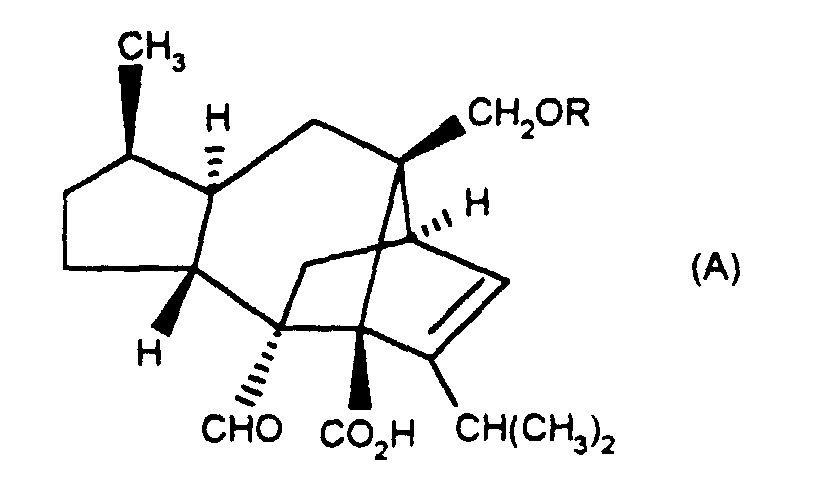 describes sordarin;
OR as OH describes sordaricin; and
OR asdescribes zofimarin.
- Although sordarin and zofimarin exhibit antifungal activity, both compounds are only moderately active and have limited spectra of action when tested against a battery of fungal organisms. We now describe hereinafter a novel group of fungicidal sordarin derivatives which exhibit excellent antifungal activity and a broad spectrum of action. Thus, according to a first aspect of the present invention, we provide compounds of formula (I)and pharmaceutically acceptable salts and solvates (e.g. hydrates) or metabolically labile derivatives thereof,
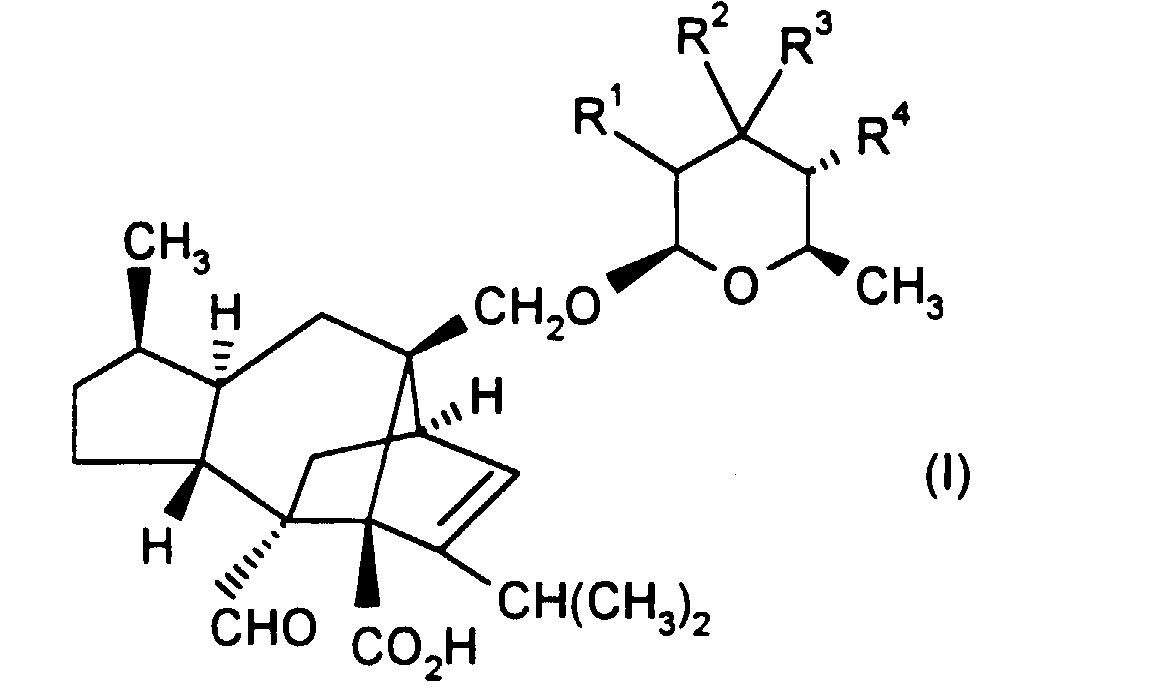
wherein R1 represents hydrogen, halogen, hydroxyl or C1-4alkoxy; - R2 represents hydrogen, halogen, hydroxyl, C1-10alkoxy, C1-10alkylthio,
C1-6alkoxyC1-4alkoxy, arylC1-6alkyloxy, arylC3-6alkenyloxy, azido, NR5COR5
(where each R5 is independently hydrogen or C1-6alkyl), OR6 (where R6 is a
cyclic ether containing 4 to 8 atoms linked to the oxygen atom via a ring
carbon atom adjacent to the ring oxygen atom) or a
group
where Y is oxygen, sulphur or NH, X is either a bond, an oxygen atom or a moiety NR8 in which R8 is hydrogen or C1-6alkyl, and R7 is C1-10alkyl optionally containing one or two double bonds, aryl, arylC1-4alkyl, arylC2-4alkenyl, haloC1-6alkyl or C1-6alkoxyC1-4alkyl), and R3 represents hydrogen, or R2 and R3 may together with the carbon atom to which they are attached represent C=O or C=NOR9 (where R9 is C1-6alkyl); and

- R4 represents hydroxyl, C1-6alkoxy or
(where R7 is as defined above); with the proviso that when R1 represents a hydroxyl group in the axial configuration and R4 is methoxy then R2 cannot represent a group in the axial configuration selected from hydroxyl and OCOCH=ZCH-CH=ECHCH3.
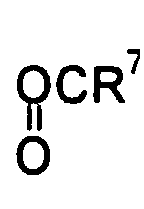
-
- Suitable pharmaceutically acceptable salts of the compounds of formula (I) include inorganic base salts such as alkali metal salts (for example sodium and potassium salts) and ammonium salts and organic base salts. Suitable organic base salts include amine salts such as trialkylamine (e.g. triethylamine), dialkylamine (e.g. dicyclohexylamine), optionally substituted benzylamine (e.g. phenylbenzylamine or p-bromobenzylamine), procaine, ethanolamine, diethanolamine, N-methylglucosamine and tri(hydroxymethyl)methylamine salts and amino acid salts (e.g. lysine and arginine salts).
- References hereinafter to a compound of formula (I) includes that compound and its pharmaceutically acceptable salts.
- Other salts which are not pharmaceutically acceptable may be useful in the preparation of compounds of formula (I) and these form a further aspect of the invention.
- Metabolically labile derivatives of compounds of formula (I) are compounds which are converted in the body into compounds of formula (1). Examples of such derivatives include conventional metabolically labile esters formed from the free carboxylic acid in the molecule.
- It is to be understood that the present invention encompasses any individual isomers, including optical isomers, of compounds represented by formula (I) above as well as mixtures thereof, including wholly or partially racemic mixtures thereof.
- As used herein, the term "alkyl" as a group or part of a group means a straight or branched chain alkyl moiety comprising, for example, 1 to 8 carbon atoms. Suitable examples include methyl, ethyl, n-propyl, i-propyl, n-butyl, s-butyl, t-butyl, n-hexyl and n-octyl.
- As used herein, the term "aryl" as a group or part of a group means phenyl or heteroaryl each optionally substituted by one or more (e.g. 1, 2 or 3) atoms or groups selected from halogen, hydroxyl, C1-6alkyl, C1-6alkoxy or C1-4alkoxycarbonyl. The heteroaryl group may be a 5- or 6-membered heteroaromatic ring containing one or more heteroatoms selected from nitrogen, oxygen and sulphur. Suitable examples of heteroaryl groups include pyridyl, furyl, thienyl and pyrrolyl.
- The term "halogen" or "halo" means herein fluorine, chlorine, bromine or iodine.
- A haloC1-6alkyl group within R7 means a C1-6alkyl group containing one or more (e.g. 1, 2 or 3) halogen atoms.
- When R1 represents a C1-4alkoxy group it may be, for example, a methoxy group. R1 may particularly represent hydrogen, fluorine, hydroxyl or methoxy.
- When R1 is a halogen atom or a hydroxyl or C1-4alkoxy group, the R1 moiety is preferably sited in the axial configuration. Particularly preferred are compounds of formula (I) in which R1 is hydrogen or hydroxyl (especially when sited in the axial configuration).
- Examples of the group R2 include halogen (e.g. fluorine), C1-10alkoxy (for example a C1-6alkoxy group such as methoxy, ethoxy, n-propoxy or n-hexyloxy), C1-6alkylthio (for example a C1-4alkylthio group such as methylthio), C1-4alkoxyC1-4alkoxy (for example a C1-4alkoxymethoxy group such as methoxymethoxy), arylC1-4alkyloxy (for example a phenylC1-4alkyloxy group such as benzyloxy), phenylC3-6alkenyloxy (for example OCH2CH=ECHPh), azido, NR5COR5 (where each R5 is independently hydrogen or a C1-4alkyl group such as methyl), OR6 (where R6 is, for example, a 2-tetrahydropyranyl group), OCOR7 where R7 is C1-10alkyl (e.g. methyl, ethyl, n-propyl, i-propyl, n-butyl, s-butyl, t-butyl, 1-methylpentyl or n-heptyl), C2-10alkyl containing one or two double bonds (for example a C3alkenyl group such as -C(CH3)=CH2, a C6alkenyl group such as -C(CH3)=C(CH2)2CH3 or a C5diene such as -CH=ZCH-CH=ECHCH3), aryl (e.g. phenyl or p-tolyl), arylC1-4alkyl (for example an arylmethyl group such as benzyl), arylC2-4alkenyl (for example an arylethenyl group such as PhCH=CH-), monohaloC1-4alkyl (for example a halopropyl group such as 3-chloropropyl), C1-6alkoxymethoxy (e.g. methoxymethoxy or n-butoxymethoxy), OCO2R7 where R7 is C1-10alkyl (e.g. n-octyl),where R7 is C1-10 alkyl (for example methyl or n-octyl) or arylC1-4alkyl (for example an arylmethyl group such as benzyl) and R8 is hydrogen or C1-4alkyl (e.g. methyl), NHCO2R7 where R7 is C1-6alkyl e.g. t-butyl or SCOR7 where R7 is C1-6alkyl e.g. methyl.
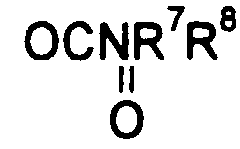
- Alternatively, CR2R3 may represent, for example, C=O or C=NOR9 (where R9 is a C1-4alkyl group, e.g. n-propyl).
- R4 may particularly represent a C1-4alkoxy group such as methoxy or n-propoxy.
- A particular group of compounds of the invention are compounds of formula (la)and pharmaceutically acceptable salts and solvates (e.g. hydrates) thereof, wherein R1 to R4 are as defined in formula (I) above.
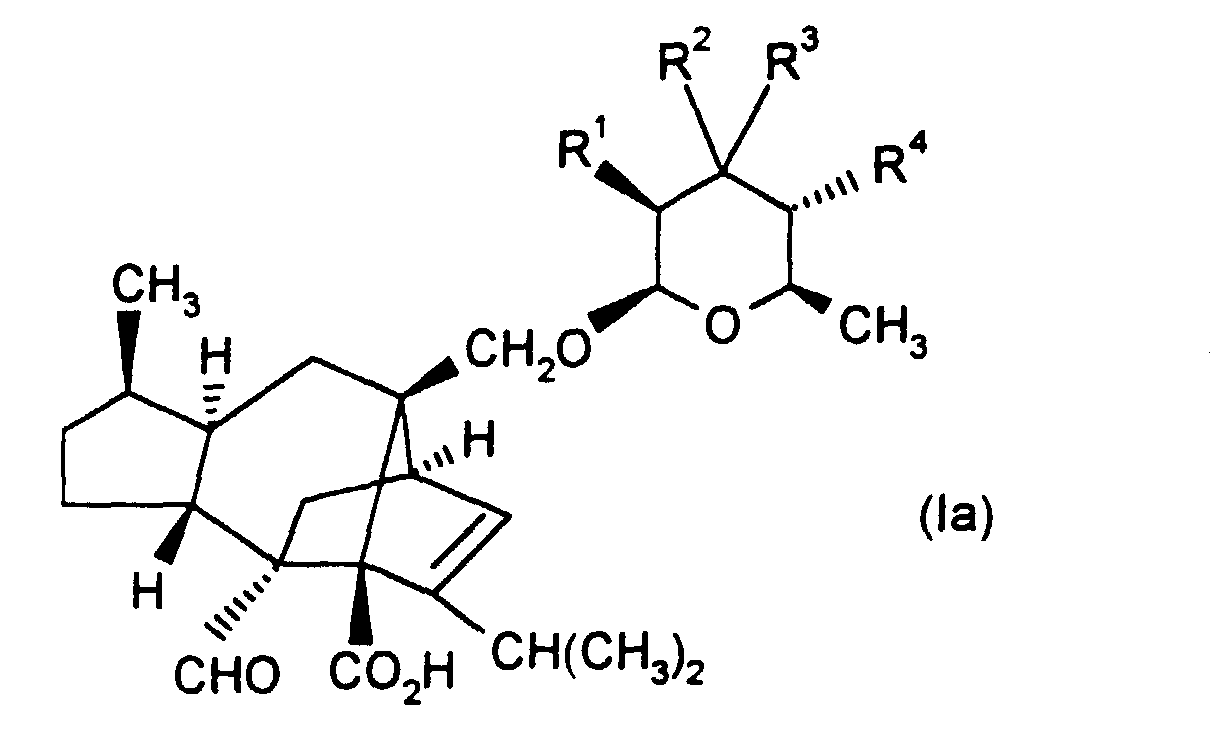
- Preferred compounds of the invention are those compounds of formula (I) or (Ia) in which R1 represents hydrogen or hydroxyl.
- Further preferred compounds are those in which R2 is in the axial configuration and R3 is hydrogen. Particular R2 groups include C1-6alkoxy, e.g. C1-4alkoxy such as methoxy or propoxy, C1-4alkoxymethoxy e.g. methoxymethoxy, C1-6alkylthio (e.g. C1-4alkylthio such as methylthio) azido, or OCOR7 wherein R7 is as defined herein above or more particular C5-8 alkyl (e.g. n-heptyl, 1-methylpentyl), phenyl, p-tolyl, 2-phenylethenyl, 1-methylethenyl or 1-methylpent-1-enyl.
- Further preferred compounds are those in which R4 is C1-4alkoxy (e.g. methoxy or propoxy).
- Particularly preferred compounds are those wherein R1 is hydrogen and R2 is C1-4alkoxy or methoxymethoxy.
- Further particularly preferred compounds are those wherein R1 is hydroxyl and R2 is azido, C1-4alkylthio e.g. thiomethyl, or OCOR7 wherein R7 is C5-8alkyl, phenyl, tolyl, 2-phenylethenyl, 1-methylethenyl or 1-methylpent-1-enyl.
- It is to be understood that the present invention covers all combinations of particular and preferred groups described hereinabove.
- The compounds of formula (I) are very active fungicides useful in combatting fungal infections in animals, including humans. For example, they may be used in the treatment of fungal infections caused by organisms such as species of Candida (e.g. Candida albicans, Candida glabrata, (Torulopsis glabrata), Candida tropicalis, Candida parapsilosis and Candida pseudotropicalis), Cryptococcus neoformans, Pneumocystis carinii, Arpergillus Sp (e.g. Aspergillus flavus and Aspergillus fumigatus), Coccidioides (e.g. Coccidioides immitis), Paracoccidioides (e.g. Paracoccidioides brasiliensis), Histoplasma (e.g. Histoplasma capsulatum) or Blastomyces (e.g. Blastomyces dermatitidis). They may also be used to treat other fungal infections caused by species of Candida, Trichophyton, Microsporum or Epidermophyton (e.g. Trichophyton mentographytes, Trichophyton rubrum, Microsporum canis or Epidermophyton floccosum), or in mucosal infections caused by Candida albicans.
- Compounds of formula (I) may also be used to treat other infections caused by species of filamentous fungi such as Geotrichum (e.g. Geotrichum clavatum), Trichosporon (e.g. Trichosporon beigelii), Blastoschizomyces (e.g. Blastoschizomyces capitatus), Sporothrix (e.g. Sporothrix schenckii), Scedosporium (e.g. Scedosporium apiosperum), Cladosporium (e.g. Cladosporium carrionii) and Pityrosporum ovale.
- The compounds of formula (I) may also be used to treat infections caused by protozoa such as Toxoplasma, Cryptosporidium, Leishmania, Tripanosoma, Giardia and Trichomonas.
- The in vitro evaluation of the anti-fungal activity of compounds of the invention was performed on liquid or solid medium by the anti-fungal two-fold serial dilution technique of determining the minimum inhibitory concentration (MIC) of anti-fungal agent that inhibited development of growth after 24 to 48 hours of incubation at 37°C. In practice, a series of agar plates or broth microdilution panels containing two-fold dilutions of anti-fungal agent tested were inoculated with a standard culture of a clinically relevant pathogen, for example, candida albicans. The agar plates or broth microdulution panels were then examined for the presence or absence of growth of the fungus and the appropriate MIC values were noted.
- MFC values (defined as the lowest anti-fungal concentration that killed at least 99.9% of the initial inoculum in liquid medium) may also be determined by sub-culturing 0.01 and 0.1µl of broth from the drug-free control well, the first well containing growth and each clear well on agar plates.
- The in vivo evaluation of compounds of formula (I) can be carried out at a series of dose levels by administration (e.g. subcutaneously, orally, intraperitoneally or intravenously) to mice or rats inoculated with a strain of Candida albicans. Untreated animals die within 3 to 9 days and the dose level at which the test compound provides 50% protection against the lethal effect of the infection is noted.
- In view of their antifungal activity, compounds of formula (I) recommend themselves for the treatment of a variety of fungal infections in human beings and animals. Such infections include superficial, cutaneous, subcutaneous and systemic mycotic infections such as respiratory tract infections, gastrointestinal tract infections, cardiovascular infections, urinary tract infections, CNS infections, candidiasis and chronic mucocandidiasis (e.g. thrush and vaginal candidiasis) and skin infections caused by fungi, cutaneous and mucocutaneous candidiasis, dermatophytoses including ringworm and tinea infections, athletes foot, paronychia, pityriasis versicolor, erythrasma, intertrigo, fungal nappy rash, candida vulvitis, candida balanitis and otitis externa. They may also be used as prophylactic agents to prevent systemic and topical fungal infections. Use as prophylactic agents may, for example, be appropriate as part of a selective gut decontamination regimen in the prevention of infection in immunocompromised patients (e.g. AIDS patients, patients receiving cancer therapy or transplant patients). Prevention of fungal overgrowth during antibiotic treatment may also be desirable in some disease syndromes or iatrogenic states.
- While it is possible that, for use in therapy, compounds of the invention may be administered as the raw chemical, it is preferable to present the active ingredient as a pharmaceutical formulation. The invention thus further provides a pharmaceutical formulation comprising compounds of formula (I) and physiologically acceptable salts thereof together with one or more pharmaceutically acceptable carriers thereof and, optionally, other therapeutic and/or prophylactic ingredients. The carrier(s) must be 'acceptable' in the sense of being compatible with the other ingredients of the formulation and not deleterious to the recipient thereof.
- The compositions of the invention include those in a form especially formulated for oral, buccal, parenteral, implant, rectal, topical, ophthalmic or genito-urinary administration or in a form suitable for administration by inhalation or insufflation.
- Tablets and capsules for oral administration may contain conventional excipients such as binding agents, for example, syrup, acacia, gelatin, sorbitol, tragacanth, mucilage of starch or polyvinylpyrrolidone; fillers, for example, lactose, sugar, microcrystalline cellulose, maize-starch, calcium phosphate or sorbitol; lubricants, for example, magnesium stearate, stearic acid, talc, polyethylene glycol or silica; disintegrants, for example, potato starch or sodium starch glycollate or crosscarmellose sodium; or wetting agents such as sodium lauryl sulphate. The tablets which include chewable, dispersible or effervescent tablets may be coated according to methods well known in the art. Oral liquid preparations may be in the form of, for example, aqueous or oily suspensions, solutions, emulsions, syrups or elixirs, or may be presented as a dry product for constitution with water or other suitable vehicle before use. Such liquid preparations may contain conventional additives such as suspending agents, for example, sorbitol syrup, methyl cellulose, glucose/sugar syrup, gelatin, hydroxyethylcellulose, carboxymethyl cellulose, aluminium stearate gel or hydrogenated edible fats; emulsifying agents, for example, lecithin, sorbitan mono-oleate or acacia; non-aqueous vehicles (which may include edible oils), for example, almond oil, fractionated coconut oil, oily esters, propylene glycol or ethyl alcohol; and preservatives, for example, methyl or propyl p-hydroxybenzoates or sorbic acid.
- For buccal administration the composition may take the form of tablets or lozenges formulated in conventional manner.
- The composition according to the invention may be formulated for parenteral administration by injection or continuous infusion. Formulations for injection may be presented in unit dose form in ampoules, or in multi-dose containers with an added preservative. The compositions may take such forms as suspensions, solutions, or emulsions in oily or aqueous vehicles, and may contain formulatory agents such as suspending, stabilising and/or dispersing agents. Altematively the active ingredient may be in powder form for constitution with a suitable vehicle, e.g. sterile, pyrogen-free water, before use.
- For administration by inhalation the compositions according to the invention are conveniently delivered in the form of an aerosol spray presentation from pressurised packs with the use of a suitable propellant, e.g. dichlorodifluoromethane, trichlorofluoromethane, dichlorotetrafluoroethane, carbon dioxide or other suitable gas, or from a nebuliser. In the case of a pressurised aerosol the dosage unit may be determined by providing a valve to deliver a metered amount.
- Alternatively, for administration by inhalation the compositions according to the invention may take the form of a dry powder composition, for example a powder mix of the compound and a suitable powder base such as lactose or starch or as a modified physical form of the drug substance alone. The powder composition may be presented in unit dosage form in, for example, capsules or cartridges of e.g. gelatin, or blister packs from which the powder may be administered with the aid of an inhaler or insufflator.
- The compositions may take the form of a suppository, e.g. containing a conventional suppository base, or a pessary, e.g. containing a conventional pessary base.
- The compositions may also be formulated for topical administration in the form of ointments, creams, gels, lotions, shampoos, powders (including spray powders), pessaries, tampons, sprays, dips, aerosols, drops (e.g. eye, ear or nose drops) or pour-ons. Ointments and creams may, for example, be formulated with an aqueous or oily base with the addition of suitable thickening and/or gelling agents. Ointments for administration to the eye may be manufactured in a sterile manner using sterilised components. Pour-ons may, for example, be formulated for veterinary use in oils containing organic solvents, optionally with formulatory agents, e.g. stabilising and solubilising agents. Pessaries and tampons for vaginal insertion may be formulated using conventional techniques and, where appropriate, may contain an effervescent vehicle. Such compositions may also contain other active ingredients such as corticosteroids, antibiotics or antiparasitics as appropriate.
- Liquid preparations for intranasal delivery may take the form of solutions or suspensions and may contain conventional excipients such as tonicity adjusting agents, for example, sodium chloride, dextrose or mannitol; preservatives, for example benzalkonium chloride, thiomersal, phenylethyl alcohol; and other formulating agents such as suspending, buffering, stabilising, dispersing and or flavouring agents.
- Transdermal administration may be affected by the design of a suitable system which promotes absorption of the active compound through the skin and would typically consist of a base formulation enclosed within an adhesive stick-on patch comprising backing films, membranes and release liners. Such systems may include absorption enhancers such as alcohols or work by promoting ionotophoresis.
- The composition according to the invention may also be formulated as a depot preparation. Such long acting formulations may be administered by implantation (for example subcutaneously or intramuscularly) or by intramuscular injection. Thus, for example, a compound of the invention may be formulated with suitable polymeric or hydrophobic materials (for example as an emulsion in an acceptable oil) or ion exchange resins, or as sparingly soluble derivatives, for example, as a sparingly soluble salt.
- When the compositions comprise dosage units, each unit will preferably contain 0.001mg to 1000mg, advantageously 0.01mg to 400mg, of active ingredient where a compound of the invention is to be administered orally. The daily dosage as employed for adult human treatment will preferably range from 0.001mg to 5000mg of active ingredient, most preferably from 0.01 mg to 2000mg which may be administered in 1 to 4 daily doses, for example, depending on the route of administration and on the condition of the patient and the disease to be treated.
- The compound may be administered by intravenous infusion using, for example, up to 50mg/kg/day of the active ingredient. The duration of treatment will be dictated by the rate of response rather than by arbitrary numbers of days.
- Compounds of the invention may also be used in combination with other therapeutic agents, and the invention thus provides, in a further aspect, a combination comprising a compound of the invention together with another therapeutically active agent.
- Thus for example the compounds of the invention may be used in combination with one or more other antifungal agents, such as a polienic derivative e.g. (Amphotericin B, Nystatin, a lipid formulation of Amphotericin B) an azole derivative e.g. (Fluconazole, Intraconazole, Ketoconazole, Miconazole, Clotrimazole, ZD-08070, UK-109496), 5-Fluorocytosine, a Pneumocandin or Echinocandin derivative such as Cilofungin, LY-303366, L-733560, and/or one or more immunomodulating agents such as an interferon e.g. (IFN-γ), interleukine e.g. (IL-1, IL-2, IL-3 and IL-8) and colony stimulating factors, [(G)-CSF, (M)-CSF and (GM)-CSF] and defensines. Particularly advantageous compounds for use with compounds of the invention include Intraconazole, Flucytosine, Fluconazole or Amphotericin B.
- When the compounds of the invention are administered in combination with another antifungal agent the compounds of the invention and the other fungal agent can be administered at the recommended maximum clinical dosage or at lower doses.
- The combinations referred to above may conveniently be presented for use in the form of a pharmaceutical formulation and thus pharmaceutical formulations comprising a combination as defined above together with a pharmaceutically acceptable carrier thereof comprise a further aspect of the invention. The individual components of such combinations may be administered either sequentially or simultaneously in separate or combined pharmaceutical formulations.
- When a compound of the invention is used in combination with a second therapeutic agent against the same condition the dose of each compound may differ from that when the compound is used alone. Appropriate doses will be readily appreciated by those skilled in the art.
- According to another aspect of the present invention, we provide a compound of formula (I) or a physiologically acceptable salt thereof or a pharmaceutical composition comprising a compound of formula (I) or a physiologically acceptable salt thereof as defined above for use in therapy, particularly for the treatment of fungal infections in animals (especially humans).
- According to another aspect of the present invention, we provide the use of a compound of formula (I) or a physiologically acceptable salt thereof in the manufacture of a medicament for the treatment of fungal infections in a human or non-human animal patient.
- According to a further aspect of the present invention, we provide a method of treatment of the human or non-human animal body to combat fungal diseases, which method comprises administering to said body an effective amount of a compound of formula (I) or a physiologically acceptable salt thereof.
- It will be appreciated by those skilled in the art that references herein to treatment extend to prophylaxis as well as the treatment of established conditions or infections.
- The compounds of the invention may be prepared by the processes described below.
- Thus, a general process (A) for the preparation of a compound of formula (I) comprises reacting a compound of formula (II)(in which R1a is as defined for R1 in formula (I) above or is a protected hydroxyl group, R4a is as defined for R4 in formula (I) above or is a protected hydroxyl group, A is a group CHO or a protected derivative thereof and Rp is hydrogen or a carboxyl protecting group) to replace one or more of the free hydroxyl groups with one or more of R1, R2/R3 and R4, followed by the removal of any protecting groups present.

- A first embodiment of process (A) comprises alkylating or alkenylating a compound of formula (II), followed by the removal of any protecting groups present to provide a compound of formula (I) in which R2 is C1-10alkoxy, C1-6alkoxyC1-4alkoxy, arylC1-6alkyloxy, arylC3-6alkenyloxy or OR6 and R1a and R4a are as defined for R1 and R4 in formula (I) above. It will be appreciated that by using appropriate alkylation and alkenylation conditions and protecting groups where necessary, one is able to selectively alkylate or alkenylate the relevant free hydroxyl group(s) without affecting any other labile groups present in a compound of formula (II).
- The alkylation or alkenylation reaction may be effected using standard methodology, for example by treating a compound of formula (II) with a strong base such as an alkali metal hydride (e.g. sodium hydride) in a solvent such as an ether (e.g. tetrahydrofuran), followed by the addition of a suitable alkyl or alkenyl halide, optionally in the presence of a tetraalkylammonium halide (e.g. tetra-n-butylammonium fluoride or iodide). The reaction may conveniently be effected at any suitable temperature, for example from room temperature to the reflux temperature of the solvent.
- Alternatively, the reaction may be carried out by treating a compound of formula (II) with a tin oxide (e.g. dibutyltin oxide) in a hydrocarbon solvent (e.g. refluxing toluene), followed by the addition of an alkylhalide and a fluoride salt (e.g. tetra-n-butylammonium fluoride) in a suitable solvent such as an ether (e.g. tetrahydrofuran), and heating the mixture in the range of about 30° to 80°C.
- The introduction of a C1-6alkoxyC1-6alkyl group may conveniently be effected using somewhat milder condition than those conditions described above. Thus, for example, a compound of formula (II) may be treated with a suitable alkoxyalkyl halide in the presence of a mild base such as a tertiary amine (e.g. diisopropylethylamine) at a temperature in the range of about 0° to 40°C. The base may also conveniently be the solvent for the reaction.
- The introduction of a group R6 may conveniently be effected by treating a compound of formula (II) with a cyclic ether containing one double bond in the ring 2,3-position. The reaction may conveniently be effected in a suitable solvent such as a halogenated hydrocarbon (e.g. dichloromethane) in the presence of a mild acid such as pyridinium p-toluenesulphonate at about room temperature.
- According to a further embodiment of process (A), a compound of formula (I) in which R2 represents a groupmay be prepared by treating a suitably protected compound of formula (II) with an acylating agent, followed by the removal of any protecting groups present. Thus, when X represents a bond or an oxygen atom, the acylation reaction may be effected using any conventional method. For example, one method for preparing compounds in which X is a bond comprises treating a compound of formula (II) with a carboxylic acid R7CO2H in the presence of an activating agent such as dicyclohexylcarbodiimide and a suitable base such as 4-dimethylaminopyridine in a solvent such as a halogenated hydrocarbon (e.g. dichloromethane) at about room temperature. Alternatively, the reaction with a carboxylic acid R7CO2H may be effected in the presence of 2-chloro-1-methylpyridinium iodide and a suitable base system such as 4-dimethylaminopyridine optionally also comprising a tertiary amine such as triethylamine, conveniently in a halogenated hydrocarbon solvent (e.g. dichloromethane) at a temperature of from about 20° to the reflux temperature of the solvent. An activated acid such as a carboxylic acid halide (for example a carboxylic acid chloride R7COCl) or a carboxylic anhydride such as acetic anhydride may also be used, whereby the acylation may be effected either by directly reacting a compound of formula (II) with the acid halide in the presence of a suitable base such as 4-dimethylaminopyridine, pyridine or a trialkylamine (e.g. triethylamine) or a mixture of suitable bases in a suitable solvent such as acetonitrile or dichloromethane or by addition of the acid halide (R7CO)2O following pre-treatment of a compound of formula (II) with a tin oxide (e.g. dibutyltin oxide) in a hydrocarbon solvent (e.g. refluxing toluene). Similar conditions using a haloformate (for example a chloroformate R7OCOCI) may conveniently provide compounds in which R2 represents OCO2R7.
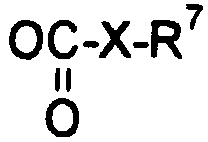
- When X represents NH, the acylation reaction may conveniently be effected using a suitable isocyanate R7NCO in the presence of a tin catalyst (e.g. a dialkyltin diacetate such as dibutyltin diacetate) and in a solvent such as an aromatic hydrocarbon (e.g. toluene) conveniently under reflux.
- When X represents NAlkyl, the acylation reaction may conveniently be effected using a reagent HalCONR7R8 (where Hal is a halogen atom, e.g. chlorine) in the presence of a strong base such as an alkali metal amide (e.g. lithium diisopropylamide) and in a solvent such as an ether (e.g. tetrahydrofuran) conveniently at a temperature in the range of about 0°C to room temperature.
- In another embodiment of process (A), a compound of formula (I) in which R1 is hydroxyl and R2 is azido or C1-10alkylthio may be prepared from a compound of formula (II) in which R1a is hydroxyl, R4a is C1-6alkoxy, A is a group CHO or a protected derivative thereof and Rp is a carboxyl protecting group via a compound of formula (III) or (IV)
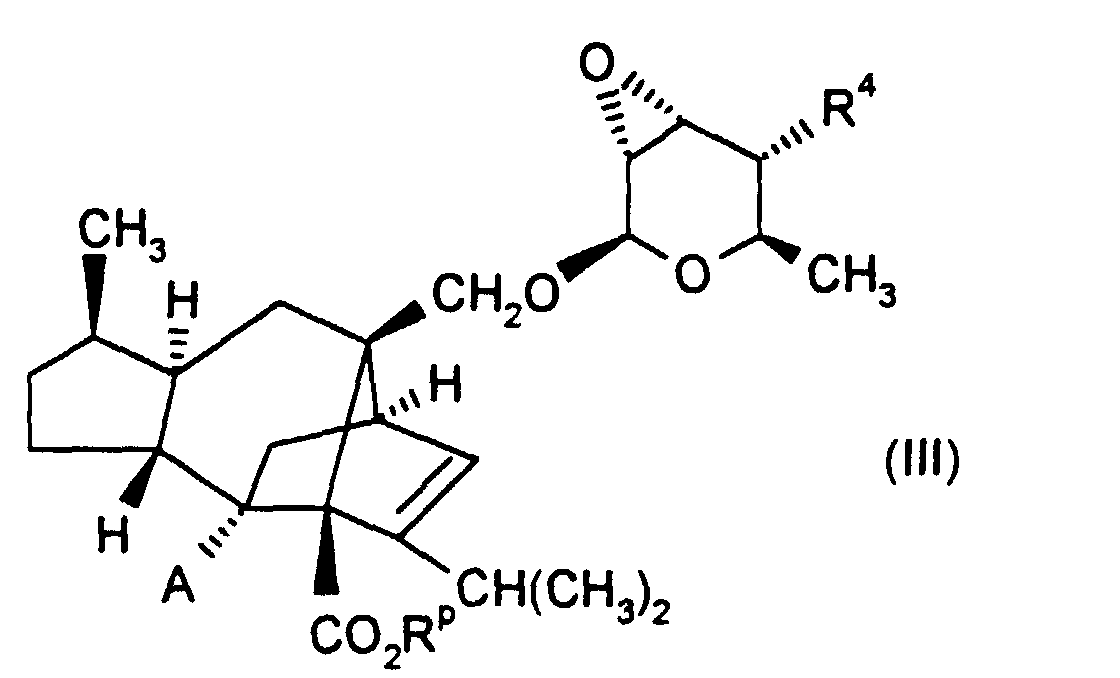 (wherein A and Rp are as defined just above and R4 is C1-6alkoxy, e.g. methoxy), followed by the removal of any protecting groups present.
- The nucleophilic ring opening of the epoxide in (III) or (IV) may conveniently be effected by the addition of an alkali metal azide (e.g. lithium azide) or an alkali metal thioalkoxide (e.g. sodium thiomethoxide) in a suitable solvent such as dimethylformamide. The reaction with an azide may conveniently be effected at an elevated temperature, for example within the range of about 80° to 120°C. The reaction with a thioalkoxide may conveniently be effected at about room temperature. It will be appreciated that the nucleophilic ring opening reaction provides compounds in which the R1 hydroxyl group is in the opposite plane to the R2 azido or C1-10alkylthio group. The particular configuration will depend upon the choice of a compound of formula (III) or (IV) as the starting material.
- In a further embodiment of process (A), a compound of formula (I) in which R1 and R2 both represent hydrogen atoms may conveniently be prepared from a suitably protected compound of formula (II) in which R1a is a hydroxyl group by treating said compound with a reducing system capable of converting the 2', 3'-diol group to a 2',3'-ene group and thereafter hydrogenating the unsaturated compound in the presence of a palladium catalyst (e.g. palladium-on-carbon), followed, where necessary, by the removal of any protecting groups remaining. The initial reaction may conveniently be effected by treating the diol with zinc and iodine following the addition of a triarylphosphine (e.g. triphenylphosphine) and imidazole. The reaction may be carried out, for example, in a solvent such as refluxing toluene.
- Compounds of formulae (III) and (IV) may conveniently be prepared treating a compound of formula (II) in which R1a is hydroxyl, R4a is C1-6alkoxy, A is a group CHO or a protected derivative hereof and Rp is a carboxyl protecting group to convert the free hydroxyl groups to leaving groups such as alkyl- or arylsulphonyloxy groups followed by treatment with a strong base such as an alkali metal hydride (e.g. sodium hydride) in a suitable solvent such as dimethylformamide, conveniently at about room temperature. Alternatively, sodium in an alcoholic solvent (e.g. methanol) may be used to form the epoxide ring. In this instance the base system is added to a solution of the reactive intermediate in a suitable solvent such as a halogenated hydrocarbon (e.g. dichloromethane) and the reaction conveniently carried out at a temperature of from about room temperature to reflux. The reaction provides a mixture of compounds of formulae (III) and (IV) which may conveniently be separated by flash column chromatography.
- The conversion of the free hydroxyl groups in appropriate compounds of formula (II) to leaving groups may be effected using conventional methodology. Thus, for example, alkyl- or arylsulphonyloxy groups may be introduced by reaction with an alkyl- or arylsulphonyl halide in the presence of a suitable solvent such as a halogenated hydrocarbon (e.g. dichloromethane) and optionally also comprising an amine base (e.g. 4-dimethylaminopyridine). The reaction may conveniently be carried out at about room temperature.
- According to a further embodiment of process (A), one or more free hydroxyl groups in a compound of formula (II) may be converted to a halogen atom using conventional displacement methods. Thus, for example, replacement with iodine may conveniently be effected by treatment with iodine in the presence of triphenylphosphine and imidazole in a suitable solvent such as an aromatic hydrocarbon (e.g. toluene) at an elevated temperature, for example under reflux. Replacement with fluorine may conveniently be effected by treatment with a suitable fluorinating agent such as diethylaminosulfur trifluoride (DAST) in the presence of a solvent such as a halogenated hydrocarbon (e.g. dichloromethane) or an aromatic hydrocarbon (e.g. toluene). The reaction may conveniently be effected about room temperature.
- Another embodiment of process (A) comprises oxidising a compound of formula (II) followed by the removal of any protecting groups present to provide a compound of formula (I) in which CR2R3 represents C=O. The oxidation reaction may conveniently be effected using a suitable oxidising agent such as dimethylsulfoxide in the presence of trifluoroacetic anhydride. The oxidation conveniently taken place in the presence of a suitable solvent such as a halogenated hydrocarbon (e.g. dichloromethane), optionally comprising a suitable amine base (e.g. triethylamine), at a reduced temperature (e.g. from about -78° to 0°C).
- Another general process (B) comprises an interconversion reaction wherein a compound of formula (I) is prepared from a different compound of formula (I) or a protected derivative thereof.
- According to a first embodiment of process (B), a protected derivative of a compound of formula (I) in which R2 is azido may be converted to a compound of formula (I) in which R2 is NR5COR5. The R2 conversion may conveniently be effected by reducing the azido group to NH2 by hydrogenation, for example in the presence of a suitable palladium catalyst (e.g. palladium on charcoal), and then acylating the amine under conventional conditions, for example by addition of a carboxylic acid anhydride in the presence of a suitable base (e.g. pyridine), followed, when R5 is C1-6alkyl, by alkylation by treating the amide with a suitable base (e.g. sodium hydride) in a solvent such as an ether (e.g. tetrahydrofuran) and then adding a suitable alkylating agent such as an alkyl halide.
- In another embodiment of process (B), a compound of formula (I) in which R2 is an azido group or the group SCOR7 may be prepared by treating a protected derivative of a corresponding compound of formula (I) in which R2 is a halogen atom (e.g. iodine) with an alkali metal azide (e.g. lithium azide) or a salt e.g. sodium or cesium salt of the thiocarboxylic acid R7COSH in a solvent such as dimethylformamide at an elevated temperature (e.g. 50° to 120°C), followed by the removal of any protecting groups present.
- A further embodiment of process (B) comprises reducing a compound of formula (I) in which R2 is a halogen atom (e.g. iodine) to provide, following the removal of any protecting groups present, a corresponding compound of formula (I) in which R2 is hydrogen. The reduction may conveniently be effected using a suitable reducing agent such as a tin hydride (e.g. a trialkyltin hydride such as tributyltin hydride) in the presence of an activating agent such as azobis (isobutyronitrile) in a solvent such as refluxing toluene.
- A further embodiment of process (B) comprises alkylating a protected derivative of a corresponding compound of formula (I) in which R1 and/or R4 is hydroxyl under the conditions described in the first embodiment of process (A) hereinabove.
- In a further embodiment of process (B), a compound of formula (I) in which CR2R3 is a group C=NOR9 may be prepared by treating a protected derivative of a corresponding compound of formula (I) in which CR2R3 is C=O with a reagent R9ONH2 or a salt thereof (e.g. the hydrochloride salt) in a suitable solvent (e.g. pyridine) at an elevated temperature (e.g. from about 60° to 100°C), followed by the removal of any protecting groups present.
- In any of the aforementioned procedures where an alkyl moiety is introduced as a group or part of a group, it may be appropriate to first introduce the corresponding unsaturated moiety and thereafter reduce the alkenyl group to the desired alkyl group, for example by hydrogenation in the presence of a palladium catalyst (e.g. 10% palladium on charcoal) at about room temperature.
- Many of the above-mentioned procedures require the removal of one or more protecting groups as a final step to provide the desired compound of formula (I). Thus, a further general process (C) comprises deprotecting a protected derivative of a compound of formula (I). Suitable carboxyl protecting groups and hydroxyl protecting groups for use herein include any conventional protecting group, for example as described in "Protective Groups in Organic Chemistry", Ed. J. F. W. McOmie (Plenum Press, 1973) or "Protective Groups in Organic Synthesis" by Theodora W. Greene (John Wiley and Sons, 1991). Examples of suitable carboxyl protecting groups include aralkyl groups such as diphenylmethyl and silyl groups (e.g. trimethylsilylethyl). Examples of suitable hydroxyl protecting groups include arylalkyl groups such as p-methoxybenzyl, acyl groups such as acetyl and ester group such as 2,2,2-trichloroethoxycarbonyl or benzyloxycarbonyl. Aldehyde groups may conveniently be protected in the form of cyclic ketals.
- The protecting groups may be removed using conventional techniques. Thus, a diphenylmethyl group may conveniently be removed using trifluoroacetic acid or by hydrogenolysis in the presence of a palladium catalyst (e.g. 10% palladium on charcoal). Trifluoroacetic acid may conveniently be employed where other groups are present which are sensitive to hydrogenation. A p-methoxybenzyl group may conveniently be removed using 2,3-dichloro-5,6-dicyano-1,4-benzoquinone. Silyl groups such as trimethylsilylethyl may conveniently be removed using fluoride ions. Cyclic ketal groups may conveniently be converted to aldehyde group by the addition of a suitable acid such as hydrochloric acid. An acyl group such as acetyl may conveniently be removed under basic conditions, for example using an alkoxide (e.g. sodium methoxide). An ester group such as 2,2,2-trichloroethoxycarbonyl may conveniently be removed by adding zinc and potassium dihydrogen phosphate.
- Compounds of formula (II) may conveniently be prepared from sordarin or 4'-demethylsordarin, a comdound of formula (V)Thus, for example, compounds of formula (II) may be prepared from sordarin or 4'-demethylsordarin by appropriate protection using conventional methods as described above, followed where necessary by converting one or more of the hydroxyl groups to other groups specified in formula (II) above.
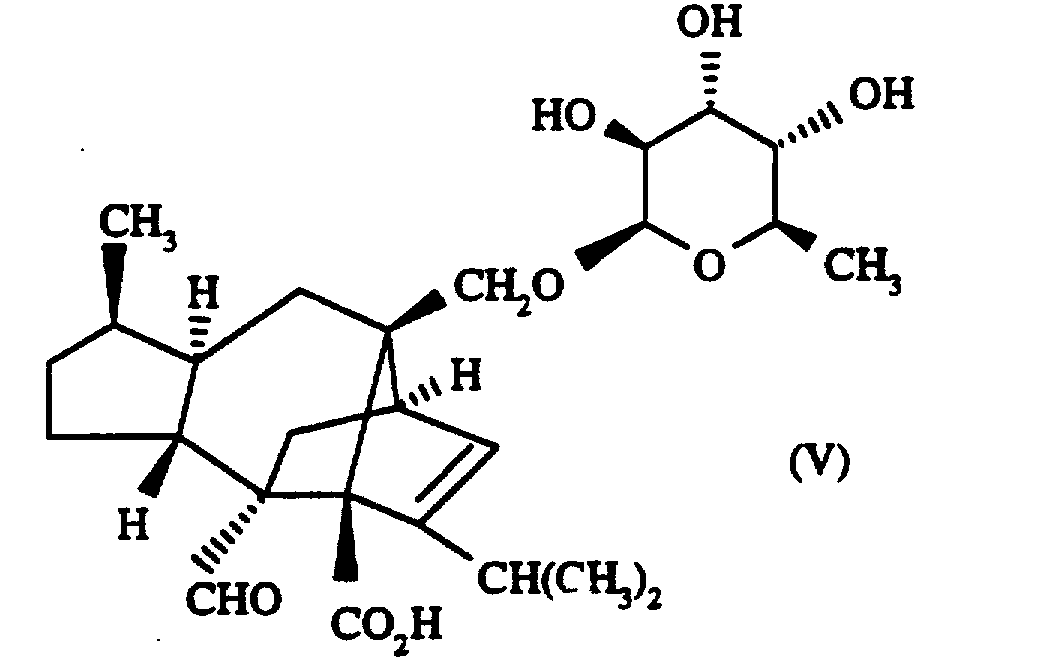
- When the carboxyl group in sordarin or a compound of formula (V) is protected with a diphenylmethyl group the protection reaction may conveniently be carried out by treating a solution of sordarin or a compound of formula (V) in an alcoholic solvent (e.g. methanol) or a halogenated hydrocarbon (e.g. dichloromethane) or a mixture of such solvents with diphenyldiazomethane, conveniently added as a solution in a halogenated hydrocarbon solvent (e.g. dichloromethane).
- When a hydroxyl group in a carboxyl protected derivative of sordarin or a compound of formula (V) is protected with a p-methoxybenzyl group this group may be introduced by reaction with a tin oxide (e.g. dibutyltin oxide) in a hydrocarbon solvent (e.g. refluxing toluene), followed by the addition of a p-methoxybenzyl halide in the presence of an fluoride salt (e.g. tetrabutylammonium fluoride). When protected with a benzyloxycarbonyl group, this group may be introduced by reaction with a benzylhaloformate in the presence of a suitable amine base such as 4-dimethylaminopyridine and in a solvent such as a halogenated hydrocarbon (e.g. dichloromethane) or acetonitrile.
- When R1a in a compound of formula (II) is hydrogen such compounds may conveniently be prepared from sordarin or 4'-demethylsordarin by appropriate protection of labile groups followed by removal of the 2'-hydroxyl group. Removal of the hydroxyl group to provide a compound in which R1a is hydrogen may conveniently be effected in two steps comprising (i) forming an S-alkyldithiocarbonate by treatment with a strong alkali metal base (e.g. sodium hydride), in the presence of imidazole, and in a suitable solvent such as an ether (e.g. tetrahydrofuran) at a reduced temperature (e.g. about 0°C), and then adding carbon disulphide and an alkylhalide (e.g. methyliodide) at about room temperature and (ii) removing this group by treating a solution of the intermediate compound in a hydrocarbon solvent (e.g. toluene) at an elevated temperature (e.g. about 80° to 120°C) with a hydride reducing agent (e.g. a trialkyltin hydride such as tributyltin hydride), optionally in the presence of an activating agent [e.g. azobis(isobutyronitrile)].
- Compounds of formulae (II), (III), (IV) and (V) are novel intermediates and form further individual aspects of the present invention. The compound of formula (V), 4'-demethylsordarin, represents a particular aspect of the present invention.
- Base salts of compounds of formula (I) may be conveniently formed by treating a compound of formula (I) with an appropriate salt or base. Thus, for example, salts may conveniently be prepared by treating a compound of formula (I) with a salt or a base selected from sodium or potassium hydroxide, hydrogen carbonate, carbonate or acetate (e.g. potassium hydroxide, potassium hydrogen carbonate, sodium hydrogen carbonate or potassium acetate), ammonium acetate, calcium acetate and L-lysine as appropriate. The salt may, for example, be prepared by adding the appropriate salt or base (if necessary as an aqueous solution) to a solution or suspension of the compound of formula (I) in a suitable solvent such as an alcohol (e.g. methanol) or dioxane at temperatures of for example 0°C to 80°C and conveniently at about room temperature.
- Pharmaceutically acceptable salts may also be prepared from other salts, including other pharmaceutically acceptable salts of the compounds of formula (I), using conventional methods.
- The novel compound of formula (V) may conveniently be prepared according to the fermentation process described hereinafter or by demethylating sordarin using a biotransformation procedure. It is to be understood that such processes for the preparation of the compound of formula (V) represent further aspects of the present invention.
- The fermentation process comprises cultivating a microorganism capable of producing the compound of formula (V) and thereafter isolating the compound of formula (V) from the culture.
- Microorganisms capable of producing the compound of formula (V) will conveniently be mutant strains of Sordaria araneosa which can be identified by screening survivors of mutagenesis by analysing a test sample obtained from fermentation of the microorganism using standard methodology. In particular, the microorganism to be conveniently used is a mutant strain of Sordaria araneosa deposited in the permanent culture collection of the CAB International Mycological Institute, Genetic Resource Reference Collection, Bakeham Lane, Egham, Surrey TW20 9TY, England. The strain was received by the Institute on 10 June, 1994 and was subsequently given the accession number IMI 362184 and dates of acceptance and confirmation of viability of 13 and 21 June, 1994 respectively. The Institute is an International Depository authority recognised under the Budapest Treaty. The characteristics thus far identified for IMI 362184 are given in Example 46.
- The present invention provides in a further aspect the microorganism IMI 362184 per se and mutants thereof.
- Mutants of the IMI 362184 may arise spontaneously or may be produced by a variety of methods including those outlined in Techniques for the Development of Microorganisms by H I Adler in "Radiation and Radioisotopes for Industrial Microorganisms", Proceedings of the Symposium, Vienna 1973, p241, International Atomic Energy authority. Such methods include ionising radiation, chemical methods, e.g. treatment with N-methyl-N'-nitro-N-nitrosoguanidine (NTG), heat, genetic techniques, such as recombination and transformation, and selective techniques for spontaneous mutants.
- The preparation of the compound of formula (V) by fermentation may be effected by conventional means i.e. by culturing a suitable organism in the presence of assimilable sources of carbon, nitrogen and mineral salts, and thereafter isolating the desired product.
- Assimilable sources of carbon, nitrogen and minerals may be provided by either simple or complex nutrients. Sources of carbon will generally include glucose, maltose, starch, glycerol, molasses, dextrin, lactose, sucrose, fructose, galactose, myo-inositol, D-mannitol, soya bean oil, carboxylic acids, amino acids, glycerides, alcohols, alkanes and vegetable oils. Sources of carbon will generally comprise from 0.5 to 10% by weight of the fermentation medium. Fructose, glucose and sucrose represent preferred sources of carbon.
- Sources of nitrogen will generally include soya bean meal, com steep liquors, distillers solubles, yeast extracts, cottonseed meal, peptones, ground nut meal, malt extract, molasses, casein, amino acid mixtures, ammonia (gas or solution), ammonium salts or nitrates. Urea and other amides may also be used. Sources of nitrogen will generally comprise from 0.1 to 10% by weight of the fermentation medium.
- Nutrient mineral salts which may be incorporated into the culture medium include the generally used salts capable of yielding sodium, potassium, ammonium, iron, magnesium, zinc, nickel, cobalt, manganese, vanadium, chromium, calcium, copper, molybdenum, boron, phosphate, sulphate, chloride and carbonate ions.
- Cultivation of the organism will generally be effected at a temperature of from 20° to 40°C, preferably from 20 to 35°C, especially about 25°C, and will desirably take place with aeration and agitation e.g. by shaking or stirring. The medium may initially be inoculated with a small quantity of mycelium and/or spores. The vegetative inoculum obtained may be transferred to the fermentation medium, or to one or more seed stages where further growth takes place before transfer to the principal fermentation medium. The fermentation will generally be carried out in the pH range 3.5 to 9.5, preferably 4.5 to 7.5. It may be necessary to add a base or an acid to the fermentation medium to keep the pH to within the desired range. Suitable bases which may be added include alkali metal hydroxides such as aqueous sodium hydroxide or potassium hydroxide. Suitable acids include mineral acids such as hydrochloric, sulphuric or phosphoric acid.
- The fermentation may be carried out for a period of 4-30 days, preferably about 5-15 days. An antifoam may be present to control excessive foaming and added at intervals as required. Carbon and/or nitrogen sources may also be fed into the fermentation medium as required.
- The compound of formula (V) is associated mainly with the cells and may be brought into solution either by addition of an acid and a water-miscible organic solvent, or more preferably by addition of a base (e.g. sodium hydroxide). Cells may be separated from these solutions either by centrifugation, conventional filtration or membrane filtration. The liquor may be optionally thereafter treated with an acid such as sulphuric acid until the pH is below 6 (e.g. about pH 4.5).
- The compound of formula (V) may be isolated and purified by a variety of fractionation techniques, for example adsorption-elution, precipitation, fractional crystallisation, solvent extraction and liquid-liquid partition which may be combined in various ways.
- Adsorption onto a solid support followed by elution has been found to be particularly suitable for isolating and purifying the compound of formula (V).
- Suitable solid supports include silica; a non-functional macroreticular adsorption resin, for example cross-linked styrene divinyl benzene polymer resins such as CG161 and Amberlite XAD-2, XAD-4, XAD-16 or XAD-l180 resins (Rohm & Haas Limited) or Kastell S112 (Montedison); a substituted styrene-divinyl benzene polymer such as Diaion SP207 (Mitsubishi); an anion exchanger [e.g. IRA-958 or MacroPrep High Q (BioRad)], an organic solvent-compatible cross-linked dextran such as Sephadex LH20 (Pharmacia UK Limited), or on reverse phase supports such as hydrocarbon linked silica, e.g. C18-linked silica.
- The compound of formula (V) may also be isolated and purified by the use of a liquid anion exchanger such as LA 2.
- Suitable solvents for the elution of the compound of formula (V) will, of course, depend on the nature of the absorbent. When using a polymer resin such as XAD-16 water-miscible solvents such as methanol, acetone, isopropanol or acetronitrile in various proportions in water may be particularly suitable.
- The presence of the compound of formula (V) during the extraction/isolation procedures may be monitored by conventional techniques such as high performance liquid chromatography (HPLC) or UV spectroscopy or by utilising the optical rotation or other property of the compound.
- Where the compound of formula (V) is obtained in the form of a solution in an organic solvent, for example after purification by absorption/elution, the solvent may be removed by conventional procedures, e.g. by evaporation, to yield the required compound. If desired, the compound may be further purified by chromatographic techniques such as countercurrent chromatography using a coil extracter such as a multi-layer coil extracter or high performance liquid chromatography or supercritical fluid chromatography on adsorbents such as carbon, alumina, vanadium, polymeric resins or silica, with or without bonded phases. Suitable solvents/eluents for the chromatographic purification/separation of the compound of formula (V) will of course depend on the nature of the adsorbent. When using a C8 bonded silica, mixtures of acetonitrile and water are particularly suitable. Alternatively, the compound may be further purified by solvent extraction, for example using an appropriate organic solvent such as a ketone (e.g. acetone or methyl ethyl ketone), a halogenated hydrocarbon, an alcohol (e.g. methanol), a diol (e.g. propane-1,2-diol or butane-1,3-diol) or an ester (e.g. methyl acetate or ethyl acetate). In a further altemative, solutions of compound (V) may be further purified by treatment with adsorbents that selectively remove impurities when added at appropriate levels (e.g. DEAE-cellulose) or by crystallisation (e.g. from a mixture of acetonitrile and water) or using a combination of the above procedures.
- The biotransformation of sordarin to 4'-demethylsordarin, the compound of formula (V), may be effected by incubating sordarin in a culture comprising a suitable organism and sources of carbon and nitrogen, including those sources specified hereinabove, and thereafter isolating the compound of formula (V) from the culture.
- Microorganisms capable of demethylating sordarin at the 4'-position may readily be identified by using a small scale test and analysing a test sample obtained using standard methodology, for example, using HPLC. Examples of microorganisms which have been identified as sordarin demethylators include Streptomyces capreolus ATCC 31963, Streptomyces avermitilis ATCC 31272, Streptomyces armentosus NRRL 3176, Streptomyces antibioticus ATCC 31771, Streptomyces rimosus ATCC 23955, Streptomyces platensis ATCC 29778, Streptomyces mashuensis ATCC 23934, Streptomyces eurythermus ATCC 14975, Nocardia orientalis ATCC 43491 and Cunninghamella echinulata var elegans ATCC 36112.
- Cultivation of the organism will generally be effected at a temperature of from 20° to 40°C, preferably from 20° to 35°C, especially about 28°C, and will desirably take place with aeration and agitation, e.g. by shaking or stirring. The medium may initially be inoculated with a small quantity of mycelium and/or spores. The vegetative inoculum obtained may be transferred to the fermentation medium or to one or more seed stages where further growth (e.g. over about 1 - 3 days) takes place before transfer to the principal fermentation medium. The principal fermentation medium will also comprise sordarin and the fermentation will generally be carried out in a pH range of 3.5 to 9.5, preferably 4.5 to 7.5. It may be necessary to add a base or an acid to the fermentation medium to keep the pH to within the desired range. Suitable bases which may be added include alkali metal hydroxides such as aqueous sodium hydroxide or potassium hydroxide. Suitable acids include mineral acids such as hydrochloric, sulphuric or phosphoric acid. Fermentation may be carried out over a period of 2 to 5 days, preferably about 3 days. An antifoam may be present to control excess foaming and added at intervals as required. Carbon and/or nitrogen sources mray also be fed into the fermentation medium as required.
- The separation and isolation of the compound of formula (V) from the fermentation broth may be effected by the general procedures previously described. When it is desired to lower the pH of the liquor to below pH 6 (e.g. to about pH 2.5) this may conveniently be achieved by the addition of an acid such as orthophosphoric acid.
- It will be appreciated that biotransformation may be effected according to a number of alternative methods. For example, cells may be grown and harvested prior to addition to a solution of sordarin in, for example, buffer, spent fermentation medium or water. It is also feasible that the appropriate enzymes could be isolated and used (with appropriate co-enzymes) or the enzymes cloned and over-expressed.
- As stated hereinabove, sordarin is a known compound, which may be obtained using procedures described in the relevant art. Thus, for example, the preparation of sordarin by the cultivation of Sordaria araneosa NRRL 3196 (also deposited in the ATCC as ATCC 36386) is described in British Patent Specification No. 1,162,027. Specific examples of the preparation of sordarin using similar procedures are reported hereinafter.
- Sordaricin may conveniently be prepared under fermentation conditions similar to those described for preparing sordarin using Sordaria araneosa NRRL 3196 or a suitable mutant thereof, with isolation of the desired compound using appropriate chromatographic means. One such mutant has been deposited in the permanent culture collection of the CAB International Mycological Institute, Genetic Resource Reference Collection, Bakeham Lane, Egham, Surrey TW20 9TY, England. The strain was received and accepted by the Institute on 11 August, 1994 and was subsequently given the accession number IMI 362947 and a date of confirmation of viability of 19 August, 1994. The Institute is an International Depository authority recognised under the Budapest Treaty. The characteristics thus far identified for IMI 362947 are given in Example 47.
- The present invention provides in a further aspect the microorganism IMI 362947 per se and mutants therof.
- Processes for obtaining mutants of IMI 362947 and its genetic material will be similar to those described hereinabove for the manipulation of IMI 362184.
- Sordaricin may also be prepared from sordarin using a biotransformation procedure. The biotransformation may conveniently be effected by incubating sordarin in a culture comprising a suitable organism and sources of carbon and nitrogen, including those sources specified hereinabove, and thereafter isolating sordaricin from the culture.
- Microorganisms capable of converting sordarin to sordaricin may readily be identified by using a small scale test and analysing a test sample obtained using standard methodology, for example, using HPLC. We have identified one such microorganism and deposited it with the National Collections of Industrial and Marine Bacteria Limited (NCIMB), 23 St. Machar Drive, Aberdeen AB2 1RY, Scotland. The strain was received by the NCIMB on 4 August, 1994 and was the same day accepted for deposit for patent purposes and the viability of the microorganism confirmed. The microorganism, which is a Coryneform species having the characteristics given in Example 48, has been assigned the accession number NCIMB 40675. The NCIMB is an International Depository authority recognised under the Budapest Treaty.
- The invention thus provides in another aspect the microorganism NCIMB 40675 per se and mutants thereof.
- According to another aspect of the present invention we provide the genetic material of NCIMB 40675 and mutants thereof that participates in the bioconversion of sordarin to sordaricin.
- Processes for obtaining mutants of NCIMB 40675 and its genetic material will be similar to those described hereinabove for the manipulation of IMI 362184.
- Cultivation of the NCIMB 40675 will generally be effected at a temperature of from 20° to 40°C, preferably from 20° to 35°C, especially about 28°C, and will desirably take place with aeration and agitation, e.g. by shaking or stirring. The medium may initially be inoculated with a small quantity of mycelium and/or spores. The vegetative inoculum obtained may be transferred to the fermentation medium or to one or more seed stages where further growth (e.g. over about 1-3 days) takes place before transfer to the principal fermentation medium. The principal fermentation medium will also comprise sordarin and the fermentation will generally be carried out in a pH range of 3.5 to 9.5, preferably about 7.5. It may be necessary to add a base or an acid to the fermentation medium to keep the pH to within the desired range. Suitable bases which may be added include alkali metal hydroxides such as aqueous sodium hydroxide or potassium hydroxide. Suitable acids include mineral acids such as hydrochloric, sulphuric or phosphoric acid. Fermentation may be carried out over a period of 4 to 8 days, preferably about 6 days. An antifoam may be present to control excess foaming and added at intervals as required. Carbon and/or nitrogen sources may also be fed into the fermentation medium as required.
- It will be appreciated that biotransformation may be effected according to a number of alternative methods. For example cells may be grown and harvested prior to addition to a solution of sordarin in, for example, buffer, spent fermentation medium or water. It is also feasible that the appropriate enzymes could be isolated and used or the enzymes cloned and overexpressed. The separation and isolation of sordaricin from the fermentation broth may be effected by the general procedures previously described. When it is desired to lower the pH of the liquor to about pH 6 this may conveniently be achieved by the addition of an acid such as orthophosphoric acid.
- It is to be understood that the fermentation and bioconversion processes described hereinabove for preparing sordaricin represent further aspects of the present invention.
- The examples hereinafter illustrate aspects of the present invention and are not intended to limit the invention in any way.
- A culture of Sordaria araneosa NRRL3196 (ATCC36386) was grown on an agar medium until mature growth occurred. 6mm diameter plugs of the agar containing the growth were transferred to sterile water or Brain Heart Infusion broth (Oxoid) + 10% glycerol and stored at ambient temperature or -140°C respectively. A suspension containing 2 of these agar plugs was used to inoculate a 250ml Erlenmyer flask containing 50ml of medium FS.
Medium FS g/L Peptone(Oxoid L34) 10 Malt extract (Oxoid L39) 21 Glycerol (Glycerine CP) 40 Junlon 110 (Honeywell & Stein) 1 Distilled water - The culture was incubated at 25°C for 5 days on a rotary shaker operated at 250 rpm with a 50mm diameter orbital motion. Aliquots (2ml) of the developed inoculum were used to inoculate further 250 ml Erlenmyer flasks containing medium FS (50ml) which were incubated as described above. 80ml of the bulked shake flask developed inoculum was used to inoculate each of two 7L fermenters containing 5L of medium FS. The fermentations were controlled to a temperature of 25C. The culture was agitated at 400 rpm and aerated at 2 Lpm. After 3 days fermentation, 10L of culture was used to inoculate a 780L fermenter containing 500L of medium SM55VAR.
SM55VAR g/L Glucidex 32D (Roquette Frere) 74 Peptone (Oxoid L37) 10 Proflo (Traders Protein) 30 Beet molasses 15 MgSO4.7H2O(BDH) 5 CaCO3 (BDH) 5 FeSO4.7H2O (Sigma) 2 ZnSO4.7H2O (BDH) 0.04 L-trytophan (Sigma) 2 PPG2000 (K & K Greef) 0.5 Silicone 1520 (Dow Corning) 0.04 Distilled water - The fermentation was controlled to a temperature of 25°C. The broth was agitated at 300-350 rpm and aerated at 200 Lpm. 70% (w/v) Meritose (Tunnel Refineries) solution was fed to the culture to maintain a positive residual glucose concentration. Distilled water was fed to maintain a culture volume of 500L. PPG2000 antifoam was added on demand to control foaming. Whole broth extracts (in aqueous acetonitrile + 1% trifluoroacetic acid) were assayed for presence of sordarin by reverse phase HPLC. The culture was harvested after 11 days when the extract of a broth sample indicated a sordarin titre of 0.6 g/L. Fermentation broth was made 0.1M with respect to sodium hydroxide and after storage at ambient temperature overnight was filtered through Dicalite on a rotary vacuum filter (1% Dicalite was added to the broth as filter aid). The filtrate was adjusted to pH 6-7 with concentrated sulphuric acid and the solution was applied to XAD16 resin (10 volumes of filtrate/volume resin). The adsorbent was washed with water and acetone:water (1:3) in both cases to give a clear effluent before sordarin was eluted with acetone:water (3:1 ; 2 column volumes collected). Flow rate throughout the process was between 1-2 column volumes/hr. The eluate was concentrated to a small volume (8.5L). The concentrate was adjusted to pH 3 with phosphoric acid and stood overnight at ambient temperature to allow precipitated sordarin to settle. Supernatant was decanted then centrifuged and the supernatant was discarded. Centrifuge pellets and precipitate were taken up in 75% aqueous acetonitrile to give 3.9L of a dark brown solution. To this was added 1.0L 0.2M NH4H2PO4 with stirring, and the solution was adjusted to pH 4.0 with phosphoric acid, to give a final volume of 5.0L with approximate composition 60% acetonitrile - 0.1 M NH4H2PO4. The crude sordarin solution (5.0L) from above was subjected to preparative HPLC in 10 injections (450-550ml each) on a column (15cm x 25cm) of 7mm Kromasil C8 in mobile phase of 50% acetonitrile - 0.1M NH4H2PO4, pH 4 (50L acetonitrile made up to 100L with water containing 575g NH4H2PO4 and 40ml H3PO4), flow-rate 600ml/min, detection by UV absorbance (λ 210nm). The fraction eluting between 15.4 and 19.2 min was collected. Pooled fractions from the 10 injections (23L) were diluted with water to 50L and this solution was pumped back through the Kromasil column at 28Uh. The column was washed with water (25L) then eluted with 90% acetonitrile (10L). The eluate was evaporated to a residue of 1300ml which was freeze-dried to yield the title compound as a buff powder (105.6g). MS and NMR analysis of the product showed equivalence with an authentic sample of sordarin.
- Sordaria araneosa NRRL3196 (ATCC36386) was maintained in Brain Heart Infusion broth (Oxoid) + 10% glycerol at -140°C as described in Preparation 1. A suspension containing 2 agar plugs was used to inoculate a 250ml Erlenmyer flask containing 50ml of medium FS. The culture was incubated at 25°C for 5 days on a rotary shaker operated at 250 rpm with a 50mm diameter orbital motion. Aliquots (2ml) of the developed inoculum were used to inoculate further 250 ml Erlenmyer flasks containing medium FS (50ml) and incubated as described above. 80ml of the bulked shake flask developed inoculum was used to inoculate each of two 7L fermenters containing 5L of medium FS. The fermentations were controlled to a temperature of 25°C. The culture was agitated at 400 rpm and aerated at 2 Lpm. After 3 days fermentation, 10L of culture was used to inoculate a 780L fermenter containing 500L of medium SD1.
SD1 g/L Meritose (Tunnel refineries) 22 Lactose 20 Glucidex 32D (Roquette Frere) 30 Arkasoy (The British Arkady Co.) 20 CSL 20 FeCl3.6H2O 0.05 NH4H2PO4 5 ZnSO4.7H2O (BDH) 0.1 PPG2000 0.5 Distilled water - The fermentation was controlled to a temperature of 25°C. The broth was agitated at 350 rpm and aerated at 200 Lpm. Distilled water was fed to maintain a culture volume of 500L. Whole broth extracts were assayed for presence of sordarin by reverse phase HPLC. The culture was harvested after 6 days when the extract of a broth sample indicated a sordarin titre of 1.3 g/L. A 50L sample of harvest broth was made 0.1M with respect to sodium hydroxide and stored at 4°C overnight. Cells were removed by vacuum filtration through a bed of Dicalite adding an additional 2% Dicalite to the broth as filter aid. The filtrate was adjusted to approximately pH 6 with concentrated sulphuric acid. Broth extract was pumped through a bed of Amberchrom CG161 resin at 320ml/min (0.64 bed volumes per min). The effluent was monitored by HPLC. After 45 min (equivalent to a pumped volume of 14.4L) sordarin began to break through and pumping was halted. The adsorbent was washed with water (2L) then 25% v/v acetone in water (2L). Sordarin was eluted with 75% v/v acetone in water (1.5L). The 75% v/v acetone eluate was evaporated to about 200ml by rotary evaporation at 40°C. 200ml butan-1-ol was added and the evaporation continued until a viscous oil remained (containing some butan-1-ol). The oily residue was extracted with hot methanol (2 x 500ml). Extracts were combined, filtered (Whatman no 1 paper) then evaporated at 40 to 45°C to give a viscous oil. This was extracted with hot acetone (2 x 500ml). Acetone extracts were combined, filtered and evaporated to a viscous oil. Propan-2-ol (350ml) was added and the oil dissolved at 45°C to give a clear brown solution. A solution of potassium-2-ethylhexanoate (39% w/w solution in propan-2-ol, 54g) was weighed into a 500ml conical flask. The sordarin-containing solution in propan-2-ol was poured into the conical flask, the contents mixed, and left to stand for 4h at room temperature. The solution was seeded with sordarin potassium salt (about 5mg) and the stoppered flask was stored for 3 days at 4°C. The off-white solid which formed was filtered under vacuum (No 4 sinter funnel) and the filter cake was washed with propan-2-ol (about 20-30ml). The solid was transferred to a crystallising dish and dried in vacuo over P2O5 for 16h to give the title compound (10.5g).
- 500 litres of culture broth was prepared as in Preparation 1. The broth was made 0.1M with respect to sodium hydroxide and after 4 days at 0°C was filtered through a bed of Dicalite on a rotary vacuum filter. 1% Dicalite was added to the broth as filter aid. The pH of the filtrate was adjusted from pH 9.6 to pH 7.5 with concentrated sulphuric acid. Filtrate (10L) was adjusted to pH 6 with H3PO4 and applied to a bed (200ml) of XAD-16 resin packed in water at a flow-rate of 1-1.5 bed volumes/h. The resin bed was washed with water (1 bed volume) then with 25% aqueous isopropanol (2.5 bed volumes) before elution with neat isopropanol. After a fore-run of 50ml the isopropanol eluate was collected as 100ml fractions. Sordarin-rich fractions 2-6 inclusive were pooled and evaporated to half volume. Isopropanol was added to bring the volume back to 500ml, then the evaporation to half volume repeated to remove residual water by azeotropic distillation. After a third evaporation to half volume the residue was filtered and the filter was washed with isopropanol. To the combined filtrate and washings (400ml) was added a solution of potassium 2-ethylhexanoate (8g) in isopropanol (100ml). The mixture was seeded with sordarin potassium salt and stood for several days at 4°C whilst a slow crystallisation took place. Crystals were filtered on a No. 3 sinter, washed with a little ice-cold isopropanol and dried in vacuo to yield the title compound as a pale brown powder (4.85g).
-
- (i) IMI 362184 was maintained in Brain Heart Infusion broth (Oxoid) + 10% glycerol at -140°C as described in Preparation 1. A suspension containing 2 agar plugs was used to inoculate a 250ml Erlenmyer flask containing 50ml of medium FS. The culture was incubated at 25°C for 5 days on a rotary shaker operated at 250 rpm with a 50mm diameter orbital motion. Aliquots (2ml) of the developed inoculum were used to inoculate further 250 ml Erlenmyer flasks containing medium FS (50ml) and incubated as described above. 80ml of the bulked shake flask developed inoculum was used to inoculate each of two 7L fermenters containing 5L of medium FS. The fermentations were controlled to a temperature of 25°C. The culture was agitated at 400 rpm and aerated at 2 Lpm. After 3 days fermentation, 10L of culture was used to inoculate a 780L fermenter containing 500L of medium SM55VAR (as described in Preparation 1). The fermentation was controlled to a temperature of 25°C. The broth was agitated at 350 rpm and aerated at 500 Lpm. 70% w/v Meritose (Tunnel Refineries) solution was fed to the culture to maintain a positive residual glucose concentration. Distilled water was fed to maintain a culture volume of 500L. Whole broth extracts were assayed for presence of 4'-demethylsordarin by reverse phase HPLC. The culture was harvested after 10 days when the extract of a broth sample indicated a 4'-demethylsordarin titre of 0.8 g/L. Fermentation broth was made 0.1M with respect to sodium hydroxide and after 1 hour at ambient temperature was filtered through Dicalite on a rotary vacuum filter (1% Dicalite was added to the broth as filter aid). The filtrate was adjusted to pH 4.5 with concentrated sulphuric acid and the solution was applied to XAD16 resin (20g product/L resin). The adsorbent was washed with 0.1% phosphoric acid (10 column volumes) and acetonitrile:water 1:4 (6 column volumes) before the product was eluted with acetonitrile:water (1:1 ; 2 column volumes). Flow rate throughout the process was between 1-2 column volumes/hr. The eluate was concentrated to dryness with the addition of butan-1-ol and the solid was extracted with methanol (12L) followed by acetone (10L) at 60°C. Insoluble material was removed at each stage by filtration through a no 3 glass sinter and the extracts concentrated to dryness as before. The solid was crystallised from acetonitrile:water (3:7) before being recrystallised from the same solvent and dried to constant weight over P2O5 to give the title compound (244.0g), which by proton NMR analysis showed equivalence with an authentic sample of 4'-demethylsordarin.
- (ii) The fermentation procedure in (i) above was followed, and after the broth was made 0.1M with respect to sodium hydroxide this was ultrafiltered through ETNA 10A membrane (10kDalton cut-off). After diafiltration with water the bulked permeate was a clear solution. After adjustment to pH 5.2, using concentrated sulphuric acid, the permeate was loaded to a column of XAD16 resin at a rate of 2 column volumes per hour to give a final loading of 32g 4'-demethylsordarin per litre of resin. The column was washed at a rate of 2 column volumes per hour, first with 0.1% v/v phosphoric acid and then with 20% v/v acetonitrile/water (10 column volumes of each). The column was eluted with 65% acetonitrile/water at 2 column volumes per hour. A forerun of 0.75 column volumes was discarded. 85% of the loaded 4'-demethylsordarin was recovered in the next 1.6 column volumes of eluate. The rich eluate was treated by stirring for 5 minutes with 2% w/v of DE52 cellulose, which was removed by filtration. An aliquot of DE52 treated eluate was concentrated to 62% of the original volume (43% acetonitrile) using a rotary evaporator. The concentrated eluate was held at 4°C for 15 hours to crystallise and the solids formed collected by filtration through a glass sinter. The crystals were washed with four cake volumes of 30% v/v acetonitrile/water and dried at 30°C in vacuo. The title compound (1.94g) was recovered from the concentrated eluate as a pale grey solid.
-
- Microorganisms capable of demethylating sordarin at the 4'-position could be identified by growing them at 28°C (bacteria) or 25°C (fungi) in 10ml volumes of SB1 (bacteria) or FB1 (fungi) in 50ml conical flasks shaken at 250rpm. After 2 days, sordarin was added to a final concentration of 0.5mg/ml (from a 200mg/ml stock solution in 80% ethanol) and the flasks were then incubated for a further 3 days. A 500µl sample of whole culture was mixed in an Eppendorf tube with 500µl of 80% acetonitrile/2% trifluoroacetic acid and left to extract at room temperature for 30 minutes. The extract supernatant, obtained by centrifuging samples in a microfuge was assayed by isocratic HPLC for the presence of 4'-demethylsordarin. 4'-demethyl sordarin eluted at 3.35mins with a mobile phase of 35% acetonitrile in water, flow rate 2ml/min, using a Spherisorb C6 column (5µm, 15cm x 4.6mm). By this method, the following microorganisms were identified as sordarin demethylators:
Streptomyces capreolus ATCC 31963 Streptomyces avermitilis ATCC 31272 Streptomyces armentosus NRRL 3176 Streptomyces antibioticus ATCC 31771 Streptomyces rimosus ATCC 23955 Streptomcyes platensis ATCC 29778 Streptomyces mashuensis ATCC 23934 Streptomyces eurythermus ATCC 14975 Nocardia orientalis ATCC 43491 Cunninghamella echinulata var elegans ATCC 36112 SB1 Medium g/L Arkasoy 25 Yeast extract 5 KH2PO4 5 Glucose 20 Distilled Water pH 7 FB1 Medium Soya oil 30 Arkasoy 10 Yeast extract 5 K2HPO4 5 Glucose 20 Distilled Water pH 5.5 - 0.3ml of a spore suspension of Streptomyces capreolus ATCC 31963 (in 15% v/v glycerol stored at -20°C) was inoculated into 30ml SB1 medium in a 250ml Erlenmeyer flask to give a seed culture which was incubated at 28°C and 250rpm on a rotary shaker. After 4 days, 0.5ml of this was used to inoculate 35ml SB1 in a 250ml flask which was grown for 48 hours at 28°C, 250rpm. At this stage, the culture was aliquoted as 10ml amounts into 50ml Erlenmeyer flasks which were fed with 5mg sordarin (from a 200mg/ml stock solution in ethanol). Incubation was continued for a further 3 days. 80% v/v acetonitrile in water (14ml) was added to whole broth (14ml) and the mixture was kept at room temperature and occasionally agitated. After 30 minutes, the cells were removed by centrifugation. Acetonitrile was removed by evaporation and the pH of the aqueous solution was adjusted to 2.5 with orthophosphoric acid. The solution was passed through a column containing Amberlite XAD-16 resin (bed volume 5ml). The adsorbent was washed sequentially with water (10ml), 10% v/v acetonitrile in water (20ml), 30% v/v acetonitrile in water (10ml), 50% v/v acetonitrile in water (20ml) and 90% v/v acetonitrile in water (10ml). Fractions were monitored by HPLC; 4'-demethylsordarin was located in the 50% v/v acetonitrile in water eluate. The fraction containing 4'-demethylsordarin was evaporated to dryness in vacuo at the room temperature and the residue was re-dissolved in 35% v/v acetonitrile in water (15ml). 4'-demethylsordarin was purified by preparative HPLC:
Column Spherisorb 5 micron C6 25cm x 2.5cm Flow rate 25ml/min Detection UV at 210nm Mobile Phase 350ml acetonitrile made up to 1000ml with 0.05M ammonium dihydrogen phosphate in water. pH adjusted to 2.5 with orthophosphoric acid Injection volume 4.5ml - 4'-Demethylsordarin was eluted after 10.0 minutes under these conditions. The pooled fractions from four HPLC runs were diluted 1:1 with water then pumped back onto the silica (after washing this with acetonitrile and re-equilibrating with water). The adsorbent was washed with water (200ml) and adsorbed product was eluted with 95% v/v acetonitrile in water (200ml). The acetonitrile/water eluate was evaporated to remove organic solvent, and the aqueous solution freeze dried to yield 4'-demethylsordarin (1.5mg) as a white powder. δ (1H,CDCl3); 9.74(s,1H); 6.08(brd,3,1H); 4.70(d,1.5,1H); 4.16(d,9.5,1H); 4.08(dd,4.5,3.5,1H); 3.88(dd,4.5,1.5,1H); 3.75(dq,8.5,6,1H); 3.62(d,9.5,1H); 3.68(dd,8.5,3.5,1H); 2.65(m,1H); 2.34(m,1H); 1.32(d,6,3H); 1.30(d,12.5,1H); 1.23(m, 1H); 1.04(d,7,3H); 0.99(d,7,3H); 0.81(d,7,3H)
- A solution of sordarin (10.0g) in dichloromethane (150ml) was treated dropwise with a solution of diphenyldiazomethane in dichloromethane (0.35M, 85ml). The resulting solution was stirred at room temperature for 24 hours. The solvent was removed under reduced pressure and the residue was purified by flash column chromatography on silica gel eluting with hexane:ethyl acetate (4:1) and (2:1). The fractions were combined and evaporated to yield the title compound (11.8g) as a white foam.
- δ (1H, CDCl3): 10.00 (s, 1H, CHO), 7.63 (m, 10H, 2Ph), 7.26 (s, 1H, CHPh2), 6.30 (dd, 1H, H-2, J=1.2 and 3.3 Hz), 4.92 (d, 1H, H-1', J=0.9 Hz), 4.84 (t, 1H, H-3', J=3.3 Hz),4.03 and 4.35 (2d, 2H, 8aCH2, J= 9 Hz), 3.88 (m, 1H, H-2'), 3.70 (dq, 1H, H-5', J=6.3 and 9.3 Hz), 3.41 (s, 3H, 4'-OMe), 3.20 (dd, 1H, H-4', J=3.3 and 9 Hz), 2.75 (t, 1H, H-1).
- A solution of Intermediate 1 (0.6mmol) in dry tetrahydrofuran (15ml) under nitrogen was treated with sodium hydride (1.5mmol). After 30 minutes, a solution of benzyl bromide (0.7mmol) in dry tetrahydrofuran (5ml) was added. The mixture was stirred under reflux for 4.5 hours and then poured into water:ethyl acetate (1:1;100ml). The organic phase was evaporated and the residue purified by flash chromatography using hexane:ethyl acetate (3:1) as eluent. Appropriate fractions were concentrated to give the title compound (249mg).
δ (1H, CDCl3): 9.76 (s, 1H, CHO), 7.33 (m, 15H, 3xPh), 6.99 (s, 1H, CHPh2), 6.03 (dd, 1H, H-2, J=1.2 and 3.3 Hz), 4.84 and 4.64 (AB system, 1H, 1H, CHPh2, J=12.6 Hz), 4.62 (d, 1H, H-1', J=1.2 Hz), 4.12 (m, 2H, H-3' and 8a-CHa), 3.66 (m, 3H, H-2', H-5' and 8a-CHb), 3.21 (dd, 1H, H-4', J=3.3 and 9.3 Hz), 2.70 (t, 1H, H-1, J=3.9 Hz), 2.92 (d, 1H, OH, J=9.9 Hz), 2.21 (m, 1H, CH(CH3)2). - A solution of Intermediate 1 (0.6mmol) in dry tetrahydrofuran (15ml) under nitrogen was treated with sodium hydride (1.5mmol). After 30 minutes, a solution of hexyl iodide (0.7mmol) in dry tetrahydrofuran (5ml) was added. The mixture was stirred under reflux for 36 hours and then poured into water:ethyl acetate (1:1;100ml). The organic phase was evaporated and the residue purified by flash chromatography using hexane:ethyl acetate (2:1) as eluent to give the title compound (124mg).
δ (1H, CDCl3): 10.01 (s, 1H, CHO), 7.60 (m, 10H, 2xPh), 7.26 (s, 1H, CH-Ph2), 6.31 (dd, 1H, H-2, J=1.5 and 3.3 Hz), 4.87 (s, 1H, H-1', J=1.2 Hz), 4.40 (t, 1H, H-3', J=3.3 Hz), 4.35 and 3.94 (d,d, 1H, 1H, 8a-CH2, J=9 Hz), 4.04 (m, 2H, H-2' and H-5'), 3.80 (m, 2H, OCH 2CH2), 3.44 (dd, 1H, H-4', J=3.3 and 9 Hz), 3.01 (t, 1H, H-1, J=3.6 Hz). - A solution of Intermediate 1 (0.6mmol) in dry tetrahydrofuran (20ml) under nitrogen was treated with sodium hydride (1.5mmol). After 30 minutes, methyl iodide (112µl) was added. The mixture was stirred at room temperature for 4 hours and poured into ethyl acetate:water (1:1;100ml). The organic phase was evaporated and the residue purified by flash chromatography using hexane:ethyl acetate (3:1) as eluent. Appropriate fractions were concentrated to give the title compound (195mg).
δ (1H, CDCl3): 9.77 (s, 1H, CHO), 7.37 (m, 10H, 2xPh), 6.99 (s, 1H, CHPh2), 6.05 (dd, 1H, H-2, J=1.5 and 3.6 Hz), 4.55 (d, 1H, H-1', J=0.9 Hz), 4.07 and 3.69 (d,d, 1H, 1H, 8a-CH2, J=8.7 Hz), 3.71 (m, 2H, H-2' and H-3'), 3.43 (dd, 1H, H-5', J=0.6 and 3.9 Hz), 3.57 (s, 3H, 2'-OCH3), 3.51 (s, 3H, 3'-OCH3), 3.16 (dd, 1H, H-4', J=3 and 9.3 Hz), 2.75 (t, 1H, H-1, J=3.9 Hz). - To a solution of 4'-demethylsordarin (10g) in methanol (20ml) was added dropwise at room temperature a solution of diphenyldiazomethane (90ml) in methylene chloride, and the mixture was stirred for 6 hours. The solvent was evaporated to dryness and the residue chromatographed in a silica gel flash column with n-hexane:ethyl acetate (3:1) as eluent to give the title compound (12.6g) as a pale yellow foam.
δ (1H, CDCl3): 9.73 (s, 1H, CHO), 6.98 (s, 1H, CHPh2), 6.05 (dd, 1H, H-2, J=1.5 and 3.6 Hz), 4.65 (d, 1H, H-1', J=1.5 Hz), 4.09, 3.76 (2d, 2H, 8a-CH 2, J=9Hz), 4.01 (m, 1H, H-2'), 3.84 (m, 1H, H-3'), 3.75 (m, 1H, H-5'), 3.69 (m, 1H, H-4'), 2.73 (t, 1H, H-1, J=4.2 Hz). - To a solution of Intermediate 5 (650mg) in 15ml of 2,2-dimethoxypropane:acetone (1:2) was added p-toluensulphonic acid (10mg). The solution was stirred at room temperature for 1.5 hours, then potassium carbonate (1.0g) was added, the stirring continued for 30 minutes and the solvent evaporated to dryness. The crude mixture was partitioned between ethyl acetate (50ml) and water (25ml), the aqueous phase was extracted with ethyl acetate (2x50ml), the organic phase was washed with brine, dried over magnesium sulphate and evaporated to dryness. The residue was flash chromatographed on silica gel eluting with ethyl acetate:hexane (1:3) to give the title compound (600mg) as a white foam.
δ (1H, CDCl3): 9.73 (s, 1H, CHO), 7.45-7.24 (m, 10H, 2Ph), 6.98 (s, 1H, CHPh2), 6.06 (dd, 1H, H-2, J=1.5 and 3.3 Hz), 4.57 (d, 1H, H-1', J=3.0 Hz), 4.30 (dd, 1H, H-3', J=3.6 and 5.7 Hz), 4.07 (d, 1H, 8aCH2, J=9.0 Hz), 3.95-3.93 (m, 1H, H-2'), 3.85 (dd, 1H, H-4', J=5.7 and 9.3 Hz), 3.75 (d, 1H, 8aCH2, J=9.0 Hz), 3.44 (dq, 1H, H-5', Jd=9.3 Hz, Jq=6.3 Hz), 2.73 (t, 1H, H-1, J=3.6 Hz). - Intermediate 6 (100mg) and imidazole (1mg) were dissolved in dry tetrahydrofuran (4ml) under nitrogen atmosphere. Sodium hydride (5mg) was added and the suspension was stirred at room temperature for 0.5 hours. Carbon disulfide (2.7ml) was added, the stirring continued for 20 minutes and methyl iodide (18ml) was added. After 2 hours the reaction was stopped by addition of 1N ammonium chloride (20ml). The mixture was extracted with ethyl acetate (3x25ml), the organic phase was washed with brine, dried over magnesium sulphate and the solvent evaporated to dryness. The residue was purified in a flash chromatography column on silica gel eluting with ethyl acetate:hexane (1:9) to give the title compound (110mg).
δ (1H, CDCl3): 9.71 (s, 1H, CHO), 7.44-7.25 (m, 10H, 2Ph), 6.96 (s, 1H, CHPh2), 6.01 (dd, 1H, H-2, J=1.2 and 3.6 Hz), 6.90 (dd, 1H, H-2', J=2.4 and 5.4 Hz), 4.85 (d, 1H, H-1', J=2.4 Hz), 4.53 (dd, 1H, H-3', J=5.4 and 6.3 Hz), 4.00 (dd, 1H, H-4', J=6.3 and 8.7 Hz), 3.93 (d, 1H, 8aCH2, J=9.3 Hz), 3.65 (dq, 1H, H-5', Jd=8.7, Jq= 6.3 Hz), 2.68 (t, 1H, H-1, J=3.9 Hz), 2.59 (s, 3H, CH3S). - Intermediate 7 (95mg) was dissolved in dry toluene (5ml) under nitrogen atmosphere and heated at 110°C. A solution of tributyltin hydride (64ml) in dry toluene (5ml) was added dropwise over 1.5 hours with stirring. The heating was continued for another 1.5 hours, methanol (2ml) was added and the solvent evaporated to dryness. Flash chromatography of the residue on silica gel eluting with ethyl acetate:hexane (1:9) gave the title compound (42mg).
δ (1H, CDCl3): 9.73 (s, 1H, CHO), 7.44-7.25 (m, 10H, 2Ph), 6.98 (1H, s, CHPh2), 6.05 (dd, 1H, H-2, J=1.2 and 3.3 Hz), 4.54 ( dd, 1H, H-1', J=2.7 and 9.3 Hz), 4.39 (dt, 1H, H-3', Jd=2.7 Hz, Jt=3.6 Hz), 4.04 (d, 1H, 8aCH2, J=9.0 Hz),3.67 (d, 1H, 8aCH2, J=9.0 Hz), 3.65 (dd, 1H, H-4', J=3.6 and 8.7 Hz), 3.44 (dq, 1H, H-5', Jd=6.3 Hz, Jq=8.7 Hz), 2.75 (t, 1H, J=3.9 Hz). - To a solution of Intermediate 8 (1.5g) in a mixture of tetrahydrofuran (30ml) and methanol (15ml) was added dropwise at room temperature a IN solution of hydrochloric acid (15ml) with vigorous stirring. Once the reaction was concluded (TLC control), saturated sodium bicarbonate (50ml) and ethyl acetate (200ml) were added and the mixture partitioned. The organic layer was washed with water (2x100ml) and dried over magnesium sulfate. Elimination of the solvent gave a residue which was flash chromatographed over silica gel eluting with hexane:ethyl acetate (5:1) and (2:1) to give the title compound (1.1 g) as a white foam.
δ (1H, CDCl3): 9.73 (s, 1H, CHO), 7.5-7.2 (m, 10H, 2Ph), 6.99 (s, 1H, CHPh2), 6.05 (dd, 1H, H-2, J=1.2 and 3.3 Hz), 4.64 (dd, 1H, H-1', J=2.1 and 9.6 Hz), 4.11 (m, 1H, H-3'), 4.06 (d, 1H, 8aCH2, JAB=9.3 Hz), 3.70 (m, 2H, H-5' and 8aCH2), 3.34 (m, 1H, H-4'), 2.75 (t, 1H, H-1, J=3.6 Hz). - A suspension of Intermediate 9 (380mg) and dibutyltin oxide (225mg) in dry toluene (15ml) was refluxed for 2 hours in a flask fitted with a Dean Stark condenser, under nitrogen. The mixture was allowed to stand at room temperature and methyl iodide (200µl) and a 1M solution of tetrabutylammonium fluoride in tetrahydrofuran (3ml, 3mmol) were added consecutively in several portions. The mixture was heated at 40°C for 24 hours, under nitrogen. The solvent was then evaporated in vacuo and the residue purified by silica gel flash chromatography eluting with hexane:acetone (10:1) to afford the title compound (220mg) together with the corresponding 3-0-methyl compound which eluted with a lower Rf.
δ (1H, CDCl3): 9.72 (s, 1H, CHO), 7.32 (m, 10H, 2Ph), 6.98 (s, 1H, CHPh2), 6.05 (dd, 1H, H-2, J=1.5 and 3.6 Hz), 4.64 (dd, 1H, H-1', J=1.8 and 9.6 Hz), 4.25 (q, 1H, H-3', J=3.3 Hz), 4.52 and 3.67 (2d, 2H, 8a-CH 2, J=9.3 Hz), 3.69 (m, 1H, H-5'), 3.41 (s, 3H, OCH3), 2.87 (dd, 1H, H-4', J=3.3 and 9.3 Hz), 2.75 (t, 1H, H-1). - To a solution of Intermediate 10 (200mg) in diisopropylethylamine (4ml) at 0°C under nitrogen was added a large excess of methyloxymethyl chloride (0.2 to 1 ml). The mixture was stirred for 1 hour at 0°C and 24 hours at room temperature. The reaction was quenched with the addition of methanol, 10% sodium bicarbonate and hydrochloric acid, and stirring was continued for 2 hours. Water (50ml) and ethyl acetate (50ml) were added and the organic layer was separated and dried over magnesium sulphate. Removal of the solvent gave the title compound (200mg).
δ(1H, CDCl3): 9.74 (s, 1H, CHO), 6.98 (s, 1H, CHPh2), 6.04 (dd, 1H, H-2, J=1.5 and 3.6 Hz), 4.74 (AB system, 2H, OCH 2OCH3, J=6.6 Hz), 4.61 (dd, 1H, H-1', J=2.1 and 9.3 Hz), 4.20 (m, 1H, H-3'), 4.04 and 3.69 (2d, 2H, 8a-CH 2, J=9.6 Hz), 3.81 (m, 1H, H-5'), 3.41 (s, 3H, OCH3), 3.40 (s, 3H, OCH3), 2.88 (dd, 1H, H-4', J=3 and 9.6 Hz), 2.75 (t, 1H, H-11, J=3.9 Hz). - A solution of Intermediate 1 (9.7mmol) in dry methanol (40ml) was treated with ethylene glycol (110ml), trimethylorthoformate (3.25ml) and a catalytic amount of p-toluenesulfonic acid. The mixture was heated at 40°C for 3 hours. After cooling, the mixture was poured into ethyl acetate:aqueous sodium hydrogen carbonate (1:1; 500ml) and the water layer was thoroughly extracted with ethyl acetate. The combined organic layers were washed with water and brine, and dried. After removal of the solvent, the residue was purified by flash chromatography using hexane:ethyl acetate (6:1) as eluent to give the title compound (6.1g).
δ (1H, CDCl3): 7.43 and 7.30 (m,m, 4H, 6H, 2xPh), 6.94 (s, 1H, CHPh2), 5.83 (dd, 1H, H-2, J=1.2 and 3.6 Hz), 5.07 (s, 1H, 4-CH), 4.63 (d, 1H, H-1', J=1.5 Hz), 4.20 (t, 1H, H-3', J=3.3 Hz), 4.07 (d, 1H, 8a-CHa, J=9.3 Hz), 3.84 (m, 6H, H-2', 8a-CHb and OCH2CH2O), 3.71 (m, 1H, H-5'), 3.42 (s, 3H, OCH3), 3.21 (dd, 1H, H-4', J=3 and 9 Hz), 2.63 (m, 1H, CH(CH3)2), 2.54 (t, 1H, H-1, J=3.9 Hz). - To a solution of Intermediate 12 (3.88mmol) and 4-dimethylaminopyridine (9mmol) in dry dichloromethane (15ml) was added dropwise a solution of p-toluenesulfonyl chloride (8mmol) in dry dichloromethane (15ml). After stirring for one day, the mixture was washed with water and the organic layer was evaporated. The residue was purified by flash chromatography using hexane:ethyl acetate (4:1) as eluent. Appropriate fractions were combined and evaporated to dryness to give the title compound (3.19).
δ (1H, CDCl3): 7.88 and 7.30 (m,m, 4H, 14H, Ar), 6.90 (s, 1H, CHPh2), 5.64 (dd, 1H, H-2, J=1.2 and 3.6 Hz), 5.01 (s, 1H, 4-CH), 4.98 (dd, 1H, H-3', J=3 and 4.2 Hz), 4.59 (m, 2H, H-1' and H-2'), 3.94 and 3.53 (d,d, 1H, 1H, 8a-CH2, J=9 Hz), 3.82 (m, 4H, OCH2CH2O), 3.68 (m, 1H, H-5'), 3.18 (dd, 1H, H-4', J=3 and 9 Hz), 2.83 (s, 3H, OCH3), 2.55 (m, 1H, CH(CH3)2), 2.48 and 2.45 (s,s, 3H, 3H, 2xCH 3Ar). - A solution of Intermediate 13 (2.87mmol) in dry dichloromethane (20ml), under nitrogen atmosphere at 0°C, was treated with a solution of sodium methoxide (20mmol) in methanol (20ml). After three days the solvent was evaporated to dryness and the residue was dissolved in dichloromethane:water (1:1; 100ml). The organic layer was evaporated and the residue purified by flash chromatography using hexane:ethyl acetate (7:1) as eluent. Appropriate fractions eluting with the higher Rf were combined and evaporated to give the title compound (680mg).
δ (1H, CDCl3): 7.44 and 7.29 (m,m, 4H, 6H, 2xPh), 6.93 (s, 1H, CHPh2), 5.86 (dd, 1H, H-2, J=0.9 and 3.3 Hz), 5.08 (s, 1H, 4-CH), 4.59 (s, 1H, H-1'), 4.03 (d, 1H, 8a-CHa, J=9 Hz), 3.83 (m, 5H, 8a-CHb and OCH2CH2O), 3.49 (m, 4H, H-4' and OCH3), 3.33 (m, 3H, H-2', H-3' and H-5'), 2.64 (m, 1H, CH(CH3)2), 2.58 (t, 1H, H-1, J=3.9 Hz). - Appropriate fraction from the Intermediate 14 preparation eluting at the lower Rf were combined and evaporated to give the title compound (912mg).
δ (1H, CDCl3): 7.43 and 7.29 (m, m, 4H, 6H, 2xPh), 6.95 (s, 1H, CHPh2), 5.86 (dd, 1H, H-2, J=1.2 and 3.6 Hz), 5.07 (s, 1H, 4-CH),4.66 (s, 1H, H-1'), 4.11 (d, 1H, 8a-CHa, J=9.3 Hz), 3.82 (m, 5H, 8a-CHb and OCH2CH2O), 3.49 (s, 3H, OCH3), 3.24 (d, 1H, H-2', J=3.9 Hz), 3.16 (m, 1H, H-5'), 3.12 (m, 2H, H-3' and H-4'), 2.62 (m, 2H, H-1 and CH(CH3)2). - A solution of Intermediate 15 (0.7mmol) and lithium azide (2.9mmol) in dry dimethylformamide (10ml) was heated for 45 hours at 100°C. After cooling, the mixture was poured into ethyl acetate:water (1:1;100ml) and the organic phase was evaporated. The residue was purified by flash chromatography using hexane:ethyl acetate (4:1) as eluent. Appropriate fractions were combined and concentrated to give the title compound (359mg).
δ (1H, CDCl3): 7.43 and 7.30 (m,m, 4H, 6H, 2xPh),6.93 (s, 1H, CHPh2), 5.83 (dd, 1H, H-2, J=1.5 and 3.6 Hz), 5.07 (s, 1H, 4-CH), 4.50 (d, 1H, H-1', J=1.5 Hz), 4.14 (m, 1H, H-2'), 4.03 (d, 1H, 8a-CHa), 3.79 (m, 7H, H-3', H-5', 8a-CHb and OCH2CH2O), 3.45 (s, 3H, OCH3), 3.36 (dd, 1H, H-4', J=3.3 and 8.1 Hz), 2.64 (m, 1H, CH(CH3)2), 2.49 (t, 1H, H-1, J=4.2 Hz), 2.36 (d, 1H, 2'-OH, J=3.3 Hz). - A mixture of Intermediate 15 (0.58mmol) and sodium thiomethoxide (3mmol) in dry dimethylformamide (5ml) was stirred for 48 hours and then poured into ethyl acetate:water (1:1;100ml). The organic phase was evaporated and the residue purified by flash chromatography using hexane:ethyl acetate (4:1) as eluent. Appropriate fractions were combined and evaporated to give a mixture which was dissolved in dry dichloromethane (10ml) and treated with 4-dimethylaminopyridine (0.7mmol). After stirring for 20 minutes at -20°C under nitrogen atmosphere, trichloroethoxycarbonyl chloride (0.35mmol) was added. After 90 minutes, the mixture was washed with water, the organic phase was evaporated and the residue was purified by flash chromatography using hexane:ethyl acetate (4:1) as eluent to give a solid which was dissolved in tetrahydrofuran (10ml) and treated with 1M aqueous potassium phosphate (0.3ml) and zinc (4.6mmol). The mixture was stirred overnight at room temperature, filtrated and washed with water. The organic phase was evaporated and the residue purifed by flash chromatography using hexane:ethyl acetate (5:1) as eluent to give the title compound (40mg).
δ (1H, CDCl3): 7.44 and 7.30 (m, m, 4H and 6H, 2xPh), 6.94 (s, 1H, CHPh2), 5.85 (dd, 1H, H-2, J=0.9 and 3.3 Hz), 5.07 (s, 1H, 4-CH), 4.69 (d, 1H, H-1', J=1.5 Hz), 4.04 (d, 1H, 8a-CHa, J=9Hz), 3.94 (m, 1H, H-2'), 3.82 (m, 5H, 8a-CHb and OCH2CH2O), 3.73 (m, 1H, H-5'), 3.47 (dd, 1H, H-4', J=4.2 and 8.4 Hz), 3.40 (s, 3H, OCH3), 3.33 (t, 1H, H-3', J=4.2 Hz), 2.63 (m, 1H, CH(CH3)2), 2.52 (t, 1H, H-1, J= 4.2 Hz), 2.44 (d, 1H, 2'-OH, J=3.6 Hz), 2.23 (s, 3H, SCH3). - A solution of Intermediate 14 (0.2mmol) and lithium azide (0.7mmol) in dry dimethylformamide (5ml) was heated for 48 hours at 100°C. After cooling, the mixture was poured into ethyl acetate:water (1:1;50ml). The organic phase was evaporated and the residue purified by flash chromatography using hexane:ethyl acetate (3:1) as eluent. Appropriate fractions were combined and concentrated to give the title compound (71mg).
δ (1H, CDCl3): 7.31 (m, 10H, 2xPh), 6.92 (s, 1H, CHPh2), 5.84 (dd, 1H, H-2, J= 1.2 and 3.3 Hz), 5.08 (s, 1H, 4-CH), 4.04 (m, 2H, H-1' and 8a-CHa), 3.84 (m, 5H, 8a-CHb and OCH2CH2O), 3.32 (m, 3H, H-2', H-3' and H-5'), 2.74 (t, 1H, H-4', J= 9 Hz), 2.66 (m, 1H, CH(CH3)2), 2.54 (t 1H, H-1, J=3.6 Hz), 2.30 (d, 1H, 2'-OH, J= 1.8 Hz). - A solution of Intermediate 14 (0.3mmol) and sodium thiomethoxide (1mmol) in dry dimethylformamide (5ml) was stirred for 26 hours and then poured into ethyl acetate:water (1:1;100ml). The organic phase was evaporated and the residue purified by flash chromatography using hexane:ethyl acetate (4:1) as eluent to give the title compound (134mg).
δ (1H, CDCl3): 7,33 (m,10H, 2xPh), 6.93 (s, 1H, CHPh2), 5.86 (dd, 1H, H-2, J= 1.2 and 3.6 Hz), 5.08 (s, 1H, 4-CH), 4.10 (m, 2H, H-1', and 8a-CHa), 3.84 (m, 5H, 8a-CHb and OCH2CH2O), 3.60 (s, 3H, OCH3), 3.30 (m, 3H, H-2', H-3' and H-5'), 2.80 (m, 1H, H-4'), 2.65 (m, 2H, H-1 and CH(CH3)2), 2.21 (s, 3H, SCH3). - To a mixture of Intermediate 18 (0.4mmol) in methanol (40ml) and 1N hydrochloric acid (10ml) was added 10% palladium on charcoal (70mg) under nitrogen. The mixture was shaken in a Parr apparatus under 20 psi of hydrogen for 2 hours at room temperature. The catalyst was filtered off and the solvent evaporated to dryness. The residue was dissolved in dichloromethane (5ml) and treated with pyridine (3ml) and acetic anhydride (0.6mmol). The mixture was heated for 48 hours at 40°C and then cooled and washed with water. The organic phase was evaporated and the residue purified by flash chromatography using dichloromethane:methanol (20:1) as eluent to give the title compound (167mg).
δ (1H, CDCl3): 9.73 (s, 1H, CHO), 6.00 (dd, 1H, H-2, J= 1.2 and 3.3 Hz), 5.55 (d, 1H, NH, J=9.3 Hz), 4.66 (dd, 1H, H-2', J=7.8 and 10.5 Hz), 4.28 (m, 2H, H-1' and H-3'), 4.06 and 3.54 (d,d, 1H, 1H, 8a-CH2, J=9.6 Hz), 3.49 (m, 4H, OCH3 and H-5'), 2.82 (t, 1H, H-4', J=9.6 Hz), 2.58 (t, 1H, H-1, J=4.2 Hz), 2.32 (m, 1H, CH(CH3)2), 2,01 and 1.99 (s,s, 3H, 3H, 2xCH3CO). - Intermediate 9 (2.0g), triphenylphosphine (3.4g) and imidazole (186mg) were refluxed in toluene (50ml) with stirring and then treated with iodine (610mg), added in small portions. Refluxing was continued for 4 hours. The reaction mixture was cooled, decanted into excess aqueous sodium hydrogen carbonate and sodium thiosulfate in a separating funnel. The mixture was shaken until the iodine was consumed. The toluene phase was washed with water, dried over magnesium sulfate and concentrated. The residue was purified by flash column chromatography eluting with hexane:ethyl acetate (15:1) and (5:1) to give the title compound (1.65g).
δ (1H, CDCl3): 9.73 (s, 1H, CHO), 7.26-7.44 (m, 10H, 2Ph), 6.98 (s, 1H, CHPh2), 6.04 (dd, 1H, H-2, J=1.2 and 3.3 Hz), 4.25 (dd, 1H, H-1', J=1.8 and 9.3 Hz), 4.08 (m, 1H, H-4'), 3.67 and 4.01 (2d, 2H, 8aCH2, J=9 Hz), 3.40 (m, 1H, H-3'), 3.32 (m 1H, H-5'), 2.74 (t, 1H, H-1, J=4.2 Hz), 2.32 and 2.53 (2m, 2H, 2H-2'). - A stirred solution of Intermediate 21 (300mg) in dry dimethylformamide was treated with lithium azide (60mg). The reaction mixture was heated at 70°C for 18 hours. The solvent was removed under reduce pressure and the residue was purified by flash column chromatography eluting with hexane:ethyl acetate (4:1) to afford the title compound (246mg) as a pale yelow syrup.
δ (1H, CDCl3): 9.74 (s, 1H, CHO), 7.25-7.45 (m, 10H, 2Ph2), 6.97 (s, 1H, CHPh2), 6.07 (dd, 1H, H-2, J=1.5 and 3.6 Hz), 4.52 (dd, 1H, H-1', J=1.4 and 9.3 Hz), 4.07 (q, 1H, H-3', J=3.6 Hz), 3.68 and 4.02 (2d, 2H, 8aCH2, J=9.3 Hz), 3.59 (dq, 1H, H-5', J=6.3 and 9 Hz), 3.40 (dd, 1H, H-4', J=3.6 and 9 Hz), 2.74 (t, 1H, H-1, J=3.6 Hz), 2.06-2.12 and 1.73-4.82 (2m, 2H, 2H-2'). - To a stirred solution of Intermediate 22 (140mg) in dry tetrahydrofuran (10ml) at 0°C was added sodium hydride (97%, 6mg). The mixture was stirred for 30 minutes under nitrogen, before methyl iodide (0.7ml) was added. Stirring was continued for a further 5 hours at which time the reaction was quenched with methanol (3ml). The solvent was evaporated to dryness under reduce pressure and the residue was purified by flash column chromatography eluting with hexane:ethyl acetate (6:1) to afford the title compound (56mg).
δ (1H, CDCl3): 9.73 (s, 1H, CHO), 7.44-7.26 (m, 10H, 2Ph), 6.98 (s, 1H, CHPh2), 6.06 (dd, 1H, H-2, J=1.5 and 3.6 Hz), 4.50 (dd, 1H, H-1', J=2.1 and 9.3 Hz), 4.22 (m, 1H, H-3'), 3.67 and 4.03 (2d, 2H, 8aCH2, J=9.3 Hz), 3.76 (dq, 1H, H-5', J=6 Hz and 9 Hz), 3.44 (s, 3H, 4'-OMe), 3.01 (dd,1H, H-4', J=3.3 and 9 Hz). - To a solution of Intermediate 1 (3 mmol) in dry dichloromethane (15ml) at 0°C under nitrogen atmosphere was added 4-dimethylaminopyridine (6.3mmol). After stirring for 15 minutes, the mixture was cooled to -20°C and a solution of benzylchloroformate (3.6 mmol) in dry dichloromethane (15ml) was added dropwise. The solvent was evaporated and the residue purified by flash chromatography using hexane:ethyl acetate (3:1) as eluent to give the title compound (1.2g).
δ (1H, CDCl3): 9.70 (s, 1H, CHO), 7.35 (m, 15H, 3xPh), 6.96 (s, 1H, CHPh2), 5.99 (dd, 1H, H-2, J=1.5 and 3.6 Hz), 5.18 (AB system, 2H, OCH 2Ph, J=12 Hz), 5.00 (dd, 1H, H-2', J=1.5 and 4.2 Hz), 4.70 (d, 1H, H-1', J=1.8 Hz), 4.13 (m, 1H, H-3'), 4.01 and 3.66 (d,d, 1H, 1H, 8a-CH2, J=9 Hz), 3.75 (m, 1H, H-5'), 3.40 (s, 3H, OMe), 3.17 (dd, 1H, H-4', J=3.3 and 8.4 Hz), 2.62 (t, 1H, H-1, J=3.6 Hz), 2.43 (d, 1H, OH, J=2.4 Hz), 2.21 (m, 1H, CH(CH3)2). - A mixture of Intermediate 24 (0.300g) and 2,3-dihydropyran (0.138ml) in dichloromethane (10ml) containing pyridinium p-toluenesulphonate (0.019g) was stirred at room temperature for 20 hours. After removal of the solvent in vacuo, the residue was chromatographed on silica gel flash column eluting with 1% dichloromethane in methanol to afford the title compound (0.208g) as a 3:2 diastereomeric mixture.
δ (1H, CDCl3) only major diastereomer: 9.72 (s, 1H, CHO), 7.43 to 7.25 (m, 15H, 3xPh), 6.97 (s, 1H, Ph2CH), 6.00 (dd, 1H, H-2, J=1.2 and 3.0 Hz), 5.16 (sist AB, 2H, PhCH2OCO), 5.04 (dd, 1H, H-2', J=1.2 and 4.2 Hz), 4.80 (m, 1H, H-1"), 4.68 (brs, 1H, H-1'), 4.21 (dd, 1H, H-3', J=3.0 and 4.5 Hz). - A solution of Intermediate 12 (500mg) in anhydrous dichloromethane (8ml) at -40°C was treated with diethylaminosulfur trifluoride (DAST, 0.35ml). The cooling bath was removed and the mixture was stirred overnight at room temperature. The mixture was cooled to -20°C, the reaction quenched by addition of methanol (2ml) and then concentrated under reduced pressure. Flash chromatography on silica gel eluting with hexane:ethyl acetate (20:1), (10:1) and (4:1) gave the title compound (140mg) as a white foam.
δ (1H, CDCl3): 7.26-7.46 (m, 10H, 2Ph), 6.89 (s, 1H, CHPh2), 5.87 (dd, 1H, H-2, J=1.2 and 3.6 Hz), 5.07 (s, 1H, CH-dioxolane), 4.58-4.70 and 4.41-4.52 (2m, 1H, H-2', JHF=53.1 and 17.1, JHH=8.7 and 8.1 Hz), 4.23 (d, 1H, H-1', J=8.4 Hz), 4.30-4.40 and 4.12-4.21 (2m, 1H, H-3', JHF=53.1 and 15.3 Hz, JHH=8.1 Hz), 4.05 (d, 1H, 8aCH2, J=9.3 Hz), 3.77-3.89 (m, 4H, of 2CH2 in dioxolane protecting group and 1H of 8aCH2), 3.55 (d, 3H, 4'-OCH3, JHF=1.2 Hz), 3.20-3.30 (m, 1H, H-5'), 2.96-3.07 (dq, 1H, H-4', JHF=13.2 Hz, JHH=8.4 and 9.6 Hz), 2.60-2.70 (m, 2H, H-1 and 2CH isopropyl). - A solution of trifluoroacetic anhydride (0,1ml) in dry dichloromethane (5ml) at -60°C under nitrogen was treated with dimethylsulfoxide (0.06ml). After 10 minutes, a solution of Intermediate 10 (0.39mmol) in dry dichloromethane (5ml) was added followed, after 60 minutes, by triethylamine (0.24ml). The mixture was stirred at -60°C to -20°C for 2 hours and washed with water. After removal of the solvent, the residue was purified by flash chromatography using hexane:ethyl acetate (3:1) as eluent to give the title compound (131mg).
δ (1H, CDCl3): 9.72 (s, 1H, CHO), 7.35 (m, 10H, 2xPh), 6.97 (s, 1H, CHPh2), 6.03 (dd, 1H, H-2, J=1.5 and 3.6 Hz), 4.46 (dd, 1H, H-1', J=2.7 and 8.9 Hz), 4.07 and 3.71 (d,d, 1H, 1H, 8a-CH2, J=9 Hz), 3.42 (m, 2H, H-4' and H-5'),2.70 (m, 3H, H-1 and CH2-2'), 2.25 (m, 1H, CH(CH3)2),1.43 (d, 3H, CH3-6', J=5.7 Hz). - To a solution of trifluoroacetic anhydride (65µl) in dry dichloromethane (2ml) under nitrogen atmosphere at -60°C were added dropwise dimethylsulphoxide (33µl) and a solution of Intermediate 24 (250mg) in dichloromethane. The resulting solution was stirred for 40 minutes, triethylamine (0.20ml) was added and the reaction mixture kept at -20°C overnight. The mixture was then poured into water, the aqueous phase extracted with dichloromethane, the organic phase washed with brine, dried (magnesium sulphate) and evaporated to dryness. Flash chromatography on silica gel eluting with ethyl acetate:hexane (2:8) afforded the title compound (152mg) as a foam.
δ (1H, CDCl3): 9.69 (s, 1H, CHO), 7.43-7.25 (m, 10H, 2Ph), 6.95 (s, 1H, CHPh2), 5.91 (dd, 1H, H-2, J=1.5 and 3.3 Hz), 5.27 (d, 1H, PhCH2O, J=12.0 mHz), 5.20 (d, 1H, PhCH2O, J=12.0 Hz), 4.99 (dd, 1H, H-2', J=1.2 and 7.8 Hz), 4.37 (d, 1H, H-1', 7.8 Hz), 4.07 (d, 1H, 8aCH2, J=9.0 Hz), 3.71 (d, 1H, 8aCH2, J=12.0 Hz), 3.53 (s, 3H, 4'-O-CH3), 3.51 (dd, 1H, H-4', J=1.2 and 9.6 Hz), 3.42 (dq, 1H, H-5', Jd=9.6 Hz, Jq=6.0 Hz), 2.62 (t, 1H, H-1, J=3.9 Hz). - To a solution of Intermediate 24 (2.03g) in methanol (18ml) were added ethylene glycol (30ml), methyl orthoformate (2.5ml) and p-toluensulphonic acid (31mg), and the resulting solution was stirred under nitrogen atmosphere at 35°C for 3 hours. The solution was then partitioned between 10% sodium bicarbonate and ethyl acetate (100ml), and the aqueous phase was extracted with more ethyl acetate (2x100ml), washed with brine, dried (magnesium sulphate) and evaporated to dryness. The residue was flash chromatographed on silica gel eluting with hexane:ethyl acetate (6:4) to yield the title compound (2.3g).
δ (1H, CDCl3): 7.46-7.20 (m, 10H, 2Ph), 6.92 (s, 1H, CHPh2),5.97 (dd, 1H, H-2, J=1.2 and 3.6 Hz), 5.22 (d, 1H, BnCH2O, J=12.3 Hz), 5.14 (d, 1H, BnCH2O, J=12.3 Hz), 5.05 (s, 1H, OCHO), 4.99 (dd, 1H, H-2', J=1.8 and 4.5 Hz), 4.69 (d, 1H, H-1', J=1.8 Hz), 4.19-4.15 (m, 1H, H-3'), 4.01 (d, 1H, 8aCH2, J=9.0 Hz), 3.89-3.74 (m, 5H, H-5', 2CH2O), 3.71 (d, 1H, 8aCH2, J=9.0 Hz), 3.40 (s, 3H, 4-O-CH3), 3.17 (dd, 1H, H-4', J=3.3 and 8.4 Hz). - To a solution of trifluoroacetic anhydride (0.64ml) in dry dichloromethane (5ml) under nitrogen atmosphere at -60°C were added dropwise dimethylsulphoxide (0.35ml) and a solution of Intermediate 29 (1.9g) in dry dichloromethane (10ml). The resulting solution was stirred for 1 hour, triethylamine (1.24ml) was added and stirring was continued for 2 hours allowing the temperature to reach -20°C. The reaction mixture was partitioned between water and dichloromethane (100ml), and the organic phase was washed with brine and dried (magnesium sulphate). The solution was then concentrated to 40ml, triethylamine (2ml) was added and the solution stirred for 2 hours at room temperature. The solvent was then evaporated off and the residue flash chromatographed on silica gel eluting with ethyl acetate:hexane (2:8) to obtain the title compound (1.6g).
δ (1H, CDCl3): 7.45-7.22 (m, 10H, CHPh2), 5.73 (dd, 1H, H-2, J=1.5 and 3.9 Hz), 5.28-5.19 (m, 2H, AB system, OCH2Ph), 5.08 (s, 1H, OCHO), 4.99 (dd, 1H, H-2', J=1.2 and 8.1 Hz), 4.37 (d, 1H, H-1', J=8.1 Hz), 4.06 (d, 1H, 8aCH2, J=9.0 Hz), 3.88-3.78 (m, 4H, 2xCH2O), 3.52 (s, 3H, 4-O-CH3), 3.76 (d, 1H, 8aCH2, J=9.0 Hz), 3.46-3.39 (m, 1H, H-5'). - A mixture of Intermediate 30 (250mg) and O-allylhydroxylamine hydrochloride (109mg) in dry pyridine (5ml) was stirred at 80°C for 4 hours. The solvent was evaporated to dryness and the residue flash chromatographed on silica gel eluting with hexane:ethyl acetate (85:15) to obtain the title compound (193mg) as a mixture of Z:E isomers in a 3:1 ratio.
δ (1H, CDCl3): 7.43-7.21 (m, 10H, 2Ph), 6.91 (s, 1H, CHPh2), 6.0-5.8 (m, 1H, HC=C), 5.67 (d, 1H, H-2, J=6.6 Hz), 5.63 (dd, 1H, H-2, J=1.2 and 2.4 Hz), 5.30-5.06 (m, 5H,2xH-C=C, OCHO, OCH2Ph), 4.74 (d, 1H, H-1', J=6.6 Hz), 4.68-4.58 (m, 2H, OCH2C=C), 4.04-3.75 (m, 6H, H-4', H-5' 2x OCH2), 3.97 (d, 1H, 8aCH2, J=9.0 Hz), 3.66 (d, 1H, 8aCH2, J=9.0 Hz), 3.26 (s, 3H, 4-O-CH3). - A stirred solution of Intermediate 1 (500mg) and dibutyltin oxide (246mg) in dry toluene (15ml) was refluxed for 2 hours in a flask fitted with a Dean-Stark condenser under nitrogen atmosphere. The reaction mixture was allowed to cool to room temperature and then treated with benzoyl chloride (95µl) and triethylamine (0.32ml). After stirring for 2 hours under reflux, the reaction mixture was concentrated under reduced pressure and the residue purified by flash column chromatography eluting with hexane:ethyl acetate (8:1 to 3:1). The appropriate fractions were combined and the solvents evaporated to yield the the title compound (300mg) as a white foam.
δ (1H, CDCl3): 9.73 (s, 1H, CHO), 8.05 and 7.26-7.59 (2m, 2H and 13H, 3Ph), 6.99 (s, 1H, CHPh2), 6.30 (dd, 1H, H-2, J=3.3 and 1.2 Hz), 5.73 (dd, 1H, H-3', J=3 and 0.9 Hz), 4.69 (d, 1H, H-1', J=1.2 Hz), 3.79 and 4.10 (2d, 2H, 8aCH2, J=9 Hz), 3.94-3.85 (m, 2H, H-2' and H-5'), 3.38 (s, 3H, 4'OMe), 3.41 (dd, 1H, H-4', J=3 and 9 Hz), 2.73 (t, 1H, H-1, J=3.9 Hz), 2.38 (d, 1H, 2'-OH, J=3.3 Hz). - A mixture of Intermediate 1 (3mmol) and dibutyltin oxide (3.9mmol) in dry toluene (40ml) was stirred under reflux in a flask fitted with a Dean-Stark condenser for 2 hours. The mixture was cooled and 4-dimethylaminopyridine (3.2mmol) and benzyloxycarbonyl chloride (3.3mmol) were added. After 30 minutes, the solvent was evaporated and the residue purified by flash column chromatography on silica gel eluting with hexane:ethyl acetate (15:1 to 3:1). Appropriate fractions were combined and concentrated to give the title compound (356mg).
δ (1H, CDCl3): 9.73 (s, 1H, CHO), 7.36 (m, 15H, 3xPh), 6.98 (s, 1H, CHPh2), 6.03 (dd, 1H, H-2, J=1.5 and 3.6 Hz), 5.32 (dd, 1H, H-3', J=3 and 3.9 Hz), 5.22 and 5.15 (d,d, 1H, 1H, OCH 2Ph, J=12 Hz), 4.61 (d, 1H, H-1', J=1.5 Hz), 4.07 and 3.73 (d,d, 1H, 1H, 8a-CH2, J=9.3 Hz), 3.85 (m, 1H, H-2'), 3.75 (m, 1H, H-5'), 3.27 (dd, 1H, H-4', J=3.3 and 9.3 Hz), 2.71 (t, 1H, H-1, J=3.9 Hz), 2.32 (d, 1H, OH, J=3 Hz), 2.22 (m, 1H, CH(CH3)2). - To a cold (0°C) solution of Intermediate 1 (200mg) and 4-dimethylaminopyridine (100mg) in acetonitrile (10ml) was added dropwise a solution of 2,2,2-trichloroethyl chloroformate (50µl) in acetonitrile (10ml), and the mixture was stirred at 0°C until all the starting material was consumed (tlc analysis 2:1 hexane:ethyl acetate). The solvent was removed under vacuum and the residue partitioned between ethyl acetate (50ml) and 1N aqueous hydrochloric acid (50ml). The organic layer was washed successively with water and brine, then dried over sodium sulphate, filtered and concentrated. The residue was purified by flash chromatography on silica gel eluting with hexane:ethyl acetate (3:1) to give the title compound (175mg) as a colourless gum which was triturated with hexane to afford a white solid.
δ (1H, CDCl3): 9.71 (s, 1H, CHO), 7.45-7.2 (m, 10H, 2Ph), 6.97 (s, 1H, CHPh2), 6.04 (dd, 1H, H-2, J=1.2 and 3.6 Hz), 5.03 (dd, 1H, H-2', J=1.5 and 4.2 Hz), 4.84, 4.75 (2d, 2H, Cl3CCH 2O, JAB=12 Hz), 4.72 (d, 1H, H-1'), 4.2 (m, 1H, H-3'), 4.05, 3.68 (2d, 2H, 8aCH2, JAB=9 Hz), 3.82-3.71 (m, 1H, H-5'), 3.43 (s, 3H, OCH3), 3.21 (dd, 1H, H-4', J=3 and 8.4 Hz), 2.70 (m, 1H, H-1), 2.47 (d, 1H, OH3', J=2.1 Hz), 2.28-2.16 (m, 1H, CH(CH3)2). - To a solution of Intermediate 24 (400mg) in dry dichloromethane (15ml) at room temperature were added 4-dimethylaminopyridine (67mg) and a solution of butoxyacetyl chloride (0,1ml) in dichloromethane (5ml). After stirring for 1 hour the solvent was removed and the residue purified by flash column chromatography eluting with hexane:ethyl acetate (5:1) to give the title compound (350mg).
δ (1H, CDCl3): 9.71 (s, 1H, CHO), 7.25-7.43 (m, 15H, 3Ph), 6.96 (s, 1H, CHPh2), 5.97 (dd, 1H, H-2, J=3.3 and 0.9 Hz), 5.53 (dd, 1H, H-3', J=4.8 and 3.3 Hz), 5.18 (AB system, 2H, CH 2-Ph, J=12 Hz), 4.93 (dd, 1H, H-2', J=1.5 and 4.8 Hz), 4.63 (d, 1H, H-1', J=1.5 Hz), 4.13 ( AB system, 2H, OCH 2CO2, J=14 Hz), 3.66 and 3.99 (2d, 2H, 8aCH2, J=9 Hz), 3.73 (m, 1H, H-5'), 3.53 (m, 2H, CH 2O), 3.32 (s, 3H, 4'-OCH3), 3.24 (dd, 1H, H-4', J=8.4 and 3 Hz). - To a solution of Intermediate 24 (600mg) and 4-dimethylaminopyridine (276mg) in dry dichloromethane (30ml) at room temperature was added octanoyl chloride (170µl) and the mixture was stirred for 3 hours. The solution was washed with water (2x50ml), dried over magnesium sulfate and concentrated under reduced presure. The residue was purified by flash cromatography eluting with hexane:ethyl acetate (4:1) to give the title compound (490mg) as a white foam.
δ (1H, CDCl3): 9.71 (s, 1H, CHO), 7.45-7.25 (m, 15H, 3Ph), 6.97 (s, 1H, CHPh2), 5.97 (dd, 1H, H-2, J=1.5 and 3.6 Hz), 5.46 (dd, 1H, H-3', J=3 and 4.5 Hz), 5.18 (AB system 2H, CH2Ph, J=12 Hz), 4.90 (dd, 1H, H-2', J=1.5 and 4.8 Hz), 4.63 (d, 1H, H-1', J=1.8), 3.98 and 3.67 (2d, 2H, 8aCH2, J=8.7 Hz), 3.74 (m, 1H, H-5'), 3.32 (s, 3H, OCH3), 3.22 (dd, 1H, H-4', J=3 and 8.1 Hz), 2.57 (t, 1H, H-1, J=3.9 Hz), 2.37 (dt, 2H, CH2CO, J=1.8 and 7.5 Hz), 1.4-1.2 (m, 5CH2 and 6'CH3). - To a solution of Intermediate 24 (400mg) in dry dichloromethane (15ml) at room temperature were added 4-dimethylaminopyridine (70mg) and methoxyacetyl chloride (51µl) in dichloromethane (5ml). After stirring for 2 hours the solvent was removed and the residue purified by flash column chromatography eluting with hexane:ethyl acetate (5:1) to give the title compound (352mg).
δ (1H, CDCl3): 9.71 (s, 1H, CHO), 7.20-7.42 (m, 15H, 3Ph), 6.96 (s, 1Ha, CHPh2), 5.97 (dd, 1H, H-2, J=3.3 and 0.39 Hz), 5.54 (dd, 1H, H-3', J=4.5 and 3 Hz), 5.18 ( AB system, 2H, CH 2Ph, J=12 Hz), 4.93 (dd, 1H, H-2', J=4.5 and 1.5 Hz), 4.63 (d, 1H, H-1', J=1.5 Hz), 4.10 ( AB system, 2H, OCH 2CO2, J=12 Hz), 3.66 and 3.98 (2d, 2H, 8aCH2, J=9 Hz), 3.72 (dq, 1H, H-5', J=9 and 6 Hz), 3.34 (s, 3H, 4'OCH3), 3.45 (s, 3H, CH 3OCH2CO2), 3.24 (dd, 1H, H-4', J=9 and 3 Hz), 2.57 (t, 1H, H-1, J=3.9 Hz). - A mixture of trans-2-methyl-2-hexenoic acid (61mg), triethylamine (167ml), Intermediate 34 (227mg), 2-chloro-1-methylpyridinium iodide (123mg) and a catalytic amount of 4-dimethylaminopyridine in dry dichloromethane (10ml) was refluxed for 10 minutes. A further quantity of 4-dimethylaminopyridine (88mg) was added and reflux continued for 2.5 hours. The solvent was removed in vacuo and the residue partitioned between ethyl acetate (50ml) and water (50ml). The organic layer was washed successively with aqueous hydrochloric acid (1N, 30ml), saturated aqueous sodium hydrogen carbonate solution (30ml) and brine (30ml), then dried (Na2SO4), filtered and concentrated in vacuo. The residue was flash chromatographed over silica gel eluting with hexane:ethyl acetate (8:1) and the required fractions combined and evaporated to give the title compound (205mg) as a white foam.
δ (1H, CDCl3): 9.72 (s, 1H, CHO), 7.46-7.22 (m, 10H, 2Ph), 6.98 (s, 1H, CHPh2), 6.82 (m, 1H, RO2C(CH3)=CH-R), 6.03 (m, 1H, H-2), 5.54 (m, 1H, H-3'), 5.0 (m, 1H, H-2'), 4.84, 4.76 (2d, 2H, Cl3CCH2, JAB=12 Hz), 4.67 (d, 1H, H-1', J=1.5 Hz), 4.05, 3.71 (2d, 2H, 8aCH2, JAB=9 Hz), 3.8 (m, 1H, H-5'), 3.37 (s, 3H,-OCH3), 3.32 (m, 1H, H-4'), 2.68 (bt, 1H, H-1, J=3.6 Hz), 2.3-2.12 (m, 3H, CHMe2 and RO2CC(CH3)=CH-CH 2-R). - A solution of Intermediate 38 (194mg) in a (20:1) trifluoroacetic acid:water mixture (5ml) at 0°C was stirred for 45 minutes. The solvent was removed in vacuo and the residue co-evaporated with toluene (2x10ml) to a yellow oil. This was purified by preparative tlc (Merck 5717) eluting with dichloromethane:methanol (20:1) and washing the product off the silica gel with ethyl acetate:methanol (6:1). Removal of solvent gave the title compound (138mg) as a white foam.
δ (1H, CDCl3): 9.73 (s, 1H, CHO), 6.81 (m, 1H, RO2CC(CH3)=CH-R), 6.05 (dd, 1H, H-2, J=1.5 and 3.6 Hz), 5.55 (dd, 1H, H-3', J=3 and 4.5 Hz), 5.02 (dd, 1H, H-2', J=1.5 and 4.5 Hz), 4.81 (m, 2H, Cl3CCH2), 4.70 (d, 1H, H-1', J=1.5 Hz), 4.17, 3.57 (2d, 2H, 8aCH2, JAB=9 Hz), 3.8 (m, 1H, H-5'), 3.36 (s, 3H, -OCH3), 3.31 (m, 1H, H-4'), 2.59 (m, 1H, H-1), 2.32 (m, 1H, CHMe2), 2.17 (m, 2H, RO2C-C(CH3)=CH-CH 2-R). - To a solution of Intermediate 24 (500mg) and 4-dimethylaminopyridine (457mg) in dry dichloromethane (25ml) at room temperature was added 4-chlorobutyryl chloride (141µl) and the mixture was stirred for 24 hours. The solution was washed with water (2x50ml), dried over magnesium sulfate, and concentrated under reduced pressure. The residue was purified by flash cromatography eluting with hexane:ethyl acetate (3:2) to give the title compound (360mg) as a white foam.
δ (1H, CDCl3): 9.7 (s, 1H, CHO), 7.45-7.24 (m, 15H, 3Ph), 6.97 (s, 1H,CHPh2), 5.97 (dd, 1H, H-2, J=1.5 and 3.6 Hz), 5.46 (dd, 1H, H-3', J=3 and 4.5 Hz), 5.18 (AB system, 2H, CH2Ph, J=12 Hz), 4.91 (dd, 1H, H-2', J=1.5 and 4.5 Hz), 4.64 (d, 1H, H-1', J=1.8 Hz), 3.99 and 3.67 (2d, 2H, 8aCH2, J=8.7 Hz), 3.75 (dd, 1H, H-5', J=6.3 and 8.4 Hz), 3.60 (t, 2H, CH2CO, J=6.6 Hz), 3.26 (s, 3H, OCH3), 3.22 (dd, 1H, H-4', J=3.0 and 8.4 Hz), 2.58 (m, 3H, 1H, H-1 and 2H, CH2Cl). - A solution of isobutyryl chloride (0.054ml) in dichloromethane (5ml) was added to a mixture of Intermediate 24 (0.415g) and 4-dimethylaminopyridine (0.064g) in dichloromethane (10ml). The reaction mixture was stirred for 20 hours. Water (15ml) was added into the mixture and the organic layer was separated. The solvent was removed in vacuo and the residue was chromatographed on silica gel flash column eluting with hexane:ethyl acetate (3:1) to give the title compound (0.276g).
δ (1H, CDCl3): 9.71 (s, 1H, CHO), 7.30 (m, 15H, 3xPh), 6.97 (s, 1H, Ph2CH), 5.97 (dd, 1H, H-2, J=1.2 and 3.6 Hz), 5.40 (dd, 1H, H-3', J=3.0 and 4.5 Hz), 5.18 (AB system, 2H, PhCH2OCO), 4.90 (dd, 1H, H-2', J=1.5 and 4.8 Hz), 4.62 (d, 1H, H-1, J=1.8 Hz), 3.98 (d, 1H, 8aCH2, JAB=9.0 Hz), 3.75 (m, 1H, H-5'), 3.67 (d, 1H, 8aCH2, JAB=9.0 Hz), 3.32 (s, 3H, OMe), 3.22 (dd, 1H, H-4', J=3.0 and 8.1 Hz), 2.62 (m, 2H, H-1 and (CH3)2CHCO2). - Propionic acid (54µl), 2-chloro-1-methylpyridinium iodide (184mg), triethylamine (250µl), Intermediate 24 (285mg), 4-dimethylaminopyridine (132mg) and dry dichloromethane (20ml) were mixed and stirred at room temperature for 18 hours. The solvent was removed in vacuo and the residue chromatographed on silica gel eluting with hexane:ethyl acetate (4:1). The appropriate fractions were combined and the solvent was evaporated to give the title compound (285mg) as a white foam.
δ (1H, CDCl3): 9.71 (s, 1H, CHO), 7.44-7.22 (m, 15H, 3Ph), 6.96 (s, 1H, CHPh2), 5.97 (dd, 1H, H-2, J=1.5 and 3.3 Hz), 5.46 (dd, 1H, H-3', J=3 and 4.8 Hz), 5.22, 5.14 (2d, 2H, PhCH 2O, JAB=12 Hz), 4.91 (dd, 1H, H-2', J=1.5 and 4.8 Hz), 4.63 (d, 1H, H-1', J=1.5 Hz), 3.99, 3.67 (2d, 2H, 8aCH2, JAB=8.7 Hz), 3.75 (m, 1H, H-5'), 3.33 (s, 3H, -OCH3), 3.23 (dd, 1H, H-4', J=3 and 8.4 Hz), 2.57 (m, 1H, H-1), 2.4 (dq, 2H, RO2CCH 2-Me, J=7.5 Hz (q) and 1.2 Hz (d)), 2.22 (m, 1H, CHMe2), 1.16 it, 3H, RO2CCH2 CH 3, J=7.5 Hz). - A mixture of trans-4-methyl-1-cyclohexanecarboxylic acid (102mg), 2-chloro-1-methylpyridinium iodide (184mg), triethylamine (250µl), Intermediate 24 (285mg) and 4-dimethylaminopyridine (132mg) in dry dichloromethane (20ml) was stirred at room temperature for 15 hours. The solvent was removed in vacuo and the residue purified by column chromatography on silica gel eluting with hexane:ethyl acetate (4:1). The required fractions were combined and evaporated to give the title compound (310mg) as a white foam.
δ (1H, CDCl3): 9.71 (s, 1H, CHO), 7.44-7.22 (m, 15H, 3Ph), 6.97 (s, 1H, CHPh2), 5.97 (dd, 1H, H-2, J=1.2 and 3.3 Hz), 5.43 (dd, 1H, H-3', J=3.3 and 4.8 Hz), 5.21, 5.14 (2d, 2H, Ph-CH 2-O, JAB=12 Hz), 4.89 (dd, 1H, H-2', J=1.8 and 4.8 Hz), 4.62 (d, 1H, H-1', J=1.8 Hz), 3.99, 3.68 (2d, 2H, 8aCH2, JAB=9 Hz), 3.75 (m, 1H, H-5'), 3.31 (s, 3H, OCH3), 3.21 (dd, 1H, H-4', J=3.3 and 8.4 Hz), 2.57 (m, 1H, H-1), 2.34-2.16 (m, 2H, CHMe2+RO2C-CH-(cyclohexane)), 0.89 (d, 3Haprox, H 3C-cyclohexane-CO2R). - A cold (0°C) solution of Intermediate 34 (75mg) in dry dichloromethane (4ml) under nitrogen was treated with 4-dimethylaminopyridine (50mg) and trans-cinnamoyl chloride (30mg). The mixture was stirred at room temperature until all the starting material was consumed (5 hours). The reaction was quenched with water and the mixture stirred for 15 minutes and then partitioned between ethyl acetate (50ml) and 1N aqueous hydrochloric acid (50ml). The organic layer was washed successively with water and brine, then dried (Na2SO4), filtered and concentrated. The residue material was flash chromatographed using hexane to 3:1 hexane:ethyl acetate as eluent to give the title compound (90mg).
δ (1H, CDCl3): 9.72 (s, 1H, CHO), 7.74 (d, 1H, PhCH=CH-CO2R, J=15.9 Hz), 7.6-7.2 (m, 15H, 3Ph), 6.98 (s, 1H, CHPh2), 6.49 (d, 1H, PhCH=CH-CO2R), 6.04 (dd, 1H, H-2, J=1.2 and 3.6 Hz), 5.60 (dd, 1H, H-3', J=3.3 and 4.5 Hz), 5.06 (dd, 1H, H-2', J=1.5 and 4.5 Hz), 4.9-4.7 (m, 3H, Cl3CCH2O, H-1'), 4.07, 3.72 (2d, 2H, 8aCH2, JAB=9 Hz), 3.94-3.82 (m, 1H, H-5'), 3.44-3.32 (m, 4H, -OCH3, H-4'), 2.7 (t, 1H, H-1, J=3.6 Hz), 2.3-2.18 (m, 1H, -CHMe2). - A suspension of Intermediate 44 (295mg) in trifluoroacetic acid:water (4:1;10ml) at 0°C was stirred for 1.5 hours. The solvent was removed in vacuo and the crude co-evaporated with toluene (3x5ml). The residue was flash chromatographed on silica gel eluting with dichloromethane:methanol (99:1 to 95:5) and appropriate fractions were combined and concentrated to give the title compound (200mg).
δ (1H, CDCl3): 9.73 (s, 1H, CHO), 7.74 (d, 1H, Ph-CH=CH-CO2R, J=15.9 Hz), 7.6-7.36 (m, 5H, Ph), 6.48 (d, 1H, Ph-CH=CH-CO2R, J=15.9 Hz), 6.06 (dd, 1H, H-2, J=1.5 and 3.6 Hz), 5.61 (dd, 1H, H-3', J=3.3 and 4.5 Hz), 5.07 (dd, 1H, H-2', J=1.5 and 4.5 Hz), 4.82 (s, 2H, Cl3CCH2O), 4.77 (d, 1H, H-1', J=1.5 Hz), 4.15, 3.61 (2d, 2H, 8aCH2, JAB=9 Hz), 3.95-3.80 (m, 1H, H-5'), 3.40 (s, 3H,-OCH3), 3.35 (dd, 1H, H-4', J=3.3 and 8.4 Hz), 2.62 (m, 1H, H-1), 2.32 (m, 1H,-CHMe2). - A mixture of Intermediate 34 (100mg), triethylamine (80µl), methacrylic acid (21µl), 2-chloro-1-methylpyridinium iodide (68mg) and a catalytic amount of 4-dimethylaminopyridine in dry dichloromethane (10ml) was refluxed under nitrogen for 5 minutes. A further quantity of 4-dimethylaminopyridine (45mg) was added and reflux was continued until all the starting material was consumed (tlc control 4:1 hexane:ethyl acetate). The solvent was removed in vacuo and the residue partitioned between ethyl acetate (50ml) and 1N aqueous hydrochloric acid (50ml). The organic layer was washed successively with saturated aqueous sodium hydrogen carbonate solution, water and brine, then dried (Na2SO4), filtered and concentrated in vacuo. The residue was purified by flash chromatography eluting with hexane:ethyl acetate (4:1) to give the title compound (60mg).
δ (1H, CDCl3): 9.72 (s, 1H, CHO), 7.46-7.22 (m, 10H, 2Ph), 6.98 (s, 1H, Ph2CH-), 6.16 (bs, 1H, Ha-C=C), 6.03 (m, 1H, H-2), 5.65 (m, 1H, Hb-C=C), 5.53 (dd, 1H, H-3', J=3 and 4.8 Hz), 5.01 (dd, 1H, H-2', J=1.5 and 4.8 Hz), 4.84, 4.76 (2d, 2H, Cl3CCH2, JAB=11.7 Hz), 4.67 (d, 1H, H-1', J=1.5 Hz), 4.04, 3.7 (2d, 2H, 8aCH2, JAB=9 Hz), 3.8 (m, 1H, H-5'), 3.36 (s, 3H,-OCH3), 3.31 (dd, 1H, H-4', J=3.3 and 8.4 Hz), 2.68 (m, 1H, H-1), 2.23 (m, 1H, CHMe2), 1.97 (s, 3H, H 3C-C=). - A suspension of Intermediate 46 (150mg) in trifluoroacetic acid:water (4:1;7ml) at 0°C was stirred for 1.5 hours. The solvent was removed in vacuo and the residue co-evaporated with toluene (3x3ml). The residue was flash chromatographed on silica gel eluting with dichloromethane:methanol (25:1) and appropriate fractions were combined and evaporated to give the title compound (115mg) as a white foam.
δ (1H, CDCl3): 9.72 (s, 1H, CHO), 6.15 (m, 1H, Ha-C=C), 6.05 (dd, 1H, H-2, J=1.5 and 3.6 Hz), 5.65 (m, 1H, Hb-C=C), 5.54 (dd, 1H, H-3', J=3 and 4.5 Hz), 5.02 (dd, 1H, H-2', J=1.8 and 4.5 Hz), 4.81 (s, 2H, Cl3CCH2), 4.70 (d, 1H, H-1', J=1.8 Hz), 4.1, 3.59 (2d, 2H, 8aCH2, JAB=9 Hz), 3.81 (m, 1H, H-5'), 3.36 (s, 3H, -OCH3), 3.31 (dd, 1H, H-4', J=3 and 8.4 Hz), 2.62 (m, 1H, H-1), 2.31 (m, 1H, CHMe2), 1.97 (s, 3H, H 3C-C=C). - To a solution of Intermediate 24 (400mg) and 4-dimethylaminopyridine (238mg) in dry dichloromethane (50ml) at room temperature was added octyl chloroformate (127µl) and the mixture was stirred for 3 hours. The solution was washed wih water (2x50ml), dried over magnesium sulfate, and concentrated under reduced pressure. The residue was purified by flash chromatography eluting with hexane:ethyl acetate (4:1) to give the title compound (320mg) as a white foam.
δ (1H, CDCl3): 9.71 (s, 1H, CHO), 7.45-7.20 (m, 15H, 3Ph), 6.96 (s, 1H, CHPh2), 5.97 (dd, 1H, H-2, J=1.2 and 3.3 Hz), 5.26 (dd, 1H, H-3', J=3 and 4.2 Hz), 5.18 (AB system, 2H, CH2-Ph, J=12 Hz), 5.00 (dd, 1H, H-2', J=1.5 and J=4.2 Hz), 4.69 (d, 1H, H-1', J=1.5 Hz), 4.15 (t, 2H, CH2OCO, J=6.6 Hz), 4.00 and 3.66 (2d, 2H, 8aCH2, J=8.7 Hz), 3.78 (dd, 1H, H-5', J=6 and 9 Hz), 3.37 (s, 3H, OCH3), 3.30 (dd, 1H, H-4', J=3 and 8.4 Hz). - To a solution of Intermediate 24 (250mg) and octyl isocyanate (62mg) in dry toluene (10ml) was added a catalytic amount (5 drops) of dibutyltin diacetate, and the mixture was refluxed under nitrogen for 1 hour. The solvent was evaporated to dryness and the residue chromatographed on a silica gel flash column using hexane:ethyl acetate (7:3) as eluent to give the title compound (280mg) as a white foam.
δ (1H, CDCl3): 9.70 (s, 1H, CHO), 6.96 (s, 1H, CHPh2), 5.96 (dd, 1H, H-2, J=1.5 and 3.6 Hz), 5.32 (m, 1H, H-3'), 5.17 (AB system, 2H,-CH 2OPh, J=12.0 Hz), 4.98 (dd, 1H, H-2',J=1.8 and 5.1 Hz), 4.75 (t, 1H,-NH-C=O-), 4.62 (d, 1H, H-1', J=1.8 Hz), 3.98 and 3.65 (2d, 2H, 8a-CH 2, J=9 Hz), 3.74 (m, 1H, H-5'), 3.37 (s, 3H, 4'-OCH 3), 3.25 (dd, 1H, H-4', J=3 and 8.1 Hz), 3.18 (m, 2H,-CH2-NH-CO2), 2.58 (t, 1H, H-1'). - To a solution of Intermediate 24 (240mg) and benzyl isocyanate (54mg) in dry toluene (10ml) was added a catalytic amount of dibutyltin diacetate, and the stirred mixture was refluxed under nitrogen for 6 hours. The solvent was evaporated to dryness and the residue chromatographed on a silica gel flash column eluting with hexane:ethyl acetate (5:1) to give the title compound (140mg) as a white foam.
δ (1H, CDCl3): 9.70 (s, 1H, CHO), 6.95 (s, 1H, CHPh2), 5.96 (dd, 1H, H-2, J=0.6 and 2.7 Hz), 5.37 (dd, 1H, H-3', J=3 and 4.8 Hz), 5.18 (AB system, 2H, O-CHPh2, J=12 Hz), 5.12 (t, 1H, CH2-NH-CO2), 4.98 (dd, 1H, H-2', J=0.3 and 1.2 Hz), 4.61 (d, 1H, H-1', J=1.2 Hz), 4.38 (m, 2H, NH-CH 2-Ph), 3.98 and 3.64 (2d, 2H, 8a-CH2, J=9 Hz), 3.74 (m, 1H, H-5'), 3.38 (s, 3H, 4'-OCH 3), 3.26 (dd, 1H, H-4', J=3 and 8.1 Hz), 2.57 (t, 1H, H-1). - A solution of Intermediate 24 (0.500g) in tetrahydrofuran (10ml) was added via cannula to a solution of lithium diisopropylamide solution in tetrahydrofuran (5ml) [prepared from diisopropylamine (0.115ml) and 2.5 M n-butyllithium in hexane (0.33ml) at 0°C]. Dimethylaminocarbonyl chloride (0.06ml) was then added and the reaction mixture was stirred at 0°C for 1 hour and then maintained at room temperature for 18 hours. The mixture was diluted with ethyl acetate (20ml) and water (10ml) and the organic layer was separated and dried (sodium sulfate). The solvent was evaporated in vacuo and the residue was chromatographed on a silica gel flash column eluting with hexane:ethyl acetate (2:1) to give the title compound 10.171g).
δ (1H, CDCl3): 9.71 (s, 1H, CHO), 7.43 to 7.26 (m,15H, 3xPh), 6.96 (s, 1H, Ph2CH), 5.97 (dd, 1H, H-2, J=1.5 and 3.6 Hz), 5.35 (dd, 1H, H-2', J=3.0 and 4.8 Hz), 5.17 (m, 2H, PhCH 2OCO), 4.98 (dd, 1H, H-3', J=1.5 and 4.8 Hz), 4.61 (d, 1H, H-1', J=1.8 Hz), 3.97 (d, 1H, 8aCH2, JAB=9.0 Hz), 3.75 (m, 1H, H-5'), 3.66 (d, 1H, 8aCH2, JAB=9.0 Hz), 3.36 (s, 3H, OMe), 3.25 (dd, 1H, H-4', J=5.1 and 3.0 Hz), 2.93 (s, 3H, CH3N), 2.91 (s, 3H, CH3N), 2.58 (m, 1H, H-1). - Intermediate 1 (1.5g), triphenylphosphine (2.4g) and imidazole (640mg) were refluxed in toluene (50ml) with stirring and zinc (40mg) was added. Then, iodine (1.75g) was added in small portions. The reaction mixture was refluxed for 4 hours, cooled, decanted into 10% aqueous sodium hydrogen carbonate (50ml) and 5% aqueous sodium thiosulfate (20ml) and then shaken until the iodine was consumed. The toluene phase was extracted with water, dried over sodium sulfate and concentrated. The residue was purified by flash column chromatography eluting with hexane:ethyl acetate (10:1 to 6:1) to afford title compound (a) with the higher Rf as a colourless syrup (185mg) and title compound (b) (as a mixture of 3'-iodo isomers) with the lower Rf as a pale yellow foam (375mg).
- (a) δ (1H, CDCl3): 9.73 (s, 1H, CHO), 7.24-7.45 (m, 10H, 2Ph), 6.99 (s, 1H, CHPh2), 6.01-6.09 (m, 2H, H-2 and H-3'), 4.97 (dd, 1H, H-1', J=1.8 and 3.6Hz), 3.74 and 4.00 (2d, 2H, 8aCH2, J=9.3 Hz), 3.64 (m, 1H, H-5'), 3.49 (m, 1H, H-4'), 3.40 (s, 3H, 4'-OCH3).
- (b) δ (1H, CDCI3): 9.73 (s, 1H, CHO), 7.26-7.45 (m, 10H, 2Ph), 6.98 and 6.99 (2s, 1H, CHPh2 of both isomers), 6.03 and 6.08 (2dd, 1H, H-2 of both isomers), 4.35 and 4.99 (2s, 1H, H-1' of each isomer), 4.75 (t, 1H, H-3' of isomer B), 4.14 (m, 1H, H-2' of isomer B), 4.06 (m, 1H, Ha-8aCH2 of both isomers and 1H, H-3' of isomer A), 3.75 (m, 1H, Hb-8aCH2 of both isomers), 3.72 (m, 1H, H-5' of isomer B), 3.34 and 3.56 (2s, 3H, 4'-OCH3), 3.30 (m, 2H, H-4' and H-5' of isomer A), 2.57 (m, 1H, H-4' of isomer B).
-
- To a degassed solution of Intermediate 52(b) (115mg) in toluene (15ml) under nitrogen, tributyltin hydride (0.08ml) and azobis(isobutyronitrile) (15mg) were added. After 1 hour under reflux, the solvent was removed in vacuo to give a syrup, which was purified by flash chromatography eluting with hexane:ethyl acetate (6:1) to yield the title compound (62mg).
δ (1H, CDCl3): 9.74 (s, 1H, CHO), 7.26-7.44 (m, 10H, 2Ph), 6.99 (s, 1H, CHPh2), 6.04 (dd, 1H, H-2, J=1.2 and 3.3 Hz), 4.32 (d, 1H, H-1', J=1.2 Hz), 3.76 and 4.08 (2d, 2H, 8aCH2, J=9 Hz), 3.87 (m, 1H, H-2'), 3.36 (s, 3H, 4'-O-CH3), 3.34 (m, 1H, H-5'), 3.21 (dq, 1H, H-4', J=13.2 and 4.5 Hz), 2.74 (t, 1H, H-1, J=3.6 Hz), 2.38-2.45 (m, 1H, H-3'a), 2.23 (m, 2H, CHMe2 and 2'-OH). - Cesium thioacetate (1.4 mmol) was prepared in situ, by addition of cesium carbonate (494 mg) to a solution of thioacetic acid (0.1 ml) in dry methanol (5 ml). After 30 minutes, the solvent was stripped off and the crude product was disolved in dry dimethylformamide (5 ml). The intermediate 21 (500 mg) was added to this solution, dissolved in 3 ml of dimethylformamide. The reaction mixture was stirred at room temperature for 2 days, and after this time, the solvent was evaporated in vacuo, and the crude product purified by flash column chromatography on silica gel, eluting with hexane:ethyl acetate 3:1 to give pure title compound (100 mg).
δ (1H, CDCl3): 9.73 (s, 1H, CHO), 7.33 (m, 10H, 2Ph), 6.98 (s, 1H, CH-Ph2), 6.05 (d, 1H, H-2, J=2.4 Hz), 4.75 (dd, 1H, H-1', J=8.I and 3.9 Hz), 4.43 (dd, 1H, H-3', J=5.1 and 3.9 Hz), 4.31 (dd, 1H, H-4', J=8.7 and 4.5 Hz), 3.99 (d, 1H, H-8a, J=9.3 Hz), 3.72 (dq, 1H, H-5', J=8.1 and 6.0 Hz), 3.67 (d, 1H, H-8a, J=9.3 Hz), 2.72 (t, 1H, H-1, J=3.9 Hz), 2.35 (s, 3H, CH 3), 2.24 (m, 1H, -CH(CH3)2), 2.00 (s, 3H, CH 3). - Intermediate 10 (200 mg) and dimethylaminopyridine (126 mg) were solved in 20 ml of dry dichloromethane. Benzoyl chloride (146 mg) in 5 ml of dry dichloromethane was added droppwise and the reaction mixture was refluxed for 6 hours. The mixture of reaction was washed with a saturated solution of sodium bicarbonate (50 ml), water (50 ml) and brine (50 ml), dried over magnesium sulphate and evaporated to dryness. The residue was chromatographied with mixtues of hexane:ethyl acetate to give the title compound (180 mg, 78% yield) as a white foam.
δ (1H, CDCl3): 9.72 (s, 1H, CHO), 8.07, 7.6-7.2 (dd, m, 2H, 13H, Ph-CO+, Ph 2-CH), 6.99 (s, 1H, Ph2CH), 6.02 (dd, 1H, H-2, J=3.6 and 1.9 Hz), 5.7 (c, 1H, H-3'), 4.7 (dd, 1H, H-1'), 4.04, 3.71 (dd, 1H, 1H, 8aCH2, 8bCH2, J=10 Hz), 3.9-3.8 (m, 1H, H-5'), 3.36 (s, 3H, OCH3), 3.04 (dd, 1H, H-4', J=3.6 and 7.5 Hz), 2.7 (t, 1H, H-1). - Intermediate 10 (150 mg), acetic anhydre (0.12 ml, 120 mg) and dimethylaminopyridine (141 mg) were solved in dry dichloromethane (25 ml) and stirred overnight at room temperature under nitrogen atmosphere. The solvent was eliminated and the residue purified by flash chromatography with hexane:ethyl acetate 9:1, to give the title compound (140 mg, 85% yield) as a white foam.
δ (1H, CDCl3): 9.74 (s, 1H, CHO), 7.45, 7.24 (m, 10H, (Ph)2CH)), 6.98 (s, 1H, (Ph)2CH)), 6.05 (dd, 1H, H-2, J=1.8 and 2.16 Hz), 5.51 (c, 1H, H-3'), 4.55 (dd, 1H, H-1', J=0.6 and 7.2 Hz), 4.02, 3.6 (d, d, 1H, 1H, 8aCH2, J=10.8 Hz), 3.72 (m, 1H, H-5'), 3.34 (s, 3H, OCH3), 2.90 (dd, 1H, H-4'), 2.73 (t, 1H, H-1), 2.11 (s, 3H, CH3CO). - A solution of sordarin (1mmol) in dry tetrahydrofuran (20ml) under nitrogen was treated with sodium hydride (3.8mmol). After 30 minutes, a solution of cinnamyl bromide (1.1 mmol) in dry tetrahydrofuran (5ml) was added. The mixture was stirred for 3 days, and then diluted with ethyl acetate and washed with water. The organic phase was evaporated and the residue purified by flash chromatography eluting with dichloromethane:methanol (30:1) to give the title compound (73mg).
δ (1H, CDCl3): 9.80 (s, 1H, CHO), 7.33 (m, 5H, Ph), 6.58 (d, 1H, H-3", J=15.9 Hz), 6.31 (m, 1H, H-2"), 6.00 (dd, 1H, H-2, J=1.2 and 3.3 Hz), 4.66 (d, 1H, H-1', J=1.2 Hz), 4.36 (m, 2H, CH2-1"), 4.24 and 3.47 (d,d 1H, 1H, 8a-CH2, J=9.3 Hz), 4.17 (t, 1H, H-3', J=3.9 Hz), 3.68 (m, 1H, H-2'), 3.65 (m, 1H, H-5'), 3.19 (dd, 1H, H-4', J=3.3 and 9.3 Hz);δ (13C, CDCl3): 204.7 (CHO), 175.1 (CO2H), 148.3 (C-3), 136.6, 133.0, 128.6, 128.5, 127.7, 126.5 and 126.2 (Ph, C-2" and C-3"), 130.4 (C-2), 98.8 (C-1'), 80.0 (C-4'), 75.8 (C-5'), 74.3 (8a-CH2), 73.3 (C-3a), 73.0 (C-2"), 68.5 (C-3'), 66.5 (C-2'). - A stirred solution of Intermediate 2 (0.3mmol) in water (3ml) at 0°C was treated with trifluoroacetic acid (7ml). The mixture was stirred for 30 minutes and then poured into water:ether (1:1; 50ml). The organic phase was evaporated and the residue purified by flash chromatography using dichloromethane:methanol (20:1) as eluent to give the title compound (115mg).
δ (1H, CDCl3): 9.81 (s, 1H, CHO), 7.36 (m, 5H, Ph), 6.03 (dd, 1H, H-2, J=1.2 and 3.6 Hz), 4.86 and 4.59 (AB system, 1H, 1H, CH 2Ph, J=12.6 Hz), 4.66 (d, 1H, H-1', J=0.9 Hz), 4.21 and 3.50 (d,d, 1H, 1H, 8a-CH2, J=9 Hz), 4.05 (t, 1H, H-3', J=3.6 Hz), 3.65 (m, 2H, H-2' and H-5'), 3.19 (dd, 1H, H-4', J=3.3 and 9.3 Hz), 2.57 (t, 1H, H-1, J=3.6 Hz), 2.32 (m, 1H, CH(CH3)2); δ (13C, CDCl3): 204.7 (CHO), 175.1 (CO2H), 148.4 (C-3), 138.2 (Cipso), 130.3 (C-2), 128.2, 127.9, 127.6 (Ph), 98.7 (C-1'), 79.8 (C-4'), 75.8 (C-5'), 74.3 and 74.1 (8a-CH2 and CH 2Ph), 65.6 (C-8a), 66.3 (C-3'), 65.3 (C-2'), 57.3 (OCH3). - To a solution of Intermediate 3 (0.14mmol) in methanol (20ml) was added 10% palladium on charcoal (20mg) under nitrogen. The mixture was shaken in a Parr apparatus under 6 psi of hydrogen for 30 minutes at room temperature. The catalyst was filtered off and the solvent evaporated to dryness. The residue was purified by flash chromatography using dichloromethane:methanol (25:1) as eluent to give the title compound (64mg).
δ (1H, CDCl3): 9.83 (s, 1H, CHO), 6.03 (d, 1H, H-2, J=3 Hz), 4.64 (d, 1H, H-1', J=1.2 H), 4.28 and 3.41 (d,d, 1H, 1H, 8a-CH2, J=9.3 Hz), 4.14 (t, 1H, H-3', J=3.6 Hz), 3.64 (m, 2H, H-2' and H-5'), 3.52 (m, 2H, OCH 2CH2), 3.15 (dd, 1H, H-4', J=3 and 9.3 Hz), 2.52 (m, 1H, H-1), 2.31 (m, 1H, CH(CH3)2); δ (13C, CDCl3): 204.7 (CHO), 174.3 (CO2H), 148.7 (C-3), 130.2 (C-2), 98.4 (C-1'), 80.0 (C-4'), 76.9 (C-5'), 73.9 (8a-CH2), 72.9 (OCH2CH2), 68.5 (C-3'), 66.3 (C-2'), 65.0 (C-8a), 59.0 (OCH3). - To a solution of Intermediate 4 (0.26mmol) in methanol (20ml) was added 10% palladium on charcoal (20mg) under nitrogen. The mixture was shaken in a Parr apparatus under 8 psi of hydrogen for 30 minutes at room temperature. The catalyst was filtered off and the solvent evaporated to dryness. The residue was purified by flash chromatography using dichloromethane:methanol (20:1) as eluent to give the title compound (98mg).
δ (1H, CDCl3): 9.85 (s, 1H, CHO), 6.04 (dd, 1H, H-2, J=1.2 and 3.3 Hz), 4.60 (d, 1H, H-1', J=1.5 Hz), 4.33 (d, 1H, 8a-CHa, J=9.3 Hz), 3.71 (m, 2H, H-2', and H-3'), 3.52 (s, 3H, 2'-OCH3), 3.50 (s, 3H, 3'-OCH3), 3.41 (m, 5H, 4'-OCH3, H-5' and 8a-CHb), 3.16 (dd, 1H, H-4', J=3 and 9.3 Hz), 2.50 (t, 1H, H-1, J=3.9 Hz), 2.32 (m, 1H, CH(CH3)2). - Sodium hydride (24mg) was added portionwise to a solution of Intermediate 10 (150mg) in anhydrous tetrahydrofuran (3ml) under nitrogen atmosphere at 0°C. The resulting suspension was stirred for 15 minutes and methyl iodide (125µl) was added. After 2 hours of stirring 1N ammonium chloride (10ml) and ethyl acetate (20ml) were added. The aqueous phase was extracted with ethyl acetate (2x20ml) and the organic phase was washed with brine, dried (magnesium sulphate) and evaporated to dryness. The residue was dissolved in ethyl acetate (10ml) and 10% palladium on charcoal (100mg) was added. The mixture was stirred under 30 psi of hydrogen for 45 minutes. The catalyst was filtered off and the residue flash chromatographed eluting with dichloromethane:methanol (30:1) to obtain the title compound (78mg).
δ (1H, CDCl3): 9.86 (s, 1H, CHO), 6.04 (dd, 1H, H-2, J=1.5 and 3.6 Hz), 4.65 (dd, 1H, H-1', J=1.8 and 9.6 Hz), 4.41 (d, 1H, 8a-CH2, J=9.3 Hz), 3.83-3.70 (m, 2H, H-3' and H-4'), 3.44 (s, 3H, CH3O), 3.39 (s, 3H, CH3O), 3.30 ( d, 1H, 8aCH2, J=9.3 Hz), 2.85 (dd, 1H, H-4', J=3.9 and 9.3 Hz), 2.45 (t, 1H, H-1, J=3.6 Hz); δ (1H, CDCl3): 204.5 (CHO), 173.8 (CO2H), 184.4 (C-3), 130.5 (C-2), 97.5 (C-1'), 82.4 (C-4'), 73.3 (8aCH2), 73.0 (C-3'), 69.5 (C-5'), 65.0 (C8a), 59.0 (C-4), 57.8 (CH3O), 57.1 (CH3O). - Sodium hydride (24mg) was added portionwise to a solution of Intermediate 10 in anhydrous tetrahydrofuran under nitrogen atmosphere at 0°C. The resulting suspension was stirred for 15 minutes and ethyl iodide (160µl) was added. After 2 hours of stirring 1N ammonium chloride (10ml) and ethyl acetate(20ml) were added. The aqueous phase was extracted with ethyl acetate (2x20ml) and the organic phase was washed with brine, dried (magnesium sulphate) and evaporated to dryness. The residue was dissolved in ethyl acetate (10ml) and 10% palladium on charcoal (100mg) was added. The mixture was stirred under 30 psi of hydrogen for 45 minutes. The catalyst was filtered off and the residue flash chromatographed eluting with dichloromethane:methanol (30:1) to obtain the title compound (57mg).
δ (1H, CDCl3): 9.88 (s, 1H, CHO), 6.04 (dd, 1H, H-2, J=1.5 and 3.6 Hz), 4.69 (dd, 1H, H-1', J=2.1 and 9.6 Hz), 4.46 (d, 1H, 8aCH2, J=9.3 Hz), 3.93-3.90 (m, 1H, H-3'), 3.81 (dq, 1H, H-4', Jd=9.6 Hz, Jq=6.6 Hz), 3.61 (t, 2H, 3'-O-CH2, J=7.2 Hz), 3.75 ( s, 3H, 4-O-CH3), 3.29 (d, 1H, 8aCH2, J=9.3 Hz), 2.84 (dd, 1H, H-4', J=3.3 and 9.6 Hz), 2.43 (t, 1H, H-1, J=3.9 Hz); δ (13C, CDCl3): 204.5 (CHO), 173.6 (CO2H), 148.5 (C-3), 130.4 (C-2), 97.7 C-1'), 82.5 (C-4'), 74.9 (C3a), 73.1 (8aCH2), 70.9 (C-3'), 69.4 (C-4'), 65.4 (C8a), 64.9 (3'-O-CH2), 59.0 (C-4), 57.1 (4'-O-CH3). - Sodium hydride (24mg) was added portionwise to a solution of Intermediate 10 (142mg) in anhydrous tetrahydrofuran (5ml) under nitrogen atmosphere at 0°C. The resulting suspension was stirred for 15 minutes and allyl bromide (173µl) was added. After 2 hours of stirring 1N ammonium chloride (10ml) and ethyl acetate (20ml) were added. The aqueous phase was extracted with ethyl acetate (2x20ml) and the organic phase was washed with brine, dried (magnesium sulphate) and evaporated to dryness. The residue was dissolved in ethyl acetate (10ml) and 10% palladium on charcoal (100mg) was added. The mixture was stirred under 30 psi of hydrogen for 45 minutes. The catalyst was filtered off and the residue flash chromatographed eluting with dichloromethane:methanol (30:1) to obtain the title compound (90mg).
δ (1H, CDCl3): 9.87 (s, 1H, CHO), 6.04 ( dd, 1H, H-2, J=1.5 and 3.6 Hz), 4.68 (dd, 1H, H-1', J=2.1 and 9.6 Hz), 4.44 (d, 1H, 8aCH2, J=9.6 Hz), 3.93-3.85 (m, 1H, H-3'), 3.81 (dq, 1H, H-5', Jd=9.3 Hz and Jq=6.3 Hz), 3.49 (t, 2H, 3'-O-CH2, J=6.6 Hz), 3.70 (s, 3H, 4'-O-CH3), 3.29 (d, 1H, 8aCH2, J=9.6 Hz), 2.84 (dd, 1H, H-4', J=2.7 and 9.3 Hz), 2.43 (t, 1H, H-1, J=4.2 Hz); δ (13C, CDCl3): 204.5 (CHO), 173.6 (CO2H), 148.5 (C-3), 130.4 (C-2), 97.8 (C-1'), 82.6 (C-4'), 74.8 (C3a), 73.2 (8a-CH2), 71.8 (3'-O-CH2), 71.0 (C-3'), 69.4 (C-5'), 65.0 (C-8a), 59.0 (C-4), 57.0(4-O-CH3). - To a solution of Intermediate 11 (180mg) in ethyl acetate (20ml) was added 10% palladium on charcoal (100mg) under nitrogen. The mixture was shaken in a Parr apparatus under 20 psi of hydrogen for 40 minutes at room temperature. The catalyst was filtered off and the solvent evaporated to dryness. The residue was purified by flash column chromatography on silica gel eluting with methylene chloride:methanol (20:1) to give the title compound (100mg).
δ (1H, CDCl3): 9.83 (s, 1H, CHO), 6.04 (dd, 1H, H-2, J=1.2 and 3.3 Hz), 4.72 (AB system, 2H, OCH 2OCH3, JAB=6.9 Hz), 4.68 (dd, 1H, H-1', J=2.1 and 9 Hz), 4.33 and 3.36 (2d, 2H, 8a-CH 2, J=9.6 Hz), 4.21 (m, 1H, H-3'), 3.79 (m, 1H, H-5'), 3.39 (s, 3H, OCH3), 3.38 (s, 3H, OCH3), 2.84 (dd, 1H, H-4', J=2.7 and 9.3 Hz), 2.49 (t, 1H, H-1); δ (13C, CDCl3): 204.5 (CHO), 173.8 (COOH), 148.4 (C-3), 130.4 (C-2), 97.8 (C-1'), 95.9 (OCH 2OCH3), 82.4 (C-4'), 73.3 (8a-CH2), 69.2 (C-3'), 68.8 (C-5'), 65.0 (C-8a), 57.3 (OCH2OCH3), 55.5 (C-7), 47.2 (C-1), 41.6 (C-4), 35.8 (C-2'), 18.0 (C-6'). - To a solution of the 3-O-methyl compound from Intermediate 10 (120mg) in dry tetrahydrofuran (20ml) at 0°C was added sodium hydride (9mg). The suspension was stirred for 0.5 hours and allyl bromide (10 equivalents) and a catalytic amount of tetrabutylammonium iodide were added. The mixture was stirred for 2 days at room temperature. The reaction was quenched with 1 N ammonium chloride and the mixture extracted with ethyl acetate. The organic layer was concentrated to 15ml and 10% palladium on charcoal was added (100mg) under nitrogen. The mixture was shaken in a Parr apparatus under 15 psi of hydrogen for 30 minutes at room temperature. The catalyst was filtered off and the solvent evaporated to dryness. The residue was purified by flash column chromatography on silica gel eluting with methylene chloride:methanol (20:1) to give the title compound (60mg).
δ (1H, CDCl3): 9.86 (s, 1H, CHO), 6.04 (dd, 1H, H-2, J=0.9 and 3.0 Hz), 4.65 (dd, 1H, H-1, J=2.1 and 9.9 Hz), 4.42 and 3.80 (2d, 2H, 8a-CH 2, J=9.6 Hz), 3.76 (m, 1H, H-3'), 3.60-3.50 (m, 1H, H5'), 3.45 (s, 3H, OCH 3), 3.38 -3.27 (m, 2H, OCH 2CH2CH3), 2.93 (dd, 1H, H-4', J=2.8 and 9.6 Hz), 2.44 (t, 1H, H-1); δ (13C, CDCl3): 204.5 (CHO), 173.2 (COOH), 148.5 (C-3), 130.3 (C-2), 97.5 (C-1'), 81.2 (C-4'), 73.8 (C-3'), 69.4 (C-5'), 64.9 (C-8a), 34.4 (C-2), 18.0 (C-6'). - A stirred solution of Intermediate 16 (0.29mmol) in water (4ml) at 0°C was treated with trifluoroacetic acid (6ml). After 90 minutes, the mixture was poured into ether:water (1:1; 50ml). The organic phase was evaporated and the residue purified by flash column chromatography using dichloromethane:methanol (50:1) as eluent to give the title compound (98mg).
δ (1H, CDCl3): 9.68 (s. 1H, CHO), 6.07 (dd, 1H, H-2, J=1.2 and 3.3 Hz), 4.52 (d, 1H, H1', J=1.2 Hz), 4.18 (t, 1H, H-2', J=4.2 Hz), 4.02 and 3.65 (m,m, 1H, 1H, 8a-CH2), 3.78 (m, 2H, H-3' and H-5'), 3.46 (s, 3H, OCH3), 3.37 (dd, 1H, H-4', J=3.3 and 8.7 Hz), 2.67 (sbr, 1H, OH), 2.34 (m, 1H, CH(CH3)2); δ(13C, CDCl3): 204.9 (CHO), 130.5 (C-2), 97.8 (C-1'), 79.8, 69.7, 69.4 and 59.2 (C-2', C-3', C-4' and C-5'), 74.4 (8a-CH2), 65.6 (C-8a). - A stirred solution of Intermediate 17 (0.2mmol) in water (4ml) at 0°C was treated with trifluoroacetic acid (6ml). After 90 minutes, the mixture was poured into ether:water (1:1; 50ml). The organic phase was evaporated and the residue purified by flash column chromatography using dichloromethane:methanol (50:1) as eluent to give the title compound (68mg).
δ (1H, CDCl3): 9.73 (s, 1H, CHO), 6.08 (dd, 1H, H-2, J=1.2 and 3.3 Hz), 4.74 (d, 1H, H-1', J=1.5 Hz), 4.09 and 3.64 (d,d, 1H, 1H, 8a-CH2, J= 9.6 Hz), 3.96 (dd, 1H, H-2', J=1.2 and 4.2 Hz), 3.72 (m, 1H, H-5'), 3.45 (dd, 1H, H-4', J= 4.2 and 8.1 Hz), 3.40 (s, 3H, OCH3), 3.33 (t, 1H, H-3', J=4.2 Hz), 2.66 (t, 1H, H-1, J= 3.9 Hz), 2.34 (m, 1H, CH(CH3)2); δ (13C, CDCl3): 204.5 (CHO), 176.6 (CO2H), 148.2 (C-3), 130.7 (C-2), 97.8 (C-1'), 79.5, 70.9, 70.4 and 57.4 (C-2', C-3', C-4' and C-5'), 74.0 (8a-CH2), 72.3 (C-3a), 65.6 (C-8a), 58.8 (C-4). - A stirred solution of Intermediate 18 (0.37mmol) in water (4ml) at 0°C was treated with trifluoroacetic acid (6ml). After 90 minutes, the mixture was poured into ether:water (1:1; 50ml). The organic phase was evaporated and the residue purified by flash column chromatography using dichloromethane:methanol (50:1) as eluent to give the title compound (119mg).
δ (1H, CDCl3): 9.71 (s, 1H, CHO), 6.04 (dd, 1H,H-2, J= 1.2 and 3.3 Hz), 4.07 (d, 1H, H-1', J=7.5 Hz), 3.99 and 3.66 (d,d, 1H, 1H, 8a-CH2, J= 9.6 Hz), 3.55 (s, 3H, OCH3), 3.30 (m, 3H, H-2', H-3' and H-5'), 2.71 (m, 3H, H-4', H-1 and 2'-OH), 2.31 (m, 1H, CH(CH3)2); δ (13C, CDCl3): 204.9 (CHO), 174.3 (CO2H), 148.6 (C-3), 130.3 (C-2), 102.7 (C-1') 84.2, 72.9, 72.2 and 67.7 (C-2', C-3', C-4' and C-5'), 75.2 (8a-CH2). - A stirred solution of Intermediate 19 (0.17mmol) in water (4ml) at 0°C was treated with trifluoroacetic acid (6ml). After 90 minutes, the mixture was poured into ether:water (1:1; 50ml). The organic phase was evaporated and the residue purified by flash column chromatography using dichloromethane:methanol (50:1) as eluent to give the title compound (69mg).
δ (1H, CDCl3): 9.74 (s, 1H, CHO), 6.09 (dd, 1H, H-2, J=1.2 and 3.3 Hz), 4.14 (m, 2H, H-1' and 8a-CHa), 3.62 (m, 4H, 8a-CHb and OCH3), 3.33 (m , 1H, H-5'), 3.24 (dd, 1H, H-2', J=7.5 and 10.8 Hz), 2.80 (dd, 1H, H-4', J=9 and 10.2 Hz), 2.71 (t, 1H, H-1, J=3.6 Hz), 2.48 (t, 1H, H-3', J=10.5 Hz), 2.33 (m, 1H, CH(CH3)2), 2.20 (s, 3H, SCH3); δ (13C, CDCl3): 204.7 (CHO), 175.8 (CO2H), 148.3 (C-3), 130.7 (C-2), 103.7 ( C-1'), 83.2 (OCH3), 74.7 (C-3a), 74.3, 70.9, 60.8 and 55.3 (C-2', C-3', C-4' and C-5'), 73.0 (8a-CH2), 65.6 (C-8a), 59.0 (C-4). - A solution of Intermediate 20 (0.26mmol) and sodium methoxide (0.6mmol) in dry methanol (3ml) was stirred for 90 minutes at room temperature. The solvent was evaporated and the residue purified by flash chromatography using dichloromethane:methanol (13:1) as eluent to give the title compound (75mg).
δ (1H, CDCl3): 9.74 (s, 1H, CHO), 6.09 (m, 2H, H-2 and NH), 4.17 (d, 1H, H-1', J=7.5 Hz), 4.13 (t, 1H, H-3', J=7.2 Hz), 3.87 (m, 1H, H-2'), 3.60 (d, 1H, 8a-CHa, J=9.6 Hz), 3.40 (m, 5H, H-5', 8a-CHb and OCH3), 2.96 (t, 1H, H-4', J= 9.6 Hz), 2.68 (t, 1H, H-1, J=3.9 Hz), 2.32 (m, 1H, CH(CH3)2), 2.07 (s, 3H, CH3CO); δ (13C, CDCl3): 204.7 (CHO), 174.9 (CO2H), 172.5 (CO2CH3), 148.3 (C-3), 130.7 (C-2), 103.6 (C-1'), 82.0 (OCH3), 74.8 (8a-CH2), 73.5, 72.0, 58.8 and 56.7 (C-2', C-3', C-4' and C-5'), 73.2 (C-3a), 65.0 (C-8a), 58.9 (C-4). - Trifluoroacetic acid (0,1ml) was added to Intermediate 23 (120mg) in dichloromethane (10ml) at 0°C. After being stirred for 40 minutes the mixture was quenched with a 5% aqueous sodium hydrogen carbonate solution to pH7. The organic phase was dried and concentrated to give an oil, which was purified by flash column chromatography eluting with hexane:ethyl acetate (10:1) and dichloromethane:methanol (20:1) afforded the title compound (68mg) as a white foam.
δ (1H, CDCl3): 9.80 (s, 1H, CHO), 6.05 (dd, 1H, H-2, J=1.2 and 3.6 Hz), 4.55 (dd, 1H, H-1', J=1.8 and 9.3 Hz), 3.41 and 4.22 (m and d, 3H, 8aCH2 and H-3'), 3.75 (dq, 1H, H-5', J=6.3 and 9 Hz), 3.44 (s, 3H, 4'-OMe), 3.00 (dd, 1H, H-4', J=3 and 9 Hz); δ (13C, CDCl3): 204.5 (CHO), 174 (CO2H), 148 (C-3), 130.6 (C-2), 97.3 (C-1'), 82.6 (C-4'), 69.3 (C-5'), 59.1 (C-3'), 57.6 (4'O-CH3), 35.2 (C-2'), 17.9 (C-6'). - To a solution of Intermediate 25 (0.300g) in ethyl acetate (20ml) was added 10% palladium on charcoal (26mg) under nitrogen. The mixture was shaken in a Parr apparatus under 20 psi of hydrogen for 2 hours at room temperature. The catalyst was filtered off and the solvent evaporated to dryness. The residue was purified on a silica gel flash column eluting with 5% dichloromethane in methanol to afford the title compound (0.027g) as a 3:2 mixture of diastereomers.
δ (1H, CDCl3) only major diastereomer: 9.75 (s, 1H, CHO), 6.07 (m, 1H, H-1"), 4.74 (m, 1H, H-2), 4.55 (m, 1H, H-1'); δ (13C, CDCl3): 206.6 (CHO), 175.9 (CO2H), 150.1 (C-3), 131.6 (C-2), 102.1, 100.5 (C-1"), 98.6 (C-1'), 81.3, 80.6 (C-3', C-4'), 76.4, 76.1 (8aCH2, C-6). - To a solution of Intermediate 26 (95mg) in ethyl acetate (25ml) was added 10% palladium on charcoal (120mg) under nitrogen. The mixture was shaken in a Parr apparatus under 20 psi of hydrogen for 2 hours. The catalyst was filtered off and a mixture of 2N hydrochloric acid (1ml) and methanol (5ml) was added to the filtrate. The mixture was stirred at room temperature for 6 hours and then neutralized with a 5% aqueous sodium hydrogen carbonate solution. The solvent was evaporated to dryness and the residue was flash chromatographed on silica gel eluting with dichloromethane:methanol (20:1) to give the title compound (42mg) as a white foam.
δ (1H, CDCl3): 9.69 (s, 1H, CHO), 5.87 (dd, 1H, H-2, J=1.2 and 3.6 Hz), 4.58-4.70 and 4.41-4.52 (2m, 1H, H-2', JFH=52.8 and 17.1 Hz, JHH=8.4 Hz), 4.25 (d, 1H, H-1', J=9 Hz), 4.30-4.40 and 4.10-4.23 (2m, 1H, H-3', JFH=52.5 and 14.1 Hz, JHH=7.8 and 8.1 Hz), 3.69 and 4.01 (2d, 2H, 8aCH2, J= 9.3 Hz), 3.55 (s, 3H, 4'-OCH3), 3.21-3.31 (m, 1H, H-5'), 2.97-3.07 (dq, 1H, H-4', JFH=13.2 Hz, JHH=8.4 and 8.7 Hz), 2.81 (t, 1H, H-1); δ (13C, CDCl3): 204.7 (CHO), 177.1 (CO2), 147.9 (C-3), 131.2 (C-2), 100.0 (dd, C-1', JCF=11 and 22 Hz), 96.7 and 97.3 (dd, C-2', JCF=18 and 185 Hz), 91.5 and 89.1 (dd, C-3', JCF=18 and 189 Hz), 83.0 (dd, C-4', JCF=6 and 16 Hz), 75.4 (8aCH2), 72.1 (C-8a), 70.0 (d, C-5', JCF=9 Hz), 65.8 (C-3a), 60.6 (4'OMe), 58.4 (C-4). - To a solution of Intermediate 27 (0.17mmol) in ethyl acetate (20ml) was added 10% palladium on charcoal (50mg) under nitrogen. The mixture was shaken in a Parr apparatus under 20 psi of hydrogen for 1 hour at room temperature. The catalyst was filtered off and the solvent evaporated to dryness. The residue was purified by flash chromatography using dichloromethane:methanol (20:1) as eluent to give the title compound (63mg).
δ (1H, CDCl3): 9.72 (s, 1 H, CHO), 6.06 (dd, 1H, H-2, J=1.2 and 3.3 Hz), 4.48 (dd, 1H, H-1', J=2.7 and 9 Hz), 4.05 and 3.62 (d,d, 1H, 1H, 8a-CH2, J=9 Hz), 3.43 (m, 2H, H-4'and H- 5'), 2.65 (m, 3H, CH2-2' and H-1), 2.32 (m, 1H, CH(CH3)2), 1.42 (d, 3H, CH3-6', J=5.7 Hz); δ (13C, CDCl3): 204.5 (CHO), 204.0 (CO-3'), 176.6 (CO2H), 148.2 (C-3), 130.8 (C-2), 100.3 (C-1'), 87.0 (C-4'), 74.6 (8a-CH2), 71.4 (C-5'), 48,4 (C-2'). - To a suspension of 10% palladium on charcoal (100mg) in ethyl acetate (10ml) was added a solution of Intermediate 28 (141mg) in ethyl acetate (5ml) and the mixture was hydrogenated at room temperature under 30 psi of hydrogen for 45 minutes. The catalyst was filtered off and the solvent evaporated to dryness. The residue was flash chromatographed on silica gel eluting with dichloromethane and dichloromethane:methanol (30:1) to obtain the title compound (83mg).
δ (1H, CDCl3): 9.71 (s, 1H, CHO), 6.11 ( dd, 1H, H-2, J=1.5 and 3.6 Hz), 4.16-4.11 (m, 2H, H-1', H-2'), 3.55 (s, 3H, 4'-O-CH3), 3.57 (dd, 1H, H-4', J= 1.5 and 9.6 Hz), 3.40 (dq, 1H, H-4', Jd=9.6 Hz, Jq=6.0 Hz), 2.82 (t, 1H, H-1, J=3.4 Hz); δ (13C, CDCl3): 205.0 (CHO), 204.6 (C-3'), 175.6 (CO2H), 148.0 (C-3), 131.2 (C-2), 104.8 (C-1'), 86.1 (C-4'), 75.3 (8aCH2), 72.3 (C3a), 71.7 (C-5'), 65.4 (C8a), 59.6 (CH3O). - Intermediate 31 (180mg) was dissolved in ethyl acetate (15ml) and 10% palladium on charcoal (100mg) was added. The mixture was stirred under 30 psi of hydrogen atmosphere for 3 hours. The catalyst was filtered off and the solvent evaporated to dryness. The residue was dissolved in tetrahydrofuran (5ml) and 1N hydrochloric acid (3ml) was added. The mixture was stirred for 4 hours at room temperature, diluted with water and extracted with ethyl acetate (3x25ml). The organic phase was washed with brine, dried (magnesium sulphate) and evaporated to dryness. The residue was flash chromatographed on silica gel eluting with dichloromethane and dichloromethane:methanol (30:1) to obtain the title compound (107mg) as a mixture of Z:E isomers in a 3:1 ratio.
δ (1H, CDCl3) peaks of the major component: 9.75 (s, 1H, CHO), 6.08 (dd, 1H, H-2, J=1.5 and 3.6 Hz), 4.79 (d, 1H, H-1', J=5.1 Hz), 4.59 (dd, 1H, H-2', J=0.6 and 5.1 Hz), 4.17-4.08 (m, 5H, OCH2, H-4', H-5', 8aCH2), 3.55 (d, 1H, 8aCH2, J=9.3 Hz), 3.33 (s, 3H, 4-O-CH3); δ (13C, CDCl3) peaks of the major component: 204.6 (CHO), 175.9 (CO2H), 151.1 (C=N), 148.0 (C-3), 130.9 (C-2), 101.9 (C-1), 81.6 (C-4'), 76.3, 76.0 (C3a), 74.9 (C-5'), 74.2 (8aCH2), 65.8 (NOCH2), 65.7 (C8a), 59.0 (CH3O). - To a solution of Intermediate 32 (250mg) in methanol (30ml), was added 10% palladium on charcoal (120mg) under nitrogen. The mixture was shaken in a Parr apparatus under 10 psi of hydrogen for 1.5 hours at room temperature. The catalyst was filtered off and the solvent evaporated to dryness. The residue was purified by flash chromatography eluting with hexane:ethyl acetate (4:1) and dichloromethane:methanol (15:1) to give the title compound (140mg) as a white foam.
δ (1H, CDCl3): 9.71 (s, 1H, CHO), 8.04 and 7.61-7.43 (2m, 2H and 3H, Ph), 6.05 (dd, 1H, H-2, J=3.3 and 1.2 Hz), 5.72 (dd, 1H, H-3', J=3 and 0.9 Hz), 4.71 (s, 1H, H-1'), 3.72 and 4.06 (2d, 2H, 8aCH2, J=9 Hz), 3.87-3.94 (m, 2H, H-2' and H-5'), 3.38 (s, 3H, 4'-OMe), 3.41 (m, 1H, H-4'), 2.73 (t, 1H, H-1, J=3.9 Hz); δ (13C, CDCl3): 204.8 (CHO), 175.8 (CO2H), 165.3 (CO2 of 3'OBz), 148.2 (C-3), 133.3, 129.6 and 128.4 (CH of Ph), 130.8 (C-2), 129.8 (quarternary of PH), 98.3 (C-1'), 78.3 (C-4'), 74.3 (8aCH2), 72.2 (C-3a), 69.8 (C-3'), 69.2 (C-5'), 68.0 (C-2'), 65.6 (C-8a), 58.9 (4'-OMe), 57.7 (C-4), 46.1 (C-1). - A stirred solution of Intermediate 33 (0.4mmol) in water (4ml) at 0°C was treated with trifluoroacetic acid (6ml). After 30 minutes, the solution was poured into water:ether (1:1;50ml). The organic phase was evaporated and the residue purified by flash column chromatography using hexane:ethyl acetate (1:2) as eluent to give the title compound (143mg).
δ (1H, CDCl3): 9.69 (s, 1H, CHO), 7.37 (m, 5H, Ph), 6.04 (dd, 1H, H-2, J=1.2 and 3.3 Hz), 5.32 (t, 1H, H-3', J=3.3 Hz), 5.21 and 5.14 (AB sistem, 1H, 1H, CH 2Ph, J=11.7 Hz), 4.62 (d, 1H, H-1', J=0.9 Hz), 4.03 and 3.65 (d,d, 1H, 1H, 8a-CH2, J=9 Hz), 3.87 (d, 1H, H-2', J=4.5 Hz), 3.74 (m, 1H, H-5'), 3.28 (dd, 1H, H-4', J=3 and 9 Hz), 2.67 (sbr, 1H, H-1), 2.33 (m, 1H, CH(CH3)2); δ (13C, CDCl3): 204.9 (CHO), 154.4 (CO3), 134.9 (Cipso), 130.6 (C-2), 128.64, 128.60 and 128.41 (Ar), 98.0 (C-1'), 78.2 (C-4'), 74.3 (8a-CH2), 71.5 (C-5'), 70.0 (OCH2Ph), 69.3 (C-2'), 69.0 (C-3'). - To a solution of Intermediate 35 (300mg) in ethanol (50ml) was added 10% palladium on charcoal (220mg) under nitrogen. The mixture was shaken in Parr apparatus under 15 psi of hydrogen for 1 hour at room temperature. The catalyst was filtered off and the solvent evaporated to dryness. The residue was purified by flash column chromatography eluting with hexane:ethyl acetate (1:1) and dichloromethane:methanol (10:1) to yield the title compound (160mg).
δ (1H, CDCl3): 9.71 (s, 1H, CHO), 6.07 (d, 1H, H-2, J=3.3 Hz), 5.55 (dd, 1H, H-3', J=4.2 and 3.3 Hz) 4.57 (d, 1H, H-1', J=0.6 Hz), 4.12 (AB system, 2H, OCH 2CO2, J=12 Hz), 3.68 and 4.01 (2d, 2H, 8aCH2, J=9.3 Hz), 3.80 (d, 1H, H-2', J=3.9 Hz), 3.68 (m, 1H, H-5'), 3.53 (t, 2H, CH 2O, J=6.6 Hz), 3.35 (s, 3H, 4'-OCH3), 3.24 (dd, 1H, H-4', J=9 and 3 Hz), 2.70 (m, 1H, H-1);δ (13C, CDCl3): 204.6 (CHO), 176.4 (CO2H), 169.6 (3'-CO2), 148.2 (C-3), 130.7 (C-2), 98.1 (C-1'), 78.2 (C-4'), 74.2 (8aCH2), 72.1 (C-3a), 71.7 (OCH2CO2), 69.5 (C-5'), 69.0 (C-3'), 68.0 (CH2 CH2O), 67.9 (C-2'), 65.6 (C-8a); 58.8 (C-4), 57.7 (4'-OCH3), 46.1 (C-1). - To a solution of Intermediate 36 (400mg) in methanol (75ml) was added 10% palladium on charcoal (275mg) under nitrogen. The mixture was shaken in a Parr apparatus under 15 psi of hydrogen for 1.5 hours at room temperature. The catalyst was filtered and the solvent evaporated to dryness. The residue was purified by flash chromatography on silica gel eluting with dichloromethane:methanol (20:1). The appropriate fractions were combined and the solvent removed to give the title compound (200mg).
δ (1H, CDCl3): 9.68 (s, 1H, CHO), 6.06 (dd, 1H, H-2, J=1.2 and 3.3 Hz), 5.48 (dd, 1H, H-3', J=3 and 4.5 Hz), 4.57 (d, 1H, H-1', J=1.5 Hz), 4.02 (d, 1H, H-8aCH2, J=9.3 Hz), 3.72 (m, 3H, H-5', H-2' and H-8aCH2), 3.28 (s, 3H, OCH3), 3.26 (dd, 1H, H-4', J=3 and 9 Hz), 2.68 (t, 1H, H-1, J=3.3 Hz), 2.36 (m, 3H, H-14 and CH2CO), 1.36-1.22 (m, 13H, 5CH2 and 6'CH3); δ (13C, CDCl3): 205.0 (CHO), 177.1 (COOH), 172.6 (COOR), 148.5 (C-3), 130.5 (C-2), 98.4 (C-1'), 78.2 (C-4'), 74.5 (C8aCH2), 69.6 (C-2'), 69.2 (C-3'), 67.2 (C-5'), 65.6 (CH2CO), 57.6 (OCH3), 34.2, 28.8, 24.9, 22.5 (5CH2), 18.1 (C-6'), 14.0 (CH3). - A solution of α-methylhexanoic acid (0.133ml) and triethylamine (0.313ml) was added to a solution of Intermediate 24 (0.371g) and 2-chloro-1-methyl pyridinium iodide (0.267g). The mixture was refluxed for 2 hours. After cooling, the solvent was evaporated and the residue was chromatographed on a silica gel column eluting with hexane:ethyl acetate (5:1) to afford the 3'-O-acyl derivative (0.43g), which was dissolved in ethyl acetate (20ml) and hydrogenated in a Parr apparatus using 10% palladium on charcoal (100mg). After filtering off the palladium catalyst the solvent was removed and the residue was chromatographed on a silica gel flash column eluting with 5% dichloromethane:methanol to give the title compound (0.235g) as a 1:1 mixture of diastereoisomers.
δ (1H, CDCl3): 9.70 (s, 1H, CHO), 6.05 (m, 1H, H-2), 5.47 (m, 1H, H-3'), 4.56 (brs, 1H, H-1'), 4.01 (brd, 1H, 8aCH2), 3.73 (m, 3H, H-2', 5' and 8aCH2), 3.32 (1, 3H, OMe), 3.26 (m, 1H, H-4'), 2.70 (m, 1H, H-1), 2.05 (sext., 1H, CHCO2), δ (13C, CDCl3): 204.7 (CHO), 176.9 and 175.6 (CO2H and CO2C), 148.4 (C-3), 130.5 (C-2), 98.4 (C-1'), 78.1 (C-4), 74.5 (8aCH2), 72.4 (C-3a), 69.7, 69.3 and 66.9 (C-2', C-3' and C-5'), 65.6 (C-8a), 58.8 (C-4). - To a solution of Intermediate 37 (200mg) in ethanol (30ml) was added 10% palladium on charcoal (170mg) under nitrogen. The mixture was shaken in Parr apparatus under 15 psi of hydrogen for 1 hour at room temperature. The catalyst was filtered off and the solvent evaporated to dryness. The residue was purified by flash column chromatography eluting with hexane:ethyl acetate (3:1) and dichloromethane:methanol (15:1) to yield the title compound (120mg).
δ (1H, CDCl3): 9.71 (s, 1H, CHO), 6.07 (dd, 1H, H-2, J=3.6 and 1.2 Hz), 5.56 (dd, 1H, H-3', J=4.2 and 3.3 Hz), 4.57 (d, 1H, H-1', J=1.5 Hz), 4.08 (AB system, 2H, OCH 2CO2, J=12 Hz), 3.68 and 4.02 (2d, 2H, 8aCH2, J=9 Hz), 3.80 (dd, 1H, H-2', J=1.2 and 4.5 Hz), 3.71 (m, 1H, H-5'), 3.35 (s, 3H, 4'-OCH3), 3.45 (s, 3H, CH 3CH2CO2), 3.24 (dd, 1H, H-4', J=9 and 3 Hz), 2.57 (t, 1H, H-1, J=3.9 Hz); δ (13C, CDCl3): 204.7 (CHO), 175.9 (CO2H), 169.2 (3'-CO2), 148.2 (C-3), 130.7 (C-2), 98.0 (C-1'), 78.2 (C-4'), 74.1 (8aCH2), 72.1 (C-3a), 69.5 (OCH2CO2), 69.4 (C-5'), 68.9 (C-3'), 67.9 (C-2'), 65.6 (C-8a), 59.3 (CH2OCH3), 58.9 (C-4), 57.7 (4'-OCH3), 46.0 (C-1). - Zinc dust (300mg) followed by 1M aqueous potassium dihydrogen phosphate (1ml) were added to a rapidly stirred solution of Intermediate 39 (131mg) in tetrahydrofuran (5ml) at room temperature. The resultant slurry was stirred for 3 days at room temperature and the solids were removed by filtration and washed with a (5:1) mixture of tetrahydrofuran:water (20ml). The filtrate and washings were combined, the solvent was removed in vacuo and the residue evaporated twice from toluene. The resulting colourless gum was purified by preparative tlc (Merck 5717) eluting with dichloromethane:methanol (10:1) and washing the product off the silica gel with ethyl acetate:methanol (8:1). Removal of the solvent gave the title compound (51mg) as a white foam.
δ (1H, CDCl3): 9.72 (s, 1H, CHO), 6.8 (m, 1H, RO2CC(CH3)=CH-R'), 6.06 (m, 1H, H-2), 5.54 (m, 1H, H-3'), 4.60 (d, 1H, H-1', J=1.2 Hz), 4.09, 3.67 (2d, 2H, 8aCH2, JAB=9.6 Hz), 3.84 (m, 1H, H-2'), 3.77 (m, 1H, H-5'), 3.35 (s, 3H,-OCH3), 3.3 (m, 1H, H-4'), 2.68 (m, 1H, H-1), 2.34 (m, 1H, CHMe2). - To a solution of Intermediate 40 (250mg) in methanol (10ml) was added 10% palladium on charcoal (165mg) under nitrogen. The mixture was shaken in a Parr apparatus under 18 psi of hydrogen for 1 hour at room temperature. The catalyst was filtered and the solvent evaporated to dryness. The residue was purifed by flash chromatography on silica gel, eluting with dichloromethane:methanol (20:1). The appropiate fractions were combined and the solvent removed to give the title compound (138mg) as a white foam.
δ (1H, CDCl3): 9.69 (s, 1H, CHO), 6.07 (dd, 1H, H-2, J=1.2 and 3.3 Hz), 5.49 (dd, 1H, H-3', J=3.6 and 4.5 Hz), 4.57 (d, 1H, H-1', J=1.5 Hz), 4.00 (d, 1H, H-8aCH2, J=9.3 Hz), 3.77 (dd, 1H, H-2', J=1.2 and 4.5 Hz), 3.71 (m, 1H, H-5'), 3.69 (d, 1H, H-8aCH2, J=9.3 Hz), 3.6 (t, 2H, CH2O, J=6.3 Hz), 3.33 (s, 3H, OCH3), 3.25 (dd, 1H, H-4', J=3 and 9 Hz), 2.69 (m, 1H, H-1), 2.56 (t, 2H, CH2Cl, J=7.2 Hz); δ (13C, CDCl3): 204.4 (CHO), 177.1 (CO2H), 171.5 (COO), 148.3 (C-3), 130.0 (C-2), 98.2 (C-1'), 78.2 (C-4'), 74.5 (C8aCH2), 72.2 (C-3a), 69.5 (C-2'), 69.1 (C-3'), 67.6 (C-5'), 65.6 (CH2CO), 58.6 (C-4), 57.7 (OCH3), 46.0 (C-1), 43.6 (CH2Cl), 31.9 (COCH2CH 2CH2Cl), 18.1 (C-6')). - To a solution of Intermediate 41 (0.270g) in ethyl acetate (25ml) was added 10% palladium on charcoal (25mg) under nitrogen. The mixture was shaken in a Parr apparatus under 25 psi of hydrogen for 2 hours at room temperature. The catalyst was filtered off and the solvent evaporated to dryness. The residue was purified on a silica gel flash column eluting with hexane:ethyl acetate (3:1) to afford the title compound (0.119g).
δ (1H, CDCl3): 9.71 (s, 1H, CHO), 6.06 (dd, 1H, H-2, J=0.9 and 3.3 Hz), 5.46 (dd, 1H, H-3', J=3.0 and 4.5 Hz), 4.56 (d, 1H, H-1', J=1.5 Hz), 4.00 (brd, 1H, 8aCH2), 3.74 (m, 3H, H-2', 5' and 8aCH2), 3.32 (s, 3H, OMe), 3.26 (dd, 1H, H-4', J=3.0 and 9.0 Hz), 2.70 (m, 1H, H-1), 2.61 (sept, 1H, (CH3)2CHCO2); δ (13C, CDCl3): 204.6 (CHO), 177.0 and 175.9 (CO2H and CO2-C), 148.4 (C-3), 130.5 (C-2), 98.4 (C-1'), 78.2 (C-4'), 74.5 (8aCH2), 72.4 (C-3a), 69.6, 69.2 and 67.1 (C-2', C-3' and C-5'), 58.7 (C-4). - A solution of Intermediate 42 (274mg) in ethyl acetate (20ml) was hydrogenated in a Parr shaker at room temperature for 1.5 hours over 10% palladium on charcoal (150mg). The catalyst was removed by filtration and the filtrate evaporated to a colourless gum. This was purified by preparative tlc (Merck 5717) eluting with dichloromethane:methanol (20:1). The product was washed off the silica gel with ethyl acetate:methanol (5:1) and the solvent removed in vacuo to give the title compound (123mg) as a white foam.
δ (1H, CDCl3): 9.72 (s, 1H, CHO), 6.07 (dd, 1H, H-2, J=1.2 and 3.6 Hz), 5.48 (dd, 1H, H-3', J=3 and 4.5 Hz), 4.58 (d, 1H, H-1', J=1.2 Hz), 4.01 (d, 1H, A part of 8aCH2, JAB=9.3 Hz), 3.81-3.66 (m, 3H, H-2', H-5' and B part of 8aCH2 (d)), 3.35 (s, 3H, OCH3), 3.26 (dd, 1H, H-4', J=3 and 9 Hz), 2.7 (bt, 1H, H-1, J=3.6 Hz), 2.46-2.26 (m, 3H, RO2CCH 2Me and CHMe2), 1.16 (t, 3H, RO2CCH2 CH 3, J=7.5 Hz); δ (13C, CDCl3): 204.6 (CHO), 176.4 (CO2H), 173.3 (CO2R), 148.2 (C-3), 130.7 (C-2), 98.3 (C-1'), 78.3, 69.6, 69.2, 67.4 (C-2', C-3', C-4', C-5'), 74.2 (8aCH2), 72.2 (C-3a), 65.6 (C-8a), 58.8 (C-4), 57.7 (OCH3), 46.1 (C-1). - To a solution of Intermediate 43 (297mg) in ethyl acetate (20ml) was added 10% palladium on charcoal (150mg) under nitrogen. The mixture was shaken in a Parr apparatus for 0.5 hours at room temperature. The catalyst was filtered off and the filtrate evaporated to dryness. The residue was purified by preparative tlc (silica gel, Merck 5717) eluting with dichloromethane:methanol (20:1) and extracted from the silica gel using ethyl acetate:methanol (5:1). The solvent was removed in vacuo to give the title compound (149mg) as a white foam.
δ (1H, CDCl3): 9.71 (s, 1H, CHO), 6.06 (dd, 1H, H-2, J=1.2 and 3.3 Hz), 5.45 (dd, 1H, H-3', J=3.3 and 4.5 Hz), 4.56 (d, 1H, H-1', J=1.5 Hz), 4.01 (d, 1H, A part of 8aCH2, JAB=9.3 Hz), 3.8-3.64 (m, 3H, H-2', H-5' and B part of 8aCH2), 3.32 (s, 3H, -OCH3), 3.25 (dd, 1H, H-4', J=3.3 and 8.7 Hz), 2.69 (bt, 1H, H-1, J=3.3 Hz), 2.4-2.2 (m, 2H, CHMe2 and RO2C-CH(cyclohexane)), 0.88 (d, 3H, H3C-cyclohexane-CO2R, J=6.3 Hz); δ (13C,CDCl3): 204.7 (CHO), 176.6 (CO2H), 175 (RO2 C-cyclohexane), 148.3 (C-3), 130.6 (C-2), 98.4 (C-1'), 78.2, 69.7, 69.2, 67 (C-2', C-3', C-4', C-5'), 74.4 (8aCH2), 72.3 (C-3a), 65.6 (C8a), 58.8 (C-4), 57.5 (OCH3), 46.2 (C-1), 43.1 (RO2C-CH(cyclohexane). - Zinc dust (400mg) followed by 1M aqueous potassium dihydrogen phosphate (0.4ml) were added to a vigorously stirred solution of Intermediate 45 (170mg) in tetrahydrofuran (4ml) at room temperature. The resultant slurry was stirred for 2 days at room temperature and the solids were removed by filtration and washed with ethyl acetate. The filtrate and washings were combined, the solvent was removed under vacuum and the residue material partitioned between ethyl acetate (50ml) and 1N aqueous hydrochloric acid (50ml). The organic layer was washed with water and brine, then dried (Na2SO4), filtered and evaporated. The residue was filtered through Dowex 50X8-200 ion-exchange resin using methanol as the eluent. The filtrate was concentrated in vacuo and the residue flash chromatographed on silica gel eluting with dichloromethane:methanol (97:3) to give the title compound (105mg) as a white foam.
δ (1H, CDCl3): 9.71 (s, 1H, CHO), 7.72 (d, 1H, Ph-CH=C-CO2R, J=15.9 Hz), 7.58-7.36 (m, 5H, Ph), 6.48 (d, 1H, Ph-C=CH-CO2R), 6.08 (dd, 1H, H-2, J=1.5 and 3.6 Hz), 5.60 (dd, 1H, H-3', J=3 and 4.5 Hz), 4.66 (d, 1H, H-1', J=1.2 Hz), 4.08, 3.7 (2d, 2H, 8aCH2, JAB=9 Hz), 3.92-3.78 (m, 2H, H-2', H-5'), 3.39 (s, 3H, -OCH3), 3.35 (dd, 1H, H-4', J=3 and 8.7 Hz), 2.7 (t, 1H, H-1), 2.4-2.26 (m, 1H, CHMe2); δ (13C, CDCl3): 204.8 (CHO), 176 (-CO2H), 165.8 (RO2 C-C=C), 148.2 (C-3), 145.8 (Ph-C=C), 130.7 (C-2), 117.3 (RO2C-C=C), 98.3 (C-1'), 78.3, 69.7, 69.2, 67.8 (C-2', C-3', C-4', C-5'), 74.2 (8aCH2), 72 (3a), 65.6 (8a), 58.9 (C-4), 57.7 (OCH3), 46.1 (C-1). - Zinc dust (300mg) followed by 1M aqueous potassium dihydrogen phosphate (0.3ml) were added to a rapidly stirred solution of Intermediate 47 (95mg) in tetrahydrofuran (4ml) at room temperature. The resultant slurry was stirred for 2 days at room temperature and the solids were removed by filtration and washed with ethyl acetate. The filtrate and washings were combined, the solvent was removed under vacuum and the residue was partitioned between ethyl acetate (50ml) and 1N aqueous hydrochloric acid (50ml). The organic layer was washed successively with water and brine, then dried over sodium sulphate, filtered and evaporated. The residue was filtered through Dowex 50X8-200 ion-exchange resin using methanol as the eluent. The filtrate was concentrated by evaporation and the residue was flash chromatographed on silica gel eluting with dichloromethane:methanol (96:4). Removal of the solvent gavel the title compound (60mg).
δ (1H, CDCl3): 9.72 (s, 1H, CHO), 6.14 (bs, 1H, Ha-C=C), 6.07 (m, 1H, H-2), 5.62 (m, 1H, Hb-C=C), 5.54 (m, 1H, H-3'), 4.60 (d, 1H, H-1', J=0.9 Hz), 4.03,3.69 (2d, 2H, 8aCH2, JAB=9.3 Hz), 3.84 (d, 1H, H-2', J=4.5 Hz), 3.76 (m, 1H, H-5'), 3.35 (s, 3H, -OCH3), 3.31 (dd, 1H, H-4', J=3 and 9 Hz), 2.69 (m, 1H, H-1), 2.34 (m, 1H, CHMe2), 1.97 (s, 3H, H3C-C=C); δ (13C, CDCl3): 204.8 (CHO), 176 (-CO2H), 166 (R-CO2R'), 148.4 (C-3), 135.9 (-C=CH2), 130.7 (C-2), 126.3 (-C=CH2), 98.4 (C-1'), 78.3, 69.8, 69.2, 67.8 (C-2', C-3', C-4', C-5'), 74.4 (8aCH2), 72 (C3a), 65.7 (C-8a), 58.9 (C-4), 57.7 (OCH3), 46.2 (C-1). - To a solution of Intermediate 48 (320mg) in methanol (40ml) was added 10% palladium on charcoal (175mg) under nitrogen. The mixture was shaken in a Parr apparatus under 15 psi of hydrogen for 1.5 hours at room temperature. The catalyst was filtered and the solvent evaporated to dryness. The residue was purified by flash chromatography on silica gel, eluting with dichloromethane:methanol (20:1). The appropiate fractions were combined and the solvent removed to give the title compound (168mg) as a white foam.
δ (1H, CDCl3): 9.66 (s, 1H, CHO), 6.04 (dd, 1H, H-2, J=0.9 and 3.3 Hz), 5.28 (dd, 1H, H-3', J=3 and 3.9 Hz), 4.63 (d, 1H, H-1', J=0.9 Hz) 4.13 (t, 2H, CH2OCO, J=6.6 Hz), 4.02 and 3.66 (2d, 2H, 8aCH2, J=9.6 Hz), 3.86 (dd, 1H, H-2', J=1.2 and 4.2 Hz), 3.74 (m, 1H, H-5'), 3.37 (s, 3H, OCH3), 3.27 (dd, 1 H, H-4, J=3 and 9 Hz), 1.4-1.1 (m, 6CH2 and 6'CH3); δ (13C, CDCl3): 205.1 (CHO), 177.3 (COOH), 154.5 (OCOO), 148.5 (C-3), 130.5 (C-2), 98.2 (C-1'), 78.2 (C-4'), 74.5 (C8aCH2), 72.6 (C-3a), 71.1 (C-2'), 69.3 (C-3'), 69.1 (C-5'), 68.6 (CH 2-OCOO), 57.9 (OCH3), 31.6, 29.1, 29.0, 28.5, 25.5, 22.5 (6CH2-), 17.9 (C-6'), 14.0 (CH3). - To a solution of Intermediate 49 (200mg) in ethyl acetate (20ml) was added 10% palladium on charcoal (100mg) under nitrogen. The mixture was shaken in a Parr apparatus under 15 psi of hydrogen for 30 minutes at room temperature. The catalyst was filtered off and the solvent evaporated to dryness. The residue was chromatographed on a silica gel flash column eluting with methylene chloride and methylene chloride:methanol (15:1) to give the title compound (135mg) as a white foam.
δ (1H, CDCl3): 9.72 (s, 1H, CHO), 6.07 (dd, 1H, H2, J=1.2 and 2.4 Hz), 5.32 (m, 1H, H-3'), 4.80 (t, 1H, CH2-NH-CO2), 4.57 (d, 1H, H-1', J=1.2Hz), 4.02 and 3.66 (2d, 2H, 8a-CH 2, J=9.6 Hz), 3.74 (m, 1H, H-5'), 3.38 (s, 3H, 4'OCH3), 3.28 (dd, 1H, H-4', J=2.8 and 8.7 Hz), 3.80 (m, 2H, CH 2NHCO2), 2.70 (t, 1H, H-1); δ (13C, CDCl3): 204.7 (CHO), 175.9 (COOH), 155.5 (OCONH, 148.2 (C-3), 130.7 (C-2), 93.7 (C-1), 78.5 (C-4'), 72.2 (8a-CH2), 69.6 (C-3'), 69.2 (C-5'), 65.6 (C-8a), 58.8 (C-2), 57.7 (C-7'), 18.2 (C-6'). - To a solution of Intermediate 50 (100mg) in ethyl acetate (15ml) was added 10% palladium on charcoal (50mg) under nitrogen. The mixture was shaken in a Parr apparatus under 15 psi of hydrogen for 10 minutes. The catalyst was filtered off and the solvent evaporated to dryness. The residue was chromatographed on a silica gel flash column using methylene chloride and methylene chloride:methanol (20:1) as eluents to give the title compound (56mg) as a white foam.
δ (1H, CDCl3): 9.70 (s, 1H, CHO), 7.28 (m, 5H, 3'-Ph), 6.06 (d, 1H, H-2, J=3.3 Hz), 5.37 (m, 1H, H-3'), 5.17 (t, 1H, Ph-NH-CO2), 4.55 (s, 1H, H-1'), 4.38 (m, 2H, Ph-CH 2-NH), 3.99 and 3.66 (2d, 2H, 8a-CH 2, JAB=9.3 Hz), 3.87 (d, 1H, H-2', J=4.5 Hz), 3.39 (s, 3H, 4'-OCH 3), 3.28 (dd, 1H, H-4', J=2.7 and 8.4 Hz), 2.71 (t, 1H, H-1). - To a solution of Intermediate 51 (0.165g) in ethyl acetate (20ml) was added 10% palladium on charcoal (20mg) under nitrogen. The mixture was shaken in a Parr apparatus under 20 psi of hydrogen for 2 hours at room temperature. The catalyst was filtered off and the solvent evaporated to dryness. The residue was purified on a silica gel flash column eluting with 5% dichloromethane in methanol to give the title compound (0.060g).
δ (1H, CDCl3): 9.71 (s, 1H, CHO), 6.07 (dd, 1H, H-2, 1.2 and 3.3 Hz), 5.36 (dd, 1H, H-3', J=3 and 4.5 Hz), 4.57 (d, 1H, H-1', J=1.2 Hz), 4.02 (m, 1H, 8aCH2), 3.85 (m, 1H, H-2'), 3.75 (m, 1H, H-5'), 3.66 (m, 1H, 8aCH2), 3.37 (s, 3H, MeO), 3.28 (dd, 1H, H-4', J=3.3+9.0 Hz), 2.94 (s, 6H, Me2N), 2.70 (m, 1H, H-1); δ (13C, CDCl3): 204.9 (CHO), 176.2 (CO2H), 155.5 (CON), 148.4 (C-3), 130.7 (C-2), 98.6 (C-1'), 78.5 (C-4'), 74.3 (8aCH2), 72.4 (C-3a), 69.9, 69.4, 68.7 (C-2', C-3', and C-5'), 65.7 (C-8a), 58.9 (C-4). - To a solution of Intermediate 33 (200mg) in dry tetrahydrofuran (10ml) at 0°C and under nitrogen atmosphere, sodium hydride (25mg) and imidazole (2mg) were added. The solution was stirred for 10 minutes and carbon disulfide (0.12ml) was added. After 20 minutes methyl iodide (0.25ml) was added and the stirring continued for 30 minutes. 1N ammonium chloride was added and the reaction mixture extracted with ethyl acetate, the organic phase washed with brine, dried over magnesium sulphate and the solvent evaporated to dryness. The residue was flash chromatographed eluting with hexane:ethyl acetate (4:1) to obtain 214mg of xanthate. 200mg of this compound were dissolved in dry toluene (8ml) under nitrogen atmosphere and heated at 110°C. A solution of tributyltin hydride (0.12ml) in dry toluene (10ml) was added dropwise over 2.5 hours with stirring. Methanol was added and the reaction mixture evaporated to dryness. The major compound of the crude was purified by flash chromatography on silica gel eluting with ethyl acetate:hexane (15:85) to obtain a foam. This foam was dissolved in ethyl acetate (10ml). Palladium on charcoal was added (50mg) and the suspension stirred under hydrogen atmosphere (30 psi) for 2 hours. The catalyst was filtered off and the solvent removed. The crude was flash chromatographed on silica gel eluting with dichloromethane:methanol (96:4) to yield the title compound (41mg) as a foam.
δ (1H, CDCl3): 9.82 (s, 1H, CHO), 6.04 (dd, 1H, H-2, J=1.2 and 4.2Hz), 4.71 (dd, 1H, H-1', J=2.4 and 9.9 Hz), 4.32 (d, 1H, 8aCH2, J=9.0 Hz), 4.24 (dd, 1H, H-3', J=3.0 and 6.6 Hz), 3.80-3.60 (m, 1H, H-5'), 3.40 (s, 3H, CH3O), 3.55 (d, 1H, 8aCH2, J=9.0 Hz), 2.85 (dd, 1H, H-4', J=3.0 and 9.3 Hz), 2.49 (t, 1H, H-1, J=3.6 Hz); δ (13C, CDCl3): 204.6 (CHO), 173.3 (CO2H), 148.4 (C-3), 130.5 (C-2), 97.6 (C-1'), 82.1 (C-4'), 73.5 (8aCH2), 68.5, 66.1, 63.8, 61.1, 57.3. - To a solution of Intermediate 52(a) (180mg) in ethyl acetate (40ml) was added 10% palladium on charcoal (150mg) under nitrogen. The mixture was shaken in a Parr apparatus under 15psi of hydrogen for 1 hour at room temperature. The catalyst was filtered off and the solvent evaporated to dryness. The residue was purified by flash column chromatography eluting with hexane:ethyl acetate (3:1) and dichloromethane:methanol (10:1) to yield the title compound (82mg).
δ (1H, CDCl3): 9.84 (s, 1H, CHO), 6.04 (dd, 1H, H-2, J=1.2 and 3.3 Hz), 4.33 (m, 2H, H-1' and H-8aCH2), 3.34 (m, 4H, H-8aCH2 and 4'-OCH3), 3.28 (dq, 1H, H-5', J=6.3 and 9Hz), 2.80 (m, 1H, H-4'), 2.50 (t, 1H, H-1, J=3.9 Hz); δ (13C, CDCl3): 204.6 (CHO), 174.1 (CO2H), 148.4 (C-3), 130.4 (C-2), 101.2 (C-1'), 79.8 (C-4'), 74.8 (C-5'), 73.1 (8aCH2), 65.1 (C-8a), 59.0 (C-4), 56.9 (4'-OCH3), 47.1 (C-1), 41.0 and 41.5 (C-5 and C-6). - 10% palladium on charcoal (100mg) was added to a solution of Intermediate 53 (100mg) in ethyl acetate (30ml) under nitrogen. The mixture was shaken in a Parr apparatus under 15psi of hydrogen for 1 hour at room temperature. The catalyst was filtered off and the solvent evaporated to dryness. The residue was purified by flash column chromatography eluting with hexane:ethyl acetate (3:1) and dichloromethane:methanol (15:1) to give the title compound (60mg) as a white foam.
δ (1H, CDCl3): 9.74 (s, 1H, CHO), 6.06 (dd, 1H, H-2, J=1.2 and 3.3 Hz), 4.35 (s, 1H, H-1'), 3.64 and 4.09 (2brd, 2H, 8aCH2, J=9Hz), 3.90 (m, 1H, H-2'), 3.35 (m, 4H, H-5' and 4'-OCH3), 3.21 (m, 1H, H-4'), 2.67 (m, 1H, H-1), 2.41 (m, 1H, H-3'a); δ (13C, CDCl3): 204 (CHO), 175.9 (CO2H), 148.4 (C-3), 130.6 (C-2), 100.6 (C-1'), 76.6 (C-4'), 74.4 (C-2'), 74.0 (8aCH2), 67.6 (C-5'), 65.6 (C-8a), 58.8 (C-4), 57.1 (4'-OCH3). - To a solution of intermediate 22 (100 mg) in ethyl acetate (15 ml), di-tert-butyl dicarbonate (0.04 ml) and palladium (10%) on charcoal (30 mg) were added under nitrogen. The mixture was shaken in a Parr apparatus (PH2=20 psi) for 2 hours at room temperature. The catalyst was filtered and the solvent evaporated to dryness. The residue was purified by flash column chromatography on silica gel eluting with dichloromethane:methanol 20:1 to give pure title compound (20 mg).
δ (1H, CDCl3): 13.20 (br s, 1H, COOH), 9.60 (s, 1H, CHO), 6.53 (br s, 1H, NH), 6.04 (d, 1H, H-2, J=2.7 Hz), 4.82 (br s 1H, OH), 4.48 (d, 1H, H-1', J=6.3 Hz), 3.82 (m, 1H, H-4'), 3.70 (d, 1H, H-8a, J=9.0 Hz), 3.61 (dq, 1H, H-5', J=8.1, 6.6 Hz), 3.48 (d, 1H, H-8a, J=9.0 Hz), 3.17 (m, 1H, H-3'), 2.58 (t, 1H, H-1, J=3.3 Hz), 2.21 (m, 1H, CH(CH3)2); δ (13C, CDCl3): 204.8 (CHO), 176.0 (COO-), 175.7 (COOH), 148.1 (C-3), 130.7 (C-2), 97.8 (C-1'), 73.7 (C-8a), 72.0 (C-5')+(C-4'), 46.47 (C-3'). - A solution of Intermediate 54 (100 mg) in dichloromethane (10 ml) at 0°C was treated with trifluoroacetic acid (0.1 ml). After 1 hour, the mixture was washed with sodium bicarbonate saturated solution (3 ml). The organic layer was treated with brine (3 ml) and dried over magnesium sulphate, filtered and concentrated. The residue was purified by flash column chromatography on silica gel, using dichlromethane:methanol (20:1), to give pure title compound (18 mg).
δ (1H, CDCl3): 9.77 (s, 1H, CHO), 6.05 (dd, 1H, H-2, J=3.3 and 1.2 Hz), 4.72 (dd, 1H, H-1', J=8.4 and 4.2 Hz), 4.48 (dd, 1H, H-3', J=6.3 and 4.5 Hz), 4.30 (dd, 1H, H-4', J=8.7 and 4.5 Hz), 4.12 (d, 1H, H-8a, J=9.3 Hz), 3.70 (dq, 1H, H-5', J=8.1 and 6.0 Hz), 3.49 (d, 1H, H-8a, J=9.3 Hz), 2.60 (t, 1H, H-1, J=3.9 Hz), 2.35 (s, 3H, COCH 3), 2.33 (m, 1H, CH(CH3)2) 2.00 (s, 3H, COCH 3); δ (13C, CDCl3): 204.9 (CHO), 193.5 (SCOCH3), 174.7 (COOH), 169.8 (OCOCH3), 148.4 (C-3), 130.6 (C-2), 98.7 (C-1'), 73.7 (C-8a), 72.2 (C-4'), 70.5 (C-5'), 40.4 (C-3'), 30.7 (CH3-COS), 20.8 (CH3-COO). - To a solution of intermediate 23 (0.75 mmol) in ethyl acetate (20 ml), palladium (10%) on charcoal was added (75 mg) under nitrogen. The mixture was shaken in a Parr apparatus (PH2=30 psi) for 4 hours at room temperature. The catalyst was filtered and the solution was treated with pyridine (3 ml) and acetic anhydride (0.2 ml) and stirred ovemight at room temperature. After this time, was washed with hydrochloric acid (2N), sodium bicarbonate and brine. After removal of the solvent, the residue was purified by flash chromatography using dichloromethane:methanol 20:1 to give the title compound (207 mg).
δ (1H, CDCl3): 9.74 (s, 1H, CHO), 6.04 (dd, 1H, H-2, J=1.5 and 3.6 Hz), 5.85 (d, 1H, NH, J=5.7 Hz), 4.50 (dd, 1H, H-1', J=2.8 and 7.8 Hz), 4.24 (m, 1H, H-3'), 4.08 and 3.45 (d, d, 1H, 1H, 8a-CH2, J=9.1 Hz), 3.87 (m, 1H, H-5'), 3.32 (s, 3H, OMe), 3.04 (dd, 1H, H-4', J=4.2 and 7.5 Hz), 2.60 (t, 1H, H-1, J=3.9 Hz), 2.04 (s, 3H, CH3CO); δ (13C, CDCl3): 204.9 (CHO), 174.8 and 170.8 (CO2 and CON), 148.3 (C-3), 130.7 (C-2), 98.2 (C-1'), 79.6 (C-4'), 73.5 (8a-CH2), 69.3 (C-5'), 65.3 (C-8a), 59.0 (C-4). - To a solution of Intermediate 55 (180 mg) in ethyl acetate (25 ml), palladium (10%) on charcoal (50 mg) was added. The mixture was shaken in a Parr apparatus (PH2=20 psi) for 1 hour at room temperature. The catalyst was filtered and the solvent evaporated to dryness. The residue was purified by flash chromatography with mixtures of hexane:ethyl acetate to give the title compound (60 mg) as a white foam.
δ (1H, CDCl3): 9.8 (s, 1H, CHO), 8.03-7.5 (m, 5H, arom), 6.04 (dd, 1H, H-2, J=1.4 and 2.5 Hz), 5.7 (c, 1H, H-3'), 4.7 (dd, 1H, H-1'), 4.36, 3.42 (dd, 2H, 8a-CH 2, J=10.8 Hz), 3.9 (m, 1H, H-5'), 3.39 (s, 3H, OCH3), 3.00 (dd, 1H, H-4'), 2.50 (t, 1H, H-1); δ (13C, CDCl3): 204.7 (CHO), 173.64 (COOH), 165.53 (OCO-Ph), 148.5 (C-3), 130.5 (C-2), 133.2, 130.0, 129.6, 128.4 (Carom), 97.78 8C-1'), 80.87 (C-4'), 73.5 (8a-CH2), 69.9 (C-5'), 66.17 (C-3'), 65.1 (C-8a), 57.5 (C-4). - To a solution of Intermediate 56 (221 mg) in ethyl acetate (20 ml), palladium (10%) on charcoal (50 mg) was added. The mixture was shaken in a Parr apparatus (PH2=20 psi) for 1 hour at room temperature. The catalyst was filtered and the solvent evaporated to dryness. The residue was purified by flash chromatography using hexane:ethyl acetate 3:7 to give the title compound (100 mg) as a colourless oil.
δ (1H, CDCl3): 9.82 (s, 1H, CHO), 6.05 (dd, 1H, H-2, J=1.44 and 2.5 Hz), 5.5 (c, 1H, H-3'), 4.63 (dd, 1H, H-1', J=2.5 and 9.36 Hz), 4.32, 3.39 (d, d, 2H, 8a-CH2, J=11 Hz), 3.72 (m, 1H, H-5'), 3.39 (s, 3H, OCH3), 2.88 (dd, 1H, H-4', J=3.6 Hz9, 2.5 (t, 1H, H-1), 2.1 (s, 2H, CH3CO); δ (13C, CDCl3): 204.5 (CHO), 174.7 (COOH), 170.143 (COCH3), 148.3 (C-3), 130.56 (C-2), 97.67 (C1'), 80.78 (C4'), 73.8 (8aCH2), 69.5 (C5'), 65.6 (C3'), 65.19 (C8a), 57.56 (C4). - IMI 362184 is a mutant of Sordaria araneosa (ATCC 36386, NRRL 3196) isolated following N-methyl-N'-nitro-N-nitrosoguanidine mutagenesis of ascospores of this strain. The characteristics of IMI 362184 are essentially similar to those described in British Patent Specification No. 1,162,027 for NRRL 3196, except that IMI 362184 produces 4'-demethylsordarin as a major product under the same conditions used for sordarin production by NRRL 3196.
- IMI 362947 is a mutant of Sordaria araneosa (ATCC 36386, NRRL 3196) isolated following N-methyl-N'-nitro-N-nitrosoguanidine mutagenesis of ascospores of this strain. The characteristics of IMI 362947 are essentially similar to those described in British Patent Specification No. 1,162,027 for NRRL 3196, except that IMI 362947 does not produce ascospores readily on agar. The strain also differs from NRRL 3196 in that it produces sordaricin as a major product under the same conditions used for sordarin production by NRRL 3196.
- NCIMB 40675 is an aerobic, Gram-positive, non-motile irregular rod that produces lemon yellow, translucent, round, entire, convex colonies with a diameter of between 0.5-1mm when grown on tryptic soy agar supplemented with 2 % (w/v) yeast extract for 48 hours at 28°C. The organism grows well at temperatures up to 37°C, but not at 45°C. Metachromatic granules were not observed and the strain is catalase positive, oxidase negative and does not metabolise glucose fermentatively. The strain can utilise the following sources of carbon: α-D-glucose, D-fructose, p-hydroxyphenyl-acetic acid, D-mannitol, methylpyruvate, lactamide, D-trehalose and sucrose. The organism can only weakly utilise D-gluconic acid, pyruvic acid and salicin as sole carbon sources. Colony and microscopic morphology resembles that of coryneform bacteria. The genus Corynebacterium was excluded on the grounds that the peptidoglycan of NCIMB 40675 contains ornithine rather than the meso-isomer of 2,6-diaminopimelic acid or diaminobutyric acid. Also, the organism contains a complex mixture of branch chain fatty acids atypical of Corynebacterium species, namely, 12-methyltetradecanoic, 14-methylhexadecanoic and 14-methylpentadecanoic acids. The presence of α-branched-β-hydroxylated fatty acids was not determined. On the basis of these results NCIMB 40675 most closely resembles one of the following actinobacterial genera: Aureobacterium, Curtobacterium or Cellulomonas.
- To clarify the taxonomic position of NCIMB 40675, a 1100 base pair partial sequence of the 16S rRNA gene was compared against 24 other species representing a range of actinobacteria and related genera. Results from this analysis indicate a close relationship between NCIMB 40675 and the genera Aureobacterium and Curtobacterium, but not Cellulomonas or Corynebacterium. More precise identification for the strain could be obtained by performing a phylogenetic analysis comparing variable regions of the 16S rRNA gene for a range of Aureobacterium and Curtobacterium species in addition to further chemotaxonomic and physiological tests.
-
1. Conventional oral tablet Drug substance 100 mg Microcrystalline cellulose 160 mg Crosscarmellose sodium 20 mg Magnesium stearate 5 mg - The drug substance is blended with microcrystalline cellulose, crosscarmellose sodium and magnesium stearate, then compressed into tablets.
2 Chewable oral tablet Drug substance 100 mg Xylitol 865 mg Peppermint flavour 5 mg Aspartame 10 mg Polyvinylpyrollidone 15 mg Magnesium stearate 5 mg - The drug substance, xylitol, aspartame and polyvinylpyrollidone are blended together and granulated with water, then dried. This granule is mixed with the peppermint flavour and magnesium stearate, then compressed into tablets.
3. Aqueous Oral Solution Drug substance 100 mg Hydroxypropylmethyl cellulose 150 mg Sodium propylhydroxybenzoate 1 mg Sodium methylhydroxybenzoate 2 mg Orange flavour 10 mg Sodium saccharin 5 mg Sucrose 800 mg Suitable buffers qs Purified water to 5 mls - Dissolve the drug substance and all the excipients in most of the purified water and mix. Make to volume and mix. Suitable buffers may be added to control the pH in the region of maximum stability.
4. Non-Aqueous Oral Suspension Drug substance 100 mg Aspartame 50 mg Grapefruit flavour 25 mg Mannitol 800 mg Colloidal silica 10 mg Fractionated coconut oil 5 mls - Disperse the drug substance and mannitol in the bulk of the fractionated coconut oil by high shear mixing. Add the remaining ingredients and mix. Make to volume with fractionated coconut oil and mix.
5. Ointment Drug substance 200 mg White Soft Paraffin 9800 mg - Melt the white soft paraffin, add the drug and mix. Continue to mix until the ointment starts to congeal.
6. Injection Drug substance 40 mg Suitable buffers qs Suitable antioxidants qs Suitable chelating agents qs Water for injections to 2 mls - Dissolve the drug substance in most of the water for injections. Suitable buffering agents may be added to control the pH to the region of optimum stability. Suitable antioxidants and chelating agents may be added to improve the stability of the injection. Make to mark with water for injections. Fill into ampoules or vials, then sterilise by autoclaving. Alternatively, sterilise by filtration and fill aseptically.
- In the experimental section described above the use of the following trade marks are acknowledge, Amberlite, Kastell, Diaion, Sephadex, Junlon, Glucidex, Proflo, Meritose, Arkasoy, Spherisorb and Dowex.
- In the experimental the following psi values correspond to the following si units (pascals).
psi si (pascals) 6 41.37 x 10³ 8 55.16 x 10³ 10 68.95 x 10³ 15 103.425 x 10³ 20 137.9 x 10³ 25 172.375 x 10³ 30 206.85 x 10³ - Compounds of formula (I) have been tested for anti fungal activity in a standard in vitro screen and the minimum inhibiting concentration (MIC; µg/ml) determined for each compound against a variety of clinically relevant pathogens. The results obtained with representative compounds of the invention are given below.
- The compounds of the invention are essentially non-toxic at therapeutically useful levels. For example the compounds of example 7, 10 and 89 when administered at a dose of 50mg/kg sc were active in protecting male mice infected with C. albicans 4711E. At this dose no adverse effects were observed in the treated mice.

Claims (12)
- A compound of the formula (I)and pharmaceutically acceptable salts and solvates (e.g. hydrates) or metabolically labile esters thereof,

wherein R1 represents hydrogen, halogen, hydroxyl or C1-4alkoxy;R2 represents hydrogen, halogen, hydroxyl, C1-10alkoxy, C1-10alkylthio, C1-6alkoxyC1-4alkoxy, arylC1-6alkyloxy, arylC3-6alkenyloxy, azido, NR5COR5 (where each R5 is independently hydrogen or C1-6alkyl), OR6 (where R6 is a cyclic ether containing 4 to 8 atoms linked to the oxygen atom via a ring carbon atom adjacent to the ring oxygen atom) or a groupwhere Y is oxygen, sulphur or NH, X is either a bond, an oxygen atom or a moiety NR8 in which R8 is hydrogen or C1-6alkyl, and R7 is C1-10alkyl optionally containing one or two double bonds, aryl, arylC1-4alkyl, arylC2-4alkenyl, haloC1-6alkyl or C1-6alkoxyC1-4alkyl), and R3 represents hydrogen, or R2 and R3 may together with the carbon atom to which they are attached represent C=O or C=NOR9 (where R9 is C1-6alkyl); and R4 represents hydroxyl, C1-6alkoxy or(where R7 is as defined above); with the proviso that when R1 represents a hydroxyl group in the axial configuration and R4 is methoxy then R2 cannot represent a group in the axial configuration selected from hydroxyl and OCOCH=ZCH-CH=ECHCH3.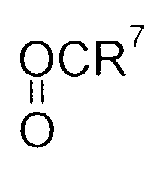
- A compound of the general formula (1a)and pharmaceutically acceptable salts and solvates (e.g. hydrates) thereof, wherein R1 to R4 are as defined in formula (I) above.

- A compound as claimed in claims 1 or Claim 2 wherein R1 represents hydrogen or hydroxyl.
- A compound as claimed in any of Claims 1 to 3 wherein R2 is in the axial configuration and R3 is hydrogen.
- A compound as claimed in any of Claims 1 to 4 wherein R2 is C1-6 alkoxy, C1-6alkylthio, azido or OCOR7.
- A compound as claimed in any of claims 1 to 5 wherein R4 is C1-4alkoxy.
- A compound as claimed in any of Claims 1 to 6 for use in therapy.
- The use of a compound a claimed in any of Claims 1 to 6 in the manufacture of a medicament for the treatment of fungal infections.
- A method of treatment of the human or non-human animal body to combat fungal diseases which method comprises administering to said body an effective amount of a compound as claimed in any of Claims 1 to 6.
- A pharmaceutical composition comprising a compound as claimed in any of Claims 1 to 6 in admixture with one or more physiologically acceptable carriers or excipients.
- A process for the preparation of a compound of formula (I) which comprises(a) reacting a compound of formula (II)(in which R1a is as defined for R1 in formula (I) above or is a protected hydroxyl group, R4 is as defined for R4 in formula (I) above or is a hydroxyl protecting group, A is a group CHO or a protected derivative thereof and Rp is hydrogen or a carboxyl protecting group) to replace one or more of the free hydroxyl groups with one or more of R1, R2/R3 and R4, followed if desired or necessary by one or more of the following steps.
 (i) conversion of one compound of the invention into another compound of the invention.(ii) removal of one or more protecting groups.
 - A compound of formula (V)or a protected derivative thereof
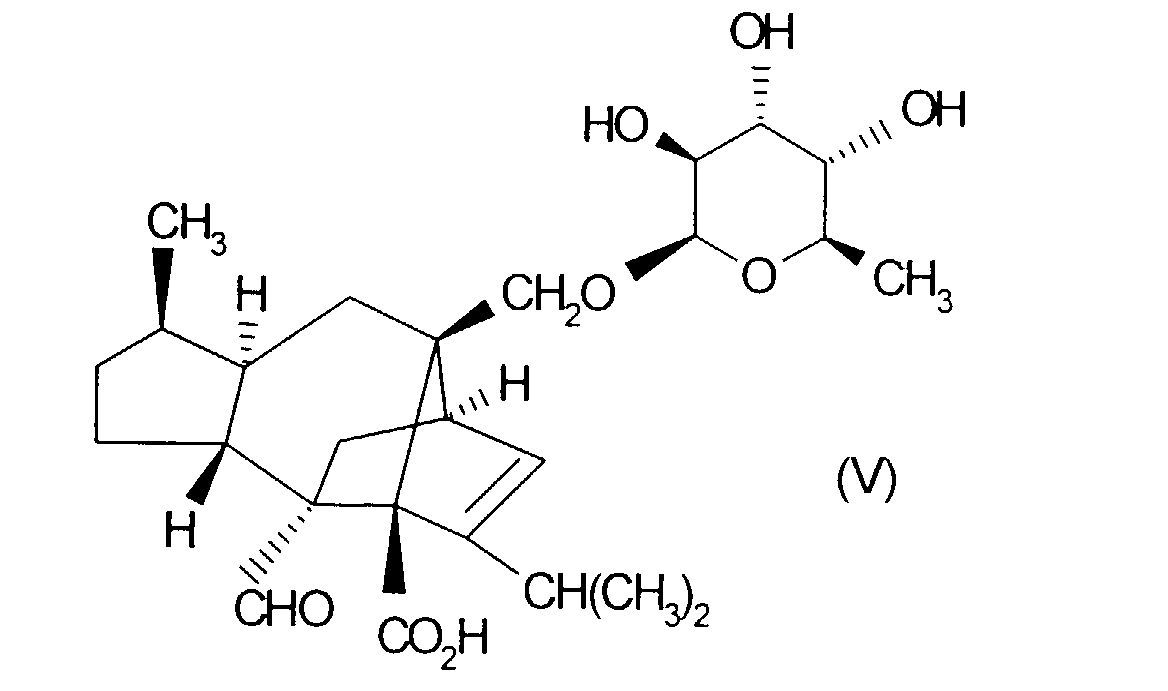
Priority Applications (3)
| Application Number | Priority Date | Filing Date | Title |
|---|---|---|---|
| EP95938407A EP0791007B1 (en) | 1994-11-08 | 1995-11-06 | Antifungal sordaridin derivatives |
| SI9530305T SI0791007T1 (en) | 1994-11-08 | 1995-11-06 | Antifungal sordaridin derivatives |
| GR990402873T GR3031781T3 (en) | 1994-11-08 | 1999-11-08 | Antifungal sordaridin derivatives |
Applications Claiming Priority (4)
| Application Number | Priority Date | Filing Date | Title |
|---|---|---|---|
| EP94500174A EP0711783A1 (en) | 1994-11-08 | 1994-11-08 | Antifungal Sordarin derivatives |
| EP94500174 | 1994-11-08 | ||
| EP95938407A EP0791007B1 (en) | 1994-11-08 | 1995-11-06 | Antifungal sordaridin derivatives |
| PCT/EP1995/004332 WO1996014327A1 (en) | 1994-11-08 | 1995-11-06 | Antifungal sordaridin derivatives |
Publications (2)
| Publication Number | Publication Date |
|---|---|
| EP0791007A1 EP0791007A1 (en) | 1997-08-27 |
| EP0791007B1 true EP0791007B1 (en) | 1999-08-11 |
Family
ID=8218171
Family Applications (2)
| Application Number | Title | Priority Date | Filing Date |
|---|---|---|---|
| EP94500174A Withdrawn EP0711783A1 (en) | 1994-11-08 | 1994-11-08 | Antifungal Sordarin derivatives |
| EP95938407A Expired - Lifetime EP0791007B1 (en) | 1994-11-08 | 1995-11-06 | Antifungal sordaridin derivatives |
Family Applications Before (1)
| Application Number | Title | Priority Date | Filing Date |
|---|---|---|---|
| EP94500174A Withdrawn EP0711783A1 (en) | 1994-11-08 | 1994-11-08 | Antifungal Sordarin derivatives |
Country Status (11)
| Country | Link |
|---|---|
| US (1) | US6054478A (en) |
| EP (2) | EP0711783A1 (en) |
| JP (1) | JPH11502188A (en) |
| AT (1) | ATE183189T1 (en) |
| AU (1) | AU3981095A (en) |
| DE (1) | DE69511424T2 (en) |
| DK (1) | DK0791007T3 (en) |
| ES (1) | ES2136887T3 (en) |
| GR (1) | GR3031781T3 (en) |
| SI (1) | SI0791007T1 (en) |
| WO (1) | WO1996014327A1 (en) |
Families Citing this family (20)
| Publication number | Priority date | Publication date | Assignee | Title |
|---|---|---|---|---|
| US6436395B1 (en) | 1996-09-18 | 2002-08-20 | Merck & Co., Inc. | Rosellinia subiculata ATCC 74386 and fungus ATCC 74387 for producing sordarin compounds for fungi control |
| DE69721805T2 (en) * | 1996-09-18 | 2004-03-11 | Merck & Co., Inc. | SORDARINE AND ITS DERIVATIVES AS FUNGICIDES FOR PLANT CULTURES |
| US6040463A (en) * | 1996-10-07 | 2000-03-21 | Merck & Co., Inc. | Sordarin derivatives |
| US6096511A (en) * | 1997-06-10 | 2000-08-01 | Merck & Co., Inc. | Protein elongation factor 2 as a target for antifungal and antiparasitic agents |
| DE69813833T2 (en) * | 1997-08-22 | 2004-01-15 | Merck & Co Inc | 4-Cyano-4-DEFORMYLSORDARIZIN DERIVATIVES |
| EA002631B1 (en) * | 1997-08-22 | 2002-08-29 | Мерк Энд Ко., Инк. | 4-cyano-4-deformylsordarin derivatives |
| US5972996A (en) * | 1997-08-22 | 1999-10-26 | Merck & Co., Inc. | 4-cyano-4-deformylsordarin derivatives |
| US5965612A (en) * | 1997-08-22 | 1999-10-12 | Merck & Co., Inc. | 4-cyano-4-deformylsordaricin derivatives |
| US6136853A (en) * | 1997-10-03 | 2000-10-24 | Merck & Co., Inc. | Sordarin derivatives |
| US6410528B1 (en) | 1998-05-11 | 2002-06-25 | Glaxo Wellcome S.A. | Morpholino ethers |
| MA26628A1 (en) * | 1998-05-11 | 2004-12-20 | Glaxo Wellcome Sa | MORPHOLINO ETHERS |
| WO2000024728A1 (en) * | 1998-10-26 | 2000-05-04 | Merck & Co., Inc. | Microbial transformation product |
| AUPQ120899A0 (en) * | 1999-06-25 | 1999-07-22 | Fujisawa Pharmaceutical Co., Ltd. | Novel compound |
| EP1228048A1 (en) * | 1999-11-11 | 2002-08-07 | Glaxo Wellcome S.A. | Sordaricin derivatives having antifungal activity |
| JP2003513964A (en) | 1999-11-11 | 2003-04-15 | グラクソ、ウェルカム、ソシエダッド、アノニマ | Antifungal solderaricin derivative |
| AU2001289063A1 (en) * | 2000-09-15 | 2002-03-26 | Bristol-Myers Squibb Company | Novel thio derivatives of sordarin as antifungal agents |
| WO2003007878A2 (en) | 2001-07-18 | 2003-01-30 | Merck & Co., Inc. | Antifungal agents of sordarin derivatives |
| US20040242904A1 (en) * | 2001-12-14 | 2004-12-02 | Angelo Basilio | Novel sordarin derivative isolated from culture fermentations and functions as an antifungal agent |
| EP1575592A1 (en) * | 2002-12-18 | 2005-09-21 | Pfizer Products Inc. | 4-anilino quinazoline derivatives for the treatment of abnormal cell growth |
| CN108085273B (en) * | 2017-12-11 | 2022-01-21 | 暨南大学 | Antifungal streptomyces and metabolite thereof, preparation method and application of metabolite |
Family Cites Families (2)
| Publication number | Priority date | Publication date | Assignee | Title |
|---|---|---|---|---|
| JPH0615555B2 (en) * | 1985-08-14 | 1994-03-02 | 三共株式会社 | Antibiotic Zofimarin |
| JP3189443B2 (en) * | 1992-11-20 | 2001-07-16 | 萬有製薬株式会社 | Antifungal substance BE-31405 |
-
1994
- 1994-11-08 EP EP94500174A patent/EP0711783A1/en not_active Withdrawn
-
1995
- 1995-11-06 EP EP95938407A patent/EP0791007B1/en not_active Expired - Lifetime
- 1995-11-06 US US08/836,284 patent/US6054478A/en not_active Expired - Fee Related
- 1995-11-06 JP JP8515052A patent/JPH11502188A/en not_active Ceased
- 1995-11-06 WO PCT/EP1995/004332 patent/WO1996014327A1/en not_active Ceased
- 1995-11-06 AT AT95938407T patent/ATE183189T1/en not_active IP Right Cessation
- 1995-11-06 DK DK95938407T patent/DK0791007T3/en active
- 1995-11-06 DE DE69511424T patent/DE69511424T2/en not_active Expired - Fee Related
- 1995-11-06 ES ES95938407T patent/ES2136887T3/en not_active Expired - Lifetime
- 1995-11-06 AU AU39810/95A patent/AU3981095A/en not_active Abandoned
- 1995-11-06 SI SI9530305T patent/SI0791007T1/en not_active IP Right Cessation
-
1999
- 1999-11-08 GR GR990402873T patent/GR3031781T3/en unknown
Also Published As
| Publication number | Publication date |
|---|---|
| ATE183189T1 (en) | 1999-08-15 |
| DE69511424T2 (en) | 1999-12-16 |
| DK0791007T3 (en) | 2000-03-20 |
| ES2136887T3 (en) | 1999-12-01 |
| AU3981095A (en) | 1996-05-31 |
| SI0791007T1 (en) | 1999-12-31 |
| GR3031781T3 (en) | 2000-02-29 |
| EP0711783A1 (en) | 1996-05-15 |
| JPH11502188A (en) | 1999-02-23 |
| DE69511424D1 (en) | 1999-09-16 |
| WO1996014327A1 (en) | 1996-05-17 |
| US6054478A (en) | 2000-04-25 |
| EP0791007A1 (en) | 1997-08-27 |
Similar Documents
| Publication | Publication Date | Title |
|---|---|---|
| EP0753001B1 (en) | Antifungal sordaridin derivatives | |
| US6054478A (en) | Antifungal sordaridin derivatives | |
| US5055596A (en) | Derivatives of avermectin and milbemycin | |
| EP0568546B1 (en) | Bridged cyclic ketal derivatives | |
| EP0494622A1 (en) | Bridged cyclic ketal derivatives | |
| JPH0753735B2 (en) | New immunosuppressant | |
| WO1992016530A1 (en) | Cyclic ketal derivatives | |
| EP0712859A1 (en) | Antifungal Sordarin derivatives | |
| EP0711784A1 (en) | Antifungal Sordarin derivatives | |
| WO1999016777A1 (en) | Antifungal corynecandin | |
| HK1004222B (en) | Antifungal sordaridin derivatives | |
| EP1259523B1 (en) | Pluraflavins and derivatives thereof, process for their preparation and use thereof | |
| EP0083019A2 (en) | Process for optically active anthracycline glycosides, the novel 4-deoxy-aclacinomycins A and B and pharmaceutical preparations | |
| KR820002138B1 (en) | Process for preparing a-40104 antibiotics | |
| WO1993018040A1 (en) | Cyclic ketal derivatives | |
| AU2001242404A1 (en) | Pluraflavins and derivatives thereof, process for their preparation and use thereof | |
| EP0524677A1 (en) | Cyclic ketal derivatives | |
| WO1993018039A1 (en) | Cyclic ketal derivatives |
Legal Events
| Date | Code | Title | Description |
|---|---|---|---|
| PUAI | Public reference made under article 153(3) epc to a published international application that has entered the european phase |
Free format text: ORIGINAL CODE: 0009012 |
|
| 17P | Request for examination filed |
Effective date: 19970429 |
|
| AK | Designated contracting states |
Kind code of ref document: A1 Designated state(s): AT BE CH DE DK ES FR GB GR IE IT LI LU MC NL PT SE |
|
| AX | Request for extension of the european patent |
Free format text: LT PAYMENT 970429;LV PAYMENT 970429;SI PAYMENT 970429 |
|
| 17Q | First examination report despatched |
Effective date: 19971124 |
|
| GRAG | Despatch of communication of intention to grant |
Free format text: ORIGINAL CODE: EPIDOS AGRA |
|
| GRAG | Despatch of communication of intention to grant |
Free format text: ORIGINAL CODE: EPIDOS AGRA |
|
| GRAH | Despatch of communication of intention to grant a patent |
Free format text: ORIGINAL CODE: EPIDOS IGRA |
|
| GRAH | Despatch of communication of intention to grant a patent |
Free format text: ORIGINAL CODE: EPIDOS IGRA |
|
| GRAA | (expected) grant |
Free format text: ORIGINAL CODE: 0009210 |
|
| AK | Designated contracting states |
Kind code of ref document: B1 Designated state(s): AT BE CH DE DK ES FR GB GR IE IT LI LU MC NL PT SE |
|
| AX | Request for extension of the european patent |
Free format text: LT PAYMENT 19970429;LV PAYMENT 19970429;SI PAYMENT 19970429 |
|
| REF | Corresponds to: |
Ref document number: 183189 Country of ref document: AT Date of ref document: 19990815 Kind code of ref document: T |
|
| REG | Reference to a national code |
Ref country code: CH Ref legal event code: EP |
|
| REG | Reference to a national code |
Ref country code: CH Ref legal event code: NV Representative=s name: BRAUN & PARTNER PATENT-, MARKEN-, RECHTSANWAELTE |
|
| REF | Corresponds to: |
Ref document number: 69511424 Country of ref document: DE Date of ref document: 19990916 |
|
| REG | Reference to a national code |
Ref country code: IE Ref legal event code: FG4D |
|
| ET | Fr: translation filed | ||
| ITF | It: translation for a ep patent filed | ||
| PG25 | Lapsed in a contracting state [announced via postgrant information from national office to epo] |
Ref country code: LU Free format text: LAPSE BECAUSE OF NON-PAYMENT OF DUE FEES Effective date: 19991130 |
|
| REG | Reference to a national code |
Ref country code: PT Ref legal event code: SC4A Free format text: AVAILABILITY OF NATIONAL TRANSLATION Effective date: 19990831 |
|
| REG | Reference to a national code |
Ref country code: ES Ref legal event code: FG2A Ref document number: 2136887 Country of ref document: ES Kind code of ref document: T3 |
|
| REG | Reference to a national code |
Ref country code: DK Ref legal event code: T3 |
|
| PLBE | No opposition filed within time limit |
Free format text: ORIGINAL CODE: 0009261 |
|
| STAA | Information on the status of an ep patent application or granted ep patent |
Free format text: STATUS: NO OPPOSITION FILED WITHIN TIME LIMIT |
|
| 26N | No opposition filed | ||
| REG | Reference to a national code |
Ref country code: GB Ref legal event code: IF02 |
|
| PGFP | Annual fee paid to national office [announced via postgrant information from national office to epo] |
Ref country code: NL Payment date: 20041018 Year of fee payment: 10 |
|
| PGFP | Annual fee paid to national office [announced via postgrant information from national office to epo] |
Ref country code: MC Payment date: 20041020 Year of fee payment: 10 |
|
| PGFP | Annual fee paid to national office [announced via postgrant information from national office to epo] |
Ref country code: AT Payment date: 20041021 Year of fee payment: 10 |
|
| PGFP | Annual fee paid to national office [announced via postgrant information from national office to epo] |
Ref country code: PT Payment date: 20041025 Year of fee payment: 10 |
|
| PGFP | Annual fee paid to national office [announced via postgrant information from national office to epo] |
Ref country code: GB Payment date: 20041103 Year of fee payment: 10 |
|
| PGFP | Annual fee paid to national office [announced via postgrant information from national office to epo] |
Ref country code: FR Payment date: 20041119 Year of fee payment: 10 |
|
| PGFP | Annual fee paid to national office [announced via postgrant information from national office to epo] |
Ref country code: SE Payment date: 20041122 Year of fee payment: 10 |
|
| PGFP | Annual fee paid to national office [announced via postgrant information from national office to epo] |
Ref country code: DK Payment date: 20041125 Year of fee payment: 10 Ref country code: CH Payment date: 20041125 Year of fee payment: 10 |
|
| PGFP | Annual fee paid to national office [announced via postgrant information from national office to epo] |
Ref country code: GR Payment date: 20041126 Year of fee payment: 10 |
|
| PGFP | Annual fee paid to national office [announced via postgrant information from national office to epo] |
Ref country code: LU Payment date: 20041129 Year of fee payment: 10 |
|
| PGFP | Annual fee paid to national office [announced via postgrant information from national office to epo] |
Ref country code: IE Payment date: 20041130 Year of fee payment: 10 |
|
| PGFP | Annual fee paid to national office [announced via postgrant information from national office to epo] |
Ref country code: ES Payment date: 20041209 Year of fee payment: 10 |
|
| PGFP | Annual fee paid to national office [announced via postgrant information from national office to epo] |
Ref country code: BE Payment date: 20041216 Year of fee payment: 10 |
|
| PGFP | Annual fee paid to national office [announced via postgrant information from national office to epo] |
Ref country code: DE Payment date: 20041230 Year of fee payment: 10 |
|
| REG | Reference to a national code |
Ref country code: SI Ref legal event code: IF |
|
| PG25 | Lapsed in a contracting state [announced via postgrant information from national office to epo] |
Ref country code: IT Free format text: LAPSE BECAUSE OF NON-PAYMENT OF DUE FEES;WARNING: LAPSES OF ITALIAN PATENTS WITH EFFECTIVE DATE BEFORE 2007 MAY HAVE OCCURRED AT ANY TIME BEFORE 2007. THE CORRECT EFFECTIVE DATE MAY BE DIFFERENT FROM THE ONE RECORDED. Effective date: 20051106 Ref country code: GB Free format text: LAPSE BECAUSE OF NON-PAYMENT OF DUE FEES Effective date: 20051106 Ref country code: AT Free format text: LAPSE BECAUSE OF NON-PAYMENT OF DUE FEES Effective date: 20051106 |
|
| PG25 | Lapsed in a contracting state [announced via postgrant information from national office to epo] |
Ref country code: SE Free format text: LAPSE BECAUSE OF NON-PAYMENT OF DUE FEES Effective date: 20051107 Ref country code: IE Free format text: LAPSE BECAUSE OF NON-PAYMENT OF DUE FEES Effective date: 20051107 Ref country code: ES Free format text: LAPSE BECAUSE OF NON-PAYMENT OF DUE FEES Effective date: 20051107 |
|
| PG25 | Lapsed in a contracting state [announced via postgrant information from national office to epo] |
Ref country code: MC Free format text: LAPSE BECAUSE OF NON-PAYMENT OF DUE FEES Effective date: 20051130 Ref country code: LI Free format text: LAPSE BECAUSE OF NON-PAYMENT OF DUE FEES Effective date: 20051130 Ref country code: DK Free format text: LAPSE BECAUSE OF NON-PAYMENT OF DUE FEES Effective date: 20051130 Ref country code: CH Free format text: LAPSE BECAUSE OF NON-PAYMENT OF DUE FEES Effective date: 20051130 Ref country code: BE Free format text: LAPSE BECAUSE OF NON-PAYMENT OF DUE FEES Effective date: 20051130 |
|
| PG25 | Lapsed in a contracting state [announced via postgrant information from national office to epo] |
Ref country code: PT Free format text: LAPSE BECAUSE OF NON-PAYMENT OF DUE FEES Effective date: 20060508 |
|
| PG25 | Lapsed in a contracting state [announced via postgrant information from national office to epo] |
Ref country code: NL Free format text: LAPSE BECAUSE OF NON-PAYMENT OF DUE FEES Effective date: 20060601 Ref country code: DE Free format text: LAPSE BECAUSE OF NON-PAYMENT OF DUE FEES Effective date: 20060601 |
|
| LTLA | Lt: lapse of european patent or patent extension |
Effective date: 20051106 |
|
| REG | Reference to a national code |
Ref country code: PT Ref legal event code: MM4A Effective date: 20060508 |
|
| REG | Reference to a national code |
Ref country code: DK Ref legal event code: EBP |
|
| REG | Reference to a national code |
Ref country code: CH Ref legal event code: PL |
|
| EUG | Se: european patent has lapsed | ||
| GBPC | Gb: european patent ceased through non-payment of renewal fee |
Effective date: 20051106 |
|
| PG25 | Lapsed in a contracting state [announced via postgrant information from national office to epo] |
Ref country code: FR Free format text: LAPSE BECAUSE OF NON-PAYMENT OF DUE FEES Effective date: 20060731 |
|
| NLV4 | Nl: lapsed or anulled due to non-payment of the annual fee |
Effective date: 20060601 |
|
| REG | Reference to a national code |
Ref country code: IE Ref legal event code: MM4A |
|
| REG | Reference to a national code |
Ref country code: FR Ref legal event code: ST Effective date: 20060731 |
|
| REG | Reference to a national code |
Ref country code: ES Ref legal event code: FD2A Effective date: 20051107 |
|
| BERE | Be: lapsed |
Owner name: S.A. *GLAXO WELLCOME Effective date: 20051130 |
|
| PG25 | Lapsed in a contracting state [announced via postgrant information from national office to epo] |
Ref country code: GR Free format text: LAPSE BECAUSE OF NON-PAYMENT OF DUE FEES Effective date: 19990811 |