EP0789030A1 - Fibrinogen binding peptides - Google Patents
Fibrinogen binding peptides Download PDFInfo
- Publication number
- EP0789030A1 EP0789030A1 EP97100941A EP97100941A EP0789030A1 EP 0789030 A1 EP0789030 A1 EP 0789030A1 EP 97100941 A EP97100941 A EP 97100941A EP 97100941 A EP97100941 A EP 97100941A EP 0789030 A1 EP0789030 A1 EP 0789030A1
- Authority
- EP
- European Patent Office
- Prior art keywords
- leu
- fibrinogen
- pro
- val
- peptide
- Prior art date
- Legal status (The legal status is an assumption and is not a legal conclusion. Google has not performed a legal analysis and makes no representation as to the accuracy of the status listed.)
- Ceased
Links
- 108010049003 Fibrinogen Proteins 0.000 title claims abstract description 96
- 102000008946 Fibrinogen Human genes 0.000 title claims abstract description 96
- 229940012952 fibrinogen Drugs 0.000 title claims abstract description 96
- 108090000765 processed proteins & peptides Proteins 0.000 title claims abstract description 77
- 102000004196 processed proteins & peptides Human genes 0.000 title claims abstract description 41
- 238000009739 binding Methods 0.000 title claims abstract description 38
- 230000027455 binding Effects 0.000 title claims abstract description 37
- 238000000034 method Methods 0.000 claims abstract description 19
- DNDWZFHLZVYOGF-KKUMJFAQSA-N Leu-Leu-Leu Chemical group CC(C)C[C@H](N)C(=O)N[C@@H](CC(C)C)C(=O)N[C@@H](CC(C)C)C(O)=O DNDWZFHLZVYOGF-KKUMJFAQSA-N 0.000 claims abstract description 5
- 239000000203 mixture Substances 0.000 claims description 20
- 239000000758 substrate Substances 0.000 claims description 9
- QIVPZSWBBHRNBA-JYJNAYRXSA-N Val-Pro-Phe Chemical compound CC(C)[C@H](N)C(=O)N1CCC[C@H]1C(=O)N[C@@H](Cc1ccccc1)C(O)=O QIVPZSWBBHRNBA-JYJNAYRXSA-N 0.000 claims description 3
- 239000000463 material Substances 0.000 claims description 3
- FPPCCQGECVKLDY-IHRRRGAJSA-N Leu-Val-Leu Chemical compound CC(C)C[C@H](N)C(=O)N[C@@H](C(C)C)C(=O)N[C@H](C(O)=O)CC(C)C FPPCCQGECVKLDY-IHRRRGAJSA-N 0.000 claims 1
- DOFAQXCYFQKSHT-SRVKXCTJSA-N Val-Pro-Pro Chemical compound CC(C)[C@H](N)C(=O)N1CCC[C@H]1C(=O)N1[C@H](C(O)=O)CCC1 DOFAQXCYFQKSHT-SRVKXCTJSA-N 0.000 claims 1
- 238000001042 affinity chromatography Methods 0.000 abstract description 5
- 230000008569 process Effects 0.000 abstract description 3
- 239000011347 resin Substances 0.000 description 33
- 229920005989 resin Polymers 0.000 description 33
- 108090000623 proteins and genes Proteins 0.000 description 28
- 235000018102 proteins Nutrition 0.000 description 27
- 102000004169 proteins and genes Human genes 0.000 description 27
- FAPWRFPIFSIZLT-UHFFFAOYSA-M Sodium chloride Chemical compound [Na+].[Cl-] FAPWRFPIFSIZLT-UHFFFAOYSA-M 0.000 description 26
- 229940024606 amino acid Drugs 0.000 description 14
- 235000001014 amino acid Nutrition 0.000 description 14
- 150000001413 amino acids Chemical class 0.000 description 14
- 238000010828 elution Methods 0.000 description 14
- 239000011780 sodium chloride Substances 0.000 description 13
- QTBSBXVTEAMEQO-UHFFFAOYSA-N Acetic acid Chemical compound CC(O)=O QTBSBXVTEAMEQO-UHFFFAOYSA-N 0.000 description 12
- 239000002253 acid Substances 0.000 description 12
- 239000006167 equilibration buffer Substances 0.000 description 11
- 230000003993 interaction Effects 0.000 description 9
- VMHLLURERBWHNL-UHFFFAOYSA-M Sodium acetate Chemical compound [Na+].CC([O-])=O VMHLLURERBWHNL-UHFFFAOYSA-M 0.000 description 8
- 239000001632 sodium acetate Substances 0.000 description 8
- 235000017281 sodium acetate Nutrition 0.000 description 8
- 238000002835 absorbance Methods 0.000 description 7
- 239000000243 solution Substances 0.000 description 7
- BWGVNKXGVNDBDI-UHFFFAOYSA-N Fibrin monomer Chemical compound CNC(=O)CNC(=O)CN BWGVNKXGVNDBDI-UHFFFAOYSA-N 0.000 description 6
- 229920001213 Polysorbate 20 Polymers 0.000 description 6
- 239000000256 polyoxyethylene sorbitan monolaurate Substances 0.000 description 6
- 235000010486 polyoxyethylene sorbitan monolaurate Nutrition 0.000 description 6
- 239000011534 wash buffer Substances 0.000 description 6
- 125000003088 (fluoren-9-ylmethoxy)carbonyl group Chemical group 0.000 description 5
- 108010073385 Fibrin Proteins 0.000 description 5
- 102000009123 Fibrin Human genes 0.000 description 5
- DEFVIWRASFVYLL-UHFFFAOYSA-N ethylene glycol bis(2-aminoethyl)tetraacetic acid Chemical compound OC(=O)CN(CC(O)=O)CCOCCOCCN(CC(O)=O)CC(O)=O DEFVIWRASFVYLL-UHFFFAOYSA-N 0.000 description 5
- 229950003499 fibrin Drugs 0.000 description 5
- 230000002209 hydrophobic effect Effects 0.000 description 5
- 125000002924 primary amino group Chemical group [H]N([H])* 0.000 description 5
- 238000002415 sodium dodecyl sulfate polyacrylamide gel electrophoresis Methods 0.000 description 5
- 102000004506 Blood Proteins Human genes 0.000 description 4
- 108010017384 Blood Proteins Proteins 0.000 description 4
- 108010067902 Peptide Library Proteins 0.000 description 4
- 108090000190 Thrombin Proteins 0.000 description 4
- 239000011324 bead Substances 0.000 description 4
- 238000001514 detection method Methods 0.000 description 4
- 239000000499 gel Substances 0.000 description 4
- 239000003446 ligand Substances 0.000 description 4
- 238000012216 screening Methods 0.000 description 4
- 125000005931 tert-butyloxycarbonyl group Chemical group [H]C([H])([H])C(OC(*)=O)(C([H])([H])[H])C([H])([H])[H] 0.000 description 4
- LFQSCWFLJHTTHZ-UHFFFAOYSA-N Ethanol Chemical compound CCO LFQSCWFLJHTTHZ-UHFFFAOYSA-N 0.000 description 3
- OKKJLVBELUTLKV-UHFFFAOYSA-N Methanol Chemical compound OC OKKJLVBELUTLKV-UHFFFAOYSA-N 0.000 description 3
- ZMANZCXQSJIPKH-UHFFFAOYSA-N Triethylamine Chemical compound CCN(CC)CC ZMANZCXQSJIPKH-UHFFFAOYSA-N 0.000 description 3
- 238000004458 analytical method Methods 0.000 description 3
- 238000003556 assay Methods 0.000 description 3
- 239000000872 buffer Substances 0.000 description 3
- 230000008859 change Effects 0.000 description 3
- 239000013522 chelant Substances 0.000 description 3
- 238000013375 chromatographic separation Methods 0.000 description 3
- 238000004587 chromatography analysis Methods 0.000 description 3
- 239000003599 detergent Substances 0.000 description 3
- 239000012149 elution buffer Substances 0.000 description 3
- 238000002474 experimental method Methods 0.000 description 3
- 230000002349 favourable effect Effects 0.000 description 3
- 229940106780 human fibrinogen Drugs 0.000 description 3
- 238000012986 modification Methods 0.000 description 3
- 230000004048 modification Effects 0.000 description 3
- 229920000136 polysorbate Polymers 0.000 description 3
- 238000002360 preparation method Methods 0.000 description 3
- 238000004007 reversed phase HPLC Methods 0.000 description 3
- 238000006467 substitution reaction Methods 0.000 description 3
- 238000001262 western blot Methods 0.000 description 3
- QWXZOFZKSQXPDC-NSHDSACASA-N (2s)-2-(9h-fluoren-9-ylmethoxycarbonylamino)propanoic acid Chemical compound C1=CC=C2C(COC(=O)N[C@@H](C)C(O)=O)C3=CC=CC=C3C2=C1 QWXZOFZKSQXPDC-NSHDSACASA-N 0.000 description 2
- QEIFSLUFHRCVQL-UHFFFAOYSA-N (5-bromo-4-chloro-1h-indol-3-yl) hydrogen phosphate;(4-methylphenyl)azanium Chemical compound CC1=CC=C(N)C=C1.C1=C(Br)C(Cl)=C2C(OP(O)(=O)O)=CNC2=C1 QEIFSLUFHRCVQL-UHFFFAOYSA-N 0.000 description 2
- JKMHFZQWWAIEOD-UHFFFAOYSA-N 2-[4-(2-hydroxyethyl)piperazin-1-yl]ethanesulfonic acid Chemical compound OCC[NH+]1CCN(CCS([O-])(=O)=O)CC1 JKMHFZQWWAIEOD-UHFFFAOYSA-N 0.000 description 2
- 241000252212 Danio rerio Species 0.000 description 2
- -1 Fmoc amino acids Chemical class 0.000 description 2
- DHMQDGOQFOQNFH-UHFFFAOYSA-N Glycine Chemical compound NCC(O)=O DHMQDGOQFOQNFH-UHFFFAOYSA-N 0.000 description 2
- 239000007995 HEPES buffer Substances 0.000 description 2
- 108700026244 Open Reading Frames Proteins 0.000 description 2
- 240000004808 Saccharomyces cerevisiae Species 0.000 description 2
- 235000014680 Saccharomyces cerevisiae Nutrition 0.000 description 2
- 238000010306 acid treatment Methods 0.000 description 2
- 238000001261 affinity purification Methods 0.000 description 2
- 230000003466 anti-cipated effect Effects 0.000 description 2
- UCMIRNVEIXFBKS-UHFFFAOYSA-N beta-alanine Chemical compound NCCC(O)=O UCMIRNVEIXFBKS-UHFFFAOYSA-N 0.000 description 2
- 125000003178 carboxy group Chemical group [H]OC(*)=O 0.000 description 2
- 238000012512 characterization method Methods 0.000 description 2
- 239000003795 chemical substances by application Substances 0.000 description 2
- 238000003776 cleavage reaction Methods 0.000 description 2
- 239000012141 concentrate Substances 0.000 description 2
- 230000003247 decreasing effect Effects 0.000 description 2
- 238000012217 deletion Methods 0.000 description 2
- 230000037430 deletion Effects 0.000 description 2
- 238000010494 dissociation reaction Methods 0.000 description 2
- 230000005593 dissociations Effects 0.000 description 2
- 231100000673 dose–response relationship Toxicity 0.000 description 2
- 239000000282 fibrinogen degradation product Substances 0.000 description 2
- 239000003292 glue Substances 0.000 description 2
- 238000004128 high performance liquid chromatography Methods 0.000 description 2
- 229940012957 plasmin Drugs 0.000 description 2
- 239000002243 precursor Substances 0.000 description 2
- 150000003141 primary amines Chemical class 0.000 description 2
- 238000011002 quantification Methods 0.000 description 2
- 150000003839 salts Chemical class 0.000 description 2
- 230000007017 scission Effects 0.000 description 2
- 239000002904 solvent Substances 0.000 description 2
- 229960004072 thrombin Drugs 0.000 description 2
- 238000004448 titration Methods 0.000 description 2
- WXPZDDCNKXMOMC-AVGNSLFASA-N (2s)-1-[(2s)-2-[[(2s)-1-(2-aminoacetyl)pyrrolidine-2-carbonyl]amino]-5-(diaminomethylideneamino)pentanoyl]pyrrolidine-2-carboxylic acid Chemical compound NCC(=O)N1CCC[C@H]1C(=O)N[C@@H](CCCNC(N)=N)C(=O)N1[C@H](C(O)=O)CCC1 WXPZDDCNKXMOMC-AVGNSLFASA-N 0.000 description 1
- MGMNPSAERQZUIM-UHFFFAOYSA-N 2-(hydroxymethyl)benzoic acid Chemical compound OCC1=CC=CC=C1C(O)=O MGMNPSAERQZUIM-UHFFFAOYSA-N 0.000 description 1
- QKNYBSVHEMOAJP-UHFFFAOYSA-N 2-amino-2-(hydroxymethyl)propane-1,3-diol;hydron;chloride Chemical compound Cl.OCC(N)(CO)CO QKNYBSVHEMOAJP-UHFFFAOYSA-N 0.000 description 1
- JCEZOHLWDIONSP-UHFFFAOYSA-N 3-[2-[2-(3-aminopropoxy)ethoxy]ethoxy]propan-1-amine Chemical group NCCCOCCOCCOCCCN JCEZOHLWDIONSP-UHFFFAOYSA-N 0.000 description 1
- CXNVOWPRHWWCQR-UHFFFAOYSA-N 4-Chloro-ortho-toluidine Chemical compound CC1=CC(Cl)=CC=C1N CXNVOWPRHWWCQR-UHFFFAOYSA-N 0.000 description 1
- SLXKOJJOQWFEFD-UHFFFAOYSA-N 6-aminohexanoic acid Chemical compound NCCCCCC(O)=O SLXKOJJOQWFEFD-UHFFFAOYSA-N 0.000 description 1
- 102000002260 Alkaline Phosphatase Human genes 0.000 description 1
- 108020004774 Alkaline Phosphatase Proteins 0.000 description 1
- 244000063299 Bacillus subtilis Species 0.000 description 1
- 241000283690 Bos taurus Species 0.000 description 1
- 102100037084 C4b-binding protein alpha chain Human genes 0.000 description 1
- 108010018956 CTP synthetase Proteins 0.000 description 1
- 241000283707 Capra Species 0.000 description 1
- 241000606153 Chlamydia trachomatis Species 0.000 description 1
- 238000007445 Chromatographic isolation Methods 0.000 description 1
- 241000272194 Ciconiiformes Species 0.000 description 1
- 206010053567 Coagulopathies Diseases 0.000 description 1
- 108010035369 Cohn fraction I Proteins 0.000 description 1
- QNAYBMKLOCPYGJ-UHFFFAOYSA-N D-alpha-Ala Natural products CC([NH3+])C([O-])=O QNAYBMKLOCPYGJ-UHFFFAOYSA-N 0.000 description 1
- 102000004190 Enzymes Human genes 0.000 description 1
- 108090000790 Enzymes Proteins 0.000 description 1
- 241000588724 Escherichia coli Species 0.000 description 1
- 108010071289 Factor XIII Proteins 0.000 description 1
- 108010080379 Fibrin Tissue Adhesive Proteins 0.000 description 1
- 108010088842 Fibrinolysin Proteins 0.000 description 1
- 102000016359 Fibronectins Human genes 0.000 description 1
- 108010067306 Fibronectins Proteins 0.000 description 1
- 239000004471 Glycine Substances 0.000 description 1
- 102000003886 Glycoproteins Human genes 0.000 description 1
- 108090000288 Glycoproteins Proteins 0.000 description 1
- 102000003839 Human Proteins Human genes 0.000 description 1
- 108090000144 Human Proteins Proteins 0.000 description 1
- 102000008100 Human Serum Albumin Human genes 0.000 description 1
- 108091006905 Human Serum Albumin Proteins 0.000 description 1
- 241000701109 Human adenovirus 2 Species 0.000 description 1
- DGAQECJNVWCQMB-PUAWFVPOSA-M Ilexoside XXIX Chemical compound C[C@@H]1CC[C@@]2(CC[C@@]3(C(=CC[C@H]4[C@]3(CC[C@@H]5[C@@]4(CC[C@@H](C5(C)C)OS(=O)(=O)[O-])C)C)[C@@H]2[C@]1(C)O)C)C(=O)O[C@H]6[C@@H]([C@H]([C@@H]([C@H](O6)CO)O)O)O.[Na+] DGAQECJNVWCQMB-PUAWFVPOSA-M 0.000 description 1
- 108010038501 Interleukin-6 Receptors Proteins 0.000 description 1
- 102100037792 Interleukin-6 receptor subunit alpha Human genes 0.000 description 1
- QNAYBMKLOCPYGJ-UWTATZPHSA-N L-Alanine Natural products C[C@@H](N)C(O)=O QNAYBMKLOCPYGJ-UWTATZPHSA-N 0.000 description 1
- XUJNEKJLAYXESH-REOHCLBHSA-N L-Cysteine Chemical compound SC[C@H](N)C(O)=O XUJNEKJLAYXESH-REOHCLBHSA-N 0.000 description 1
- QNAYBMKLOCPYGJ-REOHCLBHSA-N L-alanine Chemical compound C[C@H](N)C(O)=O QNAYBMKLOCPYGJ-REOHCLBHSA-N 0.000 description 1
- FFEARJCKVFRZRR-BYPYZUCNSA-N L-methionine Chemical compound CSCC[C@H](N)C(O)=O FFEARJCKVFRZRR-BYPYZUCNSA-N 0.000 description 1
- 101710173438 Late L2 mu core protein Proteins 0.000 description 1
- 108090000364 Ligases Proteins 0.000 description 1
- 102000003960 Ligases Human genes 0.000 description 1
- 102000018697 Membrane Proteins Human genes 0.000 description 1
- 108010052285 Membrane Proteins Proteins 0.000 description 1
- 241000702475 Miscanthus streak virus Species 0.000 description 1
- 102000016077 MutL Proteins Human genes 0.000 description 1
- 108010010712 MutL Proteins Proteins 0.000 description 1
- 241000186359 Mycobacterium Species 0.000 description 1
- 241000283973 Oryctolagus cuniculus Species 0.000 description 1
- 108010092528 Phosphate Transport Proteins Proteins 0.000 description 1
- 102000016462 Phosphate Transport Proteins Human genes 0.000 description 1
- 102000045595 Phosphoprotein Phosphatases Human genes 0.000 description 1
- 108700019535 Phosphoprotein Phosphatases Proteins 0.000 description 1
- 102000013566 Plasminogen Human genes 0.000 description 1
- 108010051456 Plasminogen Proteins 0.000 description 1
- 239000002202 Polyethylene glycol Substances 0.000 description 1
- 101710136733 Proline-rich protein Proteins 0.000 description 1
- 102000007327 Protamines Human genes 0.000 description 1
- 108010007568 Protamines Proteins 0.000 description 1
- 108010001267 Protein Subunits Proteins 0.000 description 1
- 102000002067 Protein Subunits Human genes 0.000 description 1
- 241000589194 Rhizobium leguminosarum Species 0.000 description 1
- 108010081391 Ristocetin Proteins 0.000 description 1
- 241000293869 Salmonella enterica subsp. enterica serovar Typhimurium Species 0.000 description 1
- 229920002684 Sepharose Polymers 0.000 description 1
- MTCFGRXMJLQNBG-UHFFFAOYSA-N Serine Natural products OCC(N)C(O)=O MTCFGRXMJLQNBG-UHFFFAOYSA-N 0.000 description 1
- 241000191967 Staphylococcus aureus Species 0.000 description 1
- 241000192581 Synechocystis sp. Species 0.000 description 1
- 102000040945 Transcription factor Human genes 0.000 description 1
- 108091023040 Transcription factor Proteins 0.000 description 1
- QWXOJIDBSHLIFI-UHFFFAOYSA-N [3-(1-chloro-3'-methoxyspiro[adamantane-4,4'-dioxetane]-3'-yl)phenyl] dihydrogen phosphate Chemical compound O1OC2(C3CC4CC2CC(Cl)(C4)C3)C1(OC)C1=CC=CC(OP(O)(O)=O)=C1 QWXOJIDBSHLIFI-UHFFFAOYSA-N 0.000 description 1
- 229960003767 alanine Drugs 0.000 description 1
- 125000003295 alanine group Chemical group N[C@@H](C)C(=O)* 0.000 description 1
- 239000003513 alkali Substances 0.000 description 1
- WLDHEUZGFKACJH-UHFFFAOYSA-K amaranth Chemical compound [Na+].[Na+].[Na+].C12=CC=C(S([O-])(=O)=O)C=C2C=C(S([O-])(=O)=O)C(O)=C1N=NC1=CC=C(S([O-])(=O)=O)C2=CC=CC=C12 WLDHEUZGFKACJH-UHFFFAOYSA-K 0.000 description 1
- 238000005576 amination reaction Methods 0.000 description 1
- 229960002684 aminocaproic acid Drugs 0.000 description 1
- BFNBIHQBYMNNAN-UHFFFAOYSA-N ammonium sulfate Chemical compound N.N.OS(O)(=O)=O BFNBIHQBYMNNAN-UHFFFAOYSA-N 0.000 description 1
- 229910052921 ammonium sulfate Inorganic materials 0.000 description 1
- 235000011130 ammonium sulphate Nutrition 0.000 description 1
- 238000003149 assay kit Methods 0.000 description 1
- 239000002585 base Substances 0.000 description 1
- 229940000635 beta-alanine Drugs 0.000 description 1
- 239000012148 binding buffer Substances 0.000 description 1
- 230000008275 binding mechanism Effects 0.000 description 1
- 230000003115 biocidal effect Effects 0.000 description 1
- 230000015572 biosynthetic process Effects 0.000 description 1
- 210000004369 blood Anatomy 0.000 description 1
- 239000008280 blood Substances 0.000 description 1
- 230000023555 blood coagulation Effects 0.000 description 1
- 229910021538 borax Inorganic materials 0.000 description 1
- 239000007853 buffer solution Substances 0.000 description 1
- 239000005018 casein Substances 0.000 description 1
- BECPQYXYKAMYBN-UHFFFAOYSA-N casein, tech. Chemical compound NCCCCC(C(O)=O)N=C(O)C(CC(O)=O)N=C(O)C(CCC(O)=N)N=C(O)C(CC(C)C)N=C(O)C(CCC(O)=O)N=C(O)C(CC(O)=O)N=C(O)C(CCC(O)=O)N=C(O)C(C(C)O)N=C(O)C(CCC(O)=N)N=C(O)C(CCC(O)=N)N=C(O)C(CCC(O)=N)N=C(O)C(CCC(O)=O)N=C(O)C(CCC(O)=O)N=C(O)C(COP(O)(O)=O)N=C(O)C(CCC(O)=N)N=C(O)C(N)CC1=CC=CC=C1 BECPQYXYKAMYBN-UHFFFAOYSA-N 0.000 description 1
- 235000021240 caseins Nutrition 0.000 description 1
- 230000015556 catabolic process Effects 0.000 description 1
- 238000005119 centrifugation Methods 0.000 description 1
- BGTFCAQCKWKTRL-YDEUACAXSA-N chembl1095986 Chemical compound C1[C@@H](N)[C@@H](O)[C@H](C)O[C@H]1O[C@@H]([C@H]1C(N[C@H](C2=CC(O)=CC(O[C@@H]3[C@H]([C@@H](O)[C@H](O)[C@@H](CO)O3)O)=C2C=2C(O)=CC=C(C=2)[C@@H](NC(=O)[C@@H]2NC(=O)[C@@H]3C=4C=C(C(=C(O)C=4)C)OC=4C(O)=CC=C(C=4)[C@@H](N)C(=O)N[C@@H](C(=O)N3)[C@H](O)C=3C=CC(O4)=CC=3)C(=O)N1)C(O)=O)=O)C(C=C1)=CC=C1OC1=C(O[C@@H]3[C@H]([C@H](O)[C@@H](O)[C@H](CO[C@@H]5[C@H]([C@@H](O)[C@H](O)[C@@H](C)O5)O)O3)O[C@@H]3[C@H]([C@@H](O)[C@H](O)[C@@H](CO)O3)O[C@@H]3[C@H]([C@H](O)[C@@H](CO)O3)O)C4=CC2=C1 BGTFCAQCKWKTRL-YDEUACAXSA-N 0.000 description 1
- 239000003153 chemical reaction reagent Substances 0.000 description 1
- 229940038705 chlamydia trachomatis Drugs 0.000 description 1
- 239000012539 chromatography resin Substances 0.000 description 1
- 230000035602 clotting Effects 0.000 description 1
- 238000004737 colorimetric analysis Methods 0.000 description 1
- 230000008878 coupling Effects 0.000 description 1
- 238000010168 coupling process Methods 0.000 description 1
- 238000005859 coupling reaction Methods 0.000 description 1
- 235000018417 cysteine Nutrition 0.000 description 1
- XUJNEKJLAYXESH-UHFFFAOYSA-N cysteine Natural products SCC(N)C(O)=O XUJNEKJLAYXESH-UHFFFAOYSA-N 0.000 description 1
- 238000006731 degradation reaction Methods 0.000 description 1
- 230000001419 dependent effect Effects 0.000 description 1
- 238000010511 deprotection reaction Methods 0.000 description 1
- 150000002019 disulfides Chemical class 0.000 description 1
- 230000000694 effects Effects 0.000 description 1
- 229940088598 enzyme Drugs 0.000 description 1
- 229940012444 factor xiii Drugs 0.000 description 1
- 239000000535 fibrinogen concentrate Substances 0.000 description 1
- 239000012634 fragment Substances 0.000 description 1
- 108020001507 fusion proteins Proteins 0.000 description 1
- 102000037865 fusion proteins Human genes 0.000 description 1
- 238000002523 gelfiltration Methods 0.000 description 1
- 238000007429 general method Methods 0.000 description 1
- 125000003630 glycyl group Chemical group [H]N([H])C([H])([H])C(*)=O 0.000 description 1
- 230000002439 hemostatic effect Effects 0.000 description 1
- 150000002433 hydrophilic molecules Chemical class 0.000 description 1
- 229940127121 immunoconjugate Drugs 0.000 description 1
- 238000012744 immunostaining Methods 0.000 description 1
- 230000000415 inactivating effect Effects 0.000 description 1
- 230000005764 inhibitory process Effects 0.000 description 1
- 238000002347 injection Methods 0.000 description 1
- 239000007924 injection Substances 0.000 description 1
- 230000010354 integration Effects 0.000 description 1
- 239000003456 ion exchange resin Substances 0.000 description 1
- 229920003303 ion-exchange polymer Polymers 0.000 description 1
- 238000000111 isothermal titration calorimetry Methods 0.000 description 1
- 101150098537 kdsB gene Proteins 0.000 description 1
- 238000011068 loading method Methods 0.000 description 1
- 238000004949 mass spectrometry Methods 0.000 description 1
- 238000005259 measurement Methods 0.000 description 1
- 230000007246 mechanism Effects 0.000 description 1
- 239000012528 membrane Substances 0.000 description 1
- 108020004999 messenger RNA Proteins 0.000 description 1
- 229930182817 methionine Natural products 0.000 description 1
- 230000033607 mismatch repair Effects 0.000 description 1
- 210000003470 mitochondria Anatomy 0.000 description 1
- 230000007935 neutral effect Effects 0.000 description 1
- 238000006386 neutralization reaction Methods 0.000 description 1
- 230000009871 nonspecific binding Effects 0.000 description 1
- 238000010647 peptide synthesis reaction Methods 0.000 description 1
- 239000008363 phosphate buffer Substances 0.000 description 1
- 239000013612 plasmid Substances 0.000 description 1
- 229920002401 polyacrylamide Polymers 0.000 description 1
- 229920001223 polyethylene glycol Polymers 0.000 description 1
- 238000006116 polymerization reaction Methods 0.000 description 1
- 229920001184 polypeptide Polymers 0.000 description 1
- 238000001556 precipitation Methods 0.000 description 1
- 229940048914 protamine Drugs 0.000 description 1
- 125000006239 protecting group Chemical group 0.000 description 1
- 238000000159 protein binding assay Methods 0.000 description 1
- 238000000746 purification Methods 0.000 description 1
- 101150054232 pyrG gene Proteins 0.000 description 1
- 238000011084 recovery Methods 0.000 description 1
- 238000011160 research Methods 0.000 description 1
- 230000004044 response Effects 0.000 description 1
- 229950004257 ristocetin Drugs 0.000 description 1
- 239000000565 sealant Substances 0.000 description 1
- 238000000926 separation method Methods 0.000 description 1
- 238000013207 serial dilution Methods 0.000 description 1
- 229910052708 sodium Inorganic materials 0.000 description 1
- 239000011734 sodium Substances 0.000 description 1
- NRHMKIHPTBHXPF-TUJRSCDTSA-M sodium cholate Chemical compound [Na+].C([C@H]1C[C@H]2O)[C@H](O)CC[C@]1(C)[C@@H]1[C@@H]2[C@@H]2CC[C@H]([C@@H](CCC([O-])=O)C)[C@@]2(C)[C@@H](O)C1 NRHMKIHPTBHXPF-TUJRSCDTSA-M 0.000 description 1
- 239000001488 sodium phosphate Substances 0.000 description 1
- 229910000162 sodium phosphate Inorganic materials 0.000 description 1
- 235000010339 sodium tetraborate Nutrition 0.000 description 1
- 238000000527 sonication Methods 0.000 description 1
- 238000010561 standard procedure Methods 0.000 description 1
- 239000011550 stock solution Substances 0.000 description 1
- 239000000126 substance Substances 0.000 description 1
- 238000003786 synthesis reaction Methods 0.000 description 1
- 210000001519 tissue Anatomy 0.000 description 1
- 238000012546 transfer Methods 0.000 description 1
- BSVBQGMMJUBVOD-UHFFFAOYSA-N trisodium borate Chemical compound [Na+].[Na+].[Na+].[O-]B([O-])[O-] BSVBQGMMJUBVOD-UHFFFAOYSA-N 0.000 description 1
- RYFMWSXOAZQYPI-UHFFFAOYSA-K trisodium phosphate Chemical compound [Na+].[Na+].[Na+].[O-]P([O-])([O-])=O RYFMWSXOAZQYPI-UHFFFAOYSA-K 0.000 description 1
- 238000000108 ultra-filtration Methods 0.000 description 1
- 230000003612 virological effect Effects 0.000 description 1
- 238000005406 washing Methods 0.000 description 1
Images



Classifications
-
- C—CHEMISTRY; METALLURGY
- C07—ORGANIC CHEMISTRY
- C07K—PEPTIDES
- C07K7/00—Peptides having 5 to 20 amino acids in a fully defined sequence; Derivatives thereof
- C07K7/04—Linear peptides containing only normal peptide links
- C07K7/06—Linear peptides containing only normal peptide links having 5 to 11 amino acids
-
- C—CHEMISTRY; METALLURGY
- C07—ORGANIC CHEMISTRY
- C07K—PEPTIDES
- C07K5/00—Peptides containing up to four amino acids in a fully defined sequence; Derivatives thereof
- C07K5/04—Peptides containing up to four amino acids in a fully defined sequence; Derivatives thereof containing only normal peptide links
- C07K5/10—Tetrapeptides
- C07K5/1002—Tetrapeptides with the first amino acid being neutral
- C07K5/1005—Tetrapeptides with the first amino acid being neutral and aliphatic
- C07K5/101—Tetrapeptides with the first amino acid being neutral and aliphatic the side chain containing 2 to 4 carbon atoms, e.g. Val, Ile, Leu
-
- C—CHEMISTRY; METALLURGY
- C07—ORGANIC CHEMISTRY
- C07K—PEPTIDES
- C07K5/00—Peptides containing up to four amino acids in a fully defined sequence; Derivatives thereof
- C07K5/04—Peptides containing up to four amino acids in a fully defined sequence; Derivatives thereof containing only normal peptide links
- C07K5/10—Tetrapeptides
- C07K5/1002—Tetrapeptides with the first amino acid being neutral
- C07K5/1016—Tetrapeptides with the first amino acid being neutral and aromatic or cycloaliphatic
Definitions
- This invention is concerned generally with identifying protein-ligand interactions, and specifically with peptide ligands which bind fibrinogen and which may be used in a method for the affinity purification of fibrinogen.
- Fibrinogen is a plasma precursor of the major protein of clotted blood, fibrin.
- Fibrinogen is a glycoprotein comprised of three pairs of polypeptides (A ⁇ , B ⁇ , and ⁇ ) joined by disulfides. Thrombin cleavage of the A ⁇ and B ⁇ chains converts fibrinogen into fibrin and initiates clotting. Fibrinogen has been used commercially for use in hemostatic preparations, typically called fibrin glues or sealants.
- Chromatographic isolation methods use gel filtration or ion exchange resins to prepare intermediate purity concentrates (reviewed in Furlan, 1984). Ultrafiltration has also been claimed as a method (Kopf and Morse, 1993). Affinity methods have also been introduced for high purity enrichment of fibrinogen from plasma. Protamine has been used to purify fibrinogen (Dempfle & Heene, 1987a), although fibrinogen degradation products and protofibrils of fibrin also co-purify (Dempfle & Heene, 1987b). Immobilised monomeric fibrin has been shown to bind and purify fibrinogen (Matthias et al ., 1975).
- the antibiotic, Ristocetin, has been immobilized and used to bind fibrinogen (Suzuki et al ., 1980). Immunoaffinity chromatography has been developed and is especially useful for analytical applications (Merskey et al ., 1980; McConnell & Anderson, 1993).
- the peptide GPRP is an analogue of the carboxy side (GPRVVERHK (SEQ ID NO 5)) of the fibrinogen A ⁇ -chain exposed upon cleavage by thrombin. This sequence is the binding region for initial polymerization by a carboxy terminal sequence on the ⁇ chain of fibrinogen.
- Amino acid abbreviations are as typically used in the art and are described in Scholz et al ., 1993.
- an available fibrinogen binding domain means a peptide sequence which is sterically available to bind with fibrinogen in the surrounding solution and which adopts a conformation that ligates fibrinogen with moderate to strong avidity under controlled conditions of pH, ionic strength, and solvent composition.
- the avidity of binding may be increased or decreased by altering the amino acids adjacent to the above listed sequences and/or by terminal deletion of amino acids.
- the avidity may be modified further by altering the above mentioned conditions of pH, ionic strength, and solvent composition.
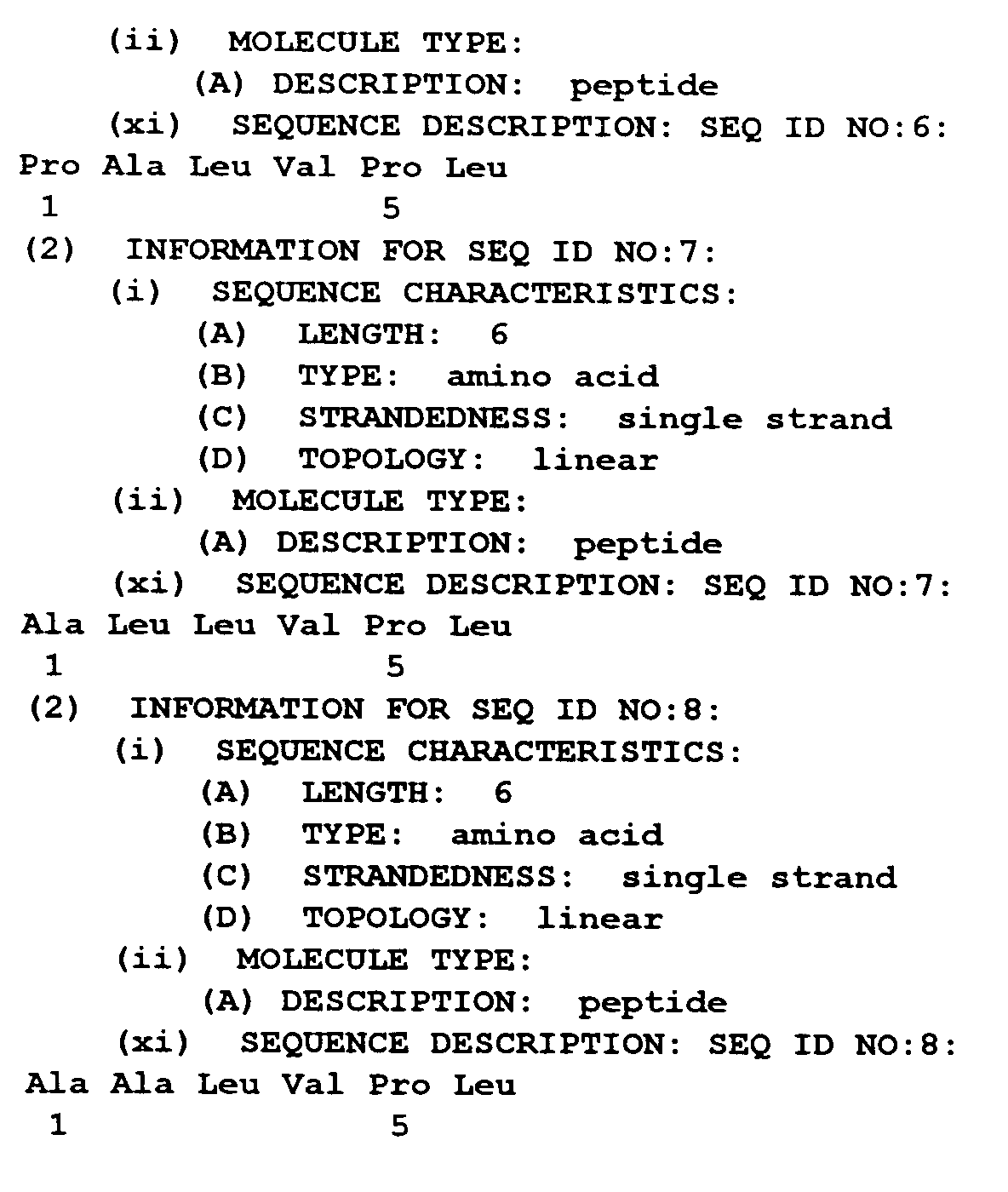
- sequences of the more preferred peptides having available fibrinogen binding domains are Phe-Leu-Leu-Val-Pro-Leu, Pro-Leu-Leu-Val-Pro-Leu, and Phe-Ala-Leu-Val-Pro-Leu (SEQ ID NOS 1, 2, and 3, respectively), and the sequence of the most preferred peptide is Phe-Leu-Leu-Val-Pro-Leu.
- the peptides were isolated and identified using a screening process described in U.S. Patent Application Serial Number 08/438,331 filed May 10, 1995 in the name of Joseph A. Buettner.
- FLLVPL The peptides FLLVPL, PLLVPL and FALVPL described herein have been compared to the protein sequence databases and do not show homology to proteins known to interact with the blood clotting components relevant to fibrinogen.
- Exact matches to FLLVPL are the interleukin-6 receptor (mouse and human), to a hypothetical membrane protein of yeast ( Saccharomyces cervisiae ), a nodule forming protein for Rhizobium leguminosarum , and a bovine sodium-dependent phosphate transporter.
- Exact matches to PLLVPL are the Chlamydia trachomatis CMP-2-keto-3-deoxyoctulosonic acid synthetase (kdsB) and CTP synthetase (pyrG) genes, mismatch repair protein mutL protein of Escherichia coli and S almonella typhimurium , the human adenovirus 2 late L2 mu core protein precursor, the hypothetical 14K protein (mer operon) of Staphylococcus aureus plasmid pI258, a hypothetical protein of Bacillus subtillis , a human mitochondria open reading frame (ORF) protein, the POU-c transcription factor of Brachydanio rerio (zebra fish), and the H + -transporting ATP synthase (EC 3.6.1.34) chain a of Synechocystis sp.
- kdsB Chlamydia trachomatis CMP-2-keto-3-deoxyoctul
- Exact matches to FALVPL are the human MLL-AF4 der (11) fusion protein, the human 140 kd serine/proline-rich protein, human protein encoded by the AF-4 mRNA, the protein lmbE of Mycobacterium , and the V0 protein of Miscanthus streak virus.
- Polyclonal rabbit antibody to fibrinogen was purchased from American Diagnostical (Greenwich, CT) and from Enzyme Research Labs (South Bend, IN).
- the second antibody conjugate, goat anti-rabbit IgG-alkaline phosphatase, and the dye substrates NBT/BCIP and Fast Red TR were from Pierce Chemical Co. (Rockford, IL).
- Human fibrinogen was purchased from Sigma Chemical Co. (St. Louis, MO) and from Chromogenix AB (Molndal, Sweden). Fmoc amino acids were from Novobiochem. All other chemicals were reagent grade or better.
- a somewhat lower peptide density would be more desirable to reduce the risk of low capacity of fibrinogen binding due to steric hindrance.
- Such desirable densitites would be in the range of 0.05-0.2 mmole/g resin (10 to 40 mg/ml resin).
- mixtures containing varied ratios of Fmoc-L-alanine to t-Boc-L-alanine were coupled to Totda-Toyopearl.
- Peptides were then synthesized onto the resin using Fmoc-derivatized amino acids, followed by deprotection under acid conditions (which also released the residual t-Boc).
- the density of peptide on batches of resin was determined by total amino acid analysis of dessicated, weighed samples by standard methods. The optimum peptide density was achieved with a mixture of Fmoc to t-Boc of 1:10.
- Rink resin Novobiochem
- Rink resin Novobiochem
- Peptides were cleaved and deprotected and purified by reverse phase HPLC.
- some peptides required for affinity chromatography were deprotected and cleaved from Rink resin without removal of the N-terminal Fmoc group, purified by reverse phase HPLC and coupled to A-Totda-Toyopearl. Purity of peptides was assessed by analytical reverse phase HPLC and compositions confirmed by FAB mass spectrometry.
- Sodium dodecylsulfate polyacrylamide gel electrophoresis was performed in 8% polyacrylamide gels (Novex, San Diego, CA) according to the procedure of Laemmli (1970), loading 4 ⁇ g protein per lane. Transfer of protein from gels was performed by the method of Towbin et al . (1979) using casein (Pierce Chemical Co.) to block unused membrane binding sites. Bound antibodies were detected by using the chemiluminescent substrate CSPD (Tropix, Bedford, MA) and exposure to XAR film (Eastman Kodak, Rochester, NY).
- Immunonephelometry was performed by using a Behring Nephelometer, model BNA, with assay kits purchased from Behringwerke AG (Marburg, DEU). Isothermal titration colorimetry was performed using either purified, soluble peptides (5mM) or peptides synthesized directly on A-Totda-Togopearl (1.4mM) and with purified fibrinogen (50 ⁇ M) by a modification of the technique of Tyler-Cross et al. (1993). All measurements were performed at 30°C in 30mM phosphate buffer, pH 7.0 with an Omega titration colorimeter (Microcal, Inc., Northampton, MA).
- a 6-mer combinatorial peptide library was synthesized directly onto a TosoHaas chromatography resin, Toyopearl 650M Chelate, modified sequentially by amination with Totda, then addition of a base labile linker hydroxymethylbenzoic acid, and finally a glycine residue (G-HMBA-Totda-Toyopearl), at a final substitution density of approximately 0.1 mmole/g resin.
- the library was synthesized using F-moc chemistry with 18 of the 20 natural amino acids (excepting cysteine and methionine). Amino termini were partially protected with a methylsulfonylethylcarbonyl group.
- the first contactings to the resin consisted of the equilibration buffer (20 mM HEPES, pH 6.8 and 0.1 M NaCl and 0.1% v/v Tween-20), and then the wash buffer (equilibration buffer containing 1 M NaCl). This was followed by sequentially contacting the resin with the individual components of the detection system. These components were, namely, anti-human fibrinogen (affinity purified IgG fraction), a second antibody conjugated with alkaline phosphatase, and BCIP/NBT blue stain. All proteins were in equilibration buffer and were followed with wash buffer.
- the resin was further contacted with 0.625 ⁇ g of fibrinogen (2 nM) in equilibration buffer, followed by the detection system using Fast Red as the stain, as outlined above and in Buettner, et al . (1996).
- Solution phase binding isotherms were performed on the purified soluble peptides and purified fibrinogen by using isothermal titration calorimetry (Table 3).
- the sequence PLLVPL showed weaker solution binding to fibrinogen than FLLVPL under the conditions used. A change from P to F at the amino terminus lowered the dissociation constant over 150-fold.
- PLLVPL bound to approximately 3 to 4 sites per fibrinogen molecule. These interactions had a large, positive entropic term which may indicate that a conformational change occurred in either the peptide or in fibrinogen.
- the sequence FLLVPL bound at approximately one site on fibrinogen, and this binding also had a very large, positive entropy.
- the apparent dissociation constant of FLLVPL synthesized on A-Totda-Toyopearl decreased over 100-fold from that of the soluble peptide.
- the increased magnitude of the enthalpic and entropic terms suggest a similar mechanism of binding to fibrinogen as compared to soluble peptide.
- the free energy of binding remained favorable.
- Human plasma was diluted 1:2 in equilibration buffer containing 0.1% (v/v) Tween-20. Wash and elution conditions were as outlined above. Approximately 1.0 ml was injected onto the peptide resin PLLVPL-A-Totda-Toyopearl and FLLVPL-A-Totda-Toyopearl ( Figures 4 and 5, respectively). Acid treatment was used to release protein from the peptide resins. Whole plasma, freshly frozen and thawed and with cryoprecipitate removed by centrifugation, was analyzed by SDS-PAGE (Figure 3A, lane 2). Plasma contained fibrinogen bands near the top of the gel whose identity was confirmed by western blotting ( Figure 3B, lane 2). Acid eluates contained highly purified fibrinogen ( Figure 3A and B, lanes 6 and 9).
- the acid eluate fraction from the FLLVPL resin separations was analyzed by immunonephelometry for fibrinogen and several other plasma proteins after adjusting the pH to neutrality with 1 M TrisHCl, pH 8.0 (Table 4).
- Truncations from the carboxyl- and amino termini of PLLVPL and FLLVPL were synthesized directly on A-Totda-Toyopearl resin in order to identify the minimum sequence necessary for binding.
- Table 6 shows the quantification of eluates from the resins contacted in a chromatographic format with graded dosages of fibrinogen.
- the full length peptides (e.g., 6-mers) bound fibrinogen most tightly for all three injection amounts (250, 500 and 1000 ⁇ g) as reflected in the amount released at low pH, although there was a smaller but proportional increase in the amount released by 1 M NaCl. Truncations from the C-terminus yielded peptides which bound fibrinogen less tightly, as indicated by a greater amount released by 1 M NaCl. Similar results were observed for the N-terminal truncation peptides. These results indicate that the entire peptide sequence of six amino acids is necessary for optimal binding to fibrinogen under the conditions tested. Additionally, modifications to the length of the peptide may allow for more gentle elution conditions than with low pH.
- Peptides which are four amino acids long (4-mers) bind well, with peptides which are five amino acids long (5-mers) being more preferred, and peptides which are six amino acids long (6-mers) being most preferred. It is anticipated that peptides which are seven (7-mers) or more amino acids long which contain the sequences disclosed herein would also be suitable for binding fibrinogen if the binding domains are accessible, or available, to be bound by the fibrinogen, as defined above.
- Peptide FLLVPL was synthesized directly on A-Totda-Toyopearl at a density of 0.2 mmole/g resin.
- a column of dimensions 1.0 x 6.4 cm (approximately 5 ml column volume) was equilibrated with either 10 mM HEPES or 10 mM sodium acetate, pH 6.8, 1.0 mM EGTA and either 0.1, 0.2 or 1.0 M NaCl.
- Fibrinogen 25 mg; 5.0 ml
- Fibrinogen 25 mg; 5.0 ml was applied to the column in 10 mM sodium acetate, pH 6.8 and 1 mM EGTA containing 0.1 M NaCl. Elution with a nonionic detergent (5% Tween-20) in the binding buffer resulted in the release of 40 percent of the applied protein, suggesting a role for hydrophobic interactions in the binding. Conversely, elution with an ionic (2% Sodium cholate) detergent resulted in only 14 percent release.
- fibrinogen 25 mg; 5.0 ml was applied to the peptide under high salt conditions favorable to hydrophobic bonding and release under low ionic strength.
- the peptide resin was equilibrated with 10 mM sodium acetate, 1.0 M NaCl, and 1.0 mM EGTA, pH 6.8.
- Five milliliters of a solution of fibrinogen (5 mg/ml) in the same buffer was applied to the column, and washed with two column volumes of the same buffer. The resin was then contacted with 10 column volumes of 10 mM sodium acetate, pH 4.0 followed by 2% acetic acid (4 column volumes).
- the elution profile is shown in Figure 6.
- Low ionic strength and low pH (4.0) released approximately 78.3 percent of the protein.
- only 5% of the applied protein was eluted in a second experiment when the 10mM sodium acetate, pH 4.0 solution contained 0.1 M NaCl. Acid treatment released the remainder of the recovered protein in both experiments.
- Approximately 88.9% of the total recovered protein in the neutralized acid eluate was clottable with ⁇ -thrombin.
- novel peptides for the affinity purification of fibrinogen. These novel peptides have available fibrinogen binding domains and were obtained by screening peptide libraries and can be readily made in purified form. It is further anticipated that modification of these peptides by conservative substitution, deletion of terminal residues, and/or addition of terminal moieties is a useful technique for altering the selectivity of binding.
Landscapes
- Chemical & Material Sciences (AREA)
- Organic Chemistry (AREA)
- Health & Medical Sciences (AREA)
- Life Sciences & Earth Sciences (AREA)
- Biochemistry (AREA)
- Biophysics (AREA)
- General Health & Medical Sciences (AREA)
- Genetics & Genomics (AREA)
- Medicinal Chemistry (AREA)
- Molecular Biology (AREA)
- Proteomics, Peptides & Aminoacids (AREA)
- Peptides Or Proteins (AREA)
Abstract
Peptides which bind to fibrinogen are disclosed. These peptides have available fibrinogen binding domains having a Phe-Leu-Leu-Val or Leu-Leu-Val-Pro sequence. The preferred peptide is a 6-mer having the sequence Phe-Leu-Leu-Val-Pro-Leu. A method of using these peptides in an affinity chromatography process to purify fibrinogen is described.
Description
- Field This invention is concerned generally with identifying protein-ligand interactions, and specifically with peptide ligands which bind fibrinogen and which may be used in a method for the affinity purification of fibrinogen.
- Background Fibrinogen is a plasma precursor of the major protein of clotted blood, fibrin. Fibrinogen is a glycoprotein comprised of three pairs of polypeptides (Aα, Bβ, and γ) joined by disulfides. Thrombin cleavage of the Aα and Bβ chains converts fibrinogen into fibrin and initiates clotting. Fibrinogen has been used commercially for use in hemostatic preparations, typically called fibrin glues or sealants.
- Preparation of fibrinogen concentrates has been performed by precipitation methods from whole plasma, cryoprecipitate, or Cohn fraction I for use in tissue glues. The most crude preparations merely use cryoprecipitated protein directly for use as a fibrin sealant, typically made from autologous plasma (Kingdon et al., 1994). Larger scale procedures depend upon use of ethanol (Blomback and Blomback, 1956), ammonium sulfate (Takeda, 1966) or β-alanine and/or glycine (Jakobsen and Kierulf, 1973) to effect differential solubility. These concentrates are mixtures of many other plasma proteins, including Factor XIII and fibronectin, and also less desirable plasmin, plasminogen, fibrinogen degradation products (fragments D and E) and fibrin protomers. Inhibition of plasmin by the addition of ε-aminocaproic acid is usually required to yield clottable fibrinogen.
- Chromatographic isolation methods use gel filtration or ion exchange resins to prepare intermediate purity concentrates (reviewed in Furlan, 1984). Ultrafiltration has also been claimed as a method (Kopf and Morse, 1993). Affinity methods have also been introduced for high purity enrichment of fibrinogen from plasma. Protamine has been used to purify fibrinogen (Dempfle & Heene, 1987a), although fibrinogen degradation products and protofibrils of fibrin also co-purify (Dempfle & Heene, 1987b). Immobilised monomeric fibrin has been shown to bind and purify fibrinogen (Matthias et al., 1975). The antibiotic, Ristocetin, has been immobilized and used to bind fibrinogen (Suzuki et al., 1980). Immunoaffinity chromatography has been developed and is especially useful for analytical applications (Merskey et al., 1980; McConnell & Anderson, 1993).
- Peptide Ligand Chromatography Kuyas, et al. (1990) purified fibrinogen from plasma on a column of GPRPK-Sepharose. (SEQ ID NO 4) The peptide GPRP is an analogue of the carboxy side (GPRVVERHK (SEQ ID NO 5)) of the fibrinogen Aα-chain exposed upon cleavage by thrombin. This sequence is the binding region for initial polymerization by a carboxy terminal sequence on the γ chain of fibrinogen. (Amino acid abbreviations are as typically used in the art and are described in Scholz et al., 1993.)
- We have now discovered a group of peptides characterized by their ability to bind fibrinogen. These peptides have available fibrinogen binding domains selected from the group consisting of Phe-Leu-Leu-Val and Leu-Leu-Val-Pro. As used herein, an available fibrinogen binding domain means a peptide sequence which is sterically available to bind with fibrinogen in the surrounding solution and which adopts a conformation that ligates fibrinogen with moderate to strong avidity under controlled conditions of pH, ionic strength, and solvent composition. The avidity of binding may be increased or decreased by altering the amino acids adjacent to the above listed sequences and/or by terminal deletion of amino acids. The avidity may be modified further by altering the above mentioned conditions of pH, ionic strength, and solvent composition.
- The sequences of the more preferred peptides having available fibrinogen binding domains are Phe-Leu-Leu-Val-Pro-Leu, Pro-Leu-Leu-Val-Pro-Leu, and Phe-Ala-Leu-Val-Pro-Leu (
SEQ ID NOS - The peptides FLLVPL, PLLVPL and FALVPL described herein have been compared to the protein sequence databases and do not show homology to proteins known to interact with the blood clotting components relevant to fibrinogen. Exact matches to FLLVPL are the interleukin-6 receptor (mouse and human), to a hypothetical membrane protein of yeast (Saccharomyces cervisiae), a nodule forming protein for Rhizobium leguminosarum, and a bovine sodium-dependent phosphate transporter. Exact matches to PLLVPL are the Chlamydia trachomatis CMP-2-keto-3-deoxyoctulosonic acid synthetase (kdsB) and CTP synthetase (pyrG) genes, mismatch repair protein mutL protein of Escherichia coli and Salmonella typhimurium, the
human adenovirus 2 late L2 mu core protein precursor, the hypothetical 14K protein (mer operon) of Staphylococcus aureus plasmid pI258, a hypothetical protein of Bacillus subtillis, a human mitochondria open reading frame (ORF) protein, the POU-c transcription factor of Brachydanio rerio (zebra fish), and the H+-transporting ATP synthase (EC 3.6.1.34) chain a of Synechocystis sp. Exact matches to FALVPL are the human MLL-AF4 der (11) fusion protein, the human 140 kd serine/proline-rich protein, human protein encoded by the AF-4 mRNA, the protein lmbE of Mycobacterium, and the V0 protein of Miscanthus streak virus. -
- Figure 1 shows elution profiles (absorbance at 280 nm) of chromatographic separations on peptide PLLVPL-A-Totda-Toyopearl. (SEQ ID NO 2) A) buffers, no protein; B) 0.5 mg hSA; C) 250 µg fibrinogen; D) 500 µg fibrinogen; E) 1000 µg fibrinogen. Fibrinogen was applied at approximately 17 µl/min for 10 min, and then the column was washed with equilibration buffer for 4 min at 865 µl/min, followed by equilibration buffer containing 1.0 M NaCl for 5 min, 3.0 M NaCl for a further 5 min, and 0.1 M for another 5 min. Protein was eluted between 30 to 35 min by using 2% acetic acid.
- Figure 2 shows elution profiles (absorbance at 280 nm) of chromatographic separations on peptide FLLVPL-A-Totda-Toyopearl. (SEQ ID NO 1) Line designations are the same as in Figure 1. Flution conditions are the same as in Figure 1.
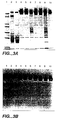
- Figure 3A shows a Coomassie-stained SDS-PAGE of plasma, fibrinogen and hSA mixture and acid eluates from chromatographic separations.
Lane 1, molecular weight standards;lane 2, human plasma;lane 3, fibrinogen/hSA mixture;lane 4, acid eluate from fibrinogen/hSA mixture (no Tween) applied to PLLVPL-resin (SEQ ID NO 2);lane 5, acid eluate, same as lane 4 (with Tween);lane 6, acid eluate of human plasma; lane 7-9, same as lanes 4-6 using FLLVPL-resin (SEQ ID NO 1);lane 10, fibrinogen standard. - Figure 3B shows a Western blot analysis of a duplicate gel to the one shown in Figure 3A.
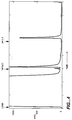
- Figure 4 shows the elution profile (absorbance at 280 nm) of whole plasma applied to PLLVPL-A-Totda-Toyopearl (SEQ ID NO 2). Elution conditions are the same as in Figure 1.
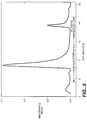
- Figure 5 shows the elution profile (absorbance at 280 nm) of whole plasma applied to FLLVPL-A-Totda-Toyopearl (SEQ ID NO 1). Flution conditions are the same as in Figure 1.
- Figure 6 shows the elution profile of fibrinogen applied to FLLVPL-A-Totda-Toyopearl (SEQ ID NO 1) under conditions of high salt (1M NaCl) at neutral pH (6.8) and elution by low ionic strength (10 mM sodium acetate) at low pH (4.0).
- Polyclonal rabbit antibody to fibrinogen was purchased from American Diagnostical (Greenwich, CT) and from Enzyme Research Labs (South Bend, IN). The second antibody conjugate, goat anti-rabbit IgG-alkaline phosphatase, and the dye substrates NBT/BCIP and Fast Red TR were from Pierce Chemical Co. (Rockford, IL). Human fibrinogen was purchased from Sigma Chemical Co. (St. Louis, MO) and from Chromogenix AB (Molndal, Sweden). Fmoc amino acids were from Novobiochem. All other chemicals were reagent grade or better.
- Screening of the peptide libraries was performed in 2.1 mm x 15 cm columns on a microbore HPLC (Microme Bioresources, Auburn, CA). Peptides and a 6-mer combinatorial library were synthesized on Toyopearl AF Chelate 650 M (Tosohaas, Montgomeryville, PA) modified with 4,7,10-trioxa-1,13-tridecanediamine (Totda; Aldrich, St. Louis, MO), using standard Fmoc chemistry as described by Buettner et al. (1996). Peptides were synthesized robotically by using a Gilson AMS 422. Peptide densities achieved with the above scheme were typically in the range of 0.2-0.5 mmole/g resin.
- For screening peptides in an affinity chromatographic format, a somewhat lower peptide density would be more desirable to reduce the risk of low capacity of fibrinogen binding due to steric hindrance. Such desirable densitites, as practiced in the usual art of affinity chromatography, would be in the range of 0.05-0.2 mmole/g resin (10 to 40 mg/ml resin). In order to control the density of peptide synthesized onto the Totda linker, mixtures containing varied ratios of Fmoc-L-alanine to t-Boc-L-alanine were coupled to Totda-Toyopearl. Mixtures were made by serial dilution of equal concentrations of stock Fmoc-L-alanine into t-Boc-L-alanine (1:0, 1:5, 1:10, 1:25, and 1:125). The total amino acid concentration was held constant at approximately 2.5 mmole/g resin (five-fold over Totda). Afier coupling the mixture using standard Fmoc conditions practiced in the art, the Fmoc protecting group was released by alkali, whereas the alkaline resistant t-Boc was not. This residual t-Boc derivatized L-alanine lacked a primary amine and was not available for further peptide synthesis. Peptides were then synthesized onto the resin using Fmoc-derivatized amino acids, followed by deprotection under acid conditions (which also released the residual t-Boc). The density of peptide on batches of resin was determined by total amino acid analysis of dessicated, weighed samples by standard methods. The optimum peptide density was achieved with a mixture of Fmoc to t-Boc of 1:10.
- Rink resin (Novobiochem) was used for syntheses when soluble, purified peptides were required as soluble binding ligands. Peptides were cleaved and deprotected and purified by reverse phase HPLC. Alternatively, some peptides required for affinity chromatography were deprotected and cleaved from Rink resin without removal of the N-terminal Fmoc group, purified by reverse phase HPLC and coupled to A-Totda-Toyopearl. Purity of peptides was assessed by analytical reverse phase HPLC and compositions confirmed by FAB mass spectrometry.
- Sodium dodecylsulfate polyacrylamide gel electrophoresis (SDS-PAGE) was performed in 8% polyacrylamide gels (Novex, San Diego, CA) according to the procedure of Laemmli (1970), loading 4 µg protein per lane. Transfer of protein from gels was performed by the method of Towbin et al. (1979) using casein (Pierce Chemical Co.) to block unused membrane binding sites. Bound antibodies were detected by using the chemiluminescent substrate CSPD (Tropix, Bedford, MA) and exposure to XAR film (Eastman Kodak, Rochester, NY).
Immunonephelometry was performed by using a Behring Nephelometer, model BNA, with assay kits purchased from Behringwerke AG (Marburg, DEU).
Isothermal titration colorimetry was performed using either purified, soluble peptides (5mM) or peptides synthesized directly on A-Totda-Togopearl (1.4mM) and with purified fibrinogen (50µM) by a modification of the technique of Tyler-Cross et al. (1993). All measurements were performed at 30°C in 30mM phosphate buffer, pH 7.0 with an Omega titration colorimeter (Microcal, Inc., Northampton, MA). - An assay similar to the one used in U.S. Patent Application Serial Number 08/438,331 (incorporated herein by reference) was used to deduce peptides that bind fibrinogen. The assay is refereed to as the peptide library immunostaining chromatographic analysis or PELICAN technique. Briefly, a 6-mer combinatorial peptide library was synthesized directly onto a TosoHaas chromatography resin, Toyopearl 650M Chelate, modified sequentially by amination with Totda, then addition of a base labile linker hydroxymethylbenzoic acid, and finally a glycine residue (G-HMBA-Totda-Toyopearl), at a final substitution density of approximately 0.1 mmole/g resin. The library was synthesized using F-moc chemistry with 18 of the 20 natural amino acids (excepting cysteine and methionine). Amino termini were partially protected with a methylsulfonylethylcarbonyl group.
- The first contactings to the resin (0.5 ml) consisted of the equilibration buffer (20 mM HEPES, pH 6.8 and 0.1 M NaCl and 0.1% v/v Tween-20), and then the wash buffer (equilibration buffer containing 1 M NaCl). This was followed by sequentially contacting the resin with the individual components of the detection system. These components were, namely, anti-human fibrinogen (affinity purified IgG fraction), a second antibody conjugated with alkaline phosphatase, and BCIP/NBT blue stain. All proteins were in equilibration buffer and were followed with wash buffer.
- The resin was further contacted with 0.625 µg of fibrinogen (2 nM) in equilibration buffer, followed by the detection system using Fast Red as the stain, as outlined above and in Buettner, et al. (1996).
- Blue beads, which indicated non-specific interactions with the detection system, were uniformly found throughout the column at <0.1%; red beads were found uniformly throughout the column at <0.01%. Individual beads were isolated, the peptide cleaved off the bead with 20% triethylamine in methanol with sonication for 2 hours. The cleaved peptide was dried and sequenced by Edman degradation. The amino acid sequence data are given below (Table 1). For cycles where there were ambiguous calls, the amino acids with the highest responses are listed on the first line, and those with lower yields on subsequent lines:

- Confirmatory binding assays were performed in a column chromatographic format on a microbore HPLC using individual peptide sequences synthesized directly onto the Toyopearl 650 M Chelate resin which had been modified with Totda followed by an alanine residue (A-Totda-Toyopearl), at a final substitution density of 0.2 mmole/g resin. Contactings to resins (Figure 1 and 2, for PLLVPL and FLLVPL resins, respectively) included A) equilibration buffer (as above), wash buffer (as above), and elution buffer (2.5% acetic acid) only; B) human serum albumin in equilibration buffer (hSA; 0.5 mg), followed by wash and elution buffers, C-E) graded dosages (250, 500, and 1000 µg) of purified fibrinogen in equilibration buffer, followed by wash and elution buffers. The endpoint was a dose-dependent increase in the acid eluate in the fibrinogen contactings, and quantification was by integration of the absorbance at 280 nm (Table 2).
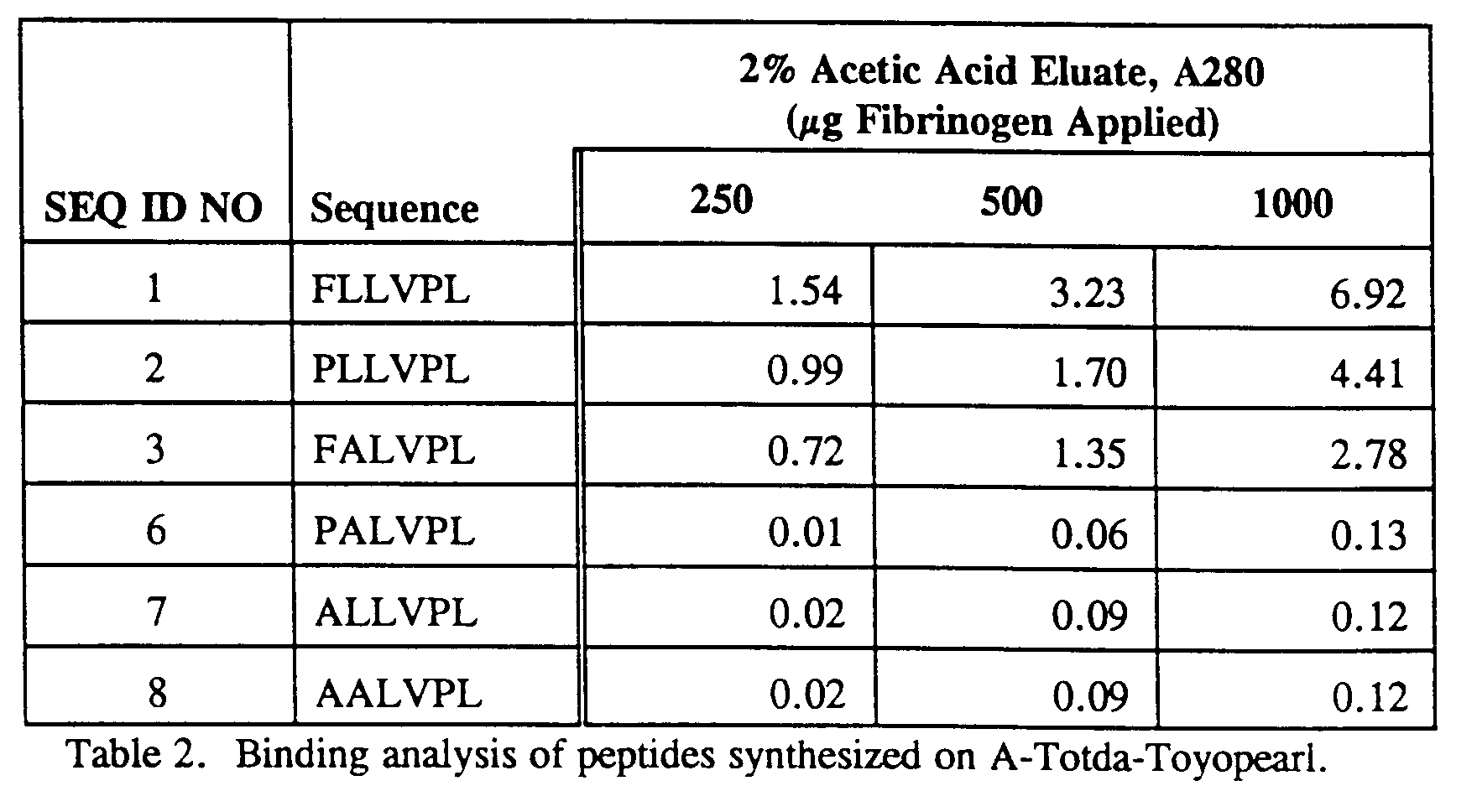
- There was a dose dependent increase in binding of fibrinogen to resins FLLVPL-A-Totda-Toyopearl PLLVPL-A-Totda-Toyopearl and to a lesser extent, to FALVPL-A-Totda-Toyopearl. These resins were contacted with a mixture of fibrinogen (100 µg) and hSA (0.5 mg) in equilibration buffer in the presence or absence of 0.1% (v/v) Tween-20, a nonionic detergent used to lower non-specific binding and also used as a viral inactivating agent. The resins were washed with wash buffer (without Tween-20) and 2% acetic acid. Analysis of the acid eluates by SDS-PAGE (Figure 3A, lanes 4-5 and 7-8) revealed that the vast majority of the protein that bound PLLVPL and FLLVPL resins was of a molecular weight equivalent to fibrinogen (340,000) that co-migrated with purified fibrinogen standard (lane 10). This protein was greatly enriched from the starting mixture (Figure 3A, lane 3). Western blotting with an antibody to human fibrinogen confirmed the identity of this protein as fibrinogen (Figure 3B). The presence of Tween-20 in the buffer system did not affect binding of fibrinogen to either peptide as indicated by the amounts of protein recovered in the acid eluate. Tween was therefore removed from the fibrinogen solution by washing the column.

- Solution phase binding isotherms were performed on the purified soluble peptides and purified fibrinogen by using isothermal titration calorimetry (Table 3). The sequence PLLVPL showed weaker solution binding to fibrinogen than FLLVPL under the conditions used. A change from P to F at the amino terminus lowered the dissociation constant over 150-fold. PLLVPL bound to approximately 3 to 4 sites per fibrinogen molecule. These interactions had a large, positive entropic term which may indicate that a conformational change occurred in either the peptide or in fibrinogen. The sequence FLLVPL bound at approximately one site on fibrinogen, and this binding also had a very large, positive entropy. Both peptide binding reactions were endothermic as indicated by the positive enthalpy (ΔH), and were thermodynamically favorable (negative ΔG) under the conditions tested. Unusually high entropic terms indicate a conformational change may be driving the association of peptide with fibrinogen.
- The apparent dissociation constant of FLLVPL synthesized on A-Totda-Toyopearl decreased over 100-fold from that of the soluble peptide. The increased magnitude of the enthalpic and entropic terms suggest a similar mechanism of binding to fibrinogen as compared to soluble peptide. The free energy of binding remained favorable.
- Human plasma was diluted 1:2 in equilibration buffer containing 0.1% (v/v) Tween-20. Wash and elution conditions were as outlined above. Approximately 1.0 ml was injected onto the peptide resin PLLVPL-A-Totda-Toyopearl and FLLVPL-A-Totda-Toyopearl (Figures 4 and 5, respectively). Acid treatment was used to release protein from the peptide resins. Whole plasma, freshly frozen and thawed and with cryoprecipitate removed by centrifugation, was analyzed by SDS-PAGE (Figure 3A, lane 2). Plasma contained fibrinogen bands near the top of the gel whose identity was confirmed by western blotting (Figure 3B, lane 2). Acid eluates contained highly purified fibrinogen (Figure 3A and B,
lanes 6 and 9). - The acid eluate fraction from the FLLVPL resin separations was analyzed by immunonephelometry for fibrinogen and several other plasma proteins after adjusting the pH to neutrality with 1 M TrisHCl, pH 8.0 (Table 4).

- No other serum protein was detected in the acid eluate other than fibrinogen and a small amount of IgM by using this assay. The low recovery of immunoreactive fibrinogen (58.8%) reflects the loss of antigenicity due to low pH exposure. All other tested plasma proteins were below detection limits.
- Peptides PLLVPL and FLLVPL, with and without an N-acetylated amino terminus, were synthesized directly onto Ala-Totda-Toyopearl at a density of approximately 0.2 mmole/g resin. The ability of these resins to bind fibrinogen was determined as above. An unblocked (free) amino terminus was required for binding fibrinogen to PLLVPL-A-Totda-Toyopearl (Table 5). Similar results were obtained in a separate experiment by using FLLVPL-A-Totda-Toyopearl (Table 5).

- Truncations from the carboxyl- and amino termini of PLLVPL and FLLVPL were synthesized directly on A-Totda-Toyopearl resin in order to identify the minimum sequence necessary for binding. Table 6 shows the quantification of eluates from the resins contacted in a chromatographic format with graded dosages of fibrinogen.

- The full length peptides (e.g., 6-mers) bound fibrinogen most tightly for all three injection amounts (250, 500 and 1000 µg) as reflected in the amount released at low pH, although there was a smaller but proportional increase in the amount released by 1 M NaCl. Truncations from the C-terminus yielded peptides which bound fibrinogen less tightly, as indicated by a greater amount released by 1 M NaCl. Similar results were observed for the N-terminal truncation peptides. These results indicate that the entire peptide sequence of six amino acids is necessary for optimal binding to fibrinogen under the conditions tested. Additionally, modifications to the length of the peptide may allow for more gentle elution conditions than with low pH. Peptides which are four amino acids long (4-mers) bind well, with peptides which are five amino acids long (5-mers) being more preferred, and peptides which are six amino acids long (6-mers) being most preferred. It is anticipated that peptides which are seven (7-mers) or more amino acids long which contain the sequences disclosed herein would also be suitable for binding fibrinogen if the binding domains are accessible, or available, to be bound by the fibrinogen, as defined above.
- Peptide FLLVPL was synthesized directly on A-Totda-Toyopearl at a density of 0.2 mmole/g resin. A column of dimensions 1.0 x 6.4 cm (approximately 5 ml column volume) was equilibrated with either 10 mM HEPES or 10 mM sodium acetate, pH 6.8, 1.0 mM EGTA and either 0.1, 0.2 or 1.0 M NaCl. Fibrinogen (25 mg; 5.0 ml) was applied to the column in 10 mM sodium acetate, pH 6.8 and 1 mM EGTA containing 0.1 M NaCl. Under these conditions, approximately 5 to 8 % of the applied absorbance (280 nm) failed to bind the column. Thus binding was unaffected by increased ionic strength, suggesting a significant role for hydrophobic binding in the peptide-protein interaction.
- Fibrinogen (25 mg; 5.0 ml) was applied to the column in 10 mM sodium acetate, pH 6.8 and 1 mM EGTA containing 0.1 M NaCl. Elution with a nonionic detergent (5% Tween-20) in the binding buffer resulted in the release of 40 percent of the applied protein, suggesting a role for hydrophobic interactions in the binding. Conversely, elution with an ionic (2% Sodium cholate) detergent resulted in only 14 percent release.
- No elution of fibrinogen (applied to the column in 10 mM sodium acetate, pH 6.8 and 1 mM EGTA containing 0.1 M NaCl) was observed by using the hydrophilic compound, polyethylene glycol (10%). Only approximately 8 percent of the applied fibrinogen was eluted by increasing the pH to 10 with 10 mM sodium borate. Further increases in pH with a linear gradient (pH 6.8 to 12.0) released approximately 25 percent of the fibrinogen. On the other hand, use of a pH gradient from 6.8 to 4.0 resulted in approximately 66 percent release of fibrinogen at pH 4.2.
- In order in assess further the contribution of hydrophobic interactions to the binding mechanism of FLLVPL to fibrinogen, fibrinogen (25 mg; 5.0 ml) was applied to the peptide under high salt conditions favorable to hydrophobic bonding and release under low ionic strength. The peptide resin was equilibrated with 10 mM sodium acetate, 1.0 M NaCl, and 1.0 mM EGTA, pH 6.8. Five milliliters of a solution of fibrinogen (5 mg/ml) in the same buffer was applied to the column, and washed with two column volumes of the same buffer. The resin was then contacted with 10 column volumes of 10 mM sodium acetate, pH 4.0 followed by 2% acetic acid (4 column volumes). The elution profile is shown in Figure 6. Approximately 7.2 percent of the applied protein (by absorbance at 280 nm) did not interact with the column and was recovered in the flow through and wash fractions. Low ionic strength and low pH (4.0) released approximately 78.3 percent of the protein. However, only 5% of the applied protein was eluted in a second experiment when the 10mM sodium acetate, pH 4.0 solution contained 0.1 M NaCl. Acid treatment released the remainder of the recovered protein in both experiments. Treatment of the pH 4.0 eluate with α-thrombin after neutralization to pH 6.9 with a stock solution of 0.4 M sodium phosphate, pH 11 resulted in the formation of a visible clot. Approximately 88.9% of the total recovered protein in the neutralized acid eluate was clottable with α-thrombin.
- These results document that the interaction of fibrinogen with FLLVPL is driven by hydrophobic attractions in addition to an ionic interaction with the primary amine at the N-terminus of the protein. Furthermore, these results demonstrated a binding and elution strategy for fibrinogen useful in affinity chromatography.
- We have demonstrated the use of novel peptides for the affinity purification of fibrinogen. These novel peptides have available fibrinogen binding domains and were obtained by screening peptide libraries and can be readily made in purified form. It is further anticipated that modification of these peptides by conservative substitution, deletion of terminal residues, and/or addition of terminal moieties is a useful technique for altering the selectivity of binding.
- The above examples are intended to illustrate the invention and it is thought variations will occur to those skilled in the art. Accordingly, it is intended that the scope of the invention should be limited only by the claims below.
-
- Blomback, B., & M. Blomback, Ark. Kemi 10: 415-443 (1956)
- Buettner, J. A. et. al., Int. J. Prot. Peptide Res. (1996) (in press)
- Dempfle, C. E., & D. L. Heene, Thromb. Res. 46: 19-27 (1987a)
- Dempfle, C. E., & D. L. Heene, Thromb. Res. 48: 223-232 (1987b)
- Furlan, M., Curr. Probl. Clin. Biochem. 14: 133-145 (1984)
- Jakobsen, E., & P. A. Kierulf, Thromb. Res. 3: 145-159 (1973)
- Kingdon, H. S. et al., U.S. Patent 5,354,682 (1994)
- Kopf, H. B., & B. S. Morse, U.S. Patent 5,259,971 (1993)
- Kuyas, C. A. et al., Thromb. Haemost. 63: 439-444 (1990)
- Laemmli, U. K. , Nature 227: 680-685 (1970)
- Matthias, F. R. et al., Thromb. Res. 7: 861-870 (1975)
- McConnell, J.P., & D. J. Anderson, J. Chromatog. 615: 67-75 (1993)
- Merskey, C. et al., Br. J. Haematol. 44: 655-670 (1980)
- Scholz, W. et al., U.S. Patent 5,210,075 (1993)
- Suzuki, K. et al., Thromb. Res. 18: 707-715 (1980)
- Takeda, Y., J. Clin. Invest. 45: 103-111 (1966)
- Towbin, H., et al., Proc. Natl. Acad. Sci. (U.S.A.) 76: 4350-4354 (1979)
- Tyler-Cross, R. et al., Arch. Biohem. Biophys 306: 528-533 (1993)


Claims (10)
- A composition comprising a peptide having an available fibrinogen binding domain, wherein the binding domain is selected from the group consisting of Phe-Leu-Leu-Val and Leu-Leu-Val-Pro.
- The composition of claim 1, wherein the peptide is a 5-mer.
- The composition of claim 2, wherein the peptide is selected from the group consisting of Phe-Leu-Leu-Val-Pro and Leu-Leu-Val-Pro-Leu.
- The composition of claim 1, wherein the peptide is a 6-mer.
- The composition of claim 4, wherein the peptide is selected from the group consisting of Phe-Leu-Leu-Val-Pro-Leu and Pro-Leu-Leu-Val-Pro-Leu.
- The composition of claim 1, wherein the peptide is selected from the group consisting of a 4-mer, a 5-mer, a 6-mer, and a 7-mer.
- A composition comprising a peptide having an available fibrinogen binding domain, wherein the binding domain is selected from the group consisting of Phe-Leu-Leu-Val-Pro-Leu, Pro-Leu-Leu-Val-Pro-Leu, and Phe-Ala-Leu-Val-Pro-Leu.
- A method of purifying fibrinogen comprising contacting a solution containing fibrinogen with a substrate under conditions sufficient to bind fibrinogen to the substrate, wherein the substrate comprises peptides bound to a support material, wherein the peptides have an available fibrinogen binding domain selected from the group consisting of Phe-Leu-Leu-Val and Leu-Leu-Val-Pro.
- A method of purifying fibrinogen comprising contacting a solution containing fibrinogen with a substrate under conditions sufficient to bind fibrinogen to the substrate, wherein the substrate comprises peptides bound to a support material, wherein the peptides have an available fibrinogen binding domain selected from the group consisting of Phe-Leu-Leu-Val-Pro-Leu, Pro-Leu-Leu-Val-Pro-Leu, and Phe-Ala-Leu-Val-Pro-Leu.
- Peptides selected from the group consisting of Phe-Leu-Leu-Val-Pro-Leu, Pro-Leu-Leu-Val-Pro-Leu, Phe-Ala-Leu-Bal-Pro-Leu, Phe-Leu-Leu-Val-Pro, Phe-Leu-Leu-Val and Leu-Leu-Val-Pro-Leu.
Applications Claiming Priority (2)
| Application Number | Priority Date | Filing Date | Title |
|---|---|---|---|
| US08/595,718 US5723579A (en) | 1996-02-02 | 1996-02-02 | Fibrinogen binding peptides |
| US595718 | 1996-02-02 |
Publications (1)
| Publication Number | Publication Date |
|---|---|
| EP0789030A1 true EP0789030A1 (en) | 1997-08-13 |
Family
ID=24384392
Family Applications (1)
| Application Number | Title | Priority Date | Filing Date |
|---|---|---|---|
| EP97100941A Ceased EP0789030A1 (en) | 1996-02-02 | 1997-01-22 | Fibrinogen binding peptides |
Country Status (5)
| Country | Link |
|---|---|
| US (1) | US5723579A (en) |
| EP (1) | EP0789030A1 (en) |
| JP (1) | JP4104691B2 (en) |
| AU (1) | AU710041B2 (en) |
| CA (1) | CA2196368A1 (en) |
Cited By (2)
| Publication number | Priority date | Publication date | Assignee | Title |
|---|---|---|---|---|
| EP0943622A1 (en) * | 1998-01-23 | 1999-09-22 | Bayer Corporation | Peptide ligands for affinity purification of fibrinogen |
| EP1568709A2 (en) | 2004-02-24 | 2005-08-31 | ZLB Behring GmbH | Purification of fibrinogen |
Families Citing this family (7)
| Publication number | Priority date | Publication date | Assignee | Title |
|---|---|---|---|---|
| US6037457A (en) * | 1997-01-31 | 2000-03-14 | The University Of North Carolina At Chapel Hill | Method for recombinant fibrinogen production |
| GB9825374D0 (en) * | 1998-11-19 | 1999-01-13 | Ppl Therapeutics Scotland Ltd | Method |
| CA2405568A1 (en) * | 2000-04-05 | 2001-10-18 | North Carolina State University | Prion-binding peptidic ligands and methods of using same |
| CN100525829C (en) * | 2002-04-15 | 2009-08-12 | 美国国家红十字会 | Method for detecting ligands and targets in a mixture |
| AU2003245612A1 (en) * | 2002-07-11 | 2004-02-02 | The American National Red Cross | Method for identifying individual active entities from complex mixtures |
| IL230151A0 (en) | 2013-12-24 | 2014-09-30 | Omrix Biopharmaceuticals Ltd | One component fibrin glue comprising a polymerization inhibitor |
| IL231792A0 (en) | 2014-03-27 | 2014-08-31 | Omrix Biopharmaceuticals Ltd | Device and method for preparing and administering one-component fibrin sealant |
Citations (1)
| Publication number | Priority date | Publication date | Assignee | Title |
|---|---|---|---|---|
| WO1994020127A1 (en) * | 1993-03-05 | 1994-09-15 | Cytel Corporation | Hla-a2.1 binding peptides and their uses |
Family Cites Families (1)
| Publication number | Priority date | Publication date | Assignee | Title |
|---|---|---|---|---|
| WO1994026930A1 (en) * | 1993-05-14 | 1994-11-24 | Thomas Jefferson University | Methods for screening and treating leukemias resulting from all-1 region chromosome abnormalities |
-
1996
- 1996-02-02 US US08/595,718 patent/US5723579A/en not_active Expired - Lifetime
-
1997
- 1997-01-22 EP EP97100941A patent/EP0789030A1/en not_active Ceased
- 1997-01-28 AU AU12355/97A patent/AU710041B2/en not_active Ceased
- 1997-01-30 CA CA002196368A patent/CA2196368A1/en not_active Abandoned
- 1997-01-30 JP JP02983897A patent/JP4104691B2/en not_active Expired - Fee Related
Patent Citations (1)
| Publication number | Priority date | Publication date | Assignee | Title |
|---|---|---|---|---|
| WO1994020127A1 (en) * | 1993-03-05 | 1994-09-15 | Cytel Corporation | Hla-a2.1 binding peptides and their uses |
Non-Patent Citations (26)
| Title |
|---|
| CHEMICAL ABSTRACTS, vol. 113, no. 21, 19 November 1990, Columbus, Ohio, US; abstract no. 189413, SUGITA, TAKAHISA ET AL: "Functional murine interleukin 6 receptor with the intracisternal a particle gene product at its cytoplasmic domain. Its possible role in plasmacytomagenesis" XP002029685 * |
| CHEMICAL ABSTRACTS, vol. 113, no. 7, 13 August 1990, Columbus, Ohio, US; abstract no. 53385, UCHIDA, SANAE ET AL: "Premature chromosome condensation is induced by a point mutation in the hamster RCC1 gene" XP002029687 * |
| CHEMICAL ABSTRACTS, vol. 114, no. 5, 4 February 1991, Columbus, Ohio, US; abstract no. 40730, BAUMANN, MATTHIAS ET AL: "Molecular cloning, characterization and functional expression of the rat liver interleukin 6 receptor" XP002029684 * |
| CHEMICAL ABSTRACTS, vol. 116, no. 25, 22 June 1992, Columbus, Ohio, US; abstract no. 253750, FIORILLO, MARIA TERESA ET AL: "Expression of the murine interleukin 6 receptor in hepatoma cells: the intracytoplasmic domain is not required for interleukin 6 signal transduction" XP002029683 * |
| CHEMICAL ABSTRACTS, vol. 118, no. 19, 10 May 1993, Columbus, Ohio, US; abstract no. 189771, SUGITA, TAKAHISA: "Cloning and characterization of the cDNAs encoding mouse interleukin-6 (IL-6) receptor. Overexpression of mutated IL-6 receptor mRNA in plasmacytoma P3U1 cells" XP002029681 * |
| CHEMICAL ABSTRACTS, vol. 118, no. 3, 18 January 1993, Columbus, Ohio, US; abstract no. 17214, LILL, HOLGER ET AL: "The atp1 and atp2 operons of the cyanobacterium Synechocystis sp. PCC 6803" XP002029682 * |
| CHEMICAL ABSTRACTS, vol. 119, no. 23, 6 December 1993, Columbus, Ohio, US; abstract no. 244315, MCLEAN, JANNA R. ET AL: "Multiple mRNAs from the Punch locus of Drosophila melanogaster encode isoforms of GTP cyclohydrolase I with distinct N-terminal domains" XP002029686 * |
| CHEMICAL ABSTRACTS, vol. 120, no. 7, 14 February 1994, Columbus, Ohio, US; abstract no. 70525, GLASER, P. ET AL: "Bacillus subtilis genome project: Cloning and sequencing of the 97 kb region from 325.degree. to 333.degree." XP002029680 * |
| CHEMICAL ABSTRACTS, vol. 121, no. 19, 7 November 1994, Columbus, Ohio, US; abstract no. 225982, CLIFTON, S. W. ET AL: "Sequence of the rec-2 locus of Haemophilus influenzae: homologies to comE-ORF3 of Bacillus subtilis and msbA of Escherichia coli" XP002029679 * |
| CHEMICAL ABSTRACTS, vol. 122, no. 1, 2 January 1995, Columbus, Ohio, US; abstract no. 2334, WANG, JIA BEI ET AL: "cDNA cloning of an orphan opiate receptor gene family member and its splice variant" XP002029678 * |
| CHEMICAL ABSTRACTS, vol. 123, no. 21, 20 November 1995, Columbus, Ohio, US; abstract no. 277287, TELFORD, ELIZABETH A. R. ET AL: "The DNA sequence of equine herpesvirus 2" XP002029676 * |
| CHEMICAL ABSTRACTS, vol. 123, no. 9, 28 August 1995, Columbus, Ohio, US; abstract no. 104026, NOMURA, NOBUO ET AL: "Prediction of the coding sequences of unidentified human genes. II. The coding sequences of 40 new genes (KIAA0041-KIAA0080) deduced by analysis of cDNA clones from human cell line KG-1" XP002029677 * |
| CHEMICAL ABSTRACTS, vol. 124, no. 3, 15 January 1996, Columbus, Ohio, US; abstract no. 22809, FLEISCHMANN, ROBERT D. ET AL: "Whole-genome random sequencing and assembly of Haemophilus influenzae Rd" XP002029675 * |
| DNA RES. (1994), 1(5), 223-9 CODEN: DARSE8;ISSN: 1340-2838, 1994 * |
| EUR. J. IMMUNOL. (1992), 22(3), 799-804 CODEN: EJIMAF;ISSN: 0014-2980, 1992 * |
| FEBS LETT. (1994), 348(1), 75-9 CODEN: FEBLAL;ISSN: 0014-5793, 1994 * |
| GENE (1994), 146(1), 95-100 CODEN: GENED6;ISSN: 0378-1119, 1994 * |
| J. BIOL. CHEM. (1990), 265(32), 19853-62 CODEN: JBCHA3;ISSN: 0021-9258, 1990 * |
| J. BIOL. CHEM. (1993), 268(36), 27191-7 CODEN: JBCHA3;ISSN: 0021-9258, 1993 * |
| J. EXP. MED. (1990), 171(6), 2001-9 CODEN: JEMEAV;ISSN: 0022-1007, 1990 * |
| J. MOL. BIOL. (1995), 249(3), 520-8 CODEN: JMOBAK;ISSN: 0022-2836, 1995 * |
| MOL. CELL. BIOL. (1990), 10(2), 577-84 CODEN: MCEBD4;ISSN: 0270-7306, 1990 * |
| MOL. MICROBIOL. (1993), 10(2), 371-84 CODEN: MOMIEE;ISSN: 0950-382X, 1993 * |
| OSAKA DAIGAKU IGAKU ZASSHI (1992), 44(5-12), 395-401 CODEN: ODIZAK;ISSN: 0369-710X, 1992 * |
| PLANT MOL. BIOL. (1991), 17(4), 641-52 CODEN: PMBIDB;ISSN: 0167-4412, 1991 * |
| SCIENCE (WASHINGTON, D. C.) (1995), 269(5223), 496-8, 507-12 CODEN: SCIEAS;ISSN: 0036-8075, 1995 * |
Cited By (5)
| Publication number | Priority date | Publication date | Assignee | Title |
|---|---|---|---|---|
| EP0943622A1 (en) * | 1998-01-23 | 1999-09-22 | Bayer Corporation | Peptide ligands for affinity purification of fibrinogen |
| EP1568709A2 (en) | 2004-02-24 | 2005-08-31 | ZLB Behring GmbH | Purification of fibrinogen |
| US7550567B2 (en) | 2004-02-24 | 2009-06-23 | Csl Behring Gmbh | Fibrinogen purification |
| EP2264069A2 (en) | 2004-02-24 | 2010-12-22 | CSL Behring GmbH | Purification of fibrinogen |
| EP2267025A2 (en) | 2004-02-24 | 2010-12-29 | CSL Behring GmbH | Purification of fibrinogen |
Also Published As
| Publication number | Publication date |
|---|---|
| US5723579A (en) | 1998-03-03 |
| AU710041B2 (en) | 1999-09-09 |
| AU1235597A (en) | 1997-08-07 |
| JPH09309899A (en) | 1997-12-02 |
| CA2196368A1 (en) | 1997-08-03 |
| JP4104691B2 (en) | 2008-06-18 |
Similar Documents
| Publication | Publication Date | Title |
|---|---|---|
| Fang et al. | Review on biomimetic affinity chromatography with short peptide ligands and its application to protein purification | |
| DeLange et al. | Calf and pea histone IV: II. The complete amino acid sequence of calf thymus histone IV; presence of ε-N-acetyllysine | |
| Jirácek et al. | Development of Highly Potent and Selective Phosphinic Peptide Inhibitors of Zinc Endopeptidase 24-15 Using Combinatorial Chemistry (∗) | |
| JP4229704B2 (en) | Fc region polypeptide binding molecule | |
| AU2002254683A1 (en) | Binding molecules for Fc-region polypeptides | |
| US8076452B2 (en) | Streptavidin-binding peptide | |
| Dyckes et al. | Spontaneous re-formation of a broken peptide chain | |
| US5846738A (en) | Synthetic standard for immunoassays | |
| US5723579A (en) | Fibrinogen binding peptides | |
| JP3811524B2 (en) | Peptides useful as ligands | |
| EP0816377B1 (en) | Peptides which bind to prothrombin and thrombin | |
| Necina et al. | Peptide affinity chromatography of human clotting factor VIII: Screening of the vWF-binding domain | |
| CA1308217C (en) | Substrate peptides | |
| US6191256B1 (en) | Recombinant factor VIII binding peptides | |
| Soberano et al. | Specificity of bacterial collagenase: studies with peptides newly synthesized using the solid-phase method | |
| Nishikata et al. | Affinity Chromatography of Trypsin and Related Enzymes: IV. Quantitative Comparison of Affinity Adsorbents Containing Various Arginine Peptides | |
| US5998589A (en) | Method of purifying human factor VIII | |
| CA2632714A1 (en) | Small peptidic and peptido-mimetic affinity ligands for factor viii and factor viii-like proteins | |
| US5679643A (en) | Glutathione analogs and paralog panels comprising glutathione mimics | |
| JPH09124696A (en) | Peptide ligands that bind to von Willebrand factor | |
| Imhof et al. | Synthesis of linear and cyclic phosphopeptides as ligands for the N‐terminal SH2‐domain of protein tyrosine phosphatase SHP‐1 | |
| García-Echeverría et al. | Biotinylated phosphotyrosine containing peptides: A valuable tool for studies on phosphopeptide interactions with SH2 and PTB domains | |
| US5783663A (en) | Peptide ligands for affinity purification of fibrinogen | |
| Basak et al. | Affinity purification of proteinases by a combination of immobilized peptidyl aldehyde and semicarbazone | |
| Peake et al. | Peptide inhibitors of C3 breakdown |
Legal Events
| Date | Code | Title | Description |
|---|---|---|---|
| PUAI | Public reference made under article 153(3) epc to a published international application that has entered the european phase |
Free format text: ORIGINAL CODE: 0009012 |
|
| AK | Designated contracting states |
Kind code of ref document: A1 Designated state(s): AT BE CH DE DK ES FI FR GB GR IE IT LI LU MC NL PT SE |
|
| RAP1 | Party data changed (applicant data changed or rights of an application transferred) |
Owner name: BAYER CORPORATION |
|
| 17P | Request for examination filed |
Effective date: 19980213 |
|
| 17Q | First examination report despatched |
Effective date: 20010531 |
|
| GRAG | Despatch of communication of intention to grant |
Free format text: ORIGINAL CODE: EPIDOS AGRA |
|
| STAA | Information on the status of an ep patent application or granted ep patent |
Free format text: STATUS: THE APPLICATION HAS BEEN REFUSED |
|
| 18R | Application refused |
Effective date: 20021205 |