EP0787573A1 - Flächiger Verbundwerkstoff - Google Patents
Flächiger Verbundwerkstoff Download PDFInfo
- Publication number
- EP0787573A1 EP0787573A1 EP97100942A EP97100942A EP0787573A1 EP 0787573 A1 EP0787573 A1 EP 0787573A1 EP 97100942 A EP97100942 A EP 97100942A EP 97100942 A EP97100942 A EP 97100942A EP 0787573 A1 EP0787573 A1 EP 0787573A1
- Authority
- EP
- European Patent Office
- Prior art keywords
- fabric
- composite material
- flat composite
- polyester
- fiber
- Prior art date
- Legal status (The legal status is an assumption and is not a legal conclusion. Google has not performed a legal analysis and makes no representation as to the accuracy of the status listed.)
- Granted
Links
- 239000002131 composite material Substances 0.000 title claims abstract description 18
- 239000004744 fabric Substances 0.000 claims abstract description 30
- 229920000728 polyester Polymers 0.000 claims abstract description 20
- 229920000098 polyolefin Polymers 0.000 claims abstract description 14
- 239000012779 reinforcing material Substances 0.000 claims abstract description 9
- 239000011159 matrix material Substances 0.000 claims abstract description 6
- 239000000835 fiber Substances 0.000 claims description 20
- 239000004743 Polypropylene Substances 0.000 claims description 13
- -1 polypropylene Polymers 0.000 claims description 13
- 229920001155 polypropylene Polymers 0.000 claims description 13
- 239000003365 glass fiber Substances 0.000 claims description 10
- 239000000155 melt Substances 0.000 claims description 2
- 239000011521 glass Substances 0.000 description 6
- 239000011265 semifinished product Substances 0.000 description 4
- 229920004935 Trevira® Polymers 0.000 description 2
- FPYJFEHAWHCUMM-UHFFFAOYSA-N maleic anhydride Chemical compound O=C1OC(=O)C=C1 FPYJFEHAWHCUMM-UHFFFAOYSA-N 0.000 description 2
- 239000000463 material Substances 0.000 description 2
- 230000035515 penetration Effects 0.000 description 2
- 238000003825 pressing Methods 0.000 description 2
- SMZOUWXMTYCWNB-UHFFFAOYSA-N 2-(2-methoxy-5-methylphenyl)ethanamine Chemical compound COC1=CC=C(C)C=C1CCN SMZOUWXMTYCWNB-UHFFFAOYSA-N 0.000 description 1
- NIXOWILDQLNWCW-UHFFFAOYSA-N 2-Propenoic acid Natural products OC(=O)C=C NIXOWILDQLNWCW-UHFFFAOYSA-N 0.000 description 1
- VGGSQFUCUMXWEO-UHFFFAOYSA-N Ethene Chemical compound C=C VGGSQFUCUMXWEO-UHFFFAOYSA-N 0.000 description 1
- 239000005977 Ethylene Substances 0.000 description 1
- 239000000654 additive Substances 0.000 description 1
- 238000007796 conventional method Methods 0.000 description 1
- 238000001816 cooling Methods 0.000 description 1
- 229920001577 copolymer Polymers 0.000 description 1
- 230000000694 effects Effects 0.000 description 1
- 239000000839 emulsion Substances 0.000 description 1
- 239000003733 fiber-reinforced composite Substances 0.000 description 1
- 239000011152 fibreglass Substances 0.000 description 1
- 239000000945 filler Substances 0.000 description 1
- 239000010408 film Substances 0.000 description 1
- 239000003063 flame retardant Substances 0.000 description 1
- 229920000578 graft copolymer Polymers 0.000 description 1
- 239000008187 granular material Substances 0.000 description 1
- 239000012943 hotmelt Substances 0.000 description 1
- 238000004519 manufacturing process Methods 0.000 description 1
- 238000002844 melting Methods 0.000 description 1
- 230000008018 melting Effects 0.000 description 1
- 239000000203 mixture Substances 0.000 description 1
- 239000000843 powder Substances 0.000 description 1
- QQONPFPTGQHPMA-UHFFFAOYSA-N propylene Natural products CC=C QQONPFPTGQHPMA-UHFFFAOYSA-N 0.000 description 1
- 125000004805 propylene group Chemical group [H]C([H])([H])C([H])([*:1])C([H])([H])[*:2] 0.000 description 1
- 230000002787 reinforcement Effects 0.000 description 1
- 239000003381 stabilizer Substances 0.000 description 1
- 229920001169 thermoplastic Polymers 0.000 description 1
- 239000004416 thermosoftening plastic Substances 0.000 description 1
- 239000002699 waste material Substances 0.000 description 1
Classifications
-
- B—PERFORMING OPERATIONS; TRANSPORTING
- B29—WORKING OF PLASTICS; WORKING OF SUBSTANCES IN A PLASTIC STATE IN GENERAL
- B29C—SHAPING OR JOINING OF PLASTICS; SHAPING OF MATERIAL IN A PLASTIC STATE, NOT OTHERWISE PROVIDED FOR; AFTER-TREATMENT OF THE SHAPED PRODUCTS, e.g. REPAIRING
- B29C70/00—Shaping composites, i.e. plastics material comprising reinforcements, fillers or preformed parts, e.g. inserts
- B29C70/04—Shaping composites, i.e. plastics material comprising reinforcements, fillers or preformed parts, e.g. inserts comprising reinforcements only, e.g. self-reinforcing plastics
- B29C70/06—Fibrous reinforcements only
- B29C70/10—Fibrous reinforcements only characterised by the structure of fibrous reinforcements, e.g. hollow fibres
- B29C70/16—Fibrous reinforcements only characterised by the structure of fibrous reinforcements, e.g. hollow fibres using fibres of substantial or continuous length
- B29C70/22—Fibrous reinforcements only characterised by the structure of fibrous reinforcements, e.g. hollow fibres using fibres of substantial or continuous length oriented in at least two directions forming a two dimensional structure
-
- B—PERFORMING OPERATIONS; TRANSPORTING
- B29—WORKING OF PLASTICS; WORKING OF SUBSTANCES IN A PLASTIC STATE IN GENERAL
- B29K—INDEXING SCHEME ASSOCIATED WITH SUBCLASSES B29B, B29C OR B29D, RELATING TO MOULDING MATERIALS OR TO MATERIALS FOR MOULDS, REINFORCEMENTS, FILLERS OR PREFORMED PARTS, e.g. INSERTS
- B29K2023/00—Use of polyalkenes or derivatives thereof as moulding material
-
- B—PERFORMING OPERATIONS; TRANSPORTING
- B29—WORKING OF PLASTICS; WORKING OF SUBSTANCES IN A PLASTIC STATE IN GENERAL
- B29K—INDEXING SCHEME ASSOCIATED WITH SUBCLASSES B29B, B29C OR B29D, RELATING TO MOULDING MATERIALS OR TO MATERIALS FOR MOULDS, REINFORCEMENTS, FILLERS OR PREFORMED PARTS, e.g. INSERTS
- B29K2023/00—Use of polyalkenes or derivatives thereof as moulding material
- B29K2023/10—Polymers of propylene
- B29K2023/12—PP, i.e. polypropylene
-
- B—PERFORMING OPERATIONS; TRANSPORTING
- B29—WORKING OF PLASTICS; WORKING OF SUBSTANCES IN A PLASTIC STATE IN GENERAL
- B29K—INDEXING SCHEME ASSOCIATED WITH SUBCLASSES B29B, B29C OR B29D, RELATING TO MOULDING MATERIALS OR TO MATERIALS FOR MOULDS, REINFORCEMENTS, FILLERS OR PREFORMED PARTS, e.g. INSERTS
- B29K2105/00—Condition, form or state of moulded material or of the material to be shaped
- B29K2105/06—Condition, form or state of moulded material or of the material to be shaped containing reinforcements, fillers or inserts
- B29K2105/08—Condition, form or state of moulded material or of the material to be shaped containing reinforcements, fillers or inserts of continuous length, e.g. cords, rovings, mats, fabrics, strands or yarns
- B29K2105/0809—Fabrics
-
- B—PERFORMING OPERATIONS; TRANSPORTING
- B29—WORKING OF PLASTICS; WORKING OF SUBSTANCES IN A PLASTIC STATE IN GENERAL
- B29K—INDEXING SCHEME ASSOCIATED WITH SUBCLASSES B29B, B29C OR B29D, RELATING TO MOULDING MATERIALS OR TO MATERIALS FOR MOULDS, REINFORCEMENTS, FILLERS OR PREFORMED PARTS, e.g. INSERTS
- B29K2267/00—Use of polyesters or derivatives thereof as reinforcement
-
- B—PERFORMING OPERATIONS; TRANSPORTING
- B29—WORKING OF PLASTICS; WORKING OF SUBSTANCES IN A PLASTIC STATE IN GENERAL
- B29K—INDEXING SCHEME ASSOCIATED WITH SUBCLASSES B29B, B29C OR B29D, RELATING TO MOULDING MATERIALS OR TO MATERIALS FOR MOULDS, REINFORCEMENTS, FILLERS OR PREFORMED PARTS, e.g. INSERTS
- B29K2709/00—Use of inorganic materials not provided for in groups B29K2703/00 - B29K2707/00, for preformed parts, e.g. for inserts
- B29K2709/08—Glass
-
- B—PERFORMING OPERATIONS; TRANSPORTING
- B29—WORKING OF PLASTICS; WORKING OF SUBSTANCES IN A PLASTIC STATE IN GENERAL
- B29L—INDEXING SCHEME ASSOCIATED WITH SUBCLASS B29C, RELATING TO PARTICULAR ARTICLES
- B29L2007/00—Flat articles, e.g. films or sheets
Definitions
- the invention relates to a flat composite material made of a polyolefin matrix and a fiber fabric as a reinforcing material.
- Composite materials made of a polypropylene matrix and glass fiber mats as reinforcing material are known. In order to achieve higher stiffness, it has already been proposed to use fiberglass fabric for reinforcement instead of fiber mats (see e.g. DE-A 35 35 272). Components made of such composite materials fail, however, if they are exposed to high impact loads. They may deform under impact loads, but they should not break or split. These requirements cannot be met with conventional glass mat-reinforced and also with glass fabric-reinforced polypropylene, since their elongation at break and toughness are too low.
- the invention was therefore based on the object of providing fiber-reinforced composite materials with increased elongation at break.
- a flat composite material made of a polyolefin matrix and a reinforcing material which at least partially consists of polyester fiber fabric.
- Ethylene and propylene homo- and copolymers are preferred as polyolefins.
- graft copolymers e.g. with acrylic acid or maleic anhydride.
- graft copolymers e.g. with acrylic acid or maleic anhydride.
- graft copolymers e.g. with acrylic acid or maleic anhydride.
- graft copolymers e.g. with acrylic acid or maleic anhydride.
- composite materials with particularly good strength and rigidity are obtained.
- Up to 100% by weight of recycled waste material with 20 to 50% by weight of glass fibers can be added to the polyolefin, and it can also contain the usual additives such as stabilizers, fill
- the fabric according to the invention can consist of conventional polyester fibers. Particularly high toughness and elongation at break values are obtained, however, if a grid is used that has gaps between the meshes.
- a so-called leno fabric is particularly preferred, in which the individual fibers of the fabric (either in the warp or in the weft direction or in both directions).
- Such leno fabrics are manufactured, for example, by C. Cramer + Co.Industrial fabrics made from twisted polyester fibers from AKZO Nobel, e.g. from Trevira 710 dtex 1670 Z 60 and Trevira 710 dtex 2200 Z 100.
- the basis weight of such fabrics is in the range from 250 to 400 g / m 2 .
- the production of the composite material according to the invention can e.g. in that polyolefin hot melt tapes or films, glass fiber mats and polyester fiber fabrics are fed into a double belt press and pressed together.
- the fabrics are preferably supplied as outer layers;
- the polyolefin is inserted in the middle between the two similar fiber layers.
- additional polyolefin layers can also be provided on the two surfaces.
- the proportions are to be selected so that the fiber content in the finished material is 20 to 70, preferably 30 to 50,% by weight.
- the reinforcing materials and polyolefin melt are simultaneously fed into a double belt press and pressed together at pressures between 1 and 50 [bar].
- the pressing must be carried out under such a high pressure that, after cooling, preferably to room temperature, a compact, flat semi-finished product is produced.
- This semi-finished product can be cut to size and processed into molded parts using conventional methods by pressing or deep drawing at temperatures above the softening range of the thermoplastic.
- the thickness of the semi-finished products obtained is 0.38 cm. Sheets with the dimensions 6 x 6 cm are cut out of the semi-finished products. In the puncture test according to ISO 6603/2, they show outstandingly good toughness and elongation at break values.
- the penetration density was 60 cm -2 , the penetration depth 8.0 mm.
Landscapes
- Engineering & Computer Science (AREA)
- Textile Engineering (AREA)
- Chemical & Material Sciences (AREA)
- Composite Materials (AREA)
- Mechanical Engineering (AREA)
- Laminated Bodies (AREA)
- Reinforced Plastic Materials (AREA)
- Nonwoven Fabrics (AREA)
- Compositions Of Macromolecular Compounds (AREA)
Abstract
Description
- Die Erfindung betrifft einen flächigen Verbundwerkstoff aus einer Polyolefinmatrix und einem Fasergewebe als Verstärkungsmaterial.
- Verbundwerkstoffe aus einer Polypropylenmatrix und Glasfasermatten als Verstärkungsmaterial sind bekannt. Um höhere Steifigkeiten zu erzielen, wurde auch schon vorgeschlagen, statt Fasermatten Glasfasergewebe zur Verstärkung einzusetzen (s. z.B. DE-A 35 35 272). Bauteile aus derartigen Verbundwerkstoffen versagen aber, wenn sie hohen Schlagbelastungen ausgesetzt sind. Sie dürfen bei stoßartiger Belastung sich zwar verformen, sie sollten aber nicht brechen oder gar splittern. Diese Anforderungen können mit herkömmlichem glasmattenverstärktem und auch mit glasgewebeverstärktem Polypropylen nicht erfüllt werden, da deren Bruchdehnung und Zähigkeit zu niedrig sind.
- Der Erfindung lag daher die Aufgabe zugrunde, faserverstärkte Verbundwerkstoffe mit erhöhter Bruchdehnung bereitzustellen.
- Diese Aufgabe wird erfindungsgemäß gelöst durch einen flächigen Verbundwerkstoff aus einer Polyolefinmatrix und einem Verstärkungsmaterial, das zumindest teilweise aus Polyesterfaser-Gewebe besteht.
- Als Polyolefine sind Ethylen- und Propylenhomo- und copolymerisate bevorzugt. Besonders gut geeignet ist Polypropylen mit einem Schmelzindex MFI zwischen 5 und 500, insbesondere zwischen 50 und 400 [g/10 min] (bei 230°C/2,16 kg), sowie entsprechende Pfropfcopolymerisate, z.B. mit Acrylsäure oder Maleinsäureanhydrid. Wenn man als Polyolefinmatrix eine Mischung verwendet aus 99 bis 80 Gew.-% Polypropylen und 1 bis 20 Gew.-% eines mit Maleinsäureanhydrid gepfropften Polypropylens, dann erhält man Verbundwerkstoffe mit besonders guter Festigkeit und Steifigkeit. Dem Polyolefin können bis zu 100 Gew.-% Recyclat von aufgearbeitetem Abfallmaterial mit 20 bis 50 Gew.-% Glasfasern zugesetzt sein, ferner kann es die üblichen Zusatzstoffe wie Stabilisatoren, Füllstoffe und Flammschutzmittel enthalten.
- Das erfindungsgemäße Gewebe kann aus üblichen Polyesterfasern bestehen. Besonders hohe Zähigkeits- und Bruchdehnungswerte erhält man aber, wenn man ein Gitter einsetzt, welches Lücken zwischen den Maschen aufweist. Besonders bevorzugt ist ein sogenanntes Drehergewebe, bei dem die einzelnen Fasern des Gewebes (entweder in Kett- oder in Schußrichtung oder in beiden Richtungen) verdreht sind. Derartiges Drehergewebe wird z.B. von der Firma C. Cramer + Co. Industriegewebe aus gedrehten Polyesterfasern der Firma AKZO Nobel hergestellt, z.B. aus Trevira 710 dtex 1670 Z 60 und Trevira 710 dtex 2200 Z 100. Das Flächengewicht derartiger Gewebe liegt im Bereich von 250 bis 400 g/m2.
- Das Verstärkungsmaterial für den erfindungsgemäßen Verbundwerkstoff besteht zumindest teilweise aus dem Polyesterfaser-Gewebe. Daneben können im Verbundwerkstoff noch Schichten üblicher Glasfasermatten angeordnet sein. Das Gewichtsverhältnis Glasfasern zu Polyesterfasern beträgt dabei vorzugsweise 6 : 1 bis 1 : 1, insbesondere 4 : 1 bis 2 : 1. Besonders bevorzugte Schichtenfolgen der Fasergebilde im Verbundwerkstoff sind:
- A.
- Polyestergewebe
Glasmatten
Glasmatten
Polyestergewebe - B.
- Polyestergewebe
Glasmatten
Polyestergewebe
Polyestergewebe
Glasmatten
Polyestergewebe - C.
-
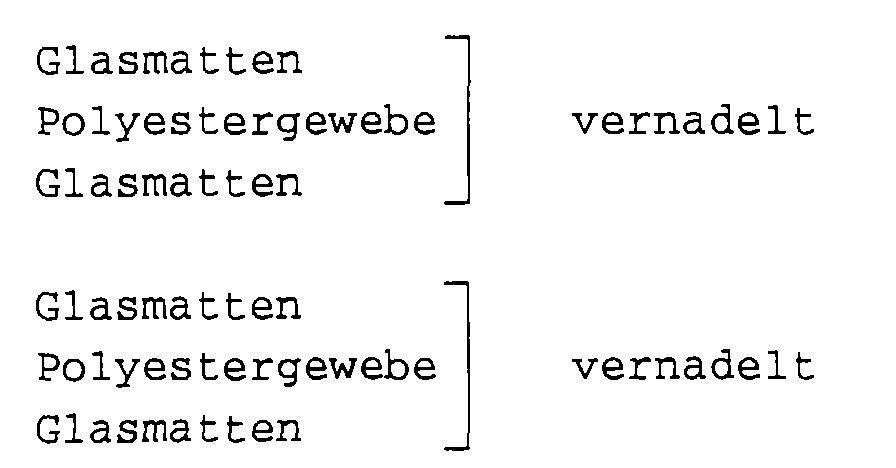
- D.
-

- Die Herstellung des erfindungsgemäßen Verbundwerkstoff kann z.B. dadurch erfolgen, daß man in eine Doppelbandpresse Polyolefin-Schmelzbänder oder -folien, Glasfasermatten und Polyesterfaser-Gewebe zuführt und miteinander verpreßt. Die Gewebe werden dabei vorzugsweise als Außenschichten zugeführt; bei den oben skizzierten Schichtenfolgen A bis D wird das Polyolefin jeweils in die Mitte zwischen die beiden gleichartigen Faserschichten eingeführt. Zur Erzielung besonderer Effekte können zusätzlich an den beiden Oberflächen weitere Polyolefinschichten vorgesehen werden.
- Es ist auch möglich, Glasfasermatten mit Polyesterfaser-gewebe zusammenzunadeln, wie es im Prinzip in DE-A 35 35 272 beschrieben ist, und das erhaltene kombinierte Verstärkungsmaterial mit dem Polyolefin zu verpressen. Ein derartiger Schichtenaufbau ist in den Schichtenfolgen C und D skizziert. Durch das Vernadeln mit der Glasfasermatte wird ein Schrumpfen des Polyesterfaser-Gewebes verhindert.
- Bei der Herstellung der erfindungsgemäßen Verbundwerkstoffe sind die Mengenverhältnisse so zu wählen, daß im fertigen Werkstoff der Fasergehalt 20 bis 70, vorzugsweise 30 bis 50 Gew.-% beträgt. Bei einer bevorzugten Ausführungsform werden in eine Doppelbandpresse gleichzeitig die Verstärkungsmaterialien und Polyolefinschmelze zugeführt und bei Drücken zwischen 1 und 50 [bar] miteinander verpreßt. Grundsätzlich ist es auch möglich, das Polyolefin in Form von Folien, Pulver, Granulat, sowie als Lösung oder Emulsion mit den Fasermatten zusammenzuführen und gemeinsam oberhalb der Schmelztemperatur diskontinuierlich oder kontinuierlich, z.B. auf einem Kalander oder einem Glättwerk, zu verpressen. Das Verpressen muß unter einem so hohen Druck vorgenommen werden, daß nach dem Abkühlen, vorzugsweise auf Raumtemperatur, ein kompaktes, flächiges Halbzeug entsteht.
- Dieses Halbzeug kann zugeschnitten und nach üblichen Methoden durch Pressen oder Tiefziehen bei Temperaturen oberhalb des Erweichungsbereichs des Thermoplasten zu Formteilen verarbeitet werden.
- Auf einer Doppelbandpresse werden Polypropylen-Schmelzefilme (Schmelzindex 150 g/10 min bei 230°C, 2,16 kg) und Verstärkungsmaterialien in folgender Schichtenfolge zusammengeführt und bei 190°C und 2 bar miteinander verpreßt:
- Polypropylen-Film 775 g/m2
- Polyestergewebe 320 g/m2
- Glasfasermatte 600 g/2
- Polypropylen-Film 1030 g/m2
- Glasfasermatte 600 g/m2
- Polyestergewebe 320 g/m2
- Polypropylen-Film 775 g/m2.
- Die Dicke der erhaltenen Halbzeuge beträgt 0,38 cm . Aus den Halbzeugen werden Platten mit den Abmessungen 6 x 6 cm herausgeschnitten. Sie zeigen im Durchstoßversuch nach ISO 6603/2 hervorragend gute Zähigkeits- und Bruchdehnungswerte.
- Unter den in Beispiel 1 angegebenen Bedingungen werden folgende Schichten miteinander verpreßt:
- Polypropylen-Film 865 g/m2

- Polypropylen-Film 725 g/m2

- Polypropylen-Film 865 g/m2.
- Beim Vernadeln betrug die Einstichdichte 60 cm-2, die Einstichtiefe 8,0 mm.
Claims (6)
- Flächiger Verbundwerkstoff aus einer Polyolefinmatrix und einem Verstärkungsmaterial, das zumindest teilweise aus einem Fasergewebe besteht, dadurch gekennzeichnet, daß das Gewebe ein Polyesterfaser-Gewebe ist.
- Flächiger Verbundwerkstoff nach Anspruch 1, dadurch gekennzeichnet, daß er 20 bis 70 Gew.-% Fasern enthält.
- Flächiger Verbundwerkstoff nach Anspruch 1, dadurch gekennzeichnet, daß das Gewebe ein Gittergewebe ist, welches Lücken zwischen den Maschen aufweist.
- Flächiger Verbundwerkstoff nach Anspruch 1, dadurch gekennzeichnet, daß das Gewebe aus gedrehten Polyesterfasern besteht.
- Flächiger Verbundwerkstoff nach Anspruch 1, dadurch gekennzeichnet, daß er sowohl Glasfasermatten als auch Polyesterfaser-Gewebe enthält.
- Flächiger Verbundwerkstoff nach Anspruch 1, dadurch gekennzeichnet, daß das Polyolefin ein Polypropylen mit einem Schmelzindex MFI zwischen 5 und 500 [g/10 min] (230°C/2,16 kg) ist.
Applications Claiming Priority (2)
| Application Number | Priority Date | Filing Date | Title |
|---|---|---|---|
| DE19603738 | 1996-02-02 | ||
| DE19603738 | 1996-02-02 |
Publications (2)
| Publication Number | Publication Date |
|---|---|
| EP0787573A1 true EP0787573A1 (de) | 1997-08-06 |
| EP0787573B1 EP0787573B1 (de) | 2001-08-22 |
Family
ID=7784327
Family Applications (1)
| Application Number | Title | Priority Date | Filing Date |
|---|---|---|---|
| EP97100942A Expired - Lifetime EP0787573B1 (de) | 1996-02-02 | 1997-01-22 | Flächiger Verbundwerkstoff |
Country Status (4)
| Country | Link |
|---|---|
| EP (1) | EP0787573B1 (de) |
| CN (1) | CN1087217C (de) |
| AT (1) | ATE204534T1 (de) |
| DE (1) | DE59704339D1 (de) |
Cited By (3)
| Publication number | Priority date | Publication date | Assignee | Title |
|---|---|---|---|---|
| EP1775169A1 (de) * | 2005-10-14 | 2007-04-18 | Nordenia Deutschland Gronau GmbH | Formteil, insbesondere für die Unterbodenauskleidung an Fahrzeugen |
| US7482402B2 (en) | 2005-05-17 | 2009-01-27 | Exxonmobil Research And Engineering Company | Fiber reinforced polypropylene compositions |
| US8119725B2 (en) | 2005-05-17 | 2012-02-21 | Exxonmobil Chemical Patents Inc. | Fiber reinforced polypropylene composite interior trim cover panels |
Families Citing this family (2)
| Publication number | Priority date | Publication date | Assignee | Title |
|---|---|---|---|---|
| CN100404238C (zh) * | 2003-10-10 | 2008-07-23 | 上海杰事杰新材料股份有限公司 | 热固性-热塑性复合树脂基连续纤维增强复合材料 |
| CN101180349B (zh) * | 2005-05-17 | 2011-05-18 | 埃克森美孚研究工程公司 | 纤维增强的聚丙烯复合材料内部装饰盖板 |
Citations (8)
| Publication number | Priority date | Publication date | Assignee | Title |
|---|---|---|---|---|
| US3993828A (en) * | 1973-02-16 | 1976-11-23 | Akzona Incorporated | Polyester, fiberglass-reinforced composite laminate |
| GB2106031A (en) * | 1981-08-24 | 1983-04-07 | Albany Int Corp | Method of manufacturing conveyor belting |
| DE3535272A1 (de) | 1985-10-03 | 1987-04-09 | Basf Ag | Verwendung genadelter gewebe oder gelege |
| US4800114A (en) * | 1986-08-15 | 1989-01-24 | Cichanowski Michael F | Fiber and resin construction |
| EP0512431A1 (de) * | 1991-05-04 | 1992-11-11 | Hoechst Aktiengesellschaft | Verfahren zur Herstellung eines dreidimensional verformten Textilmaterials und seine Verwendung |
| JPH0559630A (ja) * | 1991-08-26 | 1993-03-09 | Sakase Adotetsuku Kk | 一方向補強基材 |
| JPH0584736A (ja) * | 1991-09-26 | 1993-04-06 | Sekisui Jushi Co Ltd | 繊維強化熱可塑性樹脂複合シート |
| WO1994001272A1 (en) * | 1992-07-13 | 1994-01-20 | K.U. Leuven Research & Development | Composite material and a composite structure based on a three-dimensional textile structure |
-
1997
- 1997-01-22 EP EP97100942A patent/EP0787573B1/de not_active Expired - Lifetime
- 1997-01-22 AT AT97100942T patent/ATE204534T1/de not_active IP Right Cessation
- 1997-01-22 DE DE59704339T patent/DE59704339D1/de not_active Expired - Lifetime
- 1997-01-31 CN CN97104815A patent/CN1087217C/zh not_active Expired - Fee Related
Patent Citations (8)
| Publication number | Priority date | Publication date | Assignee | Title |
|---|---|---|---|---|
| US3993828A (en) * | 1973-02-16 | 1976-11-23 | Akzona Incorporated | Polyester, fiberglass-reinforced composite laminate |
| GB2106031A (en) * | 1981-08-24 | 1983-04-07 | Albany Int Corp | Method of manufacturing conveyor belting |
| DE3535272A1 (de) | 1985-10-03 | 1987-04-09 | Basf Ag | Verwendung genadelter gewebe oder gelege |
| US4800114A (en) * | 1986-08-15 | 1989-01-24 | Cichanowski Michael F | Fiber and resin construction |
| EP0512431A1 (de) * | 1991-05-04 | 1992-11-11 | Hoechst Aktiengesellschaft | Verfahren zur Herstellung eines dreidimensional verformten Textilmaterials und seine Verwendung |
| JPH0559630A (ja) * | 1991-08-26 | 1993-03-09 | Sakase Adotetsuku Kk | 一方向補強基材 |
| JPH0584736A (ja) * | 1991-09-26 | 1993-04-06 | Sekisui Jushi Co Ltd | 繊維強化熱可塑性樹脂複合シート |
| WO1994001272A1 (en) * | 1992-07-13 | 1994-01-20 | K.U. Leuven Research & Development | Composite material and a composite structure based on a three-dimensional textile structure |
Non-Patent Citations (2)
| Title |
|---|
| DATABASE WPI Section Ch Week 9315, Derwent World Patents Index; Class A18, AN 93-121863, XP002030649 * |
| DATABASE WPI Section Ch Week 9318, Derwent World Patents Index; Class A32, AN 93-148716, XP002030648 * |
Cited By (3)
| Publication number | Priority date | Publication date | Assignee | Title |
|---|---|---|---|---|
| US7482402B2 (en) | 2005-05-17 | 2009-01-27 | Exxonmobil Research And Engineering Company | Fiber reinforced polypropylene compositions |
| US8119725B2 (en) | 2005-05-17 | 2012-02-21 | Exxonmobil Chemical Patents Inc. | Fiber reinforced polypropylene composite interior trim cover panels |
| EP1775169A1 (de) * | 2005-10-14 | 2007-04-18 | Nordenia Deutschland Gronau GmbH | Formteil, insbesondere für die Unterbodenauskleidung an Fahrzeugen |
Also Published As
| Publication number | Publication date |
|---|---|
| ATE204534T1 (de) | 2001-09-15 |
| CN1087217C (zh) | 2002-07-10 |
| CN1163187A (zh) | 1997-10-29 |
| EP0787573B1 (de) | 2001-08-22 |
| DE59704339D1 (de) | 2001-09-27 |
Similar Documents
| Publication | Publication Date | Title |
|---|---|---|
| DE69324226T2 (de) | Dachhimmelmaterial für Fahrzeuge und Verfahren zu dessen Herstellung | |
| EP0560129B1 (de) | Flächiger Verbundwerkstoff | |
| EP0323571B1 (de) | Faserverstärktes, thermoplastisches Halbzeug | |
| EP1106344B1 (de) | Sandwichplatte | |
| EP0321735A2 (de) | Leichtverbundwerkstoff | |
| DE10319967A1 (de) | Faservlies-Verbundelement | |
| EP0300237B1 (de) | Verbundwerkstoff aus mit Fasermatten verstärktem Polypropylen | |
| DE4207243A1 (de) | Poroese formteile | |
| EP0744261A1 (de) | Verbundbauteil, insbesondere Verbundverkleidungsteil und Verfahren zur Herstellung dieses Bauteils | |
| EP0787573B1 (de) | Flächiger Verbundwerkstoff | |
| EP0643093A1 (de) | Flächiges Halbzeug aus GMT-Recyclat | |
| DE4228606C2 (de) | Flächiger Verbundwerkstoff | |
| EP0697275B1 (de) | Biegesteifer Faserverbundwerkstoff | |
| DE19616672A1 (de) | Verwendung eines flächigen Verbundwerkstoffes aus einer Polyolefinmatrix | |
| EP0643091A1 (de) | Flächiges Halbzeug | |
| DE2918923A1 (de) | Schichtstoff mit einer fluorpolymerisatschicht | |
| WO2003057453A1 (de) | Faserverstärkter thermoplastischer verbundwerkstoff | |
| DE19831124A1 (de) | Mit Matten aus thermoplastischen Fasern verstärkter Thermoplast | |
| DE3742845C2 (de) | Verfahren zur Herstellung von faserverstärkten Polypropylenbahnen sowie faserverstärkte Polypropylenbahnen | |
| AT407251B (de) | Mit matten aus thermoplastischen fasern verstärkter thermoplast | |
| DE4207244A1 (de) | Flaechiger verbundwerkstoff | |
| EP0790342A2 (de) | Glasfaserverstärktes Halbzeug | |
| DE29607085U1 (de) | Biegesteifer Faserverbundwerkstoff | |
| DE4016409A1 (de) | Flaechiger verbundwerkstoff | |
| EP1591478A1 (de) | Flächiges Halbzeug mit glassfaserverstärkten Thermoplasten |
Legal Events
| Date | Code | Title | Description |
|---|---|---|---|
| PUAI | Public reference made under article 153(3) epc to a published international application that has entered the european phase |
Free format text: ORIGINAL CODE: 0009012 |
|
| 17P | Request for examination filed |
Effective date: 19970604 |
|
| AK | Designated contracting states |
Kind code of ref document: A1 Designated state(s): AT CH DE ES FR GB IT LI NL SE |
|
| 17Q | First examination report despatched |
Effective date: 20000330 |
|
| GRAG | Despatch of communication of intention to grant |
Free format text: ORIGINAL CODE: EPIDOS AGRA |
|
| GRAG | Despatch of communication of intention to grant |
Free format text: ORIGINAL CODE: EPIDOS AGRA |
|
| GRAH | Despatch of communication of intention to grant a patent |
Free format text: ORIGINAL CODE: EPIDOS IGRA |
|
| GRAH | Despatch of communication of intention to grant a patent |
Free format text: ORIGINAL CODE: EPIDOS IGRA |
|
| GRAA | (expected) grant |
Free format text: ORIGINAL CODE: 0009210 |
|
| AK | Designated contracting states |
Kind code of ref document: B1 Designated state(s): AT CH DE ES FR GB IT LI NL SE |
|
| PG25 | Lapsed in a contracting state [announced via postgrant information from national office to epo] |
Ref country code: IT Free format text: LAPSE BECAUSE OF FAILURE TO SUBMIT A TRANSLATION OF THE DESCRIPTION OR TO PAY THE FEE WITHIN THE PRESCRIBED TIME-LIMIT;WARNING: LAPSES OF ITALIAN PATENTS WITH EFFECTIVE DATE BEFORE 2007 MAY HAVE OCCURRED AT ANY TIME BEFORE 2007. THE CORRECT EFFECTIVE DATE MAY BE DIFFERENT FROM THE ONE RECORDED. Effective date: 20010822 Ref country code: GB Free format text: LAPSE BECAUSE OF FAILURE TO SUBMIT A TRANSLATION OF THE DESCRIPTION OR TO PAY THE FEE WITHIN THE PRESCRIBED TIME-LIMIT Effective date: 20010822 Ref country code: FR Free format text: LAPSE BECAUSE OF FAILURE TO SUBMIT A TRANSLATION OF THE DESCRIPTION OR TO PAY THE FEE WITHIN THE PRESCRIBED TIME-LIMIT Effective date: 20010822 |
|
| REF | Corresponds to: |
Ref document number: 204534 Country of ref document: AT Date of ref document: 20010915 Kind code of ref document: T |
|
| REG | Reference to a national code |
Ref country code: CH Ref legal event code: EP |
|
| REF | Corresponds to: |
Ref document number: 59704339 Country of ref document: DE Date of ref document: 20010927 |
|
| PG25 | Lapsed in a contracting state [announced via postgrant information from national office to epo] |
Ref country code: SE Free format text: LAPSE BECAUSE OF FAILURE TO SUBMIT A TRANSLATION OF THE DESCRIPTION OR TO PAY THE FEE WITHIN THE PRESCRIBED TIME-LIMIT Effective date: 20011122 |
|
| EN | Fr: translation not filed | ||
| PG25 | Lapsed in a contracting state [announced via postgrant information from national office to epo] |
Ref country code: AT Free format text: LAPSE BECAUSE OF NON-PAYMENT OF DUE FEES Effective date: 20020122 |
|
| PG25 | Lapsed in a contracting state [announced via postgrant information from national office to epo] |
Ref country code: LI Free format text: LAPSE BECAUSE OF NON-PAYMENT OF DUE FEES Effective date: 20020131 Ref country code: CH Free format text: LAPSE BECAUSE OF NON-PAYMENT OF DUE FEES Effective date: 20020131 |
|
| GBV | Gb: ep patent (uk) treated as always having been void in accordance with gb section 77(7)/1977 [no translation filed] |
Effective date: 20010822 |
|
| PG25 | Lapsed in a contracting state [announced via postgrant information from national office to epo] |
Ref country code: ES Free format text: LAPSE BECAUSE OF FAILURE TO SUBMIT A TRANSLATION OF THE DESCRIPTION OR TO PAY THE FEE WITHIN THE PRESCRIBED TIME-LIMIT Effective date: 20020228 |
|
| PLBE | No opposition filed within time limit |
Free format text: ORIGINAL CODE: 0009261 |
|
| STAA | Information on the status of an ep patent application or granted ep patent |
Free format text: STATUS: NO OPPOSITION FILED WITHIN TIME LIMIT |
|
| PG25 | Lapsed in a contracting state [announced via postgrant information from national office to epo] |
Ref country code: NL Free format text: LAPSE BECAUSE OF NON-PAYMENT OF DUE FEES Effective date: 20020801 |
|
| 26N | No opposition filed | ||
| REG | Reference to a national code |
Ref country code: CH Ref legal event code: PL |
|
| NLV4 | Nl: lapsed or anulled due to non-payment of the annual fee |
Effective date: 20020801 |
|
| PGFP | Annual fee paid to national office [announced via postgrant information from national office to epo] |
Ref country code: DE Payment date: 20110121 Year of fee payment: 15 |
|
| PG25 | Lapsed in a contracting state [announced via postgrant information from national office to epo] |
Ref country code: DE Free format text: LAPSE BECAUSE OF NON-PAYMENT OF DUE FEES Effective date: 20120801 |
|
| REG | Reference to a national code |
Ref country code: DE Ref legal event code: R119 Ref document number: 59704339 Country of ref document: DE Effective date: 20120801 |