EP0787158B1 - methods for the manufacture of polar grafted polyolefines - Google Patents
methods for the manufacture of polar grafted polyolefines Download PDFInfo
- Publication number
- EP0787158B1 EP0787158B1 EP95934706A EP95934706A EP0787158B1 EP 0787158 B1 EP0787158 B1 EP 0787158B1 EP 95934706 A EP95934706 A EP 95934706A EP 95934706 A EP95934706 A EP 95934706A EP 0787158 B1 EP0787158 B1 EP 0787158B1
- Authority
- EP
- European Patent Office
- Prior art keywords
- polyolefin
- initiator
- alternatively
- graft
- grafted
- Prior art date
- Legal status (The legal status is an assumption and is not a legal conclusion. Google has not performed a legal analysis and makes no representation as to the accuracy of the status listed.)
- Expired - Lifetime
Links
Classifications
-
- C—CHEMISTRY; METALLURGY
- C10—PETROLEUM, GAS OR COKE INDUSTRIES; TECHNICAL GASES CONTAINING CARBON MONOXIDE; FUELS; LUBRICANTS; PEAT
- C10M—LUBRICATING COMPOSITIONS; USE OF CHEMICAL SUBSTANCES EITHER ALONE OR AS LUBRICATING INGREDIENTS IN A LUBRICATING COMPOSITION
- C10M167/00—Lubricating compositions characterised by the additive being a mixture of a macromolecular compound, a non-macromolecular compound and a compound of unknown or incompletely defined constitution, each of these compounds being essential
-
- C—CHEMISTRY; METALLURGY
- C08—ORGANIC MACROMOLECULAR COMPOUNDS; THEIR PREPARATION OR CHEMICAL WORKING-UP; COMPOSITIONS BASED THEREON
- C08F—MACROMOLECULAR COMPOUNDS OBTAINED BY REACTIONS ONLY INVOLVING CARBON-TO-CARBON UNSATURATED BONDS
- C08F255/00—Macromolecular compounds obtained by polymerising monomers on to polymers of hydrocarbons as defined in group C08F10/00
-
- C—CHEMISTRY; METALLURGY
- C08—ORGANIC MACROMOLECULAR COMPOUNDS; THEIR PREPARATION OR CHEMICAL WORKING-UP; COMPOSITIONS BASED THEREON
- C08F—MACROMOLECULAR COMPOUNDS OBTAINED BY REACTIONS ONLY INVOLVING CARBON-TO-CARBON UNSATURATED BONDS
- C08F255/00—Macromolecular compounds obtained by polymerising monomers on to polymers of hydrocarbons as defined in group C08F10/00
- C08F255/02—Macromolecular compounds obtained by polymerising monomers on to polymers of hydrocarbons as defined in group C08F10/00 on to polymers of olefins having two or three carbon atoms
-
- C—CHEMISTRY; METALLURGY
- C08—ORGANIC MACROMOLECULAR COMPOUNDS; THEIR PREPARATION OR CHEMICAL WORKING-UP; COMPOSITIONS BASED THEREON
- C08F—MACROMOLECULAR COMPOUNDS OBTAINED BY REACTIONS ONLY INVOLVING CARBON-TO-CARBON UNSATURATED BONDS
- C08F255/00—Macromolecular compounds obtained by polymerising monomers on to polymers of hydrocarbons as defined in group C08F10/00
- C08F255/02—Macromolecular compounds obtained by polymerising monomers on to polymers of hydrocarbons as defined in group C08F10/00 on to polymers of olefins having two or three carbon atoms
- C08F255/04—Macromolecular compounds obtained by polymerising monomers on to polymers of hydrocarbons as defined in group C08F10/00 on to polymers of olefins having two or three carbon atoms on to ethylene-propylene copolymers
-
- C—CHEMISTRY; METALLURGY
- C08—ORGANIC MACROMOLECULAR COMPOUNDS; THEIR PREPARATION OR CHEMICAL WORKING-UP; COMPOSITIONS BASED THEREON
- C08F—MACROMOLECULAR COMPOUNDS OBTAINED BY REACTIONS ONLY INVOLVING CARBON-TO-CARBON UNSATURATED BONDS
- C08F255/00—Macromolecular compounds obtained by polymerising monomers on to polymers of hydrocarbons as defined in group C08F10/00
- C08F255/02—Macromolecular compounds obtained by polymerising monomers on to polymers of hydrocarbons as defined in group C08F10/00 on to polymers of olefins having two or three carbon atoms
- C08F255/06—Macromolecular compounds obtained by polymerising monomers on to polymers of hydrocarbons as defined in group C08F10/00 on to polymers of olefins having two or three carbon atoms on to ethylene-propylene-diene terpolymers
-
- C—CHEMISTRY; METALLURGY
- C08—ORGANIC MACROMOLECULAR COMPOUNDS; THEIR PREPARATION OR CHEMICAL WORKING-UP; COMPOSITIONS BASED THEREON
- C08F—MACROMOLECULAR COMPOUNDS OBTAINED BY REACTIONS ONLY INVOLVING CARBON-TO-CARBON UNSATURATED BONDS
- C08F255/00—Macromolecular compounds obtained by polymerising monomers on to polymers of hydrocarbons as defined in group C08F10/00
- C08F255/08—Macromolecular compounds obtained by polymerising monomers on to polymers of hydrocarbons as defined in group C08F10/00 on to polymers of olefins having four or more carbon atoms
-
- C—CHEMISTRY; METALLURGY
- C08—ORGANIC MACROMOLECULAR COMPOUNDS; THEIR PREPARATION OR CHEMICAL WORKING-UP; COMPOSITIONS BASED THEREON
- C08F—MACROMOLECULAR COMPOUNDS OBTAINED BY REACTIONS ONLY INVOLVING CARBON-TO-CARBON UNSATURATED BONDS
- C08F257/00—Macromolecular compounds obtained by polymerising monomers on to polymers of aromatic monomers as defined in group C08F12/00
- C08F257/02—Macromolecular compounds obtained by polymerising monomers on to polymers of aromatic monomers as defined in group C08F12/00 on to polymers of styrene or alkyl-substituted styrenes
-
- C—CHEMISTRY; METALLURGY
- C08—ORGANIC MACROMOLECULAR COMPOUNDS; THEIR PREPARATION OR CHEMICAL WORKING-UP; COMPOSITIONS BASED THEREON
- C08F—MACROMOLECULAR COMPOUNDS OBTAINED BY REACTIONS ONLY INVOLVING CARBON-TO-CARBON UNSATURATED BONDS
- C08F279/00—Macromolecular compounds obtained by polymerising monomers on to polymers of monomers having two or more carbon-to-carbon double bonds as defined in group C08F36/00
- C08F279/02—Macromolecular compounds obtained by polymerising monomers on to polymers of monomers having two or more carbon-to-carbon double bonds as defined in group C08F36/00 on to polymers of conjugated dienes
-
- C—CHEMISTRY; METALLURGY
- C08—ORGANIC MACROMOLECULAR COMPOUNDS; THEIR PREPARATION OR CHEMICAL WORKING-UP; COMPOSITIONS BASED THEREON
- C08L—COMPOSITIONS OF MACROMOLECULAR COMPOUNDS
- C08L51/00—Compositions of graft polymers in which the grafted component is obtained by reactions only involving carbon-to-carbon unsaturated bonds; Compositions of derivatives of such polymers
- C08L51/003—Compositions of graft polymers in which the grafted component is obtained by reactions only involving carbon-to-carbon unsaturated bonds; Compositions of derivatives of such polymers grafted on to macromolecular compounds obtained by reactions only involving unsaturated carbon-to-carbon bonds
-
- C—CHEMISTRY; METALLURGY
- C10—PETROLEUM, GAS OR COKE INDUSTRIES; TECHNICAL GASES CONTAINING CARBON MONOXIDE; FUELS; LUBRICANTS; PEAT
- C10M—LUBRICATING COMPOSITIONS; USE OF CHEMICAL SUBSTANCES EITHER ALONE OR AS LUBRICATING INGREDIENTS IN A LUBRICATING COMPOSITION
- C10M133/00—Lubricating compositions characterised by the additive being an organic non-macromolecular compound containing nitrogen
- C10M133/02—Lubricating compositions characterised by the additive being an organic non-macromolecular compound containing nitrogen having a carbon chain of less than 30 atoms
- C10M133/04—Amines, e.g. polyalkylene polyamines; Quaternary amines
- C10M133/12—Amines, e.g. polyalkylene polyamines; Quaternary amines having amino groups bound to a carbon atom of a six-membered aromatic ring
-
- C—CHEMISTRY; METALLURGY
- C10—PETROLEUM, GAS OR COKE INDUSTRIES; TECHNICAL GASES CONTAINING CARBON MONOXIDE; FUELS; LUBRICANTS; PEAT
- C10M—LUBRICATING COMPOSITIONS; USE OF CHEMICAL SUBSTANCES EITHER ALONE OR AS LUBRICATING INGREDIENTS IN A LUBRICATING COMPOSITION
- C10M133/00—Lubricating compositions characterised by the additive being an organic non-macromolecular compound containing nitrogen
- C10M133/52—Lubricating compositions characterised by the additive being an organic non-macromolecular compound containing nitrogen having a carbon chain of 30 or more atoms
- C10M133/56—Amides; Imides
-
- C—CHEMISTRY; METALLURGY
- C10—PETROLEUM, GAS OR COKE INDUSTRIES; TECHNICAL GASES CONTAINING CARBON MONOXIDE; FUELS; LUBRICANTS; PEAT
- C10M—LUBRICATING COMPOSITIONS; USE OF CHEMICAL SUBSTANCES EITHER ALONE OR AS LUBRICATING INGREDIENTS IN A LUBRICATING COMPOSITION
- C10M135/00—Lubricating compositions characterised by the additive being an organic non-macromolecular compound containing sulfur, selenium or tellurium
- C10M135/20—Thiols; Sulfides; Polysulfides
- C10M135/28—Thiols; Sulfides; Polysulfides containing sulfur atoms bound to a carbon atom of a six-membered aromatic ring
- C10M135/30—Thiols; Sulfides; Polysulfides containing sulfur atoms bound to a carbon atom of a six-membered aromatic ring containing hydroxy groups; Derivatives thereof
-
- C—CHEMISTRY; METALLURGY
- C10—PETROLEUM, GAS OR COKE INDUSTRIES; TECHNICAL GASES CONTAINING CARBON MONOXIDE; FUELS; LUBRICANTS; PEAT
- C10M—LUBRICATING COMPOSITIONS; USE OF CHEMICAL SUBSTANCES EITHER ALONE OR AS LUBRICATING INGREDIENTS IN A LUBRICATING COMPOSITION
- C10M137/00—Lubricating compositions characterised by the additive being an organic non-macromolecular compound containing phosphorus
- C10M137/02—Lubricating compositions characterised by the additive being an organic non-macromolecular compound containing phosphorus having no phosphorus-to-carbon bond
- C10M137/04—Phosphate esters
- C10M137/10—Thio derivatives
-
- C—CHEMISTRY; METALLURGY
- C10—PETROLEUM, GAS OR COKE INDUSTRIES; TECHNICAL GASES CONTAINING CARBON MONOXIDE; FUELS; LUBRICANTS; PEAT
- C10M—LUBRICATING COMPOSITIONS; USE OF CHEMICAL SUBSTANCES EITHER ALONE OR AS LUBRICATING INGREDIENTS IN A LUBRICATING COMPOSITION
- C10M143/00—Lubricating compositions characterised by the additive being a macromolecular hydrocarbon or such hydrocarbon modified by oxidation
-
- C—CHEMISTRY; METALLURGY
- C10—PETROLEUM, GAS OR COKE INDUSTRIES; TECHNICAL GASES CONTAINING CARBON MONOXIDE; FUELS; LUBRICANTS; PEAT
- C10M—LUBRICATING COMPOSITIONS; USE OF CHEMICAL SUBSTANCES EITHER ALONE OR AS LUBRICATING INGREDIENTS IN A LUBRICATING COMPOSITION
- C10M143/00—Lubricating compositions characterised by the additive being a macromolecular hydrocarbon or such hydrocarbon modified by oxidation
- C10M143/02—Polyethylene
-
- C—CHEMISTRY; METALLURGY
- C10—PETROLEUM, GAS OR COKE INDUSTRIES; TECHNICAL GASES CONTAINING CARBON MONOXIDE; FUELS; LUBRICANTS; PEAT
- C10M—LUBRICATING COMPOSITIONS; USE OF CHEMICAL SUBSTANCES EITHER ALONE OR AS LUBRICATING INGREDIENTS IN A LUBRICATING COMPOSITION
- C10M143/00—Lubricating compositions characterised by the additive being a macromolecular hydrocarbon or such hydrocarbon modified by oxidation
- C10M143/04—Lubricating compositions characterised by the additive being a macromolecular hydrocarbon or such hydrocarbon modified by oxidation containing propene
-
- C—CHEMISTRY; METALLURGY
- C10—PETROLEUM, GAS OR COKE INDUSTRIES; TECHNICAL GASES CONTAINING CARBON MONOXIDE; FUELS; LUBRICANTS; PEAT
- C10M—LUBRICATING COMPOSITIONS; USE OF CHEMICAL SUBSTANCES EITHER ALONE OR AS LUBRICATING INGREDIENTS IN A LUBRICATING COMPOSITION
- C10M143/00—Lubricating compositions characterised by the additive being a macromolecular hydrocarbon or such hydrocarbon modified by oxidation
- C10M143/06—Lubricating compositions characterised by the additive being a macromolecular hydrocarbon or such hydrocarbon modified by oxidation containing butene
-
- C—CHEMISTRY; METALLURGY
- C10—PETROLEUM, GAS OR COKE INDUSTRIES; TECHNICAL GASES CONTAINING CARBON MONOXIDE; FUELS; LUBRICANTS; PEAT
- C10M—LUBRICATING COMPOSITIONS; USE OF CHEMICAL SUBSTANCES EITHER ALONE OR AS LUBRICATING INGREDIENTS IN A LUBRICATING COMPOSITION
- C10M143/00—Lubricating compositions characterised by the additive being a macromolecular hydrocarbon or such hydrocarbon modified by oxidation
- C10M143/10—Lubricating compositions characterised by the additive being a macromolecular hydrocarbon or such hydrocarbon modified by oxidation containing aromatic monomer, e.g. styrene
-
- C—CHEMISTRY; METALLURGY
- C10—PETROLEUM, GAS OR COKE INDUSTRIES; TECHNICAL GASES CONTAINING CARBON MONOXIDE; FUELS; LUBRICANTS; PEAT
- C10M—LUBRICATING COMPOSITIONS; USE OF CHEMICAL SUBSTANCES EITHER ALONE OR AS LUBRICATING INGREDIENTS IN A LUBRICATING COMPOSITION
- C10M143/00—Lubricating compositions characterised by the additive being a macromolecular hydrocarbon or such hydrocarbon modified by oxidation
- C10M143/12—Lubricating compositions characterised by the additive being a macromolecular hydrocarbon or such hydrocarbon modified by oxidation containing conjugated diene
-
- C—CHEMISTRY; METALLURGY
- C10—PETROLEUM, GAS OR COKE INDUSTRIES; TECHNICAL GASES CONTAINING CARBON MONOXIDE; FUELS; LUBRICANTS; PEAT
- C10M—LUBRICATING COMPOSITIONS; USE OF CHEMICAL SUBSTANCES EITHER ALONE OR AS LUBRICATING INGREDIENTS IN A LUBRICATING COMPOSITION
- C10M145/00—Lubricating compositions characterised by the additive being a macromolecular compound containing oxygen
- C10M145/02—Macromolecular compounds obtained by reactions only involving carbon-to-carbon unsaturated bonds
- C10M145/10—Macromolecular compounds obtained by reactions only involving carbon-to-carbon unsaturated bonds containing monomers having an unsaturated radical bound to a carboxyl radical, e.g. acrylate
- C10M145/12—Macromolecular compounds obtained by reactions only involving carbon-to-carbon unsaturated bonds containing monomers having an unsaturated radical bound to a carboxyl radical, e.g. acrylate monocarboxylic
- C10M145/14—Acrylate; Methacrylate
-
- C—CHEMISTRY; METALLURGY
- C10—PETROLEUM, GAS OR COKE INDUSTRIES; TECHNICAL GASES CONTAINING CARBON MONOXIDE; FUELS; LUBRICANTS; PEAT
- C10M—LUBRICATING COMPOSITIONS; USE OF CHEMICAL SUBSTANCES EITHER ALONE OR AS LUBRICATING INGREDIENTS IN A LUBRICATING COMPOSITION
- C10M149/00—Lubricating compositions characterised by the additive being a macromolecular compound containing nitrogen
- C10M149/02—Macromolecular compounds obtained by reactions only involving carbon-to-carbon unsaturated bonds
- C10M149/04—Macromolecular compounds obtained by reactions only involving carbon-to-carbon unsaturated bonds containing monomers having an unsaturated radical bound to an amino group
-
- C—CHEMISTRY; METALLURGY
- C10—PETROLEUM, GAS OR COKE INDUSTRIES; TECHNICAL GASES CONTAINING CARBON MONOXIDE; FUELS; LUBRICANTS; PEAT
- C10M—LUBRICATING COMPOSITIONS; USE OF CHEMICAL SUBSTANCES EITHER ALONE OR AS LUBRICATING INGREDIENTS IN A LUBRICATING COMPOSITION
- C10M149/00—Lubricating compositions characterised by the additive being a macromolecular compound containing nitrogen
- C10M149/02—Macromolecular compounds obtained by reactions only involving carbon-to-carbon unsaturated bonds
- C10M149/06—Macromolecular compounds obtained by reactions only involving carbon-to-carbon unsaturated bonds containing monomers having an unsaturated radical bound to an amido or imido group
-
- C—CHEMISTRY; METALLURGY
- C10—PETROLEUM, GAS OR COKE INDUSTRIES; TECHNICAL GASES CONTAINING CARBON MONOXIDE; FUELS; LUBRICANTS; PEAT
- C10M—LUBRICATING COMPOSITIONS; USE OF CHEMICAL SUBSTANCES EITHER ALONE OR AS LUBRICATING INGREDIENTS IN A LUBRICATING COMPOSITION
- C10M149/00—Lubricating compositions characterised by the additive being a macromolecular compound containing nitrogen
- C10M149/02—Macromolecular compounds obtained by reactions only involving carbon-to-carbon unsaturated bonds
- C10M149/08—Macromolecular compounds obtained by reactions only involving carbon-to-carbon unsaturated bonds containing monomers having an unsaturated radical bound to a nitrile group
-
- C—CHEMISTRY; METALLURGY
- C10—PETROLEUM, GAS OR COKE INDUSTRIES; TECHNICAL GASES CONTAINING CARBON MONOXIDE; FUELS; LUBRICANTS; PEAT
- C10M—LUBRICATING COMPOSITIONS; USE OF CHEMICAL SUBSTANCES EITHER ALONE OR AS LUBRICATING INGREDIENTS IN A LUBRICATING COMPOSITION
- C10M149/00—Lubricating compositions characterised by the additive being a macromolecular compound containing nitrogen
- C10M149/02—Macromolecular compounds obtained by reactions only involving carbon-to-carbon unsaturated bonds
- C10M149/10—Macromolecular compounds obtained by reactions only involving carbon-to-carbon unsaturated bonds containing monomers having an unsaturated radical bound to a nitrogen-containing hetero ring
-
- C—CHEMISTRY; METALLURGY
- C10—PETROLEUM, GAS OR COKE INDUSTRIES; TECHNICAL GASES CONTAINING CARBON MONOXIDE; FUELS; LUBRICANTS; PEAT
- C10M—LUBRICATING COMPOSITIONS; USE OF CHEMICAL SUBSTANCES EITHER ALONE OR AS LUBRICATING INGREDIENTS IN A LUBRICATING COMPOSITION
- C10M151/00—Lubricating compositions characterised by the additive being a macromolecular compound containing sulfur, selenium or tellurium
- C10M151/02—Macromolecular compounds obtained by reactions involving only carbon-to-carbon unsaturated bonds
-
- C—CHEMISTRY; METALLURGY
- C10—PETROLEUM, GAS OR COKE INDUSTRIES; TECHNICAL GASES CONTAINING CARBON MONOXIDE; FUELS; LUBRICANTS; PEAT
- C10M—LUBRICATING COMPOSITIONS; USE OF CHEMICAL SUBSTANCES EITHER ALONE OR AS LUBRICATING INGREDIENTS IN A LUBRICATING COMPOSITION
- C10M157/00—Lubricating compositions characterised by the additive being a mixture of two or more macromolecular compounds covered by more than one of the main groups C10M143/00 - C10M155/00, each of these compounds being essential
- C10M157/04—Lubricating compositions characterised by the additive being a mixture of two or more macromolecular compounds covered by more than one of the main groups C10M143/00 - C10M155/00, each of these compounds being essential at least one of them being a nitrogen-containing compound
-
- C—CHEMISTRY; METALLURGY
- C10—PETROLEUM, GAS OR COKE INDUSTRIES; TECHNICAL GASES CONTAINING CARBON MONOXIDE; FUELS; LUBRICANTS; PEAT
- C10M—LUBRICATING COMPOSITIONS; USE OF CHEMICAL SUBSTANCES EITHER ALONE OR AS LUBRICATING INGREDIENTS IN A LUBRICATING COMPOSITION
- C10M159/00—Lubricating compositions characterised by the additive being of unknown or incompletely defined constitution
- C10M159/12—Reaction products
- C10M159/20—Reaction mixtures having an excess of neutralising base, e.g. so-called overbasic or highly basic products
-
- C—CHEMISTRY; METALLURGY
- C10—PETROLEUM, GAS OR COKE INDUSTRIES; TECHNICAL GASES CONTAINING CARBON MONOXIDE; FUELS; LUBRICANTS; PEAT
- C10M—LUBRICATING COMPOSITIONS; USE OF CHEMICAL SUBSTANCES EITHER ALONE OR AS LUBRICATING INGREDIENTS IN A LUBRICATING COMPOSITION
- C10M159/00—Lubricating compositions characterised by the additive being of unknown or incompletely defined constitution
- C10M159/12—Reaction products
- C10M159/20—Reaction mixtures having an excess of neutralising base, e.g. so-called overbasic or highly basic products
- C10M159/22—Reaction mixtures having an excess of neutralising base, e.g. so-called overbasic or highly basic products containing phenol radicals
-
- C—CHEMISTRY; METALLURGY
- C10—PETROLEUM, GAS OR COKE INDUSTRIES; TECHNICAL GASES CONTAINING CARBON MONOXIDE; FUELS; LUBRICANTS; PEAT
- C10M—LUBRICATING COMPOSITIONS; USE OF CHEMICAL SUBSTANCES EITHER ALONE OR AS LUBRICATING INGREDIENTS IN A LUBRICATING COMPOSITION
- C10M159/00—Lubricating compositions characterised by the additive being of unknown or incompletely defined constitution
- C10M159/12—Reaction products
- C10M159/20—Reaction mixtures having an excess of neutralising base, e.g. so-called overbasic or highly basic products
- C10M159/24—Reaction mixtures having an excess of neutralising base, e.g. so-called overbasic or highly basic products containing sulfonic radicals
-
- C—CHEMISTRY; METALLURGY
- C10—PETROLEUM, GAS OR COKE INDUSTRIES; TECHNICAL GASES CONTAINING CARBON MONOXIDE; FUELS; LUBRICANTS; PEAT
- C10M—LUBRICATING COMPOSITIONS; USE OF CHEMICAL SUBSTANCES EITHER ALONE OR AS LUBRICATING INGREDIENTS IN A LUBRICATING COMPOSITION
- C10M2205/00—Organic macromolecular hydrocarbon compounds or fractions, whether or not modified by oxidation as ingredients in lubricant compositions
-
- C—CHEMISTRY; METALLURGY
- C10—PETROLEUM, GAS OR COKE INDUSTRIES; TECHNICAL GASES CONTAINING CARBON MONOXIDE; FUELS; LUBRICANTS; PEAT
- C10M—LUBRICATING COMPOSITIONS; USE OF CHEMICAL SUBSTANCES EITHER ALONE OR AS LUBRICATING INGREDIENTS IN A LUBRICATING COMPOSITION
- C10M2205/00—Organic macromolecular hydrocarbon compounds or fractions, whether or not modified by oxidation as ingredients in lubricant compositions
- C10M2205/02—Organic macromolecular hydrocarbon compounds or fractions, whether or not modified by oxidation as ingredients in lubricant compositions containing acyclic monomers
-
- C—CHEMISTRY; METALLURGY
- C10—PETROLEUM, GAS OR COKE INDUSTRIES; TECHNICAL GASES CONTAINING CARBON MONOXIDE; FUELS; LUBRICANTS; PEAT
- C10M—LUBRICATING COMPOSITIONS; USE OF CHEMICAL SUBSTANCES EITHER ALONE OR AS LUBRICATING INGREDIENTS IN A LUBRICATING COMPOSITION
- C10M2205/00—Organic macromolecular hydrocarbon compounds or fractions, whether or not modified by oxidation as ingredients in lubricant compositions
- C10M2205/02—Organic macromolecular hydrocarbon compounds or fractions, whether or not modified by oxidation as ingredients in lubricant compositions containing acyclic monomers
- C10M2205/022—Ethene
-
- C—CHEMISTRY; METALLURGY
- C10—PETROLEUM, GAS OR COKE INDUSTRIES; TECHNICAL GASES CONTAINING CARBON MONOXIDE; FUELS; LUBRICANTS; PEAT
- C10M—LUBRICATING COMPOSITIONS; USE OF CHEMICAL SUBSTANCES EITHER ALONE OR AS LUBRICATING INGREDIENTS IN A LUBRICATING COMPOSITION
- C10M2205/00—Organic macromolecular hydrocarbon compounds or fractions, whether or not modified by oxidation as ingredients in lubricant compositions
- C10M2205/02—Organic macromolecular hydrocarbon compounds or fractions, whether or not modified by oxidation as ingredients in lubricant compositions containing acyclic monomers
- C10M2205/024—Propene
-
- C—CHEMISTRY; METALLURGY
- C10—PETROLEUM, GAS OR COKE INDUSTRIES; TECHNICAL GASES CONTAINING CARBON MONOXIDE; FUELS; LUBRICANTS; PEAT
- C10M—LUBRICATING COMPOSITIONS; USE OF CHEMICAL SUBSTANCES EITHER ALONE OR AS LUBRICATING INGREDIENTS IN A LUBRICATING COMPOSITION
- C10M2205/00—Organic macromolecular hydrocarbon compounds or fractions, whether or not modified by oxidation as ingredients in lubricant compositions
- C10M2205/02—Organic macromolecular hydrocarbon compounds or fractions, whether or not modified by oxidation as ingredients in lubricant compositions containing acyclic monomers
- C10M2205/026—Butene
-
- C—CHEMISTRY; METALLURGY
- C10—PETROLEUM, GAS OR COKE INDUSTRIES; TECHNICAL GASES CONTAINING CARBON MONOXIDE; FUELS; LUBRICANTS; PEAT
- C10M—LUBRICATING COMPOSITIONS; USE OF CHEMICAL SUBSTANCES EITHER ALONE OR AS LUBRICATING INGREDIENTS IN A LUBRICATING COMPOSITION
- C10M2205/00—Organic macromolecular hydrocarbon compounds or fractions, whether or not modified by oxidation as ingredients in lubricant compositions
- C10M2205/04—Organic macromolecular hydrocarbon compounds or fractions, whether or not modified by oxidation as ingredients in lubricant compositions containing aromatic monomers, e.g. styrene
-
- C—CHEMISTRY; METALLURGY
- C10—PETROLEUM, GAS OR COKE INDUSTRIES; TECHNICAL GASES CONTAINING CARBON MONOXIDE; FUELS; LUBRICANTS; PEAT
- C10M—LUBRICATING COMPOSITIONS; USE OF CHEMICAL SUBSTANCES EITHER ALONE OR AS LUBRICATING INGREDIENTS IN A LUBRICATING COMPOSITION
- C10M2205/00—Organic macromolecular hydrocarbon compounds or fractions, whether or not modified by oxidation as ingredients in lubricant compositions
- C10M2205/06—Organic macromolecular hydrocarbon compounds or fractions, whether or not modified by oxidation as ingredients in lubricant compositions containing conjugated dienes
-
- C—CHEMISTRY; METALLURGY
- C10—PETROLEUM, GAS OR COKE INDUSTRIES; TECHNICAL GASES CONTAINING CARBON MONOXIDE; FUELS; LUBRICANTS; PEAT
- C10M—LUBRICATING COMPOSITIONS; USE OF CHEMICAL SUBSTANCES EITHER ALONE OR AS LUBRICATING INGREDIENTS IN A LUBRICATING COMPOSITION
- C10M2205/00—Organic macromolecular hydrocarbon compounds or fractions, whether or not modified by oxidation as ingredients in lubricant compositions
- C10M2205/14—Synthetic waxes, e.g. polythene waxes
-
- C—CHEMISTRY; METALLURGY
- C10—PETROLEUM, GAS OR COKE INDUSTRIES; TECHNICAL GASES CONTAINING CARBON MONOXIDE; FUELS; LUBRICANTS; PEAT
- C10M—LUBRICATING COMPOSITIONS; USE OF CHEMICAL SUBSTANCES EITHER ALONE OR AS LUBRICATING INGREDIENTS IN A LUBRICATING COMPOSITION
- C10M2207/00—Organic non-macromolecular hydrocarbon compounds containing hydrogen, carbon and oxygen as ingredients in lubricant compositions
- C10M2207/02—Hydroxy compounds
- C10M2207/023—Hydroxy compounds having hydroxy groups bound to carbon atoms of six-membered aromatic rings
- C10M2207/027—Neutral salts thereof
-
- C—CHEMISTRY; METALLURGY
- C10—PETROLEUM, GAS OR COKE INDUSTRIES; TECHNICAL GASES CONTAINING CARBON MONOXIDE; FUELS; LUBRICANTS; PEAT
- C10M—LUBRICATING COMPOSITIONS; USE OF CHEMICAL SUBSTANCES EITHER ALONE OR AS LUBRICATING INGREDIENTS IN A LUBRICATING COMPOSITION
- C10M2207/00—Organic non-macromolecular hydrocarbon compounds containing hydrogen, carbon and oxygen as ingredients in lubricant compositions
- C10M2207/02—Hydroxy compounds
- C10M2207/023—Hydroxy compounds having hydroxy groups bound to carbon atoms of six-membered aromatic rings
- C10M2207/028—Overbased salts thereof
-
- C—CHEMISTRY; METALLURGY
- C10—PETROLEUM, GAS OR COKE INDUSTRIES; TECHNICAL GASES CONTAINING CARBON MONOXIDE; FUELS; LUBRICANTS; PEAT
- C10M—LUBRICATING COMPOSITIONS; USE OF CHEMICAL SUBSTANCES EITHER ALONE OR AS LUBRICATING INGREDIENTS IN A LUBRICATING COMPOSITION
- C10M2207/00—Organic non-macromolecular hydrocarbon compounds containing hydrogen, carbon and oxygen as ingredients in lubricant compositions
- C10M2207/10—Carboxylix acids; Neutral salts thereof
- C10M2207/12—Carboxylix acids; Neutral salts thereof having carboxyl groups bound to acyclic or cycloaliphatic carbon atoms
- C10M2207/121—Carboxylix acids; Neutral salts thereof having carboxyl groups bound to acyclic or cycloaliphatic carbon atoms having hydrocarbon chains of seven or less carbon atoms
-
- C—CHEMISTRY; METALLURGY
- C10—PETROLEUM, GAS OR COKE INDUSTRIES; TECHNICAL GASES CONTAINING CARBON MONOXIDE; FUELS; LUBRICANTS; PEAT
- C10M—LUBRICATING COMPOSITIONS; USE OF CHEMICAL SUBSTANCES EITHER ALONE OR AS LUBRICATING INGREDIENTS IN A LUBRICATING COMPOSITION
- C10M2207/00—Organic non-macromolecular hydrocarbon compounds containing hydrogen, carbon and oxygen as ingredients in lubricant compositions
- C10M2207/10—Carboxylix acids; Neutral salts thereof
- C10M2207/12—Carboxylix acids; Neutral salts thereof having carboxyl groups bound to acyclic or cycloaliphatic carbon atoms
- C10M2207/121—Carboxylix acids; Neutral salts thereof having carboxyl groups bound to acyclic or cycloaliphatic carbon atoms having hydrocarbon chains of seven or less carbon atoms
- C10M2207/122—Carboxylix acids; Neutral salts thereof having carboxyl groups bound to acyclic or cycloaliphatic carbon atoms having hydrocarbon chains of seven or less carbon atoms monocarboxylic
-
- C—CHEMISTRY; METALLURGY
- C10—PETROLEUM, GAS OR COKE INDUSTRIES; TECHNICAL GASES CONTAINING CARBON MONOXIDE; FUELS; LUBRICANTS; PEAT
- C10M—LUBRICATING COMPOSITIONS; USE OF CHEMICAL SUBSTANCES EITHER ALONE OR AS LUBRICATING INGREDIENTS IN A LUBRICATING COMPOSITION
- C10M2207/00—Organic non-macromolecular hydrocarbon compounds containing hydrogen, carbon and oxygen as ingredients in lubricant compositions
- C10M2207/10—Carboxylix acids; Neutral salts thereof
- C10M2207/12—Carboxylix acids; Neutral salts thereof having carboxyl groups bound to acyclic or cycloaliphatic carbon atoms
- C10M2207/121—Carboxylix acids; Neutral salts thereof having carboxyl groups bound to acyclic or cycloaliphatic carbon atoms having hydrocarbon chains of seven or less carbon atoms
- C10M2207/123—Carboxylix acids; Neutral salts thereof having carboxyl groups bound to acyclic or cycloaliphatic carbon atoms having hydrocarbon chains of seven or less carbon atoms polycarboxylic
-
- C—CHEMISTRY; METALLURGY
- C10—PETROLEUM, GAS OR COKE INDUSTRIES; TECHNICAL GASES CONTAINING CARBON MONOXIDE; FUELS; LUBRICANTS; PEAT
- C10M—LUBRICATING COMPOSITIONS; USE OF CHEMICAL SUBSTANCES EITHER ALONE OR AS LUBRICATING INGREDIENTS IN A LUBRICATING COMPOSITION
- C10M2207/00—Organic non-macromolecular hydrocarbon compounds containing hydrogen, carbon and oxygen as ingredients in lubricant compositions
- C10M2207/10—Carboxylix acids; Neutral salts thereof
- C10M2207/12—Carboxylix acids; Neutral salts thereof having carboxyl groups bound to acyclic or cycloaliphatic carbon atoms
- C10M2207/129—Carboxylix acids; Neutral salts thereof having carboxyl groups bound to acyclic or cycloaliphatic carbon atoms having hydrocarbon chains of thirty or more carbon atoms
-
- C—CHEMISTRY; METALLURGY
- C10—PETROLEUM, GAS OR COKE INDUSTRIES; TECHNICAL GASES CONTAINING CARBON MONOXIDE; FUELS; LUBRICANTS; PEAT
- C10M—LUBRICATING COMPOSITIONS; USE OF CHEMICAL SUBSTANCES EITHER ALONE OR AS LUBRICATING INGREDIENTS IN A LUBRICATING COMPOSITION
- C10M2207/00—Organic non-macromolecular hydrocarbon compounds containing hydrogen, carbon and oxygen as ingredients in lubricant compositions
- C10M2207/10—Carboxylix acids; Neutral salts thereof
- C10M2207/14—Carboxylix acids; Neutral salts thereof having carboxyl groups bound to carbon atoms of six-membered aromatic rings
- C10M2207/144—Carboxylix acids; Neutral salts thereof having carboxyl groups bound to carbon atoms of six-membered aromatic rings containing hydroxy groups
-
- C—CHEMISTRY; METALLURGY
- C10—PETROLEUM, GAS OR COKE INDUSTRIES; TECHNICAL GASES CONTAINING CARBON MONOXIDE; FUELS; LUBRICANTS; PEAT
- C10M—LUBRICATING COMPOSITIONS; USE OF CHEMICAL SUBSTANCES EITHER ALONE OR AS LUBRICATING INGREDIENTS IN A LUBRICATING COMPOSITION
- C10M2207/00—Organic non-macromolecular hydrocarbon compounds containing hydrogen, carbon and oxygen as ingredients in lubricant compositions
- C10M2207/10—Carboxylix acids; Neutral salts thereof
- C10M2207/14—Carboxylix acids; Neutral salts thereof having carboxyl groups bound to carbon atoms of six-membered aromatic rings
- C10M2207/146—Carboxylix acids; Neutral salts thereof having carboxyl groups bound to carbon atoms of six-membered aromatic rings having carboxyl groups bound to carbon atoms of six-membeered aromatic rings having a hydrocarbon substituent of thirty or more carbon atoms
-
- C—CHEMISTRY; METALLURGY
- C10—PETROLEUM, GAS OR COKE INDUSTRIES; TECHNICAL GASES CONTAINING CARBON MONOXIDE; FUELS; LUBRICANTS; PEAT
- C10M—LUBRICATING COMPOSITIONS; USE OF CHEMICAL SUBSTANCES EITHER ALONE OR AS LUBRICATING INGREDIENTS IN A LUBRICATING COMPOSITION
- C10M2207/00—Organic non-macromolecular hydrocarbon compounds containing hydrogen, carbon and oxygen as ingredients in lubricant compositions
- C10M2207/10—Carboxylix acids; Neutral salts thereof
- C10M2207/22—Acids obtained from polymerised unsaturated acids
-
- C—CHEMISTRY; METALLURGY
- C10—PETROLEUM, GAS OR COKE INDUSTRIES; TECHNICAL GASES CONTAINING CARBON MONOXIDE; FUELS; LUBRICANTS; PEAT
- C10M—LUBRICATING COMPOSITIONS; USE OF CHEMICAL SUBSTANCES EITHER ALONE OR AS LUBRICATING INGREDIENTS IN A LUBRICATING COMPOSITION
- C10M2207/00—Organic non-macromolecular hydrocarbon compounds containing hydrogen, carbon and oxygen as ingredients in lubricant compositions
- C10M2207/26—Overbased carboxylic acid salts
-
- C—CHEMISTRY; METALLURGY
- C10—PETROLEUM, GAS OR COKE INDUSTRIES; TECHNICAL GASES CONTAINING CARBON MONOXIDE; FUELS; LUBRICANTS; PEAT
- C10M—LUBRICATING COMPOSITIONS; USE OF CHEMICAL SUBSTANCES EITHER ALONE OR AS LUBRICATING INGREDIENTS IN A LUBRICATING COMPOSITION
- C10M2207/00—Organic non-macromolecular hydrocarbon compounds containing hydrogen, carbon and oxygen as ingredients in lubricant compositions
- C10M2207/26—Overbased carboxylic acid salts
- C10M2207/262—Overbased carboxylic acid salts derived from hydroxy substituted aromatic acids, e.g. salicylates
-
- C—CHEMISTRY; METALLURGY
- C10—PETROLEUM, GAS OR COKE INDUSTRIES; TECHNICAL GASES CONTAINING CARBON MONOXIDE; FUELS; LUBRICANTS; PEAT
- C10M—LUBRICATING COMPOSITIONS; USE OF CHEMICAL SUBSTANCES EITHER ALONE OR AS LUBRICATING INGREDIENTS IN A LUBRICATING COMPOSITION
- C10M2207/00—Organic non-macromolecular hydrocarbon compounds containing hydrogen, carbon and oxygen as ingredients in lubricant compositions
- C10M2207/28—Esters
- C10M2207/287—Partial esters
- C10M2207/289—Partial esters containing free hydroxy groups
-
- C—CHEMISTRY; METALLURGY
- C10—PETROLEUM, GAS OR COKE INDUSTRIES; TECHNICAL GASES CONTAINING CARBON MONOXIDE; FUELS; LUBRICANTS; PEAT
- C10M—LUBRICATING COMPOSITIONS; USE OF CHEMICAL SUBSTANCES EITHER ALONE OR AS LUBRICATING INGREDIENTS IN A LUBRICATING COMPOSITION
- C10M2209/00—Organic macromolecular compounds containing oxygen as ingredients in lubricant compositions
- C10M2209/02—Macromolecular compounds obtained by reactions only involving carbon-to-carbon unsaturated bonds
- C10M2209/08—Macromolecular compounds obtained by reactions only involving carbon-to-carbon unsaturated bonds containing monomers having an unsaturated radical bound to a carboxyl radical, e.g. acrylate type
- C10M2209/084—Acrylate; Methacrylate
-
- C—CHEMISTRY; METALLURGY
- C10—PETROLEUM, GAS OR COKE INDUSTRIES; TECHNICAL GASES CONTAINING CARBON MONOXIDE; FUELS; LUBRICANTS; PEAT
- C10M—LUBRICATING COMPOSITIONS; USE OF CHEMICAL SUBSTANCES EITHER ALONE OR AS LUBRICATING INGREDIENTS IN A LUBRICATING COMPOSITION
- C10M2209/00—Organic macromolecular compounds containing oxygen as ingredients in lubricant compositions
- C10M2209/02—Macromolecular compounds obtained by reactions only involving carbon-to-carbon unsaturated bonds
- C10M2209/08—Macromolecular compounds obtained by reactions only involving carbon-to-carbon unsaturated bonds containing monomers having an unsaturated radical bound to a carboxyl radical, e.g. acrylate type
- C10M2209/086—Macromolecular compounds obtained by reactions only involving carbon-to-carbon unsaturated bonds containing monomers having an unsaturated radical bound to a carboxyl radical, e.g. acrylate type polycarboxylic, e.g. maleic acid
-
- C—CHEMISTRY; METALLURGY
- C10—PETROLEUM, GAS OR COKE INDUSTRIES; TECHNICAL GASES CONTAINING CARBON MONOXIDE; FUELS; LUBRICANTS; PEAT
- C10M—LUBRICATING COMPOSITIONS; USE OF CHEMICAL SUBSTANCES EITHER ALONE OR AS LUBRICATING INGREDIENTS IN A LUBRICATING COMPOSITION
- C10M2215/00—Organic non-macromolecular compounds containing nitrogen as ingredients in lubricant Compositions
- C10M2215/02—Amines, e.g. polyalkylene polyamines; Quaternary amines
- C10M2215/04—Amines, e.g. polyalkylene polyamines; Quaternary amines having amino groups bound to acyclic or cycloaliphatic carbon atoms
-
- C—CHEMISTRY; METALLURGY
- C10—PETROLEUM, GAS OR COKE INDUSTRIES; TECHNICAL GASES CONTAINING CARBON MONOXIDE; FUELS; LUBRICANTS; PEAT
- C10M—LUBRICATING COMPOSITIONS; USE OF CHEMICAL SUBSTANCES EITHER ALONE OR AS LUBRICATING INGREDIENTS IN A LUBRICATING COMPOSITION
- C10M2215/00—Organic non-macromolecular compounds containing nitrogen as ingredients in lubricant Compositions
- C10M2215/02—Amines, e.g. polyalkylene polyamines; Quaternary amines
- C10M2215/06—Amines, e.g. polyalkylene polyamines; Quaternary amines having amino groups bound to carbon atoms of six-membered aromatic rings
-
- C—CHEMISTRY; METALLURGY
- C10—PETROLEUM, GAS OR COKE INDUSTRIES; TECHNICAL GASES CONTAINING CARBON MONOXIDE; FUELS; LUBRICANTS; PEAT
- C10M—LUBRICATING COMPOSITIONS; USE OF CHEMICAL SUBSTANCES EITHER ALONE OR AS LUBRICATING INGREDIENTS IN A LUBRICATING COMPOSITION
- C10M2215/00—Organic non-macromolecular compounds containing nitrogen as ingredients in lubricant Compositions
- C10M2215/02—Amines, e.g. polyalkylene polyamines; Quaternary amines
- C10M2215/06—Amines, e.g. polyalkylene polyamines; Quaternary amines having amino groups bound to carbon atoms of six-membered aromatic rings
- C10M2215/064—Di- and triaryl amines
-
- C—CHEMISTRY; METALLURGY
- C10—PETROLEUM, GAS OR COKE INDUSTRIES; TECHNICAL GASES CONTAINING CARBON MONOXIDE; FUELS; LUBRICANTS; PEAT
- C10M—LUBRICATING COMPOSITIONS; USE OF CHEMICAL SUBSTANCES EITHER ALONE OR AS LUBRICATING INGREDIENTS IN A LUBRICATING COMPOSITION
- C10M2215/00—Organic non-macromolecular compounds containing nitrogen as ingredients in lubricant Compositions
- C10M2215/02—Amines, e.g. polyalkylene polyamines; Quaternary amines
- C10M2215/06—Amines, e.g. polyalkylene polyamines; Quaternary amines having amino groups bound to carbon atoms of six-membered aromatic rings
- C10M2215/064—Di- and triaryl amines
- C10M2215/065—Phenyl-Naphthyl amines
-
- C—CHEMISTRY; METALLURGY
- C10—PETROLEUM, GAS OR COKE INDUSTRIES; TECHNICAL GASES CONTAINING CARBON MONOXIDE; FUELS; LUBRICANTS; PEAT
- C10M—LUBRICATING COMPOSITIONS; USE OF CHEMICAL SUBSTANCES EITHER ALONE OR AS LUBRICATING INGREDIENTS IN A LUBRICATING COMPOSITION
- C10M2215/00—Organic non-macromolecular compounds containing nitrogen as ingredients in lubricant Compositions
- C10M2215/02—Amines, e.g. polyalkylene polyamines; Quaternary amines
- C10M2215/06—Amines, e.g. polyalkylene polyamines; Quaternary amines having amino groups bound to carbon atoms of six-membered aromatic rings
- C10M2215/066—Arylene diamines
-
- C—CHEMISTRY; METALLURGY
- C10—PETROLEUM, GAS OR COKE INDUSTRIES; TECHNICAL GASES CONTAINING CARBON MONOXIDE; FUELS; LUBRICANTS; PEAT
- C10M—LUBRICATING COMPOSITIONS; USE OF CHEMICAL SUBSTANCES EITHER ALONE OR AS LUBRICATING INGREDIENTS IN A LUBRICATING COMPOSITION
- C10M2215/00—Organic non-macromolecular compounds containing nitrogen as ingredients in lubricant Compositions
- C10M2215/02—Amines, e.g. polyalkylene polyamines; Quaternary amines
- C10M2215/06—Amines, e.g. polyalkylene polyamines; Quaternary amines having amino groups bound to carbon atoms of six-membered aromatic rings
- C10M2215/067—Polyaryl amine alkanes
-
- C—CHEMISTRY; METALLURGY
- C10—PETROLEUM, GAS OR COKE INDUSTRIES; TECHNICAL GASES CONTAINING CARBON MONOXIDE; FUELS; LUBRICANTS; PEAT
- C10M—LUBRICATING COMPOSITIONS; USE OF CHEMICAL SUBSTANCES EITHER ALONE OR AS LUBRICATING INGREDIENTS IN A LUBRICATING COMPOSITION
- C10M2215/00—Organic non-macromolecular compounds containing nitrogen as ingredients in lubricant Compositions
- C10M2215/02—Amines, e.g. polyalkylene polyamines; Quaternary amines
- C10M2215/06—Amines, e.g. polyalkylene polyamines; Quaternary amines having amino groups bound to carbon atoms of six-membered aromatic rings
- C10M2215/068—Amines, e.g. polyalkylene polyamines; Quaternary amines having amino groups bound to carbon atoms of six-membered aromatic rings having amino groups bound to polycyclic aromatic ring systems, i.e. systems with three or more condensed rings
-
- C—CHEMISTRY; METALLURGY
- C10—PETROLEUM, GAS OR COKE INDUSTRIES; TECHNICAL GASES CONTAINING CARBON MONOXIDE; FUELS; LUBRICANTS; PEAT
- C10M—LUBRICATING COMPOSITIONS; USE OF CHEMICAL SUBSTANCES EITHER ALONE OR AS LUBRICATING INGREDIENTS IN A LUBRICATING COMPOSITION
- C10M2215/00—Organic non-macromolecular compounds containing nitrogen as ingredients in lubricant Compositions
- C10M2215/086—Imides [having hydrocarbon substituents containing less than thirty carbon atoms]
-
- C—CHEMISTRY; METALLURGY
- C10—PETROLEUM, GAS OR COKE INDUSTRIES; TECHNICAL GASES CONTAINING CARBON MONOXIDE; FUELS; LUBRICANTS; PEAT
- C10M—LUBRICATING COMPOSITIONS; USE OF CHEMICAL SUBSTANCES EITHER ALONE OR AS LUBRICATING INGREDIENTS IN A LUBRICATING COMPOSITION
- C10M2215/00—Organic non-macromolecular compounds containing nitrogen as ingredients in lubricant Compositions
- C10M2215/10—Amides of carbonic or haloformic acids
- C10M2215/102—Ureas; Semicarbazides; Allophanates
-
- C—CHEMISTRY; METALLURGY
- C10—PETROLEUM, GAS OR COKE INDUSTRIES; TECHNICAL GASES CONTAINING CARBON MONOXIDE; FUELS; LUBRICANTS; PEAT
- C10M—LUBRICATING COMPOSITIONS; USE OF CHEMICAL SUBSTANCES EITHER ALONE OR AS LUBRICATING INGREDIENTS IN A LUBRICATING COMPOSITION
- C10M2215/00—Organic non-macromolecular compounds containing nitrogen as ingredients in lubricant Compositions
- C10M2215/24—Organic non-macromolecular compounds containing nitrogen as ingredients in lubricant Compositions having hydrocarbon substituents containing thirty or more carbon atoms, e.g. nitrogen derivatives of substituted succinic acid
- C10M2215/26—Amines
-
- C—CHEMISTRY; METALLURGY
- C10—PETROLEUM, GAS OR COKE INDUSTRIES; TECHNICAL GASES CONTAINING CARBON MONOXIDE; FUELS; LUBRICANTS; PEAT
- C10M—LUBRICATING COMPOSITIONS; USE OF CHEMICAL SUBSTANCES EITHER ALONE OR AS LUBRICATING INGREDIENTS IN A LUBRICATING COMPOSITION
- C10M2215/00—Organic non-macromolecular compounds containing nitrogen as ingredients in lubricant Compositions
- C10M2215/24—Organic non-macromolecular compounds containing nitrogen as ingredients in lubricant Compositions having hydrocarbon substituents containing thirty or more carbon atoms, e.g. nitrogen derivatives of substituted succinic acid
- C10M2215/28—Amides; Imides
-
- C—CHEMISTRY; METALLURGY
- C10—PETROLEUM, GAS OR COKE INDUSTRIES; TECHNICAL GASES CONTAINING CARBON MONOXIDE; FUELS; LUBRICANTS; PEAT
- C10M—LUBRICATING COMPOSITIONS; USE OF CHEMICAL SUBSTANCES EITHER ALONE OR AS LUBRICATING INGREDIENTS IN A LUBRICATING COMPOSITION
- C10M2217/00—Organic macromolecular compounds containing nitrogen as ingredients in lubricant compositions
- C10M2217/02—Macromolecular compounds obtained from nitrogen containing monomers by reactions only involving carbon-to-carbon unsaturated bonds
- C10M2217/022—Macromolecular compounds obtained from nitrogen containing monomers by reactions only involving carbon-to-carbon unsaturated bonds containing monomers having an unsaturated radical bound to an amino group
-
- C—CHEMISTRY; METALLURGY
- C10—PETROLEUM, GAS OR COKE INDUSTRIES; TECHNICAL GASES CONTAINING CARBON MONOXIDE; FUELS; LUBRICANTS; PEAT
- C10M—LUBRICATING COMPOSITIONS; USE OF CHEMICAL SUBSTANCES EITHER ALONE OR AS LUBRICATING INGREDIENTS IN A LUBRICATING COMPOSITION
- C10M2217/00—Organic macromolecular compounds containing nitrogen as ingredients in lubricant compositions
- C10M2217/02—Macromolecular compounds obtained from nitrogen containing monomers by reactions only involving carbon-to-carbon unsaturated bonds
- C10M2217/024—Macromolecular compounds obtained from nitrogen containing monomers by reactions only involving carbon-to-carbon unsaturated bonds containing monomers having an unsaturated radical bound to an amido or imido group
-
- C—CHEMISTRY; METALLURGY
- C10—PETROLEUM, GAS OR COKE INDUSTRIES; TECHNICAL GASES CONTAINING CARBON MONOXIDE; FUELS; LUBRICANTS; PEAT
- C10M—LUBRICATING COMPOSITIONS; USE OF CHEMICAL SUBSTANCES EITHER ALONE OR AS LUBRICATING INGREDIENTS IN A LUBRICATING COMPOSITION
- C10M2217/00—Organic macromolecular compounds containing nitrogen as ingredients in lubricant compositions
- C10M2217/02—Macromolecular compounds obtained from nitrogen containing monomers by reactions only involving carbon-to-carbon unsaturated bonds
- C10M2217/026—Macromolecular compounds obtained from nitrogen containing monomers by reactions only involving carbon-to-carbon unsaturated bonds containing monomers having an unsaturated radical bound to a nitrile group
-
- C—CHEMISTRY; METALLURGY
- C10—PETROLEUM, GAS OR COKE INDUSTRIES; TECHNICAL GASES CONTAINING CARBON MONOXIDE; FUELS; LUBRICANTS; PEAT
- C10M—LUBRICATING COMPOSITIONS; USE OF CHEMICAL SUBSTANCES EITHER ALONE OR AS LUBRICATING INGREDIENTS IN A LUBRICATING COMPOSITION
- C10M2217/00—Organic macromolecular compounds containing nitrogen as ingredients in lubricant compositions
- C10M2217/02—Macromolecular compounds obtained from nitrogen containing monomers by reactions only involving carbon-to-carbon unsaturated bonds
- C10M2217/028—Macromolecular compounds obtained from nitrogen containing monomers by reactions only involving carbon-to-carbon unsaturated bonds containing monomers having an unsaturated radical bound to a nitrogen-containing hetero ring
-
- C—CHEMISTRY; METALLURGY
- C10—PETROLEUM, GAS OR COKE INDUSTRIES; TECHNICAL GASES CONTAINING CARBON MONOXIDE; FUELS; LUBRICANTS; PEAT
- C10M—LUBRICATING COMPOSITIONS; USE OF CHEMICAL SUBSTANCES EITHER ALONE OR AS LUBRICATING INGREDIENTS IN A LUBRICATING COMPOSITION
- C10M2217/00—Organic macromolecular compounds containing nitrogen as ingredients in lubricant compositions
- C10M2217/04—Macromolecular compounds from nitrogen-containing monomers obtained otherwise than by reactions only involving carbon-to-carbon unsaturated bonds
- C10M2217/046—Polyamines, i.e. macromoleculars obtained by condensation of more than eleven amine monomers
-
- C—CHEMISTRY; METALLURGY
- C10—PETROLEUM, GAS OR COKE INDUSTRIES; TECHNICAL GASES CONTAINING CARBON MONOXIDE; FUELS; LUBRICANTS; PEAT
- C10M—LUBRICATING COMPOSITIONS; USE OF CHEMICAL SUBSTANCES EITHER ALONE OR AS LUBRICATING INGREDIENTS IN A LUBRICATING COMPOSITION
- C10M2217/00—Organic macromolecular compounds containing nitrogen as ingredients in lubricant compositions
- C10M2217/06—Macromolecular compounds obtained by functionalisation op polymers with a nitrogen containing compound
-
- C—CHEMISTRY; METALLURGY
- C10—PETROLEUM, GAS OR COKE INDUSTRIES; TECHNICAL GASES CONTAINING CARBON MONOXIDE; FUELS; LUBRICANTS; PEAT
- C10M—LUBRICATING COMPOSITIONS; USE OF CHEMICAL SUBSTANCES EITHER ALONE OR AS LUBRICATING INGREDIENTS IN A LUBRICATING COMPOSITION
- C10M2219/00—Organic non-macromolecular compounds containing sulfur, selenium or tellurium as ingredients in lubricant compositions
- C10M2219/02—Sulfur-containing compounds obtained by sulfurisation with sulfur or sulfur-containing compounds
- C10M2219/022—Sulfur-containing compounds obtained by sulfurisation with sulfur or sulfur-containing compounds of hydrocarbons, e.g. olefines
-
- C—CHEMISTRY; METALLURGY
- C10—PETROLEUM, GAS OR COKE INDUSTRIES; TECHNICAL GASES CONTAINING CARBON MONOXIDE; FUELS; LUBRICANTS; PEAT
- C10M—LUBRICATING COMPOSITIONS; USE OF CHEMICAL SUBSTANCES EITHER ALONE OR AS LUBRICATING INGREDIENTS IN A LUBRICATING COMPOSITION
- C10M2219/00—Organic non-macromolecular compounds containing sulfur, selenium or tellurium as ingredients in lubricant compositions
- C10M2219/02—Sulfur-containing compounds obtained by sulfurisation with sulfur or sulfur-containing compounds
- C10M2219/024—Sulfur-containing compounds obtained by sulfurisation with sulfur or sulfur-containing compounds of esters, e.g. fats
-
- C—CHEMISTRY; METALLURGY
- C10—PETROLEUM, GAS OR COKE INDUSTRIES; TECHNICAL GASES CONTAINING CARBON MONOXIDE; FUELS; LUBRICANTS; PEAT
- C10M—LUBRICATING COMPOSITIONS; USE OF CHEMICAL SUBSTANCES EITHER ALONE OR AS LUBRICATING INGREDIENTS IN A LUBRICATING COMPOSITION
- C10M2219/00—Organic non-macromolecular compounds containing sulfur, selenium or tellurium as ingredients in lubricant compositions
- C10M2219/04—Organic non-macromolecular compounds containing sulfur, selenium or tellurium as ingredients in lubricant compositions containing sulfur-to-oxygen bonds, i.e. sulfones, sulfoxides
- C10M2219/044—Sulfonic acids, Derivatives thereof, e.g. neutral salts
-
- C—CHEMISTRY; METALLURGY
- C10—PETROLEUM, GAS OR COKE INDUSTRIES; TECHNICAL GASES CONTAINING CARBON MONOXIDE; FUELS; LUBRICANTS; PEAT
- C10M—LUBRICATING COMPOSITIONS; USE OF CHEMICAL SUBSTANCES EITHER ALONE OR AS LUBRICATING INGREDIENTS IN A LUBRICATING COMPOSITION
- C10M2219/00—Organic non-macromolecular compounds containing sulfur, selenium or tellurium as ingredients in lubricant compositions
- C10M2219/04—Organic non-macromolecular compounds containing sulfur, selenium or tellurium as ingredients in lubricant compositions containing sulfur-to-oxygen bonds, i.e. sulfones, sulfoxides
- C10M2219/046—Overbased sulfonic acid salts
-
- C—CHEMISTRY; METALLURGY
- C10—PETROLEUM, GAS OR COKE INDUSTRIES; TECHNICAL GASES CONTAINING CARBON MONOXIDE; FUELS; LUBRICANTS; PEAT
- C10M—LUBRICATING COMPOSITIONS; USE OF CHEMICAL SUBSTANCES EITHER ALONE OR AS LUBRICATING INGREDIENTS IN A LUBRICATING COMPOSITION
- C10M2219/00—Organic non-macromolecular compounds containing sulfur, selenium or tellurium as ingredients in lubricant compositions
- C10M2219/08—Thiols; Sulfides; Polysulfides; Mercaptals
- C10M2219/082—Thiols; Sulfides; Polysulfides; Mercaptals containing sulfur atoms bound to acyclic or cycloaliphatic carbon atoms
- C10M2219/087—Thiols; Sulfides; Polysulfides; Mercaptals containing sulfur atoms bound to acyclic or cycloaliphatic carbon atoms containing hydroxy groups; Derivatives thereof, e.g. sulfurised phenols
-
- C—CHEMISTRY; METALLURGY
- C10—PETROLEUM, GAS OR COKE INDUSTRIES; TECHNICAL GASES CONTAINING CARBON MONOXIDE; FUELS; LUBRICANTS; PEAT
- C10M—LUBRICATING COMPOSITIONS; USE OF CHEMICAL SUBSTANCES EITHER ALONE OR AS LUBRICATING INGREDIENTS IN A LUBRICATING COMPOSITION
- C10M2219/00—Organic non-macromolecular compounds containing sulfur, selenium or tellurium as ingredients in lubricant compositions
- C10M2219/08—Thiols; Sulfides; Polysulfides; Mercaptals
- C10M2219/082—Thiols; Sulfides; Polysulfides; Mercaptals containing sulfur atoms bound to acyclic or cycloaliphatic carbon atoms
- C10M2219/087—Thiols; Sulfides; Polysulfides; Mercaptals containing sulfur atoms bound to acyclic or cycloaliphatic carbon atoms containing hydroxy groups; Derivatives thereof, e.g. sulfurised phenols
- C10M2219/088—Neutral salts
-
- C—CHEMISTRY; METALLURGY
- C10—PETROLEUM, GAS OR COKE INDUSTRIES; TECHNICAL GASES CONTAINING CARBON MONOXIDE; FUELS; LUBRICANTS; PEAT
- C10M—LUBRICATING COMPOSITIONS; USE OF CHEMICAL SUBSTANCES EITHER ALONE OR AS LUBRICATING INGREDIENTS IN A LUBRICATING COMPOSITION
- C10M2219/00—Organic non-macromolecular compounds containing sulfur, selenium or tellurium as ingredients in lubricant compositions
- C10M2219/08—Thiols; Sulfides; Polysulfides; Mercaptals
- C10M2219/082—Thiols; Sulfides; Polysulfides; Mercaptals containing sulfur atoms bound to acyclic or cycloaliphatic carbon atoms
- C10M2219/087—Thiols; Sulfides; Polysulfides; Mercaptals containing sulfur atoms bound to acyclic or cycloaliphatic carbon atoms containing hydroxy groups; Derivatives thereof, e.g. sulfurised phenols
- C10M2219/089—Overbased salts
-
- C—CHEMISTRY; METALLURGY
- C10—PETROLEUM, GAS OR COKE INDUSTRIES; TECHNICAL GASES CONTAINING CARBON MONOXIDE; FUELS; LUBRICANTS; PEAT
- C10M—LUBRICATING COMPOSITIONS; USE OF CHEMICAL SUBSTANCES EITHER ALONE OR AS LUBRICATING INGREDIENTS IN A LUBRICATING COMPOSITION
- C10M2221/00—Organic macromolecular compounds containing sulfur, selenium or tellurium as ingredients in lubricant compositions
- C10M2221/02—Macromolecular compounds obtained by reactions of monomers involving only carbon-to-carbon unsaturated bonds
-
- C—CHEMISTRY; METALLURGY
- C10—PETROLEUM, GAS OR COKE INDUSTRIES; TECHNICAL GASES CONTAINING CARBON MONOXIDE; FUELS; LUBRICANTS; PEAT
- C10M—LUBRICATING COMPOSITIONS; USE OF CHEMICAL SUBSTANCES EITHER ALONE OR AS LUBRICATING INGREDIENTS IN A LUBRICATING COMPOSITION
- C10M2223/00—Organic non-macromolecular compounds containing phosphorus as ingredients in lubricant compositions
- C10M2223/02—Organic non-macromolecular compounds containing phosphorus as ingredients in lubricant compositions having no phosphorus-to-carbon bonds
- C10M2223/04—Phosphate esters
- C10M2223/045—Metal containing thio derivatives
-
- C—CHEMISTRY; METALLURGY
- C10—PETROLEUM, GAS OR COKE INDUSTRIES; TECHNICAL GASES CONTAINING CARBON MONOXIDE; FUELS; LUBRICANTS; PEAT
- C10M—LUBRICATING COMPOSITIONS; USE OF CHEMICAL SUBSTANCES EITHER ALONE OR AS LUBRICATING INGREDIENTS IN A LUBRICATING COMPOSITION
- C10M2223/00—Organic non-macromolecular compounds containing phosphorus as ingredients in lubricant compositions
- C10M2223/12—Organic non-macromolecular compounds containing phosphorus as ingredients in lubricant compositions obtained by phosphorisation of organic compounds, e.g. with PxSy, PxSyHal or PxOy
-
- C—CHEMISTRY; METALLURGY
- C10—PETROLEUM, GAS OR COKE INDUSTRIES; TECHNICAL GASES CONTAINING CARBON MONOXIDE; FUELS; LUBRICANTS; PEAT
- C10M—LUBRICATING COMPOSITIONS; USE OF CHEMICAL SUBSTANCES EITHER ALONE OR AS LUBRICATING INGREDIENTS IN A LUBRICATING COMPOSITION
- C10M2225/00—Organic macromolecular compounds containing phosphorus as ingredients in lubricant compositions
- C10M2225/04—Organic macromolecular compounds containing phosphorus as ingredients in lubricant compositions obtained by phosphorisation of macromolecualr compounds not containing phosphorus in the monomers
-
- C—CHEMISTRY; METALLURGY
- C10—PETROLEUM, GAS OR COKE INDUSTRIES; TECHNICAL GASES CONTAINING CARBON MONOXIDE; FUELS; LUBRICANTS; PEAT
- C10N—INDEXING SCHEME ASSOCIATED WITH SUBCLASS C10M RELATING TO LUBRICATING COMPOSITIONS
- C10N2010/00—Metal present as such or in compounds
- C10N2010/04—Groups 2 or 12
-
- C—CHEMISTRY; METALLURGY
- C10—PETROLEUM, GAS OR COKE INDUSTRIES; TECHNICAL GASES CONTAINING CARBON MONOXIDE; FUELS; LUBRICANTS; PEAT
- C10N—INDEXING SCHEME ASSOCIATED WITH SUBCLASS C10M RELATING TO LUBRICATING COMPOSITIONS
- C10N2040/00—Specified use or application for which the lubricating composition is intended
- C10N2040/25—Internal-combustion engines
-
- C—CHEMISTRY; METALLURGY
- C10—PETROLEUM, GAS OR COKE INDUSTRIES; TECHNICAL GASES CONTAINING CARBON MONOXIDE; FUELS; LUBRICANTS; PEAT
- C10N—INDEXING SCHEME ASSOCIATED WITH SUBCLASS C10M RELATING TO LUBRICATING COMPOSITIONS
- C10N2040/00—Specified use or application for which the lubricating composition is intended
- C10N2040/25—Internal-combustion engines
- C10N2040/251—Alcohol-fuelled engines
-
- C—CHEMISTRY; METALLURGY
- C10—PETROLEUM, GAS OR COKE INDUSTRIES; TECHNICAL GASES CONTAINING CARBON MONOXIDE; FUELS; LUBRICANTS; PEAT
- C10N—INDEXING SCHEME ASSOCIATED WITH SUBCLASS C10M RELATING TO LUBRICATING COMPOSITIONS
- C10N2040/00—Specified use or application for which the lubricating composition is intended
- C10N2040/25—Internal-combustion engines
- C10N2040/255—Gasoline engines
-
- C—CHEMISTRY; METALLURGY
- C10—PETROLEUM, GAS OR COKE INDUSTRIES; TECHNICAL GASES CONTAINING CARBON MONOXIDE; FUELS; LUBRICANTS; PEAT
- C10N—INDEXING SCHEME ASSOCIATED WITH SUBCLASS C10M RELATING TO LUBRICATING COMPOSITIONS
- C10N2040/00—Specified use or application for which the lubricating composition is intended
- C10N2040/25—Internal-combustion engines
- C10N2040/255—Gasoline engines
- C10N2040/28—Rotary engines
Definitions
- the present invention relates to methods for making grafted polymers with polyolefin backbones.
- the polyolefin backbones preferably have pendant unsaturation.
- the polyolefins are grafted with ethylenically unsaturated nitrogen-containing and/or oxygen-containing monomers.
- the invention further relates to lubricating oil compositions containing these novel grafted polyolefins as dispersant viscosity index improvers.
- Grafted copolymers of nitrogenous, heterocyclic monomers with polyolefins having pendant ethylenically unsaturated moieties have previously been proposed for use in lubricating oils as viscosity index improving (VII) agents and as dispersants for keeping the insoluble materials in the crankcase of an internal combustion engine in suspension.
- VII viscosity index improving
- graftable polyolefins suggested for this use are ethylene-propylene polyolefins, grafted with 0.3% by weight of N-vinylimidazole.
- Other examples in the same patent are "statistic" copolymers, which are distinguished from grafted copolymers.
- Another material which has been suggested for use as both a viscosity index improver and a dispersant is a polymer containing N-vinyl pyrrolidone and an alkyl methacrylate.
- Previous dispersant viscosity index improvers (“DVII's”), including grafted copolymers of N-vinylimidazole and olefinic polymers, have typically provided an ADT (asphaltene dispersancy test) value of from about 2 to about 4.
- a dispersant viscosity index improver (DVII) having a higher ADT value would be able to disperse the insoluble material in a lubricating oil composition when less of the dispersant is used in the oil.
- DVII having a higher ADT value would be a better dispersant than the currently available materials.
- Grafted polyolefins for use as lubricating oil additives have previously been prepared by dissolving the selected polyolefin in a solvent (which may be a lubricating oil base stock), adding an organic peroxide as a free radical generator (also referred to in this specification as an initiator), holding the mixture at an elevated temperature to form active sites on the polyolefin, adding the graftable monomer, and allowing the mixture to react at an elevated temperature for long enough to form the desired grafted polyolefin.
- a solvent which may be a lubricating oil base stock
- an organic peroxide as a free radical generator
- the prior art also suggests that the grafting reaction to form a dispersant VII grafted polyolefin can be controlled to avoid by-products by combining the polyolefin backbone, graftable monomer, and initiator at a temperature below the initiation (reaction) temperature of the initiator, then heating the mixture to above that initiation (reaction) temperature to begin the reaction.
- Example 1 of the '489 patent suggests that the initiation (reaction) temperature of di-t-butyl peroxide is between 160°C and 170°C. Addition of the initiator in two stages is suggested in Example 4 of the same patent.
- a grafted polyolefin containing 1-10% by weight, preferably 2-6% by weight, most preferably about 3% by weight of the grafted monomer is taught. '489 patent, col. 3, 11. 11-15.
- Another manner proposed for preventing side reactions in the grafting process which are said to include cross-linking of polyolefin chains, homopolymerization of the graftable monomer, or functionalization of the grafted polyolefin, is to run the reaction at a relatively high temperature, such as 190°C or more if, for example, di-t-butyl peroxide is used as an initiator.
- This expedient is also said to allow the proportion of grafted monomer in the resulting product to be increased, as well.
- a grafting reaction has been carried out, according to Example 1 of U.S. Patent No. 4,810,754, by adding the initiator (di-t-butyl peroxide) and the graftable monomer (2-vinylpyridine - molecular weight 105.14) over a period of 45 minutes to an ethylene-propylene polyolefin reaction mixture maintained in a solvent mineral oil at 190°C.
- the resulting grafted polyolefin was said to contain as much as 0.17% nitrogen by one analysis. If accurate, this nitrogen level would indicate 1.3% by weight of vinylpyridine monomer grafted on the polyolefin.
- GB-A-1 558 991 discloses graft copolymers, methods for their preparation and lubricants and fuels containing them.
- WO 90/12046 discloses graft copolymers and methods for making them.
- One aim of the invention is to prepare grafted polyolefins with polyolefin backbones (preferably having pendant unsaturation) grafted with ethylenically unsaturated nitrogen or oxygen-containing monomers.
- An additional aim of the present invention is to provide a process for preparing a dispersant viscosity index improver ("DVII") which has an ADT dispersancy of from about 8 to about 32 or more -- higher than the ADT dispersancies of previous nitrogen or oxygen grafted polyolefin DVII's.
- DVII dispersant viscosity index improver
- Another aim of the invention is to provide a process for preparing such grafted polyolefins which contain higher molar proportions of the grafted monomer to the backbone than previously known grafted polyolefins -- such as a 13 : 1, 15 : 1, 25 : 1, 50 : 1, or even higher grafted monomer : backbone mole ratio -- without substantially increasing the molecular weight or decreasing the shear stability of the grafted polyolefin versus the ungrafted polyolefin starting materials.
- Still another aim of the invention is to provide a process for preparing lubricating oil compositions containing these novel grafted polyolefins in amounts effective to function both as viscosity index improvers and as dispersants.
- Still another aim of the invention is to provide a process for preparing such grafted polyolefins which minimally require use of additives which increase the low temperature viscosity of oil blends.
- These oil blends therefore can contain a higher-viscosity base stock.
- the use of a higher-viscosity base stock provides better lubrication at high operating temperatures and reduces the proportion of volatile species.
- An additional aim of the invention is to provide methods for manufacturing these grafted polyolefins.
- a method of making a graft copolymer reaction product comprising the steps of:
- Another aspect of the invention is a method of making a dispersant viscosity index improver.
- a graftable monomer and a polyolefin having graftable unsaturation are provided. Enough of an initiator is provided to graft the graftable monomer to the polyolefin.
- the polyolefin is dissolved in a solvent, forming a solution.
- the graftable monomer and the initiator are added to the solution.
- the graftable monomer can be added gradually to the reaction mixture, and it can be added together or successively with the initiator.
- the rate of addition of the graftable monomer can be from 0.1% to 100% of the entire charge of monomer per minute.
- the rate of addition of the initiator can be from about 0.1% to about 40% of the initiator charge per minute.
- the reaction temperature is maintained at a level which gives rise to a satisfactory reaction initiation rate.
- the graftable monomer and the initiator are each added at a uniform, relatively slow rate during the reaction.
- the resulting grafted polyolefin has an ADT of about 8, and desirably has a kinematic viscosity at 100°C of less than about 13,000 centistokes when used at 12.5% by weight (solids) in oil.
- Yet another aspect of the invention is a method for making a graft reaction product of a graftable monomer selected from the group consisting of:
- the graft reaction product is made by melt-blending a reaction mixture consisting essentially of a graftable monomer; a polyolefin copolymer having pendant graftable sites; and an initiator. The reaction is carried out at a temperature and under conditions effective to graft the monomer on at least some of the pendant graftable sites of said polyolefin copolymer backbone.
- Such grafted polymers are useful in a lubricating oil comprising a hydrocarbon base oil and a grafted polyolefin as described above.
- the grafted polyolefin functions as a dispersant viscosity index improver, and has the property of raising the viscosity index of the lubricating oil blend by at least about 20 points when used at a 1 wt.% solids concentration in the blend.
- the dispersant viscosity index improver may, however, be used in an amount which is more or less than It by weight solids of a lubricating oil composition.
- Such a lubricating oil employs both the superior dispersancy and the viscosity improving properties of the grafted polyolefin, so less of the oil composition than before is occupied by dispersants and viscosity improving ingredients.
- a 10W-30 lubricating oil can be formulated which employs more of a low-volatility conventional base stock (which has a higher viscosity) than previous formulations. This allows the formulator greater latitude to formulate a multi-viscosity composition which will stay within the viscosity specifications of the grade, provide equal or superior performance, and yet contain less volatiles from the base stock.
- the method for making the grafted polyolefin comprises reacting a polyolefin (preferably having pendant ethylenic unsaturation) and a polar, ethylenically unsaturated, preferably nitrogen-containing, preferably heterocyclic graftable monomer, in the presence of an initiator.
- the reaction may be carried out on the solid polyolefin in an extrusion reactor, in the molten polyolefin, or in a solvent.
- polyolefins examples include polyolefins, graftable monomers, initiators, solvents, and optional inhibitors contemplated for use herein to make the present grafted polyolefin.
- polyolefins preferably having pendant unsaturation
- polyolefins contemplated for use herein include the polyolefins suggested by U.S. Patent No. 4,092,255, col. 1, ll. 29-32: polyisobutene, polyalkylstyrenes, partially hydrogenated polyolefins of butadiene and styrene, amorphous polyolefins of ethylene and propylene, and isoprene copolymers.
- EPDM ethylene/propylene/-diene monomer
- Particular materials contemplated for use herein include ethylene/propylene/diene polyolefins containing from about 30% to about 80% ethylene and from about 70% to about 20% propylene moieties by number, optionally modified with from 0% to about 9% diene monomers.
- diene monomers are 1,4-butadiene, isoprene, 1,4-hexadiene, dicyclopentadiene, 2,5-norbornadiene, ethylidene-norbornene, the dienes recited in U.S. Patent No. 4,092,255, col. 2, 11. 36-44, or combinations of more than one of them.
- the polyolefins contemplated herein may have weight average molecular weights of from about 20,000 to about 500,000 and polydispersities from about 1 to about 15.
- ORTHOLEUM 2052 or 2053 vulcanizable elastomers which are polyolefins of principally ethylene, propylene, and 1,4-hexadiene having a CAS Number of 25190-87-8. These elastomers are believed to have weight average molecular weights ranging from 100,000 to 120,000, with an overall average of about 114,000 (U.S. Patent No. 4,519,929) and a polydispersity of about 2.5. These elastomers are sold as lubricant assistants by E.I. Du Pont de Nemours & Co., Wilmington, Delaware.
- polyolefins contemplated for use in this invention include NORDEL hydrocarbon rubbers, CAS No. 25038-37-1, which are terpolymers of ethylene, propylene, and 1,4-hexadiene sold by E.I. Du Pont de Nemours & Co., Wilmington, Delaware; NDR-4523, NDR-6987, DU2052, DU2053, DU1320, and DU9323 EPDM polymers, also sold by Du Pont; Mitsui VISNEX polyolefins, which are polyolefins of ethylene, propylene, and ethylidene-norbornene, CAS No.
- NORDEL hydrocarbon rubbers CAS No. 25038-37-1
- NDR-4523, NDR-6987, DU2052, DU2053, DU1320, and DU9323 EPDM polymers also sold by Du Pont
- Mitsui VISNEX polyolefins which are polyolefins of
- any of the graftable monomers previously used to graft polyolefins are also contemplated for use herein.
- the monomers are recited in U.S. Patent No. 4,146,489, col. 4, ll. 2 through 41; U.S. Patent No. 4,092,255, from col. 2, l. 45, to col. 3, l. 47; and U.S. Patent No. 4,810,754, from col. 3, l. 24, to col. 4, l. 4.
- graftable monomers contemplated for use herein include the following:
- any free-radical initiator capable of operating under the conditions of the present reaction is contemplated for use herein.
- Representative initiators are disclosed in U.S. Patent No. 4,146,489, col. 4, 11. 45-53.
- Specific peroxycarboxy initiators contemplated herein include alkyl, dialkyl and aryl peroxides, for example:
- Each such initiator commonly has a characteristic minimum reaction initiation temperature, above which it will readily initiate a reaction and below which the reaction will proceed more slowly or not at all. Consequently, the minimum reaction temperature is commonly dictated by the selected initiator.
- the solvents useful here include volatile solvents which are readily removable from the grafted polyolefin after the reaction is complete.
- the solvents useful here also include base oil stock which has a low aromatic content and which will be suitable for incorporation into a final lubricating oil product.
- Any base oil may be used which can disperse or dissolve the remaining components of the reaction mixture without materially participating in the reaction or causing side reactions to an unacceptable degree.
- hydrocracked base oils, base oils naturally containing low or moderate levels of aromatic constituents, and fluid poly- ⁇ -olefins are contemplated for use herein.
- Aromatic constituents are desirably kept to low levels (if present at all), since aromatic materials may be reactive with each other or other reaction components in the presence of initiators. The other reaction components thus may either be wasted, or produce unwanted by-products, unless the presence of aromatic constituents is small.
- the use of base stocks having aromatic constituents, while being less than optimum in some instances, is contemplated under this disclosure.
- the level of aromatic constituents in a refined petroleum oil is sometimes expressed as the weight percentage of molecular species containing any proportion of aromatic carbon atoms, and other times is expressed as the weight percentage of only the aromatic carbon atoms.
- the former value can be much greater than the latter value.
- the "level of aromatic constituents" is defined as the weight percentage of molecular species containing any proportion of aromatic carbon atoms.
- the petroleum oil solvents contemplated here are those containing less than about 9% by weight of such impurities, alternatively less than about 5% by weight of such impurities, alternatively less than about 1% of such impurities, alternatively about 0.2% or less of such impurities.
- Suitable solvent base oils are as follows.
- the moderately aromatic fluids contemplated for the present use include from about 5% to 10% aromatics.
- Blends of highly and minimally aromatic fluids, as well as directly-produced moderately aromatic process fluids, are contemplated to be suitable moderately aromatic fluids for practicing the present invention.
- the minimally aromatic fluids contemplated for use in the present context include hydrotreated oils having from about 0.1 to about 5 wt% aromatic content.
- Representative minimally aromatic fluids include PetroCanada HT 60 (P 60 N), HT 70 (P 70 N), HT 100 (P 100 N), and HT 160 (P 160 N) straight cut or blended oil stocks having about 0.2% aromatic constituents, sold for use in lubricating oils by PetroCanada, Calgary, Alberta; and RLOP (derived from "Richmond Lube Oil Plant") 100 N or 240 N straight or blended low aromatic content hydrotreated oil stocks, containing about 0.5% aromatic constituents, sold by Chevron USA Products Co., San Francisco, California.
- Aromatic-free process fluids can also be used to carry out the present invention.
- process fluids containing no measurable aromatic constituents include synthetic poly-alphaolefin ("PAO") base stocks such as MOBIL SHF 61, sold by Mobil Oil Co., Fairfax, Virginia.
- PAO synthetic poly-alphaolefin
- the preferable range of aromatic content in the process fluid is about 0-10 wt%.
- the most preferable range is about 0-5 wt%.
- solvents with varying amounts of aromatic content contemplated for the present use include the following materials: CHEVRON NEUTRAL OIL 100R, sold by Chevron; HPO-100, HPO-130, HPO-145, and HPO-170 blended and straight cut petroleum hydrocarbon oils containing from about 1-10% aromatics, sold by Sun Refining and Marketing Co., Philadelphia, Pennsylvania.
- Inhibitors may optionally be used in the present grafting reaction to limit the degree of crosslinking of the polyolefin.
- inhibitors contemplated herein is that of hindered phenols, which are commonly used as antioxidants or free radical inhibitors.
- One representative hindered phenol for this purpose is octadecyl3,5-di-tert-butyl-4-hydroxyhydrocinnamate, which is sold as Irganox 1076 by Ciba-Geigy Corp.
- Another representative inhibitor is hydroquinone.
- the present reaction can be carried out as follows.
- the polyolefin to be grafted is provided in fluid form.
- the polyolefin may be ground and dissolved in a reaction solvent, which may be a base oil for a lubricating composition or another suitable solvent.
- This step can be carried out under an inert gas blanket, or with an inert gas purge, at a temperature lower than the reaction temperature, typically from 60°C to about 120°C, for example, about 100°C.
- the mixing temperature will normally be less than the reaction temperature. Holding the mixture at a higher temperature may degrade the components.
- the reaction mixture can also be prepared as a melt of the desired polyolefin, with or without any added solvent or plasticizer.
- the reaction mixture thus formed is placed in a suitable reactor which can be purged or blanketed with an inert gas (which may be, for example, nitrogen, carbon dioxide, helium, or argon) or otherwise isolated from ambient oxygen gas.
- an inert gas which may be, for example, nitrogen, carbon dioxide, helium, or argon
- a tank reactor may be used or (particularly if the reaction is carried out using a molten polyolefin), an extrusion reactor, extruder, or other high-viscosity-material blender may be used.
- the polyolefin solution or melt is heated to the desired reaction temperature.
- the reaction temperature should be sufficient to consume essentially all of the selected initiator during the time allotted for the reaction.
- the reaction temperature should be greater than about 160°C, alternatively greater than about 165°C, alternatively greater than about 170°C, alternatively greater than about 175°C, alternatively about 170°C, alternatively about 175°C, alternatively less than about 175°C, alternatively less than about 180°C, alternatively less than about 185°C, alternatively less than about 190°C, alternatively less than about 195°C, alternatively less than about 200°C.
- the contemplated proportions of the graftable monomer to the polyolefin and reaction conditions are selected so that an effective percentage (ideally, most or all of the molecules) of the graftable monomer will graft directly onto the polyolefin, rather than forming dimeric, oligomeric, or homopolymeric graft moieties or entirely independent homopolymers.
- an effective percentage ideally, most or all of the molecules
- a high loading of the graftable monomer onto the polymeric backbone is contemplated.
- the alternatively contemplated minimum mole ratios of the graftable monomer to the starting polyolefin are as follows:
- the graftable monomer may be introduced into the reactor all at once, in several discrete charges, or at a steady rate over an extended period.
- the desired minimum rate of addition of the graftable monomer to the reaction mixture is selected from:
- the desired maximum rate of addition is selected from:
- the contemplated proportions of the initiator to the graftable monomer and the reaction conditions are selected so that at least many and ideally all of the molecules of the monomer will graft directly onto the polyolefin, rather than forming dimeric, oligomeric, or homopolymeric graft moieties or entirely independent homopolymers.
- the contemplated minimum molar proportions of the initiator to the graftable monomer are from about 0.05 : 1 to about 1 : 1. No specific maximum proportion of the initiator is contemplated, though too much of the initiator may degrade the polyolefin or cause other problems in the finished formulation, would be uneconomical, and should be avoided for these reasons.
- the initiator can be added before, with or after the graftable monomer, so the amount of unreacted initiator which is present at any given time is much less than the entire charge, and preferably a small fraction of the entire charge.
- the initiator may be added after all the graftable monomer has been added, so there is a large excess of both the graftable monomer and the polyolefin present during essentially the entire reaction.
- the initiator may be added along with the graftable monomer, either at the same rate (measured as a percentage of the entire charge added per minute) or at a somewhat faster or slower rate, so there is a large excess of the polyolefin to unreacted initiator, but so the amount of the unreacted graftable monomer is comparable to the amount of unreacted initiator at any given time during the addition.
- the initiator is introduced into the reactor at a steady rate over an extended period.
- the desired minimum rate of addition of the initiator to the reaction mixture is selected from:
- the desired maximum rate of addition of the initiator to the reaction mixture is selected from:
- the initiator can be added neat, it is preferably cut back with a solvent to avoid high localized proportions of the initiator as it enters the reactor. In a preferred embodiment, it is substantially diluted with the reaction solvent.
- the initiator can be diluted by at least about 5 times, alternatively at least about 10 times, alternatively at least about 20 times its weight or volume with a suitable solvent or dispersing medium.
- a polymerization inhibitor may be added after the other ingredients have been added.
- the inhibitor may constitute from 0 to about 1 weight percent of the reaction mixture, alternatively from about .01 to about 0.5 weight percent of the reaction mixture, alternatively .05 to 0.10 weight percent of the reaction mixture. It may be added immediately after the other reactants or after a time delay. The inhibitor may be added all at once or over a time interval.
- the reaction mixture is preferably mixed with heating for an additional 2-120 minutes to complete the reaction.
- the time required for completion of the reaction can be determined by experiment, by determining when the proportion of nitrogen, or of the grafted monomer in solution, reaches a value at or approaching a minimum preestablished value, or when the viscosity approaches a near constant value.
- the heat can be removed and the reaction product can be allowed to cool in the reactor with mixing.
- more aggressive cooling can be employed, using a heat exchanger or other apparatus.
- the reaction product may be removed while still at or near reaction temperature.
- the present reaction can alternatively be carried out by providing a melted reactant composition in an extruder or other polymeric mixer, for example, a Banbury mill.
- the melt reaction can be carried out as follows.
- the contemplated proportions of the graftable monomer to the polyolefin and reaction conditions are selected so that an effective percentage or most or all of the molecules of the graftable monomer will graft directly onto the polyolefin, rather than forming dimeric, oligomeric, or homopolymeric graft moieties or entirely independent homopolymers. At the same time, a high loading of the graftable monomer onto the polymeric backbone is contemplated.
- the alternatively contemplated minimum molar proportions of the graftable monomer to the starting polyolefin are essentially as previously stated for the solvent reaction.
- the reaction mixture is placed in a suitable polyolefin extruder or other mixer for melt-blending high-viscosity compositions.
- a suitable polyolefin extruder or other mixer for melt-blending high-viscosity compositions.
- the extruder can be maintained under essentially anaerobic conditions, or can be purged or blanketed with an inert gas (which may be, for example, nitrogen, carbon dioxide, helium, or argon).
- the extruder can be operated with a screw design and size, barrel diameter and length, die configuration and open cross-section, barrel temperature, die temperature, screw speed, pre-extrusion and post-extrusion conditions, and reactant addition ports designed to provide the appropriate residence times and reaction temperature for the particular initiator, graftable monomer, polyolefin, and inhibitor (if any) selected for use in the extrusion reaction.
- the reaction mixture can be heated to the desired reaction temperature before, while, or after the other reactants are added.
- the necessary heat can be applied from an external source preceding or following the extruder, by friction resulting from mastication and flow of the polyolefin composition in the extruder, by heating the extruder, by providing a suitable exothermic reaction, or by any combination of these expedients.
- the reaction temperature should be sufficient to consume essentially all of the selected initiator during the time allotted for the reaction.
- the graftable monomer may be introduced into the extruder all at once, in several discrete charges, or at a steady rate over an extended period.
- the desired minimum rate of addition of the graftable monomer to the reaction mixture is essentially as previously stated for the solvent reaction.
- the initiator can be added before, with, or after the graftable monomer, so the amount of unreacted initiator which is present at any given time is much less than the entire charge, and preferably a small fraction of the entire charge.
- the initiator may be added after all the graftable monomer has been added, so there is a large excess of both the graftable monomer and the polyolefin present during substantially the entire reaction.
- the initiator may be added along with the graftable monomer, either at the same rate (measured as a percentage of the entire charge added per minute) or at a somewhat faster or slower rate, so there is a large excess of the polyolefin to unreacted initiator, but so the amount of the unreacted graftable monomer is comparable to the amount of unreacted initiator at any given time during the addition.
- the initiator may be introduced into the reactor in several (or, alternatively, many) discrete charges, or at a steady rate over an extended period.
- the desired rates of addition of the initiator to the reaction mixture are essentially as previously stated for the solvent reaction.
- the initiator can be added neat, it is preferably cut back with a solvent to avoid high localized proportions of the initiator as it enters the reactor.
- Representative solvents include a base oil conventionally used in a lubricant composition, as defined elsewhere in this specification, mineral oil, and other solvents known to those skilled in the art.
- the solvent may be used at a relatively low level of addition of the overall reaction composition, such as about 2 parts by weight of solvent per hundred parts by weight of resin, i.e., 2 phr.
- the cut back solvent can be used in essentially the same proportions, respecting the amount of initiator, as previously stated for the solvent reaction.
- the extruder may be operated continuously or in a batch process, but it is especially well adapted for continuous operation in which all ingredients are added at a uniform rate. Delays can optionally be provided between the introductions of different ingredients by injecting the ingredients into different parts of the extruder barrel.
- the monomer, initiator, and optionally a cutback dispersing medium can be introduced together, in an alternate embodiment of the invention.
- reaction residence time and temperature, during and after addition of each ingredient can be varied to provide a final product having the desired ADT and other properties.
- This test is used to determine the proportions of nitrogen on the grafted polyolefin and on the process fluid (assuming the reaction is carried out in a process solvent). The results of this test are used to determine the degree of grafting.
- each component of the reaction mixture must be isolated and then individually analyzed, which can be done on an ANTEK Elemental Analyzer.
- reaction mixture Prior to analysis, the reaction mixture must be separated into its individual components -- the grafted polyolefin and process fluid. This is accomplished as follows.
- the grafted polyolefin is precipitated from this solution by slowly adding the solution to a beaker containing an excess of acetone. The precipitate is collected and rinsed several times with acetone. Then this precipitate is placed on a watch glass and dried at 60°C in an oven for about 18 hours. This precipitate is referred to below as the "extracted polyolefin.”
- the extracted polyolefin and process fluid samples are then analyzed separately on the ANTEK Elemental Analyzer (Model 7000 NS) without any further treatment.
- the total sample response is recorded and the sample area integration is derived from the responses using the Peak Summary Software in the PE Nelson Chromatography software package.
- the instrument is then calibrated with a suitable standard such as KEMAMIDE (CAS #112-84-5). The calibration is then utilized to convert the sample area integration (i.e. instrument response), referred to above, into the percentage of nitrogen.
- the percentage of the process fluid entrapped in the grafted polyolefin must be accurately determined by integrating the process fluid peak in its corresponding GPC chromatogram. This data is then combined with the data from ANTEK Elemental Analyzer to determine what percentage of VIMA (or other nitrogenous monomers) was grafted onto the polyolefin and what percentage was grafted to the process fluid.
- the percentage of nitrogen on the polyolefin can be easily converted to the percentage of grafted N-vinylimidazole (VIMA) on the polyolefin by dividing by 0.2976 (since VIMA contains 29.76% nitrogen by weight).
- VIMA grafted N-vinylimidazole
- the amount of residual unreacted graftable monomer, such as N-vinylimidazole (VIMA), in a dispersant polyolefin is quantified by this method.
- the peak area ratio of graftable monomer compared to an internal standard, such as n-decane, is determined by Gas Chromatography (GC).
- GC Gas Chromatography
- the area ratio is converted to a weight ratio by a calibration line.
- a gas chromatograph equipped with a flame ionization detector (FID) and a wide bore capillary attachment such as a Perkin Elmer 8500 or equivalent instrument is suitable.
- the GC column can be a megabore capillary column such as a DB-5 column [(5%-phenyl)methylpolysiloxane, from J&W Scientific (cat # 125-5032)].
- the specifications of this column are: 30m long, 0.53 mm inside diameter ("ID”), 1.5 ⁇ m film thickness.
- ID 0.53 mm inside diameter
- Other equivalent equipment which would be suitable is well known to a person skilled in the art.
- the calibration line is established by injecting several samples having known weight ratios of graftable monomer to internal standard into the GC. The areas under the peaks of graftable monomer and internal standard shown in the chromatograms are integrated. The area ratios of graftable monomer to internal standard versus the weight ratios of graftable monomer to internal standard for the calibration samples -- the calibration line -- is then plotted. The plot will be a straight line passing through the origin. The slope of the line is then calculated and used for the calculation. The slope was found to be 0.629 for the N-vinylimidazole/n-decane pair according to the equipment and GC conditions employed.
- the dispersant polyolefin is diluted with a suitable solvent, such as toluene, containing the internal standard and subsequently analyzed by GC.
- a suitable solvent such as toluene
- the GC column Prior to analysis, the GC column must be conditioned at 250°C for 18 hours with a carrier gas (helium) flowing at the rate of 5 ml/min.
- the samples are injected into the injection port of the GC employed.
- the peak areas are integrated and the weight and weight fraction of free graftable monomer are calculated as discussed above. The above procedure is known to a person skilled in the art.
- the ADT test is a test method developed by The Rohm & Haas Co., Philadelphia, Pennsylvania, and described in U.S. Patent No. 4,146,489. The ADT test is used to determine the dispersancy of grafted dispersant polyolefins.
- the ADT test is carried out as follows: A sample of the grafted polyolefin is dissolved in Exxon 130N base oil to give a solution containing 0.25% weight of polyolefin solids. Separately, 10 ml of Exxon 130N base oil is put into each of a series of six test tubes in a test tube rack. 10 ml of the grafted dispersant polyolefin solution is then added to the base oil in the first test tube in the series. The base oil and grafted dispersant polyolefin solution in the first test tube are mixed until homogeneous, giving a solution which contains one half of the concentration of grafted dispersant polyolefin contained in the original solution.
- a standardized quantity of sludge solution (as described in U.S. Patent No. 4,146,489), simulating the sludge in the crankcase of an internal combustion engine, is introduced and mixed well in each of the above prepared solutions.
- the tubes are allowed to stand at room temperature for 24 hours (or, in some cases, for a shorter or longer period, as indicated in the test results).
- the tubes of each set are examined in front of a light source to determine which tube is the first in the series to exhibit sediment (fallout), this being associated with sludge which is not successfully dispersed.
- the ADT result is graded as follows: # OF TUBES WITH NO SEDIMENT FIRST FALLOUT PRESENT IN TUBE # REPORTED ADT RESULT 0 1 FAIL 1 2 1 2 3 2 3 4 4 4 5 8 5 6 16 6 -- 32
- the ADT result is reported to the nearest power of two because the concentration of the grafted dispersant polyolefin solution is halved in each successive tube.
- the rapid ADT test is an accelerated version of the ADT test method described above.
- the test is carried out as described for the 24-hour test, except that the test tubes are initially kept in an oven for 90 minutes at 60°C.
- the tubes are graded in the same manner as before to determine the rapid ADT value of the grafted dispersant polyolefin solution. After this accelerated test, the tubes can be maintained for an additional 24 and 48 hours at room temperature to record longer-term results.
- the materials needed include a grafted dispersant polyolefin sample to be tested, unstabilized tetrahydrofuran (THF), glass vials with screw caps, autosampler vials with TEFLONTM septa and open-top screw caps, an autosampler (if available), a shaker, and disposable pipettes.
- THF unstabilized tetrahydrofuran
- the equipment used includes a THF reservoir, THF waste containers, a Knauer HPLC Pump 64, a Hitachi 655A-40 Autosampler, two 20 ⁇ m particle size Phenogel gel permeation chromatographic (GPC) columns (pore sizes 10 5 ⁇ and 10 3 ⁇ ) from Phenomenex, a 20 ⁇ m particle size Phenogel GPC guard column (pore size 10 5 ⁇ ) from Phenomenex, a Spectroflow 757 Absorbance Detector, a Millipore® Waters Differential Refractometer R40, a PE Nelson 900 Series Interface, and a Digital 386 Computer with PE Nelson chromatography software.
- GPC Phenogel gel permeation chromatographic
- a solution containing a 0.3%-grafted dispersant polyolefin is prepared in unstabilized THF.
- a solution containing 0.3% solids of an appropriate standard is prepared.
- the solutions are transferred to vials and sealed using the open-top screw caps and septa.
- the vials may be arranged on an autosampler, taking note of their sequence.
- the flow on the pump is set to 1.2 ml/min.
- the UV detector is turned on and its wavelength is set to 226 nm.
- the RI (refractive index) detector is turned on, and its reference cell is flushed with THF for at least ten minutes. Convenient run times are chosen on the computer and/or the autosampler, the analysis is started and the appropriate times are set. The autosampler is then started to begin the analysis. The same procedure is followed to analyze the standard.
- the chromatogram contains peaks associated with the polyolefins and the process fluid.
- the first peak corresponds with the two polyolefins; either grafted polyolefin or standard. After the elution of the polyolefin peak the chromatogram should return to at least near baseline before the process fluid peak begins to elute.
- the aromatic content of the solvent or process fluid used in the grafting reactions is determined by measuring its absorbance over wavelengths ranging from 190 nm to 360 nm in a solution of known concentration. A small amount of the test sample is dissolved in cyclohexane (spectroscopic grade) and the spectrum of the test solution is scanned over the above wavelength range. Measurements are carried out at the peak maxima over the ranges of 190-210 nm, 220-240 nm, and 260-280 nm. These positions correspond to the strongest absorption of mono-, di-, and polycyclic aromatics. Usually the maxima are located at 203 nm, 226 nm, and 270 nm.
- the absorbances at these positions are used to calculate the concentrations of mono-, di-, and polycyclic aromatics.
- the aromatics total is the sum of the concentrations of these three aromatic species. In carrying out these calculations, the molar absorptivities of the sample determined at the three specified wavelength ranges are utilized.
- the lubricating oil compositions preferably comprise the following ingredients in the stated proportions:
- any of the petroleum or synthetic base oils previously identified as process solvents for the graftable polyolefins of the present invention can be used as the base oil. Any other conventional lubricating oils can be used instead.
- the grafted polyolefins contain:
- the molecular weight of the grafted polyolefin is comparable to that of the ungrafted polyolefin from which it is made.
- the grafted polyolefins can be used in place of part or all of the viscosity index improving polyolefins conventionally used in such formulations. They can also be used in place of part or all of the dispersants conventionally used in such formulations, as they help keep in suspension the impurities which develop in lubricating oils during use.
- the use of the present highly-grafted dispersant polyolefins has many significant formulation advantages.
- the low-temperature viscosity increase normally caused by the presence of conventional dispersants is largely eliminated. This allows higher-viscosity (thus less expensive and less-volatile) base oils to be used.
- Another advantage of the present invention is that the highly grafted polyolefin is much less expensive than the conventional dispersants. This means that the formulations of the present invention are more economical than prior formulations which use less-grafted polyolefins and more of the conventional dispersants.
- a relatively larger amount of the grafted polyolefin can be incorporated in a base oil having low volatile content and a consequently high initial viscosity.
- the resulting lubricating oil composition can be formulated to a desired viscosity specification (e.g. 10W-30) with a reduced volatile content.
- Another formulation advantage is that the amount of a separate dispersant can be reduced, making room for more of the grafted polyolefin, more base oil, or both.
- grafted polyolefins of the prior art can also be used herein in combination with the grafted polyolefins according to the present invention.
- Previously known grafted polyolefins include those disclosed in U.S. Patent No. 4,092,255, col. 1, 11.
- grafted polyolefins useful herein include those disclosed in U.S. Patent No. 4,092,255 from col. 2, 1. 1, to col. 5, 1. 12.
- the constituents of those grafted polyolefins can also be used to prepare the grafted polyolefins.
- any of the conventional viscosity index improving polyolefins can be used in the formulations according to the present invention. These are conventionally long-chain polyolefins.
- polyolefins contemplated for use herein include those suggested by U.S. Patent No. 4,092,255, col. 1, 1. 29-32: polyisobutene, polymethacrylates, polyalkylstyrenes, partially hydrogenated copolymers of butadiene and styrene, and amorphous polyolefins of ethylene and propylene.
- dispersants i.e. dispersants which are not the graft copolymers described previously
- Suitable dispersants include high molecular weight alkyl succinimides and the reaction products of oil-soluble polyisobutylene succinic anhydride with ethylene amines such as tetraethylene pentamine and borated salts thereof.
- Such conventional dispersants are also contemplated for use herein, although frequently they can be used in a reduced quantity when the grafted polyolefins according to the present invention are also used.
- dispersants include those listed in U.S. Patent No. 4,092,255, col. 1, 11. 38-41: succinimides or succinic esters, alkylated with a polyolefin of isobutene or propylene, on the carbon in the alpha position of the succinimide carbonyl. These additives are useful for maintaining the cleanliness of an engine or other machinery.
- Detergents and rust inhibitors can be used in the present lubricating oil compositions. These materials include the metal salts of sulphonic acids, alkyl phenols, sulfurized alkyl phenols, alkyl salicylates, naphthenates, and other soluble mono- and dicarboxylic acids.
- Highly basic (vis, overbased) metal salts such as highly basic alkaline earth metal sulfonates (especially calcium and magnesium salts) are frequently used as detergents.
- Such detergents are particularly useful for keeping the particulate insoluble materials in an engine or other machinery in suspension.
- Other examples of detergents contemplated for use herein include those recited in U. S. Patent No. 4,092,255, col. 1, 11. 35-36: sulfonates, phenates, or organic phosphates of polyvalent metals.
- Anti-wear agents reduce wear of metal parts.
- Zinc dialkyldithiophosphate and zinc diaryldithiosphate are representative of conventional anti-wear agents.
- Oxidation inhibitors reduce the tendency of mineral oils to deteriorate in service. This deterioration can be evidenced by the products of oxidation such as sludge and varnish-like deposits on the metal surfaces, and by viscosity growth.
- oxidation inhibitors include alkaline earth metal salts of alkylphenolthioesters having preferably C 5 to C 12 alkyl side chains, e.g., calcium nonylphenol sulfide, dioctylphenylamine, phenyl-alpha-naphthylamine, phosphosulfurized or sulfurized hydrocarbons, etc.
- Pour point depressants otherwise known as lube oil flow improvers, lower the temperature at which the fluid will flow or can be poured.
- Such additives are well known. Typical of those additives which optimize the low temperature fluidity of a lubricant are C 8 -C 18 dialkylfumarate vinyl acetate copolymers, polymethacrylates, and wax naphthalene.
- compositions as lubricating oils are contemplated herein.
- a non-exhaustive list of other such additives includes rust inhibitors, as well as extreme pressure additives, friction modifiers, antifoam additives, and dyes.
- a polyolefin solution consisting of 12.50 weight % DuPont ORTHOLEUM 2053 in Petrocanada 160N base oil were placed in a resin kettle. This solution was heated with an electric heating mantle to 190°C. During heating the solution was purged with an inert gas (CO 2 ) fed below the surface of the polyolefin solution. When the solution reached 190°C the CO 2 purge was diverted to flow over the surface at a rate of 80 ml/min.
- CO 2 inert gas
- n-vinylimidazole by weight of the polyolefin solution
- DTBP initiator
- the grafting reaction was carried out in the same manner as in Example 1, with the following changes.
- the weight of polyolefin solution was increased from 500g to 1600g.
- the grafting reaction was carried out in the same manner as in Example 1, with the following changes.
- the reaction temperature was reduced to 170°C.
- the addition times of the graftable monomer and initiator were increased to sixty minutes.
- the reaction time after the graftable monomer and initiator were added was reduced to thirty minutes.
- the grafting reaction was carried out in the same manner as in Example 1, with the following changes.
- the addition times of the graftable monomer and initiator were increased to sixty minutes.
- the reaction time after the graftable monomer and initiator additions was reduced to thirty minutes.
- the grafting reaction was carried out in the same manner as in Example 1, with the following changes.
- the addition times of the graftable monomer and initiator were increased to sixty minutes.
- the reaction temperature was reduced to 170°C.
- the amount of the graftable monomer was reduced to 0.70 weight % of the polyolefin solution.
- the amount of the initiator was reduced to 0.15 weight % of the polyolefin solution.
- the reaction time after the additions was reduced to thirty minutes.
- polyolefin solution 30.0 kg was placed in a reactor.
- the polyolefin solution consisted of 12.50 weight % of DuPont ORTHOLEUM 2053 polyolefin in Petrocanada 160N base oil. This solution was heated with an oil recirculation system to 180°C. During the initial stages of heating, the solution was blanketed with an inert gas (CO 2 ). After 5 minutes, the gas flow was stopped and the reactor sealed.
- CO 2 inert gas
- n-vinylimidazole by weight of the polyolefin solution
- 0.20% DTBP initiator by weight of the polyolefin solution
- the resulting reaction mixture was allowed to mix with heating for an additional sixty minutes after the thirty-minute initiator addition.
- the grafting reaction was carried out in the same manner for this example as for Example 6, with the following changes.
- the reaction temperature was reduced to 170°C.
- the addition times of the graftable monomer and initiator were increased to sixty minutes.
- the reaction time after the additions was increased to 180 minutes.
- the grafting reaction was carried out in the same manner as in Example 6, with the following changes.
- the addition times of the graftable monomer and initiator were increased to sixty minutes.
- the reaction temperature was reduced to 170°C.
- the graftable monomer was reduced to 0.70 weight % of the polyolefin solution.
- the initiator was reduced to 0.15 weight % of the polyolefin solution.
- the grafting reaction was carried out in the same manner as in Example 6, with the following changes.
- the graftable monomer was reduced to 0.28 weight % of the polyolefin solution.
- the initiator was reduced to 0.07 weight % of the polyolefin solution.
- the reaction temperature was reduced to 170°C.
- the reaction mixture was maintained at about 170°C throughout the reaction.
- the mixture was allowed to react for 90 minutes after all the reactants had been introduced.
- the reaction was complete, the mixture was transferred to a product holding tank.
- the reaction was carried out according to Example 10, with the following change.
- the post-feed reaction time was reduced from 90 minutes to 15 minutes, after which the reactants were transferred out of the reactor.
- the reaction was carried out according to Example 10, with the following changes.
- the process fluid was changed to P100N base oil.
- Sufficient time (about 20 or 30 minutes) was allowed to permit dispersion of the graftable monomer throughout the reactor.
- the initiator quantity was reduced from 7.34 gallons (22.2 kg) to 2.83 gallons (8.56 kg).
- the latter quantity which corresponds to 0.06 wt% of the polyolefin solution, was diluted with 53.0 gallons (171 kg) of P100N base oil, and was introduced into the reactor over 30 minutes at a uniform rate of 0.63 pounds/min (0.0048 kg/sec, 0.002 wt%/min). The reaction was complete 60 minutes after all of the initiator had been introduced.
- Example 14 was a comparative example in which no grafted polyolefin was used and conventional dispersants were employed.
- the necessary dispersancy was provided by using a total of 6% by weight of conventional dispersants (1% contributed by the dispersant/inhibitor package and 5% added directly).
- the oil was kept within grade by using a low-viscosity base oil (5 cSt: see the second page of Table 2) and a relatively large amount of a VII polymer (exceeding 7 wt %).
- Examples 15 and 16 were comparative examples using a VIMA-grafted polyolefin outside the scope of the present invention.
- the VIMA grafted polyolefin "A" used in Examples 15 and 16 was a conventional grafted polyolefin with a mole ratio of grafted N-vinylimidazole of about 8-10 moles per mole of polymer and a typical ADT of 4 (Table 2, page 2). This ADT value is outside the scope of the embodiments of the present invention which require an ADT of at least about 8.
- Example 15-16 the polyolefin solids (ungrafted VII polyolefin plus grafted polyolefins) were comparable to those of Example 14, and most of the ungrafted VII polymer and some of the total dispersant were replaced by a VIMA-grafted polyolefin (dispersant polyolefin) containing less VIMA than the present invention requires.
- Example 17 contained a VIMA grafted polyolefin according to the present invention.
- the VIMA grafted polyolefin "B" used in Example 17 was produced according to this invention and had a mole ratio of about 32 moles of monomer to each mole of polymer and an ADT of 16, which is within the ADT ranges of the present invention.
- the formulation of Example 17 contains just 25% as much of conventional dispersants as the formulation of Example 14 (see Table 2, second page, "total dispersant").
- Example 17 One advantage of the formulation of Example 17 is that the low-temperature viscosity increase normally caused by the presence of conventional dispersants is largely eliminated. This allows higher-viscosity (thus less-expensive and less-volatile) base oils to be used for blending a 10W-30 formulation.
- Example 17 Another advantage of the present invention, reflected in Example 17, is that the VIMA-grafted polyolefin of that example is much less expensive than conventional dispersants. This means that formulations containing the present invention are more economical than prior formulations which use less-grafted polymers and conventional dispersants.
- compositions identified in Table 3 were prepared and engine tested using the ASTM Sequence VE test.
- the conventional VIMA-grafted polyolefin used in Example 18 had an ADT of about 4, which is less than the ADT of at least about 8 required by some embodiments of the present invention.
- the VIMA-grafted polyolefin used in Example 19 had an ADT of 16, which is within the scope of the grafted polyolefins of the present invention.
- Example 19 provided better dispersancy in the cleanliness/dispersancy test results reported in Table 3. The test results for rocker arm cover sludge, average engine sludge, piston skirt varnish, and average engine varnish, were higher (better) for Example 19, according to the present invention, than for Example 18 which used a less highly grafted polyolefin (dispersant).
- the ADT for Example 19 is 16, which is greater than the ADT for Example 18 (which is 4). Therefore, an ADT of 16 and even 8 gives excellent engine performance.
- Other grafted polyolefins similarly exhibiting ADT values of 16 and also of at least about 8 fall within the scope of this invention and will exhibit excellent engine performance.
- Dispersants can interact with the anti-wear agents and also compete with them for sites on the parts being lubricated, thus reducing their effectiveness.
- Table 3 thus illustrates that the use of a high-ADT dispersant polyolefin according to the present invention (which preferably has an ADT value of 8 or more) in place of conventional dispersants provides at least equal or better dispersancy and better anti-wear performance than a lower-ADT dispersant.
- Examples 20-46 were carried out similarly to the previous examples. A number of different monomers, either alone or in combinations, were successfully grafted onto a number of different polyolefins of different structure and different chemistry. The conditions and results, in terms of ADT response, of these examples are reported in Table 4.
- Nitrogen values and wt% grafted monomer could not be accurately assessed in these examples because the molecular weight and monomer distribution of the polyolefin were unknown in many instances. As noted above, however, grafted products providing ADT results of at least about 8 will perform acceptably in a sequence VE Engine Test. In all these cases, ADT values of 8 or 16 were obtained.
- VIMA N-vinylamidazole
- Example 28 4-vinylpyridine was grafted onto a polyolefin.
- VIMA N-vinylimidazole
- 4VP 4-vinylpyridine
- Examples 29, 31, 32 and 34 the 4VP was introduced first followed by the VIMA.
- examples, 30 and 33 both the 4VP and VIMA were introduced simultaneously.
- 2-vinylpyridine (2VP) was used with N-vinylimidazole (VIMA). The 2VP was added first, followed by the VIMA.
- Examples 39, 41, and 43-45 N-methyl-N-vinylacetamide (MVA) was grafted onto several different polyolefins.
- DAF diallylformamide
- Example 46 N-allylimidazole (AIMA) was successfully used as a graft monomer.
- Initiators other than di-t-butyl peroxide were successfully used in Examples 36 (t-butyl cumyl peroxide); Examples 37, 39, and 44 (dicumyl peroxide); and Examples 38, 41, and 45 (2,5-dimethyl-2,5-di-(t-butyl-peroxy)hexane).
- a Leistritz 34mm co-rotating intermeshing screw extruder was used as a reaction vessel to prepare grafted polyolefins in several trial runs, reported in Table 5 as Examples 47-49. For each run, the extruder was fed with DuPont ORTHOLEUM 2053 polyolefin.
- Example 47 For each of Examples 47-49, 2 phr (parts by weight, per 100 parts by weight resin) of mineral oil (generally used as a cutback solvent for the initiator), 0.1 phr of a peroxide initiator (a different initiator was used in each of these Examples, as Table 5 indicates) and 1.0 phr of N-vinylimidazole as a graft monomer were mixed to form a master-batch, which was added to the extruder to react with the polymer.
- mineral oil generally used as a cutback solvent for the initiator
- 0.1 phr of a peroxide initiator a different initiator was used in each of these Examples, as Table 5 indicates
- 1.0 phr of N-vinylimidazole as a graft monomer were mixed to form a master-batch, which was added to the extruder to react with the polymer.
- Example 48 an ADT value of 4 was measured.
- a grafted ethylene ⁇ propylene ⁇ diene terpolymer having an ADT value of 4 has utility in a motor oil composition as a dispersant viscosity index improver, so this ADT value indicates that the extrusion-grafted copolymer has utility in motor oil compositions.
- the present inventors believe that with further experimentation the ADT value obtained by extrusion grafting can be raised to a level of at least about 8, and probably to a value of 16 or more.
Landscapes
- Chemical & Material Sciences (AREA)
- Chemical Kinetics & Catalysis (AREA)
- Organic Chemistry (AREA)
- General Chemical & Material Sciences (AREA)
- Oil, Petroleum & Natural Gas (AREA)
- Health & Medical Sciences (AREA)
- Medicinal Chemistry (AREA)
- Polymers & Plastics (AREA)
- Graft Or Block Polymers (AREA)
- Lubricants (AREA)
- Addition Polymer Or Copolymer, Post-Treatments, Or Chemical Modifications (AREA)
Abstract
Description
- The present invention relates to methods for making grafted polymers with polyolefin backbones. The polyolefin backbones preferably have pendant unsaturation. The polyolefins are grafted with ethylenically unsaturated nitrogen-containing and/or oxygen-containing monomers.
- The invention further relates to lubricating oil compositions containing these novel grafted polyolefins as dispersant viscosity index improvers.
- Grafted copolymers of nitrogenous, heterocyclic monomers with polyolefins having pendant ethylenically unsaturated moieties have previously been proposed for use in lubricating oils as viscosity index improving (VII) agents and as dispersants for keeping the insoluble materials in the crankcase of an internal combustion engine in suspension. Among many graftable polyolefins suggested for this use are ethylene-propylene polyolefins, grafted with 0.3% by weight of N-vinylimidazole. U.S. Patent No. 4,092,255, col. 10, 11. 52-53. Other examples in the same patent are "statistic" copolymers, which are distinguished from grafted copolymers. U.S. Patent No. 4,092,255, col. 4, 11. 5-13.
- Another material which has been suggested for use as both a viscosity index improver and a dispersant is a polymer containing N-vinyl pyrrolidone and an alkyl methacrylate. U.S. Patent No. 4,146,489, col. 1, 11. 51-62.
- Previous dispersant viscosity index improvers ("DVII's"), including grafted copolymers of N-vinylimidazole and olefinic polymers, have typically provided an ADT (asphaltene dispersancy test) value of from about 2 to about 4. A dispersant viscosity index improver (DVII) having a higher ADT value would be able to disperse the insoluble material in a lubricating oil composition when less of the dispersant is used in the oil. Thus, a DVII having a higher ADT value would be a better dispersant than the currently available materials.
- Now consider the manufacture of grafted polyolefins. Grafted polyolefins for use as lubricating oil additives have previously been prepared by dissolving the selected polyolefin in a solvent (which may be a lubricating oil base stock), adding an organic peroxide as a free radical generator (also referred to in this specification as an initiator), holding the mixture at an elevated temperature to form active sites on the polyolefin, adding the graftable monomer, and allowing the mixture to react at an elevated temperature for long enough to form the desired grafted polyolefin. U.S. Patent No. 4,092,255, col. 4, l. 54, to col. 5, l. 12.
- The prior art also suggests that the grafting reaction to form a dispersant VII grafted polyolefin can be controlled to avoid by-products by combining the polyolefin backbone, graftable monomer, and initiator at a temperature below the initiation (reaction) temperature of the initiator, then heating the mixture to above that initiation (reaction) temperature to begin the reaction. U.S. Patent No. 4,146,489. Example 1 of the '489 patent suggests that the initiation (reaction) temperature of di-t-butyl peroxide is between 160°C and 170°C. Addition of the initiator in two stages is suggested in Example 4 of the same patent. A grafted polyolefin containing 1-10% by weight, preferably 2-6% by weight, most preferably about 3% by weight of the grafted monomer is taught. '489 patent, col. 3, 11. 11-15.
- One problem with prior grafted polyolefins is their limited shear stability -- the ability to withstand extensive shearing, as in an internal combustion engine, without losing potency as viscosity-index improving additives. U.S. Patent No. 4,146,489, col. 5, 11. 48-58, states that: "During the grafting reaction, noticeable thickening takes place, and evaluation of the grafted polyolefin indicates that shear stability deteriorates during the grafting reaction. This very likely results from crosslinking that may occur as part of the reaction. Although it is possible to eliminate this crosslinking, the products so prepared generally are inferior dispersants. Hence, it appears to be inherent to some extent in the grafting process of this invention that to obtain optimum dispersancy, some compromise in shear stability is necessary."
The '489 patent also points out that the shear stability of the grafted copolymer can be improved by mechanical or thermal degradation of the polyolefin to reduce the content of high-molecular-weight species which are readily broken down by such processes. However, it is not desirable to carry out the time-consuming and expensive processes necessary to mechanically or thermally degrade the polyolefin. - Another manner proposed for preventing side reactions in the grafting process, which are said to include cross-linking of polyolefin chains, homopolymerization of the graftable monomer, or functionalization of the grafted polyolefin, is to run the reaction at a relatively high temperature, such as 190°C or more if, for example, di-t-butyl peroxide is used as an initiator. This expedient is also said to allow the proportion of grafted monomer in the resulting product to be increased, as well. U.S. Patent No. 4,810,754, col. 2, II. 19-43.
- A grafting reaction has been carried out, according to Example 1 of U.S. Patent No. 4,810,754, by adding the initiator (di-t-butyl peroxide) and the graftable monomer (2-vinylpyridine - molecular weight 105.14) over a period of 45 minutes to an ethylene-propylene polyolefin reaction mixture maintained in a solvent mineral oil at 190°C. The resulting grafted polyolefin was said to contain as much as 0.17% nitrogen by one analysis. If accurate, this nitrogen level would indicate 1.3% by weight of vinylpyridine monomer grafted on the polyolefin.
- GB-A-1 558 991 discloses graft copolymers, methods for their preparation and lubricants and fuels containing them.
- WO 90/12046 discloses graft copolymers and methods for making them.
- One aim of the invention is to prepare grafted polyolefins with polyolefin backbones (preferably having pendant unsaturation) grafted with ethylenically unsaturated nitrogen or oxygen-containing monomers.
- An additional aim of the present invention is to provide a process for preparing a dispersant viscosity index improver ("DVII") which has an ADT dispersancy of from about 8 to about 32 or more -- higher than the ADT dispersancies of previous nitrogen or oxygen grafted polyolefin DVII's.
- Another aim of the invention is to provide a process for preparing such grafted polyolefins which contain higher molar proportions of the grafted monomer to the backbone than previously known grafted polyolefins -- such as a 13 : 1, 15 : 1, 25 : 1, 50 : 1, or even higher grafted monomer : backbone mole ratio -- without substantially increasing the molecular weight or decreasing the shear stability of the grafted polyolefin versus the ungrafted polyolefin starting materials.
- Still another aim of the invention is to provide a process for preparing lubricating oil compositions containing these novel grafted polyolefins in amounts effective to function both as viscosity index improvers and as dispersants.
- Still another aim of the invention is to provide a process for preparing such grafted polyolefins which minimally require use of additives which increase the low temperature viscosity of oil blends. These oil blends therefore can contain a higher-viscosity base stock. The use of a higher-viscosity base stock provides better lubrication at high operating temperatures and reduces the proportion of volatile species.
- An additional aim of the invention is to provide methods for manufacturing these grafted polyolefins.
- One or more of the preceding aims, or one or more other aims which will become plain upon consideration of the present specification, are satisfied at least in part by the invention described herein.
- In accordance with the present invention there is provided a method of making a graft copolymer reaction product, the method comprising the steps of:
- providing a polyolefin backbone having graftable unsaturation;
- providing a nitrogenous, ethylenically unsaturated, aliphatic or aromatic monomer having from 2 to about 50 carbon atoms;
- providing an initiator to graft the monomer to the polyolefin backbone;
- dissolving the polyolefin in a solvent, forming a solution, which is heated to the desired reaction temperature; the solvent being a petroleum oil solvent containing less than about 9% by weight of molecular aromatic constituents;
- adding the graftable monomer and the initiator to the solution, the monomer and the initiator being added together or successively;
- the initiator being added to the solvent at a steady rate over an extended period;
- thereby forming the graft copolymer reaction product; the graft copolymer reaction product having an ADT of at least 8.
-
- Another aspect of the invention is a method of making a dispersant viscosity index improver. According to this invention, a graftable monomer and a polyolefin having graftable unsaturation are provided. Enough of an initiator is provided to graft the graftable monomer to the polyolefin.
- The polyolefin is dissolved in a solvent, forming a solution. The graftable monomer and the initiator are added to the solution. The graftable monomer can be added gradually to the reaction mixture, and it can be added together or successively with the initiator. The rate of addition of the graftable monomer can be from 0.1% to 100% of the entire charge of monomer per minute. The rate of addition of the initiator can be from about 0.1% to about 40% of the initiator charge per minute. The reaction temperature is maintained at a level which gives rise to a satisfactory reaction initiation rate. In one embodiment, the graftable monomer and the initiator are each added at a uniform, relatively slow rate during the reaction.
- The resulting grafted polyolefin has an ADT of about 8, and desirably has a kinematic viscosity at 100°C of less than about 13,000 centistokes when used at 12.5% by weight (solids) in oil.
- Yet another aspect of the invention is a method for making a graft reaction product of a graftable monomer selected from the group consisting of:
- N-vinylimidazole;
- C-vinylimidazole
- 1-vinyl-2-pyrrolidinone;
- N-allyl imidazole;
- 1-vinyl pyrrolidinone;
- 2-vinyl pyridine;
- 4-vinyl pyridine;
- N-methyl-N-vinylacetamide;
- di-allylformamide;
- N-methyl-N-allylformamide;
- N-ethyl-N-allylformamide;
- N-cyclohexyl-N-allylformamide;
- 4-methyl-5-vinylthiazole;
- N-allyldiisooctylphenothiazine;
- 2-methyl-1-vinylimidazole
- 3-methyl-1-vinylpyrazole
- N-vinylpurine
- N-vinylpiperazines
- N-vinylsuccinimide
- Vinylpiperidines
- Vinylmorpholines and combinations of these, grafted on an polyolefin copolymer backbone having pendant sites for receiving grafts of said graftable monomers. The method comprises melt-blending the reaction mixture. The graft reaction product has an ADT value of at least about 2.
-
- The graft reaction product is made by melt-blending a reaction mixture consisting essentially of a graftable monomer; a polyolefin copolymer having pendant graftable sites; and an initiator. The reaction is carried out at a temperature and under conditions effective to graft the monomer on at least some of the pendant graftable sites of said polyolefin copolymer backbone.
- Such grafted polymers are useful in a lubricating oil comprising a hydrocarbon base oil and a grafted polyolefin as described above. The grafted polyolefin functions as a dispersant viscosity index improver, and has the property of raising the viscosity index of the lubricating oil blend by at least about 20 points when used at a 1 wt.% solids concentration in the blend. (The dispersant viscosity index improver may, however, be used in an amount which is more or less than It by weight solids of a lubricating oil composition.)
- Such a lubricating oil employs both the superior dispersancy and the viscosity improving properties of the grafted polyolefin, so less of the oil composition than before is occupied by dispersants and viscosity improving ingredients. For example, a 10W-30 lubricating oil can be formulated which employs more of a low-volatility conventional base stock (which has a higher viscosity) than previous formulations. This allows the formulator greater latitude to formulate a multi-viscosity composition which will stay within the viscosity specifications of the grade, provide equal or superior performance, and yet contain less volatiles from the base stock.
- While the invention will be described in connection with one or more preferred embodiments, it will be understood that the invention is not limited to those embodiments. On the contrary, the invention includes all alternatives, modifications, and equivalents as may be included within the spirit and scope of the claims concluding this specification.
- The method for making the grafted polyolefin comprises reacting a polyolefin (preferably having pendant ethylenic unsaturation) and a polar, ethylenically unsaturated, preferably nitrogen-containing, preferably heterocyclic graftable monomer, in the presence of an initiator. The reaction may be carried out on the solid polyolefin in an extrusion reactor, in the molten polyolefin, or in a solvent.
- The following are examples of polyolefins, graftable monomers, initiators, solvents, and optional inhibitors contemplated for use herein to make the present grafted polyolefin.
- A wide variety of polyolefins (preferably having pendant unsaturation) are contemplated for use herein as a backbone for grafting. Several examples of polyolefins contemplated for use herein include the polyolefins suggested by U.S. Patent No. 4,092,255, col. 1, ll. 29-32: polyisobutene, polyalkylstyrenes, partially hydrogenated polyolefins of butadiene and styrene, amorphous polyolefins of ethylene and propylene, and isoprene copolymers. EPDM (ethylene/propylene/-diene monomer) rubbers are also contemplated for use herein.
- Particular materials contemplated for use herein include ethylene/propylene/diene polyolefins containing from about 30% to about 80% ethylene and from about 70% to about 20% propylene moieties by number, optionally modified with from 0% to about 9% diene monomers. Several examples of diene monomers are 1,4-butadiene, isoprene, 1,4-hexadiene, dicyclopentadiene, 2,5-norbornadiene, ethylidene-norbornene, the dienes recited in U.S. Patent No. 4,092,255, col. 2, 11. 36-44, or combinations of more than one of them.
- The polyolefins contemplated herein may have weight average molecular weights of from about 20,000 to about 500,000 and polydispersities from about 1 to about 15.
- Specific materials which are contemplated for use herein include: ORTHOLEUM 2052 or 2053 vulcanizable elastomers, which are polyolefins of principally ethylene, propylene, and 1,4-hexadiene having a CAS Number of 25190-87-8. These elastomers are believed to have weight average molecular weights ranging from 100,000 to 120,000, with an overall average of about 114,000 (U.S. Patent No. 4,519,929) and a polydispersity of about 2.5. These elastomers are sold as lubricant assistants by E.I. Du Pont de Nemours & Co., Wilmington, Delaware. Other polyolefins contemplated for use in this invention include NORDEL hydrocarbon rubbers, CAS No. 25038-37-1, which are terpolymers of ethylene, propylene, and 1,4-hexadiene sold by E.I. Du Pont de Nemours & Co., Wilmington, Delaware; NDR-4523, NDR-6987, DU2052, DU2053, DU1320, and DU9323 EPDM polymers, also sold by Du Pont; Mitsui VISNEX polyolefins, which are polyolefins of ethylene, propylene, and ethylidene-norbornene, CAS No. 25038-36-2, sold by Mitsui Petrochemical Industries, Ltd., Tokyo, Japan; VISTALON ethylene/propylene polyolefins, sold by Exxon Chemical Americas, Houston, Texas; SV-250 hydrogenated isoprene copolymer, sold by Shell Chemical Co., Houston, Texas; combinations of the above materials; and other, similar materials.
- Broadly, any of the graftable monomers previously used to graft polyolefins are also contemplated for use herein. For example, the monomers are recited in U.S. Patent No. 4,146,489, col. 4, ll. 2 through 41; U.S. Patent No. 4,092,255, from col. 2, l. 45, to col. 3, l. 47; and U.S. Patent No. 4,810,754, from col. 3, l. 24, to col. 4, l. 4.
- Specific graftable monomers contemplated for use herein include the following:
- N-vinylimidazole;
- 1-vinyl-2-pyrrolidinone;
- C-vinylimidazole;
- N-allylimidazole;
- 1-vinylpyrrolidinone;
- 2-vinylpyridine;
- 4-vinylpyridine;
- N-methyl-N-vinylacetamide;
- diallyl formamide;
- N-methyl-N-allyl formamide;
- N-ethyl-N-allyl formamide;
- N-cyclohexyl-N-allyl formamide;
- 4-methyl-5-vinyl thiazole;
- N-allyl diisooctyl phenothiazine;
- 2-methyl-1-vinylimidazole
- 3-methyl-1-vinylpyrazole
- N-vinylpurine
- N-vinylpiperazines
- N-vinylsuccinimide
- Vinylpiperidines
- Vinylmorpholines as well as combinations of those materials or other, similar materials. More broadly, any oxygen- and/or nitrogen-containing ethylenically unsaturated, aliphatic or aromatic monomers having from 2 to about 50 carbon atoms, as well as combinations of such monomers, are contemplated for use as graftable monomers herein.
-
- Broadly, any free-radical initiator capable of operating under the conditions of the present reaction is contemplated for use herein. Representative initiators are disclosed in U.S. Patent No. 4,146,489, col. 4, 11. 45-53. Specific peroxycarboxy initiators contemplated herein include alkyl, dialkyl and aryl peroxides, for example:
- di-t-butyl peroxide;
- dicumyl peroxide;
- t-butyl-cumyl peroxide;
- t-butyl perbenzoate;
- t-amyl perbenzoate;
- t-butyl peroxyacetate;
- t-butyl peroxybenzoate;
- benzoyl peroxide;
- di-t-butyl peroxy phthalate;
- 2,5,-dimethyl-2,5,-di(t-butyl peroxy)hexane;
- 2,5,-dimethyl-2,5,-di(t-butyl peroxy)hexyne; and combinations thereof; azo initiators, for example:
- butanenitrile,2-methyl,2,2'-azobis;
- propanenitrile,2-methyl,2,2'-azobis;
- 2,2'-azobis(2,4-dimethylpentane nitrile);
- 1,1'-azobis(cyclohexanecarbonitrile);
- azoisobutyronitrile (AIBN);
-
- Each such initiator commonly has a characteristic minimum reaction initiation temperature, above which it will readily initiate a reaction and below which the reaction will proceed more slowly or not at all. Consequently, the minimum reaction temperature is commonly dictated by the selected initiator.
- The solvents useful here include volatile solvents which are readily removable from the grafted polyolefin after the reaction is complete.
- The solvents useful here also include base oil stock which has a low aromatic content and which will be suitable for incorporation into a final lubricating oil product. Any base oil may be used which can disperse or dissolve the remaining components of the reaction mixture without materially participating in the reaction or causing side reactions to an unacceptable degree. Specifically, hydrocracked base oils, base oils naturally containing low or moderate levels of aromatic constituents, and fluid poly-α-olefins are contemplated for use herein. Aromatic constituents are desirably kept to low levels (if present at all), since aromatic materials may be reactive with each other or other reaction components in the presence of initiators. The other reaction components thus may either be wasted, or produce unwanted by-products, unless the presence of aromatic constituents is small. The use of base stocks having aromatic constituents, while being less than optimum in some instances, is contemplated under this disclosure.
- The level of aromatic constituents in a refined petroleum oil is sometimes expressed as the weight percentage of molecular species containing any proportion of aromatic carbon atoms, and other times is expressed as the weight percentage of only the aromatic carbon atoms. The former value can be much greater than the latter value. In this specification, the "level of aromatic constituents" is defined as the weight percentage of molecular species containing any proportion of aromatic carbon atoms. The petroleum oil solvents contemplated here are those containing less than about 9% by weight of such impurities, alternatively less than about 5% by weight of such impurities, alternatively less than about 1% of such impurities, alternatively about 0.2% or less of such impurities.
- Examples of suitable solvent base oils are as follows.
- The moderately aromatic fluids contemplated for the present use include from about 5% to 10% aromatics. Blends of highly and minimally aromatic fluids, as well as directly-produced moderately aromatic process fluids, are contemplated to be suitable moderately aromatic fluids for practicing the present invention.
- The minimally aromatic fluids contemplated for use in the present context include hydrotreated oils having from about 0.1 to about 5 wt% aromatic content. Representative minimally aromatic fluids include PetroCanada HT 60 (P 60 N), HT 70 (P 70 N), HT 100 (P 100 N), and HT 160 (P 160 N) straight cut or blended oil stocks having about 0.2% aromatic constituents, sold for use in lubricating oils by PetroCanada, Calgary, Alberta; and RLOP (derived from "Richmond Lube Oil Plant") 100 N or 240 N straight or blended low aromatic content hydrotreated oil stocks, containing about 0.5% aromatic constituents, sold by Chevron USA Products Co., San Francisco, California.
- Aromatic-free process fluids can also be used to carry out the present invention. Several examples of process fluids containing no measurable aromatic constituents include synthetic poly-alphaolefin ("PAO") base stocks such as MOBIL SHF 61, sold by Mobil Oil Co., Fairfax, Virginia.
- The preferable range of aromatic content in the process fluid is about 0-10 wt%. The most preferable range is about 0-5 wt%.
- Other solvents with varying amounts of aromatic content contemplated for the present use include the following materials: CHEVRON NEUTRAL OIL 100R, sold by Chevron; HPO-100, HPO-130, HPO-145, and HPO-170 blended and straight cut petroleum hydrocarbon oils containing from about 1-10% aromatics, sold by Sun Refining and Marketing Co., Philadelphia, Pennsylvania.
- Inhibitors may optionally be used in the present grafting reaction to limit the degree of crosslinking of the polyolefin. The inventors contemplate that limiting the amount of crosslinking will reduce the viscosity increase resulting from the grafting reaction and provide a final grafted polyolefin which has improved shear stability.
- One category of inhibitors contemplated herein is that of hindered phenols, which are commonly used as antioxidants or free radical inhibitors. One representative hindered phenol for this purpose is octadecyl3,5-di-tert-butyl-4-hydroxyhydrocinnamate, which is sold as Irganox 1076 by Ciba-Geigy Corp. Another representative inhibitor is hydroquinone.
- The present reaction can be carried out as follows. The polyolefin to be grafted is provided in fluid form. For example, the polyolefin may be ground and dissolved in a reaction solvent, which may be a base oil for a lubricating composition or another suitable solvent. This step can be carried out under an inert gas blanket, or with an inert gas purge, at a temperature lower than the reaction temperature, typically from 60°C to about 120°C, for example, about 100°C. The mixing temperature will normally be less than the reaction temperature. Holding the mixture at a higher temperature may degrade the components.
- The reaction mixture can also be prepared as a melt of the desired polyolefin, with or without any added solvent or plasticizer.
- The reaction mixture thus formed is placed in a suitable reactor which can be purged or blanketed with an inert gas (which may be, for example, nitrogen, carbon dioxide, helium, or argon) or otherwise isolated from ambient oxygen gas. A tank reactor may be used or (particularly if the reaction is carried out using a molten polyolefin), an extrusion reactor, extruder, or other high-viscosity-material blender may be used.
- The polyolefin solution or melt is heated to the desired reaction temperature. At a minimum, the reaction temperature should be sufficient to consume essentially all of the selected initiator during the time allotted for the reaction. For example, if DTBP (di-t-butyl peroxide) is used as the initiator, the reaction temperature should be greater than about 160°C, alternatively greater than about 165°C, alternatively greater than about 170°C, alternatively greater than about 175°C, alternatively about 170°C, alternatively about 175°C, alternatively less than about 175°C, alternatively less than about 180°C, alternatively less than about 185°C, alternatively less than about 190°C, alternatively less than about 195°C, alternatively less than about 200°C.
- Different initiators work at different rates for a given reaction temperature. Therefore, the choice of a particular initiator may require adjustment of the reaction temperature or time.
- The contemplated proportions of the graftable monomer to the polyolefin and reaction conditions are selected so that an effective percentage (ideally, most or all of the molecules) of the graftable monomer will graft directly onto the polyolefin, rather than forming dimeric, oligomeric, or homopolymeric graft moieties or entirely independent homopolymers. At the same time, a high loading of the graftable monomer onto the polymeric backbone is contemplated. The alternatively contemplated minimum mole ratios of the graftable monomer to the starting polyolefin are as follows:
- at least about 13 moles,
- alternatively at least about 14 moles,
- alternatively at least about 15 moles,
- alternatively at least about 16 moles,
- alternatively at least about 17 moles,
- alternatively at least about 18 moles,
- alternatively at least about 19 moles,
- alternatively at least about 20 moles,
- alternatively at least about 22 moles,
- alternatively at least about 24 moles,
- alternatively at least about 26 moles,
- alternatively at least about 28 moles,
- alternatively at least about 30 moles,
- alternatively at least about 40 moles,
- alternatively at least about 50 moles,
- alternatively at least about 60 moles,
- alternatively at least about 70 moles,
- alternatively at least about 80 moles,
- alternatively at least about 100 moles, of the graftable monomer per mole of the starting polyolefin. The contemplated maximum molar proportions of the graftable monomer to the starting polyolefin are as follows:
- at most about 20 moles,
- alternatively at most about 22 moles,
- alternatively at most about 24 moles,
- alternatively at most about 26 moles,
- alternatively at most about 28 moles,
- alternatively at most about 30 moles,
- alternatively at most about 40 moles,
- alternatively at most about 50 moles,
- alternatively at most about 60 moles,
- alternatively at most about 70 moles,
- alternatively at most about 80 moles,
- alternatively at most about 100 moles,
- alternatively at most about 110 moles,
- alternatively at most about 120 moles,
-
- The graftable monomer may be introduced into the reactor all at once, in several discrete charges, or at a steady rate over an extended period. The desired minimum rate of addition of the graftable monomer to the reaction mixture is selected from:
- at least about 0.1%,
- alternatively at least about 0.5%,
- alternatively at least about 1%,
- alternatively at least about 1.2%,
- alternatively at least about 1.4%,
- alternatively at least about 1.6%,
- alternatively at least about 1.8%,
- alternatively at least about 2%,
- alternatively at least about 2.2%,
- alternatively at least about 2.4%,
- alternatively at least about 2.6%,
- alternatively at least about 2.8%,
- alternatively at least about 3%,
- alternatively at least about 3.2%,
- alternatively at least about 3.4%,
- alternatively at least about 3.6%,
- alternatively at least about 3.8%,
- alternatively at least about 4.0%,
- alternatively at least about 4.5%,
- alternatively at least about 5%,
- alternatively at least about 20%, of the necessary charge of graftable monomer per minute. The monomer can be added at an essentially constant rate, or at a rate which varies with time. Any of the above values can represent an average rate of addition or the minimum value of a rate which varies with time.
-
- The desired maximum rate of addition is selected from:
- at most about 0.1%,
- alternatively at most about 0.5%,
- alternatively at most about 1t,
- alternatively at most about 1.2%,
- alternatively at most about 1.4%,
- alternatively at most about 1.6%,
- alternatively at most about 1.8%,
- alternatively at most about 2%,
- alternatively at most about 2.2%,
- alternatively at most about 2.4%,
- alternatively at most about 2.6%,
- alternatively at most about 2.8%,
- alternatively at most about 3%,
- alternatively at most about 3.2%,
- alternatively at most about 3.4%,
- alternatively at most about 3.6%,
- alternatively at most about 3.8%,
- alternatively at most about 4.0%,
- alternatively at most about 4.5%,
- alternatively at most about 5%,
- alternatively at most about 20%,
- alternatively at most about 100% of the necessary charge of graftable monomer per minute. Any of the above values can represent an average rate of addition or the maximum value of a rate which varies with time. The graftable monomer may be added neat, in solid or molten form, or cut back with a solvent.
-
- The contemplated proportions of the initiator to the graftable monomer and the reaction conditions are selected so that at least many and ideally all of the molecules of the monomer will graft directly onto the polyolefin, rather than forming dimeric, oligomeric, or homopolymeric graft moieties or entirely independent homopolymers. The contemplated minimum molar proportions of the initiator to the graftable monomer are from about 0.05 : 1 to about 1 : 1. No specific maximum proportion of the initiator is contemplated, though too much of the initiator may degrade the polyolefin or cause other problems in the finished formulation, would be uneconomical, and should be avoided for these reasons.
- The initiator can be added before, with or after the graftable monomer, so the amount of unreacted initiator which is present at any given time is much less than the entire charge, and preferably a small fraction of the entire charge. In one embodiment, the initiator may be added after all the graftable monomer has been added, so there is a large excess of both the graftable monomer and the polyolefin present during essentially the entire reaction. In another embodiment, the initiator may be added along with the graftable monomer, either at the same rate (measured as a percentage of the entire charge added per minute) or at a somewhat faster or slower rate, so there is a large excess of the polyolefin to unreacted initiator, but so the amount of the unreacted graftable monomer is comparable to the amount of unreacted initiator at any given time during the addition.
- The initiator is introduced into the reactor at a steady rate over an extended period. The desired minimum rate of addition of the initiator to the reaction mixture is selected from:
- at least about 0.1%,
- alternatively at least about 0.5%,
- alternatively at least about 1%,
- alternatively at least about 1.2%,
- alternatively at least about 1.4%,
- alternatively at least about 1.6%,
- alternatively at least about 1.8%,
- alternatively at least about 2%,
- alternatively at least about 2.2%,
- alternatively at least about 2.4%,
- alternatively at least about 2.6%,
- alternatively at least about 2.8%,
- alternatively at least about 3%,
- alternatively at least about 3.2%,
- alternatively at least about 3.4%,
- alternatively at least about 3.6%,
- alternatively at least about 3.8%,
- alternatively at least about 4.0%,
- alternatively at least about 4.5%,
- alternatively at least about 5%,
- alternatively at least about 20% of the necessary charge of initiator per minute. The initiator can be added at an essentially constant rate, or at a rate which varies with time. Any of the above values can represent an average rate of addition or the minimum value of a rate which varies with time.
-
- The desired maximum rate of addition of the initiator to the reaction mixture is selected from:
- at most about 0.1%,
- alternatively at most about 0.5%,
- alternatively at most about 1%,
- alternatively at most about 1.2%,
- alternatively at most about 1.4%,
- alternatively at most about 1.6%,
- alternatively at most about 1.8%,
- alternatively at most about 2%,
- alternatively at most about 2.2%,
- alternatively at most about 2.4%,
- alternatively at most about 2.6%,
- alternatively at most about 2.8%,
- alternatively at most about 3%,
- alternatively at most about 3.2%,
- alternatively at most about 3.4%,
- alternatively at most about 3.6%,
- alternatively at most about 3.8%,
- alternatively at most about 4.0%,
- alternatively at most about 4.5%,
- alternatively at most about 5%,
- alternatively at most about 10%,
- alternatively at most about 20%,
- alternatively at most about 40% of the necessary charge of initiator per minute. Any of the above values can represent an average rate of addition or the maximum value of a rate which varies with time.
-
- While the initiator can be added neat, it is preferably cut back with a solvent to avoid high localized proportions of the initiator as it enters the reactor. In a preferred embodiment, it is substantially diluted with the reaction solvent. The initiator can be diluted by at least about 5 times, alternatively at least about 10 times, alternatively at least about 20 times its weight or volume with a suitable solvent or dispersing medium.
- If a polymerization inhibitor is to be used, the inventors contemplate that it may be added after the other ingredients have been added. The inhibitor may constitute from 0 to about 1 weight percent of the reaction mixture, alternatively from about .01 to about 0.5 weight percent of the reaction mixture, alternatively .05 to 0.10 weight percent of the reaction mixture. It may be added immediately after the other reactants or after a time delay. The inhibitor may be added all at once or over a time interval.
- After the reactants and the inhibitor (if any) have been added, the reaction mixture is preferably mixed with heating for an additional 2-120 minutes to complete the reaction. The time required for completion of the reaction can be determined by experiment, by determining when the proportion of nitrogen, or of the grafted monomer in solution, reaches a value at or approaching a minimum preestablished value, or when the viscosity approaches a near constant value.
- After the reaction has gone essentially to completion, the heat can be removed and the reaction product can be allowed to cool in the reactor with mixing. Alternatively, more aggressive cooling can be employed, using a heat exchanger or other apparatus. Alternatively, the reaction product may be removed while still at or near reaction temperature.
- The present reaction can alternatively be carried out by providing a melted reactant composition in an extruder or other polymeric mixer, for example, a Banbury mill. The melt reaction can be carried out as follows.
- The contemplated proportions of the graftable monomer to the polyolefin and reaction conditions are selected so that an effective percentage or most or all of the molecules of the graftable monomer will graft directly onto the polyolefin, rather than forming dimeric, oligomeric, or homopolymeric graft moieties or entirely independent homopolymers. At the same time, a high loading of the graftable monomer onto the polymeric backbone is contemplated. The alternatively contemplated minimum molar proportions of the graftable monomer to the starting polyolefin are essentially as previously stated for the solvent reaction.
- The reaction mixture is placed in a suitable polyolefin extruder or other mixer for melt-blending high-viscosity compositions. (Where an extruder is referred to in this disclosure, it should be understood that this is exemplary of the broader class of mixers which may be used for melt-blending according to the present invention.) The extruder can be maintained under essentially anaerobic conditions, or can be purged or blanketed with an inert gas (which may be, for example, nitrogen, carbon dioxide, helium, or argon). The extruder can be operated with a screw design and size, barrel diameter and length, die configuration and open cross-section, barrel temperature, die temperature, screw speed, pre-extrusion and post-extrusion conditions, and reactant addition ports designed to provide the appropriate residence times and reaction temperature for the particular initiator, graftable monomer, polyolefin, and inhibitor (if any) selected for use in the extrusion reaction.
- The reaction mixture can be heated to the desired reaction temperature before, while, or after the other reactants are added. The necessary heat can be applied from an external source preceding or following the extruder, by friction resulting from mastication and flow of the polyolefin composition in the extruder, by heating the extruder, by providing a suitable exothermic reaction, or by any combination of these expedients. At a minimum, the reaction temperature should be sufficient to consume essentially all of the selected initiator during the time allotted for the reaction.
- The graftable monomer may be introduced into the extruder all at once, in several discrete charges, or at a steady rate over an extended period. The desired minimum rate of addition of the graftable monomer to the reaction mixture is essentially as previously stated for the solvent reaction.
- The initiator can be added before, with, or after the graftable monomer, so the amount of unreacted initiator which is present at any given time is much less than the entire charge, and preferably a small fraction of the entire charge. In one embodiment, the initiator may be added after all the graftable monomer has been added, so there is a large excess of both the graftable monomer and the polyolefin present during substantially the entire reaction. In another embodiment, the initiator may be added along with the graftable monomer, either at the same rate (measured as a percentage of the entire charge added per minute) or at a somewhat faster or slower rate, so there is a large excess of the polyolefin to unreacted initiator, but so the amount of the unreacted graftable monomer is comparable to the amount of unreacted initiator at any given time during the addition.
- The initiator may be introduced into the reactor in several (or, alternatively, many) discrete charges, or at a steady rate over an extended period. The desired rates of addition of the initiator to the reaction mixture are essentially as previously stated for the solvent reaction. While the initiator can be added neat, it is preferably cut back with a solvent to avoid high localized proportions of the initiator as it enters the reactor. Representative solvents include a base oil conventionally used in a lubricant composition, as defined elsewhere in this specification, mineral oil, and other solvents known to those skilled in the art. The solvent may be used at a relatively low level of addition of the overall reaction composition, such as about 2 parts by weight of solvent per hundred parts by weight of resin, i.e., 2 phr. The cut back solvent can be used in essentially the same proportions, respecting the amount of initiator, as previously stated for the solvent reaction.
- The extruder may be operated continuously or in a batch process, but it is especially well adapted for continuous operation in which all ingredients are added at a uniform rate. Delays can optionally be provided between the introductions of different ingredients by injecting the ingredients into different parts of the extruder barrel. The monomer, initiator, and optionally a cutback dispersing medium can be introduced together, in an alternate embodiment of the invention.
- The reaction residence time and temperature, during and after addition of each ingredient, can be varied to provide a final product having the desired ADT and other properties.
- This test is used to determine the proportions of nitrogen on the grafted polyolefin and on the process fluid (assuming the reaction is carried out in a process solvent). The results of this test are used to determine the degree of grafting.
- In order to accurately determine the amount of nitrogen grafted onto the two components in the grafted dispersant polyolefin reaction mixture (which is a mixture of the grafted polyolefin and process fluid from the grafting reaction), each component of the reaction mixture must be isolated and then individually analyzed, which can be done on an ANTEK Elemental Analyzer.
- Prior to analysis, the reaction mixture must be separated into its individual components -- the grafted polyolefin and process fluid. This is accomplished as follows.
- Sufficient reaction mixture to contain between 0.1 and 0.15 grams of the grafted polyolefin is placed in a suitable glass vial. Sufficient heptane is added to give a resulting solution containing approximately 2% polyolefin solids.
- The grafted polyolefin is precipitated from this solution by slowly adding the solution to a beaker containing an excess of acetone. The precipitate is collected and rinsed several times with acetone. Then this precipitate is placed on a watch glass and dried at 60°C in an oven for about 18 hours. This precipitate is referred to below as the "extracted polyolefin."
- Next, the process fluid or solvent in which the grafting reaction took place is separated from the acetone and heptane, which are discarded.
- The extracted polyolefin and process fluid samples are then analyzed separately on the ANTEK Elemental Analyzer (Model 7000 NS) without any further treatment. The total sample response is recorded and the sample area integration is derived from the responses using the Peak Summary Software in the PE Nelson Chromatography software package. The instrument is then calibrated with a suitable standard such as KEMAMIDE (CAS #112-84-5). The calibration is then utilized to convert the sample area integration (i.e. instrument response), referred to above, into the percentage of nitrogen.
- Because the "extracted polyolefin" sample contains some process fluid (this commonly ranges between 5% and 30% by weight), the percentage of the process fluid entrapped in the grafted polyolefin must be accurately determined by integrating the process fluid peak in its corresponding GPC chromatogram. This data is then combined with the data from ANTEK Elemental Analyzer to determine what percentage of VIMA (or other nitrogenous monomers) was grafted onto the polyolefin and what percentage was grafted to the process fluid.
- The percentage of nitrogen on the polyolefin can be easily converted to the percentage of grafted N-vinylimidazole (VIMA) on the polyolefin by dividing by 0.2976 (since VIMA contains 29.76% nitrogen by weight). A similar computation can be used to find the percentage of any other nitrogenous monomer which has been grafted onto the polyolefin backbone.
- The amount of residual unreacted graftable monomer, such as N-vinylimidazole (VIMA), in a dispersant polyolefin is quantified by this method. The peak area ratio of graftable monomer compared to an internal standard, such as n-decane, is determined by Gas Chromatography (GC). The area ratio is converted to a weight ratio by a calibration line. By knowing the amount of the internal standard, it is possible to calculate the weight, and hence the weight fraction, of the free graftable monomer in the dispersant polyolefin.
- To carry out the test, a gas chromatograph equipped with a flame ionization detector (FID) and a wide bore capillary attachment such as a Perkin Elmer 8500 or equivalent instrument is suitable. The GC column can be a megabore capillary column such as a DB-5 column [(5%-phenyl)methylpolysiloxane, from J&W Scientific (cat # 125-5032)]. The specifications of this column are: 30m long, 0.53 mm inside diameter ("ID"), 1.5µm film thickness. Other equivalent equipment which would be suitable is well known to a person skilled in the art.
- The calibration line is established by injecting several samples having known weight ratios of graftable monomer to internal standard into the GC. The areas under the peaks of graftable monomer and internal standard shown in the chromatograms are integrated. The area ratios of graftable monomer to internal standard versus the weight ratios of graftable monomer to internal standard for the calibration samples -- the calibration line -- is then plotted. The plot will be a straight line passing through the origin. The slope of the line is then calculated and used for the calculation. The slope was found to be 0.629 for the N-vinylimidazole/n-decane pair according to the equipment and GC conditions employed.
- The dispersant polyolefin is diluted with a suitable solvent, such as toluene, containing the internal standard and subsequently analyzed by GC. Prior to analysis, the GC column must be conditioned at 250°C for 18 hours with a carrier gas (helium) flowing at the rate of 5 ml/min. The samples are injected into the injection port of the GC employed. The peak areas are integrated and the weight and weight fraction of free graftable monomer are calculated as discussed above. The above procedure is known to a person skilled in the art.
- The ADT test is a test method developed by The Rohm & Haas Co., Philadelphia, Pennsylvania, and described in U.S. Patent No. 4,146,489. The ADT test is used to determine the dispersancy of grafted dispersant polyolefins.
- In summary, as described, the ADT test is carried out as follows: A sample of the grafted polyolefin is dissolved in Exxon 130N base oil to give a solution containing 0.25% weight of polyolefin solids. Separately, 10 ml of Exxon 130N base oil is put into each of a series of six test tubes in a test tube rack. 10 ml of the grafted dispersant polyolefin solution is then added to the base oil in the first test tube in the series. The base oil and grafted dispersant polyolefin solution in the first test tube are mixed until homogeneous, giving a solution which contains one half of the concentration of grafted dispersant polyolefin contained in the original solution. From this first tube, 10 ml are decanted and poured into the second tube. The contents of the second tube are further diluted by a factor of 2. This process of sequential dilution is continued through the series of tubes, successively producing solutions with 1/4, 1/8, 1/16, and 1/32 of the concentration of grafted dispersant polyolefin contained in the first tube.
- A standardized quantity of sludge solution (as described in U.S. Patent No. 4,146,489), simulating the sludge in the crankcase of an internal combustion engine, is introduced and mixed well in each of the above prepared solutions. The tubes are allowed to stand at room temperature for 24 hours (or, in some cases, for a shorter or longer period, as indicated in the test results). The tubes of each set are examined in front of a light source to determine which tube is the first in the series to exhibit sediment (fallout), this being associated with sludge which is not successfully dispersed. The ADT result is graded as follows:
# OF TUBES WITH NO SEDIMENT FIRST FALLOUT PRESENT IN TUBE # REPORTED ADT RESULT 0 1 FAIL 1 2 1 2 3 2 3 4 4 4 5 8 5 6 16 6 -- 32 - The rapid ADT test is an accelerated version of the ADT test method described above. The test is carried out as described for the 24-hour test, except that the test tubes are initially kept in an oven for 90 minutes at 60°C. The tubes are graded in the same manner as before to determine the rapid ADT value of the grafted dispersant polyolefin solution. After this accelerated test, the tubes can be maintained for an additional 24 and 48 hours at room temperature to record longer-term results.
- The materials needed include a grafted dispersant polyolefin sample to be tested, unstabilized tetrahydrofuran (THF), glass vials with screw caps, autosampler vials with TEFLON™ septa and open-top screw caps, an autosampler (if available), a shaker, and disposable pipettes. The equipment used includes a THF reservoir, THF waste containers, a Knauer HPLC Pump 64, a Hitachi 655A-40 Autosampler, two 20 µm particle size Phenogel gel permeation chromatographic (GPC) columns (pore sizes 105 Å and 103 Å) from Phenomenex, a 20 µm particle size Phenogel GPC guard column (pore size 105 Å) from Phenomenex, a Spectroflow 757 Absorbance Detector, a Millipore® Waters Differential Refractometer R40, a PE Nelson 900 Series Interface, and a Digital 386 Computer with PE Nelson chromatography software.
- First, a solution containing a 0.3%-grafted dispersant polyolefin is prepared in unstabilized THF. At the same time, a solution containing 0.3% solids of an appropriate standard is prepared.
- The solutions are transferred to vials and sealed using the open-top screw caps and septa. The vials may be arranged on an autosampler, taking note of their sequence.
- The flow on the pump is set to 1.2 ml/min. The UV detector is turned on and its wavelength is set to 226 nm. The RI (refractive index) detector is turned on, and its reference cell is flushed with THF for at least ten minutes. Convenient run times are chosen on the computer and/or the autosampler, the analysis is started and the appropriate times are set. The autosampler is then started to begin the analysis. The same procedure is followed to analyze the standard.
- Next, the test results are analyzed. The chromatogram contains peaks associated with the polyolefins and the process fluid. The first peak corresponds with the two polyolefins; either grafted polyolefin or standard. After the elution of the polyolefin peak the chromatogram should return to at least near baseline before the process fluid peak begins to elute.
- It is important to make sure that the beginning and end times of the standard and sample polyolefin peak are similar. Divide the UV area by the RI area of each sample and the standard to obtain a UV/RI ratio. Divide the UV/RI ratio of the sample by the UV/RI ratio of the standard to obtain a relative UV/RI ratio.
- The aromatic content of the solvent or process fluid used in the grafting reactions is determined by measuring its absorbance over wavelengths ranging from 190 nm to 360 nm in a solution of known concentration. A small amount of the test sample is dissolved in cyclohexane (spectroscopic grade) and the spectrum of the test solution is scanned over the above wavelength range. Measurements are carried out at the peak maxima over the ranges of 190-210 nm, 220-240 nm, and 260-280 nm. These positions correspond to the strongest absorption of mono-, di-, and polycyclic aromatics. Usually the maxima are located at 203 nm, 226 nm, and 270 nm.
- The absorbances at these positions, corrected for the baseline absorbances of the corresponding cell at the corresponding wavelength, are used to calculate the concentrations of mono-, di-, and polycyclic aromatics. The aromatics total is the sum of the concentrations of these three aromatic species. In carrying out these calculations, the molar absorptivities of the sample determined at the three specified wavelength ranges are utilized.
- The lubricating oil compositions preferably comprise the following ingredients in the stated proportions:
- A. from about 70% to about 96% by weight, alternatively from about 80% to about 95% by weight, alternatively from about 88% to about 93% by weight, of one or more base oils (including any process fluid carried over from the process for making the grafted polyolefins);
- B. from about 0.25% solids to about 2% solids by weight, alternatively from about 0.5% solids to about 1.5% solids by weight, alternatively from about 0.8% solids to about 1.2 % solids by weight, alternatively from 0.25% solids by weight to 1.2% solids by weight, alternatively from 0.8% solids by weight to 1.5% solids by weight, of one or more of the grafted polyolefins made according to this specification (excluding any process oil carried over from the process for making the grafted polyolefins) ;
- C. from about 0.05% solids to 1.0% solids by weight, alternatively from about 0.05% solids to about 0.7% solids by weight, alternatively from about 0.1% solids to about 0.7% solids by weight, of one or more polyolefins other than the grafted polyolefins according to the present invention;
- D. from 0 to about 15% by weight, alternatively from about 0.5% to about 10% by weight, alternatively from about 0.5% to about 6% by weight, or alternatively from about 0.7% to about 6%, of one or more dispersants which are not grafted polyolefins according to the present invention;
- E. from about 0.3% to 4% by weight, alternatively from about 0.5% to about 3% by weight, alternatively from about 0.5 to about 2% by weight, of one or more detergents;
- F. from about 0.01% to 3% by weight, alternatively from about 0.04% to about 2.5% by weight, alternatively from about 0.06% to about 2% by weight, of one or more anti-wear agents;
- G. from about 0.01% to 2% by weight, alternatively from about 0.05% to about 1.5% by weight, alternatively from about 0.1 % to about 1% by weight, of one or more anti-oxidants; and
- H. from about 0.0% to 1% by weight, alternatively from about 0.005% to about 0.8% by weight, alternatively from about 0.005% to about 0.5% by weight, of minor ingredients. The function and properties of each ingredient identified above and several examples of ingredients are specified in the following sections of this specification.
-
- Any of the petroleum or synthetic base oils previously identified as process solvents for the graftable polyolefins of the present invention can be used as the base oil. Any other conventional lubricating oils can be used instead.
- The grafted polyolefins contain:
- at least about 13 moles,
- alternatively at least about 14 moles,
- alternatively at least about 15 moles,
- alternatively at least about 16 moles,
- alternatively at least about 17 moles,
- alternatively at least about 18 moles,
- alternatively at least about 19 moles,
- alternatively at least about 20 moles,
- alternatively at least about 22 moles,
- alternatively at least about 24 moles,
- alternatively at least about 26 moles,
- alternatively at least about 28 moles,
- alternatively at least about 30 moles,
- alternatively at least about 32 moles,
- alternatively at least about 34 moles,
- alternatively at least about 36 moles,
- alternatively at least about 38 moles,
- alternatively at least about 40 moles,
- alternatively at least about 50 moles,
- alternatively at least about 60 moles,
- alternatively at least about 70 moles,
- alternatively at least about 80 moles,
- alternatively at least about 90 moles,
- alternatively at least about 100 moles,
- alternatively at least about 120 moles of grafted monomer per mole of the original polyolefin, and
- at least about 1.2% by weight,
- alternatively at least about 1.3% by weight,
- alternatively at least about 1.4% by weight,
- alternatively at least about 1.5% by weight,
- alternatively at least about 1.6% by weight,
- alternatively at least about 1.7% by weight,
- alternatively at least about 1.8% by weight,
- alternatively at least about 1.9% by weight,
- alternatively at least about 2% by weight,
- alternatively at least about 3% by weight,
- alternatively at least about 4% by weight,
- alternatively at least about 5% by weight,
- alternatively at least about 6% by weight,
- alternatively at least about 7% by weight,
- alternatively at least about 8% by weight,
- alternatively at least about 9% by weight,
- alternatively at least about 10% by weight,
-
- The molecular weight of the grafted polyolefin is comparable to that of the ungrafted polyolefin from which it is made.
- The grafted polyolefins can be used in place of part or all of the viscosity index improving polyolefins conventionally used in such formulations. They can also be used in place of part or all of the dispersants conventionally used in such formulations, as they help keep in suspension the impurities which develop in lubricating oils during use.
- The use of the present highly-grafted dispersant polyolefins has many significant formulation advantages. The low-temperature viscosity increase normally caused by the presence of conventional dispersants is largely eliminated. This allows higher-viscosity (thus less expensive and less-volatile) base oils to be used. Another advantage of the present invention is that the highly grafted polyolefin is much less expensive than the conventional dispersants. This means that the formulations of the present invention are more economical than prior formulations which use less-grafted polyolefins and more of the conventional dispersants.
- Moreover, an improvement in wear is achieved when the present invention is used and the amount of the conventional dispersant is reduced. The present inventors believe that the anti-wear ingredients used in the formulations of Examples 39 and 40 are better able to function when little of the dispersant is present. Dispersants interact with the anti-wear agents and compete with them for sites on the parts being lubricated, thus reducing their effectiveness.
- In addition, because of the smaller viscosity increase it imparts to lubricating oil, a relatively larger amount of the grafted polyolefin can be incorporated in a base oil having low volatile content and a consequently high initial viscosity. The resulting lubricating oil composition can be formulated to a desired viscosity specification (e.g. 10W-30) with a reduced volatile content.
- Another formulation advantage is that the amount of a separate dispersant can be reduced, making room for more of the grafted polyolefin, more base oil, or both.
- The grafted polyolefins of the prior art can also be used herein in combination with the grafted polyolefins according to the present invention. Previously known grafted polyolefins, some of which also may displace part of other dispersing agents, include those disclosed in U.S. Patent No. 4,092,255, col. 1, 11. 47-53: grafted polyolefins resulting from the grafting of acrylonitrile or aminoalkyl methacrylates on amorphous polyolefins of ethylene and propylene, or also polyolefins obtained by radical polymerization of acrylates or alkyl methacrylates with vinyllactams such as N-vinylpyrrolidinone or aminoalkyl methacrylates.
- Other grafted polyolefins useful herein include those disclosed in U.S. Patent No. 4,092,255 from col. 2, 1. 1, to col. 5, 1. 12. The constituents of those grafted polyolefins (polyolefins, initiators, and graftable monomers) can also be used to prepare the grafted polyolefins.
- Any of the conventional viscosity index improving polyolefins can be used in the formulations according to the present invention. These are conventionally long-chain polyolefins. Several examples of polyolefins contemplated for use herein include those suggested by U.S. Patent No. 4,092,255, col. 1, 1. 29-32: polyisobutene, polymethacrylates, polyalkylstyrenes, partially hydrogenated copolymers of butadiene and styrene, and amorphous polyolefins of ethylene and propylene.
- Other dispersants (i.e. dispersants which are not the graft copolymers described previously) also maintain oil insolubles, resulting from oxidation which occurs in a lubricated engine in use, in suspension in the fluid, thus preventing sludge flocculation and precipitation or deposition of particulates on metal parts. Suitable dispersants include high molecular weight alkyl succinimides and the reaction products of oil-soluble polyisobutylene succinic anhydride with ethylene amines such as tetraethylene pentamine and borated salts thereof.
- Such conventional dispersants are also contemplated for use herein, although frequently they can be used in a reduced quantity when the grafted polyolefins according to the present invention are also used. Several examples of dispersants include those listed in U.S. Patent No. 4,092,255, col. 1, 11. 38-41: succinimides or succinic esters, alkylated with a polyolefin of isobutene or propylene, on the carbon in the alpha position of the succinimide carbonyl. These additives are useful for maintaining the cleanliness of an engine or other machinery.
- Detergents and rust inhibitors can be used in the present lubricating oil compositions. These materials include the metal salts of sulphonic acids, alkyl phenols, sulfurized alkyl phenols, alkyl salicylates, naphthenates, and other soluble mono- and dicarboxylic acids. Highly basic (vis, overbased) metal salts, such as highly basic alkaline earth metal sulfonates (especially calcium and magnesium salts) are frequently used as detergents. Such detergents are particularly useful for keeping the particulate insoluble materials in an engine or other machinery in suspension. Other examples of detergents contemplated for use herein include those recited in U. S. Patent No. 4,092,255, col. 1, 11. 35-36: sulfonates, phenates, or organic phosphates of polyvalent metals.
- Anti-wear agents, as their name implies, reduce wear of metal parts. Zinc dialkyldithiophosphate and zinc diaryldithiosphate are representative of conventional anti-wear agents.
- Oxidation inhibitors, or anti-oxidants, reduce the tendency of mineral oils to deteriorate in service. This deterioration can be evidenced by the products of oxidation such as sludge and varnish-like deposits on the metal surfaces, and by viscosity growth. Such oxidation inhibitors include alkaline earth metal salts of alkylphenolthioesters having preferably C5 to C12 alkyl side chains, e.g., calcium nonylphenol sulfide, dioctylphenylamine, phenyl-alpha-naphthylamine, phosphosulfurized or sulfurized hydrocarbons, etc.
- Pour point depressants, otherwise known as lube oil flow improvers, lower the temperature at which the fluid will flow or can be poured. Such additives are well known. Typical of those additives which optimize the low temperature fluidity of a lubricant are C8-C18 dialkylfumarate vinyl acetate copolymers, polymethacrylates, and wax naphthalene.
- Many minor ingredients which do not prevent the use of the present compositions as lubricating oils are contemplated herein. A non-exhaustive list of other such additives includes rust inhibitors, as well as extreme pressure additives, friction modifiers, antifoam additives, and dyes.
- 500g of a polyolefin solution consisting of 12.50 weight % DuPont ORTHOLEUM 2053 in Petrocanada 160N base oil were placed in a resin kettle. This solution was heated with an electric heating mantle to 190°C. During heating the solution was purged with an inert gas (CO2) fed below the surface of the polyolefin solution. When the solution reached 190°C the CO2 purge was diverted to flow over the surface at a rate of 80 ml/min.
- With the polyolefin solution at 190°C, 1.00% by weight of n-vinylimidazole (by weight of the polyolefin solution) was added over a one minute period. After thoroughly mixing the graftable monomer with the polyolefin solution (about 2 minutes), 0.20% initiator (DTBP) by weight of the polyolefin solution was added over a thirty-minute period. The resulting reaction mixture was allowed to mix with heating for an additional sixty minutes after the thirty-minute initiator addition.
- These reaction conditions and properties of the resulting reaction products are given in Table 1.
- The grafting reaction was carried out in the same manner as in Example 1, with the following changes. The weight of polyolefin solution was increased from 500g to 1600g.
- The grafting reaction was carried out in the same manner as in Example 1, with the following changes. The reaction temperature was reduced to 170°C. The addition times of the graftable monomer and initiator were increased to sixty minutes. The reaction time after the graftable monomer and initiator were added was reduced to thirty minutes.
- The grafting reaction was carried out in the same manner as in Example 1, with the following changes. The addition times of the graftable monomer and initiator were increased to sixty minutes. The reaction time after the graftable monomer and initiator additions was reduced to thirty minutes.
- The grafting reaction was carried out in the same manner as in Example 1, with the following changes. The addition times of the graftable monomer and initiator were increased to sixty minutes. The reaction temperature was reduced to 170°C. The amount of the graftable monomer was reduced to 0.70 weight % of the polyolefin solution. The amount of the initiator was reduced to 0.15 weight % of the polyolefin solution. The reaction time after the additions was reduced to thirty minutes.
- 30.0 kg of a polyolefin solution was placed in a reactor. The polyolefin solution consisted of 12.50 weight % of DuPont ORTHOLEUM 2053 polyolefin in Petrocanada 160N base oil. This solution was heated with an oil recirculation system to 180°C. During the initial stages of heating, the solution was blanketed with an inert gas (CO2). After 5 minutes, the gas flow was stopped and the reactor sealed.
- With the polyolefin solution at 180°C, 1.00% n-vinylimidazole (by weight of the polyolefin solution) was added over a one minute period. After thoroughly mixing the graftable monomer with the polyolefin solution for 20 minutes, 0.20% DTBP initiator (by weight of the polyolefin solution) was added over a thirty-minute period. The resulting reaction mixture was allowed to mix with heating for an additional sixty minutes after the thirty-minute initiator addition.
- The grafting reaction was carried out in the same manner for this example as for Example 6, with the following changes. The reaction temperature was reduced to 170°C. The addition times of the graftable monomer and initiator were increased to sixty minutes. The reaction time after the additions was increased to 180 minutes.
- The grafting reaction was carried out in the same manner as in Example 6, with the following changes. The addition times of the graftable monomer and initiator were increased to sixty minutes. The reaction temperature was reduced to 170°C. The graftable monomer was reduced to 0.70 weight % of the polyolefin solution. The initiator was reduced to 0.15 weight % of the polyolefin solution.
- The grafting reaction was carried out in the same manner as in Example 6, with the following changes. The graftable monomer was reduced to 0.28 weight % of the polyolefin solution. The initiator was reduced to 0.07 weight % of the polyolefin solution. The reaction temperature was reduced to 170°C.
- 4430 gallons (14,311 kg) of polyolefin solution, purged with CO2 gas, containing 12.5 wt% Ortholeum 2053 dissolved in Petrocanada 160 N (P160N) base stock, were transferred into a 5600 gallon 21,00 l. well-stirred reactor. A CO2 gas blanket was maintained in the reactor. The material was heated to 170°C under the CO2 blanket. At that temperature, the graftable monomer and initiator were fed into the reactor.
- For this reaction, 26.2 gallons (103 kg) of graftable monomer, which corresponds to 0.72 wt% of the polyolefin solution, were fed through the top of the reactor at an addition rate of 0.435 gal/min (0.0286 kg/sec, 0.012 wt%/min).
- 7.34 gallons (22.2 kg) of initiator, which corresponds to 0.155 wt% of the polyolefin solution, were diluted with 137.5 gallons (444 kg, dilution factor 20) of PetroCanada 160 N (P160N) base stock. The diluted initiator was fed via the recirculation (mixer) line through an inlet to the bottom of the reactor at an addition rate of 0.817 pounds/min (0.0062 kg/sec, 0.0026 wt%/min).
- The reaction mixture was maintained at about 170°C throughout the reaction. The mixture was allowed to react for 90 minutes after all the reactants had been introduced. When the reaction was complete, the mixture was transferred to a product holding tank.
- The reaction was carried out according to Example 10, with the following change. The post-feed reaction time was reduced from 90 minutes to 15 minutes, after which the reactants were transferred out of the reactor.
- The reaction was carried out according to Example 10, with the following changes. The process fluid was changed to P100N base oil. 9.36 gallons (36.8 kg) of VIMA, corresponding to 0.25 wt% of the polyolefin solution, was introduced into the reactor all at once. Sufficient time (about 20 or 30 minutes) was allowed to permit dispersion of the graftable monomer throughout the reactor. The initiator quantity was reduced from 7.34 gallons (22.2 kg) to 2.83 gallons (8.56 kg). The latter quantity, which corresponds to 0.06 wt% of the polyolefin solution, was diluted with 53.0 gallons (171 kg) of P100N base oil, and was introduced into the reactor over 30 minutes at a uniform rate of 0.63 pounds/min (0.0048 kg/sec, 0.002 wt%/min). The reaction was complete 60 minutes after all of the initiator had been introduced.
- The experiments of Examples 1-12 are repeated, using conditions similar to those of the previous Examples, with each possible combination of the solvents, polyolefins, graftable monomers, and initiators identified earlier in this application. Grafted polyolefins are formed which have utility for increasing the viscosity index of a lubricating oil.
- To demonstrate the formulation flexibility permitted by the present invention, several SAE 10W-30 lubricant formulations having the ingredients set out in Table 2 were prepared as Examples 14-17. The DI (dispersant/inhibitor) package used in the formulations was similar to a commercial automotive lubrication oil DI package.
- Example 14 was a comparative example in which no grafted polyolefin was used and conventional dispersants were employed. In Example 14, the necessary dispersancy was provided by using a total of 6% by weight of conventional dispersants (1% contributed by the dispersant/inhibitor package and 5% added directly). The oil was kept within grade by using a low-viscosity base oil (5 cSt: see the second page of Table 2) and a relatively large amount of a VII polymer (exceeding 7 wt %).
- Examples 15 and 16 were comparative examples using a VIMA-grafted polyolefin outside the scope of the present invention. The VIMA grafted polyolefin "A" used in Examples 15 and 16 was a conventional grafted polyolefin with a mole ratio of grafted N-vinylimidazole of about 8-10 moles per mole of polymer and a typical ADT of 4 (Table 2, page 2). This ADT value is outside the scope of the embodiments of the present invention which require an ADT of at least about 8. In Examples 15-16, the polyolefin solids (ungrafted VII polyolefin plus grafted polyolefins) were comparable to those of Example 14, and most of the ungrafted VII polymer and some of the total dispersant were replaced by a VIMA-grafted polyolefin (dispersant polyolefin) containing less VIMA than the present invention requires.
- The formulation of Example 17 contained a VIMA grafted polyolefin according to the present invention. The VIMA grafted polyolefin "B" used in Example 17 was produced according to this invention and had a mole ratio of about 32 moles of monomer to each mole of polymer and an ADT of 16, which is within the ADT ranges of the present invention. The formulation of Example 17 contains just 25% as much of conventional dispersants as the formulation of Example 14 (see Table 2, second page, "total dispersant").
- One advantage of the formulation of Example 17 is that the low-temperature viscosity increase normally caused by the presence of conventional dispersants is largely eliminated. This allows higher-viscosity (thus less-expensive and less-volatile) base oils to be used for blending a 10W-30 formulation.
- Another advantage of the present invention, reflected in Example 17, is that the VIMA-grafted polyolefin of that example is much less expensive than conventional dispersants. This means that formulations containing the present invention are more economical than prior formulations which use less-grafted polymers and conventional dispersants.
- The compositions identified in Table 3 were prepared and engine tested using the ASTM Sequence VE test. The conventional VIMA-grafted polyolefin used in Example 18 had an ADT of about 4, which is less than the ADT of at least about 8 required by some embodiments of the present invention. The VIMA-grafted polyolefin used in Example 19 had an ADT of 16, which is within the scope of the grafted polyolefins of the present invention.
- The amount of dispersant used in Example 19, according to the present invention, was again 25% that of Example 18 (1 wt.% vs. 4 wt%). Yet, Example 19 provided better dispersancy in the cleanliness/dispersancy test results reported in Table 3. The test results for rocker arm cover sludge, average engine sludge, piston skirt varnish, and average engine varnish, were higher (better) for Example 19, according to the present invention, than for Example 18 which used a less highly grafted polyolefin (dispersant).
- The ADT for Example 19 is 16, which is greater than the ADT for Example 18 (which is 4). Therefore, an ADT of 16 and even 8 gives excellent engine performance. Other grafted polyolefins similarly exhibiting ADT values of 16 and also of at least about 8 fall within the scope of this invention and will exhibit excellent engine performance. The inventors contemplate that ADT may be used as a measure of expected dispersion performance instead of N2%.
- Moreover, the wear test results of Table 3 illustrate an improvement in wear when the present invention was used and the amount of the conventional dispersant was reduced. For the average cam wear and maximum cam wear tests of Table 3, a lower number represents less wear and thus a better result.
- The inventors believe that the anti-wear ingredients used in the formulations of Examples 18 and 19 are better able to function when little of the dispersant is present. Dispersants can interact with the anti-wear agents and also compete with them for sites on the parts being lubricated, thus reducing their effectiveness.
- Table 3 thus illustrates that the use of a high-ADT dispersant polyolefin according to the present invention (which preferably has an ADT value of 8 or more) in place of conventional dispersants provides at least equal or better dispersancy and better anti-wear performance than a lower-ADT dispersant.
- Examples 20-46 were carried out similarly to the previous examples. A number of different monomers, either alone or in combinations, were successfully grafted onto a number of different polyolefins of different structure and different chemistry. The conditions and results, in terms of ADT response, of these examples are reported in Table 4.
- Nitrogen values and wt% grafted monomer could not be accurately assessed in these examples because the molecular weight and monomer distribution of the polyolefin were unknown in many instances. As noted above, however, grafted products providing ADT results of at least about 8 will perform acceptably in a sequence VE Engine Test. In all these cases, ADT values of 8 or 16 were obtained.
- In Examples 20-27, N-vinylamidazole (VIMA) was grafted successfully onto a series of different polyolefins which are identified by the manufacturer and a letter code in Table 4.
- In Example 28, 4-vinylpyridine was grafted onto a polyolefin. In Examples 29-34, two monomers, N-vinylimidazole (VIMA) and 4-vinylpyridine ("4VP") were used together. In Examples 29, 31, 32 and 34 the 4VP was introduced first followed by the VIMA. In examples, 30 and 33 both the 4VP and VIMA were introduced simultaneously. In Example 35, 2-vinylpyridine (2VP) was used with N-vinylimidazole (VIMA). The 2VP was added first, followed by the VIMA. In Examples 39, 41, and 43-45, N-methyl-N-vinylacetamide (MVA) was grafted onto several different polyolefins. In Examples 40 and 42 diallylformamide (DAF) was used as a graft monomer with two different polyolefins. In Example 46, N-allylimidazole (AIMA) was successfully used as a graft monomer.
- Initiators other than di-t-butyl peroxide ("DTBP") were successfully used in Examples 36 (t-butyl cumyl peroxide); Examples 37, 39, and 44 (dicumyl peroxide); and Examples 38, 41, and 45 (2,5-dimethyl-2,5-di-(t-butyl-peroxy)hexane).
- The ADT values for Examples 20-46 were all at least about 8, showing that these grafted polyolefins fall within the scope of the present invention.
- A Leistritz 34mm co-rotating intermeshing screw extruder was used as a reaction vessel to prepare grafted polyolefins in several trial runs, reported in Table 5 as Examples 47-49. For each run, the extruder was fed with DuPont ORTHOLEUM 2053 polyolefin.
- For each of Examples 47-49, 2 phr (parts by weight, per 100 parts by weight resin) of mineral oil (generally used as a cutback solvent for the initiator), 0.1 phr of a peroxide initiator (a different initiator was used in each of these Examples, as Table 5 indicates) and 1.0 phr of N-vinylimidazole as a graft monomer were mixed to form a master-batch, which was added to the extruder to react with the polymer.
- Referring to Table 5, in Examples 47-49 the ADT of the product was improved, in each instance, from the nominal ADT of the polyolefin (which is zero). This improvement indicated that grafting had occurred.
- In Example 48, an ADT value of 4 was measured. A grafted ethylene\propylene\diene terpolymer having an ADT value of 4 has utility in a motor oil composition as a dispersant viscosity index improver, so this ADT value indicates that the extrusion-grafted copolymer has utility in motor oil compositions. The present inventors believe that with further experimentation the ADT value obtained by extrusion grafting can be raised to a level of at least about 8, and probably to a value of 16 or more.
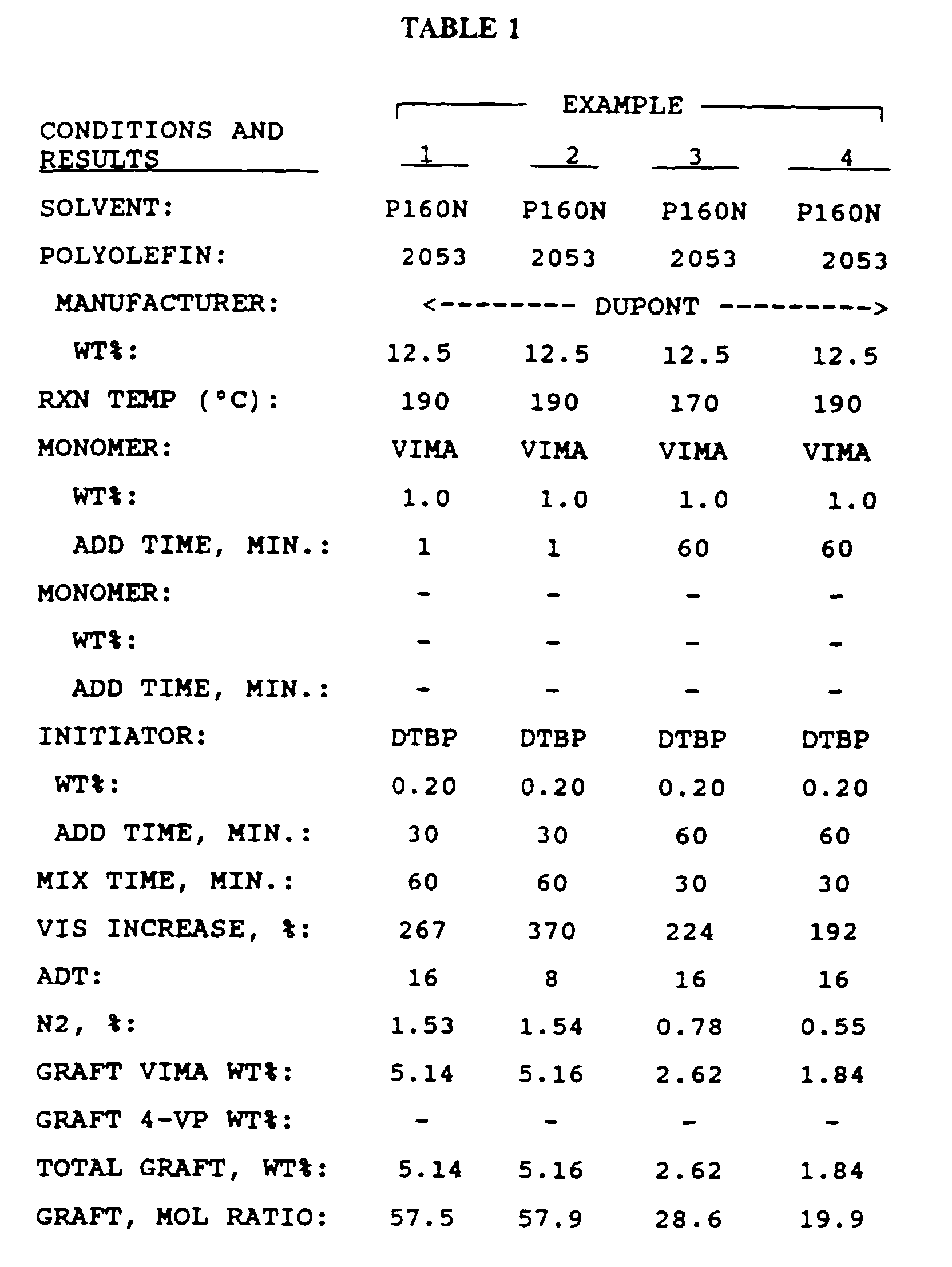


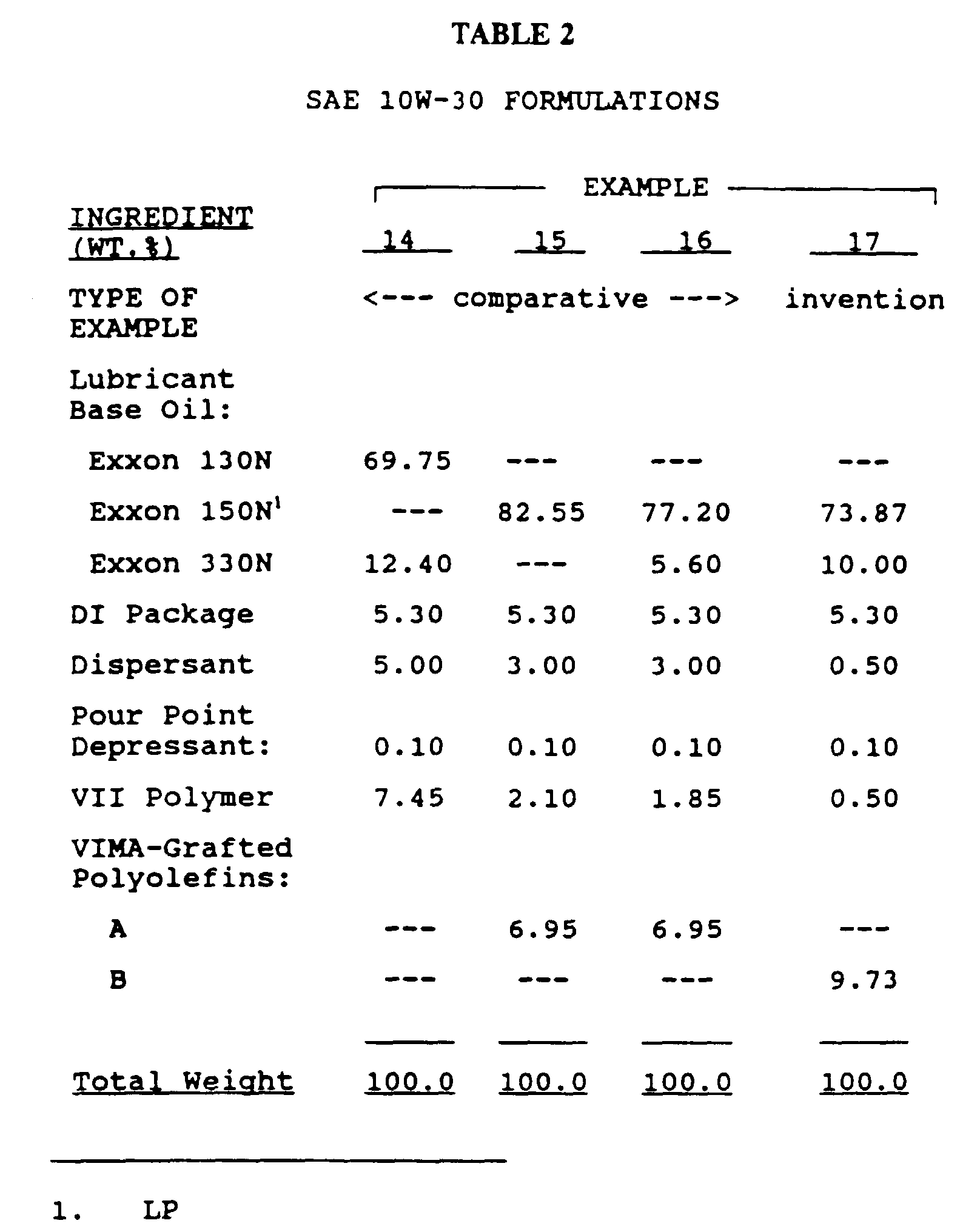


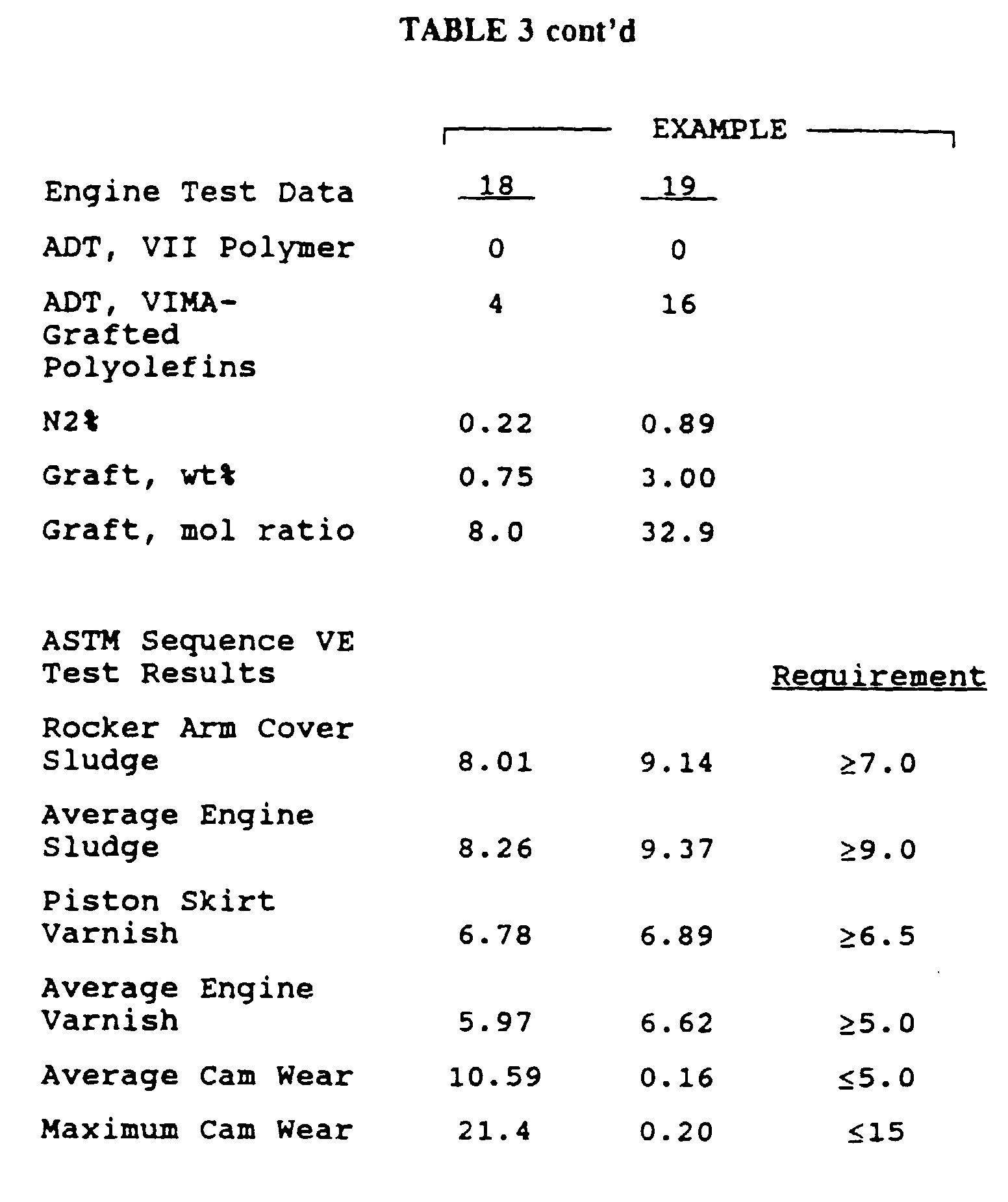

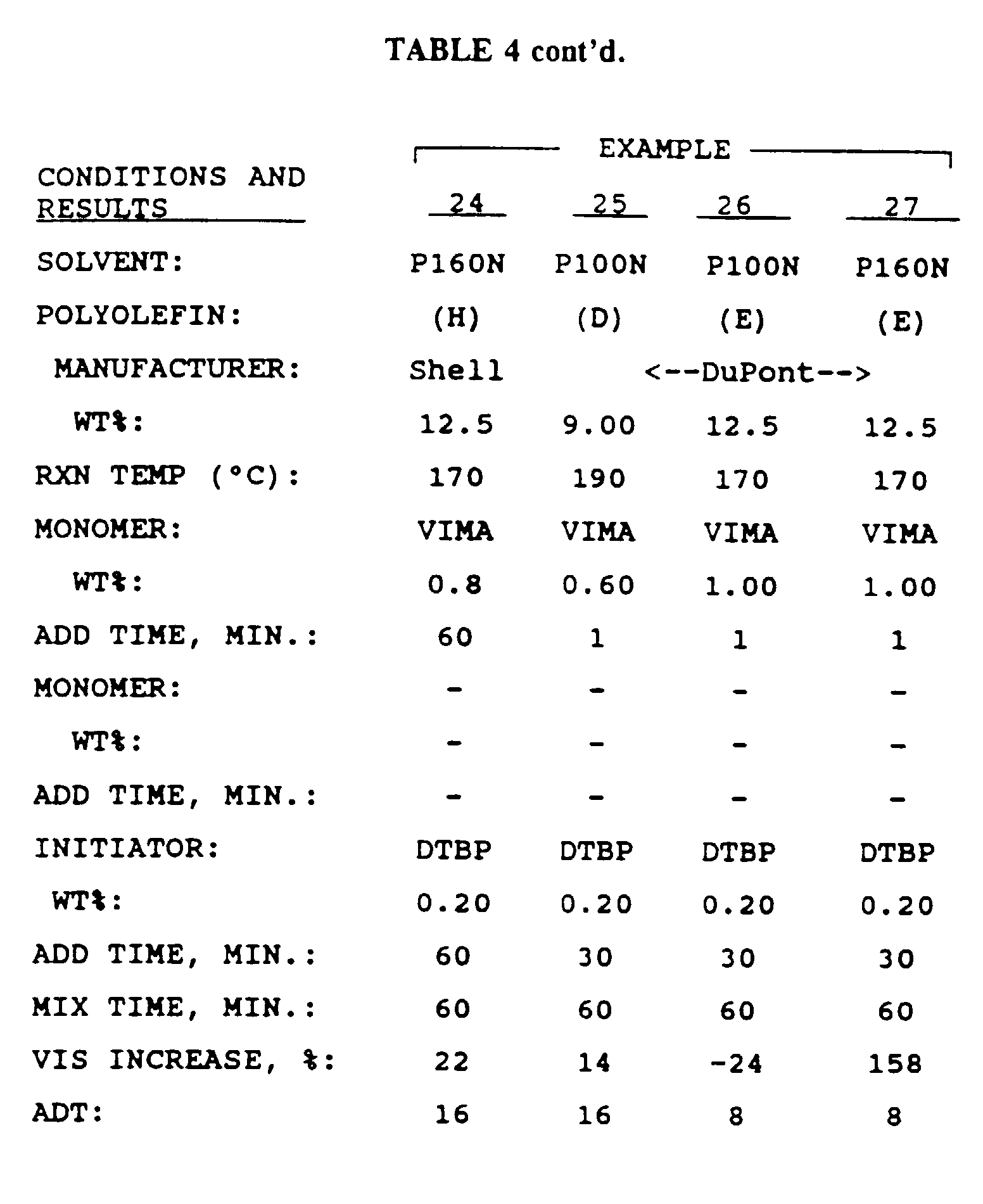


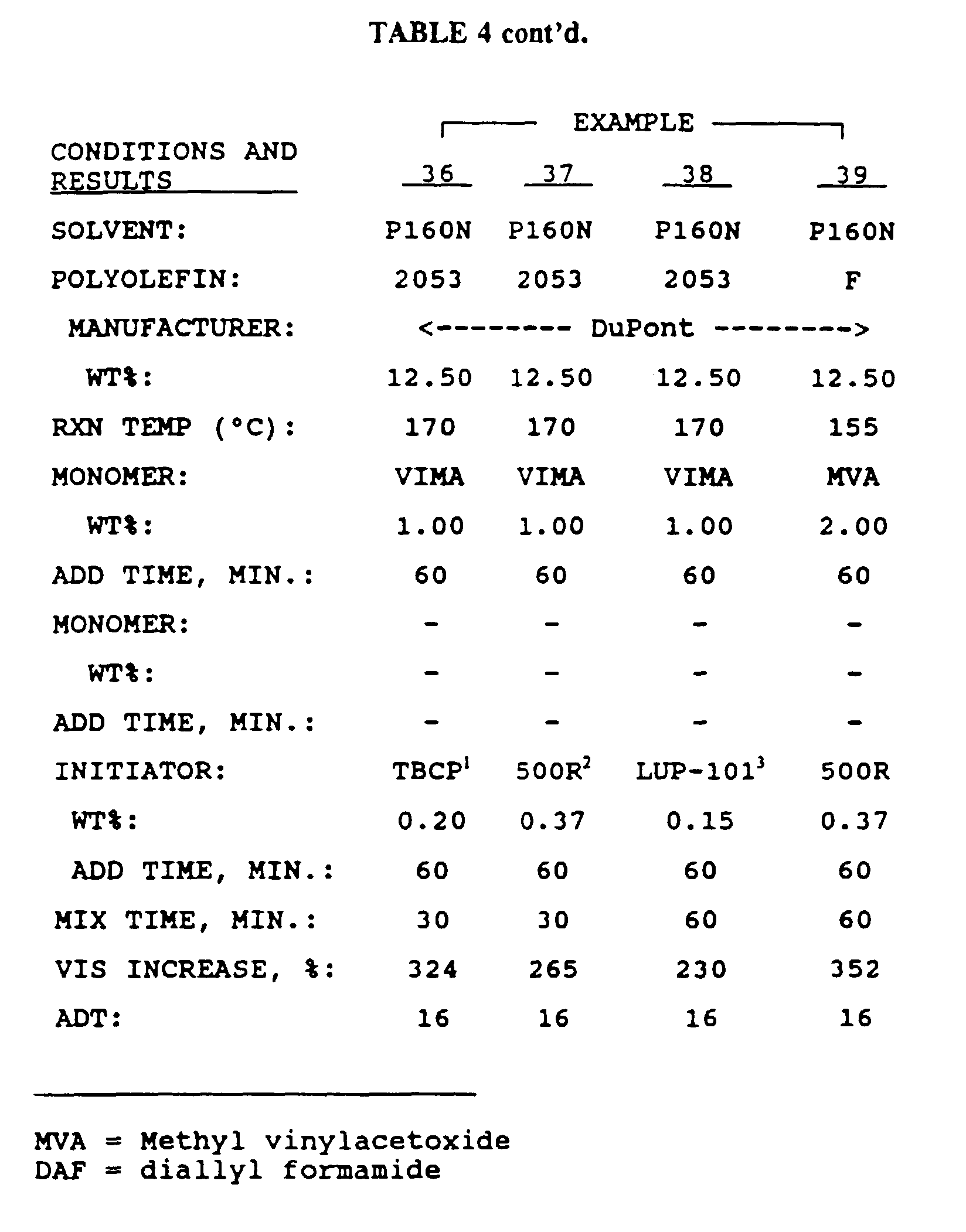
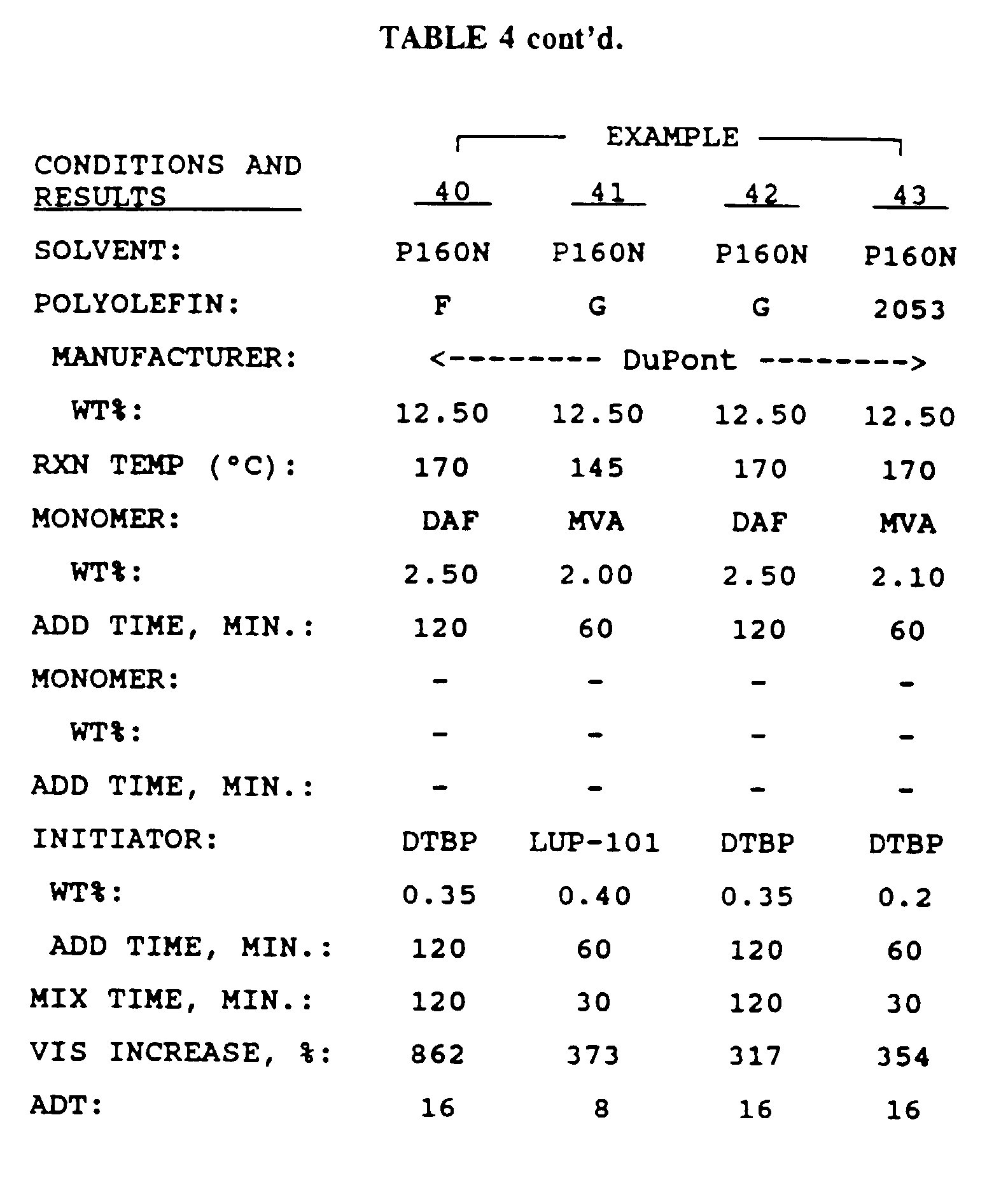


Claims (22)
- A method of making a graft copolymer reaction product, the method comprising the steps of:characterised byproviding a polyolefin backbone having graftable unsaturation;providing a nitrogenous, ethylenically unsaturated, aliphatic or aromatic monomer having from 2 to 50 carbon atoms;providing an initiator to graft the monomer to the polyolefin backbone;dissolving the polyolefin in a solvent, forming a solution, which is heated to the desired reaction temperature;adding the graftable monomer and the initiator to the solution, the monomer and the initiator being added together or successively;thereby forming the graft copolymer reaction product; the graft copolymer reaction product having an ADT of at least about 8.the solvent being a petroleum oil solvent containing less than about 9% by weight of molecular aromatic constituents; andthe initiator being added to the solvent at a steady rate over an extended period;
- The method of making a graft copolymer reaction product as claimed in claim 1, wherein said monomer comprises a member selected from the group consisting of:and combinations of those materials.N-vinylimidazole;1-vinyl-2-pyrrolidinone;N-allyl imidazole;1-vinyl pyrrolidone;2-vinyl pyridine;4-vinyl pyridine;N-methyl-N-vinyl-acetamide;di-allyl formamide;N-methyl-N-allyl formamide;N-ethyl-N-allyl formamide;N-cyclohexyl-N-allyl formamide;4-methyl-5-vinyl thiazole;N-allyl di-iso-octyl phenothiazine;2-methyl-1-vinylimidazole3-methyl-1-vinylpyrazoleN-vinyl-purineN-vinyl piperazinesN-vinyl succinimideVinylpiperidinesVinylmorpholines
- The method of making a graft copolymer reaction product as claimed in claim 2, wherein said monomer comprises a member selected from the group consisting of:and combinations of those materials.N-vinylimidazole;N-allyl imidazole;2-vinyl pyridine;4-vinyl pyridine;N-methyl-N-vinyl-acetamide;di-allyl formamide;
- The method of making a graft copolymer reaction product as claimed in claim 3, wherein said monomer comprises N-vinylimidazole.
- The method of making a graft copolymer reaction product as claimed in any one of claims 1-4, wherein the graft copolymer reaction product has the property of increasing the viscosity index of a lubricating base oil stock by at least about 20 points when present at a level of 1% by weight in the base oil stock.
- The method of making a graft copolymer reaction product as claimed in any one of claims 1-4, wherein the graft copolymer reaction product has at least 1.2% by weight of said monomer grafted on said polyolefin backbone.
- The method of making a graft copolymer reaction product as claimed in any one of claims 1-4, wherein the graft copolymer reaction product has at least 13 moles of said N-vinylimidazole grafted on a mole of said polyolefin backbone.
- A method of making a graft reaction product of a graftable monomer selected from the group consisting of:and combinations of said graftable monomers;N-vinylimidazole;C-vinylimidazole1-vinyl-2-pyrrolidinone;N-allyl imidazole;1-vinyl pyrrolidinone;2-vinyl pyridine;4-vinyl pyridine;N-methyl-N-vinylacetamide;di-allylformamide;N-methyl-N-allylformamide;N-ethyl-N-allylformamide;N-cyclohexyl-N-allylformamide;4-methyl-5-vinylthiazole;N-allyldiisooctylphenothiazine;2-methyl-1-vinylimidazole;3-methyl-1-vinylpyrazole;N-vinylpurine;N-vinylpiperazines;N-vinylsuccinimide;Vinylpiperidines;Vinylmorpholines;
the method comprising the step of blending a reaction mixture consisting essentially of at least one of said graftable monomers; a polyolefin copolymer having pendant graftable sites; and an initiator at a temperature and under conditions effective to graft said monomer on at least some of said pendant graftable sites of said polyolefin copolymer backbone; the graft reaction product having an ADT value of at least 2,
characterized in that the blending is performed as melt-blending. - The method of making a graft reaction product as claimed in claim 8, wherein the reaction mixture is melt-blended in an extruder or other polymeric mixer.
- The method of making a graft reaction product as claimed in claim 9, wherein the reaction mixture is heated by friction resulting from mastification and flow of the polyolefin composition in the extruder.
- The method of making a graft reaction product as claimed in claims 9 and 10, wherein the monomer is introduced into the extruder at a steady rate over an extended period.
- The method of making a graft reaction product as claimed in any one of claims 9 to 11, wherein the initiator is added to the extruder after the monomer.
- The method of making a graft reaction product as claimed in claim 12, wherein the initiator is added to the extruder at a steady rate over an extended period.
- The method of making a graft reaction product as claimed in claims 12 or 13, wherein the initiator is cut back with a solvent.
- The method of making a graft reaction product as claimed in any one of claims 9 to 14, wherein the extruder is operated continuously and all of the ingredients are added at a uniform rate.
- The method of making a graft copolymer claimed in any one of claims 1 to 7, or the method claimed in any one of claims 8-15, wherein the polyolefin backbone is an ethylene/propylene/diene polyolefin containing from 30% to 80% ethylene and from about 70% to about 20% propylene moieties by number, optionally modified with from 0% to 9% diene monomers.
- The method of making a graft reaction product as claimed in any one of claims 8-15, wherein said monomer comprises N-vinylimidazole.
- The method of making a graft reaction product as claimed in any one of claims 8-17, wherein said polyolefin copolymer backbone has a weight average molecular weight of from 20,000 to 500,000 and a polydispersity of less than 10.
- The method of making a graft reaction product as claimed in any one of claims 8-18, wherein said ADT is at least about 4.
- A method of making a dispersant viscosity index improver, comprising the steps of:thereby forming a graft copolymer of N-vinylimidazole on a polyolefin, said graft copolymer having a viscosity of less than 13,000 centistokes at 100°C and an ADT value of at least about 8,A. providing N-vinylimidazole, a polyolefin having graftable unsaturation, and an initiator;B. dissolving said polyolefin in a solvent, forming a solution;C. dispersing said N-vinylimidazole in said solution; and
characterised byB' the solvent being a petroleum oil solvent containing less than about 9% by weight of molecular aromatic impurities; andD. adding said initiator to said solution at an average rate of addition of less than about 20% of the amount sufficient to graft said N-vinylimidazole to said polymer per minute of addition, said adding step being carried out at a temperature exceeding the initiation temperature of said initiator. - The method of claim 20, wherein said step of dispersing said N-vinylimidazole in said solution is carried out, while adding said initiator to said solution, at a rate of addition of less than about 20% of the charge of said N-vinylimidazole per minute of addition.
- A method of making a dispersant viscosity index improver, comprising the steps of:said grafted polyolefin copolymer having a viscosity of less than 13,000 centi-stokes and an ADT of at least 2;A. providing N-vinylimidazole and a polyolefin copolymer backbone having graftable pendant sites;B. providing an amount of an initiator sufficient to graft N-vinylimidazole to said backbone;C. blending a reaction mixture consisting essentially of said N-vinylimidazole, said polyolefin copolymer, and said initiator, said blending step being carried out at a temperature and under conditions effective to graft said N-vinylimidazole on at least some of said graftable pendant sites of said polyolefin backbone;
characterised in that
the blending is carried out as melt-blending.
Applications Claiming Priority (5)
| Application Number | Priority Date | Filing Date | Title |
|---|---|---|---|
| US08/327,508 US5523008A (en) | 1994-10-21 | 1994-10-21 | Polar grafted polyolefins, methods for their manufacture, and lubricating oil compositions containing them |
| US327508 | 1994-10-21 | ||
| US08/541,832 US5663126A (en) | 1994-10-21 | 1995-10-10 | Polar grafted polyolefins, methods for their manufacture, and lubricating oil compositions containing them |
| US541832 | 1995-10-10 | ||
| PCT/GB1995/002473 WO1996012746A1 (en) | 1994-10-21 | 1995-10-20 | Polar grafted polyolefins, methods for their manufacture, and lubricating oil compositions containing them |
Publications (2)
| Publication Number | Publication Date |
|---|---|
| EP0787158A1 EP0787158A1 (en) | 1997-08-06 |
| EP0787158B1 true EP0787158B1 (en) | 2000-07-05 |
Family
ID=26985906
Family Applications (1)
| Application Number | Title | Priority Date | Filing Date |
|---|---|---|---|
| EP95934706A Expired - Lifetime EP0787158B1 (en) | 1994-10-21 | 1995-10-20 | methods for the manufacture of polar grafted polyolefines |
Country Status (11)
| Country | Link |
|---|---|
| US (5) | US5663126A (en) |
| EP (1) | EP0787158B1 (en) |
| JP (1) | JP4070027B2 (en) |
| AT (1) | ATE194363T1 (en) |
| AU (1) | AU709912B2 (en) |
| BR (1) | BR9509414A (en) |
| CA (1) | CA2185241C (en) |
| DE (1) | DE69517819T2 (en) |
| GB (1) | GB2308124B (en) |
| RU (1) | RU2184746C2 (en) |
| WO (1) | WO1996012746A1 (en) |
Families Citing this family (59)
| Publication number | Priority date | Publication date | Assignee | Title |
|---|---|---|---|---|
| US6034184A (en) * | 1998-06-23 | 2000-03-07 | Mobil Oil Corporation | Dispersants and dispersant viscosity index improvers from selectively hydrogenated polymers: Mannich reaction products |
| US6228817B1 (en) | 1990-01-16 | 2001-05-08 | Mobil Oil Corporation | Dispersants and dispersant viscosity index improvers from selectively hydrogenated polymers |
| US6103676A (en) * | 1998-06-23 | 2000-08-15 | Mobil Oil Corporation | Dispersants and dispersant viscosity index improvers from selectively hydrogenated polymers: hydroformylation/reductive amination reaction products |
| US6162768A (en) * | 1990-01-16 | 2000-12-19 | Mobil Oil Corporation | Dispersants and dispersant viscosity index improvers from selectively hydrogenated polymers: free radically initiated direct grafting reaction products |
| US6248702B1 (en) | 1990-01-16 | 2001-06-19 | Mobil Oil Corporation | Dispersant and dispersant viscosity index improvers from selectively hydrogenated aryl-substituted olefin containing diene copolymers |
| US6054539A (en) * | 1998-07-31 | 2000-04-25 | Mobil Oil Corporation | Selectively hydrogenated polymer compositions: polybutadiene-isoprene-polybutadiene |
| US5663126A (en) * | 1994-10-21 | 1997-09-02 | Castrol Limited | Polar grafted polyolefins, methods for their manufacture, and lubricating oil compositions containing them |
| GB9612278D0 (en) * | 1996-06-12 | 1996-08-14 | Castrol Ltd | A lubricant for use in diesel engines |
| US6187721B1 (en) | 1996-06-12 | 2001-02-13 | Castrol Limited | Lubricant for use in diesel engines |
| KR100241818B1 (en) * | 1996-08-13 | 2000-03-02 | 스기야마 도모오 | Thermoplastic resin composition and compatibilizing agent used therein |
| ES2166982T3 (en) * | 1996-09-24 | 2002-05-01 | Shell Int Research | DISPERSANT VISCOSITY INDEX IMPROVERS. |
| US6083888A (en) * | 1997-09-16 | 2000-07-04 | Shell Oil Company | Dispersant viscosity index improvers |
| DE69829197T2 (en) | 1997-10-28 | 2006-02-16 | Castrol Ltd., Swindon | PROCESS FOR PREPARING PFROPOPOPOLYMERS |
| US6096899A (en) | 1998-04-14 | 2000-08-01 | The Regents Of The University Of Michigan | Cylic imidazole compounds having relatively low hydrogen content and relatively high nitrogen content and polymers formed therefrom |
| US6215033B1 (en) | 1998-12-11 | 2001-04-10 | Mobil Oil Corporation | Dispersants and dispersant viscosity index improvers from selectively hydrogenated polymers: blends with lower molecular weight components |
| US6319881B1 (en) * | 1998-06-23 | 2001-11-20 | Exxonmobil Oil Corporation | Haze free oil additive compositions containing dispersants from selectively hydrogenated diene copolymers |
| US6713438B1 (en) | 1999-03-24 | 2004-03-30 | Mobil Oil Corporation | High performance engine oil |
| US6624270B1 (en) | 2000-01-14 | 2003-09-23 | The Regents Of The University Of Michigan | Copolymers derived from vinyl dicyanoimidazoles and other monomers |
| US7067049B1 (en) | 2000-02-04 | 2006-06-27 | Exxonmobil Oil Corporation | Formulated lubricant oils containing high-performance base oils derived from highly paraffinic hydrocarbons |
| US6472353B1 (en) | 2000-09-14 | 2002-10-29 | The Lubrizol Corporation | Dispersant-viscosity improvers for lubricating oil compositions |
| US6548606B1 (en) | 2002-01-23 | 2003-04-15 | Infineum International Ltd. | Method of forming grafted copolymers |
| EP1513794B1 (en) * | 2002-05-24 | 2013-03-06 | Castrol Limited | Preparation of monomers for grafting to polyolefins, and lubricating oil compositions containing grafted copolymer |
| AU2004206252A1 (en) | 2003-01-21 | 2004-08-05 | The Lubrizol Corporation | Sulphur free composition and lubricant composition and methods thereof |
| US20050101496A1 (en) * | 2003-11-06 | 2005-05-12 | Loper John T. | Hydrocarbyl dispersants and compositions containing the dispersants |
| US7514393B2 (en) * | 2003-11-21 | 2009-04-07 | Castrol Limited | Preparation of functional monomers for grafting to low molecular weight polyalkenes and their use in the preparation of dispersants and lubricating oil compositions containing dispersant polyalkenes |
| US7407918B2 (en) * | 2003-12-11 | 2008-08-05 | Afton Chemical Corporation | Lubricating oil compositions |
| US7214649B2 (en) * | 2003-12-31 | 2007-05-08 | Afton Chemical Corporation | Hydrocarbyl dispersants including pendant polar functional groups |
| US7645728B2 (en) | 2004-02-17 | 2010-01-12 | Afton Chemical Corporation | Lubricant and fuel additives derived from treated amines |
| US7361629B2 (en) * | 2004-03-10 | 2008-04-22 | Afton Chemical Corporation | Additives for lubricants and fuels |
| FR2881431B1 (en) * | 2005-01-28 | 2008-12-05 | Arkema Sa | GRAFTING A POLYAMIDE POWDER BY IRRADIATION GAMMA. |
| US7645726B2 (en) | 2004-12-10 | 2010-01-12 | Afton Chemical Corporation | Dispersant reaction product with antioxidant capability |
| US8703872B2 (en) * | 2005-03-11 | 2014-04-22 | Castrol Limited | Multiple function graft polymer |
| EP1874837A1 (en) * | 2005-04-28 | 2008-01-09 | Castrol Limited | Multiple-function dispersant graft polymer |
| EP1992677A1 (en) * | 2007-05-10 | 2008-11-19 | Castrol Limited | Lubricant composition for combustion engine containing dispersant additive and polymer dispersant viscosity index improver |
| US9175237B2 (en) * | 2007-12-12 | 2015-11-03 | Chevron Oronite Technology B.V. | Trunk piston engine lubricating oil compositions |
| EP2128232A1 (en) | 2008-05-20 | 2009-12-02 | Castrol Limited | Lubricating composition for ethanol fueled engines |
| US8415284B2 (en) * | 2009-11-05 | 2013-04-09 | Afton Chemical Corporation | Olefin copolymer VI improvers and lubricant compositions and uses thereof |
| EP2501726A1 (en) | 2009-11-17 | 2012-09-26 | Castrol Limited | Multifunctional multiple graft monomer low molecular weight polymer |
| JP2013523959A (en) | 2010-04-01 | 2013-06-17 | カストロール・リミテッド | Multifunctional graft polymer |
| MX341294B (en) | 2010-04-07 | 2016-08-12 | Castrol Ltd * | Graft polymer and related methods and compositions. |
| US9115237B2 (en) | 2012-07-18 | 2015-08-25 | Chevron Oronite Company Llc | Viscosity improver grafted with unsaturated acylating agent and an aryloxyalylkene monoamine |
| US9862909B2 (en) * | 2012-08-14 | 2018-01-09 | Basf Se | Polymer for lubricant compositions and method of forming the same |
| US10053597B2 (en) | 2013-01-18 | 2018-08-21 | Basf Se | Acrylic dispersion-based coating compositions |
| AU2014228218B2 (en) | 2013-03-15 | 2017-06-08 | Castrol Limited | Multiple function dispersant viscosity index improver |
| US9708422B2 (en) | 2013-12-10 | 2017-07-18 | The Lubrizol Corporation | Method for preparing functionalized graft polymers |
| EP3405554B1 (en) | 2016-01-22 | 2019-12-25 | Chevron Oronite Company LLC | Lubricating oil composition containing a mixture of olefin copolymer dispersant-type viscosity improver and amine compound |
| US10513668B2 (en) * | 2017-10-25 | 2019-12-24 | Afton Chemical Corporation | Dispersant viscosity index improvers to enhance wear protection in engine oils |
| WO2020193963A1 (en) | 2019-03-22 | 2020-10-01 | Castrol Limited | Devices, systems and methods for the treatment of lubricating fluids |
| CN113563530B (en) * | 2020-04-29 | 2024-07-02 | 中国石油化工股份有限公司 | Polypropylene grafted heterocycle modified material and preparation method and application thereof |
| CN111548483B (en) * | 2020-06-02 | 2021-08-13 | 中国科学技术大学 | Application of Salen Manganese Complexes in Tandem Catalytic Reactions Involving Unsaturated Acid Anhydrides-Epoxy Copolymers |
| US12187819B1 (en) | 2023-11-15 | 2025-01-07 | Tpc Group, Llc | Compound, its preparation and use |
| WO2025125894A1 (en) | 2023-12-14 | 2025-06-19 | Infineum International Limited | Lubricant compositions containing magnesium detergent for reduced pre-ignition in hydrogen fueled engines |
| WO2025126134A1 (en) | 2023-12-14 | 2025-06-19 | Infineum International Limited | Lubricant compositions containing detergent for reduced abnormal combustion events in hydrogen fueled engines |
| WO2025125892A1 (en) | 2023-12-14 | 2025-06-19 | Infineum International Limited | Lubricant compositions containing molybdenum for reduced pre-ignition in hydrogen fueled engines |
| WO2025126133A1 (en) | 2023-12-14 | 2025-06-19 | Infineum International Limited | Lubricant compositions containing phosphorus for use in hydrogen fueled engines |
| WO2025125893A1 (en) | 2023-12-14 | 2025-06-19 | Infineum International Limited | Lubricant compositions for reduced pre-ignition in hydrogen fueled engines |
| WO2025126063A1 (en) | 2023-12-14 | 2025-06-19 | Infineum International Limited | Lubricant compositions containing silicon for reduced pre-ignition in hydrogen fueled engines |
| CN118792089B (en) * | 2024-09-11 | 2025-01-03 | 锦州康泰润滑油添加剂有限公司 | Composition, and preparation method and application thereof |
| US20260092151A1 (en) | 2024-10-02 | 2026-04-02 | Tpc Group Llc | Compounds, their Preparation and Use |
Citations (1)
| Publication number | Priority date | Publication date | Assignee | Title |
|---|---|---|---|---|
| US4146489A (en) * | 1975-07-31 | 1979-03-27 | Rohm And Haas Company | Polyolefin graft copolymers |
Family Cites Families (79)
| Publication number | Priority date | Publication date | Assignee | Title |
|---|---|---|---|---|
| GB1076543A (en) | 1964-01-28 | 1967-07-19 | Gen Aniline & Film Corp | Alkylating polymeric or copolymeric lactams |
| US3728319A (en) * | 1970-02-19 | 1973-04-17 | Gaf Corp | Reaction products of poly n-vinylpyrrolidone or poly n-vinylpyrrolidones with alkyl side chains and organic secondary or tertiary amines |
| FR2293485A1 (en) * | 1974-12-03 | 1976-07-02 | Inst Francais Du Petrole | LUBRICANT COMPOSITIONS IMPROVED BY THE ADDITION OF COPOLYMERS GRAFTS |
| US4092255A (en) * | 1974-12-12 | 1978-05-30 | Entreprise De Recherches Et D'activites Petrolieres (E.R.A.P.) | Novel lubricating compositions containing nitrogen containing hydrocarbon backbone polymeric additives |
| FR2294191A1 (en) * | 1974-12-12 | 1976-07-09 | Aquitaine Petrole | COPOLYMERS OF OLEFINS OR OLEFINS AND DENES NOT CONJUGATED WITH UNSATURATED DERIVATIVES OF CYCLIC IMIDES |
| US4068058A (en) * | 1975-03-05 | 1978-01-10 | Exxon Research And Engineering Company | Aminated polymeric additives for fuel and lubricants |
| US4098710A (en) | 1976-04-26 | 1978-07-04 | Exxon Research & Engineering Co. | Oil-soluble addition products of an ethylene-propylene copolymer and anionically polymerizable monomer having utility as multifunctional V.I. improver for lubricating oils |
| US4100086A (en) | 1976-10-26 | 1978-07-11 | Texaco Inc. | Dispersant and lube oils containing same |
| GB1601079A (en) * | 1977-07-28 | 1981-10-21 | Texaco Development Corp | Reaction products of hydrocarbon polymers with olefinic polyar compounds and processes for making same |
| US4160739A (en) | 1977-12-05 | 1979-07-10 | Rohm And Haas Company | Polyolefinic copolymer additives for lubricants and fuels |
| US4229308A (en) | 1978-02-08 | 1980-10-21 | Rhone-Poulenc Industries | Polymer lubricating oil additives bearing nitrogen groups and their use as additives for lubricating oils |
| DE2805826C2 (en) * | 1978-02-11 | 1987-05-14 | Röhm GmbH, 6100 Darmstadt | Improved grafting processes |
| DE2810633A1 (en) | 1978-03-11 | 1979-09-20 | Bayer Ag | Graft copolymers containing allyl compounds |
| US4320019A (en) | 1978-04-17 | 1982-03-16 | The Lubrizol Corporation | Multi-purpose additive compositions and concentrates containing same |
| DE2905954C2 (en) | 1979-02-16 | 1982-10-28 | Röhm GmbH, 6100 Darmstadt | Concentrated polymer emulsions as viscosity index improvers for mineral oils |
| US4229311A (en) * | 1979-07-18 | 1980-10-21 | Rohm Gmbh | Lubricating oil additives |
| DE3001045A1 (en) | 1980-01-12 | 1981-07-16 | Röhm GmbH, 6100 Darmstadt | SHEAR-STABLE LUBRICANT ADDITIVES |
| FR2497822A1 (en) * | 1981-01-12 | 1982-07-16 | Organo Synthese Ste Fse | ADDITIVES FOR LUBRICATING OILS BASED ON STYRENE AND C12-C20 ALKYL HEAVY METHACRYLATES, MANUFACTURING METHOD AND APPLICATIONS |
| US4707285A (en) * | 1981-06-29 | 1987-11-17 | Exxon Research & Engineering Co. | Haze-free polymer additives for fuels and lubricants |
| US4734213A (en) * | 1981-06-29 | 1988-03-29 | Exxon Research & Engineering Co. | Haze-free polymer additives for fuels and lubricants |
| US4519929A (en) * | 1982-02-19 | 1985-05-28 | Edwin Cooper, Inc. | Lubricating oil composition containing N-allyl amide graft copolymers |
| US4810754A (en) * | 1983-12-02 | 1989-03-07 | Exxon Research & Engineering Company | High temperature peroxide induced telomerization processes for grafting vinyl nitrogen containing monomers onto olefin polymers |
| IT1181905B (en) * | 1984-06-15 | 1987-09-30 | Anic Spa | MULTIFUNCTIONAL ADDITIVE FOR LUBRICANT OILS AND PROCEDURE FOR ITS PREPARATION |
| CA1264880A (en) | 1984-07-06 | 1990-01-23 | John Brooke Gardiner | Viscosity index improver - dispersant additive useful in oil compositions |
| US4769043A (en) * | 1984-08-20 | 1988-09-06 | Texaco Inc. | Oil containing dispersant VII olefin copolymer |
| US4715975A (en) * | 1984-08-20 | 1987-12-29 | Texaco Inc. | Oil containing dispersant VII olefin copolymer |
| US4952637A (en) * | 1985-04-24 | 1990-08-28 | Texaco Inc. | Hydrocarbon compositions containing polyolefin graft polymers |
| US4877415A (en) * | 1985-04-24 | 1989-10-31 | Texaco Inc. | Hydrocarbon compositions containing polyolefin graft polymers |
| US4820776A (en) | 1985-04-24 | 1989-04-11 | Texaco Inc. | Hydrocarbon compositions containing polyolefin graft polymers having amine and phenothiazine grafted moieties |
| US4886611A (en) * | 1985-04-24 | 1989-12-12 | Texaco Inc. | Hydrocarbon compositions containing polyolefin graft polymers |
| EP0199453A3 (en) * | 1985-04-24 | 1988-04-13 | Texaco Development Corporation | Hydrocarbon compositions containing polyolefin graft polymers |
| US4640788A (en) * | 1985-04-29 | 1987-02-03 | Texaco Inc. | Hydrocarbon compositions containing polyolefin graft polymers |
| US4693838A (en) | 1985-10-29 | 1987-09-15 | Exxon Chemical Patents Inc. | Multifunctional viscosity index improver |
| US4699723A (en) * | 1986-08-20 | 1987-10-13 | Texaco Inc. | Dispersant-antioxidant multifunction viscosity index improver |
| US5328624A (en) * | 1987-06-16 | 1994-07-12 | Exxon Chemical Patents Inc. | Stabilized grafted ethylene copolymer additive useful in oil compositions |
| US4922045A (en) * | 1987-08-03 | 1990-05-01 | Texaco Inc. | Diesel lubricating oil consumption control additives |
| US4904404A (en) * | 1987-08-12 | 1990-02-27 | Texaco Inc. | Lubricating oil containing viscosity index improver |
| US4863623A (en) * | 1988-03-24 | 1989-09-05 | Texaco Inc. | Novel VI improver, dispersant, and anti-oxidant additive and lubricating oil composition containing same |
| CA1339787C (en) * | 1988-07-18 | 1998-03-31 | David Yen-Lung Chung | Multifunctional viscosity index improver |
| IT1226575B (en) | 1988-08-02 | 1991-01-24 | Ausimont Spa | PROCEDURE FOR CARRYING OUT THE MALEIC ANHYDRIDE GRAFT ON UNSATURATED POLYOLEFINIC ELASTOMERS BY MASS REACTION. |
| JPH02140211A (en) | 1988-11-22 | 1990-05-29 | Nippon Oil & Fats Co Ltd | Maleimide-based copolymer having peroxy bond in molecule |
| JPH02158614A (en) | 1988-12-13 | 1990-06-19 | Mitsubishi Rayon Co Ltd | Methacrylimide-containing resin polymer and thermoplastic resin composition containing the same |
| US5298565A (en) * | 1989-04-05 | 1994-03-29 | The Lubrizol Corporation | Graft copolymers and lubricants containing such as dispersant-viscosity improvers |
| DE69028074T2 (en) * | 1989-04-05 | 1997-03-06 | The Lubrizol Corp., Wickliffe, Ohio | GRAFT MIXING POLYMERS AND LUBRICANTS THAT CONTAIN THEM AS DISPERSING AND VISCOSITY IMPROVERS |
| CA2013891C (en) * | 1989-04-18 | 2003-01-14 | Joseph M. Bollinger | Dispersant polymethacrylate viscosity index improvers |
| US5182041A (en) | 1989-05-01 | 1993-01-26 | Texaco Inc. | Dispersant - anti-oxidant additive and lubricating oil composition containing same |
| US5167848A (en) * | 1989-05-30 | 1992-12-01 | Exxon Chemical Patents Inc. | Grafted viscosity index improver |
| US5210146A (en) | 1989-05-30 | 1993-05-11 | Exxon Chemical Patents Inc. | Multifunctional viscosity index improver derived from polyamine containing one primary amino group and at least one secondary amino group exhibiting improved low temperature viscometric properties |
| CA2025992A1 (en) * | 1989-10-12 | 1991-04-13 | David Y. Chung | Multifunctional viscosity index improver derived from polyamine containing one primary amine group and at least one tertiary amine group and degraded ethylene copolymer |
| CA2029842A1 (en) * | 1989-11-29 | 1991-05-30 | Kenneth O. Henderson | Lube oil additive package containing viscosity index improver |
| US5275747A (en) * | 1990-02-01 | 1994-01-04 | Exxon Chemical Patents Inc. | Derivatized ethylene alpha-olefin polymer useful as multifunctional viscosity index improver additive for oleaginous composition |
| BR9106126A (en) * | 1990-03-08 | 1993-03-02 | Exxon Chemical Patents Inc | OIL SOLUBLE ADDITIVE, OIL COMPOSITION AND PROCESS TO PREPARE A WET DISPERSING ADDITIVE FROM THE VISCOSITY INDEX |
| US5075383A (en) | 1990-04-11 | 1991-12-24 | Texaco Inc. | Dispersant and antioxidant additive and lubricating oil composition containing same |
| US5035820A (en) * | 1990-05-15 | 1991-07-30 | Shell Oil Company | Oil compositions containing modified star polymers |
| US5308523A (en) * | 1990-09-24 | 1994-05-03 | Texaco Inc. | VI improver, dispersant, and antioxidant additive and lubricating oil composition |
| US5167845A (en) | 1990-12-21 | 1992-12-01 | Texaco Inc. | Polymeric additives to enhance anti-wear, anti-oxidancy, and dispersancy in lubricants |
| GB9104647D0 (en) * | 1991-03-05 | 1991-04-17 | Exxon Chemical Patents Inc | Improvements in the production of lubricating or fuel oil additives and intermediates |
| US5624999A (en) | 1991-03-05 | 1997-04-29 | Exxon Chemical Patents Inc. | Manufacture of functionalized polymers |
| US5200100A (en) | 1991-04-24 | 1993-04-06 | Texaco Inc. | Multifunctional viscosity index improver containing phenothiazine |
| US5205949A (en) * | 1991-06-19 | 1993-04-27 | Texaco Inc. | Dispersant and VI improver additive and lubrication oil composition containing same |
| US5474693A (en) * | 1991-09-03 | 1995-12-12 | Texaco Inc. | Modifiers for improving clarity of multifunctional VI improver oil compositions |
| US5552096A (en) | 1991-12-13 | 1996-09-03 | Exxon Chemical Patents Inc. | Multiple reaction process in melt processing equipment |
| EP0616616B2 (en) | 1991-12-13 | 2001-02-28 | Exxon Chemical Patents Inc. | Multiple reaction process in melt processing equipment |
| US5424367A (en) | 1991-12-13 | 1995-06-13 | Exxon Chemical Patents Inc. | Multiple reaction process in melt processing equipment |
| US5294354A (en) | 1992-06-05 | 1994-03-15 | Texaco Inc. | Combining dispersant viscosity index improver and detergent additives for lubricants |
| US5474694A (en) | 1992-09-21 | 1995-12-12 | Texaco Inc. | Lubricating oil composition |
| US5427702A (en) | 1992-12-11 | 1995-06-27 | Exxon Chemical Patents Inc. | Mixed ethylene alpha olefin copolymer multifunctional viscosity modifiers useful in lube oil compositions |
| DE4244386A1 (en) | 1992-12-29 | 1994-06-30 | Basf Ag | Vinylpyrrolidone and vinylimidazole copolymers, processes for their preparation and their use in detergents |
| FI96033C (en) | 1992-12-31 | 1996-04-25 | Borealis As | Process for functionalizing olefin polymers in a molten state |
| JPH07165840A (en) | 1993-09-25 | 1995-06-27 | Basf Ag | Propylene graft copolymer formed by combining monomaleinimide |
| US5424357A (en) | 1993-12-02 | 1995-06-13 | Dow Corning Corporation | Compositions for bonding organosiloxane elastomers to organic polymers |
| BE1007888A3 (en) | 1993-12-27 | 1995-11-14 | Solvay | Continuous process of polyolefin graft the grafted polyolefin obtained through this process. |
| US5663126A (en) * | 1994-10-21 | 1997-09-02 | Castrol Limited | Polar grafted polyolefins, methods for their manufacture, and lubricating oil compositions containing them |
| US5523008A (en) * | 1994-10-21 | 1996-06-04 | Castrol Limited | Polar grafted polyolefins, methods for their manufacture, and lubricating oil compositions containing them |
| US5534171A (en) | 1994-11-29 | 1996-07-09 | Dsm Copolymer Inc. | Process for making a polymeric lubricant additive designed to enhance anti-wear, anti-oxidancy, and dispersancy thereof |
| DE19519042A1 (en) | 1995-05-24 | 1996-11-28 | Basf Ag | Production of polyalkenylsuccinic acid derivatives and their use as fuel and lubricant additives |
| US5652202A (en) | 1995-08-15 | 1997-07-29 | Exxon Chemical Patents Inc. | Lubricating oil compositions |
| US5929172A (en) | 1997-03-20 | 1999-07-27 | Adhesives Research, Inc. | Conductive heterocyclic graft copolymer |
| EP1137682B1 (en) | 1999-09-17 | 2005-03-02 | The Lubrizol Corporation | Dispersant-viscosity improvers for lubricating oil compositions |
-
1995
- 1995-10-10 US US08/541,832 patent/US5663126A/en not_active Expired - Lifetime
- 1995-10-20 AT AT95934706T patent/ATE194363T1/en not_active IP Right Cessation
- 1995-10-20 EP EP95934706A patent/EP0787158B1/en not_active Expired - Lifetime
- 1995-10-20 CA CA002185241A patent/CA2185241C/en not_active Expired - Fee Related
- 1995-10-20 GB GB9706853A patent/GB2308124B/en not_active Expired - Fee Related
- 1995-10-20 BR BR9509414A patent/BR9509414A/en not_active IP Right Cessation
- 1995-10-20 RU RU97107846/04A patent/RU2184746C2/en not_active IP Right Cessation
- 1995-10-20 WO PCT/GB1995/002473 patent/WO1996012746A1/en not_active Ceased
- 1995-10-20 DE DE69517819T patent/DE69517819T2/en not_active Expired - Lifetime
- 1995-10-20 AU AU37024/95A patent/AU709912B2/en not_active Ceased
-
1996
- 1996-05-07 US US08/646,454 patent/US5814586A/en not_active Expired - Lifetime
-
1997
- 1997-08-29 US US08/920,393 patent/US5874389A/en not_active Expired - Lifetime
-
1999
- 1999-12-22 US US09/469,867 patent/US6300289B1/en not_active Expired - Lifetime
-
2001
- 2001-10-09 US US09/973,585 patent/US6686321B2/en not_active Expired - Fee Related
-
2004
- 2004-08-25 JP JP2004244614A patent/JP4070027B2/en not_active Expired - Fee Related
Patent Citations (3)
| Publication number | Priority date | Publication date | Assignee | Title |
|---|---|---|---|---|
| US4146489A (en) * | 1975-07-31 | 1979-03-27 | Rohm And Haas Company | Polyolefin graft copolymers |
| GB1558991A (en) * | 1975-07-31 | 1980-01-09 | Rohm & Haas | Graft copolymers |
| US4146489B1 (en) * | 1975-07-31 | 1983-11-08 |
Also Published As
| Publication number | Publication date |
|---|---|
| BR9509414A (en) | 1998-01-27 |
| DE69517819D1 (en) | 2000-08-10 |
| GB2308124A8 (en) | 1997-08-04 |
| GB9706853D0 (en) | 1997-05-21 |
| ATE194363T1 (en) | 2000-07-15 |
| US5814586A (en) | 1998-09-29 |
| JP4070027B2 (en) | 2008-04-02 |
| US6686321B2 (en) | 2004-02-03 |
| AU709912B2 (en) | 1999-09-09 |
| AU3702495A (en) | 1996-05-15 |
| MX9702834A (en) | 1997-07-31 |
| WO1996012746A1 (en) | 1996-05-02 |
| RU2184746C2 (en) | 2002-07-10 |
| GB2308124A (en) | 1997-06-18 |
| JP2005042116A (en) | 2005-02-17 |
| CA2185241C (en) | 1999-05-18 |
| DE69517819T2 (en) | 2001-03-01 |
| US20020042349A1 (en) | 2002-04-11 |
| GB2308124B (en) | 1999-03-31 |
| US5663126A (en) | 1997-09-02 |
| US5874389A (en) | 1999-02-23 |
| CA2185241A1 (en) | 1996-05-02 |
| US6300289B1 (en) | 2001-10-09 |
| EP0787158A1 (en) | 1997-08-06 |
Similar Documents
| Publication | Publication Date | Title |
|---|---|---|
| US5663126A (en) | Polar grafted polyolefins, methods for their manufacture, and lubricating oil compositions containing them | |
| US5523008A (en) | Polar grafted polyolefins, methods for their manufacture, and lubricating oil compositions containing them | |
| JPH10508051A (en) | Polar graft polyolefin, method for producing the same, and lubricating oil composition containing the same | |
| US4160739A (en) | Polyolefinic copolymer additives for lubricants and fuels | |
| US5075383A (en) | Dispersant and antioxidant additive and lubricating oil composition containing same | |
| US4863623A (en) | Novel VI improver, dispersant, and anti-oxidant additive and lubricating oil composition containing same | |
| US7371713B2 (en) | Preparation of monomers for grafting to polyolefins, and lubricating oil compositions containing grafted copolymer | |
| US5409623A (en) | Functionalized graft co-polymer as a viscosity and index improver, dispersant, and anti-oxidant additive and lubricating oil composition containing same | |
| EP0931127B1 (en) | Dispersant viscosity index improvers | |
| US5429757A (en) | Multifunctional copolymer and lubricating oil composition | |
| US5112508A (en) | VI improver, dispersant, and antioxidant additive and lubricating oil composition | |
| US5238588A (en) | Dispersant, vi improver, additive and lubricating oil composition containing same | |
| US5162086A (en) | Dispersant additive and lubricating oil composition containing same | |
| US5356999A (en) | Multifunctional viscosity index improvers based on polymers containing sulfonamides | |
| US5205949A (en) | Dispersant and VI improver additive and lubrication oil composition containing same | |
| GB2328211A (en) | Polar grafted polyolefins and lubricating oil comppositions containing them | |
| EP0461774B1 (en) | Dispersant, antioxidant and VI improver and lubricating oil composition containing same | |
| MXPA97002834A (en) | Polared polyolephines polarized, methods for its manufacture and compositions of lubricant oil containing the mis | |
| CS212313B2 (en) | A method for preparing a graft copolymer suitable as an additive to a lubricating oil or hydrocarbon motor fuel | |
| HK1169981A (en) | Preparation of monomers for grafting to polyolefins |
Legal Events
| Date | Code | Title | Description |
|---|---|---|---|
| PUAI | Public reference made under article 153(3) epc to a published international application that has entered the european phase |
Free format text: ORIGINAL CODE: 0009012 |
|
| 17P | Request for examination filed |
Effective date: 19970404 |
|
| AK | Designated contracting states |
Kind code of ref document: A1 Designated state(s): AT BE CH DE DK ES FR GB GR IE IT LI LU MC NL PT SE |
|
| 17Q | First examination report despatched |
Effective date: 19970916 |
|
| GRAG | Despatch of communication of intention to grant |
Free format text: ORIGINAL CODE: EPIDOS AGRA |
|
| RTI1 | Title (correction) |
Free format text: METHODS FOR THE MANUFACTURE OF POLAR GRAFTED POLYOLEFINES |
|
| GRAG | Despatch of communication of intention to grant |
Free format text: ORIGINAL CODE: EPIDOS AGRA |
|
| GRAH | Despatch of communication of intention to grant a patent |
Free format text: ORIGINAL CODE: EPIDOS IGRA |
|
| GRAH | Despatch of communication of intention to grant a patent |
Free format text: ORIGINAL CODE: EPIDOS IGRA |
|
| GRAA | (expected) grant |
Free format text: ORIGINAL CODE: 0009210 |
|
| AK | Designated contracting states |
Kind code of ref document: B1 Designated state(s): AT BE CH DE DK ES FR GB GR IE IT LI LU MC NL PT SE |
|
| PG25 | Lapsed in a contracting state [announced via postgrant information from national office to epo] |
Ref country code: NL Free format text: LAPSE BECAUSE OF FAILURE TO SUBMIT A TRANSLATION OF THE DESCRIPTION OR TO PAY THE FEE WITHIN THE PRESCRIBED TIME-LIMIT Effective date: 20000705 Ref country code: LI Free format text: LAPSE BECAUSE OF FAILURE TO SUBMIT A TRANSLATION OF THE DESCRIPTION OR TO PAY THE FEE WITHIN THE PRESCRIBED TIME-LIMIT Effective date: 20000705 Ref country code: GR Free format text: LAPSE BECAUSE OF NON-PAYMENT OF DUE FEES Effective date: 20000705 Ref country code: ES Free format text: THE PATENT HAS BEEN ANNULLED BY A DECISION OF A NATIONAL AUTHORITY Effective date: 20000705 Ref country code: CH Free format text: LAPSE BECAUSE OF FAILURE TO SUBMIT A TRANSLATION OF THE DESCRIPTION OR TO PAY THE FEE WITHIN THE PRESCRIBED TIME-LIMIT Effective date: 20000705 Ref country code: AT Free format text: LAPSE BECAUSE OF FAILURE TO SUBMIT A TRANSLATION OF THE DESCRIPTION OR TO PAY THE FEE WITHIN THE PRESCRIBED TIME-LIMIT Effective date: 20000705 |
|
| REF | Corresponds to: |
Ref document number: 194363 Country of ref document: AT Date of ref document: 20000715 Kind code of ref document: T |
|
| RTI1 | Title (correction) |
Free format text: METHODS FOR THE MANUFACTURE OF POLAR GRAFTED POLYOLEFINES |
|
| REG | Reference to a national code |
Ref country code: CH Ref legal event code: EP |
|
| REG | Reference to a national code |
Ref country code: IE Ref legal event code: FG4D |
|
| REF | Corresponds to: |
Ref document number: 69517819 Country of ref document: DE Date of ref document: 20000810 |
|
| ITF | It: translation for a ep patent filed | ||
| PG25 | Lapsed in a contracting state [announced via postgrant information from national office to epo] |
Ref country code: SE Free format text: LAPSE BECAUSE OF FAILURE TO SUBMIT A TRANSLATION OF THE DESCRIPTION OR TO PAY THE FEE WITHIN THE PRESCRIBED TIME-LIMIT Effective date: 20001005 Ref country code: DK Free format text: LAPSE BECAUSE OF FAILURE TO SUBMIT A TRANSLATION OF THE DESCRIPTION OR TO PAY THE FEE WITHIN THE PRESCRIBED TIME-LIMIT Effective date: 20001005 |
|
| PG25 | Lapsed in a contracting state [announced via postgrant information from national office to epo] |
Ref country code: PT Free format text: LAPSE BECAUSE OF FAILURE TO SUBMIT A TRANSLATION OF THE DESCRIPTION OR TO PAY THE FEE WITHIN THE PRESCRIBED TIME-LIMIT Effective date: 20001006 |
|
| ET | Fr: translation filed | ||
| PG25 | Lapsed in a contracting state [announced via postgrant information from national office to epo] |
Ref country code: LU Free format text: LAPSE BECAUSE OF NON-PAYMENT OF DUE FEES Effective date: 20001020 Ref country code: IE Free format text: LAPSE BECAUSE OF NON-PAYMENT OF DUE FEES Effective date: 20001020 |
|
| PG25 | Lapsed in a contracting state [announced via postgrant information from national office to epo] |
Ref country code: MC Free format text: THE PATENT HAS BEEN ANNULLED BY A DECISION OF A NATIONAL AUTHORITY Effective date: 20001031 |
|
| NLV1 | Nl: lapsed or annulled due to failure to fulfill the requirements of art. 29p and 29m of the patents act | ||
| REG | Reference to a national code |
Ref country code: CH Ref legal event code: PL |
|
| PLBE | No opposition filed within time limit |
Free format text: ORIGINAL CODE: 0009261 |
|
| STAA | Information on the status of an ep patent application or granted ep patent |
Free format text: STATUS: NO OPPOSITION FILED WITHIN TIME LIMIT |
|
| 26N | No opposition filed | ||
| REG | Reference to a national code |
Ref country code: IE Ref legal event code: MM4A |
|
| REG | Reference to a national code |
Ref country code: GB Ref legal event code: IF02 |
|
| PGFP | Annual fee paid to national office [announced via postgrant information from national office to epo] |
Ref country code: FR Payment date: 20131017 Year of fee payment: 19 Ref country code: BE Payment date: 20131028 Year of fee payment: 19 Ref country code: DE Payment date: 20131029 Year of fee payment: 19 Ref country code: GB Payment date: 20131028 Year of fee payment: 19 |
|
| PGFP | Annual fee paid to national office [announced via postgrant information from national office to epo] |
Ref country code: IT Payment date: 20131024 Year of fee payment: 19 |
|
| REG | Reference to a national code |
Ref country code: DE Ref legal event code: R119 Ref document number: 69517819 Country of ref document: DE |
|
| GBPC | Gb: european patent ceased through non-payment of renewal fee |
Effective date: 20141020 |
|
| PG25 | Lapsed in a contracting state [announced via postgrant information from national office to epo] |
Ref country code: BE Free format text: LAPSE BECAUSE OF NON-PAYMENT OF DUE FEES Effective date: 20141031 |
|
| PG25 | Lapsed in a contracting state [announced via postgrant information from national office to epo] |
Ref country code: GB Free format text: LAPSE BECAUSE OF NON-PAYMENT OF DUE FEES Effective date: 20141020 Ref country code: DE Free format text: LAPSE BECAUSE OF NON-PAYMENT OF DUE FEES Effective date: 20150501 |
|
| REG | Reference to a national code |
Ref country code: FR Ref legal event code: ST Effective date: 20150630 |
|
| PG25 | Lapsed in a contracting state [announced via postgrant information from national office to epo] |
Ref country code: IT Free format text: LAPSE BECAUSE OF NON-PAYMENT OF DUE FEES Effective date: 20141020 Ref country code: FR Free format text: LAPSE BECAUSE OF NON-PAYMENT OF DUE FEES Effective date: 20141031 |