EP0787124B1 - Process for the preparation of substituted 3-aminobenzonitriles - Google Patents
Process for the preparation of substituted 3-aminobenzonitriles Download PDFInfo
- Publication number
- EP0787124B1 EP0787124B1 EP95935906A EP95935906A EP0787124B1 EP 0787124 B1 EP0787124 B1 EP 0787124B1 EP 95935906 A EP95935906 A EP 95935906A EP 95935906 A EP95935906 A EP 95935906A EP 0787124 B1 EP0787124 B1 EP 0787124B1
- Authority
- EP
- European Patent Office
- Prior art keywords
- process according
- reaction
- alkyl
- pyridine
- alkali metal
- Prior art date
- Legal status (The legal status is an assumption and is not a legal conclusion. Google has not performed a legal analysis and makes no representation as to the accuracy of the status listed.)
- Expired - Lifetime
Links
- 0 *Sc(c(N)ccc1)c1C#N Chemical compound *Sc(c(N)ccc1)c1C#N 0.000 description 1
Classifications
-
- C—CHEMISTRY; METALLURGY
- C07—ORGANIC CHEMISTRY
- C07D—HETEROCYCLIC COMPOUNDS
- C07D285/00—Heterocyclic compounds containing rings having nitrogen and sulfur atoms as the only ring hetero atoms, not provided for by groups C07D275/00 - C07D283/00
- C07D285/01—Five-membered rings
- C07D285/02—Thiadiazoles; Hydrogenated thiadiazoles
- C07D285/14—Thiadiazoles; Hydrogenated thiadiazoles condensed with carbocyclic rings or ring systems
-
- C—CHEMISTRY; METALLURGY
- C07—ORGANIC CHEMISTRY
- C07C—ACYCLIC OR CARBOCYCLIC COMPOUNDS
- C07C319/00—Preparation of thiols, sulfides, hydropolysulfides or polysulfides
- C07C319/14—Preparation of thiols, sulfides, hydropolysulfides or polysulfides of sulfides
-
- C—CHEMISTRY; METALLURGY
- C07—ORGANIC CHEMISTRY
- C07C—ACYCLIC OR CARBOCYCLIC COMPOUNDS
- C07C319/00—Preparation of thiols, sulfides, hydropolysulfides or polysulfides
- C07C319/14—Preparation of thiols, sulfides, hydropolysulfides or polysulfides of sulfides
- C07C319/20—Preparation of thiols, sulfides, hydropolysulfides or polysulfides of sulfides by reactions not involving the formation of sulfide groups
-
- C—CHEMISTRY; METALLURGY
- C07—ORGANIC CHEMISTRY
- C07C—ACYCLIC OR CARBOCYCLIC COMPOUNDS
- C07C323/00—Thiols, sulfides, hydropolysulfides or polysulfides substituted by halogen, oxygen or nitrogen atoms, or by sulfur atoms not being part of thio groups
- C07C323/01—Thiols, sulfides, hydropolysulfides or polysulfides substituted by halogen, oxygen or nitrogen atoms, or by sulfur atoms not being part of thio groups containing thio groups and halogen atoms, or nitro or nitroso groups bound to the same carbon skeleton
- C07C323/09—Thiols, sulfides, hydropolysulfides or polysulfides substituted by halogen, oxygen or nitrogen atoms, or by sulfur atoms not being part of thio groups containing thio groups and halogen atoms, or nitro or nitroso groups bound to the same carbon skeleton having sulfur atoms of thio groups bound to carbon atoms of six-membered aromatic rings of the carbon skeleton
-
- C—CHEMISTRY; METALLURGY
- C07—ORGANIC CHEMISTRY
- C07C—ACYCLIC OR CARBOCYCLIC COMPOUNDS
- C07C323/00—Thiols, sulfides, hydropolysulfides or polysulfides substituted by halogen, oxygen or nitrogen atoms, or by sulfur atoms not being part of thio groups
- C07C323/50—Thiols, sulfides, hydropolysulfides or polysulfides substituted by halogen, oxygen or nitrogen atoms, or by sulfur atoms not being part of thio groups containing thio groups and carboxyl groups bound to the same carbon skeleton
- C07C323/62—Thiols, sulfides, hydropolysulfides or polysulfides substituted by halogen, oxygen or nitrogen atoms, or by sulfur atoms not being part of thio groups containing thio groups and carboxyl groups bound to the same carbon skeleton having the sulfur atom of at least one of the thio groups bound to a carbon atom of a six-membered aromatic ring of the carbon skeleton
- C07C323/63—Thiols, sulfides, hydropolysulfides or polysulfides substituted by halogen, oxygen or nitrogen atoms, or by sulfur atoms not being part of thio groups containing thio groups and carboxyl groups bound to the same carbon skeleton having the sulfur atom of at least one of the thio groups bound to a carbon atom of a six-membered aromatic ring of the carbon skeleton the carbon skeleton being further substituted by nitrogen atoms, not being part of nitro or nitroso groups
-
- C—CHEMISTRY; METALLURGY
- C07—ORGANIC CHEMISTRY
- C07C—ACYCLIC OR CARBOCYCLIC COMPOUNDS
- C07C2601/00—Systems containing only non-condensed rings
- C07C2601/12—Systems containing only non-condensed rings with a six-membered ring
- C07C2601/14—The ring being saturated
Definitions
- the invention relates to a process for the preparation of substituted 3-aminobenzonitriles of the formula I in which:
- alkyl groups are straight-chain or branched, depending on the number of carbon atoms, and are, for example, methyl, ethyl, n-propyl, isopropyl, n-butyl, sec-butyl, isobutyl, tert-butyl, sec-amyl, tert-amyl, 1-hexyl or 3-hexyl.
- cycloalkyl is cyclopropyl, cyclobutyl, cyclopentyl, cyclohexyl, cycloheptyl or cyclooctyl.
- the ligands are phosphine gropps PQ 3 in which
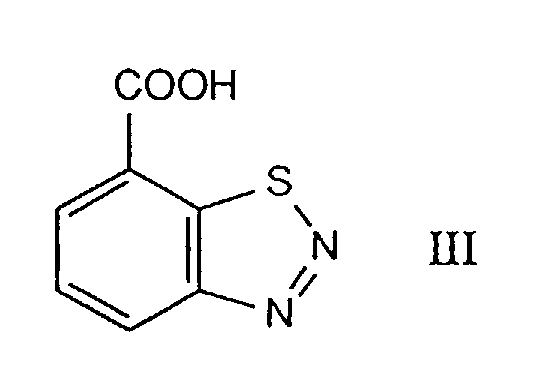
- the compounds of the formula I are important intermediates in the preparation of the compound of the formula III and of its acid derivatives which have been disclosed as plant immunization agents and plant conditioners (cf. EP-B-313 512).
- the process according to the invention comprises reacting a substituted 3-aminochlorobenzene of the formula II with a cyanide to give the compounds of the formula I according to the invention:
- aromatically bonded halides can be replaced by the cyano group by means of a cyano-donating compound, for example alkali metal cyanide, HCN, Ni(CN) 2 or tetramethylsilyl cyanide, or ketone HCN adduct or aldehyde HCN adduct, in the presence of a Co, Pd or Ni catalyst (for example "Homogeneous Catalysis II” Adv. Chem. Ser. 132 ACS 1974 p. 252; Coll. Czechoslovak Chemm. Commun. Vol. 48 (1983) p. 1765; and EP-A-384,392).
- a cyano-donating compound for example alkali metal cyanide, HCN, Ni(CN) 2 or tetramethylsilyl cyanide, or ketone HCN adduct or aldehyde HCN adduct
- Reactions a) and b) are carried out in the presence of a complexing agent.
- This complexing agent causes on the one hand an acceleration of the Cl/CN exchange reaction, and, on the other hand, suppresses cleavage of the S-R bond.
- the complexing agent is a nitrogen-containing, electron-donating compound, for example pyridine, quinoline or isoquinoline, which are unsubstituted or mono- to trisubstituted by C 1 -C 4 alkyl, C 1 -C 4 alkoxy, amino, C 1 -C 4 alkylamino or (C 1 -C 4 alkyl) 2 amino.
- pyridine which is unsubstituted or mono- to trisubstituted by methyl, and quinoline; very particularly pyridine and 3-methylpyridine.
- reaction is carried out with
- Solvents which are advantageously used are aprotic polar solvents, for example dioxane, dimethylformamide, dimethylacetamide, N-methylpyrrolidone, dimethyl sulfoxide, acetonitrile, benzonitrile, tetramethylurea, hexamethylphosphoric triamide.
- aprotic polar solvents for example dioxane, dimethylformamide, dimethylacetamide, N-methylpyrrolidone, dimethyl sulfoxide, acetonitrile, benzonitrile, tetramethylurea, hexamethylphosphoric triamide.
- at least equimolar amounts of the complexing agent, based on Cu or Fe are used directly as the solvent; particularly preferred are pyridine and 3-methylpyridine, 3-methylpyridine being very particularly preferred because its high boiling point allows the process to be carried out under atmospheric pressure even at high temperature.
- the reaction is carried out at temperatures between 50 and 350°C, preferably at temperatures between 150 and 250°C.
- the reaction is carried out under atmospheric pressure or slightly elevated pressure (20 bar), preferably under atmospheric pressure up to 10 bar.
- the yield of compounds of the formula I is up to 75 % of theory, while the reaction rate is 80 %, which corresponds to a yield of over 90 % based on reacted educt.
- Reaction a) with the use of CuCN is preferred.
- reaction c the exchange of chlorine for cyano is carried out in the presence of a catalyst.
- the reaction temperatures are between 30 and 150°C, preferably 40 to 100°C.
- the catalytic action can be improved by reductive regeneration of the catalyst during the reaction. This regeneration is effected electrochemically or by adding a reducing agent.
- the yields in this variant are even higher than 90 %, and the crude mixture can be reacted further directly for obtaining the benzothiadiazole-7-carboxylic acid III without isolating an intermediate.
- the catalyst is prepared by known methods, for example EP-384 392,"Homogeneous Catalysis II" Adv. Chem. Ser. 132 ACS 1974 p. 252; J. Organomet. Chem. 173 (1979) p. 335, J. Organomet. Chem. 243 (1983) p. 95; Coll. Czechoslovak Chemm. Commun. Vol. 48 (1983) p. 1765.
- the preferred catalyst nickel tetrakistriphenylphosphine is prepared from nickel chloride hydrate, triphenylphosphine and a reducing agent.
- the reducing agents used are metals, for example Mn, Zn, Mg or Al in the form of shavings or powder; hydrides, for example sodium borohydride, lithium aluminium hydride or sodium hydride, or else electrochemical methods.
- the catalyst can be added to the reaction mixture, but it is preferably prepared in situ.
- a further advantage of process a, b or c is that, after the further reaction which gives the benzothiadiazole-7-carboxylic acid of the formula III, the unreacted educt II is converted into the corresponding 7-chlorobenzothiadiazoles.
- Such 7-chlorobenzothiadiazoles can be removed readily from the mixture with the compound of the formula III by means of simple phase separation (water/organic solvent).
- the compounds of formula III can therefore be prepared from 2,3-dichloronitrobenzene, which is known, following equation 1 below:
- the resulting compound of the formula II is converted into one of the compounds of the formula I by means of exchanging Cl for CN as described above.
- Diazotizing and cyclizing compounds of the formula I in subsequent steps results in the compound of the formula VII, from which the compound of the formula III is obtained by hydrolysing the cyano group to the carboxyl group, or from which the corresponding carboxamide is obtained by partial hydrolysis.
- hydrolysis of the cyano group in compounds of the formula I will give carboxylic acids or, if desired, carboxamides, of the formula VI, from which compound III can be obtained by diazotization.
- the acid or alkaline hydrolysis of the nitrile group in the compounds I or VII is also carried out by customary methods, for example using concentrated sulfuric acid, hydrochloric acid or alkali metal oxides, alkali metal hydroxides, alkaline earth metal oxides or alkaline earth metal hydroxides, for example using NaOH or KOH.
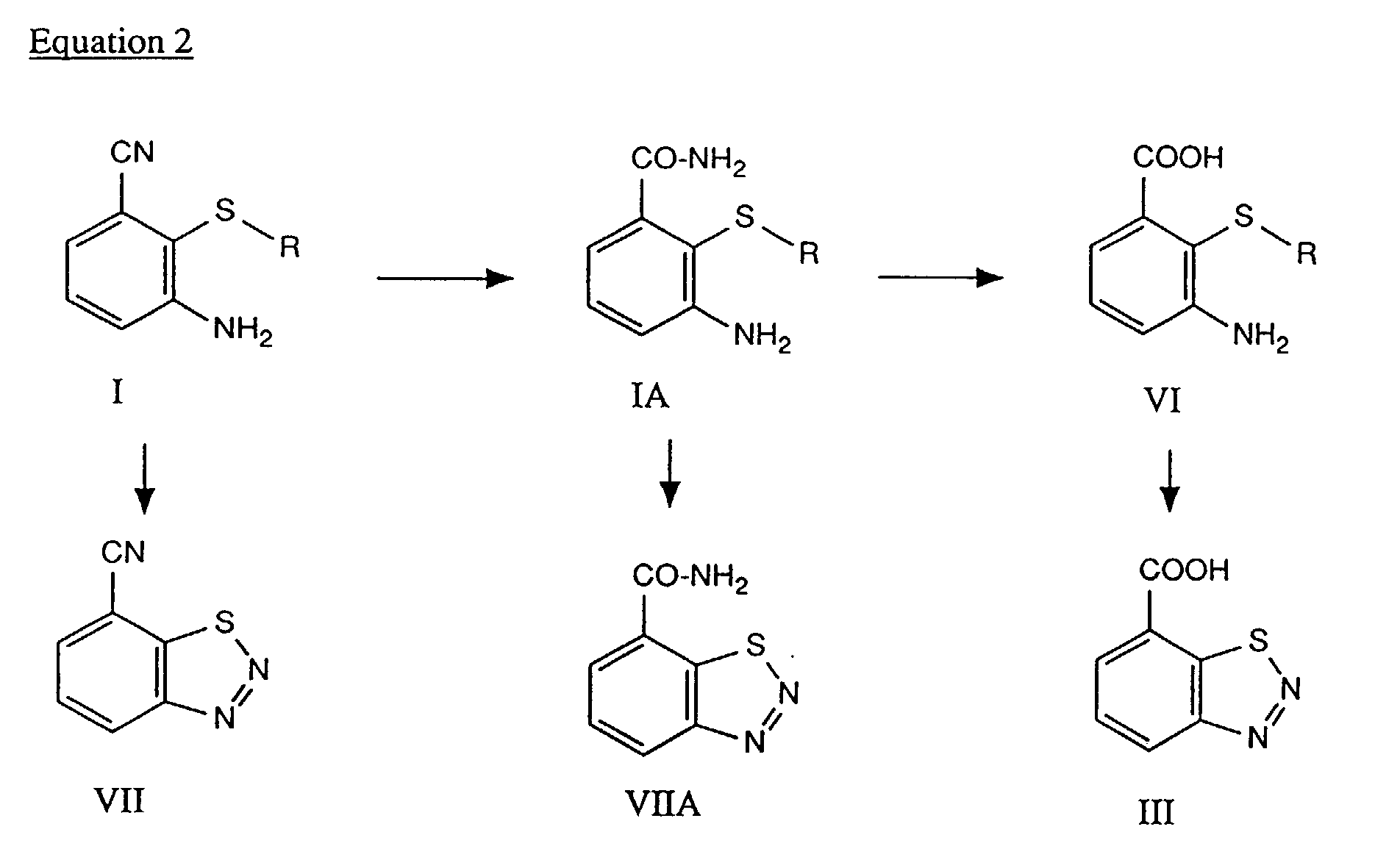
- the cyclization reaction to the benzothiadiazole can be carried out either at the cyanide level (I), the carboxamide level (IA) or the carboxylic acid level (VI), in accordance with equation 2.
- Example H-2 Preparation of the catalyst Ni (o) (PPh 3 ) 4
- Example H-3 Preparation of 3-amino-2-isopropylthiobenzonitrile using separately prepared Ni(PPh 3 ) 2 Cl 2 + 2PPh 3 as the catalyst
- Example H-4 Preparation of 3-amino-2-isopropylthiobenzonitrile using the catalyst prepared as described in Example H-2
- the aqueous phase is rendered alkaline using 30 % sodium hydroxide solution, and the precipitate is extracted using methyl isobutyl ketone. Filtration and concentration of the methyl isobutyl ketone phase yield 4.2 g (20 %) of a brown oil which solidifies later; m.p. 93-97°C.
Landscapes
- Chemical & Material Sciences (AREA)
- Organic Chemistry (AREA)
- Chemical Kinetics & Catalysis (AREA)
- Organic Low-Molecular-Weight Compounds And Preparation Thereof (AREA)
- Low-Molecular Organic Synthesis Reactions Using Catalysts (AREA)
- Catalysts (AREA)
- Pharmaceuticals Containing Other Organic And Inorganic Compounds (AREA)
- Agricultural Chemicals And Associated Chemicals (AREA)
- Heterocyclic Carbon Compounds Containing A Hetero Ring Having Nitrogen And Oxygen As The Only Ring Hetero Atoms (AREA)
Abstract
Description
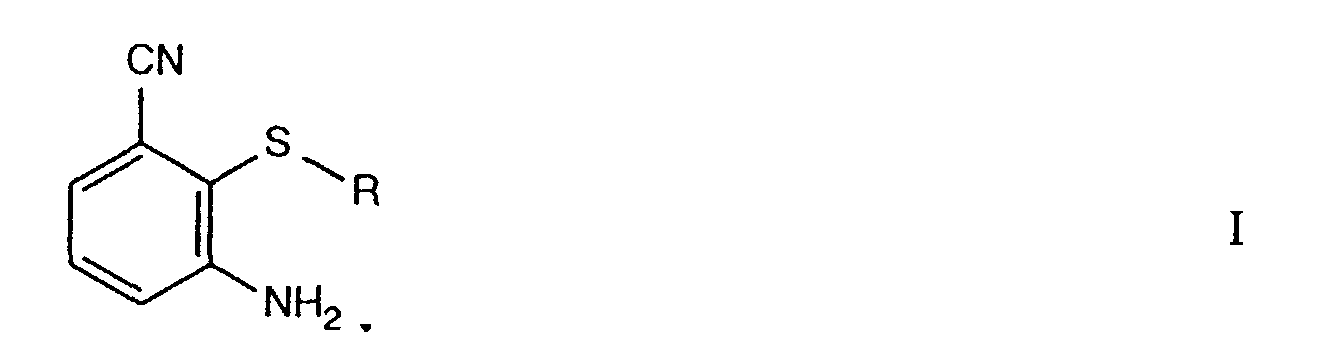
- The invention relates to a process for the preparation of substituted 3-aminobenzonitriles of the formula Iin which:
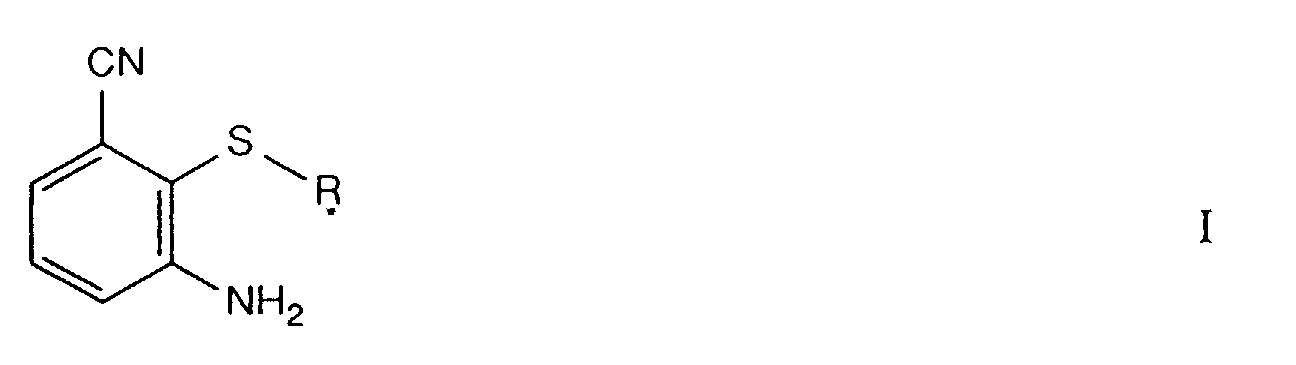
- R is hydrogen or C1-C12alkyl, C3-C8cycloalkyl, COR1, C1-C8alkoxyalkyl,
- C1-C6hydroxyalkyl, C1-C8aminoalkyl, C1-C8alkyl-NH(C1-C4alkyl),
- C1-C8alkyl-N(C1-C4alkyl)2, substituted or unsubstituted benzyl; and
- R1 is C1-C8alkyl, C3-C8cycloalkyl or phenyl; which comprises reacting, in a solvent at above 30°C, a substituted 3-aminochlorobenzene of the formula II
- a) CuCN or potassium cyanoferrate(II) (= K4[Fe(CN)6]) or calcium cyanoferrate(II) (= Ca2[Fe(CN)6]), in the presence of a complexing agent; or
- b) any Cu(I) salt together with an alkali metal cyanide in the presence of a complexing agent; or
- c) alkali metal cyanide, HCN, Ni(CN)2 or tetramethylsilyl cyanide, or ketone HCN adduct or aldehyde HCN adduct, in the presence of a catalyst M3[Co+(CN)4]3-, or Pd°-Ln or
-
- The general terms used hereinabove and hereinbelow have the following meanings, unless otherwise defined:
alkyl groups are straight-chain or branched, depending on the number of carbon atoms, and are, for example, methyl, ethyl, n-propyl, isopropyl, n-butyl, sec-butyl, isobutyl, tert-butyl, sec-amyl, tert-amyl, 1-hexyl or 3-hexyl. - Depending on the size of the ring, cycloalkyl is cyclopropyl, cyclobutyl, cyclopentyl, cyclohexyl, cycloheptyl or cyclooctyl.
- The ligands are phosphine gropps PQ3 in which
- Q is C1-C8alkyl, C3-C8cycloalkyl, unsubstituted aryl or aryl which is substituted by C1-C8alkyl, C1-C4hydroxyalkyl, C1-C6alkoxy, di(C1-C4alkyl)amino(C1-C4)alkyl, fluorine, SO3H or N(C1-C4alkyl)2; or the ligands are
- Q2P-W-PQ2 in which W is C1-C8alkyl or unsubstituted ferrocenyl or ferrocenyl which is substituted by one of the radicals mentioned for "aryl". Preferred ferrocenyl ligands are the unsubstituted ferrocenyl and the asymetrical monosubstituted representatives, for example 1-hydroxyethylferrocene and 1-dimethylaminoethylferrocene. Preferred catalysts are those of the formula Ni°-Ln in which L is triphenylphosphine and n is 2 to 4, or those of the formula Ni°-L2 in which L is (1,1'-bisdiphenylphosphine- 1 -(dimethylaminoethyl)ferrocene).
-
- The compounds of the formula I are important intermediates in the preparation of the compound of the formula III and of its acid derivatives which have been disclosed as plant immunization agents and plant conditioners (cf. EP-B-313 512).
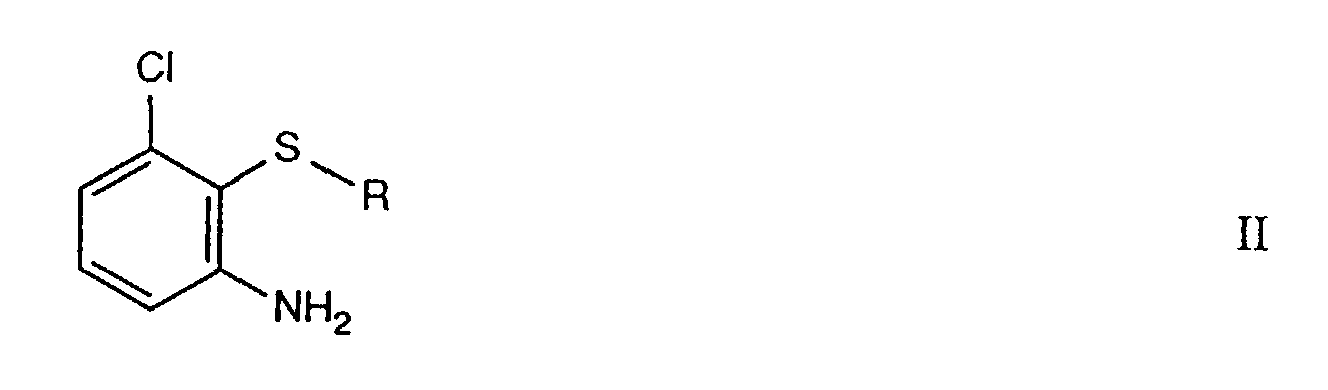
- The process according to the invention comprises reacting a substituted 3-aminochlorobenzene of the formula II with a cyanide to give the compounds of the formula I according to the invention:
- a) and b) [for example CuCN/pyridine or 3-methylpyridine/200°C]

- c) [for example Ni(PPh3)4/KCN/100°C]
-
- The exchange of halogen for the cyano group on aromatic compounds by CuCN or by complex metal cyanides, for example potassium cyanoferrate(II) (= K4[Fe(CN)6]) or calcium cyanoferrate (II) (= Ca2[Fe(CN)6]) in the presence of pyridine is known ("Rosenmund-von Braun synthesis"; for example Houben-Weyl, Methoden der organischen Chemie [Methods of Organic Chemistry], Vol. VIII, p. 302-3; Vol. E5, p. 1463-5, 1985).
It is also known that aromatically bonded halides can be replaced by the cyano group by means of a cyano-donating compound, for example alkali metal cyanide, HCN, Ni(CN)2 or tetramethylsilyl cyanide, or ketone HCN adduct or aldehyde HCN adduct, in the presence of a Co, Pd or Ni catalyst (for example "Homogeneous Catalysis II" Adv. Chem. Ser. 132 ACS 1974 p. 252; Coll. Czechoslovak Chemm. Commun. Vol. 48 (1983) p. 1765; and EP-A-384,392). - The conversion of sulfur-containing chloroanilins with the specific 1,2,3 arrangement into the desired nitriles is novel. The surprising aspect is that this reaction proceeds with good selectivity and a high yield without substantial cleavage of a carbon-sulfur bond being observed. Moreover, it could not have been expected that this reaction proceeds readily in an electron-rich system (both the sulfur and the amino group on the phenyl ring are electron-donating substituents). It is furthermore surprising that even large groups, for example tert-butylthio, isopropylthio and cyclohexylthio, in the ortho-position relative to the reaction centre do not impede the reaction to a condiserable extent.
- Reactions a) and b) are carried out in the presence of a complexing agent.
- This complexing agent causes on the one hand an acceleration of the Cl/CN exchange reaction, and, on the other hand, suppresses cleavage of the S-R bond.
- The complexing agent is a nitrogen-containing, electron-donating compound, for example pyridine, quinoline or isoquinoline, which are unsubstituted or mono- to trisubstituted by C1-C4alkyl, C1-C4alkoxy, amino, C1-C4alkylamino or (C1-C4alkyl)2amino. Particularly suitable as complexing agents are pyridine which is unsubstituted or mono- to trisubstituted by methyl, and quinoline; very particularly pyridine and 3-methylpyridine.
- In a particular embodiment, the reaction is carried out with
- a) an equimolar (based on II) amount of CuCN or potassium cyanoferrate(II) (= K4[Fe(CN)6]) or calcium cyanoferrate(II) (= Ca2[Fe(CN)6]), in the presence of pyridine, methylpyridine, dimethylpyridine, trimethylpyridine, quinoline, dimethylaniline, acetonitrile, DMSO, benzonitrile, DMF or tetramethylurea; or
- b) any Cu(I) salt together with at least equimolar or greater (based on II) amounts of alkali metal cyanide, in the presence of pyridine, methylpyridine, dimethylpyridine, trimethylpyridine, quinoline, dimethylaniline, acetonitrile, DMSO, benzonitrile, DMF or tetramethylurea; or
- c) at least equimolar (based on II) amounts of alkali metal cyanide, HCN, Ni(CN)2 or tetramethylsilyl cyanide, or keton HCN adduct or aldehyde HCN adduct, in the presence of a catalyst M3[Co+(CN)4]3-, or Pd°-Ln or, preferably, Ni°-Ln, or a three-way mixture composed of NiL2Hal2, excess L and a reducing agent, M being an alkali metal, L a ligand and n 2 to 4.
-
- Solvents which are advantageously used are aprotic polar solvents, for example dioxane, dimethylformamide, dimethylacetamide, N-methylpyrrolidone, dimethyl sulfoxide, acetonitrile, benzonitrile, tetramethylurea, hexamethylphosphoric triamide.
In a preferred embodiment, at least equimolar amounts of the complexing agent, based on Cu or Fe, are used directly as the solvent; particularly preferred are pyridine and 3-methylpyridine, 3-methylpyridine being very particularly preferred because its high boiling point allows the process to be carried out under atmospheric pressure even at high temperature. - The reaction is carried out at temperatures between 50 and 350°C, preferably at temperatures between 150 and 250°C. As a rule, the reaction is carried out under atmospheric pressure or slightly elevated pressure (20 bar), preferably under atmospheric pressure up to 10 bar.
- After a reaction time of approximately 3 to 18 hours, the yield of compounds of the formula I is up to 75 % of theory, while the reaction rate is 80 %, which corresponds to a yield of over 90 % based on reacted educt.
- Reaction a) with the use of CuCN is preferred.
- Work-up is carried out for example as follows: Na2S or NaCN, if desired in the form of an aqueous solution, is added to the reaction mixture, the mixture is then diluted with a solvent, for example ethyl acetate or methyl ethyl ketone (MEK) to make filtration easier, the salts are filtered off, the filtrate is evaporated, and the residue is purified either by distillation or by crystallization. If NaCN is used, the filtration gives directly reusable CuCN.
- In reaction c), the exchange of chlorine for cyano is carried out in the presence of a catalyst.
The reaction can be carried out in nitriles (acetonitrile, benzonitrile), hydrocarbons, in particular aromatics, furthermore in ketones, alcohols (ethanol), water, amides (dimethylformamide = DMF), ethers or mixtures of these, preferably in DMF.
The reaction temperatures are between 30 and 150°C, preferably 40 to 100°C. The catalytic action can be improved by reductive regeneration of the catalyst during the reaction. This regeneration is effected electrochemically or by adding a reducing agent. The yields in this variant are even higher than 90 %, and the crude mixture can be reacted further directly for obtaining the benzothiadiazole-7-carboxylic acid III without isolating an intermediate.
The catalyst is prepared by known methods, for example EP-384 392,"Homogeneous Catalysis II" Adv. Chem. Ser. 132 ACS 1974 p. 252; J. Organomet. Chem. 173 (1979) p. 335, J. Organomet. Chem. 243 (1983) p. 95; Coll. Czechoslovak Chemm. Commun. Vol. 48 (1983) p. 1765. The preferred catalyst nickel tetrakistriphenylphosphine is prepared from nickel chloride hydrate, triphenylphosphine and a reducing agent. The reducing agents used are metals, for example Mn, Zn, Mg or Al in the form of shavings or powder; hydrides, for example sodium borohydride, lithium aluminium hydride or sodium hydride, or else electrochemical methods. The catalyst can be added to the reaction mixture, but it is preferably prepared in situ. - A further advantage of process a, b or c is that, after the further reaction which gives the benzothiadiazole-7-carboxylic acid of the formula III, the unreacted educt II is converted into the corresponding 7-chlorobenzothiadiazoles. Such 7-chlorobenzothiadiazoles can be removed readily from the mixture with the compound of the formula III by means of simple phase separation (water/organic solvent).
- The compounds of formula III can therefore be prepared from 2,3-dichloronitrobenzene, which is known, following equation 1 below:
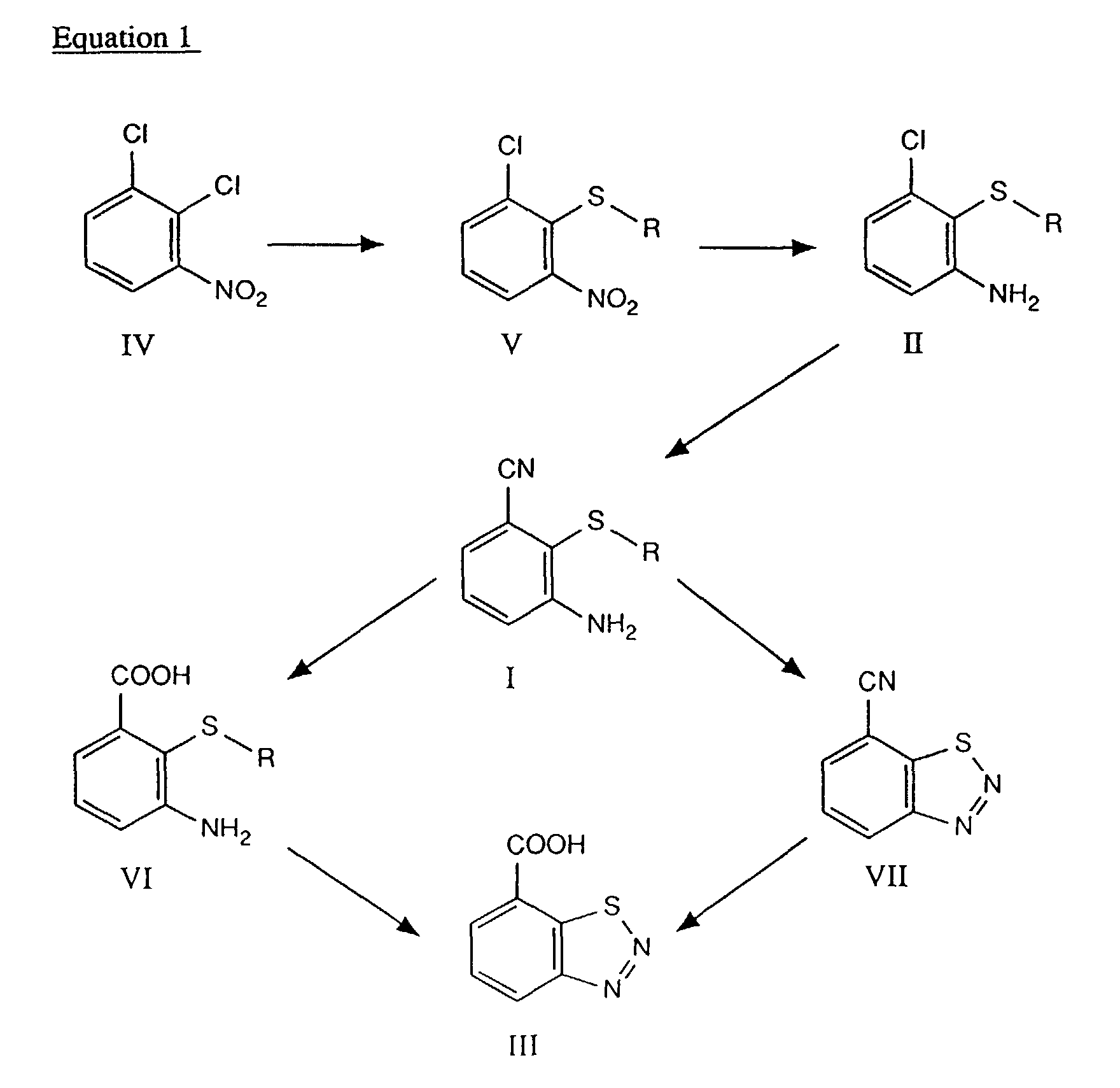
- The reaction of 2,3-dichloronitrobenzene, of the formula IV, with a compound HS-R in which R is as defined above under basic conditions results in a specific exchange of the chlorine atom in the 2-position for an R-S radical to give a compound of the formula V; reduction of the nitro group to the amino group results in a compound of the formula II. The reduction is carried out by methods known per se, for example by Béchamp reduction using iron/hydrogen chloride, catalytic hydrogenation (Pd or Raney nickel) or by Na2S reduction.
- The resulting compound of the formula II is converted into one of the compounds of the formula I by means of exchanging Cl for CN as described above.
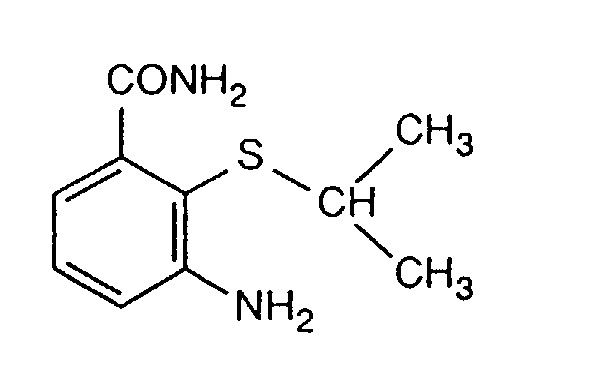
Diazotizing and cyclizing compounds of the formula I in subsequent steps results in the compound of the formula VII, from which the compound of the formula III is obtained by hydrolysing the cyano group to the carboxyl group, or from which the corresponding carboxamide is obtained by partial hydrolysis. Alternatively, if the sequence is reversed, hydrolysis of the cyano group in compounds of the formula I will give carboxylic acids or, if desired, carboxamides, of the formula VI, from which compound III can be obtained by diazotization. The diazotization is carried out by customary methods, for example with nitrous acid (= HONO) or with an inorganic or organic nitrite. Examples which may be mentioned are NaNO2 or alkyl nitrite having up to 8 carbon atoms.
The acid or alkaline hydrolysis of the nitrile group in the compounds I or VII is also carried out by customary methods, for example using concentrated sulfuric acid, hydrochloric acid or alkali metal oxides, alkali metal hydroxides, alkaline earth metal oxides or alkaline earth metal hydroxides, for example using NaOH or KOH. - The cyclization reaction to the benzothiadiazole can be carried out either at the cyanide level (I), the carboxamide level (IA) or the carboxylic acid level (VI), in accordance with equation 2.
-
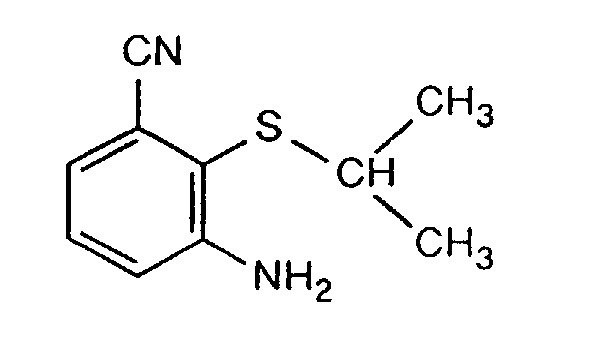
- H-1(1): 60.5 g of 3-chloro-2-isopropylthioaniline, 26.9 g of copper(I) cyanide and 26.1 g of pyridine are heated at 190°C for 7 hours. 100 ml of acetonitrile are added dropwise with evaporative cooling, and 7 ml of water are subsequently added followed by 21.5 g of sodium sulfide hydrate, a little at a time. After the mixture has been stirred at 80°C for 4 hours, it is cooled and filtered, and the filtrate is concentrated. After distillation at 70-120°C/0.05 torr, 200 ml of hexane are added and the mixture is filtered. Yield: 22.7 g (40%) of 3-amino-2-isopropylthiobenzonitrile of m.p. 82°C.
- H-1(2): 202 g of 3-chloro-2-isopropylthioaniline, 134 g of copper(I) cyanide and 140 g of 3-methylpyridine are stirred at 190°C for 9 hours. 200 g of methyl ethyl ketone, 60 g of sodium sulfide and 10 g of water are then added, the mixture is stirred, the salts are filtered off, and the filtrate is concentrated. The residue, which contains product and educt, is distilled at 70-120°C/0.05 torr, and the distillate is crystallized from methylcyclohexane. This gives 125 g of product (65% of theory); the educt (20 % of theory) remains in the mother liquor and can be recycled.
-
- 47.5 g of nickel chloride hexahydrate are introduced into 1,000 g of dimethylformamide and the mixture is stirred vigorously. Thereupon 209.8 g of triphenylphosphine are introduced. 150 g of DMF are distilled off, and 22 g of manganese powder are added under an inert atmosphere (nitrogen). The mixture is stirred at 50°C for 1.5 hours, during which time the colour of the solution changes from deep blueish green via green to reddish brown. The catalyst is now ready for use without having to be isolated.
- 5 ml of DMF are added to 327 mg of nickel(ll) bistriphenylphosphine chloride, 82 mg of manganese powder and 262 mg of triphenylphosphine under an inert atmosphere and the mixture is stirred at 50°C for 45 minutes. 1 g of 3-chloro-2-isopropylthioaniline and 358 mg of potassium cyanide are subsequently added. The mixture is stirred at 50°C for 17 hours. After 15 ml of toluene and 10 ml of water have been added, the mixture is clarified by filtration. 100 ml of toluene are added and the mixture is washed using 80 ml of water. The organic phase is concentrated and the residue chromatographed over silica gel (hexane/ethyl acetate = 4:1). This gives 0.72 g of colourless crystals (yield: 76 %).
- 201.5 g of 3-chloro-2-isopropylthioaniline are added to the catalyst mixture obtained in Example H-8. 51.5 g of sodium cyanide are added at 50°C with vigorous stirring. The reaction is checked every 3 hours. After a maximum of 24 hours, the reaction has ended. The reaction mixture is concentrated in vacuo. The residue is treated with 1 litre of methyl ethyl ketone and 1 litre of water, stirred vigorously and filtered. The solution is left to stand to allow the phases to separate. The organic phase which has been separated off is concentrated and the residue treated with 800 ml of cyclohexane at 50°C. After solids have dissolved, it is cooled to 0°C and seeded. 117 g (61 %) of white crystals are obtained.
- 6 litres of dimethylformamide are added to 50 g of nickel chloride dihydrate, 200 g of BPPFA (1,1'-bisdiphenylphosphine-1-(dimethylaminoethyl)ferrocene) and 49 g of manganese powder, and the mixture is stirred at 50°C for 2 hours under an inert atmosphere. A brown suspension forms. 1,200 g of 3-chloro-2-isopropylthioaniline and 430 g of KCN are added to the suspension and the mixture is stirred for 16 hours at 50°C. After working up, white crystals of m.p. 82°C are obtained in a yield of approxiamtely 90 %.
- 20.2 g of 3-chloro-2-isopropylthioaniline, 10.8 g of copper(I) cyanide, 0.7 g of copper(II) chloride and 3.2 g of pyridine are heated at 160°C for 22 hours. After this time, 50 ml of butanol and 11.2 g of KOH are added and the mixture is heated at 110°C for 6 hours. 4 ml of water are subsequently added and the mixture is stirred for a further 18 hours at 110°C. When cold, the mixture is treated with 100 ml of water, filtered, and the liquid phases are washed using 50 ml of methyl isobutyl ketone and 50 ml of water and acidified using 20 g of concentrated hydrochloric acid. After phase separation, the aqueous phase is rendered alkaline using 30 % sodium hydroxide solution, and the precipitate is extracted using methyl isobutyl ketone. Filtration and concentration of the methyl isobutyl ketone phase yield 4.2 g (20 %) of a brown oil which solidifies later; m.p. 93-97°C.

Claims (16)
- A process for the preparation of substituted 3-aminobenzonitriles of the formula Iin which:
 which comprises reacting, in a solvent at above 30°C, a substituted 3-aminochlorobenzene of the formula IIR is hydrogen or C1-C12alkyl, C3-C8cycloalkyl, COR1, C1-C8alkoxyalkyl,C1-C6hydroxyalkyl, C1-C8aminoalkyl, C1-C8alkyl-NH(C1-C4alkyl),C1-C8alkyl-N(C1-C4alkyl)2 or substituted or unsubstituted benzyl; andR1 is C1-C8alkyl, C3-C8cycloalkyl or phenyl;in which R is as defined for formula I, with a cyano-donating reagent selected from amongst
 preferably [a nickel catalyst] Ni°-Ln or a three-way mixture composed of NiL2Hal2, excess L and a reducing agent, M being an alkali metal, L being a ligand and n being 2 to 4.a) CuCN or potassium cyanoferrate(II) (= K4[Fe(CN)6]) or calcium cyanoferrate(II) (= Ca2[Fe(CN)6]), in the presence of a complexing agent; orb) any Cu(I) salt together with an alkali metal cyanide in the presence of a complexing agent; orc) alkali metal cyanide, HCN, Ni(CN)2 or tetramethylsilyl cyanide, or ketone HCN adduct or aldehyde HCN adduct, in the presence of a catalyst M3[Co+(CN)4]3-, or Pd°-Ln or
 - A process according to claim 1, wherein the reaction is carried out witha) an equimolar (based on II) amount of CuCN or potassium cyanoferrate(II) (= K4[Fe(CN)6]) or calcium cyanoferrate(II) (= Ca2[Fe(CN)6]), in the presence of pyridine, methylpyridine, dimethylpyridine, trimethylpyridine, quinoline, dimethylaniline, acetonitrile, DMSO, benzonitrile, DMF or tetramethylurea; orb) any Cu(I) salt together with at least equimolar or greater (based on II) amounts of alkali metal cyanide, in the presence of pyridine, methylpyridine, dimethylpyridine, trimethylpyridine, quinoline, dimethylaniline, acetonitrile, DMSO, benzonitrile, DMF or tetramethylurea; orc) at least equimolar (based on II) amounts of alkali metal cyanide, HCN, Ni(CN)2 or tetramethylsilyl cyanide, or keton HCN adduct or aldehyde HCN adduct, in the presence of a catalyst M3[Co+(CN)4]3-, or Pd°-Ln or, preferably, Ni°-Ln, or a three-way mixture composed of NiL2Hal2, excess L and a reducing agent, M being an alkali metal, L a ligand and n 2 to 4.
- A process according to claim 1, wherein the complexing agent in reaction a) or b) is a nitrogen-containing, electron-donating compound.
- A process according to claim 3, wherein the complexing agent is pyridine, quinoline or isoquinoline, which are unsubstituted or mono- to trisubstituted by C1-C4alkyl, C1-C4alkoxy, amino, C1-C4alkylamino or (C1-C4alkyl)2amino.
- A process according to claim 4, wherein the complexing agent is pyridine which is unsubstituted or mono- to trisubstituted by methyl, or is quinoline.
- A process according to claim 5, wherein the complexing agent is pyridine or 3-methylpyridine.
- A process according to claim 1, wherein reaction a) is carried out using CuCN.
- A process according to claim 1, wherein reaction b) is carried out using alkali metal cyanide.
- A process according to claim 1, wherein reaction c) is carried out using a catalyst of the formula Ni°-Ln in which L is triphenylphosphine and n is 2 to 4, or a catalyst of the formula Ni°-L2 in which L2 is (1,1'-bisdiphenylphosphine-1-(dimethylaminoethyl)ferrocene).
- A process according to claim I, wherein the catalyst in reaction c) is prepared in situ.
- A process according to claim 1, wherein the reaction is carried out at 50 to 350°C.
- A process according to claim 1, wherein reaction a) or b) is carried out at 150 to 250°C.
- A process according to claim 1, wherein reaction c) is carried out at 30 to 150°C.
- A process according to claim 1, wherein, in reaction a), at least equimolar amounts of the complexing agent, based on Cu or Fe, is used as the solvent.
- A process according to claim 14, wherein pyridine which is unsubstituted or mono- to trisubstituted by methyl, or quinoline, are used as the solvent.
- A process according to claim 15, wherein pyridine or 3-methylpyridine are used as the solvent.
Applications Claiming Priority (10)
| Application Number | Priority Date | Filing Date | Title |
|---|---|---|---|
| CH312194 | 1994-10-17 | ||
| CH312194 | 1994-10-17 | ||
| CH3121/94 | 1994-10-17 | ||
| CH174395 | 1995-06-13 | ||
| CH174395 | 1995-06-13 | ||
| CH1743/95 | 1995-06-13 | ||
| CH215695 | 1995-07-21 | ||
| CH2156/95 | 1995-07-21 | ||
| CH215695 | 1995-07-21 | ||
| PCT/EP1995/003936 WO1996011906A1 (en) | 1994-10-17 | 1995-10-05 | Process for the preparation of substituted 3-aminobenzonitriles |
Publications (2)
| Publication Number | Publication Date |
|---|---|
| EP0787124A1 EP0787124A1 (en) | 1997-08-06 |
| EP0787124B1 true EP0787124B1 (en) | 1999-12-08 |
Family
ID=27173212
Family Applications (1)
| Application Number | Title | Priority Date | Filing Date |
|---|---|---|---|
| EP95935906A Expired - Lifetime EP0787124B1 (en) | 1994-10-17 | 1995-10-05 | Process for the preparation of substituted 3-aminobenzonitriles |
Country Status (17)
| Country | Link |
|---|---|
| US (1) | US5883283A (en) |
| EP (1) | EP0787124B1 (en) |
| JP (1) | JP4332816B2 (en) |
| KR (1) | KR100375164B1 (en) |
| AT (1) | ATE187440T1 (en) |
| AU (1) | AU695287B2 (en) |
| BR (1) | BR9509373A (en) |
| CA (1) | CA2201471A1 (en) |
| CZ (1) | CZ291449B6 (en) |
| DE (1) | DE69513847T2 (en) |
| DK (1) | DK0787124T3 (en) |
| HU (1) | HU215785B (en) |
| IL (1) | IL115627A (en) |
| MX (1) | MX9702787A (en) |
| PL (1) | PL319692A1 (en) |
| SK (1) | SK47397A3 (en) |
| WO (1) | WO1996011906A1 (en) |
Cited By (2)
| Publication number | Priority date | Publication date | Assignee | Title |
|---|---|---|---|---|
| EP1903030A1 (en) | 2006-09-09 | 2008-03-26 | Saltigo GmbH | Method for catalytic manufacture of aromatic or heteroaromatic nitriles |
| EP1930316A1 (en) | 2006-11-29 | 2008-06-11 | Saltigo GmbH | Method for catalytic manufacture of aromatic or heteroaromatic nitriles |
Families Citing this family (12)
| Publication number | Priority date | Publication date | Assignee | Title |
|---|---|---|---|---|
| DE19543475A1 (en) * | 1995-11-22 | 1997-05-28 | Bayer Ag | Process for the preparation of 2-amino-6-chlorophenyl-alkylsulfanes and 2-amino-6-chlorophenyl-isopropylsulfane |
| ATE208760T1 (en) * | 1995-12-21 | 2001-11-15 | Syngenta Participations Ag | 3-AMINO-2-MERCAPTOBENZOIC ACID DERIVATIVES AND METHOD FOR THE PRODUCTION THEREOF |
| US6002013A (en) * | 1995-12-21 | 1999-12-14 | Novartis Corporation | 3-amino-2-mercaptobenzoic acid derivatives and processes for their preparation |
| US6498265B2 (en) | 1995-12-21 | 2002-12-24 | Syngenta Investment Corporation | 3-amino-2-mercaptobenzoic acid derivatives and processes for their preparation |
| US5847147A (en) * | 1996-12-20 | 1998-12-08 | Novartis Corp. | 3-Amino-2-mercaptobenzoic acid derivatives and processes for their preparation |
| JPH1017566A (en) * | 1996-07-05 | 1998-01-20 | Nippon Bayeragrochem Kk | 1,2,3,-benzothiazole derivative and plant disease control agent |
| DE19706648A1 (en) * | 1997-02-20 | 1998-08-27 | Bayer Ag | Process for the production of aromatic nitriles |
| DE19834102A1 (en) * | 1998-07-29 | 2000-02-03 | Bayer Ag | Process for the continuous production of amino-halophenyl-alkyl-thioethers |
| ES2288021T3 (en) | 1998-05-11 | 2007-12-16 | Basf Aktiengesellschaft | METHOD FOR THE PRODUCTION OF ISOXAZOLINA-3-IL-ACIL BENCENO. |
| JP2001039938A (en) * | 1999-07-26 | 2001-02-13 | Tosoh Corp | Cyanating agent and method for producing cyano compound using the same |
| WO2008030883A2 (en) * | 2006-09-05 | 2008-03-13 | Bipar Sciences, Inc. | Treatment of cancer |
| TWI395728B (en) * | 2006-12-06 | 2013-05-11 | Du Pont | Process for preparing 2-amino-5-cyanobenzoic acid derivatives |
Family Cites Families (10)
| Publication number | Priority date | Publication date | Assignee | Title |
|---|---|---|---|---|
| FR1443917A (en) * | 1965-02-12 | 1966-07-01 | Centre Nat Rech Scient | Thiophenolic, phenylthio succinic and dihydro benzothiazinonyl acetic compounds, their preparation and applications |
| DE1493728A1 (en) * | 1965-07-20 | 1969-08-28 | Lauterbach Dr Rudolf | Process for the preparation of aminophenylthioethers |
| GB1176799A (en) * | 1966-10-21 | 1970-01-07 | Shell Int Research | Novel Biocides and their preparation |
| DE2706104A1 (en) * | 1977-02-12 | 1978-08-17 | Bayer Ag | Methyl-or ethyl-thio-aniline derivs. prodn. - by reacting chloro-nitrobenzene with sodium sulphide then alkylating, intermediates for herbicides etc. |
| DE3012863A1 (en) * | 1980-04-02 | 1981-10-08 | Cassella Ag, 6000 Frankfurt | DYE MIXTURE, METHOD FOR THEIR PRODUCTION, DYES CONTAINING IT AND METHOD FOR COLORING AND PRINTING SYNTHETIC, HYDROPHOBIC FIBER MATERIAL |
| DE3528033A1 (en) * | 1985-08-05 | 1987-02-05 | Hoechst Ag | METHOD FOR PRODUCING 2-AMINOPHENYL THIOETHERS |
| DE3876211D1 (en) * | 1987-08-21 | 1993-01-07 | Ciba Geigy Ag | BENZOTHIADIAZOLES AND THEIR USE IN METHODS AND AGENTS AGAINST PLANT DISEASES. |
| FR2621912B1 (en) * | 1987-10-16 | 1990-03-02 | Oreal | NOVEL NORBORNANE DERIVATIVES, THEIR PREPARATION PROCESS AND COSMETIC AND MEDICINAL COMPOSITIONS CONTAINING THEM |
| CA2010159A1 (en) * | 1989-02-21 | 1990-08-21 | James J. Maul | Cyanation of haloaromatics utilizing catalysts generated in situ starting with nic1 or nic1 6h 0 |
| TW253885B (en) * | 1992-12-15 | 1995-08-11 | Ishihara Sangyo Kaisha |
-
1995
- 1995-10-05 PL PL95319692A patent/PL319692A1/en unknown
- 1995-10-05 JP JP51276896A patent/JP4332816B2/en not_active Expired - Fee Related
- 1995-10-05 DK DK95935906T patent/DK0787124T3/en active
- 1995-10-05 DE DE69513847T patent/DE69513847T2/en not_active Expired - Lifetime
- 1995-10-05 SK SK473-97A patent/SK47397A3/en unknown
- 1995-10-05 AT AT95935906T patent/ATE187440T1/en active
- 1995-10-05 CZ CZ19971148A patent/CZ291449B6/en not_active IP Right Cessation
- 1995-10-05 MX MX9702787A patent/MX9702787A/en unknown
- 1995-10-05 EP EP95935906A patent/EP0787124B1/en not_active Expired - Lifetime
- 1995-10-05 US US08/817,858 patent/US5883283A/en not_active Expired - Lifetime
- 1995-10-05 KR KR1019970702635A patent/KR100375164B1/en not_active Expired - Lifetime
- 1995-10-05 AU AU38041/95A patent/AU695287B2/en not_active Ceased
- 1995-10-05 BR BR9509373A patent/BR9509373A/en not_active IP Right Cessation
- 1995-10-05 WO PCT/EP1995/003936 patent/WO1996011906A1/en not_active Ceased
- 1995-10-05 HU HU9701767A patent/HU215785B/en unknown
- 1995-10-05 CA CA002201471A patent/CA2201471A1/en not_active Abandoned
- 1995-10-13 IL IL11562795A patent/IL115627A/en not_active IP Right Cessation
Cited By (2)
| Publication number | Priority date | Publication date | Assignee | Title |
|---|---|---|---|---|
| EP1903030A1 (en) | 2006-09-09 | 2008-03-26 | Saltigo GmbH | Method for catalytic manufacture of aromatic or heteroaromatic nitriles |
| EP1930316A1 (en) | 2006-11-29 | 2008-06-11 | Saltigo GmbH | Method for catalytic manufacture of aromatic or heteroaromatic nitriles |
Also Published As
| Publication number | Publication date |
|---|---|
| WO1996011906A1 (en) | 1996-04-25 |
| US5883283A (en) | 1999-03-16 |
| JP4332816B2 (en) | 2009-09-16 |
| HUT77178A (en) | 1998-03-02 |
| DE69513847T2 (en) | 2000-07-27 |
| HU215785B (en) | 1999-02-01 |
| BR9509373A (en) | 1998-07-07 |
| AU3804195A (en) | 1996-05-06 |
| JPH10507444A (en) | 1998-07-21 |
| KR100375164B1 (en) | 2003-11-28 |
| CZ114897A3 (en) | 1997-07-16 |
| CA2201471A1 (en) | 1996-04-25 |
| DE69513847D1 (en) | 2000-01-13 |
| DK0787124T3 (en) | 2000-05-08 |
| EP0787124A1 (en) | 1997-08-06 |
| CZ291449B6 (en) | 2003-03-12 |
| ATE187440T1 (en) | 1999-12-15 |
| PL319692A1 (en) | 1997-08-18 |
| SK47397A3 (en) | 1997-11-05 |
| IL115627A0 (en) | 1996-01-19 |
| AU695287B2 (en) | 1998-08-13 |
| MX9702787A (en) | 1997-06-28 |
| IL115627A (en) | 2000-02-29 |
Similar Documents
| Publication | Publication Date | Title |
|---|---|---|
| US5883283A (en) | Process for the preparation of substituted 3-aminobenzonitriles | |
| AU2018286964B2 (en) | Methods for the preparation of 1,3-benzodioxole heterocyclic compounds | |
| US4187249A (en) | Promoting the reaction of sodium salts of formyl derivatives of aromatic amines to form nitrodiarylamines | |
| EP0220743B1 (en) | Process for the preparation of (2,2)-paracyclophane | |
| CN102325747B (en) | Method for preparing 2-aminobiphenyl compounds | |
| MXPA97002787A (en) | Process for the preparation of 3-aminobenzonitrile replace | |
| KR20210022681A (en) | Method for producing tricyclic compound | |
| MX2012000569A (en) | Improved process for preparing 1-(6-methylpyridin-3-yl)-2-[4-(met hylsulfonyl)phenyl]ethanone, an intermediate of etoricoxib. | |
| US6362365B1 (en) | Preparation of trifluorobenzoic acids | |
| CN108349858A (en) | Method for synthesizing 9,9-bis(hydroxymethyl)fluorene | |
| JP4345095B2 (en) | Method for highly selective O-alkylation of amide compounds using copper salts | |
| JP2002541131A (en) | Method for producing pesticide intermediate | |
| JP2003527381A (en) | Method for producing spirocyclic tetronic acid derivative | |
| RU2264391C2 (en) | Method for preparing quinoline carboxaldehyde derivative and intermediate compounds | |
| CN1162305A (en) | Process for ereparation of substituted 3-aminobenzonitriles | |
| EP0710648B1 (en) | Method for producing oxyindoles | |
| JPH01149762A (en) | Production of 4-(alkylsulfonyl)-2-aminophenol | |
| JPH0641137A (en) | Phthalocyanine derivative and its production and production of its intermediate | |
| US5274100A (en) | Process for the preparation of (3-fluoropyridin-2-yloxy)phenoxypropionic acids | |
| JPS62132849A (en) | Production of d-or l-n-t-butoxycarbonyl-o-benzylserine | |
| US4500736A (en) | Hydrogenation of 3-trichlorovinylnitrobenzene | |
| US5719317A (en) | Process for the preparation of nitrobenzene derivatives | |
| JP4032825B2 (en) | Method for producing 3,4-dihydroxybenzonitrile | |
| TW434208B (en) | Processes for the preparing of substituted 3-aminobenzonitriles and benzothiadiazole-7-carboxylic acid | |
| JPH0558974A (en) | Anthranilic acid derivative |
Legal Events
| Date | Code | Title | Description |
|---|---|---|---|
| PUAI | Public reference made under article 153(3) epc to a published international application that has entered the european phase |
Free format text: ORIGINAL CODE: 0009012 |
|
| 17P | Request for examination filed |
Effective date: 19970317 |
|
| AK | Designated contracting states |
Kind code of ref document: A1 Designated state(s): AT BE CH DE DK FR GB IE IT LI NL |
|
| 17Q | First examination report despatched |
Effective date: 19980305 |
|
| RAP1 | Party data changed (applicant data changed or rights of an application transferred) |
Owner name: NOVARTIS-ERFINDUNGEN VERWALTUNGSGESELLSCHAFT M.B.H |
|
| RAP1 | Party data changed (applicant data changed or rights of an application transferred) |
Owner name: NOVARTIS-ERFINDUNGEN VERWALTUNGSGESELLSCHAFT M.B. Owner name: NOVARTIS AG |
|
| GRAG | Despatch of communication of intention to grant |
Free format text: ORIGINAL CODE: EPIDOS AGRA |
|
| GRAG | Despatch of communication of intention to grant |
Free format text: ORIGINAL CODE: EPIDOS AGRA |
|
| GRAH | Despatch of communication of intention to grant a patent |
Free format text: ORIGINAL CODE: EPIDOS IGRA |
|
| GRAH | Despatch of communication of intention to grant a patent |
Free format text: ORIGINAL CODE: EPIDOS IGRA |
|
| GRAA | (expected) grant |
Free format text: ORIGINAL CODE: 0009210 |
|
| AK | Designated contracting states |
Kind code of ref document: B1 Designated state(s): AT BE CH DE DK FR GB IE IT LI NL |
|
| REF | Corresponds to: |
Ref document number: 187440 Country of ref document: AT Date of ref document: 19991215 Kind code of ref document: T |
|
| REG | Reference to a national code |
Ref country code: CH Ref legal event code: EP |
|
| REF | Corresponds to: |
Ref document number: 69513847 Country of ref document: DE Date of ref document: 20000113 |
|
| REG | Reference to a national code |
Ref country code: IE Ref legal event code: FG4D |
|
| ITF | It: translation for a ep patent filed | ||
| ET | Fr: translation filed | ||
| REG | Reference to a national code |
Ref country code: DK Ref legal event code: T3 |
|
| PLBE | No opposition filed within time limit |
Free format text: ORIGINAL CODE: 0009261 |
|
| STAA | Information on the status of an ep patent application or granted ep patent |
Free format text: STATUS: NO OPPOSITION FILED WITHIN TIME LIMIT |
|
| 26N | No opposition filed | ||
| REG | Reference to a national code |
Ref country code: GB Ref legal event code: IF02 |
|
| REG | Reference to a national code |
Ref country code: GB Ref legal event code: 732E |
|
| REG | Reference to a national code |
Ref country code: CH Ref legal event code: PUE Owner name: SYNGENTA PARTICIPATIONS AG Free format text: NOVARTIS AG#SCHWARZWALDALLEE 215#4058 BASEL (CH) -TRANSFER TO- SYNGENTA PARTICIPATIONS AG#SCHWARZWALDALLEE 215#4058 BASEL (CH) |
|
| NLS | Nl: assignments of ep-patents |
Owner name: SYNGENTA PARTICIPATIONS AG |
|
| REG | Reference to a national code |
Ref country code: FR Ref legal event code: TP |
|
| PGFP | Annual fee paid to national office [announced via postgrant information from national office to epo] |
Ref country code: DK Payment date: 20140924 Year of fee payment: 20 |
|
| PGFP | Annual fee paid to national office [announced via postgrant information from national office to epo] |
Ref country code: GB Payment date: 20140925 Year of fee payment: 20 |
|
| PGFP | Annual fee paid to national office [announced via postgrant information from national office to epo] |
Ref country code: DE Payment date: 20141028 Year of fee payment: 20 Ref country code: FR Payment date: 20140924 Year of fee payment: 20 Ref country code: IE Payment date: 20141003 Year of fee payment: 20 Ref country code: CH Payment date: 20141027 Year of fee payment: 20 |
|
| PGFP | Annual fee paid to national office [announced via postgrant information from national office to epo] |
Ref country code: NL Payment date: 20141009 Year of fee payment: 20 Ref country code: AT Payment date: 20140925 Year of fee payment: 20 |
|
| PGFP | Annual fee paid to national office [announced via postgrant information from national office to epo] |
Ref country code: IT Payment date: 20141015 Year of fee payment: 20 |
|
| PGFP | Annual fee paid to national office [announced via postgrant information from national office to epo] |
Ref country code: BE Payment date: 20141020 Year of fee payment: 20 |
|
| REG | Reference to a national code |
Ref country code: DE Ref legal event code: R071 Ref document number: 69513847 Country of ref document: DE |
|
| REG | Reference to a national code |
Ref country code: NL Ref legal event code: MK Effective date: 20151004 |
|
| REG | Reference to a national code |
Ref country code: DK Ref legal event code: EUP Effective date: 20151005 |
|
| REG | Reference to a national code |
Ref country code: CH Ref legal event code: PL |
|
| REG | Reference to a national code |
Ref country code: GB Ref legal event code: PE20 Expiry date: 20151004 |
|
| REG | Reference to a national code |
Ref country code: AT Ref legal event code: MK07 Ref document number: 187440 Country of ref document: AT Kind code of ref document: T Effective date: 20151005 |
|
| REG | Reference to a national code |
Ref country code: IE Ref legal event code: MK9A |
|
| PG25 | Lapsed in a contracting state [announced via postgrant information from national office to epo] |
Ref country code: IE Free format text: LAPSE BECAUSE OF EXPIRATION OF PROTECTION Effective date: 20151005 Ref country code: GB Free format text: LAPSE BECAUSE OF EXPIRATION OF PROTECTION Effective date: 20151004 |