EP0783042B1 - Coated aerospace aluminium parts - Google Patents
Coated aerospace aluminium parts Download PDFInfo
- Publication number
- EP0783042B1 EP0783042B1 EP96400657A EP96400657A EP0783042B1 EP 0783042 B1 EP0783042 B1 EP 0783042B1 EP 96400657 A EP96400657 A EP 96400657A EP 96400657 A EP96400657 A EP 96400657A EP 0783042 B1 EP0783042 B1 EP 0783042B1
- Authority
- EP
- European Patent Office
- Prior art keywords
- basecoat
- coating
- topcoat
- coated
- aluminium
- Prior art date
- Legal status (The legal status is an assumption and is not a legal conclusion. Google has not performed a legal analysis and makes no representation as to the accuracy of the status listed.)
- Expired - Lifetime
Links
Images
Classifications
-
- B—PERFORMING OPERATIONS; TRANSPORTING
- B64—AIRCRAFT; AVIATION; COSMONAUTICS
- B64D—EQUIPMENT FOR FITTING IN OR TO AIRCRAFT; FLIGHT SUITS; PARACHUTES; ARRANGEMENT OR MOUNTING OF POWER PLANTS OR PROPULSION TRANSMISSIONS IN AIRCRAFT
- B64D29/00—Power-plant nacelles, fairings or cowlings
-
- C—CHEMISTRY; METALLURGY
- C04—CEMENTS; CONCRETE; ARTIFICIAL STONE; CERAMICS; REFRACTORIES
- C04B—LIME, MAGNESIA; SLAG; CEMENTS; COMPOSITIONS THEREOF, e.g. MORTARS, CONCRETE OR LIKE BUILDING MATERIALS; ARTIFICIAL STONE; CERAMICS; REFRACTORIES; TREATMENT OF NATURAL STONE
- C04B28/00—Compositions of mortars, concrete or artificial stone, containing inorganic binders or the reaction product of an inorganic and an organic binder, e.g. polycarboxylate cements
- C04B28/34—Compositions of mortars, concrete or artificial stone, containing inorganic binders or the reaction product of an inorganic and an organic binder, e.g. polycarboxylate cements containing cold phosphate binders
-
- C—CHEMISTRY; METALLURGY
- C09—DYES; PAINTS; POLISHES; NATURAL RESINS; ADHESIVES; COMPOSITIONS NOT OTHERWISE PROVIDED FOR; APPLICATIONS OF MATERIALS NOT OTHERWISE PROVIDED FOR
- C09D—COATING COMPOSITIONS, e.g. PAINTS, VARNISHES OR LACQUERS; FILLING PASTES; CHEMICAL PAINT OR INK REMOVERS; INKS; CORRECTING FLUIDS; WOODSTAINS; PASTES OR SOLIDS FOR COLOURING OR PRINTING; USE OF MATERIALS THEREFOR
- C09D5/00—Coating compositions, e.g. paints, varnishes or lacquers, characterised by their physical nature or the effects produced; Filling pastes
- C09D5/08—Anti-corrosive paints
- C09D5/10—Anti-corrosive paints containing metal dust
- C09D5/103—Anti-corrosive paints containing metal dust containing Al
-
- C—CHEMISTRY; METALLURGY
- C23—COATING METALLIC MATERIAL; COATING MATERIAL WITH METALLIC MATERIAL; CHEMICAL SURFACE TREATMENT; DIFFUSION TREATMENT OF METALLIC MATERIAL; COATING BY VACUUM EVAPORATION, BY SPUTTERING, BY ION IMPLANTATION OR BY CHEMICAL VAPOUR DEPOSITION, IN GENERAL; INHIBITING CORROSION OF METALLIC MATERIAL OR INCRUSTATION IN GENERAL
- C23C—COATING METALLIC MATERIAL; COATING MATERIAL WITH METALLIC MATERIAL; SURFACE TREATMENT OF METALLIC MATERIAL BY DIFFUSION INTO THE SURFACE, BY CHEMICAL CONVERSION OR SUBSTITUTION; COATING BY VACUUM EVAPORATION, BY SPUTTERING, BY ION IMPLANTATION OR BY CHEMICAL VAPOUR DEPOSITION, IN GENERAL
- C23C22/00—Chemical surface treatment of metallic material by reaction of the surface with a reactive liquid, leaving reaction products of surface material in the coating, e.g. conversion coatings, passivation of metals
- C23C22/73—Chemical surface treatment of metallic material by reaction of the surface with a reactive liquid, leaving reaction products of surface material in the coating, e.g. conversion coatings, passivation of metals characterised by the process
- C23C22/74—Chemical surface treatment of metallic material by reaction of the surface with a reactive liquid, leaving reaction products of surface material in the coating, e.g. conversion coatings, passivation of metals characterised by the process for obtaining burned-in conversion coatings
-
- C—CHEMISTRY; METALLURGY
- C04—CEMENTS; CONCRETE; ARTIFICIAL STONE; CERAMICS; REFRACTORIES
- C04B—LIME, MAGNESIA; SLAG; CEMENTS; COMPOSITIONS THEREOF, e.g. MORTARS, CONCRETE OR LIKE BUILDING MATERIALS; ARTIFICIAL STONE; CERAMICS; REFRACTORIES; TREATMENT OF NATURAL STONE
- C04B2111/00—Mortars, concrete or artificial stone or mixtures to prepare them, characterised by specific function, property or use
- C04B2111/00474—Uses not provided for elsewhere in C04B2111/00
- C04B2111/00482—Coating or impregnation materials
- C04B2111/00525—Coating or impregnation materials for metallic surfaces
-
- C—CHEMISTRY; METALLURGY
- C04—CEMENTS; CONCRETE; ARTIFICIAL STONE; CERAMICS; REFRACTORIES
- C04B—LIME, MAGNESIA; SLAG; CEMENTS; COMPOSITIONS THEREOF, e.g. MORTARS, CONCRETE OR LIKE BUILDING MATERIALS; ARTIFICIAL STONE; CERAMICS; REFRACTORIES; TREATMENT OF NATURAL STONE
- C04B2111/00—Mortars, concrete or artificial stone or mixtures to prepare them, characterised by specific function, property or use
- C04B2111/00474—Uses not provided for elsewhere in C04B2111/00
- C04B2111/00982—Uses not provided for elsewhere in C04B2111/00 as construction elements for space vehicles or aeroplanes
-
- C—CHEMISTRY; METALLURGY
- C04—CEMENTS; CONCRETE; ARTIFICIAL STONE; CERAMICS; REFRACTORIES
- C04B—LIME, MAGNESIA; SLAG; CEMENTS; COMPOSITIONS THEREOF, e.g. MORTARS, CONCRETE OR LIKE BUILDING MATERIALS; ARTIFICIAL STONE; CERAMICS; REFRACTORIES; TREATMENT OF NATURAL STONE
- C04B2111/00—Mortars, concrete or artificial stone or mixtures to prepare them, characterised by specific function, property or use
- C04B2111/10—Compositions or ingredients thereof characterised by the absence or the very low content of a specific material
- C04B2111/1075—Chromium-free or very low chromium-content materials
-
- Y—GENERAL TAGGING OF NEW TECHNOLOGICAL DEVELOPMENTS; GENERAL TAGGING OF CROSS-SECTIONAL TECHNOLOGIES SPANNING OVER SEVERAL SECTIONS OF THE IPC; TECHNICAL SUBJECTS COVERED BY FORMER USPC CROSS-REFERENCE ART COLLECTIONS [XRACs] AND DIGESTS
- Y10—TECHNICAL SUBJECTS COVERED BY FORMER USPC
- Y10T—TECHNICAL SUBJECTS COVERED BY FORMER US CLASSIFICATION
- Y10T428/00—Stock material or miscellaneous articles
- Y10T428/12—All metal or with adjacent metals
- Y10T428/12493—Composite; i.e., plural, adjacent, spatially distinct metal components [e.g., layers, joint, etc.]
- Y10T428/12535—Composite; i.e., plural, adjacent, spatially distinct metal components [e.g., layers, joint, etc.] with additional, spatially distinct nonmetal component
- Y10T428/12556—Organic component
- Y10T428/12569—Synthetic resin
-
- Y—GENERAL TAGGING OF NEW TECHNOLOGICAL DEVELOPMENTS; GENERAL TAGGING OF CROSS-SECTIONAL TECHNOLOGIES SPANNING OVER SEVERAL SECTIONS OF THE IPC; TECHNICAL SUBJECTS COVERED BY FORMER USPC CROSS-REFERENCE ART COLLECTIONS [XRACs] AND DIGESTS
- Y10—TECHNICAL SUBJECTS COVERED BY FORMER USPC
- Y10T—TECHNICAL SUBJECTS COVERED BY FORMER US CLASSIFICATION
- Y10T428/00—Stock material or miscellaneous articles
- Y10T428/12—All metal or with adjacent metals
- Y10T428/12493—Composite; i.e., plural, adjacent, spatially distinct metal components [e.g., layers, joint, etc.]
- Y10T428/12736—Al-base component
-
- Y—GENERAL TAGGING OF NEW TECHNOLOGICAL DEVELOPMENTS; GENERAL TAGGING OF CROSS-SECTIONAL TECHNOLOGIES SPANNING OVER SEVERAL SECTIONS OF THE IPC; TECHNICAL SUBJECTS COVERED BY FORMER USPC CROSS-REFERENCE ART COLLECTIONS [XRACs] AND DIGESTS
- Y10—TECHNICAL SUBJECTS COVERED BY FORMER USPC
- Y10T—TECHNICAL SUBJECTS COVERED BY FORMER US CLASSIFICATION
- Y10T428/00—Stock material or miscellaneous articles
- Y10T428/12—All metal or with adjacent metals
- Y10T428/12493—Composite; i.e., plural, adjacent, spatially distinct metal components [e.g., layers, joint, etc.]
- Y10T428/12736—Al-base component
- Y10T428/12764—Next to Al-base component
-
- Y—GENERAL TAGGING OF NEW TECHNOLOGICAL DEVELOPMENTS; GENERAL TAGGING OF CROSS-SECTIONAL TECHNOLOGIES SPANNING OVER SEVERAL SECTIONS OF THE IPC; TECHNICAL SUBJECTS COVERED BY FORMER USPC CROSS-REFERENCE ART COLLECTIONS [XRACs] AND DIGESTS
- Y10—TECHNICAL SUBJECTS COVERED BY FORMER USPC
- Y10T—TECHNICAL SUBJECTS COVERED BY FORMER US CLASSIFICATION
- Y10T428/00—Stock material or miscellaneous articles
- Y10T428/12—All metal or with adjacent metals
- Y10T428/12993—Surface feature [e.g., rough, mirror]
-
- Y—GENERAL TAGGING OF NEW TECHNOLOGICAL DEVELOPMENTS; GENERAL TAGGING OF CROSS-SECTIONAL TECHNOLOGIES SPANNING OVER SEVERAL SECTIONS OF THE IPC; TECHNICAL SUBJECTS COVERED BY FORMER USPC CROSS-REFERENCE ART COLLECTIONS [XRACs] AND DIGESTS
- Y10—TECHNICAL SUBJECTS COVERED BY FORMER USPC
- Y10T—TECHNICAL SUBJECTS COVERED BY FORMER US CLASSIFICATION
- Y10T428/00—Stock material or miscellaneous articles
- Y10T428/13—Hollow or container type article [e.g., tube, vase, etc.]
- Y10T428/1352—Polymer or resin containing [i.e., natural or synthetic]
- Y10T428/139—Open-ended, self-supporting conduit, cylinder, or tube-type article
- Y10T428/1393—Multilayer [continuous layer]
-
- Y—GENERAL TAGGING OF NEW TECHNOLOGICAL DEVELOPMENTS; GENERAL TAGGING OF CROSS-SECTIONAL TECHNOLOGIES SPANNING OVER SEVERAL SECTIONS OF THE IPC; TECHNICAL SUBJECTS COVERED BY FORMER USPC CROSS-REFERENCE ART COLLECTIONS [XRACs] AND DIGESTS
- Y10—TECHNICAL SUBJECTS COVERED BY FORMER USPC
- Y10T—TECHNICAL SUBJECTS COVERED BY FORMER US CLASSIFICATION
- Y10T428/00—Stock material or miscellaneous articles
- Y10T428/31504—Composite [nonstructural laminate]
- Y10T428/31652—Of asbestos
- Y10T428/31663—As siloxane, silicone or silane
-
- Y—GENERAL TAGGING OF NEW TECHNOLOGICAL DEVELOPMENTS; GENERAL TAGGING OF CROSS-SECTIONAL TECHNOLOGIES SPANNING OVER SEVERAL SECTIONS OF THE IPC; TECHNICAL SUBJECTS COVERED BY FORMER USPC CROSS-REFERENCE ART COLLECTIONS [XRACs] AND DIGESTS
- Y10—TECHNICAL SUBJECTS COVERED BY FORMER USPC
- Y10T—TECHNICAL SUBJECTS COVERED BY FORMER US CLASSIFICATION
- Y10T428/00—Stock material or miscellaneous articles
- Y10T428/31504—Composite [nonstructural laminate]
- Y10T428/31678—Of metal
Definitions
- This invention relates to protecting aluminum parts from environmental stress. More particularly, this invention relates to coatings for protecting aerospace grade aluminum alloy parts from the effects of high temperature, high salt concentration, water droplet erosion, and other environmental stresses which aluminum aircraft parts are subjected to.
- the invention is especially suitable for the protection of aircraft parts exposed to high temperatures and water droplet erosion, such as lipskins of nacelles for jet engines and leading edges of wings and tails.
- the coatings of the invention are easily repairable and retouchable to maintain or restore a physical and aerodynamic virtually new condition and a virtually perfect cosmetic appearance.
- Aircraft in this specification refers to both fixed wing and non-fixed wing aircraft, such as propeller driven airplanes, jets, and helicopters.
- aircraft or “airplane” is used in this specification in conjunction with a nacelle or a lipskin, or when the term “nacelle” or “lipskin” is used in the specification, it relates to any device in which a nacelle housing for a jet engine is attached, which device may be a device for travelling in air, or may be a jet propelled device for travelling in water, a watercraft, or for travelling on land, a landcraft.
- Leading edge or “leading edge of wings” in this specification refers to any leading horizontal or vertical membrane on the exterior of an aircraft, including the leading edges of wings and the horizontal and vertical leading edges of tails.
- Cosmetic repairability in this specification refers to repair of a damaged area of an aluminum alloy part so that the repaired area is virtually indistinguishable by unaided visual inspection at a distance of 3 meters from an adjacent non-damaged area of the part.
- Repairability in this specification refers to repair or restoration of a damaged area of an aluminum alloy part so that the repaired area is restored to, i.e., be virtually equivalent to, from the mechanical and physical point of view, to an undamaged adjacent or non-adjacent area of the part. Another way of expressing this feature is to describe the part as being "aerodynamically" restored to its like-new condition.
- a “nacelle” is the housing over the jet engine with the forward part being a “nose cowl” made of a composite material attached to an aluminum alloy air inlet ring, which is called a "lipskin”. See Figure 1.
- Lipskin rings may be up to about 3.66 meters (12 feet) in diameter. Because of the size, weight, and being attached to a composite structure, during the set up, hundreds of rivet holes are drilled and countersunk through the lipskin. During these procedures, the lipskins are invariably scratched, gouged, nicked, or otherwise damaged.
- lipskins and leading edges of wings and tails are subjected to severe environmental exposure, which causes corrosion of these parts.
- the temperature in flight may vary from a low of 55°C to a high of 60°C.
- these parts are subjected to high velocity impact of dirt and runway debris. In flight, water droplet erosion adversely affects the lipskin and the leading edges. Additionally, these parts are subjected to temperatures of 190°C (375°F) or higher, up to 232°C (450°F), during deicing.
- Aerospace aluminum alloys used in lipskins and leading edges are generally of the 2XXX series and contain copper, which provides strength when heat treated. Most members of the 2XXX series and other aerospace aluminum alloys, such as the 6XXX and 7XXX series, soften when exposed to temperatures used to deice a plane (between 121°C (250°F) and 190°C (375°F)). Temperatures of up to 232°C (450°F) may be used for deicing in an emergency situation.
- AA2024 The most common aluminum-copper alloy used for aerospace applications is AA2024, which has 4.4% copper, 1.5% magnesium, 0.6% manganese, and the remainder aluminum.
- AA2024 is commonly used in the leading edges of aircraft wings and the tail assembly. Leading edges are generally composed of multiple "C" shaped aluminum pieces about 20,30 meters [8 inches] across and 2,10-2,40 meters [7-8 feet] long. The leading edge may be attached by bolts or riveted to the body of the wing or tail. Leading edges are exposed to high temperatures during deicing, which causes softening of the alloy. However, such softening is generally not critical because the leading edge is not a structural member and, unlike the lipskin, is not a large self-supporting structure attached to a composite structure.
- leading edges are subject to corrosion from high temperatures (deicing) and salt fog exposure and to erosion from water droplets from rain, or sleet, for example.
- the leading edges are clad with Al 1100, pure aluminum, which does not corrode but is very soft. Because of its softness, Al 1100 scratches easily and cannot be repaired cosmetically.
- the rivets are ground to be flush with the clad aluminum leading edge, with great care being necessary to ensure that the thin cladding, usually about 100 ⁇ m (0.004 inches) thick, is not removed in the grinding process. It requires frequent maintenance, such as frequent polishing to maintain a cosmetic appearance. Polishing, however, is very labor intensive, especially due to the presence of large numbers of rivets, and does not repair scratches cosmetically.
- the present state of the art method to protect lipskins is by anodizing by sulfuric acid per MIL-A-8625, followed by sealing in boiling water or other sealant to produce a clear or aluminum finish.
- anodizing lipskins are left unpainted due to the erosion from temperature extremes experienced by the lipskins and to the difficulty in cosmetically repairing the painted surface.
- Anodizing protects the lipskin from corrosion, but only for a short time.
- the anodic coating is very thin and does not have a long erosion life, usually lasting only a few weeks. Thus, the anodic coating protects the lipskin from corrosion during manufacture and setup procedure. However, anodizing does not afford any protection from corrosion due to in-operation environmental stresses.
- Paint based protection schemes have been tried but have proven to be unacceptable due to their lack of erosion resistance, corrosion resistance, thermal stability, and cosmetic repairability.
- Chemical conversion coatings per MIL-C-5541 are often used to protect these aluminum alloys, especially to repair anodic coatings. These coatings provide good room temperature corrosion resistance but do not protect in high temperatures and do not match the color of the anodic coatings and are, therefore, cosmetically unacceptable.
- lipskins and leading edges suffer from cosmetic matching problems in manufacture and use; all are subject to deicing temperatures (232°C) and the water droplet erosion environment described for lipskins.
- deicing temperatures 232°C
- the basic coating requirements of the lipskins and leading edges are the same and all coatings and tests which are applicable to lipskins are applicable to leading edges, and vice versa.
- Preferred characteristics of an ideal corrosion protection system for lipskins and leading edges include:
- Protective metal filled phosphate bonded coating including those that are chromium-containing which, are for example, disclosed in EP-A-150 650, EP-A-147 273 and US-A-3-395 027
- coatings including aluminium-free coatings as those disclosed in U.S. Patent No 5,478,413 comprising a bonding solution and a solid particulate metallic material appeared at first to be satisfactory in many ways, it was disappointing to find out in further work that it did not meet the essential criteria of cosmetic repairability of the lipskin. Further search for a single layer coating that would meet all the above stated requirements was of no avail.
- first or basecoats could be used that met the set of requirements identified herein for a suitable basecoat and further that top coats other than the aluminum silicone paint also fulfill the necessary requirements of compatibility and repairability. These coatings are described hereinafter. As a result a two layered coating was perfected that fulfilled all the requirements for lipskin and leading edges of aircraft wings.
- the invention provides a coated whereby the coating of aerospace grade aluminum alloy, protects the substrate from corrosion due to environmental stress and which is physically and cosmetically repairable following mechanical damage.
- the coating is also aerodynamically restorable.
- the first layer of the coating is a phosphate bonded aluminium filled basecoat which is in direct contact with the coated part.
- the second layer of the coating is a topcoat selected from aluminium silicone paint, high temperature resistant epoxy resin and inorganic silicate topcoats. Following damage to the coating, such as by a scratch, the coating can be repaired so that it will be virtually indistinguishable from the physical-mechanical aspect from an undamaged coating and thus be restored cosmetically to its predamaged condition.
- the present invention concerns a multilayer coated aerospace grade aluminium alloy part, wherein said part is coated with a basecoat of a phosphate bonded aluminium-filled coating and a topcoat selected from aluminium silicone paint, high temperature resistant epoxy resin and inorganic silicate topcoats, which are stable when exposed to temperatures used in aircraft deicing and which resist ultraviolet light degradation and rain droplet erosion.
- the coated part may be anodized or non-anodized, clad or non-clad, and/or conversion coated or non-conversion coated.
- the coated parts are generally lipskins of nacelles and leading edges of wings and tails of aircraft, made of an aluminum alloy which is generally of the 2XXX series of aluminum alloys containing copper.
- Typical examples of such alloys include AA2024 (including AA2124 and AA2224) and AA2219 (including AA2419), although parts made of the other members of the 2XXX series, such as AA2011, AA2014, AA2017, AA2217, AA2218, AA2618, AA2025, and AA2036 can benefit from the coating of the invention.
- Any alloy that is suitable for use in the manufacture of leading edges of wings and tails and lipskins of nacelles is suitable for the coating of the invention.
- Suitable parts for the coating of the invention include anodized aluminum alloy parts which are subjected to environmental stress similar to that to which lipskins are exposed. These parts include aluminum parts within the nacelle. Aluminum alloy parts which are not subjected to these severe environmental stress are also suitable for the coating of the invention.
- the coated part may be of any portion of the aircraft and of any aluminum alloy.
- a second embodiment of the invention is a method for providing a coated aerospace grade aluminum alloy part, especially a leading edge of a wing or tail or a lipskin made of an aluminum alloy of the 2XXX series.
- the present invention concerns a method providing a coated aerospace grade aluminium alloy part of the invention with coating comprising the steps of applying a coating comprising a phosphate bonded aluminium containing basecoat, and drying and curing the basecoat, applying a topcoat selected from aluminium silicone paint, high temperature resistant epoxy resin and inorganic silicate topcoats, which are stable when exposed to temperatures used in aircraft deicing and which resist ultraviolet light degradation and rain droplet erosion, to the dried and cured basecoat, and drying and curing the topcoat.
- the basecoat and/or the topcoat can be subjected to one or more burnishing steps, as with an orbital sander until smooth virtually "as new". Any rivet heads, or physical depressions due to these, that might have reappeared, are not apparent any longer.
- the coating of the invention for lipskins and for leading edges of wings is preferably a duplex coating of an aluminum/phosphate ceramic basecoat and a topcoat of a silicone paint with aluminum flake pigment.
- the composition of both the basecoat and the topcoat are capable of cure at temperatures below that at which the aluminum substrate of the lipskins or the leading edges will be adversely affected.
- the curing temperature of the basecoat and the topcoat is at 190°C (375°F) or less.
- the basecoat is a phosphate bonded aluminium filled basecoat, which may or may not contain chromium.
- the chromium-free basecoat of the coating of the invention may be any of the basecoats taught in patent application 08/364,786, filed December 27, 1994, now U.S. patent No. 5,478,413, issued on December 26, 1995, entitled ENVIRONMENTALLY FRIENDLY COATING COMPOSITIONS, which patent is incorporated herein by reference.
- the coating of the invention is a duplex coating in which the basecoat is a chromium-free environmentally friendly coating, and the topcoat is an aluminum silicone paint, as described below.
- the basecoat may be a phosphate bonded aluminium filled basecoat which contains chromium.
- the coatings taught in these patents can be cured at a temperature of about 190°C (375°F). Additional suitable coating compositions of this type containing chromium and phosphate which are suitable as the basecoat of the coating of the present invention are described in U.S. Patent Nos.
- the basecoat may contain one or more additives, which may be nitrogen containing compounds, such as amines, amides or imides, such as maleimide or succinimide.
- Suitable additives include di- and tri-ethanolamine compounds as taught in U.S. Patent Nos. 4,319,924, and 4,381,323, or succinic acid or any dicarboxylic acid up to 14 carbon atoms, as taught in U.S. Patent No. 3,990,920 which, by reducing hexavalent chromium to trivalent chromium, permit curing of the coating at lower temperatures than coatings not containing these or similar additives.
- Base coats containing these additives may be less ductible and may have inferior erosion protection than basecoats without the additives.
- Such additives which act by reducing chromium are not applicable to coatings of a composition taught in U.S. Patent No. 5,478,413, which coatings lack chromium.
- a suitable basecoat for the coating of the invention will have the following characteristics.
- the topcoat of the coating of the invention is preferably an aluminum silicone paint.
- suitable forms of silicone are as silicone, as a silicone alkyd, silicone epoxy, or as a silicone polyester.
- the resin of the topcoat of the invention is stable when exposed to ultraviolet light and is stable when exposed to temperatures used in aircraft deicing.
- a suitable topcoat for the coating of the invention will preferably have the following characteristics.
- the topcoat will have a metallic, aluminum-like, color matching that of anodized aluminum, such as a pewter color, and should not fingerprint.
- the pewter color of the topcoat may be achieved by the use of aluminum or other metallic flake pigment. Brighter reflective finishes may be used but are less easily touched up cosmetically.
- the topcoat may be shiny and glossy, and highly reflective. High gloss surfaces are more difficult to touch up and produce an undetectable repair of a damaged area than is the case with duller surfaces.
- a non-leafing flake aluminum which does not float to the surface of the coating and is formulated to be dull, may be used to reduce the gloss.
- a flatting agent such as silica (SiO 2 ) or PTFE powder or a clay additive, may be added to reduce gloss of the resin.
- An example of an epoxy resin based topcoat which is suitable for the coating of the invention comprises the following.
- the topcoat is obtained by mixing 3gm Part A to 1gm Part B.
- An example of an inorganic silicate based topcoat which is suitable for the coating of the invention comprises the following.
- the above inorganic topcoat does not require high-heat curing, it is cured at ambient temperatures. Additionally, flatting agents are not required, and leafing aluminum flake may be used, because the inorganic topcoat is not glossy.
- the total thickness of the coating of the invention is preferably from about 25 to 250 ⁇ m (1 to 10 mils).
- the layers of the coating may be of equal thickness. If the layers are of equal thickness, each layer may be from about 12 ⁇ m (0.5 mils) to about 125 ⁇ m (5 mils), or any thickness in between, such as 12 to 25 or 50 ⁇ m (0.5 - 1.0 or 2.0 mils). Alternatively, the layers of the coating may be of different thicknesses. If the coating contains layers of different thicknesses, each layer may be between about 12 to 125 ⁇ m (0.5 to 5.0 mils) thick.
- Both basecoat and topcoat must resist the erosion, corrosion, and thermal cycling of the lipskin as wing/tail leading edge; however, certain areas will require thicker coatings due to more severe erosion exposure.
- Only one layer of each of the basecoat and topcoat is required for the coating of the invention. If desired, more than one layer of either the basecoat or the topcoat, or of both, may be used.
- the topcoat layer of the coating is in contact with the basecoat layer of the coating.
- additional layers of paints or sealants may be used between the basecoat and topcoat layers.
- Another embodiment of the invention is a method for applying the coating.
- the part to be coated is abraded to create a roughened profile surface for adhesion of the basecoat.
- Abrasion may be by any method known in the art, such as by sanding, sandblasting, or jitterbugging.
- the part is then cleaned of debris and degreased.
- the basecoat is applied, dried, and cured.
- the topcoat is then applied to the dried and cured basecoat and is in turn dried and cured.
- the method of the invention for applying the coating is as follows.
- the surface of the part to be coated is cleaned and degreased. If desired, the surface is then abrasive blasted or sanded to create a profile.
- the profile may be achieved by "jitterbugging", orbital sanding, or directional sanding.
- the basecoat is applied to the cleaned and degreased surface by conventional means such as by painting, spraying, rolling, or airbrushing.
- the basecoat is allowed to dry and is cured at temperatures of 163-232°C (325-450°F). Higher cure temperatures may be used depending on the alloy and component. If desired, one or more additional layers of the basecoat may be applied to the layer of the basecoat which is in contact with the surface of the part.
- the basecoat is burnished to increase adhesion of the topcoat to the basecoat.
- the topcoat may be applied, as described below, to an unburnished basecoat
- the topcoat is applied to the dried, cured, and cooled basecoat by any of the means listed above for the basecoat.
- the topcoat is dried and is cured if required for the particular topcoat used. If desired, one or more additional layers of the topcoat may be applied to the layer of the topcoat in contact with the basecoat.
- the process of applying the coating may differ.
- the substrate is often clad aluminum alloy which is polished after sanding the rivet heads smooth.
- the rivet heads need not be sanded.
- the leading edge is abraded with aluminum oxide, then the phosphate bonded aluminum filled basecoat is applied and cured.
- the cured basecoat is sanded or burnished to cover any residual rivet head indications and the topcoat is applied and cured.
- a second basecoat is applied, then cured before the topcoat is applied.
- the coated part of the invention is a lipskin of a nacelle (shown at 1 in Figures 1 and 2), which lipskin is preferably made of AA2219 aluminum alloy. Alternatively, the lipskin may be made of other heat resistant aluminum alloys.
- the coated part is resistant to corrosion from high temperatures up to 260°C (500°F), from high salt environments, and to erosion from liquid and solid particles.
- the coated part is capable of being repaired physically by touching-up when the part is scratched or nicked so that the repaired area is essentially undetectable by touch and cosmetically upon unaided visual inspection at arms length distance (of about one meter).
- Specimens coated in accordance with the invention were tested as follows to determine performance.
- Repair of minor damage due to corrosion or scratching, such as might occur due to a scratch from a tool such as a screwdriver, is readily performed in the field by dressing and filling the damaged area with high temperature epoxy to restore the original profile, followed by touching-up with the topcoat or with an air cure/low temperature drying topcoat, such as an epoxy.
- the topcoat in the repaired area adheres to the basecoat and the part as well as the topcoat in the nondamaged sections of the part, as determined by the cross hatch adhesion test.
- the coated part is repaired by sanding and feathering the damaged sections and applying a layer of the topcoat using an airbrush.
- the topcoat is dried and cured, preferably by the use of a locally applied heat source, such as a high intensity infra-red lamp for about 30 minutes.
- Smaller damaged areas such as for example 10 x 40 mm can be touched up by sanding (or burnishing) the affected areas and adjacent areas
- a hand-guided orbital sander is a suitable device for such purpose.
- the damaged area should be repaired first by applying an epoxy to restore the profile, followed by touching up with the basecoat and/or topcoat.
- a lipskin of Alloy 2219 was cleaned and degreased and coated with a basecoat of the following composition: Cr0 3 92 grams H 3 PO 4 323 grams MgO 72 grams Water to 1 liter Helium atomized 800 grams Aluminum powder, Spherical, 3.5 micron Average equivalent spherical diameter (Valimet H-3)
- the coated sample passed the following tests:
- a lipskin of Alloy 2219 was cleaned and degreased and coated with the topcoat of Example 1 without a basecoat.
- This Example demonstrates the superior protection of the duplex coating of the invention compared to a single layer coating having just the topcoat of the invention.
- a wing leading edge 2.2 meters long of clad 2000 series aluminum alloy was processed as follows:
- This topcoat was also abraded with the orbital sander until smooth.
- This coating met the high temperature, low temperature, corrosion resistance and erosion resistance requirements of Example 1.
- a lipskin of Alloy 2219 was cleaned and degreased and coated with the duplex coating of Example 1.
- the sample coated part was damaged with a knife and a screw driver blade.
- the damaged area was sanded and feathered.
- a topcoat of the same composition as on the undamaged portion of the sample was spray applied to the damaged area and adjacent areas using an airbrush.
- the topcoat was allowed to dry and was cured under a high intensity infrared lamp for 30 minutes.
- the repaired area was indistinguishable from the adjacent non-damaged area by unaided visual inspection at a distance of one meter. It felt perfectly smooth to the touch. The repaired area showed resistance to greater than 100 double MEK rubs, indicating complete cure. Also, the cross hatch adhesion test to the repaired area and to nondamaged area showed no difference in adhesion of the topcoat to the underlying basecoat and metal part.
- a lipskin is coated with the basecoat of Example 1 and with a layer of Topcoat C.
- a lipskin is coated in accordance with Example 6 except that 0.2 gm of succinimide was added to the basecoat composition.
- the basecoat is cured at 190°C (375°F) in one hour.
- Each of the coatings of Examples 5-7 meet the high and low temperature, corrosion resistance, and erosion resistance requirements set forth above.
Landscapes
- Chemical & Material Sciences (AREA)
- Engineering & Computer Science (AREA)
- Organic Chemistry (AREA)
- Materials Engineering (AREA)
- Chemical Kinetics & Catalysis (AREA)
- Ceramic Engineering (AREA)
- Aviation & Aerospace Engineering (AREA)
- Structural Engineering (AREA)
- Inorganic Chemistry (AREA)
- General Chemical & Material Sciences (AREA)
- Mechanical Engineering (AREA)
- Metallurgy (AREA)
- Life Sciences & Earth Sciences (AREA)
- Wood Science & Technology (AREA)
- Application Of Or Painting With Fluid Materials (AREA)
- Paints Or Removers (AREA)
- Coating By Spraying Or Casting (AREA)
- Structures Of Non-Positive Displacement Pumps (AREA)
Description
- This invention relates to protecting aluminum parts from environmental stress. More particularly, this invention relates to coatings for protecting aerospace grade aluminum alloy parts from the effects of high temperature, high salt concentration, water droplet erosion, and other environmental stresses which aluminum aircraft parts are subjected to. The invention is especially suitable for the protection of aircraft parts exposed to high temperatures and water droplet erosion, such as lipskins of nacelles for jet engines and leading edges of wings and tails. The coatings of the invention are easily repairable and retouchable to maintain or restore a physical and aerodynamic virtually new condition and a virtually perfect cosmetic appearance.
- "Aircraft" in this specification refers to both fixed wing and non-fixed wing aircraft, such as propeller driven airplanes, jets, and helicopters. When the term "aircraft" or "airplane" is used in this specification in conjunction with a nacelle or a lipskin, or when the term "nacelle" or "lipskin" is used in the specification, it relates to any device in which a nacelle housing for a jet engine is attached, which device may be a device for travelling in air, or may be a jet propelled device for travelling in water, a watercraft, or for travelling on land, a landcraft.
- "Leading edge" or "leading edge of wings" in this specification refers to any leading horizontal or vertical membrane on the exterior of an aircraft, including the leading edges of wings and the horizontal and vertical leading edges of tails.
- "Cosmetic repairability", in this specification refers to repair of a damaged area of an aluminum alloy part so that the repaired area is virtually indistinguishable by unaided visual inspection at a distance of 3 meters from an adjacent non-damaged area of the part.
- "Repairability", in this specification refers to repair or restoration of a damaged area of an aluminum alloy part so that the repaired area is restored to, i.e., be virtually equivalent to, from the mechanical and physical point of view, to an undamaged adjacent or non-adjacent area of the part. Another way of expressing this feature is to describe the part as being "aerodynamically" restored to its like-new condition.
- A "nacelle" is the housing over the jet engine with the forward part being a "nose cowl" made of a composite material attached to an aluminum alloy air inlet ring, which is called a "lipskin". See Figure 1.
- Lipskin rings may be up to about 3.66 meters (12 feet) in diameter. Because of the size, weight, and being attached to a composite structure, during the set up, hundreds of rivet holes are drilled and countersunk through the lipskin. During these procedures, the lipskins are invariably scratched, gouged, nicked, or otherwise damaged.
- In operation, lipskins and leading edges of wings and tails are subjected to severe environmental exposure, which causes corrosion of these parts. The temperature in flight may vary from a low of 55°C to a high of 60°C. Also, these parts are subjected to high velocity impact of dirt and runway debris. In flight, water droplet erosion adversely affects the lipskin and the leading edges. Additionally, these parts are subjected to temperatures of 190°C (375°F) or higher, up to 232°C (450°F), during deicing.
- Thus, these leading edges are exposed to a unique combination of severe environmental conditions.
- Aerospace aluminum alloys used in lipskins and leading edges are generally of the 2XXX series and contain copper, which provides strength when heat treated. Most members of the 2XXX series and other aerospace aluminum alloys, such as the 6XXX and 7XXX series, soften when exposed to temperatures used to deice a plane (between 121°C (250°F) and 190°C (375°F)). Temperatures of up to 232°C (450°F) may be used for deicing in an emergency situation.
- The most common aluminum-copper alloy used for aerospace applications is AA2024, which has 4.4% copper, 1.5% magnesium, 0.6% manganese, and the remainder aluminum. AA2024 is commonly used in the leading edges of aircraft wings and the tail assembly. Leading edges are generally composed of multiple "C" shaped aluminum pieces about 20,30 meters [8 inches] across and 2,10-2,40 meters [7-8 feet] long. The leading edge may be attached by bolts or riveted to the body of the wing or tail. Leading edges are exposed to high temperatures during deicing, which causes softening of the alloy. However, such softening is generally not critical because the leading edge is not a structural member and, unlike the lipskin, is not a large self-supporting structure attached to a composite structure. The leading edges are subject to corrosion from high temperatures (deicing) and salt fog exposure and to erosion from water droplets from rain, or sleet, for example. Often, the leading edges are clad with Al 1100, pure aluminum, which does not corrode but is very soft. Because of its softness, Al 1100 scratches easily and cannot be repaired cosmetically. The rivets are ground to be flush with the clad aluminum leading edge, with great care being necessary to ensure that the thin cladding, usually about 100µm (0.004 inches) thick, is not removed in the grinding process. It requires frequent maintenance, such as frequent polishing to maintain a cosmetic appearance. Polishing, however, is very labor intensive, especially due to the presence of large numbers of rivets, and does not repair scratches cosmetically.
- Because AA2219 is heat tolerant (will not lose strength) at temperatures of up to 232°C (450°F), it is the most common alloy used in lipskins of nacelles. AA2219 has 6.3% copper, .30% manganese, 0.34% of total of vanadium, zirconium, and titanium, and the remainder aluminum. In older jet powered air craft, lipskins were made from sections of clad aluminum alloys joined together to form a ring, which offered some protection from corrosive environmental stresses. In modern manufacture of lipskins, the lipskins are made from one piece or from 2 or more partial circular pieces. Because of the extreme deep drawing forming stresses these one or two piece lipskins cannot be formed from clad alloys.
- The present state of the art method to protect lipskins is by anodizing by sulfuric acid per MIL-A-8625, followed by sealing in boiling water or other sealant to produce a clear or aluminum finish. Generally, following anodizing, lipskins are left unpainted due to the erosion from temperature extremes experienced by the lipskins and to the difficulty in cosmetically repairing the painted surface.
- Anodizing protects the lipskin from corrosion, but only for a short time. The anodic coating is very thin and does not have a long erosion life, usually lasting only a few weeks. Thus, the anodic coating protects the lipskin from corrosion during manufacture and setup procedure. However, anodizing does not afford any protection from corrosion due to in-operation environmental stresses.
- In addition, damage to the lipskins that occurs during manufacture and set up also damages the anodic coating. Both the erosion of the anodic coating and damage to it from handling during manufacture leave the lipskin unprotected and subject to corrosion. During operation, corrosion is accelerated as corrosion products are washed away by air, which exposes the unprotected lipskin to the corrosive environment.
- Such corrosion damage in lipskins and on the leading edges of the wings, even if only on the surface, is unacceptable to commercial airlines because these parts are visible to passengers. Therefore, airlines often will refuse delivery of nose cowls or of nacelles with damaged lipskins and leading edges of wings or will accept these parts from the manufacturer only with a cosmetic concession.
- It is known that thicker anodic coatings will offer better protection than thinner anodic coatings. However, increasing the thickness of anodic coatings has not proven feasible because increasing the thickness of the anodic coating leads to reduced fatigue life of the anodized part.
- Paint based protection schemes have been tried but have proven to be unacceptable due to their lack of erosion resistance, corrosion resistance, thermal stability, and cosmetic repairability.
- Chemical conversion coatings per MIL-C-5541 are often used to protect these aluminum alloys, especially to repair anodic coatings. These coatings provide good room temperature corrosion resistance but do not protect in high temperatures and do not match the color of the anodic coatings and are, therefore, cosmetically unacceptable.
- The problems associated with wing leading edges and tail horizontal and vertical stabilizer leading edges are somewhat different than for lipskins. The wing and tail leading edges are formed of clad aluminum alloys which are not structural. These leading edges are physically abraded to remove visible residues of the rivet heads then polished to a bright luster. Such surfaces suffer the same cosmetic matching problems as lipskins; the polished surface, if damaged, cannot be touched up and must be repolished. Since polishing consumes the soft clad layer, eventually the bare basic alloy is exposed creating more cosmetic problems and corrosion.
- In spite of these differences between lipskins and leading edges, both these surfaces suffer from cosmetic matching problems in manufacture and use; all are subject to deicing temperatures (232°C) and the water droplet erosion environment described for lipskins. The basic coating requirements of the lipskins and leading edges are the same and all coatings and tests which are applicable to lipskins are applicable to leading edges, and vice versa.
- Preferred characteristics of an ideal corrosion protection system for lipskins and leading edges include:
- 1) resistance to temperatures used in deicing, that is up to 190°C (375°F) on a routine basis and up to 232°C (450°F) on an occasional emergency basis,
- 2) resistance to high temperatures of 300°C for 48 hours or 150°C for 100 hours. Following the 150°C exposure the coating must pass the cross-hatch adhesion test, ASTM D3359, method B (ISO 2409), and have a rating of "5" (no coating pickoff). In addition, the coating must withstand a direct impact test per ASTM D2792 at 1.38 kg-meters impact (120 inch-pounds),
- 3) resistance to low temperatures of -55°C for one hour. The coating must show continued excellent adhesion as measured by the cross-hatch adhesion test, ASTM D3359, method B (ISO 2409), by having a rating of "5" -no pickoff- and also resistance to ASTM D2794 Direct Impact, passing the test at 1 38 kg-meters impact (120 inch-pounds),
- 4) resistance to corrosion as measured by the salt spray corrosion test, ASTM B117, and the filiform corrosion test, ISO 4623,
- 5) resistance to immersion in aircraft fluids, such as aviation fuel, lubricating oil, de-icing fluid, and distilled water,
- 6) resistance to erosion from high velocity water droplets as measured using a standardized test such as exposure to drops of a mean drop diameter of 2mm, at an impact velocity of 223 meters/second, at an impact angle of 90°, at an intensity of 25 mm/hour, for 10 minutes, and
- 7) repairability by touching up damaged areas, so that the repaired area is essentially indistinguishable by visual inspection from adjacent non-damaged areas, herein "cosmetic" repairability. Such a repair should be invisible to 20/20 naked eye observation from a distance of 3 meters.
-
- When confronted with these stringent and cumulative requirements, it was not known whether a coating that would meet such requirements was available. A study of the various techniques described above unfortunately did not shed useful light on the solution of the problem.
- Protective metal filled phosphate bonded coating, including those that are chromium-containing which, are for example, disclosed in EP-A-150 650, EP-A-147 273 and US-A-3-395 027 Also coatings including aluminium-free coatings as those disclosed in U.S. Patent No 5,478,413 comprising a bonding solution and a solid particulate metallic material, appeared at first to be satisfactory in many ways, it was disappointing to find out in further work that it did not meet the essential criteria of cosmetic repairability of the lipskin. Further search for a single layer coating that would meet all the above stated requirements was of no avail.
- Generally, in the coating field, a single layer coating that meets all the requirements is preferred over a coating of multiple layers for numerous reasons, including possible lack of compatibility or adhesion of the coatings to each other, and other potential problems. Nonetheless, it appeared to be necessary to reconcile oneself to find a suitable second coat, or top coat that would meet the repairability requirement while being free of the problems often associated with a two-layered coating. Unexpectedly, it was found that an aluminum silicone paint admirably fulfilled all the necessary requirements of compatibility with the phosphate bonded basecoat and also provided repairability.
- Subsequently, it was unexpectedly discovered that other first or basecoats could be used that met the set of requirements identified herein for a suitable basecoat and further that top coats other than the aluminum silicone paint also fulfill the necessary requirements of compatibility and repairability. These coatings are described hereinafter. As a result a two layered coating was perfected that fulfilled all the requirements for lipskin and leading edges of aircraft wings.
- The invention provides a coated whereby the coating of aerospace grade aluminum alloy, protects the substrate from corrosion due to environmental stress and which is physically and cosmetically repairable following mechanical damage. The coating is also aerodynamically restorable.
- The first layer of the coating is a phosphate bonded aluminium filled basecoat which is in direct contact with the coated part. The second layer of the coating is a topcoat selected from aluminium silicone paint, high temperature resistant epoxy resin and inorganic silicate topcoats. Following damage to the coating, such as by a scratch, the coating can be repaired so that it will be virtually indistinguishable from the physical-mechanical aspect from an undamaged coating and thus be restored cosmetically to its predamaged condition.
- The present invention concerns a multilayer coated aerospace grade aluminium alloy part, wherein said part is coated with a basecoat of a phosphate bonded aluminium-filled coating and a topcoat selected from aluminium silicone paint, high temperature resistant epoxy resin and inorganic silicate topcoats, which are stable when exposed to temperatures used in aircraft deicing and which resist ultraviolet light degradation and rain droplet erosion. The coated part may be anodized or non-anodized, clad or non-clad, and/or conversion coated or non-conversion coated. The coated parts are generally lipskins of nacelles and leading edges of wings and tails of aircraft, made of an aluminum alloy which is generally of the 2XXX series of aluminum alloys containing copper. Typical examples of such alloys include AA2024 (including AA2124 and AA2224) and AA2219 (including AA2419), although parts made of the other members of the 2XXX series, such as AA2011, AA2014, AA2017, AA2217, AA2218, AA2618, AA2025, and AA2036 can benefit from the coating of the invention. Any alloy that is suitable for use in the manufacture of leading edges of wings and tails and lipskins of nacelles is suitable for the coating of the invention.
- In addition, aluminum alloy aircraft parts other than lipskins and leading edges may also benefit from the coatings of the invention. Suitable parts for the coating of the invention include anodized aluminum alloy parts which are subjected to environmental stress similar to that to which lipskins are exposed. These parts include aluminum parts within the nacelle. Aluminum alloy parts which are not subjected to these severe environmental stress are also suitable for the coating of the invention. Thus, the coated part may be of any portion of the aircraft and of any aluminum alloy.
- A second embodiment of the invention is a method for providing a coated aerospace grade aluminum alloy part, especially a leading edge of a wing or tail or a lipskin made of an aluminum alloy of the 2XXX series. Thus, the present invention concerns a method providing a coated aerospace grade aluminium alloy part of the invention with coating comprising the steps of applying a coating comprising a phosphate bonded aluminium containing basecoat, and drying and curing the basecoat, applying a topcoat selected from aluminium silicone paint, high temperature resistant epoxy resin and inorganic silicate topcoats, which are stable when exposed to temperatures used in aircraft deicing and which resist ultraviolet light degradation and rain droplet erosion, to the dried and cured basecoat, and drying and curing the topcoat.
- In a desirable aspect of the process, the basecoat and/or the topcoat can be subjected to one or more burnishing steps, as with an orbital sander until smooth virtually "as new". Any rivet heads, or physical depressions due to these, that might have reappeared, are not apparent any longer.
- Other embodiments will become apparent from the description herein.
-
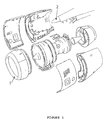
- Figure 1 shows diagrammatically the parts of a nacelle of a jet engine. 1 is the nose cowl of the nacelle, the forward part of which is the lipskin. 2 is the strut assembly to which the nacelle is attached.
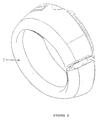
- Figure 2 shows diagrammatically the lipskin and the nose cowl 1 of a nacelle.
-
- The coating of the invention for lipskins and for leading edges of wings is preferably a duplex coating of an aluminum/phosphate ceramic basecoat and a topcoat of a silicone paint with aluminum flake pigment. The composition of both the basecoat and the topcoat are capable of cure at temperatures below that at which the aluminum substrate of the lipskins or the leading edges will be adversely affected. Preferably, the curing temperature of the basecoat and the topcoat is at 190°C (375°F) or less.
- The basecoat is a phosphate bonded aluminium filled basecoat, which may or may not contain chromium.
- The chromium-free basecoat of the coating of the invention may be any of the basecoats taught in patent application 08/364,786, filed December 27, 1994, now U.S. patent No. 5,478,413, issued on December 26, 1995, entitled ENVIRONMENTALLY FRIENDLY COATING COMPOSITIONS, which patent is incorporated herein by reference.
- In a most preferred embodiment, the coating of the invention is a duplex coating in which the basecoat is a chromium-free environmentally friendly coating, and the topcoat is an aluminum silicone paint, as described below.
- Alternatively, the basecoat may be a phosphate bonded aluminium filled basecoat which contains chromium. Any one of coatings taught in prior U.S. Patents 4,537,632 or 4,606,967, incorporated herein by reference, are suitable for use as the basecoat of the coating of the present invention. The coatings taught in these patents can be cured at a temperature of about 190°C (375°F). Additional suitable coating compositions of this type containing chromium and phosphate which are suitable as the basecoat of the coating of the present invention are described in U.S. Patent Nos. 3,248,249; 3,248,250; 3,248,251 (Allen); 3,395,027; 3,869,293; 4,544,408; 4,548,646; 4,617,056; 4,650,699; 4,659,613; 4,683,157; 4,724,172; 4,806,161; 4,863,516; 4,889,558; 4,975,330; 5,066,540; 5,242,488; 5,279,649; 5,279,650; 4,319,924 and 4,381,323, each of which is incorporated herein by reference.
- Preferably, the basecoat contains metallic aluminum pigment which permits cure at lower temperatures and increases the erosion protection capability of the coating. Optimally, the aluminum pigment is 3-4µm average equivalent spherical diameter (
ESD ) aluminum pigment. Alternatively, 5-6µm atomized aluminum may be used. The aluminum pigment may be flake, leaf, or spheroid. For best results the basecoat may be burnished or, alternatively, may be left unburnished. - Additionally, the basecoat may contain one or more additives, which may be nitrogen containing compounds, such as amines, amides or imides, such as maleimide or succinimide. Suitable additives include di- and tri-ethanolamine compounds as taught in U.S. Patent Nos. 4,319,924, and 4,381,323, or succinic acid or any dicarboxylic acid up to 14 carbon atoms, as taught in U.S. Patent No. 3,990,920 which, by reducing hexavalent chromium to trivalent chromium, permit curing of the coating at lower temperatures than coatings not containing these or similar additives. Base coats containing these additives, however may be less ductible and may have inferior erosion protection than basecoats without the additives. Such additives which act by reducing chromium are not applicable to coatings of a composition taught in U.S. Patent No. 5,478,413, which coatings lack chromium.
- A suitable basecoat for the coating of the invention will have the following characteristics.
- 1) An aqueous, acidic phosphate bonded aluminium filled composition, preferably having a pH of about 4.0 or less.
- 2) Can be thermally cured at temperatures of 190°C (375°F).
- 3) Is stable upon exposure to ultraviolet light.
- 4) Bonds strongly to the underlying substrate.
- 5) Has thermal resistance to long term repeated exposures to 230°C (450°F) and can withstand thermal excursions to temperatures above 260°C (500°F).
- 6) Resists corrosion from environmental exposure and thermal cycling.
- 7) Resists erosion from high velocity liquid and solid particles, including rain, sleet, hail and sand particles.
- 8) Is resistant to all fluids used on or around the aircraft.
-
- The topcoat of the coating of the invention is preferably an aluminum silicone paint. Examples of suitable forms of silicone are as silicone, as a silicone alkyd, silicone epoxy, or as a silicone polyester. The resin of the topcoat of the invention is stable when exposed to ultraviolet light and is stable when exposed to temperatures used in aircraft deicing.
- High temperature resistant expoxy resins as well as non-resin based inorganic silicate based topcoats are also suitable for the topcoat of the coating. Such topcoats must resist ultraviolet light degradation and rain droplet erosion. Tests disclosed herein may be utilized by one skilled in the art in selecting a suitable epoxy resin or non-resin inorganic silicate based topcoat for use in the coating of the invention.
- A suitable topcoat for the coating of the invention will preferably have the following characteristics.
- 1) Can be thermally cured at a temperature of 190°C (375°F) or less.
- 2) Is stable upon exposure to ultraviolet light.
- 3) Bonds strongly to the underlying basecoat.
- 4) Has thermal resistance. In a rain or ice storm exposure, the deicing system may heat the surface of the coated part to 400° (204°C) or 450°F (230°C). Preferably, the coating should resist short term exposure to temperatures greater than 260°C (500°F).
- 5) Damaged areas can be readily repaired, with the repaired areas being essentially undetectable and having functionality equivalent to the coating applied originally.
-
- Preferably, the topcoat will have a metallic, aluminum-like, color matching that of anodized aluminum, such as a pewter color, and should not fingerprint. The pewter color of the topcoat may be achieved by the use of aluminum or other metallic flake pigment. Brighter reflective finishes may be used but are less easily touched up cosmetically.
- If an organic resin is used in the topcoat, the topcoat may be shiny and glossy, and highly reflective. High gloss surfaces are more difficult to touch up and produce an undetectable repair of a damaged area than is the case with duller surfaces. A non-leafing flake aluminum, which does not float to the surface of the coating and is formulated to be dull, may be used to reduce the gloss. Additionally, a flatting agent, such as silica (SiO2) or PTFE powder or a clay additive, may be added to reduce gloss of the resin.
- If an inorganic silicate topcoat is used, the problem of gloss does not typically occur. Therefore, flatting agents are not needed to reduce gloss in inorganic topcoats. However, silica included in the inorganic topcoat increases erosion life of the topcoat.
- An example of a silicone-polyester based topcoat which is suitable for the coating of the invention comprises the following.
-
1800 gm Silicone-polyester resin 1221 gm Glycol ether solvents 265 gm n-Butanol 79 gm Xylene 148 gm Silicone resin 70 gm Melamine formaldehyde resin 409 gm Non-leafing Aluminum flake, 75% paste 39 gm PTFE powder 25 gm Silica 12 gm Organophilic clay 11 gm Phosphate ester catalyst 9 gm Siloxane/organic acid defoamer 8 gm Silicone fluid - An example of an epoxy resin based topcoat which is suitable for the coating of the invention comprises the following.
-
Part A 1665 gm Bisphenol A epoxy resin 666 gm Diepoxide epoxy resin 4176 gm Xylene 666 gm Propylene glycol methyl ether acetate 1332 gm Non-leafing aluminum flake paste 55 gm PTFE powder 350 gm Silica Part B 3000 gm Polyamine epoxy hardener 1940 gm Xylene - The topcoat is obtained by mixing 3gm Part A to 1gm Part B.
- An example of an inorganic silicate based topcoat which is suitable for the coating of the invention comprises the following.
-
2835 gm Potassium silicate solution, 29% solids 2025 gm Deionized water 3 gm Nonionic surfactant 506 gm 40XD leafing aluminum flake, ultrafine 1 gm silicone based defoamer - The above inorganic topcoat does not require high-heat curing, it is cured at ambient temperatures. Additionally, flatting agents are not required, and leafing aluminum flake may be used, because the inorganic topcoat is not glossy.
- The total thickness of the coating of the invention is preferably from about 25 to 250 µm (1 to 10 mils). The layers of the coating may be of equal thickness. If the layers are of equal thickness, each layer may be from about 12 µm (0.5 mils) to about 125 µm (5 mils), or any thickness in between, such as 12 to 25 or 50 µm (0.5 - 1.0 or 2.0 mils). Alternatively, the layers of the coating may be of different thicknesses. If the coating contains layers of different thicknesses, each layer may be between about 12 to 125 µm (0.5 to 5.0 mils) thick.
- It is important to consider the functions of each layer of the coating when the specific coating process is described. Both basecoat and topcoat must resist the erosion, corrosion, and thermal cycling of the lipskin as wing/tail leading edge; however, certain areas will require thicker coatings due to more severe erosion exposure.
- Only one layer of each of the basecoat and topcoat is required for the coating of the invention. If desired, more than one layer of either the basecoat or the topcoat, or of both, may be used.
- Preferably, the topcoat layer of the coating is in contact with the basecoat layer of the coating. However, if desired, additional layers of paints or sealants may be used between the basecoat and topcoat layers.
- Another embodiment of the invention is a method for applying the coating. Initially, the part to be coated is abraded to create a roughened profile surface for adhesion of the basecoat. Abrasion may be by any method known in the art, such as by sanding, sandblasting, or jitterbugging. The part is then cleaned of debris and degreased. Then, the basecoat is applied, dried, and cured. The topcoat is then applied to the dried and cured basecoat and is in turn dried and cured.
- Preferably, the method of the invention for applying the coating is as follows.
- The surface of the part to be coated is cleaned and degreased. If desired, the surface is then abrasive blasted or sanded to create a profile. The profile may be achieved by "jitterbugging", orbital sanding, or directional sanding.
- The basecoat is applied to the cleaned and degreased surface by conventional means such as by painting, spraying, rolling, or airbrushing. The basecoat is allowed to dry and is cured at temperatures of 163-232°C (325-450°F). Higher cure temperatures may be used depending on the alloy and component. If desired, one or more additional layers of the basecoat may be applied to the layer of the basecoat which is in contact with the surface of the part.
- Preferably, after curing, the basecoat is burnished to increase adhesion of the topcoat to the basecoat. Alternatively, the topcoat may be applied, as described below, to an unburnished basecoat
- The topcoat is applied to the dried, cured, and cooled basecoat by any of the means listed above for the basecoat. The topcoat is dried and is cured if required for the particular topcoat used. If desired, one or more additional layers of the topcoat may be applied to the layer of the topcoat in contact with the basecoat.
- In the case of wing and tail leading edges, the process of applying the coating may differ. The substrate is often clad aluminum alloy which is polished after sanding the rivet heads smooth. Using the invention described herein, the rivet heads need not be sanded. The leading edge is abraded with aluminum oxide, then the phosphate bonded aluminum filled basecoat is applied and cured. The cured basecoat is sanded or burnished to cover any residual rivet head indications and the topcoat is applied and cured. Alternatively, a second basecoat is applied, then cured before the topcoat is applied.
- In a preferred embodiment, the coated part of the invention is a lipskin of a nacelle (shown at 1 in Figures 1 and 2), which lipskin is preferably made of AA2219 aluminum alloy. Alternatively, the lipskin may be made of other heat resistant aluminum alloys.
- In an alternative preferred embodiment, the coated part of the invention is the leading edge of an airplane wing (shown at 2 in Figure 1), which edge is most preferably made of AA2024. The coated leading edge may be of aerospace grade aluminum alloys other than AA2024, which alloys may or may not be heat resistant. The aluminum alloy may or may not be clad with AA1100.
- The coated part is resistant to corrosion from high temperatures up to 260°C (500°F), from high salt environments, and to erosion from liquid and solid particles. The coated part is capable of being repaired physically by touching-up when the part is scratched or nicked so that the repaired area is essentially undetectable by touch and cosmetically upon unaided visual inspection at arms length distance (of about one meter).
- Specimens coated in accordance with the invention were tested as follows to determine performance.
-
- 1) Exposure at 300°C (572°F) for 48 hours followed by a cross hatch adhesion test per ASTM D3359, Method B, with no coating loss or serious discoloration.
- 2) Exposure at 150°C (302°F) for 100 hours followed by a cross hatch adhesion test per ASTM D3359, Method B, with no coating loss or discoloration.
-
-
- 1) Exposure to -55°C (-67°F) for 1 hour followed by a cross hatch adhesion test per ASTM D3359, Method B, with no coating loss.
- 2) Impact Resistance per ASTM D2794 Section 8.2.8 to exceed 5,6 m/kg (100 inch-pounds).
-
-
- 1) Salt Spray tests per ASTM B117 for 3,000 hours on scribed "X" panels - no blistering, softening of corrosion.
- 2) Filiform Corrosion Test per ISO 4623:
- a) 24 hours in salt spray per ASTM B117 followed by 1,000 hours at 40±2°C and 80±5% relative humidity.
- b) No filaments extending more than 2mm from scribe lines (at 20-25°C).
-
-
- 1) Skydrol 500B (phosphate ester hydraulic fluid) 168 hours.
- 2) Aviation Fuel (Jet-8) - 168 hours.
- 3) Lubricating Oil (MIL-L-7808), 168 hours.
- 4) Distilled Water - 336 hours.
- 5) Deicing Fluid - 168 hours. There was no softening of the coating film or adhesion loss when tested for pencil hardness per ASTM D3363 and cross-hatch adhesion per ASTM D3359.
-
-
- 1) Falling Sand Erosion per ASTM D968 - results exceed 125 liters of sand per 25µm (1 mil) of coating thickness.
- 2) Rain Erosion Resistance - tested using a whirling arm apparatus at a velocity of 223 meters/sec, at a rate of 25 mm/hour, a mean drop diameter of 2 mm, an impact angle of 90° and a time of 10 minutes. Following the test all the basecoat was intact and topcoat was still covering 80% of the sample test area.
-
- Repair of minor damage due to corrosion or scratching, such as might occur due to a scratch from a tool such as a screwdriver, is readily performed in the field by dressing and filling the damaged area with high temperature epoxy to restore the original profile, followed by touching-up with the topcoat or with an air cure/low temperature drying topcoat, such as an epoxy.
- The topcoat in the repaired area adheres to the basecoat and the part as well as the topcoat in the nondamaged sections of the part, as determined by the cross hatch adhesion test.
- If the damaged area is large, for example an area of 100 x 400 mm, such as might occur due to an extreme abrasion or scuffing, the coated part is repaired by sanding and feathering the damaged sections and applying a layer of the topcoat using an airbrush. The topcoat is dried and cured, preferably by the use of a locally applied heat source, such as a high intensity infra-red lamp for about 30 minutes. Smaller damaged areas, such as for example 10 x 40 mm can be touched up by sanding (or burnishing) the affected areas and adjacent areas A hand-guided orbital sander is a suitable device for such purpose.
- If damage penetrates more than about 125-250 µm (0.005"-0.010") into the aluminum structure, the damaged area should be repaired first by applying an epoxy to restore the profile, followed by touching up with the basecoat and/or topcoat.
- The following examples are illustrative of the invention and are not meant to limit the scope of the invention.
- A lipskin of Alloy 2219 was cleaned and degreased and coated with a basecoat of the following composition:
Cr03 92 grams H3PO4 323 grams MgO 72 grams Water to 1 liter Helium atomized 800 grams Aluminum powder, Spherical, 3.5 micron Average equivalent spherical diameter (Valimet H-3) - The basecoat was cured at 260°C (500°F) for two hours. This basecoat may also be cured at 232°C (450°F) in six hours or at 190°C (375°F) in twenty hours. If a cure reducer, such as 0.5% succinimide is added, the basecoat will cure at 190°C (375°F) in one hour.
- Following cure of the basecoat, a topcoat according to Topcoat A above, was applied.
- The coated sample passed the following tests:
- salt spray (ASTM B117) >5000 hours with no substrate corrosion
- impact resistance (ASTM D2794) 120 in. lbs.
- heat exposure 250°C for 50 hours, no color change or loss of adhesion
- cold exposure -55°C for one hour with no adhesion loss
- A lipskin of Alloy 2219 was cleaned and degreased and coated with the topcoat of Example 1 without a basecoat.
- The coated part was tested for salt spray and impact resistance as in Example 1. Results of testing were as follows.
- salt spray (ASTM B117) 350 hours - white corrosion products
- impact resistance (ASTM D2794) 60 in. lbs.
- When scratched and then repainted with the topcoat, the part felt like "new" to the touch and was undistinguishable visually from the undamaged area.
- This Example demonstrates the superior protection of the duplex coating of the invention compared to a single layer coating having just the topcoat of the invention.
- A wing leading edge 2.2 meters long of clad 2000 series aluminum alloy was processed as follows:
- 1. Solvent degreased.
- 2. Spray coated with 20-30 µm (dry film) of the basecoat of Example 1 and cured at 260°C (500°F) for 1.5 hours.
- 3. The roughness profile of the coating around the rivet heads was sanded with 80 mesh aluminum oxide paper. The basecoat was reapplied and cured as above.
- 4. The surface of the cured coating was "burnished" with an orbital sander having a 100 mesh aluminum oxide impregnated pad.
- 5. A layer of Topcoat A was applied and cured at 190°C (375°F) for 60 minutes. Topcoat thickness was 40-60 µm (1.6-2.4 mils) over the basecoat layer 45-65 µm (1.8-2.6 mils) thick.
-
- This topcoat was also abraded with the orbital sander until smooth.
- This coating met the high temperature, low temperature, corrosion resistance and erosion resistance requirements of Example 1.
- A lipskin of Alloy 2219 was cleaned and degreased and coated with the duplex coating of Example 1. The sample coated part was damaged with a knife and a screw driver blade. The damaged area was sanded and feathered. A topcoat of the same composition as on the undamaged portion of the sample was spray applied to the damaged area and adjacent areas using an airbrush. The topcoat was allowed to dry and was cured under a high intensity infrared lamp for 30 minutes.
- Following repair, the repaired area was indistinguishable from the adjacent non-damaged area by unaided visual inspection at a distance of one meter. It felt perfectly smooth to the touch. The repaired area showed resistance to greater than 100 double MEK rubs, indicating complete cure. Also, the cross hatch adhesion test to the repaired area and to nondamaged area showed no difference in adhesion of the topcoat to the underlying basecoat and metal part.
- A lipskin is coated with the basecoat of Example 1 and with a layer of Topcoat C.
- A leading edge of a wing is coated with the basecoat of Example 3 and a layer of Topcoat B.
- A lipskin is coated in accordance with Example 6 except that 0.2 gm of succinimide was added to the basecoat composition. The basecoat is cured at 190°C (375°F) in one hour.
- Each of the coatings of Examples 5-7 meet the high and low temperature, corrosion resistance, and erosion resistance requirements set forth above.
Claims (15)
- A multilayer coated aerospace grade aluminium alloy part, wherein said part is coated with a basecoat of a phosphate bonded aluminium-filled coating and a topcoat selected from aluminium silicone paint, high temperature resistant epoxy resin and inorganic silicate topcoats, which are stable when exposed to temperatures used in aircraft deicing and which resist ultraviolet light degradation and rain droplet erosion.
- The coated part of Claim 1, wherein the part is selected from the group consisting of a lipskin of a nacelle and a leading edge of a wing tail.
- The coated part of Claim 1, wherein said aerospace grade aluminium alloy comprises copper.
- The coated part of Claim 1 wherein the aluminium alloy is a 2XXX alloy, according to the Aluminium Association system.
- The coated part of Claim 4 wherein the 2XXX alloy is selected from the group consisting of AA2219 and AA2024.
- The coated part of Claim 4 wherein the alloy is AA2219.
- The coated part of Claim 1 wherein the topcoat is a silicone paint with aluminium flake pigment.
- The multilayer coating of Claim 1 wherein the coating is resistant to a temperature up to 232°C on an occasional emergency basis.
- The multilayer coated aerospace grade aluminium-copper alloy part of Claim 3, wherein the coating is resistant to temperature of about 300°C for 48 hours.
- The coated part of Claim 1 in which the basecoat is free of chromium.
- The coated part of Claim 1 in which the basecoat comprises chromium.
- A method providing a coated aerospace grade aluminium alloy part according to Claim 1 with coating comprising the steps of applying a coating comprising a phosphate bonded aluminium containing basecoat, and drying and curing the basecoat, applying a topcoat selected from aluminium silicone paint, high temperature resistant epoxy resin and inorganic silicate topcoats, which are stable when exposed to temperatures used in aircraft deicing and which resist ultraviolet light degradation and rain droplet erosion, to the dried and cured basecoat, and drying and curing the topcoat.
- The method of Claim 12 which comprises burnishing the cured basecoat.
- The method of Claim 12 wherein the curing of the basecoat and the topcoat is at temperature below 190°C (375°F).
- The method of Claim 13 wherein the curing of the topcoat is at ambient temperature.
Applications Claiming Priority (2)
| Application Number | Priority Date | Filing Date | Title |
|---|---|---|---|
| US08/580,562 US6171704B1 (en) | 1995-12-29 | 1995-12-29 | Coating for aerospace aluminum parts |
| US580562 | 1995-12-29 |
Publications (2)
| Publication Number | Publication Date |
|---|---|
| EP0783042A1 EP0783042A1 (en) | 1997-07-09 |
| EP0783042B1 true EP0783042B1 (en) | 2004-07-21 |
Family
ID=24321598
Family Applications (2)
| Application Number | Title | Priority Date | Filing Date |
|---|---|---|---|
| EP96400657A Expired - Lifetime EP0783042B1 (en) | 1995-12-29 | 1996-03-27 | Coated aerospace aluminium parts |
| EP96402755A Withdrawn EP0781861A1 (en) | 1995-12-29 | 1996-12-17 | Coating for aerospace aluminium parts |
Family Applications After (1)
| Application Number | Title | Priority Date | Filing Date |
|---|---|---|---|
| EP96402755A Withdrawn EP0781861A1 (en) | 1995-12-29 | 1996-12-17 | Coating for aerospace aluminium parts |
Country Status (4)
| Country | Link |
|---|---|
| US (1) | US6171704B1 (en) |
| EP (2) | EP0783042B1 (en) |
| CA (1) | CA2193272C (en) |
| DE (1) | DE69632944T2 (en) |
Families Citing this family (25)
| Publication number | Priority date | Publication date | Assignee | Title |
|---|---|---|---|---|
| US6599965B2 (en) * | 2000-06-22 | 2003-07-29 | Basf Corporation | Coating composition for metallic substrates |
| WO2002070617A1 (en) * | 2001-03-08 | 2002-09-12 | Liburdi Engineering Limited | Method of application of a protective coating to a substrate |
| US20040224158A1 (en) * | 2002-03-08 | 2004-11-11 | Vladimir Moravek | Method of application of a protective coating to a substrate |
| US6755886B2 (en) * | 2002-04-18 | 2004-06-29 | The Regents Of The University Of California | Method for producing metallic microparticles |
| US6833164B2 (en) | 2002-05-06 | 2004-12-21 | Ford Global Technologies, Llc. | Single-step heat treating and surface coating on self-piercing rivets |
| US20040168622A1 (en) * | 2003-02-28 | 2004-09-02 | John Thompson | Paintable multifunction components for watercraft |
| US6733837B1 (en) * | 2003-04-11 | 2004-05-11 | Allfast Fastening Systems, Inc. | Process for painting metal parts |
| US7449241B2 (en) * | 2003-08-04 | 2008-11-11 | General Electric Company | Organic coating compositions for aluminizing metal substrates, and related methods and articles |
| US20060083869A1 (en) * | 2004-10-15 | 2006-04-20 | Laudick David A | DAL spinner |
| US7527872B2 (en) * | 2005-10-25 | 2009-05-05 | Goodrich Corporation | Treated aluminum article and method for making same |
| US7596986B2 (en) * | 2007-03-01 | 2009-10-06 | 3M Innovative Properties Company | Method of testing liquid drop impact and apparatus |
| US7850126B2 (en) * | 2007-04-25 | 2010-12-14 | The Boeing Company | Laminar flow surfaces with selected roughness distributions, and associated methods |
| US20090000101A1 (en) * | 2007-06-29 | 2009-01-01 | United Technologies Corp. | Methods for Repairing Gas Turbine Engines |
| US7992823B2 (en) * | 2008-04-30 | 2011-08-09 | General Electric Company | Ice shed reduction for leading edge structures |
| US8245981B2 (en) * | 2008-04-30 | 2012-08-21 | General Electric Company | Ice shed reduction for leading edge structures |
| BRPI0912839A8 (en) | 2008-05-19 | 2019-01-29 | Henkel Ag & Co Kgaa | corrosion protective coating composition for metal substrates, method of providing a corrosion protective coating on a metal substrate, and matting substrate coated with a coating composition |
| US20110159175A1 (en) * | 2009-12-30 | 2011-06-30 | Jon Raymond Groh | Methods for inhibiting corrosion of high strength steel turbine components |
| US9309781B2 (en) | 2011-01-31 | 2016-04-12 | General Electric Company | Heated booster splitter plenum |
| US10030294B2 (en) * | 2015-02-16 | 2018-07-24 | The Boeing Company | Method for manufacturing anodized aluminum alloy parts without surface discoloration |
| EP3184180B1 (en) * | 2015-12-24 | 2020-06-10 | United Technologies Corporation | Local repair or remanufacture of polymeric erosion coatings |
| US11001719B2 (en) | 2018-09-14 | 2021-05-11 | Rohr, Inc. | Multi-layer coating for a flow surface of an aircraft component |
| US11225441B2 (en) | 2018-10-18 | 2022-01-18 | Praxair S.T. Technology, Inc. | Chromium-free silicate-based ceramic compositions with reduced curing temperature |
| FR3102080B1 (en) * | 2019-10-18 | 2022-08-19 | Safran Nacelles | Procedure for repairing an air intake lip |
| EP4048216A4 (en) | 2019-10-25 | 2023-11-15 | Nusil Technology LLC | AGRICULTURAL COMPOSITIONS AND PROCEDURES THEREOF |
| CA3248579A1 (en) * | 2022-04-12 | 2023-10-19 | Magnesium Products of America Inc. | Method of producing magnesium-containing components having visual metallic surfaces |
Family Cites Families (32)
| Publication number | Priority date | Publication date | Assignee | Title |
|---|---|---|---|---|
| US3248251A (en) * | 1963-06-28 | 1966-04-26 | Teleflex Inc | Inorganic coating and bonding composition |
| US3248249A (en) * | 1963-06-28 | 1966-04-26 | Telefiex Inc | Inorganic coating and bonding composition |
| US3248250A (en) * | 1963-06-28 | 1966-04-26 | Teleflex Inc | Coating and bonding composition |
| US3395027A (en) * | 1964-03-05 | 1968-07-30 | Teleflex Inc | Coating composition and method |
| DE1813480A1 (en) | 1968-12-09 | 1971-02-04 | Esser Paul | Heat -resistant protective coating for - metallic objects |
| US3869293A (en) | 1971-08-06 | 1975-03-04 | Teleflex Inc | Inorganic coating compositions and a method |
| US4319924A (en) * | 1974-02-12 | 1982-03-16 | Coatings For Industry, Inc. | Low-temperature curing coating composition |
| US3990920A (en) | 1974-05-06 | 1976-11-09 | Diamond Shamrock Corporation | Metal treating compositions of adjusted pH |
| US4381323A (en) | 1980-04-28 | 1983-04-26 | Coatings For Industry, Inc. | Low-temperature curing coating composition |
| US4457971A (en) * | 1981-09-08 | 1984-07-03 | Minnesota Mining And Manufacturing Company | Lithographic substrate and its process of manufacture |
| US4548646A (en) | 1982-11-15 | 1985-10-22 | Sermatech International Incorporated | Thixotropic coating compositions and methods |
| US4683157A (en) | 1982-11-15 | 1987-07-28 | Mosser Mark F | Thixotropic coating compositions and methods |
| US4650699A (en) | 1983-04-18 | 1987-03-17 | Sermetel | Thixotropic alumina coating compositions, parts and methods |
| US4544408A (en) | 1983-04-18 | 1985-10-01 | Sermatech International Inc. | Thixotropic alumina coating compositions, parts and methods |
| US4537632A (en) * | 1983-10-19 | 1985-08-27 | Sermatech International, Inc. | Spherical aluminum particles in coatings |
| US4606967A (en) * | 1983-10-19 | 1986-08-19 | Sermatech International Inc. | Spherical aluminum particles in coatings |
| US4889558A (en) * | 1983-11-28 | 1989-12-26 | Sermatech International, Inc. | Coating compositions containing undissolved hexavalent chromium salt |
| US4975330A (en) * | 1983-11-28 | 1990-12-04 | Sermatech International, Inc. | Coating compositions containing unreacted hexavalent chromium, a method of applying and an article |
| CA1266766A (en) * | 1983-11-28 | 1990-03-20 | Mark F. Mosser | Coating composition containing particles of leachable chromate figments |
| FR2557101B1 (en) | 1983-12-21 | 1986-06-27 | Pharmascience Lab | NEW PROCESS FOR THE PREPARATION OF DIAMINE-ALCOHOLS |
| US4617056A (en) | 1983-12-29 | 1986-10-14 | Sermatech International, Inc. | Thick coating compositions |
| US4724172A (en) | 1983-12-29 | 1988-02-09 | Sermatech International, Inc. | Thick coating compositions |
| US4659613A (en) | 1983-12-29 | 1987-04-21 | Sermatech International, Inc. | Parts coated with thick coating compositions of uni- and polymodal types |
| US4863516A (en) | 1987-01-23 | 1989-09-05 | Sermatech International, Inc. | Coating composition |
| US5066540A (en) | 1987-01-23 | 1991-11-19 | Sermatech International, Inc. | Flake materials in coating compositions |
| US4806161A (en) | 1987-12-04 | 1989-02-21 | Teleflex Incorporated | Coating compositions |
| US4895608A (en) * | 1988-04-29 | 1990-01-23 | Sanchem, Inc. | Corrosion resistant aluminum coating composition |
| US5242488A (en) | 1992-06-01 | 1993-09-07 | Solar Turbines Incorporated | Coating composition and method of forming |
| US5279649A (en) | 1992-06-01 | 1994-01-18 | Solar Turbines Incorporated | Coating composition and method of forming |
| US5279650A (en) | 1992-06-01 | 1994-01-18 | Solar Turbines Incorporated | Corrosion resistant seal coat composition and method of forming |
| US5536686A (en) * | 1992-10-20 | 1996-07-16 | The Research Foundation Of State University Of New York At Buffalo | Phosphate binders for metal-matrix composites |
| US5478413A (en) | 1994-12-27 | 1995-12-26 | Sermatech International, Inc. | Environmentally friendly coating compositions |
-
1995
- 1995-12-29 US US08/580,562 patent/US6171704B1/en not_active Expired - Lifetime
-
1996
- 1996-03-27 EP EP96400657A patent/EP0783042B1/en not_active Expired - Lifetime
- 1996-03-27 DE DE69632944T patent/DE69632944T2/en not_active Expired - Lifetime
- 1996-12-17 EP EP96402755A patent/EP0781861A1/en not_active Withdrawn
- 1996-12-18 CA CA002193272A patent/CA2193272C/en not_active Expired - Lifetime
Also Published As
| Publication number | Publication date |
|---|---|
| CA2193272A1 (en) | 1997-06-30 |
| US6171704B1 (en) | 2001-01-09 |
| CA2193272C (en) | 2006-03-14 |
| EP0781861A1 (en) | 1997-07-02 |
| DE69632944D1 (en) | 2004-08-26 |
| DE69632944T2 (en) | 2005-07-28 |
| EP0783042A1 (en) | 1997-07-09 |
Similar Documents
| Publication | Publication Date | Title |
|---|---|---|
| US6171704B1 (en) | Coating for aerospace aluminum parts | |
| CN102138009B (en) | Metal sheets and plates having friction-reducing textured surfaces and methods of manufacturing same | |
| KR102481351B1 (en) | surface reactivation agent | |
| Visser et al. | Aerospace coatings | |
| CN114318323A (en) | Method for repairing local damage of aircraft skin surface in situ through cold spraying | |
| US4810293A (en) | Anti-corrosive paint composition | |
| Kaneko et al. | Aluminum alloy 6013 sheet for new US Navy aircraft | |
| US9694901B2 (en) | Aircraft landing flap | |
| CN1160735A (en) | Double-component antirot zinc silicate paint and its use | |
| Kotnarowska et al. | Influence of aqueous sodium chloride solutions on operational properties of epoxy coatings | |
| JPS58196872A (en) | Chipping-resistive coating method | |
| Lin | Aircraft coating technology–Present and future | |
| Hsu et al. | Evaluation of Low VOC Materials at the Boeing Company | |
| JPH10193512A (en) | Aluminum wheel coating and application thereof | |
| Smith | Advances in protective coatings and processes for aerospace applications | |
| Pauli et al. | Plastic Media Training Requirements and Supporting Technical Data | |
| Dyachenko et al. | Technological features analysis of the initial and repair aircraft products painting | |
| Oestreich et al. | Starch Media Blasting for Aerospace Finishing Applications | |
| Ihbe | Tape Technologies to Replace Paint on Aircraft and Protect Aircraft Surfaces from Erosion, Corrosion and Abrasion | |
| CN121514127A (en) | Chemical reactivation method for directly bonding coatings to metal surfaces | |
| JPH03114574A (en) | Metallic finish of aluminum foil | |
| Hiripitiya et al. | Evaluate the potential of applying a nano paint on SLAF Y-12 (II) aircraft as a nanotechnology modification | |
| Floyd | Anodize and prime your aluminum without environmental headaches | |
| Cole | Corrosion prevention in the aerospace industries | |
| JPH05209140A (en) | Weather-resistant coating film and aluminum part having the film |
Legal Events
| Date | Code | Title | Description |
|---|---|---|---|
| PUAI | Public reference made under article 153(3) epc to a published international application that has entered the european phase |
Free format text: ORIGINAL CODE: 0009012 |
|
| AK | Designated contracting states |
Kind code of ref document: A1 Designated state(s): DE FR GB IT |
|
| 17P | Request for examination filed |
Effective date: 19971114 |
|
| 17Q | First examination report despatched |
Effective date: 19970102 |
|
| GRAP | Despatch of communication of intention to grant a patent |
Free format text: ORIGINAL CODE: EPIDOSNIGR1 |
|
| RTI1 | Title (correction) |
Free format text: COATED AEROSPACE ALUMINIUM PARTS |
|
| GRAS | Grant fee paid |
Free format text: ORIGINAL CODE: EPIDOSNIGR3 |
|
| GRAA | (expected) grant |
Free format text: ORIGINAL CODE: 0009210 |
|
| AK | Designated contracting states |
Kind code of ref document: B1 Designated state(s): DE FR GB IT |
|
| REG | Reference to a national code |
Ref country code: GB Ref legal event code: FG4D |
|
| REF | Corresponds to: |
Ref document number: 69632944 Country of ref document: DE Date of ref document: 20040826 Kind code of ref document: P |
|
| PLBE | No opposition filed within time limit |
Free format text: ORIGINAL CODE: 0009261 |
|
| STAA | Information on the status of an ep patent application or granted ep patent |
Free format text: STATUS: NO OPPOSITION FILED WITHIN TIME LIMIT |
|
| ET | Fr: translation filed | ||
| 26N | No opposition filed |
Effective date: 20050422 |
|
| REG | Reference to a national code |
Ref country code: FR Ref legal event code: PLFP Year of fee payment: 20 |
|
| PGFP | Annual fee paid to national office [announced via postgrant information from national office to epo] |
Ref country code: IT Payment date: 20150324 Year of fee payment: 20 Ref country code: DE Payment date: 20150327 Year of fee payment: 20 |
|
| PGFP | Annual fee paid to national office [announced via postgrant information from national office to epo] |
Ref country code: FR Payment date: 20150317 Year of fee payment: 20 Ref country code: GB Payment date: 20150327 Year of fee payment: 20 |
|
| REG | Reference to a national code |
Ref country code: DE Ref legal event code: R071 Ref document number: 69632944 Country of ref document: DE |
|
| REG | Reference to a national code |
Ref country code: GB Ref legal event code: PE20 Expiry date: 20160326 |
|
| PG25 | Lapsed in a contracting state [announced via postgrant information from national office to epo] |
Ref country code: GB Free format text: LAPSE BECAUSE OF EXPIRATION OF PROTECTION Effective date: 20160326 |