EP0782852B1 - Pharmaceutical compositions of heterocyclic angiotensin-II antagonists and oily substances for oral use and method of preparing them - Google Patents
Pharmaceutical compositions of heterocyclic angiotensin-II antagonists and oily substances for oral use and method of preparing them Download PDFInfo
- Publication number
- EP0782852B1 EP0782852B1 EP96118520A EP96118520A EP0782852B1 EP 0782852 B1 EP0782852 B1 EP 0782852B1 EP 96118520 A EP96118520 A EP 96118520A EP 96118520 A EP96118520 A EP 96118520A EP 0782852 B1 EP0782852 B1 EP 0782852B1
- Authority
- EP
- European Patent Office
- Prior art keywords
- alcohol
- acid
- polyoxyethylene
- alcohol ether
- formula
- Prior art date
- Legal status (The legal status is an assumption and is not a legal conclusion. Google has not performed a legal analysis and makes no representation as to the accuracy of the status listed.)
- Expired - Lifetime
Links
Classifications
-
- A—HUMAN NECESSITIES
- A61—MEDICAL OR VETERINARY SCIENCE; HYGIENE
- A61K—PREPARATIONS FOR MEDICAL, DENTAL OR TOILETRY PURPOSES
- A61K31/00—Medicinal preparations containing organic active ingredients
- A61K31/33—Heterocyclic compounds
- A61K31/395—Heterocyclic compounds having nitrogen as a ring hetero atom, e.g. guanethidine or rifamycins
- A61K31/53—Heterocyclic compounds having nitrogen as a ring hetero atom, e.g. guanethidine or rifamycins having six-membered rings with three nitrogens as the only ring hetero atoms, e.g. chlorazanil, melamine
-
- A—HUMAN NECESSITIES
- A61—MEDICAL OR VETERINARY SCIENCE; HYGIENE
- A61K—PREPARATIONS FOR MEDICAL, DENTAL OR TOILETRY PURPOSES
- A61K31/00—Medicinal preparations containing organic active ingredients
- A61K31/33—Heterocyclic compounds
- A61K31/395—Heterocyclic compounds having nitrogen as a ring hetero atom, e.g. guanethidine or rifamycins
- A61K31/41—Heterocyclic compounds having nitrogen as a ring hetero atom, e.g. guanethidine or rifamycins having five-membered rings with two or more ring hetero atoms, at least one of which being nitrogen, e.g. tetrazole
-
- A—HUMAN NECESSITIES
- A61—MEDICAL OR VETERINARY SCIENCE; HYGIENE
- A61K—PREPARATIONS FOR MEDICAL, DENTAL OR TOILETRY PURPOSES
- A61K31/00—Medicinal preparations containing organic active ingredients
- A61K31/33—Heterocyclic compounds
- A61K31/395—Heterocyclic compounds having nitrogen as a ring hetero atom, e.g. guanethidine or rifamycins
- A61K31/41—Heterocyclic compounds having nitrogen as a ring hetero atom, e.g. guanethidine or rifamycins having five-membered rings with two or more ring hetero atoms, at least one of which being nitrogen, e.g. tetrazole
- A61K31/415—1,2-Diazoles
-
- A—HUMAN NECESSITIES
- A61—MEDICAL OR VETERINARY SCIENCE; HYGIENE
- A61K—PREPARATIONS FOR MEDICAL, DENTAL OR TOILETRY PURPOSES
- A61K31/00—Medicinal preparations containing organic active ingredients
- A61K31/33—Heterocyclic compounds
- A61K31/395—Heterocyclic compounds having nitrogen as a ring hetero atom, e.g. guanethidine or rifamycins
- A61K31/41—Heterocyclic compounds having nitrogen as a ring hetero atom, e.g. guanethidine or rifamycins having five-membered rings with two or more ring hetero atoms, at least one of which being nitrogen, e.g. tetrazole
- A61K31/4164—1,3-Diazoles
- A61K31/4184—1,3-Diazoles condensed with carbocyclic rings, e.g. benzimidazoles
-
- A—HUMAN NECESSITIES
- A61—MEDICAL OR VETERINARY SCIENCE; HYGIENE
- A61K—PREPARATIONS FOR MEDICAL, DENTAL OR TOILETRY PURPOSES
- A61K31/00—Medicinal preparations containing organic active ingredients
- A61K31/33—Heterocyclic compounds
- A61K31/395—Heterocyclic compounds having nitrogen as a ring hetero atom, e.g. guanethidine or rifamycins
- A61K31/435—Heterocyclic compounds having nitrogen as a ring hetero atom, e.g. guanethidine or rifamycins having six-membered rings with one nitrogen as the only ring hetero atom
-
- A—HUMAN NECESSITIES
- A61—MEDICAL OR VETERINARY SCIENCE; HYGIENE
- A61K—PREPARATIONS FOR MEDICAL, DENTAL OR TOILETRY PURPOSES
- A61K31/00—Medicinal preparations containing organic active ingredients
- A61K31/33—Heterocyclic compounds
- A61K31/395—Heterocyclic compounds having nitrogen as a ring hetero atom, e.g. guanethidine or rifamycins
- A61K31/495—Heterocyclic compounds having nitrogen as a ring hetero atom, e.g. guanethidine or rifamycins having six-membered rings with two or more nitrogen atoms as the only ring heteroatoms, e.g. piperazine or tetrazines
-
- A—HUMAN NECESSITIES
- A61—MEDICAL OR VETERINARY SCIENCE; HYGIENE
- A61K—PREPARATIONS FOR MEDICAL, DENTAL OR TOILETRY PURPOSES
- A61K9/00—Medicinal preparations characterised by special physical form
- A61K9/20—Pills, tablets, discs, rods
- A61K9/2004—Excipients; Inactive ingredients
- A61K9/2013—Organic compounds, e.g. phospholipids, fats
-
- A—HUMAN NECESSITIES
- A61—MEDICAL OR VETERINARY SCIENCE; HYGIENE
- A61K—PREPARATIONS FOR MEDICAL, DENTAL OR TOILETRY PURPOSES
- A61K9/00—Medicinal preparations characterised by special physical form
- A61K9/20—Pills, tablets, discs, rods
- A61K9/2004—Excipients; Inactive ingredients
- A61K9/2013—Organic compounds, e.g. phospholipids, fats
- A61K9/2018—Sugars, or sugar alcohols, e.g. lactose, mannitol; Derivatives thereof, e.g. polysorbates
-
- A—HUMAN NECESSITIES
- A61—MEDICAL OR VETERINARY SCIENCE; HYGIENE
- A61K—PREPARATIONS FOR MEDICAL, DENTAL OR TOILETRY PURPOSES
- A61K9/00—Medicinal preparations characterised by special physical form
- A61K9/20—Pills, tablets, discs, rods
- A61K9/2004—Excipients; Inactive ingredients
- A61K9/2022—Organic macromolecular compounds
- A61K9/2031—Organic macromolecular compounds obtained otherwise than by reactions only involving carbon-to-carbon unsaturated bonds, e.g. polyethylene glycol, polyethylene oxide, poloxamers
-
- A—HUMAN NECESSITIES
- A61—MEDICAL OR VETERINARY SCIENCE; HYGIENE
- A61P—SPECIFIC THERAPEUTIC ACTIVITY OF CHEMICAL COMPOUNDS OR MEDICINAL PREPARATIONS
- A61P9/00—Drugs for disorders of the cardiovascular system
- A61P9/12—Antihypertensives
-
- A—HUMAN NECESSITIES
- A61—MEDICAL OR VETERINARY SCIENCE; HYGIENE
- A61K—PREPARATIONS FOR MEDICAL, DENTAL OR TOILETRY PURPOSES
- A61K9/00—Medicinal preparations characterised by special physical form
- A61K9/20—Pills, tablets, discs, rods
- A61K9/2004—Excipients; Inactive ingredients
- A61K9/2022—Organic macromolecular compounds
- A61K9/205—Polysaccharides, e.g. alginate, gums; Cyclodextrin
- A61K9/2054—Cellulose; Cellulose derivatives, e.g. hydroxypropyl methylcellulose
Definitions
- This invention relates to orally administrable pharmaceutical compositions capable of suppressing decomposition of the active component contained therein and maintaining excellent stability with days and method of preparing them.
- the present invention relates to a pharmaceutical composition for oral use comprising (A) an effective amount of a compound of the formula (I) having antagonistic action to angiotensin II wherein in the N-containing heterocyclic residue represented by the formula: a represents nitrogen atom; b and c independently represent optionally substituted carbon atoms; which N-containing heterocyclic residue may be substituted, besides Y-R 1 ; R 1 is hydrogen or an optionally substituted hydrocarbon residue; Y is a bond, -O-, -S(O)m-, wherein m denotes 0, 1 or 2, or -N(R 4 )-, where R 4 is hydrogen or an optionally substituted alkyl group; R 3 is tetrazolyl; X is a direct bond between the phenylene group and the phenyl group; n is 1, which has antagonistic action to angiotensin II and (B) an oily substance selected from hydrocarbon, higher fatty acid selected from capric acid, lauric acid
- AII angiotensin II receptor antagonist
- ACE angiotensin I converting enzyme
- the object of this invention is to provide stabilized preparations of the compound of the formula (I) having antagonistic action to angiotensin II.
- the present invention aims at sufficiently practical method of stabilization from the economical viewpoint as well, without resorting to a method inevitably requiring the rise of cost, such as that involving use of an excess amount of the active component or extremely minimizing the moisture content.
- the present invention is also to heighten the value of finished products by prolonging the period expiration through improved stability of the compositions.
- the present inventors attempted various means of general use in order to realize the stabilization of compositions containing the compound of the formula (I) having antagonistic action to angiotensin II.
- no compositions prepared thus above was found a satisfactorily practical stabilizing effect.
- the present inventors further continued various investigations, and unexpectedly found that, by incorporating an oily substance having a low melting point into a formulation containing the compound of the formula (I) having antagonistic action to angiotensin II, decomposition of the active component is remarkably suppressed to afford a stable composition, and further investigations were conducted repeatedly to accomplish the present invention.
- An object of the present invention is to provide
- R 3 is tetrazolyl.
- X is a chemical bond between the phenylene group and the phenyl group.
- n denotes an integer of 1.
- N-containing heterocyclic residues are specifically defined as follows.
- R 1 is hydrogen or an optionally substituted hydrocarbon residue
- Y is a bond, -O-, -S(O)m- (where m denotes 0, 1 or 2) or -N(R 4 )- (where R 4 is hydrogen or an optionally substituted alkyl group).
- R 1 is preferably a lower (C 1-5 ) alkyl (preferably a lower (C 2-3 ) alkyl) optionally substituted with hydroxyl group, amino group, halogen or a lower (C 1-4 ) alkoxy group; and Y is preferably a bond, -O-, -S- or -N(R 4 )- (wherein R 4 stands for hydrogen or a lower (C 1-4 ) alkyl).
- oily substances any one can be used, so long as it is oily and has the melting point of about 20 to 90°C, preferably 20 to 60°C and exerts no undesirable influence on the active component.
- the above oily substances may be more evenly admixed with the active component in preparation of pharmaceutical compositions for oral use of the present invention so that more stable compositions are produced, as compared with use of an oily substance having a higher melting point.
- any one may be soluble or unsoluble in water.
- an example of the oily substances which is soluble in water is a polymer of alkylene oxide, as mentioned below.
- these substances include hydrocarbon, higher fatty acid, higher alcohol, fatty acid ester of polyhydric alcohol, higher alcohol ether of polyhydric alcohol, and polymer or copolymer of alkylene oxide.
- hydrocarbon higher fatty acid
- higher alcohol fatty acid ester of polyhydric alcohol, higher alcohol ether of polyhydric alcohol, polymer or copolymer of alkylene oxide, especially polymer of alkylene oxide.
- hydrocarbon examples include C 17-50 n-alkane such as n-heptadecane, n-octadecane, n-nonadecane, n-eicosane, n-heneicosane, n-docosane, n-tricosane, n-tetracosane, n-pentacosane, n-triacontane, n-pentatriacontane, n-tetracontane and n-pentacontane, as well as a mixture of them (petrolatum, paraffin wax, microcrystalline wax, etc.).
- n-alkane such as n-heptadecane, n-octadecane, n-nonadecane, n-eicosane, n-heneicosane, n-docosane, n-tricosane, n
- Higher fatty acids are capric acid, lauric acid, myristic acid, palmitic acid, stearic acid, arachidinic acid, behenic acid, lignoceric acid, cerotic acid and a mixture of them.
- Higher alcohols are lauryl alcohol, myristyl alcohol, cetyl alcohol, stearyl alcohol, aralkyl alcohol and a mixture of them.
- fatty acid ester of polyhydric alcohol examples include esters formed by esterification of an alcohol having two or more hydroxyl groups in the molecule (for example, alkylene glycols such as ethylene glycol and propylene glycol; polyalkylene glycols such as polyethylene glycol, polypropylene glycol or copolymers of them; sugars such as sorbitol, sucrose and raffinose; intramolecular dehydrates such as 1,5-sorbitan, 1,4-sorbitol and 3,6-sorbitan; glycerin, diethanolamine, pentaerythritol, etc.) with a fatty acid (for example, acetic acid, propionic acid, butyric acid, pelargonic acid, capric acid, undecyclic acid, lauric acid, tridecylic acid, myristic acid, pentadecylic acid, palmitic acid, heptadecylic acid, stearic acid, nonadecanoic acid, unde
- Higher alcohol esters of polyhydric alcohol are ethers formed by etherification of a polyhydric alcohol (set forth as alcohol components of the fatty acid ester of polyhydric alcohol mentioned above) with a higher fatty acid alcohol (for example, cetyl alcohol, stearyl alcohol, oleyl alcohol, octyl alcohol or decyl alcohol), more specifically, polyoxyethylene higher alcohol ethers such as polyoxyethylene lauryl alcohol ether, polyoxyethylene cetyl alcohol ether, polyoxyethylene stearyl alcohol ether, polyoxyethylene oleyl alcohol ether, polyoxyethylene octyl alcohol ether or polyoxyethylene decyl alcohol ether; and polyoxypropylene polyoxyethylene higher alcohol ethers such as polyoxypropylene polyoxyethylene cetyl alcohol ether, polyoxypropylene polyoxyethylene stearyl alcohol ether, polyoxypropylene polyoxyethylene oleyl alcohol ether, polyoxypropylene polyoxyethylene octyl alcohol ether or polyoxypropylene
- polymer of alkylene oxide use is made of those having a molecular weight of 1,000 to 10,000 (e.g. polyethylene glycol 6000).
- alkylene oxide include ethylene oxide, propylene oxide, trimethylene oxide and tetrahydrofuran (preferably ethylene oxide).
- copolymer of alkylene oxide use is made of copolymers of two or more species of the above-mentioned alkylene oxides, having a molecular weight of 1,000 to 10,000.
- the present invention is more conveniently applied to a solid composition (e.g. granules and tablets, preferably tablets) prepared by molding (e.g. granulation or molding under elevated pressure).
- a solid composition e.g. granules and tablets, preferably tablets
- molding e.g. granulation or molding under elevated pressure
- Preparation of a solid composition of the present invention is usually conducted by incorporating such an oleaginous substance having a lower melting point into the active component, followed by subjecting the mixture to molding.
- the incorporation is conducted by a method conventionally employed in the field of pharmaceutical preparations, for example, mixing, massing, kneading, sieving and stirring.
- an oily substance having a lower melting point is directly added to the active component and to make a mixture (addition in powdery state), or a solvent is added the mixture, followed by conventional granulating and drying.
- an oily substance having a lower melting point is dissolved in an adequate solvent, then the solution is mixed with the active component, followed by conventional kneading, granulating and drying (addition in liquid state).
- a liquid material containing an oleaginous substance having a lower melting point and a liquid material containing the active component can be independently sprayed onto a powdery material such as an excipient, followed by mixing the resultant material.
- any solvent which does not exert undesirable influence on the active component for example, water, dimethylformamide, acetone, ethanol, propyl alcohol, isopropyl alcohol, butyl alcohol, methylene chloride and trichloroethane, can be employed.
- the material is subjected to a conventional molding process under elevated pressure to prepare tablets containing the active component.
- the molding under elevated pressure means that a material is compressed under elevated pressure into a desired form, and it refers to, most generally, tabletting. Incorporation of such an oily substance having a lower melting point as described above serves to minimize crystalline disorder possibly caused in the steps of kneading, granulating and molding under elevated pressure, and is considered to further serve advantageously to improve the moldability and to lower the pressure to be elevated. And, in the method of preparing the composition of this invention, a variety of additives to be employed for solid compositions can be added in an adequate step.
- additives are exemplified by excipients such as crystalline cellulose (e.g. Avicel PH 101 (manufactured by Asahi Chemical Industry Co., Ltd.)), carboxymethyl cellulose calcium, corn starch, wheat starch, lactose, sucrose, glucose, calcium sulfate, calcium phosphate or sodium chloride, binders such as gum arabic, gelatin, methyl cellulose, polyvinyl pyrrolidone, hydroxypropyl cellulose (hereinafter sometimes abbreviated as HPC) or hydroxypropylmethyl cellulose, lubricants such as magnesium stearate, talc, synthetic aluminum silicate, sodium lauryl sulfate, boric acid, magnesium oxide or paraffin, colorants, flavoring agents, odor-improving agents, etc.
- excipients such as crystalline cellulose (e.g. Avicel PH 101 (manufactured by Asahi Chemical Industry Co., Ltd.)), carboxymethyl cellulose calcium,
- the composition of this invention may be prepared into coated tablets as well.
- the coating may be conducted by a per se known method.
- coating agents use is made of conventional ones (e.g. hydroxylpropylmethyl cellulose, hydroxylpropyl cellulose, methyl cellulose and polyvinyl pyrrolidone), and as auxiliary agents for coating, use is made of, for example, polyethylene glycol 6000, polysorbate (e.g. Tween ® 80), titanium oxide, and pigments such as red iron oxide.
- the amount of the oleaginous substance is 0.005 to 0.15 weight, preferably 0.01 to 0.1 weight, more preferably 0.02 to 0.05 weight per 1 weight of the composition, and the amount of the active component is 0.001 to 0.15 part by weight, preferably 0.007 to 0.09 part by weight, more preferably 0.015 to 0.04 part by weight per 1 part of the composition by weight.
- the stabilized pharmaceutical compostition for oral use in the present invention is desirable to disintegrate in an aqueous solution with 30 minutes.
- the orally administrable pharmaceutical composition thus prepared by incorporating an oily substance having a lower melting point into the active component, decomposition with day possibly caused by compression can be suppressed to provide a stable composition.
- the pharmaceutical composition of this invention for the therapy of hypertension, cardiac diseases, cerebral apoplexy or renal diseases of mammals (e.g. man, dog, rabbit or rat), it can be administered orally as tablets.
- the dosage ranges from about 1 to 50 mg, preferably from about 2 to 30 mg per day in terms of the active component (e.g. the compound of the formula (I) having antagonistic action to angiotensin II).
- a fluid-bed granulator in accordance with the following formulation, polyethylene glycol 6000 as the oleaginous substance having a lower melting point was mixed with other ingredients including the compound having antagonistic action to angiotensin II (the active component). Onto the mixture was sprayed an aqueous solution of hydroxypropyl cellulose as the binder, which was granulated and dried to give granules.
- Sample Control A B the formula (V) 1.0 mg 1.0 mg Lactose 93.0 99.0 Corn starch 20.0 20.0 Polyethylene glycol 6000 6.0 - Hydroxypropyl cellulose 4.0 4.0 (water) (0.135 ml) (0.135 ml) Sub-total 124.0 mg 124.0 mg Carboxylmethylcellulose-calcium 5.6 5.6 Magnesium stearate 0.4 0.4 Total 130.0 mg 130.0 mg Results of stability test Item Sample Control A B At the initial time of test (hereinafter simply written as "initial") (100) (100) Residual ratio after storing at 50°C for 4 weeks 99.3 89.7 Residual ratio after storing at 40°C for 8 weeks 99.8 94.8
- the stability test was conducted by determining the content of the formula (V) after storing the respective periods by liquid chromatography, and the residual ratios were shown by percent.
- the composition (B) containing no stabilizing agent an oily substance having a lower melting point
- the test was conducted by comparing it with the composition (A) containing polyethylene glycol 6000 as the oily substance having a lower melting point.
- the composition of this invention is excellent in stability as compared with the control.
- the granules were mixed with carboxylmethylcellulose calcium and magnesium stearate respectively, and the mixture was tabletted by a tablet machine (Kikusui Seisakusho, Correct 19K) using punches of shallow concave (7.0 mm in diameter) at a weight of 130 mg under a pressure of 1.9*10 8 Pa (2.0 ton/cm 2 ).
- aqueous coating tablets the aqueous coating (5 mg) was performed by Accelacoater (Manesty Co., Ltd., Great Britain) using hydroxypropylmethyl cellulose.
- Formulation Materials per tablet Core tablet 130.0 mg Hydroxypropylmethyl cellulose 3.50 mg Polyethylene glycol 6000 0.75 mg Titanium oxide 0.75 mg (water) (0.05 ml) Total 135.0 mg Results of stability test Item Sample Control A B Initial (100) (100) Residual ratio after storing at 50°C for 4 weeks 99.4 88.4 Residual ratio after storing at 40°C for 8 weeks 100.0 90.2
- Sample Control A B the formula (V) 10.0 mg 10.0 mg Lactose 84.0 90.0 Corn starch 20.0 20.0 Polyethylene glycol 6000 6.0 - Hydroxypropyl cellulose 4.0 4.0 (water) (0.024 ml) (0.024 ml) Sub-total 124.0 mg 124.0 mg Carboxylmethylcellulose-calcium 5.6 5.6 Magnesium stearate 0.4 0.4 Total 130.0 mg 130.0 mg Results of stability test Item Sample Control A B Initial (100) (100) Residual ratio after storing at 50°C for 4 weeks 99.1 87.2 Residual ratio after storing at 40°C for 8 weeks 99.5 89.7
- tablets can be prepared under the formulations as shown in the following Table 3.
- Formulation Materials Samples A B C D 2-ethoxy-1-[[2'-(1H-tetrazol-5-yl)biphenyl-4-yl]methyl]benzimidazole-7-carboxylic acid 1,0mg - - - 2-butyl-1-[[2'-(1H-tetrazol-5-yl)biphenyl-4-yl]methyl]benzimidazole-7-carboxylic acid - 1.0 - - 1-(cyclohexyloxycarbonyloxy)ethyl 2-butyl-1-[[2'-(1H-tetrazol-5-yl)biphenyl-4-yl]methyl]benzimidazole-7-carboxylate - - 1.0 - pivaloyloxymethyl 2-butyl-1-[[2'-(1H-tetrazol-5-yl)bipheny
- orally administrable stable pharmaceutical compositions in which decomposition of the active component is suppressed to maintain its high content ratio even after the lapse of days, can be provided, by having the active components incorporated with an oily substance whose melting point is relatively low.
Landscapes
- Health & Medical Sciences (AREA)
- Life Sciences & Earth Sciences (AREA)
- Chemical & Material Sciences (AREA)
- Medicinal Chemistry (AREA)
- Pharmacology & Pharmacy (AREA)
- Animal Behavior & Ethology (AREA)
- General Health & Medical Sciences (AREA)
- Public Health (AREA)
- Veterinary Medicine (AREA)
- Epidemiology (AREA)
- Biophysics (AREA)
- Molecular Biology (AREA)
- Cardiology (AREA)
- Organic Chemistry (AREA)
- Engineering & Computer Science (AREA)
- Heart & Thoracic Surgery (AREA)
- Chemical Kinetics & Catalysis (AREA)
- General Chemical & Material Sciences (AREA)
- Nuclear Medicine, Radiotherapy & Molecular Imaging (AREA)
- Bioinformatics & Cheminformatics (AREA)
- Pharmaceuticals Containing Other Organic And Inorganic Compounds (AREA)
- Medicinal Preparation (AREA)
- Medicines That Contain Protein Lipid Enzymes And Other Medicines (AREA)
- Acyclic And Carbocyclic Compounds In Medicinal Compositions (AREA)
- Cosmetics (AREA)
- Plural Heterocyclic Compounds (AREA)
- Medicines Containing Antibodies Or Antigens For Use As Internal Diagnostic Agents (AREA)
- Investigating Or Analysing Biological Materials (AREA)
Abstract
Description
- This invention relates to orally administrable pharmaceutical compositions capable of suppressing decomposition of the active component contained therein and maintaining excellent stability with days and method of preparing them.
- More specifically, the present invention relates to a pharmaceutical composition for oral use comprising (A) an effective amount of a compound of the formula (I) having antagonistic action to angiotensin IIwherein in the N-containing heterocyclic residue represented by the formula:
 a represents nitrogen atom; b and c independently represent optionally substituted carbon atoms; which N-containing heterocyclic residue may be substituted, besides Y-R1; R1 is hydrogen or an optionally substituted hydrocarbon residue; Y is a bond, -O-, -S(O)m-, wherein m denotes 0, 1 or 2, or -N(R4)-, where R4 is hydrogen or an optionally substituted alkyl group; R3 is tetrazolyl;
X is a direct bond between the phenylene group and the phenyl group; n is 1, which has antagonistic action to angiotensin II and (B) an oily substance selected from hydrocarbon, higher fatty acid selected from capric acid, lauric acid, myristic acid, palmitic acid, stearic acid, arachidinic acid, behenic acid, lignoceric acid, cerotic acid and a mixture of them, higher alcohol selected from lauryl alcohol, myristyl alcohol, cetyl alcohol, stearyl alcohol, aralkyl alcohol and a mixture of them, fatty acid ester of polyhydric alcohol, higher alcohol ether of polyhydric alcohol selected from ethers formed by etherification of a polyhydric alcohol with a higher fatty acid alcohol, selected from cetyl alcohol, stearyl alcohol, oleyl alcohol, octyl alcohol and decyl alcohol, polyoxyethylene lauryl alcohol ether, polyoxyethylene cetyl alcohol ether, polyoxyethylene stearyl alcohol ether, polyoxyethylene oleyl alcohol ether, polyoxyethylene octyl alcohol ether, polyoxyethylene decyl alcohol ether, polyoxypropylene polyoxyethylene cetyl alcohol ether, polyoxypropylene polyoxyethylene stearyl alcohol ether, polyoxypropylene polyoxyethylene oleyl alcohol ether, polyoxypropylene polyoxyethylene octyl alcohol ether and polyoxypropylene polyoxyethylene lauryl alcohol ether and a polymer or copolymer of alkylene oxide, which is effective for the therapy of, among others, hypertension and congestive heart failure, and to a method of preparing the composition. - In the field of therapy of hypertension, angiotensin II (AII) receptor antagonist (AIIA) has attracted attention as an effective agent for the therapy of hypertension following angiotensin I converting enzyme (ACE) inhibitors. A compound of the formula (I), for example, benzimidazole-7-carboxylic acid and derivatives thereof having a strong anti-AII action (cf. EP-A 0 425 921 and EP-A 0 459 136) are considered to have, for example, the following advantages as compared with ACE inhibitors.
- 1) It has been known that there are a series capable of producing AII, which are not in the series of ACE. For example, benzimidazole-7-carboxylic acid and derivatives thereof also inhibit the action of this AII which is not dependent on ACE, and therefore it may well be that these compounds exhibit a stronger and more effective hypotensive action than that of ACE inhibitors.
- 2) Since benzimidazole-7-carboxylic acid and derivatives thereof do not enhance the action of bradykinin observed in ACE inhibitors, they are less possible to cause coughing as a side effect. EP-A-0 445 811 discloses nitrogen-containing heterocyclic compounds which have angiotensin II antagonist activity and which have a structure different to the structure of the compounds employed in the pharmaceutical compositions of the present invention.EP-A-0 442 473 discloses pyrimidinedione derivatives possessing angiotensin II antagonistic activity. The structure of these compounds is different to the structure of the compounds employed in the pharmaceutical compositions of the present invention. EP-A-0 430 300 discloses xanthine derivatives possessing angiotensin II antagonist activity. No solid pharmaceutical compositions comprising these compounds and an oily substance are disclosed.EP-A-0 411 507 discloses pyrazole derivatives potent in angiotension II antagonism. The structure of these compounds is different to the structure of the compounds employed in the pharmaceutical compositions of the present invention. EP-A-0 420 237 discloses biphenylmethane derivatives and pharmacological compositions containing the same. EP-A-0 435 827 discloses diaza compounds and pharmaceutical preparations containing these compounds. However, none of these documents mentions any problem regarding the stability of the active ingredient or that such problem could be solved by adding specific oily substances.EP-A-0 344 795 relates to the problem that disodium adenosine triphosphate (ATP-2Na), in the solid form, is unstable under high temperature and/or high humidity conditions. Stable pharmaceutical compositions containing ATP-2Na are obtained by adding a low-melting fat- or oillike substance.DE 2 251 199 discloses preparations comprising pyrazolone compounds. The pyrazolone compounds are tabletted by adding polyethylene glycole 2.000-20.000 and optionally low amounts of lubricant agents.
-
- However, while the compounds of the formula (I) having antagonistic action to angiotensin II, for example, benzimidazole-7-carboxylic acid and derivatives thereof, useful as therapeutic agent of hypertension are stable against temperature, moisture and light when they are alone in the solid state, when they are prepared into tablets of a formulation incorporated with other ingredients, it has been observed that lowering of the content of the active ingredient is apt to be enhanced with the lapse of day due to deformation of crystals caused by, for example, pressure, abrasion and heat, applied in the step of granulation or molding under elevated pressure in the course of preparation.
- While research and development of the compound of the formula (I) (hereinafter sometimes called "active component") thereof as therapeutic agent of hypertension have been conducted, problems in respect of the stability in the course of preparation are not satisfactorily solved yet. Especially, no practical technique for improving the stability of a benzimidazole-7-carboxylic acid and derivatives thereof contained in the preparation, by sufficiently suppressing decomposition of the active component with the lapse of day, the decomposition being observed in the case where the active component is formulated into a solid preparation such as tablets, has been established yet. Thus, the object of this invention is to provide stabilized preparations of the compound of the formula (I) having antagonistic action to angiotensin II. Furthermore, the present invention aims at sufficiently practical method of stabilization from the economical viewpoint as well, without resorting to a method inevitably requiring the rise of cost, such as that involving use of an excess amount of the active component or extremely minimizing the moisture content. The present invention is also to heighten the value of finished products by prolonging the period expiration through improved stability of the compositions.
- In view of the circumstances described as above, the present inventors attempted various means of general use in order to realize the stabilization of compositions containing the compound of the formula (I) having antagonistic action to angiotensin II. In no compositions prepared thus above, however, was found a satisfactorily practical stabilizing effect. The present inventors further continued various investigations, and unexpectedly found that, by incorporating an oily substance having a low melting point into a formulation containing the compound of the formula (I) having antagonistic action to angiotensin II, decomposition of the active component is remarkably suppressed to afford a stable composition, and further investigations were conducted repeatedly to accomplish the present invention.
- An object of the present invention is to provide
- (1) a pharmaceutical composition for oral use comprising (A)
an effective amount of a compound of the formula (I) having
antagonistic action to angiotensin II
wherein in the N-containing heterocyclic residue represented by the formula:
 a represents nitrogen atom; b and c independently represent optionally substituted carbon atoms; which N-containing heterocyclic residue may be substituted, besides Y-R1; R1 is hydrogen or an optionally substituted hydrocarbon residue; Y is a bond, -O-, -S(O)m-, wherein m denotes 0, 1 or 2, or -N(R4)-, where R4 is hydrogen or an optionally substituted alkyl group; R3 is tetrazolyl;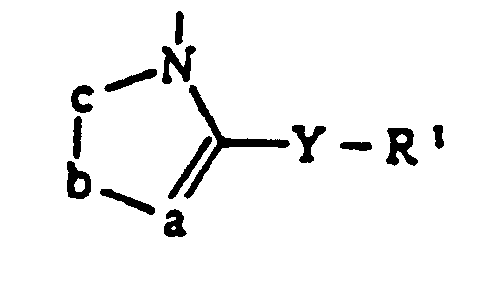
X is a direct bond between the phenylene group and the phenyl group; n is 1, which has antagonistic action to angiotensin II and (B) an oily substance selected from hydrocarbon, higher fatty acid selected from capric acid, lauric acid, myristic acid, palmitic acid, stearic acid, arachidinic acid, behenic acid, lignoceric acid, cerotic acid and a mixture of them, higher alcohol selected from lauryl alcohol, myristyl alcohol, cetyl alcohol, stearyl alcohol, aralkyl alcohol and a mixture of them, fatty acid ester of polyhydric alcohol, higher alcohol ether of polyhydric alcohol selected from ethers formed by etherification of a polyhydric alcohol with a higher fatty acid alcohol, selected from cetyl alcohol, stearyl alcohol, oleyl alcohol, octyl alcohol and decyl alcohol, polyoxyethylene lauryl alcohol ether, polyoxyethylene cetyl alcohol ether, polyoxyethylene stearyl alcohol ether, polyoxyethylene oleyl alcohol ether, polyoxyethylene octyl alcohol ether, polyoxyethylene decyl alcohol ether, polyoxypropylene polyoxyethylene cetyl alcohol ether, polyoxypropylene polyoxyethylene stearyl alcohol ether, polyoxypropylene polyoxyethylene oleyl alcohol ether, polyoxypropylene polyoxyethylene octyl alcohol ether and polyoxypropylene polyoxyethylene lauryl alcohol ether and a polymer or copolymer of alkylene oxide, and - (2) further object of the present invention is to provide a method for preparing a pharmaceutical composition for oral use as defined above, which comprises admixing the compound of the formula (I) with an oleaginous substance having a lower melting point and then subjecting the mixture to molding.
-
- Referring to the formula (I), R3 is tetrazolyl.
X is a chemical bond between the phenylene group and the phenyl group.
n denotes an integer of 1. - The N-containing heterocyclic residues
are specifically defined as follows. Incidentally, in the following formulae, R1 is hydrogen or an optionally substituted hydrocarbon residue; and Y is a bond, -O-, -S(O)m- (where m denotes 0, 1 or 2) or -N(R4)- (where R4 is hydrogen or an optionally substituted alkyl group). Among them, R1 is preferably a lower (C1-5) alkyl (preferably a lower (C2-3) alkyl) optionally substituted with hydroxyl group, amino group, halogen or a lower (C1-4) alkoxy group; and Y is preferably a bond, -O-, -S- or -N(R4)- (wherein R4 stands for hydrogen or a lower (C1-4) alkyl). - include the following:
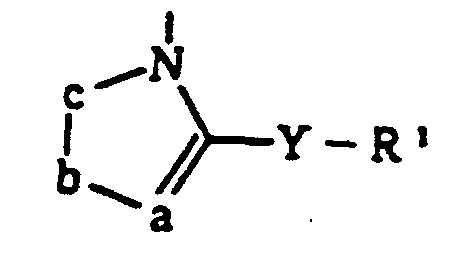 wherein h and h' each shows >CH2, >=O, or >=S.
- Among the compound represented by the formula (I) having antagonistic action to angiotensin II, those with a crystalline structure having the melting point of 100 to 200°C, especially 130 to 180°C are conveniently employed from the viewpoint of stability.
- Among the oily substances, any one can be used, so long as it is oily and has the melting point of about 20 to 90°C, preferably 20 to 60°C and exerts no undesirable influence on the active component. The above oily substances may be more evenly admixed with the active component in preparation of pharmaceutical compositions for oral use of the present invention so that more stable compositions are produced, as compared with use of an oily substance having a higher melting point. Furthermore, among them, any one may be soluble or unsoluble in water. Here, an example of the oily substances which is soluble in water is a polymer of alkylene oxide, as mentioned below.
- Examples of these substances include hydrocarbon, higher fatty acid, higher alcohol, fatty acid ester of polyhydric alcohol, higher alcohol ether of polyhydric alcohol, and polymer or copolymer of alkylene oxide. Among them, fatty acid ester of polyhydric alcohol, higher alcohol ether of polyhydric alcohol, polymer or copolymer of alkylene oxide, especially polymer of alkylene oxide, are preferably employed.
- Examples of hydrocarbon include C17-50 n-alkane such as n-heptadecane, n-octadecane, n-nonadecane, n-eicosane, n-heneicosane, n-docosane, n-tricosane, n-tetracosane, n-pentacosane, n-triacontane, n-pentatriacontane, n-tetracontane and n-pentacontane, as well as a mixture of them (petrolatum, paraffin wax, microcrystalline wax, etc.).
- Higher fatty acids are capric acid, lauric acid, myristic acid, palmitic acid, stearic acid, arachidinic acid, behenic acid, lignoceric acid, cerotic acid and a mixture of them.
- Higher alcohols are lauryl alcohol, myristyl alcohol, cetyl alcohol, stearyl alcohol, aralkyl alcohol and a mixture of them.
- Examples of fatty acid ester of polyhydric alcohol include esters formed by esterification of an alcohol having two or more hydroxyl groups in the molecule (for example, alkylene glycols such as ethylene glycol and propylene glycol; polyalkylene glycols such as polyethylene glycol, polypropylene glycol or copolymers of them; sugars such as sorbitol, sucrose and raffinose; intramolecular dehydrates such as 1,5-sorbitan, 1,4-sorbitol and 3,6-sorbitan; glycerin, diethanolamine, pentaerythritol, etc.) with a fatty acid (for example, acetic acid, propionic acid, butyric acid, pelargonic acid, capric acid, undecyclic acid, lauric acid, tridecylic acid, myristic acid, pentadecylic acid, palmitic acid, heptadecylic acid, stearic acid, nonadecanoic acid, undecylenic acid, oleic acid, elaidic acid, sorbic acid, linoleic acid, linolenic acid, arachidonic acid, stearolic acid, etc.), more specifically, sorbitan fatty acid esters having a molecular weight of 400 to 900, such as sorbitan monostearate, sorbitan tristearate, sorbitan monooleate, sorbitan sesquioleate or sorbitan monopalmitate; polyoxyalkylene sorbitan fatty acid esters having a molecular weight of 1000 to 1500, such as polyoxyethylene sorbitan tristearate, polyoxyethylene sorbitan monooleate or polyoxyethylene sorbitan tripalmitate; polyoxyalkylene sorbitol fatty acid esters, such as polyoxyethylene sorbitol hexastearate, polyoxyethylene sorbitol hexaoleate, polyoxyethylene sorbitol tristearate or polyoxyethylene sorbitol tetralaurate; polyoxyalkylene sorbitol bees wax derivatives such as polyoxyethylene sorbitol bees wax derivatives; polyoxyalkylene hydrous lanolin derivatives such as polyoxyehtylene hydrous lanolin derivatives; propylene glycol fatty acid esters having a molecular weight of 200 to 700 such as propylene glycol monopalmitate, propylene glycol monostearate, propylene glycol dilaurate, propylene glycol dimyristate, propylene glycol dipalmitate or propylene glycol distearate; alkylene glycol fatty acid esters including ethylene glycol fatty acid ester having a molecular weight of 500 to 1200, such as ethylene glycol monolaurate, ethylene glycol palmitate, ethylene glycol margarate, ethylene glycol stearate, ethylene glycol dilaurate, ehtylene glycol dimyristate, ethylene glycol dipalmitate or ethylene glycol dimargarate; polyoxyethylene castor oil derivatives having a molecular weight of 3500 to 4000, such as polyoxyethylene castor oil derivatives; polyoxyalkylene fatty acid esters having a molecular weight of 1900 to 2200, such as polyoxyethylene stearate, polyoxyethylene oleate, polyoxyethylene palmitate or polyoxyethylene linolate; glycerine monofatty acid esters having a molecular weight of 300 to 600, such as glycerine monoacetate, glycerine monopropionate, glycerine monostearate, glycerine monooleate, glycerine monopalmitate or glycerine monolinolate; and sucrose fatty acid esters having a molecular weight of 400 to 1300, such as sucrose monolaurate, sucrose monomyristate, sucrose monopalminate, sucrose monostearate, sucrose trimyristate, sucrose tripalmitate or sucrose tristearate.
- Higher alcohol esters of polyhydric alcohol are ethers formed by etherification of a polyhydric alcohol (set forth as alcohol components of the fatty acid ester of polyhydric alcohol mentioned above) with a higher fatty acid alcohol (for example, cetyl alcohol, stearyl alcohol, oleyl alcohol, octyl alcohol or decyl alcohol), more specifically, polyoxyethylene higher alcohol ethers such as polyoxyethylene lauryl alcohol ether, polyoxyethylene cetyl alcohol ether, polyoxyethylene stearyl alcohol ether, polyoxyethylene oleyl alcohol ether, polyoxyethylene octyl alcohol ether or polyoxyethylene decyl alcohol ether; and polyoxypropylene polyoxyethylene higher alcohol ethers such as polyoxypropylene polyoxyethylene cetyl alcohol ether, polyoxypropylene polyoxyethylene stearyl alcohol ether, polyoxypropylene polyoxyethylene oleyl alcohol ether, polyoxypropylene polyoxyethylene octyl alcohol ether or polyoxypropylene polyoxyethylene lauryl alcohol ether are generally used.
- As the polymer of alkylene oxide, use is made of those having a molecular weight of 1,000 to 10,000 (e.g. polyethylene glycol 6000). Examples of the alkylene oxide include ethylene oxide, propylene oxide, trimethylene oxide and tetrahydrofuran (preferably ethylene oxide).
- As the copolymer of alkylene oxide, use is made of copolymers of two or more species of the above-mentioned alkylene oxides, having a molecular weight of 1,000 to 10,000.
- These substances may be used singly or as a mixture of two or more of them.
- These substances are added to the active component in a solid or liquid state.
- The present invention is more conveniently applied to a solid composition (e.g. granules and tablets, preferably tablets) prepared by molding (e.g. granulation or molding under elevated pressure).
- Preparation of a solid composition of the present invention is usually conducted by incorporating such an oleaginous substance having a lower melting point into the active component, followed by subjecting the mixture to molding. The incorporation is conducted by a method conventionally employed in the field of pharmaceutical preparations, for example, mixing, massing, kneading, sieving and stirring. For example, an oily substance having a lower melting point is directly added to the active component and to make a mixture (addition in powdery state), or a solvent is added the mixture, followed by conventional granulating and drying. Alternatively, an oily substance having a lower melting point is dissolved in an adequate solvent, then the solution is mixed with the active component, followed by conventional kneading, granulating and drying (addition in liquid state). Further, a liquid material containing an oleaginous substance having a lower melting point and a liquid material containing the active component can be independently sprayed onto a powdery material such as an excipient, followed by mixing the resultant material. In the case of "addition in liquid state", any solvent which does not exert undesirable influence on the active component, for example, water, dimethylformamide, acetone, ethanol, propyl alcohol, isopropyl alcohol, butyl alcohol, methylene chloride and trichloroethane, can be employed. After completing the blending, the material is subjected to a conventional molding process under elevated pressure to prepare tablets containing the active component. The molding under elevated pressure means that a material is compressed under elevated pressure into a desired form, and it refers to, most generally, tabletting. Incorporation of such an oily substance having a lower melting point as described above serves to minimize crystalline disorder possibly caused in the steps of kneading, granulating and molding under elevated pressure, and is considered to further serve advantageously to improve the moldability and to lower the pressure to be elevated. And, in the method of preparing the composition of this invention, a variety of additives to be employed for solid compositions can be added in an adequate step. These additives are exemplified by excipients such as crystalline cellulose (e.g. Avicel PH 101 (manufactured by Asahi Chemical Industry Co., Ltd.)), carboxymethyl cellulose calcium, corn starch, wheat starch, lactose, sucrose, glucose, calcium sulfate, calcium phosphate or sodium chloride, binders such as gum arabic, gelatin, methyl cellulose, polyvinyl pyrrolidone, hydroxypropyl cellulose (hereinafter sometimes abbreviated as HPC) or hydroxypropylmethyl cellulose, lubricants such as magnesium stearate, talc, synthetic aluminum silicate, sodium lauryl sulfate, boric acid, magnesium oxide or paraffin, colorants, flavoring agents, odor-improving agents, etc. Incidentally, in the case of using such a crystalline compound whose specific gravity is relatively small as the formula (V), it is desirable to have the compound dispersed in advance in a thick liquid containing such a binder as HPC and water. Furthermore, the composition of this invention may be prepared into coated tablets as well.
- The coating may be conducted by a per se known method. As coating agents, use is made of conventional ones (e.g. hydroxylpropylmethyl cellulose, hydroxylpropyl cellulose, methyl cellulose and polyvinyl pyrrolidone), and as auxiliary agents for coating, use is made of, for example, polyethylene glycol 6000, polysorbate (e.g. Tween ® 80), titanium oxide, and pigments such as red iron oxide.
- In the stabilized pharmaceutical composition for oral use in the present invention prepared by admixing an oily substance having a lower melting point with the active component, the amount of the oleaginous substance is 0.005 to 0.15 weight, preferably 0.01 to 0.1 weight, more preferably 0.02 to 0.05 weight per 1 weight of the composition, and the amount of the active component is 0.001 to 0.15 part by weight, preferably 0.007 to 0.09 part by weight, more preferably 0.015 to 0.04 part by weight per 1 part of the composition by weight.
- Also, the stabilized pharmaceutical compostition for oral use in the present invention is desirable to disintegrate in an aqueous solution with 30 minutes.
- In the orally administrable pharmaceutical composition thus prepared by incorporating an oily substance having a lower melting point into the active component, decomposition with day possibly caused by compression can be suppressed to provide a stable composition. In the case of using the pharmaceutical composition of this invention for the therapy of hypertension, cardiac diseases, cerebral apoplexy or renal diseases of mammals (e.g. man, dog, rabbit or rat), it can be administered orally as tablets. The dosage ranges from about 1 to 50 mg, preferably from about 2 to 30 mg per day in terms of the active component (e.g. the compound of the formula (I) having antagonistic action to angiotensin II).
- For a more complete understanding of the instant invention, reference is made to the following illustrative examples. The examples are carried out with the compound of formula Vor the compounds named in the specific example and thus are reference examples.

- In a fluid-bed granulator (Powrex, FD-3S), in accordance with the following formulation, polyethylene glycol 6000 as the oleaginous substance having a lower melting point was mixed with other ingredients including the compound having antagonistic action to angiotensin II (the active component). Onto the mixture was sprayed an aqueous solution of hydroxypropyl cellulose as the binder, which was granulated and dried to give granules. To the granules was added carboxylmethylcellulose calcium and magnesium stearate, and the mixture was tabletted by a tablet machine (Kikusui Seisakusho, Correct 19K) using punches (7.0 mm in diameter) of bevelled edge at a weight of 130 mg under a pressure of 1.9*108 Pa (2.0 ton/cm2). The tablets thus prepared were stored at 50°C or 40°C and subjected to stability test.
Formulation Materials Sample Control A B the formula (V) 1.0 mg 1.0 mg Lactose 93.0 99.0 Corn starch 20.0 20.0 Polyethylene glycol 6000 6.0 - Hydroxypropyl cellulose 4.0 4.0 (water) (0.135 ml) (0.135 ml) Sub-total 124.0 mg 124.0 mg Carboxylmethylcellulose-calcium 5.6 5.6 Magnesium stearate 0.4 0.4 Total 130.0 mg 130.0 mg Results of stability test Item Sample Control A B At the initial time of test (hereinafter simply written as "initial") (100) (100) Residual ratio after storing at 50°C for 4 weeks 99.3 89.7 Residual ratio after storing at 40°C for 8 weeks 99.8 94.8 - The stability test was conducted by determining the content of the formula (V) after storing the respective periods by liquid chromatography, and the residual ratios were shown by percent. As the control, the composition (B) containing no stabilizing agent (an oily substance having a lower melting point) was employed, and the test was conducted by comparing it with the composition (A) containing polyethylene glycol 6000 as the oily substance having a lower melting point. As is clear from the test results, the composition of this invention is excellent in stability as compared with the control.
- In a fluid-bed granulator (Glatt WSG-15®), in accordance with the same formulation as in Example 1, polyethylene glycol 6000 as the oily substance having a lower melting point was dissolved in water, in which the formula (V) was dispersed, then the dispersion was sprayed on a powder mixture of lactose and corn starch. The resultant material was further sprayed with an aqueous solution of hydroxypropyl cellulose, which was granulated and dried to give granules. The granules were mixed with carboxylmethylcellulose calcium and magnesium stearate respectively, and the mixture was tabletted by a tablet machine using punches (7.0 mm in diameter) of bevelled edge at a weight of 130 mg under a pressure of 1.9*108 Pa (2.0 ton/cm2).
Test results of stability Item Sample Control A B Initial (100) (100) Residual ratio after storing at 50°C for one week 99.0 89.0 Residual ratio after storing at 40°C for 4 weeks 99.8 91.1 - From the test results, it is understood that, in the composition of this invention, the formula (V) is remarkably stable as compared with that in the control.
- In a fluid-bed granulator (Powrex FD-5S), in accordance with the same formulation as in Example 1, an aqueous solution of polyethylene glycol 6000 as the oily substance having a lower melting point was sprayed onto a powder mixture of lactose and corn starch. The resultant material was further sprayed with a dispersion of the formula (V) in an aqueous solution of hydroxypropyl cellulose, which was granulated and dried to give granules. The granules were mixed with carboxylmethylcellulose calcium and magnesium stearate respectively, and the mixture was tabletted by a tablet machine (Kikusui Seisakusho, Correct 19K) using punches of shallow concave (7.0 mm in diameter) at a weight of 130 mg under a pressure of 1.9*108 Pa (2.0 ton/cm2).
- Further, in accordance with the following formulation of aqueous coating tablets, the aqueous coating (5 mg) was performed by Accelacoater (Manesty Co., Ltd., Great Britain) using hydroxypropylmethyl cellulose.
Formulation Materials per tablet Core tablet 130.0 mg Hydroxypropylmethyl cellulose 3.50 mg Polyethylene glycol 6000 0.75 mg Titanium oxide 0.75 mg (water) (0.05 ml) Total 135.0 mg Results of stability test Item Sample Control A B Initial (100) (100) Residual ratio after storing at 50°C for 4 weeks 99.4 88.4 Residual ratio after storing at 40°C for 8 weeks 100.0 90.2 - From the results of the test, it is understood that, in the composition of this invention, the formula (V) is remarkably stable as compared with that in the control.
- In a granulator equipped with stirrer (Powrex, vertical granulator VG10), the formula (V) was dispersed in an aqueous solution of polyethylene glycol 6000 as the oily substance having a lower melting point and HPC. This dispersion was added to a powder mixture of lactose and corn starch, which was granulated and dried to give granules, followed by addition of carboxymethylcellulose calcium and magnesium stearate respectively. The mixture was tabletted by a tablet machine using punches of bevelled edge (7.0 mm in diameter) at a weight of 130 mg under a pressure of 1.9*108 Pa (2.0 ton/cm2).
Formulation Materials Sample Control A B the formula (V) 10.0 mg 10.0 mg Lactose 84.0 90.0 Corn starch 20.0 20.0 Polyethylene glycol 6000 6.0 - Hydroxypropyl cellulose 4.0 4.0 (water) (0.024 ml) (0.024 ml) Sub-total 124.0 mg 124.0 mg Carboxylmethylcellulose-calcium 5.6 5.6 Magnesium stearate 0.4 0.4 Total 130.0 mg 130.0 mg Results of stability test Item Sample Control A B Initial (100) (100) Residual ratio after storing at 50°C for 4 weeks 99.1 87.2 Residual ratio after storing at 40°C for 8 weeks 99.5 89.7 - From the results of the test, it is understood that, in the composition of this invention, the formula (V) is remarkably stable as compared with that in the control.
- In substantially the same manner as in Example 1, tablets were prepared under the formulation as shown in the following Table 1. These tablets were subjected to the test of stability in substantially the same manner as in Example 1. The results are shown in Table 2.
Formulation Materials Samples Control A B C D E the formula (V) 1.0 mg 1.0 mg 1.0 mg 1.0 mg 1.0 mg Lactose 98.0 89.0 93.0 93.0 99.0 Corn starch 20.0 20.0 20.0 20.0 20.0 Stearyl alcohol 1.0 10.0 - - - Sucrose fatty acid ester - - 6.0 - - Sorbitan fatty acid ester - - - 6.0 - Hydroxy propyl cellulose 4.0 4.0 4.0 4.0 4.0 (Water) (0.135 ml) (0.135) (0.135) (0.135) (0.135) Sub-total 124.0 mg 124.0 124.0 124.0 124.0 Carboxymethyl cellulose calcium 5.6 5.6 5.6 5.6 5.6 Magnesium stearate 0.4 0.4 0.4 0.4 0.4 Total 130.0 mg 130.0 130.0 130.0 130.0 Results of stability test Item Samples Control A B C D E Initial (100) (100) (100) (100) (100) Residual ratio after storing at 50°C for 4 weeks 99.0 99.4 98.9 99.1 89.7 Residual ratio after storing at 40°C for 4 weeks 99.2 100.0 99.3 99.6 94.8 - From the above test results, it is understood that the compostition of this invention in which an oily substance having a relatively low melting point is excellent in the stability of the formula (V) contained therein.
- In substantially the same manner as in Example 1, tablets can be prepared under the formulations as shown in the following Table 3.
Formulation Materials Samples A B C D 2-ethoxy-1-[[2'-(1H-tetrazol-5-yl)biphenyl-4-yl]methyl]benzimidazole-7-carboxylic acid 1,0mg - - - 2-butyl-1-[[2'-(1H-tetrazol-5-yl)biphenyl-4-yl]methyl]benzimidazole-7-carboxylic acid - 1.0 - - 1-(cyclohexyloxycarbonyloxy)ethyl 2-butyl-1-[[2'-(1H-tetrazol-5-yl)biphenyl-4-yl]methyl]benzimidazole-7-carboxylate - - 1.0 - pivaloyloxymethyl 2-butyl-1-[[2'-(1H-tetrazol-5-yl)biphenyl-4-yl]-methyl]benzimidazole-7-carboxylate - - - 1.0 Lactose 93.0 93.0 93.0 93.0 Corn starch 20.0 20.0 20.0 20.0 Polyethylene glycol 6000 6.0 6.0 6.0 6.0 Hydroxypropyl cellulose 4.0 4.0 4.0 4.0 (Water) (0.135ml) (0.135ml) (0.135ml) (0.135ml) Sub-total 124.0mg 124.0mg 124.0mg 124.0mg Carboxylmethylcellulose calcium 5.6 5.6 5.6 5.6 Magnesium stearate 0.4 0.4 0.4 0.4 Total 130.0mg 130.0mg 130.0mg 130.0mg - According to the present invention, orally administrable stable pharmaceutical compositions, in which decomposition of the active component is suppressed to maintain its high content ratio even after the lapse of days, can be provided, by having the active components incorporated with an oily substance whose melting point is relatively low.
Claims (7)
- A solid pharmaceutical composition for oral use, which comprises (A) an effective amount of a compound of the formula:wherein in the N-containing heterocyclic residue represented by the formula:
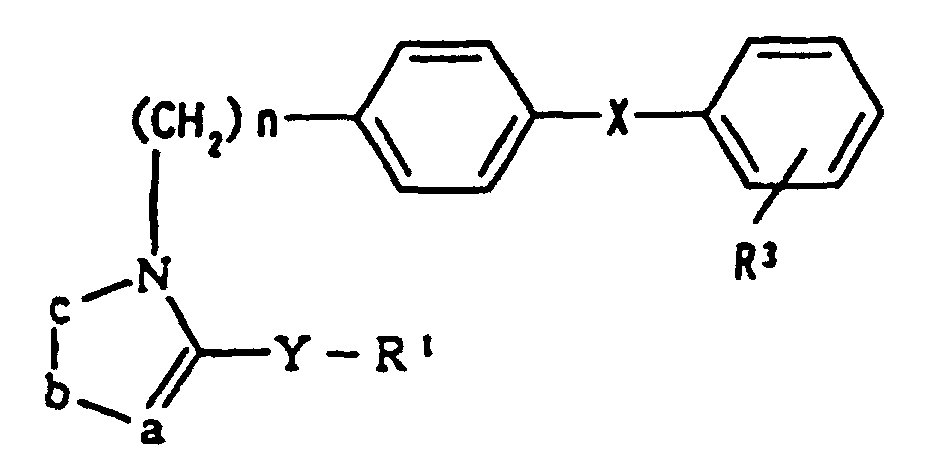 a represents nitrogen atom; b and c independently represent optionally substituted carbon atoms; which N-containing heterocyclic residue may be substituted, besides Y-R1; R1 is hydrogen or an optionally substituted hydrocarbon residue; Y is a bond, -O-, -S(O)m-, wherein m denotes 0, 1 or 2, or -N(R4)-, where R4 is hydrogen or an optionally substituted alkyl group; R3 is tetrazolyl;
X is a direct bond between the phenylene group and the phenyl group; n is 1, which has antagonistic action to angiotensin II and (B) an oily substance selected from hydrocarbon, higher fatty acid selected from capric acid, lauric acid, myristic acid, palmitic acid, stearic acid, arachidinic acid, behenic acid, lignoceric acid, cerotic acid and a mixture of them, higher alcohol selected from lauryl alcohol, myristyl alcohol, cetyl alcohol, stearyl alcohol, aralkyl alcohol and a mixture of them, fatty acid ester of polyhydric alcohol, higher alcohol ether of polyhydric alcohol selected from ethers formed by etherification of a polyhydric alcohol with a higher fatty acid alcohol, selected from cetyl alcohol, stearyl alcohol, oleyl alcohol, octyl alcohol and decyl alcohol, polyoxyethylene lauryl alcohol ether, polyoxyethylene cetyl alcohol ether, polyoxyethylene stearyl alcohol ether, polyoxyethylene oleyl alcohol ether, polyoxyethylene octyl alcohol ether, polyoxyethylene decyl alcohol ether, polyoxypropylene polyoxyethylene cetyl alcohol ether, polyoxypropylene polyoxyethylene stearyl alcohol ether, polyoxypropylene polyoxyethylene oleyl alcohol ether, polyoxypropylene polyoxyethylene octyl alcohol ether and polyoxypropylene polyoxyethylene lauryl alcohol ether and a polymeror copolymer of alkylene oxide. - A composition according to claim 1, wherein the compound of the formula as defined in claim 1 is a crystalline substance having a melting point of 100 to 200°C.
- A composition according to claim 1, wherein the melting point of the oily substance ranges from about 20 to 90°C.
- A composition according to claim 1, wherein the oily substance is a polymer of alkylene oxide.
- A composition according to claim 1, wherein the amount of the oily substance is less than 0.1 part by weight per 1 part of the composition by weight.
- A composition according to claim 1, which is a tablet.
- A method for preparing a pharmaceutical composition for oral use, which comprises (A) an effective amount of a compound of the formula
as defined in claim 1, and (B) an oily substance as defined in claim 1, which comprises admixing the compound of the formula as defined in claim 1 with said oily substance and then subjecting the mixture to molding.
Priority Applications (1)
| Application Number | Priority Date | Filing Date | Title |
|---|---|---|---|
| EP04013762A EP1468683A3 (en) | 1991-11-20 | 1992-11-19 | Pharmaceutical composition for oral use with angiotensin-II-antagonistic activity and method of preparing it |
Applications Claiming Priority (4)
| Application Number | Priority Date | Filing Date | Title |
|---|---|---|---|
| JP304924/91 | 1991-11-20 | ||
| JP30492491 | 1991-11-20 | ||
| JP30492491 | 1991-11-20 | ||
| EP92119705A EP0546358B1 (en) | 1991-11-20 | 1992-11-19 | Pharmaceutical compositions with angiotensin-II-antagonistic activity |
Related Parent Applications (2)
| Application Number | Title | Priority Date | Filing Date |
|---|---|---|---|
| EP92119705A Division EP0546358B1 (en) | 1991-11-20 | 1992-11-19 | Pharmaceutical compositions with angiotensin-II-antagonistic activity |
| EP92119705.9 Division | 1992-11-19 |
Related Child Applications (1)
| Application Number | Title | Priority Date | Filing Date |
|---|---|---|---|
| EP04013762A Division EP1468683A3 (en) | 1991-11-20 | 1992-11-19 | Pharmaceutical composition for oral use with angiotensin-II-antagonistic activity and method of preparing it |
Publications (2)
| Publication Number | Publication Date |
|---|---|
| EP0782852A1 EP0782852A1 (en) | 1997-07-09 |
| EP0782852B1 true EP0782852B1 (en) | 2004-09-29 |
Family
ID=17938952
Family Applications (3)
| Application Number | Title | Priority Date | Filing Date |
|---|---|---|---|
| EP04013762A Withdrawn EP1468683A3 (en) | 1991-11-20 | 1992-11-19 | Pharmaceutical composition for oral use with angiotensin-II-antagonistic activity and method of preparing it |
| EP92119705A Expired - Lifetime EP0546358B1 (en) | 1991-11-20 | 1992-11-19 | Pharmaceutical compositions with angiotensin-II-antagonistic activity |
| EP96118520A Expired - Lifetime EP0782852B1 (en) | 1991-11-20 | 1992-11-19 | Pharmaceutical compositions of heterocyclic angiotensin-II antagonists and oily substances for oral use and method of preparing them |
Family Applications Before (2)
| Application Number | Title | Priority Date | Filing Date |
|---|---|---|---|
| EP04013762A Withdrawn EP1468683A3 (en) | 1991-11-20 | 1992-11-19 | Pharmaceutical composition for oral use with angiotensin-II-antagonistic activity and method of preparing it |
| EP92119705A Expired - Lifetime EP0546358B1 (en) | 1991-11-20 | 1992-11-19 | Pharmaceutical compositions with angiotensin-II-antagonistic activity |
Country Status (18)
| Country | Link |
|---|---|
| US (1) | US5534534A (en) |
| EP (3) | EP1468683A3 (en) |
| KR (1) | KR100256633B1 (en) |
| CN (1) | CN1047518C (en) |
| AT (2) | ATE277602T1 (en) |
| AU (1) | AU659691B2 (en) |
| BR (1) | BR1100336A (en) |
| CA (1) | CA2083305C (en) |
| DE (2) | DE69233424T2 (en) |
| DK (1) | DK0546358T3 (en) |
| ES (1) | ES2104797T3 (en) |
| FI (2) | FI111604B (en) |
| GR (1) | GR3025338T3 (en) |
| HU (1) | HU211608A9 (en) |
| MX (1) | MX9206634A (en) |
| NO (1) | NO304408B1 (en) |
| NZ (1) | NZ245175A (en) |
| TW (1) | TW284688B (en) |
Cited By (1)
| Publication number | Priority date | Publication date | Assignee | Title |
|---|---|---|---|---|
| EP2165702A1 (en) | 2008-09-17 | 2010-03-24 | Helm AG | Stable and readily dissolved compositions of candesartan cilexetil prepared with wet granulation |
Families Citing this family (51)
| Publication number | Priority date | Publication date | Assignee | Title |
|---|---|---|---|---|
| TW284688B (en) * | 1991-11-20 | 1996-09-01 | Takeda Pharm Industry Co Ltd | |
| TW272942B (en) * | 1993-02-10 | 1996-03-21 | Takeda Pharm Industry Co Ltd | |
| CA2125251C (en) * | 1993-06-07 | 2005-04-26 | Yoshiyuki Inada | A pharmaceutical composition for angiotensin ii-mediated diseases |
| US5753672A (en) * | 1994-04-19 | 1998-05-19 | Tanabe Seiyaku Co., Ltd. | Imidazopyridine derivatives and process for preparing the same |
| AU679616B2 (en) * | 1994-04-19 | 1997-07-03 | Tanabe Seiyaku Co., Ltd. | Imidazopyridine derivatives and process for preparing the same |
| TW418204B (en) * | 1997-03-28 | 2001-01-11 | Dev Center Biotechnology | Novel 1,2,4-triazine-5-ketonyl benzene derivatives and the analogs, the preparation, and the pharmaceutical compositions as angiotension II receptor antogonists |
| US6297239B1 (en) | 1997-10-08 | 2001-10-02 | Merck & Co., Inc. | Inhibitors of prenyl-protein transferase |
| ES2214013T3 (en) * | 1998-03-04 | 2004-09-01 | Takeda Chemical Industries Ltd | PREPARATION OF SUSTAINED RELEASE FOR AN ANTAGONIST OF AII, ITS PRODUCTION AND USE. |
| US7115644B2 (en) * | 2002-09-13 | 2006-10-03 | Boehringer Ingelheim Pharmaceuticals Inc. | Heterocyclic compounds |
| US20050031683A1 (en) * | 2003-08-04 | 2005-02-10 | Ashish Kapoor | Solid pharmaceutical composition |
| US7098342B2 (en) * | 2003-10-16 | 2006-08-29 | Teva Pharmaceutical Industries Ltd. | Preparation of candesartan cilexetil |
| US20050175689A1 (en) * | 2003-10-27 | 2005-08-11 | Yamanouchi Pharmaceutical Co., Ltd. | Coated fine particles containing drug for intrabuccally fast disintegrating tablet |
| WO2005070398A2 (en) * | 2004-01-23 | 2005-08-04 | Ranbaxy Laboratories Limited | Pharmaceutical compositions of candesartan cilexetil stabilized with co-solvents |
| WO2005079751A2 (en) * | 2004-01-23 | 2005-09-01 | Ranbaxy Laboratories Limited | Oral pharmaceutical compositions of candesartan cilexetil |
| WO2005077941A2 (en) * | 2004-02-11 | 2005-08-25 | Teva Pharmaceutical Industries Ltd. | Candesartan cilexetil polymorphs |
| EP1729766A1 (en) | 2004-03-01 | 2006-12-13 | LEK Pharmaceuticals D.D. | Pharmaceutical formulation |
| MXPA06010908A (en) * | 2004-03-25 | 2006-12-15 | Astellas Pharma Inc | Composition for solid pharmaceutical preparation of solifenacin or salt thereof. |
| CN1953973A (en) * | 2004-05-05 | 2007-04-25 | 特瓦制药工业有限公司 | Preparation of candesartan cilexetil in high purity |
| US7588779B2 (en) * | 2004-05-28 | 2009-09-15 | Andrx Labs, Llc | Pharmaceutical formulation containing a biguanide and an angiotensin antagonist |
| AU2005320672B2 (en) * | 2004-12-27 | 2011-01-06 | Astellas Pharma Inc. | Stable particulate pharmaceutical composition of solifenacin or salt thereof |
| US20060165806A1 (en) * | 2005-01-06 | 2006-07-27 | Elan Pharma International Limited | Nanoparticulate candesartan formulations |
| JP2007527925A (en) * | 2005-01-14 | 2007-10-04 | テバ ファーマシューティカル インダストリーズ リミティド | Preparation of crude candesartan cilexetil |
| WO2006079496A1 (en) * | 2005-01-26 | 2006-08-03 | Lek Pharmaceuticals D.D. | New pharmaceutical composition containing candesartan cilexetil as lipophilic crystalline substance |
| JP2008505935A (en) * | 2005-05-10 | 2008-02-28 | テバ ファーマシューティカル インダストリーズ リミティド | Ultra finely ground stable candesartan cilexetil and process for its preparation |
| US7815939B2 (en) * | 2005-07-20 | 2010-10-19 | Astellas Pharma Inc. | Coated fine particles containing drug for intrabuccally fast disintegrating dosage forms |
| WO2007126135A1 (en) * | 2006-04-27 | 2007-11-08 | Takeda Pharmaceutical Company Limited | Pharmaceutical composition of angiotensin ii antagonists with pioglitazone hcl |
| GEP20125420B (en) * | 2006-08-10 | 2012-03-26 | Takeda Pharmaceutical | Solid pharmaceutical composition comprising benzimidazole compound |
| WO2008045006A1 (en) * | 2006-10-11 | 2008-04-17 | Fako Ilaclari A. S. | Formulations of candesartan |
| ES2301401B1 (en) * | 2006-11-28 | 2009-06-08 | Laboratorios Liconsa S.A. | STABILIZED SOLID PHARMACEUTICAL COMPOSITION OF CANDESARTAN CILEXETILO. |
| EP1952806A1 (en) | 2007-02-01 | 2008-08-06 | Helm AG | Process for the preparation of adsorbates of candesartan |
| DE602008002371D1 (en) * | 2007-03-08 | 2010-10-14 | Teva Pharma | PHARMACEUTICAL COMPOSITION WITH CANDESARTAN CILEXETIL |
| AR065850A1 (en) * | 2007-03-28 | 2009-07-08 | Takeda Pharmaceutical | SOLID PHARMACEUTICAL COMPOSITION INCLUDING A BENZIMIDAZOL-7-CARBOXYLATE DERIVATIVE AND A PH CONTROL AGENT |
| MX2009011493A (en) | 2007-04-25 | 2009-11-09 | Teva Pharma | Pharmaceutical excipient complex. |
| WO2008149338A2 (en) * | 2007-06-06 | 2008-12-11 | Dexcel Ltd. | Process for forming solid oral dosage forms of angiotensin ii receptor antagonists |
| DE102007052070A1 (en) | 2007-10-30 | 2009-05-07 | Tiefenbacher Pharmachemikalien Alfred E. Tiefenbacher Gmbh & Co. Kg | candesartancilexetil |
| WO2010075347A2 (en) | 2008-12-23 | 2010-07-01 | Takeda Pharmaceutical Company Limited | Methods of treating hypertension with at least one angiotensin ii receptor blocker and chlorthalidone |
| ES2364011B1 (en) | 2009-11-20 | 2013-01-24 | Gp Pharm, S.A. | CAPSULES OF PHARMACEUTICAL ACTIVE AND ESTERS OF POLYINSATURATED FATTY ACIDS FOR THE TREATMENT OF CARDIOVASCULAR DISEASES. |
| ES2616238T3 (en) | 2010-10-06 | 2017-06-12 | Glaxosmithkline Llc, Corporation Service Company | Benzimidazole derivatives as PI3 kinase inhibitors |
| CN102138920A (en) * | 2011-02-24 | 2011-08-03 | 海南中济医药科技有限公司 | Medicinal composition containing candesartan cilexetil and hydrochlorothiazide and preparation method thereof |
| CN102357095A (en) * | 2011-07-12 | 2012-02-22 | 迪沙药业集团有限公司 | Stable medicinal composition |
| GEP201706656B (en) | 2011-11-11 | 2017-04-25 | Pfizer | 2-thiopyrimidinones |
| EP2928468A4 (en) * | 2012-12-05 | 2016-07-27 | Sawai Seiyaku Kk | PREPARATION CONTAINING CANDÉSARTAN CILEXÉTIL |
| PL236001B1 (en) | 2012-12-21 | 2020-11-30 | Adamed Spolka Z Ograniczona Odpowiedzialnoscia | Complex pharmaceutical composition comprising candesartan cilexetil and amlodipine, its preparation method and the unit dosage form comprising said composition, |
| ES2768651T3 (en) | 2013-04-25 | 2020-06-23 | Kyorin Seiyaku Kk | Solid pharmaceutical composition |
| US20160168224A1 (en) * | 2013-06-11 | 2016-06-16 | Universidade Federal De Minas Gerais - Ufmg | Process for preparing amphiphilic peptide derivatives |
| FI3263110T3 (en) * | 2015-02-26 | 2023-07-25 | Takeda Pharmaceuticals Co | A tablet comprising a methoxyurea derivative and mannitol particles |
| MA42035A (en) | 2015-05-05 | 2018-03-14 | Pfizer | 2-THIOPYRIMIDINONES |
| CA3002144C (en) | 2015-10-16 | 2024-01-23 | Eisai R&D Management Co., Ltd. | Ep4 antagonists |
| CA3185151A1 (en) | 2020-05-29 | 2021-12-02 | Myovant Sciences Gmbh | Combination solid oral dosage forms of gonadotropin-releasing hormone antagonists |
| CN111617046A (en) * | 2020-07-09 | 2020-09-04 | 浙江诺得药业有限公司 | Azilsartan dispersible tablet and preparation process thereof |
| CN112957336A (en) * | 2021-03-03 | 2021-06-15 | 广州白云山天心制药股份有限公司 | Stable candesartan cilexetil medicinal solid composition and preparation method thereof |
Family Cites Families (22)
| Publication number | Priority date | Publication date | Assignee | Title |
|---|---|---|---|---|
| DE2251199C3 (en) * | 1972-10-19 | 1980-04-10 | Hoechst Ag, 6000 Frankfurt | Process for the preparation of tablets containing pyrazolones |
| NZ179623A (en) * | 1975-01-06 | 1978-03-06 | Ciba Geigy | Pharmaceutical preparation containing a beta-receptor blocking compound, a compound regulating thrombocyte function and optionally an alpha-receptor blocking compund |
| US4783334A (en) * | 1986-01-21 | 1988-11-08 | Chugai Seiyaku Kabushiki Kaisha | Stable solid preparation of thiol ester derivative |
| US4743450A (en) * | 1987-02-24 | 1988-05-10 | Warner-Lambert Company | Stabilized compositions |
| US4880804A (en) * | 1988-01-07 | 1989-11-14 | E. I. Du Pont De Nemours And Company | Angiotensin II receptor blocking benzimidazoles |
| JPH01308231A (en) * | 1988-06-03 | 1989-12-12 | Takeda Chem Ind Ltd | Stabilized pharmaceutical composition and production thereof |
| YU120988A (en) * | 1988-06-23 | 1990-06-30 | Lek Tovarna Farmacevtskih | Process for preparing new dispersion pills of cimetidine |
| SU1653780A1 (en) * | 1988-07-25 | 1991-06-07 | Piskov Vyacheslav B | Process for preparing liquid form of anthelintics from group of benzimidazoles using organic solvent |
| DE3928177A1 (en) * | 1989-04-08 | 1991-02-28 | Thomae Gmbh Dr K | BENZIMIDAZOLE, MEDICAMENTS CONTAINING THESE COMPOUNDS AND METHOD FOR THE PRODUCTION THEREOF |
| EP0400835A1 (en) * | 1989-05-15 | 1990-12-05 | Merck & Co. Inc. | Substituted benzimidazoles as angiotensin II antagonists |
| GB8911854D0 (en) * | 1989-05-23 | 1989-07-12 | Ici Plc | Heterocyclic compounds |
| DE69013607T2 (en) * | 1989-08-02 | 1995-03-02 | Takeda Chemical Industries Ltd | Pyrazole derivatives, process for their preparation and use. |
| IE70593B1 (en) * | 1989-09-29 | 1996-12-11 | Eisai Co Ltd | Biphenylmethane derivative the use of it and pharmacological compositions containing same |
| IL95975A (en) * | 1989-10-24 | 1997-06-10 | Takeda Chemical Industries Ltd | N-benzyl- 2-alkylbenzimidazole derivatives, their production and pharmaceutical compositions containing them |
| IL96019A0 (en) * | 1989-10-31 | 1991-07-18 | Fujisawa Pharmaceutical Co | Imidazole derivatives,processes for the preparation thereof and pharmaceutical compositions containing the same |
| EP0430300A3 (en) * | 1989-12-01 | 1992-03-25 | Takeda Chemical Industries, Ltd. | Xanthine derivatives, their production and use |
| EP0435827A3 (en) * | 1989-12-28 | 1991-11-13 | Ciba-Geigy Ag | Diaza compounds |
| US5162326A (en) * | 1990-02-15 | 1992-11-10 | Takeda Chemical Industries, Ltd. | Pyrimidinedione derivatives, their production and use |
| CA2037630C (en) * | 1990-03-07 | 2001-07-03 | Akira Morimoto | Nitrogen-containing heterocylic compounds, their production and use |
| CA2077897A1 (en) * | 1990-04-13 | 1991-10-14 | Robert G. Franz | Substituted benzimidazoles |
| US5196444A (en) * | 1990-04-27 | 1993-03-23 | Takeda Chemical Industries, Ltd. | 1-(cyclohexyloxycarbonyloxy)ethyl 2-ethoxy-1-[[2'-(1H-tetrazol-5-yl)biphenyl-4-yl]methyl]benzimidazole-7-carboxylate and compositions and methods of pharmaceutical use thereof |
| TW284688B (en) * | 1991-11-20 | 1996-09-01 | Takeda Pharm Industry Co Ltd |
-
1992
- 1992-11-09 TW TW081108934A patent/TW284688B/zh not_active IP Right Cessation
- 1992-11-13 AU AU28391/92A patent/AU659691B2/en not_active Expired
- 1992-11-16 NO NO924417A patent/NO304408B1/en not_active IP Right Cessation
- 1992-11-18 MX MX9206634A patent/MX9206634A/en unknown
- 1992-11-18 US US07/978,290 patent/US5534534A/en not_active Expired - Lifetime
- 1992-11-18 NZ NZ24517592A patent/NZ245175A/en not_active IP Right Cessation
- 1992-11-19 ES ES92119705T patent/ES2104797T3/en not_active Expired - Lifetime
- 1992-11-19 EP EP04013762A patent/EP1468683A3/en not_active Withdrawn
- 1992-11-19 DE DE69233424T patent/DE69233424T2/en not_active Expired - Lifetime
- 1992-11-19 CN CN92113172A patent/CN1047518C/en not_active Expired - Lifetime
- 1992-11-19 AT AT96118520T patent/ATE277602T1/en active
- 1992-11-19 EP EP92119705A patent/EP0546358B1/en not_active Expired - Lifetime
- 1992-11-19 AT AT92119705T patent/ATE157248T1/en active
- 1992-11-19 DE DE69221831T patent/DE69221831T2/en not_active Expired - Lifetime
- 1992-11-19 EP EP96118520A patent/EP0782852B1/en not_active Expired - Lifetime
- 1992-11-19 DK DK92119705.9T patent/DK0546358T3/en active
- 1992-11-19 FI FI925270A patent/FI111604B/en not_active IP Right Cessation
- 1992-11-19 CA CA002083305A patent/CA2083305C/en not_active Expired - Lifetime
- 1992-11-20 KR KR1019920021902A patent/KR100256633B1/en not_active Expired - Lifetime
-
1995
- 1995-06-29 HU HU95P/P00534P patent/HU211608A9/en unknown
-
1997
- 1997-04-23 BR BR1100336-7A patent/BR1100336A/en active IP Right Grant
- 1997-11-11 GR GR970402980T patent/GR3025338T3/en unknown
-
2003
- 2003-02-12 FI FI20030210A patent/FI20030210L/en unknown
Cited By (1)
| Publication number | Priority date | Publication date | Assignee | Title |
|---|---|---|---|---|
| EP2165702A1 (en) | 2008-09-17 | 2010-03-24 | Helm AG | Stable and readily dissolved compositions of candesartan cilexetil prepared with wet granulation |
Also Published As
Similar Documents
| Publication | Publication Date | Title |
|---|---|---|
| EP1468683A2 (en) | Pharmaceutical composition for oral use with angiotensin-II-antagonistic activity and method of preparing it | |
| US5055304A (en) | Stabilized pharmaceutical composition and method of producing same | |
| JP5361188B2 (en) | Pharmaceutical composition | |
| US20050042285A1 (en) | Stabilized composition comprising a benzimidazole type compound | |
| US20090208583A1 (en) | Tablets comprising candesartan cilexetil | |
| JP2682353B2 (en) | Oral pharmaceutical composition and method for producing the same | |
| JP2018154596A (en) | Azilsartan-containing solid pharmaceutical composition | |
| EP0348688B1 (en) | Solid pharmaceutical preparation and method of producing same | |
| US20030104049A1 (en) | Metformin Hydrochloride tablets | |
| CN110613692A (en) | Topiroxostat tablet and preparation method thereof | |
| JP5824222B2 (en) | Method for producing solid preparation | |
| US6737419B2 (en) | Benazepril hydrochloride tablet formulations | |
| US20090215756A1 (en) | Formulations containing losartan and/or its salts | |
| US20030229101A1 (en) | Tablets comprising ciprofloxacin hydrochloride | |
| WO2006092732A2 (en) | Stable solid dosage form of antihypertensive agent |
Legal Events
| Date | Code | Title | Description |
|---|---|---|---|
| PUAI | Public reference made under article 153(3) epc to a published international application that has entered the european phase |
Free format text: ORIGINAL CODE: 0009012 |
|
| AC | Divisional application: reference to earlier application |
Ref document number: 546358 Country of ref document: EP |
|
| AK | Designated contracting states |
Kind code of ref document: A1 Designated state(s): AT BE CH DE DK ES FR GB GR IE IT LI LU NL PT SE |
|
| 17P | Request for examination filed |
Effective date: 19980107 |
|
| 17Q | First examination report despatched |
Effective date: 20010124 |
|
| GRAP | Despatch of communication of intention to grant a patent |
Free format text: ORIGINAL CODE: EPIDOSNIGR1 |
|
| RIC1 | Information provided on ipc code assigned before grant |
Ipc: 7A 61P 9/12 B Ipc: 7A 61K 31/53 B Ipc: 7A 61K 31/495 B Ipc: 7A 61K 31/41 B Ipc: 7A 61K 31/505 B Ipc: 7A 61K 31/40 B Ipc: 7A 61K 31/455 B Ipc: 7A 61K 31/415 B Ipc: 7A 61K 9/20 A |
|
| RTI1 | Title (correction) |
Free format text: PHARMACEUTICAL COMPOSITIONS OF HETEROCYCLIC ANGIOTENSIN-II ANTAGONISTS AND OILY SUBSTANCES FOR ORAL USE AND METHOD OF PRE |
|
| GRAS | Grant fee paid |
Free format text: ORIGINAL CODE: EPIDOSNIGR3 |
|
| GRAA | (expected) grant |
Free format text: ORIGINAL CODE: 0009210 |
|
| RAP1 | Party data changed (applicant data changed or rights of an application transferred) |
Owner name: TAKEDA CHEMICAL INDUSTRIES, LTD. |
|
| AC | Divisional application: reference to earlier application |
Ref document number: 0546358 Country of ref document: EP Kind code of ref document: P |
|
| AK | Designated contracting states |
Kind code of ref document: B1 Designated state(s): AT BE CH DE DK ES FR GB GR IE IT LI LU NL PT SE |
|
| PG25 | Lapsed in a contracting state [announced via postgrant information from national office to epo] |
Ref country code: NL Free format text: LAPSE BECAUSE OF FAILURE TO SUBMIT A TRANSLATION OF THE DESCRIPTION OR TO PAY THE FEE WITHIN THE PRESCRIBED TIME-LIMIT Effective date: 20040929 Ref country code: BE Free format text: LAPSE BECAUSE OF FAILURE TO SUBMIT A TRANSLATION OF THE DESCRIPTION OR TO PAY THE FEE WITHIN THE PRESCRIBED TIME-LIMIT Effective date: 20040929 |
|
| REG | Reference to a national code |
Ref country code: GB Ref legal event code: FG4D |
|
| REG | Reference to a national code |
Ref country code: CH Ref legal event code: EP |
|
| REG | Reference to a national code |
Ref country code: IE Ref legal event code: FG4D |
|
| REF | Corresponds to: |
Ref document number: 69233424 Country of ref document: DE Date of ref document: 20041104 Kind code of ref document: P |
|
| PG25 | Lapsed in a contracting state [announced via postgrant information from national office to epo] |
Ref country code: LU Free format text: LAPSE BECAUSE OF NON-PAYMENT OF DUE FEES Effective date: 20041119 Ref country code: IE Free format text: LAPSE BECAUSE OF NON-PAYMENT OF DUE FEES Effective date: 20041119 |
|
| PG25 | Lapsed in a contracting state [announced via postgrant information from national office to epo] |
Ref country code: SE Free format text: LAPSE BECAUSE OF FAILURE TO SUBMIT A TRANSLATION OF THE DESCRIPTION OR TO PAY THE FEE WITHIN THE PRESCRIBED TIME-LIMIT Effective date: 20041229 Ref country code: GR Free format text: LAPSE BECAUSE OF FAILURE TO SUBMIT A TRANSLATION OF THE DESCRIPTION OR TO PAY THE FEE WITHIN THE PRESCRIBED TIME-LIMIT Effective date: 20041229 Ref country code: DK Free format text: LAPSE BECAUSE OF FAILURE TO SUBMIT A TRANSLATION OF THE DESCRIPTION OR TO PAY THE FEE WITHIN THE PRESCRIBED TIME-LIMIT Effective date: 20041229 |
|
| REG | Reference to a national code |
Ref country code: CH Ref legal event code: NV Representative=s name: A. BRAUN, BRAUN, HERITIER, ESCHMANN AG PATENTANWAE |
|
| PG25 | Lapsed in a contracting state [announced via postgrant information from national office to epo] |
Ref country code: ES Free format text: LAPSE BECAUSE OF FAILURE TO SUBMIT A TRANSLATION OF THE DESCRIPTION OR TO PAY THE FEE WITHIN THE PRESCRIBED TIME-LIMIT Effective date: 20050109 |
|
| NLV1 | Nl: lapsed or annulled due to failure to fulfill the requirements of art. 29p and 29m of the patents act | ||
| REG | Reference to a national code |
Ref country code: CH Ref legal event code: PFA Owner name: TAKEDA PHARMACEUTICAL COMPANY LIMITED Free format text: TAKEDA CHEMICAL INDUSTRIES, LTD.#1-1, DOSHOMACHI, 4-CHOME#CHUO-KU, OSAKA 541 (JP) -TRANSFER TO- TAKEDA PHARMACEUTICAL COMPANY LIMITED#1-1, DOSHOMACHI 4-CHOME, CHUO-KU#OSAKA 541 (JP) |
|
| PLBE | No opposition filed within time limit |
Free format text: ORIGINAL CODE: 0009261 |
|
| STAA | Information on the status of an ep patent application or granted ep patent |
Free format text: STATUS: NO OPPOSITION FILED WITHIN TIME LIMIT |
|
| ET | Fr: translation filed | ||
| REG | Reference to a national code |
Ref country code: IE Ref legal event code: MM4A |
|
| 26N | No opposition filed |
Effective date: 20050630 |
|
| REG | Reference to a national code |
Ref country code: FR Ref legal event code: CD |
|
| PG25 | Lapsed in a contracting state [announced via postgrant information from national office to epo] |
Ref country code: PT Free format text: LAPSE BECAUSE OF NON-PAYMENT OF DUE FEES Effective date: 20050228 |
|
| REG | Reference to a national code |
Ref country code: CH Ref legal event code: PFA Owner name: TAKEDA PHARMACEUTICAL COMPANY LIMITED Free format text: TAKEDA PHARMACEUTICAL COMPANY LIMITED#1-1, DOSHOMACHI 4-CHOME, CHUO-KU#OSAKA 541 (JP) -TRANSFER TO- TAKEDA PHARMACEUTICAL COMPANY LIMITED#1-1, DOSHOMACHI 4-CHOME, CHUO-KU#OSAKA 541 (JP) |
|
| PGFP | Annual fee paid to national office [announced via postgrant information from national office to epo] |
Ref country code: AT Payment date: 20101110 Year of fee payment: 19 |
|
| PGFP | Annual fee paid to national office [announced via postgrant information from national office to epo] |
Ref country code: DE Payment date: 20101117 Year of fee payment: 19 |
|
| PGFP | Annual fee paid to national office [announced via postgrant information from national office to epo] |
Ref country code: IT Payment date: 20101120 Year of fee payment: 19 Ref country code: GB Payment date: 20101117 Year of fee payment: 19 |
|
| PGFP | Annual fee paid to national office [announced via postgrant information from national office to epo] |
Ref country code: CH Payment date: 20111114 Year of fee payment: 20 Ref country code: FR Payment date: 20111118 Year of fee payment: 20 |
|
| REG | Reference to a national code |
Ref country code: DE Ref legal event code: R071 Ref document number: 69233424 Country of ref document: DE |
|
| REG | Reference to a national code |
Ref country code: DE Ref legal event code: R071 Ref document number: 69233424 Country of ref document: DE |
|
| REG | Reference to a national code |
Ref country code: CH Ref legal event code: PL |
|
| REG | Reference to a national code |
Ref country code: GB Ref legal event code: PE20 Expiry date: 20121118 |
|
| REG | Reference to a national code |
Ref country code: AT Ref legal event code: MK07 Ref document number: 277602 Country of ref document: AT Kind code of ref document: T Effective date: 20121119 |
|
| PG25 | Lapsed in a contracting state [announced via postgrant information from national office to epo] |
Ref country code: GB Free format text: LAPSE BECAUSE OF EXPIRATION OF PROTECTION Effective date: 20121118 |