EP0782596B1 - Pre-mixed polymer compositions - Google Patents
Pre-mixed polymer compositions Download PDFInfo
- Publication number
- EP0782596B1 EP0782596B1 EP95931330A EP95931330A EP0782596B1 EP 0782596 B1 EP0782596 B1 EP 0782596B1 EP 95931330 A EP95931330 A EP 95931330A EP 95931330 A EP95931330 A EP 95931330A EP 0782596 B1 EP0782596 B1 EP 0782596B1
- Authority
- EP
- European Patent Office
- Prior art keywords
- granules
- water
- prepolymer
- moisture
- composition
- Prior art date
- Legal status (The legal status is an assumption and is not a legal conclusion. Google has not performed a legal analysis and makes no representation as to the accuracy of the status listed.)
- Expired - Lifetime
Links
- 239000000203 mixture Substances 0.000 title claims abstract description 35
- 229920000642 polymer Polymers 0.000 title description 2
- 239000008187 granular material Substances 0.000 claims abstract description 53
- XLYOFNOQVPJJNP-UHFFFAOYSA-N water Substances O XLYOFNOQVPJJNP-UHFFFAOYSA-N 0.000 claims abstract description 31
- 238000000034 method Methods 0.000 claims abstract description 19
- 238000002156 mixing Methods 0.000 claims abstract description 13
- 229920001971 elastomer Polymers 0.000 claims abstract description 12
- 239000005060 rubber Substances 0.000 claims abstract description 12
- 238000006243 chemical reaction Methods 0.000 claims abstract description 8
- 239000003795 chemical substances by application Substances 0.000 claims abstract description 6
- 230000005540 biological transmission Effects 0.000 claims abstract description 4
- 238000001723 curing Methods 0.000 claims abstract description 4
- 238000013008 moisture curing Methods 0.000 claims abstract description 4
- 238000000151 deposition Methods 0.000 claims abstract description 3
- 229920001730 Moisture cure polyurethane Polymers 0.000 claims description 14
- 229920002635 polyurethane Polymers 0.000 claims description 7
- 239000004814 polyurethane Substances 0.000 claims description 7
- 238000001704 evaporation Methods 0.000 claims description 5
- 230000008020 evaporation Effects 0.000 claims description 5
- 239000003054 catalyst Substances 0.000 claims description 4
- 238000005538 encapsulation Methods 0.000 claims description 4
- 229920003052 natural elastomer Polymers 0.000 claims description 3
- 229920001194 natural rubber Polymers 0.000 claims description 3
- 239000002904 solvent Substances 0.000 claims description 3
- 229920003051 synthetic elastomer Polymers 0.000 claims description 3
- 239000005061 synthetic rubber Substances 0.000 claims description 3
- 239000011800 void material Substances 0.000 claims description 3
- 238000005406 washing Methods 0.000 claims description 3
- 239000008393 encapsulating agent Substances 0.000 claims description 2
- 239000007789 gas Substances 0.000 description 10
- CURLTUGMZLYLDI-UHFFFAOYSA-N Carbon dioxide Chemical compound O=C=O CURLTUGMZLYLDI-UHFFFAOYSA-N 0.000 description 4
- IJGRMHOSHXDMSA-UHFFFAOYSA-N Atomic nitrogen Chemical compound N#N IJGRMHOSHXDMSA-UHFFFAOYSA-N 0.000 description 3
- 238000004519 manufacturing process Methods 0.000 description 3
- 238000003860 storage Methods 0.000 description 3
- 229910002092 carbon dioxide Inorganic materials 0.000 description 2
- 239000001569 carbon dioxide Substances 0.000 description 2
- 239000011248 coating agent Substances 0.000 description 2
- 238000000576 coating method Methods 0.000 description 2
- 239000012948 isocyanate Substances 0.000 description 2
- 239000000463 material Substances 0.000 description 2
- 239000011159 matrix material Substances 0.000 description 2
- 239000003595 mist Substances 0.000 description 2
- 239000000758 substrate Substances 0.000 description 2
- 229920002943 EPDM rubber Polymers 0.000 description 1
- 239000005030 aluminium foil Substances 0.000 description 1
- 150000001412 amines Chemical class 0.000 description 1
- 239000010426 asphalt Substances 0.000 description 1
- 230000015572 biosynthetic process Effects 0.000 description 1
- 239000007809 chemical reaction catalyst Substances 0.000 description 1
- 239000007931 coated granule Substances 0.000 description 1
- 239000002131 composite material Substances 0.000 description 1
- 239000000470 constituent Substances 0.000 description 1
- 238000001816 cooling Methods 0.000 description 1
- 238000009792 diffusion process Methods 0.000 description 1
- 229910001873 dinitrogen Inorganic materials 0.000 description 1
- 238000009434 installation Methods 0.000 description 1
- 150000002513 isocyanates Chemical class 0.000 description 1
- 239000007788 liquid Substances 0.000 description 1
- 229910052757 nitrogen Inorganic materials 0.000 description 1
- 229920000768 polyamine Polymers 0.000 description 1
- 229920000573 polyethylene Polymers 0.000 description 1
- 229920005862 polyol Polymers 0.000 description 1
- 150000003077 polyols Chemical class 0.000 description 1
- 238000002360 preparation method Methods 0.000 description 1
- 238000007789 sealing Methods 0.000 description 1
- 238000003892 spreading Methods 0.000 description 1
Images
Classifications
-
- C—CHEMISTRY; METALLURGY
- C08—ORGANIC MACROMOLECULAR COMPOUNDS; THEIR PREPARATION OR CHEMICAL WORKING-UP; COMPOSITIONS BASED THEREON
- C08J—WORKING-UP; GENERAL PROCESSES OF COMPOUNDING; AFTER-TREATMENT NOT COVERED BY SUBCLASSES C08B, C08C, C08F, C08G or C08H
- C08J9/00—Working-up of macromolecular substances to porous or cellular articles or materials; After-treatment thereof
- C08J9/24—Working-up of macromolecular substances to porous or cellular articles or materials; After-treatment thereof by surface fusion and bonding of particles to form voids, e.g. sintering
-
- C—CHEMISTRY; METALLURGY
- C08—ORGANIC MACROMOLECULAR COMPOUNDS; THEIR PREPARATION OR CHEMICAL WORKING-UP; COMPOSITIONS BASED THEREON
- C08J—WORKING-UP; GENERAL PROCESSES OF COMPOUNDING; AFTER-TREATMENT NOT COVERED BY SUBCLASSES C08B, C08C, C08F, C08G or C08H
- C08J2321/00—Characterised by the use of unspecified rubbers
-
- C—CHEMISTRY; METALLURGY
- C08—ORGANIC MACROMOLECULAR COMPOUNDS; THEIR PREPARATION OR CHEMICAL WORKING-UP; COMPOSITIONS BASED THEREON
- C08J—WORKING-UP; GENERAL PROCESSES OF COMPOUNDING; AFTER-TREATMENT NOT COVERED BY SUBCLASSES C08B, C08C, C08F, C08G or C08H
- C08J2475/00—Characterised by the use of polyureas or polyurethanes; Derivatives of such polymers
- C08J2475/04—Polyurethanes
Definitions
- This invention concerns a method for the production of pre-mixed porous polymeric compositions, particularly, though by no means exclusively, suitable for use in the formation of impact absorbing surfaces or substrates for sports or childrens' play areas.
- Such impact absorbing surfaces comprise granules of natural or synthetic rubber, such as SBR and EPDM for example, in a matrix of polymer, such as polyurethane for example.
- the matrix may completely fill the spaces between the granules to give a non-porous composition or may simply coat the surfaces of the granules to cause them to adhere leaving the interstices between the granules void to give a porous product.
- Either kind of composition may be laid to form a sports or play surface or to form a substrate to another surface such as that provided by synthetic turf for example.
- compositions are prepared on site immediately before installation by accurately metering out the granules, liquid pre-polymer and, if necessary, a catalyst, and thoroughly mixing them prior to laying in the manner of asphalt.
- the on-site preparation necessitates the use of mixing equipment and trained operators regardless of the size of the project. It would be desirable to eliminate the need for accurate on-site metering of constituent materials and thorough mixing thereof by pre-mixing the granule and pre-polymer and storing this mixture for later application. However, attempts to do so have previously been thwarted by unwanted polymerisation of the pre-polymer induced at mixing by the presence of moisture on the surface of the granules or curing agents present in the granules and after bagging by the diffusion of atmospheric moisture through the bag walls.
- JP-A-59/041 501 discloses a method wherein the rubber is coated with a polyol or polyamine and a reaction catalyst and mixed within a prepolymer. Polymerisation will start to occur as soon as the mixture is formed.
- EP-A-216 344 discloses a method wherein water is removed from the rubber before mixing with the prepolymer. No encapsulation is envisaged.
- Any water present may be removed from the granules prior to encapsulation.
- the water to effect polymerisation may comprise atmospheric water or water applied as an atomised mist.
- the granules may comprise natural or synthetic rubber and may be in the size range of from 1 mm to 10 mm.
- the encapsulating agent may be polyurethane.
- Processing of the granules may be carried out in a closed reactor or in an open system maintained at positive pressure by a stream of moisture free gas.
- the removal of water from the rubber granules may be effected by evaporation at temperatures greater than room temperature.
- the evaporation may be carried out in a tunnel kiln.
- the water may be removed from the granules by washing with a moisture free solvent and the granules dried by a stream of moisture free gas.
- the moisture free gas may be dry carbon dioxide, dry nitrogen or moisture free air.
- the pre-polymer may be polyurethane based.
- the pre-polymer may contain a catalyst in sufficient quantity so as not to cause polymerisation in the stored container but reduce the time required for polymerisation after application of the composition.
- the encapsulation ofthe granules and the mixing of pre-polymer with the rubber granules may be carried out with ribbon mixers.
- the water may be removed from the rubber granules by a chemical reaction.
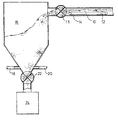
- a method of producing a pre-mixed porous polymeric composition in accordance with the present invention will now be described with reference to the accompanying drawing which shows a plant design for the production of pre-mixed polymeric compositions wherein water is removed from the rubber granules by evaporation.
- Rubber granules 10 of between 1 and 10 mm diameter are fed onto the conveyor belt 12 of a tunnel kiln 14. A portion of the tunnel kiln is heated to a temperature well in excess of room temperature, and the granules are slowly passed through this portion in order to evaporate moisture from the surface of the granules. In a typical evaporation process the granules may be heated to temperatures of around 160°C for a period of about 10 minutes.
- the granules, now near moisture free, are passed into a ribbon mixer 15.
- a Diphenylmethane-4, 4'Di-Isocyanate pre-polymer is metered at the rate of 0.5% to 5% by weight of granules into the mixer 15.
- the pre-polymer cures on the hot granules to encapsulate them with a coating of polyurethane.
- the granule/ pre-polymer mixture does not agglomerate due to the action of the mixer.
- the encapsulated granules are emptied into a hopper 16.
- a stream of dry, refrigerated carbon dioxide or nitrogen gas or moisture free air is expanded into the bottom of the hopper at positive pressure with respect to ambient gas pressure via gas input ports 18,20.
- the gas stream has the effect of cooling the hot granules.
- the now heated exhaust gas from the hopper is ducted through the tunnel kiln at positive pressure; this process inhibits the intake of wet, atmospheric air into the tunnel kiln.
- the granules are metered into a ribbon mixer 22 along with an appropriate amount (5% to 35% by weight of the pre-coated granules) of a moisture curing polyurethane based pre-polymer.
- a catalyst such as amine based may be added with the pre-polymer in sufficient quantity so as not to cause polymerisation during storage but to reduce the time required for polymerisation after application of the composition.
- the positive pressure of the dry gas also prevents ingress of wet, atmospheric air during this operation.
- the mixture of dry granules and pre-polymer from the ribbon mixer is ducted to a bagging assembly 24, wherein water impermeable bags are filled with the granule/pre-polymer mixture.
- the water impermeable bags may comprise aluminium foil lined polythene sacks.
- the bags are opened, filled and sealed in the stream of dry gas, and once again the positive pressure of the gas stream inhibits seepage of wet, atmospheric air into the dry confines of the bagging assembly and the bag itself.
- the bags of mixed polymeric composition may be stored before use. At ordinary temperatures storage for up to a year is possible. The water transmission rate of the containers is an important factor in determining the shelf-life of the product. This storage lifetime may be extended still further by storing at cooler temperatures.
- the polymeric composition may be installed to produce an impact absorbing surface by simply emptying the bags ofper-mixed polymeric composition and spreading the composition on a suitable sub-base.
- the composition polymerises by reaction with ambient, atmospheric water vapour or by reaction with water applied as an atomised mist.
- a variation involves the removal of moisture from the granules by washing same with a dry solvent.
- Another variation involves coating the granules with an agent such as an isocyanate.
- the agent removes water from the surface of the granules by chemical reaction.
Landscapes
- Chemical & Material Sciences (AREA)
- Engineering & Computer Science (AREA)
- Materials Engineering (AREA)
- Health & Medical Sciences (AREA)
- Chemical Kinetics & Catalysis (AREA)
- Medicinal Chemistry (AREA)
- Polymers & Plastics (AREA)
- Organic Chemistry (AREA)
- Compositions Of Macromolecular Compounds (AREA)
- Processes Of Treating Macromolecular Substances (AREA)
- Manufacture Of Porous Articles, And Recovery And Treatment Of Waste Products (AREA)
- Graft Or Block Polymers (AREA)
Abstract
Description
Claims (10)
- A method of producing a pre-mixed porous polymeric composition comprising the steps of:-encapsulating granules of rubber to isolate any contained curing agent or water;mixing a moisture curing quasi pre-polymer or prepolymer with the encapsulated granules in a low moisture or moisture free environment, the amount of quasi prepolymer or prepolymer being sufficient to coat the surfaces of the encapsulated granules so that, once the quasi prepolymer or prepolymer has polymerised, the encapsulated granules are adhered whilst the interstices between the encapsulated granules are left void;depositing the mixture, in a low moisture or moisture free environment, into containers which are impermeable to water vapour or which have a low water transmission rate;storing the mixture containing containers for later use; andwhen required, and without further mixing, applying the composition to a suitable sub-base and allowing the composition to polymerise by reaction with water.
- A method according to claim 1 wherein water is removed from the granules prior to encapsulation.
- A method according to claim 2 wherein the removal of water from the rubber granules is effected by evaporation at temperatures greater than room temperature.
- A method according to claim 2 wherein the water is removed from the granules by washing with a moisture free solvent and the granules dried by a stream of moisture free gas.
- A method according to claim 2 wherein the water is removed from the rubber granules by a chemical reaction.
- A method according to any preceding claim wherein the granules comprise natural or synthetic rubber and are in the size range of from 1 mm to 10 mm.
- A method according to any preceding claim wherein the encapsulating agent is polyurethane.
- A method according to any preceding claim wherein the prepolymer is polyurethane based.
- A method according to any preceding claim wherein the prepolymer contains a catalyst in sufficient quantity so as not to cause polymerisation in the stored container but reduce the time required for polymerisation after application of the composition.
- A method according to any preceding claim wherein processing of the granules is carried out in a closed reactor or in an open system maintained at positive pressure by a stream of moisture free gas.
Applications Claiming Priority (3)
| Application Number | Priority Date | Filing Date | Title |
|---|---|---|---|
| GB9418889A GB9418889D0 (en) | 1994-09-20 | 1994-09-20 | Polymeric compositions |
| GB9418889 | 1994-09-20 | ||
| PCT/GB1995/002181 WO1996009338A1 (en) | 1994-09-20 | 1995-09-15 | Pre-mixed polymer compositions |
Publications (2)
| Publication Number | Publication Date |
|---|---|
| EP0782596A1 EP0782596A1 (en) | 1997-07-09 |
| EP0782596B1 true EP0782596B1 (en) | 1999-06-09 |
Family
ID=10761588
Family Applications (1)
| Application Number | Title | Priority Date | Filing Date |
|---|---|---|---|
| EP95931330A Expired - Lifetime EP0782596B1 (en) | 1994-09-20 | 1995-09-15 | Pre-mixed polymer compositions |
Country Status (10)
| Country | Link |
|---|---|
| EP (1) | EP0782596B1 (en) |
| AT (1) | ATE181089T1 (en) |
| AU (1) | AU3481195A (en) |
| CA (1) | CA2200089A1 (en) |
| DE (1) | DE69510209T2 (en) |
| DK (1) | DK0782596T3 (en) |
| ES (1) | ES2132708T3 (en) |
| GB (2) | GB9418889D0 (en) |
| GR (1) | GR3030448T3 (en) |
| WO (1) | WO1996009338A1 (en) |
Families Citing this family (1)
| Publication number | Priority date | Publication date | Assignee | Title |
|---|---|---|---|---|
| AU5872298A (en) * | 1997-01-29 | 1998-08-18 | Frank Bowers | Pre-mixed, ready to install polymeric compositions |
Family Cites Families (9)
| Publication number | Priority date | Publication date | Assignee | Title |
|---|---|---|---|---|
| JPS49106533A (en) * | 1973-02-09 | 1974-10-09 | ||
| DE2427897A1 (en) * | 1974-06-10 | 1976-01-08 | Basf Ag | POROESE, PRACTICAL FOAM-FREE COMPOSITE BODY |
| JPS50158631A (en) * | 1974-06-13 | 1975-12-22 | ||
| US4112176A (en) * | 1974-07-08 | 1978-09-05 | U.S. Rubber Reclaiming Co., Inc. | Ground rubber elastomeric composite useful in surfacings and the like, and methods |
| DE2821001A1 (en) * | 1978-05-12 | 1979-11-15 | Bayer Ag | METHOD FOR MANUFACTURING LAMINATE |
| JPS56161456A (en) * | 1980-05-16 | 1981-12-11 | Minamoto Kk | Resilient urethane resin composition |
| JPS5941501A (en) * | 1982-09-01 | 1984-03-07 | 第一工業製薬株式会社 | Polyurethane paving material |
| DE3534107A1 (en) * | 1985-09-25 | 1987-04-02 | Klaus Ulrich Philipp | METHOD FOR THE PRODUCTION OF COVERINGS, FOR EXAMPLE FOR CYCLING AND GARDEN PATHS, CHILDREN'S PLAYGROUNDS AND FOR THE INSULATION OF CONSTRUCTIONS |
| US5254405A (en) * | 1991-10-02 | 1993-10-19 | Urethane Technologies, Incorporated | Non-cellular polyurethane composite |
-
1994
- 1994-09-20 GB GB9418889A patent/GB9418889D0/en active Pending
-
1995
- 1995-09-15 AU AU34811/95A patent/AU3481195A/en not_active Abandoned
- 1995-09-15 WO PCT/GB1995/002181 patent/WO1996009338A1/en not_active Ceased
- 1995-09-15 DE DE69510209T patent/DE69510209T2/en not_active Expired - Fee Related
- 1995-09-15 ES ES95931330T patent/ES2132708T3/en not_active Expired - Lifetime
- 1995-09-15 DK DK95931330T patent/DK0782596T3/en active
- 1995-09-15 GB GB9606135A patent/GB2299083B/en not_active Expired - Fee Related
- 1995-09-15 CA CA002200089A patent/CA2200089A1/en not_active Abandoned
- 1995-09-15 EP EP95931330A patent/EP0782596B1/en not_active Expired - Lifetime
- 1995-09-15 AT AT95931330T patent/ATE181089T1/en not_active IP Right Cessation
-
1999
- 1999-06-10 GR GR990401493T patent/GR3030448T3/en unknown
Also Published As
| Publication number | Publication date |
|---|---|
| GB2299083B (en) | 1998-12-16 |
| AU3481195A (en) | 1996-04-09 |
| EP0782596A1 (en) | 1997-07-09 |
| GR3030448T3 (en) | 1999-09-30 |
| WO1996009338A1 (en) | 1996-03-28 |
| CA2200089A1 (en) | 1996-03-28 |
| DK0782596T3 (en) | 1999-11-15 |
| ES2132708T3 (en) | 1999-08-16 |
| DE69510209T2 (en) | 1999-11-04 |
| GB9418889D0 (en) | 1994-11-09 |
| GB2299083A (en) | 1996-09-25 |
| GB9606135D0 (en) | 1996-07-03 |
| ATE181089T1 (en) | 1999-06-15 |
| DE69510209D1 (en) | 1999-07-15 |
Similar Documents
| Publication | Publication Date | Title |
|---|---|---|
| US4772490A (en) | Method for producing a water-permeable covering on granular water-soluble substances | |
| AU663136B2 (en) | Moisture curable compositions and method of curing moisture curable compositions | |
| US5993897A (en) | Pre-mixed polymer compositions | |
| CN109476818A (en) | PU floor production for sports fields | |
| US4978575A (en) | Method for the production and processing of reactant mixtures of plastics | |
| CA2274200C (en) | Sulfur containing isocyanate compositions | |
| CN106660891A (en) | Method of forming an encapsulated fertilizer | |
| CA2200089A1 (en) | Pre-mixed polymer compositions | |
| US4474836A (en) | Method for the production of carpet liners | |
| JP5860701B2 (en) | Silicate isocyanate | |
| US3536638A (en) | Breathable films of organic plastic material containing incompatible thermoplastic resin particles incorporated therein | |
| CA2401148C (en) | Method for stabilizing irregular structures | |
| WO1998032781A1 (en) | Pre-mixed, ready to install polymeric compositions | |
| EP0582614B1 (en) | Polymeric compositions | |
| AU704560B2 (en) | Coated fertilizer | |
| CA2107496C (en) | Geosynthetic barrier | |
| JPH05280011A (en) | Method of fixing sand in pavement process | |
| US8476363B2 (en) | Expanding void filler and a process of manufacturing same | |
| JPS595621B2 (en) | Reactive rubberized asphalt mixture for road paving and method for producing the same | |
| JPS59145221A (en) | Polyurethane foam composition | |
| JP2006143518A (en) | Hygroscopic inorganic mineral powder, moisture-curing resin composition, and surface treatment method of hygroscopic inorganic mineral powder | |
| JPS5940181B2 (en) | Soil stabilization method | |
| RO125850A0 (en) | Cold applicable bicomponent bituminous composition for sealing joints and horizontal surfaces of concrete or pavement mixtures, in building roofs and process for preparing the same | |
| WO2008098409A1 (en) | A coating method of mixture film containing sulfur | |
| HK40005774A (en) | Pu flooring production for a sports field |
Legal Events
| Date | Code | Title | Description |
|---|---|---|---|
| PUAI | Public reference made under article 153(3) epc to a published international application that has entered the european phase |
Free format text: ORIGINAL CODE: 0009012 |
|
| 17P | Request for examination filed |
Effective date: 19970320 |
|
| AK | Designated contracting states |
Kind code of ref document: A1 Designated state(s): AT BE CH DE DK ES FR GR IE IT LI NL PT SE |
|
| GRAG | Despatch of communication of intention to grant |
Free format text: ORIGINAL CODE: EPIDOS AGRA |
|
| 17Q | First examination report despatched |
Effective date: 19980914 |
|
| GRAG | Despatch of communication of intention to grant |
Free format text: ORIGINAL CODE: EPIDOS AGRA |
|
| GRAH | Despatch of communication of intention to grant a patent |
Free format text: ORIGINAL CODE: EPIDOS IGRA |
|
| GRAH | Despatch of communication of intention to grant a patent |
Free format text: ORIGINAL CODE: EPIDOS IGRA |
|
| GRAA | (expected) grant |
Free format text: ORIGINAL CODE: 0009210 |
|
| AK | Designated contracting states |
Kind code of ref document: B1 Designated state(s): AT BE CH DE DK ES FR GR IE IT LI NL PT SE |
|
| REF | Corresponds to: |
Ref document number: 181089 Country of ref document: AT Date of ref document: 19990615 Kind code of ref document: T |
|
| REG | Reference to a national code |
Ref country code: CH Ref legal event code: EP |
|
| REF | Corresponds to: |
Ref document number: 69510209 Country of ref document: DE Date of ref document: 19990715 |
|
| REG | Reference to a national code |
Ref country code: IE Ref legal event code: FG4D |
|
| REG | Reference to a national code |
Ref country code: CH Ref legal event code: NV Representative=s name: ROTTMANN, ZIMMERMANN + PARTNER AG |
|
| REG | Reference to a national code |
Ref country code: ES Ref legal event code: FG2A Ref document number: 2132708 Country of ref document: ES Kind code of ref document: T3 |
|
| ET | Fr: translation filed | ||
| REG | Reference to a national code |
Ref country code: PT Ref legal event code: SC4A Free format text: AVAILABILITY OF NATIONAL TRANSLATION Effective date: 19990614 |
|
| REG | Reference to a national code |
Ref country code: DK Ref legal event code: T3 |
|
| PLBE | No opposition filed within time limit |
Free format text: ORIGINAL CODE: 0009261 |
|
| STAA | Information on the status of an ep patent application or granted ep patent |
Free format text: STATUS: NO OPPOSITION FILED WITHIN TIME LIMIT |
|
| 26N | No opposition filed | ||
| PGFP | Annual fee paid to national office [announced via postgrant information from national office to epo] |
Ref country code: AT Payment date: 20011109 Year of fee payment: 7 |
|
| PGFP | Annual fee paid to national office [announced via postgrant information from national office to epo] |
Ref country code: DK Payment date: 20011113 Year of fee payment: 7 |
|
| PGFP | Annual fee paid to national office [announced via postgrant information from national office to epo] |
Ref country code: SE Payment date: 20011116 Year of fee payment: 7 |
|
| PGFP | Annual fee paid to national office [announced via postgrant information from national office to epo] |
Ref country code: NL Payment date: 20011120 Year of fee payment: 7 |
|
| PGFP | Annual fee paid to national office [announced via postgrant information from national office to epo] |
Ref country code: IE Payment date: 20011121 Year of fee payment: 7 Ref country code: CH Payment date: 20011121 Year of fee payment: 7 |
|
| PGFP | Annual fee paid to national office [announced via postgrant information from national office to epo] |
Ref country code: PT Payment date: 20011126 Year of fee payment: 7 |
|
| PGFP | Annual fee paid to national office [announced via postgrant information from national office to epo] |
Ref country code: GR Payment date: 20011129 Year of fee payment: 7 |
|
| PGFP | Annual fee paid to national office [announced via postgrant information from national office to epo] |
Ref country code: ES Payment date: 20011211 Year of fee payment: 7 |
|
| PGFP | Annual fee paid to national office [announced via postgrant information from national office to epo] |
Ref country code: BE Payment date: 20011219 Year of fee payment: 7 |
|
| PGFP | Annual fee paid to national office [announced via postgrant information from national office to epo] |
Ref country code: FR Payment date: 20020812 Year of fee payment: 8 |
|
| PGFP | Annual fee paid to national office [announced via postgrant information from national office to epo] |
Ref country code: DE Payment date: 20020822 Year of fee payment: 8 |
|
| PG25 | Lapsed in a contracting state [announced via postgrant information from national office to epo] |
Ref country code: AT Free format text: LAPSE BECAUSE OF NON-PAYMENT OF DUE FEES Effective date: 20020915 |
|
| PG25 | Lapsed in a contracting state [announced via postgrant information from national office to epo] |
Ref country code: SE Free format text: LAPSE BECAUSE OF NON-PAYMENT OF DUE FEES Effective date: 20020916 Ref country code: IE Free format text: LAPSE BECAUSE OF NON-PAYMENT OF DUE FEES Effective date: 20020916 Ref country code: ES Free format text: LAPSE BECAUSE OF NON-PAYMENT OF DUE FEES Effective date: 20020916 |
|
| PG25 | Lapsed in a contracting state [announced via postgrant information from national office to epo] |
Ref country code: LI Free format text: LAPSE BECAUSE OF NON-PAYMENT OF DUE FEES Effective date: 20020930 Ref country code: DK Free format text: LAPSE BECAUSE OF NON-PAYMENT OF DUE FEES Effective date: 20020930 Ref country code: CH Free format text: LAPSE BECAUSE OF NON-PAYMENT OF DUE FEES Effective date: 20020930 Ref country code: BE Free format text: LAPSE BECAUSE OF NON-PAYMENT OF DUE FEES Effective date: 20020930 |
|
| BERE | Be: lapsed |
Owner name: *BOWERS FRANK Effective date: 20020930 Owner name: *BOWERS JACQUELINE MARY Effective date: 20020930 |
|
| PG25 | Lapsed in a contracting state [announced via postgrant information from national office to epo] |
Ref country code: PT Free format text: LAPSE BECAUSE OF NON-PAYMENT OF DUE FEES Effective date: 20030331 |
|
| PG25 | Lapsed in a contracting state [announced via postgrant information from national office to epo] |
Ref country code: NL Free format text: LAPSE BECAUSE OF NON-PAYMENT OF DUE FEES Effective date: 20030401 |
|
| PG25 | Lapsed in a contracting state [announced via postgrant information from national office to epo] |
Ref country code: GR Free format text: LAPSE BECAUSE OF NON-PAYMENT OF DUE FEES Effective date: 20030404 |
|
| REG | Reference to a national code |
Ref country code: DK Ref legal event code: EBP |
|
| EUG | Se: european patent has lapsed | ||
| REG | Reference to a national code |
Ref country code: CH Ref legal event code: PL |
|
| REG | Reference to a national code |
Ref country code: PT Ref legal event code: MM4A Free format text: LAPSE DUE TO NON-PAYMENT OF FEES Effective date: 20030331 |
|
| REG | Reference to a national code |
Ref country code: IE Ref legal event code: MM4A |
|
| PG25 | Lapsed in a contracting state [announced via postgrant information from national office to epo] |
Ref country code: DE Free format text: LAPSE BECAUSE OF NON-PAYMENT OF DUE FEES Effective date: 20040401 |
|
| REG | Reference to a national code |
Ref country code: ES Ref legal event code: FD2A Effective date: 20031011 |
|
| PG25 | Lapsed in a contracting state [announced via postgrant information from national office to epo] |
Ref country code: FR Free format text: LAPSE BECAUSE OF NON-PAYMENT OF DUE FEES Effective date: 20040528 |
|
| REG | Reference to a national code |
Ref country code: FR Ref legal event code: ST |
|
| PG25 | Lapsed in a contracting state [announced via postgrant information from national office to epo] |
Ref country code: IT Free format text: LAPSE BECAUSE OF NON-PAYMENT OF DUE FEES;WARNING: LAPSES OF ITALIAN PATENTS WITH EFFECTIVE DATE BEFORE 2007 MAY HAVE OCCURRED AT ANY TIME BEFORE 2007. THE CORRECT EFFECTIVE DATE MAY BE DIFFERENT FROM THE ONE RECORDED. Effective date: 20050915 |