EP0782577B1 - Asymmetric ligands useful for transition metal catalyzed bond forming reactions and epoxide reactions therewith - Google Patents
Asymmetric ligands useful for transition metal catalyzed bond forming reactions and epoxide reactions therewith Download PDFInfo
- Publication number
- EP0782577B1 EP0782577B1 EP95935015A EP95935015A EP0782577B1 EP 0782577 B1 EP0782577 B1 EP 0782577B1 EP 95935015 A EP95935015 A EP 95935015A EP 95935015 A EP95935015 A EP 95935015A EP 0782577 B1 EP0782577 B1 EP 0782577B1
- Authority
- EP
- European Patent Office
- Prior art keywords
- chiral
- ligand
- reactions
- epoxide
- substrate
- Prior art date
- Legal status (The legal status is an assumption and is not a legal conclusion. Google has not performed a legal analysis and makes no representation as to the accuracy of the status listed.)
- Expired - Lifetime
Links
- 239000003446 ligand Substances 0.000 title claims abstract description 50
- 238000006664 bond formation reaction Methods 0.000 title claims abstract description 6
- 238000006243 chemical reaction Methods 0.000 title description 15
- 229910052723 transition metal Inorganic materials 0.000 title description 3
- 150000003624 transition metals Chemical class 0.000 title description 3
- 150000002118 epoxides Chemical class 0.000 title 1
- GXBYFVGCMPJVJX-UHFFFAOYSA-N Epoxybutene Chemical compound C=CC1CO1 GXBYFVGCMPJVJX-UHFFFAOYSA-N 0.000 claims abstract description 12
- 150000002924 oxiranes Chemical class 0.000 claims abstract description 11
- 239000000758 substrate Substances 0.000 claims abstract description 11
- 230000006698 induction Effects 0.000 claims abstract description 7
- -1 and R1 is H Chemical group 0.000 claims description 14
- 238000000034 method Methods 0.000 claims description 14
- 150000001875 compounds Chemical class 0.000 claims description 10
- 229910052751 metal Inorganic materials 0.000 claims description 10
- 239000002184 metal Substances 0.000 claims description 10
- 125000003118 aryl group Chemical group 0.000 claims description 8
- 150000001412 amines Chemical class 0.000 claims description 7
- LFQSCWFLJHTTHZ-UHFFFAOYSA-N Ethanol Chemical compound CCO LFQSCWFLJHTTHZ-UHFFFAOYSA-N 0.000 claims description 6
- 125000000217 alkyl group Chemical group 0.000 claims description 6
- 150000001408 amides Chemical class 0.000 claims description 6
- 150000002148 esters Chemical class 0.000 claims description 6
- 125000001072 heteroaryl group Chemical group 0.000 claims description 6
- 229910052786 argon Inorganic materials 0.000 claims description 5
- 125000000524 functional group Chemical group 0.000 claims description 4
- 125000003342 alkenyl group Chemical group 0.000 claims description 3
- 150000001732 carboxylic acid derivatives Chemical class 0.000 claims description 3
- 229910052760 oxygen Inorganic materials 0.000 claims description 3
- 229910052717 sulfur Inorganic materials 0.000 claims description 3
- IBOFVQJTBBUKMU-UHFFFAOYSA-N 4,4'-methylene-bis-(2-chloroaniline) Chemical compound C1=C(Cl)C(N)=CC=C1CC1=CC=C(N)C(Cl)=C1 IBOFVQJTBBUKMU-UHFFFAOYSA-N 0.000 claims description 2
- 125000002915 carbonyl group Chemical group [*:2]C([*:1])=O 0.000 claims description 2
- 238000004519 manufacturing process Methods 0.000 claims description 2
- 125000001624 naphthyl group Chemical group 0.000 claims description 2
- 125000005544 phthalimido group Chemical group 0.000 claims 1
- KAKZBPTYRLMSJV-UHFFFAOYSA-N vinyl-ethylene Natural products C=CC=C KAKZBPTYRLMSJV-UHFFFAOYSA-N 0.000 claims 1
- GORDERUNERXOFV-UHFFFAOYSA-N 2-(ethenylamino)ethanol Chemical compound OCCNC=C GORDERUNERXOFV-UHFFFAOYSA-N 0.000 abstract description 9
- 238000011914 asymmetric synthesis Methods 0.000 abstract description 5
- 238000005576 amination reaction Methods 0.000 abstract description 3
- YMWUJEATGCHHMB-UHFFFAOYSA-N Dichloromethane Chemical compound ClCCl YMWUJEATGCHHMB-UHFFFAOYSA-N 0.000 description 80
- XEKOWRVHYACXOJ-UHFFFAOYSA-N Ethyl acetate Chemical compound CCOC(C)=O XEKOWRVHYACXOJ-UHFFFAOYSA-N 0.000 description 33
- HEDRZPFGACZZDS-MICDWDOJSA-N Trichloro(2H)methane Chemical compound [2H]C(Cl)(Cl)Cl HEDRZPFGACZZDS-MICDWDOJSA-N 0.000 description 28
- WYURNTSHIVDZCO-UHFFFAOYSA-N Tetrahydrofuran Chemical compound C1CCOC1 WYURNTSHIVDZCO-UHFFFAOYSA-N 0.000 description 26
- VLKZOEOYAKHREP-UHFFFAOYSA-N n-Hexane Chemical class CCCCCC VLKZOEOYAKHREP-UHFFFAOYSA-N 0.000 description 22
- FJDQFPXHSGXQBY-UHFFFAOYSA-L caesium carbonate Chemical compound [Cs+].[Cs+].[O-]C([O-])=O FJDQFPXHSGXQBY-UHFFFAOYSA-L 0.000 description 20
- YLQBMQCUIZJEEH-UHFFFAOYSA-N tetrahydrofuran Natural products C=1C=COC=1 YLQBMQCUIZJEEH-UHFFFAOYSA-N 0.000 description 13
- 229910000024 caesium carbonate Inorganic materials 0.000 description 12
- 229910000104 sodium hydride Inorganic materials 0.000 description 10
- RTZKZFJDLAIYFH-UHFFFAOYSA-N Diethyl ether Chemical compound CCOCC RTZKZFJDLAIYFH-UHFFFAOYSA-N 0.000 description 9
- VYPSYNLAJGMNEJ-UHFFFAOYSA-N Silicium dioxide Chemical compound O=[Si]=O VYPSYNLAJGMNEJ-UHFFFAOYSA-N 0.000 description 9
- 239000000047 product Substances 0.000 description 9
- 0 *C(CC*1)=*1C(O)=O Chemical compound *C(CC*1)=*1C(O)=O 0.000 description 8
- IJGRMHOSHXDMSA-UHFFFAOYSA-N Atomic nitrogen Chemical compound N#N IJGRMHOSHXDMSA-UHFFFAOYSA-N 0.000 description 8
- 238000005481 NMR spectroscopy Methods 0.000 description 8
- 239000000741 silica gel Substances 0.000 description 8
- 229910002027 silica gel Inorganic materials 0.000 description 8
- 238000003786 synthesis reaction Methods 0.000 description 8
- UYRPRYSDOVYCOU-UHFFFAOYSA-N 2-diphenylphosphanylbenzoic acid Chemical compound OC(=O)C1=CC=CC=C1P(C=1C=CC=CC=1)C1=CC=CC=C1 UYRPRYSDOVYCOU-UHFFFAOYSA-N 0.000 description 7
- 238000001644 13C nuclear magnetic resonance spectroscopy Methods 0.000 description 6
- 238000005160 1H NMR spectroscopy Methods 0.000 description 6
- VHYFNPMBLIVWCW-UHFFFAOYSA-N 4-Dimethylaminopyridine Chemical compound CN(C)C1=CC=NC=C1 VHYFNPMBLIVWCW-UHFFFAOYSA-N 0.000 description 6
- 238000006555 catalytic reaction Methods 0.000 description 6
- 230000000694 effects Effects 0.000 description 6
- 239000000203 mixture Substances 0.000 description 6
- XDTMQSROBMDMFD-UHFFFAOYSA-N Cyclohexane Chemical compound C1CCCCC1 XDTMQSROBMDMFD-UHFFFAOYSA-N 0.000 description 5
- QOSSAOTZNIDXMA-UHFFFAOYSA-N Dicylcohexylcarbodiimide Chemical compound C1CCCCC1N=C=NC1CCCCC1 QOSSAOTZNIDXMA-UHFFFAOYSA-N 0.000 description 5
- RQVLGLPAZTUBKX-VKHMYHEASA-N L-vinylglycine Chemical compound C=C[C@H](N)C(O)=O RQVLGLPAZTUBKX-VKHMYHEASA-N 0.000 description 5
- 238000004458 analytical method Methods 0.000 description 5
- 230000015572 biosynthetic process Effects 0.000 description 5
- XKJCHHZQLQNZHY-UHFFFAOYSA-N phthalimide Chemical compound C1=CC=C2C(=O)NC(=O)C2=C1 XKJCHHZQLQNZHY-UHFFFAOYSA-N 0.000 description 5
- 239000002243 precursor Substances 0.000 description 5
- 239000000243 solution Substances 0.000 description 5
- IAZDPXIOMUYVGZ-WFGJKAKNSA-N Dimethyl sulfoxide Chemical compound [2H]C([2H])([2H])S(=O)C([2H])([2H])[2H] IAZDPXIOMUYVGZ-WFGJKAKNSA-N 0.000 description 4
- CDBYLPFSWZWCQE-UHFFFAOYSA-L Sodium Carbonate Chemical compound [Na+].[Na+].[O-]C([O-])=O CDBYLPFSWZWCQE-UHFFFAOYSA-L 0.000 description 4
- WPYMKLBDIGXBTP-UHFFFAOYSA-N benzoic acid Chemical compound OC(=O)C1=CC=CC=C1 WPYMKLBDIGXBTP-UHFFFAOYSA-N 0.000 description 4
- 229910052757 nitrogen Inorganic materials 0.000 description 4
- 238000002360 preparation method Methods 0.000 description 4
- 239000011541 reaction mixture Substances 0.000 description 4
- 239000007787 solid Substances 0.000 description 4
- 230000007704 transition Effects 0.000 description 4
- UEJJHQNACJXSKW-UHFFFAOYSA-N 2-(2,6-dioxopiperidin-3-yl)-1H-isoindole-1,3(2H)-dione Chemical compound O=C1C2=CC=CC=C2C(=O)N1C1CCC(=O)NC1=O UEJJHQNACJXSKW-UHFFFAOYSA-N 0.000 description 3
- OKKJLVBELUTLKV-UHFFFAOYSA-N Methanol Chemical compound OC OKKJLVBELUTLKV-UHFFFAOYSA-N 0.000 description 3
- ZMANZCXQSJIPKH-UHFFFAOYSA-N Triethylamine Chemical compound CCN(CC)CC ZMANZCXQSJIPKH-UHFFFAOYSA-N 0.000 description 3
- 239000002253 acid Substances 0.000 description 3
- 150000001298 alcohols Chemical class 0.000 description 3
- 230000029936 alkylation Effects 0.000 description 3
- 238000005804 alkylation reaction Methods 0.000 description 3
- YMCLVAZUQJPLTE-UHFFFAOYSA-N benzyl n-(4-chloro-3-hydroxy-1-phenylsulfanylbutan-2-yl)carbamate Chemical compound C=1C=CC=CC=1COC(=O)NC(C(CCl)O)CSC1=CC=CC=C1 YMCLVAZUQJPLTE-UHFFFAOYSA-N 0.000 description 3
- 150000007942 carboxylates Chemical group 0.000 description 3
- 238000005557 chiral recognition Methods 0.000 description 3
- 238000003818 flash chromatography Methods 0.000 description 3
- 238000004128 high performance liquid chromatography Methods 0.000 description 3
- 239000002904 solvent Substances 0.000 description 3
- 229960003433 thalidomide Drugs 0.000 description 3
- DIWVBIXQCNRCFE-QMMMGPOBSA-N (2s)-2-methoxy-2-phenylacetic acid Chemical compound CO[C@H](C(O)=O)C1=CC=CC=C1 DIWVBIXQCNRCFE-QMMMGPOBSA-N 0.000 description 2
- WJCBDBBZIGUHOB-UHFFFAOYSA-N 2-diphenylphosphanylnaphthalene-1-carboxylic acid Chemical compound C1=CC2=CC=CC=C2C(C(=O)O)=C1P(C=1C=CC=CC=1)C1=CC=CC=C1 WJCBDBBZIGUHOB-UHFFFAOYSA-N 0.000 description 2
- HBAQYPYDRFILMT-UHFFFAOYSA-N 8-[3-(1-cyclopropylpyrazol-4-yl)-1H-pyrazolo[4,3-d]pyrimidin-5-yl]-3-methyl-3,8-diazabicyclo[3.2.1]octan-2-one Chemical class C1(CC1)N1N=CC(=C1)C1=NNC2=C1N=C(N=C2)N1C2C(N(CC1CC2)C)=O HBAQYPYDRFILMT-UHFFFAOYSA-N 0.000 description 2
- XKRFYHLGVUSROY-UHFFFAOYSA-N Argon Chemical compound [Ar] XKRFYHLGVUSROY-UHFFFAOYSA-N 0.000 description 2
- HEDRZPFGACZZDS-UHFFFAOYSA-N Chloroform Chemical compound ClC(Cl)Cl HEDRZPFGACZZDS-UHFFFAOYSA-N 0.000 description 2
- KDLHZDBZIXYQEI-UHFFFAOYSA-N Palladium Chemical compound [Pd] KDLHZDBZIXYQEI-UHFFFAOYSA-N 0.000 description 2
- OFBQJSOFQDEBGM-UHFFFAOYSA-N Pentane Chemical compound CCCCC OFBQJSOFQDEBGM-UHFFFAOYSA-N 0.000 description 2
- XYFCBTPGUUZFHI-UHFFFAOYSA-N Phosphine Chemical compound P XYFCBTPGUUZFHI-UHFFFAOYSA-N 0.000 description 2
- KEAYESYHFKHZAL-UHFFFAOYSA-N Sodium Chemical compound [Na] KEAYESYHFKHZAL-UHFFFAOYSA-N 0.000 description 2
- PMZURENOXWZQFD-UHFFFAOYSA-L Sodium Sulfate Chemical compound [Na+].[Na+].[O-]S([O-])(=O)=O PMZURENOXWZQFD-UHFFFAOYSA-L 0.000 description 2
- UIIMBOGNXHQVGW-UHFFFAOYSA-M Sodium bicarbonate Chemical compound [Na+].OC([O-])=O UIIMBOGNXHQVGW-UHFFFAOYSA-M 0.000 description 2
- 150000001413 amino acids Chemical class 0.000 description 2
- 238000001816 cooling Methods 0.000 description 2
- BEPAFCGSDWSTEL-UHFFFAOYSA-N dimethyl malonate Chemical compound COC(=O)CC(=O)OC BEPAFCGSDWSTEL-UHFFFAOYSA-N 0.000 description 2
- 230000002708 enhancing effect Effects 0.000 description 2
- 239000002532 enzyme inhibitor Substances 0.000 description 2
- 150000004820 halides Chemical class 0.000 description 2
- 125000001997 phenyl group Chemical group [H]C1=C([H])C([H])=C(*)C([H])=C1[H] 0.000 description 2
- 229910000029 sodium carbonate Inorganic materials 0.000 description 2
- 239000012312 sodium hydride Substances 0.000 description 2
- 229910052938 sodium sulfate Inorganic materials 0.000 description 2
- 239000007858 starting material Substances 0.000 description 2
- 230000002194 synthesizing effect Effects 0.000 description 2
- 238000004809 thin layer chromatography Methods 0.000 description 2
- SSJXIUAHEKJCMH-PHDIDXHHSA-N (1r,2r)-cyclohexane-1,2-diamine Chemical compound N[C@@H]1CCCC[C@H]1N SSJXIUAHEKJCMH-PHDIDXHHSA-N 0.000 description 1
- IVWWFWFVSWOTLP-YVZVNANGSA-N (3'as,4r,7'as)-2,2,2',2'-tetramethylspiro[1,3-dioxolane-4,6'-4,7a-dihydro-3ah-[1,3]dioxolo[4,5-c]pyran]-7'-one Chemical compound C([C@@H]1OC(O[C@@H]1C1=O)(C)C)O[C@]21COC(C)(C)O2 IVWWFWFVSWOTLP-YVZVNANGSA-N 0.000 description 1
- CUHFCSMYBZBTIT-UHFFFAOYSA-N 2-(ethenylamino)acetic acid Chemical class OC(=O)CNC=C CUHFCSMYBZBTIT-UHFFFAOYSA-N 0.000 description 1
- STQGQHZAVUOBTE-UHFFFAOYSA-N 7-Cyan-hept-2t-en-4,6-diinsaeure Natural products C1=2C(O)=C3C(=O)C=4C(OC)=CC=CC=4C(=O)C3=C(O)C=2CC(O)(C(C)=O)CC1OC1CC(N)C(O)C(C)O1 STQGQHZAVUOBTE-UHFFFAOYSA-N 0.000 description 1
- 239000005711 Benzoic acid Substances 0.000 description 1
- PUHRIQHNROWWIU-QHGLUPRGSA-N C=C[C@@H](CO)C(CC(c1c2cccc1)=O)C2=O Chemical compound C=C[C@@H](CO)C(CC(c1c2cccc1)=O)C2=O PUHRIQHNROWWIU-QHGLUPRGSA-N 0.000 description 1
- 102000000584 Calmodulin Human genes 0.000 description 1
- 108010041952 Calmodulin Proteins 0.000 description 1
- BVKZGUZCCUSVTD-UHFFFAOYSA-L Carbonate Chemical compound [O-]C([O-])=O BVKZGUZCCUSVTD-UHFFFAOYSA-L 0.000 description 1
- 229920000742 Cotton Polymers 0.000 description 1
- FBPFZTCFMRRESA-KVTDHHQDSA-N D-Mannitol Chemical compound OC[C@@H](O)[C@@H](O)[C@H](O)[C@H](O)CO FBPFZTCFMRRESA-KVTDHHQDSA-N 0.000 description 1
- WEAHRLBPCANXCN-UHFFFAOYSA-N Daunomycin Natural products CCC1(O)CC(OC2CC(N)C(O)C(C)O2)c3cc4C(=O)c5c(OC)cccc5C(=O)c4c(O)c3C1 WEAHRLBPCANXCN-UHFFFAOYSA-N 0.000 description 1
- FEWJPZIEWOKRBE-JCYAYHJZSA-N Dextrotartaric acid Chemical compound OC(=O)[C@H](O)[C@@H](O)C(O)=O FEWJPZIEWOKRBE-JCYAYHJZSA-N 0.000 description 1
- OAKJQQAXSVQMHS-UHFFFAOYSA-N Hydrazine Chemical compound NN OAKJQQAXSVQMHS-UHFFFAOYSA-N 0.000 description 1
- 150000008575 L-amino acids Chemical class 0.000 description 1
- 229930195725 Mannitol Natural products 0.000 description 1
- 239000007832 Na2SO4 Substances 0.000 description 1
- 235000019502 Orange oil Nutrition 0.000 description 1
- 229930182764 Polyoxin Natural products 0.000 description 1
- NINIDFKCEFEMDL-UHFFFAOYSA-N Sulfur Chemical compound [S] NINIDFKCEFEMDL-UHFFFAOYSA-N 0.000 description 1
- FEWJPZIEWOKRBE-UHFFFAOYSA-N Tartaric acid Natural products [H+].[H+].[O-]C(=O)C(O)C(O)C([O-])=O FEWJPZIEWOKRBE-UHFFFAOYSA-N 0.000 description 1
- 230000003213 activating effect Effects 0.000 description 1
- 125000002015 acyclic group Chemical group 0.000 description 1
- 125000003158 alcohol group Chemical group 0.000 description 1
- 125000003545 alkoxy group Chemical group 0.000 description 1
- 230000000844 anti-bacterial effect Effects 0.000 description 1
- 230000000843 anti-fungal effect Effects 0.000 description 1
- 229940088710 antibiotic agent Drugs 0.000 description 1
- 229940121375 antifungal agent Drugs 0.000 description 1
- 239000002246 antineoplastic agent Substances 0.000 description 1
- QVGXLLKOCUKJST-UHFFFAOYSA-N atomic oxygen Chemical compound [O] QVGXLLKOCUKJST-UHFFFAOYSA-N 0.000 description 1
- RQPZNWPYLFFXCP-UHFFFAOYSA-L barium dihydroxide Chemical compound [OH-].[OH-].[Ba+2] RQPZNWPYLFFXCP-UHFFFAOYSA-L 0.000 description 1
- 230000004888 barrier function Effects 0.000 description 1
- 235000010233 benzoic acid Nutrition 0.000 description 1
- 230000003115 biocidal effect Effects 0.000 description 1
- 230000031018 biological processes and functions Effects 0.000 description 1
- TVFDJXOCXUVLDH-UHFFFAOYSA-N caesium atom Chemical class [Cs] TVFDJXOCXUVLDH-UHFFFAOYSA-N 0.000 description 1
- 150000001720 carbohydrates Chemical class 0.000 description 1
- 235000014633 carbohydrates Nutrition 0.000 description 1
- 125000003178 carboxy group Chemical group [H]OC(*)=O 0.000 description 1
- 239000003054 catalyst Substances 0.000 description 1
- BJDCWCLMFKKGEE-CMDXXVQNSA-N chembl252518 Chemical compound C([C@@](OO1)(C)O2)C[C@H]3[C@H](C)CC[C@@H]4[C@@]31[C@@H]2O[C@H](O)[C@@H]4C BJDCWCLMFKKGEE-CMDXXVQNSA-N 0.000 description 1
- 239000007795 chemical reaction product Substances 0.000 description 1
- VFYNVDRWOAJSKI-UHFFFAOYSA-N chloro(diphenoxy)phosphane Chemical compound C=1C=CC=CC=1OP(Cl)OC1=CC=CC=C1 VFYNVDRWOAJSKI-UHFFFAOYSA-N 0.000 description 1
- LNAMMBFJMYMQTO-FNEBRGMMSA-N chloroform;(1e,4e)-1,5-diphenylpenta-1,4-dien-3-one;palladium Chemical compound [Pd].[Pd].ClC(Cl)Cl.C=1C=CC=CC=1\C=C\C(=O)\C=C\C1=CC=CC=C1.C=1C=CC=CC=1\C=C\C(=O)\C=C\C1=CC=CC=C1.C=1C=CC=CC=1\C=C\C(=O)\C=C\C1=CC=CC=C1 LNAMMBFJMYMQTO-FNEBRGMMSA-N 0.000 description 1
- 239000012230 colorless oil Substances 0.000 description 1
- 230000008878 coupling Effects 0.000 description 1
- 238000010168 coupling process Methods 0.000 description 1
- 238000005859 coupling reaction Methods 0.000 description 1
- FXCTZFMSAHZQTR-KAMYIIQDSA-N cpccoet Chemical compound O\N=C/1C2=CC=CC=C2OC2(C(=O)OCC)C\1C2 FXCTZFMSAHZQTR-KAMYIIQDSA-N 0.000 description 1
- 239000012043 crude product Substances 0.000 description 1
- YMHQVDAATAEZLO-UHFFFAOYSA-N cyclohexane-1,1-diamine Chemical group NC1(N)CCCCC1 YMHQVDAATAEZLO-UHFFFAOYSA-N 0.000 description 1
- JMTLGVPTXJYPBX-UHFFFAOYSA-N cyclopent-2-en-1-yl acetate Chemical compound CC(=O)OC1CCC=C1 JMTLGVPTXJYPBX-UHFFFAOYSA-N 0.000 description 1
- 239000000824 cytostatic agent Substances 0.000 description 1
- 230000001085 cytostatic effect Effects 0.000 description 1
- STQGQHZAVUOBTE-VGBVRHCVSA-N daunorubicin Chemical compound O([C@H]1C[C@@](O)(CC=2C(O)=C3C(=O)C=4C=CC=C(C=4C(=O)C3=C(O)C=21)OC)C(C)=O)[C@H]1C[C@H](N)[C@H](O)[C@H](C)O1 STQGQHZAVUOBTE-VGBVRHCVSA-N 0.000 description 1
- 238000001212 derivatisation Methods 0.000 description 1
- 150000004985 diamines Chemical class 0.000 description 1
- 150000002009 diols Chemical class 0.000 description 1
- 239000003814 drug Substances 0.000 description 1
- 229940079593 drug Drugs 0.000 description 1
- 239000012065 filter cake Substances 0.000 description 1
- 239000000706 filtrate Substances 0.000 description 1
- 239000006260 foam Substances 0.000 description 1
- 238000007710 freezing Methods 0.000 description 1
- 230000008014 freezing Effects 0.000 description 1
- 125000002541 furyl group Chemical group 0.000 description 1
- 239000011521 glass Substances 0.000 description 1
- 239000003316 glycosidase inhibitor Substances 0.000 description 1
- 230000005484 gravity Effects 0.000 description 1
- 125000005842 heteroatom Chemical group 0.000 description 1
- 238000007172 homogeneous catalysis Methods 0.000 description 1
- 150000004678 hydrides Chemical class 0.000 description 1
- 239000003112 inhibitor Substances 0.000 description 1
- 239000000543 intermediate Substances 0.000 description 1
- 150000002500 ions Chemical class 0.000 description 1
- 150000002576 ketones Chemical class 0.000 description 1
- 239000000594 mannitol Substances 0.000 description 1
- 235000010355 mannitol Nutrition 0.000 description 1
- 238000001819 mass spectrum Methods 0.000 description 1
- 125000000956 methoxy group Chemical group [H]C([H])([H])O* 0.000 description 1
- QNDSZNKYBYBYAE-UHFFFAOYSA-N methyl 2-diphenylphosphanylnaphthalene-1-carboxylate Chemical compound C1=CC2=CC=CC=C2C(C(=O)OC)=C1P(C=1C=CC=CC=1)C1=CC=CC=C1 QNDSZNKYBYBYAE-UHFFFAOYSA-N 0.000 description 1
- 150000002772 monosaccharides Chemical class 0.000 description 1
- 150000002825 nitriles Chemical class 0.000 description 1
- 239000002777 nucleoside Substances 0.000 description 1
- 125000003835 nucleoside group Chemical group 0.000 description 1
- 239000003921 oil Substances 0.000 description 1
- 235000019198 oils Nutrition 0.000 description 1
- 239000010502 orange oil Substances 0.000 description 1
- 239000012074 organic phase Substances 0.000 description 1
- 239000001301 oxygen Substances 0.000 description 1
- 229910052763 palladium Inorganic materials 0.000 description 1
- 230000000144 pharmacologic effect Effects 0.000 description 1
- 150000003003 phosphines Chemical class 0.000 description 1
- 229910000073 phosphorus hydride Inorganic materials 0.000 description 1
- 230000003389 potentiating effect Effects 0.000 description 1
- 239000000843 powder Substances 0.000 description 1
- 238000000746 purification Methods 0.000 description 1
- 238000010992 reflux Methods 0.000 description 1
- 238000012552 review Methods 0.000 description 1
- 229920006395 saturated elastomer Polymers 0.000 description 1
- 239000002002 slurry Substances 0.000 description 1
- 229910000030 sodium bicarbonate Inorganic materials 0.000 description 1
- 235000017557 sodium bicarbonate Nutrition 0.000 description 1
- WBHQBSYUUJJSRZ-UHFFFAOYSA-M sodium bisulfate Chemical compound [Na+].OS([O-])(=O)=O WBHQBSYUUJJSRZ-UHFFFAOYSA-M 0.000 description 1
- 229910000342 sodium bisulfate Inorganic materials 0.000 description 1
- 159000000000 sodium salts Chemical class 0.000 description 1
- 235000011152 sodium sulphate Nutrition 0.000 description 1
- 230000003595 spectral effect Effects 0.000 description 1
- 125000001424 substituent group Chemical group 0.000 description 1
- 239000011593 sulfur Substances 0.000 description 1
- 238000010189 synthetic method Methods 0.000 description 1
- 235000002906 tartaric acid Nutrition 0.000 description 1
- 239000011975 tartaric acid Substances 0.000 description 1
- 231100000462 teratogen Toxicity 0.000 description 1
- 239000003439 teratogenic agent Substances 0.000 description 1
- 150000003623 transition metal compounds Chemical class 0.000 description 1
- 229940086542 triethylamine Drugs 0.000 description 1
- 238000010792 warming Methods 0.000 description 1
Classifications
-
- C—CHEMISTRY; METALLURGY
- C07—ORGANIC CHEMISTRY
- C07F—ACYCLIC, CARBOCYCLIC OR HETEROCYCLIC COMPOUNDS CONTAINING ELEMENTS OTHER THAN CARBON, HYDROGEN, HALOGEN, OXYGEN, NITROGEN, SULFUR, SELENIUM OR TELLURIUM
- C07F9/00—Compounds containing elements of Groups 5 or 15 of the Periodic Table
- C07F9/02—Phosphorus compounds
- C07F9/547—Heterocyclic compounds, e.g. containing phosphorus as a ring hetero atom
- C07F9/553—Heterocyclic compounds, e.g. containing phosphorus as a ring hetero atom having one nitrogen atom as the only ring hetero atom
- C07F9/5537—Heterocyclic compounds, e.g. containing phosphorus as a ring hetero atom having one nitrogen atom as the only ring hetero atom the heteroring containing the structure -C(=O)-N-C(=O)- (both carbon atoms belong to the heteroring)
-
- B—PERFORMING OPERATIONS; TRANSPORTING
- B01—PHYSICAL OR CHEMICAL PROCESSES OR APPARATUS IN GENERAL
- B01J—CHEMICAL OR PHYSICAL PROCESSES, e.g. CATALYSIS OR COLLOID CHEMISTRY; THEIR RELEVANT APPARATUS
- B01J31/00—Catalysts comprising hydrides, coordination complexes or organic compounds
- B01J31/16—Catalysts comprising hydrides, coordination complexes or organic compounds containing coordination complexes
- B01J31/24—Phosphines, i.e. phosphorus bonded to only carbon atoms, or to both carbon and hydrogen atoms, including e.g. sp2-hybridised phosphorus compounds such as phosphabenzene, phosphole or anionic phospholide ligands
- B01J31/2404—Cyclic ligands, including e.g. non-condensed polycyclic ligands, the phosphine-P atom being a ring member or a substituent on the ring
- B01J31/2409—Cyclic ligands, including e.g. non-condensed polycyclic ligands, the phosphine-P atom being a ring member or a substituent on the ring with more than one complexing phosphine-P atom
-
- B—PERFORMING OPERATIONS; TRANSPORTING
- B01—PHYSICAL OR CHEMICAL PROCESSES OR APPARATUS IN GENERAL
- B01J—CHEMICAL OR PHYSICAL PROCESSES, e.g. CATALYSIS OR COLLOID CHEMISTRY; THEIR RELEVANT APPARATUS
- B01J31/00—Catalysts comprising hydrides, coordination complexes or organic compounds
- B01J31/16—Catalysts comprising hydrides, coordination complexes or organic compounds containing coordination complexes
- B01J31/24—Phosphines, i.e. phosphorus bonded to only carbon atoms, or to both carbon and hydrogen atoms, including e.g. sp2-hybridised phosphorus compounds such as phosphabenzene, phosphole or anionic phospholide ligands
- B01J31/2404—Cyclic ligands, including e.g. non-condensed polycyclic ligands, the phosphine-P atom being a ring member or a substituent on the ring
- B01J31/2409—Cyclic ligands, including e.g. non-condensed polycyclic ligands, the phosphine-P atom being a ring member or a substituent on the ring with more than one complexing phosphine-P atom
- B01J31/2414—Cyclic ligands, including e.g. non-condensed polycyclic ligands, the phosphine-P atom being a ring member or a substituent on the ring with more than one complexing phosphine-P atom comprising aliphatic or saturated rings
-
- B—PERFORMING OPERATIONS; TRANSPORTING
- B01—PHYSICAL OR CHEMICAL PROCESSES OR APPARATUS IN GENERAL
- B01J—CHEMICAL OR PHYSICAL PROCESSES, e.g. CATALYSIS OR COLLOID CHEMISTRY; THEIR RELEVANT APPARATUS
- B01J31/00—Catalysts comprising hydrides, coordination complexes or organic compounds
- B01J31/16—Catalysts comprising hydrides, coordination complexes or organic compounds containing coordination complexes
- B01J31/24—Phosphines, i.e. phosphorus bonded to only carbon atoms, or to both carbon and hydrogen atoms, including e.g. sp2-hybridised phosphorus compounds such as phosphabenzene, phosphole or anionic phospholide ligands
- B01J31/2404—Cyclic ligands, including e.g. non-condensed polycyclic ligands, the phosphine-P atom being a ring member or a substituent on the ring
- B01J31/2442—Cyclic ligands, including e.g. non-condensed polycyclic ligands, the phosphine-P atom being a ring member or a substituent on the ring comprising condensed ring systems
- B01J31/2447—Cyclic ligands, including e.g. non-condensed polycyclic ligands, the phosphine-P atom being a ring member or a substituent on the ring comprising condensed ring systems and phosphine-P atoms as substituents on a ring of the condensed system or on a further attached ring
- B01J31/2452—Cyclic ligands, including e.g. non-condensed polycyclic ligands, the phosphine-P atom being a ring member or a substituent on the ring comprising condensed ring systems and phosphine-P atoms as substituents on a ring of the condensed system or on a further attached ring with more than one complexing phosphine-P atom
-
- B—PERFORMING OPERATIONS; TRANSPORTING
- B01—PHYSICAL OR CHEMICAL PROCESSES OR APPARATUS IN GENERAL
- B01J—CHEMICAL OR PHYSICAL PROCESSES, e.g. CATALYSIS OR COLLOID CHEMISTRY; THEIR RELEVANT APPARATUS
- B01J31/00—Catalysts comprising hydrides, coordination complexes or organic compounds
- B01J31/16—Catalysts comprising hydrides, coordination complexes or organic compounds containing coordination complexes
- B01J31/24—Phosphines, i.e. phosphorus bonded to only carbon atoms, or to both carbon and hydrogen atoms, including e.g. sp2-hybridised phosphorus compounds such as phosphabenzene, phosphole or anionic phospholide ligands
- B01J31/2404—Cyclic ligands, including e.g. non-condensed polycyclic ligands, the phosphine-P atom being a ring member or a substituent on the ring
- B01J31/2442—Cyclic ligands, including e.g. non-condensed polycyclic ligands, the phosphine-P atom being a ring member or a substituent on the ring comprising condensed ring systems
- B01J31/2447—Cyclic ligands, including e.g. non-condensed polycyclic ligands, the phosphine-P atom being a ring member or a substituent on the ring comprising condensed ring systems and phosphine-P atoms as substituents on a ring of the condensed system or on a further attached ring
- B01J31/2452—Cyclic ligands, including e.g. non-condensed polycyclic ligands, the phosphine-P atom being a ring member or a substituent on the ring comprising condensed ring systems and phosphine-P atoms as substituents on a ring of the condensed system or on a further attached ring with more than one complexing phosphine-P atom
- B01J31/2457—Cyclic ligands, including e.g. non-condensed polycyclic ligands, the phosphine-P atom being a ring member or a substituent on the ring comprising condensed ring systems and phosphine-P atoms as substituents on a ring of the condensed system or on a further attached ring with more than one complexing phosphine-P atom comprising aliphatic or saturated rings, e.g. Xantphos
-
- C—CHEMISTRY; METALLURGY
- C07—ORGANIC CHEMISTRY
- C07C—ACYCLIC OR CARBOCYCLIC COMPOUNDS
- C07C213/00—Preparation of compounds containing amino and hydroxy, amino and etherified hydroxy or amino and esterified hydroxy groups bound to the same carbon skeleton
- C07C213/04—Preparation of compounds containing amino and hydroxy, amino and etherified hydroxy or amino and esterified hydroxy groups bound to the same carbon skeleton by reaction of ammonia or amines with olefin oxides or halohydrins
-
- C—CHEMISTRY; METALLURGY
- C07—ORGANIC CHEMISTRY
- C07C—ACYCLIC OR CARBOCYCLIC COMPOUNDS
- C07C227/00—Preparation of compounds containing amino and carboxyl groups bound to the same carbon skeleton
- C07C227/12—Formation of amino and carboxyl groups
-
- C—CHEMISTRY; METALLURGY
- C07—ORGANIC CHEMISTRY
- C07D—HETEROCYCLIC COMPOUNDS
- C07D207/00—Heterocyclic compounds containing five-membered rings not condensed with other rings, with one nitrogen atom as the only ring hetero atom
- C07D207/02—Heterocyclic compounds containing five-membered rings not condensed with other rings, with one nitrogen atom as the only ring hetero atom with only hydrogen or carbon atoms directly attached to the ring nitrogen atom
- C07D207/30—Heterocyclic compounds containing five-membered rings not condensed with other rings, with one nitrogen atom as the only ring hetero atom with only hydrogen or carbon atoms directly attached to the ring nitrogen atom having two double bonds between ring members or between ring members and non-ring members
- C07D207/34—Heterocyclic compounds containing five-membered rings not condensed with other rings, with one nitrogen atom as the only ring hetero atom with only hydrogen or carbon atoms directly attached to the ring nitrogen atom having two double bonds between ring members or between ring members and non-ring members with hetero atoms or with carbon atoms having three bonds to hetero atoms with at the most one bond to halogen, e.g. ester or nitrile radicals, directly attached to ring carbon atoms
- C07D207/36—Oxygen or sulfur atoms
- C07D207/40—2,5-Pyrrolidine-diones
- C07D207/416—2,5-Pyrrolidine-diones with hetero atoms or with carbon atoms having three bonds to hetero atoms with at the most one bond to halogen, e.g. ester or nitrile radicals, directly attached to other ring carbon atoms
-
- C—CHEMISTRY; METALLURGY
- C07—ORGANIC CHEMISTRY
- C07F—ACYCLIC, CARBOCYCLIC OR HETEROCYCLIC COMPOUNDS CONTAINING ELEMENTS OTHER THAN CARBON, HYDROGEN, HALOGEN, OXYGEN, NITROGEN, SULFUR, SELENIUM OR TELLURIUM
- C07F9/00—Compounds containing elements of Groups 5 or 15 of the Periodic Table
- C07F9/02—Phosphorus compounds
- C07F9/28—Phosphorus compounds with one or more P—C bonds
- C07F9/50—Organo-phosphines
- C07F9/5022—Aromatic phosphines (P-C aromatic linkage)
-
- C—CHEMISTRY; METALLURGY
- C07—ORGANIC CHEMISTRY
- C07F—ACYCLIC, CARBOCYCLIC OR HETEROCYCLIC COMPOUNDS CONTAINING ELEMENTS OTHER THAN CARBON, HYDROGEN, HALOGEN, OXYGEN, NITROGEN, SULFUR, SELENIUM OR TELLURIUM
- C07F9/00—Compounds containing elements of Groups 5 or 15 of the Periodic Table
- C07F9/02—Phosphorus compounds
- C07F9/547—Heterocyclic compounds, e.g. containing phosphorus as a ring hetero atom
- C07F9/655—Heterocyclic compounds, e.g. containing phosphorus as a ring hetero atom having oxygen atoms, with or without sulfur, selenium, or tellurium atoms, as the only ring hetero atoms
- C07F9/65515—Heterocyclic compounds, e.g. containing phosphorus as a ring hetero atom having oxygen atoms, with or without sulfur, selenium, or tellurium atoms, as the only ring hetero atoms the oxygen atom being part of a five-membered ring
-
- C—CHEMISTRY; METALLURGY
- C07—ORGANIC CHEMISTRY
- C07F—ACYCLIC, CARBOCYCLIC OR HETEROCYCLIC COMPOUNDS CONTAINING ELEMENTS OTHER THAN CARBON, HYDROGEN, HALOGEN, OXYGEN, NITROGEN, SULFUR, SELENIUM OR TELLURIUM
- C07F9/00—Compounds containing elements of Groups 5 or 15 of the Periodic Table
- C07F9/02—Phosphorus compounds
- C07F9/547—Heterocyclic compounds, e.g. containing phosphorus as a ring hetero atom
- C07F9/655—Heterocyclic compounds, e.g. containing phosphorus as a ring hetero atom having oxygen atoms, with or without sulfur, selenium, or tellurium atoms, as the only ring hetero atoms
- C07F9/6552—Heterocyclic compounds, e.g. containing phosphorus as a ring hetero atom having oxygen atoms, with or without sulfur, selenium, or tellurium atoms, as the only ring hetero atoms the oxygen atom being part of a six-membered ring
-
- C—CHEMISTRY; METALLURGY
- C22—METALLURGY; FERROUS OR NON-FERROUS ALLOYS; TREATMENT OF ALLOYS OR NON-FERROUS METALS
- C22B—PRODUCTION AND REFINING OF METALS; PRETREATMENT OF RAW MATERIALS
- C22B3/00—Extraction of metal compounds from ores or concentrates by wet processes
- C22B3/20—Treatment or purification of solutions, e.g. obtained by leaching
- C22B3/26—Treatment or purification of solutions, e.g. obtained by leaching by liquid-liquid extraction using organic compounds
- C22B3/38—Treatment or purification of solutions, e.g. obtained by leaching by liquid-liquid extraction using organic compounds containing phosphorus
- C22B3/381—Phosphines, e.g. compounds with the formula PRnH3-n, with n = 0-3
-
- B—PERFORMING OPERATIONS; TRANSPORTING
- B01—PHYSICAL OR CHEMICAL PROCESSES OR APPARATUS IN GENERAL
- B01J—CHEMICAL OR PHYSICAL PROCESSES, e.g. CATALYSIS OR COLLOID CHEMISTRY; THEIR RELEVANT APPARATUS
- B01J2531/00—Additional information regarding catalytic systems classified in B01J31/00
- B01J2531/02—Compositional aspects of complexes used, e.g. polynuclearity
- B01J2531/0238—Complexes comprising multidentate ligands, i.e. more than 2 ionic or coordinative bonds from the central metal to the ligand, the latter having at least two donor atoms, e.g. N, O, S, P
- B01J2531/0258—Flexible ligands, e.g. mainly sp3-carbon framework as exemplified by the "tedicyp" ligand, i.e. cis-cis-cis-1,2,3,4-tetrakis(diphenylphosphinomethyl)cyclopentane
-
- B—PERFORMING OPERATIONS; TRANSPORTING
- B01—PHYSICAL OR CHEMICAL PROCESSES OR APPARATUS IN GENERAL
- B01J—CHEMICAL OR PHYSICAL PROCESSES, e.g. CATALYSIS OR COLLOID CHEMISTRY; THEIR RELEVANT APPARATUS
- B01J2531/00—Additional information regarding catalytic systems classified in B01J31/00
- B01J2531/80—Complexes comprising metals of Group VIII as the central metal
- B01J2531/82—Metals of the platinum group
- B01J2531/824—Palladium
-
- B—PERFORMING OPERATIONS; TRANSPORTING
- B01—PHYSICAL OR CHEMICAL PROCESSES OR APPARATUS IN GENERAL
- B01J—CHEMICAL OR PHYSICAL PROCESSES, e.g. CATALYSIS OR COLLOID CHEMISTRY; THEIR RELEVANT APPARATUS
- B01J31/00—Catalysts comprising hydrides, coordination complexes or organic compounds
- B01J31/16—Catalysts comprising hydrides, coordination complexes or organic compounds containing coordination complexes
- B01J31/18—Catalysts comprising hydrides, coordination complexes or organic compounds containing coordination complexes containing nitrogen, phosphorus, arsenic or antimony as complexing atoms, e.g. in pyridine ligands, or in resonance therewith, e.g. in isocyanide ligands C=N-R or as complexed central atoms
- B01J31/189—Catalysts comprising hydrides, coordination complexes or organic compounds containing coordination complexes containing nitrogen, phosphorus, arsenic or antimony as complexing atoms, e.g. in pyridine ligands, or in resonance therewith, e.g. in isocyanide ligands C=N-R or as complexed central atoms containing both nitrogen and phosphorus as complexing atoms, including e.g. phosphino moieties, in one at least bidentate or bridging ligand
-
- B—PERFORMING OPERATIONS; TRANSPORTING
- B01—PHYSICAL OR CHEMICAL PROCESSES OR APPARATUS IN GENERAL
- B01J—CHEMICAL OR PHYSICAL PROCESSES, e.g. CATALYSIS OR COLLOID CHEMISTRY; THEIR RELEVANT APPARATUS
- B01J31/00—Catalysts comprising hydrides, coordination complexes or organic compounds
- B01J31/16—Catalysts comprising hydrides, coordination complexes or organic compounds containing coordination complexes
- B01J31/22—Organic complexes
- B01J31/2204—Organic complexes the ligands containing oxygen or sulfur as complexing atoms
- B01J31/2208—Oxygen, e.g. acetylacetonates
-
- Y—GENERAL TAGGING OF NEW TECHNOLOGICAL DEVELOPMENTS; GENERAL TAGGING OF CROSS-SECTIONAL TECHNOLOGIES SPANNING OVER SEVERAL SECTIONS OF THE IPC; TECHNICAL SUBJECTS COVERED BY FORMER USPC CROSS-REFERENCE ART COLLECTIONS [XRACs] AND DIGESTS
- Y02—TECHNOLOGIES OR APPLICATIONS FOR MITIGATION OR ADAPTATION AGAINST CLIMATE CHANGE
- Y02P—CLIMATE CHANGE MITIGATION TECHNOLOGIES IN THE PRODUCTION OR PROCESSING OF GOODS
- Y02P10/00—Technologies related to metal processing
- Y02P10/20—Recycling
Definitions
- the present invention generally relates to use of ligands for transition metal-catalyzed reactions, and more particularly relates to epoxide reactions with such ligands.
- enantiomerically pure compounds are a result of the enantiomeric selectivity of biology. Because biology is based on a particular enantiomer, L-amino acids, enantiomeric recognition is an inherent component of biological processes. A prototypical example of the enantiomeric selectivity is the case history of thalidomide. Thalidomide was a widely prescribed drug that was eventually removed from the market because of unforeseen side effects. Administered as a racemic mixture, the R-isomer is a sleep aid whereas the S-isomer is a potent teratogen. Thalidomide is not unique in having only one enantiomer of optically active compound that exhibits the desired pharmacological effect. However, because of the difficulties in synthesizing enantiomerically pure compounds, racemic mixtures are often used.
- Enantiomeric excess is the enrichment of one enantiomer over the other from the expected value. For example, if the optically active product contains equal amounts of enantiomers, then the enantiomeric excess is 0. If the ratio is 70:30, then the enantiomeric excess is 40%, and if the ratio is 90:10, then the enantiomeric excess is 80% and so on.
- Transition metals are good candidates for enantioselective catalysis because of their ability to mediate a wide variety of bond-forming and bond-breaking processes. Because transition metals do not display the necessary specificity, the conjunctive use of chiral ligands or auxiliaries is essential for enantioselective catalysis. Coordinated to the metal, the metal-ligand complex binds to the prochiral precursor and in so doing induces the formation of one enantiomer over the other. Because both sterics and electronics are readily modified, phosphines are often preferred. As a result, a large number of chiral phosphine ligands have been prepared. However, only a few have gained popular use, probably because of difficulties in synthesis or inadequate enantiomeric excesses or a combination of both.
- EP-A-0 529,601 discloses optically active vinylglycine compounds, useful as enzyme inhibitors, antibacterials, and cytostatics. These optically active vinylglycines are produced by enzymatically resolving racemic vinylglycine; however, a simple asymmetric synthesis that would provide access to both enantiomers is most desirable.
- Transition metal-catalysed bond-forming reactions are known. Among the recent reviews describing such reactions are:
- transition metal-catalyzed bond-forming reactions are those involving palladium.
- a method for producing an enantiomer of a chiral product is by chiral induction in a bond-forming reaction using an epoxide-containing compound as substrate, in the presence of a chiral ligand including two metal-binding moieties each having the structure -CO-Ar-P-Ar' 2 wherein Ar and Ar' are each aryl or heteroaryl with a single ring or fused rings, each metal-binding moiety being attached by an ester or an amide linkage to a stereogenic centre of a chiral alcohol or a chiral amine.
- the method of the invention has proved remarkably successful in the amination of butadiene monoepoxide, which is one type of epoxide and a potentially desirable starting material (or substrate) for an asymmetric synthesis providing access to each enantiomer of vinylglycinol.
- Chiral ligands for enantioselective catalysis with epoxide substrates may be derived as reaction products from 2-diphenylphosphino benzoic acid (2-DPPBA) or 2-diphenylphosphinonaphthoic acid (sometimes designated “the acid precursors") and either chiral alcohols or chiral amines.
- 2-DPPBA 2-diphenylphosphino benzoic acid
- the acid precursors sometimes designated “the acid precursors”
- These acid precursors may be derivatized with any of a wide variety of chiral alcohols or chiral amines, such as by coupling in the presence of dicyclohexylcarbodiimide (DCC).
- DCC dicyclohexylcarbodiimide
- chiral diols useful for derivatizing 2-diphenylphosphinobenzoic acid are mannitol and tartaric acid.
- the aromatic carboxylic acid of the acid precursors carry a diarylphosphino (or a diheteroarylphosphino) substituent.
- the necessary phosphino substituent and the carbonyl substituent may be on an aryl, a fused ring, or heteroaryl that is further substituted by a moderately or weakly activating or deactivating group, such as with an alkyl group (branched or unbranched) usually with not greater than about ten carbons, a halide, or an alkoxy (e.g., ⁇ OCH 3 , ⁇ OC 2 H 5 , etc.).
- the necessary phosphino substituent and the carboxyl substituent preferably are 1,2 on the one ring.
- heteroatoms that can form the single or fused heteroaryl ring of the aromatic carboxylic acid from which the ligands may be derived are nitrogen, oxygen, and sulfur.
- the carboxyl group and the diphenylphosphino group are preferably in an ortho relationship, which serves best for the ligand function.
- the carboxylic acid functionality and the alcohol/amine functionalities may be exchanged to generate ligands that we call “invertomers.”
- the ligands can be generally described as a functional module (forming a chiral pocket) joined by an ester or an amide linkage to a structural module we term a chiral scaffold.
- the functional module which is a metal binding component, has the structure where Ar is an aromatic ring substituent.
- the functional module is joined by an ester or an amide linkage to the structural module.
- the structural module can be derived from any chiral alcohol or chiral amine having one or-more stereogenic centers.
- a particularly preferred embodiment of the structural module is derived from a C2 symmetrical bis alcohol or a bis amine.
- Table 1 summarizes a variety of ligands with single rings in the "Ar" of the metal-binding moiety
- Preferred ligands have Ar as a fused ring.
- a particularly preferred ligand of this invention has the Formula 1 structure, and is hereinafter sometimes referred to as "(RR)-L 12N " as an abbreviation of (-)-1R,2R-diamino-1N,2N-bis(2'-diphenylphosphino-1'-naphthoyl)cyclohexane.
- This chiral ligand embodiment has proved remarkably successful in the amination of butadiene monoepoxide, which is a potentially desirable starting material for an asymmetric synthesis providing access to each enantiomer of vinylglycinol.
- the ligand (RR)-L 12N should prove useful in syntheses of many biologically important targets.
- This preferred ligand embodiment gave an outstanding result in the addition of phthalimide to 3,4-epoxy-1-butene (butadiene monoepoxide), and provided the protected vinylglycinol quantitatively with an enantiomeric ratio (e.r.) of 99:1. Since vinylglycinol of high enantiomeric purity has now been made available simply through use of the inventive ligand, there is provided a ready entry into either enantiomeric series for syntheses of biologically interesting and important targets.
- the Formula 1 preferred ligand was prepared along with two other similar compounds as a study in rigidification and to focus on how the chiral scaffold represented by the diaminocyclohexane unit communicates with the conformationally chiral space created by the diphenylphosphino unit. These two other compounds are illustrated by Formulas 2 and 3, and are respectively designated "(RR)-L 21N " and "(RR)-L 23N .”
- vinylglycinol of high enantiomeric purity is available very simply from racemic 3,4-epoxy-1-butene by use of the new (RR)-L 12N ligand. Since the conversion of vinylglycinol to vinylglycine is also known, this route also constitutes a synthesis of the latter as well.
- entries 1-4 Comparing entries 1-4 with entries 5-8 one observes that the (RR)-L 23N ligand is generally similar or in some cases somewhat worse than (RR)-L B .
- Entries 9-12 show that the preferred ligand embodiment (RR)-L 12N has a distinctly different selectivity profile than (RR)-L B .
- entries 13-16 show an extremely poor enantioselectivity obtained with (RR)-L 21N .
- the effect of the base seems largely due to the differences in the counter ion, but some effect of the carbonate rather than hydride base cannot be excluded and likely plays a minor role.
- the Equation 3 reaction is butadiene monoepoxide, which is of an epoxide-type, or class, that can be generally viewed as having the following structure (where R is H, alkyl, aryl, or a functional group and R' is H, alkyl, alkenyl, aryl, or a functional group):
- R is H, alkyl, aryl, or a functional group and R' is H, alkyl, alkenyl, aryl, or a functional group
- Illustrative alkyls and alkenyls for R are C 1-20 carbons, linear or branched, with one or more unsaturated bonds (triple or double).
- Illustrative aryls are phenyl and heteroaryls (e.g. furyl, pyrroyl).
- Illustrative functionalized species are carboxylic acid derivatives (e.g.
- the ligands such as derived from 2-diphenylphosphinobenzoic acid or from 2-diphenylphosphinonaphthoic acid, either as an ester or amide from chiral alcohols and chiral amines, can be used for chiral induction of another class, or type, or epoxide as substrate where this second class may be generally represented by the following structure (where R is as described for the first class):
- R is as described for the first class
- the applications for chiral induction with epoxides of the second class are, for example, syntheses of carbohydrates, monosaccharide portions of antitumor agents (e.g. calichemycin, daunomycin), glycosidase inhibitors, and antifungal nucleosides (such as polyoxins).
- Part B Asymmetric alkylation of butadiene monoepoxide with phthalimide
- reaction mixture was filtered through a 2 cm pad of celite (wetted with dichloromethane) and the filter cake was washed twice with an equal volume of dichloromethane. Solvent was removed in vacuo and the residue was chromatographed on silica gel.
- Ligand 6.28 waxy solid precipitated from dichloromethane with hexanes, m.p. 80-120°C. R f 0.43 (50% ethyl acetate/hexanes).
- IR nitrogeneat film from CDCl 3 ) 3303, 3070, 2935, 2857, 1955(w), 1887(w), 1817(w), 1645(s), 1538, 1478, 1434, 1328, 1306, 1162, 1091, 909 cm -1 .
- Part B 2-Phthalimidopent-E-3-en-1,5-diol
Landscapes
- Chemical & Material Sciences (AREA)
- Organic Chemistry (AREA)
- Engineering & Computer Science (AREA)
- Chemical Kinetics & Catalysis (AREA)
- Life Sciences & Earth Sciences (AREA)
- Materials Engineering (AREA)
- Molecular Biology (AREA)
- Inorganic Chemistry (AREA)
- General Health & Medical Sciences (AREA)
- Biochemistry (AREA)
- Health & Medical Sciences (AREA)
- Geochemistry & Mineralogy (AREA)
- Metallurgy (AREA)
- Mechanical Engineering (AREA)
- Geology (AREA)
- General Life Sciences & Earth Sciences (AREA)
- Manufacturing & Machinery (AREA)
- Environmental & Geological Engineering (AREA)
- Organic Low-Molecular-Weight Compounds And Preparation Thereof (AREA)
- Heterocyclic Carbon Compounds Containing A Hetero Ring Having Nitrogen And Oxygen As The Only Ring Hetero Atoms (AREA)
- Indole Compounds (AREA)
- Epoxy Compounds (AREA)
Abstract
Description
- The present invention generally relates to use of ligands for transition metal-catalyzed reactions, and more particularly relates to epoxide reactions with such ligands.
- The importance of enantiomerically pure compounds is a result of the enantiomeric selectivity of biology. Because biology is based on a particular enantiomer, L-amino acids, enantiomeric recognition is an inherent component of biological processes. A prototypical example of the enantiomeric selectivity is the case history of thalidomide. Thalidomide was a widely prescribed drug that was eventually removed from the market because of unforeseen side effects. Administered as a racemic mixture, the R-isomer is a sleep aid whereas the S-isomer is a potent teratogen. Thalidomide is not unique in having only one enantiomer of optically active compound that exhibits the desired pharmacological effect. However, because of the difficulties in synthesizing enantiomerically pure compounds, racemic mixtures are often used.
- A relatively new and promising approach to enantioselective synthesis, where the chiral product is enriched in either enantiomer, is the use of optically active transition metal compounds as catalysts. Enantioselective catalysis in general hinges upon the ability to minimize the energy barrier (ΔΔG‡) of the desired enantiomer product relative to the other. Small energy differences translates into relatively large differences in enantiomeric excess. For example, a 1.3 kcal/mole difference in transition state energies results in an enantiomeric excess of 80%.
- Enantiomeric excess ("e.e.") is the enrichment of one enantiomer over the other from the expected value. For example, if the optically active product contains equal amounts of enantiomers, then the enantiomeric excess is 0. If the ratio is 70:30, then the enantiomeric excess is 40%, and if the ratio is 90:10, then the enantiomeric excess is 80% and so on.
- Transition metals are good candidates for enantioselective catalysis because of their ability to mediate a wide variety of bond-forming and bond-breaking processes. Because transition metals do not display the necessary specificity, the conjunctive use of chiral ligands or auxiliaries is essential for enantioselective catalysis. Coordinated to the metal, the metal-ligand complex binds to the prochiral precursor and in so doing induces the formation of one enantiomer over the other. Because both sterics and electronics are readily modified, phosphines are often preferred. As a result, a large number of chiral phosphine ligands have been prepared. However, only a few have gained popular use, probably because of difficulties in synthesis or inadequate enantiomeric excesses or a combination of both.
- One area where enantiomerically pure compounds are useful is where an enantiomerically pure vinylglycinol (or vinylglycine) is used as a synthetic building block for biologically important targets, such as various antibiotic enzyme inhibitors, calmodulin inhibitors, and others. EP-A-0 529,601, for example, discloses optically active vinylglycine compounds, useful as enzyme inhibitors, antibacterials, and cytostatics. These optically active vinylglycines are produced by enzymatically resolving racemic vinylglycine; however, a simple asymmetric synthesis that would provide access to both enantiomers is most desirable.
- At present, the most effective synthesis of vinylglycine has begun with amino acids, which restricts ready availability to the L-enantiomer. A simple asymmetric synthesis providing access to each enantiomer, as desired, would be quite useful.
- Transition metal-catalysed bond-forming reactions are known. Among the recent reviews describing such reactions are:
- (1) Consiglio et al., "Enantioselective Homogeneous Catalysis Involving Transition-Metal-Allyl Intermediates", Chem. Rev., 1989, 89, 257-276;
- (2) Noyori et al., "Enantioselective Catalysis with Metal Complexes. An Overview." Modern Synthetic Methods, Vol. 5, Scheffold, ed., Springer-Verlag: Berlin, 1989, 199-248;
- (3) Noyori, R., "Chemical Multiplication of Chirality: Science and Applications," Chem. Soc. Rev., 1989, 18, 1987-208;
- (4) Ojima et al., "Recent Advances in Catalytic Asymmetric Reasons Promoted by Transition Metal Complexes", Tetrahedron, 1989, 45, 6901-6939;
- (5) Blystone, S.L., "Synthetic Applications of Enantioselective Organotransition-Metal-Mediated Reactions," Chem. Rev., 1989, 89, 1663-1679;
- (6) Brunner, H.T., "Enantioselective Synthesis with Optically Active Transition Metals," Chapter 4 in The Chemistry of the Metal-Carbon-Bond, Vol. 5, Hartley, ed., John Wiley & Sons: New York, 1989, 109-146;
- (7) Brunner, H.T., "Enantioselective Synthesis with Optically Active Transition Metal Catalysts," Synthesis, 1988, 645-654; and
- (8) Merlic, C.A., "Ch. 3. Transition Metal-Mediated Asymmetric Allylic Alkylations," Molybdenum Catalyzed Allylic Alkylations, Ph.D., University of Wisconsin, Madison, 1988, pp. 4-79.
-
- Among such transition metal-catalyzed bond-forming reactions are those involving palladium.
- According to the present invention, a method for producing an enantiomer of a chiral product, is by chiral induction in a bond-forming reaction using an epoxide-containing compound as substrate, in the presence of a chiral ligand including two metal-binding moieties each having the structure
- The method of the invention has proved remarkably successful in the amination of butadiene monoepoxide, which is one type of epoxide and a potentially desirable starting material (or substrate) for an asymmetric synthesis providing access to each enantiomer of vinylglycinol.
- Chiral ligands for enantioselective catalysis with epoxide substrates may be derived as reaction products from 2-diphenylphosphino benzoic acid (2-DPPBA) or 2-diphenylphosphinonaphthoic acid (sometimes designated "the acid precursors") and either chiral alcohols or chiral amines.
- These acid precursors may be derivatized with any of a wide variety of chiral alcohols or chiral amines, such as by coupling in the presence of dicyclohexylcarbodiimide (DCC). Among the inexpensive and readily available chiral diols useful for derivatizing 2-diphenylphosphinobenzoic acid are mannitol and tartaric acid.
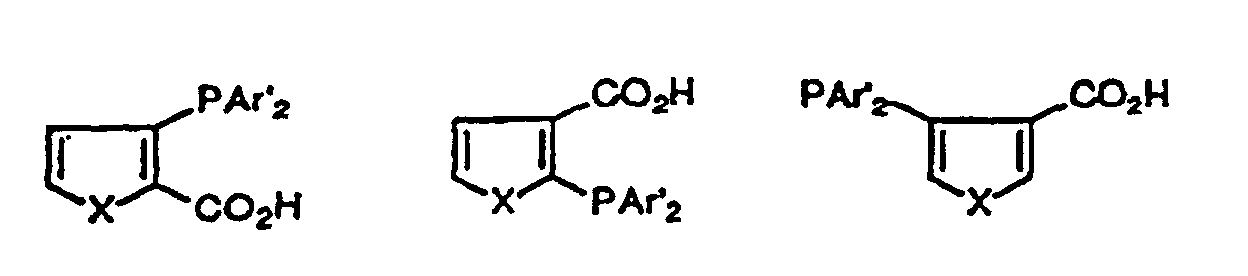
- The aromatic carboxylic acid of the acid precursors carry a diarylphosphino (or a diheteroarylphosphino) substituent. Thus, the necessary phosphino substituent and the carbonyl substituent may be on an aryl, a fused ring, or heteroaryl that is further substituted by a moderately or weakly activating or deactivating group, such as with an alkyl group (branched or unbranched) usually with not greater than about ten carbons, a halide, or an alkoxy (e.g., ―OCH3, ―OC2H5, etc.). In the instance of fused rings, the necessary phosphino substituent and the carboxyl substituent preferably are 1,2 on the one ring. Among the heteroatoms that can form the single or fused heteroaryl ring of the aromatic carboxylic acid from which the ligands may be derived are nitrogen, oxygen, and sulfur. Illustrative, suitable heteroaryl carboxylic acids on which the diarylphosphino (or diheteroarylphosphino) group can be substituted include compounds such as

- As is illustrated by the embodiment derived from 2-DPPBA, the carboxyl group and the diphenylphosphino group are preferably in an ortho relationship, which serves best for the ligand function.
- The carboxylic acid functionality and the alcohol/amine functionalities may be exchanged to generate ligands that we call "invertomers."
- Thus, to summarize, the ligands can be generally described as a functional module (forming a chiral pocket) joined by an ester or an amide linkage to a structural module we term a chiral scaffold. For one class of ligands, the functional module, which is a metal binding component, has the structurewhere Ar is an aromatic ring substituent. The functional module is joined by an ester or an amide linkage to the structural module. The structural module can be derived from any chiral alcohol or chiral amine having one or-more stereogenic centers. A particularly preferred embodiment of the structural module is derived from a C2 symmetrical bis alcohol or a bis amine.

- Table 1 summarizes a variety of ligands with single rings in the "Ar" of the metal-binding moiety,


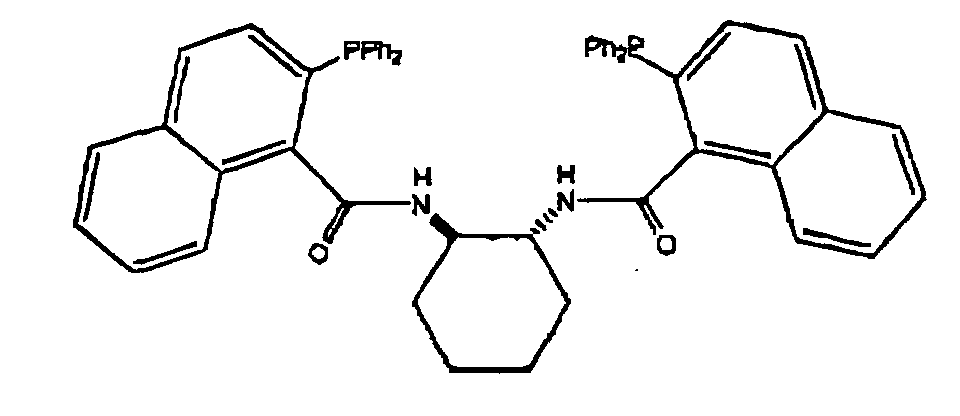
- Preferred ligands have Ar as a fused ring. A particularly preferred ligand of this invention has the Formula 1 structure, and is hereinafter sometimes referred to as "(RR)-L12N" as an abbreviation of (-)-1R,2R-diamino-1N,2N-bis(2'-diphenylphosphino-1'-naphthoyl)cyclohexane.

- This chiral ligand embodiment has proved remarkably successful in the amination of butadiene monoepoxide, which is a potentially desirable starting material for an asymmetric synthesis providing access to each enantiomer of vinylglycinol. Thus, the ligand (RR)-L12N should prove useful in syntheses of many biologically important targets.
- Without being limited by theory, we believe that the (RR)-L12N embodiment has dramatic effects on asymmetric induction by rigidifying the mode of linkage between the chiral scaffold and the "chiral pocket" in which reaction occurs by freezing rotations in the linker. Thus, we believe that the (RR)-L12N ligand has a relatively tight "chiral pocket" formed by the two metal binding moieties held in position by the chiral scaffold. Rigidifying the carboxylate unit by using a ligand constructed from the diamine and 2-diphenylphosphino-1-naphthoic acid had a dramatic effect in enhancing selectivity. This preferred ligand embodiment gave an outstanding result in the addition of phthalimide to 3,4-epoxy-1-butene (butadiene monoepoxide), and provided the protected vinylglycinol quantitatively with an enantiomeric ratio (e.r.) of 99:1. Since vinylglycinol of high enantiomeric purity has now been made available simply through use of the inventive ligand, there is provided a ready entry into either enantiomeric series for syntheses of biologically interesting and important targets.
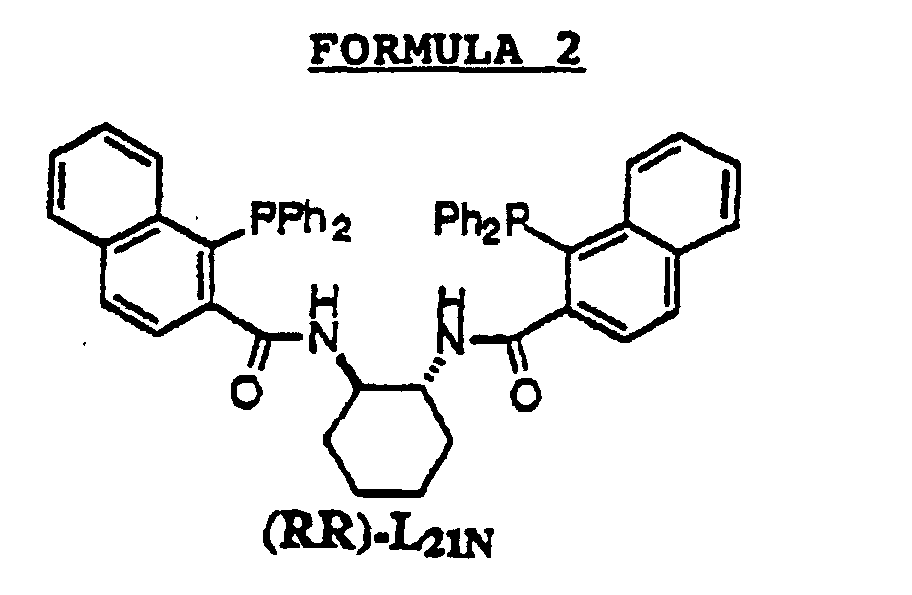
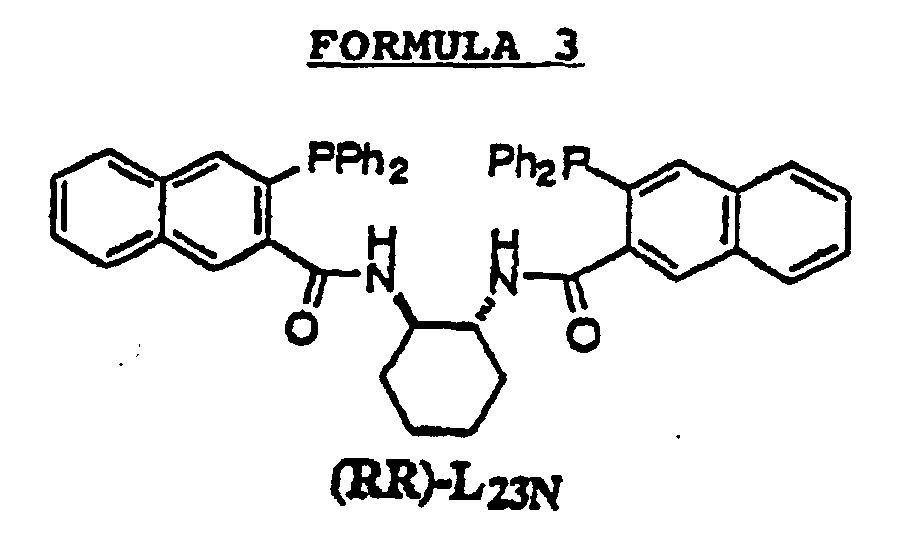
- The Formula 1 preferred ligand was prepared along with two other similar compounds as a study in rigidification and to focus on how the chiral scaffold represented by the diaminocyclohexane unit communicates with the conformationally chiral space created by the diphenylphosphino unit. These two other compounds are illustrated by Formulas 2 and 3, and are respectively designated "(RR)-L21N" and "(RR)-L23N."
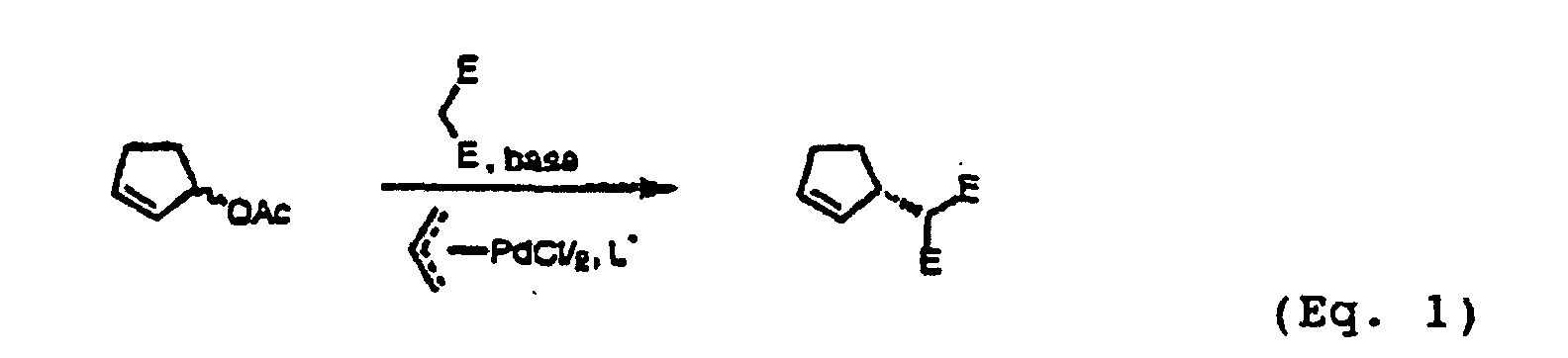
- To compare these new ligands, we explored the alkylation in Eq. 1 as our standard.(where E=CO2CH3)
- For further comparison, we used the Formula 1-3 ligands as well as the ligand with a single Ar in each metal binding moiety and sometimes referred to as "(RR)-LB."
- The (RR)-L23N ligand and the single Ar (RR)-LB ligand, were found to behave similarly and to give very high er's with cesium carbonate as base in methylene chloride (entries 4 and 8) in Table 2. Restricting the diphenylphosphino unit as in (RR)-L21N effectively destroyed the chiral recognition. Restricting the carboxylate group maintained a reasonable level of chiral recognition, although somewhat less than for (RR)-LB or (RR)-L23N.
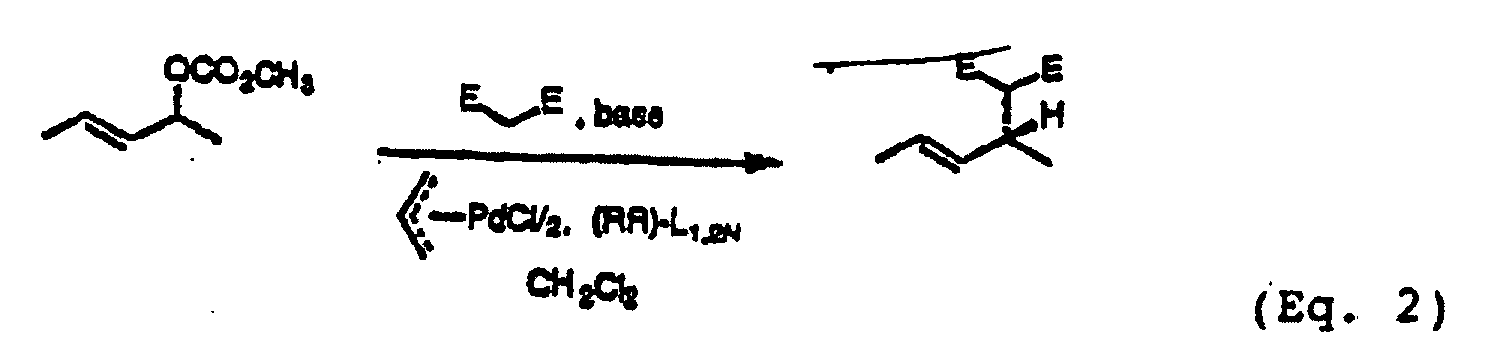
- In contrast to (RR)-LB or (RR)-L23N, we explored the reaction of the acyclic substrate shown in Eq. 2 with dimethyl malonate for which the maximum er previously recorded in the literature was 85:15.Using the (RR)-L12N ligand, the er of product produced in Eq. 2 was 70:30 for the sodium salt (base was sodium hydride) but 93:7 for the cesium salt (base was cesium carbonate), the highest recorded in the literature.
- The most dramatic result of the new ligand (RR)-L12N occurred for the type of chiral recognition required in the case of the epoxide shown (Eq. 3).Adding neat epoxide to a mixture of phthalimide (110 mol %), sodium carbonate (5 mol %), II-allylpalladium chloride dimer (2.5 mol %), and (AR)-L12N (7.5 mol %) in dichloromethane all at ambient temperature gave a 99% isolated yield of >75:1 ratio of proximal to distal products. This 99% isolated yield is in contrast to the 30-40% yield with no ligand (and in comparison to 9:1 ratio of proximal to distal). The er was assayed by conversion to the methylmandelate ester and hplc analysis and found to 99:1 (Eq. 4).
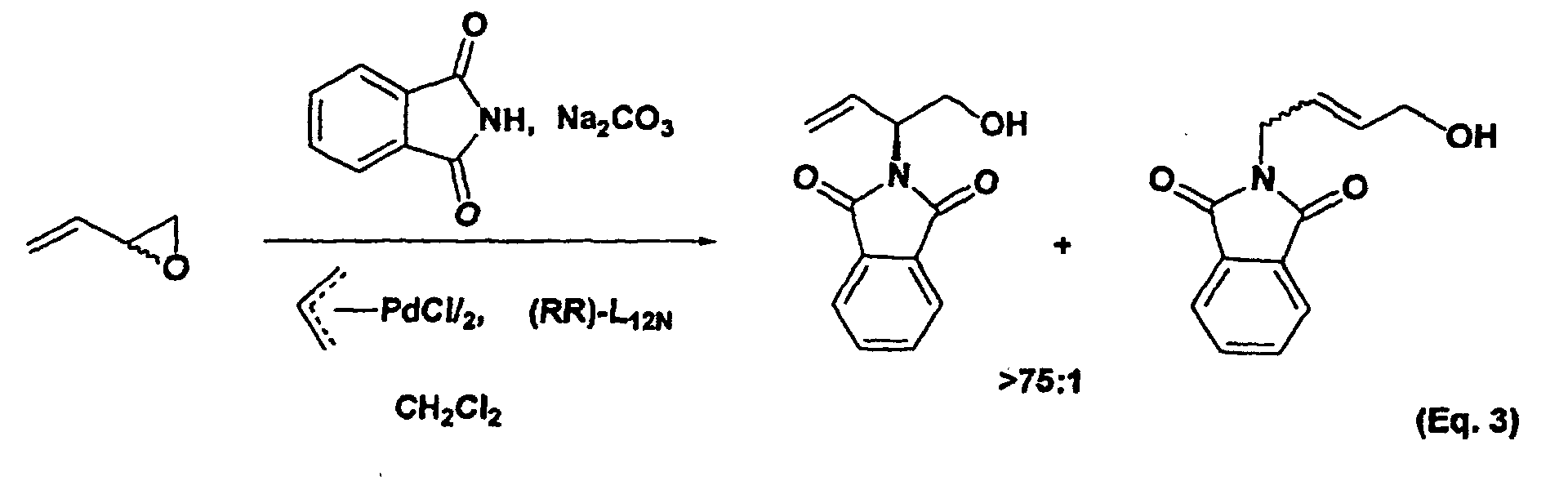

- Thus, vinylglycinol of high enantiomeric purity is available very simply from racemic 3,4-epoxy-1-butene by use of the new (RR)-L12N ligand. Since the conversion of vinylglycinol to vinylglycine is also known, this route also constitutes a synthesis of the latter as well.
- In contrast to previous syntheses relying on the natural amino acids as precursors, this route provides ready entry into either enantiomeric series. For this type of asymmetric induction, which requires a kinetic bias for reaction of one diastereomeric II-allylpalladium complex of a rapidly interconverting pair, rigidifying the carboxylate group had a dramatic effect in enhancing the selectivity. This same ligand does very well in discriminating the enantiotopic termini of the 1,3-dimethylallyl system (cf Eq. 2). The nature of the "chiral cavity" of (RR)-L12N is quite distinct from the other ligands.
- As earlier noted, to compare the naphthyl derived ligands to each other (and to a phenyl ligand), the alkylation of 2-cyclopentenyl acetate with dimethyl malonate (Eq. 1) was performed with each ligand under four sets of conditions. Both sodium hydride and cesium carbonate were used as the base in tetrahydrofuran (THF) and dichloromethane (DCM) respectively, and these data are summarized by Table 2.
Entry Ligand Base Solvent Yield [α]D ee(%) Method er (S:R) 1 (RR)-Le NaH THF 73 -28.2° 33 op. rot. 67:33 2 (RR)-Le NaH DCM 91 -43.6° 47 NMR 74:26 3 (RR)-Le Cs2CO3 THF 89 -55.7° 65 op. rot. 83:17 4 (RR)-Le Cs2CO3 DCM 82 -81.0° 97 NMR 99:1 5 (RR)-L23N NaH THF 65 -21.3° 25 op. rot 63:37 6 (RR)-L23N NaH DCM 85 -23.4° 28 NMR 64:36 7 (RR)-L23N Cs2CO3 THF 47 -45.7° 51 NMR 76:24 8 (RR)-L23N Cs2CO3 DCM 91 -82.7° 96 NMR 98:2 9 (RR)-L12N NaH THF 99 -58.2° 68 op. rot 53:47 10 (RR)-L12N NaH DCM 96 -75.3° 87 NMR 58:42 11 (RR)-L12N Cs2CO3 THF 76 -33.6° 39 op. rot 53:47 12 (RR)-L12N Cs2CO3 DCM 90 -68.7° 80 NMR 62:38 13 (RR)-L21N NaH THF 63 -5.3° 6 op. rot. 84:16 14 (RR)-L21N NaH DCM 88 -13.0° 15 op. rot. 94:6 15 (RR)-L21N Cs2CO3 THF 79 -4.6° 5 op. rot 70:30 16 (RR)-L21N Cs2CO3 DCM 87 -18.6° 23 NMR 90:10 - Comparing entries 1-4 with entries 5-8 one observes that the (RR)-L23N ligand is generally similar or in some cases somewhat worse than (RR)-LB. Entries 9-12 show that the preferred ligand embodiment (RR)-L12N has a distinctly different selectivity profile than (RR)-LB. Finally, entries 13-16 show an extremely poor enantioselectivity obtained with (RR)-L21N. The effect of the base seems largely due to the differences in the counter ion, but some effect of the carbonate rather than hydride base cannot be excluded and likely plays a minor role.
- The Equation 3 reaction is butadiene monoepoxide, which is of an epoxide-type, or class, that can be generally viewed as having the following structure (where R is H, alkyl, aryl, or a functional group and R' is H, alkyl, alkenyl, aryl, or a functional group):Illustrative alkyls and alkenyls for R are C1-20 carbons, linear or branched, with one or more unsaturated bonds (triple or double). Illustrative aryls are phenyl and heteroaryls (e.g. furyl, pyrroyl). Illustrative functionalized species are carboxylic acid derivatives (e.g. esters, amides), halides, ketones, and nitriles. However, the ligands, such as derived from 2-diphenylphosphinobenzoic acid or from 2-diphenylphosphinonaphthoic acid, either as an ester or amide from chiral alcohols and chiral amines, can be used for chiral induction of another class, or type, or epoxide as substrate where this second class may be generally represented by the following structure (where R is as described for the first class):
 Among the applications for chiral induction with epoxides of the second class are, for example, syntheses of carbohydrates, monosaccharide portions of antitumor agents (e.g. calichemycin, daunomycin), glycosidase inhibitors, and antifungal nucleosides (such as polyoxins).
- Preparation of the preferred ligand embodiment (RR)-L12N (Part A of Example 1) and its use in synthesizing vinylglycinol of high enantiomeric purity from racemic 3,4-epoxy-1-butene (Part B of Example 1) will now be illustrated. Preparation of a benzoic acid derived ligand (Part A of Example 2) and its use with the second epoxied class (Part B of Example 2) will then be illustrated.
- To a 250 ml round bottom flask was added 2.85 g (7.7 mmol) 2-diphenylphosphino-1-naphthoic acid methyl ester, 14.8 g (47.0 mmol) Ba(OH)2·8H2O, the flask purged with nitrogen, and 47 ml MeOH added. The reaction was heated at reflux overnight (25 hours). After cooling to room temperature, the reaction mixture was neutralized with 200 ml 1N NaHSO4 (aq) and extracted 4x100 ml dichloromethane. The combined organic phases were dried over Na2SO4 and concentrated in vacuo. The yellow residue was absorbed onto ∼8 g silica gel and filtered through a short column of silica gel (4 cm x 6 cm, 100% ethyl acetate) to give 2.42 g (88%) of a yellow solid (mp 190-192°C dec.) which was used without further purification.
Rf 0.56 (100% ethyl acetate).
IR (Kbr): 3414, 3074, 3057, 1685, 1434, 1287, 1252 cm-1. 1H NMR (300 MHz, DMSO-d6) δ 8.0 (d, J=8.2 Hz, 1H), 7.82 (d, J=8.0 Hz, 1H), 7.78 (d, J=8.5 Hz, 1H), 7.5-7.6 (m, 2H), 7.25 (m, 10H), 7.15 (dd, J=8.3, 2.8 Hz, 1H).
13C NMR (75 MHz, DMSO-d6) δ 170.4 (d, J=3.4 Hz), 141.6 (d, J=38.0 Hz), 137.0 (d, J=10.7 Hz), 133.1 (d, J=19.1 Hz), 132.1, 131.9, 130.7 (d, J=17.0 Hz), 129.6, 129.3, 129.2, 128.9 (d, J=6.9 Hz), 128.7, 128.5, 127.8, 125.5. Analysis: Calc'd for C, 77.52; H, 4.81; P, 8.69. Found: C, 77.38; H, 5.00; P, 8.51. - To a 100 ml round bottom flask was added 1.90 g (5.33 mmol) 2-diphenylphosphino-1-naphthoic acid and 42 ml dichloromethane. After cooling to 0°C, 1.78 g (17.6 mmol) triethyl amine was added followed by 1.58 g (5.87 mmol) diphenylchlorophosphite added dropwise over 2-3 minutes. After warming to room temperature over 5 hours, the mixture was transferred via cannula to solution of 304 mg (2.66 mmol) (1R,2R)-diaminocyclohexane and 30.5 mg (0.25 mmol) 4-dimethylaminopyridine in 11 ml dichloromethane and stirred overnight. The reaction mixture was diluted with 50 ml dichloromethane and washed 1x50 ml saturated aqueous sodium bicarbonate and dried over sodium sulfate and concentrated in vacuo. The crude product was purified by flash chromatography on silica gel (4.5 cm x 11 cm, 25% ethyl acetate in hexanes) to give 1.07 g (51%) of a white solid which was crystallized from chloroform/hexanes as a white powder (mp 148-150°C).
[α]D = +13.94° (c 1.19, CH2Cl2).
Rf 0.64 (50% ethyl acetate in hexanes).
IR (solution CDCl3): 3412, 3072, 3057, 2938, 2862, 1648, 1602, 1510, 1435, 1313, 1256, 1237, 1091, 1027 cm-1.
1H NMR (300 MHz, CDCl3) δ 7.8 (d, J=8.2 Hz, 2H), 7.7 (d, J=9.1 Hz, 2H), 7.6 (d, J=8.9 Hz, 2H), 7.2-7.4 (m, 22H), 7.0 (m, 4H), 6.6 (d, J=5.5 Hz, 2H), 3.8 (m, 2H), 2.3 (m, 2H), 1.7 (m, 2H), 1.2-.13 (m, 4H).
13C NMR (75 MHz, CDCl3) δ 169.2 (d, J=4.2 Hz), 142.0 (d, J=34.2 Hz), 136.85 (d, J=11.3 Hz), 136.81 (d, J=11.3 Hz), 133.5 (d, J=19.6 Hz), 133.4 (d, J=19.3 Hz), 133.3, 131.3 (d, J=18.1 Hz), 129.9 (d, J=7.9 Hz), 129.4, 129.2, 128.7, 128.7, 128.6, 128.5, 128.4 (d, J=6.7 Hz), 127.7, 127.2, 126.9, 125.6, 54.7, 31.5, 24.4.
Analysis: Calc'd for C, 78.97; H, 5.61; N, 3.54; P, 7.83. Found: C, 78.76; H, 5.86; N, 3.38; P, 7.67. - To a 20 ml test tube was added 9.1 mg (0.025 mmol) [η3C3H5PdCl]2, 59.3 mg (0.075 mmol) (-)-1R,2R-diamino-1N,2N-bis(2'-diphenylphosphino-1' - naphthoyl)cyclohexane, 5.0 mg (0.05 mmol) sodium carbonate, and 162 mg (1.10 mmol) phthalimide. The flask was purged with nitrogen, 10 ml dichloromethane added, and stirred 10 minutes, color to bright yellow. Then, 70.1 mg (1.00 mmol) butadiene monoepoxide (3) was added, color to clear, and the reaction stirred at room temperature for 2.5 hours at which time the bright yellow color had returned. The reaction mixture was concentrated in vacuo and purified by flash chromatography on silica gel (3 cm x 12 cm, 60% diethyl ether in hexanes) to give 216.2 mg (99%) of the 1,3 addition product as a white solid (mp 61-62°C) in 98% ee as determined by HPLC of the (S)-methoxyphenylacetate ester.
[a]D = -71.11° (c 3.06, CH2Cl2).
Rf 0.65 (100% diethyl ether).
IR (film from CDCl3): 3450, 3086, 2945, 2888, 1767, 1704, 1644, 1614, 1469, 1386, 1226, 1173, 1107, 1060, 1020 cm-1.
1H NMR (300 MHz, CDCl3) 7.8 (m, 2H), 7.7 (m, 2H), 6.1 (ddd, J-17.3, 10.2, 6.9 Hz, 1H), 5.3 (m, 2H), 4.9 (m, 1H), 4.1-4.2 (m, 1H), 3.9-4.0 (m, 1H), 2.9 (bs, 1H).
13C NMR (75 MHz, CDCl3) 168.4, 133.9, 132.0, 131.4, 123.0, 118.6, 61.7, 55.5.
Analysis: Calc'd for C, 66.35; H, 5.11; N, 6.45. Found: C, 66.60; H, 5.33; N, 6.65. - To a 3 ml test tube was added 10.9 mg (0.05 mmol) 2-phthalamido-3-butenol, 10.1 mg (0.06 mmol) (S)-methoxyphenylacetic acid, 14.4 mg (0.07 mmol) dicyclohexylcarbodiimide, 0.5 mg (0.005 mmol) 4-dimethylaminopyridine, and 0.5 ml dichloromethane. The reaction was stirred at room temperature overnight and then filtered through cotton. The product was purified by flash chromatography on silica gel (1 cm x 12 cm, 40% diethyl ether in pentane) to give 18.0 mg (98%) of the title compound as a clear oil in 98% de, as determined by HPLC analysis (Dynamax 60A analytical, 15% ethyl acetate in hexanes, 1.0 ml/min, λ=254 nm, TR=22.3, 23.4 min).
[α]D = +4.24° (c 1.80, CH2Cl2).
Rf 0.62 (30% ethyl acetate in hexanes).
Spectral data taken from racemate (RB-XI-8)
IR (film from CDCl3): 3064, 3032, 2990, 2933, 2830, 1756, 1714, 1468, 1455, 1385, 1256, 1174, 1113, 1013 cm-1.
1H NMR (300 MHz, CDCl3) 7.7-7.8 (m, 4H), 7.2 (m, 2H), 7.0 (m, 3H), 6.0-6.15 (m, 1H), 5.3 (m, 2H), 5.0 (m, 1H), 4.7 (m, 2H), 4.4 (dd, J=11.0, 5.3 Hz, 1H), 3.33 (s, 3H).
13C NMR (75 MHz, CDCl3) 170.0, 167.4, 135.8, 133.9, 131.6, 130.8, 128.4, 128.2, 126.8, 123.3 120.1, 82.1, 63.1, 57.3, 52.1.
Analysis: Calc'd for C, 69.03; H, 5.24; N, 3.83.
Found: C, 68.88; H, 5.41; N, 3.98. - To a dry flask containing alcohol or amine, excess 2-diphenylphosphinobenzoic acid, 5 mol% 4-dimethylaminopyridine in anhydrous solvent (THF or dichloromethane) under nitrogen was added dicyclohexylcarbodiimide. The yellow, chalky mixture was stirred at room temperature until thin layer chromatography indicted complete reaction.
- The reaction mixture was filtered through a 2 cm pad of celite (wetted with dichloromethane) and the filter cake was washed twice with an equal volume of dichloromethane. Solvent was removed in vacuo and the residue was chromatographed on silica gel.
- The reaction was run with (-)-1R, 2R-diaminocyclohexane (0.1312 g, 1.149 mmol, Aldrich), 2-diphenylphosphinobenzoic acid (0.774 g, 2.528 mmol), and dicyclohexylcarbodiimide (0.521 g, 2.528 mmol) in dichloromethane (4 mL) for 9 h.
- The residue was chromatographed twice on silica gel with 15-30% ethyl acetate/hexanes (gradient) to give the diamide 6.28 as a glass foam (0.2366 g, 29.8%).
- Ligand 6.28: waxy solid precipitated from dichloromethane with hexanes, m.p. 80-120°C.
Rf 0.43 (50% ethyl acetate/hexanes).
IR (neat film from CDCl3) 3303, 3070, 2935, 2857, 1955(w), 1887(w), 1817(w), 1645(s), 1538, 1478, 1434, 1328, 1306, 1162, 1091, 909 cm-1.
1H NMR (CDCl3, 200 MHz) δ 7.57(m, 2H), 7.15-7.26(m, 24H), 6.91(m, 2H), 6.31(bd, J=7.7Hz, 2H, N-H), 3.77(m, 2H), 1.87(m, 2H), 1.62(m, 2H), 0.9-1.3(m, 6H).
13C NMR (CDCl3, 50 MHz) δ 169.46, 140.80(d, J=24.2Hz), 137.96(d, J=11.8Hz), 137.88(d, J=12.3Hz), 136.81(d, J=21.6Hz), 134.34, 133.97(d, J=20.3Hz), 130.23, 128.79, 128.66, 128.57, 128.51, 128.43, 127.63, 127.55, 53.68, 31.71, 24.41.
Analysis calcd. for C44H40N2O2P2: C,76.51; H,5.83; N,4.06; P,8.97. Found: C,76.16; H,6.28;N,4.02; P,8.93.
[α]D=-46.7(±.3)°(c2.366, dichloromethane). - A dry 10 mL round bottomed flask was charged with tris(dibenzylideneacetone)dipalladium(0)chloroform complex (11.8 mg, 0.011 mmol), (+)-1R,2R-diamino-1N,2N-bis(2'-diphenylphosphinobenzoyl)cyclohexane (23.6 mg, 0.034 mmol), cesium carbonate (14.8 mg, 0.046 mmol), and phthalimide (73.6 mg, 0.500 mmol). The flask was then purged with argon and anhydrous THF (2 mL) was added. The resultant black-purple slurry was stirred at room temperature for 10 min, resulting in a clear red-orange solution. To this mixture was added a solution of 4,5-epoxypent-E-2-En-1-ol (45.5 mg, 0.455 mol) in THF (2 mL) dropwise. The reaction was stirred at room temperature for 17 hours, or until thin layer chromatography (2/1:ethyl acetate/hexanes) indicated complete consumption of the epoxide alcohol. The solution was then gravity filtered and the resulting filtrate concentrated in vacuo to an orange oil which was directly chromatographed on silica gel with ethyl acetate to afford 98.3 mg (87%) of the product as a colorless oil. [α]D 24.8 = -28.8°, c=1.966 (CH2Cl2)
Rf = 0.25 (2/1:ethyl acetate/hexanes).
IR (neat): 3432, 1722, 1646, 1445, 1395, 1319, 1257, 1150, 1087, 1043, 842 cm-1.
1H NMR (CDCl3, 300 MHz) δ: 7.80 (m, 2H), 7.70 (m, 2H), 6.04 (dd, J=15.6, 7.3 Hz, 1H), 5.87 (dt, J-15.6, 5.0 Hz, 1H), 4.91 (m, 1H), 4.11 (d, J-5.0 Hz, 2H), 4.06 (dd, J-11.6, 7.5 Hz, 1H), 3.94 (dd, J=11.6, 5.0 Hz, 1H), 2.80 (bs, 2H).
13C NMR (CDCl3, 75 MHz) δ: 168.52, 134.16, 133.94, 131.69, 124.87, 123.38, 62.83, 62.53, 54.85.
Mass spectrum m/e (rel intensity) 216(10), 199(55), 148(100), 130(43).
HRMS calcd. for C13H13NO4, 247.0845, (M-H2COH) 216.0660, found 216.0654.
ee determined to be 83% by derivatization using (S)-(+)α-methoxyphenylacetic acid.
Claims (12)
- A method for producing an enantiomer of a chiral product, by chiral induction in a bond-forming reaction using an epoxide-containing compound as substrate, in the presence of a chiral ligand including two metal-binding moieties each having the structure
- A method according to claim 1, wherein the substrate has the structurewherein R is H, alkyl, aryl or a functional group, and R1 is H, alkyl, alkenyl, aryl or a functional group.

- A method according to claim 1, wherein the substrate has the formulawherein each R independently is as defined in claim 2.

- A method according to claim 1, wherein the substrate is butadiene monoepoxide.
- A method according to claim 4, wherein the product is the phthalimido derivative of butadiene monoepoxide.
- A method according to any preceding claim, wherein Ar has the phosphino substituent (-P-Ar'2) and the carbonyl group at positions 1 and 2 of one ring.
- A method according to any preceding claim, wherein the ligand is a derivative of a chiral bis-alcohol or a chiral bis-amine having C2 symmetry.
- A method according to any preceding claim, wherein Ar is a fused ring.
- A method according to claim 8, wherein Ar is naphthyl.
- A method according to any of claims 1 to 7, wherein Ar is heteroaryl.
- A method according to claim 10, wherein the ligand is obtainable by substituting the group PAr'2 into a carboxylic acid of the formulawherein X is O, S or NR.

- A method according to claim 6, wherein the ligand has the structure
Applications Claiming Priority (5)
| Application Number | Priority Date | Filing Date | Title |
|---|---|---|---|
| US30883994A | 1994-09-19 | 1994-09-19 | |
| US308839 | 1994-09-19 | ||
| US08/487,023 US5919948A (en) | 1991-12-09 | 1995-06-07 | Asymmetric ligands useful for transition metal catalyzed bond forming reactions and epoxide reactions therewith |
| US487023 | 1995-06-07 | ||
| PCT/US1995/011938 WO1996009306A1 (en) | 1994-09-19 | 1995-09-11 | Asymmetric ligands useful for transition metal catalyzed bond forming reactions and epoxide reactions therewith |
Publications (3)
| Publication Number | Publication Date |
|---|---|
| EP0782577A1 EP0782577A1 (en) | 1997-07-09 |
| EP0782577A4 EP0782577A4 (en) | 1998-01-07 |
| EP0782577B1 true EP0782577B1 (en) | 2002-06-12 |
Family
ID=26976476
Family Applications (1)
| Application Number | Title | Priority Date | Filing Date |
|---|---|---|---|
| EP95935015A Expired - Lifetime EP0782577B1 (en) | 1994-09-19 | 1995-09-11 | Asymmetric ligands useful for transition metal catalyzed bond forming reactions and epoxide reactions therewith |
Country Status (6)
| Country | Link |
|---|---|
| US (1) | US5919948A (en) |
| EP (1) | EP0782577B1 (en) |
| JP (1) | JP3974169B2 (en) |
| AT (1) | ATE219088T1 (en) |
| DE (1) | DE69527075T2 (en) |
| WO (1) | WO1996009306A1 (en) |
Families Citing this family (5)
| Publication number | Priority date | Publication date | Assignee | Title |
|---|---|---|---|---|
| US6130337A (en) * | 1997-04-11 | 2000-10-10 | Board Of Trustees Of Leland Stanford Junior University | Enantiomerically enriched α,α-distributed amino acids and method |
| US6323366B1 (en) | 1997-07-29 | 2001-11-27 | Massachusetts Institute Of Technology | Arylamine synthesis |
| US6307067B1 (en) | 1998-09-08 | 2001-10-23 | The Board Of Trustees Of The Leland Stanford Junior University | Palladium and boron co-catalyzed addition of oxygen nucleophiles to vinyl epoxides |
| CN112538092B (en) * | 2021-02-19 | 2021-06-18 | 江苏欣诺科催化剂有限公司 | Preparation method of chiral Trost ligand |
| CN116178428A (en) * | 2023-02-24 | 2023-05-30 | 华东师范大学 | A kind of synthesis method of P, O-hybrid ligand |
Family Cites Families (3)
| Publication number | Priority date | Publication date | Assignee | Title |
|---|---|---|---|---|
| US4209468A (en) * | 1977-03-28 | 1980-06-24 | The Procter & Gamble Company | Triaryl-phosphine compounds |
| JPS62178594A (en) * | 1986-02-01 | 1987-08-05 | Takasago Corp | Novel phosphine compound |
| WO1993012260A2 (en) * | 1991-12-09 | 1993-06-24 | Board Of Trustees Of The Leland Stanford Junio | Asymmetric ligands useful for transition metal catalyzed bond forming reactions |
-
1995
- 1995-06-07 US US08/487,023 patent/US5919948A/en not_active Expired - Lifetime
- 1995-09-11 JP JP51104896A patent/JP3974169B2/en not_active Expired - Fee Related
- 1995-09-11 DE DE69527075T patent/DE69527075T2/en not_active Expired - Lifetime
- 1995-09-11 AT AT95935015T patent/ATE219088T1/en active
- 1995-09-11 EP EP95935015A patent/EP0782577B1/en not_active Expired - Lifetime
- 1995-09-11 WO PCT/US1995/011938 patent/WO1996009306A1/en not_active Ceased
Also Published As
| Publication number | Publication date |
|---|---|
| EP0782577A4 (en) | 1998-01-07 |
| WO1996009306A1 (en) | 1996-03-28 |
| DE69527075D1 (en) | 2002-07-18 |
| EP0782577A1 (en) | 1997-07-09 |
| US5919948A (en) | 1999-07-06 |
| ATE219088T1 (en) | 2002-06-15 |
| JP3974169B2 (en) | 2007-09-12 |
| DE69527075T2 (en) | 2003-02-06 |
| JPH10506109A (en) | 1998-06-16 |
Similar Documents
| Publication | Publication Date | Title |
|---|---|---|
| US6191284B1 (en) | Ligands and complexes for enantioselective hydrogenation | |
| US3798241A (en) | Bidentate coordinates,their manufacture and application | |
| US20110092712A1 (en) | Novel Ruthenium Complexes Having Hybrid Amine Ligands, Their Preparation And Use | |
| US5739396A (en) | Asymmetric ligands useful for transition metal catalyzed bond forming reactions | |
| JPS63316744A (en) | Production of optically active alcohol | |
| CA2561973A1 (en) | Process for the preparation of enantiomerically enriched beta amino acid derivatives | |
| US4981992A (en) | Process for preparing optically active 3-hydroxybutanoic acid | |
| CZ295748B6 (en) | Biphosphine derivatives and process of their preparation | |
| US5919948A (en) | Asymmetric ligands useful for transition metal catalyzed bond forming reactions and epoxide reactions therewith | |
| WO2005007662A2 (en) | Biphosphine ruthenium complexes with chiral diamine ligande as catalysts | |
| EP1127061B1 (en) | Chiral ligands for asymmetric catalysis | |
| US5892044A (en) | Process for preparing optically active 1-(p-methoxybenzyl)-1,2,3,4,5,3,7,8-octahydroisoquinoline | |
| WO1993012260A2 (en) | Asymmetric ligands useful for transition metal catalyzed bond forming reactions | |
| US20100099875A1 (en) | New ortho-functionalized p-chiral arylphosphines and derivatives: their preparation and use in asymmetric catalysis | |
| CA2200225C (en) | Asymmetric ligands useful for transition metal catalyzed bond forming reactions and epoxide reactions therewith | |
| CN115650878B (en) | Synthesis method of 3-methyl substituted homoallylnitrile compound | |
| US20080275274A1 (en) | Process for the preparation of enantiomerically enriched compounds | |
| US5919981A (en) | Chiral aminophosphines | |
| EP0901996B1 (en) | Process for producing optically active amines | |
| US8076480B2 (en) | Process of preparing optically active allyl compound | |
| US8013171B2 (en) | Axially asymmetric ester compound and production method thereof | |
| Le Gendre et al. | Stereoselective synthesis of a new optically active phosphinoacyloxazolidinone via enantioselective hydrogenation | |
| US4168381A (en) | Enhancement of enantioselectivity by iodide salts of Rh(I) complexes in the reduction of prochiral imidazolinones | |
| JPH05194568A (en) | New homochiral diphosphines | |
| US8222433B2 (en) | Axially asymmetric phosphorus compound and production method thereof |
Legal Events
| Date | Code | Title | Description |
|---|---|---|---|
| PUAI | Public reference made under article 153(3) epc to a published international application that has entered the european phase |
Free format text: ORIGINAL CODE: 0009012 |
|
| 17P | Request for examination filed |
Effective date: 19970411 |
|
| AK | Designated contracting states |
Kind code of ref document: A1 Designated state(s): AT BE CH DE DK ES FR GB GR IE IT LI LU NL PT SE |
|
| A4 | Supplementary search report drawn up and despatched |
Effective date: 19971121 |
|
| AK | Designated contracting states |
Kind code of ref document: A4 Designated state(s): AT BE CH DE DK ES FR GB GR IE IT LI LU NL PT SE |
|
| 17Q | First examination report despatched |
Effective date: 20010126 |
|
| GRAG | Despatch of communication of intention to grant |
Free format text: ORIGINAL CODE: EPIDOS AGRA |
|
| GRAG | Despatch of communication of intention to grant |
Free format text: ORIGINAL CODE: EPIDOS AGRA |
|
| GRAH | Despatch of communication of intention to grant a patent |
Free format text: ORIGINAL CODE: EPIDOS IGRA |
|
| GRAH | Despatch of communication of intention to grant a patent |
Free format text: ORIGINAL CODE: EPIDOS IGRA |
|
| GRAA | (expected) grant |
Free format text: ORIGINAL CODE: 0009210 |
|
| AK | Designated contracting states |
Kind code of ref document: B1 Designated state(s): AT BE CH DE DK ES FR GB GR IE IT LI LU NL PT SE |
|
| PG25 | Lapsed in a contracting state [announced via postgrant information from national office to epo] |
Ref country code: IT Free format text: LAPSE BECAUSE OF FAILURE TO SUBMIT A TRANSLATION OF THE DESCRIPTION OR TO PAY THE FEE WITHIN THE PRE;WARNING: LAPSES OF ITALIAN PATENTS WITH EFFECTIVE DATE BEFORE 2007 MAY HAVE OCCURRED AT ANY TIME BEFORE 2007. THE CORRECT EFFECTIVE DATE MAY BE DIFFERENT FROM THE ONE RECORDED.SCRIBED TIME-LIMIT Effective date: 20020612 Ref country code: GR Free format text: LAPSE BECAUSE OF FAILURE TO SUBMIT A TRANSLATION OF THE DESCRIPTION OR TO PAY THE FEE WITHIN THE PRESCRIBED TIME-LIMIT Effective date: 20020612 Ref country code: BE Free format text: LAPSE BECAUSE OF FAILURE TO SUBMIT A TRANSLATION OF THE DESCRIPTION OR TO PAY THE FEE WITHIN THE PRESCRIBED TIME-LIMIT Effective date: 20020612 Ref country code: AT Free format text: LAPSE BECAUSE OF FAILURE TO SUBMIT A TRANSLATION OF THE DESCRIPTION OR TO PAY THE FEE WITHIN THE PRESCRIBED TIME-LIMIT Effective date: 20020612 |
|
| REF | Corresponds to: |
Ref document number: 219088 Country of ref document: AT Date of ref document: 20020615 Kind code of ref document: T |
|
| REG | Reference to a national code |
Ref country code: GB Ref legal event code: FG4D |
|
| REG | Reference to a national code |
Ref country code: CH Ref legal event code: EP |
|
| REF | Corresponds to: |
Ref document number: 69527075 Country of ref document: DE Date of ref document: 20020718 |
|
| REG | Reference to a national code |
Ref country code: IE Ref legal event code: FG4D |
|
| PG25 | Lapsed in a contracting state [announced via postgrant information from national office to epo] |
Ref country code: LU Free format text: LAPSE BECAUSE OF NON-PAYMENT OF DUE FEES Effective date: 20020911 Ref country code: IE Free format text: LAPSE BECAUSE OF NON-PAYMENT OF DUE FEES Effective date: 20020911 |
|
| PG25 | Lapsed in a contracting state [announced via postgrant information from national office to epo] |
Ref country code: SE Free format text: LAPSE BECAUSE OF FAILURE TO SUBMIT A TRANSLATION OF THE DESCRIPTION OR TO PAY THE FEE WITHIN THE PRESCRIBED TIME-LIMIT Effective date: 20020912 Ref country code: PT Free format text: LAPSE BECAUSE OF FAILURE TO SUBMIT A TRANSLATION OF THE DESCRIPTION OR TO PAY THE FEE WITHIN THE PRESCRIBED TIME-LIMIT Effective date: 20020912 Ref country code: DK Free format text: LAPSE BECAUSE OF FAILURE TO SUBMIT A TRANSLATION OF THE DESCRIPTION OR TO PAY THE FEE WITHIN THE PRESCRIBED TIME-LIMIT Effective date: 20020912 |
|
| ET | Fr: translation filed | ||
| PG25 | Lapsed in a contracting state [announced via postgrant information from national office to epo] |
Ref country code: ES Free format text: LAPSE BECAUSE OF FAILURE TO SUBMIT A TRANSLATION OF THE DESCRIPTION OR TO PAY THE FEE WITHIN THE PRESCRIBED TIME-LIMIT Effective date: 20021220 |
|
| PLBE | No opposition filed within time limit |
Free format text: ORIGINAL CODE: 0009261 |
|
| STAA | Information on the status of an ep patent application or granted ep patent |
Free format text: STATUS: NO OPPOSITION FILED WITHIN TIME LIMIT |
|
| 26N | No opposition filed |
Effective date: 20030313 |
|
| REG | Reference to a national code |
Ref country code: IE Ref legal event code: MM4A |
|
| PGFP | Annual fee paid to national office [announced via postgrant information from national office to epo] |
Ref country code: NL Payment date: 20130916 Year of fee payment: 19 Ref country code: CH Payment date: 20130903 Year of fee payment: 19 Ref country code: DE Payment date: 20130830 Year of fee payment: 19 |
|
| PGFP | Annual fee paid to national office [announced via postgrant information from national office to epo] |
Ref country code: FR Payment date: 20130828 Year of fee payment: 19 Ref country code: GB Payment date: 20130827 Year of fee payment: 19 |
|
| REG | Reference to a national code |
Ref country code: DE Ref legal event code: R082 Ref document number: 69527075 Country of ref document: DE Representative=s name: MEISSNER, BOLTE & PARTNER GBR, DE |
|
| REG | Reference to a national code |
Ref country code: DE Ref legal event code: R082 Ref document number: 69527075 Country of ref document: DE Representative=s name: MEISSNER, BOLTE & PARTNER GBR, DE |
|
| REG | Reference to a national code |
Ref country code: DE Ref legal event code: R119 Ref document number: 69527075 Country of ref document: DE |
|
| REG | Reference to a national code |
Ref country code: CH Ref legal event code: PL |
|
| GBPC | Gb: european patent ceased through non-payment of renewal fee |
Effective date: 20140911 |
|
| REG | Reference to a national code |
Ref country code: DE Ref legal event code: R119 Ref document number: 69527075 Country of ref document: DE Effective date: 20150401 |
|
| REG | Reference to a national code |
Ref country code: FR Ref legal event code: ST Effective date: 20150529 |
|
| PG25 | Lapsed in a contracting state [announced via postgrant information from national office to epo] |
Ref country code: NL Free format text: LAPSE BECAUSE OF NON-PAYMENT OF DUE FEES Effective date: 20150401 |
|
| PG25 | Lapsed in a contracting state [announced via postgrant information from national office to epo] |
Ref country code: DE Free format text: LAPSE BECAUSE OF NON-PAYMENT OF DUE FEES Effective date: 20150401 Ref country code: GB Free format text: LAPSE BECAUSE OF NON-PAYMENT OF DUE FEES Effective date: 20140911 Ref country code: CH Free format text: LAPSE BECAUSE OF NON-PAYMENT OF DUE FEES Effective date: 20140930 Ref country code: LI Free format text: LAPSE BECAUSE OF NON-PAYMENT OF DUE FEES Effective date: 20140930 |
|
| PG25 | Lapsed in a contracting state [announced via postgrant information from national office to epo] |
Ref country code: FR Free format text: LAPSE BECAUSE OF NON-PAYMENT OF DUE FEES Effective date: 20140930 |