EP0782565B1 - Iodinated x-ray-contrast media - Google Patents
Iodinated x-ray-contrast media Download PDFInfo
- Publication number
- EP0782565B1 EP0782565B1 EP95932108A EP95932108A EP0782565B1 EP 0782565 B1 EP0782565 B1 EP 0782565B1 EP 95932108 A EP95932108 A EP 95932108A EP 95932108 A EP95932108 A EP 95932108A EP 0782565 B1 EP0782565 B1 EP 0782565B1
- Authority
- EP
- European Patent Office
- Prior art keywords
- groups
- group
- compound
- triiodo
- bis
- Prior art date
- Legal status (The legal status is an assumption and is not a legal conclusion. Google has not performed a legal analysis and makes no representation as to the accuracy of the status listed.)
- Expired - Lifetime
Links
- 0 Cc(c(I)c(*)c(I)c1*)c1I Chemical compound Cc(c(I)c(*)c(I)c1*)c1I 0.000 description 6
- NJPHUNIYKQTCGH-UHFFFAOYSA-N NC(C(C(C(I)=C1C(C(C(C(I)=C(C(C2=N)I)N)=C2I)=O)=O)=N)I)=C1I Chemical compound NC(C(C(C(I)=C1C(C(C(C(I)=C(C(C2=N)I)N)=C2I)=O)=O)=N)I)=C1I NJPHUNIYKQTCGH-UHFFFAOYSA-N 0.000 description 1
- PZICKSASEYTYQF-UHFFFAOYSA-N Nc(c(I)c(c(I)c1Oc(c(I)c(c(I)c2N)N)c2I)N)c1I Chemical compound Nc(c(I)c(c(I)c1Oc(c(I)c(c(I)c2N)N)c2I)N)c1I PZICKSASEYTYQF-UHFFFAOYSA-N 0.000 description 1
- DKIZMKQCGFSEHZ-UHFFFAOYSA-N Nc(c(I)c(c(I)c1S(c(c(I)c(c(I)c2N)N)c2I)(=O)=O)N)c1I Chemical compound Nc(c(I)c(c(I)c1S(c(c(I)c(c(I)c2N)N)c2I)(=O)=O)N)c1I DKIZMKQCGFSEHZ-UHFFFAOYSA-N 0.000 description 1
Classifications
-
- C—CHEMISTRY; METALLURGY
- C07—ORGANIC CHEMISTRY
- C07C—ACYCLIC OR CARBOCYCLIC COMPOUNDS
- C07C237/00—Carboxylic acid amides, the carbon skeleton of the acid part being further substituted by amino groups
- C07C237/28—Carboxylic acid amides, the carbon skeleton of the acid part being further substituted by amino groups having the carbon atom of at least one of the carboxamide groups bound to a carbon atom of a non-condensed six-membered aromatic ring of the carbon skeleton
- C07C237/46—Carboxylic acid amides, the carbon skeleton of the acid part being further substituted by amino groups having the carbon atom of at least one of the carboxamide groups bound to a carbon atom of a non-condensed six-membered aromatic ring of the carbon skeleton having carbon atoms of carboxamide groups, amino groups and at least three atoms of bromine or iodine, bound to carbon atoms of the same non-condensed six-membered aromatic ring
-
- A—HUMAN NECESSITIES
- A61—MEDICAL OR VETERINARY SCIENCE; HYGIENE
- A61K—PREPARATIONS FOR MEDICAL, DENTAL OR TOILETRY PURPOSES
- A61K49/00—Preparations for testing in vivo
- A61K49/04—X-ray contrast preparations
- A61K49/0433—X-ray contrast preparations containing an organic halogenated X-ray contrast-enhancing agent
-
- C—CHEMISTRY; METALLURGY
- C07—ORGANIC CHEMISTRY
- C07C—ACYCLIC OR CARBOCYCLIC COMPOUNDS
- C07C233/00—Carboxylic acid amides
- C07C233/01—Carboxylic acid amides having carbon atoms of carboxamide groups bound to hydrogen atoms or to acyclic carbon atoms
- C07C233/16—Carboxylic acid amides having carbon atoms of carboxamide groups bound to hydrogen atoms or to acyclic carbon atoms having the nitrogen atom of at least one of the carboxamide groups bound to a carbon atom of a hydrocarbon radical substituted by singly-bound oxygen atoms
- C07C233/24—Carboxylic acid amides having carbon atoms of carboxamide groups bound to hydrogen atoms or to acyclic carbon atoms having the nitrogen atom of at least one of the carboxamide groups bound to a carbon atom of a hydrocarbon radical substituted by singly-bound oxygen atoms with the substituted hydrocarbon radical bound to the nitrogen atom of the carboxamide group by a carbon atom of a six-membered aromatic ring
- C07C233/25—Carboxylic acid amides having carbon atoms of carboxamide groups bound to hydrogen atoms or to acyclic carbon atoms having the nitrogen atom of at least one of the carboxamide groups bound to a carbon atom of a hydrocarbon radical substituted by singly-bound oxygen atoms with the substituted hydrocarbon radical bound to the nitrogen atom of the carboxamide group by a carbon atom of a six-membered aromatic ring having the carbon atom of the carboxamide group bound to a hydrogen atom or to a carbon atom of an acyclic saturated carbon skeleton
-
- C—CHEMISTRY; METALLURGY
- C07—ORGANIC CHEMISTRY
- C07C—ACYCLIC OR CARBOCYCLIC COMPOUNDS
- C07C235/00—Carboxylic acid amides, the carbon skeleton of the acid part being further substituted by oxygen atoms
- C07C235/02—Carboxylic acid amides, the carbon skeleton of the acid part being further substituted by oxygen atoms having carbon atoms of carboxamide groups bound to acyclic carbon atoms and singly-bound oxygen atoms bound to the same carbon skeleton
- C07C235/04—Carboxylic acid amides, the carbon skeleton of the acid part being further substituted by oxygen atoms having carbon atoms of carboxamide groups bound to acyclic carbon atoms and singly-bound oxygen atoms bound to the same carbon skeleton the carbon skeleton being acyclic and saturated
- C07C235/16—Carboxylic acid amides, the carbon skeleton of the acid part being further substituted by oxygen atoms having carbon atoms of carboxamide groups bound to acyclic carbon atoms and singly-bound oxygen atoms bound to the same carbon skeleton the carbon skeleton being acyclic and saturated having the nitrogen atom of at least one of the carboxamide groups bound to a carbon atom of a six-membered aromatic ring
-
- C—CHEMISTRY; METALLURGY
- C07—ORGANIC CHEMISTRY
- C07C—ACYCLIC OR CARBOCYCLIC COMPOUNDS
- C07C275/00—Derivatives of urea, i.e. compounds containing any of the groups, the nitrogen atoms not being part of nitro or nitroso groups
- C07C275/28—Derivatives of urea, i.e. compounds containing any of the groups, the nitrogen atoms not being part of nitro or nitroso groups having nitrogen atoms of urea groups bound to carbon atoms of six-membered aromatic rings of a carbon skeleton
- C07C275/42—Derivatives of urea, i.e. compounds containing any of the groups, the nitrogen atoms not being part of nitro or nitroso groups having nitrogen atoms of urea groups bound to carbon atoms of six-membered aromatic rings of a carbon skeleton being further substituted by carboxyl groups
Definitions
- This invention relates to improvements in and relating to contrast media, and in particular iodinated X-ray contrast media.
- Contrast media may be administered in medical imaging procedures, for example X-ray, magnetic resonance and ultrasound imaging, to enhance the image contrast in images of a subject, generally a human or non-human animal body.
- medical imaging procedures for example X-ray, magnetic resonance and ultrasound imaging
- the resulting enhanced contrast enables different organs, tissue types or body compartments to be more clearly observed or identified
- the contrast media function by modifying the X-ray absorption characteristics of the body sites into which they distribute.
- a contrast medium e.g. the solvent or carrier as well as the contrast agent and its components (e.g. ions where it is ionic) and metabolites.
- This hypertonicity causes osmotic effects such as the draining out of water from red-blood cells, endothelial cells, and heart and blood vessel muscle cells. Loss of water makes red blood cells stiff and hypertonicity, chemotoxicity and non-optimal ionic make-up separately or together reduce the contractile force of the muscle cells and cause dilation of small blood vessels and a resultant decrease in blood pressure.
- X-ray contrast media at commercial high iodine concentrations of about 300 mgI/ml, have relatively high viscosities, ranging from about 15 to about 60 mPas at ambient temperature with the dimeric media generally being more viscous than the monomeric media.
- Such viscosities pose problems to the administrator of the contrast medium, requiring relatively large bore needles or high applied pressure, and are particularly pronounced in paediatric radiography and in radiographic techniques which require rapid, bolus administration, e.g. in angiography.
- each C 6 R 5 moeity may be the same or different; each R denotes a hydrogen or iodine atom or a group M, two or three non-adjacent R groups on each C 6 R 5 moiety denoting iodine atoms and one, two or three R groups on each C 6 R 5 moiety denoting M groups, each C 6 R 5 moiety being a triiodophenyl group or a group in which each R is other than hydrogen;
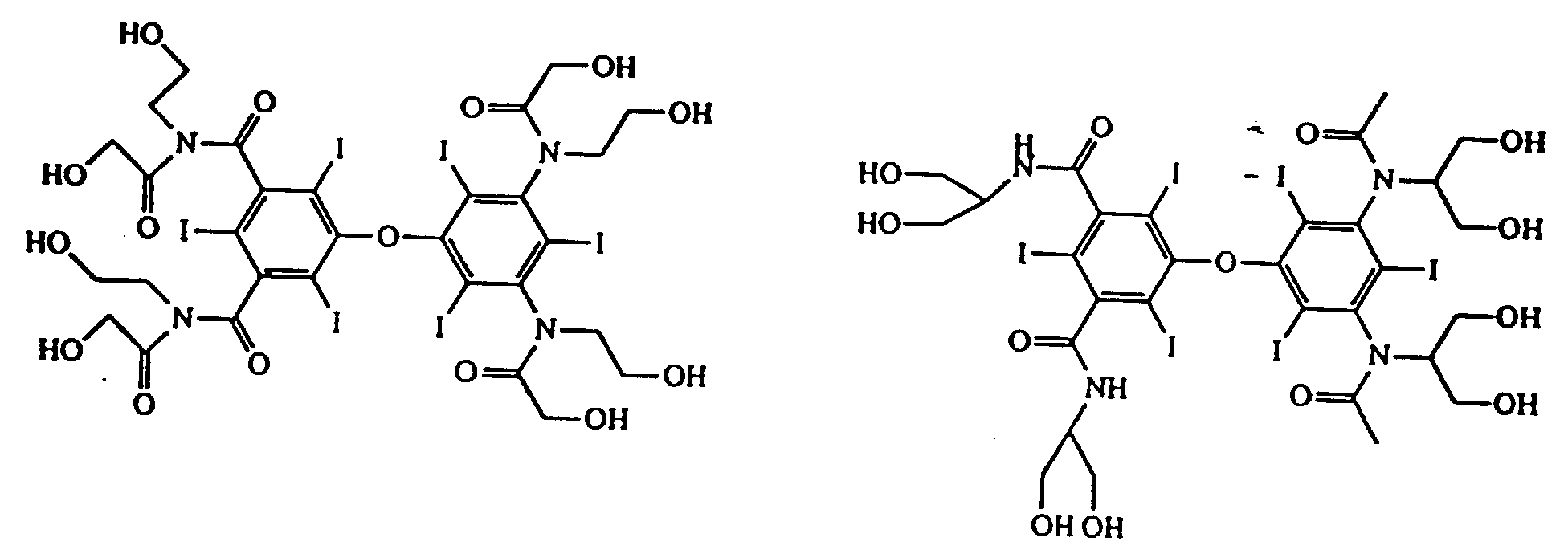
- X denotes a group providing a 1, 2 or 3 atom chain linking the two C 6 R 5 groups; and each M is independently a non-ionic hydrophilic moiety, M preferably being a non-ionic hydrophilic moiety comprising a monohydroxy- or polyhydroxy-alkyl group) and isomers, especially
- short chain dimer compounds according to the invention possess desirably low viscosities in aqueous solution.
- the compounds of formula I are preferably asymmetric. This can be achieved by the use of an asymmetric 2 or 3 atom chain-forming group X and/or by selection of non-identical C 6 R 5 groups, i.e. by non-identical substitution of the iodophenyl end groups.
- Asymmetric molecules are preferred as they have been found to have better water-solubility.
- Such non-identical substitution of the phenyl end groups, the C 6 R 5 moieties, may be achieved by having different numbers or positions of iodine substitution and/or by different numbers, positions or identities of M substitution.
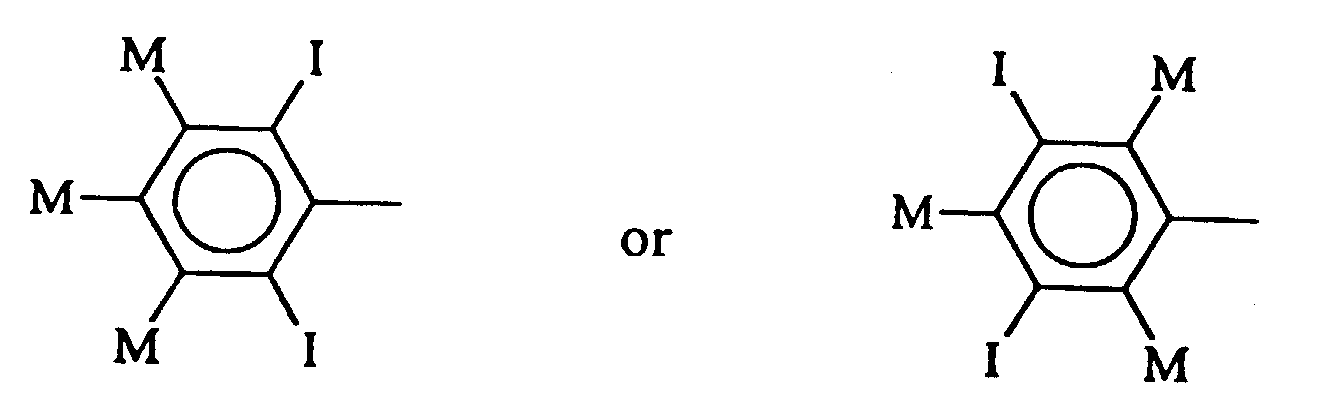
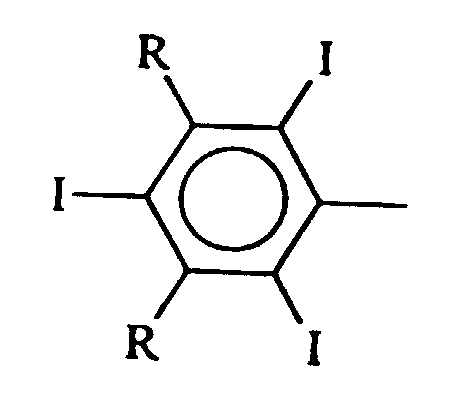
- triodophenyl end groups i.e. groups of formula are preferred, and in these the two R groups may be the same or different, although preferably both represent M groups.
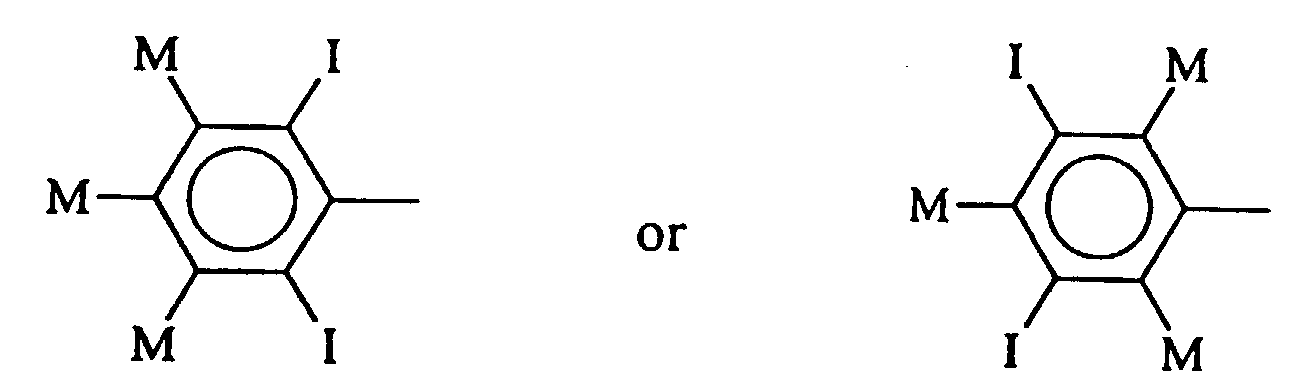
- a phenyl end group is disubstituted by iodine, it is preferably of formula (where M again may be the same or different).
- diiodophenyl-diiodophenyl dimers will be less preferred than the diiodophenyl-triiodophenyl or triiodophenyl-triiodophenyl dimers, due primarily to their reduced iodine loading, i.e. 4 rather than 5 or 6 iodines per dimer molecule. Indeed the triiodophenyl-triiodophenyl dimers are generally preferred due to their higher iodine loading.
- the solubilizing groups M may be any of the non-ionizing groups conventionally used to enhance water solubility. Suitable groups include for example straight chain or branched C 1-10 -alkyl groups, preferably C 1-5 groups, optionally with one or more CH 2 or CH moieties replaced by oxygen or nitrogen atoms and optionally substituted by one or more groups selected from oxo, hydroxy, amino, carboxyl derivative, and oxo substituted sulphur and phosphorus atoms.
- Particular examples include polyhydroxyalkyl, hydroxyalkoxyalkyl and hydroxypolyalkoxyalkyl and such groups attached to the phenyl group via an amide linkage such as hydroxyalkylaminocarbonyl, N-alkyl-hydroxyalkylaminocarbonyl and bis-hydroxyalkylaminocarbonyl groups.
- Preferred among such groups are those containing 1, 2, 3, 4, 5 or 6, especially 1, 2 or 3 hydroxy groups, e.g.
- the M groups will preferably each comprise a polyhydroxy C 1-4 -alkyl group, such as 1,3-dihydroxyprop-2-yl or 2,3-dihydroxyprop-1-yl.
- M groups as are conventional within the field of triiodophenyl X-ray contrast agents may also be used and the introduction of M groups onto iodophenyl structures may be achieved by conventional techniques.
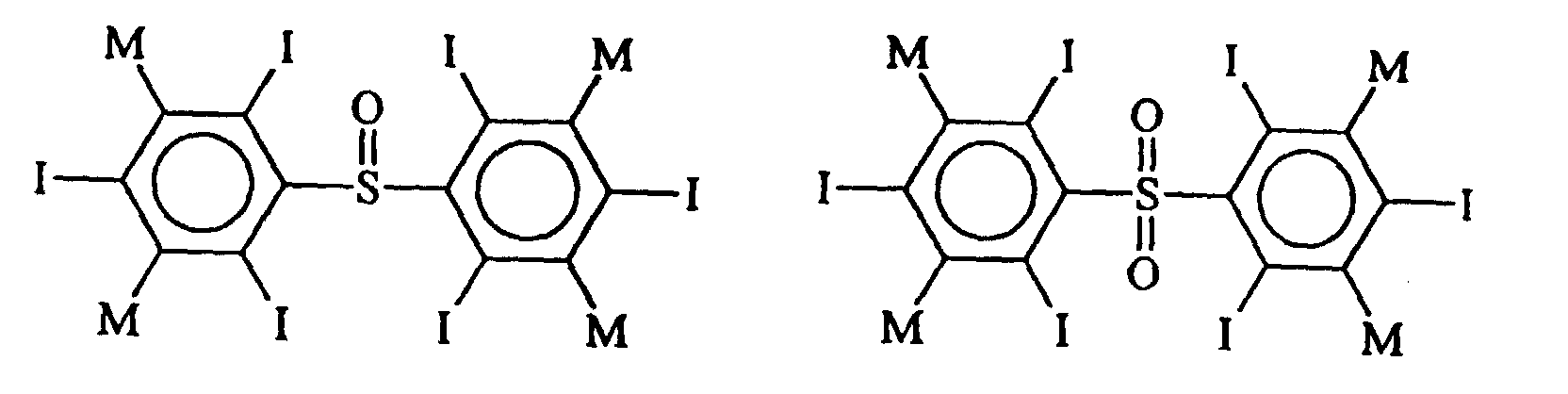
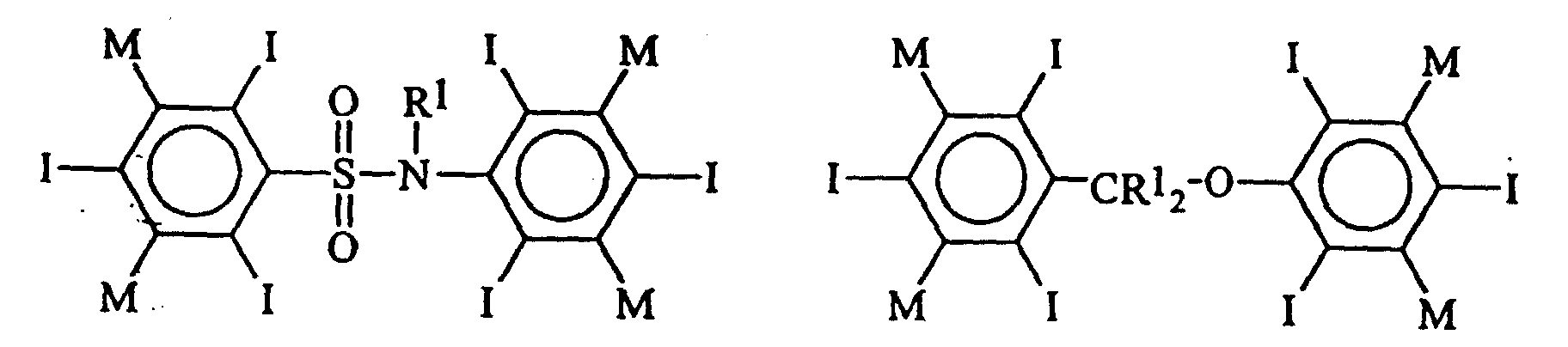
- the linker group X is conveniently a 1, 2 or 3 membered chain comprising carbon, nitrogen, oxygen or sulphur atoms, e.g. a O, S, N or C one atom chain, a NN, NC, NS, CC or CO two atom chain, or a NCN, OCN, CNC, OCO, NSN, CSN, COC, OCC or CCC three atom chain, for example: an oxygen atom or a group NR 1 , CO, SO 2 or CR 2 1 ; a group COCO, CONR 1 , COCR 2 1 , SOCR 2 1 , SO 2 NR 1 ,CR 2 1 CR 2 1 , CR 2 1 NR 1 or CR 1 2 O; a group NR 1 CONR 1 , OCONR 1 , CONR 1 CO, CONR 1 CR 1 2 , OCOO, CR 1 2 OCR 1 2 , OCR 1 2 CO, CR 1 2 CONR 1 , CR 1 , CR 1
- the X group is not symmetrical. This may be achieved for example by asymmetrical substitution of a symmetrical chain (e.g. N-C-N substituted as NHCONR 1 ) or by selection of an asymmetric chain (e.g. OCN substituted as OCONR 1 ).
- asymmetrical substitution of a symmetrical chain e.g. N-C-N substituted as NHCONR 1
- OCN substituted as OCONR 1 e.g. OCN substituted as OCONR 1
- it is preferred that the linker group X should be polar and also that it should be hydrophilic.
- the compounds of the invention may in general be prepared in three stages: (a) dimer formation, (b) iodination of phenyl groups and (c) substitution of phenyl groups and/or optionally linker moieties by solubilizing moieties.
- stages (a), (b) and (c) can be performed in any order, it will generally be preferred to perform the dimer formation step before the iodination step and, for reasons of economy, it will be preferred to perform the iodination step at as late a stage in the synthesis as is feasible so as to reduce iodine wastage.
- the dimer formation stage may itself be a multi-step procedure with an appropriate activated linker first being attached to one monomer before the resulting linker-monomer conjugate is reacted with a second monomer.
- dimer formation may be by way of reaction of similarly or cooperatively substituted monomers with the conjugation of the monomers leading to dimer formation.
- linker group X may be produced by modification, e.g. substitution, oxidation or reduction, of a precursor linker, e.g. in a precursor monomer.
- the dimeric compounds of the invention may be used as X-ray contrast agents and to this end they may be formulated with conventional carriers and excipients to produce diagnostic contrast media.
- the invention provides a diagnostic composition
- a diagnostic composition comprising a compound of formula I (as defined above) together with at least one physiologically tolerable carrier or excipient, e.g. in aqueous solution in water for injections optionally together with added plasma ions or dissolved oxygen.
- compositions of the invention may be at ready-to-use concentrations or may be formulated in concentrate form for dilution prior to administration.
- compositions in ready-to-use form will have iodine concentrations of at least 10OmgI/ml, preferably at least 150 mgI/ml, with concentrations of at least 300mgI/ml, e.g. 320 to 400 mgI/ml being generally preferred.
- concentrations of at least 300mgI/ml e.g. 320 to 400 mgI/ml being generally preferred.
- concentrations of at least 300mgI/ml e.g. 320 to 400 mgI/ml
- concentrations of at least 300mgI/ml e.g. 320 to 400 mgI/ml
- the higher the iodine concentration the higher the diagnostic value but equally the higher the solution's viscosity and osmolality.
- the maximum iodine concentration for a given compound will be determined by its solubility,
- osmotoxic effects must be considered and preferably osmolality should be below 1 Osm/kg H 2 O, especially below 850 mOsm/kg H 2 O, in particular within 50 or less, preferably within 10, mOsm of isotonicity (about 300 mOsm/kg H 2 O).
- Preferred plasma cation contents for the contrast media of the invention are as follows:
- the plasma cations may be presented, in whole or in part, as counterions in ionic contrast agents. Otherwise they will generally be provided in the form of salts with physiologically tolerable counteranions, e.g. chloride, sulphate, phosphate, hydrogen carbonate, etc., with plasma anions especially preferably being used.
- physiologically tolerable counteranions e.g. chloride, sulphate, phosphate, hydrogen carbonate, etc.
- the contrast media may contain other counterions where the dimer is ionic and such counterions will of course preferably be physiologically tolerable.
- examples of such ions include alkali and alkaline earth metal ions, ammonium, meglumine, ethanolamine, diethanolamine, chloride, phosphate, and hydrogen carbonate.
- Other counterions conventional in pharmaceutical formulation may also be used.
- the compositions moreover may contain further components conventional in X-ray contrast media, e.g. buffers, etc.
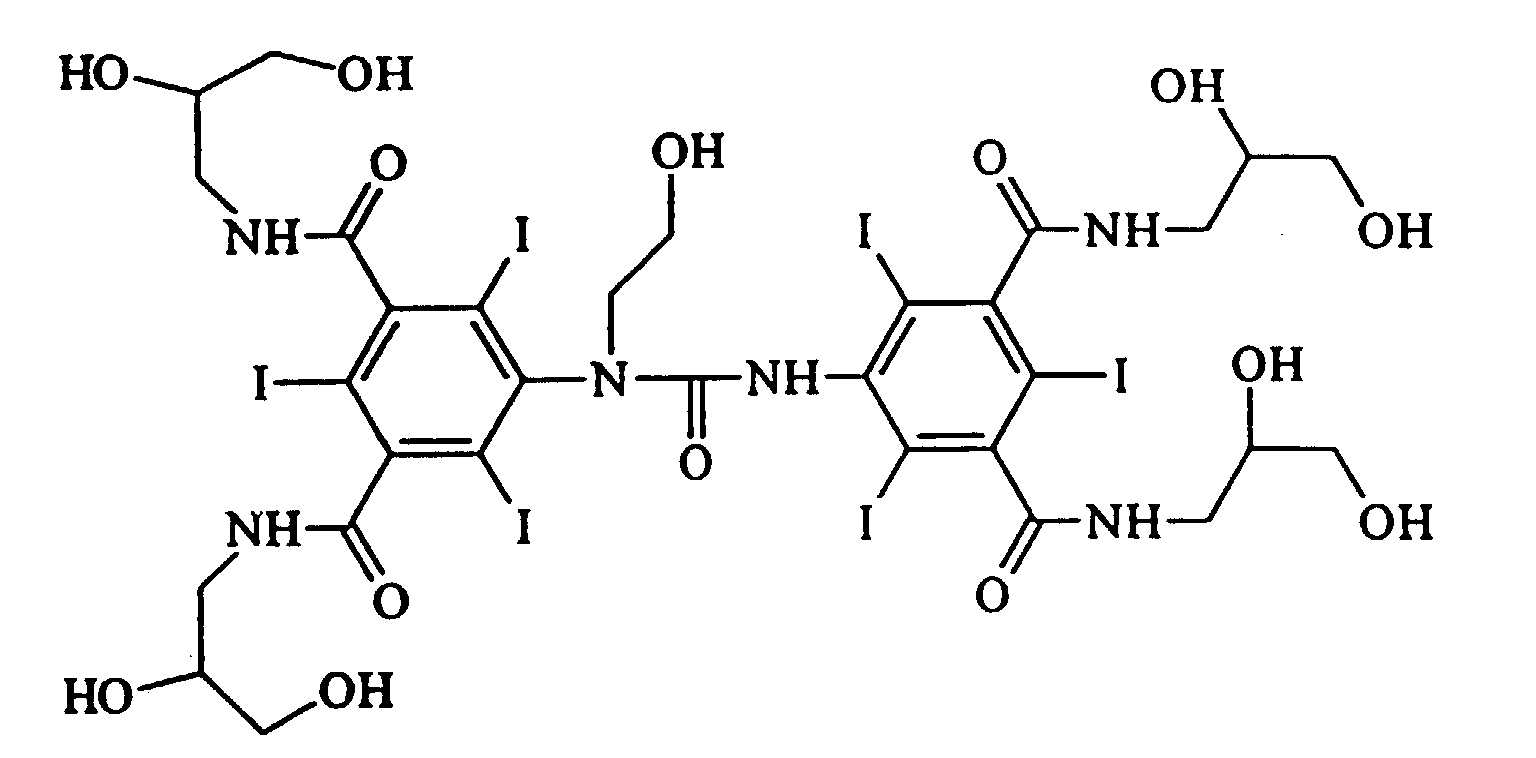
- N,N'-bis[2,4,6-triiodo-3,5-bis(2,3-diacetoxypropylaminocarbonyl)phenyl]-urea (4.0 g, 2.26 mmol) was dissolved in a 1:1 mixture of water and methanol (25 ml) containing NaOH (1.44 g, 36 mmol). After stirring for 6 h at 40 °C, the solution was treated with a strongly acidic ion exchange resin (Amberlyst 15), the solvent was separated and evaporated to give pure product. Yield: 3.24 g (100 %).
- N,N'-bis [2,4, 6-triiodo-3,5-bis (2,3-dihydroxypropylaminocarbonyl)phenyl]-urea (7.32 g, 5.1 mmol) was dissolved in 2 M aqueous NaOH (10 ml) and methyl iodide (0.95 ml) was added. The mixture was stirred at ambient temperature for 60 h, treated with a strongly acidic ion exchange resin (Amberlyst 15) evaporated and purified by preparative HPLC. Yield 4.7 g (63 %) of the product as a white solid.
- N,N'-bis[2,4,6-triiodo-3,5-bis(2,3-dihydroxypropylaminocarbonyl)phenyl]-urea (2.0 g, 1.4 mmol) was dissolved in water (13 ml) containing 2 M NaOH (7 ml). 2-Bromoethanol (1 g, 8.4 mmol) was added and the mixture was stirred at ambient temperature for 60 h, treated with a strongly acidic ion exchange resin (Amberlyst 15) evaporated and purified by preparative HPLC. Yield: 1.45 g (70 %) of the product as a white solid.
- N,N'-Bis[2,4,6-triiodo-3-(2-hydroxyethylaminocarbonyl)--5-(2,3-dihydroxypropylaminocarbonyl)-phenyl]urea (0.216 g, 0.157 mmol) was dissolved in a mixture of water (6 ml) and 2M aqueous NaOH (0.9 ml) together with 2-bromoethanol (0.067 ml). The mixture was stirred for 20 h, neutralized with a strongly acidic cation exchange resin and evaporated to dryness. Purification using preparative HPLC gave 105 mg (47 %) of the product as a white solid.
- N,N'-Bis [2,4,6-triiodo-3-(2-hydroxyethylaminocarbonyl)--5-(2,3-dihydroxypropylaminocarbonyl)-phenyl]urea (0.353 g, 0.257 mmol) was dissolved in a mixture of water (8 ml) and 2M aqueous NaOH (0.9 ml) together with 1-bromo-2,3-dihydroxypropane (0.136 ml, 1.55 mmol). After stirring at room temperature for 160 h, the solution was neutralized using a strongly acidic cation exchange resin. After evaporation, the residue was purified using preparative HPLC. Yield: 100 mg (27 %) of the product as a white solid.
- 1-Nitro-3-aminobenzoic acid (9.11 g, 50 mmol) was mixed with phosgene (13 ml of a 20 % solution in toluene) and Na 2 CO 3 (7.4 g, 70 mmol) in toluene (20 ml). The mixture was stirred at 60 °C for 2 h and then at ambient temperature for 16 h. After addition of additional toluene (4 ml), stirring was continued at 100 °C for 9h. Toluene (4 ml) was added, and stirring was continued for 20 h at 40 °C. After cooling to ambient temperature, the solution was poured into 1M aqueous HCl (200 ml).
- N,N'-bis(3-nitro-5-carboxyphenyl)urea (0.5 g, 1.3 mmol) was dissolved in methanol (15 ml) containing concentrated sulfuric acid (0.5 ml) and the solution was stirred at 60 °C for 20 h. After cooling to ambient temperature, the solution was poured into water (40 ml). The yellowish precipitate was filtered off, washed with a saturated aqueous solution of NaHCO 3 , water and dried. Yield 0.53 g (98 %).
- N,N'-bis(3-nitro-5-methoxycarbonylphenyl)urea (0.209 g, 0.5 mmol) was heated with 1-amino-2,3-propanediol (0.114 g, 1.2 mmol) to 95 °C. After 30 min, the pressure was reduced to 200 mm Hg and heating was continued for 3h. The crude reaction mixture was purified by preparative HPLC giving 164 mg (61 %) of the product as a white solid.
- N,N'-bis[3-nitro-5-(2,3-dihydroxypropylaminocarbonyl)phenyl]urea (0.103 g, 0.19 mmol) was dissolved in a mixture of methanol (14 ml) and water (6 ml) containing 2 M aqueous HCl (0.2 ml) and a Pd/C catalyst (10 %, 0.1 g). Hydrogenation was carried out at 60 psi. The catalyst was filtered off and the solvents were evaporated. The residue was redissolved in water and lyophilized giving 0.102 g (97 %) of the product.
- N,N'-bis[3-amino-5-(2,3-dihydroxypropylaminocarbonyl)phenyl]urea (0.50 g, 0.91 mmol) was dissolved in a mixture of methanol (4 ml) and water (46 ml) and an aqueous solution of KICl 2 (6 mmol) was added. After adjustment of pH to 2 with aqueous HCl, the solution was stirred for 20 h at 40 °C. After addition of an aqueous solution of NaHSO 3 , the solvents were evaporated and the residue was triturated three times with a methanol-water (3:7) mixture giving 1.02 g (89 %) of the product.
- N,N'-bis[3-amino-2,4,6-triiodo-5-(2,3-dihydroxypropylaminocarbonyl)phenyl]urea (0.155 g, 0.126 mmol) was mixed with acetic anhydride (2 ml) and concentrated sulfuric acid (3 drops) was added. The mixture was stirred at 70 °C for 5 h and then at ambient temperature for 17 h. After evaporation of the solvent, the residue was dissolved in a mixture of methanol (2.5 ml) and water (0.4 ml), pH was adjusted to 10 with 10 M aqueous NaOH and stirred at 50 °C for 5 h.
- N,N'-bis[3-amino-2,4,6-triiodo-5-(2,3-dihydroxypropylaminocarbonyl)phenyl]urea (1.23 g, 1.0 mmol) was dissolved in a mixture of acetic anhydride (5 ml), pyridine (5.5 ml) and DMF (5 ml). The solution was stirred at room temperature for 65 h, and the solvents were evaporated. The residue was dissolved in CH 2 Cl 2 (250 ml) and the solution was washed with water (2x50 ml) 0.1 M aqueous HCl (50 ml), water (100 ml) and a saturated aqueous solution of NaHCO 3 .
- N,N'-bis[3-amino-2,4,6-triiodo-5-(2,3-diacetoxypropylaminocarbonyl)phenyl]urea (1.0 g, 0.71 mmol) was dissolved in acetoxyacetyl chloride (5 ml) and the solution was stirred at ambient temperature for 24 h. After heating to 60 °C for 2.5 h, the solution was evaporated to dryness and the residue was triturated with water (40 ml). The tan-colored precipitate was filtered off, washed again with water (20 ml) and dried. Yield: 0.92 g (81 %).
- N,N'-bis[2,4,6-triiodo-3-(2-acetoxyacetamido)-5-(2,3-diacetoxypropylaminocarbonyl)phenyl]urea (0.88 g, 0.55 mmol) was dissolved in a mixture of methanol (10 ml) and 2M aqueous NaOH (2.5 ml). After stirring for 15 min at ambient temperature, pH was adjusted to 4 with a strongly acidic ion exchange resin, and, after filtration, evaporated to dryness. The residue was purified by preparative HPLC. Yield: 0.58 g (78 %).
- N,N'-bis[3-amino-2,4,6-triiodo-5-(2,3-acetoxypropylaminocarbonyl)phenyl]urea (1.0 g, 0.71 mmol) prepared as described above and 2-acetoxypropionic acid chloride (4.0 ml) were mixed and stirred at 60 °C for 2 h and 14 h at 85 °C. The solvents were evaporated and the residue was triturated with water (50 ml). The greenish solid was filtered off and used without purification in the next step. Yield: 0.92 g (79 %).
- N,N'-bis[2,4,6-triiodo-3-(2-acetoxypropionamido)-5-(2,3-acetoxypropylaminocarbonyl)phenyl]urea (0.85 g, 0.52 mmol) was dissolved in a mixture of methanol (10 ml) and 2M aqueous NaOH (2.5 ml) and the solution was stirred at room temperature for 2 h. The pH was then adjusted to 4 using a strongly acidic ion exchange resin, and, after filtration, evaporated to dryness. The residue was purified by preparative HPLC. Yield: 370 mg (51 %).
- 2,2-dimethyl-1,3-dioxalane-4 carboxylic acid potassium salt (1.50 g, 8.1 mmol) was suspended in dry ether (35 ml) and cooled to 0 °C.
- Oxalyl chloride (1.03 g, 8.1 mmol) was added and the solution was stirred for 2 h at 0 ° C and then for 24 h at ambient temperature. The mixture was filtered and the filtrate was evaporated.
- N,N'-bis[2,4,6-triiodo-3-(2,2-dimethyl-1,3-dioxalane-4-carboxamido)-5-(2,3-diacetoxypropylaminocarbonyl)phenyl]urea (0.60 g, 0.36 mmol) was mixed with K 2 CO 3 (0.40 g, 2.8 mmol) in methanol (40 ml). The solution was stirred fcr 88 h, the solution was filtered and the filtrate evaporated to dryness. The residue was dissolved in water (20 ml) and the pH was adjusted to 2 using aqueous 2M HCl.
- N,N'-bis[3-nitro-5-(1,3-dihydroxyprop-2-ylaminocarbonyl)phenyl]urea (5.6 g, 10.4 mmol) was dissolved in a mixture of methanol (100 ml) and water (14 ml) containing 2 M aqueous HCl (10.4 ml) and a Pd/C catalyst (10 %, 0.5 g). Hydrogenation was carried out at 60 psi. The catalyst was filtered off, the methanol was evaporated and the aqueous solution was lyophilized.
- N,N'-bis[2,4,6-triiodo-3-amino-5-(1,3-hydroxyprop-2-ylaminocarbonyl)phenyl]urea (4.0 g, 3.26 mmol) was suspended in a mixture of acetic anhydride (10 ml) and pyridine (10.5 ml) and the mixture was stirred for 16 h at ambient temperature. The solvents were evaporated and the residue was suspended in water (150 ml). The solid was filtered off, washed with aqueous 0.1 M HCl (2x50 ml), water (2x50 ml) and dried. Yield: 3.8 g (84 %).
- Example 15f The product from Example 15f was dissolved in a mixture of methanol (5 ml) and water (5 ml) and the pH was adjusted to 12 using a 2 M aqueous solution of NaOH. After stirring for 2 h, the pH was adjusted to 6.5 using aqueous HCl and the solvents were evaporated. The product was purified using preparative HPLC. Yield: 68 mg (44 %). MS (ESP, m/e): 1349 (M + , 15 %), 1372 ([M+Na] + , 100 %).
- the crude product was used immediately without purification in the next step: The product was dissolved in a mixture of methanol and water (1:3, 1200 ml) and an aqueous solution of KICl 2 (5.34 g, 22.6 mmol) was added. The reaction mixture was stirred at 40 °C for 30 h and then an 0.5 M aqueous solution of NaHSO 3 (1 ml) was added. After evaporation of the solvents, the residue was purified by preparative HPLC. Yield: 0.63 g (13 %).
- 3,5-Dinitrophenyl-3',5'-diacetylaminophenylether (0.12 g, 0.32 mmol) was dissolved in glacial acetic acid (5 ml) and heated to the reflux temperature. Iron powder (0.3 g) was added in portions during 5 min. After refluxing for 2 h, the solution was allowed to cool to ambient temperature, acetic anhydride (1.5 ml) was added and heating was continued for another 2 h. The solvents were then removed by evaporation, the residue was treated with ethyl acetate, filtered and evaporated. The residue was dissolved in acetone and the solution was filtered though a pad of silica gel.
- Iodination of di(3,5-diacetylaminophenyl)ether is carried out using the standard procedures for iodination of activated aromatics, e.g. using KICl 2 in an aqueous solution or in a mixture of water and an alcohol as described in the literature (see for example EP-A-501875 and DE-A-2629228). Purification of the product is performed by chromatography or recrystallization.
- Alkylation of di(3,5-diacetylamino-2,4,6-triiodophenyl)ether is carried out analogous to similar reactions described in the literature, e. g. using sodium methoxide as the base in a proper solvent such as propylene glycol, and 3-chloropropane-1,2-diol (see, for example: US 4250113).
- the product is purified by preparative HPLC.
- Acetophenone (57.6 g, 0.48 mmol) and AlCl 3 (160 g, 1.2 mol) were mixed and heated to 100 °C under an argon atmosphere for 30 min. After cooling to ambient temperature, CCl 4 (300 ml) was added and the mixture was heated to reflux temperature for 4 h. After cooling to ambient temperature, a mixture of water and concentrated HCl (300 ml, 1:1) was added. The aqueous phase was extracted with CHCl 3 (3x200 ml) and the combined organic phases were evaporated. The residue was dissolved in 70 % ethanol (400 ml) and the solution was briefly heated to reflux temperature. Evaporation of the solvents followed by recrystallization from aqueous acetone gave the pure product.
- Di(3-acetylphenenyl)ketone (60.0 g, 0.224 mol) was dissolved in concentrated sulfuric acid (400 ml) and the solution was cooled to 0 °C. A mixture of concentrated sulfuric acid (120 ml) and concentrated nitric acid (120 ml) was then added dropwise and the solution was then stirred at ambient temperature for 17 h. After stirring for another 24 h at 40 °C and for 6 h at 60 °C, the reaction mixture was poured onto ice and the precipitate was collected, washed with water and dried. Yield: 77.6 g (96 %).
- Iodination of di[3-amino-5-(2,3-dihydroxypropylaminocarbonyl)phenyl]methanol is carried out using the standard procedures for iodination of activated aromatics, e. g. using KICl 2 in an aqueous solution or in a mixture of water and an alcohol as described in the literature (see for example EP-A-501875 and DE-A-2629228). Purification of the product is performed by chromatography or recrystallization.
Landscapes
- Chemical & Material Sciences (AREA)
- Organic Chemistry (AREA)
- Health & Medical Sciences (AREA)
- Veterinary Medicine (AREA)
- Animal Behavior & Ethology (AREA)
- General Health & Medical Sciences (AREA)
- Public Health (AREA)
- Epidemiology (AREA)
- Life Sciences & Earth Sciences (AREA)
- Medicines Containing Antibodies Or Antigens For Use As Internal Diagnostic Agents (AREA)
- Organic Low-Molecular-Weight Compounds And Preparation Thereof (AREA)
- Analysing Materials By The Use Of Radiation (AREA)
- Exposure And Positioning Against Photoresist Photosensitive Materials (AREA)
- Liquid Crystal (AREA)
- Electrochromic Elements, Electrophoresis, Or Variable Reflection Or Absorption Elements (AREA)
- Devices For Indicating Variable Information By Combining Individual Elements (AREA)
- Silver Salt Photography Or Processing Solution Therefor (AREA)
- Apparatus For Radiation Diagnosis (AREA)
- Macromolecular Compounds Obtained By Forming Nitrogen-Containing Linkages In General (AREA)
Abstract
Description
- the chemotoxicity of the contrast agent,
- the osmolality of the contrast medium, and
- the ionic composition (or lack thereof) of the contrast medium.


-CONH-CH2CH2OH
-CONH-CH2CHOHCH2OH
-CONH-CH(CH2OH)2
-CON(CH2CH2OH)2
as well as other groups such as
-CONH2
-CONHCH3
-OCOCH3
-N(COCH3)H
-N(COCH3)C1-3-alkyl
-N(COCH3)-mono, bis or tris-hydroxy C1-4-alkyl
-N(COCH2OH)-mono, bis or tris-hydroxy C1-4-alkyl
-C(COCH3) (mono, bis or tris-hydroxy C1-4-alkyl)2
-N-(COCH2OH)2
-CON(CH2CHOHCH2OH) (CH2CH2OH)
-CONH-C(CH2OH)3 and
-CONH-CH(CH2OH) (CHOHCH2OH).
a O, S, N or C one atom chain,
a NN, NC, NS, CC or CO two atom chain,
or a NCN, OCN, CNC, OCO, NSN, CSN, COC, OCC or CCC three atom chain,
for example:
an oxygen atom or a group NR1, CO, SO2 or CR2 1;
a group COCO, CONR1, COCR2 1, SOCR2 1, SO2NR1,CR2 1CR2 1, CR2 1NR1 or CR1 2O;
a group NR1CONR1, OCONR1, CONR1CO, CONR1CR1 2, OCOO, CR1 2OCR1 2, OCR1 2CO, CR1 2CONR1, CR1 2CR1 2CR1 2, COCR1R1CO, CR1 2NR1CR1 2, CR1 2SO2NR1, CR1 2OCO, or NR1SO2NR1;
where R1 is hydrogen or a C1-6-alkyl or alkoxy group optionally substituted by hydroxy, alkoxy, oxa or oxo (e.g. a polyhydroxyalkyl, formyl, acetyl, hydroxyl, alkoxy or hydroxyalkoxy group), or where attached to a carbon R1 may also be a hydroxyl group.






1H NMR (acetone-d6): 8.76-8.83 (m, 2H, NH), 5.50 (br s, 2H, NH2), 5.20-5.32 (m, 2H), 4.43 (dd, J1=11.8 Hz, J2=3.4 Hz, 2H), 4.29 (dd, J1=11.8 Hz, J2=6.0Hz), 3.69-3.86 (m, 2H), 3.49-3.63 (m, 2H), 1.95-2.07 (m, 12H).
MS (ESP) : 706 (M+1).
1H NMR : 8.24-8.98 (m, 6H, NH), 5.07 (br s, 4H), 4.12-4.35 (m, 8H), 3.31-3.60 (m, 8H), 2.00 (s, 24H, CH3CO).
MS (ESP): 1771 (M+).
1H NMR (DMSO-d6): 7.98-8.60 (m, 6H, NH), 4.65-4.80 (m, 4H), 4.44-4.57 (m, 4H), 3.62-3.75 (m, 4H), 3.02-3.55 (m, 16 H).
13CNMR (DMSO-d6): 170.7, 170.4, 170.3, 151.8, 151.7, 150.1, 143.5, 100.9, 100.8, 100.7, 100.5, 100.3, 89.8, 89.6, 70.1, 70.0, 64.1, 42.7, 42.6.
MS (ESP): 1458 (M+ + Na+).
1H NMR (DMSO-d6): 8.80 (br d, 1H, NH), 8.42 (br d, 3H, NH), 8.05 (br d, 1H, NH), 4.42-4.85 (m, 8H), 3.01-3.78 (m, 23 H).
13CNMR (DMSO-d6): 170.2, 170.1, 170.0, 152.6, 152.5, 150.7, 150.3, 150.2, 149.5, 144.2, 101.3, 101.2, 100.0, 99.5, 90.5, 90.1, 70.5, 70.3, 64.4, 64.3, 43.1, 42.9, 36.0.
MS (ESP): 1470 (M+ + Na+).
1H NMR (DMSO-d6):9.10-9.38 (m, 1H, NH), 7.90-8.65 (m, 4H, NH), 3.02-3.91 (m, 24H).
13CNMR (DMSO-d6): 170.2, 153.2, 150.9, 150.3, 149.1, 144.1, 101.3, 100.9, 100.7, 100.3, 90.6, 89.8, 70.5, 70.4, 70.1, 64.4, 63.2, 60.6, 53.2, 43.1,
MS (ESP) : 1502 (M+ + Na+).
Evaporation gave 202 g (94 %) of the product as a white solid.
1H NMR (DMSO-d6): 10.79 (br s, 2H).
13C NMR (DMSO-d6): 170.1, 149.7, 149.4, 78.94, 78.90.
MS (ESP, m/e) : 595, 593 (M+).
1H NMR (CDCl3): 6.01-6.17 (2 br s, 2H, NH), 5.11 (br s, 2H, NH2), 4.59-4.67 (m, 1H, CH), 4.22-4.40 (m, 6H, CH2O), 3.69-3.78 (m, 2H, NCH2), 2.12 (s, 3H), 2.08 (s, 6H).
MS (ESP, m/e): 823 ([M+Na]+), 801 ([M+1]+).
1HNMR (DMSO-d6): 8.03-8.59 (m, 6H), 4.42-4.77 (m, 6H), 3-10-3.83 (m, 18H).
1HNMR (DMSO-d6): 9.06-9.22 (m, 1H), 8.03-8.46 (m, 4H), 4.22-4.69 (m, 7H), 3.43-3.87 (m, 22H).
MS (ESP, m/e) : 1450 (M+).
1H NMR (DMSO-d6): 8.60-8.71 (m, 2H), 5.42-5.51 (m, 1H), 5.02-5.13 (m, 1H), 4.24-4.33 (m, 1H), 4.08-4.21 (m, 3H), 3.32-3.49 (m, 5H), 2.00 (2s, 9H).
MS (ESP, m/e) : 823 ([M+Na]+), 801 (M+1)
1HNMR (DMSO-d6): 8.02-8.67 (m, 6H), 4.60-4.84 (m, 4H), 4.43-4.57 (m, 2H), 3.02-3.75 (m, 18H).
13C NMR (DMSO-d6): 169.7, 169.5, 151.4, 150.0, 142.9, 99.9, 89.6, 70.1, 70.0, 69.9, 64.0, 59.2, 42.6, 41.7.
1H NMR (DMSO-d6): 9.11-9.22 (m, 1H), 7.84-8.61 (m, 4H), 4.41-4.80 (m, 7H), 3.02-3.87 (m, 22H).
13C NMR (DMSO-d6): 170.2, 169.9, 153.2, 151.0, 150.9, 150.4, 144.2, 144.1, 100.2, 70.5, 64.4, 60.6, 59.6, 43.1, 42.1.
MS (ESP, m/e) : 1420 (M+).
1HNMR (DMSO-d6): 9.45-9.63 (m, 1H), 7.94-8.68 (m, 4H), 5.82-6.07 (m, 1H), 5.12 (br s, lH), 4.43-4.80 (m, 6H), 4.13 (m, 1H), 3.04-3.97 (m, 14H).
13C NMR (DMSO-d6): 169.8, 169.5, 153.5, 150.8, 150.5, 150.0, 149.9, 143.7, 99.8, 90.3, 70.0, 64.0, 59.2, 42.7, 41.7.
1H NMR (DMSO-d6): 9.63 (s, NH, 2H), 8.65 (dd, J1=J2=22 Hz, 2 H), 8.34 (dd, J1=1.6 Hz, J2=1.5 Hz, 2H), 8.18 (dd, J1=1.5 Hz, J2=1.3 Hz, 2H), 3.3-3.8 (br s, 2H, OH).
13CNMR (DMSO-d6): 165.8, 152.7, 148.5, 141.4, 133.1, 125.3, 117.3, 116.6.
MS (ESP, m/e): 389 (M+, 100 %), 411 ([M+Na]+, 55 %)
1H NMR (DMSO-d6): 9.78 (br s, NH, 1H), 8.68 (dd, J1=2.1 Hz, J2=2.0 Hz, 2H), 8.46 (dd, J1=2.2 Hz, J2=2.0 Hz, 2H), 8.23 (dd, J1=2.2 Hz, J2=2.0 Hz, 2H), 3.92 (s, OCH3, 6H).
13C NMR (DMSO-d6): 164.9, 153.1, 148.5, 142.0, 131.6, 124.9, 117.0, 116.9.
1HNMR (DMSO-d6): 9.61 (s, 2H), 8.79 (t, J=6.4 Hz, 2H), 8.67 (dd, J1=2.1, J2=2.0 Hz, 2H), 8.36 (dd, J1=2.1 Hz, J2=2.0 Hz, 2H), 8.25 (dd, J1=J2=2.0 Hz, 2H), 4.84 (d, J=4.5 Hz, OH, 2H), 4.58 (t, J=5.6 Hz, OH, 2H), 3.65 (m, 2H), 3.30-3.50 (m, 6H), 3.21 (m, 2H).
13CNMR (DMSO-d6): 164.8, 152.6, 148.5, 141.1, 136.8, 124.2, 115.9, 115.4.
MS (ESP, m/e): 537 (M+, 100 %), 519 ([M-H2O]+, 56 %). d. N,N'-bis[3-amino-5-(2,3-dihydroxypropylaminocarbonyl)phenyl]urea.
1HNMR (D2O): 7.60 (s, 4H), 7.29 (s, 2H), 3.74-3.82 (m, 2H), 3.38-3.54 (m, 4H), 3.22-3.37 (m, 4H).
13C NMR (D2O) : 168.6, 154.0, 139.9, 136.1, 131.1, 118.6, 118.5, 117.0, 116.9, 116.2, 70.1, 63.2, 42.4.
MS (ESP, m/e): 477 (M+, 100 %).
1HNMR (DMSO-d6): 8.41 (br s, 1H), 8.20-8.33 (m, 2H), 8.11-8.17 (d, J=7.0 Hz, 1H), 5.40 (br s, NH2, 4H), 3.62-3.74 (m, 2H), 3.44-3.52 (m, 2H), 3.34-3.43 (m, 2H), 3.21-3.32 (m, 2H), 3.07-3.21 (m, 2H).
13C NMR (DMSO-d6): 170.7, 170.6, 151.9, 149.3, 148.9, 143.1, 143.0, 142.8, 70.6 70.4, 64.4, 43.1, 43.0.
MS (ESP, m/e): 1232 (M+, 20 %),1254 ([M+Na]+, 100 %), 1270 ([M+K]+, 50 %).
1HNMR (DMSO-d6): 9.80-10.10 (2 br s, 2H), 8.20-8.75 (m, 4H), 4.70 (s, OH, 2H), 4.48 (s, OH, 2H), 3.64-3.98 (m, 2H), 3.41-3.56 (m, 4H), 3.03-3.26 (m, 4H), 2.04 (s, 6H).
13C NMR (DMSO-d6): 170.3, 170.2, 168.3, 168.2, 168.1, 151.9, 151.7, 150.3, 144.4, 144.3, 108.2, 108.1, 99.5, 99.4, 99.3, 99.2, 98.1, 98.0, 97.9, 70.6, 70.4, 64.4, 43.1, 23.5.
MS (ESP, m/e): 1339 ([M+Na]+, 100 %).
1H NMR (DMSO-d6): 8.73 (br s, 1H), 8.44-8.63 (m, 2H), 8.32-8.45 (m, 1H), 5.30-5.45 (s, NH2, 4H), 5.02-5.16 (m, 2H), 4.10-4.37 (m, 4H), 1.80-2.05 (m, 12H).
13C NMR (DMSO-d6): 170.8, 170.6, 170.3, 149.1, 148.9, 148.3, 147.8, 143.3, 143.2, 136.6, 124.4, 92.6, 92.0, 70.1, 70.0, 63.5, 21.5, 21.0.
MS (ESP, m/e): 1400 (M+, 100 %).
1H NMR (DMSO-d6): 10.05-10.30 (m, 2H), 8.62-9.06 (m, 2H), 8.22-8.58 (m, 2H), 5.02-5.15 (m, 2H), 4.66 (br s, 4H), 4.23-4.39 (m, 2H), 4.12-4.23 (m, 2H), 3.25-3.62 (m, 4H), 2.11 (s, 6H), 2.00 (s, 12H).
13C NMR (DMSO-d6): 170.7, 170.4, 170.1, 165.7, 150.1, 150.0, 144.5, 144.4, 143.3, 143.2, 108.5, 108.3, 108.1, 97.6, 97.3, 70.0, 63.5, 62.6, 61.0, 21.5, 21.0.
MS (ESP, m/e): 1599 (M+, 100 %), 1621 ([M+Na]+, 23 %).
1HNMR (DMSO-d6): 9.68-9.93 (m, 2H), 8.42-8.64 (m, 2H), 8.24-8.48 (m, 2H), 4.00 (s, OH, 6H), 3.60-3.73 (m, 6H), 3.36-3.54 (m, 6H), 3.04-3.38 (m, 4H).
13C NMR (DMSO-d6): 171.0, 170.8, 170.6, 170.3, 170.2, 151.8, 151.7, 150.3, 150.2, 144.3, 144.1, 143.9, 143.8, 108.1, 108.0, 107.9, 99.5, 99.3, 97.9, 97.8, 97.7, 70.4, 64.4, 62.3, 43.1.
MS (ESP, m/e): 1349 (M+, 36 %), 1379 ([M+Na]+, 100 %).
1HNMR (DMSO-d6): 10.08-10.25 (m, 2H), 8.70-9.30 (m, 2H), 8.08-8.75 (m, 2H), 5.15-5.27 (m, 2H), 5.03-5.16 (m, 2H), 4.23-4.36 (m, 2H), 4.11-4.25 (m, 2H), 3.23-3.54 (m, 4H), 2.10 (s, 3H), 2.06 (2s, 15H), 1.47-1.55 (m, 6H).
13C NMR (DMSO-d6): 170.7, 170.4, 170.0, 151.8, 150.1, 149.0, 144.5, 143.3, 143.2, 108.3, 107.9, 106.4, 97.7, 97.6, 70.5, 70.0, 69.9, 63.6, 63.5, 63.4, 21.5, 21.3, 21.0, 18.0.
1HNMR (DMSO-d6): 9.58-9.84 (m, 2H), 8.22-8.64 (m, 4H), 5.50-5.70 (m, 2H), 4.67 (br s, OH, 2H), 4.48 (br s, OH, 2H), 4.13-4.17 (m, 2H), 3.64-3.75 (m, 2H), 3.40-3.61 (m, 2H), 3.26-3.35 (m, 2H), 3.07-3.25 (m, 4H), 1.35-1.42 (m, 6H).
13CNMR (DMSO-d6): 173.0, 172.8, 170.3, 170.2, 151.8, l50.2, 144.2, 143.9, 108.0, 99.5, 99.2, 97.8, 97.6, 97.5, 70.4, 70.3, 68.0, 64.4, 43.1, 21.5, 21.0.
MS (ESP, m/e): 1374 (M+, 20 %), 1397 ([M+Na]+, 100 %).
1H NMR (DMSO-d6): 9.57-10.10 (m, 2H), 8.26-8.55 (m, 4H), 3.08-4.37 (m, 16H), 1.87-2.04 (m, 12H).
13C NMR (DMSO-d6): 172.4, 170.9, 170.1, 150.1, 147.0, 144.4, 143.8, 141.9, 127.9, 100.1, 99.8, 99.6, 99.1, 97.7, 97.6, 97.4, 74.2, 70.4, 66.9, 66.8, 64.8, 64.4, 64.1, 43.1, 43.0, 37.9, 35.0, 21.8, 21.5.
MS (ESP, m/e): 1656 (M+, 100 %), 1679 ([M+Na]+, 80 %).
Physical data, fraction 1:
1H NMR (DMSO-d6): 9.67-9.90 (m, 2H), 8.23-8.60 (m, 4H), 3.06-3.84 (m, 16H), 4.02-4.20 (m, 8H).
13C NMR (DMSO-d6): 171.0, 170.8, 170.3, 170.2, 151.8, 151.7, 150.2, 144.3, 144.1, 143.9, 143.8, 108.1, 108.0, 107.8, 99.5, 99.3, 99.2, 97.8, 97.6, 74.2, 70.4, 64.7, 64.4, 43.2, 43.1.
MS (ESP, m/e): 1408 (M+, 100 %), 1431 ([M+Na]+, 10 %).
Fraction 2: 9.62-10.05 (m, 2H), 8.25-8.60 (m, 4H), 5.65-5.90 (m, 2H), 4.62-4.90 (m, 4H), 4.42-4.53 (m, 2H), 4.02-4.10 (m, 2H), 3.40-3.82 (m, 10H), 3.05-3.32 (m, 4H).
1HNMR (DMSO-d6): 10.06, 9.72 (2s, ArNH, 2H), 8.68-8.73 (m, 2H), 8.44-8.51 (m, 2H), 8.38-8.43 (m, 2H), 8.23-8.27 (m, 2H), 4.66-4.73 (m, 4H), 3.92-4.13 (m, 2H), 3.44-3.60 (m, 8H).
13C NMR (DMSO-d6): 164.9, 164.6, 152.9, 148.6, 148.4, 141.9, 141.1, 137.0, 131.8, 124.9, 124.4, 117.1, 115.7, 115.3, 60.7, 54.8, 53.3.
1H NMR (DMSO-d6): 7.90-8.36 (m, 4H), 5.32-5.40 (m, 4H), 3.30-4.25 (m, 14H).
13CNMR (DMSO-d6): 170.1, 151.9, 149.1, 148.9, 148.8, 146.6, 143.1, 143.0, 88.8, 88.6, 83.0, 82.8, 81.5, 78.7, 78.6, 78.5, 76.9, 59.8, 53.6, 53.5.
MS (ESP, m/e): 1254 ([M+Na]+, 100 %).
1HNMR (DMSO-d6): 8.55-8.95 (m, 2H), 8.10-8.35 (m, 2H), 5.36-5.68 (m, 4H), 4.10-4.20 (m, 8H), 3.83-3.95 (m, 2H), 1.99-2.07 (m, 12H).
13C NMR (DMSO-d6): 170.7, 170.2, 149.0, 148.9, 148.7, 143.3, 143.2, 143.1, 89.2, 82.8, 78.5, 78.3, 78.2, 62.6, 47.4, 21.3.
MS (ESP, m/e): 1422 ([M+Na]+, 70 %), 1478 ([M+C5H5N]+, 100 %).
1HNMR (CDCl3): 8.72 (s, 1H), 8.42 (s, 1H), 8.32 (s, 1H), 4.86 (s, 2H), 3.97 (s, 3H), 2.37 (br s, 1H).
1H NMR (CD3OD): 8.57 (s, 1H), 8.38 (s, 1H), 8.19 (s, 1H), 4.77 (s, 2H), 3.81-3.88 (m, 1H), 3.39-3.63 (m, 4H).
1H NMR (CD3OD): 7.05-7.09 (m, 1H), 6.98-7.03 (m, 1H), 6.83-6.87 (m, 1H), 4.53 (s, 2H), 3.77-3.85 (m, 1H), 3.8-3.59 (m, 4H), 3.32-3.42 (m, 1H)
MS (ESP, m/e): 241 ([M+1]+, 100 %).
1H NMR (CD3OD): 5.10 (s, 2H), 3.90-3.98 (m, 1H), 3.72 (ddd, J1=0.7 Hz, J2=4.2 Hz, J3=11.4 Hz), 1H), 3.60 (dd, J1=6.0 Hz, J2=11.4 Hz, 1H), 3.49 (ddd, J1=1.2 Hz, J2=6.0 Hz, J3=13.5 Hz, 1H), 3.37 (ddd, J1=1.2 Hz, J2=6.1 Hz, J3=13.2 Hz, 1H), 2.62 (s, 1H), 2.28 and 2.34 (2s, 2H).
MS (ESP, m/e): 618 (M+, 100 %), 640 ([M+Na]+, 55 %).
1H NMR (CDCl3): 5.99 (br s, 1H), 5.52 (s, 2H), 5.25 (br s, 1H), 5.11 (s, 2H), 4.23-4.45 (m, 2H), 3.56-3.87 (m, 3H), 2.08 (s, 9H).
MS (ESP, m/e): 1643 (M+, 100 %), 1665 ([M+Na]+, 34 %).
MS (ESP, m/e): 1349 (M+, 15 %), 1372 ([M+Na]+, 100 %).
1HNMR (DMSO-d6): 7.78-7.81 (m, 1H), 7.68-7.71 (m, 1H), 7.65-7.67 (m, 1H), 5.00 (s, NH3, 3H) 3.83 (s, OCH3, 3H).
1HNMR (DMSO-d6): 11.28 (s, 1H), 9.09 (t, J=1.8 Hz, 1H), 9.03 (t, J=1.8 Hz, 1H), 8.95 (t, J=1.7 Hz, 1H), 8.81 (t, J=1.6 Hz, 1H), 8.78 (t, J=1.7 Hz, 1H), 8.38 (2t, J1=1.6 Hz, J2=1.5 Hz, lH), 3.96 (s, OCH3, 3H), 3.93 (s, OCH3, 3H).
MS (ESP, m/e): 426 ([M+Na]+, 100 %), 442 ([M+K]+, 14 %).
1HNMR (DMSO-d6): 11.2 (br s, 1H), 8.94-8.98 (m, 2H), 8.89-8.92 (m, 2H), 8.61-8.65 (m, 1H), 8.61 (d, J=7.2 Hz, 1H), 8.52-8.55 (m, 1H), 8.46 (d, J=7.8 Hz, 1H), 4.60-4.81 (m, 4H), 3.96-4.08 (m, 2H), 3.51-3.59 (m, 8H).
MS (ESP, m/e): 522 (M+, 100 %), 504 ([M-H2O]+, 65 %).
Yield: 0.98 g (93 %).
1HNMR (DMSO-d6 containing 1 % TFA): 10.83 (s, 1H), 8.25 (d, J=8.0 Hz, 1H), 8.23 (t, J=2.0 Hz, 1H), 8.12 (d, J=8.0 Hz, 1H), 8.07 (t, J=2.0 Hz, 1H), 8.03 (t, J=2.0 Hz, 1H), 7.73 (t, J=2.0 Hz, 1H), 7.70 (t, J=2 Hz, 1H), 7.46 (t, J=2.0 Hz, 1H), 4.30 (br s, 6H), 3.95-4.01 (m, 2H), 3.54 (t, J=5.5 Hz, 8H).
MS (ESP, m/e): 461 (M+, 100 %).
Yield: 0.05 g (8.3 %).
1HNMR (DMSO-d6): 9.85-10.05 (m, 1H), 8.87-9.00 (m, 1H), 7.80-8.15 (m, 1H), 5.52 (s, NH2, 2H), 5.47 (s, NH2, 2H), 4.40 (t, J=7.0 Hz, 2H), 4.15-4.24 (m, 2H), 4.06 (d, J=7.0 Hz, 1H), 4.04 (d, J=7.0 Hz, 1H), 3.78-3.85 (m, 3H), 3.57-3.64 (m, 3H), 3.40-3.56 (m, 2H).
13C NMR (DMSO-d6): 170.3, 170.2, 165.7, 150.0, 149.9, 149.6, 148.9, 148.1, 148.0, 147.5, 141.7, 64.2, 59.7, 53.4.
MS (ESP, m/e): 1215 (M+, 100 %).
1HNMR (DMSO-d6): 10.27-10.48 (m, 1H), 9.97 (br s, 1H), 9.94 (br s, lH), 8.21 (d, J=7.0 Hz, 1H), 8.11 (d, J=7.0 Hz, 1H), 4.43-4.56 (m, 4H), 3.72-3.88 (m, 2H), 3.60-3.70 (m, 4H), 3.40-3.60 (m, 4H), 2.07-2.08 (m, 6H).
13C NMR (DMSO-d6): 169.9, 169.7, 168.2, 165.2, 151.0, 148.4, 144.7, 144.6, 144.3, 144.2, 142.8, 142.7, 59.6, 59.5, 53.6, 31.1.
MS (ESP, m/e): 1300 (M+, 100 %).
1H NMR (DMSO-d6): 9.94-10.04 (m, 1H); 8.67 (d, J=7.0 Hz, 1H), 8.65 (d, J=7.0 Hz, 1H), 5.54 (s, NH2, 2H), 5.50 (s, NH2, 2H), 4.27-4.40 (m, 2H), 4.11-4.16 (m, 8H), 2.01-2.03 (m, 12H).
13C NMR (DMSO-d6): 170.7, 170.4, 170.3, 165.7, 149.6, 149.5, 149.0, 148.2, 147.6, 141.8, 139.8, 62.6, 47.4, 21.3.
MS (ESP, m/e) : 1385 (M+, 100 %).
MS (ESP, m/e): 1582 (M+, 100 %.
1HNMR (DMSO-d6): 11.32 (s, 1H), 9.02 (t, J=6.0 Hz, 1H), 8.93-8.97 (m, 3H), 8.88 (t, J=1.7 Hz, 1H), 8.86 (t, J=6.0 Hz, 1H), 8.68 (t, J=1.5 Hz, 1H), 8.51 (t, J=1.8 Hz, 1H), 3.62-3.72 (m, 2H), 3.36-3.48 (m, 2H), 3.33-3.36 (m, 4H), 3.18-3.29 (m, 2H), 3.09 (s, 4H).
MS (ESP, m/e): 545 ([M+Na]+, 65 %), 522 (M+, 100 %), 504 ([M-18]+, 19 %).
1HNMR (DMSO-d6): 9.86-10.00 (m, 1H), 8.18-8.45 (m, 2H), 5.44-5.47 (m, 4H), 4.66-4.78 (m, 2H), 4.45-4.55 (m, 2H), 3.59-3.78 (m. 2H), 3.41-3.56 (m, 2H), 3.30-3.43 (m, 2H), 3.10-3.36 (m, 2H).
13C NMR (DMSO-d6): 170.7, 165.6, 149.9, 148.5, 147.8, 147.1, 140.8, 108.0, 85.2, 84.4, 80.9, 79.2, 78.3, 70.0, 64.0, 42.6.
MS (ESP, m/e): 1216 (M+, 100 %), 1238 ([M+Na]+, 20 %.
MS (ESP, m/e): 1301 (M+, 81 %), 1324 ([M+Na]+, 100 %.
1HNMR (DMSO-d6): 9.89-10.27 (m, 1H), 8.56-8.70 (m, 2H), 5.54 (s, 2H), 5.51 (s, 2H), 5.06-5.13 (m, 2H), 4.25-4.36 (m, 2H), 4.16-4.22 (m, 2H), 3.30-3.58 (m, 4H), 2.02 (s, 12H).
MS (ESP, m/e): 1385 (M+, 100 %), 1464 ([M+pyridine]+, 19 %).
MS (ESP, m/e): 1332 (M+, 100 %).
1HNMR (DMSO-d6): 10.16-10.55 (m, 1H), 9.54-9.86 (m, 2H), 8.40-8.65 (m, 2H), 5.60 (br s, 2H), 4.70 (br s, 2H), 4.46 (br s, 2H), 4.08-4.22 (m, 2H). 3.60-3.71 (m, 2H), 3.32-3.58 (m, 2H), 3.15-3.32 (m, 2H), 3.04-3.22 (m, 4H), 1.39 (d, J=7.0 Hz, 6H).
13C NMR (DMSO-d6): 172.4, 170.0, 169.8, 169.7, 150.7, 148.0, 143.8, 143.2, 143.1, 142.3, 104.6, 100.8, 100.2, 100.0, 99.8, 97.2, 96.9, 95.0, 90.7, 90.5, 69.8, 67.6, 64.0, 42.7, 21.0.
MS (ESP, m/e): 1361(M+, 100 %), 1383 ([M+Na]+, 25 %.
1H NMR (CDCl3): 8.65 (t, J=2.0 Hz, 1H), 8.06 (d, J=2.0 Hz, 2H), 4.01 (s, 1H).
1H NMR (CDCl3): 8.64 (t, J=2.0 Hz, 1H), 8.04 (d, J=2.0 Hz, 2H), 2.0 (br s, 1H).
1HNMR (CD3OD): 7.24 (t, J=2.0 Hz, 1H), 6.92 (d, J=2.0 Hz, 2H), 2.12 (s, 6H).
MS (ESP, m/e): 375 ([M+1]+, 100 %), 397 ([M+Na]+, 39 %), 413 ([M+K]+, 35 %).
1H NMR (CD3OD): 7.62 (s, 2H), 7.08 (s, 4H), 2.12 (s, 12H).
MS (ESP, m/e): 399 ([M+1]+, 62 %), 421 ([M+Na]+, 41 %), 437 ([M+K]+, 100 %).
1H NMR (CDCl3): 8.36 (t, J=1.5 Hz, 2H), 8.20 (dt, Jd=7.8 Hz, Jt=1.5 Hz, 2H), 7.98 (dt, Jd=7.7 Hz, Jt=1.5 Hz, 2H), 7.62 (t, J=7.7 Hz, 2H), 2.65 (s, 6H).
MS (ESP, m/e): 268 (M+, 100 %).
1HNMR (DMSO-d6): 8.83 (t, J=1.8 Hz, 2H), 8.67 (t, J=1.8 Hz, 2H), 8.57 (t, J=1.8 Hz, 2H), 3.9 (br s, 2H).
MS (ESP-, m/e): 359 ([M-1]-, 100 %).
1HNMR (CDCl3): 8.76-8.78 (m, 2H), 8.58 (t, J=1.7 Hz, 2H), 8.41 (t, J=1.6 Hz, 2H), 3.98 (s, 6H), 3.19 (s, 6H).
MS (EI, m/e): 403 ([M-OCH3]+, 100 %).
1H NMR (DMSO-d6): 9.03-9.15 (m, 2H), 8.90-9.03 (m, 2H), 8.58-8.73 (m, 4H), 4.38 (br s, 2H), 4.12 (br s, 2H), 3.61-3.70 (m, 2H), 3.39-3.48 (m, 2H), 3.35 (br s, 2H), 3.33 (br s, 2H), 3.15-3.26 (m, 2H).
13C NMR (DMSO-d6): 163.9, 148.3, 138.1, 137.9, 136.9, 134.4, 126.9, 126.4, 70.5, 64.3, 43.8.
MS (ESP-, m/e): 504 (M-, 100 %).
1HNMR (DMSO-d6): 8.36-8.57 (m, 1H), 7.77-8.35 (m, 3H), 7.04-7.72 (m, 4H), 5.62-5.75 (m, 1H), 5.10 (br s, 1H), 4.23 (br s, 1H), 4.06 (br s, 2H), 3.60-3.85 (m, 4H), 2.91-3.40 (m, 10H).
MS (ESP, m/e) : 449 (M+, 100 %).
Claims (14)
- A compound of formula I(wherein each C6R5 moeity may be the same or different; each R denotes a hydrogen or iodine atom or a group M, two or three non-adjacent R groups on each C6R5 moiety denoting iodine atoms and one, two or three R groups on each C6R5 moiety denoting M groups, each C6R5 moiety being a triiodophenyl group or a group in which each R is other than hydrogen; X denotes a group providing a 1, 2 or 3 atom chain linking the two C6R5 groups; and each M is independently a non-ionic hydrophilic moiety) and isomers thereof.

- A compound as claimed in claim 1 wherein where X is or contains in the bridging chain a carbonyloxy group.
- A compound as claimed in claim 1 wherein each M is a monohydroxy- or polyhydroxy-alkyl group.
- A compound as claimed in claim 1 wherein X is an asymmetric group providing a 2 or 3 atom chain linking the two C6R5 groups.
- A compound as claimed in claim 1 wherein the two C6R5 groups are non-identically substituted.
- A compound as claimed in claim 1 wherein at least one C6R5 group is of formulawherein the two R groups are the same or different.
- A compound as claimed in claim 1 wherein at least one C6R5 group is of formulawherein the M groups are the same or different.
- A compound as claimed in claim 1 wherein the M groups are straight-chain or branched C1-10-alkyl groups which have one or more CH2 or CH moieties replaced by oxygen or nitrogen atoms and which are substituted by one or more groups selected from oxo, hydroxy, amino, carboxyl derivative, and oxo substituted sulphur and phosphorus atoms.
- A compound as claimed in claim 1 wherein the M groups are polyhydroxyalkyl, hydroxyalkoxyalkyl or hydroxypolyalkoxyalkyl groups optionally attached to the phenyl group via an amide linkage.
- A compound as claimed in claim 1 wherein the M groups are selected from
-CONH-CH2CH2OH,
-CONH-CH2CHOHCH2OH,
-CONH-CH(CH2OH)2,
-CON(CH2CH2OH)2,
-CONH2,
-CONHCH3,
-OCOCH3,
-N(COCH3)H,
-N(COCH3)C1-3-alkyl,
-N(COCH3)-mono, bis or tris-hydroxy C1-4-alkyl,
-N(COCH2OH)-mono, bis or tris-hydroxy C1-4-alkyl,
-C(COCH3) (mono, bis or tris-hydroxy C1-4-alkyl)2,
-N-(COCH2OH)2,
-CON(CH2CHOHCH2OH) (CH2CH2OH),
-CONH-C(CH2OH)3 and
-CONH-CH(CH2OH) (CHOHCH2OH). - A compound as claimed in claim 1 wherein the M groups are polyhydroxy-C1-4-alkyl groups.
- A compound as claimed in claim 1 wherein X is an oxygen atom or a group NR1, CO, SO2, CR2 1, COCO, CONR1, COCR2 1, SOCR2 1, SO2NR1, CR2 1CR2 1, CR2 1NR1, CR1 2O, NR1CONR1, OCONR1, CONR1CO, CONR1CR1 2, OCOO, CR1 2OCR1 2, OCR1 2CO, CR1 2CONR1, CR1 2CR1 2CR1 2, COCR1R1CO, CR1 2NR1CR1 2, CR1 2SO2NR1, CR1 2OCO, NR1SO2NR1, where R1 is hydrogen or a C1-6-alkyl or alkoxy group optionally substituted by hydroxy, alkoxy, oxa or oxo or where attached to a carbon R1 may also be a hydroxyl group.
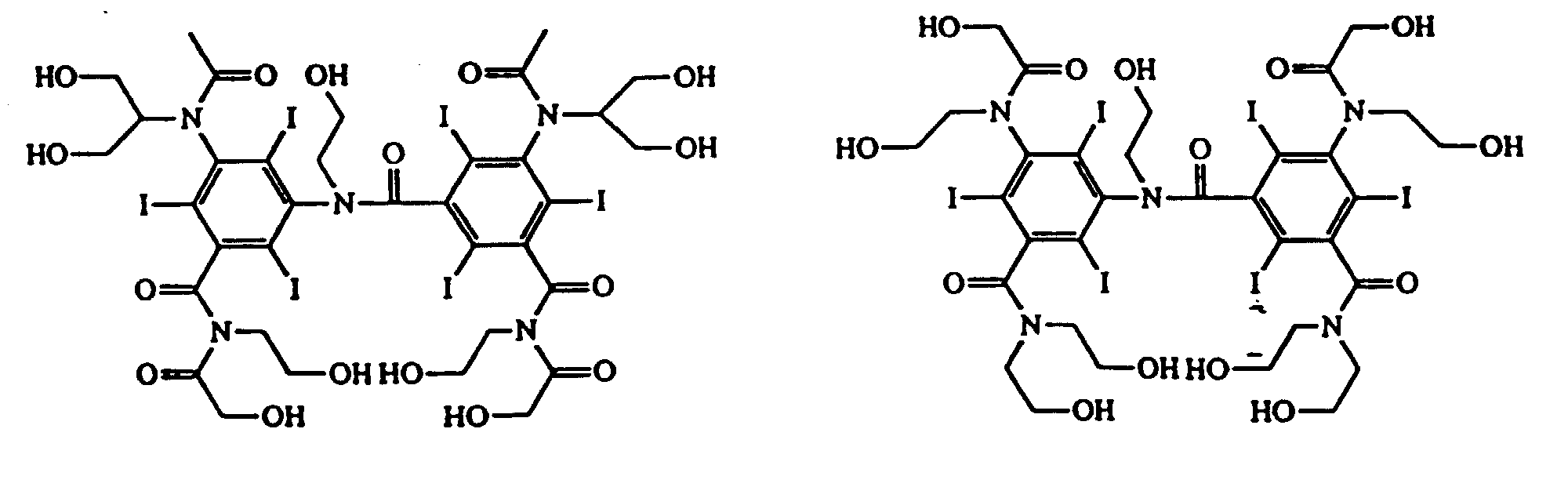
- A compound as claimed in claim 1 of one of the formulae
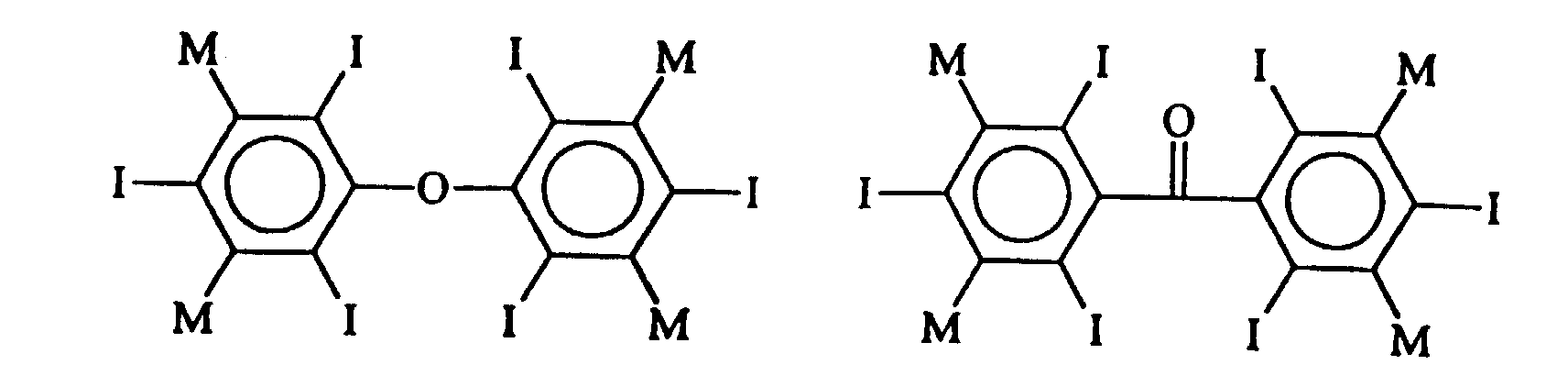

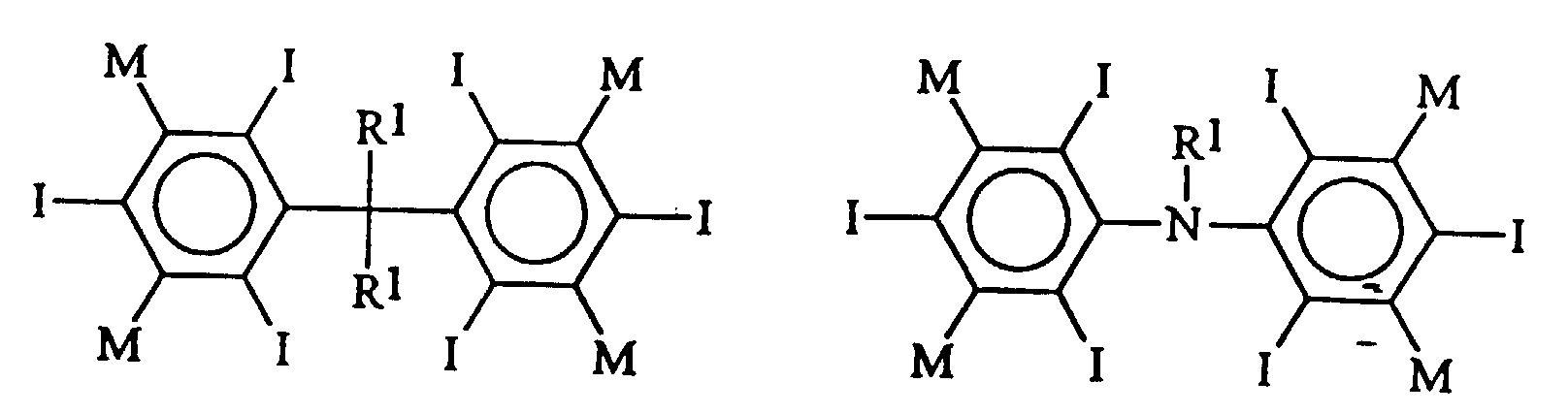

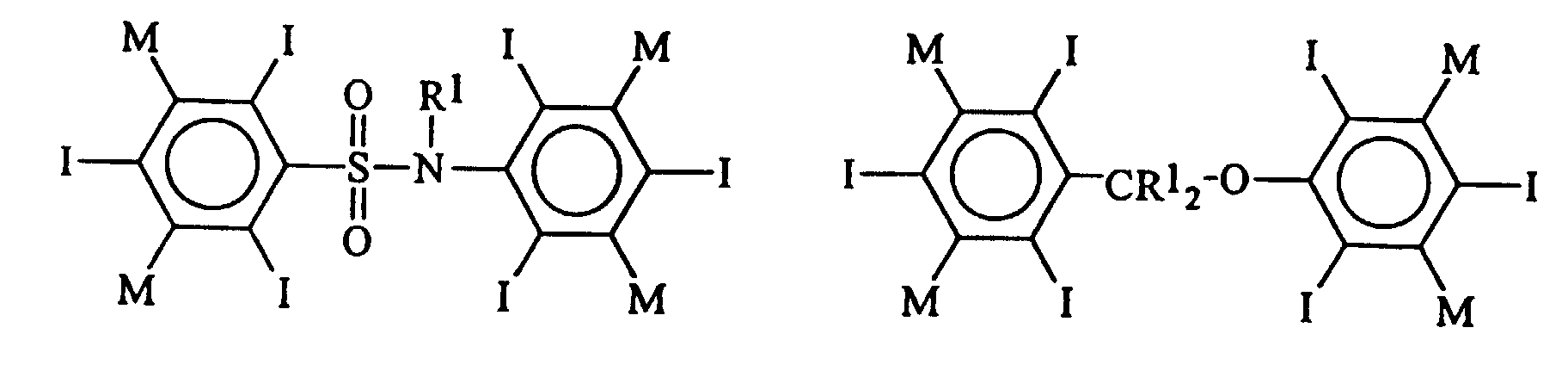
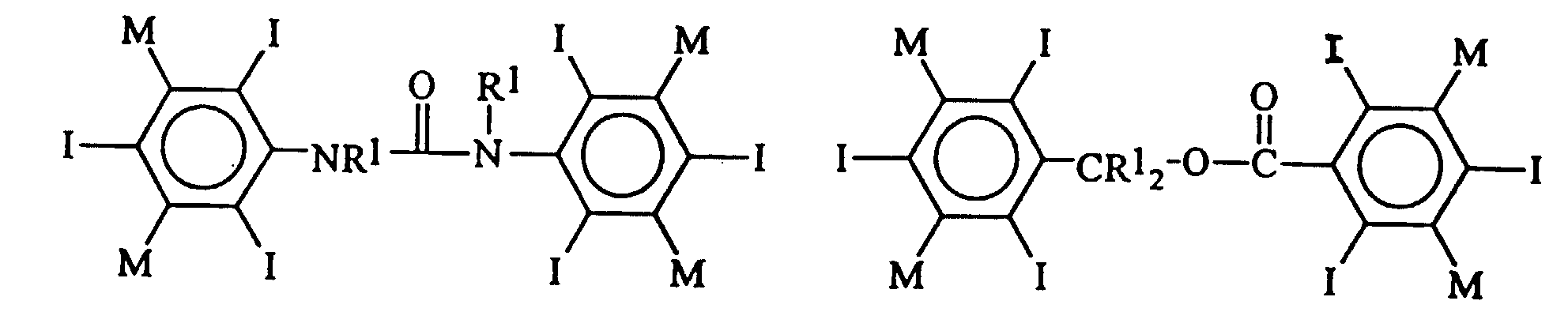 (where M is as defined in claim 1 and R1 is as defined in claim 12).
- A diagnostic composition comprising a compound of formula I as defined in any preceding claim together with at least one physiologically tolerable carrier or excipient.
Applications Claiming Priority (3)
| Application Number | Priority Date | Filing Date | Title |
|---|---|---|---|
| GB9419206 | 1994-09-23 | ||
| GB9419206A GB9419206D0 (en) | 1994-09-23 | 1994-09-23 | Contrast media |
| PCT/GB1995/002264 WO1996009285A1 (en) | 1994-09-23 | 1995-09-22 | Iodinated x-ray-contrast media |
Publications (2)
| Publication Number | Publication Date |
|---|---|
| EP0782565A1 EP0782565A1 (en) | 1997-07-09 |
| EP0782565B1 true EP0782565B1 (en) | 1999-04-07 |
Family
ID=10761799
Family Applications (1)
| Application Number | Title | Priority Date | Filing Date |
|---|---|---|---|
| EP95932108A Expired - Lifetime EP0782565B1 (en) | 1994-09-23 | 1995-09-22 | Iodinated x-ray-contrast media |
Country Status (21)
| Country | Link |
|---|---|
| US (2) | US5958375A (en) |
| EP (1) | EP0782565B1 (en) |
| JP (1) | JP3606583B2 (en) |
| AT (1) | ATE178592T1 (en) |
| AU (1) | AU710934B2 (en) |
| CA (1) | CA2200752A1 (en) |
| CZ (1) | CZ89497A3 (en) |
| DE (2) | DE69508949D1 (en) |
| DK (1) | DK0782565T3 (en) |
| EE (1) | EE9700054A (en) |
| ES (1) | ES2130650T3 (en) |
| FI (1) | FI971200A7 (en) |
| GB (1) | GB9419206D0 (en) |
| GR (1) | GR3030425T3 (en) |
| HU (1) | HUT77170A (en) |
| MX (1) | MX9702088A (en) |
| NO (1) | NO971318L (en) |
| NZ (1) | NZ292974A (en) |
| PL (1) | PL319367A1 (en) |
| SK (1) | SK35597A3 (en) |
| WO (1) | WO1996009285A1 (en) |
Families Citing this family (9)
| Publication number | Priority date | Publication date | Assignee | Title |
|---|---|---|---|---|
| GB9419203D0 (en) * | 1994-09-23 | 1994-11-09 | Nycomed Innovation Ab | Contrast media |
| GB9710726D0 (en) * | 1997-05-23 | 1997-07-16 | Nycomed Imaging As | Compound |
| ATE298320T1 (en) * | 1999-04-30 | 2005-07-15 | Amersham Health As | CONTRAST AGENTS |
| EP2289524A1 (en) | 2001-03-08 | 2011-03-02 | The Trustees Of The University Of Pennsylvania | Facially amphiphillic polymers as anti-infective agents |
| CA2519023C (en) | 2003-03-17 | 2014-05-20 | The Trustees Of The University Of Pennsylvania | Facially amphiphilic polymers and oligomers and uses thereof |
| US8551449B2 (en) * | 2007-10-30 | 2013-10-08 | Ge Healthcare As | Contrast agents |
| ES2391002T3 (en) * | 2008-01-14 | 2012-11-20 | Mallinckrodt Llc | Process for the preparation of iosimenol |
| JP5164755B2 (en) * | 2008-09-09 | 2013-03-21 | キヤノン株式会社 | Method for producing crystals of bis-acetylaminophenyl compound |
| WO2012136813A2 (en) | 2011-04-07 | 2012-10-11 | Universitetet I Oslo | Agents for medical radar diagnosis |
Family Cites Families (15)
| Publication number | Priority date | Publication date | Assignee | Title |
|---|---|---|---|---|
| US2776241A (en) * | 1952-08-06 | 1957-01-01 | Schering Ag | Injectable x-ray contrast agents comprising salts of n-acyl derivatives of 2, 4, 6-triiodo-3-aminobenzoic acid |
| US2708678A (en) * | 1954-01-15 | 1955-05-17 | Schering Corp | Iodinated acyl derivatives of 2, 4, 6-trhodometa-aminobenzoic acid |
| GB1033777A (en) * | 1963-06-06 | 1966-06-22 | Sterling Drug Inc | Bis-anilide derivatives |
| US3794729A (en) * | 1971-07-16 | 1974-02-26 | Schering Corp | Inhibiting blood platelet aggregation |
| CH576255A5 (en) * | 1972-11-17 | 1976-06-15 | Bracco Ind Chimica Spa | |
| DE2737802A1 (en) * | 1977-08-22 | 1979-03-08 | Henning Berlin Gmbh | Thyroid function disorder diagnostic or treating agent - comprises O-carboxymethyl-thyroxine deriv. |
| DE3037858A1 (en) * | 1980-10-07 | 1982-05-19 | Boehringer Mannheim Gmbh, 6800 Mannheim | METHOD FOR PRODUCING REACTIVE, CLUTCHABLE DERIVATIVES OF THE THYROID HORMONE T (ARROW DOWN) 3 (ARROW DOWN) AND T (ARROW DOWN) 4 (ARROW DOWN) AND THE USE THEREOF |
| EP0365541B1 (en) * | 1987-05-22 | 1992-08-12 | BRACCO S.p.A. | Preparation of 5-acylamino-2,4,6-triiodo- or tribromo-benzoic acid derivatives |
| GB8906130D0 (en) * | 1989-03-17 | 1989-05-04 | Nycomed As | Compositions |
| US5075502A (en) * | 1989-12-13 | 1991-12-24 | Mallinckrodt, Inc. | Nonionic x-ray contrast agents, compositions and methods |
| GB9020091D0 (en) * | 1990-09-14 | 1990-10-24 | Nycomed As | Contrast media |
| FR2673180B1 (en) * | 1991-02-25 | 1994-03-04 | Guerbet Sa | NOVEL POLY-IODIC NON-IONIC COMPOUNDS, PREPARATION METHOD, CONTRAST PRODUCT CONTAINING THE SAME. |
| FR2695125B1 (en) * | 1992-08-25 | 1994-12-23 | Guerbet Sa | New polyiodinated compounds, preparation process, contrast medium containing them. |
| NZ250063A (en) * | 1992-12-14 | 1996-03-26 | Eastman Kodak Co | Iodinated aromatic acid ester derivatives; x-ray contrast compositions |
| IT1256248B (en) * | 1992-12-24 | 1995-11-29 | Bracco Spa | WATER INJECTABLE FORMULATIONS FOR RADIODIAGNOSTICS INCLUDING MIXTURES OF IODURATED AROMATIC COMPOUNDS USEFUL AS X-RAY MATTING AGENTS |
-
1994
- 1994-09-23 GB GB9419206A patent/GB9419206D0/en active Pending
-
1995
- 1995-06-06 US US08/470,043 patent/US5958375A/en not_active Expired - Fee Related
- 1995-09-22 AU AU35293/95A patent/AU710934B2/en not_active Ceased
- 1995-09-22 SK SK355-97A patent/SK35597A3/en unknown
- 1995-09-22 DE DE69508949A patent/DE69508949D1/en not_active Expired - Lifetime
- 1995-09-22 MX MX9702088A patent/MX9702088A/en unknown
- 1995-09-22 CZ CZ97894A patent/CZ89497A3/en unknown
- 1995-09-22 HU HU9701947A patent/HUT77170A/en unknown
- 1995-09-22 EP EP95932108A patent/EP0782565B1/en not_active Expired - Lifetime
- 1995-09-22 CA CA002200752A patent/CA2200752A1/en not_active Abandoned
- 1995-09-22 DE DE69508949T patent/DE69508949T4/en not_active Expired - Lifetime
- 1995-09-22 ES ES95932108T patent/ES2130650T3/en not_active Expired - Lifetime
- 1995-09-22 PL PL95319367A patent/PL319367A1/en unknown
- 1995-09-22 AT AT95932108T patent/ATE178592T1/en not_active IP Right Cessation
- 1995-09-22 US US08/793,927 patent/US5958376A/en not_active Expired - Fee Related
- 1995-09-22 JP JP51070596A patent/JP3606583B2/en not_active Expired - Fee Related
- 1995-09-22 WO PCT/GB1995/002264 patent/WO1996009285A1/en not_active Ceased
- 1995-09-22 EE EE9700054A patent/EE9700054A/en unknown
- 1995-09-22 FI FI971200A patent/FI971200A7/en unknown
- 1995-09-22 DK DK95932108T patent/DK0782565T3/en active
- 1995-09-23 NZ NZ292974A patent/NZ292974A/en unknown
-
1997
- 1997-03-20 NO NO971318A patent/NO971318L/en not_active Application Discontinuation
-
1999
- 1999-06-03 GR GR990401509T patent/GR3030425T3/en unknown
Also Published As
| Publication number | Publication date |
|---|---|
| JP3606583B2 (en) | 2005-01-05 |
| EE9700054A (en) | 1997-08-15 |
| NO971318L (en) | 1997-08-11 |
| FI971200A0 (en) | 1997-03-21 |
| DE69508949D1 (en) | 1999-05-12 |
| US5958375A (en) | 1999-09-28 |
| MX9702088A (en) | 1997-06-28 |
| DK0782565T3 (en) | 1999-10-18 |
| DE69508949T2 (en) | 1999-09-09 |
| WO1996009285A1 (en) | 1996-03-28 |
| EP0782565A1 (en) | 1997-07-09 |
| ES2130650T3 (en) | 1999-07-01 |
| SK35597A3 (en) | 1997-11-05 |
| AU3529395A (en) | 1996-04-09 |
| GB9419206D0 (en) | 1994-11-09 |
| JPH10505856A (en) | 1998-06-09 |
| HUT77170A (en) | 1998-03-02 |
| CZ89497A3 (en) | 1997-09-17 |
| PL319367A1 (en) | 1997-08-04 |
| US5958376A (en) | 1999-09-28 |
| FI971200L (en) | 1997-05-19 |
| NO971318D0 (en) | 1997-03-20 |
| ATE178592T1 (en) | 1999-04-15 |
| DE69508949T4 (en) | 1999-12-09 |
| FI971200A7 (en) | 1997-05-19 |
| NZ292974A (en) | 1999-03-29 |
| AU710934B2 (en) | 1999-09-30 |
| GR3030425T3 (en) | 1999-09-30 |
| CA2200752A1 (en) | 1996-03-28 |
Similar Documents
| Publication | Publication Date | Title |
|---|---|---|
| EP0782564B1 (en) | Iodinated x-ray contrast media | |
| JP5290773B2 (en) | Contrast agent | |
| MXPA97002082A (en) | X yoda ray contrast media | |
| US5958376A (en) | Iodinated X-ray contrast media | |
| MXPA97002088A (en) | X-ray contrast media, yoda | |
| US6310243B1 (en) | Iodinated x-ray contrast media | |
| US8323619B2 (en) | Contrast agents | |
| EP1175392B1 (en) | Contrast media | |
| US20100303734A1 (en) | Contrast agents | |
| CN1164225A (en) | Iodinated X-ray-contrast media | |
| WO2007133088A1 (en) | Contrast agents | |
| HK1002359B (en) | Iodinated x-ray contrast media |
Legal Events
| Date | Code | Title | Description |
|---|---|---|---|
| PUAI | Public reference made under article 153(3) epc to a published international application that has entered the european phase |
Free format text: ORIGINAL CODE: 0009012 |
|
| 17P | Request for examination filed |
Effective date: 19970418 |
|
| AK | Designated contracting states |
Kind code of ref document: A1 Designated state(s): AT BE CH DE DK ES FR GB GR IE IT LI LU MC NL PT SE |
|
| AX | Request for extension of the european patent |
Free format text: LT PAYMENT 970418;LV PAYMENT 970418 |
|
| GRAG | Despatch of communication of intention to grant |
Free format text: ORIGINAL CODE: EPIDOS AGRA |
|
| 17Q | First examination report despatched |
Effective date: 19980408 |
|
| GRAG | Despatch of communication of intention to grant |
Free format text: ORIGINAL CODE: EPIDOS AGRA |
|
| GRAH | Despatch of communication of intention to grant a patent |
Free format text: ORIGINAL CODE: EPIDOS IGRA |
|
| GRAH | Despatch of communication of intention to grant a patent |
Free format text: ORIGINAL CODE: EPIDOS IGRA |
|
| GRAA | (expected) grant |
Free format text: ORIGINAL CODE: 0009210 |
|
| AK | Designated contracting states |
Kind code of ref document: B1 Designated state(s): AT BE CH DE DK ES FR GB GR IE IT LI LU MC NL PT SE |
|
| AX | Request for extension of the european patent |
Free format text: LT PAYMENT 970418;LV PAYMENT 970418 |
|
| REF | Corresponds to: |
Ref document number: 178592 Country of ref document: AT Date of ref document: 19990415 Kind code of ref document: T |
|
| REG | Reference to a national code |
Ref country code: CH Ref legal event code: EP |
|
| ITF | It: translation for a ep patent filed | ||
| REG | Reference to a national code |
Ref country code: IE Ref legal event code: FG4D |
|
| REF | Corresponds to: |
Ref document number: 69508949 Country of ref document: DE Date of ref document: 19990512 |
|
| REG | Reference to a national code |
Ref country code: CH Ref legal event code: NV Representative=s name: A. BRAUN, BRAUN, HERITIER, ESCHMANN AG PATENTANWAE |
|
| REG | Reference to a national code |
Ref country code: ES Ref legal event code: FG2A Ref document number: 2130650 Country of ref document: ES Kind code of ref document: T3 |
|
| ET | Fr: translation filed | ||
| PGFP | Annual fee paid to national office [announced via postgrant information from national office to epo] |
Ref country code: GR Payment date: 19990831 Year of fee payment: 5 |
|
| PGFP | Annual fee paid to national office [announced via postgrant information from national office to epo] |
Ref country code: PT Payment date: 19990909 Year of fee payment: 5 |
|
| PGFP | Annual fee paid to national office [announced via postgrant information from national office to epo] |
Ref country code: MC Payment date: 19990915 Year of fee payment: 5 |
|
| REG | Reference to a national code |
Ref country code: PT Ref legal event code: SC4A Free format text: AVAILABILITY OF NATIONAL TRANSLATION Effective date: 19990706 |
|
| REG | Reference to a national code |
Ref country code: DK Ref legal event code: T3 |
|
| PLBE | No opposition filed within time limit |
Free format text: ORIGINAL CODE: 0009261 |
|
| STAA | Information on the status of an ep patent application or granted ep patent |
Free format text: STATUS: NO OPPOSITION FILED WITHIN TIME LIMIT |
|
| 26N | No opposition filed | ||
| PGFP | Annual fee paid to national office [announced via postgrant information from national office to epo] |
Ref country code: SE Payment date: 20000906 Year of fee payment: 6 |
|
| PGFP | Annual fee paid to national office [announced via postgrant information from national office to epo] |
Ref country code: DK Payment date: 20000913 Year of fee payment: 6 Ref country code: AT Payment date: 20000913 Year of fee payment: 6 |
|
| PGFP | Annual fee paid to national office [announced via postgrant information from national office to epo] |
Ref country code: LU Payment date: 20000925 Year of fee payment: 6 Ref country code: IE Payment date: 20000925 Year of fee payment: 6 Ref country code: ES Payment date: 20000925 Year of fee payment: 6 |
|
| PGFP | Annual fee paid to national office [announced via postgrant information from national office to epo] |
Ref country code: CH Payment date: 20000927 Year of fee payment: 6 |
|
| PGFP | Annual fee paid to national office [announced via postgrant information from national office to epo] |
Ref country code: NL Payment date: 20000928 Year of fee payment: 6 |
|
| PG25 | Lapsed in a contracting state [announced via postgrant information from national office to epo] |
Ref country code: MC Free format text: THE PATENT HAS BEEN ANNULLED BY A DECISION OF A NATIONAL AUTHORITY Effective date: 20000930 Ref country code: GR Free format text: LAPSE BECAUSE OF NON-PAYMENT OF DUE FEES Effective date: 20000930 |
|
| PGFP | Annual fee paid to national office [announced via postgrant information from national office to epo] |
Ref country code: BE Payment date: 20001117 Year of fee payment: 6 |
|
| PG25 | Lapsed in a contracting state [announced via postgrant information from national office to epo] |
Ref country code: PT Free format text: LAPSE BECAUSE OF NON-PAYMENT OF DUE FEES Effective date: 20010331 |
|
| REG | Reference to a national code |
Ref country code: PT Ref legal event code: MM4A Free format text: LAPSE DUE TO NON-PAYMENT OF FEES Effective date: 20010331 |
|
| PG25 | Lapsed in a contracting state [announced via postgrant information from national office to epo] |
Ref country code: LU Free format text: LAPSE BECAUSE OF NON-PAYMENT OF DUE FEES Effective date: 20010922 Ref country code: DK Free format text: LAPSE BECAUSE OF NON-PAYMENT OF DUE FEES Effective date: 20010922 Ref country code: AT Free format text: LAPSE BECAUSE OF NON-PAYMENT OF DUE FEES Effective date: 20010922 |
|
| PG25 | Lapsed in a contracting state [announced via postgrant information from national office to epo] |
Ref country code: SE Free format text: LAPSE BECAUSE OF NON-PAYMENT OF DUE FEES Effective date: 20010923 Ref country code: ES Free format text: LAPSE BECAUSE OF NON-PAYMENT OF DUE FEES Effective date: 20010923 |
|
| PG25 | Lapsed in a contracting state [announced via postgrant information from national office to epo] |
Ref country code: IE Free format text: LAPSE BECAUSE OF NON-PAYMENT OF DUE FEES Effective date: 20010924 |
|
| PG25 | Lapsed in a contracting state [announced via postgrant information from national office to epo] |
Ref country code: LI Free format text: LAPSE BECAUSE OF NON-PAYMENT OF DUE FEES Effective date: 20010930 Ref country code: CH Free format text: LAPSE BECAUSE OF NON-PAYMENT OF DUE FEES Effective date: 20010930 Ref country code: BE Free format text: LAPSE BECAUSE OF NON-PAYMENT OF DUE FEES Effective date: 20010930 |
|
| REG | Reference to a national code |
Ref country code: GB Ref legal event code: IF02 |
|
| BERE | Be: lapsed |
Owner name: NYCOMED IMAGING A/S Effective date: 20010930 |
|
| PG25 | Lapsed in a contracting state [announced via postgrant information from national office to epo] |
Ref country code: NL Free format text: LAPSE BECAUSE OF NON-PAYMENT OF DUE FEES Effective date: 20020401 |
|
| EUG | Se: european patent has lapsed |
Ref document number: 95932108.4 |
|
| REG | Reference to a national code |
Ref country code: CH Ref legal event code: PL |
|
| NLV4 | Nl: lapsed or anulled due to non-payment of the annual fee |
Effective date: 20020401 |
|
| REG | Reference to a national code |
Ref country code: DK Ref legal event code: EBP |
|
| REG | Reference to a national code |
Ref country code: IE Ref legal event code: MM4A |
|
| NLV4 | Nl: lapsed or anulled due to non-payment of the annual fee |
Effective date: 20020401 |
|
| REG | Reference to a national code |
Ref country code: ES Ref legal event code: FD2A Effective date: 20021011 |
|
| PG25 | Lapsed in a contracting state [announced via postgrant information from national office to epo] |
Ref country code: IT Free format text: LAPSE BECAUSE OF NON-PAYMENT OF DUE FEES Effective date: 20050922 |
|
| PGFP | Annual fee paid to national office [announced via postgrant information from national office to epo] |
Ref country code: GB Payment date: 20070926 Year of fee payment: 13 |
|
| PGFP | Annual fee paid to national office [announced via postgrant information from national office to epo] |
Ref country code: FR Payment date: 20070917 Year of fee payment: 13 |
|
| GBPC | Gb: european patent ceased through non-payment of renewal fee |
Effective date: 20080922 |
|
| REG | Reference to a national code |
Ref country code: FR Ref legal event code: ST Effective date: 20090529 |
|
| PG25 | Lapsed in a contracting state [announced via postgrant information from national office to epo] |
Ref country code: FR Free format text: LAPSE BECAUSE OF NON-PAYMENT OF DUE FEES Effective date: 20080930 |
|
| PG25 | Lapsed in a contracting state [announced via postgrant information from national office to epo] |
Ref country code: GB Free format text: LAPSE BECAUSE OF NON-PAYMENT OF DUE FEES Effective date: 20080922 |
|
| PGFP | Annual fee paid to national office [announced via postgrant information from national office to epo] |
Ref country code: DE Payment date: 20100929 Year of fee payment: 16 |
|
| REG | Reference to a national code |
Ref country code: DE Ref legal event code: R119 Ref document number: 69508949 Country of ref document: DE Effective date: 20120403 |
|
| PG25 | Lapsed in a contracting state [announced via postgrant information from national office to epo] |
Ref country code: DE Free format text: LAPSE BECAUSE OF NON-PAYMENT OF DUE FEES Effective date: 20120403 |