EP0781469B1 - Adaptive filter - Google Patents
Adaptive filter Download PDFInfo
- Publication number
- EP0781469B1 EP0781469B1 EP95930664A EP95930664A EP0781469B1 EP 0781469 B1 EP0781469 B1 EP 0781469B1 EP 95930664 A EP95930664 A EP 95930664A EP 95930664 A EP95930664 A EP 95930664A EP 0781469 B1 EP0781469 B1 EP 0781469B1
- Authority
- EP
- European Patent Office
- Prior art keywords
- filter
- filtering
- adaptive digital
- adaptive
- coefficients
- Prior art date
- Legal status (The legal status is an assumption and is not a legal conclusion. Google has not performed a legal analysis and makes no representation as to the accuracy of the status listed.)
- Expired - Lifetime
Links
Images
Classifications
-
- H—ELECTRICITY
- H03—ELECTRONIC CIRCUITRY
- H03H—IMPEDANCE NETWORKS, e.g. RESONANT CIRCUITS; RESONATORS
- H03H21/00—Adaptive networks
- H03H21/0012—Digital adaptive filters
Definitions
- the present invention relates to adaptive digital filters, in particular for use in radio receivers.
- EP-A-0373468 a predetermined number of update calculations to the coefficent values is performed and at the same time period a predetermined number of convolution products is summed, each of which is formed by multiplying a predetermined coefficient value and a predetermined data value.
- the adaptive filter disclosed in US-A-5282155 has an architecture which computes tap coefficient updates in parallel with and simultaneously with the computation of the filter output at each iteration.
- the present invention provides a method of adaptive digital filtering comprising first steps each of adapting a filter coefficient dependent on a received data sample, and second steps each of applying an adapted filter coefficient to a received data sample, in which the first and second steps are timed such that adapted filter coefficients and modulated data samples are alternately determined in an arithmetic logic unit.
- each adapted filter coefficient can be provided for immediate use in filtering without needing to be held in a memory.
- Coefficients are adapted according to an error derived from a previous filtering operation for use in the next filtering operation.
- Each filtering operation is on successively later received data samples.
- the present invention also provides an adaptive digital filter comprising filter means and adaptive means, the adaptive means being operative to adapt a filter coefficient to provide an adapted coefficient, the filter means being operative to apply an adapted filter coefficient to a received data sample, the operation of the filter means and adaptive means being timed such that adapted filter coefficients and modulated data samples are alternately provided by an arithmetic logic unit.
- an adapted filter coefficient may be read into the filter means one clock cycle after having been determined.
- An adapted filter coefficient can, at a predetermined time, both be read by the filter means and written to a memory for later use.
- the present invention also provides a receiver including a novel adaptive digital filter as outlined above.
- the receiver could be for radio or telecommunications, in particular for time division multiplex (TDM) and/or Time division multiple access (TDMA) communications.
- the receiver can be a base station receiving TDMA communications from subscriber units which can be at fixed locations.
- the present invention also relates to corresponding methods of radio reception.
- the present invention preferably provides the advantage of increased data throughput through simple adaptive digital filters.
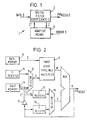
- an adaptive filter I comprises a digital filter 2 connected with adaptive means 4.
- Data samples D are received and applied to the digital filter 2 and a filtered output signal FIR result is provided.
- the previous filter coefficients C n applied by the filter 2 are adapted, i.e. updated, dependent on an error E which is the difference between received and expected filter outputs FIR result to provide adapted filter coefficients C n '.
- These adapted coefficients C n ' are applied to filter out any systematic errors received in data samples D.
- the filter 2 which is a multi-tap (e.g. 8-tap) filter, acts to provide an output FIR result according to the equation where C n ' are the updated filter coefficients and D N+n+2 are the data samples, N denoting the first data sample in the combined adaption and filtering process.
- the adaptive means 4 of the adaptive filter I thus acts to alter the filter coefficients to bring the expected and received filter outputs FIR result into agreement.
- Equation 1 The interleaving of filtering (Equation 1) and adapting (Equation 2) operations allows each coefficient to be adapted according to the error derived from a previous filtering operation before use in the current filter operation.
- the apparatus of the adaptive filter 1 is shown in more detail in Figure 2.
- a complex multiplier 6 which receives data samples D from a data memory 8 and selectively receives, from a selector 14 having an output signal denoted X, either an error value E from an error register 10 or a filter coefficient C n from a control buffer 15.
- the multiplier 6 is connected to an arithmetic logic unit ALU to which it provides a signal M.
- the arithmetic logic unit ALU provides an output signal A, and performs the calculations necessary to provide filter data samples F and coefficient C n ', as described below.
- the modulated data samples F are fed back to a register 16 which is connected to a selector 18.
- the other input port of the selector 18 is connected to a register 20 for holding a filter coefficient C.
- the output port of the selector 18 is connected to the arithmetic unit ALU, and the arithmetic logic unit ALU output is connected via the control buffer 15, to the coefficient memory 12 and selector 14 to both of which it delivers the updated filter coefficient C'.
- Selector 18 provides a signal Y to the arithmetic logic unit ALU.
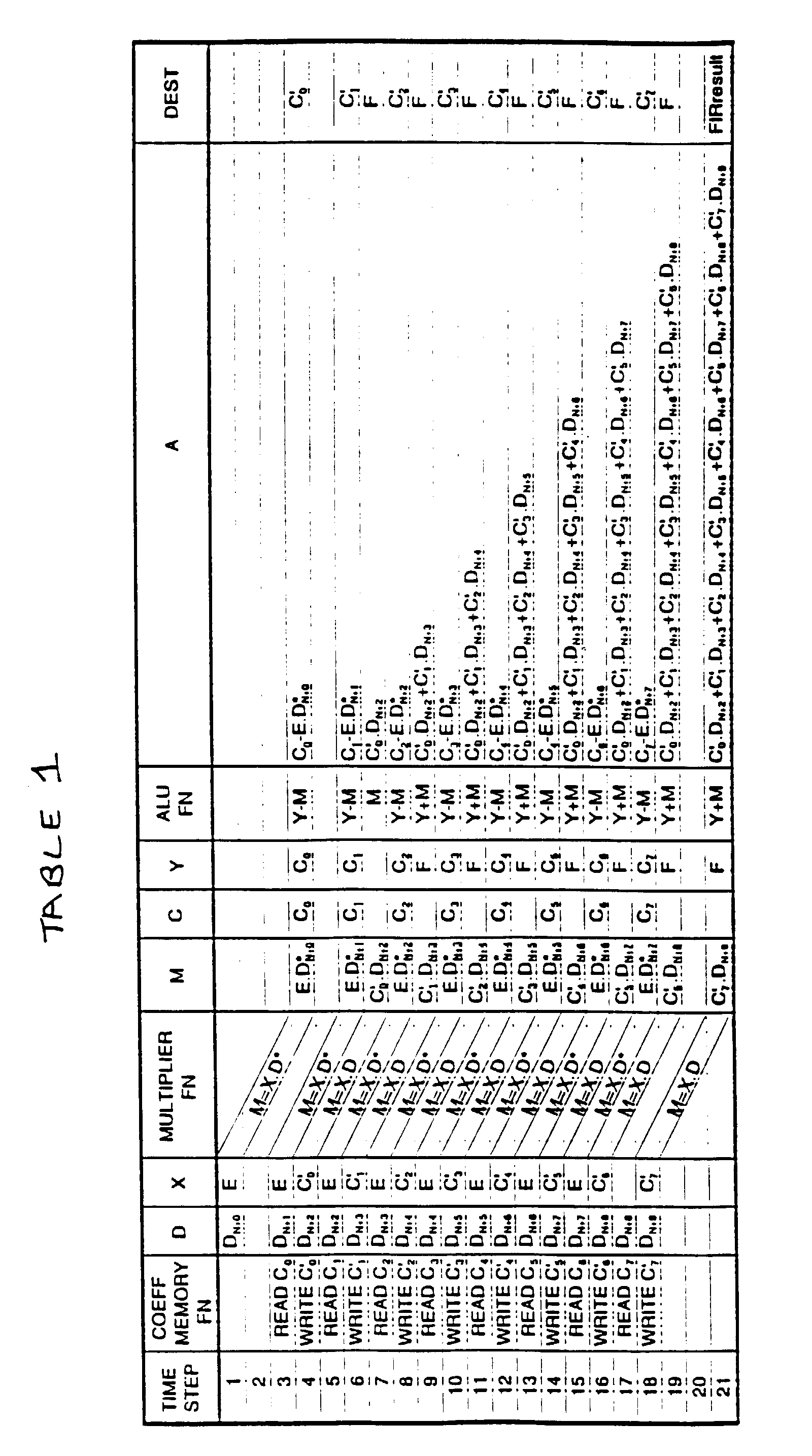
- the sequence of operations undertaken by the adaptive filter 1 is shown in Table 1, which details the individual operation of the data memory 8, coefficient memory 12, multiplier 6, ALU, and selectors 14 and 18, and the values of the data within the circuit. for each time step throughout a complete adaption and filtering operation.
- the first data sample D N+O and the error value E are provided to the multiplier 6 at the time step 1.
- the multiplier 6 operates to provide an output signal M of E.D* N+O which, because of the multiplier's three stage pipeline appears 3 time steps later, at time step 4.
- C O is read from the coefficient memory 12 into the C register 20, becoming available to the ALU through selector 18 at time step 4.
- the arithmetic logic unit ALU acts to provide an output A of C O - E.D* N+O in time step 4. This is passed to C O ' both to the coefficient memory 12 and, through selector 14, to the multiplier 6. This completes the adaptation of the first filter coefficient.
- D N+2 is provided to the multiplier 6 from the data memory 8.
- the multiplier 6 operates to provide an output M of C O '.D N+2 3 time steps later, at time step 7.
- the ALU passes this unchanged to the F-register 16, completing the modulation of the first data sample in the filter.
Landscapes
- Filters That Use Time-Delay Elements (AREA)
- Fluid-Pressure Circuits (AREA)
- Control Of Throttle Valves Provided In The Intake System Or In The Exhaust System (AREA)
- Centrifugal Separators (AREA)
- Networks Using Active Elements (AREA)
- Piezo-Electric Or Mechanical Vibrators, Or Delay Or Filter Circuits (AREA)
- Control Of Motors That Do Not Use Commutators (AREA)
- Digital Transmission Methods That Use Modulated Carrier Waves (AREA)
- Noise Elimination (AREA)
- Compression, Expansion, Code Conversion, And Decoders (AREA)
- Cable Transmission Systems, Equalization Of Radio And Reduction Of Echo (AREA)
- Transmission Systems Not Characterized By The Medium Used For Transmission (AREA)
Abstract
Description
- The present invention relates to adaptive digital filters, in particular for use in radio receivers.
- Conventional adaptive digital filters are known, for example, from digital signal processing by EC Ifeachor and DW Jervis, 1993 Addison-Wesley Publishers Limited. These filters suffer the disadvantage that filter coefficients are all updated and stored before use in modulating received data samples. This procedure necessarily involves writing the coefficients to memory and reading all the coefficients from memory before filtering. This makes the adaptive filter relatively slow, or requires additional circuitry for the separate up-dating of coefficients.
- In EP-A-0373468, a predetermined number of update calculations to the coefficent values is performed and at the same time period a predetermined number of convolution products is summed, each of which is formed by multiplying a predetermined coefficient value and a predetermined data value.
- International Conference on Acoustics, Speech, and Signal Processing; 23 - 26 May 1989; Glasgow (UK), pp. 956-959; Jin Yung Zhang et al.: "Realization and Implementation of Adaptive State-Space Recursive Filters" discloses an adaptive filter in which the computations involved in the filter calculation part and in the parameter update are matrix operations. During each iteration, the gradients of matrices are calculated. The gradient calculations are computed concurrently with the filter calculations.
- The adaptive filter disclosed in US-A-5282155 has an architecture which computes tap coefficient updates in parallel with and simultaneously with the computation of the filter output at each iteration.
- The present invention is defined in the claims to which reference should now be made.
- The present invention provides a method of adaptive digital filtering comprising first steps each of adapting a filter coefficient dependent on a received data sample, and second steps each of applying an adapted filter coefficient to a received data sample, in which the first and second steps are timed such that adapted filter coefficients and modulated data samples are alternately determined in an arithmetic logic unit. In consequence, each adapted filter coefficient can be provided for immediate use in filtering without needing to be held in a memory.
- Coefficients are adapted according to an error derived from a previous filtering operation for use in the next filtering operation. Each filtering operation is on successively later received data samples.
- The present invention also provides an adaptive digital filter comprising filter means and adaptive means, the adaptive means being operative to adapt a filter coefficient to provide an adapted coefficient, the filter means being operative to apply an adapted filter coefficient to a received data sample, the operation of the filter means and adaptive means being timed such that adapted filter coefficients and modulated data samples are alternately provided by an arithmetic logic unit. In this way, an adapted filter coefficient may be read into the filter means one clock cycle after having been determined. An adapted filter coefficient can, at a predetermined time, both be read by the filter means and written to a memory for later use.
- The present invention also provides a receiver including a novel adaptive digital filter as outlined above. The receiver could be for radio or telecommunications, in particular for time division multiplex (TDM) and/or Time division multiple access (TDMA) communications. The receiver can be a base station receiving TDMA communications from subscriber units which can be at fixed locations.
- The present invention also relates to corresponding methods of radio reception.
- The present invention preferably provides the advantage of increased data throughput through simple adaptive digital filters.
- A preferred embodiment of the present invention will now be described by way of example and with reference to the drawings in which:
- Figure 1 is a simple block diagram illustrating an adaptive filter; and
- Figure 2 is a block diagram of an adaptive filter according to the present invention.
-
- As shown in Figure 1, an adaptive filter I comprises a
digital filter 2 connected with adaptive means 4. Data samples D are received and applied to thedigital filter 2 and a filtered output signal FIRresult is provided. The previous filter coefficients Cn applied by thefilter 2 are adapted, i.e. updated, dependent on an error E which is the difference between received and expected filter outputs FIRresult to provide adapted filter coefficients Cn'. These adapted coefficients Cn' are applied to filter out any systematic errors received in data samples D. Thefilter 2, which is a multi-tap (e.g. 8-tap) filter, acts to provide an output FIRresult according to the equationwhere Cn' are the updated filter coefficients and DN+n+2 are the data samples, N denoting the first data sample in the combined adaption and filtering process.
- The filter acts in response to a complex error signal E where the error E is deduced as follows:
- The error E is used to update the filter coefficients in adaptive means 4 according to the LMS algorithm, specifically equation:
n - The adaptive means 4 of the adaptive filter I thus acts to alter the filter coefficients to bring the expected and received filter outputs FIR result into agreement.
- The interleaving of filtering (Equation 1) and adapting (Equation 2) operations allows each coefficient to be adapted according to the error derived from a previous filtering operation before use in the current filter operation.
- For an adapting and filtering operation where initialisation is required, the adaptive operation becomes, in place of Equation 3,
- The apparatus of the
adaptive filter 1 is shown in more detail in Figure 2. There is acomplex multiplier 6 which receives data samples D from adata memory 8 and selectively receives, from aselector 14 having an output signal denoted X, either an error value E from anerror register 10 or a filter coefficient Cn from acontrol buffer 15. Themultiplier 6 is connected to an arithmetic logic unit ALU to which it provides a signal M. The arithmetic logic unit ALU provides an output signal A, and performs the calculations necessary to provide filter data samples F and coefficient Cn', as described below. - The modulated data samples F are fed back to a
register 16 which is connected to aselector 18. The other input port of theselector 18 is connected to aregister 20 for holding a filter coefficient C. The output port of theselector 18 is connected to the arithmetic unit ALU, and the arithmetic logic unit ALU output is connected via thecontrol buffer 15, to thecoefficient memory 12 andselector 14 to both of which it delivers the updated filter coefficient C'.Selector 18 provides a signal Y to the arithmetic logic unit ALU. - The sequence of operations undertaken by the
adaptive filter 1 is shown in Table 1, which details the individual operation of thedata memory 8,coefficient memory 12,multiplier 6, ALU, andselectors - As shown in Table 1, the first data sample DN+O and the error value E are provided to the
multiplier 6 at thetime step 1. Themultiplier 6 operates to provide an output signal M of E.D*N+O which, because of the multiplier's three stage pipeline appears 3 time steps later, at time step 4. At time step 3, CO is read from thecoefficient memory 12 into theC register 20, becoming available to the ALU throughselector 18 at time step 4. The arithmetic logic unit ALU acts to provide an output A of CO - E.D*N+O in time step 4. This is passed to CO' both to thecoefficient memory 12 and, throughselector 14, to themultiplier 6. This completes the adaptation of the first filter coefficient. - Also at time step 4, DN+2 is provided to the
multiplier 6 from thedata memory 8. Themultiplier 6 operates to provide an output M of CO'.DN+2 3 time steps later, at time step 7. The ALU passes this unchanged to the F-register 16, completing the modulation of the first data sample in the filter. - The above sequence of operations, in which Cn' and Cn'.DN+n+2 are computed from E, DN, Cn and DN+n+2, for the case n = O, is repeated for n = 1 to 7 inclusive, starting at
time steps 3,5,7,9,11,13 and 15 respectively. For these sequences, however, the operation of the ALU during the filtering (data modulating) phase (attime steps 9,11,13,15,17,19 and 21) is modified to produce a result A of F+ Cn'.DN+n+2, thus causing this result to include the sum of all previously modulated data, as required byEquation 1. - These repeated sequences are interleaved cooperatively, causing the multiplier and ALU to operate on updated coefficients Cn' and modulated data samples alternately, in such a way as to ensure that the updated coefficients are provided for immediate use without needing to be written to and subsequently read from a memory.
Claims (13)
- A method of adaptive digital filtering comprising first steps each of adapting a filter coefficient (C) dependent on a received data sample (D), and second steps each of filtering by applying an adapted filter coefficient (C') to a received data sample (D), in which the first and second steps are timed such that adapted filter coefficients (C') and modulated data samples (F) are alternately determined in an arithmetic logic unit (ALU).
- A method of adaptive digital filtering according to any preceding claim, in which each of said second steps is performed on a successively later received data sample (D).
- A method of adaptive digital filtering according to claim 1 or claim 2, in which each adapted filter coefficient (C') is provided for immediate use in filtering without being held in a memory (12).
- A method of adaptive digital filtering according to any preceding claim, in which coefficients (C) are adapted according to an error (E) derived from a previous filtering operation for use in the next filtering operation.
- A method of adaptive digital filtering according to any preceding claim, in which the filtering follows the equation:where Cn' are the updated filter coefficients and DN+n+2 are the data samples, N denoting the first data sample in the combined adaption and filtering process.

- A method of adaptive digital filtering according to claim 5 as dependent on claim 4, in which the error E is deduced as
- An adaptive digital filter comprising filter means (2; 6, 8, 12, 14, 16, 18, ALU) and adaptive means (4; 6, 8, 10, 14, ALU), the adaptive means being operative to adapt a filter coefficient (C) to provide an adapted coefficient (C'), the filter means being operative to apply an adapted filter coefficient (C') to a received data sample (D), the operation of the filter means and adaptive means being timed such that adapted filter coefficients (C') and modulated data samples (F) are alternately provided by an arithmetic logic unit (ALU).
- An adaptive digital filter according to claim 7, including means (14, 15) for providing each adapted filter coefficient (C') for immediate use in filtering.
- An adaptive digital filter according to claim 8, in which an adapted filter coefficient (C') is read into the filter means one clock cycle after having been determined.
- An adaptive digital filter according to any of claims 7 to 9, in which at a predetermined time an adapted filter coefficient (C') is both read by the filter means and written to a memory (12) for later use.
- An adaptive digital filter according to any of claims 7 to 10, in which the adaptive means operates to adapt coefficients (C) according to an error (E) derived from a previous filtering operation for use in the next filtering operation.
- A receiver for radio or telecommunications comprising an adaptive digital filter according to any of claims 7 to 11.
- A method of radio or telecommunications reception comprising a method of adaptive digital filtering according to any of claims 1 to 4.
Applications Claiming Priority (3)
| Application Number | Priority Date | Filing Date | Title |
|---|---|---|---|
| GB9418755A GB9418755D0 (en) | 1994-09-16 | 1994-09-16 | Filter |
| GB9418755 | 1994-09-16 | ||
| PCT/GB1995/002122 WO1996008867A1 (en) | 1994-09-16 | 1995-09-08 | Filter |
Publications (2)
| Publication Number | Publication Date |
|---|---|
| EP0781469A1 EP0781469A1 (en) | 1997-07-02 |
| EP0781469B1 true EP0781469B1 (en) | 1999-11-17 |
Family
ID=10761488
Family Applications (1)
| Application Number | Title | Priority Date | Filing Date |
|---|---|---|---|
| EP95930664A Expired - Lifetime EP0781469B1 (en) | 1994-09-16 | 1995-09-08 | Adaptive filter |
Country Status (15)
| Country | Link |
|---|---|
| US (1) | US5987485A (en) |
| EP (1) | EP0781469B1 (en) |
| JP (1) | JPH10505964A (en) |
| AT (1) | ATE186799T1 (en) |
| AU (1) | AU3397395A (en) |
| BR (1) | BR9508938A (en) |
| DE (1) | DE69513410T2 (en) |
| ES (1) | ES2144140T3 (en) |
| FI (1) | FI971091A0 (en) |
| GB (1) | GB9418755D0 (en) |
| IL (1) | IL115145A (en) |
| IN (1) | IN185474B (en) |
| MX (1) | MX9701973A (en) |
| WO (1) | WO1996008867A1 (en) |
| ZA (1) | ZA957737B (en) |
Families Citing this family (2)
| Publication number | Priority date | Publication date | Assignee | Title |
|---|---|---|---|---|
| US6628923B1 (en) | 2000-05-03 | 2003-09-30 | Nokia Networks Oy | Adaptive phase and amplitude linearization method and apparatus |
| ES2297964B1 (en) * | 2005-03-03 | 2009-08-25 | Angel Carpeño Velayos | SMART INCREMENTAL FILTER. |
Family Cites Families (11)
| Publication number | Priority date | Publication date | Assignee | Title |
|---|---|---|---|---|
| NL7905577A (en) * | 1979-07-18 | 1981-01-20 | Philips Nv | DEVICE WITH A NON-RECURRENCE FILTER. |
| US5216629A (en) * | 1987-12-23 | 1993-06-01 | U.S. Philips Corp. | Adjusting filter coefficients |
| US4947363A (en) * | 1988-12-12 | 1990-08-07 | Motorola, Inc. | Pipelined processor for implementing the least-mean-squares algorithm |
| JP2573389B2 (en) * | 1990-03-23 | 1997-01-22 | 晴夫 浜田 | Electronic silencing method and device |
| US5168459A (en) * | 1991-01-03 | 1992-12-01 | Hewlett-Packard Company | Adaptive filter using continuous cross-correlation |
| US5243624A (en) * | 1991-07-26 | 1993-09-07 | General Instrument Corporation | Method and apparatus for updating coefficients in a complex adaptive equalizer |
| JP2541044B2 (en) * | 1991-08-29 | 1996-10-09 | 真作 森 | Adaptive filter device |
| DE59202546D1 (en) * | 1992-02-07 | 1995-07-20 | Siemens Ag | Adaptive non-recursive digital filter. |
| US5392315A (en) * | 1992-08-26 | 1995-02-21 | Zenith Eletronics Corporation | FIR filter coefficient updating system |
| US5282155A (en) * | 1992-11-19 | 1994-01-25 | Bell Communications Resarch, Inc. | Adaptive digital filter architecture for parallel output/update computations |
| US5535150A (en) * | 1993-04-20 | 1996-07-09 | Massachusetts Institute Of Technology | Single chip adaptive filter utilizing updatable weighting techniques |
-
1994
- 1994-09-16 GB GB9418755A patent/GB9418755D0/en active Pending
-
1995
- 1995-08-24 IN IN1006CA1995 patent/IN185474B/en unknown
- 1995-09-01 IL IL11514595A patent/IL115145A/en not_active IP Right Cessation
- 1995-09-08 BR BR9508938A patent/BR9508938A/en not_active Application Discontinuation
- 1995-09-08 EP EP95930664A patent/EP0781469B1/en not_active Expired - Lifetime
- 1995-09-08 MX MX9701973A patent/MX9701973A/en unknown
- 1995-09-08 DE DE69513410T patent/DE69513410T2/en not_active Expired - Fee Related
- 1995-09-08 JP JP8509975A patent/JPH10505964A/en active Pending
- 1995-09-08 FI FI971091A patent/FI971091A0/en unknown
- 1995-09-08 WO PCT/GB1995/002122 patent/WO1996008867A1/en not_active Ceased
- 1995-09-08 AU AU33973/95A patent/AU3397395A/en not_active Abandoned
- 1995-09-08 US US08/809,132 patent/US5987485A/en not_active Expired - Fee Related
- 1995-09-08 ES ES95930664T patent/ES2144140T3/en not_active Expired - Lifetime
- 1995-09-08 AT AT95930664T patent/ATE186799T1/en not_active IP Right Cessation
- 1995-09-14 ZA ZA957737A patent/ZA957737B/en unknown
Also Published As
| Publication number | Publication date |
|---|---|
| HK1001213A1 (en) | 1998-06-05 |
| EP0781469A1 (en) | 1997-07-02 |
| ES2144140T3 (en) | 2000-06-01 |
| DE69513410D1 (en) | 1999-12-23 |
| ATE186799T1 (en) | 1999-12-15 |
| WO1996008867A1 (en) | 1996-03-21 |
| FI971091L (en) | 1997-03-14 |
| JPH10505964A (en) | 1998-06-09 |
| GB9418755D0 (en) | 1994-11-02 |
| MX9701973A (en) | 1998-02-28 |
| AU3397395A (en) | 1996-03-29 |
| FI971091A7 (en) | 1997-03-14 |
| IL115145A (en) | 1999-09-22 |
| IN185474B (en) | 2001-02-03 |
| IL115145A0 (en) | 1995-12-31 |
| BR9508938A (en) | 1997-11-11 |
| US5987485A (en) | 1999-11-16 |
| DE69513410T2 (en) | 2000-06-21 |
| FI971091A0 (en) | 1997-03-14 |
| ZA957737B (en) | 1996-05-06 |
Similar Documents
| Publication | Publication Date | Title |
|---|---|---|
| JP3621710B2 (en) | Dynamic adaptive equalizer system and method | |
| US5557645A (en) | Channel-independent equalizer device | |
| US5282155A (en) | Adaptive digital filter architecture for parallel output/update computations | |
| JP3154998B2 (en) | Signal conversion method for converting a signal having a first sampling frequency to a signal having a second sampling frequency | |
| US5590121A (en) | Method and apparatus for adaptive filtering | |
| US5048060A (en) | Digital signal receiving circuit with means for controlling a baud rate sampling phase by a power of sampled signals | |
| US5297071A (en) | Arithmetic circuit, and adaptive filter and echo canceler using it | |
| US20020062327A1 (en) | Digital filters | |
| US6279020B1 (en) | Programmable circuit for realizing a digital filter | |
| JPH1155215A (en) | Spread spectrum receiving device | |
| US5805479A (en) | Apparatus and method for filtering digital signals | |
| US4225832A (en) | Self-adapting equalizer | |
| CN1677965A (en) | Digital modulator employing a polyphase up-converter structure | |
| US5987485A (en) | Adaptive digital filter | |
| GB2242339A (en) | Frame phase estimation method and circuit | |
| US6108681A (en) | System for sharing resources in a digital filter | |
| US4225937A (en) | Method and apparatus for suppression of error accumulation in recursive computation of a discrete Fourier transform | |
| HK1001213B (en) | Adaptive filter | |
| JPH0964791A (en) | Waveform equalizer | |
| EP0782261A2 (en) | Update block for an adaptive equalizer filter configuration | |
| US5805481A (en) | Update block for an adaptive equalizer filter configuration capable of processing complex-valued coefficient signals | |
| EP0426296B1 (en) | Apparatus having modular interpolation architecture | |
| MXPA97001973A (en) | Fil | |
| KR20010006702A (en) | Receiver, programmable circuit and method of calculating digital filters | |
| CN1163023A (en) | Filter |
Legal Events
| Date | Code | Title | Description |
|---|---|---|---|
| PUAI | Public reference made under article 153(3) epc to a published international application that has entered the european phase |
Free format text: ORIGINAL CODE: 0009012 |
|
| 17P | Request for examination filed |
Effective date: 19970410 |
|
| AK | Designated contracting states |
Kind code of ref document: A1 Designated state(s): AT BE CH DE DK ES FR GB GR IE IT LI LU MC NL PT SE |
|
| 17Q | First examination report despatched |
Effective date: 19971216 |
|
| GRAG | Despatch of communication of intention to grant |
Free format text: ORIGINAL CODE: EPIDOS AGRA |
|
| GRAG | Despatch of communication of intention to grant |
Free format text: ORIGINAL CODE: EPIDOS AGRA |
|
| GRAH | Despatch of communication of intention to grant a patent |
Free format text: ORIGINAL CODE: EPIDOS IGRA |
|
| GRAH | Despatch of communication of intention to grant a patent |
Free format text: ORIGINAL CODE: EPIDOS IGRA |
|
| GRAA | (expected) grant |
Free format text: ORIGINAL CODE: 0009210 |
|
| AK | Designated contracting states |
Kind code of ref document: B1 Designated state(s): AT BE CH DE DK ES FR GB GR IE IT LI LU MC NL PT SE |
|
| PG25 | Lapsed in a contracting state [announced via postgrant information from national office to epo] |
Ref country code: SE Free format text: THE PATENT HAS BEEN ANNULLED BY A DECISION OF A NATIONAL AUTHORITY Effective date: 19991117 Ref country code: NL Free format text: LAPSE BECAUSE OF FAILURE TO SUBMIT A TRANSLATION OF THE DESCRIPTION OR TO PAY THE FEE WITHIN THE PRESCRIBED TIME-LIMIT Effective date: 19991117 Ref country code: LI Free format text: LAPSE BECAUSE OF FAILURE TO SUBMIT A TRANSLATION OF THE DESCRIPTION OR TO PAY THE FEE WITHIN THE PRESCRIBED TIME-LIMIT Effective date: 19991117 Ref country code: GR Free format text: LAPSE BECAUSE OF NON-PAYMENT OF DUE FEES Effective date: 19991117 Ref country code: CH Free format text: LAPSE BECAUSE OF FAILURE TO SUBMIT A TRANSLATION OF THE DESCRIPTION OR TO PAY THE FEE WITHIN THE PRESCRIBED TIME-LIMIT Effective date: 19991117 Ref country code: BE Free format text: LAPSE BECAUSE OF FAILURE TO SUBMIT A TRANSLATION OF THE DESCRIPTION OR TO PAY THE FEE WITHIN THE PRESCRIBED TIME-LIMIT Effective date: 19991117 Ref country code: AT Free format text: LAPSE BECAUSE OF FAILURE TO SUBMIT A TRANSLATION OF THE DESCRIPTION OR TO PAY THE FEE WITHIN THE PRESCRIBED TIME-LIMIT Effective date: 19991117 |
|
| REF | Corresponds to: |
Ref document number: 186799 Country of ref document: AT Date of ref document: 19991215 Kind code of ref document: T |
|
| REG | Reference to a national code |
Ref country code: CH Ref legal event code: EP |
|
| REF | Corresponds to: |
Ref document number: 69513410 Country of ref document: DE Date of ref document: 19991223 |
|
| ITF | It: translation for a ep patent filed | ||
| REG | Reference to a national code |
Ref country code: IE Ref legal event code: FG4D |
|
| ET | Fr: translation filed | ||
| PG25 | Lapsed in a contracting state [announced via postgrant information from national office to epo] |
Ref country code: PT Free format text: LAPSE BECAUSE OF FAILURE TO SUBMIT A TRANSLATION OF THE DESCRIPTION OR TO PAY THE FEE WITHIN THE PRESCRIBED TIME-LIMIT Effective date: 20000217 Ref country code: DK Free format text: LAPSE BECAUSE OF FAILURE TO SUBMIT A TRANSLATION OF THE DESCRIPTION OR TO PAY THE FEE WITHIN THE PRESCRIBED TIME-LIMIT Effective date: 20000217 |
|
| NLV1 | Nl: lapsed or annulled due to failure to fulfill the requirements of art. 29p and 29m of the patents act | ||
| REG | Reference to a national code |
Ref country code: CH Ref legal event code: PL |
|
| REG | Reference to a national code |
Ref country code: ES Ref legal event code: FG2A Ref document number: 2144140 Country of ref document: ES Kind code of ref document: T3 |
|
| PG25 | Lapsed in a contracting state [announced via postgrant information from national office to epo] |
Ref country code: LU Free format text: LAPSE BECAUSE OF NON-PAYMENT OF DUE FEES Effective date: 20000908 Ref country code: IE Free format text: LAPSE BECAUSE OF NON-PAYMENT OF DUE FEES Effective date: 20000908 Ref country code: GB Free format text: LAPSE BECAUSE OF NON-PAYMENT OF DUE FEES Effective date: 20000908 |
|
| PG25 | Lapsed in a contracting state [announced via postgrant information from national office to epo] |
Ref country code: ES Free format text: LAPSE BECAUSE OF NON-PAYMENT OF DUE FEES Effective date: 20000909 |
|
| PLBE | No opposition filed within time limit |
Free format text: ORIGINAL CODE: 0009261 |
|
| STAA | Information on the status of an ep patent application or granted ep patent |
Free format text: STATUS: NO OPPOSITION FILED WITHIN TIME LIMIT |
|
| PG25 | Lapsed in a contracting state [announced via postgrant information from national office to epo] |
Ref country code: MC Free format text: THE PATENT HAS BEEN ANNULLED BY A DECISION OF A NATIONAL AUTHORITY Effective date: 20000930 |
|
| 26N | No opposition filed | ||
| GBPC | Gb: european patent ceased through non-payment of renewal fee |
Effective date: 20000908 |
|
| PG25 | Lapsed in a contracting state [announced via postgrant information from national office to epo] |
Ref country code: DE Free format text: LAPSE BECAUSE OF NON-PAYMENT OF DUE FEES Effective date: 20010601 |
|
| REG | Reference to a national code |
Ref country code: IE Ref legal event code: MM4A |
|
| PG25 | Lapsed in a contracting state [announced via postgrant information from national office to epo] |
Ref country code: FR Free format text: LAPSE BECAUSE OF NON-PAYMENT OF DUE FEES Effective date: 20011130 |
|
| REG | Reference to a national code |
Ref country code: FR Ref legal event code: ST |
|
| REG | Reference to a national code |
Ref country code: ES Ref legal event code: FD2A Effective date: 20011011 |
|
| PG25 | Lapsed in a contracting state [announced via postgrant information from national office to epo] |
Ref country code: IT Free format text: LAPSE BECAUSE OF NON-PAYMENT OF DUE FEES;WARNING: LAPSES OF ITALIAN PATENTS WITH EFFECTIVE DATE BEFORE 2007 MAY HAVE OCCURRED AT ANY TIME BEFORE 2007. THE CORRECT EFFECTIVE DATE MAY BE DIFFERENT FROM THE ONE RECORDED. Effective date: 20050908 |
|
| PG25 | Lapsed in a contracting state [announced via postgrant information from national office to epo] |
Ref country code: FR Free format text: LAPSE BECAUSE OF NON-PAYMENT OF DUE FEES Effective date: 20000930 |