EP0774795A2 - Electrolytic membrane for use as a solid polymer electrolyte in a rechargeable battery and process for its photo-crosslinking on a cathodic collector - Google Patents
Electrolytic membrane for use as a solid polymer electrolyte in a rechargeable battery and process for its photo-crosslinking on a cathodic collector Download PDFInfo
- Publication number
- EP0774795A2 EP0774795A2 EP96117238A EP96117238A EP0774795A2 EP 0774795 A2 EP0774795 A2 EP 0774795A2 EP 96117238 A EP96117238 A EP 96117238A EP 96117238 A EP96117238 A EP 96117238A EP 0774795 A2 EP0774795 A2 EP 0774795A2
- Authority
- EP
- European Patent Office
- Prior art keywords
- weight
- general formula
- cathodic
- integer
- zeolite
- Prior art date
- Legal status (The legal status is an assumption and is not a legal conclusion. Google has not performed a legal analysis and makes no representation as to the accuracy of the status listed.)
- Granted
Links
- 239000012528 membrane Substances 0.000 title claims abstract description 48
- 238000000034 method Methods 0.000 title claims description 16
- 238000004132 cross linking Methods 0.000 title description 6
- 239000007787 solid Substances 0.000 title description 3
- 239000005518 polymer electrolyte Substances 0.000 title 1
- 239000000203 mixture Substances 0.000 claims abstract description 25
- 239000010457 zeolite Substances 0.000 claims abstract description 23
- 239000004014 plasticizer Substances 0.000 claims abstract description 17
- 229910021536 Zeolite Inorganic materials 0.000 claims abstract description 16
- HNPSIPDUKPIQMN-UHFFFAOYSA-N dioxosilane;oxo(oxoalumanyloxy)alumane Chemical compound O=[Si]=O.O=[Al]O[Al]=O HNPSIPDUKPIQMN-UHFFFAOYSA-N 0.000 claims abstract description 16
- 229910003002 lithium salt Inorganic materials 0.000 claims abstract description 16
- 159000000002 lithium salts Chemical class 0.000 claims abstract description 16
- QYKIQEUNHZKYBP-UHFFFAOYSA-N Vinyl ether Chemical compound C=COC=C QYKIQEUNHZKYBP-UHFFFAOYSA-N 0.000 claims abstract description 14
- 229960000834 vinyl ether Drugs 0.000 claims abstract description 14
- 125000000391 vinyl group Chemical group [H]C([*])=C([H])[H] 0.000 claims abstract description 14
- 239000003999 initiator Substances 0.000 claims abstract description 7
- 229920000642 polymer Polymers 0.000 claims abstract description 6
- PXHVJJICTQNCMI-UHFFFAOYSA-N Nickel Chemical compound [Ni] PXHVJJICTQNCMI-UHFFFAOYSA-N 0.000 claims description 32
- 239000003792 electrolyte Substances 0.000 claims description 17
- 229910052759 nickel Inorganic materials 0.000 claims description 16
- 239000006185 dispersion Substances 0.000 claims description 10
- 238000002360 preparation method Methods 0.000 claims description 10
- 239000000843 powder Substances 0.000 claims description 8
- 239000006229 carbon black Substances 0.000 claims description 6
- 125000001495 ethyl group Chemical group [H]C([H])([H])C([H])([H])* 0.000 claims description 6
- 125000002496 methyl group Chemical group [H]C([H])([H])* 0.000 claims description 6
- 230000008021 deposition Effects 0.000 claims description 5
- 230000005855 radiation Effects 0.000 claims description 5
- 239000010406 cathode material Substances 0.000 claims description 4
- 239000011532 electronic conductor Substances 0.000 claims description 4
- 238000006116 polymerization reaction Methods 0.000 claims description 4
- 229910001496 lithium tetrafluoroborate Inorganic materials 0.000 claims description 3
- 150000003839 salts Chemical class 0.000 claims description 3
- WEVYAHXRMPXWCK-UHFFFAOYSA-N Acetonitrile Chemical compound CC#N WEVYAHXRMPXWCK-UHFFFAOYSA-N 0.000 description 12
- 230000000052 comparative effect Effects 0.000 description 9
- 229920003171 Poly (ethylene oxide) Polymers 0.000 description 8
- MHCFAGZWMAWTNR-UHFFFAOYSA-M lithium perchlorate Chemical compound [Li+].[O-]Cl(=O)(=O)=O MHCFAGZWMAWTNR-UHFFFAOYSA-M 0.000 description 7
- 229910001486 lithium perchlorate Inorganic materials 0.000 description 7
- RUOJZAUFBMNUDX-UHFFFAOYSA-N propylene carbonate Chemical compound CC1COC(=O)O1 RUOJZAUFBMNUDX-UHFFFAOYSA-N 0.000 description 7
- XKRFYHLGVUSROY-UHFFFAOYSA-N Argon Chemical compound [Ar] XKRFYHLGVUSROY-UHFFFAOYSA-N 0.000 description 6
- 238000000151 deposition Methods 0.000 description 5
- 229910052744 lithium Inorganic materials 0.000 description 5
- 239000000126 substance Substances 0.000 description 5
- ZUHZGEOKBKGPSW-UHFFFAOYSA-N tetraglyme Chemical compound COCCOCCOCCOCCOC ZUHZGEOKBKGPSW-UHFFFAOYSA-N 0.000 description 5
- WHXSMMKQMYFTQS-UHFFFAOYSA-N Lithium Chemical compound [Li] WHXSMMKQMYFTQS-UHFFFAOYSA-N 0.000 description 4
- 239000011149 active material Substances 0.000 description 4
- 239000003273 ketjen black Substances 0.000 description 4
- 239000002245 particle Substances 0.000 description 4
- -1 polyethylene Polymers 0.000 description 4
- 239000000243 solution Substances 0.000 description 4
- 125000005409 triarylsulfonium group Chemical class 0.000 description 4
- 239000004698 Polyethylene Substances 0.000 description 3
- 229910000831 Steel Inorganic materials 0.000 description 3
- 239000004809 Teflon Substances 0.000 description 3
- 229920006362 Teflon® Polymers 0.000 description 3
- PNEYBMLMFCGWSK-UHFFFAOYSA-N aluminium oxide Inorganic materials [O-2].[O-2].[O-2].[Al+3].[Al+3] PNEYBMLMFCGWSK-UHFFFAOYSA-N 0.000 description 3
- 229910052786 argon Inorganic materials 0.000 description 3
- 239000000178 monomer Substances 0.000 description 3
- VLKZOEOYAKHREP-UHFFFAOYSA-N n-Hexane Chemical compound CCCCCC VLKZOEOYAKHREP-UHFFFAOYSA-N 0.000 description 3
- 229920000573 polyethylene Polymers 0.000 description 3
- 229940032159 propylene carbonate Drugs 0.000 description 3
- 239000000523 sample Substances 0.000 description 3
- 239000002904 solvent Substances 0.000 description 3
- 239000010959 steel Substances 0.000 description 3
- YEJRWHAVMIAJKC-UHFFFAOYSA-N 4-Butyrolactone Chemical compound O=C1CCCO1 YEJRWHAVMIAJKC-UHFFFAOYSA-N 0.000 description 2
- OIFBSDVPJOWBCH-UHFFFAOYSA-N Diethyl carbonate Chemical compound CCOC(=O)OCC OIFBSDVPJOWBCH-UHFFFAOYSA-N 0.000 description 2
- KMTRUDSVKNLOMY-UHFFFAOYSA-N Ethylene carbonate Chemical compound O=C1OCCO1 KMTRUDSVKNLOMY-UHFFFAOYSA-N 0.000 description 2
- 229910000552 LiCF3SO3 Inorganic materials 0.000 description 2
- OFBQJSOFQDEBGM-UHFFFAOYSA-N Pentane Chemical compound CCCCC OFBQJSOFQDEBGM-UHFFFAOYSA-N 0.000 description 2
- VYPSYNLAJGMNEJ-UHFFFAOYSA-N Silicium dioxide Chemical compound O=[Si]=O VYPSYNLAJGMNEJ-UHFFFAOYSA-N 0.000 description 2
- 239000002253 acid Substances 0.000 description 2
- 230000004913 activation Effects 0.000 description 2
- 239000000853 adhesive Substances 0.000 description 2
- 230000001070 adhesive effect Effects 0.000 description 2
- 230000015572 biosynthetic process Effects 0.000 description 2
- 229910052799 carbon Inorganic materials 0.000 description 2
- 229910010293 ceramic material Inorganic materials 0.000 description 2
- 238000010586 diagram Methods 0.000 description 2
- 238000007599 discharging Methods 0.000 description 2
- 238000000227 grinding Methods 0.000 description 2
- 238000007654 immersion Methods 0.000 description 2
- 239000000463 material Substances 0.000 description 2
- 229910052751 metal Inorganic materials 0.000 description 2
- 239000002184 metal Substances 0.000 description 2
- 238000004806 packaging method and process Methods 0.000 description 2
- 239000004033 plastic Substances 0.000 description 2
- 229920003023 plastic Polymers 0.000 description 2
- 239000002985 plastic film Substances 0.000 description 2
- 229920000570 polyether Polymers 0.000 description 2
- 229920001289 polyvinyl ether Polymers 0.000 description 2
- 239000011148 porous material Substances 0.000 description 2
- 238000005096 rolling process Methods 0.000 description 2
- CYIGRWUIQAVBFG-UHFFFAOYSA-N 1,2-bis(2-ethenoxyethoxy)ethane Chemical compound C=COCCOCCOCCOC=C CYIGRWUIQAVBFG-UHFFFAOYSA-N 0.000 description 1
- PNSAKLKMKPWBIC-UHFFFAOYSA-N 1-[2-(2-ethenoxyethoxy)ethoxy]-2-ethoxyethane Chemical compound CCOCCOCCOCCOC=C PNSAKLKMKPWBIC-UHFFFAOYSA-N 0.000 description 1
- AZUYLZMQTIKGSC-UHFFFAOYSA-N 1-[6-[4-(5-chloro-6-methyl-1H-indazol-4-yl)-5-methyl-3-(1-methylindazol-5-yl)pyrazol-1-yl]-2-azaspiro[3.3]heptan-2-yl]prop-2-en-1-one Chemical compound ClC=1C(=C2C=NNC2=CC=1C)C=1C(=NN(C=1C)C1CC2(CN(C2)C(C=C)=O)C1)C=1C=C2C=NN(C2=CC=1)C AZUYLZMQTIKGSC-UHFFFAOYSA-N 0.000 description 1
- 239000004215 Carbon black (E152) Substances 0.000 description 1
- 229910004077 HF-HNO3 Inorganic materials 0.000 description 1
- 229910001290 LiPF6 Inorganic materials 0.000 description 1
- 239000002228 NASICON Substances 0.000 description 1
- GRYLNZFGIOXLOG-UHFFFAOYSA-N Nitric acid Chemical compound O[N+]([O-])=O GRYLNZFGIOXLOG-UHFFFAOYSA-N 0.000 description 1
- 239000004743 Polypropylene Substances 0.000 description 1
- 150000007513 acids Chemical class 0.000 description 1
- 230000003213 activating effect Effects 0.000 description 1
- 239000000654 additive Substances 0.000 description 1
- 230000000996 additive effect Effects 0.000 description 1
- 229910000323 aluminium silicate Inorganic materials 0.000 description 1
- 239000007864 aqueous solution Substances 0.000 description 1
- UNTBPXHCXVWYOI-UHFFFAOYSA-O azanium;oxido(dioxo)vanadium Chemical compound [NH4+].[O-][V](=O)=O UNTBPXHCXVWYOI-UHFFFAOYSA-O 0.000 description 1
- 238000005266 casting Methods 0.000 description 1
- 238000004140 cleaning Methods 0.000 description 1
- 229910052681 coesite Inorganic materials 0.000 description 1
- 239000012612 commercial material Substances 0.000 description 1
- 239000013065 commercial product Substances 0.000 description 1
- 239000002131 composite material Substances 0.000 description 1
- 229910052906 cristobalite Inorganic materials 0.000 description 1
- 238000005238 degreasing Methods 0.000 description 1
- 238000009831 deintercalation Methods 0.000 description 1
- IEJIGPNLZYLLBP-UHFFFAOYSA-N dimethyl carbonate Chemical compound COC(=O)OC IEJIGPNLZYLLBP-UHFFFAOYSA-N 0.000 description 1
- 238000010494 dissociation reaction Methods 0.000 description 1
- 230000005593 dissociations Effects 0.000 description 1
- 239000012153 distilled water Substances 0.000 description 1
- 238000010894 electron beam technology Methods 0.000 description 1
- 238000005530 etching Methods 0.000 description 1
- 230000008020 evaporation Effects 0.000 description 1
- 238000001704 evaporation Methods 0.000 description 1
- 239000008240 homogeneous mixture Substances 0.000 description 1
- 229930195733 hydrocarbon Natural products 0.000 description 1
- 150000002430 hydrocarbons Chemical class 0.000 description 1
- 238000002847 impedance measurement Methods 0.000 description 1
- 239000007788 liquid Substances 0.000 description 1
- QSZMZKBZAYQGRS-UHFFFAOYSA-N lithium;bis(trifluoromethylsulfonyl)azanide Chemical compound [Li+].FC(F)(F)S(=O)(=O)[N-]S(=O)(=O)C(F)(F)F QSZMZKBZAYQGRS-UHFFFAOYSA-N 0.000 description 1
- 239000011159 matrix material Substances 0.000 description 1
- 150000002739 metals Chemical class 0.000 description 1
- 238000002156 mixing Methods 0.000 description 1
- 229910017604 nitric acid Inorganic materials 0.000 description 1
- 239000003973 paint Substances 0.000 description 1
- 238000001020 plasma etching Methods 0.000 description 1
- 230000000379 polymerizing effect Effects 0.000 description 1
- 229920001155 polypropylene Polymers 0.000 description 1
- 239000002243 precursor Substances 0.000 description 1
- 239000000047 product Substances 0.000 description 1
- 239000000377 silicon dioxide Substances 0.000 description 1
- 238000003756 stirring Methods 0.000 description 1
- 229910052682 stishovite Inorganic materials 0.000 description 1
- 238000005979 thermal decomposition reaction Methods 0.000 description 1
- 229910052905 tridymite Inorganic materials 0.000 description 1
- XLYOFNOQVPJJNP-UHFFFAOYSA-N water Chemical compound O XLYOFNOQVPJJNP-UHFFFAOYSA-N 0.000 description 1
Images



Classifications
-
- H—ELECTRICITY
- H01—ELECTRIC ELEMENTS
- H01M—PROCESSES OR MEANS, e.g. BATTERIES, FOR THE DIRECT CONVERSION OF CHEMICAL ENERGY INTO ELECTRICAL ENERGY
- H01M4/00—Electrodes
- H01M4/02—Electrodes composed of, or comprising, active material
- H01M4/13—Electrodes for accumulators with non-aqueous electrolyte, e.g. for lithium-accumulators; Processes of manufacture thereof
- H01M4/139—Processes of manufacture
- H01M4/1391—Processes of manufacture of electrodes based on mixed oxides or hydroxides, or on mixtures of oxides or hydroxides, e.g. LiCoOx
-
- H—ELECTRICITY
- H01—ELECTRIC ELEMENTS
- H01M—PROCESSES OR MEANS, e.g. BATTERIES, FOR THE DIRECT CONVERSION OF CHEMICAL ENERGY INTO ELECTRICAL ENERGY
- H01M10/00—Secondary cells; Manufacture thereof
- H01M10/05—Accumulators with non-aqueous electrolyte
- H01M10/052—Li-accumulators
-
- H—ELECTRICITY
- H01—ELECTRIC ELEMENTS
- H01M—PROCESSES OR MEANS, e.g. BATTERIES, FOR THE DIRECT CONVERSION OF CHEMICAL ENERGY INTO ELECTRICAL ENERGY
- H01M10/00—Secondary cells; Manufacture thereof
- H01M10/05—Accumulators with non-aqueous electrolyte
- H01M10/056—Accumulators with non-aqueous electrolyte characterised by the materials used as electrolytes, e.g. mixed inorganic/organic electrolytes
- H01M10/0564—Accumulators with non-aqueous electrolyte characterised by the materials used as electrolytes, e.g. mixed inorganic/organic electrolytes the electrolyte being constituted of organic materials only
- H01M10/0565—Polymeric materials, e.g. gel-type or solid-type
-
- H—ELECTRICITY
- H01—ELECTRIC ELEMENTS
- H01M—PROCESSES OR MEANS, e.g. BATTERIES, FOR THE DIRECT CONVERSION OF CHEMICAL ENERGY INTO ELECTRICAL ENERGY
- H01M4/00—Electrodes
- H01M4/02—Electrodes composed of, or comprising, active material
-
- H—ELECTRICITY
- H01—ELECTRIC ELEMENTS
- H01M—PROCESSES OR MEANS, e.g. BATTERIES, FOR THE DIRECT CONVERSION OF CHEMICAL ENERGY INTO ELECTRICAL ENERGY
- H01M4/00—Electrodes
- H01M4/02—Electrodes composed of, or comprising, active material
- H01M4/13—Electrodes for accumulators with non-aqueous electrolyte, e.g. for lithium-accumulators; Processes of manufacture thereof
- H01M4/131—Electrodes based on mixed oxides or hydroxides, or on mixtures of oxides or hydroxides, e.g. LiCoOx
-
- Y—GENERAL TAGGING OF NEW TECHNOLOGICAL DEVELOPMENTS; GENERAL TAGGING OF CROSS-SECTIONAL TECHNOLOGIES SPANNING OVER SEVERAL SECTIONS OF THE IPC; TECHNICAL SUBJECTS COVERED BY FORMER USPC CROSS-REFERENCE ART COLLECTIONS [XRACs] AND DIGESTS
- Y02—TECHNOLOGIES OR APPLICATIONS FOR MITIGATION OR ADAPTATION AGAINST CLIMATE CHANGE
- Y02E—REDUCTION OF GREENHOUSE GAS [GHG] EMISSIONS, RELATED TO ENERGY GENERATION, TRANSMISSION OR DISTRIBUTION
- Y02E60/00—Enabling technologies; Technologies with a potential or indirect contribution to GHG emissions mitigation
- Y02E60/10—Energy storage using batteries
-
- Y—GENERAL TAGGING OF NEW TECHNOLOGICAL DEVELOPMENTS; GENERAL TAGGING OF CROSS-SECTIONAL TECHNOLOGIES SPANNING OVER SEVERAL SECTIONS OF THE IPC; TECHNICAL SUBJECTS COVERED BY FORMER USPC CROSS-REFERENCE ART COLLECTIONS [XRACs] AND DIGESTS
- Y10—TECHNICAL SUBJECTS COVERED BY FORMER USPC
- Y10T—TECHNICAL SUBJECTS COVERED BY FORMER US CLASSIFICATION
- Y10T29/00—Metal working
- Y10T29/49—Method of mechanical manufacture
- Y10T29/49002—Electrical device making
- Y10T29/49108—Electric battery cell making
-
- Y—GENERAL TAGGING OF NEW TECHNOLOGICAL DEVELOPMENTS; GENERAL TAGGING OF CROSS-SECTIONAL TECHNOLOGIES SPANNING OVER SEVERAL SECTIONS OF THE IPC; TECHNICAL SUBJECTS COVERED BY FORMER USPC CROSS-REFERENCE ART COLLECTIONS [XRACs] AND DIGESTS
- Y10—TECHNICAL SUBJECTS COVERED BY FORMER USPC
- Y10T—TECHNICAL SUBJECTS COVERED BY FORMER US CLASSIFICATION
- Y10T29/00—Metal working
- Y10T29/49—Method of mechanical manufacture
- Y10T29/49002—Electrical device making
- Y10T29/49108—Electric battery cell making
- Y10T29/49115—Electric battery cell making including coating or impregnating
Definitions
- the present invention relates to an electrolytic membrane for light rechargeable batteries with a high energy density and the process for its photo-cross-linking on a cathodic membrane.
- EP-A-638.950 describes electrolytic membranes essentially consisting of polyvinylethers cationically crosslinked with photochemical or chemical activation.
- the above membranes could have acceptable thicknesses, especially in the case of photochemical activation, but there was the problem of poor processability; in particular it was difficult to package cells using the three layers (electrolyte, cathode and anode) obtained separately.
- a possible solution to this problem consisted in preparing a dispersion of non-polymerized polyvinylethers and depositing it on the cathode, thus obtaining a very small thickness, and photochemically polymerizing the mixture of monomers.
- EP-A-557.251 describes an electrolytic membrane prepared by casting in acetonitrile, comprising a zeolite, polyethyleneoxide (PEO) and LiClO 4 in a weight ratio of 10/20/70 respectively.
- NASICON Na 1+x Zr 2 Si 3-x O 12
- PEO polymeric electrolytes
- the introduction of the zeolite promotes the formation of amorphous phases and consequently increases the ionic conductivity at low temperatures up to values which are 2-3 times greater with respect to membranes based on PEO alone; at room temperature in fact conductivity values of about 10 -5 S/cm are reached.
- Electrolytic membranes based on PEO and Zeolites however have the disadvantage of an ionic conductivity which is still insufficient for applications at low temperatures (room or sub-room temperature).
- An electrolytic membrane has now been found which overcomes the drawbacks mentioned above as it has thicknesses of a few tens of microns and good conductivity values at low temperatures.
- the corresponding cell can function conveniently at temperatures of about 20°C and even lower and can operate for a higher number of cycles than the analogous system without zeolites.
- the present invention also relates to a process for depositing the electrolytic precursor and its crosslinking product, directly on the cathodic membrane.
- the present invention relates to an electrolytic membrane for light rechargeable batteries essentially consisting of:
- plasticizer refers to those substances, well known to experts in the field, which are viscous liquids with a high dielectric ( ⁇ ) constant such as to ensure a high dissociation of the charges.
- plasticizers are propylenecarbonate (PC), ethylenecarbonate (EC), diethylcarbonate (DEC), dimethylcarbonate (DMC), ⁇ -butyrolactone and relative mixtures.
- PC propylenecarbonate
- EC ethylenecarbonate
- DEC diethylcarbonate
- DMC dimethylcarbonate
- ⁇ -butyrolactone ⁇ -butyrolactone
- Another group of plasticizers consists of polyethers (for example tetraglyme, polyethers with a low molecular weight) having a lower dielectric constant but a high chemical stability to lithium.
- the Lithium salt is selected from the normal Lithium salts used in this application, for example LiCF 3 SO 3 , LiClO 4 , LiPF 6 , LiN(CF 3 SO 2 ) 2 , LiASF 6 , as such or mixed, it is preferably selected from LiCF 3 SO 3 and LiClO 4 .
- the photoinitiator is selected from those substances capable of activating the polymerization of (I) and (II) by UV radiation or Electron Beam;
- the photoinitiators are preferably selected from the salts of triarylsulfonium or triaryliodonium, such as for example triarylsulfoniumhexafluorophosphate and triaryl sulfonium hexafluoroarseniate. They are generally present in quantities of about 0.005 - 0.8% by weight with respect to the total of the sum of (1) to (5).
- the mixture of monomers (I) and (II) is polymerized by treatment with a UV lamp, usually with medium power.
- Type A zeolites are preferred.
- the zeolites used it is preferable for the zeolites used to be of the type 3A or 4A, with a pore diameter of about 0.3 and 0.4 nm respectively. With respect to the particle size of the above zeolites, it is preferable for them to have an average diameter of between 2 and 20 ⁇ m.
- the above electrolytic membrane has a greater conductivity at low temperature than those of the prior art.
- a further object of the present invention relates to a process for the preparation of the cathode/electrolyte semicell.
- the present invention relates to a process for the preparation of a cathode/electrolyte semicell which comprises the following steps:
- step (A) it is preferable to subject the cathodic paste, deposited on the collector system-cathodic membrane, to rolling with a roller. This operation is carried out to make the layer of cathodic paste homogeneous and of the desired thickness.
- step (A) a layer of non-adhesive plastic material is placed on the layer of cathodic paste.
- the sandwich consisting of nickel - cathodic paste - polyethylene is then rolled, to a constant thickness, with a roller.
- the plastic sheet is then peeled away from the cathodic surface obtaining thicknesses of a few tens of microns.
- the above process comprises the treatment of a nickel plate with particular mixtures of strong acids, for example HF-HNO 3 , and subsequent etching treatment with argon plasma.
- strong acids for example HF-HNO 3
- this is a well-known commercial material which can be obtained, for example, by thermal decomposition starting from ammonium vanadate.
- Carbon black is also a commercial product, of which there are various types, for example Ketjen black, super S.
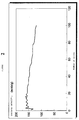
- Figure 1 shows the specific capacity expressed in mAh/gr (of cathodic active material V 6 O 13 ) of the cell of comparative example 5, in relation to the number of cycles, cycled at a temperature of 25°C.
- Figure 2 shows the specific capacity expressed in mAh/gr (of cathodic active material V 6 O 13 ) of the cell of example 6, in relation to the number of cycles, cycled at a temperature of 25°C.
- Figure 3 shows the resistance of the electrolyte (Rb) and the interfacial resistance (Ri), expressed in ohms, of the cell of example 6, in relation to the number of cycles.
- Figure 4 shows the electrical impedance diagrams of the cells of example 6 and comparative example 5.
- abscissa there is the actual impedance component and in ordinate the imaginary component, both expressed in ohms.
- the experimental points are taken at different frequencies which go from 100 kHz (low impedance values) to 10 mHz (high impedance values); the intercepts of the curve with the actual axis determine the resistances relating to the polymeric component (Rb) and to the interfaces (Ri) of the cell.
- the polymeric gel (A) is obtained by mixing MVE (triethyleneglycol ethyl vinyl ether, 0.88 grams, 4.3 mmoles, 21.4% by weight), DVE (triethyleneglycol divinylether, 0.38 grams, 1.9 mmoles, 9.3% by weight) and the plasticizer (2.43 grams, 59.1% by weight) consisting of a mixture 1/1 by weight of PC (propylene carbonate) and TGME (tetraglyme), in which the two Lithium salts LiClO 4 (0.34 grams, 8.2% by weight) and LiBF 4 (84 mg, 2% by weight of the total) are dissolved.
- MVE triethyleneglycol ethyl vinyl ether, 0.88 grams, 4.3 mmoles, 21.4% by weight
- DVE triethyleneglycol divinylether, 0.38 grams, 1.9 mmoles, 9.3% by weight
- the plasticizer (2.43 grams, 59.1% by weight) consisting of a mixture 1/1 by weight
- the powder of cathodic active material V 6 O 13 (Kerr McGee) is ground, with a ball mill in ceramic material, for 5 hours. After grinding the average diameter of the particles is about 5 microns.
- V 6 O 13 powder is dried under vacuum at a temperature of about 100°C.
- the electronic conductor powder (carbon black "Ketjen Black” of Akzo) is treated following an analogous procedure. In this case the average diameter of the particles is about 20 microns.
- V 6 O 13 (1.28 grams, 61.7% by weight) and carbon black (0.18 grams, 9% by weight) are put in a cylindrical steel container together with acetonitrile (20 ml). The container is then filled with small rolls of ceramic material, closed and stirred with a rotor for 10 hours.
- the polymeric gel described in (1a) (0.605 grams, 29.3% by weight) is added to the powder dispersion, which has the appearance of a paint, and the mixture is maintained under stirring for 3 hours.
- the cathodic paste is recovered after evaporation of the solvent.
- a nickel sheet (of Teledyne Rodney Metal) having a thickness of 50 microns and a surface of 8x8 cm 2 is subjected to surface-cleaning of the physico-chemical type.
- This treatment consists in the degreasing of the surface with a hydrocarbon solvent (hexane and/or pentane), followed by immersion in an aqueous solution at 50% of HF/HNO 3 , in a molar ratio of 1 to 2.
- a hydrocarbon solvent hexane and/or pentane
- the nickel sheet is maintained in immersion for a time varying from 3 to 5 minutes, is then repeatedly washed with distilled water and dried in an oven at 100°C under vacuum.
- This first treatment enables the surface to be cleaned eliminating any possible traces of surface oxides.
- the subsequent treatment of a physical nature is carried out by plasma etching with argon.
- the power, pressure and time experimental conditions used are the following: Power: 100-200 Watts; Pressure: 35 mbars; Time: 30-60 seconds.
- the thickness of the nickel sheet varies from 30 to 40 microns, in relation to the residence time in the acid solution.
- the roughness of the nickel sheet is between 1.2 and 1.6 microns.
- a certain quantity of cathodic paste of 1b is deposited on the nickel sheet treated as described in (1c).
- a sheet of plastic material for example polyethylene or polypropylene, which does not have adhesive characteristics with respect to the cathodic paste itself, is then placed on the cathodic paste.
- the sandwich consisting of nickel - cathodic paste - polyethylene is then rolled, to a controlled thickness, with a roller.
- the plastic sheet is then peeled away from the cathodic surface; in this way a thickness of cathodic membrane of 30 microns is obtained.
- EXAMPLE 2 Preparation of the electrolytic membrane containing an inorganic powder on a cathodic membrane.
- a mixture is prepared consisting of: MVE (1.01 grams, 4.95 mmoles, 20.6% by weight), DVE (0.434 grams, 2.14 mmoles, 8.8% by weight), the plasticizer consisting of a mixture 1/1 by weight of propylenecarbonate (PC) - Tetraethyleneglycol dimethylether (TGME) (2.57 grams, 52.4% by weight), which contains the Lithium salt LIClO 4 (0.44 grams, 8.8% by weight) dissolved together with a photopolymerization initiator, triarylsulfonium - hexafluorophosphate (0.02% by weight).
- PC propylenecarbonate
- TGME Tetraethyleneglycol dimethylether
- the zeolite A (0.46 grams, 9.4% by weight) previously ground in a ball mill up to a particle size of about 5 ⁇ m and dried at 200°C under vacuum is added to this mixture. The whole mixture is then treated with an ultrasonic probe to obtain a good dispersion of the zeolite.
- the mixture is deposited directly onto the cathodic membrane, whose preparation is described in example 1, with a doctor-blade and photopolymerized by UV with a medium power lamp.
- the crosslinking times vary from 5 to 10 seconds, depending on the thickness of the membrane.
- Membranes with a thickness of between 50 and 200 ⁇ m are usually obtained.
- the ionic conductivity ( ⁇ ) at 25°C of the electrolytic membrane is equal to 8.3.10 -4 S/cm.
- a mixture is prepared consisting of: MVE (0.63 grams, 3.1 mmoles, 15.4% by weight), DVE (0.63 grams, 3.1 mmoles, 15.4% by weight), the plasticizer consisting of a mixture 1/1 by weight of PC - TGME (2.43 grams, 59% by weight), which contains the Lithium salt LIClO 4 (0.43 grams, 10% by weight) dissolved together with a photopolymerization initiator, triarylsulfonium -hexafluorophosphate (0.02% by weight).
- the homogeneous mixture is deposited directly onto the cathodic membrane of example 1 by means of a doctor-blade, and the electrolytic membrane is then obtained by UV radiation carried out with a medium power lamp with crosslinking times varying from 1 to 5 seconds, depending on the thickness of the membrane.
- Membranes with a thickness of between 50 and 200 ⁇ m are usually obtained.
- the ionic conductivity ( ⁇ ) at 25°C is equal to 3.0.10 -4 S/cm.
- COMPARATIVE EXAMPLE 4 Preparation of an electrolytic membrane based on PEO containing zeolite.
- a dispersion of zeolite A (20 mg, 10% by weight) in acetonitrile is treated with an ultrasonic probe.
- PEO 140 mg, 70% by weight
- LiClO 4 40 mg, 20% by weight
- the dispersion obtained is deposited in a teflon container and the solvent is slowly removed in an argon stream.
- the membrane obtained has a thickness equal to 30 ⁇ m.
- the ionic conductivity ( ⁇ ) at a temperature of 80°C is equal to 1.8.10 -5 S/cm, whereas at 25°C it is equalto 10 -7 S/cm.
- a unipolar button cell having a surface equal to 1 cm 2 is obtained by superimposing:
- the cell has capacities equal to 1 mAh (based on the practical capacity of V 6 O 13 equal to 200 mAh/gr).
- the cell is then housed between two steel current-holders and inserted in a teflon container equipped with a pressure spring to maintain a good contact between the various components.
- a unipolar 1 cm 2 cell is obtained with the same procedure described in example 5, using an electrolytic membrane obtained according to the procedure of example 2.
- the cell has capacities equal to 1 mAh (based on the practical capacity of V 6 O 13 equal to 200 mAh/gr).
- Figure 3 shows the trend of the interfacial resistance (Ri) and that of the electrolyte (Rb) during the charging and discharging cycles, determined by complex impedance measurements.
- Figure 4 shows a comparison between the complex impedance diagrams of the cell of example 6 (at the hundredth charging and discharging cycle) and of the cell of comparative example 5.
- a cell having a surface equal to 1 cm 2 is obtained by superimposing:
- the cell has a capacity equal to 1 mAh (based on the practical capacity of V 6 O 13 equal to about 200 mAh/g).
- the cell is then housed between two steel current-holders and inserted in a teflon container equipped with a pressure spring to maintain good contact between the various components.
- the cell thus packaged is not capable of functioning at room temperature.
- Discharge current 0.01 mA
- Recharge current 0.01 mA
- Operating voltage 2-3.2 V
- the currents used are considerably lower than those used in the examples of the present invention, as the cell is not capable of functioning with higher currents.
Landscapes
- Chemical & Material Sciences (AREA)
- Engineering & Computer Science (AREA)
- Chemical Kinetics & Catalysis (AREA)
- Electrochemistry (AREA)
- General Chemical & Material Sciences (AREA)
- Manufacturing & Machinery (AREA)
- Materials Engineering (AREA)
- Condensed Matter Physics & Semiconductors (AREA)
- Inorganic Chemistry (AREA)
- General Physics & Mathematics (AREA)
- Dispersion Chemistry (AREA)
- Physics & Mathematics (AREA)
- Secondary Cells (AREA)
- Primary Cells (AREA)
- Manufacture Of Macromolecular Shaped Articles (AREA)
- Macromonomer-Based Addition Polymer (AREA)
- Polymerisation Methods In General (AREA)
- Electrolytic Production Of Non-Metals, Compounds, Apparatuses Therefor (AREA)
- Addition Polymer Or Copolymer, Post-Treatments, Or Chemical Modifications (AREA)
- Battery Electrode And Active Subsutance (AREA)
- Compositions Of Macromolecular Compounds (AREA)
- Cell Separators (AREA)
Abstract
- 1) polymer deriving from the photopolymerization of a mixture essentially consisting of a vinyl ether having the general formula (I) R-[-O-CH2CH2-]n-O-CH=CH2, and a divinyl ether having the general formula (II) CH2=CH-[-O-CH2-CH2-]m-O-CH=CH2, in a quantity of between 15 and 60% by weight;
- 2) plasticizer in a quantity of between 35 and 75% by weight;
- 3) Lithium salt in a quantity of between 5 and 20% by weight;
- 4) photopolymerization initiator in such a quantity as to photopolymerize (I) and (II);
- 5) zeolite in a quantity of between 3 and 30% by weight;
Description
- The present invention relates to an electrolytic membrane for light rechargeable batteries with a high energy density and the process for its photo-cross-linking on a cathodic membrane.
- It is known that the capacity of a cell for light rechargeable batteries depends, apart from the efficiency of the intercalation-deintercalation process of lithium, on the quantity of active cathodic material, i.e., in the case of the above batteries, of V6O13.
- As a result, the greater the quantity of active material which can be introduced into the cathode, the greater will be the potential capacity of a cell.
- Other energy parameters, such as the density of gravimetric energy (expressed in Wh/kg) and volumetric energy (expressed in Wh/l) are, on the other hand, calculated taking into consideration the weight or total volume of all the components.
- Therefore all the other components which together with the cathode form the cell and are essential for its functioning (electrolyte, anode, collectors) can influence its duration and performance, but they do not contribute to its capacity.
- In a fine film cell, with the same cathode and therefore capacity, the smaller the thickness of these components the greater will be the values of energy density.
- EP-A-638.950 describes electrolytic membranes essentially consisting of polyvinylethers cationically crosslinked with photochemical or chemical activation. The above membranes could have acceptable thicknesses, especially in the case of photochemical activation, but there was the problem of poor processability; in particular it was difficult to package cells using the three layers (electrolyte, cathode and anode) obtained separately.
- A possible solution to this problem consisted in preparing a dispersion of non-polymerized polyvinylethers and depositing it on the cathode, thus obtaining a very small thickness, and photochemically polymerizing the mixture of monomers.
- As can be seen in the experimental part, this solution had the disadvantage of a poor operability of the corresponding cell.
- It has been found however that a solution to the above inconveniences can be validly obtained by using the dispersion of monomers in the presence of zeolites, and this is the object of the present invention.
- The use of zeolites in electrolytic membranes is known.
- For example EP-A-557.251 describes an electrolytic membrane prepared by casting in acetonitrile, comprising a zeolite, polyethyleneoxide (PEO) and LiClO4 in a weight ratio of 10/20/70 respectively.
- In Solid State Ionics 36, 255 (1989), aluminium oxides of various natures (α, ε, θ) are added to the electrolyte PEO-NaI; the addition of the additive increases the conductivity of the electrolyte as a result of the increase in the amorphous portion.
- Similar results are obtained with γ-alumina added to the electrolyte PEO-NaSCN (Chem. J. Cinese Univers. 2,97 (1986).
- Another inorganic matrix widely used in a mixture with polymeric electrolytes is NASICON (Na1+xZr2Si3-xO12) which is added for example in percentages of about 20% (volume) to PEO; also in this case the presence of the inorganic powder increases the ionic conductivity (Solid State Ionics 28-30, 979, 1988).
- In partially crystalline systems such as PEO, the introduction of the zeolite promotes the formation of amorphous phases and consequently increases the ionic conductivity at low temperatures up to values which are 2-3 times greater with respect to membranes based on PEO alone; at room temperature in fact conductivity values of about 10-5S/cm are reached.
- Electrolytic membranes based on PEO and Zeolites however have the disadvantage of an ionic conductivity which is still insufficient for applications at low temperatures (room or sub-room temperature).
- An electrolytic membrane has now been found which overcomes the drawbacks mentioned above as it has thicknesses of a few tens of microns and good conductivity values at low temperatures. In addition the corresponding cell can function conveniently at temperatures of about 20°C and even lower and can operate for a higher number of cycles than the analogous system without zeolites.
- The present invention also relates to a process for depositing the electrolytic precursor and its crosslinking product, directly on the cathodic membrane.
- In accordance with this, the present invention relates to an electrolytic membrane for light rechargeable batteries essentially consisting of:
- 1) polymer deriving from the photopolymerization of a mixture essentially consisting of a vinyl ether having the general formula (I) R-[-O-CH2CH2-]n-O-CH=CH2, wherein R represents a methyl or an ethyl and n is an integer between 1 and 16; and a divinyl ether having the general formula (II) CH2=CH-[-O-CH2-CH2-]m-O-CH=CH2, wherein m is an integer between 1 and 10; the molar ratio between (I) and (II) being from 98/2 to 40/60; in a quantity of between 15 and 60% by weight, preferably between 25 and 35% by weight;
- 2) plasticizer in a quantity of between 35 and 75% by weight, preferably between 40 and 70% by weight;
- 3) Lithium salt in a quantity of between 5 and 20% by weight, preferably between 8 and 15% by weight;
- 4) photopolymerization initiator in such a quantity as to photopolymerize (I) and (II);
- 5) zeolite in a quantity of between 3 and 30% by weight, preferably between 5 and 20% by weight, the percentage sum of components (1) to (5) being equal to 100.
- The term "plasticizer" refers to those substances, well known to experts in the field, which are viscous liquids with a high dielectric (ε) constant such as to ensure a high dissociation of the charges. Typical examples of plasticizers are propylenecarbonate (PC), ethylenecarbonate (EC), diethylcarbonate (DEC), dimethylcarbonate (DMC), γ-butyrolactone and relative mixtures. Another group of plasticizers consists of polyethers (for example tetraglyme, polyethers with a low molecular weight) having a lower dielectric constant but a high chemical stability to lithium.
- The above plasticizers, combined with polymeric matrixes and in the presence of Lithium salt, allow a conductivity to be obtained of about 10-3S/cm at room temperature and 10-4S/cm at -20°C.
- The Lithium salt is selected from the normal Lithium salts used in this application, for example LiCF3SO3, LiClO4, LiPF6, LiN(CF3SO2)2, LiASF6, as such or mixed, it is preferably selected from LiCF3SO3 and LiClO4.
- As far as the photoinitiator is concerned, this is selected from those substances capable of activating the polymerization of (I) and (II) by UV radiation or Electron Beam; the photoinitiators are preferably selected from the salts of triarylsulfonium or triaryliodonium, such as for example triarylsulfoniumhexafluorophosphate and triaryl sulfonium hexafluoroarseniate. They are generally present in quantities of about 0.005 - 0.8% by weight with respect to the total of the sum of (1) to (5). In the preferred embodiment, the mixture of monomers (I) and (II) is polymerized by treatment with a UV lamp, usually with medium power.
- With respect to the zeolite, this term refers to Alumino-Silicates of alkaline or earth-alkaline metals having general formula (III) y/nMen+x(SiO2)y(AlO2).zH2O, wherein Me = Li, Na, K, Ca, Mg, n is the valence of the metal, x/y is between 1 and infinit. Type A zeolites are preferred.
- As far as the pore diameter is concerned, it is preferable for the zeolites used to be of the type 3A or 4A, with a pore diameter of about 0.3 and 0.4 nm respectively. With respect to the particle size of the above zeolites, it is preferable for them to have an average diameter of between 2 and 20 µm.
- The above electrolytic membrane has a greater conductivity at low temperature than those of the prior art.
- A further object of the present invention relates to a process for the preparation of the cathode/electrolyte semicell.
- In accordance with this, the present invention relates to a process for the preparation of a cathode/electrolyte semicell which comprises the following steps:
- A) deposition, on a current collector consisting of a layer of nickel having a roughness of between 1.0 and 3 microns, of a cathodic paste consisting of:
- 1) a powder of active cathodic material, preferably V6O13;
- 2) an electronic conductor, preferably carbon black;
- 3) a polymeric composition basically consisting of:
- 3a) a polymer deriving from the polymerization of a mixture of a vinyl ether having general formula (I) R-[-O-CH2CH2-]n-O-CH=CH2, wherein R represents a methyl or an ethyl and n is an integer from 1 to 16; and a divinyl ether having general formula (II) CH2=CH-[-O-CH2-CH2-]m-O-CH=CH2, wherein m is an integer between 1 and 10;
- 3b) plasticizer and Lithium salts, selected from LiBF4, alone or mixed with other salts;
- B) deposition on the collector system-cathodic membrane of step (A) of a dispersion consisting of:
- B1) a vinyl ether having general formula (I) R-[-O-CH2CH2-]n-O-CH=CH2, wherein R represents a methyl or an ethyl and n is an integer from 1 to 16;
- B2) a divinyl ether having general formula (II) CH2=CH-[-O-CH2-CH2-]m-O-CH=CH2, wherein m is an integer between 1 and 10; the molar ratio between (B1) and (B2) being from 98/2 to 40/60; the quantity of (B1) and (B2) being between 15 and 60% by weight, preferably between 25 and 35% by weight;
- B3) plasticizer in a quantity of between 35 and 75% by weight, preferably between 40 and 70% by weight;
- B4) Lithium salt in a quantity of between 5 and 20% by weight, preferably between 8 and 15% by weight;
- B5) photopolymerization initiator in such a quantity as to photopolymerize (B1) and (B2);
- B6) zeolite in a quantity of between 3 and 30% by weight, preferably between 5 and 20% by weight, the percentage sum of components (B1) to (B6) being equal to 100;
- C) photopolymerization of the dispersion deposited in step (B) by exposure to UV radiation, thus obtaining the cathode/electrolyte semicell system.
- At the end of step (A) and before step (B), it is preferable to subject the cathodic paste, deposited on the collector system-cathodic membrane, to rolling with a roller. This operation is carried out to make the layer of cathodic paste homogeneous and of the desired thickness.
- In one embodiment, at the end of step (A) a layer of non-adhesive plastic material is placed on the layer of cathodic paste. The sandwich consisting of nickel - cathodic paste - polyethylene is then rolled, to a constant thickness, with a roller. At the end of the rolling the plastic sheet is then peeled away from the cathodic surface obtaining thicknesses of a few tens of microns.
- With respect to the nickel current collector having a roughness of between 1.0 and 3.0 microns, its preparation is described in the copending patent application filed by the same applicant IT-A-MI 95/a 001650.
- The above process comprises the treatment of a nickel plate with particular mixtures of strong acids, for example HF-HNO3, and subsequent etching treatment with argon plasma.
- With respect to the V6O13, this is a well-known commercial material which can be obtained, for example, by thermal decomposition starting from ammonium vanadate.
- Carbon black is also a commercial product, of which there are various types, for example Ketjen black, super S.
- Figure 1 shows the specific capacity expressed in mAh/gr (of cathodic active material V6O13) of the cell of comparative example 5, in relation to the number of cycles, cycled at a temperature of 25°C.
- Figure 2 shows the specific capacity expressed in mAh/gr (of cathodic active material V6O13) of the cell of example 6, in relation to the number of cycles, cycled at a temperature of 25°C.
- Figure 3 shows the resistance of the electrolyte (Rb) and the interfacial resistance (Ri), expressed in ohms, of the cell of example 6, in relation to the number of cycles.
- Figure 4 shows the electrical impedance diagrams of the cells of example 6 and comparative example 5. In abscissa there is the actual impedance component and in ordinate the imaginary component, both expressed in ohms. The experimental points are taken at different frequencies which go from 100 kHz (low impedance values) to 10 mHz (high impedance values); the intercepts of the curve with the actual axis determine the resistances relating to the polymeric component (Rb) and to the interfaces (Ri) of the cell.
- The following examples provide a better illustration of the present invention.
- The polymeric gel (A) is obtained by mixing MVE (triethyleneglycol ethyl vinyl ether, 0.88 grams, 4.3 mmoles, 21.4% by weight), DVE (triethyleneglycol divinylether, 0.38 grams, 1.9 mmoles, 9.3% by weight) and the plasticizer (2.43 grams, 59.1% by weight) consisting of a
mixture 1/1 by weight of PC (propylene carbonate) and TGME (tetraglyme), in which the two Lithium salts LiClO4 (0.34 grams, 8.2% by weight) and LiBF4 (84 mg, 2% by weight of the total) are dissolved. - The polymerization and crosslinking of the system with the consequent formation of the polymeric gel englobing the plasticizer and the Lithium salts is completed in about 6 hours.
- The powder of cathodic active material V6O13 (Kerr McGee) is ground, with a ball mill in ceramic material, for 5 hours. After grinding the average diameter of the particles is about 5 microns.
- After grinding, the V6O13 powder is dried under vacuum at a temperature of about 100°C.
- The electronic conductor powder (carbon black "Ketjen Black" of Akzo) is treated following an analogous procedure. In this case the average diameter of the particles is about 20 microns.
- V6O13 (1.28 grams, 61.7% by weight) and carbon black (0.18 grams, 9% by weight) are put in a cylindrical steel container together with acetonitrile (20 ml). The container is then filled with small rolls of ceramic material, closed and stirred with a rotor for 10 hours. The polymeric gel described in (1a) (0.605 grams, 29.3% by weight) is added to the powder dispersion, which has the appearance of a paint, and the mixture is maintained under stirring for 3 hours.
- The cathodic paste is recovered after evaporation of the solvent.
- A nickel sheet (of Teledyne Rodney Metal) having a thickness of 50 microns and a surface of 8x8 cm2 is subjected to surface-cleaning of the physico-chemical type.
- This treatment consists in the degreasing of the surface with a hydrocarbon solvent (hexane and/or pentane), followed by immersion in an aqueous solution at 50% of HF/HNO3, in a molar ratio of 1 to 2.
- The nickel sheet is maintained in immersion for a time varying from 3 to 5 minutes, is then repeatedly washed with distilled water and dried in an oven at 100°C under vacuum.
- This first treatment enables the surface to be cleaned eliminating any possible traces of surface oxides.
- The subsequent treatment of a physical nature is carried out by plasma etching with argon. The power, pressure and time experimental conditions used are the following: Power: 100-200 Watts; Pressure: 35 mbars; Time: 30-60 seconds.
- At the end of the treatment, the thickness of the nickel sheet varies from 30 to 40 microns, in relation to the residence time in the acid solution. The roughness of the nickel sheet is between 1.2 and 1.6 microns.
- A certain quantity of cathodic paste of 1b, is deposited on the nickel sheet treated as described in (1c).
- A sheet of plastic material (for example polyethylene or polypropylene), which does not have adhesive characteristics with respect to the cathodic paste itself, is then placed on the cathodic paste.
- The sandwich consisting of nickel - cathodic paste - polyethylene is then rolled, to a controlled thickness, with a roller. The plastic sheet is then peeled away from the cathodic surface; in this way a thickness of cathodic membrane of 30 microns is obtained.
- A mixture is prepared consisting of: MVE (1.01 grams, 4.95 mmoles, 20.6% by weight), DVE (0.434 grams, 2.14 mmoles, 8.8% by weight), the plasticizer consisting of a
mixture 1/1 by weight of propylenecarbonate (PC) - Tetraethyleneglycol dimethylether (TGME) (2.57 grams, 52.4% by weight), which contains the Lithium salt LIClO4 (0.44 grams, 8.8% by weight) dissolved together with a photopolymerization initiator, triarylsulfonium - hexafluorophosphate (0.02% by weight). - The zeolite A (0.46 grams, 9.4% by weight) previously ground in a ball mill up to a particle size of about 5µm and dried at 200°C under vacuum is added to this mixture. The whole mixture is then treated with an ultrasonic probe to obtain a good dispersion of the zeolite.
- The mixture is deposited directly onto the cathodic membrane, whose preparation is described in example 1, with a doctor-blade and photopolymerized by UV with a medium power lamp. The crosslinking times vary from 5 to 10 seconds, depending on the thickness of the membrane. Membranes with a thickness of between 50 and 200 µm are usually obtained.
- The ionic conductivity (σ) at 25°C of the electrolytic membrane is equal to 8.3.10-4 S/cm.
- A mixture is prepared consisting of: MVE (0.63 grams, 3.1 mmoles, 15.4% by weight), DVE (0.63 grams, 3.1 mmoles, 15.4% by weight), the plasticizer consisting of a
mixture 1/1 by weight of PC - TGME (2.43 grams, 59% by weight), which contains the Lithium salt LIClO4 (0.43 grams, 10% by weight) dissolved together with a photopolymerization initiator, triarylsulfonium -hexafluorophosphate (0.02% by weight). - The homogeneous mixture is deposited directly onto the cathodic membrane of example 1 by means of a doctor-blade, and the electrolytic membrane is then obtained by UV radiation carried out with a medium power lamp with crosslinking times varying from 1 to 5 seconds, depending on the thickness of the membrane. Membranes with a thickness of between 50 and 200 µm are usually obtained.
- The ionic conductivity (σ) at 25°C is equal to 3.0.10-4 S/cm.
- A dispersion of zeolite A (20 mg, 10% by weight) in acetonitrile is treated with an ultrasonic probe. PEO (140 mg, 70% by weight) dissolved in acetonitrile (10 ml) and LiClO4 (40 mg, 20% by weight) are added to this and a further treatment with the ultrasonic probe is carried out. The dispersion obtained is deposited in a teflon container and the solvent is slowly removed in an argon stream. The membrane obtained has a thickness equal to 30 µm.
- The ionic conductivity (σ) at a temperature of 80°C is equal to 1.8.10-5 S/cm, whereas at 25°C it is equalto 10-7 S/cm.
- A unipolar button cell having a surface equal to 1 cm2 is obtained by superimposing:
- a 1 cm2 disk of a multilayer system (cathode/electrolyte semicell) consisting of a nickel collector, cathodic membrane, electrolytic membrane, obtained directly on the cathode by UV radiation according to the procedure described in comparative Example 3;
- a 1 cm2 Lithium disk, having a thickness of 150 µm.
- The cathodic membrane having a thickness of 30 µm and a weight of 8 mg has the following composition:
V6O13 = 4.9 mg (61.7% by weight) Ketjen Black = 0.7 mg (8.9% by weight) Polymeric gel 1a = 2.3 mg (29.4% by weight) - The cell has capacities equal to 1 mAh (based on the practical capacity of V6O13 equal to 200 mAh/gr).
- The electrolytic membrane having a thickness of 100 µm has the following composition:
MVE = 15.4% by weight DVE = 15.4% by weight PC- TGME 1/1= 59.0% by weight LiClO4 = 10.0% by weight Triarylsulfoniumhexafluorophosphate = 0.05% by weight - The cell is then housed between two steel current-holders and inserted in a teflon container equipped with a pressure spring to maintain a good contact between the various components.
- Figure 1 shows the specific capacity of the cell, cycled at 25°C, in relation to the number of cycles, obtained with constant discharge and recharge currents during the cycles and in particular:
Discharge current = 0.25 mA Recharge current (elect.plat.) = 0.25 mA Operating voltage = 2-3.2 V - A unipolar 1 cm2 cell is obtained with the same procedure described in example 5, using an electrolytic membrane obtained according to the procedure of example 2.
- The cathodic membrane, having a thickness of 30 µm, has the following composition:
V6O13 = 5 mg (62.5% by weight) Ketjen Black = 0.7 mg (8.7% by weight) Polymeric gel 1a = 2.3 mg (28.8% by weight) - The electrolytic membrane having a thickness of 120 µm and a weight equal to 14.8 mg, has the following composition:
MVE = 20.6% by weight DVE = 8.8% by weight PC- TGME 1/1= 52.4% by weight LiClO4 = 8.8% by weight Triarylsulfoniumhexafluorophosphate = 0.04% by weight Zeolite = 9.4% by weight - Figure 2 shows the specific capacity of the cell, cycled at 25°C, in relation to the number of cycles, obtained with constant discharge and recharge currents during the cycles and in particular:
Discharge current = 0.52 mA Recharge current (elect.plat.) = 0.26 mA Operating voltage = 2-3.2 V - Figure 3 shows the trend of the interfacial resistance (Ri) and that of the electrolyte (Rb) during the charging and discharging cycles, determined by complex impedance measurements.
- Figure 4 shows a comparison between the complex impedance diagrams of the cell of example 6 (at the hundredth charging and discharging cycle) and of the cell of comparative example 5.
- It can be seen how both the interfacial resistance (Ri) and that of the electrolyte (Rb) are considerably reduced with the use of the electrolyte of the present invention.
- A cell having a surface equal to 1 cm2 is obtained by superimposing:
- a 1 cm2 disk of a cathodic membrane deposited on a nickel collector obtained according to the procedure described in example 1d. The cathode has a thickness equal to 30 µm and a weight of 8 mg (5 mg V6O13, 0.7 mg carbon black, 2.3 mg of polymeric gel of Example 1a);
- -- a 1 cm2 disk of electrolytic membrane having a thickness of 30 µm and a weight of 4 mg obtained according to the procedure described in comparative example 4;
- a 1 cm2 lithium disk, having a thickness of 150 µm.
- The cell has a capacity equal to 1 mAh (based on the practical capacity of V6O13 equal to about 200 mAh/g).
- The cell is then housed between two steel current-holders and inserted in a teflon container equipped with a pressure spring to maintain good contact between the various components.
- The cell thus packaged is not capable of functioning at room temperature.
- It is then heated to a temperature of 80°C and cycled, using constant discharge and recharge currents during the cycles and in particular:
Discharge current = 0.01 mA Recharge current (elect.plat.) = 0.01 mA Operating voltage = 2-3.2 V - The currents used are considerably lower than those used in the examples of the present invention, as the cell is not capable of functioning with higher currents.
- Under these conditions a specific capacity is obtained equal to 0.0044 mAh, much lower than that obtained with the use of the electrolyte of the present invention.
Claims (9)
- An electrolytic membrane for light rechargeable batteries essentially consisting of:1) polymer deriving from the photopolymerization of a mixture essentially consisting of a vinyl ether having the general formula (I) R-[-O-CH2CH2-]n-O-CH=CH2, wherein R represents a methyl or an ethyl and n is an integer between 1 and 16; and a divinyl ether having the general formula (II) CH2=CH-[-O-CH2-CH2-]m-O-CH=CH2, wherein m is an integer between 1 and 10; the molar ratio between (I) and (II) being from 98/2 to 40/60; in a quantity of between 15 and 60% by weight;2) plasticizer in a quantity of between 35 and 75% by weight;3) Lithium salt in a quantity of between 5 and 20% by weight;4) photopolymerization initiator in such a quantity as to photopolymerize (I) and (II);5) zeolite in a quantity of between 3 and 30% by weight; the percentage sum of components (1) to (5) being equal to 100.
- The electrolytic membrane according to claim 1, characterized in that the polymer (1) is present in a quantity of between 25 and 35% by weight.
- The membrane according to claim 1, characterized in that the plasticizer is present in a quantity of between 40 and 70% by weight.
- The membrane according to claim 1, characterized in that the Lithium salt is present in a quantity of between 8 and 15% by weight.
- The membrane according to claim 1, characterized in that the zeolite is present in a quantity of between 5 and 20% by weight.
- The membrane according to claim 1, characterized in that the zeolite is type A.
- A process for the preparation of a cathode/electrolyte semicell which comprises the following steps:A) deposition, on a current collector consisting of a layer of nickel having a roughness of between 1.0 and 3 microns, of a cathodic paste consisting of:1) a powder of active cathodic material;2) an electronic conductor;3) a polymeric composition basically consisting of:3a) a polymer deriving from the polymerization of a mixture of a vinyl ether having general formula (I) R-[-O-CH2CH2-]n-O-CH=CH2, wherein R represents a methyl or an ethyl and n is an integer from 1 to 16; and a divinyl ether having general formula (II) CH2=CH-[-O-CH2-CH2-]m-O-CH=CH2, wherein m is an integer between 1 and 10;3b) plasticizer and Lithium salts, selected from LiBF4, alone or mixed with other salts;B) deposition on the collector system-cathodic membrane of step (A) of a dispersion consisting of:B1) a vinyl ether having general formula (I) R-[-O-CH2CH2-]n-O-CH=CH2, wherein R represents a methyl or an ethyl and n is an integer from 1 to 16;B2) a divinyl ether having general formula (II) CH2=CH-[-O-CH2-CH2-]m-O-CH=CH2, wherein m is an integer between 1 and 10; the molar ratio between (B1) and (B2) being from 98/2 to 40/60; the quantity of (B1) and (B2) being between 15 and 60% by weight,B3) plasticizer in a quantity of between 35 and 75% by weight;B4) Lithium salt in a quantity of between 5 and 20% by weight;B5) photopolymerization initiator in such a quantity as to photopolymerize (B1) and (B2);B6) zeolite in a quantity of between 3 and 30% by weight, the percentage sum of components (B1) to (B6) being equal to 100;C) photopolymerization of the dispersion deposited in step (B) by exposure to UV radiation, thus obtaining the cathode/electrolyte semicell system.
- The process according to claim 7, wherein the active cathodic material is V6O13 and the electronic conductor is carbon black.
- The process according to claim 7, characterized in that:the quantity of B1 + B2 is between 25 and 35% by weight;the plasticizer B3 is in a quantity of between 40 and 70% by weight;the Lithium salt B4 is in a quantity of between 8 and 15% by weight;the zeolite B6 is in a quantity of between 5 and 20% by weight.
Priority Applications (1)
| Application Number | Priority Date | Filing Date | Title |
|---|---|---|---|
| SI9630122T SI0774795T1 (en) | 1995-11-17 | 1996-10-28 | Electrolytic membrane for use as a solid polymer electrolyte in a rechargeable battery and process for its photo-crosslinking on a cathodic collector |
Applications Claiming Priority (2)
| Application Number | Priority Date | Filing Date | Title |
|---|---|---|---|
| ITMI952369 | 1995-11-17 | ||
| IT95MI002369A IT1276151B1 (en) | 1995-11-17 | 1995-11-17 | ELECTROLYTIC MEMBRANE AND PROCEDURE FOR ITS PHOTO-CROSS LINKAGE ON CATHODE MEMBRANE |
Publications (3)
| Publication Number | Publication Date |
|---|---|
| EP0774795A2 true EP0774795A2 (en) | 1997-05-21 |
| EP0774795A3 EP0774795A3 (en) | 1997-05-28 |
| EP0774795B1 EP0774795B1 (en) | 1999-09-22 |
Family
ID=11372542
Family Applications (1)
| Application Number | Title | Priority Date | Filing Date |
|---|---|---|---|
| EP96117238A Expired - Lifetime EP0774795B1 (en) | 1995-11-17 | 1996-10-28 | Electrolytic membrane for use as a solid polymer electrolyte in a rechargeable battery and process for its photo-crosslinking on a cathodic collector |
Country Status (10)
| Country | Link |
|---|---|
| US (2) | US5741610A (en) |
| EP (1) | EP0774795B1 (en) |
| JP (1) | JPH09180706A (en) |
| AT (1) | ATE185022T1 (en) |
| DE (1) | DE69604363T2 (en) |
| DK (1) | DK0774795T3 (en) |
| ES (1) | ES2138780T3 (en) |
| GR (1) | GR3032128T3 (en) |
| IT (1) | IT1276151B1 (en) |
| SI (1) | SI0774795T1 (en) |
Cited By (8)
| Publication number | Priority date | Publication date | Assignee | Title |
|---|---|---|---|---|
| WO1998026468A1 (en) * | 1996-12-12 | 1998-06-18 | Valence Technology, Inc. | Polymer electrolytes containing lithiated zeolite |
| WO1999005743A1 (en) * | 1997-07-25 | 1999-02-04 | Minnesota Mining And Manufacturing Company | Pressure system and method for rechargeable thin-film electrochemical cells |
| WO1999005748A1 (en) * | 1997-07-25 | 1999-02-04 | Minnesota Mining And Manufacturing Company | Rechargeable thin-film electrochemical generator |
| WO1999064484A1 (en) * | 1998-06-08 | 1999-12-16 | Moltech Corporation | Polymerization of vinyl ethers |
| US6146778A (en) * | 1997-07-25 | 2000-11-14 | 3M Innovative Properties Company | Solid-state energy storage module employing integrated interconnect board |
| KR100414588B1 (en) * | 2001-08-09 | 2004-01-07 | 주식회사 네스캡 | Electric Energy Storage System |
| EP0951743A4 (en) * | 1996-10-23 | 2004-11-24 | Valence Technology Inc | Solid electrolytes containing toughening agents and electrolytic cells produced therefrom |
| US20220176345A1 (en) * | 2019-06-27 | 2022-06-09 | Johnson Matthey Public Limited Company | Layered sorbent structures |
Families Citing this family (10)
| Publication number | Priority date | Publication date | Assignee | Title |
|---|---|---|---|---|
| IT1276151B1 (en) * | 1995-11-17 | 1997-10-27 | Eniricerche Spa | ELECTROLYTIC MEMBRANE AND PROCEDURE FOR ITS PHOTO-CROSS LINKAGE ON CATHODE MEMBRANE |
| US8181113B2 (en) * | 1998-12-18 | 2012-05-15 | Microsoft Corporation | Mediating conflicts in computer users context data |
| US6956083B2 (en) * | 2001-05-31 | 2005-10-18 | The Regents Of The University Of California | Single ion conductor cross-linked polymeric networks |
| US7101643B2 (en) | 2001-05-31 | 2006-09-05 | The Regents Of The University Of California | Polymeric electrolytes based on hydrosilyation reactions |
| KR101669218B1 (en) * | 2008-11-10 | 2016-11-10 | 삼성전자주식회사 | Gel polymer electrolyte, Lithium battery comprising gel polymer electrolyte, method for preparing gel polymer electrolyte, and method for preparing lithium battery |
| EP2184799B1 (en) * | 2008-11-10 | 2013-01-09 | Samsung Electronics Co., Ltd. | Polymer electrolyte, lithium battery comprising the polymer electrolyte, method of preparing the polymer electrolyte, and method of preparing the lithium battery |
| US9601804B2 (en) | 2008-11-10 | 2017-03-21 | Samsung Electronics Co., Ltd. | Gel polymer electrolyte, lithium battery including gel polymer electrolyte, and method of preparing gel polymer electrolyte |
| US9065150B2 (en) | 2009-12-09 | 2015-06-23 | Nippon Shokubai Co., Ltd. | Electrolyte material, and battery material and secondary battery using said electrolyte material |
| US20160087271A1 (en) * | 2014-09-24 | 2016-03-24 | Schlumberger Technology Corporation | Rechargeable Lithium Polymer Electrolyte Battery for Oilfield Use |
| WO2018180017A1 (en) * | 2017-03-31 | 2018-10-04 | Necエナジーデバイス株式会社 | Battery electrode and lithium ion secondary battery |
Citations (2)
| Publication number | Priority date | Publication date | Assignee | Title |
|---|---|---|---|---|
| EP0557251A1 (en) | 1992-02-19 | 1993-08-25 | Cattani S.P.A. | A separator of solid particles for variable discharge fluid flow rates in dental apparatus |
| EP0638950A1 (en) | 1993-08-13 | 1995-02-15 | ENIRICERCHE S.p.A. | Process for preparing a solid, polymeric electrolyte based on polyvinyl ethers |
Family Cites Families (9)
| Publication number | Priority date | Publication date | Assignee | Title |
|---|---|---|---|---|
| IT1222929B (en) * | 1987-10-16 | 1990-09-12 | Enirecherche S P A | SOLID POLYMER ELECTROLYTE AND ELECTROCHEMICAL GENERATORS THAT CONTAIN IT |
| CA2016517C (en) * | 1989-05-11 | 1999-01-12 | Dale R. Shackle | Solid state electrochemical cell having microroughened current collector |
| IT1231031B (en) * | 1989-08-01 | 1991-11-08 | Eniricerche Spa | SOLID POLYMER ELECTROLYTE AND DEVICES THAT INCORPORATE IT. |
| IT1248840B (en) * | 1990-06-13 | 1995-01-30 | Eniricerche Spa | POLYEPOXY POLYMERIC ELECTROLYTE-BASED ELECTROCHROME WINDOW |
| IT1244483B (en) * | 1990-12-21 | 1994-07-15 | Eniricerche Spa | SOLID POLYMERIC ELECTROLYTE BASED ON CROSS-LINKED POLYVINYLETER |
| IT1254709B (en) * | 1992-01-17 | 1995-10-09 | Enea Ente Nuove Tec | COMPOSITE POLYMER ELECTROLYTE PARTICULARLY USEFUL FOR USE IN LIGHT ELECTROCHEMICAL ACCUMULATORS. |
| IT1271949B (en) * | 1993-02-10 | 1997-06-10 | Eniricerche Spa | POLYESTER BASED SOLID POLYMER ELECTROLYTE. |
| IT1264697B1 (en) * | 1993-07-09 | 1996-10-04 | Eniricerche Spa | SOLID POLYMER ELECTROLYTE CONSISTING OF A CROSS-LINKED POLYETER INGLOBING AN ION COMPOUND AND A LIQUID PLASTICIZER |
| IT1276151B1 (en) * | 1995-11-17 | 1997-10-27 | Eniricerche Spa | ELECTROLYTIC MEMBRANE AND PROCEDURE FOR ITS PHOTO-CROSS LINKAGE ON CATHODE MEMBRANE |
-
1995
- 1995-11-17 IT IT95MI002369A patent/IT1276151B1/en active IP Right Grant
-
1996
- 1996-10-28 AT AT96117238T patent/ATE185022T1/en not_active IP Right Cessation
- 1996-10-28 DE DE69604363T patent/DE69604363T2/en not_active Expired - Fee Related
- 1996-10-28 EP EP96117238A patent/EP0774795B1/en not_active Expired - Lifetime
- 1996-10-28 ES ES96117238T patent/ES2138780T3/en not_active Expired - Lifetime
- 1996-10-28 SI SI9630122T patent/SI0774795T1/en unknown
- 1996-10-28 DK DK96117238T patent/DK0774795T3/en active
- 1996-10-30 US US08/740,562 patent/US5741610A/en not_active Expired - Fee Related
- 1996-11-18 JP JP8306455A patent/JPH09180706A/en active Pending
-
1997
- 1997-09-26 US US08/938,901 patent/US5873915A/en not_active Expired - Fee Related
-
1999
- 1999-12-14 GR GR990403210T patent/GR3032128T3/en unknown
Patent Citations (2)
| Publication number | Priority date | Publication date | Assignee | Title |
|---|---|---|---|---|
| EP0557251A1 (en) | 1992-02-19 | 1993-08-25 | Cattani S.P.A. | A separator of solid particles for variable discharge fluid flow rates in dental apparatus |
| EP0638950A1 (en) | 1993-08-13 | 1995-02-15 | ENIRICERCHE S.p.A. | Process for preparing a solid, polymeric electrolyte based on polyvinyl ethers |
Cited By (9)
| Publication number | Priority date | Publication date | Assignee | Title |
|---|---|---|---|---|
| EP0951743A4 (en) * | 1996-10-23 | 2004-11-24 | Valence Technology Inc | Solid electrolytes containing toughening agents and electrolytic cells produced therefrom |
| WO1998026468A1 (en) * | 1996-12-12 | 1998-06-18 | Valence Technology, Inc. | Polymer electrolytes containing lithiated zeolite |
| WO1999005743A1 (en) * | 1997-07-25 | 1999-02-04 | Minnesota Mining And Manufacturing Company | Pressure system and method for rechargeable thin-film electrochemical cells |
| WO1999005748A1 (en) * | 1997-07-25 | 1999-02-04 | Minnesota Mining And Manufacturing Company | Rechargeable thin-film electrochemical generator |
| US6146778A (en) * | 1997-07-25 | 2000-11-14 | 3M Innovative Properties Company | Solid-state energy storage module employing integrated interconnect board |
| WO1999064484A1 (en) * | 1998-06-08 | 1999-12-16 | Moltech Corporation | Polymerization of vinyl ethers |
| KR100414588B1 (en) * | 2001-08-09 | 2004-01-07 | 주식회사 네스캡 | Electric Energy Storage System |
| US20220176345A1 (en) * | 2019-06-27 | 2022-06-09 | Johnson Matthey Public Limited Company | Layered sorbent structures |
| US12290794B2 (en) * | 2019-06-27 | 2025-05-06 | Johnson Matthey Public Limited Company | Layered sorbent structures |
Also Published As
| Publication number | Publication date |
|---|---|
| SI0774795T1 (en) | 2000-02-29 |
| EP0774795B1 (en) | 1999-09-22 |
| DK0774795T3 (en) | 2000-04-03 |
| DE69604363D1 (en) | 1999-10-28 |
| IT1276151B1 (en) | 1997-10-27 |
| JPH09180706A (en) | 1997-07-11 |
| DE69604363T2 (en) | 2000-05-11 |
| ES2138780T3 (en) | 2000-01-16 |
| GR3032128T3 (en) | 2000-04-27 |
| US5873915A (en) | 1999-02-23 |
| ITMI952369A0 (en) | 1995-11-17 |
| US5741610A (en) | 1998-04-21 |
| ITMI952369A1 (en) | 1997-05-17 |
| ATE185022T1 (en) | 1999-10-15 |
| EP0774795A3 (en) | 1997-05-28 |
Similar Documents
| Publication | Publication Date | Title |
|---|---|---|
| EP0774795B1 (en) | Electrolytic membrane for use as a solid polymer electrolyte in a rechargeable battery and process for its photo-crosslinking on a cathodic collector | |
| EP3312916B1 (en) | Negative electrode active material for non-aqueous electrolyte secondary battery, non-aqueous electrolyte secondary battery, and method of producing negative electrode material for non-aqueous electrolyte secondary battery | |
| KR100580442B1 (en) | Lithium ion secondary battery and a method for manufacturing the same | |
| KR102148509B1 (en) | Negative electrode for lithium secondary battery, method for preparing the same and lithium secondary battery comprising the same | |
| KR102635072B1 (en) | Negative active material for lithium secondary battery, method of manufacturing the same, and lithium secondary battery including the same | |
| WO1999033129A1 (en) | Ion battery using high aspect ratio electrodes | |
| JP4283598B2 (en) | Non-aqueous electrolyte solution and lithium ion secondary battery | |
| KR20050021957A (en) | Process for producing composite particle for electrode, process for producing electrode and process for producing electrochemical element, and apparatus for producing composite particle for electrode, apparatus for producing electrode and apparatus for producing electrochemical element | |
| WO2009123232A1 (en) | Positive plate for a secondary battery, manufacturing method thereof, and secondary battery equipped with same | |
| JP2002063894A (en) | Method for producing carbon material film and non-aqueous electrolyte secondary battery using the carbon material film | |
| KR102701085B1 (en) | Composite cathode active material, Cathode and Lithium battery containing composite cathode active material and Preparation method thereof | |
| JP4868677B2 (en) | Electrode composition containing doped tungsten oxide and method for producing the same | |
| US5798190A (en) | Process for the preparation of a current collector in contact with the cathode material | |
| JP3785407B2 (en) | Electrode composite particle manufacturing method, electrode manufacturing method and electrochemical element manufacturing method, and electrode composite particle manufacturing apparatus, electrode manufacturing apparatus and electrochemical element manufacturing apparatus | |
| JP5638224B2 (en) | Polymer electrolyte, lithium battery including the same, method for producing polymer electrolyte, and method for producing lithium battery | |
| EP2453511A1 (en) | Polymer gel electrolyte and polymer secondary battery using same | |
| JPH08306367A (en) | Non-aqueous polymer battery | |
| JPH05211070A (en) | Lithium secondary battery | |
| KR101807693B1 (en) | Gel polymer electrolyte and Lithium battery comprising gel polymer electrolyte and method for preparing gel polymer electrolyte | |
| JP2007042601A (en) | Carbon electrode, production method therefor and nonaqueous electrolyte secondary battery | |
| WO1998049739A1 (en) | Ultrasonic extraction of plasticizer from electrochemical cells | |
| JP3379567B2 (en) | Lithium secondary battery | |
| JP3525921B2 (en) | Cathode active material for non-aqueous secondary batteries | |
| JP2007018794A (en) | Carbon material electrode, its manufacturing method and nonaqueous electrolyte secondary battery | |
| KR20200127645A (en) | Negative electrode for lithium secondary battery, method for preparing the same and lithium secondary battery comprising the same |
Legal Events
| Date | Code | Title | Description |
|---|---|---|---|
| PUAI | Public reference made under article 153(3) epc to a published international application that has entered the european phase |
Free format text: ORIGINAL CODE: 0009012 |
|
| PUAL | Search report despatched |
Free format text: ORIGINAL CODE: 0009013 |
|
| AK | Designated contracting states |
Kind code of ref document: A2 Designated state(s): AT BE CH DE DK ES FI FR GB GR IE LI LU MC NL PT SE |
|
| AX | Request for extension of the european patent |
Free format text: LT PAYMENT 961028;LV PAYMENT 961028;SI PAYMENT 961028 |
|
| AK | Designated contracting states |
Kind code of ref document: A3 Designated state(s): AT BE CH DE DK ES FI FR GB GR IE LI LU MC NL PT SE |
|
| AX | Request for extension of the european patent |
Free format text: LT PAYMENT 961028;LV PAYMENT 961028;SI PAYMENT 961028 |
|
| 17P | Request for examination filed |
Effective date: 19970924 |
|
| RAP1 | Party data changed (applicant data changed or rights of an application transferred) |
Owner name: OLIVETTI PERSONAL COMPUTERS S.P.A. Owner name: ENITECNOLOGIE S.P.A. |
|
| GRAG | Despatch of communication of intention to grant |
Free format text: ORIGINAL CODE: EPIDOS AGRA |
|
| GRAG | Despatch of communication of intention to grant |
Free format text: ORIGINAL CODE: EPIDOS AGRA |
|
| GRAH | Despatch of communication of intention to grant a patent |
Free format text: ORIGINAL CODE: EPIDOS IGRA |
|
| 17Q | First examination report despatched |
Effective date: 19990304 |
|
| GRAH | Despatch of communication of intention to grant a patent |
Free format text: ORIGINAL CODE: EPIDOS IGRA |
|
| GRAA | (expected) grant |
Free format text: ORIGINAL CODE: 0009210 |
|
| RIN1 | Information on inventor provided before grant (corrected) |
Inventor name: SOPRANI, MASSIMO Inventor name: CAPUANO, FEDERICO Inventor name: ANDREI, MARIA |
|
| AK | Designated contracting states |
Kind code of ref document: B1 Designated state(s): AT BE CH DE DK ES FI FR GB GR IE LI LU MC NL PT SE |
|
| AX | Request for extension of the european patent |
Free format text: LT PAYMENT 19961028;LV PAYMENT 19961028;SI PAYMENT 19961028 |
|
| REF | Corresponds to: |
Ref document number: 185022 Country of ref document: AT Date of ref document: 19991015 Kind code of ref document: T |
|
| REG | Reference to a national code |
Ref country code: CH Ref legal event code: EP |
|
| REF | Corresponds to: |
Ref document number: 69604363 Country of ref document: DE Date of ref document: 19991028 |
|
| REG | Reference to a national code |
Ref country code: IE Ref legal event code: FG4D |
|
| REG | Reference to a national code |
Ref country code: CH Ref legal event code: NV Representative=s name: PATENTANWAELTE SCHAAD, BALASS, MENZL & PARTNER AG |
|
| ET | Fr: translation filed | ||
| REG | Reference to a national code |
Ref country code: ES Ref legal event code: FG2A Ref document number: 2138780 Country of ref document: ES Kind code of ref document: T3 |
|
| REG | Reference to a national code |
Ref country code: PT Ref legal event code: SC4A Free format text: AVAILABILITY OF NATIONAL TRANSLATION Effective date: 19991214 |
|
| REG | Reference to a national code |
Ref country code: DK Ref legal event code: T3 |
|
| PLBE | No opposition filed within time limit |
Free format text: ORIGINAL CODE: 0009261 |
|
| STAA | Information on the status of an ep patent application or granted ep patent |
Free format text: STATUS: NO OPPOSITION FILED WITHIN TIME LIMIT |
|
| 26N | No opposition filed | ||
| PGFP | Annual fee paid to national office [announced via postgrant information from national office to epo] |
Ref country code: SE Payment date: 20001009 Year of fee payment: 5 |
|
| PGFP | Annual fee paid to national office [announced via postgrant information from national office to epo] |
Ref country code: FR Payment date: 20001010 Year of fee payment: 5 |
|
| PGFP | Annual fee paid to national office [announced via postgrant information from national office to epo] |
Ref country code: AT Payment date: 20001011 Year of fee payment: 5 |
|
| PGFP | Annual fee paid to national office [announced via postgrant information from national office to epo] |
Ref country code: FI Payment date: 20001012 Year of fee payment: 5 Ref country code: DK Payment date: 20001012 Year of fee payment: 5 |
|
| PGFP | Annual fee paid to national office [announced via postgrant information from national office to epo] |
Ref country code: PT Payment date: 20001018 Year of fee payment: 5 |
|
| PGFP | Annual fee paid to national office [announced via postgrant information from national office to epo] |
Ref country code: LU Payment date: 20001020 Year of fee payment: 5 |
|
| PGFP | Annual fee paid to national office [announced via postgrant information from national office to epo] |
Ref country code: DE Payment date: 20001023 Year of fee payment: 5 |
|
| PGFP | Annual fee paid to national office [announced via postgrant information from national office to epo] |
Ref country code: GB Payment date: 20001025 Year of fee payment: 5 Ref country code: ES Payment date: 20001025 Year of fee payment: 5 |
|
| PGFP | Annual fee paid to national office [announced via postgrant information from national office to epo] |
Ref country code: NL Payment date: 20001026 Year of fee payment: 5 Ref country code: CH Payment date: 20001026 Year of fee payment: 5 |
|
| PGFP | Annual fee paid to national office [announced via postgrant information from national office to epo] |
Ref country code: IE Payment date: 20001027 Year of fee payment: 5 Ref country code: GR Payment date: 20001027 Year of fee payment: 5 |
|
| PGFP | Annual fee paid to national office [announced via postgrant information from national office to epo] |
Ref country code: MC Payment date: 20001031 Year of fee payment: 5 |
|
| PGFP | Annual fee paid to national office [announced via postgrant information from national office to epo] |
Ref country code: BE Payment date: 20001215 Year of fee payment: 5 |
|
| LTLA | Lt: lapse of european patent or patent extension | ||
| PG25 | Lapsed in a contracting state [announced via postgrant information from national office to epo] |
Ref country code: MC Free format text: LAPSE BECAUSE OF NON-PAYMENT OF DUE FEES Effective date: 20011028 Ref country code: LU Free format text: LAPSE BECAUSE OF NON-PAYMENT OF DUE FEES Effective date: 20011028 Ref country code: GB Free format text: LAPSE BECAUSE OF NON-PAYMENT OF DUE FEES Effective date: 20011028 Ref country code: FI Free format text: LAPSE BECAUSE OF NON-PAYMENT OF DUE FEES Effective date: 20011028 Ref country code: DK Free format text: LAPSE BECAUSE OF NON-PAYMENT OF DUE FEES Effective date: 20011028 Ref country code: AT Free format text: LAPSE BECAUSE OF NON-PAYMENT OF DUE FEES Effective date: 20011028 |
|
| PG25 | Lapsed in a contracting state [announced via postgrant information from national office to epo] |
Ref country code: SE Free format text: LAPSE BECAUSE OF NON-PAYMENT OF DUE FEES Effective date: 20011029 Ref country code: IE Free format text: LAPSE BECAUSE OF FAILURE TO SUBMIT A TRANSLATION OF THE DESCRIPTION OR TO PAY THE FEE WITHIN THE PRESCRIBED TIME-LIMIT Effective date: 20011029 Ref country code: ES Free format text: LAPSE BECAUSE OF NON-PAYMENT OF DUE FEES Effective date: 20011029 |
|
| PG25 | Lapsed in a contracting state [announced via postgrant information from national office to epo] |
Ref country code: LI Free format text: LAPSE BECAUSE OF NON-PAYMENT OF DUE FEES Effective date: 20011031 Ref country code: CH Free format text: LAPSE BECAUSE OF NON-PAYMENT OF DUE FEES Effective date: 20011031 Ref country code: BE Free format text: LAPSE BECAUSE OF NON-PAYMENT OF DUE FEES Effective date: 20011031 |
|
| REG | Reference to a national code |
Ref country code: GB Ref legal event code: IF02 |
|
| BERE | Be: lapsed |
Owner name: OLIVETTI PERSONAL COMPUTERS S.P.A. Effective date: 20011031 Owner name: ENITECNOLOGIE S.P.A. Effective date: 20011031 |
|
| PG25 | Lapsed in a contracting state [announced via postgrant information from national office to epo] |
Ref country code: PT Free format text: LAPSE BECAUSE OF NON-PAYMENT OF DUE FEES Effective date: 20020430 Ref country code: GR Free format text: LAPSE BECAUSE OF NON-PAYMENT OF DUE FEES Effective date: 20020430 |
|
| PG25 | Lapsed in a contracting state [announced via postgrant information from national office to epo] |
Ref country code: NL Free format text: LAPSE BECAUSE OF NON-PAYMENT OF DUE FEES Effective date: 20020501 |
|
| EUG | Se: european patent has lapsed |
Ref document number: 96117238.4 |
|
| REG | Reference to a national code |
Ref country code: DK Ref legal event code: EBP |
|
| REG | Reference to a national code |
Ref country code: CH Ref legal event code: PL |
|
| GBPC | Gb: european patent ceased through non-payment of renewal fee |
Effective date: 20011028 |
|
| PG25 | Lapsed in a contracting state [announced via postgrant information from national office to epo] |
Ref country code: FR Free format text: LAPSE BECAUSE OF NON-PAYMENT OF DUE FEES Effective date: 20020628 |
|
| NLV4 | Nl: lapsed or anulled due to non-payment of the annual fee |
Effective date: 20020501 |
|
| PG25 | Lapsed in a contracting state [announced via postgrant information from national office to epo] |
Ref country code: DE Free format text: LAPSE BECAUSE OF NON-PAYMENT OF DUE FEES Effective date: 20020702 |
|
| REG | Reference to a national code |
Ref country code: IE Ref legal event code: MM4A |
|
| REG | Reference to a national code |
Ref country code: FR Ref legal event code: ST |
|
| REG | Reference to a national code |
Ref country code: PT Ref legal event code: MM4A Free format text: LAPSE DUE TO NON-PAYMENT OF FEES Effective date: 20020430 |
|
| REG | Reference to a national code |
Ref country code: ES Ref legal event code: FD2A Effective date: 20021113 |