EP0773936B1 - Macrocyclic chelants, their chelates and uses thereof in the diagnostic field - Google Patents
Macrocyclic chelants, their chelates and uses thereof in the diagnostic field Download PDFInfo
- Publication number
- EP0773936B1 EP0773936B1 EP95928457A EP95928457A EP0773936B1 EP 0773936 B1 EP0773936 B1 EP 0773936B1 EP 95928457 A EP95928457 A EP 95928457A EP 95928457 A EP95928457 A EP 95928457A EP 0773936 B1 EP0773936 B1 EP 0773936B1
- Authority
- EP
- European Patent Office
- Prior art keywords
- group
- amino
- chelates
- acids
- hydroxy
- Prior art date
- Legal status (The legal status is an assumption and is not a legal conclusion. Google has not performed a legal analysis and makes no representation as to the accuracy of the status listed.)
- Expired - Lifetime
Links
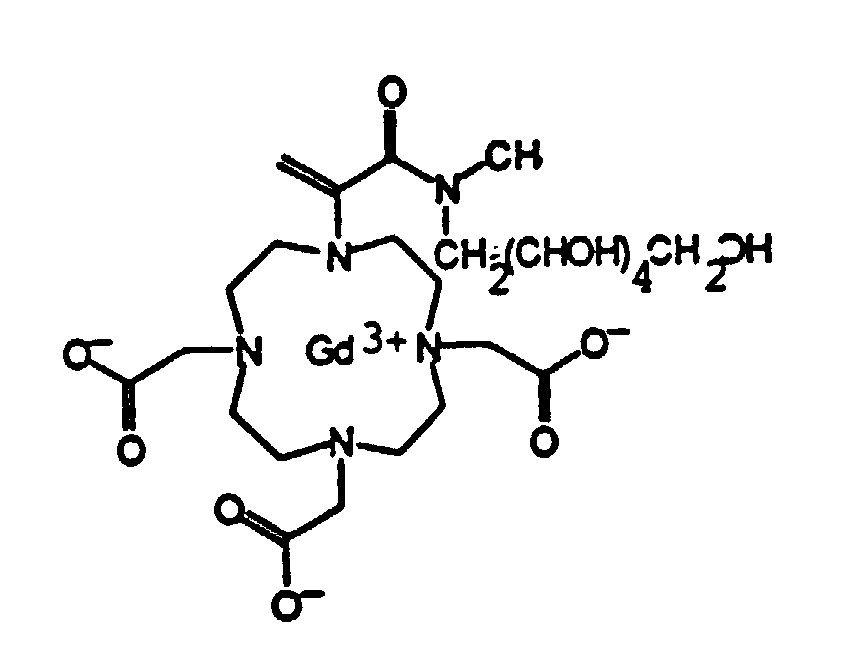
- 0 BC(CN(CCN(CC(O)=O)CC1)CCN(C*(O)=O)CCN1C(*(II)=O)=C)O Chemical compound BC(CN(CCN(CC(O)=O)CC1)CCN(C*(O)=O)CCN1C(*(II)=O)=C)O 0.000 description 1
Classifications
-
- C—CHEMISTRY; METALLURGY
- C07—ORGANIC CHEMISTRY
- C07D—HETEROCYCLIC COMPOUNDS
- C07D257/00—Heterocyclic compounds containing rings having four nitrogen atoms as the only ring hetero atoms
- C07D257/02—Heterocyclic compounds containing rings having four nitrogen atoms as the only ring hetero atoms not condensed with other rings
-
- A—HUMAN NECESSITIES
- A61—MEDICAL OR VETERINARY SCIENCE; HYGIENE
- A61K—PREPARATIONS FOR MEDICAL, DENTAL OR TOILETRY PURPOSES
- A61K49/00—Preparations for testing in vivo
-
- A—HUMAN NECESSITIES
- A61—MEDICAL OR VETERINARY SCIENCE; HYGIENE
- A61K—PREPARATIONS FOR MEDICAL, DENTAL OR TOILETRY PURPOSES
- A61K49/00—Preparations for testing in vivo
- A61K49/06—Nuclear magnetic resonance [NMR] contrast preparations; Magnetic resonance imaging [MRI] contrast preparations
Definitions
- This invention relates to novel compounds able to chelate paramagnetic bi- or trivalent metal ions, their chelates with said metal ions and their use as contrast agents in magnetic resonance imaging (MRI).
- MRI magnetic resonance imaging
- Physiologically tolerable complexes formed by chelating agents and bi- or trivalent metal ions are used as diagnostic agents in imaging techniques such as X-ray, nuclear magnetic resonance (NMR) and scintigraphy.
- MRI magnetic resonance imaging
- paramagnetic pharmaceutical compositions preferably containing chelated complexes of bi- or trivalent paramagnetic metal ions, usually belonging to the class of transition metals, or rare earth, with polyaminocarboxylic acids and/or their derivatives or analogues.
- the images are the result of a complex interaction of different parameters, such as proton density and T 1 and T 2 relaxation times.
- a contrast enhancement can be obtained through the administration of exogenous chemical substances which significantly change the resonance properties of the nearby water protons (see Lauffer, R.B. Chem. Rev. 1987,87,901). Due to the high capacity of gadolinium complexes of reducing the relaxation times of hydrogen nuclei of nearby water molecules through dipolar interaction, scientists have investigated, patented and published a lot of works on these complexes.
- MRI contrast media Gd-DTPA/Dimeg, N-methylglucamine salt of gadolinium diethylenetriaminepentaacetic acid, MAGNEVIST®, Schering; Gd-DOTA/Dimeg, N-methylglucamine salt of gadolinium 1,4,7,10-tetraazacyclododecan-1,4,7,10-tetracetic acid, DOTAREM® Guerbet; HPDO3A, gadolinium 10-(2-hydroxypropyl)-1,4,7,10-tetraazacyclo-dodecan1,4,7-triacetic acid, PROHANCE®, Bracco; Gd-DTPA-BMA, Gd-DTPA bismethylamide, OMNISCAN®, Salutar).
- the selection of the suitable compound is based on the evaluation of different parameters such as relaxivity, toxicity, distribution in the human body, excretion and so on.
- Three important properties are mainly needed to use a complex of Gd (3+) as a potential MRI contrast agent. Firstly, a high thermodynamic (and possibly kinetic) stability of the complex, i.e. a low tendency to release free Gd (3+) ions, per se highly toxic in vivo .
- a high water solubility ( ⁇ 0.5 mol/L).
- Gd-DTPA and Gd-DOTA are stable and water-soluble gadolinium chelates, they are ionic compounds (i.e. formally charged, namely -2 for Gd-DTPA and -1 for Gd-DOTA) which are made neutral with the formation of N-methylglucamine salts. Therefore the solutions contain charged particles, which affect their osmolality characteristics. Injectable concentrated solutions (0.5 - 1.0 M) of such salts are much more hyperosmolal compared to blood and physiological fluids. Hyperosmolality can produce, in vivo, oedemas and other undesired side effects.
- This invention relates to a novel class of chelants useful for the preparation of paramagnetic contrast agents of general formula (I): wherein
- This invention also relates to the chelates of said compounds of formula (I) with bi- or trivalent metal ions having atomic number selected between 20 and 31, 39, 42, 43, 44, 49, or between 57 and 83, as well as their salts with physiologically acceptable organic bases selected from primary, secondary, tertiary amines or basic amino acids, or with inorganic bases whose cation are sodium, potassium, magnesium, calcium or their mixtures, or with anions of physiologically acceptable organic acids, selected for instance from acetate, succinate, citrate, fumarate, maleate, oxalate, or with anions of inorganic acids such as ions of hydrohalogen acids, i.e. chlorides, bromides, iodides.
- physiologically acceptable organic bases selected from primary, secondary, tertiary amines or basic amino acids
- inorganic bases whose cation are sodium, potassium, magnesium, calcium or their mixtures
- anions of physiologically acceptable organic acids selected for instance from acetate, succinate, cit
- A is preferably an acrylic acid, which can be esterified or preferably substituted by a free amine function, mono or disubstituted by alkyl, hydroxyalkyl, alkoxyalkyl or alkoxyhydroxyalkyl groups.
- the substituent X can be a hydroxy group or also a O-R group wherein R is as defined above.
- R are the following: methyl, ethyl, isopropyl, 2-hydroxyethyl, 2hydroxypropyl, 1,3-dihydroxypropyl, polyoxaalkyl.
- Substituent X preferably can also be a hydroxyalkylamino residue of formula -NR 2 R 3 wherein R 2 and R 3 are as defined above.
- Non-limiting examples of such residues are the following: amino-, 2-hydroxyethylamino-, 2,3dihydroxypropylamino-, 1,3-dihydroxypropylamino-, 1,3dihydroxy-2-methyl-isopropylamino-, 2,3,4-trihydroxy-1butylamino-, 1,3,4-trihydroxy-2-butylamino-, 1,3dihydroxy-2-hydroxymethyl-isopropylamino-, N-methyl-N(2-hydroxyethyl)amino-, N-methyl-N-(2,3-dihydroxypropyl)amino-, N-methyl-N-(1,3-dihydroxypropyl)amino-, N-methyl-N-(2,3,4,5,6-pentahydroxyhexyl)amino-, N-2-hydroxyethyl-N-(1,3-dihydroxyisopropyl)amino-, N,N-bis(2hydroxyethyl)amino-, N,
- Hydroxy groups present in R 2 and R 3 residues can be present in the form of ethers, preferably methyl or ethyl ethers.
- Non-limiting examples of said residues are 1,3dimethoxyisopropylamino- 2,3-dimethoxypropylamino-.
- amines are cyclopentylamine, cyclohexylamine, morpholine, Nmethylpiperazine, piperazine.
- B 1 , B 2 , B 3 residues are an acetic acid group or an acrylic acid group which can be esterified or substituted with a free amine function, mono- or disubstituted with alkyl, hydroxyalkyl, alkoxyalkyl or alkoxyhydroxyalkyl groups.
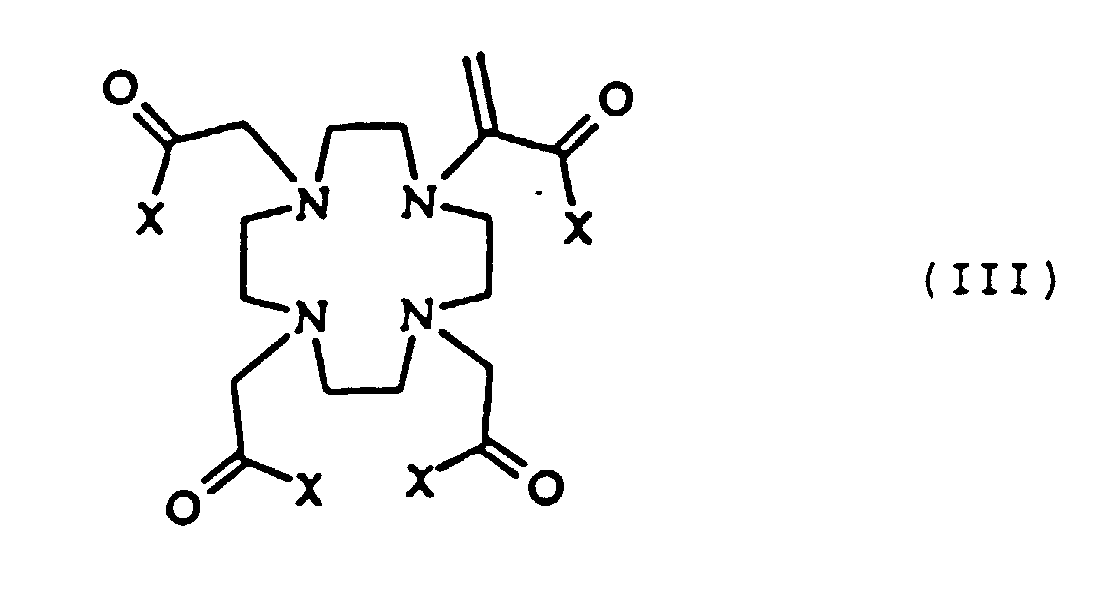
- a first preferred group of compounds of the invention comprises compounds of general formula (II) wherein X and Y are as defined above and the respective chelates with the metal ions having atomic number selected between 20 and 31, 39, 42, 43, 44, 49, or between 57 and 83, as well as their salts with physiologically acceptable organic bases selected from primary, secondary, tertiary amines or basic amino acids, or with inorganic bases whose cations are sodium, potassium, magnesium, calcium or their mixtures, or with anions of physiologically acceptable organic acids, selected from acetate, succinate, citrate, fumarate, maleate, oxalate, or with anions of inorganic acids such as the ions of hydrohalogen acids, such as chlorides, bromides, iodides.
- a second preferred group of compounds of the invention comprises compounds of general formula (III) wherein X is defined above and the respective chelates with the metal ions having atomic number selected between 20 and 31, 39, 42, 43, 44, 49, or between 57 and 83, as well as their salts with physiologically acceptable organic bases selected from primary, secondary, tertiary amines or basic amino acids, or with inorganic bases whose cations are sodium, potassium, magnesium, calcium or their mixtures.
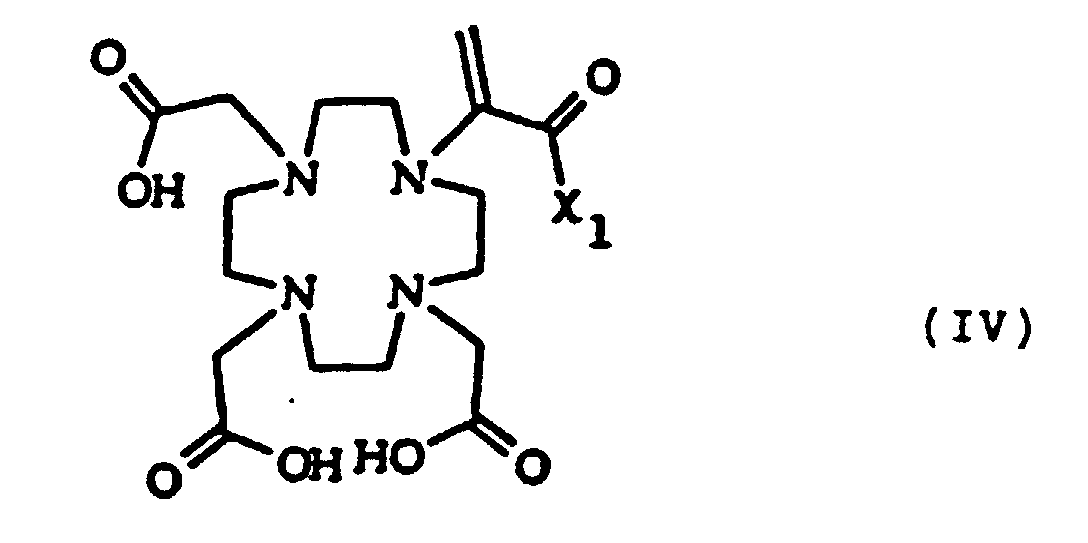
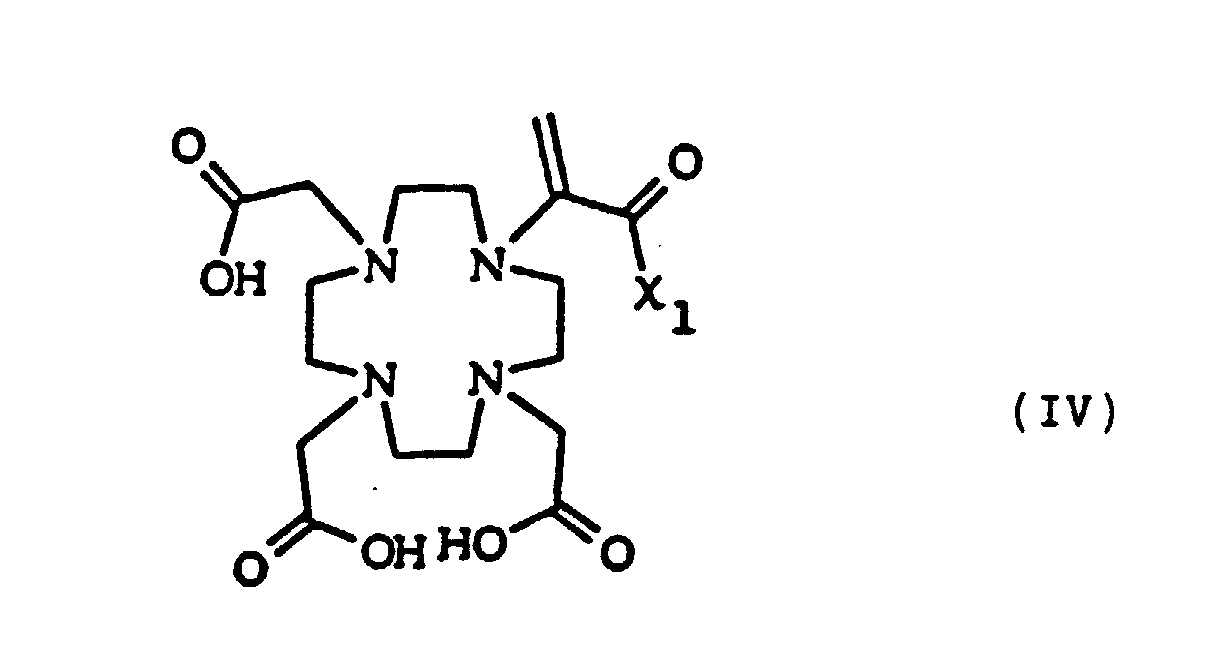
- a third preferred group of compounds of the invention comprises compounds of general formula (IV) wherein X 1 is OH, -NH 2 , -NHCH 2 CH 2 OH, -NHCH(CH 2 OH) 2 , -NHCH 2 CH(OH)CH 2 OH, -NHC[(CH 2 ) 3 OH] 3 , -NH(CH 2 ) 2 O(CH 2 ) 2 OH, -NHCH 2 -[CH(OH)] 4 CH 2 OH, -N(CH 3 )-CH 2 -[CH(OH)] 4 -CH 2 OH.
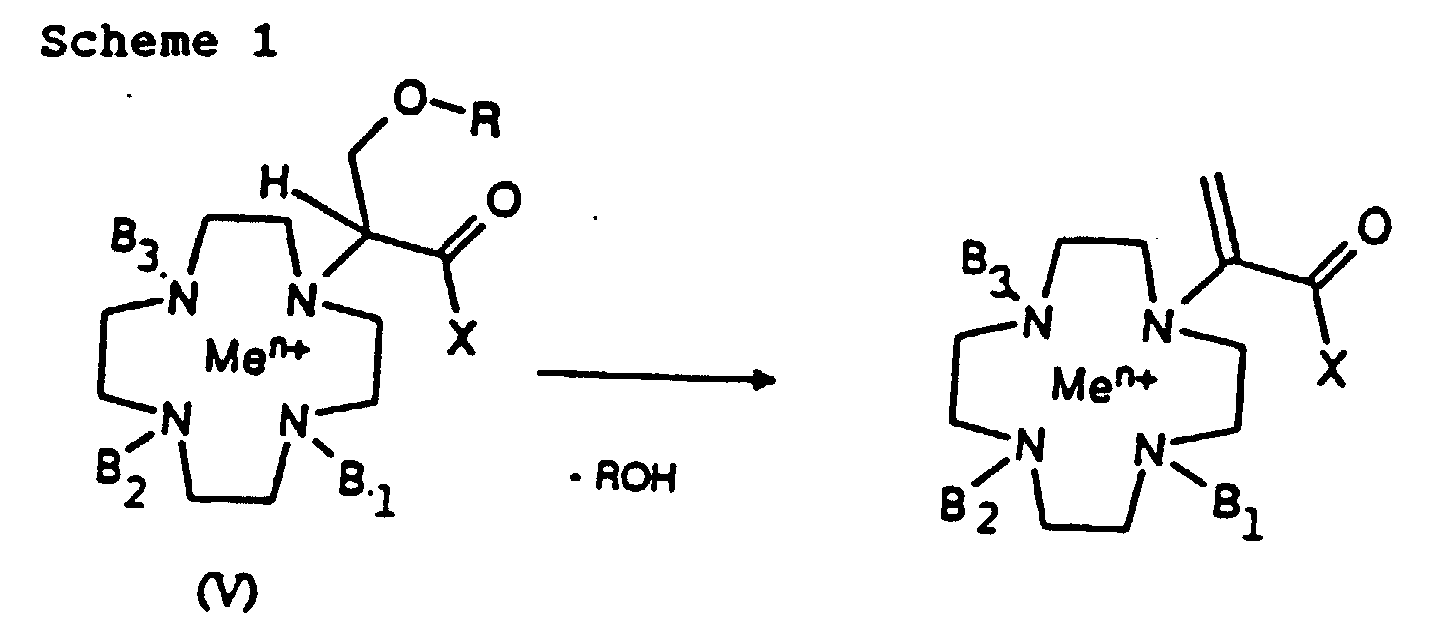
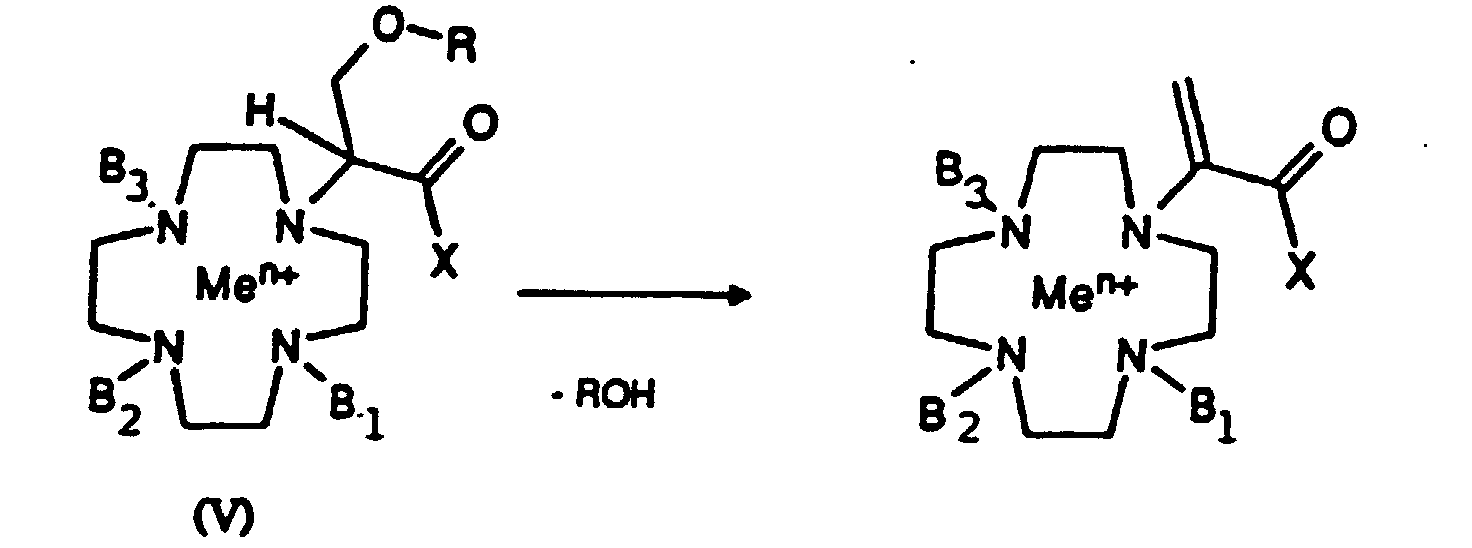
- the chelating agents of this invention can be prepared in an original way, exploiting the elimination of water or alcohol starting from suitable precursors, according to the following scheme:
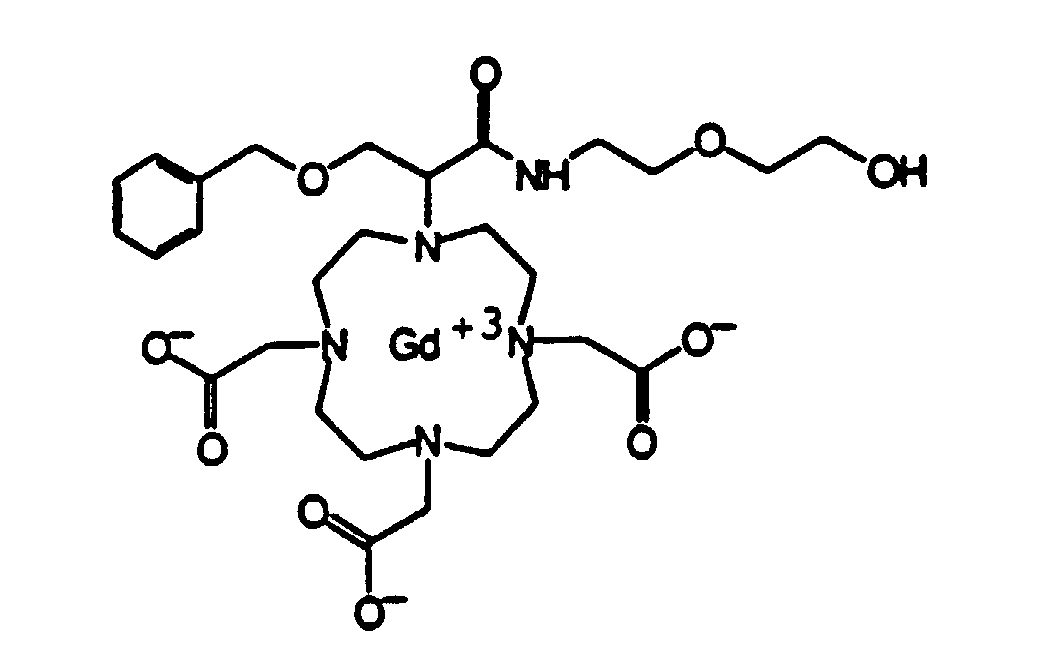
- the precursors are chelates of general formula (V), wherein X, B 1 , B 2 , B 3 are as defined above and R can be H, or a linear or branched alkyl group which contains 1-5 carbon atoms or a benzyl group, which can be substituted or not on the benzene ring, and its preparation is disclosed in patent EP 440606 (BRACCO).
- Patent EP 440606 discloses the synthesis and the use of complexes of non-ionic macrocyclic ligands, which preferably have a 3-(phenylmethoxy)propanoic residue whose carboxylic group is amidated with hydroxy- or polyhydroxyalkyl- amines.
- the elimination reaction is preferably carried out in an aqueous medium or in a dipolar aprotic solvent or in mixtures thereof, at controlled pH, ranging from 8 to 12, preferably between 9 and 11, through addition of a suitable organic or inorganic base for example ethanolamine, diethanolamine, glucamine, N,Ndimethylglucamine, preferably N-methylglucamine, preferably at a temperature ranging from 80 to 160°C, in particular 100-130°C.
- a suitable organic or inorganic base for example ethanolamine, diethanolamine, glucamine, N,Ndimethylglucamine, preferably N-methylglucamine, preferably at a temperature ranging from 80 to 160°C, in particular 100-130°C.
- the chelates of this invention proved to have interesting characteristics of low toxicity, showed as LD 50 on test animals, and excellent stability during the heat sterilization of solutions for diagnostic use.
- the bi- or trivalent metal ion complexed by the chelating residue B is selected from Fe (2+) , Fe (3+) , Gd (3+) , Eu (3+) , Dy (3+) , La (3+) , Yb (3+) and Mn (2+) .
- the compounds of this invention have a wide range of applications, since they can be used for intravasal, (for instance i.v., intraarterial, intracoronaric, intraventricular administration and so on), intrathecal, intraperitoneal, intralymphatic, intracavital and intraparenchymal administrations. Both soluble and less soluble compounds are suitable for oral or enteral administration, and therefore, specifically for the imaging of the gastrointestinal (GI) tract. For parenteral administration they can be preferentially formulated as sterile aqueous solutions or suspensions, whose pH can range from 6.0 to 8.5.
- aqueous solutions or suspensions can be administered in concentrations ranging from 0.002 M to 1.0 M.
- these formulations can be lyophilized and supplied as such, to be reconstituted just before the use.
- these agents can be formulated as a solution or suspension containing suitable additives in order to, for example, control viscosity.
- the oral administration they can be formulated according to preparation methods routinely used in the pharmaceutical technique or as coated formulations to gain extra protection from the acid pH of stomach, inhibiting the release of the chelated metal ion, which usually occurs at typical pH values of gastric juices.
- excipients such as sweeteners and/or flavouring agents, can be also added according to known techniques of pharmaceutical formulations.
- solutions or suspensions of the compounds of this invention can also be formulated as aerosol to be used in aerosol-bronchography and instillation.
- the chelates of this invention can also be used as radiopharmaceuticals in nuclear medicine both in the diagnostic and therapeutic field.
- the metal ion which is chelated is a radioisotope, such as 51 Cr, 67 Ga, 68 Ga, 111 In, 99m Tc, 140 La, 175 Yb, 153 Sm, 166 Ho, 90 Y, 149 Pm, 177 Lu, 47 Sc, 142 Pr, 159 Gd.
- a radioisotope such as 51 Cr, 67 Ga, 68 Ga, 111 In, 99m Tc, 140 La, 175 Yb, 153 Sm, 166 Ho, 90 Y, 149 Pm, 177 Lu, 47 Sc, 142 Pr, 159 Gd.
- Preferred cations of inorganic bases which can be suitably used to salify complex chelates of this invention particularly comprise ions of alkali or alkaline-earth metals such as potassium, sodium, calcium, magnesium and the mixtures thereof.
- Preferred cations of organic bases suitable for the above mentioned aim comprise, among others, those of primary, secondary and tertiary amines such as ethanolamine, diethanolamine, morpholine, glucamine, N-methylglucamine, N,N-dimethylglucamine.
- Preferred cations of amino acids comprise, for instance, those of lysine, arginine or ornithine or of the aspartic and glutamic acid.
- Preferred anions of inorganic acids which can be suitably used for the salification of complex chelates of this invention particularly comprise anions of the hydrohalogen acids such as chlorides, bromides, iodides or other anions such as sulfate.
- Preferred anions of organic acids suitable for the above mentioned aim comprise those of acids routinely used in pharmaceutical technique for the salification of basic substances, such as acetate, succinate, citrate, fumarate, maleate.
- the compounds of this invention can be conjugated to macromolecules or encapsulated or associated to suitable carriers. For instance they can also be encapsulated in liposomes or form the constituents of their chemical structure and used as uni- or multilamellar vesicles.
- a mixture of 57.1 g of compound (A) (0.142 mol) and 36.7 g of 1,4,7,10-tetraazacyclododecan (marketed product) (0.213 mol) is prepared by powdering finely the two components, and kept under N 2 with stirring, at 80 °C for 6 h and then at 85 °C for 18 h.
- the reaction mixture is dissolved in 135 mL of 2N HCl (0.27 mol), diluted to 1000 mL with H 2 O and percolated on a cation exchange resin Duolite® C 20 MB. After washing with H 2 O to neutrality, the acid eluate is concentrated under vacuum to give an oily residue which is dissolved in abs. EtOH and concentrated under vacuum.
- the mixture is neutralized with 8 mL of 37% HCl (w/w), diluted to 1.5 L with H 2 O and electrodialyzed.
- the dissalted solution is concentrated under vacuum to about 1 L, treated with active carbon, after that filtered on buchner funnel and then on a Millipore® filter. By concentration under vacuum, an oily residue is obtained which upon drying gives 62.83 g of the desired product (0.088 mol).
- a solution of 37.2 g of compound (D) (0.043 mol) in 300 mL of H 2 O is adjusted to pH 9.2 by addition of 0.187 g of 1-deoxy-1-(methylamino)-D-glucitol (0.95 mmol) and heated to a temperature of 100 °C for 3.5 h. After cooling at room temperature, the reaction mixture is adjusted to pH 6.5 with 1N HCl (0.54 mL) and then electrodialyzed. The dissalted solution is concentrated under vacuum and diluted with H 2 O (200 mL), then is concentrated under vacuum again. The operation is performed twice to obtain an oily residue which is placed into the dryer to slowly solidify to give 31 g of the desired product (0.041 mol).
- the mixture is neutralized with 37% HCl (w/w) and left at room temperature for 15 h.
- the aqueous phase is separated and extracted with AcOEt.
- the organic extract is combined again with the organic phase, then is concentrated under vacuum to give a residue which is dissolved with AcOEt and washed with a solution of 2.5% Na 2 CO 3 (w/v), with 0.5N HCl and then with H 2 O.
- the solution is dried with Na 2 SO 4 and concentrated under vacuum to give a residue which is purified by flash chromatography to obtain 70.1 g of the desired product (0.232 mol).
- the aqueous phase is neutralized with 37% HCl (w/w) and extracted again with AcOEt.
- the aqueous phase is separated, diluted to 1L and percolated through a Duolite R C 20 MB cation exchange resin.
- the solution is eluted with 2M NH 4 OH. Both eluates are concentrated under vacuum to give oily residues.
- the acid eluate residue is dissolved in abs. EtOH and concentrated to dryness under vacuum to give an oily residue.
- the basic eluate residue is dissolved in abs. EtOH, concentrated under vacuum, dissolved in 4N HCl in EtOH and then concentrated to dryness under vacuum to give a solid residue.
- the reaction mixture is heated to 50 °C for 48 h and 50 mL of 10N NaOH (0.5 mol) are added to keep a constant pH of 10. After cooling at room temperature, the mixture is filtered on a Millipore R filter, neutralized with 37%HCl (w/w), diluted to 1.5 L with H 2 O and electrodialyzed. When the electrodialysis is over, the solution is concentrated under vacuum to give an oily residue which is placed into a drier to give a glassy solid. The solid is triturated and dissolved with AcOEt (200 mL), filtered and dried again.
- the crude product is dissolved in H 2 O (150 mL) and percolated on Amberlite® XAD 16 resin (1000 mL) performing a gradient elution with H 2 O-MeOH.
- the fractions containing the pure product are collected and concentrated under vacuum to give 38.83 g of the desired product (0.063 mol).
- a solution of 766 mg of compound (D) (1 mmol) in 20 mL of H 2 O is adjusted to pH 9 by addition of 2.5 mL of a 0.01 M solution of 1-deoxy-1-(methylamino)-Dglucitol then is heated in autoclave at the external temperature of 130 °C for 70 min.
- the fractions of same purity are collected and concentrated under vacuum to give an oily residue which is placed into a dryer to solidify slowly, obtaining 579 mg of the desired product (0.88 mmol).
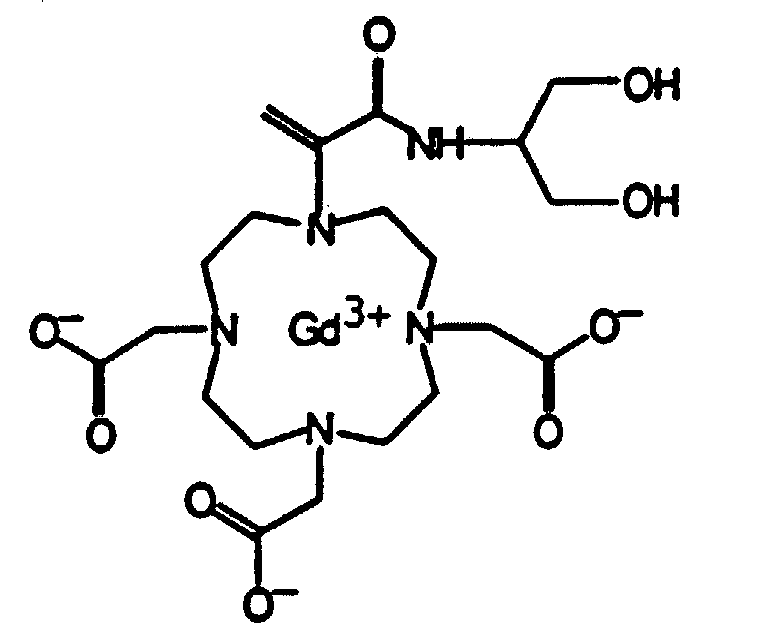
- Table I shows as non-limiting examples the LD 50 values for the compounds of this invention, Gadolinium complex of 10-[2-[[1,1-bis(3-hydroxypropyl)-4hydroxybutyl]amino]-1-methylene-2-oxoethyl]-1,4,7,10tetraazacyclododecan-1,4,7-triacetic acid, compared to GdDTPA-BMA, OMNISCAN®, DOTAREM® and PROHANCE®.
- Table I clearly shows that, in the pharmacological test performed, the gadolinium complexation with the macrocyclic chelants of this invention brought about a remarkable decrease in toxicity compared to DOTAREM®, GdDTPA-BMA, and PROHANCE®. Also the datum relative to Gd-DTPA-bismethylamide, Gd-DTPA-BMA, constituting OMNISCAN®, is reported, even if there is a remarkable difference in the LD 50 values. It is known that this difference is due to the simultaneous presence in OMNISCAN® of Gd-DTPA-BMA with a 500mM concentration, and of the complex of the same ligand with sodium and calcium, Na[CaDTPA-BMA], at a concentration of 25mM. Therefore, the comparison of this last datum with the available data for the compounds of this invention is more significant as far as determination homogeneity is concerned.
Landscapes
- Chemical & Material Sciences (AREA)
- Organic Chemistry (AREA)
- Health & Medical Sciences (AREA)
- Public Health (AREA)
- Epidemiology (AREA)
- Life Sciences & Earth Sciences (AREA)
- Animal Behavior & Ethology (AREA)
- General Health & Medical Sciences (AREA)
- Veterinary Medicine (AREA)
- Radiology & Medical Imaging (AREA)
- Nuclear Medicine, Radiotherapy & Molecular Imaging (AREA)
- Medicines Containing Antibodies Or Antigens For Use As Internal Diagnostic Agents (AREA)
- Organic Low-Molecular-Weight Compounds And Preparation Thereof (AREA)
Abstract
Description

- A
- is a group of formula

- X
- is a -O-R group where R is hydrogen, or a linear or branched (C1-C5) alkyl group which can be substituted or not by 1-6 hydroxy and/or alkoxy groups, or X is a -NR2R3 group where R2 and R3 can be same or different and are an hydrogen atom, a linear or branched (C1-C10) alkyl group which can be substituted or not by 1-6 hydroxy and/or alkoxy groups, or a polyoxaalkyl group comprising 1-10 oxygen atoms and 3-30 carbon atoms, or the -NR2R3 group is a heterocyclic residue wherein R2 and R3, taken together, form a (C4-C5) chain which can be interrupted or not by O, N, S, >N-CH3, and can be possibly substituted by one or more hydroxy or hydroxyalkyl groups,
- B1, B2, B3
- can be same or different and have the same meaning as A, or are a -CHYCOX group, wherein Y is a -CH2OR1 group, wherein R1 is hydrogen, or a linear or branched (C1-C5) alkyl group which can be substituted or not by 1-6 hydroxy and/or alkoxy groups, or R1 is a phenyl or benzyl residue which can also be mono or polysubstituted on the aromatic ring by halogen, hydroxy, alkoxy, carboxy, carbamoyl, alkoxycarbonyl, (C1-C5) alkyl, (C1-C5) hydroxyalkyl, amino, acylamino groups, or Y can also be a R1 residue as defined above.





| min | % A | % B |
| 0 | 80 | 20 |
| 10 | 80 | 20 |
| 20 | 30 | 70 |
| 30 | 30 | 70 |
| 35 | 20 | 80 |
| 45 | 20 | 80 |
| Elemental Analysis | C | H | Cl | N | ||
| % calc.: | 59.76 | 8.02 | 8.81 | 3.48 | ||
| % found: | 59.88 | 8.07 | 8.74 | 3.47 | H2O | 0.2 |
| min | % A | % B |
| 0 | 80 | 20 |
| 10 | 80 | 20 |
| 20 | 30 | 70 |
| 30 | 30 | 70 |
| Elemental Analysis | C | H | Cl | N | ||
| % calc.: | 51.96 | 8.10 | 16.43 | 10.82 | ||
| % found: | 50.52 | 8.89 | 16.15 | 10.43 | H2O | 2.05 |
| min | % A | % B |
| 0 | 90 | 10 |
| 15 | 90 | 10 |
| 30 | 60 | 40 |
| Elemental Analysis | C | H | N | Br | Cl | Na | ||
| % calc.: | 57.36 | 8.07 | 9.83 | |||||
| % found: | 55.43 | 8.48 | 9.48 | <0.1 | <0.1 | 0.2 | H2O | 0.89 |
0.0125 M KH2PO4) : CH3CN = 87 : 13 (v/v)

| min | % A | % B |
| 0 | 100 | 0 |
| 15 | 90 | 10 |
| 20 | 90 | 10 |
| 37 | 75 | 25 |
| Elemental Analysis | C | H | Gd | N | ||
| % calc.: | 47.15 | 6.28 | 18.15 | 8.08 | ||
| % found: | 45.85 | 6.82 | 17.14 | 7.73 | H2O | 3.45 |
| min | % A | % B |
| 0 | 100 | 0 |
| 15 | 90 | 10 |
| 20 | 90 | 10 |
| 37 | 75 | 25 |
| Elemental Analysis | C | H | Gd | N | ||
| % calc.: | 42.78 | 6.11 | 20.74 | 9.23 | ||
| % found: | 40.66 | 6.63 | 19.11 | 8.55 | H2O | 3.65 |

| Elemental Analysis | C | H | Cl | N | ||
| % calc.: | 55.72 | 6.68 | 1.74 | 4.64 | ||
| % found: | 54.47 | 6.83 | 11.30 | 4.44 | H2O | 1.20 |
| Elemental Analysis | C | H | Cl | N | ||
| % calc.: | 48.31 | 7.74 | 19.44 | 12.80 | ||
| % found: | 45.58 | 7.96 | 18.91 | 12.37 | H2O | 2.27 |
| Elemental Analysis | C | H | N | Br | Cl | Na | ||
| % calc.: | 54.98 | 7.41 | 11.44 | |||||
| % found: | 53.35 | 7.87 | 11.04 | <0.1 | <0.1 | <0.1 | H2O | 2.85 |
| min | % A | % B |
| 0 | 95 | 5 |
| 25 | 20 | 80 |
| 30 | 10 | 90 |
| 40 | 10 | 90 |
| Elemental Analysis | C | H | Gd | N | ||
| % calc.: | 43.91 | 5.53 | 20.53 | 9.14 | ||
| % found: | 41.29 | 6.13 | 19.34 | 8.63 | H2O | 5.77 |
| min | % A | % B |
| 0 | 100 | 0 |
| 15 | 90 | 10 |
| 20 | 90 | 10 |
| 37 | 75 | 25 |
| Elemental Analysis | C | H | Gd | N | ||
| % calc.: | 38.34 | 5.21 | 23.90 | 10.64 | ||
| % found: | 37.26 | 5.74 | 23.12 | 10.28 | H2O | 3.15 |


| LD50 (mice) i.v.(mmol/kg) | OSMOLALITY (mOsm/kg H2O) | CHARGE | |
| Example 1 | 23.4 | ||
| Example 2 | 37.6 | 855 | non-ionic |
| GdDTPA-BMA | 14.8 | non-ionic | |
| OMNISCAN® | 34 | 780 | non-ionic |
| PROHANCE® | 7-10 | 630 | non-ionic |
| DOTAREM® | 11.4 | 1350 | ionic |
Claims (18)
- A compound of general formula (I)wherein

- A
- is a group of formula

- X
- is a -O-R group where R is hydrogen, or a linear or branched (C1-C5) alkyl group which can be substituted or not by 1-6 hydroxy and/or alkoxy groups, or X is a -NR2R3 group where R2 and R3 can be same or different and are an hydrogen atom, a linear or branched (C1-C10) alkyl group which can be substituted or not by 1-6 hydroxy and/or alkoxy groups, or a polyoxaalkyl group comprising 1-10 oxygen atoms and 3-30 carbon atoms, or -NR2R3 group is a heterocyclic residue wherein R3 and R3, taken together, form a (C4-C5) chain which can be interrupted or not by O, N, S, >N-CH3, and can be substituted or not by one or more hydroxy or hydroxyalkyl groups,
- B1, B2, B3
- can be same or different and have the same meaning as A, or are a -CHYCOX group, wherein Y is a -CH2OR1 group, wherein R1 is hydrogen, or a linear or branched (C1-C5) alkyl group which can be substituted or not by 1-6 hydroxy and/or alkoxy groups, or R1 is a phenyl or benzyl residue which can be also mono or polysubstituted on the aromatic ring by halogen, hydroxy, alkoxy, carboxy, carbamoyl, alkoxycarbonyl, (C1-C5) alkyl, (C1-C5) hydroxyalkyl, amino, acylamino groups, or Y can also be a R1 residue as defined above,
as well as their salts with physiologically acceptable organic bases selected from primary, secondary, tertiary amines or basic amino acids, or with inorganic bases whose cations are sodium, potassium, magnesium, calcium or their mixtures, or with anions of physiologically acceptable organic acids, selected from acetate, succinate, citrate, fumarate, maleate, oxalate, or with anions of inorganic acids. - A compound according to claim 1 of general formula (II)wherein X and Y are as defined above and the respective chelates with the metal ions having atomic number selected between 20 and 31, 39, 42, 43, 44, 49, or between 57 and 83, as well as their salts with physiologically acceptable organic bases selected from primary, secondary, tertiary amines or basic amino acids, or with inorganic bases whose cations are sodium, potassium, magnesium, calcium or their mixtures, or with anions of physiologically acceptable organic acids, selected from acetate, succinate, citrate, fumarate, maleate, oxalate, or with anions of inorganic acids such as the ions of hydrohalogen acids, such as chlorides, bromides, iodides.

- A compound according to claim 1 of general formula (III)wherein X is defined above and the respective chelates with the metal ions having atomic number selected between 20 and 31, 39, 42, 43, 44, 49, or between 57 and 83, as well as their salts with physiologically acceptable organic bases selected from primary, secondary, tertiary amines or basic amino acids, or with inorganic bases whose cations are sodium, potassium, magnesium, calcium or their mixtures.

- A compound according to claim 1 of general formula (IV)wherein X1 is OH, -NH2, -NHCH2CH2OH, -NHCH(CH2OH)2, -NHCH2CH(OH)CH2OH, -NHC[(CH2)3OH]3, -NH(CH2)2O(CH2)2OH, -NHCH2-[CH(OH)]4CH2OH, -N(CH3)-CH2-[CH(OH)]4-CH2OH.
- A compound according to claim 1, wherein the bior trivalent metal ion complexed by the chelating residue B is selected from Fe(2+), Fe(3+), Gd(3+), Eu(3+), Dy(3+), La(3+), Yb(3+) and Mn(2+), or is a radioisotope selected from 51Cr, 67Ga, 68Ga, 111In, 99mTc, 140La, 175Yb, 153Sm, 166Ho, 90Y, 149Pm, 177Lu, 47Sc, 142Pr, 159Gd, 212Bi.
- A compound according to claim 1, wherein the physiologically acceptable salifying organic base is selected from ethanolamine, diethanolamine, morpholine, glucamine, N,N-dimethylglucamine, N-methylglucamine, lysine, arginine, ornithine.
- A compound according to claim 1, wherein the anion of the physiologically acceptable salifying inorganic acid is selected from the ions of the hydrohalogen acids such as chlorides, bromides, iodides.
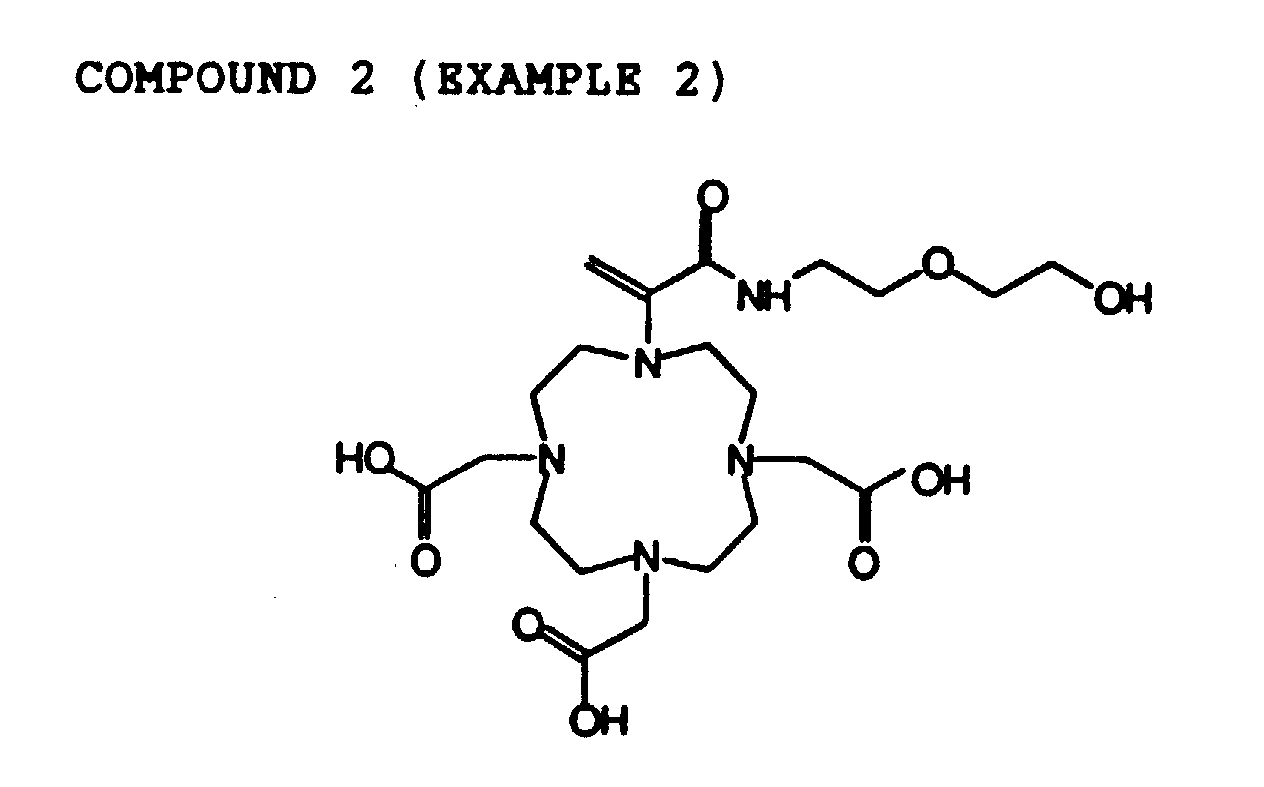
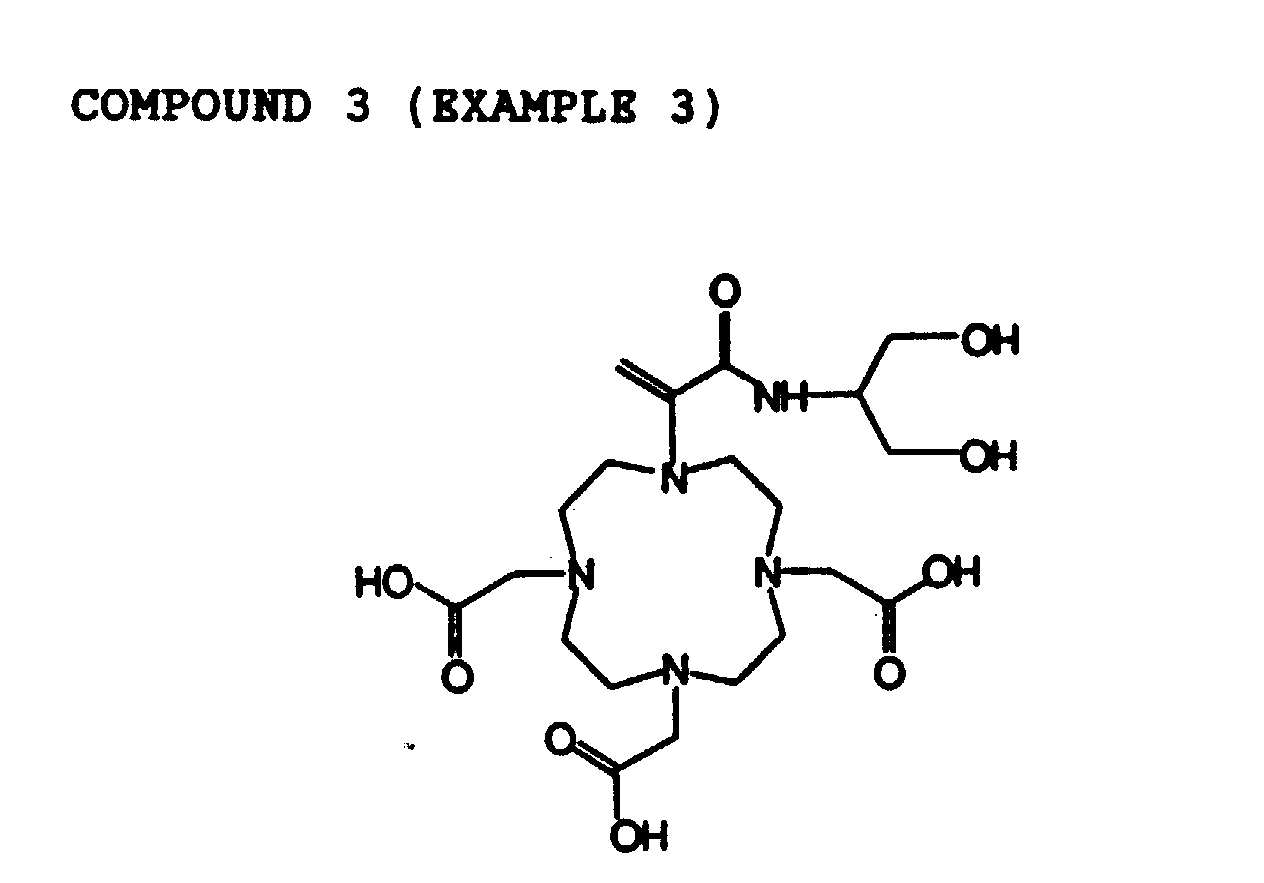
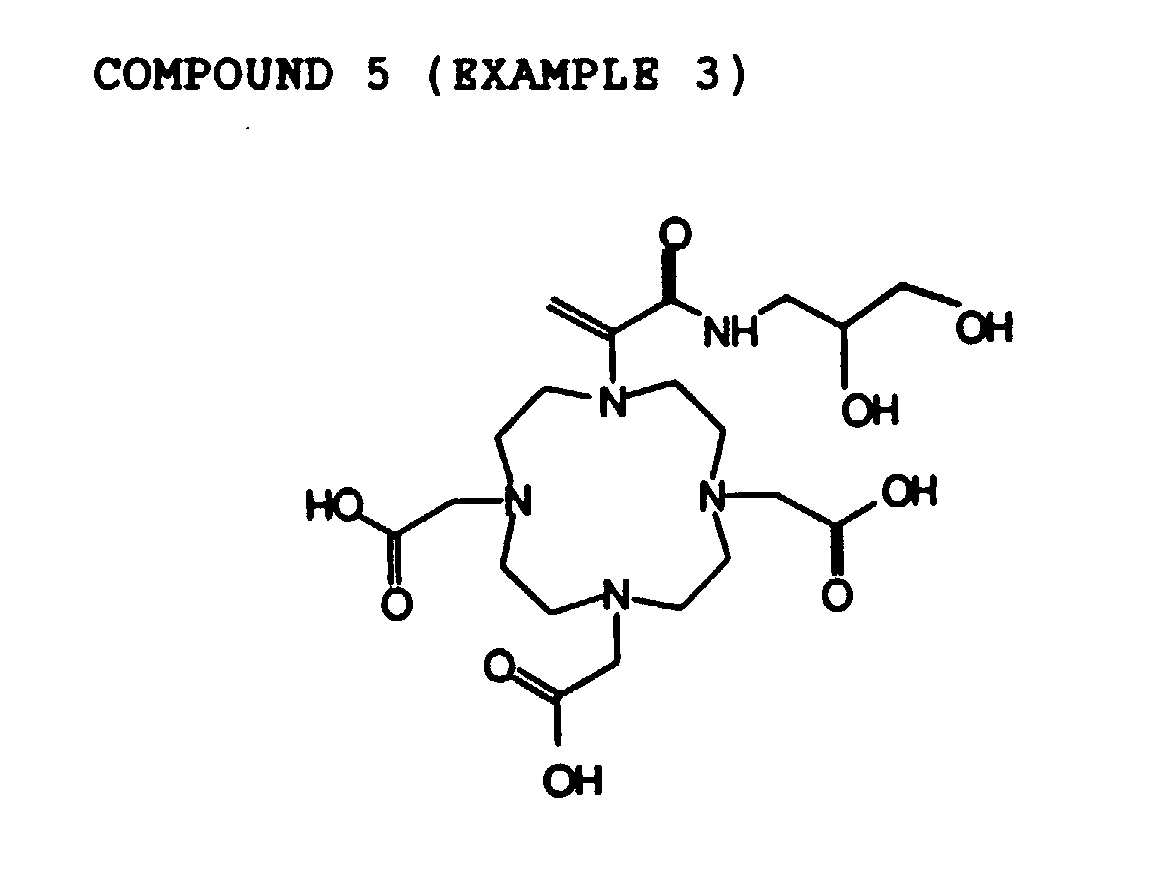
- A compound according to claims 1-4, wherein the derivative of formula (I) is selected from the following:10-[2-[[1,1-bis(3-hydroxypropyl)-4-hydroxybutyl]amino]-1-methylene-2-oxoethyl]-1,4,7,10-tetraazacyclododecan-1,4,7-triacetic acid10-[2-[[2-(2-hydroxyethoxy)ethyl]amino]-1(methylene)-2-oxoethyl]-1,4,7,10-tetraazacyclododecan1,4,7-triacetic acid10-[2-[[2-hydroxy-1-(hydroxymethyl)ethyl]amino]-1methylene-2-oxoethyl]-1,4,7,10-tetraazacyclododecan1,4,7-triacetic acid10-[2-[[2-hydroxyethyl]amino]-1-methylene-2-oxoethyl]-1,4,7,10-tetraazacyclododecan-1,4,7-triacetic acid10-[2-[[2,3-dihydroxypropyl]amino]-1-methylene-2-oxoethyl]-1,4,7,10-tetraazacyclododecan-1,4,7-triacetic acid1-desoxy-1-[methyl[1-oxo-2-[[4,7,10tris(carboxymethyl)-1,4,7,10-tetraazacyclododec-1-yl]-2-propenyl]amino]-(S)-D-glucitol
- A method for the preparation of compounds according to claim 1, exploiting the elimination of water or alcohol starting from the precursors of general formula (V), according to the following scheme:wherein X, B1, B2, B3 are as defined above and R can be H, or a linear or branched alkyl group which contains 1-5 carbon atoms or a benzyl group, which can be substituted or not on the benzene ring, which preparation is disclosed in patent EP 440606 (BRACCO), carried out in an aqueous medium or in a dipolar aprotic solvent or in mixtures thereof, at controlled pH, ranging from 8 to 12, by addition of a suitable organic or inorganic base.
- A method according to claim 9, wherein the reaction solvent is water.
- A method according to claim 9, wherein the used organic base is selected from the group consisting of ethanolamine, diethanolamine, glucamine, N,N-dimethylglucamine, N-methylglucamine.
- A method according to claim 9, wherein the used organic base is N-methylglucamine.
- A method according to claim 9, wherein pH is kept between 9 and 11.
- A method according to claim 9, wherein temperature ranges from 100 to 130°C.
- A method according to claim 9, wherein the reaction is carried out in an autoclave.
- Pharmaceutical diagnostic contrast compositions, comprising at least one of the chelates according to claim 1 or a salt thereof.
- Pharmaceutical compositions according to claim 16, to obtain images of organs and/or tissues of human or animal body by using nuclear magnetic resonance.
- The use of chelates of compounds of formula (I) or the salts thereof for the preparation of diagnostic formulations, to obtain images of organs and/or tissues of human or animal body by using nuclear magnetic resonance.
Applications Claiming Priority (3)
| Application Number | Priority Date | Filing Date | Title |
|---|---|---|---|
| ITMI941646 | 1994-07-29 | ||
| ITMI941646A IT1274038B (en) | 1994-07-29 | 1994-07-29 | MACROCYCLIC CHELANTS THEIR CHELATES AND RELATED USES IN THE DIAGNOSTIC FIELD |
| PCT/EP1995/002931 WO1996004259A1 (en) | 1994-07-29 | 1995-07-24 | Macrocyclic chelants, their chelates and uses thereof in the diagnostic field |
Publications (2)
| Publication Number | Publication Date |
|---|---|
| EP0773936A1 EP0773936A1 (en) | 1997-05-21 |
| EP0773936B1 true EP0773936B1 (en) | 1998-06-17 |
Family
ID=11369406
Family Applications (1)
| Application Number | Title | Priority Date | Filing Date |
|---|---|---|---|
| EP95928457A Expired - Lifetime EP0773936B1 (en) | 1994-07-29 | 1995-07-24 | Macrocyclic chelants, their chelates and uses thereof in the diagnostic field |
Country Status (21)
| Country | Link |
|---|---|
| US (2) | US5622688A (en) |
| EP (1) | EP0773936B1 (en) |
| JP (1) | JP2941062B2 (en) |
| KR (1) | KR100376950B1 (en) |
| CN (1) | CN1064355C (en) |
| AT (1) | ATE167477T1 (en) |
| AU (1) | AU691024B2 (en) |
| BR (1) | BR9508435A (en) |
| CA (1) | CA2196041A1 (en) |
| DE (2) | DE773936T1 (en) |
| DK (1) | DK0773936T3 (en) |
| ES (1) | ES2100827T3 (en) |
| FI (1) | FI970327A7 (en) |
| GR (1) | GR970300019T1 (en) |
| HU (1) | HUT76805A (en) |
| IL (1) | IL114732A0 (en) |
| IT (1) | IT1274038B (en) |
| MX (1) | MX9700674A (en) |
| NO (1) | NO307214B1 (en) |
| WO (1) | WO1996004259A1 (en) |
| ZA (1) | ZA956174B (en) |
Families Citing this family (13)
| Publication number | Priority date | Publication date | Assignee | Title |
|---|---|---|---|---|
| IT1274038B (en) * | 1994-07-29 | 1997-07-14 | Bracco Spa | MACROCYCLIC CHELANTS THEIR CHELATES AND RELATED USES IN THE DIAGNOSTIC FIELD |
| JP4432000B2 (en) * | 1996-12-23 | 2010-03-17 | ブラッコ・リサーチ・ソシエテ・アノニム | Composition for increasing MRI contrast in visualization of a patient's gastrointestinal tract |
| IT1291624B1 (en) * | 1997-04-18 | 1999-01-11 | Bracco Spa | COMPLEX CHELATES OF PARAMAGNETIC METALS WITH LOW TOXICITY |
| FR2772025B1 (en) * | 1997-12-10 | 2000-03-03 | Guerbet Sa | METAL CHELATES OF POLYAMINOCARBOXYLIC MACROCYCLES AND THEIR APPLICATION TO MAGNETIC RESONANCE IMAGING |
| AU3225900A (en) * | 1999-02-09 | 2000-08-29 | Board Of Regents, The University Of Texas System | Ph sensitive mri contrast agents |
| AU2002227184A1 (en) * | 2000-10-18 | 2002-04-29 | The Board Of Trustess Of The Leland Stanford Junior University | Methods for development and use of diagnostic and therapeutic agents |
| AU2002220082A1 (en) * | 2000-10-19 | 2002-04-29 | The General Hospital Corporation | Imaging of enzymatic activity |
| US20030100829A1 (en) * | 2001-11-27 | 2003-05-29 | Sheng-Ping Zhong | Medical devices with magnetic resonance visibility enhancing material |
| US20040215240A1 (en) * | 2003-04-11 | 2004-10-28 | Lovett Eric G. | Reconfigurable subcutaneous cardiac device |
| FR2857967B1 (en) * | 2003-07-25 | 2015-04-24 | Centre Nat Rech Scient | LANTHANIDE COMPLEXES, THEIR PREPARATION AND USES THEREOF |
| US20050107838A1 (en) * | 2003-09-18 | 2005-05-19 | Lovett Eric G. | Subcutaneous cardiac rhythm management with disordered breathing detection and treatment |
| CN1993357B (en) | 2004-07-02 | 2011-10-19 | 伯拉考成像股份公司 | High relaxation contrast agents containing chelating moieties with polyhydroxylated substituents for magnetic resonance imaging (MRI) |
| CN109384737A (en) * | 2017-08-04 | 2019-02-26 | 天津科伦药物研究有限公司 | A kind of tetraazacyclododecane yttrium complex and its preparation method and application |
Family Cites Families (6)
| Publication number | Priority date | Publication date | Assignee | Title |
|---|---|---|---|---|
| US4885363A (en) * | 1987-04-24 | 1989-12-05 | E. R. Squibb & Sons, Inc. | 1-substituted-1,4,7-triscarboxymethyl-1,4,7,10-tetraazacyclododecane and analogs |
| IT1224416B (en) * | 1987-12-24 | 1990-10-04 | Bracco Ind Chimica Spa | MACROCYCLIC CHELANTS AND THEIR CHELATES |
| US5053503A (en) * | 1989-02-17 | 1991-10-01 | Centocor | Chelating agents |
| DE4035760A1 (en) * | 1990-11-08 | 1992-05-14 | Schering Ag | MONO-N-SUBSTITUTED 1,4,7,10-TETRAAZACYCLODODECAN DERIVATIVES, METHOD FOR THE PRODUCTION THEREOF AND PHARMACEUTICAL AGENTS CONTAINING THEM |
| IT1274038B (en) * | 1994-07-29 | 1997-07-14 | Bracco Spa | MACROCYCLIC CHELANTS THEIR CHELATES AND RELATED USES IN THE DIAGNOSTIC FIELD |
| GB9504910D0 (en) * | 1995-03-10 | 1995-04-26 | Nycomed Imaging As | Compounds |
-
1994
- 1994-07-29 IT ITMI941646A patent/IT1274038B/en active IP Right Grant
-
1995
- 1995-05-24 US US08/448,742 patent/US5622688A/en not_active Expired - Fee Related
- 1995-07-24 JP JP8506155A patent/JP2941062B2/en not_active Expired - Fee Related
- 1995-07-24 DE DE0773936T patent/DE773936T1/en active Pending
- 1995-07-24 AU AU32211/95A patent/AU691024B2/en not_active Ceased
- 1995-07-24 CA CA002196041A patent/CA2196041A1/en not_active Abandoned
- 1995-07-24 HU HU9700250A patent/HUT76805A/en unknown
- 1995-07-24 CN CN95194377A patent/CN1064355C/en not_active Expired - Fee Related
- 1995-07-24 EP EP95928457A patent/EP0773936B1/en not_active Expired - Lifetime
- 1995-07-24 KR KR1019970700527A patent/KR100376950B1/en not_active Expired - Fee Related
- 1995-07-24 DE DE69503055T patent/DE69503055T2/en not_active Expired - Fee Related
- 1995-07-24 DK DK95928457T patent/DK0773936T3/en active
- 1995-07-24 FI FI970327A patent/FI970327A7/en unknown
- 1995-07-24 WO PCT/EP1995/002931 patent/WO1996004259A1/en not_active Ceased
- 1995-07-24 ES ES95928457T patent/ES2100827T3/en not_active Expired - Lifetime
- 1995-07-24 MX MX9700674A patent/MX9700674A/en unknown
- 1995-07-24 BR BR9508435A patent/BR9508435A/en active Search and Examination
- 1995-07-24 AT AT95928457T patent/ATE167477T1/en not_active IP Right Cessation
- 1995-07-25 ZA ZA956174A patent/ZA956174B/en unknown
- 1995-07-25 IL IL11473295A patent/IL114732A0/en unknown
-
1997
- 1997-01-14 US US08/783,609 patent/US5708166A/en not_active Expired - Fee Related
- 1997-01-27 NO NO970342A patent/NO307214B1/en not_active IP Right Cessation
- 1997-07-30 GR GR970300019T patent/GR970300019T1/en unknown
Also Published As
Similar Documents
| Publication | Publication Date | Title |
|---|---|---|
| EP0872479B1 (en) | Chelated complexes of paramagnetic metals with low toxicity | |
| DE69514350T2 (en) | Gallic Acid Conjugates, Their Metal Complexes and Related Applications | |
| RU2073005C1 (en) | Metal chelate compound | |
| US6461588B1 (en) | Use of bile acid conjugates, derivatives thereof with metal complexes as blood pool agents for nuclear magnetic resonance diagnostics | |
| EP0731797B1 (en) | Paramagnetic chelates for nuclear magnetic resonance diagnosis | |
| EP1259532B1 (en) | Bile acids conjugates with metal ion chelates and the use thereof | |
| SK283838B6 (en) | Cascade polymer complexes, a process for their manufacture and a pharmaceutical composition comprising the same | |
| AU7060291A (en) | Chelants | |
| AU691024B2 (en) | Macrocyclic chelants, their chelates and uses thereof in the diagnostic field | |
| US5869651A (en) | Hydrazide derivatives of polyamides and their medical use as chelating agents | |
| DE69120826T2 (en) | CHELATE-MAKING AGENTS | |
| EP1045838B1 (en) | 1,4,7,10-tetraazacyclododecane-1,4-diacetic acid | |
| EP3386953B1 (en) | Contrast agents | |
| AU637052B2 (en) | Macrocyclic polyaza compounds containing 5 or 6 rings, process for producing them and pharmaceutical media containing them | |
| ITMI942188A1 (en) | PARAMAGNETIC CHELATES FOR DIAGNOSIS IN NUCLEAR MAGNETIC RESONANCE |
Legal Events
| Date | Code | Title | Description |
|---|---|---|---|
| PUAI | Public reference made under article 153(3) epc to a published international application that has entered the european phase |
Free format text: ORIGINAL CODE: 0009012 |
|
| 17P | Request for examination filed |
Effective date: 19970206 |
|
| AK | Designated contracting states |
Kind code of ref document: A1 Designated state(s): AT BE CH DE DK ES FR GB GR IE IT LI LU MC NL PT SE |
|
| ITCL | It: translation for ep claims filed |
Representative=s name: STUDIO CONSUL.BREVETTUALE S.R.L. |
|
| EL | Fr: translation of claims filed | ||
| REG | Reference to a national code |
Ref country code: ES Ref legal event code: BA2A Ref document number: 2100827 Country of ref document: ES Kind code of ref document: T1 |
|
| GRAG | Despatch of communication of intention to grant |
Free format text: ORIGINAL CODE: EPIDOS AGRA |
|
| TCNL | Nl: translation of patent claims filed | ||
| 17Q | First examination report despatched |
Effective date: 19970620 |
|
| TCAT | At: translation of patent claims filed | ||
| DET | De: translation of patent claims | ||
| GRAG | Despatch of communication of intention to grant |
Free format text: ORIGINAL CODE: EPIDOS AGRA |
|
| GRAH | Despatch of communication of intention to grant a patent |
Free format text: ORIGINAL CODE: EPIDOS IGRA |
|
| GRAH | Despatch of communication of intention to grant a patent |
Free format text: ORIGINAL CODE: EPIDOS IGRA |
|
| GRAA | (expected) grant |
Free format text: ORIGINAL CODE: 0009210 |
|
| AK | Designated contracting states |
Kind code of ref document: B1 Designated state(s): AT BE CH DE DK ES FR GB GR IE IT LI LU MC NL PT SE |
|
| REF | Corresponds to: |
Ref document number: 167477 Country of ref document: AT Date of ref document: 19980715 Kind code of ref document: T |
|
| REG | Reference to a national code |
Ref country code: CH Ref legal event code: NV Representative=s name: HUG INTERLIZENZ AG Ref country code: CH Ref legal event code: EP |
|
| PGFP | Annual fee paid to national office [announced via postgrant information from national office to epo] |
Ref country code: BE Payment date: 19980702 Year of fee payment: 4 |
|
| REF | Corresponds to: |
Ref document number: 69503055 Country of ref document: DE Date of ref document: 19980723 |
|
| PGFP | Annual fee paid to national office [announced via postgrant information from national office to epo] |
Ref country code: GR Payment date: 19980730 Year of fee payment: 4 |
|
| PGFP | Annual fee paid to national office [announced via postgrant information from national office to epo] |
Ref country code: LU Payment date: 19980826 Year of fee payment: 4 |
|
| ITF | It: translation for a ep patent filed | ||
| REG | Reference to a national code |
Ref country code: ES Ref legal event code: FG2A Ref document number: 2100827 Country of ref document: ES Kind code of ref document: T3 |
|
| REG | Reference to a national code |
Ref country code: IE Ref legal event code: FG4D |
|
| REG | Reference to a national code |
Ref country code: PT Ref legal event code: SC4A Free format text: AVAILABILITY OF NATIONAL TRANSLATION Effective date: 19980617 |
|
| ET | Fr: translation filed | ||
| PG25 | Lapsed in a contracting state [announced via postgrant information from national office to epo] |
Ref country code: MC Free format text: LAPSE BECAUSE OF NON-PAYMENT OF DUE FEES Effective date: 19990131 |
|
| REG | Reference to a national code |
Ref country code: DK Ref legal event code: T3 |
|
| PLBE | No opposition filed within time limit |
Free format text: ORIGINAL CODE: 0009261 |
|
| STAA | Information on the status of an ep patent application or granted ep patent |
Free format text: STATUS: NO OPPOSITION FILED WITHIN TIME LIMIT |
|
| 26N | No opposition filed | ||
| PG25 | Lapsed in a contracting state [announced via postgrant information from national office to epo] |
Ref country code: LU Free format text: LAPSE BECAUSE OF NON-PAYMENT OF DUE FEES Effective date: 19990724 |
|
| PG25 | Lapsed in a contracting state [announced via postgrant information from national office to epo] |
Ref country code: BE Free format text: LAPSE BECAUSE OF NON-PAYMENT OF DUE FEES Effective date: 19990731 |
|
| BERE | Be: lapsed |
Owner name: BRACCO S.P.A. Effective date: 19990731 |
|
| PG25 | Lapsed in a contracting state [announced via postgrant information from national office to epo] |
Ref country code: GR Free format text: LAPSE BECAUSE OF NON-PAYMENT OF DUE FEES Effective date: 20000207 |
|
| REG | Reference to a national code |
Ref country code: GB Ref legal event code: IF02 |
|
| PGFP | Annual fee paid to national office [announced via postgrant information from national office to epo] |
Ref country code: PT Payment date: 20030612 Year of fee payment: 9 |
|
| PGFP | Annual fee paid to national office [announced via postgrant information from national office to epo] |
Ref country code: SE Payment date: 20030613 Year of fee payment: 9 |
|
| PGFP | Annual fee paid to national office [announced via postgrant information from national office to epo] |
Ref country code: FR Payment date: 20030627 Year of fee payment: 9 |
|
| PGFP | Annual fee paid to national office [announced via postgrant information from national office to epo] |
Ref country code: NL Payment date: 20030630 Year of fee payment: 9 |
|
| PGFP | Annual fee paid to national office [announced via postgrant information from national office to epo] |
Ref country code: IE Payment date: 20030710 Year of fee payment: 9 |
|
| PGFP | Annual fee paid to national office [announced via postgrant information from national office to epo] |
Ref country code: GB Payment date: 20030711 Year of fee payment: 9 |
|
| PGFP | Annual fee paid to national office [announced via postgrant information from national office to epo] |
Ref country code: CH Payment date: 20030721 Year of fee payment: 9 |
|
| PGFP | Annual fee paid to national office [announced via postgrant information from national office to epo] |
Ref country code: DK Payment date: 20030724 Year of fee payment: 9 |
|
| PGFP | Annual fee paid to national office [announced via postgrant information from national office to epo] |
Ref country code: ES Payment date: 20030728 Year of fee payment: 9 Ref country code: AT Payment date: 20030728 Year of fee payment: 9 |
|
| PGFP | Annual fee paid to national office [announced via postgrant information from national office to epo] |
Ref country code: DE Payment date: 20030731 Year of fee payment: 9 |
|
| PG25 | Lapsed in a contracting state [announced via postgrant information from national office to epo] |
Ref country code: GB Free format text: LAPSE BECAUSE OF NON-PAYMENT OF DUE FEES Effective date: 20040724 Ref country code: AT Free format text: LAPSE BECAUSE OF NON-PAYMENT OF DUE FEES Effective date: 20040724 |
|
| PG25 | Lapsed in a contracting state [announced via postgrant information from national office to epo] |
Ref country code: SE Free format text: LAPSE BECAUSE OF NON-PAYMENT OF DUE FEES Effective date: 20040725 |
|
| PG25 | Lapsed in a contracting state [announced via postgrant information from national office to epo] |
Ref country code: IE Free format text: LAPSE BECAUSE OF NON-PAYMENT OF DUE FEES Effective date: 20040726 Ref country code: ES Free format text: LAPSE BECAUSE OF NON-PAYMENT OF DUE FEES Effective date: 20040726 |
|
| PG25 | Lapsed in a contracting state [announced via postgrant information from national office to epo] |
Ref country code: LI Free format text: LAPSE BECAUSE OF NON-PAYMENT OF DUE FEES Effective date: 20040731 Ref country code: CH Free format text: LAPSE BECAUSE OF NON-PAYMENT OF DUE FEES Effective date: 20040731 |
|
| PG25 | Lapsed in a contracting state [announced via postgrant information from national office to epo] |
Ref country code: DK Free format text: LAPSE BECAUSE OF NON-PAYMENT OF DUE FEES Effective date: 20040802 |
|
| PG25 | Lapsed in a contracting state [announced via postgrant information from national office to epo] |
Ref country code: PT Free format text: LAPSE BECAUSE OF NON-PAYMENT OF DUE FEES Effective date: 20050124 |
|
| PG25 | Lapsed in a contracting state [announced via postgrant information from national office to epo] |
Ref country code: NL Free format text: LAPSE BECAUSE OF NON-PAYMENT OF DUE FEES Effective date: 20050201 Ref country code: DE Free format text: LAPSE BECAUSE OF NON-PAYMENT OF DUE FEES Effective date: 20050201 |
|
| EUG | Se: european patent has lapsed | ||
| REG | Reference to a national code |
Ref country code: DK Ref legal event code: EBP |
|
| REG | Reference to a national code |
Ref country code: CH Ref legal event code: PL |
|
| GBPC | Gb: european patent ceased through non-payment of renewal fee |
Effective date: 20040724 |
|
| PG25 | Lapsed in a contracting state [announced via postgrant information from national office to epo] |
Ref country code: FR Free format text: LAPSE BECAUSE OF NON-PAYMENT OF DUE FEES Effective date: 20050331 |
|
| REG | Reference to a national code |
Ref country code: PT Ref legal event code: MM4A Free format text: LAPSE DUE TO NON-PAYMENT OF FEES Effective date: 20050124 |
|
| NLV4 | Nl: lapsed or anulled due to non-payment of the annual fee |
Effective date: 20050201 |
|
| REG | Reference to a national code |
Ref country code: FR Ref legal event code: ST |
|
| REG | Reference to a national code |
Ref country code: IE Ref legal event code: MM4A |
|
| PG25 | Lapsed in a contracting state [announced via postgrant information from national office to epo] |
Ref country code: IT Free format text: LAPSE BECAUSE OF NON-PAYMENT OF DUE FEES;WARNING: LAPSES OF ITALIAN PATENTS WITH EFFECTIVE DATE BEFORE 2007 MAY HAVE OCCURRED AT ANY TIME BEFORE 2007. THE CORRECT EFFECTIVE DATE MAY BE DIFFERENT FROM THE ONE RECORDED. Effective date: 20050724 |
|
| REG | Reference to a national code |
Ref country code: ES Ref legal event code: FD2A Effective date: 20040726 |