EP0770068B1 - Conformationally rigid bicyclic and adamantane derivatives useful as alpha 2-adrenergic blocking agents - Google Patents
Conformationally rigid bicyclic and adamantane derivatives useful as alpha 2-adrenergic blocking agents Download PDFInfo
- Publication number
- EP0770068B1 EP0770068B1 EP95926259A EP95926259A EP0770068B1 EP 0770068 B1 EP0770068 B1 EP 0770068B1 EP 95926259 A EP95926259 A EP 95926259A EP 95926259 A EP95926259 A EP 95926259A EP 0770068 B1 EP0770068 B1 EP 0770068B1
- Authority
- EP
- European Patent Office
- Prior art keywords
- carbon atoms
- compound
- heptyl
- bicyclo
- ring
- Prior art date
- Legal status (The legal status is an assumption and is not a legal conclusion. Google has not performed a legal analysis and makes no representation as to the accuracy of the status listed.)
- Expired - Lifetime
Links
- 239000000670 adrenergic alpha-2 receptor antagonist Substances 0.000 title claims description 7
- ORILYTVJVMAKLC-UHFFFAOYSA-N adamantane Chemical class C1C(C2)CC3CC1CC2C3 ORILYTVJVMAKLC-UHFFFAOYSA-N 0.000 title description 5
- 125000002619 bicyclic group Chemical group 0.000 title description 2
- 229940052761 dopaminergic adamantane derivative Drugs 0.000 title 1
- 150000001875 compounds Chemical class 0.000 claims abstract description 73
- 125000004432 carbon atom Chemical group C* 0.000 claims abstract description 35
- -1 methylenedioxyphenyl Chemical group 0.000 claims abstract description 27
- 238000011282 treatment Methods 0.000 claims abstract description 23
- 125000000217 alkyl group Chemical group 0.000 claims abstract description 18
- 150000003839 salts Chemical class 0.000 claims abstract description 17
- 229910052739 hydrogen Inorganic materials 0.000 claims abstract description 14
- MTNDZQHUAFNZQY-UHFFFAOYSA-N imidazoline Chemical group C1CN=CN1 MTNDZQHUAFNZQY-UHFFFAOYSA-N 0.000 claims abstract description 11
- 239000001257 hydrogen Substances 0.000 claims abstract description 10
- 210000002569 neuron Anatomy 0.000 claims abstract description 10
- 125000003504 2-oxazolinyl group Chemical group O1C(=NCC1)* 0.000 claims abstract description 9
- 125000004435 hydrogen atom Chemical group [H]* 0.000 claims abstract description 8
- CBDKQYKMCICBOF-UHFFFAOYSA-N thiazoline Chemical group C1CN=CS1 CBDKQYKMCICBOF-UHFFFAOYSA-N 0.000 claims abstract description 8
- 125000003342 alkenyl group Chemical group 0.000 claims abstract description 7
- 125000003545 alkoxy group Chemical group 0.000 claims abstract description 7
- 210000004556 brain Anatomy 0.000 claims abstract description 7
- 229910052736 halogen Inorganic materials 0.000 claims abstract description 7
- 150000002367 halogens Chemical group 0.000 claims abstract description 7
- 125000002887 hydroxy group Chemical group [H]O* 0.000 claims abstract description 7
- 125000001997 phenyl group Chemical group [H]C1=C([H])C([H])=C(*)C([H])=C1[H] 0.000 claims abstract description 7
- 230000004406 elevated intraocular pressure Effects 0.000 claims abstract description 5
- 201000001881 impotence Diseases 0.000 claims abstract description 5
- 208000020401 Depressive disease Diseases 0.000 claims abstract description 4
- 208000001072 type 2 diabetes mellitus Diseases 0.000 claims abstract description 4
- 208000008589 Obesity Diseases 0.000 claims abstract 3
- 201000003102 mental depression Diseases 0.000 claims abstract 3
- 235000020824 obesity Nutrition 0.000 claims abstract 3
- 239000000203 mixture Substances 0.000 claims description 24
- 239000003814 drug Substances 0.000 claims description 11
- UMRZSTCPUPJPOJ-KNVOCYPGSA-N norbornane Chemical compound C1C[C@H]2CC[C@@H]1C2 UMRZSTCPUPJPOJ-KNVOCYPGSA-N 0.000 claims description 10
- 241000124008 Mammalia Species 0.000 claims description 9
- 208000037265 diseases, disorders, signs and symptoms Diseases 0.000 claims description 9
- 230000009471 action Effects 0.000 claims description 8
- 201000010099 disease Diseases 0.000 claims description 8
- 230000001473 noxious effect Effects 0.000 claims description 7
- IMSODMZESSGVBE-UHFFFAOYSA-N 2-Oxazoline Chemical compound C1CN=CO1 IMSODMZESSGVBE-UHFFFAOYSA-N 0.000 claims description 4
- 239000008194 pharmaceutical composition Substances 0.000 claims description 4
- 230000030833 cell death Effects 0.000 claims description 3
- 239000003937 drug carrier Substances 0.000 claims description 3
- 230000005779 cell damage Effects 0.000 claims 2
- 208000037887 cell injury Diseases 0.000 claims 2
- 238000004519 manufacturing process Methods 0.000 claims 2
- 230000000903 blocking effect Effects 0.000 abstract description 6
- 239000004090 neuroprotective agent Substances 0.000 abstract description 6
- 239000002243 precursor Substances 0.000 abstract description 2
- 150000003141 primary amines Chemical class 0.000 abstract description 2
- YMWUJEATGCHHMB-UHFFFAOYSA-N Dichloromethane Chemical compound ClCCl YMWUJEATGCHHMB-UHFFFAOYSA-N 0.000 description 56
- 230000027455 binding Effects 0.000 description 26
- OKKJLVBELUTLKV-UHFFFAOYSA-N Methanol Chemical compound OC OKKJLVBELUTLKV-UHFFFAOYSA-N 0.000 description 24
- 102000005962 receptors Human genes 0.000 description 23
- 108020003175 receptors Proteins 0.000 description 23
- 239000000243 solution Substances 0.000 description 21
- 230000000694 effects Effects 0.000 description 19
- HEDRZPFGACZZDS-MICDWDOJSA-N Trichloro(2H)methane Chemical compound [2H]C(Cl)(Cl)Cl HEDRZPFGACZZDS-MICDWDOJSA-N 0.000 description 16
- HEMHJVSKTPXQMS-UHFFFAOYSA-M Sodium hydroxide Chemical compound [OH-].[Na+] HEMHJVSKTPXQMS-UHFFFAOYSA-M 0.000 description 15
- 150000001412 amines Chemical class 0.000 description 15
- 238000006243 chemical reaction Methods 0.000 description 15
- QKNYBSVHEMOAJP-UHFFFAOYSA-N 2-amino-2-(hydroxymethyl)propane-1,3-diol;hydron;chloride Chemical compound Cl.OCC(N)(CO)CO QKNYBSVHEMOAJP-UHFFFAOYSA-N 0.000 description 14
- UIIMBOGNXHQVGW-UHFFFAOYSA-M Sodium bicarbonate Chemical compound [Na+].OC([O-])=O UIIMBOGNXHQVGW-UHFFFAOYSA-M 0.000 description 14
- ZSWFCLXCOIISFI-UHFFFAOYSA-N cyclopentadiene Chemical compound C1C=CC=C1 ZSWFCLXCOIISFI-UHFFFAOYSA-N 0.000 description 14
- DHMQDGOQFOQNFH-UHFFFAOYSA-N Glycine Chemical compound NCC(O)=O DHMQDGOQFOQNFH-UHFFFAOYSA-N 0.000 description 12
- KDLHZDBZIXYQEI-UHFFFAOYSA-N Palladium Chemical compound [Pd] KDLHZDBZIXYQEI-UHFFFAOYSA-N 0.000 description 12
- 239000002253 acid Substances 0.000 description 12
- 239000000872 buffer Substances 0.000 description 12
- 210000004027 cell Anatomy 0.000 description 12
- 239000008188 pellet Substances 0.000 description 12
- 238000000034 method Methods 0.000 description 11
- 239000000047 product Substances 0.000 description 11
- 102000009032 Imidazoline Receptors Human genes 0.000 description 10
- 108010049134 Imidazoline Receptors Proteins 0.000 description 10
- 229960002896 clonidine Drugs 0.000 description 10
- 230000000324 neuroprotective effect Effects 0.000 description 10
- 238000002360 preparation method Methods 0.000 description 10
- 239000002287 radioligand Substances 0.000 description 10
- XLYOFNOQVPJJNP-UHFFFAOYSA-N water Substances O XLYOFNOQVPJJNP-UHFFFAOYSA-N 0.000 description 10
- 229910001868 water Inorganic materials 0.000 description 10
- YXFVVABEGXRONW-UHFFFAOYSA-N Toluene Chemical compound CC1=CC=CC=C1 YXFVVABEGXRONW-UHFFFAOYSA-N 0.000 description 9
- ZMANZCXQSJIPKH-UHFFFAOYSA-N Triethylamine Chemical compound CCN(CC)CC ZMANZCXQSJIPKH-UHFFFAOYSA-N 0.000 description 9
- 238000002474 experimental method Methods 0.000 description 9
- IENZQIKPVFGBNW-UHFFFAOYSA-N prazosin Chemical compound N=1C(N)=C2C=C(OC)C(OC)=CC2=NC=1N(CC1)CCN1C(=O)C1=CC=CO1 IENZQIKPVFGBNW-UHFFFAOYSA-N 0.000 description 9
- 108060003345 Adrenergic Receptor Proteins 0.000 description 8
- 102000017910 Adrenergic receptor Human genes 0.000 description 8
- PEDCQBHIVMGVHV-UHFFFAOYSA-N Glycerine Chemical compound OCC(O)CO PEDCQBHIVMGVHV-UHFFFAOYSA-N 0.000 description 8
- FAPWRFPIFSIZLT-UHFFFAOYSA-M Sodium chloride Chemical compound [Na+].[Cl-] FAPWRFPIFSIZLT-UHFFFAOYSA-M 0.000 description 8
- 229940079593 drug Drugs 0.000 description 8
- 150000002462 imidazolines Chemical class 0.000 description 8
- 102000004169 proteins and genes Human genes 0.000 description 8
- 108090000623 proteins and genes Proteins 0.000 description 8
- 230000004044 response Effects 0.000 description 8
- 125000001424 substituent group Chemical group 0.000 description 8
- LFQSCWFLJHTTHZ-UHFFFAOYSA-N Ethanol Chemical compound CCO LFQSCWFLJHTTHZ-UHFFFAOYSA-N 0.000 description 7
- NBIIXXVUZAFLBC-UHFFFAOYSA-N Phosphoric acid Chemical compound OP(O)(O)=O NBIIXXVUZAFLBC-UHFFFAOYSA-N 0.000 description 7
- 239000005557 antagonist Substances 0.000 description 7
- 239000003795 chemical substances by application Substances 0.000 description 7
- 239000010410 layer Substances 0.000 description 7
- 210000004379 membrane Anatomy 0.000 description 7
- 239000012528 membrane Substances 0.000 description 7
- BLGXFZZNTVWLAY-DIRVCLHFSA-N rauwolscine Chemical compound C1=CC=C2C(CCN3C[C@H]4CC[C@H](O)[C@H]([C@H]4C[C@H]33)C(=O)OC)=C3NC2=C1 BLGXFZZNTVWLAY-DIRVCLHFSA-N 0.000 description 7
- 210000001519 tissue Anatomy 0.000 description 7
- CSCPPACGZOOCGX-UHFFFAOYSA-N Acetone Chemical compound CC(C)=O CSCPPACGZOOCGX-UHFFFAOYSA-N 0.000 description 6
- WVDDGKGOMKODPV-UHFFFAOYSA-N Benzyl alcohol Chemical compound OCC1=CC=CC=C1 WVDDGKGOMKODPV-UHFFFAOYSA-N 0.000 description 6
- GJSURZIOUXUGAL-UHFFFAOYSA-N Clonidine Chemical compound ClC1=CC=CC(Cl)=C1NC1=NCCN1 GJSURZIOUXUGAL-UHFFFAOYSA-N 0.000 description 6
- 239000004471 Glycine Substances 0.000 description 6
- VYPSYNLAJGMNEJ-UHFFFAOYSA-N Silicium dioxide Chemical compound O=[Si]=O VYPSYNLAJGMNEJ-UHFFFAOYSA-N 0.000 description 6
- 150000002148 esters Chemical class 0.000 description 6
- 238000011534 incubation Methods 0.000 description 6
- 229910052757 nitrogen Inorganic materials 0.000 description 6
- 231100000252 nontoxic Toxicity 0.000 description 6
- 230000003000 nontoxic effect Effects 0.000 description 6
- 239000012044 organic layer Substances 0.000 description 6
- 229910000030 sodium bicarbonate Inorganic materials 0.000 description 6
- BCMYXYHEMGPZJN-UHFFFAOYSA-N 1-chloro-2-isocyanatoethane Chemical compound ClCCN=C=O BCMYXYHEMGPZJN-UHFFFAOYSA-N 0.000 description 5
- 238000005160 1H NMR spectroscopy Methods 0.000 description 5
- VEXZGXHMUGYJMC-UHFFFAOYSA-N Hydrochloric acid Chemical compound Cl VEXZGXHMUGYJMC-UHFFFAOYSA-N 0.000 description 5
- 239000004480 active ingredient Substances 0.000 description 5
- 239000007924 injection Substances 0.000 description 5
- 238000002347 injection Methods 0.000 description 5
- 230000009467 reduction Effects 0.000 description 5
- 239000011780 sodium chloride Substances 0.000 description 5
- 239000002904 solvent Substances 0.000 description 5
- 239000000725 suspension Substances 0.000 description 5
- 238000003786 synthesis reaction Methods 0.000 description 5
- 210000005261 ventrolateral medulla Anatomy 0.000 description 5
- 238000001644 13C nuclear magnetic resonance spectroscopy Methods 0.000 description 4
- IJGRMHOSHXDMSA-UHFFFAOYSA-N Atomic nitrogen Chemical compound N#N IJGRMHOSHXDMSA-UHFFFAOYSA-N 0.000 description 4
- 238000005698 Diels-Alder reaction Methods 0.000 description 4
- RTZKZFJDLAIYFH-UHFFFAOYSA-N Diethyl ether Chemical compound CCOCC RTZKZFJDLAIYFH-UHFFFAOYSA-N 0.000 description 4
- KCXVZYZYPLLWCC-UHFFFAOYSA-N EDTA Chemical compound OC(=O)CN(CC(O)=O)CCN(CC(O)=O)CC(O)=O KCXVZYZYPLLWCC-UHFFFAOYSA-N 0.000 description 4
- WQZGKKKJIJFFOK-GASJEMHNSA-N Glucose Natural products OC[C@H]1OC(O)[C@H](O)[C@@H](O)[C@@H]1O WQZGKKKJIJFFOK-GASJEMHNSA-N 0.000 description 4
- TWRXJAOTZQYOKJ-UHFFFAOYSA-L Magnesium chloride Chemical compound [Mg+2].[Cl-].[Cl-] TWRXJAOTZQYOKJ-UHFFFAOYSA-L 0.000 description 4
- PXIPVTKHYLBLMZ-UHFFFAOYSA-N Sodium azide Chemical compound [Na+].[N-]=[N+]=[N-] PXIPVTKHYLBLMZ-UHFFFAOYSA-N 0.000 description 4
- 239000007983 Tris buffer Substances 0.000 description 4
- XSQUKJJJFZCRTK-UHFFFAOYSA-N Urea Chemical compound NC(N)=O XSQUKJJJFZCRTK-UHFFFAOYSA-N 0.000 description 4
- 230000004913 activation Effects 0.000 description 4
- 239000000556 agonist Substances 0.000 description 4
- 230000015572 biosynthetic process Effects 0.000 description 4
- 210000003169 central nervous system Anatomy 0.000 description 4
- 239000002552 dosage form Substances 0.000 description 4
- 208000014674 injury Diseases 0.000 description 4
- 230000004410 intraocular pressure Effects 0.000 description 4
- 239000000463 material Substances 0.000 description 4
- 125000000449 nitro group Chemical group [O-][N+](*)=O 0.000 description 4
- 239000000546 pharmaceutical excipient Substances 0.000 description 4
- MRBDMNSDAVCSSF-UHFFFAOYSA-N phentolamine Chemical compound C1=CC(C)=CC=C1N(C=1C=C(O)C=CC=1)CC1=NCCN1 MRBDMNSDAVCSSF-UHFFFAOYSA-N 0.000 description 4
- 229960001999 phentolamine Drugs 0.000 description 4
- SATCULPHIDQDRE-UHFFFAOYSA-N piperonal Chemical compound O=CC1=CC=C2OCOC2=C1 SATCULPHIDQDRE-UHFFFAOYSA-N 0.000 description 4
- 230000002829 reductive effect Effects 0.000 description 4
- 230000000638 stimulation Effects 0.000 description 4
- 239000000126 substance Substances 0.000 description 4
- 150000003549 thiazolines Chemical class 0.000 description 4
- ZUWFBQUHBOUPFK-UHFFFAOYSA-N 1-chloro-2-isothiocyanatoethane Chemical compound ClCCN=C=S ZUWFBQUHBOUPFK-UHFFFAOYSA-N 0.000 description 3
- JKMHFZQWWAIEOD-UHFFFAOYSA-N 2-[4-(2-hydroxyethyl)piperazin-1-yl]ethanesulfonic acid Chemical compound OCC[NH+]1CCN(CCS([O-])(=O)=O)CC1 JKMHFZQWWAIEOD-UHFFFAOYSA-N 0.000 description 3
- JTRHTNVGGLWMFV-UHFFFAOYSA-N 4,5-dihydro-1h-imidazol-3-ium-2-sulfonate Chemical compound OS(=O)(=O)C1=NCCN1 JTRHTNVGGLWMFV-UHFFFAOYSA-N 0.000 description 3
- WEVYAHXRMPXWCK-UHFFFAOYSA-N Acetonitrile Chemical compound CC#N WEVYAHXRMPXWCK-UHFFFAOYSA-N 0.000 description 3
- 241000283690 Bos taurus Species 0.000 description 3
- 208000010412 Glaucoma Diseases 0.000 description 3
- 239000007995 HEPES buffer Substances 0.000 description 3
- 238000000023 Kugelrohr distillation Methods 0.000 description 3
- 229910019142 PO4 Inorganic materials 0.000 description 3
- KWYUFKZDYYNOTN-UHFFFAOYSA-M Potassium hydroxide Chemical compound [OH-].[K+] KWYUFKZDYYNOTN-UHFFFAOYSA-M 0.000 description 3
- DNIAPMSPPWPWGF-UHFFFAOYSA-N Propylene glycol Chemical compound CC(O)CO DNIAPMSPPWPWGF-UHFFFAOYSA-N 0.000 description 3
- CZMRCDWAGMRECN-UGDNZRGBSA-N Sucrose Chemical compound O[C@H]1[C@H](O)[C@@H](CO)O[C@@]1(CO)O[C@@H]1[C@H](O)[C@@H](O)[C@H](O)[C@@H](CO)O1 CZMRCDWAGMRECN-UGDNZRGBSA-N 0.000 description 3
- 229930006000 Sucrose Natural products 0.000 description 3
- 208000027418 Wounds and injury Diseases 0.000 description 3
- BLGXFZZNTVWLAY-CCZXDCJGSA-N Yohimbine Natural products C1=CC=C2C(CCN3C[C@@H]4CC[C@@H](O)[C@H]([C@H]4C[C@H]33)C(=O)OC)=C3NC2=C1 BLGXFZZNTVWLAY-CCZXDCJGSA-N 0.000 description 3
- 125000000304 alkynyl group Chemical group 0.000 description 3
- 229960003805 amantadine Drugs 0.000 description 3
- 239000012298 atmosphere Substances 0.000 description 3
- WQZGKKKJIJFFOK-VFUOTHLCSA-N beta-D-glucose Chemical compound OC[C@H]1O[C@@H](O)[C@H](O)[C@@H](O)[C@@H]1O WQZGKKKJIJFFOK-VFUOTHLCSA-N 0.000 description 3
- BLGXFZZNTVWLAY-UHFFFAOYSA-N beta-Yohimbin Natural products C1=CC=C2C(CCN3CC4CCC(O)C(C4CC33)C(=O)OC)=C3NC2=C1 BLGXFZZNTVWLAY-UHFFFAOYSA-N 0.000 description 3
- 230000036772 blood pressure Effects 0.000 description 3
- BEWYHVAWEKZDPP-UHFFFAOYSA-N bornane Chemical compound C1CC2(C)CCC1C2(C)C BEWYHVAWEKZDPP-UHFFFAOYSA-N 0.000 description 3
- 210000000133 brain stem Anatomy 0.000 description 3
- 239000000969 carrier Substances 0.000 description 3
- 230000006378 damage Effects 0.000 description 3
- 238000010494 dissociation reaction Methods 0.000 description 3
- 230000005593 dissociations Effects 0.000 description 3
- 239000003365 glass fiber Substances 0.000 description 3
- 235000011187 glycerol Nutrition 0.000 description 3
- HPMRFMKYPGXPEP-UHFFFAOYSA-N idazoxan Chemical compound N1CCN=C1C1OC2=CC=CC=C2OC1 HPMRFMKYPGXPEP-UHFFFAOYSA-N 0.000 description 3
- 229950001476 idazoxan Drugs 0.000 description 3
- 239000003446 ligand Substances 0.000 description 3
- 239000007788 liquid Substances 0.000 description 3
- BUGYDGFZZOZRHP-UHFFFAOYSA-N memantine Chemical compound C1C(C2)CC3(C)CC1(C)CC2(N)C3 BUGYDGFZZOZRHP-UHFFFAOYSA-N 0.000 description 3
- 229960004640 memantine Drugs 0.000 description 3
- LYGJENNIWJXYER-UHFFFAOYSA-N nitromethane Chemical compound C[N+]([O-])=O LYGJENNIWJXYER-UHFFFAOYSA-N 0.000 description 3
- 230000000144 pharmacologic effect Effects 0.000 description 3
- NBIIXXVUZAFLBC-UHFFFAOYSA-K phosphate Chemical compound [O-]P([O-])([O-])=O NBIIXXVUZAFLBC-UHFFFAOYSA-K 0.000 description 3
- 239000010452 phosphate Substances 0.000 description 3
- 229960001289 prazosin Drugs 0.000 description 3
- 239000003223 protective agent Substances 0.000 description 3
- 238000002731 protein assay Methods 0.000 description 3
- 238000000159 protein binding assay Methods 0.000 description 3
- 239000011541 reaction mixture Substances 0.000 description 3
- 235000017557 sodium bicarbonate Nutrition 0.000 description 3
- 239000007787 solid Substances 0.000 description 3
- 230000009870 specific binding Effects 0.000 description 3
- 239000005720 sucrose Substances 0.000 description 3
- 239000000829 suppository Substances 0.000 description 3
- 210000001177 vas deferen Anatomy 0.000 description 3
- BLGXFZZNTVWLAY-SCYLSFHTSA-N yohimbine Chemical compound C1=CC=C2C(CCN3C[C@@H]4CC[C@H](O)[C@@H]([C@H]4C[C@H]33)C(=O)OC)=C3NC2=C1 BLGXFZZNTVWLAY-SCYLSFHTSA-N 0.000 description 3
- 229960000317 yohimbine Drugs 0.000 description 3
- AADVZSXPNRLYLV-UHFFFAOYSA-N yohimbine carboxylic acid Natural products C1=CC=C2C(CCN3CC4CCC(C(C4CC33)C(O)=O)O)=C3NC2=C1 AADVZSXPNRLYLV-UHFFFAOYSA-N 0.000 description 3
- PIAOLBVUVDXHHL-VOTSOKGWSA-N β-nitrostyrene Chemical compound [O-][N+](=O)\C=C\C1=CC=CC=C1 PIAOLBVUVDXHHL-VOTSOKGWSA-N 0.000 description 3
- ICLYJLBTOGPLMC-KVVVOXFISA-N (z)-octadec-9-enoate;tris(2-hydroxyethyl)azanium Chemical compound OCCN(CCO)CCO.CCCCCCCC\C=C/CCCCCCCC(O)=O ICLYJLBTOGPLMC-KVVVOXFISA-N 0.000 description 2
- CNIIGCLFLJGOGP-UHFFFAOYSA-N 2-(1-naphthalenylmethyl)-4,5-dihydro-1H-imidazole Chemical compound C=1C=CC2=CC=CC=C2C=1CC1=NCCN1 CNIIGCLFLJGOGP-UHFFFAOYSA-N 0.000 description 2
- BITBMHVXCILUEX-UHFFFAOYSA-N 2-chloroethylurea Chemical compound NC(=O)NCCCl BITBMHVXCILUEX-UHFFFAOYSA-N 0.000 description 2
- PIAOLBVUVDXHHL-UHFFFAOYSA-N 2-nitroethenylbenzene Chemical compound [O-][N+](=O)C=CC1=CC=CC=C1 PIAOLBVUVDXHHL-UHFFFAOYSA-N 0.000 description 2
- IBGBGRVKPALMCQ-UHFFFAOYSA-N 3,4-dihydroxybenzaldehyde Chemical compound OC1=CC=C(C=O)C=C1O IBGBGRVKPALMCQ-UHFFFAOYSA-N 0.000 description 2
- JLVDVIXDYDGVLS-UHFFFAOYSA-N 3-oxabicyclo[2.2.1]heptane Chemical class C1C2CCC1OC2 JLVDVIXDYDGVLS-UHFFFAOYSA-N 0.000 description 2
- YAXGBZDYGZBRBQ-UHFFFAOYSA-N 4,5-dihydro-1,3-oxazol-2-amine Chemical compound NC1=NCCO1 YAXGBZDYGZBRBQ-UHFFFAOYSA-N 0.000 description 2
- XZIIFPSPUDAGJM-UHFFFAOYSA-N 6-chloro-2-n,2-n-diethylpyrimidine-2,4-diamine Chemical compound CCN(CC)C1=NC(N)=CC(Cl)=N1 XZIIFPSPUDAGJM-UHFFFAOYSA-N 0.000 description 2
- XYLJNLCSTIOKRM-UHFFFAOYSA-N Alphagan Chemical compound C1=CC2=NC=CN=C2C(Br)=C1NC1=NCCN1 XYLJNLCSTIOKRM-UHFFFAOYSA-N 0.000 description 2
- QGZKDVFQNNGYKY-UHFFFAOYSA-N Ammonia Chemical compound N QGZKDVFQNNGYKY-UHFFFAOYSA-N 0.000 description 2
- XKRFYHLGVUSROY-UHFFFAOYSA-N Argon Chemical compound [Ar] XKRFYHLGVUSROY-UHFFFAOYSA-N 0.000 description 2
- CIWBSHSKHKDKBQ-JLAZNSOCSA-N Ascorbic acid Chemical compound OC[C@H](O)[C@H]1OC(=O)C(O)=C1O CIWBSHSKHKDKBQ-JLAZNSOCSA-N 0.000 description 2
- 108091003079 Bovine Serum Albumin Proteins 0.000 description 2
- 244000025254 Cannabis sativa Species 0.000 description 2
- CURLTUGMZLYLDI-UHFFFAOYSA-N Carbon dioxide Chemical compound O=C=O CURLTUGMZLYLDI-UHFFFAOYSA-N 0.000 description 2
- HEDRZPFGACZZDS-UHFFFAOYSA-N Chloroform Chemical compound ClC(Cl)Cl HEDRZPFGACZZDS-UHFFFAOYSA-N 0.000 description 2
- KRKNYBCHXYNGOX-UHFFFAOYSA-K Citrate Chemical compound [O-]C(=O)CC(O)(CC([O-])=O)C([O-])=O KRKNYBCHXYNGOX-UHFFFAOYSA-K 0.000 description 2
- 241000699802 Cricetulus griseus Species 0.000 description 2
- OKKJLVBELUTLKV-MZCSYVLQSA-N Deuterated methanol Chemical compound [2H]OC([2H])([2H])[2H] OKKJLVBELUTLKV-MZCSYVLQSA-N 0.000 description 2
- 239000006144 Dulbecco’s modified Eagle's medium Substances 0.000 description 2
- UFHFLCQGNIYNRP-UHFFFAOYSA-N Hydrogen Chemical compound [H][H] UFHFLCQGNIYNRP-UHFFFAOYSA-N 0.000 description 2
- WHUUTDBJXJRKMK-VKHMYHEASA-N L-glutamic acid Chemical compound OC(=O)[C@@H](N)CCC(O)=O WHUUTDBJXJRKMK-VKHMYHEASA-N 0.000 description 2
- WMFOQBRAJBCJND-UHFFFAOYSA-M Lithium hydroxide Chemical compound [Li+].[OH-] WMFOQBRAJBCJND-UHFFFAOYSA-M 0.000 description 2
- CSNNHWWHGAXBCP-UHFFFAOYSA-L Magnesium sulfate Chemical compound [Mg+2].[O-][S+2]([O-])([O-])[O-] CSNNHWWHGAXBCP-UHFFFAOYSA-L 0.000 description 2
- 102000004868 N-Methyl-D-Aspartate Receptors Human genes 0.000 description 2
- 108090001041 N-Methyl-D-Aspartate Receptors Proteins 0.000 description 2
- 208000028389 Nerve injury Diseases 0.000 description 2
- GRYLNZFGIOXLOG-UHFFFAOYSA-N Nitric acid Chemical compound O[N+]([O-])=O GRYLNZFGIOXLOG-UHFFFAOYSA-N 0.000 description 2
- 102000035195 Peptidases Human genes 0.000 description 2
- 108091005804 Peptidases Proteins 0.000 description 2
- VMHLLURERBWHNL-UHFFFAOYSA-M Sodium acetate Chemical compound [Na+].CC([O-])=O VMHLLURERBWHNL-UHFFFAOYSA-M 0.000 description 2
- 239000000464 adrenergic agent Substances 0.000 description 2
- 150000001336 alkenes Chemical class 0.000 description 2
- DKNWSYNQZKUICI-UHFFFAOYSA-N amantadine Chemical compound C1C(C2)CC3CC2CC1(N)C3 DKNWSYNQZKUICI-UHFFFAOYSA-N 0.000 description 2
- 239000007864 aqueous solution Substances 0.000 description 2
- 230000004888 barrier function Effects 0.000 description 2
- HUMNYLRZRPPJDN-UHFFFAOYSA-N benzaldehyde Chemical compound O=CC1=CC=CC=C1 HUMNYLRZRPPJDN-UHFFFAOYSA-N 0.000 description 2
- 235000019445 benzyl alcohol Nutrition 0.000 description 2
- PUJDIJCNWFYVJX-UHFFFAOYSA-N benzyl carbamate Chemical compound NC(=O)OCC1=CC=CC=C1 PUJDIJCNWFYVJX-UHFFFAOYSA-N 0.000 description 2
- GPRLTFBKWDERLU-UHFFFAOYSA-N bicyclo[2.2.2]octane Chemical compound C1CC2CCC1CC2 GPRLTFBKWDERLU-UHFFFAOYSA-N 0.000 description 2
- 230000033228 biological regulation Effects 0.000 description 2
- 210000004369 blood Anatomy 0.000 description 2
- 239000008280 blood Substances 0.000 description 2
- 229930006742 bornane Natural products 0.000 description 2
- RYYVLZVUVIJVGH-UHFFFAOYSA-N caffeine Chemical compound CN1C(=O)N(C)C(=O)C2=C1N=CN2C RYYVLZVUVIJVGH-UHFFFAOYSA-N 0.000 description 2
- 239000004202 carbamide Substances 0.000 description 2
- 150000003943 catecholamines Chemical class 0.000 description 2
- 238000004113 cell culture Methods 0.000 description 2
- OSASVXMJTNOKOY-UHFFFAOYSA-N chlorobutanol Chemical compound CC(C)(O)C(Cl)(Cl)Cl OSASVXMJTNOKOY-UHFFFAOYSA-N 0.000 description 2
- 238000013270 controlled release Methods 0.000 description 2
- 125000004122 cyclic group Chemical group 0.000 description 2
- ARUKYTASOALXFG-UHFFFAOYSA-N cycloheptylcycloheptane Chemical class C1CCCCCC1C1CCCCCC1 ARUKYTASOALXFG-UHFFFAOYSA-N 0.000 description 2
- 230000018044 dehydration Effects 0.000 description 2
- 238000006297 dehydration reaction Methods 0.000 description 2
- 230000001419 dependent effect Effects 0.000 description 2
- 239000008121 dextrose Substances 0.000 description 2
- 238000000921 elemental analysis Methods 0.000 description 2
- DEFVIWRASFVYLL-UHFFFAOYSA-N ethylene glycol bis(2-aminoethyl)tetraacetic acid Chemical compound OC(=O)CN(CC(O)=O)CCOCCOCCN(CC(O)=O)CC(O)=O DEFVIWRASFVYLL-UHFFFAOYSA-N 0.000 description 2
- 230000003492 excitotoxic effect Effects 0.000 description 2
- 231100000063 excitotoxicity Toxicity 0.000 description 2
- 239000012091 fetal bovine serum Substances 0.000 description 2
- 239000012530 fluid Substances 0.000 description 2
- 239000011521 glass Substances 0.000 description 2
- 239000008103 glucose Substances 0.000 description 2
- 229930195712 glutamate Natural products 0.000 description 2
- 229940093915 gynecological organic acid Drugs 0.000 description 2
- 238000005984 hydrogenation reaction Methods 0.000 description 2
- 239000003112 inhibitor Substances 0.000 description 2
- 230000005764 inhibitory process Effects 0.000 description 2
- 230000003993 interaction Effects 0.000 description 2
- 230000000670 limiting effect Effects 0.000 description 2
- 239000008297 liquid dosage form Substances 0.000 description 2
- 239000006193 liquid solution Substances 0.000 description 2
- 239000006194 liquid suspension Substances 0.000 description 2
- 229910001629 magnesium chloride Inorganic materials 0.000 description 2
- HQKMJHAJHXVSDF-UHFFFAOYSA-L magnesium stearate Chemical compound [Mg+2].CCCCCCCCCCCCCCCCCC([O-])=O.CCCCCCCCCCCCCCCCCC([O-])=O HQKMJHAJHXVSDF-UHFFFAOYSA-L 0.000 description 2
- 230000008764 nerve damage Effects 0.000 description 2
- 230000004112 neuroprotection Effects 0.000 description 2
- JRZJOMJEPLMPRA-UHFFFAOYSA-N olefin Natural products CCCCCCCC=C JRZJOMJEPLMPRA-UHFFFAOYSA-N 0.000 description 2
- 210000000056 organ Anatomy 0.000 description 2
- 150000007524 organic acids Chemical class 0.000 description 2
- 235000005985 organic acids Nutrition 0.000 description 2
- 210000001672 ovary Anatomy 0.000 description 2
- 150000002918 oxazolines Chemical class 0.000 description 2
- 239000006179 pH buffering agent Substances 0.000 description 2
- 239000004031 partial agonist Substances 0.000 description 2
- HGBOYTHUEUWSSQ-UHFFFAOYSA-N pentanal Chemical compound CCCCC=O HGBOYTHUEUWSSQ-UHFFFAOYSA-N 0.000 description 2
- 239000006187 pill Substances 0.000 description 2
- BASFCYQUMIYNBI-UHFFFAOYSA-N platinum Chemical compound [Pt] BASFCYQUMIYNBI-UHFFFAOYSA-N 0.000 description 2
- 230000003389 potentiating effect Effects 0.000 description 2
- 239000000843 powder Substances 0.000 description 2
- 230000008569 process Effects 0.000 description 2
- 238000001525 receptor binding assay Methods 0.000 description 2
- 229920006395 saturated elastomer Polymers 0.000 description 2
- 238000007790 scraping Methods 0.000 description 2
- 239000008299 semisolid dosage form Substances 0.000 description 2
- 239000000377 silicon dioxide Substances 0.000 description 2
- 239000001632 sodium acetate Substances 0.000 description 2
- 235000017281 sodium acetate Nutrition 0.000 description 2
- 229960004249 sodium acetate Drugs 0.000 description 2
- 239000007909 solid dosage form Substances 0.000 description 2
- 229940035044 sorbitan monolaurate Drugs 0.000 description 2
- 239000003381 stabilizer Substances 0.000 description 2
- 239000006228 supernatant Substances 0.000 description 2
- 239000003826 tablet Substances 0.000 description 2
- 238000002560 therapeutic procedure Methods 0.000 description 2
- VZCYOOQTPOCHFL-UHFFFAOYSA-N trans-butenedioic acid Natural products OC(=O)C=CC(O)=O VZCYOOQTPOCHFL-UHFFFAOYSA-N 0.000 description 2
- 229940117013 triethanolamine oleate Drugs 0.000 description 2
- LENZDBCJOHFCAS-UHFFFAOYSA-N tris Chemical compound OCC(N)(CO)CO LENZDBCJOHFCAS-UHFFFAOYSA-N 0.000 description 2
- 229960000281 trometamol Drugs 0.000 description 2
- 239000005526 vasoconstrictor agent Substances 0.000 description 2
- 238000010792 warming Methods 0.000 description 2
- 230000004580 weight loss Effects 0.000 description 2
- SFLSHLFXELFNJZ-QMMMGPOBSA-N (-)-norepinephrine Chemical compound NC[C@H](O)C1=CC=C(O)C(O)=C1 SFLSHLFXELFNJZ-QMMMGPOBSA-N 0.000 description 1
- SCYULBFZEHDVBN-UHFFFAOYSA-N 1,1-Dichloroethane Chemical compound CC(Cl)Cl SCYULBFZEHDVBN-UHFFFAOYSA-N 0.000 description 1
- WSLDOOZREJYCGB-UHFFFAOYSA-N 1,2-Dichloroethane Chemical compound ClCCCl WSLDOOZREJYCGB-UHFFFAOYSA-N 0.000 description 1
- ACTKAGSPIFDCMF-UHFFFAOYSA-N 1,3-oxazol-2-amine Chemical class NC1=NC=CO1 ACTKAGSPIFDCMF-UHFFFAOYSA-N 0.000 description 1
- NVRCWQXVOOOPPA-UHFFFAOYSA-N 1-nitrohex-1-ene Chemical compound CCCCC=C[N+]([O-])=O NVRCWQXVOOOPPA-UHFFFAOYSA-N 0.000 description 1
- MGGGUUMQEMJSNJ-UHFFFAOYSA-N 1-nitrohexan-2-ol Chemical compound CCCCC(O)C[N+]([O-])=O MGGGUUMQEMJSNJ-UHFFFAOYSA-N 0.000 description 1
- RAXXELZNTBOGNW-UHFFFAOYSA-N 1H-imidazole Chemical compound C1=CNC=N1 RAXXELZNTBOGNW-UHFFFAOYSA-N 0.000 description 1
- IXGLCDGZIPJEMW-UHFFFAOYSA-N 2,3-dihydro-1,3-oxazol-2-amine Chemical class NC1NC=CO1 IXGLCDGZIPJEMW-UHFFFAOYSA-N 0.000 description 1
- DQLGSEKUMSPJPB-UHFFFAOYSA-N 2-(2-ethyl-4-bicyclo[2.2.1]heptanyl)-4,5-dihydro-1,3-oxazol-4-amine Chemical compound C1CC(C2)C(CC)CC21C1=NC(N)CO1 DQLGSEKUMSPJPB-UHFFFAOYSA-N 0.000 description 1
- MOYMCNAPJUHOHX-UHFFFAOYSA-N 2-(2-ethyl-4-bicyclo[2.2.1]heptanyl)-4,5-dihydroimidazol-1-amine Chemical compound C1CC(C2)C(CC)CC21C1=NCCN1N MOYMCNAPJUHOHX-UHFFFAOYSA-N 0.000 description 1
- FXRVMFFTEIJNSJ-UHFFFAOYSA-N 2-(3-ethyl-1-bicyclo[2.2.1]heptanyl)-4,5-dihydro-1,3-thiazol-4-amine Chemical compound C(C)C1CC2(CCC1C2)C=1SCC(N=1)N FXRVMFFTEIJNSJ-UHFFFAOYSA-N 0.000 description 1
- YOETUEMZNOLGDB-UHFFFAOYSA-N 2-methylpropyl carbonochloridate Chemical compound CC(C)COC(Cl)=O YOETUEMZNOLGDB-UHFFFAOYSA-N 0.000 description 1
- XOYWOBQGRZMQBL-UHFFFAOYSA-N 2-oxabicyclo[2.2.1]hept-3-ene Chemical class O1C(C2)CCC2=C1 XOYWOBQGRZMQBL-UHFFFAOYSA-N 0.000 description 1
- YESNBFAEPGJCQQ-UHFFFAOYSA-N 2-phenylbicyclo[2.2.1]heptan-3-amine Chemical class NC1C(C2)CCC2C1C1=CC=CC=C1 YESNBFAEPGJCQQ-UHFFFAOYSA-N 0.000 description 1
- SHXVJSFOJHMEEQ-UHFFFAOYSA-N 2-propan-2-ylbicyclo[2.2.1]heptan-3-amine Chemical compound C1CC2C(N)C(C(C)C)C1C2 SHXVJSFOJHMEEQ-UHFFFAOYSA-N 0.000 description 1
- PCYGLFXKCBFGPC-UHFFFAOYSA-N 3,4-Dihydroxy hydroxymethyl benzene Natural products OCC1=CC=C(O)C(O)=C1 PCYGLFXKCBFGPC-UHFFFAOYSA-N 0.000 description 1
- REGFWZVTTFGQOJ-UHFFFAOYSA-N 4,5-dihydro-1,3-thiazol-2-amine Chemical group NC1=NCCS1 REGFWZVTTFGQOJ-UHFFFAOYSA-N 0.000 description 1
- DISXFZWKRTZTRI-UHFFFAOYSA-N 4,5-dihydro-1h-imidazol-2-amine Chemical compound NC1=NCCN1 DISXFZWKRTZTRI-UHFFFAOYSA-N 0.000 description 1
- YPWFNLSXQIGJCK-UHFFFAOYSA-N 7-oxabicyclo[2.2.1]heptane Chemical compound C1CC2CCC1O2 YPWFNLSXQIGJCK-UHFFFAOYSA-N 0.000 description 1
- WRDABNWSWOHGMS-UHFFFAOYSA-N AEBSF hydrochloride Chemical compound Cl.NCCC1=CC=C(S(F)(=O)=O)C=C1 WRDABNWSWOHGMS-UHFFFAOYSA-N 0.000 description 1
- QTBSBXVTEAMEQO-UHFFFAOYSA-M Acetate Chemical compound CC([O-])=O QTBSBXVTEAMEQO-UHFFFAOYSA-M 0.000 description 1
- GUBGYTABKSRVRQ-XLOQQCSPSA-N Alpha-Lactose Chemical compound O[C@@H]1[C@@H](O)[C@@H](O)[C@@H](CO)O[C@H]1O[C@@H]1[C@@H](CO)O[C@H](O)[C@H](O)[C@H]1O GUBGYTABKSRVRQ-XLOQQCSPSA-N 0.000 description 1
- RSRUDTPYRBLHEO-UHFFFAOYSA-N Benalfocin Chemical compound C1CN(C)CCC2=CC=CC(Cl)=C21 RSRUDTPYRBLHEO-UHFFFAOYSA-N 0.000 description 1
- BTBUEUYNUDRHOZ-UHFFFAOYSA-N Borate Chemical compound [O-]B([O-])[O-] BTBUEUYNUDRHOZ-UHFFFAOYSA-N 0.000 description 1
- RZZPDXZPRHQOCG-OJAKKHQRSA-O CDP-choline(1+) Chemical compound O[C@@H]1[C@H](O)[C@@H](COP(O)(=O)OP(O)(=O)OCC[N+](C)(C)C)O[C@H]1N1C(=O)N=C(N)C=C1 RZZPDXZPRHQOCG-OJAKKHQRSA-O 0.000 description 1
- UXVMQQNJUSDDNG-UHFFFAOYSA-L Calcium chloride Chemical compound [Cl-].[Cl-].[Ca+2] UXVMQQNJUSDDNG-UHFFFAOYSA-L 0.000 description 1
- 102000007590 Calpain Human genes 0.000 description 1
- 108010032088 Calpain Proteins 0.000 description 1
- KXDHJXZQYSOELW-UHFFFAOYSA-M Carbamate Chemical compound NC([O-])=O KXDHJXZQYSOELW-UHFFFAOYSA-M 0.000 description 1
- 238000006969 Curtius rearrangement reaction Methods 0.000 description 1
- 229920001651 Cyanoacrylate Polymers 0.000 description 1
- FBPFZTCFMRRESA-KVTDHHQDSA-N D-Mannitol Chemical compound OC[C@@H](O)[C@@H](O)[C@H](O)[C@H](O)CO FBPFZTCFMRRESA-KVTDHHQDSA-N 0.000 description 1
- DSLZVSRJTYRBFB-LLEIAEIESA-N D-glucaric acid Chemical compound OC(=O)[C@@H](O)[C@@H](O)[C@H](O)[C@@H](O)C(O)=O DSLZVSRJTYRBFB-LLEIAEIESA-N 0.000 description 1
- RGHNJXZEOKUKBD-SQOUGZDYSA-M D-gluconate Chemical compound OC[C@@H](O)[C@@H](O)[C@H](O)[C@@H](O)C([O-])=O RGHNJXZEOKUKBD-SQOUGZDYSA-M 0.000 description 1
- FEWJPZIEWOKRBE-JCYAYHJZSA-N Dextrotartaric acid Chemical compound OC(=O)[C@H](O)[C@@H](O)C(O)=O FEWJPZIEWOKRBE-JCYAYHJZSA-N 0.000 description 1
- YXHKONLOYHBTNS-UHFFFAOYSA-N Diazomethane Chemical compound C=[N+]=[N-] YXHKONLOYHBTNS-UHFFFAOYSA-N 0.000 description 1
- 238000006117 Diels-Alder cycloaddition reaction Methods 0.000 description 1
- 229940121891 Dopamine receptor antagonist Drugs 0.000 description 1
- VZCYOOQTPOCHFL-OWOJBTEDSA-N Fumaric acid Chemical compound OC(=O)\C=C\C(O)=O VZCYOOQTPOCHFL-OWOJBTEDSA-N 0.000 description 1
- CPELXLSAUQHCOX-UHFFFAOYSA-N Hydrogen bromide Chemical compound Br CPELXLSAUQHCOX-UHFFFAOYSA-N 0.000 description 1
- LPHGQDQBBGAPDZ-UHFFFAOYSA-N Isocaffeine Natural products CN1C(=O)N(C)C(=O)C2=C1N(C)C=N2 LPHGQDQBBGAPDZ-UHFFFAOYSA-N 0.000 description 1
- 239000007836 KH2PO4 Substances 0.000 description 1
- OUYCCCASQSFEME-QMMMGPOBSA-N L-tyrosine Chemical compound OC(=O)[C@@H](N)CC1=CC=C(O)C=C1 OUYCCCASQSFEME-QMMMGPOBSA-N 0.000 description 1
- JVTAAEKCZFNVCJ-UHFFFAOYSA-M Lactate Chemical compound CC(O)C([O-])=O JVTAAEKCZFNVCJ-UHFFFAOYSA-M 0.000 description 1
- GUBGYTABKSRVRQ-QKKXKWKRSA-N Lactose Natural products OC[C@H]1O[C@@H](O[C@H]2[C@H](O)[C@@H](O)C(O)O[C@@H]2CO)[C@H](O)[C@@H](O)[C@H]1O GUBGYTABKSRVRQ-QKKXKWKRSA-N 0.000 description 1
- 229910021380 Manganese Chloride Inorganic materials 0.000 description 1
- GLFNIEUTAYBVOC-UHFFFAOYSA-L Manganese chloride Chemical compound Cl[Mn]Cl GLFNIEUTAYBVOC-UHFFFAOYSA-L 0.000 description 1
- 229930195725 Mannitol Natural products 0.000 description 1
- 102000018697 Membrane Proteins Human genes 0.000 description 1
- 108010052285 Membrane Proteins Proteins 0.000 description 1
- 239000012359 Methanesulfonyl chloride Substances 0.000 description 1
- MWCLLHOVUTZFKS-UHFFFAOYSA-N Methyl cyanoacrylate Chemical compound COC(=O)C(=C)C#N MWCLLHOVUTZFKS-UHFFFAOYSA-N 0.000 description 1
- 229940121948 Muscarinic receptor antagonist Drugs 0.000 description 1
- 238000005481 NMR spectroscopy Methods 0.000 description 1
- 239000007832 Na2SO4 Substances 0.000 description 1
- 241000283973 Oryctolagus cuniculus Species 0.000 description 1
- 240000007594 Oryza sativa Species 0.000 description 1
- MUBZPKHOEPUJKR-UHFFFAOYSA-N Oxalic acid Chemical compound OC(=O)C(O)=O MUBZPKHOEPUJKR-UHFFFAOYSA-N 0.000 description 1
- 229920002873 Polyethylenimine Polymers 0.000 description 1
- 239000004365 Protease Substances 0.000 description 1
- CQXADFVORZEARL-UHFFFAOYSA-N Rilmenidine Chemical compound C1CC1C(C1CC1)NC1=NCCO1 CQXADFVORZEARL-UHFFFAOYSA-N 0.000 description 1
- PMZURENOXWZQFD-UHFFFAOYSA-L Sodium Sulfate Chemical compound [Na+].[Na+].[O-]S([O-])(=O)=O PMZURENOXWZQFD-UHFFFAOYSA-L 0.000 description 1
- 229920002472 Starch Polymers 0.000 description 1
- QAOWNCQODCNURD-UHFFFAOYSA-L Sulfate Chemical compound [O-]S([O-])(=O)=O QAOWNCQODCNURD-UHFFFAOYSA-L 0.000 description 1
- 239000004809 Teflon Substances 0.000 description 1
- 229920006362 Teflon® Polymers 0.000 description 1
- 238000002441 X-ray diffraction Methods 0.000 description 1
- DGEZNRSVGBDHLK-UHFFFAOYSA-N [1,10]phenanthroline Chemical compound C1=CN=C2C3=NC=CC=C3C=CC2=C1 DGEZNRSVGBDHLK-UHFFFAOYSA-N 0.000 description 1
- DHKHKXVYLBGOIT-UHFFFAOYSA-N acetaldehyde Diethyl Acetal Natural products CCOC(C)OCC DHKHKXVYLBGOIT-UHFFFAOYSA-N 0.000 description 1
- 150000001241 acetals Chemical class 0.000 description 1
- 150000007513 acids Chemical class 0.000 description 1
- 239000013543 active substance Substances 0.000 description 1
- 239000002671 adjuvant Substances 0.000 description 1
- 125000001931 aliphatic group Chemical group 0.000 description 1
- 239000002168 alkylating agent Substances 0.000 description 1
- 229940100198 alkylating agent Drugs 0.000 description 1
- 102000015007 alpha-adrenergic receptor activity proteins Human genes 0.000 description 1
- 108040006816 alpha-adrenergic receptor activity proteins Proteins 0.000 description 1
- 150000001408 amides Chemical class 0.000 description 1
- 229910021529 ammonia Inorganic materials 0.000 description 1
- 150000003863 ammonium salts Chemical class 0.000 description 1
- 238000004458 analytical method Methods 0.000 description 1
- 150000001450 anions Chemical class 0.000 description 1
- 230000003042 antagnostic effect Effects 0.000 description 1
- 230000001078 anti-cholinergic effect Effects 0.000 description 1
- 230000001430 anti-depressive effect Effects 0.000 description 1
- 230000001384 anti-glaucoma Effects 0.000 description 1
- 230000003276 anti-hypertensive effect Effects 0.000 description 1
- 239000000935 antidepressant agent Substances 0.000 description 1
- 229940005513 antidepressants Drugs 0.000 description 1
- 239000000030 antiglaucoma agent Substances 0.000 description 1
- 239000000164 antipsychotic agent Substances 0.000 description 1
- 239000011260 aqueous acid Substances 0.000 description 1
- 229910052786 argon Inorganic materials 0.000 description 1
- 125000003118 aryl group Chemical group 0.000 description 1
- 229960005070 ascorbic acid Drugs 0.000 description 1
- 235000010323 ascorbic acid Nutrition 0.000 description 1
- 239000011668 ascorbic acid Substances 0.000 description 1
- QVGXLLKOCUKJST-UHFFFAOYSA-N atomic oxygen Chemical group [O] QVGXLLKOCUKJST-UHFFFAOYSA-N 0.000 description 1
- 150000001540 azides Chemical class 0.000 description 1
- 229960000686 benzalkonium chloride Drugs 0.000 description 1
- CADWTSSKOVRVJC-UHFFFAOYSA-N benzyl(dimethyl)azanium;chloride Chemical compound [Cl-].C[NH+](C)CC1=CC=CC=C1 CADWTSSKOVRVJC-UHFFFAOYSA-N 0.000 description 1
- ZMMWAKMGEHMYPN-UHFFFAOYSA-N bicyclo[2.2.2]octane;4,5-dihydro-1,3-oxazol-2-amine Chemical compound NC1=NCCO1.C1CC2CCC1CC2 ZMMWAKMGEHMYPN-UHFFFAOYSA-N 0.000 description 1
- 239000011230 binding agent Substances 0.000 description 1
- 230000002051 biphasic effect Effects 0.000 description 1
- BFAKENXZKHGIGE-UHFFFAOYSA-N bis(2,3,5,6-tetrafluoro-4-iodophenyl)diazene Chemical compound FC1=C(C(=C(C(=C1F)I)F)F)N=NC1=C(C(=C(C(=C1F)F)I)F)F BFAKENXZKHGIGE-UHFFFAOYSA-N 0.000 description 1
- 230000000740 bleeding effect Effects 0.000 description 1
- 230000017531 blood circulation Effects 0.000 description 1
- 229960003679 brimonidine Drugs 0.000 description 1
- 229960001948 caffeine Drugs 0.000 description 1
- VJEONQKOZGKCAK-UHFFFAOYSA-N caffeine Natural products CN1C(=O)N(C)C(=O)C2=C1C=CN2C VJEONQKOZGKCAK-UHFFFAOYSA-N 0.000 description 1
- 239000001110 calcium chloride Substances 0.000 description 1
- 229910001628 calcium chloride Inorganic materials 0.000 description 1
- 239000002775 capsule Substances 0.000 description 1
- 229910052799 carbon Inorganic materials 0.000 description 1
- 150000001721 carbon Chemical group 0.000 description 1
- 235000011089 carbon dioxide Nutrition 0.000 description 1
- 150000001732 carboxylic acid derivatives Chemical class 0.000 description 1
- 230000015556 catabolic process Effects 0.000 description 1
- 239000001913 cellulose Substances 0.000 description 1
- 229920002678 cellulose Polymers 0.000 description 1
- 235000010980 cellulose Nutrition 0.000 description 1
- 239000003874 central nervous system depressant Substances 0.000 description 1
- 238000005119 centrifugation Methods 0.000 description 1
- 210000003710 cerebral cortex Anatomy 0.000 description 1
- 239000003153 chemical reaction reagent Substances 0.000 description 1
- 210000004978 chinese hamster ovary cell Anatomy 0.000 description 1
- 229960004926 chlorobutanol Drugs 0.000 description 1
- 239000000812 cholinergic antagonist Substances 0.000 description 1
- 238000004587 chromatography analysis Methods 0.000 description 1
- 238000011260 co-administration Methods 0.000 description 1
- 229910052681 coesite Inorganic materials 0.000 description 1
- 238000004440 column chromatography Methods 0.000 description 1
- 210000002808 connective tissue Anatomy 0.000 description 1
- 238000010276 construction Methods 0.000 description 1
- 230000008602 contraction Effects 0.000 description 1
- 230000001276 controlling effect Effects 0.000 description 1
- 239000012059 conventional drug carrier Substances 0.000 description 1
- 229910052906 cristobalite Inorganic materials 0.000 description 1
- 230000001186 cumulative effect Effects 0.000 description 1
- 125000000392 cycloalkenyl group Chemical group 0.000 description 1
- 125000000753 cycloalkyl group Chemical group 0.000 description 1
- 125000000113 cyclohexyl group Chemical group [H]C1([H])C([H])([H])C([H])([H])C([H])(*)C([H])([H])C1([H])[H] 0.000 description 1
- 230000034994 death Effects 0.000 description 1
- 238000006731 degradation reaction Methods 0.000 description 1
- 230000002939 deleterious effect Effects 0.000 description 1
- 230000000994 depressogenic effect Effects 0.000 description 1
- 206010012601 diabetes mellitus Diseases 0.000 description 1
- 208000035475 disorder Diseases 0.000 description 1
- 238000006073 displacement reaction Methods 0.000 description 1
- 239000003210 dopamine receptor blocking agent Substances 0.000 description 1
- 231100000673 dose–response relationship Toxicity 0.000 description 1
- 238000001035 drying Methods 0.000 description 1
- 230000002526 effect on cardiovascular system Effects 0.000 description 1
- 230000008030 elimination Effects 0.000 description 1
- 238000003379 elimination reaction Methods 0.000 description 1
- 239000003480 eluent Substances 0.000 description 1
- 239000003995 emulsifying agent Substances 0.000 description 1
- 239000000839 emulsion Substances 0.000 description 1
- 239000006274 endogenous ligand Substances 0.000 description 1
- 150000002169 ethanolamines Chemical class 0.000 description 1
- RIFGWPKJUGCATF-UHFFFAOYSA-N ethyl chloroformate Chemical compound CCOC(Cl)=O RIFGWPKJUGCATF-UHFFFAOYSA-N 0.000 description 1
- 230000000763 evoking effect Effects 0.000 description 1
- 238000000605 extraction Methods 0.000 description 1
- 238000001914 filtration Methods 0.000 description 1
- 238000003818 flash chromatography Methods 0.000 description 1
- 238000009472 formulation Methods 0.000 description 1
- 150000002240 furans Chemical class 0.000 description 1
- 230000002496 gastric effect Effects 0.000 description 1
- 229940050410 gluconate Drugs 0.000 description 1
- 235000001727 glucose Nutrition 0.000 description 1
- 150000002357 guanidines Chemical class 0.000 description 1
- 230000003862 health status Effects 0.000 description 1
- OEMWTWLQGRYBGM-UHFFFAOYSA-N hepta-1,2-diene Chemical compound CCCCC=C=C OEMWTWLQGRYBGM-UHFFFAOYSA-N 0.000 description 1
- 125000001072 heteroaryl group Chemical group 0.000 description 1
- 125000000623 heterocyclic group Chemical group 0.000 description 1
- 238000000265 homogenisation Methods 0.000 description 1
- 150000003840 hydrochlorides Chemical class 0.000 description 1
- 150000002431 hydrogen Chemical group 0.000 description 1
- XMBWDFGMSWQBCA-UHFFFAOYSA-N hydrogen iodide Chemical compound I XMBWDFGMSWQBCA-UHFFFAOYSA-N 0.000 description 1
- QAOWNCQODCNURD-UHFFFAOYSA-M hydrogensulfate Chemical compound OS([O-])(=O)=O QAOWNCQODCNURD-UHFFFAOYSA-M 0.000 description 1
- 239000005457 ice water Substances 0.000 description 1
- 150000002460 imidazoles Chemical class 0.000 description 1
- 150000002461 imidazolidines Chemical class 0.000 description 1
- 239000007943 implant Substances 0.000 description 1
- 238000010348 incorporation Methods 0.000 description 1
- 238000011835 investigation Methods 0.000 description 1
- INQOMBQAUSQDDS-UHFFFAOYSA-N iodomethane Chemical compound IC INQOMBQAUSQDDS-UHFFFAOYSA-N 0.000 description 1
- 208000028867 ischemia Diseases 0.000 description 1
- 230000000302 ischemic effect Effects 0.000 description 1
- 210000000231 kidney cortex Anatomy 0.000 description 1
- 238000009533 lab test Methods 0.000 description 1
- 239000008101 lactose Substances 0.000 description 1
- 150000002634 lipophilic molecules Chemical class 0.000 description 1
- 239000002502 liposome Substances 0.000 description 1
- 239000003589 local anesthetic agent Substances 0.000 description 1
- 230000004807 localization Effects 0.000 description 1
- ZLNQQNXFFQJAID-UHFFFAOYSA-L magnesium carbonate Chemical compound [Mg+2].[O-]C([O-])=O ZLNQQNXFFQJAID-UHFFFAOYSA-L 0.000 description 1
- 239000001095 magnesium carbonate Substances 0.000 description 1
- 229910000021 magnesium carbonate Inorganic materials 0.000 description 1
- 235000019359 magnesium stearate Nutrition 0.000 description 1
- 229910052943 magnesium sulfate Inorganic materials 0.000 description 1
- 238000012423 maintenance Methods 0.000 description 1
- VZCYOOQTPOCHFL-UPHRSURJSA-N maleic acid Chemical compound OC(=O)\C=C/C(O)=O VZCYOOQTPOCHFL-UPHRSURJSA-N 0.000 description 1
- 210000005171 mammalian brain Anatomy 0.000 description 1
- 239000011565 manganese chloride Substances 0.000 description 1
- 239000000594 mannitol Substances 0.000 description 1
- 235000010355 mannitol Nutrition 0.000 description 1
- 230000007246 mechanism Effects 0.000 description 1
- 230000001404 mediated effect Effects 0.000 description 1
- 238000002844 melting Methods 0.000 description 1
- 230000008018 melting Effects 0.000 description 1
- QARBMVPHQWIHKH-UHFFFAOYSA-N methanesulfonyl chloride Chemical compound CS(Cl)(=O)=O QARBMVPHQWIHKH-UHFFFAOYSA-N 0.000 description 1
- VYHVHWVKRQHORF-UHFFFAOYSA-N methyl bicyclo[2.2.1]hept-2-ene-3-carboxylate Chemical compound C1CC2C(C(=O)OC)=CC1C2 VYHVHWVKRQHORF-UHFFFAOYSA-N 0.000 description 1
- PUMCQAGLTAGULO-UHFFFAOYSA-N methyl pent-2-ynoate Chemical compound CCC#CC(=O)OC PUMCQAGLTAGULO-UHFFFAOYSA-N 0.000 description 1
- 125000000250 methylamino group Chemical group [H]N(*)C([H])([H])[H] 0.000 description 1
- 150000007522 mineralic acids Chemical class 0.000 description 1
- 230000004048 modification Effects 0.000 description 1
- 238000012986 modification Methods 0.000 description 1
- 229910000402 monopotassium phosphate Inorganic materials 0.000 description 1
- 210000004400 mucous membrane Anatomy 0.000 description 1
- USPOZAMBZZCKGV-UHFFFAOYSA-N n-(2,3-dihydro-1h-inden-1-yl)-4,5-dihydro-1,3-oxazol-2-amine Chemical class O1CCN=C1NC1C2=CC=CC=C2CC1 USPOZAMBZZCKGV-UHFFFAOYSA-N 0.000 description 1
- GOPQHZDIFSNTGJ-UHFFFAOYSA-N n-(2-butyl-4-bicyclo[2.2.1]heptanyl)-4,5-dihydro-1,3-oxazol-2-amine Chemical compound C1CC(C2)C(CCCC)CC21NC1=NCCO1 GOPQHZDIFSNTGJ-UHFFFAOYSA-N 0.000 description 1
- SVJVYVVDNBGUAD-UHFFFAOYSA-N n-(2-butyl-4-bicyclo[2.2.1]heptanyl)-4,5-dihydro-1,3-thiazol-2-amine Chemical compound C1CC(C2)C(CCCC)CC21NC1=NCCS1 SVJVYVVDNBGUAD-UHFFFAOYSA-N 0.000 description 1
- ZNULHYCBFHDDKC-UHFFFAOYSA-N n-(2-butyl-4-bicyclo[2.2.1]heptanyl)-4,5-dihydro-1h-imidazol-2-amine Chemical compound C1CC(C2)C(CCCC)CC21NC1=NCCN1 ZNULHYCBFHDDKC-UHFFFAOYSA-N 0.000 description 1
- SYSQUGFVNFXIIT-UHFFFAOYSA-N n-[4-(1,3-benzoxazol-2-yl)phenyl]-4-nitrobenzenesulfonamide Chemical class C1=CC([N+](=O)[O-])=CC=C1S(=O)(=O)NC1=CC=C(C=2OC3=CC=CC=C3N=2)C=C1 SYSQUGFVNFXIIT-UHFFFAOYSA-N 0.000 description 1
- FQEBDSGXTAANPO-UHFFFAOYSA-N n-naphthalen-1-yl-4,5-dihydro-1,3-oxazol-2-amine Chemical class O1CCN=C1NC1=CC=CC2=CC=CC=C12 FQEBDSGXTAANPO-UHFFFAOYSA-N 0.000 description 1
- 229960005016 naphazoline Drugs 0.000 description 1
- DMDOTRUOIVBPSF-UHFFFAOYSA-N naphthalene;hydrochloride Chemical compound Cl.C1=CC=CC2=CC=CC=C21 DMDOTRUOIVBPSF-UHFFFAOYSA-N 0.000 description 1
- 210000005036 nerve Anatomy 0.000 description 1
- 230000001537 neural effect Effects 0.000 description 1
- 230000004770 neurodegeneration Effects 0.000 description 1
- 230000003961 neuronal insult Effects 0.000 description 1
- 229910000069 nitrogen hydride Inorganic materials 0.000 description 1
- 238000006902 nitrogenation reaction Methods 0.000 description 1
- 230000009871 nonspecific binding Effects 0.000 description 1
- 229960002748 norepinephrine Drugs 0.000 description 1
- SFLSHLFXELFNJZ-UHFFFAOYSA-N norepinephrine Natural products NCC(O)C1=CC=C(O)C(O)=C1 SFLSHLFXELFNJZ-UHFFFAOYSA-N 0.000 description 1
- 210000001328 optic nerve Anatomy 0.000 description 1
- 230000002018 overexpression Effects 0.000 description 1
- 239000001301 oxygen Substances 0.000 description 1
- 229910052760 oxygen Inorganic materials 0.000 description 1
- QNGNSVIICDLXHT-UHFFFAOYSA-N para-ethylbenzaldehyde Natural products CCC1=CC=C(C=O)C=C1 QNGNSVIICDLXHT-UHFFFAOYSA-N 0.000 description 1
- 238000007911 parenteral administration Methods 0.000 description 1
- 230000036961 partial effect Effects 0.000 description 1
- 239000008177 pharmaceutical agent Substances 0.000 description 1
- PDTFCHSETJBPTR-UHFFFAOYSA-N phenylmercuric nitrate Chemical compound [O-][N+](=O)O[Hg]C1=CC=CC=C1 PDTFCHSETJBPTR-UHFFFAOYSA-N 0.000 description 1
- 235000011007 phosphoric acid Nutrition 0.000 description 1
- 229940081310 piperonal Drugs 0.000 description 1
- 229910052697 platinum Inorganic materials 0.000 description 1
- 229920001515 polyalkylene glycol Polymers 0.000 description 1
- 239000000244 polyoxyethylene sorbitan monooleate Substances 0.000 description 1
- 235000010482 polyoxyethylene sorbitan monooleate Nutrition 0.000 description 1
- 229920000053 polysorbate 80 Polymers 0.000 description 1
- 229940068968 polysorbate 80 Drugs 0.000 description 1
- GNSKLFRGEWLPPA-UHFFFAOYSA-M potassium dihydrogen phosphate Chemical compound [K+].OP(O)([O-])=O GNSKLFRGEWLPPA-UHFFFAOYSA-M 0.000 description 1
- 230000036515 potency Effects 0.000 description 1
- 239000003755 preservative agent Substances 0.000 description 1
- 230000002335 preservative effect Effects 0.000 description 1
- 230000002265 prevention Effects 0.000 description 1
- 230000002035 prolonged effect Effects 0.000 description 1
- 235000019833 protease Nutrition 0.000 description 1
- 230000004224 protection Effects 0.000 description 1
- 238000010791 quenching Methods 0.000 description 1
- 238000003653 radioligand binding assay Methods 0.000 description 1
- 108091006084 receptor activators Proteins 0.000 description 1
- 239000003087 receptor blocking agent Substances 0.000 description 1
- 210000003370 receptor cell Anatomy 0.000 description 1
- 230000001105 regulatory effect Effects 0.000 description 1
- 238000012552 review Methods 0.000 description 1
- 229960000764 rilmenidine Drugs 0.000 description 1
- 238000007363 ring formation reaction Methods 0.000 description 1
- 210000005262 rostral ventrolateral medulla Anatomy 0.000 description 1
- CVHZOJJKTDOEJC-UHFFFAOYSA-N saccharin Chemical compound C1=CC=C2C(=O)NS(=O)(=O)C2=C1 CVHZOJJKTDOEJC-UHFFFAOYSA-N 0.000 description 1
- 230000003248 secreting effect Effects 0.000 description 1
- 239000000932 sedative agent Substances 0.000 description 1
- 230000001624 sedative effect Effects 0.000 description 1
- 238000000926 separation method Methods 0.000 description 1
- 210000002966 serum Anatomy 0.000 description 1
- 238000003307 slaughter Methods 0.000 description 1
- 229910052938 sodium sulfate Inorganic materials 0.000 description 1
- 235000011152 sodium sulphate Nutrition 0.000 description 1
- 239000008247 solid mixture Substances 0.000 description 1
- 239000008107 starch Substances 0.000 description 1
- 235000019698 starch Nutrition 0.000 description 1
- 239000007858 starting material Substances 0.000 description 1
- 230000001954 sterilising effect Effects 0.000 description 1
- 239000003206 sterilizing agent Substances 0.000 description 1
- 238000003756 stirring Methods 0.000 description 1
- 229910052682 stishovite Inorganic materials 0.000 description 1
- 230000002459 sustained effect Effects 0.000 description 1
- 238000013268 sustained release Methods 0.000 description 1
- 208000024891 symptom Diseases 0.000 description 1
- 238000007910 systemic administration Methods 0.000 description 1
- 230000009885 systemic effect Effects 0.000 description 1
- 239000000454 talc Substances 0.000 description 1
- 235000012222 talc Nutrition 0.000 description 1
- 229910052623 talc Inorganic materials 0.000 description 1
- 229940095064 tartrate Drugs 0.000 description 1
- 238000012360 testing method Methods 0.000 description 1
- 230000001225 therapeutic effect Effects 0.000 description 1
- RTKIYNMVFMVABJ-UHFFFAOYSA-L thimerosal Chemical compound [Na+].CC[Hg]SC1=CC=CC=C1C([O-])=O RTKIYNMVFMVABJ-UHFFFAOYSA-L 0.000 description 1
- 229940033663 thimerosal Drugs 0.000 description 1
- JOXIMZWYDAKGHI-UHFFFAOYSA-N toluene-4-sulfonic acid Chemical class CC1=CC=C(S(O)(=O)=O)C=C1 JOXIMZWYDAKGHI-UHFFFAOYSA-N 0.000 description 1
- 239000003440 toxic substance Substances 0.000 description 1
- 230000008733 trauma Effects 0.000 description 1
- 238000011269 treatment regimen Methods 0.000 description 1
- 125000005270 trialkylamine group Chemical group 0.000 description 1
- 229910052905 tridymite Inorganic materials 0.000 description 1
- OUYCCCASQSFEME-UHFFFAOYSA-N tyrosine Natural products OC(=O)C(N)CC1=CC=C(O)C=C1 OUYCCCASQSFEME-UHFFFAOYSA-N 0.000 description 1
- 238000009736 wetting Methods 0.000 description 1
- 239000000080 wetting agent Substances 0.000 description 1
- 238000010626 work up procedure Methods 0.000 description 1
Classifications
-
- C—CHEMISTRY; METALLURGY
- C07—ORGANIC CHEMISTRY
- C07D—HETEROCYCLIC COMPOUNDS
- C07D413/00—Heterocyclic compounds containing two or more hetero rings, at least one ring having nitrogen and oxygen atoms as the only ring hetero atoms
- C07D413/02—Heterocyclic compounds containing two or more hetero rings, at least one ring having nitrogen and oxygen atoms as the only ring hetero atoms containing two hetero rings
- C07D413/12—Heterocyclic compounds containing two or more hetero rings, at least one ring having nitrogen and oxygen atoms as the only ring hetero atoms containing two hetero rings linked by a chain containing hetero atoms as chain links
-
- A—HUMAN NECESSITIES
- A61—MEDICAL OR VETERINARY SCIENCE; HYGIENE
- A61P—SPECIFIC THERAPEUTIC ACTIVITY OF CHEMICAL COMPOUNDS OR MEDICINAL PREPARATIONS
- A61P25/00—Drugs for disorders of the nervous system
-
- A—HUMAN NECESSITIES
- A61—MEDICAL OR VETERINARY SCIENCE; HYGIENE
- A61P—SPECIFIC THERAPEUTIC ACTIVITY OF CHEMICAL COMPOUNDS OR MEDICINAL PREPARATIONS
- A61P25/00—Drugs for disorders of the nervous system
- A61P25/24—Antidepressants
-
- A—HUMAN NECESSITIES
- A61—MEDICAL OR VETERINARY SCIENCE; HYGIENE
- A61P—SPECIFIC THERAPEUTIC ACTIVITY OF CHEMICAL COMPOUNDS OR MEDICINAL PREPARATIONS
- A61P25/00—Drugs for disorders of the nervous system
- A61P25/26—Psychostimulants, e.g. nicotine, cocaine
-
- A—HUMAN NECESSITIES
- A61—MEDICAL OR VETERINARY SCIENCE; HYGIENE
- A61P—SPECIFIC THERAPEUTIC ACTIVITY OF CHEMICAL COMPOUNDS OR MEDICINAL PREPARATIONS
- A61P3/00—Drugs for disorders of the metabolism
- A61P3/06—Antihyperlipidemics
-
- A—HUMAN NECESSITIES
- A61—MEDICAL OR VETERINARY SCIENCE; HYGIENE
- A61P—SPECIFIC THERAPEUTIC ACTIVITY OF CHEMICAL COMPOUNDS OR MEDICINAL PREPARATIONS
- A61P3/00—Drugs for disorders of the metabolism
- A61P3/08—Drugs for disorders of the metabolism for glucose homeostasis
-
- A—HUMAN NECESSITIES
- A61—MEDICAL OR VETERINARY SCIENCE; HYGIENE
- A61P—SPECIFIC THERAPEUTIC ACTIVITY OF CHEMICAL COMPOUNDS OR MEDICINAL PREPARATIONS
- A61P37/00—Drugs for immunological or allergic disorders
- A61P37/02—Immunomodulators
- A61P37/06—Immunosuppressants, e.g. drugs for graft rejection
-
- A—HUMAN NECESSITIES
- A61—MEDICAL OR VETERINARY SCIENCE; HYGIENE
- A61P—SPECIFIC THERAPEUTIC ACTIVITY OF CHEMICAL COMPOUNDS OR MEDICINAL PREPARATIONS
- A61P43/00—Drugs for specific purposes, not provided for in groups A61P1/00-A61P41/00
-
- C—CHEMISTRY; METALLURGY
- C07—ORGANIC CHEMISTRY
- C07D—HETEROCYCLIC COMPOUNDS
- C07D233/00—Heterocyclic compounds containing 1,3-diazole or hydrogenated 1,3-diazole rings, not condensed with other rings
- C07D233/04—Heterocyclic compounds containing 1,3-diazole or hydrogenated 1,3-diazole rings, not condensed with other rings having one double bond between ring members or between a ring member and a non-ring member
- C07D233/28—Heterocyclic compounds containing 1,3-diazole or hydrogenated 1,3-diazole rings, not condensed with other rings having one double bond between ring members or between a ring member and a non-ring member with hetero atoms or with carbon atoms having three bonds to hetero atoms with at the most one bond to halogen, e.g. ester or nitrile radicals, directly attached to ring carbon atoms
- C07D233/44—Nitrogen atoms not forming part of a nitro radical
- C07D233/50—Nitrogen atoms not forming part of a nitro radical with carbocyclic radicals directly attached to said nitrogen atoms
-
- C—CHEMISTRY; METALLURGY
- C07—ORGANIC CHEMISTRY
- C07D—HETEROCYCLIC COMPOUNDS
- C07D263/00—Heterocyclic compounds containing 1,3-oxazole or hydrogenated 1,3-oxazole rings
- C07D263/02—Heterocyclic compounds containing 1,3-oxazole or hydrogenated 1,3-oxazole rings not condensed with other rings
- C07D263/08—Heterocyclic compounds containing 1,3-oxazole or hydrogenated 1,3-oxazole rings not condensed with other rings having one double bond between ring members or between a ring member and a non-ring member
- C07D263/16—Heterocyclic compounds containing 1,3-oxazole or hydrogenated 1,3-oxazole rings not condensed with other rings having one double bond between ring members or between a ring member and a non-ring member with hetero atoms or with carbon atoms having three bonds to hetero atoms with at the most one bond to halogen, e.g. ester or nitrile radicals, directly attached to ring carbon atoms
- C07D263/28—Nitrogen atoms not forming part of a nitro radical
-
- C—CHEMISTRY; METALLURGY
- C07—ORGANIC CHEMISTRY
- C07D—HETEROCYCLIC COMPOUNDS
- C07D277/00—Heterocyclic compounds containing 1,3-thiazole or hydrogenated 1,3-thiazole rings
- C07D277/02—Heterocyclic compounds containing 1,3-thiazole or hydrogenated 1,3-thiazole rings not condensed with other rings
- C07D277/08—Heterocyclic compounds containing 1,3-thiazole or hydrogenated 1,3-thiazole rings not condensed with other rings having one double bond between ring members or between a ring member and a non-ring member
- C07D277/12—Heterocyclic compounds containing 1,3-thiazole or hydrogenated 1,3-thiazole rings not condensed with other rings having one double bond between ring members or between a ring member and a non-ring member with hetero atoms or with carbon atoms having three bonds to hetero atoms with at the most one bond to halogen, e.g. ester or nitrile radicals, directly attached to ring carbon atoms
- C07D277/18—Nitrogen atoms
Definitions
- the present invention relates to aliphatic bridged-cyclic compounds with 2-amino-imidazoline, 2-amino-oxazoline or 2-amino-thiazoline substituents. More particularly, the invention relates to such compounds which are selective in blocking the ⁇ 2 adrenoreceptor. These compounds find use in the treatment of conditions which are responsive to regulation of ⁇ 2 -receptor responses, such activities include, for example, treatment of depression, palliation of non insulin-dependent diabetes, alleviation of male impotence, lowering of intraocular pressure (which is useful in treating e.g. glaucoma) and stimulation of weight loss. Further, it has been discovered that the compounds of the present invention and the primary amine precursors from which these compounds are made have neuroprotective activity.
- Adrenergic agents and particularly agents affective on ⁇ 2 adrenergic receptors are known in the art.
- United States patent 5,091,528 describes 6- or 7-(2-imino-2-imidazoline)-1,2-benzoxazine as ⁇ adrenergic agents.
- Published European patent application 0 251 4543 describes certain cyclohexyl substituted aminodihydro-oxazoles, -thiazoles and -imidazoles as ⁇ 2 agents.
- United States Patent 3,598,833 describes 2-cycloalkylamino oxazolines having local anesthetic, sedative, vasoconstrictor, mucous membrane deswelling, blood pressure depressant and gastric fluid secretory inhibition effects. Further United States and foreign patents and scientific publications which pertain to substituted amino-oxazoline, imidazolines and thiazolines are as follows:
- Memantine (1,3-dimethyl-5-adamantamine) and adamantamine have been shown to have neuroprotective properties by Kornhuber, et al. [J. Neural Transm., 1994, Suppl. 43 (Neuroprot. in Neurodegeneration), pp. 91-104].
- United States Patent 5,334,618 to Lipton discloses a method for reducing non-ischemic NMDA receptor-mediated neuronal damage in a mammal by using memantine and related adamantamines.
- adrenoceptors were first divided into ⁇ and ⁇ subtypes by Ahlquist in 1948. This division was based on pharmacological characteristics. Later, ⁇ -adrenoceptors were subdivided into ⁇ 1 and ⁇ 2 subtypes, again based on a pharmacological definition by comparison of the relative potencies of 12 agonists. The ⁇ -adrenoceptors were also subdivided into ⁇ 1 and ⁇ 2 subtypes, initially based on a presumed localization of ⁇ 1 receptors postsynaptically and ⁇ 2 presynaptically.
- agonist refers to a class of compounds which bind with some affinity to and activate a particular type of receptor. Activation refers to what could be considered analogous to flipping on a switch, i.e. the receptor is induced to initiate some kind of action like a physiologic response or a chain of biochemical events.
- antagonist refers to a class of compounds which bind to a receptor with some affinity, but are unable to activate the receptor to provide an effect. The antagonist can be compared to a key which is able to slide into a lock, but is unable to turn in the lock to open it.
- alpha 2 ( ⁇ 2 ) adrenergic receptor blocking compounds are:
- Idazoxan is classified as a selective ⁇ 2 antagonist, and has been studied in combination with tyrosine as an antidepressant and in combination with D 2 dopamine receptor antagonists as an antipsychotic agent.
- 1,2,3,4-tetrahydro-6-hydroxy-1-((N-methylamino)-methyl-N-phenylethyl)naphthalene hydrochloride (A-75169) lowers intraocular pressure in mammals.
- the receptor affinity of candidate compounds can be determined by radioligand binding competition studies. Radioligand binding competition studies assess the affinity of a compound by measuring its ability to displace a radioligand of known affinity.
- an agonist is defined as a compound that binds to and activates a receptor response.
- An antagonist binds to, but does not activate a response by, the receptor.
- the measure of activation caused by a bound molecule is said to be its efficacy.
- Functional experiments are designed to determine whether, after binding, a test compound elicits a biochemical effect, or rather binds without causing the receptor to respond.
- An antagonist if of sufficient binding affinity, can be used to block the binding of endogenous molecules in the body which activate a receptor, and thereby prevent its activation.
- Antagonists can find therapeutic use by blocking the binding of an oversupply of an endogenous receptor activator or the over expression of a receptor effect. Owing to the intricacy of the interactions between a given binding molecule and the conformation and function of the receptor itself, partial agonists and partial antagonists are also known in receptor pharmacology.
- ring A is any of the five alternative multi-cyclic rings shown
- R 1 is 2-oxazoline, 2-imidazoline or 2-thiazoline and R is hydrogen, straight or branched chain alkyl of 1 to 6 carbon atoms, or straight or branched chain alkenyl of 2 to 6 carbon atoms, a cycloaliphatic ring of 3 to 6 carbon atoms, phenyl optionally mono- or di-substituted with hydroxy, halogen, alkyl of 1 to 3 carbon atoms or alkoxy of 1 to 2 carbon atoms, or methylenedioxyphenyl.
- Another aspect of the invention concerns the use of these compounds for blocking or antagonizing ⁇ 2 receptor function as defined in claims 15 and 19 appended hereto.
- a further aspect of the invention concerns the use of compounds of formula I for protection of nerve cells in the mammalian brain and eye from noxious effects, as defined in claims 16 and 19 appended hereto.
- compositions containing the compounds of the invention in admixture with one or more pharmaceutically acceptable, non-toxic carriers relate to pharmaceutical compositions containing the compounds of the invention in admixture with one or more pharmaceutically acceptable, non-toxic carriers, and to methods pertaining to their use.
- esters and amide refer to and cover any compound falling within the definition of those terms as classically used in organic chemistry.
- alkyl refers to and includes normal and branched chain alkyl groups as well as cycloalkyl groups.
- alkenyl and alkynyl include normal and branched chain as well as cycloalkenyl and alkynyl groups, respectively, having 2 to 6 carbons when the chains are normal, and 3 to 6 carbons when the chains are branched or cyclic.
- endo and exo are used in describing a substituent in spatial relation to its connection to a bridged ring and refer to the position of the substituent as either "inside” or “outside” the ring.
- endo refers to a substituent attached to the ring by a bond that points down and below the general plane of the six membered ring
- exo refers to a substituent attached to the ring by a bond that points out from and above the general plane of the six membered ring.
- cis and trans are also used in describing the relative stereochemistry of the substituents of the present invention. Since the carbon atoms at positions 2 and 3 in the norbornane and bicyclo[2.2.2]octane rings are rigidly fixed by the bicyclic ring structure there is no bond rotation or alternative conformation of the ring system. Thus, the bond between carbon atoms 2 and 3 can be likened to a double bond in that respect, and so relative stereochemistry can be described with cis indicating that the substituents are located on the same side of the bond, and trans indicating that the substituents are located in positions opposite one another across the bond.
- Neuroprotection and neuroprotective activity refer to the property of sparing nerve cells in the mammalian eye or brain from injury or death following a noxious action or event.
- noxious actions or events can be ischemia, glutamate-induced excitotoxicity, physical trauma or elevated intraocular pressure. Elevated intraocular pressure with subsequent optic nerve damage occurs very commonly in glaucoma.
- Pharmaceutically acceptable salts of the compounds of formula I are also within the scope of the present invention.
- Pharmaceutically acceptable acid addition salts of the compounds of the invention are those formed from acids which provide pharmaceutically acceptable anions, such as the hydrochloride, hydrobromide, hydroiodide, sulfate, bisulfate, phosphate or acid phosphate, acetate, maleate, fumarate, oxalate, lactate, tartrate, citrate, gluconate, saccharate, or p -toluenesulfonate salts.
- a pharmaceutically acceptable salt may be any salt which retains the activity of the parent compound and does not impart any deleterious or untoward effect on the subject to which it is administered and by the context in which it is administered.
- a protective agent in a method of using the compounds of formula I in neuroprotection, can be administered alone to treat nerve injury or to prevent nerve cell death.
- the most effective mode of administration and dosage regimen of protective agent will depend on the type of disease to be treated, the severity and course of that disease, previous therapy, the patient's health status, and response to the drug and the judgment of the treating physician.
- the neuroprotective agent should be administered in a dose to achieve a serum or intravitreal concentration of 0.01 nM to 50 nM.
- the neuroprotective agent is administered prior to injury to the nerve, but can be administered injury has occurred with lessened effect.
- Optimal dosages for co-administration of a drug e.g. an IOP-lowering drug
- a neuroprotective agent can be determined using methods known in the art. Dosages of neuroprotective agents may be adjusted to the individual patient based on the dosage of the drug with which the agent is co-administered and the response of the patient to the treatment regimen.
- the protective agent may be administered to the patient at one time or over a series of treatments.
- An agent that cannot pass the blood/brain barrier e.g. MK-801
- MK-801 may be administered locally, e.g. intravitreally by intrabulbar injection, or intrathecally.
- Agents which are capable of crossing the blood/brain barrier e.g. a highly lipophilic molecule, can be administered systemically, e.g., orally, or intravenously, or by injection.
- composition used in these therapies may also be in a variety of forms. These include, for example, solid, semi-solid, and liquid dosage forms, such as tablets, pills, powders, liquid solution or suspension, liposomes, suppositories, injectable and infusible solutions.
- the compositions also preferably include conventional pharmaceutically acceptable carriers which are known those of skill in the art.
- Organic amine salts may be made with amines, particularly ammonium salts such as mono-, di- and trialkyl amines or ethanol amines. Salts may also be formed with caffeine, tromethamine, and similar molecules. Where there is a nitrogen sufficiently basic as to be capable of forming acid addition salts such may be formed with any inorganic or organic acids or alkylating agent such as methyl iodide. Any of a number of simple organic acids such as mono-, di-, or tri-acid may also be used.
- a pharmaceutically acceptable salt may be prepared for any compound of the invention having a functionality capable of forming such a salt, e.g., an acid salt of an amine functionality.
- administration may be achieved by any pharmaceutically acceptable mode of administration which provides adequate local concentrations to provide the desired response.
- pharmaceutically acceptable modes of administration include direct administration to the eye via drops and controlled release inserts or implants, as well as systemic administration as described below.
- Drops and solutions applied directly to the eye are typically sterilized aqueous solutions containing 0.001% to 10%, most preferably 0.005% to 1% of the active ingredient, along with suitable buffer, stabilizer, and preservative.
- the total concentration of solutes should be such that, if possible, the resultant solution is isotonic with the lachrymal fluid and has a pH in the range of 6-8.
- Typical sterilizing agents are thimerosal, chlorobutanol, phenyl mercuric nitrate and benzalkonium chloride.
- Typical buffers are, for example, citrate, phosphate, borate or tromethamine; suitable stabilizers include glycerin and polysorbate 80.
- the aqueous solutions are formulated by simply dissolving the solutes in a suitable quantity of water, adjusting the pH with suitable acid or base to a pH of about 6.8 to 8, making a final volume adjustment with additional water and sterilizing the resultant solution.
- the dosage level of the resulting composition will, of course, depend on the concentration of the drops, the condition of the subject and the individual magnitude of response to treatment. However, a typical ocular composition could be administered at the rate of about 2 to 10 drops per day per eye of a 0.1% solution of active ingredient.
- the compounds of the present invention when administered for conditions which are regulated by the central nervous system (CNS), can be by any of the accepted modes of administration for agents which relieve depression or affect the CNS including oral, parenteral, rectal, and otherwise systemic routes of administration.
- Any pharmaceutically acceptable mode of administration can be used, including solid, semi-solid, or liquid dosage forms, such as for example, tablets, suppositories, pills, capsules, powders, liquids suspensions, or the like, preferably in unit dosage form suitable to single administration of precise dosages, or in sustained or controlled release forms for the prolonged administration of the compound at a predetermined rate.
- the compositions will typically include a conventional pharmaceutical carrier or excipient and an active compound of formula I or the pharmaceutically acceptable salts thereof and, in addition, may include other medicinal agents, pharmaceutical agents, carriers, adjuvants, etc.
- an effective dosage is in the range of 0.01 - 1 mg/kg/day, preferably 0.1 - 0.5 mg/kg/day. For an average human of about 70 kg, this would amount to 0.7 - 70 mg/day.
- non-toxic carriers include, for example mannitol, lactose, starch, magnesium stearate, sodium saccharin, talcum, cellulose, glucose, sucrose, magnesium carbonate, and the like may be used.
- the active compound as defined above may be formulated as suppositories using, for example, polyalkylene glycols, for example, propylene glycol as a carrier.
- Liquid pharmaceutically administerable compositions can, for example, be prepared by dissolving, dispersing, etc.
- an active compound as defined above and optional pharmaceutical adjuvants in a carrier such as , for example, water, saline, aqueous dextrose, glycerol, ethanol, and the like to thereby form a solution or suspension.
- a carrier such as , for example, water, saline, aqueous dextrose, glycerol, ethanol, and the like to thereby form a solution or suspension.
- the pharmaceutical composition to be administered may also contain minor amounts of non toxic auxiliary pH buffering agents and the like, for example, sodium acetate, sorbitan monolaurate, triethanolamine oleate, etc.
- auxiliary pH buffering agents and the like for example, sodium acetate, sorbitan monolaurate, triethanolamine oleate, etc.
- Actual methods of preparing such dosage forms are known, or will be apparent. to those skilled in this art; for example, see Remington's Pharmaceutical Sciences, Mack Publishing Company, Easton, Pa., 15th Edition, 1975
- composition or formulation to be administered will, in any event, contain a quantity of the active compound in an amount effective to alleviate the symptoms of the subject being treated.
- Dosage forms or composition containing active ingredient of formula I or its salts in the range of 0.25 to 95% with the balance made up from non-toxic carrier may be prepared.
- a pharmaceutically acceptable non-toxic composition is formed by the incorporation of any of the normally employed excipients, and may contain 1% - 95% active ingredient, preferably 5% - 50%.
- Parenteral administration is generally characterized by injection, whether subcutaneously, intramuscularly, or intravenously.
- Injectables can be prepared in conventional forms, either as liquid solutions or suspension, solid forms suitable for solution or suspension in liquid prior to injection, or as emulsions.
- Suitable excipients include, for example, water, saline, aqueous dextrose, glycerol, ethanol or the like.
- the pharmaceutical compositions may also contain minor amounts of non-toxic substances such as wetting or emulsifying agents, auxiliary pH buffering agents and the like, for example, sodium acetate, sorbitan monolaurate, triethanolamine oleate, etc.
- the percentage of active compound contained in such parenteral compositions is highly dependent on the specific nature thereof, as well as the activity of the compound and the needs of the subject. However, percentages of active ingredient of 0.1% to 10% in solution are employable, and will be higher if the composition is a solid which will be subsequently diluted to the above percentages.
- the composition will comprise 0.2-2% of the active agent in solution.
- a preferred group includes compounds of formula I wherein X is oxygen, i.e. compounds where the oxazoline ring constitutes the heterocycle.
- a second preferred group of compounds of the invention are those that incorporate the bicyclo[2.2.1]heptane group in their structure as the ring A group.
- a still more preferred embodiment is of compounds which have a hydrogen atom or an aromatic group at the position represented by R.
- the amine was liberated upon treatment with H 2 and Pd/C at one atmosphere.
- Oxazoline synthesis was accomplished under standard conditions: treatment first with chloroethylisocyanate and then aqueous NaHCO 3 solution.
- ⁇ -nitrostyrene was accomplished according to the Organic Syntheses method.
- Dehydration of the alcohol was effected by treatment with aqueous hydrochloric acid (5M).
- the nitrostyrene of 3,4-dihydroxybenzaldehyde was obtained by treating piperonal (3,4-methylenedioxybenzaldehyde) in a similar fashion to that reported for ⁇ -nitrostyrene.
- the acetal proved stable to the aqueous acid required for dehydration.
- Oxazoline synthesis was conducted under standard conditions.
- the amine was first converted to the chloroethylurea by treatment with chloroethylisocyanate. Warming the chloroethylurea in the presence of sodium bicarbonate afforded the oxazolines.
- This effort is summarized in Scheme II.
- Thiazolines and imidazolines were also prepared under standard conditions. Treatment of amines with chloroethylisothiocyanate affords thiazolines directly while treatment with imidazoline-2-sulfonic acid affords the corresponding imidazolines in a single step.
- oxabicyclo[2.2.1]heptane derivatives of the present invention can also be prepared by Diels Alder reactions following means well known in the art.
- Grieco, Zelle, Lis and Finn in Journal of the American Chemical Society, 105 , 1403-4 (1985) report means of making suitably derivatized oxabicyclo[2.2.1]heptane and oxabicyclo[2.2.1]heptene compounds which can be elaborated into compounds of the present invention.
- This can be accomplished by the synthetic steps which follow the Diels Alder cycloaddition in Scheme 1 using the 2-carbomethoxy-bicyclo[2.2.1]hept-2-ene intermediate of the reference, or if the nitro functionality of other of the Grieco et al.
- Pentanal (49.6 ml, 464 mmol) was stirred in a solution of nitromethane (276 ml, 5108 mmol).
- nitromethane 276 ml, 5108 mmol.
- methanolic KOH 3N
- the reaction was stirred at room temperature overnight.
- the solution contained trace amounts of insoluble dark brown material.
- the solution was washed with H 2 0 and extracted into dichloromethane; concentration of the solvent gave clean product (II) in 96% yield, (56.58g).
- nitroalcohol (1) (2.0 g, 13.6 mmol) was dissolved in dichloromethane and treated at 0°C for 30 minutes by dropwise addition with methanesulfonyl chloride (1.6 g, 13.6 mmol). Triethylamine (2.75 g, 27.2 mmol) was then added dropwise and stirred for an additional hour at 0°C. The product was washed with 1M H 3 PO 4 and then with saturated NaHCO 3 and extracted with dichloromethane. Concentration of the solvent gave the olefin in 80% yield (3.03g).
- nitroolefin (2) (3.00 g, 19.3 mmol) was dissolved in 20 mL of dichloromethane and then freshly cracked cyclopentadiene (6.49, 96.6 mmol) was added and bubbled with argon for 15 minutes. This was added to a sealable tube and once sealed was placed in an oil bath at 90°C overnight. The reaction went to completion. Excess cyclopentadiene was removed by Kugelrohr distillation. The resultant product was obtained in 60% yield (3.53g).
- the cycloadduct (3) (2.53g, 13.0 mmol) was dissolved in methanol (25 ml) and bubbled with Ar. To this was added 10% palladium on carbon (500 mg). This vessel containing this mixture was put on a Parr apparatus for hydrogenation at 50 psi overnight. The reduced material was filtered through celite and the solvent was concentrated. The residue was dissolved in 1M H 3 PO 4 and washed with dichloromethane. The aqueous layer was basified with 25% NaOH to a pH of ca. 13. This was extracted with dichloromethane three times. The organic layers were combined and concentrated to give the product in 86% yield (1.86g).
- the amine (4) (200 mg, 1.20 mmol) was dissolved in THF (5 ml). To this was added chloroethylisocyanate (0.122 ml, 1.40 mmol) dropwise and stirred at room temperature for two hours. The reaction mixture was poured into 1M H 3 PO 4 and ice (1:1) to quench the reaction. This was then extracted with dichloromethane and concentrated to give the urea. The urea was treated with methanol (6 ml), water (6 ml) and NaHCO 3 (202 mg, 2.4 mmol). This mixture was refluxed at 80°C for 2 hours. The reaction was quenched with saturated NaHCO 3 and extracted with dichloromethane.
- the amine (4) (200 mg, 1.20 mmol) in THF (5 ml) was treated with chloroethylisothiocyanate dropwise at 0°C for 3 hours.
- the reaction mixture was poured into 1M H 3 PO 4 .
- the aqueous layer was extracted with dichloromethane and then basified with 25% NaOH to pH 13.
- the aqueous layer was then extracted with dichloromethane three times.
- the organic layers were combined and concentrated to give the product in 11.6% yield (35 mg).
- Methyl pent-2-yn-oate (5.3 g, 126.16 mmol) was dissolved in toluene (30 ml) and placed in a sealable tube. To this was added freshly cracked cyclopentadiene. The tube was sealed and placed in a oil bath at 168°C for 42 hours. The excess cyclopentadiene was removed by Kugelrohr distillation. The product was isolated in 70.3% yield (5.26 g).
- the cycloadduct (6) (5.26 g, 29.5 mmol) was dissolved in MeOH (60 ml) and bubbled with Ar, and to the solution was added 10% palladium on carbon (500 mg).
- the reaction vessel containing this mixture was put on a Parr apparatus for hydrogenation at 50 psi overnight.
- the reduced material was filtered through celite and solvent concentrated.
- the residue was dissolved in 1M H 3 PO 4 and washed with dichloromethane.
- the aqueous layer was basified with 25% NaOH to ca. pH 13. This was extracted with dichloromethane three times. The organic layers were combined and concentrated to give product in 81% yield (4.7 g).
- the ester (3) (2.0 g, 10.2 mmol) was dissolved in a MeOH/THF (30 ml/20 ml) solution. This was treated with 2N LiOH (10.2 ml, 20.4 mmol) in H 2 O at 100°C and refluxed. The reaction was concentrated to a paste and dissolved in 40 ml H 2 O and washed twice with dichloromethane. The organic layers were combined and concentrated to give the corresponding acid. This acid was dissolved in acetone (20 ml), and triethylamine (3.06 ml, 22.1 mmol) was added dropwise. Next ethylchloroformate was added dropwise (2 ml, 20.9 mmol) at 0°C.
- 9C can be prepared by substituting the bicyclic amine (8) for (4) in the preparation of 5C above.
- Tissue preparation Membrane suspensions were prepared from human cerebral cortex (HCC) obtained from the UCI Organ and Tissue Bank and rat kidney cortex (RKC). Briefly, tissues (1g) were homogenized in 25 mls of iced-cold 5 mM tris, pH 7.4 with a Polytron homogenizer for 30 secs at setting # 7, and centrifuged for 10-12 minutes at 300 x g at 4°C. The supernatant was filtered through 2 layers of gauze and diluted 1: 2 with 50 mM Tris-HCl buffer, pH 7.4, then centrifuged at 49,000 x g for 20 minutes. The pellet fraction was washed 3 times (resuspended in Tris-HCl buffer and centrifuged for 20 minutes at 49,000 x g). The pellet was then stored at -80°C until the binding assay.
- HCC human cerebral cortex
- RKC rat kidney cortex
- HT-29 and chinese hamster ovary (CHO) cells expressing the human ⁇ 2A (CHO-C10) receptor and CHO cells (CHO-RNG) expressing the rat ⁇ 2B adrenoceptor were grown to near confluency in Dulbecco's modified Eagle's medium supplemented with 10% fetal bovine serum using standard cell culture methods.
- Cells were harvested by scraping and placed into cold buffer of the following composition: 50 mM Tris-HCl, 5 mM EDTA, pH 7.4). Cells were then homogenized with a Polytron homogenizer for 2 X 10 secs at setting # 7, and centrifuged for 20 minutes at 49,000 x g. The pellet fraction was washed (resuspended in Tris-HCl, pH 8 buffer and centrifuged for 15-20 minutes at 49,000 x g) 2 times and stored at -100°C until binding assay.
- the samples were filtered through glass fiber filters (Whatman GF/B) in a 96 well cell harvester and rapidly washed four times with 4 mL of iced-cold 50 mM Tris-HCl buffer. The filters were then oven dried and transferred to scintillation vials containing 5 mL of Beckman's Ready Protein® scintillation cocktail for counting.
- glass fiber filters Whatman GF/B
- Frozen membrane pellet was resuspended in either 50 mM tris, 2 mM EGTA, 1 mM MgCl 2 , pH 7.5 (RbKC, RbICB-[ 3 H]brimonidine); 50 mM tris, 0.5 mM EDTA, 5 mM NaCl, pH 7.7 (RbICB-[ 3 H]rauwolscine); 25 mM glycine/glycine, pH 7.4 (RtKC, CHO-C10, CHO-RNG, HT-29, HCC) or 50 mM tris, 0.1 mM MnCl 2 , pH 7.7 (RtCC).
- Membrane protein homogenate (75 - 200 ⁇ g) was incubated with radioligand under the following conditions: RbKC and RbICB-[ 3 H]rauwolscine, 22 °C, 45 minutes; RtCC and RbICB-[ 3 H]brimondine, 22 °C, 90 minutes; CHO-C10, CHO-RNG and HT-29-[ 3 H]rauwolscine, 22 °C, 30 minutes; HCC-[ 3 H]prazosin, 22 °C, 30 minutes; and , in a final volume of 250 or 500 ⁇ L.
- the samples were filtered through glass fiber filters (Whatman GF/B) in a 24 or 96 well cell harvester and rapidly washed four times with 4 mL of iced-cold 50 mM Tris-HCl buffer. The filters were then oven dried and transferred to scintillation vials containing 10 mL of Beckman's Ready Protein® scintillation cocktail for counting.
- glass fiber filters Whatman GF/B
- Cell preparation Chinese hamster ovary (CHO) cells expressing the human ⁇ 2A (CHO-C10) and the rat ⁇ 2B (CHO-RNG) adrenoceptors were grown to near confluency in Dulbecco's modified Eagle's medium supplemented with 10% fetal bovine serum using standard cell culture methods. Cells were harvested by scraping and placed into cold buffer of the following composition: 50 mM Tris-HCl, 5 mM EDTA, pH 7.4). Cells were then homogenize with a Polytron homogenizer for 2 X 10 sec at setting #7, and centrifuged for 20 minutes at 49,000 x g. The pellet fraction was washed (resuspended in Tris-HCl, pH 8 buffer and centrifuged for 15-20 minutes at 49,000 x g) 2 times and stored at -100°C until binding assay.
- CHO Chinese hamster ovary
- radioligands [ 3 H]rauwolscine (specific activity 80 Ci/mmol) and [ 3 H]prazosin (specific activity 76 Ci/mmol) were obtained from New England Nuclear, Boston, MA. Frozen membrane pellet was resuspended in 25 mM glycine/glycine, pH 7.4 and incubated with radioligand under the following conditions: CHO-C10, CHO-RNG-[ 3 H]rauwolscine, 22 °C, 30 minutes; and, HCC-[ 3 H]prazosin, 22 °C, 30 minutes in a final volume of 500 ⁇ L.
- the samples were filtered through glass fiber filters (Whatman GF/B) in a 96 well cell harvester and rapidly washed four times with 4 mL of iced-cold 50 mM Tris-HCl buffer. The filters were then oven dried and transferred to scintillation vials containing 5 mL of Beckman's Ready Protein® scintillation cocktail for counting.
- glass fiber filters Whatman GF/B
- vas deferens The prostatic ends of the vas deferens (2-3 cm) were removed from albino rabbits and mounted between platinum electrodes in 9 ml organ baths containing Krebs-Hensleit solution of the following composition (mM): NaCl 119, KCl 4.7, MgSO 4 1.5, KH 2 PO 4 1.2. CaCl 2 2.5, NaHCO 3 25 and glucose 11. This solution was maintained at 35° C and bubbled with 95% O 2 and 5% CO 2 . The tissue was equilibrated at 0.5 g tension for 30 minutes.
- vas deferens strips were then field stimulated at 0.1 Hz, 2 msec, 90 mA using a square wave stimulator (World Precision Instruments A310 Accupulser / A385 Stimulus Isolater), or a Grass S48 stimulator at 0.1 Hz, 2 msec, 70 volts. After 30 minutes of electrical stimulation, cumulative concentration-response curves in 0.25 log units were obtained with a 4 minute contact time for each concentration. Each tissue was used to evaluate only one drug. Tissue contractions produced by the field stimulation were measured isometrically using Grass FT-.03 force-displacement transducers and recorded on a Grass Model 7D physiograph. The reduction in electrically-evoked peak height by the drugs was measured and expressed as a percentage of the pre-drug peak height. The IC 50 was determined as the concentration which produced a 50% reduction in peak height.
- Fresh bovine brain stems were obtained from a local slaughter house. After removal of pia-arachnoid, the medulla was isolated by dissecting the brain stem about 1 cm posterior and 1 cm caudal to the obex. The ventral quadrants of the medulla excluding the pyramids were used as the VLM. For each preparation, 30 to 40 VLM were used. Initial homogenization was performed in 20 volumes of 5 mM HEPES buffer (pH 7.4 at 4°C) containing 250 mM sucrose, 50 uM Calpain I inhibitor (Boehginer Mannheim, Indianapolis, IN), 100 uM 1,10-phenanthroline (Sigma, St.
- the pellets obtained were resuspended in a teflon-glass homogenizer in 50 mM Tris-HCl with 5 mM EDTA (pH 7.7 at 4°C), centrifuged, and resuspended in 50 mM Tris-HCl with 25 mM NaCl, pH 7.7 at room temp. To remove endogenous ligands, the homogenate was incubated 30 min at room temp before it was centrifuged for 20 min at 48000xg. The pellets were then washed with 50 mM Tris-HCl buffer, (pH 7.4 at 4°C) and loaded on top of 5 mM HEPES/0.85 M sucrose (pH 7.4 at 4°C).
- I 1 imidazoline receptor binding affinity was determined from radioligand binding of 3 H-clonidine (NEN, Boston, MA) to bovine VLM membranes. Specific activity of 3 H-clonidine was 43 Ci/mmol. Kd of 3 H-clonidine binding to the I 1 imidazoline receptor was determined by saturation experiments and Ki of other ligands studied were determined by competition experiments. The radioligand binding assay was performed in Teflon 96-wells with the Biomek-1000 robotics (Beckman Instruments, Fullerton, CA).
- Each well contained 4 nM 3 H-Clonidine and 0.3 to 0.5 mg of bovine VLM protein in 5 mM HEPES buffer containing 0.5 mM EGTA and 0.5 mM MgCl 2 , pH 7.4 (0.1 mM ascorbic acid was added just before the protein). After 50 min of incubation at 25°C, the reaction was terminated by rapid filtration over Whatman GF/B filters treated with 0.1% polyethyleneimine and washed with 12 ml ice cold 50 mM Tris-HCl, pH 7.4 at 4°C in a Brandel Harvester (Brandel, Gaithersburg, MD). Both 'hot' and 'cold' saturation experiments were performed.
- Radioactivity was counted in a Beckman LS-3801 scintillation counter. Data were captured and analyzed with Accufit saturation and competition software modeled both for one-site and two-site fits (Beckman Instruments, Fullerton, CA) using an IBM compatible computer. All experiments were repeated at least twice.
Landscapes
- Chemical & Material Sciences (AREA)
- Organic Chemistry (AREA)
- Health & Medical Sciences (AREA)
- Engineering & Computer Science (AREA)
- Bioinformatics & Cheminformatics (AREA)
- Medicinal Chemistry (AREA)
- General Chemical & Material Sciences (AREA)
- Nuclear Medicine, Radiotherapy & Molecular Imaging (AREA)
- Chemical Kinetics & Catalysis (AREA)
- Pharmacology & Pharmacy (AREA)
- Life Sciences & Earth Sciences (AREA)
- Animal Behavior & Ethology (AREA)
- General Health & Medical Sciences (AREA)
- Public Health (AREA)
- Veterinary Medicine (AREA)
- Biomedical Technology (AREA)
- Diabetes (AREA)
- Neurosurgery (AREA)
- Neurology (AREA)
- Immunology (AREA)
- Psychiatry (AREA)
- Obesity (AREA)
- Hematology (AREA)
- Endocrinology (AREA)
- Emergency Medicine (AREA)
- Pain & Pain Management (AREA)
- Transplantation (AREA)
- Pharmaceuticals Containing Other Organic And Inorganic Compounds (AREA)
- Nitrogen Condensed Heterocyclic Rings (AREA)
- Heterocyclic Carbon Compounds Containing A Hetero Ring Having Nitrogen And Oxygen As The Only Ring Hetero Atoms (AREA)
- Plural Heterocyclic Compounds (AREA)
- Heterocyclic Carbon Compounds Containing A Hetero Ring Having Oxygen Or Sulfur (AREA)
- Organic Low-Molecular-Weight Compounds And Preparation Thereof (AREA)
Abstract
Description
- The present invention relates to aliphatic bridged-cyclic compounds with 2-amino-imidazoline, 2-amino-oxazoline or 2-amino-thiazoline substituents. More particularly, the invention relates to such compounds which are selective in blocking the α2 adrenoreceptor. These compounds find use in the treatment of conditions which are responsive to regulation of α2-receptor responses, such activities include, for example, treatment of depression, palliation of non insulin-dependent diabetes, alleviation of male impotence, lowering of intraocular pressure (which is useful in treating e.g. glaucoma) and stimulation of weight loss. Further, it has been discovered that the compounds of the present invention and the primary amine precursors from which these compounds are made have neuroprotective activity.
- Adrenergic agents, and particularly agents affective on α2 adrenergic receptors are known in the art. For example, United States patent 5,091,528 describes 6- or 7-(2-imino-2-imidazoline)-1,2-benzoxazine as α adrenergic agents. Published European patent application 0 251 4543 describes certain cyclohexyl substituted aminodihydro-oxazoles, -thiazoles and -imidazoles as α2 agents. United States Patent 3,598,833 describes 2-cycloalkylamino oxazolines having local anesthetic, sedative, vasoconstrictor, mucous membrane deswelling, blood pressure depressant and gastric fluid secretory inhibition effects. Further United States and foreign patents and scientific publications which pertain to substituted amino-oxazoline, imidazolines and thiazolines are as follows:
- United States Patent 4,587,257 [2-trisubstituted phenylimino) imidazoline compounds capable of controlling ocular bleeding];
- United States Patent 3,636,219 [2-(substituted-phenylamino)-thiazolines and imidazolines having anticholinergic activity];
- United States Patent 3,453,284 [2-substituted anilino)-2-oxazolines;
- United States Patent 3,432,600 [partially reduced 2-(naphthylamino) oxazolines and 2-(indanylamino) oxazolines;
- United States Patent 3,679,798 [compositions comprising arylaminooxazolines and an anticholinergic agent];
- United States Patent 3,624,092 [amino-oxazolines useful as central nervous system depressants];
- United States Patent 2,876,232 [2-(9-fluorenylamino)-oxazolines), and German Patent nos. 1,191,381 and 1,195,323 and European Patent Application no 87304019.0;
- United States Patent 4,515,800 [2-(trisubstituted phenylimino) imidazoline compounds, also known as 2-(trisubstituted-anilino)-1,3-diazacyclopentene-(2) compounds, for treatment of glaucoma];
- United States Patent 5,066,664 [2-(hydroxy-2-alkylphenylamino)-oxazolines and thiazolines as anti glaucoma and vasoconstrictive agents].
-
- Chapleo et al. [Journal of Medicinal Chemistry 1989, 32, 1627-30] describe heteroaromatic analogs of clonidine as partial agonists of α2 adrenoceptors.
- Poos, et al. [Journal of Organic Chemistry, 1961, 26, 4898-904.] reported the syntheses of isomeric forms of 2-amino-3-phenylnorbornanes, and that the endo-phenyl-exo-amino compounds demonstrated a biphasic effect on blood pressure. United States Patent 3,514,486 to Hartzler discloses making 3-isopropyl-2-norbornanamine and reports that they have useful antihypertensive activity.
- Additionally, commonly assigned co-pending applications 08/186,406 and 08/185,653 disclose alpha-substituted derivatives of aromatic 2-amino-imidazoles and methods of using the same as α2A selective agonists.
- Memantine (1,3-dimethyl-5-adamantamine) and adamantamine have been shown to have neuroprotective properties by Kornhuber, et al. [J. Neural Transm., 1994, Suppl. 43 (Neuroprot. in Neurodegeneration), pp. 91-104].
- United States Patent 5,334,618 to Lipton discloses a method for reducing non-ischemic NMDA receptor-mediated neuronal damage in a mammal by using memantine and related adamantamines.
- A study by Maiese, et al. [J. Cereb. Blood Flow Metab., 1992, 12 (1), pp. 53-63] suggested that binding of rilmenidine (a 2-aminooxazole derivative) and idazoxan (an imidazoline compound) have neuroprotective activity as a result of binding to imidazol(in)e receptors. It was found that another non-imidazoline receptor binding α2 antagonist (SKF 86466) lacked such neuroprotective activity.
- Reis, et al. [Am. J. Cardiol., 1994, 74 (13), pp. 25A-30A] have reported evidence they interpret to show that interactions with central imidazoline receptors are neuroprotective. They have found that imidazoline receptor binding agents which also have α-adrenergic activity have neuroprotective properties whereas an α2 antagonist which lacks I1 receptor binding affinity is not neuroprotective.
- The background of the division of adrenoceptors into differing categories can be briefly described as follows. Historically, adrenoceptors were first divided into α and β subtypes by Ahlquist in 1948. This division was based on pharmacological characteristics. Later, β-adrenoceptors were subdivided into β1 and β2 subtypes, again based on a pharmacological definition by comparison of the relative potencies of 12 agonists. The α-adrenoceptors were also subdivided into α1 and α2 subtypes, initially based on a presumed localization of α1 receptors postsynaptically and α2 presynaptically. Now, however, this physiologic division is no longer used and it is generally accepted that the most useful way to subdivide the α-adrenoceptors is based on pharmacology, using affinities for the α-antagonists yohimbine and prazosin. At α1 receptors, prazosin is more potent than yohimbine, whereas at α2 receptors, yohimbine is more potent than prazosin. More recently the α1 and α2 receptors have been further subdivided into subtypes such as α1A, α1B, α 1C, α2A, α2B and α2C.
- The investigation of imidazoline actions independent of adrenoceptors started in the mid-1980's with three key findings. Bousquet (Strasbourg, FR) noted that various imidazolines irrespective of their affinity and efficacy at known α-adrenoceptor subtypes, lowered blood pressure upon injection into a brainstem cardiovascular area, the rostral ventrolateral medulla, whereas catecholamines were inactive. Atlas (Jerusalem, IL) isolated an extract from brain that inhibited [3H]clonidine binding and was hence named 'clonidine displacing substance' (CDS). The laboratories of Reis (New York, US) and Parini (Paris, FR) described [3H]clonidine and [3H]idazoxan binding sites that specifically recognized imidazoline-like drugs but did not bind catecholamines. These binding sites were termed imidazoline receptors and two major subtypes were tentatively designated I1 and I2. The 'I' designation is intended to encompass not only imidazolines, but imidazoles and imidazolidines and related structures such as guanidines and oxazolines, all of which are potential ligands at the imidazoline receptor sites. For a short review of imidazoline receptors, see Michel M.C. and Ernsberger P. in Trends Pharmacol. Sci. (ENGLAND), 1992, 13 (10) pp. 369-70.
- The term agonist refers to a class of compounds which bind with some affinity to and activate a particular type of receptor. Activation refers to what could be considered analogous to flipping on a switch, i.e. the receptor is induced to initiate some kind of action like a physiologic response or a chain of biochemical events. The term antagonist (or receptor blocker) refers to a class of compounds which bind to a receptor with some affinity, but are unable to activate the receptor to provide an effect. The antagonist can be compared to a key which is able to slide into a lock, but is unable to turn in the lock to open it.
- Some examples of alpha2 (α2) adrenergic receptor blocking compounds known in the art are:
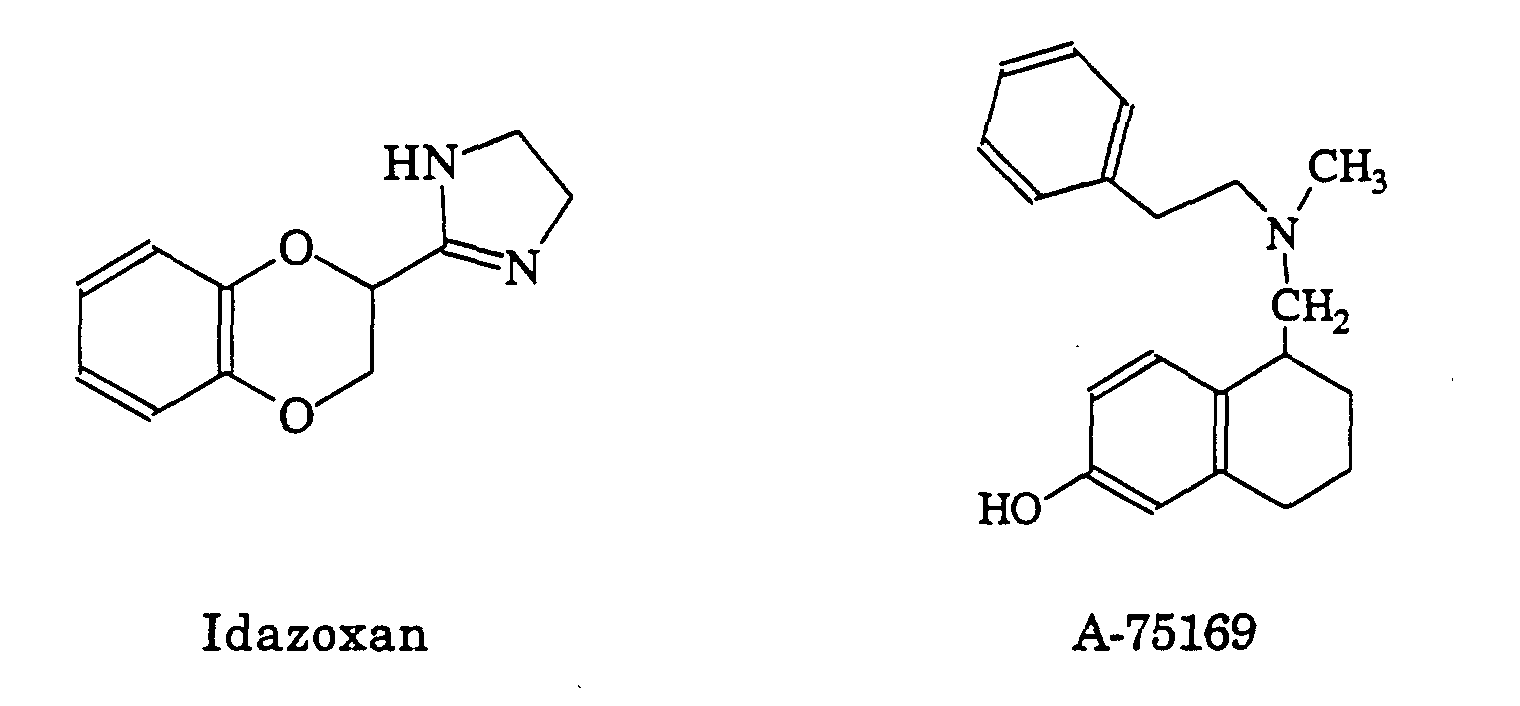
- Idazoxan is classified as a selective α2 antagonist, and has been studied in combination with tyrosine as an antidepressant and in combination with D2 dopamine receptor antagonists as an antipsychotic agent. 1,2,3,4-tetrahydro-6-hydroxy-1-((N-methylamino)-methyl-N-phenylethyl)naphthalene hydrochloride (A-75169) lowers intraocular pressure in mammals.
- The receptor affinity of candidate compounds can be determined by radioligand binding competition studies. Radioligand binding competition studies assess the affinity of a compound by measuring its ability to displace a radioligand of known affinity.
- As described above, an agonist is defined as a compound that binds to and activates a receptor response. An antagonist binds to, but does not activate a response by, the receptor. The measure of activation caused by a bound molecule is said to be its efficacy. Functional experiments are designed to determine whether, after binding, a test compound elicits a biochemical effect, or rather binds without causing the receptor to respond. An antagonist, if of sufficient binding affinity, can be used to block the binding of endogenous molecules in the body which activate a receptor, and thereby prevent its activation. Antagonists can find therapeutic use by blocking the binding of an oversupply of an endogenous receptor activator or the over expression of a receptor effect. Owing to the intricacy of the interactions between a given binding molecule and the conformation and function of the receptor itself, partial agonists and partial antagonists are also known in receptor pharmacology.
- The present invention concerns novel compounds of the formula I,in which: ring A is any of the five alternative multi-cyclic rings shown, R1 is 2-oxazoline, 2-imidazoline or 2-thiazoline and R is hydrogen, straight or branched chain alkyl of 1 to 6 carbon atoms, or straight or branched chain alkenyl of 2 to 6 carbon atoms, a cycloaliphatic ring of 3 to 6 carbon atoms, phenyl optionally mono- or di-substituted with hydroxy, halogen, alkyl of 1 to 3 carbon atoms or alkoxy of 1 to 2 carbon atoms, or methylenedioxyphenyl. In the drawing of chemical structures as shown above, the intersection of two or more lines indicates a carbon atom, a single line indicates a single bond, and a double line a double bond, and a dotted line adjacent a single line indicates either a single or double bond. The chemical nomenclature for the rings shown above from left to right in descending order is norbornane (or bicyclo[2.2.1]heptane); bornane (or 1,7,7-trimethyl-bicyclo[2.2.1]heptane); 7-oxa-bicyclo[2.2.1]heptane; bicyclo[2.2.2]octane and adamantane (or tricyclo[3.3.1.13,7]decane).
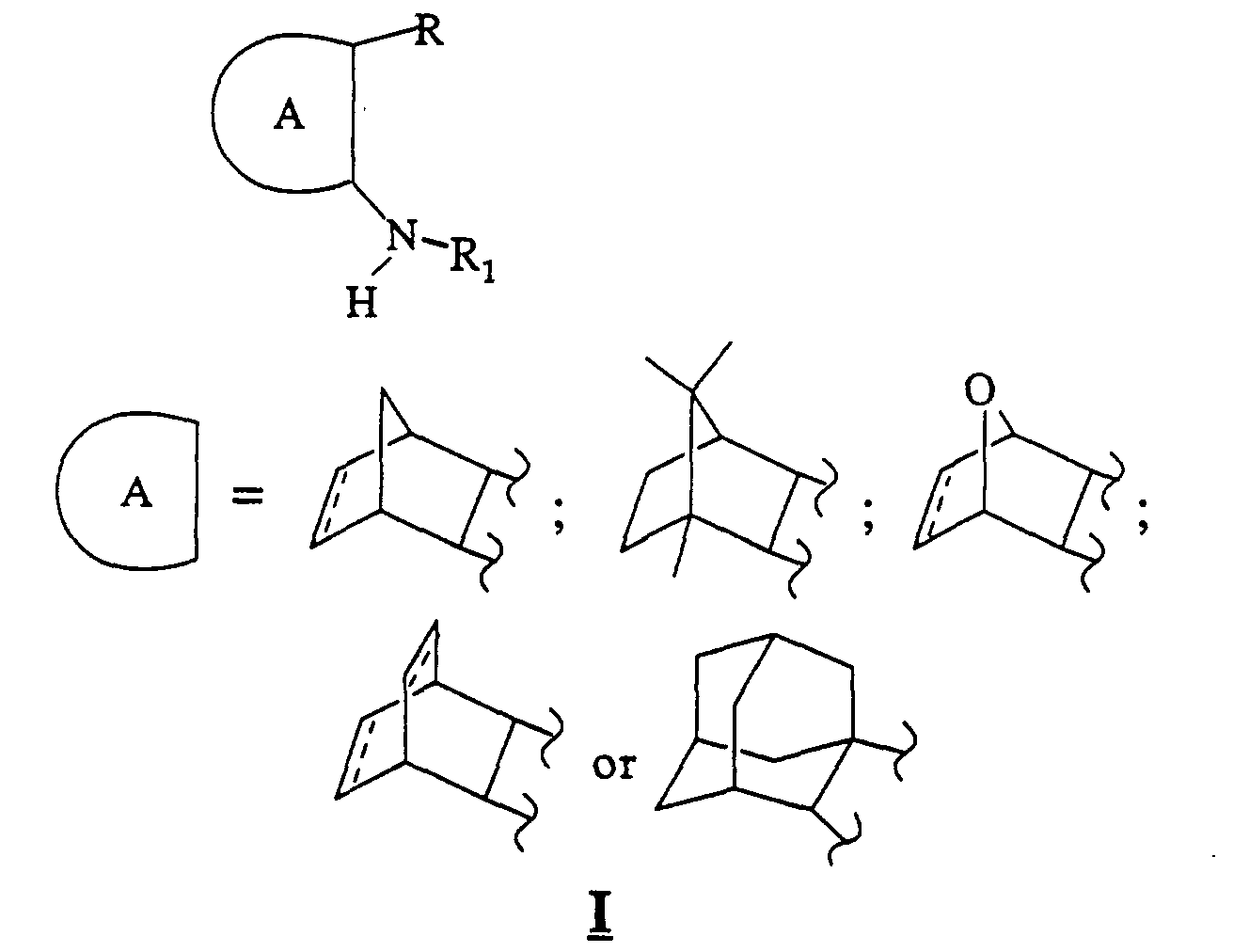
- The wavy lines across a bond indicate that the bond attaches to either the R or 2-amino-heterocyclic moieties. Any stereoisomers and diastereomers which are available by bonding the substituents R and the 2-amino-hetero-azole moieties to the available valences of the above-indicated carbons on the rings are-contemplated by the invention, as well as the pharmaceutically acceptable salts.
- Another aspect of the invention concerns the use of these compounds for blocking or antagonizing α2 receptor function as defined in claims 15 and 19 appended hereto.
- A further aspect of the invention concerns the use of compounds of formula I for protection of nerve cells in the mammalian brain and eye from noxious effects, as defined in claims 16 and 19 appended hereto.
- Other aspects of the invention relate to pharmaceutical compositions containing the compounds of the invention in admixture with one or more pharmaceutically acceptable, non-toxic carriers, and to methods pertaining to their use.
- As used herein:
- The terms "ester" and "amide" refer to and cover any compound falling within the definition of those terms as classically used in organic chemistry.
- The term "alkyl" refers to and includes normal and branched chain alkyl groups as well as cycloalkyl groups. The term "lower alkyl", unless specifically stated otherwise, includes normal alkyl of 1 to 6 carbons, branched-chain alkyl of 3 to 6 carbons and cyclo-groups having 3 to 6 carbon atoms. Similarly, the terms "alkenyl" and "alkynyl" include normal and branched chain as well as cycloalkenyl and alkynyl groups, respectively, having 2 to 6 carbons when the chains are normal, and 3 to 6 carbons when the chains are branched or cyclic.
- The terms endo and exo are used in describing a substituent in spatial relation to its connection to a bridged ring and refer to the position of the substituent as either "inside" or "outside" the ring. For the bicycloheptane compounds, endo refers to a substituent attached to the ring by a bond that points down and below the general plane of the six membered ring, and exo refers to a substituent attached to the ring by a bond that points out from and above the general plane of the six membered ring.
- The terms cis and trans are also used in describing the relative stereochemistry of the substituents of the present invention. Since the carbon atoms at positions 2 and 3 in the norbornane and bicyclo[2.2.2]octane rings are rigidly fixed by the bicyclic ring structure there is no bond rotation or alternative conformation of the ring system. Thus, the bond between carbon atoms 2 and 3 can be likened to a double bond in that respect, and so relative stereochemistry can be described with cis indicating that the substituents are located on the same side of the bond, and trans indicating that the substituents are located in positions opposite one another across the bond.
- Neuroprotection and neuroprotective activity refer to the property of sparing nerve cells in the mammalian eye or brain from injury or death following a noxious action or event. Such noxious actions or events can be ischemia, glutamate-induced excitotoxicity, physical trauma or elevated intraocular pressure. Elevated intraocular pressure with subsequent optic nerve damage occurs very commonly in glaucoma.
- The mechanism by which these compounds manifests the neuroprotective effect is not yet certain. In the case of memantine and its analogs, NMDA receptor blocking activity is thought to protect cells from glutamate-induced excitotoxicity. Certain compounds with imidazoline or oxazoline groups which bind to imidazoline receptors are theorized to have either a direct of remotely induced neuroprotective effect as a result of this binding.
- Pharmaceutically acceptable salts of the compounds of formula I are also within the scope of the present invention. Pharmaceutically acceptable acid addition salts of the compounds of the invention are those formed from acids which provide pharmaceutically acceptable anions, such as the hydrochloride, hydrobromide, hydroiodide, sulfate, bisulfate, phosphate or acid phosphate, acetate, maleate, fumarate, oxalate, lactate, tartrate, citrate, gluconate, saccharate, or p-toluenesulfonate salts. A pharmaceutically acceptable salt may be any salt which retains the activity of the parent compound and does not impart any deleterious or untoward effect on the subject to which it is administered and by the context in which it is administered.
- In a method of using the compounds of formula I in neuroprotection, pharmaceutically effective amounts of a protective agent can be administered alone to treat nerve injury or to prevent nerve cell death. The most effective mode of administration and dosage regimen of protective agent will depend on the type of disease to be treated, the severity and course of that disease, previous therapy, the patient's health status, and response to the drug and the judgment of the treating physician. Generally, the neuroprotective agent should be administered in a dose to achieve a serum or intravitreal concentration of 0.01 nM to 50 nM. Preferably the neuroprotective agent is administered prior to injury to the nerve, but can be administered injury has occurred with lessened effect.
- Conventional modes of administration and standard dosage regimens of known neuroprotective agents, e.g. MK-801, can be used. Optimal dosages for co-administration of a drug, e.g. an IOP-lowering drug, with a neuroprotective agent can be determined using methods known in the art. Dosages of neuroprotective agents may be adjusted to the individual patient based on the dosage of the drug with which the agent is co-administered and the response of the patient to the treatment regimen. The protective agent may be administered to the patient at one time or over a series of treatments.
- An agent that cannot pass the blood/brain barrier, e.g. MK-801, may be administered locally, e.g. intravitreally by intrabulbar injection, or intrathecally. Agents which are capable of crossing the blood/brain barrier, e.g. a highly lipophilic molecule, can be administered systemically, e.g., orally, or intravenously, or by injection.
- The composition used in these therapies may also be in a variety of forms. These include, for example, solid, semi-solid, and liquid dosage forms, such as tablets, pills, powders, liquid solution or suspension, liposomes, suppositories, injectable and infusible solutions. The compositions also preferably include conventional pharmaceutically acceptable carriers which are known those of skill in the art.
- Organic amine salts may be made with amines, particularly ammonium salts such as mono-, di- and trialkyl amines or ethanol amines. Salts may also be formed with caffeine, tromethamine, and similar molecules. Where there is a nitrogen sufficiently basic as to be capable of forming acid addition salts such may be formed with any inorganic or organic acids or alkylating agent such as methyl iodide. Any of a number of simple organic acids such as mono-, di-, or tri-acid may also be used. A pharmaceutically acceptable salt may be prepared for any compound of the invention having a functionality capable of forming such a salt, e.g., an acid salt of an amine functionality.
- The compounds of formula I wherein R1 is 2-oxazoline, 2-imidazoline or 2-thiazoline and pharmaceutically acceptable acid addition salts thereof have been found to possess valuable pharmacologic properties in the central nervous system and, in particular, have been shown to block (antagonize) α2 receptors in standard laboratory tests. Accordingly, these compounds and pharmaceutically acceptable compositions containing them are useful in reduction or maintenance of the intraocular pressure in at least one eye of a mammal and in regulation of other physiologic phenomena related to α2 receptors. Such physiologic activities include for example: alleviation, prevention or inhibition of depression in mammals; reduction in the severity of diabetes; alleviation of male impotence; and stimulation of weight loss.
- In applying the compounds of the invention to treatment of diseases or disorders of the eye which are associated with an abnormally high intraocular pressure, administration may be achieved by any pharmaceutically acceptable mode of administration which provides adequate local concentrations to provide the desired response. These include direct administration to the eye via drops and controlled release inserts or implants, as well as systemic administration as described below.
- Drops and solutions applied directly to the eye are typically sterilized aqueous solutions containing 0.001% to 10%, most preferably 0.005% to 1% of the active ingredient, along with suitable buffer, stabilizer, and preservative. The total concentration of solutes should be such that, if possible, the resultant solution is isotonic with the lachrymal fluid and has a pH in the range of 6-8. Typical sterilizing agents are thimerosal, chlorobutanol, phenyl mercuric nitrate and benzalkonium chloride. Typical buffers are, for example, citrate, phosphate, borate or tromethamine; suitable stabilizers include glycerin and polysorbate 80. The aqueous solutions are formulated by simply dissolving the solutes in a suitable quantity of water, adjusting the pH with suitable acid or base to a pH of about 6.8 to 8, making a final volume adjustment with additional water and sterilizing the resultant solution.
- The dosage level of the resulting composition will, of course, depend on the concentration of the drops, the condition of the subject and the individual magnitude of response to treatment. However, a typical ocular composition could be administered at the rate of about 2 to 10 drops per day per eye of a 0.1% solution of active ingredient.
- The compounds of the present invention , when administered for conditions which are regulated by the central nervous system (CNS), can be by any of the accepted modes of administration for agents which relieve depression or affect the CNS including oral, parenteral, rectal, and otherwise systemic routes of administration. Any pharmaceutically acceptable mode of administration can be used, including solid, semi-solid, or liquid dosage forms, such as for example, tablets, suppositories, pills, capsules, powders, liquids suspensions, or the like, preferably in unit dosage form suitable to single administration of precise dosages, or in sustained or controlled release forms for the prolonged administration of the compound at a predetermined rate. The compositions will typically include a conventional pharmaceutical carrier or excipient and an active compound of formula I or the pharmaceutically acceptable salts thereof and, in addition, may include other medicinal agents, pharmaceutical agents, carriers, adjuvants, etc.
- The amount of active compound administered will course be dependent of the subject being treated, the severity of the affliction, the manner of administration and the judgment of the prescribing physician. However, an effective dosage is in the range of 0.01 - 1 mg/kg/day, preferably 0.1 - 0.5 mg/kg/day. For an average human of about 70 kg, this would amount to 0.7 - 70 mg/day.
- For solid compositions, conventional non-toxic carriers include, for example mannitol, lactose, starch, magnesium stearate, sodium saccharin, talcum, cellulose, glucose, sucrose, magnesium carbonate, and the like may be used. The active compound as defined above may be formulated as suppositories using, for example, polyalkylene glycols, for example, propylene glycol as a carrier. Liquid pharmaceutically administerable compositions can, for example, be prepared by dissolving, dispersing, etc. an active compound as defined above and optional pharmaceutical adjuvants in a carrier, such as , for example, water, saline, aqueous dextrose, glycerol, ethanol, and the like to thereby form a solution or suspension. If desired, the pharmaceutical composition to be administered may also contain minor amounts of non toxic auxiliary pH buffering agents and the like, for example, sodium acetate, sorbitan monolaurate, triethanolamine oleate, etc. Actual methods of preparing such dosage forms are known, or will be apparent. to those skilled in this art; for example, see Remington's Pharmaceutical Sciences, Mack Publishing Company, Easton, Pa., 15th Edition, 1975.
- The composition or formulation to be administered will, in any event, contain a quantity of the active compound in an amount effective to alleviate the symptoms of the subject being treated.
- Dosage forms or composition containing active ingredient of formula I or its salts in the range of 0.25 to 95% with the balance made up from non-toxic carrier may be prepared.
- For oral administration, a pharmaceutically acceptable non-toxic composition is formed by the incorporation of any of the normally employed excipients, and may contain 1% - 95% active ingredient, preferably 5% - 50%.
- Parenteral administration is generally characterized by injection, whether subcutaneously, intramuscularly, or intravenously. Injectables can be prepared in conventional forms, either as liquid solutions or suspension, solid forms suitable for solution or suspension in liquid prior to injection, or as emulsions. Suitable excipients include, for example, water, saline, aqueous dextrose, glycerol, ethanol or the like. In addition, if desired, the pharmaceutical compositions may also contain minor amounts of non-toxic substances such as wetting or emulsifying agents, auxiliary pH buffering agents and the like, for example, sodium acetate, sorbitan monolaurate, triethanolamine oleate, etc.
- The percentage of active compound contained in such parenteral compositions is highly dependent on the specific nature thereof, as well as the activity of the compound and the needs of the subject. However, percentages of active ingredient of 0.1% to 10% in solution are employable, and will be higher if the composition is a solid which will be subsequently diluted to the above percentages. Preferably the composition will comprise 0.2-2% of the active agent in solution.
- Among the family of compounds of the present invention, a preferred group includes compounds of formula I wherein X is oxygen, i.e. compounds where the oxazoline ring constitutes the heterocycle.
- A second preferred group of compounds of the invention are those that incorporate the bicyclo[2.2.1]heptane group in their structure as the ring A group.
- Within either of the two preceding preferred groups, a still more preferred embodiment is of compounds which have a hydrogen atom or an aromatic group at the position represented by R.
- As illustrated by Scheme I below, treatment of an alkynyl acid with diazomethane in ether afforded the corresponding ester. The ester and cyclopentadiene were warmed at 175° C for 40 hours to form the cycloadduct. This adduct was unstable to SiO2 chromatography and was best purified using a Kugelrohr distillation.The double bonds in the cycloadduct were immediately saturated by treatment with H2 and Pd/C at one atmosphere. Conversion of the ester into an amine was accomplished by conversion to the carboxylic acid followed by a Curtius reaction. Thus, the acid was activated by treatment with isobutylchloroformate. The acyl azide was formed by treatment with sodium azide. Elimination of nitrogen and formation of a benzyl carbamate occurred when the azide was warmed in toluene in the presence of benzyl alcohol. The amine was liberated upon treatment with H2 and Pd/C at one atmosphere. Oxazoline synthesis was accomplished under standard conditions: treatment first with chloroethylisocyanate and then aqueous NaHCO3 solution.

- Preparation of β-nitrostyrene was accomplished according to the Organic Syntheses method. Treatment of a methanol solution of benzaldehyde with nitromethane (100 mol.-%) in the presence of sodium hydroxide (105 mol.-%) afforded the nitro alcohol. Dehydration of the alcohol was effected by treatment with aqueous hydrochloric acid (5M).
The nitrostyrene of 3,4-dihydroxybenzaldehyde was obtained by treating piperonal (3,4-methylenedioxybenzaldehyde) in a similar fashion to that reported for β-nitrostyrene. The acetal proved stable to the aqueous acid required for dehydration. - Construction of the bicyclo[2.2.1]heptane skeleton was carried out in two steps. The Diels-Alder reaction was conducted by warming the nitrostyrene with cyclopentadiene (110 mol.-%) neat (β-nitrostyrene is a low melting material) or in 1,2-dichloroethane (1M in nitroolefin). The Diels-Alder reaction proceeds in approximately a 3:1 endo nitro: exo nitro ratio. Both the ratio and relative stereochemistry was demonstrated through X-ray analysis. Reduction of both the nitro group and the olefin was carried under an atmosphere of hydrogen in the presence of 10 weight-% palladium on charcoal (10%). Separation of isomers was conveniently carried out at this stage using flash chromatography.
- Oxazoline synthesis was conducted under standard conditions. The amine was first converted to the chloroethylurea by treatment with chloroethylisocyanate. Warming the chloroethylurea in the presence of sodium bicarbonate afforded the oxazolines. This effort is summarized in Scheme II. Thiazolines and imidazolines were also prepared under standard conditions. Treatment of amines with chloroethylisothiocyanate affords thiazolines directly while treatment with imidazoline-2-sulfonic acid affords the corresponding imidazolines in a single step.
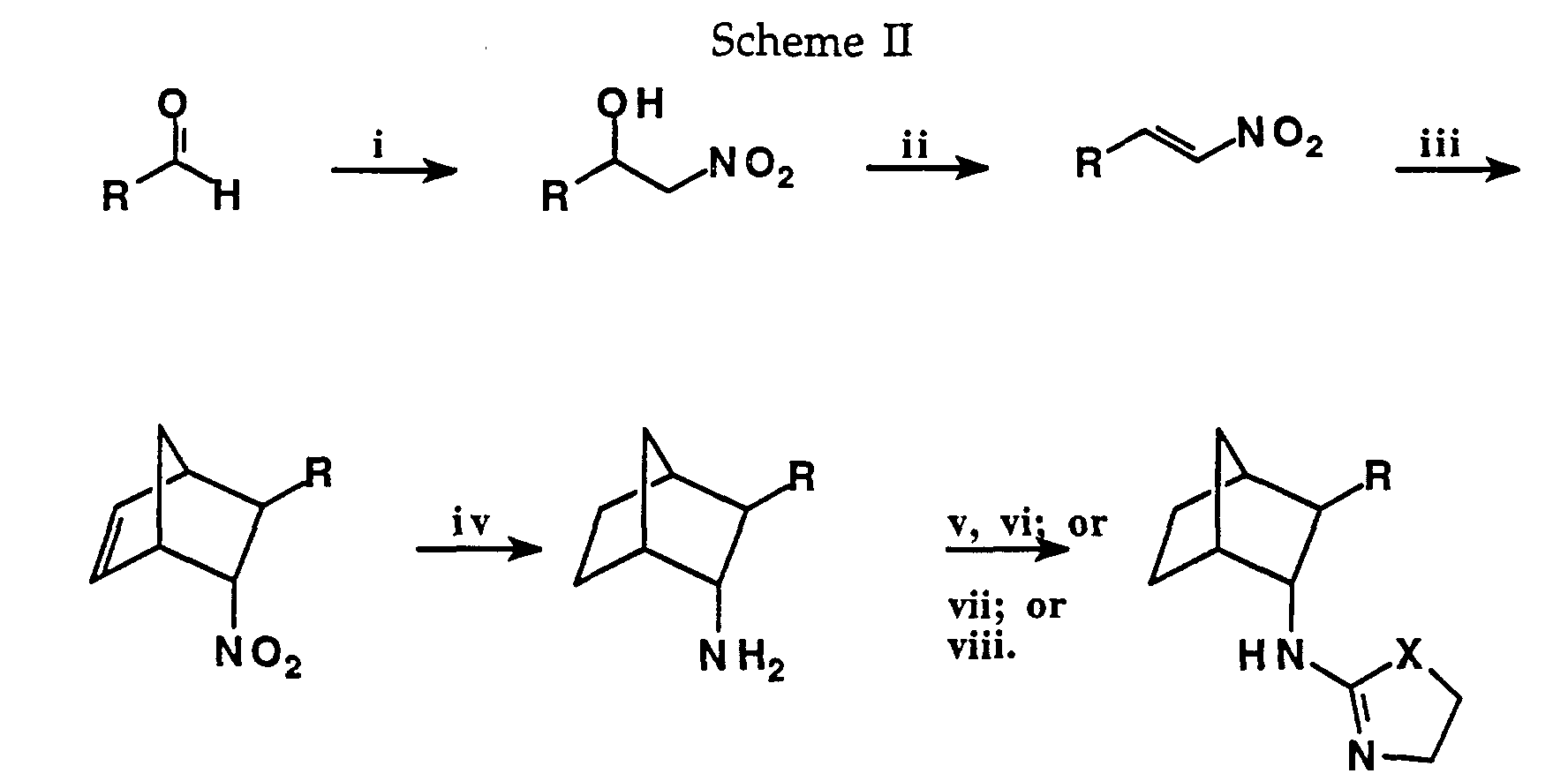
- Reagents and Conditions: i. CH3NO2, KOH, MeOH; ii. HCl; iii. cyclopentadiene, neat or 1M in dichloroethane; iv. H2, 10 Pd on C; v. chloroethylisocyanate; vi. NaHCO3 [X = O]; vii. chloroethylisothiocyanate [X = S]; viii. imidazoline-2-sulfonic acid [X = NH].
- Synthesis of oxabicyclo[2.2.1]heptane derivatives of the present invention can also be prepared by Diels Alder reactions following means well known in the art. Grieco, Zelle, Lis and Finn in Journal of the American Chemical Society, 105, 1403-4 (1985) report means of making suitably derivatized oxabicyclo[2.2.1]heptane and oxabicyclo[2.2.1]heptene compounds which can be elaborated into compounds of the present invention. This can be accomplished by the synthetic steps which follow the Diels Alder cycloaddition in Scheme 1 using the 2-carbomethoxy-bicyclo[2.2.1]hept-2-ene intermediate of the reference, or if the nitro functionality of other of the Grieco et al. compounds are employed , according to the steps iv, v, vi (or vii or viii) in Scheme 2. Another journal article by Jarvest and Readshaw disclose advantageous conditions for Diels-Alder cyclization of derivatized furans and cyanoacrylate to yield 2-cyano-5-substituted-bicyclo[2.2.1]heptanes. These articles are incorporated by reference herein in their entirety.
- The invention is further illustrated by the following non-limiting examples which are illustrative of a specific mode of practicing the invention and are not intended as limiting the scope of the appended claims.
- Pentanal (49.6 ml, 464 mmol) was stirred in a solution of nitromethane (276 ml, 5108 mmol). To the reaction methanolic KOH (3N) was added dropwise to pH 8. The reaction was stirred at room temperature overnight. The solution contained trace amounts of insoluble dark brown material. The solution was washed with H20 and extracted into dichloromethane; concentration of the solvent gave clean product (II) in 96% yield, (56.58g).
- The nitroalcohol (1) (2.0 g, 13.6 mmol) was dissolved in dichloromethane and treated at 0°C for 30 minutes by dropwise addition with methanesulfonyl chloride (1.6 g, 13.6 mmol). Triethylamine (2.75 g, 27.2 mmol) was then added dropwise and stirred for an additional hour at 0°C. The product was washed with 1M H3PO4 and then with saturated NaHCO3 and extracted with dichloromethane. Concentration of the solvent gave the olefin in 80% yield (3.03g).
- The nitroolefin (2) (3.00 g, 19.3 mmol) was dissolved in 20 mL of dichloromethane and then freshly cracked cyclopentadiene (6.49, 96.6 mmol) was added and bubbled with argon for 15 minutes. This was added to a sealable tube and once sealed was placed in an oil bath at 90°C overnight. The reaction went to completion. Excess cyclopentadiene was removed by Kugelrohr distillation. The resultant product was obtained in 60% yield (3.53g).
- The cycloadduct (3) (2.53g, 13.0 mmol) was dissolved in methanol (25 ml) and bubbled with Ar. To this was added 10% palladium on carbon (500 mg). This vessel containing this mixture was put on a Parr apparatus for hydrogenation at 50 psi overnight. The reduced material was filtered through celite and the solvent was concentrated. The residue was dissolved in 1M H3PO4 and washed with dichloromethane. The aqueous layer was basified with 25% NaOH to a pH of ca. 13. This was extracted with dichloromethane three times. The organic layers were combined and concentrated to give the product in 86% yield (1.86g).
- The amine (4) (200 mg, 1.20 mmol) was dissolved in THF (5 ml). To this was added chloroethylisocyanate (0.122 ml, 1.40 mmol) dropwise and stirred at room temperature for two hours. The reaction mixture was poured into 1M H3PO4 and ice (1:1) to quench the reaction. This was then extracted with dichloromethane and concentrated to give the urea. The urea was treated with methanol (6 ml), water (6 ml) and NaHCO3 (202 mg, 2.4 mmol). This mixture was refluxed at 80°C for 2 hours. The reaction was quenched with saturated NaHCO3 and extracted with dichloromethane. The organic layers were combined and concentrated to give desired product (270 mg). Column chromatography with 5% MeOH saturated with NH3 in dichloromethane gave the desired product in 60% yield (155 mg).
1H NMR(CDCl3): 0.70-1.70(M,16H), 1.9(d, 1H), 2.5(5, 1H), 3.4(S1H) 3.75(t,2H), 4.1(5,1H), 4.25(t,2H).Elemental analysis theoretical - C 71.14% H 10.23% N 11.86% found - C 70.8% H 10.20% N 11.60% - The amine (4) (200 mg, 1.20 mmol) in THF (5 ml) was treated with chloroethylisothiocyanate dropwise at 0°C for 3 hours. The reaction mixture was poured into 1M H3PO4. The aqueous layer was extracted with dichloromethane and then basified with 25% NaOH to pH 13. The aqueous layer was then extracted with dichloromethane three times. The organic layers were combined and concentrated to give the product in 11.6% yield (35 mg).
1H NMR (CDCl3): 0.85 (t, 3H), 1.1-1.7(M, 13H), 1.95 (d,1H), 2.5 (S, 1H) 3.3 (t,2H), 3.5 (S,1H), 4.0 (t, 2H)
13C NMR C (CD3OD): δ 14.0, 21.0, 23.0, 30.0, 30.5, 35.0, 35.2, 35.3, 40.5, 41.5, 51.5, 64.0.Elemental analysis theoretical - C 66.63% H 9.59% N 11.10% found - C 66.40% H 9.52% N 11.0% - An acetonitrile (2.4 ml) suspension of the amine (4) (200 mg, 1.20 mmol) with triethylamine (0.184 ml, 1.32 mmol) and then with imidazoline-2-sulfonic acid (198 mg, 1.32 mmol). The solution was refluxed for 2 hours. Aqueous workup with 1 M H3PO4 and then basifying aqueous layer to pH 13 and extraction with dichloromethane gave the desired product. The HCl salt was prepared from HCl/ether in methanol which gave a yield of 20% (60 mg).
1H NMR (CDCl3): 0.70-1.70 (M, 16H), 2.0 (d, 1H), 2.6 (S,1H), 3.4(S,1H) 3.65(S,4H)
13C NMR (CHCl3): δ 22.9, 27.8, 27.89, 28.05, 31.83, 32.29, 33.41, 37.34, 39.89, 42.53, 42.89, 44.06, 44.54, 57.9, 61.6, 95.6, 161.02. - Methyl pent-2-yn-oate (5.3 g, 126.16 mmol) was dissolved in toluene (30 ml) and placed in a sealable tube. To this was added freshly cracked cyclopentadiene. The tube was sealed and placed in a oil bath at 168°C for 42 hours. The excess cyclopentadiene was removed by Kugelrohr distillation. The product was isolated in 70.3% yield (5.26 g).
- The cycloadduct (6) (5.26 g, 29.5 mmol) was dissolved in MeOH (60 ml) and bubbled with Ar, and to the solution was added 10% palladium on carbon (500 mg). The reaction vessel containing this mixture was put on a Parr apparatus for hydrogenation at 50 psi overnight. The reduced material was filtered through celite and solvent concentrated. The residue was dissolved in 1M H3PO4 and washed with dichloromethane. The aqueous layer was basified with 25% NaOH to ca. pH 13. This was extracted with dichloromethane three times. The organic layers were combined and concentrated to give product in 81% yield (4.7 g).
- The ester (3) (2.0 g, 10.2 mmol) was dissolved in a MeOH/THF (30 ml/20 ml) solution. This was treated with 2N LiOH (10.2 ml, 20.4 mmol) in H2O at 100°C and refluxed. The reaction was concentrated to a paste and dissolved in 40 ml H2O and washed twice with dichloromethane. The organic layers were combined and concentrated to give the corresponding acid. This acid was dissolved in acetone (20 ml), and triethylamine (3.06 ml, 22.1 mmol) was added dropwise. Next ethylchloroformate was added dropwise (2 ml, 20.9 mmol) at 0°C. The reaction was stirred for 1 hour. NaN3 (676 mg, 10.4 mmol) was added in portions at 0°C for an additional hour. The reaction was partitioned between ice water and dichloromethane. The organic layers were combined and concentrated to give the acyl azide. This was then treated with benzyl alcohol (995 mg, 9.2 mmol) in toluene and refluxed at 110°C for 30 minutes. The reaction was washed with H2O and extracted in dichloromethane. Concentration of solvent gave the benzyl carbamate. The carbamate was reduced in the same manner as before with 10% palladium on carbon. The product was obtained in an overall yield of 45% (550 mg).
NMR H1(CDCl3): 0..8(t, 3H), 1.0-1.6(m, 9H), 1.8 (s,1H), 2.2 (s,1H), 4.7(s,1H), 5.3(s,2H) - The bicyclic amine (8) was treated as in the procedure outlined for the preparation of the trans compound (5A) above.
1H-NMR (CDCl3): 0.8(t, 3H), 1.00-2.00(m, 9H), 2.1(s,1H), 2.5(s,1H), 3.9(s,1H), 3.8(t, 2H), 4.2(t, 2H).
13C NMR (CDCl3): δ 14.5, 20.8, 25.5, 28.2, 38.2, 40.3, 44.7, 54.42, 55.05, 64.3, 69.2.Analysis calculated for C12H20N2O C 69.09, H 9.68, N 13.45 Found C 68.6, H 9.24, N 13.45. - can be prepared by substituting the bicyclic amine (8) for (4) in the preparation of 5B above.
- Likewise, 9C can be prepared by substituting the bicyclic amine (8) for (4) in the preparation of 5C above.
- To a THF solution of the amine (250 mg, 1.63 mmol) at 0° C was added chloroethylisocyanate (189 mg, 1.79 mmol) dropwise. The reaction was allowd to warm to r.t. and after stirring for one hr., all starting material was consumed. The reaction mixture was poured into 1M H3PO4 and extracted three times with methylene chloride. After drying, the solution was concentrated and the resulting solid was warmed in aqueous methanolic NaHCO3. The reaction was extracted from 0.5N NaOH and dried (Na2SO4), concentrated and chromatographed over 250-400 mesh silica using 5% ammonia saturated methanol in CH2Cl2 as eluent. Yield: 206 mg (60%).
13C NMR (CDCl3) 161.7, 67.6, 57.8, 52.9, 49.2, 48.0, 44.8, 38.4, 28.3, 27.6, 19.9, 18.7, 13.7
1H NMR (CDCl3) 4.24 (2H, m); 3.80 (3H, m); 2.38 (1H, m); 1.87-1.1 (6H, env, m); 0.93 (3H, s); 0.87 (3H, s); 0.86 (3H, s) - In a similar manner to Example 10, commercially available bicyclo[2.2.2]octane amine and adamantylamine can be used to prepare the 2-bicyclo[2.2.2]octane-aminooxazoline and adamantylaminooxazoline compounds, respectively.
- Tissue preparation: Membrane suspensions were prepared from human cerebral cortex (HCC) obtained from the UCI Organ and Tissue Bank and rat kidney cortex (RKC). Briefly, tissues (1g) were homogenized in 25 mls of iced-cold 5 mM tris, pH 7.4 with a Polytron homogenizer for 30 secs at setting # 7, and centrifuged for 10-12 minutes at 300 x g at 4°C. The supernatant was filtered through 2 layers of gauze and diluted 1: 2 with 50 mM Tris-HCl buffer, pH 7.4, then centrifuged at 49,000 x g for 20 minutes. The pellet fraction was washed 3 times (resuspended in Tris-HCl buffer and centrifuged for 20 minutes at 49,000 x g). The pellet was then stored at -80°C until the binding assay.
- Cell preparation: HT-29 and chinese hamster ovary (CHO) cells expressing the human α2A (CHO-C10) receptor and CHO cells (CHO-RNG) expressing the rat α2B adrenoceptor were grown to near confluency in Dulbecco's modified Eagle's medium supplemented with 10% fetal bovine serum using standard cell culture methods. Cells were harvested by scraping and placed into cold buffer of the following composition: 50 mM Tris-HCl, 5 mM EDTA, pH 7.4). Cells were then homogenized with a Polytron homogenizer for 2 X 10 secs at setting # 7, and centrifuged for 20 minutes at 49,000 x g. The pellet fraction was washed (resuspended in Tris-HCl, pH 8 buffer and centrifuged for 15-20 minutes at 49,000 x g) 2 times and stored at -100°C until binding assay.
- Binding studies: The radioligands [3H]rauwolscine (specific activity 80 Ci/mmol) and [3H]prazosin (specific activity 76 Ci/mmol) were obtained from New England Nuclear, Boston, MA. Frozen membrane pellet was resuspended in 25 mM glycine / glycine, pH 7.4 and incubated with radioligand under the following conditions: CHO-C10, CHO-RNG, HT-29 - [3H]rauwolscine, 22 °C, 30 minutes; RKC-[3H]rauwolscine, 0 °C, 120 minutes; and, HCC-[3H]prazosin, 22 °C, 30 minutes in a final volume of 500 µL. At the end of the incubation period, the samples were filtered through glass fiber filters (Whatman GF/B) in a 96 well cell harvester and rapidly washed four times with 4 mL of iced-cold 50 mM Tris-HCl buffer. The filters were then oven dried and transferred to scintillation vials containing 5 mL of Beckman's Ready Protein® scintillation cocktail for counting. Specific binding defined by 10 µM phentolamine for competition studies were as follows: 0.3 nM [3H]rauwolscine - CHO-C10 99%; 0.4 nM [3H]rauwolscine - CHO-RNG 99%; 0.7 nM [3H]rauwolscine - HT-29 90%; 1 nM [3H]rauwolscine - RKC 92 %, and 0.3 nM [3H]prazosin - HCC 87%. Protein concentrations were determined with a protein assay kit from Bio Rad. Binding isotherms, equilibrium dissociation and affinity constants were analyzed and determined by the non-linear least squares curve fitting programs AccuFit Competition / Saturation by Beckman.
- Binding studies: The radioligands [3H]rauwolscine (specific activity 80 Ci/mmol), [3H]prazosin (specific activity 76 Ci/mmol) and [3H]brimonidine (UK-14,304; specific activity 63 Ci/mmol) were obtained from New England Nuclear, Boston, MA. Frozen membrane pellet was resuspended in either 50 mM tris, 2 mM EGTA, 1 mM MgCl2, pH 7.5 (RbKC, RbICB-[3H]brimonidine); 50 mM tris, 0.5 mM EDTA, 5 mM NaCl, pH 7.7 (RbICB-[3H]rauwolscine); 25 mM glycine/glycine, pH 7.4 (RtKC, CHO-C10, CHO-RNG, HT-29, HCC) or 50 mM tris, 0.1 mM MnCl2, pH 7.7 (RtCC). Membrane protein homogenate (75 - 200 µg) was incubated with radioligand under the following conditions: RbKC and RbICB-[3H]rauwolscine, 22 °C, 45 minutes; RtCC and RbICB-[3H]brimondine, 22 °C, 90 minutes; CHO-C10, CHO-RNG and HT-29-[3H]rauwolscine, 22 °C, 30 minutes; HCC-[3H]prazosin, 22 °C, 30 minutes; and , in a final volume of 250 or 500 µL. At the end of the incubation period, the samples were filtered through glass fiber filters (Whatman GF/B) in a 24 or 96 well cell harvester and rapidly washed four times with 4 mL of iced-cold 50 mM Tris-HCl buffer. The filters were then oven dried and transferred to scintillation vials containing 10 mL of Beckman's Ready Protein® scintillation cocktail for counting. Specific binding defined by 10 µM phentolamine for competition studies were as follows: 2.4 nM [3H]brimonidine-RbICB 62 %; 2.4 nM [3H]rauwolscine-RbICB 75 %; 2 nM [3H]rauwolscine-RbKC 88 %;; 0.3 nM [3H]rauwolscine-CHO-C10 99%; 0.4 nM [3H]rauwolscine-CHO-RNG 99%,, 0.3 nM [3H]prazosin 87%; and 1 nM [3H]rauwolscine-RtCC 90%. Protein concentrations were determined with a protein assay kit from Bio Rad. Binding isotherms, equilibrium dissociation and affinity constants were analyzed and determined by the non-linear least squares curve fitting programs EBDA (BioSoft) or AccuFit Competition / Saturation by Beckman.
- Cell preparation: Chinese hamster ovary (CHO) cells expressing the human α2A (CHO-C10) and the rat α2B (CHO-RNG) adrenoceptors were grown to near confluency in Dulbecco's modified Eagle's medium supplemented with 10% fetal bovine serum using standard cell culture methods. Cells were harvested by scraping and placed into cold buffer of the following composition: 50 mM Tris-HCl, 5 mM EDTA, pH 7.4). Cells were then homogenize with a Polytron homogenizer for 2 X 10 sec at setting #7, and centrifuged for 20 minutes at 49,000 x g. The pellet fraction was washed (resuspended in Tris-HCl, pH 8 buffer and centrifuged for 15-20 minutes at 49,000 x g) 2 times and stored at -100°C until binding assay.
- The radioligands [3H]rauwolscine (specific activity 80 Ci/mmol) and [3H]prazosin (specific activity 76 Ci/mmol) were obtained from New England Nuclear, Boston, MA. Frozen membrane pellet was resuspended in 25 mM glycine/glycine, pH 7.4 and incubated with radioligand under the following conditions: CHO-C10, CHO-RNG-[3H]rauwolscine, 22 °C, 30 minutes; and, HCC-[3H]prazosin, 22 °C, 30 minutes in a final volume of 500 µL. At the end of the incubation period, the samples were filtered through glass fiber filters (Whatman GF/B) in a 96 well cell harvester and rapidly washed four times with 4 mL of iced-cold 50 mM Tris-HCl buffer. The filters were then oven dried and transferred to scintillation vials containing 5 mL of Beckman's Ready Protein® scintillation cocktail for counting. Specific binding defined by 10 µM phentolamine for competition studies were as follows: 0.3 nM [3H]rauwolscine-CHO-C10 99%; 0.4 nM [3H]rauwolscine-CHO-RNG 99%, and 0.3 nM [3H]prazosin - HCC 87%. Protein concentrations were determined with a protein assay kit from Bio Rad. Binding isotherms, equilibrium dissociation and affinity constants were analyzed and determined by the non-linear least squares curve fitting programs AccuFit Competition/Saturation by Beckman.
- Vas Deferens: The prostatic ends of the vas deferens (2-3 cm) were removed from albino rabbits and mounted between platinum electrodes in 9 ml organ baths containing Krebs-Hensleit solution of the following composition (mM): NaCl 119, KCl 4.7, MgSO4 1.5, KH2PO4 1.2. CaCl2 2.5, NaHCO3 25 and glucose 11. This solution was maintained at 35° C and bubbled with 95% O2 and 5% CO2. The tissue was equilibrated at 0.5 g tension for 30 minutes. The vas deferens strips were then field stimulated at 0.1 Hz, 2 msec, 90 mA using a square wave stimulator (World Precision Instruments A310 Accupulser / A385 Stimulus Isolater), or a Grass S48 stimulator at 0.1 Hz, 2 msec, 70 volts. After 30 minutes of electrical stimulation, cumulative concentration-response curves in 0.25 log units were obtained with a 4 minute contact time for each concentration. Each tissue was used to evaluate only one drug. Tissue contractions produced by the field stimulation were measured isometrically using Grass FT-.03 force-displacement transducers and recorded on a Grass Model 7D physiograph. The reduction in electrically-evoked peak height by the drugs was measured and expressed as a percentage of the pre-drug peak height. The IC50 was determined as the concentration which produced a 50% reduction in peak height.
- Fresh bovine brain stems were obtained from a local slaughter house. After removal of pia-arachnoid, the medulla was isolated by dissecting the brain stem about 1 cm posterior and 1 cm caudal to the obex. The ventral quadrants of the medulla excluding the pyramids were used as the VLM. For each preparation, 30 to 40 VLM were used. Initial homogenization was performed in 20 volumes of 5 mM HEPES buffer (pH 7.4 at 4°C) containing 250 mM sucrose, 50 uM Calpain I inhibitor (Boehginer Mannheim, Indianapolis, IN), 100 uM 1,10-phenanthroline (Sigma, St. Louis, MO) and 50 uM Pefabloc (Boehginer Mannheim, Indianapolis, IN), using Virtis homogenizer at setting 7 with three 10 second pulses, followed by three passes in a teflon-glass tissue homogenizer. The inhibitors were added to prevent degradation by proteases and peptidases. The homogenates were then centrifuged at 1000xg for 10 min and the resulting pellets were re-homogenized and centrifuged. Supernatants resulted from both runs were combined and centrifuged for 20 min at 48000xg. The pellets obtained were resuspended in a teflon-glass homogenizer in 50 mM Tris-HCl with 5 mM EDTA (pH 7.7 at 4°C), centrifuged, and resuspended in 50 mM Tris-HCl with 25 mM NaCl, pH 7.7 at room temp. To remove endogenous ligands, the homogenate was incubated 30 min at room temp before it was centrifuged for 20 min at 48000xg. The pellets were then washed with 50 mM Tris-HCl buffer, (pH 7.4 at 4°C) and loaded on top of 5 mM HEPES/0.85 M sucrose (pH 7.4 at 4°C). Pellets obtained after centrifugation at 48000xg for 20 min were saved. The fatty connective tissue on the top layer was discarded. The partially purified VLM membrane pellets were then washed twice with 50 mM Tris-HCl, pH 7.7 at 4°C, flash frozen in dry ice/acetone slush, and stored at -100°C until use. Receptor binding experiments were performed within days after the membrane preparation.
- I1 imidazoline receptor binding affinity was determined from radioligand binding of 3H-clonidine (NEN, Boston, MA) to bovine VLM membranes. Specific activity of 3H-clonidine was 43 Ci/mmol. Kd of 3H-clonidine binding to the I1 imidazoline receptor was determined by saturation experiments and Ki of other ligands studied were determined by competition experiments. The radioligand binding assay was performed in Teflon 96-wells with the Biomek-1000 robotics (Beckman Instruments, Fullerton, CA). Each well contained 4 nM 3H-Clonidine and 0.3 to 0.5 mg of bovine VLM protein in 5 mM HEPES buffer containing 0.5 mM EGTA and 0.5 mM MgCl2, pH 7.4 (0.1 mM ascorbic acid was added just before the protein). After 50 min of incubation at 25°C, the reaction was terminated by rapid filtration over Whatman GF/B filters treated with 0.1% polyethyleneimine and washed with 12 ml ice cold 50 mM Tris-HCl, pH 7.4 at 4°C in a Brandel Harvester (Brandel, Gaithersburg, MD). Both 'hot' and 'cold' saturation experiments were performed. In 'hot' saturation experiments, studies were performed with 3H-clonidine ranging from 0.1 to 50 nM. In 'cold' saturation experiments, studies were performed with 2 nM 3H-clonidine with 20 different concentrations of the unlabeled clonidine, ranging from 0.1 nM to 1 uM unlabeled clonidine. Non specific binding was defined by parallel incubations containing 10-5 M phentolamine or naphazoline. Imidazoline binding was determined by parallel incubations in which the alpha-adrenergic sites were masked with 10-5 M norepinephrine. During competition experiments, ligands of 20 concentrations ranged from 10-11 to 10-4 were used. Radioactivity was counted in a Beckman LS-3801 scintillation counter. Data were captured and analyzed with Accufit saturation and competition software modeled both for one-site and two-site fits (Beckman Instruments, Fullerton, CA) using an IBM compatible computer. All experiments were repeated at least twice.
- In the following tables, data for compounds of the formula I wherein R, is hydrogen are included for comparison purposes.


- Several modifications of the above described compounds, the processes disclosed for making them, and application of the disclosed processes to numerous compounds beyond the examples set forth above, may be practiced by those skilled in the art without departing from the scope and spirit of the present invention. Therefore the scope of the present invention should be interpreted solely from the following claims, as such claims are read in light of the present disclosure.
Claims (20)
- A compound of formula Iin which: ring A is one of the five alternative multi-cyclic rings as shown wherein a dotted line adjacent to a bond indicates that a single bond or a double bond may be present at that position; R1 is 2-oxazoline, 2-imidazoline or 2-thiazoline; R is hydrogen, straight or branched chain alkyl of 1 to 6 carbon atoms, or straight or branched chain alkenyl of 2 to 6 carbon atoms, a cycloaliphatic ring of 3 to 6 carbon atoms, phenyl optionally mono- or di-substituted with hydroxy, halogen, alkyl of 1 to 3 carbon atoms or alkoxy of 1 to 2 carbon atoms, or methylenedioxyphenyl; or a stereoisomer, or a pharmaceutically acceptable salt thereof.
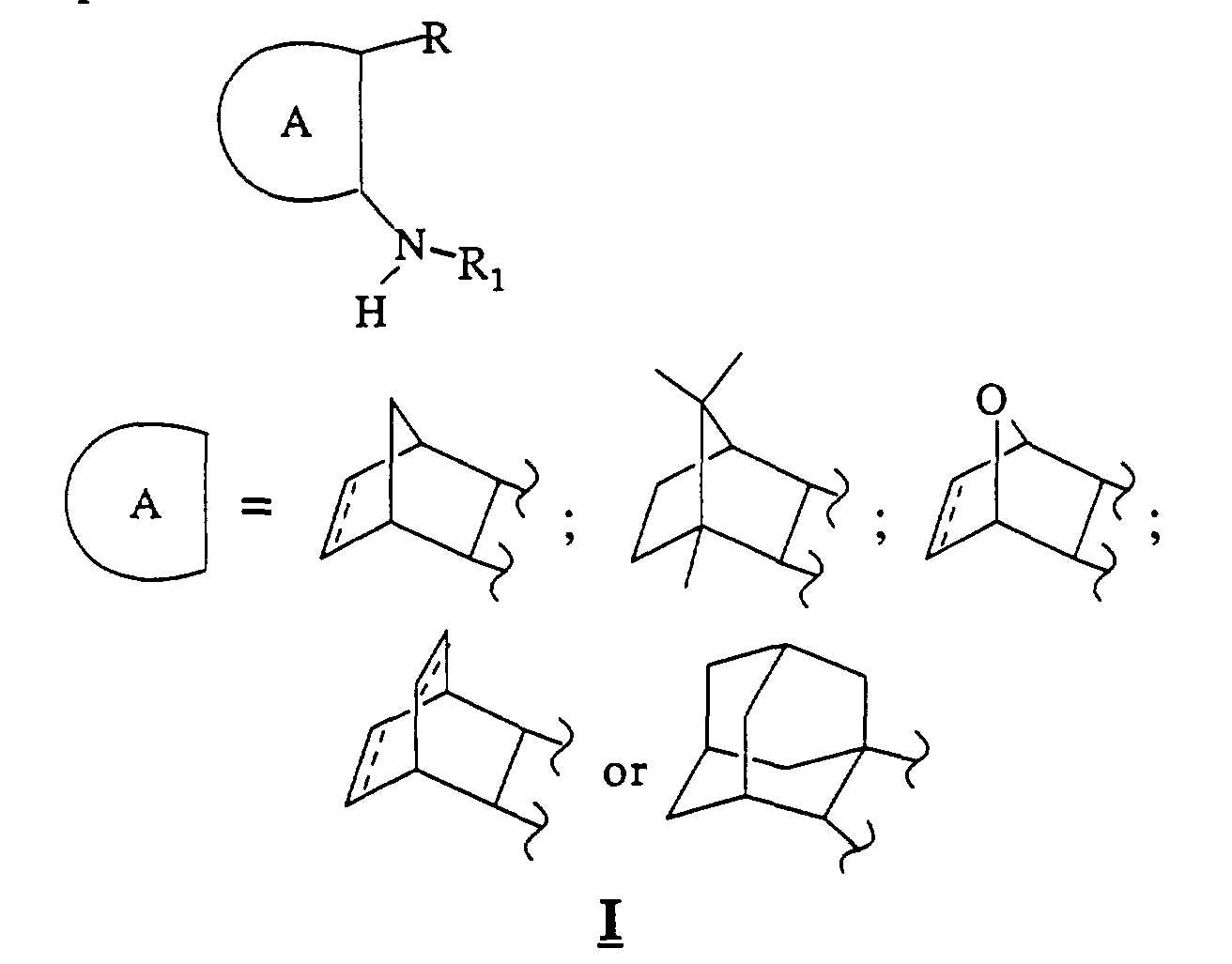
- The compound of claim 1 wherein R1 is 2-oxazoline.
- The compound of claim 1 wherein R1 is 2-imidazoline.
- The compound of claim 1 wherein R1 is 2-thiazoline.
- The compound of claim 1 wherein the ring A is
bicyclo[2.2.1]heptane (norbornane). - The compound of claim 2 wherein the ring A is
bicyclo[2.2.1]heptane (norbornane). - The compound of claim 5 wherein R is hydrogen; phenyl optionally mono- or di-substituted with hydroxy, halogen, alkyl of 1 to 3 carbon atoms or alkoxy of 1 to 2 carbon atoms; or methylenedioxyphenyl.
- The compound of claim 1 which is
trans-2-(3-phenyl-bicyclo[2.2.1]heptyl)-2-aminooxazoline. - The compound of claim 1 which is
trans-2-(3-phenyl-bicyclo[2.2.1]heptyl)-2-aminoimidazoline. - The compound of claim 1 which is
trans- 2-(3-methylenedioxy-phenyl-bicyclo[2.2.1]heptyl)-2-aminooxazoline. - The compound of claim 1 which is
trans-2-(3-propyl-bicyclo[2.2.1]heptyl)-2-aminooxazoline. - The compound of claim 1 which is
2-cyclo[2.2.1]heptyl-2-aminooxazoline. - A composition suitable for administration to a mammal having a disease state which is alleviated by treatment with an α2-blocking agent, the composition comprising a therapeutically effective amount of a compound of formula Iin which: ring A is one of the five alternative multi-cyclic rings as shown wherein a dotted line adjacent to a bond indicates that a single bond or a double bond may be present at that position; R1 is 2-oxazoline, 2-imidazoline or 2-thiazoline; R is hydrogen, straight or branched chain alkyl of 1 to 6 carbon atoms, or straight or branched chain alkenyl of 2 to 6 carbon atoms, a cycloaliphatic ring of 3 to 6 carbon atoms, phenyl optionally mono- or di-substituted with hydroxy, halogen, alkyl of 1 to 3 carbon atoms or alkoxy of 1 to 2 carbon atoms, or methylenedioxyphenyl; or a stereoisomer, or a pharmaceutically acceptable salt thereof, in admixture with one or more pharmaceutically acceptable carriers.

- The composition of claim 13 wherein the therapeutically effective compound is selected from the group consisting of trans-2-(3-phenyl-bicyclo[2.2.1]heptyl)-2-aminooxazoline, trans-2-(3-phenylbicyclo[2.2.1 ]heptyl)-2-aminoimidazoline, cis- 2-(3-phenylbicyclo[2.2.1] heptyl)-2-aminooxazoline, trans- 2-(3-methylenedioxy-phenyl-bicyclo [2.2.1]heptyl)-2-aminooxazoline, trans-2-(3-propyl-bicyclo[2.2.1]heptyl)-2-aminooxazoline, cis-2-(3-propyl-bicyclo[2.2.1] heptyl)-2-aminooxazoline and 2-cyclo[2.2.1]heptyl-2-aminooxazoline.
- The use of a compound for the manufacture of a medicament for the treatment of a mammal having a disease state which is alleviated by treatment with an alpha-2 blocking agent, the disease state being chosen from mental depression, elevated intraocular pressure, non-insulin dependent diabetes, male impotence and obesity, and the compound being a compound of the formula (I):in which: ring A is one of the five alternative multicyclic rings as shown wherein a dotted line adjacent to a bond indicates that a single bond or a double bond may be present at that position; R1 is 2-oxazoline, 2-imidazoline or 2-thiazoline; R is hydrogen, straight or branched chain alkyl of 1 to 6 carbon atoms, or straight or branched chain alkenyl of 2 to 6 carbon atoms, a cycloaliphatic ring of 3 to 6 carbon atoms, phenyl optionally mono- or di-substituted with hydroxy, halogen, alkyl of 1 to 3 carbon atoms or alkoxy of 1 to 2 carbon atoms, or methylenedioxyphenyl; or a stereoisomer or a pharmaceutically acceptable salt thereof.

- The use of a compound for the manufacture of a medicament for protecting the ocular or brain nerve cells in a mammal suffering a noxious action or at risk of experiencing a noxious action on said nerve cells so as to inhibit or prevent nerve cell injury or death, the compound being a compound of the formula (I):in which: ring A is one of the five alternative multicyclic rings as shown wherein a dotted line adjacent to a bond indicates that a single bond or a double bond may be present at that position; R1 is 2-oxazoline, 2-imidazoline or 2-thiazoline; R is hydrogen, straight or branched chain alkyl of 1 to 6 carbon atoms, or straight or branched chain alkenyl of 2 to 6 carbon atoms, a cycloaliphatic ring of 3 to 6 carbon atoms, phenyl optionally mono- or di-substituted with hydroxy, halogen, alkyl of 1 to 3 carbon atoms or alkoxy of 1 to 2 carbon atoms, or methylenedioxyphenyl.

- The use according to claim 16 wherein ring A is norbornane.
- The use according to claim 16 wherein R1 is oxazoline.
- A compound of the formula I as defined in any one of claims 1 to 12 for use in medicine, for example for use in:(i) the treatment of a mammal having a disease state which is alleviated by treatment with an alpha-2 blocking agent, the disease state being chosen from mental depression, elevated intraocular pressure, non-insulin dependent diabetes, male impotence and obesity: or(ii) protecting the ocular or brain nerve cells in a mammal suffering a noxious action or at risk of experiencing a noxious action on said nerve cells so as to inhibit or prevent nerve cell injury or cell death.
- A pharmaceutical composition comprising a compound of the formula I as defined in any one of claims 1 to 12 and a pharmaceutically acceptable carrier.
Applications Claiming Priority (3)
| Application Number | Priority Date | Filing Date | Title |
|---|---|---|---|
| US27352194A | 1994-07-11 | 1994-07-11 | |
| PCT/US1995/008733 WO1996001813A1 (en) | 1994-07-11 | 1995-07-11 | CONFORMATIONALLY RIGID BICYCLIC AND ADAMANTANE DERIVATIVES USEFUL AS α2-ADRENERGIC BLOCKING AGENTS |
| US273521 | 1999-03-22 |
Publications (2)
| Publication Number | Publication Date |
|---|---|
| EP0770068A1 EP0770068A1 (en) | 1997-05-02 |
| EP0770068B1 true EP0770068B1 (en) | 2001-11-28 |
Family
ID=23044279
Family Applications (1)
| Application Number | Title | Priority Date | Filing Date |
|---|---|---|---|
| EP95926259A Expired - Lifetime EP0770068B1 (en) | 1994-07-11 | 1995-07-11 | Conformationally rigid bicyclic and adamantane derivatives useful as alpha 2-adrenergic blocking agents |
Country Status (8)
| Country | Link |
|---|---|
| US (1) | US5731337A (en) |
| EP (1) | EP0770068B1 (en) |
| JP (1) | JPH10502643A (en) |
| AU (1) | AU687584B2 (en) |
| CA (1) | CA2194702A1 (en) |
| DE (1) | DE69524223T2 (en) |
| ES (1) | ES2168373T3 (en) |
| WO (1) | WO1996001813A1 (en) |
Families Citing this family (7)
| Publication number | Priority date | Publication date | Assignee | Title |
|---|---|---|---|---|
| US6150389A (en) | 1994-07-11 | 2000-11-21 | Allergan Sales, Inc. | Comformationally rigid bicyclic and adamantane derivatives useful as α2 -adrenergic blocking agents |
| US6841684B2 (en) | 1997-12-04 | 2005-01-11 | Allergan, Inc. | Imidiazoles having reduced side effects |
| US6329369B1 (en) | 1997-12-04 | 2001-12-11 | Allergan Sales, Inc. | Methods of treating pain and other conditions |
| US6787517B1 (en) * | 2000-12-29 | 2004-09-07 | Allergan, Inc. | Agent and methods for treating pain |
| WO2012094437A2 (en) * | 2011-01-07 | 2012-07-12 | Targacept, Inc. | Nicotinic receptor non-competitive antagonists |
| EP3986412A4 (en) | 2019-06-21 | 2023-11-15 | The Broad Institute, Inc. | AGENTS TO REVERSE TOXIC PROTEINOPATHIES |
| US11840495B2 (en) | 2020-12-23 | 2023-12-12 | The Broad Institute, Inc. | Compositions and methods related to di-substituted bicyclo[2.2.1] heptanamine-containing compounds |
Family Cites Families (21)
| Publication number | Priority date | Publication date | Assignee | Title |
|---|---|---|---|---|
| US2870159A (en) * | 1957-07-08 | 1959-01-20 | Pfizer & Co C | Hydrogenated 2-(1-naphthylamino)-oxazolines |
| US2876232A (en) * | 1957-07-08 | 1959-03-03 | Pfizer & Co C | Therapeutic agents |
| US3278382A (en) * | 1962-07-23 | 1966-10-11 | Mcneilab Inc | 2-amino-5-aryloxazoline compositions and methods of using same |
| GB1021012A (en) * | 1963-02-12 | 1966-02-23 | Mcneilab Inc | 2-amino-oxazoline products and method of making same |
| US3432600A (en) * | 1963-09-30 | 1969-03-11 | Du Pont | Partially reduced 2-(1-napthylamino) oxazoline,indanylethylureas,and indanylaminooxazoline |
| US3679798A (en) * | 1964-02-28 | 1972-07-25 | Du Pont | Composition comprising arylaminooxazoline and antichloligeneric agent |
| US3636219A (en) * | 1964-03-02 | 1972-01-18 | Du Pont | Anticholinergic compositions containing certain thiazolines or imidazolines |
| US3453284A (en) * | 1966-01-19 | 1969-07-01 | Du Pont | Certain 2-(substituted-anilino)-2-oxazolines |
| DE1670753A1 (en) * | 1966-09-27 | 1970-07-16 | Bayer Ag | Process for the preparation of 2-cycloalkylaminooxazolines |
| US3511851A (en) * | 1967-06-12 | 1970-05-12 | Du Pont | Heterocyclic amino-oxazolines |
| US3514486A (en) * | 1968-05-23 | 1970-05-26 | Miles Lab | 3-isopropylnorbornanamine |
| US4064348A (en) * | 1975-10-21 | 1977-12-20 | The Dow Chemical Company | 2-Cycloalkyl-amino-2-oxazolines |
| US4256755A (en) * | 1980-04-28 | 1981-03-17 | E. I. Du Pont De Nemours & Company | Method of using N-substituted dihydro-2-oxazolamines as analgesics |
| US4515800A (en) * | 1981-11-20 | 1985-05-07 | Icilio Cavero | Method of lowering intraocular pressure using phenylimino-imidazoles |
| US4590202A (en) * | 1984-01-19 | 1986-05-20 | Merck & Co., Inc. | N-(2-imidazolidinylidene)-5H-dibenzo[a,d]cyclohepten-5-amine compounds and α2 -adrenergic antagonistic uses thereof |
| US4587257A (en) * | 1984-12-14 | 1986-05-06 | Alcon Laboratories, Inc. | Control of ocular bleeding using clonidine derivatives |
| GB8610909D0 (en) * | 1986-05-03 | 1986-06-11 | Beecham Group Plc | Compounds |
| US4980364A (en) * | 1989-06-26 | 1990-12-25 | Goodman Robert M | Method of decongesting the nose without adverse stimulant effects |
| US5066664A (en) * | 1990-02-28 | 1991-11-19 | Allergan, Inc. | 2-(hydroxy-2-alkylphenylamino)-oxazolines and thiazolines as anti-glaucoma and vasoconstrictive agents |
| US5091528A (en) * | 1990-09-12 | 1992-02-25 | Allergan, Inc. | 6- or 7- (2-imino-2-imidazolidine)-1,4-benzoxazines as α adrenergic agents |
| US5580892A (en) * | 1993-10-22 | 1996-12-03 | Allergan | Method for using 2-(2-alkylphenylamino)-oxazolines as adrenergic agents |
-
1995
- 1995-07-11 EP EP95926259A patent/EP0770068B1/en not_active Expired - Lifetime
- 1995-07-11 AU AU30076/95A patent/AU687584B2/en not_active Ceased
- 1995-07-11 ES ES95926259T patent/ES2168373T3/en not_active Expired - Lifetime
- 1995-07-11 DE DE69524223T patent/DE69524223T2/en not_active Expired - Fee Related
- 1995-07-11 CA CA002194702A patent/CA2194702A1/en not_active Abandoned
- 1995-07-11 WO PCT/US1995/008733 patent/WO1996001813A1/en not_active Ceased
- 1995-07-11 JP JP8504476A patent/JPH10502643A/en not_active Ceased
- 1995-10-03 US US08/538,694 patent/US5731337A/en not_active Expired - Lifetime
Also Published As
| Publication number | Publication date |
|---|---|
| AU687584B2 (en) | 1998-02-26 |
| WO1996001813A1 (en) | 1996-01-25 |
| DE69524223D1 (en) | 2002-01-10 |
| AU3007695A (en) | 1996-02-09 |
| EP0770068A1 (en) | 1997-05-02 |
| DE69524223T2 (en) | 2002-08-22 |
| US5731337A (en) | 1998-03-24 |
| ES2168373T3 (en) | 2002-06-16 |
| JPH10502643A (en) | 1998-03-10 |
| CA2194702A1 (en) | 1996-01-25 |
Similar Documents
| Publication | Publication Date | Title |
|---|---|---|
| JP3935201B2 (en) | N-substituted azabicycloalkane derivatives as neuroleptic drugs AFS | |
| EP0923581B1 (en) | 4-substituted beta-carbolines as immunomodulators | |
| US6150389A (en) | Comformationally rigid bicyclic and adamantane derivatives useful as α2 -adrenergic blocking agents | |
| RU2232154C2 (en) | Substituted derivatives of imidazole, method for administration of pharmaceutical composition and method for treatment based on these compounds | |
| US9040532B2 (en) | Alpha adrenergic receptor modulators | |
| AU600839B2 (en) | Optical isomers of an imidazole derivative | |
| NZ250944A (en) | Substituted benzazepines and analogs thereof; use as medicaments | |
| US4818764A (en) | Imidazoline derivative and method of treating depression therewith | |
| US7071225B2 (en) | Arylaminopropane analogues and their use for the treatment of glaucoma | |
| AU687584B2 (en) | Conformationally rigid bicyclic and adamantane derivatives useful as alpha2-adrenergic blocking agents | |
| EP0741709B1 (en) | Aromatic 2-amino-imidazole derivatives as alpha-2a adrenoceptor agonists | |
| US5726197A (en) | Isoindolinyl derivatives | |
| EP0452101B1 (en) | Spiro bridged and unbridged heterocyclic compounds | |
| US5292766A (en) | Method for improving primary memory and/or learning | |
| JP2005513103A (en) | Novel benzodifuran imidazolines and benzofuran imidazoline derivatives and their use for the treatment of glaucoma | |
| EP0602060A1 (en) | Spirocyclic benzopyran imidazolines, their preparation and their use as potassium channel activators | |
| Ruffolo Jr et al. | Adrenoceptor-mediated effects of optically active catecholimidazolines in pithed rat | |
| US20010009916A1 (en) | Heterocyclic amines having central nervous system activity | |
| US4318909A (en) | Benzoxazocines | |
| US4626522A (en) | Benzoxazocines intermediates |
Legal Events
| Date | Code | Title | Description |
|---|---|---|---|
| PUAI | Public reference made under article 153(3) epc to a published international application that has entered the european phase |
Free format text: ORIGINAL CODE: 0009012 |
|
| 17P | Request for examination filed |
Effective date: 19970211 |
|
| AK | Designated contracting states |
Kind code of ref document: A1 Designated state(s): DE ES FR GB IT |
|
| 17Q | First examination report despatched |
Effective date: 19981228 |
|
| RAP1 | Party data changed (applicant data changed or rights of an application transferred) |
Owner name: ALLERGAN SALES, INC. |
|
| GRAG | Despatch of communication of intention to grant |
Free format text: ORIGINAL CODE: EPIDOS AGRA |
|
| GRAG | Despatch of communication of intention to grant |
Free format text: ORIGINAL CODE: EPIDOS AGRA |
|
| GRAH | Despatch of communication of intention to grant a patent |
Free format text: ORIGINAL CODE: EPIDOS IGRA |
|
| GRAH | Despatch of communication of intention to grant a patent |
Free format text: ORIGINAL CODE: EPIDOS IGRA |
|
| GRAA | (expected) grant |
Free format text: ORIGINAL CODE: 0009210 |
|
| AK | Designated contracting states |
Kind code of ref document: B1 Designated state(s): DE ES FR GB IT |
|
| REG | Reference to a national code |
Ref country code: GB Ref legal event code: IF02 |
|
| REF | Corresponds to: |
Ref document number: 69524223 Country of ref document: DE Date of ref document: 20020110 |
|
| ET | Fr: translation filed | ||
| REG | Reference to a national code |
Ref country code: ES Ref legal event code: FG2A Ref document number: 2168373 Country of ref document: ES Kind code of ref document: T3 |
|
| PLBE | No opposition filed within time limit |
Free format text: ORIGINAL CODE: 0009261 |
|
| STAA | Information on the status of an ep patent application or granted ep patent |
Free format text: STATUS: NO OPPOSITION FILED WITHIN TIME LIMIT |
|
| 26N | No opposition filed | ||
| PGFP | Annual fee paid to national office [announced via postgrant information from national office to epo] |
Ref country code: FR Payment date: 20060717 Year of fee payment: 12 |
|
| PGFP | Annual fee paid to national office [announced via postgrant information from national office to epo] |
Ref country code: GB Payment date: 20060726 Year of fee payment: 12 Ref country code: ES Payment date: 20060726 Year of fee payment: 12 |
|
| PGFP | Annual fee paid to national office [announced via postgrant information from national office to epo] |
Ref country code: IT Payment date: 20060731 Year of fee payment: 12 |
|
| PGFP | Annual fee paid to national office [announced via postgrant information from national office to epo] |
Ref country code: DE Payment date: 20060831 Year of fee payment: 12 |
|
| GBPC | Gb: european patent ceased through non-payment of renewal fee |
Effective date: 20070711 |
|
| PG25 | Lapsed in a contracting state [announced via postgrant information from national office to epo] |
Ref country code: DE Free format text: LAPSE BECAUSE OF NON-PAYMENT OF DUE FEES Effective date: 20080201 |
|
| PG25 | Lapsed in a contracting state [announced via postgrant information from national office to epo] |
Ref country code: GB Free format text: LAPSE BECAUSE OF NON-PAYMENT OF DUE FEES Effective date: 20070711 |
|
| REG | Reference to a national code |
Ref country code: FR Ref legal event code: ST Effective date: 20080331 |
|
| PG25 | Lapsed in a contracting state [announced via postgrant information from national office to epo] |
Ref country code: FR Free format text: LAPSE BECAUSE OF NON-PAYMENT OF DUE FEES Effective date: 20070731 |
|
| REG | Reference to a national code |
Ref country code: ES Ref legal event code: FD2A Effective date: 20070712 |
|
| PG25 | Lapsed in a contracting state [announced via postgrant information from national office to epo] |
Ref country code: ES Free format text: LAPSE BECAUSE OF NON-PAYMENT OF DUE FEES Effective date: 20070712 |
|
| PG25 | Lapsed in a contracting state [announced via postgrant information from national office to epo] |
Ref country code: IT Free format text: LAPSE BECAUSE OF NON-PAYMENT OF DUE FEES Effective date: 20070711 |