EP0769484B1 - Method for separating cyclohexene - Google Patents
Method for separating cyclohexene Download PDFInfo
- Publication number
- EP0769484B1 EP0769484B1 EP96116521A EP96116521A EP0769484B1 EP 0769484 B1 EP0769484 B1 EP 0769484B1 EP 96116521 A EP96116521 A EP 96116521A EP 96116521 A EP96116521 A EP 96116521A EP 0769484 B1 EP0769484 B1 EP 0769484B1
- Authority
- EP
- European Patent Office
- Prior art keywords
- cyclohexene
- column
- nitrogen
- containing compound
- benzene
- Prior art date
- Legal status (The legal status is an assumption and is not a legal conclusion. Google has not performed a legal analysis and makes no representation as to the accuracy of the status listed.)
- Expired - Lifetime
Links
- HGCIXCUEYOPUTN-UHFFFAOYSA-N cyclohexene Chemical compound C1CCC=CC1 HGCIXCUEYOPUTN-UHFFFAOYSA-N 0.000 title claims description 186
- 238000000034 method Methods 0.000 title claims description 27
- UHOVQNZJYSORNB-UHFFFAOYSA-N Benzene Chemical compound C1=CC=CC=C1 UHOVQNZJYSORNB-UHFFFAOYSA-N 0.000 claims description 165
- -1 nitrogen-containing compound Chemical class 0.000 claims description 74
- 238000004821 distillation Methods 0.000 claims description 52
- 239000000203 mixture Substances 0.000 claims description 46
- XDTMQSROBMDMFD-UHFFFAOYSA-N Cyclohexane Chemical compound C1CCCCC1 XDTMQSROBMDMFD-UHFFFAOYSA-N 0.000 claims description 41
- 238000000895 extractive distillation Methods 0.000 claims description 37
- 238000000605 extraction Methods 0.000 claims description 22
- 239000002904 solvent Substances 0.000 claims description 22
- 239000007788 liquid Substances 0.000 claims description 21
- CYSGHNMQYZDMIA-UHFFFAOYSA-N 1,3-Dimethyl-2-imidazolidinon Chemical compound CN1CCN(C)C1=O CYSGHNMQYZDMIA-UHFFFAOYSA-N 0.000 claims description 19
- 125000000008 (C1-C10) alkyl group Chemical group 0.000 claims description 2
- 125000006273 (C1-C3) alkyl group Chemical group 0.000 claims description 2
- 239000001257 hydrogen Chemical group 0.000 claims description 2
- 229910052739 hydrogen Chemical group 0.000 claims description 2
- 125000004435 hydrogen atom Chemical group [H]* 0.000 claims description 2
- 238000010992 reflux Methods 0.000 description 10
- 238000005984 hydrogenation reaction Methods 0.000 description 4
- 238000012856 packing Methods 0.000 description 4
- 238000004088 simulation Methods 0.000 description 4
- 150000001875 compounds Chemical class 0.000 description 3
- 239000011541 reaction mixture Substances 0.000 description 3
- 238000000926 separation method Methods 0.000 description 3
- FXHOOIRPVKKKFG-UHFFFAOYSA-N N,N-Dimethylacetamide Chemical compound CN(C)C(C)=O FXHOOIRPVKKKFG-UHFFFAOYSA-N 0.000 description 2
- 241000183024 Populus tremula Species 0.000 description 2
- 239000003054 catalyst Substances 0.000 description 2
- 238000004519 manufacturing process Methods 0.000 description 2
- 230000003068 static effect Effects 0.000 description 2
- NYCCIHSMVNRABA-UHFFFAOYSA-N 1,3-diethylimidazolidin-2-one Chemical compound CCN1CCN(CC)C1=O NYCCIHSMVNRABA-UHFFFAOYSA-N 0.000 description 1
- MUXOBHXGJLMRAB-UHFFFAOYSA-N Dimethyl succinate Chemical compound COC(=O)CCC(=O)OC MUXOBHXGJLMRAB-UHFFFAOYSA-N 0.000 description 1
- KJTLSVCANCCWHF-UHFFFAOYSA-N Ruthenium Chemical compound [Ru] KJTLSVCANCCWHF-UHFFFAOYSA-N 0.000 description 1
- BTGRAWJCKBQKAO-UHFFFAOYSA-N adiponitrile Chemical compound N#CCCCCC#N BTGRAWJCKBQKAO-UHFFFAOYSA-N 0.000 description 1
- 238000009835 boiling Methods 0.000 description 1
- 239000006227 byproduct Substances 0.000 description 1
- 238000006243 chemical reaction Methods 0.000 description 1
- 239000003795 chemical substances by application Substances 0.000 description 1
- 230000000052 comparative effect Effects 0.000 description 1
- 230000007797 corrosion Effects 0.000 description 1
- 238000005260 corrosion Methods 0.000 description 1
- HPXRVTGHNJAIIH-UHFFFAOYSA-N cyclohexanol Chemical compound OC1CCCCC1 HPXRVTGHNJAIIH-UHFFFAOYSA-N 0.000 description 1
- 238000000354 decomposition reaction Methods 0.000 description 1
- BEPAFCGSDWSTEL-UHFFFAOYSA-N dimethyl malonate Chemical compound COC(=O)CC(=O)OC BEPAFCGSDWSTEL-UHFFFAOYSA-N 0.000 description 1
- 230000000887 hydrating effect Effects 0.000 description 1
- 239000012535 impurity Substances 0.000 description 1
- 230000000704 physical effect Effects 0.000 description 1
- 239000002574 poison Substances 0.000 description 1
- 231100000614 poison Toxicity 0.000 description 1
- 239000000047 product Substances 0.000 description 1
- 238000011084 recovery Methods 0.000 description 1
- 229910052707 ruthenium Inorganic materials 0.000 description 1
- 230000001988 toxicity Effects 0.000 description 1
- 231100000419 toxicity Toxicity 0.000 description 1
- XLYOFNOQVPJJNP-UHFFFAOYSA-N water Substances O XLYOFNOQVPJJNP-UHFFFAOYSA-N 0.000 description 1
Images


Classifications
-
- C—CHEMISTRY; METALLURGY
- C07—ORGANIC CHEMISTRY
- C07C—ACYCLIC OR CARBOCYCLIC COMPOUNDS
- C07C7/00—Purification; Separation; Use of additives
- C07C7/04—Purification; Separation; Use of additives by distillation
- C07C7/05—Purification; Separation; Use of additives by distillation with the aid of auxiliary compounds
- C07C7/08—Purification; Separation; Use of additives by distillation with the aid of auxiliary compounds by extractive distillation
-
- C—CHEMISTRY; METALLURGY
- C07—ORGANIC CHEMISTRY
- C07C—ACYCLIC OR CARBOCYCLIC COMPOUNDS
- C07C2601/00—Systems containing only non-condensed rings
- C07C2601/12—Systems containing only non-condensed rings with a six-membered ring
- C07C2601/14—The ring being saturated
-
- C—CHEMISTRY; METALLURGY
- C07—ORGANIC CHEMISTRY
- C07C—ACYCLIC OR CARBOCYCLIC COMPOUNDS
- C07C2601/00—Systems containing only non-condensed rings
- C07C2601/12—Systems containing only non-condensed rings with a six-membered ring
- C07C2601/16—Systems containing only non-condensed rings with a six-membered ring the ring being unsaturated
Definitions
- the present invention relates to a method for separating cyclohexene from a mixture comprising cyclohexene and at least one member selected from cyclohexane and benzene.
- extractive distillation As a method for separating such a mixture.
- various extracting media such as N,N-dimethylacetamide, adiponitrile, sulforan, dimethyl malonate and dimethyl succinate, are used (e.g. Japanese Unexamined Patent Publications No. 1645724/1983, No. 1645725/1983, No. 172323/1983, No. 295311/1987 and No. 41441/1992).
- the present inventors have conducted extensive studies on a method for separating cyclohexene and as a result, have found it possible to solve all of the above-mentioned problems by extractive distillation employing a certain specific nitrogen-containing compound as an extraction solvent.
- the present invention has been accomplished on the basis of this discovery.
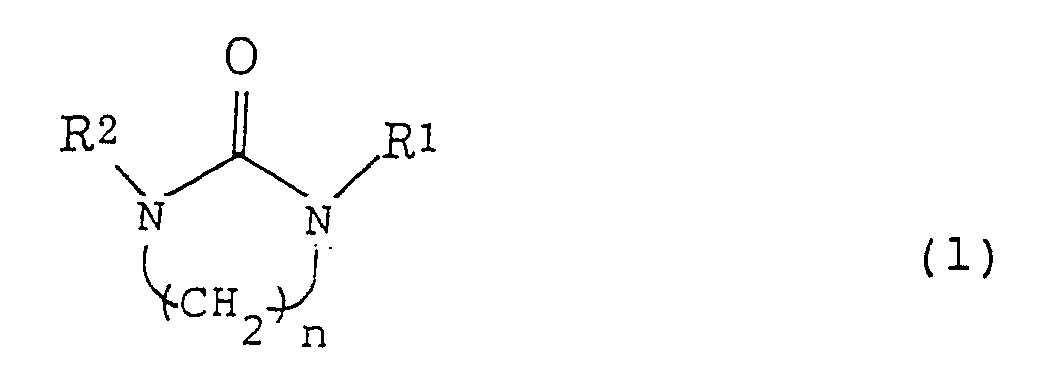
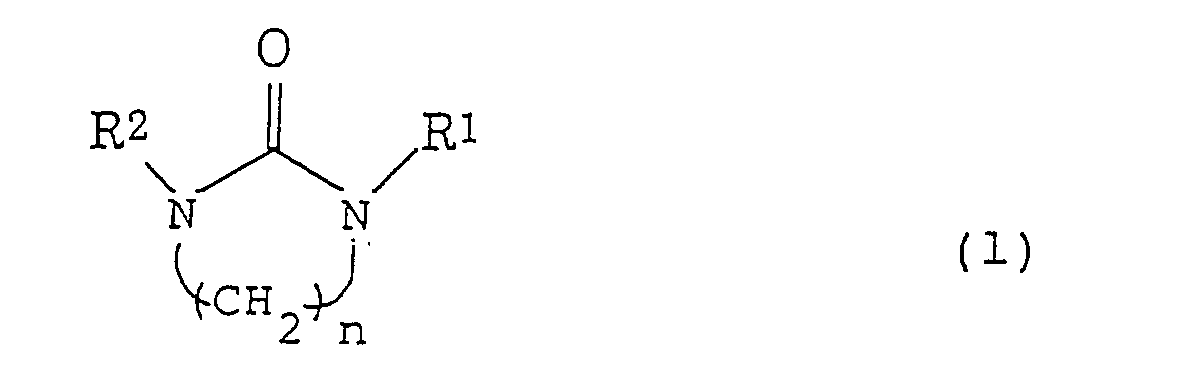
- the present invention provides a method for separating cyclohexene from a mixture comprising cyclohexene and at least one member selected from cyclohexane and benzene, which comprises subjecting the mixture to extractive distillation to obtain a fraction rich in cyclohexene, wherein a nitrogen-containing compound of the following formula (1) is used as an extraction solvent for the extractive distillation: wherein each of R 1 and R 2 is a C 1-10 alkyl group or hydrogen, and n is an integer of from 2 to 4.
- Figure 1 is a flow sheet illustrating an embodiment of the present invention which corresponds to the method 3 ⁇ as described hereinafter.
- Figure 2 is a flow sheet illustrating another embodiment of the present invention which corresponds to the method 4 ⁇ as described hereinafter.
- the mixture which is subjected to extractive distillation is a mixture comprising cyclohexene and at least one member selected from the cyclohexane and benzene.
- a reaction mixture obtained by partial hydrogenation of benzene may be mentioned as such a mixture to which the present invention is applicable.
- the nitrogen-containing compound of the above formula (1) is preferably the one wherein each of R 1 and R 2 is a C 1-3 alkyl group, and n is 2.
- such a compound may, for example, be 1,3-dimethyl-2-imidazolidinone or 1,3-diethyl-2-imidazolidinone, preferably 1,3-dimethyl-2-imidazolidinone.
- 1,3-Dimethyl-2-imidazolidinone is not only excellent as an extracting agent for separation useful in the present invention, but also relatively easily available for industrial purpose, thermally stable and free from corrosiveness, and it has a characteristic such that the toxicity is low.
- the nitrogen-containing compound of the formula (1) will hereinafter be referred to as "the nitrogen-containing compound (1)".
- a distillation column which usually has a theoretical plate number of at least 10, preferably at least 20.
- the reflux ratio is usually from 0.5 to 30. If the reflux ratio is too small or too large, the separation efficiency deteriorates. If the reflux ratio is too large, the column system is obliged to be large.
- the nitrogen-containing compound (1) as the extraction solvent is supplied to an upper portion of the distillation column, and the mixture is supplied to a portion lower than the intermediate portion of the distillation column. At the upper portion, about 5 plates are usually provided as recovery plates.
- the extraction solvent is used usually in an amount of at least equivalent to the mixture, and the pressure at the top of the column is usually from 0.02 to 0.3 MPa.
- the nitrogen-containing compound (1) as the extraction solvent is already contained in the mixed liquid supplied to the distillation step, but the nitrogen-containing compound (1) may be supplemented depending upon the composition or the amount of the components to be separated.
- Figure 1 illustrates the above-mentioned method 3 ⁇ which comprises firstly separating benzene from the mixture comprising cyclohexene, benzene and cyclohexane, and then separating cyclohexene and cyclohexane.
- the mixture comprising three compounds of cyclohexane, cyclohexene and benzene, is supplied by a line 1 to a distillation column D1, and the nitrogen-containing compound (1) as an extraction solvent is supplied by a line 2 to the distillation column D1.
- distillation column D1 extractive distillation is carried out, whereby a mixture of cyclohexene and cyclohexane is withdrawn from the top of the column and transported by a line 3 to a distillation column D3, and from the bottom of the column, a mixture of benzene and the nitrogen-containing compound (1), is withdrawn and sent by a line 4 to a distillation column D2.
- benzene and the nitrogen-containing compound (1) are separated by distillation, whereby from the top of the column, benzene is withdrawn by a line 5, and from the bottom of the column, the nitrogen-containing compound (1) is withdrawn by a line 6.
- the mixture of cyclohexene and cyclohexane is supplied by the line 3, and the nitrogen-containing compound (1) is supplied by a line 7, to carry out extractive distillation.
- cyclohexane is withdrawn by a line 8.
- a mixture comprising cyclohexene and the nitrogen-containing compound (1) is withdrawn and sent to a distillation column D4 by a line 9.
- distillation column D4 cyclohexene and the nitrogen-containing compound (1) are separated by distillation, whereby from the top of the column, cyclohexene is withdrawn by a line 10, and from the bottom of the column, the nitrogen-containing compound (1) is withdrawn by a line 11.
- Figure 2 illustrates the above method 4 ⁇ which comprises firstly removing cyclohexane from the mixture comprising cyclohexene, benzene and cyclohexane and then separating cyclohexene and benzene.
- the mixture comprising cyclohexene, benzene and cyclohexane is sent by a line 1 to a distillation column D1, and the nitrogen-containing compound (1) is sent by a line 2 to the distillation column D1.
- distillation column D1 extractive distillation is carried out, whereby from the top of the column, cyclohexane is withdrawn by a line 3, and from the bottom of the column, a mixture comprising benzene, cyclohexene and the nitrogen-containing compound (1), is withdrawn by a line 4, and the mixture is supplied to a distillation column D2.
- the nitrogen-containing compound (1) is supplied also from a line 5.
- distillation column D2 extractive distillation is carried out, whereby from the top of the column, cyclohexene is withdrawn by a line 6, and from the bottom of the column, a mixture of benzene and the nitrogen-containing compound (1), is withdrawn by a line 7 and supplied to a distillation column D3.
- benzene and the nitrogen-containing compound (1) are separated by distillation, whereby from the top of the column, benzene is withdrawn by a line 8, and from the bottom of the column, the nitrogen-containing compound (1) is withdrawn by a line 9.
- Extractive distillation was carried out in the same manner as in Example 1 except that as the extraction solvent, N,N-dimethylacetamide was used instead of 1,3-dimethyl-2-imidazolidinone.
- N,N-dimethylacetamide was used instead of 1,3-dimethyl-2-imidazolidinone.
- extractive distillation was carried out at a reflux ratio of 5 under a column top pressure of 0.1 MPa, while introducing a mixture comprising cyclohexene and benzene obtained in the same manner as in Example 1 to a position at 2100 mm from the top of the column at a rate of 52.8 parts/hr of cyclohexene and 32.4 parts/hr of benzene and introducing 320 parts/hr of 1,3-dimethyl-2-imidazolidinone to a position at 330 mm from the top of the column.
- extractive distillation was carried out at a reflux ratio of 10 under a column top pressure of 0.1 MPa, while introducing a mixture comprising cyclohexene and benzene obtained in the same manner as in Example 1 to a position at 2100 mm from the top of the column at a rate of 52.8 parts/hr of cyclohexene and 32.4 parts/hr of benzene and introducing 320 parts/hr of 1,3-dimethyl-2-imidazolidinone to a position at 330 mm from the top of the column.
- extractive distillation was carried out at a reflux ratio of 5 under a column top pressure of 0.1 MPa, while introducing a mixture comprising cyclohexene and benzene obtained in the same manner as in Example 1 to a position at 2100 mm from the top of the column at a rate of 52.3 parts/hr of cyclohexene and 32.4 parts/hr of benzene and introducing 320 parts/hr of 1,3-dimethyl-2-imidazolidinone to a position at 330 mm from the top of the column.
- Distillation simulation was carried out using static simulator soft ASPEN, manufactured by ASPENTEC Co. (the physical property model for the simulation was the one calculated as a homogeneous system by correction UNIFAC, and the same applies to the results of distillation simulation given hereinafter).
- extractive distillation is carried out at a reflux ratio of 8 under a column top pressure of 0.1 MPa, while introducing 750 parts/hr of cyclohexane and 3000 parts/hr of cyclohexene and 2500 parts/hr of benzene to the 12th plate from the top of the distillation column having a theoretical plate number of 22 plates (each of a condenser at the top and a reboiler at the bottom is counted as one plate) and introducing 3000 parts/hr of 1,3-dimethyl-2-imidazolidinone to the 4th plate from the top of the column.
- Distillation simulation was carried out using static simulator soft ASPEN, manufactured by ASPENTEC Co.
- extractive distillation is carried out at a reflux ratio of 20 under a column top pressure of 0.1 MPa, while introducing 750 parts/hr of cyclohexane and 3000 parts/hr of cyclohexene to the 50th plate from the top of a distillation column having a theoretical plate number of 62 plates (each of a condenser at the top and a reboiler at the bottom is counted as one plate) and introducing 20000 parts/hr of 1,3-dimethyl-2-imidazolidinone to the 5th plate from the top of the column.
- cyclohexene of high purity can be obtained efficiently from a mixture comprising cyclohexene and at least one member selected from cyclohexane and benzene.
- the specific nitrogen-containing compound used as an extraction solvent in extractive distillation of the present invention is chemically stable and relatively inexpensive. Accordingly, the present invention is expected to be a very advantageous method for producing cyclohexene of high purity on an industrial scale over a long period of time.
Landscapes
- Chemical & Material Sciences (AREA)
- Organic Chemistry (AREA)
- Engineering & Computer Science (AREA)
- Analytical Chemistry (AREA)
- Oil, Petroleum & Natural Gas (AREA)
- Water Supply & Treatment (AREA)
- Organic Low-Molecular-Weight Compounds And Preparation Thereof (AREA)
Description
In the distillation column D1, extractive distillation is carried out, whereby a mixture of cyclohexene and cyclohexane is withdrawn from the top of the column and transported by a
Claims (7)
- A method for separating cyclohexene from a mixture comprising cyclohexene and at least one member selected from cyclohexane and benzene, which comprises subjecting the mixture to extractive distillation to obtain a fraction rich in cyclohexene, wherein a nitrogen-containing compound of the following formula (1) is used as an extraction solvent for the extractive distillation:wherein each of R1 and R2 is a C1-10 alkyl group or hydrogen, and n is an integer of from 2 to 4.
- The method for separating cyclohexene according to Claim 1, wherein in the formula (1), each of R1 and R2 is a C1-3 alkyl group, and n is 2.
- The method for separating cyclohexene according to Claim 1, wherein the nitrogen-containing compound of the formula (1) is 1,3-dimethyl-2-imidazolidinone.
- The method for separating cyclohexene according to Claim 1, wherein a mixture of cyclohexene and cyclohexane is subjected to extractive distillation by means of the nitrogen-containing compound of the formula (1) as the extraction solvent, so that cyclohexane is distilled from the top of the distillation column, and a mixed liquid of cyclohexene and the nitrogen-containing compound of the formula (1) , is withdrawn from the bottom of the column, and the mixed liquid is subjected to distillation to separate cyclohexene.
- The method for separating cyclohexene according to Claim 1, wherein a mixture of cyclohexene and benzene is subjected to extractive distillation by means of the nitrogen-containing compound of the formula (1) as the extraction solvent, so that cyclohexene is distilled from the top of the distillation column, and a mixed liquid of benzene and the nitrogen-containing compound of the formula (1), is withdrawn from the bottom of the column.
- The method for separating cyclohexene according to Claim 1, wherein a mixture of cyclohexene, cyclohexane and benzene, is subjected to first extractive distillation by means of the nitrogen-containing compound of the formula (1) as the extraction solvent, so that a mixed liquid of benzene and the nitrogen-containing compound of the formula (1), is withdrawn from the bottom of the distillation column, and a mixed liquid of cyclohexene and cyclohexane, is distilled from the top of the column, the distillate liquid is subjected to second extractive distillation by means of the nitrogen-containing compound of the formula (1) as the extraction solvent, so that cyclohexane is distilled from the top of the column, and a mixed liquid of cyclohexene and the nitrogen-containing compound of the formula (1), is withdrawn from the bottom of the column, and the mixed liquid is subjected to distillation to separate cyclohexene.
- The method for separating cyclohexene according to Claim 1, wherein a mixture of cyclohexene, cyclohexane and benzene is subjected to extractive distillation by means of the nitrogen-containing compound of the formula (1) as the extraction solvent, so that cyclohexane is distilled from the top of the distillation column, and a mixed liquid of cyclohexene, benzene and the nitrogen-containing compound of the formula (1), is withdrawn from the bottom of the column, and the mixed liquid is subjected to distillation, so that cyclohexene is distilled from the top of the column, and benzene and the nitrogen-containing compound of the formula (1), are withdrawn from the bottom of the column.
Applications Claiming Priority (9)
| Application Number | Priority Date | Filing Date | Title |
|---|---|---|---|
| JP27243695 | 1995-10-20 | ||
| JP27243695 | 1995-10-20 | ||
| JP272436/95 | 1995-10-20 | ||
| JP273967/95 | 1995-10-23 | ||
| JP27396795 | 1995-10-23 | ||
| JP27396795 | 1995-10-23 | ||
| JP310823/95 | 1995-11-29 | ||
| JP31082395 | 1995-11-29 | ||
| JP31082395 | 1995-11-29 |
Publications (3)
| Publication Number | Publication Date |
|---|---|
| EP0769484A2 EP0769484A2 (en) | 1997-04-23 |
| EP0769484A3 EP0769484A3 (en) | 1997-06-25 |
| EP0769484B1 true EP0769484B1 (en) | 2001-06-13 |
Family
ID=27335999
Family Applications (1)
| Application Number | Title | Priority Date | Filing Date |
|---|---|---|---|
| EP96116521A Expired - Lifetime EP0769484B1 (en) | 1995-10-20 | 1996-10-15 | Method for separating cyclohexene |
Country Status (4)
| Country | Link |
|---|---|
| US (1) | US5865958A (en) |
| EP (1) | EP0769484B1 (en) |
| CN (1) | CN1062546C (en) |
| DE (1) | DE69613309T2 (en) |
Families Citing this family (3)
| Publication number | Priority date | Publication date | Assignee | Title |
|---|---|---|---|---|
| JP5498165B2 (en) * | 2007-09-05 | 2014-05-21 | 旭化成ケミカルズ株式会社 | Separation and production method of cyclohexene |
| CN102617262B (en) * | 2012-02-23 | 2014-04-09 | 蓝仁水 | Energy-saving process method for separating cyclohexane-cyclohexene-benzene |
| CN108467330B (en) * | 2018-06-26 | 2024-04-16 | 中国天辰工程有限公司 | A method and device for efficiently separating a mixture of cyclohexane and benzene |
Family Cites Families (17)
| Publication number | Priority date | Publication date | Assignee | Title |
|---|---|---|---|---|
| US2840511A (en) * | 1955-07-08 | 1958-06-24 | Standard Oil Co | Process of extraction with 2-oxazolidone solvents |
| JPS525733A (en) * | 1975-07-03 | 1977-01-17 | Toray Ind Inc | Process for separation and purification of cyclohexene |
| JPS58172323A (en) | 1982-04-02 | 1983-10-11 | Asahi Chem Ind Co Ltd | Separation of monocyclic monoolefin |
| JPS6150930A (en) | 1984-08-16 | 1986-03-13 | Asahi Chem Ind Co Ltd | Production of cycloolefin |
| JPS6281332A (en) | 1985-10-03 | 1987-04-14 | Asahi Chem Ind Co Ltd | Production of cycloolefin |
| JPS62295311A (en) | 1986-06-13 | 1987-12-22 | 松下電器産業株式会社 | Making of transparent conducting film |
| JPH0788427B2 (en) * | 1986-11-25 | 1995-09-27 | 東ソー株式会社 | Method for recovering polyarylensulfide |
| DE3832340A1 (en) * | 1988-09-23 | 1990-03-29 | Krupp Koppers Gmbh | METHOD AND DEVICE FOR OPTIMIZING THE OPERATION OF AN OUTPUT COLUMN PROVIDED WITH A SIDE COOKER |
| US4955468A (en) * | 1989-09-08 | 1990-09-11 | Phillips Petroleum Company | Separation of hydrocarbon mixtures |
| JP2802673B2 (en) | 1990-06-05 | 1998-09-24 | 旭化成工業株式会社 | Purification method of cyclohexene for hydration reaction |
| JP2814711B2 (en) | 1990-07-13 | 1998-10-27 | 三菱化学株式会社 | Method for producing cycloolefin |
| US5085740A (en) * | 1990-10-26 | 1992-02-04 | Phillips Petroleum Company | Separation of alkenes from alkanes |
| US5069756A (en) * | 1990-11-26 | 1991-12-03 | Lloyd Berg | Separation of cyclohexane from cyclohexene by azeotropic or extractive distillation |
| JPH05202367A (en) * | 1991-10-15 | 1993-08-10 | General Sekiyu Kk | Method for desulfurizing and denitrating light oil by extraction |
| JP3265659B2 (en) * | 1992-06-05 | 2002-03-11 | 住友化学工業株式会社 | Phenol purification method |
| US5399244A (en) * | 1993-12-06 | 1995-03-21 | Glitsch, Inc. | Process to recover benzene from mixed hydrocarbons by extractive distillation |
| US5405505A (en) * | 1994-01-14 | 1995-04-11 | Lloyd Berg | Separation of benzene from close boiling hydrocarbons by azeotropic distillation |
-
1996
- 1996-10-15 EP EP96116521A patent/EP0769484B1/en not_active Expired - Lifetime
- 1996-10-15 DE DE69613309T patent/DE69613309T2/en not_active Expired - Fee Related
- 1996-10-18 US US08/732,724 patent/US5865958A/en not_active Expired - Fee Related
- 1996-10-18 CN CN96122862A patent/CN1062546C/en not_active Expired - Fee Related
Also Published As
| Publication number | Publication date |
|---|---|
| CN1062546C (en) | 2001-02-28 |
| EP0769484A2 (en) | 1997-04-23 |
| DE69613309T2 (en) | 2002-05-02 |
| DE69613309D1 (en) | 2001-07-19 |
| US5865958A (en) | 1999-02-02 |
| CN1157811A (en) | 1997-08-27 |
| EP0769484A3 (en) | 1997-06-25 |
Similar Documents
| Publication | Publication Date | Title |
|---|---|---|
| CA2300083C (en) | Propylene oxide purification | |
| US7164044B2 (en) | Process for producing high purity trialkanolamine | |
| US10322988B2 (en) | Process for purifying a stream comprising 1,4-butanediol | |
| CN101006045B (en) | Industrial preparation method of high-purity diphenyl carbonate | |
| US4563308A (en) | Recovery of caprolactam from caprolactam-containing distillation residue | |
| EP1175387A2 (en) | Method of separating dimethyl carbonate and methanol | |
| US7497931B2 (en) | Distillative preparation of IPDA having a high cis/trans isomer ratio | |
| EP0769484B1 (en) | Method for separating cyclohexene | |
| JP3265659B2 (en) | Phenol purification method | |
| JPWO2006025424A1 (en) | Industrial production of high purity diphenyl carbonate | |
| EP1603651A2 (en) | Distillative method for separating hexamethylenediamine from a mixture comprising hexamethylenediamine, -aminocapronitrile and tetrahydroazepine | |
| US11655229B2 (en) | Process for preparing dioxolane | |
| RU2121993C1 (en) | Method of recovering pentafluoroethane form mixture with chloropentafluoroethane | |
| US5360520A (en) | Separation of 2-butanol from t-amyl alcohol by extractive distillation | |
| JPH06228026A (en) | Separation of methanol from dimethyl carbonate | |
| US3987121A (en) | Process for separating alpha-pinene from beta-pinene | |
| JPH0930994A (en) | Separation method of cyclohexene | |
| JPH09208500A (en) | Separation method of cyclohexene | |
| JPH01139537A (en) | Separation of cyclohexene | |
| JP2524510B2 (en) | Method for separating cyclohexene with mixed solvent | |
| US6175045B1 (en) | Process for the preparation of pentafluoroethane | |
| CA2070876A1 (en) | Purification of methyl tertiary-butyl ether | |
| US4859285A (en) | Separation of 2-pentanone from formic acid by extractive distillation | |
| EP0106353B1 (en) | A method for preparing bis(beta-(n,n,-dimethylamino)-ethyl)ether | |
| US5228956A (en) | Separation of 3-pentanone from formic acid by extractive distillation |
Legal Events
| Date | Code | Title | Description |
|---|---|---|---|
| PUAI | Public reference made under article 153(3) epc to a published international application that has entered the european phase |
Free format text: ORIGINAL CODE: 0009012 |
|
| AK | Designated contracting states |
Kind code of ref document: A2 Designated state(s): BE DE GB |
|
| PUAL | Search report despatched |
Free format text: ORIGINAL CODE: 0009013 |
|
| AK | Designated contracting states |
Kind code of ref document: A3 Designated state(s): BE DE GB |
|
| 17P | Request for examination filed |
Effective date: 19970901 |
|
| 17Q | First examination report despatched |
Effective date: 19981008 |
|
| GRAG | Despatch of communication of intention to grant |
Free format text: ORIGINAL CODE: EPIDOS AGRA |
|
| GRAG | Despatch of communication of intention to grant |
Free format text: ORIGINAL CODE: EPIDOS AGRA |
|
| GRAH | Despatch of communication of intention to grant a patent |
Free format text: ORIGINAL CODE: EPIDOS IGRA |
|
| GRAH | Despatch of communication of intention to grant a patent |
Free format text: ORIGINAL CODE: EPIDOS IGRA |
|
| GRAA | (expected) grant |
Free format text: ORIGINAL CODE: 0009210 |
|
| AK | Designated contracting states |
Kind code of ref document: B1 Designated state(s): BE DE GB |
|
| REF | Corresponds to: |
Ref document number: 69613309 Country of ref document: DE Date of ref document: 20010719 |
|
| REG | Reference to a national code |
Ref country code: GB Ref legal event code: IF02 |
|
| PLBE | No opposition filed within time limit |
Free format text: ORIGINAL CODE: 0009261 |
|
| STAA | Information on the status of an ep patent application or granted ep patent |
Free format text: STATUS: NO OPPOSITION FILED WITHIN TIME LIMIT |
|
| 26N | No opposition filed | ||
| PGFP | Annual fee paid to national office [announced via postgrant information from national office to epo] |
Ref country code: GB Payment date: 20031016 Year of fee payment: 8 |
|
| PGFP | Annual fee paid to national office [announced via postgrant information from national office to epo] |
Ref country code: DE Payment date: 20031023 Year of fee payment: 8 |
|
| PGFP | Annual fee paid to national office [announced via postgrant information from national office to epo] |
Ref country code: BE Payment date: 20031211 Year of fee payment: 8 |
|
| PG25 | Lapsed in a contracting state [announced via postgrant information from national office to epo] |
Ref country code: GB Free format text: LAPSE BECAUSE OF NON-PAYMENT OF DUE FEES Effective date: 20041015 |
|
| PG25 | Lapsed in a contracting state [announced via postgrant information from national office to epo] |
Ref country code: BE Free format text: LAPSE BECAUSE OF NON-PAYMENT OF DUE FEES Effective date: 20041031 |
|
| BERE | Be: lapsed |
Owner name: *MITSUBISHI CHEMICAL CORP. Effective date: 20041031 |
|
| PG25 | Lapsed in a contracting state [announced via postgrant information from national office to epo] |
Ref country code: DE Free format text: LAPSE BECAUSE OF NON-PAYMENT OF DUE FEES Effective date: 20050503 |
|
| GBPC | Gb: european patent ceased through non-payment of renewal fee |
Effective date: 20041015 |
|
| BERE | Be: lapsed |
Owner name: *MITSUBISHI CHEMICAL CORP. Effective date: 20041031 |