EP0767825B1 - Alkaline diamine track lubricants - Google Patents
Alkaline diamine track lubricants Download PDFInfo
- Publication number
- EP0767825B1 EP0767825B1 EP95912111A EP95912111A EP0767825B1 EP 0767825 B1 EP0767825 B1 EP 0767825B1 EP 95912111 A EP95912111 A EP 95912111A EP 95912111 A EP95912111 A EP 95912111A EP 0767825 B1 EP0767825 B1 EP 0767825B1
- Authority
- EP
- European Patent Office
- Prior art keywords
- diamine
- amine
- lubricant
- water
- hydrotrope
- Prior art date
- Legal status (The legal status is an assumption and is not a legal conclusion. Google has not performed a legal analysis and makes no representation as to the accuracy of the status listed.)
- Revoked
Links
- 239000000314 lubricant Substances 0.000 title claims abstract description 69
- 150000004985 diamines Chemical class 0.000 title claims abstract description 63
- -1 alkyl diamine Chemical class 0.000 claims abstract description 45
- 239000003752 hydrotrope Substances 0.000 claims abstract description 34
- QUCDWLYKDRVKMI-UHFFFAOYSA-M sodium;3,4-dimethylbenzenesulfonate Chemical compound [Na+].CC1=CC=C(S([O-])(=O)=O)C=C1C QUCDWLYKDRVKMI-UHFFFAOYSA-M 0.000 claims abstract description 32
- 239000003112 inhibitor Substances 0.000 claims abstract description 23
- 238000005260 corrosion Methods 0.000 claims abstract description 21
- 230000007797 corrosion Effects 0.000 claims abstract description 20
- 239000003139 biocide Substances 0.000 claims abstract description 14
- 230000003115 biocidal effect Effects 0.000 claims abstract description 12
- 239000003638 chemical reducing agent Substances 0.000 claims abstract description 11
- 150000001412 amines Chemical class 0.000 claims description 55
- 239000000203 mixture Substances 0.000 claims description 49
- 239000012141 concentrate Substances 0.000 claims description 31
- XLYOFNOQVPJJNP-UHFFFAOYSA-N water Substances O XLYOFNOQVPJJNP-UHFFFAOYSA-N 0.000 claims description 27
- 125000004432 carbon atom Chemical group C* 0.000 claims description 26
- 235000014113 dietary fatty acids Nutrition 0.000 claims description 22
- 239000000194 fatty acid Substances 0.000 claims description 22
- 229930195729 fatty acid Natural products 0.000 claims description 22
- 125000000217 alkyl group Chemical group 0.000 claims description 20
- 150000004665 fatty acids Chemical class 0.000 claims description 20
- 239000002736 nonionic surfactant Substances 0.000 claims description 12
- 150000003973 alkyl amines Chemical class 0.000 claims description 10
- 239000002253 acid Substances 0.000 claims description 7
- 239000012458 free base Substances 0.000 claims description 5
- 239000003760 tallow Substances 0.000 claims description 4
- 235000013162 Cocos nucifera Nutrition 0.000 claims description 3
- 244000060011 Cocos nucifera Species 0.000 claims description 3
- 125000001117 oleyl group Chemical group [H]C([*])([H])C([H])([H])C([H])([H])C([H])([H])C([H])([H])C([H])([H])C([H])([H])C([H])([H])/C([H])=C([H])\C([H])([H])C([H])([H])C([H])([H])C([H])([H])C([H])([H])C([H])([H])C([H])([H])C([H])([H])[H] 0.000 claims description 3
- 150000003839 salts Chemical class 0.000 claims description 3
- 125000001453 quaternary ammonium group Chemical group 0.000 claims description 2
- NLXLAEXVIDQMFP-UHFFFAOYSA-N Ammonia chloride Chemical compound [NH4+].[Cl-] NLXLAEXVIDQMFP-UHFFFAOYSA-N 0.000 claims 1
- 229910052782 aluminium Inorganic materials 0.000 abstract description 2
- XAGFODPZIPBFFR-UHFFFAOYSA-N aluminium Chemical compound [Al] XAGFODPZIPBFFR-UHFFFAOYSA-N 0.000 abstract description 2
- 239000011521 glass Substances 0.000 abstract description 2
- 238000006386 neutralization reaction Methods 0.000 abstract description 2
- 238000004519 manufacturing process Methods 0.000 abstract 1
- KWYUFKZDYYNOTN-UHFFFAOYSA-M Potassium hydroxide Chemical compound [OH-].[K+] KWYUFKZDYYNOTN-UHFFFAOYSA-M 0.000 description 21
- IAYPIBMASNFSPL-UHFFFAOYSA-N Ethylene oxide Chemical compound C1CO1 IAYPIBMASNFSPL-UHFFFAOYSA-N 0.000 description 18
- 239000000243 solution Substances 0.000 description 16
- 125000002947 alkylene group Chemical group 0.000 description 14
- 125000005702 oxyalkylene group Chemical group 0.000 description 11
- LPXPTNMVRIOKMN-UHFFFAOYSA-M sodium nitrite Chemical compound [Na+].[O-]N=O LPXPTNMVRIOKMN-UHFFFAOYSA-M 0.000 description 10
- 239000004094 surface-active agent Substances 0.000 description 9
- 229920003171 Poly (ethylene oxide) Polymers 0.000 description 8
- 239000002585 base Substances 0.000 description 8
- 238000005336 cracking Methods 0.000 description 6
- 230000002209 hydrophobic effect Effects 0.000 description 6
- 239000004615 ingredient Substances 0.000 description 6
- 230000005764 inhibitory process Effects 0.000 description 6
- 239000010802 sludge Substances 0.000 description 5
- 235000010288 sodium nitrite Nutrition 0.000 description 5
- BKOOMYPCSUNDGP-UHFFFAOYSA-N 2-methylbut-2-ene Chemical group CC=C(C)C BKOOMYPCSUNDGP-UHFFFAOYSA-N 0.000 description 4
- 229910001209 Low-carbon steel Inorganic materials 0.000 description 4
- GOOHAUXETOMSMM-UHFFFAOYSA-N Propylene oxide Chemical compound CC1CO1 GOOHAUXETOMSMM-UHFFFAOYSA-N 0.000 description 4
- WYURNTSHIVDZCO-UHFFFAOYSA-N Tetrahydrofuran Chemical compound C1CCOC1 WYURNTSHIVDZCO-UHFFFAOYSA-N 0.000 description 4
- 150000007513 acids Chemical class 0.000 description 4
- 150000004945 aromatic hydrocarbons Chemical class 0.000 description 4
- 125000003118 aryl group Chemical group 0.000 description 4
- 230000015572 biosynthetic process Effects 0.000 description 4
- 150000001875 compounds Chemical class 0.000 description 4
- 150000002191 fatty alcohols Chemical class 0.000 description 4
- 125000004435 hydrogen atom Chemical class [H]* 0.000 description 4
- 150000003141 primary amines Chemical class 0.000 description 4
- QQONPFPTGQHPMA-UHFFFAOYSA-N propylene Natural products CC=C QQONPFPTGQHPMA-UHFFFAOYSA-N 0.000 description 4
- 150000003335 secondary amines Chemical class 0.000 description 4
- QTBSBXVTEAMEQO-UHFFFAOYSA-N Acetic acid Chemical compound CC(O)=O QTBSBXVTEAMEQO-UHFFFAOYSA-N 0.000 description 3
- ZFIVKAOQEXOYFY-UHFFFAOYSA-N Diepoxybutane Chemical compound C1OC1C1OC1 ZFIVKAOQEXOYFY-UHFFFAOYSA-N 0.000 description 3
- CTKINSOISVBQLD-UHFFFAOYSA-N Glycidol Chemical compound OCC1CO1 CTKINSOISVBQLD-UHFFFAOYSA-N 0.000 description 3
- HEMHJVSKTPXQMS-UHFFFAOYSA-M Sodium hydroxide Chemical compound [OH-].[Na+] HEMHJVSKTPXQMS-UHFFFAOYSA-M 0.000 description 3
- AWMVMTVKBNGEAK-UHFFFAOYSA-N Styrene oxide Chemical compound C1OC1C1=CC=CC=C1 AWMVMTVKBNGEAK-UHFFFAOYSA-N 0.000 description 3
- 230000000845 anti-microbial effect Effects 0.000 description 3
- 229910052739 hydrogen Inorganic materials 0.000 description 3
- 239000001257 hydrogen Substances 0.000 description 3
- 230000001050 lubricating effect Effects 0.000 description 3
- 230000007935 neutral effect Effects 0.000 description 3
- 229920001451 polypropylene glycol Polymers 0.000 description 3
- 125000004805 propylene group Chemical group [H]C([H])([H])C([H])([*:1])C([H])([H])[*:2] 0.000 description 3
- 150000003333 secondary alcohols Chemical class 0.000 description 3
- 239000002689 soil Substances 0.000 description 3
- 239000000126 substance Substances 0.000 description 3
- 150000003512 tertiary amines Chemical class 0.000 description 3
- 238000005406 washing Methods 0.000 description 3
- YXIWHUQXZSMYRE-UHFFFAOYSA-N 1,3-benzothiazole-2-thiol Chemical compound C1=CC=C2SC(S)=NC2=C1 YXIWHUQXZSMYRE-UHFFFAOYSA-N 0.000 description 2
- RTZKZFJDLAIYFH-UHFFFAOYSA-N Diethyl ether Chemical compound CCOCC RTZKZFJDLAIYFH-UHFFFAOYSA-N 0.000 description 2
- LFQSCWFLJHTTHZ-UHFFFAOYSA-N Ethanol Chemical compound CCO LFQSCWFLJHTTHZ-UHFFFAOYSA-N 0.000 description 2
- KFZMGEQAYNKOFK-UHFFFAOYSA-N Isopropanol Chemical compound CC(C)O KFZMGEQAYNKOFK-UHFFFAOYSA-N 0.000 description 2
- 125000002252 acyl group Chemical group 0.000 description 2
- 150000001408 amides Chemical class 0.000 description 2
- 239000003795 chemical substances by application Substances 0.000 description 2
- 238000004140 cleaning Methods 0.000 description 2
- 239000002270 dispersing agent Substances 0.000 description 2
- 238000009472 formulation Methods 0.000 description 2
- 150000002462 imidazolines Chemical class 0.000 description 2
- JEIPFZHSYJVQDO-UHFFFAOYSA-N iron(III) oxide Inorganic materials O=[Fe]O[Fe]=O JEIPFZHSYJVQDO-UHFFFAOYSA-N 0.000 description 2
- 239000000463 material Substances 0.000 description 2
- 238000000034 method Methods 0.000 description 2
- 230000003472 neutralizing effect Effects 0.000 description 2
- 125000006353 oxyethylene group Chemical group 0.000 description 2
- 150000002989 phenols Chemical class 0.000 description 2
- 239000004033 plastic Substances 0.000 description 2
- 229920000642 polymer Polymers 0.000 description 2
- 230000002265 prevention Effects 0.000 description 2
- 239000000344 soap Substances 0.000 description 2
- WXMKPNITSTVMEF-UHFFFAOYSA-M sodium benzoate Chemical compound [Na+].[O-]C(=O)C1=CC=CC=C1 WXMKPNITSTVMEF-UHFFFAOYSA-M 0.000 description 2
- 239000004299 sodium benzoate Substances 0.000 description 2
- 235000010234 sodium benzoate Nutrition 0.000 description 2
- VWDWKYIASSYTQR-UHFFFAOYSA-N sodium nitrate Chemical compound [Na+].[O-][N+]([O-])=O VWDWKYIASSYTQR-UHFFFAOYSA-N 0.000 description 2
- AKHNMLFCWUSKQB-UHFFFAOYSA-L sodium thiosulfate Chemical compound [Na+].[Na+].[O-]S([O-])(=O)=S AKHNMLFCWUSKQB-UHFFFAOYSA-L 0.000 description 2
- 235000019345 sodium thiosulphate Nutrition 0.000 description 2
- 239000010935 stainless steel Substances 0.000 description 2
- 229910001220 stainless steel Inorganic materials 0.000 description 2
- FJLUATLTXUNBOT-UHFFFAOYSA-N 1-Hexadecylamine Chemical compound CCCCCCCCCCCCCCCCN FJLUATLTXUNBOT-UHFFFAOYSA-N 0.000 description 1
- JRZJOMJEPLMPRA-UHFFFAOYSA-N 1-nonene Chemical compound CCCCCCCC=C JRZJOMJEPLMPRA-UHFFFAOYSA-N 0.000 description 1
- JKTAIYGNOFSMCE-UHFFFAOYSA-N 2,3-di(nonyl)phenol Chemical compound CCCCCCCCCC1=CC=CC(O)=C1CCCCCCCCC JKTAIYGNOFSMCE-UHFFFAOYSA-N 0.000 description 1
- RSWGJHLUYNHPMX-UHFFFAOYSA-N Abietic-Saeure Natural products C12CCC(C(C)C)=CC2=CCC2C1(C)CCCC2(C)C(O)=O RSWGJHLUYNHPMX-UHFFFAOYSA-N 0.000 description 1
- BVKZGUZCCUSVTD-UHFFFAOYSA-M Bicarbonate Chemical class OC([O-])=O BVKZGUZCCUSVTD-UHFFFAOYSA-M 0.000 description 1
- 125000006539 C12 alkyl group Chemical group [H]C([H])([H])C([H])([H])C([H])([H])C([H])([H])C([H])([H])C([H])([H])C([H])([H])C([H])([H])C([H])([H])C([H])([H])C([H])([H])C([H])([H])* 0.000 description 1
- OKTJSMMVPCPJKN-UHFFFAOYSA-N Carbon Chemical group [C] OKTJSMMVPCPJKN-UHFFFAOYSA-N 0.000 description 1
- 239000004215 Carbon black (E152) Substances 0.000 description 1
- 229910000975 Carbon steel Inorganic materials 0.000 description 1
- IOVCWXUNBOPUCH-UHFFFAOYSA-M Nitrite anion Chemical compound [O-]N=O IOVCWXUNBOPUCH-UHFFFAOYSA-M 0.000 description 1
- REYJJPSVUYRZGE-UHFFFAOYSA-N Octadecylamine Chemical compound CCCCCCCCCCCCCCCCCCN REYJJPSVUYRZGE-UHFFFAOYSA-N 0.000 description 1
- KHPCPRHQVVSZAH-HUOMCSJISA-N Rosin Natural products O(C/C=C/c1ccccc1)[C@H]1[C@H](O)[C@@H](O)[C@@H](O)[C@@H](CO)O1 KHPCPRHQVVSZAH-HUOMCSJISA-N 0.000 description 1
- 235000021355 Stearic acid Nutrition 0.000 description 1
- 229920002359 Tetronic® Polymers 0.000 description 1
- GSEJCLTVZPLZKY-UHFFFAOYSA-N Triethanolamine Chemical compound OCCN(CCO)CCO GSEJCLTVZPLZKY-UHFFFAOYSA-N 0.000 description 1
- 239000000654 additive Substances 0.000 description 1
- 239000003619 algicide Substances 0.000 description 1
- 125000001931 aliphatic group Chemical group 0.000 description 1
- 150000008044 alkali metal hydroxides Chemical class 0.000 description 1
- 125000003342 alkenyl group Chemical group 0.000 description 1
- 150000005215 alkyl ethers Chemical class 0.000 description 1
- 239000004599 antimicrobial Substances 0.000 description 1
- 239000007864 aqueous solution Substances 0.000 description 1
- 239000012298 atmosphere Substances 0.000 description 1
- 235000013405 beer Nutrition 0.000 description 1
- 125000001797 benzyl group Chemical group [H]C1=C([H])C([H])=C(C([H])=C1[H])C([H])([H])* 0.000 description 1
- 235000013361 beverage Nutrition 0.000 description 1
- 229920001400 block copolymer Polymers 0.000 description 1
- 239000010962 carbon steel Substances 0.000 description 1
- 150000004649 carbonic acid derivatives Chemical class 0.000 description 1
- 239000003518 caustics Substances 0.000 description 1
- 239000002738 chelating agent Substances 0.000 description 1
- 239000003240 coconut oil Substances 0.000 description 1
- 235000019864 coconut oil Nutrition 0.000 description 1
- 229920001577 copolymer Polymers 0.000 description 1
- MHDVGSVTJDSBDK-UHFFFAOYSA-N dibenzyl ether Chemical class C=1C=CC=CC=1COCC1=CC=CC=C1 MHDVGSVTJDSBDK-UHFFFAOYSA-N 0.000 description 1
- 238000007865 diluting Methods 0.000 description 1
- 230000001804 emulsifying effect Effects 0.000 description 1
- 150000002148 esters Chemical class 0.000 description 1
- 230000001747 exhibiting effect Effects 0.000 description 1
- 150000002193 fatty amides Chemical class 0.000 description 1
- 239000000945 filler Substances 0.000 description 1
- 229940083124 ganglion-blocking antiadrenergic secondary and tertiary amines Drugs 0.000 description 1
- 150000002334 glycols Chemical class 0.000 description 1
- 239000008233 hard water Substances 0.000 description 1
- 229930195733 hydrocarbon Natural products 0.000 description 1
- 150000004679 hydroxides Chemical class 0.000 description 1
- 230000002401 inhibitory effect Effects 0.000 description 1
- 125000001400 nonyl group Chemical group [H]C([*])([H])C([H])([H])C([H])([H])C([H])([H])C([H])([H])C([H])([H])C([H])([H])C([H])([H])C([H])([H])[H] 0.000 description 1
- 125000002347 octyl group Chemical group [H]C([*])([H])C([H])([H])C([H])([H])C([H])([H])C([H])([H])C([H])([H])C([H])([H])C([H])([H])[H] 0.000 description 1
- 235000021313 oleic acid Nutrition 0.000 description 1
- 150000002889 oleic acids Chemical class 0.000 description 1
- 150000007524 organic acids Chemical class 0.000 description 1
- 235000005985 organic acids Nutrition 0.000 description 1
- 238000007254 oxidation reaction Methods 0.000 description 1
- 238000004181 pedogenesis Methods 0.000 description 1
- 229940083254 peripheral vasodilators imidazoline derivative Drugs 0.000 description 1
- 229920001983 poloxamer Polymers 0.000 description 1
- 238000002360 preparation method Methods 0.000 description 1
- 239000011814 protection agent Substances 0.000 description 1
- 150000003856 quaternary ammonium compounds Chemical class 0.000 description 1
- 150000003242 quaternary ammonium salts Chemical class 0.000 description 1
- 239000003352 sequestering agent Substances 0.000 description 1
- WBHQBSYUUJJSRZ-UHFFFAOYSA-M sodium bisulfate Chemical compound [Na+].OS([O-])(=O)=O WBHQBSYUUJJSRZ-UHFFFAOYSA-M 0.000 description 1
- 229910000342 sodium bisulfate Inorganic materials 0.000 description 1
- CSMWJXBSXGUPGY-UHFFFAOYSA-L sodium dithionate Chemical compound [Na+].[Na+].[O-]S(=O)(=O)S([O-])(=O)=O CSMWJXBSXGUPGY-UHFFFAOYSA-L 0.000 description 1
- 239000004317 sodium nitrate Substances 0.000 description 1
- 235000010344 sodium nitrate Nutrition 0.000 description 1
- FVEFRICMTUKAML-UHFFFAOYSA-M sodium tetradecyl sulfate Chemical compound [Na+].CCCCC(CC)CCC(CC(C)C)OS([O-])(=O)=O FVEFRICMTUKAML-UHFFFAOYSA-M 0.000 description 1
- 239000002904 solvent Substances 0.000 description 1
- 238000003756 stirring Methods 0.000 description 1
- 238000003786 synthesis reaction Methods 0.000 description 1
- 239000003784 tall oil Substances 0.000 description 1
- KHPCPRHQVVSZAH-UHFFFAOYSA-N trans-cinnamyl beta-D-glucopyranoside Natural products OC1C(O)C(O)C(CO)OC1OCC=CC1=CC=CC=C1 KHPCPRHQVVSZAH-UHFFFAOYSA-N 0.000 description 1
- 239000013638 trimer Substances 0.000 description 1
- 125000003258 trimethylene group Chemical group [H]C([H])([*:2])C([H])([H])C([H])([H])[*:1] 0.000 description 1
- 229960004418 trolamine Drugs 0.000 description 1
Classifications
-
- C—CHEMISTRY; METALLURGY
- C02—TREATMENT OF WATER, WASTE WATER, SEWAGE, OR SLUDGE
- C02F—TREATMENT OF WATER, WASTE WATER, SEWAGE, OR SLUDGE
- C02F9/00—Multistage treatment of water, waste water or sewage
- C02F9/20—Portable or detachable small-scale multistage treatment devices, e.g. point of use or laboratory water purification systems
-
- C—CHEMISTRY; METALLURGY
- C08—ORGANIC MACROMOLECULAR COMPOUNDS; THEIR PREPARATION OR CHEMICAL WORKING-UP; COMPOSITIONS BASED THEREON
- C08J—WORKING-UP; GENERAL PROCESSES OF COMPOUNDING; AFTER-TREATMENT NOT COVERED BY SUBCLASSES C08B, C08C, C08F, C08G or C08H
- C08J7/00—Chemical treatment or coating of shaped articles made of macromolecular substances
- C08J7/04—Coating
- C08J7/06—Coating with compositions not containing macromolecular substances
- C08J7/065—Low-molecular-weight organic substances, e.g. absorption of additives in the surface of the article
-
- C—CHEMISTRY; METALLURGY
- C10—PETROLEUM, GAS OR COKE INDUSTRIES; TECHNICAL GASES CONTAINING CARBON MONOXIDE; FUELS; LUBRICANTS; PEAT
- C10M—LUBRICATING COMPOSITIONS; USE OF CHEMICAL SUBSTANCES EITHER ALONE OR AS LUBRICATING INGREDIENTS IN A LUBRICATING COMPOSITION
- C10M125/00—Lubricating compositions characterised by the additive being an inorganic material
- C10M125/10—Metal oxides, hydroxides, carbonates or bicarbonates
-
- C—CHEMISTRY; METALLURGY
- C10—PETROLEUM, GAS OR COKE INDUSTRIES; TECHNICAL GASES CONTAINING CARBON MONOXIDE; FUELS; LUBRICANTS; PEAT
- C10M—LUBRICATING COMPOSITIONS; USE OF CHEMICAL SUBSTANCES EITHER ALONE OR AS LUBRICATING INGREDIENTS IN A LUBRICATING COMPOSITION
- C10M125/00—Lubricating compositions characterised by the additive being an inorganic material
- C10M125/20—Compounds containing nitrogen
-
- C—CHEMISTRY; METALLURGY
- C10—PETROLEUM, GAS OR COKE INDUSTRIES; TECHNICAL GASES CONTAINING CARBON MONOXIDE; FUELS; LUBRICANTS; PEAT
- C10M—LUBRICATING COMPOSITIONS; USE OF CHEMICAL SUBSTANCES EITHER ALONE OR AS LUBRICATING INGREDIENTS IN A LUBRICATING COMPOSITION
- C10M133/00—Lubricating compositions characterised by the additive being an organic non-macromolecular compound containing nitrogen
- C10M133/02—Lubricating compositions characterised by the additive being an organic non-macromolecular compound containing nitrogen having a carbon chain of less than 30 atoms
- C10M133/04—Amines, e.g. polyalkylene polyamines; Quaternary amines
- C10M133/06—Amines, e.g. polyalkylene polyamines; Quaternary amines having amino groups bound to acyclic or cycloaliphatic carbon atoms
-
- C—CHEMISTRY; METALLURGY
- C10—PETROLEUM, GAS OR COKE INDUSTRIES; TECHNICAL GASES CONTAINING CARBON MONOXIDE; FUELS; LUBRICANTS; PEAT
- C10M—LUBRICATING COMPOSITIONS; USE OF CHEMICAL SUBSTANCES EITHER ALONE OR AS LUBRICATING INGREDIENTS IN A LUBRICATING COMPOSITION
- C10M133/00—Lubricating compositions characterised by the additive being an organic non-macromolecular compound containing nitrogen
- C10M133/02—Lubricating compositions characterised by the additive being an organic non-macromolecular compound containing nitrogen having a carbon chain of less than 30 atoms
- C10M133/04—Amines, e.g. polyalkylene polyamines; Quaternary amines
- C10M133/06—Amines, e.g. polyalkylene polyamines; Quaternary amines having amino groups bound to acyclic or cycloaliphatic carbon atoms
- C10M133/08—Amines, e.g. polyalkylene polyamines; Quaternary amines having amino groups bound to acyclic or cycloaliphatic carbon atoms containing hydroxy groups
-
- C—CHEMISTRY; METALLURGY
- C10—PETROLEUM, GAS OR COKE INDUSTRIES; TECHNICAL GASES CONTAINING CARBON MONOXIDE; FUELS; LUBRICANTS; PEAT
- C10M—LUBRICATING COMPOSITIONS; USE OF CHEMICAL SUBSTANCES EITHER ALONE OR AS LUBRICATING INGREDIENTS IN A LUBRICATING COMPOSITION
- C10M145/00—Lubricating compositions characterised by the additive being a macromolecular compound containing oxygen
- C10M145/18—Macromolecular compounds obtained otherwise than by reactions only involving carbon-to-carbon unsaturated bonds
- C10M145/24—Polyethers
- C10M145/26—Polyoxyalkylenes
- C10M145/36—Polyoxyalkylenes etherified
-
- C—CHEMISTRY; METALLURGY
- C10—PETROLEUM, GAS OR COKE INDUSTRIES; TECHNICAL GASES CONTAINING CARBON MONOXIDE; FUELS; LUBRICANTS; PEAT
- C10M—LUBRICATING COMPOSITIONS; USE OF CHEMICAL SUBSTANCES EITHER ALONE OR AS LUBRICATING INGREDIENTS IN A LUBRICATING COMPOSITION
- C10M149/00—Lubricating compositions characterised by the additive being a macromolecular compound containing nitrogen
- C10M149/12—Macromolecular compounds obtained otherwise than by reactions only involving carbon-to-carbon unsaturated bonds
-
- C—CHEMISTRY; METALLURGY
- C10—PETROLEUM, GAS OR COKE INDUSTRIES; TECHNICAL GASES CONTAINING CARBON MONOXIDE; FUELS; LUBRICANTS; PEAT
- C10M—LUBRICATING COMPOSITIONS; USE OF CHEMICAL SUBSTANCES EITHER ALONE OR AS LUBRICATING INGREDIENTS IN A LUBRICATING COMPOSITION
- C10M173/00—Lubricating compositions containing more than 10% water
- C10M173/02—Lubricating compositions containing more than 10% water not containing mineral or fatty oils
-
- C—CHEMISTRY; METALLURGY
- C08—ORGANIC MACROMOLECULAR COMPOUNDS; THEIR PREPARATION OR CHEMICAL WORKING-UP; COMPOSITIONS BASED THEREON
- C08J—WORKING-UP; GENERAL PROCESSES OF COMPOUNDING; AFTER-TREATMENT NOT COVERED BY SUBCLASSES C08B, C08C, C08F, C08G or C08H
- C08J2367/00—Characterised by the use of polyesters obtained by reactions forming a carboxylic ester link in the main chain; Derivatives of such polymers
- C08J2367/02—Polyesters derived from dicarboxylic acids and dihydroxy compounds
-
- C—CHEMISTRY; METALLURGY
- C10—PETROLEUM, GAS OR COKE INDUSTRIES; TECHNICAL GASES CONTAINING CARBON MONOXIDE; FUELS; LUBRICANTS; PEAT
- C10M—LUBRICATING COMPOSITIONS; USE OF CHEMICAL SUBSTANCES EITHER ALONE OR AS LUBRICATING INGREDIENTS IN A LUBRICATING COMPOSITION
- C10M2201/00—Inorganic compounds or elements as ingredients in lubricant compositions
- C10M2201/02—Water
-
- C—CHEMISTRY; METALLURGY
- C10—PETROLEUM, GAS OR COKE INDUSTRIES; TECHNICAL GASES CONTAINING CARBON MONOXIDE; FUELS; LUBRICANTS; PEAT
- C10M—LUBRICATING COMPOSITIONS; USE OF CHEMICAL SUBSTANCES EITHER ALONE OR AS LUBRICATING INGREDIENTS IN A LUBRICATING COMPOSITION
- C10M2201/00—Inorganic compounds or elements as ingredients in lubricant compositions
- C10M2201/06—Metal compounds
- C10M2201/062—Oxides; Hydroxides; Carbonates or bicarbonates
-
- C—CHEMISTRY; METALLURGY
- C10—PETROLEUM, GAS OR COKE INDUSTRIES; TECHNICAL GASES CONTAINING CARBON MONOXIDE; FUELS; LUBRICANTS; PEAT
- C10M—LUBRICATING COMPOSITIONS; USE OF CHEMICAL SUBSTANCES EITHER ALONE OR AS LUBRICATING INGREDIENTS IN A LUBRICATING COMPOSITION
- C10M2201/00—Inorganic compounds or elements as ingredients in lubricant compositions
- C10M2201/06—Metal compounds
- C10M2201/063—Peroxides
-
- C—CHEMISTRY; METALLURGY
- C10—PETROLEUM, GAS OR COKE INDUSTRIES; TECHNICAL GASES CONTAINING CARBON MONOXIDE; FUELS; LUBRICANTS; PEAT
- C10M—LUBRICATING COMPOSITIONS; USE OF CHEMICAL SUBSTANCES EITHER ALONE OR AS LUBRICATING INGREDIENTS IN A LUBRICATING COMPOSITION
- C10M2201/00—Inorganic compounds or elements as ingredients in lubricant compositions
- C10M2201/08—Inorganic acids or salts thereof
-
- C—CHEMISTRY; METALLURGY
- C10—PETROLEUM, GAS OR COKE INDUSTRIES; TECHNICAL GASES CONTAINING CARBON MONOXIDE; FUELS; LUBRICANTS; PEAT
- C10M—LUBRICATING COMPOSITIONS; USE OF CHEMICAL SUBSTANCES EITHER ALONE OR AS LUBRICATING INGREDIENTS IN A LUBRICATING COMPOSITION
- C10M2201/00—Inorganic compounds or elements as ingredients in lubricant compositions
- C10M2201/08—Inorganic acids or salts thereof
- C10M2201/081—Inorganic acids or salts thereof containing halogen
-
- C—CHEMISTRY; METALLURGY
- C10—PETROLEUM, GAS OR COKE INDUSTRIES; TECHNICAL GASES CONTAINING CARBON MONOXIDE; FUELS; LUBRICANTS; PEAT
- C10M—LUBRICATING COMPOSITIONS; USE OF CHEMICAL SUBSTANCES EITHER ALONE OR AS LUBRICATING INGREDIENTS IN A LUBRICATING COMPOSITION
- C10M2201/00—Inorganic compounds or elements as ingredients in lubricant compositions
- C10M2201/08—Inorganic acids or salts thereof
- C10M2201/082—Inorganic acids or salts thereof containing nitrogen
-
- C—CHEMISTRY; METALLURGY
- C10—PETROLEUM, GAS OR COKE INDUSTRIES; TECHNICAL GASES CONTAINING CARBON MONOXIDE; FUELS; LUBRICANTS; PEAT
- C10M—LUBRICATING COMPOSITIONS; USE OF CHEMICAL SUBSTANCES EITHER ALONE OR AS LUBRICATING INGREDIENTS IN A LUBRICATING COMPOSITION
- C10M2201/00—Inorganic compounds or elements as ingredients in lubricant compositions
- C10M2201/08—Inorganic acids or salts thereof
- C10M2201/082—Inorganic acids or salts thereof containing nitrogen
- C10M2201/083—Inorganic acids or salts thereof containing nitrogen nitrites
-
- C—CHEMISTRY; METALLURGY
- C10—PETROLEUM, GAS OR COKE INDUSTRIES; TECHNICAL GASES CONTAINING CARBON MONOXIDE; FUELS; LUBRICANTS; PEAT
- C10M—LUBRICATING COMPOSITIONS; USE OF CHEMICAL SUBSTANCES EITHER ALONE OR AS LUBRICATING INGREDIENTS IN A LUBRICATING COMPOSITION
- C10M2201/00—Inorganic compounds or elements as ingredients in lubricant compositions
- C10M2201/08—Inorganic acids or salts thereof
- C10M2201/084—Inorganic acids or salts thereof containing sulfur, selenium or tellurium
-
- C—CHEMISTRY; METALLURGY
- C10—PETROLEUM, GAS OR COKE INDUSTRIES; TECHNICAL GASES CONTAINING CARBON MONOXIDE; FUELS; LUBRICANTS; PEAT
- C10M—LUBRICATING COMPOSITIONS; USE OF CHEMICAL SUBSTANCES EITHER ALONE OR AS LUBRICATING INGREDIENTS IN A LUBRICATING COMPOSITION
- C10M2201/00—Inorganic compounds or elements as ingredients in lubricant compositions
- C10M2201/085—Phosphorus oxides, acids or salts
-
- C—CHEMISTRY; METALLURGY
- C10—PETROLEUM, GAS OR COKE INDUSTRIES; TECHNICAL GASES CONTAINING CARBON MONOXIDE; FUELS; LUBRICANTS; PEAT
- C10M—LUBRICATING COMPOSITIONS; USE OF CHEMICAL SUBSTANCES EITHER ALONE OR AS LUBRICATING INGREDIENTS IN A LUBRICATING COMPOSITION
- C10M2207/00—Organic non-macromolecular hydrocarbon compounds containing hydrogen, carbon and oxygen as ingredients in lubricant compositions
- C10M2207/02—Hydroxy compounds
- C10M2207/021—Hydroxy compounds having hydroxy groups bound to acyclic or cycloaliphatic carbon atoms
-
- C—CHEMISTRY; METALLURGY
- C10—PETROLEUM, GAS OR COKE INDUSTRIES; TECHNICAL GASES CONTAINING CARBON MONOXIDE; FUELS; LUBRICANTS; PEAT
- C10M—LUBRICATING COMPOSITIONS; USE OF CHEMICAL SUBSTANCES EITHER ALONE OR AS LUBRICATING INGREDIENTS IN A LUBRICATING COMPOSITION
- C10M2207/00—Organic non-macromolecular hydrocarbon compounds containing hydrogen, carbon and oxygen as ingredients in lubricant compositions
- C10M2207/02—Hydroxy compounds
- C10M2207/021—Hydroxy compounds having hydroxy groups bound to acyclic or cycloaliphatic carbon atoms
- C10M2207/022—Hydroxy compounds having hydroxy groups bound to acyclic or cycloaliphatic carbon atoms containing at least two hydroxy groups
-
- C—CHEMISTRY; METALLURGY
- C10—PETROLEUM, GAS OR COKE INDUSTRIES; TECHNICAL GASES CONTAINING CARBON MONOXIDE; FUELS; LUBRICANTS; PEAT
- C10M—LUBRICATING COMPOSITIONS; USE OF CHEMICAL SUBSTANCES EITHER ALONE OR AS LUBRICATING INGREDIENTS IN A LUBRICATING COMPOSITION
- C10M2207/00—Organic non-macromolecular hydrocarbon compounds containing hydrogen, carbon and oxygen as ingredients in lubricant compositions
- C10M2207/02—Hydroxy compounds
- C10M2207/023—Hydroxy compounds having hydroxy groups bound to carbon atoms of six-membered aromatic rings
-
- C—CHEMISTRY; METALLURGY
- C10—PETROLEUM, GAS OR COKE INDUSTRIES; TECHNICAL GASES CONTAINING CARBON MONOXIDE; FUELS; LUBRICANTS; PEAT
- C10M—LUBRICATING COMPOSITIONS; USE OF CHEMICAL SUBSTANCES EITHER ALONE OR AS LUBRICATING INGREDIENTS IN A LUBRICATING COMPOSITION
- C10M2207/00—Organic non-macromolecular hydrocarbon compounds containing hydrogen, carbon and oxygen as ingredients in lubricant compositions
- C10M2207/10—Carboxylix acids; Neutral salts thereof
- C10M2207/12—Carboxylix acids; Neutral salts thereof having carboxyl groups bound to acyclic or cycloaliphatic carbon atoms
- C10M2207/121—Carboxylix acids; Neutral salts thereof having carboxyl groups bound to acyclic or cycloaliphatic carbon atoms having hydrocarbon chains of seven or less carbon atoms
- C10M2207/124—Carboxylix acids; Neutral salts thereof having carboxyl groups bound to acyclic or cycloaliphatic carbon atoms having hydrocarbon chains of seven or less carbon atoms containing hydroxy groups; Ethers thereof
-
- C—CHEMISTRY; METALLURGY
- C10—PETROLEUM, GAS OR COKE INDUSTRIES; TECHNICAL GASES CONTAINING CARBON MONOXIDE; FUELS; LUBRICANTS; PEAT
- C10M—LUBRICATING COMPOSITIONS; USE OF CHEMICAL SUBSTANCES EITHER ALONE OR AS LUBRICATING INGREDIENTS IN A LUBRICATING COMPOSITION
- C10M2207/00—Organic non-macromolecular hydrocarbon compounds containing hydrogen, carbon and oxygen as ingredients in lubricant compositions
- C10M2207/10—Carboxylix acids; Neutral salts thereof
- C10M2207/12—Carboxylix acids; Neutral salts thereof having carboxyl groups bound to acyclic or cycloaliphatic carbon atoms
- C10M2207/125—Carboxylix acids; Neutral salts thereof having carboxyl groups bound to acyclic or cycloaliphatic carbon atoms having hydrocarbon chains of eight up to twenty-nine carbon atoms, i.e. fatty acids
-
- C—CHEMISTRY; METALLURGY
- C10—PETROLEUM, GAS OR COKE INDUSTRIES; TECHNICAL GASES CONTAINING CARBON MONOXIDE; FUELS; LUBRICANTS; PEAT
- C10M—LUBRICATING COMPOSITIONS; USE OF CHEMICAL SUBSTANCES EITHER ALONE OR AS LUBRICATING INGREDIENTS IN A LUBRICATING COMPOSITION
- C10M2207/00—Organic non-macromolecular hydrocarbon compounds containing hydrogen, carbon and oxygen as ingredients in lubricant compositions
- C10M2207/10—Carboxylix acids; Neutral salts thereof
- C10M2207/12—Carboxylix acids; Neutral salts thereof having carboxyl groups bound to acyclic or cycloaliphatic carbon atoms
- C10M2207/125—Carboxylix acids; Neutral salts thereof having carboxyl groups bound to acyclic or cycloaliphatic carbon atoms having hydrocarbon chains of eight up to twenty-nine carbon atoms, i.e. fatty acids
- C10M2207/126—Carboxylix acids; Neutral salts thereof having carboxyl groups bound to acyclic or cycloaliphatic carbon atoms having hydrocarbon chains of eight up to twenty-nine carbon atoms, i.e. fatty acids monocarboxylic
-
- C—CHEMISTRY; METALLURGY
- C10—PETROLEUM, GAS OR COKE INDUSTRIES; TECHNICAL GASES CONTAINING CARBON MONOXIDE; FUELS; LUBRICANTS; PEAT
- C10M—LUBRICATING COMPOSITIONS; USE OF CHEMICAL SUBSTANCES EITHER ALONE OR AS LUBRICATING INGREDIENTS IN A LUBRICATING COMPOSITION
- C10M2207/00—Organic non-macromolecular hydrocarbon compounds containing hydrogen, carbon and oxygen as ingredients in lubricant compositions
- C10M2207/10—Carboxylix acids; Neutral salts thereof
- C10M2207/12—Carboxylix acids; Neutral salts thereof having carboxyl groups bound to acyclic or cycloaliphatic carbon atoms
- C10M2207/129—Carboxylix acids; Neutral salts thereof having carboxyl groups bound to acyclic or cycloaliphatic carbon atoms having hydrocarbon chains of thirty or more carbon atoms
-
- C—CHEMISTRY; METALLURGY
- C10—PETROLEUM, GAS OR COKE INDUSTRIES; TECHNICAL GASES CONTAINING CARBON MONOXIDE; FUELS; LUBRICANTS; PEAT
- C10M—LUBRICATING COMPOSITIONS; USE OF CHEMICAL SUBSTANCES EITHER ALONE OR AS LUBRICATING INGREDIENTS IN A LUBRICATING COMPOSITION
- C10M2207/00—Organic non-macromolecular hydrocarbon compounds containing hydrogen, carbon and oxygen as ingredients in lubricant compositions
- C10M2207/10—Carboxylix acids; Neutral salts thereof
- C10M2207/14—Carboxylix acids; Neutral salts thereof having carboxyl groups bound to carbon atoms of six-membered aromatic rings
- C10M2207/141—Carboxylix acids; Neutral salts thereof having carboxyl groups bound to carbon atoms of six-membered aromatic rings monocarboxylic
-
- C—CHEMISTRY; METALLURGY
- C10—PETROLEUM, GAS OR COKE INDUSTRIES; TECHNICAL GASES CONTAINING CARBON MONOXIDE; FUELS; LUBRICANTS; PEAT
- C10M—LUBRICATING COMPOSITIONS; USE OF CHEMICAL SUBSTANCES EITHER ALONE OR AS LUBRICATING INGREDIENTS IN A LUBRICATING COMPOSITION
- C10M2207/00—Organic non-macromolecular hydrocarbon compounds containing hydrogen, carbon and oxygen as ingredients in lubricant compositions
- C10M2207/10—Carboxylix acids; Neutral salts thereof
- C10M2207/16—Naphthenic acids
-
- C—CHEMISTRY; METALLURGY
- C10—PETROLEUM, GAS OR COKE INDUSTRIES; TECHNICAL GASES CONTAINING CARBON MONOXIDE; FUELS; LUBRICANTS; PEAT
- C10M—LUBRICATING COMPOSITIONS; USE OF CHEMICAL SUBSTANCES EITHER ALONE OR AS LUBRICATING INGREDIENTS IN A LUBRICATING COMPOSITION
- C10M2209/00—Organic macromolecular compounds containing oxygen as ingredients in lubricant compositions
- C10M2209/10—Macromolecular compoundss obtained otherwise than by reactions only involving carbon-to-carbon unsaturated bonds
- C10M2209/103—Polyethers, i.e. containing di- or higher polyoxyalkylene groups
-
- C—CHEMISTRY; METALLURGY
- C10—PETROLEUM, GAS OR COKE INDUSTRIES; TECHNICAL GASES CONTAINING CARBON MONOXIDE; FUELS; LUBRICANTS; PEAT
- C10M—LUBRICATING COMPOSITIONS; USE OF CHEMICAL SUBSTANCES EITHER ALONE OR AS LUBRICATING INGREDIENTS IN A LUBRICATING COMPOSITION
- C10M2209/00—Organic macromolecular compounds containing oxygen as ingredients in lubricant compositions
- C10M2209/10—Macromolecular compoundss obtained otherwise than by reactions only involving carbon-to-carbon unsaturated bonds
- C10M2209/103—Polyethers, i.e. containing di- or higher polyoxyalkylene groups
- C10M2209/104—Polyethers, i.e. containing di- or higher polyoxyalkylene groups of alkylene oxides containing two carbon atoms only
-
- C—CHEMISTRY; METALLURGY
- C10—PETROLEUM, GAS OR COKE INDUSTRIES; TECHNICAL GASES CONTAINING CARBON MONOXIDE; FUELS; LUBRICANTS; PEAT
- C10M—LUBRICATING COMPOSITIONS; USE OF CHEMICAL SUBSTANCES EITHER ALONE OR AS LUBRICATING INGREDIENTS IN A LUBRICATING COMPOSITION
- C10M2209/00—Organic macromolecular compounds containing oxygen as ingredients in lubricant compositions
- C10M2209/10—Macromolecular compoundss obtained otherwise than by reactions only involving carbon-to-carbon unsaturated bonds
- C10M2209/103—Polyethers, i.e. containing di- or higher polyoxyalkylene groups
- C10M2209/105—Polyethers, i.e. containing di- or higher polyoxyalkylene groups of alkylene oxides containing three carbon atoms only
-
- C—CHEMISTRY; METALLURGY
- C10—PETROLEUM, GAS OR COKE INDUSTRIES; TECHNICAL GASES CONTAINING CARBON MONOXIDE; FUELS; LUBRICANTS; PEAT
- C10M—LUBRICATING COMPOSITIONS; USE OF CHEMICAL SUBSTANCES EITHER ALONE OR AS LUBRICATING INGREDIENTS IN A LUBRICATING COMPOSITION
- C10M2209/00—Organic macromolecular compounds containing oxygen as ingredients in lubricant compositions
- C10M2209/10—Macromolecular compoundss obtained otherwise than by reactions only involving carbon-to-carbon unsaturated bonds
- C10M2209/103—Polyethers, i.e. containing di- or higher polyoxyalkylene groups
- C10M2209/107—Polyethers, i.e. containing di- or higher polyoxyalkylene groups of two or more specified different alkylene oxides covered by groups C10M2209/104 - C10M2209/106
-
- C—CHEMISTRY; METALLURGY
- C10—PETROLEUM, GAS OR COKE INDUSTRIES; TECHNICAL GASES CONTAINING CARBON MONOXIDE; FUELS; LUBRICANTS; PEAT
- C10M—LUBRICATING COMPOSITIONS; USE OF CHEMICAL SUBSTANCES EITHER ALONE OR AS LUBRICATING INGREDIENTS IN A LUBRICATING COMPOSITION
- C10M2209/00—Organic macromolecular compounds containing oxygen as ingredients in lubricant compositions
- C10M2209/10—Macromolecular compoundss obtained otherwise than by reactions only involving carbon-to-carbon unsaturated bonds
- C10M2209/103—Polyethers, i.e. containing di- or higher polyoxyalkylene groups
- C10M2209/108—Polyethers, i.e. containing di- or higher polyoxyalkylene groups etherified
-
- C—CHEMISTRY; METALLURGY
- C10—PETROLEUM, GAS OR COKE INDUSTRIES; TECHNICAL GASES CONTAINING CARBON MONOXIDE; FUELS; LUBRICANTS; PEAT
- C10M—LUBRICATING COMPOSITIONS; USE OF CHEMICAL SUBSTANCES EITHER ALONE OR AS LUBRICATING INGREDIENTS IN A LUBRICATING COMPOSITION
- C10M2215/00—Organic non-macromolecular compounds containing nitrogen as ingredients in lubricant Compositions
- C10M2215/02—Amines, e.g. polyalkylene polyamines; Quaternary amines
-
- C—CHEMISTRY; METALLURGY
- C10—PETROLEUM, GAS OR COKE INDUSTRIES; TECHNICAL GASES CONTAINING CARBON MONOXIDE; FUELS; LUBRICANTS; PEAT
- C10M—LUBRICATING COMPOSITIONS; USE OF CHEMICAL SUBSTANCES EITHER ALONE OR AS LUBRICATING INGREDIENTS IN A LUBRICATING COMPOSITION
- C10M2215/00—Organic non-macromolecular compounds containing nitrogen as ingredients in lubricant Compositions
- C10M2215/02—Amines, e.g. polyalkylene polyamines; Quaternary amines
- C10M2215/04—Amines, e.g. polyalkylene polyamines; Quaternary amines having amino groups bound to acyclic or cycloaliphatic carbon atoms
-
- C—CHEMISTRY; METALLURGY
- C10—PETROLEUM, GAS OR COKE INDUSTRIES; TECHNICAL GASES CONTAINING CARBON MONOXIDE; FUELS; LUBRICANTS; PEAT
- C10M—LUBRICATING COMPOSITIONS; USE OF CHEMICAL SUBSTANCES EITHER ALONE OR AS LUBRICATING INGREDIENTS IN A LUBRICATING COMPOSITION
- C10M2215/00—Organic non-macromolecular compounds containing nitrogen as ingredients in lubricant Compositions
- C10M2215/02—Amines, e.g. polyalkylene polyamines; Quaternary amines
- C10M2215/04—Amines, e.g. polyalkylene polyamines; Quaternary amines having amino groups bound to acyclic or cycloaliphatic carbon atoms
- C10M2215/042—Amines, e.g. polyalkylene polyamines; Quaternary amines having amino groups bound to acyclic or cycloaliphatic carbon atoms containing hydroxy groups; Alkoxylated derivatives thereof
-
- C—CHEMISTRY; METALLURGY
- C10—PETROLEUM, GAS OR COKE INDUSTRIES; TECHNICAL GASES CONTAINING CARBON MONOXIDE; FUELS; LUBRICANTS; PEAT
- C10M—LUBRICATING COMPOSITIONS; USE OF CHEMICAL SUBSTANCES EITHER ALONE OR AS LUBRICATING INGREDIENTS IN A LUBRICATING COMPOSITION
- C10M2215/00—Organic non-macromolecular compounds containing nitrogen as ingredients in lubricant Compositions
- C10M2215/02—Amines, e.g. polyalkylene polyamines; Quaternary amines
- C10M2215/06—Amines, e.g. polyalkylene polyamines; Quaternary amines having amino groups bound to carbon atoms of six-membered aromatic rings
-
- C—CHEMISTRY; METALLURGY
- C10—PETROLEUM, GAS OR COKE INDUSTRIES; TECHNICAL GASES CONTAINING CARBON MONOXIDE; FUELS; LUBRICANTS; PEAT
- C10M—LUBRICATING COMPOSITIONS; USE OF CHEMICAL SUBSTANCES EITHER ALONE OR AS LUBRICATING INGREDIENTS IN A LUBRICATING COMPOSITION
- C10M2215/00—Organic non-macromolecular compounds containing nitrogen as ingredients in lubricant Compositions
- C10M2215/22—Heterocyclic nitrogen compounds
- C10M2215/223—Five-membered rings containing nitrogen and carbon only
- C10M2215/224—Imidazoles
-
- C—CHEMISTRY; METALLURGY
- C10—PETROLEUM, GAS OR COKE INDUSTRIES; TECHNICAL GASES CONTAINING CARBON MONOXIDE; FUELS; LUBRICANTS; PEAT
- C10M—LUBRICATING COMPOSITIONS; USE OF CHEMICAL SUBSTANCES EITHER ALONE OR AS LUBRICATING INGREDIENTS IN A LUBRICATING COMPOSITION
- C10M2215/00—Organic non-macromolecular compounds containing nitrogen as ingredients in lubricant Compositions
- C10M2215/24—Organic non-macromolecular compounds containing nitrogen as ingredients in lubricant Compositions having hydrocarbon substituents containing thirty or more carbon atoms, e.g. nitrogen derivatives of substituted succinic acid
- C10M2215/26—Amines
-
- C—CHEMISTRY; METALLURGY
- C10—PETROLEUM, GAS OR COKE INDUSTRIES; TECHNICAL GASES CONTAINING CARBON MONOXIDE; FUELS; LUBRICANTS; PEAT
- C10M—LUBRICATING COMPOSITIONS; USE OF CHEMICAL SUBSTANCES EITHER ALONE OR AS LUBRICATING INGREDIENTS IN A LUBRICATING COMPOSITION
- C10M2217/00—Organic macromolecular compounds containing nitrogen as ingredients in lubricant compositions
- C10M2217/04—Macromolecular compounds from nitrogen-containing monomers obtained otherwise than by reactions only involving carbon-to-carbon unsaturated bonds
-
- C—CHEMISTRY; METALLURGY
- C10—PETROLEUM, GAS OR COKE INDUSTRIES; TECHNICAL GASES CONTAINING CARBON MONOXIDE; FUELS; LUBRICANTS; PEAT
- C10M—LUBRICATING COMPOSITIONS; USE OF CHEMICAL SUBSTANCES EITHER ALONE OR AS LUBRICATING INGREDIENTS IN A LUBRICATING COMPOSITION
- C10M2217/00—Organic macromolecular compounds containing nitrogen as ingredients in lubricant compositions
- C10M2217/04—Macromolecular compounds from nitrogen-containing monomers obtained otherwise than by reactions only involving carbon-to-carbon unsaturated bonds
- C10M2217/046—Polyamines, i.e. macromoleculars obtained by condensation of more than eleven amine monomers
-
- C—CHEMISTRY; METALLURGY
- C10—PETROLEUM, GAS OR COKE INDUSTRIES; TECHNICAL GASES CONTAINING CARBON MONOXIDE; FUELS; LUBRICANTS; PEAT
- C10M—LUBRICATING COMPOSITIONS; USE OF CHEMICAL SUBSTANCES EITHER ALONE OR AS LUBRICATING INGREDIENTS IN A LUBRICATING COMPOSITION
- C10M2217/00—Organic macromolecular compounds containing nitrogen as ingredients in lubricant compositions
- C10M2217/06—Macromolecular compounds obtained by functionalisation op polymers with a nitrogen containing compound
-
- C—CHEMISTRY; METALLURGY
- C10—PETROLEUM, GAS OR COKE INDUSTRIES; TECHNICAL GASES CONTAINING CARBON MONOXIDE; FUELS; LUBRICANTS; PEAT
- C10M—LUBRICATING COMPOSITIONS; USE OF CHEMICAL SUBSTANCES EITHER ALONE OR AS LUBRICATING INGREDIENTS IN A LUBRICATING COMPOSITION
- C10M2219/00—Organic non-macromolecular compounds containing sulfur, selenium or tellurium as ingredients in lubricant compositions
- C10M2219/04—Organic non-macromolecular compounds containing sulfur, selenium or tellurium as ingredients in lubricant compositions containing sulfur-to-oxygen bonds, i.e. sulfones, sulfoxides
- C10M2219/044—Sulfonic acids, Derivatives thereof, e.g. neutral salts
-
- C—CHEMISTRY; METALLURGY
- C10—PETROLEUM, GAS OR COKE INDUSTRIES; TECHNICAL GASES CONTAINING CARBON MONOXIDE; FUELS; LUBRICANTS; PEAT
- C10M—LUBRICATING COMPOSITIONS; USE OF CHEMICAL SUBSTANCES EITHER ALONE OR AS LUBRICATING INGREDIENTS IN A LUBRICATING COMPOSITION
- C10M2219/00—Organic non-macromolecular compounds containing sulfur, selenium or tellurium as ingredients in lubricant compositions
- C10M2219/10—Heterocyclic compounds containing sulfur, selenium or tellurium compounds in the ring
-
- C—CHEMISTRY; METALLURGY
- C10—PETROLEUM, GAS OR COKE INDUSTRIES; TECHNICAL GASES CONTAINING CARBON MONOXIDE; FUELS; LUBRICANTS; PEAT
- C10M—LUBRICATING COMPOSITIONS; USE OF CHEMICAL SUBSTANCES EITHER ALONE OR AS LUBRICATING INGREDIENTS IN A LUBRICATING COMPOSITION
- C10M2219/00—Organic non-macromolecular compounds containing sulfur, selenium or tellurium as ingredients in lubricant compositions
- C10M2219/10—Heterocyclic compounds containing sulfur, selenium or tellurium compounds in the ring
- C10M2219/102—Heterocyclic compounds containing sulfur, selenium or tellurium compounds in the ring containing sulfur and carbon only in the ring
-
- C—CHEMISTRY; METALLURGY
- C10—PETROLEUM, GAS OR COKE INDUSTRIES; TECHNICAL GASES CONTAINING CARBON MONOXIDE; FUELS; LUBRICANTS; PEAT
- C10M—LUBRICATING COMPOSITIONS; USE OF CHEMICAL SUBSTANCES EITHER ALONE OR AS LUBRICATING INGREDIENTS IN A LUBRICATING COMPOSITION
- C10M2219/00—Organic non-macromolecular compounds containing sulfur, selenium or tellurium as ingredients in lubricant compositions
- C10M2219/10—Heterocyclic compounds containing sulfur, selenium or tellurium compounds in the ring
- C10M2219/104—Heterocyclic compounds containing sulfur, selenium or tellurium compounds in the ring containing sulfur and carbon with nitrogen or oxygen in the ring
-
- C—CHEMISTRY; METALLURGY
- C10—PETROLEUM, GAS OR COKE INDUSTRIES; TECHNICAL GASES CONTAINING CARBON MONOXIDE; FUELS; LUBRICANTS; PEAT
- C10M—LUBRICATING COMPOSITIONS; USE OF CHEMICAL SUBSTANCES EITHER ALONE OR AS LUBRICATING INGREDIENTS IN A LUBRICATING COMPOSITION
- C10M2219/00—Organic non-macromolecular compounds containing sulfur, selenium or tellurium as ingredients in lubricant compositions
- C10M2219/10—Heterocyclic compounds containing sulfur, selenium or tellurium compounds in the ring
- C10M2219/104—Heterocyclic compounds containing sulfur, selenium or tellurium compounds in the ring containing sulfur and carbon with nitrogen or oxygen in the ring
- C10M2219/106—Thiadiazoles
-
- C—CHEMISTRY; METALLURGY
- C10—PETROLEUM, GAS OR COKE INDUSTRIES; TECHNICAL GASES CONTAINING CARBON MONOXIDE; FUELS; LUBRICANTS; PEAT
- C10M—LUBRICATING COMPOSITIONS; USE OF CHEMICAL SUBSTANCES EITHER ALONE OR AS LUBRICATING INGREDIENTS IN A LUBRICATING COMPOSITION
- C10M2221/00—Organic macromolecular compounds containing sulfur, selenium or tellurium as ingredients in lubricant compositions
- C10M2221/04—Macromolecular compounds obtained otherwise than by reactions only involving carbon-to-carbon unsaturated bonds
- C10M2221/043—Polyoxyalkylene ethers with a thioether group
-
- C—CHEMISTRY; METALLURGY
- C10—PETROLEUM, GAS OR COKE INDUSTRIES; TECHNICAL GASES CONTAINING CARBON MONOXIDE; FUELS; LUBRICANTS; PEAT
- C10M—LUBRICATING COMPOSITIONS; USE OF CHEMICAL SUBSTANCES EITHER ALONE OR AS LUBRICATING INGREDIENTS IN A LUBRICATING COMPOSITION
- C10M2223/00—Organic non-macromolecular compounds containing phosphorus as ingredients in lubricant compositions
- C10M2223/06—Organic non-macromolecular compounds containing phosphorus as ingredients in lubricant compositions having phosphorus-to-carbon bonds
- C10M2223/065—Organic non-macromolecular compounds containing phosphorus as ingredients in lubricant compositions having phosphorus-to-carbon bonds containing sulfur
-
- C—CHEMISTRY; METALLURGY
- C10—PETROLEUM, GAS OR COKE INDUSTRIES; TECHNICAL GASES CONTAINING CARBON MONOXIDE; FUELS; LUBRICANTS; PEAT
- C10N—INDEXING SCHEME ASSOCIATED WITH SUBCLASS C10M RELATING TO LUBRICATING COMPOSITIONS
- C10N2010/00—Metal present as such or in compounds
- C10N2010/02—Groups 1 or 11
-
- C—CHEMISTRY; METALLURGY
- C10—PETROLEUM, GAS OR COKE INDUSTRIES; TECHNICAL GASES CONTAINING CARBON MONOXIDE; FUELS; LUBRICANTS; PEAT
- C10N—INDEXING SCHEME ASSOCIATED WITH SUBCLASS C10M RELATING TO LUBRICATING COMPOSITIONS
- C10N2040/00—Specified use or application for which the lubricating composition is intended
-
- C—CHEMISTRY; METALLURGY
- C10—PETROLEUM, GAS OR COKE INDUSTRIES; TECHNICAL GASES CONTAINING CARBON MONOXIDE; FUELS; LUBRICANTS; PEAT
- C10N—INDEXING SCHEME ASSOCIATED WITH SUBCLASS C10M RELATING TO LUBRICATING COMPOSITIONS
- C10N2040/00—Specified use or application for which the lubricating composition is intended
- C10N2040/30—Refrigerators lubricants or compressors lubricants
-
- C—CHEMISTRY; METALLURGY
- C10—PETROLEUM, GAS OR COKE INDUSTRIES; TECHNICAL GASES CONTAINING CARBON MONOXIDE; FUELS; LUBRICANTS; PEAT
- C10N—INDEXING SCHEME ASSOCIATED WITH SUBCLASS C10M RELATING TO LUBRICATING COMPOSITIONS
- C10N2040/00—Specified use or application for which the lubricating composition is intended
- C10N2040/32—Wires, ropes or cables lubricants
-
- C—CHEMISTRY; METALLURGY
- C10—PETROLEUM, GAS OR COKE INDUSTRIES; TECHNICAL GASES CONTAINING CARBON MONOXIDE; FUELS; LUBRICANTS; PEAT
- C10N—INDEXING SCHEME ASSOCIATED WITH SUBCLASS C10M RELATING TO LUBRICATING COMPOSITIONS
- C10N2040/00—Specified use or application for which the lubricating composition is intended
- C10N2040/34—Lubricating-sealants
-
- C—CHEMISTRY; METALLURGY
- C10—PETROLEUM, GAS OR COKE INDUSTRIES; TECHNICAL GASES CONTAINING CARBON MONOXIDE; FUELS; LUBRICANTS; PEAT
- C10N—INDEXING SCHEME ASSOCIATED WITH SUBCLASS C10M RELATING TO LUBRICATING COMPOSITIONS
- C10N2040/00—Specified use or application for which the lubricating composition is intended
- C10N2040/36—Release agents or mold release agents
-
- C—CHEMISTRY; METALLURGY
- C10—PETROLEUM, GAS OR COKE INDUSTRIES; TECHNICAL GASES CONTAINING CARBON MONOXIDE; FUELS; LUBRICANTS; PEAT
- C10N—INDEXING SCHEME ASSOCIATED WITH SUBCLASS C10M RELATING TO LUBRICATING COMPOSITIONS
- C10N2040/00—Specified use or application for which the lubricating composition is intended
- C10N2040/38—Conveyors or chain belts
-
- C—CHEMISTRY; METALLURGY
- C10—PETROLEUM, GAS OR COKE INDUSTRIES; TECHNICAL GASES CONTAINING CARBON MONOXIDE; FUELS; LUBRICANTS; PEAT
- C10N—INDEXING SCHEME ASSOCIATED WITH SUBCLASS C10M RELATING TO LUBRICATING COMPOSITIONS
- C10N2040/00—Specified use or application for which the lubricating composition is intended
- C10N2040/40—Generators or electric motors in oil or gas winning field
-
- C—CHEMISTRY; METALLURGY
- C10—PETROLEUM, GAS OR COKE INDUSTRIES; TECHNICAL GASES CONTAINING CARBON MONOXIDE; FUELS; LUBRICANTS; PEAT
- C10N—INDEXING SCHEME ASSOCIATED WITH SUBCLASS C10M RELATING TO LUBRICATING COMPOSITIONS
- C10N2040/00—Specified use or application for which the lubricating composition is intended
- C10N2040/42—Flashing oils or marking oils
-
- C—CHEMISTRY; METALLURGY
- C10—PETROLEUM, GAS OR COKE INDUSTRIES; TECHNICAL GASES CONTAINING CARBON MONOXIDE; FUELS; LUBRICANTS; PEAT
- C10N—INDEXING SCHEME ASSOCIATED WITH SUBCLASS C10M RELATING TO LUBRICATING COMPOSITIONS
- C10N2040/00—Specified use or application for which the lubricating composition is intended
- C10N2040/44—Super vacuum or supercritical use
-
- C—CHEMISTRY; METALLURGY
- C10—PETROLEUM, GAS OR COKE INDUSTRIES; TECHNICAL GASES CONTAINING CARBON MONOXIDE; FUELS; LUBRICANTS; PEAT
- C10N—INDEXING SCHEME ASSOCIATED WITH SUBCLASS C10M RELATING TO LUBRICATING COMPOSITIONS
- C10N2040/00—Specified use or application for which the lubricating composition is intended
- C10N2040/50—Medical uses
-
- C—CHEMISTRY; METALLURGY
- C10—PETROLEUM, GAS OR COKE INDUSTRIES; TECHNICAL GASES CONTAINING CARBON MONOXIDE; FUELS; LUBRICANTS; PEAT
- C10N—INDEXING SCHEME ASSOCIATED WITH SUBCLASS C10M RELATING TO LUBRICATING COMPOSITIONS
- C10N2050/00—Form in which the lubricant is applied to the material being lubricated
- C10N2050/01—Emulsions, colloids, or micelles
-
- C—CHEMISTRY; METALLURGY
- C10—PETROLEUM, GAS OR COKE INDUSTRIES; TECHNICAL GASES CONTAINING CARBON MONOXIDE; FUELS; LUBRICANTS; PEAT
- C10N—INDEXING SCHEME ASSOCIATED WITH SUBCLASS C10M RELATING TO LUBRICATING COMPOSITIONS
- C10N2070/00—Specific manufacturing methods for lubricant compositions
- C10N2070/02—Concentrating of additives
Definitions
- the present invention relates to diamine lubricant compositions. More particularly, the present invention relates to highly alkaline diamine track lubricant compositions. Even more particularly, the present invention relates to highly alkaline alkyl diamine track lubricant compositions which contain biocides and/or corrosion inhibitors.
- aqueous lubricant compositions which include a particular group of fatty alkyl amines.
- the fatty alkyl amines are neutralized with acids to adjust the pH of the solution to within the neutral range of pH 5 to 8.
- the composition may also include dispersing agents and dissolving agents for the amine lubricant.
- solubilizers may be used, such as isopropanol, ethanol and glycols.
- the dispersing agents may be triethanol amine and alkoxylated fatty alkyl monoamines and diamines.
- Weber requires that, in order to improve the solubility of the selected fatty alkyl amines, acids which form pH neutral salts with the amines may be added to the lubricant composition where organic acids are the preferred acids for use in neutralizing the amines.
- United States patent 5,244,589 describes an antimicrobial lubricant which is fatty acid based and includes a quaternary ammonium salt as the antimicrobial.
- a sufficient amount of alkaline material is added to the composition to increase the pH to at least 8.
- an amine may be included in the composition to significantly enhance antimicrobial and lubricating properties of the composition.
- Suitable amines include monoamines and diamines, such as secondary amines.
- Corrosion protection agents are also described as being useful in conjunction with this fatty acid based lubricant.
- fatty based lubricants are distinct from synthetic diamine lubricants where fatty acid based lubricants have a source of alkalinity incorporated therein in order to form soaps at the pH.
- United States patent 5,009,801 describes the use of a fatty acid based lubricant which carries the stress crack inhibitor.
- the fatty acid is saponified with an alkali metal hydroxide or free base amines, such as primary, secondary and tertiary amines.
- the stress crack inhibitor is a hydrophilic-substituted aromatic hydrocarbon having either an alkyl or an aryl side chain.
- the saponifying agent for neutralizing the fatty acid is preferably an amine rather than the use of potassium hydroxide or the like, because it is generally understood that potassium hydroxide contributes to and promotes stress cracking in PET articles.
- United States patent 5,073,280 describes a stress crack inhibition composition which uses an amine of greater than six carbon atoms as the stress crack inhibitor.
- the stress crack inhibitor may be applied directly to the PET article through a fatty acid lube or may be included in the contents of the container.
- the selected amine is preferably a neutral amine.
- the fatty acid has been neutralized with a base. It is has been found that, by using amines of greater than six carbon atoms as a stress crack inhibitor, the fatty acid may be neutralized with potassium hydroxide without causing stress cracking in the PET articles.
- the amines may be primary, secondary or tertiary amines.
- the secondary amines may be, for example, hydrogenated tallow diamine, oleyl diamines and the like.
- United States patent 5,223,162 describes a washing composition which includes a hydrophilic-substituted aromatic hydrocarbon having either alkyl or aryl side chain for use in inhibiting stress cracking.
- the washing composition is a caustic solution where the presence of the hydrophilic-substituted aromatic hydrocarbon has been found to reduce stress cracking during the washing operation.
- amines may be used to enhance the stress crack inhibition properties of the hydrophilic-substituted aromatic hydrocarbons.
- Such amines may be primary, secondary or tertiary amines along with other amines such as alkoxylated amines.
- aqueous use solutions of alkyl diamine track lubricants have a tendency to rust mild steel and to create and deposit an unsightly black soil or sludge, especially around brewery or other beverage product fillers. Moreover, such lubricants do not achieve the optimally desired biocidal levels.
- improved highly alkaline alkyl diamine lubricants made from lubricant concentrates which are free of fatty acids and prepared by admixing with the diamine a water-soluble hydrotrope for the diamine.
- the water-soluble hydrotrope is an ethoxylated hydrotrope.
- the diamine is solubilized into solution due to the emulsifying nature of the hydrotrope.
- the hydrotrope enables the introduction of quaternary ammonium-type biocides into both the concentrate and use solution.
- the present concentrate further includes a corrosion inhibitor.
- the corrosion inhibitor is also a reducing agent.
- Useful corrosion inhibitors which also are reducing agents include sodium nitrite, sodium thiosulfate, sodium metabisulfate and the like, as well as mixture thereof.
- Other useful corrosion inhibitors, although not reducing agents, include mercaptobenzothiazole, sodium benzoate and the like, as well as mixtures thereof.
- Suitable biocides which may be included are the quaternary ammonium-type compounds.
- a source of alkalinity is also included to raise the pH levels of the use solution to the desired range.
- the diamine component is not neutralized.
- the lubricants prepared from the concentrate are highly alkaline having a pH ⁇ 8.0 and preferably a pH of from between pH 9.0 to pH 13.0.
- the use solutions are prepared by admixing the concentrate with water. Generally, the use solution contains one part of concentrate per 1/100 to 1/1000 part of water.
- compositions do not inhibit stress cracking, they do minimize rusting of mild steel conveyors and considerably reduce black soil formation while permitting the introduction of a biocide thereinto.
- a diamine-based track lubricant free of fatty acid, comprises;
- a diamine track lubricant concentrate free of fatty acid, comprises:
- an alkyl diamine track lubricant having a pH greater than 8 which generally comprises:
- the lubricant is prepared from a lubricant concentrate generally comprising by weight:
- the concentrate comprises:
- the lubricant is prepared by diluting the concentrate with water in a volumetric ratio of concentrate to water ranging from 1/100 to 1/1000 and, preferably, from 1/200 to 1/800.
- diamine lubricants have been neutralized with a weak acid, such as acetic acid or the like.
- a weak acid such as acetic acid or the like.
- the unneutralized diamine which is alkaline, is emulsified into aqueous solution using the water-soluble hydrotrope.
- the use of the water-soluble hydrotrope enables the formation of a water-soluble lubricant having a pH greater than 8.
- the diamine lubricants, in accordance with this invention are to be distinguished from fatty acid lubricants.
- Fatty acid lubricants require the use of alkaline materials to form soaps-which are avoided with diamine lubricants as will be subsequently described.
- Diamine lubricants when free of fatty acid lubricants are usually not affected by water hardness. This is a significant benefit in making the synthetic diamine formulation, because hard water sequestrants, chelators and the like are not required in the composition.
- the diamine composition in accordance with this invention, may include other additives, it is also understood that the diamine composition may only include the basic ingredients of a hydrotrope corrosion inhibitor, source of alkalinity and water in combination with the selected diamine. Such a compact formulation has surprising results insofar as achieving effective lubricating properties.
- the oil-soluble diamines used herein are, preferably primary amines having an alkylene residue which may be straight chain or branched, containing from 8 to 24 carbon atoms and preferably, 10 to 18 carbon atoms.
- the alkylene group further contains unsaturation.
- the fatty alkyl diamines used herein generally correspond to the formula: R 1 - NH - R 2 - NH 2 wherein R 1 and R 2 are each linear alkyl, R 1 being a C 8 to C 24 alkyl and R 2 being a C 1 to C 3 alkyl group.
- suitable diamines are oleyldiamine, cocodiamine, myristyl diamine, linoeyldiamine, strearyldiamine, 2-ethyldodecane diamine, and the like. Mixtures of diamines may be used.
- the diamines contemplated for use herein are available from several commercial sources, such as the oleyldiamine from Witco Chemical, sold under the name ANDOGEN® 572.
- the diamine is present in the use solution as a free base diamine.
- any water-soluble hydrotrope which can hydrotrope the diamine can be used herein.
- the useful hydrotropes are, preferably, alkoxylated amines and nonionic surfactants.
- the amines may be alkoxylated monoamines, diamines, triamines, tetraamines, pentaamines and the like. These amines may be substituted or unsubstituted. While these amines may contain other alkoxylates, they must contain sufficient moles of ethylene oxide to enable the hydrotroping of the diamine into the aqueous system.
- the ethoxylated amine hydrotrope in an alkyl amine having at least six carbon atoms in the alkyl portion may be a primary, a secondary and/or a tertiary amine.
- alkoxylated alkyl amines which can be employed in this invention have the general formula: wherein R 1 and R 2 are either hydrogen, alkoxylate, or alkyl, R 3 is an unsubstituted linear alkyl group having from 6 to 12 carbon atoms, and, preferably from 6 to 10 carbon atoms and X is an alkoxylate group.
- the hydrotrope is an oxyalkylated amine selected from the group consisting of oxyalkylated N-alkylamines and oxyalkylated N-alkyl-alkylenediamines.
- oxyalklated N-alkylamines are the oxyalkylated fatty amines such as oxyalkylated N-cocoamine, N-stearylamine, N-palmitylamine, and the like.
- the N-alkyl group should have from 8 to 24 carbon atoms, preferably 12 to 20 carbon atoms, and more preferably, 15 to 18 carbon atoms.
- This group may be unsaturated, having from 1 to 4 sites of unsaturation, preferably 1 to 2 sites of unsaturation.
- Such amines correspond to the formula: R - NHC where R is a C 18 to C 24 alkyl or alkenyl group.
- the polyoxyalkylene ether portion of the oxyalkylated N-alkylamine is preferably derived completely from the ethylene oxide, and is thus a polyoxyethylated N-alkylamine.
- block and heteric polyoxyethylene/polyoxypropylene copolymeric N-alkylamines are also suitable, particularly, those block copolymers having an internal polyoxyethylene block capped with a polyoxypropylene block.
- Use of other alkylene oxides such as butylene oxide, amylene oxide, and the higher alkylene oxides such as the VIKOLOX® alkylene oxides having from 8 to 18 carbon atoms in the alkylene residue are also suitable.
- alkylene oxides with a C 8 or greater alkylene residue are used, then not more than 4 moles of said alkylene oxide, preferably 2 moles should be used, as a cap.
- the oxyalkylation is performed with substantially all ethylene oxide. From 6 to 40 moles, preferably from 10 to 30 moles, and most preferably, from 12 to 16 moles of ethylene oxide should be used.
- N-alkyl-alkylenediamines correspond to the formula:
- R 1 is preferably a C 8 to C 20 linear or branched alkyl group, optionally containing unsaturation, more preferably a C 12 to C 18 alkyl, and most preferably C 15 to C 18 alkyl.
- R 2 is an alkylene residue containing from 2 to 6 carbon atoms, preferably 3 to 6 carbon atoms, for example 1,3-propylene, 1,4-butylene, 1,5-pentylene, or 1,6-hexylene (1,6-hexamethylene).
- R 2 is trimethylene
- R 1 is C 13 to C 15
- the oxyalkylation is all ethylene oxide derived.
- a suitable oxyalkylated N-alkyl alkylenediamine is SYNPROLAM® 35 3Nx10, available from Imperial Chemical Inc. (ICI).
- alkoxylated amines such as, for example, oleyl (ethoxylated) amine, tallow (ethoxylated) amine, coconut (ethoxylated) amine, as well as mixtures thereof. These compounds are well known and commercially available.
- the amine hydrotrope is employed as the free-base amine.
- the present alkoxylated amine hydrotropes may be defined classically as nonionic surfactants, depending on the degree of alkoxylation.
- the ethoxylated amine be a nonionic surfactant, only that is be capable of hydrotroping the diamine.
- the diamines are optimally employed herein because of their compatibility with the biocides.
- hydrotropes are the wellknown and commercially available water-soluble nonionic surfactants.
- the nonionic surfactants which are advantageously employed in the compositions of the present invention are basically the polyoxyalkylene adducts of hydrophobic bases wherein the oxyalkylene portion of the molecule includes ethylene oxide, butadiene dioxide and glycidol, mixtures of these alkylene oxides with each other and with minor amounts of propylene oxide, butylene oxide, amylene oxide, styrene oxide, and other higher molecular weight alkylene oxides.
- Ethylene oxide for example, is condensed with the hydrophobic base in an amount sufficient to impart water dispersibility or solubility and surface active properties to the molecule being prepared.
- Typical hydrophobic bases which can be condensed with ethylene oxide in order to prepare nonionic surface active agents include mono- and polyalkylphenolx, polyoxypropylene condensed with a base having from about 1 to 6 carbon atoms and at least one reactive hydrogen atom, fatty acids, fatty amines, other than those enumerated above, fatty amides and fatty alcohols.
- the hydrocarbon ethers such as the benzyl or lower alkyl ether of the polyoxyethyelne surfactant condensates are also advantageously employed in the compositions of the invention.
- nonionic surface active agents are the polyoxyethylene condensates of alkylphenols having from 6 to 20 carbon atoms in the alkyl portion and from 5 to 15 ethenoxy groups in the polyoxyethylene radical.
- the alkyl substituent on the aromatic nucleus may be octyl, diamyl, n-dodecyl, polymerized propylene such a propylene tetramer and trimer, isoctyl, nonyl, etc.
- the benzyl ethers of the polyoxyethylene condensates of monoalkyl phenols impart good properties to the compositions of the invention.
- a typical product corresponds to the formula: C 18 H 17 -O-(OCH 2 CH 2 ) 15 OCH 2 C 6 H 5
- Higher polyalkyloxyethylated phenols corresponding to the formula: wherein R is hydrogen or an alkyl radical having from 1 to 12 carbon atoms, R' and R" are alkyl radicals having from 6 to 16 carbon atoms and n has a value from 10 to 40, are also suitable as nonionic surfactants.
- a typical oxyethylated polyalkylphenol is dinonylphenol condensed with 14 moles of ethylene oxide.
- nonionic surface active agents are cogeneric mixtures of conjugated polyoxyalkylene compounds containing in their structure at least one hydrophobic oxyalkylene chain.
- Polymers of oxyalkylene groups obtained from propylene oxide, butylene oxide, amylene oxide, styrene oxide, mixtures of such oxyalkylene groups with each other and with minor amounts of polyoxyalkylene groups obtained from ethylene oxide, butadiene dioxide and glycidol are illustrative of hydrophobic oxyalkylene chains.
- Polymers of oxyalkylene groups obtained from ethylene oxide, butadiene dioxide, glycidol, mixtures of such oxyalkylene groups with each other and with minor amounts of oxyalkylene groups obtained from propylene oxide, butylene oxide, amylene oxide, and styrene oxide are illustrative of hydrophilic oxyalkylene chains.
- nonionic surface active agents are the polyoxyethylene esters of higher fatty acids having from 8 to 22 carbon atoms in the acyl group and from 8 to 15 ethanoxy units in the oxyethylene portion.
- Typical products are the polyoxyethylene adducts of tall oil, rosin acids, lauric, stearic and oleic acids and the like.
- Additional, nonionic surface active agents are the polyoxyethylene condensates of higher fatty acid amines and amides having from 8 to 22 carbon atoms in the fatty alkyl or acyl group and 10 to 15 ethanoxy units in the oxyethylene portion.
- Illustrative products are coconut oil, fatty acid amines and amides condensed with 10 to 15 moles of ethylene oxide.
- polyoxyalkylene nonionic surface active agents are the alkylene oxide adducts of higher aliphatic alcohols and thioalcohols having from 8 to 22 carbon atoms in the aliphatic portion and 3 to 15 carbon atoms in the oxyalkylene portion.
- Typical products are the synthetic fatty alcohols, such as n-decyl, n-undecyl, n-dodecyl, n-tridecyl, n-tetradecyl, n-hexadecyl, n-octadecyl and mixtures thereof condensed with 3 to 15 moles of ethylene oxide, a mixture of normal fatty alcohols condensed with 9 to 20 moles of ethylene oxide and 3 to 10 moles of propylene oxide, in either order, or a mixture of normal fatty alcohols condensed with a mixture of propylene and ethylene oxides, or a linear secondary alcohol condensed with 3 to 10 moles of ethylene oxide, or a linear secondary alcohol condensed with a mixture of propylene and ethylene oxides, or a linear secondary alcohol condensed with a mixture of ethylene, propylene and higher alkylene oxides.
- synthetic fatty alcohols such as n-decyl, n
- surfactants are well known and commercially available such as those sold by BASF under the name PLURONIC and TETRONIC, as well as those sold by Union Carbide under the name TERGITOL.
- the hydrotrope and diamine are present in respective weight ratio of about 2:1.
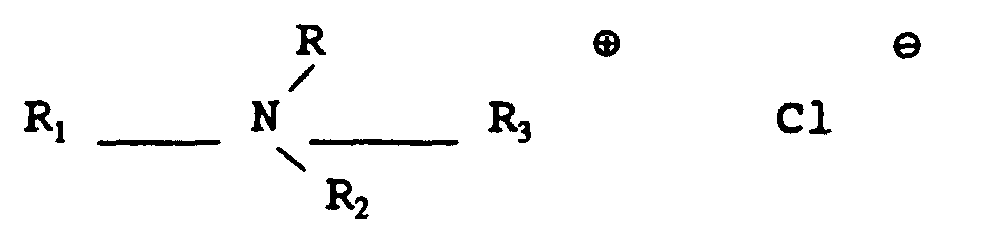
- the biocide which may be included herewith is, preferably, a quaternary ammonium chloride-type biocide well known to the skilled artisan and which, generally corresponds to the formula: wherein R, R 1 , R 2 and R 3 are each, individually, selected from the group of hydrogen, C 1 to C 12 alkyl groups, or aryl.
- the composition hereof also includes a corrosion inhibitor which preferably is a reducing agent as well.
- the corrosion inhibitor minimizes the rusting of a mild stainless steel or plastic track conveyor.
- other corrosion inhibitors may be used herein.
- the useful compounds are sodium nitrate, sodium thiosulfate, sodium bisulfate, mercaptobenzothiozale, sodium benzoate, substituted imidazoline derivatives including the substituted imidazoline of coco fatty acid and the like.
- Mixtures of corrosion inhibitor-reducing agents may be used.
- sodium nitrite is employed since it is both a reducing agent and corrosion inhibitor. It has been observed that the presence of the nitrite in the present lubricant precludes the rusting and the formation of black soil or sludge heretofore encountered in breweries.
- the source of alkalinity is used to elevate the pH of the lubricant to the desired levels and contributes to the cleaning.
- the source of alkalinity is used to elevate the pH of the lubricant to the desired levels and contributes to the cleaning.
- rust prevention and soil prevention is enhanced.
- the elevated pH keeps the diamine in the insoluble free base state, thereby minimizing its contribution to oxidation reactions.
- any source of compatible alkalinity may be used such as carbonates, metasilicates, bicarbonates, hydroxides and the like, as well as mixtures thereof, may be used.
- a strong base such as sodium hydroxide, potassium hydroxide, etc., or the like is employed as the alkaline source. It should be noted that in selecting the diamine and an amine hydrotrope, optimally, the alkyl portion of the diamine has about the same carbon chain length as the alkyl portion of the amine.
- the concentrate has a pH of from 11.0 to 13.0.
- the present track lubricants are particularly useful on mild steel stainless steel, plastic track conveyors, such as are used for filling glass, aluminum and two-piece PET containers.
- lubricant use solutions hereof which are advantageously supplied in the form of concentrates which are subsequently, preferably, diluted with water for use, also may contain additional ingredients such as defoamers, algaecides, etc., which may either be incorporated into the concentrate or added to the use solution.
- the components are admixed together. Ordinarily, the water is warmed to 38°C (100°F) to 54°C (130°F) and the other ingredients are added thereto. In preparing the use solution, the concentrate is added to the requisite amount of water, usually, at room temperature.
- the lubricant composition according to this invention is not, under ordinary conditions, affected by water hardness. Consequently, water softeners, which are usually employed with fatty acid-type soap lubricants, are not necessary for the diamine lubricants hereof.
- the use solution has a pH ⁇ 8 and, usually, ranging from 9.0 to 13.0, and, preferably, from 10.0 to 11.5.
- This example illustrates the preparation of a diamine lubricant concentrate in accordance with the present invention.
- a diamine lubricant concentrate in accordance with the present invention, is prepared from the following: Ingredient Amount, pbw Diamine 5.0 Water-Soluble Amine Hydrotrope 10.0 Potassium Hydroxide, 45% 0.6 Sodium Nitrite 9.9 Water 74.5
- a diamine lubricant concentrate was prepared from the following: Ingredient Amount, pbw Diamine 3.0 Nonionic Surfactant 16.0 KOH, 45% 0.5 Sodium Nitrite 1.0 Water 79.5
- a 0.25% use solution is prepared by admixing 25 parts of the concentrate of Example II with 1000 parts of water in a suitable container and at room temperature.
- a 2,5 x 7,6 cm (1" x 3") 1010 carbon steel coupon is then immersed in the lubricant such that approximately one half of the coupon is immersed in the lubricant and the other half is in the atmosphere.
- the coupon is then visually observed for rusting. After 21 days in the lubricant no rusting is visually apparent.
- Example III is repeated except that 40 parts of beer is added to the 160 parts of the 0.25% lubricant use solution.
- alkaline diamine lubricants are provided which can be used on various containers and articles with a lessening of corrosivity, while providing excellent lubricity, cleaning and the like.
Landscapes
- Chemical & Material Sciences (AREA)
- Organic Chemistry (AREA)
- Chemical Kinetics & Catalysis (AREA)
- General Chemical & Material Sciences (AREA)
- Oil, Petroleum & Natural Gas (AREA)
- Inorganic Chemistry (AREA)
- Health & Medical Sciences (AREA)
- Engineering & Computer Science (AREA)
- Clinical Laboratory Science (AREA)
- Life Sciences & Earth Sciences (AREA)
- Hydrology & Water Resources (AREA)
- Environmental & Geological Engineering (AREA)
- Water Supply & Treatment (AREA)
- Polymers & Plastics (AREA)
- Medicinal Chemistry (AREA)
- Lubricants (AREA)
Abstract
Description


| Ingredient | Amt, pbw |
| Diamine | 5.0 |
| Water-Soluble Amine Hydrotrope | 10.0 |
| Quaternary Ammonium Compound | 9.0 |
| Potassium Hydroxide, 45% | 0.6 |
| Sodium Nitrite | 5.0 |
| Water | 70.4 |
| Ingredient | Amount, pbw |
| Diamine | 5.0 |
| Water-Soluble Amine Hydrotrope | 10.0 |
| Potassium Hydroxide, 45% | 0.6 |
| Sodium Nitrite | 9.9 |
| Water | 74.5 |
| Ingredient | Amount, pbw |
| Diamine | 3.0 |
| Nonionic Surfactant | 16.0 |
| KOH, 45% | 0.5 |
| Sodium Nitrite | 1.0 |
| Water | 79.5 |
Claims (14)
- An alkaline diamine-based track lubricant, free of fatty acid, comprising;wherein the lubricant has a pH greater than 8 and the diamine is not neutralized with an acid to form a salt.(a) an alkyl diamine,(b) a water-soluble hydrotrope selected from the group consisting of ethoxylated alkyl amines, having at least 6 carbon atoms in the alkyl portion, nonionic surfactants and mixtures thereof,(c) a source of alkalinity.(d) a corrosion inhibitor,(e) water, and
- A lubricant according to claim 1, which further comprises a quaternary ammonium biocide.
- A lubricant according to claim 1 or 2, wherein the water-soluble amine is selected from the group consisting of coconut (ethoxylated) amine, oleyl (ethoxylated) amine, tallow (ethoxylated) amine and mixtures thereof.
- A lubricant according to claim 1,2 or 3, wherein the hydrotrope is the amine, the amine being present as a free-base amine.
- A lubricant according to any one of the preceding claims, wherein the hydrotrope and diamine are present in a respective weight ratio of about 2:1.
- A lubricant according to any one of the preceding claims, wherein the corrosion inhibitor is a reducing agent.
- An alkaline diamine-based track lubricant concentrate, free of fatty acid, comprising;wherein the diamine is not neutralized with an acid to form a salt, and the concentrate has a pH from 11.5 to 13.0.(a) an alkyl diamine,(b) a water-soluble hydrotrope selected from the group consisting of ethoxylated alkyl amines having at least 6 carbon atoms in the alkyl portion, nonionic surfactants and mixtures thereof,(c) a water-soluble reducing agent,(d) water, and
- A concentrate according to claim 7, which further comprises a source of alkalinity, the source of alkalinity being present in sufficient amount such that a use solution prepared therefrom has a pH greater than 8.
- A concentrate according to claim 7 or 8, which further comprises a quaternary ammonium chloride biocide.
- A concentrate according to claim 7, 8 or 9, which further comprises, by weight:(a) from 0.5 to 15 percent of the diamine;(b) from 1 to 30 percent of the hydrotrope;(c) from 1 to 15 percent of the reducing agent;(d) an effective amount of the source of alkalinity sufficient to raise the pH of a lubricant prepared therefrom to a pH greater than 8;(e) from 0 to 15 percent of a biocide, and(f) the balance being water.
- A concentrate according to claim 7, 8, 9 or 10, wherein the hydrotrope is an ethoxylated alkyl amine having at least 6 carbon atoms in the alkyl portion.
- A concentrate according to claim 11 wherein the hydrotrope is selected from the group consisting of coconut (ethoxylated) amine, oleyl (ethoxylated) amine, tallow (ethoxylated) amine and mixtures thereof.
- A concentrate according to any one of claims 7 to 12, wherein the hydrotrope and diamine are present in a respective weight ratio of about 2:1.
- A diamine track lubricant comprising:(a) water, and(b) a concentrate as defined in any one of claims 7 to 13, the lubricant comprising one part by weight of the concentrate per 100 to 1000 parts by weight of water.
Applications Claiming Priority (3)
| Application Number | Priority Date | Filing Date | Title |
|---|---|---|---|
| US217978 | 1994-03-25 | ||
| US08/217,978 US5510045A (en) | 1988-07-14 | 1994-03-25 | Alkaline diamine track lubricants |
| PCT/CA1995/000156 WO1995026389A1 (en) | 1994-03-25 | 1995-03-21 | Alkaline diamine track lubricants |
Publications (2)
| Publication Number | Publication Date |
|---|---|
| EP0767825A1 EP0767825A1 (en) | 1997-04-16 |
| EP0767825B1 true EP0767825B1 (en) | 1998-09-30 |
Family
ID=22813266
Family Applications (1)
| Application Number | Title | Priority Date | Filing Date |
|---|---|---|---|
| EP95912111A Revoked EP0767825B1 (en) | 1994-03-25 | 1995-03-21 | Alkaline diamine track lubricants |
Country Status (14)
| Country | Link |
|---|---|
| US (1) | US5510045A (en) |
| EP (1) | EP0767825B1 (en) |
| JP (1) | JP2002515073A (en) |
| AT (1) | ATE171720T1 (en) |
| AU (1) | AU685923B2 (en) |
| BR (1) | BR9507181A (en) |
| CA (1) | CA2184991C (en) |
| DE (1) | DE69505123T2 (en) |
| ES (1) | ES2123964T3 (en) |
| MX (1) | MX192368B (en) |
| NZ (1) | NZ282365A (en) |
| PL (1) | PL180444B1 (en) |
| WO (1) | WO1995026389A1 (en) |
| ZA (1) | ZA952435B (en) |
Cited By (5)
| Publication number | Priority date | Publication date | Assignee | Title |
|---|---|---|---|---|
| US7109152B1 (en) | 1999-07-22 | 2006-09-19 | Johnsondiversey, Inc. | Lubricant composition |
| US9359579B2 (en) | 2010-09-24 | 2016-06-07 | Ecolab Usa Inc. | Conveyor lubricants including emulsions and methods employing them |
| US9365798B2 (en) | 2005-03-15 | 2016-06-14 | Ecolab Usa Inc. | Lubricant for conveying containers |
| US9562209B2 (en) | 2005-03-15 | 2017-02-07 | Ecolab Usa Inc. | Dry lubricant for conveying containers |
| US9873853B2 (en) | 2013-03-11 | 2018-01-23 | Ecolab Usa Inc. | Lubrication of transfer plates using an oil or oil in water emulsions |
Families Citing this family (24)
| Publication number | Priority date | Publication date | Assignee | Title |
|---|---|---|---|---|
| EP0883668B1 (en) * | 1996-02-27 | 2001-10-04 | Unilever N.V. | Method for lubricating a conveyor belt |
| US5723418A (en) * | 1996-05-31 | 1998-03-03 | Ecolab Inc. | Alkyl ether amine conveyor lubricants containing corrosion inhibitors |
| NZ329859A (en) * | 1996-05-31 | 1999-04-29 | Ecolab Inc | Alkyl ether amine conveyor lubricant also comprising of an acid, a stabilising hydrotrope and a surfactant |
| US6247478B1 (en) | 1996-11-15 | 2001-06-19 | Ecolab Inc. | Cleaning method for polyethylene terephthalate containers |
| US6554005B1 (en) | 1996-11-15 | 2003-04-29 | Ecolab Inc. | Cleaning method for polyethylene terephthalate containers |
| US5932526A (en) * | 1997-06-20 | 1999-08-03 | Ecolab, Inc. | Alkaline ether amine conveyor lubricant |
| BE1011367A3 (en) * | 1997-09-12 | 1999-08-03 | Sopura S A | Lubricant formulation and use of same |
| DE19751744A1 (en) * | 1997-11-21 | 1999-05-27 | Basf Ag | Additives for chain lubricants |
| DE69820483T2 (en) | 1998-01-05 | 2004-10-14 | Ecolab Inc., St. Paul | ANTIMICROBIELLES, LUBRICANT COMPATIBLE WITH DRINKS FOR CONVEYORS |
| US6667283B2 (en) | 1999-01-15 | 2003-12-23 | Ecolab Inc. | Antimicrobial, high load bearing conveyor lubricant |
| FR2794767B1 (en) | 1999-06-08 | 2005-02-25 | Ceca Sa | LIQUID CONCENTRATE COMPOSITIONS EASILY DILUABLE BY WATER OF N-COCO-, N-OLEYL- OR N-SUIFHYLENEDIAMINES DIACETATES |
| US6214777B1 (en) | 1999-09-24 | 2001-04-10 | Ecolab, Inc. | Antimicrobial lubricants useful for lubricating containers, such as beverage containers, and conveyors therefor |
| DE19959315A1 (en) * | 1999-12-09 | 2001-06-21 | Henkel Ecolab Gmbh & Co Ohg | Improvement of the transport of containers on transport systems |
| US20040235680A1 (en) * | 2002-09-18 | 2004-11-25 | Ecolab Inc. | Conveyor lubricant with corrosion inhibition |
| US6967189B2 (en) * | 2002-11-27 | 2005-11-22 | Ecolab Inc. | Buffered lubricant for conveyor system |
| CA2496230C (en) | 2004-02-06 | 2015-11-24 | Henkel Kommanditgesellschaft Auf Aktien | Antimicrobial metal working fluids |
| US20050288191A1 (en) * | 2004-06-24 | 2005-12-29 | Ecolab Inc. | Conveyor system lubricant |
| MXNL04000060A (en) * | 2004-07-21 | 2006-01-26 | Quimiproductos S A De C V | Lubricant for conveyor chains for packaged products. |
| US20060046940A1 (en) * | 2004-08-27 | 2006-03-02 | Mohannad Almalki | Aqueous conveyor and cutting lubricant |
| US7727941B2 (en) * | 2005-09-22 | 2010-06-01 | Ecolab Inc. | Silicone conveyor lubricant with stoichiometric amount of an acid |
| US7915206B2 (en) * | 2005-09-22 | 2011-03-29 | Ecolab | Silicone lubricant with good wetting on PET surfaces |
| US7741255B2 (en) * | 2006-06-23 | 2010-06-22 | Ecolab Inc. | Aqueous compositions useful in filling and conveying of beverage bottles wherein the compositions comprise hardness ions and have improved compatibility with pet |
| DE102011084168B4 (en) * | 2011-10-07 | 2020-07-09 | Röchling Automotive AG & Co. KG | Flexible shaft loudspeaker, motor vehicle with flexible shaft loudspeaker, and use of a flexible shaft loudspeaker |
| WO2016191056A1 (en) * | 2015-05-22 | 2016-12-01 | Diversey, Inc. | Method and composition for an anion tolerant lubricant |
Family Cites Families (16)
| Publication number | Priority date | Publication date | Assignee | Title |
|---|---|---|---|---|
| US4604220A (en) * | 1984-11-15 | 1986-08-05 | Diversey Wyandotte Corporation | Alpha olefin sulfonates as conveyor lubricants |
| US4795581A (en) * | 1987-04-10 | 1989-01-03 | Texaco Inc. | Aqueous fluids thickened with fatty acid modified polyoxyalkylene diamines |
| SE460671B (en) * | 1988-03-30 | 1989-11-06 | Berol Kemi Ab | WATER-BASED METAL WORKING FLUID CONTAINING AN ALKANOLAMIN INTRODUCTION AS ANTIMICROBIAL AGENT AND A WAY TO PROCESS METALS USING THE SAME ALKANOLAMIN INTRODUCTION |
| US5073280A (en) * | 1988-07-14 | 1991-12-17 | Diversey Corporation | Composition for inhibiting stress cracks in plastic articles and methods of use therefor |
| US5223162A (en) * | 1988-07-14 | 1993-06-29 | Diversey Corporation | Washing composition for inhibiting stress cracking in poly(alkylene terephthalate) articles and methods of use therefor |
| US4929375A (en) * | 1988-07-14 | 1990-05-29 | Diversey Corporation | Conveyor lubricant containing alkyl amine coupling agents |
| US5009801A (en) * | 1988-07-14 | 1991-04-23 | Diversey Corporation | Compositions for preventing stress cracks in poly(alkylene terephthalate) articles and methods of use therefor |
| JPH03501267A (en) * | 1988-07-25 | 1991-03-22 | ハルコフスキー、アフトモビルノ‐ドロズヌイ、インスチツート、イメーニ、コムソモラ、ウクライヌイ | non-flammable lubricating fluid |
| ES2040986T5 (en) * | 1988-12-05 | 1997-02-16 | Unilever Nv | USE OF AQUEOUS LUBRICANT SOLUTIONS BASED ON ALKYL FAT AMINES. |
| DE3905548A1 (en) * | 1989-02-23 | 1990-09-06 | Henkel Kgaa | LUBRICANTS AND THEIR USE |
| US5202037A (en) * | 1989-10-02 | 1993-04-13 | Diversey Corporation | High solids lubricant |
| US5244589A (en) * | 1991-01-16 | 1993-09-14 | Ecolab Inc. | Antimicrobial lubricant compositions including a fatty acid and a quaternary |
| US5174914A (en) * | 1991-01-16 | 1992-12-29 | Ecolab Inc. | Conveyor lubricant composition having superior compatibility with synthetic plastic containers |
| FR2681312A1 (en) * | 1991-09-16 | 1993-03-19 | Francais Prod Ind Cfpi | LUBRICATING AND DISINFECTING SOLUTION FOR TRANSPORTING CHAIN OF CONTAINERS IN THE AGRO-FOOD INDUSTRY AND METHOD FOR ITS IMPLEMENTATION |
| US5282992A (en) * | 1992-04-07 | 1994-02-01 | Betz Laboratories, Inc. | Lubricating metal cleaner additive |
| DE59304833D1 (en) * | 1992-08-03 | 1997-01-30 | Henkel Ecolab Gmbh & Co Ohg | LUBRICANT CONCENTRATE AND AQUEOUS LUBRICANT SOLUTION BASED ON FAT AMINS, METHOD FOR THE PRODUCTION AND USE THEREOF |
-
1994
- 1994-03-25 US US08/217,978 patent/US5510045A/en not_active Expired - Lifetime
-
1995
- 1995-03-21 NZ NZ282365A patent/NZ282365A/en unknown
- 1995-03-21 ES ES95912111T patent/ES2123964T3/en not_active Expired - Lifetime
- 1995-03-21 DE DE69505123T patent/DE69505123T2/en not_active Revoked
- 1995-03-21 AU AU19443/95A patent/AU685923B2/en not_active Ceased
- 1995-03-21 AT AT95912111T patent/ATE171720T1/en not_active IP Right Cessation
- 1995-03-21 WO PCT/CA1995/000156 patent/WO1995026389A1/en not_active Ceased
- 1995-03-21 PL PL95316410A patent/PL180444B1/en unknown
- 1995-03-21 BR BR9507181A patent/BR9507181A/en not_active IP Right Cessation
- 1995-03-21 CA CA002184991A patent/CA2184991C/en not_active Expired - Fee Related
- 1995-03-21 JP JP52488695A patent/JP2002515073A/en active Pending
- 1995-03-21 EP EP95912111A patent/EP0767825B1/en not_active Revoked
- 1995-03-21 MX MX9604284A patent/MX192368B/en not_active IP Right Cessation
- 1995-03-24 ZA ZA952435A patent/ZA952435B/en unknown
Cited By (15)
| Publication number | Priority date | Publication date | Assignee | Title |
|---|---|---|---|---|
| US7109152B1 (en) | 1999-07-22 | 2006-09-19 | Johnsondiversey, Inc. | Lubricant composition |
| US10815448B2 (en) | 2005-03-15 | 2020-10-27 | Ecolab Usa Inc. | Lubricant for conveying containers |
| US10851325B2 (en) | 2005-03-15 | 2020-12-01 | Ecolab Usa Inc. | Dry lubricant for conveying containers |
| US9562209B2 (en) | 2005-03-15 | 2017-02-07 | Ecolab Usa Inc. | Dry lubricant for conveying containers |
| US9365798B2 (en) | 2005-03-15 | 2016-06-14 | Ecolab Usa Inc. | Lubricant for conveying containers |
| US9926511B2 (en) | 2005-03-15 | 2018-03-27 | Ecolab Usa Inc. | Lubricant for conveying containers |
| US10260020B2 (en) | 2010-09-24 | 2019-04-16 | Ecolab Usa Inc. | Conveyor lubricants including emulsions and methods employing them |
| US10793806B2 (en) | 2010-09-24 | 2020-10-06 | Ecolab Usa Inc. | Conveyor lubricants including emulsions and methods employing them |
| US9359579B2 (en) | 2010-09-24 | 2016-06-07 | Ecolab Usa Inc. | Conveyor lubricants including emulsions and methods employing them |
| US10316267B2 (en) | 2013-03-11 | 2019-06-11 | Ecolab Usa Inc. | Lubrication of transfer plates using an oil or oil in water emulsions |
| US10844314B2 (en) | 2013-03-11 | 2020-11-24 | Ecolab Usa Inc. | Lubrication of transfer plates using an oil or oil in water emulsions |
| US9873853B2 (en) | 2013-03-11 | 2018-01-23 | Ecolab Usa Inc. | Lubrication of transfer plates using an oil or oil in water emulsions |
| US11312919B2 (en) | 2013-03-11 | 2022-04-26 | Ecolab Usa Inc. | Lubrication of transfer plates using an oil or oil in water emulsions |
| US11788028B2 (en) | 2013-03-11 | 2023-10-17 | Ecolab Usa Inc. | Lubrication of transfer plate using an oil or oil in water emulsions |
| US12281280B2 (en) | 2013-03-11 | 2025-04-22 | Ecolab Usa Inc. | Lubrication of transfer plates using an oil or oil in water emulsions |
Also Published As
| Publication number | Publication date |
|---|---|
| ATE171720T1 (en) | 1998-10-15 |
| MX9604284A (en) | 1997-12-31 |
| CA2184991C (en) | 1999-06-22 |
| PL316410A1 (en) | 1997-01-06 |
| ZA952435B (en) | 1996-09-25 |
| NZ282365A (en) | 1997-09-22 |
| MX192368B (en) | 1999-06-15 |
| JP2002515073A (en) | 2002-05-21 |
| DE69505123D1 (en) | 1998-11-05 |
| AU1944395A (en) | 1995-10-17 |
| AU685923B2 (en) | 1998-01-29 |
| EP0767825A1 (en) | 1997-04-16 |
| PL180444B1 (en) | 2001-02-28 |
| DE69505123T2 (en) | 1999-02-18 |
| ES2123964T3 (en) | 1999-01-16 |
| BR9507181A (en) | 1997-10-14 |
| WO1995026389A1 (en) | 1995-10-05 |
| US5510045A (en) | 1996-04-23 |
Similar Documents
| Publication | Publication Date | Title |
|---|---|---|
| AU685923B2 (en) | Alkaline diamine track lubricants | |
| AU703542B2 (en) | Alkyl ether amine conveyor lubricant | |
| CA2291246C (en) | Alkaline ether amine conveyor lubricant | |
| AU703374B2 (en) | Alkyl ether amine conveyor lubricants containing corrosion inhibitors | |
| AU654843B2 (en) | Antimicrobial lubricant composition containing diamine acetate | |
| MXPA96004284A (en) | Lubricants for via diamina alcal | |
| EP0706555B1 (en) | Composition for inhibiting stress cracks in plastic articles and methods of use therefor | |
| CA2100563C (en) | Antimicrobial lubricant including fatty acid and quaternary ammonium compound | |
| EP0946692B1 (en) | Lubricants for conveyor belt installations in the food industry | |
| CA2155105C (en) | Thermoplastic compatible conveyor lubricant | |
| FI113784B (en) | Lubricating oil concentrate and aqueous lubricant solution based on fatty amines, process for making and using them | |
| JP2807081B2 (en) | lubricant | |
| EP0372628B1 (en) | Use of aqueous lubricant solutions based on fatty alkyl amines | |
| CA2131312A1 (en) | A surfactant base for soapless lubricants | |
| US5900392A (en) | Aqueous belt lubricant composition based on fatty alkyl propylene tettramines and fatty alcohol polyglycol ethers and method for lubricating belt conveyor systems | |
| MXPA99012040A (en) | Alkaline ether amine conveyor lubricant |
Legal Events
| Date | Code | Title | Description |
|---|---|---|---|
| PUAI | Public reference made under article 153(3) epc to a published international application that has entered the european phase |
Free format text: ORIGINAL CODE: 0009012 |
|
| 17P | Request for examination filed |
Effective date: 19960927 |
|
| AK | Designated contracting states |
Kind code of ref document: A1 Designated state(s): AT BE CH DE DK ES FR GB IT LI NL PT SE |
|
| GRAG | Despatch of communication of intention to grant |
Free format text: ORIGINAL CODE: EPIDOS AGRA |
|
| 17Q | First examination report despatched |
Effective date: 19980127 |
|
| GRAG | Despatch of communication of intention to grant |
Free format text: ORIGINAL CODE: EPIDOS AGRA |
|
| GRAH | Despatch of communication of intention to grant a patent |
Free format text: ORIGINAL CODE: EPIDOS IGRA |
|
| RAP1 | Party data changed (applicant data changed or rights of an application transferred) |
Owner name: UNILEVER PLC Owner name: UNILEVER N.V. |
|
| GRAH | Despatch of communication of intention to grant a patent |
Free format text: ORIGINAL CODE: EPIDOS IGRA |
|
| GRAA | (expected) grant |
Free format text: ORIGINAL CODE: 0009210 |
|
| AK | Designated contracting states |
Kind code of ref document: B1 Designated state(s): AT BE CH DE DK ES FR GB IT LI NL PT SE |
|
| PG25 | Lapsed in a contracting state [announced via postgrant information from national office to epo] |
Ref country code: BE Free format text: LAPSE BECAUSE OF FAILURE TO SUBMIT A TRANSLATION OF THE DESCRIPTION OR TO PAY THE FEE WITHIN THE PRESCRIBED TIME-LIMIT Effective date: 19980930 Ref country code: AT Free format text: LAPSE BECAUSE OF FAILURE TO SUBMIT A TRANSLATION OF THE DESCRIPTION OR TO PAY THE FEE WITHIN THE PRESCRIBED TIME-LIMIT Effective date: 19980930 |
|
| REF | Corresponds to: |
Ref document number: 171720 Country of ref document: AT Date of ref document: 19981015 Kind code of ref document: T |
|
| REG | Reference to a national code |
Ref country code: CH Ref legal event code: EP |
|
| REF | Corresponds to: |
Ref document number: 69505123 Country of ref document: DE Date of ref document: 19981105 |
|
| REG | Reference to a national code |
Ref country code: CH Ref legal event code: NV Representative=s name: E. BLUM & CO. PATENTANWAELTE |
|
| ET | Fr: translation filed | ||
| PG25 | Lapsed in a contracting state [announced via postgrant information from national office to epo] |
Ref country code: PT Free format text: LAPSE BECAUSE OF FAILURE TO SUBMIT A TRANSLATION OF THE DESCRIPTION OR TO PAY THE FEE WITHIN THE PRESCRIBED TIME-LIMIT Effective date: 19981230 |
|
| PG25 | Lapsed in a contracting state [announced via postgrant information from national office to epo] |
Ref country code: DK Free format text: LAPSE BECAUSE OF FAILURE TO SUBMIT A TRANSLATION OF THE DESCRIPTION OR TO PAY THE FEE WITHIN THE PRESCRIBED TIME-LIMIT Effective date: 19981231 |
|
| REG | Reference to a national code |
Ref country code: ES Ref legal event code: FG2A Ref document number: 2123964 Country of ref document: ES Kind code of ref document: T3 |
|
| PLBI | Opposition filed |
Free format text: ORIGINAL CODE: 0009260 |
|
| PLBF | Reply of patent proprietor to notice(s) of opposition |
Free format text: ORIGINAL CODE: EPIDOS OBSO |
|
| 26 | Opposition filed |
Opponent name: HENKEL KGAA Effective date: 19990623 |
|
| PLBF | Reply of patent proprietor to notice(s) of opposition |
Free format text: ORIGINAL CODE: EPIDOS OBSO |
|
| PGFP | Annual fee paid to national office [announced via postgrant information from national office to epo] |
Ref country code: FR Payment date: 20010208 Year of fee payment: 7 |
|
| PGFP | Annual fee paid to national office [announced via postgrant information from national office to epo] |
Ref country code: CH Payment date: 20010216 Year of fee payment: 7 |
|
| PGFP | Annual fee paid to national office [announced via postgrant information from national office to epo] |
Ref country code: DE Payment date: 20010222 Year of fee payment: 7 |
|
| PGFP | Annual fee paid to national office [announced via postgrant information from national office to epo] |
Ref country code: SE Payment date: 20010223 Year of fee payment: 7 |
|
| PGFP | Annual fee paid to national office [announced via postgrant information from national office to epo] |
Ref country code: GB Payment date: 20010301 Year of fee payment: 7 |
|
| PGFP | Annual fee paid to national office [announced via postgrant information from national office to epo] |
Ref country code: ES Payment date: 20010314 Year of fee payment: 7 |
|
| PGFP | Annual fee paid to national office [announced via postgrant information from national office to epo] |
Ref country code: NL Payment date: 20010319 Year of fee payment: 7 |
|
| RDAH | Patent revoked |
Free format text: ORIGINAL CODE: EPIDOS REVO |
|
| RDAG | Patent revoked |
Free format text: ORIGINAL CODE: 0009271 |
|
| STAA | Information on the status of an ep patent application or granted ep patent |
Free format text: STATUS: PATENT REVOKED |
|
| REG | Reference to a national code |
Ref country code: CH Ref legal event code: PL |
|
| 27W | Patent revoked |
Effective date: 20010622 |
|
| GBPR | Gb: patent revoked under art. 102 of the ep convention designating the uk as contracting state |
Free format text: 20010622 |
|
| NLR2 | Nl: decision of opposition |