EP0767739B1 - Heat sealed polymeric films - Google Patents
Heat sealed polymeric films Download PDFInfo
- Publication number
- EP0767739B1 EP0767739B1 EP96911030A EP96911030A EP0767739B1 EP 0767739 B1 EP0767739 B1 EP 0767739B1 EP 96911030 A EP96911030 A EP 96911030A EP 96911030 A EP96911030 A EP 96911030A EP 0767739 B1 EP0767739 B1 EP 0767739B1
- Authority
- EP
- European Patent Office
- Prior art keywords
- film
- polymethyl methacrylate
- cross
- heat sealing
- linked polymethyl
- Prior art date
- Legal status (The legal status is an assumption and is not a legal conclusion. Google has not performed a legal analysis and makes no representation as to the accuracy of the status listed.)
- Expired - Lifetime
Links
- 239000003795 chemical substances by application Substances 0.000 claims abstract description 34
- 238000007789 sealing Methods 0.000 claims abstract description 21
- 229920003229 poly(methyl methacrylate) Polymers 0.000 claims abstract description 20
- 239000004926 polymethyl methacrylate Substances 0.000 claims abstract description 20
- 238000000034 method Methods 0.000 claims abstract description 15
- 239000002245 particle Substances 0.000 claims abstract description 12
- 239000010410 layer Substances 0.000 claims description 29
- 239000012792 core layer Substances 0.000 claims description 6
- VYPSYNLAJGMNEJ-UHFFFAOYSA-N Silicium dioxide Chemical compound O=[Si]=O VYPSYNLAJGMNEJ-UHFFFAOYSA-N 0.000 description 18
- 239000000377 silicon dioxide Substances 0.000 description 9
- QQONPFPTGQHPMA-UHFFFAOYSA-N propylene Natural products CC=C QQONPFPTGQHPMA-UHFFFAOYSA-N 0.000 description 8
- 125000004805 propylene group Chemical group [H]C([H])([H])C([H])([*:1])C([H])([H])[*:2] 0.000 description 8
- 229920001155 polypropylene Polymers 0.000 description 7
- 229920001577 copolymer Polymers 0.000 description 6
- 229920001038 ethylene copolymer Polymers 0.000 description 6
- 239000002184 metal Substances 0.000 description 6
- 239000004594 Masterbatch (MB) Substances 0.000 description 5
- 239000004677 Nylon Substances 0.000 description 4
- VXNZUUAINFGPBY-UHFFFAOYSA-N ethyl ethylene Natural products CCC=C VXNZUUAINFGPBY-UHFFFAOYSA-N 0.000 description 4
- 239000000203 mixture Substances 0.000 description 4
- 229920001778 nylon Polymers 0.000 description 4
- 229920002959 polymer blend Polymers 0.000 description 4
- 238000001125 extrusion Methods 0.000 description 3
- 230000003287 optical effect Effects 0.000 description 3
- 238000004806 packaging method and process Methods 0.000 description 3
- 238000012360 testing method Methods 0.000 description 3
- 230000015572 biosynthetic process Effects 0.000 description 2
- 229920000642 polymer Polymers 0.000 description 2
- VGGSQFUCUMXWEO-UHFFFAOYSA-N Ethene Chemical compound C=C VGGSQFUCUMXWEO-UHFFFAOYSA-N 0.000 description 1
- 239000005977 Ethylene Substances 0.000 description 1
- CERQOIWHTDAKMF-UHFFFAOYSA-M Methacrylate Chemical compound CC(=C)C([O-])=O CERQOIWHTDAKMF-UHFFFAOYSA-M 0.000 description 1
- 239000004952 Polyamide Substances 0.000 description 1
- 239000006185 dispersion Substances 0.000 description 1
- 230000000694 effects Effects 0.000 description 1
- FPYJFEHAWHCUMM-UHFFFAOYSA-N maleic anhydride Chemical group O=C1OC(=O)C=C1 FPYJFEHAWHCUMM-UHFFFAOYSA-N 0.000 description 1
- 239000000463 material Substances 0.000 description 1
- 238000002844 melting Methods 0.000 description 1
- 230000008018 melting Effects 0.000 description 1
- 239000004005 microsphere Substances 0.000 description 1
- 229920003023 plastic Polymers 0.000 description 1
- 239000004033 plastic Substances 0.000 description 1
- 229920002647 polyamide Polymers 0.000 description 1
- 229920000098 polyolefin Polymers 0.000 description 1
- 229920005629 polypropylene homopolymer Polymers 0.000 description 1
- 229920001384 propylene homopolymer Polymers 0.000 description 1
- 239000005060 rubber Substances 0.000 description 1
- 238000006748 scratching Methods 0.000 description 1
- 230000002393 scratching effect Effects 0.000 description 1
- 238000010998 test method Methods 0.000 description 1
- 230000000007 visual effect Effects 0.000 description 1
- 238000005303 weighing Methods 0.000 description 1
- 239000010457 zeolite Substances 0.000 description 1
Images
Classifications
-
- B—PERFORMING OPERATIONS; TRANSPORTING
- B29—WORKING OF PLASTICS; WORKING OF SUBSTANCES IN A PLASTIC STATE IN GENERAL
- B29C—SHAPING OR JOINING OF PLASTICS; SHAPING OF MATERIAL IN A PLASTIC STATE, NOT OTHERWISE PROVIDED FOR; AFTER-TREATMENT OF THE SHAPED PRODUCTS, e.g. REPAIRING
- B29C66/00—General aspects of processes or apparatus for joining preformed parts
- B29C66/70—General aspects of processes or apparatus for joining preformed parts characterised by the composition, physical properties or the structure of the material of the parts to be joined; Joining with non-plastics material
- B29C66/72—General aspects of processes or apparatus for joining preformed parts characterised by the composition, physical properties or the structure of the material of the parts to be joined; Joining with non-plastics material characterised by the structure of the material of the parts to be joined
- B29C66/723—General aspects of processes or apparatus for joining preformed parts characterised by the composition, physical properties or the structure of the material of the parts to be joined; Joining with non-plastics material characterised by the structure of the material of the parts to be joined being multi-layered
-
- B—PERFORMING OPERATIONS; TRANSPORTING
- B32—LAYERED PRODUCTS
- B32B—LAYERED PRODUCTS, i.e. PRODUCTS BUILT-UP OF STRATA OF FLAT OR NON-FLAT, e.g. CELLULAR OR HONEYCOMB, FORM
- B32B27/00—Layered products comprising a layer of synthetic resin
- B32B27/30—Layered products comprising a layer of synthetic resin comprising vinyl (co)polymers; comprising acrylic (co)polymers
- B32B27/308—Layered products comprising a layer of synthetic resin comprising vinyl (co)polymers; comprising acrylic (co)polymers comprising acrylic (co)polymers
-
- B—PERFORMING OPERATIONS; TRANSPORTING
- B29—WORKING OF PLASTICS; WORKING OF SUBSTANCES IN A PLASTIC STATE IN GENERAL
- B29C—SHAPING OR JOINING OF PLASTICS; SHAPING OF MATERIAL IN A PLASTIC STATE, NOT OTHERWISE PROVIDED FOR; AFTER-TREATMENT OF THE SHAPED PRODUCTS, e.g. REPAIRING
- B29C65/00—Joining or sealing of preformed parts, e.g. welding of plastics materials; Apparatus therefor
- B29C65/02—Joining or sealing of preformed parts, e.g. welding of plastics materials; Apparatus therefor by heating, with or without pressure
- B29C65/18—Joining or sealing of preformed parts, e.g. welding of plastics materials; Apparatus therefor by heating, with or without pressure using heated tools
-
- B—PERFORMING OPERATIONS; TRANSPORTING
- B29—WORKING OF PLASTICS; WORKING OF SUBSTANCES IN A PLASTIC STATE IN GENERAL
- B29C—SHAPING OR JOINING OF PLASTICS; SHAPING OF MATERIAL IN A PLASTIC STATE, NOT OTHERWISE PROVIDED FOR; AFTER-TREATMENT OF THE SHAPED PRODUCTS, e.g. REPAIRING
- B29C66/00—General aspects of processes or apparatus for joining preformed parts
- B29C66/01—General aspects dealing with the joint area or with the area to be joined
- B29C66/02—Preparation of the material, in the area to be joined, prior to joining or welding
- B29C66/024—Thermal pre-treatments
- B29C66/0242—Heating, or preheating, e.g. drying
-
- B—PERFORMING OPERATIONS; TRANSPORTING
- B29—WORKING OF PLASTICS; WORKING OF SUBSTANCES IN A PLASTIC STATE IN GENERAL
- B29C—SHAPING OR JOINING OF PLASTICS; SHAPING OF MATERIAL IN A PLASTIC STATE, NOT OTHERWISE PROVIDED FOR; AFTER-TREATMENT OF THE SHAPED PRODUCTS, e.g. REPAIRING
- B29C66/00—General aspects of processes or apparatus for joining preformed parts
- B29C66/40—General aspects of joining substantially flat articles, e.g. plates, sheets or web-like materials; Making flat seams in tubular or hollow articles; Joining single elements to substantially flat surfaces
- B29C66/41—Joining substantially flat articles ; Making flat seams in tubular or hollow articles
- B29C66/43—Joining a relatively small portion of the surface of said articles
-
- B—PERFORMING OPERATIONS; TRANSPORTING
- B29—WORKING OF PLASTICS; WORKING OF SUBSTANCES IN A PLASTIC STATE IN GENERAL
- B29C—SHAPING OR JOINING OF PLASTICS; SHAPING OF MATERIAL IN A PLASTIC STATE, NOT OTHERWISE PROVIDED FOR; AFTER-TREATMENT OF THE SHAPED PRODUCTS, e.g. REPAIRING
- B29C66/00—General aspects of processes or apparatus for joining preformed parts
- B29C66/40—General aspects of joining substantially flat articles, e.g. plates, sheets or web-like materials; Making flat seams in tubular or hollow articles; Joining single elements to substantially flat surfaces
- B29C66/41—Joining substantially flat articles ; Making flat seams in tubular or hollow articles
- B29C66/43—Joining a relatively small portion of the surface of said articles
- B29C66/431—Joining the articles to themselves
-
- B—PERFORMING OPERATIONS; TRANSPORTING
- B32—LAYERED PRODUCTS
- B32B—LAYERED PRODUCTS, i.e. PRODUCTS BUILT-UP OF STRATA OF FLAT OR NON-FLAT, e.g. CELLULAR OR HONEYCOMB, FORM
- B32B27/00—Layered products comprising a layer of synthetic resin
- B32B27/06—Layered products comprising a layer of synthetic resin as the main or only constituent of a layer, which is next to another layer of the same or of a different material
- B32B27/08—Layered products comprising a layer of synthetic resin as the main or only constituent of a layer, which is next to another layer of the same or of a different material of synthetic resin
-
- B—PERFORMING OPERATIONS; TRANSPORTING
- B32—LAYERED PRODUCTS
- B32B—LAYERED PRODUCTS, i.e. PRODUCTS BUILT-UP OF STRATA OF FLAT OR NON-FLAT, e.g. CELLULAR OR HONEYCOMB, FORM
- B32B27/00—Layered products comprising a layer of synthetic resin
- B32B27/18—Layered products comprising a layer of synthetic resin characterised by the use of special additives
-
- B—PERFORMING OPERATIONS; TRANSPORTING
- B32—LAYERED PRODUCTS
- B32B—LAYERED PRODUCTS, i.e. PRODUCTS BUILT-UP OF STRATA OF FLAT OR NON-FLAT, e.g. CELLULAR OR HONEYCOMB, FORM
- B32B27/00—Layered products comprising a layer of synthetic resin
- B32B27/30—Layered products comprising a layer of synthetic resin comprising vinyl (co)polymers; comprising acrylic (co)polymers
-
- B—PERFORMING OPERATIONS; TRANSPORTING
- B32—LAYERED PRODUCTS
- B32B—LAYERED PRODUCTS, i.e. PRODUCTS BUILT-UP OF STRATA OF FLAT OR NON-FLAT, e.g. CELLULAR OR HONEYCOMB, FORM
- B32B27/00—Layered products comprising a layer of synthetic resin
- B32B27/32—Layered products comprising a layer of synthetic resin comprising polyolefins
-
- B—PERFORMING OPERATIONS; TRANSPORTING
- B29—WORKING OF PLASTICS; WORKING OF SUBSTANCES IN A PLASTIC STATE IN GENERAL
- B29C—SHAPING OR JOINING OF PLASTICS; SHAPING OF MATERIAL IN A PLASTIC STATE, NOT OTHERWISE PROVIDED FOR; AFTER-TREATMENT OF THE SHAPED PRODUCTS, e.g. REPAIRING
- B29C66/00—General aspects of processes or apparatus for joining preformed parts
- B29C66/01—General aspects dealing with the joint area or with the area to be joined
- B29C66/05—Particular design of joint configurations
- B29C66/10—Particular design of joint configurations particular design of the joint cross-sections
- B29C66/11—Joint cross-sections comprising a single joint-segment, i.e. one of the parts to be joined comprising a single joint-segment in the joint cross-section
- B29C66/112—Single lapped joints
- B29C66/1122—Single lap to lap joints, i.e. overlap joints
-
- B—PERFORMING OPERATIONS; TRANSPORTING
- B29—WORKING OF PLASTICS; WORKING OF SUBSTANCES IN A PLASTIC STATE IN GENERAL
- B29C—SHAPING OR JOINING OF PLASTICS; SHAPING OF MATERIAL IN A PLASTIC STATE, NOT OTHERWISE PROVIDED FOR; AFTER-TREATMENT OF THE SHAPED PRODUCTS, e.g. REPAIRING
- B29C66/00—General aspects of processes or apparatus for joining preformed parts
- B29C66/70—General aspects of processes or apparatus for joining preformed parts characterised by the composition, physical properties or the structure of the material of the parts to be joined; Joining with non-plastics material
- B29C66/71—General aspects of processes or apparatus for joining preformed parts characterised by the composition, physical properties or the structure of the material of the parts to be joined; Joining with non-plastics material characterised by the composition of the plastics material of the parts to be joined
-
- B—PERFORMING OPERATIONS; TRANSPORTING
- B32—LAYERED PRODUCTS
- B32B—LAYERED PRODUCTS, i.e. PRODUCTS BUILT-UP OF STRATA OF FLAT OR NON-FLAT, e.g. CELLULAR OR HONEYCOMB, FORM
- B32B38/00—Ancillary operations in connection with laminating processes
- B32B2038/0052—Other operations not otherwise provided for
- B32B2038/0076—Curing, vulcanising, cross-linking
-
- B—PERFORMING OPERATIONS; TRANSPORTING
- B32—LAYERED PRODUCTS
- B32B—LAYERED PRODUCTS, i.e. PRODUCTS BUILT-UP OF STRATA OF FLAT OR NON-FLAT, e.g. CELLULAR OR HONEYCOMB, FORM
- B32B2250/00—Layers arrangement
- B32B2250/03—3 layers
-
- B—PERFORMING OPERATIONS; TRANSPORTING
- B32—LAYERED PRODUCTS
- B32B—LAYERED PRODUCTS, i.e. PRODUCTS BUILT-UP OF STRATA OF FLAT OR NON-FLAT, e.g. CELLULAR OR HONEYCOMB, FORM
- B32B2250/00—Layers arrangement
- B32B2250/24—All layers being polymeric
- B32B2250/246—All polymers belonging to those covered by groups B32B27/32 and B32B27/30
-
- B—PERFORMING OPERATIONS; TRANSPORTING
- B32—LAYERED PRODUCTS
- B32B—LAYERED PRODUCTS, i.e. PRODUCTS BUILT-UP OF STRATA OF FLAT OR NON-FLAT, e.g. CELLULAR OR HONEYCOMB, FORM
- B32B2250/00—Layers arrangement
- B32B2250/40—Symmetrical or sandwich layers, e.g. ABA, ABCBA, ABCCBA
-
- B—PERFORMING OPERATIONS; TRANSPORTING
- B32—LAYERED PRODUCTS
- B32B—LAYERED PRODUCTS, i.e. PRODUCTS BUILT-UP OF STRATA OF FLAT OR NON-FLAT, e.g. CELLULAR OR HONEYCOMB, FORM
- B32B2333/00—Polymers of unsaturated acids or derivatives thereof
Definitions
- This invention concerns heat sealed polymeric films and the formation of such seals with such films.
- Polymeric films used for packaging are usually required to have good slip properties both when hot, so that the film slides satisfactorily on metal surfaces of packaging machines, and when cold, so that the packages themselves can slide on each other.
- Particularly demanding conditions occur in the formation of so-called “drag-seals” where film to be sealed is pulled across the face of a hot heat surface before heat sealing is effected, compared with situations in which the film is required to slide over other hot metal surfaces, for example in form-fill-seal machines.
- Increased slip can be provided by the use of larger amounts of slip and/or antiblock agents.
- increasing the amount of such agents often reduces the optical properties of the films, relatively large amounts of such agents often increasing the haze of the films.
- inorganic antiblock agents such as silica or zeolites, the result can be scratching of the film by film-to-film contact caused by the abrasive effect of the antiblock agent.
- hitherto proposed organic antiblock agents often have relatively low softening temperatures and/or melting points, which leads to poor hot slip properties even if their room temperature slip properties and haze are otherwise satisfactory.
- the temperatures used to extrude the polymers used to produce polymeric films are often sufficiently high that hitherto proposed organic antiblock agents degrade at the extrusion temperatures, leading to the build up of degraded material at the die. This can happen, for example, when using polyamide antiblock agents.
- Hitherto proposed polyalkyl methacrylate antiblock agents have also been found to reduce in size during extrusion, thereby leading to a reduction in their effectiveness as an antiblock agent.
- the invention further provides a method of heat sealing a heat sealable multilayer film having a first film surface which is heat sealable to itself or to other surfaces and a second film surface including particles of a cross-linked polymethyl methacrylate as an antiblock agent, the method comprising sliding the said second film surface over a heated heat sealing surfaces before effecting heat sealing of the film to itself or to another surface using said heated heat sealing surfaces.
- Multilayer films used in accordance with the present invention can consist of two or more layers, usually of one or more polyolefins.
- the precise film structure is relatively unimportant since the present invention is concerned with the outer surface of the films being sealed rather than any layer or layers which may be present beneath the outer surface.
- particularly preferred films have a core layer with a first and second outer layer, the first and second outer layers respectively defining the first and second film surfaces.
- Especially preferred films for use in accordance with the present invention have a core layer, for example of a propylene polymer, more particularly a propylene homopolymer, with two outer layers, at least one of the outer layers being heat sealable to itself and/or to another surface and defining the second surface, and the other defining the first surface and having the particulate cross-linked polymethyl methacrylate in its surface.
- the polymer layer defining the first surface is also heat sealable to itself and/or to other surfaces.
- the first surface of the films to be sealed in accordance with the present invention include a particulate cross-linked polymethyl methacrylate as an antiblock agent.
- the second film surface can also include a particulate cross-linked polymethyl methacrylate antiblock agent, for example to impart good hot slip properties to the second film surface.
- the cross-linked polymethyl methacrylate antiblock agent is preferably in the form of microspheres, and the mean particle size of the cross-linked polymethyl methacrylate is preferably from 2 to 6 ⁇ m.
- the preferred amount of particulate cross-linked polymethyl methacrylate is from 500 to 6000 ppm, more preferably from 1000 to 5000 ppm, based on the weight of the respective layer or layers in which it is present.
- antiblock agents can also be present in either or both of the film surfaces which contain the cross-linked polymethyl methacrylate antiblock agent.
- excessive total amounts of antiblock agents can reduce the optical properties of the films, for example their gloss and/or haze. It is therefore generally preferred to include relatively low amounts of other antiblock agents.
- silica is the other antiblock agent it is present in an amount not in excess of 2000ppm based on the weight of the layer in which it is present with the particulate cross-linked polymethyl methacrylate. Excessive total amounts of antiblock agent can lead to reduced sealing performance, particularly in low pressure sealing applications.
- Films used in accordance with the present invention can be produced by known methods, for example by coextrusion of the respective layers of the films, and in general biaxially orienting the resultant co-extrudate.
- a three layer film was produced by coextruding a core layer of a polypropylene homopolymer with a first outer layer of a polymer blend containing a mixture of antiblock agents on one surface of the core layer, and a second outer layer of a single copolymer plus an antiblock agent on the other surface of the core layer.
- the polymer blend used for the first layer consisted of a blend of 25 wt% of a propylene/butene-1 copolymer (20 mol% butene-1) and 75 wt% of a propylene/ethylene copolymer (5 mol% ethylene).
- the antiblock agents consisted of 5000 ppm of a particulate polymethyl methacrylate with a mean particle size of 4 ⁇ m (EPOSTAR 1004 MA - Nagase & Co., Ltd, Japan) used as a masterbatch in some of the propylene/ethylene copolymer referred to above (ABVT22SCN supplied by Schulman Plastics NV, Belgium as a 10 wt% dispersion in the copolymer, a proportion of the copolymer having been modified with maleic anhydride), 940 ppm of silica with a mean particle size of 2 ⁇ m from the masterbatch and the remainder of the propylene/ethylene copolymer, and 760 ppm of silica with a mean particle size of 4 ⁇ m from the propylene/butene-1 copolymer.
- the second outer layer consisted of the propylene/ethylene copolymer used in the first layer, and it contained 1000 ppm of silica having a mean particle size of 2 ⁇ m.
- the resulting extruded three layer web was cooled on a chill roll, and it was then stretched 4.5 times in the direction of extrusion by passing it over heated rollers at 110°C, followed by 10 times in the transverse direction in a stenter oven at 160°C.
- the film was then heat set, the second layer was corona discharge treated to increase its surface energy (42J/cm 2 ), and the film was wound up.
- the film had a total thickness of 18 ⁇ m, with the outer layer formed from the copolymer blend having a thickness of 1.4 ⁇ m and the other outer layer having a thickness of 1 ⁇ m.
- a three layer film was produced substantially as described in Example 1, except that the masterbatch containing the EPOSTAR 1004 MA was replaced by 10 wt% of a masterbatch of particulate nylon with a mean particle size of 3 ⁇ m in the same propylene/ethylene copolymer to yield a polymer blend containing 5000 ppm of the nylon based on the weight of the blend.
- a three layer film was produced substantially as described in Example 1, except that the masterbatch used to add the EPOSTAR 1004 MA was replaced by an equivalent weight of the propylene/ethylene copolymer.
- the apparatus used to test film samples for their dynamic slip properties at various temperatures, thereby to give an indication of their performance in forming drag seals included a flat, horizontal metal bed approximately 50cm long and 20cm wide, and a film transport system consisting of a pair of rubber rollers driven by a motor so that the film to be tested could be pulled across the metal bed.
- the attachment of the transducer to the flat bed was also such that transport of the film across the flat: bed by the film transport system caused the film to drag the sled with it, and thereby provide an output indicative of the frictional force required to move the film relative to the sled.
- the output of the force transducer was connected to a chart recorder to provide a time variant record indicative of the frictional force between the sled and the film as the film was drawn through the apparatus by the film transport system.
- the temperature of the sled was monitored by a thermistor linked to a visual display.
- a sample of the film to be tested 18cm wide and approximately 5m long, was loaded into the apparatus across the flat bed and between the rollers of the film transport system.
- the film samples were placed with the layer formed from the polymer blend upwards, and the sled, connected to the flat bed via the force transducer, was than placed on the film sample.
- the speed of the motor of the film transport system was set so that the 5m long film sample was drawn across the flat bed in approximately 3 minutes, and the electric heater in the sled was turned on so that the temperature of the sled increased from room temperature to 140"C in slightly less time than was required to drag the sample under the sled.
- the chart recorder was also switched on.
- the chart produced by the chart recorder was then marked to show when the sled had reached certain temperatures.
- the slip between the heated sled and the moving film was then calculated at various temperatures from the output of the force transducer as shown on the chart recorder.
- Example 1 which included a particulate cross-linked polymethyl methacrylate and silica as an antiblock agent, showed particularly high slip against the metal surface of the sled when compared with the comparison films of Examples 2 and 3 which respectively used nylon plus silica or silica alone as the antiblock agent.
- This improvement was especially marked at the temperatures used to heat seal heat sealable polymeric films, for example at temperatures in excess of 80°C, and more especially at temperatures above 100°C.
Landscapes
- Engineering & Computer Science (AREA)
- Mechanical Engineering (AREA)
- Physics & Mathematics (AREA)
- Thermal Sciences (AREA)
- Laminated Bodies (AREA)
Abstract
Description
- This invention concerns heat sealed polymeric films and the formation of such seals with such films.
- Polymeric films used for packaging are usually required to have good slip properties both when hot, so that the film slides satisfactorily on metal surfaces of packaging machines, and when cold, so that the packages themselves can slide on each other. Particularly demanding conditions occur in the formation of so-called "drag-seals" where film to be sealed is pulled across the face of a hot heat surface before heat sealing is effected, compared with situations in which the film is required to slide over other hot metal surfaces, for example in form-fill-seal machines.
- Increased slip can be provided by the use of larger amounts of slip and/or antiblock agents. However, increasing the amount of such agents often reduces the optical properties of the films, relatively large amounts of such agents often increasing the haze of the films. In the case of increased amounts of inorganic antiblock agents such as silica or zeolites, the result can be scratching of the film by film-to-film contact caused by the abrasive effect of the antiblock agent.
- The result of these problems is that a trade off is made between the speed of packaging which can be carried out and the optical properties of the film being used.
- One proposal for dealing with this problem has been to use organic antiblock agents. However, hitherto proposed organic antiblock agents often have relatively low softening temperatures and/or melting points, which leads to poor hot slip properties even if their room temperature slip properties and haze are otherwise satisfactory. Furthermore, the temperatures used to extrude the polymers used to produce polymeric films are often sufficiently high that hitherto proposed organic antiblock agents degrade at the extrusion temperatures, leading to the build up of degraded material at the die. This can happen, for example, when using polyamide antiblock agents. Hitherto proposed polyalkyl methacrylate antiblock agents have also been found to reduce in size during extrusion, thereby leading to a reduction in their effectiveness as an antiblock agent.
- According to the present invention there is provided the use of drag sealing to heat seal a heat sealable polymeric film including particulate cross-linked polymethyl methacrylate as an antiblock agent.
- The invention further provides a method of heat sealing a heat sealable multilayer film having a first film surface which is heat sealable to itself or to other surfaces and a second film surface including particles of a cross-linked polymethyl methacrylate as an antiblock agent, the method comprising sliding the said second film surface over a heated heat sealing surfaces before effecting heat sealing of the film to itself or to another surface using said heated heat sealing surfaces.
- The use of drag sealing to seal films which use cross-linked polymethyl methacrylate as an antiblock agent has resulted in good sealing with high slip on the heat seal jaws, particularly when compared with analogous films using comparable weights of silica or nylon antiblock agents.
- Multilayer films used in accordance with the present invention can consist of two or more layers, usually of one or more polyolefins. As will be appreciated by those skilled in the art, the precise film structure is relatively unimportant since the present invention is concerned with the outer surface of the films being sealed rather than any layer or layers which may be present beneath the outer surface. However, particularly preferred films have a core layer with a first and second outer layer, the first and second outer layers respectively defining the first and second film surfaces.
- Especially preferred films for use in accordance with the present invention have a core layer, for example of a propylene polymer, more particularly a propylene homopolymer, with two outer layers, at least one of the outer layers being heat sealable to itself and/or to another surface and defining the second surface, and the other defining the first surface and having the particulate cross-linked polymethyl methacrylate in its surface. Preferably, the polymer layer defining the first surface is also heat sealable to itself and/or to other surfaces.
- The first surface of the films to be sealed in accordance with the present invention include a particulate cross-linked polymethyl methacrylate as an antiblock agent. However, the second film surface can also include a particulate cross-linked polymethyl methacrylate antiblock agent, for example to impart good hot slip properties to the second film surface.
- The cross-linked polymethyl methacrylate antiblock agent is preferably in the form of microspheres, and the mean particle size of the cross-linked polymethyl methacrylate is preferably from 2 to 6µm.
- The preferred amount of particulate cross-linked polymethyl methacrylate is from 500 to 6000 ppm, more preferably from 1000 to 5000 ppm, based on the weight of the respective layer or layers in which it is present.
- Other antiblock agents can also be present in either or both of the film surfaces which contain the cross-linked polymethyl methacrylate antiblock agent. However, excessive total amounts of antiblock agents can reduce the optical properties of the films, for example their gloss and/or haze. It is therefore generally preferred to include relatively low amounts of other antiblock agents. It is generally preferred that when silica is the other antiblock agent it is present in an amount not in excess of 2000ppm based on the weight of the layer in which it is present with the particulate cross-linked polymethyl methacrylate. Excessive total amounts of antiblock agent can lead to reduced sealing performance, particularly in low pressure sealing applications.
- Films used in accordance with the present invention can be produced by known methods, for example by coextrusion of the respective layers of the films, and in general biaxially orienting the resultant co-extrudate.
- The following Examples are given by way of illustration only.
- A three layer film was produced by coextruding a core layer of a polypropylene homopolymer with a first outer layer of a polymer blend containing a mixture of antiblock agents on one surface of the core layer, and a second outer layer of a single copolymer plus an antiblock agent on the other surface of the core layer.
- The polymer blend used for the first layer consisted of a blend of 25 wt% of a propylene/butene-1 copolymer (20 mol% butene-1) and 75 wt% of a propylene/ethylene copolymer (5 mol% ethylene). The antiblock agents consisted of 5000 ppm of a particulate polymethyl methacrylate with a mean particle size of 4µm (EPOSTAR 1004 MA - Nagase & Co., Ltd, Japan) used as a masterbatch in some of the propylene/ethylene copolymer referred to above (ABVT22SCN supplied by Schulman Plastics NV, Belgium as a 10 wt% dispersion in the copolymer, a proportion of the copolymer having been modified with maleic anhydride), 940 ppm of silica with a mean particle size of 2µm from the masterbatch and the remainder of the propylene/ethylene copolymer, and 760 ppm of silica with a mean particle size of 4µm from the propylene/butene-1 copolymer.
- The second outer layer consisted of the propylene/ethylene copolymer used in the first layer, and it contained 1000 ppm of silica having a mean particle size of 2µm.
- The resulting extruded three layer web was cooled on a chill roll, and it was then stretched 4.5 times in the direction of extrusion by passing it over heated rollers at 110°C, followed by 10 times in the transverse direction in a stenter oven at 160°C. The film was then heat set, the second layer was corona discharge treated to increase its surface energy (42J/cm2), and the film was wound up.
- The film had a total thickness of 18µm, with the outer layer formed from the copolymer blend having a thickness of 1.4µm and the other outer layer having a thickness of 1µm.
- A three layer film was produced substantially as described in Example 1, except that the masterbatch containing the EPOSTAR 1004 MA was replaced by 10 wt% of a masterbatch of particulate nylon with a mean particle size of 3µm in the same propylene/ethylene copolymer to yield a polymer blend containing 5000 ppm of the nylon based on the weight of the blend.
- A three layer film was produced substantially as described in Example 1, except that the masterbatch used to add the EPOSTAR 1004 MA was replaced by an equivalent weight of the propylene/ethylene copolymer.
- The apparatus used to test film samples for their dynamic slip properties at various temperatures, thereby to give an indication of their performance in forming drag seals, included a flat, horizontal metal bed approximately 50cm long and 20cm wide, and a film transport system consisting of a pair of rubber rollers driven by a motor so that the film to be tested could be pulled across the metal bed.
- An electrically heatable metal sled 8.9cm long and 6.35cm wide, and weighing 936g, was connected to the flat bed via a force transducer so that in use with the sled positioned on the film being tested it was approximately half way across the width of the flat bed, with the length of the sled being substantially parallel to the longer dimension of the bed. The attachment of the transducer to the flat bed was also such that transport of the film across the flat: bed by the film transport system caused the film to drag the sled with it, and thereby provide an output indicative of the frictional force required to move the film relative to the sled.
- The output of the force transducer was connected to a chart recorder to provide a time variant record indicative of the frictional force between the sled and the film as the film was drawn through the apparatus by the film transport system. The temperature of the sled was monitored by a thermistor linked to a visual display.
- A sample of the film to be tested, 18cm wide and approximately 5m long, was loaded into the apparatus across the flat bed and between the rollers of the film transport system. In testing the films of Examples 1 to 3 the film samples were placed with the layer formed from the polymer blend upwards, and the sled, connected to the flat bed via the force transducer, was than placed on the film sample.
- The speed of the motor of the film transport system was set so that the 5m long film sample was drawn across the flat bed in approximately 3 minutes, and the electric heater in the sled was turned on so that the temperature of the sled increased from room temperature to 140"C in slightly less time than was required to drag the sample under the sled. The chart recorder was also switched on.
- The chart produced by the chart recorder was then marked to show when the sled had reached certain temperatures.
- The slip between the heated sled and the moving film was then calculated at various temperatures from the output of the force transducer as shown on the chart recorder.
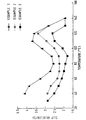
- The results obtained with Examples 1 to 3 in this test are shown in the accompanying drawing which graphically shows changes in slip (the inverse of coefficient of friction) as a function of changes in the temperature of the sled. As can be seen from the drawing, the film of Example 1, which included a particulate cross-linked polymethyl methacrylate and silica as an antiblock agent, showed particularly high slip against the metal surface of the sled when compared with the comparison films of Examples 2 and 3 which respectively used nylon plus silica or silica alone as the antiblock agent. This improvement was especially marked at the temperatures used to heat seal heat sealable polymeric films, for example at temperatures in excess of 80°C, and more especially at temperatures above 100°C.
Claims (10)
- A method of heat sealing a heat sealable multilayer film having a first film surface which is heat sealable to itself or to other surfaces and a second film surface including particles of a cross-linked polymethyl methacrylate as an antiblock agent, the method comprising sliding the said second film surface over a heated heat sealing surface before effecting heat sealing of the film to itself or to another surface using said heated heat sealing surface.
- A method according to claim 1, wherein the said first film surface also includes particles of a cross-linked polymethyl methacrylate as an antiblock agent.
- A method according to either of the preceding claims, wherein the multilayer film comprises a polymeric core layer with a first outer layer thereon defining the said first film surface and a second outer layer thereon defining the said second film surface.
- A method according to claim 3, wherein the cross-linked polymethyl methacrylate is present in an amount of from 500 to 6000 ppm based on the weight of the layer or layers in which it is present.
- A method according to any of the preceding claims, wherein the cross-linked polymethyl methacrylate has a mean particle size of from 2 to 6µm.
- A method according to any of the preceding claims, wherein the said first surface includes particles of a further antiblock agent, the cross-linked polymethyl methacrylate being present in said first film surface in an amount sufficient to reduce the drag of the film on the heated heat sealing surfaces.
- A method according to any of the preceding claims, wherein the heated heat sealing surfaces are at a temperature of at least 80°C.
- A method according to claim 7, wherein the said temperature is at least 100°C.
- A method according to claim 8, wherein the said temperature is at least 120°C.
- The use of drag sealing to heat seal a heat sealable polymeric film including particulate cross-linked polymethyl methacrylate as an antiblock agent.
Applications Claiming Priority (4)
| Application Number | Priority Date | Filing Date | Title |
|---|---|---|---|
| GB9508551A GB2300143B (en) | 1995-04-27 | 1995-04-27 | Heat sealed polymeric films |
| GB9508551 | 1995-04-27 | ||
| PCT/GB1996/000971 WO1996033868A1 (en) | 1995-04-27 | 1996-04-24 | Heat sealed polymeric films |
| CA002183038A CA2183038A1 (en) | 1995-04-27 | 1996-08-09 | Heat sealed polymeric films |
Publications (2)
| Publication Number | Publication Date |
|---|---|
| EP0767739A1 EP0767739A1 (en) | 1997-04-16 |
| EP0767739B1 true EP0767739B1 (en) | 2001-09-05 |
Family
ID=25678615
Family Applications (1)
| Application Number | Title | Priority Date | Filing Date |
|---|---|---|---|
| EP96911030A Expired - Lifetime EP0767739B1 (en) | 1995-04-27 | 1996-04-24 | Heat sealed polymeric films |
Country Status (4)
| Country | Link |
|---|---|
| EP (1) | EP0767739B1 (en) |
| CA (1) | CA2183038A1 (en) |
| GB (1) | GB2300143B (en) |
| WO (1) | WO1996033868A1 (en) |
Families Citing this family (1)
| Publication number | Priority date | Publication date | Assignee | Title |
|---|---|---|---|---|
| KR100622429B1 (en) * | 1999-07-08 | 2006-09-11 | 삼성토탈 주식회사 | Heat Adhesive Polypropylene Resin Composition |
Family Cites Families (7)
| Publication number | Priority date | Publication date | Assignee | Title |
|---|---|---|---|---|
| NL135161C (en) * | 1961-11-08 | |||
| NL185669C (en) * | 1976-08-05 | 1990-06-18 | Mobil Oil Corp | PROCESS FOR MANUFACTURING A PACKAGING FOR A PRODUCT FROM A LAYER OF A TWO-SIDED COATED FOIL OF POLYPROPYPE. |
| DE8631465U1 (en) * | 1986-11-25 | 1989-08-03 | Pfaff Industriemaschinen Gmbh, 6750 Kaiserslautern | Plastic welding machine |
| EP0430472A3 (en) * | 1989-11-30 | 1992-02-26 | Imperial Chemical Industries Plc | Multiple-layer polyolefin films |
| DE4006402A1 (en) * | 1990-03-01 | 1991-09-05 | Wolff Walsrode Ag | HIGH SLIDING, STRETCHED POLYPROPYLENE FILMS |
| JP3267735B2 (en) * | 1993-04-15 | 2002-03-25 | 三菱化学株式会社 | Biaxially stretched multilayer film |
| DE4426185A1 (en) * | 1994-07-23 | 1996-01-25 | Hoechst Ag | Sealable oriented polyolefin multilayer film, process for its production and its use |
-
1995
- 1995-04-27 GB GB9508551A patent/GB2300143B/en not_active Revoked
-
1996
- 1996-04-24 WO PCT/GB1996/000971 patent/WO1996033868A1/en not_active Ceased
- 1996-04-24 EP EP96911030A patent/EP0767739B1/en not_active Expired - Lifetime
- 1996-08-09 CA CA002183038A patent/CA2183038A1/en not_active Abandoned
Also Published As
| Publication number | Publication date |
|---|---|
| GB2300143A (en) | 1996-10-30 |
| EP0767739A1 (en) | 1997-04-16 |
| GB9508551D0 (en) | 1995-06-14 |
| GB2300143B (en) | 1998-12-02 |
| WO1996033868A1 (en) | 1996-10-31 |
| CA2183038A1 (en) | 1998-02-10 |
Similar Documents
| Publication | Publication Date | Title |
|---|---|---|
| AU703167B2 (en) | Heat sealed polymeric films | |
| JP3754085B2 (en) | Multilayer oxygen barrier packaging film | |
| CA1289322C (en) | Multiple-layer polyolefin films | |
| CA2040846C (en) | Biaxially stretched multilayer film and process for manufacturing same | |
| US5302427A (en) | Printable, biaxially oriented polyolefin multilayer film | |
| US6790405B2 (en) | Polyolefin film with embossed surface | |
| US5489454A (en) | Matte, heat-sealable, shrinkable, biaxially oriented, multilayer polypropylene film, process for the production thereof, and the use thereof | |
| KR20010012704A (en) | Improved composition for uniaxially heat-shrinkable biaxially oriented polypropylene film | |
| US5376437A (en) | Laminated three-layer film | |
| US4997700A (en) | Biaxially oriented polypropylene film for metallizing applications | |
| JPH0852781A (en) | Multilayer polyolefin film containing reused polymer derivedfrom crosslinked film | |
| US5811185A (en) | Low temperature heat sealable biaxially oriented polypropylene films comprising propylene/butylene resin | |
| DE69916111T2 (en) | METHOD FOR PRODUCING A HIGH-GRADE, BIAXIALLY-SCRAPED, HEAT-SHRINKABLE, THERMOPLASTIC MULTILAYER FILM | |
| EP0858395B1 (en) | Heat-shrinkable multi-layer film | |
| US5900310A (en) | Heat-sealable, oriented, multilayer polyolefin film | |
| KR100578006B1 (en) | Multilayer polymer membrane | |
| JPH03213339A (en) | Multi-layer polyolefin film | |
| US5079072A (en) | Polymeric films | |
| WO1996033868A1 (en) | Heat sealed polymeric films | |
| AU764475B2 (en) | Process for manufacturing a bi-axially oriented, heat-shrinkable, polyolefin multi-layer film and film obtained thereby | |
| US3547768A (en) | Heat-shrinkable plastic film laminates with a wax moisture - vapor barrier layer and methods of making the same | |
| CA1306323C (en) | Peelable protective film | |
| JP3104200B2 (en) | Stretched antibacterial synthetic resin film and antibacterial laminate | |
| US6612356B2 (en) | Apparatus for improving film machinability during film sealing | |
| WO1995014566A1 (en) | Slip-resistant polyolefin film and process for preparation thereof |
Legal Events
| Date | Code | Title | Description |
|---|---|---|---|
| PUAI | Public reference made under article 153(3) epc to a published international application that has entered the european phase |
Free format text: ORIGINAL CODE: 0009012 |
|
| AK | Designated contracting states |
Kind code of ref document: A1 Designated state(s): BE DE ES FR GB IT NL |
|
| 17P | Request for examination filed |
Effective date: 19970430 |
|
| RAP1 | Party data changed (applicant data changed or rights of an application transferred) |
Owner name: HOECHST TRESPAPHAN GMBH |
|
| 17Q | First examination report despatched |
Effective date: 19990721 |
|
| RAP1 | Party data changed (applicant data changed or rights of an application transferred) |
Owner name: TRESPAPHAN GMBH |
|
| GRAG | Despatch of communication of intention to grant |
Free format text: ORIGINAL CODE: EPIDOS AGRA |
|
| GRAG | Despatch of communication of intention to grant |
Free format text: ORIGINAL CODE: EPIDOS AGRA |
|
| GRAH | Despatch of communication of intention to grant a patent |
Free format text: ORIGINAL CODE: EPIDOS IGRA |
|
| GRAH | Despatch of communication of intention to grant a patent |
Free format text: ORIGINAL CODE: EPIDOS IGRA |
|
| GRAA | (expected) grant |
Free format text: ORIGINAL CODE: 0009210 |
|
| AK | Designated contracting states |
Kind code of ref document: B1 Designated state(s): BE DE ES FR GB IT NL |
|
| REF | Corresponds to: |
Ref document number: 69614957 Country of ref document: DE Date of ref document: 20011011 |
|
| REG | Reference to a national code |
Ref country code: GB Ref legal event code: IF02 |
|
| ET | Fr: translation filed | ||
| REG | Reference to a national code |
Ref country code: ES Ref legal event code: FG2A Ref document number: 2163621 Country of ref document: ES Kind code of ref document: T3 |
|
| PLBE | No opposition filed within time limit |
Free format text: ORIGINAL CODE: 0009261 |
|
| STAA | Information on the status of an ep patent application or granted ep patent |
Free format text: STATUS: NO OPPOSITION FILED WITHIN TIME LIMIT |
|
| 26N | No opposition filed | ||
| PGFP | Annual fee paid to national office [announced via postgrant information from national office to epo] |
Ref country code: GB Payment date: 20040413 Year of fee payment: 9 |
|
| PGFP | Annual fee paid to national office [announced via postgrant information from national office to epo] |
Ref country code: NL Payment date: 20040419 Year of fee payment: 9 |
|
| PGFP | Annual fee paid to national office [announced via postgrant information from national office to epo] |
Ref country code: FR Payment date: 20040421 Year of fee payment: 9 |
|
| PGFP | Annual fee paid to national office [announced via postgrant information from national office to epo] |
Ref country code: BE Payment date: 20040426 Year of fee payment: 9 |
|
| PGFP | Annual fee paid to national office [announced via postgrant information from national office to epo] |
Ref country code: ES Payment date: 20040427 Year of fee payment: 9 |
|
| PGFP | Annual fee paid to national office [announced via postgrant information from national office to epo] |
Ref country code: DE Payment date: 20040624 Year of fee payment: 9 |
|
| PG25 | Lapsed in a contracting state [announced via postgrant information from national office to epo] |
Ref country code: IT Free format text: LAPSE BECAUSE OF NON-PAYMENT OF DUE FEES;WARNING: LAPSES OF ITALIAN PATENTS WITH EFFECTIVE DATE BEFORE 2007 MAY HAVE OCCURRED AT ANY TIME BEFORE 2007. THE CORRECT EFFECTIVE DATE MAY BE DIFFERENT FROM THE ONE RECORDED. Effective date: 20050424 Ref country code: GB Free format text: LAPSE BECAUSE OF NON-PAYMENT OF DUE FEES Effective date: 20050424 |
|
| PG25 | Lapsed in a contracting state [announced via postgrant information from national office to epo] |
Ref country code: ES Free format text: LAPSE BECAUSE OF NON-PAYMENT OF DUE FEES Effective date: 20050425 |
|
| PG25 | Lapsed in a contracting state [announced via postgrant information from national office to epo] |
Ref country code: BE Free format text: LAPSE BECAUSE OF NON-PAYMENT OF DUE FEES Effective date: 20050430 |
|
| BERE | Be: lapsed |
Owner name: *TRESPAPHAN G.M.B.H. Effective date: 20050430 |
|
| PG25 | Lapsed in a contracting state [announced via postgrant information from national office to epo] |
Ref country code: NL Free format text: LAPSE BECAUSE OF NON-PAYMENT OF DUE FEES Effective date: 20051101 Ref country code: DE Free format text: LAPSE BECAUSE OF NON-PAYMENT OF DUE FEES Effective date: 20051101 |
|
| GBPC | Gb: european patent ceased through non-payment of renewal fee |
Effective date: 20050424 |
|
| PG25 | Lapsed in a contracting state [announced via postgrant information from national office to epo] |
Ref country code: FR Free format text: LAPSE BECAUSE OF NON-PAYMENT OF DUE FEES Effective date: 20051230 |
|
| NLV4 | Nl: lapsed or anulled due to non-payment of the annual fee |
Effective date: 20051101 |
|
| REG | Reference to a national code |
Ref country code: FR Ref legal event code: ST Effective date: 20051230 |
|
| REG | Reference to a national code |
Ref country code: ES Ref legal event code: FD2A Effective date: 20050425 |
|
| BERE | Be: lapsed |
Owner name: *TRESPAPHAN G.M.B.H. Effective date: 20050430 |