EP0767217B1 - Elastomer-forming compositions - Google Patents
Elastomer-forming compositions Download PDFInfo
- Publication number
- EP0767217B1 EP0767217B1 EP96307161A EP96307161A EP0767217B1 EP 0767217 B1 EP0767217 B1 EP 0767217B1 EP 96307161 A EP96307161 A EP 96307161A EP 96307161 A EP96307161 A EP 96307161A EP 0767217 B1 EP0767217 B1 EP 0767217B1
- Authority
- EP
- European Patent Office
- Prior art keywords
- component
- composition according
- further characterized
- range
- ratio
- Prior art date
- Legal status (The legal status is an assumption and is not a legal conclusion. Google has not performed a legal analysis and makes no representation as to the accuracy of the status listed.)
- Expired - Lifetime
Links
Classifications
-
- C—CHEMISTRY; METALLURGY
- C08—ORGANIC MACROMOLECULAR COMPOUNDS; THEIR PREPARATION OR CHEMICAL WORKING-UP; COMPOSITIONS BASED THEREON
- C08L—COMPOSITIONS OF MACROMOLECULAR COMPOUNDS
- C08L83/00—Compositions of macromolecular compounds obtained by reactions forming in the main chain of the macromolecule a linkage containing silicon with or without sulfur, nitrogen, oxygen or carbon only; Compositions of derivatives of such polymers
- C08L83/04—Polysiloxanes
-
- C—CHEMISTRY; METALLURGY
- C08—ORGANIC MACROMOLECULAR COMPOUNDS; THEIR PREPARATION OR CHEMICAL WORKING-UP; COMPOSITIONS BASED THEREON
- C08G—MACROMOLECULAR COMPOUNDS OBTAINED OTHERWISE THAN BY REACTIONS ONLY INVOLVING UNSATURATED CARBON-TO-CARBON BONDS
- C08G77/00—Macromolecular compounds obtained by reactions forming a linkage containing silicon with or without sulfur, nitrogen, oxygen or carbon in the main chain of the macromolecule
- C08G77/04—Polysiloxanes
- C08G77/12—Polysiloxanes containing silicon bound to hydrogen
-
- C—CHEMISTRY; METALLURGY
- C08—ORGANIC MACROMOLECULAR COMPOUNDS; THEIR PREPARATION OR CHEMICAL WORKING-UP; COMPOSITIONS BASED THEREON
- C08G—MACROMOLECULAR COMPOUNDS OBTAINED OTHERWISE THAN BY REACTIONS ONLY INVOLVING UNSATURATED CARBON-TO-CARBON BONDS
- C08G77/00—Macromolecular compounds obtained by reactions forming a linkage containing silicon with or without sulfur, nitrogen, oxygen or carbon in the main chain of the macromolecule
- C08G77/04—Polysiloxanes
- C08G77/14—Polysiloxanes containing silicon bound to oxygen-containing groups
- C08G77/16—Polysiloxanes containing silicon bound to oxygen-containing groups to hydroxy groups
-
- C—CHEMISTRY; METALLURGY
- C08—ORGANIC MACROMOLECULAR COMPOUNDS; THEIR PREPARATION OR CHEMICAL WORKING-UP; COMPOSITIONS BASED THEREON
- C08G—MACROMOLECULAR COMPOUNDS OBTAINED OTHERWISE THAN BY REACTIONS ONLY INVOLVING UNSATURATED CARBON-TO-CARBON BONDS
- C08G77/00—Macromolecular compounds obtained by reactions forming a linkage containing silicon with or without sulfur, nitrogen, oxygen or carbon in the main chain of the macromolecule
- C08G77/04—Polysiloxanes
- C08G77/14—Polysiloxanes containing silicon bound to oxygen-containing groups
- C08G77/18—Polysiloxanes containing silicon bound to oxygen-containing groups to alkoxy or aryloxy groups
-
- C—CHEMISTRY; METALLURGY
- C08—ORGANIC MACROMOLECULAR COMPOUNDS; THEIR PREPARATION OR CHEMICAL WORKING-UP; COMPOSITIONS BASED THEREON
- C08G—MACROMOLECULAR COMPOUNDS OBTAINED OTHERWISE THAN BY REACTIONS ONLY INVOLVING UNSATURATED CARBON-TO-CARBON BONDS
- C08G77/00—Macromolecular compounds obtained by reactions forming a linkage containing silicon with or without sulfur, nitrogen, oxygen or carbon in the main chain of the macromolecule
- C08G77/70—Siloxanes defined by use of the MDTQ nomenclature
Definitions
- the present invention relates to elastomer-forming compositions, more specifically siloxane-based elastomer-forming compositions which are substantially free from organic solvents and which show improved strength without the use of reinforcing filler particles.
- siloxane elastomeric materials are provided, which have a good mechanical strength, but which do not have a high viscosity prior to curing to the elastomeric phase.
- Systems have been provided which have a relatively low viscosity before curing, and give a high strength when cured to elastomeric form, but they tend to use organic solvent materials to reduce the inherent viscosity of elastomer-forming siloxane compositions which have been formulated with reinforcing filler particles.
- organic solvent materials to reduce the inherent viscosity of elastomer-forming siloxane compositions which have been formulated with reinforcing filler particles.
- a siloxane-based elastomer-forming composition comprising (A) a first ⁇ , ⁇ -dihydroxyl polydiorganosiloxane, (B) a second ⁇ , ⁇ -dihydroxyl polydiorganosiloxane, (C) a third ⁇ , ⁇ -dihydroxyl polydiorganosiloxane, (D) an organosilicon compound having at least three silicon-bonded hydrogen or alkoxy groups and (E) a condensation catalyst, characterized in that the number average molecular weight ratio of A/B is in the range of 20 to 80, the number average molecular weight ratio of B/C is in the range of 1 to 6, the molar ratio of A/B is in the range of 0.01 to 0.15 and the molar ratio of B/C is in the range of 0.2 to 2.
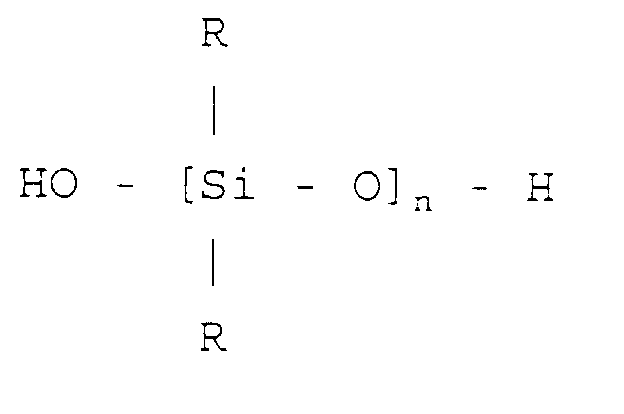
- Components (A), (B) and (C) are ⁇ , ⁇ -dihydroxyl polydiorganosiloxanes, which are substantially linear materials having an average general formula (I) wherein R denotes an organic group, preferably a hydrocarbon group, more preferably an alkyl group or an aryl group, e.g. methyl, ethyl, n-propyl, isobutyl, n-hexyl, n-octodecyl, and n is an integer.
- R may be saturated or unsaturated, aliphatic or aromatic, but is preferably a group having up to 8 carbon atoms, most preferably no more than 3 carbon atoms.
- R groups are alkyl groups, preferably methyl groups. Most preferred are ⁇ , ⁇ -dihydroxyl polydimethyl siloxanes. Such siloxane materials are well known and are commercially available with a wide range of chain lengths and molecular weights. The actual molecular weight of the materials used is not most important. The ratio of molecular weight of the different components (A), (B) and (C) is however very important. The ratio of number average molecular weight of A/B is from 20 to 80, preferably 30 to 50, and of B/C is from 1 to 6, preferably 2 to 4.
- component (A) will have the highest molecular weight, and component (C) the lowest, thus making (A) the longest polymer and (C) the shortest. It is, however, preferred that component (A) has a number average molecular weight of from 20,000 to 500,000, preferably 50,000 to 200,000, and that component (C) has a number average molecular weight of from 200 to 3000, preferably 500 to 2500.
- the ratios of number average molecular weight of the polymers used as components (A) to (C) it is also important that the components (A), (B) and (C) are used in the correct molar proportions.
- the number of moles used should reflect a ratio of A/B of from 0.01 to 0.15, preferably 0.01 to 0.1, more preferably 0.02 to 0.06, and a ratio of B/C of from 0.2 to 2, preferably 0.5 to 1.5. Values outside the specified ratios tend to give elastomeric siloxane materials which have lower mechanical strength.
- Component (D) is an organosilicon compound which functions as a cross-linker for the components (A) to (C) during the curing process, causing a three-dimensional network to form upon curing of the compositions according to the invention.
- component (D) In order to be active as cross-linker, it is important that component (D) has at least three sites per molecule in which it can react with any one of components (A) to (C).
- the curing mechanism of elastomer-forming compositions comprising ⁇ , ⁇ -dihydroxyl polydiorgano-siloxanes is preferably a condensation reaction, in which the silanol group of components (A) to (C) react with silicon-bonded hydrogen atoms, releasing hydrogen gas, or with silicon-bonded alkoxy groups, releasing alcohols.
- component (D) has either at least three silicon-bonded hydrogen atoms per molecule or three silicon-bonded alkoxy groups.
- Component (D) may be silanes or siloxanes and may be a linear, branched or resinous compound.
- component (D) has silicone-bonded hydrogen atoms
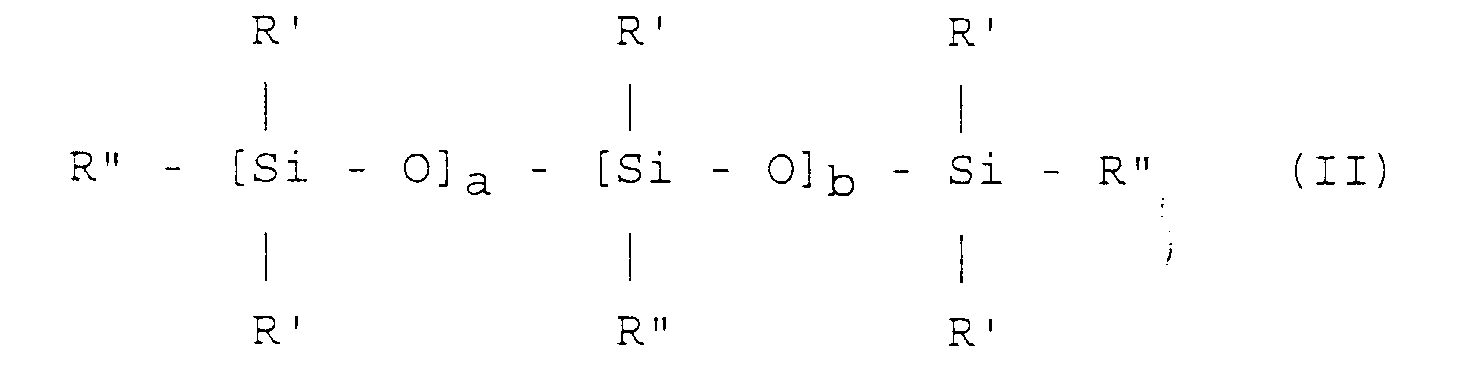
- component (D) has the average formula (II) wherein R' denotes a hydrocarbon group having up to 8 carbon atoms, R" denotes a hydrogen atom or a group R', provided at least three R" groups are hydrogen atoms, a has a value of 0 or an integer and b is an integer with a value of at least 1. It is more preferred that component (D) has at least three silicon-bonded alkoxy groups.
- the most preferred components (D) are either silanes or small resinous siloxanes.
- Preferred silanes have the general formula R'Si(OR') 3 or Si(OR') 4 , wherein R' is as defined above, preferably alkyl having up to 4 carbon atoms.
- suitable silanes include methyltrimethoxy silane, phenyl trimethoxy silane, ethyl tripropoxy silane, hexyl trimethoxy silane, tetra ethoxy silane and tetra n-propoxy silane.
- component (D) may be a resinous siloxane, preferably consisting of monovalent siloxane units of the formula R" 3 SiO 1/2 and tetravalent siloxane units of the formula SiO 4/2 , preferably in a ratio of from 0.6/1 to 1.5/1.
- component (D) used has to be sufficient to provide sufficient cross-linking to give the elastomer formed sufficient mechanical strength, while maintaining sufficient flexibility. It is preferred that the ratio of silicon-bonded hydrogen or alkoxy groups of component (D) to silanol groups in components (A), (B) and (C) combined is in the range of from 1/1 to 10/1. For compositions wherein component (D) is a silicon-bonded hydrogen containing compound, the ratio is preferably from 1/1 to 5/1, most preferably 1/1 to 3/1. For compositions where component (D) has silicon-bonded alkoxy groups, the ratio is preferably from 2/1 to 10/1. Component (D) may also comprise more than one organosilicon compound useful as cross-linker for the compositions according to the invention.
- tetra-alkoxy silane with a trialkoxy silane in a ratio of from 2:1 to 1:2, e.g. tetraethoxy silane and phenyl trimethoxy silane.
- Component (E) is a catalyst which encourages the condensation of components (A), (B) and (C) with (D).
- Any suitable condensation catalysts may be used, preferably metal salts of carboxylic acid, e.g. tin or lead salts.
- Particularly suitable condensation catalysts are tin or lead salts of octoates or acetates, for example dibutyltin dioctoate, dibutyltin dilaurate, dibutyltin di-ethyl-hexoate, dibutyltin diacetate, lead octoate, lead ethyl-hexoate and lead acetate.
- Catalysts may be provided as 100% solid materials or may be diluted in suitable solvents or dispersed in suitable dispersion media. It is preferred to use from 1 to 4% by weight of the catalyst, based on the weight of the total composition, preferably 1.2 to 2%, or from 0.001 to 0.1 molar parts by weight of the actual metal per 100g of the composition, preferably 0.002 to 0.05 molar parts. Levels as indicated will ensure a good cure, while still maintaining a reasonable pot life of the compositions according to the invention. Particularly preferred for improved pot life are mixtures of tin and lead salts, preferably in a 50/50 weight ratio of the active catalyst species.
- compositions according to the invention may also be incorporated in compositions according to the invention.
- One such ingredient is (F) an organosilicon compound having at least three silicon-bonded hydrogen atoms.
- cross-linking component (D) it may be added in addition to component (D) at a level of 1 to 2% by weight based on the total weight of components (A) to (D).
- the organosilicon compound (F) will act as a curing accelerator, whichever cross-linking component (D) is used.
- the organosilicon compound (F) is added where component (D) is an organosilicon compound having at least three silicon-bonded alkoxy groups.
- component (D) has silicon-bonded alkoxy groups
- component (G) which is an organosilicon resin consisting only of monovalent siloxane units of the formula R a 3 SiO 1/2 and tetravalent siloxane units of the formula SiO 4/2 in a ratio of from 0.4/1 to 1.2/1, preferably 0.6/1 to 0.9/1 wherein R a is an alkyl group, preferably having up to 6 carbon atoms, most preferably methyl, or a hydroxyl group, provided no more than about 5% by weight hydroxyl groups are present on the resin molecule, preferably from 2 to 3% by weight.
- Component (G) is usually a solid material, and is preferably provided in a suitable solvent, e.g.
- xylene or toluene for example as a 50 to 80% solids solution.
- this component (G) is used at high levels, i.e. above 10% by weight based on the total weight of components (A) to (D), preferably above 15%, an improvement in tear strength is also observed.
- adhesion promoters e.g. amino-functional or epoxy-functional organosilicon compounds, colorants, dyes, preservatives, cure inhibitors, fillers, which may be strengthening or non-strengthening fillers or solvents. However, it is preferred to leave out solvents or strengthening fillers, as the invention is particularly concerned with compositions without such ingredients.
- compositions according to the present invention may be prepared by any convenient method, e.g. by mixing of all the ingredients till a homogeneous mixture is obtained. In order to provide a storage stable composition, it is preferred that the ingredients are mixed in two parts, whereby the catalyst (E) is kept separated from the cross-linking component (D), preferably in sealed containers which do not allow ingress of moisture.
- One suitable way of packing compositions according to the invention is by incorporating part of the mixture of components (A), (B) and (C) with component (E) into a first part and the remainder of the mixture of (A), (B) and (C) with component (D) in a second part, so that mixing parts 1 and 2 in a 1/1 ratio will provide an elastomer forming composition according to the invention.
- component (E) is kept separately and is added as a second part in the desired ratio to the rest of the composition in a first part.
- compositions according to the invention may be cured to elastomers by exposing them to moisture e.g. to air at ambient temperatures.
- Cure of the compositions can be accelerated by heating the compositions when applied to appropriate substrates.
- compositions according to the present invention are particularly useful as sealing compounds, e.g. conformal coatings for electronic application or intricate moulding materials. These uses are particularly of interest as the initial viscosity of the compositions can be kept relatively low, allowing easy flow of uncured materials. Viscosities could be as low as 100 mPa.s at 25°C, and are preferably kept below 50,000 mPa.s. Particularly useful viscosities are in the range of 500 to 10,000 mPa.s at 25°C.
- Ingredient (1) was a high viscosity ⁇ , ⁇ -dihydroxy polydimethyl siloxane having a number average molecular weight of 100,000 and a viscosity of 50,000 mPa.s.
- Ingredient (2) was a high viscosity ⁇ , ⁇ -dihydroxy polydimethyl siloxane having a number average molecular weight of 146,000 and a viscosity of 360,000 mPa.s.
- Ingredient (3) was a high viscosity ⁇ , ⁇ -dihydroxy polydimethyl siloxane having a number average molecular weight of 71,000 and a viscosity of 13,500 mPa.s.
- Ingredient (4) was a high viscosity ⁇ , ⁇ -dihydroxy polydimethyl siloxane having a number average molecular weight of 62,000 and a viscosity of 10,000 mPa.s.
- Ingredient (5) was an ⁇ , ⁇ -dihydroxy polydimethyl siloxane having a number average molecular weight of 4,600 and a viscosity of 70 mPa.s.
- Ingredient (6) was an ⁇ , ⁇ -dihydroxy polydimethyl siloxane having a number average molecular weight of 38,500 and a viscosity of 2000 mPa.s.
- Ingredient (7) was an ⁇ , ⁇ -dihydroxy polydimethyl siloxane having a number average molecular weight of 2000 and a viscosity of 40 mPa.s.
- Ingredient (8) was an ⁇ , ⁇ -dihydroxy polydimethyl siloxane having a number average molecular weight of 400 and a viscosity of 20 mPa.s.
- Ingredient (9) was tetraethoxy silane.
- Ingredient (10) was phenyltrimethoxy silane.
- Ingredient (11) was a trimethylsiloxane-endblocked polymethylhydro siloxane having a viscosity of about 30 mPa.s.
- Ingredient (12) was a trimethylsiloxane end-blocked polymethylhydro siloxane polydimethyl siloxane copolymer having a viscosity of about 5 mPa.s and 0.7% hydrogen.
- Ingredient (13) was a 50/50 mixture of dibutyltin di-2-ethylhexoate and lead-2-ethylhexoate with some organic solvent.
- Ingredient (14) is an organosilicon resin consisting only of monovalent siloxane units of the formula Me 3 SiO 1/2 and tetravalent siloxane units of the formula SiO 4/2 in a ratio of from 0.6/1 to 0.9/1 wherein Me denotes a methyl group.
- compositions according to the invention were prepared by mixing together the ingredients according to Table I, wherein components (A), (B) etc. have the same meaning as in the specification in ratios as specified in Table II (where MW means ratio of number average molecular weight and Mol means molar ratio).
Landscapes
- Chemical & Material Sciences (AREA)
- Health & Medical Sciences (AREA)
- Chemical Kinetics & Catalysis (AREA)
- Medicinal Chemistry (AREA)
- Polymers & Plastics (AREA)
- Organic Chemistry (AREA)
- Compositions Of Macromolecular Compounds (AREA)
- Silicon Polymers (AREA)
Description
characterized in that the number average molecular weight ratio of A/B is in the range of 20 to 80, the number average molecular weight ratio of B/C is in the range of 1 to 6, the molar ratio of A/B is in the range of 0.01 to 0.15 and the molar ratio of B/C is in the range of 0.2 to 2.

Most preferred are α,ω-dihydroxyl polydimethyl siloxanes. Such siloxane materials are well known and are commercially available with a wide range of chain lengths and molecular weights. The actual molecular weight of the materials used is not most important. The ratio of molecular weight of the different components (A), (B) and (C) is however very important. The ratio of number average molecular weight of A/B is from 20 to 80, preferably 30 to 50, and of B/C is from 1 to 6, preferably 2 to 4. From the conditions indicated above, it is clear that component (A) will have the highest molecular weight, and component (C) the lowest, thus making (A) the longest polymer and (C) the shortest. It is, however, preferred that component (A) has a number average molecular weight of from 20,000 to 500,000, preferably 50,000 to 200,000, and that component (C) has a number average molecular weight of from 200 to 3000, preferably 500 to 2500.
The curing mechanism of elastomer-forming compositions comprising α,ω-dihydroxyl polydiorgano-siloxanes, is preferably a condensation reaction, in which the silanol group of components (A) to (C) react with silicon-bonded hydrogen atoms, releasing hydrogen gas, or with silicon-bonded alkoxy groups, releasing alcohols. Accordingly component (D) has either at least three silicon-bonded hydrogen atoms per molecule or three silicon-bonded alkoxy groups. Component (D) may be silanes or siloxanes and may be a linear, branched or resinous compound.
It is preferred to use from 1 to 4% by weight of the catalyst, based on the weight of the total composition, preferably 1.2 to 2%, or from 0.001 to 0.1 molar parts by weight of the actual metal per 100g of the composition, preferably 0.002 to 0.05 molar parts. Levels as indicated will ensure a good cure, while still maintaining a reasonable pot life of the compositions according to the invention. Particularly preferred for improved pot life are mixtures of tin and lead salts, preferably in a 50/50 weight ratio of the active catalyst species.
Component (G) is usually a solid material, and is preferably provided in a suitable solvent, e.g. xylene or toluene, for example as a 50 to 80% solids solution. Where this component (G) is used at high levels, i.e. above 10% by weight based on the total weight of components (A) to (D), preferably above 15%, an improvement in tear strength is also observed.
Ingredient (7) was an α,ω-dihydroxy polydimethyl siloxane having a number average molecular weight of 2000 and a viscosity of 40 mPa.s. Ingredient (8) was an α,ω-dihydroxy polydimethyl siloxane having a number average molecular weight of 400 and a viscosity of 20 mPa.s. Ingredient (9) was tetraethoxy silane. Ingredient (10) was phenyltrimethoxy silane. Ingredient (11) was a trimethylsiloxane-endblocked polymethylhydro siloxane having a viscosity of about 30 mPa.s. Ingredient (12) was a trimethylsiloxane end-blocked polymethylhydro siloxane polydimethyl siloxane copolymer having a viscosity of about 5 mPa.s and 0.7% hydrogen. Ingredient (13) was a 50/50 mixture of dibutyltin di-2-ethylhexoate and lead-2-ethylhexoate with some organic solvent. Ingredient (14) is an organosilicon resin consisting only of monovalent siloxane units of the formula Me3SiO1/2 and tetravalent siloxane units of the formula SiO4/2 in a ratio of from 0.6/1 to 0.9/1 wherein Me denotes a methyl group.
| Components | A | B | C | D | E | F | G |
| Example | |||||||
| Ingredients | |||||||
| 1 | 2 | 5 | 7 | 9 | 13 | - | - |
| 2 | 2 | 5 | 7 | 9 | 13 | - | - |
| 3 | 2 | 5 | 7 | 9 | 13 | - | - |
| 4 | 1 | 5 | 7 | 9 | 13 | - | - |
| 5 | 1 | 5 | 7 | 9+10 | 13 | - | - |
| 6 | 1 | 5 | 7 | 9 | 13 | - | - |
| 7 | 1 | 5 | 7 | 9+10 | 13 | - | - |
| 8 | 1 | 5 | 7 | 9 | 13 | - | - |
| 9 | 3 | 7 | 8 | 9 | 13 | - | - |
| 10 | 3 | 7 | 8 | 9 | 13 | - | - |
| 11 | 4 | 7 | 8 | 9 | 13 | - | - |
| 12 | 1 | 5 | 7 | 11 | 13 | - | - |
| 13 | 1 | 5 | 7 | 11 | 13 | - | - |
| 14 | 1 | 5 | 7 | 11 | 13 | - | - |
| 15 | 1 | 5 | 7 | 11 | 13 | - | - |
| 16 | 1 | 5 | 7 | 12 | 13 | - | - |
| 17 | 1 | 5 | 7 | 9+10 | 13 | 11 | - |
| 18 | 1 | 5 | 7 | 9+10 | 13 | 11 | - |
| 19 | 1 | 5 | 7 | 9+10 | 13 | 11 | - |
| 20 | 3 | 7 | 8 | 9 | 13 | - | 14 |
| 21 | 3 | 7 | 8 | 9 | 13 | - | 14 |
| 22 | 3 | 7 | 8 | 9 | 13 | - | 14 |
| Example | Ratio | |||||
| MW A/B | MW B/C | Mol A/B | Mol B/C | Mol SiH/SiOH | Mol SiOR/SiOH | |
| 1 | 56 | 3 | 0.04 | 0.35 | - | 4 |
| 2 | 56 | 3 | 0.02 | 0.35 | - | 4 |
| 3 | 56 | 3 | 0.02 | 0.54 | - | 4 |
| 4 | 40 | 3 | 0.04 | 0.70 | - | 4 |
| 5 | 40 | 3 | 0.04 | 0.70 | - | 4 |
| 6 | 40 | 3 | 0.03 | 0.35 | - | 4 |
| 7 | 40 | 3 | 0.04 | 0.52 | - | 4 |
| 8 | 40 | 3 | 0.04 | 0.70 | - | 4 |
| 9 | 80 | 3 | 0.05 | 0.54 | - | 3 |
| 10 | 80 | 3 | 0.04 | 0.54 | - | 3 |
| 11 | 57 | 3 | 0.04 | 0.54 | - | 3 |
| 12 | 40 | 3 | 0.13 | 0.18 | 2 | - |
| 13 | 40 | 3 | 0.06 | 0.35 | 2 | - |
| 14 | 40 | 3 | 0.05 | 0.35 | 2 | - |
| 15 | 40 | 3 | 0.04 | 0.70 | 2 | - |
| 16 | 40 | 3 | 0.04 | 0.70 | 2 | - |
| 17 | 40 | 3 | 0.07 | 0.65 | - | 8 |
| 18 | 40 | 3 | 0.07 | 0.65 | - | 2 |
| 19 | 40 | 3 | 0.07 | 0.65 | - | 8 |
| 20 | 80 | 3 | 0.07 | 0.90 | - | 14 |
| 21 | 80 | 3 | 0.05 | 0.54 | - | 28 |
| 22 | 80 | 3 | 0.04 | 2.00 | - | 27 |
| Example | Viscosity mPa.s | Durometer Shore A | Elongation % | Tensile MPa | Mechanical Strength |
| 1 | 5,660 | 44 | 185 | 4.7 | H |
| 2 | 1,700 | 45 | 200 | 5.3 | H |
| 3 | 3,500 | 44 | 200 | 5.6 | H |
| 4 | 2,530 | 45 | 185 | 4.5 | H |
| 5 | 2,700 | 42 | 200 | 5.2 | H |
| 6 | 1,000 | 48 | 130 | 3.7 | H |
| 7 | 1,900 | 48 | 180 | 5.2 | H |
| 8 | 1,530 | 48 | 185 | 3.9 | H |
| 9 | 1,640 | 40 | 200 | 3.6 | H |
| 10 | 1,000 | 45 | 180 | 4.5 | H |
| 11 | 750 | 48 | 170 | 3.7 | H |
| 12 | 21,400 | 31 | 220 | 2.1 | H |
| 13 | 13,000 | 38 | 200 | 2.2 | H |
| 14 | 7,670 | 38 | 170 | 2.4 | H |
| 15 | 6,500 | 35 | 140 | 1.4 | M |
| 16 | 3,600 | 33 | 190 | 2.3 | H |
| 17 | 1,980 | 41 | 190 | 4.2 | H |
| 18 | 2,020 | 40 | 200 | 4.5 | H |
| 19 | 1,850 | 44 | 185 | 4.0 | H |
| 20 | 1,000 | 48 | 150 | 4.0 | H |
| 21 | 360 | 56 | 150 | 4.2 | H |
| 22 | 460 | 56 | 150 | 4.9 | H |
| Components | A | B | C | D | E | F | G |
| Example | Ingredients | ||||||
| C1 | 2 | 6 | 5 | 9 | 13 | - | - |
| C2 | 1 | 5 | 8 | 9 | 13 | - | - |
| C3 | 1 | 5 | - | 11 | 13 | - | - |
| C4 | 3 | 5 | - | 11 | 13 | - | - |
| C5 | 6 | 5 | - | 11 | 13 | - | - |
| C6 | 2 | 5 | - | 9 | 13 | - | - |
| C7 | 1 | 7 | - | 9 | 13 | - | - |
| C8 | 3 | 8 | - | 9 | 13 | - | - |
| C9 | 1 | - | - | 11 | 13 | - | - |
| C10 | 3 | - | - | 11 | 13 | - | - |
| C11 | 6 | - | - | 11 | 13 | - | - |
| C12 | 5 | - | - | 11 | 13 | - | - |
| C13 | 3 | - | - | 9 | 13 | - | - |
| C14 | 3 | - | - | 9 | 13 | - | - |
| C15 | 3 | - | - | 9 | 13 | - | - |
| Ratio | ||||||
| Example | MW A/B | MW B/C | Mol A/B | Mol B/C | Mol SiH/SiOH | Mol SiOR/SiOH |
| C1 | 4 | 14 | 0.04 | 0.35 | - | 4 |
| C2 | 40 | 8 | 0.04 | 0.38 | - | 4 |
| C3 | 40 | NA | 0.03 | NA | 1 | - |
| C4 | 28 | NA | 0.03 | NA | 1 | - |
| C5 | 14 | NA | 0.03 | NA | 1 | - |
| C6 | 56 | NA | 0.04 | NA | - | 4 |
| C7 | 114 | NA | 0.04 | NA | - | 4 |
| C8 | 180 | NA | 0.04 | NA | - | 4 |
| C9 | NA | NA | NA | NA | 1 | - |
| C10 | NA | NA | NA | NA | 1 | - |
| C11 | NA | NA | NA | NA | 1 | - |
| C12 | NA | NA | NA | NA | 1 | - |
| C13 | NA | NA | NA | NA | - | 20 |
| C14 | NA | NA | NA | NA | - | 40 |
| C15 | NA | NA | NA | NA | - | 60 |
| Example | Viscosity mPa.s | Durometer Shore A | Elongation % | Tensile MPa | Mechanical Strength |
| C1 | 1,160 | 28 | 120 | 0.85 | L |
| C2 | 1,780 | 39 | 80 | 1.00 | L |
| C3 | 9,200 | 39 | 90 | 0.70 | L |
| C4 | 1,700 | 42 | 50 | 0.40 | L |
| C5 | 360 | 44 | 30 | 0.40 | L |
| C6 | 57,000 | 27 | 180 | 1.20 | L |
| C7 | 22,000 | 30 | 180 | 1.60 | L |
| C8 | 4,000 | 23 | 225 | 1.50 | L |
| C9 | 50,000 | 6 | 1,200 | 0.25 | L |
| C10 | 13,800 | 8 | 330 | 0.21 | L |
| C11 | 2,700 | 20 | 150 | 0.20 | L |
| C12 | 90 | 28 | 40 | 0.28 | L |
| C13 | 13,000 | 20 | 100 | 0.30 | L |
| C14 | 11,000 | 40 | 110 | 0.33 | L |
| C15 | 9,400 | 17 | 100 | 0.23 | L |
Claims (10)
- A siloxane-based elastomer-forming composition comprising (A) a first α,ω-dihydroxyl polydiorganosiloxane, (B) a second α,ω-dihydroxyl polydiorganosiloxane, (C) a third α,ω-dihydroxyl polydiorganosiloxane, (D) an organosilicon compound having at least three silicon-bonded hydrogen or alkoxy groups and (E) a condensation catalyst, characterized in that the number average molecular weight ratio of A/B is in the range of 20 to 80, the number average molecular weight ratio of B/C is in the range of 1 to 6, the molar ratio of A/B is in the range of 0.01 to 0.15 and the molar ratio of B/C is in the range of 0.2 to 2.
- A composition according to Claim 1 further characterized in that components (A), (B) and (C) are substantially linear a,w-dihydroxyl polydiorganosiloxanes having an average general formulawherein R is a hydrocarbon group and n is an integer.
- A composition according to Claim 2 further characterized in that R is an alkyl group having up to 8 carbon atoms or an aryl groups having up to 8 carbon atoms.
- A composition according to any one of the preceding claims further characterized in that component (A) has a number average molecular weight in the range of 20,000 to 500,000 and component (C) has a number average molecular weight in the range of 200 to 3000.
- A composition according to any one of the preceding claims further characterized in that component (D) has the average formulawherein R' is a hydrocarbon group having up to 8 carbon atoms, R" is a hydrogen atom or R', provided at least three R" groups are hydrogen or alkoxy groups, a is an integer greater than or equal to 0 and b is an integer greater than 0.

- A composition according to any one of the preceding claims further characterized in that component (D) has the general formula R'Si(OR')3 or Si(OR)4, wherein R' is a hydrocarbon group having up to 8 carbon atoms.
- A composition according to any one of the preceding claims further characterized in that component (D) is a resinous siloxane consisting of monovalent siloxane units of the formula R"3SiO1/2 and tetravalent siloxane units of the formula SiO4/2 and the ratio of monovalent siloxane units to tetravalent siloxane units is in the range of 0.6/1 to 1.5/1.
- A composition according to any one of the preceding claims further characterized in that component (E) is a condensation catalyst based on metal salts of a carboxylic acid.
- A composition according to any one of the preceding claims further characterized in that component (D) is an organosilicon compound having silicon-bonded alkoxy groups and wherein the composition also comprises an organosilicon compound (F) having at least three silicon-bonded hydrogen atoms, wherein said component (F) is present at a concentration of 1 to 2 % by weight based on the total weight of components (A), (B), (C) and (D).
- A composition according to any one of the preceding claims further characterized in that component (D) is an organosilicon compound having silicon-bonded alkoxy groups and wherein the composition also comprises an organosilicon resin (G) consisting of monovalent siloxane units of the formula Ra 3SiO1/2 and tetravalent siloxane units of the formula SiO4/2 in a ratio of from 0.4/1 to 1.2/1, wherein Ra is an alkyl group having up to 6 carbon atoms or a hydroxyl group, provided that no more than about 5 % by weight hydroxyl groups are present on said resin (G) and wherein said component (G) is present at a concentration greater than 10 % by weight based on the total weight of components (A), (B), (C), and (D).
Applications Claiming Priority (2)
| Application Number | Priority Date | Filing Date | Title |
|---|---|---|---|
| GB9520272 | 1995-10-04 | ||
| GBGB9520272.7A GB9520272D0 (en) | 1995-10-04 | 1995-10-04 | Elastomer-forming compositions |
Publications (2)
| Publication Number | Publication Date |
|---|---|
| EP0767217A1 EP0767217A1 (en) | 1997-04-09 |
| EP0767217B1 true EP0767217B1 (en) | 1999-01-20 |
Family
ID=10781764
Family Applications (1)
| Application Number | Title | Priority Date | Filing Date |
|---|---|---|---|
| EP96307161A Expired - Lifetime EP0767217B1 (en) | 1995-10-04 | 1996-09-30 | Elastomer-forming compositions |
Country Status (7)
| Country | Link |
|---|---|
| US (1) | US5905131A (en) |
| EP (1) | EP0767217B1 (en) |
| JP (1) | JPH09110992A (en) |
| CA (1) | CA2186995A1 (en) |
| DE (1) | DE69601402T2 (en) |
| GB (1) | GB9520272D0 (en) |
| MX (1) | MX9604543A (en) |
Families Citing this family (5)
| Publication number | Priority date | Publication date | Assignee | Title |
|---|---|---|---|---|
| EP1148080A1 (en) * | 2000-04-19 | 2001-10-24 | Ciba Spezialitätenchemie Pfersee GmbH | Polyorganosiloxane mixtures for treating fibrous materials |
| CN103687896B (en) * | 2012-04-11 | 2015-05-13 | 信越化学工业株式会社 | Method for producing organopolysiloxane emulsion composition |
| US20150307759A1 (en) * | 2014-04-28 | 2015-10-29 | Ames Rubber Corporation | Solventless curable coating systems and uses thereof |
| CN107446354A (en) * | 2017-06-08 | 2017-12-08 | 仲恺农业工程学院 | Organic silicon composition and preparation method thereof |
| CN121450237B (en) * | 2026-01-08 | 2026-04-17 | 北京世纪航凯电力科技股份有限公司 | A two-component insulating spray and its preparation method |
Family Cites Families (2)
| Publication number | Priority date | Publication date | Assignee | Title |
|---|---|---|---|---|
| US4780338A (en) * | 1987-03-26 | 1988-10-25 | General Electric Company | Solventless silicone coating composition |
| US5616673A (en) * | 1995-12-13 | 1997-04-01 | General Electric Company | Process for production of low viscosity low silanol content silicone fluids |
-
1995
- 1995-10-04 GB GBGB9520272.7A patent/GB9520272D0/en active Pending
-
1996
- 1996-09-27 US US08/722,332 patent/US5905131A/en not_active Expired - Fee Related
- 1996-09-30 EP EP96307161A patent/EP0767217B1/en not_active Expired - Lifetime
- 1996-09-30 DE DE69601402T patent/DE69601402T2/en not_active Expired - Fee Related
- 1996-10-02 CA CA002186995A patent/CA2186995A1/en not_active Abandoned
- 1996-10-02 MX MX9604543A patent/MX9604543A/en unknown
- 1996-10-04 JP JP8264775A patent/JPH09110992A/en active Pending
Also Published As
| Publication number | Publication date |
|---|---|
| EP0767217A1 (en) | 1997-04-09 |
| DE69601402T2 (en) | 1999-06-24 |
| DE69601402D1 (en) | 1999-03-04 |
| US5905131A (en) | 1999-05-18 |
| MX9604543A (en) | 1997-08-30 |
| CA2186995A1 (en) | 1997-04-05 |
| JPH09110992A (en) | 1997-04-28 |
| GB9520272D0 (en) | 1995-12-06 |
Similar Documents
| Publication | Publication Date | Title |
|---|---|---|
| CA2007660C (en) | Elastomer-forming compositions | |
| CA1080388A (en) | Self-adhering silicone compositions and preparations thereof | |
| EP0157580B1 (en) | Oil resistant low modulus silicone sealant composition | |
| EP0776944B1 (en) | A room temperature curing silicone elastomer composition | |
| EP0552919B1 (en) | Silicone elastomers | |
| EP3102325A1 (en) | Moisture curable silicone composition | |
| CA2007659C (en) | Alkoxy functional resins and compositions containing them | |
| US5717010A (en) | Low compression set silicone elastomers | |
| US6663967B1 (en) | Moldable silicone elastomers having selective primerless adhesion | |
| JPH08269335A (en) | Method for producing one-part room temperature curable silicone elastomer composition | |
| CN101772552A (en) | Crosslinkable substances based on organosilicon compounds | |
| EP0933398A2 (en) | Process for the production of RTV organopolysiloxane compositions | |
| CA2097015A1 (en) | Low modulus room-temperature-curable organosiloxane composition | |
| US5905131A (en) | Elastomer-forming compositions | |
| KR20230008080A (en) | Room temperature curable organopolysiloxane compositions and articles | |
| US20060258817A1 (en) | Room temperature-curable organopolysiloxane compositions | |
| EP1311589A1 (en) | Copolymer sealant compositions and method for making | |
| WO2019183318A1 (en) | Room temperature curable organopolysiloxane composition and electric/electronic apparatus | |
| US20070249782A1 (en) | Organopolysiloxanes Comprising Nitrogen and Their Use in Cross-Linkable Materials | |
| MXPA96004543A (en) | Compositions that form elastomer | |
| KR840000525B1 (en) | Ferrocene catalyzed elastomer formation | |
| US20230399513A1 (en) | Mixtures containing phosphorus compounds and use thereof | |
| JP7862415B2 (en) | Mixtures containing phosphorus compounds and their use | |
| EP0816437A2 (en) | Curable organosiloxane compositions of extended shelf life and cured elastomers therefrom exhibiting extended mold life | |
| EP1337589A2 (en) | Moldable silicone elastomers having selective primerless adhesion |
Legal Events
| Date | Code | Title | Description |
|---|---|---|---|
| PUAI | Public reference made under article 153(3) epc to a published international application that has entered the european phase |
Free format text: ORIGINAL CODE: 0009012 |
|
| AK | Designated contracting states |
Kind code of ref document: A1 Designated state(s): DE FR GB IT |
|
| 17P | Request for examination filed |
Effective date: 19970820 |
|
| GRAG | Despatch of communication of intention to grant |
Free format text: ORIGINAL CODE: EPIDOS AGRA |
|
| 17Q | First examination report despatched |
Effective date: 19971029 |
|
| GRAG | Despatch of communication of intention to grant |
Free format text: ORIGINAL CODE: EPIDOS AGRA |
|
| GRAH | Despatch of communication of intention to grant a patent |
Free format text: ORIGINAL CODE: EPIDOS IGRA |
|
| GRAH | Despatch of communication of intention to grant a patent |
Free format text: ORIGINAL CODE: EPIDOS IGRA |
|
| GRAA | (expected) grant |
Free format text: ORIGINAL CODE: 0009210 |
|
| AK | Designated contracting states |
Kind code of ref document: B1 Designated state(s): DE FR GB IT |
|
| ITF | It: translation for a ep patent filed | ||
| REF | Corresponds to: |
Ref document number: 69601402 Country of ref document: DE Date of ref document: 19990304 |
|
| PG25 | Lapsed in a contracting state [announced via postgrant information from national office to epo] |
Ref country code: DE Free format text: LAPSE BECAUSE OF FAILURE TO SUBMIT A TRANSLATION OF THE DESCRIPTION OR TO PAY THE FEE WITHIN THE PRESCRIBED TIME-LIMIT Effective date: 19990421 |
|
| ET | Fr: translation filed | ||
| PLBE | No opposition filed within time limit |
Free format text: ORIGINAL CODE: 0009261 |
|
| STAA | Information on the status of an ep patent application or granted ep patent |
Free format text: STATUS: NO OPPOSITION FILED WITHIN TIME LIMIT |
|
| 26N | No opposition filed | ||
| REG | Reference to a national code |
Ref country code: GB Ref legal event code: IF02 |
|
| PGFP | Annual fee paid to national office [announced via postgrant information from national office to epo] |
Ref country code: DE Payment date: 20020812 Year of fee payment: 7 |
|
| PGFP | Annual fee paid to national office [announced via postgrant information from national office to epo] |
Ref country code: FR Payment date: 20020814 Year of fee payment: 7 |
|
| PGFP | Annual fee paid to national office [announced via postgrant information from national office to epo] |
Ref country code: GB Payment date: 20020815 Year of fee payment: 7 |
|
| PG25 | Lapsed in a contracting state [announced via postgrant information from national office to epo] |
Ref country code: GB Free format text: LAPSE BECAUSE OF NON-PAYMENT OF DUE FEES Effective date: 20030930 |
|
| GBPC | Gb: european patent ceased through non-payment of renewal fee |
Effective date: 20030930 |
|
| PG25 | Lapsed in a contracting state [announced via postgrant information from national office to epo] |
Ref country code: FR Free format text: LAPSE BECAUSE OF NON-PAYMENT OF DUE FEES Effective date: 20040528 |
|
| REG | Reference to a national code |
Ref country code: FR Ref legal event code: ST |
|
| PG25 | Lapsed in a contracting state [announced via postgrant information from national office to epo] |
Ref country code: IT Free format text: LAPSE BECAUSE OF NON-PAYMENT OF DUE FEES Effective date: 20050930 |