EP0763064B1 - A method of manufacturing particles, and particles that can be produced in accordance with the method - Google Patents
A method of manufacturing particles, and particles that can be produced in accordance with the method Download PDFInfo
- Publication number
- EP0763064B1 EP0763064B1 EP95919714A EP95919714A EP0763064B1 EP 0763064 B1 EP0763064 B1 EP 0763064B1 EP 95919714 A EP95919714 A EP 95919714A EP 95919714 A EP95919714 A EP 95919714A EP 0763064 B1 EP0763064 B1 EP 0763064B1
- Authority
- EP
- European Patent Office
- Prior art keywords
- particles
- water
- emulsion
- diameter
- monomers
- Prior art date
- Legal status (The legal status is an assumption and is not a legal conclusion. Google has not performed a legal analysis and makes no representation as to the accuracy of the status listed.)
- Expired - Lifetime
Links
- 239000002245 particle Substances 0.000 title claims abstract description 80
- 238000000034 method Methods 0.000 title claims abstract description 26
- 238000004519 manufacturing process Methods 0.000 title description 6
- XLYOFNOQVPJJNP-UHFFFAOYSA-N water Substances O XLYOFNOQVPJJNP-UHFFFAOYSA-N 0.000 claims abstract description 46
- 239000000178 monomer Substances 0.000 claims abstract description 39
- 239000000839 emulsion Substances 0.000 claims abstract description 36
- 239000012071 phase Substances 0.000 claims abstract description 36
- 239000011148 porous material Substances 0.000 claims abstract description 25
- 238000006116 polymerization reaction Methods 0.000 claims abstract description 24
- 125000000391 vinyl group Chemical group [H]C([*])=C([H])[H] 0.000 claims abstract description 23
- 239000003995 emulsifying agent Substances 0.000 claims abstract description 21
- 229920002554 vinyl polymer Polymers 0.000 claims abstract description 21
- 239000003999 initiator Substances 0.000 claims abstract description 17
- 239000008307 w/o/w-emulsion Substances 0.000 claims abstract description 11
- 239000007762 w/o emulsion Substances 0.000 claims abstract description 9
- 239000012798 spherical particle Substances 0.000 claims abstract description 7
- 239000008346 aqueous phase Substances 0.000 claims abstract description 4
- 229920000642 polymer Polymers 0.000 claims abstract description 4
- 239000011541 reaction mixture Substances 0.000 claims abstract description 4
- 239000004971 Cross linker Substances 0.000 claims abstract description 3
- 230000000977 initiatory effect Effects 0.000 claims abstract description 3
- 230000000379 polymerizing effect Effects 0.000 claims abstract description 3
- KAKZBPTYRLMSJV-UHFFFAOYSA-N Butadiene Chemical group C=CC=C KAKZBPTYRLMSJV-UHFFFAOYSA-N 0.000 claims abstract 4
- MYRTYDVEIRVNKP-UHFFFAOYSA-N 1,2-Divinylbenzene Chemical compound C=CC1=CC=CC=C1C=C MYRTYDVEIRVNKP-UHFFFAOYSA-N 0.000 claims description 14
- PPBRXRYQALVLMV-UHFFFAOYSA-N Styrene Chemical compound C=CC1=CC=CC=C1 PPBRXRYQALVLMV-UHFFFAOYSA-N 0.000 claims description 12
- 238000004626 scanning electron microscopy Methods 0.000 claims description 6
- 230000004913 activation Effects 0.000 claims description 4
- 150000001875 compounds Chemical class 0.000 claims description 4
- 150000002148 esters Chemical class 0.000 claims description 4
- 125000002915 carbonyl group Chemical group [*:2]C([*:1])=O 0.000 claims description 3
- 125000003178 carboxy group Chemical group [H]OC(*)=O 0.000 claims description 3
- 230000002209 hydrophobic effect Effects 0.000 claims description 3
- 239000000463 material Substances 0.000 claims description 3
- 150000002734 metacrylic acid derivatives Chemical class 0.000 claims description 3
- 238000010532 solid phase synthesis reaction Methods 0.000 claims description 3
- 229920001400 block copolymer Polymers 0.000 claims description 2
- 150000001735 carboxylic acids Chemical class 0.000 claims description 2
- 239000000969 carrier Substances 0.000 claims description 2
- 238000004113 cell culture Methods 0.000 claims description 2
- 150000005846 sugar alcohols Chemical class 0.000 claims description 2
- 125000003118 aryl group Chemical group 0.000 claims 2
- 125000004185 ester group Chemical group 0.000 claims 2
- 125000004386 diacrylate group Chemical group 0.000 claims 1
- 150000005690 diesters Chemical class 0.000 claims 1
- 238000004811 liquid chromatography Methods 0.000 claims 1
- 239000007764 o/w emulsion Substances 0.000 claims 1
- 238000010526 radical polymerization reaction Methods 0.000 claims 1
- 125000003011 styrenyl group Chemical group [H]\C(*)=C(/[H])C1=C([H])C([H])=C([H])C([H])=C1[H] 0.000 claims 1
- 238000007873 sieving Methods 0.000 abstract description 3
- 102000003817 Fos-related antigen 1 Human genes 0.000 abstract 3
- 108090000123 Fos-related antigen 1 Proteins 0.000 abstract 3
- 102000004169 proteins and genes Human genes 0.000 description 16
- 108090000623 proteins and genes Proteins 0.000 description 16
- HEMHJVSKTPXQMS-UHFFFAOYSA-M Sodium hydroxide Chemical compound [OH-].[Na+] HEMHJVSKTPXQMS-UHFFFAOYSA-M 0.000 description 15
- FAPWRFPIFSIZLT-UHFFFAOYSA-M Sodium chloride Chemical compound [Na+].[Cl-] FAPWRFPIFSIZLT-UHFFFAOYSA-M 0.000 description 14
- QKNYBSVHEMOAJP-UHFFFAOYSA-N 2-amino-2-(hydroxymethyl)propane-1,3-diol;hydron;chloride Chemical compound Cl.OCC(N)(CO)CO QKNYBSVHEMOAJP-UHFFFAOYSA-N 0.000 description 11
- 238000003756 stirring Methods 0.000 description 11
- 239000012153 distilled water Substances 0.000 description 10
- 239000000203 mixture Substances 0.000 description 10
- 239000007983 Tris buffer Substances 0.000 description 9
- 239000000872 buffer Substances 0.000 description 9
- LENZDBCJOHFCAS-UHFFFAOYSA-N tris Chemical compound OCC(N)(CO)CO LENZDBCJOHFCAS-UHFFFAOYSA-N 0.000 description 9
- 239000011521 glass Substances 0.000 description 8
- 239000000243 solution Substances 0.000 description 8
- BFSVOASYOCHEOV-UHFFFAOYSA-N 2-diethylaminoethanol Chemical group CCN(CC)CCO BFSVOASYOCHEOV-UHFFFAOYSA-N 0.000 description 7
- 239000011780 sodium chloride Substances 0.000 description 7
- 238000006243 chemical reaction Methods 0.000 description 6
- 238000001179 sorption measurement Methods 0.000 description 6
- 239000012148 binding buffer Substances 0.000 description 5
- 238000004587 chromatography analysis Methods 0.000 description 5
- 238000002474 experimental method Methods 0.000 description 5
- CSCPPACGZOOCGX-UHFFFAOYSA-N Acetone Chemical compound CC(C)=O CSCPPACGZOOCGX-UHFFFAOYSA-N 0.000 description 4
- 102000036675 Myoglobin Human genes 0.000 description 4
- 108010062374 Myoglobin Proteins 0.000 description 4
- VOZRXNHHFUQHIL-UHFFFAOYSA-N glycidyl methacrylate Chemical group CC(=C)C(=O)OCC1CO1 VOZRXNHHFUQHIL-UHFFFAOYSA-N 0.000 description 4
- 229910000033 sodium borohydride Inorganic materials 0.000 description 4
- 239000012279 sodium borohydride Substances 0.000 description 4
- QTBSBXVTEAMEQO-UHFFFAOYSA-N Acetic acid Chemical compound CC(O)=O QTBSBXVTEAMEQO-UHFFFAOYSA-N 0.000 description 3
- BRLQWZUYTZBJKN-UHFFFAOYSA-N Epichlorohydrin Chemical compound ClCC1CO1 BRLQWZUYTZBJKN-UHFFFAOYSA-N 0.000 description 3
- 102000008192 Lactoglobulins Human genes 0.000 description 3
- 108010060630 Lactoglobulins Proteins 0.000 description 3
- 230000008878 coupling Effects 0.000 description 3
- 238000010168 coupling process Methods 0.000 description 3
- 238000005859 coupling reaction Methods 0.000 description 3
- 125000000524 functional group Chemical group 0.000 description 3
- 239000007787 solid Substances 0.000 description 3
- MHAJPDPJQMAIIY-UHFFFAOYSA-N Hydrogen peroxide Chemical compound OO MHAJPDPJQMAIIY-UHFFFAOYSA-N 0.000 description 2
- 238000013019 agitation Methods 0.000 description 2
- 125000002009 alkene group Chemical group 0.000 description 2
- 238000009835 boiling Methods 0.000 description 2
- 239000003153 chemical reaction reagent Substances 0.000 description 2
- 239000003795 chemical substances by application Substances 0.000 description 2
- 238000004132 cross linking Methods 0.000 description 2
- 238000010438 heat treatment Methods 0.000 description 2
- 125000002887 hydroxy group Chemical group [H]O* 0.000 description 2
- 239000012074 organic phase Substances 0.000 description 2
- 150000003254 radicals Chemical class 0.000 description 2
- 238000000926 separation method Methods 0.000 description 2
- 239000000126 substance Substances 0.000 description 2
- JNYAEWCLZODPBN-JGWLITMVSA-N (2r,3r,4s)-2-[(1r)-1,2-dihydroxyethyl]oxolane-3,4-diol Chemical compound OC[C@@H](O)[C@H]1OC[C@H](O)[C@H]1O JNYAEWCLZODPBN-JGWLITMVSA-N 0.000 description 1
- ZORQXIQZAOLNGE-UHFFFAOYSA-N 1,1-difluorocyclohexane Chemical compound FC1(F)CCCCC1 ZORQXIQZAOLNGE-UHFFFAOYSA-N 0.000 description 1
- COXCGWKSEPPDAA-UHFFFAOYSA-N 2,4-dimethylpentanenitrile Chemical compound CC(C)CC(C)C#N COXCGWKSEPPDAA-UHFFFAOYSA-N 0.000 description 1
- WYGWHHGCAGTUCH-UHFFFAOYSA-N 2-[(2-cyano-4-methylpentan-2-yl)diazenyl]-2,4-dimethylpentanenitrile Chemical compound CC(C)CC(C)(C#N)N=NC(C)(C#N)CC(C)C WYGWHHGCAGTUCH-UHFFFAOYSA-N 0.000 description 1
- 238000004438 BET method Methods 0.000 description 1
- 108091003079 Bovine Serum Albumin Proteins 0.000 description 1
- 229920002307 Dextran Polymers 0.000 description 1
- IAYPIBMASNFSPL-UHFFFAOYSA-N Ethylene oxide Chemical compound C1CO1 IAYPIBMASNFSPL-UHFFFAOYSA-N 0.000 description 1
- 239000012028 Fenton's reagent Substances 0.000 description 1
- UFHFLCQGNIYNRP-UHFFFAOYSA-N Hydrogen Chemical compound [H][H] UFHFLCQGNIYNRP-UHFFFAOYSA-N 0.000 description 1
- 108091034117 Oligonucleotide Proteins 0.000 description 1
- 102000015636 Oligopeptides Human genes 0.000 description 1
- 108010038807 Oligopeptides Proteins 0.000 description 1
- GWEVSGVZZGPLCZ-UHFFFAOYSA-N Titan oxide Chemical group O=[Ti]=O GWEVSGVZZGPLCZ-UHFFFAOYSA-N 0.000 description 1
- JLCPHMBAVCMARE-UHFFFAOYSA-N [3-[[3-[[3-[[3-[[3-[[3-[[3-[[3-[[3-[[3-[[3-[[5-(2-amino-6-oxo-1H-purin-9-yl)-3-[[3-[[3-[[3-[[3-[[3-[[5-(2-amino-6-oxo-1H-purin-9-yl)-3-[[5-(2-amino-6-oxo-1H-purin-9-yl)-3-hydroxyoxolan-2-yl]methoxy-hydroxyphosphoryl]oxyoxolan-2-yl]methoxy-hydroxyphosphoryl]oxy-5-(5-methyl-2,4-dioxopyrimidin-1-yl)oxolan-2-yl]methoxy-hydroxyphosphoryl]oxy-5-(6-aminopurin-9-yl)oxolan-2-yl]methoxy-hydroxyphosphoryl]oxy-5-(6-aminopurin-9-yl)oxolan-2-yl]methoxy-hydroxyphosphoryl]oxy-5-(6-aminopurin-9-yl)oxolan-2-yl]methoxy-hydroxyphosphoryl]oxy-5-(6-aminopurin-9-yl)oxolan-2-yl]methoxy-hydroxyphosphoryl]oxyoxolan-2-yl]methoxy-hydroxyphosphoryl]oxy-5-(5-methyl-2,4-dioxopyrimidin-1-yl)oxolan-2-yl]methoxy-hydroxyphosphoryl]oxy-5-(4-amino-2-oxopyrimidin-1-yl)oxolan-2-yl]methoxy-hydroxyphosphoryl]oxy-5-(5-methyl-2,4-dioxopyrimidin-1-yl)oxolan-2-yl]methoxy-hydroxyphosphoryl]oxy-5-(5-methyl-2,4-dioxopyrimidin-1-yl)oxolan-2-yl]methoxy-hydroxyphosphoryl]oxy-5-(6-aminopurin-9-yl)oxolan-2-yl]methoxy-hydroxyphosphoryl]oxy-5-(6-aminopurin-9-yl)oxolan-2-yl]methoxy-hydroxyphosphoryl]oxy-5-(4-amino-2-oxopyrimidin-1-yl)oxolan-2-yl]methoxy-hydroxyphosphoryl]oxy-5-(4-amino-2-oxopyrimidin-1-yl)oxolan-2-yl]methoxy-hydroxyphosphoryl]oxy-5-(4-amino-2-oxopyrimidin-1-yl)oxolan-2-yl]methoxy-hydroxyphosphoryl]oxy-5-(6-aminopurin-9-yl)oxolan-2-yl]methoxy-hydroxyphosphoryl]oxy-5-(4-amino-2-oxopyrimidin-1-yl)oxolan-2-yl]methyl [5-(6-aminopurin-9-yl)-2-(hydroxymethyl)oxolan-3-yl] hydrogen phosphate Polymers Cc1cn(C2CC(OP(O)(=O)OCC3OC(CC3OP(O)(=O)OCC3OC(CC3O)n3cnc4c3nc(N)[nH]c4=O)n3cnc4c3nc(N)[nH]c4=O)C(COP(O)(=O)OC3CC(OC3COP(O)(=O)OC3CC(OC3COP(O)(=O)OC3CC(OC3COP(O)(=O)OC3CC(OC3COP(O)(=O)OC3CC(OC3COP(O)(=O)OC3CC(OC3COP(O)(=O)OC3CC(OC3COP(O)(=O)OC3CC(OC3COP(O)(=O)OC3CC(OC3COP(O)(=O)OC3CC(OC3COP(O)(=O)OC3CC(OC3COP(O)(=O)OC3CC(OC3COP(O)(=O)OC3CC(OC3COP(O)(=O)OC3CC(OC3COP(O)(=O)OC3CC(OC3COP(O)(=O)OC3CC(OC3COP(O)(=O)OC3CC(OC3CO)n3cnc4c(N)ncnc34)n3ccc(N)nc3=O)n3cnc4c(N)ncnc34)n3ccc(N)nc3=O)n3ccc(N)nc3=O)n3ccc(N)nc3=O)n3cnc4c(N)ncnc34)n3cnc4c(N)ncnc34)n3cc(C)c(=O)[nH]c3=O)n3cc(C)c(=O)[nH]c3=O)n3ccc(N)nc3=O)n3cc(C)c(=O)[nH]c3=O)n3cnc4c3nc(N)[nH]c4=O)n3cnc4c(N)ncnc34)n3cnc4c(N)ncnc34)n3cnc4c(N)ncnc34)n3cnc4c(N)ncnc34)O2)c(=O)[nH]c1=O JLCPHMBAVCMARE-UHFFFAOYSA-N 0.000 description 1
- 239000000654 additive Substances 0.000 description 1
- 230000000996 additive effect Effects 0.000 description 1
- 239000003463 adsorbent Substances 0.000 description 1
- 230000001476 alcoholic effect Effects 0.000 description 1
- 150000001412 amines Chemical class 0.000 description 1
- 238000004458 analytical method Methods 0.000 description 1
- 230000009286 beneficial effect Effects 0.000 description 1
- 230000008901 benefit Effects 0.000 description 1
- 230000015572 biosynthetic process Effects 0.000 description 1
- 229940098773 bovine serum albumin Drugs 0.000 description 1
- 125000004432 carbon atom Chemical group C* 0.000 description 1
- 239000007795 chemical reaction product Substances 0.000 description 1
- 239000011248 coating agent Substances 0.000 description 1
- 238000000576 coating method Methods 0.000 description 1
- 230000007423 decrease Effects 0.000 description 1
- 230000001419 dependent effect Effects 0.000 description 1
- 238000009795 derivation Methods 0.000 description 1
- -1 diacrylate ester Chemical class 0.000 description 1
- 238000009826 distribution Methods 0.000 description 1
- 125000003700 epoxy group Chemical group 0.000 description 1
- 238000011156 evaluation Methods 0.000 description 1
- 230000001747 exhibiting effect Effects 0.000 description 1
- 239000007863 gel particle Substances 0.000 description 1
- 229910052739 hydrogen Inorganic materials 0.000 description 1
- 239000001257 hydrogen Substances 0.000 description 1
- MGZTXXNFBIUONY-UHFFFAOYSA-N hydrogen peroxide;iron(2+);sulfuric acid Chemical compound [Fe+2].OO.OS(O)(=O)=O MGZTXXNFBIUONY-UHFFFAOYSA-N 0.000 description 1
- 150000002433 hydrophilic molecules Chemical class 0.000 description 1
- 238000003018 immunoassay Methods 0.000 description 1
- 239000007788 liquid Substances 0.000 description 1
- 239000011159 matrix material Substances 0.000 description 1
- 238000005259 measurement Methods 0.000 description 1
- FQPSGWSUVKBHSU-UHFFFAOYSA-N methacrylamide Chemical class CC(=C)C(N)=O FQPSGWSUVKBHSU-UHFFFAOYSA-N 0.000 description 1
- 125000002496 methyl group Chemical group [H]C([H])([H])* 0.000 description 1
- 238000002156 mixing Methods 0.000 description 1
- 230000004048 modification Effects 0.000 description 1
- 238000012986 modification Methods 0.000 description 1
- 150000002772 monosaccharides Chemical class 0.000 description 1
- QYZFTMMPKCOTAN-UHFFFAOYSA-N n-[2-(2-hydroxyethylamino)ethyl]-2-[[1-[2-(2-hydroxyethylamino)ethylamino]-2-methyl-1-oxopropan-2-yl]diazenyl]-2-methylpropanamide Chemical compound OCCNCCNC(=O)C(C)(C)N=NC(C)(C)C(=O)NCCNCCO QYZFTMMPKCOTAN-UHFFFAOYSA-N 0.000 description 1
- 230000007935 neutral effect Effects 0.000 description 1
- 125000000466 oxiranyl group Chemical group 0.000 description 1
- 235000010603 pastilles Nutrition 0.000 description 1
- 150000002978 peroxides Chemical class 0.000 description 1
- JRKICGRDRMAZLK-UHFFFAOYSA-L persulfate group Chemical group S(=O)(=O)([O-])OOS(=O)(=O)[O-] JRKICGRDRMAZLK-UHFFFAOYSA-L 0.000 description 1
- ISWSIDIOOBJBQZ-UHFFFAOYSA-N phenol group Chemical group C1(=CC=CC=C1)O ISWSIDIOOBJBQZ-UHFFFAOYSA-N 0.000 description 1
- 125000001997 phenyl group Chemical group [H]C1=C([H])C([H])=C(*)C([H])=C1[H] 0.000 description 1
- 239000002861 polymer material Substances 0.000 description 1
- 150000003141 primary amines Chemical group 0.000 description 1
- 230000008569 process Effects 0.000 description 1
- 239000012460 protein solution Substances 0.000 description 1
- 238000000746 purification Methods 0.000 description 1
- 230000005855 radiation Effects 0.000 description 1
- 238000001878 scanning electron micrograph Methods 0.000 description 1
- 150000003335 secondary amines Chemical group 0.000 description 1
- 239000002002 slurry Substances 0.000 description 1
- 239000007790 solid phase Substances 0.000 description 1
- 239000002904 solvent Substances 0.000 description 1
- 239000001593 sorbitan monooleate Substances 0.000 description 1
- 229940035049 sorbitan monooleate Drugs 0.000 description 1
- 235000011069 sorbitan monooleate Nutrition 0.000 description 1
- 230000002269 spontaneous effect Effects 0.000 description 1
- 125000001424 substituent group Chemical group 0.000 description 1
- 238000006467 substitution reaction Methods 0.000 description 1
- 230000003319 supportive effect Effects 0.000 description 1
- 239000004094 surface-active agent Substances 0.000 description 1
- 238000003786 synthesis reaction Methods 0.000 description 1
- 150000003512 tertiary amines Chemical group 0.000 description 1
- 229920006305 unsaturated polyester Polymers 0.000 description 1
- 238000009736 wetting Methods 0.000 description 1
Classifications
-
- C—CHEMISTRY; METALLURGY
- C08—ORGANIC MACROMOLECULAR COMPOUNDS; THEIR PREPARATION OR CHEMICAL WORKING-UP; COMPOSITIONS BASED THEREON
- C08F—MACROMOLECULAR COMPOUNDS OBTAINED BY REACTIONS ONLY INVOLVING CARBON-TO-CARBON UNSATURATED BONDS
- C08F2/00—Processes of polymerisation
- C08F2/12—Polymerisation in non-solvents
- C08F2/16—Aqueous medium
-
- B—PERFORMING OPERATIONS; TRANSPORTING
- B01—PHYSICAL OR CHEMICAL PROCESSES OR APPARATUS IN GENERAL
- B01J—CHEMICAL OR PHYSICAL PROCESSES, e.g. CATALYSIS OR COLLOID CHEMISTRY; THEIR RELEVANT APPARATUS
- B01J20/00—Solid sorbent compositions or filter aid compositions; Sorbents for chromatography; Processes for preparing, regenerating or reactivating thereof
- B01J20/22—Solid sorbent compositions or filter aid compositions; Sorbents for chromatography; Processes for preparing, regenerating or reactivating thereof comprising organic material
- B01J20/26—Synthetic macromolecular compounds
-
- C—CHEMISTRY; METALLURGY
- C08—ORGANIC MACROMOLECULAR COMPOUNDS; THEIR PREPARATION OR CHEMICAL WORKING-UP; COMPOSITIONS BASED THEREON
- C08F—MACROMOLECULAR COMPOUNDS OBTAINED BY REACTIONS ONLY INVOLVING CARBON-TO-CARBON UNSATURATED BONDS
- C08F2/00—Processes of polymerisation
- C08F2/32—Polymerisation in water-in-oil emulsions
Definitions
- the invention is concerned with novel macroporous particles which have an open pore structure, and also with a method of manufacturing such particles.
- the particles can be used as a supportive matrix in chromatography and in the solid-phase synthesis of oligopeptides and oligo-nucleotides, and also as microcarriers in the cultivation of cells, e.g. anchorage-dependent cells, and as a solid phase in heterogenic immunoassays, particularly when the particles are in a hydrophilic form.
- spheres In the context of the present invention, by spheres is meant spherical cavities and spherical particles, and also spheroidal forms thereof which are gently rounded and slightly elongated.
- the inventive particles can be produced by polymerization in w/o/w emulsions.
- This type of emulsion can be considered as an aqueous emulsion of oil droplets which, in turn, contain a dispersed aqueous phase.
- W/o/w emulsions have earlier been used for the production of porous particles (Tioxide Group Service Ltd., GB-A-2,245,575).
- W/o/w emulsions have also been used for the production of polymers having good softening points together with improved ability to be dried (Bonin et al., Bayer AG; US 3,255,127). These latter polymers have been in porous or non-porous form.
- Particles have also been produced by crosslinking unsaturated polyesters with unsaturated monomers, such as styrene and divinylbenzene.
- Polymerization in the oil phase of inverse emulsions has earlier been described by Sherrington (EP-A-60138) and Bayer AG (DE-A-1160616, US 3,206,441, US 3,244,772), among others.
- At least EP-A-60138 and US 5,200,433 refer to inverse emulsions with a high internal phase content.
- the high internal phase emulsions employed in EP-A-60,138 and US 5,200, 433 result in polymer material in form of blocks exhibiting pore structures comprising open cells, i.e. open pore structures with a high absorbing capacity for liquids.
- Relevant inverse emulsions will normally contain > 60%, preferably > 75%, water (w/w) and emulsifiers which are distributed to the oil phase (the monomer phase).
- Emulsifiers which provide such inverse emulsions will normally have an HLB value > 2, preferably between 2-6.
- the HLB values can only be used as guidelines for determining whether or not an emulsifier is suited to a given type of inverse emulsion. The aforesaid ranges do not therefore exclude the possibility that emulsifiers with HLB values > 6 will also provide inverse emulsions having a high content of internal phase.
- open, porous spherical particles are produced by polymerizing monovinyl monomers and polyvinyl monomers (cross-linkers) in an emulsion with the aid of the appropriate initiator.
- the method as claimed comprises:
- Polymerization takes place in the intermediate phase, i.e. in the oil phase of the droplets.
- the w/o/w emulsion is formed in two stages.
- Stage 1 there is prepared a water-in-oil emulsion (w/o emulsion) in which the oil phase constitutes 5-45%, preferably 10-30% (w/w).
- Vinyl monomers and emulsifier are mixed with water in Stage 1, so as to form a water-in-oil emulsion, preferably while stirring.
- Stage 2 the remainder of the water is added so as to form a w/o/w emulsion. Stirring of the mixture is normally interrupted while adding the remainder of the water and then recommenced.
- the initiator is preferably added in Stage 1 and may be either water-soluble or oil-soluble.
- the oil phase (the intermediate phase) in the droplets normally contains emulsifier, vinyl monomer (e.g. mono- and difunctional monomers) and, when applicable, an oil-soluble initiator.
- emulsifier e.g. mono- and difunctional monomers
- vinyl monomer e.g. mono- and difunctional monomers
- Agitation is normally avoided during the polymerization stage, which means that the particles will be obtained in the form of a loosely-combined cake. Agitation of the system during the process of polymerization is liable to result directly in particles in a free form, and it may then be beneficial to add a water-soluble emulsifier in stage 2.
- the conditions under which polymerization takes place is adapted to form essentially particles having a diameter of 10-2,000 ⁇ m (with preference for the range of 50-2,000 ⁇ m).
- the sizes of the major part of the droplets (w/o emulsion) in the w/o/w emulsion will therefore lie within this range.
- Particle size is determined by, among other things, relative quantities and the type of the components added (monofunctional and polyfunctional monomers, emulsifier, water content and stirring conditions).
- the size of the inventive particles is of minor importance in the case of chromatography, particularly in the case of initial purification in different downstream processors, since the extremely high porosity of the particles will permit a convective flow through a bed comprised of said particles.
- the particles should not be too small.
- a suitable size is from 100 ⁇ m-700 ⁇ m, such as 300 ⁇ m-700 ⁇ m.
- a suitable particle size is 100 ⁇ m-1,000 ⁇ m, preferably 200 ⁇ m-1,000 ⁇ m, with a maximum size distribution of 100 ⁇ m.
- the pore size is at least 30 ⁇ m, preferably between 30 ⁇ m-50 ⁇ m.
- the particle size may be between 50 ⁇ m-2,000 ⁇ m in the case of solid-phase-synthesis.
- the porosity of formed particles is determined by the same variables as the particle size. Particles having very high porosity can be produced by means of the inventive method, for instance porosities > 80%, such as > 90%.
- the pore system is built up of cavities in the form of spheres with connecting pores between the spheres.
- the spheres will normally have a diameter of ⁇ 1/9 of the diameter of the particles, which normally means that the diameter of the spheres is between 1 ⁇ m-25 ⁇ m.
- the diameter of the connecting pores is normally about 1/10-1/3 of the diameter of the spheres, often between 0.5 ⁇ m-10 ⁇ m.
- Particles that have been produced hitherto have had a surface area/g of 5-30 m 2 /g, although the method is able to produce much larger surface areas, such as surface areas up to 50 m 2 /g.
- the surface area is measured by the aid of N 2 -adsorption (BET method) and the porosity can be estimated from SEM-images (pore size) and the water content of the emulsion produced in Stage 1 (pore volume).
- the particle-size dependency and the porosity dependency (pore volume, surface area, pore size) on stirring, emulsifier, monomer and water content are complex.
- a guide to the selection of proper conditions for producing a given particle can be obtained from the experimental part and from the summary of the results.
- the emulsion shall always contain an emulsifier which will provide an inverse emulsion together with water and oil phase (see the aforegoing and DE-A-1160616 and EP-A-60138).
- suitable emulsifiers are found among emulsifiers which are (a) monoesters between C 10-25 carboxylic acids and sugar alcohols, and (b) block copolymers which contain both hydrophilic and hydrophobic segments.
- the amount of emulsifier capable of providing the type of inverse emulsion concerned will normally be ⁇ 30%. Normally, 5% (w/w) constitutes a lowest limit.
- the polymerization is normally a free radical type polymerization (vinyl polymerization).
- the monomers to be polymerized will be insoluble or essentially insoluble in water.
- a minor quantity of monomers may have a lipophilic-hydrophilic balance such that the monomers will orientate themselves in the phase boundary with their polymerizable ends facing the oil phase and their hydrophilic ends facing the water phase (reactive surfactant).
- the monomer shall include one or more alkene groups, i.e. a substituted or non-substituted vinyl group (monofunctional, difunctional and polyfunctional vinyl monomers).
- alkene groups i.e. a substituted or non-substituted vinyl group (monofunctional, difunctional and polyfunctional vinyl monomers).
- CH 2 CH-
- the vinyl group of the vinyl monomer may be bound directly to the carbonyl group in an ester or carboxy function.
- Monoacrylate ester or diacrylate ester or corresponding methacrylate esters, vinyl benzene or divinyl benzene can be mentioned in particular.
- the quantity ratio between difunctional plus polyfunctional vinyl monomers and monofunctional vinyl monomers in the w/o/w emulsion is not critical, and may be in the range 0.5-100%.
- the use of hydrolysis-stable monomers is preferred, i.e. the use of monomers which contain solely carbon-carbon-bonds, carbon-hydrogen-bonds or ether-bonds.
- Methacrylate esters and methacrylamides are preferred in certain cases.
- the monomer also exhibits functional groups, for instance oxirane in addition to the polymerizable group, these functional groups can be used to derivate the pore surfaces of the particles.
- functional groups for instance oxirane in addition to the polymerizable group
- these functional groups can be used to derivate the pore surfaces of the particles.
- An example in this regard is glycidyl methacrylate.
- the polymerization process can be initiated by different types of radical initiators.
- Thermic initiators are preferred. Such initiators will have their efficiency in the range 30°C-90°C, where the lower limit is determined by the fact that lower activation temperatures lead to spontaneous activation at room temperature, whereas the upper limit is determined by the fact that it is undesirable for water to disappear during the polymerization process.
- the initiators may either be water-soluble or oil-soluble. Examples of thermic initiators are azo-compounds (for instance, the initiator used in the experimental part (oil-soluble), hydrophobic peroxides (oil-soluble), persulphates (water-soluble), different redox systems, e.g. Fenton's reagent (hydrogen peroxide + Fe 2+ , water-soluble)).
- Polymerization may also be initiated via UV radiation, ⁇ -radiation and electron irradiation.
- the aforesaid emulsions are suitably created at room temperature or in the immediate vicinity thereof.
- the temperature may vary during the polymerization process, it will be such as to ensure that the w/o/w emulsion will not collapse.
- thermic initiators it is necessary to raise the temperature in order for polymerization to begin.
- the temperature should be held at at least 10°C beneath the boiling point of water and the boiling point of other components (i.e. normally beneath 90°C). A raise in temperature will often destabilize the emulsions concerned.
- the pore surfaces of produced particles can be made hydrophilic and derivated to present a desired structure. This can be achieved through adsorption of a suitable reagent which exhibits the structure in question.
- the adsorbed reagent may in a later stage be crosslinked and/or covalently coupled to the surface in order to ensure a stable layer.
- epoxy groups can be introduced via glycidyl methacrylate for later use in coupling hydroxyl compounds or amine-containing compounds to the particle surfaces (internal and external surfaces).
- Polymeric hydrophilic compounds that have been adsorbed or covalent attached to the particles may subsequently be crosslinked.
- porous particles are produced which carry on their internal and external surfaces hydrophilic groups (primarily alcoholic and/or phenolic hydroxyl groups and/or primary, secondary or tertiary amine groups) which have been introduced by adsorption or covalent bonding of a compound containing the groups.
- hydrophilic groups primarily alcoholic and/or phenolic hydroxyl groups and/or primary, secondary or tertiary amine groups
- the compounds concerned may have a polymeric structure.
- Polymerization was effected by heating the emulsion in a hot-air oven to a temperature of about 50-70°C.
- the particles were characterized by SEM-analysis and the specific surface area of the particles was determined by N 2 -adsorption.
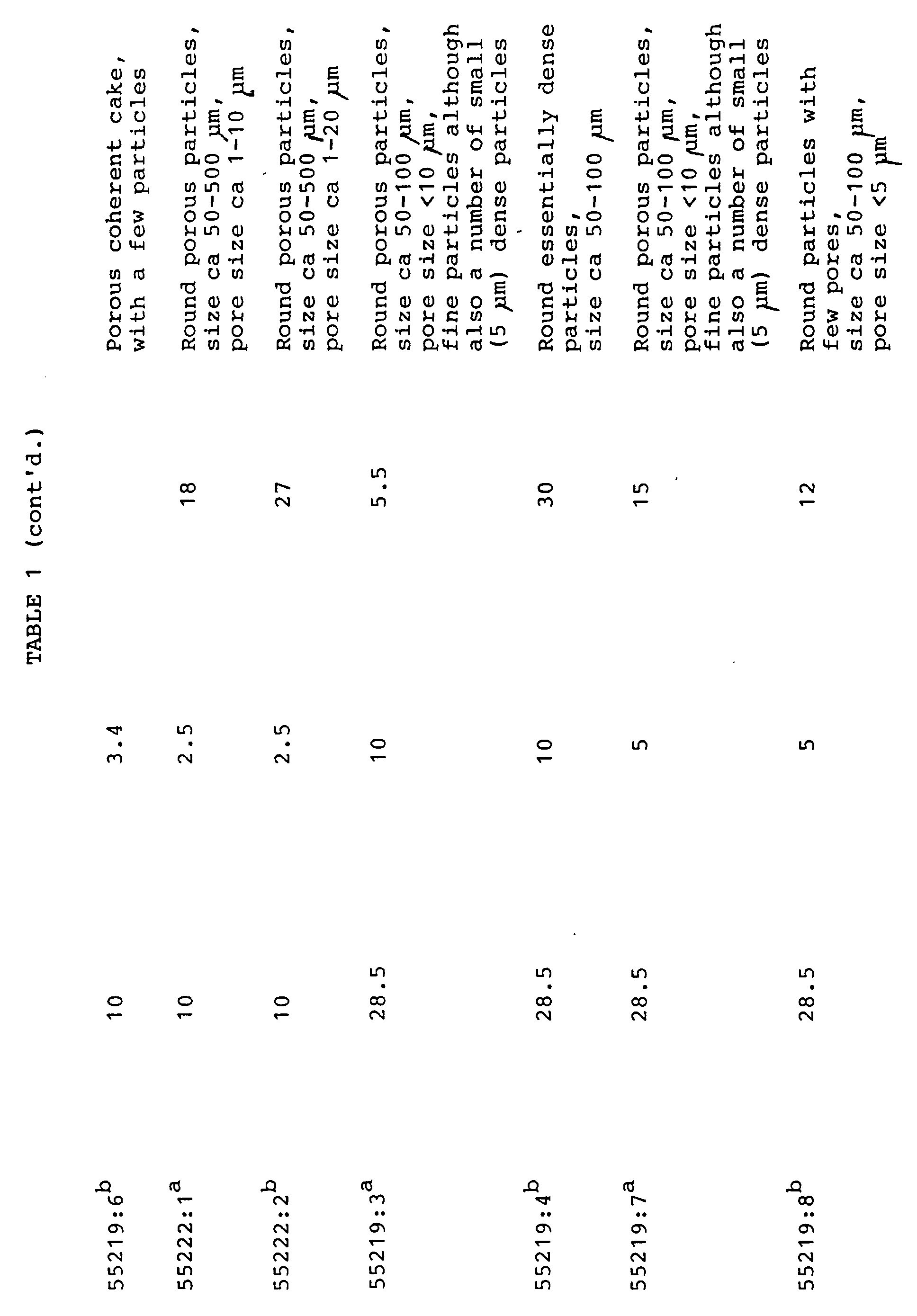
- the exact components of the reaction mixtures are set forth in Table 1.
- results of SEM-analysis of prepared non-derivated particles are set forth in Table 1.
- the results show that it is possible to produce particles of varying porosity by means of the inventive method.
- the results also indicate that macroporous particles can be obtained when Stage 1 (production of w/o emulsion) is effected with a dry solids content that lies in the range of about 5-35%, preferably within the range of 10-30% (w/w).
- Stage 2 the results indicate that a more open pore structure is obtained when the dry solid content decreases.
- Drained DEAE particles according to the above (20 g) were mixed with 10 ml buffer (50 mM Tris buffer pH 7.5) and were poured into a column (XK 16/20). After the gel had settled and had compacted, the gel height was 12.7 cm. Tris buffer (50 mM Tris buffer pH 7.5) was pumped through the column at a linear rate of flow (300 cm/h). The pressure across the system and column was noted, as was also the pressure across solely the system. The pressure across the column was calculated by subtracting the pressure across solely the system from the combined system plus column pressure. When noting the pressure, the flow rate was increased successively until the gel collapsed and the pressure quickly disappeared.
- Drained DEAE particles according to the above (20 g) were pored into a column (XK 16/20).
- the gel was equilibrated with binding buffer, whereafter a solution of BSA (2.0 g/ml) was applied to the column (the experiments were repeated with each of the four buffers).
- BSA 2.0 g/ml
- the non-bound protein was washed away from the column.
- the bound protein was eluted with 1 M NaCl.
- the experiments were carried out at linear flow rates of 150 and 1,500 cm/h. Plate numbers and asymmetry factors were determined.
- the available capacity of the gel was calculated by dividing the amount of BSA eluted with 1 M NaCl by the gel volume.
- the dynamic binding capacity (DBC) was given as the amount of protein adsorbed per milliliter of gel when the UV reading was 1% and 50% of the protein solution indication respectively.
- the gel volume was subtracted from the breakthrough curve, since the time taken for the protein to wander through the column corresponded to an excessively large proportion of the dynamic capacity.
- Drained DEAE gel particles according to the above (20 g) were packed in a column to a height of 12 cm.
- the gel was equilibrated with a binding buffer (10 mM Tris-HCl pH 8.3), whereafter there were applied 100 ml of a protein mixture containing 50 mg of each of two proteins. After having washed non-bound protein from the column, the bound protein was eluted with an NaCl gradient in a Tris solution (10 mM Tris) from 0 to 1 M NaCl. A linear flow rate of 100 cm/h was applied in the experiments.
- the protein mixtures were:
- the plate number per metre of the column was 990, while the asymmetry factor was 1.05. The following values were obtained when determining the capacity of the DEAE particles with different buffers and different flow rates: 1. Buffer 10 mM Tris-HCl, pH 7.5 Flow rate 150 cm/h Available capacity 4.0 mg/ml DBC 1% 4.0 mg/ml DBC 50% 5.7 mg/ml 2. Buffer 20 mM Tris-HCl, pH 7.5 Flow rate 150 cm/h Available capacity 5.4 mg/ml DBC 1% 3.6 mg/ml DBC 50% 5.4 mg/ml 3.
- the inventive particles tested had a dynamic capacity that was independent of flow rate, at least up to 1500 cm/h, indicating fast kinetic and little diffusional resistance, which will be of great benefit for e.g. chromatography in early stages (capture).
- the inventive particles tested were unable to manage the same high flow rates as those managed by the chromatographic matrices BigBeads and Streamline® (Pharmacia Biotech AB, Uppsala, Sweden).
- the tested particles were able to separate two proteins having different iso-electric points. The protein capacity was low.
Landscapes
- Chemical & Material Sciences (AREA)
- Chemical Kinetics & Catalysis (AREA)
- Organic Chemistry (AREA)
- Health & Medical Sciences (AREA)
- Medicinal Chemistry (AREA)
- Polymers & Plastics (AREA)
- Analytical Chemistry (AREA)
- Oil, Petroleum & Natural Gas (AREA)
- Polymerisation Methods In General (AREA)
- Addition Polymer Or Copolymer, Post-Treatments, Or Chemical Modifications (AREA)
- Manufacture Of Porous Articles, And Recovery And Treatment Of Waste Products (AREA)
- Manufacturing Of Micro-Capsules (AREA)
- Physical Or Chemical Processes And Apparatus (AREA)
Abstract
Description



| 1. | Buffer | 10 mM Tris-HCl, pH 7.5 |
| Flow rate | 150 cm/h | |
| Available capacity | 4.0 mg/ml | |
| DBC 1% | 4.0 mg/ml | |
| DBC 50% | 5.7 mg/ml | |
| 2. | Buffer | 20 mM Tris-HCl, pH 7.5 |
| Flow rate | 150 cm/h | |
| Available capacity | 5.4 mg/ml | |
| DBC 1% | 3.6 mg/ml | |
| DBC 50% | 5.4 mg/ml | |
| 3. | Buffer | 10 mM Tris-HCl, pH 7.5 |
| Flow rate | 1,500 cm/h | |
| Available capacity | 8.3 mg/ml | |
| DBC 1% | 4.4 mg/ml | |
| DBC 50% | 8.0 mg/ml | |
| 4. | Buffer: | 50 mM Tris-HCl, pH 7.5 |
| Flow rate: | 1,500 cm/h | |
| Available capacity: | 4.6 mg/ml | |
| DBC 1%: | 2.9 mg/ml | |
| DBC 50%: | 5.6 mg/ml |
Claims (15)
- A method of producing open porous spherical particles by polymerizing monovinyl monomers and divinyl monomers and/or polyvinyl monomers (cross-linkers) in an emulsion with the aid of an initiator, wherein the method comprisesi) preparing in two steps a water-in-oil-in-water (w/o/w) emulsion which in total contains 75-99% (w/w) water and comprises an aqueous phase having emulsified therein droplets which contain a water-in-oil (w/o) high internal phase emulsion, whereinwherein the first step is preparing a water-in-oil (w/o) high internal phase emulsion with an oil phase comprising 5-45% (w/w) and water being the internal phase and the second step is adding the remainder of water so as to form the w/o/w emulsion,a) the oil phase in the droplets includes vinyl monomers and an emulsifier which enables a high internal phase inverse emulsion, andb) the droplets have a diameter in the range of 10-2,000 µm,ii) thereafter initiating polymerization and isolating a population of particles having a diameter in the range of 10 - 2,000 µm from the reaction mixture after the polymerization process.
- The method according to claim 1, characterized in that the total amount of water in the water-in-oil-in-water emulsion is 90-99% (w/w).
- The method according to anyone of claims 1-2,
characterized in that the isolated particles have a size (diameter) in the range of 10 µm - 2,000 µm and that the pore system of the particles is built up of spherical hollows which are interconnected by pores, whereinsaid diameters being measured from SEM (scanning electron microscopy) images.a) the diameters of the spherical hollows are within the range of 1-25 µm and < 1/9 of the diameter of the particles; andb) the diameters of the interconnecting pores are within the range of 0.5-10 µm and 1/10 - 1/3 of the diameter of the spheres; and - The method according to anyone of claims 1-3,
characterized in that the initiator used for the polymerization is a thermic initiator for radical polymerization with an activation temperature in the range of 30-90°C, said initiator being included in the water-in-oil emulsion provided in step a. - The method according to claim 4, characterized in that the initiator is of the azo-type.
- The method according to anyone of claims 1-5,
characterized in that the emulsifier constitutes < 30 % (w/w) of the oil phase of the water-in-oil emulsion. - The method according to anyone of claims 1-6,
characterized in that the vinyl group in the monomers are bound directly to a carbonyl group in an ester group or in a carboxy group, or to an aromatic ring. - The method according to anyone of claims 1-7,
characterized in that the vinyl monomers are selected from monoacrylate esters and diacrylate esters, or corresponding methacrylate esters, or are vinyl benzene and divinyl benzene. - The method according to anyone of claims 1-6,
characterized in that the emulsifier includes compounds chosen from (a) monoesters or diesters between C10-25 carboxylic acids and sugar alcohols and (b) block copolymers which contain both hydrophilic and hydrophobic segments. - The method according to anyone of claims 1-9,
characterized in that said vinyl monomers are a vinyl benzene and a divinyl benzene. - A population of particles being obtainable by the method of anyone of claims 1-10 and consisting of spherical porous polymer particles built up of vinyl monomer units, having a diameter within the range of 50 µm - 2,000 µm and a pore system comprisingsaid diameters being measured from SEM (scanning electron microscopy) images.a) spherical hollows whose diameters are within the range of 1-25 µm and < 1/9 of the of the particle diameter; andb) connecting pores whose opening diameters to the spheres and on the particle surfaces are within the range of 0.5-10 µm and 1/10 - 1/3 of the diameter of the spheres; and
- The population of spherical particles according to claim 11, characterized in that the vinyl monomer units have their respective vinyl group directly attached to the carbonyl group of an ester group or of a carboxy group, or to an aromatic ring.
- The population of spherical particles according to anyone of claims 11-12, characterized in that the vinyl monomer units are monoacrylate ester units and diacrylate ester units, or corresponding methacrylate ester units, or vinyl benzene units and divinyl benzene units.
- The population of spherical particles according to anyone of claims 11-13, characterized in that the vinyl monomer units are monovinyl benzene and divinyl benzene units.
- The use of the population of particles according to any one of claims 11-15 as support material in liquid chromatography or as support material in solid phase synthesis or as cell culture carriers.
Applications Claiming Priority (5)
| Application Number | Priority Date | Filing Date | Title |
|---|---|---|---|
| SE9401670A SE9401670D0 (en) | 1994-05-15 | 1994-05-15 | Process for producing particles and particles which can be prepared by the process |
| SE9401670 | 1994-05-15 | ||
| SE9402483 | 1994-07-15 | ||
| SE9402483A SE9402483D0 (en) | 1994-07-15 | 1994-07-15 | Process for producing particles and particles which can be prepared by the process |
| PCT/SE1995/000516 WO1995031485A1 (en) | 1994-05-15 | 1995-05-10 | A method of manufacturing particles, and particles that can be produced in accordance with the method |
Publications (2)
| Publication Number | Publication Date |
|---|---|
| EP0763064A1 EP0763064A1 (en) | 1997-03-19 |
| EP0763064B1 true EP0763064B1 (en) | 2001-08-01 |
Family
ID=26662054
Family Applications (1)
| Application Number | Title | Priority Date | Filing Date |
|---|---|---|---|
| EP95919714A Expired - Lifetime EP0763064B1 (en) | 1994-05-15 | 1995-05-10 | A method of manufacturing particles, and particles that can be produced in accordance with the method |
Country Status (8)
| Country | Link |
|---|---|
| US (1) | US5902834A (en) |
| EP (1) | EP0763064B1 (en) |
| JP (1) | JP3608625B2 (en) |
| AT (1) | ATE203755T1 (en) |
| AU (1) | AU2541695A (en) |
| DE (1) | DE69521997T2 (en) |
| DK (1) | DK0763064T3 (en) |
| WO (1) | WO1995031485A1 (en) |
Cited By (2)
| Publication number | Priority date | Publication date | Assignee | Title |
|---|---|---|---|---|
| US9592458B2 (en) | 2013-12-26 | 2017-03-14 | Dionex Corporation | Ion exchange foams to remove ions from samples |
| US10921298B2 (en) | 2014-12-30 | 2021-02-16 | Dionex Corporation | Vial cap and method for removing matrix components from a liquid sample |
Families Citing this family (44)
| Publication number | Priority date | Publication date | Assignee | Title |
|---|---|---|---|---|
| US5583162A (en) * | 1994-06-06 | 1996-12-10 | Biopore Corporation | Polymeric microbeads and method of preparation |
| DE19545257A1 (en) | 1995-11-24 | 1997-06-19 | Schering Ag | Process for the production of morphologically uniform microcapsules and microcapsules produced by this process |
| SE9504205D0 (en) * | 1995-11-24 | 1995-11-24 | Pharmacia Biotech Ab | A chromatographic separation method and device |
| DE19640793A1 (en) * | 1996-10-02 | 1998-04-16 | Basf Ag | Method and device for the production of homopolymers and copolymers in emulsion polymerization technology |
| US6048908A (en) * | 1997-06-27 | 2000-04-11 | Biopore Corporation | Hydrophilic polymeric material |
| SE9704935D0 (en) * | 1997-12-30 | 1997-12-30 | Pharmacia & Upjohn Diag Ab | Method of analysis with particles |
| GB9826701D0 (en) * | 1998-12-05 | 1999-01-27 | Univ Newcastle | Microcellular polymers as cell growth media and novel polymers |
| DE19920794A1 (en) * | 1999-05-06 | 2000-11-09 | Merck Patent Gmbh | Process for the preparation of bead polymers |
| US7252842B2 (en) | 2000-12-21 | 2007-08-07 | Alrise Biosystems Gmbh | Induced phase transition method for the production of microparticles containing hydrophilic active agents |
| US7462366B2 (en) | 2002-03-29 | 2008-12-09 | Boston Scientific Scimed, Inc. | Drug delivery particle |
| US7094369B2 (en) * | 2002-03-29 | 2006-08-22 | Scimed Life Systems, Inc. | Processes for manufacturing polymeric microspheres |
| US7131997B2 (en) | 2002-03-29 | 2006-11-07 | Scimed Life Systems, Inc. | Tissue treatment |
| US7053134B2 (en) * | 2002-04-04 | 2006-05-30 | Scimed Life Systems, Inc. | Forming a chemically cross-linked particle of a desired shape and diameter |
| US7449236B2 (en) * | 2002-08-09 | 2008-11-11 | Boston Scientific Scimed, Inc. | Porous polymeric particle comprising polyvinyl alcohol and having interior to surface porosity-gradient |
| US7842377B2 (en) | 2003-08-08 | 2010-11-30 | Boston Scientific Scimed, Inc. | Porous polymeric particle comprising polyvinyl alcohol and having interior to surface porosity-gradient |
| US8012454B2 (en) * | 2002-08-30 | 2011-09-06 | Boston Scientific Scimed, Inc. | Embolization |
| US7883490B2 (en) | 2002-10-23 | 2011-02-08 | Boston Scientific Scimed, Inc. | Mixing and delivery of therapeutic compositions |
| US7588825B2 (en) | 2002-10-23 | 2009-09-15 | Boston Scientific Scimed, Inc. | Embolic compositions |
| GB0228914D0 (en) * | 2002-12-11 | 2003-01-15 | Dynal Biotech Asa | Particles |
| US7976823B2 (en) | 2003-08-29 | 2011-07-12 | Boston Scientific Scimed, Inc. | Ferromagnetic particles and methods |
| US7901770B2 (en) | 2003-11-04 | 2011-03-08 | Boston Scientific Scimed, Inc. | Embolic compositions |
| JP4317941B2 (en) * | 2004-02-18 | 2009-08-19 | 国立大学法人神戸大学 | Aperture fine particles and method for producing the same |
| US7736671B2 (en) | 2004-03-02 | 2010-06-15 | Boston Scientific Scimed, Inc. | Embolization |
| US8173176B2 (en) | 2004-03-30 | 2012-05-08 | Boston Scientific Scimed, Inc. | Embolization |
| US7311861B2 (en) | 2004-06-01 | 2007-12-25 | Boston Scientific Scimed, Inc. | Embolization |
| US8425550B2 (en) | 2004-12-01 | 2013-04-23 | Boston Scientific Scimed, Inc. | Embolic coils |
| US7858183B2 (en) | 2005-03-02 | 2010-12-28 | Boston Scientific Scimed, Inc. | Particles |
| US7727555B2 (en) | 2005-03-02 | 2010-06-01 | Boston Scientific Scimed, Inc. | Particles |
| US7963287B2 (en) | 2005-04-28 | 2011-06-21 | Boston Scientific Scimed, Inc. | Tissue-treatment methods |
| US9463426B2 (en) | 2005-06-24 | 2016-10-11 | Boston Scientific Scimed, Inc. | Methods and systems for coating particles |
| US8007509B2 (en) | 2005-10-12 | 2011-08-30 | Boston Scientific Scimed, Inc. | Coil assemblies, components and methods |
| US8101197B2 (en) | 2005-12-19 | 2012-01-24 | Stryker Corporation | Forming coils |
| US8152839B2 (en) | 2005-12-19 | 2012-04-10 | Boston Scientific Scimed, Inc. | Embolic coils |
| US7501179B2 (en) | 2005-12-21 | 2009-03-10 | Boston Scientific Scimed, Inc. | Block copolymer particles |
| US7947368B2 (en) | 2005-12-21 | 2011-05-24 | Boston Scientific Scimed, Inc. | Block copolymer particles |
| US8414927B2 (en) | 2006-11-03 | 2013-04-09 | Boston Scientific Scimed, Inc. | Cross-linked polymer particles |
| US7887984B2 (en) * | 2007-01-18 | 2011-02-15 | Eastman Kodak Company | Toner porous particles containing hydrocolloids |
| JP5250985B2 (en) * | 2007-03-19 | 2013-07-31 | 東ソー株式会社 | New filler for packed bed and its use |
| WO2009111264A2 (en) * | 2008-02-29 | 2009-09-11 | Alseres Pharmaceuticals, Inc. | Systemic purine administration:modulating axonal outgrowth of central nervous system neurons |
| JP2013507959A (en) * | 2009-10-22 | 2013-03-07 | ジーイー・ヘルスケア・バイオサイエンス・アクチボラグ | Cell culture / treatment products and methods for their production and use |
| US8703834B2 (en) * | 2011-07-28 | 2014-04-22 | Eastman Kodak Company | Preparation of crosslinked organic porous particlesrelated applications |
| WO2013016080A2 (en) * | 2011-07-28 | 2013-01-31 | Eastman Kodak Company | Crosslinked organic porous particles |
| US20130029155A1 (en) | 2011-07-28 | 2013-01-31 | Mridula Nair | Crosslinked organic porous particles |
| WO2025244512A1 (en) * | 2024-05-23 | 2025-11-27 | 주식회사 엘지화학 | Microcarrier for cell culture, method for preparing microcarrier for cell culture, and cell culture composition using same |
Family Cites Families (10)
| Publication number | Priority date | Publication date | Assignee | Title |
|---|---|---|---|---|
| DE1160616C2 (en) * | 1960-06-09 | 1975-11-20 | Bayer Ag, 5090 Leverkusen | PROCESS FOR THE MANUFACTURING OF POLYMERIZES |
| DE1137554B (en) * | 1961-06-21 | 1962-10-04 | Bayer Ag | Process for the polymerization of water-insoluble monomers |
| NZ199916A (en) * | 1981-03-11 | 1985-07-12 | Unilever Plc | Low density polymeric block material for use as carrier for included liquids |
| GB8709688D0 (en) * | 1987-04-24 | 1987-05-28 | Unilever Plc | Porous material |
| US4968562A (en) * | 1990-02-27 | 1990-11-06 | Minnesota Mining And Manufacturing Company | Hollow acid-free acrylate polymeric microspheres having multiple small voids |
| GB9014689D0 (en) * | 1990-07-02 | 1990-08-22 | Tioxide Group Services Ltd | Supports for active entities |
| CA2124342C (en) * | 1991-12-17 | 2003-03-25 | Joaquin Delgado | Tack-free elastomeric acrylate microspheres |
| US5200433A (en) * | 1992-04-20 | 1993-04-06 | Shell Oil Company | Process for preparing low density porous crosslinked polymeric materials |
| US5189070A (en) * | 1992-05-29 | 1993-02-23 | Shell Oil Company | Process for preparing low density porous crosslinked polymeric materials |
| US5583162A (en) * | 1994-06-06 | 1996-12-10 | Biopore Corporation | Polymeric microbeads and method of preparation |
-
1995
- 1995-05-10 US US08/737,488 patent/US5902834A/en not_active Expired - Fee Related
- 1995-05-10 AT AT95919714T patent/ATE203755T1/en not_active IP Right Cessation
- 1995-05-10 DK DK95919714T patent/DK0763064T3/en active
- 1995-05-10 JP JP52955895A patent/JP3608625B2/en not_active Expired - Fee Related
- 1995-05-10 DE DE69521997T patent/DE69521997T2/en not_active Expired - Lifetime
- 1995-05-10 AU AU25416/95A patent/AU2541695A/en not_active Abandoned
- 1995-05-10 WO PCT/SE1995/000516 patent/WO1995031485A1/en not_active Ceased
- 1995-05-10 EP EP95919714A patent/EP0763064B1/en not_active Expired - Lifetime
Cited By (4)
| Publication number | Priority date | Publication date | Assignee | Title |
|---|---|---|---|---|
| US9592458B2 (en) | 2013-12-26 | 2017-03-14 | Dionex Corporation | Ion exchange foams to remove ions from samples |
| US10076756B2 (en) | 2013-12-26 | 2018-09-18 | Dionex Corporation | Ion exchange foams to remove ions from samples |
| US10921298B2 (en) | 2014-12-30 | 2021-02-16 | Dionex Corporation | Vial cap and method for removing matrix components from a liquid sample |
| US12038422B2 (en) | 2014-12-30 | 2024-07-16 | Dionex Corporation | Vial cap and method for removing matrix components from a liquid sample |
Also Published As
| Publication number | Publication date |
|---|---|
| DE69521997T2 (en) | 2002-04-04 |
| DK0763064T3 (en) | 2001-11-05 |
| JP3608625B2 (en) | 2005-01-12 |
| ATE203755T1 (en) | 2001-08-15 |
| WO1995031485A1 (en) | 1995-11-23 |
| EP0763064A1 (en) | 1997-03-19 |
| JPH10500164A (en) | 1998-01-06 |
| DE69521997D1 (en) | 2001-09-06 |
| US5902834A (en) | 1999-05-11 |
| AU2541695A (en) | 1995-12-05 |
Similar Documents
| Publication | Publication Date | Title |
|---|---|---|
| US5902834A (en) | Method of manufacturing particles, and particles that can be produced in accordance with the method | |
| EP1969039B1 (en) | Method of making macroporous anion exchange resins | |
| Tennikova et al. | High-performance membrane chromatography of proteins, a novel method of protein separation | |
| US5334310A (en) | Column with macroporous polymer media | |
| EP1237938B1 (en) | Large-pore chromatographic beads prepared by suspension polymerization | |
| US8338496B2 (en) | Method of making macroporous cation exchange resins | |
| US6290853B1 (en) | Chromotographic method and device in which a continuous macroporous organic matrix is used | |
| Hosoya et al. | In situ surface-selective modification of uniform size macroporous polymer particles with temperature-responsive poly-N-isopropylacrylamide | |
| JPH0198606A (en) | Polymer particle and preparation thereof | |
| KR20070015430A (en) | Macroporous ion exchange resin | |
| US6573307B1 (en) | Process for making fluorinated polymer adsorbent particles | |
| IL32917A (en) | Macroreticular resins | |
| US20050065282A1 (en) | Post-modification of a porous support | |
| EP1226869B1 (en) | Cation exchanger, process for producing same, and its use | |
| US6746608B2 (en) | Use of adsorbent polymer particles in DNA separation | |
| JPH07179504A (en) | Fine particle polymer and method for producing the same | |
| CN1233438C (en) | Method for preparing microspheric PGDT separating medium with two kinds of pore forms | |
| JP3316915B2 (en) | Separation resin and production method thereof | |
| JPS6392627A (en) | Hydrophilic porous particle | |
| JPS5837005B2 (en) | Desalination method using thermally recyclable resin | |
| KR20260033233A (en) | Porous particles, method for praparing the same, and column resin using the same | |
| KR0141989B1 (en) | Method of preparing synthetic adsorbent | |
| JPS6379064A (en) | Filler for gel permeation chromatography | |
| JPS6379066A (en) | Filler for gas chromatography | |
| JPH0450765A (en) | Packing material for liquid chromatograph |
Legal Events
| Date | Code | Title | Description |
|---|---|---|---|
| PUAI | Public reference made under article 153(3) epc to a published international application that has entered the european phase |
Free format text: ORIGINAL CODE: 0009012 |
|
| 17P | Request for examination filed |
Effective date: 19961126 |
|
| AK | Designated contracting states |
Kind code of ref document: A1 Designated state(s): AT BE CH DE DK ES FR GB IT LI NL SE |
|
| 17Q | First examination report despatched |
Effective date: 19970421 |
|
| RAP1 | Party data changed (applicant data changed or rights of an application transferred) |
Owner name: AMERSHAM PHARMACIA BIOTECH AB |
|
| GRAG | Despatch of communication of intention to grant |
Free format text: ORIGINAL CODE: EPIDOS AGRA |
|
| GRAG | Despatch of communication of intention to grant |
Free format text: ORIGINAL CODE: EPIDOS AGRA |
|
| GRAH | Despatch of communication of intention to grant a patent |
Free format text: ORIGINAL CODE: EPIDOS IGRA |
|
| GRAH | Despatch of communication of intention to grant a patent |
Free format text: ORIGINAL CODE: EPIDOS IGRA |
|
| RAP1 | Party data changed (applicant data changed or rights of an application transferred) |
Owner name: APBIOTECH AKTIEBOLAG |
|
| GRAA | (expected) grant |
Free format text: ORIGINAL CODE: 0009210 |
|
| AK | Designated contracting states |
Kind code of ref document: B1 Designated state(s): AT BE CH DE DK ES FR GB IT LI NL SE |
|
| PG25 | Lapsed in a contracting state [announced via postgrant information from national office to epo] |
Ref country code: LI Free format text: LAPSE BECAUSE OF FAILURE TO SUBMIT A TRANSLATION OF THE DESCRIPTION OR TO PAY THE FEE WITHIN THE PRESCRIBED TIME-LIMIT Effective date: 20010801 Ref country code: IT Free format text: LAPSE BECAUSE OF FAILURE TO SUBMIT A TRANSLATION OF THE DESCRIPTION OR TO PAY THE FEE WITHIN THE PRESCRIBED TIME-LIMIT;WARNING: LAPSES OF ITALIAN PATENTS WITH EFFECTIVE DATE BEFORE 2007 MAY HAVE OCCURRED AT ANY TIME BEFORE 2007. THE CORRECT EFFECTIVE DATE MAY BE DIFFERENT FROM THE ONE RECORDED. Effective date: 20010801 Ref country code: CH Free format text: LAPSE BECAUSE OF FAILURE TO SUBMIT A TRANSLATION OF THE DESCRIPTION OR TO PAY THE FEE WITHIN THE PRESCRIBED TIME-LIMIT Effective date: 20010801 Ref country code: BE Free format text: LAPSE BECAUSE OF FAILURE TO SUBMIT A TRANSLATION OF THE DESCRIPTION OR TO PAY THE FEE WITHIN THE PRESCRIBED TIME-LIMIT Effective date: 20010801 Ref country code: AT Free format text: LAPSE BECAUSE OF FAILURE TO SUBMIT A TRANSLATION OF THE DESCRIPTION OR TO PAY THE FEE WITHIN THE PRESCRIBED TIME-LIMIT Effective date: 20010801 |
|
| REF | Corresponds to: |
Ref document number: 203755 Country of ref document: AT Date of ref document: 20010815 Kind code of ref document: T |
|
| REG | Reference to a national code |
Ref country code: CH Ref legal event code: EP |
|
| REF | Corresponds to: |
Ref document number: 69521997 Country of ref document: DE Date of ref document: 20010906 |
|
| REG | Reference to a national code |
Ref country code: DK Ref legal event code: T3 |
|
| ET | Fr: translation filed | ||
| REG | Reference to a national code |
Ref country code: GB Ref legal event code: IF02 |
|
| REG | Reference to a national code |
Ref country code: CH Ref legal event code: PL |
|
| PG25 | Lapsed in a contracting state [announced via postgrant information from national office to epo] |
Ref country code: ES Free format text: LAPSE BECAUSE OF FAILURE TO SUBMIT A TRANSLATION OF THE DESCRIPTION OR TO PAY THE FEE WITHIN THE PRESCRIBED TIME-LIMIT Effective date: 20020228 |
|
| PLBE | No opposition filed within time limit |
Free format text: ORIGINAL CODE: 0009261 |
|
| STAA | Information on the status of an ep patent application or granted ep patent |
Free format text: STATUS: NO OPPOSITION FILED WITHIN TIME LIMIT |
|
| 26N | No opposition filed | ||
| NLT1 | Nl: modifications of names registered in virtue of documents presented to the patent office pursuant to art. 16 a, paragraph 1 |
Owner name: GE HEALTHCARE BIO-SCIENCES AB Owner name: AMERSHAM PHARMACIA BIOTECH AKTIEBOLAG Owner name: AMERSHAM BIOSCIENCES AKTIEBOLAG |
|
| PGFP | Annual fee paid to national office [announced via postgrant information from national office to epo] |
Ref country code: NL Payment date: 20060524 Year of fee payment: 12 |
|
| PGFP | Annual fee paid to national office [announced via postgrant information from national office to epo] |
Ref country code: SE Payment date: 20060530 Year of fee payment: 12 |
|
| PGFP | Annual fee paid to national office [announced via postgrant information from national office to epo] |
Ref country code: DK Payment date: 20060531 Year of fee payment: 12 |
|
| REG | Reference to a national code |
Ref country code: FR Ref legal event code: CD |
|
| EUG | Se: european patent has lapsed | ||
| REG | Reference to a national code |
Ref country code: DK Ref legal event code: EBP |
|
| PG25 | Lapsed in a contracting state [announced via postgrant information from national office to epo] |
Ref country code: NL Free format text: LAPSE BECAUSE OF NON-PAYMENT OF DUE FEES Effective date: 20071201 |
|
| NLV4 | Nl: lapsed or anulled due to non-payment of the annual fee |
Effective date: 20071201 |
|
| PG25 | Lapsed in a contracting state [announced via postgrant information from national office to epo] |
Ref country code: DK Free format text: LAPSE BECAUSE OF NON-PAYMENT OF DUE FEES Effective date: 20070531 |
|
| PG25 | Lapsed in a contracting state [announced via postgrant information from national office to epo] |
Ref country code: SE Free format text: LAPSE BECAUSE OF NON-PAYMENT OF DUE FEES Effective date: 20070511 |
|
| PGFP | Annual fee paid to national office [announced via postgrant information from national office to epo] |
Ref country code: FR Payment date: 20100601 Year of fee payment: 16 |
|
| PGFP | Annual fee paid to national office [announced via postgrant information from national office to epo] |
Ref country code: DE Payment date: 20100527 Year of fee payment: 16 |
|
| PGFP | Annual fee paid to national office [announced via postgrant information from national office to epo] |
Ref country code: GB Payment date: 20100525 Year of fee payment: 16 |
|
| REG | Reference to a national code |
Ref country code: DE Ref legal event code: R119 Ref document number: 69521997 Country of ref document: DE |
|
| REG | Reference to a national code |
Ref country code: DE Ref legal event code: R119 Ref document number: 69521997 Country of ref document: DE |
|
| GBPC | Gb: european patent ceased through non-payment of renewal fee |
Effective date: 20110510 |
|
| REG | Reference to a national code |
Ref country code: FR Ref legal event code: ST Effective date: 20120131 |
|
| PG25 | Lapsed in a contracting state [announced via postgrant information from national office to epo] |
Ref country code: FR Free format text: LAPSE BECAUSE OF NON-PAYMENT OF DUE FEES Effective date: 20110531 |
|
| PG25 | Lapsed in a contracting state [announced via postgrant information from national office to epo] |
Ref country code: GB Free format text: LAPSE BECAUSE OF NON-PAYMENT OF DUE FEES Effective date: 20110510 |
|
| PG25 | Lapsed in a contracting state [announced via postgrant information from national office to epo] |
Ref country code: DE Free format text: LAPSE BECAUSE OF NON-PAYMENT OF DUE FEES Effective date: 20111130 |