EP0762995B1 - Metal oxyhalide materials, their use and methods for their production - Google Patents
Metal oxyhalide materials, their use and methods for their production Download PDFInfo
- Publication number
- EP0762995B1 EP0762995B1 EP95921034A EP95921034A EP0762995B1 EP 0762995 B1 EP0762995 B1 EP 0762995B1 EP 95921034 A EP95921034 A EP 95921034A EP 95921034 A EP95921034 A EP 95921034A EP 0762995 B1 EP0762995 B1 EP 0762995B1
- Authority
- EP
- European Patent Office
- Prior art keywords
- cuo
- halogen
- copper oxide
- halide
- effected
- Prior art date
- Legal status (The legal status is an assumption and is not a legal conclusion. Google has not performed a legal analysis and makes no representation as to the accuracy of the status listed.)
- Expired - Lifetime
Links
- 238000000034 method Methods 0.000 title claims description 31
- 239000000463 material Substances 0.000 title claims description 11
- 238000004519 manufacturing process Methods 0.000 title description 8
- 229910052751 metal Inorganic materials 0.000 title description 3
- 239000002184 metal Substances 0.000 title description 3
- 239000010949 copper Substances 0.000 claims description 25
- 229910052736 halogen Inorganic materials 0.000 claims description 25
- 150000002367 halogens Chemical class 0.000 claims description 25
- QPLDLSVMHZLSFG-UHFFFAOYSA-N Copper oxide Chemical compound [Cu]=O QPLDLSVMHZLSFG-UHFFFAOYSA-N 0.000 claims description 19
- 239000005751 Copper oxide Substances 0.000 claims description 18
- 229910000431 copper oxide Inorganic materials 0.000 claims description 18
- 239000000203 mixture Substances 0.000 claims description 17
- IJGRMHOSHXDMSA-UHFFFAOYSA-N Atomic nitrogen Chemical compound N#N IJGRMHOSHXDMSA-UHFFFAOYSA-N 0.000 claims description 12
- -1 ammonium halide Chemical class 0.000 claims description 12
- 229910044991 metal oxide Inorganic materials 0.000 claims description 12
- 239000002887 superconductor Substances 0.000 claims description 12
- 150000004820 halides Chemical class 0.000 claims description 11
- 230000002140 halogenating effect Effects 0.000 claims description 11
- LDDQLRUQCUTJBB-UHFFFAOYSA-N ammonium fluoride Chemical compound [NH4+].[F-] LDDQLRUQCUTJBB-UHFFFAOYSA-N 0.000 claims description 7
- 150000004706 metal oxides Chemical class 0.000 claims description 7
- 229910052788 barium Inorganic materials 0.000 claims description 6
- 238000010438 heat treatment Methods 0.000 claims description 6
- 229910052757 nitrogen Inorganic materials 0.000 claims description 6
- FVRNDBHWWSPNOM-UHFFFAOYSA-L strontium fluoride Chemical compound [F-].[F-].[Sr+2] FVRNDBHWWSPNOM-UHFFFAOYSA-L 0.000 claims description 6
- 229910001637 strontium fluoride Inorganic materials 0.000 claims description 6
- 230000026030 halogenation Effects 0.000 claims description 5
- 238000005658 halogenation reaction Methods 0.000 claims description 5
- 229910052784 alkaline earth metal Inorganic materials 0.000 claims description 4
- 150000001342 alkaline earth metals Chemical class 0.000 claims description 4
- 229910052712 strontium Inorganic materials 0.000 claims description 4
- DDFHBQSCUXNBSA-UHFFFAOYSA-N 5-(5-carboxythiophen-2-yl)thiophene-2-carboxylic acid Chemical group S1C(C(=O)O)=CC=C1C1=CC=C(C(O)=O)S1 DDFHBQSCUXNBSA-UHFFFAOYSA-N 0.000 claims description 3
- UFHFLCQGNIYNRP-UHFFFAOYSA-N Hydrogen Chemical compound [H][H] UFHFLCQGNIYNRP-UHFFFAOYSA-N 0.000 claims description 3
- 239000012298 atmosphere Substances 0.000 claims description 3
- 239000003795 chemical substances by application Substances 0.000 claims description 3
- 239000001257 hydrogen Substances 0.000 claims description 3
- 229910052739 hydrogen Inorganic materials 0.000 claims description 3
- 239000011261 inert gas Substances 0.000 claims description 3
- KRHYYFGTRYWZRS-UHFFFAOYSA-M Fluoride anion Chemical compound [F-] KRHYYFGTRYWZRS-UHFFFAOYSA-M 0.000 claims description 2
- 239000007792 gaseous phase Substances 0.000 claims description 2
- 239000007791 liquid phase Substances 0.000 claims description 2
- 239000007790 solid phase Substances 0.000 claims description 2
- 125000005207 tetraalkylammonium group Chemical group 0.000 claims description 2
- QLOLFVLPQSFYEU-UHFFFAOYSA-L C([O-])([O-])=O.[Cu+2]=O Chemical compound C([O-])([O-])=O.[Cu+2]=O QLOLFVLPQSFYEU-UHFFFAOYSA-L 0.000 claims 2
- 229910052731 fluorine Inorganic materials 0.000 description 16
- 239000011737 fluorine Substances 0.000 description 13
- YCKRFDGAMUMZLT-UHFFFAOYSA-N Fluorine atom Chemical compound [F] YCKRFDGAMUMZLT-UHFFFAOYSA-N 0.000 description 11
- 229910052760 oxygen Inorganic materials 0.000 description 9
- 230000003647 oxidation Effects 0.000 description 8
- 238000007254 oxidation reaction Methods 0.000 description 8
- QVGXLLKOCUKJST-UHFFFAOYSA-N atomic oxygen Chemical compound [O] QVGXLLKOCUKJST-UHFFFAOYSA-N 0.000 description 6
- 150000002500 ions Chemical class 0.000 description 6
- 239000001301 oxygen Substances 0.000 description 6
- 229910002282 La2CuO4 Inorganic materials 0.000 description 5
- 239000012071 phase Substances 0.000 description 5
- 239000000843 powder Substances 0.000 description 5
- BVKZGUZCCUSVTD-UHFFFAOYSA-L Carbonate Chemical compound [O-]C([O-])=O BVKZGUZCCUSVTD-UHFFFAOYSA-L 0.000 description 4
- PXHVJJICTQNCMI-UHFFFAOYSA-N Nickel Chemical compound [Ni] PXHVJJICTQNCMI-UHFFFAOYSA-N 0.000 description 4
- 238000002441 X-ray diffraction Methods 0.000 description 4
- 238000003682 fluorination reaction Methods 0.000 description 4
- 238000011282 treatment Methods 0.000 description 4
- 230000015572 biosynthetic process Effects 0.000 description 3
- 229910052801 chlorine Inorganic materials 0.000 description 3
- 239000000460 chlorine Substances 0.000 description 3
- 125000001153 fluoro group Chemical group F* 0.000 description 3
- 239000007789 gas Substances 0.000 description 3
- 238000003780 insertion Methods 0.000 description 3
- 230000037431 insertion Effects 0.000 description 3
- 238000003786 synthesis reaction Methods 0.000 description 3
- 230000007704 transition Effects 0.000 description 3
- NLXLAEXVIDQMFP-UHFFFAOYSA-N Ammonia chloride Chemical compound [NH4+].[Cl-] NLXLAEXVIDQMFP-UHFFFAOYSA-N 0.000 description 2
- 229910002480 Cu-O Inorganic materials 0.000 description 2
- 229910003098 YBa2Cu3O7−x Inorganic materials 0.000 description 2
- 125000004429 atom Chemical group 0.000 description 2
- DSAJWYNOEDNPEQ-UHFFFAOYSA-N barium atom Chemical compound [Ba] DSAJWYNOEDNPEQ-UHFFFAOYSA-N 0.000 description 2
- 230000008901 benefit Effects 0.000 description 2
- 229910052794 bromium Inorganic materials 0.000 description 2
- 239000002019 doping agent Substances 0.000 description 2
- 229910052740 iodine Inorganic materials 0.000 description 2
- 229910052749 magnesium Inorganic materials 0.000 description 2
- 239000011777 magnesium Substances 0.000 description 2
- 238000005404 magnetometry Methods 0.000 description 2
- 229910052759 nickel Inorganic materials 0.000 description 2
- 125000004430 oxygen atom Chemical group O* 0.000 description 2
- 238000000634 powder X-ray diffraction Methods 0.000 description 2
- 239000000047 product Substances 0.000 description 2
- 239000007787 solid Substances 0.000 description 2
- 239000000126 substance Substances 0.000 description 2
- 238000006467 substitution reaction Methods 0.000 description 2
- 238000004448 titration Methods 0.000 description 2
- 241000238366 Cephalopoda Species 0.000 description 1
- ZAMOUSCENKQFHK-UHFFFAOYSA-N Chlorine atom Chemical group [Cl] ZAMOUSCENKQFHK-UHFFFAOYSA-N 0.000 description 1
- RYGMFSIKBFXOCR-UHFFFAOYSA-N Copper Chemical compound [Cu] RYGMFSIKBFXOCR-UHFFFAOYSA-N 0.000 description 1
- 108091006149 Electron carriers Proteins 0.000 description 1
- 229910002283 La2CuO4+δ Inorganic materials 0.000 description 1
- FYYHWMGAXLPEAU-UHFFFAOYSA-N Magnesium Chemical compound [Mg] FYYHWMGAXLPEAU-UHFFFAOYSA-N 0.000 description 1
- 235000019270 ammonium chloride Nutrition 0.000 description 1
- 238000004458 analytical method Methods 0.000 description 1
- 150000001450 anions Chemical class 0.000 description 1
- 238000000137 annealing Methods 0.000 description 1
- 229910052791 calcium Inorganic materials 0.000 description 1
- 239000011575 calcium Substances 0.000 description 1
- VAWSWDPVUFTPQO-UHFFFAOYSA-N calcium strontium Chemical compound [Ca].[Sr] VAWSWDPVUFTPQO-UHFFFAOYSA-N 0.000 description 1
- 150000004649 carbonic acid derivatives Chemical class 0.000 description 1
- 150000001768 cations Chemical class 0.000 description 1
- 238000006243 chemical reaction Methods 0.000 description 1
- 239000007795 chemical reaction product Substances 0.000 description 1
- 150000001875 compounds Chemical class 0.000 description 1
- 229910052802 copper Inorganic materials 0.000 description 1
- 239000013078 crystal Substances 0.000 description 1
- 230000007547 defect Effects 0.000 description 1
- 238000011161 development Methods 0.000 description 1
- 238000009826 distribution Methods 0.000 description 1
- 230000000694 effects Effects 0.000 description 1
- 238000002474 experimental method Methods 0.000 description 1
- 238000011010 flushing procedure Methods 0.000 description 1
- 230000004907 flux Effects 0.000 description 1
- 239000012535 impurity Substances 0.000 description 1
- 238000010348 incorporation Methods 0.000 description 1
- 230000005415 magnetization Effects 0.000 description 1
- 238000005259 measurement Methods 0.000 description 1
- MOVBJUGHBJJKOW-UHFFFAOYSA-N methyl 2-amino-5-methoxybenzoate Chemical group COC(=O)C1=CC(OC)=CC=C1N MOVBJUGHBJJKOW-UHFFFAOYSA-N 0.000 description 1
- 238000013508 migration Methods 0.000 description 1
- 230000005012 migration Effects 0.000 description 1
- 230000004048 modification Effects 0.000 description 1
- 238000012986 modification Methods 0.000 description 1
- 238000001683 neutron diffraction Methods 0.000 description 1
- 238000002250 neutron powder diffraction Methods 0.000 description 1
- 239000012299 nitrogen atmosphere Substances 0.000 description 1
- UJMWVICAENGCRF-UHFFFAOYSA-N oxygen difluoride Chemical class FOF UJMWVICAENGCRF-UHFFFAOYSA-N 0.000 description 1
- 239000002245 particle Substances 0.000 description 1
- 230000035515 penetration Effects 0.000 description 1
- 238000001556 precipitation Methods 0.000 description 1
- 238000002360 preparation method Methods 0.000 description 1
- 230000008569 process Effects 0.000 description 1
- 229910052705 radium Inorganic materials 0.000 description 1
- 230000009257 reactivity Effects 0.000 description 1
- 230000009467 reduction Effects 0.000 description 1
- 230000000717 retained effect Effects 0.000 description 1
- 238000005245 sintering Methods 0.000 description 1
- 230000005476 size effect Effects 0.000 description 1
- 239000000243 solution Substances 0.000 description 1
- 239000012086 standard solution Substances 0.000 description 1
- CIOAGBVUUVVLOB-UHFFFAOYSA-N strontium atom Chemical compound [Sr] CIOAGBVUUVVLOB-UHFFFAOYSA-N 0.000 description 1
- LEDMRZGFZIAGGB-UHFFFAOYSA-L strontium carbonate Chemical compound [Sr+2].[O-]C([O-])=O LEDMRZGFZIAGGB-UHFFFAOYSA-L 0.000 description 1
- 229910000018 strontium carbonate Inorganic materials 0.000 description 1
- 229910001281 superconducting alloy Inorganic materials 0.000 description 1
- QSUJAUYJBJRLKV-UHFFFAOYSA-M tetraethylazanium;fluoride Chemical compound [F-].CC[N+](CC)(CC)CC QSUJAUYJBJRLKV-UHFFFAOYSA-M 0.000 description 1
- DIZZDZCUMBBRSG-UHFFFAOYSA-J tetrasodium;2-[[5-[3-[3-[[bis(carboxylatomethyl)amino]methyl]-4-hydroxy-2-methyl-5-propan-2-ylphenyl]-1,1-dioxo-2,1$l^{6}-benzoxathiol-3-yl]-2-hydroxy-6-methyl-3-propan-2-ylphenyl]methyl-(carboxylatomethyl)amino]acetate Chemical compound [Na+].[Na+].[Na+].[Na+].[O-]C(=O)CN(CC([O-])=O)CC1=C(O)C(C(C)C)=CC(C2(C3=CC=CC=C3S(=O)(=O)O2)C=2C(=C(CN(CC([O-])=O)CC([O-])=O)C(O)=C(C(C)C)C=2)C)=C1C DIZZDZCUMBBRSG-UHFFFAOYSA-J 0.000 description 1
- 238000007669 thermal treatment Methods 0.000 description 1
- 238000002411 thermogravimetry Methods 0.000 description 1
- VGBPIHVLVSGJGR-UHFFFAOYSA-N thorium(4+);tetranitrate Chemical compound [Th+4].[O-][N+]([O-])=O.[O-][N+]([O-])=O.[O-][N+]([O-])=O.[O-][N+]([O-])=O VGBPIHVLVSGJGR-UHFFFAOYSA-N 0.000 description 1
- 238000012546 transfer Methods 0.000 description 1
Images



Classifications
-
- C—CHEMISTRY; METALLURGY
- C01—INORGANIC CHEMISTRY
- C01G—COMPOUNDS CONTAINING METALS NOT COVERED BY SUBCLASSES C01D OR C01F
- C01G3/00—Compounds of copper
- C01G3/006—Compounds containing copper, with or without oxygen or hydrogen, and containing two or more other elements
-
- C—CHEMISTRY; METALLURGY
- C01—INORGANIC CHEMISTRY
- C01P—INDEXING SCHEME RELATING TO STRUCTURAL AND PHYSICAL ASPECTS OF SOLID INORGANIC COMPOUNDS
- C01P2002/00—Crystal-structural characteristics
- C01P2002/60—Compounds characterised by their crystallite size
-
- C—CHEMISTRY; METALLURGY
- C01—INORGANIC CHEMISTRY
- C01P—INDEXING SCHEME RELATING TO STRUCTURAL AND PHYSICAL ASPECTS OF SOLID INORGANIC COMPOUNDS
- C01P2002/00—Crystal-structural characteristics
- C01P2002/70—Crystal-structural characteristics defined by measured X-ray, neutron or electron diffraction data
- C01P2002/72—Crystal-structural characteristics defined by measured X-ray, neutron or electron diffraction data by d-values or two theta-values, e.g. as X-ray diagram
-
- C—CHEMISTRY; METALLURGY
- C01—INORGANIC CHEMISTRY
- C01P—INDEXING SCHEME RELATING TO STRUCTURAL AND PHYSICAL ASPECTS OF SOLID INORGANIC COMPOUNDS
- C01P2002/00—Crystal-structural characteristics
- C01P2002/70—Crystal-structural characteristics defined by measured X-ray, neutron or electron diffraction data
- C01P2002/76—Crystal-structural characteristics defined by measured X-ray, neutron or electron diffraction data by a space-group or by other symmetry indications
-
- C—CHEMISTRY; METALLURGY
- C01—INORGANIC CHEMISTRY
- C01P—INDEXING SCHEME RELATING TO STRUCTURAL AND PHYSICAL ASPECTS OF SOLID INORGANIC COMPOUNDS
- C01P2002/00—Crystal-structural characteristics
- C01P2002/70—Crystal-structural characteristics defined by measured X-ray, neutron or electron diffraction data
- C01P2002/77—Crystal-structural characteristics defined by measured X-ray, neutron or electron diffraction data by unit-cell parameters, atom positions or structure diagrams
-
- C—CHEMISTRY; METALLURGY
- C01—INORGANIC CHEMISTRY
- C01P—INDEXING SCHEME RELATING TO STRUCTURAL AND PHYSICAL ASPECTS OF SOLID INORGANIC COMPOUNDS
- C01P2006/00—Physical properties of inorganic compounds
- C01P2006/42—Magnetic properties
Definitions
- This invention relates to metal oxyhalides, their use as superconductors and methods for their production.
- High pressure sythesis has proved a useful technique for obtaining new, metastable copper oxide superconductors; for example, oxygen insertion into Sr 2 CuO 3 at 6 GPa (Hirol, Z. et al. Nature 364, 315 - 317 (1993)) yields superconducting Sr 2 CuO 3,1 , with a superconducting transition temperature (T c ) of 70 K, in which the superconducting CuO 2 layers are generated by pressure induced oxygen migration from apical to equatorial sites.
- T c superconducting transition temperature
- Metal oxide superconductors containing fluorine as an electronic dopant are per se known, for example La 2 CuO 4 F x is disclosed by Tissue, B. et al. in Solid St. Commun. 65 , 51 - 54 (1988), and Nd 2 CuO 4-x F y is disclosed by James, A. et al. in Nature 338 , 240 - 241 (1989).
- JP 4-130015 copper oxide superconductive material with layered perovskite crystal structure and containing at least one of F, Cl, Br, and I are described. These compounds show the formula (M 1-y A y ) n+1 Cu n O 2n+d X 2-d in which M is at least one of Mg, Ca, Sr, Ba, and Ra, and A is at least one of Li, Na, K, and Ra or vacancy, X is at least one of F, Cl, I, and Br, n is 1 - 3, y is 0 - 5, and d is 0 - 0,6.
- solid powder materials of suitable carbonates, oxides and halides is mixed and heated in O 2 at 500 -900°C for 1 to 100 hours. After that the received product is ground, mixed, moulded and further heated at 500- 900 °C for 1 - 100 hours.
- US 5,1081,103 describes a method of incorporating fluorine into the orthorhombic structure of the YBa 2 Cu 3 O 7-x system annealing YBa 2 Cu 3 O 7-x powder in a fluorine-containing gas, especially NF 2 gas or NF 3 /O 2 blend of F 2 N 2 blend, at a temperature of at least 250 °C, preferably higher.
- the operative temperature limits for the NF 3 and NF 3 /O 2 treatment are 250- 300 °C, a temperature which allows sufficient reactivity with the fluorine gas while maintaining the system below temperatures at which oxygen incorporation is observed to take place.
- a treatment using a 10/90 % F 2 /N 2 mixture showed no reaction below 500 to 550 °C.
- a new method for the production of a superconductive material comprising a halogen containing copper oxide of the formula A n-1 Cu n O 2n X 2n+ ⁇ where A, X, n, and ⁇ are as defined above.
- ⁇ is 0.2 to 0.5.
- a superconductive material produced according to the claimed method comprising a halogen-containing copper oxide of the formula A n+1 Cu n O 2n X 2n+ ⁇ , where A, X, n and ⁇ are as defined above.
- Halogenation (most preferably fluorination) may be effected using a gaseous halogenating agent (eg the halogen itself) at a temperature in the range of 100 to 400°C, more preferably 150 to 250°C, and most preferably 180 to 230°C.
- This fluorination step has the advantage that it can be conducted at ambient pressure.
- halogenation may be effected in the solid phase using an ammonium halide (preferably ammonium fluoride or ammonium chloride) or in the gaseous or liquid phase using an organoammonium halide (eg an alkylammonium halide such as a tetraalkylammonium halide, for example tetramethyl- or tetraethyl- ammonium fluoride).
- an ammonium halide preferably ammonium fluoride or ammonium chloride
- an organoammonium halide eg an alkylammonium halide such as a tetraalkylammonium halide, for example tetramethyl- or tetraethyl- ammonium fluoride.
- an alkylammonium halide such as a tetraalkylammonium halide, for example tetramethyl- or tetraethyl- ammonium fluor
- a method of producing a halogen-containing, metal oxide or metal oxide carbonate superconductor comprising introducing a halogen into a metal oxide or metal oxide carbonate using an ammonium halide or an organoammonium halide, eg ammonium fluoride or a tetraalkylammonium fluoride.
- 1 mole of Sr 2 CuO 3 is reacted with 2 to 20 moles of NH 4 F at 225°C for 10 hours to produce a mixture of SrF 2 and Sr 2 CuO 2 F 3+ ⁇ with a T c of 46K.
- cuprate carbonate (Ba x Sr 1-x ) 2 CuO 2 (CO 3 ) is fluorinated using NH 4 F to produce (Ba x Sr 1-x ) 2 CuO 2 (CO 3 )F ⁇ , where 0 ⁇ x ⁇ 1 .
- the halogen-containing copper oxide according to said first and second aspects of the present invention may also contain carbonate.
- the method according to the fourth aspect of the present invention may be applied to the production of per se known halogen-containing metal oxide superconductors such as La 2 CuO 4 F x and Nd 2 CuO 4-x F y noted above, it is preferably applied to the production of the novel superconductors according to said second aspect of the present invention, possibly modified by the additional presence of carbonate.
- the fluorination step in the method according to said third and fourth aspects of the present invention favours production of A n+1 Cu n O 2n X 2n+0.6 .
- the material which has been subjected to halogenation is heat-treated in an inert gas atmosphere, eg nitrogen or a mixture of hydrogen and nitrogen, (without the need to use an elevated pressure) to promote loss of halide whereby to decrease the value of ⁇ until it is in the range of 0.2 to less than 0.6, preferably in the range of 0.2 to 0.5 in the case where a superconductive, halogen-containing copper oxide according to said second aspect of the present invention is required.
- heat treatment of Sr 2 CuO 2 F 2.6 in nitrogen for up to 3 hours at temperatures up to 330°C reduced the ⁇ value from 0.6 down to as low as 0.4.
- heat treatment of Sr 2 CuO 2 F 2.6 in a 10% hydrogen/nitrogen mixture for 15 minutes at temperatures up to 220°C reduced the ⁇ value from 0.6 to between 0.2 and 0.4 inclusive.
- the alkaline earth metal represented by A is preferably at least one of magnesium, calcium strontium and barium, more preferably at least one of strontium and barium.
- the halide represented by X is preferably fluorine or chlorine, with fluorine being more preferred.
- Sr 2 CuO 3 (prepared from SrCO 3 and CuO, using two heat treatments at 950°C for 16 h in air) was subjected to thermal treatments in a nickel furnace tube in a mixture of 10% F 2 /90% N 2 from which traces of HF have been removed by passing over NaF. Although moderate temperatures (400°C) were found to yield predominantly SrF 2 owing to its high thermodynamic stability, at 210°C this yield of this reaction product was minimised (estimated at ⁇ 5 - 10% by X-ray diffraction).
- a 200-mg sample of Sr 2 CuO 3 in a nickel boat was heated to 210°C in dry N 2 at normal ambient pressure, subjected to a flowing F 2 /N 2 atmosphere for 15 min at this temperature, and allowed to cool in N 2 or air after flushing all F 2 from the system.
- the F content was estimated by precipitation titrations using thorium nitrate solution with methyl thymol blue indicator and comparison with standard solutions containing similar cation concentrations.
- Thermogravimetric analysis H 2 /N 2 mixture at 930°C to form SrF 2 , SrO, Cu
- quantitative X-ray diffraction determination of the SrF 2 :SrO ratio provided an independent measure of the F:O ratio in the material;
- the Cu oxidation state was evaluated by iodometric titration. All results were consistent with the composition Sr 2 CuC 2 F 2.6 (formal Cu oxidation state +2.6), which implies significant fluorine substitution for oxygen, in addition to fluorine insertion.
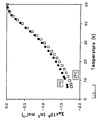
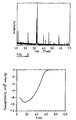
- the calculated superconducting volume fractions are small for all samples; this is attributed to particle size effects as it is well established that the magnetization is reduced for powders comprising crystallites with dimensions comparable to the London penetration depth. This interpretation is supported by the broad X-ray diffraction peaks for Sr 2 CuO 2 F 2.6 (Fig 1), which indicate a mean crystallite size of only ⁇ 700A, and the small divergence between field-cooled and zero field-cooled susceptibilities (Fig 3).
- T c and the superconducting volume fraction may show a broad maximum at a formal Cu oxidation state of +2.2 to +2.3, which is similar to other copper oxide superconductors.
- the wide range of oxidation states for which superconductivity is observed is thought to reflect composition variations, which are to be expected due to the low temperatures of the synthesis conditions.
- the defect model is slightly different from those proposed for La 2 CuO 4- ⁇ , one of which involves a very short O-O distance, it is chemically plausible and avoids all close F-F contacts.
- the F(3) and F(2) occupancies were constrained to be equal in the final refinement, which suggested the composition Sr 2 CuO 2 F 2.57 , in excellent agreement with analysis.
- Bond valence sum calculations suggested a Cu oxidation state of 2.23 (using Cu 2+ values for r 0 -see Brown, I et al Acta Crystallogr. B41 , 244-247 (1985)), which is lower than the expected value of +2.6.
- Madelung energies were calculated for different distributions of O and F atoms in the parent Sr 2 CuO 2 F 2 , and indicated a substantial preference for apical F (11,072 kJmol -1 ) rather than equatorial F (10,138 kJmol -1 ) and provided strong support for the presence of only apical F.
- the structure of Sr 2 CuO 2 F 2.6 is shown in simplified form in Fig 4.
- the magnetic susceptibility measurements showed the presence of a superconducting transition at a temperature of about 55 K (see Fig. 6). Although the location of the fluorine has not yet been established, it is possible to envisage that fluorine insertion occurs in the carbonate layer, thus doping the CuO 2 planes. The resulting structure could therefore be described as (Ba x Sr 1-x ) 2 CuO 2 (CO 3 )F ⁇ .
Landscapes
- Chemical & Material Sciences (AREA)
- Organic Chemistry (AREA)
- Inorganic Chemistry (AREA)
- Inorganic Compounds Of Heavy Metals (AREA)
- Superconductor Devices And Manufacturing Methods Thereof (AREA)
Description
In one particular treatment, a 200-mg sample of Sr2CuO3 in a nickel boat was heated to 210°C in dry N2 at normal ambient pressure, subjected to a flowing F2/N2 atmosphere for 15 min at this temperature, and allowed to cool in N2 or air after flushing all F2 from the system. The F content was estimated by precipitation titrations using thorium nitrate solution with methyl thymol blue indicator and comparison with standard solutions containing similar cation concentrations. Thermogravimetric analysis (H2/N2 mixture at 930°C to form SrF2, SrO, Cu) followed by quantitative X-ray diffraction determination of the SrF2:SrO ratio, provided an independent measure of the F:O ratio in the material; the Cu oxidation state was evaluated by iodometric titration. All results were consistent with the composition Sr2CuC2F2.6 (formal Cu oxidation state +2.6), which implies significant fluorine substitution for oxygen, in addition to fluorine insertion.
| Refined structural data for Sr2CuO2F2.6 | |||||||
| Atom | Position | x | y | z | B(Å2) | Cell | |
| Sr | 8i | ||||||
| 0 | 0 | 0.3680(1) | 0.67(2) | 8 | |||
| | 4a | 0 | 0 | 0 | 0.66(3) | 4 | |
| 0 | 8e | 0.25 | 0.25 | 0 | 0.76(3) | 8 | |
| F(1) | 32p | 0.0358(8) | 0.0483(7) | 0.1802(4) | 0.67(7) | 5.72(5) | |
| F(2) | 32p | 0.059 | 0.151(2) | 0.1802(4) | 0.67(7) | 2.28(5) | |
| F(3) | 32p | 0.196(2) | 0.239(2) | 0.2212(8) | 0.67(7) | 2.28(5) |
Claims (20)
- A method of producing a halogen-containing copper oxide of the formula An+1CunO2nX2n+α where A represents one or more alkaline earth metals, X represents halogen, n is 1 or 2 and 0 < α ≤ 0.6, comprising the step of halogenating a copper oxide of the formula An+1CunC2n+1,
wherein the halogenating step is effected at a temperature in the range of 150 to 250 °C, and if necessary
comprising a heat treatment in an inert gas atmosphere to promote loss of halide whereby to decrease the value of α until it is in the range 0.2 to less than 0.6. - A method as claimed in claim 1, wherein the halogenating step is a fluorinating step.
- A method as claimed in claim 1 or 2, wherein the halogenating step is effected using a gaseous halogenating agent.
- A method as claimed in claim 3, wherein the halogenating agent is the halogen.
- A method as claimed in claim 1, 2, 3 or 4, wherein the halogenating step is effected at a temperature in the range of 180 to 230 °C.
- A method as claimed in any one of claims 1 to 5, wherein the halogenating step is effected at ambient pressure.
- A method as claimed in claim 1 or 2, wherein the halogenating step is effected in the solid phase using an ammonium halide or in the gaseous or liquid phase using an organoammonium halide.
- A method of producing a halogen-containing metal oxide or metal oxide carbonate superconductor, comprising the step of introducing a halogen into a metal oxide or metal oxide carbonate at a temperature in the range of 150 to 250 °C, preferably in the range of 180 to 230°C, using an ammonium halide or an organoammonium halide.
- A method as claimed in claim 8, wherein the ammonium halide is ammonium fluoride.
- A method as claimed in claim 8, wherein the organoammonium halide is a tetraalkylammonium fluoride.
- A method as claimed in claim 1 or 8, wherein 1 mole of Sr2CuO3 is reacted with 2 to 20 moles of NH4F at 225 °C for 10 hours to produce a mixture of SrF2 and Sr2CuO2F2+α with a Tc of 46 K.
- A method as claimed in claim 1 or 8, wherein 1 mole of (Sr1,5Ba0,5)CuO3 is reacted with 2 to 20 moles of NH4F at 225 °C for 10 hours to produce a mixture of (Sr, Ba)F2 and Sr1,5Ba0,5CuO2F2+α with a Tc of 60 K.
- A method as claimed in claim 8, wherein the copper oxide carbonate (BaxSr1-x)2CuO2(CO3) is fluorinated using NH4F to produce (BaxSr1-x)2CuO2(CO3)Fα, where 0 < x<1, and 0 < α ≤ 0.6
- A halogen-containing copper oxide of the formula An+1CunO2nX2n+α where A represents one or more alkaline earth metals, X represents halogen, n is 1 or 2 and 0 < α ≤ 0.6 prepared by a method as claimed in claims 1 to 10.
- A halogen-containing copper oxide as claimed in claim 14, wherein α is 0.2 to 0.5.
- A superconductive material produced according to a method as claimed in claims 1 to 10 comprising a halogen-containing copper oxide of the formula An+1CunO2nX2n+α, where A, X, n and α are as defined in claim 14 or 15.
- Halogen-containing copper oxide or halogen-containing copper oxide carbonate prepared by a method as claimed in claims 8 to 13.
- A method as claimed in claim 1 or 8, wherein the material which has been subjected to halogenation is heat-treated in an inert gas atmosphere to promote loss of halide whereby to decrease the value of α until it is in the range of 0.2 to 0.5 in the case where a superconductive, halogen-containing copper oxide according to claim 16.
- A method as claimed in claim 18, wherein heat treatment of Sr2CuO2F2.6 is effected in nitrogen for up to 3 hours at temperatures up to 330 °C to reduce the α value from 0.6 down to 0.4.
- A method as claimed in claim 18, wherein heat treatment of Sr2CuO2F2.6 is effected in a 10% hydrogen/nitrogen mixture for 15 minutes at temperatures up to 220 °C to reduce the α value from 0.6 to between 0.2 and 0.4 inclusive.
Applications Claiming Priority (3)
| Application Number | Priority Date | Filing Date | Title |
|---|---|---|---|
| GB9411055A GB9411055D0 (en) | 1994-06-02 | 1994-06-02 | Metal oxyhalide materials, their use and methods for their production |
| GB9411055 | 1994-06-02 | ||
| PCT/GB1995/001280 WO1995033687A1 (en) | 1994-06-02 | 1995-06-02 | Metal oxyhalide materials, their use and methods for their production |
Publications (2)
| Publication Number | Publication Date |
|---|---|
| EP0762995A1 EP0762995A1 (en) | 1997-03-19 |
| EP0762995B1 true EP0762995B1 (en) | 2003-08-27 |
Family
ID=10756084
Family Applications (1)
| Application Number | Title | Priority Date | Filing Date |
|---|---|---|---|
| EP95921034A Expired - Lifetime EP0762995B1 (en) | 1994-06-02 | 1995-06-02 | Metal oxyhalide materials, their use and methods for their production |
Country Status (6)
| Country | Link |
|---|---|
| EP (1) | EP0762995B1 (en) |
| JP (1) | JPH10500932A (en) |
| AU (1) | AU2624195A (en) |
| DE (1) | DE69531616D1 (en) |
| GB (1) | GB9411055D0 (en) |
| WO (1) | WO1995033687A1 (en) |
Families Citing this family (1)
| Publication number | Priority date | Publication date | Assignee | Title |
|---|---|---|---|---|
| US7160647B2 (en) * | 2003-12-22 | 2007-01-09 | The Gillette Company | Battery cathode |
Family Cites Families (6)
| Publication number | Priority date | Publication date | Assignee | Title |
|---|---|---|---|---|
| US4402924A (en) * | 1978-01-16 | 1983-09-06 | Exxon Research And Engineering Co. | Preparation of high surface area metal fluorides and metal oxyfluorides, especially aluminum fluoride extrudates |
| JPS63242922A (en) * | 1987-03-30 | 1988-10-07 | Sumitomo Electric Ind Ltd | superconducting material |
| FR2620574B1 (en) * | 1987-09-15 | 1989-12-01 | Thomson Csf | SUPERCONDUCTING MATERIAL |
| GB8815102D0 (en) * | 1988-06-24 | 1988-08-03 | Plessey Co Plc | Mixed phase ceramic compounds |
| JP2786292B2 (en) * | 1989-01-13 | 1998-08-13 | 株式会社日立製作所 | Copper oxide superconductor containing halogen |
| US5081103A (en) * | 1989-06-29 | 1992-01-14 | Air Products And Chemicals, Inc. | Fluorination of superconducting YBa2 Cu3 O7-x powder |
-
1994
- 1994-06-02 GB GB9411055A patent/GB9411055D0/en active Pending
-
1995
- 1995-06-02 AU AU26241/95A patent/AU2624195A/en not_active Abandoned
- 1995-06-02 EP EP95921034A patent/EP0762995B1/en not_active Expired - Lifetime
- 1995-06-02 JP JP8500545A patent/JPH10500932A/en not_active Withdrawn
- 1995-06-02 DE DE69531616T patent/DE69531616D1/en not_active Expired - Lifetime
- 1995-06-02 WO PCT/GB1995/001280 patent/WO1995033687A1/en not_active Ceased
Also Published As
| Publication number | Publication date |
|---|---|
| JPH10500932A (en) | 1998-01-27 |
| DE69531616D1 (en) | 2003-10-02 |
| AU2624195A (en) | 1996-01-04 |
| GB9411055D0 (en) | 1994-07-20 |
| WO1995033687A1 (en) | 1995-12-14 |
| EP0762995A1 (en) | 1997-03-19 |
Similar Documents
| Publication | Publication Date | Title |
|---|---|---|
| Yoo et al. | Phase diagram in the Nd-Ba-Cu-O system | |
| KR100589031B1 (en) | Cathode occluding composition, preparation method thereof and rechargeable lithium battery comprising same | |
| Rao | Chemical synthesis of solid inorganic materials | |
| Lazure et al. | BICOVOX family of oxide anion conductors: chemical, electrical and structural studies | |
| Francesconi et al. | Superconducting Sr2− xAxCuO2F2+ δ (A= Ca, Ba): synthetic pathways and associated structural rearrangements | |
| Choisnet et al. | A re-investigation of the crystal structure of La2NiO4: Non stoichiometry and “LaO” layers | |
| Gotor et al. | Synthesis of YBa2Cu3O7− x by sol-gel route formation of YBaCuO oxycarbonate intermediate | |
| Hiroi | La1− xSrxCuO2. 5as a Doped Spin-Ladder Compound | |
| Ar-nikova et al. | A new way of synthesis and characterization of superconducting oxyfluoride Sr2Cu (O, F) 4+ δ | |
| Lobanov et al. | Synthesis and investigation of novel Mn-based oxyfluoride Sr2Mn2O5–xF1+ x | |
| Brosha et al. | Low‐Temperature Phase Equilibria in the Y‐Ba‐Cu‐O System | |
| Mitchell et al. | Low-pressure synthesis of tetragonal Sr2CuO3+ χ from a single-source hydroxometallate precursor | |
| Cava et al. | Sr2 (Nd, Ce) 2MCu2O9, M Al, Co, Ga: A new layered copper oxide structure type | |
| EP0762995A1 (en) | Metal oxyhalide materials, their use and methods for their production | |
| Kharton et al. | Synthesis, physicochemical characterization and ionic conductivity of LaGa0. 4Mg0. 2M0. 4O3− δ (M= Cr, Mn, Fe, Co) | |
| Kwei et al. | Low-temperature structure of Ba 0.6 K 0.4 BiO 3 | |
| Kazakov et al. | Synthesis, neutron diffraction study and cation substitutions in Srn− 1Cun+ 1O2n (n= 3, 5) | |
| US5066635A (en) | High temperature superconducting Ti-Ba-Ca-Cu-O phases | |
| US5081103A (en) | Fluorination of superconducting YBa2 Cu3 O7-x powder | |
| Vernochet et al. | Chemical, structural and electrical characterizations in the BIZNVOX family | |
| US5607658A (en) | Method of manufacturing metallic oxide and metallic oxide manufactured by the same | |
| US6010982A (en) | Sodium-intervened superconductor and its manufacturing method | |
| Pyper et al. | Electrochemical solid–solid conversion of bismuth oxide to bismuth metal | |
| Luhrs et al. | Crystal chemistry and redox behaviour of perovskite-related bismuth strontium calcium oxides | |
| US5145834A (en) | Processes for making Tl-Ca-Ba-Cu-O, Tl-Sr-Ba-Cu-O and Tl-Sr-Cu-O superconductors by solid state synthesis |
Legal Events
| Date | Code | Title | Description |
|---|---|---|---|
| PUAI | Public reference made under article 153(3) epc to a published international application that has entered the european phase |
Free format text: ORIGINAL CODE: 0009012 |
|
| 17P | Request for examination filed |
Effective date: 19961123 |
|
| AK | Designated contracting states |
Kind code of ref document: A1 Designated state(s): DE DK FR GB IT |
|
| 17Q | First examination report despatched |
Effective date: 19971212 |
|
| GRAH | Despatch of communication of intention to grant a patent |
Free format text: ORIGINAL CODE: EPIDOS IGRA |
|
| GRAH | Despatch of communication of intention to grant a patent |
Free format text: ORIGINAL CODE: EPIDOS IGRA |
|
| GRAA | (expected) grant |
Free format text: ORIGINAL CODE: 0009210 |
|
| AK | Designated contracting states |
Designated state(s): DE DK FR GB IT |
|
| PG25 | Lapsed in a contracting state [announced via postgrant information from national office to epo] |
Ref country code: IT Free format text: LAPSE BECAUSE OF FAILURE TO SUBMIT A TRANSLATION OF THE DESCRIPTION OR TO PAY THE FEE WITHIN THE PRESCRIBED TIME-LIMIT;WARNING: LAPSES OF ITALIAN PATENTS WITH EFFECTIVE DATE BEFORE 2007 MAY HAVE OCCURRED AT ANY TIME BEFORE 2007. THE CORRECT EFFECTIVE DATE MAY BE DIFFERENT FROM THE ONE RECORDED. Effective date: 20030827 Ref country code: FR Free format text: LAPSE BECAUSE OF FAILURE TO SUBMIT A TRANSLATION OF THE DESCRIPTION OR TO PAY THE FEE WITHIN THE PRESCRIBED TIME-LIMIT Effective date: 20030827 |
|
| REG | Reference to a national code |
Ref country code: GB Ref legal event code: FG4D |
|
| REF | Corresponds to: |
Ref document number: 69531616 Country of ref document: DE Date of ref document: 20031002 Kind code of ref document: P |
|
| PG25 | Lapsed in a contracting state [announced via postgrant information from national office to epo] |
Ref country code: DK Free format text: LAPSE BECAUSE OF FAILURE TO SUBMIT A TRANSLATION OF THE DESCRIPTION OR TO PAY THE FEE WITHIN THE PRESCRIBED TIME-LIMIT Effective date: 20031127 |
|
| PG25 | Lapsed in a contracting state [announced via postgrant information from national office to epo] |
Ref country code: DE Free format text: LAPSE BECAUSE OF FAILURE TO SUBMIT A TRANSLATION OF THE DESCRIPTION OR TO PAY THE FEE WITHIN THE PRESCRIBED TIME-LIMIT Effective date: 20031128 |
|
| PG25 | Lapsed in a contracting state [announced via postgrant information from national office to epo] |
Ref country code: GB Free format text: LAPSE BECAUSE OF NON-PAYMENT OF DUE FEES Effective date: 20040602 |
|
| PLBE | No opposition filed within time limit |
Free format text: ORIGINAL CODE: 0009261 |
|
| STAA | Information on the status of an ep patent application or granted ep patent |
Free format text: STATUS: NO OPPOSITION FILED WITHIN TIME LIMIT |
|
| 26N | No opposition filed |
Effective date: 20040528 |
|
| EN | Fr: translation not filed | ||
| GBPC | Gb: european patent ceased through non-payment of renewal fee |