EP0761776B1 - Plain surface acoustical product and coating therefor - Google Patents
Plain surface acoustical product and coating therefor Download PDFInfo
- Publication number
- EP0761776B1 EP0761776B1 EP96113578A EP96113578A EP0761776B1 EP 0761776 B1 EP0761776 B1 EP 0761776B1 EP 96113578 A EP96113578 A EP 96113578A EP 96113578 A EP96113578 A EP 96113578A EP 0761776 B1 EP0761776 B1 EP 0761776B1
- Authority
- EP
- European Patent Office
- Prior art keywords
- paint
- sound absorbing
- product according
- absorbing product
- mesh
- Prior art date
- Legal status (The legal status is an assumption and is not a legal conclusion. Google has not performed a legal analysis and makes no representation as to the accuracy of the status listed.)
- Revoked
Links
- 239000011248 coating agent Substances 0.000 title description 15
- 238000000576 coating method Methods 0.000 title description 15
- 239000003973 paint Substances 0.000 claims description 63
- 239000000758 substrate Substances 0.000 claims description 23
- 239000011094 fiberboard Substances 0.000 claims description 18
- 239000002245 particle Substances 0.000 claims description 18
- 239000000945 filler Substances 0.000 claims description 16
- 239000007787 solid Substances 0.000 claims description 13
- XLYOFNOQVPJJNP-UHFFFAOYSA-N water Substances O XLYOFNOQVPJJNP-UHFFFAOYSA-N 0.000 claims description 12
- 235000019738 Limestone Nutrition 0.000 claims description 11
- 239000006028 limestone Substances 0.000 claims description 11
- 230000000007 visual effect Effects 0.000 claims description 10
- 239000002344 surface layer Substances 0.000 claims description 8
- GWEVSGVZZGPLCZ-UHFFFAOYSA-N Titan oxide Chemical compound O=[Ti]=O GWEVSGVZZGPLCZ-UHFFFAOYSA-N 0.000 claims description 7
- 239000011521 glass Substances 0.000 claims description 7
- VYPSYNLAJGMNEJ-UHFFFAOYSA-N Silicium dioxide Chemical compound O=[Si]=O VYPSYNLAJGMNEJ-UHFFFAOYSA-N 0.000 claims description 6
- 239000004408 titanium dioxide Substances 0.000 claims description 4
- 239000011324 bead Substances 0.000 claims description 3
- 239000004816 latex Substances 0.000 claims description 3
- 229920000126 latex Polymers 0.000 claims description 3
- 239000010451 perlite Substances 0.000 claims description 3
- 235000019362 perlite Nutrition 0.000 claims description 3
- 239000000377 silicon dioxide Substances 0.000 claims description 3
- 239000006194 liquid suspension Substances 0.000 claims description 2
- 239000010410 layer Substances 0.000 description 10
- 238000010521 absorption reaction Methods 0.000 description 9
- 239000007921 spray Substances 0.000 description 6
- 239000000463 material Substances 0.000 description 5
- 238000000034 method Methods 0.000 description 5
- 238000004581 coalescence Methods 0.000 description 4
- 230000007423 decrease Effects 0.000 description 4
- 229910052500 inorganic mineral Inorganic materials 0.000 description 4
- 239000011707 mineral Substances 0.000 description 4
- 239000000203 mixture Substances 0.000 description 4
- 239000000835 fiber Substances 0.000 description 3
- 239000011347 resin Substances 0.000 description 3
- 229920005989 resin Polymers 0.000 description 3
- 239000002023 wood Substances 0.000 description 3
- 238000000889 atomisation Methods 0.000 description 2
- 239000011230 binding agent Substances 0.000 description 2
- 238000009472 formulation Methods 0.000 description 2
- 239000003365 glass fiber Substances 0.000 description 2
- 239000007788 liquid Substances 0.000 description 2
- 239000002557 mineral fiber Substances 0.000 description 2
- 238000004080 punching Methods 0.000 description 2
- 239000000725 suspension Substances 0.000 description 2
- 125000000391 vinyl group Chemical group [H]C([*])=C([H])[H] 0.000 description 2
- 229920002554 vinyl polymer Polymers 0.000 description 2
- 239000002025 wood fiber Substances 0.000 description 2
- 229920013646 Hycar Polymers 0.000 description 1
- 239000006096 absorbing agent Substances 0.000 description 1
- NIXOWILDQLNWCW-UHFFFAOYSA-N acrylic acid group Chemical group C(C=C)(=O)O NIXOWILDQLNWCW-UHFFFAOYSA-N 0.000 description 1
- 239000000654 additive Substances 0.000 description 1
- 230000000996 additive effect Effects 0.000 description 1
- 239000000853 adhesive Substances 0.000 description 1
- 230000001070 adhesive effect Effects 0.000 description 1
- 230000015572 biosynthetic process Effects 0.000 description 1
- 239000003795 chemical substances by application Substances 0.000 description 1
- 239000011247 coating layer Substances 0.000 description 1
- 238000010276 construction Methods 0.000 description 1
- 230000003247 decreasing effect Effects 0.000 description 1
- 239000006185 dispersion Substances 0.000 description 1
- 239000000839 emulsion Substances 0.000 description 1
- 239000004744 fabric Substances 0.000 description 1
- 239000011152 fibreglass Substances 0.000 description 1
- 239000010419 fine particle Substances 0.000 description 1
- 239000004615 ingredient Substances 0.000 description 1
- 238000002156 mixing Methods 0.000 description 1
- 238000010422 painting Methods 0.000 description 1
- 239000000049 pigment Substances 0.000 description 1
- 239000002002 slurry Substances 0.000 description 1
- 229920001169 thermoplastic Polymers 0.000 description 1
- 239000004416 thermosoftening plastic Substances 0.000 description 1
Images
Classifications
-
- B—PERFORMING OPERATIONS; TRANSPORTING
- B32—LAYERED PRODUCTS
- B32B—LAYERED PRODUCTS, i.e. PRODUCTS BUILT-UP OF STRATA OF FLAT OR NON-FLAT, e.g. CELLULAR OR HONEYCOMB, FORM
- B32B21/00—Layered products comprising a layer of wood, e.g. wood board, veneer, wood particle board
- B32B21/10—Next to a fibrous or filamentary layer
-
- B—PERFORMING OPERATIONS; TRANSPORTING
- B32—LAYERED PRODUCTS
- B32B—LAYERED PRODUCTS, i.e. PRODUCTS BUILT-UP OF STRATA OF FLAT OR NON-FLAT, e.g. CELLULAR OR HONEYCOMB, FORM
- B32B21/00—Layered products comprising a layer of wood, e.g. wood board, veneer, wood particle board
- B32B21/02—Layered products comprising a layer of wood, e.g. wood board, veneer, wood particle board the layer being formed of fibres, chips, or particles, e.g. MDF, HDF, OSB, chipboard, particle board, hardboard
-
- B—PERFORMING OPERATIONS; TRANSPORTING
- B32—LAYERED PRODUCTS
- B32B—LAYERED PRODUCTS, i.e. PRODUCTS BUILT-UP OF STRATA OF FLAT OR NON-FLAT, e.g. CELLULAR OR HONEYCOMB, FORM
- B32B5/00—Layered products characterised by the non- homogeneity or physical structure, i.e. comprising a fibrous, filamentary, particulate or foam layer; Layered products characterised by having a layer differing constitutionally or physically in different parts
- B32B5/02—Layered products characterised by the non- homogeneity or physical structure, i.e. comprising a fibrous, filamentary, particulate or foam layer; Layered products characterised by having a layer differing constitutionally or physically in different parts characterised by structural features of a fibrous or filamentary layer
- B32B5/022—Non-woven fabric
-
- B—PERFORMING OPERATIONS; TRANSPORTING
- B32—LAYERED PRODUCTS
- B32B—LAYERED PRODUCTS, i.e. PRODUCTS BUILT-UP OF STRATA OF FLAT OR NON-FLAT, e.g. CELLULAR OR HONEYCOMB, FORM
- B32B5/00—Layered products characterised by the non- homogeneity or physical structure, i.e. comprising a fibrous, filamentary, particulate or foam layer; Layered products characterised by having a layer differing constitutionally or physically in different parts
- B32B5/22—Layered products characterised by the non- homogeneity or physical structure, i.e. comprising a fibrous, filamentary, particulate or foam layer; Layered products characterised by having a layer differing constitutionally or physically in different parts characterised by the presence of two or more layers which are next to each other and are fibrous, filamentary, formed of particles or foamed
- B32B5/24—Layered products characterised by the non- homogeneity or physical structure, i.e. comprising a fibrous, filamentary, particulate or foam layer; Layered products characterised by having a layer differing constitutionally or physically in different parts characterised by the presence of two or more layers which are next to each other and are fibrous, filamentary, formed of particles or foamed one layer being a fibrous or filamentary layer
- B32B5/26—Layered products characterised by the non- homogeneity or physical structure, i.e. comprising a fibrous, filamentary, particulate or foam layer; Layered products characterised by having a layer differing constitutionally or physically in different parts characterised by the presence of two or more layers which are next to each other and are fibrous, filamentary, formed of particles or foamed one layer being a fibrous or filamentary layer another layer next to it also being fibrous or filamentary
-
- C—CHEMISTRY; METALLURGY
- C09—DYES; PAINTS; POLISHES; NATURAL RESINS; ADHESIVES; COMPOSITIONS NOT OTHERWISE PROVIDED FOR; APPLICATIONS OF MATERIALS NOT OTHERWISE PROVIDED FOR
- C09D—COATING COMPOSITIONS, e.g. PAINTS, VARNISHES OR LACQUERS; FILLING PASTES; CHEMICAL PAINT OR INK REMOVERS; INKS; CORRECTING FLUIDS; WOODSTAINS; PASTES OR SOLIDS FOR COLOURING OR PRINTING; USE OF MATERIALS THEREFOR
- C09D5/00—Coating compositions, e.g. paints, varnishes or lacquers, characterised by their physical nature or the effects produced; Filling pastes
- C09D5/02—Emulsion paints including aerosols
- C09D5/024—Emulsion paints including aerosols characterised by the additives
- C09D5/028—Pigments; Filters
-
- G—PHYSICS
- G10—MUSICAL INSTRUMENTS; ACOUSTICS
- G10K—SOUND-PRODUCING DEVICES; METHODS OR DEVICES FOR PROTECTING AGAINST, OR FOR DAMPING, NOISE OR OTHER ACOUSTIC WAVES IN GENERAL; ACOUSTICS NOT OTHERWISE PROVIDED FOR
- G10K11/00—Methods or devices for transmitting, conducting or directing sound in general; Methods or devices for protecting against, or for damping, noise or other acoustic waves in general
- G10K11/16—Methods or devices for protecting against, or for damping, noise or other acoustic waves in general
- G10K11/162—Selection of materials
-
- B—PERFORMING OPERATIONS; TRANSPORTING
- B32—LAYERED PRODUCTS
- B32B—LAYERED PRODUCTS, i.e. PRODUCTS BUILT-UP OF STRATA OF FLAT OR NON-FLAT, e.g. CELLULAR OR HONEYCOMB, FORM
- B32B2305/00—Condition, form or state of the layers or laminate
- B32B2305/02—Cellular or porous
- B32B2305/026—Porous
-
- B—PERFORMING OPERATIONS; TRANSPORTING
- B32—LAYERED PRODUCTS
- B32B—LAYERED PRODUCTS, i.e. PRODUCTS BUILT-UP OF STRATA OF FLAT OR NON-FLAT, e.g. CELLULAR OR HONEYCOMB, FORM
- B32B2307/00—Properties of the layers or laminate
- B32B2307/10—Properties of the layers or laminate having particular acoustical properties
- B32B2307/102—Insulating
-
- Y—GENERAL TAGGING OF NEW TECHNOLOGICAL DEVELOPMENTS; GENERAL TAGGING OF CROSS-SECTIONAL TECHNOLOGIES SPANNING OVER SEVERAL SECTIONS OF THE IPC; TECHNICAL SUBJECTS COVERED BY FORMER USPC CROSS-REFERENCE ART COLLECTIONS [XRACs] AND DIGESTS
- Y10—TECHNICAL SUBJECTS COVERED BY FORMER USPC
- Y10T—TECHNICAL SUBJECTS COVERED BY FORMER US CLASSIFICATION
- Y10T428/00—Stock material or miscellaneous articles
- Y10T428/24—Structurally defined web or sheet [e.g., overall dimension, etc.]
- Y10T428/24802—Discontinuous or differential coating, impregnation or bond [e.g., artwork, printing, retouched photograph, etc.]
- Y10T428/24893—Discontinuous or differential coating, impregnation or bond [e.g., artwork, printing, retouched photograph, etc.] including particulate material
-
- Y—GENERAL TAGGING OF NEW TECHNOLOGICAL DEVELOPMENTS; GENERAL TAGGING OF CROSS-SECTIONAL TECHNOLOGIES SPANNING OVER SEVERAL SECTIONS OF THE IPC; TECHNICAL SUBJECTS COVERED BY FORMER USPC CROSS-REFERENCE ART COLLECTIONS [XRACs] AND DIGESTS
- Y10—TECHNICAL SUBJECTS COVERED BY FORMER USPC
- Y10T—TECHNICAL SUBJECTS COVERED BY FORMER US CLASSIFICATION
- Y10T428/00—Stock material or miscellaneous articles
- Y10T428/25—Web or sheet containing structurally defined element or component and including a second component containing structurally defined particles
- Y10T428/258—Alkali metal or alkaline earth metal or compound thereof
-
- Y—GENERAL TAGGING OF NEW TECHNOLOGICAL DEVELOPMENTS; GENERAL TAGGING OF CROSS-SECTIONAL TECHNOLOGIES SPANNING OVER SEVERAL SECTIONS OF THE IPC; TECHNICAL SUBJECTS COVERED BY FORMER USPC CROSS-REFERENCE ART COLLECTIONS [XRACs] AND DIGESTS
- Y10—TECHNICAL SUBJECTS COVERED BY FORMER USPC
- Y10T—TECHNICAL SUBJECTS COVERED BY FORMER US CLASSIFICATION
- Y10T428/00—Stock material or miscellaneous articles
- Y10T428/27—Web or sheet containing structurally defined element or component, the element or component having a specified weight per unit area [e.g., gms/sq cm, lbs/sq ft, etc.]
- Y10T428/273—Web or sheet containing structurally defined element or component, the element or component having a specified weight per unit area [e.g., gms/sq cm, lbs/sq ft, etc.] of coating
-
- Y—GENERAL TAGGING OF NEW TECHNOLOGICAL DEVELOPMENTS; GENERAL TAGGING OF CROSS-SECTIONAL TECHNOLOGIES SPANNING OVER SEVERAL SECTIONS OF THE IPC; TECHNICAL SUBJECTS COVERED BY FORMER USPC CROSS-REFERENCE ART COLLECTIONS [XRACs] AND DIGESTS
- Y10—TECHNICAL SUBJECTS COVERED BY FORMER USPC
- Y10T—TECHNICAL SUBJECTS COVERED BY FORMER US CLASSIFICATION
- Y10T428/00—Stock material or miscellaneous articles
- Y10T428/27—Web or sheet containing structurally defined element or component, the element or component having a specified weight per unit area [e.g., gms/sq cm, lbs/sq ft, etc.]
- Y10T428/273—Web or sheet containing structurally defined element or component, the element or component having a specified weight per unit area [e.g., gms/sq cm, lbs/sq ft, etc.] of coating
- Y10T428/277—Cellulosic substrate
-
- Y—GENERAL TAGGING OF NEW TECHNOLOGICAL DEVELOPMENTS; GENERAL TAGGING OF CROSS-SECTIONAL TECHNOLOGIES SPANNING OVER SEVERAL SECTIONS OF THE IPC; TECHNICAL SUBJECTS COVERED BY FORMER USPC CROSS-REFERENCE ART COLLECTIONS [XRACs] AND DIGESTS
- Y10—TECHNICAL SUBJECTS COVERED BY FORMER USPC
- Y10T—TECHNICAL SUBJECTS COVERED BY FORMER US CLASSIFICATION
- Y10T442/00—Fabric [woven, knitted, or nonwoven textile or cloth, etc.]
- Y10T442/20—Coated or impregnated woven, knit, or nonwoven fabric which is not [a] associated with another preformed layer or fiber layer or, [b] with respect to woven and knit, characterized, respectively, by a particular or differential weave or knit, wherein the coating or impregnation is neither a foamed material nor a free metal or alloy layer
- Y10T442/2139—Coating or impregnation specified as porous or permeable to a specific substance [e.g., water vapor, air, etc.]
Definitions
- the invention relates to a sound absorbing product comprising a fiberboard base substrate, particularly an acoustical fiberboard, having a visual surface which is capable of absorbing sound with a noise reduction coefficient NCR (ASTM C423-90a) being equal to or greater than 0.65, and a surface layer on said visual surface consisting of directly applied paint or of an attached porous non woven scrim covered by applied paint.
- NCR noise reduction coefficient
- NRC noise reduction coefficients
- the board porosity must be high. Finish paint applied directly to the board also must not form a continuous film closing off the board surface. Normally this occurs thus lowering the NRC.
- a method generally used to increase the NRC is hole punching and surface perforations.
- US 3 494 782 discloses a method of preparing a spray-coated vinyl-faced fibrous acoustical insulating member, wherein a coating dispersion comprises a thermoplastic vinyl resin and inert particles of a maximum size of up to about 44 microns to act as anti-tack additive material. These particles constitute 5 to 20 percent of the weight of the coating and are of an amount sufficient to make the resin non-tacky at high temperatures. The remainder of the coating layer essentially consists of vinyl resin.
- GB 928 028 discloses a process of coating glass fiber fissured boards with a light reflecting coating in order to leave the multiplicity of fissures of random orientation and various lengths and depths open.
- the fissures should not be bridged with a coating, i.e. the size of particles is to be as small as possible, even if a special particle size of mineral pigment contained in the applied paint is not disclosed.
- the object of the invention is achieved by the sound absorbing product as described in the first paragraph of the specification in that said paint consists substantially of latex, large size inert filler particles ranging from 40 mesh to 150 mesh (going through a sieve opening of 0.42 mm to 0.1 mm), water and very small size inert filler particles equal to 325 mesh and finer (going through a sieve opening of 0.044 mm or smaller), which very small size particles and the water have a greater affinity to the large size particles than for the visual surface of the substrate resulting in discrete and individual droplets of the applied paint making the surface layer optically opaque as well as discontinuous and acoustically transparent by having a porosity of not less than 15 m 3 /min/m 2 (50 ft 3 /min/ft 2 ) and providing a plain fine textured non perforated surface visual.
- the very small size inert filler particles are selected from the group consisting of limestone and titanium dioxide.
- the large size filler particles are selected from the group consisting of limestone, glass beads, silica, perlite.
- the surfacing described herein is intended to render a product having a plain, fine textured surface without holes or surface perforations.
- This surface layer can be a directly applied paint or an attached painted nonwoven scrim.
- the critical characteristic of this surfacing is that it is acoustically transparent so that the sound can penetrate through the surface and be absorbed in the substrate.
- Paints are generally designed and applied at sufficient rates to form a continuous film. Atomized paint droplets coalesce and normally flow, and wick on the substrate to spread over the surface forming a film. This same type of wicking and spreading occurs when painting porous scrims. Retaining acoustical transparency of the surface can be attained by applying small amounts of paint insufficient to form a film, but these small amounts are not optically opaque. Another method is to use a paint having minimal wicking and spreading characteristics. More paint can then be applied without closing off the surface. If hole perforations are needed to develop the desired NRC, these holes can be hidden by applying a porous nonwoven scrim to the board surface bridging the holes and then painted with an acoustically porous paint.
- the paint has restricted flow properties and minimized coalescence when applied, thus retaining discrete paint droplets. This is accomplished with a critically high solids/low liquid suspension ranging from about 70-85% solids by weight which increases viscosity quickly with minimal water loss.
- the paint also has to have a greater affinity for itself than for the surface to which it is applied.
- coarse limestone ranging from 40 mesh to 150 mesh [going through a sieve opening of 0.42 mm to 0.1 mm]
- the total filler level can be increased to 82% solids while retaining a relatively low viscosity of about 1 to 8 Pas (1000-8000 cps).
- Other particles that can be used are glass beads, silica, perlite, etc.
- the porosity of the paint coating could be used to reduce the sound absorption of the fiberboard.
- paints with a high percent of solids, particularly coarse fillers permits significantly higher application rates while retaining openness essential for good air and sound passage into a sound absorbing substrate.
- coarse limestone ranging from 40 mesh to 150 mesh [going through a sieve opening of 0.42 mm to 0.1 mm]
- extremely fine (325 mesh and finer going through a sieve opening of 0.044 mm or smaller]
- titanium dioxide titanium dioxide
- binder and water
- unusual properties are secured when this suspension is spray applied.
- This paint has minimal wicking and spreading characteristics. Minimal coalescence occurs retaining more discrete individual paint droplets.
- the liquid and fine fillers have a greater affinity for the large particle limestone than for the surface to which they are applied.
- the factor minimizing coalescence of the paint droplets is the critically high solids, so that with minimal water loss the viscosity quickly increases thus setting the droplet and retaining discrete paint droplets.
- the use of coarse fillers enables up to 82% filled suspensions with viscosity ranging from about 1 to 4 Pas (1000-4000 cps), permitting spray application via air atomized guns.
- the amount of fillers and known viscosity altering agents will permit other viscosity ranges higher or lower than above.
- the preferred formulation at present for the paint is as follows: Ingredients % By Weight Range % Binder-Hycar Acrylic latex emulsion 50% solids by weight - B. F. Goodrich 6.80 4-20 Filler-Omyacarb slurry limestone 70% solids by weight - Omya Corp. 33.78 30-55 Filler-40 mesh limestone 100% solids - Pfizer 50.95 30-55 Filler-Titanium dioxide 100% solids 1.41 1-8 Liquid-Water 7.06 2-8 100.00 100.00
- the amount of paint has to be reduced since the water in the paint is not as readily absorbed and flooding occurs closing off the surface.
- Between about 324 to 540 g/m 2 (30 to 50 gm/sf) of paint is generally ideal for retaining sufficient openness in the surface layer while not affecting the sound absorption properties of the substrate.
- the above paint formulation can be used on fiberboard substrates made of fibers selected from the group of wood, mineral, glass and mixtures thereof.
- the paint has utility as a layer for good air and sound passage. Porosity to air flow is a measure of a material's ability to pass sound. Porosity as measured by the Frazier Airflow Test or its equivalent is necessary for sound passage.
- the paint coating should have a minimum porosity of not less than 15 m 3 /min/m 2 (50 cfm/square foot). This will than permit a substrate with a NRC rating of 65, having the above paint coating, to still have a NRC rating of 65. Lowering the paint coating porosity to about 7.5 m 3 /min/m 2 (25 cfm/square foot) would reduce the substrate NRC rating to less than 65.
- a nonwoven glass scrim of 80 g/m 2 (7.5 gm/sf,) 500 ⁇ m (20 mils) thick and having a porosity of 90 m 3 /min/m 2 (300 cfm/square foot) is laminated to this substrate using a water based adhesive.
- the scrim is generally of a thickness of 10 mile or thicker.
- Other scrims that can be used are organic fiber, glass/organic fiber combinations and like materials.
- the weight of the scrims is generally 65 to 160 g/m 2 (6 to 15 gm/square foot) and a porosity of 60 m 3 /min/m 2 (200 cfm/square foot).
- the scrim used is made by Owens Corning as grade A80 PFR YK111 with glass fibers of a nominal length of 6mm and nominal diameter of 10 to 11 ⁇ m.
- the holes are visible through the glass scrim.
- the high solids paint is spray applied using conventional air atomized spray guns. Up to 540 g/m 2 (50 gm/sf) of paint can be applied without a decrease in the NRC.
- the surfacing is optically opaque and acoustically transparent without visible surface perforations.
- the porosity of the paint layer or the paint/scrim combination layer decreases the ability of that layer to pass sound decreases.
- Each layer has utility in different situations. Less porous paint layers or paint/scrim layers can be compensated for increasing the absorption of the substrate. However, this is usually accompanied by a decrease in the strength and durability of the substrate since substrate density must be decreased to increase its absorption. The most efficient system overall is one in which the absorption loss due to the paint or paint/scrim is minimized.
- the paint/scrim porosity should not be lower than 15 m 3 /min/m 2 (50 cfm/square foot). With the above paint coat, the above scrim itself requires a porosity of higher than 60 m 3 /min/m 2 (200 cfm/square foot).
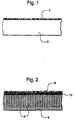
- Fig. 1 shows a porous fiberboard substrate 2 with a discontinuous paint coating 4.
- Fig. 2 shows a hole perforated fiberboard substrate 6 with holes 8.
- a porous scrim 10 is used with a discontinuous paint coating 12.
Landscapes
- Engineering & Computer Science (AREA)
- Chemical & Material Sciences (AREA)
- Life Sciences & Earth Sciences (AREA)
- Wood Science & Technology (AREA)
- Organic Chemistry (AREA)
- Materials Engineering (AREA)
- Dispersion Chemistry (AREA)
- Physics & Mathematics (AREA)
- Acoustics & Sound (AREA)
- Multimedia (AREA)
- Textile Engineering (AREA)
- Application Of Or Painting With Fluid Materials (AREA)
- Laminated Bodies (AREA)
- Building Environments (AREA)
- Soundproofing, Sound Blocking, And Sound Damping (AREA)
Description
| Ingredients | % By Weight | Range % |
| Binder-Hycar Acrylic latex emulsion 50% solids by weight - B. F. Goodrich | 6.80 | 4-20 |
| Filler-Omyacarb slurry limestone 70% solids by weight - Omya Corp. | 33.78 | 30-55 |
| Filler-40 mesh limestone 100% solids - Pfizer | 50.95 | 30-55 |
| Filler-Titanium dioxide 100% solids | 1.41 | 1-8 |
| Liquid-Water | 7.06 | 2-8 |
| | |
Claims (6)
- Sound absorbing product comprising a fiberboard base substrate, particularly an acoustical fiberboard, having a visual surface which is capable of absorbing sound with a noise reduction coefficient NCR according to ASTM C423-90a being equal to or greater than 0.65, and a surface layer on said visual surface consisting of directly applied paint (4) or of an attached porous non woven scrim (10) covered by applied paint (4) characterized in that said paint (4) consists substantially of latex, large size inert filler particles ranging from 40 mesh to 150 mesh (going through a sieve opening of 0.42 mm to 0.1 mm), water and very small size inert filler particles equal to 325 mesh and finer (going through a sieve opening of 0.044 mm or smaller), which very small size particles and the water have a greater affinity to the large size particles than for the visual surface of the substrate resulting in discrete and individual droplets of the applied paint (4) making the surface layer optically opaque as well as discontinuous and acoustically transparent by having a porosity of not less than 15 m3/min/m2 (50 ft3/min/ft2) and providing a plain fine textured non perforated surface visual.
- Sound absorbing product according to claim 1, characterized in that the very small size inert filler particles are selected from the group consisting of limestone and titanium dioxide.
- Sound absorbing product according to claim 1 or 2, characterized in that the large size filler particles are selected from the group consisting of limestone, glass beads, silica, perlite.
- Sound absorbing product according to one of the preceding claims, characterized in that the paint is a high solids/ low liquid suspension having 70 to 85% solids by weight.
- Sound absorbing product according to one of the preceding claims, characterized in that the paint has a viscosity of about 1 to 8 Pa s (1000 to 8000 cps).
- Sound absorbing product according to one of the preceding claims, characterized in that the paint application rates are 324 to 650 g/m2 (30 to 60 g/ft2).
Applications Claiming Priority (2)
| Application Number | Priority Date | Filing Date | Title |
|---|---|---|---|
| US52297095A | 1995-09-01 | 1995-09-01 | |
| US522970 | 1995-09-01 |
Publications (3)
| Publication Number | Publication Date |
|---|---|
| EP0761776A2 EP0761776A2 (en) | 1997-03-12 |
| EP0761776A3 EP0761776A3 (en) | 1997-08-13 |
| EP0761776B1 true EP0761776B1 (en) | 2001-06-13 |
Family
ID=24083122
Family Applications (1)
| Application Number | Title | Priority Date | Filing Date |
|---|---|---|---|
| EP96113578A Revoked EP0761776B1 (en) | 1995-09-01 | 1996-08-23 | Plain surface acoustical product and coating therefor |
Country Status (5)
| Country | Link |
|---|---|
| US (2) | US5888626A (en) |
| EP (1) | EP0761776B1 (en) |
| CA (1) | CA2184557C (en) |
| DE (1) | DE69613290T2 (en) |
| GB (1) | GB2304725B (en) |
Families Citing this family (32)
| Publication number | Priority date | Publication date | Assignee | Title |
|---|---|---|---|---|
| EP0761776B1 (en) * | 1995-09-01 | 2001-06-13 | Armstrong World Industries, Inc. | Plain surface acoustical product and coating therefor |
| US5874161A (en) * | 1995-11-09 | 1999-02-23 | Armstrong World Industries, Inc. | Plain surface acoustical product and coating therefor |
| GB2335431A (en) * | 1995-11-09 | 1999-09-22 | Armstrong World Ind Inc | Acoustical products and coatings therefor |
| US6103360A (en) * | 1998-01-09 | 2000-08-15 | Armstrong World Industries, Inc. | High light reflectance and durable ceiling board coating |
| EP1020846B1 (en) * | 1999-01-14 | 2018-09-19 | Nichias Corporation | Sound absorbing structure |
| US7217746B2 (en) | 2000-05-19 | 2007-05-15 | Ppg Industries Ohio, Inc. | Coating compositions having a geometrically ordered array of polymeric particles and substrates coated therewith |
| CA2409087A1 (en) * | 2001-10-25 | 2003-04-25 | Armstrong World Industries, Inc. | Low-temperature coalescing fluoropolymer coatings |
| US20040048531A1 (en) * | 2002-09-09 | 2004-03-11 | Hector Belmares | Low formaldehyde emission panel |
| GB2393351B (en) * | 2002-09-23 | 2004-08-11 | Chui-Che Chen | Method of producing cone diaphragm having color patterns |
| CA2441141A1 (en) * | 2002-09-30 | 2004-03-30 | Armstrong World Industries, Inc. | Acoustical panel coating and process of applying same |
| US20050256228A1 (en) * | 2004-04-20 | 2005-11-17 | Zeev Ariel | Seamless smooth acoustical ceiling |
| US8789492B2 (en) * | 2008-07-15 | 2014-07-29 | Awi Licensing Company | Coating apparatus and method |
| US9266778B2 (en) * | 2008-11-21 | 2016-02-23 | Usg Interiors, Llc | Multi-layer acoustical plaster system |
| US8100226B2 (en) * | 2009-12-22 | 2012-01-24 | Usg Interiors, Inc. | Porous nonwoven scrims in acoustical panels |
| CN103221492B (en) * | 2010-11-16 | 2016-04-20 | 阿克佐诺贝尔国际涂料股份有限公司 | multipurpose paint formulation |
| US8785533B2 (en) | 2010-12-02 | 2014-07-22 | The Sherwin-Williams Company | Architectural paint for covering defects |
| US8210310B1 (en) | 2010-12-29 | 2012-07-03 | United States Gypsum Company | Tunable acoustical plaster system and method of making it |
| US8770345B2 (en) | 2012-06-27 | 2014-07-08 | Usg Interiors, Llc | Gypsum-panel acoustical monolithic ceiling |
| US8684134B2 (en) | 2012-06-27 | 2014-04-01 | Usg Interiors, Llc | Gypsum-panel acoustical monolithic ceiling |
| US8925677B2 (en) | 2012-06-27 | 2015-01-06 | Usg Interiors, Llc | Gypsum-panel acoustical monolithic ceiling |
| US9649831B2 (en) * | 2012-10-05 | 2017-05-16 | Dirtt Environmental Solutions, Ltd | Perforated acoustic tiles |
| US8734613B1 (en) | 2013-07-05 | 2014-05-27 | Usg Interiors, Llc | Glass fiber enhanced mineral wool based acoustical tile |
| AU2013394373B2 (en) | 2013-07-15 | 2017-02-16 | Armstrong World Industries, Inc. | Acoustical structure |
| DE102014202477A1 (en) | 2014-02-11 | 2015-08-13 | Leena Rose Wilson | Acoustic absorber and use of such an acoustic absorber |
| US9747883B2 (en) * | 2015-04-14 | 2017-08-29 | Cadillac Products Automotive Company | Acoustic insulator mat with liquid applied sprayable coating and method for making the same |
| US9777472B2 (en) | 2015-10-28 | 2017-10-03 | Awi Licensing Llc | Scrim attachment system |
| CA3030287A1 (en) * | 2016-07-12 | 2018-01-18 | Armstrong World Industries, Inc. | High solids color face and edge coatings for building panels |
| US9738796B1 (en) * | 2016-09-07 | 2017-08-22 | Usg Interiors, Llc | Acoustically transparent coating |
| US10208477B2 (en) * | 2016-10-20 | 2019-02-19 | Usg Interiors, Llc | Veil finishing process |
| US10316201B2 (en) * | 2017-08-15 | 2019-06-11 | Usg Interiors, Llc | Acoustically transparent sandable coating |
| FR3081894B1 (en) * | 2018-06-05 | 2020-09-25 | Saint Gobain Adfors | TEXTILE STRUCTURE BASED ON FIBERGLASS FOR ACOUSTIC CEILINGS OR ACOUSTIC WALL PANELS |
| CN109707060B (en) * | 2018-12-28 | 2020-05-22 | 西安交通大学 | Continuous divergent gradient open-pore double-porosity sound absorption device and application thereof |
Family Cites Families (15)
| Publication number | Priority date | Publication date | Assignee | Title |
|---|---|---|---|---|
| GB1015704A (en) * | 1961-05-31 | 1966-01-05 | Huber Corp J M | Paint |
| NL131624C (en) * | 1965-04-12 | |||
| US3578493A (en) | 1968-05-29 | 1971-05-11 | Scott Paper Co | High solids coating composition |
| US3583522A (en) * | 1970-06-01 | 1971-06-08 | Johns Manville | Decorative acoustical panel construction |
| US3755238A (en) | 1970-12-28 | 1973-08-28 | R Wiita | High gloss and low block coating composition containing plasticized vinyl resin latex and finely divided polyolefin particles |
| US3894169A (en) | 1972-02-18 | 1975-07-08 | Rockwell International Corp | Acoustical damping structure and method of preparation |
| US4010307A (en) | 1973-11-15 | 1977-03-01 | Rhone-Progil | Coating of paper, cardboard and the like and composition |
| DE2423618C3 (en) * | 1974-05-15 | 1981-02-26 | Hoechst Ag, 6000 Frankfurt | Plaster mix |
| US4162342A (en) | 1976-08-30 | 1979-07-24 | Burlington Industries, Inc. | Foam coated ceiling board facing and method of making the same |
| US4152474A (en) | 1976-09-28 | 1979-05-01 | Chemical Fabrics Corporation | Acoustic absorber and method for absorbing sound |
| DE2750903C2 (en) * | 1977-11-14 | 1982-12-09 | Basf Farben + Fasern Ag, 2000 Hamburg | Use of a coating agent based on acrylate polymers for various purposes, in particular in the building sector |
| US4900611A (en) | 1988-11-07 | 1990-02-13 | Eastman Kodak Company | Paint coated article |
| US5674594A (en) * | 1994-08-24 | 1997-10-07 | Armstrong World Industries, Inc. | Plain surface acoustical product |
| EP0761776B1 (en) * | 1995-09-01 | 2001-06-13 | Armstrong World Industries, Inc. | Plain surface acoustical product and coating therefor |
| US5874161A (en) * | 1995-11-09 | 1999-02-23 | Armstrong World Industries, Inc. | Plain surface acoustical product and coating therefor |
-
1996
- 1996-08-23 EP EP96113578A patent/EP0761776B1/en not_active Revoked
- 1996-08-23 DE DE69613290T patent/DE69613290T2/en not_active Revoked
- 1996-08-28 GB GB9617901A patent/GB2304725B/en not_active Expired - Fee Related
- 1996-08-30 CA CA 2184557 patent/CA2184557C/en not_active Expired - Fee Related
-
1997
- 1997-01-27 US US08/791,447 patent/US5888626A/en not_active Expired - Lifetime
-
1999
- 1999-03-24 US US09/275,101 patent/US6284351B1/en not_active Expired - Lifetime
Also Published As
| Publication number | Publication date |
|---|---|
| DE69613290T2 (en) | 2001-12-06 |
| US5888626A (en) | 1999-03-30 |
| CA2184557A1 (en) | 1997-03-02 |
| DE69613290D1 (en) | 2001-07-19 |
| EP0761776A3 (en) | 1997-08-13 |
| GB2304725B (en) | 1999-10-13 |
| GB9617901D0 (en) | 1996-10-09 |
| GB2304725A (en) | 1997-03-26 |
| EP0761776A2 (en) | 1997-03-12 |
| US6284351B1 (en) | 2001-09-04 |
| CA2184557C (en) | 2002-04-02 |
Similar Documents
| Publication | Publication Date | Title |
|---|---|---|
| US5888626A (en) | Plain surface acoustical product and coating therefor | |
| EP0773266B1 (en) | Paint coating for a sound absorbing substrate | |
| CA2153186C (en) | Plain surface acoustical product | |
| EP1403330B1 (en) | Acoustical panel coating and process of applying same | |
| JP2935897B2 (en) | Decorative surface layer and method for producing the same | |
| US6158176A (en) | Core for a sound absorbing panel | |
| CA1252053A (en) | Acoustically porous building materials | |
| US4637951A (en) | Fibrous mat facer with improved strike-through resistance | |
| KR20180103076A (en) | Mineral fiber-based ceiling tiles | |
| KR102323474B1 (en) | acoustically transparent coating | |
| RU2108133C1 (en) | Filter element with fibrous coat and method of its manufacture | |
| US11828064B2 (en) | Face coating for acoustical monolithic ceilings | |
| US3357516A (en) | Acoustical panels | |
| CA3236601A1 (en) | Stable high temperature coating compositions and methods of preparing and using the same | |
| GB2335431A (en) | Acoustical products and coatings therefor | |
| CN116981518A (en) | Mixed coating method | |
| US20190136524A1 (en) | Water stain and sag resistant acoustic building panel | |
| CA2176004A1 (en) | Mineral wool product, method for its production, impregnating mass therefor, and use thereof | |
| CA3072590C (en) | Acoustically transparent sandable coating | |
| JP2006009231A (en) | Wallpaper having moisture permeability/water absorbency and method for producing the same | |
| CA3106408C (en) | Acoustic panels and methods for preparing them | |
| CA2191106C (en) | A filter element having a fibrous coating and methods for producing it | |
| HK1059943A (en) | Acoustical panel coating and process of applying same |
Legal Events
| Date | Code | Title | Description |
|---|---|---|---|
| PUAI | Public reference made under article 153(3) epc to a published international application that has entered the european phase |
Free format text: ORIGINAL CODE: 0009012 |
|
| AK | Designated contracting states |
Kind code of ref document: A2 Designated state(s): BE DE FR NL SE |
|
| PUAL | Search report despatched |
Free format text: ORIGINAL CODE: 0009013 |
|
| AK | Designated contracting states |
Kind code of ref document: A3 Designated state(s): BE DE FR NL SE |
|
| 17P | Request for examination filed |
Effective date: 19971202 |
|
| 17Q | First examination report despatched |
Effective date: 19981023 |
|
| RAP1 | Party data changed (applicant data changed or rights of an application transferred) |
Owner name: ARMSTRONG WORLD INDUSTRIES, INC. |
|
| GRAG | Despatch of communication of intention to grant |
Free format text: ORIGINAL CODE: EPIDOS AGRA |
|
| GRAG | Despatch of communication of intention to grant |
Free format text: ORIGINAL CODE: EPIDOS AGRA |
|
| GRAG | Despatch of communication of intention to grant |
Free format text: ORIGINAL CODE: EPIDOS AGRA |
|
| GRAG | Despatch of communication of intention to grant |
Free format text: ORIGINAL CODE: EPIDOS AGRA |
|
| GRAH | Despatch of communication of intention to grant a patent |
Free format text: ORIGINAL CODE: EPIDOS IGRA |
|
| GRAH | Despatch of communication of intention to grant a patent |
Free format text: ORIGINAL CODE: EPIDOS IGRA |
|
| GRAA | (expected) grant |
Free format text: ORIGINAL CODE: 0009210 |
|
| AK | Designated contracting states |
Kind code of ref document: B1 Designated state(s): BE DE FR NL SE |
|
| ET | Fr: translation filed | ||
| REF | Corresponds to: |
Ref document number: 69613290 Country of ref document: DE Date of ref document: 20010719 |
|
| PLBQ | Unpublished change to opponent data |
Free format text: ORIGINAL CODE: EPIDOS OPPO |
|
| PLBQ | Unpublished change to opponent data |
Free format text: ORIGINAL CODE: EPIDOS OPPO |
|
| PLBI | Opposition filed |
Free format text: ORIGINAL CODE: 0009260 |
|
| PLBF | Reply of patent proprietor to notice(s) of opposition |
Free format text: ORIGINAL CODE: EPIDOS OBSO |
|
| 26 | Opposition filed |
Opponent name: ODENWALD FASERPLATTENWERK GMBH Effective date: 20020312 Opponent name: SAINT-GOBAIN ECOPHON AB Effective date: 20020311 |
|
| NLR1 | Nl: opposition has been filed with the epo |
Opponent name: ODENWALD FASERPLATTENWERK GMBH Opponent name: SAINT-GOBAIN ECOPHON AB |
|
| PGFP | Annual fee paid to national office [announced via postgrant information from national office to epo] |
Ref country code: FR Payment date: 20020731 Year of fee payment: 7 |
|
| PGFP | Annual fee paid to national office [announced via postgrant information from national office to epo] |
Ref country code: SE Payment date: 20020801 Year of fee payment: 7 Ref country code: NL Payment date: 20020801 Year of fee payment: 7 |
|
| PLBF | Reply of patent proprietor to notice(s) of opposition |
Free format text: ORIGINAL CODE: EPIDOS OBSO |
|
| PGFP | Annual fee paid to national office [announced via postgrant information from national office to epo] |
Ref country code: DE Payment date: 20020830 Year of fee payment: 7 |
|
| PGFP | Annual fee paid to national office [announced via postgrant information from national office to epo] |
Ref country code: BE Payment date: 20020904 Year of fee payment: 7 |
|
| PLBF | Reply of patent proprietor to notice(s) of opposition |
Free format text: ORIGINAL CODE: EPIDOS OBSO |
|
| PLBF | Reply of patent proprietor to notice(s) of opposition |
Free format text: ORIGINAL CODE: EPIDOS OBSO |
|
| RDAH | Patent revoked |
Free format text: ORIGINAL CODE: EPIDOS REVO |
|
| RDAG | Patent revoked |
Free format text: ORIGINAL CODE: 0009271 |
|
| STAA | Information on the status of an ep patent application or granted ep patent |
Free format text: STATUS: PATENT REVOKED |
|
| 27W | Patent revoked |
Effective date: 20030130 |
|
| REG | Reference to a national code |
Ref country code: SE Ref legal event code: ECNC |
|
| NLR2 | Nl: decision of opposition |
Effective date: 20030130 |