EP0761724A2 - Method for the continuous preparation of organopolysiloxane emulsions - Google Patents
Method for the continuous preparation of organopolysiloxane emulsions Download PDFInfo
- Publication number
- EP0761724A2 EP0761724A2 EP96306308A EP96306308A EP0761724A2 EP 0761724 A2 EP0761724 A2 EP 0761724A2 EP 96306308 A EP96306308 A EP 96306308A EP 96306308 A EP96306308 A EP 96306308A EP 0761724 A2 EP0761724 A2 EP 0761724A2
- Authority
- EP
- European Patent Office
- Prior art keywords
- organopolysiloxane
- stage
- mixer
- water
- emulsion
- Prior art date
- Legal status (The legal status is an assumption and is not a legal conclusion. Google has not performed a legal analysis and makes no representation as to the accuracy of the status listed.)
- Granted
Links
- 239000000839 emulsion Substances 0.000 title claims abstract description 99
- 238000000034 method Methods 0.000 title claims abstract description 73
- 229920001296 polysiloxane Polymers 0.000 title claims abstract description 70
- 238000002360 preparation method Methods 0.000 title description 13
- XLYOFNOQVPJJNP-UHFFFAOYSA-N water Substances O XLYOFNOQVPJJNP-UHFFFAOYSA-N 0.000 claims abstract description 64
- 239000012530 fluid Substances 0.000 claims abstract description 16
- 239000003995 emulsifying agent Substances 0.000 claims abstract description 13
- 238000010790 dilution Methods 0.000 claims abstract description 12
- 239000012895 dilution Substances 0.000 claims abstract description 12
- 238000010008 shearing Methods 0.000 claims description 48
- 230000009471 action Effects 0.000 claims description 41
- 238000003756 stirring Methods 0.000 claims description 27
- 239000007789 gas Substances 0.000 claims description 16
- 230000007246 mechanism Effects 0.000 claims description 15
- 230000000694 effects Effects 0.000 claims description 14
- IJGRMHOSHXDMSA-UHFFFAOYSA-N Atomic nitrogen Chemical compound N#N IJGRMHOSHXDMSA-UHFFFAOYSA-N 0.000 claims description 8
- 239000003570 air Substances 0.000 claims description 7
- 239000000463 material Substances 0.000 claims description 7
- XKRFYHLGVUSROY-UHFFFAOYSA-N Argon Chemical compound [Ar] XKRFYHLGVUSROY-UHFFFAOYSA-N 0.000 claims description 6
- CURLTUGMZLYLDI-UHFFFAOYSA-N Carbon dioxide Chemical compound O=C=O CURLTUGMZLYLDI-UHFFFAOYSA-N 0.000 claims description 6
- 238000007599 discharging Methods 0.000 claims description 4
- 229910052757 nitrogen Inorganic materials 0.000 claims description 4
- 229910052786 argon Inorganic materials 0.000 claims description 3
- 239000001569 carbon dioxide Substances 0.000 claims description 3
- 229910002092 carbon dioxide Inorganic materials 0.000 claims description 3
- 239000007788 liquid Substances 0.000 claims 3
- 230000008569 process Effects 0.000 abstract description 36
- 238000004519 manufacturing process Methods 0.000 abstract description 7
- 238000002202 sandwich sublimation Methods 0.000 description 73
- 239000007858 starting material Substances 0.000 description 35
- 235000013870 dimethyl polysiloxane Nutrition 0.000 description 34
- 229920000435 poly(dimethylsiloxane) Polymers 0.000 description 34
- 239000004205 dimethyl polysiloxane Substances 0.000 description 32
- 239000000203 mixture Substances 0.000 description 21
- 238000004945 emulsification Methods 0.000 description 13
- 238000004090 dissolution Methods 0.000 description 10
- 230000002093 peripheral effect Effects 0.000 description 10
- -1 e.g. Chemical group 0.000 description 9
- 238000000227 grinding Methods 0.000 description 8
- 238000002156 mixing Methods 0.000 description 8
- 239000003795 chemical substances by application Substances 0.000 description 6
- 229920001577 copolymer Polymers 0.000 description 6
- 239000002245 particle Substances 0.000 description 6
- 238000000265 homogenisation Methods 0.000 description 5
- 238000005520 cutting process Methods 0.000 description 4
- 229920000259 polyoxyethylene lauryl ether Polymers 0.000 description 4
- KEQXNNJHMWSZHK-UHFFFAOYSA-L 1,3,2,4$l^{2}-dioxathiaplumbetane 2,2-dioxide Chemical compound [Pb+2].[O-]S([O-])(=O)=O KEQXNNJHMWSZHK-UHFFFAOYSA-L 0.000 description 3
- 239000000654 additive Substances 0.000 description 3
- 230000000052 comparative effect Effects 0.000 description 3
- 238000011437 continuous method Methods 0.000 description 3
- 238000010924 continuous production Methods 0.000 description 3
- MTHSVFCYNBDYFN-UHFFFAOYSA-N diethylene glycol Chemical compound OCCOCCO MTHSVFCYNBDYFN-UHFFFAOYSA-N 0.000 description 3
- 230000001804 emulsifying effect Effects 0.000 description 3
- RTZKZFJDLAIYFH-UHFFFAOYSA-N Diethyl ether Chemical compound CCOCC RTZKZFJDLAIYFH-UHFFFAOYSA-N 0.000 description 2
- VYPSYNLAJGMNEJ-UHFFFAOYSA-N Silicium dioxide Chemical compound O=[Si]=O VYPSYNLAJGMNEJ-UHFFFAOYSA-N 0.000 description 2
- 239000003945 anionic surfactant Substances 0.000 description 2
- 230000015572 biosynthetic process Effects 0.000 description 2
- 239000003093 cationic surfactant Substances 0.000 description 2
- WOWHHFRSBJGXCM-UHFFFAOYSA-M cetyltrimethylammonium chloride Chemical compound [Cl-].CCCCCCCCCCCCCCCC[N+](C)(C)C WOWHHFRSBJGXCM-UHFFFAOYSA-M 0.000 description 2
- 239000002537 cosmetic Substances 0.000 description 2
- 239000000835 fiber Substances 0.000 description 2
- 239000003365 glass fiber Substances 0.000 description 2
- 230000005484 gravity Effects 0.000 description 2
- 239000004615 ingredient Substances 0.000 description 2
- 238000002347 injection Methods 0.000 description 2
- 239000007924 injection Substances 0.000 description 2
- 239000000314 lubricant Substances 0.000 description 2
- 239000002736 nonionic surfactant Substances 0.000 description 2
- 239000003921 oil Substances 0.000 description 2
- 239000003973 paint Substances 0.000 description 2
- 238000000926 separation method Methods 0.000 description 2
- 238000003860 storage Methods 0.000 description 2
- WBIQQQGBSDOWNP-UHFFFAOYSA-N 2-dodecylbenzenesulfonic acid Chemical compound CCCCCCCCCCCCC1=CC=CC=C1S(O)(=O)=O WBIQQQGBSDOWNP-UHFFFAOYSA-N 0.000 description 1
- SYSFRXFRWRDPIJ-UHFFFAOYSA-N 2-hexylbenzenesulfonic acid Chemical compound CCCCCCC1=CC=CC=C1S(O)(=O)=O SYSFRXFRWRDPIJ-UHFFFAOYSA-N 0.000 description 1
- QWHHBVWZZLQUIH-UHFFFAOYSA-N 2-octylbenzenesulfonic acid Chemical compound CCCCCCCCC1=CC=CC=C1S(O)(=O)=O QWHHBVWZZLQUIH-UHFFFAOYSA-N 0.000 description 1
- UFHFLCQGNIYNRP-UHFFFAOYSA-N Hydrogen Chemical compound [H][H] UFHFLCQGNIYNRP-UHFFFAOYSA-N 0.000 description 1
- DGAQECJNVWCQMB-PUAWFVPOSA-M Ilexoside XXIX Chemical compound C[C@@H]1CC[C@@]2(CC[C@@]3(C(=CC[C@H]4[C@]3(CC[C@@H]5[C@@]4(CC[C@@H](C5(C)C)OS(=O)(=O)[O-])C)C)[C@@H]2[C@]1(C)O)C)C(=O)O[C@H]6[C@@H]([C@H]([C@@H]([C@H](O6)CO)O)O)O.[Na+] DGAQECJNVWCQMB-PUAWFVPOSA-M 0.000 description 1
- 229920003171 Poly (ethylene oxide) Polymers 0.000 description 1
- BCKXLBQYZLBQEK-KVVVOXFISA-M Sodium oleate Chemical compound [Na+].CCCCCCCC\C=C/CCCCCCCC([O-])=O BCKXLBQYZLBQEK-KVVVOXFISA-M 0.000 description 1
- QAOWNCQODCNURD-UHFFFAOYSA-L Sulfate Chemical compound [O-]S([O-])(=O)=O QAOWNCQODCNURD-UHFFFAOYSA-L 0.000 description 1
- 239000002253 acid Substances 0.000 description 1
- 150000007513 acids Chemical class 0.000 description 1
- 230000002411 adverse Effects 0.000 description 1
- 238000013019 agitation Methods 0.000 description 1
- 125000005907 alkyl ester group Chemical group 0.000 description 1
- 150000005215 alkyl ethers Chemical class 0.000 description 1
- 125000000217 alkyl group Chemical group 0.000 description 1
- 125000005037 alkyl phenyl group Chemical group 0.000 description 1
- 229940045714 alkyl sulfonate alkylating agent Drugs 0.000 description 1
- 150000008052 alkyl sulfonates Chemical class 0.000 description 1
- 125000003118 aryl group Chemical group 0.000 description 1
- 238000010923 batch production Methods 0.000 description 1
- WGQKYBSKWIADBV-UHFFFAOYSA-N benzylamine Chemical class NCC1=CC=CC=C1 WGQKYBSKWIADBV-UHFFFAOYSA-N 0.000 description 1
- 230000005587 bubbling Effects 0.000 description 1
- 230000008859 change Effects 0.000 description 1
- 238000006243 chemical reaction Methods 0.000 description 1
- 125000004218 chloromethyl group Chemical group [H]C([H])(Cl)* 0.000 description 1
- 239000000084 colloidal system Substances 0.000 description 1
- 150000001875 compounds Chemical class 0.000 description 1
- 238000010586 diagram Methods 0.000 description 1
- 235000014113 dietary fatty acids Nutrition 0.000 description 1
- 229920005645 diorganopolysiloxane polymer Polymers 0.000 description 1
- KPUWHANPEXNPJT-UHFFFAOYSA-N disiloxane Chemical class [SiH3]O[SiH3] KPUWHANPEXNPJT-UHFFFAOYSA-N 0.000 description 1
- JVQOASIPRRGMOS-UHFFFAOYSA-M dodecyl(trimethyl)azanium;hydroxide Chemical compound [OH-].CCCCCCCCCCCC[N+](C)(C)C JVQOASIPRRGMOS-UHFFFAOYSA-M 0.000 description 1
- 229940060296 dodecylbenzenesulfonic acid Drugs 0.000 description 1
- 150000002170 ethers Chemical class 0.000 description 1
- 125000001495 ethyl group Chemical group [H]C([H])([H])C([H])([H])* 0.000 description 1
- 239000000194 fatty acid Substances 0.000 description 1
- 229930195729 fatty acid Natural products 0.000 description 1
- 229910052736 halogen Inorganic materials 0.000 description 1
- 125000005843 halogen group Chemical group 0.000 description 1
- 125000001183 hydrocarbyl group Chemical group 0.000 description 1
- 239000001257 hydrogen Substances 0.000 description 1
- 229910052739 hydrogen Inorganic materials 0.000 description 1
- 239000011261 inert gas Substances 0.000 description 1
- 230000003993 interaction Effects 0.000 description 1
- 238000011835 investigation Methods 0.000 description 1
- 238000005259 measurement Methods 0.000 description 1
- 125000002496 methyl group Chemical group [H]C([H])([H])* 0.000 description 1
- 125000001997 phenyl group Chemical group [H]C1=C([H])C([H])=C(*)C([H])=C1[H] 0.000 description 1
- 229920001451 polypropylene glycol Polymers 0.000 description 1
- 125000001436 propyl group Chemical group [H]C([*])([H])C([H])([H])C([H])([H])[H] 0.000 description 1
- 230000004224 protection Effects 0.000 description 1
- 230000009467 reduction Effects 0.000 description 1
- 230000003014 reinforcing effect Effects 0.000 description 1
- 150000003839 salts Chemical class 0.000 description 1
- 239000000377 silicon dioxide Substances 0.000 description 1
- 229910052708 sodium Inorganic materials 0.000 description 1
- 239000011734 sodium Substances 0.000 description 1
- BTURAGWYSMTVOW-UHFFFAOYSA-M sodium dodecanoate Chemical compound [Na+].CCCCCCCCCCCC([O-])=O BTURAGWYSMTVOW-UHFFFAOYSA-M 0.000 description 1
- 229940082004 sodium laurate Drugs 0.000 description 1
- RYYKJJJTJZKILX-UHFFFAOYSA-M sodium octadecanoate Chemical compound [Na+].CCCCCCCCCCCCCCCCCC([O-])=O RYYKJJJTJZKILX-UHFFFAOYSA-M 0.000 description 1
- UNZSHUCNBUBSGW-IFNWOZJISA-M sodium;(9z,12z,15z)-octadeca-9,12,15-trienoate Chemical compound [Na+].CC\C=C/C\C=C/C\C=C/CCCCCCCC([O-])=O UNZSHUCNBUBSGW-IFNWOZJISA-M 0.000 description 1
- 239000002904 solvent Substances 0.000 description 1
- 238000001179 sorption measurement Methods 0.000 description 1
- 239000004094 surface-active agent Substances 0.000 description 1
- 230000002195 synergetic effect Effects 0.000 description 1
- 239000008399 tap water Substances 0.000 description 1
- 235000020679 tap water Nutrition 0.000 description 1
- 125000003944 tolyl group Chemical group 0.000 description 1
- STYCVOUVPXOARC-UHFFFAOYSA-M trimethyl(octyl)azanium;hydroxide Chemical compound [OH-].CCCCCCCC[N+](C)(C)C STYCVOUVPXOARC-UHFFFAOYSA-M 0.000 description 1
- 238000011144 upstream manufacturing Methods 0.000 description 1
Images


Classifications
-
- C—CHEMISTRY; METALLURGY
- C08—ORGANIC MACROMOLECULAR COMPOUNDS; THEIR PREPARATION OR CHEMICAL WORKING-UP; COMPOSITIONS BASED THEREON
- C08J—WORKING-UP; GENERAL PROCESSES OF COMPOUNDING; AFTER-TREATMENT NOT COVERED BY SUBCLASSES C08B, C08C, C08F, C08G or C08H
- C08J3/00—Processes of treating or compounding macromolecular substances
- C08J3/02—Making solutions, dispersions, lattices or gels by other methods than by solution, emulsion or suspension polymerisation techniques
- C08J3/03—Making solutions, dispersions, lattices or gels by other methods than by solution, emulsion or suspension polymerisation techniques in aqueous media
-
- B—PERFORMING OPERATIONS; TRANSPORTING
- B01—PHYSICAL OR CHEMICAL PROCESSES OR APPARATUS IN GENERAL
- B01F—MIXING, e.g. DISSOLVING, EMULSIFYING OR DISPERSING
- B01F23/00—Mixing according to the phases to be mixed, e.g. dispersing or emulsifying
- B01F23/40—Mixing liquids with liquids; Emulsifying
- B01F23/41—Emulsifying
-
- B—PERFORMING OPERATIONS; TRANSPORTING
- B01—PHYSICAL OR CHEMICAL PROCESSES OR APPARATUS IN GENERAL
- B01F—MIXING, e.g. DISSOLVING, EMULSIFYING OR DISPERSING
- B01F23/00—Mixing according to the phases to be mixed, e.g. dispersing or emulsifying
- B01F23/40—Mixing liquids with liquids; Emulsifying
- B01F23/43—Mixing liquids with liquids; Emulsifying using driven stirrers
-
- B—PERFORMING OPERATIONS; TRANSPORTING
- B01—PHYSICAL OR CHEMICAL PROCESSES OR APPARATUS IN GENERAL
- B01F—MIXING, e.g. DISSOLVING, EMULSIFYING OR DISPERSING
- B01F27/00—Mixers with rotary stirring devices in fixed receptacles; Kneaders
-
- C—CHEMISTRY; METALLURGY
- C08—ORGANIC MACROMOLECULAR COMPOUNDS; THEIR PREPARATION OR CHEMICAL WORKING-UP; COMPOSITIONS BASED THEREON
- C08J—WORKING-UP; GENERAL PROCESSES OF COMPOUNDING; AFTER-TREATMENT NOT COVERED BY SUBCLASSES C08B, C08C, C08F, C08G or C08H
- C08J2383/00—Characterised by the use of macromolecular compounds obtained by reactions forming in the main chain of the macromolecule a linkage containing silicon with or without sulfur, nitrogen, oxygen, or carbon only; Derivatives of such polymers
- C08J2383/04—Polysiloxanes
Definitions
- This invention relates to a method for the continuous preparation of organopolysiloxane emulsions. More particularly, this invention relates to a highly productive method for the preparation of very storage-stable and uniform emulsions.
- Organopolysiloxane emulsions are widely used in industry as lubricants, release agents, fiber-treatment agents, glass fiber-treatment agents, cosmetic bases, lustrants, and paint additives.
- Methods known for the preparation of organopolysiloxane emulsions are exemplified by (a) mixing a starting organopolysiloxane fluid, emulsifying agent, and water using a mixer that applies a stirring action, for example, a Henschel TM mixer or kneader mixer, and (b) mixing said starting materials through the application of a shearing action using a colloid mill, or homomixer.
- JP-A 59-51565 teaches a method that uses a cylindrical container and, installed therein, a stirring element with at least 3 disks positioned at a fixed interval on a rotating axle. Diorganopolysiloxane oil, emulsifying agent, and water are continuously fed to the cylindrical container and are sheared and stirred by the stirring element.
- the present invention takes as its object the introduction of a highly productive continuous method for the preparation of organopolysiloxane emulsions that, through the use of special SSMs, makes possible without pressurization and with low drive force, the continuous mass production of highly homogeneous and very storage-stable organopolysiloxane emulsions that are already diluted with water to appropriate concentrations for immediate use.
- a gas can be injected into the starting materials during mixing and emulsification.
- Process (I) involves the continuous supply of
- the method involves subjecting starting materials in the first-stage SSM principally to an intake action and a shearing action at a shear rate of at least 100/second and then, after passage through the relaxation zone, in the second-stage, principally to phase reversal and rotating effects, and a shearing action at a shear rate of at least 100/second; and then discharging from the discharge port, an organopolysiloxane-in-water emulsion with an organopolysiloxane content of 10 to 99 weight%, based on the weight of the emulsion.
- the ensuing process (II) is the continuous supply of dilution water and the organopolysiloxane-in-water emulsion made in process (I) into the supply port of the cylindrical casing of a mixer having a cylindrical casing in which there is installed between the supply port and discharge port of the cylindrical casing at least a first-stage SSM and a second-stage SSM.
- the first-stage SSM is a turbine-type rotor having blades that are slanted obliquely from the radial direction when viewed from the axial direction, and a stator installed about the circumference of the rotor.
- the second-stage SSM is a turbine-type rotor having blades that describe spiral curves with respect to the axial direction, and a stator installed about the circumference of the rotor.
- the mechanisms are arranged serially along the direction of starting material feed and are separated from one another by a relaxation zone.
- the method involves subjecting the starting materials in the first-stage SSM principally to an intake action and a shearing action at a shear rate of at least 100/second and then, after passage through the relaxation zone, in the second-stage SSM principally to phase reversal and rotating effects, and a shearing action at a shear rate of at least 100/second; and then discharging from the discharge port of the cylindrical casing a water-diluted organopolysiloxane-in-water emulsion.
- the starting materials are subjected to an intake action and a shearing action at a shear rate of at least 100/second due to the particular structure of the first-stage SSM which is a turbine-type rotor having blades that are slanted obliquely from the radial direction when viewed from the axial direction, and a stator installed about the circumference of the rotor. Due to the particular structure of the second-stage SSM which is a spiral blade-equipped turbine-type rotor and a stator, this stage subjects the mixture to a strong shearing action at a shear rate of at least 100/second between the stator and the spiral blades of the turbine-type rotor.
- the mixture is also impacted against the side surfaces of the spiral blades which are slanted with respect to the rotational axis. This results in strong reversal and rotation effects that forcibly alter the phase into the radial and circumferential directions. Emulsification of the organopolysiloxane proceeds through a synergetic interaction among these actions and effects.
- Emulsification is even further advanced by the repetition of the above-described emulsifying effects over at least two stages, with a relaxation zone interposed between successive serially connected SSMs.
- the overall result is the production of a uniform, highly disperse emulsion of organopolysiloxane.
- dilution water and the highly concentrated organopolysiloxane emulsion made by process (I) are separately and continuously fed to the supply port of a mixer which includes a cylindrical casing in which there is installed between the supply port and discharge port of the cylindrical casing at least a first-stage SSM and a second-stage SSM.
- the first-stage SSM is a turbine-type rotor having blades that are slanted obliquely from the radial direction when viewed from the axial direction, and a stator installed about the circumference of the rotor.
- the said second-stage SSM is a turbine-type rotor having blades that describe spiral curves with respect to the axial direction, and a stator installed about the circumference of the rotor.
- the mechanisms are arranged serially along the direction of starting material feed and are separated from one another by a relaxation zone.
- the emulsion and dilution water are subjected in the first-stage SSM to an intake action and a shearing action at a shear rate of at least 100/second, and are then subjected in the second-stage SSM to reversal and rotating effects, and a shearing action at a shear rate of at least 100/second.
- V s (1/second) The "shear rate" V s (1/second) referenced herein is the value given by the equation (1)
- V s (1/sec) V/C in which V is the peripheral velocity of the turbine-type rotor in cm/second, and C is the gap in centimeters between the inner surface of the stator and the peripheral surface, moving at peripheral velocity V.
- the mixer used in process (II) may or may not be identical to the mixer used in process (I).
- Figure 1 is a schematic diagram partly in cross-section, of a mixer used to perform the method of our invention for the continuous preparation of organopolysiloxane emulsions.
- Figure 2 is a cross-sectional view, taken along line 2-2 in Figure 1, when viewed in the direction of the arrows.
- Figure 3 is a cross-sectional view, taken along line 3-3 in Figure 1, when viewed in the direction of the arrows.
- Figure 4 is a cross-sectional view, taken along line 4-4 in Figure 1, when viewed in the direction of the arrows.
- Figure 5 is a perspective view of the rotor of the first-stage SSM in the mixer apparatus of Figure 1.
- 1 is the cylindrical casing
- 2 is the supply port
- 3 is the discharge port
- 4 is the rotary axis or axle
- 5 and 7 are turbine-type rotors
- 5a and 7a are blades
- 6 and 8 are stators
- 8b is the straight grooves
- 9 and 10 are SSMs
- 11 is the relaxation zone or space
- 12 is the sawtooth-like projections
- 13 is the stator part or element
- 13a is the sawtooth-like projections
- 14 is the flow passage.
- Supply port 2 can be provided with a separate inlet (not shown) for injecting and feeding a gas into the port 2.
- the gas is introduced separately from the starting materials supplied by port 2.
- 1 denotes a cylindrical casing whose axial direction is on the horizontal.
- One end of this casing is equipped with a starting material supply port 2 , while the other end is equipped with a discharge port 3 for the emulsified mixture.
- a rotatable axle 4 is inserted at the center of the cylindrical casing 1 .
- the rotatable axle 4 is inserted from the left end of the cylindrical casing 1 and extends to the vicinity of the supply port 2 on the right end. It is driven by a motor (not shown) that sits outside the casing.
- the rotatable axle 4 is equipped with a rotor 5 at its end at the supply port 2 and with a rotor 7 at its middle.
- Stators 6 and 8 which are fixed in the inner peripheral wall of the cylindrical casing 1 , are installed surrounding the circumferences of the rotors 5 and 7 , respectively, and in each case are separated therefrom by a small gap.
- the rotor 5 and the stator 6 make up the first-stage SSM 9
- the rotor 7 and the stator 8 make up the second-stage SSM 10 .
- a relaxation space 11 with a relatively large volume is installed between the first-stage SSM 9 and the second-stage SSM 10 .
- the rotor 5 in the first-stage SSM 9 is a turbine-type rotor, from which a plural number of blades 5a radiate out in a cone-like manner toward the supply port 2 as seen in Figures 2 and 5.
- These blades 5a are substantially parallel to the axial direction in plane view, but are slanted relative to the axial direction in side view, and are obliquely slanted with respect to the radial direction when viewed from the axial direction.
- the stator 6 in the SSM 9 forms a near-conical interior peripheral surface that contains grooves 6b that extend in the axial direction.
- the rotor 5 is inserted into the conical stator 6 with the formation of a narrow gap with the peripheral edges of the blades 5a .
- the minimum gap size is 2 mm or less, and is preferably about 1 mm, as seen in Figure 2.
- the rotor 7 in the second-stage SSM 10 is also a turbine-type rotor, but unlike the SSM 9 , the blades 7a describe a spiral with reference to the axial direction.
- the blades 7a are also shorter in the radial direction than the blades 5a of the rotor 5 of the SSM 9 as seen in Figure 3.
- the stator 8 of the SSM 10 has a near-conical shape, and its interior peripheral surface contains a number of straight grooves 8b that extend in the axial direction.
- the rotor 7 is inserted into the stator 8 with the formation of a small gap with the outer surfaces of the spiral blades 7a .
- This gap is formed to become progressively narrower in a wedge-like manner, moving from the upstream side to the downstream side as shown in Figure 1.
- the minimum gap size is 2 mm or less and is preferably about 1 mm.
- a number of rearward projecting sawtooth-like projections 12 are present on the downstream end surface (i.e., the surface perpendicular to the axial direction) of the rotor 7 of the second-stage SSM 10 . These projections 12 alternate moving radially, with a number of sawtooth-like projections 13a fixed on the stator element 13 . A narrow gap remains interposed between the projections 12 and the projections 13a . These projections 12 and 13a are formed in a spirally curved pattern radiating outward along the radial direction as shown in Figures 1 and 4.
- the three starting materials i.e., (a) the organopolysiloxane fluid or gum, (b) the emulsifying agent, and (c) water, are supplied in process (I) to the starting material supply port 2 of the mixing device in which there are serially installed at least the above-described first-stage SSM 9 and the above-described second-stage SSM 10 .
- These starting materials may be supplied separately, or they may be supplied In the form of a prepared mixture.
- the first-stage SSM 9 performs an intake action and also an initial emulsifying action on the starting materials.
- the intake action is performed mainly through the outward radiating shape of the blades 5a on the rotor 5 which are obliquely slanted with reference to the radial direction when viewed from the axial direction.
- the initial emulsifying action occurs through a microparticulation and emulsification of the organopolysiloxane fluid or gum resulting from the shearing or cutting action applied to the three starting materials between the outer peripheral surface of the blades 5a and the inner wall of the stator 6 .
- This shearing action should apply shear at a shear rate of at least 100/second.
- the mixture After initial emulsification by the first-stage SSM 9 , the mixture is squeezed into the intermediate flow passage 14 , then fed into the relaxation space 11 , where it is released from its compressed state, and thereafter supplied to the second-stage SSM 10 .
- a coarse grinding action is performed by the stator 8 and the spiral blades 7a of the rotor 7 , while a fine grinding action is developed by the shearing action generated by intermeshing between the sawtooth-like projections 12 on the downstream end surface of the rotor 7 and the sawtooth-like protections 13a on the stator element 13 .
- the mixture Upon introduction into the space circumscribed by the blades 7a of the rotor 7 and the inner wall of the stator 8 , the mixture is subjected to phase reversing and rotating effects due to the action of the blades 7a which are diagonally curved in the axial direction. This functions to alter the phase to the radial and circumferential directions.
- An even finer and more uniform emulsification is obtained as the mixture, while being subjected to these reversing and rotating effects, is at the same time also subjected to a shearing or cutting action between the peripheral surfaces of the blades 7a and the inner wall of the stator 8 which is equipped with a number of straight grooves 8b .
- This shearing action should apply shear at a shear rate of at least 100/second.
- the resulting emulsified mixture becomes even more finely emulsified in the downstream fine grinding region between the sawtooth-like projections 12 and 13a , yielding a highly dispersed and uniform organopolysiloxane emulsion that is discharged from the discharge port 3 in the cylindrical casing 1 as an organopolysiloxane-in-water emulsion, preferably containing 10 to 99 weight%, and more preferably 20 to 99 weight% organopolysiloxane.
- the discharged organopolysiloxane emulsion will generally contain (a) 10 to 99 weight% organopolysiloxane fluid or gum, (b) 0.1 to 89 weight% emulsifying agent, and (c) 1.0 to 89 weight% water.
- the first-stage SSM 9 performs mainly an intake action on the starting materials, while also effecting an initial mixing and dissolution, by subjecting the inputs to a shearing or cutting action.
- This shearing action should apply shear at a shear rate of at least 100/second.
- the mixture After its initial mixing and dissolution by the first-stage SSM 9 , the mixture is squeezed into the intermediate flow passage 14 , then fed into the relaxation space 11 , where it is released from its compressed state, and supplied to the second-stage SSM 10 .
- the second-stage SSM 10 performs both a coarse grinding action and a fine grinding action.
- the mixture Upon introduction into the space circumscribed by the blades 7a of the rotor 7 and the inner wall of the stator 8 , the mixture is subjected to phase reversing and rotating effects due to the action of the blades 7a which are diagonally curved in the axial direction. This functions to change the phase to radial and circumferential directions. An even finer and more uniform dissolution is obtained, because the mixture, while being subjected to these reversing and rotating effects, is at the same time also subjected to a shearing or cutting action between the peripheral surfaces of the blades 7a and the inner wall of the stator 8 which is equipped with a number of straight grooves 8b .
- This shearing action should apply shear at a shear rate of at least 100/second.
- the mixture of water and organopolysiloxane emulsion as described above becomes even more finely dissolved and homogenized in the downstream fine grinding region between the sawtooth-like projections 12 and 13a , yielding a highly dispersed and uniform organopolysiloxane emulsion that is diluted with water to a concentration appropriate to a particular application.
- This product is discharged from the discharge port 3 in the cylindrical casing 1 .
- the continuous production of organopolysiloxane emulsions by the method of our invention may be performed using separate feeds of starting organopolysiloxane fluid or gum, emulsifying agent, and water to the starting material supply port 2 in process (I), or by preliminarily mixing these starting materials and supplying them as mixture to the supply port 2 for process (I).
- the dilution water used in process (II) is preferably supplied separately from the relatively highly concentrated organopolysiloxane emulsion made in process (I).
- first-stage SSM having a stator and a turbine-type rotor whose blades are slanted obliquely from the radial direction when viewed from the axial direction
- second-stage SSM having a stator and a turbine-type rotor whose blades describe spiral curves with respect to the axial direction.
- This two-stage serial combination may be repeatedly serially connected a number of times, to obtain an ever finer emulsification, dissolution, and homogenization, as may be desired.
- An extremely fine emulsification, dissolution, and homogenization is achieved by at least the two-stage combination described above. But in addition, a front stage with the first-stage SSM that implements primarily starting material intake and shearing activities, and a rear stage having the second-stage SSM that implements primarily reversing and rotation activities simultaneously with a shearing activity, makes possible emulsification, dissolution, and homogenization of the mixture at low pressures along with a low drive power. The process is enhanced by the presence of a sufficiently large relaxation zone between the first-stage and second-stage SSMs.
- a shear rate of at least 100/second, but preferably of 10,000 to 300,000/second, should be applied to the mixture between the stator and turbine-type rotor in each SSM.
- a shear rate below 100/second is applied to the mixture, the process cannot yield a highly dispersed and uniform emulsion diluted with water to the concentration appropriate to an intended application.
- the first shearing action a coarse grinding zone to carry out a coarse emulsification, dissolution, and homogenization
- the second shearing action a fine grinding zone, to carry out dissolution and homogenization through fine attrition.
- the continuous nethod of invention also applies a strong reversing activity through the action of the spiral blades on the turbine-type rotor.
- This reversing action constantly alters the phase of the mixture into the radial and circumferential directions, and the synergy between this action and the aforementioned shearing action makes possible a much more efficient conversion of the mixture into a uniform emulsion.
- the organopolysiloxane (a) may be any organopolysiloxane that is a fluid or gum at ambient temperature.
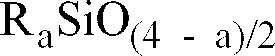
- Compounds with the following average unit formula are examples of organopolysiloxane (a): R a SiO (4 - a)/2 R represents substituted and unsubstituted monovalent hydrocarbon groups, e.g., alkyl groups such as methyl, ethyl, and propyl; aryl groups such as phenyl and tolyl; and such groups in which all or part of the carbon-bonded hydrogen has been substituted by halogen, such as chloromethyl and 3,3,3-trifluoropropyl.
- the subscript a in the formula has a value of 1.9 to 2.1.
- the organopolysiloxane (a) is exemplified by trimethylsiloxy-endblocked dimethylpolysiloxanes, silanol-endblocked dimethylpolysiloxanes, trimethylsiloxy-endblocked dimethylsiloxane-methylphenylsiloxane copolymers, silanol-endblocked dimethylsiloxane-methylphenylsiloxane copolymers, trimethylsiloxy-endblocked dimethylsiloxane-diphenylsiloxane copolymers, silanol-endblocked dimethylsiloxane-diphenylsiloxane copolymers, trimethylsiloxy-endblocked dimethylsiloxane-methyl(3,3,3-trifluoropropyl)siloxane copolymers, and silanol-endblocked dimethylsiloxane-methyl(3,3,3-trifluoropropyl)silox
- organopolysiloxane (a) can be straight chain, partially-branched straight chain, or network. Straight chain organopolysiloxanes are preferred.
- the organopolysiloxane When the organopolysiloxane is a fluid, it preferably has a viscosity at 25°C of at least 10,000 mm 2 /s (centistokes). When the organopolysiloxane has a high viscosity, as in the case of a gum, it may be used by dissolving it in a solvent.
- the organopolysiloxane may contain additives, on an optional basis, such as silica, as long as our method is not adversely affected.
- Nonionic surfactants anionic surfactants, and cationic surfactants may be used as emulsifying agent (b).
- the nonionic surfactants are exemplified by polyoxyalkylene alkyl ethers, polyoxyalkylene alkylphenol ethers, polyoxyalkylene alkyl esters, polyoxyalkylene sorbitan alkyl esters, polypropylene glycol, and diethylene glycol.
- the anionic surfactants are exemplified by fatty acid salts such as sodium laurate, sodium stearate, sodium oleate, and sodium linolenate; alkylbenzenesulfonic acids such as hexylbenzenesulfonic acid, octylbenzenesulfonic acid, and dodecylbenzenesulfonic acid; salts thereof; and by alkylsulfonates and sodium polyoxyethylene alkylphenyl ether sulfate.
- fatty acid salts such as sodium laurate, sodium stearate, sodium oleate, and sodium linolenate
- alkylbenzenesulfonic acids such as hexylbenzenesulfonic acid, octylbenzenesulfonic acid, and dodecylbenzenesulfonic acid
- salts thereof and by alkylsulfonates and sodium polyoxyethylene alkylphen
- the cationic surfactants are exemplified by octyltrimethylammonium hydroxide, dodecyltrimethylammonium hydroxide, alkyltrimethylammonium chlorides, and benzylammonium salts. Two or more types of these surfactants may be used in combination.
- Component (b) is added in sufficient quantity to emulsify the organopolysiloxane fluid or gum (a) in water (c).
- Component (b) is preferably added in a quantity to provide 0.1 to 89 weight% of emulsifying agent in the organopolysiloxane emulsion made by process (I).
- Component (b) is also preferably added in the range from 1.0 to 100 weight parts per 100 weight parts of the organopolysiloxane fluid or gum (a).
- the water (c) may be tap water or ion-exchanged water.
- the amount of water used in process (I) should provide from 1.0 to 89 weight%, and preferably from 1.0 to 79 weight% of water in the emulsion prepared in process (I).
- the amount of water used in process (I) is also preferably from 1 to 400 weight parts per 100 weight parts of the organopolysiloxane (a).
- the amount of water used for dilution in process (II) is preferably from 1 to 2,000 weight parts per 100 weight parts of the organopolysiloxane (a).
- the organopolysiloxane emulsions made by the continuous method of this invention are emulsions in which the organopolysiloxane fluid or gum (a) is emulsified and dispersed in water, and typically has an average particle diameter in the range from 0.1 to 50 micrometers.
- Organopolysiloxane emulsions according to our invention may be directly used for such applications as fiber-treatment agents, lubricants, release agents, glass fiber-treatment agents, oil bases for cosmetics, lustrants, defoamers, and paint additives.
- This example employed two mixers as depicted in Figure 1 connected in series. There were continuously fed into the starting material supply port 2 of the first mixer, 100 weight parts trimethylsiloxy-endblocked dimethylpolysiloxane with a viscosity at 25°C of 60,000 mm 2 /s (centistokes), 9.0 weight parts polyoxyethylene lauryl ether, 3.4 weight parts cetyltrimethylammonium chloride, and 3.6 weight parts ion-exchanged water. These materials were mixed by shearing and stirring to homogeneity, and were discharged as a translucent paste-like emulsion, with a dimethylpolysiloxane content of 86.2 weight%, from the discharge port 3 of the first mixer.
- the rotation rate of the rotatable axis 4 was 4,200 rpm; the minimum gap was 0.2 mm in both the first-stage SSM 9 and the second-stage SSM 10 .
- the shear rate in the first-stage SSM 9 was 93,000/second and the shear rate in the second-stage SSM 10 was 70,000/second.
- the rotation rate of the rotatable axis 4 was 3,000 rpm; the minimum gap was 0.2 mm in both the first-stage SSM 9 and the second-stage SSM 10 ; the shear rate in the first-stage SSM 9 was 66,000/second; the shear rate in the second-stage SSM 10 was 50,000/second; the pressure at the starting material supply port 2 was 0.0 kg/cm 2 G; and the pressure at the discharge port 3 was 0.0 kg/cm 2 G.
- the resulting dimethylpolysiloxane emulsion prepared by this shearing and stirring process was a milk-white emulsion in which the dimethylpolysiloxane was uniformly emulsified and dispersed in the water. Its average particle size was 0.4 micrometer. This emulsion had a viscosity at 25°C of 200 mPa ⁇ s (centipoise). Even when this emulsion was held for 6 months at ambient temperature, the dimethylpolysiloxane and water did not separate, indicating that this emulsion was extremely stable.
- This example used two of the mixers shown in Figure 1 connected in series. The following were continuously fed to the starting material supply port 2 of the first mixer: 10 weight parts polyoxyethylene lauryl ether, 5.0 weight parts ion-exchanged water, and 100 weight parts of a mixture with a viscosity at 25°C of 100,000 mm 2 /s (centistokes), prepared by the dissolution to homogeneity of 42 weight parts trimethylsiloxy-endblocked dimethylpolysiloxane gum with a viscosity at 25°C of 10,500,000 mm 2 /s (centistokes), in 58 weight parts isoparaffin with a specific gravity of 0.79 and a viscosity at 40°C of 2.4 mm 2 /s (centistokes).
- the rotation rate of the rotatable axis 4 was 4,200 rpm; the minimum gap was 0.2 mm in both the first-stage SSM 9 and the second-stage SSM 10 ; the shear rate in the first-stage SSM 9 was 93,000/second; the shear rate in the second-stage SSM 10 was 70,000/second; the pressure at the starting material supply port 2 was 0.4 kg/cm 2 G; and the pressure at the discharge port 3 was 0.0 kg/cm 2 G.
- the rotation rate of the rotatable axis 4 was 3,000 rpm; the minimum gap was 0.2 mm in both the first-stage SSM 9 and the second-stage SSM 10 ; the shear rate in the first-stage SSM 9 was 66,000/second; the shear rate in the second-stage SSM 10 was 50,000/second; the pressure at the starting material supply port 2 was 0.0 kg/cm 2 G; and the pressure at the discharge port 3 was 0.0 kg/cm 2 G.
- the dimethylpolysiloxane emulsion made by this shearing and stirring process was a milk-white emulsion in which the dimethylpolysiloxane gum was emulsified and dispersed to homogeneity in the water. Its average particle size was 0.4 micrometer. Even when this emulsion was held for 6 months at ambient temperature, the dimethylpolysiloxane and water did not separate, indicating that this emulsion was extremely stable.
- the above illustrated continuous preparative method according to the present invention is characterized by its ability to continuously mass-produce organopolysiloxane emulsions that are uniform, highly dispersed, and very storage stable.
- the shearing and stirring processes in the continuous production of our organopolysiloxane emulsions are also implemented by bubbling in a gas such as air, nitrogen, carbon dioxide, or an inert gas such as argon.
- a gas such as air, nitrogen, carbon dioxide, or an inert gas such as argon.
- This feature of our invention makes possible preparation of even more uniform and more stable organopolysiloxane emulsions, and also makes possible a reduction in pressure within the mixer. Accompanying this is a drop in the driving force required for agitation.
- the gas is preferably injected at the starting material supply port 2.
- the gas used in this aspect of our invention promotes emulsification of the organopolysiloxane emulsion, and yields a homogeneous and very stable emulsion. While the gas is generally exemplified by air, nitrogen, argon, and carbon dioxide, air and nitrogen are preferred for their safety and ease of acquisition.
- the organopolysiloxane should be supplied in an amount that affords a value of from 0.01 to 100 (NL/hour)/(kg/hour), and preferably from 0.1 to 10 (NL/hour)/(kg/hour), for a ratio of the amount of the injected gas in NL/hour to the amount of organopolysiloxane fluid or gum being supplied in kg/hour.
- NL is Normal Liter at 0°C and one atmospheres.
- a uniform and highly stable emulsion is difficult to obtain when the ratio is below 0.01 (NL/hour)/(kg/hour).
- the ratio exceeds 100 (NL/hour)/(kg/hour)
- unemulsified organopolysiloxane may remain in the emulsion, because the inputs will pass through the SSM without being subjected to a thorough shearing and stirring.
- the continuous injection of gas promotes stirring and mixing of the organopolysiloxane and water inputs during their passage through the zone of the SSM, and thereby supports a thorough adsorption of the emulsifying agent to the surface of the organopolysiloxane drops dispersed in the water.
- the rotation rate of rotatable axle 4 was 4,200 rpm; the minimum gap was 0.2 mm in the SSMs 9 and 10; the pressure at the starting material supply port 2 was 0.4 kg/cm 2 G; and the emulsion discharge pressure at the discharge port 3 was 0.0 kg/cm 2 G.
- the dimethylpolysiloxane emulsion prepared according to the shearing and stirring process of this example was a translucent paste-like emulsion, in which the dimethylpolysiloxane was uniformly dispersed and emulsified in water. The average particle size of the dimethylpolysiloxane in the emulsion was measured at 0.3 micrometer.
- a second emulsion was also prepared by the addition of 71 weight parts water for each 100 weight parts of this paste-like emulsion. This second emulsion was held at ambient temperature for 6 months without occurrence of separation between the dimethylpolysiloxane and water, which indicated that it was extremely stable.
- This example used two mixers as shown in Figure 1 which were connected in series. The following were continuously fed to the starting material supply port 2 of the first mixer: 10 weight parts polyoxyethylene lauryl ether, 5.0 weight parts ion-exchanged water, and 100 weight parts of a mixture having a viscosity at 25 °C of 100,000 mm 2 /s (centistokes) prepared by dissolution to homogeneity of 42 weight parts trimethylsiloxy-endblocked dimethylpolysiloxane gum with a viscosity at 25 °C of 10,500,000 mm 2 /s (centistokes) in 58 weight parts isoparaffin with a specific gravity of 0.79 and a viscosity at 40°C of 2.4 mm 2 /s(centistokes).
- Compressed air was also continuously injected through a gas supply port connected to material supply port 2, to provide a ratio of 1.0 (NL/hour)/(kg/hour) between its feed and the dimethylpolysiloxane feed.
- These ingredients were mixed by shearing and stirring to homogeneity, and were discharged as a translucent paste-like emulsion with a dimethylpolysiloxane content of 36.5 weight percent, from discharge port 3 of the first mixer.
- This paste-like emulsion and 82.4 weight parts of dilution water (i.e., equivalent to 71 weight parts per 100 weight parts of paste-like emulsion discharged from the first mixer) were then continuously fed to the starting material supply port 2 of a second mixer, where shearing and stirring to homogeneity yielded a dimethylpolysiloxane gum emulsion with a dimethylpolysiloxane content of 21.3 weight percent.
- Conditions in the first and second mixers used in the process carried out in this example were the same as conditions used in Example 1, i.e., the rotation rate of rotatable axle 4, the minimum gap, shear rates, and pressures at supply port 2 and discharge port 3.
- the dimethylpolysiloxane emulsion prepared this shearing and stirring process was a milk-white emulsion in which the dimethylpolysiloxane gum was emulsified and dispersed to homogeneity in water. Its average particle size was 0.4 micrometer. Even when this dimethylpolysiloxane emulsion was held for 10 months at ambient temperature, the dimethylpolysiloxane and water did not separate, indicating that the emulsion was extremely stable.
- Dimethylpolysiloxane, emulsifying agent, and water were mixed as described in Example 3, but in this comparative example without injection of compressed air. A paste-like emulsion was obtained. The average particle size of dimethylpolysiloxane in this emulsion was measured at 0.4 micrometer. In the case of the second emulsion prepared by the addition of 71 weight parts water for each 100 weight parts of the paste-like emulsion, the dimethylpolysiloxane and water underwent separation after standing for only one day at ambient temperature.
Landscapes
- Chemical & Material Sciences (AREA)
- Chemical Kinetics & Catalysis (AREA)
- Dispersion Chemistry (AREA)
- Health & Medical Sciences (AREA)
- Medicinal Chemistry (AREA)
- Polymers & Plastics (AREA)
- Organic Chemistry (AREA)
- Processes Of Treating Macromolecular Substances (AREA)
- Colloid Chemistry (AREA)
- Compositions Of Macromolecular Compounds (AREA)
Abstract
Description
- This invention relates to a method for the continuous preparation of organopolysiloxane emulsions. More particularly, this invention relates to a highly productive method for the preparation of very storage-stable and uniform emulsions.
- Organopolysiloxane emulsions are widely used in industry as lubricants, release agents, fiber-treatment agents, glass fiber-treatment agents, cosmetic bases, lustrants, and paint additives.
- Methods known for the preparation of organopolysiloxane emulsions are exemplified by (a) mixing a starting organopolysiloxane fluid, emulsifying agent, and water using a mixer that applies a stirring action, for example, a Henschel TM mixer or kneader mixer, and (b) mixing said starting materials through the application of a shearing action using a colloid mill, or homomixer. In addition, JP-A 59-51565 teaches a method that uses a cylindrical container and, installed therein, a stirring element with at least 3 disks positioned at a fixed interval on a rotating axle. Diorganopolysiloxane oil, emulsifying agent, and water are continuously fed to the cylindrical container and are sheared and stirred by the stirring element.
- However, when mass production of organopolysiloxane is sought through continuous production, the prior-art methods are poorly adaptable to the production of uniform, highly disperse organopolysiloxane emulsions, and they suffer from the problem of poor productivity. In JP-A 59-51565, shearing and stirring must be conducted along with the application of pressure to make a uniform emulsion. This automatically incurs such disadvantages as higher operating costs due to increased energy, as well as costs associated with reinforcing the equipment structure. In addition, the material afforded by this reference is a grease-like silicone-containing water-based fluid. The use of this fluid in the above applications requires that it be dissolved in and diluted with water in a batch process using a shaker.
- In order to solve these problems, we have previosly disclosed a method capable of the continuous mass production of a uniform and highly disperse organopolysiloxane emulsion in 08/498,963, Japanese Patent Application 7-9248. This method uses a low drive force and is not carried out under elevated pressure. As a result of additional investigation, we have now found a continuous method capable of the direct production of organopolysiloxane emulsions that are already diluted with water to concentrations suitable for the above applications.
- In specific terms, the present invention takes as its object the introduction of a highly productive continuous method for the preparation of organopolysiloxane emulsions that, through the use of special SSMs, makes possible without pressurization and with low drive force, the continuous mass production of highly homogeneous and very storage-stable organopolysiloxane emulsions that are already diluted with water to appropriate concentrations for immediate use.
- In another aspect of our invention, a gas can be injected into the starting materials during mixing and emulsification.
- The method of our invention for the preparation of organopolysiloxane emulsions achieves these objects and is a method for the continuous preparation of organopolysiloxane emulsions by processes (I) and (II) described below.
Process (I) involves the continuous supply of - (a) an organopolysiloxane fluid or gum,
- (b) an emulsifying agent, and
- (c) water, as the starting materials into the supply port of a mixer. The mixer has a cylindrical casing in which there are installed between the supply port and discharge port of the cylindrical casing at least a first-stage SSM (SSM), and a second-stage SSM. The first-stage SSM is a turbine-type rotor having blades that are slanted obliquely from the radial direction when viewed from the axial direction, and a stator installed about the circumference of the rotor. The second-stage SSM is a turbine-type rotor having blades that describe spiral curves with respect to the axial direction, and a stator installed about the circumference of the rotor.
- These mechanisms are arranged serially along the direction of starting material feed and are separated from one another by a relaxation zone. The method involves subjecting starting materials in the first-stage SSM principally to an intake action and a shearing action at a shear rate of at least 100/second and then, after passage through the relaxation zone, in the second-stage, principally to phase reversal and rotating effects, and a shearing action at a shear rate of at least 100/second; and then discharging from the discharge port, an organopolysiloxane-in-water emulsion with an organopolysiloxane content of 10 to 99 weight%, based on the weight of the emulsion.
- The ensuing process (II) is the continuous supply of dilution water and the organopolysiloxane-in-water emulsion made in process (I) into the supply port of the cylindrical casing of a mixer having a cylindrical casing in which there is installed between the supply port and discharge port of the cylindrical casing at least a first-stage SSM and a second-stage SSM.
- The first-stage SSM is a turbine-type rotor having blades that are slanted obliquely from the radial direction when viewed from the axial direction, and a stator installed about the circumference of the rotor. The second-stage SSM is a turbine-type rotor having blades that describe spiral curves with respect to the axial direction, and a stator installed about the circumference of the rotor.
- The mechanisms are arranged serially along the direction of starting material feed and are separated from one another by a relaxation zone. The method involves subjecting the starting materials in the first-stage SSM principally to an intake action and a shearing action at a shear rate of at least 100/second and then, after passage through the relaxation zone, in the second-stage SSM principally to phase reversal and rotating effects, and a shearing action at a shear rate of at least 100/second; and then discharging from the discharge port of the cylindrical casing a water-diluted organopolysiloxane-in-water emulsion.
- In process (I), the starting materials are subjected to an intake action and a shearing action at a shear rate of at least 100/second due to the particular structure of the first-stage SSM which is a turbine-type rotor having blades that are slanted obliquely from the radial direction when viewed from the axial direction, and a stator installed about the circumference of the rotor. Due to the particular structure of the second-stage SSM which is a spiral blade-equipped turbine-type rotor and a stator, this stage subjects the mixture to a strong shearing action at a shear rate of at least 100/second between the stator and the spiral blades of the turbine-type rotor. At the same time, the mixture is also impacted against the side surfaces of the spiral blades which are slanted with respect to the rotational axis. This results in strong reversal and rotation effects that forcibly alter the phase into the radial and circumferential directions. Emulsification of the organopolysiloxane proceeds through a synergetic interaction among these actions and effects.
- Emulsification is even further advanced by the repetition of the above-described emulsifying effects over at least two stages, with a relaxation zone interposed between successive serially connected SSMs. The overall result is the production of a uniform, highly disperse emulsion of organopolysiloxane.
- In the ensuing process (II), dilution water and the highly concentrated organopolysiloxane emulsion made by process (I) are separately and continuously fed to the supply port of a mixer which includes a cylindrical casing in which there is installed between the supply port and discharge port of the cylindrical casing at least a first-stage SSM and a second-stage SSM. The first-stage SSM is a turbine-type rotor having blades that are slanted obliquely from the radial direction when viewed from the axial direction, and a stator installed about the circumference of the rotor. The said second-stage SSM is a turbine-type rotor having blades that describe spiral curves with respect to the axial direction, and a stator installed about the circumference of the rotor.
- The mechanisms are arranged serially along the direction of starting material feed and are separated from one another by a relaxation zone. The emulsion and dilution water are subjected in the first-stage SSM to an intake action and a shearing action at a shear rate of at least 100/second, and are then subjected in the second-stage SSM to reversal and rotating effects, and a shearing action at a shear rate of at least 100/second. This directly and continuously affords an emulsion that is uniformly diluted with water to an application-appropriate concentration, that is free of undissolved high-concentrations of organopolysiloxane emulsion. The "shear rate" Vs (1/second) referenced herein is the value given by the equation

- The mixer used in process (II) may or may not be identical to the mixer used in process (I).
- Figure 1 is a schematic diagram partly in cross-section, of a mixer used to perform the method of our invention for the continuous preparation of organopolysiloxane emulsions.
- Figure 2 is a cross-sectional view, taken along line 2-2 in Figure 1, when viewed in the direction of the arrows.
- Figure 3 is a cross-sectional view, taken along line 3-3 in Figure 1, when viewed in the direction of the arrows.
- Figure 4 is a cross-sectional view, taken along line 4-4 in Figure 1, when viewed in the direction of the arrows.
- Figure 5 is a perspective view of the rotor of the first-stage SSM in the mixer apparatus of Figure 1.
- To facilitate understanding of the invention, and the mixer apparatus of Figures 1-5, names of the various parts have been added to the figures, in addition to their reference numerals. Thus, 1 is the cylindrical casing, 2 is the supply port, 3 is the discharge port, 4 is the rotary axis or axle, 5 and 7 are turbine-type rotors, 5a and 7a are blades, 6 and 8 are stators, 8b is the straight grooves, 9 and 10 are SSMs, 11 is the relaxation zone or space, 12 is the sawtooth-like projections, 13 is the stator part or element, 13a is the sawtooth-like projections, and 14 is the flow passage.
Supply port 2 can be provided with a separate inlet (not shown) for injecting and feeding a gas into theport 2. Preferably, the gas is introduced separately from the starting materials supplied byport 2. - In Figure 1, 1 denotes a cylindrical casing whose axial direction is on the horizontal. One end of this casing is equipped with a starting
material supply port 2, while the other end is equipped with adischarge port 3 for the emulsified mixture. Arotatable axle 4 is inserted at the center of the cylindrical casing 1. Therotatable axle 4 is inserted from the left end of the cylindrical casing 1 and extends to the vicinity of thesupply port 2 on the right end. It is driven by a motor (not shown) that sits outside the casing. - The
rotatable axle 4 is equipped with arotor 5 at its end at thesupply port 2 and with a rotor 7 at its middle. Stators 6 and 8, which are fixed in the inner peripheral wall of the cylindrical casing 1, are installed surrounding the circumferences of therotors 5 and 7, respectively, and in each case are separated therefrom by a small gap. Therotor 5 and the stator 6 make up the first-stage SSM 9, while the rotor 7 and the stator 8 make up the second-stage SSM 10. In addition, arelaxation space 11 with a relatively large volume is installed between the first-stage SSM 9 and the second-stage SSM 10. - The
rotor 5 in the first-stage SSM 9 is a turbine-type rotor, from which a plural number ofblades 5a radiate out in a cone-like manner toward thesupply port 2 as seen in Figures 2 and 5. Theseblades 5a are substantially parallel to the axial direction in plane view, but are slanted relative to the axial direction in side view, and are obliquely slanted with respect to the radial direction when viewed from the axial direction. - The stator 6 in the SSM 9 forms a near-conical interior peripheral surface that contains
grooves 6b that extend in the axial direction. Therotor 5 is inserted into the conical stator 6 with the formation of a narrow gap with the peripheral edges of theblades 5a. The minimum gap size is 2 mm or less, and is preferably about 1 mm, as seen in Figure 2. - The rotor 7 in the second-
stage SSM 10 is also a turbine-type rotor, but unlike the SSM 9, the blades 7a describe a spiral with reference to the axial direction. The blades 7a are also shorter in the radial direction than theblades 5a of therotor 5 of the SSM 9 as seen in Figure 3. - The stator 8 of the
SSM 10 has a near-conical shape, and its interior peripheral surface contains a number ofstraight grooves 8b that extend in the axial direction. The rotor 7 is inserted into the stator 8 with the formation of a small gap with the outer surfaces of the spiral blades 7a. This gap is formed to become progressively narrower in a wedge-like manner, moving from the upstream side to the downstream side as shown in Figure 1. The minimum gap size is 2 mm or less and is preferably about 1 mm. - A number of rearward projecting sawtooth-
like projections 12 are present on the downstream end surface (i.e., the surface perpendicular to the axial direction) of the rotor 7 of the second-stage SSM 10. Theseprojections 12 alternate moving radially, with a number of sawtooth-like projections 13a fixed on thestator element 13. A narrow gap remains interposed between theprojections 12 and theprojections 13a. Theseprojections - To execute the method of our invention for the continuous preparation of organopolysiloxane emulsions, the three starting materials, i.e., (a) the organopolysiloxane fluid or gum, (b) the emulsifying agent, and (c) water, are supplied in process (I) to the starting
material supply port 2 of the mixing device in which there are serially installed at least the above-described first-stage SSM 9 and the above-described second-stage SSM 10. These starting materials may be supplied separately, or they may be supplied In the form of a prepared mixture. - The first-stage SSM 9 performs an intake action and also an initial emulsifying action on the starting materials. The intake action is performed mainly through the outward radiating shape of the
blades 5a on therotor 5 which are obliquely slanted with reference to the radial direction when viewed from the axial direction. The initial emulsifying action occurs through a microparticulation and emulsification of the organopolysiloxane fluid or gum resulting from the shearing or cutting action applied to the three starting materials between the outer peripheral surface of theblades 5a and the inner wall of the stator 6. This shearing action should apply shear at a shear rate of at least 100/second. - After initial emulsification by the first-stage SSM 9, the mixture is squeezed into the
intermediate flow passage 14, then fed into therelaxation space 11, where it is released from its compressed state, and thereafter supplied to the second-stage SSM 10. - In the second-
stage SSM 10, a coarse grinding action is performed by the stator 8 and the spiral blades 7a of the rotor 7, while a fine grinding action is developed by the shearing action generated by intermeshing between the sawtooth-like projections 12 on the downstream end surface of the rotor 7 and the sawtooth-like protections 13a on thestator element 13. - Upon introduction into the space circumscribed by the blades 7a of the rotor 7 and the inner wall of the stator 8, the mixture is subjected to phase reversing and rotating effects due to the action of the blades 7a which are diagonally curved in the axial direction. This functions to alter the phase to the radial and circumferential directions. An even finer and more uniform emulsification is obtained as the mixture, while being subjected to these reversing and rotating effects, is at the same time also subjected to a shearing or cutting action between the peripheral surfaces of the blades 7a and the inner wall of the stator 8 which is equipped with a number of
straight grooves 8b. This shearing action should apply shear at a shear rate of at least 100/second. - The resulting emulsified mixture becomes even more finely emulsified in the downstream fine grinding region between the sawtooth-
like projections discharge port 3 in the cylindrical casing 1 as an organopolysiloxane-in-water emulsion, preferably containing 10 to 99 weight%, and more preferably 20 to 99 weight% organopolysiloxane. The discharged organopolysiloxane emulsion will generally contain (a) 10 to 99 weight% organopolysiloxane fluid or gum, (b) 0.1 to 89 weight% emulsifying agent, and (c) 1.0 to 89 weight% water. - In the ensuing process (II), dilution water and the highly concentrated organopolysiloxane emulsion made by process (I) are separately and continuously fed to the starting
material supply port 2 of another mixer, in which the above-described SSM 9 andSSM 10 are installed in series. - The first-stage SSM 9 performs mainly an intake action on the starting materials, while also effecting an initial mixing and dissolution, by subjecting the inputs to a shearing or cutting action. This shearing action should apply shear at a shear rate of at least 100/second.
- After its initial mixing and dissolution by the first-stage SSM 9, the mixture is squeezed into the
intermediate flow passage 14, then fed into therelaxation space 11, where it is released from its compressed state, and supplied to the second-stage SSM 10. - The second-
stage SSM 10 performs both a coarse grinding action and a fine grinding action. Upon introduction into the space circumscribed by the blades 7a of the rotor 7 and the inner wall of the stator 8, the mixture is subjected to phase reversing and rotating effects due to the action of the blades 7a which are diagonally curved in the axial direction. This functions to change the phase to radial and circumferential directions. An even finer and more uniform dissolution is obtained, because the mixture, while being subjected to these reversing and rotating effects, is at the same time also subjected to a shearing or cutting action between the peripheral surfaces of the blades 7a and the inner wall of the stator 8 which is equipped with a number ofstraight grooves 8b. This shearing action should apply shear at a shear rate of at least 100/second. - The mixture of water and organopolysiloxane emulsion as described above becomes even more finely dissolved and homogenized in the downstream fine grinding region between the sawtooth-
like projections discharge port 3 in the cylindrical casing 1. - The continuous production of organopolysiloxane emulsions by the method of our invention may be performed using separate feeds of starting organopolysiloxane fluid or gum, emulsifying agent, and water to the starting
material supply port 2 in process (I), or by preliminarily mixing these starting materials and supplying them as mixture to thesupply port 2 for process (I). The dilution water used in process (II) is preferably supplied separately from the relatively highly concentrated organopolysiloxane emulsion made in process (I). - It is important in the present invention that there are serially installed at least a first-stage SSM having a stator and a turbine-type rotor whose blades are slanted obliquely from the radial direction when viewed from the axial direction, and a second-stage SSM having a stator and a turbine-type rotor whose blades describe spiral curves with respect to the axial direction. This two-stage serial combination may be repeatedly serially connected a number of times, to obtain an ever finer emulsification, dissolution, and homogenization, as may be desired.
- An extremely fine emulsification, dissolution, and homogenization is achieved by at least the two-stage combination described above. But in addition, a front stage with the first-stage SSM that implements primarily starting material intake and shearing activities, and a rear stage having the second-stage SSM that implements primarily reversing and rotation activities simultaneously with a shearing activity, makes possible emulsification, dissolution, and homogenization of the mixture at low pressures along with a low drive power. The process is enhanced by the presence of a sufficiently large relaxation zone between the first-stage and second-stage SSMs.
- A shear rate of at least 100/second, but preferably of 10,000 to 300,000/second, should be applied to the mixture between the stator and turbine-type rotor in each SSM. When a shear rate below 100/second is applied to the mixture, the process cannot yield a highly dispersed and uniform emulsion diluted with water to the concentration appropriate to an intended application.
- With regard to the SSM(s) from the second stage on, it is preferred to make the first shearing action a coarse grinding zone to carry out a coarse emulsification, dissolution, and homogenization, and to make the second shearing action a fine grinding zone, to carry out dissolution and homogenization through fine attrition.
- In addition to subjecting the mixture to these high shear rates, the continuous nethod of invention also applies a strong reversing activity through the action of the spiral blades on the turbine-type rotor. This reversing action constantly alters the phase of the mixture into the radial and circumferential directions, and the synergy between this action and the aforementioned shearing action makes possible a much more efficient conversion of the mixture into a uniform emulsion.
- The organopolysiloxane (a) may be any organopolysiloxane that is a fluid or gum at ambient temperature. Compounds with the following average unit formula are examples of organopolysiloxane (a):
- The organopolysiloxane (a) is exemplified by trimethylsiloxy-endblocked dimethylpolysiloxanes, silanol-endblocked dimethylpolysiloxanes, trimethylsiloxy-endblocked dimethylsiloxane-methylphenylsiloxane copolymers, silanol-endblocked dimethylsiloxane-methylphenylsiloxane copolymers, trimethylsiloxy-endblocked dimethylsiloxane-diphenylsiloxane copolymers, silanol-endblocked dimethylsiloxane-diphenylsiloxane copolymers, trimethylsiloxy-endblocked dimethylsiloxane-methyl(3,3,3-trifluoropropyl)siloxane copolymers, and silanol-endblocked dimethylsiloxane-methyl(3,3,3-trifluoropropyl)siloxane copolymers.
- The molecular structure of organopolysiloxane (a) can be straight chain, partially-branched straight chain, or network. Straight chain organopolysiloxanes are preferred.
- When the organopolysiloxane is a fluid, it preferably has a viscosity at 25°C of at least 10,000 mm2/s (centistokes). When the organopolysiloxane has a high viscosity, as in the case of a gum, it may be used by dissolving it in a solvent.
- The organopolysiloxane may contain additives, on an optional basis, such as silica, as long as our method is not adversely affected.
- Nonionic surfactants, anionic surfactants, and cationic surfactants may be used as emulsifying agent (b). The nonionic surfactants are exemplified by polyoxyalkylene alkyl ethers, polyoxyalkylene alkylphenol ethers, polyoxyalkylene alkyl esters, polyoxyalkylene sorbitan alkyl esters, polypropylene glycol, and diethylene glycol. The anionic surfactants are exemplified by fatty acid salts such as sodium laurate, sodium stearate, sodium oleate, and sodium linolenate; alkylbenzenesulfonic acids such as hexylbenzenesulfonic acid, octylbenzenesulfonic acid, and dodecylbenzenesulfonic acid; salts thereof; and by alkylsulfonates and sodium polyoxyethylene alkylphenyl ether sulfate. The cationic surfactants are exemplified by octyltrimethylammonium hydroxide, dodecyltrimethylammonium hydroxide, alkyltrimethylammonium chlorides, and benzylammonium salts. Two or more types of these surfactants may be used in combination.
- This Component (b) is added in sufficient quantity to emulsify the organopolysiloxane fluid or gum (a) in water (c). Component (b) is preferably added in a quantity to provide 0.1 to 89 weight% of emulsifying agent in the organopolysiloxane emulsion made by process (I). Component (b) is also preferably added in the range from 1.0 to 100 weight parts per 100 weight parts of the organopolysiloxane fluid or gum (a).
- The water (c) may be tap water or ion-exchanged water. The amount of water used in process (I) should provide from 1.0 to 89 weight%, and preferably from 1.0 to 79 weight% of water in the emulsion prepared in process (I). The amount of water used in process (I) is also preferably from 1 to 400 weight parts per 100 weight parts of the organopolysiloxane (a). The amount of water used for dilution in process (II) is preferably from 1 to 2,000 weight parts per 100 weight parts of the organopolysiloxane (a).
- The organopolysiloxane emulsions made by the continuous method of this invention are emulsions in which the organopolysiloxane fluid or gum (a) is emulsified and dispersed in water, and typically has an average particle diameter in the range from 0.1 to 50 micrometers.
- Organopolysiloxane emulsions according to our invention may be directly used for such applications as fiber-treatment agents, lubricants, release agents, glass fiber-treatment agents, oil bases for cosmetics, lustrants, defoamers, and paint additives.
- This example employed two mixers as depicted in Figure 1 connected in series. There were continuously fed into the starting
material supply port 2 of the first mixer, 100 weight parts trimethylsiloxy-endblocked dimethylpolysiloxane with a viscosity at 25°C of 60,000 mm2/s (centistokes), 9.0 weight parts polyoxyethylene lauryl ether, 3.4 weight parts cetyltrimethylammonium chloride, and 3.6 weight parts ion-exchanged water. These materials were mixed by shearing and stirring to homogeneity, and were discharged as a translucent paste-like emulsion, with a dimethylpolysiloxane content of 86.2 weight%, from thedischarge port 3 of the first mixer. 100 weight parts of this paste-like emulsion and 71 weight parts dilution water were then continuously fed to the startingmaterial supply port 2 of the second mixer, where shearing and stirring to homogeneity yielded a dimethylpolysiloxane emulsion with a dimethylpolysiloxane content of 50.4 weight%. - In the first mixer used in this process, the rotation rate of the
rotatable axis 4 was 4,200 rpm; the minimum gap was 0.2 mm in both the first-stage SSM 9 and the second-stage SSM 10. The shear rate in the first-stage SSM 9 was 93,000/second and the shear rate in the second-stage SSM 10 was 70,000/second. The pressure at the startingmaterial supply port 2 was 0.4 kg/cm2 G, and the pressure at thedischarge port 3 was 0.0 kg/cm2 G. In these measurements, G is the guage pressure, i.e., atmospheric pressure = 0.0 kg/cm2 G. - In the second mixer used in this process, the rotation rate of the
rotatable axis 4 was 3,000 rpm; the minimum gap was 0.2 mm in both the first-stage SSM 9 and the second-stage SSM 10; the shear rate in the first-stage SSM 9 was 66,000/second; the shear rate in the second-stage SSM 10 was 50,000/second; the pressure at the startingmaterial supply port 2 was 0.0 kg/cm2 G; and the pressure at thedischarge port 3 was 0.0 kg/cm2 G. - The resulting dimethylpolysiloxane emulsion prepared by this shearing and stirring process was a milk-white emulsion in which the dimethylpolysiloxane was uniformly emulsified and dispersed in the water. Its average particle size was 0.4 micrometer. This emulsion had a viscosity at 25°C of 200 mPa·s (centipoise). Even when this emulsion was held for 6 months at ambient temperature, the dimethylpolysiloxane and water did not separate, indicating that this emulsion was extremely stable.
- This example used two of the mixers shown in Figure 1 connected in series. The following were continuously fed to the starting
material supply port 2 of the first mixer: 10 weight parts polyoxyethylene lauryl ether, 5.0 weight parts ion-exchanged water, and 100 weight parts of a mixture with a viscosity at 25°C of 100,000 mm2/s (centistokes), prepared by the dissolution to homogeneity of 42 weight parts trimethylsiloxy-endblocked dimethylpolysiloxane gum with a viscosity at 25°C of 10,500,000 mm2/s (centistokes), in 58 weight parts isoparaffin with a specific gravity of 0.79 and a viscosity at 40°C of 2.4 mm2/s (centistokes). These ingredients were mixed by shearing and stirring to homogeneity, and were discharged as a translucent paste-like emulsion with a dimethylpolysiloxane content of 36.5 weight%, from thedischarge port 3 of the first mixer. This paste-like emulsion, and 82.4 weight parts dilution water, equivalent to 71 weight parts per 100 weight parts of the paste-like emulsion discharged from the first mixer, were then continuously fed to the startingmaterial supply port 2 of the second mixer, where shearing and stirring to homogeneity, yielded a dimethylpolysiloxane gum emulsion with a dimethylpolysiloxane content of 21.3 weight%. - In the first mixer used in this process, the rotation rate of the
rotatable axis 4 was 4,200 rpm; the minimum gap was 0.2 mm in both the first-stage SSM 9 and the second-stage SSM 10; the shear rate in the first-stage SSM 9 was 93,000/second; the shear rate in the second-stage SSM 10 was 70,000/second; the pressure at the startingmaterial supply port 2 was 0.4 kg/cm2 G; and the pressure at thedischarge port 3 was 0.0 kg/cm2 G. - In the second mixer used in this process, the rotation rate of the
rotatable axis 4 was 3,000 rpm; the minimum gap was 0.2 mm in both the first-stage SSM 9 and the second-stage SSM 10; the shear rate in the first-stage SSM 9 was 66,000/second; the shear rate in the second-stage SSM 10 was 50,000/second; the pressure at the startingmaterial supply port 2 was 0.0 kg/cm2 G; and the pressure at thedischarge port 3 was 0.0 kg/cm2 G. - The dimethylpolysiloxane emulsion made by this shearing and stirring process was a milk-white emulsion in which the dimethylpolysiloxane gum was emulsified and dispersed to homogeneity in the water. Its average particle size was 0.4 micrometer. Even when this emulsion was held for 6 months at ambient temperature, the dimethylpolysiloxane and water did not separate, indicating that this emulsion was extremely stable.
- The above illustrated continuous preparative method according to the present invention is characterized by its ability to continuously mass-produce organopolysiloxane emulsions that are uniform, highly dispersed, and very storage stable.
- The shearing and stirring processes in the continuous production of our organopolysiloxane emulsions are also implemented by bubbling in a gas such as air, nitrogen, carbon dioxide, or an inert gas such as argon. This feature of our invention makes possible preparation of even more uniform and more stable organopolysiloxane emulsions, and also makes possible a reduction in pressure within the mixer. Accompanying this is a drop in the driving force required for agitation. The gas is preferably injected at the starting
material supply port 2. - The gas used in this aspect of our invention promotes emulsification of the organopolysiloxane emulsion, and yields a homogeneous and very stable emulsion. While the gas is generally exemplified by air, nitrogen, argon, and carbon dioxide, air and nitrogen are preferred for their safety and ease of acquisition. The organopolysiloxane should be supplied in an amount that affords a value of from 0.01 to 100 (NL/hour)/(kg/hour), and preferably from 0.1 to 10 (NL/hour)/(kg/hour), for a ratio of the amount of the injected gas in NL/hour to the amount of organopolysiloxane fluid or gum being supplied in kg/hour. NL is Normal Liter at 0°C and one atmospheres. A uniform and highly stable emulsion is difficult to obtain when the ratio is below 0.01 (NL/hour)/(kg/hour). When the ratio exceeds 100 (NL/hour)/(kg/hour), unemulsified organopolysiloxane may remain in the emulsion, because the inputs will pass through the SSM without being subjected to a thorough shearing and stirring.
- It is not entirely understood how the gas promotes emulsification and stabilizes the emulsion. Thus, for emulsion preparation in general, admixture of bubbles has been regarded as exercising negative influences on emulsion stability. This occurs because admixed bubbles adsorb emulsion at their interface, thereby consuming same, and because at the same time, they also adsorb emulsified drops and cause them to float upwardly. As a result, avoiding admixture of bubbles has been regarded as essential for emulsion preparation. However in our method, the continuous injection of gas promotes stirring and mixing of the organopolysiloxane and water inputs during their passage through the zone of the SSM, and thereby supports a thorough adsorption of the emulsifying agent to the surface of the organopolysiloxane drops dispersed in the water.
- Using the mixer 1 shown in Figure 1, 100 weight parts trimethylsiloxy-endblocked dimethylpolysiloxane with a viscosity at 25°C of 300,000 mPa·s (centipoise), 9.0 weight parts polyoxyethylene lauryl ether, 3.4 weight parts cetyltrimethylammonium chloride, and 3.6 weight parts ion-exchanged water, were continuously supplied through the starting
material supply port 2. Compressed air was also continuously injected through a gas supply port connected toport 2, to provide a ratio of 1.0 (NL/hour)/(kg/hour) between its feed and the siloxane feed. Shearing and stirring to homogeneity were conducted to yield a dimethylpolysiloxane emulsion. - In regard to the mixer used in this example, the rotation rate of
rotatable axle 4 was 4,200 rpm; the minimum gap was 0.2 mm in theSSMs 9 and 10; the pressure at the startingmaterial supply port 2 was 0.4 kg/cm2 G; and the emulsion discharge pressure at thedischarge port 3 was 0.0 kg/cm2 G. - The dimethylpolysiloxane emulsion prepared according to the shearing and stirring process of this example was a translucent paste-like emulsion, in which the dimethylpolysiloxane was uniformly dispersed and emulsified in water. The average particle size of the dimethylpolysiloxane in the emulsion was measured at 0.3 micrometer. A second emulsion was also prepared by the addition of 71 weight parts water for each 100 weight parts of this paste-like emulsion. This second emulsion was held at ambient temperature for 6 months without occurrence of separation between the dimethylpolysiloxane and water, which indicated that it was extremely stable.
- This example used two mixers as shown in Figure 1 which were connected in series. The following were continuously fed to the starting
material supply port 2 of the first mixer: 10 weight parts polyoxyethylene lauryl ether, 5.0 weight parts ion-exchanged water, and 100 weight parts of a mixture having a viscosity at 25 °C of 100,000 mm2/s (centistokes) prepared by dissolution to homogeneity of 42 weight parts trimethylsiloxy-endblocked dimethylpolysiloxane gum with a viscosity at 25 °C of 10,500,000 mm2/s (centistokes) in 58 weight parts isoparaffin with a specific gravity of 0.79 and a viscosity at 40°C of 2.4 mm2/s(centistokes). Compressed air was also continuously injected through a gas supply port connected tomaterial supply port 2, to provide a ratio of 1.0 (NL/hour)/(kg/hour) between its feed and the dimethylpolysiloxane feed. These ingredients were mixed by shearing and stirring to homogeneity, and were discharged as a translucent paste-like emulsion with a dimethylpolysiloxane content of 36.5 weight percent, fromdischarge port 3 of the first mixer. This paste-like emulsion and 82.4 weight parts of dilution water (i.e., equivalent to 71 weight parts per 100 weight parts of paste-like emulsion discharged from the first mixer) were then continuously fed to the startingmaterial supply port 2 of a second mixer, where shearing and stirring to homogeneity yielded a dimethylpolysiloxane gum emulsion with a dimethylpolysiloxane content of 21.3 weight percent. - Conditions in the first and second mixers used in the process carried out in this example were the same as conditions used in Example 1, i.e., the rotation rate of
rotatable axle 4, the minimum gap, shear rates, and pressures atsupply port 2 and dischargeport 3. - The dimethylpolysiloxane emulsion prepared this shearing and stirring process was a milk-white emulsion in which the dimethylpolysiloxane gum was emulsified and dispersed to homogeneity in water. Its average particle size was 0.4 micrometer. Even when this dimethylpolysiloxane emulsion was held for 10 months at ambient temperature, the dimethylpolysiloxane and water did not separate, indicating that the emulsion was extremely stable.
- Dimethylpolysiloxane, emulsifying agent, and water were mixed as described in Example 3, but in this comparative example without injection of compressed air. A paste-like emulsion was obtained. The average particle size of dimethylpolysiloxane in this emulsion was measured at 0.4 micrometer. In the case of the second emulsion prepared by the addition of 71 weight parts water for each 100 weight parts of the paste-like emulsion, the dimethylpolysiloxane and water underwent separation after standing for only one day at ambient temperature.
- It should be apparent therefore by comparing our Example 3 with this Comparative Example, that where emulsification is carried out while continuously injecting a gas into the starting material, that there is produced according to this aspect of our invention, an organopolysiloxane emulsion that is highly homogeneous and very storage stable.
Claims (9)
- A method for preparing organopolysiloxane emulsions comprising(A) as a first procedure:
continuously feeding and supplying an organopolysiloxane liquid or gum, water, and an emulsifying agent as materials into the supply port (2) of a first mixer having a cylindrical casing (1), the cylindrical casing having mounted therein between its supply port(2) and its discharge port (3) a first-stage shearing and stirring mechanism (9) and a second-stage shearing and stirring mechanism (10), the first-stage shearing and stirring mechanism comprising a turbine rotor (5) having blades (5a) slanted obliquely from the radial direction when viewed in the axial direction and a stator (6) about the circumference of the rotor, the second-stage shearing and stirring mechanism comprising a turbine rotor (7) having blades (7a) describing spiral curves with respect to the axial direction and a stator (8) about the circumference of its rotor, the first and second stage mechanisms being arranged serially along the direction of flow of fed materials and being separated one from the other by a relaxation zone (11); subjecting the fed materials in the first-stage shearing and stirring mechanism to an intake and shearing action at a shear rate of at least 100 reciprocal seconds; and after passage through the relaxation zone (11), subjecting the materials in the second-stage shearing and stirring mechanism to phase reversal, rotational effects, and shearing action, at a shear rate of at least 100 reciprocal seconds; and discharging from the discharge port of the cylindrical casing an organopolysiloxane-in-water emulsion having a content of organopolysiloxane in the emulsion of 10-99 weight percent based on the total weight of the emulsion; and(B) as a second procedure:
continuously feeding and supplying dilution water and the organopolysiloxane-in-water emulsion produced in the first mixer by the first procedure to a second mixer, and repeating in the second mixer the steps carried out in the first procedure in the first mixer, and discharging from the discharge port of the cylindrical casing of the second mixer a water-diluted organopolysiloxane-in-water emulsion. - A method according to Claim 1 in which a rearward surface of the turbine rotor (7) in the second-stage shearing and stirring mechanism has sawtooth-like projections (12), the second-stage shearing and stirring mechanism including an intervening gap, followed by sawtooth-like projections (13a) on a surface of the stator (13) of the second-stage shearing and stirring mechanism, the two sets of sawtooth-like projections on surfaces of the rotor and stator of the second-stage mechanism intermeshing with one another.
- A method according to Claim 1 in which the organopolysiloxane liquid or gum has a viscosity at 25 °C of at least 10,000 mm2/s (centistokes).
- A method according to Claim 1 in which the organopolysiloxane-in-water emulsion produced in the first mixer by the first procedure comprises 10-99 weight percent of the organopolysiloxane fluid or gum, 0.1-89 weight percent of the emulsifying agent, and 1.0-89 weight percent water.
- A method according to Claim 1 in which the amount of dilution water fed and supplied in the second procedure is
1-2,000 weight parts per 100 weight parts of the organopolysiloxane-in-water emulsion produced in the first mixer by the first procedure. - A method according to Claim 1 in which there is a minimum gap between the turbine rotors and stators of the mechanisms of between 1-2 mm.
- A method according to Claim 1 in which a gas is injected into the supply port of the first mixer.
- A method according to Claim 7 in which the ratio of the amount of injected gas in NL/hour to the amount of organopolysiloxane liquid or gum supplied in kg/hour is 0.01 to 100 (NL/hour)/(kg/hour).
- A method according to Claim 8 in which the gas is selected from the group consisting of air, nitrogen, carbon dioxide, and argon.
Applications Claiming Priority (6)
| Application Number | Priority Date | Filing Date | Title |
|---|---|---|---|
| JP24557595A JP3549956B2 (en) | 1995-08-30 | 1995-08-30 | Method for continuous production of organopolysiloxane emulsion |
| JP245575/95 | 1995-08-30 | ||
| JP24557495A JP3549955B2 (en) | 1995-08-30 | 1995-08-30 | Method for continuous production of organopolysiloxane emulsion |
| JP24557495 | 1995-08-30 | ||
| JP24557595 | 1995-08-30 | ||
| JP245574/95 | 1995-08-30 |
Publications (3)
| Publication Number | Publication Date |
|---|---|
| EP0761724A2 true EP0761724A2 (en) | 1997-03-12 |
| EP0761724A3 EP0761724A3 (en) | 1997-06-04 |
| EP0761724B1 EP0761724B1 (en) | 2000-07-26 |
Family
ID=26537289
Family Applications (1)
| Application Number | Title | Priority Date | Filing Date |
|---|---|---|---|
| EP96306308A Expired - Lifetime EP0761724B1 (en) | 1995-08-30 | 1996-08-30 | Method for the continuous preparation of organopolysiloxane emulsions |
Country Status (5)
| Country | Link |
|---|---|
| US (1) | US5741850A (en) |
| EP (1) | EP0761724B1 (en) |
| CA (1) | CA2184341A1 (en) |
| DE (1) | DE69609462T2 (en) |
| ES (1) | ES2150638T3 (en) |
Cited By (7)
| Publication number | Priority date | Publication date | Assignee | Title |
|---|---|---|---|---|
| WO2001023498A1 (en) * | 1999-09-28 | 2001-04-05 | Basf Aktiengesellschaft | Method for the continuous production of stabilizer dispersions |
| EP0937495A3 (en) * | 1998-02-23 | 2002-07-10 | Unilever Plc | Mixing immiscible liquids |
| EP1464371A1 (en) * | 2003-04-03 | 2004-10-06 | Goldschmidt AG | Improved aqueous defoaming compositions |
| WO2006081892A1 (en) | 2005-02-03 | 2006-08-10 | Degussa Gmbh | Aqueous emulsions of functional alkoxysilanes and condensed oligomers thereof, their preparation and use for surface treatment |
| US7109268B2 (en) | 2000-11-24 | 2006-09-19 | Dow Corning Corporation | Process for making silicone emulsions |
| EP2368008A4 (en) * | 2008-11-24 | 2016-12-21 | M-I Llc | METHODS AND DEVICES FOR MIXING DRILLING FLUIDS |
| EP3243807A1 (en) | 2016-05-12 | 2017-11-15 | Evonik Degussa GmbH | Use of aqueous emulsions based on propylethoxysilane oligomers as an additive in hydraulically setting cement mixes for reducing shrinkage |
Families Citing this family (6)
| Publication number | Priority date | Publication date | Assignee | Title |
|---|---|---|---|---|
| EP1241407A3 (en) * | 2001-03-14 | 2003-02-26 | S.I.T Schiffs-& Industrie Technik GmbH | Device and method for preparing emulsions, in particular for preparing water-fuel emulsions |
| GB0302840D0 (en) * | 2003-02-07 | 2003-03-12 | Dow Corning | Process for making silicone emulsions |
| US20050150155A1 (en) * | 2004-01-09 | 2005-07-14 | Clean Fuels Technology, Inc., A Nevada Corporation. | Mixing apparatus and method for manufacturing an emulsified fuel |
| US8282266B2 (en) * | 2007-06-27 | 2012-10-09 | H R D Corporation | System and process for inhibitor injection |
| US8450539B2 (en) * | 2008-11-07 | 2013-05-28 | H R D Corporation | High shear process for producing micronized waxes |
| DE102010013105A1 (en) * | 2010-03-29 | 2011-09-29 | Porep Gmbh | homogenizer |
Family Cites Families (6)
| Publication number | Priority date | Publication date | Assignee | Title |
|---|---|---|---|---|
| JPS5951565B2 (en) * | 1980-01-31 | 1984-12-14 | 信越化学工業株式会社 | Continuous production method of silicone aqueous liquid |
| JPS5951565A (en) * | 1982-09-17 | 1984-03-26 | Nec Corp | Semiconductor integrated circuit device |
| NZ218652A (en) * | 1985-12-17 | 1992-09-25 | Koppers Australia | Stable water/oil emulsions as wood preservatives |
| JPS63125530A (en) * | 1986-11-13 | 1988-05-28 | Shin Etsu Chem Co Ltd | Production of organopolysiloxane emulsion |
| EP0479718B1 (en) * | 1990-10-04 | 1995-05-24 | Buss Ag | Mixing and kneading device |
| JP3439860B2 (en) * | 1995-01-24 | 2003-08-25 | 東レ・ダウコーニング・シリコーン株式会社 | Continuous production method of organopolysiloxane emulsion |
-
1996
- 1996-08-27 US US08/704,478 patent/US5741850A/en not_active Expired - Fee Related
- 1996-08-28 CA CA002184341A patent/CA2184341A1/en not_active Abandoned
- 1996-08-30 EP EP96306308A patent/EP0761724B1/en not_active Expired - Lifetime
- 1996-08-30 ES ES96306308T patent/ES2150638T3/en not_active Expired - Lifetime
- 1996-08-30 DE DE69609462T patent/DE69609462T2/en not_active Expired - Fee Related
Cited By (7)
| Publication number | Priority date | Publication date | Assignee | Title |
|---|---|---|---|---|
| EP0937495A3 (en) * | 1998-02-23 | 2002-07-10 | Unilever Plc | Mixing immiscible liquids |
| WO2001023498A1 (en) * | 1999-09-28 | 2001-04-05 | Basf Aktiengesellschaft | Method for the continuous production of stabilizer dispersions |
| US7109268B2 (en) | 2000-11-24 | 2006-09-19 | Dow Corning Corporation | Process for making silicone emulsions |
| EP1464371A1 (en) * | 2003-04-03 | 2004-10-06 | Goldschmidt AG | Improved aqueous defoaming compositions |
| WO2006081892A1 (en) | 2005-02-03 | 2006-08-10 | Degussa Gmbh | Aqueous emulsions of functional alkoxysilanes and condensed oligomers thereof, their preparation and use for surface treatment |
| EP2368008A4 (en) * | 2008-11-24 | 2016-12-21 | M-I Llc | METHODS AND DEVICES FOR MIXING DRILLING FLUIDS |
| EP3243807A1 (en) | 2016-05-12 | 2017-11-15 | Evonik Degussa GmbH | Use of aqueous emulsions based on propylethoxysilane oligomers as an additive in hydraulically setting cement mixes for reducing shrinkage |
Also Published As
| Publication number | Publication date |
|---|---|
| DE69609462T2 (en) | 2001-03-29 |
| CA2184341A1 (en) | 1997-03-01 |
| DE69609462D1 (en) | 2000-08-31 |
| EP0761724A3 (en) | 1997-06-04 |
| US5741850A (en) | 1998-04-21 |
| ES2150638T3 (en) | 2000-12-01 |
| EP0761724B1 (en) | 2000-07-26 |
| MX9603738A (en) | 1997-07-31 |
Similar Documents
| Publication | Publication Date | Title |
|---|---|---|
| US5665796A (en) | Method for the continuous preparation of organopolysiloxane emulsions | |
| EP0761724B1 (en) | Method for the continuous preparation of organopolysiloxane emulsions | |
| EP1447423B2 (en) | Process for making silicone emulsions | |
| KR940000201B1 (en) | Process for preparing organopolysiloxane emulsion | |
| US5942574A (en) | Method for continuously emulsifying organopolysiloxane gums | |
| EP0328118B1 (en) | Preparation of a water based dispersion of a viscous liquid | |
| EP1607428B1 (en) | Continuous manufacture of high internal phase ratio silicone-in-water emulsions | |
| EP0967239B1 (en) | Process for the preparation of cured silicone powder | |
| JP3549955B2 (en) | Method for continuous production of organopolysiloxane emulsion | |
| US20110275738A1 (en) | Process for producing finely divided suspensions by melt emulsification | |
| CN102933289B (en) | Process for the preparation of fine particle suspensions by melt emulsification | |
| JP3549956B2 (en) | Method for continuous production of organopolysiloxane emulsion | |
| MXPA96003738A (en) | Method for the continuous preparation of organopolisilox emulsions | |
| KR20240100129A (en) | High viscosity ink dispersing and emulsify system | |
| JP2003508611A (en) | How to emulsify thermosensitive silicone without grinding | |
| JP4201328B2 (en) | Method for emulsifying rubber-like elastic resin that is synthetic rubber, and emulsion of rubber-like elastic resin that is synthetic rubber produced by the method | |
| JP2000000449A (en) | Continuous production method of aqueous solution of organopolysiloxane | |
| Banaszek et al. | Mixing |
Legal Events
| Date | Code | Title | Description |
|---|---|---|---|
| PUAI | Public reference made under article 153(3) epc to a published international application that has entered the european phase |
Free format text: ORIGINAL CODE: 0009012 |
|
| AK | Designated contracting states |
Kind code of ref document: A2 Designated state(s): DE ES FR GB IT |
|
| PUAL | Search report despatched |
Free format text: ORIGINAL CODE: 0009013 |
|
| AK | Designated contracting states |
Kind code of ref document: A3 Designated state(s): DE ES FR GB IT |
|
| 17P | Request for examination filed |
Effective date: 19970625 |
|
| GRAG | Despatch of communication of intention to grant |
Free format text: ORIGINAL CODE: EPIDOS AGRA |
|
| 17Q | First examination report despatched |
Effective date: 19990927 |
|
| GRAG | Despatch of communication of intention to grant |
Free format text: ORIGINAL CODE: EPIDOS AGRA |
|
| GRAH | Despatch of communication of intention to grant a patent |
Free format text: ORIGINAL CODE: EPIDOS IGRA |
|
| GRAH | Despatch of communication of intention to grant a patent |
Free format text: ORIGINAL CODE: EPIDOS IGRA |
|
| GRAA | (expected) grant |
Free format text: ORIGINAL CODE: 0009210 |
|
| AK | Designated contracting states |
Kind code of ref document: B1 Designated state(s): DE ES FR GB IT |
|
| REF | Corresponds to: |
Ref document number: 69609462 Country of ref document: DE Date of ref document: 20000831 |
|
| ITF | It: translation for a ep patent filed | ||
| ET | Fr: translation filed | ||
| REG | Reference to a national code |
Ref country code: ES Ref legal event code: FG2A Ref document number: 2150638 Country of ref document: ES Kind code of ref document: T3 |
|
| PLBE | No opposition filed within time limit |
Free format text: ORIGINAL CODE: 0009261 |
|
| STAA | Information on the status of an ep patent application or granted ep patent |
Free format text: STATUS: NO OPPOSITION FILED WITHIN TIME LIMIT |
|
| 26N | No opposition filed | ||
| REG | Reference to a national code |
Ref country code: GB Ref legal event code: IF02 |
|
| PGFP | Annual fee paid to national office [announced via postgrant information from national office to epo] |
Ref country code: ES Payment date: 20020909 Year of fee payment: 7 |
|
| PG25 | Lapsed in a contracting state [announced via postgrant information from national office to epo] |
Ref country code: ES Free format text: LAPSE BECAUSE OF NON-PAYMENT OF DUE FEES Effective date: 20030901 |
|
| PGFP | Annual fee paid to national office [announced via postgrant information from national office to epo] |
Ref country code: FR Payment date: 20040810 Year of fee payment: 9 |
|
| PGFP | Annual fee paid to national office [announced via postgrant information from national office to epo] |
Ref country code: GB Payment date: 20040825 Year of fee payment: 9 |
|
| PGFP | Annual fee paid to national office [announced via postgrant information from national office to epo] |
Ref country code: DE Payment date: 20040902 Year of fee payment: 9 |
|
| REG | Reference to a national code |
Ref country code: ES Ref legal event code: FD2A Effective date: 20030901 |
|
| PG25 | Lapsed in a contracting state [announced via postgrant information from national office to epo] |
Ref country code: IT Free format text: LAPSE BECAUSE OF NON-PAYMENT OF DUE FEES Effective date: 20050830 Ref country code: GB Free format text: LAPSE BECAUSE OF NON-PAYMENT OF DUE FEES Effective date: 20050830 |
|
| PG25 | Lapsed in a contracting state [announced via postgrant information from national office to epo] |
Ref country code: DE Free format text: LAPSE BECAUSE OF NON-PAYMENT OF DUE FEES Effective date: 20060301 |
|
| GBPC | Gb: european patent ceased through non-payment of renewal fee |
Effective date: 20050830 |
|
| PG25 | Lapsed in a contracting state [announced via postgrant information from national office to epo] |
Ref country code: FR Free format text: LAPSE BECAUSE OF NON-PAYMENT OF DUE FEES Effective date: 20060428 |
|
| REG | Reference to a national code |
Ref country code: FR Ref legal event code: ST Effective date: 20060428 |