EP0759697B1 - Methods of post-slaughter handling and cutting a carcase - Google Patents
Methods of post-slaughter handling and cutting a carcase Download PDFInfo
- Publication number
- EP0759697B1 EP0759697B1 EP95918676A EP95918676A EP0759697B1 EP 0759697 B1 EP0759697 B1 EP 0759697B1 EP 95918676 A EP95918676 A EP 95918676A EP 95918676 A EP95918676 A EP 95918676A EP 0759697 B1 EP0759697 B1 EP 0759697B1
- Authority
- EP
- European Patent Office
- Prior art keywords
- carcase
- cutting
- chump
- leg
- knuckle
- Prior art date
- Legal status (The legal status is an assumption and is not a legal conclusion. Google has not performed a legal analysis and makes no representation as to the accuracy of the status listed.)
- Expired - Lifetime
Links
Images






Classifications
-
- A—HUMAN NECESSITIES
- A22—BUTCHERING; MEAT TREATMENT; PROCESSING POULTRY OR FISH
- A22B—SLAUGHTERING
- A22B5/00—Accessories for use during or after slaughtering
- A22B5/0017—Apparatus for cutting, dividing or deboning carcasses
- A22B5/0029—Cutting through or detaching portions of a carcass
Definitions
- the present invention relates to methods of post-slaughter handling and cutting a carcase.
- the carcase may be cow, pig, sheep, goat, deer or any other suitable animal.
- the present invention is applicable to the handling and cutting of a wide variety of species, but in general the description will be limited to the example of lamb. This should not be taken as limiting the applicability of the invention in any way.
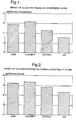
- FIG. 1 shows the effect of slaughter period on tenderness score. Tenderness score is a value that is assigned varying from 1 (extremely tough) to 8 (extremely tender). As can be seen, there is a generally downward trend in tenderness of lamb sold after September.
- Figure 2 shows a similar trend in the overall acceptability score, which ranges from 1 (extremely unacceptable) to 8 (extremely acceptable).
- carcases are hung from the achilles tendon or hock.
- An alternative to conventional hanging is to hang the carcase before the onset of rigor mortis (typically within one hour of stunning) from the symphysis pubis (otherwise known as the "aitch bone").
- the carcases are aged for up to 48 hours from the time of slaughter, and one leg and one loin is removed from each carcase.
- Figure 3 shows the positions of traditional retail joints, including leg joints from a conventionally hung lamb carcase (hung from the achilles tendon).
- the shank/knuckle is removed by a cut (4).
- the angle (6) between the cut (4), and a line (7) perpendicular to the back line (5) is less than 45°.
- these traditional cuts are not particularly suitable for the chump and hind leg of an aitch bone hung carcase.
- FIG 19 shows a conventional technique of cutting an aitch bone hung lamb carcase.
- the leg and chump are removed from the rest of the carcase by a first cut 40.
- a number of cuts 41a-d are then made parallel to the cut 40, to produce a number of "bone in” chops.
- the size of the leg joint 42 is then reduced by removing a number of steaks 43a-d after removing the tip 44 of the aitch bone.
- This cutting technique does not fully exploit the changed shape of the carcase due to aitch bone hanging, and only produces small steaks 43a-d.
- Figure 19A is a photograph of the leg of a lamb carcase which has been aitch bone hung and cut according to the technique shown in Figure 19.
- Figure 19A shows the leg joint 42, three "hone in” chops cuts produced by cuts 41a-c and two small steaks 43a,43b.
- US-A-4628569 describes a conventional method of butchering a side of lamb into a plurality of meat cuts.
- a method of post slaughter handling and cutting a carcase comprises the steps of:
- the back line is defined as being a line at right angles to the dorsal edge of the lumbar vertebrae.
- the carcase may be any species, but is typically a lamb carcase.
- the first and second aspects of the invention exploit the improved and more compact shape which is assumed by the hind legs when the carcase has been aitch bone hung.
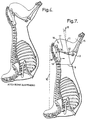
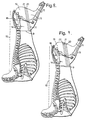
- the knuckle, fillet end and chump are removed by a cut approximately perpendicular to the backline between two vertebrae (for instance last and second last lumbar vertebrae).
- the femur is cut in step (2) at a narrow point between its distal and proximal ends.
- the femur is cut at a position between the middle and distal thirds of the femur.
- one or more steaks may be removed from the fillet end and chump.
- the bones from the fillet end and chump are removed (using the tunnel boning method where appropriate), and one or more steaks are removed by cutting substantially parallel with the cut surface which results from step (2). This produces a much larger steak than can be cut from a traditionally hung carcase.
- the method further comprises removing the distal end of the tibia, fibula and tarsal bones, removing the tail (coccygeal), aitch (pelvic) bone, sacrum and lumbar vertebrae and then removing the remaining bones by tunnel boning.
- the joint is then tied securely and the chump and fillet end portion may then be divided into two or more joints by cutting at right angles to the back line of the carcase.
- a method of post slaughter handling and cutting a carcase comprises the steps of:
- the third and fourth aspects of the invention give the improved eating qualities which result from aitch bone hanging, whilst the straightened leg and chump have a more traditional shape, allowing them to be cut using conventional techniques.
- the method further comprises removing the tail, sacrum and lumbar vertebrae.
- the leg is straightened by positioning the anterior surface of the leg on the edge of a firm surface with the posterior surface of the leg uppermost, holding the posterior surface firmly and applying downward pressure on the distal end of the leg.
- the methods according to first to fourth aspects of the invention further comprise allowing the carcase, or cuts derived from the carcase to age for at least 72 hours from the time of slaughter.
- they are aged between 4 and 10 days, typically 7 days.
- the methods according to the first to fourth aspects of the invention result in very clear benefits for improved tenderness and overall acceptability, and also results in a favourable comparison with samples of conventionally hung chilled lamb.
- the method further comprises applying high voltage stimulation to the carcase.
- High voltage stimulation in combination with aitch bone hanging has also been shown to provide improved eating qualities. This method is suited to any carcase, for instance beef or sheep.
- aitch bone hanging the carcase with the cutting techniques according to the present invention and ageing and/or high voltage electrical stimulation results in a number of conveniently sized cuts, with improved tenderness and eating qualities.
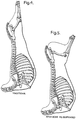
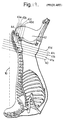
- Figures 4-6 show the skeletal structure of a lamb carcase, and how the outline of the carcase differs from the traditional method of suspension from the achilles or hock joint (Figure 4) when suspended from the aitch bone (or hip) when hot ( Figures 5 and 6).
- Figure 5 the carcase was resuspended from the achilles tendon after cooling and this produced a small change in the shape of the hind leg.
- Figure 6 the carcase has been aitch bone suspended throughout. The carcase may be suspended by a hook or may be hung by a cord. The methods described below can be applied to carcases which have been aitch bone suspended throughout or have been aitch bone suspended until cold and then resuspended from the achilles.
- the entire fillet end and chump may be divided into steaks.
- Figures 10A and 10B illustrate the altered shape of the hind leg of the lamb as a result of aitch bone hanging compared with conventional hanging from the achilles tendon or hock.
- Figure 10A shows a lateral view of a lamb leg (30) which has been conventionally hung (lower joint), and a lamb leg (31) which has been aitch bone hung (upper joint).
- Figure 10B shows a medial view of the lamb legs shown in Figure 10A. As can be seen, the joints have a very different shape.
- FIG. 11A-C An alternative method of producing leg or leg and chump cuts from an aitch bone suspended carcase is shown in Figures 11A-C. This method corresponds to the third and fourth aspects of the present invention.
- Figure 11D is a photograph of parts of a lamb carcase which has been handled and cut as shown in Figures 11A-C. As can be seen, the leg has been cut into two joints 33,34.
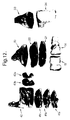
- Figure 12 is a photograph showing the three examples of cutting an aitch-bone hung lamb carcase.
- the Prior art cuts shown on the left of Figure 12 may be contrasted with the cuts shown in the centre ( Figure 8A - Method 2) and on the right ( Figure 11D - Method 4).
- HVES high voltage electrical stimulation
- Ageing (or maturing or conditioning) of the leg and loin cuts also prove beneficial.
- the entire carcase may be aged.
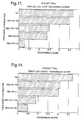
- the cuts or carcase are typically aged at 0-4°C for between 3 days and 12 weeks. However, tests have shown that an ageing period of 10 days is preferable, as can be seen in Figures 13 and 14.
- Figures 13-18 show how the tenderness and overall acceptability scores can be improved by some of the treatments alone or in combination.
- the key to these figures is as follows: NES: No stimulation ES: High voltage electrical stimulation ACH: Achilles suspension AB: Aitch bone suspension 4d: 4 days ageing 10d: 10 days ageing NZ: Chilled New Zealand
- Figures 13-18 show the results from "Hogget” trials on older lamb (slaughtered in January or February) which conventionally shows the deteriorating eating quality shown in Figures 1 and 2.
- Figures 13-16 show the tenderness and overall acceptability scores for loin chops and leg joints which have not been electrically stimulated. It can be seen that aitch bone hung carcases have generally higher scores than achilles tendon hung carcases. It can also be seen that an ageing period of 10 days is preferable.
- FIGs 17 and 18 show similar results for electrically stimulated carcases. It can be seen that electrical stimulation also provides improved scores.
- Figures 13-18 also illustrate how the treatments compare with the New Zealand samples which have been packaged and chilled under special conditions in transit for several weeks.
- This NZ material is clearly very tender but is less good on overall acceptability than some of the treatments. This reflects in part the development of off-flavours in the long aged product.
Landscapes
- Life Sciences & Earth Sciences (AREA)
- Engineering & Computer Science (AREA)
- Food Science & Technology (AREA)
- Processing Of Meat And Fish (AREA)
- Knives (AREA)
- Professional, Industrial, Or Sporting Protective Garments (AREA)
- Scissors And Nippers (AREA)
- Information Transfer Between Computers (AREA)
- Tyre Moulding (AREA)
- Electrotherapy Devices (AREA)
Abstract
Description
| NES: | No stimulation |
| ES: | High voltage electrical stimulation |
| ACH: | Achilles suspension |
| AB: | |
| 4d: | 4 days ageing |
| 10d: | 10 days ageing |
| NZ: | Chilled New Zealand |
Claims (18)
- A method of cutting a carcase which has been hung from its symphysis pubis comprising the steps of:(1) removing the knuckle (13), fillet end (19) and chump (14) from the rest of the carcase; and characterised in that the method further comprises(2) separating the knuckle (13) from the fillet end (19) and chump (14) by cutting at an angle of less than 45° to the back line (10) of the carcase.
- A method of post slaughter handling and cutting a carcase comprises the steps of:(1) hanging the carcase from its symphysis pubis; and(2) cutting the carcase by a method according to claim 1.
- A method according to claim 1 or 2, wherein the knuckle (13), fillet end (19) and chump (14) are removed from the rest of the carcase by a cut (9) between two vertebrae substantially at right angles to the backline (10) of the carcase.
- A method according to any of the preceding claims, wherein the knuckle (13) is separated from the fillet end (19) and chump (14) by cutting through the femur (17) at a position between its middle and distal thirds.
- A method according to any of the preceding claims, wherein the angle of the cut (11) separating the knuckle (13) from the fillet end (19) and chump (14) is between 10 and 20 degrees to the backline (10) of the carcase.
- A method according to any of the preceding claims, further comprising removing the distal end of the tibia, fibula and tarsal bones plus adhering tissue.
- A method according to any of the preceding claims, further comprising removing the tail, aitch bone, sacrum and lumbar vertebrae.
- A method according to any of the preceding claims, further comprising removing the remaining bones from the chump (14) and fillet end (19) using tunnel boning where appropriate.
- A method according to any of the preceding claims, further comprising removing one or more steaks (20-22) from the distal end of the joint by cutting substantially parallel to the line of the cut used to remove the knuckle joint.
- A method according to any of the preceding claims, further comprising tying up the joint formed by the chump and fillet end and separating into two or more parts.
- A method of cutting a carcase which has been hung from its symphysis pubis comprising the steps of:(1) removing the leg and chump from the rest of the carcase; and characterised in that the method further comprises(2) removing at least the pelvic bones; and(3) straightening the leg.
- A method of post slaughter handling and cutting a carcase comprises the steps of:(1) hanging the carcase from its symphysis pubis;(2) cutting the carcase by a method according to claim 11.
- A method according to claim 11 or claim 12, further comprising removing the tail, sacrum and lumbar vertebral bones.
- A method according to any of claims 11 to 13, wherein the leg is straightened by positioning the anterior surface of the leg at the kneecap (position 1) on the edge of a firm surface with the posterior surface (position 2) uppermost so that tibia fibula overhangs the firm surface, holding the posterior surface steady and applying pressure to the end of the leg (position 3) until the whole leg has straightened.
- A method according to any of claims 11 to 14, further comprising treating the cut in a conventional manner to produce boneless chump chops, bone in or boneless whole leg, fillet or knuckle joints.
- A method according to any of claims 1 to 15 further comprising allowing the carcase, or cuts derived from the carcase to age for at least 72 hours from the time of slaughter.
- A method according to claim 16, wherein the carcase or cuts derived from the carcase are aged for between 4 and 10 days.
- A method according to any of the preceding claims further comprising
applying high voltage stimulation to the carcase.
Applications Claiming Priority (3)
| Application Number | Priority Date | Filing Date | Title |
|---|---|---|---|
| GB9409964 | 1994-05-18 | ||
| GB9409964A GB9409964D0 (en) | 1994-05-18 | 1994-05-18 | Methods of post-slaughter handling and cutting a carcase |
| PCT/GB1995/001091 WO1995031109A1 (en) | 1994-05-18 | 1995-05-15 | Methods of post-slaughter handling and cutting a carcase |
Publications (2)
| Publication Number | Publication Date |
|---|---|
| EP0759697A1 EP0759697A1 (en) | 1997-03-05 |
| EP0759697B1 true EP0759697B1 (en) | 1998-07-15 |
Family
ID=10755350
Family Applications (1)
| Application Number | Title | Priority Date | Filing Date |
|---|---|---|---|
| EP95918676A Expired - Lifetime EP0759697B1 (en) | 1994-05-18 | 1995-05-15 | Methods of post-slaughter handling and cutting a carcase |
Country Status (10)
| Country | Link |
|---|---|
| US (1) | US5855507A (en) |
| EP (1) | EP0759697B1 (en) |
| AT (1) | ATE168242T1 (en) |
| AU (2) | AU688502B2 (en) |
| DE (1) | DE69503500T2 (en) |
| DK (1) | DK0759697T3 (en) |
| ES (1) | ES2121383T3 (en) |
| GB (1) | GB9409964D0 (en) |
| NZ (1) | NZ285424A (en) |
| WO (1) | WO1995031109A1 (en) |
Cited By (1)
| Publication number | Priority date | Publication date | Assignee | Title |
|---|---|---|---|---|
| CN109874850A (en) * | 2019-03-19 | 2019-06-14 | 内蒙古农业大学 | A kind of dividing method of mutton |
Families Citing this family (15)
| Publication number | Priority date | Publication date | Assignee | Title |
|---|---|---|---|---|
| US9530150B2 (en) * | 1996-01-19 | 2016-12-27 | Adcension, Llc | Compensation model for network services |
| US6478667B2 (en) * | 2000-01-28 | 2002-11-12 | Excel Corporation | Method and apparatus for tenderizing meat |
| AR018239A1 (en) * | 2000-03-09 | 2001-11-14 | Garcia Pascual Ricardo | PROCEDURE TO OBTAIN UNIFORM CUTS OF HOMOGENIC QUALITY BOVINE MEAT FROM A PROGRAMMED INDUSTRIAL BIOTIPO |
| DK175567B1 (en) * | 2001-07-03 | 2004-12-06 | Slagteriernes Forskningsinst | Method and apparatus for cutting internal bones in a front end |
| US7503839B2 (en) * | 2005-04-06 | 2009-03-17 | Evnin Group Llc | Butchering processes for meat products |
| WO2007053856A1 (en) * | 2005-11-04 | 2007-05-10 | Cargill, Incorporated | Meat tenderization methods and systems |
| US7613330B2 (en) * | 2006-04-03 | 2009-11-03 | Jbs Swift & Company | Methods and systems for tracking and managing livestock through the production process |
| US7606394B2 (en) * | 2006-04-03 | 2009-10-20 | Jbs Swift & Company | Methods and systems for administering a drug program related to livestock |
| US9159126B2 (en) | 2006-04-03 | 2015-10-13 | Jbs Usa, Llc | System and method for analyzing and processing food product |
| US7892076B2 (en) * | 2006-05-22 | 2011-02-22 | Swift & Company | Multibar apparatus and method for electrically stimulating a carcass |
| US7635294B2 (en) * | 2006-07-28 | 2009-12-22 | Tyson Foods, Inc. | Method and apparatus to load and remove bones from primals |
| CA2778248A1 (en) * | 2009-10-30 | 2011-05-05 | Cargill, Incorporated | Method of detaching a muscle and beef products produced by the method |
| US10803771B2 (en) * | 2018-03-28 | 2020-10-13 | Jordan L. B. Williams | Field dress instruction |
| NL2023064B1 (en) | 2019-05-03 | 2020-11-30 | Marel Meat Bv | A method and an apparatus for processing a half pig carcass part hanging from a carrier. |
| US12268217B2 (en) * | 2020-08-03 | 2025-04-08 | NSC Beef Processing, LLC | Method for processing beef |
Family Cites Families (7)
| Publication number | Priority date | Publication date | Assignee | Title |
|---|---|---|---|---|
| US3210802A (en) * | 1964-02-19 | 1965-10-12 | Graham A Gray | Method of severing a section of meat from a large suspended body thereof |
| US3916484A (en) * | 1973-10-05 | 1975-11-04 | Raymond A Kennedy | Method and apparatus for automatic carcass cutting |
| US3940998A (en) * | 1974-09-26 | 1976-03-02 | International Telephone And Telegraph Corporation | Hog processing method |
| GB2147791A (en) * | 1983-10-12 | 1985-05-22 | Vyzk Ustav Zivocisne Vyroby | An apparatus for speeding up the ripening of meat |
| US4628569A (en) * | 1985-02-13 | 1986-12-16 | Southdown Meat Company, Inc. | Method of butchering a side of lamb and cuts resulting therefrom |
| DK171036B1 (en) * | 1993-04-26 | 1996-04-29 | Slagteriernes Forskningsinst | Method and apparatus for fixing carved carcasses on slaughtered pigs at the hind legs |
| US5464368A (en) * | 1994-07-05 | 1995-11-07 | White; John A. | Process for preparing pork meat morsels |
-
1994
- 1994-05-18 GB GB9409964A patent/GB9409964D0/en active Pending
-
1995
- 1995-05-15 DK DK95918676T patent/DK0759697T3/en active
- 1995-05-15 NZ NZ285424A patent/NZ285424A/en unknown
- 1995-05-15 US US08/737,609 patent/US5855507A/en not_active Expired - Fee Related
- 1995-05-15 WO PCT/GB1995/001091 patent/WO1995031109A1/en not_active Ceased
- 1995-05-15 EP EP95918676A patent/EP0759697B1/en not_active Expired - Lifetime
- 1995-05-15 AU AU24510/95A patent/AU688502B2/en not_active Ceased
- 1995-05-15 AT AT95918676T patent/ATE168242T1/en not_active IP Right Cessation
- 1995-05-15 DE DE69503500T patent/DE69503500T2/en not_active Expired - Fee Related
- 1995-05-15 ES ES95918676T patent/ES2121383T3/en not_active Expired - Lifetime
-
1997
- 1997-12-30 AU AU49298/97A patent/AU692130B2/en not_active Ceased
Cited By (1)
| Publication number | Priority date | Publication date | Assignee | Title |
|---|---|---|---|---|
| CN109874850A (en) * | 2019-03-19 | 2019-06-14 | 内蒙古农业大学 | A kind of dividing method of mutton |
Also Published As
| Publication number | Publication date |
|---|---|
| AU2451095A (en) | 1995-12-05 |
| US5855507A (en) | 1999-01-05 |
| DE69503500D1 (en) | 1998-08-20 |
| ATE168242T1 (en) | 1998-08-15 |
| WO1995031109A1 (en) | 1995-11-23 |
| AU4929897A (en) | 1998-03-05 |
| AU692130B2 (en) | 1998-05-28 |
| EP0759697A1 (en) | 1997-03-05 |
| DK0759697T3 (en) | 1999-04-19 |
| DE69503500T2 (en) | 1998-11-19 |
| NZ285424A (en) | 1998-03-25 |
| ES2121383T3 (en) | 1998-11-16 |
| AU688502B2 (en) | 1998-03-12 |
| GB9409964D0 (en) | 1994-07-06 |
Similar Documents
| Publication | Publication Date | Title |
|---|---|---|
| US5855507A (en) | Methods of post-slaughter handling and cutting a carcase | |
| Sørheim et al. | Influence of beef carcass stretching and chilling rate on tenderness of m. longissimus dorsi | |
| Cason et al. | Effect of muscle opposition during rigor on development of broiler breast meat tenderness | |
| US6769977B2 (en) | Method for preparing fowl meat cut | |
| US5951392A (en) | Method for cutting a flat or round | |
| US5525103A (en) | Process for preparing pork back rib cuts | |
| Contreras et al. | Electrical stunning, hot boning, and quality of chicken breast meat | |
| US20080286437A1 (en) | Method for the Production of Sausages | |
| CN109874850B (en) | A method of cutting mutton | |
| US5667436A (en) | Method for cutting animal knuckle | |
| US6527636B2 (en) | Method of cutting ribs | |
| US5263891A (en) | Turkey processing-hot deboning | |
| NZ329504A (en) | Post-slaughter handling and cutting a carcase hung from its symphysis pubis comprises removing leg chump and pelvic bones then straightening the leg | |
| Soladoye | 5 Meat and meat products processing | |
| Apata et al. | Physicochemical, histological and organoleptic evaluation of Red-Sokoto (Maradi) buck meat as affected by carcass dressing methods. | |
| McLeod et al. | Hot cutting of lamb and mutton | |
| GB2234659A (en) | Method of treating meat | |
| WO2001037674A1 (en) | Method of, and apparatus for, treating meat | |
| McKeith et al. | Technology of developing low-fat meat products | |
| KR20110047236A (en) | Use of high pressure processing to improve muscle quality by inhibiting post mortem glycolysis | |
| US2281449A (en) | Ham butchering | |
| Pearson et al. | Restructured meat products | |
| Bayliss | Chemistry in the kitchen: the chemistry of flesh foods II | |
| Orts et al. | Texas AandM" Tenderstretch". | |
| US20120276273A1 (en) | Method of detaching a muscle and beef products produced by the method |
Legal Events
| Date | Code | Title | Description |
|---|---|---|---|
| PUAI | Public reference made under article 153(3) epc to a published international application that has entered the european phase |
Free format text: ORIGINAL CODE: 0009012 |
|
| 17P | Request for examination filed |
Effective date: 19961129 |
|
| AK | Designated contracting states |
Kind code of ref document: A1 Designated state(s): AT BE CH DE DK ES FR GB GR IE IT LI LU MC NL PT SE |
|
| 17Q | First examination report despatched |
Effective date: 19970402 |
|
| GRAG | Despatch of communication of intention to grant |
Free format text: ORIGINAL CODE: EPIDOS AGRA |
|
| GRAG | Despatch of communication of intention to grant |
Free format text: ORIGINAL CODE: EPIDOS AGRA |
|
| GRAH | Despatch of communication of intention to grant a patent |
Free format text: ORIGINAL CODE: EPIDOS IGRA |
|
| GRAH | Despatch of communication of intention to grant a patent |
Free format text: ORIGINAL CODE: EPIDOS IGRA |
|
| GRAA | (expected) grant |
Free format text: ORIGINAL CODE: 0009210 |
|
| AK | Designated contracting states |
Kind code of ref document: B1 Designated state(s): AT BE CH DE DK ES FR GB GR IE IT LI LU MC NL PT SE |
|
| REF | Corresponds to: |
Ref document number: 168242 Country of ref document: AT Date of ref document: 19980815 Kind code of ref document: T |
|
| REG | Reference to a national code |
Ref country code: CH Ref legal event code: EP |
|
| REF | Corresponds to: |
Ref document number: 69503500 Country of ref document: DE Date of ref document: 19980820 |
|
| REG | Reference to a national code |
Ref country code: IE Ref legal event code: FG4D |
|
| ET | Fr: translation filed | ||
| REG | Reference to a national code |
Ref country code: CH Ref legal event code: NV Representative=s name: ISLER & PEDRAZZINI AG |
|
| REG | Reference to a national code |
Ref country code: ES Ref legal event code: FG2A Ref document number: 2121383 Country of ref document: ES Kind code of ref document: T3 |
|
| REG | Reference to a national code |
Ref country code: PT Ref legal event code: SC4A Free format text: AVAILABILITY OF NATIONAL TRANSLATION Effective date: 19981009 |
|
| REG | Reference to a national code |
Ref country code: DK Ref legal event code: T3 |
|
| PLBE | No opposition filed within time limit |
Free format text: ORIGINAL CODE: 0009261 |
|
| STAA | Information on the status of an ep patent application or granted ep patent |
Free format text: STATUS: NO OPPOSITION FILED WITHIN TIME LIMIT |
|
| 26N | No opposition filed | ||
| REG | Reference to a national code |
Ref country code: GB Ref legal event code: IF02 |
|
| PGFP | Annual fee paid to national office [announced via postgrant information from national office to epo] |
Ref country code: MC Payment date: 20040428 Year of fee payment: 10 |
|
| PGFP | Annual fee paid to national office [announced via postgrant information from national office to epo] |
Ref country code: NL Payment date: 20040505 Year of fee payment: 10 |
|
| PGFP | Annual fee paid to national office [announced via postgrant information from national office to epo] |
Ref country code: SE Payment date: 20040506 Year of fee payment: 10 Ref country code: PT Payment date: 20040506 Year of fee payment: 10 |
|
| PGFP | Annual fee paid to national office [announced via postgrant information from national office to epo] |
Ref country code: FR Payment date: 20040510 Year of fee payment: 10 |
|
| PGFP | Annual fee paid to national office [announced via postgrant information from national office to epo] |
Ref country code: LU Payment date: 20040512 Year of fee payment: 10 Ref country code: IE Payment date: 20040512 Year of fee payment: 10 Ref country code: GB Payment date: 20040512 Year of fee payment: 10 Ref country code: AT Payment date: 20040512 Year of fee payment: 10 |
|
| PGFP | Annual fee paid to national office [announced via postgrant information from national office to epo] |
Ref country code: DK Payment date: 20040517 Year of fee payment: 10 Ref country code: CH Payment date: 20040517 Year of fee payment: 10 |
|
| PGFP | Annual fee paid to national office [announced via postgrant information from national office to epo] |
Ref country code: ES Payment date: 20040518 Year of fee payment: 10 |
|
| PGFP | Annual fee paid to national office [announced via postgrant information from national office to epo] |
Ref country code: GR Payment date: 20040526 Year of fee payment: 10 |
|
| PGFP | Annual fee paid to national office [announced via postgrant information from national office to epo] |
Ref country code: DE Payment date: 20040527 Year of fee payment: 10 |
|
| PGFP | Annual fee paid to national office [announced via postgrant information from national office to epo] |
Ref country code: BE Payment date: 20040716 Year of fee payment: 10 |
|
| PG25 | Lapsed in a contracting state [announced via postgrant information from national office to epo] |
Ref country code: IT Free format text: LAPSE BECAUSE OF NON-PAYMENT OF DUE FEES Effective date: 20050515 Ref country code: GB Free format text: LAPSE BECAUSE OF NON-PAYMENT OF DUE FEES Effective date: 20050515 Ref country code: AT Free format text: LAPSE BECAUSE OF NON-PAYMENT OF DUE FEES Effective date: 20050515 |
|
| PG25 | Lapsed in a contracting state [announced via postgrant information from national office to epo] |
Ref country code: SE Free format text: LAPSE BECAUSE OF NON-PAYMENT OF DUE FEES Effective date: 20050516 Ref country code: IE Free format text: LAPSE BECAUSE OF NON-PAYMENT OF DUE FEES Effective date: 20050516 Ref country code: ES Free format text: LAPSE BECAUSE OF NON-PAYMENT OF DUE FEES Effective date: 20050516 |
|
| PG25 | Lapsed in a contracting state [announced via postgrant information from national office to epo] |
Ref country code: MC Free format text: LAPSE BECAUSE OF NON-PAYMENT OF DUE FEES Effective date: 20050531 Ref country code: LI Free format text: LAPSE BECAUSE OF NON-PAYMENT OF DUE FEES Effective date: 20050531 Ref country code: DK Free format text: LAPSE BECAUSE OF NON-PAYMENT OF DUE FEES Effective date: 20050531 Ref country code: CH Free format text: LAPSE BECAUSE OF NON-PAYMENT OF DUE FEES Effective date: 20050531 Ref country code: BE Free format text: LAPSE BECAUSE OF NON-PAYMENT OF DUE FEES Effective date: 20050531 |
|
| PG25 | Lapsed in a contracting state [announced via postgrant information from national office to epo] |
Ref country code: PT Free format text: LAPSE BECAUSE OF NON-PAYMENT OF DUE FEES Effective date: 20051115 |
|
| BERE | Be: lapsed |
Owner name: *MEAT & LIVESTOCK COMMISSION Effective date: 20050531 |
|
| PG25 | Lapsed in a contracting state [announced via postgrant information from national office to epo] |
Ref country code: NL Free format text: LAPSE BECAUSE OF NON-PAYMENT OF DUE FEES Effective date: 20051201 Ref country code: DE Free format text: LAPSE BECAUSE OF NON-PAYMENT OF DUE FEES Effective date: 20051201 |
|
| PG25 | Lapsed in a contracting state [announced via postgrant information from national office to epo] |
Ref country code: GR Free format text: LAPSE BECAUSE OF NON-PAYMENT OF DUE FEES Effective date: 20051205 |
|
| REG | Reference to a national code |
Ref country code: CH Ref legal event code: PL |
|
| EUG | Se: european patent has lapsed | ||
| GBPC | Gb: european patent ceased through non-payment of renewal fee |
Effective date: 20050515 |
|
| PG25 | Lapsed in a contracting state [announced via postgrant information from national office to epo] |
Ref country code: FR Free format text: LAPSE BECAUSE OF NON-PAYMENT OF DUE FEES Effective date: 20060131 |
|
| NLV4 | Nl: lapsed or anulled due to non-payment of the annual fee |
Effective date: 20051201 |
|
| REG | Reference to a national code |
Ref country code: IE Ref legal event code: MM4A |
|
| REG | Reference to a national code |
Ref country code: DK Ref legal event code: EBP |
|
| REG | Reference to a national code |
Ref country code: FR Ref legal event code: ST Effective date: 20060131 |
|
| REG | Reference to a national code |
Ref country code: ES Ref legal event code: FD2A Effective date: 20050516 |
|
| BERE | Be: lapsed |
Owner name: *MEAT & LIVESTOCK COMMISSION Effective date: 20050531 |