EP0758630B1 - Slurry compositions for plastic molding purposes and products obtained thereof - Google Patents
Slurry compositions for plastic molding purposes and products obtained thereof Download PDFInfo
- Publication number
- EP0758630B1 EP0758630B1 EP19950112818 EP95112818A EP0758630B1 EP 0758630 B1 EP0758630 B1 EP 0758630B1 EP 19950112818 EP19950112818 EP 19950112818 EP 95112818 A EP95112818 A EP 95112818A EP 0758630 B1 EP0758630 B1 EP 0758630B1
- Authority
- EP
- European Patent Office
- Prior art keywords
- molding
- water
- slurry
- base material
- purposes
- Prior art date
- Legal status (The legal status is an assumption and is not a legal conclusion. Google has not performed a legal analysis and makes no representation as to the accuracy of the status listed.)
- Expired - Lifetime
Links
- 239000002002 slurry Substances 0.000 title claims description 24
- 238000010137 moulding (plastic) Methods 0.000 title claims description 22
- 239000000203 mixture Substances 0.000 title claims description 6
- 229920005989 resin Polymers 0.000 claims description 34
- 239000011347 resin Substances 0.000 claims description 34
- 239000000463 material Substances 0.000 claims description 30
- 238000000465 moulding Methods 0.000 claims description 27
- XLYOFNOQVPJJNP-UHFFFAOYSA-N water Substances O XLYOFNOQVPJJNP-UHFFFAOYSA-N 0.000 claims description 24
- 239000000843 powder Substances 0.000 claims description 23
- 238000000034 method Methods 0.000 claims description 15
- 239000000919 ceramic Substances 0.000 claims description 12
- 229910052573 porcelain Inorganic materials 0.000 claims description 12
- 238000004898 kneading Methods 0.000 claims description 9
- 238000001125 extrusion Methods 0.000 claims description 8
- 238000001035 drying Methods 0.000 description 15
- 238000010304 firing Methods 0.000 description 9
- 239000004744 fabric Substances 0.000 description 8
- 239000000839 emulsion Substances 0.000 description 7
- 239000003795 chemical substances by application Substances 0.000 description 5
- 238000004519 manufacturing process Methods 0.000 description 5
- VYPSYNLAJGMNEJ-UHFFFAOYSA-N Silicium dioxide Chemical compound O=[Si]=O VYPSYNLAJGMNEJ-UHFFFAOYSA-N 0.000 description 4
- 239000004927 clay Substances 0.000 description 4
- 238000001914 filtration Methods 0.000 description 4
- 230000009477 glass transition Effects 0.000 description 4
- 238000010298 pulverizing process Methods 0.000 description 4
- HEMHJVSKTPXQMS-UHFFFAOYSA-M Sodium hydroxide Chemical compound [OH-].[Na+] HEMHJVSKTPXQMS-UHFFFAOYSA-M 0.000 description 3
- 230000015572 biosynthetic process Effects 0.000 description 3
- 238000005336 cracking Methods 0.000 description 3
- 229920003023 plastic Polymers 0.000 description 3
- 239000004033 plastic Substances 0.000 description 3
- JUJWROOIHBZHMG-UHFFFAOYSA-N Pyridine Chemical compound C1=CC=NC=C1 JUJWROOIHBZHMG-UHFFFAOYSA-N 0.000 description 2
- MCMNRKCIXSYSNV-UHFFFAOYSA-N Zirconium dioxide Chemical compound O=[Zr]=O MCMNRKCIXSYSNV-UHFFFAOYSA-N 0.000 description 2
- 239000002270 dispersing agent Substances 0.000 description 2
- 239000006185 dispersion Substances 0.000 description 2
- 238000002156 mixing Methods 0.000 description 2
- -1 poly(vinyl acetate) Polymers 0.000 description 2
- 239000002994 raw material Substances 0.000 description 2
- 238000000926 separation method Methods 0.000 description 2
- 239000000377 silicon dioxide Substances 0.000 description 2
- NTHWMYGWWRZVTN-UHFFFAOYSA-N sodium silicate Chemical compound [Na+].[Na+].[O-][Si]([O-])=O NTHWMYGWWRZVTN-UHFFFAOYSA-N 0.000 description 2
- WRIDQFICGBMAFQ-UHFFFAOYSA-N (E)-8-Octadecenoic acid Natural products CCCCCCCCCC=CCCCCCCC(O)=O WRIDQFICGBMAFQ-UHFFFAOYSA-N 0.000 description 1
- TUSDEZXZIZRFGC-UHFFFAOYSA-N 1-O-galloyl-3,6-(R)-HHDP-beta-D-glucose Natural products OC1C(O2)COC(=O)C3=CC(O)=C(O)C(O)=C3C3=C(O)C(O)=C(O)C=C3C(=O)OC1C(O)C2OC(=O)C1=CC(O)=C(O)C(O)=C1 TUSDEZXZIZRFGC-UHFFFAOYSA-N 0.000 description 1
- LQJBNNIYVWPHFW-UHFFFAOYSA-N 20:1omega9c fatty acid Natural products CCCCCCCCCCC=CCCCCCCCC(O)=O LQJBNNIYVWPHFW-UHFFFAOYSA-N 0.000 description 1
- HNNQYHFROJDYHQ-UHFFFAOYSA-N 3-(4-ethylcyclohexyl)propanoic acid 3-(3-ethylcyclopentyl)propanoic acid Chemical compound CCC1CCC(CCC(O)=O)C1.CCC1CCC(CCC(O)=O)CC1 HNNQYHFROJDYHQ-UHFFFAOYSA-N 0.000 description 1
- QJZYHAIUNVAGQP-UHFFFAOYSA-N 3-nitrobicyclo[2.2.1]hept-5-ene-2,3-dicarboxylic acid Chemical compound C1C2C=CC1C(C(=O)O)C2(C(O)=O)[N+]([O-])=O QJZYHAIUNVAGQP-UHFFFAOYSA-N 0.000 description 1
- QSBYPNXLFMSGKH-UHFFFAOYSA-N 9-Heptadecensaeure Natural products CCCCCCCC=CCCCCCCCC(O)=O QSBYPNXLFMSGKH-UHFFFAOYSA-N 0.000 description 1
- 229920000178 Acrylic resin Polymers 0.000 description 1
- 239000004925 Acrylic resin Substances 0.000 description 1
- 239000005995 Aluminium silicate Substances 0.000 description 1
- 239000001263 FEMA 3042 Substances 0.000 description 1
- 239000005642 Oleic acid Substances 0.000 description 1
- ZQPPMHVWECSIRJ-UHFFFAOYSA-N Oleic acid Natural products CCCCCCCCC=CCCCCCCCC(O)=O ZQPPMHVWECSIRJ-UHFFFAOYSA-N 0.000 description 1
- LRBQNJMCXXYXIU-PPKXGCFTSA-N Penta-digallate-beta-D-glucose Natural products OC1=C(O)C(O)=CC(C(=O)OC=2C(=C(O)C=C(C=2)C(=O)OC[C@@H]2[C@H]([C@H](OC(=O)C=3C=C(OC(=O)C=4C=C(O)C(O)=C(O)C=4)C(O)=C(O)C=3)[C@@H](OC(=O)C=3C=C(OC(=O)C=4C=C(O)C(O)=C(O)C=4)C(O)=C(O)C=3)[C@H](OC(=O)C=3C=C(OC(=O)C=4C=C(O)C(O)=C(O)C=4)C(O)=C(O)C=3)O2)OC(=O)C=2C=C(OC(=O)C=3C=C(O)C(O)=C(O)C=3)C(O)=C(O)C=2)O)=C1 LRBQNJMCXXYXIU-PPKXGCFTSA-N 0.000 description 1
- 229910052581 Si3N4 Inorganic materials 0.000 description 1
- 239000004115 Sodium Silicate Substances 0.000 description 1
- 229920002125 Sokalan® Polymers 0.000 description 1
- 235000021355 Stearic acid Nutrition 0.000 description 1
- XTXRWKRVRITETP-UHFFFAOYSA-N Vinyl acetate Chemical compound CC(=O)OC=C XTXRWKRVRITETP-UHFFFAOYSA-N 0.000 description 1
- PNEYBMLMFCGWSK-UHFFFAOYSA-N aluminium oxide Inorganic materials [O-2].[O-2].[O-2].[Al+3].[Al+3] PNEYBMLMFCGWSK-UHFFFAOYSA-N 0.000 description 1
- 235000012211 aluminium silicate Nutrition 0.000 description 1
- 239000003638 chemical reducing agent Substances 0.000 description 1
- 229920006026 co-polymeric resin Polymers 0.000 description 1
- 239000000084 colloidal system Substances 0.000 description 1
- 230000000052 comparative effect Effects 0.000 description 1
- 238000013329 compounding Methods 0.000 description 1
- 238000001816 cooling Methods 0.000 description 1
- 238000005520 cutting process Methods 0.000 description 1
- 230000003111 delayed effect Effects 0.000 description 1
- HPNMFZURTQLUMO-UHFFFAOYSA-N diethylamine Chemical compound CCNCC HPNMFZURTQLUMO-UHFFFAOYSA-N 0.000 description 1
- 230000003292 diminished effect Effects 0.000 description 1
- WEHWNAOGRSTTBQ-UHFFFAOYSA-N dipropylamine Chemical compound CCCNCCC WEHWNAOGRSTTBQ-UHFFFAOYSA-N 0.000 description 1
- 239000002612 dispersion medium Substances 0.000 description 1
- 230000000694 effects Effects 0.000 description 1
- 239000003995 emulsifying agent Substances 0.000 description 1
- 239000010433 feldspar Substances 0.000 description 1
- 238000007730 finishing process Methods 0.000 description 1
- 238000005187 foaming Methods 0.000 description 1
- 238000009472 formulation Methods 0.000 description 1
- LRBQNJMCXXYXIU-QWKBTXIPSA-N gallotannic acid Chemical compound OC1=C(O)C(O)=CC(C(=O)OC=2C(=C(O)C=C(C=2)C(=O)OC[C@H]2[C@@H]([C@@H](OC(=O)C=3C=C(OC(=O)C=4C=C(O)C(O)=C(O)C=4)C(O)=C(O)C=3)[C@H](OC(=O)C=3C=C(OC(=O)C=4C=C(O)C(O)=C(O)C=4)C(O)=C(O)C=3)[C@@H](OC(=O)C=3C=C(OC(=O)C=4C=C(O)C(O)=C(O)C=4)C(O)=C(O)C=3)O2)OC(=O)C=2C=C(OC(=O)C=3C=C(O)C(O)=C(O)C=3)C(O)=C(O)C=2)O)=C1 LRBQNJMCXXYXIU-QWKBTXIPSA-N 0.000 description 1
- 239000004021 humic acid Substances 0.000 description 1
- QXJSBBXBKPUZAA-UHFFFAOYSA-N isooleic acid Natural products CCCCCCCC=CCCCCCCCCC(O)=O QXJSBBXBKPUZAA-UHFFFAOYSA-N 0.000 description 1
- NLYAJNPCOHFWQQ-UHFFFAOYSA-N kaolin Chemical compound O.O.O=[Al]O[Si](=O)O[Si](=O)O[Al]=O NLYAJNPCOHFWQQ-UHFFFAOYSA-N 0.000 description 1
- 229920005610 lignin Polymers 0.000 description 1
- 239000011268 mixed slurry Substances 0.000 description 1
- QIQXTHQIDYTFRH-UHFFFAOYSA-N octadecanoic acid Chemical compound CCCCCCCCCCCCCCCCCC(O)=O QIQXTHQIDYTFRH-UHFFFAOYSA-N 0.000 description 1
- OQCDKBAXFALNLD-UHFFFAOYSA-N octadecanoic acid Natural products CCCCCCCC(C)CCCCCCCCC(O)=O OQCDKBAXFALNLD-UHFFFAOYSA-N 0.000 description 1
- ZQPPMHVWECSIRJ-KTKRTIGZSA-N oleic acid Chemical compound CCCCCCCC\C=C/CCCCCCCC(O)=O ZQPPMHVWECSIRJ-KTKRTIGZSA-N 0.000 description 1
- 239000002245 particle Substances 0.000 description 1
- 150000003014 phosphoric acid esters Chemical class 0.000 description 1
- 239000004014 plasticizer Substances 0.000 description 1
- 239000004584 polyacrylic acid Substances 0.000 description 1
- 229920002689 polyvinyl acetate Polymers 0.000 description 1
- 239000011118 polyvinyl acetate Substances 0.000 description 1
- 235000019353 potassium silicate Nutrition 0.000 description 1
- 238000002360 preparation method Methods 0.000 description 1
- 238000003825 pressing Methods 0.000 description 1
- 230000001681 protective effect Effects 0.000 description 1
- UMJSCPRVCHMLSP-UHFFFAOYSA-N pyridine Natural products COC1=CC=CN=C1 UMJSCPRVCHMLSP-UHFFFAOYSA-N 0.000 description 1
- 150000003839 salts Chemical class 0.000 description 1
- HBMJWWWQQXIZIP-UHFFFAOYSA-N silicon carbide Chemical compound [Si+]#[C-] HBMJWWWQQXIZIP-UHFFFAOYSA-N 0.000 description 1
- 229910010271 silicon carbide Inorganic materials 0.000 description 1
- HQVNEWCFYHHQES-UHFFFAOYSA-N silicon nitride Chemical compound N12[Si]34N5[Si]62N3[Si]51N64 HQVNEWCFYHHQES-UHFFFAOYSA-N 0.000 description 1
- 235000011121 sodium hydroxide Nutrition 0.000 description 1
- 229910052911 sodium silicate Inorganic materials 0.000 description 1
- 235000019794 sodium silicate Nutrition 0.000 description 1
- 239000007787 solid Substances 0.000 description 1
- 238000007711 solidification Methods 0.000 description 1
- 230000008023 solidification Effects 0.000 description 1
- 238000001694 spray drying Methods 0.000 description 1
- 239000008117 stearic acid Substances 0.000 description 1
- 239000004575 stone Substances 0.000 description 1
- 229920002258 tannic acid Polymers 0.000 description 1
- 229940033123 tannic acid Drugs 0.000 description 1
- 235000015523 tannic acid Nutrition 0.000 description 1
- 239000000080 wetting agent Substances 0.000 description 1
- 229910000859 α-Fe Inorganic materials 0.000 description 1
Classifications
-
- C—CHEMISTRY; METALLURGY
- C04—CEMENTS; CONCRETE; ARTIFICIAL STONE; CERAMICS; REFRACTORIES
- C04B—LIME, MAGNESIA; SLAG; CEMENTS; COMPOSITIONS THEREOF, e.g. MORTARS, CONCRETE OR LIKE BUILDING MATERIALS; ARTIFICIAL STONE; CERAMICS; REFRACTORIES; TREATMENT OF NATURAL STONE
- C04B33/00—Clay-wares
- C04B33/02—Preparing or treating the raw materials individually or as batches
- C04B33/13—Compounding ingredients
- C04B33/18—Compounding ingredients for liquefying the batches
-
- C—CHEMISTRY; METALLURGY
- C04—CEMENTS; CONCRETE; ARTIFICIAL STONE; CERAMICS; REFRACTORIES
- C04B—LIME, MAGNESIA; SLAG; CEMENTS; COMPOSITIONS THEREOF, e.g. MORTARS, CONCRETE OR LIKE BUILDING MATERIALS; ARTIFICIAL STONE; CERAMICS; REFRACTORIES; TREATMENT OF NATURAL STONE
- C04B33/00—Clay-wares
- C04B33/28—Slip casting
-
- C—CHEMISTRY; METALLURGY
- C04—CEMENTS; CONCRETE; ARTIFICIAL STONE; CERAMICS; REFRACTORIES
- C04B—LIME, MAGNESIA; SLAG; CEMENTS; COMPOSITIONS THEREOF, e.g. MORTARS, CONCRETE OR LIKE BUILDING MATERIALS; ARTIFICIAL STONE; CERAMICS; REFRACTORIES; TREATMENT OF NATURAL STONE
- C04B35/00—Shaped ceramic products characterised by their composition; Ceramics compositions; Processing powders of inorganic compounds preparatory to the manufacturing of ceramic products
- C04B35/622—Forming processes; Processing powders of inorganic compounds preparatory to the manufacturing of ceramic products
- C04B35/626—Preparing or treating the powders individually or as batches ; preparing or treating macroscopic reinforcing agents for ceramic products, e.g. fibres; mechanical aspects section B
- C04B35/63—Preparing or treating the powders individually or as batches ; preparing or treating macroscopic reinforcing agents for ceramic products, e.g. fibres; mechanical aspects section B using additives specially adapted for forming the products, e.g.. binder binders
- C04B35/632—Organic additives
- C04B35/634—Polymers
Definitions
- This invention concerns a method of molding a base for plastic molding purposes, which is formed by kneading after dewatering a slurry composition, whereby 0.5 - 20 parts by weight of redispersible resin powder and water are added to, and mixed with, 100 parts by weight of base material for porcelain and/or ceramic purposes, and said base for plastic molding purposes is plastically molded into the prescribed shape by extrusion or power wheel molding.
- a suitable quantity of water etc. has been added to the required base material, such as a base material for porcelain purposes or a base material for ceramic purposes for example, to provide fluidity (water content generally 40 - 70%) and the mixture has been mixed and pulverised in a ball mill, for example, to prepare a slurry, and then a pressed cake of water content 10 - 30% has been formed by dewatering in a filter press, for example.
- This pressed cake has then been formed into a base for plastic molding purposes using a vacuum kneading machine and then plastically molded, which is to say it has been molded to the prescribed shape by extrusion molding or wheel molding.
- the final molding has then been obtained by processes such as drying, pre-baking, glazing, firing and cutting etc., but when such a method is used there must be no problem with dewatering, there must be no gas bubbles in the base material, the drying of the moldings must be rapid, and the moldings must have a mechanical strength such that they can be handled in the finishing process and in transportation for example.
- plasticity required for molding has been inadequate for plastic molding with the bases for ceramic purposes when manufacturing ceramics, and there has been a problem in that plastic moldings of adequate strength could not be obtained.
- the invention of this application is a method of molding a base for plastic molding purposes, which is formed by kneading after dewatering a slurry composition, whereby 0.5 - 20 parts by weight of redispersible resin powder and water are added to, and mixed with, 100 parts by weight of base material for porcelain and/or ceramic purposes, and said base for plastic molding purposes is plastically molded into the prescribed shape by extrusion or power wheel molding.
- the known porcelain raw materials such as feldspar, silica, pottery stone, kaolin and clay for example, can be used for the porcelain base material in this present invention
- the known ceramic raw materials such as alumina, zirconia, silica, ferrite, silicon carbide, silicon nitride or saialon for example
- These porcelain base materials and ceramic base materials can each be used individually, or they can be used in a suitable formulation, as required.
- the prescribed base materials such as porcelain base materials and ceramic base materials for example, are referred to simply as the base material.
- redispersible resin powder which has been obtained by spray drying a poly(vinyl acetate), vinyl acetate copolymer or acrylic resin based emulsion is used for the redispersible resin powder.
- the glass transition temperature of this redispersible resin powder is preferably -5°C or above, from the viewpoint of ideal film formation molding, and in those cases where it is below -5°C it is liable to undergo cohesion and attachment and, conversely, if the glass transition temperature is too high then film formation on molding is liable to become inadequate, and so a glass transition temperature of 0 - 20°C is preferred.
- the drying temperature may be raised or the time may be increased, or a plasticizer or a film forming promoter may be added.
- the amount of redispersible resin powder which is added to the base material differs according to the type of base material, the type of redispersible resin powder and the characteristics of the sinter which is to be manufactured, for example, but it is generally 0.5 - 20 parts by weight, and preferably 1.0 - 15 parts by weight.
- redispersible resin powders are available commercially with trade names such as, for example, Sumikafurekksu (registered trademark) RP-1005 and RP-110 (manufactured by Sumitomo Kagaku Kogyo K.K., Akuronarru (registered trademark) DS-6029 and DS-6031 manufactured by the Mitsubishi yuka Baadeisshe K.K., and Movinyl (registered trademark) DM200, DM289, 843, 5A, E45 manufactured by Hoechst Kasei K.K.
- trade names such as, for example, Sumikafurekksu (registered trademark) RP-1005 and RP-110 (manufactured by Sumitomo Kagaku Kogyo K.K., Akuronarru (registered trademark) DS-6029 and DS-6031 manufactured by the Mitsubishi yuka Baadeisshe K.K., and Movinyl (registered trademark)
- water is preferably added as a dispersion medium in such a way that the water content of the slurry is of the order of 40 - 70 percent by weight.
- inorganic deflocculating agents such as caustic soda, sodium silicate, water glass and phosphate esters, organic deflocculating agents such as diethylamine, di-n-propylamine, pyridine and polyacrylic acid salts, protective colloids such as humic acid, tannic acid and lignin, pulverization promoters such as stearic acid, oleic acid and naphthenic acid, and dispersing agents, wetting agents, water-reducing agents, fluidizing agents, high performance fluidizing agents and emulsifying agents, for example, can be added, as required.
- the slurry is prepared by adding the prescribed amount of redispersible resin powder to the base material and adding the water and deflocculating agent, as required, and pulverizing with a known type of pulverizing machine, such as a ball mill or a tube mill for example, in such a way that the particle size of the base material is 0.1 - 10 ⁇ m.
- the redispersible resin powder is a powder and so when compared with a conventional aqueous resin emulsion foaming does not occur, and the separation which accompanies difference in density from the base material, and cohesion, do not occur and it is uniformly dispersed in a very stable manner, and a slurry of the correct viscosity is prepared ideally.
- the redispersible resin powder is in general uniformly dispersed in a stable manner in the prepared slurry.
- the base material and water may be pre-formed into a slurry and the redispersible resin powder may be added to, and mixed with, this slurry, but it is difficult to disperse and time is required for dispersion, and so the base material and the redispersible resin powder are preferably formed into a slurry at the same time.
- the slurry obtained is dewatered and concentrated by means of a press type filtering machine, for example a filter press, using the known procedure, and a pressed cake of water content 10 - 30 percent by weight, and preferably of 15 - 25 percent by weight, is formed.
- a press type filtering machine for example a filter press
- This process is one in which the slurry is dewatered through a filter cloth and, since the redispersible resin powder is uniformly dispersed in a very stable manner, only water is passed through the filter cloth and removed, and there is no blockage of the filter cloth, cohesion or attachment, or filming, and the filtering operation can be carried out very easily and, moreover, there is no attachment of the pressed cake to the filter cloth and the pressed cake can be removed easily.
- the pressed cake obtained is kneaded with a known kneading machine to prepare a plastic base.
- plastic molding such as extrusion molding or power-wheel molding for example, is carried out using this plastic base, and the prescribed plastic moldings are formed.
- the plastic moldings obtained are subjected to a suitable drying treatment, but they are best dried at 20°C or above.
- the redispersible resin powder is in a stable and uniformly dispersed state and so bulging, peeling and cracking etc. are not likely to occur during the drying treatment or the firing treatment, and because the strength before firing is high it is possible to form prescribed thin forms.
- the pulverized and mixed slurry is prepared in the most ideal state, and a base for plastic molding purposes is prepared by dewatering and concentrating this slurry, but this can also be used to the prepare a slurry for plastic molding purposes, with the addition of more water and dispersing agent, for example, to the plastic base.
- the plastic moldings obtained are fired in the known way after a suitable drying treatment, and sinters are formed.
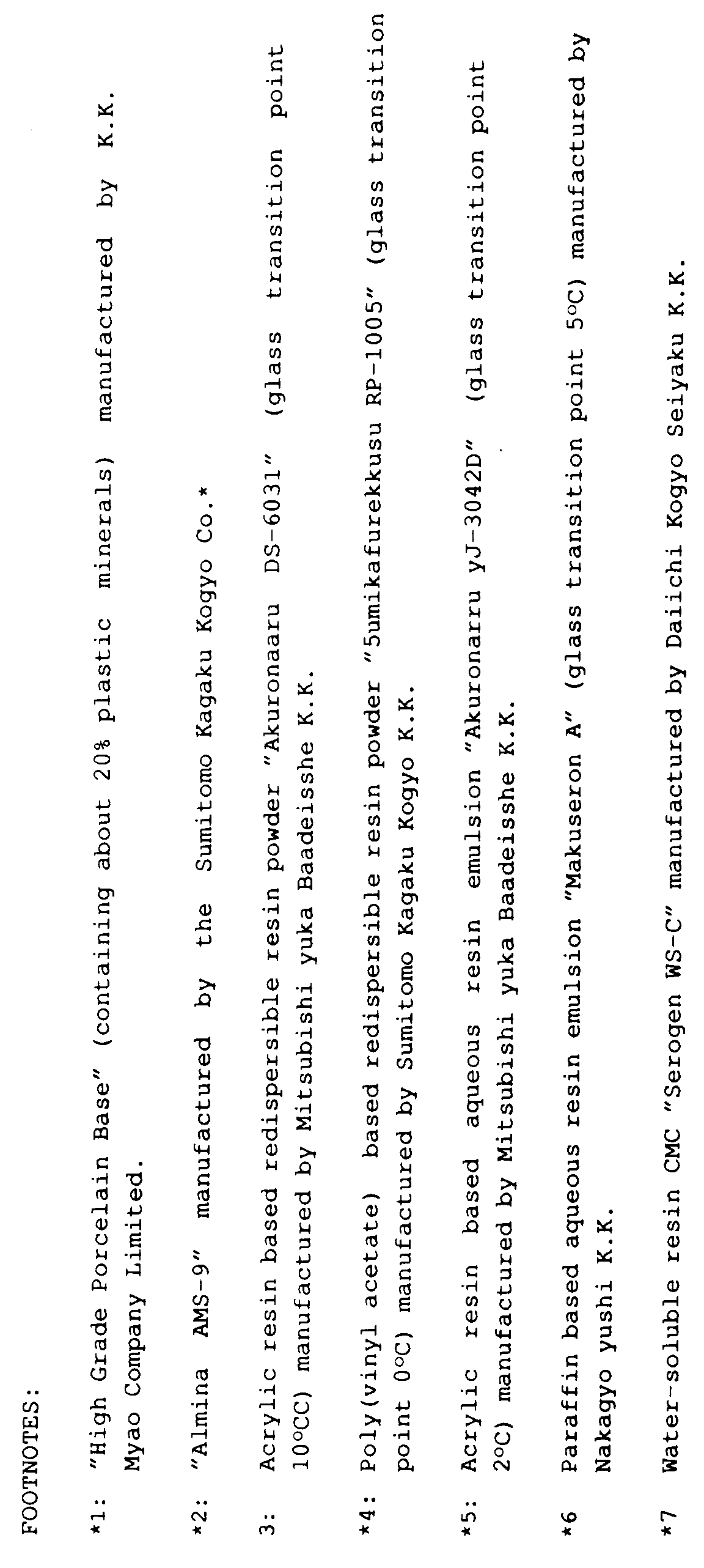
- Redispersible resin powder, water-soluble resin or aqueous resin emulsion (indicated as solid fraction) were added to base materials in accordance with the compounding proportions shown in Table 1, water was added and pulverization and mixing were carried out using a ball mill to prepare slurries of water content about 60%.
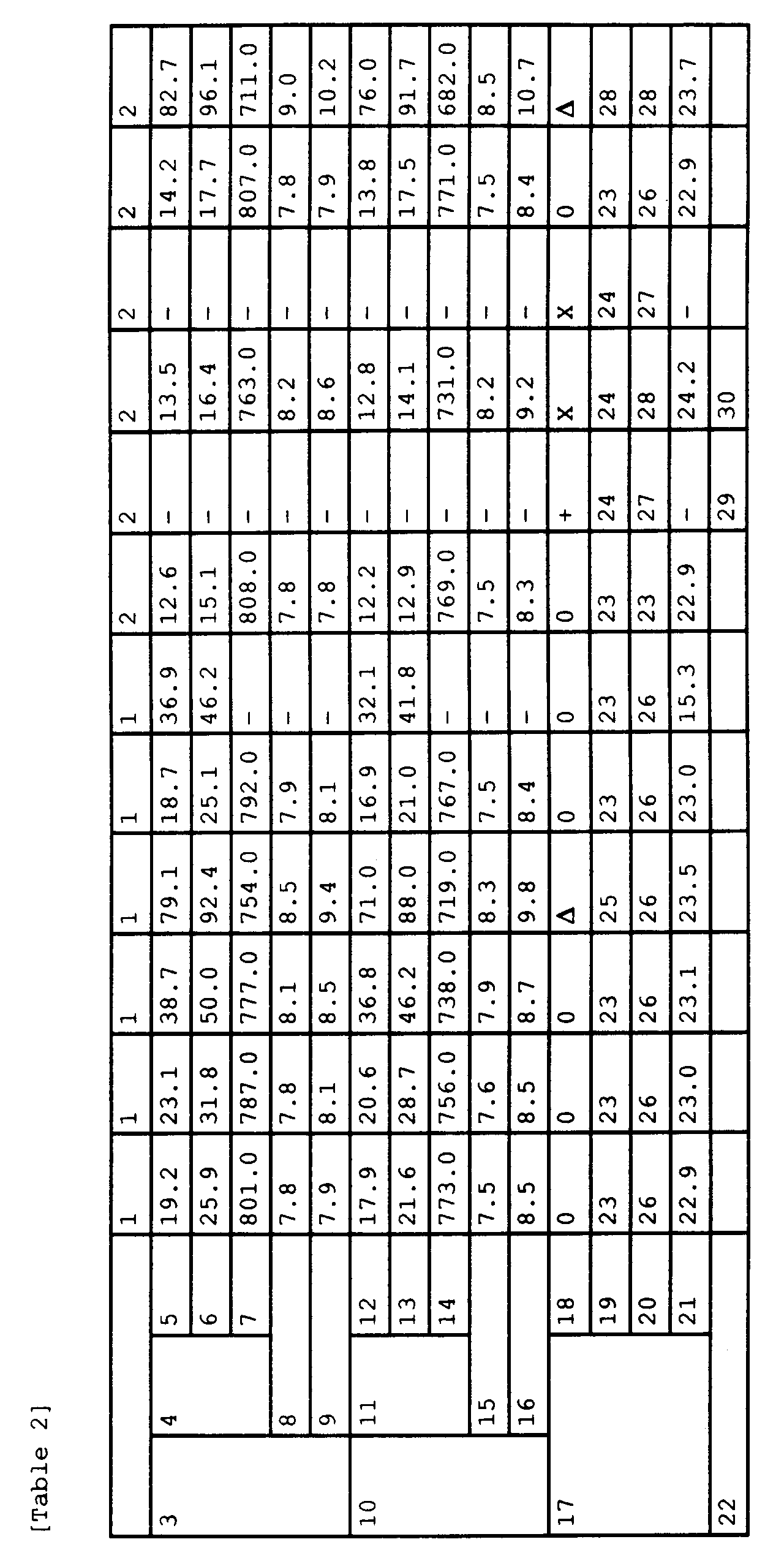
- the moldings obtained with the two methods indicated above were draught dried for 24 hours at 20°C and then they were dried for 24 hours at 110°C. Moreover, the temperature was raised over a period of 5 hours to 1230°C and then maintained at this level for 1 hour, and sinters were obtained on cooling for 4 hours.
- the flex strengths after drying at 20°C before firing, after drying at 110°C and after firing, and the shrinkage factors during firing and the water uptakes were measured using the methods indicated below. The results are shown in Table 2.
- redispersible resin powder and water are added to, and mixed with, the base material and so the redispersible resin powder is dispersed uniformly in a very stable manner, the water content of the slurry is greatly reduced by filtering and dewatering to prepare a base for plastic molding purposes, and moldings of greatly increased mechanical strength are obtained by plastically molding to the prescribed form, and in this way it is possible to manufacture sinters which are thin, light or large when compared to the products of the conventional form.
Landscapes
- Chemical & Material Sciences (AREA)
- Engineering & Computer Science (AREA)
- Ceramic Engineering (AREA)
- Structural Engineering (AREA)
- Organic Chemistry (AREA)
- Materials Engineering (AREA)
- Manufacturing & Machinery (AREA)
- Dispersion Chemistry (AREA)
- Inorganic Chemistry (AREA)
- Mechanical Engineering (AREA)
- Compositions Of Oxide Ceramics (AREA)
- Casting Or Compression Moulding Of Plastics Or The Like (AREA)
- Processing And Handling Of Plastics And Other Materials For Molding In General (AREA)
- Press-Shaping Or Shaping Using Conveyers (AREA)
Description
- Extrusion Molding:
- Continuous extrusion molding of depth 10 mm x width 30 mm, with chopping to length every 50 mm, was carried out using the above-mentioned vacuum kneading molding machine.
- Power-Wheel Molding:
- Moldings of depth 50 mm x width 30 mm x thickness 10 mm were obtained using a power-wheel molding machine.
- P:
- Load (kgf)
- L:
- Span (cm)
- b:
- Specimen width (cm)
- h:
- Specimen thickness (cm)


Claims (1)
- Method of molding a base for plastic molding purposes, which is formed by kneading after dewatering a slurry composition, whereby 0.5 - 20 parts by weight of redispersible resin powder and water are added to, and mixed with, 100 parts by weight of base material for porcelain and/or ceramic purposes, and said base for plastic molding purposes is plastically molded into the prescribed shape by extrusion or power wheel molding.
Priority Applications (3)
| Application Number | Priority Date | Filing Date | Title |
|---|---|---|---|
| ES95112818T ES2113702T3 (en) | 1995-08-16 | 1995-08-16 | SUSPENSION COMPOSITIONS FOR PURPOSES RELATED TO PLASTIC MOLDING AND PRODUCTS OBTAINED THEREOF. |
| EP19950112818 EP0758630B1 (en) | 1995-08-16 | 1995-08-16 | Slurry compositions for plastic molding purposes and products obtained thereof |
| DE1995601826 DE69501826T2 (en) | 1995-08-16 | 1995-08-16 | Slurry composition for plastic molding processes and products made from them |
Applications Claiming Priority (1)
| Application Number | Priority Date | Filing Date | Title |
|---|---|---|---|
| EP19950112818 EP0758630B1 (en) | 1995-08-16 | 1995-08-16 | Slurry compositions for plastic molding purposes and products obtained thereof |
Publications (2)
| Publication Number | Publication Date |
|---|---|
| EP0758630A1 EP0758630A1 (en) | 1997-02-19 |
| EP0758630B1 true EP0758630B1 (en) | 1998-03-18 |
Family
ID=8219526
Family Applications (1)
| Application Number | Title | Priority Date | Filing Date |
|---|---|---|---|
| EP19950112818 Expired - Lifetime EP0758630B1 (en) | 1995-08-16 | 1995-08-16 | Slurry compositions for plastic molding purposes and products obtained thereof |
Country Status (3)
| Country | Link |
|---|---|
| EP (1) | EP0758630B1 (en) |
| DE (1) | DE69501826T2 (en) |
| ES (1) | ES2113702T3 (en) |
Family Cites Families (7)
| Publication number | Priority date | Publication date | Assignee | Title |
|---|---|---|---|---|
| GB2167741B (en) * | 1984-10-16 | 1988-06-29 | Mitsui Toatsu Chemicals | Process for forming ceramics |
| DE3778275D1 (en) * | 1986-08-07 | 1992-05-21 | Roehm Gmbh | METHOD FOR PRODUCING A REDISPERGABLE PLASTIC POWDER. |
| DE3626663A1 (en) * | 1986-08-07 | 1988-02-11 | Roehm Gmbh | BINDING AGENT FOR MOLDED SAND |
| JPH0364465A (en) | 1989-08-02 | 1991-03-19 | Fujitsu Ltd | Vapor growth method of organometallic compound |
| JPH0432155A (en) | 1990-05-25 | 1992-02-04 | Iwasaki Electric Co Ltd | Metal vapor discharge lamp lighting device |
| JPH05104509A (en) | 1991-10-17 | 1993-04-27 | Kawasaki Refract Co Ltd | Cast molding method for ceramic |
| JP3337308B2 (en) * | 1994-03-05 | 2002-10-21 | ビーエーエスエフディスパージョン株式会社 | Slurry composition for cast molding, method for molding cast body using the same, and sintered body fired therefrom |
-
1995
- 1995-08-16 DE DE1995601826 patent/DE69501826T2/en not_active Expired - Lifetime
- 1995-08-16 ES ES95112818T patent/ES2113702T3/en not_active Expired - Lifetime
- 1995-08-16 EP EP19950112818 patent/EP0758630B1/en not_active Expired - Lifetime
Also Published As
| Publication number | Publication date |
|---|---|
| DE69501826T2 (en) | 1998-07-09 |
| ES2113702T3 (en) | 1998-05-01 |
| DE69501826D1 (en) | 1998-04-23 |
| EP0758630A1 (en) | 1997-02-19 |
Similar Documents
| Publication | Publication Date | Title |
|---|---|---|
| US5900201A (en) | Binder coagulation casting | |
| KR100365106B1 (en) | Method for manufacturing ceramic green body, method for improving machinability thereof and ceramic green body manufactured therefrom | |
| EP0206342B1 (en) | Ceramics binder and production of ceramics articles | |
| DE69902080T2 (en) | Process for the production of ceramic masses | |
| JP2843348B2 (en) | Formation of complex high performance ceramic and metal shapes | |
| EP1090890A2 (en) | Method for preparing ceramic compositions | |
| US5368795A (en) | Use of ethylene/vinyl acetate polymer binders as drying pressing aids for ceramic powders | |
| WO1993019017A1 (en) | Composition for high pressure casting slip, high pressure casting slip and method for preparing the composition and slip | |
| US5573982A (en) | Slurry composition, shaping method using the same, and fired body | |
| JPH01246076A (en) | Bond for abrasive material raw grindstone | |
| EP0758630A1 (en) | Slurry compositions for plastic molding purposes and products obtained thereof | |
| JP3105524B2 (en) | Manufacturing method of whiteware ceramic products | |
| CN100497243C (en) | Composition for use as sanitary earthenware material, method for production thereof, method for manufacturing sanitary earthenware using said composition | |
| JP3672598B2 (en) | Plastic molding slurry composition, method for producing the plastic molding slurry composition, plastic molding clay obtained by subjecting the plastic molding slurry composition to dehydration and kneading, and use of the plastic molding clay Molding method of plastic molded body, plastic molded body molded by the molding method, and dried plastic molded body obtained by drying the plastic molded body | |
| AU6595498A (en) | Process for preparing green bodies | |
| EP0670189A2 (en) | Slurry compositions for cast molding purposes, a method of molding cast moldings wherein these slurry compositions are used, and sinters wherein these moldings have been fired. | |
| EP0275609B1 (en) | Manufacture of shaped articles from refractory powder | |
| DE3536428A1 (en) | CERAMIC MOLDING COMPOSITION AND METHOD FOR MOLDING CERAMIC FROM THE COMPOSITION AND FURTHER PROCESSING OF THE MOLDED PRODUCTS | |
| JPH11114403A (en) | Molding method for ceramic powder | |
| JPS61175004A (en) | Molding processing method of ceramics | |
| JPH035361A (en) | Ceramic raw base compound for dry press-molded raw base | |
| HUT76765A (en) | Slurry composition and sinters | |
| JPS6060967A (en) | Manufacture of ceramic mud | |
| JP3282500B2 (en) | Method for producing slurry for casting | |
| JPS62191458A (en) | Manufacture of ceramic formed body |
Legal Events
| Date | Code | Title | Description |
|---|---|---|---|
| PUAI | Public reference made under article 153(3) epc to a published international application that has entered the european phase |
Free format text: ORIGINAL CODE: 0009012 |
|
| 17P | Request for examination filed |
Effective date: 19960126 |
|
| AK | Designated contracting states |
Kind code of ref document: A1 Designated state(s): DE DK ES FR GB IT |
|
| GRAG | Despatch of communication of intention to grant |
Free format text: ORIGINAL CODE: EPIDOS AGRA |
|
| GRAG | Despatch of communication of intention to grant |
Free format text: ORIGINAL CODE: EPIDOS AGRA |
|
| GRAH | Despatch of communication of intention to grant a patent |
Free format text: ORIGINAL CODE: EPIDOS IGRA |
|
| GRAH | Despatch of communication of intention to grant a patent |
Free format text: ORIGINAL CODE: EPIDOS IGRA |
|
| GRAA | (expected) grant |
Free format text: ORIGINAL CODE: 0009210 |
|
| AK | Designated contracting states |
Kind code of ref document: B1 Designated state(s): DE DK ES FR GB IT |
|
| REF | Corresponds to: |
Ref document number: 69501826 Country of ref document: DE Date of ref document: 19980423 |
|
| REG | Reference to a national code |
Ref country code: ES Ref legal event code: FG2A Ref document number: 2113702 Country of ref document: ES Kind code of ref document: T3 |
|
| ITF | It: translation for a ep patent filed | ||
| PG25 | Lapsed in a contracting state [announced via postgrant information from national office to epo] |
Ref country code: DK Free format text: LAPSE BECAUSE OF FAILURE TO SUBMIT A TRANSLATION OF THE DESCRIPTION OR TO PAY THE FEE WITHIN THE PRESCRIBED TIME-LIMIT Effective date: 19980618 |
|
| ET | Fr: translation filed | ||
| PLBE | No opposition filed within time limit |
Free format text: ORIGINAL CODE: 0009261 |
|
| STAA | Information on the status of an ep patent application or granted ep patent |
Free format text: STATUS: NO OPPOSITION FILED WITHIN TIME LIMIT |
|
| 26N | No opposition filed | ||
| REG | Reference to a national code |
Ref country code: GB Ref legal event code: IF02 |
|
| PGFP | Annual fee paid to national office [announced via postgrant information from national office to epo] |
Ref country code: DE Payment date: 20030828 Year of fee payment: 9 |
|
| PGFP | Annual fee paid to national office [announced via postgrant information from national office to epo] |
Ref country code: FR Payment date: 20040810 Year of fee payment: 10 |
|
| PGFP | Annual fee paid to national office [announced via postgrant information from national office to epo] |
Ref country code: GB Payment date: 20040811 Year of fee payment: 10 |
|
| PGFP | Annual fee paid to national office [announced via postgrant information from national office to epo] |
Ref country code: ES Payment date: 20040825 Year of fee payment: 10 |
|
| PG25 | Lapsed in a contracting state [announced via postgrant information from national office to epo] |
Ref country code: DE Free format text: LAPSE BECAUSE OF THE APPLICANT RENOUNCES Effective date: 20041028 |
|
| PG25 | Lapsed in a contracting state [announced via postgrant information from national office to epo] |
Ref country code: IT Free format text: LAPSE BECAUSE OF NON-PAYMENT OF DUE FEES;WARNING: LAPSES OF ITALIAN PATENTS WITH EFFECTIVE DATE BEFORE 2007 MAY HAVE OCCURRED AT ANY TIME BEFORE 2007. THE CORRECT EFFECTIVE DATE MAY BE DIFFERENT FROM THE ONE RECORDED. Effective date: 20050816 Ref country code: GB Free format text: LAPSE BECAUSE OF NON-PAYMENT OF DUE FEES Effective date: 20050816 |
|
| PG25 | Lapsed in a contracting state [announced via postgrant information from national office to epo] |
Ref country code: ES Free format text: LAPSE BECAUSE OF NON-PAYMENT OF DUE FEES Effective date: 20050817 |
|
| GBPC | Gb: european patent ceased through non-payment of renewal fee |
Effective date: 20050816 |
|
| PG25 | Lapsed in a contracting state [announced via postgrant information from national office to epo] |
Ref country code: FR Free format text: LAPSE BECAUSE OF NON-PAYMENT OF DUE FEES Effective date: 20060428 |
|
| REG | Reference to a national code |
Ref country code: FR Ref legal event code: ST Effective date: 20060428 |
|
| REG | Reference to a national code |
Ref country code: ES Ref legal event code: FD2A Effective date: 20050817 |