EP0758333B1 - Intermediates in pharmaceutical camptothecin preparation - Google Patents
Intermediates in pharmaceutical camptothecin preparation Download PDFInfo
- Publication number
- EP0758333B1 EP0758333B1 EP95917217A EP95917217A EP0758333B1 EP 0758333 B1 EP0758333 B1 EP 0758333B1 EP 95917217 A EP95917217 A EP 95917217A EP 95917217 A EP95917217 A EP 95917217A EP 0758333 B1 EP0758333 B1 EP 0758333B1
- Authority
- EP
- European Patent Office
- Prior art keywords
- palladium
- methyl
- alkyl
- compound
- group
- Prior art date
- Legal status (The legal status is an assumption and is not a legal conclusion. Google has not performed a legal analysis and makes no representation as to the accuracy of the status listed.)
- Expired - Lifetime
Links
- VSJKWCGYPAHWDS-FQEVSTJZSA-N camptothecin Chemical compound C1=CC=C2C=C(CN3C4=CC5=C(C3=O)COC(=O)[C@]5(O)CC)C4=NC2=C1 VSJKWCGYPAHWDS-FQEVSTJZSA-N 0.000 title claims abstract description 13
- KLWPJMFMVPTNCC-UHFFFAOYSA-N Camptothecin Natural products CCC1(O)C(=O)OCC2=C1C=C3C4Nc5ccccc5C=C4CN3C2=O KLWPJMFMVPTNCC-UHFFFAOYSA-N 0.000 title claims abstract description 10
- 229940127093 camptothecin Drugs 0.000 title claims abstract description 10
- VSJKWCGYPAHWDS-UHFFFAOYSA-N dl-camptothecin Natural products C1=CC=C2C=C(CN3C4=CC5=C(C3=O)COC(=O)C5(O)CC)C4=NC2=C1 VSJKWCGYPAHWDS-UHFFFAOYSA-N 0.000 title claims abstract description 10
- 239000000543 intermediate Substances 0.000 title abstract description 19
- 238000002360 preparation method Methods 0.000 title abstract description 12
- 150000001875 compounds Chemical class 0.000 claims abstract description 59
- 238000000034 method Methods 0.000 claims abstract description 34
- 125000005843 halogen group Chemical group 0.000 claims abstract description 4
- 229910052757 nitrogen Inorganic materials 0.000 claims description 36
- WEVYAHXRMPXWCK-UHFFFAOYSA-N Acetonitrile Chemical compound CC#N WEVYAHXRMPXWCK-UHFFFAOYSA-N 0.000 claims description 30
- KDLHZDBZIXYQEI-UHFFFAOYSA-N Palladium Chemical compound [Pd] KDLHZDBZIXYQEI-UHFFFAOYSA-N 0.000 claims description 24
- 239000003054 catalyst Substances 0.000 claims description 23
- RIOQSEWOXXDEQQ-UHFFFAOYSA-N triphenylphosphine Chemical compound C1=CC=CC=C1P(C=1C=CC=CC=1)C1=CC=CC=C1 RIOQSEWOXXDEQQ-UHFFFAOYSA-N 0.000 claims description 20
- UHOVQNZJYSORNB-UHFFFAOYSA-N Benzene Chemical compound C1=CC=CC=C1 UHOVQNZJYSORNB-UHFFFAOYSA-N 0.000 claims description 18
- ZMXDDKWLCZADIW-UHFFFAOYSA-N N,N-Dimethylformamide Chemical compound CN(C)C=O ZMXDDKWLCZADIW-UHFFFAOYSA-N 0.000 claims description 18
- QTBSBXVTEAMEQO-UHFFFAOYSA-N Acetic acid Chemical compound CC(O)=O QTBSBXVTEAMEQO-UHFFFAOYSA-N 0.000 claims description 15
- 239000000460 chlorine Substances 0.000 claims description 14
- -1 tetraalkylammonium halide salt Chemical class 0.000 claims description 13
- 229910052763 palladium Inorganic materials 0.000 claims description 12
- LOUPRKONTZGTKE-LHHVKLHASA-N quinidine Chemical compound C([C@H]([C@H](C1)C=C)C2)C[N@@]1[C@H]2[C@@H](O)C1=CC=NC2=CC=C(OC)C=C21 LOUPRKONTZGTKE-LHHVKLHASA-N 0.000 claims description 12
- MHAJPDPJQMAIIY-UHFFFAOYSA-N Hydrogen peroxide Chemical compound OO MHAJPDPJQMAIIY-UHFFFAOYSA-N 0.000 claims description 10
- CZPWVGJYEJSRLH-UHFFFAOYSA-N Pyrimidine Chemical compound C1=CN=CN=C1 CZPWVGJYEJSRLH-UHFFFAOYSA-N 0.000 claims description 10
- 125000002496 methyl group Chemical group [H]C([H])([H])* 0.000 claims description 10
- YJVFFLUZDVXJQI-UHFFFAOYSA-L palladium(ii) acetate Chemical compound [Pd+2].CC([O-])=O.CC([O-])=O YJVFFLUZDVXJQI-UHFFFAOYSA-L 0.000 claims description 10
- 108090001060 Lipase Proteins 0.000 claims description 8
- 239000004367 Lipase Substances 0.000 claims description 8
- 102000004882 Lipase Human genes 0.000 claims description 8
- SMWDFEZZVXVKRB-UHFFFAOYSA-N Quinoline Chemical compound N1=CC=CC2=CC=CC=C21 SMWDFEZZVXVKRB-UHFFFAOYSA-N 0.000 claims description 8
- WPYMKLBDIGXBTP-UHFFFAOYSA-N benzoic acid Chemical compound OC(=O)C1=CC=CC=C1 WPYMKLBDIGXBTP-UHFFFAOYSA-N 0.000 claims description 8
- 229910052739 hydrogen Inorganic materials 0.000 claims description 8
- 235000019421 lipase Nutrition 0.000 claims description 8
- 230000001590 oxidative effect Effects 0.000 claims description 8
- YNPNZTXNASCQKK-UHFFFAOYSA-N phenanthrene Chemical compound C1=CC=C2C3=CC=CC=C3C=CC2=C1 YNPNZTXNASCQKK-UHFFFAOYSA-N 0.000 claims description 8
- QBERHIJABFXGRZ-UHFFFAOYSA-M rhodium;triphenylphosphane;chloride Chemical compound [Cl-].[Rh].C1=CC=CC=C1P(C=1C=CC=CC=1)C1=CC=CC=C1.C1=CC=CC=C1P(C=1C=CC=CC=1)C1=CC=CC=C1.C1=CC=CC=C1P(C=1C=CC=CC=1)C1=CC=CC=C1 QBERHIJABFXGRZ-UHFFFAOYSA-M 0.000 claims description 8
- ITMCEJHCFYSIIV-UHFFFAOYSA-M triflate Chemical group [O-]S(=O)(=O)C(F)(F)F ITMCEJHCFYSIIV-UHFFFAOYSA-M 0.000 claims description 8
- 108090000790 Enzymes Proteins 0.000 claims description 7
- 102000004190 Enzymes Human genes 0.000 claims description 7
- 230000003197 catalytic effect Effects 0.000 claims description 7
- 239000003795 chemical substances by application Substances 0.000 claims description 7
- 125000001309 chloro group Chemical group Cl* 0.000 claims description 7
- HNQIVZYLYMDVSB-UHFFFAOYSA-N methanesulfonimidic acid Chemical compound CS(N)(=O)=O HNQIVZYLYMDVSB-UHFFFAOYSA-N 0.000 claims description 7
- 239000007800 oxidant agent Substances 0.000 claims description 7
- LXNAVEXFUKBNMK-UHFFFAOYSA-N palladium(II) acetate Substances [Pd].CC(O)=O.CC(O)=O LXNAVEXFUKBNMK-UHFFFAOYSA-N 0.000 claims description 7
- 239000012970 tertiary amine catalyst Substances 0.000 claims description 7
- LJOQGZACKSYWCH-LHHVKLHASA-N (s)-[(2r,4s,5r)-5-ethyl-1-azabicyclo[2.2.2]octan-2-yl]-(6-methoxyquinolin-4-yl)methanol Chemical compound C1=C(OC)C=C2C([C@H](O)[C@H]3C[C@@H]4CCN3C[C@@H]4CC)=CC=NC2=C1 LJOQGZACKSYWCH-LHHVKLHASA-N 0.000 claims description 6
- WFDIJRYMOXRFFG-UHFFFAOYSA-N Acetic anhydride Chemical compound CC(=O)OC(C)=O WFDIJRYMOXRFFG-UHFFFAOYSA-N 0.000 claims description 6
- LFTLOKWAGJYHHR-UHFFFAOYSA-N N-methylmorpholine N-oxide Chemical compound CN1(=O)CCOCC1 LFTLOKWAGJYHHR-UHFFFAOYSA-N 0.000 claims description 6
- 238000006256 asymmetric dihydroxylation reaction Methods 0.000 claims description 6
- LOUPRKONTZGTKE-UHFFFAOYSA-N cinchonine Natural products C1C(C(C2)C=C)CCN2C1C(O)C1=CC=NC2=CC=C(OC)C=C21 LOUPRKONTZGTKE-UHFFFAOYSA-N 0.000 claims description 6
- LJOQGZACKSYWCH-UHFFFAOYSA-N dihydro quinine Natural products C1=C(OC)C=C2C(C(O)C3CC4CCN3CC4CC)=CC=NC2=C1 LJOQGZACKSYWCH-UHFFFAOYSA-N 0.000 claims description 6
- 229960000811 hydroquinidine Drugs 0.000 claims description 6
- 239000003880 polar aprotic solvent Substances 0.000 claims description 6
- 229960001404 quinidine Drugs 0.000 claims description 6
- NHGXDBSUJJNIRV-UHFFFAOYSA-M tetrabutylammonium chloride Chemical compound [Cl-].CCCC[N+](CCCC)(CCCC)CCCC NHGXDBSUJJNIRV-UHFFFAOYSA-M 0.000 claims description 6
- DGODWNOPHMXOTR-UHFFFAOYSA-N dipotassium;dioxido(dioxo)osmium;dihydrate Chemical compound O.O.[K+].[K+].[O-][Os]([O-])(=O)=O DGODWNOPHMXOTR-UHFFFAOYSA-N 0.000 claims description 5
- 229910052762 osmium Inorganic materials 0.000 claims description 5
- SYQBFIAQOQZEGI-UHFFFAOYSA-N osmium atom Chemical compound [Os] SYQBFIAQOQZEGI-UHFFFAOYSA-N 0.000 claims description 5
- 150000003140 primary amides Chemical class 0.000 claims description 5
- 239000003586 protic polar solvent Substances 0.000 claims description 5
- WKBOTKDWSSQWDR-UHFFFAOYSA-N Bromine atom Chemical compound [Br] WKBOTKDWSSQWDR-UHFFFAOYSA-N 0.000 claims description 4
- XTXRWKRVRITETP-UHFFFAOYSA-N Vinyl acetate Chemical compound CC(=O)OC=C XTXRWKRVRITETP-UHFFFAOYSA-N 0.000 claims description 4
- GDTBXPJZTBHREO-UHFFFAOYSA-N bromine Substances BrBr GDTBXPJZTBHREO-UHFFFAOYSA-N 0.000 claims description 4
- 229910052794 bromium Inorganic materials 0.000 claims description 4
- 238000005906 dihydroxylation reaction Methods 0.000 claims description 4
- 125000002346 iodo group Chemical group I* 0.000 claims description 4
- 239000012285 osmium tetroxide Substances 0.000 claims description 4
- 229910000489 osmium tetroxide Inorganic materials 0.000 claims description 4
- GPNDARIEYHPYAY-UHFFFAOYSA-N palladium(ii) nitrate Chemical compound [Pd+2].[O-][N+]([O-])=O.[O-][N+]([O-])=O GPNDARIEYHPYAY-UHFFFAOYSA-N 0.000 claims description 4
- 229910052703 rhodium Inorganic materials 0.000 claims description 4
- 239000010948 rhodium Substances 0.000 claims description 4
- MHOVAHRLVXNVSD-UHFFFAOYSA-N rhodium atom Chemical compound [Rh] MHOVAHRLVXNVSD-UHFFFAOYSA-N 0.000 claims description 4
- FBPINGSGHKXIQA-UHFFFAOYSA-N 2-amino-3-(2-carboxyethylsulfanyl)propanoic acid Chemical compound OC(=O)C(N)CSCCC(O)=O FBPINGSGHKXIQA-UHFFFAOYSA-N 0.000 claims description 3
- 238000006617 Intramolecular Heck reaction Methods 0.000 claims description 3
- WGLPBDUCMAPZCE-UHFFFAOYSA-N chromium trioxide Inorganic materials O=[Cr](=O)=O WGLPBDUCMAPZCE-UHFFFAOYSA-N 0.000 claims description 3
- 229940117975 chromium trioxide Drugs 0.000 claims description 3
- GAMDZJFZMJECOS-UHFFFAOYSA-N chromium(6+);oxygen(2-) Chemical compound [O-2].[O-2].[O-2].[Cr+6] GAMDZJFZMJECOS-UHFFFAOYSA-N 0.000 claims description 3
- DKAGJZJALZXOOV-UHFFFAOYSA-N hydrate;hydrochloride Chemical compound O.Cl DKAGJZJALZXOOV-UHFFFAOYSA-N 0.000 claims description 3
- PNDPGZBMCMUPRI-UHFFFAOYSA-N iodine Chemical compound II PNDPGZBMCMUPRI-UHFFFAOYSA-N 0.000 claims description 3
- 239000003444 phase transfer catalyst Substances 0.000 claims description 3
- JRMUNVKIHCOMHV-UHFFFAOYSA-M tetrabutylammonium bromide Chemical compound [Br-].CCCC[N+](CCCC)(CCCC)CCCC JRMUNVKIHCOMHV-UHFFFAOYSA-M 0.000 claims description 3
- DPKBAXPHAYBPRL-UHFFFAOYSA-M tetrabutylazanium;iodide Chemical compound [I-].CCCC[N+](CCCC)(CCCC)CCCC DPKBAXPHAYBPRL-UHFFFAOYSA-M 0.000 claims description 3
- YCMLQMDWSXFTIF-UHFFFAOYSA-N 2-methylbenzenesulfonimidic acid Chemical compound CC1=CC=CC=C1S(N)(=O)=O YCMLQMDWSXFTIF-UHFFFAOYSA-N 0.000 claims description 2
- 241000228245 Aspergillus niger Species 0.000 claims description 2
- KHBQMWCZKVMBLN-UHFFFAOYSA-N Benzenesulfonamide Chemical compound NS(=O)(=O)C1=CC=CC=C1 KHBQMWCZKVMBLN-UHFFFAOYSA-N 0.000 claims description 2
- 239000005711 Benzoic acid Substances 0.000 claims description 2
- 108010015598 Chromobacterium viscosum lipase Proteins 0.000 claims description 2
- 229910021605 Palladium(II) bromide Inorganic materials 0.000 claims description 2
- 229910021606 Palladium(II) iodide Inorganic materials 0.000 claims description 2
- 102000019280 Pancreatic lipases Human genes 0.000 claims description 2
- 108050006759 Pancreatic lipases Proteins 0.000 claims description 2
- 241000589516 Pseudomonas Species 0.000 claims description 2
- 235000010233 benzoic acid Nutrition 0.000 claims description 2
- CKWZZRQMNIOWCY-UHFFFAOYSA-N benzonitrile;dihydrochloride Chemical compound Cl.Cl.N#CC1=CC=CC=C1.N#CC1=CC=CC=C1 CKWZZRQMNIOWCY-UHFFFAOYSA-N 0.000 claims description 2
- XSCHRSMBECNVNS-UHFFFAOYSA-N benzopyrazine Natural products N1=CC=NC2=CC=CC=C21 XSCHRSMBECNVNS-UHFFFAOYSA-N 0.000 claims description 2
- 229910052801 chlorine Inorganic materials 0.000 claims description 2
- 230000005611 electricity Effects 0.000 claims description 2
- SHFJWMWCIHQNCP-UHFFFAOYSA-M hydron;tetrabutylazanium;sulfate Chemical compound OS([O-])(=O)=O.CCCC[N+](CCCC)(CCCC)CCCC SHFJWMWCIHQNCP-UHFFFAOYSA-M 0.000 claims description 2
- 238000006317 isomerization reaction Methods 0.000 claims description 2
- 239000003446 ligand Substances 0.000 claims description 2
- LVDZSYMRHIOFDF-UHFFFAOYSA-N n-[1,2-diphenyl-2-[(2,4,6-trimethylphenyl)methylideneamino]ethyl]-1-(2,4,6-trimethylphenyl)methanimine Chemical compound CC1=CC(C)=CC(C)=C1C=NC(C=1C=CC=CC=1)C(C=1C=CC=CC=1)N=CC1=C(C)C=C(C)C=C1C LVDZSYMRHIOFDF-UHFFFAOYSA-N 0.000 claims description 2
- 230000000269 nucleophilic effect Effects 0.000 claims description 2
- MUJIDPITZJWBSW-UHFFFAOYSA-N palladium(2+) Chemical compound [Pd+2] MUJIDPITZJWBSW-UHFFFAOYSA-N 0.000 claims description 2
- PBDBXAQKXCXZCJ-UHFFFAOYSA-L palladium(2+);2,2,2-trifluoroacetate Chemical compound [Pd+2].[O-]C(=O)C(F)(F)F.[O-]C(=O)C(F)(F)F PBDBXAQKXCXZCJ-UHFFFAOYSA-L 0.000 claims description 2
- RFLFDJSIZCCYIP-UHFFFAOYSA-L palladium(2+);sulfate Chemical compound [Pd+2].[O-]S([O-])(=O)=O RFLFDJSIZCCYIP-UHFFFAOYSA-L 0.000 claims description 2
- PIBWKRNGBLPSSY-UHFFFAOYSA-L palladium(II) chloride Chemical compound Cl[Pd]Cl PIBWKRNGBLPSSY-UHFFFAOYSA-L 0.000 claims description 2
- 229910000364 palladium(II) sulfate Inorganic materials 0.000 claims description 2
- JKDRQYIYVJVOPF-FDGPNNRMSA-L palladium(ii) acetylacetonate Chemical compound [Pd+2].C\C([O-])=C\C(C)=O.C\C([O-])=C\C(C)=O JKDRQYIYVJVOPF-FDGPNNRMSA-L 0.000 claims description 2
- INIOZDBICVTGEO-UHFFFAOYSA-L palladium(ii) bromide Chemical compound Br[Pd]Br INIOZDBICVTGEO-UHFFFAOYSA-L 0.000 claims description 2
- HNNUTDROYPGBMR-UHFFFAOYSA-L palladium(ii) iodide Chemical compound [Pd+2].[I-].[I-] HNNUTDROYPGBMR-UHFFFAOYSA-L 0.000 claims description 2
- NFHFRUOZVGFOOS-UHFFFAOYSA-N palladium;triphenylphosphane Chemical compound [Pd].C1=CC=CC=C1P(C=1C=CC=CC=1)C1=CC=CC=C1.C1=CC=CC=C1P(C=1C=CC=CC=1)C1=CC=CC=C1.C1=CC=CC=C1P(C=1C=CC=CC=1)C1=CC=CC=C1.C1=CC=CC=C1P(C=1C=CC=CC=1)C1=CC=CC=C1 NFHFRUOZVGFOOS-UHFFFAOYSA-N 0.000 claims description 2
- LFSXCDWNBUNEEM-UHFFFAOYSA-N phthalazine Chemical compound C1=NN=CC2=CC=CC=C21 LFSXCDWNBUNEEM-UHFFFAOYSA-N 0.000 claims description 2
- WYVAMUWZEOHJOQ-UHFFFAOYSA-N propionic anhydride Chemical compound CCC(=O)OC(=O)CC WYVAMUWZEOHJOQ-UHFFFAOYSA-N 0.000 claims description 2
- CIHOLLKRGTVIJN-UHFFFAOYSA-N tert‐butyl hydroperoxide Chemical compound CC(C)(C)OO CIHOLLKRGTVIJN-UHFFFAOYSA-N 0.000 claims description 2
- GTCDARUMAMVCRO-UHFFFAOYSA-M tetraethylazanium;acetate Chemical compound CC([O-])=O.CC[N+](CC)(CC)CC GTCDARUMAMVCRO-UHFFFAOYSA-M 0.000 claims description 2
- RWRDLPDLKQPQOW-UHFFFAOYSA-N tetrahydropyrrole Substances C1CCNC1 RWRDLPDLKQPQOW-UHFFFAOYSA-N 0.000 claims description 2
- 125000002827 triflate group Chemical group FC(S(=O)(=O)O*)(F)F 0.000 claims description 2
- BYGOPQKDHGXNCD-UHFFFAOYSA-N tripotassium;iron(3+);hexacyanide Chemical compound [K+].[K+].[K+].[Fe+3].N#[C-].N#[C-].N#[C-].N#[C-].N#[C-].N#[C-] BYGOPQKDHGXNCD-UHFFFAOYSA-N 0.000 claims description 2
- COIOYMYWGDAQPM-UHFFFAOYSA-N tris(2-methylphenyl)phosphane Chemical compound CC1=CC=CC=C1P(C=1C(=CC=CC=1)C)C1=CC=CC=C1C COIOYMYWGDAQPM-UHFFFAOYSA-N 0.000 claims description 2
- LFNXCUNDYSYVJY-UHFFFAOYSA-N tris(3-methylphenyl)phosphane Chemical compound CC1=CC=CC(P(C=2C=C(C)C=CC=2)C=2C=C(C)C=CC=2)=C1 LFNXCUNDYSYVJY-UHFFFAOYSA-N 0.000 claims description 2
- WXAZIUYTQHYBFW-UHFFFAOYSA-N tris(4-methylphenyl)phosphane Chemical compound C1=CC(C)=CC=C1P(C=1C=CC(C)=CC=1)C1=CC=C(C)C=C1 WXAZIUYTQHYBFW-UHFFFAOYSA-N 0.000 claims description 2
- DCXPBOFGQPCWJY-UHFFFAOYSA-N trisodium;iron(3+);hexacyanide Chemical compound [Na+].[Na+].[Na+].[Fe+3].N#[C-].N#[C-].N#[C-].N#[C-].N#[C-].N#[C-] DCXPBOFGQPCWJY-UHFFFAOYSA-N 0.000 claims description 2
- 125000004209 (C1-C8) alkyl group Chemical group 0.000 claims 15
- 230000002194 synthesizing effect Effects 0.000 claims 4
- 241000047214 Cyclocybe cylindracea Species 0.000 claims 2
- 230000010933 acylation Effects 0.000 claims 2
- 238000005917 acylation reaction Methods 0.000 claims 2
- 230000002255 enzymatic effect Effects 0.000 claims 2
- ZAMOUSCENKQFHK-UHFFFAOYSA-N Chlorine atom Chemical compound [Cl] ZAMOUSCENKQFHK-UHFFFAOYSA-N 0.000 claims 1
- 238000007363 ring formation reaction Methods 0.000 claims 1
- MCZDHTKJGDCTAE-UHFFFAOYSA-M tetrabutylazanium;acetate Chemical compound CC([O-])=O.CCCC[N+](CCCC)(CCCC)CCCC MCZDHTKJGDCTAE-UHFFFAOYSA-M 0.000 claims 1
- 229910052736 halogen Inorganic materials 0.000 abstract description 2
- LMBFAGIMSUYTBN-MPZNNTNKSA-N teixobactin Chemical compound C([C@H](C(=O)N[C@@H]([C@@H](C)CC)C(=O)N[C@@H](CO)C(=O)N[C@H](CCC(N)=O)C(=O)N[C@H]([C@@H](C)CC)C(=O)N[C@@H]([C@@H](C)CC)C(=O)N[C@@H](CO)C(=O)N[C@H]1C(N[C@@H](C)C(=O)N[C@@H](C[C@@H]2NC(=N)NC2)C(=O)N[C@H](C(=O)O[C@H]1C)[C@@H](C)CC)=O)NC)C1=CC=CC=C1 LMBFAGIMSUYTBN-MPZNNTNKSA-N 0.000 abstract description 2
- YMWUJEATGCHHMB-UHFFFAOYSA-N Dichloromethane Chemical compound ClCCl YMWUJEATGCHHMB-UHFFFAOYSA-N 0.000 description 154
- OKKJLVBELUTLKV-UHFFFAOYSA-N Methanol Chemical compound OC OKKJLVBELUTLKV-UHFFFAOYSA-N 0.000 description 96
- VLKZOEOYAKHREP-UHFFFAOYSA-N n-Hexane Chemical class CCCCCC VLKZOEOYAKHREP-UHFFFAOYSA-N 0.000 description 75
- 239000000203 mixture Substances 0.000 description 66
- IJGRMHOSHXDMSA-UHFFFAOYSA-N Atomic nitrogen Chemical compound N#N IJGRMHOSHXDMSA-UHFFFAOYSA-N 0.000 description 60
- HEDRZPFGACZZDS-MICDWDOJSA-N Trichloro(2H)methane Chemical compound [2H]C(Cl)(Cl)Cl HEDRZPFGACZZDS-MICDWDOJSA-N 0.000 description 56
- XLYOFNOQVPJJNP-UHFFFAOYSA-N water Substances O XLYOFNOQVPJJNP-UHFFFAOYSA-N 0.000 description 45
- 238000005160 1H NMR spectroscopy Methods 0.000 description 42
- 239000007787 solid Substances 0.000 description 41
- 229910001868 water Inorganic materials 0.000 description 40
- CSCPPACGZOOCGX-UHFFFAOYSA-N Acetone Chemical compound CC(C)=O CSCPPACGZOOCGX-UHFFFAOYSA-N 0.000 description 36
- 238000006243 chemical reaction Methods 0.000 description 33
- 239000000243 solution Substances 0.000 description 33
- HEDRZPFGACZZDS-UHFFFAOYSA-N Chloroform Chemical compound ClC(Cl)Cl HEDRZPFGACZZDS-UHFFFAOYSA-N 0.000 description 32
- 239000011541 reaction mixture Substances 0.000 description 31
- 239000002002 slurry Substances 0.000 description 29
- XEKOWRVHYACXOJ-UHFFFAOYSA-N Ethyl acetate Chemical compound CCOC(C)=O XEKOWRVHYACXOJ-UHFFFAOYSA-N 0.000 description 26
- BWHMMNNQKKPAPP-UHFFFAOYSA-L potassium carbonate Chemical compound [K+].[K+].[O-]C([O-])=O BWHMMNNQKKPAPP-UHFFFAOYSA-L 0.000 description 26
- 239000002244 precipitate Substances 0.000 description 24
- VYPSYNLAJGMNEJ-UHFFFAOYSA-N Silicium dioxide Chemical compound O=[Si]=O VYPSYNLAJGMNEJ-UHFFFAOYSA-N 0.000 description 21
- LFQSCWFLJHTTHZ-UHFFFAOYSA-N Ethanol Chemical compound CCO LFQSCWFLJHTTHZ-UHFFFAOYSA-N 0.000 description 20
- BDERNNFJNOPAEC-UHFFFAOYSA-N propan-1-ol Chemical compound CCCO BDERNNFJNOPAEC-UHFFFAOYSA-N 0.000 description 20
- PMZURENOXWZQFD-UHFFFAOYSA-L Sodium Sulfate Chemical compound [Na+].[Na+].[O-]S([O-])(=O)=O PMZURENOXWZQFD-UHFFFAOYSA-L 0.000 description 19
- DKGAVHZHDRPRBM-UHFFFAOYSA-N Tert-Butanol Chemical compound CC(C)(C)O DKGAVHZHDRPRBM-UHFFFAOYSA-N 0.000 description 18
- ZMANZCXQSJIPKH-UHFFFAOYSA-N Triethylamine Chemical compound CCN(CC)CC ZMANZCXQSJIPKH-UHFFFAOYSA-N 0.000 description 18
- 238000000921 elemental analysis Methods 0.000 description 18
- 239000012044 organic layer Substances 0.000 description 18
- 238000010992 reflux Methods 0.000 description 17
- 239000000706 filtrate Substances 0.000 description 16
- 239000003921 oil Substances 0.000 description 16
- 239000012267 brine Substances 0.000 description 15
- 238000001914 filtration Methods 0.000 description 15
- HPALAKNZSZLMCH-UHFFFAOYSA-M sodium;chloride;hydrate Chemical compound O.[Na+].[Cl-] HPALAKNZSZLMCH-UHFFFAOYSA-M 0.000 description 15
- KXSPNNXIXSQDKH-UHFFFAOYSA-N 4-ethyl-8-methoxy-1h-pyrano[3,4-c]pyridine Chemical compound N1=CC=C2C(CC)=COCC2=C1OC KXSPNNXIXSQDKH-UHFFFAOYSA-N 0.000 description 14
- BZLVMXJERCGZMT-UHFFFAOYSA-N Methyl tert-butyl ether Chemical compound COC(C)(C)C BZLVMXJERCGZMT-UHFFFAOYSA-N 0.000 description 14
- 239000000741 silica gel Substances 0.000 description 14
- 229910002027 silica gel Inorganic materials 0.000 description 14
- VEXZGXHMUGYJMC-UHFFFAOYSA-N Hydrochloric acid Chemical compound Cl VEXZGXHMUGYJMC-UHFFFAOYSA-N 0.000 description 13
- 239000010410 layer Substances 0.000 description 13
- 229910000027 potassium carbonate Inorganic materials 0.000 description 13
- ZCUUVWCJGRQCMZ-UHFFFAOYSA-N 3-hydroxypyridin-4(1H)-one Chemical compound OC1=CC=NC=C1O ZCUUVWCJGRQCMZ-UHFFFAOYSA-N 0.000 description 12
- VTYYLEPIZMXCLO-UHFFFAOYSA-L Calcium carbonate Chemical compound [Ca+2].[O-]C([O-])=O VTYYLEPIZMXCLO-UHFFFAOYSA-L 0.000 description 12
- 239000012043 crude product Substances 0.000 description 12
- 238000003756 stirring Methods 0.000 description 12
- 235000019439 ethyl acetate Nutrition 0.000 description 11
- 239000000047 product Substances 0.000 description 11
- 239000000126 substance Substances 0.000 description 11
- 238000001953 recrystallisation Methods 0.000 description 10
- 239000000725 suspension Substances 0.000 description 9
- IAZDPXIOMUYVGZ-WFGJKAKNSA-N Dimethyl sulfoxide Chemical compound [2H]C([2H])([2H])S(=O)C([2H])([2H])[2H] IAZDPXIOMUYVGZ-WFGJKAKNSA-N 0.000 description 8
- 238000004587 chromatography analysis Methods 0.000 description 8
- RVFGKBWWUQOIOU-NDEPHWFRSA-N lurtotecan Chemical compound O=C([C@]1(O)CC)OCC(C(N2CC3=4)=O)=C1C=C2C3=NC1=CC=2OCCOC=2C=C1C=4CN1CCN(C)CC1 RVFGKBWWUQOIOU-NDEPHWFRSA-N 0.000 description 8
- 239000000843 powder Substances 0.000 description 8
- 238000000746 purification Methods 0.000 description 8
- 229910052938 sodium sulfate Inorganic materials 0.000 description 8
- MOAXCYPYHBDZRI-FPYGCLRLSA-N (4z)-4-ethylidene-8-methoxy-1h-pyrano[3,4-c]pyridine Chemical compound C/C=C/1COCC2=C\1C=CN=C2OC MOAXCYPYHBDZRI-FPYGCLRLSA-N 0.000 description 7
- ZCYVEMRRCGMTRW-UHFFFAOYSA-N 7553-56-2 Chemical compound [I] ZCYVEMRRCGMTRW-UHFFFAOYSA-N 0.000 description 7
- XTHFKEDIFFGKHM-UHFFFAOYSA-N Dimethoxyethane Chemical compound COCCOC XTHFKEDIFFGKHM-UHFFFAOYSA-N 0.000 description 7
- 239000000538 analytical sample Substances 0.000 description 7
- 239000000284 extract Substances 0.000 description 7
- 229910052740 iodine Inorganic materials 0.000 description 7
- 239000011630 iodine Substances 0.000 description 7
- GEHJYWRUCIMESM-UHFFFAOYSA-L sodium sulfite Chemical compound [Na+].[Na+].[O-]S([O-])=O GEHJYWRUCIMESM-UHFFFAOYSA-L 0.000 description 7
- 238000005406 washing Methods 0.000 description 7
- XIVQDDQILMFQIK-UHFFFAOYSA-N 1-(6-amino-2,3-dihydro-1,4-benzodioxin-7-yl)-2-chloroethanone Chemical compound O1CCOC2=C1C=C(N)C(C(=O)CCl)=C2 XIVQDDQILMFQIK-UHFFFAOYSA-N 0.000 description 6
- XKRFYHLGVUSROY-UHFFFAOYSA-N Argon Chemical compound [Ar] XKRFYHLGVUSROY-UHFFFAOYSA-N 0.000 description 6
- KWYUFKZDYYNOTN-UHFFFAOYSA-M Potassium hydroxide Chemical compound [OH-].[K+] KWYUFKZDYYNOTN-UHFFFAOYSA-M 0.000 description 6
- DTQVDTLACAAQTR-UHFFFAOYSA-N Trifluoroacetic acid Chemical compound OC(=O)C(F)(F)F DTQVDTLACAAQTR-UHFFFAOYSA-N 0.000 description 6
- 125000000217 alkyl group Chemical group 0.000 description 6
- 229910000019 calcium carbonate Inorganic materials 0.000 description 6
- 239000003153 chemical reaction reagent Substances 0.000 description 6
- 238000001816 cooling Methods 0.000 description 6
- IXCSERBJSXMMFS-UHFFFAOYSA-N hydrogen chloride Substances Cl.Cl IXCSERBJSXMMFS-UHFFFAOYSA-N 0.000 description 6
- 229910000041 hydrogen chloride Inorganic materials 0.000 description 6
- VXCWSXUMPQYTEQ-UHFFFAOYSA-N 3-(but-2-enoxymethyl)-4-iodo-2-methoxypyridine Chemical compound COC1=NC=CC(I)=C1COCC=CC VXCWSXUMPQYTEQ-UHFFFAOYSA-N 0.000 description 5
- IAZDPXIOMUYVGZ-UHFFFAOYSA-N Dimethylsulphoxide Chemical compound CS(C)=O IAZDPXIOMUYVGZ-UHFFFAOYSA-N 0.000 description 5
- 239000002585 base Substances 0.000 description 5
- 238000004296 chiral HPLC Methods 0.000 description 5
- 238000001035 drying Methods 0.000 description 5
- 238000010828 elution Methods 0.000 description 5
- VGLKHVQPWGFXEG-NCJHBDPTSA-K europium(3+);(1z)-2,2,3,3,4,4,4-heptafluoro-1-(4,7,7-trimethyl-3-oxo-2-bicyclo[2.2.1]heptanylidene)butan-1-olate Chemical compound [Eu+3].C1CC2(C)C(=O)\C(=C(/[O-])C(F)(F)C(F)(F)C(F)(F)F)C1C2(C)C.C1CC2(C)C(=O)\C(=C(/[O-])C(F)(F)C(F)(F)C(F)(F)F)C1C2(C)C.C1CC2(C)C(=O)\C(=C(/[O-])C(F)(F)C(F)(F)C(F)(F)F)C1C2(C)C VGLKHVQPWGFXEG-NCJHBDPTSA-K 0.000 description 5
- PDQXPDXYQXBMBF-UHFFFAOYSA-N methyl 7-chloro-9-[(4-methylpiperazin-1-yl)methyl]-2,3-dihydro-[1,4]dioxino[2,3-g]quinoline-8-carboxylate Chemical compound COC(=O)C1=C(Cl)N=C2C=C3OCCOC3=CC2=C1CN1CCN(C)CC1 PDQXPDXYQXBMBF-UHFFFAOYSA-N 0.000 description 5
- 239000012074 organic phase Substances 0.000 description 5
- JUJWROOIHBZHMG-UHFFFAOYSA-N pyridine Substances C1=CC=NC=C1 JUJWROOIHBZHMG-UHFFFAOYSA-N 0.000 description 5
- 150000003839 salts Chemical class 0.000 description 5
- 235000011152 sodium sulphate Nutrition 0.000 description 5
- 239000002904 solvent Substances 0.000 description 5
- 238000004809 thin layer chromatography Methods 0.000 description 5
- WSLDOOZREJYCGB-UHFFFAOYSA-N 1,2-Dichloroethane Chemical compound ClCCCl WSLDOOZREJYCGB-UHFFFAOYSA-N 0.000 description 4
- VJCJZENVZHQSFJ-UHFFFAOYSA-N 3-(but-2-enoxymethyl)-6-chloro-4-iodo-2-methoxypyridine Chemical compound COC1=NC(Cl)=CC(I)=C1COCC=CC VJCJZENVZHQSFJ-UHFFFAOYSA-N 0.000 description 4
- GNBKAOHTTIVAMT-UHFFFAOYSA-N 4-iodo-2-methoxypyridine-3-carbaldehyde Chemical compound COC1=NC=CC(I)=C1C=O GNBKAOHTTIVAMT-UHFFFAOYSA-N 0.000 description 4
- FAPXKXCTMFVFGA-UHFFFAOYSA-N 6-chloro-4-ethyl-8-methoxy-1h-pyrano[3,4-c]pyridine Chemical compound N1=C(Cl)C=C2C(CC)=COCC2=C1OC FAPXKXCTMFVFGA-UHFFFAOYSA-N 0.000 description 4
- KFZMGEQAYNKOFK-UHFFFAOYSA-N Isopropanol Chemical compound CC(C)O KFZMGEQAYNKOFK-UHFFFAOYSA-N 0.000 description 4
- MZRVEZGGRBJDDB-UHFFFAOYSA-N N-Butyllithium Chemical compound [Li]CCCC MZRVEZGGRBJDDB-UHFFFAOYSA-N 0.000 description 4
- IMNFDUFMRHMDMM-UHFFFAOYSA-N N-Heptane Chemical compound CCCCCCC IMNFDUFMRHMDMM-UHFFFAOYSA-N 0.000 description 4
- WYURNTSHIVDZCO-UHFFFAOYSA-N Tetrahydrofuran Chemical compound C1CCOC1 WYURNTSHIVDZCO-UHFFFAOYSA-N 0.000 description 4
- 229940045348 brown mixture Drugs 0.000 description 4
- 239000007789 gas Substances 0.000 description 4
- 238000003760 magnetic stirring Methods 0.000 description 4
- 238000004519 manufacturing process Methods 0.000 description 4
- WXQBCXYGGNXMLG-UHFFFAOYSA-N methyl 7-chloro-9-(chloromethyl)-2,3-dihydro-[1,4]dioxino[2,3-g]quinoline-8-carboxylate Chemical compound O1CCOC2=CC3=C(CCl)C(C(=O)OC)=C(Cl)N=C3C=C21 WXQBCXYGGNXMLG-UHFFFAOYSA-N 0.000 description 4
- AQRLNPVMDITEJU-UHFFFAOYSA-N triethylsilane Chemical compound CC[SiH](CC)CC AQRLNPVMDITEJU-UHFFFAOYSA-N 0.000 description 4
- PVOAHINGSUIXLS-UHFFFAOYSA-N 1-Methylpiperazine Chemical compound CN1CCNCC1 PVOAHINGSUIXLS-UHFFFAOYSA-N 0.000 description 3
- WCASXYBKJHWFMY-NSCUHMNNSA-N 2-Buten-1-ol Chemical compound C\C=C\CO WCASXYBKJHWFMY-NSCUHMNNSA-N 0.000 description 3
- NBESTMKMEZSWAV-UHFFFAOYSA-N 6-chloro-4-ethylidene-8-methoxy-1h-pyrano[3,4-c]pyridine Chemical compound CC=C1COCC2=C1C=C(Cl)N=C2OC NBESTMKMEZSWAV-UHFFFAOYSA-N 0.000 description 3
- SPOMOQUCJZFSQQ-UHFFFAOYSA-N 7-chloro-9-[(4-methylpiperazin-1-yl)methyl]-2,3-dihydro-[1,4]dioxino[2,3-g]quinoline-8-carbaldehyde Chemical compound C1CN(C)CCN1CC(C1=C2)=C(C=O)C(Cl)=NC1=CC1=C2OCCO1 SPOMOQUCJZFSQQ-UHFFFAOYSA-N 0.000 description 3
- PCLLEKBIKPNJER-UHFFFAOYSA-N 7-iodo-9-[(4-methylpiperazin-1-yl)methyl]-2,3-dihydro-[1,4]dioxino[2,3-g]quinoline-8-carbaldehyde Chemical compound C1CN(C)CCN1CC(C1=C2)=C(C=O)C(I)=NC1=CC1=C2OCCO1 PCLLEKBIKPNJER-UHFFFAOYSA-N 0.000 description 3
- RTZKZFJDLAIYFH-UHFFFAOYSA-N Diethyl ether Chemical compound CCOCC RTZKZFJDLAIYFH-UHFFFAOYSA-N 0.000 description 3
- MNYARIILPGRTQL-WPRPVWTQSA-N Ephedroxane Chemical compound O1C(=O)N(C)[C@@H](C)[C@H]1C1=CC=CC=C1 MNYARIILPGRTQL-WPRPVWTQSA-N 0.000 description 3
- 238000007341 Heck reaction Methods 0.000 description 3
- 239000007832 Na2SO4 Substances 0.000 description 3
- ZLMJMSJWJFRBEC-UHFFFAOYSA-N Potassium Chemical compound [K] ZLMJMSJWJFRBEC-UHFFFAOYSA-N 0.000 description 3
- QEXNYBAXFWRYNV-UHFFFAOYSA-N [7-chloro-9-[(4-methylpiperazin-1-yl)methyl]-2,3-dihydro-[1,4]dioxino[2,3-g]quinolin-8-yl]methanol Chemical compound C1CN(C)CCN1CC(C1=C2)=C(CO)C(Cl)=NC1=CC1=C2OCCO1 QEXNYBAXFWRYNV-UHFFFAOYSA-N 0.000 description 3
- HWMROAICMNSQKR-UHFFFAOYSA-N [7-iodo-9-[(4-methylpiperazin-1-yl)methyl]-2,3-dihydro-[1,4]dioxino[2,3-g]quinolin-8-yl]methanol Chemical compound C1CN(C)CCN1CC(C1=C2)=C(CO)C(I)=NC1=CC1=C2OCCO1 HWMROAICMNSQKR-UHFFFAOYSA-N 0.000 description 3
- 238000004458 analytical method Methods 0.000 description 3
- 239000008346 aqueous phase Substances 0.000 description 3
- 229910052786 argon Inorganic materials 0.000 description 3
- 239000012298 atmosphere Substances 0.000 description 3
- OKKOAYCJNFPKAO-UHFFFAOYSA-N ethyl 7-bromo-9-(bromomethyl)-2,3-dihydro-[1,4]dioxino[2,3-g]quinoline-8-carboxylate;hydrobromide Chemical compound Br.O1CCOC2=CC3=C(CBr)C(C(=O)OCC)=C(Br)N=C3C=C21 OKKOAYCJNFPKAO-UHFFFAOYSA-N 0.000 description 3
- IPFPTVGYFKZJFV-UHFFFAOYSA-N ethyl 9-(chloromethyl)-7-oxo-3,6-dihydro-2h-[1,4]dioxino[2,3-g]quinoline-8-carboxylate Chemical compound O1CCOC2=C1C=C1C(CCl)=C(C(=O)OCC)C(=O)NC1=C2 IPFPTVGYFKZJFV-UHFFFAOYSA-N 0.000 description 3
- WCASXYBKJHWFMY-UHFFFAOYSA-N gamma-methylallyl alcohol Natural products CC=CCO WCASXYBKJHWFMY-UHFFFAOYSA-N 0.000 description 3
- 239000007788 liquid Substances 0.000 description 3
- 238000002844 melting Methods 0.000 description 3
- 230000008018 melting Effects 0.000 description 3
- DUMSBFVNUTXCRW-UHFFFAOYSA-N methyl 9-(chloromethyl)-7-oxo-3,6-dihydro-2h-[1,4]dioxino[2,3-g]quinoline-8-carboxylate Chemical compound O1CCOC2=C1C=C1C(CCl)=C(C(=O)OC)C(=O)NC1=C2 DUMSBFVNUTXCRW-UHFFFAOYSA-N 0.000 description 3
- 230000003287 optical effect Effects 0.000 description 3
- 239000012071 phase Substances 0.000 description 3
- 239000011369 resultant mixture Substances 0.000 description 3
- FVAUCKIRQBBSSJ-UHFFFAOYSA-M sodium iodide Chemical compound [Na+].[I-] FVAUCKIRQBBSSJ-UHFFFAOYSA-M 0.000 description 3
- 235000010265 sodium sulphite Nutrition 0.000 description 3
- 230000009466 transformation Effects 0.000 description 3
- 238000005292 vacuum distillation Methods 0.000 description 3
- BZKOZYWGZKRTIB-UHFFFAOYSA-N 2,3-dihydro-1,4-benzodioxin-6-amine Chemical compound O1CCOC2=CC(N)=CC=C21 BZKOZYWGZKRTIB-UHFFFAOYSA-N 0.000 description 2
- IWTFOFMTUOBLHG-UHFFFAOYSA-N 2-methoxypyridine Chemical compound COC1=CC=CC=N1 IWTFOFMTUOBLHG-UHFFFAOYSA-N 0.000 description 2
- HBAQYPYDRFILMT-UHFFFAOYSA-N 8-[3-(1-cyclopropylpyrazol-4-yl)-1H-pyrazolo[4,3-d]pyrimidin-5-yl]-3-methyl-3,8-diazabicyclo[3.2.1]octan-2-one Chemical class C1(CC1)N1N=CC(=C1)C1=NNC2=C1N=C(N=C2)N1C2C(N(CC1CC2)C)=O HBAQYPYDRFILMT-UHFFFAOYSA-N 0.000 description 2
- KZMGYPLQYOPHEL-UHFFFAOYSA-N Boron trifluoride etherate Chemical compound FB(F)F.CCOCC KZMGYPLQYOPHEL-UHFFFAOYSA-N 0.000 description 2
- RENMDAKOXSCIGH-UHFFFAOYSA-N Chloroacetonitrile Chemical compound ClCC#N RENMDAKOXSCIGH-UHFFFAOYSA-N 0.000 description 2
- 235000021513 Cinchona Nutrition 0.000 description 2
- 241000157855 Cinchona Species 0.000 description 2
- ZHNUHDYFZUAESO-UHFFFAOYSA-N Formamide Chemical compound NC=O ZHNUHDYFZUAESO-UHFFFAOYSA-N 0.000 description 2
- 238000005481 NMR spectroscopy Methods 0.000 description 2
- OFBQJSOFQDEBGM-UHFFFAOYSA-N Pentane Chemical compound CCCCC OFBQJSOFQDEBGM-UHFFFAOYSA-N 0.000 description 2
- OAICVXFJPJFONN-UHFFFAOYSA-N Phosphorus Chemical compound [P] OAICVXFJPJFONN-UHFFFAOYSA-N 0.000 description 2
- UIIMBOGNXHQVGW-UHFFFAOYSA-M Sodium bicarbonate Chemical class [Na+].OC([O-])=O UIIMBOGNXHQVGW-UHFFFAOYSA-M 0.000 description 2
- WQDUMFSSJAZKTM-UHFFFAOYSA-N Sodium methoxide Chemical compound [Na+].[O-]C WQDUMFSSJAZKTM-UHFFFAOYSA-N 0.000 description 2
- QAOWNCQODCNURD-UHFFFAOYSA-N Sulfuric acid Chemical compound OS(O)(=O)=O QAOWNCQODCNURD-UHFFFAOYSA-N 0.000 description 2
- HMDTWNIFWIYOJP-UHFFFAOYSA-N [7-bromo-9-[(4-methylpiperazin-1-yl)methyl]-2,3-dihydro-[1,4]dioxino[2,3-g]quinolin-8-yl]methanol Chemical compound C1CN(C)CCN1CC(C1=C2)=C(CO)C(Br)=NC1=CC1=C2OCCO1 HMDTWNIFWIYOJP-UHFFFAOYSA-N 0.000 description 2
- 241000179532 [Candida] cylindracea Species 0.000 description 2
- 239000002253 acid Substances 0.000 description 2
- 230000002378 acidificating effect Effects 0.000 description 2
- 150000001299 aldehydes Chemical class 0.000 description 2
- 229930013930 alkaloid Natural products 0.000 description 2
- VSCWAEJMTAWNJL-UHFFFAOYSA-K aluminium trichloride Chemical compound Cl[Al](Cl)Cl VSCWAEJMTAWNJL-UHFFFAOYSA-K 0.000 description 2
- 125000003118 aryl group Chemical group 0.000 description 2
- 230000015572 biosynthetic process Effects 0.000 description 2
- SIPUZPBQZHNSDW-UHFFFAOYSA-N bis(2-methylpropyl)aluminum Chemical compound CC(C)C[Al]CC(C)C SIPUZPBQZHNSDW-UHFFFAOYSA-N 0.000 description 2
- 125000001246 bromo group Chemical group Br* 0.000 description 2
- 229910052799 carbon Inorganic materials 0.000 description 2
- 125000004432 carbon atom Chemical group C* 0.000 description 2
- 238000012512 characterization method Methods 0.000 description 2
- 238000000451 chemical ionisation Methods 0.000 description 2
- 239000012230 colorless oil Substances 0.000 description 2
- 239000013058 crude material Substances 0.000 description 2
- 238000002425 crystallisation Methods 0.000 description 2
- 230000008025 crystallization Effects 0.000 description 2
- WGLUMOCWFMKWIL-UHFFFAOYSA-N dichloromethane;methanol Chemical compound OC.ClCCl WGLUMOCWFMKWIL-UHFFFAOYSA-N 0.000 description 2
- FAMRKDQNMBBFBR-BQYQJAHWSA-N diethyl azodicarboxylate Substances CCOC(=O)\N=N\C(=O)OCC FAMRKDQNMBBFBR-BQYQJAHWSA-N 0.000 description 2
- 238000002330 electrospray ionisation mass spectrometry Methods 0.000 description 2
- FAMRKDQNMBBFBR-UHFFFAOYSA-N ethyl n-ethoxycarbonyliminocarbamate Chemical compound CCOC(=O)N=NC(=O)OCC FAMRKDQNMBBFBR-UHFFFAOYSA-N 0.000 description 2
- 238000010265 fast atom bombardment Methods 0.000 description 2
- 230000022244 formylation Effects 0.000 description 2
- 238000006170 formylation reaction Methods 0.000 description 2
- 239000012458 free base Substances 0.000 description 2
- 238000004128 high performance liquid chromatography Methods 0.000 description 2
- 239000005457 ice water Substances 0.000 description 2
- UBJFKNSINUCEAL-UHFFFAOYSA-N lithium;2-methylpropane Chemical compound [Li+].C[C-](C)C UBJFKNSINUCEAL-UHFFFAOYSA-N 0.000 description 2
- 238000001819 mass spectrum Methods 0.000 description 2
- 239000000463 material Substances 0.000 description 2
- CSLBJRKWKVBRSQ-UHFFFAOYSA-N n-[2-(dimethylamino)ethyl]-n-methylformamide Chemical compound CN(C)CCN(C)C=O CSLBJRKWKVBRSQ-UHFFFAOYSA-N 0.000 description 2
- 238000005580 one pot reaction Methods 0.000 description 2
- 239000003960 organic solvent Substances 0.000 description 2
- CTSLXHKWHWQRSH-UHFFFAOYSA-N oxalyl chloride Chemical compound ClC(=O)C(Cl)=O CTSLXHKWHWQRSH-UHFFFAOYSA-N 0.000 description 2
- 229910052698 phosphorus Inorganic materials 0.000 description 2
- 239000011574 phosphorus Substances 0.000 description 2
- XHXFXVLFKHQFAL-UHFFFAOYSA-N phosphoryl trichloride Chemical compound ClP(Cl)(Cl)=O XHXFXVLFKHQFAL-UHFFFAOYSA-N 0.000 description 2
- LJCNRYVRMXRIQR-OLXYHTOASA-L potassium sodium L-tartrate Chemical compound [Na+].[K+].[O-]C(=O)[C@H](O)[C@@H](O)C([O-])=O LJCNRYVRMXRIQR-OLXYHTOASA-L 0.000 description 2
- 238000001556 precipitation Methods 0.000 description 2
- 238000000425 proton nuclear magnetic resonance spectrum Methods 0.000 description 2
- 235000011006 sodium potassium tartrate Nutrition 0.000 description 2
- 239000007858 starting material Substances 0.000 description 2
- YLQBMQCUIZJEEH-UHFFFAOYSA-N tetrahydrofuran Natural products C=1C=COC=1 YLQBMQCUIZJEEH-UHFFFAOYSA-N 0.000 description 2
- VZCYOOQTPOCHFL-UHFFFAOYSA-N trans-butenedioic acid Natural products OC(=O)C=CC(O)=O VZCYOOQTPOCHFL-UHFFFAOYSA-N 0.000 description 2
- 238000000844 transformation Methods 0.000 description 2
- FAQYAMRNWDIXMY-UHFFFAOYSA-N trichloroborane Chemical compound ClB(Cl)Cl FAQYAMRNWDIXMY-UHFFFAOYSA-N 0.000 description 2
- 238000001291 vacuum drying Methods 0.000 description 2
- UIPNPFUNPXYKGP-ZETCQYMHSA-N (3s)-6,7-dihydroxy-1,2,3,4-tetrahydroisoquinoline-3-carboxylic acid Chemical compound OC1=C(O)C=C2CN[C@H](C(=O)O)CC2=C1 UIPNPFUNPXYKGP-ZETCQYMHSA-N 0.000 description 1
- 0 *C(*)=C1c2cc(*)nc(O*)c2COC1 Chemical compound *C(*)=C1c2cc(*)nc(O*)c2COC1 0.000 description 1
- NPHULPIAPWNOOH-UHFFFAOYSA-N 2-[4-[2-(2,3-dihydro-1H-inden-2-ylamino)pyrimidin-5-yl]-3-(2,3-dihydroindol-1-ylmethyl)pyrazol-1-yl]-1-(2,4,6,7-tetrahydrotriazolo[4,5-c]pyridin-5-yl)ethanone Chemical compound C1C(CC2=CC=CC=C12)NC1=NC=C(C=N1)C=1C(=NN(C=1)CC(=O)N1CC2=C(CC1)NN=N2)CN1CCC2=CC=CC=C12 NPHULPIAPWNOOH-UHFFFAOYSA-N 0.000 description 1
- IPOVOSHRRIJKBR-UHFFFAOYSA-N 2-ethylpropanedioyl dichloride Chemical compound CCC(C(Cl)=O)C(Cl)=O IPOVOSHRRIJKBR-UHFFFAOYSA-N 0.000 description 1
- IEEHKTFVUIVORU-UHFFFAOYSA-N 2-methylpropanedioyl dichloride Chemical compound ClC(=O)C(C)C(Cl)=O IEEHKTFVUIVORU-UHFFFAOYSA-N 0.000 description 1
- MTJGVAJYTOXFJH-UHFFFAOYSA-N 3-aminonaphthalene-1,5-disulfonic acid Chemical compound C1=CC=C(S(O)(=O)=O)C2=CC(N)=CC(S(O)(=O)=O)=C21 MTJGVAJYTOXFJH-UHFFFAOYSA-N 0.000 description 1
- FGWGBHNTCORMJL-UHFFFAOYSA-N 6-chloro-4-iodo-2-methoxypyridine-3-carbaldehyde Chemical compound COC1=NC(Cl)=CC(I)=C1C=O FGWGBHNTCORMJL-UHFFFAOYSA-N 0.000 description 1
- QTBSBXVTEAMEQO-UHFFFAOYSA-M Acetate Chemical compound CC([O-])=O QTBSBXVTEAMEQO-UHFFFAOYSA-M 0.000 description 1
- KZBUYRJDOAKODT-UHFFFAOYSA-N Chlorine Chemical compound ClCl KZBUYRJDOAKODT-UHFFFAOYSA-N 0.000 description 1
- KRKNYBCHXYNGOX-UHFFFAOYSA-K Citrate Chemical compound [O-]C(=O)CC(O)(CC([O-])=O)C([O-])=O KRKNYBCHXYNGOX-UHFFFAOYSA-K 0.000 description 1
- CPELXLSAUQHCOX-UHFFFAOYSA-N Hydrogen bromide Chemical compound Br CPELXLSAUQHCOX-UHFFFAOYSA-N 0.000 description 1
- FEWJPZIEWOKRBE-JCYAYHJZSA-L L-tartrate(2-) Chemical compound [O-]C(=O)[C@H](O)[C@@H](O)C([O-])=O FEWJPZIEWOKRBE-JCYAYHJZSA-L 0.000 description 1
- JVTAAEKCZFNVCJ-UHFFFAOYSA-M Lactate Chemical compound CC(O)C([O-])=O JVTAAEKCZFNVCJ-UHFFFAOYSA-M 0.000 description 1
- 239000002841 Lewis acid Substances 0.000 description 1
- AFVFQIVMOAPDHO-UHFFFAOYSA-N Methanesulfonic acid Chemical compound CS(O)(=O)=O AFVFQIVMOAPDHO-UHFFFAOYSA-N 0.000 description 1
- 229910002651 NO3 Inorganic materials 0.000 description 1
- JZFPYUNJRRFVQU-UHFFFAOYSA-N Niflumic acid Chemical compound OC(=O)C1=CC=CN=C1NC1=CC=CC(C(F)(F)F)=C1 JZFPYUNJRRFVQU-UHFFFAOYSA-N 0.000 description 1
- NHNBFGGVMKEFGY-UHFFFAOYSA-N Nitrate Chemical compound [O-][N+]([O-])=O NHNBFGGVMKEFGY-UHFFFAOYSA-N 0.000 description 1
- 229910019142 PO4 Inorganic materials 0.000 description 1
- BLRPTPMANUNPDV-UHFFFAOYSA-N Silane Chemical compound [SiH4] BLRPTPMANUNPDV-UHFFFAOYSA-N 0.000 description 1
- DWAQJAXMDSEUJJ-UHFFFAOYSA-M Sodium bisulfite Chemical compound [Na+].OS([O-])=O DWAQJAXMDSEUJJ-UHFFFAOYSA-M 0.000 description 1
- FAPWRFPIFSIZLT-UHFFFAOYSA-M Sodium chloride Chemical class [Na+].[Cl-] FAPWRFPIFSIZLT-UHFFFAOYSA-M 0.000 description 1
- QAOWNCQODCNURD-UHFFFAOYSA-L Sulfate Chemical compound [O-]S([O-])(=O)=O QAOWNCQODCNURD-UHFFFAOYSA-L 0.000 description 1
- ACIAHEMYLLBZOI-ZZXKWVIFSA-N Unsaturated alcohol Chemical compound CC\C(CO)=C/C ACIAHEMYLLBZOI-ZZXKWVIFSA-N 0.000 description 1
- PBCJIPOGFJYBJE-UHFFFAOYSA-N acetonitrile;hydrate Chemical compound O.CC#N PBCJIPOGFJYBJE-UHFFFAOYSA-N 0.000 description 1
- 230000001476 alcoholic effect Effects 0.000 description 1
- 125000002431 aminoalkoxy group Chemical group 0.000 description 1
- 239000007864 aqueous solution Substances 0.000 description 1
- QVGXLLKOCUKJST-UHFFFAOYSA-N atomic oxygen Chemical compound [O] QVGXLLKOCUKJST-UHFFFAOYSA-N 0.000 description 1
- 238000011109 contamination Methods 0.000 description 1
- 239000013078 crystal Substances 0.000 description 1
- 230000005595 deprotonation Effects 0.000 description 1
- 238000010537 deprotonation reaction Methods 0.000 description 1
- 239000002274 desiccant Substances 0.000 description 1
- ZAASRHQPRFFWCS-UHFFFAOYSA-P diazanium;oxygen(2-);uranium Chemical compound [NH4+].[NH4+].[O-2].[O-2].[O-2].[O-2].[O-2].[O-2].[O-2].[U].[U] ZAASRHQPRFFWCS-UHFFFAOYSA-P 0.000 description 1
- 150000004683 dihydrates Chemical class 0.000 description 1
- 150000002009 diols Chemical class 0.000 description 1
- 239000001177 diphosphate Substances 0.000 description 1
- XPPKVPWEQAFLFU-UHFFFAOYSA-J diphosphate(4-) Chemical compound [O-]P([O-])(=O)OP([O-])([O-])=O XPPKVPWEQAFLFU-UHFFFAOYSA-J 0.000 description 1
- 235000011180 diphosphates Nutrition 0.000 description 1
- 150000002084 enol ethers Chemical class 0.000 description 1
- UREBWPXBXRYXRJ-UHFFFAOYSA-N ethyl acetate;methanol Chemical compound OC.CCOC(C)=O UREBWPXBXRYXRJ-UHFFFAOYSA-N 0.000 description 1
- 125000001495 ethyl group Chemical group [H]C([H])([H])C([H])([H])* 0.000 description 1
- 238000001704 evaporation Methods 0.000 description 1
- 230000008020 evaporation Effects 0.000 description 1
- 125000001153 fluoro group Chemical group F* 0.000 description 1
- VZCYOOQTPOCHFL-OWOJBTEDSA-L fumarate(2-) Chemical compound [O-]C(=O)\C=C\C([O-])=O VZCYOOQTPOCHFL-OWOJBTEDSA-L 0.000 description 1
- UPWPDUACHOATKO-UHFFFAOYSA-K gallium trichloride Chemical compound Cl[Ga](Cl)Cl UPWPDUACHOATKO-UHFFFAOYSA-K 0.000 description 1
- 239000000499 gel Substances 0.000 description 1
- 239000011521 glass Substances 0.000 description 1
- 230000002140 halogenating effect Effects 0.000 description 1
- 150000002367 halogens Chemical class 0.000 description 1
- 238000010438 heat treatment Methods 0.000 description 1
- 229910001385 heavy metal Inorganic materials 0.000 description 1
- 125000004051 hexyl group Chemical group [H]C([H])([H])C([H])([H])C([H])([H])C([H])([H])C([H])([H])C([H])([H])* 0.000 description 1
- 150000004677 hydrates Chemical class 0.000 description 1
- 239000012535 impurity Substances 0.000 description 1
- 230000006698 induction Effects 0.000 description 1
- 150000007529 inorganic bases Chemical class 0.000 description 1
- 239000013067 intermediate product Substances 0.000 description 1
- 150000002500 ions Chemical class 0.000 description 1
- 125000001449 isopropyl group Chemical group [H]C([H])([H])C([H])(*)C([H])([H])[H] 0.000 description 1
- 150000002596 lactones Chemical class 0.000 description 1
- 150000007517 lewis acids Chemical class 0.000 description 1
- 229940049920 malate Drugs 0.000 description 1
- BJEPYKJPYRNKOW-UHFFFAOYSA-L malate(2-) Chemical compound [O-]C(=O)C(O)CC([O-])=O BJEPYKJPYRNKOW-UHFFFAOYSA-L 0.000 description 1
- VZCYOOQTPOCHFL-UPHRSURJSA-N maleic acid Chemical compound OC(=O)\C=C/C(O)=O VZCYOOQTPOCHFL-UPHRSURJSA-N 0.000 description 1
- 239000012528 membrane Substances 0.000 description 1
- GBMDVOWEEQVZKZ-UHFFFAOYSA-N methanol;hydrate Chemical compound O.OC GBMDVOWEEQVZKZ-UHFFFAOYSA-N 0.000 description 1
- BUTPBERGMJVRBM-UHFFFAOYSA-N methanol;methylsulfinylmethane Chemical compound OC.CS(C)=O BUTPBERGMJVRBM-UHFFFAOYSA-N 0.000 description 1
- 125000000956 methoxy group Chemical group [H]C([H])([H])O* 0.000 description 1
- 150000007522 mineralic acids Chemical class 0.000 description 1
- 238000002156 mixing Methods 0.000 description 1
- 125000004108 n-butyl group Chemical group [H]C([H])([H])C([H])([H])C([H])([H])C([H])([H])* 0.000 description 1
- 239000012299 nitrogen atmosphere Substances 0.000 description 1
- QIQXTHQIDYTFRH-UHFFFAOYSA-N octadecanoic acid Chemical compound CCCCCCCCCCCCCCCCCC(O)=O QIQXTHQIDYTFRH-UHFFFAOYSA-N 0.000 description 1
- 125000002347 octyl group Chemical group [H]C([*])([H])C([H])([H])C([H])([H])C([H])([H])C([H])([H])C([H])([H])C([H])([H])C([H])([H])[H] 0.000 description 1
- 239000010502 orange oil Substances 0.000 description 1
- 150000007524 organic acids Chemical class 0.000 description 1
- 235000005985 organic acids Nutrition 0.000 description 1
- 230000003647 oxidation Effects 0.000 description 1
- 238000007254 oxidation reaction Methods 0.000 description 1
- 229910052760 oxygen Inorganic materials 0.000 description 1
- 239000001301 oxygen Substances 0.000 description 1
- NBIIXXVUZAFLBC-UHFFFAOYSA-K phosphate Chemical compound [O-]P([O-])([O-])=O NBIIXXVUZAFLBC-UHFFFAOYSA-K 0.000 description 1
- 239000010452 phosphate Substances 0.000 description 1
- UXCDUFKZSUBXGM-UHFFFAOYSA-N phosphoric tribromide Chemical compound BrP(Br)(Br)=O UXCDUFKZSUBXGM-UHFFFAOYSA-N 0.000 description 1
- 239000011591 potassium Substances 0.000 description 1
- 229910052700 potassium Inorganic materials 0.000 description 1
- VZOPRCCTKLAGPN-ZFJVMAEJSA-L potassium;sodium;(2r,3r)-2,3-dihydroxybutanedioate;tetrahydrate Chemical compound O.O.O.O.[Na+].[K+].[O-]C(=O)[C@H](O)[C@@H](O)C([O-])=O VZOPRCCTKLAGPN-ZFJVMAEJSA-L 0.000 description 1
- 230000002250 progressing effect Effects 0.000 description 1
- 125000001436 propyl group Chemical group [H]C([*])([H])C([H])([H])C([H])([H])[H] 0.000 description 1
- 238000010926 purge Methods 0.000 description 1
- UMJSCPRVCHMLSP-UHFFFAOYSA-N pyridine Natural products COC1=CC=CN=C1 UMJSCPRVCHMLSP-UHFFFAOYSA-N 0.000 description 1
- YGSDEFSMJLZEOE-UHFFFAOYSA-M salicylate Chemical compound OC1=CC=CC=C1C([O-])=O YGSDEFSMJLZEOE-UHFFFAOYSA-M 0.000 description 1
- 229960001860 salicylate Drugs 0.000 description 1
- 229920006395 saturated elastomer Polymers 0.000 description 1
- 239000012047 saturated solution Substances 0.000 description 1
- 238000000526 short-path distillation Methods 0.000 description 1
- 229910000077 silane Inorganic materials 0.000 description 1
- 239000012279 sodium borohydride Substances 0.000 description 1
- 229910000033 sodium borohydride Inorganic materials 0.000 description 1
- CSMWJXBSXGUPGY-UHFFFAOYSA-L sodium dithionate Chemical class [Na+].[Na+].[O-]S(=O)(=O)S([O-])(=O)=O CSMWJXBSXGUPGY-UHFFFAOYSA-L 0.000 description 1
- 235000010267 sodium hydrogen sulphite Nutrition 0.000 description 1
- 235000009518 sodium iodide Nutrition 0.000 description 1
- AKHNMLFCWUSKQB-UHFFFAOYSA-L sodium thiosulfate Chemical class [Na+].[Na+].[O-]S([O-])(=O)=S AKHNMLFCWUSKQB-UHFFFAOYSA-L 0.000 description 1
- 239000012453 solvate Substances 0.000 description 1
- 241000894007 species Species 0.000 description 1
- 230000000707 stereoselective effect Effects 0.000 description 1
- 239000012258 stirred mixture Substances 0.000 description 1
- KDYFGRWQOYBRFD-UHFFFAOYSA-L succinate(2-) Chemical compound [O-]C(=O)CCC([O-])=O KDYFGRWQOYBRFD-UHFFFAOYSA-L 0.000 description 1
- 238000000967 suction filtration Methods 0.000 description 1
- 238000003786 synthesis reaction Methods 0.000 description 1
- 239000000454 talc Substances 0.000 description 1
- 229910052623 talc Inorganic materials 0.000 description 1
- 229940095064 tartrate Drugs 0.000 description 1
- 125000000999 tert-butyl group Chemical group [H]C([H])([H])C(*)(C([H])([H])[H])C([H])([H])[H] 0.000 description 1
- 150000003512 tertiary amines Chemical class 0.000 description 1
- JOXIMZWYDAKGHI-UHFFFAOYSA-N toluene-4-sulfonic acid Chemical compound CC1=CC=C(S(O)(=O)=O)C=C1 JOXIMZWYDAKGHI-UHFFFAOYSA-N 0.000 description 1
- FTVLMFQEYACZNP-UHFFFAOYSA-N trimethylsilyl trifluoromethanesulfonate Chemical compound C[Si](C)(C)OS(=O)(=O)C(F)(F)F FTVLMFQEYACZNP-UHFFFAOYSA-N 0.000 description 1
- 238000010792 warming Methods 0.000 description 1
- 239000002699 waste material Substances 0.000 description 1
- 235000020138 yakult Nutrition 0.000 description 1
Classifications
-
- C—CHEMISTRY; METALLURGY
- C07—ORGANIC CHEMISTRY
- C07D—HETEROCYCLIC COMPOUNDS
- C07D213/00—Heterocyclic compounds containing six-membered rings, not condensed with other rings, with one nitrogen atom as the only ring hetero atom and three or more double bonds between ring members or between ring members and non-ring members
- C07D213/02—Heterocyclic compounds containing six-membered rings, not condensed with other rings, with one nitrogen atom as the only ring hetero atom and three or more double bonds between ring members or between ring members and non-ring members having three double bonds between ring members or between ring members and non-ring members
- C07D213/04—Heterocyclic compounds containing six-membered rings, not condensed with other rings, with one nitrogen atom as the only ring hetero atom and three or more double bonds between ring members or between ring members and non-ring members having three double bonds between ring members or between ring members and non-ring members having no bond between the ring nitrogen atom and a non-ring member or having only hydrogen or carbon atoms directly attached to the ring nitrogen atom
- C07D213/60—Heterocyclic compounds containing six-membered rings, not condensed with other rings, with one nitrogen atom as the only ring hetero atom and three or more double bonds between ring members or between ring members and non-ring members having three double bonds between ring members or between ring members and non-ring members having no bond between the ring nitrogen atom and a non-ring member or having only hydrogen or carbon atoms directly attached to the ring nitrogen atom with hetero atoms or with carbon atoms having three bonds to hetero atoms with at the most one bond to halogen, e.g. ester or nitrile radicals, directly attached to ring carbon atoms
- C07D213/62—Oxygen or sulfur atoms
- C07D213/63—One oxygen atom
- C07D213/64—One oxygen atom attached in position 2 or 6
-
- A—HUMAN NECESSITIES
- A61—MEDICAL OR VETERINARY SCIENCE; HYGIENE
- A61P—SPECIFIC THERAPEUTIC ACTIVITY OF CHEMICAL COMPOUNDS OR MEDICINAL PREPARATIONS
- A61P35/00—Antineoplastic agents
-
- C—CHEMISTRY; METALLURGY
- C07—ORGANIC CHEMISTRY
- C07D—HETEROCYCLIC COMPOUNDS
- C07D213/00—Heterocyclic compounds containing six-membered rings, not condensed with other rings, with one nitrogen atom as the only ring hetero atom and three or more double bonds between ring members or between ring members and non-ring members
- C07D213/02—Heterocyclic compounds containing six-membered rings, not condensed with other rings, with one nitrogen atom as the only ring hetero atom and three or more double bonds between ring members or between ring members and non-ring members having three double bonds between ring members or between ring members and non-ring members
- C07D213/04—Heterocyclic compounds containing six-membered rings, not condensed with other rings, with one nitrogen atom as the only ring hetero atom and three or more double bonds between ring members or between ring members and non-ring members having three double bonds between ring members or between ring members and non-ring members having no bond between the ring nitrogen atom and a non-ring member or having only hydrogen or carbon atoms directly attached to the ring nitrogen atom
- C07D213/60—Heterocyclic compounds containing six-membered rings, not condensed with other rings, with one nitrogen atom as the only ring hetero atom and three or more double bonds between ring members or between ring members and non-ring members having three double bonds between ring members or between ring members and non-ring members having no bond between the ring nitrogen atom and a non-ring member or having only hydrogen or carbon atoms directly attached to the ring nitrogen atom with hetero atoms or with carbon atoms having three bonds to hetero atoms with at the most one bond to halogen, e.g. ester or nitrile radicals, directly attached to ring carbon atoms
- C07D213/62—Oxygen or sulfur atoms
- C07D213/69—Two or more oxygen atoms
-
- C—CHEMISTRY; METALLURGY
- C07—ORGANIC CHEMISTRY
- C07D—HETEROCYCLIC COMPOUNDS
- C07D491/00—Heterocyclic compounds containing in the condensed ring system both one or more rings having oxygen atoms as the only ring hetero atoms and one or more rings having nitrogen atoms as the only ring hetero atoms, not provided for by groups C07D451/00 - C07D459/00, C07D463/00, C07D477/00 or C07D489/00
- C07D491/02—Heterocyclic compounds containing in the condensed ring system both one or more rings having oxygen atoms as the only ring hetero atoms and one or more rings having nitrogen atoms as the only ring hetero atoms, not provided for by groups C07D451/00 - C07D459/00, C07D463/00, C07D477/00 or C07D489/00 in which the condensed system contains two hetero rings
- C07D491/04—Ortho-condensed systems
Definitions
- the present invention relates to chemical compounds that are useful as intermediates in the preparation of camptothecin and camptothecin-like compounds and to processes for their preparation.
- camptothecin and camptothecin-like compounds that can be produced using intermediates and processes of the present Invention include compounds described in U.S. Patent No. 4,894,456 to Wall et al. issued January 16, 1990; U.S. Patent No. 4,399,282 to Miyasaka, et al. issued August 16, 1983; U.S. Patent 4,399,276 to Miyasaka, et al. issued August 16, 1983; U.S. Patent No. 4,943,579 to Vishnuvajjala, et al. issued July 24, 1990; European Patent Application 0 321 122 A2 filed by SmithKline Beckman Corporation, and published June 21,1989; U.S. Patent No.
- the present Invention describes a method for producing enantiomerically enriched intermediates useful for the preparation of camptothecin and camptothecin-like compounds using a process of catalytic asymmetric induction.
- a chiral catalyst used in sub-stoichiometric amounts influences the stereoselective formation of the chiral center. Additionally, the process continually regenerates the chiral catalyst preventing waste.
- One aspect of the present invention is a process of providing compounds of Formula (I), which are useful as intermediates in the preparation of camptothecin and camptothecin-like compounds, wherein:
- alkyl as used herein means, a linear or branched alkyl group with from 1 to 8 carbon atoms, such as, methyl, ethyl, propyl, isopropyl, n-butyl, tert-butyl, hexyl and octyl.
- triflate as used herein refers to trifluoromethanesulphonate.
- C as used herein means centigrade.
- ambient temperature as used herein means from about 20 °C to about 30 °C.
- Compounds of the present Invention have 1 or more asymmetric carbon atoms that form enantiomeric arrangements, i.e., "R” and “S” configurations.
- the present Invention includes all enantiomeric forms and any combinations of these forms. For simplicity, where no specific configuration is depicted in the structural formulas, it is to be understood that both enantiomeric forms and mixtures thereof are represented. Unless noted otherwise, the nomenclature convention, "(R)” and “(S)” denote essentially optically pure R and S enantiomers respectively. Also included in the present Invention are other forms of the compounds including: solvates, hydrates, various polymorphs and the like.
- Acceptable salts include, but are not limited to salts with inorganic acids and bases such as hydrochloride, sulfate, phosphate, diphosphate, hydrobromide and nitrate or salts with organic acids such as acetate, malate, maleate, fumarate, tartrate, succinate, citrate, lactate, methanesulfonate, p-toluenesulfonate, palmoate, salicylate, oxalic and stearate.
- inorganic acids and bases such as hydrochloride, sulfate, phosphate, diphosphate, hydrobromide and nitrate
- organic acids such as acetate, malate, maleate, fumarate, tartrate, succinate, citrate, lactate, methanesulfonate, p-toluenesulfonate, palmoate, salicylate, oxalic and stearate.
- organic acids such as acetate, malate, maleate,
- one aspect of the present Invention provides a process for preparing compounds of Formula (V); enantiomerically enriched, which comprises dihydroxylating a compound of Formula (III), using a catalytic asymmetric dihydroxylation reaction.
- the reaction is carried out in the presence of an osmium catalyst (e.g., potassium osmate (VI) dihydrate, osmic chloride hydrate or osmium tetroxide), a chiral tertiary amine catalyst (e.g., derivatives of the cinchona alkaloids such as 2, 5-diphenyl-4,6-bis(9-O-dihydroquinidyl)pyrimidine), a stoichiometric oxidizing reagent (e.g., potassium ferricyanide, hydrogen peroxide or N-methylmorpholine N-oxide), and a primary amide (e.g., methanesulfonamide) under basic conditions (e.g.
- Preferred chiral tertiary amine catalysts are quinidine, dihydroquinidine, (9-O-acetyl) dihydroquinidine, (9-O-acetyl) quinidine, quinine-9-O-(4-chloro)benzoate, dihydroquinidine-9-O-(4-chloro)benzoate, 2,5-diphenyl-4,6-bis(9-0-dihydroquinidyl)pyrimidine, 2,5-diphenyl-4,6-bis(9-O-quinidyl)pyrimidine, 1,4-bis(9-O-dihydroquinidyl-phthalazine, 1,4-bis(9-O-quinidyl)phthalazine, 9- (9'-O-dihydroquinidyl)phenanthrene, 9-(9'-O-quinidyl)phenanthrene, 4-methyl-2-(9'-O-di
- the nucleophilic agent (primary amide) is preferably tetraethylammonium acetate, methanesulfonamide, benzenesulfonamide and toluenesulfonamide.
- a preferred embodiment is a process, wherein the chiral tertiary amine catalyst is 2,5-diphenyl-4,6-bis(9-0-dihydroquinidyl)pyrimidine and the stoichiometric oxidizing agent is selected from the group consisting of: potassium ferricyanide (III), hydrogen peroxide, t-butylhydroperoxide, N-methylmorpholine N-oxide, sodium ferricyanide and electricity.
- the chiral tertiary amine catalyst is 2,5-diphenyl-4,6-bis(9-0-dihydroquinidyl)pyrimidine and the stoichiometric oxidizing agent is selected from the group consisting of: potassium ferricyanide (III), hydrogen peroxide, t-butylhydroperoxide, N-methylmorpholine N-oxide, sodium ferricyanide and electricity.
- the compound of Formula III is oxidized to a compound of Formula V in an achiral dihydroxylation reaction to yield a racemic cis -diol which is then resolved enzymatically to give the enantiomerically enriched compound of Formula V.
- the resolution reaction may be carried out in the presence of an acylating enzyme such as pancreatic lipases, pseudomonas fluorenscens lipases, C.
- acylating agent such as vinyl acetate at a temperature of between about 0°C to ambient temperature for about 2 to about 48 hours. Variations on these conditions will be apparent from A. Klibanov, Asymmetric Transformations Catalyzed by Enzymes in Organic Solvents, Acc. Chem Res . 1990, 23, 114-120.
- the acylating agent is vinyl acetate, acetic anhydride, propionic anhydride, acetic acid, and benzoic acid.
- Compounds of Formula (III) may be prepared by isomerizing a compound of Formula (IV).
- the isomerization is carried out under standard conditions used to isomerize double bonds, for example, in the presence of a rhodium catalyst such as tris(triphenylphosphine)rhodium(I) chloride under basic conditions in a polar aprotic solvent (e.g., acetonitrile or N,N-dimethylformamide) or a polar protic solvent (e.g., n-propanol, i-propanol, or t-butanol).
- a rhodium catalyst such as tris(triphenylphosphine)rhodium(I) chloride under basic conditions in a polar aprotic solvent (e.g., acetonitrile or N,N-dimethylformamide) or a polar protic solvent (e.g., n-propanol, i-propanol, or t-butanol).
- a rhodium catalyst such as tri
- the reaction mixture may be heated to a temperature between about 50 ° to about 110 °C for about 1 to about 24 hours. Variations on these conditions will be apparent from Grieco et. al, R. Heck, Palladium Reagents in Organic Syntheses, 19-22 (1990) and Journal of the American Chemical Society , 98:22, 7102-7104, 1976.
- Compounds of Formula (IV) may be prepared by cyclizing a compound of Formula (II).
- the compounds of Formula (II) may be cyclized by an intramolecular Heck reaction.
- the reaction may be carried out in the presence of a palladium catalyst (e.g., palladium(II) acetate) or a palladium catalyst and a rhodium catalyst (e.g. tris(triphenylphosphine) rhodium(I) chloride) under basic conditions in a polar aprotic solvent (e.g., acetonitrile or N,N-dimethylformamide) or a polar protic solvent (e.g., n-propanol, i-propanol, or t-butanol).
- a polar aprotic solvent e.g., acetonitrile or N,N-dimethylformamide
- a polar protic solvent e.g., n-propanol, i-propanol, or t-butanol.
- phase transfer catalyst such as a tetraalkylammonium halide salt (e.g., tetra-n-butyl ammonium chloride, tetra-n-butyl ammonium bromide, tetra-n-butyl ammonium iodide, tetra-n-butyl ammonium hydrogen sulfate and-tetra-n-butyl ammonium acetate) may be included especially when a polar aprotic solvent is used.
- a tetraalkylammonium halide salt e.g., tetra-n-butyl ammonium chloride, tetra-n-butyl ammonium bromide, tetra-n-butyl ammonium iodide, tetra-n-butyl ammonium hydrogen sulfate and-tetra-n-butyl ammonium acetate
- a ligand for the palladium catalyst may also be included such as a triphenylphosphine, tri-o-tolylphosphine, tri-m-tolylphosphine or tri-p-tolylphosphine.
- the reaction should be carried out in an inert atmosphere, such as under nitrogen or argon gas in a suitable reaction vessel equipped with an overhead mechanical stirrer and water cooled condenser.
- the reaction mixture may be heated to a temperature between about 50° to about 110°C for about 1 to about 24 hours. Variations on these conditions will be apparent from the literature on the Heck reaction. See, e.g., R. Grigg et al. Tetrahedron 46, 4003-4008 (1990).
- Preferred palladium catalysts are palladium(II)acetate, tetrakis(triphenylphosphine)palladium(O), palladium(II) acetylacetonate, palladium(II) bis(benzonitrile) dichloride, palladium(II) bromide, palladium(II) chloride, palladium(II) iodide, palladium(II) sulfate, palladium(II) trifluoroacetate and palladium(II) nitrate hydrate.
- the intermediates of Formula (V) may be oxidized to yield a compound of Formula (I) in enantiomerically enriched form.
- the reaction is carried out in the presence of an oxidizing reagent (e.g., bromine, iodine,chlorine, chromium trioxide, and pyridine sulfur trioxide) in a polar protic medium (e.g., aqueous methanol, aqueous t-butanol or aqueous n-propanol) in the presence of a base (e.g., calcium carbonate) at a temperature of from about 0°C to about 25°C.
- an oxidizing reagent e.g., bromine, iodine,chlorine, chromium trioxide, and pyridine sulfur trioxide
- a polar protic medium e.g., aqueous methanol, aqueous t-butanol or aqueous n-propanol
- a base e.g., calcium carbonate
- the starting material, compounds of Formula II, may be produced by sequentially formylating and halogenating a halo-alkoxy-pyridine such as 2-methoxypyridine available from the Aldrich Chemical Company, Inc., 1001 West Saint Paul Avenue, Milwaukee, WI 53233, producing a halo-pyridinecarboxaldehyde. Formylation at the 3-position is disclosed in D. Comins and M. Killpack, J. Org. Chem . 55, 68-73 (1990).
- a halo-alkoxy-pyridine such as 2-methoxypyridine available from the Aldrich Chemical Company, Inc., 1001 West Saint Paul Avenue, Milwaukee, WI 53233
- the formylation may be carried out by deprotonation at the 3-position with a base such as t-butyllithium in tetrahydrofuran or dimethoxyethane at a temperature at least as low as about -60°C.
- a base such as t-butyllithium in tetrahydrofuran or dimethoxyethane at a temperature at least as low as about -60°C.
- the C-3-lithiated pyridine intermediate is then alkylated with a formamide such as N-formyl-N,N',N'-trimethylethylenediamine at a temperature of between about -60°C and -20°C.
- the intermediate aminoalkoxy species is deprotonated at the C-4 position using a base such as n-butyllithium.
- the C-4-lithiated-pyridine intermediate can then be halogenated by mixing the intermediate with a solution of iodine or bromine in a polar or nonpolar organic solvent, preferably at a temperature of at least as low as about -60°C, to form an alkoxyaldehyde.
- the alkoxyaldehyde is then reduced in an alcoholic acidic media in the presence of a trialkylsilane to yield an alkoxymethylpyridine.
- the acid should be a strong non-oxidizing protic acid (e.g., sulfuric acid or trifluoroacetic acid) or a Lewis acid (e.g., boron trifluoride etherate) or an activated silylating reagent (e.g., trimethylsilyltrifluoromethanesulfonate).
- a strong non-oxidizing protic acid e.g., sulfuric acid or trifluoroacetic acid
- a Lewis acid e.g., boron trifluoride etherate
- an activated silylating reagent e.g., trimethylsilyltrifluoromethanesulfonate
- At least about 2 molar equivalents of an unsaturated alcohol e.g., crotyl alcohol
- intermediates of Formula (III) are prepared by a single reaction comprising cyclizing and isomerizing a compound of Formula II by an intramolecular Heck reaction.
- the Heck reaction is carried out in the presence of a palladium catalyst (e.g., palladium acetate) or a palladium catalyst and a rhodium catalyst (e.g.
- tris(triphenylphosphine) rhodium(I) chloride) under basic conditions e.g., potassium carbonate
- a polar aprotic solvent e.g., acetonitrile or N,N-dimethylformamide
- a polar-protic solvent e.g., n-propanol, i-propanol, or t-butanol
- a phase transfer catalyst such as a tetraalkylammonium halide salt (e.g.
- tetra-n-butyl ammonium chloride tetra-n-butyl ammonium bromide, or tetra-n-butyl ammonium iodide
- a polar-aprotic solvent e.g., benzyl sulfate, benzyl sulfate, benzyl sulfate, benzyl sulfate, benzyl sulfon gas, a suitable reaction vessel equipped with an overhead mechanical stirrer and water cooled condenser.
- the reaction mixture may be heated to a temperature of between about 50 ° to about 110 °C for about 1 to about 24 hours. Variations on these conditions will be apparent from the literature on the Heck reaction. See, e.g., R. Grigg et al. Tetrahedron 46, 4003-4008 (1990).
- compounds of Formula (I) are prepared by a two-step one-pot sequence of reactions comprising: dihydroxylating and oxidizing the compounds of Formula (III).
- the dihydroxylation is a catalytic asymmetric dihydroxylation reaction carried out in the presence of an osmium catalyst (e.g., potassium osmate (VI) dihydrate, osmic chloride hydrate or osmium tetroxide), a chiral tertiary amine catalyst (e.g., derivatives of the cinchona alkaloids), a stoichiometric oxidizing reagent (e.g., potassium ferricyanide, hydrogen peroxide or N-methylmorpholine N-oxide), a primary amide (e.g., methanesulfonamide), under basic conditions (e.g., potassium carbonate) in an aqueous mixture containing a polar protic alcohol (e.g., t-butanol,
- a polar protic alcohol
- the reaction is be carried out at a temperature between about 0 °C to about 25 °C for about 24 to about 48 hours. Variations on these conditions will be apparent from literature on the catalytic asymmetric dihydroxylation reaction. See, e.g., K. B. Sharpless et al., J. Org. Chem . 58, 3785-3786 (1993).
- the following step, an oxidation is carried out on the above reaction mixture in the presence of an oxidizing reagent (e.g., bromine, iodine, chromium trioxide or pyridine sulfur trioxide) and a base (e.g., calcium carbonate or triethylamine) at a temperature between about 0 ° to about 25 °C.
- an oxidizing reagent e.g., bromine, iodine, chromium trioxide or pyridine sulfur trioxide
- a base e.g., calcium carbonate or triethylamine
- the compounds of Formula (I) are prepared by a four-step one-pot sequence of reactions comprising i) cyclizing ii) isomerizing iii) dyhydroxlating and iv) oxidizing a compound of Formula (II) as described herein.
- the compounds of Formula (I) are useful as intermediates in the preparation of camptothecin and camptothecin-like derivatives such as those defined and described in European Patent application 0 540 099 A1, filed by Glaxo Inc., and published May 5, 1993.
- a compound of Formula (I) may be demethylated under acidic or basic conditions to yield a compound of Formula (VI).
- Racemic compounds of Formula (VI) are known and have been described in World Patent Application WO 92 / 11263, filed by North Carolina State University, and published July 9, 1992, having utility as intermediates for the preparation of camptothecin derivatives.
- a 5 liter 3-necked round bottom flask is equipped with an overhead mechanical stirrer under nitrogen, the flask is charged with tetrahydrofuran (1 L) and cooled to -78°C.
- tetrahydrofuran (1 L)
- tert-butyllithium 1.7 M in pentane, 800 mL, 1.36 mol
- 2-methoxypyridine 132.2 g, 1.21 mol
- the mixture is allowed to stir for one hr at -78°C.
- N-formyl-N,N',N'-trimethylethylenediamine (176 mL, 1.37 mol) dropwise at -78°C described as in Comins, D.
- a 12 liter 4-neck round bottom flask is equipped with an overhead mechanical stirrer under nitrogen, the 12 liter flask is charged with iodine (571 g, 2.25 mol) and ethylene glycol dimethyl ether (2 L) and the resultant solution is cooled to -78°C.
- the contents of the 5 liter flask are transferred via canula to the mixture of iodine and ethylene glycol dimethyl ether in the 12 liter flask at -78°C.
- the reaction mixture is stirred for an additional 1 hr at -78°C.
- the cooling bath is removed and the mixture is allowed to warm to about 0°C then treated with 2 L of water and 2 L of 1N hydrochloric acid.
- Methyl t-butyl ether (2 L) is added and the layers are separated.
- the aqueous layer is extracted with 2 x 1 L of methyl t-butyl ether.
- the combined organic extracts are washed with 1.2 L of saturated sodium thiosulfate solution followed by 1.2 L of saturated sodium chloride solution.
- the organic extracts are dried over sodium sulfate, filtered, and concentrated in vacuo to give a thick slurry.
- To the slurry is added 1 L of hexane resulting in the generation of additional precipitate.
- the mixture is cooled in an ice/water bath for about 30 min then filtered yielding 4-iodo-2-methoxy-pyridine-3-carbaldehyde.
- a 500 mL 3-necked round-bottom flask is equipped with an overhead mechanical stirrer under nitrogen, the flask is charged with 4-iodo-2-methoxy-pyridine-3-carbaldehyde (75.0 g, 0.29 mol) prepared as in example 1, crotyl alcohol (75 mL, 0.88 mol), and triethylsilane (70 mL, 0.44 mol).
- 4-iodo-2-methoxy-pyridine-3-carbaldehyde 75.0 g, 0.29 mol
- crotyl alcohol 75 mL, 0.88 mol
- triethylsilane 70 mL, 0.44 mol
- To the stirred suspension at 0°C is added trifluoroacetic acid (175 mL, 2.27 mol) dropwise via an addition funnel.
- the resulting solution is stirred at about 22 °C for approximately 12 hr.
- the reaction mixture is slowly poured into a rapidly stirring saturated sodium bicarbon
- a 5 liter 3-necked round bottom flask is equipped with an overhead mechanical stirrer under nitrogen, the flask is charged with 1-propanol (1.0 L), potassium carbonate (45.0 g, 0.33 mol), 3-(but-2-enyloxymethyl)-4-iodo-2-methoxy-pyridine (49.41 g, 0.16 mol) prepared as in example 2, and palladium(II) acetate (1.42g, 6.33 mmol).
- the resulting slurry is heated at reflux for approximately 2 hr. During this time the color of the reaction mixture turns dark brown then light gray.
- reaction mixture A 150 mL aliquot of the reaction mixture is removed to identify 4-ethylidene-8-methoxy-3,4-dihydro-1H-pyrano[3,4-c]pyridine and 4-ethyl-8-methoxy-1H-pyrano[3,4-c]pyridine.
- the reaction mixture is further treated with potassium ferricyanide (130 g, 0.40 mol), potassium carbonate (55.4 g, 0.40 mol), 2, 5-diphenyl-4,6-bis(9-O-dihydroquinidyl)pyrimidine (1.16 g, 1.32 mmol) available from the Aldrich Chemical Company, Inc., 1001 West Saint Paul Avenue, Milwaukee, WI 53233, water (0.85 L) and methane sulfonamide (12.5 g, 0.13 mol).
- potassium (VI) osmate dihydrate 9 mg, 0.26 mmol
- a 300 ml aliquot of the reaction mixture is removed for identification of 3(R)-4(S)-4-ethyl-8-methoxy-3,4-dihydro-1H-pyrano[3,4-c]pyridine-3,4-diol.
- the aliquot is diluted with 150 mL of water and extracted with 3 x 50 mL of methylene chloride.
- the combined organic layers are washed with 2 N potassium hydroxide.
- the aqueous layer is extracted with 100 mL of methylene chloride.
- the combined organic extracts are dried over sodium sulfate, filtered, and concentrated in vacuo giving a crude product.
- the reaction mixture is further treated with iodine (280 g, 1.10 mol) and calcium carbonate (54 g, 0.54 mol ) and allowed to stir 2 days at about 22 °C.
- the reaction mixture is cooled to 0 °C and sodium sulfite (150 g, 1.19 mol) is added.
- the filtrate is extracted with methylene chloride (3 x 200 mL) and the combined extracts are washed with brine.
- the organic phase is dried with sodium sulfate and then concentrated to an oil.
- a three-necked 500-mL round-bottom flask is equipped with a mechanical stirrer. Under nitrogen, the flask is charged with 6-chloro-4-iodo-2-methoxypyridine-3-carbaldehyde (53.0 g, 178 mmol) obtained as prepared in U.S. Patent 5,254,690 to Comins et al. issued October 19, 1993, triethylsilane (42.7 mL, 267 mmol) and crotyl alcohol (60.8 mL, 713 mmol). The slurry is cooled to 0 °C and trifluoroacetic acid (90.0 mL, 1.17 mmol) is added over 1h.
- reaction is allowed to warm to ambient temperature and stirred for 16 h.
- the reaction mixture is slowly poured into a rapidly stirred solution of saturated sodium bicarbonate in water (1.5 L).
- the mixture is extracted with methyl t-butyl ether (4 x 300 mL).
- the combined organic layers are washed with brine (700 mL) and dried over anhydrous sodium sulfate (150 g).
- the drying agent is removed by filtration and the solvents are removed in vacuo to afford 6-chloro-4-iodo-2-methoxy-3-(2-butenyloxymethyl)pyridine as crude product.
- the product can be purified by vacuum distillation to provide 6-chloro-4-iodo-2-methoxy-3-(2-butenyloxymethyl)pyridine as a light yellow oil.
- a 2-liter 3-necked round-bottom flask is equipped with an overhead stirrer under nitrogen, the flask is charged with 6-chloro-4-iodo-2-methoxy-3-(2-butenyloxymethyl)pyridine (26.8 g, 75.6 mmol), prepared as in example 4, anhydrous potassium carbonate (22.0 g, 159 mmol), palladium acetate (697 mg, 2.98 mmol), and 500 mL of 1-propanol.
- the mixture is brought to reflux for 1.5 hr.
- the reaction turned from an initial brown color to gray at approximately 1hr.
- the reaction is allowed to cool to approximately 20 °C and a 166 mL aliquot of the reaction mixture is removed for purification and characterization of the initial products.
- the rest of the reaction mixture is treated with iodine (95.9 g, 378 mmol) and calcium carbonate (18.9 g, 189 mmol).
- the mixture is warmed to ambient temperature and stirred for 48 hr. After being treated with 45 g of sodium sulfite (added in 4 portions over 40 min), the brown mixture is stirred for 1 hr. and turns green. Filtration of the reaction mixture by suction through a short pad of Celite 545® and washing with CH 2 Cl 2 (5x300 mL) gives a two-phase mixture. The mixture is extracted with CH 2 Cl 2 ( 3x500mL).
- a 3-liter 3-necked round bottom flask is equipped with a heating mantle monitored by a J-KEM thermocouple and an overhead stirrer; under nitrogen, the flask is charged with 3-(but-2-enyloxymethyl)-4-iodo-2-methoxy-pyridine (30.0 g, 93.9 mmol), prepared as in example 2, and 939 mL (0.1M) of N,N-dimethylformamide, followed by successive addition of anhydrous potassium carbonate (26.0 g, 188 mmol), palladium acetate (422 mg, 1.88 mmol) and tetra- n -butylammonium chloride (13.1 g, 47.0 mmol).
- the light brown mixture is brought to 90 °C and stirred for 30 min.
- the now dark brown mixture is allowed to cool to 85 °C and stirring is continued for 20 h when TLC (10% EtOAc/hexane) indicates complete reaction.
- TLC 50% EtOAc/hexane
- the mixture is filtered through Celite 545® (80 g), washed with MTBE (0.5L) and the filtrate is poured into 800 mL of ice water and extracted with MTBE (3 X 600 mL).
- the combined extracts are successively washed with water (700 mL) and brine (700 mL), dried over anhydrous Na 2 SO 4 (150 g).
- a 2-liter 3-necked round bottom flask is equipped with an overhead stirrer and a cryocool monitored by a J-KEM thermocouple.
- the flask is successively charged with 200 mL of t-butyl alcohol, 261 mL water, potassium ferricyanide (51.7 g, 157 mmol), anhydrous potassium carbonate powder (21.7 g, 157 mmol), potassium osmate (VI) dihydrate (38.5 mg, 0.105 mmol), 2, 5-diphenyl-4,6-bis(9-O-dihydroquinidyl)pyrimidine (461 mg, 0.523 mmol) Aldrich Chemical Company, Inc., 1001 West Saint Paul Avenue, Milwaukee, WI 53233, and methanesulfonamide (4.97 g, 52.3 mmol).
- the mixture is treated with iodine (133 g, 523 mmol) and calcium carbonate (26.2 g, 261 mmol). After being warmed to ambient temperature the thick slurry is stirred for 48 h. The mixture is cooled to 12 °C and sodium sulfite (70 g) is added in four portions over 20 min with ice cooling. The brown mixture is stirred for 15 min and turns green. Filtration by suction through a pad of Celite 545® (70 g) and extensive washing with CH 2 Cl 2 (1.0 L) gives a two phase mixture. The water phase is extracted with CH 2 Cl 2 ( 3 X 800 mL).
- the mixture is cooled to 0 °C, followed by addition of 4-ethyl-8-methoxy-1H-pyrano[3,4-c]pyridine (1.50 g, 6.65 mmol), prepared as in example 8.
- the mixture is allowed to warm to ambient temperature and stirred for 20 h.
- a slurry of 100 mg of Na 2 SO 3 , 800 mg of talc and 4.6 mL of water is added. After being stirred for 10 min, the mixture is filtered through a short pad of Celite 545® and washed with 20 mL of 10% MeOH in CHCl 3 . The filtrate is neutralized with 2N HCl to near pH 7 and diluted with about 20 mL of brine. The aqueous layer is extracted with 10% MeOH in CHCl 3 (2x15 mL) and the combined organic layers are dried over anhydrous Na 2 SO 4 and concentrated in vacuo to afford crude product.
- a 10 mL round bottom flask is equipped with a magnetic stirring bar.
- the flask is charged with racemic 4-ethyl-8-methoxy-3,4-dihydro-1H-pyrano[3,4-c]pyridine-cis-3,4-diol (100 mg, 0.444 mmol), prepared as in example 9 and 100 mg of lipase from Candida cylindracea enzyme (Type VII, Sigma L-1754), followed by addition of 5 mL of vinyl acetate.
- the suspension is stirred at ambient temperature for 24 h.
- the mixture is filtered and the solids are washed with 20 mL of methylene chloride.
- the combined filtrates are concentrated in vacuo .
- optical purity (80% ee) of 3(R)-4(S)-4-ethyl-8-methoxy-3,4-dihydro-1H-pyrano[3,4-c]pyridine-3,4-diol is determined by examination of the chiral HPLC and 1 H NMR chiral shift study on 4(S)-4-ethyl-4-hydroxy-8-methoxy-1,4-dihydro-pyrano[3,4-c]pyridin-3-one derived from 3(R)-4(S)-4-ethyl-8-methoxy-3,4-dihydro-1H-pyrano[3,4-c]pyridine-3,4-diol.
- a 10-mL round bottom flask is equipped with a magnetic stirring bar.
- the flask is charged with a mixture of 3(R)-4(S)-4-ethyl-8-methoxy-3,4-dihydro-1H-pyrano[3,4-c]pyridine-3,4-diol (50 mg, 0.222 mmol), prepared as in example 10, calcium carbonate (386 mg, 3.86 mmol) and iodine (1.95 g,7.68 mmol) in 4 mL of MeOH-H 2 O (10:1). The mixture is stirred at ambient temperature for 40 h, then poured into 10 mL of saturated sodium metabisulfate. The mixture is extracted with 10% MeOH/CH 2 Cl 2 (3 x10 mL).
- a 4-necked 12-L round-bottom flask is equipped with a mechanical stirrer and water-cooled condenser. Under nitrogen, the flask is charged with 1 M boron trichloride in methylene chloride (4 L, 4.00 mol). The solution is cooled to -20 °C, then 1,4-benzodioxane-6-amine (500 g, 3.31 mol) available from the Aldrich Chemical Company, Inc., 1001 West Saint Paul Avenue, Milwaukee, WI 53233, is added as a solution in methylene chloride (250 mL) over 30 min. The temperature increases to 10 °C during the addition and is subsequently re-cooled back to -10 °C.
- a 4-necked 12-L round-bottom flask is equipped with a mechanical stirrer and 500-mL addition funnel. Under nitrogen, the flask is charged with 1-(7-amino-2,3-dihydro-benzo[1,4]dioxin-6-yl)-2-chloro-ethanone (595 g, 2.61 mol), prepared as in example 13a, triethylamine (474 mL, 3.40 mol), and anhydrous acetonitrile (3.5 L). The solution is cooled to 0 °C, then methyl malonyl chloride (364 mL, 3.40 mol) is added over 35 min. The cooling bath is removed and the mixture is stirred for 5 h.
- a 4-necked 5-L round-bottom flask is equipped with a mechanical stirrer and water-cooled condenser. Under nitrogen, the flask is charged with 9-chloromethyl-7-oxo-2,3,6,7-tetrahydro[1,4]dioxino[2,3-g]quinoline-8-carboxylic acid methyl ester (360 g, 1.16 mol), prepared as in example 13b, as a suspension in phosphorus oxychloride (1.8 kg). The mixture is heated to reflux generating a black solution. After being heated at reflux for 20 h, the reaction mixture is allowed to cool to ambient temperature and transferred to a 25-L separatory funnel containing 18 L of ice water.
- a 4-necked 5-L round-bottom flask is equipped with a mechanical stirrer and 250-mL addition funnel. Under nitrogen, the flask is charged with 7-chloro-9-chloromethyl-2,3-dihydro[1,4]dioxino[2,3-g]quinoline-8-carboxylic acid methyl ester (340 g, 1.04 mol), prepared as in example 13c, and methylene chloride (2L). To the stirred solution is added N -methylpiperazine (237 mL, 2.14 mol) over 10 min. After the addition is complete, the reaction mixture is stirred at ambient temperature for 15 h. The reaction mixture is poured into water (3 L) and the organic layer is separated.
- the aqueous layer is extracted with methylene chloride (3 x 2 L).
- the combined organic layers are washed with brine (2 L), dried over anhydrous sodium sulfate and concentrated in vacuo .
- the resultant thick brown slurry is successively treated with methylene chloride (300 mL) and hexane (1.5 L). The mixture is swirled at 0 °C for 30 min. The precipitate is collected on a Büchner funnel, washed with hexane (1 L) and dried in vacuo .
- a 4-necked 5-L round-bottom flask is equipped with an overhead mechanical stirrer, a water-cooled condenser and nitrogen flow is maintained.
- the flask is charged with [7-chloro-9-(4-methyl-piperazin-1-yl-methyl)-2,3-dihydro[1,4]dioxino[2,3-g]quinoline-8-carboxylic acid methyl ester (194 g, 495 mol), prepared as in example 13d, as a solution in 1 L of methylene chloride.
- To the solution is added 1 M diisobutylaluminum hydride in methylene chloride (2.00 L, 2.00 mol) over 15 min.
- the solution is heated to reflux during the addition.
- the reaction is allowed to cool to ambient temperature and stirred for 4 h.
- the reaction mixture is transferred to a 15-L separatory funnel containing a saturated solution of Rochelle's salt (5 L).
- the organic layer is separated and the aqueous layer is extracted with methylene chloride (3 x 2.5 L).
- the combined organic layers are washed with brine (3 L), dried over anhydrous sodium sulfate and concentrated in vacuo .
- the resultant thick brown slurry is successively treated with methylene chloride (500 mL) and hexane (1 L). The mixture is swirled at 0 °C for 30 min.
- a 3-necked 4-L round-bottom flask is equipped with a mechanical stirrer and a 250-mL addition funnel. Under nitrogen, the flask is charged with methylene chloride (800 mL), followed by addition of oxalyl chloride (28.8 mL, 330 mmol). The solution is cooled to -78 °C and dimethyl sulfoxide (46.7 mL, 660 mmol) is added over 6 min. The temperature of the solution increases to -58 °C during the addition and is cooled back to about -70 °C.
- a 4-necked 12-L round-bottom flask is equipped with a mechanical stirrer and water-cooled condenser. Under nitrogen, the flask is charged with 7-chloro-9-(4-methyl-piperazin-1-yl-methyl)-2,3-dihydro-[1,4]dioxino[2,3-g]quinolin-8-carbaldehyde (120 g, 346 mmol), prepared as in example 13f, sodium iodide (1.04 kg, 6.92 mmol), and 3 L of acetonitrile. To the yellow suspension is added concentrated hydrogen chloride (59.7 mL, 726 mmol) over 5 min. The white slurry is refluxed for 15 hr.
- the solvent is mostly removed by short-path distillation in vacuo .
- the resultant thick slurry is cooled to ambient temperature and treated with 2.5 L of water and 2.5 L of methylene chloride.
- the organic layer is separated and the aqueous layer is extracted with methylene chloride (3 x 2 L).
- the combined organic layers are washed with brine (2.5 L), dried over anhydrous sodium sulfate, concentrated and dried in vacuo at 30 °C yielding 7-iodo-9-(4-methyl-piperazin-1-yl-methyl)-2,3-dihydro-[1,4]dioxino[2,3-g]quinolin-8-carbaldehyde as a yellow solid.
- This crude product is used for the next step without further purification.
- a 3-necked 2-L round-bottom flask is equipped with an overhead mechanical stirrer and nitrogen flow is maintained.
- the flask is charged with 7-iodo-9-(4-methyl-piperazin-1-ylmethyl)-2,3-dihydro-[1,4]dioxino[2,3-g]quinolin-8-carbaldehyde (105 g, 232 mmol), prepared as in example 13g, as a suspension in 700 mL of methanol.
- the mixture is cooled to 0 °C, then sodium borohydride (8.76 mmol) is added in three portions over 15 min.
- the mixture is allowed to warm to ambient temperature and stirred for 2 hr.
- the solvent is mostly removed in vacuo and the resultant residue is treated with 2.5 L of water and extracted with methylene chloride (4 x 1.5 L). The combined organic layers are washed with brine (2.5 L), dried over anhydrous sodium sulfate, filtered, and concentrated in vacuo .
- the resultant solid residue is successively treated with 300 mL of methylene chloride and 300 mL of MeOH-EtOAc (1:1). The mixture was swirled at 0 °C for 30 min.
- a 1-liter 3-necked round bottom flask is equipped with an overhead mechanical stirrer and a condenser, under nitrogen, the flask is charged with 1 N hydrochloric acid (600 mL) and 101 g of crude 4(S)-4-ethyl-4-hydroxy-8-methoxy-1,4-dihydro-pyrano[3,4-c]pyridin-3-one prepared as in example 3.
- the resulting solution is heated at reflux for 14 hr.
- the reaction mixture is cooled to ambient temperature and then concentrated to a solid.
- a 4-necked 3-L round bottom flask is equipped with mechanical stirrer, and water-cooled condenser. Under nitrogen, the flask is charged with 4(S)-4-ethyl-4-hydroxy-7-[7-iodo-9-(4-methyl-piperazin-1-yl-methyl)-2,3-dihydro-[1,4]dioxino[2,3-g]quinolin-8-yl-methyl]-4,7-dihydro-1H-pyrano[3,4-c]pyridine-3,8-dione (30.0 g, 46.4 mmol), prepared as in example 13j, palladium(II) acetate (213 mg, 0.928 mmol), anhydrous potassium carbonate powder (12.8 g, 92.8 mmol), triphenylphosphine (6.09 g, 23.2 mmol) and anhydrous acetonitrile (1.8 L).
- the suspension is brought to reflux during which time the solids dissolve. As the reflux is continued for 16 h, the product precipitates.
- the reaction mixture is cooled to 0 °C and stirred for an additional 2.5 h.
- the precipitate is collected on a Fritted funnel and the resulting yellow cake is treated with 1 L of chloroform.
- the suspension is filtered and washed with chloform (5 x 200 mL), the combined filtrates are concentrated to 300 mL and treated with 30.0 g of triphenylphosphine. After being stirred at ambient temperature for 30 min, the solution is treated with 100 mL of acetone.
- the resulting precipitate is filtered by suction yields 7-(4-methylpiperazinomethylene)-10,11-ethylenedioxy-20(S)-camptothecin as a light yellow powder.
- the product is further purified by stirring as a solution in 220 mL of MeOH/CHCl 3 (1:10) containing 5.6 g of triphenylphosphine, followed by precipitation with 50 mL of acetone.
- the precipitate is collected on a Büchner funnel and dried in vacuo . At this stage, analysis shows palladium and phosphorus.
- a four-necked 1-L round-bottom flask is equipped with a mechanical stirrer and water cooled condenser. Under nitrogen, the flask is charged with free base 7-(4-methylpiperazinomethylene)-10,11-ethylenedioxy-20(S)-camptothecin (14.0 g, 27.0 mmol), prepared as in example 13k, and 350 mL of 6 N HCl. The suspension is brought to reflux for 35 min. A small amount of precipitate is generated after initial complete solution formation. Without being cooled, the mixture is filtered through a Supor (0.45m) filtering membrane. Washing with hot 6N HCl (100 mL) dissolves the above precipitate. The combined filtrates are cooled to 35 °C.
- Recrystallization is initiated by addition of 20 mL of 200 proof ethanol. After stirring for 1h, 150 mL more ethanol is added. The mixture is allowed to stand at 0 °C for 24 h. Filtration and drying in vacuo . at 70 °C yields 7-(4-methylpiperazinomethylene)-10,11-ethylenedioxy-20(S)-camptothecin dihydrochloride as a yellow powder.
- a 4-necked 5-L round-bottom flask is equipped with a mechanical stirrer and 250-mL addition funnel. Under nitrogen, the flask is charged with 7-chloro-9-chloromethyl-2,3-dihydro[1,4]dioxino[2,3-g]quinoline-8-carboxylic acid methyl ester, prepared as in example 13c (6, 340 g, 1.04 mol), and methylene chloride (2L). To the stirred solution is added N -methylpiperazine (237 mL, 2.14 mol) over 10 min. After the addition is complete, the reaction mixture is stirred at ambient temperature for 15 h. The reaction mixture is poured into water (3 L) and the organic layer is separated.
- the aqueous layer is extracted with methylene chloride (3 x 2 L).
- the combined organic layers are washed with brine (2 L), dried over anhydrous sodium sulfate and concentrated in vacuo
- the resultant thick brown slurry is successively treated with methylene chloride (300 mL) and hexane (1.5 L). The mixture is swirled at 0 °C for 30 min. The precipitate is collected on a Büchner funnel, washed with hexane (1 L) and dried in vacuo .
- 1,4-benzodioxan-6-amine available from the Aldrich Chemical Company, Inc., 1001 West Saint Paul Avenue, Milwaukee, WI 53233, (160 g, 1.06 mol) is dissolved in dichloromethane (2.4 L) and cooled in an ice bath to less than 10 °C. Boron trichloride gas (150 g, 1.27 mol, 1.2 eq) is added over 0.75 hour. The resulting brown slurry is then stirred overnight at room temperature. The slurry is then cooled in an ice bath to 10 °C and chloroacetonitrile (94 mL, 1.48 mol, 1.4 eq) is added in one portion.
- Gallium chloride (205 g, 1.16 mol, 1.1 eq) is dissolved in dichloromethane (310 mL) and added to the reaction over 0.5 h. The resulting brown slurry is then heated at reflux overnight (13- 24 h). The brown solution is then cooled to rt and poured into a stirred mixture of dichloromethane (6.4 L)) and water (6.4 L). The mixture is stirred for 1.5 to 2 h to allow the solids to dissolve. The layers are then separated and the aqueous phase is extracted with dichloromethane (2 L). The organic layers are combined and concentrated under vacuum (about 100 mm Hg) to about 320 mL.
- the organic phases are combined and washed with water (2x50 mL). The organic solution is then concentrated to an oil.
- the oil is diluted with dichloromethane (50 mL) and stirred while diisobutylaluminum hydride (1.0 M in dichloromethane, 53 mL. 53 mmol) is added slowly while keeping the reaction temperature below 30 °C using an ice bath.
- the reaction is stirred for 10 min and then slowly poured into an aqueous solution (75 mL) saturated with potassium sodium tartrate tetrahydrate (Rochelle's salt). The temperature is kept ⁇ 30 °C with an ice bath during the addition. The mixture gels and is stirred overnight at room temperature.
- the reaction warms to reflux during the addition. After the addition is complete, the mixture is stirred for 50 minutes. The mixture is filtered to remove any solids. To the filtrate is added tert -butyl methyl ether (3.1 liters) with stirring, causing a precipitate to form. The resultant mixture is cooled to about 1 °C, filtered, and washed with tert -butyl methyl ether. The solid is mixed with 2.9 liters of dichloromethane and 100 mL of methanol, stirred for 15 minutes and filtered. To the filtrate is added with stirring tert -butyl methyl ether (5 L), causing a precipitate to form.
- the mixture is cooled to about 0 °C, filtered, and rinsed with acetonitrile (0.2 L).
- the crude solid is mixed with dichloromethane (3.25 L) and methanol (550 mL), stirred for about 0.5 hours, filtered, and washed with dichloromethane (0.2 L).
- the filtrate is treated with triphenylphosphine (54 g) and stirred under nitrogen for about 1.5 hours.
- Acetone (1.9 L) is added (65 ml/min) with stirring, causing a precipitate to form.
- the mixture is cooled at 0 °C for 4 hours.
- the mixture is filtered, and the solid is washed with acetone (0.2 L), and air-dried to give crude product (146 g, 78%).
- the crude product is dissolved in dichloromethane (2.5 L) and methanol (0.3 L) for 0.5 hours.
- Triphenylphosphine (36.5 g, 0.39 equiv) is added and the solution is stirred at RT for 2.5 hours under nitrogen.
- Acetone (1.7 L) is added (85 ml/min) causing a precipitate to form.
- the resulting mixture is cooled at 0 °C for 4 hours. Filtration, washing with acetone (0.4 L), and drying at 30°C provides crude product (135 g, 72%).
- the product is dissolved in dichloromethane (2 L) and methanol (0.31 L).
- Acetone (1.6 L) is added dropwise to the solution causing a precipitate to form.
- the slurry is cooled at 0 °C for 4 hours. Filtration, washing with acetone (0.2 L), and drying at 30 °C provides crude product (124.8 g, 67%). The crude product is dissolved in dichloromethane (1.6 L) and methanol (350 mL). Acetone (1.4 L) is added (280 ml/min) causing a precipitate to form. The slurry is cooled at 0°C for 3.5 hours. Filtration, washing with acetone (.25 vol/wt), and vacuum-drying at 40 °C provides 115 g (61%) of 7-(4-methylpiperazinomethylene)-10,11-ethylenedioxy-20(S)-camptothecin as a yellow solid.
Landscapes
- Chemical & Material Sciences (AREA)
- Organic Chemistry (AREA)
- Health & Medical Sciences (AREA)
- General Health & Medical Sciences (AREA)
- Veterinary Medicine (AREA)
- Medicinal Chemistry (AREA)
- Nuclear Medicine, Radiotherapy & Molecular Imaging (AREA)
- Pharmacology & Pharmacy (AREA)
- Life Sciences & Earth Sciences (AREA)
- Animal Behavior & Ethology (AREA)
- Chemical Kinetics & Catalysis (AREA)
- Public Health (AREA)
- General Chemical & Material Sciences (AREA)
- Nitrogen Condensed Heterocyclic Rings (AREA)
- Pharmaceuticals Containing Other Organic And Inorganic Compounds (AREA)
- Organic Low-Molecular-Weight Compounds And Preparation Thereof (AREA)
- Low-Molecular Organic Synthesis Reactions Using Catalysts (AREA)
- Preparation Of Compounds By Using Micro-Organisms (AREA)
- Pyridine Compounds (AREA)
- Catalysts (AREA)
Abstract
Description
- The present invention relates to chemical compounds that are useful as intermediates in the preparation of camptothecin and camptothecin-like compounds and to processes for their preparation.
- Useful camptothecin and camptothecin-like compounds that can be produced using intermediates and processes of the present Invention include compounds described in U.S. Patent No. 4,894,456 to Wall et al. issued January 16, 1990; U.S. Patent No. 4,399,282 to Miyasaka, et al. issued August 16, 1983; U.S. Patent 4,399,276 to Miyasaka, et al. issued August 16, 1983; U.S. Patent No. 4,943,579 to Vishnuvajjala, et al. issued July 24, 1990; European Patent Application 0 321 122 A2 filed by SmithKline Beckman Corporation, and published June 21,1989; U.S. Patent No. 4,473,692 to Miyasaka, et al. issued September 25, 1984; European Patent application No. 0 325 247 A2 filed by Kabushiki Kaisha Yakult Honsh, and published July 26, 1989; European Patent application 0 556 585 A2 filed by Takeda Chemical Industries, and published August 25, 1993; U.S. Patent No. 4,981,968 toWall, et al. issued January 1, 1991; U.S. Patent No. 5,049,668 to Wall, et al. issued September 17, 1991; U.S. Patent No. 5,180,722 to Wall, et al. issued January 19, 1993 and European Patent application 0 540 099 A1, filed by Glaxo Inc., and published May 5,1993.
- Previous methods used in the preparation of camptothecin and camptothecin-like compounds employ resolutions or chiral auxiliaries to obtain enantiomerically enriched intermediates. A problem with these methods is that a resolution necessitates discarding half of the racemic material and a chiral auxiliary requires utilizing stoichiometric amounts of a chiral subunit to enantioselectively install the chiral center. WO 92/ 11263 discloses a further method of making camptothecin and camptothecin analogues.
- The present Invention describes a method for producing enantiomerically enriched intermediates useful for the preparation of camptothecin and camptothecin-like compounds using a process of catalytic asymmetric induction. In this process, a chiral catalyst used in sub-stoichiometric amounts influences the stereoselective formation of the chiral center. Additionally, the process continually regenerates the chiral catalyst preventing waste.
- One aspect of the present invention is a process of providing compounds of Formula (I), which are useful as intermediates in the preparation of camptothecin and camptothecin-like compounds,wherein:

- R1 represents alkyl, particularly methyl, R2 represents H or alkyl, particularly methyl, R3 represents H or alkyl, particularly H; Q represents triflate or halo particularly bromo and iodo more particularly iodo and Y represents chloro or OR4, wherein R4 represents alkyl or triflate, or particularly H.
-
- In addition to a process for manufacturing the compounds of Formula (I), other aspects of the invention include the compounds of Formula (I) and various intermediates useful in producing the compounds of Formula (I). Other aspects and advantages of the present invention will become apparent from a review of the detailed description below.
- The term "alkyl" as used herein means, a linear or branched alkyl group with from 1 to 8 carbon atoms, such as, methyl, ethyl, propyl, isopropyl, n-butyl, tert-butyl, hexyl and octyl. The terms "halo" and "halogen" as used herein refers to a substitutent which may be fluoro, chloro, bromo, or iodo. The term "triflate" as used herein refers to trifluoromethanesulphonate. The designation "C" as used herein means centigrade. The term "ambient temperature" as used herein means from about 20 °C to about 30 °C.
- Compounds of the present Invention have 1 or more asymmetric carbon atoms that form enantiomeric arrangements, i.e., "R" and "S" configurations. The present Invention includes all enantiomeric forms and any combinations of these forms. For simplicity, where no specific configuration is depicted in the structural formulas, it is to be understood that both enantiomeric forms and mixtures thereof are represented. Unless noted otherwise, the nomenclature convention, "(R)" and "(S)" denote essentially optically pure R and S enantiomers respectively. Also included in the present Invention are other forms of the compounds including: solvates, hydrates, various polymorphs and the like.
- Acceptable salts include, but are not limited to salts with inorganic acids and bases such as hydrochloride, sulfate, phosphate, diphosphate, hydrobromide and nitrate or salts with organic acids such as acetate, malate, maleate, fumarate, tartrate, succinate, citrate, lactate, methanesulfonate, p-toluenesulfonate, palmoate, salicylate, oxalic and stearate. For further examples of acceptable salts see, "Pharmaceutical Salts," J. Pharm. Sci., 66(1), 1 (1977).
- Thus, one aspect of the present Invention provides a process for preparing compounds of Formula (V);enantiomerically enriched, which comprises dihydroxylating a compound of Formula (III),
 using a catalytic asymmetric dihydroxylation reaction. The reaction is carried out in the presence of an osmium catalyst (e.g., potassium osmate (VI) dihydrate, osmic chloride hydrate or osmium tetroxide), a chiral tertiary amine catalyst (e.g., derivatives of the cinchona alkaloids such as 2, 5-diphenyl-4,6-bis(9-O-dihydroquinidyl)pyrimidine), a stoichiometric oxidizing reagent (e.g., potassium ferricyanide, hydrogen peroxide or N-methylmorpholine N-oxide), and a primary amide (e.g., methanesulfonamide) under basic conditions (e.g. potassium carbonate) in an aqueous mixture containing a polar protic solvent (e.g., t-butanol, i-propand, n-propanol). The reaction should be carried out at a temperature of between about 0°C to about 25°C for about 24 to about 48 hours. Variations on these conditions will be apparent from the literature on the catalytic asymmetric dihydroxylation reaction. See, e.g., K. B. Sharpless et al., J. Org. Chem. 58, 3785-3786 (1993).
- Preferred chiral tertiary amine catalysts are quinidine, dihydroquinidine, (9-O-acetyl) dihydroquinidine, (9-O-acetyl) quinidine, quinine-9-O-(4-chloro)benzoate, dihydroquinidine-9-O-(4-chloro)benzoate, 2,5-diphenyl-4,6-bis(9-0-dihydroquinidyl)pyrimidine, 2,5-diphenyl-4,6-bis(9-O-quinidyl)pyrimidine, 1,4-bis(9-O-dihydroquinidyl-phthalazine, 1,4-bis(9-O-quinidyl)phthalazine, 9- (9'-O-dihydroquinidyl)phenanthrene, 9-(9'-O-quinidyl)phenanthrene, 4-methyl-2-(9'-O-dihydroquindyl)quinoline, 4-methyl-2-(9'-O-quindyl)quinoline, o-methoxy(9-O-dihydroquinidyl)benzene, o-methoxy(9-O-quinidyl)benzene, (9-O-indolinylcarbamoyl)dihydroquinidine, (9-O-indolinylcarbamoyl)quinidine, (-)-(R,R)-N,N,N'N'-tetramethylcyclohexane-1,2-trans-diamene, 1,2-(trans-3,4-diaryl)pyrrolidinylethane, N,N'-dialkyl-2,2'-pyrrolidine, and 1,2-diphenyl-N,N'-bis (2,4,6-trimethylbenzylidene)-1,2-diaminoethane.
- The nucleophilic agent (primary amide) is preferably tetraethylammonium acetate, methanesulfonamide, benzenesulfonamide and toluenesulfonamide.
- A preferred embodiment is a process, wherein the chiral tertiary amine catalyst is 2,5-diphenyl-4,6-bis(9-0-dihydroquinidyl)pyrimidine and the stoichiometric oxidizing agent is selected from the group consisting of: potassium ferricyanide (III), hydrogen peroxide, t-butylhydroperoxide, N-methylmorpholine N-oxide, sodium ferricyanide and electricity.
- Alternatively the compound of Formula III is oxidized to a compound of Formula V in an achiral dihydroxylation reaction to yield a racemic cis-diol which is then resolved enzymatically to give the enantiomerically enriched compound of Formula V. See R. Larock, Comprehensive Organic Transformations, 493-496 (1989). The resolution reaction may be carried out in the presence of an acylating enzyme such as pancreatic lipases, pseudomonas fluorenscens lipases, C. cylindracea lipases, Chromobacterium viscosum lipases and Aspergillus niger lipases in the presence of an acylating agent such as vinyl acetate at a temperature of between about 0°C to ambient temperature for about 2 to about 48 hours. Variations on these conditions will be apparent from A. Klibanov, Asymmetric Transformations Catalyzed by Enzymes in Organic Solvents, Acc. Chem Res. 1990, 23, 114-120. Preferably, the acylating agent is vinyl acetate, acetic anhydride, propionic anhydride, acetic acid, and benzoic acid.
- Compounds of Formula (III) may be prepared by isomerizing a compound of Formula (IV).

- The isomerization is carried out under standard conditions used to isomerize double bonds, for example, in the presence of a rhodium catalyst such as tris(triphenylphosphine)rhodium(I) chloride under basic conditions in a polar aprotic solvent (e.g., acetonitrile or N,N-dimethylformamide) or a polar protic solvent (e.g., n-propanol, i-propanol, or t-butanol). The reaction should be carried out in an inert atmosphere, such as under nitrogen or argon gas in a suitable reaction vessel equipped with an overhead mechanical stirrer and water cooled condenser. The reaction mixture may be heated to a temperature between about 50 ° to about 110 °C for about 1 to about 24 hours. Variations on these conditions will be apparent from Grieco et. al, R. Heck, Palladium Reagents in Organic Syntheses, 19-22 (1990) and Journal of the American Chemical Society, 98:22, 7102-7104, 1976.
- Compounds of Formula (IV) may be prepared by cyclizing a compound of Formula (II).

- The compounds of Formula (II) may be cyclized by an intramolecular Heck reaction. The reaction may be carried out in the presence of a palladium catalyst (e.g., palladium(II) acetate) or a palladium catalyst and a rhodium catalyst (e.g. tris(triphenylphosphine) rhodium(I) chloride) under basic conditions in a polar aprotic solvent (e.g., acetonitrile or N,N-dimethylformamide) or a polar protic solvent (e.g., n-propanol, i-propanol, or t-butanol). A phase transfer catalyst such as a tetraalkylammonium halide salt (e.g., tetra-n-butyl ammonium chloride, tetra-n-butyl ammonium bromide, tetra-n-butyl ammonium iodide, tetra-n-butyl ammonium hydrogen sulfate and-tetra-n-butyl ammonium acetate) may be included especially when a polar aprotic solvent is used. A ligand for the palladium catalyst may also be included such as a triphenylphosphine, tri-o-tolylphosphine, tri-m-tolylphosphine or tri-p-tolylphosphine. The reaction should be carried out in an inert atmosphere, such as under nitrogen or argon gas in a suitable reaction vessel equipped with an overhead mechanical stirrer and water cooled condenser. The reaction mixture may be heated to a temperature between about 50° to about 110°C for about 1 to about 24 hours. Variations on these conditions will be apparent from the literature on the Heck reaction. See, e.g., R. Grigg et al. Tetrahedron 46, 4003-4008 (1990).
- Preferred palladium catalysts are palladium(II)acetate, tetrakis(triphenylphosphine)palladium(O), palladium(II) acetylacetonate, palladium(II) bis(benzonitrile) dichloride, palladium(II) bromide, palladium(II) chloride, palladium(II) iodide, palladium(II) sulfate, palladium(II) trifluoroacetate and palladium(II) nitrate hydrate.
- The intermediates of Formula (V) may be oxidized to yield a compound of Formula (I) in enantiomerically enriched form.

- The reaction is carried out in the presence of an oxidizing reagent (e.g., bromine, iodine,chlorine, chromium trioxide, and pyridine sulfur trioxide) in a polar protic medium (e.g., aqueous methanol, aqueous t-butanol or aqueous n-propanol) in the presence of a base (e.g., calcium carbonate) at a temperature of from about 0°C to about 25°C.
- The starting material, compounds of Formula II, may be produced by sequentially formylating and halogenating a halo-alkoxy-pyridine such as 2-methoxypyridine available from the Aldrich Chemical Company, Inc., 1001 West Saint Paul Avenue, Milwaukee, WI 53233, producing a halo-pyridinecarboxaldehyde. Formylation at the 3-position is disclosed in D. Comins and M. Killpack, J. Org. Chem. 55, 68-73 (1990). If an alkoxy-pyridine is being utilized the formylation may be carried out by deprotonation at the 3-position with a base such as t-butyllithium in tetrahydrofuran or dimethoxyethane at a temperature at least as low as about -60°C. The C-3-lithiated pyridine intermediate is then alkylated with a formamide such as N-formyl-N,N',N'-trimethylethylenediamine at a temperature of between about -60°C and -20°C. The intermediate aminoalkoxy species is deprotonated at the C-4 position using a base such as n-butyllithium. The C-4-lithiated-pyridine intermediate can then be halogenated by mixing the intermediate with a solution of iodine or bromine in a polar or nonpolar organic solvent, preferably at a temperature of at least as low as about -60°C, to form an alkoxyaldehyde. The alkoxyaldehyde is then reduced in an alcoholic acidic media in the presence of a trialkylsilane to yield an alkoxymethylpyridine. The acid should be a strong non-oxidizing protic acid (e.g., sulfuric acid or trifluoroacetic acid) or a Lewis acid (e.g., boron trifluoride etherate) or an activated silylating reagent (e.g., trimethylsilyltrifluoromethanesulfonate). At least about 2 molar equivalents of an unsaturated alcohol (e.g., crotyl alcohol) should be included to convert the aldehyde to an ether of Formula (II). Conditions and variations on the silane reduction of aldehydes is described by M. Doyle et al., J. Am. Chem. Soc. 94:10, 3659-3661 (1972). The above reactions are further described in U.S. Patent 5,254,690 to Comins et al. issued October 19, 1993.
- In a further particular aspect of the Invention, intermediates of Formula (III) are prepared by a single reaction comprising cyclizing and isomerizing a compound of Formula II by an intramolecular Heck reaction. The Heck reaction is carried out in the presence of a palladium catalyst (e.g., palladium acetate) or a palladium catalyst and a rhodium catalyst (e.g. tris(triphenylphosphine) rhodium(I) chloride) under basic conditions (e.g., potassium carbonate) in a polar aprotic solvent (e.g., acetonitrile or N,N-dimethylformamide) or in a polar-protic solvent (e.g., n-propanol, i-propanol, or t-butanol). A phase transfer catalyst such as a tetraalkylammonium halide salt (e.g. tetra-n-butyl ammonium chloride, tetra-n-butyl ammonium bromide, or tetra-n-butyl ammonium iodide) should be included when a polar-aprotic solvent is used. The reaction should be carried out in an inert atmosphere, such as under nitrogen or argon gas in a suitable reaction vessel equipped with an overhead mechanical stirrer and water cooled condenser. The reaction mixture may be heated to a temperature of between about 50 ° to about 110 °C for about 1 to about 24 hours. Variations on these conditions will be apparent from the literature on the Heck reaction. See, e.g., R. Grigg et al. Tetrahedron 46, 4003-4008 (1990).
- In a still further particular aspect of the Invention, compounds of Formula (I) are prepared by a two-step one-pot sequence of reactions comprising:
dihydroxylating and oxidizing the compounds of Formula (III). The dihydroxylation is a catalytic asymmetric dihydroxylation reaction carried out in the presence of an osmium catalyst (e.g., potassium osmate (VI) dihydrate, osmic chloride hydrate or osmium tetroxide), a chiral tertiary amine catalyst (e.g., derivatives of the cinchona alkaloids), a stoichiometric oxidizing reagent (e.g., potassium ferricyanide, hydrogen peroxide or N-methylmorpholine N-oxide), a primary amide (e.g., methanesulfonamide), under basic conditions (e.g., potassium carbonate) in an aqueous mixture containing a polar protic alcohol (e.g., t-butanol, i-propanol, n-propanol). The reaction is be carried out at a temperature between about 0 °C to about 25 °C for about 24 to about 48 hours. Variations on these conditions will be apparent from literature on the catalytic asymmetric dihydroxylation reaction. See, e.g., K. B. Sharpless et al., J. Org. Chem. 58, 3785-3786 (1993). The following step, an oxidation, is carried out on the above reaction mixture in the presence of an oxidizing reagent (e.g., bromine, iodine, chromium trioxide or pyridine sulfur trioxide) and a base (e.g., calcium carbonate or triethylamine) at a temperature between about 0 ° to about 25 °C. - Thus, progressing compounds of Formula (II) to compounds of Formula (I) through the intermediate compounds of Formula (III) is schematically represented by the following reaction scheme:

- In a still further aspect of the Invention, the compounds of Formula (I) are prepared by a four-step one-pot sequence of reactions comprising i) cyclizing ii) isomerizing iii) dyhydroxlating and iv) oxidizing a compound of Formula (II) as described herein.
- The compounds of Formula (I), (III), (IV) and (V) are novel and represent a still further aspect of the Invention.
- The compounds of Formula (I) are useful as intermediates in the preparation of camptothecin and camptothecin-like derivatives such as those defined and described in European Patent application 0 540 099 A1, filed by Glaxo Inc., and published May 5, 1993. Thus, for example, a compound of Formula (I) may be demethylated under acidic or basic conditions to yield a compound of Formula (VI).

- Racemic compounds of Formula (VI) are known and have been described in World Patent Application WO 92/11263, filed by North Carolina State University, and published July 9, 1992, having utility as intermediates for the preparation of camptothecin derivatives.
- A typical preparation and heavy metal contamination removal from a camptothecin derivative, utilizing an intermediate of Formula (I) is exemplified herein.
- The following examples illustrate various aspects of the present Invention, but should not be construed as limitations. The symbols, conventions and nomenclature not specifically defined below are consistent with those used in the contemporary chemical literature, for example the journal of the American Chemical Society.
- In the examples that follow: "mg" means milligram(s), "M" means molar, "mL" means milliliter(s), "mmol" means millimole(s), "L" means liter(s), "mol" means mole(s), "g" means gram(s), "TLC" means thin layer chromatography, "HPLC" means high pressure liquid chromotography, "mm" means millimole(s), "mp" means melting point, "MHz" means Megahertz, "1H-NMR" means proton nuclear magnetic resonance, "Hz" means Hertz, "hr " or "h" means hour(s) and "N" means normal. Also included in the following examples is terminology commonplace with the use of a proton nuclear magnetic resonance spectrometer.
- Unless otherwise noted all starting materials were obtained from commercial suppliers and used without further purification. All reactions involving oxygen or moisture-sensitive compounds were performed under a dry N2 atmosphere. All reactions and chromatography fractions were analyzed by thin-layer chromatography on silica gel plates, visualized with UV light and I2 stain.
- 1H-NMR spectra were measured in CDCl3 or DMSO-d6 using either a Varian Gemini-200 MHz or a Bruker AMX-400 MHz instrument. J values are reported in Hertz. Chemical shifts are expressed in ppm in reference to an internal standard such as CHCl3 or DMSO. Apparent multiplicities are designated as s, singlet; d, doublet; t, triplet; q, quartet; m, multiplet; b, broad. All mass spectra were taken in the positive ion mode under chemical ionization (CI), electron impact (EI), or by fast-atom bombardment (FAB). Melting points were determined on a Digital melting point apparatus, electrothermal series 1A9000, model 9200 and are uncorrected. Elemental analyses were performed by Atlantic Microlab, Norcross, GA.
- A 5 liter 3-necked round bottom flask is equipped with an overhead mechanical stirrer under nitrogen, the flask is charged with tetrahydrofuran (1 L) and cooled to -78°C. To this stirred solution is added tert-butyllithium (1.7 M in pentane, 800 mL, 1.36 mol) via canula followed by 2-methoxypyridine (132.2 g, 1.21 mol) at -78°C. The mixture is allowed to stir for one hr at -78°C. To the mixture is added N-formyl-N,N',N'-trimethylethylenediamine (176 mL, 1.37 mol) dropwise at -78°C described as in Comins, D. L.; Baevsky, M. F.; Hong, H. J. Am. Chem. Soc. 1992, 114, 10972. The reaction mixture is stirred for about 30 min at -78°C before warming to -23°C over about 30 min. To the mixture at -23°C is added ethylene glycol dimethyl ether (1 L) followed by n-butyllithium (2.5 M in hexanes, 800 mL, 2.0 mol). The resultant mixture is stirred for about 2h during which time the reaction mixture turns deep green. A 12 liter 4-neck round bottom flask is equipped with an overhead mechanical stirrer under nitrogen, the 12 liter flask is charged with iodine (571 g, 2.25 mol) and ethylene glycol dimethyl ether (2 L) and the resultant solution is cooled to -78°C. The contents of the 5 liter flask are transferred via canula to the mixture of iodine and ethylene glycol dimethyl ether in the 12 liter flask at -78°C. After the addition is complete, the reaction mixture is stirred for an additional 1 hr at -78°C. The cooling bath is removed and the mixture is allowed to warm to about 0°C then treated with 2 L of water and 2 L of 1N hydrochloric acid. Methyl t-butyl ether (2 L) is added and the layers are separated. The aqueous layer is extracted with 2 x 1 L of methyl t-butyl ether. The combined organic extracts are washed with 1.2 L of saturated sodium thiosulfate solution followed by 1.2 L of saturated sodium chloride solution. The organic extracts are dried over sodium sulfate, filtered, and concentrated in vacuo to give a thick slurry. To the slurry is added 1 L of hexane resulting in the generation of additional precipitate. The mixture is cooled in an ice/water bath for about 30 min then filtered yielding 4-iodo-2-methoxy-pyridine-3-carbaldehyde. The filtrate is reconcentrated to a slurry and treated with hexane to generate additional precipitate again yielding 4-iodo-2-methoxy-pyridine-3-carbaldehyde. Chromatography (silica gel, 10% ethyl acetate/hexane) yields an analytical sample as a bright yellow solid: mp 98-99°C. 1H-NMR (400 MHz, CDCl3) 10.21 (s, 1H), 7.86 (d, J=5 Hz, 1 H), 7.54 (d, J = 5 Hz, 1H), 4.06 (s, 3 H); IR (CHCl3) 1710,1560,1470, 1380,1305,1260,1025 cm-1; Elemental analysis: calculated for C7H6NO2I: C 31.97%, H 2.30, N 5.32, I 48.25; Found: C 32.06, H 2.35; N 5.25, I 48.35.
- A 500 mL 3-necked round-bottom flask is equipped with an overhead mechanical stirrer under nitrogen, the flask is charged with 4-iodo-2-methoxy-pyridine-3-carbaldehyde (75.0 g, 0.29 mol) prepared as in example 1, crotyl alcohol (75 mL, 0.88 mol), and triethylsilane (70 mL, 0.44 mol). To the stirred suspension at 0°C is added trifluoroacetic acid (175 mL, 2.27 mol) dropwise via an addition funnel. The resulting solution is stirred at about 22 °C for approximately 12 hr. The reaction mixture is slowly poured into a rapidly stirring saturated sodium bicarbonate solution (2 L). The mixture is extracted with 3 x 500 mL of hexane. The combined organic layers are dried over sodium sulfate, filtered, and concentrated in vacuo to give an oil. Purification of this oil by vacuum distillation (about 0.4 mm Hg, about 120-130°C) yields 3-(but-2-enyloxymethyl)-4-iodo-2-methoxy-pyridine as a pale yellow oil: 1H-NMR (400 MHz, CDCl3) δ 7.69 (d, J = 5 Hz, 1 H), 7.34 (d, J = 5 Hz, 1 H), 5.71 (m, 2 H), 4.58 (s, 2 H), 4.02 (d, J = 1 Hz, 2 H), 3.94 (s, 3 H), 1.72 (d, J = 6 Hz, 3 H); IR (neat) 2948, 2859, 1561, 1459, 1381, 1361, 1301, 1233, 1169, 1094, 1052 cm-1; Elemental analysis: calculated for C11H14NO2I: C 41.40, H 4.42, N 4.39, 139.76; Found: C 41.31, H 4.45, N 4.37, I 39.71.
- A 5 liter 3-necked round bottom flask is equipped with an overhead mechanical stirrer under nitrogen, the flask is charged with 1-propanol (1.0 L), potassium carbonate (45.0 g, 0.33 mol), 3-(but-2-enyloxymethyl)-4-iodo-2-methoxy-pyridine (49.41 g, 0.16 mol) prepared as in example 2, and palladium(II) acetate (1.42g, 6.33 mmol). The resulting slurry is heated at reflux for approximately 2 hr. During this time the color of the reaction mixture turns dark brown then light gray. A 150 mL aliquot of the reaction mixture is removed to identify 4-ethylidene-8-methoxy-3,4-dihydro-1H-pyrano[3,4-c]pyridine and 4-ethyl-8-methoxy-1H-pyrano[3,4-c]pyridine.
- This aliquot is diluted with 200 mL of tert-butyl methyl ether, filtered, and concentrated in vacuo affording a colorless oil. Chromatography on silica gel (5% ethyl acetate: hexanes) yields 4-ethyl-8-methoxy-1H-pyrano[3,4-c]pyridine. 1H-NMR (400 MHz, CDCl3) δ 8.04 (d, J= 5.4 Hz, 1H), 6.65 (d, J= 5.4 Hz, 1H), 6.54 (s, 1H), 5.04 (s, 2H), 3.94 (s, 3H), 2.32 (m, 2H), 0.97 (t, J= 7.2 Hz, 3H), HRMS (EI+): calc for C11H13NO2: 191.0946, Found: 191.0952. IR(neat) 3450, 2962, 1731, 1602, 1581, 1454, 1390, 1362, 1313, 1267 cm-1. Further elution gives 4-ethylidene-8-methoxy-3,4-dihydro-1H-pyrano[3,4-c]pyridine: 1H-NMR (400 MHz, CDCl3) δ 7.97 (d, J = 6 Hz, 1H), 7.04 (d, J= 6Hz, 1H), 6.33 (q, J = 7Hz, 1H), 4.68 (s, 2H), 4.48 (s, 2H), 3.94 (s, 3H), 1.82 (d, J = 2Hz, 3H); MS (EI) 191 (M+).
- The reaction mixture is further treated with potassium ferricyanide (130 g, 0.40 mol), potassium carbonate (55.4 g, 0.40 mol), 2, 5-diphenyl-4,6-bis(9-O-dihydroquinidyl)pyrimidine (1.16 g, 1.32 mmol) available from the Aldrich Chemical Company, Inc., 1001 West Saint Paul Avenue, Milwaukee, WI 53233, water (0.85 L) and methane sulfonamide (12.5 g, 0.13 mol). After cooling the mixture to 0 °C, potassium (VI) osmate dihydrate (97 mg, 0.26 mmol) is added and the mixture is stirred for 2 days at 0 °C.
- A 300 ml aliquot of the reaction mixture is removed for identification of 3(R)-4(S)-4-ethyl-8-methoxy-3,4-dihydro-1H-pyrano[3,4-c]pyridine-3,4-diol. The aliquot is diluted with 150 mL of water and extracted with 3 x 50 mL of methylene chloride. The combined organic layers are washed with 2 N potassium hydroxide. The aqueous layer is extracted with 100 mL of methylene chloride. The combined organic extracts are dried over sodium sulfate, filtered, and concentrated in vacuo giving a crude product. Chromatography of this material on silica gel using 5% methanol:methylene chloride provides an analytical sample of 3(R)-4(S)-4-ethyl-8-methoxy-3,4-dihydro-1H-pyrano[3,4-c]pyridine-3,4-diol: mp. 106-107 °C (dec); 1H-NMR (400 MHz, CDCl3) δ 8.11 (d, J= 5 Hz, 1H), 7.14 (d, J= 5 Hz, 1H), 5.21 ( d, J = 5 Hz, 1H), 4.84 (d, J = 16 Hz, 1H), 4.66 (d, J = 16 Hz, 1H), 3.98 (s, 3H), 3.67 (d, J = 5 Hz, 1H), 2.60 (s, 1H), 1.87 (q, J = 8 Hz, 2H), 0.93 (t, J = 8 Hz, 3H); IR 3450, 2948, 2375, 2360, 1604, 1580, 1459, 1403, 1368, 1267 cm-1; Calculated for C11H14NO4: 58.66% C, 6.71% H, 6.22% N; Found 58.75% C, 6.75% H, 6.26% N; [α]D 22= -59.2 [c. 0.62, CHCl3].
- The reaction mixture is further treated with iodine (280 g, 1.10 mol) and calcium carbonate (54 g, 0.54 mol ) and allowed to stir 2 days at about 22 °C. The reaction mixture is cooled to 0 °C and sodium sulfite (150 g, 1.19 mol) is added. After filtering the slurry through Celite 545® the filtrate is extracted with methylene chloride (3 x 200 mL) and the combined extracts are washed with brine. The organic phase is dried with sodium sulfate and then concentrated to an oil. The crude material is chromatographed (silica gel, 3% methanol/methylene chloride) to yield 4(S)-4-ethyl-4-hydroxy-8-methoxy-1,4-dihydro-pyrano[3,4-c]pyridin-3-one as amber colored oil: 1H-NMR (400 MHz, CDCl3) δ 8.21 (d, J = 5 Hz, 1 H), 7.16 (d, J= 5 Hz, 1 H), 5.58 (d, J= 16 Hz, 1 H), 5.27 (d, J = 16 Hz, 1H), 3.99 (s, 3 H), 3.62 (s, 1 H), 1.80 (m, 2 H), 0.96 (t, J= 7 Hz, 3 H); Calculated for C11H13NO4: C 59.19, H 5.87, N 6.27; Found: C 59.11, H 5.91, N 6.16; IR (neat) 3480, 2977, 2952, 2360, 1744, 1603,1592,1457,1378,1379 cm-1; [α]D 22 +85.97 °[c 0.677, CHCl3]. Optical purity is determined to be a S/R ratio of 10:1 by chiral HPLC: 3% ethanol/hexane, 26°C, 1 mL/min., λ = 300 nm, Chiralcel-OD column 250 x 4.6 mm. i.d.
- Example 3a
- A mixture of 3-(but-2-enyloxymethyl)-4-iodo-2-methoxy-pyridine (228g, 0.714 mol), potassium carbonate (200g, 1.45 mol) and tetrabutylammonium chloride (100g, 0.36 mol) in N,N-dimethylformamide (3.5 L) is purged with nitrogen for 20 min prior to the addition of palladium(II) acetate (3.75g, 0.0167 mol) and tris(triphenylphosphine) rhodium(I) chloride (5.31g, 0.00574 mol). The mixture is heated at 90°C for about 4 h, cooled to below 50°C and filtered through a pad of Celite®. The pad is washed with tert-butyl methyl ether (200ml). The filtrate is washed with water (4 x 3L), dried over sodium sulfate (260g) and concentrated to a dark oil that is vacuum distilled (about 85°-98°C, about 6mm Hg) to provide 4-ethyl-8-methoxy-1H-pyrano[3,4-c]pyridine as a yellow-orange oil which contains a 14.3:1 ratio of 4-ethyl-8-methoxy-1H-pyrano[3,4-c]pyridine to the corresponding double bond isomer, 4-ethylidene-8-methoxy-3,4-dihydro-1H-pyrano[3,4-c]pyridine.
- A three-necked 500-mL round-bottom flask is equipped with a mechanical stirrer. Under nitrogen, the flask is charged with 6-chloro-4-iodo-2-methoxypyridine-3-carbaldehyde (53.0 g, 178 mmol) obtained as prepared in U.S. Patent 5,254,690 to Comins et al. issued October 19, 1993, triethylsilane (42.7 mL, 267 mmol) and crotyl alcohol (60.8 mL, 713 mmol). The slurry is cooled to 0 °C and trifluoroacetic acid (90.0 mL, 1.17 mmol) is added over 1h. The reaction is allowed to warm to ambient temperature and stirred for 16 h. The reaction mixture is slowly poured into a rapidly stirred solution of saturated sodium bicarbonate in water (1.5 L). The mixture is extracted with methyl t-butyl ether (4 x 300 mL). The combined organic layers are washed with brine (700 mL) and dried over anhydrous sodium sulfate (150 g). The drying agent is removed by filtration and the solvents are removed in vacuo to afford 6-chloro-4-iodo-2-methoxy-3-(2-butenyloxymethyl)pyridine as crude product. The product can be purified by vacuum distillation to provide 6-chloro-4-iodo-2-methoxy-3-(2-butenyloxymethyl)pyridine as a light yellow oil. 1H NMR (200 MHz, CDCL3) δ 1.75 (d, J = 6.1 Hz, 3H), 3.92 (s, 3H), 4.00 (m, 2H), 4.59 (s, 2H), 5.74 (m, 1H), 5.75 (m, 1H), 7.39 (s, 1H).
- A 2-liter 3-necked round-bottom flask is equipped with an overhead stirrer under nitrogen, the flask is charged with 6-chloro-4-iodo-2-methoxy-3-(2-butenyloxymethyl)pyridine (26.8 g, 75.6 mmol), prepared as in example 4, anhydrous potassium carbonate (22.0 g, 159 mmol), palladium acetate (697 mg, 2.98 mmol), and 500 mL of 1-propanol. The mixture is brought to reflux for 1.5 hr. The reaction turned from an initial brown color to gray at approximately 1hr. The reaction is allowed to cool to approximately 20 °C and a 166 mL aliquot of the reaction mixture is removed for purification and characterization of the initial products.
- The aliquot (166mL) taken above is diluted with 250 mL of tert-butyl methyl ether and stirred at ambient temperature for 20 min. The precipitates are removed by suction filtration and the filtrate is concentrated to give a yellow liquid. 1H NMR (400 MHz, CDCl3) indicates 4-ethyl-6-chloro-8-methoxy-1H-pyrano[3,4-c]pyridine and 4-ethylidene-6-chloro-8-methoxy-3,4-dihydro-1H-pyrano[3,4-c]pyridine and chromatography on silica gel eluting with 3-5% EtOAc in hexane affords 4-ethylidene-6-chloro-8-methoxy-3,4-dihydro-1H-pyrano[3,4-c]pyridine as a white solid: 1H NMR (400 MHz, CDCl3) δ 1.85 (d, J = 7.2 Hz, 3H), 3.97 (s, 3H), 4.48 (s, 2H), 4.66 (s, 2H), 6.35 (q, J = 7.2 Hz, 1H), 7.10 (s, 1H). In addition crude 4-ethyl-6-chloro-8-methoxy-1H-pyrano[3,4-c]pyridine is obtained and can be further purified by chromatography on silica gel. Elution with 2% EtOAc in hexane affords an analytical sample of 4-ethyl-6-chloro-8-methoxy-1H-pyrano[3,4-c]pyridine as a yellow liquid: 1H NMR (400 MHz, CDCl3) δ 1.13 (t, J = 7.2 Hz, 3H), 2.26 (q, J = 7.2 Hz, 3H), 3.97 (s, 3H), 5.03 (s, 2H), 6.56 (s, 1H), 6.66 (s, 1H). Elemental analysis: Calculated for C11H12ClNO2: C 58.55, H 5.36, N 6.21, Cl 15.71. Found: C 58.65, H 5.39, N 6.22, Cl 15.63.
- The rest of the reaction mixture is cooled to 0 °C, followed by successive addition of potassium ferricyanide (49.8 g, 151 mmol), anhydrous potassium carbonate (21.1 g, 153 mmol), 2, 5-diphenyl-4,6-bis(9-O-dihydroquinidyl)pyrimidine (448 mg, 0.502 mmol) available from the Aldrich Chemical Company, Inc., 1001 West Saint Paul Avenue, Milwaukee, WI 53233, methanesulfonamide (4.77 g, 50.4 mmol) and potassium osmate (VI) dihydrate (37.1 mg, 0.10 mmol). The brown slurry is stirred vigorously at 0 °C for about 58 hr. At this stage, a about 150 mL aliquot of the reaction mixture is taken for purification and characterization of the intermediate product. The aliquot (150 mL) taken from the reaction is treated with 25 g of sodium bisulfite and stirred for 20 min. The green mixture is diluted with water (200 mL) and extracted with CH2Cl2 (4x150 mL). The combined extracts are successively washed with 2N aq KOH (150 mL) and brine (300 mL), dried over anhydrous sodium sulfate, filtered, and concentrated in vacuo to give a residue. Chromatography on silica gel eluting with 5% MeOH in CH2Cl2 yields 3(R)-4(S)-4-ethyl-6-chloro-8-methoxy-3,4-dihydro-1H-pyrano[3,4-c]pyridine-3,4-diol as a white solid. mp 164-166 °C. [α]D -63.1° (c 1.30, MeOH).1H NMR (400 MHz, CDCl3) δ 0.84 (t, J = 7.5 Hz, 3H), 1.71 (q, J = 7.5 Hz, 3H), 2.72 (s, 1H), 3.60 (d, J = 4.7 Hz, 1H), 3.88 (s, 3H), 4.59 (ABq, JAB = 16.3 Hz, Δν = 57.1 Hz, 2H), 5.10 (d, J = 4.7 Hz, 1H), 7.08 (s, 1H). Elemental analysis: Calculated for C11H14ClNO4: C 50.88, H 5.43, N 5.39, Cl 13.65. Found: C 50.98, H 5.41, N 5.34, Cl 13.70.
- The rest of the reaction mixture is treated with iodine (95.9 g, 378 mmol) and calcium carbonate (18.9 g, 189 mmol). The mixture is warmed to ambient temperature and stirred for 48 hr. After being treated with 45 g of sodium sulfite (added in 4 portions over 40 min), the brown mixture is stirred for 1 hr. and turns green. Filtration of the reaction mixture by suction through a short pad of Celite 545® and washing with CH2Cl2 (5x300 mL) gives a two-phase mixture. The mixture is extracted with CH2Cl2 ( 3x500mL). The combined organic phases are washed with brine (1L), dried over anhydrous sodium sulfate and concentrated in vacuo to give a yellow oil which partially solidifies upon standing. The oil is chromatographed on silica gel. Elution with 2% MeOH in CH2Cl2 affords 4(S)-4-ethyl-4-hydroxy-6-chloro-8-methoxy-1,4-dihydro-pyrano[3,4-c]pyridin-3-one which is a semi-solid at approximately 25 °C. 1H NMR shift study with Eu(hfc)3 indicates an 8.5:1 ratio of the S: R enantiomers. The absolute stereochemistry is determined by transformation to a known compound (vide infra). [α]D +62.4° (c 1.60, CHCl3). 1H NMR (400 MHz, CDCl3) δ 0.99 (t, J = 7.4 Hz, 3H), 1.82 (q, J = 7.4 Hz, 2H), 3.68 (s, 1H), 4.03 (s, 3H), 5.40 (ABq, JAB = 15.6 Hz, Δν = 120 Hz, 2H), 7.22 (s, 1H). Elemental analysis: Calculated for C11H12ClNO4: C 51.28, H 4.69, N 5.44, Cl 13.76. Found: C 51.20, H 4.68, N 5.38, Cl 13.84.
- A 3-liter 3-necked round bottom flask is equipped with a heating mantle monitored by a J-KEM thermocouple and an overhead stirrer; under nitrogen, the flask is charged with 3-(but-2-enyloxymethyl)-4-iodo-2-methoxy-pyridine (30.0 g, 93.9 mmol), prepared as in example 2, and 939 mL (0.1M) of N,N-dimethylformamide, followed by successive addition of anhydrous potassium carbonate (26.0 g, 188 mmol), palladium acetate (422 mg, 1.88 mmol) and tetra-n-butylammonium chloride (13.1 g, 47.0 mmol). The light brown mixture is brought to 90 °C and stirred for 30 min. The now dark brown mixture is allowed to cool to 85 °C and stirring is continued for 20 h when TLC (10% EtOAc/hexane) indicates complete reaction. After being cooled to ambient temperature, the mixture is filtered through Celite 545® (80 g), washed with MTBE (0.5L) and the filtrate is poured into 800 mL of ice water and extracted with MTBE (3 X 600 mL). The combined extracts are successively washed with water (700 mL) and brine (700 mL), dried over anhydrous Na2SO4 (150 g). Evaporation in vacuo yields crude 4-ethyl-8-methoxy-1H-pyrano[3,4-c]pyridine 1H NMR (400 MHz) indicates an endo/exo ratio of 8:1. Vacuum distillation at about 112-120°C yields 4-ethyl-8-methoxy-1H-pyrano[3,4-c]pyridine as an 11:1 endo/exo mixture. 1H-NMR (400 MHz, CDCl3) δ 8.04 (d, J= 5.4 Hz, 1H), 6.65 (d, J= 5.4 Hz, 1H), 6.54 (s, 1H), 5.04 (s, 2H), 3.94 (s, 3H), 2.32 (m, 2H), 0.97 (t, J= 7.2 Hz, 3H), HRMS (EI+): calc for C11H13NO2:191.0946, Found: 191.0952. IR 3450, 2962, 1731, 1602, 1581, 1454, 1390, 1362, 1313, 1267 cm-1
- A 2-liter 3-necked round bottom flask is equipped with an overhead stirrer and a cryocool monitored by a J-KEM thermocouple. The flask is successively charged with 200 mL of t-butyl alcohol, 261 mL water, potassium ferricyanide (51.7 g, 157 mmol), anhydrous potassium carbonate powder (21.7 g, 157 mmol), potassium osmate (VI) dihydrate (38.5 mg, 0.105 mmol), 2, 5-diphenyl-4,6-bis(9-O-dihydroquinidyl)pyrimidine (461 mg, 0.523 mmol) Aldrich Chemical Company, Inc., 1001 West Saint Paul Avenue, Milwaukee, WI 53233, and methanesulfonamide (4.97 g, 52.3 mmol). After being stirred for 3 min. at ambient temperature, the slurry was cooled to 0 °C, followed by addition of 4-ethyl-8-methoxy-1H-pyrano[3,4-c]pyridine (10.0 g, 52.3 mmol), prepared as in example 6, in 61 mL of t-butyl alcohol. The thick slurry is vigorously stirred for 48 h at which time TLC (10% EtOAc/hexane for enol ether, and 30% EtOAc/hexane or 10% MeOH/CHCl3 for the diol product) and 1H NMR (400 MHz) on an aliquot indicate complete reaction. It is noted that the exo enol ether (4-ethylidene-8-methoxy-3,4-dihydro-1H-pyrano[3,4-c]pyridine) does not react to a significant extent.
- The mixture is treated with iodine (133 g, 523 mmol) and calcium carbonate (26.2 g, 261 mmol). After being warmed to ambient temperature the thick slurry is stirred for 48 h. The mixture is cooled to 12 °C and sodium sulfite (70 g) is added in four portions over 20 min with ice cooling. The brown mixture is stirred for 15 min and turns green. Filtration by suction through a pad of Celite 545® (70 g) and extensive washing with CH2Cl2 (1.0 L) gives a two phase mixture. The water phase is extracted with CH2Cl2 ( 3 X 800 mL). The combined organic phases are washed with brine (1.2 L), dried over anhydrous Na2SO4 (180 g) and concentrated in vacuo to give 12.0 g of crude product as a yellow oil which does not solidify upon standing at ambient temperature. The oil is chromatographed on 150 g of silica gel. Elution with less than one liter of 2% MeOH in CH2Cl2 yields 4(S)-4-ethyl-4-hydroxy-4,7-dihydro-4,7-dihydro-1H-pyrano[3,4-c]pyridin-3,8-dione as a yellow oil. Chiral HPLC (Chiracel OD, EtOH /hexane 3:97, λ 254 nm) shows a S/R ratio of 39:1. This ratio is confirmed by 1H NMR (400 MHz) shift study with Eu(hfc)3, in which a S/R ratio of 37:1 is demonstrated. In addition, 1.95 g of product is collected as a mixture of the desired lactone product and faster moving impurities.
- A warmed solution of 4-ethylidene-8-methoxy-3,4-dihydro-1H-pyrano[3,4-c]pyridine, prepared as in example 3 (0.35 g, 1.83 mmol) in 30 mL of n-propanol is purged with a stream of nitrogen for 20 minutes prior to the addition of tris(triphenylphosphine)rhodium(I) chloride (0.025 g, 0.027 mmol). The reaction mixture is stirred at reflux for 15 hours under nitrogen and again treated with tris(triphenylphosphine)rhodium(I) chloride (0.025 g). After 2 hr, the flask is charged with potassium carbonate (0.50 g, 3.60 mmol), and heated for 2 hr. The mixture is then treated with tris(triphenylphosphine)rhodium(I) chloride (0.025 g). The mixture is heated to reflux for an additional 2 hr, filtered through Celite 545® and the filtrate is concentrated in vacuo. 1H NMR analysis shows an 1: 8.3 ratio of exo- (4-ethylidene-8-methoxy-3,4-dihydro-1H-pyrano[3,4-c]pyridine) to endocyclic (4-ethyl-8-methoxy-1H-pyrano[3,4-c]pyridine) product. The dark residue is chromatographed on silica gel using 5% EtOAc/hexanes to provide 4-ethyl-8-methoxy-1H-pyrano[3,4-c]pyridine, the endocyclic form, as a colorless oil. 1H-NMR (CDCl3, 400 MHz): δ1.13 (t, J = 7.4 Hz, 3H, -CH3); 2.30 (q, J = 7.4 Hz, 2H, -CH2-); 3.95 (s, 3H, -OCH3); 5.04 (s, 2H, -CH2O); 6.55 (d, J = 5.4 Hz, 1H, Aromatic); 8.04 (d, J = 5.4 Hz, Aromatic). Anal. Calcd for C11H13NO2 · 0.10CHCl3 · 0.05C3H8O: C, 65.54; H, 6.60; N,6.79. Found: C, 65.48; H, 6.57; N, 6.89. Mass Spectrum (FAB+): m/e 192 (M+1,100%).
- A 25-mL round bottom flask, equipped with a magnetic stirring bar, is successively charged with N-methylmorpholine-N-oxide (826 mg, 7.05 mmol), acetone (1.3 mL), water (3.3 mL), t-butyl alcohol (0.6 mL) and 4% wt osmium tetroxide (water solution, 133 mg). The mixture is cooled to 0 °C, followed by addition of 4-ethyl-8-methoxy-1H-pyrano[3,4-c]pyridine (1.50 g, 6.65 mmol), prepared as in example 8. The mixture is allowed to warm to ambient temperature and stirred for 20 h. A slurry of 100 mg of Na2SO3, 800 mg of talc and 4.6 mL of water is added. After being stirred for 10 min, the mixture is filtered through a short pad of Celite 545® and washed with 20 mL of 10% MeOH in CHCl3. The filtrate is neutralized with 2N HCl to near pH 7 and diluted with about 20 mL of brine. The aqueous layer is extracted with 10% MeOH in CHCl3 (2x15 mL) and the combined organic layers are dried over anhydrous Na2SO4 and concentrated in vacuo to afford crude product. Recrystallization from methanol-methyl t-butyl ether yields 4-ethyl-8-methoxy-3,4-dihydro-1H-pyrano[3,4-c]pyridine-cis-3,4-diol as a crystalline solid. 1H NMR (400 MHz, CDCl3) δ 0.93 (t, J = 7.6 Hz, 3H), 1.87 (q, J = 7.6 Hz, 2H), 2.63 (s, 1H), 3.45 (d, J = 5.1 Hz, 1H), 3.98 (s, 3H), 4.75 (ABq, JAB = 16.4 Hz, Δν = 68.0 Hz, 2H), 5.21 (d, J =5.1 Hz, 1H), 7.14 (d, J = 5.2 Hz, 1H), 8.11 (d, J = 5.2 Hz, 1H).
- A 10 mL round bottom flask is equipped with a magnetic stirring bar. The flask is charged with racemic 4-ethyl-8-methoxy-3,4-dihydro-1H-pyrano[3,4-c]pyridine-cis-3,4-diol (100 mg, 0.444 mmol), prepared as in example 9 and 100 mg of lipase from Candida cylindracea enzyme (Type VII, Sigma L-1754), followed by addition of 5 mL of vinyl acetate. The suspension is stirred at ambient temperature for 24 h. The mixture is filtered and the solids are washed with 20 mL of methylene chloride. The combined filtrates are concentrated in vacuo. The resultant residue is washed with 30% EtOAc in hexane. Filtration gives a white solid which is a mixture of 3(R)-4(S)-4-ethyl-8-methoxy-3,4-dihydro-1H-pyrano[3,4-c]pyridine-3,4-diol and acetic acid 3(R)-4(R)-4-ethyl-4-hydroxy-8-methoxy-3,4-dihydro-1H-pyrano[3,4-c]pyridine-3-yl ester as indicated by 1H NMR spectrum. Chromatography on silica gel yields (50%) of 3(R)-4(S)-4-ethyl-8-methoxy-3,4-dihydro-1H-pyrano[3,4-c]pyridine-3,4-diol and (42%) of 3(R)-4(R)-4-ethyl-4-hydroxy-8-methoxy-3,4-dihydro-1H-pyrano[3,4-c]pyridine-3-yl ester. The optical purity (80% ee) of 3(R)-4(S)-4-ethyl-8-methoxy-3,4-dihydro-1H-pyrano[3,4-c]pyridine-3,4-diol is determined by examination of the chiral HPLC and 1H NMR chiral shift study on 4(S)-4-ethyl-4-hydroxy-8-methoxy-1,4-dihydro-pyrano[3,4-c]pyridin-3-one derived from 3(R)-4(S)-4-ethyl-8-methoxy-3,4-dihydro-1H-pyrano[3,4-c]pyridine-3,4-diol. A shift study on acetic acid 3(R)-4(R)-4-ethyl-4-hydroxy-8-methoxy-3,4-dihydro-1H-pyrano[3,4-c]pyridine-3-yl ester with Eu(hfc)3 indicates one enantiomer. 3(R)-4(S)-4-ethyl-8-methoxy-3,4-dihydro-1H-pyrano[3,4-c]pyridine-3,4-diol: mp 138 °C (dec.). [α]Δ = -52.1° (MeOH, c 1.44). 1H NMR (CDCl3, 400 MHz): δ 0.93 (t, J = 7.6 Hz, 3H), 1.87 (q, J = 7.6 Hz, 2H), 2.63 (s, 1H), 3.45 (d, J = 5.1 Hz, 1H), 3.98 (s, 3H), 4.75 (ABq, JAB = 16.4 Hz, Δν = 68.0 Hz, 2H), 5.21 (d, J =5.1 Hz, 1H), 7.14 (d, J = 5.2 Hz, 1H), 8.11 (d, J = 5.2 Hz, 1H). Elemental analysis: Calculated for C13H17NO5: C 58.66, H 6.71, N 6.22. Found: C 58.75, 6.74, N6.17. Acetic acid 3(R)-4(R)-4-ethyl-4-hydroxy-8-methoxy-3,4-dihydro-1H-pyrano[3,4-c]pyridine-3-yl ester: mp 141-143°C. [α]Δ = +92.1° (MeOH, c 1.27).1H NMR (CDCl3, 400 MHz) δ 0.89 (t, J = 7.5 Hz, 3H), 1.76 (m, 2H), 2.01 (s, 3H), 2.07 (s, 1H), 3.89 (s, 3H), 4.61(ABq, J AB = 16.6 Hz, Δν = 27.3 Hz, 2H), 6.09 (s, 1H), 7.04 (d, J = 5.3 Hz, 1H), 8.03 (d, J = 5.3 Hz, 1H). HRMS (EI+), Calculated for C13H17INO5 : 267.1104 Found: 267.1107.
- A 10-mL round bottom flask is equipped with a magnetic stirring bar. The flask is charged with a mixture of 3(R)-4(S)-4-ethyl-8-methoxy-3,4-dihydro-1H-pyrano[3,4-c]pyridine-3,4-diol (50 mg, 0.222 mmol), prepared as in example 10, calcium carbonate (386 mg, 3.86 mmol) and iodine (1.95 g,7.68 mmol) in 4 mL of MeOH-H2O (10:1). The mixture is stirred at ambient temperature for 40 h, then poured into 10 mL of saturated sodium metabisulfate. The mixture is extracted with 10% MeOH/CH2Cl2 (3 x10 mL). The combined extracts are washed with brine (10 mL), dried over anhydrous sodium sulfate and concentrated in vacuo yielding 4(S)-4-ethyl-4-hydroxy-8-methoxy-1,4-dihydro-pyrano[3,4-c]pyridin-3-one as a yellow oil. Chiral HPLC (Chiracel OD 250x16, 254 nm, 3% EtOH/hexane) and 1H NMR shift study with Eu(hfc)3 both indicate a ratio of 9:1 (80% ee). [α]D = +74.0° (CHCl3, c 2.50). 1H NMR (CDCl3, 400 MHz) δ 0.89 (t, J = 7.4 Hz, 3H), 1.72 (q, J = 7.4 Hz, 2H), 3.55 (s, 1H), 3.93 (s, 3H), 5.36 (ABq, J AB = 15.5 Hz, Δν = 125 Hz, 2H), 7.09 (d, J = 5.3 Hz, 1H), 8.14 (d, J = 5.3 Hz, 1H).
- A 50-mL round bottom flask, equipped with a magnetic stirring bar, a water cooled condenser and an oil bath, is charged with 4(S)-4-ethyl-4-hydroxy-6-chloro-8-methoxy-1,4-dihydro-pyrano[3,4-c]pyridin-3-one (500 mg, 1.94 mmol), prepared as in example 5, and 20 mL of 6N aqueous HCl. The mixture is brought to reflux for 6 hr. Water is removed in vacuo at 45 °C. The solid residue is dissolved in 15 mL of 10% MeOH in CHCl3 and filtered through a short pad of silica gel eluting with 10% MeOH in CHCl3 yielding 4(S)-4-ethyl-4-hydroxy-6-chloro-4,7-dihydro-1H-pyrano[3,4-c]pyridin-3,8-dione as a solid after concentration: mp 208-209 °C. [α]D 25 +58.1° (c 1.98, MeOH). (literature for optically pure 4(S)-4-ethyl-4-hydroxy-6-chloro-4,7-dihydro-1H-pyrano[3,4-c]pyridin-3,8-dione, [α]D 23 +58.5° (c 0.85, MeOH), [α]D 23 +71.9° (c 2.00, MeOH) see Comins, D. L.; Baevsky, M. F.; Hong, H. J. Am. Chem. Soc. 1992, 114, 10971). 1H NMR (400 MHz, DMSO-d6) δ 0.80 (t, J = 7.3 Hz, 3H), 1.78 (m, 2H), 5.37 (ABq, JAB = 5.6 Hz, Δν = 42.6 Hz, 2H), 6.42 (s, 1H), 6.92 (s, 1H), 12.3 (br. s, 1H). c 0.67). 1H NMR (D2O, 400 MHz) δ 0.92(t, J = 7.2 Hz, 3H), 1.89 (m, 2H), 2.55 (m, 2H), 2.81 (s, 3H), 2.96 (m, 2H), 3.11 (m, 2H), 3.41 (m, 3H), 3.71 (s, 2H), 5.32 (ABq, JAB = 16.1 Hz, Δν = 54.2 Hz, 2H), 6.84 (s, 1H), 6.97 (s, 1H), 7.00 (s, 1H). Elemental analysis: Calculated for C28H30N4O6.2HCl . H2O: C 55.18, H 5.62, N 9.19, Cl 11.63. Found: C 55.41, H 5.70, N 9.24, Cl 11.52.
- A 4-necked 12-L round-bottom flask is equipped with a mechanical stirrer and water-cooled condenser. Under nitrogen, the flask is charged with 1 M boron trichloride in methylene chloride (4 L, 4.00 mol). The solution is cooled to -20 °C, then 1,4-benzodioxane-6-amine (500 g, 3.31 mol) available from the Aldrich Chemical Company, Inc., 1001 West Saint Paul Avenue, Milwaukee, WI 53233, is added as a solution in methylene chloride (250 mL) over 30 min. The temperature increases to 10 °C during the addition and is subsequently re-cooled back to -10 °C. Chloroacetonitrile (250 mL, 3.95 mol) is added over 5 min, followed by addition of aluminum chloride (485 g, 3.64 mol). The resulting dark mixture is heated at reflux for 24 h. The reaction mixture is cooled to ambient temperature and transferred to two 20-L separatory funnels, each containing 10 L of water. After being stirred for 2.5 h, the organic layer is separated and the aqueous layer is extracted with methylene chloride (4 x 4 L). The combined organic layers are washed with brine (4 L), dried over anhydrous sodium sulfate and concentrated in vacuo. The resultant thick brown slurry is successively treated with 600 mL of methylene chloride and 2 L of hexane. The mixture is stirred at 0 °C for 30 min. The precipitate is collected by filtration on a Büchner funnel, washed with hexane (1 L) and dried in vacuo. at 30 °C yielding 1-(7-amino-2,3-dihydro-benzo[1,4]dioxin-6-yl)-2-chloro-ethanone as a yellow powder. Reverse HPLC (Spherisorb ODS-25 micron, 1:1 MeCN-H2O) indicated a purity of 91%. Recrystallization from CH2Cl2 provides an analytical sample as a yellow crystalline solid: mp 130 °C (dec.). 1H NMR (CDCl3, 200 MHz) δ 4.24 (m, 2H), 4.32 (m, 2H), 4.59 (s, 2H), 6.21 (s, 1H), 6.23 (br. s, 2H), 7.29 (s, 1H). Elemental analysis: Calculated for C10H10ClNO3: C 52.76, H 4.43, N 6.15. Found: C 52.62, H 4.42, N 6.12.
- A 4-necked 12-L round-bottom flask is equipped with a mechanical stirrer and 500-mL addition funnel. Under nitrogen, the flask is charged with 1-(7-amino-2,3-dihydro-benzo[1,4]dioxin-6-yl)-2-chloro-ethanone (595 g, 2.61 mol), prepared as in example 13a, triethylamine (474 mL, 3.40 mol), and anhydrous acetonitrile (3.5 L). The solution is cooled to 0 °C, then methyl malonyl chloride (364 mL, 3.40 mol) is added over 35 min. The cooling bath is removed and the mixture is stirred for 5 h. To the resultant slurry is added 25% sodium methoxide in methanol (596 mL, 2.61 mol) over 10 min. After being stirred at ambient temperature for 2 h, the now very thick yellow slurry is diluted with water (3 L). The precipitate is collected on a Büchner funnel and washed with water (3 L). The yellow solid is dried in vacuo. at 60 °C yielding 9-chloromethyl-7-oxo-2,3,6,7-tetrahydro[1,4]dioxino[2,3-g]quinoline-8-carboxylic acid methyl ester as a yellow solid. This crude product is used for the next step without further purification. Recrystallization from MeOH-DMSO (1:1) gave an analytical sample: mp>300 °C (dec.). 1H NMR (DMSO-d6, 400 MHz) δ 3.85 (s, 3H), 4.32 (s, 2H), 4.36 (s, 2H), 4.83 (s, 2H), 6.83 (s, 1H), 7.40 (s, 2H), 12.0 (s, 1H). Elemental analysis: Calculated for C10H10ClNO3: C 54.29, H 3.91, N 4.52. Found: C 53.68, H 3.84, N 4.48. HRMS (EI+): Calculated for C10H10ClNO3: 309.0404. Found: 309.0405.
- A 4-necked 5-L round-bottom flask is equipped with a mechanical stirrer and water-cooled condenser. Under nitrogen, the flask is charged with 9-chloromethyl-7-oxo-2,3,6,7-tetrahydro[1,4]dioxino[2,3-g]quinoline-8-carboxylic acid methyl ester (360 g, 1.16 mol), prepared as in example 13b, as a suspension in phosphorus oxychloride (1.8 kg). The mixture is heated to reflux generating a black solution. After being heated at reflux for 20 h, the reaction mixture is allowed to cool to ambient temperature and transferred to a 25-L separatory funnel containing 18 L of ice water. After being stirred vigorously for 1.5 h, the precipitate is collected on a Büchner funnel, washed with water (3 L) and dried in vacuo. at 50°C yielding 7-chloro-9-chloromethyl-2,3-dihydro[1,4]dioxino[2,3-g]quinoline-8-carboxylic acid methyl ester as a dark crystalline solid: mp 130-132 °C. 1H NMR (CDCl3, 200 MHz) δ 4.05 (s, 3H), 4.42 (s, 4H), 4.81 (s, 2H), 7.50 (s, 2H). Elemental analysis: Calculated for C14H11Cl2NO4: C 51.24, H 3.38, N 4.27. Found: C 51.10, H 3.34, N 4.33.
- A 4-necked 5-L round-bottom flask is equipped with a mechanical stirrer and 250-mL addition funnel. Under nitrogen, the flask is charged with 7-chloro-9-chloromethyl-2,3-dihydro[1,4]dioxino[2,3-g]quinoline-8-carboxylic acid methyl ester (340 g, 1.04 mol), prepared as in example 13c, and methylene chloride (2L). To the stirred solution is added N-methylpiperazine (237 mL, 2.14 mol) over 10 min. After the addition is complete, the reaction mixture is stirred at ambient temperature for 15 h. The reaction mixture is poured into water (3 L) and the organic layer is separated. The aqueous layer is extracted with methylene chloride (3 x 2 L). The combined organic layers are washed with brine (2 L), dried over anhydrous sodium sulfate and concentrated in vacuo. The resultant thick brown slurry is successively treated with methylene chloride (300 mL) and hexane (1.5 L). The mixture is swirled at 0 °C for 30 min. The precipitate is collected on a Büchner funnel, washed with hexane (1 L) and dried in vacuo. at 30°C yielding [7-chloro-9-(4-methyl-piperazin-1-yl-methyl)-2,3-dihydro[1,4]dioxino[2,3-g]quinoline-8-carboxylic acid methyl ester as a yellow powder: mp 143 °C. 1H NMR (CDCl3, 200 MHz) δ 2.28 (s, 3H), 2.38-2.49 (m, 8H), 3.81 (s, 2H), 3.96 (s, 3H), 4.59 (s, 2H), 4.40 (s, 4H), 7.45 (s, 1H), 7.65 (s, 1H). Elemental analysis: Calculated for C19H22ClN3O4: C 58.24, H 5.66, N 10.72. Found: C 58.08, H 5.72, N 10.63.
- A 4-necked 5-L round-bottom flask is equipped with an overhead mechanical stirrer, a water-cooled condenser and nitrogen flow is maintained. The flask is charged with [7-chloro-9-(4-methyl-piperazin-1-yl-methyl)-2,3-dihydro[1,4]dioxino[2,3-g]quinoline-8-carboxylic acid methyl ester (194 g, 495 mol), prepared as in example 13d, as a solution in 1 L of methylene chloride. To the solution is added 1 M diisobutylaluminum hydride in methylene chloride (2.00 L, 2.00 mol) over 15 min. The solution is heated to reflux during the addition. The reaction is allowed to cool to ambient temperature and stirred for 4 h. The reaction mixture is transferred to a 15-L separatory funnel containing a saturated solution of Rochelle's salt (5 L). After being stirred for 2.5 h, the organic layer is separated and the aqueous layer is extracted with methylene chloride (3 x 2.5 L). The combined organic layers are washed with brine (3 L), dried over anhydrous sodium sulfate and concentrated in vacuo. The resultant thick brown slurry is successively treated with methylene chloride (500 mL) and hexane (1 L). The mixture is swirled at 0 °C for 30 min. The precipitate is collected on a Büchner funnel, washed with 1 liter of hexane and dried in vacuo. at 30 °C yielding [7-chloro-9-(4-methyl-piperazin-1-ylmethyl)-2,3-dihydro-[1,4]dioxino[2,3-g]quinolin-8-yl]-methanol as a yellow crystalline solid: mp 178-180 °C. 1H NMR (CDCl3, 200 MHz) δ 2.26 (s, 3H), 2.63 (br. s, 4H), 4.00 (s, 2H). 4.39(s, 4H), 4.93 (s, 2H), 6.10 (br. s, 1H), 7.46 (s, 1H), 7.51 (s, 1H). Elemental analysis: Calculated for C18H22ClN3O3: C 59.42, H 6.09, N 11.55. Found: C 59.41, H 6.12, N 11.46.
- A 3-necked 4-L round-bottom flask is equipped with a mechanical stirrer and a 250-mL addition funnel. Under nitrogen, the flask is charged with methylene chloride (800 mL), followed by addition of oxalyl chloride (28.8 mL, 330 mmol). The solution is cooled to -78 °C and dimethyl sulfoxide (46.7 mL, 660 mmol) is added over 6 min. The temperature of the solution increases to -58 °C during the addition and is cooled back to about -70 °C. After stirring for 3 min, [7-chloro-9-(4-methyl-piperazin-1-yl-methyl)-2,3-dihydro-[1,4]dioxino[2,3-g]quinolin-8-yl]-methanol (100 g, 275 mmol), prepared as in example 13e, is added as a solution in 140 mL of methylene chloride over 10 min. The yellow slurry is stirred for 45 min, then anhydrous triethylamine (153 mL, 1.10 mol) is added over 4 min. Stirring is continued for 10 min at -78 °C, then the cooling bath is removed. The reaction mixture is allowed to warm to -5 °C and poured into 2 L of water. The organic layer is separated and the aqueous layer is extracted with methylene chloride (3 x 1.5 L). The combined organic layers are washed with brine (2 L), dried over anhydrous sodium sulfate and concentrated in vacuo yielding 7-chloro-9-(4-methyl-piperazin-1-ylmethyl)-2,3-dihydro-[1,4]dioxino[2,3-g]quinolin-8-carbaldehyde as a dark solid. This crude product is used for the next step without further purification. Recrystallization from CH2Cl2-MeOH (5:1) provided an analytical sample as a light yellow solid:140-142 °C (dec.). 1H NMR (CDCl3, 200 MHz) δ 2.30 (s, 3H), 2.45, 2.59 (m, 8H), 3.98 (s, 2H). 4.41(s, 4H), 7.46 (s, 1H), 7.53 (s, 1H), 10.4 (s, 1H). Elemental analysis: Calculated for C18H20ClN3O3: C 59.75, H 5.57, N 11.61. Found: C 59.78, H 5.62, N 11.64.
- A 4-necked 12-L round-bottom flask is equipped with a mechanical stirrer and water-cooled condenser. Under nitrogen, the flask is charged with 7-chloro-9-(4-methyl-piperazin-1-yl-methyl)-2,3-dihydro-[1,4]dioxino[2,3-g]quinolin-8-carbaldehyde (120 g, 346 mmol), prepared as in example 13f, sodium iodide (1.04 kg, 6.92 mmol), and 3 L of acetonitrile. To the yellow suspension is added concentrated hydrogen chloride (59.7 mL, 726 mmol) over 5 min. The white slurry is refluxed for 15 hr. The solvent is mostly removed by short-path distillation in vacuo. The resultant thick slurry is cooled to ambient temperature and treated with 2.5 L of water and 2.5 L of methylene chloride. The organic layer is separated and the aqueous layer is extracted with methylene chloride (3 x 2 L). The combined organic layers are washed with brine (2.5 L), dried over anhydrous sodium sulfate, concentrated and dried in vacuo at 30 °C yielding 7-iodo-9-(4-methyl-piperazin-1-yl-methyl)-2,3-dihydro-[1,4]dioxino[2,3-g]quinolin-8-carbaldehyde as a yellow solid. This crude product is used for the next step without further purification. Recrystallization from CH2Cl2-MeOH (1:1) gave an analytical sample as an off-white solid: 198-200 °C (dec.). 1H NMR (CDCl3, 200 MHz) δ 2.30 (s, 3H), 2.43, 2.57 (m, 8H), 3.93 (s, 2H). 4.40(s, 4H), 7.47 (s, 1H), 7.50 (s, 1H), 10.1 (s, 1H). Elemental analysis: Calculated for C18H20IN3O3: C 47.70, H 4.45, N 9.27. Found: C 47.78, H 4.45, N 9.26.
- A 3-necked 2-L round-bottom flask is equipped with an overhead mechanical stirrer and nitrogen flow is maintained. The flask is charged with 7-iodo-9-(4-methyl-piperazin-1-ylmethyl)-2,3-dihydro-[1,4]dioxino[2,3-g]quinolin-8-carbaldehyde (105 g, 232 mmol), prepared as in example 13g, as a suspension in 700 mL of methanol. The mixture is cooled to 0 °C, then sodium borohydride (8.76 mmol) is added in three portions over 15 min. The mixture is allowed to warm to ambient temperature and stirred for 2 hr. The solvent is mostly removed in vacuo and the resultant residue is treated with 2.5 L of water and extracted with methylene chloride (4 x 1.5 L). The combined organic layers are washed with brine (2.5 L), dried over anhydrous sodium sulfate, filtered, and concentrated in vacuo. The resultant solid residue is successively treated with 300 mL of methylene chloride and 300 mL of MeOH-EtOAc (1:1). The mixture was swirled at 0 °C for 30 min. The precipitate is filtered by suction, washed with 500 mL of hexane and dried in vacuo at 30 °C yielding [7-iodo-9-(4-methyl-piperazin-1-ylmethyl)-2,3-dihydro-[1,4]dioxino[2,3-g]quinolin-8-yl]-methanol as an off-white powder: mp 201-203 °C (dec.). 1H NMR (CDCl3, 200 MHz): δ 2.26 (s, 3H), 2.62 (m, 8H), 4.02 (s, 2H). 4.39(s, 4H), 4.93 (m, 2H), 6.05 (br. s, 1H), 7.49 (s, 1H), 7.51 (s, 1H). HRMS (EI+): Calculated for C18H22N3O3: 455.0706. Found: 455.0699.
- A 1-liter 3-necked round bottom flask is equipped with an overhead mechanical stirrer and a condenser, under nitrogen, the flask is charged with 1 N hydrochloric acid (600 mL) and 101 g of crude 4(S)-4-ethyl-4-hydroxy-8-methoxy-1,4-dihydro-pyrano[3,4-c]pyridin-3-one prepared as in example 3. The resulting solution is heated at reflux for 14 hr. The reaction mixture is cooled to ambient temperature and then concentrated to a solid. The solids are recrystallized in methanol (75 mL) yielding 4(S)-4-ethyl-4-hydroxy-4,7-dihydro-1H-pyrano[3,4-c]pyridin-3,8-dione. mp 224-226 °C; 1H-NMR (400 MHz, DMSO-d6) δ 11.85 (s, 1H), 7.44 (d, J = 7 Hz, 1 H), 6.36 (d, J = 7 Hz, 1 H), 6.28 (s, 1 H), 5.24 (s, 2H), 3.36 (s, 3 H), 2.99 (s, 1H), 1.75 (m, 2 H), 0.81 (t, J = 7 Hz, 3 H); Calculated for C10H11NO4; C 57.4%, H 5.30%, N 6.70%: Found; C 56.59%, H 5.26%, N 6.66%; MS (EI) 209 (M+); [a]D22 +115.4° [c 0.877, MeOH]; Optical purity determined by chiral HPLC: 10% ethanol/hexane, 26°C, 1 mL/min., l = 300 nm, Chiralcel-OD column 250 x 4.6 mm. i.d.
- A 4-necked 2-L round-bottom flask is equipped with mechanical stirrer, and water cooled condenser. Under nitrogen, the flask is charged with 4(S)-4-ethyl-4-hydroxy-4,7-dihydro-1H-pyrano[3,4-c]pyridin-3,8-dione (26.7 g, 128 mmol), prepared as in example 13i, [7-iodo-9-(4-methyl-piperazin-1-yl-methyl)-2,3-dihydro[1,4]dioxino[2,3-g]quinolin-8-yl]-methanol (58.1g, 128 mmol), as prepared in example 13h, triphenylphosphine (33.5 g, 128 mmol) and 318 mL of methylene chloride. The suspension is stirred for 15 min, then diethyl azodicarboxylate (20.1 mL, 128 mmol) is added dropwise over 15 min. During the addition, gentle reflux of the solvent is observed. The brown solution is allowed to cool to ambient temperature and stirred for 6.5 h. The solvent is removed in vacuo. and the resulting residue is treated with 400 mL of benzene and swirled for 3 min. The formed precipitate is filtered by suction and washed with 50 mL of cold benzene. The filtrate is concentrated and the resultant solid is chromatographed on silica gel. Elution with 3-50% MeOH in CHCl3 affords a light yellow solid, which is dissolved in 500 mL MeOH/CH2Cl2 (1:100). Recrystallization is then initiated by addition of ethyl acetate and filtration by suction and drying in vacuo. The filtrate from the recrystallization is partially concentrated and a second recrystallization is performed. A third recrystallization in the same fashion yields 4(S)-4-ethyl-4-hydroxy-7-[7-iodo-9-(4-methyl-piperazin-1-yl-methyl)-2,3-dihydro-[1,4]dioxino[2,3-g]quinolin-8-yl-methyl]-4,7-dihydro-1H-pyrano[3,4-c]pyridine-3,8-dione slightly contaminated with ethyl acetate: mp 158-163°C (dec.). [α]D = + 1.9 ° (MeOH, c 1.29). 1H NMR (CDCl3, 200 MHz) δ 0.98 (t, J = 7.3 Hz, 3H), 1.83 (q, J = 7.3 Hz, 2H), 2.19 (s, 3H), 2.15-2.49 (m, 9H), 3.54 (m, 2H), 4.42 (m, 4H), 5.46 (ABq, J AB = 15.4 Hz, Δν = 94.4 Hz, 2H), 5.51 (ABq, J AB = 16.3 Hz, Δν = 110, Hz, 2H), 6.48 (d, J = 7.2 Hz, 1H), 7.20 (d, J = 7.2 Hz, 1H), 7.38 (s, 1H), 7.40 (s, 1H). HRMS (EI+): Calculated for C28H31IN4O6: 646.1239 Found: 646.1304.
- A 4-necked 3-L round bottom flask is equipped with mechanical stirrer, and water-cooled condenser. Under nitrogen, the flask is charged with 4(S)-4-ethyl-4-hydroxy-7-[7-iodo-9-(4-methyl-piperazin-1-yl-methyl)-2,3-dihydro-[1,4]dioxino[2,3-g]quinolin-8-yl-methyl]-4,7-dihydro-1H-pyrano[3,4-c]pyridine-3,8-dione (30.0 g, 46.4 mmol), prepared as in example 13j, palladium(II) acetate (213 mg, 0.928 mmol), anhydrous potassium carbonate powder (12.8 g, 92.8 mmol), triphenylphosphine (6.09 g, 23.2 mmol) and anhydrous acetonitrile (1.8 L). The suspension is brought to reflux during which time the solids dissolve. As the reflux is continued for 16 h, the product precipitates. The reaction mixture is cooled to 0 °C and stirred for an additional 2.5 h. The precipitate is collected on a Fritted funnel and the resulting yellow cake is treated with 1 L of chloroform. The suspension is filtered and washed with chloform (5 x 200 mL), the combined filtrates are concentrated to 300 mL and treated with 30.0 g of triphenylphosphine. After being stirred at ambient temperature for 30 min, the solution is treated with 100 mL of acetone. The resulting precipitate is filtered by suction yields 7-(4-methylpiperazinomethylene)-10,11-ethylenedioxy-20(S)-camptothecin as a light yellow powder. The product is further purified by stirring as a solution in 220 mL of MeOH/CHCl3 (1:10) containing 5.6 g of triphenylphosphine, followed by precipitation with 50 mL of acetone. The precipitate is collected on a Büchner funnel and dried in vacuo. At this stage, analysis shows palladium and phosphorus. Further purification is carried out by dissolving the compound in 165 mL of MeOH/CHCl3 (1:10), followed by precipitation with 150 mL of acetone; filtration and drying in vacuo at ambient temperature. Analysis indicated nondetectable amount (< 2ppm) of palladium and phosphorus in the product: mp: 275 °C (dec.). [α]D = + 22.6 ° (CHCl3, c 1.02). 1H NMR (CDCl3, 400 MHz): δ 1.04 (t, J = 7.4 Hz, 3H), 1.87 (m, 2H), 2.31 (s, 3H), 2.20-2.59 (m, 9H), 3.97 (s, 2H), 4.46 (s, 4H), 5.32 (s, 2H), 5.55 (ABq, JAB = 16.2 Hz, Δν = 180 Hz, 2H), 7.60 (s, 1H), 7.66 (s, 1H), 7.72 (s, 1H). Elemental analysis: Calculated for C28H30N4O6: C 64.85, H 5.83, N 10.80. Found: C 64.34, H 5.83, N 10.71.
- A four-necked 1-L round-bottom flask is equipped with a mechanical stirrer and water cooled condenser. Under nitrogen, the flask is charged with free base 7-(4-methylpiperazinomethylene)-10,11-ethylenedioxy-20(S)-camptothecin (14.0 g, 27.0 mmol), prepared as in example 13k, and 350 mL of 6 N HCl. The suspension is brought to reflux for 35 min. A small amount of precipitate is generated after initial complete solution formation. Without being cooled, the mixture is filtered through a Supor (0.45m) filtering membrane. Washing with hot 6N HCl (100 mL) dissolves the above precipitate. The combined filtrates are cooled to 35 °C. Recrystallization is initiated by addition of 20 mL of 200 proof ethanol. After stirring for 1h, 150 mL more ethanol is added. The mixture is allowed to stand at 0 °C for 24 h. Filtration and drying in vacuo. at 70 °C yields 7-(4-methylpiperazinomethylene)-10,11-ethylenedioxy-20(S)-camptothecin dihydrochloride as a yellow powder. A 1H NMR shift study with Eu(hfc)3 indicates a single enantiomer. mp 280 °C (dec.). [α]D = -6.72 ° (H2O, c 0.67). 1H NMR (D2O, 400 MHz) δ 0.92(t, J = 7.2 Hz, 3H), 1.89 (m, 2H), 2.55 (m, 2H), 2.81 (s, 3H), 2.96 (m, 2H), 3.11 (m, 2H), 3.41 (m, 3H), 3.71 (s, 2H), 5.32 (ABq, JAB = 16.1 Hz, Δν = 54.2 Hz, 2H), 6.84 (s, 1H), 6.97 (s, 1H), 7.00 (s, 1H). Elemental analysis: Calculated for C28H30N4O6·2HCl·H2O: C 55.18, H 5.62, N 9.19, Cl 11.63. Found: C 55.41, H 5.70, N 9.24, Cl 11.52.
- A 4-necked 5-L round-bottom flask is equipped with a mechanical stirrer and 250-mL addition funnel. Under nitrogen, the flask is charged with 7-chloro-9-chloromethyl-2,3-dihydro[1,4]dioxino[2,3-g]quinoline-8-carboxylic acid methyl ester, prepared as in example 13c (6, 340 g, 1.04 mol), and methylene chloride (2L). To the stirred solution is added N-methylpiperazine (237 mL, 2.14 mol) over 10 min. After the addition is complete, the reaction mixture is stirred at ambient temperature for 15 h. The reaction mixture is poured into water (3 L) and the organic layer is separated. The aqueous layer is extracted with methylene chloride (3 x 2 L). The combined organic layers are washed with brine (2 L), dried over anhydrous sodium sulfate and concentrated in vacuo The resultant thick brown slurry is successively treated with methylene chloride (300 mL) and hexane (1.5 L). The mixture is swirled at 0 °C for 30 min. The precipitate is collected on a Büchner funnel, washed with hexane (1 L) and dried in vacuo. at 30 °C yielding 7-chloro-9-(4-methylpiperazin-1-ylmethyl)-2,3-dihydro[1,4]dioxino [2,3-g]quinoline-8-carboxylic acid methyl ester as a yellow powder: mp 143 °C. 1H NMR (CDCl3, 200 MHz) d 2.28 (s, 3H), 2.38-2.49 (m, 8H), 3.81 (s, 2H), 3.96 (s, 3H), 4.59 (s, 2H), 4.40 (s, 4H), 7.45 (s, 1H), 7.65 (s, 1H). Elemental analysis: Calculated for C19H22ClN3O4: C 58.24, H 5.66, N 10.72. Found: C 58.08, H 5.72, N 10.63.
- 1,4-benzodioxan-6-amine, available from the Aldrich Chemical Company, Inc., 1001 West Saint Paul Avenue, Milwaukee, WI 53233, (160 g, 1.06 mol) is dissolved in dichloromethane (2.4 L) and cooled in an ice bath to less than 10 °C. Boron trichloride gas (150 g, 1.27 mol, 1.2 eq) is added over 0.75 hour. The resulting brown slurry is then stirred overnight at room temperature. The slurry is then cooled in an ice bath to 10 °C and chloroacetonitrile (94 mL, 1.48 mol, 1.4 eq) is added in one portion. Gallium chloride (205 g, 1.16 mol, 1.1 eq) is dissolved in dichloromethane (310 mL) and added to the reaction over 0.5 h. The resulting brown slurry is then heated at reflux overnight (13- 24 h). The brown solution is then cooled to rt and poured into a stirred mixture of dichloromethane (6.4 L)) and water (6.4 L). The mixture is stirred for 1.5 to 2 h to allow the solids to dissolve. The layers are then separated and the aqueous phase is extracted with dichloromethane (2 L). The organic layers are combined and concentrated under vacuum (about 100 mm Hg) to about 320 mL. (Crystallization occurs during the concentration.) Heptane (640 mL) is added over 1 hour and the slurry stirred overnight at room temperature. The slurry is filtered, washing the cake with heptane (200 mL). The cake is then dried overnight at 40 °C under high vacuum (about 1 mm Hg) to give 206 g (86%) of 1-(7-amino-2,3-dihydro-benzo[1,4]dioxin-6-yl)-2-chloro-ethanone as a yellow solid.
- To a mixture of 1-(7-amino-2,3-dihydro-benzo[1,4]dioxin-6-yl)-2-chloro-ethanone (230 g. 1.01 mol) prepared as in example 15, in acetonitrile (1.5 L) and triethylamine (197 mL, 1.41 mol, 1.4 eq) is added ethyl malonyl chloride (180 mL, 1.41 mol, 1.4 eq) over 0.5 h while keeping the reaction temperature less than 30 °C with an ice bath. After the addition is complete the reaction is stirred 1.5 h at room temperature. A second charge of triethylamine (140 mL, 1.01 mol, 1.0 eq) is added and the reaction is stirred for 4.5 hours. Water (2.1 L) is added slowly followed by conc. HCl (115 mL). The slurry is stirred overnight at rt, filtered, and the solid washed with water (460 mL). The solid is then dried under high vacuum (about 1 mm Hg) at 40 °C to yield 9-chloromethyl-7-oxo-2,3,6,7-tetrahydro[1,4]dioxino[2,3-g]quinoline-8-carboxylic acid ethyl ester as a yellow solid. HRMS (EI+): calc for C15H14NO5Cl: 323.0561, Found: 323.0556.
- To a mixture of 9-chloromethyl-7-oxo-2,3,6,7-tetrahydro[1,4]dioxino[2,3-g]quinoline-8-carboxylic acid ethyl ester (25 g, 0.077 mol), prepared as in example 16, in 1,2-dichloroethane (DCE, 90 mL) is added a solution of phosphorus oxybromide (44 g, 2 eq) in DCE (90 mL). The resultant mixture is heated at reflux for about 4.0 h, and then cooled to <15 °C. Ethanol (91 mL, 20.0 eq) is added while keeping the temp <20 °C. The mixture is then allowed to warm to room temperature and stirred overnight. The mixture is filtered and the solid is washed with DCE (30 mL). The solid is dried under high vacuum (about 1 mm Hg) at room temperature overnight to yield 7-bromo-9-bromomethyl-2,3-dihydro[1,4]dioxino[2,3-g]quinoline-8-carboxylic acid ethyl ester hydrobromic acid salt as a yellow solid. MP (207°C (dec.)), HRMS (EI+): calc for C15H13NO4Br2 (free base): 428.9211, Found: 428.9238.
- To a mixture of 7-bromo-9-bromomethyl-2,3-dihydro[1,4]dioxino[2,3-g]quinoline-8-carboxylic acid ethyl ester hydrobromic acid salt, prepared as in example 17 (10 g, 19.6 mmol) in dichloromethane (100 mL) is added triethylamine (5.4 mL. 39.2 mmol) followed by N-methylpiperazine (2.79 mL, 25.5 mmol). After stirring 30 min, water (50 mL) is added and the mixture is stirred 10 min. The layers are separated and the aqueous phase is extracted with dichloromethane (50 mL). The organic phases are combined and washed with water (2x50 mL). The organic solution is then concentrated to an oil. The oil is diluted with dichloromethane (50 mL) and stirred while diisobutylaluminum hydride (1.0 M in dichloromethane, 53 mL. 53 mmol) is added slowly while keeping the reaction temperature below 30 °C using an ice bath. The reaction is stirred for 10 min and then slowly poured into an aqueous solution (75 mL) saturated with potassium sodium tartrate tetrahydrate (Rochelle's salt). The temperature is kept <30 °C with an ice bath during the addition. The mixture gels and is stirred overnight at room temperature. The layers are separated and the aqueous phase is extracted with dichloromethane (2x75 mL). The organics are combined and washed with water (2x50 mL). The organic phase is then concentrated under vacuum (crystallization occurs during concentration) to about 20 mL and the rest of the product crystallized out by adding tert-butyl methyl ether. The slurry is filtered and dried on high vacuum at room temperature overnight to provide 6.87 g (86%) of [7-bromo-9-(4-methyl-piperazin-1-ylmethyl)-2,3-dihydro-[1,4]dioxino[2,3-g] quinolin-8-yl]-methanol as a tan solid. MP (184-186°C), HRMS calc for C18H22N3O3Br: 407.0841, Found: 407.0827.
- A mixture of 4(S)-4-ethyl-4-hydroxy-8-methoxy-1,4-dihydro-pyrano[3,4-c]pyridin-3-one (30.3 g crude material) prepared as in example 7 and 1N hydrochloric acid (120 mL) is heated at 90-95 °C for about 2 h. The solution is filtered while hot through a course glass frit, and the resultant filtrate stirred while cooling to generate a precipitate. The crystals were collected by filtration and washed with tert-butyl methyl ether (2x15 mL) and air-dried for 2 h to yield 9.28 g of 4(S)-4-ethyl-4-hydroxy-4,7-dihydro-1H-pyrano[3,4-c]pyridin-3,8-dione as a yellow-brown solid.
- To a mixture of 4(S)-4-ethyl-4-hydroxy-4,7-dihydro-1H-pyrano[3,4-c]pyridin-3,8-dione, prepared as in example 19 (240g, 1.15 moles), [7-bromo-9-(4-methylpiperazin-1-yl-methyl)-2,3-dihydro-[1,4]dioxino(2,3-g]quinolin-8-yl]-methanol, prepared as in example 18 (609g, 1.49 moles), and triphenylphosphine (361g, 1.38 moles) in 2.0 liters of dichloromethane is added diethylazodicarboxylate (217 ml, 1.38 moles). The reaction warms to reflux during the addition. After the addition is complete, the mixture is stirred for 50 minutes. The mixture is filtered to remove any solids. To the filtrate is added tert-butyl methyl ether (3.1 liters) with stirring, causing a precipitate to form. The resultant mixture is cooled to about 1 °C, filtered, and washed with tert-butyl methyl ether. The solid is mixed with 2.9 liters of dichloromethane and 100 mL of methanol, stirred for 15 minutes and filtered. To the filtrate is added with stirring tert-butyl methyl ether (5 L), causing a precipitate to form. The mixture is cooled to 3°C, the solid is collected by filtration, and rinsed with tert-butyl methyl ether. After vacuum drying the solid, obtained 492g (71%) of 4(S)-4-ethyl-4-hydroxy-7-[7-bromo-9-(4-methyl-piperazin-1-yl-methyl)-2,3-dihydro-[1,4]dioxino[2,3-g]quinolin-8-yl-methyl]-4,7-dihydro-1H-pyrano[3,4-c]pyridine-3,8-dione. MP (183-188 °C (dec.)). HRMS (EI+): calc for C28H31BrN4O6: 589.1427, Found: 589.1441.
- After purging with nitrogen, 4(S)-4-ethyl-4-hydroxy-7-[7-bromo-9-(4-methylpiperazin-1-yl-methyl)-2,3-dihydro-[1,4]dioxino[2,3-g]quinolin-8-yl-methyl]-4,7-dihydro-1H-pyrano[3,4-c]pyridine-3,8-dione (216 g, 0.36 mol) prepared as in example 20, palladium(II) acetate (4.85 g, 0.0216 mol), powdered potassium carbonate (74.6 g, 0.54 mol), and triphenylphosphine (47.2 g, 0.18 mol) in acetonitrile (9 L) are refluxed under nitrogen for about 12 hours. The mixture is cooled to about 0 °C, filtered, and rinsed with acetonitrile (0.2 L). The crude solid is mixed with dichloromethane (3.25 L) and methanol (550 mL), stirred for about 0.5 hours, filtered, and washed with dichloromethane (0.2 L). The filtrate is treated with triphenylphosphine (54 g) and stirred under nitrogen for about 1.5 hours. Acetone (1.9 L) is added (65 ml/min) with stirring, causing a precipitate to form. The mixture is cooled at 0 °C for 4 hours. The mixture is filtered, and the solid is washed with acetone (0.2 L), and air-dried to give crude product (146 g, 78%). The crude product is dissolved in dichloromethane (2.5 L) and methanol (0.3 L) for 0.5 hours. Triphenylphosphine (36.5 g, 0.39 equiv) is added and the solution is stirred at RT for 2.5 hours under nitrogen. Acetone (1.7 L) is added (85 ml/min) causing a precipitate to form. The resulting mixture is cooled at 0 °C for 4 hours. Filtration, washing with acetone (0.4 L), and drying at 30°C provides crude product (135 g, 72%). The product is dissolved in dichloromethane (2 L) and methanol (0.31 L). Acetone (1.6 L) is added dropwise to the solution causing a precipitate to form. The slurry is cooled at 0 °C for 4 hours. Filtration, washing with acetone (0.2 L), and drying at 30 °C provides crude product (124.8 g, 67%). The crude product is dissolved in dichloromethane (1.6 L) and methanol (350 mL). Acetone (1.4 L) is added (280 ml/min) causing a precipitate to form. The slurry is cooled at 0°C for 3.5 hours. Filtration, washing with acetone (.25 vol/wt), and vacuum-drying at 40 °C provides 115 g (61%) of 7-(4-methylpiperazinomethylene)-10,11-ethylenedioxy-20(S)-camptothecin as a yellow solid.
Claims (25)
- A process of synthesizing a compound of Formula (V)enantiomerically enriched, which method comprises subjecting a compound of Formula (III)
 wherein: R1 represents C1-8alkyl, R2 and R3 represent H or C1-8alkyl; and Y is selected from the group consisting of: chloro, H or OR4, wherein R4 represents C1-8 alkyl, trifluoromethanesulphonate or H,
to a catalytic asymmetric dihydroxylation reaction in the presence of an osmium catalyst, a chiral tertiary amine catalyst, a stoichiometric oxidizing agent and a primary amide under basic conditions, or to an achiral dihydroxylation reaction with subsequent resolution by enzymatic acylation in the presence of an acylating enzyme and an acylating agent. - The process of claim 1 wherein R1 and R2 are methyl, R3 is H and Y is H.
- The process according to claim 1 to 2 wherein the acylating enzyme is a lipase which is selected from the group consisting of: pancreatic lipases, pseudomonas fluorenscens lipases, C. cylindracea lipases, Chromobacterium viscosum lipases and Aspergillus niger lipases.
- The process of claim 3 wherein the enzyme is C. cylindracea and the acylating agent is selected from a group consisting of: vinyl acetate, acetic anhydride, propionic anhydride, acetic acid, and benzoic acid.
- The process according to claim 1 to 2 wherein the catalyst is an osmium catalyst selected from the group consisting of: potassium osmate (VI) dihydrate, osmic chloride hydrate and osmium tetroxide.
- The process according to claim 1, 2, or 5 wherein the catalyst is a chiral tertiary amine catalyst selected from the group consisting of: quinidine, dihydroquinidine, (9-O-acetyl)dihydroquinidine, (9-O-acetyl)quinidine, quinine-9-O-(4-chloro)benzoate, dihydroquinidine-9-O-(4-chloro)benzoate, 2,5-diphenyl-4,6-bis(9-0-dihydroquinidyl)pyrimidine, 2,5-diphenyl-4,6-bis(9-O-quinidyl)pyrimidine, 1,4-bis(9-O-dihydroquinidyl-phthalazine, 1,4-bis(9-O-quinidyl)phthalazine, 9-(9'-O-dihydroquinidyl)phenanthrene, 9-(9'-O-quinidyl)phenanthrene, 4-methyl-2-(9'-O-dihydroquindyl)quinoline, 4-methyl-2-(9'-O-quindyl)quinoline, o-methoxy(9-O-dihydroquinidyl)benzene, o-methoxy(9-O-quinidyl)benzene, (9-O-indolinylcarbamoyl)dihydroquinidine, (9-O-indolinylcarbamoyl)quinidine, (-)-(R,R)-N,N,N'N'-tetramethylcyclohexane-1,2-trans-diamene, 1,2-(trans-3,4-diaryl)pyrrolidinylethane, N,N'-dialkyl-2,2'-pyrrolidine, and 1,2-diphenyl-N,N'-bis(2,4,6-trimethylbenzylidene)-1,2-diaminoethane.
- The process according to claim 1, 2, or 5 wherein the chiral tertiary amine catalyst is 2,5-diphenyl-4,6-bis(9-0-dihydroquinidyl)pyrimidine and the stoichiometric oxidizing agent is selected from the group consisting of: potassium ferricyanide (III), hydrogen peroxide, t-butylhydroperoxide, N-methylmorpholine N-oxide, sodium ferricyanide and electricity.
- The process according to claim 1, 2, 5, 6 or 7 which additionally utilizes a nucleophilic agent selected from the group consisting of: tetraethylammonium acetate, methanesulfonamide, benzenesulfonamide and toluenesulfonamide.
- A process of synthesizing a compound of Formula (I), in an enantiomerically enriched formwherein: R1 represents C1-8 alkyl, R2 and R3 represent H or C1-8 alkyl and Y is selected from the group consisting of: chloro, H or OR4, wherein R4 represents C1-8alkyl, trifluoromethanesulphonate or H,

which comprises synthesizing a compound of formula (V)wherein R1, R2 and R3 are as defined above, by subjecting a compound of formula (III)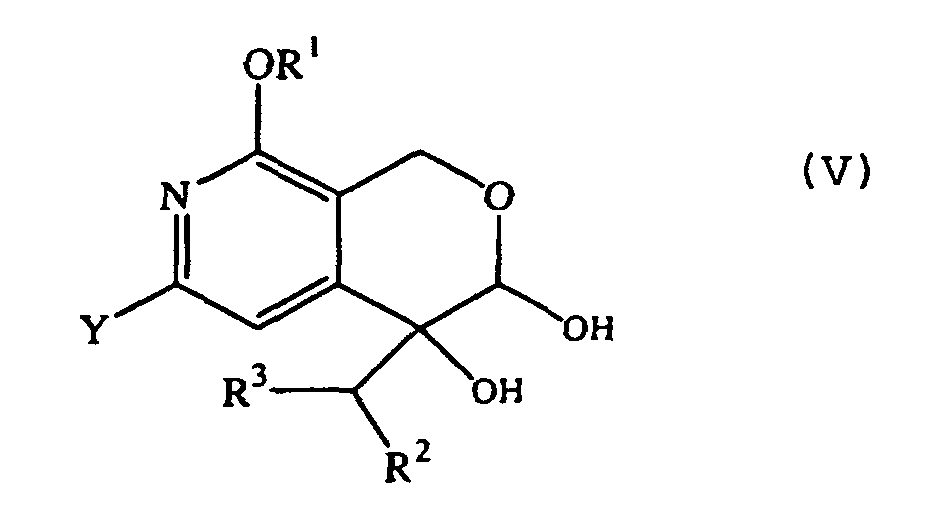 to a catalytic asymmetric dihydroxylation reaction in the presence of an osmium catalyst, a chiral tertiary amine catalyst, a stoichiometric oxidizing agent, and a primary amide under basic conditions, or to an achiral dihydroxylation reaction with subsequent resolution by enzymatic acylation in the presence of an acylating enzyme and an acylating agent, and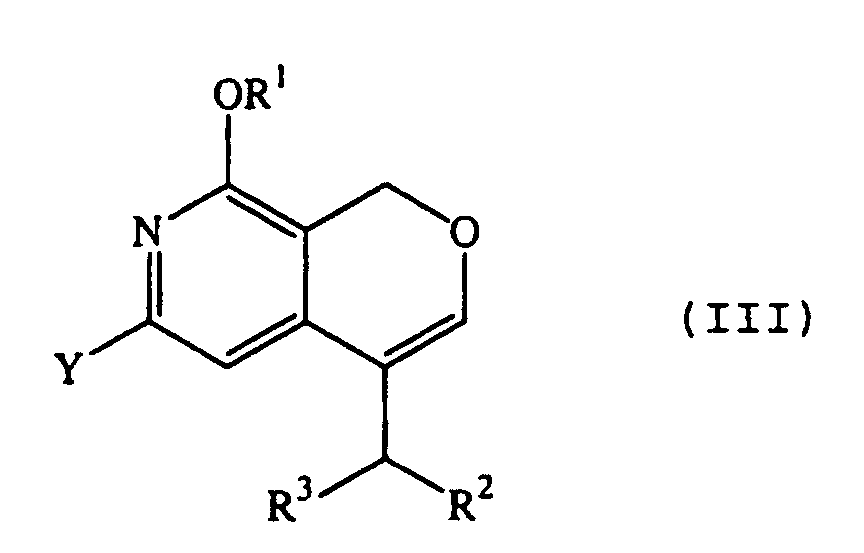
oxidizing the compound of formula (V) of claim 1 with an oxidizing agent under basic conditions. - The process of claim 9 wherein R1 and R2 are methyl, R3 is H and Y is H.
- The process of claim 9 or 10 wherein the oxidizing agent is selected from the group consisting of: iodine, bromine, chlorine, chromium trioxide and pyridine sulfur trioxide.
- A process of synthesizing a compound of Formula (III)which process comprises the steps of:
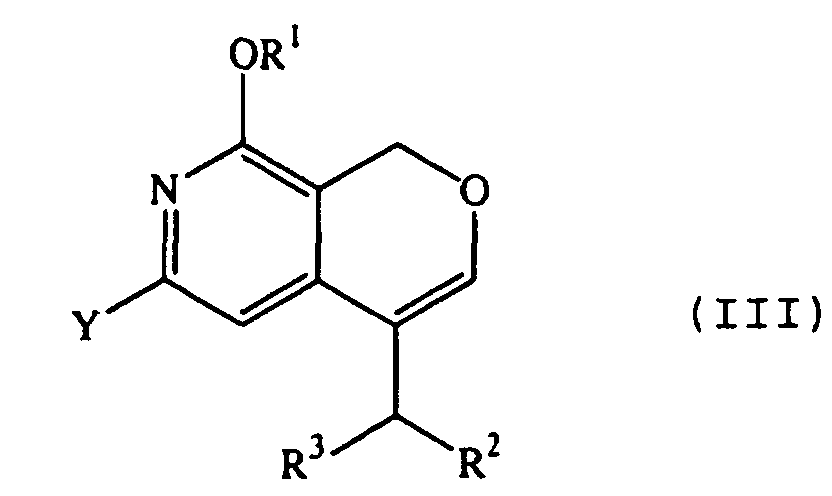 i) cyclizing a compound of Formula (II) in the presence of a palladium catalyst under basic conditionsand
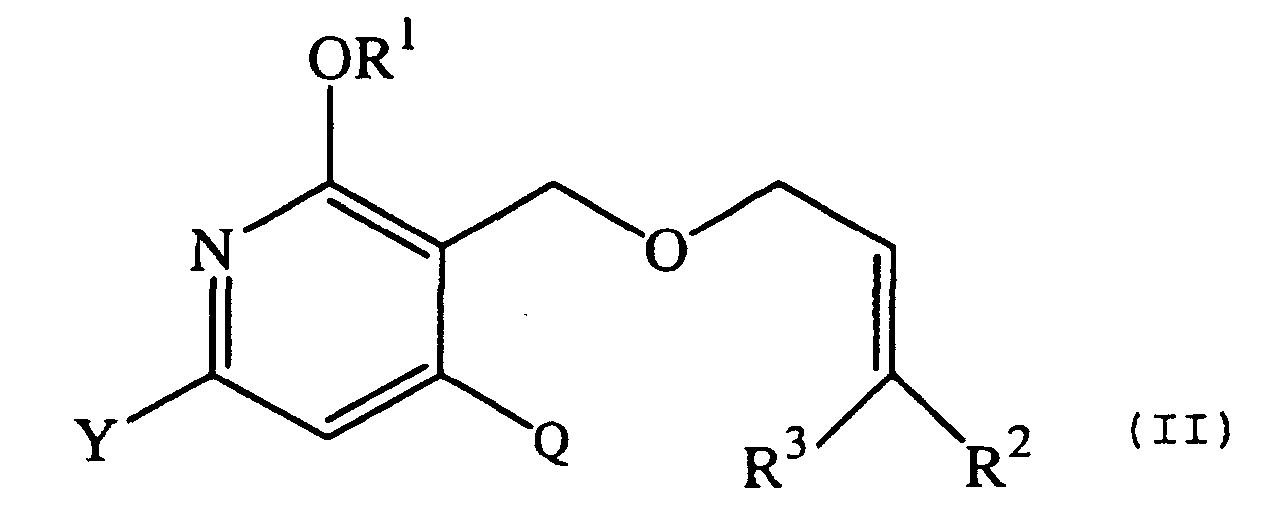 ii) isomerizing a compound of Formula (IV) in the presence of a rhodium catalyst under basic conditionswherein: R1 represents C1-8 alkyl, R2 and R3 represent H or C1-8 alkyl, Q represents triflate or halo and Y represents chloro, H or OR4, wherein R4 is selected from the group consisting of: H, C1-8 alkyl or triflate.
- The process of claim 12 wherein R1 and R2 are methyl R3 is H, Q is iodo and Y is H.
- The process of claim 12 or 13 wherein the cyclization is an intramolecular Heck reaction and wherein the palladium catalyst is selected from the group consisting of: palladium(II) acetate, tetrakis(triphenylphosphine)palladium(O), palladium(II) acetylacetonate, palladium(II) bis(benzonitrile) dichloride, palladium(II) bromide, palladium(II) chloride, palladium(II) iodide, palladium(II) sulfate, palladium(II) trifluoroacetate and palladium(II) nitrate hydrate.
- The process of claim 12, 13 or 14 carried out in a polar-protic solvent.
- The process of claim 12, 13 or 14 carried out in a polar-aprotic solvent selected from the group consisting of: acetonitrile, N,N-dimethylformamide.
- The process of claim 12, 13, 14 or 16 which additionally utilizes a tetraalkylammonium halide salt phase-transfer catalyst selected from the group consisting of: tetra-n-butyl ammonium chloride, tetra-n-butyl ammonium bromide, tetra-n-butyl ammonium iodide, tetra-n-butyl ammonium hydrogen sulfate and tetra-n-butyl ammonium acetate.
- The process according to any one of claims 14 to 17 which additionally utilizes ligand for the palladium catalyst selected from the group consisting of: triphenylphosphine, tri-o-tolylphosphine, tri-m-tolylphosphine and tri-p-tolylphosphine.
- The process according to any one of claims 12 or 18 wherein the isomerization is carried out in the presence of tris(triphenylphosphine)rhodium(I)chloride.
- Compounds of the following Formulas (I), (III), (IV), (V):


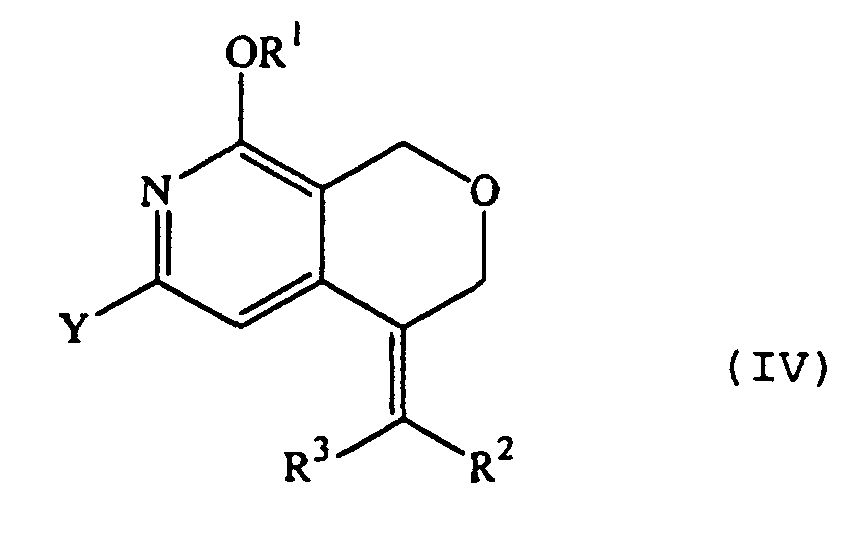 wherein: R1 represents C1-8 alkyl, R2 and R3 represent H or C1-8 alkyl; and Y represents, chloro, H or OR4, wherein R4 represents C1-8 alkyl, trifluoromethanesulphonate or H.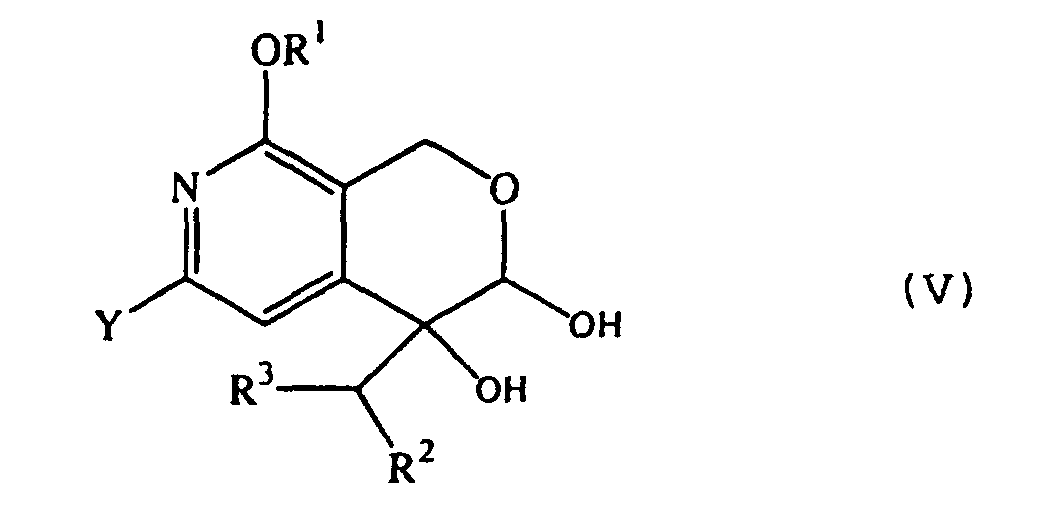
- The compound of claim 20 wherein R1 and R2 are methyl, R3 is H, and Y is H.
- Compound (V) of claim 20 in the following form:wherein R1 represents C1-8 alkyl, R2 and R3 represent H or C1-8 alkyl, and Y represents chloro, H or OR4, wherein R4 represents C1-8 alkyl, trifluoromethanesulphonate or H.

- The compound of claim 22 wherein R1 is methyl, R2 is methyl, and R3 is H and Y is H.
- The use of the compound of any of claim 20, 21, 22 or 23 or of compound (I) of claim 9 for preparing camptothecin or camptothecin-like compounds.
- The process according to any one of claims 1 to 6 wherein the stoichiometric oxidizing agent is selected from the group consisting of potassium ferricyanide, hydrogen peroxide or N-methylmorpholine N-oxide.
Applications Claiming Priority (3)
| Application Number | Priority Date | Filing Date | Title |
|---|---|---|---|
| US08/237,081 US5491237A (en) | 1994-05-03 | 1994-05-03 | Intermediates in pharmaceutical camptothecin preparation |
| US237081 | 1994-05-03 | ||
| PCT/US1995/005425 WO1995029917A2 (en) | 1994-05-03 | 1995-05-02 | Intermediates in pharmaceutical camptothecin preparation |
Publications (2)
| Publication Number | Publication Date |
|---|---|
| EP0758333A1 EP0758333A1 (en) | 1997-02-19 |
| EP0758333B1 true EP0758333B1 (en) | 2004-03-03 |
Family
ID=22892263
Family Applications (3)
| Application Number | Title | Priority Date | Filing Date |
|---|---|---|---|
| EP95917217A Expired - Lifetime EP0758333B1 (en) | 1994-05-03 | 1995-05-02 | Intermediates in pharmaceutical camptothecin preparation |
| EP02014439A Expired - Lifetime EP1254908B9 (en) | 1994-05-03 | 1995-05-02 | Preparation of a camptothecin derivative by intramolecular cyclisation |
| EP95918904A Expired - Lifetime EP0758335B1 (en) | 1994-05-03 | 1995-05-02 | Preparation of a camptothecin derivative by intramolecular cyclisation |
Family Applications After (2)
| Application Number | Title | Priority Date | Filing Date |
|---|---|---|---|
| EP02014439A Expired - Lifetime EP1254908B9 (en) | 1994-05-03 | 1995-05-02 | Preparation of a camptothecin derivative by intramolecular cyclisation |
| EP95918904A Expired - Lifetime EP0758335B1 (en) | 1994-05-03 | 1995-05-02 | Preparation of a camptothecin derivative by intramolecular cyclisation |
Country Status (9)
| Country | Link |
|---|---|
| US (4) | US5491237A (en) |
| EP (3) | EP0758333B1 (en) |
| JP (2) | JPH09512559A (en) |
| AT (3) | ATE227292T1 (en) |
| AU (2) | AU2381695A (en) |
| DE (3) | DE69528762T2 (en) |
| DK (1) | DK0758335T3 (en) |
| ES (3) | ES2219661T3 (en) |
| WO (2) | WO1995029917A2 (en) |
Families Citing this family (52)
| Publication number | Priority date | Publication date | Assignee | Title |
|---|---|---|---|---|
| US6559309B2 (en) | 1996-11-01 | 2003-05-06 | Osi Pharmaceuticals, Inc. | Preparation of a camptothecin derivative by intramolecular cyclisation |
| US6207832B1 (en) * | 1999-04-09 | 2001-03-27 | University Of Pittsburgh | Camptothecin analogs and methods of preparation thereof |
| US6288072B1 (en) * | 1999-12-29 | 2001-09-11 | Monroe E. Wall | Camptothecin β-alanine esters with topoisomerase I inhibition |
| EP1512413A3 (en) | 2001-01-16 | 2009-09-23 | Glaxo Group Limited | Pharmaceutical combination containing a 4-quinazolineamine and another anti-neoplastic agent for the treatment of cancer |
| US6809210B2 (en) | 2001-06-12 | 2004-10-26 | Lucent Technologies Inc. | Method of solvating a metal in an aromatic organic liquid |
| US6593334B1 (en) | 2002-05-02 | 2003-07-15 | The University Of North Carolina At Chapel Hill | Camptothecin-taxoid conjugates as antimitotic and antitumor agents |
| CZ299329B6 (en) * | 2003-08-26 | 2008-06-18 | Pliva-Lachema A.S. | Process for preparing 7-ethyl-10-[4-(1-piperidino)-1-piperidino]-carbonyloxy camptothecin |
| CZ299593B6 (en) * | 2003-12-16 | 2008-09-10 | Pliva-Lachema A. S. | Process for preparing 7-ethyl-10-hydroxycamptothecine |
| US8492456B2 (en) * | 2004-02-09 | 2013-07-23 | Hewlett-Packard Development Company, L.P. | Ink compositions for ink-jet printing |
| JP4861340B2 (en) * | 2005-02-22 | 2012-01-25 | エフ.ホフマン−ラ ロシュ アーゲー | A new synthesis of camptothecin subunits. |
| TWI375678B (en) * | 2005-06-09 | 2012-11-01 | Yakult Honsha Kk | A method of preparation of a tricyclic ketone |
| UY30892A1 (en) | 2007-02-07 | 2008-09-02 | Smithkline Beckman Corp | AKT ACTIVITY INHIBITORS |
| US20110129550A1 (en) * | 2007-02-16 | 2011-06-02 | Connie Erickson-Miller | Cancer treatment method |
| US20110160130A1 (en) * | 2007-02-16 | 2011-06-30 | Connie Erickson-Miller | Cancer treatment method |
| UY30915A1 (en) * | 2007-02-16 | 2008-09-02 | Smithkline Beecham Corp | CANCER TREATMENT METHOD |
| PE20090717A1 (en) | 2007-05-18 | 2009-07-18 | Smithkline Beecham Corp | QUINOLINE DERIVATIVES AS PI3 KINASE INHIBITORS |
| CN101888841B (en) * | 2007-10-09 | 2012-09-26 | 宾夕法尼亚大学理事会 | Thrombopoietin receptor agonist (TpoRA) kills acute human myeloid leukemia cells |
| US8697685B2 (en) | 2008-11-20 | 2014-04-15 | Glaxosmithkline Llc | Chemical compounds |
| CA2750565C (en) | 2009-01-30 | 2015-10-20 | Glaxosmithkline Llc | Crystalline n-{(1s)-2-amino-1-[(3-fluorophenyl)methyl]ethyl}-5-chloro-4-(4-chloro-1-methyl-1h-pyrazol-5-yl)-2-thiophenecarboxamide hydrochloride |
| US8410095B2 (en) | 2009-05-20 | 2013-04-02 | Glaxosmithkline Llc | Thiazolopyrimidinone derivatives as PI3 kinase inhibitors |
| CN101591342B (en) * | 2009-07-03 | 2011-07-27 | 华东师范大学 | Method for synthesizing key intermediate for preparing camptothecine compounds |
| MX2012002426A (en) | 2009-08-26 | 2012-06-27 | Cylene Pharmaceuticals Inc | Condensed quinolines as protein kinase modulators. |
| CA2794153C (en) | 2010-03-25 | 2018-01-02 | Glaxosmithkline Llc | Substituted indoline derivatives as perk inhibitors |
| ES2616238T3 (en) | 2010-10-06 | 2017-06-12 | Glaxosmithkline Llc, Corporation Service Company | Benzimidazole derivatives as PI3 kinase inhibitors |
| TWI505828B (en) | 2010-12-20 | 2015-11-01 | 葛蘭素史克智慧財產(第二)有限公司 | Novel pharmaceutical composition |
| MX2014006126A (en) | 2011-11-22 | 2015-03-19 | Deciphera Pharmaceuticals Llc | Pyridone amides and analogs exhibiting anti-cancer and anti-proliferative activities. |
| RU2014135224A (en) | 2012-01-31 | 2016-03-27 | Смитклайн Бичем (Корк) Лимитед | METHOD FOR TREATING MALIGNANT TUMORS |
| EP3181564B1 (en) | 2012-11-20 | 2019-09-18 | H. Hoffnabb-La Roche Ag | Aminopyrimidine compounds as inhibitors of t790m containing egfr mutants |
| MA38121A1 (en) | 2012-11-30 | 2016-10-31 | Glaxosmithkline Llc | New pharmaceutical composition |
| CN104902896A (en) | 2013-01-09 | 2015-09-09 | 葛兰素史密斯克莱知识产权(第2号)有限公司 | combination |
| EP2943484B1 (en) | 2013-01-10 | 2017-10-25 | Glaxosmithkline Intellectual Property (No. 2) Limited | Fatty acid synthase inhibitors |
| WO2015056180A1 (en) | 2013-10-15 | 2015-04-23 | Glaxosmithkline Intellectual Property (No.2) Limited | Indoline derivatives as inhibitors of perk |
| WO2015128837A1 (en) | 2014-02-26 | 2015-09-03 | Glaxosmithkline Intellectual Property (No.2) Limited | Methods of treating cancer patients responding to ezh2 inhibitor gsk126 |
| WO2016055935A1 (en) | 2014-10-06 | 2016-04-14 | Glaxosmithkline Intellectual Property (No.2) Limited | Combination of lysine-specific demethylase 1 inhibitor and thrombopoietin agonist |
| WO2016059602A2 (en) | 2014-10-16 | 2016-04-21 | Glaxo Group Limited | Methods of treating cancer and related compositions |
| MA41414A (en) | 2015-01-28 | 2017-12-05 | Centre Nat Rech Scient | ICOS AGONIST BINDING PROTEINS |
| EP3331919A1 (en) | 2015-08-07 | 2018-06-13 | GlaxoSmithKline Intellectual Property Development Limited | Combination therapy comprising anti ctla-4 antibodies |
| US20190256608A1 (en) | 2015-12-01 | 2019-08-22 | Glaxosmithkline Intellectual Property Development Limited | Combination treatments and uses and methods thereof |
| WO2017098421A1 (en) | 2015-12-08 | 2017-06-15 | Glaxosmithkline Intellectual Property Development Limited | Benzothiadiazine compounds |
| WO2017153952A1 (en) | 2016-03-10 | 2017-09-14 | Glaxosmithkline Intellectual Property Development Limited | 5-sulfamoyl-2-hydroxybenzamide derivatives |
| US11649289B2 (en) | 2016-08-04 | 2023-05-16 | Glaxosmithkline Intellectual Property Development Limited | Anti-ICOS and anti-PD-1 antibody combination therapy |
| KR20190090824A (en) | 2016-12-01 | 2019-08-02 | 글락소스미스클라인 인털렉츄얼 프로퍼티 디벨로프먼트 리미티드 | How to cure cancer |
| KR20250026366A (en) | 2017-07-05 | 2025-02-25 | 노파르티스 아게 | Novel pharmaceutical composition |
| UY37866A (en) | 2017-09-07 | 2019-03-29 | Glaxosmithkline Ip Dev Ltd | NEW SUBSTITUTED BENZOIMIDAZOL COMPOUNDS THAT REDUCE MYC PROTEIN (C-MYC) IN THE CELLS AND INHIBIT THE HISTONE ACETYLTRANSPHERASE OF P300 / CBP. |
| WO2019053617A1 (en) | 2017-09-12 | 2019-03-21 | Glaxosmithkline Intellectual Property Development Limited | Chemical compounds |
| WO2020160375A1 (en) | 2019-02-01 | 2020-08-06 | Glaxosmithkline Intellectual Property Development Limited | Combination treatments for cancer comprising belantamab mafodotin and an anti ox40 antibody and uses and methods thereof |
| KR20220026585A (en) | 2019-06-26 | 2022-03-04 | 글락소스미스클라인 인털렉츄얼 프로퍼티 디벨로프먼트 리미티드 | IL1RAP binding protein |
| WO2021018941A1 (en) | 2019-07-31 | 2021-02-04 | Glaxosmithkline Intellectual Property Development Limited | Methods of treating cancer |
| WO2021046293A1 (en) | 2019-09-06 | 2021-03-11 | Glaxosmithkline Intellectual Property Development Limited | Dosing regimen for the treatment of cancer with an anti icos agonistic antibody and tremelimumab |
| WO2021043961A1 (en) | 2019-09-06 | 2021-03-11 | Glaxosmithkline Intellectual Property Development Limited | Dosing regimen for the treatment of cancer with an anti icos agonistic antibody and chemotherapy |
| EP4096718A1 (en) | 2020-01-28 | 2022-12-07 | GlaxoSmithKline Intellectual Property Development Limited | Combination treatments and uses and methods thereof |
| CN115073408A (en) * | 2022-08-09 | 2022-09-20 | 江苏法安德医药科技有限公司 | Synthetic method of 2,3,4, 6-tetrabenzyl-D-glucopyranose |
Family Cites Families (50)
| Publication number | Priority date | Publication date | Assignee | Title |
|---|---|---|---|---|
| DE152774C (en) * | ||||
| US4399282A (en) * | 1979-07-10 | 1983-08-16 | Kabushiki Kaisha Yakult Honsha | Camptothecin derivatives |
| DD152774A1 (en) * | 1980-08-25 | 1981-12-09 | Brunhilde Gorski | METHOD FOR THE SEPARATION OF PALLADIUM AND TECHNETIUM FROM SOLUTIONS OF THE CORE FUEL REPRODUCTION |
| US4399276A (en) * | 1981-01-09 | 1983-08-16 | Kabushiki Kaisha Yakult Honsha | 7-Substituted camptothecin derivatives |
| US4413118A (en) * | 1981-03-02 | 1983-11-01 | Merck & Co., Inc. | Process for removal of homogeneous catalyst group VIII metals from process streams |
| US4473692A (en) * | 1981-09-04 | 1984-09-25 | Kabushiki Kaisha Yakult Honsha | Camptothecin derivatives and process for preparing same |
| DE3682874D1 (en) * | 1985-10-21 | 1992-01-23 | Daiichi Seiyaku Co | PYRANOINDOLICINE DERIVATIVES AND METHOD FOR THE PRODUCTION THEREOF. |
| JPS6314824A (en) * | 1986-07-04 | 1988-01-22 | Tanaka Kikinzoku Kogyo Kk | Method for recovering noble metallic element |
| JPS6333355A (en) * | 1986-07-29 | 1988-02-13 | Mitsui Toatsu Chem Inc | Purification of cystine |
| US5227380A (en) * | 1987-03-31 | 1993-07-13 | Research Triangle Institute | Pharmaceutical compositions and methods employing camptothecins |
| US5106742A (en) * | 1987-03-31 | 1992-04-21 | Wall Monroe E | Camptothecin analogs as potent inhibitors of topoisomerase I |
| US4894456A (en) * | 1987-03-31 | 1990-01-16 | Research Triangle Institute | Synthesis of camptothecin and analogs thereof |
| US4981968A (en) * | 1987-03-31 | 1991-01-01 | Research Triangle Institute | Synthesis of camptothecin and analogs thereof |
| US5244903A (en) * | 1987-03-31 | 1993-09-14 | Research Triangle Institute | Camptothecin analogs as potent inhibitors of topoisomerase I |
| US5053512A (en) * | 1987-04-14 | 1991-10-01 | Research Triangle Institute | Total synthesis of 20(S) and 20(R)-camptothecin and compthothecin derivatives |
| US5122526A (en) * | 1987-03-31 | 1992-06-16 | Research Triangle Institute | Camptothecin and analogs thereof and pharmaceutical compositions and method using them |
| US5122606A (en) * | 1987-04-14 | 1992-06-16 | Research Triangle Institute | 10,11-methylenedioxy camptothecins |
| US5180722A (en) * | 1987-04-14 | 1993-01-19 | Research Triangle Institute | 10,11-methylenedioxy-20(RS)-camptothecin and 10,11-methylenedioxy-20(S)-camptothecin analogs |
| US5049668A (en) * | 1989-09-15 | 1991-09-17 | Research Triangle Institute | 10,11-methylenedioxy-20(RS)-camptothecin analogs |
| US4943579A (en) * | 1987-10-06 | 1990-07-24 | The United States Of America As Represented By The Secretary Of The Department Of Health And Human Services | Water soluble prodrugs of camptothecin |
| US5004758A (en) * | 1987-12-01 | 1991-04-02 | Smithkline Beecham Corporation | Water soluble camptothecin analogs useful for inhibiting the growth of animal tumor cells |
| US4965364A (en) * | 1988-02-23 | 1990-10-23 | Massachusetts Institute Of Technology | Ligand-accelerated catalytic asymmetric dihydroxylation |
| US5260461A (en) * | 1988-01-11 | 1993-11-09 | Massachusetts Institute Of Technology | Ligands for ADH: cinchona alkaloids and moderately sized organic substituents linked through a planar aromatic spacer group |
| US5227543A (en) * | 1988-01-11 | 1993-07-13 | Massachusetts Institute Of Technology | Facilitation of turnover in the ADH by additives which catalyze the hydrolysis of the OS(VI) glycolate esters |
| ATE178578T1 (en) * | 1988-01-11 | 1999-04-15 | Massachusetts Inst Technology | ASYMMETRIC CATALYTIC DIHYDROXYLATION ACCELERATED BY A COMPLEX IMAGE |
| US4871855A (en) * | 1988-01-11 | 1989-10-03 | Massachusetts Institute Of Technology | Ligand-accelerated catalytic asymmetric dihydroxylation using dihydroquinidine and dihydroquinidine esters as ligands |
| US5126494A (en) * | 1988-01-11 | 1992-06-30 | Massachusetts Institute Of Technology | Methods for catalytic asymmetric dihydroxylation of olefins |
| JPH0615547B2 (en) * | 1988-01-20 | 1994-03-02 | 株式会社ヤクルト本社 | Novel camptothecin derivative |
| DK0418099T3 (en) * | 1989-09-15 | 2002-04-02 | Res Triangle Inst | Process for Preparation of 10,11-Methylenedioxy-20 (RS) Camptothecin and 10,11-Methylenedioxy-20 (S) Camptothecin Analogs |
| US5099047A (en) * | 1989-11-17 | 1992-03-24 | Mitsubishi Kasei Corporation | Method for recovering a group viii metal solid complex and hydroformylation method |
| IE913790A1 (en) * | 1990-10-31 | 1992-05-22 | Smithkline Beecham Corp | SUBSTITUTED INDOLIZINO [1,2-b]QUINOLINONES |
| US5247089A (en) * | 1990-12-20 | 1993-09-21 | North Carolina State University | Method of making intermediates useful for the manufacture of camptothecin and camptothecin analogs |
| US5243050A (en) * | 1990-12-20 | 1993-09-07 | North Carolina State University | Alkylpyridone DE ring intermediates useful for the manufacture of camptothecin and camptothecin analogs |
| US5191082A (en) * | 1990-12-20 | 1993-03-02 | North Carolina State University | Camptothecin intermediate and method of making camptothecin intermediates |
| US5264579A (en) * | 1990-12-20 | 1993-11-23 | North Carolina State University | D ring intermediates for the synthesis of camptothecin and camptothecin analogs |
| US5212317A (en) * | 1990-12-20 | 1993-05-18 | North Carolina State University | Methods and intermediates for the assymmetric synthesis of camptothecin and camptothecin analogs |
| US5162532A (en) * | 1990-12-20 | 1992-11-10 | North Carolina State University | Intermediates and method of making camptothecin and camptothecin analogs |
| US5200524A (en) * | 1990-12-20 | 1993-04-06 | North Carolina State University | Camptothecin intermediates and method of making same |
| US5258516A (en) * | 1990-12-20 | 1993-11-02 | Nc State University | Optically pure D,E ring intermediates useful for the synthesis of camptothecin and camptothecin analogs |
| US5254690A (en) * | 1990-12-20 | 1993-10-19 | North Carolina State University | Alkoxymethylpyridine d-ring intermediates useful for the synthesis of camptpthecin and camptothecin analogs |
| US5315007A (en) * | 1990-12-20 | 1994-05-24 | North Carolina State University | Process for making DE ring intermediates for the synthesis of camptothecin and camptothecin analogs |
| JP3550397B2 (en) * | 1991-05-13 | 2004-08-04 | マサチユセツツ・インスチチユート・オブ・テクノロジイ | A method for catalytic asymmetric dihydroxylation of heterocyclic chiral ligands and olefins |
| ATE136898T1 (en) * | 1991-10-29 | 1996-05-15 | Glaxo Wellcome Inc | WATER SOLUBLE CAMPTOTHECINE DERIVATIVES |
| EP0556585A3 (en) * | 1992-01-24 | 1993-09-01 | Takeda Chemical Industries, Ltd. | Condensed camptothecin derivatives their production and use as antitumor agents |
| WO1993016698A1 (en) * | 1992-02-21 | 1993-09-02 | Smithkline Beecham Corporation | SUBSTITUTED FURO[3',4':6,7]INDOLIZINO[1,2-b]QUINOLINONES |
| EP0655919A4 (en) * | 1992-08-21 | 1995-10-18 | Dana Farber Cancer Inst Inc | TREATMENT OF VIRAL INFECTIONS IN MAN. |
| US5342947A (en) * | 1992-10-09 | 1994-08-30 | Glaxo Inc. | Preparation of water soluble camptothecin derivatives |
| US5479108A (en) * | 1992-11-25 | 1995-12-26 | David Cheng | Method and apparatus for handling wafers |
| AP9300587A0 (en) * | 1992-11-12 | 1995-05-05 | Glaxo Inc | Water soluble camptothecin derivatives. |
| ATE301659T1 (en) * | 1995-11-02 | 2005-08-15 | Osi Pharm Inc | METHOD FOR PRODUCING CAMPOTHECINE DERIVATIVES |
-
1994
- 1994-05-03 US US08/237,081 patent/US5491237A/en not_active Expired - Lifetime
-
1995
- 1995-05-02 ES ES95917217T patent/ES2219661T3/en not_active Expired - Lifetime
- 1995-05-02 DE DE69528762T patent/DE69528762T2/en not_active Expired - Fee Related
- 1995-05-02 JP JP7528482A patent/JPH09512559A/en active Pending
- 1995-05-02 DE DE69532634T patent/DE69532634T2/en not_active Expired - Fee Related
- 1995-05-02 DK DK95918904T patent/DK0758335T3/en active
- 1995-05-02 DE DE69534029T patent/DE69534029T2/en not_active Expired - Fee Related
- 1995-05-02 AU AU23816/95A patent/AU2381695A/en not_active Abandoned
- 1995-05-02 AT AT95918904T patent/ATE227292T1/en not_active IP Right Cessation
- 1995-05-02 EP EP95917217A patent/EP0758333B1/en not_active Expired - Lifetime
- 1995-05-02 AT AT95917217T patent/ATE260919T1/en not_active IP Right Cessation
- 1995-05-02 JP JP7528481A patent/JPH09512558A/en not_active Ceased
- 1995-05-02 ES ES02014439T patent/ES2238523T3/en not_active Expired - Lifetime
- 1995-05-02 EP EP02014439A patent/EP1254908B9/en not_active Expired - Lifetime
- 1995-05-02 WO PCT/US1995/005425 patent/WO1995029917A2/en not_active Ceased
- 1995-05-02 WO PCT/US1995/005427 patent/WO1995029919A1/en not_active Ceased
- 1995-05-02 AT AT02014439T patent/ATE289608T1/en not_active IP Right Cessation
- 1995-05-02 ES ES95918904T patent/ES2188661T3/en not_active Expired - Lifetime
- 1995-05-02 US US08/737,032 patent/US6063923A/en not_active Expired - Fee Related
- 1995-05-02 AU AU24651/95A patent/AU2465195A/en not_active Abandoned
- 1995-05-02 US US08/732,435 patent/US5840898A/en not_active Expired - Fee Related
- 1995-05-02 EP EP95918904A patent/EP0758335B1/en not_active Expired - Lifetime
-
2000
- 2000-04-19 US US09/552,214 patent/US6462196B1/en not_active Expired - Fee Related
Also Published As
| Publication number | Publication date |
|---|---|
| EP1254908A1 (en) | 2002-11-06 |
| AU2465195A (en) | 1995-11-29 |
| WO1995029917A3 (en) | 1995-12-28 |
| EP0758333A1 (en) | 1997-02-19 |
| ES2238523T3 (en) | 2005-09-01 |
| US5840898A (en) | 1998-11-24 |
| EP1254908B1 (en) | 2005-02-23 |
| US6462196B1 (en) | 2002-10-08 |
| JPH09512559A (en) | 1997-12-16 |
| DE69532634T2 (en) | 2005-03-10 |
| ATE227292T1 (en) | 2002-11-15 |
| WO1995029919A1 (en) | 1995-11-09 |
| HK1052687A1 (en) | 2003-09-26 |
| US5491237A (en) | 1996-02-13 |
| AU2381695A (en) | 1995-11-29 |
| ATE289608T1 (en) | 2005-03-15 |
| DE69532634D1 (en) | 2004-04-08 |
| ES2188661T3 (en) | 2003-07-01 |
| WO1995029917A2 (en) | 1995-11-09 |
| JPH09512558A (en) | 1997-12-16 |
| DE69528762D1 (en) | 2002-12-12 |
| DK0758335T3 (en) | 2003-03-17 |
| EP0758335B1 (en) | 2002-11-06 |
| ATE260919T1 (en) | 2004-03-15 |
| DE69534029T2 (en) | 2006-01-12 |
| DE69534029D1 (en) | 2005-03-31 |
| EP0758335A1 (en) | 1997-02-19 |
| EP1254908B9 (en) | 2005-09-21 |
| DE69528762T2 (en) | 2003-07-17 |
| ES2219661T3 (en) | 2004-12-01 |
| US6063923A (en) | 2000-05-16 |
Similar Documents
| Publication | Publication Date | Title |
|---|---|---|
| US5840898A (en) | Method of removing heavy metal contaminants from organic compounds | |
| US6444820B1 (en) | Process for the manufacture of camptothecin derivatives | |
| US6143891A (en) | Method for preparing camptothecin derivatives | |
| US6559309B2 (en) | Preparation of a camptothecin derivative by intramolecular cyclisation | |
| HK1052687B (en) | Preparation of a camptothecin derivative by intramolecular cyclisation | |
| US6716982B2 (en) | Method for preparing camptothecin derivatives | |
| HK1055118B (en) | Novel intermediates and process for the manufacture of camptothecin derivatives (cpt-11) and related compounds |
Legal Events
| Date | Code | Title | Description |
|---|---|---|---|
| PUAI | Public reference made under article 153(3) epc to a published international application that has entered the european phase |
Free format text: ORIGINAL CODE: 0009012 |
|
| 17P | Request for examination filed |
Effective date: 19961128 |
|
| AK | Designated contracting states |
Kind code of ref document: A1 Designated state(s): AT BE CH DE DK ES FR GB GR IE IT LI LU MC NL PT SE |
|
| AX | Request for extension of the european patent |
Free format text: LT PAYMENT 961128;LV PAYMENT 961128;SI PAYMENT 961128 |
|
| 17Q | First examination report despatched |
Effective date: 19990617 |
|
| RAP1 | Party data changed (applicant data changed or rights of an application transferred) |
Owner name: GILEAD SCIENCES INC. |
|
| RAP1 | Party data changed (applicant data changed or rights of an application transferred) |
Owner name: OSI PHARMACEUTICALS, INC. |
|
| GRAP | Despatch of communication of intention to grant a patent |
Free format text: ORIGINAL CODE: EPIDOSNIGR1 |
|
| GRAS | Grant fee paid |
Free format text: ORIGINAL CODE: EPIDOSNIGR3 |
|
| GRAA | (expected) grant |
Free format text: ORIGINAL CODE: 0009210 |
|
| AK | Designated contracting states |
Kind code of ref document: B1 Designated state(s): AT BE CH DE DK ES FR GB GR IE IT LI LU MC NL PT SE |
|
| AX | Request for extension of the european patent |
Extension state: LT LV SI |
|
| PG25 | Lapsed in a contracting state [announced via postgrant information from national office to epo] |
Ref country code: NL Free format text: LAPSE BECAUSE OF FAILURE TO SUBMIT A TRANSLATION OF THE DESCRIPTION OR TO PAY THE FEE WITHIN THE PRESCRIBED TIME-LIMIT Effective date: 20040303 Ref country code: LI Free format text: LAPSE BECAUSE OF FAILURE TO SUBMIT A TRANSLATION OF THE DESCRIPTION OR TO PAY THE FEE WITHIN THE PRESCRIBED TIME-LIMIT Effective date: 20040303 Ref country code: CH Free format text: LAPSE BECAUSE OF FAILURE TO SUBMIT A TRANSLATION OF THE DESCRIPTION OR TO PAY THE FEE WITHIN THE PRESCRIBED TIME-LIMIT Effective date: 20040303 Ref country code: BE Free format text: LAPSE BECAUSE OF FAILURE TO SUBMIT A TRANSLATION OF THE DESCRIPTION OR TO PAY THE FEE WITHIN THE PRESCRIBED TIME-LIMIT Effective date: 20040303 Ref country code: AT Free format text: LAPSE BECAUSE OF FAILURE TO SUBMIT A TRANSLATION OF THE DESCRIPTION OR TO PAY THE FEE WITHIN THE PRESCRIBED TIME-LIMIT Effective date: 20040303 |
|
| REG | Reference to a national code |
Ref country code: GB Ref legal event code: FG4D |
|
| REG | Reference to a national code |
Ref country code: CH Ref legal event code: EP |
|
| REG | Reference to a national code |
Ref country code: IE Ref legal event code: FG4D |
|
| REF | Corresponds to: |
Ref document number: 69532634 Country of ref document: DE Date of ref document: 20040408 Kind code of ref document: P |
|
| PGFP | Annual fee paid to national office [announced via postgrant information from national office to epo] |
Ref country code: DK Payment date: 20040413 Year of fee payment: 10 Ref country code: CH Payment date: 20040413 Year of fee payment: 10 |
|
| PGFP | Annual fee paid to national office [announced via postgrant information from national office to epo] |
Ref country code: NL Payment date: 20040419 Year of fee payment: 10 |
|
| PGFP | Annual fee paid to national office [announced via postgrant information from national office to epo] |
Ref country code: SE Payment date: 20040421 Year of fee payment: 10 Ref country code: MC Payment date: 20040421 Year of fee payment: 10 Ref country code: IE Payment date: 20040421 Year of fee payment: 10 |
|
| PGFP | Annual fee paid to national office [announced via postgrant information from national office to epo] |
Ref country code: GR Payment date: 20040423 Year of fee payment: 10 |
|
| PGFP | Annual fee paid to national office [announced via postgrant information from national office to epo] |
Ref country code: LU Payment date: 20040525 Year of fee payment: 10 |
|
| PGFP | Annual fee paid to national office [announced via postgrant information from national office to epo] |
Ref country code: BE Payment date: 20040527 Year of fee payment: 10 |
|
| PG25 | Lapsed in a contracting state [announced via postgrant information from national office to epo] |
Ref country code: SE Free format text: LAPSE BECAUSE OF FAILURE TO SUBMIT A TRANSLATION OF THE DESCRIPTION OR TO PAY THE FEE WITHIN THE PRESCRIBED TIME-LIMIT Effective date: 20040603 Ref country code: GR Free format text: LAPSE BECAUSE OF FAILURE TO SUBMIT A TRANSLATION OF THE DESCRIPTION OR TO PAY THE FEE WITHIN THE PRESCRIBED TIME-LIMIT Effective date: 20040603 Ref country code: DK Free format text: LAPSE BECAUSE OF FAILURE TO SUBMIT A TRANSLATION OF THE DESCRIPTION OR TO PAY THE FEE WITHIN THE PRESCRIBED TIME-LIMIT Effective date: 20040603 |
|
| NLV1 | Nl: lapsed or annulled due to failure to fulfill the requirements of art. 29p and 29m of the patents act | ||
| LTIE | Lt: invalidation of european patent or patent extension |
Effective date: 20040303 |
|
| REG | Reference to a national code |
Ref country code: CH Ref legal event code: PL |
|
| ET | Fr: translation filed | ||
| REG | Reference to a national code |
Ref country code: ES Ref legal event code: FG2A Ref document number: 2219661 Country of ref document: ES Kind code of ref document: T3 |
|
| PLBE | No opposition filed within time limit |
Free format text: ORIGINAL CODE: 0009261 |
|
| STAA | Information on the status of an ep patent application or granted ep patent |
Free format text: STATUS: NO OPPOSITION FILED WITHIN TIME LIMIT |
|
| 26N | No opposition filed |
Effective date: 20041206 |
|
| PG25 | Lapsed in a contracting state [announced via postgrant information from national office to epo] |
Ref country code: LU Free format text: LAPSE BECAUSE OF NON-PAYMENT OF DUE FEES Effective date: 20050502 Ref country code: IE Free format text: LAPSE BECAUSE OF NON-PAYMENT OF DUE FEES Effective date: 20050502 |
|
| PG25 | Lapsed in a contracting state [announced via postgrant information from national office to epo] |
Ref country code: MC Free format text: LAPSE BECAUSE OF NON-PAYMENT OF DUE FEES Effective date: 20050531 |
|
| REG | Reference to a national code |
Ref country code: IE Ref legal event code: MM4A |
|
| PG25 | Lapsed in a contracting state [announced via postgrant information from national office to epo] |
Ref country code: PT Free format text: LAPSE BECAUSE OF NON-PAYMENT OF DUE FEES Effective date: 20040803 |
|
| PGFP | Annual fee paid to national office [announced via postgrant information from national office to epo] |
Ref country code: GB Payment date: 20080319 Year of fee payment: 14 |
|
| PGFP | Annual fee paid to national office [announced via postgrant information from national office to epo] |
Ref country code: ES Payment date: 20080421 Year of fee payment: 14 Ref country code: DE Payment date: 20080430 Year of fee payment: 14 |
|
| PGFP | Annual fee paid to national office [announced via postgrant information from national office to epo] |
Ref country code: IT Payment date: 20080331 Year of fee payment: 14 |
|
| PGFP | Annual fee paid to national office [announced via postgrant information from national office to epo] |
Ref country code: FR Payment date: 20080320 Year of fee payment: 14 |
|
| GBPC | Gb: european patent ceased through non-payment of renewal fee |
Effective date: 20090502 |
|
| REG | Reference to a national code |
Ref country code: FR Ref legal event code: ST Effective date: 20100129 |
|
| PG25 | Lapsed in a contracting state [announced via postgrant information from national office to epo] |
Ref country code: FR Free format text: LAPSE BECAUSE OF NON-PAYMENT OF DUE FEES Effective date: 20090602 |
|
| PG25 | Lapsed in a contracting state [announced via postgrant information from national office to epo] |
Ref country code: GB Free format text: LAPSE BECAUSE OF NON-PAYMENT OF DUE FEES Effective date: 20090502 |
|
| PG25 | Lapsed in a contracting state [announced via postgrant information from national office to epo] |
Ref country code: DE Free format text: LAPSE BECAUSE OF NON-PAYMENT OF DUE FEES Effective date: 20091201 |
|
| REG | Reference to a national code |
Ref country code: ES Ref legal event code: FD2A Effective date: 20090504 |
|
| PG25 | Lapsed in a contracting state [announced via postgrant information from national office to epo] |
Ref country code: ES Free format text: LAPSE BECAUSE OF NON-PAYMENT OF DUE FEES Effective date: 20090504 |
|
| PG25 | Lapsed in a contracting state [announced via postgrant information from national office to epo] |
Ref country code: IT Free format text: LAPSE BECAUSE OF NON-PAYMENT OF DUE FEES Effective date: 20090502 |