EP0757453B1 - A telecommunications system - Google Patents
A telecommunications system Download PDFInfo
- Publication number
- EP0757453B1 EP0757453B1 EP96305380A EP96305380A EP0757453B1 EP 0757453 B1 EP0757453 B1 EP 0757453B1 EP 96305380 A EP96305380 A EP 96305380A EP 96305380 A EP96305380 A EP 96305380A EP 0757453 B1 EP0757453 B1 EP 0757453B1
- Authority
- EP
- European Patent Office
- Prior art keywords
- station
- ground
- fixed
- stations
- aircraft
- Prior art date
- Legal status (The legal status is an assumption and is not a legal conclusion. Google has not performed a legal analysis and makes no representation as to the accuracy of the status listed.)
- Expired - Lifetime
Links
- 238000000034 method Methods 0.000 claims description 24
- 230000005540 biological transmission Effects 0.000 claims description 20
- 230000008569 process Effects 0.000 claims description 7
- 230000001360 synchronised effect Effects 0.000 claims description 3
- 230000010267 cellular communication Effects 0.000 claims description 2
- 230000001413 cellular effect Effects 0.000 claims description 2
- 230000009194 climbing Effects 0.000 claims description 2
- 239000006185 dispersion Substances 0.000 claims description 2
- 238000005070 sampling Methods 0.000 claims description 2
- 238000004891 communication Methods 0.000 description 7
- 230000000694 effects Effects 0.000 description 2
- 239000000654 additive Substances 0.000 description 1
- 230000000996 additive effect Effects 0.000 description 1
- 230000001174 ascending effect Effects 0.000 description 1
- 230000008901 benefit Effects 0.000 description 1
- 230000001419 dependent effect Effects 0.000 description 1
- 238000012986 modification Methods 0.000 description 1
- 230000004048 modification Effects 0.000 description 1
- 230000009467 reduction Effects 0.000 description 1
Images


Classifications
-
- H—ELECTRICITY
- H04—ELECTRIC COMMUNICATION TECHNIQUE
- H04W—WIRELESS COMMUNICATION NETWORKS
- H04W48/00—Access restriction; Network selection; Access point selection
- H04W48/20—Selecting an access point
-
- H—ELECTRICITY
- H04—ELECTRIC COMMUNICATION TECHNIQUE
- H04W—WIRELESS COMMUNICATION NETWORKS
- H04W84/00—Network topologies
- H04W84/02—Hierarchically pre-organised networks, e.g. paging networks, cellular networks, WLAN [Wireless Local Area Network] or WLL [Wireless Local Loop]
- H04W84/04—Large scale networks; Deep hierarchical networks
- H04W84/06—Airborne or Satellite Networks
Definitions
- the present invention relates to a telecommunications system, in particular a terrestrial flight telecommunications system, and method of operating same.
- transmission to or from one or more mobile stations is achieved by means of a number of fixed stations each defining a cell, the cell being the area in which communication via the associated ground station can be effected.
- the mobile station for example a mobile phone, normally comprises a logic circuitry which enables a fixed station to be selected and in a mobile phone application, for example, this selection could be made on the basis of signal strength.
- the present invention is primarily concerned with a terrestrial flight telephone system, which systems are presently being deployed on commercial aircraft to enable telephone calls to be made on board the aircraft both whilst the aircraft is on the airport apron, and also whilst in flight.
- a detailed description of such a system is to be found in the European Telecommunications Standard Institute (ETSI) draft publication entitled: “Radio Equipment and Systems (RES) Terrestrial Flight Telephone System (TFTS) Part 2: Search Services, Radio Interface", dated July 1993 and subsequently updated and published as prETS300 326-2.
- ETSI proposes a system in which a mobile air station selects a fixed ground station by a method summarised by the flow charts on pages 75-86 of that document.
- the method comprises establishing certain criteria relating to the mobile station, more particularly the aircraft on which it is located, and a number of fixed ground stations, and depending on those criteria an appropriate ground station is identified and a transmission effected via that ground station. This selection would for example be based on the closing rate alone to any ground station which had an acceptable signal strength.
- an air-to-ground communications system for controlling multiple two way radiotelephone conversations between a large number of aircraft and a network of base stations that are capable of being interconnected to landline telephone networks.
- Means are provided for matching each aircraft with an optimal base station to afford it the strongest available communication signals, and for dynamically allocating communication channels between the base stations.
- Each aircraft compares the relative strength and Doppler frequency shift error of each of the pilot signals of the base stations and selects the base station that will supply the best service.
- US-A-4,419,766 discloses air/ground communications compatible with ground based telephone systems.
- the airborne equipment incorporates means for comparing signals received from various ground stations located along the flight path so as to allow the selection of the "best" signal to provide good telephone communications service for a reasonable length telephone conversation, principally on the basis of Doppler shift and signal strength. Further improvements in such systems are desirable.
- a telecommunications system comprising at least one mobile station and a plurality of fixed stations with which the at least one mobile station can communicate, the at least one mobile station comprising processing means for receiving selected criteria, characterised in that the processing means is such as to derive from a plurality of these criteria a score value for each of a plurality of fixed stations with which the at least one mobile station is able to communicate, and to select on the basis of these score values the fixed station via which a transmission is to be routed, the score value for each fixed station being derived from an algorithm into which the selected criteria are input, wherein the processing means comprises means for receiving signals relating to the status of the mobile station and/or a fixed station for which it is determining a score value, at least one criterion being multiplied by a constant associated with that criterion, the value of the constant being selected from one of a number of values depending on the status of the mobile and/or fixed station.
- the score for a particular fixed station is derived from an algorithm into which the selected criteria are input, such an algorithm enables a number of criteria to be taken into account and weighted appropriately. Certain criteria may be weighted in dependence on other criteria.
- the processing means comprises means for receiving signals relating to the status of the mobile station and/or a fixed station for which it is determining a score, at least one criterion being multiplied by a constant associated with that criterion, the value of the constant being selected from one of a number of values depending on the status of the mobile and/or fixed station. This enables the selection process to take into account the status of the mobile station or fixed station. For example if the mobile station is an aircraft then the selection process may need to be biased towards a particular type of fixed ground station in dependence on whether the aircraft is on the ground or airborne.
- the system comprises a plurality of classes of fixed station and the processing means has means for identifying the class to which a particular fixed station belongs, and inserting a value in the algorithm in dependence upon the class of the fixed station for which a score is to be derived.
- This enables different weighting to be given to different base stations, for example a base station normally subject to high traffic density may be given a lower rating than one subject to low traffic density, the mobile station will then be biased towards selecting the fixed station with lower traffic density.
- the fixed stations may be categorised as macro, micro or pico stations, as is conventional, with the algorithm being biased such that macro stations are favoured in preference to micro stations, which are in turn favoured in preference to pico stations. This prevents "passing" mobiles using micro or pico stations which are normally positioned so as to cope with high intensity local traffic.
- a transmission is rerouted if the score of an alternative fixed station exceeds that of the present fixed station by a predetermined value or ratio. This provides hysteresis and prevents a mobile station "skipping" from cell to cell.
- some of the constants in the algorithm are selected in dependence on the class of fixed station, thereby enabling a different weighting to be applied to some of the criteria depending on the type of fixed station.
- a terrestrial flight telephone system comprising a cellular communications system in accordance with the invention as described above, wherein the at least one mobile station is an air station for location aboard an aircraft and the plurality of fixed stations are ground stations.
- TFTS terrestrial flight telephone system
- Such a system may comprise a number of ground stations categorised as airport ground stations, intermediate ground stations and en-route ground stations.
- An airport ground station is herein defined as a ground station which is designed to serve air stations located in aircraft on the ground at the airfield.
- Such an airport ground station corresponds to a conventional pico station having a very high intensity of traffic but having relatively small cell size.
- An intermediate ground station is herein defined as a ground station located such as to serve aircraft ascending from or descending to an airport, and would normally be located in close proximity to that airport. Such a ground station would correspond to a conventional micro station, serving a medium sized area of relatively dense traffic.
- An en-route ground station is herein defined as one designed to serve a large area of fairly low intensity traffic, and a number of these would be located at strategic points such that they ideally together provide blanket coverage at least of the major flight paths. Such en-route stations would correspond to macro stations in a conventional system.
- the bias introduced into the algorithm can be used to ensure that an en-route aircraft normally continues to use en-route stations even though it may be in an intermediate or airport cell, thus avoiding congestion of the intermediate or airport cell.
- the processor receives some of the following criteria: closing rate to a ground station; quality of signal from a ground station; signal strength from a ground station; the cell limit of a ground station; the range to a ground station; whether the aircraft with which the processing means is associated is on the ground (weight on wheels); whether a ground station can be legally accessed.
- a method of selecting in a cellular telecommunications system via which of a plurality of fixed stations a transmission with a mobile station is to be routed comprising, for each fixed station with which the mobile station can communicate, receiving selected criteria and deriving from a plurality of these a score value for each fixed station, and deciding on the basis of the score values through which fixed station the transmission is to be routed, comprising substituting the selected criteria into an algorithm to derive a score value for each fixed station with which the mobile station can communicate, the algorithm determining the status of the fixed station and/or mobile station and multiplying the value of at least one criterion by a constant the value of which depends on the status value of the fixed station or mobile station.
- FIG. 1 there is illustrated the primary components of the airborne mobile station.
- This comprises a transmitter/receiver 1 for communicating with a fixed ground station, a central processor unit (CPU) 2 which controls transmissions to and from receiver 1, and a data base 3 in which the CPU can store selected information.
- the CPU 2 is also connected to the aircraft data bus 4, through which it can obtain information relating to the status of the aircraft, and also to a private branch exchange (PBX) 5.
- PBX 5 is in turn connected to telephones aboard the aircraft and enables telephones aboard the aircraft to be interconnected, or connected to the ground telephone system via the CPU 2, transmitter/receiver 1 and ground station of Figure 2.
- the ground station comprises a transmitter/receiver 6 connected to a CPU 7 through which calls are routed to and from public switch telephone network (PSTN) 8.
- PSTN public switch telephone network
- a data base 9 is also connected to the CPU 7 which provides data to be transmitted via transmitter/receiver 6.
- the data base 9 of the ground station contains information relating to the ground station with which it is associated and also a number of adjacent ground stations. This information is transmitted in the access channel or broadcast control data channel BCCH(D) of the ground station.
- the information relating to the particular ground station from which the transmission is made includes maximum range (mr) of the ground station i.e. the radius of the cell associated with the ground station, the type of ground station, a synchronisation signal and a value (r LIM ), see Figure 3.
- the air station of Figure 1 is arranged, as will be described below, such that the range between R and r LIM is a handover region, and therefore if a ground station is particularly busy by reducing r LIM it effectively reduces its working cell size as is illustrated in Figure 3.
- a terrestrial flight telephone system in accordance with the present embodiment comprises three classes or types of ground stations providing different types of coverage as will now be explained with reference to Figure 4.
- an airport ground station is located at or adjacent an airport and has a horizontal range of approximately five kilometres.
- the purpose of this ground station is to serve aircraft which are located on the ground, which is detected by aircraft sensors indicating that the weight is on the wheels (WoW) of the aircraft.
- the airport cell extends vertically to approximately 100 metres to permit handover when an aircraft takes off.
- Such an airport cell is subject to very high traffic density having a large number of aircraft within a very small area, but the size of the cell does not need to extend greatly beyond the boundary of the airfield.
- a small airport cell has the advantage that another such cell can be located within 50 kilometres and operate on the same frequency band.
- a second type of ground station is termed an intermediate (INT) ground station which serves a region shaped like an inverted cone above the airport, extending vertically to 5000 metres, with an inverted base of 100 kilometres radius.
- This ground station serves aircraft approaching or departing from the associated airport and is subject to fairly dense traffic but is of a relatively limited area.
- a third type of ground station is an en-route ground station (E-R).
- E-R en-route ground station
- Such stations are not associated with particular airports but provide blanket coverage at least along the major flight paths.
- the cells extend vertically to include the cruising altitude of most commercial airlines.
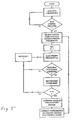
- the airborne station of Figure 1 first scans a range of primary terrestrial flight telephone system (TFTS) frequencies allocated to the ground stations. This process continues until a TFTS signal is identified. Once such a signal is identified an access code contained within that signal is decoded. From the access code a broadcast control data channel BCCH(D) is identified and tuned to which contains information relating to the ground station with which it is associated and also the primary frequencies of adjacent ground stations.
- BCCH(D) broadcast control data channel
- the CPU 2 of Figure 1 stores in data base 3 the received information and then sequentially interrogates in turn the primary frequency associated with each other cell identified. For each primary frequency for which a readable signal is obtained the data conveyed by that signal for its associated ground station is also stored in the data base 3 of the airborne station.
- the CPU 2 derives a score for each of the ground stations using data in the data base received from the ground stations and also information received via the aircraft data bus 4 relating to the status of the aircraft. The way in which the score is derived is described below.
- the CPU then tunes the transmitter/receiver 1 to the frequency of the ground station with the highest score in order to connect a user of the private branch exchange 5 to the public switch telephone network 6 of Figure 2.
- the process is then repeated for primary frequencies surrounding the selected ground station identified by the selected ground station.
- the value of the constants depends on the type of ground station (En Route, Intermediate or Airport), whether a call is in process (CALLS) or not (NO CALLS), whether the weight is on the wheels of the aircraft (WoW), whether the aircraft is descending at less than 30.48 metres per minute (100 feet per minute) climbing cruising at a constant altitude (ALT), or descending at a rate greater than 30.48 metres per minute (100 feet per minute) (ALT/DESC).
- k cr being the closing rate determined by the time delay between transmission and receipt of a signal, the ground station and air station both being synchronised to network time, as is standard practice.
- the negative closing rate is applied so that a ground station in which an aircraft is travelling away from the transmitter will be disadvantaged.
- k r is selected to apply the desired weighting to the criterion.
- k cr and k r operate in conjunction and provide a combined criterion where in the case of an en-route ground station, constant k cr is more powerful but does not dominate totally, and in the case of an intermediate ground station, the reverse applies and the k r term is more powerful. This normalises the parameters multiplied by the criteria to give all the terms a balanced effect. This means that INT, AP and ER ground stations can compete on equal terms for traffic.
- k q is selected to apply the desired weighting to the criterion.
- k q operates in conjunction with k ss and against k cr and k r .
- Q is a multiplier term whilst the others are additive.
- k gst allows preference to be given to one type of ground station relative to another. The preference is dependent on WoW, whether the weight is on the wheels (WoW) of the aircraft.
- k sl makes allowance for whether the ground station can be legally accessed. This means that the air station conforms to the rules dictating whether it can use a given ground station, i.e. it is within the cell boundary (mr).
- the criterion is a multiplication on the equation and so has a more powerful effect than the others.
- Two values are shown in the table: one for legal (k sl ); the other for not legal (k sl(not) ).
- a high value is assigned if the aircraft conforms to the rules, and a low value is assigned otherwise. This only applies for actual call establishment. It is not important for selecting the reference cell for BCCH(D) collection.
- k ho 1 if the range R>r LIM , as described with reference to Figure 3, thus encouraging handover in the handover region defined by the ground station.
- Network time is normally available from a clock of the air station which is regularly synchronised to the true network time. However in the event that network time is not available, the following modifications are required:-
- a new ground station is selected if [S] gs x k s is greater than the score for the current cell.
- k s provides hysteresis and is applied to all cells except for the current cell, preventing unnecessary handovers.
Landscapes
- Engineering & Computer Science (AREA)
- Computer Security & Cryptography (AREA)
- Computer Networks & Wireless Communication (AREA)
- Signal Processing (AREA)
- Mobile Radio Communication Systems (AREA)
- Radio Relay Systems (AREA)
Description
| CRITERION | k q | k cr | k r | k ss | k mr | k gst | k s | k sl | k (m) | |
| EN ROUTE GS | ||||||||||
| CONDITION CALLS | WoW | .2 | 0 | 0 | 1 | 0 | .4 | .8 | 1 | 0 |
| ALT | .5 | .3 | .2 | .15 | .8 | .6 | .8 | 1 | 0 | |
| ALT/DESC | .5 | .3 | .2 | .15 | .8 | .2 | .8 | 1 | 0 | |
| NO ALT | .5 | .3 | .2 | .15 | .8 | 1 | .8 | 1 | 0 | |
| NO CALLS | WoW | .2 | 0 | 0 | 1 | 0 | .4 | 1 | 1 | .8 |
| ALT | .5 | .3 | .1 | .15 | .8 | 1 | 1 | 1 | .8 | |
| NO ALT | .5 | .3 | .1 | .15 | .8 | 1 | 1 | 1 | .8 | |
| INTERMEDIATE GS | ||||||||||
| CONDITION CALLS | WoW | .2 | 0 | 0 | 1 | 0 | .6 | .6 | 1 | 0 |
| ALT | .5 | .6 | .4 | 0 | 0 | .6 | .6 | 1 | 0 | |
| ALT/DESC | .5 | .6 | .4 | 0 | 0 | .8 | .7 | 1 | 0 | |
| NO ALT | .5 | .6 | .4 | 0 | 0 | .3 | .6 | 1 | 0 | |
| NO CALLS | WoW | .2 | 0 | 0 | 1 | 0 | .6 | 1 | 1 | .8 |
| ALT | .5 | .6 | .4 | 0. | 0 | .6 | 1 | 1 | .8 | |
| NO ALT | .5 | .6 | .4 | 0 | 0 | .6 | 1 | 1 | .8 | |
| AIRPORT GS | ||||||||||
| CONDITION CALLS | WoW | .2 | 0 | 0 | 1 | 0 | .8 | .7 | 1 | 0 |
| ALT | 0 | 0 | 0 | 0 | 0 | 0 | .7 | 1 | 0 | |
| NO ALT | 0 | 0 | 0 | 0 | 0 | 0 | .7 | 1 | 0 | |
| NO CALLS | WoW | .2 | 0 | 0 | 1 | 0 | .8 | .9 | 1 | .8 |
| ALT | .5 | .5 | .5 | 0 | 0 | .4 | .9 | 1 | .8 | |
| NO ALT | .5 | .5 | .5 | 0 | 0 | .4 | .9 | 1 | .8 |
If cr < 0 then
Claims (16)
- A telecommunications system comprising at least one mobile station (1-5) and a plurality of fixed stations (6-8) with which the at least one mobile station can communicate, the at least one mobile station comprising processing means (2) for receiving selected criteria, characterised in that the processing means is such as to derive from a plurality of these criteria a score value for each of a plurality of fixed stations with which the at least one mobile station is able to communicate, and to select on the basis of these score values the fixed station via which a transmission is to be routed, the score value for each fixed station being derived from an algorithm into which the selected criteria are input, wherein the processing means comprises means for receiving signals relating to the status of the mobile station and/or a fixed station for which it is determining a score value, at least one criterion being multiplied by a constant associated with that criterion, the value of the constant being selected from one of a number of values depending on the status of the mobile and/or fixed station.
- A system as claimed in claim 1, wherein each fixed station is assigned to one of a plurality of classes of fixed station and wherein the processing means has means for identifying the class to which a particular fixed station belongs and inserting a value in the algorithm in dependence upon the class of the fixed station for which a score is to be derived.
- A system as claimed in claim 2, wherein at least some constants are selected in dependence on the class of fixed station.
- A system as claimed in claim 2 wherein the fixed stations are categorised as macro, micro or pico stations.
- A system as claimed in any preceding claim wherein a transmission is rerouted during transmission if the score of an alternative fixed station exceeds that of the present fixed station by a predetermined value or ratio.
- A terrestrial flight telephone system "TFTS" comprising a cellular communication system as claimed in any preceding claim wherein the at least one mobile station is an air station for location aboard an aircraft, and the plurality of fixed stations are ground stations.
- A TFTS as claimed in claim 6 comprising a number of ground stations categorised as airport ground stations, located at or close to airports, a number of intermediate ground stations and a number of en-route ground stations, wherein constants associated with said algorithm are such that selection of a transmission route to or from an air station located on an aircraft: on the ground is biased in preference of an airport ground station; on a plane taking off or landing in preference of an intermediate station; and on a plane en-route in preference of an en-route station.
- A TFTS as claimed in claim 7 wherein the processor receives at least the following criteria: closing rate to a ground station; quality of signal to or from a ground station; signal strength to or from a ground station; the cell limit of a ground station; the range to a ground station; whether the aircraft with which the processing means is associated is on the ground.
- A TFTS as claimed in any one of claims 6 to 8 employing the algorithmkcr, kr, kss, kmr, kq, Ksl and Kho are predetermined weighting constants, the value of which depends on the type of ground station "En Route, Intermediate or Airport", whether a call is in process "CALLS" or not "NO CALLS", whether the weight is on the wheels of the aircraft "WoW", whether the aircraft is descending at less than 30.48 metres per minute (100 feet per minute) climbing cruising at a constant altitude "ALT", or descending at a rate greater than 100 feet per minute "ALT/DESC";Ccr is calculated by the relationship:-
If cr < 0 thencr being the closing rate determined by the time delay between transmission and receipt of a signal, the ground station and air station both being synchronised to network time andkr is selected to apply the desired weighting to the criterion Ccrkcr and kr operate in conjunction and provide a combined criterion where in the case of an en-route ground station, constant kcr is more powerful but does not dominate totally, and in the case of an intermediate ground station, the reverse applies and the kr term is more powerful;where Q is a quality factor derived from the constellation dispersions at the sampling times within the demodulator of the receiver;R, the range in km of the plane to the ground station andkr operates in conjunction with kcr and against kss and kq;kss operates in conjunction with kq and against kcr and kr;.kmr is set to give precedence to ground stations with smaller cell radii;.kq is selected to apply the desired weighting to the criterion. kq operates in conjunction with kss and against kcr and krkho = 1 if the range R>rLIM; andksl makes allowance for whether the ground station can be legally accessed. - A method of selecting in a cellular telecommunications system via which of a plurality of fixed stations a transmission with a mobile station is to be routed, the method comprising, for each fixed station with which the mobile station can communicate, receiving selected criteria and deriving from a plurality of these a score value for each fixed station, and deciding on the basis of the score values through which fixed station the transmission is to be routed, comprising substituting the selected criteria into an algorithm to derive a score value for each fixed station with which the mobile station can communicate, the algorithm determining the status of the fixed station and/or mobile station and multiplying the value of at least one criterion by a constant the value of which depends on the status of the fixed station or mobile station.
- A method as claimed in claim 10 comprising deploying fixed stations of different classes, identifying the class to which a fixed station belongs and inserting a value in the algorithm in dependence on the class of the fixed station for which a score is to be derived.
- A method as claimed in claim 11 comprising selecting a value of at least some constants in dependence on the class of a fixed station for which a score value is to be derived.
- A method as claimed in any one of claims 10 to 12 comprising rerouting a transmission if the score value of an alternative fixed station exceeds that of the present fixed station by a predetermined value or ratio.
- A method of selecting in a Terrestrial Flight Telephone System via which of a plurality of fixed ground stations a transmission to a mobile air station located aboard an aircraft is to be routed, the method comprising the method as claimed in any one of claims 10 to 13.
- A method as claimed in claim 14 comprising categorising the ground stations into three classes: airport, intermediate and en-route, and selecting through which ground station a transmission is to be routed by applying said algorithm, said algorithm and constants associated with said algorithm being selected such that if the air station is located in an aircraft on the ground the algorithm is biased in favour of selection of an airport ground station, if the aircraft is taking off or landing, biased in favour of selection of an intermediate ground station, and if en-route, biased in favour of an en-route ground station.
- A method as claimed in claim 14 or 15 comprising making a selection of ground station in dependence on the following criteria: closing rate to a ground station; quality of signal to or from a ground station; signal strength to or from a ground station; the cell limit of a ground station; the range to a ground station; whether the aircraft with which the processing means is associated is on the ground.
Applications Claiming Priority (2)
| Application Number | Priority Date | Filing Date | Title |
|---|---|---|---|
| GB9515763A GB2303997B (en) | 1995-08-01 | 1995-08-01 | Selecting via which fixed station a transmission with a mobile air station is to be routed based on a score derived from received selected criteria |
| GB9515763 | 1995-08-01 |
Publications (3)
| Publication Number | Publication Date |
|---|---|
| EP0757453A2 EP0757453A2 (en) | 1997-02-05 |
| EP0757453A3 EP0757453A3 (en) | 1999-06-16 |
| EP0757453B1 true EP0757453B1 (en) | 2005-08-17 |
Family
ID=10778594
Family Applications (1)
| Application Number | Title | Priority Date | Filing Date |
|---|---|---|---|
| EP96305380A Expired - Lifetime EP0757453B1 (en) | 1995-08-01 | 1996-07-23 | A telecommunications system |
Country Status (5)
| Country | Link |
|---|---|
| US (1) | US5926759A (en) |
| EP (1) | EP0757453B1 (en) |
| JP (1) | JPH09135204A (en) |
| DE (1) | DE69635072D1 (en) |
| GB (1) | GB2303997B (en) |
Families Citing this family (20)
| Publication number | Priority date | Publication date | Assignee | Title |
|---|---|---|---|---|
| US6408180B1 (en) * | 1992-03-06 | 2002-06-18 | Aircell, Inc. | Ubiquitous mobile subscriber station |
| US7640016B2 (en) * | 1992-03-06 | 2009-12-29 | Aircell, Llc | Air-to-ground cellular network for deck-to-deck call coverage |
| US6788935B1 (en) | 1992-03-06 | 2004-09-07 | Aircell, Inc. | Aircraft-based network for wireless subscriber stations |
| US5987322A (en) * | 1997-04-03 | 1999-11-16 | Ericsson Inc. | System specified adaptive mobile station behavior within a mobile telecommunications system |
| FI104685B (en) * | 1997-09-05 | 2000-04-14 | Nokia Networks Oy | Method for selecting a cell in a cellular radio network, mobile telephone system and a mobile station |
| JP3099789B2 (en) * | 1997-10-20 | 2000-10-16 | 日本電気株式会社 | Handoff control method in mobile communication system |
| US6181990B1 (en) * | 1998-07-30 | 2001-01-30 | Teledyne Technologies, Inc. | Aircraft flight data acquisition and transmission system |
| GB2375013A (en) * | 2001-04-27 | 2002-10-30 | Ericsson Telefon Ab L M | Communicating connectivity information in a frequency hopping piconet |
| GB2390265A (en) * | 2002-06-26 | 2003-12-31 | Motorola Inc | Mechanism for determining when to hand over from a terrestrial to a non-terrestrial communication network |
| GB2390777B (en) * | 2002-06-26 | 2004-05-05 | Motorola Inc | Method system and apparatus for mobile communications |
| US7689752B1 (en) * | 2002-09-11 | 2010-03-30 | Gte Wireless Incorporated | Cabin telecommunication unit |
| US7774112B2 (en) | 2004-09-27 | 2010-08-10 | Teledyne Technologies Incorporated | System and method for flight data recording |
| WO2008033870A2 (en) | 2006-09-11 | 2008-03-20 | Lumexis Corporation | Fiber-to-the-seat (ftts) fiber distribution system |
| US9167495B2 (en) * | 2007-06-15 | 2015-10-20 | Qualcomm Incorporated | Cell selection |
| EP2462513B1 (en) | 2009-08-06 | 2018-12-19 | Global Eagle Entertainment Inc. | Serial networking fiber-to-the-seat inflight entertainment system |
| US8424045B2 (en) | 2009-08-14 | 2013-04-16 | Lumexis Corporation | Video display unit docking assembly for fiber-to-the-screen inflight entertainment system |
| US8416698B2 (en) | 2009-08-20 | 2013-04-09 | Lumexis Corporation | Serial networking fiber optic inflight entertainment system network configuration |
| KR101877395B1 (en) * | 2016-11-24 | 2018-08-09 | 한국항공우주연구원 | Communication relay apparatus for moon exploration and relay method using the apparatus |
| JP7054860B2 (en) * | 2017-10-04 | 2022-04-15 | パナソニックIpマネジメント株式会社 | Base station equipment, communication system and communication control method |
| CN111328126B (en) * | 2018-12-17 | 2021-09-07 | 华为技术有限公司 | Communication method and device |
Family Cites Families (13)
| Publication number | Priority date | Publication date | Assignee | Title |
|---|---|---|---|---|
| US4419766A (en) * | 1980-10-24 | 1983-12-06 | Goeken John D | Methods and means for providing improved air/ground radio telephone communications |
| SE500157C2 (en) * | 1989-09-13 | 1994-04-25 | Ericsson Telefon Ab L M | Method for selecting base station, radio channel and time slot at a mobile station |
| GB2242806B (en) * | 1990-04-06 | 1994-04-20 | Stc Plc | Handover techniques |
| US5123112A (en) * | 1990-08-02 | 1992-06-16 | Gte Airfone Incorporated | Air-to-ground communication system |
| US5212804A (en) * | 1990-08-02 | 1993-05-18 | Gte Airfone, Inc. | Communication system having multiple base stations and multiple mobile units |
| US5249303A (en) * | 1991-04-23 | 1993-09-28 | Goeken John D | Continuous reception by a mobile receiver unit of program channels transmitted by a series of transmitters |
| SE468696B (en) * | 1991-06-20 | 1993-03-01 | Ericsson Telefon Ab L M | PROCEDURE TO PERFORM HANDS IN A MOBILE RADIO SYSTEM WITH MULTIPLE CELL CELLS |
| US5471645A (en) * | 1992-09-25 | 1995-11-28 | Motorola | Method of allocating channels in multi-rate channel environment |
| US5396647A (en) * | 1992-11-03 | 1995-03-07 | Motorola, Inc. | GPS base wide area communication system site selection |
| IL103976A0 (en) * | 1992-12-04 | 1994-05-30 | Mintz Yossi | Method and system for iteratively targeting participants according to their priorities |
| US5455964A (en) * | 1993-03-26 | 1995-10-03 | Claircom Communications Group, Inc. | Stabilization of frequency and power in an airborne communication system |
| GB2287379B (en) * | 1994-03-10 | 1998-06-10 | Roke Manor Research | Apparatus for use in a mobile radio system |
| FI106671B (en) * | 1995-03-13 | 2001-03-15 | Nokia Mobile Phones Ltd | Mobile telephony, mobile terminal and a method of establishing a connection from a mobile terminal |
-
1995
- 1995-08-01 GB GB9515763A patent/GB2303997B/en not_active Expired - Fee Related
-
1996
- 1996-07-23 DE DE69635072T patent/DE69635072D1/en not_active Expired - Lifetime
- 1996-07-23 EP EP96305380A patent/EP0757453B1/en not_active Expired - Lifetime
- 1996-07-29 US US08/688,159 patent/US5926759A/en not_active Expired - Fee Related
- 1996-08-01 JP JP8203485A patent/JPH09135204A/en not_active Ceased
Also Published As
| Publication number | Publication date |
|---|---|
| US5926759A (en) | 1999-07-20 |
| JPH09135204A (en) | 1997-05-20 |
| EP0757453A2 (en) | 1997-02-05 |
| GB2303997B (en) | 2000-03-08 |
| GB9515763D0 (en) | 1995-10-04 |
| EP0757453A3 (en) | 1999-06-16 |
| GB2303997A (en) | 1997-03-05 |
| DE69635072D1 (en) | 2005-09-22 |
Similar Documents
| Publication | Publication Date | Title |
|---|---|---|
| US5926759A (en) | Telecommunications system | |
| US6430412B1 (en) | Call handoff | |
| US7415275B2 (en) | Frequency selection apparatus, a mobile communications system, and a multi-band frequency resource management method | |
| US5930710A (en) | Control/pilot channel reselection between cells belonging to different registration areas | |
| US6782262B1 (en) | Self-tuning sufficient signal strength threshold | |
| KR100352040B1 (en) | Method and apparatus for selecting an optimal server in a layer cellular wireless communication system | |
| EP0589552B1 (en) | Method and apparatus for maintaining connectivity of nodes in a wireless local area network | |
| US4750198A (en) | Cellular radiotelephone system providing diverse separately-accessible groups of channels | |
| AU720309B2 (en) | Adaptive frequency allocation in a telecommunication system | |
| US6453166B1 (en) | Communication channel selecting method and base station device | |
| EP0505106A2 (en) | Split service in cellular telecommunications networks and methods therefore | |
| WO1993012589A1 (en) | Listening control channel in a cellular mobile radiotelephone system | |
| JP2001514473A (en) | Method and apparatus for idle cell selection in a cellular telephone system | |
| US6230014B1 (en) | Method of controlling handoff of communications with a mobile station from a first radio transceiver to a second radio transceiver | |
| GB2284725A (en) | Method for determining handoff | |
| JP2000324559A (en) | System for providing guaranteed wireless service to specified wireless subscribers | |
| US6507569B1 (en) | Dynamic control of cellular radio communication system resources | |
| EP0967819B1 (en) | Method for handover in a cellular system | |
| CA2334210A1 (en) | Mobile communication network and method of operation thereof | |
| AU749653B2 (en) | Multiple Hyperband radiocommunications system | |
| EP0418061A2 (en) | A digital radio communication system | |
| Macario | Cellular Radio Design Principles | |
| Edwards | Advanced handoff algorithms for microcells using fuzzy techniques | |
| MXPA97007564A (en) | Automatic channel planning of control in adaptable canal allocation systems |
Legal Events
| Date | Code | Title | Description |
|---|---|---|---|
| PUAI | Public reference made under article 153(3) epc to a published international application that has entered the european phase |
Free format text: ORIGINAL CODE: 0009012 |
|
| AK | Designated contracting states |
Kind code of ref document: A2 Designated state(s): DE DK FR GB IT SE |
|
| PUAL | Search report despatched |
Free format text: ORIGINAL CODE: 0009013 |
|
| AK | Designated contracting states |
Kind code of ref document: A3 Designated state(s): DE DK FR GB IT SE |
|
| RAP1 | Party data changed (applicant data changed or rights of an application transferred) |
Owner name: MARCONI ELECTRONIC SYSTEMS LIMITED |
|
| 17P | Request for examination filed |
Effective date: 19990607 |
|
| RAP1 | Party data changed (applicant data changed or rights of an application transferred) |
Owner name: BAE SYSTEMS ELECTRONICS LTD. |
|
| 17Q | First examination report despatched |
Effective date: 20030610 |
|
| GRAP | Despatch of communication of intention to grant a patent |
Free format text: ORIGINAL CODE: EPIDOSNIGR1 |
|
| GRAS | Grant fee paid |
Free format text: ORIGINAL CODE: EPIDOSNIGR3 |
|
| GRAA | (expected) grant |
Free format text: ORIGINAL CODE: 0009210 |
|
| AK | Designated contracting states |
Kind code of ref document: B1 Designated state(s): DE DK FR GB IT SE |
|
| PG25 | Lapsed in a contracting state [announced via postgrant information from national office to epo] |
Ref country code: IT Free format text: LAPSE BECAUSE OF FAILURE TO SUBMIT A TRANSLATION OF THE DESCRIPTION OR TO PAY THE FEE WITHIN THE PRE;WARNING: LAPSES OF ITALIAN PATENTS WITH EFFECTIVE DATE BEFORE 2007 MAY HAVE OCCURRED AT ANY TIME BEFORE 2007. THE CORRECT EFFECTIVE DATE MAY BE DIFFERENT FROM THE ONE RECORDED.SCRIBED TIME-LIMIT Effective date: 20050817 |
|
| REG | Reference to a national code |
Ref country code: GB Ref legal event code: FG4D |
|
| REF | Corresponds to: |
Ref document number: 69635072 Country of ref document: DE Date of ref document: 20050922 Kind code of ref document: P |
|
| PG25 | Lapsed in a contracting state [announced via postgrant information from national office to epo] |
Ref country code: SE Free format text: LAPSE BECAUSE OF FAILURE TO SUBMIT A TRANSLATION OF THE DESCRIPTION OR TO PAY THE FEE WITHIN THE PRESCRIBED TIME-LIMIT Effective date: 20051117 Ref country code: DK Free format text: LAPSE BECAUSE OF FAILURE TO SUBMIT A TRANSLATION OF THE DESCRIPTION OR TO PAY THE FEE WITHIN THE PRESCRIBED TIME-LIMIT Effective date: 20051117 |
|
| PG25 | Lapsed in a contracting state [announced via postgrant information from national office to epo] |
Ref country code: DE Free format text: LAPSE BECAUSE OF FAILURE TO SUBMIT A TRANSLATION OF THE DESCRIPTION OR TO PAY THE FEE WITHIN THE PRESCRIBED TIME-LIMIT Effective date: 20051118 |
|
| RAP2 | Party data changed (patent owner data changed or rights of a patent transferred) |
Owner name: SELEX SENSORS AND AIRBORNE SYSTEMS LIMITED LIMITED |
|
| PLBE | No opposition filed within time limit |
Free format text: ORIGINAL CODE: 0009261 |
|
| STAA | Information on the status of an ep patent application or granted ep patent |
Free format text: STATUS: NO OPPOSITION FILED WITHIN TIME LIMIT |
|
| REG | Reference to a national code |
Ref country code: GB Ref legal event code: 732E |
|
| PG25 | Lapsed in a contracting state [announced via postgrant information from national office to epo] |
Ref country code: GB Free format text: LAPSE BECAUSE OF NON-PAYMENT OF DUE FEES Effective date: 20060723 |
|
| 26N | No opposition filed |
Effective date: 20060518 |
|
| PG25 | Lapsed in a contracting state [announced via postgrant information from national office to epo] |
Ref country code: FR Free format text: LAPSE BECAUSE OF FAILURE TO SUBMIT A TRANSLATION OF THE DESCRIPTION OR TO PAY THE FEE WITHIN THE PRESCRIBED TIME-LIMIT Effective date: 20060818 |
|
| EN | Fr: translation not filed | ||
| GBPC | Gb: european patent ceased through non-payment of renewal fee |
Effective date: 20060723 |
|
| PG25 | Lapsed in a contracting state [announced via postgrant information from national office to epo] |
Ref country code: FR Free format text: LAPSE BECAUSE OF FAILURE TO SUBMIT A TRANSLATION OF THE DESCRIPTION OR TO PAY THE FEE WITHIN THE PRESCRIBED TIME-LIMIT Effective date: 20050817 |