EP0757027A1 - Ester synthesis - Google Patents
Ester synthesis Download PDFInfo
- Publication number
- EP0757027A1 EP0757027A1 EP96305369A EP96305369A EP0757027A1 EP 0757027 A1 EP0757027 A1 EP 0757027A1 EP 96305369 A EP96305369 A EP 96305369A EP 96305369 A EP96305369 A EP 96305369A EP 0757027 A1 EP0757027 A1 EP 0757027A1
- Authority
- EP
- European Patent Office
- Prior art keywords
- process according
- range
- olefin
- carboxylic acid
- support
- Prior art date
- Legal status (The legal status is an assumption and is not a legal conclusion. Google has not performed a legal analysis and makes no representation as to the accuracy of the status listed.)
- Granted
Links
- 150000002148 esters Chemical class 0.000 title claims abstract description 11
- 230000015572 biosynthetic process Effects 0.000 title description 3
- 238000003786 synthesis reaction Methods 0.000 title description 2
- 239000003054 catalyst Substances 0.000 claims abstract description 67
- 238000000034 method Methods 0.000 claims abstract description 55
- RTZKZFJDLAIYFH-UHFFFAOYSA-N ether Substances CCOCC RTZKZFJDLAIYFH-UHFFFAOYSA-N 0.000 claims abstract description 35
- 150000001336 alkenes Chemical class 0.000 claims abstract description 34
- XLYOFNOQVPJJNP-UHFFFAOYSA-N water Substances O XLYOFNOQVPJJNP-UHFFFAOYSA-N 0.000 claims abstract description 33
- QTBSBXVTEAMEQO-UHFFFAOYSA-N Acetic acid Chemical compound CC(O)=O QTBSBXVTEAMEQO-UHFFFAOYSA-N 0.000 claims abstract description 28
- -1 aliphatic mono-carboxylic acid Chemical class 0.000 claims abstract description 27
- JRZJOMJEPLMPRA-UHFFFAOYSA-N olefin Natural products CCCCCCCC=C JRZJOMJEPLMPRA-UHFFFAOYSA-N 0.000 claims abstract description 27
- 239000011964 heteropoly acid Substances 0.000 claims abstract description 23
- 239000011541 reaction mixture Substances 0.000 claims abstract description 19
- 238000006243 chemical reaction Methods 0.000 claims abstract description 15
- 239000006227 byproduct Substances 0.000 claims abstract description 7
- 229920006395 saturated elastomer Polymers 0.000 claims abstract description 5
- 125000001931 aliphatic group Chemical group 0.000 claims abstract description 3
- 238000004519 manufacturing process Methods 0.000 claims abstract description 3
- VYPSYNLAJGMNEJ-UHFFFAOYSA-N Silicium dioxide Chemical compound O=[Si]=O VYPSYNLAJGMNEJ-UHFFFAOYSA-N 0.000 claims description 40
- 239000002253 acid Substances 0.000 claims description 20
- 239000000377 silicon dioxide Substances 0.000 claims description 19
- 239000000376 reactant Substances 0.000 claims description 17
- 239000000203 mixture Substances 0.000 claims description 12
- LFQSCWFLJHTTHZ-UHFFFAOYSA-N Ethanol Chemical compound CCO LFQSCWFLJHTTHZ-UHFFFAOYSA-N 0.000 claims description 10
- 238000005886 esterification reaction Methods 0.000 claims description 10
- 239000008188 pellet Substances 0.000 claims description 8
- 239000011148 porous material Substances 0.000 claims description 8
- 150000007513 acids Chemical class 0.000 claims description 7
- 239000002245 particle Substances 0.000 claims description 7
- OAICVXFJPJFONN-UHFFFAOYSA-N Phosphorus Chemical compound [P] OAICVXFJPJFONN-UHFFFAOYSA-N 0.000 claims description 6
- 229910052751 metal Inorganic materials 0.000 claims description 6
- 239000002184 metal Substances 0.000 claims description 6
- 229910052698 phosphorus Inorganic materials 0.000 claims description 6
- 239000011574 phosphorus Substances 0.000 claims description 6
- 239000000047 product Substances 0.000 claims description 6
- 229910052720 vanadium Inorganic materials 0.000 claims description 6
- GPPXJZIENCGNKB-UHFFFAOYSA-N vanadium Chemical compound [V]#[V] GPPXJZIENCGNKB-UHFFFAOYSA-N 0.000 claims description 6
- 238000005453 pelletization Methods 0.000 claims description 5
- 230000002093 peripheral effect Effects 0.000 claims description 5
- 150000003839 salts Chemical class 0.000 claims description 5
- 229910052684 Cerium Inorganic materials 0.000 claims description 4
- XEEYBQQBJWHFJM-UHFFFAOYSA-N Iron Chemical compound [Fe] XEEYBQQBJWHFJM-UHFFFAOYSA-N 0.000 claims description 4
- 150000001450 anions Chemical class 0.000 claims description 4
- 229910052785 arsenic Inorganic materials 0.000 claims description 4
- RQNWIZPPADIBDY-UHFFFAOYSA-N arsenic atom Chemical compound [As] RQNWIZPPADIBDY-UHFFFAOYSA-N 0.000 claims description 4
- 230000032050 esterification Effects 0.000 claims description 4
- 150000002500 ions Chemical class 0.000 claims description 4
- BASFCYQUMIYNBI-UHFFFAOYSA-N platinum Chemical compound [Pt] BASFCYQUMIYNBI-UHFFFAOYSA-N 0.000 claims description 4
- 229910052710 silicon Inorganic materials 0.000 claims description 4
- 239000010703 silicon Substances 0.000 claims description 4
- 229910052714 tellurium Inorganic materials 0.000 claims description 4
- ZOKXTWBITQBERF-UHFFFAOYSA-N Molybdenum Chemical compound [Mo] ZOKXTWBITQBERF-UHFFFAOYSA-N 0.000 claims description 3
- 150000007933 aliphatic carboxylic acids Chemical class 0.000 claims description 3
- 239000011324 bead Substances 0.000 claims description 3
- 238000011065 in-situ storage Methods 0.000 claims description 3
- 229910052750 molybdenum Inorganic materials 0.000 claims description 3
- 239000011733 molybdenum Substances 0.000 claims description 3
- 230000000737 periodic effect Effects 0.000 claims description 3
- WFKWXMTUELFFGS-UHFFFAOYSA-N tungsten Chemical compound [W] WFKWXMTUELFFGS-UHFFFAOYSA-N 0.000 claims description 3
- 229910052721 tungsten Inorganic materials 0.000 claims description 3
- 239000010937 tungsten Substances 0.000 claims description 3
- ZSLUVFAKFWKJRC-IGMARMGPSA-N 232Th Chemical compound [232Th] ZSLUVFAKFWKJRC-IGMARMGPSA-N 0.000 claims description 2
- 229910002016 Aerosil® 200 Inorganic materials 0.000 claims description 2
- ZOXJGFHDIHLPTG-UHFFFAOYSA-N Boron Chemical compound [B] ZOXJGFHDIHLPTG-UHFFFAOYSA-N 0.000 claims description 2
- OKTJSMMVPCPJKN-UHFFFAOYSA-N Carbon Chemical compound [C] OKTJSMMVPCPJKN-UHFFFAOYSA-N 0.000 claims description 2
- VYZAMTAEIAYCRO-UHFFFAOYSA-N Chromium Chemical compound [Cr] VYZAMTAEIAYCRO-UHFFFAOYSA-N 0.000 claims description 2
- GYHNNYVSQQEPJS-UHFFFAOYSA-N Gallium Chemical compound [Ga] GYHNNYVSQQEPJS-UHFFFAOYSA-N 0.000 claims description 2
- VEQPNABPJHWNSG-UHFFFAOYSA-N Nickel(2+) Chemical compound [Ni+2] VEQPNABPJHWNSG-UHFFFAOYSA-N 0.000 claims description 2
- 229910003910 SiCl4 Inorganic materials 0.000 claims description 2
- XUIMIQQOPSSXEZ-UHFFFAOYSA-N Silicon Chemical compound [Si] XUIMIQQOPSSXEZ-UHFFFAOYSA-N 0.000 claims description 2
- NINIDFKCEFEMDL-UHFFFAOYSA-N Sulfur Chemical compound [S] NINIDFKCEFEMDL-UHFFFAOYSA-N 0.000 claims description 2
- 239000005864 Sulphur Substances 0.000 claims description 2
- 229910052776 Thorium Inorganic materials 0.000 claims description 2
- ATJFFYVFTNAWJD-UHFFFAOYSA-N Tin Chemical compound [Sn] ATJFFYVFTNAWJD-UHFFFAOYSA-N 0.000 claims description 2
- RTAQQCXQSZGOHL-UHFFFAOYSA-N Titanium Chemical compound [Ti] RTAQQCXQSZGOHL-UHFFFAOYSA-N 0.000 claims description 2
- HCHKCACWOHOZIP-UHFFFAOYSA-N Zinc Chemical compound [Zn] HCHKCACWOHOZIP-UHFFFAOYSA-N 0.000 claims description 2
- QCWXUUIWCKQGHC-UHFFFAOYSA-N Zirconium Chemical compound [Zr] QCWXUUIWCKQGHC-UHFFFAOYSA-N 0.000 claims description 2
- 239000004411 aluminium Substances 0.000 claims description 2
- 229910052782 aluminium Inorganic materials 0.000 claims description 2
- XAGFODPZIPBFFR-UHFFFAOYSA-N aluminium Chemical compound [Al] XAGFODPZIPBFFR-UHFFFAOYSA-N 0.000 claims description 2
- 229910052787 antimony Inorganic materials 0.000 claims description 2
- WATWJIUSRGPENY-UHFFFAOYSA-N antimony atom Chemical compound [Sb] WATWJIUSRGPENY-UHFFFAOYSA-N 0.000 claims description 2
- 229910001439 antimony ion Inorganic materials 0.000 claims description 2
- QVGXLLKOCUKJST-UHFFFAOYSA-N atomic oxygen Chemical compound [O] QVGXLLKOCUKJST-UHFFFAOYSA-N 0.000 claims description 2
- 229910052790 beryllium Inorganic materials 0.000 claims description 2
- ATBAMAFKBVZNFJ-UHFFFAOYSA-N beryllium atom Chemical compound [Be] ATBAMAFKBVZNFJ-UHFFFAOYSA-N 0.000 claims description 2
- 229910052797 bismuth Inorganic materials 0.000 claims description 2
- JCXGWMGPZLAOME-UHFFFAOYSA-N bismuth atom Chemical compound [Bi] JCXGWMGPZLAOME-UHFFFAOYSA-N 0.000 claims description 2
- 229910052796 boron Inorganic materials 0.000 claims description 2
- GWXLDORMOJMVQZ-UHFFFAOYSA-N cerium Chemical compound [Ce] GWXLDORMOJMVQZ-UHFFFAOYSA-N 0.000 claims description 2
- 229910052804 chromium Inorganic materials 0.000 claims description 2
- 239000011651 chromium Substances 0.000 claims description 2
- 239000010941 cobalt Substances 0.000 claims description 2
- GUTLYIVDDKVIGB-UHFFFAOYSA-N cobalt atom Chemical compound [Co] GUTLYIVDDKVIGB-UHFFFAOYSA-N 0.000 claims description 2
- 229910001429 cobalt ion Inorganic materials 0.000 claims description 2
- 150000001875 compounds Chemical class 0.000 claims description 2
- 229910021485 fumed silica Inorganic materials 0.000 claims description 2
- 229910052733 gallium Inorganic materials 0.000 claims description 2
- 229910052732 germanium Inorganic materials 0.000 claims description 2
- GNPVGFCGXDBREM-UHFFFAOYSA-N germanium atom Chemical compound [Ge] GNPVGFCGXDBREM-UHFFFAOYSA-N 0.000 claims description 2
- 229910052735 hafnium Inorganic materials 0.000 claims description 2
- VBJZVLUMGGDVMO-UHFFFAOYSA-N hafnium atom Chemical compound [Hf] VBJZVLUMGGDVMO-UHFFFAOYSA-N 0.000 claims description 2
- 230000007062 hydrolysis Effects 0.000 claims description 2
- 238000006460 hydrolysis reaction Methods 0.000 claims description 2
- 239000011630 iodine Substances 0.000 claims description 2
- 229910052740 iodine Inorganic materials 0.000 claims description 2
- 229910052742 iron Inorganic materials 0.000 claims description 2
- ZAUUZASCMSWKGX-UHFFFAOYSA-N manganese nickel Chemical compound [Mn].[Ni] ZAUUZASCMSWKGX-UHFFFAOYSA-N 0.000 claims description 2
- 229910001453 nickel ion Inorganic materials 0.000 claims description 2
- 229910052758 niobium Inorganic materials 0.000 claims description 2
- 239000010955 niobium Substances 0.000 claims description 2
- GUCVJGMIXFAOAE-UHFFFAOYSA-N niobium atom Chemical compound [Nb] GUCVJGMIXFAOAE-UHFFFAOYSA-N 0.000 claims description 2
- 239000001301 oxygen Substances 0.000 claims description 2
- 229910052760 oxygen Inorganic materials 0.000 claims description 2
- 229910052697 platinum Inorganic materials 0.000 claims description 2
- 229910052761 rare earth metal Inorganic materials 0.000 claims description 2
- 229910052703 rhodium Inorganic materials 0.000 claims description 2
- 239000010948 rhodium Substances 0.000 claims description 2
- FDNAPBUWERUEDA-UHFFFAOYSA-N silicon tetrachloride Chemical compound Cl[Si](Cl)(Cl)Cl FDNAPBUWERUEDA-UHFFFAOYSA-N 0.000 claims description 2
- 229910052715 tantalum Inorganic materials 0.000 claims description 2
- GUVRBAGPIYLISA-UHFFFAOYSA-N tantalum atom Chemical compound [Ta] GUVRBAGPIYLISA-UHFFFAOYSA-N 0.000 claims description 2
- PORWMNRCUJJQNO-UHFFFAOYSA-N tellurium atom Chemical compound [Te] PORWMNRCUJJQNO-UHFFFAOYSA-N 0.000 claims description 2
- 229910052718 tin Inorganic materials 0.000 claims description 2
- 229910052719 titanium Inorganic materials 0.000 claims description 2
- 239000010936 titanium Substances 0.000 claims description 2
- 239000011701 zinc Substances 0.000 claims description 2
- 229910052725 zinc Inorganic materials 0.000 claims description 2
- 229910052726 zirconium Inorganic materials 0.000 claims description 2
- 150000001735 carboxylic acids Chemical class 0.000 claims 3
- NBIIXXVUZAFLBC-UHFFFAOYSA-N Phosphoric acid Chemical compound OP(O)(O)=O NBIIXXVUZAFLBC-UHFFFAOYSA-N 0.000 claims 2
- 125000000218 acetic acid group Chemical group C(C)(=O)* 0.000 claims 1
- 229910000147 aluminium phosphate Inorganic materials 0.000 claims 1
- 229910052500 inorganic mineral Inorganic materials 0.000 claims 1
- 239000011707 mineral Substances 0.000 claims 1
- VGGSQFUCUMXWEO-UHFFFAOYSA-N Ethene Chemical compound C=C VGGSQFUCUMXWEO-UHFFFAOYSA-N 0.000 abstract description 7
- 239000005977 Ethylene Substances 0.000 abstract description 7
- XEKOWRVHYACXOJ-UHFFFAOYSA-N Ethyl acetate Chemical compound CCOC(C)=O XEKOWRVHYACXOJ-UHFFFAOYSA-N 0.000 abstract description 6
- IJGRMHOSHXDMSA-UHFFFAOYSA-N Atomic nitrogen Chemical compound N#N IJGRMHOSHXDMSA-UHFFFAOYSA-N 0.000 description 12
- 239000000243 solution Substances 0.000 description 12
- 229910009112 xH2O Inorganic materials 0.000 description 10
- 238000011068 loading method Methods 0.000 description 9
- 229960000583 acetic acid Drugs 0.000 description 8
- 239000007789 gas Substances 0.000 description 7
- 239000012153 distilled water Substances 0.000 description 6
- 239000007788 liquid Substances 0.000 description 6
- 150000001298 alcohols Chemical class 0.000 description 5
- 150000001732 carboxylic acid derivatives Chemical class 0.000 description 5
- 229960004132 diethyl ether Drugs 0.000 description 5
- 229910052757 nitrogen Inorganic materials 0.000 description 5
- 238000003756 stirring Methods 0.000 description 5
- IIPYXGDZVMZOAP-UHFFFAOYSA-N lithium nitrate Chemical compound [Li+].[O-][N+]([O-])=O IIPYXGDZVMZOAP-UHFFFAOYSA-N 0.000 description 4
- 239000003377 acid catalyst Substances 0.000 description 3
- 239000012263 liquid product Substances 0.000 description 3
- 150000002739 metals Chemical class 0.000 description 3
- 229910052700 potassium Inorganic materials 0.000 description 3
- 239000011734 sodium Substances 0.000 description 3
- 238000012360 testing method Methods 0.000 description 3
- IKHGUXGNUITLKF-UHFFFAOYSA-N Acetaldehyde Chemical compound CC=O IKHGUXGNUITLKF-UHFFFAOYSA-N 0.000 description 2
- QGZKDVFQNNGYKY-UHFFFAOYSA-N Ammonia Chemical compound N QGZKDVFQNNGYKY-UHFFFAOYSA-N 0.000 description 2
- QGZKDVFQNNGYKY-UHFFFAOYSA-O Ammonium Chemical compound [NH4+] QGZKDVFQNNGYKY-UHFFFAOYSA-O 0.000 description 2
- DGAQECJNVWCQMB-PUAWFVPOSA-M Ilexoside XXIX Chemical compound C[C@@H]1CC[C@@]2(CC[C@@]3(C(=CC[C@H]4[C@]3(CC[C@@H]5[C@@]4(CC[C@@H](C5(C)C)OS(=O)(=O)[O-])C)C)[C@@H]2[C@]1(C)O)C)C(=O)O[C@H]6[C@@H]([C@H]([C@@H]([C@H](O6)CO)O)O)O.[Na+] DGAQECJNVWCQMB-PUAWFVPOSA-M 0.000 description 2
- 229910020881 PMo12O40 Inorganic materials 0.000 description 2
- ZLMJMSJWJFRBEC-UHFFFAOYSA-N Potassium Chemical compound [K] ZLMJMSJWJFRBEC-UHFFFAOYSA-N 0.000 description 2
- 229910020628 SiW12O40 Inorganic materials 0.000 description 2
- 229910052681 coesite Inorganic materials 0.000 description 2
- 229910052906 cristobalite Inorganic materials 0.000 description 2
- 238000010908 decantation Methods 0.000 description 2
- 235000014113 dietary fatty acids Nutrition 0.000 description 2
- 229910001873 dinitrogen Inorganic materials 0.000 description 2
- 238000001035 drying Methods 0.000 description 2
- 238000001125 extrusion Methods 0.000 description 2
- 229930195729 fatty acid Natural products 0.000 description 2
- 239000000194 fatty acid Substances 0.000 description 2
- 238000001914 filtration Methods 0.000 description 2
- 239000008187 granular material Substances 0.000 description 2
- 238000010438 heat treatment Methods 0.000 description 2
- 239000012071 phase Substances 0.000 description 2
- BCTWNMTZAXVEJL-UHFFFAOYSA-N phosphane;tungsten;tetracontahydrate Chemical compound O.O.O.O.O.O.O.O.O.O.O.O.O.O.O.O.O.O.O.O.O.O.O.O.O.O.O.O.O.O.O.O.O.O.O.O.O.O.O.O.P.[W].[W].[W].[W].[W].[W].[W].[W].[W].[W].[W].[W] BCTWNMTZAXVEJL-UHFFFAOYSA-N 0.000 description 2
- AVFBYUADVDVJQL-UHFFFAOYSA-N phosphoric acid;trioxotungsten;hydrate Chemical compound O.O=[W](=O)=O.O=[W](=O)=O.O=[W](=O)=O.O=[W](=O)=O.O=[W](=O)=O.O=[W](=O)=O.O=[W](=O)=O.O=[W](=O)=O.O=[W](=O)=O.O=[W](=O)=O.O=[W](=O)=O.O=[W](=O)=O.OP(O)(O)=O AVFBYUADVDVJQL-UHFFFAOYSA-N 0.000 description 2
- 239000011591 potassium Substances 0.000 description 2
- 238000002360 preparation method Methods 0.000 description 2
- CGFYHILWFSGVJS-UHFFFAOYSA-N silicic acid;trioxotungsten Chemical compound O[Si](O)(O)O.O=[W]1(=O)O[W](=O)(=O)O[W](=O)(=O)O1.O=[W]1(=O)O[W](=O)(=O)O[W](=O)(=O)O1.O=[W]1(=O)O[W](=O)(=O)O[W](=O)(=O)O1.O=[W]1(=O)O[W](=O)(=O)O[W](=O)(=O)O1 CGFYHILWFSGVJS-UHFFFAOYSA-N 0.000 description 2
- 229910052708 sodium Inorganic materials 0.000 description 2
- 229910052682 stishovite Inorganic materials 0.000 description 2
- 229910052905 tridymite Inorganic materials 0.000 description 2
- 208000033962 Fontaine progeroid syndrome Diseases 0.000 description 1
- UFHFLCQGNIYNRP-UHFFFAOYSA-N Hydrogen Chemical compound [H][H] UFHFLCQGNIYNRP-UHFFFAOYSA-N 0.000 description 1
- 101150002998 LCAT gene Proteins 0.000 description 1
- 229910019142 PO4 Inorganic materials 0.000 description 1
- 230000002378 acidificating effect Effects 0.000 description 1
- 230000002411 adverse Effects 0.000 description 1
- 150000001335 aliphatic alkanes Chemical class 0.000 description 1
- 239000007864 aqueous solution Substances 0.000 description 1
- 150000004945 aromatic hydrocarbons Chemical class 0.000 description 1
- 229910052792 caesium Inorganic materials 0.000 description 1
- TVFDJXOCXUVLDH-UHFFFAOYSA-N caesium atom Chemical compound [Cs] TVFDJXOCXUVLDH-UHFFFAOYSA-N 0.000 description 1
- 230000003197 catalytic effect Effects 0.000 description 1
- 230000000052 comparative effect Effects 0.000 description 1
- 238000009833 condensation Methods 0.000 description 1
- 230000005494 condensation Effects 0.000 description 1
- 238000001816 cooling Methods 0.000 description 1
- 229910052802 copper Inorganic materials 0.000 description 1
- LJQKCYFTNDAAPC-UHFFFAOYSA-N ethanol;ethyl acetate Chemical compound CCO.CCOC(C)=O LJQKCYFTNDAAPC-UHFFFAOYSA-N 0.000 description 1
- DQYBDCGIPTYXML-UHFFFAOYSA-N ethoxyethane;hydrate Chemical compound O.CCOCC DQYBDCGIPTYXML-UHFFFAOYSA-N 0.000 description 1
- 150000004665 fatty acids Chemical class 0.000 description 1
- 238000004508 fractional distillation Methods 0.000 description 1
- 238000002290 gas chromatography-mass spectrometry Methods 0.000 description 1
- 239000007792 gaseous phase Substances 0.000 description 1
- 239000012362 glacial acetic acid Substances 0.000 description 1
- 239000011491 glass wool Substances 0.000 description 1
- JEGUKCSWCFPDGT-UHFFFAOYSA-N h2o hydrate Chemical compound O.O JEGUKCSWCFPDGT-UHFFFAOYSA-N 0.000 description 1
- 229910000856 hastalloy Inorganic materials 0.000 description 1
- XLYOFNOQVPJJNP-ZSJDYOACSA-N heavy water Substances [2H]O[2H] XLYOFNOQVPJJNP-ZSJDYOACSA-N 0.000 description 1
- 230000036571 hydration Effects 0.000 description 1
- 238000006703 hydration reaction Methods 0.000 description 1
- 229930195733 hydrocarbon Natural products 0.000 description 1
- 150000002430 hydrocarbons Chemical class 0.000 description 1
- 239000001257 hydrogen Substances 0.000 description 1
- 229910052739 hydrogen Inorganic materials 0.000 description 1
- 239000012535 impurity Substances 0.000 description 1
- 229910052744 lithium Inorganic materials 0.000 description 1
- 229910052749 magnesium Inorganic materials 0.000 description 1
- 229910044991 metal oxide Inorganic materials 0.000 description 1
- 150000004706 metal oxides Chemical class 0.000 description 1
- NBIIXXVUZAFLBC-UHFFFAOYSA-K phosphate Chemical compound [O-]P([O-])([O-])=O NBIIXXVUZAFLBC-UHFFFAOYSA-K 0.000 description 1
- 239000010452 phosphate Substances 0.000 description 1
- DHRLEVQXOMLTIM-UHFFFAOYSA-N phosphoric acid;trioxomolybdenum Chemical compound O=[Mo](=O)=O.O=[Mo](=O)=O.O=[Mo](=O)=O.O=[Mo](=O)=O.O=[Mo](=O)=O.O=[Mo](=O)=O.O=[Mo](=O)=O.O=[Mo](=O)=O.O=[Mo](=O)=O.O=[Mo](=O)=O.O=[Mo](=O)=O.O=[Mo](=O)=O.OP(O)(O)=O DHRLEVQXOMLTIM-UHFFFAOYSA-N 0.000 description 1
- IYDGMDWEHDFVQI-UHFFFAOYSA-N phosphoric acid;trioxotungsten Chemical compound O=[W](=O)=O.O=[W](=O)=O.O=[W](=O)=O.O=[W](=O)=O.O=[W](=O)=O.O=[W](=O)=O.O=[W](=O)=O.O=[W](=O)=O.O=[W](=O)=O.O=[W](=O)=O.O=[W](=O)=O.O=[W](=O)=O.OP(O)(O)=O IYDGMDWEHDFVQI-UHFFFAOYSA-N 0.000 description 1
- 239000002798 polar solvent Substances 0.000 description 1
- QQONPFPTGQHPMA-UHFFFAOYSA-N propylene Natural products CC=C QQONPFPTGQHPMA-UHFFFAOYSA-N 0.000 description 1
- 125000004805 propylene group Chemical group [H]C([H])([H])C([H])([*:1])C([H])([H])[*:2] 0.000 description 1
- 230000001105 regulatory effect Effects 0.000 description 1
- 238000007873 sieving Methods 0.000 description 1
- 239000002904 solvent Substances 0.000 description 1
- 239000000126 substance Substances 0.000 description 1
- 238000011144 upstream manufacturing Methods 0.000 description 1
- 210000002268 wool Anatomy 0.000 description 1
Classifications
-
- C—CHEMISTRY; METALLURGY
- C07—ORGANIC CHEMISTRY
- C07C—ACYCLIC OR CARBOCYCLIC COMPOUNDS
- C07C67/00—Preparation of carboxylic acid esters
- C07C67/04—Preparation of carboxylic acid esters by reacting carboxylic acids or symmetrical anhydrides onto unsaturated carbon-to-carbon bonds
-
- B—PERFORMING OPERATIONS; TRANSPORTING
- B01—PHYSICAL OR CHEMICAL PROCESSES OR APPARATUS IN GENERAL
- B01J—CHEMICAL OR PHYSICAL PROCESSES, e.g. CATALYSIS OR COLLOID CHEMISTRY; THEIR RELEVANT APPARATUS
- B01J21/00—Catalysts comprising the elements, oxides, or hydroxides of magnesium, boron, aluminium, carbon, silicon, titanium, zirconium, or hafnium
- B01J21/06—Silicon, titanium, zirconium or hafnium; Oxides or hydroxides thereof
- B01J21/08—Silica
-
- B—PERFORMING OPERATIONS; TRANSPORTING
- B01—PHYSICAL OR CHEMICAL PROCESSES OR APPARATUS IN GENERAL
- B01J—CHEMICAL OR PHYSICAL PROCESSES, e.g. CATALYSIS OR COLLOID CHEMISTRY; THEIR RELEVANT APPARATUS
- B01J21/00—Catalysts comprising the elements, oxides, or hydroxides of magnesium, boron, aluminium, carbon, silicon, titanium, zirconium, or hafnium
- B01J21/16—Clays or other mineral silicates
-
- B—PERFORMING OPERATIONS; TRANSPORTING
- B01—PHYSICAL OR CHEMICAL PROCESSES OR APPARATUS IN GENERAL
- B01J—CHEMICAL OR PHYSICAL PROCESSES, e.g. CATALYSIS OR COLLOID CHEMISTRY; THEIR RELEVANT APPARATUS
- B01J35/00—Catalysts, in general, characterised by their form or physical properties
- B01J35/60—Catalysts, in general, characterised by their form or physical properties characterised by their surface properties or porosity
- B01J35/63—Pore volume
- B01J35/633—Pore volume less than 0.5 ml/g
-
- B—PERFORMING OPERATIONS; TRANSPORTING
- B01—PHYSICAL OR CHEMICAL PROCESSES OR APPARATUS IN GENERAL
- B01J—CHEMICAL OR PHYSICAL PROCESSES, e.g. CATALYSIS OR COLLOID CHEMISTRY; THEIR RELEVANT APPARATUS
- B01J35/00—Catalysts, in general, characterised by their form or physical properties
- B01J35/60—Catalysts, in general, characterised by their form or physical properties characterised by their surface properties or porosity
- B01J35/63—Pore volume
- B01J35/635—0.5-1.0 ml/g
Definitions
- the present invention relates to a process for the synthesis of esters by reacting an olefin with a lower carboxylic acid in the presence of an acidic catalyst.
- esters can be reacted with lower aliphatic carboxylic acids to form the corresponding esters.
- One such method is described in GB-A-1259390 in which an ethylenically unsaturated compound is contacted with a liquid medium comprising a carboxylic acid and a free heteropolyacid of molybdenum or tungsten. This process is a homogeneous process in which the heteropolyacid catalyst is unsupported.
- a further process for producing esters is described in JP-A-05294894 in which a lower fatty acid is esterified with a lower olefin to form a lower fatty acid ester.
- the esterification reaction is carried out in the gaseous phase in the presence of a catalyst consisting of at least one heteropolyacid salt of a metal eg Li, Cu, Mg or K, being supported on a carrier.
- a catalyst consisting of at least one heteropolyacid salt of a metal eg Li, Cu, Mg or K, being supported on a carrier.
- the heteropolyacid used is phosphotungstic acid and the carrier described is silica.
- the present invention is a process for the production of lower aliphatic esters said process comprising reacting a lower olefin with a saturated lower aliphatic mono-carboxylic acid in the vapour phase in the presence of a heteropolyacid catalyst characterised in that an amount of water in the range from 1-10 mole % based on the total of the olefin, aliphatic mono-carboxylic acid and water is added to the reaction mixture during the reaction.
- a feature of the invention is the addition of water as a component of the reaction mixture.
- water as a component of the reaction mixture.
- the presence of water in the reaction mixture in an amount of 1-10 mole %, preferably from 1 to 7 mole %, eg 1 to 5 mole %, based on the total feed enhances the stability of the catalyst and thereby enhances the efficiency of the process.
- the presence of water also reduces the selectivity of the process to undesired by-products such as eg oligomers and other unknowns, excluding diethyl ether and ethanol.
- dosing the reaction mixture with amounts of di-ether such as eg diethyl ether, as a co-feed also reduces the formation of undesirable by-products.
- the amount of di-ether co-fed is suitably in the range from 1 to 6 mole %, preferably in the range from 1 to 3 mole % based on the total reaction mixture comprising the olefin, the aliphatic carboxylic acid, water and diethyl ether.
- the di-ether co-fed may correspond to the by product di-ether from the reaction generated from the reactant olefin.
- the di-ether may in turn be an unsymmetrical di-ether.
- the di-ether co-feed may thus be the by-product of the reaction which by-product is recycled to the reaction mixture.
- heteropolyacids as used herein and throughout the specification is meant to include the free acids.
- the heteropolyacids used to prepare the esterification catalysts of the present invention therefore include inter alia the free acids and coordination type salts thereof in which the anion is a complex, high molecular weight entity.
- the anion is comprises 2-18 oxygen-linked polyvalent metal atoms, which are called peripheral atoms. These peripheral atoms surround one or more central atoms in a symmetrical manner.
- the peripheral atoms are usually one or more of molybdenum, tungsten, vanadium, niobium, tantalum and other metals.
- the central atoms are usually silicon or phosphorus but can comprise any one of a large variety of atoms from Groups I-VIII in the Periodic Table of elements. These include, for instance, cupric ions; divalent beryllium, zinc, cobalt or nickel ions; trivalent boron, aluminium, gallium, iron, cerium, arsenic, antimony, phosphorus, bismuth, chromium or rhodium ions; tetravalent silicon, germanium, tin, titanium, zirconium, vanadium, sulphur, tellurium, manganese nickel, platinum, thorium, hafnium, cerium ions and other rare earth ions; pentavalent phosphorus, arsenic, vanadium, antimony ions; hexavalent tellurium ions; and heptavalent iodine ions.
- heteropolyacids are also known as “polyoxoanions”, “polyoxometallates” or “metal oxide clusters”.
- polyoxoanions polyoxometallates
- metal oxide clusters metal oxide clusters.
- Heteropolyacids usually have a high molecular weight eg in the range from 700-8500 and include dimeric complexes. They have a relatively high solubility in polar solvents such as water or other oxygenated solvents, especially if they are free acids and in the case of several salts, and their solubility can be controlled by choosing the appropriate counter-ions.
- polar solvents such as water or other oxygenated solvents
- heteropolyacids that may be used as the catalysts in the present invention include: 12-tungstophosphoric acid - H 3 [PW 12 O 40 ].xH 2 0 12-molybdophosphoric acid - H 3 [PMo 12 O 40 ].xH 2 O 12-tungstosilicic acid - H 4 [SiW 12 O 40 ].xH 2 O 12-molybdosilicic acid - H 4 [SiMo 12 O 40 ].xH 2 O Potassium tungstophosphate - K 6 [P 2 W 18 O 62 ].xH 2 O Sodium molybdophosphate - Na 3 [PMo 12 O 40 ].xH 2 O Ammonium molybdodiphosphate - (NH 4 ) 6 [P 2 Mo 18 O 62 ].xH 2 O Sodium tungstonickelate - Na 4 [NiW 6 O 24 H 6 ].xH 2 O Ammonium molybdodicobaltate - (NH 4 )[Co 2
- the heteropolyacid catalyst whether used as a free acid or as a salt thereof is suitably supported, preferably on a siliceous support.
- the siliceous support is suitably in the form of extrudates or pellets.
- the siliceous support used is most preferably derived from an amorphous, non-porous synthetic silica especially fumed silica, such as those produced by flame hydrolysis of SiCl 4 .
- Specific examples of such siliceous supports include Support 350 made by pelletisation of AEROSIL® 200 (both ex Degussa). This pelletisation procedure is suitably carried out by the process described in US Patent 5,086,031 (see especially the Examples) and is incorporated herein by reference.
- the silica support is suitably in the form of pellets or beads or are globular in shape having an average particle diameter of 2 to 10 mm, preferably 4 to 6 mm.
- the siliceous support suitably has a pore volume in the range from 0.3-1.2 ml/g, preferably from 0.6-1.0 ml/g.
- the support suitably has a crush strength of at least 2 Kg force, suitably at least 5 Kg force, preferably at least 6 Kg and more preferably at least 7 Kg.
- the crush strengths quoted are based on average of that determined for each set of 50 beads/globules on a CHATTILLON tester which measures the minimum force necessary to crush a particle between parallel plates.
- the bulk density of the support is suitably at least 380 g/l, preferably at least 440 g/l.
- the support suitably has an average pore radius (prior to use) of 10 to 500 ⁇ preferably an average pore radius of 30 to 100 ⁇ .
- the siliceous support is suitably free of extraneous metals or elements which might adversely affect the catalytic activity of the system.
- the siliceous support suitably has at least 99% w/w purity, ie the impurities are less than 1% w/w, preferably less than 0.60% w/w and more preferably less than 0.30% w/w.
- pelleted silica supports are the Grace 57 and 1371 grades of silica.
- Grace silica No. 1371 has an average bulk density of about 0.39 g/ml, an average pore volume of about 1.15 ml/g and an average particle size ranging from about 0.1-3.5 mm. These pellets can be used as such or after crushing to an average particle size in the range from 0.5-2 mm and sieving before being used as the support for the heteropolyacid catalyst.
- the impregnated support is suitably prepared by dissolving the heteropolyacid, which is preferably a tungstosilicic acid, in eg distilled water, and then adding the support to the aqueous solution so formed.
- the support is suitably left to soak in the acid solution for a duration of several hours, with periodic manual stirring, after which time it is suitably filtered using a Buchner funnel in order to remove any excess acid.
- the wet catalyst thus formed is then suitably placed in an oven at elevated temperature for several hours to dry, after which time it is allowed to cool to ambient temperature in a desiccator.
- the weight of the catalyst on drying, the weight of the support used and the weight of the acid on support was obtained by deducting the latter from the former from which the catalyst loading in g/litre was determined.
- the support may be impregnated with the catalyst using the incipient wetness technique with simultaneous drying on a rotary evaporator.
- This supported catalyst (measured by weight) can then be used in the esterification process.
- the amount of heteropolyacid deposited/impregnated on the support for use in the esterification reaction is suitably in the range from 10 to 60% by weight, preferably from 30 to 50% by weight based on the total weight of the heteropolyacid and the support.
- the olefin reactant used is suitably ethylene, propylene or mixtures thereof. Where a mixture of olefins is used, the resultant product will inevitably a mixture of esters.
- the source of the olefin reactant used may be a refinery product or a chemical grade olefin which invariably contain some alkanes admixed therewith.
- the saturated, lower aliphatic mono-carboxylic acid reactant is suitably a C1-C4 carboxylic acid and is preferably acetic acid.
- the reaction mixture suitably comprises a molar excess of the olefin reactant with respect to the aliphatic mono-carboxylic acid reactant.
- the mole ratio of olefin to the lower carboxylic acid in the reaction mixture is suitably in the range from 1:1 to 15 : 1, preferably from 10:1 to 14:1.
- the reaction is carried out in the vapour phase suitably above the dew point of the reactor contents comprising the reactant acid, any alcohol formed in situ, the product ester and water as stated above.
- the amount of water is in the range from 1-10 mole %, suitably from 1-7 mole %, preferably from 1-5 mole % based on the total amount of olefin, carboxylic acid and water.
- Dew point is the temperature at which condensation of a vapour of a given sample in air takes place. The dew point of any vaporous sample will depend upon its composition.
- the supported heteropolyacid catalyst is suitably used as a fixed bed which may be in the form of a packed column.
- the vapours of the reactant olefins and acids are passed over the catalyst suitably at a GHSV in the range from 100 to 5000 per hour, preferably from 300 to 2000 per hour.
- the esterification reaction is suitably carried out at a temperature in the range from 150-200°C using a reaction pressure which is at least 400 KPa, preferably from 500-3000 Kpa depending upon the relative mole ratios of olefin to acid reactant and the amount of water used.
- the water added to the reaction mixture is suitably present in the form of steam and is capable of generating a mixture of esters and alcohols in the process.
- the products of the reaction are recovered by eg fractional distillation. Where esters are produced, whether singly or as mixture of esters, these may be hydrolysed to the corresponding alcohols or mixture of alcohols in relatively high yields and purity. By using this latter technique the efficiency of the process to produce alcohols from olefins is significantly improved over the conventional process of producing alcohols by hydration of olefins.
- Silica granules (Grace 1371 grade, 530 m 2 /g, bulk density 0.39 g/ml, pore volume 1.15 ml/g, ca. 1-3 mm, 70 g, ex W R Grace) were soaked over 24 hours with intermittent stirring in a solution of silicotungstic acid [H 4 SiW 12 O 40 .26H 2 O] (65.53 g, ex Japan New Metals) dissolved in 250 mlo distilled water in order to impregnate the silica support with the silicophosphoric acid catalyst. After this duration, excess catalyst solution was decanted and filtered off. The resultant catalyst impregnated support was then dried in flowing nitrogen gas overnight at 120°C. The supported catalyst so formed was then left in a desiccator to cool and was finally reweighed. The resultant supported catalyst had a heteropolyacid catalyst loading of 92 g/litre.
- Catalyst2 Silica granules (Grace 57 grade, surface area 510 m 2 /g, bulk density 0.649 g/ml, pore volume 1.0267 ml/g, ca. 5-8 mm, 57.7 g, ex W R Grace) was soaked in a solution of 12-tungstosilicic acid [H 4 SiW 12 O 40 .26H 2 O] (ex Johnson Matthey, 69.4 g dissolved in 200 ml distilled water) for 24 hours with intermittent stirring in order to impregnate the support with the catalyst. Thereafter the excess solution of the silicotungstic acid catalyst was removed by decantation and filtration. The resultant catalyst impregnated support was then dried overnight under flowing nitrogen at 120°C. The dried supported catalyst so formed was cooled in a desiccator and had a heteropolyacid catalyst loading of 190g/litre.
- Catalyst 3 The above process of Catalyst 2 was repeated and was found to have a heteropolyacid catalyst loading of 192 g/litre.
- the reactor used was a three-zone Severn Sciences reactor constructed of Hastelloy C-276 capable of withstanding glacial acetic acid up to 300°C and 15000 Kpa (150 barg) pressure (length 650 mm, outer diameter 22 mm, internal diameter 16 mm). It had a thermowell running the entire reactor length (5 mm outer diameter) and 1.77 cm outer diameter Swagelock VCR joints at each end. Gas from cylinders of ethylene and nitrogen were taken off at 1000 Kpa (10 barg) and then compressed to 5000-12000 Kpa (50-120 barg), via Haskel boosters, before being regulated and fed to mass-flow controllers. The liquid feed systems had 2 dm 3 reservoirs maintained under a nitrogen blanket of 10 KPa-80 KPa (0.1-0.8 barg).
- a cooling jacket was provided to condense products in the gas stream back to liquids prior to collection in a receiver. The majority of the liquid product was collected at room temperature.
- a pre-heating zone was located upstream of the catalyst bed.
- the pre-heating zone was separated from the catalyst bed by a plug of glass wool.
- Another plug of gas wool was used downstream of the catalyst bed to reduce dead volume and help maintain the catalyst bed in the centre section of the reactor.
- the reaction was started up by pressurising the reactor to 1000 KPa (10 barg) with nitrogen, establishing the desired flow rate (which is the same as that used later for the olefin feed) and then increasing the reactor temperature to the desired operating conditions (170°C or 180°C) over a one hour period.
- the liquid pump for the mixture of acetic acid/water mixture was switched on initially at the desired flow rate and the olefin admitted into the reactor on liquid breakthrough at the collection pots, usually after 2 to 3 hours.
- the flows were then adjusted to give the desired feed molar ratios and GHSVs.
- the reactor effluent was collected at regular intervals. Liquid product was drained off, weighed and then analysed by GC.
- the gas stream was sampled downstream of the liquid collection points and also analysed by GC. Total gas out during a test period was measured using a wet-gas meter.
- Solution "A” was added to pelleted silica support ( Grace 1371 grade, 1-3 mm, 99.5 g, ex W R Grace) and left to soak over 24 hours with occasional stirring in order to impregnate the silica with the tungstophosphoric acid catalyst. After this duration, excess solution "A” was decanted and filtered off. The resultant catalyst impregnated support was then dried in flowing nitrogen gas initially at 150 °C for 3 hours and then raised to 200°C and maintained at that temperature for 5 hours. The supported catalyst so formed was then left in a desiccator to cool and was finally reweighed.
- the resultant supported catalyst had a final weight of 164.4 g, a net catalyst loading of 64.9 g and had the formula Li 0.1 H 2.9 PW 12 O 40 .24H 2 O/SiO 2 corresponding to a loading of 255 g/l.
- Catalyst 4 Pelleted silica support (Grace 1371 grade, 1-3 mm, 70 g, ex W R Grace) was soaked in a solution (250 ml) of 12-tungstosilicic acid [H 4 SiW 12 O 40 .26H 2 O] (65.53 g in distilled water) for 24 hours with intermittent stirring in order to impregnate the support with the catalyst. Thereafter the excess solution of the tungstosilicic acid was removed by decantation and filtration. The resultant catalyst impregnated support was then dried overnight under flowing nitrogen at 120°C.
- the dried supported catalyst so formed was cooled in a desiccator and had a final weight of 86.2g, a net catalyst loading of 16.2 g and had the formula H 4 SiW 12 O 40 .26H 2 O/SiO 2 corresponding to a loading of 92 g/l.
Landscapes
- Chemical & Material Sciences (AREA)
- Organic Chemistry (AREA)
- Engineering & Computer Science (AREA)
- Materials Engineering (AREA)
- Chemical Kinetics & Catalysis (AREA)
- Dispersion Chemistry (AREA)
- Organic Low-Molecular-Weight Compounds And Preparation Thereof (AREA)
- Low-Molecular Organic Synthesis Reactions Using Catalysts (AREA)
- Catalysts (AREA)
Abstract
Description
- The present invention relates to a process for the synthesis of esters by reacting an olefin with a lower carboxylic acid in the presence of an acidic catalyst.
- It is well known that olefins can be reacted with lower aliphatic carboxylic acids to form the corresponding esters. One such method is described in GB-A-1259390 in which an ethylenically unsaturated compound is contacted with a liquid medium comprising a carboxylic acid and a free heteropolyacid of molybdenum or tungsten. This process is a homogeneous process in which the heteropolyacid catalyst is unsupported. A further process for producing esters is described in JP-A-05294894 in which a lower fatty acid is esterified with a lower olefin to form a lower fatty acid ester. In this document, the esterification reaction is carried out in the gaseous phase in the presence of a catalyst consisting of at least one heteropolyacid salt of a metal eg Li, Cu, Mg or K, being supported on a carrier. The heteropolyacid used is phosphotungstic acid and the carrier described is silica.
- It has now been found that the process efficiency can be improved significantly by co-feeding water to the reaction mixture.
- Accordingly, the present invention is a process for the production of lower aliphatic esters said process comprising reacting a lower olefin with a saturated lower aliphatic mono-carboxylic acid in the vapour phase in the presence of a heteropolyacid catalyst characterised in that an amount of water in the range from 1-10 mole % based on the total of the olefin, aliphatic mono-carboxylic acid and water is added to the reaction mixture during the reaction.
- A feature of the invention is the addition of water as a component of the reaction mixture. Surprisingly, it has been found that the presence of water in the reaction mixture in an amount of 1-10 mole %, preferably from 1 to 7 mole %, eg 1 to 5 mole %, based on the total feed enhances the stability of the catalyst and thereby enhances the efficiency of the process. Furthermore, the presence of water also reduces the selectivity of the process to undesired by-products such as eg oligomers and other unknowns, excluding diethyl ether and ethanol.
- It has further been found that dosing the reaction mixture with amounts of di-ether such as eg diethyl ether, as a co-feed also reduces the formation of undesirable by-products. The amount of di-ether co-fed is suitably in the range from 1 to 6 mole %, preferably in the range from 1 to 3 mole % based on the total reaction mixture comprising the olefin, the aliphatic carboxylic acid, water and diethyl ether. The di-ether co-fed may correspond to the by product di-ether from the reaction generated from the reactant olefin. Where a mixture of olefins is used, eg a mixture of ethylene and propylene, the di-ether may in turn be an unsymmetrical di-ether. The di-ether co-feed may thus be the by-product of the reaction which by-product is recycled to the reaction mixture.
- The term "heteropolyacids" as used herein and throughout the specification is meant to include the free acids. The heteropolyacids used to prepare the esterification catalysts of the present invention therefore include inter alia the free acids and coordination type salts thereof in which the anion is a complex, high molecular weight entity. Typically, the anion is comprises 2-18 oxygen-linked polyvalent metal atoms, which are called peripheral atoms. These peripheral atoms surround one or more central atoms in a symmetrical manner. The peripheral atoms are usually one or more of molybdenum, tungsten, vanadium, niobium, tantalum and other metals. The central atoms are usually silicon or phosphorus but can comprise any one of a large variety of atoms from Groups I-VIII in the Periodic Table of elements. These include, for instance, cupric ions; divalent beryllium, zinc, cobalt or nickel ions; trivalent boron, aluminium, gallium, iron, cerium, arsenic, antimony, phosphorus, bismuth, chromium or rhodium ions; tetravalent silicon, germanium, tin, titanium, zirconium, vanadium, sulphur, tellurium, manganese nickel, platinum, thorium, hafnium, cerium ions and other rare earth ions; pentavalent phosphorus, arsenic, vanadium, antimony ions; hexavalent tellurium ions; and heptavalent iodine ions. Such heteropolyacids are also known as "polyoxoanions", "polyoxometallates" or "metal oxide clusters". The structures of some of the well known anions are named after the original researchers in this field and are known eg as Keggin, Wells-Dawson and Anderson-Evans-Perloff structures.
- Heteropolyacids usually have a high molecular weight eg in the range from 700-8500 and include dimeric complexes. They have a relatively high solubility in polar solvents such as water or other oxygenated solvents, especially if they are free acids and in the case of several salts, and their solubility can be controlled by choosing the appropriate counter-ions. Specific examples of heteropolyacids that may be used as the catalysts in the present invention include:
12-tungstophosphoric acid - H3[PW12O40].xH20 12-molybdophosphoric acid - H3[PMo12O40].xH2O 12-tungstosilicic acid - H4[SiW12O40].xH2O 12-molybdosilicic acid - H4[SiMo12O40].xH2O Potassium tungstophosphate - K6[P2W18O62].xH2O Sodium molybdophosphate - Na3[PMo12O40].xH2O Ammonium molybdodiphosphate - (NH4)6[P2Mo18O62].xH2O Sodium tungstonickelate - Na4[NiW6O24H6].xH2O Ammonium molybdodicobaltate - (NH4)[Co2Mo10O36].xH2O Cesium hydrogen tungstosilicate - Cs3H[SiW12O40].xH2O Potassium molybdodivanado phosphate - K5[PMoV2O40].xH2O - The heteropolyacid catalyst whether used as a free acid or as a salt thereof is suitably supported, preferably on a siliceous support. The siliceous support is suitably in the form of extrudates or pellets.
- The siliceous support used is most preferably derived from an amorphous, non-porous synthetic silica especially fumed silica, such as those produced by flame hydrolysis of SiCl4. Specific examples of such siliceous supports include Support 350 made by pelletisation of AEROSIL® 200 (both ex Degussa). This pelletisation procedure is suitably carried out by the process described in US Patent 5,086,031 (see especially the Examples) and is incorporated herein by reference. Such a process of pelletisation or extrusion does not involve any steam treatment steps and the porosity of the support is derived from the interstices formed during the pelletisation or extrusion step of the non-porous silica The silica support is suitably in the form of pellets or beads or are globular in shape having an average particle diameter of 2 to 10 mm, preferably 4 to 6 mm. The siliceous support suitably has a pore volume in the range from 0.3-1.2 ml/g, preferably from 0.6-1.0 ml/g. The support suitably has a crush strength of at least 2 Kg force, suitably at least 5 Kg force, preferably at least 6 Kg and more preferably at least 7 Kg. The crush strengths quoted are based on average of that determined for each set of 50 beads/globules on a CHATTILLON tester which measures the minimum force necessary to crush a particle between parallel plates. The bulk density of the support is suitably at least 380 g/l, preferably at least 440 g/l.
- The support suitably has an average pore radius (prior to use) of 10 to 500Å preferably an average pore radius of 30 to 100Å.
- In order to achieve optimum performance, the siliceous support is suitably free of extraneous metals or elements which might adversely affect the catalytic activity of the system. The siliceous support suitably has at least 99% w/w purity, ie the impurities are less than 1% w/w, preferably less than 0.60% w/w and more preferably less than 0.30% w/w.
- Other pelleted silica supports are the Grace 57 and 1371 grades of silica. In paticular, Grace silica No. 1371 has an average bulk density of about 0.39 g/ml, an average pore volume of about 1.15 ml/g and an average particle size ranging from about 0.1-3.5 mm. These pellets can be used as such or after crushing to an average particle size in the range from 0.5-2 mm and sieving before being used as the support for the heteropolyacid catalyst.
- The impregnated support is suitably prepared by dissolving the heteropolyacid, which is preferably a tungstosilicic acid, in eg distilled water, and then adding the support to the aqueous solution so formed. The support is suitably left to soak in the acid solution for a duration of several hours, with periodic manual stirring, after which time it is suitably filtered using a Buchner funnel in order to remove any excess acid.
- The wet catalyst thus formed is then suitably placed in an oven at elevated temperature for several hours to dry, after which time it is allowed to cool to ambient temperature in a desiccator. The weight of the catalyst on drying, the weight of the support used and the weight of the acid on support was obtained by deducting the latter from the former from which the catalyst loading in g/litre was determined.
- Alternatively, the support may be impregnated with the catalyst using the incipient wetness technique with simultaneous drying on a rotary evaporator.
- This supported catalyst (measured by weight) can then be used in the esterification process. The amount of heteropolyacid deposited/impregnated on the support for use in the esterification reaction is suitably in the range from 10 to 60% by weight, preferably from 30 to 50% by weight based on the total weight of the heteropolyacid and the support.
- In the esterification reaction, the olefin reactant used is suitably ethylene, propylene or mixtures thereof. Where a mixture of olefins is used, the resultant product will inevitably a mixture of esters. The source of the olefin reactant used may be a refinery product or a chemical grade olefin which invariably contain some alkanes admixed therewith.
- The saturated, lower aliphatic mono-carboxylic acid reactant is suitably a C1-C4 carboxylic acid and is preferably acetic acid.
- The reaction mixture suitably comprises a molar excess of the olefin reactant with respect to the aliphatic mono-carboxylic acid reactant. Thus the mole ratio of olefin to the lower carboxylic acid in the reaction mixture is suitably in the range from 1:1 to 15 : 1, preferably from 10:1 to 14:1.
- The reaction is carried out in the vapour phase suitably above the dew point of the reactor contents comprising the reactant acid, any alcohol formed in situ, the product ester and water as stated above. The amount of water is in the range from 1-10 mole %, suitably from 1-7 mole %, preferably from 1-5 mole % based on the total amount of olefin, carboxylic acid and water. Dew point is the temperature at which condensation of a vapour of a given sample in air takes place. The dew point of any vaporous sample will depend upon its composition. The supported heteropolyacid catalyst is suitably used as a fixed bed which may be in the form of a packed column. The vapours of the reactant olefins and acids are passed over the catalyst suitably at a GHSV in the range from 100 to 5000 per hour, preferably from 300 to 2000 per hour.
- The esterification reaction is suitably carried out at a temperature in the range from 150-200°C using a reaction pressure which is at least 400 KPa, preferably from 500-3000 Kpa depending upon the relative mole ratios of olefin to acid reactant and the amount of water used.
- The water added to the reaction mixture is suitably present in the form of steam and is capable of generating a mixture of esters and alcohols in the process. The products of the reaction are recovered by eg fractional distillation. Where esters are produced, whether singly or as mixture of esters, these may be hydrolysed to the corresponding alcohols or mixture of alcohols in relatively high yields and purity. By using this latter technique the efficiency of the process to produce alcohols from olefins is significantly improved over the conventional process of producing alcohols by hydration of olefins.
- The present invention is further illustrated with reference to the following Examples and Comparative Tests.
- In all the Examples, the reaction conditions used and the results achieved are tabulated below. In these tables, the following abbreviations have been used:
HOS Hours on stream Bed (T/M/B) Bed (top/middle/bottom) HAC Acetic Acid C2H4 Ethylene H2O Water EtAc Ethyl acetate EtOH Ethanol DEE Diethyl ether GHSV Gas hourly space velocity g/Lcat/h Gram per litre of catalyst per hour STP Standard temperature & pressure STY Space time yield - Silica granules (Grace 1371 grade, 530 m2/g, bulk density 0.39 g/ml, pore volume 1.15 ml/g, ca. 1-3 mm, 70 g, ex W R Grace) were soaked over 24 hours with intermittent stirring in a solution of silicotungstic acid [H4SiW12O40.26H2O] (65.53 g, ex Japan New Metals) dissolved in 250 mlo distilled water in order to impregnate the silica support with the silicophosphoric acid catalyst. After this duration, excess catalyst solution was decanted and filtered off. The resultant catalyst impregnated support was then dried in flowing nitrogen gas overnight at 120°C. The supported catalyst so formed was then left in a desiccator to cool and was finally reweighed. The resultant supported catalyst had a heteropolyacid catalyst loading of 92 g/litre.
- Catalyst2: Silica granules (Grace 57 grade, surface area 510 m2/g, bulk density 0.649 g/ml, pore volume 1.0267 ml/g, ca. 5-8 mm, 57.7 g, ex W R Grace) was soaked in a solution of 12-tungstosilicic acid [H4SiW12O40.26H2O] (ex Johnson Matthey, 69.4 g dissolved in 200 ml distilled water) for 24 hours with intermittent stirring in order to impregnate the support with the catalyst. Thereafter the excess solution of the silicotungstic acid catalyst was removed by decantation and filtration. The resultant catalyst impregnated support was then dried overnight under flowing nitrogen at 120°C. The dried supported catalyst so formed was cooled in a desiccator and had a heteropolyacid catalyst loading of 190g/litre.
- Catalyst 3: The above process of Catalyst 2 was repeated and was found to have a heteropolyacid catalyst loading of 192 g/litre.
- All the catalysts produced above were broken down and sieved to obtain the desired pellet size for loading into the esterification reactor.
- The reactor used was a three-zone Severn Sciences reactor constructed of Hastelloy C-276 capable of withstanding glacial acetic acid up to 300°C and 15000 Kpa (150 barg) pressure (length 650 mm, outer diameter 22 mm, internal diameter 16 mm). It had a thermowell running the entire reactor length (5 mm outer diameter) and 1.77 cm outer diameter Swagelock VCR joints at each end. Gas from cylinders of ethylene and nitrogen were taken off at 1000 Kpa (10 barg) and then compressed to 5000-12000 Kpa (50-120 barg), via Haskel boosters, before being regulated and fed to mass-flow controllers. The liquid feed systems had 2 dm3 reservoirs maintained under a nitrogen blanket of 10 KPa-80 KPa (0.1-0.8 barg).
- A cooling jacket was provided to condense products in the gas stream back to liquids prior to collection in a receiver. The majority of the liquid product was collected at room temperature.
- A pre-heating zone was located upstream of the catalyst bed. The pre-heating zone was separated from the catalyst bed by a plug of glass wool. Another plug of gas wool was used downstream of the catalyst bed to reduce dead volume and help maintain the catalyst bed in the centre section of the reactor.
- The reaction was started up by pressurising the reactor to 1000 KPa (10 barg) with nitrogen, establishing the desired flow rate (which is the same as that used later for the olefin feed) and then increasing the reactor temperature to the desired operating conditions (170°C or 180°C) over a one hour period. The liquid pump for the mixture of acetic acid/water mixture was switched on initially at the desired flow rate and the olefin admitted into the reactor on liquid breakthrough at the collection pots, usually after 2 to 3 hours. The flows were then adjusted to give the desired feed molar ratios and GHSVs. The reactor effluent was collected at regular intervals. Liquid product was drained off, weighed and then analysed by GC. The gas stream was sampled downstream of the liquid collection points and also analysed by GC. Total gas out during a test period was measured using a wet-gas meter.
- The above process/catalysts were used to esterify ethylene with acetic acid. The relative amounts of each of the Catalysts 1 to 3 used, their bed size and bed length in performing the esterfication reaction were as follows:
Parameter Catalyst 1 Catalyst 2 Catalyst 3 Volume (cm3) 25 25 25 Weight (g) 11.3 (11.4*) 12 12 Pellet size (mm) 1-2 (0.5-1*) 0.5-1 0.5-1 Bed length 8.75 (14*) 14 14 * Parameters of Catalyst 1 used for the Runs in Table 2 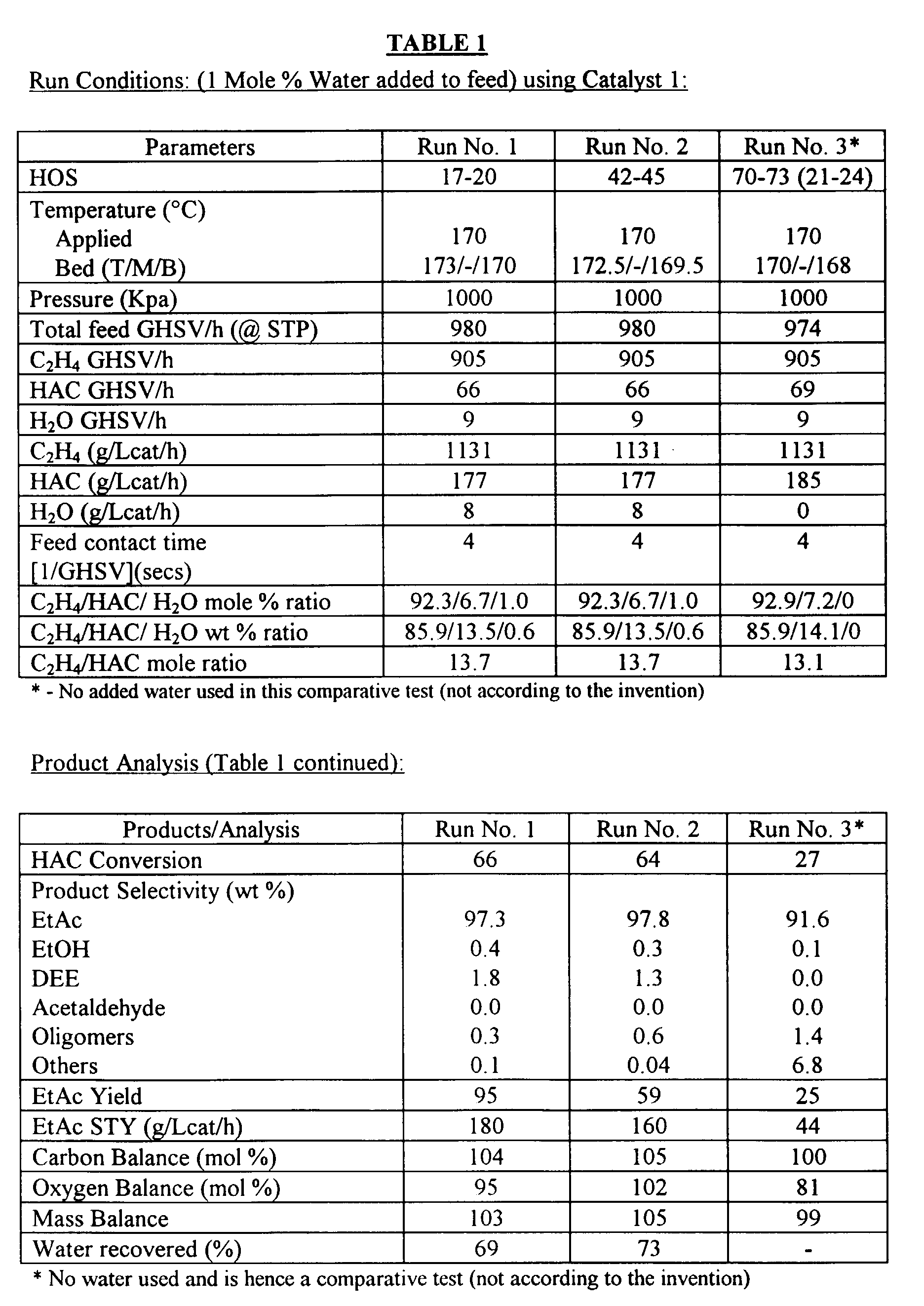


TABLE 9 LIQUID PRODUCT DATA GCMS 180°C, 1000 Kpa (10 barg), ethylene/acetic acid = 14 Organics (% by Wt) Run No. 7 17 23 Water (mole% in feed) 1 5 5 (+ 2% DEE) Acetic acid (unreacted feed) 52.3 21.2 16.3 Ethyl acetate 46.5 67.3 69 Diethylether 0.05 3 3.3 Ethanol 0.65 7.8 11 Acetaldehyde 0.002 0.04 0.009 C6 oligomers 0.0015 0 0 C8 oligomers 0.0055 0 0 Miscellaneous oxygenates 0.0065 0 0 Aromatic hydrocarbons 0.045 0 0 Unknowns 0.11 0.01 0 BALANCE :others (Hydrocarbons & oxy compounds) - Catalyst 4. 12-Tungstophosphoric acid [H3PW12O40.24H2O] (175 g) was dissolved in distilled water (250 ml). Lithium nitrate [LiNO3.2H2O] (0.652 g) was dissolved in distilled water (∼ 5ml). The lithium nitrate solution was added dropwise to the tungstophosphoric acid solution to form Solution "A".
- Solution "A" was added to pelleted silica support ( Grace 1371 grade, 1-3 mm, 99.5 g, ex W R Grace) and left to soak over 24 hours with occasional stirring in order to impregnate the silica with the tungstophosphoric acid catalyst. After this duration, excess solution "A" was decanted and filtered off. The resultant catalyst impregnated support was then dried in flowing nitrogen gas initially at 150 °C for 3 hours and then raised to 200°C and maintained at that temperature for 5 hours. The supported catalyst so formed was then left in a desiccator to cool and was finally reweighed. The resultant supported catalyst had a final weight of 164.4 g, a net catalyst loading of 64.9 g and had the formula Li0.1H2.9PW12O40.24H2O/SiO2 corresponding to a loading of 255 g/l.
- Catalyst 4. Pelleted silica support (Grace 1371 grade, 1-3 mm, 70 g, ex W R Grace) was soaked in a solution (250 ml) of 12-tungstosilicic acid [H4SiW12O40.26H2O] (65.53 g in distilled water) for 24 hours with intermittent stirring in order to impregnate the support with the catalyst. Thereafter the excess solution of the tungstosilicic acid was removed by decantation and filtration. The resultant catalyst impregnated support was then dried overnight under flowing nitrogen at 120°C. The dried supported catalyst so formed was cooled in a desiccator and had a final weight of 86.2g, a net catalyst loading of 16.2 g and had the formula H4SiW12O40.26H2O/SiO2 corresponding to a loading of 92 g/l.
- The above catalysts were used to esterify ethylene with acetic acid. The relative amounts of each of these catalysts used, their bed size and bed length in performing the esterfication reaction were as follows:
Parameter Catalyst 4 Catalyst 5 Volume (cm3) 25 25 Weight (g) 15.5 11.2-11.4 Pellet size (mm) 1-2 1-2 (Table 11) &
0.5-1 (Tables 12, 13 and 14)Bed length 8.5 8.75 


Claims (31)
- A process for the production of lower aliphatic esters said process comprising reacting a lower olefin with a saturated lower aliphatic mono-carboxylic acid in the vapour phase in the presence of a heteropolyacid catalyst characterised in that an amount of water in the range from 1-10 mole % based on the total of the olefin, aliphatic mono-carboxylic acid and water is added to the reaction mixture during the reaction.
- A process according to Claim 1 wherein the amount of water added is in the range from 1 to 7 mole % based on the total of the olefin, aliphatic mono-carboxylic acid and water.
- A process according to Claim 1 or 2 wherein the amount of water added is in the range from 1 to 5 mole % based on the total of the olefin, aliphatic mono-carboxylic acid and water.
- A process according to any one of the preceding Claims wherein the heteropolyacid catalyst is supported on a siliceous support which is in the form of extrudates or pellets.
- A process according to Claim 4 wherein the siliceous support is derived from an amorphous, non-porous synthetic silica.
- A process according to Claim 4 or 5 wherein the siliceous support is derived from fumed silica produced by flame hydrolysis of SiCl4.
- A process according to any one of the preceding Claims 4-6 wherein the siliceous supports is Support 350 made by pelletisation of AEROSIL® 200 (both ex Degussa).
- A process according to any one of the preceding Claims 4-7 wherein the silica support is in the form of pellets or beads or are globular in shape having an average particle diameter in the range from 2 to 10 mm, a pore volume in the range from 0.3-1.2 ml/g, a crush strength of at least 2 Kg force and a bulk density of at least 380 g/l.
- A process according to any one of the preceding Claims 4-8 wherein the siliceous support has at least 99% w/w purity.
- A process according to Claim 4 wherein the siliceous support is a pelleted silica support which has an average bulk density of about 0.39 g/ml, an average pore volume of about 1.15 ml/g and an average particle size ranging from about 0.1-3.5 mm.
- A process according to Claim 10 wherein the pelleted silica support is used as such or after crushing to an average particle size in the range from 0.5-2 mm to support the heteropolyacid catalyst.
- A process according to any one of the preceding Claims wherein the heteropolyacids used to prepare the esterification catalyst is selcted from the free acids and co-ordination-type salts thereof in which the anion is a complex, high molecular weight entity and comprises 2-18 oxygen-linked polyvalent metal peripheral atoms surrounding in a symmetrical manner a central atom or ion from Groups I-VIII in the Periodic Table of Elements.
- A process according to Claim 12 wherein the peripheral atom is one or more of molybdenum, tungsten, vanadium, niobium and tantalum and the central atom or ion is selected from silicon; phosphorus; cupric ions; divalent beryllium, zinc, cobalt or nickel ions; trivalent boron, aluminium, gallium, iron, cerium, arsenic, antimony, phosphorus, bismuth, chromium or rhodium ions; tetravalent silicon, germanium, tin, titanium, zirconium, vanadium, sulphur, tellurium, manganese nickel, platinum, thorium, hafnium, cerium ions and other rare earth ions; pentavalent phosphorus, arsenic, vanadium, antimony ions; hexavalent tellurium ions; and heptavalent iodine ions.
- A process according to any one of the preceding Claims wherein the heteropolyacids have a molecular weight eg in the range from 700-8500 and include dimeric complexes.
- A process according to any one of the preceding Claims wherein the heteropolyacid comprises at least one of the following compounds:


- A process according to any one of the preceding Claims 4-15 wherein the amount of heteropolyacid deposited/impregnated on the support for use in the esterification reaction is in the range from 10 to 60% by weight based on the total weight of the heteropolyacid and the support.
- A process according to any one of the preceding Claims wherein the olefin reactant used is ethylene, propylene or mixtures thereof.
- A process according to any one of the preceding Claims wherein the saturated, lower aliphatic mono-carboxylic acid reactant is a C1-C4 carboxylic acid.
- A process according to Claim any one of the preceding Claims wherein the aliphatic mono-carboxylic acid reactant is acetic acid.
- A process according to any one of the preceding Claims wherein the reaction mixture has a molar excess of the olefin reactant with respect to the aliphatic mono-carboxylic acid reactant.
- A process according to any one of the preceding Claims wherein the mole ratio of olefin to the lower carboxylic acid in the reaction mixture is in the range from 1:1 to 15 :1.
- A process according to Claim 18 wherein the mole ratio of olefin to the lower carboxylic acid in the reaction mixture is in the range from 10 : 1 to 14:1.
- A process according to any one of the preceding Claims wherein the reaction is carried out in the vapour phase suitably above the dew point of the reactor contents comprising the reactant acid, any alcohol formed in situ, the product ester and water.
- A process according to any one of the preceding Claims wherein the supported heteropolyacid catalyst is used as a fixed bed which may be in the form of a packed column.
- A process according to any one of the preceding Claims wherein the heteropolyacid catalyst is further modified by the addition of phosphoric acid or other mineral acids thereto.
- A process according to any one of the preceding Claims wherein the vapours of the reactant olefins and acids are passed over the catalyst at a GHSV in the range of 100 to 5000 per hour.
- A process according to any one of the preceding Claims wherein the esterification reaction is carried out at a temperature in the range from 150-200°C using a reaction pressure which is at least 400KPa.
- A process according to any one of the preceding Claims wherein the reaction mixture is dosed with a di-ether amount of a di-ether co-fed is suitably in the range from 1 to 6 mole % based on the total reaction mixture comprising the olefin, the aliphatic carboxylic acid, water and di-ether.
- A process according to Claim 28 wherein the di-ether corresponds to the by-product di-ether formed in situ during the reaction from the reactant olefin which is recovered and is recycled to the reaction mixture.
- A process according Claim 28 or 29 wherein the di-ether is diethyl ether.
- A process according to Claim 28 or 29 wherein the di-ether is an unsymmetrical ether.
Priority Applications (1)
| Application Number | Priority Date | Filing Date | Title |
|---|---|---|---|
| EP99113642A EP0959064B1 (en) | 1995-08-02 | 1996-07-22 | Ester synthesis |
Applications Claiming Priority (6)
| Application Number | Priority Date | Filing Date | Title |
|---|---|---|---|
| GBGB9515813.5A GB9515813D0 (en) | 1995-08-02 | 1995-08-02 | Ester synthesis |
| GB9515813 | 1995-08-02 | ||
| GBGB9603770.0A GB9603770D0 (en) | 1996-02-22 | 1996-02-22 | Ester synthesis |
| GB9603770 | 1996-02-22 | ||
| GBGB9613227.9A GB9613227D0 (en) | 1996-06-25 | 1996-06-25 | Ester synthesis |
| GB9613227 | 1996-06-25 |
Related Child Applications (2)
| Application Number | Title | Priority Date | Filing Date |
|---|---|---|---|
| EP99113642A Division-Into EP0959064B1 (en) | 1995-08-02 | 1996-07-22 | Ester synthesis |
| EP99113642A Division EP0959064B1 (en) | 1995-08-02 | 1996-07-22 | Ester synthesis |
Publications (2)
| Publication Number | Publication Date |
|---|---|
| EP0757027A1 true EP0757027A1 (en) | 1997-02-05 |
| EP0757027B1 EP0757027B1 (en) | 2000-04-05 |
Family
ID=27267836
Family Applications (2)
| Application Number | Title | Priority Date | Filing Date |
|---|---|---|---|
| EP99113642A Expired - Lifetime EP0959064B1 (en) | 1995-08-02 | 1996-07-22 | Ester synthesis |
| EP96305369A Expired - Lifetime EP0757027B1 (en) | 1995-08-02 | 1996-07-22 | Ester synthesis |
Family Applications Before (1)
| Application Number | Title | Priority Date | Filing Date |
|---|---|---|---|
| EP99113642A Expired - Lifetime EP0959064B1 (en) | 1995-08-02 | 1996-07-22 | Ester synthesis |
Country Status (11)
| Country | Link |
|---|---|
| US (2) | US5861530A (en) |
| EP (2) | EP0959064B1 (en) |
| JP (2) | JP3911048B2 (en) |
| KR (1) | KR100293337B1 (en) |
| CN (1) | CN1085197C (en) |
| CA (1) | CA2182558C (en) |
| DE (2) | DE69618032T2 (en) |
| MY (1) | MY116546A (en) |
| SA (1) | SA96170381B1 (en) |
| SG (1) | SG49973A1 (en) |
| TW (1) | TW338764B (en) |
Cited By (19)
| Publication number | Priority date | Publication date | Assignee | Title |
|---|---|---|---|---|
| EP0926126A1 (en) * | 1997-12-23 | 1999-06-30 | BP Chemicals Limited | Ester synthesis |
| EP0936210A1 (en) * | 1998-01-22 | 1999-08-18 | BP Chemicals Limited | Ester synthesis |
| WO2000003967A1 (en) * | 1998-07-14 | 2000-01-27 | Bp Chemicals Limited | Ester synthesis |
| WO2000003966A1 (en) * | 1998-07-14 | 2000-01-27 | Bp Chemicals Limited | Ester synthesis |
| WO2000009262A1 (en) * | 1998-08-14 | 2000-02-24 | Sunoco, Inc. (R & M) | Wells-dawson type heteropolyacids, their preparation and use as oxidation catalysts |
| WO2000045952A1 (en) * | 1999-02-06 | 2000-08-10 | Bp Chemicals Limited | Heteropoly acid catalysts supported on silica with low alkali metal content |
| WO2000074842A1 (en) * | 1999-06-03 | 2000-12-14 | Showa Denko K. K. | Catalyst for use in producing lower fatty acid ester, process for producing the catalyst, and process for producing lower fatty acid ester using the catalyst |
| WO2001030738A1 (en) * | 1999-10-25 | 2001-05-03 | Showa Denko K. K. | Process for producing esters |
| WO2002000591A1 (en) * | 2000-06-27 | 2002-01-03 | Bp Chemicals Limited | Synthesis of aliphatic esters from carboxylic acids and olefins |
| EP1038578A3 (en) * | 1999-03-26 | 2002-01-30 | President of Shizuoka University, a government agency of Japan | Method of producing formaldehyde directly from methane |
| WO2002000589A3 (en) * | 2000-06-27 | 2002-04-18 | Showa Denko Kk | Catalyst for use in producing lower aliphatic carboxylic acid ester, process for producing the catalyst and process for producing lower aliphatic carboxylic acid ester using the catalyst |
| WO2002026691A3 (en) * | 2000-09-26 | 2002-06-13 | Showa Denko Kk | Process for producing lower aliphatic carboxylic acid ester |
| WO2003082462A3 (en) * | 2002-03-22 | 2004-01-15 | Exxonmobil Chem Patents Inc | Combined oxydehydrogenation and cracking catalyst for production of olefins |
| US6849759B1 (en) | 1999-10-25 | 2005-02-01 | Showa Denko K.K. | Process for producing esters |
| WO2005023747A1 (en) * | 2003-09-03 | 2005-03-17 | Bp Chemicals Limited | Ester synthesis |
| US7553794B2 (en) | 2002-12-20 | 2009-06-30 | Showa Denko K.K. | Heteropolyacid and or its salt supported catalyst, production process of the catalyst and production process of compound using the catalyst |
| USRE41341E1 (en) | 1995-08-02 | 2010-05-18 | Ineos Europe Limited | Ester synthesis |
| WO2019049838A1 (en) * | 2017-09-05 | 2019-03-14 | Showa Denko K.K. | Production method of aliphatic carboxylic acid ester |
| US11890592B2 (en) | 2017-09-05 | 2024-02-06 | Resonac Corporation | Method for producing silica carrier, and silica carrier |
Families Citing this family (101)
| Publication number | Priority date | Publication date | Assignee | Title |
|---|---|---|---|---|
| US6018076A (en) * | 1997-09-30 | 2000-01-25 | Arco Chemical Technology, L.P. | Ester preparation |
| US6818790B1 (en) * | 1999-10-05 | 2004-11-16 | Showa Denko K.K. | Process for producing mixed gas of lower olefin and lower aliphatic carboxylic acid, and process for producing lower aliphatic ester using the mixed gas |
| US20040242918A1 (en) * | 2000-06-27 | 2004-12-02 | Showa Denko K.K | Support and catalyst for use in producing lower aliphatic carboxylic acid ester, process for producing the catalyst and process for producing lower aliphatic carboxylic acid ester using the catalyst |
| JP2002316048A (en) * | 2001-02-13 | 2002-10-29 | Showa Denko Kk | Support used for catalyst for producing lower aliphatic carboxylic acid ester, catalyst for producing lower aliphatic carboxylic acid ester using the same, method for producing the catalyst, and method for producing lower aliphatic carboxylic acid ester using the catalyst |
| EP1324825A2 (en) * | 2000-09-07 | 2003-07-09 | Showa Denko K.K. | Heteropolyacid catalyst for producing lower aliphatic carboxylic acid ester |
| AU2001284440A1 (en) * | 2000-09-07 | 2002-03-22 | Showa Denko K K | Catalyst for use in producing lower aliphatic carboxylic acid ester, process forproducing the catalyst, and process for producing lower aliphatic carboxylic ac id ester using the catalyst |
| JP2002079088A (en) * | 2000-09-07 | 2002-03-19 | Showa Denko Kk | Catalyst for manufacturing lower aliphatic carboxylic acid ester, method for manufacturing the same and method for manufacturing lower aliphatic carboxylic acid ester by the catalyst |
| JP4620236B2 (en) * | 2000-09-26 | 2011-01-26 | 昭和電工株式会社 | Method for producing lower aliphatic carboxylic acid ester |
| US7122495B2 (en) * | 2003-02-05 | 2006-10-17 | Exxonmobil Chemical Patents Inc. | Combined cracking and selective hydrogen combustion for catalytic cracking |
| US7125817B2 (en) * | 2003-02-20 | 2006-10-24 | Exxonmobil Chemical Patents Inc. | Combined cracking and selective hydrogen combustion for catalytic cracking |
| US7122492B2 (en) * | 2003-02-05 | 2006-10-17 | Exxonmobil Chemical Patents Inc. | Combined cracking and selective hydrogen combustion for catalytic cracking |
| US7122494B2 (en) * | 2003-02-05 | 2006-10-17 | Exxonmobil Chemical Patents Inc. | Combined cracking and selective hydrogen combustion for catalytic cracking |
| US7122493B2 (en) * | 2003-02-05 | 2006-10-17 | Exxonmobil Chemical Patents Inc. | Combined cracking and selective hydrogen combustion for catalytic cracking |
| JP4633339B2 (en) * | 2003-05-26 | 2011-02-16 | 三洋化成工業株式会社 | Method for producing carboxylic acid ester |
| GB0410603D0 (en) * | 2004-05-12 | 2004-06-16 | Bp Chem Int Ltd | Ester synthesis |
| WO2006032843A1 (en) * | 2004-09-22 | 2006-03-30 | Bp Chemicals Limited | Silica support, heteropolyacid catalyst produced therefrom and ester synthesis using the silica supported heteropolyacid catalyst |
| US7413805B2 (en) * | 2005-02-25 | 2008-08-19 | Fry's Metals, Inc. | Preparation of metallic particles for electrokinetic or electrostatic deposition |
| US20090012324A1 (en) * | 2006-02-14 | 2009-01-08 | Jun-Chul Choi | Process for Production of Carboxylic Acid Ester or Ether Compound |
| SG189592A1 (en) * | 2006-11-22 | 2013-05-31 | Bp Chem Int Ltd | Process for producing alkenes from oxygenates by using supported heteropolyacid catalysts |
| EP1982761A1 (en) * | 2006-11-22 | 2008-10-22 | BP Chemicals Limited | Supported heteropolyacid catalysts |
| US8304586B2 (en) * | 2010-02-02 | 2012-11-06 | Celanese International Corporation | Process for purifying ethanol |
| US8546622B2 (en) | 2008-07-31 | 2013-10-01 | Celanese International Corporation | Process for making ethanol from acetic acid using acidic catalysts |
| US7820852B2 (en) * | 2008-07-31 | 2010-10-26 | Celanese International Corporation | Direct and selective production of ethyl acetate from acetic acid utilizing a bimetal supported catalyst |
| US8338650B2 (en) | 2008-07-31 | 2012-12-25 | Celanese International Corporation | Palladium catalysts for making ethanol from acetic acid |
| US8501652B2 (en) | 2008-07-31 | 2013-08-06 | Celanese International Corporation | Catalysts for making ethanol from acetic acid |
| US8309772B2 (en) | 2008-07-31 | 2012-11-13 | Celanese International Corporation | Tunable catalyst gas phase hydrogenation of carboxylic acids |
| US8680317B2 (en) * | 2008-07-31 | 2014-03-25 | Celanese International Corporation | Processes for making ethyl acetate from acetic acid |
| US8309773B2 (en) * | 2010-02-02 | 2012-11-13 | Calanese International Corporation | Process for recovering ethanol |
| US8637714B2 (en) | 2008-07-31 | 2014-01-28 | Celanese International Corporation | Process for producing ethanol over catalysts containing platinum and palladium |
| US8471075B2 (en) | 2008-07-31 | 2013-06-25 | Celanese International Corporation | Processes for making ethanol from acetic acid |
| US20100197486A1 (en) * | 2008-07-31 | 2010-08-05 | Celanese International Corporation | Catalysts for making ethyl acetate from acetic acid |
| US8450535B2 (en) | 2009-07-20 | 2013-05-28 | Celanese International Corporation | Ethanol production from acetic acid utilizing a cobalt catalyst |
| US8680321B2 (en) * | 2009-10-26 | 2014-03-25 | Celanese International Corporation | Processes for making ethanol from acetic acid using bimetallic catalysts |
| US8710277B2 (en) * | 2009-10-26 | 2014-04-29 | Celanese International Corporation | Process for making diethyl ether from acetic acid |
| US8211821B2 (en) | 2010-02-01 | 2012-07-03 | Celanese International Corporation | Processes for making tin-containing catalysts |
| US8858659B2 (en) * | 2010-02-02 | 2014-10-14 | Celanese International Corporation | Processes for producing denatured ethanol |
| US8680343B2 (en) | 2010-02-02 | 2014-03-25 | Celanese International Corporation | Process for purifying ethanol |
| US8314272B2 (en) | 2010-02-02 | 2012-11-20 | Celanese International Corporation | Process for recovering ethanol with vapor separation |
| US8728179B2 (en) | 2010-02-02 | 2014-05-20 | Celanese International Corporation | Ethanol compositions |
| US8394985B2 (en) * | 2010-02-02 | 2013-03-12 | Celanese International Corporation | Process for producing an ester feed stream for esters production and co-production of ethanol |
| KR20120112852A (en) | 2010-02-02 | 2012-10-11 | 셀라니즈 인터내셔날 코포레이션 | Preparation and use of a catalyst for producing ethanol comprising a crystalline support modifier |
| US8344186B2 (en) | 2010-02-02 | 2013-01-01 | Celanese International Corporation | Processes for producing ethanol from acetaldehyde |
| US8932372B2 (en) | 2010-02-02 | 2015-01-13 | Celanese International Corporation | Integrated process for producing alcohols from a mixed acid feed |
| US8575403B2 (en) | 2010-05-07 | 2013-11-05 | Celanese International Corporation | Hydrolysis of ethyl acetate in ethanol separation process |
| US8318988B2 (en) | 2010-05-07 | 2012-11-27 | Celanese International Corporation | Process for purifying a crude ethanol product |
| US8541633B2 (en) * | 2010-02-02 | 2013-09-24 | Celanese International Corporation | Processes for producing anhydrous ethanol compositions |
| US8668750B2 (en) | 2010-02-02 | 2014-03-11 | Celanese International Corporation | Denatured fuel ethanol compositions for blending with gasoline or diesel fuel for use as motor fuels |
| US8747492B2 (en) | 2010-02-02 | 2014-06-10 | Celanese International Corporation | Ethanol/fuel blends for use as motor fuels |
| US8222466B2 (en) * | 2010-02-02 | 2012-07-17 | Celanese International Corporation | Process for producing a water stream from ethanol production |
| US8394984B2 (en) | 2010-02-02 | 2013-03-12 | Celanese International Corporation | Process for producing an ethyl acetate solvent and co-production of ethanol |
| US8460405B2 (en) * | 2010-02-02 | 2013-06-11 | Celanese International Corporation | Ethanol compositions |
| US8754267B2 (en) | 2010-05-07 | 2014-06-17 | Celanese International Corporation | Process for separating acetaldehyde from ethanol-containing mixtures |
| US8680342B2 (en) | 2010-05-07 | 2014-03-25 | Celanese International Corporation | Process for recovering alcohol produced by hydrogenating an acetic acid feed stream comprising water |
| US8569551B2 (en) | 2010-05-07 | 2013-10-29 | Celanese International Corporation | Alcohol production process integrating acetic acid feed stream comprising water from carbonylation process |
| US8846986B2 (en) | 2011-04-26 | 2014-09-30 | Celanese International Corporation | Water separation from crude alcohol product |
| US9150474B2 (en) | 2010-07-09 | 2015-10-06 | Celanese International Corporation | Reduction of acid within column through esterification during the production of alcohols |
| WO2012148509A1 (en) | 2011-04-26 | 2012-11-01 | Celanese International Corporation | Process for producing ethanol using a stacked bed reactor |
| US8846988B2 (en) | 2010-07-09 | 2014-09-30 | Celanese International Corporation | Liquid esterification for the production of alcohols |
| US8664454B2 (en) | 2010-07-09 | 2014-03-04 | Celanese International Corporation | Process for production of ethanol using a mixed feed using copper containing catalyst |
| US9272970B2 (en) | 2010-07-09 | 2016-03-01 | Celanese International Corporation | Hydrogenolysis of ethyl acetate in alcohol separation processes |
| US8901358B2 (en) | 2010-07-09 | 2014-12-02 | Celanese International Corporation | Esterification of vapor crude product in the production of alcohols |
| MX2012013920A (en) | 2010-07-09 | 2012-12-17 | Celanese Int Corp | Finishing reactor for purifying ethanol. |
| US8710279B2 (en) | 2010-07-09 | 2014-04-29 | Celanese International Corporation | Hydrogenolysis of ethyl acetate in alcohol separation processes |
| US8350098B2 (en) | 2011-04-04 | 2013-01-08 | Celanese International Corporation | Ethanol production from acetic acid utilizing a molybdenum carbide catalyst |
| US8927788B2 (en) | 2011-04-26 | 2015-01-06 | Celanese International Corporation | Process to recover alcohol with reduced water from overhead of acid column |
| US8686200B2 (en) | 2011-04-26 | 2014-04-01 | Celanese International Corporation | Process to recover alcohol from an acidic residue stream |
| US8754268B2 (en) | 2011-04-26 | 2014-06-17 | Celanese International Corporation | Process for removing water from alcohol mixtures |
| US8927784B2 (en) | 2011-04-26 | 2015-01-06 | Celanese International Corporation | Process to recover alcohol from an ethyl acetate residue stream |
| US8686199B2 (en) | 2011-04-26 | 2014-04-01 | Celanese International Corporation | Process for reducing the concentration of acetic acid in a crude alcohol product |
| US8927787B2 (en) | 2011-04-26 | 2015-01-06 | Celanese International Corporation | Process for controlling a reboiler during alcohol recovery and reduced ester formation |
| TW201302684A (en) | 2011-04-26 | 2013-01-16 | Celanese Int Corp | Process for the production of ethanol from an acetic acid feed and a recycled ethyl acetate feed |
| US9000233B2 (en) | 2011-04-26 | 2015-04-07 | Celanese International Corporation | Process to recover alcohol with secondary reactors for hydrolysis of acetal |
| US9000232B2 (en) | 2011-04-26 | 2015-04-07 | Celanese International Corporation | Extractive distillation of crude alcohol product |
| US9024085B2 (en) | 2011-04-26 | 2015-05-05 | Celanese International Corporation | Process to reduce ethanol recycled to hydrogenation reactor |
| US9073816B2 (en) | 2011-04-26 | 2015-07-07 | Celanese International Corporation | Reducing ethyl acetate concentration in recycle streams for ethanol production processes |
| US8884081B2 (en) | 2011-04-26 | 2014-11-11 | Celanese International Corporation | Integrated process for producing acetic acid and alcohol |
| US8907141B2 (en) | 2011-04-26 | 2014-12-09 | Celanese International Corporation | Process to recover alcohol with secondary reactors for esterification of acid |
| US8592635B2 (en) | 2011-04-26 | 2013-11-26 | Celanese International Corporation | Integrated ethanol production by extracting halides from acetic acid |
| US8933278B2 (en) | 2011-04-26 | 2015-01-13 | Celanese International Corporation | Process for producing ethanol and reducing acetic acid concentration |
| US9024082B2 (en) | 2011-04-26 | 2015-05-05 | Celanese International Corporation | Using a dilute acid stream as an extractive agent |
| US9024084B2 (en) | 2011-04-26 | 2015-05-05 | Celanese International Corporation | Reduced energy alcohol separation process having controlled pressure |
| US8884079B2 (en) | 2011-08-03 | 2014-11-11 | Celanese International Corporation | Reducing impurities in hydrogenation processes with multiple reaction zones |
| US8575405B2 (en) | 2011-08-03 | 2013-11-05 | Celanese International Corporation | Reducing acetals during ethanol separation process |
| US8895786B2 (en) | 2011-08-03 | 2014-11-25 | Celanese International Corporation | Processes for increasing alcohol production |
| US8748676B2 (en) | 2011-08-03 | 2014-06-10 | Celanese International Corporation | Process for purifying a crude ethanol product |
| US8658843B2 (en) | 2011-10-06 | 2014-02-25 | Celanese International Corporation | Hydrogenation catalysts prepared from polyoxometalate precursors and process for using same to produce ethanol while minimizing diethyl ether formation |
| US8536382B2 (en) | 2011-10-06 | 2013-09-17 | Celanese International Corporation | Processes for hydrogenating alkanoic acids using catalyst comprising tungsten |
| US8703868B2 (en) | 2011-11-28 | 2014-04-22 | Celanese International Corporation | Integrated process for producing polyvinyl alcohol or a copolymer thereof and ethanol |
| US9000234B2 (en) | 2011-12-22 | 2015-04-07 | Celanese International Corporation | Calcination of modified support to prepare hydrogenation catalysts |
| US9233899B2 (en) | 2011-12-22 | 2016-01-12 | Celanese International Corporation | Hydrogenation catalysts having an amorphous support |
| US8907142B2 (en) | 2011-12-29 | 2014-12-09 | Celanese International Corporation | Process for promoting catalyst activity for ethyl acetate conversion |
| CN103282334B (en) | 2011-12-30 | 2015-11-25 | 国际人造丝公司 | For carrying out the pressure-driven distillation of alcohol production and recovery from method of hydrotreating |
| US8729311B2 (en) | 2012-02-10 | 2014-05-20 | Celanese International Corporaton | Catalysts for converting acetic acid to acetone |
| US8729317B2 (en) | 2012-02-15 | 2014-05-20 | Celanese International Corporation | Ethanol manufacturing process over catalyst with cesium and support comprising tungsten or oxides thereof |
| US8802903B2 (en) | 2012-03-13 | 2014-08-12 | Celanese International Corporation | Stacked bed reactor with diluents for producing ethanol |
| US8772553B2 (en) | 2012-10-26 | 2014-07-08 | Celanese International Corporation | Hydrogenation reaction conditions for producing ethanol |
| CN103214365B (en) * | 2013-04-18 | 2015-04-08 | 湖南长岭石化科技开发有限公司 | Method for producing cyclohexyl acetate through benzene |
| US9498772B2 (en) | 2013-11-26 | 2016-11-22 | Saudi Arabian Oil Company | Unsupported metal substituted heteropolyacid catalysts for dimerization and/or oligomerization of olefins |
| CN104117378B (en) * | 2014-06-29 | 2016-03-02 | 陈昆 | The preparation method of catalyst for esterification reaction |
| JP6425530B2 (en) * | 2014-12-11 | 2018-11-21 | 昭和電工株式会社 | Method for producing aliphatic carboxylic acid ester |
| CN110152648B (en) * | 2018-02-12 | 2022-01-04 | 中国石油化工股份有限公司 | Preparation method of tin catalyst, tin catalyst and application thereof |
Citations (2)
| Publication number | Priority date | Publication date | Assignee | Title |
|---|---|---|---|---|
| EP0538826A2 (en) * | 1991-10-22 | 1993-04-28 | MITSUI TOATSU CHEMICALS, Inc. | Process for producing ethyl acetate |
| EP0562139A1 (en) * | 1992-03-25 | 1993-09-29 | Showa Denko Kabushiki Kaisha | Process for preparation of lower fatty acid ester |
Family Cites Families (10)
| Publication number | Priority date | Publication date | Assignee | Title |
|---|---|---|---|---|
| US2174985A (en) * | 1937-03-02 | 1939-10-03 | Du Pont | Process for the esterification of olefins |
| US3644497A (en) * | 1968-11-01 | 1972-02-22 | Celanese Corp | Conversion of ethylenically unsaturated compounds using heteropoly-molybdic and heteropolytungstic acids as catalysts |
| CH529814A (en) | 1969-11-14 | 1972-10-31 | Sir Soc Italiana Resine Spa | Process for the pigmentation of synthetic resins |
| DE3912504A1 (en) * | 1989-04-17 | 1990-10-18 | Degussa | PRESSLINGS BASED ON PYROGEN-PRODUCED SILICON DIOXIDE, PROCESS FOR THEIR PRODUCTION AND THEIR USE |
| JP3012059B2 (en) * | 1991-11-05 | 2000-02-21 | 昭和電工株式会社 | Method for producing lower fatty acid ester |
| JP3330404B2 (en) * | 1991-12-20 | 2002-09-30 | 三井化学株式会社 | Method for producing ethyl acetate |
| JPH05279297A (en) * | 1992-02-07 | 1993-10-26 | Nippon Shokubai Co Ltd | Production of aliphatic carboxylic acid ester |
| JP3261731B2 (en) * | 1992-04-23 | 2002-03-04 | 昭和電工株式会社 | Method for producing lower fatty acid ester |
| JP3147500B2 (en) * | 1992-06-23 | 2001-03-19 | 昭和電工株式会社 | Production method of ethyl acetate and ethyl alcohol |
| EP0959064B1 (en) | 1995-08-02 | 2001-12-12 | BP Chemicals Limited | Ester synthesis |
-
1996
- 1996-07-22 EP EP99113642A patent/EP0959064B1/en not_active Expired - Lifetime
- 1996-07-22 DE DE69618032T patent/DE69618032T2/en not_active Expired - Lifetime
- 1996-07-22 EP EP96305369A patent/EP0757027B1/en not_active Expired - Lifetime
- 1996-07-22 DE DE69607536T patent/DE69607536T2/en not_active Expired - Lifetime
- 1996-07-26 US US08/687,811 patent/US5861530A/en not_active Ceased
- 1996-07-29 SG SG1996010358A patent/SG49973A1/en unknown
- 1996-08-01 CA CA002182558A patent/CA2182558C/en not_active Expired - Lifetime
- 1996-08-01 JP JP20397496A patent/JP3911048B2/en not_active Expired - Lifetime
- 1996-08-02 CN CN96112172A patent/CN1085197C/en not_active Expired - Lifetime
- 1996-08-02 MY MYPI96003185A patent/MY116546A/en unknown
- 1996-08-02 KR KR1019960032397A patent/KR100293337B1/en not_active Expired - Lifetime
- 1996-10-04 TW TW085112155A patent/TW338764B/en not_active IP Right Cessation
- 1996-10-21 SA SA96170381A patent/SA96170381B1/en unknown
-
2005
- 2005-07-13 JP JP2005204950A patent/JP2005298527A/en active Pending
-
2007
- 2007-02-28 US US11/712,545 patent/USRE41341E1/en not_active Expired - Lifetime
Patent Citations (2)
| Publication number | Priority date | Publication date | Assignee | Title |
|---|---|---|---|---|
| EP0538826A2 (en) * | 1991-10-22 | 1993-04-28 | MITSUI TOATSU CHEMICALS, Inc. | Process for producing ethyl acetate |
| EP0562139A1 (en) * | 1992-03-25 | 1993-09-29 | Showa Denko Kabushiki Kaisha | Process for preparation of lower fatty acid ester |
Cited By (29)
| Publication number | Priority date | Publication date | Assignee | Title |
|---|---|---|---|---|
| USRE41341E1 (en) | 1995-08-02 | 2010-05-18 | Ineos Europe Limited | Ester synthesis |
| EP0926126A1 (en) * | 1997-12-23 | 1999-06-30 | BP Chemicals Limited | Ester synthesis |
| US6946570B2 (en) | 1997-12-23 | 2005-09-20 | Bp Chemicals Limited | Ester synthesis |
| US6187949B1 (en) | 1998-01-22 | 2001-02-13 | Bp Chemicals Limited | Synthesis of lower aliphatic esters using heterpolyacids with an aldehyde-free product stream |
| EP0936210A1 (en) * | 1998-01-22 | 1999-08-18 | BP Chemicals Limited | Ester synthesis |
| SG90034A1 (en) * | 1998-01-22 | 2002-07-23 | Bp Chem Int Ltd | Ester synthesis |
| KR100663685B1 (en) * | 1998-07-14 | 2007-01-02 | 비피 케미칼즈 리미티드 | Ester synthesis |
| WO2000003967A1 (en) * | 1998-07-14 | 2000-01-27 | Bp Chemicals Limited | Ester synthesis |
| WO2000003966A1 (en) * | 1998-07-14 | 2000-01-27 | Bp Chemicals Limited | Ester synthesis |
| US6794535B2 (en) | 1998-07-14 | 2004-09-21 | Bp Chemicals Limited | Ester synthesis |
| WO2000009262A1 (en) * | 1998-08-14 | 2000-02-24 | Sunoco, Inc. (R & M) | Wells-dawson type heteropolyacids, their preparation and use as oxidation catalysts |
| WO2000045952A1 (en) * | 1999-02-06 | 2000-08-10 | Bp Chemicals Limited | Heteropoly acid catalysts supported on silica with low alkali metal content |
| EP1038578A3 (en) * | 1999-03-26 | 2002-01-30 | President of Shizuoka University, a government agency of Japan | Method of producing formaldehyde directly from methane |
| WO2000074842A1 (en) * | 1999-06-03 | 2000-12-14 | Showa Denko K. K. | Catalyst for use in producing lower fatty acid ester, process for producing the catalyst, and process for producing lower fatty acid ester using the catalyst |
| US6624325B1 (en) | 1999-06-03 | 2003-09-23 | Showa Denko K. K. | Catalyst for use in producing lower fatty acid ester, process for producing the catalyst, and process for producing lower fatty acid ester using the catalyst |
| WO2001030738A1 (en) * | 1999-10-25 | 2001-05-03 | Showa Denko K. K. | Process for producing esters |
| US6849759B1 (en) | 1999-10-25 | 2005-02-01 | Showa Denko K.K. | Process for producing esters |
| WO2002000591A1 (en) * | 2000-06-27 | 2002-01-03 | Bp Chemicals Limited | Synthesis of aliphatic esters from carboxylic acids and olefins |
| WO2002000589A3 (en) * | 2000-06-27 | 2002-04-18 | Showa Denko Kk | Catalyst for use in producing lower aliphatic carboxylic acid ester, process for producing the catalyst and process for producing lower aliphatic carboxylic acid ester using the catalyst |
| WO2002026691A3 (en) * | 2000-09-26 | 2002-06-13 | Showa Denko Kk | Process for producing lower aliphatic carboxylic acid ester |
| US6696598B2 (en) | 2000-09-26 | 2004-02-24 | Showa Denko K.K. | Process for producing lower aliphatic carboxylic acid ester |
| WO2003082462A3 (en) * | 2002-03-22 | 2004-01-15 | Exxonmobil Chem Patents Inc | Combined oxydehydrogenation and cracking catalyst for production of olefins |
| US7553794B2 (en) | 2002-12-20 | 2009-06-30 | Showa Denko K.K. | Heteropolyacid and or its salt supported catalyst, production process of the catalyst and production process of compound using the catalyst |
| WO2005023747A1 (en) * | 2003-09-03 | 2005-03-17 | Bp Chemicals Limited | Ester synthesis |
| WO2019049838A1 (en) * | 2017-09-05 | 2019-03-14 | Showa Denko K.K. | Production method of aliphatic carboxylic acid ester |
| CN111065618A (en) * | 2017-09-05 | 2020-04-24 | 昭和电工株式会社 | Production method of aliphatic carboxylate |
| US10919836B2 (en) | 2017-09-05 | 2021-02-16 | Showa Denko K.K. | Production method of aliphatic carboxylic acid ester |
| CN111065618B (en) * | 2017-09-05 | 2022-07-19 | 昭和电工株式会社 | Process for producing aliphatic carboxylic acid ester |
| US11890592B2 (en) | 2017-09-05 | 2024-02-06 | Resonac Corporation | Method for producing silica carrier, and silica carrier |
Also Published As
| Publication number | Publication date |
|---|---|
| DE69607536D1 (en) | 2000-05-11 |
| JP2005298527A (en) | 2005-10-27 |
| EP0757027B1 (en) | 2000-04-05 |
| EP0959064A1 (en) | 1999-11-24 |
| JPH09118647A (en) | 1997-05-06 |
| KR100293337B1 (en) | 2001-07-12 |
| TW338764B (en) | 1998-08-21 |
| KR980002006A (en) | 1998-03-30 |
| DE69618032T2 (en) | 2002-06-27 |
| SG49973A1 (en) | 1998-06-15 |
| EP0959064B1 (en) | 2001-12-12 |
| US5861530A (en) | 1999-01-19 |
| CN1085197C (en) | 2002-05-22 |
| SA96170381B1 (en) | 2007-01-20 |
| CN1150585A (en) | 1997-05-28 |
| JP3911048B2 (en) | 2007-05-09 |
| CA2182558A1 (en) | 1997-02-03 |
| CA2182558C (en) | 2006-10-24 |
| USRE41341E1 (en) | 2010-05-18 |
| MY116546A (en) | 2004-02-28 |
| DE69618032D1 (en) | 2002-01-24 |
| DE69607536T2 (en) | 2001-02-08 |
Similar Documents
| Publication | Publication Date | Title |
|---|---|---|
| EP0959064B1 (en) | Ester synthesis | |
| EP0936210B1 (en) | Ester synthesis | |
| EP1097121B1 (en) | Ester synthesis | |
| EP0713723A1 (en) | Olefin hydration process | |
| CA2257418C (en) | Ester synthesis | |
| US7432393B2 (en) | Silica support, heteropolyacid catalyst produced therefrom and ester synthesis using the silica supported heteropolyacid catalyst | |
| WO2000045952A1 (en) | Heteropoly acid catalysts supported on silica with low alkali metal content | |
| MXPA06013091A (en) | Process for the production of ethyl acetate. | |
| US20010047107A1 (en) | Ester synthesis | |
| JP2002079089A (en) | Catalyst for manufacturing lower aliphatic carboxylic acid ester, method for manufacturing the same and method for manufacturing lower aliphatic carboxylic acid ester by catalyst | |
| CN100478068C (en) | Silica support, heteropolyacid catalyst produced therefrom and ester synthesis using the silica supported heteropolyacid catalyst | |
| CA2537052A1 (en) | Ester synthesis | |
| WO2002000591A1 (en) | Synthesis of aliphatic esters from carboxylic acids and olefins |
Legal Events
| Date | Code | Title | Description |
|---|---|---|---|
| PUAI | Public reference made under article 153(3) epc to a published international application that has entered the european phase |
Free format text: ORIGINAL CODE: 0009012 |
|
| AK | Designated contracting states |
Kind code of ref document: A1 Designated state(s): BE DE FR GB NL SE |
|
| 17P | Request for examination filed |
Effective date: 19970120 |
|
| 17Q | First examination report despatched |
Effective date: 19981123 |
|
| GRAG | Despatch of communication of intention to grant |
Free format text: ORIGINAL CODE: EPIDOS AGRA |
|
| GRAG | Despatch of communication of intention to grant |
Free format text: ORIGINAL CODE: EPIDOS AGRA |
|
| GRAH | Despatch of communication of intention to grant a patent |
Free format text: ORIGINAL CODE: EPIDOS IGRA |
|
| GRAH | Despatch of communication of intention to grant a patent |
Free format text: ORIGINAL CODE: EPIDOS IGRA |
|
| GRAA | (expected) grant |
Free format text: ORIGINAL CODE: 0009210 |
|
| AK | Designated contracting states |
Kind code of ref document: B1 Designated state(s): BE DE FR GB NL SE |
|
| REF | Corresponds to: |
Ref document number: 69607536 Country of ref document: DE Date of ref document: 20000511 |
|
| ET | Fr: translation filed | ||
| PLBE | No opposition filed within time limit |
Free format text: ORIGINAL CODE: 0009261 |
|
| STAA | Information on the status of an ep patent application or granted ep patent |
Free format text: STATUS: NO OPPOSITION FILED WITHIN TIME LIMIT |
|
| 26N | No opposition filed | ||
| REG | Reference to a national code |
Ref country code: GB Ref legal event code: IF02 |
|
| PLCP | Request for limitation filed |
Free format text: ORIGINAL CODE: EPIDOSNLIM1 |
|
| PLCQ | Request for limitation of patent found admissible |
Free format text: ORIGINAL CODE: 0009231 |
|
| LIM1 | Request for limitation found admissible |
Free format text: SEQUENCE NO: 1; FILED AFTER OPPOSITION PERIOD Filing date: 20071221 |
|
| PLCW | Request for limitation of patent withdrawn |
Free format text: ORIGINAL CODE: 0009235 |
|
| LIM5 | Request for limitation withdrawn |
Free format text: SEQUENCE NO: 1; FILED AFTER OPPOSITION PERIOD Filing date: 20071221 |
|
| REG | Reference to a national code |
Ref country code: GB Ref legal event code: 732E Free format text: REGISTERED BETWEEN 20090702 AND 20090708 |
|
| REG | Reference to a national code |
Ref country code: GB Ref legal event code: 732E Free format text: REGISTERED BETWEEN 20100701 AND 20100707 |
|
| REG | Reference to a national code |
Ref country code: DE Ref legal event code: R082 Ref document number: 69607536 Country of ref document: DE Representative=s name: LEDERER & KELLER, DE |
|
| BECA | Be: change of holder's address |
Owner name: INEOS OXIDE LTDHAWKSLEASE CHAPEL LANE LYNDHURST,H Effective date: 20111006 |
|
| BECH | Be: change of holder |
Owner name: INEOS OXIDE LTDHAWKSLEASE CHAPEL LANE LYNDHURST,H Effective date: 20111006 |
|
| REG | Reference to a national code |
Ref country code: DE Ref legal event code: R082 Ref document number: 69607536 Country of ref document: DE Representative=s name: LEDERER & KELLER PATENTANWAELTE PARTNERSCHAFT , DE Effective date: 20111028 Ref country code: DE Ref legal event code: R081 Ref document number: 69607536 Country of ref document: DE Owner name: INEOS OXIDE LIMITED, GB Free format text: FORMER OWNER: BP CHEMICALS LTD., LONDON, GB Effective date: 20111028 |
|
| REG | Reference to a national code |
Ref country code: GB Ref legal event code: 732E Free format text: REGISTERED BETWEEN 20111201 AND 20111207 |
|
| REG | Reference to a national code |
Ref country code: GB Ref legal event code: 732E Free format text: REGISTERED BETWEEN 20120628 AND 20120704 |
|
| REG | Reference to a national code |
Ref country code: FR Ref legal event code: PLFP Year of fee payment: 20 |
|
| PGFP | Annual fee paid to national office [announced via postgrant information from national office to epo] |
Ref country code: NL Payment date: 20150726 Year of fee payment: 20 |
|
| PGFP | Annual fee paid to national office [announced via postgrant information from national office to epo] |
Ref country code: GB Payment date: 20150727 Year of fee payment: 20 Ref country code: DE Payment date: 20150729 Year of fee payment: 20 |
|
| PGFP | Annual fee paid to national office [announced via postgrant information from national office to epo] |
Ref country code: SE Payment date: 20150729 Year of fee payment: 20 Ref country code: BE Payment date: 20150727 Year of fee payment: 20 Ref country code: FR Payment date: 20150717 Year of fee payment: 20 |
|
| REG | Reference to a national code |
Ref country code: DE Ref legal event code: R071 Ref document number: 69607536 Country of ref document: DE |
|
| REG | Reference to a national code |
Ref country code: NL Ref legal event code: MK Effective date: 20160721 |
|
| REG | Reference to a national code |
Ref country code: GB Ref legal event code: PE20 Expiry date: 20160721 |
|
| PG25 | Lapsed in a contracting state [announced via postgrant information from national office to epo] |
Ref country code: GB Free format text: LAPSE BECAUSE OF EXPIRATION OF PROTECTION Effective date: 20160721 |