EP0755955B1 - Flexible polyurethane foam on the basis of polyether polyols prepared by co-initiation of aqueous solutions of solid polyhydroxyl initiators - Google Patents
Flexible polyurethane foam on the basis of polyether polyols prepared by co-initiation of aqueous solutions of solid polyhydroxyl initiators Download PDFInfo
- Publication number
- EP0755955B1 EP0755955B1 EP96305479A EP96305479A EP0755955B1 EP 0755955 B1 EP0755955 B1 EP 0755955B1 EP 96305479 A EP96305479 A EP 96305479A EP 96305479 A EP96305479 A EP 96305479A EP 0755955 B1 EP0755955 B1 EP 0755955B1
- Authority
- EP
- European Patent Office
- Prior art keywords
- flexible foam
- polyurethane flexible
- oxyalkylation
- weight percent
- water
- Prior art date
- Legal status (The legal status is an assumption and is not a legal conclusion. Google has not performed a legal analysis and makes no representation as to the accuracy of the status listed.)
- Revoked
Links
Classifications
-
- C—CHEMISTRY; METALLURGY
- C08—ORGANIC MACROMOLECULAR COMPOUNDS; THEIR PREPARATION OR CHEMICAL WORKING-UP; COMPOSITIONS BASED THEREON
- C08G—MACROMOLECULAR COMPOUNDS OBTAINED OTHERWISE THAN BY REACTIONS ONLY INVOLVING UNSATURATED CARBON-TO-CARBON BONDS
- C08G18/00—Polymeric products of isocyanates or isothiocyanates
- C08G18/06—Polymeric products of isocyanates or isothiocyanates with compounds having active hydrogen
- C08G18/28—Polymeric products of isocyanates or isothiocyanates with compounds having active hydrogen characterised by the compounds used containing active hydrogen
- C08G18/40—High-molecular-weight compounds
- C08G18/48—Polyethers
- C08G18/487—Polyethers containing cyclic groups
- C08G18/4883—Polyethers containing cyclic groups containing cyclic groups having at least one oxygen atom in the ring
-
- C—CHEMISTRY; METALLURGY
- C08—ORGANIC MACROMOLECULAR COMPOUNDS; THEIR PREPARATION OR CHEMICAL WORKING-UP; COMPOSITIONS BASED THEREON
- C08G—MACROMOLECULAR COMPOUNDS OBTAINED OTHERWISE THAN BY REACTIONS ONLY INVOLVING UNSATURATED CARBON-TO-CARBON BONDS
- C08G18/00—Polymeric products of isocyanates or isothiocyanates
- C08G18/06—Polymeric products of isocyanates or isothiocyanates with compounds having active hydrogen
- C08G18/28—Polymeric products of isocyanates or isothiocyanates with compounds having active hydrogen characterised by the compounds used containing active hydrogen
- C08G18/40—High-molecular-weight compounds
- C08G18/48—Polyethers
-
- C—CHEMISTRY; METALLURGY
- C08—ORGANIC MACROMOLECULAR COMPOUNDS; THEIR PREPARATION OR CHEMICAL WORKING-UP; COMPOSITIONS BASED THEREON
- C08G—MACROMOLECULAR COMPOUNDS OBTAINED OTHERWISE THAN BY REACTIONS ONLY INVOLVING UNSATURATED CARBON-TO-CARBON BONDS
- C08G65/00—Macromolecular compounds obtained by reactions forming an ether link in the main chain of the macromolecule
- C08G65/02—Macromolecular compounds obtained by reactions forming an ether link in the main chain of the macromolecule from cyclic ethers by opening of the heterocyclic ring
- C08G65/26—Macromolecular compounds obtained by reactions forming an ether link in the main chain of the macromolecule from cyclic ethers by opening of the heterocyclic ring from cyclic ethers and other compounds
- C08G65/2603—Macromolecular compounds obtained by reactions forming an ether link in the main chain of the macromolecule from cyclic ethers by opening of the heterocyclic ring from cyclic ethers and other compounds the other compounds containing oxygen
- C08G65/2606—Macromolecular compounds obtained by reactions forming an ether link in the main chain of the macromolecule from cyclic ethers by opening of the heterocyclic ring from cyclic ethers and other compounds the other compounds containing oxygen containing hydroxyl groups
-
- C—CHEMISTRY; METALLURGY
- C08—ORGANIC MACROMOLECULAR COMPOUNDS; THEIR PREPARATION OR CHEMICAL WORKING-UP; COMPOSITIONS BASED THEREON
- C08G—MACROMOLECULAR COMPOUNDS OBTAINED OTHERWISE THAN BY REACTIONS ONLY INVOLVING UNSATURATED CARBON-TO-CARBON BONDS
- C08G65/00—Macromolecular compounds obtained by reactions forming an ether link in the main chain of the macromolecule
- C08G65/34—Macromolecular compounds obtained by reactions forming an ether link in the main chain of the macromolecule from hydroxy compounds or their metallic derivatives
-
- C—CHEMISTRY; METALLURGY
- C08—ORGANIC MACROMOLECULAR COMPOUNDS; THEIR PREPARATION OR CHEMICAL WORKING-UP; COMPOSITIONS BASED THEREON
- C08G—MACROMOLECULAR COMPOUNDS OBTAINED OTHERWISE THAN BY REACTIONS ONLY INVOLVING UNSATURATED CARBON-TO-CARBON BONDS
- C08G2110/00—Foam properties
- C08G2110/0008—Foam properties flexible
-
- C—CHEMISTRY; METALLURGY
- C08—ORGANIC MACROMOLECULAR COMPOUNDS; THEIR PREPARATION OR CHEMICAL WORKING-UP; COMPOSITIONS BASED THEREON
- C08G—MACROMOLECULAR COMPOUNDS OBTAINED OTHERWISE THAN BY REACTIONS ONLY INVOLVING UNSATURATED CARBON-TO-CARBON BONDS
- C08G2110/00—Foam properties
- C08G2110/0041—Foam properties having specified density
- C08G2110/005—< 50kg/m3
-
- C—CHEMISTRY; METALLURGY
- C08—ORGANIC MACROMOLECULAR COMPOUNDS; THEIR PREPARATION OR CHEMICAL WORKING-UP; COMPOSITIONS BASED THEREON
- C08G—MACROMOLECULAR COMPOUNDS OBTAINED OTHERWISE THAN BY REACTIONS ONLY INVOLVING UNSATURATED CARBON-TO-CARBON BONDS
- C08G2110/00—Foam properties
- C08G2110/0083—Foam properties prepared using water as the sole blowing agent
-
- Y—GENERAL TAGGING OF NEW TECHNOLOGICAL DEVELOPMENTS; GENERAL TAGGING OF CROSS-SECTIONAL TECHNOLOGIES SPANNING OVER SEVERAL SECTIONS OF THE IPC; TECHNICAL SUBJECTS COVERED BY FORMER USPC CROSS-REFERENCE ART COLLECTIONS [XRACs] AND DIGESTS
- Y10—TECHNICAL SUBJECTS COVERED BY FORMER USPC
- Y10S—TECHNICAL SUBJECTS COVERED BY FORMER USPC CROSS-REFERENCE ART COLLECTIONS [XRACs] AND DIGESTS
- Y10S521/00—Synthetic resins or natural rubbers -- part of the class 520 series
- Y10S521/914—Polyurethane cellular product formed from a polyol which has been derived from at least two 1,2 epoxides as reactants
Definitions
- the present invention pertains to a polyurethane foam prepared from co-initiated polyoxyalkylene polyether polyols.
- the co-initiated polyoxyalkylene polyether polyols are prepared by oxyalkylating an aqueous solution of a polyhydric, hydroxyfunctional solid initiator molecule.
- the subject polyether polyols are particularly useful in the preparation of all water-blown polyurethane slabstock foam.
- Polyurethane foam is prepared by the reaction of a di- or polyisocyanate with an isocyanate reactive component in the presence of a physical or chemical blowing agent.
- a physical or chemical blowing agent In general, one or more surfactants are required to stabilize the foam so as to produce a uniform cell structure and prevent foam collapse.
- the reaction is generally catalyzed, commonly by the use of tin-based and/or amine-based catalysts.
- Polyurethane flexible foams have acquired a separate status in the art.
- the isocyanate component is reacted with isocyanate-reactive polyols having high functionality and high hydroxyl number (low equivalent weight) to produce a stiff and rigid, and generally closed cell product.
- Flexible polyurethane foams are soft and resilient and predominantly open-celled products that are prepared from low functionality, low hydroxyl number polyols, and are generally all water-blown or blown with water and a non-CFC physical blowing agent.
- Flexible foams require the use of polyether polyols and polyol blends of relatively low functionality and low hydroxyl number.
- polyether polyols in the above hydroxyl ranges have been the mainstay of polyurethane flexible foam manufacture.
- Such polyether polyols are prepared by the oxyalkylation of trifunctional initiators such as glycerine or trimethylolpropane, particularly the former, with propylene oxide and ethylene oxide in the presence of a basic oxyalkylation catalyst. Residual minor quantities of water contained in the initiator or introduced with the catalyst are typically removed through a stripping operation prior to beginning the oxyalkylation to insure an adequate and reproducible functionality for the final polyol product.
- Glycerine however, the most commonly used initiator in polyoxyalkylene polyether polyol production, has become a relatively high cost starting material and similarly functional lower cost replacements are not available. Additionally, stripping of residual water levels and blending of initiators or polyols or adding epoxy resins to control the functionality of the polyol leads to more complicated and costly processes.
- High functionality polyether polyols suitable for rigid polyurethane foams have been prepared by oxyalkylating a number of polyhydric initiators containing four or more reactive hydrogens, such as ethylene diamine, the various toluene diamines and methylenedianilines, pentaerythritol, and saccharides and disaccharides, such as sucrose, ⁇ -methylglucoside, sorbitol, and various starch-based products. Functionalities of from 4 to 8 and higher are useful in such applications.
- Oxyalkylation of polyhydric, hydroxyl-functional initiators such as the saccharides, disaccharides, and their chemically modified derivatives to produce rigid polyols is rendered difficult by the fact that such initiators are predominantly solids with elevated melting points.
- the melting point is above the temperatures desired for oxyalkylation with propylene oxide, the predominant alkylene oxide used to prepare polyether polyols suitable for polyurethane applications.
- such initiators have generally been dissolved in an unreactive organic solvent, the heel of a previously prepared polyether polyol batch, or a reactive liquid initiator such as ethylene glycol, propylene glycol, or glycerine.
- Sorbitol itself has been used as an initiator, or as a co-initiator/cosolvent with other saccharides or disaccharides such as sucrose, to prepare high functionality, high hydroxyl number rigid polyols, as described in U.S. Patent No. 5,306,798.
- the relatively low melting point of sorbitol (93-95°C) facilitates this use.
- sorbitol must be obtained in a water-free state, thus elevating product cost.
- Preparation of high functionality, high hydroxyl number polyols from concentrated aqueous solutions (syrups) of sucrose containing from 10 to 20 weight percent water in the presence of urea is disclosed in U.S. Patent No. 4,820,810.
- a two-stage oxyalkylation is performed, wherein unreacted water is stripped following the first oxyalkylation to leave a water content of from 8-10 weight percent or less. Following the second oxyalkylation, further unreacted water is removed. Rigid polyols having hydroxyl numbers in the range of 550 to 750 are obtained. The products are noted to contain various reaction products of alkylene oxide and urea.
- U.S. Patent No. 4,166,172 a process for oxyalkylating aqueous solutions of polyhydric initiators, particularly sucrose, is disclosed, wherein ammonia gas is utilized as the oxyalkylation catalyst, the ammonia being oxyalkylated in the process to form alkoxyalkanolamines which also act catalytically in a later polyurethane-forming reaction.
- the disclosed process produced polyether polyols having hydroxyl numbers in the 500-600 range.
- the water present is stated to react poorly, and thus the product has minimal diol content, ensuring high functionality.
- U.S. Patent No. 5,272,183 discloses preparation of rigid polyurethane foams from rigid polyols prepared from initiators having average functionalities of from 4 to 8, separately, or in conjunction with other initiators such as glycerine or water.
- the polyols stated as suitable for low K-factor foams blown with HCFC-123 or HCFC-141b, have hydroxyl numbers between 200 and 650.
- US 4,767,846 discloses polymeric polyols which are prepared by reacting a polyhydroxy initiator compound with an epoxide in the presence of alkali metal hydroxide catalyst used in an amount of at least 10% by mole based on the molar amount of polyhydroxy initiator compounds.
- the polyols so obtained may be chain extended by reaction with further epoxide in the presence of at least 10% by mole of an alkali metal hydroxide catalyst based on the molar amount of the polymeric polyol.
- EP-A-0609982 discloses polyether polyol comprising as alkylene oxide units ethylene oxide and propylene oxide units, said polyol having a nominal average hydroxyl functionality 2-6, an hydroxyl value of 16-45 mg KOH/g, a primary hydroxyl content of at least 50% calculated on the total amount of hydroxyl groups and an amount of ethylene oxide units, calculated on the weight of the alkylene oxide units in the polyol, of 21-49% by weight. These polyols are useful for making flexible foam.
- polyoxyalkylene polyether polyol compositions which are capable of providing polyurethane flexible foams over wider processing and formulating ranges and with enhanced physical properties.
- polyoxyalkylene polyether polyols prepared by oxyalkylating aqueous solutions of one or more solid, polyhydric, hydroxyl-functional initiators until the hydroxyl number is about 180 or below are ideally suited to the production of good quality flexible polyurethane foam.
- the relatively large amount of water present is oxyalkylated to produce a co-initiated blend of low functionality diols and higher functionality polyols whose average functionality is within the range useful for flexible foam production, and which may serve as a substantially direct replacement for glycerine initiated polyols.
- water-coinitiated polyols to replace glycerine-initiated polyols is surprising and unexpected in view of the great difference in the make-up of the respective polyols, the latter being nominally tri-functional, while the polyols of the subject invention are mixtures of di-functional and tri-, preferably tetra- to octa- or higher functional polyols.
- the subject polyols offer broad formulating and processing latitude in the production of flexible polyurethane foam and may allow the production of softer foam grades without resorting to the use of physical blowing agents.
- the subject polyoxyalkylene polyether polyols have average calculated functionalities of from about 2.2 to about 4.0, hydroxyl numbers of between about 10 and about 180, and are prepared by oxyalkylating an aqueous solution comprising water and one or more polyhydric, hydroxyl-functional, solid initiators having nominal functionalities greater than or equal to 3, and preferably 4 or higher, in the presence of one or more suitable oxyalkylation catalysts which provide for both oxyalkylation of water as well as the solid initiator(s).
- the polyol products typically contain 50 mol percent or more of polyoxyalkylene diols.
- Suitable polyhydric hydroxyl-functional, solid initiators are those solid initiators having nominal functionalities of three or more, preferably four or more, which are soluble in water to the extent required to prepare a polyoxyalkylene polyether polyol of suitable average functionality, i.e., a calculated functionality from about 2.2 to about 4.0, preferably from about 2.3 to about 3.7, and most preferably from about 2.4 to about 3.5.
- suitable average functionality i.e., a calculated functionality from about 2.2 to about 4.0, preferably from about 2.3 to about 3.7, and most preferably from about 2.4 to about 3.5.
- solid is meant solid in the pure state at 25°C or normally expected ambient temperatures.
- the extent of water solubility refers not to ambient temperature solubility, but to solubility under the expected oxyalkylation reaction temperatures, i.e., from about 70°C to 150°C, preferably 90°C-120°C.
- the term "average functionality" refers to the calculated functionalities based on initi
- Suitable polyhydric, hydroxyl-functional, solid initiators are, for example, trimethylolpropane, pentaerythritol, dipentaerythritol, tripentaerythritol, polyglycerol, saccharides such as glucose, sorbitol, lactose, mannose, galactose, and fructose; polysaccharides such as sucrose; various low molecular weight hydrolyzed starches; saccharide and polysaccharide derivatives such as ⁇ -methylglucoside and ⁇ -hydroxyethylglucoside, and the like. Sorbitol and sucrose are preferred, with the former being particularly preferred.
- the polyhydric, hydroxyl-functional, solid initiators are preferably derived from biological sources and supplied, when possible, as concentrated syrups. If supplied as the pure solid or mixture of solids, the solid initiator is dissolved in a suitable amount of water prior to oxyalkylation. The presence of water is critical, as water will also be oxyalkylated under the reaction conditions employed.
- Suitable amounts of water are such that the average calculated functionality of the polyoxyalkylene polyether polyol product will be within the ranges specified previously.
- the amount of water present during oxyalkylation is thus inversely dependent on the desired average functionality as well as the hydroxyl equivalent weight of the solid initiator or mixture of solid initiators.
- the hydroxyl number of the polyol product is from about 10 to about 180, preferably 10 to about 150, more preferably from 20 to 120, and most preferably from 20 to about 80.
- an aqueous syrup containing c.a. 70% sorbitol and 30% water by weight when oxyalkylated to a hydroxyl number of 56, will produce a product with an average calculated functionality of about 2.75.
- Other hexoses, having hydroxyl equivalent weights in the range of c.a. 30 Da should behave similarly.
- Sucrose has a higher functionality than sorbitol, eight as opposed to six. However, the molecular weight of sucrose is considerably greater than sorbitol, and thus the hydroxyl equivalent weight is c.a. 43 Da. For the same average functionality, therefore, sucrose syrups must be slightly more concentrated than sorbitol syrups.
- Pentaerythritol has a hydroxyl equivalent weight between that of sorbitol and sucrose.
- water contents between about 90 weight percent and 12 weight percent are suitable, more preferably between 50 weight percent and 12 weight percent, and most preferably between 40 weight percent and 15 weight percent.
- sorbitol the preferred solid initiator, water contents between 50 weight percent and 12 weight percent, more preferably between 40 weight percent and 12 weight percent are highly suitable.
- the water content may be adjusted by adding additional water or by removing water by distillation or stripping prior to oxyalkylation, particularly under reduced pressure.
- This provides an easy and convenient means of producing polyols of different functionality without the need for blending initiators or polyols of different functionality.
- Additional solid initiators may be added, and if desired, liquid co-initiators may be added as well, for example ethylene glycol, propylene glycol, or glycerine.
- Oxyalkylation of the aqueous solutions containing solid initiators may be conducted with conventional alkylene oxides such as ethylene oxide, propylene oxide, 1,2- and 2,3-butylene oxide, and the like.
- propylene oxide and ethylene oxide, or mixtures thereof are used.
- the alkylene oxides may be reacted sequentially to form block polyoxyalkylene polyether polyols, particularly polyoxypropylene polyether polyols terminated with one or more oxyethylene moieties as a cap; mixtures of alkylene oxides to form a random oxyalkylene copolymer; or varieties of these modes of addition to result in random, block, block-random, or other polyoxyalkylene chains as are well known to those skilled in the art.
- HR high resilience
- a polyoxyethylene capped polyol with relatively high primary hydroxyl content is desirable, whereas for conventional flexible foams, secondary hydroxyl termination is preferred.
- Oxyalkylation preferably takes place under conventional conditions using basic catalysts, for example alkali metal hydroxides or alkoxides, barium hydroxide, strontium hydroxide, and the like. These catalysts can be added as solids which are easily solubilized in the aqueous initiator solution or can be added as an aqueous solution.
- the oxyalkylation may be advantageously interrupted to provide an initial product of high hydroxyl number, followed by further oxyalkylation. This method is particularly useful when reactor volume is limited or where the initial charge may not be able to be agitated adequately due to its small volume in a large reactor.
- the hydroxyl number of such first stage, intermediate products is generally above 180, preferably above 200, more preferably greater than 300, and most preferably in the range of 400 to 700.
- Oxyalkylation of these intermediate products may be continued using the same contained catalyst, additional basic oxyalkylation catalyst may be added, or the catalyst may be removed, and further oxyalkylation performed with an alternative catalyst, for example a double metal cyanide complex.
- the polyoxyalkylene polyether polyols of the subject invention may be used to prepare polyurethane flexible foams in the conventional manner, advantageously at isocyanate indices of from 130 to 70, preferably 125 to 85, and most preferably 120 to 90.
- the isocyanate may be any organic di- or polyisocyanate, for example toluene diisocyanate (TDI) methylenediphenylenediisocyanate (MDI), polymeric MDI of higher functionality, i.e.
- modified isocyanates derived from reacting the above-isocyanates with themselves or with monomeric or oligomeric glycols or polyols to form urethane, urea, carbodiimide, allophanate, uretonimine, or other modified isocyanates.
- TDI and MDI or their mixtures are preferred, in conjunction with either or both of tin and amine catalysts.
- a polyoxyalkylene polyether polyol is prepared in a two-stage process using a 70/30 weight percent syrup of sorbitol/water as the initiator, having a calculated average functionality of 2.75.
- Potassium hydroxide oxyalkylation catalyst in flake form is added at 120°C in such amount that the first stage product contains 0.25 weight percent KOH.
- a vacuum of c.a. 1-3 psia is applied to the system prior to heating up.
- Propylene oxide is added and the initiator mixture oxyalkylated at c.a. 117°C to form a c.a. 255 hydroxyl number intermediate, first stage product.
- Example 2 The procedure of Example 1 is followed, but prior to oxyalkylation the sorbitol concentration in the initiator mixture is raised to yield an 88/12 weight ratio of sorbitol/water.
- the polyol product has a calculated functionality of 3.7 and an estimated functionality of about 3.2, and a hydroxyl number of 56. This polyol is designated as "Polyol B”.
- a series of nominal 1.8 pcf polyurethane flexible foams are prepared in bench foaming tests employing constant levels of tin and amine catalysts.
- the tin catalyst is T-9 (dibutyltindilaurate) at 0.2 parts per 100 parts polyol
- the amine catalyst A-133 bis(2-dimethylaminoethyl)ether, active component) at 0.15 parts per 100 parts polyol.
- Polyol A is the polyol of Example 1 and contained 0.01 parts water.
- Polyol C is a prior art, glycerine initiated polyol having a hydroxyl number of 56, a measured functionality of 2.7, and a random internal ethylene oxide content of c.a. 8.5 weight percent.
- Polyol C contains 0.08 weight percent water.
- Each foam formulation contains 3.8 parts water per 100 parts polyol (not including water contained in the polyol), and employs 0.600 parts of a foam stabilizing silicone surfactant L-620 available from OSi Chemicals.
- the foams were prepared by reacting the polyol component described above, with toluene diisocyanate (TDI) at isocyanate indices of from 110 to 85. The results are presented in Table 1. The actual isocyanate index for each foam, taking into account all water, is in parentheses.
- Table 1 indicates that physical properties of water-blown polyurethane foams prepared from the sorbitol/water initiated polyols of the subject invention (Polyol A) surprisingly are quite similar to those derived from a similar, glycerine initiated polyol (Polyol C) despite the fact that the latter contains nearly all trifunctional species (plus propylene oxide-derived monol), while the subject polyol, in addition to monol, is a mixture of species having nominal functionalities of two and six.
- the ability to formulate at lower index without splitting is particularly surprising, and may offer the ability to utilize less of the more expensive isocyanate component and/or may signify wider formulating and processing latitude.
- the foams prepared from the sorbitol/water initiator blends were also somewhat softer (note 25% ILD) and of slightly higher density than the foams prepared from glycerine-initiated polyols. The difference in softness may be due to the lower average (measured) functionality (2.4 versus 2.7) of the sorbitol/water polyol.
- Water-blown polyurethane flexible foams were prepared with TDI at an isocyanate index of 105 with constant levels of amine catalyst and tin catalyst ranging from 0.14 to 0.18 parts per 100 parts polyol.
- Polyol A (Example 1) and Polyol B (Example 2) were used alone and in blends, and compared to similar glycerine-initiated polyols, Polyol C (previously described) and Polyol D, a glycerine-initiated, epoxy resin modified polyol having an actual functionality of about 3.2 and a hydroxyl number of 56, containing random oxypropylene and oxyethylene moieties in a ratio of 85/15.
- the formulations and physical properties are presented in Table 2. The dramatic similarity between the sorbitol/water-initiated polyols and glycerine-initiated polyols of similar functionality is apparent.
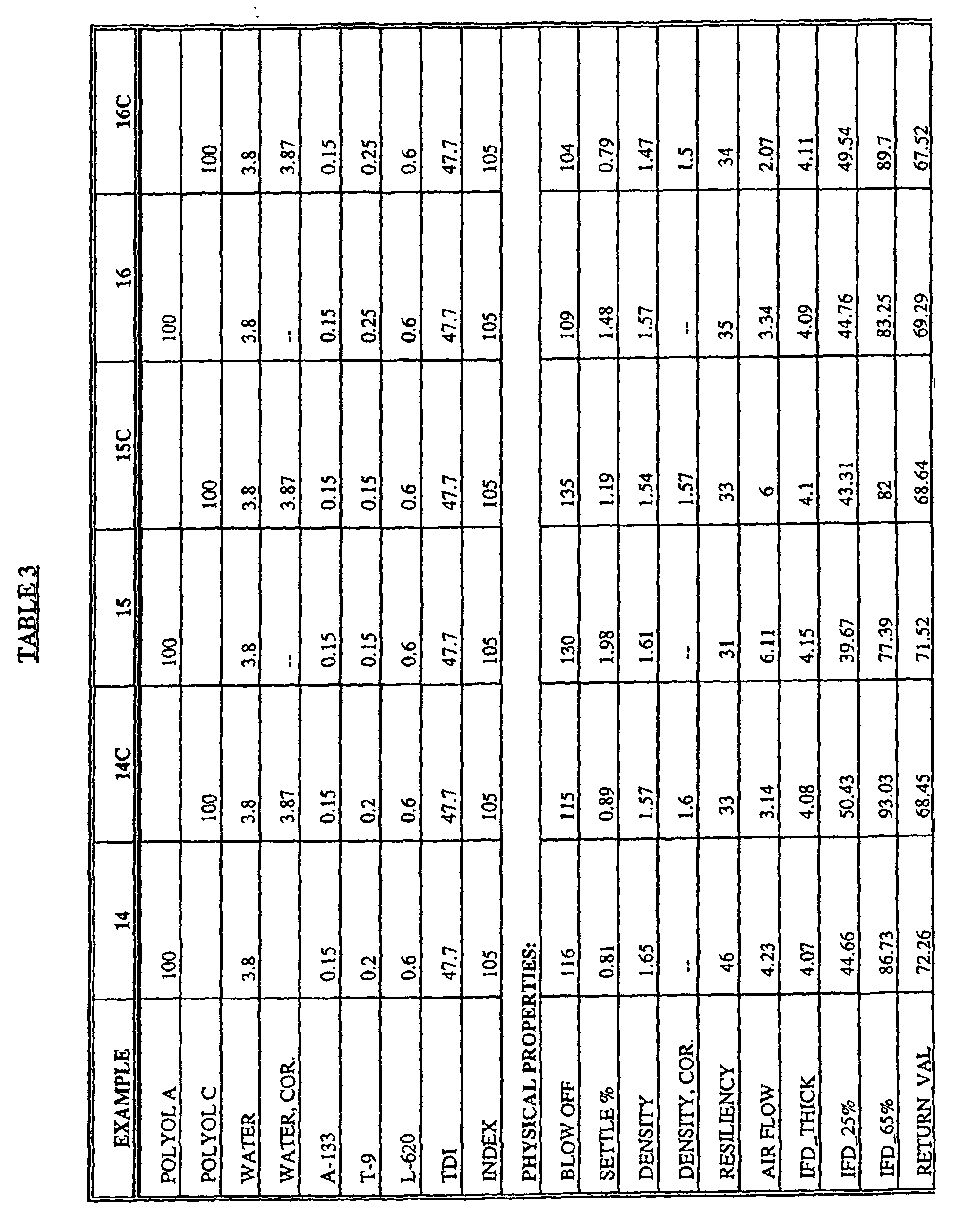
- a series of water-blown polyurethane foams of 1.7 lb/ft 3 nominal density were prepared from the polyol of Example 1 (Polyol A) and a similar glycerine-initiated polyol (Polyol C) at various levels of tin catalyst to assess processing latitude, at an isocyanate index of 105.
- the foams prepared from the sorbitol/water-initiated polyols displayed excellent processing latitude and in general, good overall performance properties.
- the formulations and physical properties are presented in Tables 3 and 4.
Landscapes
- Chemical & Material Sciences (AREA)
- Health & Medical Sciences (AREA)
- Chemical Kinetics & Catalysis (AREA)
- Medicinal Chemistry (AREA)
- Polymers & Plastics (AREA)
- Organic Chemistry (AREA)
- Polyurethanes Or Polyureas (AREA)
- Polyethers (AREA)
Description
- The present invention pertains to a polyurethane foam prepared from co-initiated polyoxyalkylene polyether polyols. The co-initiated polyoxyalkylene polyether polyols are prepared by oxyalkylating an aqueous solution of a polyhydric, hydroxyfunctional solid initiator molecule. The subject polyether polyols are particularly useful in the preparation of all water-blown polyurethane slabstock foam.
- Polyurethane foam is prepared by the reaction of a di- or polyisocyanate with an isocyanate reactive component in the presence of a physical or chemical blowing agent. In general, one or more surfactants are required to stabilize the foam so as to produce a uniform cell structure and prevent foam collapse. The reaction is generally catalyzed, commonly by the use of tin-based and/or amine-based catalysts. A general discussion of polyurethane foams, the ingredients useful in the preparation thereof, and suitable blowing agents, surfactants, catalysts, additives, and auxiliaries may be found in the POLYURETHANE HANDBOOK, Gunter Oertel, Ed., Hanser Publishers, Munich, Germany, © 1985, and in POLYURETHANES: CHEMISTRY AND TECHNOLOGY, J.H. Sanders and K.C. Frisch, Interscience Publishers, New York, 1963.
- Polyurethane flexible foams have acquired a separate status in the art. In rigid polyurethane foams, the isocyanate component is reacted with isocyanate-reactive polyols having high functionality and high hydroxyl number (low equivalent weight) to produce a stiff and rigid, and generally closed cell product. Flexible polyurethane foams, by contrast, are soft and resilient and predominantly open-celled products that are prepared from low functionality, low hydroxyl number polyols, and are generally all water-blown or blown with water and a non-CFC physical blowing agent. Flexible foams require the use of polyether polyols and polyol blends of relatively low functionality and low hydroxyl number. A discussion of the physical properties of conventional and high resiliency flexible polyurethane foams may be found in U.S. Patent No. 4,950,694, which is herein incorporated by reference. The useful range of polyol functionality necessary to produce an acceptable flexible foam lies between about 1.8 and 3.5, with hydroxyl numbers ranging between 10 and 180, and more often in the middle range, i.e., between 20 and 80.
- For these reasons, nominally trifunctional polyether polyols in the above hydroxyl ranges have been the mainstay of polyurethane flexible foam manufacture. Such polyether polyols are prepared by the oxyalkylation of trifunctional initiators such as glycerine or trimethylolpropane, particularly the former, with propylene oxide and ethylene oxide in the presence of a basic oxyalkylation catalyst. Residual minor quantities of water contained in the initiator or introduced with the catalyst are typically removed through a stripping operation prior to beginning the oxyalkylation to insure an adequate and reproducible functionality for the final polyol product. During oxyalkylation with propylene oxide, the accompanying rearrangement of the latter to allyl alcohol and its subsequent oxyalkylation introduces polyoxyalkylene monols which lower the overall functionality. See, e.g., BLOCK AND GRAFT POLYMERIZATION, Vol. 2, Ceresa, Ed., John Wiley & Sons, pp. 17-21. Average, measured functionalities in the range of 2.2 to about 2.8 are most common. To raise or lower the functionality, it is necessary to prepare coinitiator blends with higher or lower functionality initiators or to blend polyols prepared from individual initiators of different functionality. Another alternative for raising the functionality is to add an epoxy resin during the oxyalkylation process as described in U.S. Patent No. 4,316,991.
- Glycerine, however, the most commonly used initiator in polyoxyalkylene polyether polyol production, has become a relatively high cost starting material and similarly functional lower cost replacements are not available. Additionally, stripping of residual water levels and blending of initiators or polyols or adding epoxy resins to control the functionality of the polyol leads to more complicated and costly processes.
- High functionality polyether polyols (rigid polyols) suitable for rigid polyurethane foams have been prepared by oxyalkylating a number of polyhydric initiators containing four or more reactive hydrogens, such as ethylene diamine, the various toluene diamines and methylenedianilines, pentaerythritol, and saccharides and disaccharides, such as sucrose, α-methylglucoside, sorbitol, and various starch-based products. Functionalities of from 4 to 8 and higher are useful in such applications.
- Oxyalkylation of polyhydric, hydroxyl-functional initiators such as the saccharides, disaccharides, and their chemically modified derivatives to produce rigid polyols is rendered difficult by the fact that such initiators are predominantly solids with elevated melting points. In many cases, the melting point is above the temperatures desired for oxyalkylation with propylene oxide, the predominant alkylene oxide used to prepare polyether polyols suitable for polyurethane applications. In many cases, even when the melting point is low, only discolored products are obtained. Thus, such initiators have generally been dissolved in an unreactive organic solvent, the heel of a previously prepared polyether polyol batch, or a reactive liquid initiator such as ethylene glycol, propylene glycol, or glycerine. However, use of previously prepared polyols as solvents results in polyols containing high molecular weight, low hydroxyl number coproducts, while use of propylene glycol or other liquid hydroxyl-functional initiators produces a polyol blend containing lower functionality species. In the latter cases, the amount of glycol or triol must be severely limited, otherwise the average functionality and hydroxyl number will be lowered below the range useful for polyurethane rigid foams. U.S. Patent No. 5,045,623 discloses a polyol having an average functionality of 4.77 and a hydroxyl number of 490 initiated with a mixture of sorbitol (functionality 6) and propylene glycol in a weight ratio of 92:8, for example.
- Sorbitol itself has been used as an initiator, or as a co-initiator/cosolvent with other saccharides or disaccharides such as sucrose, to prepare high functionality, high hydroxyl number rigid polyols, as described in U.S. Patent No. 5,306,798. The relatively low melting point of sorbitol (93-95°C) facilitates this use. However, for such use, sorbitol must be obtained in a water-free state, thus elevating product cost. Preparation of high functionality, high hydroxyl number polyols from concentrated aqueous solutions (syrups) of sucrose containing from 10 to 20 weight percent water in the presence of urea is disclosed in U.S. Patent No. 4,820,810. A two-stage oxyalkylation is performed, wherein unreacted water is stripped following the first oxyalkylation to leave a water content of from 8-10 weight percent or less. Following the second oxyalkylation, further unreacted water is removed. Rigid polyols having hydroxyl numbers in the range of 550 to 750 are obtained. The products are noted to contain various reaction products of alkylene oxide and urea.
- In U.S. Patent No. 4,166,172, a process for oxyalkylating aqueous solutions of polyhydric initiators, particularly sucrose, is disclosed, wherein ammonia gas is utilized as the oxyalkylation catalyst, the ammonia being oxyalkylated in the process to form alkoxyalkanolamines which also act catalytically in a later polyurethane-forming reaction. The disclosed process produced polyether polyols having hydroxyl numbers in the 500-600 range. As is the case with the process disclosed in U.S. Patent No. 4,820,810, the water present is stated to react poorly, and thus the product has minimal diol content, ensuring high functionality.
- U.S. Patent No. 5,272,183 discloses preparation of rigid polyurethane foams from rigid polyols prepared from initiators having average functionalities of from 4 to 8, separately, or in conjunction with other initiators such as glycerine or water. The polyols, stated as suitable for low K-factor foams blown with HCFC-123 or HCFC-141b, have hydroxyl numbers between 200 and 650.
- US 4,767,846 discloses polymeric polyols which are prepared by reacting a polyhydroxy initiator compound with an epoxide in the presence of alkali metal hydroxide catalyst used in an amount of at least 10% by mole based on the molar amount of polyhydroxy initiator compounds. The polyols so obtained may be chain extended by reaction with further epoxide in the presence of at least 10% by mole of an alkali metal hydroxide catalyst based on the molar amount of the polymeric polyol.
- EP-A-0609982 discloses polyether polyol comprising as alkylene oxide units ethylene oxide and propylene oxide units, said polyol having a nominal average hydroxyl functionality 2-6, an hydroxyl value of 16-45 mg KOH/g, a primary hydroxyl content of at least 50% calculated on the total amount of hydroxyl groups and an amount of ethylene oxide units, calculated on the weight of the alkylene oxide units in the polyol, of 21-49% by weight. These polyols are useful for making flexible foam.
- The high functionality, high hydroxyl number rigid polyols prepared as disclosed in the above-identified references are not suitable for the preparation of flexible polyurethane foams. Moreover, the introduction of substances such as urea and ammonia into the oxyalkylation process results in complex mixtures which frequently contain catalytically active species which may interfere with the production of slabstock and other commodity flexible foams.
- There is a need for alkylene polyols having hydroxyl numbers and functionalities suitable for use as the dominant polyol in flexible polyurethane foam production without employing relatively expensive initiators such as glycerine.
- It would further be desirable in the production of such polyols to reduce or eliminate the stripping of minor residual quantities of water contained in initiators or introduced into initiators through addition of oxyalkylation catalysts.
- It would further be desirable to produce polyols of widely varying functionality from a single initiator starting material rather than preparing multicomponent initiator mixes or by blending polyols prepared from initiators of varying functionality.
- It would further be desirable to offer to the polyurethane flexible foam industry, polyoxyalkylene polyether polyols of functionality and hydroxyl number which can serve as economical replacements for conventional trifunctional polyether polyols.
- It would be further desirable to provide polyoxyalkylene polyether polyol compositions which are capable of providing polyurethane flexible foams over wider processing and formulating ranges and with enhanced physical properties.
- It has now been unexpectedly discovered that polyoxyalkylene polyether polyols prepared by oxyalkylating aqueous solutions of one or more solid, polyhydric, hydroxyl-functional initiators until the hydroxyl number is about 180 or below are ideally suited to the production of good quality flexible polyurethane foam. Using conventional base catalysis, the relatively large amount of water present is oxyalkylated to produce a co-initiated blend of low functionality diols and higher functionality polyols whose average functionality is within the range useful for flexible foam production, and which may serve as a substantially direct replacement for glycerine initiated polyols. The ability of water-coinitiated polyols to replace glycerine-initiated polyols is surprising and unexpected in view of the great difference in the make-up of the respective polyols, the latter being nominally tri-functional, while the polyols of the subject invention are mixtures of di-functional and tri-, preferably tetra- to octa- or higher functional polyols. Particularly surprising and unexpected is that the subject polyols offer broad formulating and processing latitude in the production of flexible polyurethane foam and may allow the production of softer foam grades without resorting to the use of physical blowing agents.
- The subject polyoxyalkylene polyether polyols have average calculated functionalities of from about 2.2 to about 4.0, hydroxyl numbers of between about 10 and about 180, and are prepared by oxyalkylating an aqueous solution comprising water and one or more polyhydric, hydroxyl-functional, solid initiators having nominal functionalities greater than or equal to 3, and preferably 4 or higher, in the presence of one or more suitable oxyalkylation catalysts which provide for both oxyalkylation of water as well as the solid initiator(s). The polyol products typically contain 50 mol percent or more of polyoxyalkylene diols.
- Suitable polyhydric hydroxyl-functional, solid initiators are those solid initiators having nominal functionalities of three or more, preferably four or more, which are soluble in water to the extent required to prepare a polyoxyalkylene polyether polyol of suitable average functionality, i.e., a calculated functionality from about 2.2 to about 4.0, preferably from about 2.3 to about 3.7, and most preferably from about 2.4 to about 3.5. By the term "solid" is meant solid in the pure state at 25°C or normally expected ambient temperatures. The extent of water solubility, however, refers not to ambient temperature solubility, but to solubility under the expected oxyalkylation reaction temperatures, i.e., from about 70°C to 150°C, preferably 90°C-120°C. The term "average functionality" refers to the calculated functionalities based on initiator charge. Actual, measured functionalities are generally lower due to monol content, for example in the range of 1.8 to about 3.3.
- For example, the calculated functionality of the polyol expected from a 70/30 weight ratio blend of sorbitol/water is:
- Suitable polyhydric, hydroxyl-functional, solid initiators are, for example, trimethylolpropane, pentaerythritol, dipentaerythritol, tripentaerythritol, polyglycerol, saccharides such as glucose, sorbitol, lactose, mannose, galactose, and fructose; polysaccharides such as sucrose; various low molecular weight hydrolyzed starches; saccharide and polysaccharide derivatives such as α-methylglucoside and α-hydroxyethylglucoside, and the like. Sorbitol and sucrose are preferred, with the former being particularly preferred.
- The polyhydric, hydroxyl-functional, solid initiators are preferably derived from biological sources and supplied, when possible, as concentrated syrups. If supplied as the pure solid or mixture of solids, the solid initiator is dissolved in a suitable amount of water prior to oxyalkylation. The presence of water is critical, as water will also be oxyalkylated under the reaction conditions employed.
- Suitable amounts of water are such that the average calculated functionality of the polyoxyalkylene polyether polyol product will be within the ranges specified previously. The amount of water present during oxyalkylation is thus inversely dependent on the desired average functionality as well as the hydroxyl equivalent weight of the solid initiator or mixture of solid initiators. The hydroxyl number of the polyol product is from about 10 to about 180, preferably 10 to about 150, more preferably from 20 to 120, and most preferably from 20 to about 80.
- For example, employing sorbitol as a single solid initiator, an aqueous syrup containing c.a. 70% sorbitol and 30% water by weight, when oxyalkylated to a hydroxyl number of 56, will produce a product with an average calculated functionality of about 2.75. Other hexoses, having hydroxyl equivalent weights in the range of c.a. 30 Da should behave similarly. Sucrose has a higher functionality than sorbitol, eight as opposed to six. However, the molecular weight of sucrose is considerably greater than sorbitol, and thus the hydroxyl equivalent weight is c.a. 43 Da. For the same average functionality, therefore, sucrose syrups must be slightly more concentrated than sorbitol syrups. Pentaerythritol has a hydroxyl equivalent weight between that of sorbitol and sucrose. In general, water contents between about 90 weight percent and 12 weight percent are suitable, more preferably between 50 weight percent and 12 weight percent, and most preferably between 40 weight percent and 15 weight percent. With respect to sorbitol, the preferred solid initiator, water contents between 50 weight percent and 12 weight percent, more preferably between 40 weight percent and 12 weight percent are highly suitable.
- If supplied as a syrup, the water content may be adjusted by adding additional water or by removing water by distillation or stripping prior to oxyalkylation, particularly under reduced pressure. This provides an easy and convenient means of producing polyols of different functionality without the need for blending initiators or polyols of different functionality. Additional solid initiators may be added, and if desired, liquid co-initiators may be added as well, for example ethylene glycol, propylene glycol, or glycerine. Oxyalkylation of the aqueous solutions containing solid initiators may be conducted with conventional alkylene oxides such as ethylene oxide, propylene oxide, 1,2- and 2,3-butylene oxide, and the like. Preferably, propylene oxide and ethylene oxide, or mixtures thereof, are used. When more than one alkylene oxide is used for oxyalkylation, the alkylene oxides may be reacted sequentially to form block polyoxyalkylene polyether polyols, particularly polyoxypropylene polyether polyols terminated with one or more oxyethylene moieties as a cap; mixtures of alkylene oxides to form a random oxyalkylene copolymer; or varieties of these modes of addition to result in random, block, block-random, or other polyoxyalkylene chains as are well known to those skilled in the art. For high resilience (HR) foam, a polyoxyethylene capped polyol with relatively high primary hydroxyl content is desirable, whereas for conventional flexible foams, secondary hydroxyl termination is preferred.
- Oxyalkylation preferably takes place under conventional conditions using basic catalysts, for example alkali metal hydroxides or alkoxides, barium hydroxide, strontium hydroxide, and the like. These catalysts can be added as solids which are easily solubilized in the aqueous initiator solution or can be added as an aqueous solution. The oxyalkylation may be advantageously interrupted to provide an initial product of high hydroxyl number, followed by further oxyalkylation. This method is particularly useful when reactor volume is limited or where the initial charge may not be able to be agitated adequately due to its small volume in a large reactor. The hydroxyl number of such first stage, intermediate products is generally above 180, preferably above 200, more preferably greater than 300, and most preferably in the range of 400 to 700. Oxyalkylation of these intermediate products may be continued using the same contained catalyst, additional basic oxyalkylation catalyst may be added, or the catalyst may be removed, and further oxyalkylation performed with an alternative catalyst, for example a double metal cyanide complex.
- For higher molecular weight products of low hydroxyl number, it may be particularly advantageous to halt conventional base-catalyzed oxyalkylation, whether one or two stage, at an intermediate molecular weight and continue further oxyalkylation with catalysts such as calcium naphthenate with or without addition of tertiary amine cocatalysts, or with double metal cyanide complex catalysts. Suitable double metal cyanide complex catalysts are disclosed in EP-A-0654302 and U.S. Patent No. 5,158,922.
- The polyoxyalkylene polyether polyols of the subject invention may be used to prepare polyurethane flexible foams in the conventional manner, advantageously at isocyanate indices of from 130 to 70, preferably 125 to 85, and most preferably 120 to 90. The isocyanate may be any organic di- or polyisocyanate, for example toluene diisocyanate (TDI) methylenediphenylenediisocyanate (MDI), polymeric MDI of higher functionality, i.e. greater than 2 to about 3.4, or modified isocyanates derived from reacting the above-isocyanates with themselves or with monomeric or oligomeric glycols or polyols to form urethane, urea, carbodiimide, allophanate, uretonimine, or other modified isocyanates. TDI and MDI or their mixtures are preferred, in conjunction with either or both of tin and amine catalysts.
- Having generally described this invention, a further understanding can be obtained by reference to certain specific examples which are provided herein for purposes of illustration only and are not intended to be limiting unless otherwise specified.
- A polyoxyalkylene polyether polyol is prepared in a two-stage process using a 70/30 weight percent syrup of sorbitol/water as the initiator, having a calculated average functionality of 2.75. Potassium hydroxide oxyalkylation catalyst in flake form is added at 120°C in such amount that the first stage product contains 0.25 weight percent KOH. A vacuum of c.a. 1-3 psia is applied to the system prior to heating up. Propylene oxide is added and the initiator mixture oxyalkylated at c.a. 117°C to form a c.a. 255 hydroxyl number intermediate, first stage product.
- To a portion of the first stage product is added additional KOH prior to a second oxyalkylation to raise the KOH concentration to 0.34 weight percent based on the final product weight. Oxyalkylation is conducted with a 86/14 mixture of propylene oxide and ethylene oxide at 105°C to form a final product having a hydroxyl number of c.a. 56 and an estimated functionality of 2.5. Basic catalyst residues are removed by conventional treatment. To the polyether polyol product is added a conventional antioxidant stabilizer package. The product has an APHA color of 25 and a viscosity of c.a. 440 cks at 25°C. This polyol is designated as "Polyol A".
- The procedure of Example 1 is followed, but prior to oxyalkylation the sorbitol concentration in the initiator mixture is raised to yield an 88/12 weight ratio of sorbitol/water. The polyol product has a calculated functionality of 3.7 and an estimated functionality of about 3.2, and a hydroxyl number of 56. This polyol is designated as "Polyol B".
- A series of nominal 1.8 pcf polyurethane flexible foams are prepared in bench foaming tests employing constant levels of tin and amine catalysts. The tin catalyst is T-9 (dibutyltindilaurate) at 0.2 parts per 100 parts polyol, and the amine catalyst A-133 (bis(2-dimethylaminoethyl)ether, active component) at 0.15 parts per 100 parts polyol. Polyol A is the polyol of Example 1 and contained 0.01 parts water. Polyol C is a prior art, glycerine initiated polyol having a hydroxyl number of 56, a measured functionality of 2.7, and a random internal ethylene oxide content of c.a. 8.5 weight percent. Polyol C contains 0.08 weight percent water. Each foam formulation contains 3.8 parts water per 100 parts polyol (not including water contained in the polyol), and employs 0.600 parts of a foam stabilizing silicone surfactant L-620 available from OSi Chemicals. The foams were prepared by reacting the polyol component described above, with toluene diisocyanate (TDI) at isocyanate indices of from 110 to 85. The results are presented in Table 1. The actual isocyanate index for each foam, taking into account all water, is in parentheses.


- Table 1 indicates that physical properties of water-blown polyurethane foams prepared from the sorbitol/water initiated polyols of the subject invention (Polyol A) surprisingly are quite similar to those derived from a similar, glycerine initiated polyol (Polyol C) despite the fact that the latter contains nearly all trifunctional species (plus propylene oxide-derived monol), while the subject polyol, in addition to monol, is a mixture of species having nominal functionalities of two and six. In the bench scale tests presented in Table 1, the ability to formulate at lower index without splitting is particularly surprising, and may offer the ability to utilize less of the more expensive isocyanate component and/or may signify wider formulating and processing latitude. The foams prepared from the sorbitol/water initiator blends were also somewhat softer (note 25% ILD) and of slightly higher density than the foams prepared from glycerine-initiated polyols. The difference in softness may be due to the lower average (measured) functionality (2.4 versus 2.7) of the sorbitol/water polyol.
- Water-blown polyurethane flexible foams were prepared with TDI at an isocyanate index of 105 with constant levels of amine catalyst and tin catalyst ranging from 0.14 to 0.18 parts per 100 parts polyol. Polyol A (Example 1) and Polyol B (Example 2) were used alone and in blends, and compared to similar glycerine-initiated polyols, Polyol C (previously described) and Polyol D, a glycerine-initiated, epoxy resin modified polyol having an actual functionality of about 3.2 and a hydroxyl number of 56, containing random oxypropylene and oxyethylene moieties in a ratio of 85/15. The formulations and physical properties are presented in Table 2. The dramatic similarity between the sorbitol/water-initiated polyols and glycerine-initiated polyols of similar functionality is apparent.


- A series of water-blown polyurethane foams of 1.7 lb/ft3 nominal density were prepared from the polyol of Example 1 (Polyol A) and a similar glycerine-initiated polyol (Polyol C) at various levels of tin catalyst to assess processing latitude, at an isocyanate index of 105. The foams prepared from the sorbitol/water-initiated polyols displayed excellent processing latitude and in general, good overall performance properties. The formulations and physical properties are presented in Tables 3 and 4.


Claims (16)
- A polyurethane flexible foam comprising the reaction product of:a) an organic di- or polyisocyanate, at an isocyanate index from 70 to 130; withb) a polyether polyol component comprising at least one polyoxyalkylene polyether polyol which at least one polyoxyalkylene polyether polyolin the presence of(I) comprises the oxyalkylation product of an aqueous solution of one or more polyhydric, hydroxyl-functional solid initiators having nominal functionalities of three or greater, wherein the water content of said aqueous solution is between 12 weight percent and 90 weight percent relative to the weight of said aqueous solution, and wherein said polyoxyalkylene polyether polyol has a calculated functionality between 2.2 and 4.0 and a hydroxyl number between 10 and 180; or(II) is obtained by a process comprising(i) providing an aqueous solution comprising one or more polyhydric, hydroxyl-functional solid initiators and from 12 weight percent to 90 weight percent water based on the weight of said aqueous solution;(ii) introducing into said aqueous solution, an oxyalkylation-effective amount of one or more basic oxyalkylation catalysts effective to catalyze oxyalkylation of said water of said aqueous solution, to form an aqueous initiator/catalyst mixture;(iii) oxyalkylating said aqueous initiator/catalyst mixture with one or more alkylene oxides until the hydroxyl number of the oxyalkylation product produced by said oxyalkylating is between 10 and 180;(iv) inactivating and/or removing said basic oxyalkylation catalyst; and(v) recovering a polyoxyalkylene polyether polyol having a calculated functionality of between 2.2 and 4.0 and a hydroxyl number between 10 and 180;(c) an effective amount of a urethane reaction-promoting catalyst;(d) water as a reactive blowing agent in an amount effective to prepare a flexible foam having a density of between 8 kg/m3 (0.5 lb/ft3) and 96.1 kg/m3 (6 lb/ft3); and optionally(e) a cell-stabilizing amount of one or more surfactants.
- A polyurethane flexible foam according to claim1 characterised in that one of said one or more polyhydric, hydroxyl-functional solid initiators is selected from the group consisting of trimethylolpropane, pentaerythritol, dipentaerythritol, tripentaerythritol, sorbitol, α-methylglucoside, α-hydroxyethylglucoside, and sucrose.
- A polyurethane flexible foam according to claim 1 or claim 2 characterised in that said water content is from 12 weight percent to 50 weight percent.
- A polyurethane flexible foam according to claim 3 characterised in that said water content is from 15 weight percent to 40 weight percent.
- A polyurethane flexible foam according to any one of the preceding claims characterised in that said calculated functionality is between 2.2 and 3.7 and said hydroxyl number is between 20 and 120.
- A polyurethane flexible foam according to claim 5 characterised in that said hydroxyl number is between 20 and 80.
- A polyurethane flexible foam according to any one of the preceding claims characterised in that said aqueous solution further comprises liquid co-initiators such that said liquid co-initiators provide less than 50 mol percent of reactive, oxyalkylatable functional groups.
- A polyurethane flexible foam according to claim 1 characterised in that in said process oxyalkylating takes place in two or more steps, a first step of said two or more steps providing a first, intermediate polyoxyalkylene polyether polyol having a hydroxyl number in the range of greater than 180 to 700, and at least a second step wherein said first, intermediate polyoxyalkylene polyether polyol is further oxyalkylated.
- A polyurethane flexible foam according to claim 8 characterised in that the hydroxyl number of said first, intermediate polyoxyalkylene polyether polyol is in the range of 300 to 450.
- A polyurethane flexible foam according to claim 8 or claim 9 characterised in that said first of said two or more oxyalkylating steps produces a polyoxyalkylene polyether product substantially free of water.
- A polyurethane flexible foam according to any one of claims 8 to 10 characterised in that said one or more alkylene oxides are selected from the group consisting of ethylene oxide; propylene oxide, 1,2-butylene oxide, 2,3-butylene oxide, and mixtures thereof.
- A polyurethane flexible foam according to claim 10 characterised in that said oxyalkylating is first conducted with propylene oxide or a mixture of propylene oxide and ethylene oxide followed by oxyalkylation with substantially all ethylene oxide or with substantially all propylene oxide.
- A polyurethane foam according to any one of claims 8 to 12 characterised in that said polyoxyalkylene polyether product is further oxyalkylated with propylene oxide or a mixture of propylene oxide and ethylene oxide in the presence of a catalytically effective amount of one or more double metal cyanide complex oxyalkylation catalysts.
- A polyurethane flexible foam as claimed in any one of the preceding claims further comprising a non-reactive blowing agent such that the density of said polyurethane flexible foam is between 8 kg/m3 (0.5 lb/ft3) and 56 kg/m3 (3.5 lb/ft3)
- A polyurethane flexible foam as claimed in any one of the preceding claims characterised in that said isocyanate index is between 85 and 125.
- A polyurethane flexible foam as claimed in any one of the preceding claims characterised in that said at least one polyoxyalkylene polyether polyol comprises a polyol having a calculated functionality between 2.2 and 3.7 and a hydroxyl number between 20 and 60, prepared by oxyalkylating an aqueous solution comprising sorbitol and from 12 weight percent to 50 weight percent water.
Applications Claiming Priority (2)
| Application Number | Priority Date | Filing Date | Title |
|---|---|---|---|
| US507102 | 1995-07-26 | ||
| US08/507,102 US5596059A (en) | 1995-07-26 | 1995-07-26 | Polyether polyols suitable for mflexible polyurethane foam prepared by co-initiation of aqueous solutions of solid polyhydroxyl initiators |
Publications (2)
| Publication Number | Publication Date |
|---|---|
| EP0755955A1 EP0755955A1 (en) | 1997-01-29 |
| EP0755955B1 true EP0755955B1 (en) | 2002-11-27 |
Family
ID=24017261
Family Applications (1)
| Application Number | Title | Priority Date | Filing Date |
|---|---|---|---|
| EP96305479A Revoked EP0755955B1 (en) | 1995-07-26 | 1996-07-25 | Flexible polyurethane foam on the basis of polyether polyols prepared by co-initiation of aqueous solutions of solid polyhydroxyl initiators |
Country Status (9)
| Country | Link |
|---|---|
| US (2) | US5596059A (en) |
| EP (1) | EP0755955B1 (en) |
| JP (1) | JPH0940770A (en) |
| KR (1) | KR100422793B1 (en) |
| CN (2) | CN1075085C (en) |
| CA (1) | CA2181606A1 (en) |
| DE (1) | DE69624986T2 (en) |
| HK (1) | HK1046149B (en) |
| TW (1) | TW336239B (en) |
Families Citing this family (26)
| Publication number | Priority date | Publication date | Assignee | Title |
|---|---|---|---|---|
| USRE38558E1 (en) * | 1991-03-19 | 2004-07-20 | Cytrx Corporation | Polyoxypropylene/polyoxyethylene copolymers with improved biological activity |
| US5668191A (en) * | 1995-12-21 | 1997-09-16 | Arco Chemical Technology, L.P. | One-shot cold molded flexible polyurethane foam from low primary hydroxyl polyols and process for the preparation thereof |
| CN1117111C (en) * | 1997-09-26 | 2003-08-06 | 陶氏环球技术公司 | High service temperature polyurethane elastomers |
| US6063309A (en) * | 1998-07-13 | 2000-05-16 | Arco Chemical Technology L.P. | Dispersion polyols for hypersoft polyurethane foam |
| WO2001053370A1 (en) | 2000-01-17 | 2001-07-26 | Huntsman International Llc | Process for preparing a free rise or slabstock flexible polyurethane foam |
| US6423759B1 (en) | 2000-12-20 | 2002-07-23 | Bayer Corporation | Co-initiated polyols useful for the production of rigid polyurethane foams |
| US6548564B1 (en) | 2001-12-13 | 2003-04-15 | Bayer Corporation | Polyether polyols with increased functionality |
| US6599952B2 (en) | 2001-12-13 | 2003-07-29 | Bayer Corporation | Polyether polyols with increased functionality |
| AU2003201859A1 (en) * | 2002-01-11 | 2003-07-30 | Asahi Glass Company, Limited | Process for producing flexible polyurethane foam |
| KR100428197B1 (en) * | 2002-07-11 | 2004-04-28 | 현대자동차주식회사 | Auto tensioner |
| US6710096B2 (en) | 2002-07-22 | 2004-03-23 | Basf Corporation | Polyether polyol for foam applications |
| DE10240186A1 (en) † | 2002-08-28 | 2004-03-11 | Basf Ag | Process for the production of low-emission flexible polyurethane foams |
| US7168216B2 (en) * | 2003-06-06 | 2007-01-30 | Hans T. Hagen, Jr. | Insulated stud panel and method of making such |
| CA2469986A1 (en) | 2003-06-06 | 2004-12-06 | Hagen, Hans T., Iii | Insulated stud panel and method of making such |
| DE102005015894A1 (en) * | 2005-04-06 | 2006-10-12 | Basf Ag | Process for the preparation of polyether alcohols |
| CN101161699B (en) * | 2006-10-09 | 2011-09-21 | 李颂兵 | Polyether polyvalent alcohol for preparing no-freon polyurethane hard foam plastic and preparation method thereof |
| EP1935918A1 (en) * | 2006-12-20 | 2008-06-25 | Repsol Ypf S.A. | New reactive polyols |
| DE102008051882A1 (en) * | 2008-10-16 | 2010-04-29 | Bayer Materialscience Ag | Process for the preparation of polyetherester polyols |
| CN102858846B (en) * | 2010-02-25 | 2015-10-07 | 陶氏环球技术有限责任公司 | Polyether polyol initiated by multifunctional polyglycerin and high resilience polyurethane sheet obtained therefrom |
| TW201217431A (en) * | 2010-10-22 | 2012-05-01 | jian-zhang Chen | wherein the foaming material has excellent yellowing resistance, hydrolysis resiatance, degradation resistance, and better mechanical property |
| CN104086765B (en) * | 2014-07-04 | 2016-04-27 | 山东一诺威新材料有限公司 | The preparation method of aliphatics coating polyether glycol |
| AU2016242839B2 (en) * | 2015-03-31 | 2020-04-09 | Dow Global Technologies Llc | Polyether polyol compositions |
| RU2734761C2 (en) * | 2015-12-21 | 2020-10-23 | Шелл Интернэшнл Рисерч Маатсхаппий Б.В. | Method of producing polyurethane foam |
| PL3841140T3 (en) * | 2018-08-21 | 2022-12-05 | Dow Global Technologies Llc | Viscoelastic polyurethane foams |
| US11780949B2 (en) * | 2019-05-13 | 2023-10-10 | Dow Global Technologies Llc | Low density, low compression set, long recovery time polyurethane foam |
| US20220315693A1 (en) * | 2019-07-24 | 2022-10-06 | Dow Global Technologies Llc | Formulated polyol compositons |
Family Cites Families (20)
| Publication number | Priority date | Publication date | Assignee | Title |
|---|---|---|---|---|
| US4585858A (en) * | 1967-01-03 | 1986-04-29 | Cpc International Inc. | Starch-based polyether polyols |
| US4166172A (en) * | 1975-03-20 | 1979-08-28 | Texas Development Corporation | Production of polyether polyol compositions |
| JPS5251497A (en) * | 1975-10-24 | 1977-04-25 | Bridgestone Corp | Improved process for preparing flame-retarded polyurethane foam having a low smoking property |
| US4220728A (en) * | 1978-03-27 | 1980-09-02 | The Dow Chemical Company | Process of reacting isocyanates with active hydrogen containing compounds using sulfonium zwitterions as initiators |
| US4288562A (en) * | 1978-03-27 | 1981-09-08 | The Dow Chemical Co. | Initiators for isocyanate reactions |
| US4316991A (en) * | 1980-09-02 | 1982-02-23 | Texaco Inc. | Modification of polyols with epoxy resins |
| GB2106506B (en) * | 1981-07-04 | 1985-05-09 | Univ Manchester | Production of polymeric polyols |
| US4451588A (en) * | 1983-07-26 | 1984-05-29 | Texaco Inc. | High load bearing polyurethane foams made from mixed initiator polyether polyols |
| US4585807A (en) * | 1985-01-14 | 1986-04-29 | Basf Corporation | Rigid polyurethane foams employing oxyalkylated ethylenediamine |
| US4820810A (en) * | 1986-10-30 | 1989-04-11 | Arco Chemical Technology, Inc. | Urea catalyst for preparation of sucrose polyols useful for rigid polyurethane foams |
| US4883825A (en) * | 1987-12-30 | 1989-11-28 | Union Carbide Chemicals And Plastics Company Inc. | Process for the manufacture of low density, flexible polyurethane foams |
| DE3806476A1 (en) * | 1988-03-01 | 1989-09-14 | Bayer Ag | METHOD FOR PRODUCING CALINARY POLYURETHANIC SOFT FORMULA MATERIALS WITH EXCELLENT DAWNING PROPERTIES |
| US4950694A (en) * | 1989-06-29 | 1990-08-21 | Union Carbide Chemicals And Plastics Company Inc. | Preparation of polyurethane foams without using inert blowing agents |
| DE3927244A1 (en) * | 1989-08-18 | 1991-02-21 | Basf Ag | TRANSPARENT, COMPRESSABLE, STEAM-STEAMABLE, COMPACT POLYURETHANE POWDERING, PROCESS FOR THEIR PRODUCTION AND THEIR USE, IN PARTICULAR FOR MEDICAL TECHNICAL ITEMS |
| DE3942329A1 (en) * | 1989-12-21 | 1991-06-27 | Basf Ag | METHOD FOR PRODUCING POLYURETHANOUS FUEL GRAINS WITH LOW STERILIZED HAIR AND BLOCKPOLYOXYPROPYLENE POLYOXYETHYLENE POLYOL MIXTURES USES THEREOF |
| US5096993A (en) * | 1990-11-02 | 1992-03-17 | Olin Corporation | Thermoplastic polyurethane elastomers and polyurea elastomers made using low unsaturation level polyols prepared with double metal cyanide catalysts |
| US5272183A (en) * | 1991-09-20 | 1993-12-21 | Miles Inc. | HCFC blown rigid foams with low thermal conductivity |
| DE4134693A1 (en) * | 1991-10-21 | 1993-04-22 | Basf Ag | TRANSPARENT, STEAM-STEAMABLE, NON-CYTOTOXIC, COMPRISINGLY COMPACT POLYURETHANE POWDERING, PROCESS FOR THEIR PRODUCTION AND THEIR USE, ESPECIALLY FOR MEDICAL-TECHNICAL ITEMS |
| GB9301995D0 (en) * | 1993-02-02 | 1993-03-17 | Ici Plc | Process for making flexible foams |
| DE4318120C5 (en) * | 1993-06-01 | 2005-05-12 | Basf Ag | Process for the preparation of open-cell flexible polyurethane foams |
-
1995
- 1995-07-26 US US08/507,102 patent/US5596059A/en not_active Expired - Fee Related
-
1996
- 1996-07-19 CA CA002181606A patent/CA2181606A1/en not_active Abandoned
- 1996-07-19 JP JP8207588A patent/JPH0940770A/en active Pending
- 1996-07-25 TW TW085109071A patent/TW336239B/en active
- 1996-07-25 EP EP96305479A patent/EP0755955B1/en not_active Revoked
- 1996-07-25 DE DE69624986T patent/DE69624986T2/en not_active Revoked
- 1996-07-26 KR KR1019960030557A patent/KR100422793B1/en not_active Expired - Fee Related
- 1996-07-26 CN CN96111793A patent/CN1075085C/en not_active Expired - Fee Related
- 1996-10-21 US US08/734,557 patent/US5652279A/en not_active Expired - Fee Related
-
2001
- 2001-05-10 CN CNB011169648A patent/CN1203102C/en not_active Expired - Fee Related
-
2002
- 2002-10-29 HK HK02107808.5A patent/HK1046149B/en not_active IP Right Cessation
Also Published As
| Publication number | Publication date |
|---|---|
| TW336239B (en) | 1998-07-11 |
| HK1046149A1 (en) | 2002-12-27 |
| DE69624986D1 (en) | 2003-01-09 |
| KR970006344A (en) | 1997-02-19 |
| HK1046149B (en) | 2005-12-16 |
| KR100422793B1 (en) | 2004-06-23 |
| DE69624986T2 (en) | 2003-11-13 |
| EP0755955A1 (en) | 1997-01-29 |
| CN1075085C (en) | 2001-11-21 |
| CA2181606A1 (en) | 1997-01-27 |
| CN1149063A (en) | 1997-05-07 |
| US5596059A (en) | 1997-01-21 |
| CN1358799A (en) | 2002-07-17 |
| JPH0940770A (en) | 1997-02-10 |
| CN1203102C (en) | 2005-05-25 |
| US5652279A (en) | 1997-07-29 |
Similar Documents
| Publication | Publication Date | Title |
|---|---|---|
| US5596059A (en) | Polyether polyols suitable for mflexible polyurethane foam prepared by co-initiation of aqueous solutions of solid polyhydroxyl initiators | |
| KR100556181B1 (en) | Molding and slab polyurethane foams made from double metal cyanide complex-catalyzed polyoxyalkylenepolyols and polyols suitable for the preparation thereof | |
| KR100852527B1 (en) | Process for the Production of Polyol Blends | |
| KR100574735B1 (en) | Process for preparing polyurethane molded foam or slab foam from polyoxyalkylene polyols prepared using bimetal cyanide complex-catalysts | |
| EP1097179B1 (en) | Dispersion polyols for hypersoft polyurethane foam | |
| US5792829A (en) | Polyurethane elastomers exhibiting improved demold, green strength, and water absorption, and haze-free polyols suitable for their preparation | |
| EP1525244B1 (en) | Polyether polyol for foam applications | |
| AU5987598A (en) | New polyols and their use in polyurethane preparation | |
| EP0420274A2 (en) | Alkylene oxide adducts and polyurethane foams prepared therefrom | |
| MXPA04009801A (en) | An improved isocyanate reactive mixture and process for preparing same. | |
| WO1998033833A1 (en) | New polyols and their use in polyurethane preparation | |
| JPS6246571B2 (en) |
Legal Events
| Date | Code | Title | Description |
|---|---|---|---|
| PUAI | Public reference made under article 153(3) epc to a published international application that has entered the european phase |
Free format text: ORIGINAL CODE: 0009012 |
|
| AK | Designated contracting states |
Kind code of ref document: A1 Designated state(s): BE DE FR GB IT NL |
|
| 17P | Request for examination filed |
Effective date: 19970704 |
|
| RAP1 | Party data changed (applicant data changed or rights of an application transferred) |
Owner name: BAYER ANTWERPEN N.V. |
|
| 17Q | First examination report despatched |
Effective date: 20010130 |
|
| GRAG | Despatch of communication of intention to grant |
Free format text: ORIGINAL CODE: EPIDOS AGRA |
|
| RTI1 | Title (correction) |
Free format text: FLEXIBLE POLYURETHANE FOAM ON THE BASIS OF POLYETHER POLYOLS PREPARED BY CO-INITIATION OF AQUEOUS SOLUTIONS OF SOLID POLYHYDROXYL INITIATORS |
|
| GRAG | Despatch of communication of intention to grant |
Free format text: ORIGINAL CODE: EPIDOS AGRA |
|
| GRAH | Despatch of communication of intention to grant a patent |
Free format text: ORIGINAL CODE: EPIDOS IGRA |
|
| GRAH | Despatch of communication of intention to grant a patent |
Free format text: ORIGINAL CODE: EPIDOS IGRA |
|
| GRAA | (expected) grant |
Free format text: ORIGINAL CODE: 0009210 |
|
| AK | Designated contracting states |
Kind code of ref document: B1 Designated state(s): BE DE FR GB IT NL |
|
| REG | Reference to a national code |
Ref country code: GB Ref legal event code: FG4D |
|
| REF | Corresponds to: |
Ref document number: 69624986 Country of ref document: DE Date of ref document: 20030109 |
|
| ET | Fr: translation filed | ||
| PLBQ | Unpublished change to opponent data |
Free format text: ORIGINAL CODE: EPIDOS OPPO |
|
| PLBI | Opposition filed |
Free format text: ORIGINAL CODE: 0009260 |
|
| PLAX | Notice of opposition and request to file observation + time limit sent |
Free format text: ORIGINAL CODE: EPIDOSNOBS2 |
|
| 26 | Opposition filed |
Opponent name: THE DOW CHEMICAL COMPANY Effective date: 20030826 |
|
| NLR1 | Nl: opposition has been filed with the epo |
Opponent name: THE DOW CHEMICAL COMPANY |
|
| PLAX | Notice of opposition and request to file observation + time limit sent |
Free format text: ORIGINAL CODE: EPIDOSNOBS2 |
|
| PLAX | Notice of opposition and request to file observation + time limit sent |
Free format text: ORIGINAL CODE: EPIDOSNOBS2 |
|
| PLBB | Reply of patent proprietor to notice(s) of opposition received |
Free format text: ORIGINAL CODE: EPIDOSNOBS3 |
|
| PGFP | Annual fee paid to national office [announced via postgrant information from national office to epo] |
Ref country code: DE Payment date: 20050611 Year of fee payment: 10 |
|
| PGFP | Annual fee paid to national office [announced via postgrant information from national office to epo] |
Ref country code: NL Payment date: 20050629 Year of fee payment: 10 |
|
| RDAF | Communication despatched that patent is revoked |
Free format text: ORIGINAL CODE: EPIDOSNREV1 |
|
| PGFP | Annual fee paid to national office [announced via postgrant information from national office to epo] |
Ref country code: FR Payment date: 20050718 Year of fee payment: 10 |
|
| PGFP | Annual fee paid to national office [announced via postgrant information from national office to epo] |
Ref country code: GB Payment date: 20050720 Year of fee payment: 10 |
|
| PGFP | Annual fee paid to national office [announced via postgrant information from national office to epo] |
Ref country code: BE Payment date: 20050819 Year of fee payment: 10 |
|
| RDAG | Patent revoked |
Free format text: ORIGINAL CODE: 0009271 |
|
| STAA | Information on the status of an ep patent application or granted ep patent |
Free format text: STATUS: PATENT REVOKED |
|
| 27W | Patent revoked |
Effective date: 20050711 |
|
| GBPR | Gb: patent revoked under art. 102 of the ep convention designating the uk as contracting state |
Free format text: 20050711 |
|
| NLR2 | Nl: decision of opposition |
Effective date: 20050711 |
|
| PGFP | Annual fee paid to national office [announced via postgrant information from national office to epo] |
Ref country code: IT Payment date: 20060731 Year of fee payment: 11 |