EP0755436B1 - Biofilm device for the monitoring of microbial disturbances in industrial process waters - Google Patents
Biofilm device for the monitoring of microbial disturbances in industrial process waters Download PDFInfo
- Publication number
- EP0755436B1 EP0755436B1 EP95914370A EP95914370A EP0755436B1 EP 0755436 B1 EP0755436 B1 EP 0755436B1 EP 95914370 A EP95914370 A EP 95914370A EP 95914370 A EP95914370 A EP 95914370A EP 0755436 B1 EP0755436 B1 EP 0755436B1
- Authority
- EP
- European Patent Office
- Prior art keywords
- biofilm
- flow
- plates
- monitoring
- sample plates
- Prior art date
- Legal status (The legal status is an assumption and is not a legal conclusion. Google has not performed a legal analysis and makes no representation as to the accuracy of the status listed.)
- Expired - Lifetime
Links
- 238000004519 manufacturing process Methods 0.000 title claims description 8
- 239000003643 water by type Substances 0.000 title claims description 8
- 238000012544 monitoring process Methods 0.000 title claims description 5
- 230000000813 microbial effect Effects 0.000 title description 6
- 229910000831 Steel Inorganic materials 0.000 claims description 24
- 239000010959 steel Substances 0.000 claims description 24
- XLYOFNOQVPJJNP-UHFFFAOYSA-N water Substances O XLYOFNOQVPJJNP-UHFFFAOYSA-N 0.000 claims description 17
- 239000000463 material Substances 0.000 claims description 6
- 241000894006 Bacteria Species 0.000 description 8
- 238000012360 testing method Methods 0.000 description 7
- MHAJPDPJQMAIIY-UHFFFAOYSA-N Hydrogen peroxide Chemical compound OO MHAJPDPJQMAIIY-UHFFFAOYSA-N 0.000 description 6
- 240000004808 Saccharomyces cerevisiae Species 0.000 description 6
- 239000003139 biocide Substances 0.000 description 5
- 210000005253 yeast cell Anatomy 0.000 description 5
- 239000006059 cover glass Substances 0.000 description 4
- 230000002906 microbiologic effect Effects 0.000 description 4
- 241000233866 Fungi Species 0.000 description 3
- 238000011835 investigation Methods 0.000 description 3
- 238000000034 method Methods 0.000 description 3
- 238000005406 washing Methods 0.000 description 3
- 238000004458 analytical method Methods 0.000 description 2
- 230000001580 bacterial effect Effects 0.000 description 2
- 230000003115 biocidal effect Effects 0.000 description 2
- 230000015572 biosynthetic process Effects 0.000 description 2
- 238000002474 experimental method Methods 0.000 description 2
- 238000005755 formation reaction Methods 0.000 description 2
- 239000000203 mixture Substances 0.000 description 2
- MCJGNVYPOGVAJF-UHFFFAOYSA-N quinolin-8-ol Chemical compound C1=CN=C2C(O)=CC=CC2=C1 MCJGNVYPOGVAJF-UHFFFAOYSA-N 0.000 description 2
- 238000005070 sampling Methods 0.000 description 2
- 239000000243 solution Substances 0.000 description 2
- 239000000126 substance Substances 0.000 description 2
- 108010023063 Bacto-peptone Proteins 0.000 description 1
- WQZGKKKJIJFFOK-GASJEMHNSA-N Glucose Natural products OC[C@H]1OC(O)[C@H](O)[C@@H](O)[C@@H]1O WQZGKKKJIJFFOK-GASJEMHNSA-N 0.000 description 1
- 229940041514 candida albicans extract Drugs 0.000 description 1
- 230000001332 colony forming effect Effects 0.000 description 1
- 239000012611 container material Substances 0.000 description 1
- 238000010790 dilution Methods 0.000 description 1
- 239000012895 dilution Substances 0.000 description 1
- 239000002270 dispersing agent Substances 0.000 description 1
- 239000012153 distilled water Substances 0.000 description 1
- 238000001317 epifluorescence microscopy Methods 0.000 description 1
- 239000000835 fiber Substances 0.000 description 1
- -1 fibrils Substances 0.000 description 1
- 239000007789 gas Substances 0.000 description 1
- 239000011521 glass Substances 0.000 description 1
- 239000008103 glucose Substances 0.000 description 1
- 230000002401 inhibitory effect Effects 0.000 description 1
- 238000009533 lab test Methods 0.000 description 1
- 238000012332 laboratory investigation Methods 0.000 description 1
- 235000015097 nutrients Nutrition 0.000 description 1
- 238000005457 optimization Methods 0.000 description 1
- 239000002245 particle Substances 0.000 description 1
- 239000000049 pigment Substances 0.000 description 1
- 239000011295 pitch Substances 0.000 description 1
- 238000011160 research Methods 0.000 description 1
- 239000002023 wood Substances 0.000 description 1
- 239000012138 yeast extract Substances 0.000 description 1
Images
Classifications
-
- G—PHYSICS
- G01—MEASURING; TESTING
- G01N—INVESTIGATING OR ANALYSING MATERIALS BY DETERMINING THEIR CHEMICAL OR PHYSICAL PROPERTIES
- G01N33/00—Investigating or analysing materials by specific methods not covered by groups G01N1/00 - G01N31/00
- G01N33/18—Water
- G01N33/186—Water using one or more living organisms, e.g. a fish
- G01N33/1866—Water using one or more living organisms, e.g. a fish using microorganisms
Definitions
- the invention relates to a modern so-called biofilm device for the microbiological monitoring of industrial process waters.
- the device of this invention is particularly advantageous when microbial disturbances of paper industry are monitored.
- the biofilm device it is namely possible to predict runnability problems caused by microbes. It can also be used for the selection of control methods in the paper mill itself.
- Biofilm is a term generally used in the field for a deposit formed by microbes on surfaces.
- the worst microbial problems in the paper and board manufacture are the runnability problems caused by microbial deposits i.e. the formations of holes and patches in the product, web breaks as well as drainage disturbances caused by blockages of machine felts. For the monitoring of these problems determination of the bacterial contents of circulation water samples is generally used.
- the aim of the present invention is to remove the above-mentioned drawbacks and to develop a device with which it is possible to predict runnability problems caused by microbes particularly in paper and board mills.
- the device of the invention the microbiological status of the surfaces of pipings and containers can be found out also during the normal production without stopping the run of the machines.
- the biofilm device of the invention consists of a cylindrical body and steel plates placed symmetrically in regard to each other and with respect to the flow of the circulation water inside the body, on the surfaces of which the microbes as well as other material, such as fibrils, fibers, pitch and pigment particles can attach from the side streams of the circulation water or a container.
- the symmetrical arrangement of the steel plates is an absolute prerequisite to make the steel plates comparable taken at various times into investigation.
- the Robbins device (Ruseska I. et al., Oil & Gas Journal, vol. 80 (1982), p. 253-264) does not fulfil the symmetry requirement either because removable sample plates are placed after each other along a pipe.
- the last plate is, in the theory, in the most disadvantageous position compared with the first plate as regards the flow.
- the size of the sample plates of the Robbins device is all too small to carry out microbiological analyses of the biofilms deposited on the plates.
- Conkey J., TAPPI Proceedings (1984), p. 115-120 has developed a tubular device, the principle of operation of which is fully different from that of the biofilm device of the present invention.
- the intention of the device is, namely, to indirectly monitor the amount of the material attaching on the surfaces of the pipe by measuring the flow resistance.
- the Conkey device does not contain detachable sample plates for laboratory investigations.
- the new device of the present invention is preferably prepared from acid-proof steel, which is a generally used pipe and container material in paper industry. This is important in a biofilm device because microbes attach differently for example to glass than to steel. To secure the reliability of the device the same material should be used in it as in the equipment to be investigated.
- the device of the invention and its steel plates tolerate fairly great pressures and strong flows contrary to, for example, the thin cover glass plates of the above-mentioned Pedersen device.
- biofilm device of the invention as compared with other devices are in summary the symmetric position of the sample plates made of steel in regard to each other and the flow-through, an adequate size of the sample plates for various microbiological analyses, the strength of the structure and in addition to this the suitability of the steel plates as such for epifluorescence microscopy.
- the biofilm device of the invention is also suitable to be used for testing the efficiency of biocides in the process of the mill. So far the testing and choice of biocides has taken place in laboratories, where it is difficult to simulate the dynamic conditions of circulation water.
- the device of the invention is also suitable both for testing biocides and for testing dispersing agents and washing chemicals.
- the device of the invention can be connected with any side stream of the circulation water or container in a paper or board mill or, for example, with a flow taken from the wet end.
- the flow-through of the device is preferably adjusted to the range of 0.5 to 100 liters/min.
- the sample plates are preferably kept in the flow to be investigated for about 1 to 90 days.
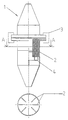
- the device consists of a cylindrical body 1 made of acid-proof steel, the ends of which have been formed conical.
- Sample plates 2 made of acid-proof steel have been placed inside the body so that they lie symmetrically around the middle axis of the body 1 parallel to the axis.
- the body 1 and the steel plates 2 can also be made of some other durable material.
- the body 1 of the device is hinged 3 in the middle or otherwise openable to install the sample plates and to remove them. Inside the body 1 there is, for example, a hoop-formed holder 4, to which the lower end of the sample plates 2 can be placed for the symmetrical installing of the sample plates.
- the plates are fixed at their upper end of the sample plates 2 by a locking means (not shown) which can be, for example, a hoop-formed holder.
- the steel plates have been installed radially around the middle axis of the body parallel with the axis, whereby all plates are equal with each other.
- the number of the sample plates can be any number, provided the flow resistance will not grow harmfully high.
- the device comprises a valve (not shown) connected with the inlet for the opening, closing and regulation of the flow-through.
- the composition of the MYGP solution was the following: Bacto malt extract 3g Bacto yeast extract 3g Bacto peptone 5g D glucose 10g distilled water 1000ml dilution in the ratio 1:40 with water.
- a yeast isolated from the broke of a paper mill was chosen as the microbe to be investigated. It was added into the mixture to be circulated to the concentration 10,000 cfu (colony-forming units) per ml. To the circulation of the first device 20 ppm of biocide Fennosan M 9 was added and the second biofilm device served as a control. The steel plates of the devices were taken for investigation after three and six days and the number of yeast cells per sq. cm was determined. The results are presented in Table 1. Time days Yeasts attached to steel plates (cfu/cm 2 ) Control Fennosan M 9 3 140 000 37 000 6 1 600 000 11 000
- the idea of this example is to show the significance of the biofilm forming microbes harming the runnability of a paper machine.
- the head box and the wire tank of a paper machine were chosen as the sampling points.
- a biofilm device according to the invention was connected with the wire tank. Harmful molds were determined both from the biofilms of the surfaces and from the circulation water. The results are given in table 3. Sampling point Number of molds (cfu/ml) Circulation water Biofilm Head box ⁇ 100 1400 Wire tank ⁇ 100 5400
- the function of the biofilm device according to the invention is reliable.
- new information from the community structure and amount of microbes attaching to the surfaces may be obtained under production conditions. This information can be utilized in combatting microbes harmful to the runnability and in the optimization and scheduling of washings of the production machines.
Landscapes
- Life Sciences & Earth Sciences (AREA)
- Chemical & Material Sciences (AREA)
- Health & Medical Sciences (AREA)
- Analytical Chemistry (AREA)
- Engineering & Computer Science (AREA)
- Food Science & Technology (AREA)
- Medicinal Chemistry (AREA)
- Physics & Mathematics (AREA)
- Microbiology (AREA)
- Biochemistry (AREA)
- General Health & Medical Sciences (AREA)
- General Physics & Mathematics (AREA)
- Immunology (AREA)
- Pathology (AREA)
- Measuring Or Testing Involving Enzymes Or Micro-Organisms (AREA)
- Apparatus Associated With Microorganisms And Enzymes (AREA)
Description
| Bacto malt extract | 3g |
| Bacto yeast extract | 3g |
| Bacto peptone | 5g |
| D glucose | 10g |
| distilled water | 1000ml |
| Time days | Yeasts attached to steel plates (cfu/cm2) | |
| Control | Fennosan M 9 | |
| 3 | 140 000 | 37 000 |
| 6 | 1 600 000 | 11 000 |
| Time days | Yeasts attached to the steel plates (cfu/cm2) | ||
| | Hydrogen peroxide | ||
| 2 | 170 000 | 110 000 | |
| 5 | 2 000 000 | 80 000 | |
| 12 | 2 000 000 | 40 000 |
| Sampling point | Number of molds (cfu/ml) | |
| Circulation water | Biofilm | |
| Head box | <100 | 1400 |
| Wire tank | <100 | 5400 |
| Time days | Bacteria (cfu/cm2) | Fungi (cfu/cm2) |
| 12 | 3 000 | <30 |
| 21 | 24 000 | 270 |
| 22 | 140 000 | 5 400 |
| 34 | 730 000 | 32 000 |
Claims (5)
- Device for the monitoring of biofilm-forming microbes in industrial process waters, characterized in that the device consists of a cylindrical, openable body (1) made of acid-proof steel or other durable material, sample plates (2) made of acid-proof steel or other durable material, placed symmetrically in respect to each other and to the flow of the water, inside the body (1) parallel to its middle axis, and holders (4) placed inside the body (1) for the mounting and holding of the sample plates (2).
- Device according to claim 1, wherein the device further comprises a valve for the opening, closing and regulation of the flow-through.
- Device according to claim 1 or 2, wherein it is connected with the circulation water of a mill or the side flow of a tank or, for example, with a flow taken from the wet end of a paper or board-mill.
- Device according to any of claims 1 to 3, wherein the flow-through of the device is adjusted to the range of 0.5 to 100 liters/min.
- Device according to any of claims 1 to 4, wherein the sample plates are kept in the flow to be investigated for 1 to 90 days.
Applications Claiming Priority (3)
| Application Number | Priority Date | Filing Date | Title |
|---|---|---|---|
| FI941539 | 1994-03-31 | ||
| FI941539A FI95597C (en) | 1994-03-31 | 1994-03-31 | Biofilm device for monitoring and forecasting microbial disturbances in industrial process waters |
| PCT/FI1995/000174 WO1995027039A1 (en) | 1994-03-31 | 1995-03-30 | Biofilm device for the monitoring of microbial disturbances in industrial process waters |
Publications (2)
| Publication Number | Publication Date |
|---|---|
| EP0755436A1 EP0755436A1 (en) | 1997-01-29 |
| EP0755436B1 true EP0755436B1 (en) | 2001-11-07 |
Family
ID=8540437
Family Applications (1)
| Application Number | Title | Priority Date | Filing Date |
|---|---|---|---|
| EP95914370A Expired - Lifetime EP0755436B1 (en) | 1994-03-31 | 1995-03-30 | Biofilm device for the monitoring of microbial disturbances in industrial process waters |
Country Status (5)
| Country | Link |
|---|---|
| EP (1) | EP0755436B1 (en) |
| DE (1) | DE69523748T2 (en) |
| FI (1) | FI95597C (en) |
| NO (1) | NO964150L (en) |
| WO (1) | WO1995027039A1 (en) |
Cited By (1)
| Publication number | Priority date | Publication date | Assignee | Title |
|---|---|---|---|---|
| US7829305B2 (en) | 2003-11-06 | 2010-11-09 | Kemira Oyj | Method for monitoring the presence of biofilmforming microorganisms in paper industry |
Families Citing this family (10)
| Publication number | Priority date | Publication date | Assignee | Title |
|---|---|---|---|---|
| US6599714B1 (en) | 1996-03-13 | 2003-07-29 | University Technologies International Inc. | Method of growing and analyzing a biofilm |
| US5928889A (en) * | 1998-02-13 | 1999-07-27 | S.C. Johnson & Son, Inc. | Protocol for simulated natural biofilm formation |
| JP2003502063A (en) * | 1999-06-10 | 2003-01-21 | エス.シー. ジョンソン アンド サン、インコーポレイテッド | Model biofilm for evaluating the efficacy of fungicides |
| US6599696B2 (en) | 2000-04-17 | 2003-07-29 | University Technologies International, Inc. | Effects of materials and surface coatings on encrustation and biofilm formation |
| US6596505B2 (en) | 2000-04-17 | 2003-07-22 | University Technologies International, Inc. | Apparatus and methods for testing effects of materials and surface coatings on the formation of biofilms |
| AU2001252078B2 (en) * | 2000-04-17 | 2005-10-06 | University Technologies International, Inc. | Apparatus and methods for testing effects of materials and surface coatings on the formation of biofilms |
| US6361963B1 (en) * | 2000-08-02 | 2002-03-26 | Hercules Incorporated | Biofilm growth device |
| DE10326586A1 (en) | 2003-06-13 | 2004-12-30 | Henkel Kgaa | Process for measuring and controlling the formation of biofilms in a water system |
| DE102005012824A1 (en) * | 2005-03-17 | 2006-09-21 | Stockhausen Gmbh | Method for determining and controlling deposit formation in a water system |
| US20180223239A1 (en) * | 2015-08-12 | 2018-08-09 | Joshua D. Erickson | Biofilm growth devices and methods |
Family Cites Families (3)
| Publication number | Priority date | Publication date | Assignee | Title |
|---|---|---|---|---|
| US4945758A (en) * | 1987-05-28 | 1990-08-07 | Arabian American Oil Company | Method and apparatus for monitoring the interior surface of a pipeline |
| US5049492A (en) * | 1990-03-14 | 1991-09-17 | The United States Of America As Represented By The United States National Aeronautics And Space Administration | Biofilm monitoring coupon system and method of use |
| EP0593683B1 (en) * | 1991-07-11 | 1996-01-17 | Kiwa N.V. | Monitor for determining the formation of deposits and the growth of microorganisms on surfaces |
-
1994
- 1994-03-31 FI FI941539A patent/FI95597C/en not_active IP Right Cessation
-
1995
- 1995-03-30 WO PCT/FI1995/000174 patent/WO1995027039A1/en not_active Ceased
- 1995-03-30 EP EP95914370A patent/EP0755436B1/en not_active Expired - Lifetime
- 1995-03-30 DE DE69523748T patent/DE69523748T2/en not_active Expired - Lifetime
-
1996
- 1996-09-30 NO NO964150A patent/NO964150L/en unknown
Cited By (1)
| Publication number | Priority date | Publication date | Assignee | Title |
|---|---|---|---|---|
| US7829305B2 (en) | 2003-11-06 | 2010-11-09 | Kemira Oyj | Method for monitoring the presence of biofilmforming microorganisms in paper industry |
Also Published As
| Publication number | Publication date |
|---|---|
| FI95597B (en) | 1995-11-15 |
| NO964150D0 (en) | 1996-09-30 |
| FI95597C (en) | 1996-02-26 |
| FI941539A0 (en) | 1994-03-31 |
| NO964150L (en) | 1996-11-21 |
| DE69523748D1 (en) | 2001-12-13 |
| DE69523748T2 (en) | 2002-05-08 |
| WO1995027039A1 (en) | 1995-10-12 |
| EP0755436A1 (en) | 1997-01-29 |
Similar Documents
| Publication | Publication Date | Title |
|---|---|---|
| EP0755436A1 (en) | Biofilm device for the monitoring of microbial disturbances in industrial process waters | |
| Vrouwenvelder et al. | Diagnosis, prediction and prevention of biofouling of NF and RO membranes | |
| EP1687481B1 (en) | A method for monitoring the presence of biofilm-forming microorganisms in paper industry | |
| Väisänen et al. | Microbial communities of printing paper machines | |
| US20070117140A1 (en) | Method for selecting antimicrobial agent and utilization thereof | |
| US20060120916A1 (en) | Inhibiting biofilm formation by thermophilic microbes in paper and board machines | |
| Bajpai | Pulp and paper industry: Microbiological issues in papermaking | |
| US5624575A (en) | Method for preventing microbial deposits in the papermaking process with ethylene oxide/propylene oxide copolymers | |
| CA2598775C (en) | Method for determining and controlling the formation of deposits in a water system | |
| MXPA03000949A (en) | Biofilm growth device. | |
| Lutey | Process cooling water | |
| EP1051510A1 (en) | A rapid method for the assessment of the inhibition and kill of anaerobic bacteria by toxic compounds | |
| Holt | Microbiology of paper and board manufacture | |
| Applegate et al. | Monitoring and control of biological activity in Permasep® seawater RO plants | |
| Öqvist et al. | Novel evaluation methods for paper machine deposits | |
| Tatnall | Experiments in Microbiologically Influenced Corrosion | |
| CORBEL | 5.15 Pulp & paper | |
| Kolari et al. | NOVEL BIOFILM CONTROL TECHNOLOGY FOR PAPER MACHINES | |
| Tanner | Paper and paper board in the food industry—public health aspects | |
| Hassler | Improving Productivity and Quality by Controlling Organic, Inorganic and Microbiological Deposits | |
| Rakotonirainy et al. | Research on fungicides for aerial disinfection by thermal fogging | |
| Öqvist | Microbial life and deposits in paper machine circuits | |
| Hassler | The source and control of paper machine deposits | |
| Misra | Process control in an integrated pulp & paper mill | |
| OHLINGER | 2.2 Sample Preparation |
Legal Events
| Date | Code | Title | Description |
|---|---|---|---|
| PUAI | Public reference made under article 153(3) epc to a published international application that has entered the european phase |
Free format text: ORIGINAL CODE: 0009012 |
|
| 17P | Request for examination filed |
Effective date: 19961023 |
|
| AK | Designated contracting states |
Kind code of ref document: A1 Designated state(s): DE FR GB SE |
|
| 17Q | First examination report despatched |
Effective date: 20000105 |
|
| GRAG | Despatch of communication of intention to grant |
Free format text: ORIGINAL CODE: EPIDOS AGRA |
|
| GRAG | Despatch of communication of intention to grant |
Free format text: ORIGINAL CODE: EPIDOS AGRA |
|
| GRAH | Despatch of communication of intention to grant a patent |
Free format text: ORIGINAL CODE: EPIDOS IGRA |
|
| GRAH | Despatch of communication of intention to grant a patent |
Free format text: ORIGINAL CODE: EPIDOS IGRA |
|
| GRAA | (expected) grant |
Free format text: ORIGINAL CODE: 0009210 |
|
| AK | Designated contracting states |
Kind code of ref document: B1 Designated state(s): DE FR GB SE |
|
| REF | Corresponds to: |
Ref document number: 69523748 Country of ref document: DE Date of ref document: 20011213 |
|
| REG | Reference to a national code |
Ref country code: GB Ref legal event code: IF02 |
|
| ET | Fr: translation filed | ||
| PLBE | No opposition filed within time limit |
Free format text: ORIGINAL CODE: 0009261 |
|
| STAA | Information on the status of an ep patent application or granted ep patent |
Free format text: STATUS: NO OPPOSITION FILED WITHIN TIME LIMIT |
|
| 26N | No opposition filed | ||
| REG | Reference to a national code |
Ref country code: GB Ref legal event code: 732E |
|
| REG | Reference to a national code |
Ref country code: FR Ref legal event code: TP |
|
| PGFP | Annual fee paid to national office [announced via postgrant information from national office to epo] |
Ref country code: FR Payment date: 20100402 Year of fee payment: 16 |
|
| PGFP | Annual fee paid to national office [announced via postgrant information from national office to epo] |
Ref country code: GB Payment date: 20100322 Year of fee payment: 16 |
|
| PGFP | Annual fee paid to national office [announced via postgrant information from national office to epo] |
Ref country code: DE Payment date: 20100419 Year of fee payment: 16 |
|
| PGFP | Annual fee paid to national office [announced via postgrant information from national office to epo] |
Ref country code: SE Payment date: 20100312 Year of fee payment: 16 |
|
| REG | Reference to a national code |
Ref country code: SE Ref legal event code: EUG |
|
| GBPC | Gb: european patent ceased through non-payment of renewal fee |
Effective date: 20110330 |
|
| REG | Reference to a national code |
Ref country code: FR Ref legal event code: ST Effective date: 20111130 |
|
| PG25 | Lapsed in a contracting state [announced via postgrant information from national office to epo] |
Ref country code: FR Free format text: LAPSE BECAUSE OF NON-PAYMENT OF DUE FEES Effective date: 20110331 Ref country code: DE Free format text: LAPSE BECAUSE OF NON-PAYMENT OF DUE FEES Effective date: 20111001 |
|
| REG | Reference to a national code |
Ref country code: DE Ref legal event code: R119 Ref document number: 69523748 Country of ref document: DE Effective date: 20111001 |
|
| PG25 | Lapsed in a contracting state [announced via postgrant information from national office to epo] |
Ref country code: GB Free format text: LAPSE BECAUSE OF NON-PAYMENT OF DUE FEES Effective date: 20110330 |
|
| PG25 | Lapsed in a contracting state [announced via postgrant information from national office to epo] |
Ref country code: SE Free format text: LAPSE BECAUSE OF NON-PAYMENT OF DUE FEES Effective date: 20110331 |