EP0755418B1 - Compatibilized blend of olefinic polymers and monovinylidene aromatic polymers - Google Patents
Compatibilized blend of olefinic polymers and monovinylidene aromatic polymers Download PDFInfo
- Publication number
- EP0755418B1 EP0755418B1 EP95916240A EP95916240A EP0755418B1 EP 0755418 B1 EP0755418 B1 EP 0755418B1 EP 95916240 A EP95916240 A EP 95916240A EP 95916240 A EP95916240 A EP 95916240A EP 0755418 B1 EP0755418 B1 EP 0755418B1
- Authority
- EP
- European Patent Office
- Prior art keywords
- composition
- percent
- interpolymer
- weight
- olefin
- Prior art date
- Legal status (The legal status is an assumption and is not a legal conclusion. Google has not performed a legal analysis and makes no representation as to the accuracy of the status listed.)
- Expired - Lifetime
Links
Classifications
-
- C—CHEMISTRY; METALLURGY
- C08—ORGANIC MACROMOLECULAR COMPOUNDS; THEIR PREPARATION OR CHEMICAL WORKING-UP; COMPOSITIONS BASED THEREON
- C08L—COMPOSITIONS OF MACROMOLECULAR COMPOUNDS
- C08L25/00—Compositions of, homopolymers or copolymers of compounds having one or more unsaturated aliphatic radicals, each having only one carbon-to-carbon double bond, and at least one being terminated by an aromatic carbocyclic ring; Compositions of derivatives of such polymers
- C08L25/02—Homopolymers or copolymers of hydrocarbons
- C08L25/04—Homopolymers or copolymers of styrene
- C08L25/08—Copolymers of styrene
-
- C—CHEMISTRY; METALLURGY
- C08—ORGANIC MACROMOLECULAR COMPOUNDS; THEIR PREPARATION OR CHEMICAL WORKING-UP; COMPOSITIONS BASED THEREON
- C08J—WORKING-UP; GENERAL PROCESSES OF COMPOUNDING; AFTER-TREATMENT NOT COVERED BY SUBCLASSES C08B, C08C, C08F, C08G or C08H
- C08J5/00—Manufacture of articles or shaped materials containing macromolecular substances
- C08J5/18—Manufacture of films or sheets
-
- C—CHEMISTRY; METALLURGY
- C08—ORGANIC MACROMOLECULAR COMPOUNDS; THEIR PREPARATION OR CHEMICAL WORKING-UP; COMPOSITIONS BASED THEREON
- C08J—WORKING-UP; GENERAL PROCESSES OF COMPOUNDING; AFTER-TREATMENT NOT COVERED BY SUBCLASSES C08B, C08C, C08F, C08G or C08H
- C08J9/00—Working-up of macromolecular substances to porous or cellular articles or materials; After-treatment thereof
-
- C—CHEMISTRY; METALLURGY
- C08—ORGANIC MACROMOLECULAR COMPOUNDS; THEIR PREPARATION OR CHEMICAL WORKING-UP; COMPOSITIONS BASED THEREON
- C08L—COMPOSITIONS OF MACROMOLECULAR COMPOUNDS
- C08L23/00—Compositions of homopolymers or copolymers of unsaturated aliphatic hydrocarbons having only one carbon-to-carbon double bond; Compositions of derivatives of such polymers
- C08L23/02—Compositions of homopolymers or copolymers of unsaturated aliphatic hydrocarbons having only one carbon-to-carbon double bond; Compositions of derivatives of such polymers not modified by chemical after-treatment
- C08L23/04—Homopolymers or copolymers of ethene
-
- C—CHEMISTRY; METALLURGY
- C08—ORGANIC MACROMOLECULAR COMPOUNDS; THEIR PREPARATION OR CHEMICAL WORKING-UP; COMPOSITIONS BASED THEREON
- C08L—COMPOSITIONS OF MACROMOLECULAR COMPOUNDS
- C08L23/00—Compositions of homopolymers or copolymers of unsaturated aliphatic hydrocarbons having only one carbon-to-carbon double bond; Compositions of derivatives of such polymers
- C08L23/02—Compositions of homopolymers or copolymers of unsaturated aliphatic hydrocarbons having only one carbon-to-carbon double bond; Compositions of derivatives of such polymers not modified by chemical after-treatment
- C08L23/04—Homopolymers or copolymers of ethene
- C08L23/06—Polyethylene
-
- C—CHEMISTRY; METALLURGY
- C08—ORGANIC MACROMOLECULAR COMPOUNDS; THEIR PREPARATION OR CHEMICAL WORKING-UP; COMPOSITIONS BASED THEREON
- C08L—COMPOSITIONS OF MACROMOLECULAR COMPOUNDS
- C08L25/00—Compositions of, homopolymers or copolymers of compounds having one or more unsaturated aliphatic radicals, each having only one carbon-to-carbon double bond, and at least one being terminated by an aromatic carbocyclic ring; Compositions of derivatives of such polymers
- C08L25/02—Homopolymers or copolymers of hydrocarbons
-
- C—CHEMISTRY; METALLURGY
- C08—ORGANIC MACROMOLECULAR COMPOUNDS; THEIR PREPARATION OR CHEMICAL WORKING-UP; COMPOSITIONS BASED THEREON
- C08L—COMPOSITIONS OF MACROMOLECULAR COMPOUNDS
- C08L25/00—Compositions of, homopolymers or copolymers of compounds having one or more unsaturated aliphatic radicals, each having only one carbon-to-carbon double bond, and at least one being terminated by an aromatic carbocyclic ring; Compositions of derivatives of such polymers
- C08L25/02—Homopolymers or copolymers of hydrocarbons
- C08L25/04—Homopolymers or copolymers of styrene
- C08L25/06—Polystyrene
-
- C—CHEMISTRY; METALLURGY
- C08—ORGANIC MACROMOLECULAR COMPOUNDS; THEIR PREPARATION OR CHEMICAL WORKING-UP; COMPOSITIONS BASED THEREON
- C08L—COMPOSITIONS OF MACROMOLECULAR COMPOUNDS
- C08L2205/00—Polymer mixtures characterised by other features
- C08L2205/02—Polymer mixtures characterised by other features containing two or more polymers of the same C08L -group
-
- C—CHEMISTRY; METALLURGY
- C08—ORGANIC MACROMOLECULAR COMPOUNDS; THEIR PREPARATION OR CHEMICAL WORKING-UP; COMPOSITIONS BASED THEREON
- C08L—COMPOSITIONS OF MACROMOLECULAR COMPOUNDS
- C08L23/00—Compositions of homopolymers or copolymers of unsaturated aliphatic hydrocarbons having only one carbon-to-carbon double bond; Compositions of derivatives of such polymers
Definitions
- This invention relates to a polymer blend comprising an olefinic polymer, a monovinylidene aromatic polymer and a compatibilizer.
- the invention further relates to an expandable composition comprising such a polymer blend composition and an expanding agent, to a foamed composition obtained by subjecting such an expandable composition to a foaming process, to an article of manufacture molded from the polymer blend composition, and to a method of packaging a substance or article by using the polymer blend composition.
- Monovinylidene aromatic polymers such as polystyrene and rubber-modified polystyrene were very easily thermoformed and exhibit impact strength and low temperature properties when thermoformed. Thermoforming was a process whereby a resin sheet or preform which was heat softened to a temperature below the temperature at which the resin was completely molten or plastified, was formed into the desired shape by an applied pressure or vacuum.
- monovinylidene aromatic polymers with a high degree of crystallinity were brittle and can be thermoformed only at high temperatures.
- Monovinylidene aromatic polymers were known to have poor environmental stress crack resistance. Environmental stress cracking occurs when molded resin parts were subjected to conditions where the part was both placed under stress and exposed to an oil- or grease-containing substance.
- Olefinic polymers such as polyethylene, polypropylene, have relatively good resistance to the actions of oils and greases and, therefore, were very desirable for the manufacture of containers for foods and similar materials. When it comes to manufacturing or forming techniques, however, olefinic polymers were much less versatile than monovinylidene aromatic polymers. Olefinic polymers were very difficult to thermoform due to their low glass transition temperature and relatively sharp melting point at elevated temperature.
- Blending of monovinylidene aromatic and olefinic polymer resins was, however, complicated by the incompatibility of the two resins. Attempts to solve the incompatibility problem have focused on the use of specified amounts of the two resins and also on the use of a so-called compatibilizer.
- Compatibilizers for blends of olefinic polymers and monovinylidene aromatic polymers proposed heretofore include:
- compatibilization between two immiscible or incompatible polymers can be effected by a compatibilizer which improves adhesion between the polymer interfaces. It was further hypothesized, that for good adhesion the compatibilizer must have molecular segments which were immiscible with the respective polymer domains. This would require the compatibilizer to have certain blocks of structures compatible with the respective polymer domains. For this reason, the compatibilizers proposed heretofore generally were grafted copolymers or block copolymers. The block copolymers containing unsaturated bonds in the polymer backbone lack resistance to thermal oxidation and ultraviolet light, presenting difficulties during processing and while the article was in use.
- Saturated block copolymers having hydrogenated rubber blocks such as styrene-ethylene/butylene-styrene (SEBS) tri-block copolymers were more stable but in general not as effective compatibilizers as unsaturated ones.
- block copolymers and especially the hydrogenated block copolymers were expensive due to their high cost manufacturing process. Accordingly, there was still a desire for other low-cost compatibilizers which perform at least equally to or even better than existing compatibilizers. In addition there was a desire for compatibilizers which were resistant to oxidation and ultraviolet light, using decreased amounts of or no antioxidants.
- the present invention provides a polymer blend composition comprising:
- the present invention provides an expandable composition comprising such a polymer blend composition and an expanding agent.
- the present invention provides a foamed composition obtained by subjecting such an expandable composition to a foaming process.
- the present invention also provides an article of manufacture molded from the present polymer blend composition.
- a method of packaging a substance or article by providing an intimate blend of components (a), (b), and (c) of the present polymer blend composition and providing the blend in the form of an enclosure around or suitable for receiving a substance or article to be packaged.
- polymer refers to a polymeric compound prepared by polymerizing one or more monomers.
- the generic term polymer thus embraces the term homopolymer, usually employed to refer to polymers prepared from only one monomer, and the term interpolymer as defined hereinafter.
- interpolymer refers to polymers prepared by the polymerization of at least two different monomers.
- the generic term interpolymer thus embraces the terms copolymer, usually employed to refer to polymers prepared from two different monomers, and polymers prepared from more than two different monomers.
- blend component (a) may be referred to as an olefinic resin or polymer, blend component (b) as a monovinylidene aromatic resin or polymer, and blend component (c) as a compatibilizer.
- substantially random interpolymer in the substantially random interpolymer comprising an ⁇ -olefin and a vinylidene aromatic monomer as used herein means that the distribution of the monomers of said interpolymer can be described by the Bernoulli statistical model or by a first or second order Markovian statistical model, as described by J. C. Randall in POLYMER SEQUENCE DETERMINATION, Carbon-13 NMR Method, Academic Press New York, 1977, pp. 71-78.
- the substantially random interpolymer comprising an ⁇ -olefin and a vinylidene aromatic monomer does not contain more than 15 percent of the total amount of vinylidene aromatic monomer in blocks of vinylidene aromatic monomer of more than 3 units.
- the interpolymer was not characterized by a high degree of either isotacticity or syndiotacticity. This means that in the 13C-NMR spectrum of the substantially random interpolymer the peak areas corresponding to the main chain methylene and methine carbons representing either meso diad sequences or racemic diad sequences should not exceed 75 percent of the total peak area of the main chain methylene and methine carbons.
- linear means that the polymer does not have long chain branching. That was, the backbone of the polymer or interpolymer was unbranched or has only branches derived from the substituent(s) attached to the vinyl moieties of the monomers making up said polymer backbone.
- substantially linear means that the backbone of the polymer or interpolymer was substituted with up to 3 long chain branches/1000 carbons, more preferably from 0.01 long chain branches/1000 carbons to 1 long chain branches/1000 carbons, and especially from 0.05 long chain branches/1000 carbons to 1 long chain branches/1000 carbons.
- the concept of substantially linear was defined in more detail in US Patent Nos. 5,272,236 and 5,278,272 which were incorporated herein by reference.
- a linear or substantially linear polymer was different from a polymer produced by a high pressure, free radical initiated polymerization process which was known to those skilled in the art to have numerous long chain branches.
- Olefinic polymers suitable for use as component (a) in the blends according to the present invention were aliphatic ⁇ -olefin homopolymers or interpolymers, or interpolymers of an aliphatic ⁇ -olefin and a non-aromatic monomer interpolymerizable therewith.
- Preferred olefinic polymers for use in the present invention were homopolymers or interpolymers of an aliphatic, including cycloaliphatic, ⁇ -olefin having from 2 to 18 carbon atoms. Suitable examples were homopolymers of ethylene or propylene, and interpolymers of two or more ⁇ -olefin monomers.
- olefinic polymers were interpolymers of ethylene and one or more other ⁇ -olefins having from 3 to 8 carbon atoms.
- Exemplary monomers which can be polymerized therewith include 1-butene, 4-methyl-1-pentene, 1-hexene, and 1-octene.
- the olefinic polymer components (a) may also contain, in addition to the ⁇ -olefin, one or more non-aromatic monomers interpolymerizable therewith.
- additional interpolymerizable monomers include, for example, diolefins, ethylenically unsaturated carboxylic acids (both mono- and difunctional) as well as derivatives of these acids, such as esters and anhydrides.
- Exemplary of such monomers were acrylic acid, methacrylic acid, vinyl acetate and, maleic anhydride.
- the olefinic polymers can be further characterized by their degree of long or short chain branching and the distribution thereof.
- LDPE long chain branched low density polyethylene
- ASTM Test Method D 1238, condition I One class of olefinic polymers was generally produced by a high pressure polymerization process using a free radical initiator resulting in the traditional long chain branched low density polyethylene (LDPE).
- LDPE employed in the present composition usually has a density of less than 0.94 g/cc (ASTM D 792) and a melt index of from 0.01 to 100, and preferably from 0.1 to 50 grams per 10 minutes (as determined by ASTM Test Method D 1238, condition I).
- linear olefin polymers which have an absence of long chain branching, as the traditional linear low density polyethylene polymers (heterogeneous LLDPE) or linear high density polyethylene polymers (HDPE) made using Ziegler polymerization processes (for example, U.S. Patent No. 4,076,698 (Anderson et al.), sometimes called heterogeneous polymers.
- heterogeneous polymers for example, U.S. Patent No. 4,076,698 (Anderson et al.
- HDPE consists mainly of long linear polyethylene chains.
- the HDPE employed in the present composition usually has a density of at least 0.94 grams per cubic centimeter (g/cc) as determined by ASTM Test Method D 1505, and a melt index (ASTM-1238, condition I) in the range of from 0.01 to 100, and preferably from 0.1 to 50 grams per 10 minutes.
- the heterogeneous LLDPE employed in the present composition generally has a density of from 0.85 to 0.94 g/cc (ASTM D 792), and a melt index (ASTM-1238, condition I) in the range of from 0.01 to 100, and preferably from 0.1 to 50 grams per 10 minutes.
- the LLDPE was an interpolymer of ethylene and one or more other ⁇ -olefins having from 3 to 18 carbon atoms, more preferably from 3-8 carbon atoms.
- Preferred comonomers include 1-butene, 4-methyl-1-pentene, 1-hexene, and 1 octene.
- homogeneous LLDPE uniformly branched or homogeneous polymers
- the homogeneous polymers contain no long chain branches and have only branches derived from the monomers (if having more than two carbon atoms).
- Homogeneous polymers include those made as described in U.S. Patent 3,645,992 (Elston), and those made using so-called single site catalysts in a batch reactor having relatively high olefin concentrations (as described in U.S. Patent Nos. 5,026,798 and 5,055,438 (Canich).
- the uniformly branched/homogeneous polymers were those polymers in which the comonomer was randomly distributed within a given interpolymer molecule and wherein the interpolymer molecules have a similar ethylene/comonomer ratio within that interpolymer.
- the homogeneous LLDPE employed in the present composition generally has a density of from 0.85 to 0.94 g/cc (ASTM D 792), and a melt index (ASTM-1238, condition I) in the range of from 0.01 to 100, and preferably from 0.1 to 50 grams per 10 minutes.
- the LLDPE was an interpolymer of ethylene and one or more other ⁇ -olefins having from 3 to 18 carbon atoms, more preferably from 3-8 carbon atoms.
- Preferred comonomers include 1-butene, 4-methyl-1-pentene, 1-hexene, and 1-octene.
- substantially linear olefin polymers that may advantageously be used in component (a) of the blends of the present invention.
- SLOP substantially linear olefin polymers
- these polymers have a processability similar to LDPE, but the strength and toughness of LLDPE.
- the substantially linear ethylene/ ⁇ -olefin interpolymers have only a single melting peak, as opposed to traditional Ziegler polymerized heterogeneous linear ethylene/ ⁇ -olefin interpolymers which have two or more melting peaks (determined using differential scanning calorimetry).
- Substantially linear olefin polymers were disclosed in U.S. Patent Nos. 5,272,236 and 5,278,272 which were incorporated herein by reference.
- the density of the SLOP as measured in accordance with ASTM D-792 was generally from 0.85 g/cc to 0.97 g/cc, preferably from 0.85 g/cc to 0.955 g/cc, and especially from 0.85 g/cc to 0.92 g/cc.
- the melt index, according to ASTM D-1238, Condition 190°C/2.16 kg (also known as I2), of the SLOP was generally from 0.01 g/10 min to 1000 g/10 min, preferably from 0.01 g/10 min to 100 g/10 min, and especially from 0.01 g/10 min to 10 g/10 min.
- the SLOP can be a homopolymer of C2-C20 olefins, such as ethylene, propylene, 4-methyl-1-pentene, etc., or it can be an interpolymer of ethylene with at least one C3-C20 ⁇ -olefin and/or C2-C20 acetylenically unsaturated monomer and/or C4-C18 diolefin.
- SLOP can also be an interpolymer of ethylene with at least one of the above C3-C20 ⁇ -olefins, diolefins and/or acetylenically unsaturated monomers in combination with other unsaturated monomers.
- Especially preferred olefin polymer components (a) comprise LDPE, HDPE, heterogeneous and homogeneous LLDPE, SLOP, polypropylene (PP), especially isotactic polypropylene and rubber toughened polypropylenes, or ethylene-propylene interpolymers (EP), or blends thereof.
- the blends according to the present invention generally contain at least 0.5 percent by weight, preferably at least 20 percent by weight, most preferably at least 35 percent by weight, to generally 99 percent by weight, preferably to 80 percent by weight, most preferably to 75 percent by weight of olefinic polymer (a), based on the total weight of (a), (b), and (c).
- Suitable monovinylidene aromatic polymers for use in component (b) of the present blends include homopolymers or interpolymers of a monovinylidene aromatic monomer, or an interpolymer of a monovinylidene aromatic monomer and a monomer interpolymerizable therewith other than an aliphatic ⁇ -olefin.
- Suitable monovinylidene aromatic monomers were represented by the following formula: wherein R 1 was selected from the group of radicals consisting of hydrogen and alkyl radicals containing three carbons or less, and Ar was a phenyl group or a phenyl group substituted with from 1 to 5 substituents selected from the group consisting of halo, C 1-4 -alkyl, and C 1-4 -haloalkyl.
- Exemplary monovinylidene aromatic monomers include styrene, para-vinyl toluene, ⁇ -methylstyrene, t-butyl styrene, chlorostyrene, including all isomers of these compounds, etc.
- Styrene was a particularly desirable monovinylidene aromatic monomer for the monovinylidene aromatic polymers used in the practice of the present invention.
- suitable interpolymerizable comonomers other than a monovinylidene aromatic monomer include N-phenyl maleimide, acrylamide, ethylenically-unsaturated nitrile monomers such as acrylonitrile and methacrylonitrile, ethylenically-unsaturated mono- and difunctional carboxylic acids and derivatives thereof such as esters and, in the case of difunctional acids, anhydrides, such as acrylic acid, C 1-4 -alkylacrylates or methacrylates, such as n-butyl acrylate and methyl methacrylate, maleic anhydride, etc. In some cases it was also desirable to copolymerize a cross-linking monomer such as a divinyl benzene into the monovinylidene aromatic polymer.
- a cross-linking monomer such as a divinyl benzene into the monovinylidene aromatic polymer.
- the interpolymers of monovinylidene aromatic monomers with other interpolymerizable comonomers preferably contain, polymerized therein, at least 50 percent by weight and, preferably, at least 90 percent by weight of one or more monovinylidene aromatic monomers.
- the monovinylidene aromatic polymers may be suitably modified by rubbers to improve their impact properties.
- suitable rubbers were homopolymers of C 4-6 -conjugated dienes, especially butadiene or isoprene; interpolymers of one or more monovinylidene aromatic monomers and one or more C 4-6 conjugated dienes, especially butadiene or isoprene; interpolymers of ethylene and propylene or ethylene, propylene and a nonconjugated diene, especially 1,6 hexadiene or ethylidene norbornene; homopolymers of C4-6 alkyl acrylates; interpolymers of C 4-6 alkyl acrylates and a interpolymerizable comonomer, especially a monovinylidene aromatic monomer or a C 1-4 alkyl methacrylate.
- graft polymers of the foregoing rubbery polymers wherein the graft polymer was a monovinylidene aromatic polymer.
- a preferred monovinylidene aromatic monomer for use in all of the foregoing rubbery polymers was styrene.
- a most preferred rubbery polymer was polybutadiene or a styrene/butadiene copolymer.
- the above rubbers may be prepared by anionic solution polymerization techniques or by free radically initiated solution, mass, emulsion or suspension processes.
- the rubbery elastomers prepared by emulsion polymerization may be agglomerated to produce larger particles having a bimodal or trimodal, etc. particle size distribution if desired.
- Impact modified monovinylidene aromatic polymers were well known in the art and were commercially available. Suitable impact modified polymers were prepared by blending the rubbery polymer with previously prepared matrix polymer having the desired chemical composition, by graft polymerizing the matrix in the presence of a predissolved rubber, or by a combination of such techniques.
- Preferred impact modified monovinylidene aromatic polymers were prepared by dissolving the rubber in the monomer or monomers, optionally in the presence of a solvent or diluent and polymerizing the resulting solution, desirably while agitating the solution so as to prepare a dispersed, grafted, impact modified polymer, having rubbery domains containing occlusions of matrix polymer dispersed throughout the resulting polymeric matrix.
- Such rubber modified polymers known as mass or solution polymerized, high impact polymers, were previously well known in the art and were commercially available. Additional quantities of rubbery polymer, especially emulsion grafted rubbery polymers may be blended into the impact modified monovinylidene aromatic polymer if desired.
- a highly preferred monovinylidene aromatic monomer was styrene and the impact modified polymer was high impact polystyrene.
- a very highly preferred high impact polystyrene was prepared by the solution or mass polymerization technique and contains from 5 to 15 (more preferably from 6 to 9) weight percent polybutadiene rubber.
- Most highly preferred high impact polystyrenes were those wherein the polystyrene matrix has a molecular weight from 60,000 to 225,000 (preferably from 100,000 to 225,000 and more preferably from 150,000 to 225,000). When measuring such molecular weights, the technique employed was that of gel permeation chromatography employing a polystyrene standard.
- Suitable polymers to be employed as component (b) also include monovinylidene aromatic polymers having a high degree of syndiotactic configuration.
- a high degree of syndiotactic configuration was meant that the stereochemical structure was mainly of syndiotactic configuration, the stereostructure in which phenyl groups or substituted phenyl group as side chains were located alternately at opposite directions relative to the main chain consisting of carbon-carbon bonds. Tacticity was quantitatively determined by the 13C-nuclear magnetic resonance method, as was well known in the art.
- the degree of syndiotacticity as measured by 13C NMR spectroscopy was greater than 75 percent r diad, more preferably greater than 90 percent r dyad.
- Suitable examples of syndiotactic polymers include polystyrene, poly(alkylstyrene), poly(halogenated styrene), poly(alkoxystyrene), poly(vinylbenzoate), the mixtures thereof, and copolymers containing the above polymers as main components.
- Poly(alkylstyrene) includes poly (methylstyrene), poly(ethylstyrene) poly(isopropylstyrene), poly(tert-butylstyrene), etc.
- poly(halogenated styrene) includes, poly(chlorostyrene), poly(bromostyrene), and poly(fluorostyrene), etc.
- Poly(alkoxystyrene) includes, poly(methoxystyrene), poly(ethoxystyrene), etc.
- the syndiotactic polymer used as component (b) usually has a weight-average molecular weight of 10,000 to 10,000,000, preferably 100,000 to 5,500,000 with a number-average molecular weight of 5,000 to 5,500,000, preferably 50,000 to 2,500,000.
- the syndiotactic polymer has a melting point of 160 to 310°C.
- Preferred monovinylidene aromatic polymers for use as component (b) of the present invention include polystyrene, syndiotactic polystyrene, rubber-modified high impact polystyrene, poly(vinyl-toluene), and poly( ⁇ -methylstyrene).
- the blends according to the present invention contain generally at least 0.5 percent by weight, preferably at least 10 percent by weight, more preferably at least 15 weight percent, to 99 percent by weight, preferably to 80 percent by weight, more preferably to 60 weight percent of monovinylidene aromatic polymer component (b), based on the total weight of (a), (b), and (c).
- Blend components (c) for the polymer blend composition of the present invention were substantially random interpolymers comprising an aliphatic ⁇ -olefin and a vinylidene aromatic monomer.
- the aliphatic ⁇ -olefin monomers contained in the compatibilizer component (c) include aliphatic and cycloaliphatic ⁇ -olefins having from 2 to 18 carbon atoms, and preferably ⁇ -olefins having from 2 to 8 carbon atoms.
- the aliphatic ⁇ -olefin of compatibilizer component (c) comprises ethylene or propylene, preferably ethylene, optionally together with one or more other ⁇ -olefins having from 3 to 8 carbon atoms, such as ethylene and propylene, or ethylene and octene, or ethylene and propylene and octene.
- Suitable vinylidene aromatic monomers incorporated in component (c) were monovinylidene aromatic monomers represented by the following formula: wherein R 1 and Ar were as previously defined. Suitable examples include styrene and lower alkyl- or halogen-substituted derivatives thereof. Preferred examples include styrene, ⁇ -methyl styrene, the lower alkyl- or phenyl-ring substituted derivatives of styrene, such as ortho-, meta-, and para-methylstyrene, or mixtures thereof, and the ring halogenated styrenes. A more preferred monovinylidene aromatic monomer was styrene.
- the compatibilizer component (c) useful in the present invention was preferably a pseudo-random linear or substantially linear, more preferably a linear interpolymer comprising an aliphatic ⁇ -olefin and a monovinylidene aromatic monomer. These pseudo-random linear interpolymers were described in US serial number 545,403 filed July 3, 1990 (corresponding to EP-A-0,416,815).
- pseudo-random interpolymers comprising an ⁇ -olefin and vinylidenearomatic monomer can be described by the following general formula (using styrene as the hindered monomer and ethylene as the olefin for illustration): where j, k and l ⁇ 1 The symbol ⁇ means equal to or greater than
- the compatibilizer component (c) was a pseudo-random linear interpolymer comprising ethylene and styrene.
- the content of units derived from the vinylidene aromatic monomer incorporated in the compatibilizer component (c), and preferably in the pseudo-random, linear interpolymer, preferably was at least 1.0 mole percent, more preferably from 1.5 to less than 55 mole percent, highly preferably from 3.0 to 50 mole percent, and most preferably from 15.0 to 35 mole percent.
- higher molecular weight interpolymer components (c) were used, such as possess a Mw of greater than 13,000. Also preferably such polymers possess a melt index (I2), ASTM D-1238 Procedure A, condition E, of less than 125, more preferably from 0.01 - 100, even more preferably from 0.01 to 25, and most preferably from 0.05 to 6.
- an amount of atactic vinylidene aromatic homopolymer may be formed due to homopolymerization of the vinylidene aromatic monomer at elevated temperatures.
- the presence of vinylidene aromatic homopolymer was in general not detrimental for the purposes of the present invention and may be tolerated.
- the vinylidene aromatic homopolymer may be separated from component (c), if desired, such as by extraction with a suitable extracting agent, acetone or chloroform.
- the substantially random interpolymers may be modified by typical grafting, hydrogenation, functionalizing, or other reactions well known to those skilled in the art, provided their compatibilization function will not be substantially affected.
- the polymers may be readily sulfonated or chlorinated to provide functionalized derivatives according to established techniques.
- the pseudo-random interpolymers can be prepared as described in US serial number 545,403 filed July 3, 1990 (corresponding to EP-A-0,416,815).
- Preferred operating conditions for such polymerization reactions were pressures from atmospheric up to 3000 atmospheres and temperatures from 30°C to 200°C. Polymerizations at temperatures above the autopolymerization temperature of the respective monomers may result in formation of some amounts of homopolymer polymerization products resulting from free radical polymerization.
- the blends according to the present invention contain an effective amount of component (c) to achieve an improved dispersability of blend component (a) in blend component (b), or of blend component (b) in blend component (a), compared to blends of (a) and (b) without component (c).
- component (c) may be employed in an amount of at least 0.5, preferably of at least 1 percent by weight, more preferably at least 2 weight percent, to 99 percent by weight, preferably to 50 percent by weight, more preferably to 20 weight percent, based on the total weight of (a), (b), and (c). If the amount of (c) was too low, this will give a poor compatibility of (a) and (b) in the blend. If too high, the blend loses the desired stiffness derived from component (b).
- the blends according to the present invention comprise from 35 to 75 weight percent of (a), from 15 to 60 weight percent of (b), and from 2 to 20 weight percent of a pseudo-random interpolymer (c).
- a was selected from the group consisting of low density polyethylene, high density polyethylene, substantially linear polyethylene, linear low density polyethylene, and polypropylene
- b was selected from the group consisting of styrene homopolymer, rubber modified high impact polystyrene, poly(vinyl-toluene), and poly( ⁇ -methylstyrene).
- the blends according to the present invention comprise from 40 to 87 weight percent of (a), from 11 to 40 weight percent of syndiotactic polystyrene as (b), and from 2 to 20 weight percent of a pseudo-random, linear interpolymer comprising an ⁇ -olefin and a monovinylidene aromatic monomer (c).
- in these blends (a) comprises polypropylene.
- the polymer blends of the present invention can be prepared by any conventional compounding operation, such as single and twin screw extruders, brabender mixers, brabender mixers, Farrel continuous mixers, and two roll mixers.
- the order of mixing and the form of the blend components to be mixed was not critical.
- the mixing temperatures were preferably such that an intimate blend was obtained of the components. Typical temperatures were above the softening or melting points of at least one of the components, and more preferably above the softening or melting points of all the components.
- the polymer blends of the present invention may further comprise additives, such as fillers, antioxidants, process aids, colorants, UV stabilizers, flame retardants, additional elastomeric impact modifiers, etc.
- additives such as fillers, antioxidants, process aids, colorants, UV stabilizers, flame retardants, additional elastomeric impact modifiers, etc.
- the polymer blends of the present invention can be fabricated into films, sheet, moldings, foam sheet, and foam plank articles by conventional processes. Suitable processes include injection molding, compression molding, extruding, and thermoforming.
- An article may be prepared in a one-step process or two-step process. In a one-step process, the mixing and blending steps were combined and continuously performed on an apparatus having adequate mixing capability. In the two-step process, the blend was first prepared in a granular form by a suitable mixing and pelletizing means, and then subjected to a conventional fabrication process. By employing the present compatibilizer components (c) with their good dispersion properties, the more economical one-step process can be employed.
- Sheet articles were typically extruded in one step and often subjected to thermoforming, such as described in U.S. Patent 4,386,187, which was incorporated herein by reference.
- Film articles can be prepared by extrusion and thermoforming as well, but also by casting or film blowing. Blown films require a relatively homogeneously mixed blend, which preferably was prepared in a separate step.
- Foam sheet articles can be prepared as described in U.S. Patent 4,020,025 incorporated herein by reference, which discloses a first step of blending the resin pellets, followed by extrusion of the foam sheet.
- Foam plank articles can be manufactured by the foam extrusion process.
- Injection moldings were typically manufactured in a two-step process, comprising a first blending step, followed by an injection molding step.
- JP 48-43,031 a process was described to injection mold a foamed article by dry-blending a decomposable blowing agent with a granular blend followed by injection molding.
- the polymer blends of the present invention can be used to make films such as label films, foams, especially packaging foams and toughened insulation foams, resilient expandable polymer beads, refrigerator liners, thermoformable sheet and other shaped articles by molding casting or the like process.
- the blends of the present invention were particularly useful in that they can be prepared from waste olefinic and monovinylidene aromatic resins, together with the pseudo-random interpolymer compatibilizer. This may provide an effective way to recycle waste polymeric materials.
- the present invention provides an expandable composition comprising the polymer blend composition of the present invention and an expanding agent.
- expanding agent was meant an agent or compound which while subjected to expanding condition, such as heating, change of pressure, or application of mechanical force, undergoes a change in its physical or chemical condition such as to occupy a greater volume.
- Preferred expanding agents were conventional blowing agents used to produce foams.
- the expandable composition was in the form of beads.
- a foamed composition obtained by subjecting the expandable composition to a foaming process.
- the foamed composition was in the form of a sheet or plank.
- the present invention provides an article of manufacture molded from the polymer blend composition of the present invention.
- the article of manufacture was obtained by thermoforming, extrusion, injection molding, or blow molding.
- Such an article of manufacture was preferably in the form of a sheet or film.
- the present invention provides a method of packaging a substance or article by providing an intimate blend of components (a), (b), and (c) of the present polymer blend composition and providing the blend in the form of an enclosure around or suitable for receiving a substance or article to be packaged.
- the combination of enclosure and material to be packaged may be subjected to a thermal and/or mechanical treatment to close or seal the packaged substance or article. This sealing or closing operation may be carried out under reduced pressure to provide a vacuum in the package.
- the blend was preferably formed into a sheet or film and the substance or article to be packaged was food.
- the blend was formed into a container and the substance to be packaged was a liquid.
- Elongation values as given in the examples were measured according to ASTM D882-91, Method A, except that the gage length was 25.4 mm (1 inch) and the crosshead speed was 5 mm per minute.
- Toughness values as given in the examples were tensile energies to break measured according to ASTM D882-91, Method A, except that the gage length was 25.4 mm (1 inch) and the crosshead speed was 5 mm per minute.
- Modulus values as given in the examples were 2 percent secant moduli measured according to ASTM D882-91, Method A, except that the gage length was 25.4 mm (1 inch) and the crosshead speed was 5 mm per minute
- the compatibilizers used as component (c) in the polymer blends of the present invention were prepared by the following procedures.
- Ethylene/styrene copolymers were made using (tert-butylamido)dimethyl(tetramethyl- ⁇ 5 -cyclopenta dienyl)silane dimethyltitanium(+4) catalyst and tris(pentafluorophenyl)borane cocatalyst in a one to one ratio according to the following procedure.
- a two liter stirred reactor was charged with the desired quantity of mixed alkane solvent (Isopar®-E available from Exxon Chemicals Inc.) and the desired quantity of styrene comonomer. Hydrogen was added to the reactor by differential pressure expansion (pressure difference indicated by delta) from a 75 ml addition tank.
- the reactor was heated to the desired temperature and saturated with ethylene to the desired pressure.
- Catalyst and cocatalyst were mixed in a dry box by pipetting the desired amount of 0.005 M solution of cocatalyst in Isopar®-E or toluene into a solution of the catalyst in Isopar-E or toluene.
- the resulting solution was transferred to a catalyst addition tank and injected into the reactor.
- the polymerization was allowed to proceed with ethylene on demand. Additional charges of catalyst and cocatalyst, if used, were prepared in the same manner and were added to the reactor periodically. After the run time, the polymer solution was removed from the reactor and quenched with isopropyl alcohol. A hindered phenol antioxidant (Irganox® 1010 available from Ciba Geigy Corp.) was added to the polymer except for the preparation of ES-4 where tert-butyl catechol was used. Volatiles were removed from the polymers in a reduced pressure vacuum oven at 120°C for 20 hours.
- Irganox® 1010 available from Ciba Geigy Corp.
- olefinic polymer components (a) used in the examples were listed in Table 3.
- the sheet was cut to 1/2 inch (1.27 cm) wide strips by using a Thwing-Albert Model LDC-50 cutter.
- the cutter beneficially cuts the sheet to tensile specimens free of crazes at the edges by directing the crazes away from the strips.
- Tensile properties of the specimens were determined by using an Instron 1123 tensile tester at 5 mm/min cross-head speed and a 1 inch (2.54 cm) jaw span. Five specimens were run for each blend and the average value was reported as the representative value for the blend.
- the toughness values were determined from the werea under the tensile curves.
- Polymer blends were prepared from STYRON® 612 general purpose polystyrene and LDPE at various blending ratios, comparing compatibilizer ES-1 (invention) with KRATON® G-1657 SEBS (comparative). The compositions of the blends as well as their properties were listed in Table 5.
- the toughness of the blends compatibilized according to the invention was already significantly enhanced at a level of 2.5 weight percent compatibilizer and continues to be enhanced as its level was increased to 20 percent.
- the SEBS block-copolymer was only half as effective at a level of 2.5 percent, and its performance does not increase as its level increases.
- the decrease in stiffness for the blends of the present invention was significantly less at the same amounts of compatibilizer.
- Polymer blends were prepared from STYRON® 612 general purpose polystyrene and LDPE 3 at various blending ratios for a fixed amount of compatibilizer ES-2 (invention) and without compatibilizer (comparative). The compositions of the blends as well as their properties were listed in Table 6.
- Polymer blends were prepared from STYRON® 612 general purpose polystyrene and different types of olefinic polymers at various blending ratios with a compatibilizer selected from ES-2 (invention), mixtures of ES-2 and Kraton® G-1657 (invention), and Kraton® G-1657 (comparative) as well as without compatibilizer (comparative).
- a compatibilizer selected from ES-2 (invention), mixtures of ES-2 and Kraton® G-1657 (invention), and Kraton® G-1657 (comparative) as well as without compatibilizer (comparative).
- the compositions of the blends as well as their properties were listed in Table 7.
- Polymer blends Component(A) Component (B) Compatibilizer Tensile Strength Elongation @ Break Toughness Modulus Run No. Type (wt. percent) STYRON 612 (wt.
- Polymer blends were prepared from different types of monovinylidene aromatic polymers and different types of olefinic polymers in various ratios with compatibilizer ES-2 or ES-3 (invention) and without compatibilizer (comparative).
- the compositions of the blends as well as their properties were listed in Table 8.
- Polymer blends were prepared from STYRON 612 general purpose polystyrene and LDPE and HDPE polymers at various blending ratios with several different compatibilizers according to the invention. The compositions of the blends as well as their properties were listed in Tables 9 and 10.
- HDPE 2 (wt. percent) STYRON 612 (wt. percent) Type wt. percent (MPa) (percent) (MPa) (MPa) 1 60 30 ES-4 10 18.1 16.6 2.6 578 2 60 30 ES-5 10 19.4 19.5 3.3 575 3 60 30 ES-6 10 17.6 282 4.7 543 4 60 30 ES-3 10 17.3 39.1 6.9 512 5 60 30 ES-7 10 16.1 41.4 6.9 473 6 60 30 ES-8 10 159 352 62 495 7 60 30 ES-9 10 8.9 807.0 772 447 8 60 30 ES-10 10 13.9 179.0 24.9 521 9 60 30 ES-11 10 19.8 31.1 5.9 501 10 60 30 ES-12 10 22.4 30.4 62 509 11 60 30 ES-13 10 20.9 37.1 8.7 802 12 60 35 ES-5 5 21.6 122 2.0 703 13 60 35 ES-3 5 21.0 14.6 2.4 613 14 60 35 ES-7 5 21.4 23.6 4.4 652
- Polymer blends especially suitable for producing liners, such as for refrigerators, and films, such as for labels, were prepared from several high-impact polystyrenes and LDPE and HDPE polymers at various blending ratios with several different pseudo-random interpolymer compatibilizers (invention). Comparison runs were also made with several block-copolymers as a compatibilizer. The compositions of the blends as well as their properties were listed in Table 11.
- ES resin having 26.5 mole percent styrene was found to be the most effective compatibilizer for all PE/HIPS blends.
- a HDPE 3/STYRON® 404 HIPS: 35/55 blend this compatibilizer performs as well as or better than the Vector® 6241-D SBS in both the toughness and modulus, and superior to an SEBS copolymer.
- a LDPE/HIPS: 60/30 blend several ES copolymers with 18-27 mole percent styrene outperformed the SB block copolymer. Since styrene-butadiene block copolymers lack thermal and UV stability, ES copolymers were attractive for these applications. Replacing the HDPE resin with one having a high molecular weight tends to improve the properties.
- Weatherable polymer blends were prepared from STYRON® 612 general purpose polystyrene and LDPE and HDPE polymers at various blending ratios with several different pseudo-random interpolymer compatibilizer (invention) and with several block-copolymers (comparative). The compositions of the blends as well as their properties were listed in Table 12.
- Weatherable polymer blends can be produced from a GPPS resin and a polyethylene resin by using an ES copolymer as the compatibilizer.
- an ES resin consistently outperformed a saturated SEBS block copolymer, and, in general, outperformed an SBS tri-block copolymer.
- Polymer blends were prepared from syndiotactic polystyrene SPS 2 and a high molecular weight rubber-modified polypropylene PROFAXTM SD 613 at various blending ratios with several pseudo-random ES interpolymer compatibilizers (invention) and with block-copolymers (comparative).
- the composition of the blends as well as their properties were listed in Table 13.
- the components as well as 0.25 percent Irganox 1010 and 0.25 percent Irgafos 168 antioxidants were mixed for 10 minutes in 40 g batches in a Brabender batch mixer operated at 60 rpm and 260°C.
- the blends were cooled and ground to powder in a Wiley mill and subsequently compression molded into small micro tensile bars having the dimensions of 0.33 cm (0.130 inch) x 0.46 cm (0.183 inch) x 1.8 cm (0.75 inch) (gauge length).
- a compression molding cycle of 2 min/10 min/2 min for preheat/pressure/cool was used at a molding temperature of 300°C.
- Tensile yield and tensile modulus were determined at 23°C and at a rate of 0.13 cm/min (0.05 inch/min).
- the Notched Izod was determined by cutting and notching (0.25 mm (10 mil) notch radius) the micro bars and impacting them at 23°C.
Landscapes
- Chemical & Material Sciences (AREA)
- Health & Medical Sciences (AREA)
- Chemical Kinetics & Catalysis (AREA)
- Medicinal Chemistry (AREA)
- Polymers & Plastics (AREA)
- Organic Chemistry (AREA)
- Engineering & Computer Science (AREA)
- Materials Engineering (AREA)
- Manufacturing & Machinery (AREA)
- Compositions Of Macromolecular Compounds (AREA)
- Manufacture Of Porous Articles, And Recovery And Treatment Of Waste Products (AREA)
Abstract
Description
- This invention relates to a polymer blend comprising an olefinic polymer, a monovinylidene aromatic polymer and a compatibilizer. The invention further relates to an expandable composition comprising such a polymer blend composition and an expanding agent, to a foamed composition obtained by subjecting such an expandable composition to a foaming process, to an article of manufacture molded from the polymer blend composition, and to a method of packaging a substance or article by using the polymer blend composition.
- Monovinylidene aromatic polymers such as polystyrene and rubber-modified polystyrene were very easily thermoformed and exhibit impact strength and low temperature properties when thermoformed. Thermoforming was a process whereby a resin sheet or preform which was heat softened to a temperature below the temperature at which the resin was completely molten or plastified, was formed into the desired shape by an applied pressure or vacuum. However, monovinylidene aromatic polymers with a high degree of crystallinity were brittle and can be thermoformed only at high temperatures. Monovinylidene aromatic polymers were known to have poor environmental stress crack resistance. Environmental stress cracking occurs when molded resin parts were subjected to conditions where the part was both placed under stress and exposed to an oil- or grease-containing substance. These conditions occur commonly where materials such as grease- or oil-containing foods were packaged in a molded container. The presence of the grease or fat in the food in combination with the stress placed on the container, associated with filling, sealing and handling, cause such containers to become weakened and easily damaged.
- Olefinic polymers, such as polyethylene, polypropylene, have relatively good resistance to the actions of oils and greases and, therefore, were very desirable for the manufacture of containers for foods and similar materials. When it comes to manufacturing or forming techniques, however, olefinic polymers were much less versatile than monovinylidene aromatic polymers. Olefinic polymers were very difficult to thermoform due to their low glass transition temperature and relatively sharp melting point at elevated temperature.
- It was desirable to combine the toughness and solvent resistance of olefinic polymers with the high modulus and thermoformability of monovinylidene aromatic polymers by blending the two resins. Blending of monovinylidene aromatic and olefinic polymer resins was, however, complicated by the incompatibility of the two resins. Attempts to solve the incompatibility problem have focused on the use of specified amounts of the two resins and also on the use of a so-called compatibilizer.
- Compatibilizers for blends of olefinic polymers and monovinylidene aromatic polymers proposed heretofore include:
- graft copolymers of polystyrene and polyethylene, see Polymer 18, 69 (1977), J. Appl. Polym. Sci. 17, 2597 (1973), Polymer 21, 1469 (1980), US 4,690,976, and US 4,716,197;
- graft copolymers of polystyrene and EPDM rubber, see J. Appl. Polym. Sci. 17, 2597 (1973), ANTEC '92 Conference Proceedings, Society of Plastic Engineers, May 3-7, Detroit 2635 (1992);
- di-block copolymers of styrene-diene, see JP-A-48-43,031, JP-A-49-28,637, U.S. Patent 4,031,166, EP-A-0,060,524, and EP-A-0,060,525;
- hydrogenated di-block copolymers of styrene-diene, see Polymer Blends, E. Martuscelli, Ed. 201 (1981), J. Polym. Sci.: Polym. Letters, Ed. 19, 79 (1981), J. Polym. Sci.: Polym. Phys. Ed. 19, 1269 (1981), and J. Polym. Sci.: Polym. Phys. Ed. 20, 2209 (1982), GB-A-1,363,466, DD-A-241,375, US Patent 4,020,025, and JP-A-81-38,338;
- block copolymers of styrene-ethylene, see US Patents 3,980,736 and 3,851,015;
- tri-block copolymers of styrene-diene-styrene, see Eur. Polym. J. 19, 81 (1983), and US Patents 4,386,187 and 4,386,188;
- hydrogenated tri-block copolymers of styrene-diene-styrene, see ANTEC '92 Conference Proceedings, ibid., EP-A-0,060,525, US Patent 4,188,432, Polym. Eng. & Sci. 21(5), 985 (1981), J. Appl. Polym. Sci. 26, 1 (1981), and Polymer Blends and Alloys Technology, Vol. 3, Technomic Publishing Co., 117 (1992); and
- an elastomer comprising styrene and a diene hydrocarbon monomers on the main chain of polymer, which monomers were distributed heterogeneously microscopically but homogeneously macroscopically. Such elastomer can be obtained by polymerizing styrene and a diene in the presence of a lithium based catalyst to produce copolymer which was then further added to a mixture of the monomers and continued to be copolymerized, see JP 56-36,534.
-
- It was commonly hypothesized that compatibilization between two immiscible or incompatible polymers can be effected by a compatibilizer which improves adhesion between the polymer interfaces. It was further hypothesized, that for good adhesion the compatibilizer must have molecular segments which were immiscible with the respective polymer domains. This would require the compatibilizer to have certain blocks of structures compatible with the respective polymer domains. For this reason, the compatibilizers proposed heretofore generally were grafted copolymers or block copolymers. The block copolymers containing unsaturated bonds in the polymer backbone lack resistance to thermal oxidation and ultraviolet light, presenting difficulties during processing and while the article was in use. Adding large amounts of antioxidant reduces the processing problem but will lead to the antioxidant migrating to the surface of fabricated articles, thereby deteriorating the aesthetics of the article. Saturated block copolymers having hydrogenated rubber blocks such as styrene-ethylene/butylene-styrene (SEBS) tri-block copolymers were more stable but in general not as effective compatibilizers as unsaturated ones. In addition, block copolymers and especially the hydrogenated block copolymers were expensive due to their high cost manufacturing process. Accordingly, there was still a desire for other low-cost compatibilizers which perform at least equally to or even better than existing compatibilizers. In addition there was a desire for compatibilizers which were resistant to oxidation and ultraviolet light, using decreased amounts of or no antioxidants.
- There was also a desire for foamable or expandable materials which combine the properties of olefinic polymers and monovinylidene polymers in an expanded or foamed application.
- The present invention provides a polymer blend composition comprising:
- (a) from 0.5 to 99 percent by weight, based on the total weight of (a), (b), and (c), of an aliphatic α-olefin homopolymer or interpolymer, or an interpolymer of an aliphatic α-olefin and a non-aromatic monomer interpolymerizable therewith;
- (b) from 0.5 to 99 percent by weight, based on the total weight of (a), (b), and (c), of a homopolymer or interpolymer of monovinylidene aromatic monomers, or an interpolymer of monovinylidene aromatic monomer and a monomer interpolymerizable therewith other than an aliphatic -olefin; and
- (c) from 0.5 to 99 percent by weight, based on the total weight of (a), (b), and (c), of a substantially random interpolymer comprising an aliphatic α-olefin and a vinylidene aromatic monomer.
-
- According to a further aspect the present invention provides an expandable composition comprising such a polymer blend composition and an expanding agent.
- According to yet a further aspect, the present invention provides a foamed composition obtained by subjecting such an expandable composition to a foaming process.
- The present invention also provides an article of manufacture molded from the present polymer blend composition.
- According to another aspect there was provided a method of packaging a substance or article by providing an intimate blend of components (a), (b), and (c) of the present polymer blend composition and providing the blend in the form of an enclosure around or suitable for receiving a substance or article to be packaged.
- All reference to the Periodic Table of the Elements herein shall refer to the Periodic Table of the Elements, published and copyrighted by CRC Press, Inc., 1989. Also, any reference to a Group or Groups shall be to the Group or Groups as reflected in this Periodic Table of the Elements using the IUPAC system for numbering Groups.
- The term "polymer" as used herein refers to a polymeric compound prepared by polymerizing one or more monomers. The generic term polymer thus embraces the term homopolymer, usually employed to refer to polymers prepared from only one monomer, and the term interpolymer as defined hereinafter.
- The term "interpolymer" as used herein refers to polymers prepared by the polymerization of at least two different monomers. The generic term interpolymer thus embraces the terms copolymer, usually employed to refer to polymers prepared from two different monomers, and polymers prepared from more than two different monomers.
- While describing in the present invention a polymer or interpolymer as comprising or containing certain monomers, it was meant that such polymers or interpolymers comprise or contain polymerized therein units derived from such a monomer. For example, if the monomer was ethylene CH2=CH2, the derivative of this unit as incorporated in the polymer was -CH2-CH2-.
- While describing the invention in more detail blend component (a) may be referred to as an olefinic resin or polymer, blend component (b) as a monovinylidene aromatic resin or polymer, and blend component (c) as a compatibilizer.
- The term "substantially random" in the substantially random interpolymer comprising an α-olefin and a vinylidene aromatic monomer as used herein means that the distribution of the monomers of said interpolymer can be described by the Bernoulli statistical model or by a first or second order Markovian statistical model, as described by J. C. Randall in POLYMER SEQUENCE DETERMINATION, Carbon-13 NMR Method, Academic Press New York, 1977, pp. 71-78. Preferably, the substantially random interpolymer comprising an α-olefin and a vinylidene aromatic monomer does not contain more than 15 percent of the total amount of vinylidene aromatic monomer in blocks of vinylidene aromatic monomer of more than 3 units. More preferably, the interpolymer was not characterized by a high degree of either isotacticity or syndiotacticity. This means that in the 13C-NMR spectrum of the substantially random interpolymer the peak areas corresponding to the main chain methylene and methine carbons representing either meso diad sequences or racemic diad sequences should not exceed 75 percent of the total peak area of the main chain methylene and methine carbons.
- The term "linear" as used herein means that the polymer does not have long chain branching. That was, the backbone of the polymer or interpolymer was unbranched or has only branches derived from the substituent(s) attached to the vinyl moieties of the monomers making up said polymer backbone.
- The term "substantially linear" means that the backbone of the polymer or interpolymer was substituted with up to 3 long chain branches/1000 carbons, more preferably from 0.01 long chain branches/1000 carbons to 1 long chain branches/1000 carbons, and especially from 0.05 long chain branches/1000 carbons to 1 long chain branches/1000 carbons. The concept of substantially linear was defined in more detail in US Patent Nos. 5,272,236 and 5,278,272 which were incorporated herein by reference. A linear or substantially linear polymer was different from a polymer produced by a high pressure, free radical initiated polymerization process which was known to those skilled in the art to have numerous long chain branches.
- Olefinic polymers suitable for use as component (a) in the blends according to the present invention were aliphatic α-olefin homopolymers or interpolymers, or interpolymers of an aliphatic α-olefin and a non-aromatic monomer interpolymerizable therewith. Preferred olefinic polymers for use in the present invention were homopolymers or interpolymers of an aliphatic, including cycloaliphatic, α-olefin having from 2 to 18 carbon atoms. Suitable examples were homopolymers of ethylene or propylene, and interpolymers of two or more α-olefin monomers. Other preferred olefinic polymers were interpolymers of ethylene and one or more other α-olefins having from 3 to 8 carbon atoms. Exemplary monomers which can be polymerized therewith include 1-butene, 4-methyl-1-pentene, 1-hexene, and 1-octene. The olefinic polymer components (a) may also contain, in addition to the α-olefin, one or more non-aromatic monomers interpolymerizable therewith. Such additional interpolymerizable monomers include, for example, diolefins, ethylenically unsaturated carboxylic acids (both mono- and difunctional) as well as derivatives of these acids, such as esters and anhydrides. Exemplary of such monomers were acrylic acid, methacrylic acid, vinyl acetate and, maleic anhydride. The olefinic polymers can be further characterized by their degree of long or short chain branching and the distribution thereof.
- One class of olefinic polymers was generally produced by a high pressure polymerization process using a free radical initiator resulting in the traditional long chain branched low density polyethylene (LDPE). LDPE employed in the present composition usually has a density of less than 0.94 g/cc (ASTM D 792) and a melt index of from 0.01 to 100, and preferably from 0.1 to 50 grams per 10 minutes (as determined by ASTM Test Method D 1238, condition I).
- Another class was the linear olefin polymers which have an absence of long chain branching, as the traditional linear low density polyethylene polymers (heterogeneous LLDPE) or linear high density polyethylene polymers (HDPE) made using Ziegler polymerization processes (for example, U.S. Patent No. 4,076,698 (Anderson et al.), sometimes called heterogeneous polymers.
- HDPE consists mainly of long linear polyethylene chains. The HDPE employed in the present composition usually has a density of at least 0.94 grams per cubic centimeter (g/cc) as determined by ASTM Test Method D 1505, and a melt index (ASTM-1238, condition I) in the range of from 0.01 to 100, and preferably from 0.1 to 50 grams per 10 minutes.
- The heterogeneous LLDPE employed in the present composition generally has a density of from 0.85 to 0.94 g/cc (ASTM D 792), and a melt index (ASTM-1238, condition I) in the range of from 0.01 to 100, and preferably from 0.1 to 50 grams per 10 minutes. Preferably the LLDPE was an interpolymer of ethylene and one or more other α-olefins having from 3 to 18 carbon atoms, more preferably from 3-8 carbon atoms. Preferred comonomers include 1-butene, 4-methyl-1-pentene, 1-hexene, and 1 octene.
- A further class was that of the uniformly branched or homogeneous polymers (homogeneous LLDPE). The homogeneous polymers contain no long chain branches and have only branches derived from the monomers (if having more than two carbon atoms). Homogeneous polymers include those made as described in U.S. Patent 3,645,992 (Elston), and those made using so-called single site catalysts in a batch reactor having relatively high olefin concentrations (as described in U.S. Patent Nos. 5,026,798 and 5,055,438 (Canich). The uniformly branched/homogeneous polymers were those polymers in which the comonomer was randomly distributed within a given interpolymer molecule and wherein the interpolymer molecules have a similar ethylene/comonomer ratio within that interpolymer.
- The homogeneous LLDPE employed in the present composition generally has a density of from 0.85 to 0.94 g/cc (ASTM D 792), and a melt index (ASTM-1238, condition I) in the range of from 0.01 to 100, and preferably from 0.1 to 50 grams per 10 minutes. Preferably the LLDPE was an interpolymer of ethylene and one or more other α-olefins having from 3 to 18 carbon atoms, more preferably from 3-8 carbon atoms. Preferred comonomers include 1-butene, 4-methyl-1-pentene, 1-hexene, and 1-octene.
- Further, there was the class of substantially linear olefin polymers (SLOP) that may advantageously be used in component (a) of the blends of the present invention. These polymers have a processability similar to LDPE, but the strength and toughness of LLDPE. Similar to the traditional homogeneous polymers, the substantially linear ethylene/α-olefin interpolymers have only a single melting peak, as opposed to traditional Ziegler polymerized heterogeneous linear ethylene/α-olefin interpolymers which have two or more melting peaks (determined using differential scanning calorimetry). Substantially linear olefin polymers were disclosed in U.S. Patent Nos. 5,272,236 and 5,278,272 which were incorporated herein by reference.
- The density of the SLOP as measured in accordance with ASTM D-792 was generally from 0.85 g/cc to 0.97 g/cc, preferably from 0.85 g/cc to 0.955 g/cc, and especially from 0.85 g/cc to 0.92 g/cc.
- The melt index, according to ASTM D-1238, Condition 190°C/2.16 kg (also known as I2), of the SLOP was generally from 0.01 g/10 min to 1000 g/10 min, preferably from 0.01 g/10 min to 100 g/10 min, and especially from 0.01 g/10 min to 10 g/10 min.
- The SLOP can be a homopolymer of C2-C20 olefins, such as ethylene, propylene, 4-methyl-1-pentene, etc., or it can be an interpolymer of ethylene with at least one C3-C20 α-olefin and/or C2-C20 acetylenically unsaturated monomer and/or C4-C18 diolefin. SLOP can also be an interpolymer of ethylene with at least one of the above C3-C20 α-olefins, diolefins and/or acetylenically unsaturated monomers in combination with other unsaturated monomers.
- Especially preferred olefin polymer components (a) comprise LDPE, HDPE, heterogeneous and homogeneous LLDPE, SLOP, polypropylene (PP), especially isotactic polypropylene and rubber toughened polypropylenes, or ethylene-propylene interpolymers (EP), or blends thereof.
- The blends according to the present invention generally contain at least 0.5 percent by weight, preferably at least 20 percent by weight, most preferably at least 35 percent by weight, to generally 99 percent by weight, preferably to 80 percent by weight, most preferably to 75 percent by weight of olefinic polymer (a), based on the total weight of (a), (b), and (c).
- Suitable monovinylidene aromatic polymers for use in component (b) of the present blends include homopolymers or interpolymers of a monovinylidene aromatic monomer, or an interpolymer of a monovinylidene aromatic monomer and a monomer interpolymerizable therewith other than an aliphatic α-olefin. Suitable monovinylidene aromatic monomers were represented by the following formula:wherein R1 was selected from the group of radicals consisting of hydrogen and alkyl radicals containing three carbons or less, and Ar was a phenyl group or a phenyl group substituted with from 1 to 5 substituents selected from the group consisting of halo, C1-4-alkyl, and C1-4-haloalkyl. Exemplary monovinylidene aromatic monomers include styrene, para-vinyl toluene, α-methylstyrene, t-butyl styrene, chlorostyrene, including all isomers of these compounds, etc. Styrene was a particularly desirable monovinylidene aromatic monomer for the monovinylidene aromatic polymers used in the practice of the present invention.

- Examples of suitable interpolymerizable comonomers other than a monovinylidene aromatic monomer include N-phenyl maleimide, acrylamide, ethylenically-unsaturated nitrile monomers such as acrylonitrile and methacrylonitrile, ethylenically-unsaturated mono- and difunctional carboxylic acids and derivatives thereof such as esters and, in the case of difunctional acids, anhydrides, such as acrylic acid, C1-4-alkylacrylates or methacrylates, such as n-butyl acrylate and methyl methacrylate, maleic anhydride, etc. In some cases it was also desirable to copolymerize a cross-linking monomer such as a divinyl benzene into the monovinylidene aromatic polymer.
- The interpolymers of monovinylidene aromatic monomers with other interpolymerizable comonomers preferably contain, polymerized therein, at least 50 percent by weight and, preferably, at least 90 percent by weight of one or more monovinylidene aromatic monomers.
- The monovinylidene aromatic polymers may be suitably modified by rubbers to improve their impact properties. Examples of suitable rubbers were homopolymers of C4-6-conjugated dienes, especially butadiene or isoprene; interpolymers of one or more monovinylidene aromatic monomers and one or more C4-6 conjugated dienes, especially butadiene or isoprene; interpolymers of ethylene and propylene or ethylene, propylene and a nonconjugated diene, especially 1,6 hexadiene or ethylidene norbornene; homopolymers of C4-6 alkyl acrylates; interpolymers of C4-6 alkyl acrylates and a interpolymerizable comonomer, especially a monovinylidene aromatic monomer or a C1-4 alkyl methacrylate. Also included were graft polymers of the foregoing rubbery polymers wherein the graft polymer was a monovinylidene aromatic polymer. A preferred monovinylidene aromatic monomer for use in all of the foregoing rubbery polymers was styrene. A most preferred rubbery polymer was polybutadiene or a styrene/butadiene copolymer. The above rubbers may be prepared by anionic solution polymerization techniques or by free radically initiated solution, mass, emulsion or suspension processes. The rubbery elastomers prepared by emulsion polymerization may be agglomerated to produce larger particles having a bimodal or trimodal, etc. particle size distribution if desired.
- Impact modified monovinylidene aromatic polymers were well known in the art and were commercially available. Suitable impact modified polymers were prepared by blending the rubbery polymer with previously prepared matrix polymer having the desired chemical composition, by graft polymerizing the matrix in the presence of a predissolved rubber, or by a combination of such techniques.
- Preferred impact modified monovinylidene aromatic polymers were prepared by dissolving the rubber in the monomer or monomers, optionally in the presence of a solvent or diluent and polymerizing the resulting solution, desirably while agitating the solution so as to prepare a dispersed, grafted, impact modified polymer, having rubbery domains containing occlusions of matrix polymer dispersed throughout the resulting polymeric matrix. Such rubber modified polymers, known as mass or solution polymerized, high impact polymers, were previously well known in the art and were commercially available. Additional quantities of rubbery polymer, especially emulsion grafted rubbery polymers may be blended into the impact modified monovinylidene aromatic polymer if desired.
- A highly preferred monovinylidene aromatic monomer was styrene and the impact modified polymer was high impact polystyrene. A very highly preferred high impact polystyrene was prepared by the solution or mass polymerization technique and contains from 5 to 15 (more preferably from 6 to 9) weight percent polybutadiene rubber. Most highly preferred high impact polystyrenes were those wherein the polystyrene matrix has a molecular weight from 60,000 to 225,000 (preferably from 100,000 to 225,000 and more preferably from 150,000 to 225,000). When measuring such molecular weights, the technique employed was that of gel permeation chromatography employing a polystyrene standard.
- Suitable polymers to be employed as component (b) also include monovinylidene aromatic polymers having a high degree of syndiotactic configuration. By a high degree of syndiotactic configuration was meant that the stereochemical structure was mainly of syndiotactic configuration, the stereostructure in which phenyl groups or substituted phenyl group as side chains were located alternately at opposite directions relative to the main chain consisting of carbon-carbon bonds. Tacticity was quantitatively determined by the 13C-nuclear magnetic resonance method, as was well known in the art. Preferably, the degree of syndiotacticity as measured by 13C NMR spectroscopy was greater than 75 percent r diad, more preferably greater than 90 percent r dyad. Suitable examples of syndiotactic polymers include polystyrene, poly(alkylstyrene), poly(halogenated styrene), poly(alkoxystyrene), poly(vinylbenzoate), the mixtures thereof, and copolymers containing the above polymers as main components. Poly(alkylstyrene) includes poly (methylstyrene), poly(ethylstyrene) poly(isopropylstyrene), poly(tert-butylstyrene), etc., poly(halogenated styrene) includes, poly(chlorostyrene), poly(bromostyrene), and poly(fluorostyrene), etc. Poly(alkoxystyrene) includes, poly(methoxystyrene), poly(ethoxystyrene), etc.
- The syndiotactic polymer used as component (b) usually has a weight-average molecular weight of 10,000 to 10,000,000, preferably 100,000 to 5,500,000 with a number-average molecular weight of 5,000 to 5,500,000, preferably 50,000 to 2,500,000. The syndiotactic polymer has a melting point of 160 to 310°C.
- Preferred monovinylidene aromatic polymers for use as component (b) of the present invention include polystyrene, syndiotactic polystyrene, rubber-modified high impact polystyrene, poly(vinyl-toluene), and poly(α-methylstyrene).
- The blends according to the present invention contain generally at least 0.5 percent by weight, preferably at least 10 percent by weight, more preferably at least 15 weight percent, to 99 percent by weight, preferably to 80 percent by weight, more preferably to 60 weight percent of monovinylidene aromatic polymer component (b), based on the total weight of (a), (b), and (c).
- Blend components (c) for the polymer blend composition of the present invention were substantially random interpolymers comprising an aliphatic α-olefin and a vinylidene aromatic monomer.
- The aliphatic α-olefin monomers contained in the compatibilizer component (c) include aliphatic and cycloaliphatic α-olefins having from 2 to 18 carbon atoms, and preferably α-olefins having from 2 to 8 carbon atoms. Most preferably, the aliphatic α-olefin of compatibilizer component (c) comprises ethylene or propylene, preferably ethylene, optionally together with one or more other α-olefins having from 3 to 8 carbon atoms, such as ethylene and propylene, or ethylene and octene, or ethylene and propylene and octene.
- Suitable vinylidene aromatic monomers incorporated in component (c) were monovinylidene aromatic monomers represented by the following formula:wherein R1 and Ar were as previously defined. Suitable examples include styrene and lower alkyl- or halogen-substituted derivatives thereof. Preferred examples include styrene, α-methyl styrene, the lower alkyl- or phenyl-ring substituted derivatives of styrene, such as ortho-, meta-, and para-methylstyrene, or mixtures thereof, and the ring halogenated styrenes. A more preferred monovinylidene aromatic monomer was styrene.

- The compatibilizer component (c) useful in the present invention was preferably a pseudo-random linear or substantially linear, more preferably a linear interpolymer comprising an aliphatic α-olefin and a monovinylidene aromatic monomer. These pseudo-random linear interpolymers were described in US serial number 545,403 filed July 3, 1990 (corresponding to EP-A-0,416,815).
- A particular distinguishing feature of pseudo-random interpolymers was the fact that all phenyl or substituted phenyl groups substituted on the polymer backbone were separated by two or more methylene units. In other words, the pseudo-random interpolymers comprising an α-olefin and vinylidenearomatic monomer can be described by the following general formula (using styrene as the hindered monomer and ethylene as the olefin for illustration):where j, k and l ≥ 1

The symbol ≥ means equal to or greater than - It was believed that during the addition polymerization reaction of ethylene and styrene employing a catalyst as described hereinafter, if a hindered monomer (styrene) was inserted into the growing polymer chain, the next monomer inserted must be ethylene or a hindered monomer which was inserted in an inverted fashion. Ethylene, on the other hand, may be inserted at any time. After an inverted hindered monomer insertion, the next monomer must be ethylene, as the insertion of another hindered monomer at this point would place the hindering substituent too close to the previously inserted hindered monomer.
- Most preferably the compatibilizer component (c) was a pseudo-random linear interpolymer comprising ethylene and styrene.
- The content of units derived from the vinylidene aromatic monomer incorporated in the compatibilizer component (c), and preferably in the pseudo-random, linear interpolymer, preferably was at least 1.0 mole percent, more preferably from 1.5 to less than 55 mole percent, highly preferably from 3.0 to 50 mole percent, and most preferably from 15.0 to 35 mole percent.
- Preferably, higher molecular weight interpolymer components (c) were used, such as possess a Mw of greater than 13,000. Also preferably such polymers possess a melt index (I2), ASTM D-1238 Procedure A, condition E, of less than 125, more preferably from 0.01 - 100, even more preferably from 0.01 to 25, and most preferably from 0.05 to 6.
- While preparing the substantially random interpolymer component (c), as will be described hereinafter, an amount of atactic vinylidene aromatic homopolymer may be formed due to homopolymerization of the vinylidene aromatic monomer at elevated temperatures. In general, the higher the polymerization temperature was, the higher was the amount of homopolymer formed. The presence of vinylidene aromatic homopolymer was in general not detrimental for the purposes of the present invention and may be tolerated. The vinylidene aromatic homopolymer may be separated from component (c), if desired, such as by extraction with a suitable extracting agent, acetone or chloroform. For the purpose of the present invention it was preferred that in component (c) no more than 20 percent by weight, based on the weight of component (c), more preferably less than 15 weight percent of vinylidene aromatic homopolymer was present.
- The substantially random interpolymers may be modified by typical grafting, hydrogenation, functionalizing, or other reactions well known to those skilled in the art, provided their compatibilization function will not be substantially affected. The polymers may be readily sulfonated or chlorinated to provide functionalized derivatives according to established techniques.
- The pseudo-random interpolymers can be prepared as described in US serial number 545,403 filed July 3, 1990 (corresponding to EP-A-0,416,815). Preferred operating conditions for such polymerization reactions were pressures from atmospheric up to 3000 atmospheres and temperatures from 30°C to 200°C. Polymerizations at temperatures above the autopolymerization temperature of the respective monomers may result in formation of some amounts of homopolymer polymerization products resulting from free radical polymerization.
- Examples of suitable catalysts and methods for preparing the pseudo-random interpolymers were disclosed in U.S. Application Serial No. 545,403, filed July 3, 1990 (EP-A-416,815); U.S. Application Serial No. 547,718, filed July 3, 1990 (EP-A-468,651); U.S. Application Serial No. 702,475, filed May 20, 1991 (EP-A-514,828); U.S. Application Serial No. 876,268, filed May 1, 1992, (EP-A-520,732), U.S. Application Serial No. 884,966, filed May 15, 1992 (corresponding to WO 93/23412), U.S. Application Serial No. 8,003, filed January 21, 1993, U.S. Application Serial No. 34,434, filed March 19, 1993, U.S. Application Serial No. 82,197, filed June 24, 1993, as well as U.S. Patents: 5,055,438, 5,057,475, 5,096,867, 5,064,802, 5,132,380, and 5,189,192.
- The blends according to the present invention contain an effective amount of component (c) to achieve an improved dispersability of blend component (a) in blend component (b), or of blend component (b) in blend component (a), compared to blends of (a) and (b) without component (c). Thus, component (c) may be employed in an amount of at least 0.5, preferably of at least 1 percent by weight, more preferably at least 2 weight percent, to 99 percent by weight, preferably to 50 percent by weight, more preferably to 20 weight percent, based on the total weight of (a), (b), and (c). If the amount of (c) was too low, this will give a poor compatibility of (a) and (b) in the blend. If too high, the blend loses the desired stiffness derived from component (b).
- Preferably, the blends according to the present invention comprise from 35 to 75 weight percent of (a), from 15 to 60 weight percent of (b), and from 2 to 20 weight percent of a pseudo-random interpolymer (c). According to a further preferred embodiment, in these blends (a) was selected from the group consisting of low density polyethylene, high density polyethylene, substantially linear polyethylene, linear low density polyethylene, and polypropylene, and (b) was selected from the group consisting of styrene homopolymer, rubber modified high impact polystyrene, poly(vinyl-toluene), and poly(α-methylstyrene).
- According to another preferred embodiment, the blends according to the present invention comprise from 40 to 87 weight percent of (a), from 11 to 40 weight percent of syndiotactic polystyrene as (b), and from 2 to 20 weight percent of a pseudo-random, linear interpolymer comprising an α-olefin and a monovinylidene aromatic monomer (c). According to a further preferred embodiment, in these blends (a) comprises polypropylene.
- The polymer blends of the present invention can be prepared by any conventional compounding operation, such as single and twin screw extruders, brabender mixers, brabender mixers, Farrel continuous mixers, and two roll mixers. The order of mixing and the form of the blend components to be mixed was not critical. The mixing temperatures were preferably such that an intimate blend was obtained of the components. Typical temperatures were above the softening or melting points of at least one of the components, and more preferably above the softening or melting points of all the components.
- The polymer blends of the present invention may further comprise additives, such as fillers, antioxidants, process aids, colorants, UV stabilizers, flame retardants, additional elastomeric impact modifiers, etc.
- The polymer blends of the present invention can be fabricated into films, sheet, moldings, foam sheet, and foam plank articles by conventional processes. Suitable processes include injection molding, compression molding, extruding, and thermoforming. An article may be prepared in a one-step process or two-step process. In a one-step process, the mixing and blending steps were combined and continuously performed on an apparatus having adequate mixing capability. In the two-step process, the blend was first prepared in a granular form by a suitable mixing and pelletizing means, and then subjected to a conventional fabrication process. By employing the present compatibilizer components (c) with their good dispersion properties, the more economical one-step process can be employed.
- Sheet articles were typically extruded in one step and often subjected to thermoforming, such as described in U.S. Patent 4,386,187, which was incorporated herein by reference. Film articles can be prepared by extrusion and thermoforming as well, but also by casting or film blowing. Blown films require a relatively homogeneously mixed blend, which preferably was prepared in a separate step. Foam sheet articles can be prepared as described in U.S. Patent 4,020,025 incorporated herein by reference, which discloses a first step of blending the resin pellets, followed by extrusion of the foam sheet. Foam plank articles can be manufactured by the foam extrusion process. Injection moldings were typically manufactured in a two-step process, comprising a first blending step, followed by an injection molding step. In JP 48-43,031 a process was described to injection mold a foamed article by dry-blending a decomposable blowing agent with a granular blend followed by injection molding.
- The polymer blends of the present invention can be used to make films such as label films, foams, especially packaging foams and toughened insulation foams, resilient expandable polymer beads, refrigerator liners, thermoformable sheet and other shaped articles by molding casting or the like process. The blends of the present invention were particularly useful in that they can be prepared from waste olefinic and monovinylidene aromatic resins, together with the pseudo-random interpolymer compatibilizer. This may provide an effective way to recycle waste polymeric materials.
- According to a preferred aspect, the present invention provides an expandable composition comprising the polymer blend composition of the present invention and an expanding agent. With the term "expanding agent" was meant an agent or compound which while subjected to expanding condition, such as heating, change of pressure, or application of mechanical force, undergoes a change in its physical or chemical condition such as to occupy a greater volume. Preferred expanding agents were conventional blowing agents used to produce foams.
- According to a preferred embodiment the expandable composition was in the form of beads.
- Advantageously, there was provided a foamed composition obtained by subjecting the expandable composition to a foaming process. Preferably the foamed composition was in the form of a sheet or plank.
- According to a further aspect, the present invention provides an article of manufacture molded from the polymer blend composition of the present invention. Preferably, the article of manufacture was obtained by thermoforming, extrusion, injection molding, or blow molding. Such an article of manufacture was preferably in the form of a sheet or film.
- According to another aspect, the present invention provides a method of packaging a substance or article by providing an intimate blend of components (a), (b), and (c) of the present polymer blend composition and providing the blend in the form of an enclosure around or suitable for receiving a substance or article to be packaged. Optionally the combination of enclosure and material to be packaged may be subjected to a thermal and/or mechanical treatment to close or seal the packaged substance or article. This sealing or closing operation may be carried out under reduced pressure to provide a vacuum in the package. In this method the blend was preferably formed into a sheet or film and the substance or article to be packaged was food. In another preferred method the blend was formed into a container and the substance to be packaged was a liquid.
- The invention will be further illustrated by the following examples, without limiting the invention thereto. Comparative examples were indicted with capital "C".
- Melt Index values as given in the examples were measured according to ASTM D-1238 at 190°C with a load of 2.16 kg.
- Tensile strength values as given in the examples were measured according to ASTM D882-91, Method A.
- Elongation values as given in the examples were measured according to ASTM D882-91, Method A, except that the gage length was 25.4 mm (1 inch) and the crosshead speed was 5 mm per minute.
- Toughness values as given in the examples were tensile energies to break measured according to ASTM D882-91, Method A, except that the gage length was 25.4 mm (1 inch) and the crosshead speed was 5 mm per minute.
- Modulus values as given in the examples were 2 percent secant moduli measured according to ASTM D882-91, Method A, except that the gage length was 25.4 mm (1 inch) and the crosshead speed was 5 mm per minute
- The percentages of vinylidene aromatic monomer present in the pseudo-random interpolymer compatibilizers used in the polymer blends according to the present invention were determined by 13C NMR spectroscopy. All percentages given were expressed by weight unless indicated otherwise.
- The compatibilizers used as component (c) in the polymer blends of the present invention were prepared by the following procedures.
- Ethylene/styrene copolymers were made using (tert-butylamido)dimethyl(tetramethyl-η5-cyclopenta dienyl)silane dimethyltitanium(+4) catalyst and tris(pentafluorophenyl)borane cocatalyst in a one to one ratio according to the following procedure. A two liter stirred reactor was charged with the desired quantity of mixed alkane solvent (Isopar®-E available from Exxon Chemicals Inc.) and the desired quantity of styrene comonomer. Hydrogen was added to the reactor by differential pressure expansion (pressure difference indicated by delta) from a 75 ml addition tank. The reactor was heated to the desired temperature and saturated with ethylene to the desired pressure. Catalyst and cocatalyst were mixed in a dry box by pipetting the desired amount of 0.005 M solution of cocatalyst in Isopar®-E or toluene into a solution of the catalyst in Isopar-E or toluene. The resulting solution was transferred to a catalyst addition tank and injected into the reactor.
- The polymerization was allowed to proceed with ethylene on demand. Additional charges of catalyst and cocatalyst, if used, were prepared in the same manner and were added to the reactor periodically. After the run time, the polymer solution was removed from the reactor and quenched with isopropyl alcohol. A hindered phenol antioxidant (Irganox® 1010 available from Ciba Geigy Corp.) was added to the polymer except for the preparation of ES-4 where tert-butyl catechol was used. Volatiles were removed from the polymers in a reduced pressure vacuum oven at 120°C for 20 hours.
- The preparation conditions for and the properties of the pseudo-random interpolymers were listed in Tables 1 and 2, respectively. The pseudo-random interpolymer compatibilizers were found to contain small amounts of amorphous polystyrene.
Preparation of Pseudo-Random Interpolymers Components (C) Design. Isopar-E (ml) Styrene (ml) Ethylene (MPa) H2 (delta MPa) Temp. (°C) Time (min.) Catalyst (micromol) Yield (g) ES-1 500 500 1.48 0 80 80 20 73 ES-2 500 500 1.48 0 80 50 20 87 ES-3 500 500 1.48 0.07 80 20 3 45 ES-4 500 500 2.17 0.07 80 30 5 51 ES-5 500 500 1.83 0.07 80 20 5 70 ES-6 500 500 2.17 0.07 80 20 4 67 ES-7 500 500 1.14 0.07 80 20 6 58 ES-8 500 500 0.79 0.52 90 30 18 53 ES-9 500 500 0.79 0.07 80 20 9 48 ES-10 500 500 0.79 0 80 30 12 59 ES-11 590 420 0.45 0 80 30 25 86 ES-12 500 500 0.45 0.07 60 30 15 115 ES-13 - 840 0.45 0.10 60 30 20 96 ES-14 500 500 0.79 0.55 80 N.A. 18 78 ES-15 500 500 1.14 0.69 90 N.A. 16 76 ES-16 500 500 1.31 0.69 90 N.A. 16 83 ES-17 500 500 1.48 1.38 90 N.A. 13 72 ES-18 500 500 1.65 1.38 90 N.A. 13 92 Properties of Pseudo-Random Interpolymer Components (C) Design. Styrene Content by mole (percent) by wt. (percent) Amorph. PS (percent) Melt Flow Rate (dg/min.) ES-1 20.1 48.3 4 0.20 ES-2 20.1 48.3 4 0.26 ES-3 12.4 34.5 1.7 0.21 ES-4 6.6 20.8 1.6 2.60 ES-5 7.4 22.9 0.4 0.40 ES-6 8.4 25.4 2 0.14 ES-7 17.8 44.6 1.9 0.74 ES-8 22.2 51.4 4.3 12.1 ES-9 24.9 55.2 22 3.62 ES-10 26.5 57.3 2.6 1.52 ES-11 34.3 66.0 52 13.1 ES-12 41.0 72.1 1.4 1.07 ES-13 47.3 76.9 52 0.92 ES-14 31.4 63.0 N.A. 15.7 ES-15 18.6 45.9 N.A. 4.0 ES-16 16.3 42.0 N.A. 2.1 ES-17 13.1 35.9 N.A. 6.3 ES-18 11.7 33.9 N.A. 2 - In the comparative examples the following compatibilizers, if any, were used:
- KRATON® G-1657 available from Shell Chemical Company, which was a mixture of diblock and triblock copolymers containing 13 weight percent styrene and having a melt index of 2.23;
- KRATON® G-1652 available from Shell Chemical Company, which was a styrene/ethylene-butylene/styrene-block copolymer containing 29 weight percent styrene;
- VECTOR® 6241-D available from Dexco Polymers, which was a styrene/butadiene/styrene (SBS) tri-block copolymer containing 43 weight percent styrene and having a melt index of 5.2; and
- STEREON® 840A available from Firestone Synthetic Rubber and Latex Co., which was a styrene/butadiene (SB) di-block copolymer containing 43 weight percent styrene and having a melt index of 2.32.
-
- The olefinic polymer components (a) used in the examples were listed in Table 3.
Olefinic Polymer Components (A) Polymer Designation Density (g/cm3) Melt Index (g/10 min.) Remarks LDPE 132i 0.921 0.22 LDPE 681i 0.922 1.20 LDPE 3 0.923 1.80 SLOP 1 0.919 1.82 substantially linear ethylene/octene copolymer SLOP 2 0.939 0.87 substantially linear ethylene/octene copolymer SLOP 3 0.884 1.88 substantially linear ethylene/octene copolymer HDPE 1 N.A. 0.54 recycled HDPE HDPE 2 0.963 0.69 HDPE 3 0.963 0.87 HDPE 4 0.952 0.05 high molecular weight EP 1 2.63 high melt strength ethylene/propylene random copolymer (appr. 2.0 percent ethylene) EP 2 0.8 high melt strength ethylene/propylene random copolymer (appr. 2.0 percent ethylene) Profax SD 613 0.900 0.3 high molecular weight rubber modified isotactic polypropylene - The monovinylidene aromatic polymer components (b) used in the examples were listed in Table 4.
Monovinylidene Aromatic Polymer (B)Components Polymer Designation Melt Index (g/10 min.) Remarks STYRON® 663 0.2 general purpose polystyrene STYRON® 612a 1.0 general purpose polystyrene GPPS 3 1.3 general purpose polystyrene GPPS 4 2.7 general purpose polystyrene GPPS 5 4.3 general purpose polystyrene STYRON® 404a HIPS 0.3 high impact polystyrene STYRON® 469Ra HIPS 0.34 high impact polystyrene STYRON® 478a 0.76 high impact polystyrene PVT 0.89 Poly(vinyl toluene) SBA 3.45 Styrene/butyl acrylate copolymer (11.8 percent BA) SPS 1 Syndiotactic polystyrene 300,000 Mw SPS 2 Syndiotactic copolymer of 12 mole percent paramethylstyrene, 88 mole percent styrene about 220,000 Mw SAN 111a styrene/acrylonitrile copolymer (31 percent acrylonitrile) - All blends, except where mentioned differently, were prepared on a Haake Rheocord Model 90 mixer, compressed on a hot press and tensile tested. Except for blends involving syndiotactic polystyrene (SPS), the blends were prepared at approximately the same conditions. A total of 40 g of granular resin mixture were melt blended in the Haake mixer for 15 minutes at 180°C and 30 rpm rotor speed under a nitrogen atmosphere. The SPS/HDPE blends were mixed at 270°C and pressed to sheet at 290°C. The thicknesses of the sheet ranged from 0.7 mm to 1.1 mm varying from sheet to sheet. The sheet was cut to 1/2 inch (1.27 cm) wide strips by using a Thwing-Albert Model LDC-50 cutter. The cutter beneficially cuts the sheet to tensile specimens free of crazes at the edges by directing the crazes away from the strips. Tensile properties of the specimens were determined by using an Instron 1123 tensile tester at 5 mm/min cross-head speed and a 1 inch (2.54 cm) jaw span. Five specimens were run for each blend and the average value was reported as the representative value for the blend.
- The toughness values were determined from the werea under the tensile curves.
- Polymer blends were prepared from STYRON® 612 general purpose polystyrene and LDPE at various blending ratios, comparing compatibilizer ES-1 (invention) with KRATON® G-1657 SEBS (comparative). The compositions of the blends as well as their properties were listed in Table 5.
Polymer Blends Component (A) Component (B) Component (C) Tensile Strength Elongation @ Break Toughness Modulus Run No. LDPE 3 (wt. percent) STYRON 612 (wt percent) Type Wt. percent (MPa) (percent) (MPa) (MPa) 1 47.5 50 ES-1 2.5 17.4 25.4 3.5 338 2 45 50 ES-1 5 17.4 31.7 4.5 331 3 40 50 ES-1 10 18.1 39.5 6.1 322 4 30 50 ES-1 20 15.7 80.1 10.8 261 5 40 40 ES-1 20 15.9 175.0 25.2 238 6 35 60 ES-1 5 20.4 163 2.5 438 7 15 80 ES-1 5 31.8 5.8 1.0 807 C1 50 50 - - 13.1 2.8 0.2 596 C2 47.5 50 Kraton 2.5 16.4 18.8 2.3 345 G-1657 C3 45 50 Kraton 5 14.5 24.6 2.8 274 G-1657 C4 40 50 Kraton 10 8.0 36.6 2.4 132 G-1657 C5 40 50 Kraton 10 10.8 30.7 2.5 175 G-1657 C6 30 50 Kraton 20 8.6 46.1 3.1 126 G-1657 C7 35 60 Kraton 5 18.0 14.3 1.9 410 G-1657 C8 40 60 - - 15.5 2.5 0.2 724 - Polymer blends were prepared from STYRON® 612 general purpose polystyrene and LDPE 3 at various blending ratios for a fixed amount of compatibilizer ES-2 (invention) and without compatibilizer (comparative). The compositions of the blends as well as their properties were listed in Table 6.
Polymer Blends Component (A) Component (B) Component (C) Tensile Strength Elongation @ Break Toughness Modulus Run No. LDPE3 (wt. percent) STYRON 612 (wt. percent) ES-2(wt. percent) (Mpa) (percent) (MPa (MPa) 1 85 10 5 10.6 583.0 55.3 171 2 75 20 5 10.3 212.0 20.9 189 3 65 30 5 11.2 119.0 122 194 4 55 40 5 13.2 552 6.2 254 5 45 50 5 8.0 109.0 7.5 259 6 35 60 5 18.4 18.9 2.9 453 7 25 70 5 26.6 5.8 0.9 745 8 15 80 5 32.6 5.3 0.9 841 9 5 90 5 29.1 3.7 0.6 945 C1 90 10 - 8.7 238.0 20.5 200 C2 80 20 - 16.1 31.4 4.2 333 C3 70 30 - 8.6 12.8 1.0 303 C4 60 40 - 10.4 4.6 0.3 401 C5 50 50 - 13.1 2.8 02 596 C6 40 60 - 15.5 2.5 0.2 724 C7 30 70 - 17.4 2.9 0.3 772 C8 20 80 - 25.0 3.5 0.5 938 C9 10 90 - 31.4 4.3 0.7 952 - The data in Table 6 show that, without compatibilizer, incorporation of as little as 10 percent polystyrene in the LDPE results in a dramatic deterioration of the toughness of LDPE, leaving almost no mechanical strength at 30 percent polystyrene incorporation. With compatibilizer, the blend was toughened up to high levels of polystyrene. At levels higher than 30 percent of polystyrene the blend was significantly stiffer than the base LDPE, as evidenced by the modulus.
- Polymer blends were prepared from STYRON® 612 general purpose polystyrene and different types of olefinic polymers at various blending ratios with a compatibilizer selected from ES-2 (invention), mixtures of ES-2 and Kraton® G-1657 (invention), and Kraton® G-1657 (comparative) as well as without compatibilizer (comparative). The compositions of the blends as well as their properties were listed in Table 7.
Polymer blends Component(A) Component (B) Compatibilizer Tensile Strength Elongation @ Break Toughness Modulus Run No. Type (wt. percent) STYRON 612 (wt. percent) Type Level percent (MPa) (percent) (MPa) (MPa) 1 SLOP 2 40 50 ES-2 10 20.1 37.7 6.7 419 2 SLOP 1 40 50 ES-2 10 14.4 49.4 62 262 3 SLOP 3 40 50 ES-2 10 12.0 148.0 15.9 191 4 SLOP 2 15 80 ES-2 5 20.9 4.4 0.5 632 5 SLOP 3 15 80 ES-2 5 25.1 5.7 0.8 658 6 HDPE2 40 50 ES-2 10 23.9 31.9 6.8 526 7 HDPE4 40 50 ES-2 10 26.3 11.2 2.3 697 8 HDPE2 30 65 ES-2 5 31.9 8.5 1.8 883 9 HDPE2 30 65 4 ES-2/1 5 28.3 6.9 1.3 952 Kraton G-1657 10 HDPE2 30 65 2.5ES-2/ 5 27.7 7.5 1.4 883 2.5 Kraton G-1657 11 HDPE 2 30 65 1 ES-2/4 5 26.3 8.7 1.7 862 Kraton G-1657 12 EP 1 35 60 ES-2 5 21.9 3.9 0.5 828 13 EP 2 40 50 ES-2 10 25.3 8.4 1.5 759 Cl SLOP 2 50 50 - - 17.2 4.1 0.4 594 C2 SLOP 1 50 50 - - 10.9 3.7 0.2 446 C3 SLOP 3 50 50 - - 5.2 11.4 0.5 143 C4 SLOP 2 20 80 - - 25.4 3.3 0.4 890 C5 SLOP3 20 80 - - 21.0 3.3 0.7 779 C6 HDPE2 50 50 - - 21.7 3.4 0.4 828 C7 HDPE4 50 50 - - 27.7 4.7 0.8 793 C8 HDPE2 30 65 Kraton G-1657 5 21.5 11.1 1.8 814 C9 EP 2 50 50 - - 23.2 3.8 0.5 821 - The data in Table 7 show that at an amount of 10 percent ES compatibilizer, blends having superior toughness were obtained. A lower density SLOP results in a blend that was more ductile but of lower modulus. The blend of intermediate density SLOP 2 was fairly tough and stiff. Addition of 5 percent ES compatibilizer to PS-rich (80 percent PS) blends has a relatively small effect on the toughness. At that high PS level, the PS resin apparently forms a continuous phase.
- Properly toughened HDPE/PS and EP/PS blends were of high interest since the blends would combine rigidity and a high heat distortion temperature. 10 percent of ES compatibilizer renders HDPE/PS blends an elongation greater than 10 percent. For a PS-rich blends (65 percent PS), 5 percent of ES compatibilizer appears to be insufficient with an elongation less than 10 percent. A three-fold enhancement of the toughness was achieved by incorporation of 10 percent ES compatibilizer into a 50 percent-PS HDPE/PS blend.
- Polymer blends were prepared from different types of monovinylidene aromatic polymers and different types of olefinic polymers in various ratios with compatibilizer ES-2 or ES-3 (invention) and without compatibilizer (comparative). The compositions of the blends as well as their properties were listed in Table 8.
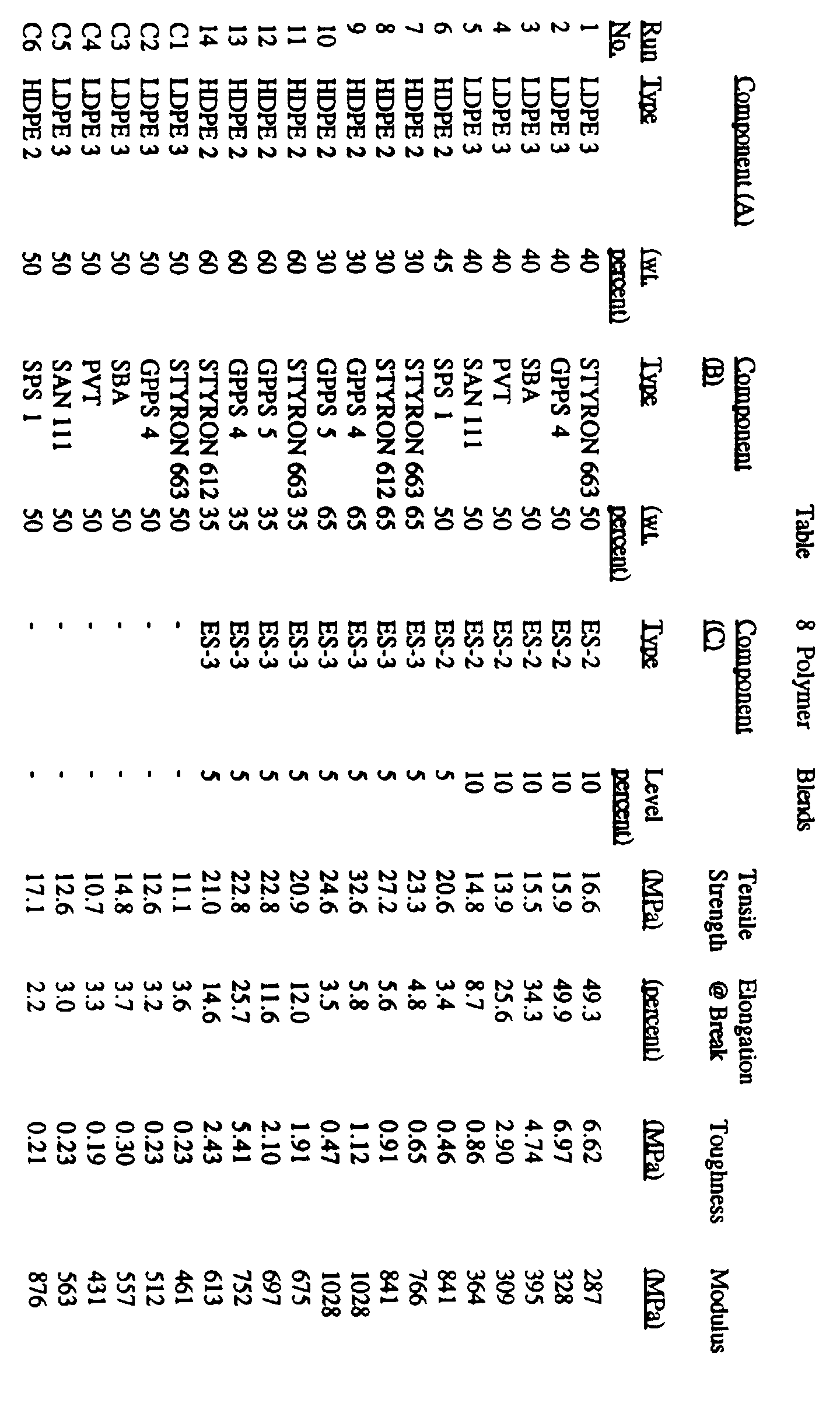
- In Table 8 the effects of the chemical composition of styrenic polymers on the blend properties were investigated. The blend properties were not severely affected by the presence of butyl acrylate comonomer (SBA) or p-methyl styrene (PVT) groups in the molecular structure. Both LDPE/SBA and LDPE/PVT blends compatibilized with ES have a satisfactory toughness and stiffness. The LDPE/SAN blend was not as well compatibilized as these blends. The compatibilized LDPE/SAN blend was, however, four times as tough as the uncompatibilized blend.
- Polymer blends were prepared from STYRON 612 general purpose polystyrene and LDPE and HDPE polymers at various blending ratios with several different compatibilizers according to the invention. The compositions of the blends as well as their properties were listed in Tables 9 and 10.
Polymer Blend Component (A) Component (B) Component (C) Tensile Strength Elongation @ Break Toughness Modulus Run No. LDPE 3 (wt. percent) STYRON 612 (wt. percent) Type Wt. percent (MPa) (percent) (MPa) (MPa) 1 40 50 ES-4 10 14.6 9.1 0.9 431 2 40 50 ES-5 10 15.2 18.5 2.3 366 3 40 50 ES-6 10 14.6 18.0 2.2 352 4 40 50 ES-3 10 16.6 25.1 3.4 381 5 40 50 ES-7 10 15.9 30.0 4.0 337 6 40 50 ES-1 10 18.1 39.5 6.1 322 7 40 50 ES-8 10 16.8 9.0 1.1 456 8 40 50 ES-9 10 9.9 40.2 3.9 326 9 40 50 ES-10 10 14.3 34.1 4.4 356 10 40 50 ES-11 10 17.8 7.8 0.9 445 11 40 50 ES-12 10 15.5 5.3 0.5 423 12 40 50 ES-13 10 185 4.8 0.6 611 13 30 60 ES-13 10 17.0 3.0 0.3 731 Polymer Blends Component (A) Component (B) Component (C) Tensile Strength Elongation @ Break Toughness Modulus Run No. HDPE 2 (wt. percent) STYRON 612 (wt. percent) Type wt. percent (MPa) (percent) (MPa) (MPa) 1 60 30 ES-4 10 18.1 16.6 2.6 578 2 60 30 ES-5 10 19.4 19.5 3.3 575 3 60 30 ES-6 10 17.6 282 4.7 543 4 60 30 ES-3 10 17.3 39.1 6.9 512 5 60 30 ES-7 10 16.1 41.4 6.9 473 6 60 30 ES-8 10 159 352 62 495 7 60 30 ES-9 10 8.9 807.0 772 447 8 60 30 ES-10 10 13.9 179.0 24.9 521 9 60 30 ES-11 10 19.8 31.1 5.9 501 10 60 30 ES-12 10 22.4 30.4 62 509 11 60 30 ES-13 10 20.9 37.1 8.7 802 12 60 35 ES-5 5 21.6 122 2.0 703 13 60 35 ES-3 5 21.0 14.6 2.4 613 14 60 35 ES-7 5 21.4 23.6 4.4 652 15 60 35 ES-9 5 19.7 34.0 6.4 622 16 30 60 ES-4 10 21.3 5.0 0.7 814 17 30 60 ES-5 10 25.7 62 1.1 786 18 30 60 ES-6 10 28.3 73 1.3 855 19 30 60 ES-3 10 292 8.0 1.5 855 20 30 60 ES-7 10 27.5 10.0 2.0 786 21 30 60 ES-8 10 30.3 6.9 1.4 716 22 30 60 ES-9 10 27.9 12.8 2.8 793 23 30 60 ES-10 10 262 12.4 2.7 745 24 30 60 ES-11 10 32.3 6.6 1.3 694 25 30 60 ES-12 10 33.0 72 1.5 729 26 30 60 ES-13 10 31.4 5.0 0.9 917 27 35 60 ES-3 5 25.1 55 0.8 786 28 25 65 ES-3 10 312 6.8 1.3 876 - The data in Tables 9 and 10 show that for blends of LDPE or HDPE with GPPS, ES compatibilizers with a styrene content of approximately 15-35 mole percent were preferred. The optimum compatibilizer differed slightly among blends. For an LDPE/PS blend, an ES resin having 20 mole percent styrene was the most effective. An ES resin having 25 mole percent styrene (ES-9) performs the best for HDPE-rich HDPE/PS blends. The HDPE 2/STYRON 612/ES-9: 60/30/10 blend stands out with its remarkably high elongation and toughness. Like a HDPE resin, the blend developed necking during the tensile elongation tests.
- Polymer blends especially suitable for producing liners, such as for refrigerators, and films, such as for labels, were prepared from several high-impact polystyrenes and LDPE and HDPE polymers at various blending ratios with several different pseudo-random interpolymer compatibilizers (invention). Comparison runs were also made with several block-copolymers as a compatibilizer. The compositions of the blends as well as their properties were listed in Table 11.

- An ES resin having 26.5 mole percent styrene (ES-10) was found to be the most effective compatibilizer for all PE/HIPS blends. In a HDPE 3/STYRON® 404 HIPS: 35/55 blend this compatibilizer performs as well as or better than the Vector® 6241-D SBS in both the toughness and modulus, and superior to an SEBS copolymer. In a LDPE/HIPS: 60/30 blend, several ES copolymers with 18-27 mole percent styrene outperformed the SB block copolymer. Since styrene-butadiene block copolymers lack thermal and UV stability, ES copolymers were attractive for these applications. Replacing the HDPE resin with one having a high molecular weight tends to improve the properties.
- Weatherable polymer blends were prepared from STYRON® 612 general purpose polystyrene and LDPE and HDPE polymers at various blending ratios with several different pseudo-random interpolymer compatibilizer (invention) and with several block-copolymers (comparative). The compositions of the blends as well as their properties were listed in Table 12.
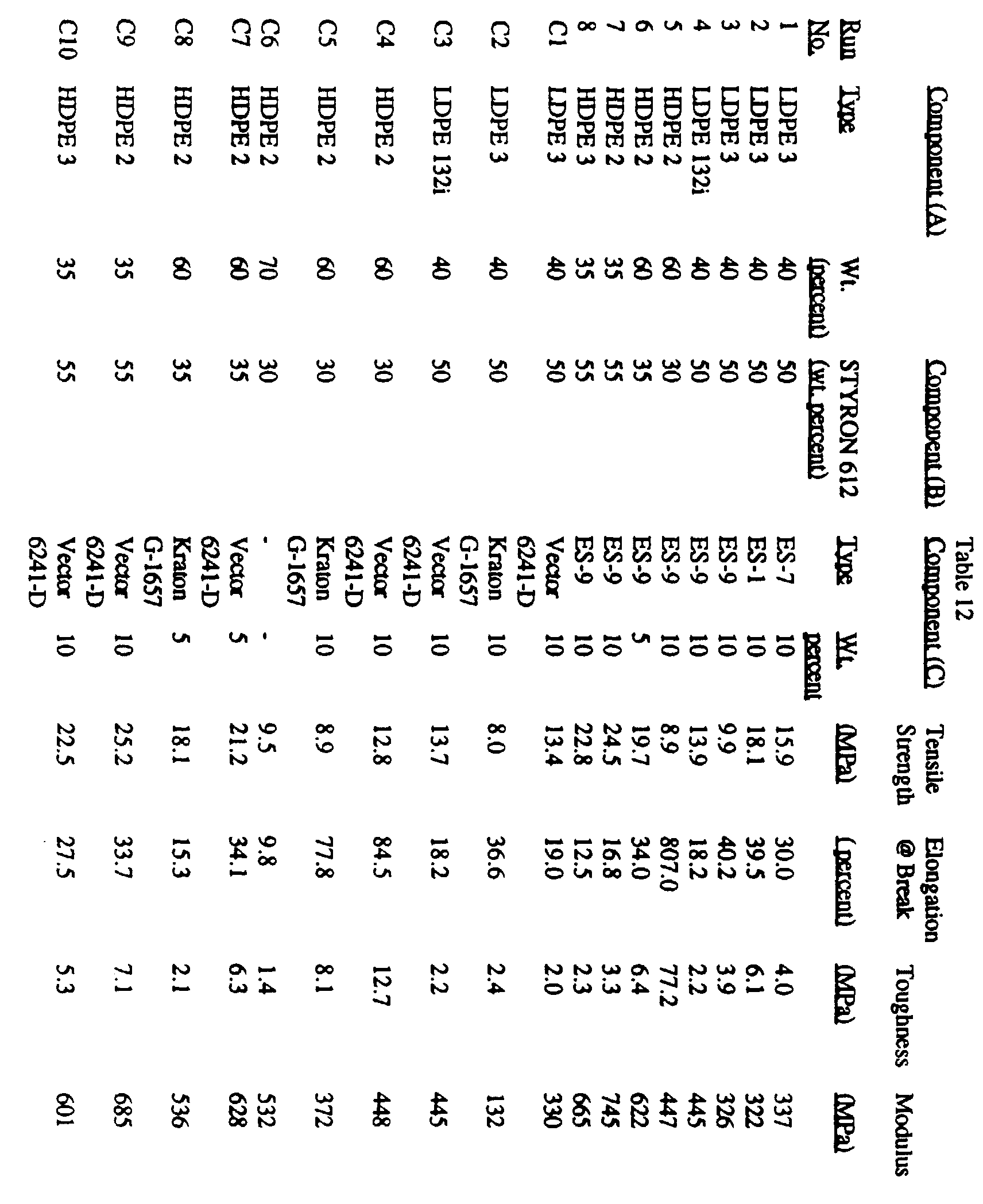
- Weatherable polymer blends can be produced from a GPPS resin and a polyethylene resin by using an ES copolymer as the compatibilizer. In blends containing 50 percent or less polystyrene, an ES resin consistently outperformed a saturated SEBS block copolymer, and, in general, outperformed an SBS tri-block copolymer.
- All these GPPS-based blends were effectively compatibilized with ES copolymers having 18-25 mole percent styrene.
- Polymer blends were prepared from syndiotactic polystyrene SPS 2 and a high molecular weight rubber-modified polypropylene PROFAX™ SD 613 at various blending ratios with several pseudo-random ES interpolymer compatibilizers (invention) and with block-copolymers (comparative). The composition of the blends as well as their properties were listed in Table 13. The components as well as 0.25 percent Irganox 1010 and 0.25 percent Irgafos 168 antioxidants were mixed for 10 minutes in 40 g batches in a Brabender batch mixer operated at 60 rpm and 260°C.
- The blends were cooled and ground to powder in a Wiley mill and subsequently compression molded into small micro tensile bars having the dimensions of 0.33 cm (0.130 inch) x 0.46 cm (0.183 inch) x 1.8 cm (0.75 inch) (gauge length). A compression molding cycle of 2 min/10 min/2 min for preheat/pressure/cool was used at a molding temperature of 300°C. Tensile yield and tensile modulus were determined at 23°C and at a rate of 0.13 cm/min (0.05 inch/min). The Notched Izod was determined by cutting and notching (0.25 mm (10 mil) notch radius) the micro bars and impacting them at 23°C.
- The data in Table 13 show that the blends according to the invention have better stiffness (modulus) than the blends containing an equivalent amount of Kraton G1652, while still improving the ductility (percent E) and toughness (Izod).
Run No. SPS Wt.) PP (wt. percent) Compatibilizer Wt. percent Compatibilizer Tensile Yield (MPa) (percent) E Izod (J/m) Modulus (MPa) 1 22.5 67.5 10 ES-14 12.5 12.6 26.7 1457 2 22.5 67.5 10 ES-15 11.7 5.3 58.7 1303 3 22.5 67.5 10 ES-16 11.4 3.4 52.3 1484 4 22.5 67.5 10 ES-17 12.2 4.8 43.2 1383 5 22.5 67.5 10 ES-18 122 7.2 51.2 1372 6 67.5 22.5 10 ES-14 11.3 0.6 9.6 2270 7 67.5 22.5 10 ES-16 11.3 0.6 - 2304 8 67.5 22.5 10 ES-18 12.4 0.6 - 2439 9 24.6 73.9 2.5 ES-16 13.1 6.7 - 1623 10 23.8 71.2 5.0 ES-16 12.8 6A - 1400 11 20 60 20 ES-16 11.9 11.1 133.1 908 12 20 60 10/10 ES-16+ 12.4 11.8 - 762 Kraton G1652 C1 25 75 - - 15.3 3.4 31.0 1979 C2 75 25 - - 13.0 0.5 8.0 3293 C3 22.5 67.5 10 Kraton 12.8 12.9 14.7 951 G1652 C4 67.5 22.5 10 Kraton 14.9 0.9 18.7 2170 G1652
Claims (31)
- A polymer blend composition comprising:(a) from 0.5 to 99 percent by weight, based on the total weight of (a), (b), and (c), of an aliphatic α-olefin homopolymer or interpolymer, or an interpolymer of an aliphatic α-olefin and a non-aromatic monomer interpolymerizable therewith;(b) from 0.5 to 99 percent by weight, based on the total weight of (a), (b), and (c), of a homopolymer or interpolymer of monovinylidene aromatic monomers, or an interpolymer of monovinylidene aromatic monomer and a monomer interpolymerizable therewith other than an aliphatic α-olefin; and(c) from 0.5 to 99 percent by weight, based on the total weight of (a), (b), and (c), of a compatibilizer polymer; chacatcerized by employing as said compatablizer polymer a substantially random interpolymer comprising an aliphatic α-olefin and a vinylidene aromatic monomer.
- The composition of Claim 1 wherein (a) comprises a homopolymer or interpolymer of an α-olefin having from 2 to 18 carbon atoms.
- The composition of Claim 2 wherein (a) was a homopolymer of ethylene or propylene, or an interpolymer of ethylene and one or more α-olefins having from 3 to 8 carbon atoms.
- The composition of Claim 1 comprising from 80 to 20 percent by weight of (a).
- The composition of Claim 1 wherein the monovinylidene aromatic monomer of (b) was represented by the following formula:wherein R1 was selected from the group of radicals consisting of hydrogen and all radicals containing three carbons or less, and Ar was a phenyl group or a phenyl group substituted with from 1 to 5 substituents selected from the group consisting of C1-4-alkyl and C1-4-haloalkyl.
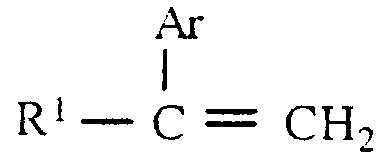
- The composition of Claim 1 wherein the interpolymerizable monomer of (b) was selected from the group consisting of N-phenyl maleimide, acrylamide, acrylonitrile, methacrylonitrile, maleic anhydride, acrylic acid, C1-4-alkyl acrylates or C1-4-alkyl methacrylates.
- The composition of Claim 5 wherein (b) comprises polystyrene, rubber-modified high impact polystyrene, poly(vinyl-toluene), or poly(α-methyl styrene).
- The composition of Claim 1 comprising from 10 to 80 percent by weight of (b).
- The composition of Claim 1 wherein the substantially random interpolymer component (c) was a pseudo-random linear or substantially linear interpolymer comprising an aliphatic α-olefin and a monovinylidene aromatic monomer.
- The composition of Claim 9 wherein the α-olefin has from 2 to 8 carbon atoms and the monovinylidene aromatic monomer was represented by the following formula:wherein R1 was selected from the group of radicals consisting of hydrogen and alkyl radicals containing three carbons or less, and Ar was a phenyl group or a phenyl group substituted with from 1 to 5 substituents selected from the group consisting of C1-4-alkyl and

C1-4-haloalkyl. - The composition of Claim 10 wherein the α-olefin was ethylene and the monovinylidene aromatic monomer was styrene.
- The composition of Claim 11 wherein the pseudo-random interpolymer contains from 1 to less than 55 mole percent of the monovinylidene aromatic monomer.
- The composition of Claim 12 wherein the pseudo-random interpolymer contains from 3 to 50 mole percent of the monovinylidene aromatic monomer.
- The composition of Claim 13 wherein the pseudo-random interpolymer contains from 15 to 35 mole percent of the monovinylidene aromatic monomer.
- The composition of Claim 1 wherein the substantially random interpolymer has a melt index of from 0.01 to 100.
- The composition of Claim 15 wherein the substantially random interpolymer has a melt index of from 0.01 to 25.
- The composition of Claim 1 comprising from 1 to 50 percent by weight of (c).
- The composition of Claim 1 comprising from 35 to 75 weight percent of (a), from 15 to 60 weight percent of (b), and from 2 to 20 weight percent of (c).
- The composition of Claim 18 wherein (a) was selected from the group consisting of low density polyethylene, high density polyethylene, substantially linear polyethylene, linear low density polyethylene, and polypropylene, and (b) was selected from the group consisting of styrene homopolymer, rubber modified high impact polystyrene, poly(vinyl-toluene), and poly(α-methylstyrene).
- The composition of Claim 9 comprising from 40 to 87 weight percent of (a), from 11 to 40 weight percent of syndiotactic polystyrene as (b), and from 2 to 20 weight percent of (c).
- The composition of Claim 20 wherein (a) comprises polypropylene.
- An expandable composition comprising a polymer blend composition according to Claim 1 and an expanding agent.
- The expandable composition of Claim 22 in the form of beads.
- Foamed composition obtained by subjecting the expandable composition of Claim 22 to a foaming process.
- Foamed composition of Claim 24 in the form of a sheet or plank.
- An article of manufacture molded from the polymer blend composition according to Claim 1.
- The article of manufacture of Claim 26 obtained by thermoforming, extrusion, injection molding, or blow molding.
- The article of manufacture of Claim 27 in the form of a sheet or film.
- Method of packaging a substance or article by providing an intimate blend of components (a), (b), and (c) of a polymer blend composition of Claim 1 and providing the blend in the form of an enclosure around or suitable for receiving a substance or article to be packaged.
- The method of Claim 29 wherein the blend was formed into a sheet or film and the substance or article to be packaged was food.
- The method of Claim 29 wherein the blend was formed into a container and the substance or article to be packaged was a liquid.
Applications Claiming Priority (3)
| Application Number | Priority Date | Filing Date | Title |
|---|---|---|---|
| US08/226,533 US5460818A (en) | 1994-04-12 | 1994-04-12 | Compatibilized blend of olefinic polymers and monovinylidene aromatic polymers |
| PCT/US1995/004314 WO1995027755A1 (en) | 1994-04-12 | 1995-04-12 | Compatibilized blend of olefinic polymers and monovinylidene aromatic polymers |
| US226533 | 1999-01-07 |
Publications (2)
| Publication Number | Publication Date |
|---|---|
| EP0755418A1 EP0755418A1 (en) | 1997-01-29 |
| EP0755418B1 true EP0755418B1 (en) | 1999-08-04 |
Family
ID=22849299
Family Applications (1)
| Application Number | Title | Priority Date | Filing Date |
|---|---|---|---|
| EP95916240A Expired - Lifetime EP0755418B1 (en) | 1994-04-12 | 1995-04-12 | Compatibilized blend of olefinic polymers and monovinylidene aromatic polymers |
Country Status (14)
| Country | Link |
|---|---|
| US (1) | US5460818A (en) |
| EP (1) | EP0755418B1 (en) |
| JP (1) | JPH09512038A (en) |
| KR (1) | KR970702324A (en) |
| CN (1) | CN1146211A (en) |
| AT (1) | ATE182913T1 (en) |
| AU (1) | AU2281195A (en) |
| BR (1) | BR9507455A (en) |
| CA (1) | CA2187640A1 (en) |
| DE (1) | DE69511258T2 (en) |
| ES (1) | ES2136846T3 (en) |
| FI (1) | FI964099A0 (en) |
| RU (1) | RU2144549C1 (en) |
| WO (1) | WO1995027755A1 (en) |
Families Citing this family (56)
| Publication number | Priority date | Publication date | Assignee | Title |
|---|---|---|---|---|
| US6087447A (en) * | 1989-08-31 | 2000-07-11 | The Dow Chemical Company | Blends of substantially random interpolymers with vinyl or vinylidene aromatic polymers |
| NZ235032A (en) | 1989-08-31 | 1993-04-28 | Dow Chemical Co | Constrained geometry complexes of titanium, zirconium or hafnium comprising a substituted cyclopentadiene ligand; use as olefin polymerisation catalyst component |
| TW408155B (en) * | 1989-08-31 | 2000-10-11 | Dow Chemical Co | Blends of <alpha>-olefin/vinylidene aromatic monomer or hindered aliphatic vinylidene monomer interpolymers with polymers of vinylidene aromatic monomers |
| US5869591A (en) * | 1994-09-02 | 1999-02-09 | The Dow Chemical Company | Thermoset interpolymers and foams |
| US6884480B2 (en) | 1995-05-19 | 2005-04-26 | Cryovac, Inc. | Film containing alpha-olefin/vinyl aromatic copolymer |
| EP0885260B1 (en) | 1996-03-05 | 2000-11-02 | The Dow Chemical Company | Molding composition containing syndiotactic vinylaromatic polymer |
| ZA977909B (en) | 1996-09-04 | 1999-03-03 | Dow Chemical Co | Compositions comprising a substantially random interpolymer of at least one alpha-olefin and at least one vinylidene aromatic monomer or hindered aliphatic vinylidene monomer |
| WO1998010160A1 (en) | 1996-09-04 | 1998-03-12 | The Dow Chemical Company | Floor, wall or ceiling covering |
| BR9612724A (en) * | 1996-09-04 | 2002-05-21 | Dow Chemical Co | Mixtures containing an alpha-olefin interpolymer and products obtained from these |
| TW421663B (en) * | 1996-09-04 | 2001-02-11 | Dow Chemical Co | Blends of <alpha>-olefin/vinyl or vinylidene aromatic monomer and/or aliphatic or cycloaliphatic vinyl or vinylidene monomer interpolymers |
| US5741857A (en) * | 1996-10-15 | 1998-04-21 | The Dow Chemical Company | Blends of elastomer block copolymer and aliphatic α-olefin/monovinylidene aromatic monomer and/or hindered aliphatic vinylidene monomer interpolymer |
| US5739200A (en) * | 1996-12-17 | 1998-04-14 | The Dow Chemical Company | Plasticizied α-olefin/vinylidene aromatic monomer of hindered aliphatic or cycloaliphatic vinylidene monomer interpolymers |
| US5973049A (en) * | 1997-06-26 | 1999-10-26 | The Dow Chemical Company | Filled polymer compositions |
| US6319969B1 (en) | 1997-06-26 | 2001-11-20 | The Dow Chemical Company | Interpolymer compositions for use in sound management |
| US5889069A (en) * | 1997-07-15 | 1999-03-30 | The Dow Chemical Company | High temperature syndiotactic styrene polymer foam |
| CA2305380A1 (en) * | 1997-09-29 | 1999-04-22 | National Research Council Of Canada | Trivalent thrombin inhibitor |
| US6136923A (en) * | 1997-10-15 | 2000-10-24 | The Dow Chemical Company | Thermoplastic compositions of interpolymers of ethylene with styrene blended with poly vinyl chloride |
| JP2001520291A (en) | 1997-10-17 | 2001-10-30 | ザ ダウ ケミカル カンパニー | Compositions of interpolymers made from alpha-olefin monomers and one or more vinyl or vinylidene aromatic monomers |
| US6027800A (en) * | 1997-12-19 | 2000-02-22 | Basf Corporation | High impact resistant, high gloss, and high environmental stress crack resistant thermoplastic manufactured articles |
| US6380305B1 (en) | 1997-12-19 | 2002-04-30 | Basf Corporation | High impact resistant, high gloss, and high environmental stress crack resistant polymeric compositions |
| EP1062957A4 (en) * | 1998-03-09 | 2009-04-29 | Denki Kagaku Kogyo Kk | SUBSTANCE AND SUPPLY FOR MEDICAL USE |
| BR9908805A (en) | 1998-03-11 | 2000-10-31 | Dow Chemical Co | Thermoplastic compositions of mixtures of polymeric materials with engineering thermoplastics |
| WO1999048972A1 (en) * | 1998-03-23 | 1999-09-30 | Denki Kagaku Kogyo Kabushiki Kaisha | Resin composition |
| US6124406A (en) | 1998-03-31 | 2000-09-26 | The B. F. Goodrich Company | Blocky chlorinated polyolefins, process for making and use as impact modifier compatibilizer for PVC or CPVC |
| US6225363B1 (en) | 1998-04-07 | 2001-05-01 | Pactiv Corporation | Foamable composition using high density polyethylene |
| US6069183A (en) * | 1998-04-07 | 2000-05-30 | Tenneco Packaging Inc. | Foamable composition using high density polyethylene |
| BR9913436A (en) * | 1998-08-28 | 2001-05-22 | Dow Chemical Co | Polymer mixing foam |
| DE19983482B4 (en) * | 1998-09-09 | 2006-09-28 | Asahi Kasei Chemicals Corp. | Use of compatibilized resin compositions for liquid containers of an antifreeze system |
| US5993707A (en) * | 1998-12-04 | 1999-11-30 | The Dow Chemical Company | Enlarged cell size foams made from blends of alkenyl aromatic polymers and alpha-olefin/vinyl or vinylidene aromatic and/or sterically hindered aliphatic or cycloaliphatic vinyl or vinylidene interpolymers |
| US6231795B1 (en) * | 1998-12-04 | 2001-05-15 | The Dow Chemical Company | Soft and flexible foams made from blends of alkenyl aromatic polymers and alpha-olefin/vinyl or vinylidene aromatic and/or sterically hindered aliphatic or cycloaliphatic vinyl or vinylidene interpolymers |
| CA2372217A1 (en) * | 1999-04-30 | 2000-11-09 | Wenbin Liang | Film with enhanced performance properties |
| US6365658B1 (en) | 1999-08-12 | 2002-04-02 | The Dow Chemical Company | Polymer compositions |
| US6277915B1 (en) | 1999-09-29 | 2001-08-21 | Pmd Holdings Corporation | Block chlorinated polyolefins for use as impact modifier enhancers for PVC or CPVC |
| WO2001051547A1 (en) * | 2000-01-07 | 2001-07-19 | Dow Global Technologies Inc. | Thermoformable ethylene/styrene interpolymer-based polymer blend film for three-dimensional transfer finish foil |
| WO2001053410A1 (en) * | 2000-01-19 | 2001-07-26 | The Dow Chemical Company | Acoustical insulating foam from compatibilized blends of vinyl aromatic polymers and alpha-olefin polymers |
| CN100432127C (en) | 2000-03-17 | 2008-11-12 | 陶氏环球技术公司 | Macroporous acoustic foams and uses thereof |
| US6767931B2 (en) | 2000-07-20 | 2004-07-27 | Dow Global Technologies Inc. | Foam compositions from blend of alkenyl aromatic polymers and alpha-olefin/vinyl or vinylidene aromatic interpolymers |
| AU2001281270A1 (en) * | 2000-08-14 | 2002-02-25 | The Dow Chemical Company | Dimensionally stable foam made from compatibilized blends of poly (vinyl aromatic) polymers and poly (alpha-olefin) polymers for cushion packaging applications |
| AU2001286657A1 (en) * | 2000-09-15 | 2002-03-26 | The Dow Chemical Company | Propylene polymer composition |
| WO2002068529A2 (en) * | 2001-02-27 | 2002-09-06 | Dow Global Technologies Inc. | Fabricated articles prepared from blends of substantially random ethylene/propylene/vinyl aromatic interpolymers with polypropylene |
| US20040106739A1 (en) * | 2002-02-19 | 2004-06-03 | Cheung Yunwa Wilson | Blends of substantially random interpolymers with enhanced thermal performance |
| US6894102B2 (en) * | 2002-05-20 | 2005-05-17 | General Electric | Syndiotactic polystyrene blends |
| US7045556B2 (en) * | 2002-07-02 | 2006-05-16 | Pactiv Corporation | Polyolefin foams made with isopentane-based blowing agents |
| US7166248B2 (en) * | 2003-01-03 | 2007-01-23 | Pactiv Corporation | Reduced VOC emission alkenyl aromatic polymer foams and processes |
| EP1612239B1 (en) * | 2003-04-04 | 2012-04-25 | Sekisui Plastics Co., Ltd. | Expandable styrene-modified olefin resin particles, pre-expanded particles, and method for producing an expanded molded article |
| US7358282B2 (en) | 2003-12-05 | 2008-04-15 | Kimberly-Clark Worldwide, Inc. | Low-density, open-cell, soft, flexible, thermoplastic, absorbent foam and method of making foam |
| US7361694B2 (en) * | 2004-02-27 | 2008-04-22 | Dow Global Technologies Inc. | Durable foam of olefin polymers, methods of making foam and articles prepared from same |
| US7291382B2 (en) | 2004-09-24 | 2007-11-06 | Kimberly-Clark Worldwide, Inc. | Low density flexible resilient absorbent open-cell thermoplastic foam |
| US8158689B2 (en) | 2005-12-22 | 2012-04-17 | Kimberly-Clark Worldwide, Inc. | Hybrid absorbent foam and articles containing it |
| US8378024B2 (en) * | 2007-02-07 | 2013-02-19 | Lg Chem, Ltd. | Low surface gloss styrene resin composition, and low surface gloss sheet and composite article therefrom |
| US8202528B2 (en) * | 2007-06-05 | 2012-06-19 | Abbott Cardiovascular Systems Inc. | Implantable medical devices with elastomeric block copolymer coatings |
| WO2011131322A1 (en) * | 2010-04-21 | 2011-10-27 | Basell Polyolefine Gmbh | Polymer blend having improved mechanical properties |
| CA2796733C (en) * | 2010-05-13 | 2018-07-31 | Dow Global Technologies Llc | Styrene-acrylonitrile copolymer foam with minimal yellowing |
| US20130087361A1 (en) * | 2011-10-11 | 2013-04-11 | Hitachi Cable, Ltd. | Foamed resin composition, wire and cable |
| US10053597B2 (en) | 2013-01-18 | 2018-08-21 | Basf Se | Acrylic dispersion-based coating compositions |
| CN118359837B (en) * | 2024-06-19 | 2024-08-16 | 浙江新恒泰新材料股份有限公司 | High-resilience polyolefin foam material and preparation method thereof |
Family Cites Families (19)
| Publication number | Priority date | Publication date | Assignee | Title |
|---|---|---|---|---|
| US3117945A (en) * | 1960-01-04 | 1964-01-14 | Union Carbide Corp | Compositions comprising styrene homopolymer and styrene-ethylene copolymer and method therefor |
| US3117946A (en) * | 1960-01-04 | 1964-01-14 | Union Carbide Corp | Compositions comprising ethylene homopolymer and ethylene-styrene copolymer and method of preparing same |
| US4031166A (en) * | 1970-01-29 | 1977-06-21 | Badische Anilin- & Soda-Fabrik Aktiengesellschaft | Impact-resistant polystyrene, α-olefin, block copolymer blends |
| BE776346A (en) * | 1970-12-12 | 1972-06-07 | Basf Ag | THERMOPLASTIC MOLDING MATERIALS |
| FR2120302A5 (en) * | 1970-12-29 | 1972-08-18 | Aquitaine Total Organico | |
| JPS5327744B2 (en) * | 1971-09-30 | 1978-08-10 | ||
| US3851015A (en) * | 1972-02-17 | 1974-11-26 | Aquitaine Petrole | Method for copolymerizing monomers of different types |
| JPS4928637A (en) * | 1972-07-12 | 1974-03-14 | ||
| US4020025A (en) * | 1973-05-08 | 1977-04-26 | Basf Aktiengesellschaft | Extrudable foamable composition comprising an olefin polymer, a styrene polymer and a hydrogenated styrene butadiene block copolymer |
| US4188432A (en) * | 1978-03-30 | 1980-02-12 | Shell Oil Company | Articles resistant to attack by fatty substances, made from polystyrene blends, and compositions |
| JPS5636534A (en) * | 1979-09-03 | 1981-04-09 | Asahi Chem Ind Co Ltd | Thermoplastic resin composition |
| JPS5638338A (en) * | 1979-09-06 | 1981-04-13 | Asahi Chem Ind Co Ltd | Thermoplastic resin composition |
| US4386187A (en) * | 1980-06-11 | 1983-05-31 | Sweetheart Plastics, Inc. | Thermoformable polymer blend composition comprising styrene polymer, olefin polymer and block copolymer |
| US4386188A (en) * | 1981-01-16 | 1983-05-31 | Sweetheart Plastics, Inc. | Thermoformable polymer blend composition |
| IT1167713B (en) * | 1981-03-12 | 1987-05-13 | Montefina Sa | THERMOPLASTIC RUBBER CONSTITUTED BY MIXTURE OF POLYPROPYLENE, SHOCKPROOF POLYSTYRENE AND STYRENE / DIENE BLOCK COPOLYMER |
| IT1167712B (en) * | 1981-03-12 | 1987-05-13 | Montefina Sa | POLYMERIC MATERIAL CONSTITUTED BY A MIXTURE OF ANTI-IMPACT POLYSTYRENE, HIGH DENSITY POLYETHYLENE AND STYRENE / DIENE BLOCK COPOLYMER |
| US4690976A (en) * | 1983-08-01 | 1987-09-01 | The Dow Chemical Company | Blends of olefinic and monovinylidene aromatic polymers |
| US4716197A (en) * | 1986-04-21 | 1987-12-29 | The Dow Chemical Company | Polyethylene/EPDM-graft polystyrene blends |
| DE69023846T2 (en) * | 1989-03-20 | 1996-04-11 | Idemitsu Kosan Co | STYRENE COPOLYMERS AND PRODUCTION METHOD. |
-
1994
- 1994-04-12 US US08/226,533 patent/US5460818A/en not_active Expired - Fee Related
-
1995
- 1995-04-12 AU AU22811/95A patent/AU2281195A/en not_active Abandoned
- 1995-04-12 AT AT95916240T patent/ATE182913T1/en not_active IP Right Cessation
- 1995-04-12 JP JP7526466A patent/JPH09512038A/en not_active Ceased
- 1995-04-12 EP EP95916240A patent/EP0755418B1/en not_active Expired - Lifetime
- 1995-04-12 CA CA002187640A patent/CA2187640A1/en not_active Abandoned
- 1995-04-12 RU RU96121917A patent/RU2144549C1/en active
- 1995-04-12 KR KR1019960705705A patent/KR970702324A/en not_active Abandoned
- 1995-04-12 WO PCT/US1995/004314 patent/WO1995027755A1/en not_active Ceased
- 1995-04-12 ES ES95916240T patent/ES2136846T3/en not_active Expired - Lifetime
- 1995-04-12 BR BR9507455A patent/BR9507455A/en not_active Application Discontinuation
- 1995-04-12 FI FI964099A patent/FI964099A0/en unknown
- 1995-04-12 CN CN95192552A patent/CN1146211A/en active Pending
- 1995-04-12 DE DE69511258T patent/DE69511258T2/en not_active Expired - Fee Related
Also Published As
| Publication number | Publication date |
|---|---|
| BR9507455A (en) | 1997-09-02 |
| DE69511258T2 (en) | 1999-12-02 |
| DE69511258D1 (en) | 1999-09-09 |
| EP0755418A1 (en) | 1997-01-29 |
| ES2136846T3 (en) | 1999-12-01 |
| WO1995027755A1 (en) | 1995-10-19 |
| CA2187640A1 (en) | 1995-10-19 |
| RU2144549C1 (en) | 2000-01-20 |
| CN1146211A (en) | 1997-03-26 |
| FI964099A7 (en) | 1996-10-11 |
| AU2281195A (en) | 1995-10-30 |
| FI964099L (en) | 1996-10-11 |
| US5460818A (en) | 1995-10-24 |
| ATE182913T1 (en) | 1999-08-15 |
| FI964099A0 (en) | 1996-10-11 |
| KR970702324A (en) | 1997-05-13 |
| JPH09512038A (en) | 1997-12-02 |
Similar Documents
| Publication | Publication Date | Title |
|---|---|---|
| US5460818A (en) | Compatibilized blend of olefinic polymers and monovinylidene aromatic polymers | |
| US6833411B2 (en) | Block copolymer compositions | |
| EP0923617B1 (en) | Blends of alpha-olefin/vinylidene aromatic monomer or hindered aliphatic vinylidene monomer interpolymers with polyolefins | |
| US8101686B2 (en) | Interpolymer resin particles | |
| AU659696B2 (en) | Thermoformable, chemical resistant polymer blends | |
| DK174747B1 (en) | Mixtures based on high toughness and chemical resistance vinyl polymers | |
| US4690976A (en) | Blends of olefinic and monovinylidene aromatic polymers | |
| JPWO2000008079A1 (en) | Linear block copolymer and resin composition containing same | |
| KR20010014237A (en) | Filled polymer compositions | |
| JP2001514292A (en) | Coupling of blends of polyolefins with interpolymers of α-olefin / vinyl aromatic monomer or hindered aliphatic vinyl monomer | |
| US20020061976A1 (en) | Propylene polymer composition | |
| US6087447A (en) | Blends of substantially random interpolymers with vinyl or vinylidene aromatic polymers | |
| EP0923616B1 (en) | Blends containing an interpolymer of alpha-olefin | |
| CA2250285A1 (en) | High impact resistant, high gloss, and high environmental stress crack resistant manufactured articles | |
| EP0195829B1 (en) | Blends of olefinic and monovinylidene aromatic polymers | |
| JP3662135B2 (en) | Thermoplastic resin composition | |
| JP4641590B2 (en) | Resin composition | |
| MXPA99002109A (en) | Blends containing an interpolymer of alpha-olefin | |
| MXPA99002110A (en) | BLENDS OF&agr;-OLEFIN/VINYLIDENE AROMATIC MONOMER OR HINDERED ALIPHATIC VINYLIDENE MONOMER INTERPOLYMERS WITH POLYOLEFINS | |
| KR20000035969A (en) | Blends containing an interpolymer of alpha-olefin | |
| MXPA00006956A (en) | Thermoplastic blends of alpha-olefin/vinylidene aromatic monomer interpolymers with aromatic polyethers | |
| AU9737401A (en) | Blends containing an interpolymer of alpha-olefin |
Legal Events
| Date | Code | Title | Description |
|---|---|---|---|
| PUAI | Public reference made under article 153(3) epc to a published international application that has entered the european phase |
Free format text: ORIGINAL CODE: 0009012 |
|
| 17P | Request for examination filed |
Effective date: 19961009 |
|
| AK | Designated contracting states |
Kind code of ref document: A1 Designated state(s): AT BE CH DE DK ES FR GB GR IE IT LI LU MC NL PT SE |
|
| RAP3 | Party data changed (applicant data changed or rights of an application transferred) |
Owner name: THE DOW CHEMICAL COMPANY |
|
| GRAG | Despatch of communication of intention to grant |
Free format text: ORIGINAL CODE: EPIDOS AGRA |
|
| 17Q | First examination report despatched |
Effective date: 19980910 |
|
| GRAG | Despatch of communication of intention to grant |
Free format text: ORIGINAL CODE: EPIDOS AGRA |
|
| GRAG | Despatch of communication of intention to grant |
Free format text: ORIGINAL CODE: EPIDOS AGRA |
|
| GRAH | Despatch of communication of intention to grant a patent |
Free format text: ORIGINAL CODE: EPIDOS IGRA |
|
| GRAH | Despatch of communication of intention to grant a patent |
Free format text: ORIGINAL CODE: EPIDOS IGRA |
|
| GRAA | (expected) grant |
Free format text: ORIGINAL CODE: 0009210 |
|
| AK | Designated contracting states |
Kind code of ref document: B1 Designated state(s): AT BE CH DE DK ES FR GB GR IE IT LI LU MC NL PT SE |
|
| PG25 | Lapsed in a contracting state [announced via postgrant information from national office to epo] |
Ref country code: GR Free format text: LAPSE BECAUSE OF NON-PAYMENT OF DUE FEES Effective date: 19990804 |
|
| REF | Corresponds to: |
Ref document number: 182913 Country of ref document: AT Date of ref document: 19990815 Kind code of ref document: T |
|
| REG | Reference to a national code |
Ref country code: CH Ref legal event code: NV Representative=s name: FIAMMENGHI-FIAMMENGHI Ref country code: CH Ref legal event code: EP |
|
| REF | Corresponds to: |
Ref document number: 69511258 Country of ref document: DE Date of ref document: 19990909 |
|
| ET | Fr: translation filed | ||
| ITF | It: translation for a ep patent filed | ||
| REG | Reference to a national code |
Ref country code: IE Ref legal event code: FG4D |
|
| PG25 | Lapsed in a contracting state [announced via postgrant information from national office to epo] |
Ref country code: PT Free format text: LAPSE BECAUSE OF FAILURE TO SUBMIT A TRANSLATION OF THE DESCRIPTION OR TO PAY THE FEE WITHIN THE PRESCRIBED TIME-LIMIT Effective date: 19991104 Ref country code: DK Free format text: LAPSE BECAUSE OF FAILURE TO SUBMIT A TRANSLATION OF THE DESCRIPTION OR TO PAY THE FEE WITHIN THE PRESCRIBED TIME-LIMIT Effective date: 19991104 |
|
| REG | Reference to a national code |
Ref country code: ES Ref legal event code: FG2A Ref document number: 2136846 Country of ref document: ES Kind code of ref document: T3 |
|
| PG25 | Lapsed in a contracting state [announced via postgrant information from national office to epo] |
Ref country code: LU Free format text: LAPSE BECAUSE OF NON-PAYMENT OF DUE FEES Effective date: 20000412 Ref country code: IE Free format text: LAPSE BECAUSE OF NON-PAYMENT OF DUE FEES Effective date: 20000412 |
|
| PLBE | No opposition filed within time limit |
Free format text: ORIGINAL CODE: 0009261 |
|
| STAA | Information on the status of an ep patent application or granted ep patent |
Free format text: STATUS: NO OPPOSITION FILED WITHIN TIME LIMIT |
|
| 26N | No opposition filed | ||
| PG25 | Lapsed in a contracting state [announced via postgrant information from national office to epo] |
Ref country code: MC Free format text: LAPSE BECAUSE OF NON-PAYMENT OF DUE FEES Effective date: 20001031 |
|
| REG | Reference to a national code |
Ref country code: IE Ref legal event code: MM4A |
|
| PGFP | Annual fee paid to national office [announced via postgrant information from national office to epo] |
Ref country code: SE Payment date: 20010209 Year of fee payment: 7 |
|
| PGFP | Annual fee paid to national office [announced via postgrant information from national office to epo] |
Ref country code: GB Payment date: 20010212 Year of fee payment: 7 |
|
| PGFP | Annual fee paid to national office [announced via postgrant information from national office to epo] |
Ref country code: FR Payment date: 20010219 Year of fee payment: 7 |
|
| PGFP | Annual fee paid to national office [announced via postgrant information from national office to epo] |
Ref country code: AT Payment date: 20010308 Year of fee payment: 7 |
|
| PGFP | Annual fee paid to national office [announced via postgrant information from national office to epo] |
Ref country code: CH Payment date: 20010327 Year of fee payment: 7 |
|
| PGFP | Annual fee paid to national office [announced via postgrant information from national office to epo] |
Ref country code: BE Payment date: 20010515 Year of fee payment: 7 |
|
| REG | Reference to a national code |
Ref country code: GB Ref legal event code: IF02 |
|
| PGFP | Annual fee paid to national office [announced via postgrant information from national office to epo] |
Ref country code: ES Payment date: 20020410 Year of fee payment: 8 |
|
| PG25 | Lapsed in a contracting state [announced via postgrant information from national office to epo] |
Ref country code: GB Free format text: LAPSE BECAUSE OF NON-PAYMENT OF DUE FEES Effective date: 20020412 Ref country code: AT Free format text: LAPSE BECAUSE OF NON-PAYMENT OF DUE FEES Effective date: 20020412 |
|
| PG25 | Lapsed in a contracting state [announced via postgrant information from national office to epo] |
Ref country code: SE Free format text: LAPSE BECAUSE OF NON-PAYMENT OF DUE FEES Effective date: 20020413 |
|
| PG25 | Lapsed in a contracting state [announced via postgrant information from national office to epo] |
Ref country code: LI Free format text: LAPSE BECAUSE OF NON-PAYMENT OF DUE FEES Effective date: 20020430 Ref country code: CH Free format text: LAPSE BECAUSE OF NON-PAYMENT OF DUE FEES Effective date: 20020430 Ref country code: BE Free format text: LAPSE BECAUSE OF NON-PAYMENT OF DUE FEES Effective date: 20020430 |
|
| PGFP | Annual fee paid to national office [announced via postgrant information from national office to epo] |
Ref country code: NL Payment date: 20020430 Year of fee payment: 8 |
|
| EUG | Se: european patent has lapsed |
Ref document number: 95916240.5 |
|
| GBPC | Gb: european patent ceased through non-payment of renewal fee |
Effective date: 20020412 |
|
| REG | Reference to a national code |
Ref country code: CH Ref legal event code: PL |
|
| PG25 | Lapsed in a contracting state [announced via postgrant information from national office to epo] |
Ref country code: FR Free format text: LAPSE BECAUSE OF NON-PAYMENT OF DUE FEES Effective date: 20021231 |
|
| REG | Reference to a national code |
Ref country code: FR Ref legal event code: ST |
|
| PGFP | Annual fee paid to national office [announced via postgrant information from national office to epo] |
Ref country code: DE Payment date: 20030307 Year of fee payment: 9 |
|
| PG25 | Lapsed in a contracting state [announced via postgrant information from national office to epo] |
Ref country code: ES Free format text: LAPSE BECAUSE OF NON-PAYMENT OF DUE FEES Effective date: 20030414 |
|
| PG25 | Lapsed in a contracting state [announced via postgrant information from national office to epo] |
Ref country code: NL Free format text: LAPSE BECAUSE OF NON-PAYMENT OF DUE FEES Effective date: 20031101 |
|
| NLV4 | Nl: lapsed or anulled due to non-payment of the annual fee |
Effective date: 20031101 |
|
| REG | Reference to a national code |
Ref country code: ES Ref legal event code: FD2A Effective date: 20030414 |
|
| PG25 | Lapsed in a contracting state [announced via postgrant information from national office to epo] |
Ref country code: DE Free format text: LAPSE BECAUSE OF NON-PAYMENT OF DUE FEES Effective date: 20041103 |
|
| PG25 | Lapsed in a contracting state [announced via postgrant information from national office to epo] |
Ref country code: IT Free format text: LAPSE BECAUSE OF NON-PAYMENT OF DUE FEES Effective date: 20050412 |