EP0755411B1 - Free radical polymerisation process - Google Patents
Free radical polymerisation process Download PDFInfo
- Publication number
- EP0755411B1 EP0755411B1 EP95911410A EP95911410A EP0755411B1 EP 0755411 B1 EP0755411 B1 EP 0755411B1 EP 95911410 A EP95911410 A EP 95911410A EP 95911410 A EP95911410 A EP 95911410A EP 0755411 B1 EP0755411 B1 EP 0755411B1
- Authority
- EP
- European Patent Office
- Prior art keywords
- chelate
- group
- process according
- formula
- alkyl
- Prior art date
- Legal status (The legal status is an assumption and is not a legal conclusion. Google has not performed a legal analysis and makes no representation as to the accuracy of the status listed.)
- Expired - Lifetime
Links
Classifications
-
- C—CHEMISTRY; METALLURGY
- C07—ORGANIC CHEMISTRY
- C07F—ACYCLIC, CARBOCYCLIC OR HETEROCYCLIC COMPOUNDS CONTAINING ELEMENTS OTHER THAN CARBON, HYDROGEN, HALOGEN, OXYGEN, NITROGEN, SULFUR, SELENIUM OR TELLURIUM
- C07F5/00—Compounds containing elements of Groups 3 or 13 of the Periodic Table
- C07F5/02—Boron compounds
- C07F5/022—Boron compounds without C-boron linkages
-
- C—CHEMISTRY; METALLURGY
- C08—ORGANIC MACROMOLECULAR COMPOUNDS; THEIR PREPARATION OR CHEMICAL WORKING-UP; COMPOSITIONS BASED THEREON
- C08F—MACROMOLECULAR COMPOUNDS OBTAINED BY REACTIONS ONLY INVOLVING CARBON-TO-CARBON UNSATURATED BONDS
- C08F2/00—Processes of polymerisation
- C08F2/38—Polymerisation using regulators, e.g. chain terminating agents, e.g. telomerisation
Definitions
- the present invention relates to a process for the free-radical initiated polymerisation of olefinically unsaturated monomer(s) in which molecular weight control is achieved by the presence of certain cobalt chelate complexes.
- oligomers Polymers of low molecular weight, known as oligomers, are often desired for various applications (such as coating compositions) either in their own right or as precursors for other polymers. In order to form oligomers it is necessary to appropriately control the polymerisation process being used to yield the desired type of product.
- free-radical polymerisations which are widely used for polymerising olefinically unsaturated monomers, various conventional means are employed for controlling and limiting the molecular weight of the growing polymer chains. Of these, the addition of thiol compounds to the polymerisation has probably been used the most extensively; the thiol acts as an effective chain transfer agent but unfortunately contaminates the system to which it has been added by virtue of its distinctive and persistent odour.
- transition metal complexes particularly cobalt chelate complexes
- chain transfer agents for use in controlling molecular weight when radically polymerising olefinically unsaturated monomers.
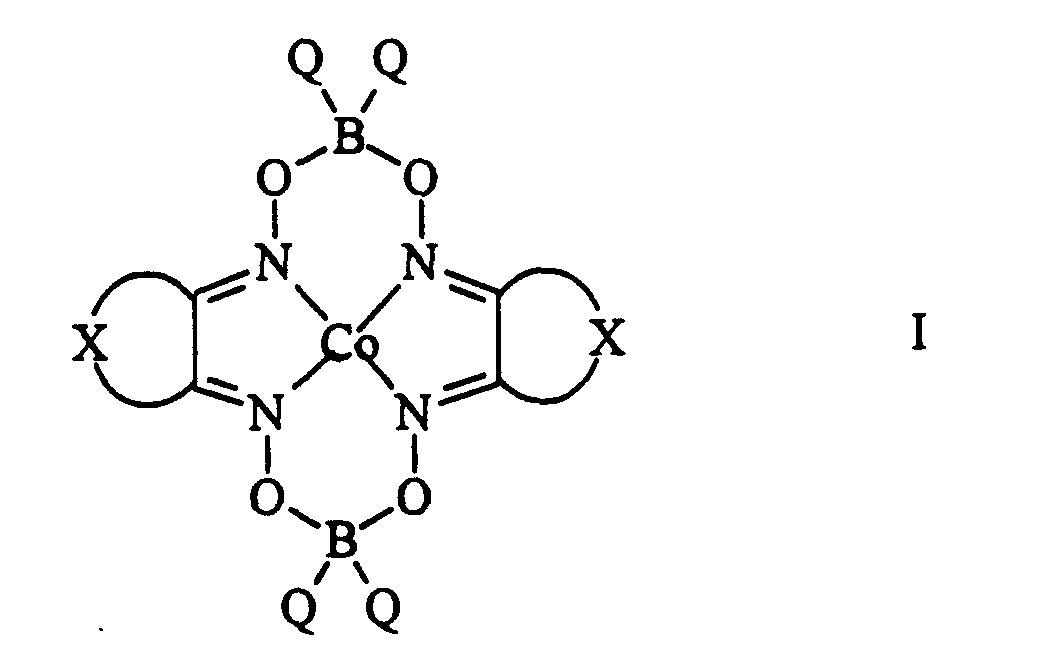
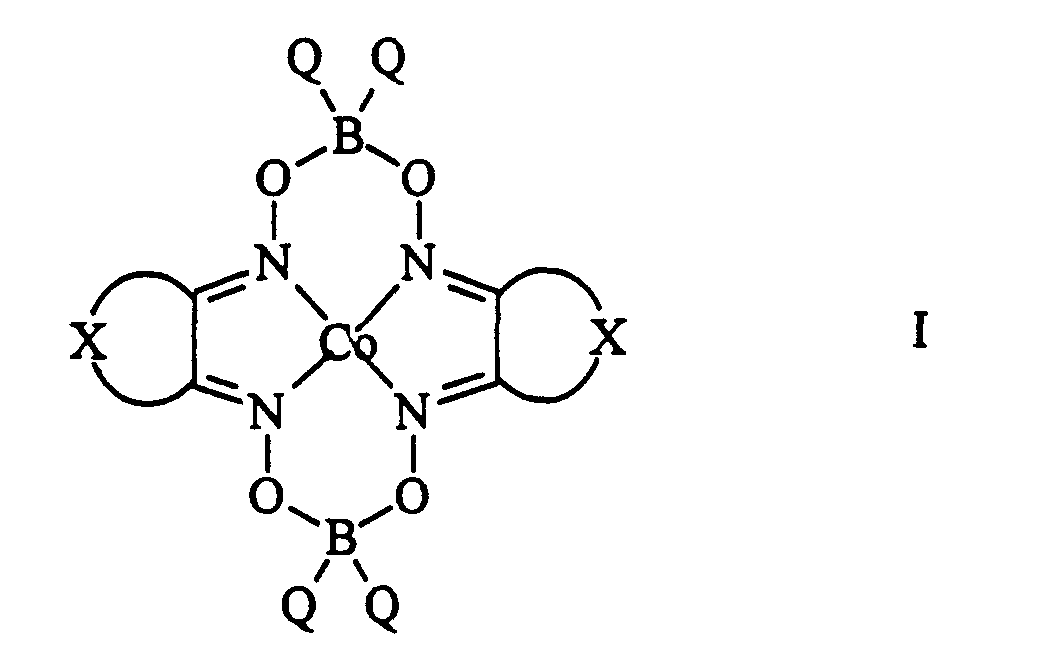
- a process for the free-radical polymerisation of olefinically unsaturated monomer(s) (especially methacrylic monomer(s)) using a free-radical initiator the polymerisation being performed in the presence of a compound for effecting molecular weight control, the molecular weight control compound being a Coil chelate of the following formula I:
- a pericondensed polycyclic group in this specification is meant a group having 3 or more carbocyclic rings (including the oxime-containing ring), i.e. the ring atoms being only of carbon atoms, where the oxime-containing carbocyclic ring has carbon atoms (not necessarily the same carbon atoms of course) in common with 2 or more of the other rings (usually 2 or 3 of the other rings) of the polycyclic group.
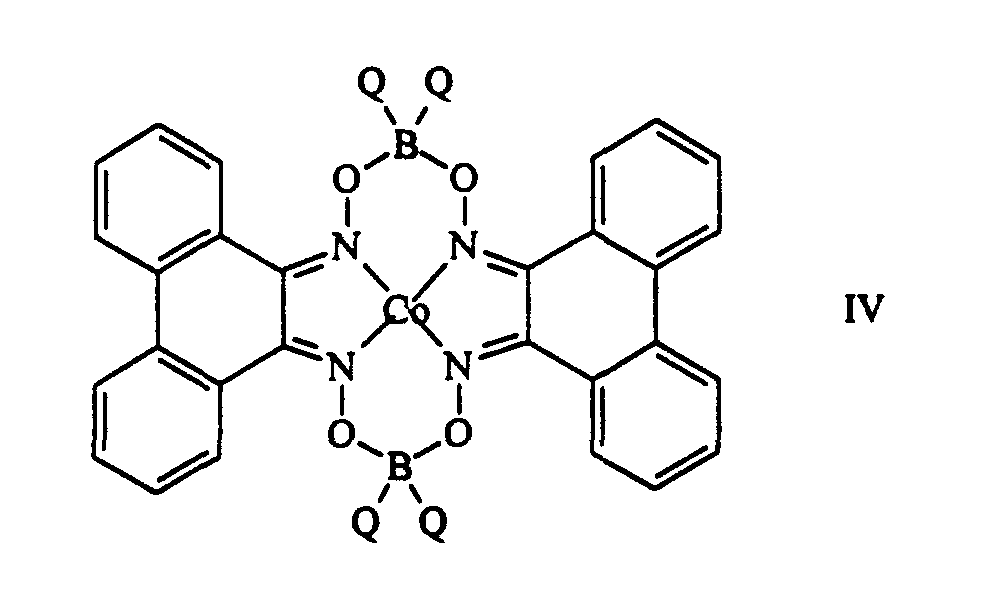
- the oxime-substituted ring may have two pairs of adjacent carbon atoms, each pair being respectivly shared (i.e. being in common) with two different rings of the polycyclic group as in formula IV below; note that if the group X in IV were a pyrene-derived group rather than a phenanthrene-derived group, as is possible, the oxime-substituted ring would have the second and third carbon atoms of the adjacent pairs of carbon atoms common to the additional ring of the pyrene ring system, with each of these carbon atoms being individually common to two other rings of the system (i.e. apart from the oxime ring).
- the oxime-substituted ring may have three consecutive carbon atoms in which the first and second carbon atoms are common with another ring of the polycyclic group and the second and third carbon atoms are common with a further ring of the polycyclic group, as in formula V below. Note that in this arrangement one of the carbon atoms is individually common to 3 rings of the polycyclic ring system.
- the polycyclic group may in principle be wholly alicyclic in character, but more usually at least 1 of the non oxime-containing rings is aromatic in character, and more preferably at least two of the non oxime-containing rings are aromatic in character.
- the carbon atoms of the polycyclic ring system are normally unsubstituted (apart from the oxime groups of course) but may optionally be substituted with a hydrocarbyl group(s) (i.e. a group(s) of only carbon and hydrogen, preferably alkyl of 1 to 12 carbons).
- a hydrocarbyl group(s) i.e. a group(s) of only carbon and hydrogen, preferably alkyl of 1 to 12 carbons.
- the two groups X are usually the same, although in principle they may be different.
- the group X is in particular selected from those of the following formulae II and III (* these are bonds, not methyl groups) giving rise to preferred cobalt II chelates of the following formulae IV and V.
- An example of a cobalt II chelate in which both the polycyclic groups X are wholly alicyclic in character is the cobalt chelate of formula IV in which the four aromatic rings shown are wholly reduced.
- the groups Q are preferably all the same and more preferably are all F.
- G is a divalent aryl or alicyclic linking group
- the group G preferably has 6 to 10 carbon atoms and linkage is from adjacent ring carbon atoms; more preferably G is o-phenylene or 1,2-cyclohexanediyl.
- G is alkylene it preferably has the formula -(CR 1 2 ) m - where each R 1 is independently hydrogen or C x H 2x+1 where x is 1 to 12 and m is 2 or 3.
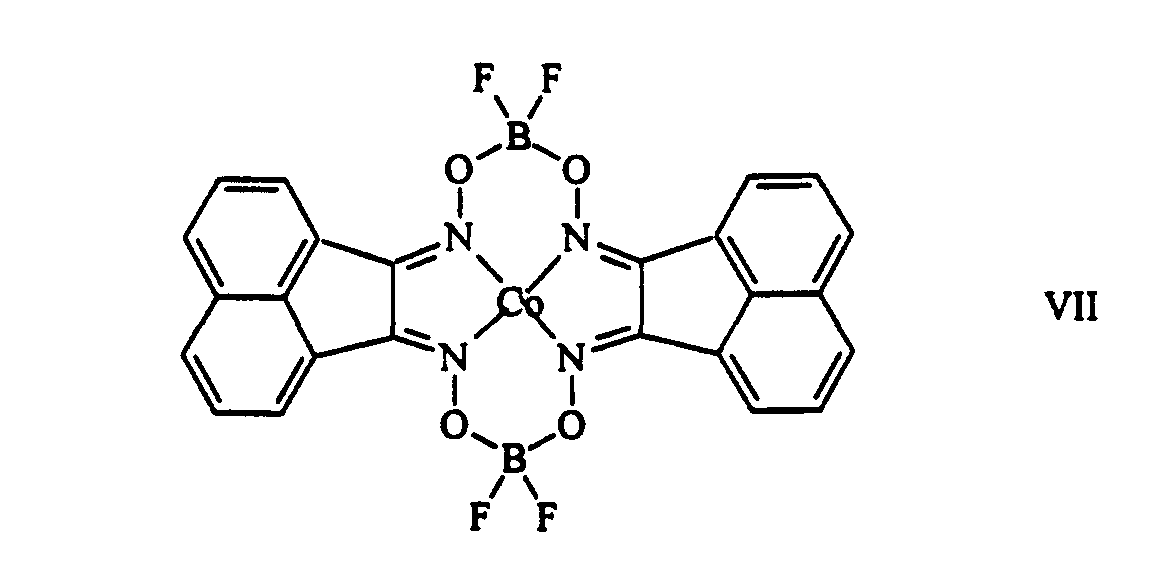
- Coil chelates for use in the invention process are those of formula VI, which is the material having formula IV in which all the Q's are F, and formula VII, which is the material having formula V in which all the Q's are F.
- the Co chelates used in the invention are electrically neutral, the surrounding ligands providing a double negative charge to balance the Co 2+ charge.
- the negative charges are believed to be delocalised rather than being on any particular atoms.
- Coil chelate complex of any formulae I to VII as defined supra and also the CoIII analogues of such complexes as defined supra.
- CoIII analogues of said compounds of said formulae arise when the Co is additionally bonded to a further atom, ion or organic group which is homolytically dissociable, such as H, optionally substituted alkyl (preferably C 1-12 ), cyano, halide, ester, aryl (preferably C 6-10 ) (including heterocyclic aryl, preferably C 6-10 ), and alicyclyl (preferably C 6-10 ) (including heterocyclic alicyclyl, preferably C 6-10 ), such a further group usually being located in an axial position (i.e. perpendicular to the equatorial ligands, the latter being as shown in the formulae above).
- a further atom, ion or organic group which is homolytically dissociable such as H, optionally substituted alkyl (preferably C 1-12 ), cyano, halide, ester, aryl (preferably C 6-10 ) (including heterocyclic aryl, preferably C 6-10 ), and ali
- WO-A-87/03605 for other compounds of a CoIII chelate type.
- Preferred are the analogous CoIII complexes in which the CoIII is reducible to Coil under the conditions of the polymerisation.
- Alkyl groups bearing one or more substituents on the carbon atom bonded to the metal ion are particularly suitable; such substituents may include nitrile, ester and optionally substituted aromatic groups.
- Some of these CoIII complexes may be stable materials under ordinary storage conditions, and may only react under the free-radical-generating conditions of the polymerisation process.
- H is the further (axial) group
- H may be highly reactive intermediate species - and indeed it is possible that all the Coil complexes (and possibly the CoIII ones as well) exert their chain transfer effect by proceeding through the reactive CoIIIH intermediate. It is also possible that there is always a periodic interchange between the Coil and CoIII valency states in the complexes during the polymerisation. In fact the actual mechanism of involvement is complex and not properly understood on our part and we do not wish to be bound by any particular theory nor to an identification of the specific chemical constitution or valency state of the Co complex during the actual polymerisation process.
- cobalt complexes as defined supra i.e. CoII or CoIII complexes
- cobalt complexes may additionally have further ligands coordinated to the Co atom (presumably axially), which do not alter the Co valency state.
- These may be derived en passant from the reaction medium used in the preparation of the Co complex or from the polymerisation medium used in the polymerisation process, or may be derived by deliberately adding a compound which will provide such ligands, and it is often the case that the coordinated presence thereof in the complex will ameliorate the latter's effectiveness.
- they are not essential to the invention, and for convenience they have not been shown in the various formulae.
- Typical of such additional ligands are weakly basic tertiary amines such as pyridine (or their substituted derivatives), trialkyl amines, dialkylamines, ethers such as tetrahydrofuran and diethyl ether, and also optionally substituted trialkyl, triaryl or tri(alkyl/aryl) phosphines (or analogous compounds such as corresponding alkoxy or aryloxy phosphines).
- the alkyl groups mentioned above preferably, and independently, are of 1-14 carbons and the aryl groups are preferably, and independently, are of 6-10 carbons, more preferably phenyl).
- One or more water molecules could also be coordinated to the Co complex.
- the defined cobalt chelate complexes allow the efficient production of oligomers and are likely to be functioning as catalytic chain transfer agents (CCEA's), and are sometime referred to as such in this specification.
- CCEA's catalytic chain transfer agents
- the degree of polymerisation of such oligomers will usually be within the range 2 to about 1000 (i.e. 2 to 1000 polymerised units), preferably 2 to 500, more preferably 10 to 500, and still more preferably 10 to 150.
- the polymerisation process can be carried out in the presence of a polymerisation medium (acting as a carrier medium for the components and as a heat transfer medium) or in the absence of such a medium (i.e. in bulk).
- a polymerisation medium the polymerisation may be e.g. a solution (in organic solvent), or a suspension or emulsion (in an aqueous medium) polymerisation.
- Typical organic solvents which may be used as the medium for the polymerisation include aromatic hydrocarbons such as benzene, toluene, and the xylenes; ethers such as diethyl ether, tetrahydrofuran, alkoxylated ethylene glycol or polyethyleneglycol; alcohols such as methanol, ethanol, propanol and butanol and their esters with carboxylic acids such as acetic, propionic and butyric acids, ketones such as acetone or methyl ethyl ketone; and liquid tertiary amines such as pyridine. Mixtures of solvents may be used.
- Water may also be used as a polymerisation medium (sometimes in combination with a solvent(s) such as described above) as in suspension or emulsion polymerisations, and for such processes conventional emulsifying or suspension agents (stabilisers) may be employed.
- suitable suspension agents include protective colloids such as partially hydrolysed polyvinylacetate (varyious degrees of hydrolysis), polyacrylic acid of varying molecular weight, cellulose derivatives, gelatin and polyvinyl pyrollidone. The amount used is usually 0.1 to 8%, calculated on monomer weight. Salts such as Na 2 SO 4 are also often included for reducing monomer solubility in the aqueous phase and to improve stabilisation.
- the polymerisations are usually performed at a temperature within the range of 25 to 160°C (more usually 45 to 90°C).
- Any suitable free radical yielding initiator may be used in the process of the invention, the usual criteria being that it has acceptable solubility in one or more of the other polymerisation components (e.g. solvent, monomers, or water), is sufficiently active at the polymerisation temperature (usually having a half life within the range 0.5 to 5 hours), and does not unacceptably affect the stability of the Co chelate.
- free-radical-yielding initiators examples include azo compounds as 2,2'-azobis(isobutyronitrile) (AIBN), 2,2'-azobis-(2-methyl)butanenitrile, 4,4'-azobis(4-cyanovaleric acid), 2-(t-butylazo)-2-cyanopropane, 2,2'-azobis[2-methyl-N-(1,1)-bis(hydroxymethyl)-2-hydroxethyl] -propionamide, and 2,2'-azobis[2-methyl-N-hydroxyethyl)]-propionamide.
- Other soluble free radical initiators may also be used, examples of which include peroxy compounds such as benzoyl peroxide and lauroyl peroxide. Combinations of initiators may of course be used.
- the use of the defined Co chelates as molecular weight control compounds in the invention process avoids the requirement to use conventional chain transfer agents which often have disadvantages of one sort or another.
- mercaptans impart a pronounced odour, and (unlike the defined Co chelates) cannot be used to incorporate certain monomers such as glycidyl methacrylate into the oligomers (this monomer being incompatible with thiol-containing chain transfer agent due to reaction of the epoxide ring).
- halogenated hydrocarbons such as bromoform or carbon tetrachloride
- ⁇ -Methyl styrene (another known chain transfer agent), possibly in combination with styrene itself, is rather more expensive than methyl methacrylate and often has to be used at very high levels, e.g. up to 35 weight % (although its deliberate use as a comonomer is not of course precluded; similarly the use of styrene itself as a comonomer is not precluded).
- the defined Co chelate acting to control molecular weight, may be used in a very low amount (because it acts in a catalytic manner) in comparison to conventional chain transfer agents for achieving comparable molecular weight reduction. This allows a much purer product to be made.
- the invention process may be carried out using an "all-inone" batch process in which all components are present in the reaction medium at the start of polymerisation or a semi batch process in which one or more the components employed (usually at least one of the monomers) is wholly or partially fed to the polymerisation medium during the polymerisation.
- the chelates used in the process may be prepared beforehand or may be formed in-situ from the appropriate reactants.
- the level of the cobalt chelate used in the polymerisation process will be such that the ratio of monomer(s)/free-radical initiator (molar basis) is within the range of from 20 to 500, more usually 40 to 300.
- the level of cobalt employed will be such that the ratio of cobalt chelate to free-radical initiator (molar basis) is within the range of 0.001 to 0.1, more usually 0.003 to 0.08.
- the molar ratio of monomer(s) to Co chelate will often be in the range from 5,000/1 to 2,000,000/1.
- the process of the invention is most effectively applied to the homo-or copolymerisation of methacrylate esters and styrenes, although acrylate esters can be polymerised effectively if included as comonomers.
- the process has a particular utility in that it may be employed for the polymerisation of acid-functional monomers.
- Preferred monomers are C1-C10 alkyl methacrylates and acrylates, hydroxy C1-C14 alkyl methacylates and acrylates, such as hydroxyethyl methacrylate and hydroxypropyl methacrylate, methacrylic acid and/or acrylic acid, styrene and styrene derivatives and epoxy C 1-14 alkyl methacrylates such as glycidyl methacrylate.
- the oligomers prepared by the invention process find particular utility in coatings, inks, and adhesives applications.
- Co(II) (diphenanthrenequinone dioxime - diBF 2 ), being the complex of formula VI (i.e. the complex of formula IV in which all Q's are F with the oxime groups in the 9, 10 position), was synthesised as follows.
- Coil di(9,10-diphenathrenequinone dioxime - H 2 ), i.e. the complex in which the oxime oxygens are linked to H was synthesised from the reaction of stoichiometric equivalents of 9,10-phenanthrenequinone dioxime and cobalt acetate hexahydrate in methanol under a nitrogen atmosphere.
- the boron difluoride derivative was synthesised by reaction of Coil di(9,10-diphenanthrenequinone dioxime-H 2 ) with excess BF 3 in diethyl ether under nitrogen.
- [MMA] / [Co] means the mole ratio of MMA to Co catalyst.
- Mw is the weight average molecular weight;
- Mn is the number average molecular weight.
- the Co catalyst used in these examples was that of formula VII (i.e. the complex of formula V with all the Q's being F) and was prepared using an analogous synthetic procedure to that used for Co(diphenanthrenequinonedioxime-diBF 2 ) as described above, but starting from acenaphthenequinonedioxime.
Landscapes
- Chemical & Material Sciences (AREA)
- Organic Chemistry (AREA)
- Health & Medical Sciences (AREA)
- Chemical Kinetics & Catalysis (AREA)
- Medicinal Chemistry (AREA)
- Polymers & Plastics (AREA)
- Addition Polymer Or Copolymer, Post-Treatments, Or Chemical Modifications (AREA)
- Polymerization Catalysts (AREA)
Description

giving rise to preferred cobalt II chelates of the following formulae IV and V.

To a 200ml Schlenk tube filled with dry nitrogen and 0.085g AIBN (2,2'-azobis(isobutyronitrile), recrystallised from ethanol) were added the appropriate amounts of the monomer(s) (typically 10ml methyl methacrylate, MMA) and 20ml of the appropriate solvent, all of which had been previously sparged with dry nitrogen. The desired amount of cobalt catalyst was then added and the tube heated at 60°C under nitrogen.
400g of distilled water, 0.6g sodium sulphate and 2.4g HX39 stabiliser (polyacrylic acid) were degassed with nitrogen for 1 hour and charged to a reactor, heated to 80°C and then a solution of 100g degassed monomer(s) containing the quoted amount of AIBN and the appropriate amount of cobalt catalyst was added and the reaction stirred at 500rpm in a reactor inside a water bath at 80°C under nitrogen for 3 hours.
| Ex No | [MMA] / [Co] | Mn | Mw/Mn |
| 1 | 50,000 | 626 | 2 |
| 2 | 102,400 | 655 | 2 |
| 3 | 256,400 | 1,004 | 2 |
| C4 | 0 (no Co cat) | 57,920 | 1.9 |
| Ex No | [AIBN] (wt%) | [Co] (g) | Mn | Mw/Mn |
| 5 | 1.25 | 0.025 | 3,562 | 1.8 |
| 6 | 1.25 | 0.05 | 3,902 | 1.8 |
| 7 | 1 | 0.015 | 1,677 | 2.2 |
| 8 | 1 | 0.01 | 6,265 | 2.5 |
| 9 | 1 | 0.005 | 8,793 | 2.5 |
| C10 | 1.25 | 0 | 143,500 | 3.9 |
| Ex No | [AIBN] (wt %) | [MAA] (wt %) | [Co] (g) | Mn | Mw/Mn |
| 11 | 1 | 4 | 0.015 | 4,559 | 2.6 |
| 12 | 1 | 8 | 0.015 | 5,382 | 2.6 |
| Ex No | [MMA] /[Co] | Mn | Mw/Mn |
| 13 | 300,000 | 14,939 | 2.6 |
| 14 | 200,000 | 11,419 | 2.8 |
| 15 | 100,000 | 8,561 | 2.6 |
| C16 | 0 | 31,900 | 2.5 |
| Ex No | [AIBN] (wt %) | [Co] (g) | Mn | Mw/Mn |
| 17 | 1.25 | 0.025 | 28,000 | 2 |
| 18 | 1.25 | 0.05 | 13,320 | 2 |
Claims (33)
- Process for the free-radical polymerisation of at least one olefinically unsaturated monomer using a free-radical initiator, the polymerisation being performed in the presence of a compound for effecting molecular weight control, wherein the molecular weight control compound is a Coil chelate of the following formula I:
 wherein each group X is a divalent group which forms with the two carbon atoms to which it is bonded a pericondensed polycyclic group, being a group having 3 or more carbocyclic rings where the oxime-containing carbocyclic ring has carbon atoms in common with 2 or more of the other rings, said polycyclic group being unsubstituted (apart from the oxime groups) or having at least one hydrocarbyl substituent;and wherein each group Q is independently selected from F, Cl, Br, OH, C1-12 alkoxy, aryloxy, C1-12 alkyl and aryl; or two Q groups taken together provide on one or both boron atoms a group -O-(G)-O- where G is a divalent aryl or alicyclic linking group or an alkylene linking group;or two Q groups taken together on one or both boron atoms provide a 1,5-cyclooctanediyl linking group;or being a CoIII analogue of said cobalt II chelate of formula I in which the Co atom is additionally covalently bonded to H, a halide or other anion, or a homolytically dissociable organic group.
 - Process according to claim 1 wherein said pericondensed polycyclic group has at least one aromatic ring.
- Process according to claim 2 wherein said pericondensed polycyclic group has at least two aromatic rings.
- Process according to any one of the preceding claims wherein the oxime-containing carbocyclic ring of said pericondensed polycylic group has carbon atoms in common with 2 or 3 of the other rings.
- Process according to any one of the preceding claims wherein said pericondensed polycyclic group is unsubstituted (apart from the oxime groups) or has at least one substituent which is C1-12 alkyl.
- Process according to any one of the preceding claims, wherein the Coil chelate complex has the formula IV:

- Process according to any one of claims 1 to 5, wherein the Coil chelate complex has the formula V:

- Process according to any one of the preceding claims wherein each Q is the same and is selected from F, Cl, Br, OH, C1-12 alkyl and C1-12 alkoxyl.
- Process according to claim 8 where each Q is F.
- Process according to claim 1 wherein said Coil chelate complex has the following formula VI:

- Process according to claim 1 wherein said Coil chelate complex has the following formula VII:
- Process according to any one of the preceding claims wherein the molecular weight control compound is the CoIII analogue of said Coil chelate in which the Co atom is additionally bonded, in a direction at right angles to the macrocyclic ring system, to H, a halide or other anion, or a homolytically dissociable organic group.
- Process according to any one of the preceding claims wherein said cobalt chelate has a further ligand(s) coordinated to the cobalt atom which does not alter the cobalt valency state, said ligand being selected from weakly basic tertiary amines, ethers, alkanols, optionally substituted trialkyl, triaryl, or tri(alkyl/aryl)phosphines and the corresponding alkoxy or aryloxy phosphines, and water.
- Process according to any one of the preceding claims wherein said polymerisation is a solution polymerisation in organic solvent.
- Process according to any one of claims 1 to 13 wherein said polymerisation is an aqueous suspension polymerisation.
- Process according to any one of the preceding claims wherein said at least one olefinically unsaturated monomer is a methacrylic monomer.
- Process according to any one of the claims 1 to 15 wherein said process is applied to the homo- or copolymerisation of methacrylate esters or styrenes.
- Process according to claim 17 wherein the monomer system employed includes an acrylate ester(s).
- Process according to any one of the preceding claims wherein the monomer system employed includes an acid-functional monomer, preferably being one or both of methacrylic acid and acrylic acid.
- Process according to any one of claims 1 to 15 wherein said monomer(s) polymerised is selected from at least one of C1-10 alkyl methacrylates and acrylates, hydroxy C1-14 alkyl methacrylates and acrylates, epoxy C1-14 alkyl methacrylates and acrylates, methacrylic acid, acrylic acid, styrene and styrene derivatives.
- Process according to any one of claims 1 to 15 wherein the monomer polymerised is selected from at least methyl methacrylate, ethyl methacrylate, propyl methacrylate (all isomers), butyl methacrylate (all isomers); the corresponding acrylates; functionalised methacrylates and acrylates selected from glycidyl methacrylate, trimethoxysilyl propyl methacrylate, allyl methacrylate, hydroxyethyl methacrylate, hydroxypropyl methacrylate, dialkylaminoalkyl methacrylates; fluoroalkyl (meth)acrylates; methacrylic acid; acrylic acid; fumaric acid (and esters), itaconic acid (and esters), and maleic anhydride; styrene, α-methyl styrene; vinyl chloride and vinyl fluoride; acrylonitrile, methacrylonitrile; vinylidene halides of formula CH2 = C(Hal)2 where each halogen is independently Cl or F; optionally substituted butadienes of the formula CH2 = C(R2)-C(R2) = CH2 where R2 is independently H, C1 to C10 alkyl, Cl, or F; sulphonic acids or derivatives thereof of formula CH2 = CHSO2OM wherein M is Na, K, Li, N(R3)4, R3, or -(CH2)2-D where each R3 is independently H or C1 to C10 alkyl, D is CO2Z, OH, N(R3)2 or SO2OZ and Z is H, Li, Na. K or N(R3)4; acrylamide or derivatives thereof of formula CH2 = CHCON(R3)2, and methacrylamide or derivatives thereof of formula CH2=C(CH3)CON(R3)2, and mixtures of such monomers.
- A Coil chelate of the following formula I:
 wherein each group X is a divalent group which forms with the two carbon atoms to which it is bonded a pericondensed polycyclic group, being a group having 3 or more carbocyclic rings where the oxime-containing carbocyclic ring has carbon atoms in common with 2 or more of the other rings, said polycyclic group being unsubstituted (apart from the oxime groups) or having at least one hydrocarbyl substituent;and wherein each group Q is independently selected from F, Cl, Br, OH, C1-12 alkoxy, aryloxy, C1-12 alkyl and aryl, or two Q groups taken together provide on one or both boron atoms a group -O- (G) -O- where G is a divalent aryl or alicyclic linking group or an alkylene linking group;or two Q groups taken together on one or both boron atoms provide a 1,5-cyclooctanediyl linking group;or being a CoIII analogue of said cobalt II chelate of formula I in which the Co atom is additionally covalently bonded to H, a halide or other anion, or a homolytically dissociable organic group.
 - A Co chelate according to claim 22 wherein said pericondensed polycyclic group has at least one aromatic ring.
- A Co chelate according to claim 22 wherein said pericondensed polycyclic group has at least two aromatic rings.
- A Co chelate according to any one of claims 22 to 24 wherein the oxime-containing carbocyclic ring of said pericondensed polycyclic group has carbon atoms in common with 2 or 3 of the other rings.
- A Co chelate according to any one of claims 22 to 25 wherein said pericondensed polycyclic group is unsubstituted (apart from the oxime groups) or has at least one substituent which is C1-12 alkyl.
- A Co chelate according to any one of claims 22 to 26, wherein the CoII chelate complex has the formula IV:

- A Co chelate according to any one of claims 22 to 26, wherein the CoII chelate complex has the formula V:
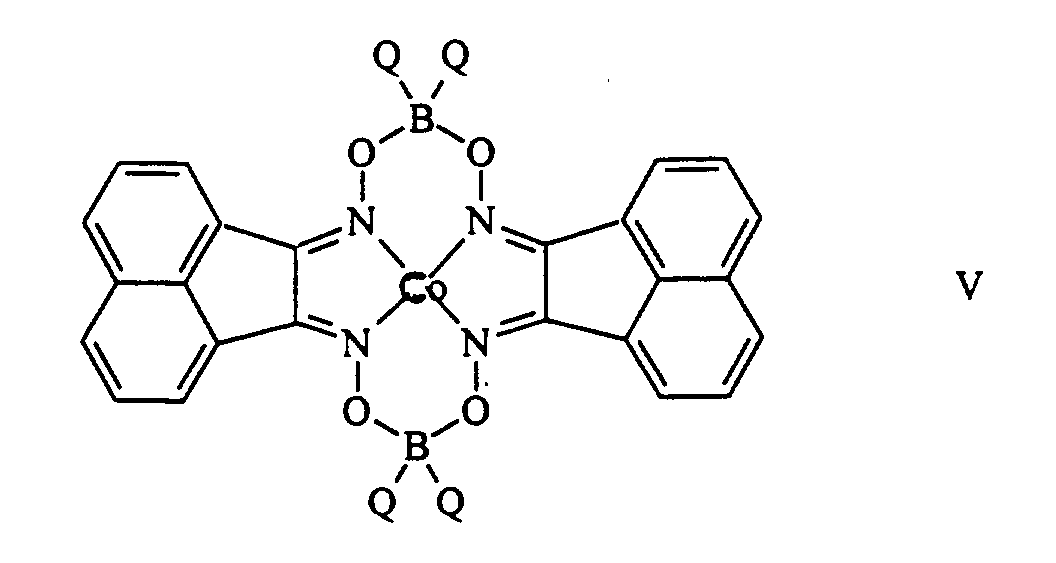
- A Co chelate according to any one of claims 22 to 28 wherein each Q is the same and is selected from F, Cl, Br, OH, C1-12 alkyl and C1-12 alkoxyl.
- A Co chelate according to claim 29 where each Q is F.
- A Co chelate according to claim 22 wherein the CoII chelate complex has the following formula VI:
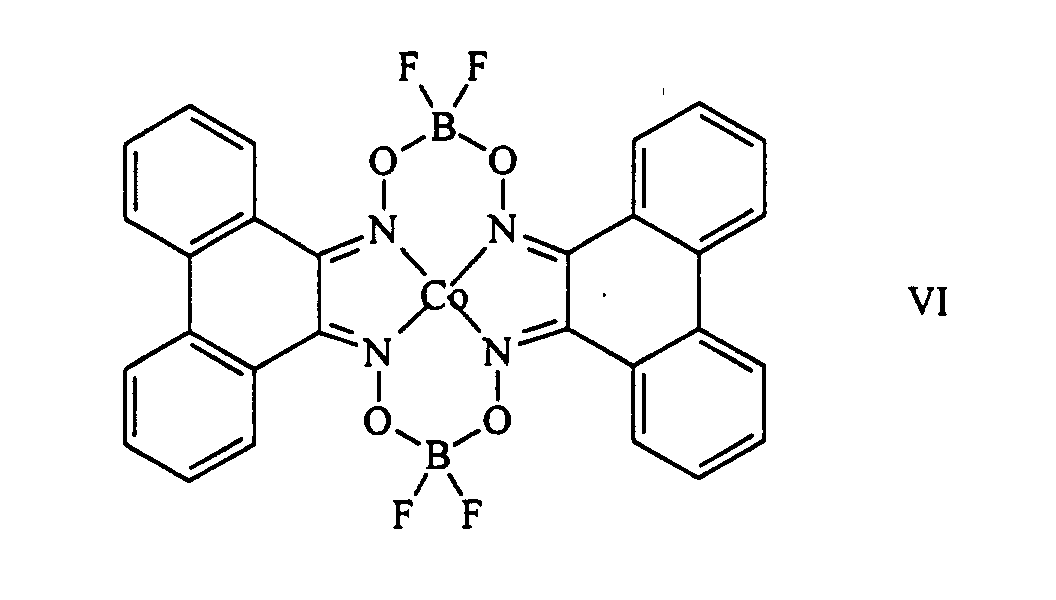
- A Co chelate according to claim 22 wherein the Coil chelate complex has the following formula VII
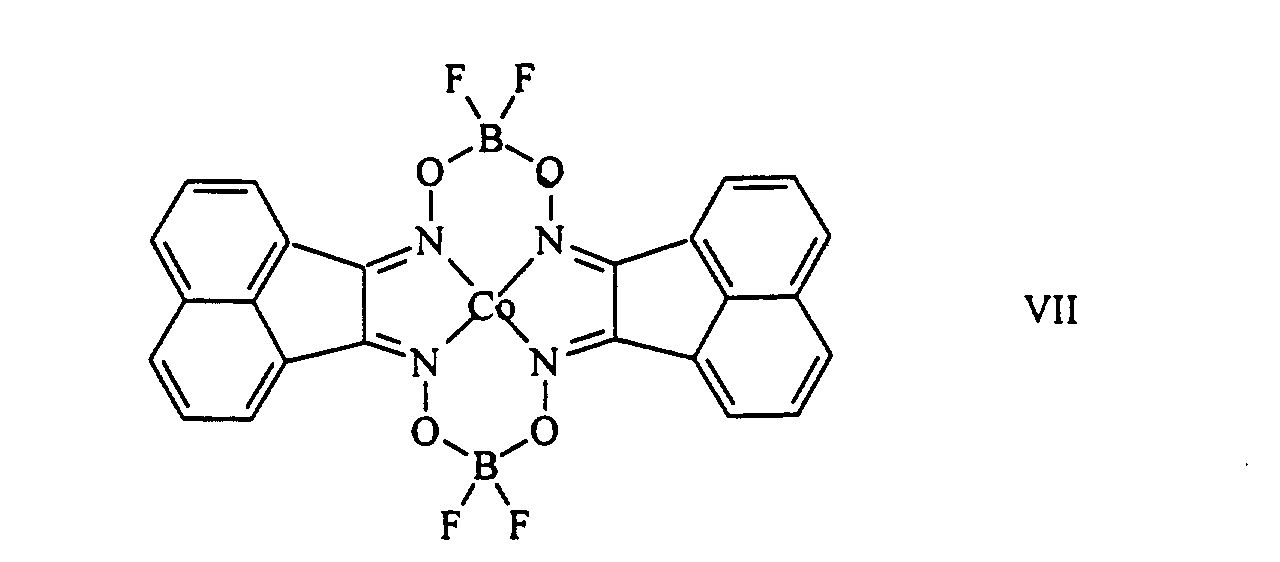
- A Co chelate according to any one of claims 22 to 32 wherein the molecular weight control compound is the CoIII analogue of said Coil chelate in which the Co atom is additionally bonded, in a direction at right angles to the macrocyclic ring system, to H, a halide, or other anion, or a homolytically dissociable organic group.
Applications Claiming Priority (3)
| Application Number | Priority Date | Filing Date | Title |
|---|---|---|---|
| GB9407129 | 1994-04-11 | ||
| GB9407129A GB9407129D0 (en) | 1994-04-11 | 1994-04-11 | Free radical polymerisation process |
| PCT/GB1995/000577 WO1995027737A1 (en) | 1994-04-11 | 1995-03-17 | Free radical polymerisation process |
Publications (2)
| Publication Number | Publication Date |
|---|---|
| EP0755411A1 EP0755411A1 (en) | 1997-01-29 |
| EP0755411B1 true EP0755411B1 (en) | 2001-06-20 |
Family
ID=10753340
Family Applications (1)
| Application Number | Title | Priority Date | Filing Date |
|---|---|---|---|
| EP95911410A Expired - Lifetime EP0755411B1 (en) | 1994-04-11 | 1995-03-17 | Free radical polymerisation process |
Country Status (7)
| Country | Link |
|---|---|
| US (1) | US5684101A (en) |
| EP (1) | EP0755411B1 (en) |
| AU (1) | AU1898695A (en) |
| DE (1) | DE69521421T2 (en) |
| ES (1) | ES2158090T3 (en) |
| GB (1) | GB9407129D0 (en) |
| WO (1) | WO1995027737A1 (en) |
Families Citing this family (10)
| Publication number | Priority date | Publication date | Assignee | Title |
|---|---|---|---|---|
| EP0788518B1 (en) * | 1994-10-28 | 1999-06-02 | Zeneca Limited | Free radical polymerisation process |
| AUPM930494A0 (en) * | 1994-11-09 | 1994-12-01 | Commonwealth Scientific And Industrial Research Organisation | Polymerization in aqueous media |
| US6121181A (en) * | 1998-08-07 | 2000-09-19 | Equistar Chemicals, L.P. | Cyclic oligomeric oxo- and imido- metal complexes as olefin polymerization catalysts |
| US7129008B2 (en) * | 1999-10-12 | 2006-10-31 | Laser Photonics Technology Inc. | Holographic recording material |
| DE10337975A1 (en) * | 2003-08-19 | 2005-04-07 | Construction Research & Technology Gmbh | Statistical comb polymers, process for their preparation and their use |
| US7022792B2 (en) * | 2004-03-16 | 2006-04-04 | E. I. Dupont De Nemours And Company | Initiation of polymerization by hydrogen atom donation |
| GB0409448D0 (en) | 2004-04-28 | 2004-06-02 | Avecia Bv | Free radical polymerisation process |
| EP2982720A1 (en) * | 2009-12-17 | 2016-02-10 | DSM IP Assets B.V. | Polymeric composition |
| US9580529B2 (en) * | 2013-01-04 | 2017-02-28 | Evonik Oil Additives Gmbh | Preparation of low-viscosity polymers |
| US11345769B2 (en) | 2019-12-30 | 2022-05-31 | Columbia Insurance Company | Hydrophobic, low glass transition temperature oligomer with high level of chain transfer agent |
Family Cites Families (6)
| Publication number | Priority date | Publication date | Assignee | Title |
|---|---|---|---|---|
| US4526945A (en) * | 1984-03-21 | 1985-07-02 | Scm Corporation | Low molecular weight polymers and copolymers |
| US4694054A (en) * | 1985-03-01 | 1987-09-15 | E. I. Du Pont De Nemours And Company | Cobalt(II) chelates as chain transfer agents in free radical polymerizations |
| US4680352A (en) * | 1985-03-01 | 1987-07-14 | E. I. Du Pont De Nemours And Company | Cobalt (II) chelates as chain transfer agents in free radical polymerizations |
| ATE76880T1 (en) * | 1985-12-03 | 1992-06-15 | Commw Scient Ind Res Org | PROCESS FOR OLIGOMERIZATION. |
| US4680354A (en) * | 1986-05-21 | 1987-07-14 | The Glidden Company | Low molecular weight polymers and copolymers |
| GB9316525D0 (en) * | 1993-08-09 | 1993-09-22 | Zeneca Ltd | Free radical polymerisation process |
-
1994
- 1994-04-11 GB GB9407129A patent/GB9407129D0/en active Pending
-
1995
- 1995-03-17 WO PCT/GB1995/000577 patent/WO1995027737A1/en not_active Ceased
- 1995-03-17 US US08/727,659 patent/US5684101A/en not_active Expired - Lifetime
- 1995-03-17 EP EP95911410A patent/EP0755411B1/en not_active Expired - Lifetime
- 1995-03-17 AU AU18986/95A patent/AU1898695A/en not_active Abandoned
- 1995-03-17 ES ES95911410T patent/ES2158090T3/en not_active Expired - Lifetime
- 1995-03-17 DE DE69521421T patent/DE69521421T2/en not_active Expired - Fee Related
Also Published As
| Publication number | Publication date |
|---|---|
| DE69521421D1 (en) | 2001-07-26 |
| GB9407129D0 (en) | 1994-06-01 |
| US5684101A (en) | 1997-11-04 |
| EP0755411A1 (en) | 1997-01-29 |
| DE69521421T2 (en) | 2002-04-11 |
| AU1898695A (en) | 1995-10-30 |
| WO1995027737A1 (en) | 1995-10-19 |
| ES2158090T3 (en) | 2001-09-01 |
Similar Documents
| Publication | Publication Date | Title |
|---|---|---|
| US5770665A (en) | Free radical polymerization process | |
| AU701611B2 (en) | Free radical polymerisation process | |
| US5602220A (en) | Free radical polymerisation process | |
| EP0199436B1 (en) | Cobalt(ii) chelates as chain transfer agents in free radical polymerizations | |
| MXPA97002791A (en) | Polymerization process of radicals lib | |
| US5324879A (en) | Oligomerization process | |
| US5028677A (en) | Novel macromonomer compositions | |
| US5684101A (en) | Free radical polymerisation process | |
| WO1987003605A1 (en) | Oligomerization process | |
| JP4593786B2 (en) | Method for producing a polymer containing N → O end groups | |
| JP3332920B2 (en) | Antibacterial agent | |
| JPWO1992014365A1 (en) | antibacterial agents | |
| KR960002979B1 (en) | Macromonomer compositions | |
| KR100250892B1 (en) | Polymerization in Aqueous Medium | |
| JPH0623209B2 (en) | Cobalt (II) chelate as chain transfer agent in free radical polymerization | |
| JP3587267B2 (en) | Salt-resistant latex | |
| JPH07258342A (en) | Salt water resistant latex | |
| EP0489941B1 (en) | Industrial coatings with oxazoline latex |
Legal Events
| Date | Code | Title | Description |
|---|---|---|---|
| PUAI | Public reference made under article 153(3) epc to a published international application that has entered the european phase |
Free format text: ORIGINAL CODE: 0009012 |
|
| 17P | Request for examination filed |
Effective date: 19961111 |
|
| AK | Designated contracting states |
Kind code of ref document: A1 Designated state(s): DE ES FR GB IT NL SE |
|
| 17Q | First examination report despatched |
Effective date: 19990127 |
|
| RAP1 | Party data changed (applicant data changed or rights of an application transferred) |
Owner name: AVECIA LIMITED |
|
| GRAG | Despatch of communication of intention to grant |
Free format text: ORIGINAL CODE: EPIDOS AGRA |
|
| GRAG | Despatch of communication of intention to grant |
Free format text: ORIGINAL CODE: EPIDOS AGRA |
|
| GRAG | Despatch of communication of intention to grant |
Free format text: ORIGINAL CODE: EPIDOS AGRA |
|
| GRAH | Despatch of communication of intention to grant a patent |
Free format text: ORIGINAL CODE: EPIDOS IGRA |
|
| GRAH | Despatch of communication of intention to grant a patent |
Free format text: ORIGINAL CODE: EPIDOS IGRA |
|
| GRAA | (expected) grant |
Free format text: ORIGINAL CODE: 0009210 |
|
| AK | Designated contracting states |
Kind code of ref document: B1 Designated state(s): DE ES FR GB IT NL SE |
|
| REF | Corresponds to: |
Ref document number: 69521421 Country of ref document: DE Date of ref document: 20010726 |
|
| REG | Reference to a national code |
Ref country code: ES Ref legal event code: FG2A Ref document number: 2158090 Country of ref document: ES Kind code of ref document: T3 |
|
| ITF | It: translation for a ep patent filed | ||
| ET | Fr: translation filed | ||
| REG | Reference to a national code |
Ref country code: GB Ref legal event code: IF02 |
|
| PLBE | No opposition filed within time limit |
Free format text: ORIGINAL CODE: 0009261 |
|
| STAA | Information on the status of an ep patent application or granted ep patent |
Free format text: STATUS: NO OPPOSITION FILED WITHIN TIME LIMIT |
|
| 26N | No opposition filed | ||
| NLS | Nl: assignments of ep-patents |
Owner name: DSM IP ASSETS B.V. Effective date: 20060227 |
|
| REG | Reference to a national code |
Ref country code: FR Ref legal event code: TP |
|
| REG | Reference to a national code |
Ref country code: GB Ref legal event code: 732E |
|
| REG | Reference to a national code |
Ref country code: ES Ref legal event code: PC2A |
|
| PGFP | Annual fee paid to national office [announced via postgrant information from national office to epo] |
Ref country code: ES Payment date: 20090326 Year of fee payment: 15 |
|
| PGFP | Annual fee paid to national office [announced via postgrant information from national office to epo] |
Ref country code: NL Payment date: 20090324 Year of fee payment: 15 |
|
| PGFP | Annual fee paid to national office [announced via postgrant information from national office to epo] |
Ref country code: SE Payment date: 20090327 Year of fee payment: 15 Ref country code: IT Payment date: 20090331 Year of fee payment: 15 Ref country code: DE Payment date: 20090327 Year of fee payment: 15 |
|
| PGFP | Annual fee paid to national office [announced via postgrant information from national office to epo] |
Ref country code: FR Payment date: 20090317 Year of fee payment: 15 |
|
| PGFP | Annual fee paid to national office [announced via postgrant information from national office to epo] |
Ref country code: GB Payment date: 20090403 Year of fee payment: 15 |
|
| REG | Reference to a national code |
Ref country code: NL Ref legal event code: V1 Effective date: 20101001 |
|
| EUG | Se: european patent has lapsed | ||
| GBPC | Gb: european patent ceased through non-payment of renewal fee |
Effective date: 20100317 |
|
| REG | Reference to a national code |
Ref country code: FR Ref legal event code: ST Effective date: 20101130 |
|
| PG25 | Lapsed in a contracting state [announced via postgrant information from national office to epo] |
Ref country code: NL Free format text: LAPSE BECAUSE OF NON-PAYMENT OF DUE FEES Effective date: 20101001 Ref country code: FR Free format text: LAPSE BECAUSE OF NON-PAYMENT OF DUE FEES Effective date: 20100331 |
|
| PG25 | Lapsed in a contracting state [announced via postgrant information from national office to epo] |
Ref country code: DE Free format text: LAPSE BECAUSE OF NON-PAYMENT OF DUE FEES Effective date: 20101001 |
|
| PG25 | Lapsed in a contracting state [announced via postgrant information from national office to epo] |
Ref country code: IT Free format text: LAPSE BECAUSE OF NON-PAYMENT OF DUE FEES Effective date: 20100317 Ref country code: GB Free format text: LAPSE BECAUSE OF NON-PAYMENT OF DUE FEES Effective date: 20100317 |
|
| REG | Reference to a national code |
Ref country code: ES Ref legal event code: FD2A Effective date: 20110419 |
|
| PG25 | Lapsed in a contracting state [announced via postgrant information from national office to epo] |
Ref country code: ES Free format text: LAPSE BECAUSE OF NON-PAYMENT OF DUE FEES Effective date: 20110404 |
|
| PG25 | Lapsed in a contracting state [announced via postgrant information from national office to epo] |
Ref country code: ES Free format text: LAPSE BECAUSE OF NON-PAYMENT OF DUE FEES Effective date: 20100318 |
|
| PG25 | Lapsed in a contracting state [announced via postgrant information from national office to epo] |
Ref country code: SE Free format text: LAPSE BECAUSE OF NON-PAYMENT OF DUE FEES Effective date: 20100318 |