EP0754754B1 - Fk506-binding protein gene - Google Patents
Fk506-binding protein gene Download PDFInfo
- Publication number
- EP0754754B1 EP0754754B1 EP95910782A EP95910782A EP0754754B1 EP 0754754 B1 EP0754754 B1 EP 0754754B1 EP 95910782 A EP95910782 A EP 95910782A EP 95910782 A EP95910782 A EP 95910782A EP 0754754 B1 EP0754754 B1 EP 0754754B1
- Authority
- EP
- European Patent Office
- Prior art keywords
- binding protein
- gene
- protein
- otk4
- dna
- Prior art date
- Legal status (The legal status is an assumption and is not a legal conclusion. Google has not performed a legal analysis and makes no representation as to the accuracy of the status listed.)
- Expired - Lifetime
Links
- 108010027179 Tacrolimus Binding Proteins Proteins 0.000 title claims abstract description 46
- 238000000034 method Methods 0.000 claims abstract description 48
- 102000018679 Tacrolimus Binding Proteins Human genes 0.000 claims abstract description 40
- 125000003275 alpha amino acid group Chemical group 0.000 claims abstract 5
- 108090000623 proteins and genes Proteins 0.000 abstract description 58
- 102000004169 proteins and genes Human genes 0.000 abstract description 17
- 238000012216 screening Methods 0.000 abstract description 5
- 239000003814 drug Substances 0.000 abstract description 4
- 230000007246 mechanism Effects 0.000 abstract description 4
- 229940124597 therapeutic agent Drugs 0.000 abstract description 4
- 102000007056 Recombinant Fusion Proteins Human genes 0.000 abstract description 3
- 108010008281 Recombinant Fusion Proteins Proteins 0.000 abstract description 3
- 208000023275 Autoimmune disease Diseases 0.000 abstract description 2
- 206010062016 Immunosuppression Diseases 0.000 abstract description 2
- 230000001506 immunosuppresive effect Effects 0.000 abstract description 2
- 101001060736 Homo sapiens Peptidyl-prolyl cis-trans isomerase FKBP1B Proteins 0.000 description 41
- 102100027914 Peptidyl-prolyl cis-trans isomerase FKBP1B Human genes 0.000 description 38
- 238000010804 cDNA synthesis Methods 0.000 description 29
- 239000002299 complementary DNA Substances 0.000 description 28
- 108020004635 Complementary DNA Proteins 0.000 description 27
- 108020004414 DNA Proteins 0.000 description 25
- 210000004027 cell Anatomy 0.000 description 21
- 239000002585 base Chemical group 0.000 description 20
- 150000001413 amino acids Chemical group 0.000 description 16
- 239000013598 vector Substances 0.000 description 16
- 108091028043 Nucleic acid sequence Proteins 0.000 description 14
- 230000000694 effects Effects 0.000 description 14
- 239000002609 medium Substances 0.000 description 13
- 108020004999 messenger RNA Proteins 0.000 description 13
- 125000000539 amino acid group Chemical group 0.000 description 12
- 210000001519 tissue Anatomy 0.000 description 12
- 102000009658 Peptidylprolyl Isomerase Human genes 0.000 description 11
- 108010020062 Peptidylprolyl Isomerase Proteins 0.000 description 11
- 239000000523 sample Substances 0.000 description 10
- 108091032973 (ribonucleotides)n+m Proteins 0.000 description 9
- 150000007523 nucleic acids Chemical class 0.000 description 9
- 241000588724 Escherichia coli Species 0.000 description 8
- 108091011114 FK506 binding proteins Proteins 0.000 description 7
- RWSXRVCMGQZWBV-WDSKDSINSA-N glutathione Chemical compound OC(=O)[C@@H](N)CCC(=O)N[C@@H](CS)C(=O)NCC(O)=O RWSXRVCMGQZWBV-WDSKDSINSA-N 0.000 description 7
- 229920002684 Sepharose Polymers 0.000 description 6
- 244000005700 microbiome Species 0.000 description 6
- 239000013612 plasmid Substances 0.000 description 6
- 230000009466 transformation Effects 0.000 description 6
- 108020004705 Codon Proteins 0.000 description 5
- 102000053602 DNA Human genes 0.000 description 5
- 240000004808 Saccharomyces cerevisiae Species 0.000 description 5
- 235000014680 Saccharomyces cerevisiae Nutrition 0.000 description 5
- 210000004556 brain Anatomy 0.000 description 5
- 239000012634 fragment Substances 0.000 description 5
- 230000008569 process Effects 0.000 description 5
- 108090000765 processed proteins & peptides Chemical group 0.000 description 5
- 108091008146 restriction endonucleases Proteins 0.000 description 5
- 230000014616 translation Effects 0.000 description 5
- 102000014914 Carrier Proteins Human genes 0.000 description 4
- 238000000636 Northern blotting Methods 0.000 description 4
- DBMJMQXJHONAFJ-UHFFFAOYSA-M Sodium laurylsulphate Chemical compound [Na+].CCCCCCCCCCCCOS([O-])(=O)=O DBMJMQXJHONAFJ-UHFFFAOYSA-M 0.000 description 4
- 108091008324 binding proteins Proteins 0.000 description 4
- 238000003776 cleavage reaction Methods 0.000 description 4
- 210000004748 cultured cell Anatomy 0.000 description 4
- 239000013604 expression vector Substances 0.000 description 4
- 230000001605 fetal effect Effects 0.000 description 4
- 229960003180 glutathione Drugs 0.000 description 4
- 235000003969 glutathione Nutrition 0.000 description 4
- 239000000047 product Substances 0.000 description 4
- 230000007017 scission Effects 0.000 description 4
- 238000000926 separation method Methods 0.000 description 4
- QKNYBSVHEMOAJP-UHFFFAOYSA-N 2-amino-2-(hydroxymethyl)propane-1,3-diol;hydron;chloride Chemical compound Cl.OCC(N)(CO)CO QKNYBSVHEMOAJP-UHFFFAOYSA-N 0.000 description 3
- 108010024636 Glutathione Proteins 0.000 description 3
- 101001060744 Homo sapiens Peptidyl-prolyl cis-trans isomerase FKBP1A Proteins 0.000 description 3
- 102100034343 Integrase Human genes 0.000 description 3
- 108700026244 Open Reading Frames Proteins 0.000 description 3
- 108020004682 Single-Stranded DNA Proteins 0.000 description 3
- 230000006044 T cell activation Effects 0.000 description 3
- 108090000190 Thrombin Proteins 0.000 description 3
- 238000002835 absorbance Methods 0.000 description 3
- 238000004458 analytical method Methods 0.000 description 3
- 238000000137 annealing Methods 0.000 description 3
- 238000006243 chemical reaction Methods 0.000 description 3
- 238000007796 conventional method Methods 0.000 description 3
- 238000000605 extraction Methods 0.000 description 3
- 102000055209 human FKBP1A Human genes 0.000 description 3
- BPHPUYQFMNQIOC-NXRLNHOXSA-N isopropyl beta-D-thiogalactopyranoside Chemical compound CC(C)S[C@@H]1O[C@H](CO)[C@H](O)[C@H](O)[C@H]1O BPHPUYQFMNQIOC-NXRLNHOXSA-N 0.000 description 3
- 108020004707 nucleic acids Proteins 0.000 description 3
- 102000039446 nucleic acids Human genes 0.000 description 3
- 210000000056 organ Anatomy 0.000 description 3
- 238000000746 purification Methods 0.000 description 3
- 238000012163 sequencing technique Methods 0.000 description 3
- 239000006228 supernatant Substances 0.000 description 3
- 229960004072 thrombin Drugs 0.000 description 3
- IJGRMHOSHXDMSA-UHFFFAOYSA-N Atomic nitrogen Chemical compound N#N IJGRMHOSHXDMSA-UHFFFAOYSA-N 0.000 description 2
- 108091003079 Bovine Serum Albumin Proteins 0.000 description 2
- UXVMQQNJUSDDNG-UHFFFAOYSA-L Calcium chloride Chemical compound [Cl-].[Cl-].[Ca+2] UXVMQQNJUSDDNG-UHFFFAOYSA-L 0.000 description 2
- CURLTUGMZLYLDI-UHFFFAOYSA-N Carbon dioxide Chemical compound O=C=O CURLTUGMZLYLDI-UHFFFAOYSA-N 0.000 description 2
- 108090000317 Chymotrypsin Proteins 0.000 description 2
- 241000701959 Escherichia virus Lambda Species 0.000 description 2
- 108010069271 FKBP-13 Proteins 0.000 description 2
- ZHNUHDYFZUAESO-UHFFFAOYSA-N Formamide Chemical compound NC=O ZHNUHDYFZUAESO-UHFFFAOYSA-N 0.000 description 2
- 108091036060 Linker DNA Proteins 0.000 description 2
- TWRXJAOTZQYOKJ-UHFFFAOYSA-L Magnesium chloride Chemical compound [Mg+2].[Cl-].[Cl-] TWRXJAOTZQYOKJ-UHFFFAOYSA-L 0.000 description 2
- 108091092724 Noncoding DNA Proteins 0.000 description 2
- 102100026408 Peptidyl-prolyl cis-trans isomerase FKBP2 Human genes 0.000 description 2
- 102100023846 Peptidyl-prolyl cis-trans isomerase FKBP3 Human genes 0.000 description 2
- 101710147149 Peptidyl-prolyl cis-trans isomerase FKBP3 Proteins 0.000 description 2
- 108010092799 RNA-directed DNA polymerase Proteins 0.000 description 2
- 108020004511 Recombinant DNA Proteins 0.000 description 2
- FAPWRFPIFSIZLT-UHFFFAOYSA-M Sodium chloride Chemical compound [Na+].[Cl-] FAPWRFPIFSIZLT-UHFFFAOYSA-M 0.000 description 2
- 210000001744 T-lymphocyte Anatomy 0.000 description 2
- 238000009825 accumulation Methods 0.000 description 2
- 239000002253 acid Substances 0.000 description 2
- 230000009471 action Effects 0.000 description 2
- 238000000246 agarose gel electrophoresis Methods 0.000 description 2
- AVKUERGKIZMTKX-NJBDSQKTSA-N ampicillin Chemical compound C1([C@@H](N)C(=O)N[C@H]2[C@H]3SC([C@@H](N3C2=O)C(O)=O)(C)C)=CC=CC=C1 AVKUERGKIZMTKX-NJBDSQKTSA-N 0.000 description 2
- 229960000723 ampicillin Drugs 0.000 description 2
- 230000003321 amplification Effects 0.000 description 2
- 210000004102 animal cell Anatomy 0.000 description 2
- 239000001110 calcium chloride Substances 0.000 description 2
- 229910001628 calcium chloride Inorganic materials 0.000 description 2
- 239000001913 cellulose Substances 0.000 description 2
- 229920002678 cellulose Polymers 0.000 description 2
- 239000003795 chemical substances by application Substances 0.000 description 2
- 229960002376 chymotrypsin Drugs 0.000 description 2
- 238000010367 cloning Methods 0.000 description 2
- 210000001072 colon Anatomy 0.000 description 2
- 230000000295 complement effect Effects 0.000 description 2
- 239000012228 culture supernatant Substances 0.000 description 2
- 238000000354 decomposition reaction Methods 0.000 description 2
- 201000010099 disease Diseases 0.000 description 2
- 208000037265 diseases, disorders, signs and symptoms Diseases 0.000 description 2
- VHJLVAABSRFDPM-QWWZWVQMSA-N dithiothreitol Chemical compound SC[C@@H](O)[C@H](O)CS VHJLVAABSRFDPM-QWWZWVQMSA-N 0.000 description 2
- 239000000284 extract Substances 0.000 description 2
- 239000012894 fetal calf serum Substances 0.000 description 2
- 238000009396 hybridization Methods 0.000 description 2
- 229960003444 immunosuppressant agent Drugs 0.000 description 2
- 230000001861 immunosuppressant effect Effects 0.000 description 2
- 239000003018 immunosuppressive agent Substances 0.000 description 2
- 238000000338 in vitro Methods 0.000 description 2
- 238000011534 incubation Methods 0.000 description 2
- 230000006698 induction Effects 0.000 description 2
- 238000003780 insertion Methods 0.000 description 2
- 230000037431 insertion Effects 0.000 description 2
- 210000003734 kidney Anatomy 0.000 description 2
- 238000002372 labelling Methods 0.000 description 2
- 210000004185 liver Anatomy 0.000 description 2
- 238000004519 manufacturing process Methods 0.000 description 2
- 239000012528 membrane Substances 0.000 description 2
- 230000000813 microbial effect Effects 0.000 description 2
- 239000000203 mixture Substances 0.000 description 2
- 238000003199 nucleic acid amplification method Methods 0.000 description 2
- 239000013600 plasmid vector Substances 0.000 description 2
- 230000008488 polyadenylation Effects 0.000 description 2
- 102000004196 processed proteins & peptides Human genes 0.000 description 2
- 238000001243 protein synthesis Methods 0.000 description 2
- 230000006798 recombination Effects 0.000 description 2
- 238000005215 recombination Methods 0.000 description 2
- 230000010076 replication Effects 0.000 description 2
- FGDZQCVHDSGLHJ-UHFFFAOYSA-M rubidium chloride Chemical compound [Cl-].[Rb+] FGDZQCVHDSGLHJ-UHFFFAOYSA-M 0.000 description 2
- 210000002966 serum Anatomy 0.000 description 2
- 210000002027 skeletal muscle Anatomy 0.000 description 2
- 238000002415 sodium dodecyl sulfate polyacrylamide gel electrophoresis Methods 0.000 description 2
- 239000000243 solution Substances 0.000 description 2
- 238000003786 synthesis reaction Methods 0.000 description 2
- 238000013518 transcription Methods 0.000 description 2
- 230000035897 transcription Effects 0.000 description 2
- 238000011144 upstream manufacturing Methods 0.000 description 2
- 239000011534 wash buffer Substances 0.000 description 2
- 238000005406 washing Methods 0.000 description 2
- LBCZOTMMGHGTPH-UHFFFAOYSA-N 2-[2-[4-(2,4,4-trimethylpentan-2-yl)phenoxy]ethoxy]ethanol Chemical compound CC(C)(C)CC(C)(C)C1=CC=C(OCCOCCO)C=C1 LBCZOTMMGHGTPH-UHFFFAOYSA-N 0.000 description 1
- KBDIEUYACKKLIJ-UHFFFAOYSA-N 2-isocyanatoguanidine Chemical compound NC(=N)NN=C=O KBDIEUYACKKLIJ-UHFFFAOYSA-N 0.000 description 1
- LKDMKWNDBAVNQZ-WJNSRDFLSA-N 4-[[(2s)-1-[[(2s)-1-[(2s)-2-[[(2s)-1-(4-nitroanilino)-1-oxo-3-phenylpropan-2-yl]carbamoyl]pyrrolidin-1-yl]-1-oxopropan-2-yl]amino]-1-oxopropan-2-yl]amino]-4-oxobutanoic acid Chemical compound OC(=O)CCC(=O)N[C@@H](C)C(=O)N[C@@H](C)C(=O)N1CCC[C@H]1C(=O)N[C@H](C(=O)NC=1C=CC(=CC=1)[N+]([O-])=O)CC1=CC=CC=C1 LKDMKWNDBAVNQZ-WJNSRDFLSA-N 0.000 description 1
- 108010051457 Acid Phosphatase Proteins 0.000 description 1
- 102000007469 Actins Human genes 0.000 description 1
- 108010085238 Actins Proteins 0.000 description 1
- 102100027211 Albumin Human genes 0.000 description 1
- 108010088751 Albumins Proteins 0.000 description 1
- 241000972773 Aulopiformes Species 0.000 description 1
- 244000063299 Bacillus subtilis Species 0.000 description 1
- 235000014469 Bacillus subtilis Nutrition 0.000 description 1
- 241000283690 Bos taurus Species 0.000 description 1
- OKTJSMMVPCPJKN-UHFFFAOYSA-N Carbon Chemical compound [C] OKTJSMMVPCPJKN-UHFFFAOYSA-N 0.000 description 1
- 108091026890 Coding region Proteins 0.000 description 1
- 108700010070 Codon Usage Proteins 0.000 description 1
- 238000011537 Coomassie blue staining Methods 0.000 description 1
- 229930105110 Cyclosporin A Natural products 0.000 description 1
- PMATZTZNYRCHOR-CGLBZJNRSA-N Cyclosporin A Chemical compound CC[C@@H]1NC(=O)[C@H]([C@H](O)[C@H](C)C\C=C\C)N(C)C(=O)[C@H](C(C)C)N(C)C(=O)[C@H](CC(C)C)N(C)C(=O)[C@H](CC(C)C)N(C)C(=O)[C@@H](C)NC(=O)[C@H](C)NC(=O)[C@H](CC(C)C)N(C)C(=O)[C@H](C(C)C)NC(=O)[C@H](CC(C)C)N(C)C(=O)CN(C)C1=O PMATZTZNYRCHOR-CGLBZJNRSA-N 0.000 description 1
- 108010036949 Cyclosporine Proteins 0.000 description 1
- 102000004594 DNA Polymerase I Human genes 0.000 description 1
- 108010017826 DNA Polymerase I Proteins 0.000 description 1
- 238000001712 DNA sequencing Methods 0.000 description 1
- 102000016928 DNA-directed DNA polymerase Human genes 0.000 description 1
- 108010014303 DNA-directed DNA polymerase Proteins 0.000 description 1
- KCXVZYZYPLLWCC-UHFFFAOYSA-N EDTA Chemical compound OC(=O)CN(CC(O)=O)CCN(CC(O)=O)CC(O)=O KCXVZYZYPLLWCC-UHFFFAOYSA-N 0.000 description 1
- 239000006145 Eagle's minimal essential medium Substances 0.000 description 1
- 102000004190 Enzymes Human genes 0.000 description 1
- 108090000790 Enzymes Proteins 0.000 description 1
- 241001646716 Escherichia coli K-12 Species 0.000 description 1
- 108060002716 Exonuclease Proteins 0.000 description 1
- 108700039691 Genetic Promoter Regions Proteins 0.000 description 1
- HTTJABKRGRZYRN-UHFFFAOYSA-N Heparin Chemical compound OC1C(NC(=O)C)C(O)OC(COS(O)(=O)=O)C1OC1C(OS(O)(=O)=O)C(O)C(OC2C(C(OS(O)(=O)=O)C(OC3C(C(O)C(O)C(O3)C(O)=O)OS(O)(=O)=O)C(CO)O2)NS(O)(=O)=O)C(C(O)=O)O1 HTTJABKRGRZYRN-UHFFFAOYSA-N 0.000 description 1
- 101000878213 Homo sapiens Inactive peptidyl-prolyl cis-trans isomerase FKBP6 Proteins 0.000 description 1
- 101000932178 Homo sapiens Peptidyl-prolyl cis-trans isomerase FKBP4 Proteins 0.000 description 1
- 102100036984 Inactive peptidyl-prolyl cis-trans isomerase FKBP6 Human genes 0.000 description 1
- 101710203526 Integrase Proteins 0.000 description 1
- QIVBCDIJIAJPQS-VIFPVBQESA-N L-tryptophane Chemical compound C1=CC=C2C(C[C@H](N)C(O)=O)=CNC2=C1 QIVBCDIJIAJPQS-VIFPVBQESA-N 0.000 description 1
- 201000009906 Meningitis Diseases 0.000 description 1
- 241001529936 Murinae Species 0.000 description 1
- 241000588653 Neisseria Species 0.000 description 1
- 241000221961 Neurospora crassa Species 0.000 description 1
- 239000004677 Nylon Substances 0.000 description 1
- 108091034117 Oligonucleotide Proteins 0.000 description 1
- 238000010222 PCR analysis Methods 0.000 description 1
- 101710111747 Peptidyl-prolyl cis-trans isomerase FKBP12 Proteins 0.000 description 1
- 101710147152 Peptidyl-prolyl cis-trans isomerase FKBP4 Proteins 0.000 description 1
- 102100020739 Peptidyl-prolyl cis-trans isomerase FKBP4 Human genes 0.000 description 1
- 108091036407 Polyadenylation Proteins 0.000 description 1
- 108091034057 RNA (poly(A)) Proteins 0.000 description 1
- 238000002123 RNA extraction Methods 0.000 description 1
- 239000012980 RPMI-1640 medium Substances 0.000 description 1
- 238000010240 RT-PCR analysis Methods 0.000 description 1
- 108020005091 Replication Origin Proteins 0.000 description 1
- 102000006382 Ribonucleases Human genes 0.000 description 1
- 108010083644 Ribonucleases Proteins 0.000 description 1
- 241000235070 Saccharomyces Species 0.000 description 1
- 238000002105 Southern blotting Methods 0.000 description 1
- 108091081024 Start codon Proteins 0.000 description 1
- 208000037065 Subacute sclerosing leukoencephalitis Diseases 0.000 description 1
- 206010042297 Subacute sclerosing panencephalitis Diseases 0.000 description 1
- 108020005038 Terminator Codon Proteins 0.000 description 1
- 229920004890 Triton X-100 Polymers 0.000 description 1
- 239000013504 Triton X-100 Substances 0.000 description 1
- QIVBCDIJIAJPQS-UHFFFAOYSA-N Tryptophan Natural products C1=CC=C2C(CC(N)C(O)=O)=CNC2=C1 QIVBCDIJIAJPQS-UHFFFAOYSA-N 0.000 description 1
- 241000251539 Vertebrata <Metazoa> Species 0.000 description 1
- ZVQOOHYFBIDMTQ-UHFFFAOYSA-N [methyl(oxido){1-[6-(trifluoromethyl)pyridin-3-yl]ethyl}-lambda(6)-sulfanylidene]cyanamide Chemical compound N#CN=S(C)(=O)C(C)C1=CC=C(C(F)(F)F)N=C1 ZVQOOHYFBIDMTQ-UHFFFAOYSA-N 0.000 description 1
- 238000011481 absorbance measurement Methods 0.000 description 1
- 239000000061 acid fraction Substances 0.000 description 1
- 150000007513 acids Chemical class 0.000 description 1
- 239000013543 active substance Substances 0.000 description 1
- 238000005377 adsorption chromatography Methods 0.000 description 1
- 238000001042 affinity chromatography Methods 0.000 description 1
- 239000003513 alkali Substances 0.000 description 1
- 230000004075 alteration Effects 0.000 description 1
- 230000003698 anagen phase Effects 0.000 description 1
- 230000000692 anti-sense effect Effects 0.000 description 1
- 239000000440 bentonite Substances 0.000 description 1
- 229910000278 bentonite Inorganic materials 0.000 description 1
- SVPXDRXYRYOSEX-UHFFFAOYSA-N bentoquatam Chemical compound O.O=[Si]=O.O=[Al]O[Al]=O SVPXDRXYRYOSEX-UHFFFAOYSA-N 0.000 description 1
- 239000000872 buffer Substances 0.000 description 1
- 239000007853 buffer solution Substances 0.000 description 1
- 210000004899 c-terminal region Anatomy 0.000 description 1
- 238000010805 cDNA synthesis kit Methods 0.000 description 1
- AIYUHDOJVYHVIT-UHFFFAOYSA-M caesium chloride Chemical compound [Cl-].[Cs+] AIYUHDOJVYHVIT-UHFFFAOYSA-M 0.000 description 1
- 229910052799 carbon Inorganic materials 0.000 description 1
- 239000001569 carbon dioxide Substances 0.000 description 1
- 229910002092 carbon dioxide Inorganic materials 0.000 description 1
- 239000006143 cell culture medium Substances 0.000 description 1
- 239000013592 cell lysate Substances 0.000 description 1
- 238000005119 centrifugation Methods 0.000 description 1
- 210000001638 cerebellum Anatomy 0.000 description 1
- 210000004720 cerebrum Anatomy 0.000 description 1
- 238000004587 chromatography analysis Methods 0.000 description 1
- 239000013611 chromosomal DNA Substances 0.000 description 1
- 229960001265 ciclosporin Drugs 0.000 description 1
- 239000013599 cloning vector Substances 0.000 description 1
- 238000001816 cooling Methods 0.000 description 1
- NKLPQNGYXWVELD-UHFFFAOYSA-M coomassie brilliant blue Chemical compound [Na+].C1=CC(OCC)=CC=C1NC1=CC=C(C(=C2C=CC(C=C2)=[N+](CC)CC=2C=C(C=CC=2)S([O-])(=O)=O)C=2C=CC(=CC=2)N(CC)CC=2C=C(C=CC=2)S([O-])(=O)=O)C=C1 NKLPQNGYXWVELD-UHFFFAOYSA-M 0.000 description 1
- 238000012136 culture method Methods 0.000 description 1
- 108091007930 cytoplasmic receptors Proteins 0.000 description 1
- 210000000172 cytosol Anatomy 0.000 description 1
- 230000001086 cytosolic effect Effects 0.000 description 1
- SUYVUBYJARFZHO-RRKCRQDMSA-N dATP Chemical compound C1=NC=2C(N)=NC=NC=2N1[C@H]1C[C@H](O)[C@@H](COP(O)(=O)OP(O)(=O)OP(O)(O)=O)O1 SUYVUBYJARFZHO-RRKCRQDMSA-N 0.000 description 1
- SUYVUBYJARFZHO-UHFFFAOYSA-N dATP Natural products C1=NC=2C(N)=NC=NC=2N1C1CC(O)C(COP(O)(=O)OP(O)(=O)OP(O)(O)=O)O1 SUYVUBYJARFZHO-UHFFFAOYSA-N 0.000 description 1
- RGWHQCVHVJXOKC-SHYZEUOFSA-J dCTP(4-) Chemical compound O=C1N=C(N)C=CN1[C@@H]1O[C@H](COP([O-])(=O)OP([O-])(=O)OP([O-])([O-])=O)[C@@H](O)C1 RGWHQCVHVJXOKC-SHYZEUOFSA-J 0.000 description 1
- HAAZLUGHYHWQIW-KVQBGUIXSA-N dGTP Chemical compound C1=NC=2C(=O)NC(N)=NC=2N1[C@H]1C[C@H](O)[C@@H](COP(O)(=O)OP(O)(=O)OP(O)(O)=O)O1 HAAZLUGHYHWQIW-KVQBGUIXSA-N 0.000 description 1
- NHVNXKFIZYSCEB-XLPZGREQSA-N dTTP Chemical compound O=C1NC(=O)C(C)=CN1[C@@H]1O[C@H](COP(O)(=O)OP(O)(=O)OP(O)(O)=O)[C@@H](O)C1 NHVNXKFIZYSCEB-XLPZGREQSA-N 0.000 description 1
- 238000012217 deletion Methods 0.000 description 1
- 230000037430 deletion Effects 0.000 description 1
- KXGVEGMKQFWNSR-LLQZFEROSA-N deoxycholic acid Chemical compound C([C@H]1CC2)[C@H](O)CC[C@]1(C)[C@@H]1[C@@H]2[C@@H]2CC[C@H]([C@@H](CCC(O)=O)C)[C@@]2(C)[C@@H](O)C1 KXGVEGMKQFWNSR-LLQZFEROSA-N 0.000 description 1
- 229960003964 deoxycholic acid Drugs 0.000 description 1
- KXGVEGMKQFWNSR-UHFFFAOYSA-N deoxycholic acid Natural products C1CC2CC(O)CCC2(C)C2C1C1CCC(C(CCC(O)=O)C)C1(C)C(O)C2 KXGVEGMKQFWNSR-UHFFFAOYSA-N 0.000 description 1
- 230000001419 dependent effect Effects 0.000 description 1
- 238000001514 detection method Methods 0.000 description 1
- 238000000502 dialysis Methods 0.000 description 1
- FFYPMLJYZAEMQB-UHFFFAOYSA-N diethyl pyrocarbonate Chemical compound CCOC(=O)OC(=O)OCC FFYPMLJYZAEMQB-UHFFFAOYSA-N 0.000 description 1
- 230000029087 digestion Effects 0.000 description 1
- 238000002635 electroconvulsive therapy Methods 0.000 description 1
- 239000006274 endogenous ligand Substances 0.000 description 1
- 229940088598 enzyme Drugs 0.000 description 1
- 102000013165 exonuclease Human genes 0.000 description 1
- 239000013613 expression plasmid Substances 0.000 description 1
- 238000007710 freezing Methods 0.000 description 1
- 230000008014 freezing Effects 0.000 description 1
- 102000037865 fusion proteins Human genes 0.000 description 1
- 108020001507 fusion proteins Proteins 0.000 description 1
- 239000000499 gel Substances 0.000 description 1
- 238000002523 gelfiltration Methods 0.000 description 1
- 238000010353 genetic engineering Methods 0.000 description 1
- 230000012010 growth Effects 0.000 description 1
- 210000002216 heart Anatomy 0.000 description 1
- 229960002897 heparin Drugs 0.000 description 1
- 229920000669 heparin Polymers 0.000 description 1
- 238000004128 high performance liquid chromatography Methods 0.000 description 1
- 210000003405 ileum Anatomy 0.000 description 1
- 230000028993 immune response Effects 0.000 description 1
- 239000003112 inhibitor Substances 0.000 description 1
- 230000005764 inhibitory process Effects 0.000 description 1
- 230000000977 initiatory effect Effects 0.000 description 1
- 238000011835 investigation Methods 0.000 description 1
- 238000004255 ion exchange chromatography Methods 0.000 description 1
- 238000006317 isomerization reaction Methods 0.000 description 1
- 210000000265 leukocyte Anatomy 0.000 description 1
- 239000007788 liquid Substances 0.000 description 1
- 210000004072 lung Anatomy 0.000 description 1
- 206010025135 lupus erythematosus Diseases 0.000 description 1
- 239000012139 lysis buffer Substances 0.000 description 1
- 229910001629 magnesium chloride Inorganic materials 0.000 description 1
- 239000007758 minimum essential medium Substances 0.000 description 1
- 239000011259 mixed solution Substances 0.000 description 1
- 238000002156 mixing Methods 0.000 description 1
- 230000004048 modification Effects 0.000 description 1
- 238000012986 modification Methods 0.000 description 1
- 238000010369 molecular cloning Methods 0.000 description 1
- 239000002808 molecular sieve Substances 0.000 description 1
- 230000035772 mutation Effects 0.000 description 1
- 229910052757 nitrogen Inorganic materials 0.000 description 1
- 229920001778 nylon Polymers 0.000 description 1
- 229920002113 octoxynol Polymers 0.000 description 1
- 230000003204 osmotic effect Effects 0.000 description 1
- 210000001672 ovary Anatomy 0.000 description 1
- 238000004806 packaging method and process Methods 0.000 description 1
- 210000000496 pancreas Anatomy 0.000 description 1
- 230000008506 pathogenesis Effects 0.000 description 1
- 230000007170 pathology Effects 0.000 description 1
- 210000005259 peripheral blood Anatomy 0.000 description 1
- 239000011886 peripheral blood Substances 0.000 description 1
- 230000000144 pharmacologic effect Effects 0.000 description 1
- 238000002205 phenol-chloroform extraction Methods 0.000 description 1
- -1 phosphite triester Chemical class 0.000 description 1
- 210000002826 placenta Anatomy 0.000 description 1
- 229920002401 polyacrylamide Polymers 0.000 description 1
- 229920001184 polypeptide Polymers 0.000 description 1
- 230000004481 post-translational protein modification Effects 0.000 description 1
- 239000008057 potassium phosphate buffer Substances 0.000 description 1
- 230000003389 potentiating effect Effects 0.000 description 1
- 230000001376 precipitating effect Effects 0.000 description 1
- 210000002307 prostate Anatomy 0.000 description 1
- 238000002731 protein assay Methods 0.000 description 1
- 230000012846 protein folding Effects 0.000 description 1
- 210000001938 protoplast Anatomy 0.000 description 1
- 239000011541 reaction mixture Substances 0.000 description 1
- 238000011160 research Methods 0.000 description 1
- 230000000717 retained effect Effects 0.000 description 1
- 239000003161 ribonuclease inhibitor Substances 0.000 description 1
- 235000019515 salmon Nutrition 0.000 description 1
- 238000005185 salting out Methods 0.000 description 1
- 150000003839 salts Chemical class 0.000 description 1
- 238000002741 site-directed mutagenesis Methods 0.000 description 1
- 210000000813 small intestine Anatomy 0.000 description 1
- URGAHOPLAPQHLN-UHFFFAOYSA-N sodium aluminosilicate Chemical compound [Na+].[Al+3].[O-][Si]([O-])=O.[O-][Si]([O-])=O URGAHOPLAPQHLN-UHFFFAOYSA-N 0.000 description 1
- 239000011780 sodium chloride Substances 0.000 description 1
- 238000000527 sonication Methods 0.000 description 1
- 238000001179 sorption measurement Methods 0.000 description 1
- 241000894007 species Species 0.000 description 1
- 210000000952 spleen Anatomy 0.000 description 1
- 230000002269 spontaneous effect Effects 0.000 description 1
- 238000010186 staining Methods 0.000 description 1
- 239000011550 stock solution Substances 0.000 description 1
- 210000002784 stomach Anatomy 0.000 description 1
- 238000012916 structural analysis Methods 0.000 description 1
- 239000000126 substance Substances 0.000 description 1
- 239000000758 substrate Substances 0.000 description 1
- 230000001629 suppression Effects 0.000 description 1
- 239000004094 surface-active agent Substances 0.000 description 1
- 230000009885 systemic effect Effects 0.000 description 1
- 210000001550 testis Anatomy 0.000 description 1
- 238000010257 thawing Methods 0.000 description 1
- 210000001541 thymus gland Anatomy 0.000 description 1
- 230000005030 transcription termination Effects 0.000 description 1
- 238000013519 translation Methods 0.000 description 1
- 238000000108 ultra-filtration Methods 0.000 description 1
- 238000005199 ultracentrifugation Methods 0.000 description 1
- 229910052720 vanadium Inorganic materials 0.000 description 1
- LEONUFNNVUYDNQ-UHFFFAOYSA-N vanadium atom Chemical compound [V] LEONUFNNVUYDNQ-UHFFFAOYSA-N 0.000 description 1
- 229940088594 vitamin Drugs 0.000 description 1
- 239000011782 vitamin Substances 0.000 description 1
- 229930003231 vitamin Natural products 0.000 description 1
- 235000013343 vitamin Nutrition 0.000 description 1
- 238000001262 western blot Methods 0.000 description 1
Images


Classifications
-
- C—CHEMISTRY; METALLURGY
- C12—BIOCHEMISTRY; BEER; SPIRITS; WINE; VINEGAR; MICROBIOLOGY; ENZYMOLOGY; MUTATION OR GENETIC ENGINEERING
- C12N—MICROORGANISMS OR ENZYMES; COMPOSITIONS THEREOF; PROPAGATING, PRESERVING, OR MAINTAINING MICROORGANISMS; MUTATION OR GENETIC ENGINEERING; CULTURE MEDIA
- C12N9/00—Enzymes; Proenzymes; Compositions thereof; Processes for preparing, activating, inhibiting, separating or purifying enzymes
- C12N9/90—Isomerases (5.)
Definitions
- the present invention relates to an FK506 binding protein gene.
- FK506 is a potent immunosuppressant and, like cyclosporin A [Borel, J. G. et al., Agents and Actions, 6, 468-471 (1976)], it is often used for preventing allograft rejection [Thomson, A. W., Immunol. Today, 10 , 6-9 (1989)]. It is considered that the mechanism of its immunosuppresant action is in focus on the suppression of translation, during T cell activation [Tocci, M. et al., J. Immunol., 143, 718-726 (1989)], of a series of lymphokine genes which is critical to early immune responses. However, the precise mechanism remains unclear.
- AF506 binding protein was found in human T cells. It was identified as the 12 kDa cytosolic receptor of FK506 and shown to have peptidylprolyl cis-trans isomerase activity (PPIase activity) [Siekier, J. et al., J. Immunol., 143 , 1580-1583 (1989)].
- FKBPs FK506 binding proteins
- cDNA clones a number of FK506 binding proteins (FKBPs) and corresponding cDNA clones have been isolated and the nucleotide sequences of said clones have been determined [for example, human FKBPs such as FKBP-12 (Standaert, R. F. et al., Nature, 346 , 671-674 (1990); Maki, N, et al., Proc. Natl. Acad. Sci. USA, 87 , 5440-5443 (1990)), FKBP-13 (Jin, Y. et al., Proc. Natl. Acad. Sci.
- FKBPs FK506 binding proteins
- WO95/21861 discloses a FK-506 cytosolic binding protein isolated from the cytosol of mammalian tissues.
- FKBPs all have PPIase activity, which is presumably essential for protein folding during protein synthesis in cells [Ficher, G. et al., Biomed. Biochim. Acta, 43 , 1101-1111 (1984)]. Although no clear evidence is available to prove that said PPIase activity is necessary for T cell activation, binding of FK506 to FKBPs is believed to bring about inhibition of PPIase activity and thereby inactivate T cells [Tropschug, M. et al., Nature, 346 , 674-677 (1990)].
- FKBP FK506 binding protein
- the present inventors succeeded in isolating, from a human fetal brain cDNA library, a novel gene coding for a protein highly homologous to the human FK506 binding protein 12 kD (FKBP-12) and in determining its full-length cDNA sequence. Based on these results, they have now attained the present invention.
- the present invention is directed to an FK506 binding protein gene coding for an amino acid sequence defined by the sequence shown under SEQ ID NO:1 or SEQ ID NO:2 in the sequence listing.
- the gene of the present invention includes genes characterized in that they comprise an open reading frame consisting of a 324 nucleic acid sequence coding for the 108 amino acid residues as shown under the above-mentioned SEQ ID NO:1.
- the gene of the present invention also includes genes characterized in that they comprise an open reading frame consisting of a 240 nucleic acid sequence coding for the 80 amino acid residues as shown under the above-mentioned SEQ ID NO:2.
- novel FK506 binding proteins encoded by the genes of the present invention are characterized by high PPIase activity.
- the gene of the present invention is represented by a single-stranded DNA sequence, as shown under, for example, SEQ ID NO:3, the present invention also includes the DNA sequence complementary to such a single-stranded DNA sequence as well as a component comprising both of these.
- the DNA sequence representing the gene of the present invention shown in the above-mentioned SEQ ID NO:3 is an example of the codon combination coding for the respective amino acid residues according to the amino acid sequence shown under the above-mentioned SEQ ID NO:1.
- the gene of the present invention is not limited to the above-mentioned one but may, of course, have any other DNA base sequence comprising a combination of codons arbitrarily selected for the respective amino acid residues without altering the above-mentioned amino acid sequence.
- Codons can be carried out by the conventional method in which the codon usage or codon choice in the host to be used for gene recombination is taken into consideration [Nucl. Acids Res., 9 , 43-74 (1981)], and these codons can be produced, for example by chemical synthesis, etc..
- the gene of the present invention further includes DNA sequences coding for those equivalents to the above-mentioned amino acid sequence that are derived from the latter by deletion, addition or like modification of one or more amino acid residues or part of the amino acid sequence and have similar PPIase activity to that of the FK 506 binding protein. While production, alteration (mutation) or the like of these polypeptides may occur spontaneously, they can also be produced by posttranslational modification. Furthermore, any desired gene can be produced by gene engineering techniques such as the site-specific mutagenesis technique in which the natural gene (gene of the present invention) is altered, by a chemical synthesis technique such as the phosphite triester method in which mutant DNAs are synthesized or by combining both procedures.
- the FK506 binding protein can be expressed readily and in large quantities, and said protein can be isolated and provided. Since said protein has PPIase activity, it is effective for various pharmacological purposes, not to speak of T cell activation, and it is also useful, among others, in elucidating the pathogenesises, the pathologies or the like of various diseases.
- the recombinant FK506 binding protein obtained by utilizing the gene of the present invention is an immunosuppressant binding protein, it can effectively be used, for example, in elucidating the mechanism of immunosuppression in living bodies, developing or screening out therapeutic agents for autoimmune diseases (e.g. rheumatism, SLE (systemic lupus erythematodes), etc.), searching for endogenous ligands to the novel binding protein and developing therapeutic agents therefor.
- autoimmune diseases e.g. rheumatism, SLE (systemic lupus erythematodes), etc.
- the gene of the present invention can be isolated by general genetic engineering techniques, for example, by selecting an appropriate clone from among a human fetal brain cDNA library (cDNA synthesized in the conventional manner from mRNA isolated and purified from total RNA obtained in turn from appropriate origin cells containing a gene coding for the FK506 binding protein) using appropriate probes, purifying said clone, and determining the base sequence thereof. In this way, the gene of the present invention can be obtained.
- a human fetal brain cDNA library cDNA synthesized in the conventional manner from mRNA isolated and purified from total RNA obtained in turn from appropriate origin cells containing a gene coding for the FK506 binding protein
- the origin cells may be any animal cells or tissues where the occurrence of an FK506 binding protein is known, or soluble fractions of cultured cells derived therefrom. This can be isolated and purified for the culture supernatant by various chromatographic processes.
- Said origin cells capable of FK506 binding protein expression can be cultured by the conventional culture method using an appropriate cell culture medium.
- the medium that can be used in this case are RPMI 1640 medium, CEM medium, CMRL-1066 medium, Dulbecco's modified Eagle's minimum essential medium (Eagle's MEM), Fisher's medium, F-10 medium and the like.
- serum such as fetal calf serum (FCS), and/or serum components, such as albumin, may adequately be added to these medium.
- Cultivation can be carried out in the conventional manner, for example by the carbon dioxide incubator method, generally at about 30 to 40°C, preferably at about 37°C, for about 5 to 17 days, preferably for about 8 to 11 days.
- RNA extraction from said origin tissue or cultured cells can be carried out as follows.
- the tissue is disrupted in an appropriate buffer solution, such as potassium phosphate buffer, supplemented with EDTA, DTT (dithiothreitol) or the like, under ice cooling, then partially or completely disrupted and solubilized by using a guanidine-isocyanate mixed solution or an appropriate surfactant such as SDS, NP-40, Triton X-100 or deoxycholic acid, or by physical means such as a homogenizer or freezing and thawing and, thereafter, chromosomal DNA is cut to a certain extent using a Polytron mixer (Kinematica, Switzerland) or a like mixer or a syringe, followed by separation into a protein fraction and a nucleic acid fraction.
- an appropriate buffer solution such as potassium phosphate buffer, supplemented with EDTA, DTT (dithiothreitol) or the like
- a guanidine-isocyanate mixed solution or an appropriate surfactant such as SDS, NP-40,
- phenol-chloroform extraction or the cesium chloride density gradient method using ultracentrifugation at about 100,000 x g [Chirgwin, J. M., et al., Biochemistry, 18, 5294 (1979)], among others, can be generally employed.
- an RNase inhibitor such as heparin, polyvinylsulfuric acid, diethyl pyrocarbonate, vanadium complex, bentonite, macaloid or the like.
- Separation and purification of mRNA from the RNA obtained by the above-mentioned extraction process can be carried out, for example by subjecting the extract to an adsorption column, such as an oligo(dT)-cellulose (Collaborative Research Inc.), poly(U)-Sepharose 2B (Pharmacia) or Sepharose (Pharmacia) column, or by a batch method.
- an adsorption column such as an oligo(dT)-cellulose (Collaborative Research Inc.), poly(U)-Sepharose 2B (Pharmacia) or Sepharose (Pharmacia) column, or by a batch method.
- the purified mRNA obtained as mentioned above is generally unstable. Therefore, it is reversely transcribed to the stable complementary DNA (cDNA) form and the latter is joined to a replicon of the microorganism origin for enabling amplification of the desired gene.
- cDNA stable complementary DNA
- oligo(dT) either free oligo(dT) or oligo(dT) already joined to a vector primer
- primer oligo(dT)
- mRNA single-stranded cDNA complementary to the mRNA is synthesized based on the latter using reverse transcriptase in the presence of dNTPs (dATP, dGTP, dCTP and dTTP).
- dNTPs dATP, dGTP, dCTP and dTTP.
- the mRNA used as template is removed by decomposition with alkali treatment, for instance, and, then, double-stranded DNA is produced using the single-stranded DNA as template, together with reverse transcriptase or DNA polymerase. Both ends of the thus-obtained double-stranded DNA are treated with exonuclease, and an appropriate linker DNA or a plurality of bases whose combination allows annealing is joined to each, followed by insertion into an appropriate vector.
- This can be carried out, according to the vector used, by a conventional method, for example by the Gubler-Hoffman method.
- a commercially available cDNA synthesis kit may also be used.
- the use of such a kit is advantageous in that the procedure becomes simple and easy.
- the vector to be used here is not limited to any particular species. It is recommendable, however, to select it suitably from among ⁇ gt phage vectors, EK plasmid vectors and the like, either singly or in combination, according to the host to be used.
- ⁇ gt phage vectors there may be mentioned ⁇ gt10, ⁇ gt11, etc.
- the process dealing with these ⁇ gt phage vectors can be carried out by the method of Young et al. [Young, R. A., et al., in DNA Cloning, 1 , 49 (1985)].
- the mRNA-cDNA hybrid while the mRNA used as template is retained, the mRNA-cDNA hybrid, a linearized plasmid with a plurality of bases combined so as to enable annealing as mentioned above, and a linker DNA (often used is a DNA fragment containing a region capable of autonomous replication in animal cells and a transcription promoter region of mRNA) are together subjected to annealing to give a circularized product. Then, the mRNA is replaced with a DNA chain in the presence of dNTPs, RNase H and DNA polymerase I, to give a completed plasmid DNA.
- the DNA obtained in the above manner can be introduced into an appropriate host of the vector, for example Escherichia coli , Bacillus subtilis, Saccharomyces cerevisiae or the like, to thereby transform the host.
- an appropriate host of the vector for example Escherichia coli , Bacillus subtilis, Saccharomyces cerevisiae or the like.
- Employable for this DNA introduction into host for transformation are those methods that are generally used, for example the method comprising collecting cells mostly at the logarithmic growth phase, treating them with CaCl 2 to place in a condition suited for ready spontaneous taking up of the DNA, and allowing the plasmid to be taken up.
- MgCl 2 or RbCl may be caused to be present so that the transformation efficiency can be further improved, as is generally known.
- a cDNA library in ⁇ phage can be constructed by in vitro packaging.
- Commercially available cDNA libraries for example various cDNA libraries available from Clontech, can also be used as said cDNA library.
- Screening of the thus-obtained cDNA library for the gene of the present invention can be performed in the conventional manner.
- the screening method there may be mentioned, for example, the method comprising selecting the corresponding cDNA clone by Western blotting using an antibody specific to the FK506 binding protein against the protein produced by cDNA, the Southern blotting method which uses a probe selectively binding to the desired DNA sequence, the Northern blotting method, and the combination of these.
- the probe to be used here DNA sequences or the like chemically synthesized based on the information concerning the desired DNA or RNA sequence or the amino acid sequence encoded thereby are generally used, among others. DNA or RNA derived from the nature can also be used as such a probe.
- the above-mentioned probe is prepared in the following manner.
- poly(A) + RNA is selected from among RNA obtained from a tissue or cultured cells containing the FK506 binding protein
- single-stranded cDNA is synthesized by the method mentioned above and, after the reaction is terminated, the single-stranded cDNA is amplified by the PCR method [Saiki, R. K., et al., Science, 230, 1350-1354 (1985)] using primers estimably corresponding to information about the amino acid sequence of parts of the FK506 binding protein using an automatic oligonucleotide synthesizer.
- the base sequence of the thus-obtained DNA fragment can be determined in the conventional manner. For example, after the DNA fragment obtained is digested with an appropriate restriction enzyme, sequencing can be performed by the dideoxy method [Sanger, F., Nicklen, S. and Coulson, A. R., DNA sequencing with chain-terminating inhibitors, Proc. Natl. Acad. Sci. USA, 74 , 5463-5467 (1977)] or the Maxam-Gilbert method [Maxam, A. M. and Gilbert, W., Methods in Enzymology, 65 , 499 (1980)], for instance. Furthermore, said base sequence determination may also be readily carried out using commercially available sequencing kits or the like.
- the thus-determined full-length base sequence of a DNA containing the gene of the present invention is as shown in the sequence listing under SEQ ID NO:3.
- the desired DNA can be screened out by the plaque hybridization technique developed by Benton and Davis [Benton, W. and Davis, R., Science, 196, 383-394 (1977)].
- the gene of the present invention as obtained in the above manner can be cloned in various plasmids in the conventional manner.
- the gene of the present invention can be inserted into a cloning vector (e.g. plasmid) cleaved with the same restriction enzyme and purified, at the cleavage site thereof, whereby a recombinant plasmid can be obtained.
- a restriction enzyme map of the clone containing said gene can be drawn using the transformant by a conventional known method, for example the method described in Molecular Cloning (A Laboratory Manual), T.
- the base sequence of said clone can be determined by the above-mentioned dideoxy method or the Maxam-Gilbert method, for instance.
- the base sequence determination mentioned above may also be readily performed using a commercially available kit or the like.
- the recombinant FK506 binding protein can be obtained by various known gene recombination techniques [cf. for example Science, 224, 1431 (1984); Biochem. Biophys. Res. Comm., 130, 692 (1985); Proc. Natl. Acad. Sci. USA, 80 , 5990 (1983)].
- Said FK506 binding protein is produced, in more detail, by constructing a recombinant DNA allowing expression of the gene of the present invention in host cells, introducing this into host cells for transformation thereof, and cultivating the transformant strain.
- the host cells may be either eukaryotic or prokaryotic.
- As an expression vector for use with vertebrate cells it is possible to use one containing a promoter generally located upstream of the gene to be expressed, an RNA splicing site, a polyadenylation site and a transcription termination sequence and so on. This may further have a replication origin, as necessary.
- Yeasts are often and generally used as eukaryotic microorganisms and, among them, yeasts belonging to the genus Saccharomyces are advantageously used.
- pAM82 Usable as expression vectors for use with said yeasts and other eukaryotic microorganisms are pAM82 [A. Miyanohara et al., Proc. Natl. Acad. Sci. USA, 80 , 1-5 (1983)] containing a promoter for the acid phosphatase gene, and like vectors. Escherichia coli and Bacilus subtilis are generally and very often used as prokaryotic host cells.
- an expression plasmid is preferably used which is derived, for instance, from a plasmid vector capable of replication in said host microorganisms and provided with a promoter, the SD (Shine and Dalgarno) base sequence and further an initiation codon (e.g. ATG) necessary for the initiation of protein synthesis, upstream from the gene of the present invention so that said gene can be expressed.
- a promoter the SD (Shine and Dalgarno) base sequence and further an initiation codon (e.g. ATG) necessary for the initiation of protein synthesis, upstream from the gene of the present invention so that said gene can be expressed.
- the hose Escherichia coli mentioned above the strain Escherichia coli K12 and the like are often used and, as the vector, pBR322 is generally and often used.
- the host and vector are not limited thereto, but other various known microbial strains and vectors can also be used.
- the promoter the tryptophan (trp) promote
- the thus-obtained desired recombinant DNA can be introduced into host cells for transformation thereof by various conventional methods.
- the transformant obtained can be cultivated in the conventional manner, leading to production and accumulation of the desired FK506 binding protein encoded by the gene of the present invention.
- the medium to be used in said cultivation can adequately be selected, according to the host cells employed, from among various media in common use.
- transformant cultivation can be conducted using LB medium, E medium, M9 medium, M63 medium or the like. To these media, there may be added, as necessary, generally known various carbon sources, nitrogen sources, inorganic salts, vitamins, nature-derived extracts, physiologically active substances, etc.
- the above-mentioned transformant cultivation can be carried out under conditions suited for the growth of the host cells.
- conditions can be employed, for instance, as a pH of about 5 to 8, preferably 7 or thereabout, and a temperature of about 20 to 43°C, preferably 37°C or thereabout.
- the transformant cells produce and accumulate intracellularly or secrete extracellularly the desired recombinant FK506 binding protein.
- Said desired protein can be isolated and purified by various separation techniques utilizing its physical, chemical and other properties [cf. for example "Seikagaku (Biochemistry) Data Book II", pages 1175-1259, 1st edition, 1st printing, published June 23, 1980 by Kabushiki Kaisha Tokyo Kagaku Dojin; Biochemistry, vol. 25, No. 25, 8274-8277 (1986); Eur. J. Biocehm., 163, 313-321 (1987)].
- Fig. 1 schematically shows the base sequence of OTK4(6-1) (top) and that of OTK4(4-1) (bottom).
- Fig. 2 shows the results of analysis of the OTK4 protein by SDS-PAGE.
- Fig. 3 shows the PPIase activity of the OTK4 protein.
- Fig. 4 shows the results of Northern blot analysis of various tissues using the OTK4 gene.
- Fig. 5 shows the results of RT-PCR analysis of various tissues to investigate the expression of OTK4(4-1) and OTK4(6-1).
- a 1.0 kb clone highly homologous to the human FK506 binding protein 12kDa was selected in the conventional manner and designated OTK4.
- OTK4 and OTK4(6-1) have one and the same nucleic acid sequence.
- the full nucleic acid sequence of OTK4(6-1) is as shown in the sequence listing under SEQ ID NO:3.
- This clone has an open reading frame consisting of a sequence of 324 nucleic acid residues coding for the 108 amino acid residues shown under SEQ ID NO:1. Its 5' noncoding region comprising a sequence of 72 bases contains a GC-rich sequence and its 3' noncoding region comprising a sequence of 470 bases contains the polyadenylation signal AATAAA, followed by a poly(A) tail.
- the other clone OTK4(4-1) encodes the 80 amino acid residues represented by SEQ ID NO:2 and this is supposed to be a form derived from OTK4(6-1) by splicing.
- Said OTK4(4-1) has a sequence of 45 bases coding for 14 amino acid residues and the termination codon as inserted in the coding region of OTK4(6-1) at a site of the 199th base (behind Ala at position 66) and, as a result, codes for the above-mentioned 80 amino acid residues.
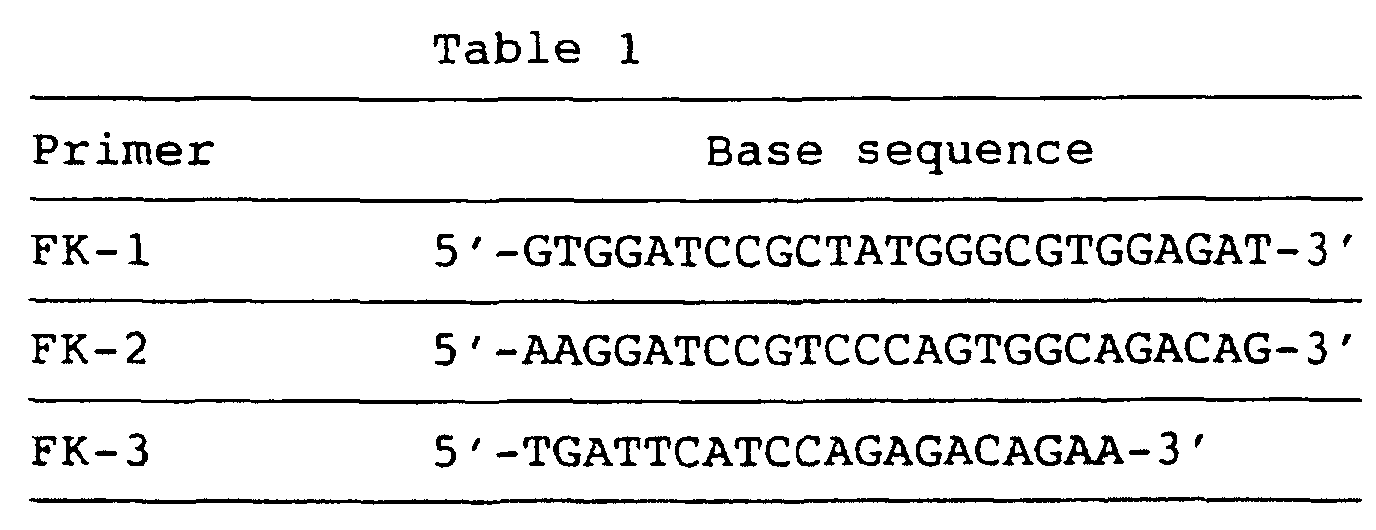
- arrows indicate the PCR primers FK-1, FK-2 and FK-3 to be later mentioned herein, and "EX" indicates the insertion region of the above-mentioned sequence of 45 bases.
- OKT4(6-1) showed the highest homology with human FKBP-12.
- its homology with human FKBP-12 was found to be 76% in terms of nucleic acid sequence and 88% in terms of amino acid sequence.
- the full coding redion of the OTK4(6-1) cDNA was amplified by the PCR method using, as primers, FK-1 and FK-2 shown below, which have a Bam HI site.
- the PCR product was digested with Bam HI and cloned in the PGEX2T expression vector (Pharmacia) at its Bam HI site.
- the recombinant FK506 binding protein (OTK4 protein) of the present invention was produced and purified by causing it to be expressed as a GST-fused protein in Escherichia coli DH5 according to the method described in the literature [Ayer, D. E. et al., Cell, 72 , 211-222 (1993)].
- a colony of the Escherichia coli strain transformed with the PGEX2T expression vector obtained as mentioned above was inoculated into 20 ml of LB/ampicillin medium and incubated at 37°C for 12 to 15 hours.
- the culture was diluted (1:10) with 200 ml of fresh LB/ampicillin medium. After 1 hour of incubation, IPTG was added (1 mM) and incubation was further continued for 3 to 5 hours.
- Cells were pelleted at 3,000 rpm, resuspended in 5 ml of cold lysis buffer, lysed by sonication and then incubated on ice for 1 hour. The cell lysate was centrifuged at 3,000 rpm, and the supernatant was added to Glutathion Sepharose 4B (Pharmacia) and incubated at 4°C for 1 hour. The mixture was centrifuged at 300 rpm for 5 minutes and the supernatant was discarded. The Glutathione Sepharose 4B was washed three times with PBS and once with PBS-T (PBS containing 1% Triton X).
- the GST-fused protein was cleaved with thrombin.
- the Glutathione Sepharose 4B was washed with washing buffer (50 mM Tris-HCl (pH 7.5)/150 mM NaCl), 900 ml of thrombin cleavage buffer (washing buffer containing 2.5 mM CaCl 2 ) and 100 ml of thrombin (Sigma) were added to the Glutathione Sepharose 4B, and the mixture was incubated at 25°C for 1 hour and then centrifuged at 300 rpm. The thus-obtained OTK4 protein (supernatant) was stored at -80°C.
- the OTK4 protein was electrophoresed on a 15% polyacrylamide gel and then analyzed by Coomassie brilliant blue staining [Wilson, C. M. et al., Methods Enzymol., 91 , 236-247 (1983)].
- lane 1 is for the total cell protein obtained without the above-mentioned IPTG induction
- lane 2 is for the total cell protein obtained with said IPTG induction
- lane 3 is for the GST-OTK4 fusion protein after purification treatment
- lane 4 is for the OTK4 protein after cleavage treatment.
- the OTK4 protein purified in the above manner was quantitated by the Lowry method [Lowry, O. H. et al., Nature, 337, 476-478 (1989)] to be 500 ⁇ g protein per ml.
- the enzyme activity of the purified protein was determined by the method described in the literature [Fisher, G. et al., Nature, 337 , 476-487 (1989)] as modified to measure the isomerization (cis to trans) of the proline-alanine peptide bond in the peptide (N-succinyl-Ala-Ala-Pro-Phe-p-nitroanilide).
- trans form of the above peptide is readily cleaved with chymotrypsin, releasing p-nitroanilide which can be quantitated by absorbance measurement at 405 nm.
- the reaction mixture (1.0 ml) contained the above-mentioned peptide substrate (30 ⁇ l taken from a 2.1 mM stock solution; final concentration 0.1 mM), 100 mM Tris-HCl (pH 7.8) and 1.0 ⁇ g/ml or 10 ⁇ g/ml of the OTK4 protein, and the reaction was carried out at 25°C.
- the curve containing open circles indicates the results obtained with 1.0 ⁇ g/ml of OTK4 protein;
- the curve containing closed circles indicates the results obtained with 10 ⁇ g/ml of OTK4 protein; and
- the curve containing closed triangles indicates the results obtained with a control without OTK4 protein.
- the probe used was 32 P-labeled OTK4 cDNA. Washing was performed with 2 x SSC/0.05% SDS at room temperature for 10 minutes (three times) and then with 0.1 x SSC/0.1% SDS at 50°C for 15 minutes (two times), followed by 60 hours of exposure at -80°C.
- lane 1 and the succeeding lanes correspond, in that order, heart, brain, placenta, lung, liver, skeletal muscle, kidney, pancreas, spleen, thymus, prostate, testis, ovary, small intestine, colon and peripheral blood leukocyte.
- mRNA size markers in kb.
- OTK4 gene mRNA expression is observable in various tissues.
- PCR reaction conditions were as follows: 40 cycles with the regime: 94°C for 0.5 minute, 54°C for 1 minute, and 72°C for 1 minute per cycle.
- each product was then subjected to 2% agarose gel electrophoresis, transferred to a nylon membrane, and hybridized at 50°C with terminally 32 P-labeled FK-3 (cf. Table 1). After washing with 6 x SSC at room temperature for 10 minutes and further at 50°C for 10 minutes, the membrane was autoradiographed for detection, with actin as control.
- the present invention provides an FK506 binding protein gened.
- the use of said gene makes it possisble to produce the FK506 binding protein with ease and in large quantities, and said protein, which has PPIase activity, can be used in developing therapeutic agents for various diseases.
Landscapes
- Life Sciences & Earth Sciences (AREA)
- Chemical & Material Sciences (AREA)
- Health & Medical Sciences (AREA)
- Genetics & Genomics (AREA)
- Organic Chemistry (AREA)
- Zoology (AREA)
- Engineering & Computer Science (AREA)
- Bioinformatics & Cheminformatics (AREA)
- Wood Science & Technology (AREA)
- Microbiology (AREA)
- Biotechnology (AREA)
- Biomedical Technology (AREA)
- Molecular Biology (AREA)
- Biochemistry (AREA)
- General Engineering & Computer Science (AREA)
- General Health & Medical Sciences (AREA)
- Medicinal Chemistry (AREA)
- Peptides Or Proteins (AREA)
- Preparation Of Compounds By Using Micro-Organisms (AREA)
- Medicines That Contain Protein Lipid Enzymes And Other Medicines (AREA)
Abstract
Description




Claims (7)
- An FK506 binding protein gene which encodes the amino acid sequence shown in SEQ ID No. 1.
- The FK506 binding protein gene as claimed in claim 1 which contains the base sequence shown in SEQ ID No. 3.
- A recombinant FK506 binding protein characterized by having the amino acid sequence shown in SEQ ID No. 1.
- A method of producing a recombinant FK506 binding protein which comprises introducing a base sequence containing the FK506 binding protein gene of claim 1 into a host to thereby transform the host, cultivating the thus obtained transformant, and recovering the recombinant FK506 binding protein thus produced.
- An FK506 binding protein gene which encodes the amino acid sequence shown in SEQ ID No. 2.
- A recombinant FK506 binding protein which has the amino acid sequence shown in SEQ ID No. 2.
- A method of producing a recombinant FK506 binding protein which comprises introducing a base sequence containing the FK506 binding protein gene of claim 5 into a host to thereby transform the host, cultivating the thus obtained transformant, and recovering the recombinant FK506 binding protein thus produced.
Applications Claiming Priority (4)
| Application Number | Priority Date | Filing Date | Title |
|---|---|---|---|
| JP6796794 | 1994-03-10 | ||
| JP6067967A JPH07250686A (en) | 1994-03-10 | 1994-03-10 | FK506 binding protein gene |
| JP67967/94 | 1994-03-10 | ||
| PCT/JP1995/000393 WO1995024480A1 (en) | 1994-03-10 | 1995-03-09 | Fk506-binding protein gene |
Publications (3)
| Publication Number | Publication Date |
|---|---|
| EP0754754A1 EP0754754A1 (en) | 1997-01-22 |
| EP0754754A4 EP0754754A4 (en) | 1999-11-17 |
| EP0754754B1 true EP0754754B1 (en) | 2001-08-29 |
Family
ID=13360261
Family Applications (1)
| Application Number | Title | Priority Date | Filing Date |
|---|---|---|---|
| EP95910782A Expired - Lifetime EP0754754B1 (en) | 1994-03-10 | 1995-03-09 | Fk506-binding protein gene |
Country Status (10)
| Country | Link |
|---|---|
| US (1) | US6136584A (en) |
| EP (1) | EP0754754B1 (en) |
| JP (1) | JPH07250686A (en) |
| AT (1) | ATE204903T1 (en) |
| CA (1) | CA2185098C (en) |
| DE (1) | DE69522444T2 (en) |
| DK (1) | DK0754754T3 (en) |
| ES (1) | ES2159628T3 (en) |
| PT (1) | PT754754E (en) |
| WO (1) | WO1995024480A1 (en) |
Families Citing this family (2)
| Publication number | Priority date | Publication date | Assignee | Title |
|---|---|---|---|---|
| US5457182A (en) * | 1994-02-15 | 1995-10-10 | Merck & Co., Inc. | FK-506 cytosolic binding protein, FKBP12.6 |
| DE19907598A1 (en) * | 1999-02-22 | 2000-08-24 | Schulz Burkhard | New DNA encoding plant FK506-binding protein analog useful for producing transgenic plants with altered architecture and for studying immunosuppressants |
Family Cites Families (3)
| Publication number | Priority date | Publication date | Assignee | Title |
|---|---|---|---|---|
| JP2982908B2 (en) * | 1990-07-11 | 1999-11-29 | 東燃株式会社 | DNA encoding human FK506 binding protein |
| CA2052928A1 (en) * | 1990-10-15 | 1992-04-16 | John J. Siekierka | Genes encoding the human fk-506 binding protein and a.s. cerevisiae homolog, fkb1 and their expression |
| US5457182A (en) * | 1994-02-15 | 1995-10-10 | Merck & Co., Inc. | FK-506 cytosolic binding protein, FKBP12.6 |
-
1994
- 1994-03-10 JP JP6067967A patent/JPH07250686A/en active Pending
-
1995
- 1995-03-09 AT AT95910782T patent/ATE204903T1/en not_active IP Right Cessation
- 1995-03-09 DE DE69522444T patent/DE69522444T2/en not_active Expired - Fee Related
- 1995-03-09 WO PCT/JP1995/000393 patent/WO1995024480A1/en not_active Ceased
- 1995-03-09 CA CA002185098A patent/CA2185098C/en not_active Expired - Fee Related
- 1995-03-09 US US08/714,071 patent/US6136584A/en not_active Expired - Fee Related
- 1995-03-09 DK DK95910782T patent/DK0754754T3/en active
- 1995-03-09 PT PT95910782T patent/PT754754E/en unknown
- 1995-03-09 EP EP95910782A patent/EP0754754B1/en not_active Expired - Lifetime
- 1995-03-09 ES ES95910782T patent/ES2159628T3/en not_active Expired - Lifetime
Also Published As
| Publication number | Publication date |
|---|---|
| EP0754754A4 (en) | 1999-11-17 |
| JPH07250686A (en) | 1995-10-03 |
| ATE204903T1 (en) | 2001-09-15 |
| DE69522444T2 (en) | 2002-05-16 |
| DK0754754T3 (en) | 2001-10-08 |
| WO1995024480A1 (en) | 1995-09-14 |
| CA2185098C (en) | 2002-06-18 |
| ES2159628T3 (en) | 2001-10-16 |
| CA2185098A1 (en) | 1995-09-14 |
| EP0754754A1 (en) | 1997-01-22 |
| US6136584A (en) | 2000-10-24 |
| DE69522444D1 (en) | 2001-10-04 |
| PT754754E (en) | 2002-01-30 |
Similar Documents
| Publication | Publication Date | Title |
|---|---|---|
| Duronio et al. | Protein N-myristoylation in Escherichia coli: reconstitution of a eukaryotic protein modification in bacteria. | |
| EP0676471B1 (en) | Effector proteins of rapamycin | |
| Harper et al. | Calcium and lipid regulation of an Arabidopsis protein kinase expressed in Escherichia coli | |
| EP0746611B1 (en) | Method for increasing production of disulfide bonded recombinant proteins by (saccharomyces cerevisiae) | |
| Mitta et al. | The primary structure of porcine aminoacylase 1 deduced from cDNA sequence | |
| Lee et al. | Cloning and expression of a mammalian peptide chain release factor with sequence similarity to tryptophanyl-tRNA synthetases. | |
| EP0669396B1 (en) | Novel polypeptide and dna coding for the same | |
| JP2982908B2 (en) | DNA encoding human FK506 binding protein | |
| JPH01281091A (en) | Fibrolase composition of crotalidus liquid poison of and production thereof by recombinant | |
| Teunissen et al. | Molecular cloning of a cDNA encoding a member of a novel cytochrome P450 family in the mollusc Lymnaea stagnalis | |
| CA2185098C (en) | Fk506 binding protein gene | |
| JP2002514906A (en) | Mammalian ribonuclease inhibitors and uses thereof | |
| Arakawa et al. | Molecular Cloning and Expression of a Novel Human Gene That Is Highly Homologous to Human FK506-Binding Protein 12kDa (hFJBP-12) and Characterization of Two Alternatively Spliced Transcripts | |
| JP4158956B2 (en) | Method for producing gene encoding protein having ability to regenerate luciferin, recombinant DNA and protein having ability to regenerate luciferin | |
| Van der Schueren et al. | Misfolding of chloramphenicol acetyltransferase due to carboxy-terminal truncation can be corrected by second-site mutations. | |
| JPS6344597A (en) | Novel substrate peptide | |
| JPH0755146B2 (en) | Polypeptide and process for producing the same | |
| KE Köpke et al. | Initiation of translation at an AUA codon for an archaebacterial protein gene expressed in E. coli | |
| Bardwell et al. | Characterization of the RAD10 gene of Saccharomyces cerevisiae and purification of Rad10 protein | |
| JP2919144B2 (en) | Polypeptide | |
| Isono et al. | Mutation leading to gene fusion in the histidine operon of Salmonella typhimurium | |
| JP3024154B2 (en) | Cytochrome P450c Bottom 2 Bottom 5 Gene | |
| JP2003506091A (en) | Soluble active recombinant human MAO-B | |
| CA2176507A1 (en) | Endothelin-converting enzyme | |
| WO2001025426A1 (en) | Gene encoding protein capable of regenerating luciferin, novel recombinant dna and process for producing protein capable of regenerating luciferin |
Legal Events
| Date | Code | Title | Description |
|---|---|---|---|
| PUAI | Public reference made under article 153(3) epc to a published international application that has entered the european phase |
Free format text: ORIGINAL CODE: 0009012 |
|
| 17P | Request for examination filed |
Effective date: 19960910 |
|
| AK | Designated contracting states |
Kind code of ref document: A1 Designated state(s): AT BE CH DE DK ES FR GB GR IE IT LI LU MC NL PT SE |
|
| A4 | Supplementary search report drawn up and despatched |
Effective date: 19991006 |
|
| AK | Designated contracting states |
Kind code of ref document: A4 Designated state(s): AT BE CH DE DK ES FR GB GR IE IT LI LU MC NL PT SE |
|
| RIC1 | Information provided on ipc code assigned before grant |
Free format text: 6C 12N 15/61 A, 6C 12N 9/90 B |
|
| GRAG | Despatch of communication of intention to grant |
Free format text: ORIGINAL CODE: EPIDOS AGRA |
|
| 17Q | First examination report despatched |
Effective date: 20001115 |
|
| GRAG | Despatch of communication of intention to grant |
Free format text: ORIGINAL CODE: EPIDOS AGRA |
|
| GRAH | Despatch of communication of intention to grant a patent |
Free format text: ORIGINAL CODE: EPIDOS IGRA |
|
| GRAH | Despatch of communication of intention to grant a patent |
Free format text: ORIGINAL CODE: EPIDOS IGRA |
|
| GRAA | (expected) grant |
Free format text: ORIGINAL CODE: 0009210 |
|
| AK | Designated contracting states |
Kind code of ref document: B1 Designated state(s): AT BE CH DE DK ES FR GB GR IE IT LI LU MC NL PT SE |
|
| REF | Corresponds to: |
Ref document number: 204903 Country of ref document: AT Date of ref document: 20010915 Kind code of ref document: T |
|
| XX | Miscellaneous (additional remarks) |
Free format text: THE APPLICANT HAS SUBSQUENTLY FILED A SEQUENCE LISTING AND DECLARED,T HAT IT INCLUDES NO NEW MATTER. |
|
| REG | Reference to a national code |
Ref country code: CH Ref legal event code: EP |
|
| REG | Reference to a national code |
Ref country code: CH Ref legal event code: NV Representative=s name: RITSCHER & SEIFERT |
|
| REG | Reference to a national code |
Ref country code: IE Ref legal event code: FG4D |
|
| REF | Corresponds to: |
Ref document number: 69522444 Country of ref document: DE Date of ref document: 20011004 |
|
| REG | Reference to a national code |
Ref country code: DK Ref legal event code: T3 |
|
| REG | Reference to a national code |
Ref country code: ES Ref legal event code: FG2A Ref document number: 2159628 Country of ref document: ES Kind code of ref document: T3 |
|
| ET | Fr: translation filed | ||
| REG | Reference to a national code |
Ref country code: GB Ref legal event code: IF02 |
|
| REG | Reference to a national code |
Ref country code: PT Ref legal event code: SC4A Free format text: AVAILABILITY OF NATIONAL TRANSLATION Effective date: 20011017 |
|
| REG | Reference to a national code |
Ref country code: GR Ref legal event code: EP Ref document number: 20010402202 Country of ref document: GR |
|
| PLBE | No opposition filed within time limit |
Free format text: ORIGINAL CODE: 0009261 |
|
| STAA | Information on the status of an ep patent application or granted ep patent |
Free format text: STATUS: NO OPPOSITION FILED WITHIN TIME LIMIT |
|
| 26N | No opposition filed | ||
| PG25 | Lapsed in a contracting state [announced via postgrant information from national office to epo] |
Ref country code: GR Free format text: LAPSE BECAUSE OF NON-PAYMENT OF DUE FEES Effective date: 20021007 |
|
| PGFP | Annual fee paid to national office [announced via postgrant information from national office to epo] |
Ref country code: DE Payment date: 20070301 Year of fee payment: 13 Ref country code: CH Payment date: 20070301 Year of fee payment: 13 |
|
| PGFP | Annual fee paid to national office [announced via postgrant information from national office to epo] |
Ref country code: SE Payment date: 20070307 Year of fee payment: 13 Ref country code: GB Payment date: 20070307 Year of fee payment: 13 |
|
| PGFP | Annual fee paid to national office [announced via postgrant information from national office to epo] |
Ref country code: PT Payment date: 20070309 Year of fee payment: 13 |
|
| PGFP | Annual fee paid to national office [announced via postgrant information from national office to epo] |
Ref country code: LU Payment date: 20070313 Year of fee payment: 13 Ref country code: AT Payment date: 20070313 Year of fee payment: 13 |
|
| PGFP | Annual fee paid to national office [announced via postgrant information from national office to epo] |
Ref country code: NL Payment date: 20070315 Year of fee payment: 13 Ref country code: DK Payment date: 20070315 Year of fee payment: 13 |
|
| PGFP | Annual fee paid to national office [announced via postgrant information from national office to epo] |
Ref country code: MC Payment date: 20070320 Year of fee payment: 13 Ref country code: IE Payment date: 20070320 Year of fee payment: 13 |
|
| PGFP | Annual fee paid to national office [announced via postgrant information from national office to epo] |
Ref country code: ES Payment date: 20070329 Year of fee payment: 13 |
|
| PGFP | Annual fee paid to national office [announced via postgrant information from national office to epo] |
Ref country code: BE Payment date: 20070514 Year of fee payment: 13 |
|
| PGFP | Annual fee paid to national office [announced via postgrant information from national office to epo] |
Ref country code: IT Payment date: 20070601 Year of fee payment: 13 |
|
| PGFP | Annual fee paid to national office [announced via postgrant information from national office to epo] |
Ref country code: GR Payment date: 20070313 Year of fee payment: 13 |
|
| PGFP | Annual fee paid to national office [announced via postgrant information from national office to epo] |
Ref country code: FR Payment date: 20070308 Year of fee payment: 13 |
|
| REG | Reference to a national code |
Ref country code: PT Ref legal event code: MM4A Free format text: LAPSE DUE TO NON-PAYMENT OF FEES Effective date: 20080909 |
|
| BERE | Be: lapsed |
Owner name: *OTSUKA PHARMACEUTICAL CO. LTD Effective date: 20080331 |
|
| PG25 | Lapsed in a contracting state [announced via postgrant information from national office to epo] |
Ref country code: PT Free format text: LAPSE BECAUSE OF NON-PAYMENT OF DUE FEES Effective date: 20080909 Ref country code: MC Free format text: LAPSE BECAUSE OF NON-PAYMENT OF DUE FEES Effective date: 20080331 |
|
| REG | Reference to a national code |
Ref country code: CH Ref legal event code: PL |
|
| REG | Reference to a national code |
Ref country code: DK Ref legal event code: EBP |
|
| EUG | Se: european patent has lapsed | ||
| GBPC | Gb: european patent ceased through non-payment of renewal fee |
Effective date: 20080309 |
|
| PG25 | Lapsed in a contracting state [announced via postgrant information from national office to epo] |
Ref country code: NL Free format text: LAPSE BECAUSE OF NON-PAYMENT OF DUE FEES Effective date: 20081001 Ref country code: AT Free format text: LAPSE BECAUSE OF NON-PAYMENT OF DUE FEES Effective date: 20080309 |
|
| NLV4 | Nl: lapsed or anulled due to non-payment of the annual fee |
Effective date: 20081001 |
|
| REG | Reference to a national code |
Ref country code: FR Ref legal event code: ST Effective date: 20081125 |
|
| REG | Reference to a national code |
Ref country code: IE Ref legal event code: MM4A |
|
| PG25 | Lapsed in a contracting state [announced via postgrant information from national office to epo] |
Ref country code: SE Free format text: LAPSE BECAUSE OF NON-PAYMENT OF DUE FEES Effective date: 20080310 Ref country code: LI Free format text: LAPSE BECAUSE OF NON-PAYMENT OF DUE FEES Effective date: 20080331 Ref country code: IE Free format text: LAPSE BECAUSE OF NON-PAYMENT OF DUE FEES Effective date: 20080310 Ref country code: DE Free format text: LAPSE BECAUSE OF NON-PAYMENT OF DUE FEES Effective date: 20081001 Ref country code: CH Free format text: LAPSE BECAUSE OF NON-PAYMENT OF DUE FEES Effective date: 20080331 |
|
| PG25 | Lapsed in a contracting state [announced via postgrant information from national office to epo] |
Ref country code: BE Free format text: LAPSE BECAUSE OF NON-PAYMENT OF DUE FEES Effective date: 20080331 |
|
| PG25 | Lapsed in a contracting state [announced via postgrant information from national office to epo] |
Ref country code: FR Free format text: LAPSE BECAUSE OF NON-PAYMENT OF DUE FEES Effective date: 20080331 Ref country code: DK Free format text: LAPSE BECAUSE OF NON-PAYMENT OF DUE FEES Effective date: 20080331 |
|
| REG | Reference to a national code |
Ref country code: ES Ref legal event code: FD2A Effective date: 20080310 |
|
| PG25 | Lapsed in a contracting state [announced via postgrant information from national office to epo] |
Ref country code: GB Free format text: LAPSE BECAUSE OF NON-PAYMENT OF DUE FEES Effective date: 20080309 |
|
| PG25 | Lapsed in a contracting state [announced via postgrant information from national office to epo] |
Ref country code: ES Free format text: LAPSE BECAUSE OF NON-PAYMENT OF DUE FEES Effective date: 20080310 |
|
| PG25 | Lapsed in a contracting state [announced via postgrant information from national office to epo] |
Ref country code: IT Free format text: LAPSE BECAUSE OF NON-PAYMENT OF DUE FEES Effective date: 20080309 |
|
| PG25 | Lapsed in a contracting state [announced via postgrant information from national office to epo] |
Ref country code: LU Free format text: LAPSE BECAUSE OF NON-PAYMENT OF DUE FEES Effective date: 20080309 |