EP0753500B1 - Process for producing ether compound - Google Patents
Process for producing ether compound Download PDFInfo
- Publication number
- EP0753500B1 EP0753500B1 EP96111314A EP96111314A EP0753500B1 EP 0753500 B1 EP0753500 B1 EP 0753500B1 EP 96111314 A EP96111314 A EP 96111314A EP 96111314 A EP96111314 A EP 96111314A EP 0753500 B1 EP0753500 B1 EP 0753500B1
- Authority
- EP
- European Patent Office
- Prior art keywords
- mol
- reaction
- ether
- catalyst
- water
- Prior art date
- Legal status (The legal status is an assumption and is not a legal conclusion. Google has not performed a legal analysis and makes no representation as to the accuracy of the status listed.)
- Expired - Lifetime
Links
- RTZKZFJDLAIYFH-UHFFFAOYSA-N ether Substances CCOCC RTZKZFJDLAIYFH-UHFFFAOYSA-N 0.000 title claims description 65
- -1 ether compound Chemical class 0.000 title claims description 50
- 238000000034 method Methods 0.000 title claims description 47
- 238000006243 chemical reaction Methods 0.000 claims description 179
- KDLHZDBZIXYQEI-UHFFFAOYSA-N Palladium Chemical group [Pd] KDLHZDBZIXYQEI-UHFFFAOYSA-N 0.000 claims description 130
- 239000003054 catalyst Substances 0.000 claims description 129
- UFHFLCQGNIYNRP-UHFFFAOYSA-N Hydrogen Chemical compound [H][H] UFHFLCQGNIYNRP-UHFFFAOYSA-N 0.000 claims description 120
- XLYOFNOQVPJJNP-UHFFFAOYSA-N water Substances O XLYOFNOQVPJJNP-UHFFFAOYSA-N 0.000 claims description 71
- CSNNHWWHGAXBCP-UHFFFAOYSA-L Magnesium sulfate Chemical compound [Mg+2].[O-][S+2]([O-])([O-])[O-] CSNNHWWHGAXBCP-UHFFFAOYSA-L 0.000 claims description 56
- 150000001728 carbonyl compounds Chemical class 0.000 claims description 50
- 150000002440 hydroxy compounds Chemical class 0.000 claims description 36
- 125000004432 carbon atom Chemical group C* 0.000 claims description 27
- 239000012024 dehydrating agents Substances 0.000 claims description 22
- 230000018044 dehydration Effects 0.000 claims description 22
- 238000006297 dehydration reaction Methods 0.000 claims description 22
- 238000007664 blowing Methods 0.000 claims description 10
- VYPSYNLAJGMNEJ-UHFFFAOYSA-N Silicium dioxide Chemical compound O=[Si]=O VYPSYNLAJGMNEJ-UHFFFAOYSA-N 0.000 claims description 8
- PNEYBMLMFCGWSK-UHFFFAOYSA-N aluminium oxide Inorganic materials [O-2].[O-2].[O-2].[Al+3].[Al+3] PNEYBMLMFCGWSK-UHFFFAOYSA-N 0.000 claims description 8
- 239000012298 atmosphere Substances 0.000 claims description 7
- 125000002887 hydroxy group Chemical group [H]O* 0.000 claims description 7
- 125000000217 alkyl group Chemical group 0.000 claims description 6
- 125000002947 alkylene group Chemical group 0.000 claims description 5
- 238000005984 hydrogenation reaction Methods 0.000 claims description 5
- 150000002576 ketones Chemical class 0.000 claims description 5
- 229910052763 palladium Inorganic materials 0.000 claims description 5
- OKTJSMMVPCPJKN-UHFFFAOYSA-N Carbon Chemical compound [C] OKTJSMMVPCPJKN-UHFFFAOYSA-N 0.000 claims description 4
- 229910021536 Zeolite Inorganic materials 0.000 claims description 4
- 125000003342 alkenyl group Chemical group 0.000 claims description 4
- 229910052799 carbon Inorganic materials 0.000 claims description 4
- 125000000753 cycloalkyl group Chemical group 0.000 claims description 4
- HNPSIPDUKPIQMN-UHFFFAOYSA-N dioxosilane;oxo(oxoalumanyloxy)alumane Chemical compound O=[Si]=O.O=[Al]O[Al]=O HNPSIPDUKPIQMN-UHFFFAOYSA-N 0.000 claims description 4
- 239000010457 zeolite Substances 0.000 claims description 4
- PMZURENOXWZQFD-UHFFFAOYSA-L Sodium Sulfate Chemical compound [Na+].[Na+].[O-]S([O-])(=O)=O PMZURENOXWZQFD-UHFFFAOYSA-L 0.000 claims description 3
- 239000002808 molecular sieve Substances 0.000 claims description 3
- 239000000377 silicon dioxide Substances 0.000 claims description 3
- URGAHOPLAPQHLN-UHFFFAOYSA-N sodium aluminosilicate Chemical compound [Na+].[Al+3].[O-][Si]([O-])=O.[O-][Si]([O-])=O URGAHOPLAPQHLN-UHFFFAOYSA-N 0.000 claims description 3
- 125000004122 cyclic group Chemical group 0.000 claims description 2
- 125000004435 hydrogen atom Chemical group [H]* 0.000 claims description 2
- 239000000741 silica gel Substances 0.000 claims description 2
- 229910002027 silica gel Inorganic materials 0.000 claims description 2
- 229940095564 anhydrous calcium sulfate Drugs 0.000 claims 1
- XLYOFNOQVPJJNP-UHFFFAOYSA-M hydroxide Chemical compound [OH-] XLYOFNOQVPJJNP-UHFFFAOYSA-M 0.000 claims 1
- 229910017053 inorganic salt Inorganic materials 0.000 claims 1
- 239000000376 reactant Substances 0.000 claims 1
- 239000001257 hydrogen Substances 0.000 description 85
- 229910052739 hydrogen Inorganic materials 0.000 description 85
- 238000002955 isolation Methods 0.000 description 68
- NTIZESTWPVYFNL-UHFFFAOYSA-N Methyl isobutyl ketone Chemical compound CC(C)CC(C)=O NTIZESTWPVYFNL-UHFFFAOYSA-N 0.000 description 64
- UIHCLUNTQKBZGK-UHFFFAOYSA-N Methyl isobutyl ketone Natural products CCC(C)C(C)=O UIHCLUNTQKBZGK-UHFFFAOYSA-N 0.000 description 64
- ZWEHNKRNPOVVGH-UHFFFAOYSA-N 2-Butanone Chemical compound CCC(C)=O ZWEHNKRNPOVVGH-UHFFFAOYSA-N 0.000 description 54
- CSCPPACGZOOCGX-UHFFFAOYSA-N Acetone Chemical compound CC(C)=O CSCPPACGZOOCGX-UHFFFAOYSA-N 0.000 description 52
- IAYPIBMASNFSPL-UHFFFAOYSA-N Ethylene oxide Chemical class C1CO1 IAYPIBMASNFSPL-UHFFFAOYSA-N 0.000 description 48
- 229940117927 ethylene oxide Drugs 0.000 description 47
- BXWNKGSJHAJOGX-UHFFFAOYSA-N hexadecan-1-ol Chemical compound CCCCCCCCCCCCCCCCO BXWNKGSJHAJOGX-UHFFFAOYSA-N 0.000 description 40
- HLZKNKRTKFSKGZ-UHFFFAOYSA-N tetradecan-1-ol Chemical compound CCCCCCCCCCCCCCO HLZKNKRTKFSKGZ-UHFFFAOYSA-N 0.000 description 38
- 229920003171 Poly (ethylene oxide) Polymers 0.000 description 37
- 238000001914 filtration Methods 0.000 description 36
- 239000000047 product Substances 0.000 description 33
- 239000007788 liquid Substances 0.000 description 31
- NUJGJRNETVAIRJ-UHFFFAOYSA-N octanal Chemical compound CCCCCCCC=O NUJGJRNETVAIRJ-UHFFFAOYSA-N 0.000 description 28
- LQZZUXJYWNFBMV-UHFFFAOYSA-N dodecan-1-ol Chemical compound CCCCCCCCCCCCO LQZZUXJYWNFBMV-UHFFFAOYSA-N 0.000 description 26
- LUYCRLZBULKURT-UHFFFAOYSA-N 1-(4-methylpentan-2-yloxy)tetradecane Chemical compound CCCCCCCCCCCCCCOC(C)CC(C)C LUYCRLZBULKURT-UHFFFAOYSA-N 0.000 description 22
- 230000015572 biosynthetic process Effects 0.000 description 22
- 238000003786 synthesis reaction Methods 0.000 description 22
- XMFUMMRWIFOQDQ-UHFFFAOYSA-N 1-(4-methylpentan-2-yloxy)hexadecane Chemical compound CCCCCCCCCCCCCCCCOC(C)CC(C)C XMFUMMRWIFOQDQ-UHFFFAOYSA-N 0.000 description 20
- JHIVVAPYMSGYDF-UHFFFAOYSA-N cyclohexanone Chemical compound O=C1CCCCC1 JHIVVAPYMSGYDF-UHFFFAOYSA-N 0.000 description 20
- GOOHAUXETOMSMM-UHFFFAOYSA-N Propylene oxide Chemical compound CC1CO1 GOOHAUXETOMSMM-UHFFFAOYSA-N 0.000 description 18
- 230000000052 comparative effect Effects 0.000 description 18
- PEDCQBHIVMGVHV-UHFFFAOYSA-N Glycerine Chemical compound OCC(O)CO PEDCQBHIVMGVHV-UHFFFAOYSA-N 0.000 description 17
- 238000004821 distillation Methods 0.000 description 16
- 150000002170 ethers Chemical class 0.000 description 16
- AMIMRNSIRUDHCM-UHFFFAOYSA-N Isopropylaldehyde Chemical compound CC(C)C=O AMIMRNSIRUDHCM-UHFFFAOYSA-N 0.000 description 14
- 229940043265 methyl isobutyl ketone Drugs 0.000 description 14
- CMCBDXRRFKYBDG-UHFFFAOYSA-N 1-dodecoxydodecane Chemical compound CCCCCCCCCCCCOCCCCCCCCCCCC CMCBDXRRFKYBDG-UHFFFAOYSA-N 0.000 description 12
- MMMPXNOKIZOWHM-UHFFFAOYSA-N 1-octoxydodecane Chemical compound CCCCCCCCCCCCOCCCCCCCC MMMPXNOKIZOWHM-UHFFFAOYSA-N 0.000 description 12
- 229910052943 magnesium sulfate Inorganic materials 0.000 description 12
- 235000019341 magnesium sulphate Nutrition 0.000 description 12
- ZTQSAGDEMFDKMZ-UHFFFAOYSA-N Butyraldehyde Chemical compound CCCC=O ZTQSAGDEMFDKMZ-UHFFFAOYSA-N 0.000 description 11
- 239000003795 chemical substances by application Substances 0.000 description 11
- 239000002904 solvent Substances 0.000 description 11
- 150000001298 alcohols Chemical class 0.000 description 10
- GLDOVTGHNKAZLK-UHFFFAOYSA-N octadecan-1-ol Chemical compound CCCCCCCCCCCCCCCCCCO GLDOVTGHNKAZLK-UHFFFAOYSA-N 0.000 description 10
- 238000004519 manufacturing process Methods 0.000 description 9
- 150000001875 compounds Chemical class 0.000 description 7
- 239000000203 mixture Substances 0.000 description 7
- 239000002994 raw material Substances 0.000 description 7
- KBPLFHHGFOOTCA-UHFFFAOYSA-N 1-Octanol Chemical compound CCCCCCCCO KBPLFHHGFOOTCA-UHFFFAOYSA-N 0.000 description 6
- LFQSCWFLJHTTHZ-UHFFFAOYSA-N Ethanol Chemical compound CCO LFQSCWFLJHTTHZ-UHFFFAOYSA-N 0.000 description 6
- 235000011187 glycerol Nutrition 0.000 description 6
- SJWFXCIHNDVPSH-UHFFFAOYSA-N octan-2-ol Chemical compound CCCCCCC(C)O SJWFXCIHNDVPSH-UHFFFAOYSA-N 0.000 description 6
- 238000010992 reflux Methods 0.000 description 6
- 239000007787 solid Substances 0.000 description 6
- DURPTKYDGMDSBL-UHFFFAOYSA-N 1-butoxybutane Chemical compound CCCCOCCCC DURPTKYDGMDSBL-UHFFFAOYSA-N 0.000 description 5
- 239000007789 gas Substances 0.000 description 5
- 125000002496 methyl group Chemical group [H]C([H])([H])* 0.000 description 5
- 238000007670 refining Methods 0.000 description 5
- 238000010898 silica gel chromatography Methods 0.000 description 5
- ZIBGPFATKBEMQZ-UHFFFAOYSA-N triethylene glycol Chemical compound OCCOCCOCCO ZIBGPFATKBEMQZ-UHFFFAOYSA-N 0.000 description 5
- LTSWUFKUZPPYEG-UHFFFAOYSA-N 1-decoxydecane Chemical compound CCCCCCCCCCOCCCCCCCCCC LTSWUFKUZPPYEG-UHFFFAOYSA-N 0.000 description 4
- XYVAYAJYLWYJJN-UHFFFAOYSA-N 2-(2-propoxypropoxy)propan-1-ol Chemical compound CCCOC(C)COC(C)CO XYVAYAJYLWYJJN-UHFFFAOYSA-N 0.000 description 4
- JSHWBQKBJKLISC-UHFFFAOYSA-N 2-[2-(2,3-dimethylpentan-3-yloxy)ethoxy]ethanol Chemical compound C(C)C(C(C)C)(C)OCCOCCO JSHWBQKBJKLISC-UHFFFAOYSA-N 0.000 description 4
- ZTKXIVDCRCJOMF-UHFFFAOYSA-N 2-methyl-4-(4-methylpentan-2-yloxy)pentane Chemical compound CC(C)CC(C)OC(C)CC(C)C ZTKXIVDCRCJOMF-UHFFFAOYSA-N 0.000 description 4
- SNRUBQQJIBEYMU-UHFFFAOYSA-N Dodecane Natural products CCCCCCCCCCCC SNRUBQQJIBEYMU-UHFFFAOYSA-N 0.000 description 4
- 239000002253 acid Substances 0.000 description 4
- WERYXYBDKMZEQL-UHFFFAOYSA-N butane-1,4-diol Chemical compound OCCCCO WERYXYBDKMZEQL-UHFFFAOYSA-N 0.000 description 4
- OSGAYBCDTDRGGQ-UHFFFAOYSA-L calcium sulfate Chemical compound [Ca+2].[O-]S([O-])(=O)=O OSGAYBCDTDRGGQ-UHFFFAOYSA-L 0.000 description 4
- OCDXZFSOHJRGIL-UHFFFAOYSA-N cyclohexyloxycyclohexane Chemical compound C1CCCCC1OC1CCCCC1 OCDXZFSOHJRGIL-UHFFFAOYSA-N 0.000 description 4
- 229940028820 didecyl ether Drugs 0.000 description 4
- 229940028356 diethylene glycol monobutyl ether Drugs 0.000 description 4
- HFJRKMMYBMWEAD-UHFFFAOYSA-N dodecanal Chemical compound CCCCCCCCCCCC=O HFJRKMMYBMWEAD-UHFFFAOYSA-N 0.000 description 4
- OKNCPTWACAGXHI-UHFFFAOYSA-N dodecoxycyclohexane Chemical compound CCCCCCCCCCCCOC1CCCCC1 OKNCPTWACAGXHI-UHFFFAOYSA-N 0.000 description 4
- 125000003438 dodecyl group Chemical group [H]C([H])([H])C([H])([H])C([H])([H])C([H])([H])C([H])([H])C([H])([H])C([H])([H])C([H])([H])C([H])([H])C([H])([H])C([H])([H])C([H])([H])* 0.000 description 4
- JCGNDDUYTRNOFT-UHFFFAOYSA-N oxolane-2,4-dione Chemical compound O=C1COC(=O)C1 JCGNDDUYTRNOFT-UHFFFAOYSA-N 0.000 description 4
- 125000002914 sec-butyl group Chemical group [H]C([H])([H])C([H])([H])C([H])(*)C([H])([H])[H] 0.000 description 4
- ALVZNPYWJMLXKV-UHFFFAOYSA-N 1,9-Nonanediol Chemical compound OCCCCCCCCCO ALVZNPYWJMLXKV-UHFFFAOYSA-N 0.000 description 3
- BPIUIOXAFBGMNB-UHFFFAOYSA-N 1-hexoxyhexane Chemical compound CCCCCCOCCCCCC BPIUIOXAFBGMNB-UHFFFAOYSA-N 0.000 description 3
- HANWHVWXFQSQGJ-UHFFFAOYSA-N 1-tetradecoxytetradecane Chemical compound CCCCCCCCCCCCCCOCCCCCCCCCCCCCC HANWHVWXFQSQGJ-UHFFFAOYSA-N 0.000 description 3
- OJVAMHKKJGICOG-UHFFFAOYSA-N 2,5-hexanedione Chemical compound CC(=O)CCC(C)=O OJVAMHKKJGICOG-UHFFFAOYSA-N 0.000 description 3
- HRWADRITRNUCIY-UHFFFAOYSA-N 2-(2-propan-2-yloxyethoxy)ethanol Chemical compound CC(C)OCCOCCO HRWADRITRNUCIY-UHFFFAOYSA-N 0.000 description 3
- SXFJDZNJHVPHPH-UHFFFAOYSA-N 3-methylpentane-1,5-diol Chemical compound OCCC(C)CCO SXFJDZNJHVPHPH-UHFFFAOYSA-N 0.000 description 3
- UHOVQNZJYSORNB-UHFFFAOYSA-N Benzene Chemical compound C1=CC=CC=C1 UHOVQNZJYSORNB-UHFFFAOYSA-N 0.000 description 3
- OKKJLVBELUTLKV-UHFFFAOYSA-N Methanol Chemical compound OC OKKJLVBELUTLKV-UHFFFAOYSA-N 0.000 description 3
- LRHPLDYGYMQRHN-UHFFFAOYSA-N N-Butanol Chemical compound CCCCO LRHPLDYGYMQRHN-UHFFFAOYSA-N 0.000 description 3
- IMNFDUFMRHMDMM-UHFFFAOYSA-N N-Heptane Chemical compound CCCCCCC IMNFDUFMRHMDMM-UHFFFAOYSA-N 0.000 description 3
- YXFVVABEGXRONW-UHFFFAOYSA-N Toluene Chemical compound CC1=CC=CC=C1 YXFVVABEGXRONW-UHFFFAOYSA-N 0.000 description 3
- 150000001336 alkenes Chemical class 0.000 description 3
- 150000008051 alkyl sulfates Chemical class 0.000 description 3
- 239000012295 chemical reaction liquid Substances 0.000 description 3
- 239000002537 cosmetic Substances 0.000 description 3
- HPXRVTGHNJAIIH-UHFFFAOYSA-N cyclohexanol Chemical compound OC1CCCCC1 HPXRVTGHNJAIIH-UHFFFAOYSA-N 0.000 description 3
- KSMVZQYAVGTKIV-UHFFFAOYSA-N decanal Chemical compound CCCCCCCCCC=O KSMVZQYAVGTKIV-UHFFFAOYSA-N 0.000 description 3
- 239000003599 detergent Substances 0.000 description 3
- MTHSVFCYNBDYFN-UHFFFAOYSA-N diethylene glycol Chemical compound OCCOCCO MTHSVFCYNBDYFN-UHFFFAOYSA-N 0.000 description 3
- 239000003995 emulsifying agent Substances 0.000 description 3
- 238000006266 etherification reaction Methods 0.000 description 3
- 239000000314 lubricant Substances 0.000 description 3
- VIKNJXKGJWUCNN-XGXHKTLJSA-N norethisterone Chemical compound O=C1CC[C@@H]2[C@H]3CC[C@](C)([C@](CC4)(O)C#C)[C@@H]4[C@@H]3CCC2=C1 VIKNJXKGJWUCNN-XGXHKTLJSA-N 0.000 description 3
- 150000003839 salts Chemical class 0.000 description 3
- 230000002194 synthesizing effect Effects 0.000 description 3
- NKJOXAZJBOMXID-UHFFFAOYSA-N 1,1'-Oxybisoctane Chemical compound CCCCCCCCOCCCCCCCC NKJOXAZJBOMXID-UHFFFAOYSA-N 0.000 description 2
- LZJWBHPZNYMYKL-UHFFFAOYSA-N 1,6-di(propan-2-yloxy)hexane Chemical compound CC(C)OCCCCCCOC(C)C LZJWBHPZNYMYKL-UHFFFAOYSA-N 0.000 description 2
- QFVDVXIBCOXZQA-UHFFFAOYSA-N 1-(5-octoxyhexan-2-yloxy)octane Chemical compound CCCCCCCCOC(C)CCC(C)OCCCCCCCC QFVDVXIBCOXZQA-UHFFFAOYSA-N 0.000 description 2
- HLXMUINEVNYTPK-UHFFFAOYSA-N 1-butan-2-yloxyoctadecane Chemical compound CCCCCCCCCCCCCCCCCCOC(C)CC HLXMUINEVNYTPK-UHFFFAOYSA-N 0.000 description 2
- NMMIRFKUKVHGTQ-UHFFFAOYSA-N 1-butoxydodecane Chemical compound CCCCCCCCCCCCOCCCC NMMIRFKUKVHGTQ-UHFFFAOYSA-N 0.000 description 2
- ULTRPZHREZRMJX-UHFFFAOYSA-N 1-propan-2-yloxytetradecane Chemical compound CCCCCCCCCCCCCCOC(C)C ULTRPZHREZRMJX-UHFFFAOYSA-N 0.000 description 2
- CQWUJFPMPPEROY-UHFFFAOYSA-N 2-(2-methylpropoxy)octane Chemical compound CCCCCCC(C)OCC(C)C CQWUJFPMPPEROY-UHFFFAOYSA-N 0.000 description 2
- NARVIWMVBMUEOG-UHFFFAOYSA-N 2-Hydroxy-propylene Natural products CC(O)=C NARVIWMVBMUEOG-UHFFFAOYSA-N 0.000 description 2
- FKMHSNTVILORFA-UHFFFAOYSA-N 2-[2-(2-dodecoxyethoxy)ethoxy]ethanol Chemical compound CCCCCCCCCCCCOCCOCCOCCO FKMHSNTVILORFA-UHFFFAOYSA-N 0.000 description 2
- XNGBRIJMANCISV-UHFFFAOYSA-N 2-[2-(2-hexadecan-5-yloxyethoxy)ethoxy]ethanol Chemical compound CCCCCCCCCCCC(CCCC)OCCOCCOCCO XNGBRIJMANCISV-UHFFFAOYSA-N 0.000 description 2
- ATDRPSXFLATLHS-UHFFFAOYSA-N 2-[2-(2-methylhexan-3-yloxy)propoxy]propan-1-ol Chemical compound C(C)(C)C(CCC)OC(C)COC(C)CO ATDRPSXFLATLHS-UHFFFAOYSA-N 0.000 description 2
- MMNNFRMBRXEEFR-UHFFFAOYSA-N 2-methyl-4-[4-(4-methylpentan-2-yloxy)butoxy]pentane Chemical compound CC(C)CC(C)OCCCCOC(C)CC(C)C MMNNFRMBRXEEFR-UHFFFAOYSA-N 0.000 description 2
- CRWNQZTZTZWPOF-UHFFFAOYSA-N 2-methyl-4-phenylpyridine Chemical compound C1=NC(C)=CC(C=2C=CC=CC=2)=C1 CRWNQZTZTZWPOF-UHFFFAOYSA-N 0.000 description 2
- KEKPAPJXCXKIDQ-UHFFFAOYSA-N 4-methylpentan-2-one Chemical compound CC(C)CC(C)=O.CC(C)CC(C)=O KEKPAPJXCXKIDQ-UHFFFAOYSA-N 0.000 description 2
- IKHGUXGNUITLKF-UHFFFAOYSA-N Acetaldehyde Chemical compound CC=O IKHGUXGNUITLKF-UHFFFAOYSA-N 0.000 description 2
- OFBQJSOFQDEBGM-UHFFFAOYSA-N Pentane Chemical compound CCCCC OFBQJSOFQDEBGM-UHFFFAOYSA-N 0.000 description 2
- 239000002202 Polyethylene glycol Substances 0.000 description 2
- WYURNTSHIVDZCO-UHFFFAOYSA-N Tetrahydrofuran Chemical compound C1CCOC1 WYURNTSHIVDZCO-UHFFFAOYSA-N 0.000 description 2
- 150000007513 acids Chemical class 0.000 description 2
- 150000001299 aldehydes Chemical class 0.000 description 2
- 150000001350 alkyl halides Chemical class 0.000 description 2
- 125000002915 carbonyl group Chemical group [*:2]C([*:1])=O 0.000 description 2
- 239000007795 chemical reaction product Substances 0.000 description 2
- 229910052593 corundum Inorganic materials 0.000 description 2
- 150000003997 cyclic ketones Chemical class 0.000 description 2
- DCZFGQYXRKMVFG-UHFFFAOYSA-N cyclohexane-1,4-dione Chemical compound O=C1CCC(=O)CC1 DCZFGQYXRKMVFG-UHFFFAOYSA-N 0.000 description 2
- DIOQZVSQGTUSAI-UHFFFAOYSA-N decane Chemical compound CCCCCCCCCC DIOQZVSQGTUSAI-UHFFFAOYSA-N 0.000 description 2
- 150000002009 diols Chemical class 0.000 description 2
- 238000004508 fractional distillation Methods 0.000 description 2
- 238000005227 gel permeation chromatography Methods 0.000 description 2
- JARKCYVAAOWBJS-UHFFFAOYSA-N hexanal Chemical compound CCCCCC=O JARKCYVAAOWBJS-UHFFFAOYSA-N 0.000 description 2
- XXMIOPMDWAUFGU-UHFFFAOYSA-N hexane-1,6-diol Chemical compound OCCCCCCO XXMIOPMDWAUFGU-UHFFFAOYSA-N 0.000 description 2
- VLKZOEOYAKHREP-UHFFFAOYSA-N n-Hexane Chemical compound CCCCCC VLKZOEOYAKHREP-UHFFFAOYSA-N 0.000 description 2
- TVMXDCGIABBOFY-UHFFFAOYSA-N octane Chemical compound CCCCCCCC TVMXDCGIABBOFY-UHFFFAOYSA-N 0.000 description 2
- 239000003921 oil Substances 0.000 description 2
- HBEQXAKJSGXAIQ-UHFFFAOYSA-N oxopalladium Chemical compound [Pd]=O HBEQXAKJSGXAIQ-UHFFFAOYSA-N 0.000 description 2
- 229910003445 palladium oxide Inorganic materials 0.000 description 2
- NXJCBFBQEVOTOW-UHFFFAOYSA-L palladium(2+);dihydroxide Chemical compound O[Pd]O NXJCBFBQEVOTOW-UHFFFAOYSA-L 0.000 description 2
- BASFCYQUMIYNBI-UHFFFAOYSA-N platinum Chemical compound [Pt] BASFCYQUMIYNBI-UHFFFAOYSA-N 0.000 description 2
- 229920001223 polyethylene glycol Polymers 0.000 description 2
- BDERNNFJNOPAEC-UHFFFAOYSA-N propan-1-ol Chemical compound CCCO BDERNNFJNOPAEC-UHFFFAOYSA-N 0.000 description 2
- 229910052938 sodium sulfate Inorganic materials 0.000 description 2
- 235000011152 sodium sulphate Nutrition 0.000 description 2
- 239000000243 solution Substances 0.000 description 2
- 238000001179 sorption measurement Methods 0.000 description 2
- 229910001845 yogo sapphire Inorganic materials 0.000 description 2
- MIFJLGRNWXPMLY-UHFFFAOYSA-N 1,4-dioctoxycyclohexane Chemical compound CCCCCCCCOC1CCC(OCCCCCCCC)CC1 MIFJLGRNWXPMLY-UHFFFAOYSA-N 0.000 description 1
- DTIQBEPZQFIJNJ-UHFFFAOYSA-N 1,5-di(butan-2-yloxy)-3-methylpentane Chemical compound CCC(C)OCCC(C)CCOC(C)CC DTIQBEPZQFIJNJ-UHFFFAOYSA-N 0.000 description 1
- RRQYJINTUHWNHW-UHFFFAOYSA-N 1-ethoxy-2-(2-ethoxyethoxy)ethane Chemical compound CCOCCOCCOCC RRQYJINTUHWNHW-UHFFFAOYSA-N 0.000 description 1
- FDCJDKXCCYFOCV-UHFFFAOYSA-N 1-hexadecoxyhexadecane Chemical compound CCCCCCCCCCCCCCCCOCCCCCCCCCCCCCCCC FDCJDKXCCYFOCV-UHFFFAOYSA-N 0.000 description 1
- 238000005160 1H NMR spectroscopy Methods 0.000 description 1
- ABVRALPGOZKWQO-UHFFFAOYSA-N 2-methyl-4-[2-[2-[2-(4-methylpentan-2-yloxy)ethoxy]ethoxy]ethoxy]pentane Chemical compound CC(C)CC(C)OCCOCCOCCOC(C)CC(C)C ABVRALPGOZKWQO-UHFFFAOYSA-N 0.000 description 1
- FZCWKUPTQAVGOQ-UHFFFAOYSA-N 3-methyl-1,5-bis(2-methylpropoxy)pentane Chemical compound CC(COCCC(CCOCC(C)C)C)C FZCWKUPTQAVGOQ-UHFFFAOYSA-N 0.000 description 1
- KIABPGOWHAPFNF-UHFFFAOYSA-N 6-cyclohexyloxyhexoxycyclohexane Chemical compound C1CCCCC1OCCCCCCOC1CCCCC1 KIABPGOWHAPFNF-UHFFFAOYSA-N 0.000 description 1
- UXVMQQNJUSDDNG-UHFFFAOYSA-L Calcium chloride Chemical compound [Cl-].[Cl-].[Ca+2] UXVMQQNJUSDDNG-UHFFFAOYSA-L 0.000 description 1
- XDTMQSROBMDMFD-UHFFFAOYSA-N Cyclohexane Chemical compound C1CCCCC1 XDTMQSROBMDMFD-UHFFFAOYSA-N 0.000 description 1
- ZAFNJMIOTHYJRJ-UHFFFAOYSA-N Diisopropyl ether Chemical compound CC(C)OC(C)C ZAFNJMIOTHYJRJ-UHFFFAOYSA-N 0.000 description 1
- LCGLNKUTAGEVQW-UHFFFAOYSA-N Dimethyl ether Chemical compound COC LCGLNKUTAGEVQW-UHFFFAOYSA-N 0.000 description 1
- VGGSQFUCUMXWEO-UHFFFAOYSA-N Ethene Chemical compound C=C VGGSQFUCUMXWEO-UHFFFAOYSA-N 0.000 description 1
- 239000005977 Ethylene Substances 0.000 description 1
- 206010067482 No adverse event Diseases 0.000 description 1
- CTQNGGLPUBDAKN-UHFFFAOYSA-N O-Xylene Chemical compound CC1=CC=CC=C1C CTQNGGLPUBDAKN-UHFFFAOYSA-N 0.000 description 1
- 229930040373 Paraformaldehyde Natural products 0.000 description 1
- KJTLSVCANCCWHF-UHFFFAOYSA-N Ruthenium Chemical compound [Ru] KJTLSVCANCCWHF-UHFFFAOYSA-N 0.000 description 1
- ZJCCRDAZUWHFQH-UHFFFAOYSA-N Trimethylolpropane Chemical compound CCC(CO)(CO)CO ZJCCRDAZUWHFQH-UHFFFAOYSA-N 0.000 description 1
- 238000006959 Williamson synthesis reaction Methods 0.000 description 1
- 239000003377 acid catalyst Substances 0.000 description 1
- 239000003513 alkali Substances 0.000 description 1
- 239000007864 aqueous solution Substances 0.000 description 1
- 230000001588 bifunctional effect Effects 0.000 description 1
- 238000009835 boiling Methods 0.000 description 1
- 239000001110 calcium chloride Substances 0.000 description 1
- 229910001628 calcium chloride Inorganic materials 0.000 description 1
- AXCZMVOFGPJBDE-UHFFFAOYSA-L calcium dihydroxide Chemical compound [OH-].[OH-].[Ca+2] AXCZMVOFGPJBDE-UHFFFAOYSA-L 0.000 description 1
- 239000000920 calcium hydroxide Substances 0.000 description 1
- 229910001861 calcium hydroxide Inorganic materials 0.000 description 1
- 235000011132 calcium sulphate Nutrition 0.000 description 1
- 239000003153 chemical reaction reagent Substances 0.000 description 1
- 229910000365 copper sulfate Inorganic materials 0.000 description 1
- ARUVKPQLZAKDPS-UHFFFAOYSA-L copper(II) sulfate Chemical compound [Cu+2].[O-][S+2]([O-])([O-])[O-] ARUVKPQLZAKDPS-UHFFFAOYSA-L 0.000 description 1
- OILAIQUEIWYQPH-UHFFFAOYSA-N cyclohexane-1,2-dione Chemical compound O=C1CCCCC1=O OILAIQUEIWYQPH-UHFFFAOYSA-N 0.000 description 1
- 238000000354 decomposition reaction Methods 0.000 description 1
- 239000002274 desiccant Substances 0.000 description 1
- 125000004989 dicarbonyl group Chemical group 0.000 description 1
- DENRZWYUOJLTMF-UHFFFAOYSA-N diethyl sulfate Chemical compound CCOS(=O)(=O)OCC DENRZWYUOJLTMF-UHFFFAOYSA-N 0.000 description 1
- 229940008406 diethyl sulfate Drugs 0.000 description 1
- 229940019778 diethylene glycol diethyl ether Drugs 0.000 description 1
- 238000006471 dimerization reaction Methods 0.000 description 1
- VAYGXNSJCAHWJZ-UHFFFAOYSA-N dimethyl sulfate Chemical compound COS(=O)(=O)OC VAYGXNSJCAHWJZ-UHFFFAOYSA-N 0.000 description 1
- 238000001035 drying Methods 0.000 description 1
- 239000010696 ester oil Substances 0.000 description 1
- 239000004210 ether based solvent Substances 0.000 description 1
- 239000000706 filtrate Substances 0.000 description 1
- 238000004817 gas chromatography Methods 0.000 description 1
- AVIYEYCFMVPYST-UHFFFAOYSA-N hexane-1,3-diol Chemical compound CCCC(O)CCO AVIYEYCFMVPYST-UHFFFAOYSA-N 0.000 description 1
- OHMBHFSEKCCCBW-UHFFFAOYSA-N hexane-2,5-diol Chemical compound CC(O)CCC(C)O OHMBHFSEKCCCBW-UHFFFAOYSA-N 0.000 description 1
- 150000004679 hydroxides Chemical class 0.000 description 1
- 238000011835 investigation Methods 0.000 description 1
- 229910052741 iridium Inorganic materials 0.000 description 1
- GKOZUEZYRPOHIO-UHFFFAOYSA-N iridium atom Chemical compound [Ir] GKOZUEZYRPOHIO-UHFFFAOYSA-N 0.000 description 1
- 239000000395 magnesium oxide Substances 0.000 description 1
- CPLXHLVBOLITMK-UHFFFAOYSA-N magnesium oxide Inorganic materials [Mg]=O CPLXHLVBOLITMK-UHFFFAOYSA-N 0.000 description 1
- AXZKOIWUVFPNLO-UHFFFAOYSA-N magnesium;oxygen(2-) Chemical compound [O-2].[Mg+2] AXZKOIWUVFPNLO-UHFFFAOYSA-N 0.000 description 1
- 229910052751 metal Inorganic materials 0.000 description 1
- 239000002184 metal Substances 0.000 description 1
- WSFSSNUMVMOOMR-NJFSPNSNSA-N methanone Chemical compound O=[14CH2] WSFSSNUMVMOOMR-NJFSPNSNSA-N 0.000 description 1
- BGEHHAVMRVXCGR-UHFFFAOYSA-N methylundecylketone Natural products CCCCCCCCCCCCC=O BGEHHAVMRVXCGR-UHFFFAOYSA-N 0.000 description 1
- GOQYKNQRPGWPLP-UHFFFAOYSA-N n-heptadecyl alcohol Natural products CCCCCCCCCCCCCCCCCO GOQYKNQRPGWPLP-UHFFFAOYSA-N 0.000 description 1
- 239000002736 nonionic surfactant Substances 0.000 description 1
- JRZJOMJEPLMPRA-UHFFFAOYSA-N olefin Natural products CCCCCCCC=C JRZJOMJEPLMPRA-UHFFFAOYSA-N 0.000 description 1
- 229910052762 osmium Inorganic materials 0.000 description 1
- SYQBFIAQOQZEGI-UHFFFAOYSA-N osmium atom Chemical compound [Os] SYQBFIAQOQZEGI-UHFFFAOYSA-N 0.000 description 1
- MUMZUERVLWJKNR-UHFFFAOYSA-N oxoplatinum Chemical compound [Pt]=O MUMZUERVLWJKNR-UHFFFAOYSA-N 0.000 description 1
- SJLOMQIUPFZJAN-UHFFFAOYSA-N oxorhodium Chemical compound [Rh]=O SJLOMQIUPFZJAN-UHFFFAOYSA-N 0.000 description 1
- 125000005702 oxyalkylene group Chemical group 0.000 description 1
- 150000002941 palladium compounds Chemical class 0.000 description 1
- 229920002866 paraformaldehyde Polymers 0.000 description 1
- 239000003208 petroleum Substances 0.000 description 1
- 238000005191 phase separation Methods 0.000 description 1
- 229910052697 platinum Inorganic materials 0.000 description 1
- 229910003446 platinum oxide Inorganic materials 0.000 description 1
- 229920005862 polyol Polymers 0.000 description 1
- 150000003077 polyols Chemical class 0.000 description 1
- 239000000843 powder Substances 0.000 description 1
- 125000004805 propylene group Chemical group [H]C([H])([H])C([H])([*:1])C([H])([H])[*:2] 0.000 description 1
- 230000035484 reaction time Effects 0.000 description 1
- 229910052702 rhenium Inorganic materials 0.000 description 1
- WUAPFZMCVAUBPE-UHFFFAOYSA-N rhenium atom Chemical compound [Re] WUAPFZMCVAUBPE-UHFFFAOYSA-N 0.000 description 1
- 229910052703 rhodium Inorganic materials 0.000 description 1
- 239000010948 rhodium Substances 0.000 description 1
- MHOVAHRLVXNVSD-UHFFFAOYSA-N rhodium atom Chemical compound [Rh] MHOVAHRLVXNVSD-UHFFFAOYSA-N 0.000 description 1
- 229910003450 rhodium oxide Inorganic materials 0.000 description 1
- 229910052707 ruthenium Inorganic materials 0.000 description 1
- 229910001925 ruthenium oxide Inorganic materials 0.000 description 1
- WOCIAKWEIIZHES-UHFFFAOYSA-N ruthenium(iv) oxide Chemical compound O=[Ru]=O WOCIAKWEIIZHES-UHFFFAOYSA-N 0.000 description 1
- 150000003333 secondary alcohols Chemical class 0.000 description 1
- 238000007086 side reaction Methods 0.000 description 1
- 229910052708 sodium Inorganic materials 0.000 description 1
- 239000011734 sodium Substances 0.000 description 1
- 239000007858 starting material Substances 0.000 description 1
- 238000010025 steaming Methods 0.000 description 1
- 239000000126 substance Substances 0.000 description 1
- 150000005846 sugar alcohols Polymers 0.000 description 1
- YLQBMQCUIZJEEH-UHFFFAOYSA-N tetrahydrofuran Natural products C=1C=COC=1 YLQBMQCUIZJEEH-UHFFFAOYSA-N 0.000 description 1
- 125000000383 tetramethylene group Chemical group [H]C([H])([*:1])C([H])([H])C([H])([H])C([H])([H])[*:2] 0.000 description 1
- QXJQHYBHAIHNGG-UHFFFAOYSA-N trimethylolethane Chemical compound OCC(C)(CO)CO QXJQHYBHAIHNGG-UHFFFAOYSA-N 0.000 description 1
- 239000008096 xylene Substances 0.000 description 1
Classifications
-
- C—CHEMISTRY; METALLURGY
- C07—ORGANIC CHEMISTRY
- C07C—ACYCLIC OR CARBOCYCLIC COMPOUNDS
- C07C41/00—Preparation of ethers; Preparation of compounds having groups, groups or groups
- C07C41/01—Preparation of ethers
-
- C—CHEMISTRY; METALLURGY
- C08—ORGANIC MACROMOLECULAR COMPOUNDS; THEIR PREPARATION OR CHEMICAL WORKING-UP; COMPOSITIONS BASED THEREON
- C08G—MACROMOLECULAR COMPOUNDS OBTAINED OTHERWISE THAN BY REACTIONS ONLY INVOLVING UNSATURATED CARBON-TO-CARBON BONDS
- C08G65/00—Macromolecular compounds obtained by reactions forming an ether link in the main chain of the macromolecule
- C08G65/02—Macromolecular compounds obtained by reactions forming an ether link in the main chain of the macromolecule from cyclic ethers by opening of the heterocyclic ring
- C08G65/30—Post-polymerisation treatment, e.g. recovery, purification, drying
-
- C—CHEMISTRY; METALLURGY
- C08—ORGANIC MACROMOLECULAR COMPOUNDS; THEIR PREPARATION OR CHEMICAL WORKING-UP; COMPOSITIONS BASED THEREON
- C08G—MACROMOLECULAR COMPOUNDS OBTAINED OTHERWISE THAN BY REACTIONS ONLY INVOLVING UNSATURATED CARBON-TO-CARBON BONDS
- C08G65/00—Macromolecular compounds obtained by reactions forming an ether link in the main chain of the macromolecule
- C08G65/02—Macromolecular compounds obtained by reactions forming an ether link in the main chain of the macromolecule from cyclic ethers by opening of the heterocyclic ring
- C08G65/32—Polymers modified by chemical after-treatment
- C08G65/329—Polymers modified by chemical after-treatment with organic compounds
- C08G65/331—Polymers modified by chemical after-treatment with organic compounds containing oxygen
-
- C—CHEMISTRY; METALLURGY
- C08—ORGANIC MACROMOLECULAR COMPOUNDS; THEIR PREPARATION OR CHEMICAL WORKING-UP; COMPOSITIONS BASED THEREON
- C08G—MACROMOLECULAR COMPOUNDS OBTAINED OTHERWISE THAN BY REACTIONS ONLY INVOLVING UNSATURATED CARBON-TO-CARBON BONDS
- C08G65/00—Macromolecular compounds obtained by reactions forming an ether link in the main chain of the macromolecule
- C08G65/02—Macromolecular compounds obtained by reactions forming an ether link in the main chain of the macromolecule from cyclic ethers by opening of the heterocyclic ring
- C08G65/32—Polymers modified by chemical after-treatment
- C08G65/338—Polymers modified by chemical after-treatment with inorganic and organic compounds
-
- C—CHEMISTRY; METALLURGY
- C07—ORGANIC CHEMISTRY
- C07C—ACYCLIC OR CARBOCYCLIC COMPOUNDS
- C07C2601/00—Systems containing only non-condensed rings
- C07C2601/12—Systems containing only non-condensed rings with a six-membered ring
- C07C2601/14—The ring being saturated
Definitions
- the present invention relates to a process for producing ether compounds with ease and at a low cost, which are advantageously useful in a wide variety to applications such as solvents, cosmetics, detergents, lubricants and emulsifiers.
- ether compounds such as diethyl ether, dibutyl ether and diethylene glycol diethyl ether have been used as solvents.
- ether compounds having larger molecular weights or those of unsymmetric structures have been scarcely used because of their difficulties to be produced.
- ether compounds are expected to be used as cosmetic oils since they are not so sticky and can be less hydrolyzed than conventionally used ester oils.
- the ether compounds have a potential as oils for detergent compositions and new nonionic surfactants and besides as lubricants, emulsifiers and the like.
- Known methods for synthesizing ether compounds include, for example, synthesis from alcoholates and alkyl halides (Williamson synthesis); synthesis from alcohols and alkyl sulfates; synthesis from alcohols by dehydration by using acid; and synthesis by addition of alcohols to olefins.
- alkyl sulfates are restricted to dimethyl sulfate and diethyl sulfate. This method is applicable for synthesizing methyl ether and ethyl ether; it is difficult to synthesize ether compounds having more carbon atoms.
- ether compounds are synthesized from alcohols and carbonyl compounds.
- J. Chem. Soc., 5598 (1963) and Chem. Commun., 422 (1967) disclose a method in which ether compounds are synthesized by using excess of an alcohol under hydrogen atmosphere at an ordinary pressure in the presence of an acid catalyst.
- WO 93/02033 discloses a process for producing polyolethers by reacting at least one polyol with at least one carbonyl compound at a high temperature i.e. 150 to 250°C in the presence of a hydrogenation catalyst. Additionally, a process for producing a symmetric or unsymmetric ether compound is disclosed in Tetrahedron Letters, Vol. 36, No. 24, pp. 4235-4236 (1995), wherein an aldehyde or a ketone is reacted with a primary or a secondary alcohol in the presence of Pd/C catalyst and then is hydrogenated. In those processes, however, the yields are still low.
- the ether compounds can not widely be used because of difficulty in producing them while they are expected to be applied to various uses. Accordingly, a process in which an ether compound can easily be produced at low costs have been desired.
- EP-A-665 207 discloses a one-step method for the generation of ethers from acetone which method comprises reacting an acetone-rich feed over a bifunctional hydrogenation catalyst.
- EP-A-719 751 an integrated process for the generation of ethers from acetone or a crude acetone stream comprising reacting the acetone with hydrogen over a catalyst system is described.
- a purpose of the present invention is to provide a process for producing an ether compound with ease at a low cost at an improved production rate, which is useful for solvents, cosmetics, detergents, lubricants, emulsifiers and the like.
- the inventors have made intensive investigations to find a simple and inexpensive process for producing a widely applicable ether compound at a high production rate as an improvement of the above shown hydrogenational decomposition. As a result, they have found that an ether compound can be obtained in one step at a high yield or production rate by carrying out the reaction using as the starting material (a) a hydroxy compound compound with a carbonyl compound, or (b) carbonyl compounds by itself, reacting it under hydrogen gas atmosphere in the presence of a catalyst, while removing water produced by the reaction.
- the invention provides a process for producing an ether compound by reacting (a) a hydroxy compound with a carbonyl compound or (b) a carbonyl compound, under hydrogen gas atmosphere in the presence of a catalyst, capable of catalysing hydrogenations wherein said reaction is carried out while removing out water produced by the reaction.
- Examples of the hydroxy compound include compounds represented by the formula (1): R 1 -(OA) n -OH (1) wherein, R 1 represents a straight or branched alkyl or alkenyl group having 1 to 40 carbon atoms, or a cycloalkyl group having 3 to 12 carbon atoms; A represents an alkylene group having 2 to 12 carbon atoms which may have a hydroxyl group;, two or more A's may be the same as or different from one another; n is a number of 0 to 500].
- R 1 is preferebly a straight or branched alkyl group having 1 to 24 carbon atoms or a cycloalkyl group having 5 to 8 carbon atoms, more preferably a straight alkyl group having 3 to 24, particularly 6 to 22 carbon atoms or a cycloalkyl having 5 to 7 carbon atoms.
- A is preferably a straight or branched alkylene group having 2 to 6 carbon atoms which may have a hydroxyl group, including for example, groups of ethylene, propylene, trimethylene, tetramethylene, 1,2-butylene, pentylene, hexylene and 2-hydroxypropylene.
- ethylene, propylene, trimethylene and tetramethylene are preferable, more preferably, a straight or branched alkylene group having 2 to 3 carbon atoms, particularly ethylene or propylene group are used.
- the n is preferably a number of 0 to 200, more preferably, 0 to 30.
- Two or more A's may be the same as or different from one another, and the oxyalkylene groups, OA, of the formula (1) may be bonded to one another either in the form of block or at random.
- polyhydric compounds having 2 or more hydroxyl groups can be used in the present invention.
- examples thereof include polyhydric alcohols and derivatives thereof having 2 to 10 hydroxyl groups. More specifically, examples thereof include a diol having 2 to 20 carbon atoms, glycerol, trimethylol ethane, trimethylol propane, pentaerythrytol, sacharide and alkylene oxide adducts thereto (addition molar numbers of 0 to 500).
- a diol having 2 to 20 carbon atoms, preferably 2 to 10 carbon atoms, glycerin and ethylene oxide adducts thereto are particularly preferred.
- hydroxy compounds can be used alone or in a mixture of two or more of them.
- Examples of the carbonyl compound used in the present invention include compounds represented by the formula (2): [wherein, R 2 and R 3 represent a hydrogen atom or a straight or branched alkyl or alkenyl group having 1 to 20 carbon atoms. R 2 and R 3 may be the same as or different from one another. R 2 and R 3 may be combined with each other to form a cyclic structure].
- a linear ketone having 1 to 12 carbon atoms, an aldehyde having 1 to 12 carbon atoms or a cyclic ketone having 5 to 8 carbon atoms is preferred.
- linear ketones having 3 to 6 carbon atoms including acetone, methylethyl ketone, methylisobutyl ketone (4-methyl-2-pentanone); aliphatic aldehyde having 1 to 12, preferably 3 to 8 carbon atoms, such as formaldehyde, paraformaldehyde, acetoaldehyde, butylaldehyde, octylaldehyde and dodecylaldehyde; and cyclic ketones having 5 to 7 carbon atoms including cyclohexanone are particluraly preferred.
- Most preferrd are acetone, methylethyl ketone, methylisobutyl ketone (4-methyl-2-pentanone).
- polyvalent carbonyl compounds having 2 or more carbonyl groups are included.
- carbonyl compounds may be used alone or as a mixture of two or more species.
- reaction formula 1 A typical reaction for producing an ether compound by reacting a hydroxy compound represented by the formula (1) with a carbonyl compound represented by the formula (2) in the present invention under hydrogen atmosphere using a catalyst is shown by the following reaction formula 1.
- a preferred molar ratio of hydroxy compound/carbonyl compound is usually 50/1 to 1/50, particularly, 20/1 to 1/20, more particularly, 10/1 to 1/10. If the hydroxy compound has a low molecular weight and can easily be removed, the hydroxy compound is preferably used in an excess amount to react the whole amount of the carbonyl compound. If the hydroxy compound has a large molecular weight and the carbonyl compound has a low molecular weight and can be easily removed, the carbonyl compound is preferably used in an excess amount to react the whole amount of the hydroxy compound which is difficult to remove. A mole ratio of the hydroxy compound/carbonyl compound falling outside the range described above does not exert so much influence on the yield but is not economical.
- the catalysts used in reacting include palladium or palladium compounds such as palladium hydroxide and palladium oxide, ruthenium, rhodium or platinum, ruthenium oxide, rhodium oxide, and platinum oxide. Further, iridium, osmium and rhenium can be used as well. These catalysts may be supported on a carrier such as carbon, silica-alumina, zeolite, alumina or silica.
- palladium catalysts preferred are palladium catalysts, and more preferred is palladium, palladium hydroxide; or palladium oxide, supported on carbon, silica-alumina, alumina or silica. Palladium supported on carbon is particularly preferred.
- the supported amount when the catalyst is supported on each carrier is in the range of 2 to 10% by weight based on the weight of a carrier.
- the supported catalysts may include 20 to 60% by weight of water.
- the supported catalyst is used preferably in an amount of 0.1 to 20% weight based on the weight of the carbonyl compound used. Even when it is less than 0.1% by weight, the reaction can be conducted, however, it is not preferred since the reaction proceeds slow. Meanwhile, when it exceeds 20% by weight, the reaction proceeds fast, but it is not preferred since side reactions also appear.
- the amount is more preferably 0.5 to 15 weight %.
- the catalyst can be used in any pH range but the catalyst having a pH of 8 or lower is preferred, more preferably in the range from 2 to 8, the most preferably in the range from 3 to 7.5.
- the pH of the catalyst means a pH of an aqueous solution obtained by dispersing 2 g of the catalyst powder in 30 g of ion-exchanged water.
- the hydrogen gas pressure is not specifically limited and may be either at the atomspheric pressure or an increased pressure. It is preferably from the atmospheric pressure to 300 kg/cm 2 , further preferably from the atmospheric pressure to 200 kg/cm 2 , particularly preferably from the atmospheric pressure to 150 kg/cm 2 .
- reaction temperature in reacting (a) the hydroxy compound with the carbonyl compound or (b) the carbonyl compounds are not specifically limited and are preferably 10 to 200°C, particularly preferably 50 to 180°C.
- the reaction time can suitably be selected depending on the reaction temperature, the hydrogen gas pressure and the catalyst's amount, and is usually 1 to 24 hours, preferably 1 to 12 hours in each case.
- the reaction can be carried out without using a solvent but can be carried out in a diluted form with a suitable solvent.
- Any solvents can be used as long as they are inert to the hydrogenation reaction, for example, solvents such as n-pentane, n-hexane, n-heptane, n-octane, n-decane, and petroleum ether, and ether solvents such as dibutylether, dihexylether and tetrahydrofuran.
- the reaction in the present invention is carried out while removing produced water by at least one method selected from the group consisting of:
- the reaction in the present invention is carried out while removing the produced water, which means not only removing out the water from the reaction system but also removing the water in the reaction system with use of dehydrating agents by way of adsorption or a reaction.
- Concrete methods for removing the water include; carrying out the reaction in the presence of a dehydrating agent; distilling the water off by azeotropic dehydration ; and blowing hydrogen gas through the reaction system.
- the dehydrating agent used includes so-called drying agents used for drying liquids.
- the dehydrating ability of the dehydrating agent is attained on the basis of physical or chemical adsorption of water or a chemical reaction.
- the dehydrating agent used in the present invention is not specifically limited by the mechanism of the dehydrating ability, and any dehydrating agents can be used as long as they have a dehydrating ability or a water-absorbing ability and substantially remove out the produced water, causing the intended etherification to proceed rapidly.
- strong acids and strong alkalis can be used as well if some measures are employed so that they are not involved directly in the reaction system.
- the preferred dehydrating agents used in the resent invention include inorganic salts such as magnesium sulfate, sodium sulfate, calcium sulfate, copper sulfate, and calcium chloride, preferably anhydrous ones, hydroxides such as calcium hydroxide, oxides such as magnesium oxide, crystalline zeolite such as molecular sieves, and silica gel.
- the dehydrating agents are not necessarily limited to these compounds.
- the anhydrous inorganic salts, and the crystalline zeolite are preferred.
- anhydrous magnesium sulfate, anydrous sodium sulfate, anydrous calcium sulfate, and molecular sieve are preferred, and anydrous magnesium sulfate is particularly preferred.
- the amount of the dehydrating agent is not specifically limited and is preferably 0.1 to 100 molar %, more preferably 0.1 to 80 molar %, particularly preferably, 0.1 to 50 molar % based on the hydroxy compound or carbonyl compound as the raw material.
- the method for removing water by carrying out the reaction in the presence of such dehydrating agents is preferred very much since a specific reactor is not needed, and the water can easily be removed only by adding dehydrating agents.
- the produced water by the reaction can also be removed out of the reaction system by distilling it off.
- a method for distilling off the water is not specifically limited and includes, for example, a method by azeotropic dehydration.
- This circulating step can be made continuously or stepwise, either during the reaction or not. When the raw materials can not be trapped sufficiently, it is preferable to add further raw materials.
- azeotropic dehydration there are a method in which the reaction and the distillation of the water are carried out continuously by use of an azeotropic dehydration apparatus, and a method in which the reaction and then removing out the water are carried out stepwise, e.g., a method in which after once the reaction is carried out, the azeotropic dehydration is carried out, then the reaction is carried out again.
- the reaction is preferably carried out continuously in order to cause the reaction to proceed smoothly.
- the azeotropic dehydration may be carried out while flowing through hydrogen gas.
- solvents as an azeotropic solvent which exert no adverse effects on the reaction.
- solvents include toluene, xylene and benzene.
- the amount of the solvent is not specifically limited when the solvent is used in the reaction, 1 to 2 times as much an amount in volume as reaction liquid are preferred.
- produced water by the reaction can be removed out of the reaction system by carrying out the reaction while blowing gases such as hydrogen gas onto or through the reaction liquid.
- gases such as hydrogen gas onto or through the reaction liquid.
- the flow amount of hydrogen gas used in the present invention can be selected according to the scale of the reaction and is preferably 0.01 to 30 liters/min, more preferably 0.01 to 10 liters/min, for example, in the scale of 0.5 liter.
- the flow amount of hydrogen gas controlled to 0.01 liter/min or more makes it easy to remove out the water of the reaction system and accelerates the reaction.
- the flow amount of hydrogen gas controlled to 30 liters/min or less is preferred since a reduced amount of the hydroxy compound or carbonyl compound as the raw materials is removed together with the water.
- the hydroxy compound or carbonyl compound removed together with the water can be returned again to the reactor after removing the water, for example, by fractional distillation or a dehydrating agent, to thereby continue the reaction without stagnation.
- the blowing of the hydrogen gas may be continuously or intermittently conducted during the reaction. The continuous blowing is preferred in order to cause the reaction to proceed smoothly.
- the hydrogen gas blown into the reaction system may be discharged in the air as it is, but in order to use the hydrogen gas effectively, it is efficient and therefore preferred to return again the hydrogen gas coming out of the system to the system via a circulating line to be used for the reaction while circulating.
- Such methods as removing out the water while blowing the hydrogen gas has such advantages that no reagents are further added and that hydrogen gas can easily be separated from water and pro-treatment is simple.
- the isolation yield was 99%.
- the isolation yield was 73%.
- the autoclave was cooled down to room temperatures, and the autoclave was exhausted of hydrogen gas and opened.
- the catalyst and magnesium sulfate were removed from the reaction solution by filtration, and then analyzing by the gas chromatography was carried out. The result thereof showed that the apparent conversion rate of cyclohexanol was 97% and the yield of dicylohexyl ether was 95%.
- Dicyclohexyl ether was obtained in the same manner as that in Example A-8, except that anhydrous magnesium sulfate was not added. The result thereof showed that the apparent conversion rate of cyclohexanol was 81% and the yield of dicylohexyl ether was 78%.
- the catalyst was removed by filtration, and a 500 ml flask equipped with a dehydration-refluxing tube and a stirrer was charged with the filtrate.
- the solution obtained after finishing azeotropic dehydration and the catalyst were returned again into the autoclave to carry out the reaction of the second step at 100 kg/cm 2 of hydrogen pressure at 150°C for 7 hours.
- the catalyst was removed by filtration, and excess 4-methyl-2-pentanone was removed under reduced pressure. Further, distillation under reduced pressure (143°C/1 Torr) was carried out to obtain 107 g (0.36 mol) of intended 1,3-dimethyl butyl tetradecyl ether as a colorless, transparent liquid.
- the isolation yield was 97%.
- the isolation yield was 78%.
- the isolation yield was 95%.
- the isolation yield was 62%.
- 1,3-dimethylbutyl tetradecyl ether 67 g (0.22 mol), 61% A-12 dodecyl alcohol 46.5 g (0.25 mol) octyl aldehyde 128 g (1.0 mol) 5%Pd-C (pH6.6) 0.9 g H 2 pressure: 20 kg/cm 2 150°C, 8 h.
- the isolation yield was 95 %.
- the isolation yield was 60%.
- dodecyloctyl ether 73 g (0.245 mol), 98% A'-18 polyoxyethylene (p 9.3) monododecyl ether* 107 g (0.18 mol) cyclohexanone 70 g (0.71 mol) 5%Pd-C (pH7.1) 2.1 g H 2 press.: 20 kg/cm 2 H 2 flow amount: 200 ml/min 150°C, 8 h.
- 1,3-dimethylbutyl hexadecyl ether 80.7 g (0.248 mol), 99% A'-23 polyoxyethylene(p 9.3) monododecyl ether** 107 g (0.18 mol) octylaldehyde 92 g (0.72 mol) 5%Pd-C (pH7.1) 8.6 g H 2 press.: 2 kg/cm 2 H 2 flow amount: 300 ml/min 120°C, 6 h.
- polyoxyethylene(p 9.3)dodecyloctyl ether 126 g (0.178 mol), 99% A'-24 diethyleneglycol monoisopropyl ether 51.8 g (0.35 mol) methylethyl ketone 126 g (1.75 mol) 5%Pd-C (pH6.6) 2.1 g H 2 press.: 2 kg/cm 2 H 2 flow amount: 200 ml/min 130°C, 6 h.
- 1,3-dimetliylbutyl tetradecyl ether 45 g (0.15 mol), 60% A'-15 hexadecyl alcohol 60.5 g (0.25 mol) 4-methyl-2-pentanone 100 g (1.0 mol) 5%Pd-C (pH7.1) 1.2 g H 2 press.: 20 kg/cm 2 1.50°C, 8 h.
- the isolation yield was 99%.
- the isolation yield was 29%.
- dodecylbutyl ether 58.9 g (0.248 mol), 99% A'-30 polyoxyethylene (p 9.3) monododecyl ether* 107 g (0.18 mol) cyclohexanone 70 g (0.71 mol) 5%Pd-C (pH7.1) 4.3 g H 2 press.: 5 kg/cm 2 H 2 flow amount: 200 ml/min 150°C, 8 h.
- dipropyleneglycol propyl(2-methylpropyl)ether 78.0 g (0.336 mol), 96% A'-35 2-octanol 52.0 g (0.4 mol) isobutylaldehyde 144 g (2.0 mol) 5%Pd-C (pH4.0) 2.1 g H 2 press.: 1.5 kg/cm 2 H 2 flow amount: 200 ml/min 150°C, 8 h. 1-methylheptyl(2-methylpropyl)ether 71.4 g (0.384 mol), 96% A'-36 polyoxyethylene(p 9.
- 1,3-dimethylbutyl hexadecyl ether 9.78 g (0.030 mol), 12% A'-29 dodecyl alcohol 46.5 g (0.25 mol) butylaldehyde 72 g (1.0 mol) 5%Pd-C (pH6.6) 1.4 g H 2 press.: 1.5 kg/cm 2 150°C, 6 h.
- dodecylbutyl ether 20.6 g (0.085 mol), 34% A'-30 polyoxyethylene (p 9.3) monododecyl ether* 107 g (0.18 mol) cyclohexanone 70 g (0.71 mol) 5%Pd-C (p117.1) 4.3 g H 2 press.: 5 kg/cm 2 150°C, 8 h.
- diethyleneglycol isopropyl(1-methylpropyl)ether 12.1 g (0.060 mol), 17% A'-34 dipropyleneglycol monopropyl ether 62 g (0.35 mol) isobutylaldehyde 126 g (1.75 mol) 5%Pd-C (pH7.3) 2.5 g H 2 press.: 3 kg/cm 2 130°C, 8 h.
- dipropyleneglycol propyl(2-methylpropyl)ether 10.6 g (0.046 mol), 13% A'-35 2-octanol 52 g (0.4 mol) isobutylaldehyde 144 g (2.0 mol) 5%Pd-C (pH4.0) 2.1 g H 2 press.: 1.5 kg/cm 2 150°C, 8 h.
- the isolation yield was 75%.
- the isolation yield was 95%.
- the isolation yield was 93%.
- n-octylaldehyde and 7.7 g of 5% Pd-C (pH 3.8) as a catalyst were charged into a 500 ml autoclave equipped with a hydrogen gas-introducing tube, a stirrer and a cooling-dehydrating tube, and the contents were stirred at 100 kg/cm 2 of hydrogen pressure and 800 ml/min of hydrogen flow amount at 150°C for 8 hours to carry out the reaction while removing water by-produced by the reaction out of the system and n-octylaldehyde which came out of the system together with water was returned again into the system.
- the isolation yield was 93%.
- the isolation yield was 92%.
- the isolation yield was 93%.
- the isolation yield was 79%.
- the isolation yield was 82%.
- the isolation yield was 98% (based on 1,6-hexanediol).
- the etherification rate calculated from the hydroxyl value [255 (KOH mg/g)] before the reaction and the hydroxyl value [26 (KOH mg/g)] after the reaction was 76%.
- the isolation yield was 98% (based on 1,4-butanediol).
- the isolation yield was 99% (based on 1,9-nonanediol).
- the isolation yield was 98% (based on triethylene glycol).
- the catalyst was removed by filtration to obtain 180 g of the product.
- This product was determined by GPC (gel permeation chromatography), and the peaks of compounds having about 230 to 1500 of molecular weight were observed. The main peak is at about 345, and it has been found from the results obtained by IR and 1 H-NMR that the resulting product is a mixture of compounds represented by the following formulae.
Landscapes
- Chemical & Material Sciences (AREA)
- Organic Chemistry (AREA)
- Health & Medical Sciences (AREA)
- Chemical Kinetics & Catalysis (AREA)
- Medicinal Chemistry (AREA)
- Polymers & Plastics (AREA)
- General Chemical & Material Sciences (AREA)
- Inorganic Chemistry (AREA)
- Organic Low-Molecular-Weight Compounds And Preparation Thereof (AREA)
Description
- The present invention relates to a process for producing ether compounds with ease and at a low cost, which are advantageously useful in a wide variety to applications such as solvents, cosmetics, detergents, lubricants and emulsifiers.
- Conventionally, ether compounds such as diethyl ether, dibutyl ether and diethylene glycol diethyl ether have been used as solvents. However, ether compounds having larger molecular weights or those of unsymmetric structures have been scarcely used because of their difficulties to be produced.
- In particular, ether compounds are expected to be used as cosmetic oils since they are not so sticky and can be less hydrolyzed than conventionally used ester oils.
- Furthermore, the ether compounds have a potential as oils for detergent compositions and new nonionic surfactants and besides as lubricants, emulsifiers and the like.
- Although the expectation for the ether compounds has been raised, they cannot easily be produced at low costs at the industrial level.
- Known methods for synthesizing ether compounds include, for example, synthesis from alcoholates and alkyl halides (Williamson synthesis); synthesis from alcohols and alkyl sulfates; synthesis from alcohols by dehydration by using acid; and synthesis by addition of alcohols to olefins.
- However, in the synthesis from alcoholates and alkyl halides, an alcohol and an equivalent amount of a metal, such as Na and K, or an alkali are necessary to form the corresponding alcoholate. Eventualy a large amount of salts are formed in the reaction. Therefore, this method is not preferred from the industrial point of view.
- In the synthesis from alcohols and alkyl sulfates, available alkyl sulfates are restricted to dimethyl sulfate and diethyl sulfate. This method is applicable for synthesizing methyl ether and ethyl ether; it is difficult to synthesize ether compounds having more carbon atoms.
- The synthesis by dehydration of alcohols with acid is suitable for synthesizing symmetric ether compounds; it is difficult to synthesize unsymmetric ether compounds by this method.
- In the synthesis by addition of alcohols to olefins, the olefin compounds are restricted, and many of them and the catalysts used are very expensive. Further, it is difficult in many cases to recover and reuse the olefins and the catalysts. Accordingly, this method is not industrially suitable.
- Besides the methods described above, ether compounds are synthesized from alcohols and carbonyl compounds. For example, J. Chem. Soc., 5598 (1963) and Chem. Commun., 422 (1967) disclose a method in which ether compounds are synthesized by using excess of an alcohol under hydrogen atmosphere at an ordinary pressure in the presence of an acid catalyst.
- However, all these methods use a large excess of alcohols and only lower alcohols such as methanol, ethanol and propyl alcohol are applicable, i.e., higher alcohols having more than 6 carbon atoms are not disclosed in the above references.
- Further, WO 93/02033 discloses a process for producing polyolethers by reacting at least one polyol with at least one carbonyl compound at a high temperature i.e. 150 to 250°C in the presence of a hydrogenation catalyst. Additionally, a process for producing a symmetric or unsymmetric ether compound is disclosed in Tetrahedron Letters, Vol. 36, No. 24, pp. 4235-4236 (1995), wherein an aldehyde or a ketone is reacted with a primary or a secondary alcohol in the presence of Pd/C catalyst and then is hydrogenated. In those processes, however, the yields are still low.
- As described above, the ether compounds can not widely be used because of difficulty in producing them while they are expected to be applied to various uses. Accordingly, a process in which an ether compound can easily be produced at low costs have been desired.
- EP-A-665 207 discloses a one-step method for the generation of ethers from acetone which method comprises reacting an acetone-rich feed over a bifunctional hydrogenation catalyst.
- In EP-A-719 751 an integrated process for the generation of ethers from acetone or a crude acetone stream comprising reacting the acetone with hydrogen over a catalyst system is described.
- A purpose of the present invention is to provide a process for producing an ether compound with ease at a low cost at an improved production rate, which is useful for solvents, cosmetics, detergents, lubricants, emulsifiers and the like.
- The inventors have made intensive investigations to find a simple and inexpensive process for producing a widely applicable ether compound at a high production rate as an improvement of the above shown hydrogenational decomposition. As a result, they have found that an ether compound can be obtained in one step at a high yield or production rate by carrying out the reaction using as the starting material (a) a hydroxy compound compound with a carbonyl compound, or (b) carbonyl compounds by itself, reacting it under hydrogen gas atmosphere in the presence of a catalyst, while removing water produced by the reaction.
- The invention provides a process for producing an ether compound by reacting (a) a hydroxy compound with a carbonyl compound or (b) a carbonyl compound, under hydrogen gas atmosphere in the presence of a catalyst, capable of catalysing hydrogenations wherein said reaction is carried out while removing out water produced by the reaction.
- Examples of the hydroxy compound include compounds represented by the formula (1):
R1-(OA)n-OH (1)
wherein, R1 represents a straight or branched alkyl or alkenyl group having 1 to 40 carbon atoms, or a cycloalkyl group having 3 to 12 carbon atoms; A represents an alkylene group having 2 to 12 carbon atoms which may have a hydroxyl group;, two or more A's may be the same as or different from one another; n is a number of 0 to 500]. - R1 is preferebly a straight or branched alkyl group having 1 to 24 carbon atoms or a cycloalkyl group having 5 to 8 carbon atoms, more preferably a straight alkyl group having 3 to 24, particularly 6 to 22 carbon atoms or a cycloalkyl having 5 to 7 carbon atoms.
- A is preferably a straight or branched alkylene group having 2 to 6 carbon atoms which may have a hydroxyl group, including for example, groups of ethylene, propylene, trimethylene, tetramethylene, 1,2-butylene, pentylene, hexylene and 2-hydroxypropylene. Among them, ethylene, propylene, trimethylene and tetramethylene are preferable, more preferably, a straight or branched alkylene group having 2 to 3 carbon atoms, particularly ethylene or propylene group are used.
- The n is preferably a number of 0 to 200, more preferably, 0 to 30. Two or more A's may be the same as or different from one another, and the oxyalkylene groups, OA, of the formula (1) may be bonded to one another either in the form of block or at random.
- Furthermore, as another hydroxy compound, polyhydric compounds having 2 or more hydroxyl groups can be used in the present invention. Examples thereof include polyhydric alcohols and derivatives thereof having 2 to 10 hydroxyl groups. More specifically, examples thereof include a diol having 2 to 20 carbon atoms, glycerol, trimethylol ethane, trimethylol propane, pentaerythrytol, sacharide and alkylene oxide adducts thereto (addition molar numbers of 0 to 500). Among them, a diol having 2 to 20 carbon atoms, preferably 2 to 10 carbon atoms, glycerin and ethylene oxide adducts thereto (addition molar numbers of 0 to 200) are particularly preferred.
- These hydroxy compounds can be used alone or in a mixture of two or more of them.
- Examples of the carbonyl compound used in the present invention include compounds represented by the formula (2):

- Among these carbonyl compounds, a linear ketone having 1 to 12 carbon atoms, an aldehyde having 1 to 12 carbon atoms or a cyclic ketone having 5 to 8 carbon atoms is preferred. Among them, linear ketones having 3 to 6 carbon atoms including acetone, methylethyl ketone, methylisobutyl ketone (4-methyl-2-pentanone); aliphatic aldehyde having 1 to 12, preferably 3 to 8 carbon atoms, such as formaldehyde, paraformaldehyde, acetoaldehyde, butylaldehyde, octylaldehyde and dodecylaldehyde; and cyclic ketones having 5 to 7 carbon atoms including cyclohexanone are particluraly preferred. Most preferrd are acetone, methylethyl ketone, methylisobutyl ketone (4-methyl-2-pentanone).
- In addition, as other carbonyl compounds, polyvalent carbonyl compounds having 2 or more carbonyl groups are included. Preferred are compounds having 2 to 10 carbonyl groups, for examples, linear or cyclic dicarbonyl compounds having 2 to 20 carbon atoms. Linear dicarbonyl compounds having 2 to 10 carbon atoms and cyclohexanedione are particularly preferred.
- These carbonyl compounds may be used alone or as a mixture of two or more species.
- A typical reaction for producing an ether compound by reacting a hydroxy compound represented by the formula (1) with a carbonyl compound represented by the formula (2) in the present invention under hydrogen atmosphere using a catalyst is shown by the following reaction formula 1.

- And a typical reaction for producing an ether compound by reacting a carbonyl compound represented by the formula (2) in the present invention under hydrogen atmosphere using a catalyst is shown in the following reaction formula 2.

- Though the charging ratio of the hydroxy compound represented by the formula (1) to the carbonyl compound represented by the formula (2) in the present process is not specifically limited, a preferred molar ratio of hydroxy compound/carbonyl compound is usually 50/1 to 1/50, particularly, 20/1 to 1/20, more particularly, 10/1 to 1/10. If the hydroxy compound has a low molecular weight and can easily be removed, the hydroxy compound is preferably used in an excess amount to react the whole amount of the carbonyl compound. If the hydroxy compound has a large molecular weight and the carbonyl compound has a low molecular weight and can be easily removed, the carbonyl compound is preferably used in an excess amount to react the whole amount of the hydroxy compound which is difficult to remove. A mole ratio of the hydroxy compound/carbonyl compound falling outside the range described above does not exert so much influence on the yield but is not economical.
- In the present invention, the catalysts used in reacting (a) the hydroxy compound and the carbonyl compound, or (b) the carbonyl compounds include palladium or palladium compounds such as palladium hydroxide and palladium oxide, ruthenium, rhodium or platinum, ruthenium oxide, rhodium oxide, and platinum oxide. Further, iridium, osmium and rhenium can be used as well. These catalysts may be supported on a carrier such as carbon, silica-alumina, zeolite, alumina or silica. Among these catalysts, preferred are palladium catalysts, and more preferred is palladium, palladium hydroxide; or palladium oxide, supported on carbon, silica-alumina, alumina or silica. Palladium supported on carbon is particularly preferred.
- The supported amount when the catalyst is supported on each carrier is in the range of 2 to 10% by weight based on the weight of a carrier. The supported catalysts may include 20 to 60% by weight of water.
- When the catalyst is supported in an amount of 5% by weight based on the weight of the carrier, the supported catalyst is used preferably in an amount of 0.1 to 20% weight based on the weight of the carbonyl compound used. Even when it is less than 0.1% by weight, the reaction can be conducted, however, it is not preferred since the reaction proceeds slow. Meanwhile, when it exceeds 20% by weight, the reaction proceeds fast, but it is not preferred since side reactions also appear. The amount is more preferably 0.5 to 15 weight %.
- The catalyst can be used in any pH range but the catalyst having a pH of 8 or lower is preferred, more preferably in the range from 2 to 8, the most preferably in the range from 3 to 7.5. In this case, the pH of the catalyst means a pH of an aqueous solution obtained by dispersing 2 g of the catalyst powder in 30 g of ion-exchanged water.
- In the present invention, (a) the hydroxy compound and the carbonyl compound, or (b) the carbonyl compounds are reacted in hydrogen gas atmosphere. The hydrogen gas pressure is not specifically limited and may be either at the atomspheric pressure or an increased pressure. It is preferably from the atmospheric pressure to 300 kg/cm2, further preferably from the atmospheric pressure to 200 kg/cm2, particularly preferably from the atmospheric pressure to 150 kg/cm2.
- In the present invention, the reaction temperature in reacting (a) the hydroxy compound with the carbonyl compound or (b) the carbonyl compounds are not specifically limited and are preferably 10 to 200°C, particularly preferably 50 to 180°C.
- In each of (a) and (b) described above, the reaction time can suitably be selected depending on the reaction temperature, the hydrogen gas pressure and the catalyst's amount, and is usually 1 to 24 hours, preferably 1 to 12 hours in each case.
- In the reaction described above, the reaction can be carried out without using a solvent but can be carried out in a diluted form with a suitable solvent. Any solvents can be used as long as they are inert to the hydrogenation reaction, for example, solvents such as n-pentane, n-hexane, n-heptane, n-octane, n-decane, and petroleum ether, and ether solvents such as dibutylether, dihexylether and tetrahydrofuran.
- The reaction in the present invention is carried out while removing produced water by at least one method selected from the group consisting of:
- (1) being in the presence of a dehydrating agent;
- (2) distillating off the water; and
- (3) blowing hydrogen gas to flow through the reaction system.
- That is, the reaction in the present invention is carried out while removing the produced water, which means not only removing out the water from the reaction system but also removing the water in the reaction system with use of dehydrating agents by way of adsorption or a reaction. Concrete methods for removing the water include; carrying out the reaction in the presence of a dehydrating agent; distilling the water off by azeotropic dehydration ; and blowing hydrogen gas through the reaction system.
- Further methods for removing the water are included; distillating off the water by an azeotropic dehydration while returning back into the reaction system unreacted raw materials or ether compounds as reaction products having come out of the reaction system together with the water; removing the water while blowing hydrogen gas and conducting an azeotropic dehydrating.
- In the method for removing water by carrying out the reaction in the presence of a dehydrating agent in the present invention, the dehydrating agent used includes so-called drying agents used for drying liquids.
- In general, the dehydrating ability of the dehydrating agent is attained on the basis of physical or chemical adsorption of water or a chemical reaction. The dehydrating agent used in the present invention is not specifically limited by the mechanism of the dehydrating ability, and any dehydrating agents can be used as long as they have a dehydrating ability or a water-absorbing ability and substantially remove out the produced water, causing the intended etherification to proceed rapidly. It is not preferable to use strong acids and strong alkalis as they are, which cause reactions being substantially different from the dehydration, for example, dissolving the catalysts or causing dimerization to carbonyl compounds. However, it is a matter of course that strong acids and strong alkalis can be used as well if some measures are employed so that they are not involved directly in the reaction system.
- The preferred dehydrating agents used in the resent invention include inorganic salts such as magnesium sulfate, sodium sulfate, calcium sulfate, copper sulfate, and calcium chloride, preferably anhydrous ones, hydroxides such as calcium hydroxide, oxides such as magnesium oxide, crystalline zeolite such as molecular sieves, and silica gel. However, the dehydrating agents are not necessarily limited to these compounds. Among these dehydrating agents, the anhydrous inorganic salts, and the crystalline zeolite are preferred. Further, anhydrous magnesium sulfate, anydrous sodium sulfate, anydrous calcium sulfate, and molecular sieve are preferred, and anydrous magnesium sulfate is particularly preferred.
- In the present invention, the amount of the dehydrating agent is not specifically limited and is preferably 0.1 to 100 molar %, more preferably 0.1 to 80 molar %, particularly preferably, 0.1 to 50 molar % based on the hydroxy compound or carbonyl compound as the raw material. The method for removing water by carrying out the reaction in the presence of such dehydrating agents is preferred very much since a specific reactor is not needed, and the water can easily be removed only by adding dehydrating agents.
- Further, in the present invention, the produced water by the reaction can also be removed out of the reaction system by distilling it off. A method for distilling off the water is not specifically limited and includes, for example, a method by azeotropic dehydration. In this case, it is preferred to distill off the water together with unreacted raw materials or reaction products, circulating the unreacted raw materials into the reaction system by separating the water by a fractional distillation, by a phase separation or by a treatment with a dehydrating agents. This circulating step can be made continuously or stepwise, either during the reaction or not. When the raw materials can not be trapped sufficiently, it is preferable to add further raw materials.
- As a method for carrying out the azeotropic dehydration, there are a method in which the reaction and the distillation of the water are carried out continuously by use of an azeotropic dehydration apparatus, and a method in which the reaction and then removing out the water are carried out stepwise, e.g., a method in which after once the reaction is carried out, the azeotropic dehydration is carried out, then the reaction is carried out again. The reaction is preferably carried out continuously in order to cause the reaction to proceed smoothly. Further, in order to carry out efficiently the dehydration, the azeotropic dehydration may be carried out while flowing through hydrogen gas.
- In the method for carrying out the reaction while removing out the water by the azeotropic dehydration in the present invention, it is preferable to use solvents as an azeotropic solvent which exert no adverse effects on the reaction. Concrete examples thereof include toluene, xylene and benzene. However, it is not necessarily limited to them. And the amount of the solvent is not specifically limited when the solvent is used in the reaction, 1 to 2 times as much an amount in volume as reaction liquid are preferred.
- By such an azeotropic dehydration, there is an advantage that the water can be removed out effectively.
- Further, in the present invention, produced water by the reaction can be removed out of the reaction system by carrying out the reaction while blowing gases such as hydrogen gas onto or through the reaction liquid. By blowing hydrogen gas and so on into the reaction liquid is particularly preferable to remove out the water effectively. The flow amount of hydrogen gas used in the present invention can be selected according to the scale of the reaction and is preferably 0.01 to 30 liters/min, more preferably 0.01 to 10 liters/min, for example, in the scale of 0.5 liter. The flow amount of hydrogen gas controlled to 0.01 liter/min or more makes it easy to remove out the water of the reaction system and accelerates the reaction. The flow amount of hydrogen gas controlled to 30 liters/min or less is preferred since a reduced amount of the hydroxy compound or carbonyl compound as the raw materials is removed together with the water. In this case, however, the hydroxy compound or carbonyl compound removed together with the water can be returned again to the reactor after removing the water, for example, by fractional distillation or a dehydrating agent, to thereby continue the reaction without stagnation. The blowing of the hydrogen gas may be continuously or intermittently conducted during the reaction. The continuous blowing is preferred in order to cause the reaction to proceed smoothly.
- Further, the hydrogen gas blown into the reaction system may be discharged in the air as it is, but in order to use the hydrogen gas effectively, it is efficient and therefore preferred to return again the hydrogen gas coming out of the system to the system via a circulating line to be used for the reaction while circulating.
- Such methods as removing out the water while blowing the hydrogen gas has such advantages that no reagents are further added and that hydrogen gas can easily be separated from water and pro-treatment is simple.
- The present invention will now be explained below in more detail with reference to examples.
-

- 197 g (0.5 mol) of tetradecyl alcohol, 100 g (1.0 mol) of 4-methyl-2-pentanone, 2.1 g of 5% Pd-C (pH 6.6) as a catalyst and 8.6 g (0.07 mol) of anhydrous magnesium sulfate as a dehydrating agent were charged into a 500 mℓ of autoclave equipped with a hydrogen gas-introducing tube and a stirrer, and the mixture was stirred at 100 kg/cm2 of hydrogen pressure at 150°C for 5 hours.
- After completion of the reaction, the catalyst and magnesium sulfate were removed by filtration, and excess 4-methyl-2-pentanone was removed under reduced pressure. Further, distillation under reduced pressure (143°C/1 Torr) was carried out to obtain 148 g (0.49 mol) of intended 1,3-dimethyl butyl tetradecyl ether as a colorless, transparent liquid.
- The isolation yield was 99%.
- The reaction was carried out in the same manner as that in Example A-1, except that anhydrous magnesium sulfate was not added, whereby 109 g (0.37 mol) of 1,3-dimethyl butyl tetradecyl ether was obtained as a colorless, transparent liquid.
- The isolation yield was 73%.
- The hydroxy compounds and the carbonyl compounds shown in Table A-1 were reacted in the presence of the catalysts and the dehydrating agents shown in Table A-1 in the same manner as that in Example A-1, except that the reaction conditions were changed as shown in Table A-1.
- The resulting products and the isolation yields thereof are shown in Table A-1.
- The hydroxy compounds and the carbonyl compounds shown in Table A-2 were reacted in the presence of the catalysts shown in Table A-2 in the same manner as that in Comparative Example A-1, except that the reaction conditions were changed as shown in Table A-2.
- The resulting products and the isolation yields thereof are shown in Table A-2.
Table A-1 Hydroxy compound Carbonyl compound Catalyst Dehydrating agent Reaction condition Product and Isolation yield Ex. A-1 tetradecyl alcohol 107 g (0.5 mol) 4-methyl-2-pentanone 100 g (1.0 mol) 5%Pd-C (pH6.6) 2.1 g anhydrous magnesium sulfate 8.6 g (0.07 mol) H2 pressure: 100 kg/cm2 150°C, 5 h. 1,3-dimethylbutyl tetradecyl ether 148 g (0.49 mol), 99% A-2 hexadecyl alcohol 121 g (0.5 mol) 4-methyl-2-pentanone 100 g (1.0 mol) 5%fd-C (pH6.6) 2.4 g anhydrous magnesium sulfate 8.6 g (0.07 mol) H2 pressure: 100 kg/cm2 150°C, 5 h. 1,3-dimethylbutyl hexadecyl ether 161 g (0.49 mol), 99% A-3 tetradecyl alcohol 107 g (0.5 mol) 4-methyl-2-pentanone 100 g (1.0 mol) 5%Pd-Aℓ2O3 (pH5.0) 2.1 g anhydrous magnesium sulfate 8.6 g (0.07 mol) H2 pressure: 100 kg/cm2 150°C, 8 h. 1,3-dlmethylbutyl tetradecyl ether 110 g (0.37 mol). 74% A-4 octadecyl alcohol 135 g (0.5 mol) methylethyl ketone 72 g (1.0 mol) 5%Pd-C (pH4.0) 2.7 g anhydrous magnesium sulfate 7.1 g (0.05 mol) H2 pressure: 100 kg/cm2 150°C, 8 h. 1-methylpropyl octadecyl ether 160 g (0.49 mol), 98% A-5 tetradecyl alcohol 107 g (0.5 mole) acetone 87 g (1.5 mol) 5%Pd-C (pH4.0) 2.1 g anhydrous magnesium sulfate 13.6 g (0.10 mol) H2 pressure: 100 kg/cm2 150°C, 8 h. isopropyl tetradecyl ether 127 g (0.49 mol), 99% A-6 diethylene glycol monobutyl ether 97 g (0.6 mol) butyl aldehyde 130 g (1.8 mol) 5%Pd-C (pH4.0) 1.9 g anhydrous magnesium sulfate 9.6 g (0.08 mol) H2 pressure: 100 kg/cm2 150°C, 8 h. diethylene glycol dibutyl ether 129 g (0.59 mol). 99% A-7 triethylene glycol monododecyl ether 127 g (0.4 mol) butyl aldehyde 86 g (1.2 mol) 5%Pd-C (pH4.0) 2.5 g anhydrous magnesium sulfate 7.2 g (0.06 mol) H2 pressure: 100 kg/cm2 150°C, 8 h. triethylene glycol butyldodecyl ether 148 g (0.39 mol), 99% Table A-2 Hydroxy compound Carbonyl compound Catalyst Dehydrating agent Reaction condition Product and Isolation yield Comp. Ex. A-1 tetradecyl alcohol 107 g (0.5 mol) 4-methyl-2-pentanone 100 g (1.0 mol) 5%Pd-C (pH6.6) 2.1 g - H2 pressure: 100 kg/cm2 150°C, 5 h. 1,3-dimethylbutyl tetradecyl ether 109 g (0.37 mol), 73% A-2 hexadecyl alcohol 121 g (0.5 mol) 4-methyl-2-pentanone 100 g (1.0 mol) 5%Pd-C (pH6.6) 2.4 g - H2 pressure: 100 kg/cm2 150°C, 5 h. 1,3-dimethylbutyl hexadecyl ether 112 g (0.35 mol), 69% A-3 tetradecyl alcohol 107 g (0.5 mol) 4-methyl-2-pentanone 100 g (1.0 mol) 5%Pd-Aℓ2O3 (pH5.0) 2.1 g - H2 pressure: 100 kg/cm2 150°C, 8 h. 1,3-dimethylbutyl tetradecyl ether 33 g (0.11 mol), 22% A-4 octadecyl alcohol 135 g (0.5 mol) methylethyl ketone 72 g (1.0 mol) 5%Pd-C (pH4.0) 2.7 g - H2 pressure: 100 kg/cm2 150°C, 8 h. 1-methylpropyl octadecyl ether 109 g (0.33 mol), 66% A-5 tetradecyl alcohol 107 g (0.5 mole) acetone 87 g (1.5 mol) 5%Pd-C (pH4.0) 2.1 g - H2 pressure: 100 kg/cm2 150°C. 8 h. isopropyl tetradecyl ether 92 g (0.36 mol), 72% A-6 diethylene glycol monobutyl ether 97 g (0.6 mol) butyl aldehyde 130 g (1.8 mol) 5%Pd-C (pH4.0) 1.9 g - H2 pressure: 100 kg/cm2 150°C, 8 h. diethylene glycol dibutyl ether 92 g (0.42 mol), 70% A-7 triethylene glycol monododecyl ether 127 g (0.4 mol) butyl aldehyde 86 g (1.2 mol) 5%Pd-C (p114.0) 2.5 g - H2 pressure: 100 kg/cm2 150°C, 8 h. triethylene glycol butyldodecyl ether 102 g (0.27 mol), 68% -

- 147 g (1.5 mol) of cyclohexanone, 100 g (1.0 mol) of cyclohexanol, 5 g of 5% Pd-C (pH 6.6) as a catalyst and 13 g (0.1 mol) of anhydrous magnesium sulfate as a dehydrating agent were charged into a 500 mℓ autoclave equipped with a hydrogen gas-introducing tube and a stirrer, and the contents were stirred at 100 kg/cm2 of hydrogen pressure at 180°C for 7 hours.
- After the completion of the reaction, the autoclave was cooled down to room temperatures, and the autoclave was exhausted of hydrogen gas and opened. The catalyst and magnesium sulfate were removed from the reaction solution by filtration, and then analyzing by the gas chromatography was carried out. The result thereof showed that the apparent conversion rate of cyclohexanol was 97% and the yield of dicylohexyl ether was 95%.
- Dicyclohexyl ether was obtained in the same manner as that in Example A-8, except that anhydrous magnesium sulfate was not added. The result thereof showed that the apparent conversion rate of cyclohexanol was 81% and the yield of dicylohexyl ether was 78%.
-

- 80 g (0.37 mol) of tetradecyl alcohol, 150 g (1.5 mol) of 4-methyl-2-pentanone and 1.6 g of 5% Pd-C (pH 4.0) as a catalyst were charged into a 500 mℓ of autoclave equipped with a hydrogen gas-introducing tube and a stirrer, and the contents were stirred under 100 kg/cm2 of hydrogen pressure at 150°C for 8 hours to carry out the reaction of the first step.
- After completion of the reaction of the first step, the catalyst was removed by filtration, and a 500 mℓ flask equipped with a dehydration-refluxing tube and a stirrer was charged with the filtrate. The mixture of 4-methyl-2-pentanone and water, which was distilled by azeotropy, was separated into phases in the dehydration-refluxing tube to remove water. Then, the solution obtained after finishing azeotropic dehydration and the catalyst were returned again into the autoclave to carry out the reaction of the second step at 100 kg/cm2 of hydrogen pressure at 150°C for 7 hours. After completion of the reaction of the second step, the catalyst was removed by filtration, and excess 4-methyl-2-pentanone was removed under reduced pressure. Further, distillation under reduced pressure (143°C/1 Torr) was carried out to obtain 107 g (0.36 mol) of intended 1,3-dimethyl butyl tetradecyl ether as a colorless, transparent liquid.
- The isolation yield was 97%.
- 80 g (0.37 mol) of tetradecyl alcohol, 150 g (1.5 mol) of 4-methyl-2-pentanone, and 1.6 g of 5% Pd-C (pH 4.0) as a catalyst were charged into a 500 mℓ autoclave equipped with a hydrogen gas-introducing tube and a stirrer, and the reaction was carried out at '100 kg/cm2 of hydrogen pressure at 150° C for 15 hours.
- After completion of the reaction, the catalyst was removed by filtration, and excess 4-methyl-2-pentanone was removed under reduced pressure.
Further, distillation under reduced pressure (143°C/1 Torr) was carried out to obtain 86 g (0.29 mol) of intended 1,3-dimethyl butyl tetradecyl ether as a colorless and transparent liquid. - The isolation yield was 78%.
-

- 90 g (0.37 mol) of hexadecyl alcohol, 150 g (1.5 mol) of 4-methyl-2-pentanone and 1.8 g of 5% Pd-C (pH 4.0) as a catalyst were charged into a 500 mℓ autoclave equipped with a hydrogen gas-introducing tube, a stirrer and a dehydration-refluxing device, and the contents were stirred at 20 kg/cm2 of hydrogen pressure at 150°C for 12 hours while carrying out azeotropic dehydration. The mixture of 4-methyl-2-pentanone and water, which was distilled by azeotropy during the reaction, was separated into phases in a fractionating tube installed in the dehydration-refluxing device and only 4-methyl-2-pentanone was refluxed continuously in the autoclave.
- After completion of the reaction, the catalyst was removed by filtration, and excess 4-methyl-2-pentanone was removed under reduced pressure.
Further, distillation under reduced pressure (145°C/0.3 Torr) was carried out to obtain 115 g (0.35 mol) of intended 1,3-dimethyl butyl hexadecyl ether as a colorless, transparent liquid. - The isolation yield was 95%.
- 90 g (0.37 mol) of hexadecyl alcohol, 150 g (1.5 mol) of 4-methyl-2-pentanone and 1.8 g of 5% Pd-C (pH 4.0) as a catalyst were charged into a 500 mℓ autoclave equipped with a hydrogen gas-introducing tube and a stirrer, and the contents were stirred at 20 kg/cm2 of hydrogen pressure at 150°C for 12 hours.
- After completion of the reaction, the catalyst was removed by filtration, and excess 4-methyl-2-pentanone was removed under reduced pressure.
Further, distillation under reduced pressure (145°C/0.3 Torr) was carried out to obtain 75 g (0.23 mol) of intended 1,3-dimethyl butyl hexadecyl ether as a colorless, transparent liquid. - The isolation yield was 62%.
- The hydroxy compounds and the carbonyl compounds shown in Table A-3 were reacted in the presence of the catalysts shown in Table A-3 in the same manner as that in Example A-10, except that the reaction conditions were changed as shown in Table A-3.
- The resulting products and the isolation yields thereof are shown in Table A-3 together with the results of Examples A-9 and 10.
- the hydroxy compounds and the carbonyl compounds shown in Table A-4 were reacted in the presence of the catalysts shown in Table A-4 in the same manner as that in Comparative Example A-10, except that the reaction conditions were changed as shown in Table A-4.
- The resulting products and the isolation yields thereof are shown in Table A-4 together with the results of Comparative Examples A-9 and 10.
Table A-3 Hydroxy compound Carbonyl compound Catalyst Reaction condition Product and Isolation yield Ex. A-9 tetradecyl alcohol 80 g (0.37 mol) 4-methyl-2-pentanone 150 g (1.5 mol) 5%Pd-C (pH4.0) 1.6 g First Stage Reaction: H2 press.: 100 kg/cm2 150°C, 8 h. Azeotropic dehydration after First Stage Reaction Second Stage Reaction: H2 press.: 100 kg/cm2 150°C, 7 h. 1,3-dimethylbutyl tetradecyl ether 107 g (0.36 mol), 97% A-10 hexadecyl alcohol 90 g (0.37 mol) 4-methyl-2-pentanone 150 g (1.5 mol) 5%Pd-C (pH4.0) 1.8 g While azeotropic dehydration H2 press.: 20 kg/cm2 150° C, 12 h. 1,3-dimethylbutyl hexadecyl ether 115 g (0.35 mol.), 95% A-11 tetradecyl alcohol 80 g (0.37 mol) 4-methyl-2-pentanone 150 g (1.5 mol) 5%Pd-C (pH4.0) 1.6 g While azeotropic dehydration H2 pressure: 20 kg/cm2 150°C, 10 h. 1,3-dimethylbutyl tetradecyl ether 104 g (0.35 mol), 94% A-12 dodecyl alcohol 46.5 g (0.25 mol) octyl aldehyde 128 g (1.0 mol) 5%Pd-C (pH6.6) 0.9 g While azeotropic dehydration H2 pressure: 20 kg/cm2 150°C, 8 h. dodecyloctyl ether 68 g (0.23 mol), 92% A-13 polyoxyethylene (p=9.3) monododecyl ether* 107 g (0.18 mol) octyl aldehyde 90 g (0.7 mol) 5%Pd-C (pH6.6) 2.1 g While azeotropic dehydration H2 pressure: 20 kg/cm2 150°C, 8 h. polyoxyethylene(p=9.3) dodecyloctyl ether 115 g (0.16 mol), 90% * p means an average addition molar number of ethyleneoxide. Table A-4 Hydroxy compound Carbonyl compound Catalyst Reaction condition Product and Isolation yield Comp. Ex. A-9 tetradecyl alcohol 80 g (0.37 mol) 4-methyl-2-pentanone 150 g (1.5 mol) 5%Pd-C (pH4.0) 1.6 g H2 press.: 100 kg/cm2 150°C, 15 h. 1,3-dimethylbutyl tetradecyl ether 86 g (0.29 mol). 78% A-10 hexadecyl alcohol 90 g (0.37 mol) 4-methyl-2-pentanone 150 g (1.5 mol) 5%Pd-C (pH4.0) 1.8 g H2 press.: 20 kg/cm2 150°C, 12 h. 1,3-dimethylbutyl hexadecyl ether 75 g (0.23 mol), 62% A-11 tetradecyl alcohol 80 g (0.37 mol) 4-methyl-2-pentanone 150 g (1.5 mol) 5%Pd-C (pH4.0) 1.6 g H2 pressure: 20 kg/cm2 15°C, 10 h. 1,3-dimethylbutyl tetradecyl ether 67 g (0.22 mol), 61% A-12 dodecyl alcohol 46.5 g (0.25 mol) octyl aldehyde 128 g (1.0 mol) 5%Pd-C (pH6.6) 0.9 g H2 pressure: 20 kg/cm2 150°C, 8 h. dodecyloctyl ether 45 g (0.15 mol), 60% A-13 polyoxyethylene (p=9.3)monododecyl ether* 107 g (0.18 mol) octyl aldehyde 90 g (0.7 mol) 5%Pd-C (pH6.6) 2.1 g H2 pressure: 20 kg/cm2 150°C, 8 h. polyoxyethylene(p=9.3) dodecyloctyl ether 63 g (0.09 mol). 49% * p means an average addition molar number of ethyleneoxide. -

- 53.5 g (0.25 mol) of tetradecyl alcohol, 100 g (1.0 mol) of 4-methyl-2-pentanone, and 1.1 g of 5% Pd-C (pH 6.6) as a catalyst were charged into a 500 mℓ autoclave equipped with a hydrogen gas-introducing tube and a stirrer, and the contents were stirred at 20 kg/cm2 of hydrogen pressure while introducing 0.2 liter/min of hydrogen gas to flow continuously at 150°C for 8 hours.
- After completion of the reaction, the catalyst was removed by filtration, and excess 4-methyl-2-pentanone was removed under reduced pressure.
Further, distillation under reduced pressure (143°C/1 Torr) was carried out to obtain 71 g (0.24 mol) of intended 1,3-dimethyl butyl tetradecyl ether as a colorless and transparent liquid. - The isolation yield was 95 %.
- The reaction was carried out in the same manner as that in Example A-14, except that hydrogen was not caused to flow continuously, whereby 45 g (0.15 mol) of 1,3-dimethyl butyl tetradecyl ether was obtained as a colorless, transparent liquid.
- The isolation yield was 60%.
- The hydroxy compounds and the carbonyl compounds shown in Tables A'-5 and A'-6 were reacted in the presence of the catalysts shown in Tables A'-5 and A'-6 in the same manner as that in Example A-14, except that the reaction conditions were changed as shown in Tables A'-5 and A'-6.
- The resulting products and the isolation yields thereof are shown in Tables A'-5 and A'-6 together with the results of Example A-14.
- The hydroxy compounds and the carbonyl compounds shown in Tables A'-7 and A'-8 were reacted in the presence of the catalysts shown in Tables A'-7 and A'-8 in the same manner as that in Comparative Example A-14, except that the reaction conditions were changed as shown in Tables A'-7 and A'-8.
- The resulting products and the isolation yields thereof are shown in Tables A'-7 and A'-8 together with the results of Comparative Example 14.
Table A'-5 Hydroxy compound Carbonyl compound Catalyst Reaction condition Product and Isolation yield Ex. A-14 tetradecyl alcohol 53.5 (0.25 mol) 4-methyl-2-pentanone 100 g (1.0 mol) 5%Pd-C (pH6.6) 1.1 g H2 press.: 20 kg/cm2 H2 flow amount: 200 mℓ/min 150°C, 8 h. 1,3-dimethylbutyl tetradecyl ether 71 g (0.24 mol), 95% A'-15 hexadecyl alcohol 60.5 g (0.25 mol) 4-methyl-2-pentanone 100 g (1.0 mol) 5%Pd-C (pH7.1) 1.2 g H2 press.: 20 kg/cm2 H2 flow amount: 200 mℓ/min 150°C, 8 h. 1,3-dimethylbutyl hexadecyl ether 78 g (0.24 mol), 96% A'-16 hexadecyl alcohol 24.2 g (0.1 mol) 4-methyl-2-pentanone 100 g (1.0 mol) 5%Pd-C (pH6.6) 0.5 g H2 press.: 20 kg/cm2 H2 flow amount: 200 mℓ/min 150°C, 6 h. 1,3-dimethylbutyl hexadecyl ether 31 g (0.095 mol), 95% A'-17 dodecyl alcohol 46.5 g (0.25 mol) octylaldehyde 128 g (1.0 mol) 5%Pd-C (pH6.6) 0.9 g Flow H2 gas under atmospheric pressure H2 flow amount: 200 mℓ/min 105°C, 8 h. dodecyloctyl ether 73 g (0.245 mol), 98% A'-18 polyoxyethylene (p=9.3) monododecyl ether* 107 g (0.18 mol) cyclohexanone 70 g (0.71 mol) 5%Pd-C (pH7.1) 2.1 g H2 press.: 20 kg/cm2 H2 flow amount: 200 mℓ/min 150°C, 8 h. polyoxyethylene(p=9.3)cyclohexyl dodecyl ether 108 g (0.16 mol), 89% A'-19 polyoxyethylene (p=9.3) monododecyl ether* 107 g (0.18 mol) octylaldehyde 90 g (0.7 mol) 5%Pd-C (pH4.0) 2.1 g H2 press.: 20 kg/cm2 H2 flow amount: 200 mℓ/min 150°C, 8 h. polyoxyethylene(p=9.3)dodecyloctyl ether 115 g (0.16 mol), 90% * p means an avarage addition molar number of ethyleneoxide. Table A'-6 Hydroxy compound Carbonyl compound Catalyst Reaction condition Product and Isolation yield Ex. A'-20 hexadecyl alcohol 60.5 g (0.25 mol) 4-methyl-2-pentanone 100 g (1.0 mol) 5%Pd-C (pH7.1) 3.6 g Flow H2 gas under atmospheric press. H2 flow amount: 300 mℓ/min 105°C, 7 h. 1,3-dimethylbutyl hexadecyl ether 80.7 g (0.248 mol), 99% A'-21 hexadecyl alcohol 60.5 g (0.25 mol) 4-methyl-2-pentanone 100 g (1.0 mol) 5%Pd-C (pH7.1) 3.6 g H2 press.: 1.5 kg/cm2 H2 flow amount: 300 mℓ/min 150°C, 5 h. 1,3-dimethylbutyl hexadecyl ether 80.7 g (0.248 mol), 99% A'-22 hexadecyl alcohol 60.5 g (0.25 mol) 4-methyl-2-pentanone 100 g (1.0 mol) 5%Pd-C (pH7.1) 3.6 g H2 press.: 3 kg/cm2 H2 flow amount: 200 mℓ/min 150°C, 4 h. 1,3-dimethylbutyl hexadecyl ether 80.7 g (0.248 mol), 99% A'-23 polyoxyethylene(p= 9.3) monododecyl ether** 107 g (0.18 mol) octylaldehyde 92 g (0.72 mol) 5%Pd-C (pH7.1) 8.6 g H2 press.: 2 kg/cm2 H2 flow amount: 300 mℓ/min 120°C, 6 h. polyoxyethylene(p=9.3)dodecyloctyl ether 126 g (0.178 mol), 99% A'-24 diethyleneglycol monoisopropyl ether 51.8 g (0.35 mol) methylethyl ketone 126 g (1.75 mol) 5%Pd-C (pH6.6) 2.1 g H2 press.: 2 kg/cm2 H2 flow amount: 200 mℓ/min 130°C, 6 h. diethyleneglycol isopropyl(1-methylpropyl)ether 70.0 g (0.343 mol), 98% A'-25 dipropyleneglycol monopropyl ether 61.6 g (0.35 mol) isobutylaldehyde 126 g (1.75 mol) 5%Pd-C (pH7.3) 2.5 g H2 press.: 3 kg/cm2 H2 flow amount: 200 mℓ/min 130°C, 5 h. dipropyleneglycolpropyl(2-methylpropyl)ether 79.6 g (0.343 mol), 98% * p means an avarage addition molar number of ethyleneoxide. Table A'-7 Hydroxy compound Carbonyl compound Catalyst Reaction condition Product and Isolation yield Comp. Ex. A-14 tetradecyl alcohol 53.5 (0.25 mol) 4-methyl-2-pentanone 100 g (1.0 mol) 5%Pd-C (pH6.6) 1.6 g H2 press.: 20 kg/cm2 150°C, 8 h. 1,3-dimetliylbutyl tetradecyl ether 45 g (0.15 mol), 60% A'-15 hexadecyl alcohol 60.5 g (0.25 mol) 4-methyl-2-pentanone 100 g (1.0 mol) 5%Pd-C (pH7.1) 1.2 g H2 press.: 20 kg/cm2 1.50°C, 8 h. 1,3-dimethylbutyl hexadecyl ether 49 g (0.15 mol), 60% A'-16 hexadecyl alcohol 24.2 g (0.1 mol) 4-methyl-2-pentanone 100 g (1.0 mol) 5%Pd-C (pH6.6) 0.5 g H2 press.: 20 kg/cm2 150°C, G h. 1,3-dimethylbutyl hexadecyl ether 19 g (0.058 mol), 58% A'-17 dodecyl alcohol 46.5 g (0.25 mol) octylaldehyde 128 g (1.0 mol) 5%Pd-C (pH6.6) 0.9 g H2 press.: atmospheric pressure 105°C, 8 h. dodecyloctyl ether 4.5 g (0.915 mol), 6% A'-18 polyoxyethylene (p=9.3) monododecyl ether* 107 g (0.18 mol) cyclohexanone 70 g (0.71 mol) 5%Pd-C (pH7.1) 2.1 g H2 press.: 20 kg/cm2 150°C, 8 h. polyoxyethylene(p=9.3)cyclohexyl dodecyl ether 55 g (0.08 mol), 45% A'-19 polyoxyethylene (p=9.3) monododecyl ether* 107 g (0.18 mol) octylaldehyde 90 g (0.7 mol) 5%Pd-C (pH4.0) 2.1 g H2 press.: 20 kg/cm2 150°C, 8 h. polyoxyethylene(p=9.3)dodecyloctyl ether G3 g (0.09 mol). 49% * p means an avarage addition molar number of ethyleneoxide. Table A'-8 Hydroxy compound Carbonyl compound Catalyst Reaction condition Product and Isolation yield Comp. Ex. A'-20 hexadecyl alcohol 60.5 (0.25 mol) 4-methyl-2-pentunone 100 g (1.0 mol) 5%Pd-C (pH7.1) 3.6 g H2 press.: 1 kg/cm2 105°C, 7 h. 1.3-dimethylbutyl hexadecyl ether 1.63 g (0.005 mol), 2% A'-21 hexadecyl alcohol 60.5 g (0.25 mol) 4-methyl-2-pentanone 100 g (1.0 mol) 5%Pd-C (pH7.1) 3.6 g H2 press.: 1.5 kg/cm2 150°C, 5 h. 1,3-dimethylbutyl hexadecyl ether 14.7 g (0.045 mol), 18% A'-22 hexadecyl alcohol 60.5 g (0.25 mol) 4-methyl-2-pentanone 100 g (1.0 mol) 5%Pd-C (pH7.1) 3.6 g H2 press.: 3 kg/cm2 150°C, 4 h. 1,3-dimethylbutyl hexadecyl ether 24.5 g (0.075 mol), 30% A'-23 polyoxyethylene (p=9 .3)monododecyl ether* 107 g (0.18 mol) octylaldehyde 92 g (0.72 mol) 5%Pd-C (pH7.1) 8.6 g H2 press.: 2 kg/cm2 120°C, 6 h. polyoxyethylene(p=9.3)dodecyloctyl ether 3.82 g (0.0054 mol). 3% A'-24 diethyleneglycol monolsopropyl ether 51.8 g (0.35 mol) methylethyl ketone 126 g (1.75 mol) 5%Pd-C (pH6.6) 2.1 g H2 press.: 2 kg/cm2 130°C, 6 h. diethyleneglycol isopropyl(1-methylpropyl)ether 8.57 g (0.042 mol), 12% A'-25 dipropyleneglycol monopropyl ether 61.6 g (0.35 mol) isobutylaldehyde 126 g (1.75 mol) 5%Pd-C (pH7.3) 2.5 g H2 press.: 3 kg/cm2 130°C, 5 h. dipropyleneglycolpropyl(2-methylpropyl)ether 7.32 g (0.032 mol). 9% * p means an avarage addition molar number of ethyleneoxide. -
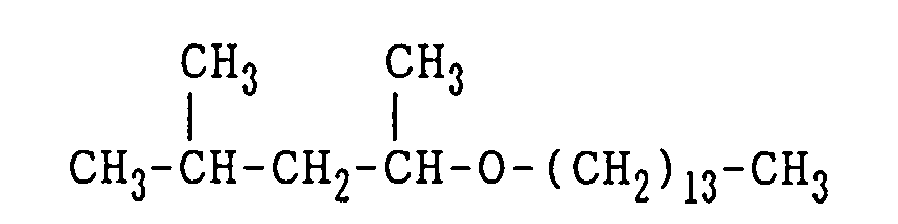
- 53.5 g (0.25 mol) of tetradecyl alcohol, 100 g (1.0 mol) of 4-methyl-2-pentanone and 1.6 g of 5% Pd-C (pH 6.6) as a catalyst were charged into a 500 mℓ autoclave equipped with a hydrogen gas-introducing tube, a stirrer and a dehydration-refluxing tube, and the contents were stirred at 8 kg/cm2 of hydrogen pressure while introducing 700 mℓ/min of hydrogen gas to flow continuously at 150°C for 7 hours. Water by-produced by the reaction was removed out of the system, and 4-methyl-2-pentanone which came out of the system together with the water was refluxed in the system.
- After completion of the reaction, the catalyst was removed by filtration, and excess 4-methyl-2-pentanone was removed under reduced pressure.
Further, distillation under reduced pressure (143°C/1 Torr) was carried out to obtain 73.8 g (0.248 mol) of intended 1,3-dimethylbutyl tetradecyl ether as a colorless and transparent liquid. - The isolation yield was 99%.
- The reaction was carried out in the same manner as that in Example A'-26, except that the dehydration-refluxing tube was not equipped, and hydrogen gas was not introduced to flow continuously, whereby 21.6 g (0.073 mol) of 1,3-dimethyl butyl tetradecyl ether was obtained as a colorless and transparent liquid.
- The isolation yield was 29%.
- The hydroxy compounds and the carbonyl compounds shown in Tables A'-9 and 10 were reacted in the presence of the catalysts shown in Tables A'-9 and 10 in the same manner as that in Example A'-26, except that the reaction conditions were changed as shown in Tables A'-9 and 10.
- The resulting products and the isolation yields thereof are shown in Tables A'-9 and 10 together with the results of Comparative Example A'-26.
- The hydroxy compounds and the carbonyl compounds shown in Tables A'-11 and A'-12 were reacted in the presence of the catalysts shown in Tables A'-11 and A'-12 in the same manner as that in Comparative Example A'-26, except that the reaction conditions were changed as shown in Tables A'-11 and A'-12.
- The resulting products and the isolation yields thereof are shown in Tables A'-11 and A'-12 together with the results of Comparative Example A'-26.
Table A'-9 Hydroxy compound Carbonyl compound Catalyst Reaction condition Product and Isolation yield Ex. A'-26 tetradecyl alcohol 53.5 g (0.25 mol) 4-methyl-2-pentanone 100 g (1.0 mol) 5%Pd-C (pH6.6) 1.6 g H2 press.: 2 kg/cm2 H2 flow amount: 300 mℓ/min 150°C, 7 h. 1,3-dimethylbutyl tetradecyl ether 73.8 g (0.248 mol), 99% A'-27 hexadecyl alcohol 60.5 g (0.25 mol) 4-methyl-2-pentanone 100 g (1.0 mol) 5%Pd-C (pH7.1) 1.8 g H2 press.: 1.5 kg/cm2 H2 flow amount: 300 mℓ/min 150°C, 7 h. 1,3-dimethylbutyl hexadecyl ether 79.9 g (0.245 mol), 98% A'-28 hexadecyl alcohol 60.5 g (0.25 mol) 4-methyl-2-pentanone 100 g (1.0 mol) 5%Pd-C (pH6.6) 3.6 g Flow H2 under atmospheric press. H2 flow amount: 200 mℓ/min 105°C, 10 h. 1,3-dimethylbutyl hexadecyl ether 73.8 g (0.248 mol), 99% A'-29 dodecyl alcohol 46.5 g (0.25 mol) butylaldehyde 72 g (1.0 mol) 5%Pd-C (pH6.6) 1.4 g H2 press.: 1.5 kg/cm2 H2 flow amount: 200 mℓ/min 105°C, 6 h. dodecylbutyl ether 58.9 g (0.248 mol), 99% A'-30 polyoxyethylene (p=9.3) monododecyl ether* 107 g (0.18 mol) cyclohexanone 70 g (0.71 mol) 5%Pd-C (pH7.1) 4.3 g H2 press.: 5 kg/cm2 H2 flow amount: 200 mℓ/min 150°C, 8 h. polyoxyethylene(p=9.3)cyclohexyl dodecyl ether 121 g (0.178 mol), 99% A'-31 polyoxyethylene (p=9.3) monododecyl ether* 107 g (0.18 mol) methylethyl ketone 50 g (0.7 mol) 5%Pd-C (pH4.0) 4.3 g H2 press.: 3 kg/cm2 H2 flow amount: 300 mℓ/min 150°C, 8 h. polyoxyethylenc(p=9.3)dodecyl(1-methylpropyl) ether 116 g (0.178 mol), 99% * p means an avarage addition molar number of ethyleneoxide. Table A'-10 Hydroxy compound Carbonyl compound Catalyst Reaction condition Product and Isolation yield Ex. A'-32 2-hexadecyleicosyl alcohol 104 g (0.2 mol) methylethyl ketone 72 g (1.0 mol) 5%Pd-C (pH7.3) 3.1 g H2 press.: 1.5 kg/cm2 H2 flow amount: 200 mℓ/min 150°C. 7 h. 1-methylpropyl(2-hexadecylelcosyl)ether 114 g (0.198 mol), 99% A'-33 diethyleneglycol monoisopropyl ether 51.8 g (0.35 mol) methylethyl ketone 126 g (1.75 mol) 5%Pd-C (pH6.6) 2.1 g H2 press.: 2 kg/cm2 H2 flow amount: 200 mℓ/min 130°C, 8 h. diethyleneglycol isopropyl(1-methylpropyl)ether 69.3 g (0.34 mol), 97% A'-34 dipropyleneglycol monopropyl ether 61.6 g (0.35 mol) isobutylaldehyde 126 g (1.75 mol) 5%Pd-C (pH7.3) 2.5 g H2 press.: 3 kg/cm2 H2 flow amount: 200 mℓ/min 130°C, 8 h. dipropyleneglycol propyl(2-methylpropyl)ether 78.0 g (0.336 mol), 96% A'-35 2-octanol 52.0 g (0.4 mol) isobutylaldehyde 144 g (2.0 mol) 5%Pd-C (pH4.0) 2.1 g H2 press.: 1.5 kg/cm2 H2 flow amount: 200 mℓ/min 150°C, 8 h. 1-methylheptyl(2-methylpropyl)ether 71.4 g (0.384 mol), 96% A'-36 polyoxyethylene(p=9. 3)monododecyl ether* 107 g (0.18 mol) 4-methyl-2-pentanone 72 g (0.72 mol) 5%Pd-C (pH7.1) 8.6 g Flow H2 gas under atmospheric press. H2 flow amount: 300 mℓ/min 105°C, 10 h. polyoxyethylene(p=9.3)dodecyl(1,3-dimethylbutyl)ether 120 g (0.176 mol), 98% A'-37 polyoxyethylene(p=9. 3)monododecyl ether* 107 g (0.18 mol) octylaldehyde 92 g (0.72 mol) 5%Pd-C (pH7.1) 8.G g Flow H2 gas under atmospheric press. H2 flow amount: 300 mℓ/min 105°C, 8 h. polyoxyethylene(p=9.3)dodecyloctylether 126 g (0.178 mol), 99% * p means an avarage addition molar number of ethyleneoxide. Table A'-11 Hydroxy compound Carbonyl compound Catalyst Reaction condition Product and Isolation yield Comp. Ex. A'-26 tetradecyl alcohol 53.5 g (0.25 mol) 4-methyl-2-pentanone 100 g (1.0 mol) 5%Pd-C (pH6.6) 1.6 g H2 press.: 2 kg/cm2 150°C, 7 h. 1,3-dimethylbutyl tetradecyl ether 21.6 g (0.073 mol), 29% A'-27 hexadecyl alcohol 60.5 g (0.25 mol) 4-methyl-2-pentanone 100 g (1.0 mol) 5%Pd-C (pH7.1) 1.8 g H2 press.: 1.5 kg/cm2 150°C, 7 h. 1,3-dimethylbutyl hexadecyl ether 25.3 g (0.078 mol), 31% A'-28 hexadecyl alcohol 60.5 g (0.25 mol) 4-methyl-2-pentanone 100 g (1.0 mol) 5%Pd-C (pH6.6) 3.6 g H2 press.: 1 kg/cm2 105°C, 10 h. 1,3-dimethylbutyl hexadecyl ether 9.78 g (0.030 mol), 12% A'-29 dodecyl alcohol 46.5 g (0.25 mol) butylaldehyde 72 g (1.0 mol) 5%Pd-C (pH6.6) 1.4 g H2 press.: 1.5 kg/cm2 150°C, 6 h. dodecylbutyl ether 20.6 g (0.085 mol), 34% A'-30 polyoxyethylene (p=9.3) monododecyl ether* 107 g (0.18 mol) cyclohexanone 70 g (0.71 mol) 5%Pd-C (p117.1) 4.3 g H2 press.: 5 kg/cm2 150°C, 8 h. polyoxyethylene(p=9.3)cyclohexyl dodecyl ether * 26.9 g (0.040 mol), 22% A'-31 polyoxyethylene (p=9.3) monododecyl ether* 107 g (0.18 mol) methylethyl ketone 50 g (0.7 mol) 5%Pd-C (pH4.0) 4.3 g H2 press.: 3 kg/cm2 150°C, 8 h. polyoxyethylene(p=9.3)dodecyl(1-methylpropyl) ether 29.3 g (0.045 mol), 25% * p means an avarage addition molar number of ethyleneoxide. Table A'-12 Hydroxy compound Carbonyl compound Catalyst Reaction condition Product and Isolation yield Comp. Ex. A'-32 2-hexadecylelcosyl alcohol 104 g (0.2 mol) methylethyl ketone 72 g (1.0 mol) 5%Pd-C (pH7.3) 3.1 g H2 press.: 1.5 kg/cm2 150°C, 7 h. 1-methylpropyl(2-hexadecylelcosyl)ether 25.4 g (0.044 mol), 22% A'-33 diethyleneglycol monoisopropyl ether 52 g (0.35 mol) methylethyl ketone 126 g (1.75 mol) 5%Pd-C (pH6.6) 2.1 g H2 press.: 2 kg/cm2 130°C, 8 h. diethyleneglycol isopropyl(1-methylpropyl)ether 12.1 g (0.060 mol), 17% A'-34 dipropyleneglycol monopropyl ether 62 g (0.35 mol) isobutylaldehyde 126 g (1.75 mol) 5%Pd-C (pH7.3) 2.5 g H2 press.: 3 kg/cm2 130°C, 8 h. dipropyleneglycol propyl(2-methylpropyl)ether 10.6 g (0.046 mol), 13% A'-35 2-octanol 52 g (0.4 mol) isobutylaldehyde 144 g (2.0 mol) 5%Pd-C (pH4.0) 2.1 g H2 press.: 1.5 kg/cm2 150°C, 8 h. 1-methylheptyl(2-methylpropyl)ether 11.9 g (0.064 mol), 16% A'-36 polyoxyethylene(p=9. 3)monododecyl ether* 107 g (0.18 mol) 4-methyl-2-pentanone 72 g (0.72 mol) 5%Pd-C (pH7.1) 8.6 g H2 press.: 1 kg/cm2 105°C, 10 h. polyoxyethylene(p=9.3)dodecyl(1,3-dimethylbutyl)ether 8.6 g (0.013 mol), 7% A'-37 polyoxyethylene(p=9. 3)monododecyl ether* 107 g (0.18 mol) octylaldehyde 92 g (0.72 mol) 5%Pd-C (pH7.1) 8.6 g atmospheric press. 105°C, 8 h. polyoxyethylene(p=9.3)dodecyloctylether 5.1 g (0.072 mol), 4% * p means an avarage addition molar number of ethyleneoxide. -

- 265 g (1.7 mol) of n-decylaldehyde, 5.3 g of 5% Pd-C (pH 6.6) as a catalyst and 2.7 g (0.02 mol) of anhydrous magnesium sulfate were charged into a 500 mℓ autoclave equipped with a hydrogen gas-introducing tube and a stirrer, and the contents were stirred at 100 kg/cm2 of hydrogen pressure at 150°C for 8 hours.
- After completion of the reaction, the catalyst was removed by filtration. Further, distillation under reduced pressure (143°C/0.3 Torr) was carried out to obtain 228 g (0.77 mol) of intended didecyl ether as a colorless and transparent liquid.
- ' The isolation yield was 90%.
-

- 250 g (2.5 mol) of methyl isobutyl ketone, 5.0 g of 5% Pd-C (pH 3.8) as a catalyst and 2.5 g (0.02 mol) of anhydrous magnesium sulfate were charged into a 500 mℓ autoclave equipped with a hydrogen gas-introducing tube and a stirrer, and the contents were stirred at 150 kg/cm2 of hydrogen pressure at 150°C for 8 hours.
- After completion of the reaction, the catalyst were removed by filtration. Further, distillation under reduced pressure (97°C/50 Torr) was carried out to obtain 174 g (0.94 mol) of intended bis(1,3-dimethylbutyl) ether as a colorless and transparent liquid.
- The isolation yield was 75%.
-
CH3(CH2)2CH2-O-CH2-CH2)2CH3
- 284 g (4.0 mol) of n-butylaldehyde and 8.5 g of 5% Pd-C (pH 6.6) as a catalyst were charged into a 500 mℓ autoclave equipped with a hydrogen gas-introducing tube, a stirrer and a cooling-dehydrating tube, and the contents were stirred at 60 kg/cm2 of hydrogen pressure while introducing 700 mℓ/min of hydrogen gas to flow continuously at 150°C for 8 hours to carry out the reaction while removing water by-produced by the reaction out of the system and n-butylaldehyde which came out of the system together with the water was returned again into the system.
- After completion of the reaction, the catalyst was removed by filtration. Further, distillation (140°C/atmospheric pressure) was carried out to obtain 247 g (1.9 mol) of intended dibutyl ether as a colorless and transparent liquid.
- The isolation yield was 95%.
-
CH3(CH2)4CH2-O-CH2(CH2)4CH3
- 250 g (2.5 mol) of n-hexylaldehyde and 7.5 g of 5% Pd-C (pH 6.6) as a catalyst were charged into a 500 mℓ autoclave equipped with a hydrogen gas-introducing tube, a stirrer and a cooling-dehydrating tube, and the contents were stirred at 80 kg/cm2 of hydrogen pressure while introducing 700 mℓ/min of hydrogen gas to flow continuously at 150°C for 8 hours to carry out the reaction while removing water by-produced by the reaction out of the system and n-hexylaldehyde which came out of the system together with water was returned again into the system.
- After completion of the reaction, the catalyst was removed by filtration. Further, distillation under reduced pressure (102°C/50 Torr) was carried out to obtain 216 g (1.16 mol) of intended dihexyl ether as a colorless and transparent liquid.
- The isolation yield was 93%.
-
CH3(CH2)6CH2-O-CH2(CH2)6CH3
- 256 g (2.5 mol) of n-octylaldehyde and 7.7 g of 5% Pd-C (pH 3.8) as a catalyst were charged into a 500 mℓ autoclave equipped with a hydrogen gas-introducing tube, a stirrer and a cooling-dehydrating tube, and the contents were stirred at 100 kg/cm2 of hydrogen pressure and 800 mℓ/min of hydrogen flow amount at 150°C for 8 hours to carry out the reaction while removing water by-produced by the reaction out of the system and n-octylaldehyde which came out of the system together with water was returned again into the system.
- After completion of the reaction, the catalyst was removed by filtration. Further, distillation under reduced pressure (127°C/3.5 Torr) was carried out to obtain 225 g (0.93 mol) of intended dioctyl ether as a colorless and transparent liquid.
- The isolation yield was 93%.
-
CH3(CH2)8CH2-O-CH2(CH2)8CH3
- 265 g (1.7 mol) of n-decylaldehyde and 8.0 g of 5% Pd-C (pH 6.6) as a catalyst were charged into a 500 mℓ autoclave equipped with a hydrogen gas-introducing tube, a stirrer and a cooling-dehydrating tube, and the contents were stirred at 100 kg/cm2 of hydrogen pressure and 1 liter/min of hydrogen flow amount at 150°C for 8 hours to carry out the reaction while removing water by-produced by the reaction out of the system and n-decylaldehyde which came out of the system together with water was returned again into the system.
- After completion of the reaction, the catalyst was removed by filtration. Further, distillation under reduced pressure (142°C/0.3 Torr) was carried out to obtain intended didecyl ether of 233 g (0.78 mol) in the form of a colorless, transparent liquid.
- The isolation yield was 92%.
-
CH3(CH2)10CH2-O-CH2(CH2)10CH3
- 276 g (1.5 mol) of n-dodecylaldehyde and 8.3 g of 5% Pd-C (pH 3.8) as a catalyst were charged into a 500 mℓ autoclave equipped with a hydrogen gas-introducing tube, a stirrer and a cooling-dehydrating tube, and the contents were stirred at 120 kg/cm2 of hydrogen pressure and 1 liter/min of hydrogen flow amount at 150°C for 8 hours to carry out the reaction while removing water by-produced by the reaction out of the system and n-dodecylaldehyde which came out of the system together with the water was returned again into the system.
- After completion of the reaction, the catalyst was removed by filtration. Further, distillation under reduced pressure (165°C/0.2 Torr) was carried out to obtain 247 g (0.70 mol) of intended didodecyl ether as a colorless and transparent liquid.
- The isolation yield was 93%.
-

- 250 g (2.5 mol) of methyl isobutyl ketone and-10 g 5% Pd-C (pH 3.8) as a catalyst were charged into a 500 mℓ autoclave equipped with a hydrogen gas-introducing tube, a stirrer and a cooling-dehydrating tube, and the contents were stirred at 150 kg/cm2 of hydrogen pressure and 700 mℓ/min of hydrogen flow amount at 150°C for 8 hours to carry out the reaction while removing water by-produced by the reaction out of the system and methyl isobutyl ketone which came out of the system together with the water was returned again into the system.
- After completion of the reaction, the catalyst was removed by filtration. Further, distillation under reduced pressure (97°C/50 Torr) was carried out to obtain 184 g (0.99 mol) of intended bis(1,3-dimethylbutyl) ether as a colorless and transparent liquid.
- The isolation yield was 79%.
-

- 245 g (2.5 mol) of cyclohexanone and 9.8 g of 5% Pd-C (pH 6.6) as a catalyst were charged into a 500 mℓ autoclave equipped with a hydrogen gas-introducing tube, a stirrer and a cooling-dehydrating tube, and the contents were stirred at 150 kg/cm2 of hydrogen pressure and 700 mℓ/min of hydrogen flow amount at 150°C for 8 hours to carry out the reaction while removing water by-produced by the reaction out of the system and cyclohexanone which came out of the system together with the water was returned again into the system.
- After completion of the reaction, the catalyst was removed by filtration. Further, refining was carried out with silica gel column chromatography, whereby 187 g (1.03 mol) of intended dicyclohexyl ether was obtained as a colorless and transparent liquid.
- The isolation yield was 82%.
- 150 g (0.027 mol) of ethylene oxide adduct of dodecyl alcohol (ethylene oxide average addition molar number: 120 mol), 44 g (0.76 mol) of acetone, 0.94 g (7.84 milli mol) of anhydrous magnesium sulfate and 3 g of 5% Pd-C (pH 4.0) as a catalyst were charged into a 500 mℓ autoclave equipped with a hydrogen gas-introducing tube and a stirrer, and the reaction was carried out at 100 kg/cm2 of hydrogen pressure at 150°C for 8 hours. After completion of the reaction, the catalyst and magnesium sulfate were removed by filtration, and excess acetone was removed under reduced pressure, whereby 148 g of polyoxyethylene(ethylene oxide average addition molar number: 120 mol)-isopropyl-lauryl ether was obtained as a white solid matter (isolation yield: 98%).
- 200 g (0.03 mol) of ethylene oxide adduct of dodecyl alcohol (ethylene oxide average addition molar number: 150 mol), 50 g (0.86 mol) of acetone, 1.03 g (8.57 milli mol) of anhydrous magnesium sulfate and 4 g of 5% Pd-C (pH 4.0) as a catalyst were charged into a 500 mℓ autoclave equipped with a hydrogen gas-introducing tube and a stirrer, and the reaction was carried out at 100 kg/cm2 of hydrogen pressure at 150°C for 8 hours. After completion of the reaction, the catalyst and magnesium sulfate were removed by filtration, and excess acetone was removed under reduced pressure, whereby 199 g of polyoxyethylene(ethylene oxide average addition molar number: 150 mol)-isopropyl-lauryl ether was obtained as a white solid matter (isolation yield: 99%).
- 150 g (0.027 mol) of ethylene oxide adduct of dodecyl alcohol (ethylene oxide average addition molar number: 120 mol), 54 g (0.75 mol) of methyl ethyl ketone, 0.94 g (7.87 milli mol) of anhydrous magnesium sulfate and 3 g of 5% Pd-C (pH 4.0) as a catalyst were charged into a 500 mℓ autoclave equipped with a hydrogen gas-introducing tube and a stirrer, and the reaction was carried out at 100 kg/cm2 of hydrogen pressure at 150°C for 8 hours. After completion of the reaction, the catalyst and magnesium sulfate were removed by filtration, and excess methyl ethyl ketone was removed under reduced pressure, whereby 147 g of polyoxyethylene(ethylene oxide average addition molar number: 120 mol)-1-methylpropyl-lauryl ether was obtained as a white solid matter (isolation yield: 96%).
- 83 g (0.036 mol) of ethylene oxide and propylene oxide adduct of stearyl alcohol (ethylene oxide average addition molar number: 20 mol, propylene oxide average addition molar number: 20 mol), 53 g (0.93 mol) of acetone, 1.85 g (0.015 mol) of anhydrous magnesium sulfate and 1.7 g of 5% Pd-C (pH 4.0) as a catalyst were charged into a 500 mℓ autoclave equipped with a hydrogen gas-introducing tube and a stirrer and the reaction was carried out at 100 kg/cm2 of hydrogen pressure at 150°C for 10 hours. After completion of the reaction, the catalyst and magnesium sulfate were removed by filtration, and excess acetone was removed under reduced pressure, whereby 74 g of polyoxyalkylene(ethylene oxide average addition molar number: 20 mol, propylene oxide average addition molar number: 20 mol)-isopropyl-lauryl ether was obtained as a colorless and transparent liquid (isolation yield: 87%).
- 150 g (0.047 mol) of ethylene oxide and propylene oxide adduct of 2-octyl alcohol (ethylene oxide average addition molar number: 30 mol, propylene oxide average addition molar number: 30 mol), 150 g (1.5 mol) of methyl isobutyl ketone, 2.42 g (0.02 mol) of anhydrous magnesium sulfate and 3 g of 5% Pd-C (pH 4.0) as a catalyst were charged into a 500 mℓ autoclave equipped with a hydrogen gas-introducing tube and a stirrer, and the reaction was carried out at 100 kg/cm2 of hydrogen pressure at 150°C for 10 hours. After completion of the reaction, the catalyst and magnesium sulfate were removed by filtration, and excess methyl isobutyl ketone was removed under reduced pressure, whereby 143 g of polyoxyalkylene(ethylene oxide average addition molar number: 30 mol, propylene oxide average addition molar number: 30 mol)-1,3-dimethylbutyl-1-methylheptyl ether was obtained as a colorless and transparent liquid (isolation yield: 93%).
- 150 g (0.047 mol) of ethylene oxide and propylene oxide adduct of 2-octyl alcohol (ethylene oxide average addition molar number: 30 mol, propylene oxide average addition molar number: 30 mol), 147 g (1.5 mol) of cyclohexanone, 2.42 g (0.02 mol) of anhydrous magnesium sulfate and 3 g of 5% Pd-C (pH 4.0) as a catalyst were charged into a 500 mℓ autoclave equipped with a hydrogen gas-introducing tube and a stirrer, and the reaction was carried out at 100 kg/cm2 of hydrogen pressure at 150°C for 10 hours. After completion of the reaction, the catalyst and magnesium sulfate were removed by filtration, and excess cyclohexanone was removed under reduced pressure, whereby 102 g of polyoxyalkylene(ethylene oxide average addition molar number: 30 mol, propylene oxide average addition molar number: 30 mol)-cyclohexyl-1-methylheptyl ether was obtained as a colorless and transparent liquid (isolation yield: 91%).
- 164 g (0.05 mol) of ethylene oxide and propylene oxide adduct of dodecyl alcohol (ethylene oxide average addition molar number: 30 mol, propylene oxide average addition molar number: 30 mol), 150 g (1.5 mol) of methyl isobutyl ketone and 3 g of 5% Pd-C (pH 4.0) as a catalyst were charged into a 500 mℓ autoclave equipped with a hydrogen gas-introducing tube and a stirrer, and the reaction was carried out at 10 kg/cm2 of hydrogen pressure and 300 mℓ/min of hydrogen gas flow amount at 105°C for 10 hours. Water by-produced by the reaction was removed out of the system, and unreacted methyl isobutyl ketone which came out of the system together with the water was returned again into the system.
- After completion of the reaction, the catalyst was removed by filtration, and excess methyl isobutyl ketone was removed under reduced pressure, whereby 158 g of polyoxyalkylene(ethylene oxide average addition molar number: 30 mol, propylene oxide average addition molar number: 30 mol)-1,3-dimethylbutyl-dodecyl ether was obtained as a colorless and transparent liquid (isolation yield: 95%).
- 150 g (0.027 mol) of ethylene oxide adduct of dodecyl alcohol (ethylene oxide average addition molar number: 120 mol), 75 g (0.75 mol) of methyl isobutyl ketone and 10 g of 5% Pd-C (pH 4.0) as a catalyst were charged into a 500 me autoclave equipped with a hydrogen gas-introducing tube and a stirrer, and the reaction was carried out at 10 kg/cm2 of hydrogen pressure and 300 mQ/min of hydrogen gas flow amount at 105°C for 10 hours. Water by-produced by the reaction was removed out of the system, and unreacted methyl isobutyl ketone which came out of the system together with the water was returned again into the system.
- After completion of the reaction, the catalyst was removed by filtration, and excess methyl isobutyl ketone was removed under reduced pressure, whereby 144 g of polyoxyalkylene(ethylene oxide average addition molar number: 120 mol)-1,3-dimethylbutyl-dodecyl ether was obtained as a white solid matter (isolation yield: 96%).
- 150 g (0.027 mol) of ethylene oxide adduct of dodecyl alcohol (ethylene oxide average addition molar number: 120 mol), 54 g (0.75 mol) of isobutylaldehyde and 10 g of 5% Pd-C (pH 4.0) as a catalyst were charged into a 500 mℓ autoclave equipped with a hydrogen gas-introducing tube and a stirrer, and the reaction was carried out at 10 kg/cm2 of hydrogen pressure and 300 mℓ/min of hydrogen gas flow amount at 80°C for 10 hours. Water by-produced by the reaction was removed out of the system, and unreacted isobutylaldehyde which came out of the system together with water was returned again into the system.
- After completion the reaction, the catalyst was removed by filtration, and excess isobutylaldehyde was removed under reduced pressure, whereby 143 g of polyoxyalkylene(ethylene oxide average addition molar number: 120 mol)-2-methylpropyl-dodecyl ether was obtained as a white solid matter (isolation yield: 96%).
- 83 g (0.036 mol) of ethylene oxide and propylene oxide adduct of octadecyl alcohol (ethylene oxide average addition molar number: 20 mol, propylene oxide average addition molar number: 20 mol), 67 g (0.93 mol) of methyl ethyl ketone and 5 g of 5% Pd-C (pH 4.0) as a catalyst were charged into a 500 mℓ autoclave equipped with a hydrogen gas-introducing tube and a stirrer, and the reaction was carried out at 10 kg/cm2 of hydrogen pressure and 300 mℓ/min of hydrogen gas flow amount at 80°C for 10 hours. Water by-produced by the reaction was removed out of the system, and unreacted methyl ethyl ketone which came out of the system together with the water was returned again into the system.
- After completion of the reaction, the catalyst was removed by filtration, and excess methyl ethyl ketone was removed under reduced pressure, whereby 81 g of polyoxyalkylene(ethylene oxide average addition molar number: 20 mol, propylene oxide average addition molar number: 20 mol)-1-methylpropyl-octadecyl ether was obtained as a colorless and transparent liquid (isolation yield: 95%).
- 109 g (0.020 mol) of ethylene oxide adduct of dodecyl alcohol (ethylene oxide average addition molar number: 120 mol), 44 g (0.76 mol) of acetone and 8 g of 5% Pd-C (pH 4.0) as a catalyst were charged into a 500 mℓ autoclave equipped with a hydrogen gas-introducing tube and a stirrer, and the reaction was carried out at 10 kg/cm2 of hydrogen pressure and 300 mℓ/min of hydrogen gas flow amount at 120°C for 10 hours.
- After completion of the reaction, the catalyst was removed by filtration, and excess acetone was removed under reduced pressure, whereby 107 g of polyoxyalkylene(ethylene oxide average addition molar number: 120 mol)-isopropyl-dodecyl ether was obtained as a white solid matter (isolation yield: 97%).
- 83 g (0.036 mol) of ethylene oxide and propylene oxide adduct of octadecyl alcohol (ethylene oxide average addition molar number: 20 mol, propylene oxide average addition molar number: 20 mol), 67 g (0.93 mol) of isobutyl aldehyde and 5 g of 5% Pd-C (pH 4.0) as a catalyst were charged into a 500 mℓ autoclave equipped with a hydrogen gas-introducing tube and a stirrer, and the reaction was carried out at 10 kg/cm2 of hydrogen pressure and 300 mℓ/min hydrogen gas flow amount at 120°C for 10 hours.
- After completion of the reaction, the catalyst was removed by filtration, and excess isobutylaldehyde was removed under reduced pressure, whereby 82 g of polyoxyalkylene(ethylene oxide average addition molar number: 20 mol, propylene oxide average addition molar number: 20 mol)-2-methylpropyl-octadecyl ether was obtained as a colorless and transparent liquid (isolation yield: 96%).
-

- 47 g (0.4 mol) of 1,6-hexanediol, 232 g (4 mol) of acetone, 0.94 g of 5% Pd-C (pH 6.4) as a catalyst and 28 g (0.23 mol) of anhydrous magnesium sulfate as a dehydrating agent were charged into a 500 mℓ autoclave equipped with a hydrogen gas-introducing tube and a stirrer, and the content were stirred at 70 kg/cm2 of hydrogen pressure at 150°C for 7 hours.
- After completion of the reaction, the catalyst and magnesium sulfate were removed by filtration, and excess acetone was removed under reduced pressure. Further, refining with silica gel column chromatography was carried out to obtain 79 g (0.39 mol) of intended 1,6-hexanediol diisopropyl ether as a colorless and transparent liquid.
- The isolation yield was 98% (based on 1,6-hexanediol).
- The polyhydric hydroxy compounds and the monovalent carbonyl compounds shown in Table D-1 were reacted in the presence of the catalysts and the dehydrating agents shown in Table D-1 in the same manner as that in Example D-1, except that the reaction conditions were changed as shown in Table D-1.
- The resulting products and the isolation yields thereof are shown in Table D-1.
- The isolation yields are based on the hydroxy compounds.
Table D-1 Hydroxy compound Carbonyl compound Catalyst Dehydrating agent Reaction condition Product and Isolation yield Ex. D-2 1,9-nonanediol 32 g (0.2 mol) 4-methyl-2-pentanone 200 g (2.0 mol) 5%Pd-C (pH6.4) 0.64 g, anhydrous magnesium sulfate 13 g (0.11 mol) H2 pressure: 70 kg/cm2 150°C, 7 h. 1,9-nonanedlol bis(1,3-dlmethylbutyl)ether 63 g (0.19 mol), 95% D-3 3-methyl-1,5-pentanediol 35 g (0.3 mol) methylethyl ketone 216 g (3 mol) 5%Pd-C (pH7.1) 0.70 g anhydrous magnesium sulfate 20 g (0.17 mol) H2 pressure: 100 kg/cm2 150°C, 7 h. 3-methyl-1.5-pentanediol bis(1-methylpropyl)ether 66 g (0.29 mol), 96% D-4 glycerol 28 g (0.3 mol) acetone 261 g (4.5 mol) 5%Pd-C (pH7.1) 0.56 g anhydrous magnesium sulfate 31 g (0.26 mol) H2 pressure: 100 kg/cm2 150°C, 15 h. glycerolisopropylether · tri- 1.3 g (0.006 mol), 2% · di- 32 g (0.18 mol), 60% · mono- 12 g (0.09 mol), 30% - The monohydric hydroxy compounds and the polyvalent carbonyl compounds shown in Table D-2 were reacted in the presence of the catalysts and the dehydrating agents shown in Table D-2 in the same manner as that in Example D-1, except that the reaction conditions were changed as shown in Table D-2.
- The resulting products and the isolation yields thereof are shown in Table D-2.
- The isolation yields are based on the carbonyl compounds.
Table D-2 Hydroxy compound Carbonyl compound Catalyst Dehydrating agent Reaction condition Product and Isolation yield Ex. D-5 n-octylalcohol 260 g (2 mol) 2,5-hexanedlon 23 g (0.2 mol) 5%Pd-C (pH6.4) 0.46 g anhydrous magnesium sulfate 13 g (0.11 mol) H2 pressure: 70 kg/cm2 150°C, 7 h. 2,5-hexanediol dioctylether 67 g (0.196 mol), 98% D-6 n-butylalcohol 222 g (3 mol) 1,4-cyclohexancdion 34 g (0.3 mol) 5%Pd-C (pH6.4) 0.68 g anhydrous magnesium sulfate 20 g (0.17 mol) H2 pressure: 70 kg/cm2 150°C, 6 h. 1,4-cyclohexnnediol dibutylether 65 g (0.285 mol). 95% D-7 tetradecylalcohol 214 g (1 mol) 1,4-cyclohexafiedion 11 g (0.1 mol) 5%Pd-C (pH7.1) 0.44 g anhydrous magnesium sulfate 7.2 g (0.06 mol) H2 pressure: 70 kg/cm2 150°C, 7 h. 1,4-cyclohexanedlol ditetradecylether 47 g (0.093 mol). 93% D-8 diethyleneglycol monobutylether 243 g (1.5 mol) 2,5-hexanedion 17 g (0.15 mol) 5%Pd-C (pH7.1) 0.68 g anhydrous magnesium sulfate 11 g (0.09 mol) H2 pressure: 70 kg/cm2 150°C, 7 h. 2,5-hexanediol bis(diethylene glycol monobutylether)ether 58 g (0.143 mol), 95% D-9 polyoxyethylene(p =6.0)monododecyl ether* 225 g (0.5 mol) 2,5-hexanedion 6.8 g (0.06 mol) 5%Pd-C (pH3.8) 0.27 g anhydrous magnesium sulfate 6.0 g (0.05 mol) H2 pressure: 100 kg/cm2 150°C, 10 h. 2.5-hexanedlol bis{polyoxyethylene(p=6.0) monododecylether}ether 53 g (0.054 mol), 90% *: p means an average addition molar number of ethyleneoxide. -

- 99 g (0.15 mol) of polyoxyethylene(P=4.3)glycerol, 133 g (2.3 mol) of acetone, 2.0 g of 5% Pd-C (pH 3.8) as a catalyst and 16 g (0.13 mol) of anhydrous magnesium sulfate as a dehydrating agent were charged into a 500 mℓ autoclave equipped with a hydrogen gas-introducing tube and a stirrer, and the contents were stirred at 100 kg/cm2 of hydrogen pressure at 150°C for 10 hours.
- After completion of the reaction, the catalyst and magnesium sulfate were removed by filtration, and excess acetone was removed under reduced pressure. Further, the low boiling portion were completely removed by steaming to obtain 100 g of intended isopropylpolyoxyethylene(P=4.3)glycerol as a colorless and transparent liquid.
- The etherification rate calculated from the hydroxyl value [255 (KOH mg/g)] before the reaction and the hydroxyl value [26 (KOH mg/g)] after the reaction was 76%.
- The polyhydric hydroxy compound and the monovalent carbonyl compound shown in Table D-3 were reacted in the presence of the catalyst and the dehydrating agent shown in Table D-3 in the same manner as that in Example D-10, except that the reaction conditions were changed as shown in Table D-3.
- The resulting product and the etherification rate thereof are shown in Table D-3.
-

- 18 g (0.2 mol) of 1,4-butanediol, 200 g (2 mol) of methyl isobutyl ketone and 2 g of 5% Pd-C (pH 7.1) as a catalyst were charged into a 500 mℓ autoclave equipped with a hydrogen gas-introducing tube, a stirrer and a cooling-dehydrating tube, and the contents were stirred at 3 kg/cm2 of hydrogen pressure and 300 mℓ/min of hydrogen flow amount at 105°C for 10 hours. Water by-produced by the reaction was removed out of the system, and unreacted methyl isobutyl ketone which came out of the system together with the water was put back into the system.
- After completion of the reaction, the catalyst was removed by filtration, and excess methyl isobutyl ketone was removed under reduced pressure. Further, refining was carried out with silica gel column chromatography to obtain 50.6 g (0.196 mol) of intended 1,4-butanediol bis(1,3-dimethylbutyl) ether as a colorless and transparent liquid.
- The isolation yield was 98% (based on 1,4-butanediol).
- The polyhydric hydroxy compounds and the monovalent carbonyl compounds shown in Table D-4 were reacted in the presence of the catalysts shown in Table D-4 in the same manner as that in Example D-12, except that the reaction conditions were changed as shown in Table D-4.
- The resulting products and the isolation yields thereof are shown in Table D-4.
- The isolation yields are based on the hydroxy compounds.
Table D-3 Hydroxy compound Carbonyl compound Catalyst Dehydrating agent Reaction condition Product and Isolation yield Ex. D-11 polyethyleneglycol [average molecular wt.: 400] 80 g (0.2 mol) acetone 139 g (2.4 mol) 5%Pd-C (pH6.4) 3.2 g anhydrous magnesium sulfate 28 g (0.23 mol) H2 pressure: 70 kg/cm2 150°C, 12 h. polyethyleneglycol diisopropylether 86 g, lsopropyletherification rate (93%) Table D-4 Hydroxy compound Carbonyl compound Catalyst Reaction condition Product and Isolation yield Ex. D-13 1,3-hexanediol 24 g (0.2 mol) cyclohexane 157 g (1.6 mol) 5%Pd-C (pH7.1) 2 g H2 pressure: 5 kg/cm2 H2 flow amount: 400 mℓ/min 120°C 1,6-hexanediol dicyclohexylether 54.7 g (0.194 mol), 97% D-14 triethyleneglycol 30 g (0.2 mol) methyllsobutyl ketone 200 g (2 mol) 5%Pd-C (pH7.1) 2.2 g H2 pressure: 3 kg/cm2 H2 flow amount: 300 mℓ/min 105°C triethyleneglycol bis(1,3-dimethylbutyl)ether G2.9 g (0.198 mol), 99% D-15 3-methyl-1,5-pentanediol 30 g (0.25 mol) isobutylaldehyde 180 g (2.5 mol) 5%Pd-C (pH6.4) 2.2 g H2 pressure: 3 kg/cm2 H2 flow amount: 300 mℓ/min 105°C 3-methyl-1.5-pentanediol bis(2-methylpropyl)ether 56.9 g (0.248 mol), 99% - The monohydric hydroxy compounds and the polyvalent carbonyl compounds shown in Table D-5 were reacted in the presence of the catalysts shown in Table D-5 in the same manner as that in Example D-12, except that the reaction conditions were changed as shown in Table D-5.
- The resulting products and the isolation yields thereof are shown in Table D-5.
- The isolation yields are based on the carbonyl compounds.
Table D-5 Hydroxy compound Carbonyl compound Catalyst Reaction condition Product and Isolation yield Ex. D-16 octanol 208 g (1.6 mol) 1,4-cyclohexanedion 22 g (0.2 mol) 5%Pd-C (pH7.1) 2 g H2 pressure: 5 kg/cm2 H2 flow amount: 400 mℓ/min 120°C 1,4-cyclohexanediol dioctylether 66.6 g (0.196 mol), 98% D-17 octanol 208 g (1.6 mol) 2,5-hexanedion 23 g (0.2 mol) 5%Pd-C (pH6.4) 2 g H2 pressure: 5 kg/cm2 H2 flow amount: 400 mℓ/min 120°C 2,5-hexanediol dioctylether 66.3 g (0.194 mol), 97% -

- 48 g (0.3 mol) of 1,9-nonanediol, 174 g (3 mol) of acetone and 4 g of 5% Pd-C (pH 7.1) 4 g as a catalyst were charged into a 500 mℓ autoclave equipped with a hydrogen gas-introducing tube and a stirrer, and the reaction was carried out at 10 kg/cm2 of hydrogen pressure and 250 mℓ/min of hydrogen flow amount at 100°C for 10 hours.
- After completion of the reaction, the catalyst was removed by filtration, and excess acetone was removed under reduced pressure. Further, refining was carried out with silica gel column chromatography to obtain 72.5 g (0.297 mol) of intended 1,9-nonanedioldiisopropyl ether as a colorless and transparent liquid.
- The isolation yield was 99% (based on 1,9-nonanediol).
-
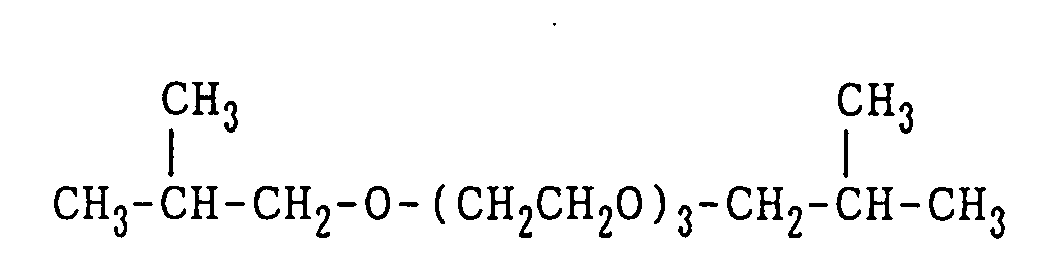
- 30 g (0.2 mol) of triethylene glycol, 144 g (2 mol) of isobutylaldehyde and 2.2 g of 5% Pd-C (pH 6.4) as a catalyst were charged into a 500 mℓ autoclave equipped with a hydrogen gas-introducing tube and a stirrer, and the reaction was carried out at 10 kg/cm2 of hydrogen pressure and 250 mℓ/min of hydrogen flow amount at 110°C for 10 hours.
- After completion of the reaction, the catalyst was removed by filtration, and excess isobutylaldehyde was removed under reduced pressure. Further, refining was carried out with silica gel column chromatography to obtain 51.4 g (0.196 mol) of intended triethylene glycol bis(2-methyl)propyl ether as a colorless and transparent liquid.
- The isolation yield was 98% (based on triethylene glycol).
- 106 g (0.9 mol) of 3-methyl-1,5-pentanediol, 101 g (0.9 mol) of 1,4-cyclohexanedione and 7 g of 5% Pd-C (pH 7.1) as a catalyst were charged into a 500 mℓ autoclave equipped with a hydrogen gas-introducing tube and a stirrer, and the reaction was carried out at 3 kg/cm2 of hydrogen pressure and 300 mℓ/min of hydrogen flow amount at 100°C for 10 hours.
- After completion of the reaction, the catalyst was removed by filtration to obtain 180 g of the product. This product was determined by GPC (gel permeation chromatography), and the peaks of compounds having about 230 to 1500 of molecular weight were observed. The main peak is at about 345, and it has been found from the results obtained by IR and 1H-NMR that the resulting product is a mixture of compounds represented by the following formulae.


Claims (12)
- A process for producing an ether compound by reacting (a) a hydroxy compound with a carbonyl compound or (b) a carbonyl compound, under hydrogen gas atmosphere in the presence of a catalyst, capable of catalysing hydrogenations, characterized in that the reaction is carried out while removing out water produced by the reaction.
- The process as claimed in claim 1,
characterized in that the water is removed by at least one method selected from the group consisting of:(1) carrying out the reaction in the presence of a dehydrating agent;(2) distillating off the water; and(3) blowing hydrogen gas to flow through the reaction system. - The process as claimed in claim 2,
characterized in that the dehydrating agent is selected from the group consisting of an inorganic salt, an oxide, a hydroxide, a crystalline zeolite and a silica gel. - The process as claimed in claim 3,
characterized in that the dehydrating agent is selected from the group consisting of anhydrous magnesium sulfate, anhydrous sodium sulfate, anhydrous calcium sulfate and a molecular sieve. - The process as claimed in any of claims 2 to 4,
characterized in that the amount of the dehydrating agent is in the range from 0.1 to 100 molar % based on the starting carbonyl compound. - The process as claimed in claim 2,
characterized in that the water is distilled off by azeotropic dehydration. - The process as claimed in claim 1,
characterized in that the water is removed by azeotropic dehydration while blowing hydrogen gas through the reaction system. - The process as claimed in any of claims 2, 6 or 7,
characterized in that the unreacted reactants which have come out of the reaction system together with the removed water are returned back to the reaction system. - The process as claimed in any of claims 1 to 8,
characterized in that the ether compound is produced by the reaction of a hydroxy compound and a carbonyl compound. - The process as claimed in any of claims 1 to 9,
characterized in that the hydroxy compound is represented by the following formula (1):
R1-(OA)n-OH (1)
(wherein R1 represents a straight or branched alkyl or alkenyl group having 1 to 40 carbon atoms or a cycloalkyl group having 3 to 12 carbon atoms; A represents an alkylene group having 2 to 12 carbon atoms, which may have a hydroxy group; two or more A's may be the same as or different from one another; and n is a number of 0 to 500). - The process as claimed in any of claims 1 to 10,
characterized in that the carbonyl compound is a ketone or an aldehyde compound represented by the general formula (2):
- The process as claimed in any of claims 1 to 11,
characterized in that the catalyst is a palladium catalyst supported on carbon, alumina, silica or silica-alumina.
Applications Claiming Priority (4)
| Application Number | Priority Date | Filing Date | Title |
|---|---|---|---|
| JP176089/95 | 1995-07-12 | ||
| JP17608995 | 1995-07-12 | ||
| JP30115095 | 1995-11-20 | ||
| JP301150/95 | 1995-11-20 |
Publications (3)
| Publication Number | Publication Date |
|---|---|
| EP0753500A2 EP0753500A2 (en) | 1997-01-15 |
| EP0753500A3 EP0753500A3 (en) | 1997-04-02 |
| EP0753500B1 true EP0753500B1 (en) | 2007-03-07 |
Family
ID=26497152
Family Applications (1)
| Application Number | Title | Priority Date | Filing Date |
|---|---|---|---|
| EP96111314A Expired - Lifetime EP0753500B1 (en) | 1995-07-12 | 1996-07-12 | Process for producing ether compound |
Country Status (4)
| Country | Link |
|---|---|
| US (1) | US5914430A (en) |
| EP (1) | EP0753500B1 (en) |
| CN (1) | CN1066706C (en) |
| DE (1) | DE69636943T2 (en) |
Cited By (1)
| Publication number | Priority date | Publication date | Assignee | Title |
|---|---|---|---|---|
| RU2634902C1 (en) * | 2016-11-23 | 2017-11-08 | Акционерное общество "Научно-исследовательский институт полимерных материалов" | Method of producing dibutylkarbitolformal |
Families Citing this family (9)
| Publication number | Priority date | Publication date | Assignee | Title |
|---|---|---|---|---|
| US6060626A (en) * | 1997-10-16 | 2000-05-09 | Kao Corporation | Fluorine-containing ether compound |
| US6002048A (en) * | 1997-10-16 | 1999-12-14 | Kao Corporation | Fluorine-containing ether compound and gelling agent containing the same |
| US8211974B2 (en) * | 2005-10-07 | 2012-07-03 | Johns Manville | Curable fiberglass binder comprising a polyacetal or polyketal |
| FR2933097B1 (en) * | 2008-06-27 | 2010-08-20 | Seppic Sa | NOVEL INVERSE LATEX FREE OF OXYETHYLENE DERIVATIVES, COSMETIC, DERMOCOSMETIC, DERMOPHARMACEUTICAL OR PHARMACEUTICAL COMPOSITIONS COMPRISING THE SAME |
| CN102131757A (en) * | 2008-08-25 | 2011-07-20 | 陶氏环球技术有限责任公司 | Polyol ethers and process for making them |
| RU2433991C2 (en) * | 2010-02-08 | 2011-11-20 | Учреждение Российской Академии Наук Институт Нефтехимии И Катализа Ран | Method of producing dioctyl ether |
| US20110207969A1 (en) * | 2010-02-23 | 2011-08-25 | Olken Michael M | Process for making polyol ethers |
| US10273432B2 (en) * | 2016-12-20 | 2019-04-30 | International Flavors & Fragrances Inc. | Organoleptic compounds |
| CN110330640B (en) * | 2019-07-15 | 2022-02-18 | 万华化学集团股份有限公司 | Refining method of high molecular weight alkyl terminated polyether |
Citations (2)
| Publication number | Priority date | Publication date | Assignee | Title |
|---|---|---|---|---|
| EP0665207A1 (en) * | 1994-01-28 | 1995-08-02 | Texaco Development Corporation | Isopropyl alcohol and ether production from acetone |
| EP0719751A1 (en) * | 1994-12-30 | 1996-07-03 | Texaco Development Corporation | A gradient catalyst system for the integrated production of isopropyl alcohol and diisopropyl ethers |
Family Cites Families (2)
| Publication number | Priority date | Publication date | Assignee | Title |
|---|---|---|---|---|
| US3954883A (en) * | 1970-07-23 | 1976-05-04 | Mobil Oil Corporation | Catalytic polystep reactions |
| DE4124199A1 (en) * | 1991-07-20 | 1993-01-21 | Henkel Kgaa | PROCESS FOR THE PRODUCTION OF POLYOLETHERS |
-
1996
- 1996-07-05 US US08/675,923 patent/US5914430A/en not_active Expired - Lifetime
- 1996-07-12 EP EP96111314A patent/EP0753500B1/en not_active Expired - Lifetime
- 1996-07-12 DE DE69636943T patent/DE69636943T2/en not_active Expired - Lifetime
- 1996-07-12 CN CN96112106A patent/CN1066706C/en not_active Expired - Lifetime
Patent Citations (2)
| Publication number | Priority date | Publication date | Assignee | Title |
|---|---|---|---|---|
| EP0665207A1 (en) * | 1994-01-28 | 1995-08-02 | Texaco Development Corporation | Isopropyl alcohol and ether production from acetone |
| EP0719751A1 (en) * | 1994-12-30 | 1996-07-03 | Texaco Development Corporation | A gradient catalyst system for the integrated production of isopropyl alcohol and diisopropyl ethers |
Cited By (1)
| Publication number | Priority date | Publication date | Assignee | Title |
|---|---|---|---|---|
| RU2634902C1 (en) * | 2016-11-23 | 2017-11-08 | Акционерное общество "Научно-исследовательский институт полимерных материалов" | Method of producing dibutylkarbitolformal |
Also Published As
| Publication number | Publication date |
|---|---|
| DE69636943D1 (en) | 2007-04-19 |
| EP0753500A3 (en) | 1997-04-02 |
| EP0753500A2 (en) | 1997-01-15 |
| CN1148584A (en) | 1997-04-30 |
| DE69636943T2 (en) | 2007-12-06 |
| US5914430A (en) | 1999-06-22 |
| CN1066706C (en) | 2001-06-06 |
Similar Documents
| Publication | Publication Date | Title |
|---|---|---|
| US6667396B2 (en) | Polyxyloside derivatives, process for preparing them, composition containing them and use as surfactants | |
| EP2143706A1 (en) | Process for production of ether carboxylates | |
| US5914430A (en) | Process for producing ether compound | |
| JPH11315077A (en) | Production of macrocyclic ester | |
| EP0024806B2 (en) | Preparation of alkyl glyceryl ether alcohols | |
| US20230303488A1 (en) | Branched Technologies | |
| JPS58189129A (en) | Manufacture of monoethylene glycol monoether | |
| EP0708073A1 (en) | Process for producing polyhydric alcohol | |
| EP0950652B1 (en) | Cis-configurational unsaturated ester, process for producing the same, and fragrance composition containing the same | |
| EP0761629A1 (en) | Aliphatic unsaturated compounds, process for their preparation as well as their use as fragrances | |
| EP0846094B1 (en) | Branched chain compounds and their use | |
| US7723277B2 (en) | Methyl cyclohexane carboxylates and their use in perfume compositions | |
| JPH03279336A (en) | Production of branched dimerized alcohol | |
| JP4611998B2 (en) | Method for preparing an alkoxylated alcohol composition | |
| EP4509549A1 (en) | Carboxylated organopolysiloxane, method for producing carboxylated organopolysiloxane, and surfactant | |
| KR100211777B1 (en) | Method for producing aliphatic tertiary amine | |
| EP0358091A2 (en) | Derivative of 2-cyclohexylpropanal and perfumery composition comprising the same | |
| US6075060A (en) | Trans olefinic diols with surfactant properties | |
| JPH0725804A (en) | Glyceryl ether compound and production thereof | |
| JP3986672B2 (en) | Method for producing ether compound | |
| EP0432949B1 (en) | Production of polyalkylene glycol ethers | |
| JPH09316017A (en) | Method for producing ether compound | |
| JPH0136451B2 (en) | ||
| JPH0751713B2 (en) | Fragrance composition | |
| JP3025754B2 (en) | Method for producing ether compound |
Legal Events
| Date | Code | Title | Description |
|---|---|---|---|
| PUAI | Public reference made under article 153(3) epc to a published international application that has entered the european phase |
Free format text: ORIGINAL CODE: 0009012 |
|
| AK | Designated contracting states |
Kind code of ref document: A2 Designated state(s): DE FR GB |
|
| PUAL | Search report despatched |
Free format text: ORIGINAL CODE: 0009013 |
|
| AK | Designated contracting states |
Kind code of ref document: A3 Designated state(s): DE FR GB |
|
| 17P | Request for examination filed |
Effective date: 19970515 |
|
| 17Q | First examination report despatched |
Effective date: 19970626 |
|
| GRAP | Despatch of communication of intention to grant a patent |
Free format text: ORIGINAL CODE: EPIDOSNIGR1 |
|
| GRAS | Grant fee paid |
Free format text: ORIGINAL CODE: EPIDOSNIGR3 |
|
| GRAA | (expected) grant |
Free format text: ORIGINAL CODE: 0009210 |
|
| AK | Designated contracting states |
Kind code of ref document: B1 Designated state(s): DE FR GB |
|
| REG | Reference to a national code |
Ref country code: GB Ref legal event code: FG4D |
|
| REF | Corresponds to: |
Ref document number: 69636943 Country of ref document: DE Date of ref document: 20070419 Kind code of ref document: P |
|
| ET | Fr: translation filed | ||
| PLBE | No opposition filed within time limit |
Free format text: ORIGINAL CODE: 0009261 |
|
| STAA | Information on the status of an ep patent application or granted ep patent |
Free format text: STATUS: NO OPPOSITION FILED WITHIN TIME LIMIT |
|
| 26N | No opposition filed |
Effective date: 20071210 |
|
| PGFP | Annual fee paid to national office [announced via postgrant information from national office to epo] |
Ref country code: GB Payment date: 20120711 Year of fee payment: 17 |
|
| PGFP | Annual fee paid to national office [announced via postgrant information from national office to epo] |
Ref country code: FR Payment date: 20120719 Year of fee payment: 17 Ref country code: DE Payment date: 20120704 Year of fee payment: 17 |
|
| GBPC | Gb: european patent ceased through non-payment of renewal fee |
Effective date: 20130712 |
|
| REG | Reference to a national code |
Ref country code: FR Ref legal event code: ST Effective date: 20140331 |
|
| PG25 | Lapsed in a contracting state [announced via postgrant information from national office to epo] |
Ref country code: GB Free format text: LAPSE BECAUSE OF NON-PAYMENT OF DUE FEES Effective date: 20130712 Ref country code: DE Free format text: LAPSE BECAUSE OF NON-PAYMENT OF DUE FEES Effective date: 20140201 |
|
| REG | Reference to a national code |
Ref country code: DE Ref legal event code: R119 Ref document number: 69636943 Country of ref document: DE Effective date: 20140201 |
|
| PG25 | Lapsed in a contracting state [announced via postgrant information from national office to epo] |
Ref country code: FR Free format text: LAPSE BECAUSE OF NON-PAYMENT OF DUE FEES Effective date: 20130731 |