EP0752431A2 - A catalyst system to produce highly crystalline polypropylene - Google Patents
A catalyst system to produce highly crystalline polypropylene Download PDFInfo
- Publication number
- EP0752431A2 EP0752431A2 EP96109106A EP96109106A EP0752431A2 EP 0752431 A2 EP0752431 A2 EP 0752431A2 EP 96109106 A EP96109106 A EP 96109106A EP 96109106 A EP96109106 A EP 96109106A EP 0752431 A2 EP0752431 A2 EP 0752431A2
- Authority
- EP
- European Patent Office
- Prior art keywords
- group
- alkyl
- catalyst
- electron donor
- catalyst system
- Prior art date
- Legal status (The legal status is an assumption and is not a legal conclusion. Google has not performed a legal analysis and makes no representation as to the accuracy of the status listed.)
- Granted
Links
Classifications
-
- C—CHEMISTRY; METALLURGY
- C08—ORGANIC MACROMOLECULAR COMPOUNDS; THEIR PREPARATION OR CHEMICAL WORKING-UP; COMPOSITIONS BASED THEREON
- C08F—MACROMOLECULAR COMPOUNDS OBTAINED BY REACTIONS ONLY INVOLVING CARBON-TO-CARBON UNSATURATED BONDS
- C08F10/00—Homopolymers and copolymers of unsaturated aliphatic hydrocarbons having only one carbon-to-carbon double bond
Definitions
- the present invention provides a catalyst system for the polymerization of propylene to produce highly crystalline polypropylene that includes the combination of a conventional supported Ziegler-Natta catalyst with an electron donor compound having the general formula SiR m (OR') 4-m where R is selected from the group consisting of an alkyl group, a cycloalkyl group, an aryl group and a vinyl group; R' is an alkyl group; and m is 0-3, wherein when R is an alkyl group, R may be identical with R'; when m is 0, 1 or 2, the R' groups may be identical or different; and when m is 1, 2 or 3, the R groups may be identical or difference.
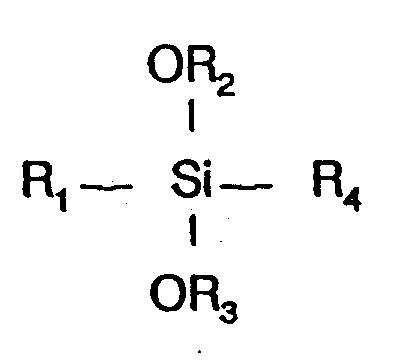
- the electron donor preferably has the formula: wherein R 1 is an alkyl or cycloalkyl group containing a primary, secondary or tertiary carbon atom attached to the silicon atom; R 2 and R 3 are alkyl or aryl groups; and R 4 is an alkyl or cycloalkyl group with a secondary or tertiary carbon atom attached to the silicon atom, R 1 and R 4 can be the same or different and R 2 and R 3 can be the same or different.
- Catalyst systems for the polymerization of olefins are well known in the art Typically, these systems include a Ziegler-Natta type polymerization catalyst; a co-catalyst, usually an organoaluminum compound; and an electron donor, usually an organosilicon compound. Examples of such catalyst systems are shown in the following U.S. Patents: 4,107,413; 4,294,721; 4,439,540; 4,115,319; 4,,220,554; 4,460,701; and 4,522,173; the disclosures of these patents are hereby incorporated by reference. These are just a few of the scores of issued patents relating to catalysts and catalyst systems designed primarily for the polymerization of propylene and ethylene.
- a conventional supported Ziegler-Natta polymerization catalyst generally comprises a complex derived from a halide of a transition metal, for example, titanium, chromium or vanadium with a metal hydride and/or a metal alkyl that is typically an organoaluminum compound.
- the catalyst is usually comprised of a titanium halide supported on a magnesium compound complexed with an aluminum.
- An external electron donor or selectivity control agent (SCA) can be added to improve the stereoregulation of the catalyst so that a more crystalline polymer is produced.
- One improved activation method includes a process for pre-polymerizing the catalyst just prior to introducing the catalyst into the reaction zone.
- One such pre-polymerization process is disclosed in U.S. Patent No. 4,767,735, the disclosure of which is hereby incorporated by reference.
- a co-catalyst that works well with a supported Ziegler-Natta catalyst component is an organoaluminum compound, usually an alkylaluminum and most typically a trialkylaluminum, such as triethylaluminum (TEAl) or triisobutylaluminum (TIBAl).
- organoaluminum compounds useful as a co-catalyst for a conventional supported Ziegler-Natta catalyst component include an alkylaluminum dihalide and a dialkylaluminum halide.
- An electron donor compound is used in the polymerization reaction to reduce the atactic form of the polymer thereby giving control of and increasing the production of stereoregular or crystalline polymers.
- a broad range of compounds are known generally as electron donors, a particular catalyst may have a specific compound or group of compounds with which it is especially compatible. Discovery of an appropriate type of electron donor which gives good catalyst efficiency as well as improved control of the isotactic index of the desired polymer product and other properties of the product would be highly advantageous.
- One such group of electron donors are disclosed in U.S. Patent No. 4,927,797.
- the present invention comprises another such discovery. It has been surprisingly discovered that a specific group of silane compounds serving as electron donors in combination with a particular type of catalyst results in significant increases in crystallinity of the polymer produced over the previously known crystallinity for this particular type of catalyst as well as other known catalyst systems.
- the present invention provides a catalyst system for the polymerization of propylene wherein the system includes the combination of a particular type of catalyst with a specific group of electron donor compounds which results in significant increases in the crystallinity of the polymer product.
- the catalyst comprises a conventional supported Ziegler-Natta catalyst component, an organoaluminum co-catalyst and an organosilicon electron donor. This combination results in a catalyst system that produces a polymer product with significantly higher crystallinity (lower xylene solubles) than provided by previous catalyst systems as illustrated by the comparative examples included below.
- the catalyst system of the present invention using a particular conventional supported Ziegler-Natta-catalyst component provides better control of the xylene solubles of the polymer product than with other types of catalyst components.
- the catalyst system of the present invention using a particular electron donor provides better control of the xylene solubles of the polymer product than with other types of electron donors.
- the above-described catalyst exhibits some increase in crystallinity of the polymer product over previously known catalysts when it is paired with a previously used electron donor, but that increase is significantly greater when the catalyst is paired with electron donors as described by the present invention.
- the invention provides improved operational control of the properties of the polymer product such as the xylene solubles.
- the invention also provides a process for the polymerization of propylene.
- the process comprises:
- the present invention relates to the combination of a particular group of compounds as electron donors with a particular type of catalyst for use in the polymerization of propylene.
- Electron donors are typically used in two ways in the formation of a Ziegler-Natta catalyst and a catalyst system.
- an internal electron donor may be used in the formation reaction of the catalyst as the transition metal halide is reacted with the metal hydride or metal alkyl.
- the internal electron-donor compounds suitable for preparing conventional Ziegler-Natta catalyst components include ethers, ketones, lactones, electron donors compounds with N, P and/or S atoms and specific classes of esters. Particularly suitable are the esters of phthalic acid, such as diisobutyl, dioctyl, diphenyl and benzylbutylphthalate; esters of malonic acid, such as diisobutyl and diethylmalonate; alkyl and arylpivalates; alkyl, cycloalkyl and arylmaleates; alkyl and aryl carbonates such as diisobutyl, ethylphenyl and diphenylcarbonate; succinic acid esters, such as mono and diethyl succinate. These esters of phthalic acid are the preferred donors.
- the second use for an electron donor in a catalyst system is as an external electron donor and stereoregulator in the polymerization reaction.
- the same compound may be used in both instances, although typically they are different.
- a common external electron donor is an organic silicon compound, for example, cyclohexylmethyl dimethoxysilane (CMDS).
- CMDS cyclohexylmethyl dimethoxysilane
- the conventional Ziegler-Natta catalyst component comprises a compound of the general formula MR + x where M is the metal, R is a halogen or a hydrocarboxyl and x is the valence of the metal.
- M is a transition metal, more preferably, Group IVB, VB or VIB metal, most preferably a Group IVB, and specifically titanium.
- R is chlorine, bromine, an alkoxy or a phenoxy, more preferably chlorine or ethoxy and most preferably, chlorine.
- transition metal compound catalyst components are TiCl 4 , TiBr 4 , Ti(OC 2 H 5 ) 3 Cl, Ti(OC 2 H 5 ) 3 Cl, Ti(OC 3 H 7 ) 2 Cl 2 , TiOC 6 H 13 ) 2 Cl 2 , Ti(OC 2 H 5 ) 2 Br 2 and Ti(OC 12 H 25 )Cl 3 .
- Mixtures of the transition metal compounds may be used. No restriction on the number of transition metal compounds is made as long as at least one transition metal compound is present.
- the support should be an inert solid which is chemically unreactive with any of the components of the conventional Ziegler-Natta Catalyst.
- the support is preferably a magnesium compound.
- the magnesium compounds which are to be used to provide a support source for the catalyst component are magnesium halides, dialkoxymagnesiums, alkoxymagnesium halides, magnesium oxyhalides, dialkylmagnesiums, magnesium oxide, magnesium hydroxide, and carboxylates of magnesium.
- the organoaluminum compound which acts as a co-catalyst is preferably an alkylaluminum of the general formula AlR' 3 where R' is an alkyl of from 1-8 carbon atoms or a halogen, R' being the same or different with at least one R 1 being an alkyl and R' being the same or different.
- the organoaluminum compound is an alkylaluminum, an alkylaluminum dihalide or a dialkylaluminum halide. More preferably, R' is an alkyl making the alkylaluminum a trialkylaluminum.
- the alkylaluminum is an trialkylaluminum such as triethylaluminum (TEAl) or triisobutylaluminum (TIBAl).
- Ziegler-Natta catalyst component which can be used in the present invention is a commercially available Ziegler-Natta catalyst component for the polymerization of olefins comprising:
- the preferred auxiliary precipitant useful in the formation of the catalyst is an organic carboxylic acid anhydride, more preferably phthalic acid anhydride, added in the amount of 0.03 to 1.0 moles per mole of magnesium halide.
- the preferred polycarboxylic ester is selected from the group consisting of the esters of aromatic polycarboxylic acids, preferably dibutyl phthalate and di-isobutyl phthalate.
- the preferred inert diluent for washing the precipitate is 1,2-dichloroethane.
- Suitable titanium tetrahalides include TiCl 4 , TiBr 4 and TiI 4 , with TiCl 4 being preferred.
- the term "electron donor” as used herein refers to the external donor.
- the external electron donor acts as a stereoregulator to control the amount of atactic form of polymer produced. It may also increase the production of isotactic polymers.
- Organic silicon compounds are known in the art for use as electron donors. Examples of electron donors that are organic silicon compounds are disclosed in U.S. Patent Nos. 4,218,339; 4,395,360; 4,328,122; 4,473,660 and 4,927,797.
- a particular catalyst may produce better results when paired with a particular group of electron donors. Examples of this pairing of catalyst and electron donors are disclosed in U.S. Patent Nos. 4,562,173; 4,547,552; and 4,927,797.
- the electron donor is of the general formula SiR m (OR') 4-m where R is selected from the group consisting of an alkyl group, a cycloalkyl group, an aryl group and a vinyl group; R' is an alkyl group; and m is 0-3, wherein when R is an alkyl group, R may be identical with R'; when m is 0, 1 or 2, the R' groups may be identical or different; and when m is 1, 2 or 3, the R groups may be identical or different.
- the electron donor is selected from a organosilicon compound of the following formula: wherein R 1 is an alkyl or cycloalkyl group containing primary, secondary or tertiary carbon atom attached to the silicon; R 2 and R 3 are alkyl or aryl groups; and R 4 is an alkyl or cycloalkyl group with a secondary or tertiary carbon atom attached to the silicon atom, R 1 and R 4 being the same or different and R 2 and R 3 being the same or different.
- R 1 is a secondary alkyl group of 3-5 carbon atoms having mirror image symmetry
- R 2 and R 3 are methyl, ethyl, propyl, or butyl groups and not necessarily the same
- R 4 is secondary alkyl or cycloalkyl group of 3-6 carbon atoms having mirror image symmetry. More preferably, R 1 and R 4 are the same and are a cycloalkyl group, specifically a group of 5 carbon atoms, i.e. cyclopentyl.
- CMDS cyolohexylmethyldimethoxysilane
- DIDS diisopropyldimethoxysilane
- DTDS di-t-butyldimethoxysilane
- CPDS dicyclopentyldimethoxysilane
- CIDS cyclohexylisopropyldimethoxysilane
- CPDS dicyclopentyl dimethoxysilane
- the combination of the electron donor described above and a conventional supported Ziegler-Natta catalyst yields wholly unexpected results that surpass previously known catalyst systems.
- the electron donors as described by the present invention may be limited by the stability of the compound and the ease of handling including storage, transportation and use in the plant
- the catalyst system is capable of achieving high efficiencies over a wide range of Si/Ti ratios (4-200) while exhibiting a control of the formation of atactic polymer, or xylene solubles, at relatively low levels, resulting in a high isotactic index.
- the polymer product exhibits a sharp increase in the xylene solubles.
- the present catalyst system using a particular supported Ziegler-Natta catalyst component with CMDS, DIDS, DTDS, CPDS or CIDS exhibits low xylene solubles from about 0.6 to about 3.0% as the Si/Ti ratio decreases from 200 to 4 and below.
- the catalyst system with CPDS also provides higher crystallinity in the polymer product
- the per cent of meso pentads (mmmm) of the heptane insoluble fraction of the polymer product is very high, being equal to or greater than 97%.
- the present invention also provides a process for the polymerization of propylene using the catalyst and the electron donors described by the above formula comprising:
- the reactor was then opened to collect the polymer product which was dried, weighed and analyzed.
- the Si/Ti mole ratio was calculated from the molar amount of electron donor used divided by the molar amount of catalyst.
- the xylene solubles were measured by dissolving the polymer in hot xylene, cooling the solution to 0°C and precipitating out the isotactic form.
- the xylene solubles are the wt% of the polymer that was soluble in the cold xylene.
- the pentad distribution was determined by NMR analysis. Polymer fluff was dissolved in boiling xylene and then the polymer was precipitated in methanol by adding xylene solution dropwise into methanol while stirring.
- Example 1 The procedures of Example 1 were repeated except that the total amount of CMDS was varied as indicated in Table 1 from 1 mmoles to 0.002 mmoles. The results are tabulated in Table 1.
- Example 1 The procedures of Example 1 were repeated except diisopropyldimethoxysilane (DIDS) was used instead of CMDS and the total amount of DIDS was varied as indicated in Table 1 from 2 mmoles to 0.0033 mmoles. The results are shown in Table 1.
- DIDS diisopropyldimethoxysilane
- Example 1 The procedures of Example 1 were repeated except di-t-butyldimethoxysilane (DTDS) was used instead of CMDS and the total amount of DTDS was varied as indicated in Table 1 from 2 mmoles to 0.05 mmoles. The results are shown in Table 1.
- DTDS di-t-butyldimethoxysilane
- Example 1 The procedures of Example 1 were repeated except dicyclopentyldimethoxysilane (CPDS) was used instead of CMDS and the total amount of CPDS was varied as indicated in Table 1 from 2 mmoles to 0.0033 mmoles. The results are shown in Table 1.
- CPDS dicyclopentyldimethoxysilane
- Example 1 The procedures of Example 1 were repeated except cyclohexylisopropyl dimethoxysilane (CIDS) was used instead of CMDS and the total amount of CIDS was varied as indicated in Table 1 from 2 mmoles to 0.0033 mmoles. The results are shown in Table 1.
- CIDS cyclohexylisopropyl dimethoxysilane
- Example 1 The procedures of Example 1 were repeated except that another commercially available Ziegler-Natta catalyst component was substituted for the catalyst component used in Examples 1-30. The results are shown in Table 2.
- TABLE 1 Example TEAl mmol CMDS mmol Al/Si Catalyst mg Yield g Xylene Solubles wt% Isotacticity %mmmm 1 1 2 0.5 10 51 3.0 2 1 1 1.0 10 51.4 2.3 3 1 0.5 2.0 10 102 1.4 4 1 0.1 10 10 195 1.7 96 5 1 0.05 20 10 216 2.0 6 1 0.033 30 10 172 3.2 7 1 0.02 50 10 269 2.3 8 1 0.01 100 10 234 5.1 9 1 0.002 500 10 124 23.7 DIDS 10 1 2 0.5 10 101 0.8 11 1 1 1 1.0 10 133 1.1 12 1 0.5 2.0 10 204 1.2 13 1 0.1 10 10 278 1.6 14 1 0.05 20 10 223 2.8 15 1 0.033 30 10 225 2.1
- the crystallinity of polypropylene is controlled by stereoregularity, i.e., isotacticity (%mmmm), as well as the amounts of atactic polymers present.
- isotacticity of xylene and/or heptane insoluble fractions increases with decreasing xylene solubles.
- certain electron donors in combination with a specific catalyst component produces relatively small amounts of xylene solubles. This phenomenon is enhanced when CPDS is used with the specific catalyst component.
- xylene solubles are generally significantly lower for the combination of each electron donor with the specific catalyst component of Examples 1-27 and Table 1 when compared with the same electron donors of Comparative Examples 1-27 and Table 2.
- use of CPDS with the catalyst component as described produces propylene having the lowest relative xylene solubles and the relative highest crystallinity.
- the combination of CPDS with the catalyst component as described has increased activity over combinations of other electron donors with the catalyst component.
Landscapes
- Chemical & Material Sciences (AREA)
- Health & Medical Sciences (AREA)
- Chemical Kinetics & Catalysis (AREA)
- Medicinal Chemistry (AREA)
- Polymers & Plastics (AREA)
- Organic Chemistry (AREA)
- Transition And Organic Metals Composition Catalysts For Addition Polymerization (AREA)
Abstract
Description
- TECHNICAL FIELD: The present invention provides a catalyst system for the polymerization of propylene to produce highly crystalline polypropylene that includes the combination of a conventional supported Ziegler-Natta catalyst with an electron donor compound having the general formula SiRm(OR')4-m where R is selected from the group consisting of an alkyl group, a cycloalkyl group, an aryl group and a vinyl group; R' is an alkyl group; and m is 0-3, wherein when R is an alkyl group, R may be identical with R'; when m is 0, 1 or 2, the R' groups may be identical or different; and when m is 1, 2 or 3, the R groups may be identical or difference. The electron donor preferably has the formula:

- DESCRIPTION OF PRIOR ART: Catalyst systems for the polymerization of olefins are well known in the art Typically, these systems include a Ziegler-Natta type polymerization catalyst; a co-catalyst, usually an organoaluminum compound; and an electron donor, usually an organosilicon compound. Examples of such catalyst systems are shown in the following U.S. Patents: 4,107,413; 4,294,721; 4,439,540; 4,115,319; 4,,220,554; 4,460,701; and 4,522,173; the disclosures of these patents are hereby incorporated by reference. These are just a few of the scores of issued patents relating to catalysts and catalyst systems designed primarily for the polymerization of propylene and ethylene.
- A conventional supported Ziegler-Natta polymerization catalyst generally comprises a complex derived from a halide of a transition metal, for example, titanium, chromium or vanadium with a metal hydride and/or a metal alkyl that is typically an organoaluminum compound. The catalyst is usually comprised of a titanium halide supported on a magnesium compound complexed with an aluminum. An external electron donor or selectivity control agent (SCA) can be added to improve the stereoregulation of the catalyst so that a more crystalline polymer is produced.
- The development of these polymerization catalysts has improved catalyst and polymer properties. In addition to the improved catalysts, improved activation methods have also lead to increases in the catalyst efficiency. One improved activation method includes a process for pre-polymerizing the catalyst just prior to introducing the catalyst into the reaction zone. One such pre-polymerization process is disclosed in U.S. Patent No. 4,767,735, the disclosure of which is hereby incorporated by reference.
- In addition to the development of new catalysts and new reaction processes, a discovery of an appropriate electron donor to go with a supported Ziegler-Natta catalysts in forming a total catalyst system has been found to be of great benefit to the polymerization art in leading to dramatic improvements in the catalyst and polymer properties. In such a catalyst system, it is believed that a co-catalyst activates the catalyst and provides the initiation of a polymer chain. A co-catalyst that works well with a supported Ziegler-Natta catalyst component is an organoaluminum compound, usually an alkylaluminum and most typically a trialkylaluminum, such as triethylaluminum (TEAl) or triisobutylaluminum (TIBAl). Examples of other organoaluminum compounds useful as a co-catalyst for a conventional supported Ziegler-Natta catalyst component include an alkylaluminum dihalide and a dialkylaluminum halide.
- An electron donor compound is used in the polymerization reaction to reduce the atactic form of the polymer thereby giving control of and increasing the production of stereoregular or crystalline polymers. Although a broad range of compounds are known generally as electron donors, a particular catalyst may have a specific compound or group of compounds with which it is especially compatible. Discovery of an appropriate type of electron donor which gives good catalyst efficiency as well as improved control of the isotactic index of the desired polymer product and other properties of the product would be highly advantageous. One such group of electron donors are disclosed in U.S. Patent No. 4,927,797.
- The present invention comprises another such discovery. It has been surprisingly discovered that a specific group of silane compounds serving as electron donors in combination with a particular type of catalyst results in significant increases in crystallinity of the polymer produced over the previously known crystallinity for this particular type of catalyst as well as other known catalyst systems.
- The present invention provides a catalyst system for the polymerization of propylene wherein the system includes the combination of a particular type of catalyst with a specific group of electron donor compounds which results in significant increases in the crystallinity of the polymer product. The catalyst comprises a conventional supported Ziegler-Natta catalyst component, an organoaluminum co-catalyst and an organosilicon electron donor. This combination results in a catalyst system that produces a polymer product with significantly higher crystallinity (lower xylene solubles) than provided by previous catalyst systems as illustrated by the comparative examples included below. Further, the catalyst system of the present invention using a particular conventional supported Ziegler-Natta-catalyst component provides better control of the xylene solubles of the polymer product than with other types of catalyst components. Further, the catalyst system of the present invention using a particular electron donor provides better control of the xylene solubles of the polymer product than with other types of electron donors. These and other beneficial advantages will become more apparent from the following detailed description of the invention and the accompanying examples.
- The above-described catalyst exhibits some increase in crystallinity of the polymer product over previously known catalysts when it is paired with a previously used electron donor, but that increase is significantly greater when the catalyst is paired with electron donors as described by the present invention. The invention provides improved operational control of the properties of the polymer product such as the xylene solubles.
- The most significant unexpected result obtained from the combination of the catalyst described in U.S. Patent Nos. 4,784,983 and 4,861,847 and CMDS, DIDS, DTDS, CPDS and CIDS is the dramatic increase in the crystallinity of the polymer produced by the catalyst system in the polymerization of propylene. The catalyst system has been shown to achieve efficiencies higher than 30 kg/g-cat·h for Si/Ti mole ratios within the range 4-200.
- The invention also provides a process for the polymerization of propylene. The process comprises:
- forming a catalyst by contacting a supported Ziegler-Natta catalyst component with an organoaluminum compound, preferably with a trialkylaluminum;
- contacting the catalyst with an electron donor either simultaneously with or after contact with the organoaluminum, the electron donor being an organosilicon compound as described by the formula above,
- optionally, pre-polymerizing the catalyst by contacting a small amount of monomer with the catalyst;
- introducing the catalyst into a reaction zone under polymerization conditions containing the monomer and, optionally additional amounts of organoaluminum compound and the electron donor; and
- withdrawing a polymer product.
- The present invention relates to the combination of a particular group of compounds as electron donors with a particular type of catalyst for use in the polymerization of propylene.
- It has been discovered that a particular group of electron donors does significantly enhance the catalytic properties of a conventional supported Ziegler-Natta catalyst Any of the conventional Ziegler-Natta transition metal compound catalyst components can be used in the present Invention. Electron donors are typically used in two ways in the formation of a Ziegler-Natta catalyst and a catalyst system. First, an internal electron donor may be used in the formation reaction of the catalyst as the transition metal halide is reacted with the metal hydride or metal alkyl.
- The internal electron-donor compounds suitable for preparing conventional Ziegler-Natta catalyst components include ethers, ketones, lactones, electron donors compounds with N, P and/or S atoms and specific classes of esters. Particularly suitable are the esters of phthalic acid, such as diisobutyl, dioctyl, diphenyl and benzylbutylphthalate; esters of malonic acid, such as diisobutyl and diethylmalonate; alkyl and arylpivalates; alkyl, cycloalkyl and arylmaleates; alkyl and aryl carbonates such as diisobutyl, ethylphenyl and diphenylcarbonate; succinic acid esters, such as mono and diethyl succinate. These esters of phthalic acid are the preferred donors.
- The second use for an electron donor in a catalyst system is as an external electron donor and stereoregulator in the polymerization reaction. The same compound may be used in both instances, although typically they are different. A common external electron donor is an organic silicon compound, for example, cyclohexylmethyl dimethoxysilane (CMDS). A description of the two types of electron donors is provided in U.S. Patent 4,535,068, the disclosure of which is hereby incorporated by reference.
- The conventional Ziegler-Natta catalyst component comprises a compound of the general formula MR+ x where M is the metal, R is a halogen or a hydrocarboxyl and x is the valence of the metal. Preferably, M is a transition metal, more preferably, Group IVB, VB or VIB metal, most preferably a Group IVB, and specifically titanium. Preferably, R is chlorine, bromine, an alkoxy or a phenoxy, more preferably chlorine or ethoxy and most preferably, chlorine. Illustrative examples of the transition metal compound catalyst components are TiCl4, TiBr4, Ti(OC2H5)3Cl, Ti(OC2H5)3Cl, Ti(OC3H7)2Cl2, TiOC6H13)2Cl2, Ti(OC2H5)2Br2 and Ti(OC12H25)Cl3. Mixtures of the transition metal compounds may be used. No restriction on the number of transition metal compounds is made as long as at least one transition metal compound is present.
- The support should be an inert solid which is chemically unreactive with any of the components of the conventional Ziegler-Natta Catalyst. The support is preferably a magnesium compound. Examples of the magnesium compounds which are to be used to provide a support source for the catalyst component are magnesium halides, dialkoxymagnesiums, alkoxymagnesium halides, magnesium oxyhalides, dialkylmagnesiums, magnesium oxide, magnesium hydroxide, and carboxylates of magnesium.
- The organoaluminum compound which acts as a co-catalyst is preferably an alkylaluminum of the general formula AlR'3 where R' is an alkyl of from 1-8 carbon atoms or a halogen, R' being the same or different with at least one R1 being an alkyl and R' being the same or different. Preferably, the organoaluminum compound is an alkylaluminum, an alkylaluminum dihalide or a dialkylaluminum halide. More preferably, R' is an alkyl making the alkylaluminum a trialkylaluminum. Most preferably, the alkylaluminum is an trialkylaluminum such as triethylaluminum (TEAl) or triisobutylaluminum (TIBAl).
- One particular Ziegler-Natta catalyst component which can be used in the present invention is a commercially available Ziegler-Natta catalyst component for the polymerization of olefins comprising:
- a catalyst component consisting essentially of about 1.5-6.0% by weight or titanium, about 10-20% by weight of magnesium, about 40-70% by weight of a halide selected from the group consisting of chlorine, bromine, and iodine; about 5-25%by weight of a polycarboxylic ester selected from the group consisting of the esters of aliphatic, aromatic and alicyclic polycarboxylic acids; and about 0.1-2.5% by weight of an organic phosphorus compound selected from the group consisting of hydrocarbon esters of phosphoric acid and phosphorus acid wherein each hydrocarbon group has 1 to 6 carbon atoms, said catalyst component being-prepared by a process having the following steps:
- a) dissolving in a solvent mixture a magnesium halide compound selected from the group consisting of magnesium halide complexes of magnesium halide with water or alcohol and derivatives of magnesium halide wherein a halogen atom is replaced by a hydrocarboxyl group or a halohydrocarboxyl group; the solvent mixture consisting of an organic epoxy compound, selected from the group consisting of oxides of aliphatic olefins and diolefins, oxides of halogenated aliphatic olefins and diolefins and glycidyl ethers, all having 2 to 8 carbon atoms, and an organic phosphorus compound selected from the group consisting of alkyl phosphates, aryl phosphates, aralkyl phosphates, alkyl phosphites, aryl phosphites and aralkyl phosphites where alkyl has one to four carbon atoms and aryl has six to ten carbon atoms to form a homogeneous solution;
- b) mixing the homogeneous solution with a liquid titanium compound having the formula TiXn(OR)4-n wherein X is halogen, R is an alkyl group being identical or different and n is an integer of 0 to 4;
- c) adding at least one auxiliary precipitant selected from the group consisting of carboxylic acid anhydrides, carboxylic acids, ethers and ketones to form a precipitate;
- d) adding a polycarboxylic add ester when a precipitate appears;
- e) separating the precipitate from the mixture and treating the separated precipitate with titanium compound, TiXn(OR)4-n wherein X is halogen, R is a hydrocarbon group and may be identical or different, and n is and integer of from 0 to 4, or a mixture thereof, in an inert diluent; and
- f) washing the treated precipitate with an organic inert diluent as disclosed in U.S. Patent Nos. 4,861,847 and 4,784,983, the disclosures of which are hereby incorporated.
- The preferred auxiliary precipitant useful in the formation of the catalyst is an organic carboxylic acid anhydride, more preferably phthalic acid anhydride, added in the amount of 0.03 to 1.0 moles per mole of magnesium halide. The preferred polycarboxylic ester is selected from the group consisting of the esters of aromatic polycarboxylic acids, preferably dibutyl phthalate and di-isobutyl phthalate. The preferred inert diluent for washing the precipitate is 1,2-dichloroethane. Suitable titanium tetrahalides include TiCl4, TiBr4 and TiI4, with TiCl4 being preferred.
- As the present invention relates particularly to external electron donors, the term "electron donor" as used herein, refers to the external donor. The external electron donor acts as a stereoregulator to control the amount of atactic form of polymer produced. It may also increase the production of isotactic polymers. Organic silicon compounds are known in the art for use as electron donors. Examples of electron donors that are organic silicon compounds are disclosed in U.S. Patent Nos. 4,218,339; 4,395,360; 4,328,122; 4,473,660 and 4,927,797. As mentioned, a particular catalyst may produce better results when paired with a particular group of electron donors. Examples of this pairing of catalyst and electron donors are disclosed in U.S. Patent Nos. 4,562,173; 4,547,552; and 4,927,797.
- The electron donor is of the general formula SiRm(OR')4-m where R is selected from the group consisting of an alkyl group, a cycloalkyl group, an aryl group and a vinyl group; R' is an alkyl group; and m is 0-3, wherein when R is an alkyl group, R may be identical with R'; when m is 0, 1 or 2, the R' groups may be identical or different; and when m is 1, 2 or 3, the R groups may be identical or different. Preferably, the electron donor is selected from a organosilicon compound of the following formula:

- The catalyst system is capable of achieving high efficiencies over a wide range of Si/Ti ratios (4-200) while exhibiting a control of the formation of atactic polymer, or xylene solubles, at relatively low levels, resulting in a high isotactic index. When another catalyst is paired with these above described electron donors, the polymer product exhibits a sharp increase in the xylene solubles. The present catalyst system using a particular supported Ziegler-Natta catalyst component with CMDS, DIDS, DTDS, CPDS or CIDS, however, exhibits low xylene solubles from about 0.6 to about 3.0% as the Si/Ti ratio decreases from 200 to 4 and below.
- The catalyst system with CPDS also provides higher crystallinity in the polymer product The per cent of meso pentads (mmmm) of the heptane insoluble fraction of the polymer product is very high, being equal to or greater than 97%.
- The present invention also provides a process for the polymerization of propylene using the catalyst and the electron donors described by the above formula comprising:
- a) selecting a conventional supported Ziegler-Natta catalyst component;
- b) contacting the catalyst with an organoaluminum compound;
- c) contacting the catalyst with an electron donor as described above;
- d) introducing the catalyst into a polymerization reaction zone containing the organoaluminum compound, the electron donor and the monomer; and
- e) extracting polymer product from the reactor.
- The following Examples and Comparative Examples illustrate the present invention and its various advantages in more detail. The results are summarized in Tables 1-2 The catalyst used in the Examples was believed to be prepared with the materials and processes as disclosed in U.S. Patent Nos. 4,861,847 and 4,784,983 and is sold by Catalyst Resources, Inc. under the tradename of "Lynx 1000". The catalyst used in the Comparative Examples was believed to be prepared with the materials and processes as disclosed in U.S. Patent Nos. 4,927,797; 4,816,433 and 4,839,321 and is sold by Toho Titanium, Inc. under the tradename "THC-32A".
- Prior to a polymerization run, all traces of moisture and air were expelled from the reactor by heating to a temperature over 100°C for a minimum of 30 minutes under a constant purge of dry nitrogen. Following this beating, the reactor was cooled to room temperature (25°C) under nitrogen. The reactor was stabilized at room temperature and then 32 mmoles of hydrogen and 1.45 L of propylene were added. The reactor was stirred at 1300 rpm and the temperature was raised to 70°C. 1.0 mmole of TEAl and 0.1 mmole of cyclohexylmethyldimethoxysilane (CMDS) were added to a 40 cc tubular reaction vessel. The TEAl and donor were allowed to pre-contact approximately one minute. Ten milligrams of catalyst in a mineral oil suspension were added to the 40 cc reaction cylinder. The catalyst was allowed to pre-contact the TEAl and donor mixture for approximately two minutes. The tubular reaction vessel was then attached to an entry point on the reactor and filled with room temperature liquid propylene which was allowed to polymerize for about five seconds to effect prepolymerization of the catalyst. The contents of the vessel were then flushed into the reactor with 1.45 L of room temperature propylene. The total amount of liquid propylene present in the reactor was about 2.9 L. The polymerization reaction was allowed to proceed for one hour, at which point it is terminated by venting the excess propylene and cooling the reactor to room temperature.
- The reactor was then opened to collect the polymer product which was dried, weighed and analyzed. The Si/Ti mole ratio was calculated from the molar amount of electron donor used divided by the molar amount of catalyst. The xylene solubles were measured by dissolving the polymer in hot xylene, cooling the solution to 0°C and precipitating out the isotactic form. The xylene solubles are the wt% of the polymer that was soluble in the cold xylene. The pentad distribution was determined by NMR analysis. Polymer fluff was dissolved in boiling xylene and then the polymer was precipitated in methanol by adding xylene solution dropwise into methanol while stirring. The precipitates were collected by filtration and then extracted with boiling heptane overnight The results are shown in Table 1.
SUMMARY OF POLYMERIZATION CONDITIONS wt. of catalyst: 10.0 mgrams amount of TEAL (co-catalyst): 1.0 mmoles amount of CMDS (electron donor): 0.1 mmoles Al/Ti: 200 Al/Si: 10 Si/Ti: 20 Hydrogen: 240 Δpsig Propylene: 2.9 L (1500 g) Temp.: 70°C Time: 1 hr. - The procedures of Example 1 were repeated except that the total amount of CMDS was varied as indicated in Table 1 from 1 mmoles to 0.002 mmoles. The results are tabulated in Table 1.
- The procedures of Example 1 were repeated except diisopropyldimethoxysilane (DIDS) was used instead of CMDS and the total amount of DIDS was varied as indicated in Table 1 from 2 mmoles to 0.0033 mmoles. The results are shown in Table 1.
- The procedures of Example 1 were repeated except di-t-butyldimethoxysilane (DTDS) was used instead of CMDS and the total amount of DTDS was varied as indicated in Table 1 from 2 mmoles to 0.05 mmoles. The results are shown in Table 1.
- The procedures of Example 1 were repeated except dicyclopentyldimethoxysilane (CPDS) was used instead of CMDS and the total amount of CPDS was varied as indicated in Table 1 from 2 mmoles to 0.0033 mmoles. The results are shown in Table 1.
- The procedures of Example 1 were repeated except cyclohexylisopropyl dimethoxysilane (CIDS) was used instead of CMDS and the total amount of CIDS was varied as indicated in Table 1 from 2 mmoles to 0.0033 mmoles. The results are shown in Table 1.
- The procedures of Example 1 were repeated except that another commercially available Ziegler-Natta catalyst component was substituted for the catalyst component used in Examples 1-30. The results are shown in Table 2.
TABLE 1 Example TEAl mmol CMDS mmol Al/Si Catalyst mg Yield g Xylene Solubles wt% Isotacticity %mmmm 1 1 2 0.5 10 51 3.0 2 1 1 1.0 10 51.4 2.3 3 1 0.5 2.0 10 102 1.4 4 1 0.1 10 10 195 1.7 96 5 1 0.05 20 10 216 2.0 6 1 0.033 30 10 172 3.2 7 1 0.02 50 10 269 2.3 8 1 0.01 100 10 234 5.1 9 1 0.002 500 10 124 23.7 DIDS 10 1 2 0.5 10 101 0.8 11 1 1 1.0 10 133 1.1 12 1 0.5 2.0 10 204 1.2 13 1 0.1 10 10 278 1.6 14 1 0.05 20 10 223 2.8 15 1 0.033 30 10 225 2.1 DTDS 16 1 2 0.5 10 208 1.4 17 1 1 1.0 10 246 1.6 18 1 0.5 2.0 10 195 1.5 CPDS 19 1 2 0.5 10 105 1.1 98.4 20 1 1 1.0 10 136 1.0 98.4 21 1 0.5 20 10 210 0.9 97.9 22 1 0.1 10 10 260 0.9 98.5 23 1 0.05 20 10 315 0.6 24 1 0.033 30 10 249 0.6 98.5 CIDS 25 1 2 0.5 10 70 0.9 98.4 26 1 1 1.0 10 127 0.9 27 1 0.5 2.0 10 181 0.9 28 1 0.1 10 10 119 1.6 29 1 0.05 20 10 134 2.0 30 1 0.033 30 10 157 2.4 TABLE 2 Comparative Example TEAl mmol CMDS mmol Al/Si Catalyst mg Yield g Xylene Solubles wt% Isotacticity %mmmm 1 1 2 0.5 10 48 4.1 2 1 1 1.0 10 142 0.9 3 1 0.5 2.0 10 205 1.5 4 1 0.1 10 10 269 1.4 95 5 1 0.05 20 10 249 2.8 6 1 0.033 30 10 269 7.1 7 1 0.02 50 10 280 8.7 8 1 0.01 100 10 302 6.8 93.6 9 1 0.002 500 10 294 15.7 91.6 DIDS 10 1 2 0.5 10 163 2.9 92.2 11 1 1 1.0 10 214 3.1 95 12 1 0.5 2.0 10 294 2.9 96 13 1 0.1 10 10 305 2.4 14 1 0.05 20 10 249 2.5 15 1 0.033 30 10 243 2.8 DTDS 16 1 2 0.5 10 274 3.9 17 1 1 1.0 10 246 3.1 96 18 1 0.5 2.0 10 309 3.7 CPDS 19 1 2 0.5 10 140 2.9 97.9 20 1 1 1.0 10 209 3.1 21 1 0.5 2.0 10 281 2.9 96.6 22 1 0.1 10 10 294 2.4 23 1 0.05 20 10 346 2.5 24 1 0.033 30 10 307 2.8 97.7 CIDS 25 1 2 0.5 10 98 2.4 26 1 1 1.0 10 195 1.8 27 1 0.5 2.0 10 237 2.0 28 1 0.1 10 10 267 2.3 29 1 0.05 20 10 206 2.4 30 1 0.033 30 10 224 2.4 - The crystallinity of polypropylene is controlled by stereoregularity, i.e., isotacticity (%mmmm), as well as the amounts of atactic polymers present. Generally, the isotacticity of xylene and/or heptane insoluble fractions increases with decreasing xylene solubles. As the data above demonstrates, certain electron donors in combination with a specific catalyst component produces relatively small amounts of xylene solubles. This phenomenon is enhanced when CPDS is used with the specific catalyst component.
- As shown in the Examples and Table 1 and 2 above, xylene solubles are generally significantly lower for the combination of each electron donor with the specific catalyst component of Examples 1-27 and Table 1 when compared with the same electron donors of Comparative Examples 1-27 and Table 2. As shown in Examples 16-21 and Tables 1 and 2, use of CPDS with the catalyst component as described produces propylene having the lowest relative xylene solubles and the relative highest crystallinity. The combination of CPDS with the catalyst component as described has increased activity over combinations of other electron donors with the catalyst component.
Claims (29)
- A catalyst system for the polymerization and copolymerization of propylene comprising:(a) a conventional Ziegler-Natta catalyst component consisting essentially of about 1.5-6.0% by weight or titanium, about 10-20% by weight of magnesium, about 40-70% by weight of a halide selected from the group consisting of chlorine, bromine, and iodine; about 5-25%by weight of a polycarboxylic ester selected from the group consisting of the esters of aliphatic, aromatic and alicyclic polycarboxylic acids; and about 0.1-2.5% by weight of an organic phosphorus compound selected from the group consisting of hydrocarbon esters of phosphoric acid and phosphorus acid wherein each hydrocarbon group has 1 to 6 carbon atoms, said catalyst component being prepared by a process having he following steps:a) dissolving in a solvent mixture a magnesium halide compound selected from the group consisting of magnesium halide complexes of magnesium halide with water or alcohol and derivatives of magnesium halide wherein a halogen atom is replaced by a hydrocarboxyl group or a halohydrocarboxyl group; the solvent mixture consisting of an organic epoxy compound, selected from the group consisting of oxides of aliphatic olefins and diolefins, oxides of halogenated aliphatic olefins and diolefins and glycidyl ethers, all having 2 to 8 carbon atoms, and an organic phosphorus compound selected from the group consisting of alkyl phosphates, aryl phosphates, aralkyl phosphates, alkyl phosphites, aryl phosphites and aralkyl phosphites where alkyl has one to four carbon atoms and aryl has six to ten carbon atoms to form a homogeneous solution;b) mixing the homogeneous solution with a liquid titanium compound having the formula TiXn(OR)4-n wherein X is halogen, R is an alkyl group being identical or different and n is an integer of 0 to 4;c) adding at least one auxiliary precipitant selected from the group consisting of carboxylic acid anhydrides, carboxylic acids, ethers and ketones to form a precipitate;d) adding, a polycarboxylic acid ester when a precipitate appears;e) separating the precipitate from the mixture and treating the separated precipitate with titanium compound, TiXn(OR)4-n wherein X is halogen; R is a hydrocarbon group and may be identical or different, and n is and integer of from 0 to 4, or a mixture thereof, in an inert diluent; andf) washing the treated precipitate with an organic inert diluent(b) an organoaluminum compound and(c) an electron donor having the general formula SiRm(OR')4-m where R is selected from the group consisting of an alkyl group, a cycloalkyl group, an aryl group and a vinyl group: R' is an alkyl group: and m is 0-3, wherein when R is an alkyl group, R may be identical with R'; when m is 0, 1 or 2, the R' groups may be identical or different; and when m is 1, 2 or 3, the R groups may be identical or different.
- The catalyst system of Claim 1 wherein the electron donor is of the formula:

- The catalyst system of Claim 2 wherein R1 is a secondary alkyl or cycloalkyl of 3 or 5 carbon atoms having mirror image symmetry and R4 is a secondary alkyl or cycloalkyl of 1-6 carbon atoms having mirror image symmetry.
- The catalyst system of Claim 3 wherein R1 and R4 are both cycloalkyl groups and are the same.
- The catalyst system of Claim 4 wherein R1 and R4 are cyclopentyl.
- The catalyst system of Claim 2 wherein R2 and R3 are selected from the group consisting of methyl, ethyl, propyl, and butyl groups.
- The catalyst system of Claim 6 wherein R2 and R3 are both a methyl group and are the same.
- The catalyst system of Claim 1 wherein the electron donor is cyclohexylmethyldimethoxysilane, diisopropyldimethoxysilane. di-t-butyldimethoxysilane, cyclohexylisopropyldimethoxysilane or dicyclopentyldimethoxysilane.
- The catalyst system of Claim 8 wherein the electron donor is dicyclopentyldimethoxysilane.
- The catalyst system of Claim 1 wherein the organoaluminum compound is an aluminum alkyl of the general formula AlR'3 where R' is an alkyl of from 1-8 carbon atoms or a halogen, R' being the same or different with at least one R1 being an alkyl and R' being the same or different.
- The catalyst system of Claim 10 wherein the organoaluminum compound is selected from the group consisting of a trialkylaluminum, an alkylaluminum dihalide, a trialkoxyaluminum and a dialkylaluminum halide.
- The catalyst system of Claim 11 wherein the organoaluminum compound is a trialkylaluminum.
- The catalyst system of Claim 13 wherein the organoaluminum compound is triethylaluminum or triisobutylaluminum.
- A process for the polymerization of propylene comprising:(a) selecting a conventional Ziegler-Natta catalyst component consisting essentially of about 1.5-6.0% by weight or titanium, about 10-20% by weight of magnesium, about 40-70% by weight of a halide selected from the group consisting of chlorine, bromine, and iodine; about 5-25%by weight of a polycarboxylic ester selected from the group consisting of the esters of aliphatic, aromatic and alicyclic polycarboxylic acids; and about 0.1-2.5% by weight of an organic phosphorus compound selected from the group consisting of hydrocarbon esters of phosphoric acid and phosphorus acid wherein each hydrocarbon group has 1 to 6 carbon atoms, said catalyst component being prepared by a process having he following steps:a) dissolving in a solvent mixture a magnesium halide compound selected from the group consisting of magnesium halide complexes of magnesium halide with water or alcohol and derivatives of magnesium halide wherein a halogen atom is replaced by a hydrocarboxyl group or a halohydrocarboxyl group; the solvent mixture consisting of an organic epoxy compound, selected from the group consisting of oxides of aliphatic olefins and diolefins, oxides of halogenated aliphatic olefins and diolefins and glycidyl ethers, all having 2 to 8 carbon atoms, and an organic phosphorus compound selected from the group consisting of alkyl phosphates, aryl phosphates, aralkyl phosphates, alkyl phosphites, aryl phosphites and aralkyl phosphites where alkyl has one to four carbon atoms and aryl has six to ten carbon atoms to form a homogeneous solution;b) mixing the homogeneous solution with a liquid titanium compound having the formula TiXn(OR)4-n wherein X is halogen, R is an alkyl group being identical or different and n is an integer of 0 to 4;c) adding at least one auxiliary precipitant selected from the group consisting of carboxylic acid anhydrides, carboxylic acids, ethers and ketones to form a precipitate;d) adding a polycarboxylic acid ester when a precipitate appears;e) separating the precipitate from the mixture and treating the separated precipitate with titanium compound, TiXn(OR)4-n wherein X is halogen, R is a hydrocarbon group and may be identical or different, and n is and integer of from 0 to 4, or a mixture thereof, in an inert diluent; andf) washing the treated precipitate with an organic inert diluent(b) contacting the catalyst with an organoaluminum compound;(c) contacting said catalyst with an electron donor either simultaneously with or after step (b), said electron donor having the general formula SiRm(OR')4-m where R is selected from the group consisting of an alkyl group, a cycloalkyl group, an aryl group and a vinyl group; R' is an alkyl group; and m is 0-3, wherein when R is an alkyl group, R may be identical with R'; when m is 0, 1 or 2, the R' groups may be identical or different; and when m is 1, 2 or 3, the R groups may be identical or different.(d) introducing said catalyst into a polymerization reaction zone containing said monomer.
- The process of Claim 14 wherein the electron donor is described by the formula:

- The process of Claim 15 wherein R1 is a secondary alkyl or cycloalkyl of 3 or 5 carbon atoms having mirror image symmetry and R4 is a secondary alkyl or cycloalkyl of 1-6 carbon atoms having mirror image symmetry.
- The process of Claim 16 wherein R1 and R4 are both cycloalkyl groups and are the same.
- The process of Claim 17 wherein R1 and R4 are both a cyclopentyl group.
- The process of Claim 18 wherein said electron donor is cyclohexylmethyldimethoxysilane, diisopropyldimethoxysilane, di-t-butyldimethoxysilane,-dicyclopentyldimethoxysilane or cyclohexylisopropyldimethoxysilane.
- The process of Claim 19 wherein said electron donor is dicyclopentyldimethoxysilane.
- The process of Claim 14 wherein the organoaluminum compound is an aluminum alkyl of the general formula AlR'3 where R' is an alkyl of from 1-8 carbon atoms or a halogen, R' being the same or different with at least one R1 being an alkyl and R' being the same or different.
- The process of Claim 21 wherein the organoaluminum compound is selected from the group consisting of a trialkylaluminum, an alkylaluminum dihalide, a trialkoxyaluminum and a dialkylaluminum halide.
- The process of Claim 22 wherein the organoaluminum compound is a trialkylaluminum.
- The process of Claim 23 wherein the organoaluminum compound is triethylaluminum.
- The process of Clam 14 wherein said monomer is propylene.
- The process of Claim 14 wherein after step (c) there is an additional step comprising:pre-polymerizing said catalyst by contacting a small amount of monomer with said catalyst.
- The process of Claim 14 wherein the reaction zone contains additional amounts of said organoaluminum compound and said electron donor.
- The process of Claim 14 wherein said process is characterized by producing a polymer product in which the xylene soluble portion is within the range of 0.6-3.0 wt% of the polymer product.
- The process of Claim 14 further comprising the addition of a second monomer so as to form a copolymer.
Applications Claiming Priority (2)
| Application Number | Priority Date | Filing Date | Title |
|---|---|---|---|
| US474233 | 1995-06-07 | ||
| US08/474,233 US6635734B2 (en) | 1994-04-26 | 1995-06-07 | Catalyst system to produce highly crystalline polypropylene |
Publications (3)
| Publication Number | Publication Date |
|---|---|
| EP0752431A2 true EP0752431A2 (en) | 1997-01-08 |
| EP0752431A3 EP0752431A3 (en) | 1997-02-12 |
| EP0752431B1 EP0752431B1 (en) | 2002-03-20 |
Family
ID=23882706
Family Applications (1)
| Application Number | Title | Priority Date | Filing Date |
|---|---|---|---|
| EP96109106A Expired - Lifetime EP0752431B1 (en) | 1995-06-07 | 1996-06-07 | A catalyst system to produce highly crystalline polypropylene |
Country Status (5)
| Country | Link |
|---|---|
| US (1) | US6635734B2 (en) |
| EP (1) | EP0752431B1 (en) |
| JP (1) | JPH09100313A (en) |
| DE (1) | DE69619896T2 (en) |
| ES (1) | ES2172610T3 (en) |
Cited By (7)
| Publication number | Priority date | Publication date | Assignee | Title |
|---|---|---|---|---|
| EP0860452A1 (en) * | 1997-02-21 | 1998-08-26 | Fina Technology, Inc. | Improved electron donor and catalyst system for monomer polymerization |
| WO1999047568A1 (en) * | 1998-03-17 | 1999-09-23 | China Petrochemical Corporation | Catalyst system for use in ethylene polymerization and copolymerization and process for preparing the same |
| WO2005100409A1 (en) * | 2004-04-12 | 2005-10-27 | China Petroleum & Chemical Corporation | Catalyst component for ethylene polymerisation, preparation process thereof, and catalyst containing the same |
| WO2017001479A1 (en) | 2015-06-30 | 2017-01-05 | Borealis Ag | Process for preparing propylene polymer compositions |
| EP3187512A1 (en) | 2015-12-31 | 2017-07-05 | Borealis AG | Process for preparing propylene copolymer compositions |
| US20170335035A1 (en) | 2014-12-31 | 2017-11-23 | Borealis Ag | Process for preparing propylene copolymers |
| WO2018011165A1 (en) | 2016-07-12 | 2018-01-18 | Borealis Ag | Solid catalyst for the preparation of nucleated polyolefins |
Families Citing this family (13)
| Publication number | Priority date | Publication date | Assignee | Title |
|---|---|---|---|---|
| US6469112B2 (en) * | 2000-08-22 | 2002-10-22 | Engelhard Corporation | (Cycloalkyl)methyl silanes as external donors for polyolefin catalysts |
| US20060252894A1 (en) * | 2005-05-06 | 2006-11-09 | Fina Technology, Inc. | Novel combinations of silane electron donors for use in catalyst compositions |
| JP4784279B2 (en) * | 2005-11-17 | 2011-10-05 | 王子製紙株式会社 | Condenser film |
| MX2008015361A (en) * | 2006-06-01 | 2008-12-16 | Sunoco Inc R&M | High crystallinity, high melt flow rate polypropylene. |
| CN101125898A (en) * | 2007-07-19 | 2008-02-20 | 中国科学院长春应用化学研究所 | A Catalyst for Synthesizing Polypropylene with Broad Molecular Weight Distribution |
| US7662901B2 (en) * | 2007-11-30 | 2010-02-16 | Sunoco Chemicals, Inc. | High crystallinity, high melt flow rate polypropylene |
| EP2274148B1 (en) * | 2008-01-08 | 2012-05-23 | Eovations LLC | Cellular oriented polymer composition with inorganic filler and low xylene solubles |
| BRPI0912901A2 (en) * | 2008-08-19 | 2015-10-06 | Dow Global Technologies Llc | process for producing a graded catalyst composition, polymerization process, apparatus for producing a graded catalyst composition and method for determining the solids content in a paste |
| US20100081755A1 (en) * | 2008-10-01 | 2010-04-01 | Sunoco, Inc. (R&M) | Method for preparing a random copolymer with enhanced ethylene content |
| US20100081760A1 (en) * | 2008-10-01 | 2010-04-01 | Sunoco, Inc. (R&M) | Film comprising a random copolymer with enhanced ethylene content |
| US7750081B2 (en) * | 2008-10-01 | 2010-07-06 | Sunoco Chemicals, Inc. | Random copolymer with enhanced ethylene content |
| BRPI0919554B1 (en) * | 2008-10-01 | 2019-09-24 | Braskem America, Inc. | RESIN COMPOSITION, METHOD FOR PREPARING A POLYMER, AND BIAXIALLY ORIENTED POLYPROPYLENE FILM |
| US10851191B2 (en) | 2015-06-30 | 2020-12-01 | Borealis Ag | Process for preparing propylene polymer compositions |
Family Cites Families (5)
| Publication number | Priority date | Publication date | Assignee | Title |
|---|---|---|---|---|
| JPS5634714A (en) * | 1979-08-29 | 1981-04-07 | Sumitomo Chem Co Ltd | Preparation of propylene polymer or copolymer |
| JPS59206410A (en) | 1983-05-11 | 1984-11-22 | Mitsui Petrochem Ind Ltd | Production of olefin polymer |
| CN1006071B (en) | 1985-04-01 | 1989-12-13 | 中国石油化工总公司 | Catalyst systems for olefin polymerization and copolymerization |
| EP0350170B2 (en) | 1988-06-17 | 2001-09-12 | Mitsui Chemicals, Inc. | Process for polymerising olefins and polymerisation catalyst therefor |
| TW300235B (en) | 1992-12-04 | 1997-03-11 | Mitsui Petroleum Chemicals Ind |
-
1995
- 1995-06-07 US US08/474,233 patent/US6635734B2/en not_active Expired - Fee Related
-
1996
- 1996-06-07 ES ES96109106T patent/ES2172610T3/en not_active Expired - Lifetime
- 1996-06-07 JP JP8168283A patent/JPH09100313A/en active Pending
- 1996-06-07 EP EP96109106A patent/EP0752431B1/en not_active Expired - Lifetime
- 1996-06-07 DE DE69619896T patent/DE69619896T2/en not_active Expired - Fee Related
Cited By (13)
| Publication number | Priority date | Publication date | Assignee | Title |
|---|---|---|---|---|
| EP0860452A1 (en) * | 1997-02-21 | 1998-08-26 | Fina Technology, Inc. | Improved electron donor and catalyst system for monomer polymerization |
| WO1999047568A1 (en) * | 1998-03-17 | 1999-09-23 | China Petrochemical Corporation | Catalyst system for use in ethylene polymerization and copolymerization and process for preparing the same |
| CN1086191C (en) * | 1998-03-17 | 2002-06-12 | 中国石油化工集团公司 | Catalyst for ethylene polymerization or copolymerization and preparation method thereof |
| US6617278B1 (en) | 1998-03-17 | 2003-09-09 | China Petro-Chemical Corporation | Catalyst system for use in ethylene polymerization and copolymerization and process for preparing the same |
| EP1083187A4 (en) * | 1998-03-17 | 2004-05-19 | China Petrochemical Corp | Catalyst system for use in ethylene polymerization and copolymerization and process for preparing the same |
| US7153804B2 (en) | 2004-04-12 | 2006-12-26 | China Petroleum & Chemical Corporation | Catalyst component for ethylene polymerization, the preparation thereof and catalyst comprising the same |
| WO2005100409A1 (en) * | 2004-04-12 | 2005-10-27 | China Petroleum & Chemical Corporation | Catalyst component for ethylene polymerisation, preparation process thereof, and catalyst containing the same |
| US20170335035A1 (en) | 2014-12-31 | 2017-11-23 | Borealis Ag | Process for preparing propylene copolymers |
| US10696764B2 (en) | 2014-12-31 | 2020-06-30 | Borealis Ag | Process for preparing propylene copolymers |
| WO2017001479A1 (en) | 2015-06-30 | 2017-01-05 | Borealis Ag | Process for preparing propylene polymer compositions |
| EP3187512A1 (en) | 2015-12-31 | 2017-07-05 | Borealis AG | Process for preparing propylene copolymer compositions |
| US10787528B2 (en) | 2015-12-31 | 2020-09-29 | Borealis Ag | Process for preparing propylene copolymer compositions |
| WO2018011165A1 (en) | 2016-07-12 | 2018-01-18 | Borealis Ag | Solid catalyst for the preparation of nucleated polyolefins |
Also Published As
| Publication number | Publication date |
|---|---|
| ES2172610T3 (en) | 2002-10-01 |
| DE69619896D1 (en) | 2002-04-25 |
| EP0752431A3 (en) | 1997-02-12 |
| US20030060580A1 (en) | 2003-03-27 |
| US6635734B2 (en) | 2003-10-21 |
| EP0752431B1 (en) | 2002-03-20 |
| DE69619896T2 (en) | 2002-11-07 |
| JPH09100313A (en) | 1997-04-15 |
Similar Documents
| Publication | Publication Date | Title |
|---|---|---|
| EP0752431B1 (en) | A catalyst system to produce highly crystalline polypropylene | |
| EP0676419B1 (en) | Catalyst system for improved stereoselectivity and broader molecular weight distribution in polymerization of olefins | |
| US7169871B2 (en) | Propylene polymers | |
| US6825146B2 (en) | Olefin polymerization catalyst compositions and method of preparation | |
| US6143684A (en) | Components and catalysts for the polymerization of olefins | |
| KR20000068055A (en) | Components and catalysts for the polymerization of olefins | |
| US7202314B2 (en) | Components and catalysts for the polymerization of olefins | |
| US5308818A (en) | Catalyst system for the polymerization of olefins | |
| WO2002096957A1 (en) | Olefin polymerization catalyst compositions and method of preparation | |
| EP1483301B1 (en) | Process for preparing a diether-based catalyst component | |
| US6410663B2 (en) | Electron donors in a Ziegler-Natta catalyst for the production of high melt flow copolymers | |
| US5891817A (en) | Electron donors for improved olefin polymerization | |
| WO1994011409A1 (en) | Process for polymerizing alpha-olefin | |
| CN101165073B (en) | Catalyst component used for olefin polymerization reaction and catalyst thereof | |
| CN1176258A (en) | Catalyst system to produce highly crystalline polypropylene | |
| US6255247B1 (en) | Optimum external co-catalyst electron donor molar ratio in propylene polymerization | |
| EP0607771B1 (en) | Process for polydispersity control of polypropylene | |
| EP0576413B1 (en) | Electron donors for improved olefin polymerization | |
| EP0576412B1 (en) | Electron donors for improved olefin polymerization | |
| JPH1087719A (en) | Catalytic system for producing highly crystalline polypropylene | |
| KR19980020194A (en) | Catalyst systems for making highly crystalline polypropylene | |
| JPH09104706A (en) | Bifunctional electron donor for olefin polymerization | |
| EP0661303A1 (en) | Co-catalyst with a ziegler-natta catalyst for polydispersity control of polypropylene | |
| JPH09104713A (en) | Electron donor for improved olefin polymerization |
Legal Events
| Date | Code | Title | Description |
|---|---|---|---|
| PUAI | Public reference made under article 153(3) epc to a published international application that has entered the european phase |
Free format text: ORIGINAL CODE: 0009012 |
|
| PUAL | Search report despatched |
Free format text: ORIGINAL CODE: 0009013 |
|
| 17P | Request for examination filed |
Effective date: 19960610 |
|
| AK | Designated contracting states |
Kind code of ref document: A2 Designated state(s): BE DE ES FR GB IT NL |
|
| AK | Designated contracting states |
Kind code of ref document: A3 Designated state(s): BE DE ES FR GB IT NL |
|
| 17Q | First examination report despatched |
Effective date: 19980206 |
|
| RAP1 | Party data changed (applicant data changed or rights of an application transferred) |
Owner name: FINA TECHNOLOGY, INC. |
|
| RAP1 | Party data changed (applicant data changed or rights of an application transferred) |
Owner name: FINA TECHNOLOGY, INC. |
|
| GRAG | Despatch of communication of intention to grant |
Free format text: ORIGINAL CODE: EPIDOS AGRA |
|
| GRAG | Despatch of communication of intention to grant |
Free format text: ORIGINAL CODE: EPIDOS AGRA |
|
| GRAH | Despatch of communication of intention to grant a patent |
Free format text: ORIGINAL CODE: EPIDOS IGRA |
|
| GRAH | Despatch of communication of intention to grant a patent |
Free format text: ORIGINAL CODE: EPIDOS IGRA |
|
| REG | Reference to a national code |
Ref country code: GB Ref legal event code: IF02 |
|
| GRAA | (expected) grant |
Free format text: ORIGINAL CODE: 0009210 |
|
| AK | Designated contracting states |
Kind code of ref document: B1 Designated state(s): BE DE ES FR GB IT NL |
|
| REF | Corresponds to: |
Ref document number: 69619896 Country of ref document: DE Date of ref document: 20020425 |
|
| ET | Fr: translation filed | ||
| REG | Reference to a national code |
Ref country code: ES Ref legal event code: FG2A Ref document number: 2172610 Country of ref document: ES Kind code of ref document: T3 |
|
| PLBE | No opposition filed within time limit |
Free format text: ORIGINAL CODE: 0009261 |
|
| STAA | Information on the status of an ep patent application or granted ep patent |
Free format text: STATUS: NO OPPOSITION FILED WITHIN TIME LIMIT |
|
| 26N | No opposition filed |
Effective date: 20021223 |
|
| PGFP | Annual fee paid to national office [announced via postgrant information from national office to epo] |
Ref country code: NL Payment date: 20040517 Year of fee payment: 9 |
|
| PGFP | Annual fee paid to national office [announced via postgrant information from national office to epo] |
Ref country code: GB Payment date: 20040528 Year of fee payment: 9 |
|
| PGFP | Annual fee paid to national office [announced via postgrant information from national office to epo] |
Ref country code: DE Payment date: 20040604 Year of fee payment: 9 |
|
| PGFP | Annual fee paid to national office [announced via postgrant information from national office to epo] |
Ref country code: FR Payment date: 20040609 Year of fee payment: 9 |
|
| PGFP | Annual fee paid to national office [announced via postgrant information from national office to epo] |
Ref country code: ES Payment date: 20040615 Year of fee payment: 9 |
|
| PG25 | Lapsed in a contracting state [announced via postgrant information from national office to epo] |
Ref country code: IT Free format text: LAPSE BECAUSE OF NON-PAYMENT OF DUE FEES;WARNING: LAPSES OF ITALIAN PATENTS WITH EFFECTIVE DATE BEFORE 2007 MAY HAVE OCCURRED AT ANY TIME BEFORE 2007. THE CORRECT EFFECTIVE DATE MAY BE DIFFERENT FROM THE ONE RECORDED. Effective date: 20050607 Ref country code: GB Free format text: LAPSE BECAUSE OF NON-PAYMENT OF DUE FEES Effective date: 20050607 |
|
| PG25 | Lapsed in a contracting state [announced via postgrant information from national office to epo] |
Ref country code: ES Free format text: LAPSE BECAUSE OF NON-PAYMENT OF DUE FEES Effective date: 20050608 |
|
| PG25 | Lapsed in a contracting state [announced via postgrant information from national office to epo] |
Ref country code: NL Free format text: LAPSE BECAUSE OF NON-PAYMENT OF DUE FEES Effective date: 20060101 |
|
| PG25 | Lapsed in a contracting state [announced via postgrant information from national office to epo] |
Ref country code: DE Free format text: LAPSE BECAUSE OF NON-PAYMENT OF DUE FEES Effective date: 20060103 |
|
| PG25 | Lapsed in a contracting state [announced via postgrant information from national office to epo] |
Ref country code: FR Free format text: LAPSE BECAUSE OF NON-PAYMENT OF DUE FEES Effective date: 20060228 |
|
| GBPC | Gb: european patent ceased through non-payment of renewal fee |
Effective date: 20050607 |
|
| NLV4 | Nl: lapsed or anulled due to non-payment of the annual fee |
Effective date: 20060101 |
|
| REG | Reference to a national code |
Ref country code: FR Ref legal event code: ST Effective date: 20060228 |
|
| REG | Reference to a national code |
Ref country code: ES Ref legal event code: FD2A Effective date: 20050608 |
|
| PGFP | Annual fee paid to national office [announced via postgrant information from national office to epo] |
Ref country code: BE Payment date: 20100611 Year of fee payment: 15 |
|
| BERE | Be: lapsed |
Owner name: *FINA TECHNOLOGY INC. Effective date: 20110630 |
|
| PG25 | Lapsed in a contracting state [announced via postgrant information from national office to epo] |
Ref country code: BE Free format text: LAPSE BECAUSE OF NON-PAYMENT OF DUE FEES Effective date: 20110630 |