EP0751494A1 - Sound encoding system - Google Patents
Sound encoding system Download PDFInfo
- Publication number
- EP0751494A1 EP0751494A1 EP95940473A EP95940473A EP0751494A1 EP 0751494 A1 EP0751494 A1 EP 0751494A1 EP 95940473 A EP95940473 A EP 95940473A EP 95940473 A EP95940473 A EP 95940473A EP 0751494 A1 EP0751494 A1 EP 0751494A1
- Authority
- EP
- European Patent Office
- Prior art keywords
- codebook
- parameters
- pitch
- term prediction
- speech signal
- Prior art date
- Legal status (The legal status is an assumption and is not a legal conclusion. Google has not performed a legal analysis and makes no representation as to the accuracy of the status listed.)
- Granted
Links
Images

Classifications
-
- G—PHYSICS
- G10—MUSICAL INSTRUMENTS; ACOUSTICS
- G10L—SPEECH ANALYSIS TECHNIQUES OR SPEECH SYNTHESIS; SPEECH RECOGNITION; SPEECH OR VOICE PROCESSING TECHNIQUES; SPEECH OR AUDIO CODING OR DECODING
- G10L13/00—Speech synthesis; Text to speech systems
-
- G—PHYSICS
- G10—MUSICAL INSTRUMENTS; ACOUSTICS
- G10L—SPEECH ANALYSIS TECHNIQUES OR SPEECH SYNTHESIS; SPEECH RECOGNITION; SPEECH OR VOICE PROCESSING TECHNIQUES; SPEECH OR AUDIO CODING OR DECODING
- G10L19/00—Speech or audio signals analysis-synthesis techniques for redundancy reduction, e.g. in vocoders; Coding or decoding of speech or audio signals, using source filter models or psychoacoustic analysis
- G10L19/04—Speech or audio signals analysis-synthesis techniques for redundancy reduction, e.g. in vocoders; Coding or decoding of speech or audio signals, using source filter models or psychoacoustic analysis using predictive techniques
- G10L19/06—Determination or coding of the spectral characteristics, e.g. of the short-term prediction coefficients
- G10L19/07—Line spectrum pair [LSP] vocoders
-
- G—PHYSICS
- G10—MUSICAL INSTRUMENTS; ACOUSTICS
- G10L—SPEECH ANALYSIS TECHNIQUES OR SPEECH SYNTHESIS; SPEECH RECOGNITION; SPEECH OR VOICE PROCESSING TECHNIQUES; SPEECH OR AUDIO CODING OR DECODING
- G10L19/00—Speech or audio signals analysis-synthesis techniques for redundancy reduction, e.g. in vocoders; Coding or decoding of speech or audio signals, using source filter models or psychoacoustic analysis
- G10L19/04—Speech or audio signals analysis-synthesis techniques for redundancy reduction, e.g. in vocoders; Coding or decoding of speech or audio signals, using source filter models or psychoacoustic analysis using predictive techniques
- G10L19/08—Determination or coding of the excitation function; Determination or coding of the long-term prediction parameters
- G10L19/12—Determination or coding of the excitation function; Determination or coding of the long-term prediction parameters the excitation function being a code excitation, e.g. in code excited linear prediction [CELP] vocoders
-
- G—PHYSICS
- G10—MUSICAL INSTRUMENTS; ACOUSTICS
- G10L—SPEECH ANALYSIS TECHNIQUES OR SPEECH SYNTHESIS; SPEECH RECOGNITION; SPEECH OR VOICE PROCESSING TECHNIQUES; SPEECH OR AUDIO CODING OR DECODING
- G10L19/00—Speech or audio signals analysis-synthesis techniques for redundancy reduction, e.g. in vocoders; Coding or decoding of speech or audio signals, using source filter models or psychoacoustic analysis
- G10L19/04—Speech or audio signals analysis-synthesis techniques for redundancy reduction, e.g. in vocoders; Coding or decoding of speech or audio signals, using source filter models or psychoacoustic analysis using predictive techniques
- G10L19/16—Vocoder architecture
- G10L19/18—Vocoders using multiple modes
-
- G—PHYSICS
- G10—MUSICAL INSTRUMENTS; ACOUSTICS
- G10L—SPEECH ANALYSIS TECHNIQUES OR SPEECH SYNTHESIS; SPEECH RECOGNITION; SPEECH OR VOICE PROCESSING TECHNIQUES; SPEECH OR AUDIO CODING OR DECODING
- G10L19/00—Speech or audio signals analysis-synthesis techniques for redundancy reduction, e.g. in vocoders; Coding or decoding of speech or audio signals, using source filter models or psychoacoustic analysis
- G10L19/04—Speech or audio signals analysis-synthesis techniques for redundancy reduction, e.g. in vocoders; Coding or decoding of speech or audio signals, using source filter models or psychoacoustic analysis using predictive techniques
- G10L19/08—Determination or coding of the excitation function; Determination or coding of the long-term prediction parameters
- G10L19/09—Long term prediction, i.e. removing periodical redundancies, e.g. by using adaptive codebook or pitch predictor
-
- G—PHYSICS
- G10—MUSICAL INSTRUMENTS; ACOUSTICS
- G10L—SPEECH ANALYSIS TECHNIQUES OR SPEECH SYNTHESIS; SPEECH RECOGNITION; SPEECH OR VOICE PROCESSING TECHNIQUES; SPEECH OR AUDIO CODING OR DECODING
- G10L19/00—Speech or audio signals analysis-synthesis techniques for redundancy reduction, e.g. in vocoders; Coding or decoding of speech or audio signals, using source filter models or psychoacoustic analysis
- G10L2019/0001—Codebooks
- G10L2019/0004—Design or structure of the codebook
- G10L2019/0005—Multi-stage vector quantisation
-
- G—PHYSICS
- G10—MUSICAL INSTRUMENTS; ACOUSTICS
- G10L—SPEECH ANALYSIS TECHNIQUES OR SPEECH SYNTHESIS; SPEECH RECOGNITION; SPEECH OR VOICE PROCESSING TECHNIQUES; SPEECH OR AUDIO CODING OR DECODING
- G10L25/00—Speech or voice analysis techniques not restricted to a single one of groups G10L15/00 - G10L21/00
- G10L25/03—Speech or voice analysis techniques not restricted to a single one of groups G10L15/00 - G10L21/00 characterised by the type of extracted parameters
- G10L25/24—Speech or voice analysis techniques not restricted to a single one of groups G10L15/00 - G10L21/00 characterised by the type of extracted parameters the extracted parameters being the cepstrum
Definitions
- This invention relates to a speech encoding method for encoding short-term prediction residuals or parameters representing short-term prediction coefficients of the input speech signal by vector or matrix quantization.
- encoding methods known for encoding the audio signal, inclusive of the speech signal and the acoustic signal, by exploiting statistic properties of the audio signal in the time domain and in the frequency domain and psychoacoustic characteristics of the human hearing system. These encoding methods may be roughly classified into encoding on the time domain, encoding on the frequency domain and analysis/ synthesis encoding.
- MBE multi-band excitation
- SBE single-band excitation
- SBC sub-band coding
- LPC linear predictive coding
- DCT discrete cosine transform
- MDCT modified DCT
- FFT fast Fourier transform
- the bit rate is decreased to e.g. 3 to 4 kbps to further increase the quantization efficiency, the quantization noise or distortion is increased, thus raising difficulties in practical utilization.
- different data given for encoding such as time-domain data, frequency-domain data or filter coefficient data, into a vector, or to group such vectors across plural frames, into a matrix, and to effect vector or matrix quantization, in place of individually quantizing the different data.
- LPC residuals are directly quantized by vector or matrix quantization as time-domain waveform.
- the spectral envelope in MBE encoding is similarly quantized by vector or matrix quantization.
- bit rate If the bit rate is decreased further, it becomes infeasible to use enough bits to quantize parameters specifying the envelope of the spectrum itself or the LPC residuals, thus deteriorating the signal quality.
- a first codebook and a second codebook are formed by assorting parameters representing short-term prediction values concerning a reference parameter comprised of one or a combination of a plurality of characteristic parameters of the input speech signal.
- the short-term prediction values are generated based upon the input speech signal.
- One of the first and second codebooks concerning the reference parameter of the input speech signal is selected and the short-term prediction values are quantized by having reference to the selected codebook for encoding the input speech signal.
- the short-term prediction values are short-term prediction coefficients or short-term prediction errors.
- the characteristic parameters include the pitch values of the speech signal, pitch strength, frame power, voiced/unvoiced discrimination flag and the gradient of the signal spectrum.
- the quantization is the vector quantization or the matrix quantization.
- the reference parameter is the pitch value of the speech signal.
- One of the first and second codebooks is selected in dependence upon the magnitude relation between the pitch value of the input speech signal and a pre-set pitch value.
- the short-term prediction value generated based upon the input speech signal, is quantized by having reference to the selected codebook for improving the quantization efficiency.
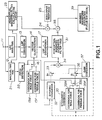
- Fig.1 is a schematic block diagram showing a speech encoding device (encoder) as an illustrative example of a device for carrying out the speech encoding method according to the present invention.
- Fig.2 is a circuit diagram for illustrating a smoother that may be employed for a pitch detection circuit shown in Fig.1.
- Fig.3 is a block diagram for illustrating the method for forming a codebook (training method) employed for vector quantization.
- Fig.1 is a schematic block diagram showing the constitution for carrying out the speech encoding method according to the present invention.
- the speech signals supplied to an input terminal 11 are supplied to a linear prediction coding (LPC) analysis circuit 12, a reverse-filtering circuit 21 and a perceptual weighting filter calculating circuit 23.
- LPC linear prediction coding
- the LPC analysis circuit 12 applies a Hamming window to an input waveform signal, with a length of the order of 256 samples of the input waveform signal as a block, and calculates linear prediction coefficients or ⁇ -parameters by the auto-correlation method.
- the frame period as a data outputting unit, is comprised e.g., of 160 samples. If the sampling frequency fs is e.g., 8 kHz, the frame period is equal to 20 msec.
- the ⁇ -parameters from the LPC analysis circuit 12 are supplied to an ⁇ to LSP converting circuit 13 for conversion to line spectral pair (LSP) parameters. That is, the ⁇ -parameters, found as direct-type filter coefficients, are converted into e.g., ten, that is five pairs of, LSP parameters. This conversion is carried out using e.g., the Newton-Raphson method. The reason the ⁇ -parameters are converted into the LSP parameters is that the LSP parameters are superior to the ⁇ -parameters in interpolation characteristics.
- LSP line spectral pair
- the LSP parameters from the ⁇ to LSP conversion circuit 13 are vector-quantized by an LSP vector quantizer 14.
- the inter-frame difference may be first found before carrying out the vector quantization.
- plural LSP parameters for plural frames are grouped together for carrying out the matrix quantization.
- 20 msec corresponds to one frame, and the LSP parameters calculated every 20 msecs are quantized by vector quantization.
- a codebook for male 15M or a codebook for female 15F is used by switching between them with a changeover switch 16, in accordance with the pitch.
- CELP code excitation linear prediction
- An output of a so-called dynamic codebook (pitch codebook, also called an adaptive codebook) 32 for code excitation linear prediction (CELP) encoding is supplied to an adder 34 via a coefficient multiplier 33 designed for multiplying a gain g 0 .
- an output of a so-called stochastic codebook (noise codebook, also called a probabilistic codebook) is supplied to the adder 34 via a coefficient multiplier 36 designed for multiplying a gain g 1 .
- a sum output of the adder 34 is supplied as an excitation signal to the perceptual weighting synthesis filter 31.
- the dynamic codebook 32 are stored past excitation signals. These excitation signals are read out at a pitch period and multiplied by the gain g 0 .
- the resulting product signal is summed by the adder 34 to a signal from the stochastic codebook 35 multiplied by the gain g 1 .
- the resulting sum signal is used for exciting the perceptual weighting synthesis filter 31.
- the sum output from the adder 34 is fed back to the dynamic codebook 32 to form a sort of an IIR filter.
- the stochastic codebook 35 is configured so that the changeover switch 35S switches between the codebook 35M for male voice and the codebook 35F for female voice to select one of the codebooks.
- the coefficient multipliers 33, 36 have their respective gains g 0 , g 1 controlled responsive to outputs of the gain codebook 37.
- An output of the perceptual weighting synthesis filter 31 is supplied as a subtraction signal to an adder 38.
- An output signal of the adder 38 is supplied to a waveform distortion (Euclid distance) minimizing circuit 39. Based upon an output of the waveform distortion minimizing circuit 39, signal readout from the respective codebooks 32, 35 and 37 is controlled for minimizing an output of the adder 38, that is the weighted waveform distortion.
- the input speech signal from the input terminal 11 is back-filtered by the ⁇ -parameter from the LPC analysis circuit 12 and supplied to a pitch detection circuit 22 for pitch detection.
- the changeover switch 16 or the changeover switch 35S is changed over responsive to the pitch detection results from the pitch detection circuit 22 for selective switching between the codebook for male voice and the codebook for female voice.
- perceptual weighting filter calculating circuit 23 perceptual weighting filter calculation is carried out on the input speech signal from the input terminal 11 using an output of the LPC analysis circuit 12.
- the resulting perceptual weighted signal is supplied to an adder 24 which is also fed with an output of a zero input response circuit 25 as a subtraction signal.
- the zero input response circuit 25 synthesizes the response of the previous frame by a weighted synthesis filter and outputs a synthesized signal. This synthesized signal is subtracted from the perceptual weighted signal for canceling the filter response of the previous frame remnant in the perceptual weighting synthesis filter 31 for producing a signal required as a new input for a decoder.
- An output of the adder 24 is supplied to the adder 38 where an output of the perceptual weighting synthesis filter 31 is subtracted from the addition output.
- the prediction residual res(n) obtained from the reverse-filtering circuit 21 is passed through a low-pass filter (LPF) for deriving resl(n).
- LPF low-pass filter
- Such an LPF usually has a cut-off frequency fc of the order of 1 kHz in the case of the sampling clock frequency fs of 8 kHz.
- L min is equal to 20 and L max is equal to 147 approximately.
- the strength of the auto-correlation normalized by ⁇ resl (0), is defined as above.
- the quantization table for ⁇ i ⁇ or the quantization table formed by converting the ⁇ -parameters into line spectral pairs (LSPs) are changed over between the codebook for male voice and the codebook for female voice.
- the quantization table for the vector quantizer 14 used for quantizing the LSPs is changed over between the codebook for male voice 15M and the codebook for female voice 15F.
- P th denotes the threshold value of the pitch lag P(k) used for making distinction between the male voice and the female voice
- Pl th and R oth denote respective threshold values of the pitch strength Pl(k) for discriminating pitch reliability and the frame power R 0 (k)
- codebook 35M for male voice and the codebook 35F for female voice may be employed as the third codebook, it is also possible to employ the codebook 35M for male voice or the codebook 35F for female voice as the third codebook.
- the codebooks may be changed over by preserving past n frames of the pitch lags P(k), finding a mean value of P(k) over these n frames and discriminating the mean value with the pre-set threshold value P th . It is noted that these n frames are selected so that Pl(k) > Pl th' and R 0 (k) > R oth' , that is so that the frames are voiced frames and exhibit high pitch reliability.
- the pitch lag P(k) satisfying the above condition may be supplied to the smoother shown in Fig.2 and the resulting smoothed output may be discriminated by the threshold value P th for changing over the codebooks.
- an output of the smoother of Fig.2 is obtained by multiplying the input data with 0.2 by a multiplier 41 and summing the resulting product signal by an adder 44 to an output data delayed by one frame by a delay circuit 42 and multiplied with 0.8 by a multiplier 43.
- the output state of the smoother is maintained unless the pitch lag P(k), the input data, is supplied.
- the codebooks may also be changed over depending upon the voiced/unvoiced discrimination, the value of the pitch strength Pl(k) or the value of the frame power R 0 (k).
- the mean value of the pitch is extracted from the stable pitch section and discrimination is made as to whether or not the input speech is the male speech or the female speech for switching between the codebook for male voice and the codebook for female voice.
- the reason is that, since there is deviation in the frequency distribution of the formant of the vowel between the male voice and the female voice, the space occupied by the vectors to be quantized is decreased, that is, the vector variance is diminished, by switching between the male voice and the female voice especially in the vowel portion, thus enabling satisfactory training, that is learning to reduce the quantization error.
- the changeover switch 35S is changed over in accordance with the above conditions for selecting one of the codebook 35M for male voice and the codebook 35F for female voice as the stochastic codebook 35.
- training data may be assorted under the same standard as that for encoding/decoding so that the training data will be optimized under e.g., the so-called LBG method.
- signals from a training set 51 made up of speech signals for training, continuing for e.g., several minutes, are supplied to a line spectral pair (LSP) calculating circuit 52 and a pitch discriminating circuit 53.
- the LRP calculating circuit 52 is equivalent to e.g., the LPC analysis circuit 12 and the ⁇ to LSP converting circuit 13 of Fig.1, while the pitch discriminating circuit 53 is equivalent to the back filtering circuit 21 and the pitch detection circuit 22 of Fig.1.
- the pitch discrimination circuit 53 discriminates the pitch lag P(k), pitch strength Pl(k) and the frame power R 0 (k) by the above-mentioned threshold values P th , Pl th and R oth for case classification in accordance with the above conditions (i), (ii) and (iii). Specifically, discrimination between at least the male voice under the condition (i) and the female voice under the condition (ii) suffices. Alternatively, the pitch lag values P(k) of past n voiced frames with high pitch reliability may be preserved and a mean value of the P(k) values of these n frames may be found and discriminated by the threshold value P th . An output of the smoother of Fig.2 may also be discriminated by the threshold value P th .
- the LSP data from the LSP calculating circuit 52 are sent to a training data assorting circuit 54 where the LSP data are assorted into training data for male voice 55 and into training data for female voice 56 in dependence upon the discrimination output of the pitch discrimination circuit 53.
- These training data are supplied to training processors 57, 58 where training is carried out in accordance with e.g., the so-called LBG method for formulating the codebook 35M for male voice and the codebook 35F for female voice.
- the LBG method is a method for codebook training proposed in Linde, Y., Buzo, A. and Gray, R.M., "An Algorithm for vector Quantizer Design", in IEEE Trans. Comm., COM-28, pp. 84 to 95, Jan. 1980. Specifically, it is a technique of designing a locally optimum vector quantizer for an information source, whose probabilistic density function has not been known, with the aid of a so-called training string.
- the codebook 15M for male voice and the codebook 15F for female voice, thus formulated, are selected by switching the changeover switch 16 at the time of vector quantization by the vector quantizer 14 shown in Fig.1.
- This changeover switch 16 is controlled for switching in dependence upon the results of discrimination by the pitch detection circuit 22.
- the index information as the quantization output of the vector quantizer 14, that is the codes of the representative vectors, are outputted as data to be transmitted, while the quantized LSP data of the output vector is converted by the LSP to a converting circuit 17 into ⁇ -parameters which are fed to a perceptual weighing synthesis filter 31.
- the index information for the dynamic codebook 32 and the stochastic codebook 35 there are the index information of the gain codebook 37 and the pitch information of the pitch detection circuit 22, in addition to the index information of the representative vectors in the vector quantizer 14. Since the pitch values or the index of the dynamic codebook are parameters inherently required to be transmitted, the quantity of the transmitted information or the transmission rate is not increased. However, if the parameters not to be inherently transmitted, such as the pitch information, is to be used as reference basis for switching between the codebook for male voice and that for female voice, it is necessary to transmit separate code switching information.
- the codebook for male voice and the codebook for female voice is merely the appellation for convenience.
- the codebooks are changed over depending upon the pitch value by exploiting the fact that correlation exists between the pitch value and the shape of the spectral envelope.
- the present invention is not limited to the above embodiments.
- each component of the arrangement of Fig.1 is stated as hardware, it may also be implemented by a software program using a so-called digital signal processor (DSP).
- DSP digital signal processor
- the low-range side codebook of band-splitting vector quantization or the partial codebook such as a codebook for a part of the multistage vector quantization may be switched between plural codebooks for male voice and for female voice.
- matrix quantization may also be executed in place of vector quantization by grouping data of plural frames together.
- the speech encoding method according to the present invention is not limited to the linear prediction coding method employing code excitation but may also be applied to a variety of speech encoding methods in which the voiced portion is synthesized by sine wave synthesis and the non-voiced portion is synthesized based upon the noise signal.
- the present invention is not limited to transmission or recording/reproduction but may be applied to a variety of usages, such as pitch conversion speech modification, regular speech syntheses or noise suppression.
- a speech encoding method provides a first codebook and a second codebook formed by assorting parameters representing short-term prediction values concerning a reference parameter comprised of one or a combination of a plurality of characteristic parameters of the input speech signal.
- the short-term prediction values are then generated based upon an input speech signal and one of the first and second codebooks is selected in connection with the reference parameter of the input speech signal.
- the short-term prediction values are encoded by having reference to the selected codebook for encoding the input speech signal. This improves the quantization efficiency. For example, the signal quality may be improved without increasing the transmission bit rate or the transmission bit rate may be lowered further while suppressing deterioration in the signal quality.
Landscapes
- Engineering & Computer Science (AREA)
- Physics & Mathematics (AREA)
- Multimedia (AREA)
- Health & Medical Sciences (AREA)
- Audiology, Speech & Language Pathology (AREA)
- Human Computer Interaction (AREA)
- Acoustics & Sound (AREA)
- Computational Linguistics (AREA)
- Signal Processing (AREA)
- Spectroscopy & Molecular Physics (AREA)
- Compression, Expansion, Code Conversion, And Decoders (AREA)
- Transmission Systems Not Characterized By The Medium Used For Transmission (AREA)
- Reduction Or Emphasis Of Bandwidth Of Signals (AREA)
- Communication Control (AREA)
- Golf Clubs (AREA)
- Tires In General (AREA)
Abstract
Description
- This invention relates to a speech encoding method for encoding short-term prediction residuals or parameters representing short-term prediction coefficients of the input speech signal by vector or matrix quantization.
- There are a variety of encoding methods known for encoding the audio signal, inclusive of the speech signal and the acoustic signal, by exploiting statistic properties of the audio signal in the time domain and in the frequency domain and psychoacoustic characteristics of the human hearing system. These encoding methods may be roughly classified into encoding on the time domain, encoding on the frequency domain and analysis/ synthesis encoding.
- If, in multi-band excitation (MBE), single-band excitation (SBE), harmonic excitation, sub-band coding (SBC), linear predictive coding (LPC), discrete cosine transform (DCT), modified DCT (MDCT) or fast Fourier transform (FFT), as examples of high-efficiency coding for speech signals, various information data, such as spectral amplitudes or parameters thereof, such as LSP parameters, α-parameters or k-parameters, are quantized, scalar quantization has been usually adopted.
- If, with such scalar quantization, the bit rate is decreased to e.g. 3 to 4 kbps to further increase the quantization efficiency, the quantization noise or distortion is increased, thus raising difficulties in practical utilization. Thus it is currently practiced to group different data given for encoding, such as time-domain data, frequency-domain data or filter coefficient data, into a vector, or to group such vectors across plural frames, into a matrix, and to effect vector or matrix quantization, in place of individually quantizing the different data.
- For example, in code excitation linear prediction (CELP) encoding, LPC residuals are directly quantized by vector or matrix quantization as time-domain waveform. In addition, the spectral envelope in MBE encoding is similarly quantized by vector or matrix quantization.
- If the bit rate is decreased further, it becomes infeasible to use enough bits to quantize parameters specifying the envelope of the spectrum itself or the LPC residuals, thus deteriorating the signal quality.
- In view of the foregoing, it is an object of the present invention to provide a speech encoding method capable of affording satisfactory quantization characteristics even with a smaller number of bits.
- With the speech encoding method according to the present invention, a first codebook and a second codebook are formed by assorting parameters representing short-term prediction values concerning a reference parameter comprised of one or a combination of a plurality of characteristic parameters of the input speech signal. The short-term prediction values are generated based upon the input speech signal. One of the first and second codebooks concerning the reference parameter of the input speech signal is selected and the short-term prediction values are quantized by having reference to the selected codebook for encoding the input speech signal.
- The short-term prediction values are short-term prediction coefficients or short-term prediction errors. The characteristic parameters include the pitch values of the speech signal, pitch strength, frame power, voiced/unvoiced discrimination flag and the gradient of the signal spectrum. The quantization is the vector quantization or the matrix quantization. The reference parameter is the pitch value of the speech signal. One of the first and second codebooks is selected in dependence upon the magnitude relation between the pitch value of the input speech signal and a pre-set pitch value.
- According to the present invention, the short-term prediction value, generated based upon the input speech signal, is quantized by having reference to the selected codebook for improving the quantization efficiency.
- Fig.1 is a schematic block diagram showing a speech encoding device (encoder) as an illustrative example of a device for carrying out the speech encoding method according to the present invention.
- Fig.2 is a circuit diagram for illustrating a smoother that may be employed for a pitch detection circuit shown in Fig.1.
- Fig.3 is a block diagram for illustrating the method for forming a codebook (training method) employed for vector quantization.
- Preferred embodiments of the present invention will be hereinafter explained.
- Fig.1 is a schematic block diagram showing the constitution for carrying out the speech encoding method according to the present invention.
- In the present speech signal encoder, the speech signals supplied to an input terminal 11 are supplied to a linear prediction coding (LPC)
analysis circuit 12, a reverse-filtering circuit 21 and a perceptual weightingfilter calculating circuit 23. - The
LPC analysis circuit 12 applies a Hamming window to an input waveform signal, with a length of the order of 256 samples of the input waveform signal as a block, and calculates linear prediction coefficients or α-parameters by the auto-correlation method. The frame period, as a data outputting unit, is comprised e.g., of 160 samples. If the sampling frequency fs is e.g., 8 kHz, the frame period is equal to 20 msec. - The α-parameters from the
LPC analysis circuit 12 are supplied to an α toLSP converting circuit 13 for conversion to line spectral pair (LSP) parameters. That is, the α-parameters, found as direct-type filter coefficients, are converted into e.g., ten, that is five pairs of, LSP parameters. This conversion is carried out using e.g., the Newton-Raphson method. The reason the α-parameters are converted into the LSP parameters is that the LSP parameters are superior to the α-parameters in interpolation characteristics. - The LSP parameters from the α to
LSP conversion circuit 13 are vector-quantized by anLSP vector quantizer 14. At this time, the inter-frame difference may be first found before carrying out the vector quantization. Alternatively, plural LSP parameters for plural frames are grouped together for carrying out the matrix quantization. For this quantization, 20 msec corresponds to one frame, and the LSP parameters calculated every 20 msecs are quantized by vector quantization. For carrying out the vector quantization or matrix quantization, a codebook for male 15M or a codebook for female 15F is used by switching between them with achangeover switch 16, in accordance with the pitch. - A quantization output of the
LSP vector quantizer 14, that is the index of the LSP vector quantization, is provided, and the quantized LSP vectors are processed by a LSP to α conversion circuit 17 for conversion of the LSP parameters to the α-parameters as coefficients of the direct type filter. Based upon the output of the LSP to α conversion circuit 17, filter coefficients of a perceptualweighting synthesis filter 31 for code excitation linear prediction (CELP) encoding are calculated. - An output of a so-called dynamic codebook (pitch codebook, also called an adaptive codebook) 32 for code excitation linear prediction (CELP) encoding is supplied to an
adder 34 via acoefficient multiplier 33 designed for multiplying a gain g0. On the other hand, an output of a so-called stochastic codebook (noise codebook, also called a probabilistic codebook) is supplied to theadder 34 via acoefficient multiplier 36 designed for multiplying a gain g1. A sum output of theadder 34 is supplied as an excitation signal to the perceptualweighting synthesis filter 31. - In the
dynamic codebook 32 are stored past excitation signals. These excitation signals are read out at a pitch period and multiplied by the gain g0. The resulting product signal is summed by theadder 34 to a signal from thestochastic codebook 35 multiplied by the gain g1. The resulting sum signal is used for exciting the perceptualweighting synthesis filter 31. In addition, the sum output from theadder 34 is fed back to thedynamic codebook 32 to form a sort of an IIR filter. Thestochastic codebook 35 is configured so that thechangeover switch 35S switches between thecodebook 35M for male voice and thecodebook 35F for female voice to select one of the codebooks. Thecoefficient multipliers gain codebook 37. An output of the perceptualweighting synthesis filter 31 is supplied as a subtraction signal to anadder 38. An output signal of theadder 38 is supplied to a waveform distortion (Euclid distance) minimizingcircuit 39. Based upon an output of the waveformdistortion minimizing circuit 39, signal readout from therespective codebooks adder 38, that is the weighted waveform distortion. - In the reverse-
filtering circuit 21, the input speech signal from the input terminal 11 is back-filtered by the α-parameter from theLPC analysis circuit 12 and supplied to apitch detection circuit 22 for pitch detection. Thechangeover switch 16 or thechangeover switch 35S is changed over responsive to the pitch detection results from thepitch detection circuit 22 for selective switching between the codebook for male voice and the codebook for female voice. - In the perceptual weighting
filter calculating circuit 23, perceptual weighting filter calculation is carried out on the input speech signal from the input terminal 11 using an output of theLPC analysis circuit 12. The resulting perceptual weighted signal is supplied to anadder 24 which is also fed with an output of a zeroinput response circuit 25 as a subtraction signal. The zeroinput response circuit 25 synthesizes the response of the previous frame by a weighted synthesis filter and outputs a synthesized signal. This synthesized signal is subtracted from the perceptual weighted signal for canceling the filter response of the previous frame remnant in the perceptualweighting synthesis filter 31 for producing a signal required as a new input for a decoder. An output of theadder 24 is supplied to theadder 38 where an output of the perceptualweighting synthesis filter 31 is subtracted from the addition output. - In the above-described encoder, assuming that an input signal from the input terminal 11 is x(n), the LPC coefficients, i.e. α-parameters, are αi and the prediction residuals are res(n). With the number of orders for analysis of P, 1 ≦ i ≦ P. The input signal x(n) is back-filtered by the reverse-
filtering circuit 21 in accordance with the equation (1):
- Next, in the
pitch detection circuit 22, the prediction residual res(n) obtained from the reverse-filtering circuit 21 is passed through a low-pass filter (LPF) for deriving resl(n). Such an LPF usually has a cut-off frequency fc of the order of 1 kHz in the case of the sampling clock frequency fs of 8 kHz. Next, the auto-correlation function Φresl(n) of resl(n) is calculated in accordance with the equation (2):
- Usually, Lmin is equal to 20 and Lmax is equal to 147 approximately. The pitch as found by tracking the number i which gives a peak value of the auto-correlation function Φresl(i) or the number i which gives a peak value by suitable processing is employed as the pitch for the current frame. For example, assuming that the pitch, more specifically, the pitch lag, of the k'th frame, is P(k). On the other hand, pitch reliability or pitch strength is defined by the equation (3):

- That is, the strength of the auto-correlation, normalized by Φresl(0), is defined as above.
- In addition, with the usual code excitation linear prediction (CELP) coding, the frame power R0(k) is calculated by the equation (4):
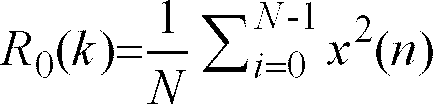
- Depending upon the values of the pitch lag P(k), pitch strength Pl(k) and the frame power R0(k), the quantization table for {αi} or the quantization table formed by converting the α-parameters into line spectral pairs (LSPs) are changed over between the codebook for male voice and the codebook for female voice. In the embodiment of Fig.1, the quantization table for the
vector quantizer 14 used for quantizing the LSPs is changed over between the codebook formale voice 15M and the codebook forfemale voice 15F. - For example, if Pth denotes the threshold value of the pitch lag P(k) used for making distinction between the male voice and the female voice, and Plth and Roth denote respective threshold values of the pitch strength Pl(k) for discriminating pitch reliability and the frame power R0(k),
- (i) a first codebook, e.g., the codebook for
male voice 15M, is used for P(k) ≧ Pth, Pl(k) > Plth and R0(k) > Roth; - (ii) a second codebook, e.g., the codebook for
female voice 15F, is used for P(k) ≦ Pth, Pl(k) > Plth and R0(k) > Roth; and - (iii) a third codebook is used otherwise.
- Although a codebook different from the codebook 35M for male voice and the
codebook 35F for female voice may be employed as the third codebook, it is also possible to employ the codebook 35M for male voice or thecodebook 35F for female voice as the third codebook. - The above threshold values may be exemplified e.g., by Pth = 45, Plth = 0.7 and R0(k) = (full scale - 40 dB).
- Alternatively, the codebooks may be changed over by preserving past n frames of the pitch lags P(k), finding a mean value of P(k) over these n frames and discriminating the mean value with the pre-set threshold value Pth. It is noted that these n frames are selected so that Pl(k) > Plth' and R0(k) > Roth', that is so that the frames are voiced frames and exhibit high pitch reliability.
- Still alternatively, the pitch lag P(k) satisfying the above condition may be supplied to the smoother shown in Fig.2 and the resulting smoothed output may be discriminated by the threshold value Pth for changing over the codebooks. It is noted that an output of the smoother of Fig.2 is obtained by multiplying the input data with 0.2 by a
multiplier 41 and summing the resulting product signal by anadder 44 to an output data delayed by one frame by adelay circuit 42 and multiplied with 0.8 by amultiplier 43. The output state of the smoother is maintained unless the pitch lag P(k), the input data, is supplied. - In combination with the above-described switching, the codebooks may also be changed over depending upon the voiced/unvoiced discrimination, the value of the pitch strength Pl(k) or the value of the frame power R0(k).
- In this manner, the mean value of the pitch is extracted from the stable pitch section and discrimination is made as to whether or not the input speech is the male speech or the female speech for switching between the codebook for male voice and the codebook for female voice. The reason is that, since there is deviation in the frequency distribution of the formant of the vowel between the male voice and the female voice, the space occupied by the vectors to be quantized is decreased, that is, the vector variance is diminished, by switching between the male voice and the female voice especially in the vowel portion, thus enabling satisfactory training, that is learning to reduce the quantization error.
- It is also possible to change over the stochastic codebook in CELP coding in accordance with the above conditions. In the embodiment of Fig.1, the
changeover switch 35S is changed over in accordance with the above conditions for selecting one of the codebook 35M for male voice and thecodebook 35F for female voice as thestochastic codebook 35. - For codebook learning, training data may be assorted under the same standard as that for encoding/decoding so that the training data will be optimized under e.g., the so-called LBG method.
- That is, referring to Fig.3, signals from a training set 51, made up of speech signals for training, continuing for e.g., several minutes, are supplied to a line spectral pair (LSP) calculating
circuit 52 and apitch discriminating circuit 53. TheLRP calculating circuit 52 is equivalent to e.g., theLPC analysis circuit 12 and the α toLSP converting circuit 13 of Fig.1, while thepitch discriminating circuit 53 is equivalent to theback filtering circuit 21 and thepitch detection circuit 22 of Fig.1. Thepitch discrimination circuit 53 discriminates the pitch lag P(k), pitch strength Pl(k) and the frame power R0(k) by the above-mentioned threshold values Pth, Plth and Roth for case classification in accordance with the above conditions (i), (ii) and (iii). Specifically, discrimination between at least the male voice under the condition (i) and the female voice under the condition (ii) suffices. Alternatively, the pitch lag values P(k) of past n voiced frames with high pitch reliability may be preserved and a mean value of the P(k) values of these n frames may be found and discriminated by the threshold value Pth. An output of the smoother of Fig.2 may also be discriminated by the threshold value Pth. - The LSP data from the
LSP calculating circuit 52 are sent to a trainingdata assorting circuit 54 where the LSP data are assorted into training data formale voice 55 and into training data forfemale voice 56 in dependence upon the discrimination output of thepitch discrimination circuit 53. These training data are supplied totraining processors codebook 35F for female voice. The LBG method is a method for codebook training proposed in Linde, Y., Buzo, A. and Gray, R.M., "An Algorithm for vector Quantizer Design", in IEEE Trans. Comm., COM-28, pp. 84 to 95, Jan. 1980. Specifically, it is a technique of designing a locally optimum vector quantizer for an information source, whose probabilistic density function has not been known, with the aid of a so-called training string. - The codebook 15M for male voice and the
codebook 15F for female voice, thus formulated, are selected by switching thechangeover switch 16 at the time of vector quantization by thevector quantizer 14 shown in Fig.1. Thischangeover switch 16 is controlled for switching in dependence upon the results of discrimination by thepitch detection circuit 22. - The index information, as the quantization output of the
vector quantizer 14, that is the codes of the representative vectors, are outputted as data to be transmitted, while the quantized LSP data of the output vector is converted by the LSP to a converting circuit 17 into α-parameters which are fed to a perceptual weighingsynthesis filter 31. This perceptual weighingsynthesis filter 31 hascharacteristics 1/A(z) as shown by the following equation (5):
- Among data to be transmitted in the above-described CELP encoding, there are the index information for the
dynamic codebook 32 and thestochastic codebook 35, the index information of thegain codebook 37 and the pitch information of thepitch detection circuit 22, in addition to the index information of the representative vectors in thevector quantizer 14. Since the pitch values or the index of the dynamic codebook are parameters inherently required to be transmitted, the quantity of the transmitted information or the transmission rate is not increased. However, if the parameters not to be inherently transmitted, such as the pitch information, is to be used as reference basis for switching between the codebook for male voice and that for female voice, it is necessary to transmit separate code switching information. - It is noted that discrimination between the male voice and the female voice need not be coincident with the sex of the speaker provided that the codebook selection has been made under the same standard as that for assortment of the training data. Thus the appellation of the codebook for male voice and the codebook for female voice is merely the appellation for convenience. In the present embodiment, the codebooks are changed over depending upon the pitch value by exploiting the fact that correlation exists between the pitch value and the shape of the spectral envelope.
- The present invention is not limited to the above embodiments. Although each component of the arrangement of Fig.1 is stated as hardware, it may also be implemented by a software program using a so-called digital signal processor (DSP). The low-range side codebook of band-splitting vector quantization or the partial codebook such as a codebook for a part of the multistage vector quantization may be switched between plural codebooks for male voice and for female voice. In addition, matrix quantization may also be executed in place of vector quantization by grouping data of plural frames together. In addition, the speech encoding method according to the present invention is not limited to the linear prediction coding method employing code excitation but may also be applied to a variety of speech encoding methods in which the voiced portion is synthesized by sine wave synthesis and the non-voiced portion is synthesized based upon the noise signal. As for the usage, the present invention is not limited to transmission or recording/reproduction but may be applied to a variety of usages, such as pitch conversion speech modification, regular speech syntheses or noise suppression.
- As will be apparent from the foregoing description, a speech encoding method according to the present invention provides a first codebook and a second codebook formed by assorting parameters representing short-term prediction values concerning a reference parameter comprised of one or a combination of a plurality of characteristic parameters of the input speech signal. The short-term prediction values are then generated based upon an input speech signal and one of the first and second codebooks is selected in connection with the reference parameter of the input speech signal. The short-term prediction values are encoded by having reference to the selected codebook for encoding the input speech signal. This improves the quantization efficiency. For example, the signal quality may be improved without increasing the transmission bit rate or the transmission bit rate may be lowered further while suppressing deterioration in the signal quality.
Claims (7)
- A speech encoding method comprising:generating values relating short-term prediction based upon an input speech signal;providing a first codebook and a second codebook formed by assorting parameters representing said values relating short-term prediction in relation to a reference parameter and producing data based upon the assorted parameters, said reference parameter comprised of one or a combination of a plurality of characteristic parameters of the input speech signal;selecting one of the first and second codebooks in relation to said reference parameter of said input speech signal; andquantizing said values relating short-term prediction by referring to the selected codebook for encoding said input speech signal.
- The speech encoding method as claimed in claim 1 wherein said values relating short-term prediction are short-term prediction coefficients.
- The speech encoding method as claimed in claim 1 wherein said values relating short-term prediction are short-term prediction errors.
- The speech encoding method as claimed in claim 1 wherein said characteristic parameters are the pitch value of a speech signal, pitch strength, frame power, a voiced/unvoiced discrimination flag and the gradient of the signal spectrum.
- The speech encoding method as claimed in claim 1 wherein said values relating short-term prediction are vector-quantized for encoding the input speech signal.
- The speech encoding method as claimed in claim 1 wherein said values relating short-term prediction are matrix-quantized for encoding the input speech signal.
- The speech encoding method as claimed in claim 1 wherein said reference parameter is the pitch value of the speech signal and wherein one of the first codebook and the second codebook is selected depending upon the magnitude relation of the pitch value of the input speech signal and a pre-set pitch value.
Applications Claiming Priority (4)
| Application Number | Priority Date | Filing Date | Title |
|---|---|---|---|
| JP6318689A JPH08179796A (en) | 1994-12-21 | 1994-12-21 | Speech coding method |
| JP318689/94 | 1994-12-21 | ||
| JP31868994 | 1994-12-21 | ||
| PCT/JP1995/002607 WO1996019798A1 (en) | 1994-12-21 | 1995-12-19 | Sound encoding system |
Publications (3)
| Publication Number | Publication Date |
|---|---|
| EP0751494A1 true EP0751494A1 (en) | 1997-01-02 |
| EP0751494A4 EP0751494A4 (en) | 1998-12-30 |
| EP0751494B1 EP0751494B1 (en) | 2003-02-19 |
Family
ID=18101922
Family Applications (1)
| Application Number | Title | Priority Date | Filing Date |
|---|---|---|---|
| EP95940473A Expired - Lifetime EP0751494B1 (en) | 1994-12-21 | 1995-12-19 | Speech encoding system |
Country Status (16)
| Country | Link |
|---|---|
| US (1) | US5950155A (en) |
| EP (1) | EP0751494B1 (en) |
| JP (1) | JPH08179796A (en) |
| KR (1) | KR970701410A (en) |
| CN (1) | CN1141684A (en) |
| AT (1) | ATE233008T1 (en) |
| AU (1) | AU703046B2 (en) |
| BR (1) | BR9506841A (en) |
| CA (1) | CA2182790A1 (en) |
| DE (1) | DE69529672T2 (en) |
| ES (1) | ES2188679T3 (en) |
| MY (1) | MY112314A (en) |
| PL (1) | PL316008A1 (en) |
| TR (1) | TR199501637A2 (en) |
| TW (1) | TW367484B (en) |
| WO (1) | WO1996019798A1 (en) |
Cited By (8)
| Publication number | Priority date | Publication date | Assignee | Title |
|---|---|---|---|---|
| EP0905680A3 (en) * | 1997-08-28 | 1999-09-29 | Texas Instruments Inc. | Method for quantizing LPC parameters using switched-predictive quantization |
| WO2000011646A1 (en) | 1998-08-21 | 2000-03-02 | Matsushita Electric Industrial Co., Ltd. | Multimode speech encoder and decoder |
| EP0858069A4 (en) * | 1996-08-02 | 2000-08-23 | Matsushita Electric Industrial Co Ltd | VOICE CODEC, MEDIUM ON WHICH A VOICE CODEC PROGRAM IS RECORDED, AND MOBILE TELECOMMUNICATIONS APPARATUS |
| GB2352949A (en) * | 1999-08-02 | 2001-02-07 | Motorola Ltd | Speech coder for communications unit |
| WO2001029825A1 (en) * | 1999-10-19 | 2001-04-26 | Atmel Corporation | Variable bit-rate celp coding of speech with phonetic classification |
| EP1035538A3 (en) * | 1999-03-12 | 2003-04-23 | Texas Instruments Incorporated | Multimode quantizing of the prediction residual in a speech coder |
| EP1383109A1 (en) * | 2002-07-17 | 2004-01-21 | STMicroelectronics N.V. | Method and device for wide band speech coding |
| EP1091495A4 (en) * | 1999-04-20 | 2005-08-10 | Mitsubishi Electric Corp | DEVICE FOR ENCODING VOICE SIGNALS |
Families Citing this family (27)
| Publication number | Priority date | Publication date | Assignee | Title |
|---|---|---|---|---|
| JP3273455B2 (en) * | 1994-10-07 | 2002-04-08 | 日本電信電話株式会社 | Vector quantization method and its decoder |
| JP3707153B2 (en) * | 1996-09-24 | 2005-10-19 | ソニー株式会社 | Vector quantization method, speech coding method and apparatus |
| US7788092B2 (en) | 1996-09-25 | 2010-08-31 | Qualcomm Incorporated | Method and apparatus for detecting bad data packets received by a mobile telephone using decoded speech parameters |
| US6205130B1 (en) | 1996-09-25 | 2001-03-20 | Qualcomm Incorporated | Method and apparatus for detecting bad data packets received by a mobile telephone using decoded speech parameters |
| CA2265640A1 (en) | 1996-09-25 | 1998-04-02 | Qualcomm Incorporated | Method and apparatus for detecting bad data packets received by a mobile telephone using decoded speech parameters |
| DE19654079A1 (en) * | 1996-12-23 | 1998-06-25 | Bayer Ag | Endo-ecto-parasiticidal agents |
| CA2283187A1 (en) | 1997-03-12 | 1998-09-17 | Mitsubishi Denki Kabushiki Kaisha | A method and apparatus for speech encoding, speech decoding, and speech coding/decoding |
| IL120788A (en) * | 1997-05-06 | 2000-07-16 | Audiocodes Ltd | Systems and methods for encoding and decoding speech for lossy transmission networks |
| JP3235543B2 (en) * | 1997-10-22 | 2001-12-04 | 松下電器産業株式会社 | Audio encoding / decoding device |
| US7092885B1 (en) * | 1997-12-24 | 2006-08-15 | Mitsubishi Denki Kabushiki Kaisha | Sound encoding method and sound decoding method, and sound encoding device and sound decoding device |
| SE521225C2 (en) * | 1998-09-16 | 2003-10-14 | Ericsson Telefon Ab L M | Method and apparatus for CELP encoding / decoding |
| US6449313B1 (en) * | 1999-04-28 | 2002-09-10 | Lucent Technologies Inc. | Shaped fixed codebook search for celp speech coding |
| US6721701B1 (en) * | 1999-09-20 | 2004-04-13 | Lucent Technologies Inc. | Method and apparatus for sound discrimination |
| JP3462464B2 (en) * | 2000-10-20 | 2003-11-05 | 株式会社東芝 | Audio encoding method, audio decoding method, and electronic device |
| KR100446630B1 (en) * | 2002-05-08 | 2004-09-04 | 삼성전자주식회사 | Vector quantization and inverse vector quantization apparatus for the speech signal and method thereof |
| JP4816115B2 (en) * | 2006-02-08 | 2011-11-16 | カシオ計算機株式会社 | Speech coding apparatus and speech coding method |
| JP5300733B2 (en) * | 2007-10-12 | 2013-09-25 | パナソニック株式会社 | Vector quantization apparatus, vector inverse quantization apparatus, and methods thereof |
| CN100578619C (en) | 2007-11-05 | 2010-01-06 | 华为技术有限公司 | Encoding Methods and Encoders |
| GB2466673B (en) | 2009-01-06 | 2012-11-07 | Skype | Quantization |
| GB2466671B (en) | 2009-01-06 | 2013-03-27 | Skype | Speech encoding |
| GB2466675B (en) * | 2009-01-06 | 2013-03-06 | Skype | Speech coding |
| JP2011090031A (en) * | 2009-10-20 | 2011-05-06 | Oki Electric Industry Co Ltd | Voice band expansion device and program, and extension parameter learning device and program |
| US8280726B2 (en) * | 2009-12-23 | 2012-10-02 | Qualcomm Incorporated | Gender detection in mobile phones |
| CA2929800C (en) | 2010-12-29 | 2017-12-19 | Samsung Electronics Co., Ltd. | Apparatus and method for encoding/decoding for high-frequency bandwidth extension |
| US9972325B2 (en) | 2012-02-17 | 2018-05-15 | Huawei Technologies Co., Ltd. | System and method for mixed codebook excitation for speech coding |
| CN107452390B (en) * | 2014-04-29 | 2021-10-26 | 华为技术有限公司 | Audio coding method and related device |
| US10878831B2 (en) * | 2017-01-12 | 2020-12-29 | Qualcomm Incorporated | Characteristic-based speech codebook selection |
Family Cites Families (29)
| Publication number | Priority date | Publication date | Assignee | Title |
|---|---|---|---|---|
| JPS56111899A (en) * | 1980-02-08 | 1981-09-03 | Matsushita Electric Industrial Co Ltd | Voice synthetizing system and apparatus |
| JPS5912499A (en) * | 1982-07-12 | 1984-01-23 | 松下電器産業株式会社 | speech encoding device |
| JPS60116000A (en) * | 1983-11-28 | 1985-06-22 | ケイディディ株式会社 | Voice encoding system |
| IT1180126B (en) * | 1984-11-13 | 1987-09-23 | Cselt Centro Studi Lab Telecom | PROCEDURE AND DEVICE FOR CODING AND DECODING THE VOICE SIGNAL BY VECTOR QUANTIZATION TECHNIQUES |
| IT1195350B (en) * | 1986-10-21 | 1988-10-12 | Cselt Centro Studi Lab Telecom | PROCEDURE AND DEVICE FOR THE CODING AND DECODING OF THE VOICE SIGNAL BY EXTRACTION OF PARA METERS AND TECHNIQUES OF VECTOR QUANTIZATION |
| US4817157A (en) * | 1988-01-07 | 1989-03-28 | Motorola, Inc. | Digital speech coder having improved vector excitation source |
| EP0364647B1 (en) * | 1988-10-19 | 1995-02-22 | International Business Machines Corporation | Improvement to vector quantizing coder |
| US5012518A (en) * | 1989-07-26 | 1991-04-30 | Itt Corporation | Low-bit-rate speech coder using LPC data reduction processing |
| DE4009033A1 (en) * | 1990-03-21 | 1991-09-26 | Bosch Gmbh Robert | DEVICE FOR SUPPRESSING INDIVIDUAL IGNITION PROCESSES IN A IGNITION SYSTEM |
| US5202926A (en) * | 1990-09-13 | 1993-04-13 | Oki Electric Industry Co., Ltd. | Phoneme discrimination method |
| JP3151874B2 (en) * | 1991-02-26 | 2001-04-03 | 日本電気株式会社 | Voice parameter coding method and apparatus |
| JP3296363B2 (en) * | 1991-04-30 | 2002-06-24 | 日本電信電話株式会社 | Speech linear prediction parameter coding method |
| EP1998319B1 (en) * | 1991-06-11 | 2010-08-11 | Qualcomm Incorporated | Variable rate vocoder |
| US5487086A (en) * | 1991-09-13 | 1996-01-23 | Comsat Corporation | Transform vector quantization for adaptive predictive coding |
| US5371853A (en) * | 1991-10-28 | 1994-12-06 | University Of Maryland At College Park | Method and system for CELP speech coding and codebook for use therewith |
| JPH05232996A (en) * | 1992-02-20 | 1993-09-10 | Olympus Optical Co Ltd | Voice coding device |
| US5651026A (en) * | 1992-06-01 | 1997-07-22 | Hughes Electronics | Robust vector quantization of line spectral frequencies |
| JP2746039B2 (en) * | 1993-01-22 | 1998-04-28 | 日本電気株式会社 | Audio coding method |
| US5491771A (en) * | 1993-03-26 | 1996-02-13 | Hughes Aircraft Company | Real-time implementation of a 8Kbps CELP coder on a DSP pair |
| IT1270439B (en) * | 1993-06-10 | 1997-05-05 | Sip | PROCEDURE AND DEVICE FOR THE QUANTIZATION OF THE SPECTRAL PARAMETERS IN NUMERICAL CODES OF THE VOICE |
| US5533052A (en) * | 1993-10-15 | 1996-07-02 | Comsat Corporation | Adaptive predictive coding with transform domain quantization based on block size adaptation, backward adaptive power gain control, split bit-allocation and zero input response compensation |
| US5602961A (en) * | 1994-05-31 | 1997-02-11 | Alaris, Inc. | Method and apparatus for speech compression using multi-mode code excited linear predictive coding |
| FR2720850B1 (en) * | 1994-06-03 | 1996-08-14 | Matra Communication | Linear prediction speech coding method. |
| JP3557662B2 (en) * | 1994-08-30 | 2004-08-25 | ソニー株式会社 | Speech encoding method and speech decoding method, and speech encoding device and speech decoding device |
| US5602959A (en) * | 1994-12-05 | 1997-02-11 | Motorola, Inc. | Method and apparatus for characterization and reconstruction of speech excitation waveforms |
| US5699481A (en) * | 1995-05-18 | 1997-12-16 | Rockwell International Corporation | Timing recovery scheme for packet speech in multiplexing environment of voice with data applications |
| US5699485A (en) * | 1995-06-07 | 1997-12-16 | Lucent Technologies Inc. | Pitch delay modification during frame erasures |
| US5732389A (en) * | 1995-06-07 | 1998-03-24 | Lucent Technologies Inc. | Voiced/unvoiced classification of speech for excitation codebook selection in celp speech decoding during frame erasures |
| US5710863A (en) * | 1995-09-19 | 1998-01-20 | Chen; Juin-Hwey | Speech signal quantization using human auditory models in predictive coding systems |
-
1994
- 1994-12-21 JP JP6318689A patent/JPH08179796A/en not_active Withdrawn
-
1995
- 1995-12-15 TW TW084113420A patent/TW367484B/en active
- 1995-12-19 ES ES95940473T patent/ES2188679T3/en not_active Expired - Lifetime
- 1995-12-19 PL PL95316008A patent/PL316008A1/en unknown
- 1995-12-19 AU AU41901/96A patent/AU703046B2/en not_active Ceased
- 1995-12-19 KR KR1019960704546A patent/KR970701410A/en not_active Withdrawn
- 1995-12-19 WO PCT/JP1995/002607 patent/WO1996019798A1/en not_active Ceased
- 1995-12-19 DE DE69529672T patent/DE69529672T2/en not_active Expired - Fee Related
- 1995-12-19 US US08/676,226 patent/US5950155A/en not_active Expired - Lifetime
- 1995-12-19 EP EP95940473A patent/EP0751494B1/en not_active Expired - Lifetime
- 1995-12-19 BR BR9506841A patent/BR9506841A/en not_active Application Discontinuation
- 1995-12-19 CA CA002182790A patent/CA2182790A1/en not_active Abandoned
- 1995-12-19 CN CN95191734A patent/CN1141684A/en active Pending
- 1995-12-19 AT AT95940473T patent/ATE233008T1/en not_active IP Right Cessation
- 1995-12-20 MY MYPI95003968A patent/MY112314A/en unknown
- 1995-12-21 TR TR95/01637A patent/TR199501637A2/en unknown
Cited By (15)
| Publication number | Priority date | Publication date | Assignee | Title |
|---|---|---|---|---|
| EP0858069A4 (en) * | 1996-08-02 | 2000-08-23 | Matsushita Electric Industrial Co Ltd | VOICE CODEC, MEDIUM ON WHICH A VOICE CODEC PROGRAM IS RECORDED, AND MOBILE TELECOMMUNICATIONS APPARATUS |
| EP1553564A3 (en) * | 1996-08-02 | 2005-10-19 | Matsushita Electric Industrial Co., Ltd. | Voice encoding device, voice decoding device, recording medium for recording program for realizing voice encoding /decoding and mobile communication device |
| EP0905680A3 (en) * | 1997-08-28 | 1999-09-29 | Texas Instruments Inc. | Method for quantizing LPC parameters using switched-predictive quantization |
| KR100889399B1 (en) * | 1997-08-28 | 2009-06-03 | 텍사스 인스트루먼츠 인코포레이티드 | Switched Predictive Quantization Method |
| US6122608A (en) * | 1997-08-28 | 2000-09-19 | Texas Instruments Incorporated | Method for switched-predictive quantization |
| EP1024477A4 (en) * | 1998-08-21 | 2002-04-24 | Matsushita Electric Industrial Co Ltd | MULTIMODE SPEECH ENCODER AND DECODER |
| SG101517A1 (en) * | 1998-08-21 | 2004-01-30 | Matsushita Electric Industrial Co Ltd | Multimode speech coding apparatus and decoding apparatus |
| WO2000011646A1 (en) | 1998-08-21 | 2000-03-02 | Matsushita Electric Industrial Co., Ltd. | Multimode speech encoder and decoder |
| EP1035538A3 (en) * | 1999-03-12 | 2003-04-23 | Texas Instruments Incorporated | Multimode quantizing of the prediction residual in a speech coder |
| EP1091495A4 (en) * | 1999-04-20 | 2005-08-10 | Mitsubishi Electric Corp | DEVICE FOR ENCODING VOICE SIGNALS |
| GB2352949A (en) * | 1999-08-02 | 2001-02-07 | Motorola Ltd | Speech coder for communications unit |
| WO2001029825A1 (en) * | 1999-10-19 | 2001-04-26 | Atmel Corporation | Variable bit-rate celp coding of speech with phonetic classification |
| US6510407B1 (en) | 1999-10-19 | 2003-01-21 | Atmel Corporation | Method and apparatus for variable rate coding of speech |
| EP1383109A1 (en) * | 2002-07-17 | 2004-01-21 | STMicroelectronics N.V. | Method and device for wide band speech coding |
| US7254534B2 (en) | 2002-07-17 | 2007-08-07 | Stmicroelectronics N.V. | Method and device for encoding wideband speech |
Also Published As
| Publication number | Publication date |
|---|---|
| EP0751494B1 (en) | 2003-02-19 |
| KR970701410A (en) | 1997-03-17 |
| AU703046B2 (en) | 1999-03-11 |
| ATE233008T1 (en) | 2003-03-15 |
| DE69529672T2 (en) | 2003-12-18 |
| JPH08179796A (en) | 1996-07-12 |
| CA2182790A1 (en) | 1996-06-27 |
| MY112314A (en) | 2001-05-31 |
| US5950155A (en) | 1999-09-07 |
| TW367484B (en) | 1999-08-21 |
| WO1996019798A1 (en) | 1996-06-27 |
| TR199501637A2 (en) | 1996-07-21 |
| EP0751494A4 (en) | 1998-12-30 |
| AU4190196A (en) | 1996-07-10 |
| BR9506841A (en) | 1997-10-14 |
| ES2188679T3 (en) | 2003-07-01 |
| MX9603416A (en) | 1997-12-31 |
| PL316008A1 (en) | 1996-12-23 |
| DE69529672D1 (en) | 2003-03-27 |
| CN1141684A (en) | 1997-01-29 |
Similar Documents
| Publication | Publication Date | Title |
|---|---|---|
| EP0751494B1 (en) | Speech encoding system | |
| EP0770990B1 (en) | Speech encoding method and apparatus and speech decoding method and apparatus | |
| EP0770989B1 (en) | Speech encoding method and apparatus | |
| EP0772186B1 (en) | Speech encoding method and apparatus | |
| US5749065A (en) | Speech encoding method, speech decoding method and speech encoding/decoding method | |
| US5819212A (en) | Voice encoding method and apparatus using modified discrete cosine transform | |
| EP0673014B1 (en) | Acoustic signal transform coding method and decoding method | |
| KR100487136B1 (en) | Voice decoding method and apparatus | |
| KR100421226B1 (en) | Method for linear predictive analysis of an audio-frequency signal, methods for coding and decoding an audiofrequency signal including application thereof | |
| EP1224662B1 (en) | Variable bit-rate celp coding of speech with phonetic classification | |
| US6532443B1 (en) | Reduced length infinite impulse response weighting | |
| US5787391A (en) | Speech coding by code-edited linear prediction | |
| RU2255380C2 (en) | Method and device for reproducing speech signals and method for transferring said signals | |
| KR19980024885A (en) | Vector quantization method, speech coding method and apparatus | |
| US20040111257A1 (en) | Transcoding apparatus and method between CELP-based codecs using bandwidth extension | |
| JP3087814B2 (en) | Acoustic signal conversion encoding device and decoding device | |
| JP2003044099A (en) | Pitch cycle search range setting device and pitch cycle search device | |
| KR0155798B1 (en) | Vocoder and the method thereof | |
| JP3192051B2 (en) | Audio coding device | |
| JPH04301900A (en) | Audio encoding device | |
| MXPA96003416A (en) | Ha coding method | |
| AU7201300A (en) | Speech encoding method |
Legal Events
| Date | Code | Title | Description |
|---|---|---|---|
| PUAI | Public reference made under article 153(3) epc to a published international application that has entered the european phase |
Free format text: ORIGINAL CODE: 0009012 |
|
| 17P | Request for examination filed |
Effective date: 19960730 |
|
| AK | Designated contracting states |
Kind code of ref document: A1 Designated state(s): AT DE ES FR GB IT NL |
|
| A4 | Supplementary search report drawn up and despatched |
Effective date: 19981113 |
|
| AK | Designated contracting states |
Kind code of ref document: A4 Designated state(s): AT DE ES FR GB IT NL |
|
| 17Q | First examination report despatched |
Effective date: 20010216 |
|
| RIC1 | Information provided on ipc code assigned before grant |
Free format text: 7G 10L 19/12 A, 7G 10L 19/14 B |
|
| RTI1 | Title (correction) |
Free format text: SPEECH ENCODING SYSTEM |
|
| GRAG | Despatch of communication of intention to grant |
Free format text: ORIGINAL CODE: EPIDOS AGRA |
|
| GRAG | Despatch of communication of intention to grant |
Free format text: ORIGINAL CODE: EPIDOS AGRA |
|
| GRAH | Despatch of communication of intention to grant a patent |
Free format text: ORIGINAL CODE: EPIDOS IGRA |
|
| GRAH | Despatch of communication of intention to grant a patent |
Free format text: ORIGINAL CODE: EPIDOS IGRA |
|
| GRAA | (expected) grant |
Free format text: ORIGINAL CODE: 0009210 |
|
| AK | Designated contracting states |
Designated state(s): AT DE ES FR GB IT NL |
|
| REG | Reference to a national code |
Ref country code: GB Ref legal event code: FG4D |
|
| REF | Corresponds to: |
Ref document number: 69529672 Country of ref document: DE Date of ref document: 20030327 Kind code of ref document: P |
|
| REG | Reference to a national code |
Ref country code: ES Ref legal event code: FG2A Ref document number: 2188679 Country of ref document: ES Kind code of ref document: T3 |
|
| ET | Fr: translation filed | ||
| PGFP | Annual fee paid to national office [announced via postgrant information from national office to epo] |
Ref country code: NL Payment date: 20031205 Year of fee payment: 9 |
|
| PGFP | Annual fee paid to national office [announced via postgrant information from national office to epo] |
Ref country code: FR Payment date: 20031210 Year of fee payment: 9 |
|
| PGFP | Annual fee paid to national office [announced via postgrant information from national office to epo] |
Ref country code: AT Payment date: 20031211 Year of fee payment: 9 |
|
| PG25 | Lapsed in a contracting state [announced via postgrant information from national office to epo] |
Ref country code: GB Free format text: LAPSE BECAUSE OF NON-PAYMENT OF DUE FEES Effective date: 20031219 |
|
| PLBE | No opposition filed within time limit |
Free format text: ORIGINAL CODE: 0009261 |
|
| STAA | Information on the status of an ep patent application or granted ep patent |
Free format text: STATUS: NO OPPOSITION FILED WITHIN TIME LIMIT |
|
| PGFP | Annual fee paid to national office [announced via postgrant information from national office to epo] |
Ref country code: ES Payment date: 20031230 Year of fee payment: 9 |
|
| PGFP | Annual fee paid to national office [announced via postgrant information from national office to epo] |
Ref country code: DE Payment date: 20040102 Year of fee payment: 9 |
|
| 26N | No opposition filed |
Effective date: 20031120 |
|
| GBPC | Gb: european patent ceased through non-payment of renewal fee |
Effective date: 20031219 |
|
| PG25 | Lapsed in a contracting state [announced via postgrant information from national office to epo] |
Ref country code: AT Free format text: LAPSE BECAUSE OF NON-PAYMENT OF DUE FEES Effective date: 20041219 |
|
| PG25 | Lapsed in a contracting state [announced via postgrant information from national office to epo] |
Ref country code: ES Free format text: LAPSE BECAUSE OF NON-PAYMENT OF DUE FEES Effective date: 20041220 |
|
| PG25 | Lapsed in a contracting state [announced via postgrant information from national office to epo] |
Ref country code: NL Free format text: LAPSE BECAUSE OF NON-PAYMENT OF DUE FEES Effective date: 20050701 Ref country code: DE Free format text: LAPSE BECAUSE OF NON-PAYMENT OF DUE FEES Effective date: 20050701 |
|
| PG25 | Lapsed in a contracting state [announced via postgrant information from national office to epo] |
Ref country code: FR Free format text: LAPSE BECAUSE OF NON-PAYMENT OF DUE FEES Effective date: 20050831 |
|
| NLV4 | Nl: lapsed or anulled due to non-payment of the annual fee |
Effective date: 20050701 |
|
| REG | Reference to a national code |
Ref country code: FR Ref legal event code: ST |
|
| PG25 | Lapsed in a contracting state [announced via postgrant information from national office to epo] |
Ref country code: IT Free format text: LAPSE BECAUSE OF NON-PAYMENT OF DUE FEES;WARNING: LAPSES OF ITALIAN PATENTS WITH EFFECTIVE DATE BEFORE 2007 MAY HAVE OCCURRED AT ANY TIME BEFORE 2007. THE CORRECT EFFECTIVE DATE MAY BE DIFFERENT FROM THE ONE RECORDED. Effective date: 20051219 |
|
| REG | Reference to a national code |
Ref country code: ES Ref legal event code: FD2A Effective date: 20041220 |