EP0750649B1 - Branched polyoxaalkyl macromolecules, process for making them and their uses - Google Patents
Branched polyoxaalkyl macromolecules, process for making them and their uses Download PDFInfo
- Publication number
- EP0750649B1 EP0750649B1 EP95913106A EP95913106A EP0750649B1 EP 0750649 B1 EP0750649 B1 EP 0750649B1 EP 95913106 A EP95913106 A EP 95913106A EP 95913106 A EP95913106 A EP 95913106A EP 0750649 B1 EP0750649 B1 EP 0750649B1
- Authority
- EP
- European Patent Office
- Prior art keywords
- generation
- generations
- residue
- branched
- chains
- Prior art date
- Legal status (The legal status is an assumption and is not a legal conclusion. Google has not performed a legal analysis and makes no representation as to the accuracy of the status listed.)
- Expired - Lifetime
Links
Classifications
-
- C—CHEMISTRY; METALLURGY
- C08—ORGANIC MACROMOLECULAR COMPOUNDS; THEIR PREPARATION OR CHEMICAL WORKING-UP; COMPOSITIONS BASED THEREON
- C08G—MACROMOLECULAR COMPOUNDS OBTAINED OTHERWISE THAN BY REACTIONS ONLY INVOLVING UNSATURATED CARBON-TO-CARBON BONDS
- C08G65/00—Macromolecular compounds obtained by reactions forming an ether link in the main chain of the macromolecule
- C08G65/02—Macromolecular compounds obtained by reactions forming an ether link in the main chain of the macromolecule from cyclic ethers by opening of the heterocyclic ring
- C08G65/32—Polymers modified by chemical after-treatment
-
- B—PERFORMING OPERATIONS; TRANSPORTING
- B82—NANOTECHNOLOGY
- B82Y—SPECIFIC USES OR APPLICATIONS OF NANOSTRUCTURES; MEASUREMENT OR ANALYSIS OF NANOSTRUCTURES; MANUFACTURE OR TREATMENT OF NANOSTRUCTURES
- B82Y5/00—Nanobiotechnology or nanomedicine, e.g. protein engineering or drug delivery
-
- A—HUMAN NECESSITIES
- A61—MEDICAL OR VETERINARY SCIENCE; HYGIENE
- A61K—PREPARATIONS FOR MEDICAL, DENTAL OR TOILETRY PURPOSES
- A61K47/00—Medicinal preparations characterised by the non-active ingredients used, e.g. carriers or inert additives; Targeting or modifying agents chemically bound to the active ingredient
- A61K47/50—Medicinal preparations characterised by the non-active ingredients used, e.g. carriers or inert additives; Targeting or modifying agents chemically bound to the active ingredient the non-active ingredient being chemically bound to the active ingredient, e.g. polymer-drug conjugates
- A61K47/51—Medicinal preparations characterised by the non-active ingredients used, e.g. carriers or inert additives; Targeting or modifying agents chemically bound to the active ingredient the non-active ingredient being chemically bound to the active ingredient, e.g. polymer-drug conjugates the non-active ingredient being a modifying agent
- A61K47/56—Medicinal preparations characterised by the non-active ingredients used, e.g. carriers or inert additives; Targeting or modifying agents chemically bound to the active ingredient the non-active ingredient being chemically bound to the active ingredient, e.g. polymer-drug conjugates the non-active ingredient being a modifying agent the modifying agent being an organic macromolecular compound, e.g. an oligomeric, polymeric or dendrimeric molecule
- A61K47/59—Medicinal preparations characterised by the non-active ingredients used, e.g. carriers or inert additives; Targeting or modifying agents chemically bound to the active ingredient the non-active ingredient being chemically bound to the active ingredient, e.g. polymer-drug conjugates the non-active ingredient being a modifying agent the modifying agent being an organic macromolecular compound, e.g. an oligomeric, polymeric or dendrimeric molecule obtained otherwise than by reactions only involving carbon-to-carbon unsaturated bonds, e.g. polyureas or polyurethanes
-
- A—HUMAN NECESSITIES
- A61—MEDICAL OR VETERINARY SCIENCE; HYGIENE
- A61K—PREPARATIONS FOR MEDICAL, DENTAL OR TOILETRY PURPOSES
- A61K47/00—Medicinal preparations characterised by the non-active ingredients used, e.g. carriers or inert additives; Targeting or modifying agents chemically bound to the active ingredient
- A61K47/50—Medicinal preparations characterised by the non-active ingredients used, e.g. carriers or inert additives; Targeting or modifying agents chemically bound to the active ingredient the non-active ingredient being chemically bound to the active ingredient, e.g. polymer-drug conjugates
- A61K47/51—Medicinal preparations characterised by the non-active ingredients used, e.g. carriers or inert additives; Targeting or modifying agents chemically bound to the active ingredient the non-active ingredient being chemically bound to the active ingredient, e.g. polymer-drug conjugates the non-active ingredient being a modifying agent
- A61K47/56—Medicinal preparations characterised by the non-active ingredients used, e.g. carriers or inert additives; Targeting or modifying agents chemically bound to the active ingredient the non-active ingredient being chemically bound to the active ingredient, e.g. polymer-drug conjugates the non-active ingredient being a modifying agent the modifying agent being an organic macromolecular compound, e.g. an oligomeric, polymeric or dendrimeric molecule
- A61K47/59—Medicinal preparations characterised by the non-active ingredients used, e.g. carriers or inert additives; Targeting or modifying agents chemically bound to the active ingredient the non-active ingredient being chemically bound to the active ingredient, e.g. polymer-drug conjugates the non-active ingredient being a modifying agent the modifying agent being an organic macromolecular compound, e.g. an oligomeric, polymeric or dendrimeric molecule obtained otherwise than by reactions only involving carbon-to-carbon unsaturated bonds, e.g. polyureas or polyurethanes
- A61K47/60—Medicinal preparations characterised by the non-active ingredients used, e.g. carriers or inert additives; Targeting or modifying agents chemically bound to the active ingredient the non-active ingredient being chemically bound to the active ingredient, e.g. polymer-drug conjugates the non-active ingredient being a modifying agent the modifying agent being an organic macromolecular compound, e.g. an oligomeric, polymeric or dendrimeric molecule obtained otherwise than by reactions only involving carbon-to-carbon unsaturated bonds, e.g. polyureas or polyurethanes the organic macromolecular compound being a polyoxyalkylene oligomer, polymer or dendrimer, e.g. PEG, PPG, PEO or polyglycerol
-
- A—HUMAN NECESSITIES
- A61—MEDICAL OR VETERINARY SCIENCE; HYGIENE
- A61K—PREPARATIONS FOR MEDICAL, DENTAL OR TOILETRY PURPOSES
- A61K47/00—Medicinal preparations characterised by the non-active ingredients used, e.g. carriers or inert additives; Targeting or modifying agents chemically bound to the active ingredient
- A61K47/50—Medicinal preparations characterised by the non-active ingredients used, e.g. carriers or inert additives; Targeting or modifying agents chemically bound to the active ingredient the non-active ingredient being chemically bound to the active ingredient, e.g. polymer-drug conjugates
- A61K47/69—Medicinal preparations characterised by the non-active ingredients used, e.g. carriers or inert additives; Targeting or modifying agents chemically bound to the active ingredient the non-active ingredient being chemically bound to the active ingredient, e.g. polymer-drug conjugates the conjugate being characterised by physical or galenical forms, e.g. emulsion, particle, inclusion complex, stent or kit
- A61K47/6949—Medicinal preparations characterised by the non-active ingredients used, e.g. carriers or inert additives; Targeting or modifying agents chemically bound to the active ingredient the non-active ingredient being chemically bound to the active ingredient, e.g. polymer-drug conjugates the conjugate being characterised by physical or galenical forms, e.g. emulsion, particle, inclusion complex, stent or kit inclusion complexes, e.g. clathrates, cavitates or fullerenes
-
- A—HUMAN NECESSITIES
- A61—MEDICAL OR VETERINARY SCIENCE; HYGIENE
- A61K—PREPARATIONS FOR MEDICAL, DENTAL OR TOILETRY PURPOSES
- A61K51/00—Preparations containing radioactive substances for use in therapy or testing in vivo
- A61K51/02—Preparations containing radioactive substances for use in therapy or testing in vivo characterised by the carrier, i.e. characterised by the agent or material covalently linked or complexing the radioactive nucleus
- A61K51/04—Organic compounds
- A61K51/06—Macromolecular compounds, carriers being organic macromolecular compounds, i.e. organic oligomeric, polymeric, dendrimeric molecules
- A61K51/065—Macromolecular compounds, carriers being organic macromolecular compounds, i.e. organic oligomeric, polymeric, dendrimeric molecules conjugates with carriers being macromolecules
-
- C—CHEMISTRY; METALLURGY
- C08—ORGANIC MACROMOLECULAR COMPOUNDS; THEIR PREPARATION OR CHEMICAL WORKING-UP; COMPOSITIONS BASED THEREON
- C08G—MACROMOLECULAR COMPOUNDS OBTAINED OTHERWISE THAN BY REACTIONS ONLY INVOLVING UNSATURATED CARBON-TO-CARBON BONDS
- C08G65/00—Macromolecular compounds obtained by reactions forming an ether link in the main chain of the macromolecule
- C08G65/02—Macromolecular compounds obtained by reactions forming an ether link in the main chain of the macromolecule from cyclic ethers by opening of the heterocyclic ring
- C08G65/32—Polymers modified by chemical after-treatment
- C08G65/329—Polymers modified by chemical after-treatment with organic compounds
-
- C—CHEMISTRY; METALLURGY
- C08—ORGANIC MACROMOLECULAR COMPOUNDS; THEIR PREPARATION OR CHEMICAL WORKING-UP; COMPOSITIONS BASED THEREON
- C08G—MACROMOLECULAR COMPOUNDS OBTAINED OTHERWISE THAN BY REACTIONS ONLY INVOLVING UNSATURATED CARBON-TO-CARBON BONDS
- C08G65/00—Macromolecular compounds obtained by reactions forming an ether link in the main chain of the macromolecule
- C08G65/34—Macromolecular compounds obtained by reactions forming an ether link in the main chain of the macromolecule from hydroxy compounds or their metallic derivatives
-
- C—CHEMISTRY; METALLURGY
- C08—ORGANIC MACROMOLECULAR COMPOUNDS; THEIR PREPARATION OR CHEMICAL WORKING-UP; COMPOSITIONS BASED THEREON
- C08G—MACROMOLECULAR COMPOUNDS OBTAINED OTHERWISE THAN BY REACTIONS ONLY INVOLVING UNSATURATED CARBON-TO-CARBON BONDS
- C08G83/00—Macromolecular compounds not provided for in groups C08G2/00 - C08G81/00
- C08G83/002—Dendritic macromolecules
- C08G83/003—Dendrimers
Definitions
- the present invention concerns a new class of branched, dendrimeric-type macromolecules composed essentially of a central nucleus and of a series of polyoxaalkyl chains that depart from said nucleus and spread into the surrounding space branching in a cascade fashion until the desired size is obtained.
- the molecules formed in this way do not have excessive functional crowding on their outer surfaces.
- the invention also includes the synthetic method for obtaining these molecules as well as their uses.
- dendrimeric macromolecules have stirred considerable interest because of their intrinsic features which are very different from those of highly polydispersed linear or branched polymers produced by polymerisation processes.
- dendrimers are obtained through synthetic procedures involving a step-by- step growth which allow for greater control over molecular mass, size and shape.
- Dendrimeric molecules are characterized by having a central nucleus, termed "core”, from which chains originate and branch off to the periphery to occupy all the available space. This leads to a multibranched ordered structure having many functional groups on the external surface. Such a molecule can have a highly congested surface capable of controlling the diffusion of small chemical entities into and out of the dendrimeric structure.
- macromolecules can assume different geometric shapes (spheroidal, cylindrical, mushroom-like, ellipsoidal etc.). Compared with other branched polymers, these macromolecules usually are endowed with a relatively low intrinsic viscosity (limiting viscosity number) even at high molecular masses.
- Macromolecules with different denominations, synthesized and patented by different research groups can be included in this class of derivatives.
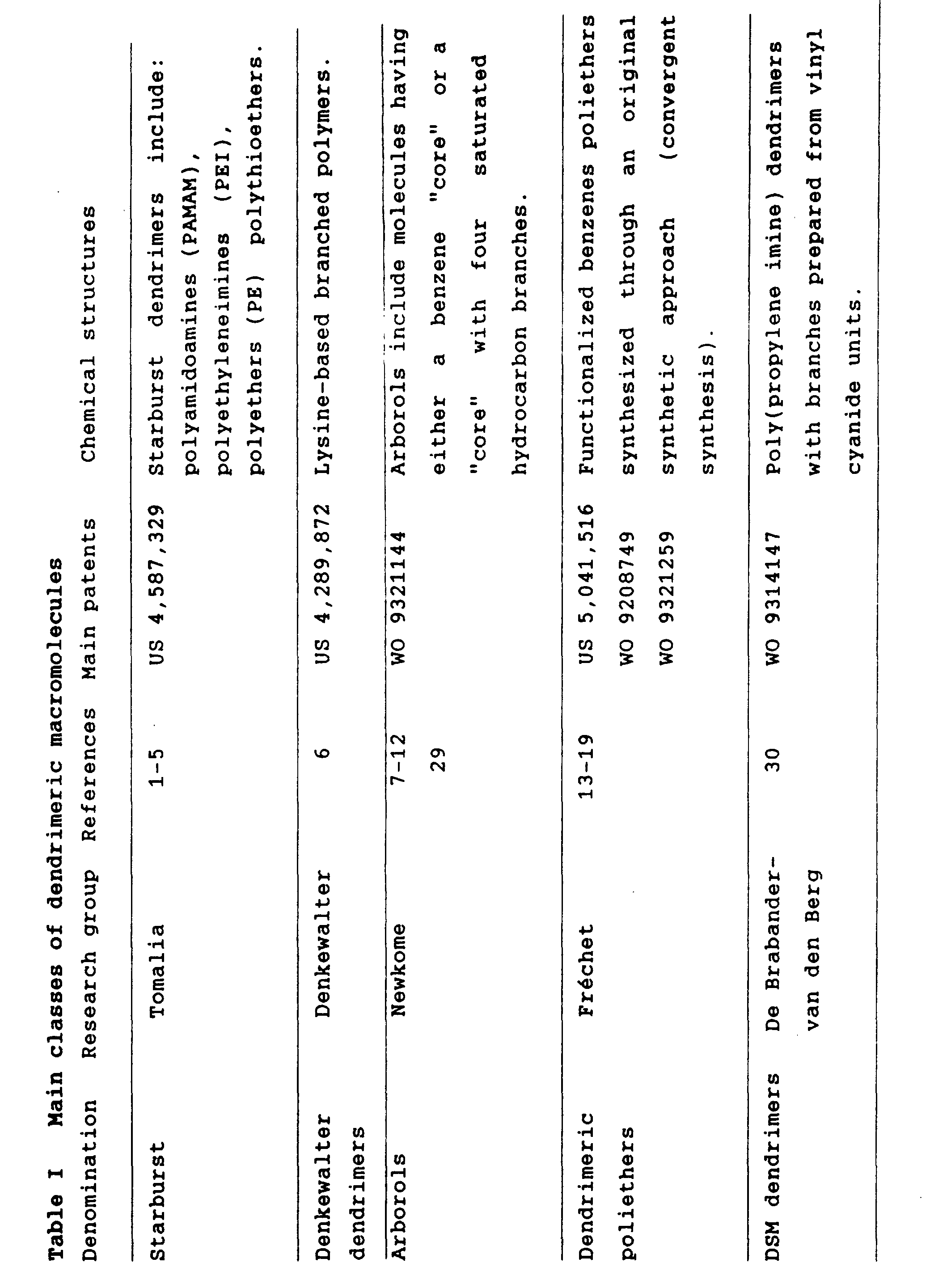
- the main classes are shown in Table I.
- Starburst dendrimers synthesized by Tomalia et al. include:
- PAMAM Starburst polyamidoamine
- nucleophilic compounds with either a nucleophilic or an electrophilic "core".
- nucleophilic an electrophilic
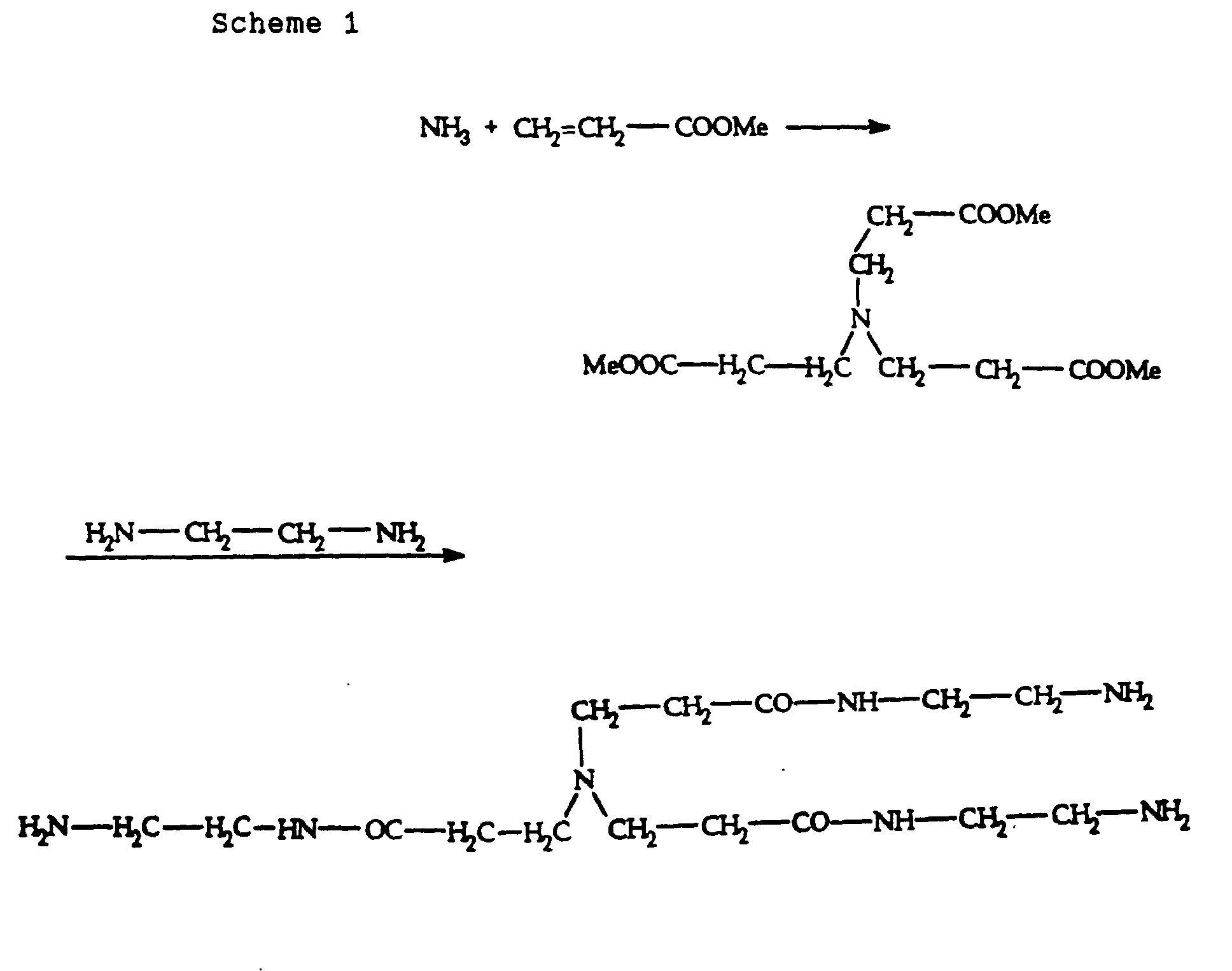
- One of the most widely used nucleophilic "core” is ammonia.
- the synthesis involves a preliminary reaction with methyl acrylate (Michael's addition) to form a triester which is then amidated with ethylenediamine to form a first generation molecule containing 3 terminal amino groups (Scheme 1).
- the dendrimer grows in diameter by approximately 10 ⁇ per generation evolving from an undefined shape for generations 0-2 to an oblate spheroid for generations 3-4 and finally to a nearly symmetrical spheroid for generations 5 and higher.
- core is ethylenediamine.
- Denkewalter et al. reported the synthesis of lysine-based dendrimers obtained by using the classic approach for solid-phase peptide synthesis.
- the lysine trees were constructed using a benzhydrylamine resin and N-protected tert-butyloxycarbonyl lysine.
- the branching points, i.e. the lysine amino groups, are located on segments of different length.
- Such dendrimers are thermally stable and, with the exception of the sparingly soluble first generation, are soluble in organic solvents such as THF, toluene and chloroform.
- organic solvents such as THF, toluene and chloroform.
- the author suggested the use of these products as standards for size-exclusion chromatography.
- Uchida et al. (Ref. 22) and Mathias and Carothers (Ref. 23) synthesized silicone-based dendrimers up to the third generation.
- the absolute molecular weight, molecular weight distribution and uniformity of branching are still unknown.
- Dendrimers having charges within the cascade structure have been described by Rengan and Engel (Ref 24, 25). These are phosphonium or ammonium sites and only the first three generations have been synthesized. Morikawa et al. (Ref. 26) synthesized starburst dendrimers containing polysiloxane units up to the third generation whose potential applications could be as drug carriers. Nagasaki et al. (Ref. 27) described the synthesis of arborols with encapsulated crown ethers in the hope of producing compounds with novel physical properties such as the selectivity towards alkali metal ions, the allosteric effect in the metal-binding process, the conformational change.
- Brabander-van den Berg et al. (Ref. 30) synthesized poly(propylene imine) dendrimers up to the fifth generation. These dendrimers are obtained through repetitive double Michael addition of acrylonitrile to primary amines, followed by a heterogeneously catalyzed hydrogenation of the nitriles. These kinds of dendrimers are not sensitive to hydrolytic degradation and are stable at high temperature. The process by which they are prepared is suitable for large scale productions.
- Convergent synthesis differs from the divergent approach in that growth starts at what will become the periphery of the macromolecule.
- Convergent synthesis has certain advantages over divergent synthesis. With divergent synthesis, the molecule's growth occurs through the simultaneous addition of an increasing number of reactive sites. With the convergent approach, on the other hand, size increase involves a limited number of reactive sites. Convergent synthesis makes use of a smaller excess of reagents. Possible side reactions are therefore avoided and the final products more easily purified.
- one limitation of the convergent approach is that, as the size of the dendrimers increases, there is an increase in the steric hindrance near the functional group, or focal point, which prevents the group from reacting with the "core". This limitation is also common in divergent synthesis since the size of the molecule increases more slowly than the number of external functional groups. This leads to an increase in steric hindrance around the functional groups which are thus prevented from reacting to give the next generation.
- PAMAM and the polyethers possess different multiplicity of the "core” (3 for PAMAM; 4 for the polyethers); as a result PAMAM are much less sterically hindered than the polyethers and show internal cavities. These characteristics allow the synthesis of PAMAM products with higher generation numbers than is possible with polyethers for which the phenomenon of "dense-packing" is already apparent by the third generation.
- the early generations of PAMAM dendrimers unlike the polyethers, do not have definite shapes; only the more advanced generations of PAMAM dendrimers have definite shapes.
- the large excess of reagents typically ethylenediamine
- L-lysine-based Denkewalter dendrimers have asymmetric "branches" and their structures have not been rigourously established.
- the different lengths of the "branches” can cause steric hindrance because a few functional groups are buried in the internal part of the molecule and therefore sterically hindered and unreactive.
- Newkome et al. (Ref. 8-12, 29) have synthesized less branched, less sterically hindered molecules which have large lipophilic internal cavities capable of accepting hydrophobic molecules and which in solution behave similarly to micelles.
- the synthesis of such molecules is rather complex, because of the unreactivity of the neopentyl centre ("core") to nucleophilic reactions (Ref. 11).
- core neopentyl centre
- nucleophilic reactions Ref. 11
- dendrimeric macromolecules described above have been synthesized with specific uses in mind. They could, for example, be used as transporters of high quantities of substances and it is for this reason that dendrimers are extensively studied as possible "carriers" for the controlled and targeted release of drugs. It is possible to prepare dendrimers with a lipophilic interior and a hydrophilic surface thus obtaining molecules that can function as micelles. Compared to micelles, such molecules, as a result of their intrinsic characteristics, could show much greater stability. By utilizing suitable monomers in the latter generation, it is theoretically possible to control the porosity of the external sphere of the molecule. In this regard, dendrimers can perhaps be compared with cells. Furthermore, these polymers are characterized by large surface areas which, in combination with high solubility in organic solvents, might facilitate their use as carriers of catalysts that could be recovered at the end of the reaction by simple extraction or filtration.
- Compounds that are suitable for association with dendrimers are, in general, molecules that can be used either for therapeutic treatment or for in vivo or in vitro diagnosis.
- Compounds of this type are for example pharmaceuticals (such as antibiotics, analgesics, antihypertensives, and cardiotonics) used in the treatment of various diseases; radionuclides; signal generators and absorbers; antibodies; metal chelates; opacifying diagnostics and hormones.
- the in vivo and in vitro diagnostic procedures which could benefit from the use of dendrimer derivatives are, for example: radioimmunologic assays, electron microscopy, ELISA, X-ray imaging, magnetic resonance imaging (MRI) and immunoscintigraphy.
- Dendrimers can also have other uses, for example as "carriers" of chemical substances for agriculture, as adhesives, as absorbents, as oil/water demulsifiers, as thickeners of plastic materials, as calibration standards for ultrafiltration membranes and electron microscopy, as standards for size-exclusion chromatography, and as agents to modify the rheological properties of solutions of dyes and paints.
- carriers of chemical substances for agriculture
- adhesives as absorbents
- oil/water demulsifiers as thickeners of plastic materials
- calibration standards for ultrafiltration membranes and electron microscopy as standards for size-exclusion chromatography
- the objects of the present invention are new, dendrimeric-type macromolecules that comprise the following structural groups:
- the total amount of growth units comprised in the same shell or growth level represents a generation.
- Core and branching points are characterized by a multiplicity number which refers to either the number of functional groups on the “core”, that enable growth of the molecule, or to the degree of branching possible at each branching point.
- the introduction of the first branching point in the molecule determines the first generation, the introduction of a successive branching point determines the second generation and so on.
- the length of the polyoxaalkyl chain between the "core" and the first branching point, or between one branching point and the next one, can vary.
- Such chain lengths are chosen according to the structure and the characteristics required for the macromolecule. For example, the chain length influences the formation of the internal cavities within the structure and/or the compactness (density) of the molecule, and in the early generations particularly, its geometric form as well.
- highly preferred compounds are those in which at least one of the generations include polyoxaalkyl chains in which n is different from 0.
- the distance between the "core" and the first branching point, or between one branching point and next one, is determined by the length of the polyoxaalkyl chain, i.e. by the value of n. This value can be equal in each generations or can vary from generation to generation.
- the central nucleus of the compounds of the present invention can derive from any polyvalent, aliphatic organic open chain residue, both branched and not, or from alicyclic residues, or from heterocyclic residues containing N, O and/or S, or from aromatic or heteroaromatic residues. All of them are substituted by at least two reactive groups to which the polyoxaalkyl chains of the first generation are covalently attached.
- the "core” can also possess one or more reactive groups that do not participate to the growth of the molecule but which are possibly available for the coupling to other structures or as dimerization points.
- Branching points can consist of polyvalent residues with at least two or three reactive functions suitable for introducing multiplicity. In each dendrimer, the branching points can be the same in each generation or may vary from generation to generation.
- Multiplicity can also be introduced for example using polyoxaalkyl chains in which the terminal part is already branched.
- the multiplicity of the "core”, the multiplicity of the branching points and the value of n can be chosen according to the characteristics/properties desired in the final macromolecule. In this way it is possible to obtain macromolecules with different distributions of functional groups on the external surface: for example, zonal distribution if the polyoxaalkyl chains connected to the "core" are long and those of the branches short, or uniform distribution if the polyoxaalkyl chains are of equal length. In both cases there will be a different density of terminal groups and/or chains between the peripheral and the central part of the molecule.
- the external surfaces of the macromolecules of the present invention are well provided with functional groups such as for example hydroxyl, tosyl, mesyl, tresyl, brosyl and similar groups, trifluoromethanesulfonyl, phthalimido, amino, thiol, aldehydo, nitrilo, acetyl, pyranyl, cyclic orthoester, carboxyl and amido groups.
- functional groups such as for example hydroxyl, tosyl, mesyl, tresyl, brosyl and similar groups, trifluoromethanesulfonyl, phthalimido, amino, thiol, aldehydo, nitrilo, acetyl, pyranyl, cyclic orthoester, carboxyl and amido groups.
- the compounds of the present invention may be ideally suited to the transport of drugs and/or molecules for use in diagnostic imaging. Both these classes of compounds can be linked to such macromolecules, either directly or through suitable spacer chains, alternatively they can be included in the macromolecules themselves.
- contrast agents for magnetic resonance MRI
- paramagnetic metal chelates such as chelates of polyaminopolycarboxylic acids
- Ferromagnetic or superparamagnetic (ferrite, magnetites or derivatives thereof) compounds can also be included in the internal cavities of the macromolecules for diagnostic use in MRI.
- the macromolecules of the present invention can also be linked to chelates of radioactive metal ions for use in nuclear medicine, or conjugated to iodinated molecules for use in all roentgenographic diagnostic investigations.
- the molecules may also be labelled with isotopes such as 13 C, 14 C, 2 H, 3 H or 125 I and used subsequently in biodistribution studies. Moreover, they may be used in the preparation of pharmaceutical products where controlled release of the active principle is required. Moreover, it is even possible to modify the external functional groups with suitable hydrophobic groups to create a molecular structure that behaves as an inverse micelle, i.e. with a hydrophilic internal part and a hydrophobic surface.
- macromolecules are highly promising as carriers of catalysts, allowing a complete recovery of the same after the reaction.
- macromolecules of the present invention can be prepared to precise and definite dimensions, they are particularly useful as calibration standards for separation techniques based on molecular shape, such as for example size-exclusion chromatography.
- the macromolecule is represented by the following formula A[g 1 ] r , i.e. A[B 1 -M 1 [T] m1 ] r in which A, B 1 , M 1 , T, m 1 and r are defined as above.
- Compounds of general formula (I) also comprise those ones which are labelled with isotopes such as 13 C, 14 C, 2 H, 3 H, and 125 I.
- B is a polyoxyethylene chain of formula in which n is an integer from 0 to 25, preferably from 0 to 15.
- Preferred macromolecular compounds are those in which the total number of generations ranges from 1 to 20, preferably from 1 to 15.
- the present invention is illustrated particularly through the preparation of branched macromolecules having a neopentyl "core" from which four polyoxyethylene chains depart.
- the branching is obtained through the introduction of a residue of pentaerythritol on the terminal residue of the polyoxyethylene chains.
- the synthesis of the compounds of the present invention can preferably be performed by two independent synthetic processes:
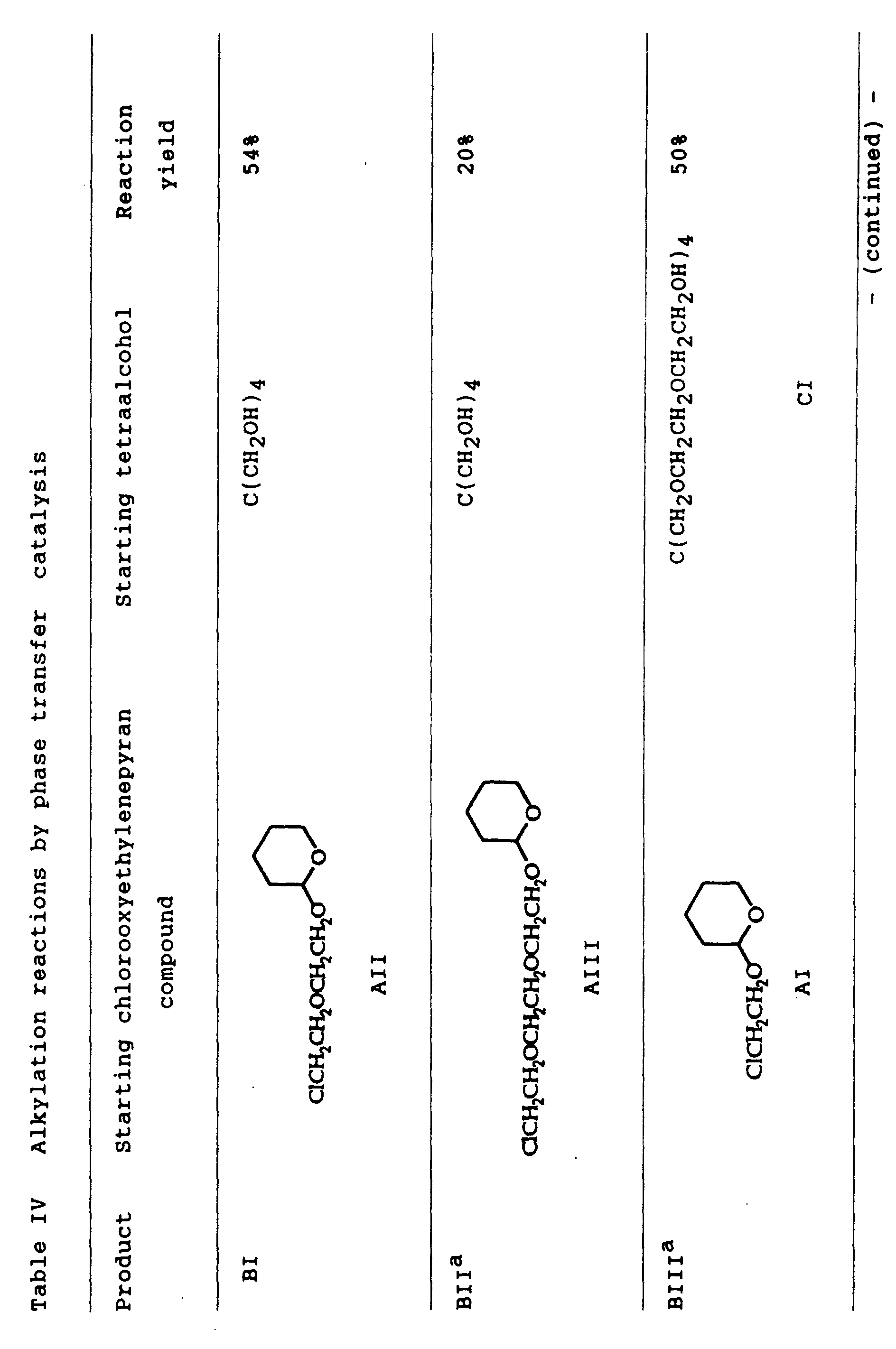
- the starting tetraalcohol (0.0156 mol) (Table IV) was dissolved in 19.06 M NaOH (0.624 mol).
- the reaction mixture was than warmed to 65°C under nitrogen and mechanically stirred.
- the reaction mixture was incubated at 65°C for 48 h. After this time a freshly prepared 19.06 M NaOH solution (0.312 mol), the chlorooxyethylenepyranyl derivative (0.062 mol), tetraoctylammoniumbromide (0.0062 mol) and NaI (0.0036 mol) were added.
- the reaction mixture was then stirred at 120°C for 14 h. After cooling to room temperature, the solvent was removed under vacuum and the mixture taken up with water and extracted with CH 2 Cl 2 . The organic layer was dried over Na 2 SO 4 , filtered and the solvent removed under vacuum.
- the crude product was purified by chromatography on a silica gel column (eluent AcOEt). The fractions containing the product were combined and the solvent removed under vacuum. The residue was dissolved in MeOH and then 37% HCl was added. The mixture was refluxed and the MeOH distilled off very slowly over a period of 2 h. The mixture was cooled to room temperature and the remaining MeOH removed under vacuum. The product was then obtained as a colourless oil. By this synthetic pathway the following compounds were obtained:
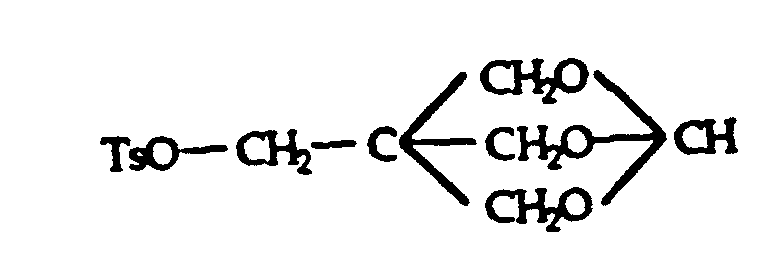
- the branched alcohol HI (0.00208 mol) (Table XVIII), obtained according to the method of Example 8, was dissolved in pyridine (40 mL) and the solution cooled to -5°C. A solution of p-toluenesulfonyl chloride (0.00583 mol) in pyridine (50 mL) was then added dropwise. The mixture was stirred for 1 h at 0°C and then left at room temperature for 4 days. Water was added and the mixture extracted with CHCl3. The organic layer was dried over Na 2 SO 4 and then the solvent was removed under vacuum. The crude product was purified by chromatography on a silica gel column (eluent AcOEt/CHCl 3 1/1 (v/v)). By this synthetic pathway the following compound was obtained:
- the tosyl derivative LI (0.00051 mol) (Table XX), obtained according to the method of Example 9, was dissolved in N,N-dimethylacetamide (50 mL). NaBr (0.01224 mol) was added and the reaction mixture stirred for 1 h at 150°C. The temperature was then cooled to room temperature and the solvent removed under vacuum. The residue was taken up with water and extracted with CH 2 Cl 2 . The organic layer was dried over Na 2 SO 4 and the solvent removed under vacuum.
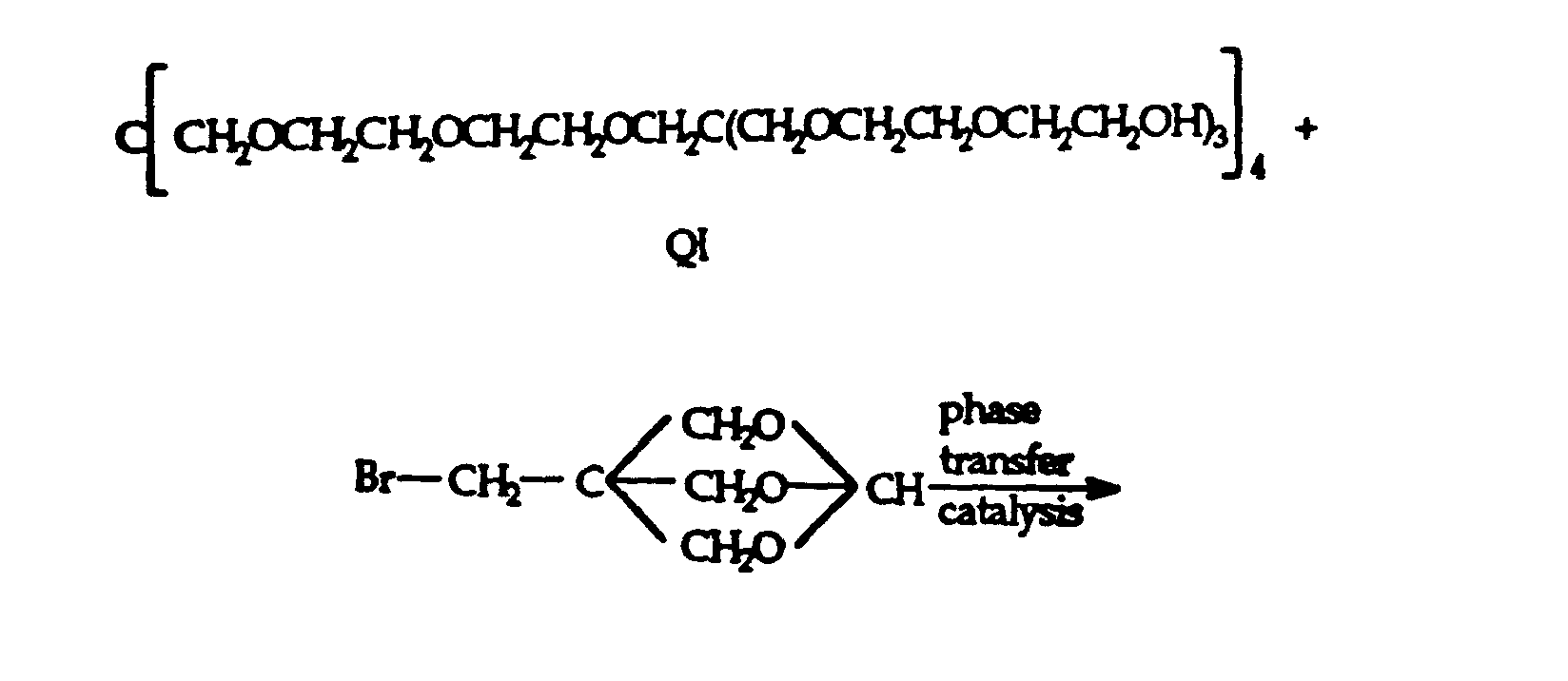
- the branched alcohol HI (0.00104 mol) (Table XXII), obtained according to the method of Example 8, was dissolved in 19.06 M NaOH (0.125 mol) under nitrogen. The reaction mixture was warmed up to 65°C under mechanical stirring. Tetrabutylammonium bromide (0.00042 mol) and the chlorooxyethylenepyranyl derivative (0.00187 mol) were then added. The reaction mixture was incubated at 65°C for 72 h.
- the second generation product was also obtained, after deprotection of the corresponding orthoester, through the following synthetic pathways: Following similar procedures, products of higher generations were obtained.
Landscapes
- Health & Medical Sciences (AREA)
- Chemical & Material Sciences (AREA)
- Medicinal Chemistry (AREA)
- Life Sciences & Earth Sciences (AREA)
- Engineering & Computer Science (AREA)
- Pharmacology & Pharmacy (AREA)
- General Health & Medical Sciences (AREA)
- Animal Behavior & Ethology (AREA)
- Polymers & Plastics (AREA)
- Epidemiology (AREA)
- Public Health (AREA)
- Veterinary Medicine (AREA)
- Bioinformatics & Cheminformatics (AREA)
- Organic Chemistry (AREA)
- Chemical Kinetics & Catalysis (AREA)
- Nanotechnology (AREA)
- General Chemical & Material Sciences (AREA)
- Proteomics, Peptides & Aminoacids (AREA)
- Biotechnology (AREA)
- Biophysics (AREA)
- Optics & Photonics (AREA)
- General Engineering & Computer Science (AREA)
- Medical Informatics (AREA)
- Molecular Biology (AREA)
- Crystallography & Structural Chemistry (AREA)
- Physics & Mathematics (AREA)
- Other Resins Obtained By Reactions Not Involving Carbon-To-Carbon Unsaturated Bonds (AREA)
- Polyethers (AREA)
- Medicines Containing Antibodies Or Antigens For Use As Internal Diagnostic Agents (AREA)
- Organic Low-Molecular-Weight Compounds And Preparation Thereof (AREA)
- Polyesters Or Polycarbonates (AREA)
- Macromolecular Compounds Obtained By Forming Nitrogen-Containing Linkages In General (AREA)
- Addition Polymer Or Copolymer, Post-Treatments, Or Chemical Modifications (AREA)
- Polymers With Sulfur, Phosphorus Or Metals In The Main Chain (AREA)
- Medicinal Preparation (AREA)
- Magnetic Resonance Imaging Apparatus (AREA)
Abstract
Description
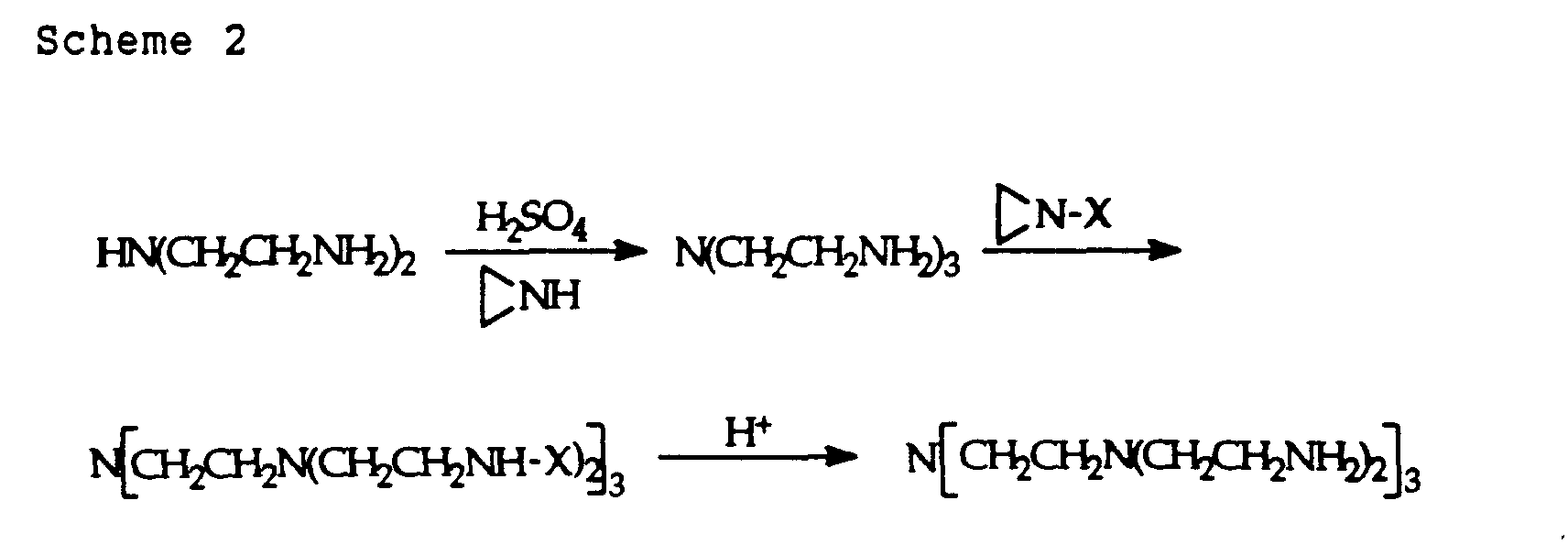
- x =
- tosyl or mesyl
The higher generations are obtained by repeating these synthetic steps. PEIs differ from PAMAMs because of their short branch-segment lengths. For each generation, the diameter increases by only 5 Å compared with the 10 Å of PAMAMs. The CPK® (Corey Pauling Koltun) models indicate that these dendrimers are much more compact and congested than the starburst PAMAMs. These models show that the 5th generation is impossible due to the so-called "dense-packing" phenomenon or excessive crowding of surface functional groups, phenomenon which makes impossible or only partially possible the further growth of the molecule (Ref. 1). Compared with PAMAMs, PEIs possess more stable chemical bonds.

A further advantage arising from the introduction of polyoxaalkyl chains between the "core" and the first branching point, or between one branching point and the next one, is that in this way it is possible to construct molecules that are able to grow further giving structures with a large number of generations. This is the fundamental point of the present invention. Additionally, it is also possible to avoid the phenomenon of "dense-packing", a phenomenon that severely hampers the preparation of the dendrimers of the prior-art by restricting the number of successive generations obtainable. As a general rule, one of the main obstacles to the synthesis of dendrimeric structures is the excessive surface area crowding that inevitably arises with higher numbers of generations. For this reason the growth of the structure becomes progressively more difficult; for example, preparation of molecules of the third generation, in the case of polythioethers, or of the fourth in the case of polyethers, is effectively impossible as reported by Tomalia (Ref. 1).
- A
- is a central nucleus, or "core", deriving from a polyvalent organic molecule which can be an aliphatic open chain, branched or not, residue, or an alicyclic, a heteroaromatic residue and which is characterized by the presence of r terminal residues to which the polyoxaalkyl chains of the first generation are attached,
- r
- is an integer from 2 to 10 representing the multiplicity of the "core" A,
- G1-->p
- represents the branched structure of the
macromolecule comprising g levels of
generations, from the first one (g1) to the
last one (gp) in which the total p number of
said generations can range from 1 to 20 and
in which the different generations can
contain the same repetition units or not, and
in which:
- a) each generation g, except for the last, comprises
a number of repetition units, which are
represented by residues of formula
- a) each generation g, except for the last, comprises
a number of repetition units, which are
represented by residues of formula
- B
- is preferably a polyoxyethylene or
polyoxypropylene chain of formula:
in which n can range from 0 to 25 and is different or not from generation to generation, provided that, in at least one of the generations of the macromolecule, n is different from 0,

- M
- represents a branching point selected from a residue having the following formulas
wherein q is 1 or 2.

- m
- an integer ranging from 2 to 3, representing the
branching multiplicity introduced by M and being m
different or not from generation to generation,
and
being the total number of repetition units -B-M- in each generation level g equal to the sum of all the branching multiplicities m of the preceding generation g-1;- b) the last generation gp comprises residues of
formula:
- T
- is a terminal group that can be either H or one of
the following residues: halo, hydroxyl, amino,
thiol, -O-tosyl, -O-mesyl, -O-tresyl, -O-brosyl
and similar groups, trifluoromethanesulfonyl,
aldehydo, carboxy, amido group, such a terminal
group T being free, either dissociated or
undissociated, or protected by suitable
protective groups such as for example, pyranyl,
phthalimido, acetyl, cyclic orthoester group etc.
and
being the total number of the terminal groups T equal to the sum of all the branching multiplicities m of the last generation gp, and with the further condition that - Mp
- can also be a single bond, in which case mp is
equal to 1 (i.e., there is no branching) and as a
consequence the last generation gp comprises
residues of formula:
- c) in case p = 1, that is when the macromolecule
contains only one generation, gp corresponds to
g1, i.e. represents the residue:
- b) the last generation gp comprises residues of
formula:
where the symbols used are as above defined.


- n
- is an integer from 0 to 20, preferably from 0 to 15, and with the condition that n is different from 0 in at least one generation,
- g'1
- is the first generation having a branching multiplicity of 3,
- L
- represents T, or the sequence of successive generations from g ' / 2 to g ' / p in which each g', apart from g ' / p, is defined analogously to g ' / 1 and can have the same meaning or not whereas g ' / p corresponds to g ' / 1-T and T is as above defined; moreover the number of generations g can be as high as 20, preferably 15.
- AI
- 2-(3-chloroethoxy)oxane (C7H13ClO2)
- All
- 2-(3-oxa-5-chloropentyloxy)oxane (C9H17ClO3)
- AIII
- 2-(3,6-dioxa-8-chlorooctyloxy)oxane (C11H21ClO4)
| Synthesis of protected oxyethylene chains | ||
| Product | Starting chloroalcohol | Reaction yield |
| AI | ClCH2CH2OH | 85% |
| All | ClCH2CH2OCH2CH2OH | 91% |
| AIII | ClCH2CH2OCH2CH2OCH2CH2OH | 80% |



| Tosylation reactions of the tetraoxyethylenealcohols | ||
| Product | Starting tetraoxyethylenealcohol | Reaction yield |
| DI | C(CH2OCH2CH2OCH2CH2OH)4 CI | 75% |
| DII | C(CH2OCH2CH2OCH2CH2OCH2CH2OH)4 CII | 65% |
| DIII | C(CH2OCH2CH2OCH2CH2OCH2CH2OCH2CH2OH)4 CIII | 60% |


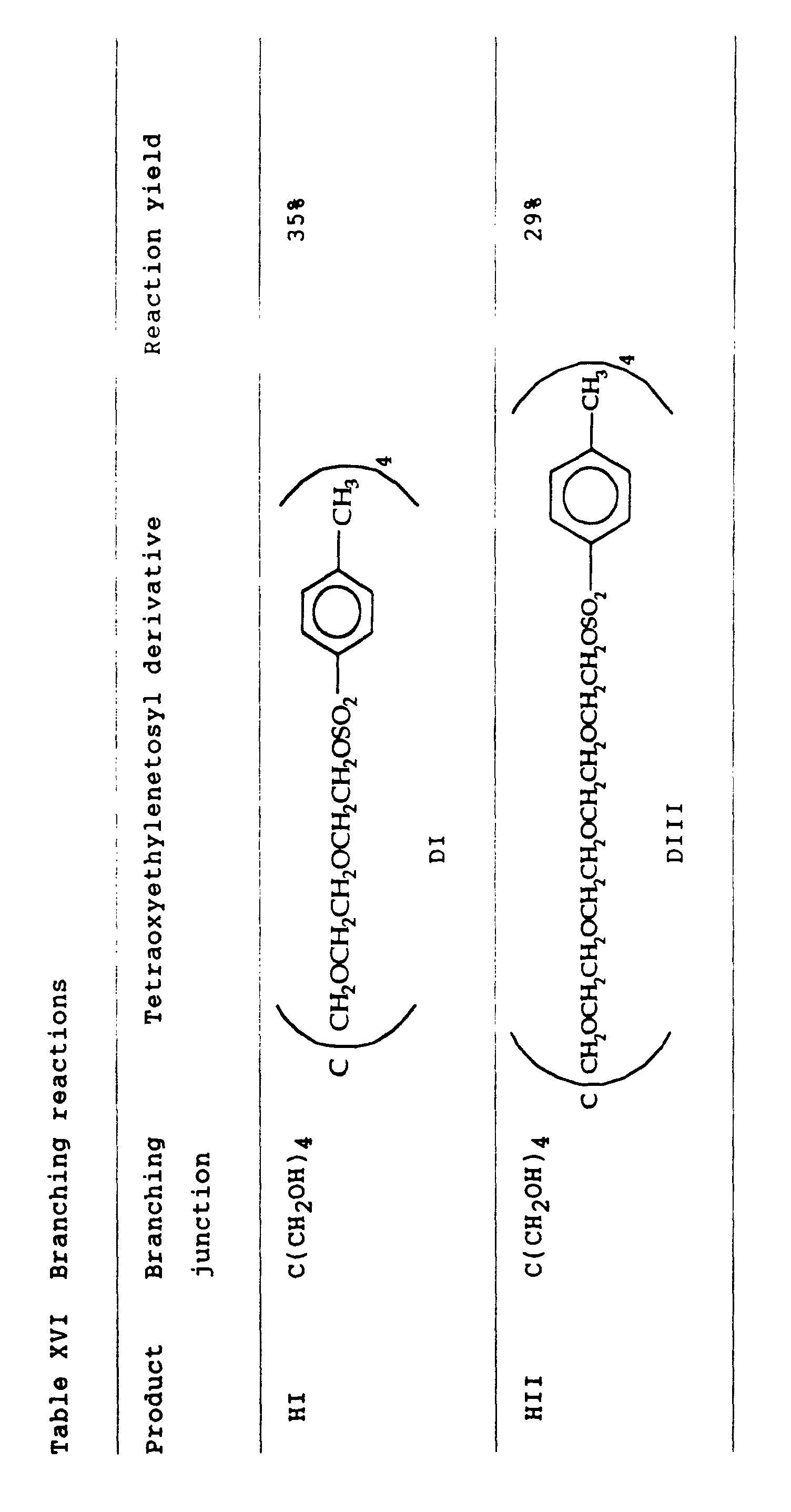
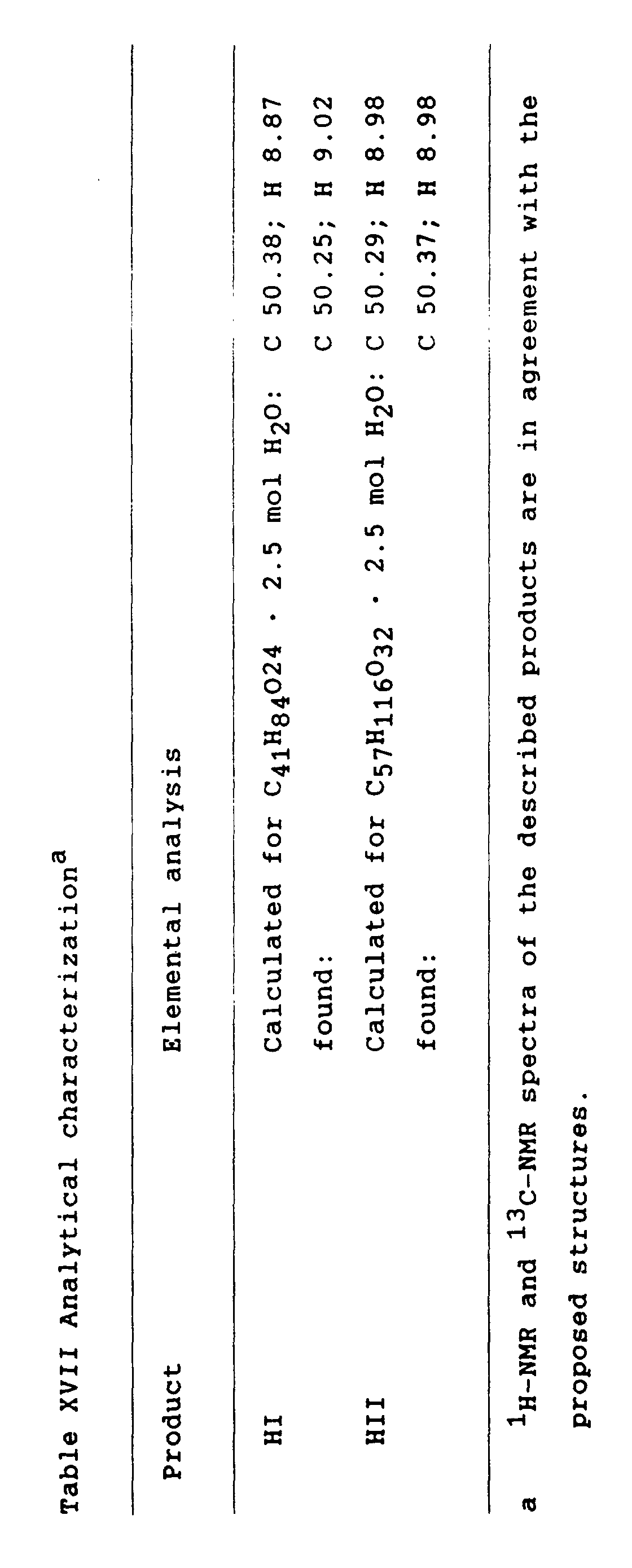


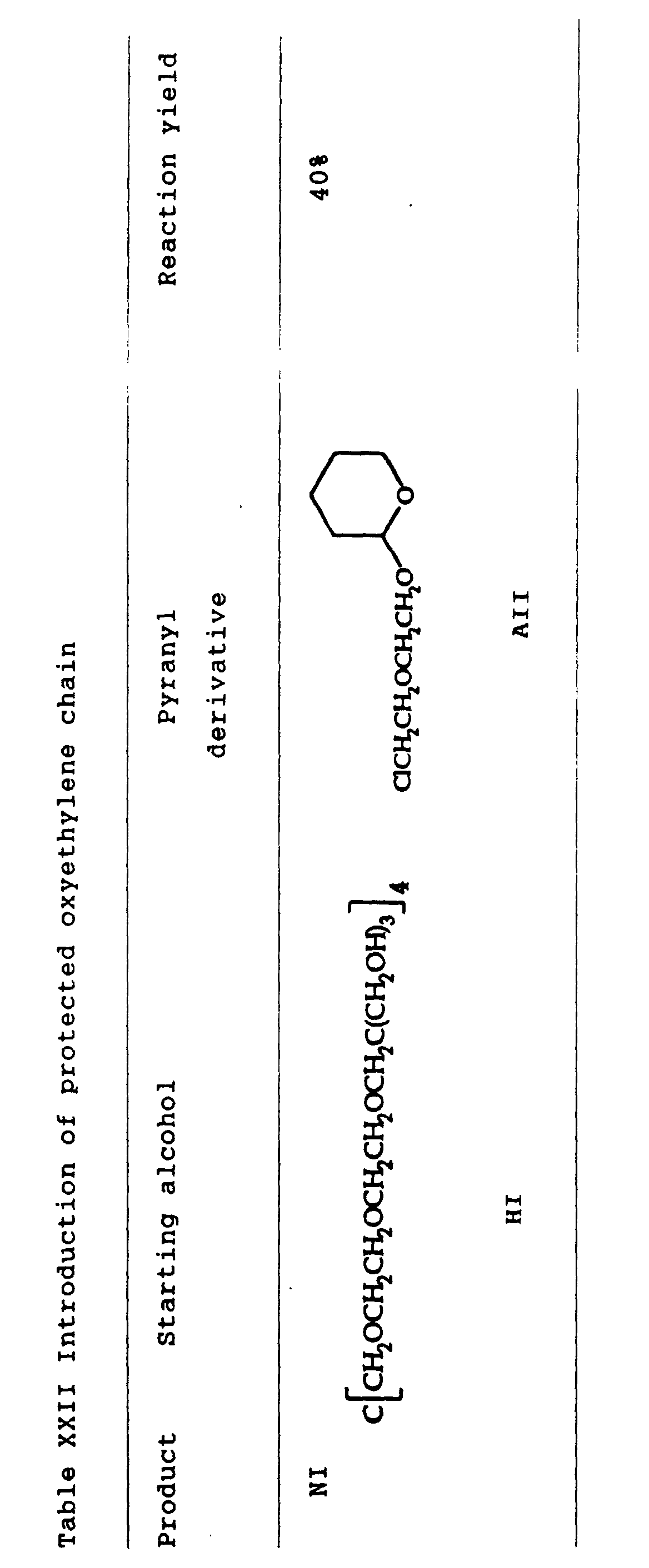

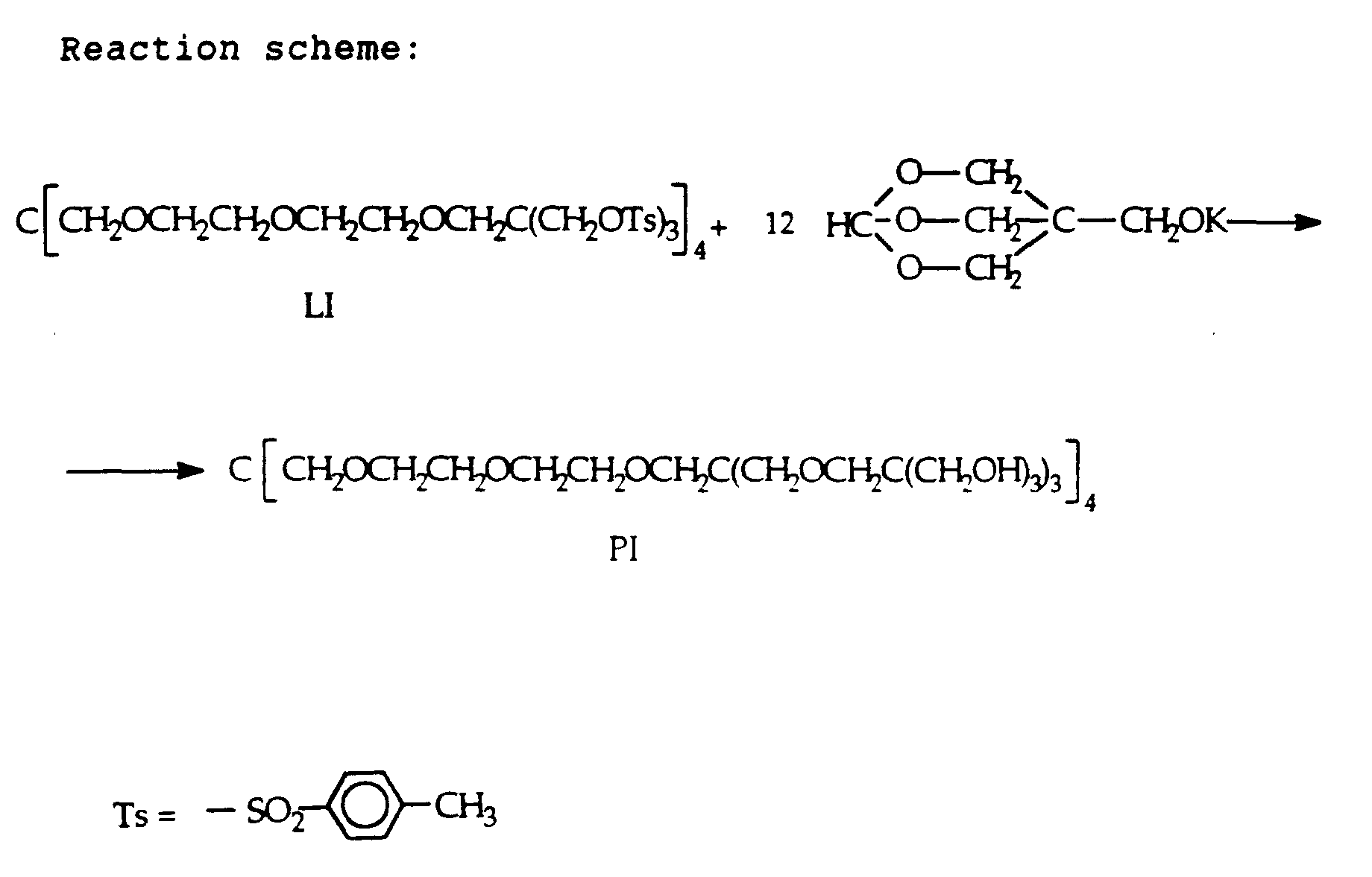
1H-NMR, 13C-NMR and mass spectra of all the products described are in agreement with the proposed structure. The same product can be synthesized by starting from the dodecabromo derivative (MI), obtained using the method described in Example 10, by using the same synthetic approach of this example.



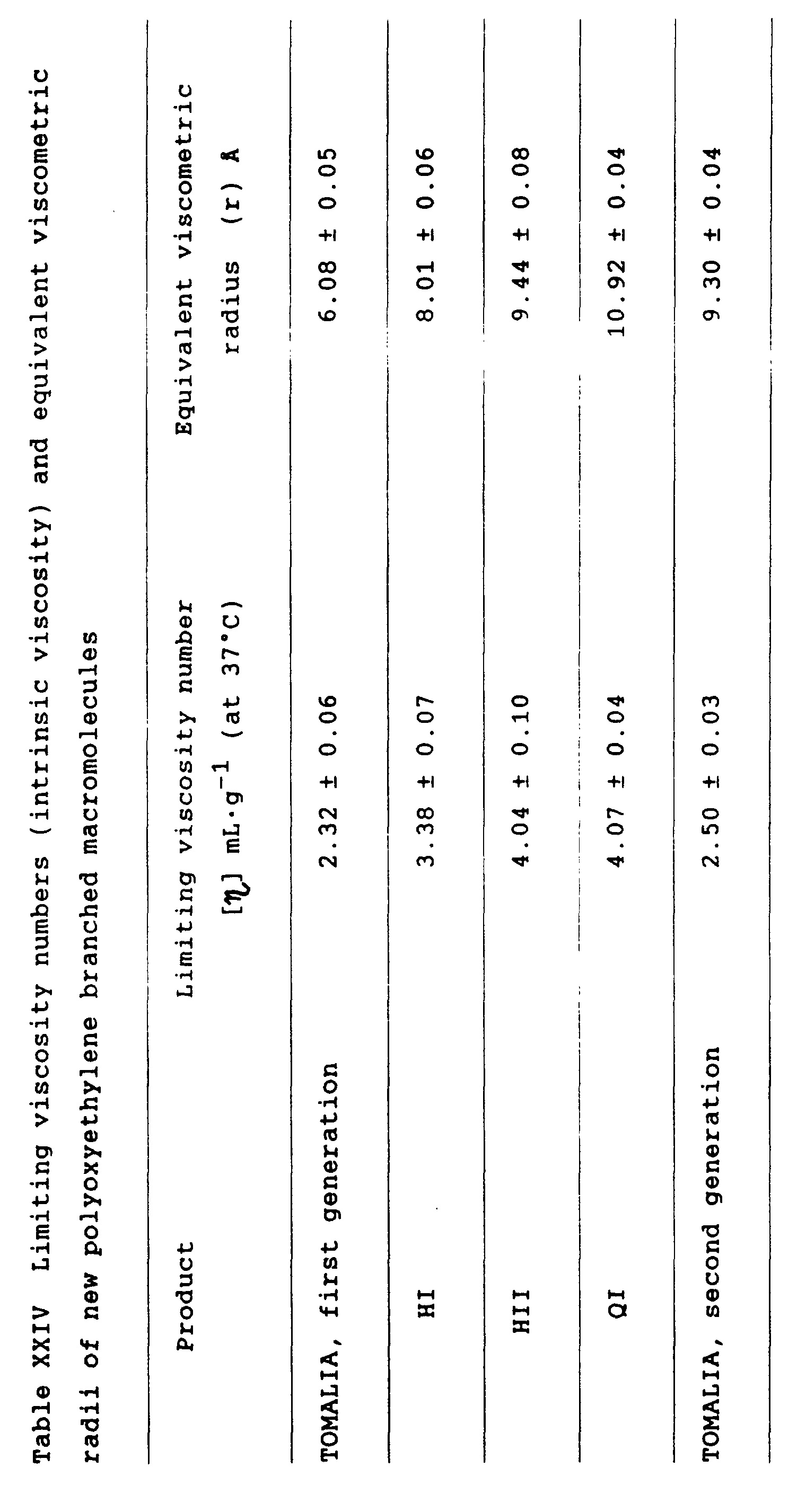
Numerical evaluations of equivalent viscometric radii (r) were obtained by the following relationship
Claims (15)
- Dendrimeric-type macromolecules, being unaffected by functional surface over-crowding and essentially consisting ofcharacterised in that said polyoxaalkylene chain has formulaa) a core deriving from a polyvalent organic molecule,b) at least two cascade branched chains departing from said core, each one comprising a number of repetitions units, which are dendrimerically linked and are the same or different, wherein the structure of every repetition unit comprises:a polyoxaalkylene chain,a polyvalent branched organic chain residue, said residue acting as a branching point, on which the polyoxaalkylene chains of the subsequent repetition units are grafted;c) the maximum number of subsequent levels of repetition units, or generations, is not more than 20 and the last generation level has mono- or polyvalent functional terminal groups;wherein q is 1 or 2, wherein said dendrimeric-type macromolecules have an equivalent viscometric radius higher than the corresponding starburst polyether dendrimer of the same generation,

- Macromolecules according to claim 1 of general formula (I)
- A
- is a central nucleus, or "core", deriving from a polyvalent organic molecule which can be an aliphatic open chain, branched or not, residue, or an alicylic, or a heteroaromatic residue and which is characterised by the presence of r terminal residues to which the polyoxaalkyl chains of the first generation are attached,
- r
- is an integer from 2 to 10 representing the multiplicity of the "core" A,
- G1-->p
- represents the branched structure of the
macromolecule comprising p levels of
generations, from the first one (g1) to the last
one (gp), in which the total p number of said
generations can range from 1 to 20 and in which
the different generations can contain the same
repetitions units or not, and in which:
- a) each generation g, except for the last,
comprises a number of repetition units, which
are represented by residues of formula
- B:
- is a polyoxyethylene or polypropylene chain of
formula:
in which n can range from 0 to 25 and is different or not from generation to generation, provided that, in at least one of the generations of the macromolecule, n is different from O,

- M
- represents a branching point selected from a residue having the following formulas
wherein q is 1 or 2.

- b) the last generation gp comprises residues of
formula:
- T
- is a terminal group that can be either H or one of the following residues: halo, hydroxyl, amino, thiol, -O-tosyl, -O-mesyl, -O-tresyl, -O-brosyl, trifluoromethanesulfonyl, aldehydo, carboxy, amido group, such a terminal group T being free either dissociated or undissociated, or protected by protective groups such as pyranyl, phthalimido, acetyl, cyclic orthoester group and being the total number of the terminal groups T equal to the sum of all the branching multiplicities mp of the last generation gp, and with the further condition that:
- mp
- can also be a single bond, in which case mp is equal
to 1 (i.e. there is no branching) and as a
consequence the last generation gp comprises
residues of formula:
- c) in case p = 1, that is when the macromolecule
contains only one generation, gp corresponds to g1,
i.e. represents the residue:
- a) each generation g, except for the last,
comprises a number of repetition units, which
are represented by residues of formula
- Macromolecules according to claim 2, in which:a) the core A is a tetravalent neopentyl residue of formula :b) each generation, apart from the last, comprises growth units of formula
- B'
- is a polyoxyethylene residue of formula:
wherein n is variable from 0 to 15 and is different or not from generation to generation, with the condition that it is different from 0 in at least one generation,

- M'
- is a branching point with a branching multiplicity
of 2 or 3 of formula:
wherein q is 1 or 2;

c) the last generation is a residue of the following formula: - Macromolecules according to claim 3, of general formula (III)in which

- n
- is variable from 0 to 15, and with the condition that n is different from 0 in at least one generation,
- g1
- is the first generation having a branching multiplicity of 3,
- L
- represents T, or the sequence of successive generations from g2 to gp, in which each g', apart from gp, is defined analogously to g1, and can have the same meaning or not whereas gp corresponds to g1-T and T is defined as in claim 3, and the total number of generations g can be as high as 15.
- Method for the preparation of the dendrimeric-type molecules according to claim 1, characterised by the following synthetic steps:a) reaction of the reactive terminal function of the central. nucleus with the corresponding polyoxaalkyl chains of the first generation, in which said polyoxaalkyl chains have an extremity functionalized with reactive groups, such as halogen groups and have their terminal alcoholic group protected with protective agents typical of the hydroxy group;b) deprotection of the terminal alcoholic groups and reaction of the same, either as they are or after activation, with a reactive branched group in which the terminal functions of the branching are protected;c) deprotection of these functions and successive reaction with the corresponding polyoxaalkyl chains of the second generation, according to the methodology described for a) above;d) repetition of steps a), b) and c) until the desired number of generations is attained.
- Method for the preparation of the dendrimeric-type molecules according to claim 1, characterized by the following synthetic steps:a) reaction of the terminal alcoholic group of a polyoxaalkyl chain with a reactive branched group whose terminal functions are protected;b) reaction of the branched polyoxaalkyl chain obtained in a) with a functionalized central nucleus to give the already branched first generation, or,c) reaction of the chains resulting from a) with the terminal functions of the branching point of a previous generation so as to give a subsequent generation.
- Method for the preparation of the dendrimeric-type molecules according to claim 1, characterized by the following synthetic steps:a) independent preparation of the single cascade-like branched chains of the molecule,b) reaction of said chains obtained in a) with the reactive terminal functions of the central nucleus.
- Use of the compounds according to claim 1 as carriers of drugs, said drugs being either conjugated or entrapped in said compounds.
- Use of the compounds according to claim 1 as carriers of contrast agents for diagnostic imaging said contrast agents being either conjugated or entrapped in said compounds.
- Use of the compounds according to claim 1 in radiology as vehicles of radioactive species.
- Use of the compounds according to claim 1 for the preparation of pharmaceutical formulations for the controlled release of active principles.
- Use of the compounds according to claim 1 as standards for calibrating separation techniques that are based on molecular size.
- Use of the compounds according to claim 1 as calibration standards for size-exclusion chromatography.
- Use of the compounds according to claim 1 as carriers of catalysts.
- Use of the compounds according to claim 1 as catalysts in phase-transfer catalysis reactions.
Applications Claiming Priority (3)
| Application Number | Priority Date | Filing Date | Title |
|---|---|---|---|
| ITMI940512A IT1270994B (en) | 1994-03-18 | 1994-03-18 | POLYOXYKYLIC STRUCTURE MACROMOLECULES WITH THEIR USE |
| ITMI940512 | 1994-03-18 | ||
| PCT/EP1995/000943 WO1995025763A1 (en) | 1994-03-18 | 1995-03-14 | Branched polyoxaalkyl macromolecules, process for making them and their uses |
Publications (2)
| Publication Number | Publication Date |
|---|---|
| EP0750649A1 EP0750649A1 (en) | 1997-01-02 |
| EP0750649B1 true EP0750649B1 (en) | 2001-12-19 |
Family
ID=11368259
Family Applications (1)
| Application Number | Title | Priority Date | Filing Date |
|---|---|---|---|
| EP95913106A Expired - Lifetime EP0750649B1 (en) | 1994-03-18 | 1995-03-14 | Branched polyoxaalkyl macromolecules, process for making them and their uses |
Country Status (14)
| Country | Link |
|---|---|
| US (1) | US5780644A (en) |
| EP (1) | EP0750649B1 (en) |
| JP (1) | JPH09510489A (en) |
| KR (1) | KR970701748A (en) |
| AT (1) | ATE211155T1 (en) |
| AU (1) | AU689244B2 (en) |
| CA (1) | CA2185647A1 (en) |
| DE (1) | DE69524738T2 (en) |
| FI (1) | FI963646A0 (en) |
| IL (1) | IL113004A (en) |
| IT (1) | IT1270994B (en) |
| NO (1) | NO312901B1 (en) |
| WO (1) | WO1995025763A1 (en) |
| ZA (1) | ZA952165B (en) |
Families Citing this family (18)
| Publication number | Priority date | Publication date | Assignee | Title |
|---|---|---|---|---|
| AU4344696A (en) * | 1994-12-21 | 1996-07-10 | Novartis Ag | Oligonucleotide-dendrimer conjugates |
| IT1277414B1 (en) * | 1995-08-02 | 1997-11-10 | Bracco Spa | USE OF DENDRIMER-TYPE MACROMOLECULES AS CATALYSTS OR ADJUVANTS OF REACTIONS IN PHASE TRANSFER CONDITIONS |
| IT1277596B1 (en) * | 1995-09-15 | 1997-11-11 | Bracco Spa | MACROMOLECULAR COMPOUNDS OF THE DENDRIMERIC TYPE |
| AU730969B2 (en) | 1995-10-19 | 2001-03-22 | University Of Washington | Discrete-length polyethylene glycols |
| DE19624705A1 (en) * | 1996-06-20 | 1998-01-08 | Deutsches Krebsforsch | Saccharide-based dendrimers |
| US6214988B1 (en) | 1999-01-03 | 2001-04-10 | Schlumberger Technology Corporation | Process for making an HMX product |
| US6201117B1 (en) | 1999-05-26 | 2001-03-13 | Schlumberger Technology Corporation | Process for making a 1,3,5,7-tetraalkanoyl-1,3,5,7-tetraazacyclooctane |
| US6428724B1 (en) | 1999-05-26 | 2002-08-06 | Schlumberger Technology Corporation | Granulation process |
| US6265573B1 (en) | 1999-05-26 | 2001-07-24 | Schlumberger Technology Corporation | Purification process |
| US6194571B1 (en) | 1999-05-26 | 2001-02-27 | Schlumberger Technology Corporation | HMX compositions and processes for their preparation |
| CN1382062A (en) | 1999-07-29 | 2002-11-27 | 埃匹克斯医学股份有限公司 | Homing multibody contrast agents via multisite binding |
| US7560520B1 (en) | 2004-11-08 | 2009-07-14 | The United States Of America As Represented By The Secretary Of The Army | Interface-directed branched polymer transports and methods for producing same |
| US7645854B2 (en) * | 2005-03-04 | 2010-01-12 | Central Michigan University Board Of Trustees | Conjugate addition products of primary amines and activated acceptors |
| EP1955712A1 (en) * | 2007-02-09 | 2008-08-13 | Scil proteins GmbH | Multimeric conjugate |
| WO2008112952A1 (en) | 2007-03-15 | 2008-09-18 | Huntsman Petrochemical Corporation | High functionality amine compounds and uses therefor |
| WO2011123031A1 (en) * | 2010-03-30 | 2011-10-06 | Spago Imaging Ab | Branched, compact polyethyleneglycol derivatives |
| US8816099B2 (en) * | 2010-03-31 | 2014-08-26 | Nof Corporation | Polyfunctional polyoxyalkylene compound, and producing method and intermediate thereof |
| US9133114B2 (en) * | 2012-01-31 | 2015-09-15 | University Of Maryland, Baltimore | Dendrimers and methods of preparing same through proportionate branching |
Family Cites Families (5)
| Publication number | Priority date | Publication date | Assignee | Title |
|---|---|---|---|---|
| US4737550A (en) * | 1983-01-07 | 1988-04-12 | The Dow Chemical Company | Bridged dense star polymers |
| US4568737A (en) * | 1983-01-07 | 1986-02-04 | The Dow Chemical Company | Dense star polymers and dendrimers |
| US5099042A (en) * | 1989-03-14 | 1992-03-24 | Thiokol Corporation | Synthesis of tetrafunctional polyethers and compositions formed therefrom |
| US5041516A (en) * | 1989-06-21 | 1991-08-20 | Cornell Research Foundation, Inc. | Dendritic molecules and method of production |
| US5294365A (en) * | 1991-12-12 | 1994-03-15 | Basf Corporation | Hydroxypolyethers as low-foam surfactants |
-
1994
- 1994-03-18 IT ITMI940512A patent/IT1270994B/en active IP Right Grant
-
1995
- 1995-03-14 CA CA002185647A patent/CA2185647A1/en not_active Abandoned
- 1995-03-14 DE DE69524738T patent/DE69524738T2/en not_active Expired - Lifetime
- 1995-03-14 WO PCT/EP1995/000943 patent/WO1995025763A1/en not_active Ceased
- 1995-03-14 JP JP7524352A patent/JPH09510489A/en not_active Ceased
- 1995-03-14 EP EP95913106A patent/EP0750649B1/en not_active Expired - Lifetime
- 1995-03-14 FI FI963646A patent/FI963646A0/en not_active IP Right Cessation
- 1995-03-14 AT AT95913106T patent/ATE211155T1/en not_active IP Right Cessation
- 1995-03-14 AU AU20703/95A patent/AU689244B2/en not_active Ceased
- 1995-03-15 US US08/404,259 patent/US5780644A/en not_active Expired - Lifetime
- 1995-03-16 IL IL11300495A patent/IL113004A/en not_active IP Right Cessation
- 1995-03-16 ZA ZA952165A patent/ZA952165B/en unknown
-
1996
- 1996-09-16 NO NO19963872A patent/NO312901B1/en not_active IP Right Cessation
- 1996-09-16 KR KR1019960705119A patent/KR970701748A/en not_active Withdrawn
Also Published As
| Publication number | Publication date |
|---|---|
| AU689244B2 (en) | 1998-03-26 |
| FI963646A7 (en) | 1996-09-16 |
| IL113004A (en) | 2000-08-31 |
| DE69524738D1 (en) | 2002-01-31 |
| IT1270994B (en) | 1997-05-26 |
| ITMI940512A0 (en) | 1994-03-18 |
| EP0750649A1 (en) | 1997-01-02 |
| IL113004A0 (en) | 1995-06-29 |
| NO312901B1 (en) | 2002-07-15 |
| US5780644A (en) | 1998-07-14 |
| ZA952165B (en) | 1995-12-14 |
| FI963646L (en) | 1996-09-16 |
| ITMI940512A1 (en) | 1995-09-18 |
| JPH09510489A (en) | 1997-10-21 |
| ATE211155T1 (en) | 2002-01-15 |
| AU2070395A (en) | 1995-10-09 |
| CA2185647A1 (en) | 1995-09-28 |
| WO1995025763A1 (en) | 1995-09-28 |
| NO963872L (en) | 1996-09-16 |
| NO963872D0 (en) | 1996-09-16 |
| KR970701748A (en) | 1997-04-12 |
| FI963646A0 (en) | 1996-09-16 |
| DE69524738T2 (en) | 2002-06-13 |
Similar Documents
| Publication | Publication Date | Title |
|---|---|---|
| AU689244B2 (en) | Branched polyoxaalkyl macromolecules, process for making them and their uses | |
| US5527524A (en) | Dense star polymer conjugates | |
| DK174053B1 (en) | Star Explosion Conjugates, Methods of Preparation thereof, Process of Preparation of a Star Explosion Polyethyleneimine, and Method of Purifying a Star Explosion Dendrimer | |
| CA2598430C (en) | Dendritic polymers with enhanced amplification and interior functionality | |
| Klajnert et al. | Dendrimers: properties and applications. | |
| EP0699079B1 (en) | Bioactive and/or targeted dendrimer conjugates comprising genetic materials | |
| US5338532A (en) | Starburst conjugates | |
| US6177414B1 (en) | Starburst conjugates | |
| EP0850262B1 (en) | Selectively functionalizable desdendrimers | |
| US20170202971A1 (en) | Oxazoline Polymer Compositions and Use Thereof | |
| Namazi et al. | Fabrication of triblock ABA type peptide dendrimer based on glutamic acid dimethyl ester and PEG as a potential nano drug delivery agent | |
| US5886110A (en) | Binary-branched polyoxaalkylene macromolecules process for making them and their uses | |
| KR970011150B1 (en) | Starburst Conjugate | |
| CA1316456C (en) | Starburst conjugates | |
| Milhem | An Investigation into the Potential Use of Polyamidoamine Dendrites for Drug Delivery | |
| Bryant Jr et al. | Dendrimers: Chemical principles and biotechnology applications | |
| Wang | Design and syntheses of dendritic catalysts | |
| AU768662B2 (en) | Bioactive and/or targeted dendrimer conjugates | |
| Gitsov et al. | Synthesis and Applications | |
| Zhou | Strategies for Enhancement of Solubilisation Capacity of Block Copoly (oxyalkylene) s | |
| Srinivas et al. | PHARMACEUTICAL SCIENCES | |
| Finn | Certain polyhydroxylated amines in the genesis of dendritic molecules and as potential inhibitors |
Legal Events
| Date | Code | Title | Description |
|---|---|---|---|
| PUAI | Public reference made under article 153(3) epc to a published international application that has entered the european phase |
Free format text: ORIGINAL CODE: 0009012 |
|
| 17P | Request for examination filed |
Effective date: 19960827 |
|
| AK | Designated contracting states |
Kind code of ref document: A1 Designated state(s): AT BE CH DE DK ES FR GB IE IT LI NL PT SE |
|
| 17Q | First examination report despatched |
Effective date: 19970313 |
|
| GRAG | Despatch of communication of intention to grant |
Free format text: ORIGINAL CODE: EPIDOS AGRA |
|
| RAP1 | Party data changed (applicant data changed or rights of an application transferred) |
Owner name: BRACCO IMAGING S.P.A. |
|
| GRAG | Despatch of communication of intention to grant |
Free format text: ORIGINAL CODE: EPIDOS AGRA |
|
| GRAH | Despatch of communication of intention to grant a patent |
Free format text: ORIGINAL CODE: EPIDOS IGRA |
|
| GRAH | Despatch of communication of intention to grant a patent |
Free format text: ORIGINAL CODE: EPIDOS IGRA |
|
| GRAA | (expected) grant |
Free format text: ORIGINAL CODE: 0009210 |
|
| AK | Designated contracting states |
Kind code of ref document: B1 Designated state(s): AT BE CH DE DK ES FR GB IE IT LI NL PT SE |
|
| PG25 | Lapsed in a contracting state [announced via postgrant information from national office to epo] |
Ref country code: NL Free format text: LAPSE BECAUSE OF FAILURE TO SUBMIT A TRANSLATION OF THE DESCRIPTION OR TO PAY THE FEE WITHIN THE PRESCRIBED TIME-LIMIT Effective date: 20011219 Ref country code: LI Free format text: LAPSE BECAUSE OF FAILURE TO SUBMIT A TRANSLATION OF THE DESCRIPTION OR TO PAY THE FEE WITHIN THE PRESCRIBED TIME-LIMIT Effective date: 20011219 Ref country code: CH Free format text: LAPSE BECAUSE OF FAILURE TO SUBMIT A TRANSLATION OF THE DESCRIPTION OR TO PAY THE FEE WITHIN THE PRESCRIBED TIME-LIMIT Effective date: 20011219 Ref country code: BE Free format text: LAPSE BECAUSE OF FAILURE TO SUBMIT A TRANSLATION OF THE DESCRIPTION OR TO PAY THE FEE WITHIN THE PRESCRIBED TIME-LIMIT Effective date: 20011219 Ref country code: AT Free format text: LAPSE BECAUSE OF FAILURE TO SUBMIT A TRANSLATION OF THE DESCRIPTION OR TO PAY THE FEE WITHIN THE PRESCRIBED TIME-LIMIT Effective date: 20011219 |
|
| REF | Corresponds to: |
Ref document number: 211155 Country of ref document: AT Date of ref document: 20020115 Kind code of ref document: T |
|
| REG | Reference to a national code |
Ref country code: CH Ref legal event code: EP |
|
| REG | Reference to a national code |
Ref country code: GB Ref legal event code: IF02 |
|
| REG | Reference to a national code |
Ref country code: IE Ref legal event code: FG4D |
|
| REF | Corresponds to: |
Ref document number: 69524738 Country of ref document: DE Date of ref document: 20020131 |
|
| PG25 | Lapsed in a contracting state [announced via postgrant information from national office to epo] |
Ref country code: IE Free format text: LAPSE BECAUSE OF NON-PAYMENT OF DUE FEES Effective date: 20020314 |
|
| PG25 | Lapsed in a contracting state [announced via postgrant information from national office to epo] |
Ref country code: SE Free format text: LAPSE BECAUSE OF FAILURE TO SUBMIT A TRANSLATION OF THE DESCRIPTION OR TO PAY THE FEE WITHIN THE PRESCRIBED TIME-LIMIT Effective date: 20020319 Ref country code: PT Free format text: LAPSE BECAUSE OF FAILURE TO SUBMIT A TRANSLATION OF THE DESCRIPTION OR TO PAY THE FEE WITHIN THE PRESCRIBED TIME-LIMIT Effective date: 20020319 Ref country code: DK Free format text: LAPSE BECAUSE OF FAILURE TO SUBMIT A TRANSLATION OF THE DESCRIPTION OR TO PAY THE FEE WITHIN THE PRESCRIBED TIME-LIMIT Effective date: 20020319 |
|
| NLV1 | Nl: lapsed or annulled due to failure to fulfill the requirements of art. 29p and 29m of the patents act | ||
| ET | Fr: translation filed | ||
| PG25 | Lapsed in a contracting state [announced via postgrant information from national office to epo] |
Ref country code: ES Free format text: LAPSE BECAUSE OF FAILURE TO SUBMIT A TRANSLATION OF THE DESCRIPTION OR TO PAY THE FEE WITHIN THE PRESCRIBED TIME-LIMIT Effective date: 20020627 |
|
| REG | Reference to a national code |
Ref country code: CH Ref legal event code: PL |
|
| PLBE | No opposition filed within time limit |
Free format text: ORIGINAL CODE: 0009261 |
|
| STAA | Information on the status of an ep patent application or granted ep patent |
Free format text: STATUS: NO OPPOSITION FILED WITHIN TIME LIMIT |
|
| 26N | No opposition filed | ||
| REG | Reference to a national code |
Ref country code: IE Ref legal event code: MM4A |
|
| NLV1 | Nl: lapsed or annulled due to failure to fulfill the requirements of art. 29p and 29m of the patents act | ||
| PGFP | Annual fee paid to national office [announced via postgrant information from national office to epo] |
Ref country code: FR Payment date: 20100406 Year of fee payment: 16 |
|
| PGFP | Annual fee paid to national office [announced via postgrant information from national office to epo] |
Ref country code: GB Payment date: 20100326 Year of fee payment: 16 |
|
| PGFP | Annual fee paid to national office [announced via postgrant information from national office to epo] |
Ref country code: IT Payment date: 20100330 Year of fee payment: 16 Ref country code: DE Payment date: 20100329 Year of fee payment: 16 |
|
| GBPC | Gb: european patent ceased through non-payment of renewal fee |
Effective date: 20110314 |
|
| REG | Reference to a national code |
Ref country code: FR Ref legal event code: ST Effective date: 20111130 |
|
| PG25 | Lapsed in a contracting state [announced via postgrant information from national office to epo] |
Ref country code: FR Free format text: LAPSE BECAUSE OF NON-PAYMENT OF DUE FEES Effective date: 20110331 Ref country code: DE Free format text: LAPSE BECAUSE OF NON-PAYMENT OF DUE FEES Effective date: 20111001 |
|
| REG | Reference to a national code |
Ref country code: DE Ref legal event code: R119 Ref document number: 69524738 Country of ref document: DE Effective date: 20111001 |
|
| PG25 | Lapsed in a contracting state [announced via postgrant information from national office to epo] |
Ref country code: IT Free format text: LAPSE BECAUSE OF NON-PAYMENT OF DUE FEES Effective date: 20110314 Ref country code: GB Free format text: LAPSE BECAUSE OF NON-PAYMENT OF DUE FEES Effective date: 20110314 |