EP0750507B1 - Proteasome regulation of nf-kappa-b activity - Google Patents
Proteasome regulation of nf-kappa-b activity Download PDFInfo
- Publication number
- EP0750507B1 EP0750507B1 EP95914075A EP95914075A EP0750507B1 EP 0750507 B1 EP0750507 B1 EP 0750507B1 EP 95914075 A EP95914075 A EP 95914075A EP 95914075 A EP95914075 A EP 95914075A EP 0750507 B1 EP0750507 B1 EP 0750507B1
- Authority
- EP
- European Patent Office
- Prior art keywords
- proteasome
- inhibitor
- leu
- inhibitors
- alkyl
- Prior art date
- Legal status (The legal status is an assumption and is not a legal conclusion. Google has not performed a legal analysis and makes no representation as to the accuracy of the status listed.)
- Expired - Lifetime
Links
- 0 CC(C)CC(*(C([C@](CC(C)C)CC(C(OCC1=CC=CCC1)=O)I)=O)I)C(C*(Cc1ccc(C)cc1)C(I=C)=O)=O Chemical compound CC(C)CC(*(C([C@](CC(C)C)CC(C(OCC1=CC=CCC1)=O)I)=O)I)C(C*(Cc1ccc(C)cc1)C(I=C)=O)=O 0.000 description 13
- UAEPNZWRGJTJPN-UHFFFAOYSA-N CC1CCCCC1 Chemical compound CC1CCCCC1 UAEPNZWRGJTJPN-UHFFFAOYSA-N 0.000 description 1
- CLYFIAOQFWXUJI-NHUOJYBISA-N CCC(C)[C@@H](C=O)NC([C@H]([C@@H](C)C(C)C)NC([C@H](CC(C)C)NC(OCC1=CCCC=C1)=O)=O)=O Chemical compound CCC(C)[C@@H](C=O)NC([C@H]([C@@H](C)C(C)C)NC([C@H](CC(C)C)NC(OCC1=CCCC=C1)=O)=O)=O CLYFIAOQFWXUJI-NHUOJYBISA-N 0.000 description 1
- VWKLPRVDBSKROJ-UHFFFAOYSA-N CN(C)C(OCC1=CCCC=C1)=O Chemical compound CN(C)C(OCC1=CCCC=C1)=O VWKLPRVDBSKROJ-UHFFFAOYSA-N 0.000 description 1
Images






Classifications
-
- C—CHEMISTRY; METALLURGY
- C07—ORGANIC CHEMISTRY
- C07K—PEPTIDES
- C07K5/00—Peptides containing up to four amino acids in a fully defined sequence; Derivatives thereof
- C07K5/04—Peptides containing up to four amino acids in a fully defined sequence; Derivatives thereof containing only normal peptide links
- C07K5/06—Dipeptides
- C07K5/06008—Dipeptides with the first amino acid being neutral
- C07K5/06078—Dipeptides with the first amino acid being neutral and aromatic or cycloaliphatic
-
- A—HUMAN NECESSITIES
- A61—MEDICAL OR VETERINARY SCIENCE; HYGIENE
- A61K—PREPARATIONS FOR MEDICAL, DENTAL OR TOILETRY PURPOSES
- A61K38/00—Medicinal preparations containing peptides
- A61K38/04—Peptides having up to 20 amino acids in a fully defined sequence; Derivatives thereof
- A61K38/05—Dipeptides
-
- A—HUMAN NECESSITIES
- A61—MEDICAL OR VETERINARY SCIENCE; HYGIENE
- A61K—PREPARATIONS FOR MEDICAL, DENTAL OR TOILETRY PURPOSES
- A61K38/00—Medicinal preparations containing peptides
- A61K38/04—Peptides having up to 20 amino acids in a fully defined sequence; Derivatives thereof
- A61K38/06—Tripeptides
-
- A—HUMAN NECESSITIES
- A61—MEDICAL OR VETERINARY SCIENCE; HYGIENE
- A61K—PREPARATIONS FOR MEDICAL, DENTAL OR TOILETRY PURPOSES
- A61K38/00—Medicinal preparations containing peptides
- A61K38/16—Peptides having more than 20 amino acids; Gastrins; Somatostatins; Melanotropins; Derivatives thereof
- A61K38/55—Protease inhibitors
-
- A—HUMAN NECESSITIES
- A61—MEDICAL OR VETERINARY SCIENCE; HYGIENE
- A61P—SPECIFIC THERAPEUTIC ACTIVITY OF CHEMICAL COMPOUNDS OR MEDICINAL PREPARATIONS
- A61P25/00—Drugs for disorders of the nervous system
-
- A—HUMAN NECESSITIES
- A61—MEDICAL OR VETERINARY SCIENCE; HYGIENE
- A61P—SPECIFIC THERAPEUTIC ACTIVITY OF CHEMICAL COMPOUNDS OR MEDICINAL PREPARATIONS
- A61P29/00—Non-central analgesic, antipyretic or antiinflammatory agents, e.g. antirheumatic agents; Non-steroidal antiinflammatory drugs [NSAID]
-
- A—HUMAN NECESSITIES
- A61—MEDICAL OR VETERINARY SCIENCE; HYGIENE
- A61P—SPECIFIC THERAPEUTIC ACTIVITY OF CHEMICAL COMPOUNDS OR MEDICINAL PREPARATIONS
- A61P31/00—Antiinfectives, i.e. antibiotics, antiseptics, chemotherapeutics
-
- A—HUMAN NECESSITIES
- A61—MEDICAL OR VETERINARY SCIENCE; HYGIENE
- A61P—SPECIFIC THERAPEUTIC ACTIVITY OF CHEMICAL COMPOUNDS OR MEDICINAL PREPARATIONS
- A61P31/00—Antiinfectives, i.e. antibiotics, antiseptics, chemotherapeutics
- A61P31/12—Antivirals
-
- A—HUMAN NECESSITIES
- A61—MEDICAL OR VETERINARY SCIENCE; HYGIENE
- A61P—SPECIFIC THERAPEUTIC ACTIVITY OF CHEMICAL COMPOUNDS OR MEDICINAL PREPARATIONS
- A61P31/00—Antiinfectives, i.e. antibiotics, antiseptics, chemotherapeutics
- A61P31/12—Antivirals
- A61P31/14—Antivirals for RNA viruses
- A61P31/18—Antivirals for RNA viruses for HIV
-
- A—HUMAN NECESSITIES
- A61—MEDICAL OR VETERINARY SCIENCE; HYGIENE
- A61P—SPECIFIC THERAPEUTIC ACTIVITY OF CHEMICAL COMPOUNDS OR MEDICINAL PREPARATIONS
- A61P37/00—Drugs for immunological or allergic disorders
-
- A—HUMAN NECESSITIES
- A61—MEDICAL OR VETERINARY SCIENCE; HYGIENE
- A61P—SPECIFIC THERAPEUTIC ACTIVITY OF CHEMICAL COMPOUNDS OR MEDICINAL PREPARATIONS
- A61P43/00—Drugs for specific purposes, not provided for in groups A61P1/00-A61P41/00
-
- C—CHEMISTRY; METALLURGY
- C07—ORGANIC CHEMISTRY
- C07K—PEPTIDES
- C07K5/00—Peptides containing up to four amino acids in a fully defined sequence; Derivatives thereof
- C07K5/04—Peptides containing up to four amino acids in a fully defined sequence; Derivatives thereof containing only normal peptide links
- C07K5/06—Dipeptides
- C07K5/06008—Dipeptides with the first amino acid being neutral
- C07K5/06017—Dipeptides with the first amino acid being neutral and aliphatic
- C07K5/06034—Dipeptides with the first amino acid being neutral and aliphatic the side chain containing 2 to 4 carbon atoms
- C07K5/06043—Leu-amino acid
Definitions
- the present invention relates to a method for reducing the cellular content and activity of NF- ⁇ B by use of inhibitors of proteasome function or ubiquitin conjugation.
- NF- ⁇ B The transcription factor NF- ⁇ B and other members of the rel family of protein complexes play a central role in the regulation of a remarkably diverse set of genes involved in the immune and inflammatory responses (Grilli et al ., International Review of Cytology 143 :1-62 (1993)).
- NF- ⁇ B is required for the expression of a number of immune response genes, including the Ig- ⁇ light chain immunoglobulin gene, the IL-2 receptor ⁇ chain gene, the T cell receptor ⁇ chain gene, and class I and II major histocompatibility genes.
- NF- ⁇ B has been shown to be required for a number of genes involved in the inflammatory response, such as the TNF- ⁇ gene and the cell adhesion genes, E-selectin, I-cam, and V-cam. NF- ⁇ B is also required for the expression of a large number of cytokine genes such as IL-2, IL-6, G-CSF, and 1FN- ⁇ . Finally, NF- ⁇ B is essential for the expression of the human immunodeficiency virus (HIV).
- HAV human immunodeficiency virus
- This multicomponent system is known to catalyze the selective degradation of highly abnormal proteins and short-lived regulatory proteins. However, the system also appears to be responsible for the breakdown of most proteins in maturing reticulocytes (Boches et al ., Science 215 :978-980 (1982); Spenser et al ., J. Biol . Chem. 257 :14122-14127 (1985)), in growing fibroblasts (Ciechanover et al ., Cell 37 :57-66 (1984); Gronostajski et al ., J . Biol . Chem 260 :3344-3349 (1985)), and in atrophying skeletal muscle.
- the first step in degradation of many proteins involves their conjugation to Ub by an ATP-requiring process.
- the ubiquitinated proteins are then degraded by an ATP-dependent proteolytic complex, referred to above, known as the 26S proteasome complex.
- 26S proteasome complex The precise nature of the 26S proteasome complex is unclear, although it has been shown that the 1000-1500 kDa (26S) complex can be formed in extracts of energy-depleted reticulocytes by an ATP-dependent association of three components, referred to as CF-1, CF-2, and CF-3 (Ganoth, D. et al ., J . Biol . Chem. 263 :12412-12419 (1988)).
- the proteasome is believed to make up the catalytic core of the large 26S multisubunit cytoplasmic particle necessary for the ubiquitin-dependent pathway of intracellular proteolysis (Driscoll et al ., J. Biol. Chem. 265 :4789-4692 (1990); Eytan et al ., Proc . Natl. Acad. Sci. U.S.A. 86 :7751-7755 (1989); Hough et al ., Biochemistry 262 :8303-8313 (1987); McGuire et al ., Biochim . Biophys . Acta 967 :195-203 (1988); Rechsteiner et al ., A. Rev. Cell. Biol.
- proteasome is unable to degrade ubiquitinated proteins, but provides most of the proteolytic activity of the 26S proteasome complex.
- the complex formed between multipain and proteasome in vitro appears very similar or identical to the 1500 kDa Ub-conjugate, degrading enzyme, or 26S proteolytic complex, isolated from reticulocytes and muscle.
- the complexes contain the characteristic 20-30 kDa proteasome subunits, plus a number of larger subunits, including the six large polypeptides found in multipain.
- the complex formed contains at least 10-12 polypeptides of 40-150 kDa.
- a 40 kDa polypeptide regulator of the proteasome which inhibits the proteasome's proteolytic activities has been purified from reticulocytes and shown to be an ATP-binding protein whose release appears to activate proteolysis.
- the isolated regulator exists as a 250 kDa multimer and is quite labile (at 42°C). It can be stabilized by the addition of ATP or a nonhydrolyzable ATP analog, although the purified regulator does not require ATP to inhibit proteasome function and lacks ATPase activity.
- the regulator has been shown to correspond to an essential component of the 1500 kDa proteolytic complex. The regulator appears identical to CF-2 by many criteria.
- the 20S proteasome is composed of about 15 distinct 20-30 kDa subunits. It contains at least three different peptidases that cleave specifically on the carboxyl side of the hydrophobic, basic, and acidic amino acids (Goldberg et al ., Nature 357 :375-379 (1992); Goldberg, Eur . J . Biochem. 203 :9-23 (1992); Orlowski, Biochemistry 29 :10289-10297 (1990); Rivett et al ., Archs . Biochem . Biophys . 218 :1 (1989); Rivett et al ., J . Biol. Chem.
- peptidases are referred to as the chymotrypsin-like peptidase, the trypsin-like peptidase, and the peptidylglutamyl peptidase. Which subunits are responsible for these activities is unknown, although the cDNA's encoding several subunits have been cloned (Tanaka et al ., New Biol. 4 :1-11 (1992)).
- proteasome activities include the 240 kDa and the 200 kDa inhibitors isolated from human erythrocytes (Murakami et al., Proc. Natl . Acad . Sci . U . S . A . 83 :7588-7592 (1986); Li et al., Biochemistry 30 :9709-9715 (1991)) and purified CF-2 (Goldberg, Eur . J. Biochem .
- Novel molecules can also be obtained and tested for inhibitory activity.
- various strategies are known in the art for obtaining the inhibitors for a given protease.
- Compound or extract libraries can be screened for inhibitors using peptidase assays.
- peptide and peptidomimetic molecules can be designed based on knowledge of the substrates of the protease.
- substrate analogs can be synthesized containing a reactive group likely to interact with the catalytic site of the protease (see, e.g., Siman et al ., WO 91/13904; Powers et al ., in Proteinase Inhibitors, Barrett et al.
- the inhibitors can be stable analogs of catalytic transition states (transition state analog inhibitors), such as Z-Gly-Gly-Leu-H, which inhibits the chymotrypsin-like activity of the proteasome (Orlowski, Biochemistry 29 :10289-10297 (1990); see also Kennedy and Schultz, Biochemistry 18 :349 (1979)).
- transition state analog inhibitors such as Z-Gly-Gly-Leu-H
- peptides containing an ⁇ -diketone or an ⁇ -keto ester include peptide chloromethyl ketones, isocoumarins, peptide sulfonyl fluorides, peptidyl boronates, peptide epoxides, and peptidyl diazomethanes (Angelastro et al ., J . Med Chem.
- peptide aldehydes (benzyloxycarbonyl) - Leu - Leu - phenylalaninal (Z-LLF-H), N-acetyl - Leu - Leu - Norleucinal (Ac-LLnL-H), and N-acetyl - Leu - Leu - methioninal (Ac-LLM-H) were found to be slow binding inhibitors with K i values of 0.46, 5.7, and 33 ⁇ M, respectively.
- Z - Leu - Leu - Phe - COOEt was the most potent inhibitor of the chymotrypsin-like activity with a K i of 53 ⁇ M. Many such compounds exist.
- tripeptides that have been described in the literature include Ac-Leu-Leu-Leu-H, Ac-Leu-Leu-Met-OR, Ac-Leu-Leu-Nle-OR, Ac-Leu-Leu-Leu-OR, Ac-Leu-Leu-Arg-H, Z-Leu-Leu-Leu-H, Z-Arg-Leu-Phe-H, and Z-Arg-Ile-Phe-H, where OR, along with the carbonyl of the preceding amino acid residue, represents an ester group.
- Goldberg in U.S. Patent Application Serial No. 07/699,184, filed May 13, 1991, discloses that the ATP-ubiquitin-dependent process has been shown to be responsible for the excessive protein degradation that occurs in conditions or disease states in which there is severe loss of body mass and negative nitrogen balance.
- a method of inhibiting the accelerated or enhanced proteolysis, a method of identifying inhibitors of the process, multipain and proteasome inhibitors are also disclosed.
- Goldberg et al . in U.S. Patent Application Serial No. 08/016,066, filed February 10, 1993, disclose methods and drugs that inhibit the processing of antigens for presentation by major histocompatibility complex class I molecules. Specifically, inhibitors of the ATP-ubiquitin-dependent proteolytic pathway are described, which can inhibit MHC-I antigen presentation. These methods and drugs may be useful for the treatment of autoimmune diseases and for reducing rejection of organs and graft transplants. See, also, Michalek et al ., Nature 363 :552-554 (1993).
- Powers discloses peptide ketoamides, ketoacids, and ketoesters and their use in inhibiting serine proteases and cysteine proteases.
- Bartus et al. disclose uses for Calpain inhibitor compounds and pharmaceutical compositions containing them.
- One use of these compounds is in the treatment of a neurodegenerative pathology in a human patient.
- the disclosure also provides additional uses and pharmaceutical compositions containing Calpain inhibitor compounds, such as peptide ketoamides, peptide ketoacids, and peptide ketoesters.
- the present invention relates to uses of inhibitors of proteasome function or ubiquitin conjugation.
- the present invention relates to the use of an inhibitor of proteasome function or ubiquitin conjugation for the manufacture of a medicament for use in the treatment of an inflammatory condition.
- the present invention relates to the use of an inhibitor of proteasome function or ubiquitin conjungation for the manufacture of a medicament for the treatment of HIV infection.
- the present invention relates to the use of an inhibitor of proteasome function or ubiquitin conjugation for the manufacture of a medicament for use in a method of treatment to reduce cellular content and activity of NF- ⁇ B.
- inhibitor of proteasome function or ubiquitin conjugation of the present invention has the formula I: where
- mammals are preferably mammals. Both terms are intended to include humans.
- NF- ⁇ B exists in an inactive form in the cytosol complexed with an inhibitor protein, I ⁇ B.
- I ⁇ B inhibitor protein
- the NF- ⁇ B In order for the NF- ⁇ B to become active and perform its function, it must enter the cell nucleus. It cannot do this, however, until the I ⁇ B portion of the complex is removed, a process referred to by those skilled in the art as the activation of, or processing of, NF- ⁇ B.
- the normal performance of its function by the NF- ⁇ B can be detrimental to the health of the patient.
- NF- ⁇ B is essential for the expression of the human immunodeficiency virus (HIV). Accordingly, a process that would prevent the activation of the NF- ⁇ B in patients suffering from such diseases could be therapeutically beneficial.
- the inhibitors employed in the practice of the present invention are capable of preventing this activation.
- blocking NF- ⁇ B activity or production could have important application in various areas of medicine, e.g., inflammation, sepsis,
- NF- ⁇ B comprises two subunits, p50 and an additional member of the rel gene family, e.g., p65 (also known as Rel A).
- p50 and p65 are present in an inactive precursor form in the cytoplasm, bound to I ⁇ B.
- the p50 subunit of NF- ⁇ B is generated by the proteolytic processing of a 105 kD precursor protein NF- ⁇ B 1 (p105), and this processing is also regulated.
- the sequence of the N-terminal 50 kD portion of p105 is similar to that of p65 and other members of the rel gene family (the rel homology domain).
- the C-terminal 55 kD of p105 bears a striking resemblance to I ⁇ B- ⁇ (also known as MAD3).
- unprocessed p105 can associate with p65 and other members of the rel family to form a p65/p105 heterodimer.
- Processing of p105 results in the production of p50, which can form the transcriptionally active p50/p65 heterodimer.
- the C-terminal I ⁇ B- ⁇ -homologous sequence of p105 is rapidly degraded upon processing.
- NF- ⁇ B 2 NF- ⁇ B 2
- p100 NF- ⁇ B 2
- p52 DNA binding subunit
- p52 DNA binding subunit
- Bours et al. Molecular and Cellular Biology 12 :685 (1992); Mercurio et al ., DNA Cell Biology 11 :523 (1992)
- Many of the structural and regulatory features of p100 are similar to p105.
- the p100 protein can also form a heterodimer with p65 and other rel family members.
- the transcriptional activity of heterodimers consisting of p50 and one of the many rel family proteins, such as p65, can be regulated by at least two mechanisms.
- the heterodimers associate with I ⁇ B- ⁇ to form an inactive ternary cytoplasmic complex.
- the rel family members associate with p105 and p100 to form inactive complexes.
- the ternary complex can be activated by the dissociation and destruction of I ⁇ B- ⁇ , while the p65/p105 and p65/p100 heterodimer can be activated by processing p105 and p100, respectively.
- I ⁇ B- ⁇ The dissociation of I ⁇ B- ⁇ can be induced by a remarkably large number of extracellular signals, such as lipopolysaccharides, phorbol esters, TNF- ⁇ , and a variety of cytokines. The I ⁇ B- ⁇ is then rapidly degraded. Recent studies suggest that p105 and p100 processing can also be induced by at least some of these extracellular signals. Neither the signal transduction pathways leading to NF- ⁇ B activation, nor the mechanisms of I ⁇ B- ⁇ inactivation or p105/p100 processing are understood. Accordingly, the inventors do not wish to be limited by any theory of the mechanism(s) by which the inhibitors employed in the practice of the present invention achieve their useful effects.
- the inventors do have clear evidence of effects with certain inhibitors that block the hydrophobic site on the 20S (core) proteasome particle, but it must be realized that other essential sites exist on this particle, which constitutes the catalytic core on the 26S proteasome complex. Consequently, similar effects would be anticipated with inhibitors of other essential activities of the proteasome. Removal of the proteasome particle by ultracentrifugation or immunoprecipitation prevents the activation of NF- ⁇ B. There are many other catalytic functions on this particle that, if blocked, would also be expected by those skilled in the art to prevent its ability to process NP- ⁇ B and/or destroy I ⁇ B.
- the effects achieved by the inhibitors used in the process of the present invention may be achieved by inhibition of the ubiquitination of NF- ⁇ B and/or I ⁇ B.
- the inventors have discovered that ubiquitin-conjugation is necessary for their degradation. Accordingly, there may be specific E-2s or E-3s involved in the processing of NF- ⁇ B and/or I ⁇ B whereby one could predict that any inhibitor of E-1, E-2, or E-3-dependent Ub-conjugation would prevent NF- ⁇ B activation by blocking the ubiquitin-proteasome pathway.
- the present inventors have proven that the proteasome is indeed required for the processing of p105 to p50.
- First it was found that the p105/p60 Tth proteins are not processed in mammalian cell cytoplasmic extracts depleted of proteasome activity. However, addition of purified 26S proteasomes to these depleted extracts restores the processing activity. Second, specific inhibitors of the proteasome block the formation of p50 in mammalian cell extracts and in vivo.
- mammalian p105 is processed to p50 in Saccharomyces cerevisiae in vivo, and a mutant in the chymotrypsin-like activity of the proteasome results in a significant decrease in p105 processing.
- p60 Tth is ubiquitinated in vitro and this ubiquitination is a pre-requisite for p105 processing.
- the C-terminal half of the p105 (p105C') is rapidly degraded during the formation of p50 and the sequence of p105C' is remarkably similar to that of I ⁇ B. Because of the similarity in the structures and activities of p105C' and I ⁇ B- ⁇ , the present inventors initiated studies to determine whether the proteasome is also involved in the inactivation of I ⁇ B- ⁇ .
- I ⁇ B- ⁇ is rapidly degraded in response to NF- ⁇ B inducers and this degradation has been shown to be necessary for the activation (Mellits et al ., Nucleic Acids Research 21(22) :5059-5066 (1993); Henkel et al ., Nature 365 :182-185 (1993); Beg et al ., Molecular and Cellular Biology 13(6) :3301-3310 (1993)).
- the present inventors have now shown that I ⁇ B- ⁇ degradation and the activation of NF- ⁇ B is indeed blocked by inhibitors of proteasome function or ubiquitin conjugation.
- the proteasome plays an essential role in the regulation of NF- ⁇ B activity.
- the proteasome is required for the processing of p105 and possibly p100.
- the degradation of the inhibitory C-terminus may also require the proteasome.
- the proteasome appears to be required for the degradation of I ⁇ B- ⁇ in response to extracellular inducers.
- the present invention preferably relates to the use of inhibitors of proteasome function or ubiquitin conjugation of the structure (1): where
- the P moiety of the proteasome inhibitor is (2) and R 7 is alkyl, aryl, alkaryl, aralkyl, alkoxy, aryloxy, alkaryloxy, or aralkoxy.
- R 7 is alkyl, it is preferably alkyl of from 1 to 4 carbon atoms, e.g., methyl, ethyl, propyl, butyl, or isomers thereof. Additionally, where R 7 is alkaryl, aralkyl, alkoxy, alkaryloxy, or aralkoxy, the alkyl moiety thereof is also preferably one having from 1 to 4 carbon atoms.
- R 7 is aryl, it is preferably aryl of from 6 to 10 carbon atoms, e.g., phenyl or naphthyl, which may, if desired, be ring substituted. Additionally, where R 7 is alkaryl, aralkyl, aryloxy, alkaryloxy, or aralkoxy, the aryl moiety thereof is also preferably one having from 6 to 10 carbon atoms.
- R 7 be alkyl or aralkoxy, most preferably methyl or benzyloxy, i.e.,
- X represents a peptide bond or an isostere that can be used as a peptide bond replacement in the proteasome inhibitors to increase bioavailability and reduce hydrolytic metabolism.
- X is
- Another isostere within the scope of the present invention is the aza-peptide isostere. This is the result of the replacement of the ⁇ -carbon atom of an amino acid with a nitrogen atom, e.g.,
- a in structure (1) can be either 0 or 1.
- a in structure (1) can be either 0 or 1.
- the amino acid residue within the brackets is not present and the inhibitor is a tripeptide.
- a is 1 the amino acid residue within the brackets is present and the inhibitor is a tetrapeptide. It is preferred that A be 0.
- R 1 and R 2 in structure (1) be independently selected from the group consisting of alkyl and ⁇ CH 2 ⁇ R 5 . More preferably, R 1 and R 2 are independently selected from the group consisting of alkyl groups of from 1 to 4 carbon atoms, e.g., methyl, ethyl, propyl, butyl, or isomers thereof, e.g., isopropyl, isobutyl, sec-butyl, t-butyl, or ⁇ CH 2 ⁇ R 5 , where R 5 is cycloalkyl or naphthyl. It is more preferred that at least one of R 1 and R 2 be isobutyl, and most preferred that both R 1 and R 2 be isobutyl.
- R 3 is alkyl, it is preferably alkyl of from 1 to 4 carbon atoms, e.g., methyl, ethyl, propyl, butyl, or isomers thereof, which groups may be substituted or unsubstituted.
- R 3 is aryl, it is preferably aryl of from 6 to 10 carbon atoms, e.g., phenyl or naphthyl, which groups may be substituted or unsubstituted.
- R 3 is a substituted alkyl, it is preferably an alkyl of from 1 to 4 carbon atoms substituted with at least one aryl group of from 6 to 10 carbon atoms or at least one cycloalkyl group, preferably a cycloalkyl group having 5 or 6 carbon atoms, which groups may be substituted or unsubstituted.
- R 3 is substituted aryl, it is preferably substituted with at least one alkyl group of from 1 to 4 carbon atoms, which groups may be substituted or unsubstituted.
- R 3 is cycloalkyl, it is preferably cycloalkyl of from 5 to 6 carbon atoms, e.g., cyclopentyl or cyclohexyl, which groups may be substituted or unsubstituted.
- R 3 is substituted cycloalkyl, it is preferably substituted with at least one aryl group of from 6 to 10 carbon atoms or at least one alkyl group, preferably an alkyl group having 1 to 4 carbon atoms, which groups may be substituted or unsubstituted.
- R 3 is -Y-R 6
- Y is a chalcogen, preferably oxygen or sulfur, more preferably sulfur
- R 6 is alkyl, preferably alkyl of from 1 to 4 carbon atoms, e.g., methyl, ethyl, propyl, butyl, or isomers thereof.
- R in the structure shown above is hydrogen, alkyl, acyl, or carboxyl.
- R is alkyl, it is preferably alkyl of from 1 to 4 carbon atoms, e.g., methyl, ethyl, propyl, butyl, or isomers thereof.
- R is acyl, it preferably comprises a carbonyl moiety covalently bonded to an alkyl moiety of from I to 4 carbon atoms, e.g., methyl, ethyl, propyl, butyl, or isomers thereof, which may be substituted or unsubstituted.
- R is carboxyl
- it is preferably a carboxyl of the structure [R 8 ] n -COO-, where R 8 is alkylene of from 1 to 4 carbon atoms, e.g., methylene, ethylene, propylene, butylene, and isomers thereof, and n is 0 or 1, and where the final O is normally bound to an alkyl group of 1 to 4 carbon atoms, which may be substituted or unsubstituted, thereby forming an ester.
- R is preferably hydrogen, alkyl, or carboxyl; more preferably, hydrogen.
- proteasome inhibitors include, without limitation, the following compounds: where:
- proteasome inhibitors are:
- the present invention relates to uses of inhibitors of proteasome function or ubiquitin conjugation.
- the accelerated proteolysis is inhibited by interfering with the ATP-Ub-dependent pathway at one or more possible steps (e.g., by interfering with activity of the 26S proteasome complex, or by interfering with activity of one of its components).
- a particularly useful approach to testing drug candidates for their ability to inhibit the ATP-ubiquitin-dependent degradative process is to do so in cultured cells in which a short-lived protein whose degradation is ubiquitin-dependent is produced. Inhibition of the process leads to accumulation of the protein in the cytosol.
- the extent to which the protein accumulates in the cytosol can be determined, using known methods. For example, a potential inhibitor of the process can be introduced into cultured cells producing a short-lived enzyme and the extent to which the enzyme is present in the cytosol in the presence of the potential inhibitor can be compared with the extent to which it occurs in its absence. Accumulation of the enzyme in the presence of the potential inhibitor is indicative of inhibition of the ATP-ubiquitin-dependent processes by the potential inhibitor being tested.
- Cultured cells such as COS cells, which are stably transformed with a gene encoding a short-lived protein whose degradation is ubiquitin-dependent (e.g., a short-lived enzyme, such as a mutant ⁇ -galactosidase from E. coli , whose half-life is about 15 minutes and whose degradation is ubiquitin-dependent) can be used (Bachmair, A. et al., Science 234 :179-186 (1986); Gonda, D.K. et al ., J. Biol. Chem. 264 :16700-16712 (1989)). Other mutant forms of enzymes that are rapidly degraded can also be used.
- a short-lived protein whose degradation is ubiquitin-dependent
- a short-lived enzyme such as a mutant ⁇ -galactosidase from E. coli , whose half-life is about 15 minutes and whose degradation is ubiquitin-dependent
- MG 101 and MG 102 also known as Calpain Inhibitor I and II, were purchased from Calbiochem as catalogue products.
- MG 101 is an inhibitor of the 26S ATP-dependent protease and an inhibitor of the proteasome (macropain, multi-catalytic protease) (Table IV).
- MG 101 Inhibits Different Forms of Muscle Proteasome Enzyme Preparation No Inhibitor Relative Catalytic Efficiency MG 101 K i ( ⁇ M) 20S Proteasome 1 7 26S Proteasome Complex 2 3 20S Proteasome + Muscle 180 kDa Activator 50 0.6 20S Proteasome + SDS 140 0.14
- the inhibitors can be used in vitro or in vivo. They can be administered by any number of known routes, including orally, intravenously, intramuscularly, topically, and by infusion (Platt et al., U.S. Patent No. 4,510, 130; Badalêt et al ., Proc. Natl. Acad. Sci. U.S.A. 86 :5983-5987 (1989); Staubli et al ., Brain Research 444 :153-158 (1988)) and will generally be administered in combination with a physiologically acceptable carrier (e.g., physiological saline).
- a physiologically acceptable carrier e.g., physiological saline
- the effective quantity of inhibitor to be given will be determined empirically and will be based on such considerations as the particular inhibitor used, the condition of the individual, and the size and weight of the individual. They can be administered alone or in combination with another inhibitor or an inhibitor of another pathway.
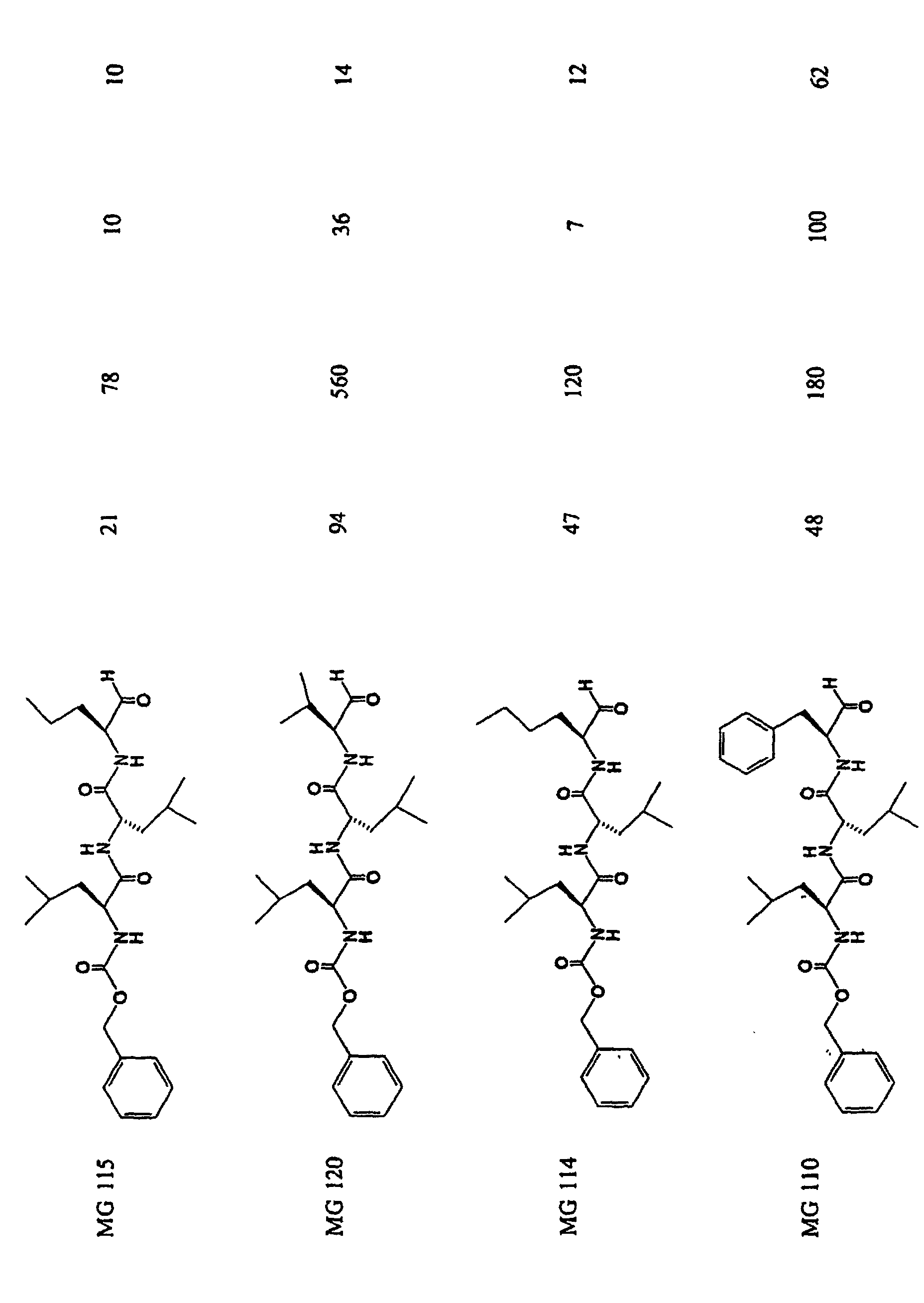
- Table V summarizes data for the inhibition of the 20S proteasome by various tripeptide aldehyde inhibitors.
- N-Boc-L-norvaline N,O-dimethylhydroxylamide (546 mg) and trifluoroacetic acid (8 mL) in methylene chloride (20 mL) was stirred at 0°C for 3 hours. The solvent was evaporated under reduced pressure and the residue was dried under vacuum. To this flask was added Z-L-leucine-L-leucine (794 mg), 1-hydroxybenzotriazole monohydrate (340 mg), N-methylmorpholine (0.28 mL), and DMF (20 mL). 1-Ethyl-3-(3-dimethylaminopropyl)carbodiimide hydrochloride (442 mg) was then added at 0°C.
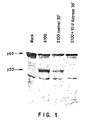
- the p60Tth precursor (or p105) was translated in wheat germ extract.
- the substrate protein was mixed with HeLa cell cytoplasmic extract (S100) in a processing buffer containing 12 mM Tris, pH 7.5, 60 mM KCl, 20 mM creatine phosphate, 3.5 mM MgCl 2 and 1 mM ATP. After incubation at 30° C for one hour, the reaction mixtures were subjected to immunoprecipitation with anti-p50 Ab and the proteins were resolved by SDS-PAGE.
- the p60 was incubated with 10 U of enzyme at 37° C for 30 minutes to inactivate residual ATP in the wheat germ extract before adding the HeLa cell S100. The control sample did not receive the enzyme or ATP.
- Figure 1 The results are shown in Figure 1.
- HeLa cell S100 was centrifuged for six hours at 100,000xg to remove proteasomes. Loss of proteasome activity was verified using a fluorogenic peptide assay specific for the proteasome. The results from two different depleted extracts [Pr - (I & II)] are shown. The pellet contains most of the proteasome activity.
- the processing reactions were carried out as described in Example 4 and the reactions were immunoprecipitated with either anti-p50 Ab or anti-myc peptide mAb. The anti-myc mAb will recognize the N-terminal myc-peptide on a tagged p60 precursor protein. The results are shown in Figure 3.
- the p60Tth precursor protein is ubiquitinated.
- COS cells were transfected with human p105.
- Inhibitors Calpain inhibitor, MG101, and MG115
- 50 ⁇ M portions were added to the cells one hour prior to the addition of 35 S-methionine/cysteine.
- HeLa or MG63 cells were pretreated with inhibitors (50 ⁇ M) for one hour. Cells were then treated with TNF- ⁇ (1000 U/ml) or IFN- ⁇ (1000U/ml) for 30 and 60 minutes, respectively. Whole-cell extracts were prepared and analyzed by an electrophoretic mobility shift assay. The NF- ⁇ B site from the interferon- ⁇ gene was used to examine NF- ⁇ B binding activity and the pIRE site from the IRF-1 gene was used to measure gamma-activated factor (GAF) activity. The inhibitors only block NF- ⁇ B activation and have no effect on GAF induction. The results are shown in Figure 10.
Landscapes
- Health & Medical Sciences (AREA)
- Life Sciences & Earth Sciences (AREA)
- Chemical & Material Sciences (AREA)
- Medicinal Chemistry (AREA)
- General Health & Medical Sciences (AREA)
- Organic Chemistry (AREA)
- Animal Behavior & Ethology (AREA)
- Veterinary Medicine (AREA)
- Pharmacology & Pharmacy (AREA)
- Public Health (AREA)
- Proteomics, Peptides & Aminoacids (AREA)
- Bioinformatics & Cheminformatics (AREA)
- Engineering & Computer Science (AREA)
- General Chemical & Material Sciences (AREA)
- Chemical Kinetics & Catalysis (AREA)
- Immunology (AREA)
- Nuclear Medicine, Radiotherapy & Molecular Imaging (AREA)
- Epidemiology (AREA)
- Gastroenterology & Hepatology (AREA)
- Molecular Biology (AREA)
- Genetics & Genomics (AREA)
- Biochemistry (AREA)
- Biophysics (AREA)
- Virology (AREA)
- Oncology (AREA)
- Communicable Diseases (AREA)
- Rheumatology (AREA)
- Tropical Medicine & Parasitology (AREA)
- AIDS & HIV (AREA)
- Neurology (AREA)
- Biomedical Technology (AREA)
- Pain & Pain Management (AREA)
- Neurosurgery (AREA)
- Medicines That Contain Protein Lipid Enzymes And Other Medicines (AREA)
- Peptides Or Proteins (AREA)
- Enzymes And Modification Thereof (AREA)
- Detergent Compositions (AREA)
- Medicines Containing Plant Substances (AREA)
- Distillation Of Fermentation Liquor, Processing Of Alcohols, Vinegar And Beer (AREA)
- Acyclic And Carbocyclic Compounds In Medicinal Compositions (AREA)
Abstract
Description
- The present invention relates to a method for reducing the cellular content and activity of NF-κB by use of inhibitors of proteasome function or ubiquitin conjugation.
- The transcription factor NF-κB and other members of the rel family of protein complexes play a central role in the regulation of a remarkably diverse set of genes involved in the immune and inflammatory responses (Grilli et al., International Review of Cytology 143:1-62 (1993)). For example, NF-κB is required for the expression of a number of immune response genes, including the Ig-κ light chain immunoglobulin gene, the IL-2 receptor α chain gene, the T cell receptor β chain gene, and class I and II major histocompatibility genes. In addition, NF-κB has been shown to be required for a number of genes involved in the inflammatory response, such as the TNF-α gene and the cell adhesion genes, E-selectin, I-cam, and V-cam. NF-κB is also required for the expression of a large number of cytokine genes such as IL-2, IL-6, G-CSF, and 1FN-β. Finally, NF-κB is essential for the expression of the human immunodeficiency virus (HIV).
- In the cytosol, there is a soluble proteolytic pathway that requires ATP and involves covalent conjugation of the cellular proteins with the small polypeptide ubiquitin ("Ub") (Hershko et al., A. Rev. Biochem. 61:761-807 (1992); Rechsteiner et al., A. Rev. Cell. Biol. 3:1-30 (1987)). Thereafter, the conjugated proteins are hydrolyzed by a 26S proteolytic complex containing a 20S degradative particle called the proteasome (Goldberg, Eur. J. Biochem. 203:9-23 (1992); Goldberg et al., Nature 357:375-379 (1992)). This multicomponent system is known to catalyze the selective degradation of highly abnormal proteins and short-lived regulatory proteins. However, the system also appears to be responsible for the breakdown of most proteins in maturing reticulocytes (Boches et al., Science 215:978-980 (1982); Spenser et al., J. Biol. Chem. 257:14122-14127 (1985)), in growing fibroblasts (Ciechanover et al., Cell 37:57-66 (1984); Gronostajski et al., J. Biol. Chem. 260:3344-3349 (1985)), and in atrophying skeletal muscle.
- The first step in degradation of many proteins involves their conjugation to Ub by an ATP-requiring process. The ubiquitinated proteins are then degraded by an ATP-dependent proteolytic complex, referred to above, known as the 26S proteasome complex.
- The precise nature of the 26S proteasome complex is unclear, although it has been shown that the 1000-1500 kDa (26S) complex can be formed in extracts of energy-depleted reticulocytes by an ATP-dependent association of three components, referred to as CF-1, CF-2, and CF-3 (Ganoth, D. et al., J. Biol. Chem. 263:12412-12419 (1988)). A large (∼700 kDa) multimeric protease found in the cytoplasm and nucleus of eukaryotic cells, referred to as the proteasome, is a component (CF-3) (Driscoll et al., J. Biol. Chem. 265:4789-4792 (1992); Eytan et al., Proc. Natl. Acad. Sci. USA 86:7751-7755 (1989); Orlowski, Biochemistry 29:10289-10297 (1990) and Rivett, Arch. Biochem. Biophys. 268:1-8 (1989)).
- The proteasome is believed to make up the catalytic core of the large 26S multisubunit cytoplasmic particle necessary for the ubiquitin-dependent pathway of intracellular proteolysis (Driscoll et al., J. Biol. Chem. 265:4789-4692 (1990); Eytan et al., Proc. Natl. Acad. Sci. U.S.A. 86:7751-7755 (1989); Hough et al., Biochemistry 262:8303-8313 (1987); McGuire et al., Biochim. Biophys. Acta 967:195-203 (1988); Rechsteiner et al., A. Rev. Cell. Biol. 3:1-30 (1987); Waxman et al., J. Biol. Chem. 262:2451-2457 (1987)). By itself, the proteasome is unable to degrade ubiquitinated proteins, but provides most of the proteolytic activity of the 26S proteasome complex.
- There is another ATP-dependent protease that is involved in degradation of ubiquitinated proteins, forms a complex with the proteasome, and appears to be part of the 26S proteasome complex, which rapidly degrades proteins conjugated to ubiquitin. This protease, referred to as multipain, has been identified in muscle and plays an essential role in the ATP-ubiquitin-dependent pathway.
- The complex formed between multipain and proteasome in vitro appears very similar or identical to the 1500 kDa Ub-conjugate, degrading enzyme, or 26S proteolytic complex, isolated from reticulocytes and muscle. The complexes contain the characteristic 20-30 kDa proteasome subunits, plus a number of larger subunits, including the six large polypeptides found in multipain. The complex formed contains at least 10-12 polypeptides of 40-150 kDa.
- A 40 kDa polypeptide regulator of the proteasome, which inhibits the proteasome's proteolytic activities has been purified from reticulocytes and shown to be an ATP-binding protein whose release appears to activate proteolysis. The isolated regulator exists as a 250 kDa multimer and is quite labile (at 42°C). It can be stabilized by the addition of ATP or a nonhydrolyzable ATP analog, although the purified regulator does not require ATP to inhibit proteasome function and lacks ATPase activity. The regulator has been shown to correspond to an essential component of the 1500 kDa proteolytic complex. The regulator appears identical to CF-2 by many criteria. These findings suggest that the regulator plays a role in the ATP-dependent mechanism of the 26S proteasome complex.
- There is also a system in the cytosol that generates antigenic particles from endogenously synthesized cellular and viral proteins (Moore et al., Cell 54:777-785 (1988); Morrison et al., J. Exp. Med. 163:903-921 (1986); Powis et al., Nature 354:529-531 (1991); Spies et al., Nature 351:323-324 (1991); Townsend et al., Cell 42:457-467 (1985); Townsend et al., Nature 324:575-577 (1986); Monaco et al., Proc. Natl. Acad. Sci. U.S.A. 79:3001-3005 (1982); Monaco, Immun. Today 13:173-179 (1992); Yewdell et al., Adv. Immun. 52:1-123 (1992); Townsend et al., J. Exp. Med. 168:1211-1224 (1988)). Indirect evidence suggests a role for proteolytic particles closely resembling and perhaps identical to the proteasome (Goldberg et al., Nature 357:375-379 (1992); Monaco, Immun. Today 13:173-179 (1992); Parham, Nature 348:674-675 (1990); Yang et al., Proc. Natl. Acad. Sci. U.S.A. 89:4928-4932 (1992); (Brown et al., Nature 353:355-357 (1991)). It has been shown that the proteasome is responsible for cytoplasmic processing of MHC class I antigen molecules.
- The 20S proteasome is composed of about 15 distinct 20-30 kDa subunits. It contains at least three different peptidases that cleave specifically on the carboxyl side of the hydrophobic, basic, and acidic amino acids (Goldberg et al., Nature 357:375-379 (1992); Goldberg, Eur. J. Biochem. 203:9-23 (1992); Orlowski, Biochemistry 29:10289-10297 (1990); Rivett et al., Archs. Biochem. Biophys. 218:1 (1989); Rivett et al., J. Biol. Chem. 264:12,215-12,219 (1989); Tanaka et al., New Biol. 4:1-11 (1992)). These peptidases are referred to as the chymotrypsin-like peptidase, the trypsin-like peptidase, and the peptidylglutamyl peptidase. Which subunits are responsible for these activities is unknown, although the cDNA's encoding several subunits have been cloned (Tanaka et al., New Biol. 4:1-11 (1992)).
- Recent studies have found that the 20S proteasomes resemble in size and subunit composition the MHC-linked LMP particles (Driscoll et al., Cell 68:823 (1992); Goldberg et al., Nature 357:375-379 (1992); Matthews et al., Proc. Natl. Acad. Sci. U.S.A. 86:2586 (1989); Monaco et al., Human Immunology 15:416 (1986); Parham, Nature 348:674-675 (1990); Martinez et al., Nature 353:664 (1991); Oritz-Navarette et al., Nature 353:662 (1991); Glynne et al., Nature 353:357 (1991); Kelly et al., Nature 353:667 (1991); Monaco et al., Proc. Natl. Acad. Sci. U.S.A. 79:3001 (1982); Brown et al., Nature 353:355 (1991); Goldberg, Eur. J. Biochem. 203:9-23 (1992); Tanaka et al., New Biol. 4:1-11 (1992)).
- Various inhibitors of the peptidases of the proteasome have been reported (Dick et al., Biochemistry 30:2725-2734 (1991); Goldberg et al., Nature 357:375-379 (1992); Goldberg, Eur. J. Biochem. 203:9-23 (1992); Orlowski, Biochemistry 29:10289-10297 (1990); Rivett et al., Archs. Biochem. Biophys. 218:1 (1989); Rivett et al., J. Biol. Chem. 264:12,215-12,219 (1989); Tanaka et al., New Biol. 4:1-11 (1992)). These include known inhibitors of chymotrypsin-like and trypsin-like proteases, as well as inhibitors of thiol (or cysteine) and serine proteases. In addition, some endogenous inhibitors of proteasome activities have been isolated. These include the 240 kDa and the 200 kDa inhibitors isolated from human erythrocytes (Murakami et al., Proc. Natl. Acad. Sci. U.S.A. 83:7588-7592 (1986); Li et al., Biochemistry 30:9709-9715 (1991)) and purified CF-2 (Goldberg, Eur. J. Biochem. 203:9-23 (1992)). In addition to antibiotic inhibitors originally isolated from actinomycetes (Aoyagi et al., Proteases and Biological Control, Cold Spring Harbor Laboratory Press, pp. 429-454 (1975)), a variety of peptide aldehydes have been synthesized, such as the inhibitors of chymotrypsin-like proteases described by Siman et al. (WO 91/13904).
- Novel molecules can also be obtained and tested for inhibitory activity. As illustrated by the above cited references, various strategies are known in the art for obtaining the inhibitors for a given protease. Compound or extract libraries can be screened for inhibitors using peptidase assays. Alternatively, peptide and peptidomimetic molecules can be designed based on knowledge of the substrates of the protease. For example, substrate analogs can be synthesized containing a reactive group likely to interact with the catalytic site of the protease (see, e.g., Siman et al., WO 91/13904; Powers et al., in Proteinase Inhibitors, Barrett et al. (eds.), Elsevier, pp. 55-152 (1986)). The inhibitors can be stable analogs of catalytic transition states (transition state analog inhibitors), such as Z-Gly-Gly-Leu-H, which inhibits the chymotrypsin-like activity of the proteasome (Orlowski, Biochemistry 29:10289-10297 (1990); see also Kennedy and Schultz, Biochemistry 18:349 (1979)).
- Various natural and chemical protease inhibitors reported in the literature, or molecules similar to them, include peptides containing an α-diketone or an α-keto ester, peptide chloromethyl ketones, isocoumarins, peptide sulfonyl fluorides, peptidyl boronates, peptide epoxides, and peptidyl diazomethanes (Angelastro et al., J. Med Chem. 33:11-13 (1990); Bey et al., EPO 363,284; Bey et al., EPO 364,344; Grubb et al., WO 88/10266; Higuchi et al., EPO 393,457; Ewoldt et al., Molecular Immunology 29(6):713-721 (1992); Hernandez et al., Journal of Medicinal Chemistry 35(6):1121-1129 (1992); Vlasak et al., Journal of Virology 63(5):2056-2062 (1989); Hudig et al., Journal of Immunology 147(4):1360-1368 (1991); Odakc et al., Biochemistry 30(8):2217-2227 (1991); Vijayalakshmi et al., Biochemistry 30(8):2175-2183 (1991); Kam et al., Thrombosis and Haemostasis 64(1):133-137 (1990); Powers et al., Journal of Cellular Biochemistry 39(1):33-46 (1989); Powers et al., Proteinase Inhibitors, Barrett et al., Eds., Elsevier, pp. 55-152 (1986); Powers et al., Biochemistry 29(12):3108-3118 (1990); Oweida et al., Thrombosis Research 58(2):391-397 (1990); Hudig et al., Molecular Immunology 26(8):793-798 (1989); Orlowski et al., Archives of Biochemistry and Biophysics 269(1):125-136 (1989); Zunino et al., Biochimica et Biophysica Acta. 967(3):331-340 (1988); Kam et al., Biochemistry 27(7):2547-2557 (1988); Parkes et al., Biochem J. 230:509-516 (1985); Green et al., J. Biol. Chem. 256:1923-1928(1981); Angliker et al., Biochem. J. 241:871-875 (1987); Puri et al., Arch. Biochem. Biophys. 27:346-358 (1989); Hanada et al., Proteinase Inhibitors: Medical and Biological Aspects, Katunuma et al., Eds., Springer-Verlag pp. 25-36 (1983); Kajiwara et al., Biochem. Int. 15:935-944 (1987); Rao et al., Thromb. Res. 47:635-637 (1987); Tsujinaka et al., Biochem. Biophys. Res. Commun. 153:1201-1208 (1988)).
- Various inhibitors of ubiquitin conjugation to proteins are also known (Wilkinson et al., Biochemistry 29:7373-7380 (1990)).
- Certain peptide aldehydes and peptide α-keto esters containing a hydrophobic residue in the P1 position were tested by Vinitsky et al. (Biochemistry 31:9421-9428 (1992), see also, Orlowski et al. Biochemistry 32:1563-1572 (1993)) as potential inhibitors of the chymotrypsin-like activity of the proteasome. Three peptide aldehydes, (benzyloxycarbonyl) - Leu - Leu - phenylalaninal (Z-LLF-H), N-acetyl - Leu - Leu - Norleucinal (Ac-LLnL-H), and N-acetyl - Leu - Leu - methioninal (Ac-LLM-H) were found to be slow binding inhibitors with K i values of 0.46, 5.7, and 33 µM, respectively. Of the several peptide α-keto ester inhibitors tested, Z - Leu - Leu - Phe - COOEt was the most potent inhibitor of the chymotrypsin-like activity with a K i of 53 µM. Many such compounds exist.
- Other tripeptides that have been described in the literature include Ac-Leu-Leu-Leu-H, Ac-Leu-Leu-Met-OR, Ac-Leu-Leu-Nle-OR, Ac-Leu-Leu-Leu-OR, Ac-Leu-Leu-Arg-H, Z-Leu-Leu-Leu-H, Z-Arg-Leu-Phe-H, and Z-Arg-Ile-Phe-H, where OR, along with the carbonyl of the preceding amino acid residue, represents an ester group.
- Goldberg, in U.S. Patent Application Serial No. 07/699,184, filed May 13, 1991, discloses that the ATP-ubiquitin-dependent process has been shown to be responsible for the excessive protein degradation that occurs in conditions or disease states in which there is severe loss of body mass and negative nitrogen balance. A method of inhibiting the accelerated or enhanced proteolysis, a method of identifying inhibitors of the process, multipain and proteasome inhibitors are also disclosed.
- Goldberg et al., in U.S. Patent Application Serial No. 08/016,066, filed February 10, 1993, disclose methods and drugs that inhibit the processing of antigens for presentation by major histocompatibility complex class I molecules. Specifically, inhibitors of the ATP-ubiquitin-dependent proteolytic pathway are described, which can inhibit MHC-I antigen presentation. These methods and drugs may be useful for the treatment of autoimmune diseases and for reducing rejection of organs and graft transplants. See, also, Michalek et al., Nature 363:552-554 (1993).
- Tsubuki et al., Biochem. and Biophys. Res. Commun. 196(3):1195-1201 (1993) reported that a tripeptide aldehyde protease inhibitor, benzyloxycarbonyl(Z)-Leu-Leu-leucinal, initiates neurite outgrowth in PC12 cells at an optimal concentration of 30 nM. The following synthetic peptides are also mentioned: Z-Leu-Leu-Gly-H, Z-Leu-Leu-Ala-H, Z-Leu-Leu-Ile-H, Z-Leu-Leu-Val-H, Z-Leu-Leu-Nva-H, Z-Leu-Leu-Phe-H, Z-Leu-Leu-Leu-H, Bz-Leu-Leu-Leu-H, Ac-Leu-Leu-Leu-H, Z-Leu-Leu-Leu.sc, Z-Leu-Leu-Leu.ol, Z-Leu-Leu-Leu, Dns-Leu-Leu-Leu-H, Dns-Leu-Leu-Leu-CH2Cl, and Leupeptin.
- Siman et al. (WO 91/13904) disclose chymotrypsin-like proteases and their inhibitors. The inhibitors have the formula R-A4-A3-A2-y, wherein
- R is hydrogen, or a N-terminal blocking group;
- A4 is a covalent bond, an amino acid or a peptide;
- A3 is a covalent bond, a D-amino acid, Phe, Tyr, Val, or a conservative amino acid substituent of Val;
- A2 is a hydrophobic amino acid or lysine or a conservative amino acid substituent thereof, or when A4 includes at least two amino acids, A2 is any amino acid; and
- Y is a group reactive with the active site of said protease.
-
- Powers (WO 92/12140) discloses peptide ketoamides, ketoacids, and ketoesters and their use in inhibiting serine proteases and cysteine proteases.
- Bartus et al. (WO 92/1850) disclose uses for Calpain inhibitor compounds and pharmaceutical compositions containing them. One use of these compounds is in the treatment of a neurodegenerative pathology in a human patient. The disclosure also provides additional uses and pharmaceutical compositions containing Calpain inhibitor compounds, such as peptide ketoamides, peptide ketoacids, and peptide ketoesters.
- The present invention relates to uses of inhibitors of proteasome function or ubiquitin conjugation.
- In a preferred embodiment, the present invention relates to the use of an inhibitor of proteasome function or ubiquitin conjugation for the manufacture of a medicament for use in the treatment of an inflammatory condition.
- In a further preferred embodiment, the present invention relates to the use of an inhibitor of proteasome function or ubiquitin conjungation for the manufacture of a medicament for the treatment of HIV infection.
- In an even further preferred embodiment, the present invention relates to the use of an inhibitor of proteasome function or ubiquitin conjugation for the manufacture of a medicament for use in a method of treatment to reduce cellular content and activity of NF-κB.
- More particularly, the inhibitor of proteasome function or ubiquitin conjugation of the present invention has the formula I:where

- P is an amino-group-protecting moiety;
- B1, B2, B3 and B4 are independently selected from the
group consisting of
- X1, X2 and X3 are independently selected from the
group consisting of
 and -CH=CH-;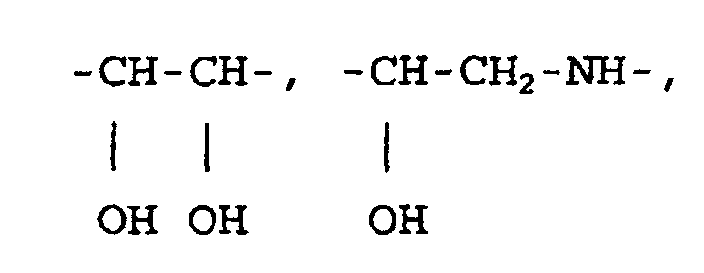
- R is a hydrogen, alkyl, acyl or carboxyl;
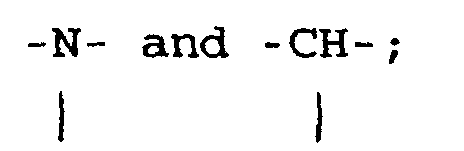
- R1, R2, R3 and R4 are independently selected from the
group consisting of hydrogen, alkyl, cycloalkyl,
alkenyl, alkynyl, aryl and -CH2-R5;
where R5 is aryl, aralkyl, alkaryl, cycloalkyl or -Y-R6;
where Y is a chalcogen, and R6 is alkyl; and A is 0 or 1. -
- The "animals" referred to herein are preferably mammals. Both terms are intended to include humans.
-
- Figure 1 shows that proteolytic processing of the p6OTth precursor to p50 in vitro requires ATP.
- Figure 2 is a diagram showing the role of ubiquitin and proteasome in the generation of active NF-κB.
- Figure 3 depicts processing of p105/p60T in proteasome-depleted and proteasome-enriched extracts.
- Figure 4 shows that immunodepletion of the proteasome inhibits the processing of NF-κB.
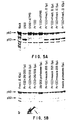
- Figure 5 shows that purified proteasomes stimulate the processing of p60Tth.
- Figure 6 shows that the p60Tth precursor protein is ubiquitinated.
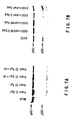
- Figure 7 shows that ubiquitin is required for the processing of NF-κB.
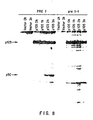
- Figure 8 shows that processing of p105 in Saccharomyces cerevisiae requires the proteasome.
- Figure 9 shows that specific inhibitors of the proteasome block the processing of p105 in vivo.
- Figure 10 shows that specific inhibitors of the proteasome block activation of NF-κB.
-
- NF-κB exists in an inactive form in the cytosol complexed with an inhibitor protein, IκB. In order for the NF-κB to become active and perform its function, it must enter the cell nucleus. It cannot do this, however, until the IκB portion of the complex is removed, a process referred to by those skilled in the art as the activation of, or processing of, NF-κB. In some diseases, the normal performance of its function by the NF-κB can be detrimental to the health of the patient. For example, as mentioned above, NF-κB is essential for the expression of the human immunodeficiency virus (HIV). Accordingly, a process that would prevent the activation of the NF-κB in patients suffering from such diseases could be therapeutically beneficial. The inhibitors employed in the practice of the present invention are capable of preventing this activation. Thus, blocking NF-κB activity or production could have important application in various areas of medicine, e.g., inflammation, sepsis, AIDS, and the like.
- More specifically, the activity of NF-κB is highly regulated (Grilli et al., International Review of Cytology 143: 1-62 (1993); Beg et al., Genes and Development 7:2064-2070 (1993)). NF-κB comprises two subunits, p50 and an additional member of the rel gene family, e.g., p65 (also known as Rel A). In most cells, the p50 and p65 are present in an inactive precursor form in the cytoplasm, bound to IκB. In addition, the p50 subunit of NF-κB is generated by the proteolytic processing of a 105 kD precursor protein NF-κB1 (p105), and this processing is also regulated. The sequence of the N-terminal 50 kD portion of p105 is similar to that of p65 and other members of the rel gene family (the rel homology domain). By contrast, the C-terminal 55 kD of p105 bears a striking resemblance to IκB-α (also known as MAD3). Significantly, unprocessed p105 can associate with p65 and other members of the rel family to form a p65/p105 heterodimer. Processing of p105 results in the production of p50, which can form the transcriptionally active p50/p65 heterodimer. The C-terminal IκB-α-homologous sequence of p105 is rapidly degraded upon processing.
- There is another rel-related protein, NF-κB2 (p100), that is similar to p105 in that it, too, is processed to a DNA binding subunit, p52 (Neri et al., Cell 67:1075 (1991); Schmid et al., Nature 352:733 (1991); Bours et al., Molecular and Cellular Biology 12:685 (1992); Mercurio et al., DNA Cell Biology 11:523 (1992)). Many of the structural and regulatory features of p100 are similar to p105. In addition, the p100 protein can also form a heterodimer with p65 and other rel family members.
- In summary, the transcriptional activity of heterodimers consisting of p50 and one of the many rel family proteins, such as p65, can be regulated by at least two mechanisms. First, the heterodimers associate with IκB-α to form an inactive ternary cytoplasmic complex. Second, the rel family members associate with p105 and p100 to form inactive complexes. The ternary complex can be activated by the dissociation and destruction of IκB-α, while the p65/p105 and p65/p100 heterodimer can be activated by processing p105 and p100, respectively.
- The dissociation of IκB-α can be induced by a remarkably large number of extracellular signals, such as lipopolysaccharides, phorbol esters, TNF-α, and a variety of cytokines. The IκB-α is then rapidly degraded. Recent studies suggest that p105 and p100 processing can also be induced by at least some of these extracellular signals. Neither the signal transduction pathways leading to NF-κB activation, nor the mechanisms of IκB-α inactivation or p105/p100 processing are understood. Accordingly, the inventors do not wish to be limited by any theory of the mechanism(s) by which the inhibitors employed in the practice of the present invention achieve their useful effects. The inventors do have clear evidence of effects with certain inhibitors that block the hydrophobic site on the 20S (core) proteasome particle, but it must be realized that other essential sites exist on this particle, which constitutes the catalytic core on the 26S proteasome complex. Consequently, similar effects would be anticipated with inhibitors of other essential activities of the proteasome. Removal of the proteasome particle by ultracentrifugation or immunoprecipitation prevents the activation of NF-κB. There are many other catalytic functions on this particle that, if blocked, would also be expected by those skilled in the art to prevent its ability to process NP-κB and/or destroy IκB. It is also possible that the effects achieved by the inhibitors used in the process of the present invention may be achieved by inhibition of the ubiquitination of NF-κB and/or IκB. Indeed, the inventors have discovered that ubiquitin-conjugation is necessary for their degradation. Accordingly, there may be specific E-2s or E-3s involved in the processing of NF-κB and/or IκB whereby one could predict that any inhibitor of E-1, E-2, or E-3-dependent Ub-conjugation would prevent NF-κB activation by blocking the ubiquitin-proteasome pathway.
- Studies have demonstrated that p105 or a truncated form of p105 (p60Tth) can be processed to p50 in vitro (Fan et al., Nature 354:395-398 (1991)). Certain of the requirements and characteristics of this in vitro processing reaction (e.g., ATP/Mg++ dependency) suggested to the present inventors that the ATP-dependent protease complex of the ubiquitin-mediated protein degradation pathway was involved (i.e. proteasome; Rechsteiner, 1991, Goldberg, Eur. J. Biochem. 203:9-23 (1992), Hershko et al., Annu. Rev. Biochem. 61:761-807 (1992)). However, this structure was only known to catalyze the complete degradation of proteins to small acid-soluble peptides and was not believed capable of processing precursors to generate active proteins, such as p50 NF-κB.
- Using a variety of experimental approaches, the present inventors have proven that the proteasome is indeed required for the processing of p105 to p50. First , it was found that the p105/p60Tth proteins are not processed in mammalian cell cytoplasmic extracts depleted of proteasome activity. However, addition of purified 26S proteasomes to these depleted extracts restores the processing activity. Second, specific inhibitors of the proteasome block the formation of p50 in mammalian cell extracts and in vivo. Third, mammalian p105 is processed to p50 in Saccharomyces cerevisiae in vivo, and a mutant in the chymotrypsin-like activity of the proteasome results in a significant decrease in p105 processing. p60Tth is ubiquitinated in vitro and this ubiquitination is a pre-requisite for p105 processing.
- As mentioned above, the C-terminal half of the p105 (p105C') is rapidly degraded during the formation of p50 and the sequence of p105C' is remarkably similar to that of IκB. Because of the similarity in the structures and activities of p105C' and IκB-α, the present inventors initiated studies to determine whether the proteasome is also involved in the inactivation of IκB-α. IκB-α is rapidly degraded in response to NF-κB inducers and this degradation has been shown to be necessary for the activation (Mellits et al., Nucleic Acids Research 21(22):5059-5066 (1993); Henkel et al., Nature 365:182-185 (1993); Beg et al., Molecular and Cellular Biology 13(6):3301-3310 (1993)). The present inventors have now shown that IκB-α degradation and the activation of NF-κB is indeed blocked by inhibitors of proteasome function or ubiquitin conjugation.
- Accordingly, the proteasome plays an essential role in the regulation of NF-κB activity. First, the proteasome is required for the processing of p105 and possibly p100. The degradation of the inhibitory C-terminus may also require the proteasome. Second, the proteasome appears to be required for the degradation of IκB-α in response to extracellular inducers.
- The present invention preferably relates to the use of inhibitors of proteasome function or ubiquitin conjugation of the structure (1):where

- P is an amino-group-protecting moiety;
- B1, B2, B3, and B4 are independently selected from the group consisting
of
X1, X2, and X3 are independently selected from the group consisting of
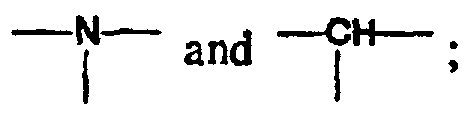
 and ―CH=CH―;
- R is a hydrogen, alkyl, acyl, or carboxyl;
- R1, R2, R3, and R4 are independently selected from the group consisting of hydrogen, alkyl, cycloalkyl, alkenyl, alkynyl, aryl, and ―CH2―R5, where R5 is aryl, aralkyl, alkaryl, cycloalkyl or ―Y―R6,
-
- In a preferred embodiment of the present invention, the P moiety of the proteasome inhibitor is (2)and R7 is alkyl, aryl, alkaryl, aralkyl, alkoxy, aryloxy, alkaryloxy, or aralkoxy.

- Where R7 is alkyl, it is preferably alkyl of from 1 to 4 carbon atoms, e.g., methyl, ethyl, propyl, butyl, or isomers thereof. Additionally, where R7 is alkaryl, aralkyl, alkoxy, alkaryloxy, or aralkoxy, the alkyl moiety thereof is also preferably one having from 1 to 4 carbon atoms.
- Where R7 is aryl, it is preferably aryl of from 6 to 10 carbon atoms, e.g., phenyl or naphthyl, which may, if desired, be ring substituted. Additionally, where R7 is alkaryl, aralkyl, aryloxy, alkaryloxy, or aralkoxy, the aryl moiety thereof is also preferably one having from 6 to 10 carbon atoms.
- It is more preferred that R7 be alkyl or aralkoxy, most preferably methyl or benzyloxy, i.e.,

- In structure (1), X represents a peptide bond or an isostere that can be used as a peptide bond replacement in the proteasome inhibitors to increase bioavailability and reduce hydrolytic metabolism. As noted above, X can beor ―CH=CH―. Preferably, X is

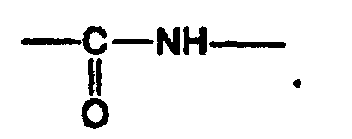
- Introduction of these moieties into the proteasome inhibitors results in the following:


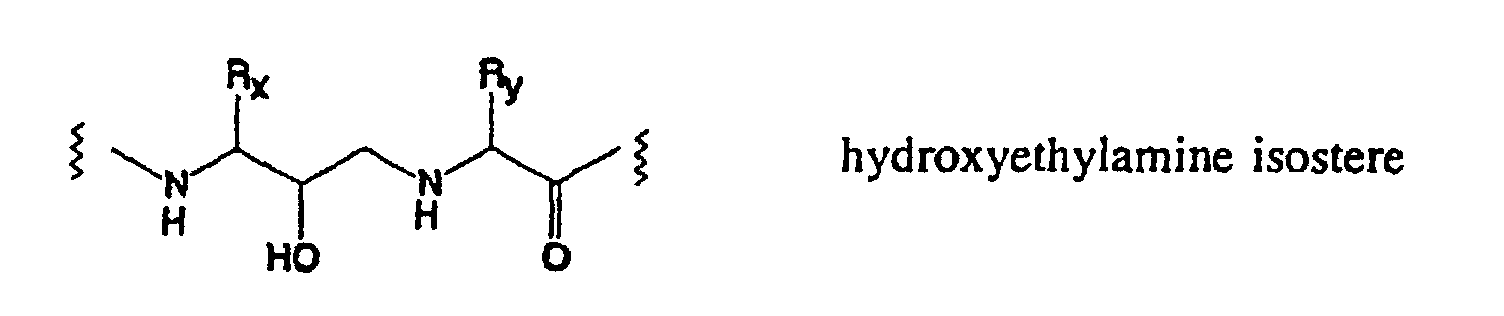 For example, if Z-Leu-Leu-Leu-H is found to undergo rapid hydrolytic metabolism to produce Z-Leu-OH and H2N-Leu-Leu-H, the hydroxyethylene isostere can be prepared to eliminate this reaction:

- Another isostere within the scope of the present invention is the aza-peptide isostere. This is the result of the replacement of the α-carbon atom of an amino acid with a nitrogen atom, e.g.,

- As noted above, A in structure (1) can be either 0 or 1. Thus, when A is 0, the amino acid residue within the brackets is not present and the inhibitor is a tripeptide. Similarly, where A is 1, the amino acid residue within the brackets is present and the inhibitor is a tetrapeptide. It is preferred that A be 0.
- It is preferred that R1 and R2 in structure (1) be independently selected from the group consisting of alkyl and ―CH2―R5. More preferably, R1 and R2 are independently selected from the group consisting of alkyl groups of from 1 to 4 carbon atoms, e.g., methyl, ethyl, propyl, butyl, or isomers thereof, e.g., isopropyl, isobutyl, sec-butyl, t-butyl, or ―CH2―R5, where R5 is cycloalkyl or naphthyl. It is more preferred that at least one of R1 and R2 be isobutyl,and most preferred that both R1 and R2 be isobutyl.

- Where R3 is alkyl, it is preferably alkyl of from 1 to 4 carbon atoms, e.g., methyl, ethyl, propyl, butyl, or isomers thereof, which groups may be substituted or unsubstituted.
- Where R3 is aryl, it is preferably aryl of from 6 to 10 carbon atoms, e.g., phenyl or naphthyl, which groups may be substituted or unsubstituted.
- Where R3 is a substituted alkyl, it is preferably an alkyl of from 1 to 4 carbon atoms substituted with at least one aryl group of from 6 to 10 carbon atoms or at least one cycloalkyl group, preferably a cycloalkyl group having 5 or 6 carbon atoms, which groups may be substituted or unsubstituted.
- Where R3 is substituted aryl, it is preferably substituted with at least one alkyl group of from 1 to 4 carbon atoms, which groups may be substituted or unsubstituted.
- Where R3 is cycloalkyl, it is preferably cycloalkyl of from 5 to 6 carbon atoms, e.g., cyclopentyl or cyclohexyl, which groups may be substituted or unsubstituted.
- Where R3 is substituted cycloalkyl, it is preferably substituted with at least one aryl group of from 6 to 10 carbon atoms or at least one alkyl group, preferably an alkyl group having 1 to 4 carbon atoms, which groups may be substituted or unsubstituted.
- Where R3 is -Y-R6, Y is a chalcogen, preferably oxygen or sulfur, more preferably sulfur; and R6 is alkyl, preferably alkyl of from 1 to 4 carbon atoms, e.g., methyl, ethyl, propyl, butyl, or isomers thereof.
- R in the structure shown above is hydrogen, alkyl, acyl, or carboxyl.
- Where R is alkyl, it is preferably alkyl of from 1 to 4 carbon atoms, e.g., methyl, ethyl, propyl, butyl, or isomers thereof.
- Where R is acyl, it preferably comprises a carbonyl moiety covalently bonded to an alkyl moiety of from I to 4 carbon atoms, e.g., methyl, ethyl, propyl, butyl, or isomers thereof, which may be substituted or unsubstituted.
- Where R is carboxyl, it is preferably a carboxyl of the structure [R8]n-COO-, where R8 is alkylene of from 1 to 4 carbon atoms, e.g., methylene, ethylene, propylene, butylene, and isomers thereof, and n is 0 or 1, and where the final O is normally bound to an alkyl group of 1 to 4 carbon atoms, which may be substituted or unsubstituted, thereby forming an ester.
- R is preferably hydrogen, alkyl, or carboxyl; more preferably, hydrogen.
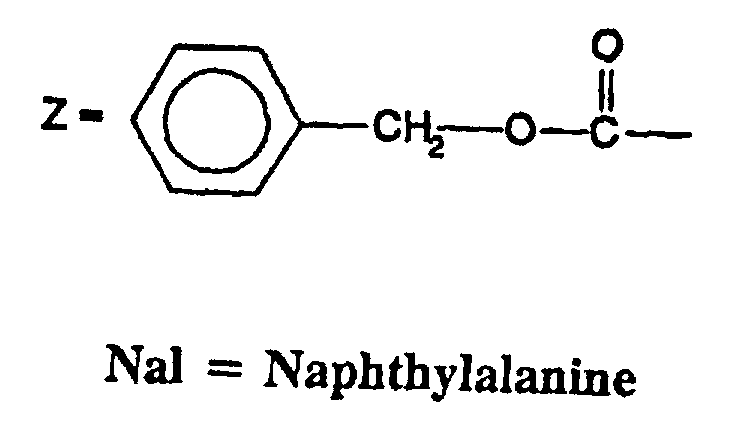
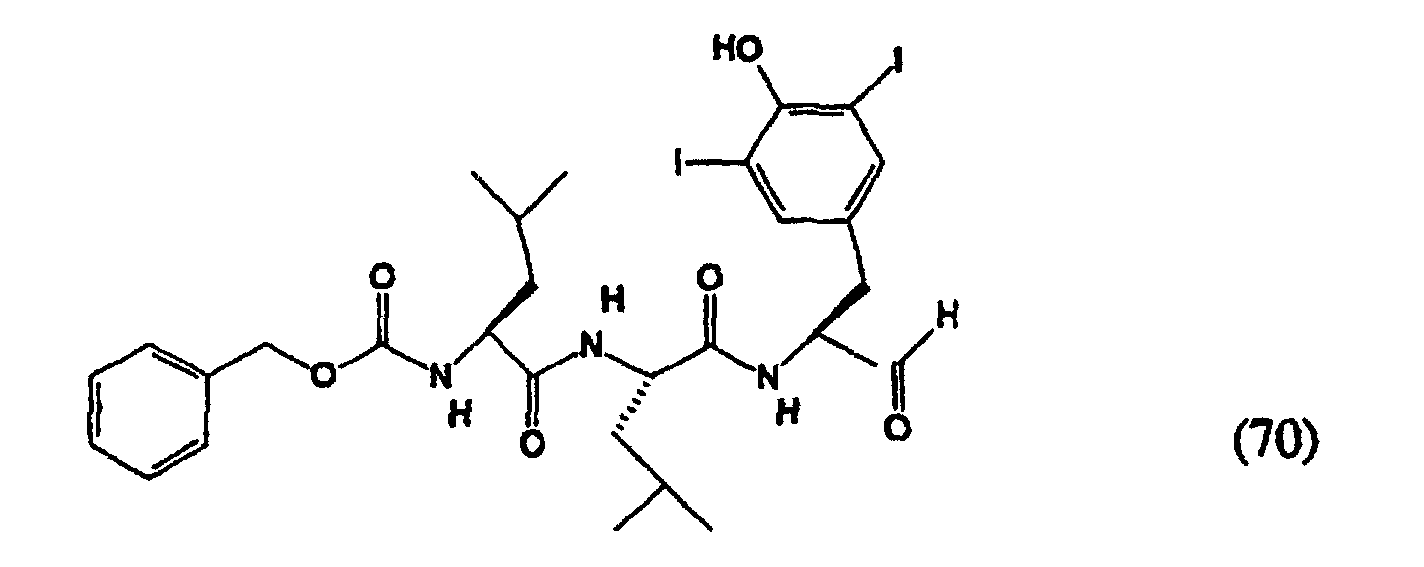
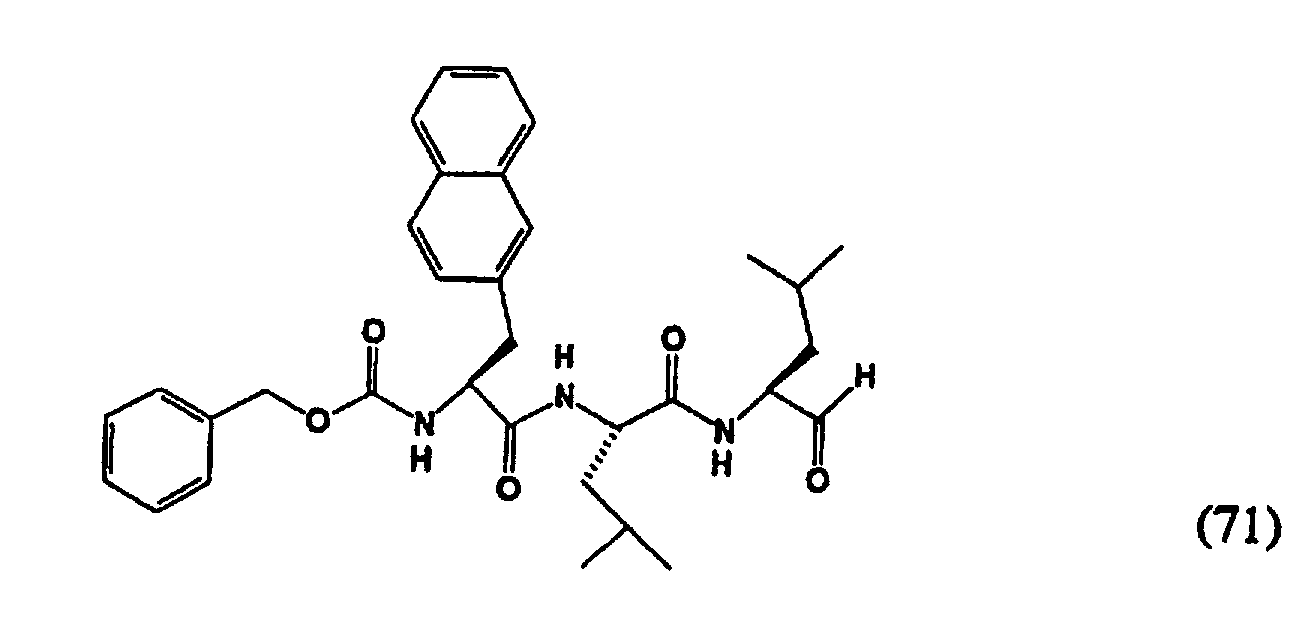
- Examples of suitable proteasome inhibitors include, without limitation, the following compounds:









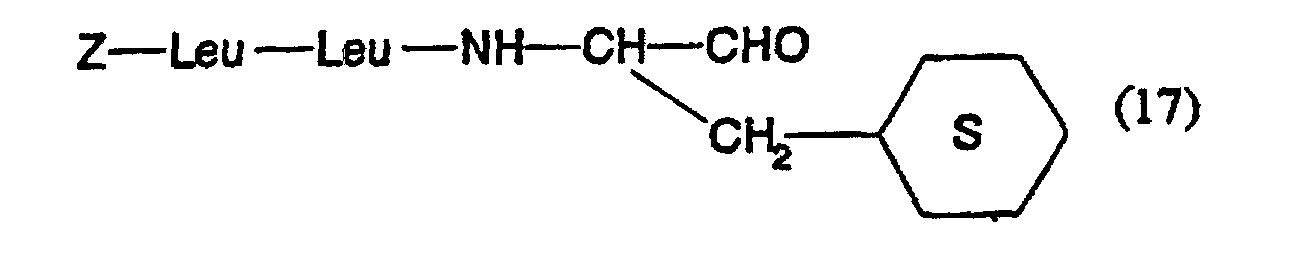



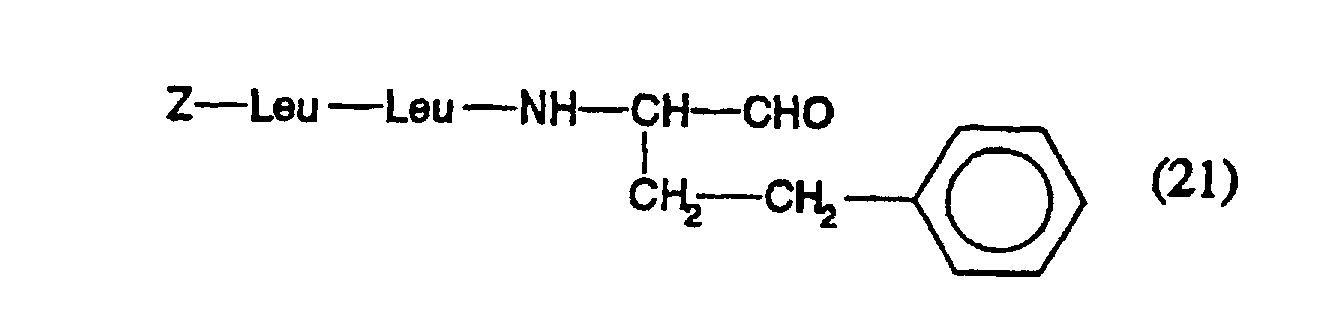

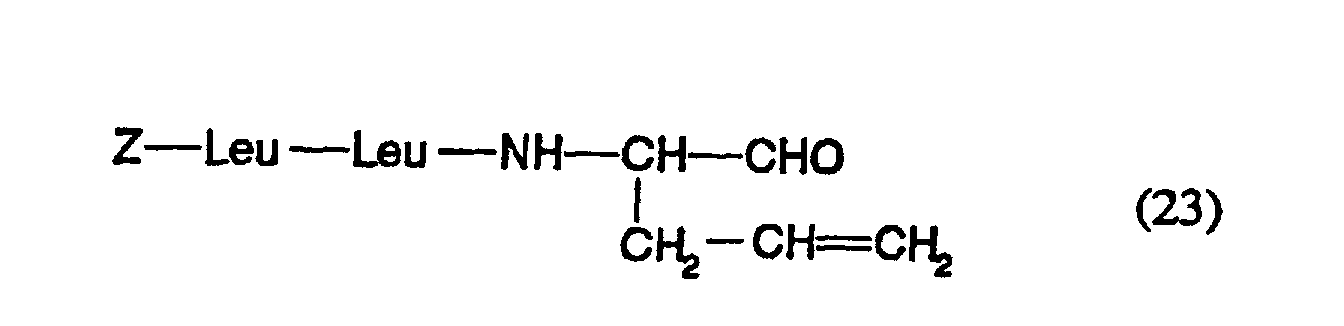


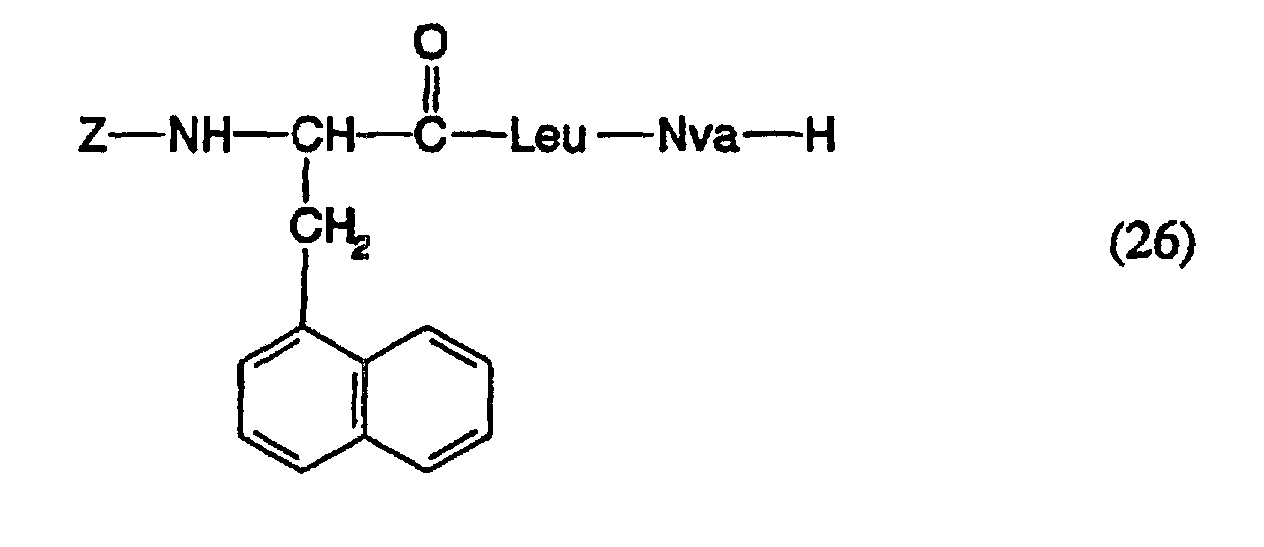
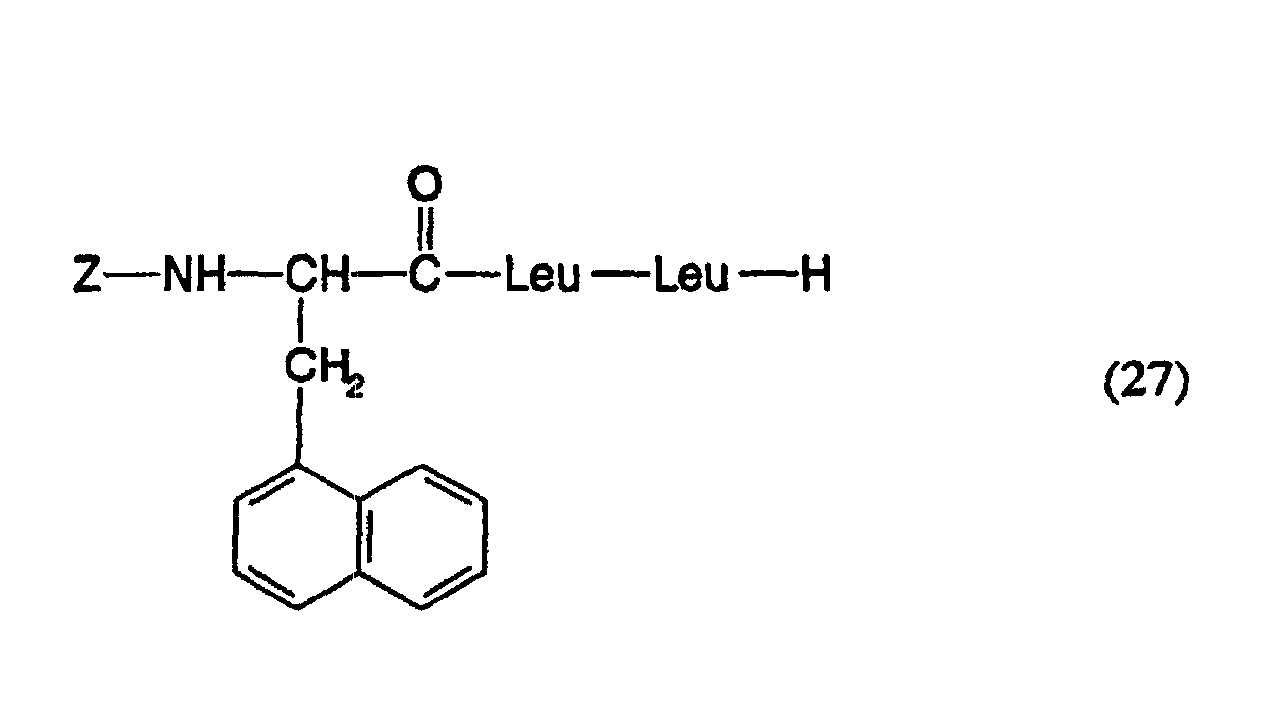
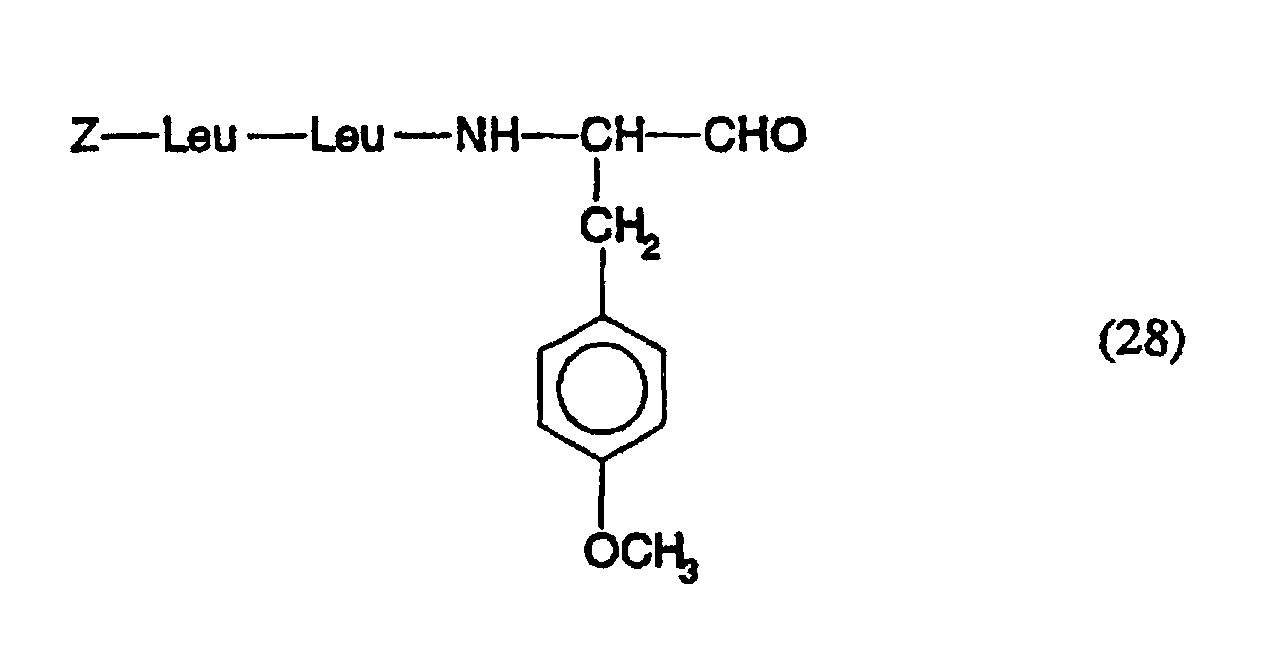



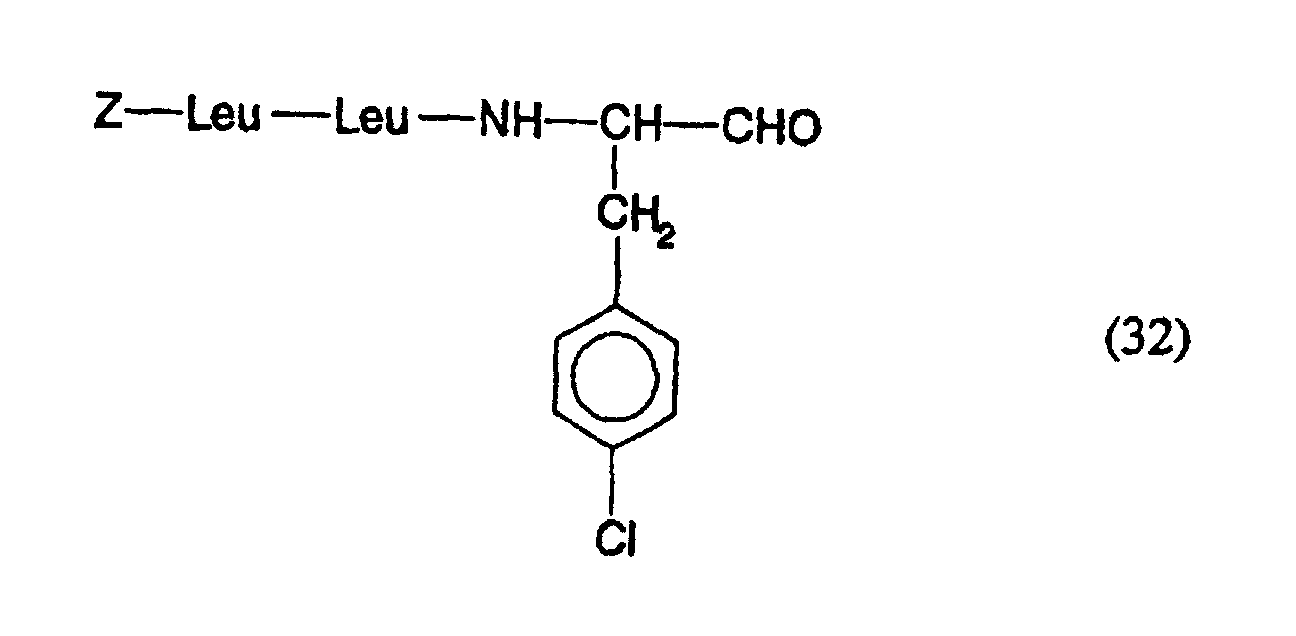
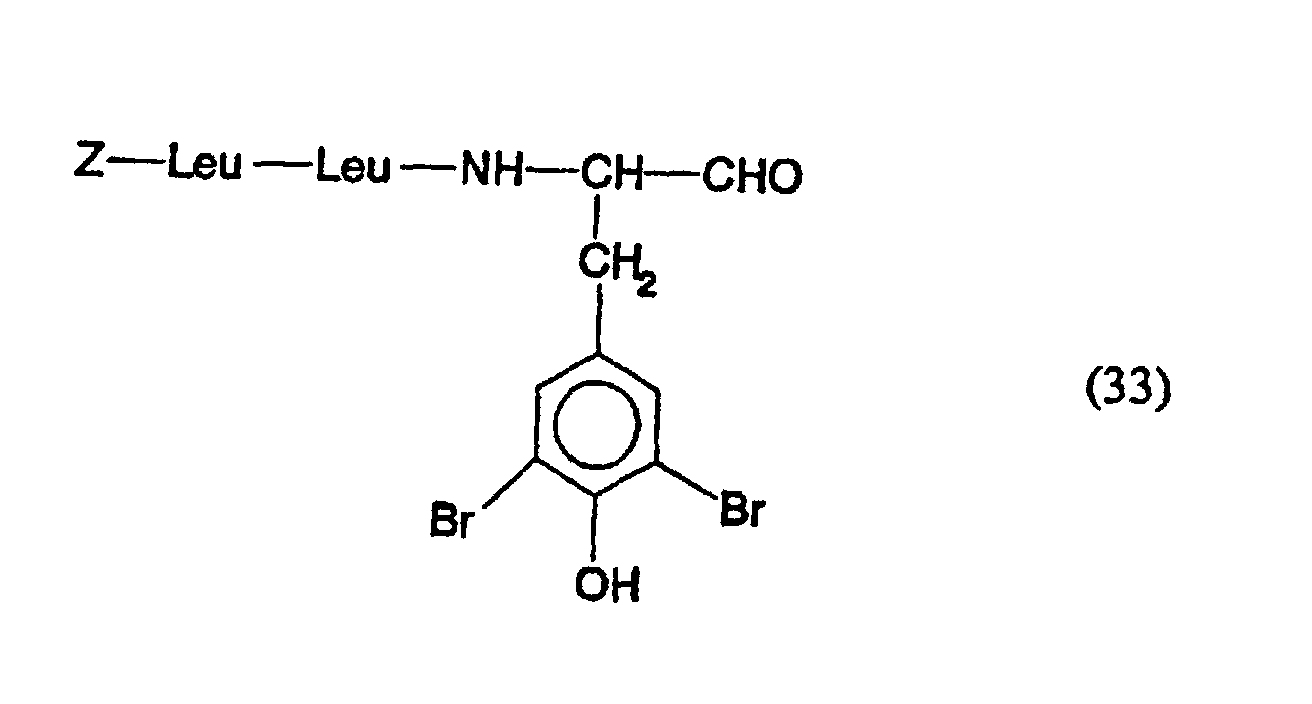


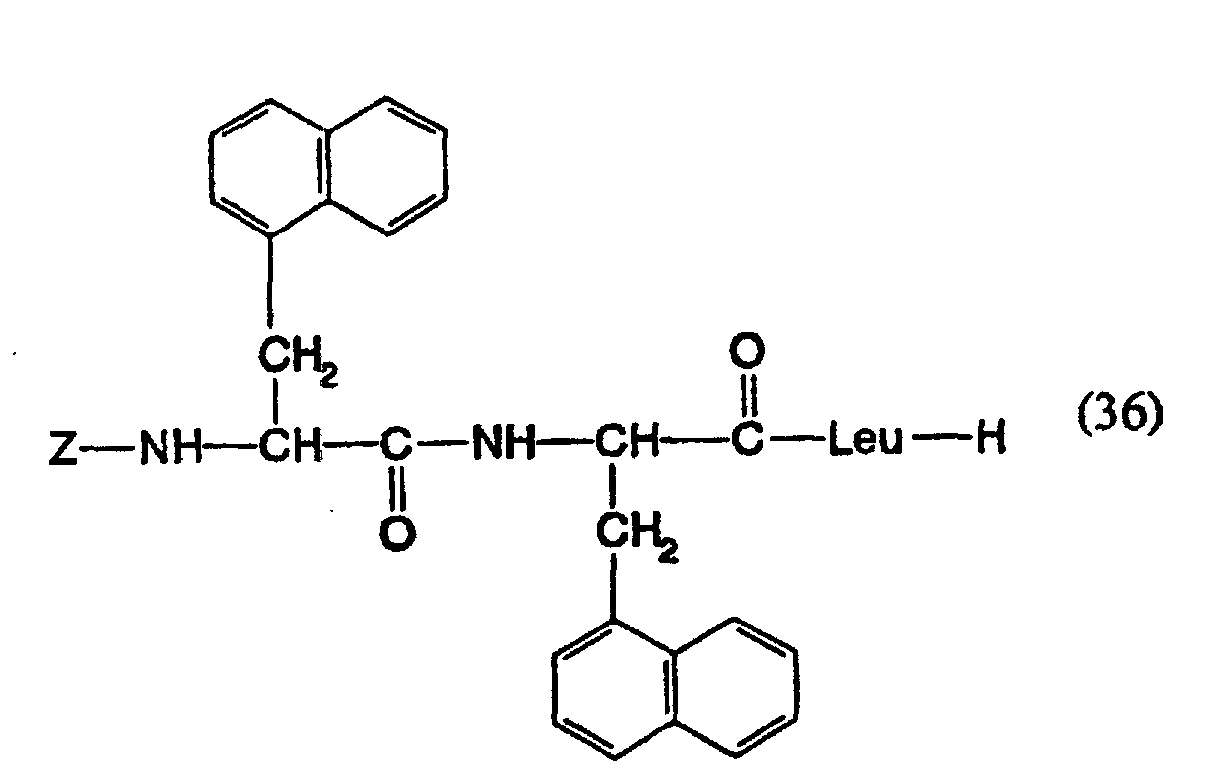
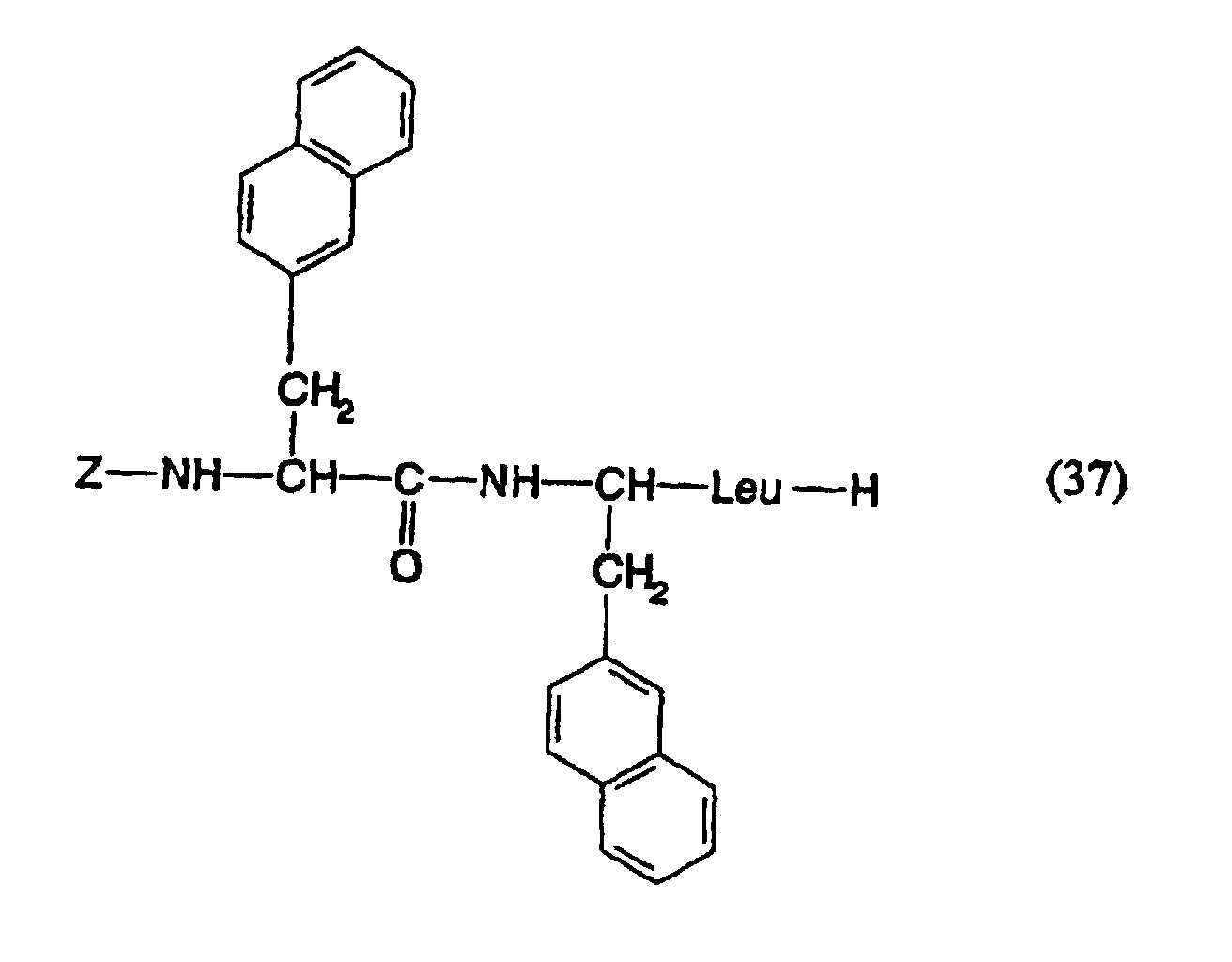 where:

- Most preferably, the proteasome inhibitors are:
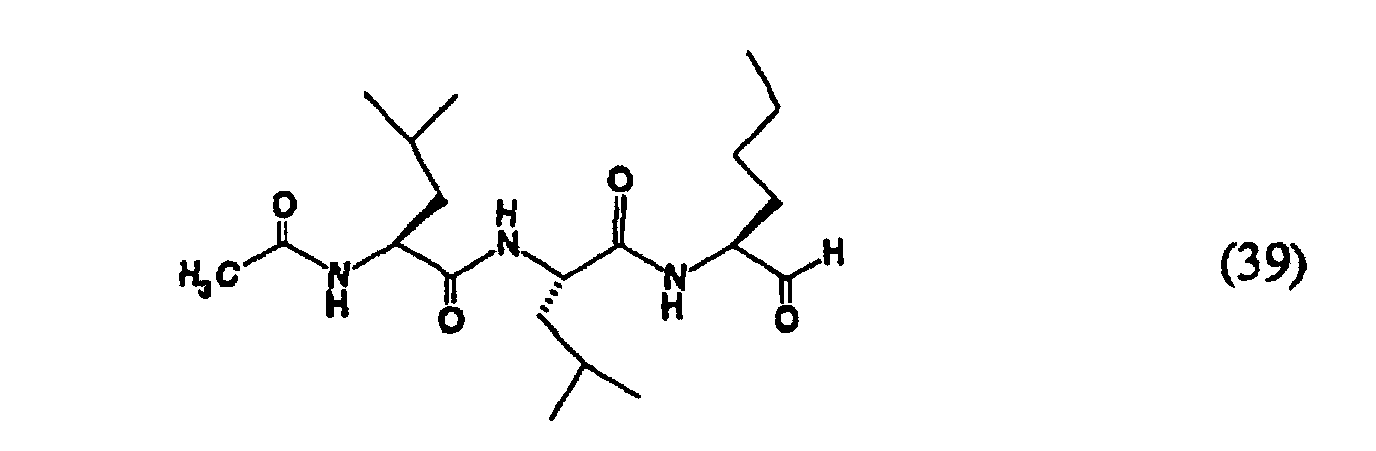


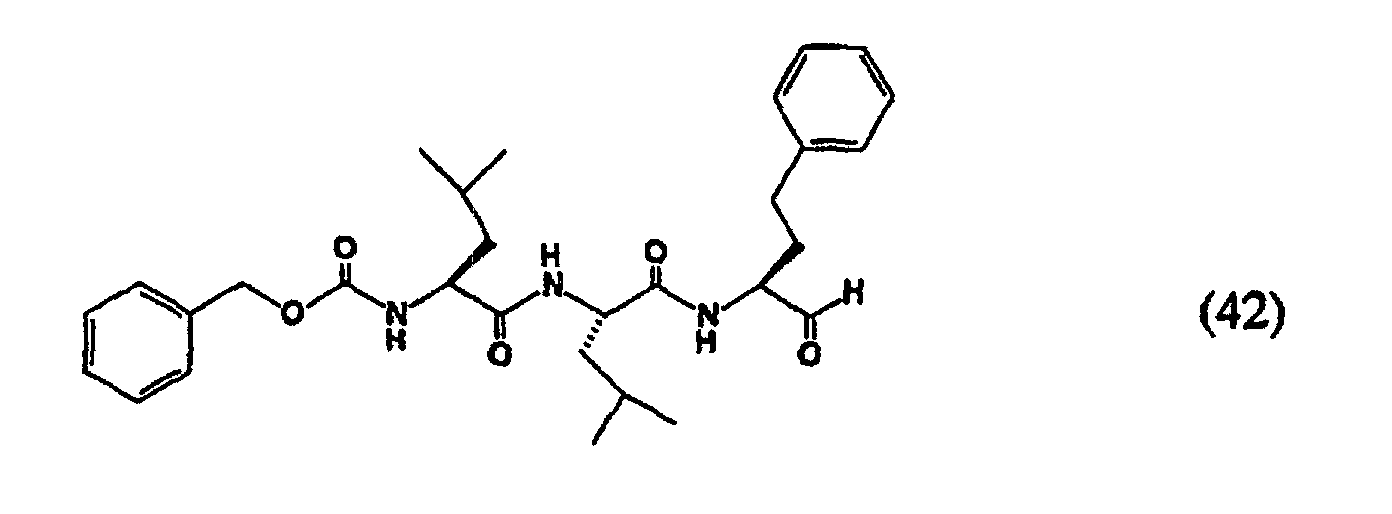

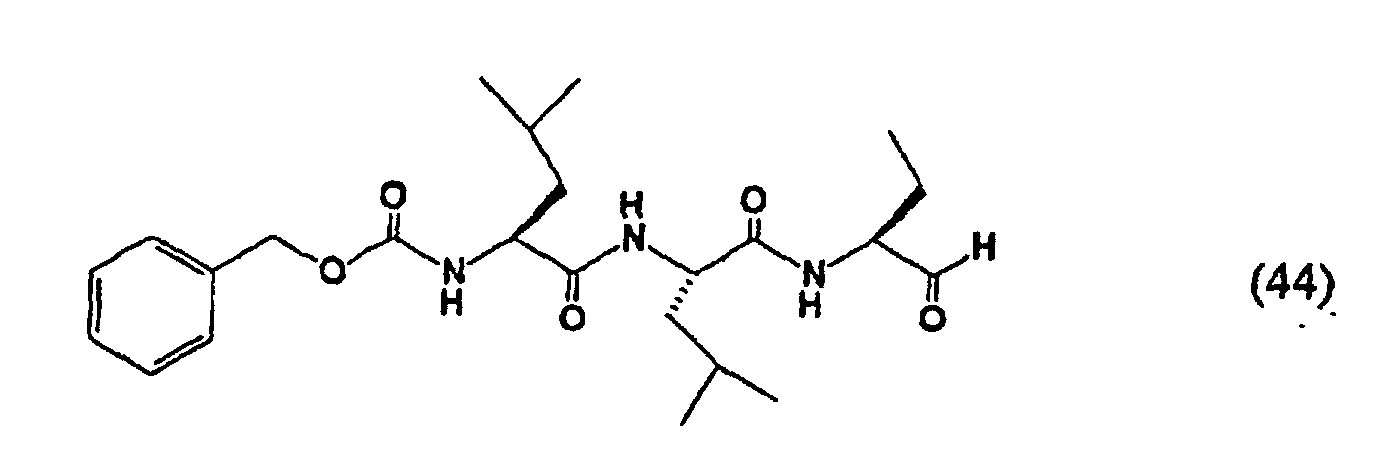

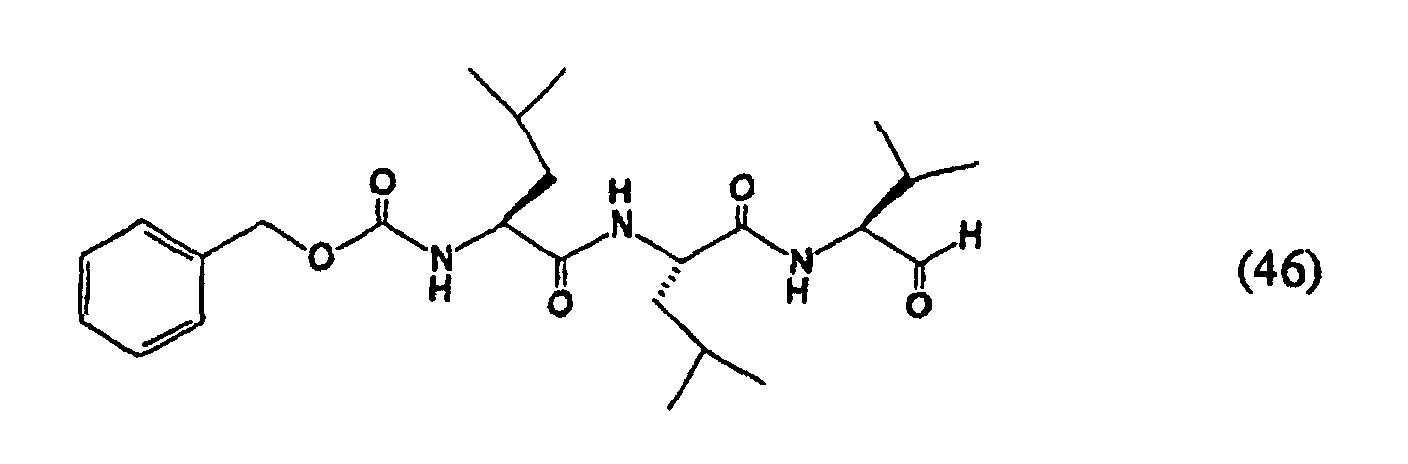

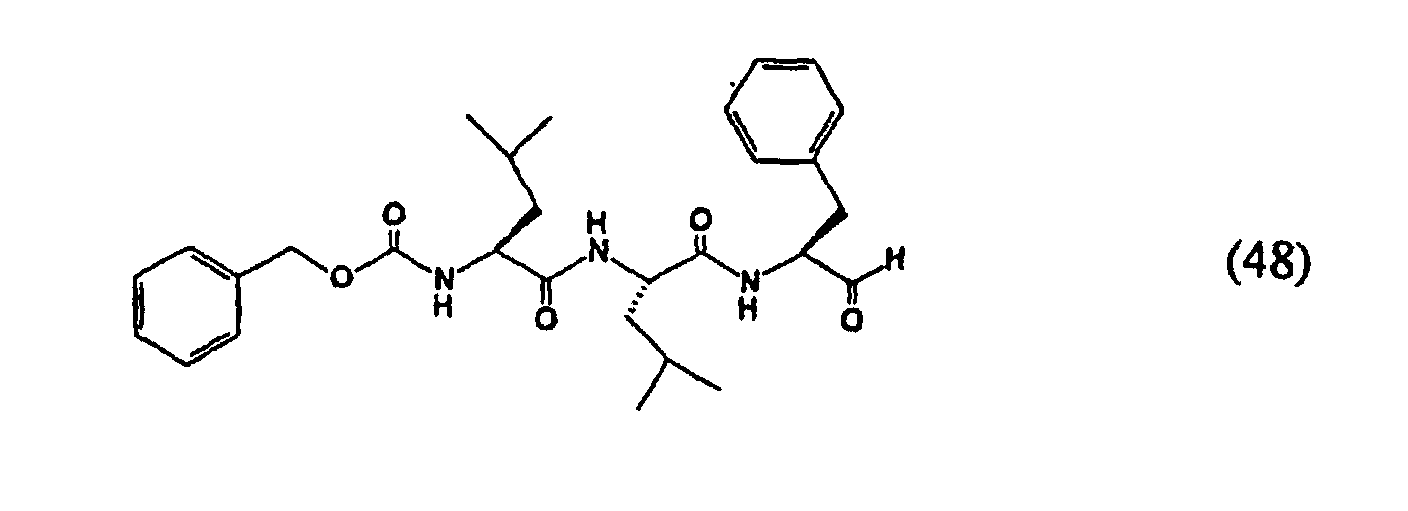
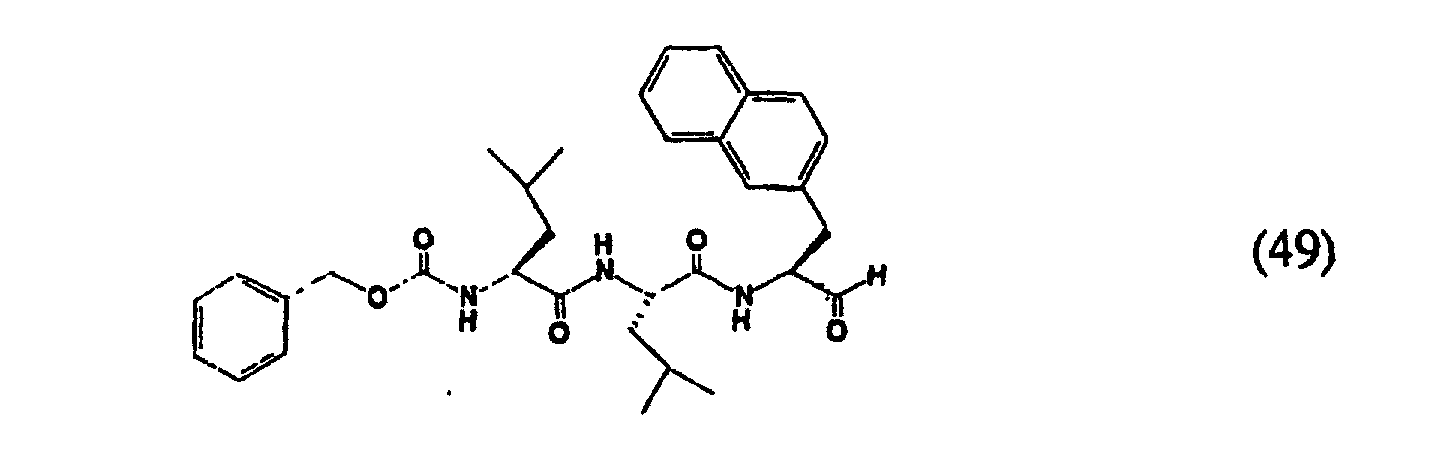
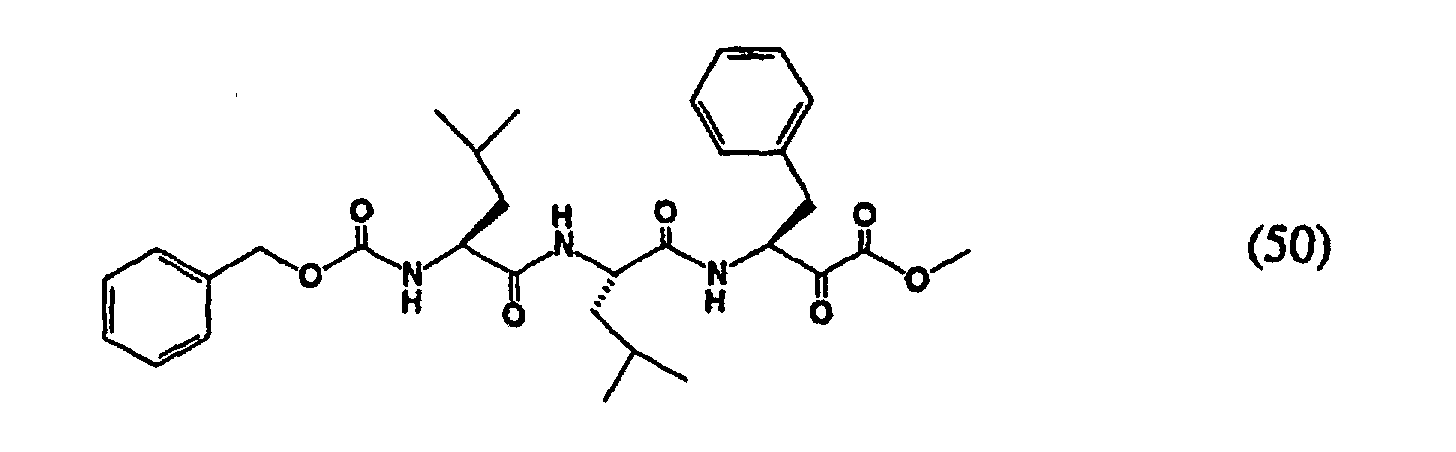
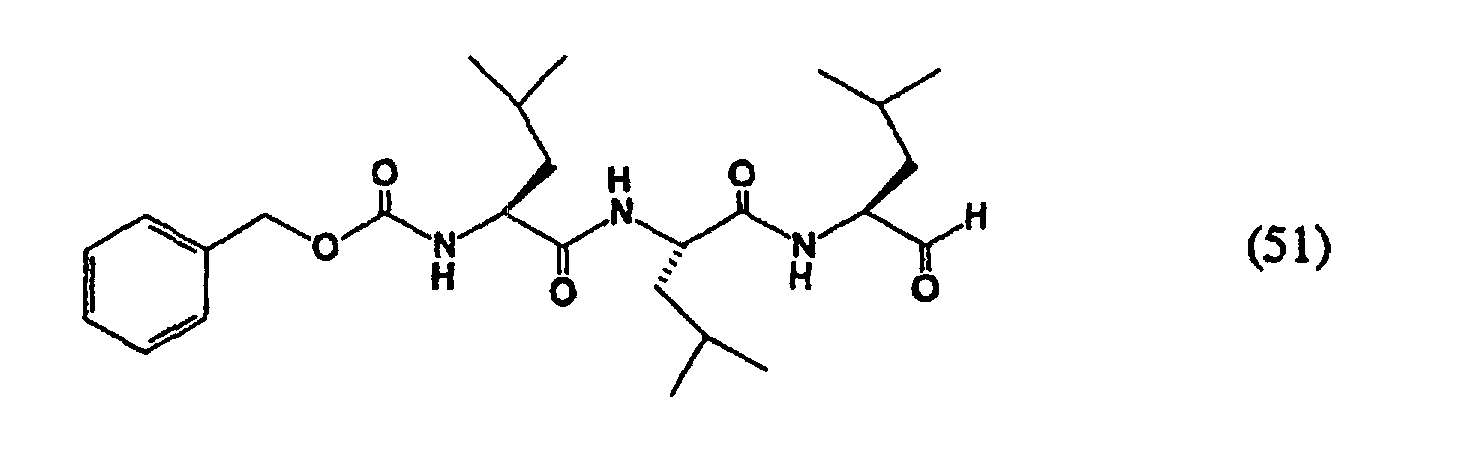
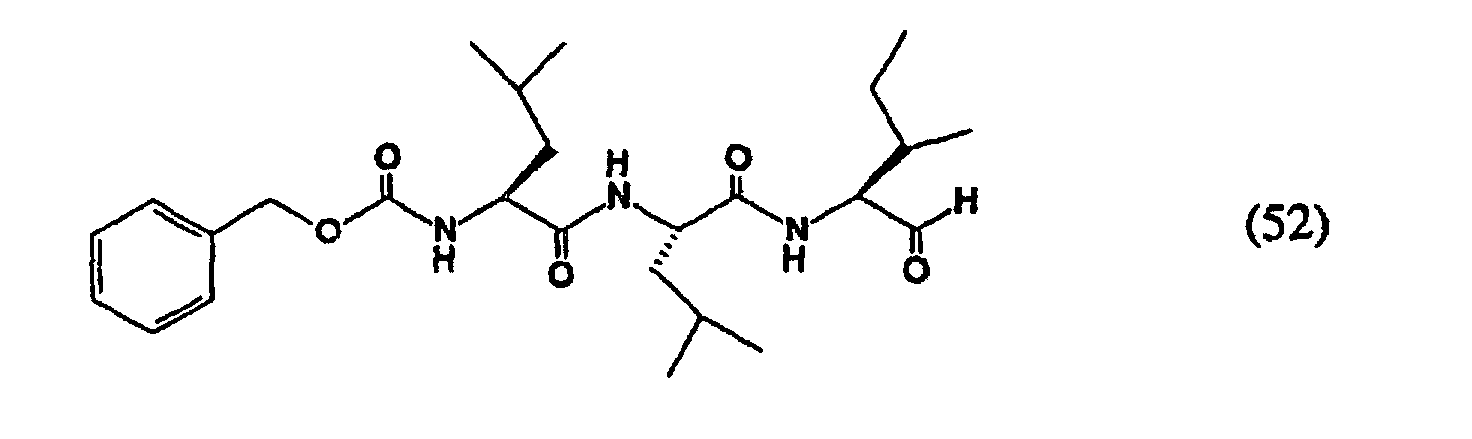


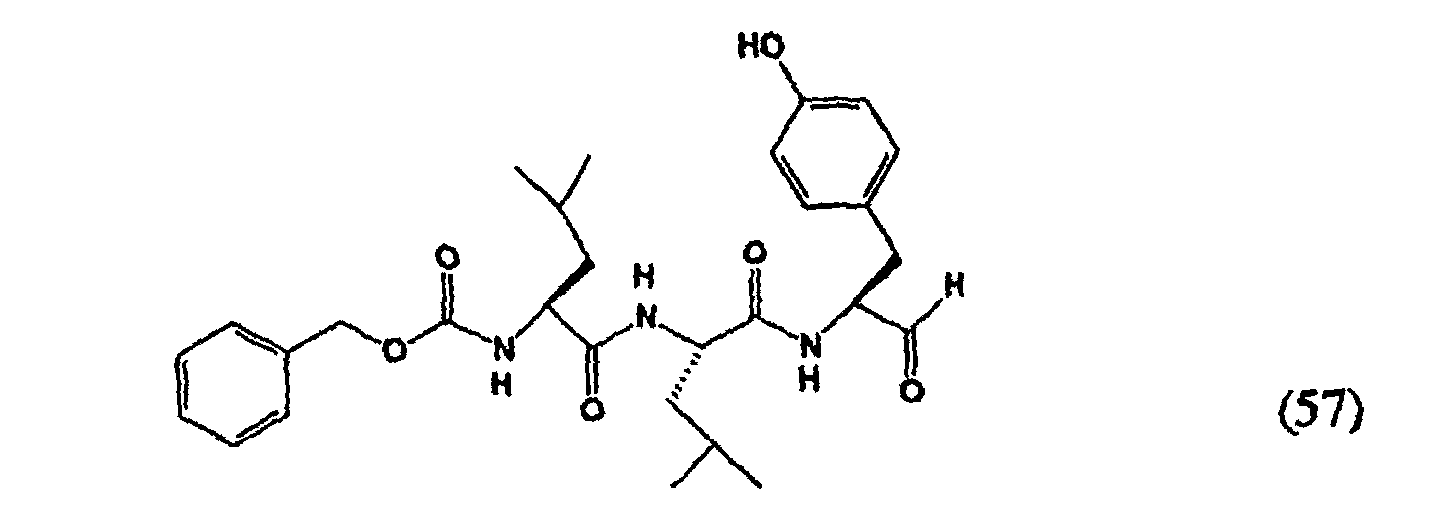
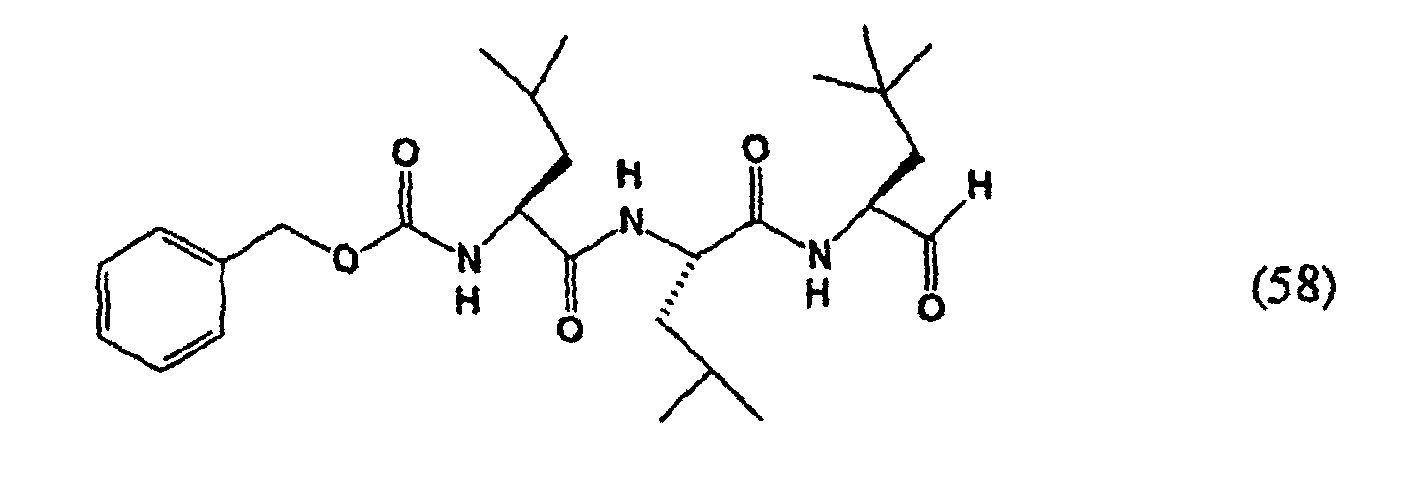

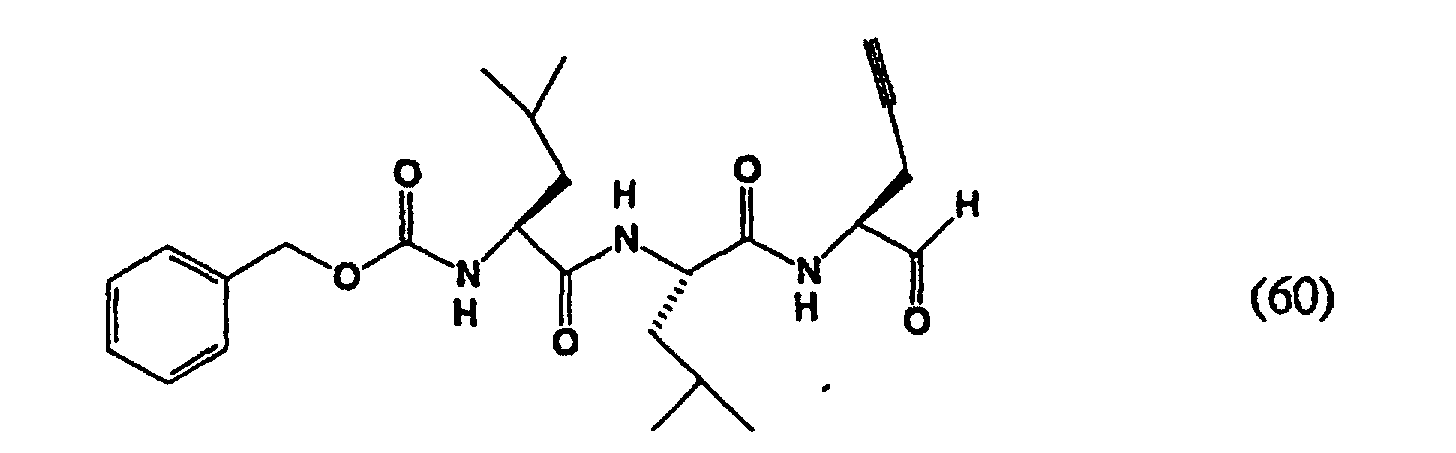
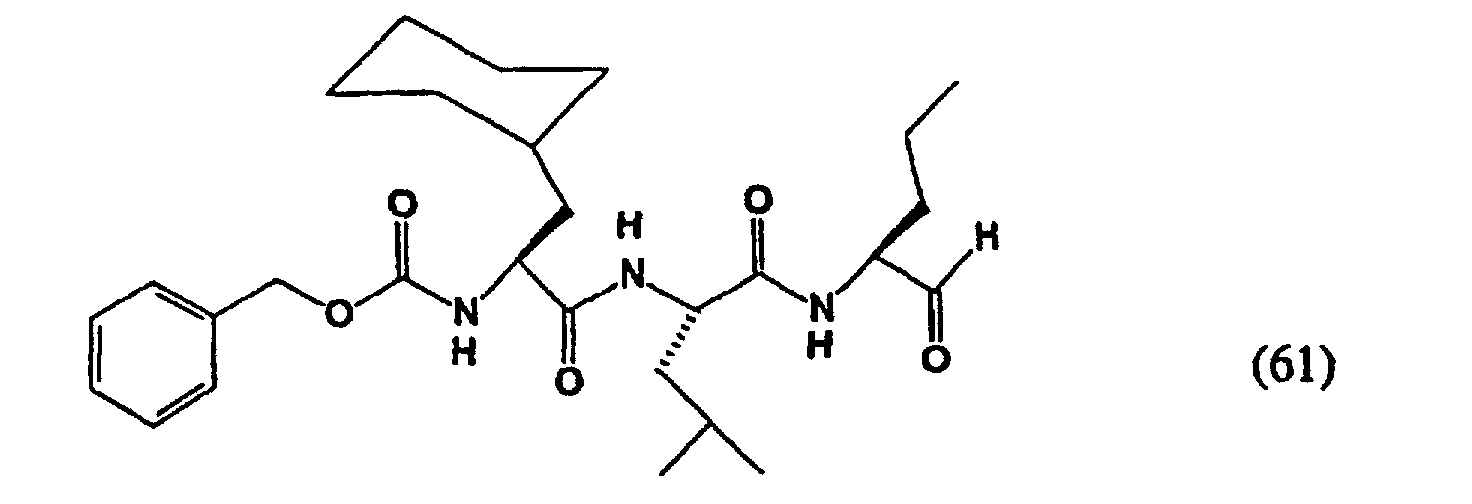

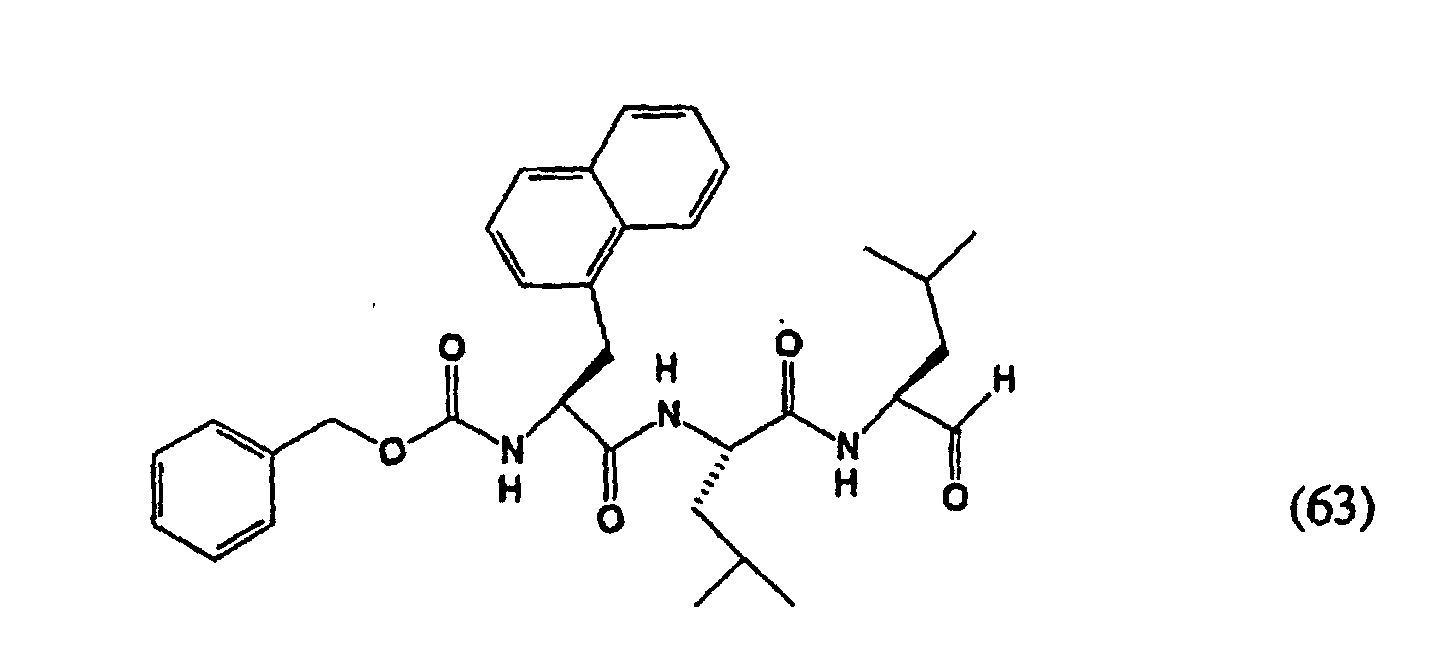


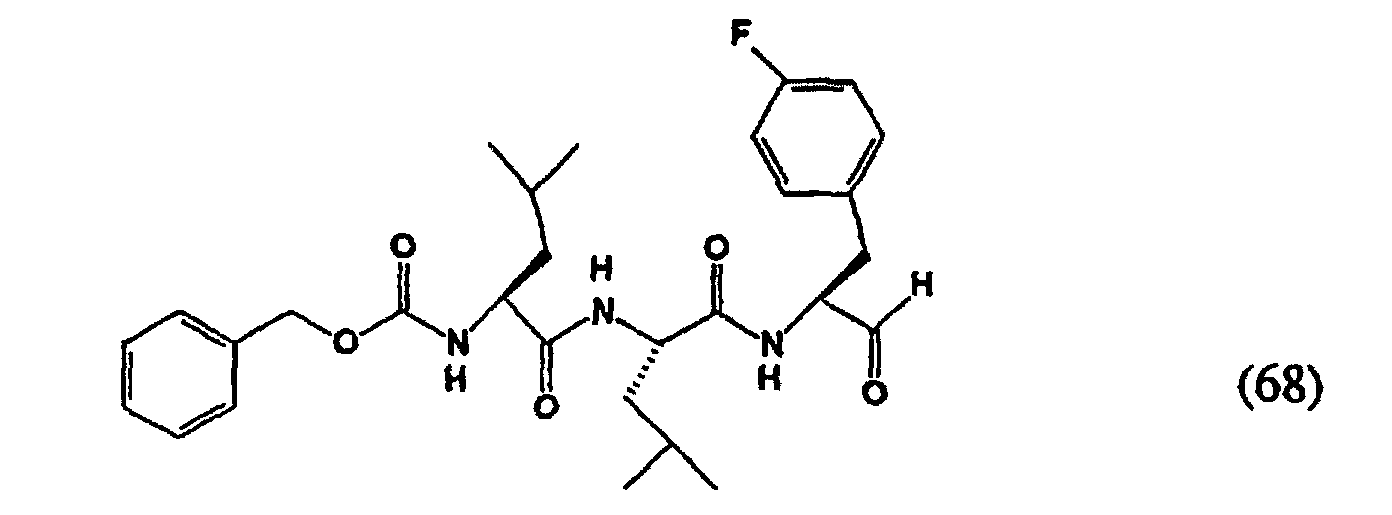
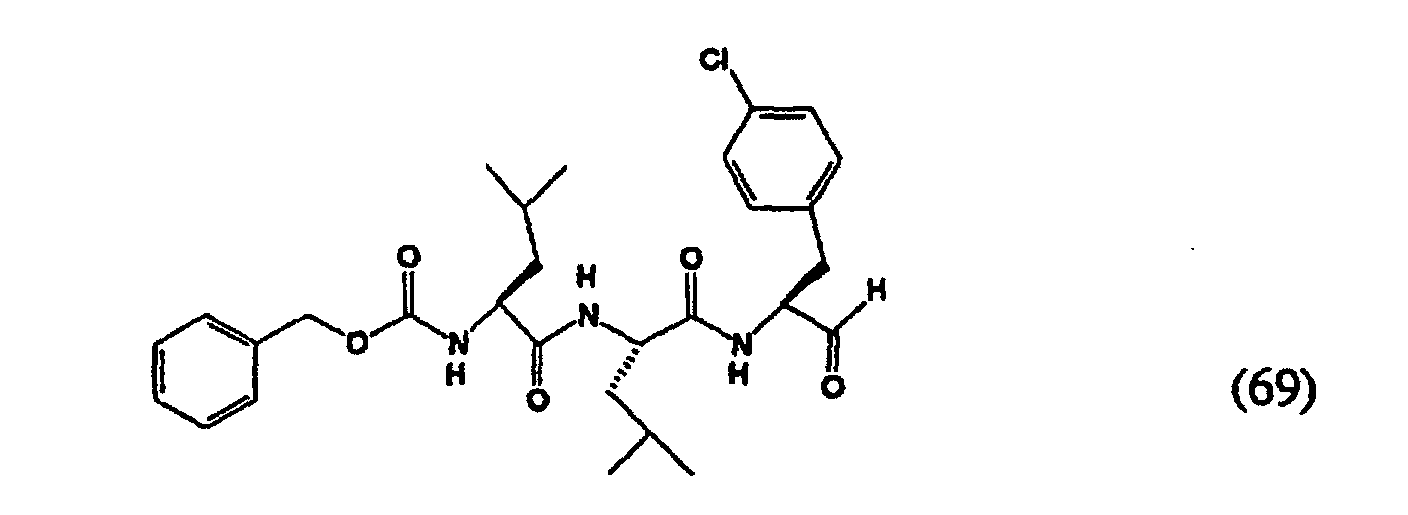


- The present invention relates to uses of inhibitors of proteasome function or ubiquitin conjugation. In the present invention, the accelerated proteolysis is inhibited by interfering with the ATP-Ub-dependent pathway at one or more possible steps (e.g., by interfering with activity of the 26S proteasome complex, or by interfering with activity of one of its components).
- A particularly useful approach to testing drug candidates for their ability to inhibit the ATP-ubiquitin-dependent degradative process is to do so in cultured cells in which a short-lived protein whose degradation is ubiquitin-dependent is produced. Inhibition of the process leads to accumulation of the protein in the cytosol. The extent to which the protein accumulates in the cytosol can be determined, using known methods. For example, a potential inhibitor of the process can be introduced into cultured cells producing a short-lived enzyme and the extent to which the enzyme is present in the cytosol in the presence of the potential inhibitor can be compared with the extent to which it occurs in its absence. Accumulation of the enzyme in the presence of the potential inhibitor is indicative of inhibition of the ATP-ubiquitin-dependent processes by the potential inhibitor being tested. Cultured cells, such as COS cells, which are stably transformed with a gene encoding a short-lived protein whose degradation is ubiquitin-dependent (e.g., a short-lived enzyme, such as a mutant β-galactosidase from E. coli, whose half-life is about 15 minutes and whose degradation is ubiquitin-dependent) can be used (Bachmair, A. et al., Science 234:179-186 (1986); Gonda, D.K. et al., J. Biol. Chem. 264:16700-16712 (1989)). Other mutant forms of enzymes that are rapidly degraded can also be used. Accumulation of the mutant β-galactosidase in COS cytosol in the presence of a substance being assessed for its ability to inhibit the process (a potential inhibitor) is indicative of inhibition of the process. An appropriate control is COS cells maintained under the same conditions, but in the absence of the potential inhibitor. This approach can be used to screen for effective inhibitors from microbial broths or chemical libraries.
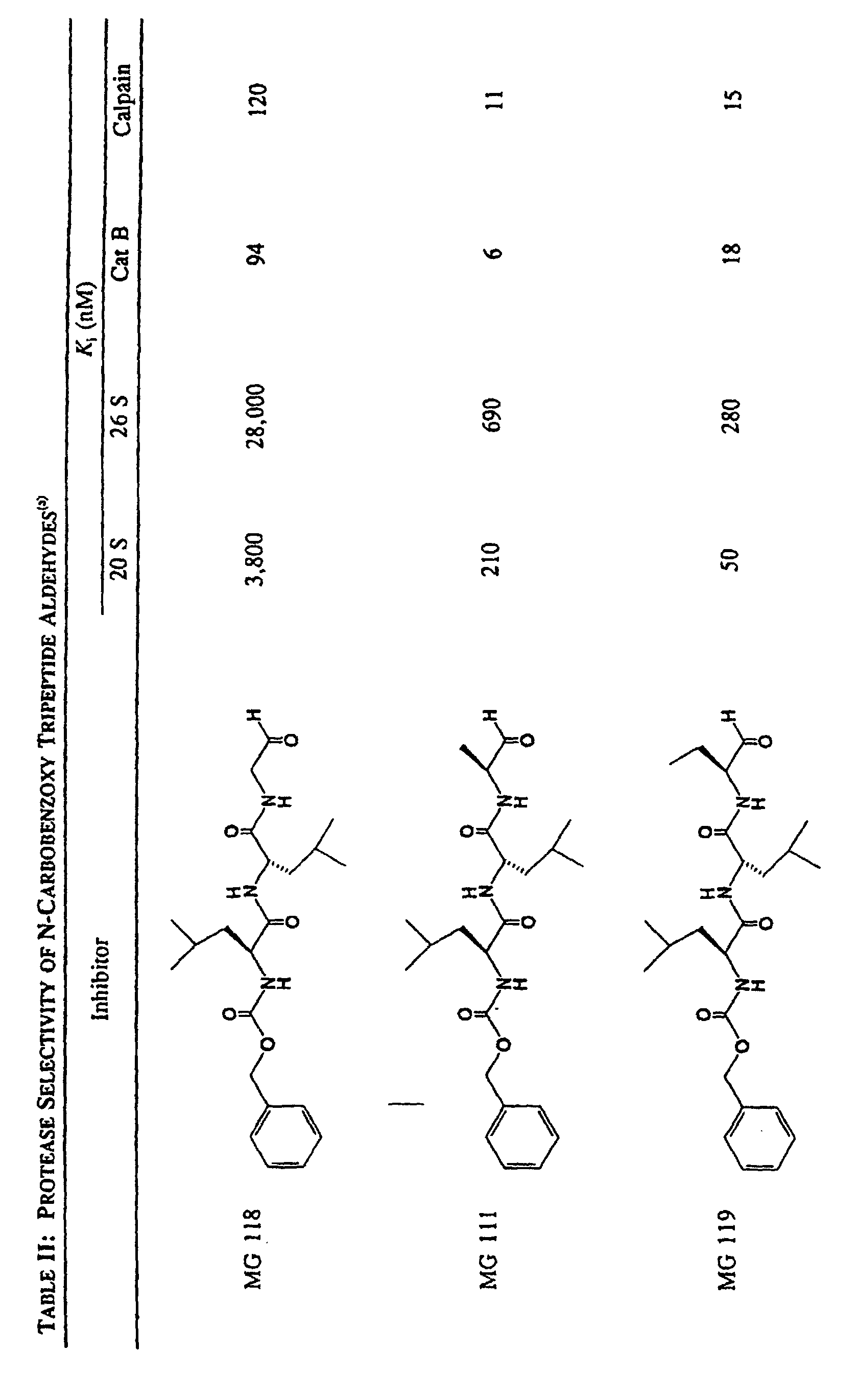
- Tables I-III summarize results from kinetic experiments that measured the inhibition of the 20S and 26S proteasomes, as well as cathepsin B and calpain. In these tables, K i values are reported, which are dissociation constants for the equilibrium that is established when enzyme and inhibitor interact to form the enzyme:inhibitor complex.
- The substances and assay conditions are briefly summarized in the footnotes to Table
I. MG 101 and MG 102, also known as Calpain Inhibitor I and II, were purchased from Calbiochem as catalogue products.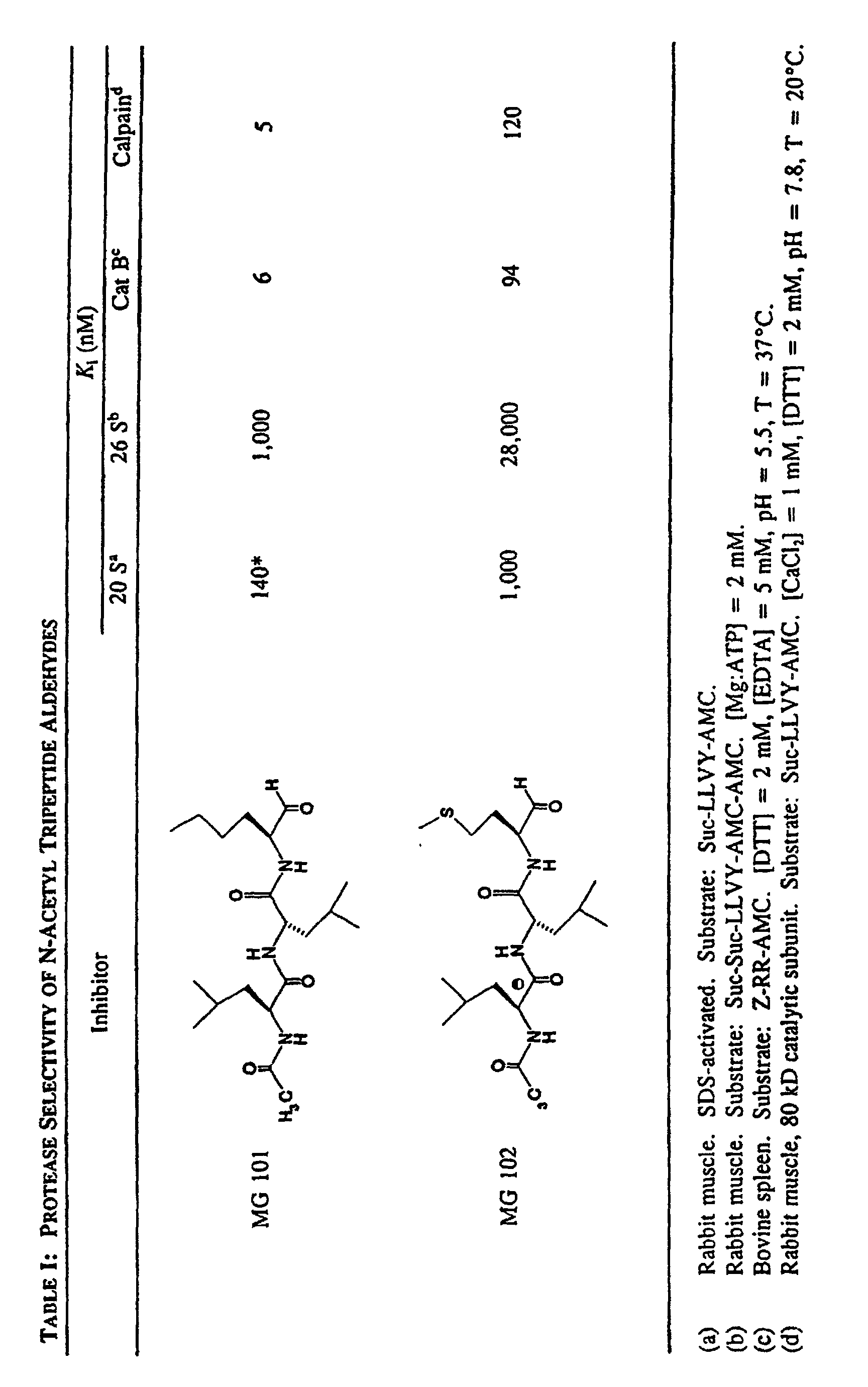


- Data also show that
MG 101 is an inhibitor of the 26S ATP-dependent protease and an inhibitor of the proteasome (macropain, multi-catalytic protease) (Table IV).MG 101 Inhibits Different Forms of Muscle ProteasomeEnzyme Preparation No Inhibitor Relative Catalytic Efficiency MG 101 Ki (µM) 20S Proteasome 1 7 26S Proteasome Complex 2 3 20S Proteasome + Muscle 180 kDa Activator 50 0.6 20S Proteasome + SDS 140 0.14 - The inhibitors can be used in vitro or in vivo. They can be administered by any number of known routes, including orally, intravenously, intramuscularly, topically, and by infusion (Platt et al., U.S. Patent No. 4,510, 130; Badalamente et al., Proc. Natl. Acad. Sci. U.S.A. 86:5983-5987 (1989); Staubli et al., Brain Research 444:153-158 (1988)) and will generally be administered in combination with a physiologically acceptable carrier (e.g., physiological saline). The effective quantity of inhibitor to be given will be determined empirically and will be based on such considerations as the particular inhibitor used, the condition of the individual, and the size and weight of the individual. They can be administered alone or in combination with another inhibitor or an inhibitor of another pathway.
- Table V summarizes data for the inhibition of the 20S proteasome by various tripeptide aldehyde inhibitors.


- The present invention will now be illustrated by the following examples, which are not intended to be limiting in any way.
- All peptidyl N,O-dimethylhydroxylamides were prepared by solution phase method using 1-ethyl-3-(3-dimethylaminopropyl)carbodiimide hydrochloride as coupling reagent (Sheehan et al., J. Am. Chem. Soc. 87:2492-2493 (1965)). Reduction of the hydroxylamide with lithium aluminum hydride provided peptidyl aldehyde (Fehrentz et al., Synthesis:676-678 (1983)); Fehrentz et al., Int. J. Peptide Protein Res. 26:236-241 (1985)); All compounds are characterized by Proton nuclei magnetic resonance (NMR) spectroscopy. The purity of the products was verified by thin layer chromatography and, in some cases, by high performance liquid chromatography (HPLC).
- 1-Ethyl-3-(3-dimethylaminopropyl)carbodiimide hydrochloride (443 mg) in one portion was added to a mixture of N-Boc-L-norvaline dicyclohexylammonium salt (838 mg), N,O-dimethylhydroxylamine hydrochloride (215 mg), 1-hydroxybenzotriazole monohydrate (340 mg), and N-methylmorpholine (0.28 ml) in dimethyl formamide (DMF, 20 ml) at 0°C. The mixture was stirred at 0°C for 2 hours, then at room temperature for 40 hours. The reaction was quenched with water (80 mL) and the mixture was extracted with ethyl acetate (EtOAc, 3 x 100 mL). The combined organic layers were washed with aqueous 10% hydrogen chloride (HCl), saturated sodium bicarbonate (NaHCO3), and brine, then dried over anhydrous magnesium sulfate (MgSO4), filtered, and evaporated to afford the product (546 mg) as an oil.
- A solution of N-Boc-L-norvaline N,O-dimethylhydroxylamide (546 mg) and trifluoroacetic acid (8 mL) in methylene chloride (20 mL) was stirred at 0°C for 3 hours. The solvent was evaporated under reduced pressure and the residue was dried under vacuum. To this flask was added Z-L-leucine-L-leucine (794 mg), 1-hydroxybenzotriazole monohydrate (340 mg), N-methylmorpholine (0.28 mL), and DMF (20 mL). 1-Ethyl-3-(3-dimethylaminopropyl)carbodiimide hydrochloride (442 mg) was then added at 0°C. The mixture was stirred at 0°C for 2 h, then at room temperature for 24 h. The reaction was quenched with water (40 mL) and the mixture was extracted with EtOAc (3 x 60 mL). The combined organic layers were washed with aqueous 10% HCl, saturated NaHCO3, and brine, then dried over anhydrous MgSO4, filtered, and evaporated to afford the product (1.09 g) as a white solid.
- A solution of Z-L-leucine-L-leucine-L-norvaline N,O-dimethylhydroxylamide (1.09 g) was dissolved in 20 mL dry tetrahydrofuran (THF) and cooled to 0°C. Lithium aluminum hydride (1 M solution in THF, 3.05 mL) was added and the mixture was stirred at 0°C for 25 minutes. Potassium bisulfate (465 mg) in 20 mL water was added and the mixture was extracted with EtOAc (3 x 80 mL). The combined organic layers were washed with aqueous 5 % HCI, saturated NaHCO3, and brine, then dried over anhydrous MgSO4, filtered, and evaporated to afford the product (430 mg) as a white solid.
- A mixture of N-Boc-L-leucine-L-leucine (1 g), N,O-dimethylhydroxylamine hydrochloride (423 mg), 1-hydroxybenzotriazole monohydrate (509 mg), and N-methylmorpholine (0.42 mL) was dissolved in DMF (20 mL). 1-Ethyl-3-(3-dimethylaminopropyl)carbodiimide hydrochloride (610 mg) was added at 0°C for 2 h, then at room temperature for 40 h. The reaction was quenched with water (80 mL) and the mixture was extracted with EtOAc (3 x 100 mL). The combined organic layers were washed with aqueous 10% HCl, saturated NaHCO3, and brine then dried over anhydrous MgSO4, filtered, and evaporated to afford the product (923 mg) as a white solid.
- A solution of N-Boc-L-leucine-L-leucine N,O-dimethylhydroxylamide (923 mg) and trifluoroacetic acid (10 mL) in methylene chloride (20 mL) was stirred at 0°C for 3 hours. The solvent was evaporated under reduced pressure and the residue was dried under vacuum. A portion of this product (488 mg) was transferred to another flask and was combined with Z-L-leucine (451 mg), 1-hydroxybenzotriazole monohydrate (276 mg), N-methylmorpholine (0.22 mL), and DMF (15 mL). 1-Ethyl-3-(3-dimethylaminopropyl) carbodiimide hydrochloride (357 mg) was then added at 0°C. The mixture was stirred at 0°C for 2 h, then at room temperature for 42 h. The reaction was quenched with water (50 mL) and the mixture was extracted with EtOAc (3 x 60 mL). The combined organic layers were washed with aqueous 10% HCl, saturated NaHCO3, and brine, then dried over anhydrous MgSO4, filtered, and evaporated to afford the product as a white solid. This was further purified by silica gel chromatography (hexane/acetone 80:20, 70:30) to give the title compound (546 mg) as a white solid.
- A solution of Z-L-leucine-L-leucine-L-leucine N,O-dimethylhydroxylamide (546 mg) was dissolved in 15 mL dry tetrahydrofuran (THF) and cooled to 0°C. Lithium aluminum hydride (1 M solution in THF, 4.1 mL) was added and the mixture was stirred at 0°C for 30 minutes. Potassium bisulfate (1.39 g) in 30 mL water was added and the mixture was extracted with EtOAc (3 x 50 mL). The combined organic layers were washed with aqueous 5 % HCl, saturated NaHCO3, and brine, then dried over anhydrous MgSO4, filtered, and evaporated to afford the product (446 mg) as a white solid. This was further purified by reverse phase HPLC (water/acetonitrile).
- A mixture of N-Boc-L-leucine (2.47 g), N,O-dimethylhydroxylamine hydrochloride (1.09 g), 1-hydroxybenzotriazole monohydrate (1.51 g), and N-methylmorpholine (1.21 mL) was dissolved in DMF (40 mL), 1-Ethyl-3-(3-dimethylaminopropyl)carbodiimide hydrochloride (2.14 g) was added at 0°C and the mixture was stirred at 0°C for 2h, then at room temperature for 22 h. The reaction was quenched with water (100 mL) and the mixture was extracted with EtOAc (3 x 100 mL). The combined organic layers were washed with aqueous 10% HCl, saturated NaHCO3, and brine, then dried over anhydrous MgSO4, filtered, and evaporated to afford the product (2.57 g) as an oil.
- A solution of N-Boc-L-leucine N,O-dimethylhydroxylamide (983 mg) and trifluoroacetic acid (8 mL) in methylene chloride (20 mL) was stirred at 0°C for 3 hours. The solvent was evaporated under reduced pressure and the residue was dried under vacuum. A portion of this product (208 mg) was transferred to another flask and was combined with Boc-L-(1-naphthyl)-alanine (378 mg) 1-hydroxybenzotriazole monohydrate (178 mg) N-methylmorpholine (0.15 mL), and DMF (10 mL). 1-Ethyl-3(3-dimethylaminopropyl) carbodiimide hydrochloride (241 mg) was then added at 0°C. The mixture was stirred at 0°C for 2 h, then at room temperature for 17 hours. The reaction was quenched with water (20 mL) and the mixture was extracted with EtOAc (3 x 50 mL). The combined organic layers were washed with aqueous 10% HCl, saturated NaHCO3, and brine, then dried over anhydrous MgSO4, filtered, and evaporated to afford the product as a white solid (459 mg).
- A solution of Boc-L-(1-naphthyl)-alanine-L-leucine N,O-dimethylhydroxylamide (459 mg), trifluoroacetic acid (5 mL), and thioanisole (2 mL) was stirred at 0°C for 2.5 hours. The solvent was evaporated and the residue was dried under vacuum. A portion of this product (182 mg) was transferred to another flask and was combined with Z-L-(2-naphthyl)-alanine (171 mg), 1-hydroxybenzotriazole monohydrate (99 mg), N-methylmorpholine (0.08 mL), and DMF (10 mL). 1-Ethyl-3-(3-dimethylaminopropyl) carbodiimide hydrochloride (112 mg) was then added at 0°C. The mixture was stirred at 0°C for 2 h, then at room temperature for 41 hours. The reaction was quenched with water (20 mL) and the mixture was extracted with EtOAc (3 x 50 mL). The combined organic layers were washed with aqueous 10% HCl, saturated NaHCO3, and brine, then dried over anhydrous MgSO4, filtered, and evaporated to afford' the product as a white solid. This was then purified by silica gel chromatography (hexane/acetone 80:20, 70:30) to give the title compound (321 mg).
- Z-L-(2-naphthyl)-alanine-L-(1-naphthyl)-alanine-L-leucine-N,O-dimethylhydroxylamide (321 mg) was dissolved in 15 mL dry tetrahydrofuran (THF) and cooled to 0°C. Lithium aluminum hydride (1 M, solution in THF, 1.7 mL) was added and the mixture was stirred at 0°C for 30 minutes. Potassium bisulfate (0.59 g) in 30 mL water was added and the mixture was extracted with EtOAc (3 x 40 mL). The combined organic layers were washed with aqueous 5% HCl, saturated NaHCO3, and brine, then dried over anhydrous MgSO4, filtered, and evaporated to afford the product (274 mg) as a white solid.
- The p60Tth precursor (or p105) was translated in wheat germ extract. The substrate protein was mixed with HeLa cell cytoplasmic extract (S100) in a processing buffer containing 12 mM Tris, pH 7.5, 60 mM KCl, 20 mM creatine phosphate, 3.5 mM MgCl2 and 1 mM ATP. After incubation at 30° C for one hour, the reaction mixtures were subjected to immunoprecipitation with anti-p50 Ab and the proteins were resolved by SDS-PAGE. In the Apyrase treated sample, the p60 was incubated with 10 U of enzyme at 37° C for 30 minutes to inactivate residual ATP in the wheat germ extract before adding the HeLa cell S100. The control sample did not receive the enzyme or ATP. The results are shown in Figure 1.
- HeLa cell S100 was centrifuged for six hours at 100,000xg to remove proteasomes. Loss of proteasome activity was verified using a fluorogenic peptide assay specific for the proteasome. The results from two different depleted extracts [Pr-(I & II)] are shown. The pellet contains most of the proteasome activity. The processing reactions were carried out as described in Example 4 and the reactions were immunoprecipitated with either anti-p50 Ab or anti-myc peptide mAb. The anti-myc mAb will recognize the N-terminal myc-peptide on a tagged p60 precursor protein. The results are shown in Figure 3.
- Monoclonal antibodies against specific components of the proteasome (MCP20, 29K) and a control McAb against hemagglutinin (HA 12CA5) were incubated with Pr-(II) extract reconstituted with proteasome activity from the pellet. The immune complexes were removed and the depleted extracts were used in p60 processing reactions as described in Example 4. The results are shown in Figure 4.
- Increasing amounts of purified 20/26S proteasomes or a proteasome-enriched fraction from reticulocyte lysate, fraction II, were added alone or were combined with Pr-(II) extract in a processing reaction (see Example 4). In addition, processing was inhibited by ATPγS, a non-hydrolyzable analogue of ATP that allows ubiquitination but inhibits proteasome function (lanes 3-5). See Figure 5.
- In this Example, and in those described above, there are ladder-like bands that appear when the substrate is incubated with extracts lacking proteasome activity (Pr-). The ubiquitination of p60 is more pronounced when 7.5 µg of purified ubiquitin (ub) is added to the Pr-(II) extract in a processing reaction (lane 5). See Figure 6.
-
- A. Different amounts of reticulocyte fraction II (+/- 7.5 µg of ub) were used in a processing reaction (see Example 4) with p60 as substrate. Fraction II has proteasome activity, but has very little ubiquitin.
- B. HeLa cell S100 or fraction II was supplemented with E. coli recombinant wild-type ub or mutant ub(L>R48) protein, which inhibits ub chain formation. Processing reactions were as described above.
-
- The results are shown in Figure 7.
- Both wild-type (PRE 1) and proteasome mutant (prel-1) yeast were transformed with human p105. The transformants were pulsed with 35S-methionine/cysteine for 20 minutes and chased with cold methionine/cysteine for various periods of time. Extracts were prepared, the lysates were immunoprecipitated with anti-p50 Ab and the proteins were resolved by SDS-PAGE. The results are shown in Figure 8.
- COS cells were transfected with human p105. Inhibitors (Calpain inhibitor, MG101, and MG115) in 50 µM portions were added to the cells one hour prior to the addition of 35S-methionine/cysteine. A typical 20 minute pulse-2 hour chase experiment, immunoprecipitated with anti-p50 Ab followed by SDS-PAGE, is shown in Figure 9. Only proteasome-specific inhibitors block p105 processing; non-specific protease inhibitors do not have an effect. These results were verified in vitro.
- HeLa or MG63 cells were pretreated with inhibitors (50 µM) for one hour. Cells were then treated with TNF-α (1000 U/ml) or IFN-γ (1000U/ml) for 30 and 60 minutes, respectively. Whole-cell extracts were prepared and analyzed by an electrophoretic mobility shift assay. The NF-κB site from the interferon-β gene was used to examine NF-κB binding activity and the pIRE site from the IRF-1 gene was used to measure gamma-activated factor (GAF) activity. The inhibitors only block NF-κB activation and have no effect on GAF induction. The results are shown in Figure 10.
- Although the foregoing refers to particular preferred embodiments, it will be understood that the present invention is not so limited. It will occur to those ordinarily skilled in the art that various modifications may be made to the disclosed embodiments and that such modifications are intended to be within the scope of the present invention.
where Y is a chalcogen, and R6 is alkyl; and
A is 0 or 1.
Claims (14)
- Use of an inhibitor of proteasome function or ubiquitin conjugation for the manufacture of a medicament for use in the treatment of an inflammatory condition.
- Use of an inhibitor of proteasome function or ubiquitin conjungation for the manufacture of a medicament for the treatment of HIV infection.
- Use as claimed in any one of claims 1 to 2 of an inhibitor of formula Iwhere
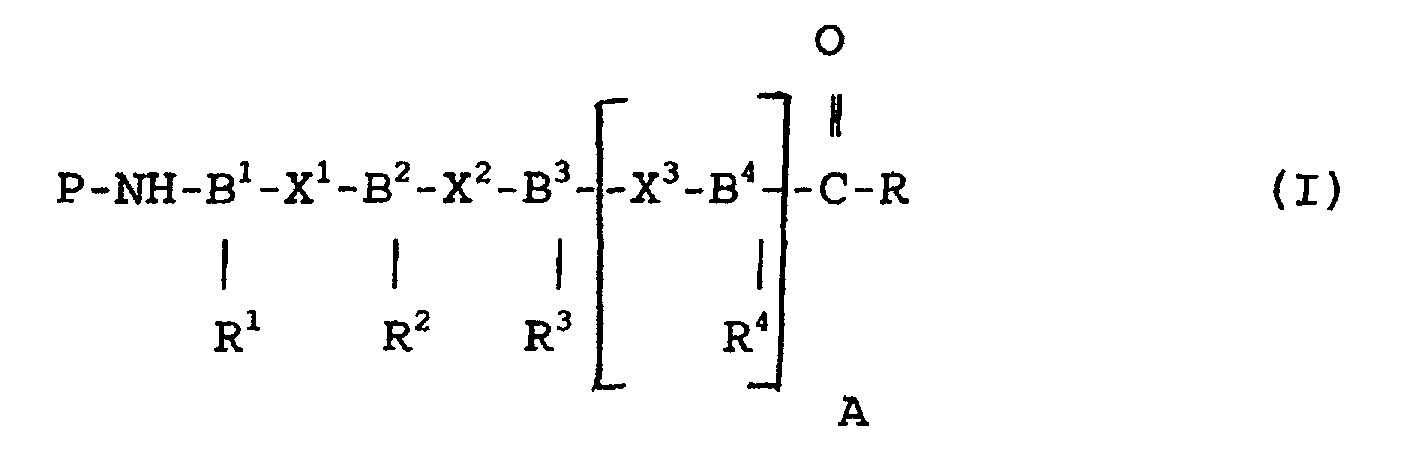 P is an amino-group-protecting moiety;B1, B2, B3 and B4 are independently selected from the group consisting of
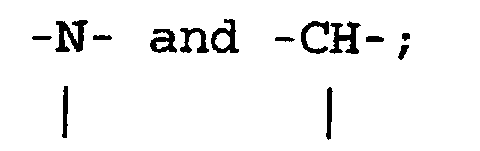 X1, X2 and X3 are independently selected from the group consisting of
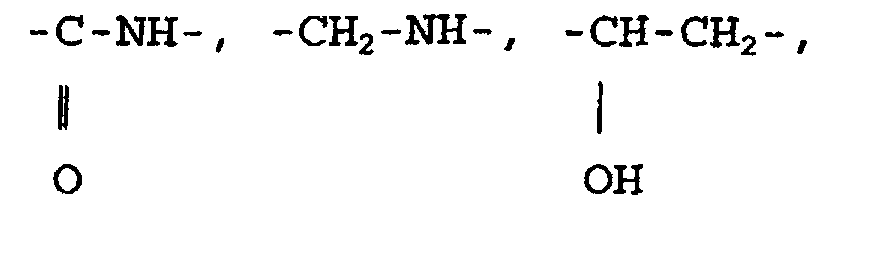 and -CH=CH-;
 R is a hydrogen, alkyl, acyl or carboxyl;R1, R2, R3 and R4 are independently selected from the group consisting of hydrogen, alkyl, cycloalkyl, alkenyl, alkynyl, aryl and -CH2-R5;R5 is aryl, aralkyl, alkaryl, cycloalkyl or -Y-R6;Y is a chalcogen;R6 is alkyl; andA is 0 or 1.
 - Use as claimed in claim 3 of an inhibitor of formula I wherein P isand R7 is alkyl, aryl, alkaryl, aralkyl, alkoxy, aryloxy, alkaryloxy or aralkoxy.

- Use as claimed in either of claims 3 and 4 of an inhibitor of formula I wherein X1, X2 and X3 are

- Use as claimed in claim 5 of an inhibitor of formula I wherein A is 0 and B1, B2 and B3 are

- Use as claimed in any one of claims 3 to 6 of an inhibitor of formula I wherein R1 and R2 are independently selected from the group consisting of alkyl and -CH2-R5, where R5 is cyclohexyl or naphthyl.
- Use as claimed in any one of claims 3 to 7 of an inhibitor of formula I wherein R1 and R2 are isobutyl.
- Use as claimed in any one of claims 1 to 2 of an inhibitor selected from the following:








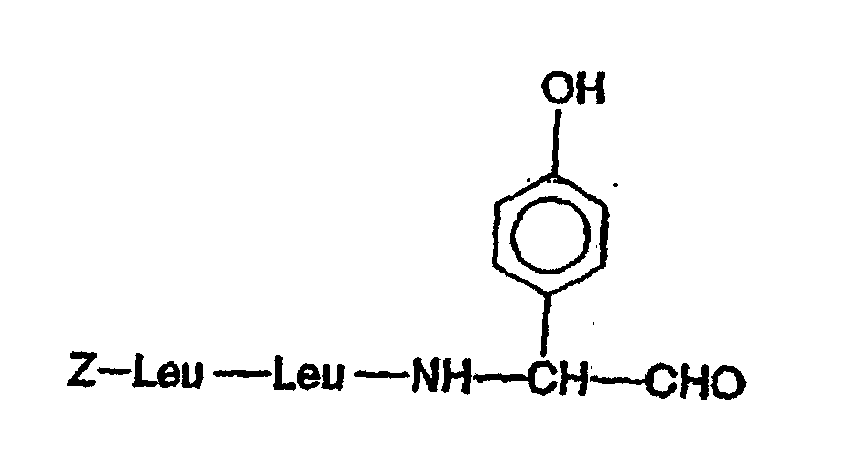
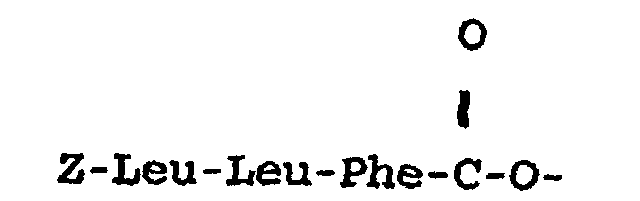


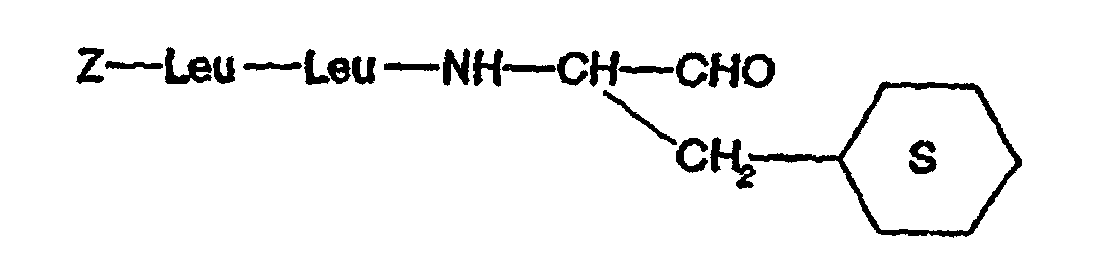
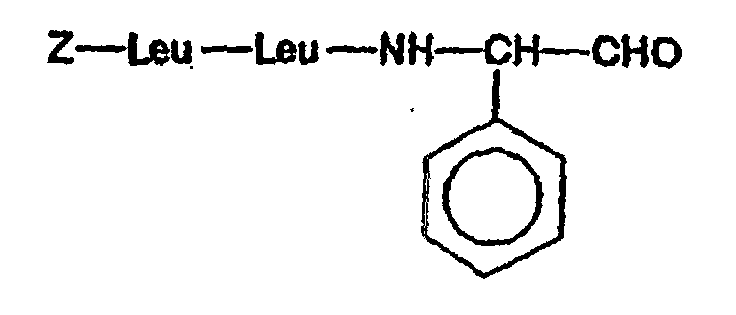
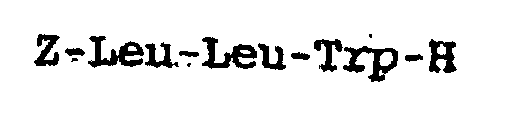
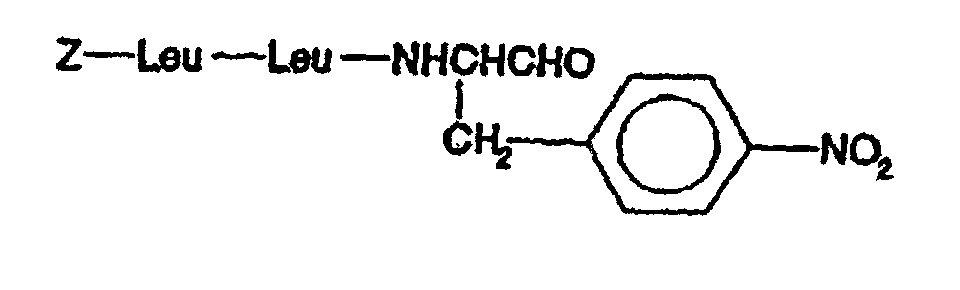
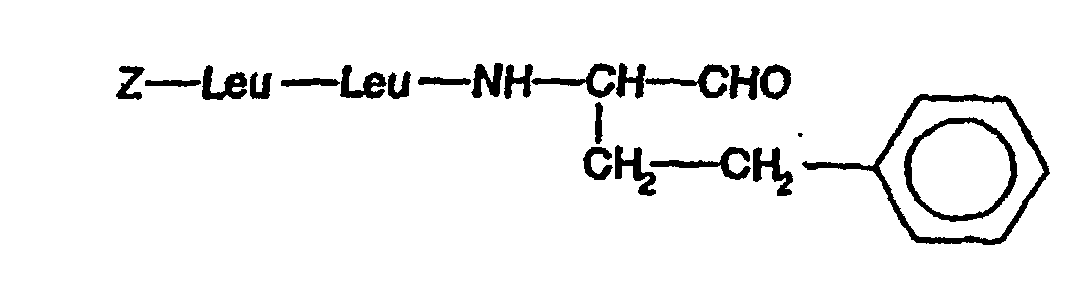
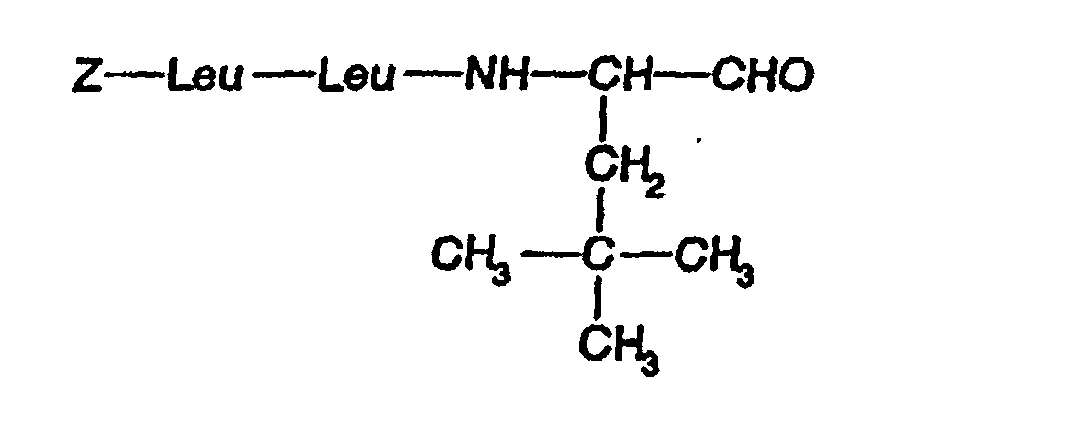



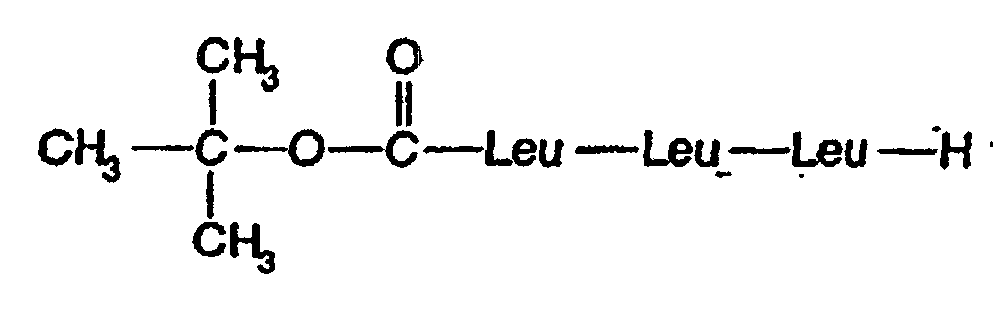
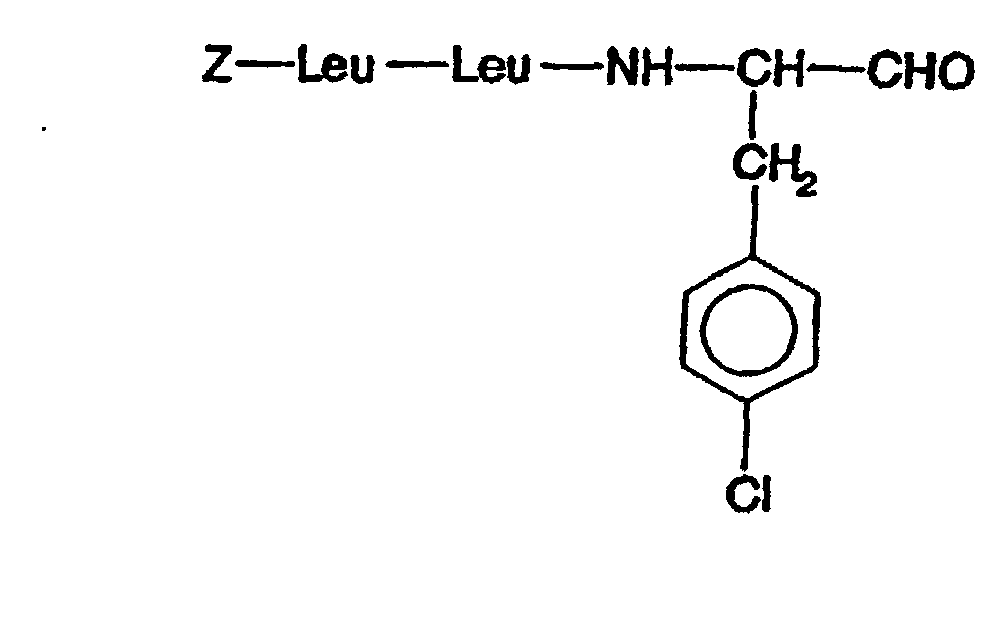

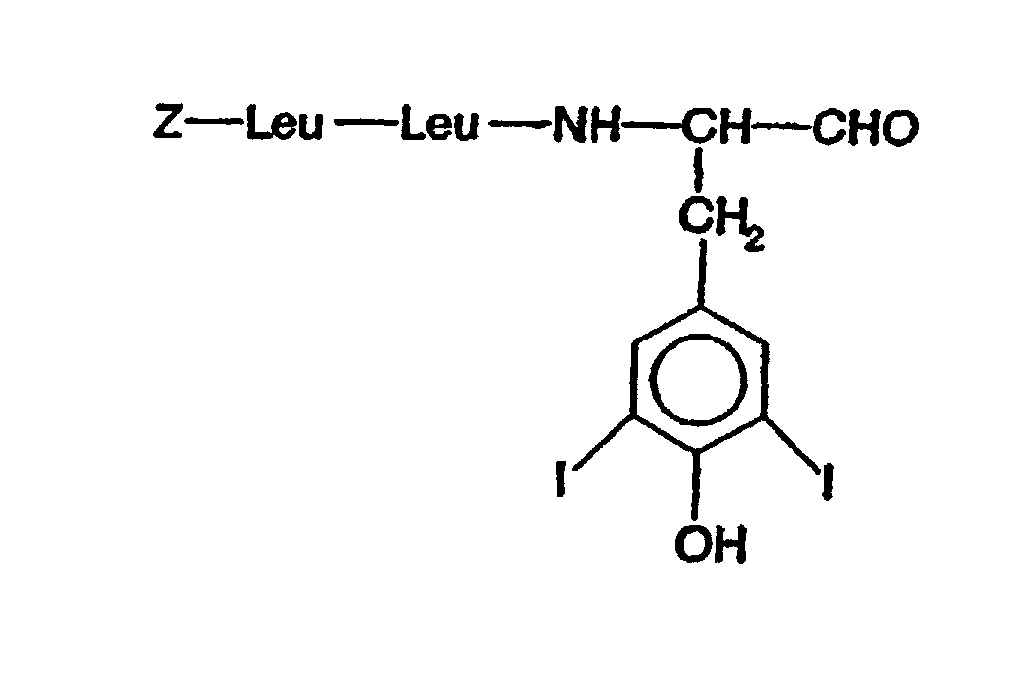
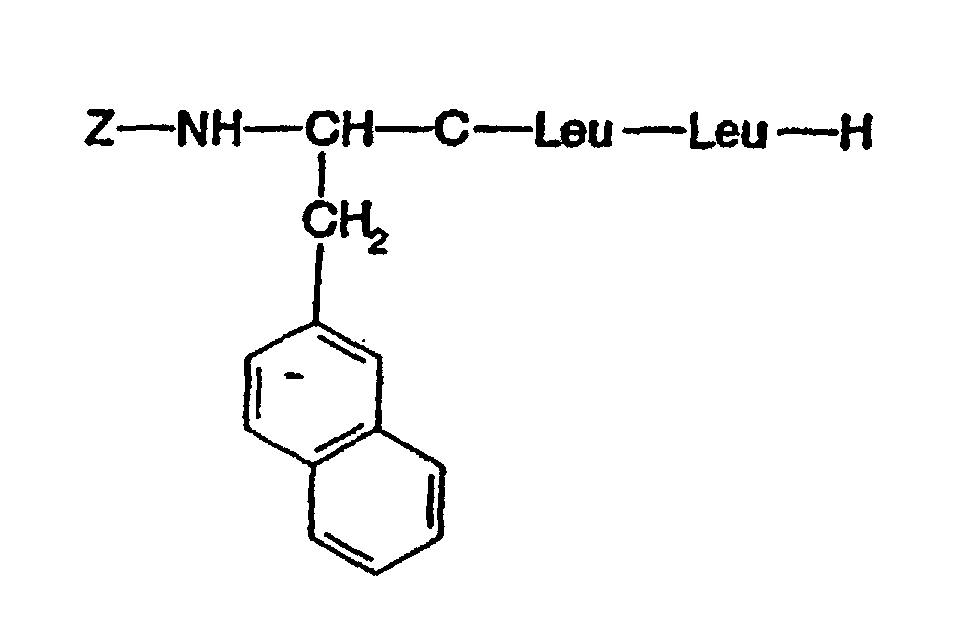
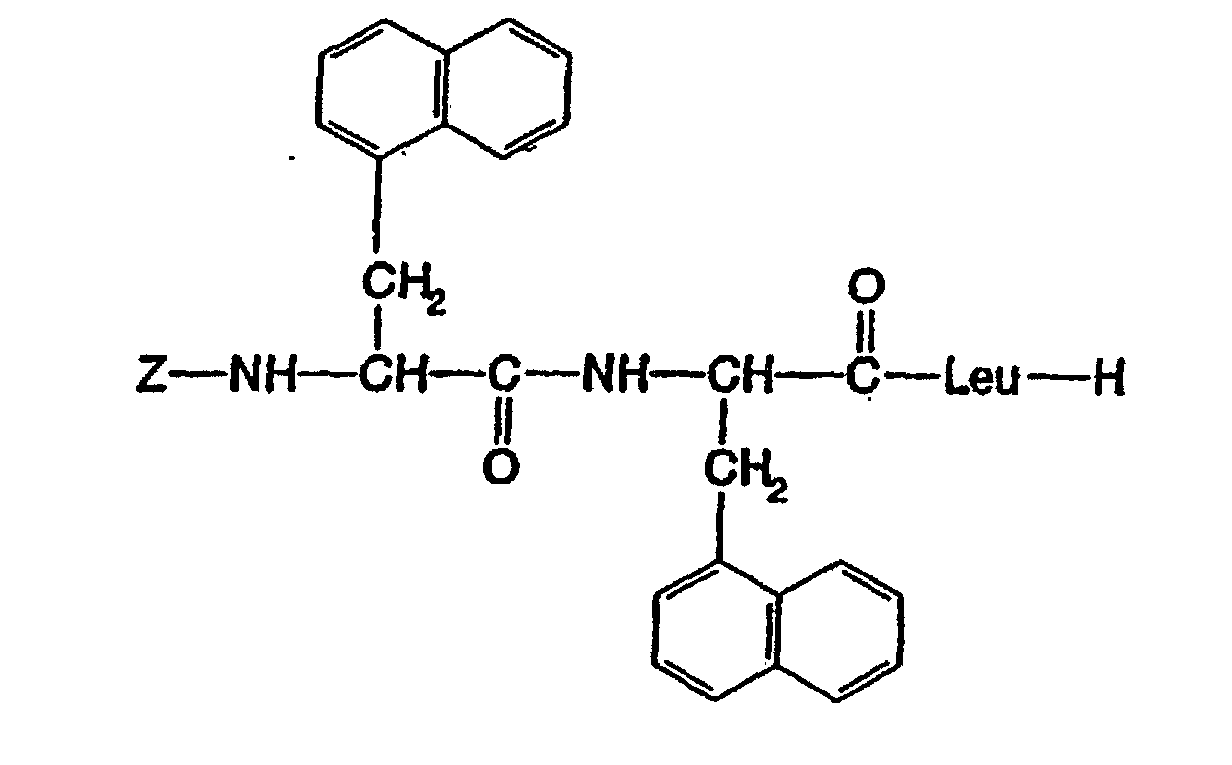

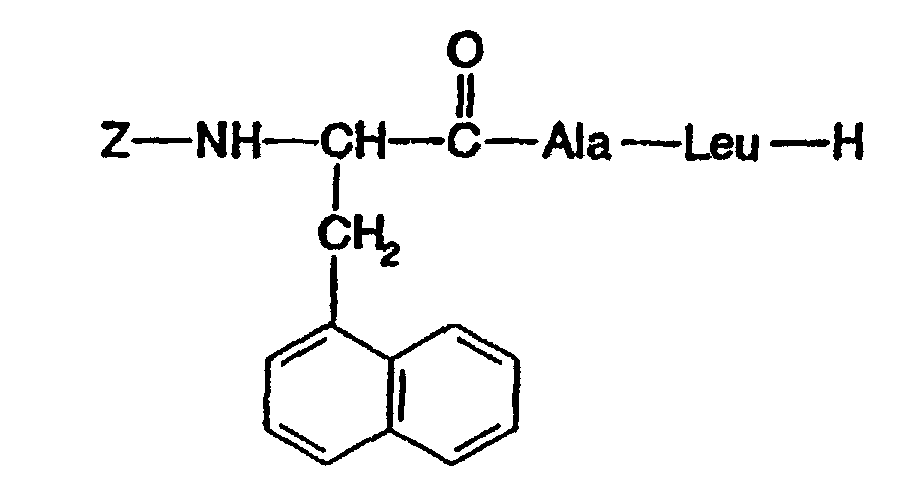 where:
 Nle = Norleucine
Nva = Norvaline
Nal = Naphthylalanine. - Use as claimed in any one of claims 1 to 2 of an inhibitor selected from the following:
 (where Z and Ac are as defined in claim 6).
- Use as claimed in any one of claims 1 to 2 of an inhibitor selected from the following:
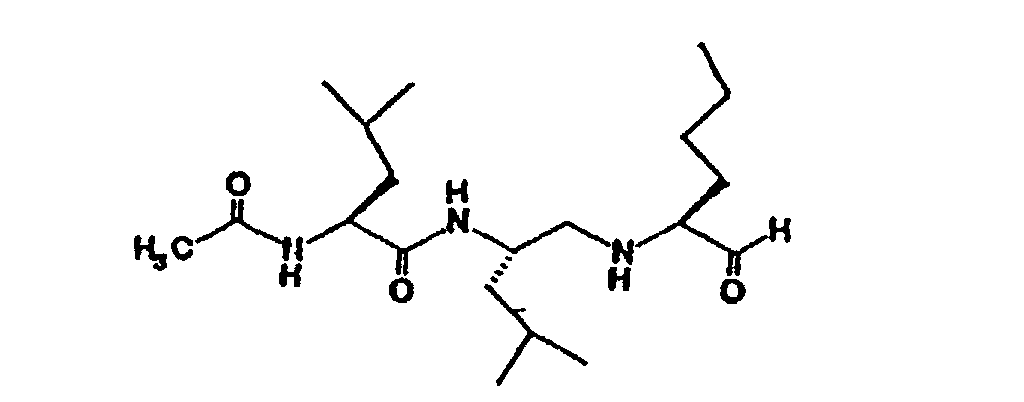


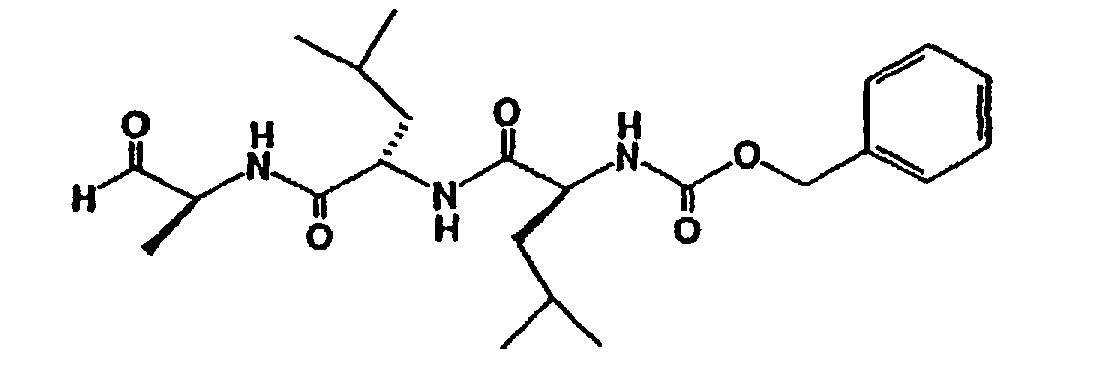
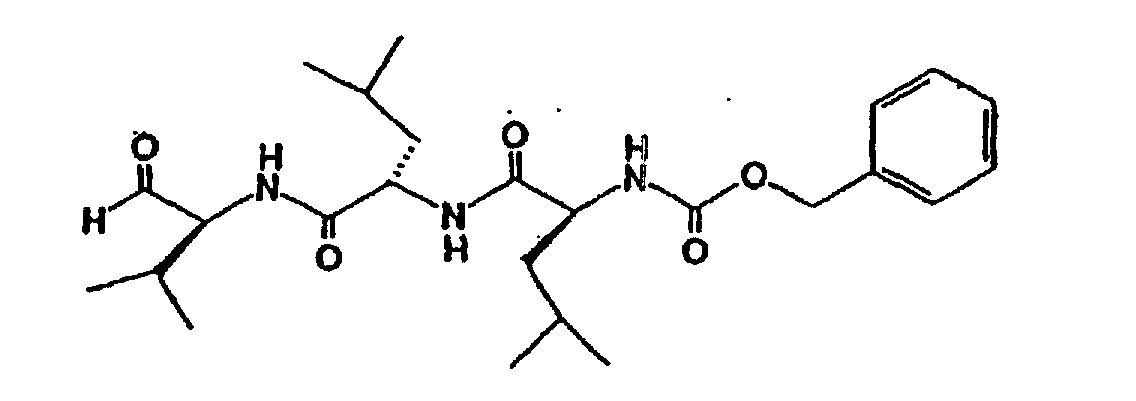

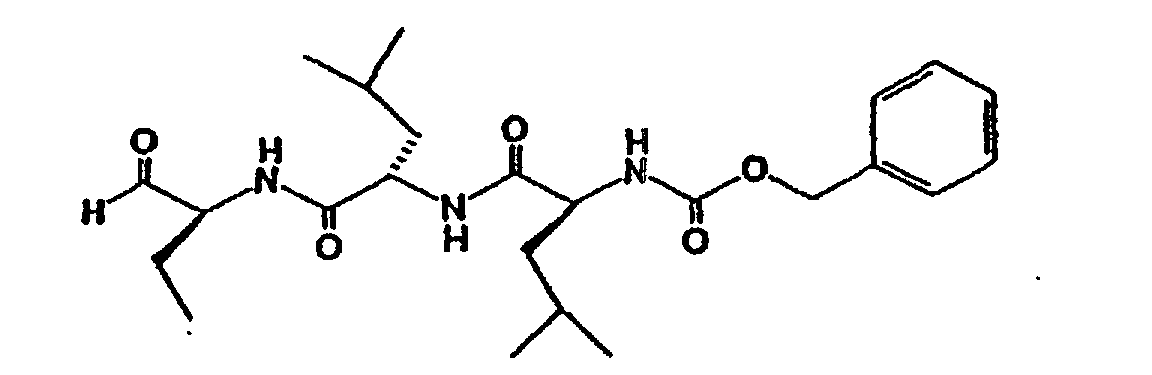


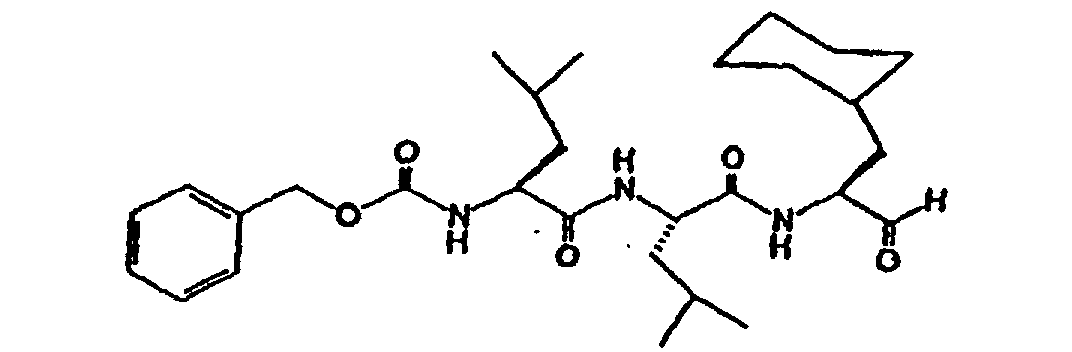
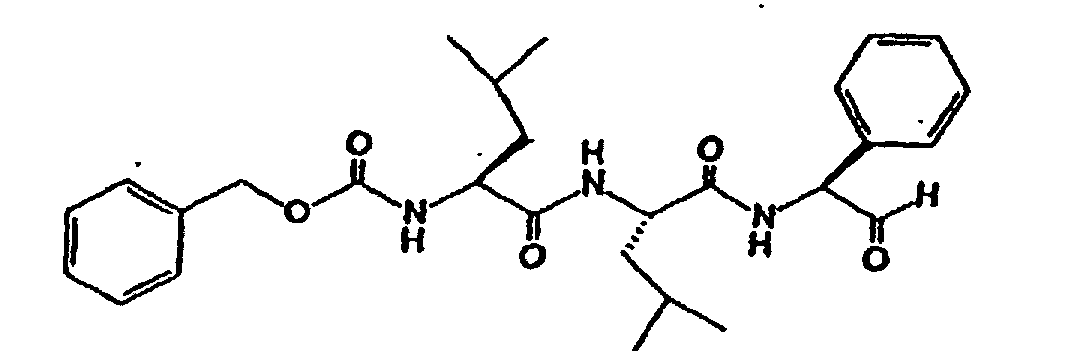


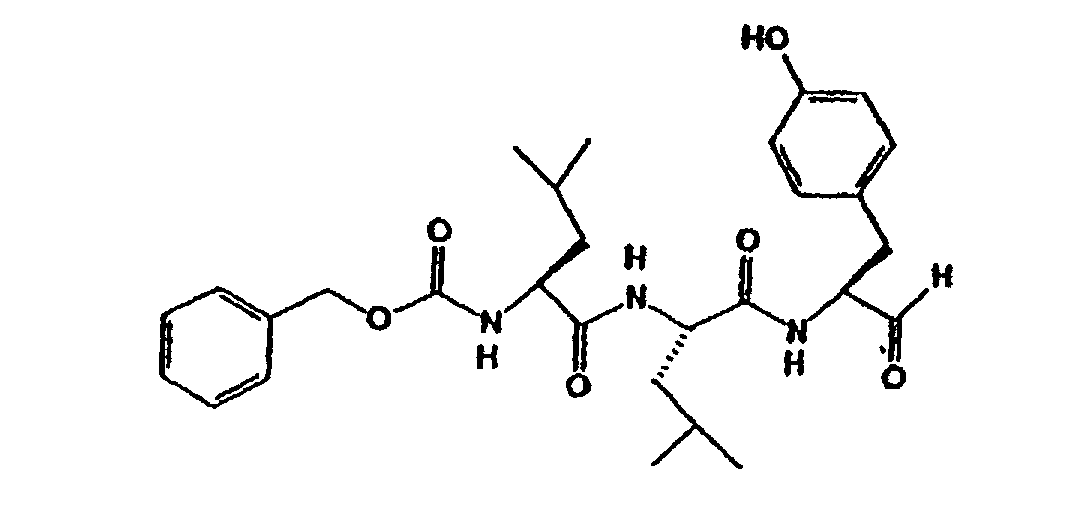

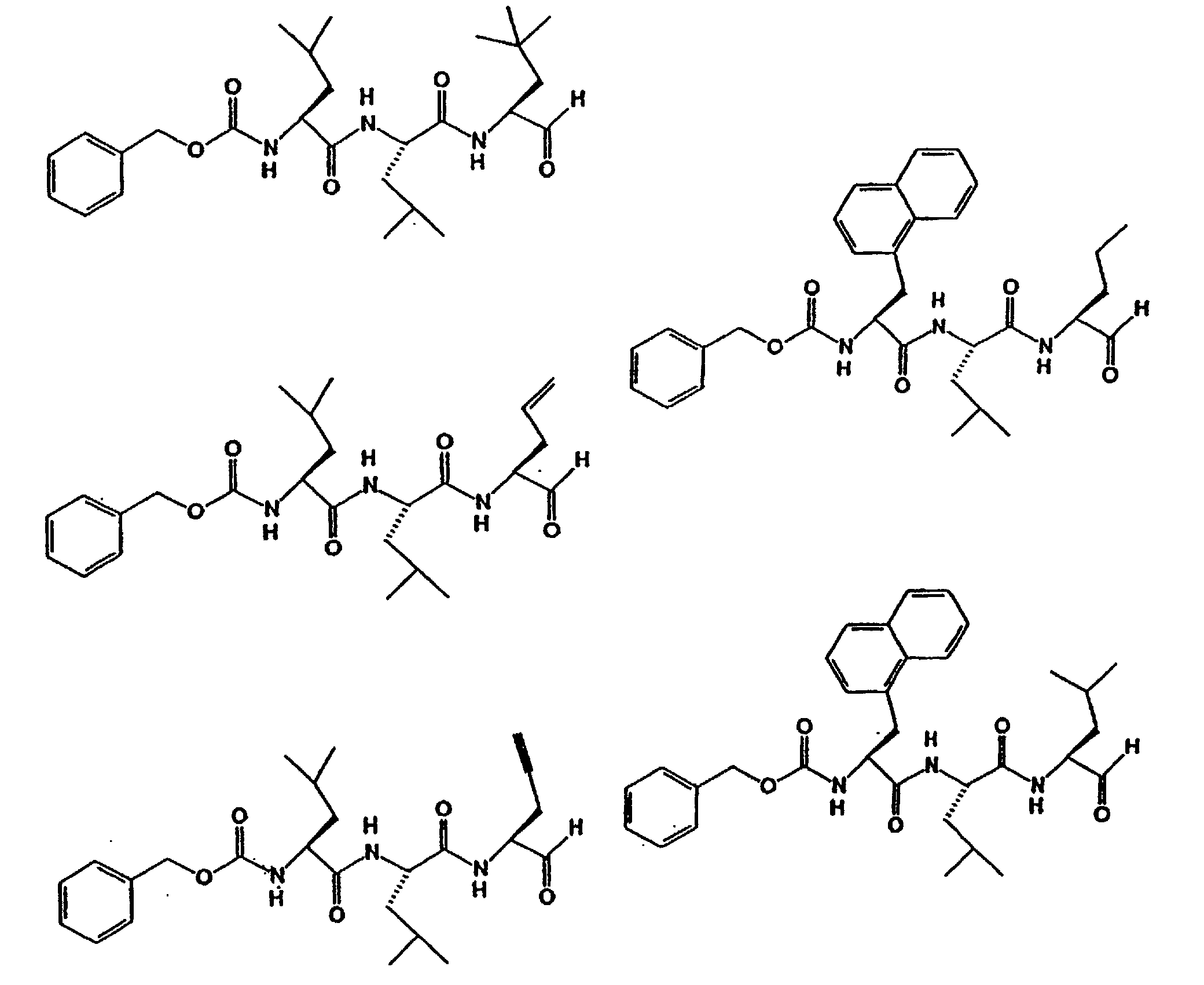
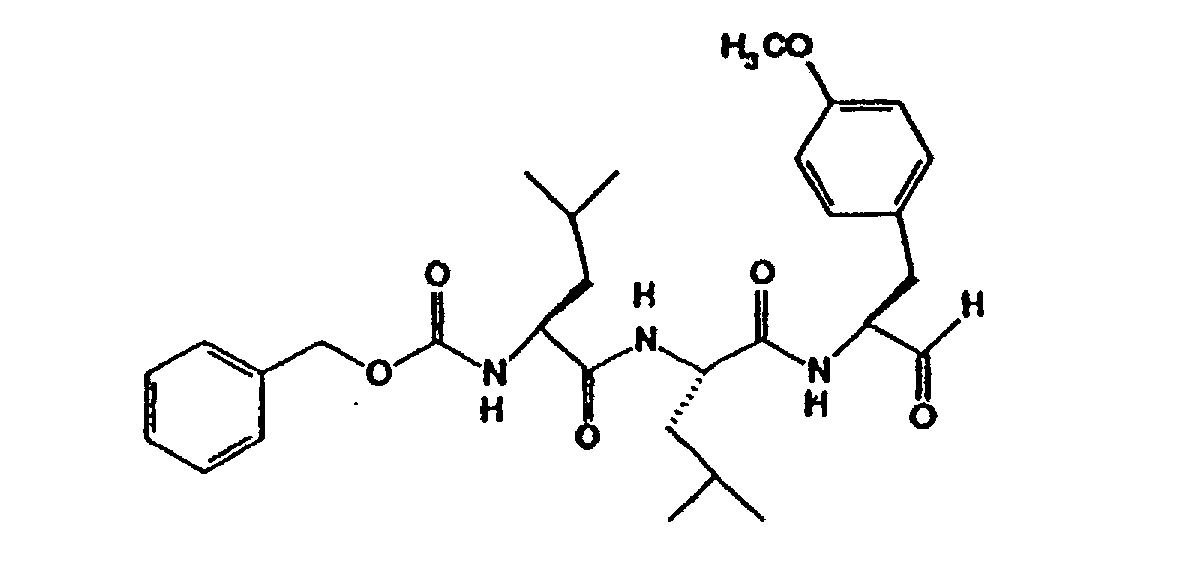

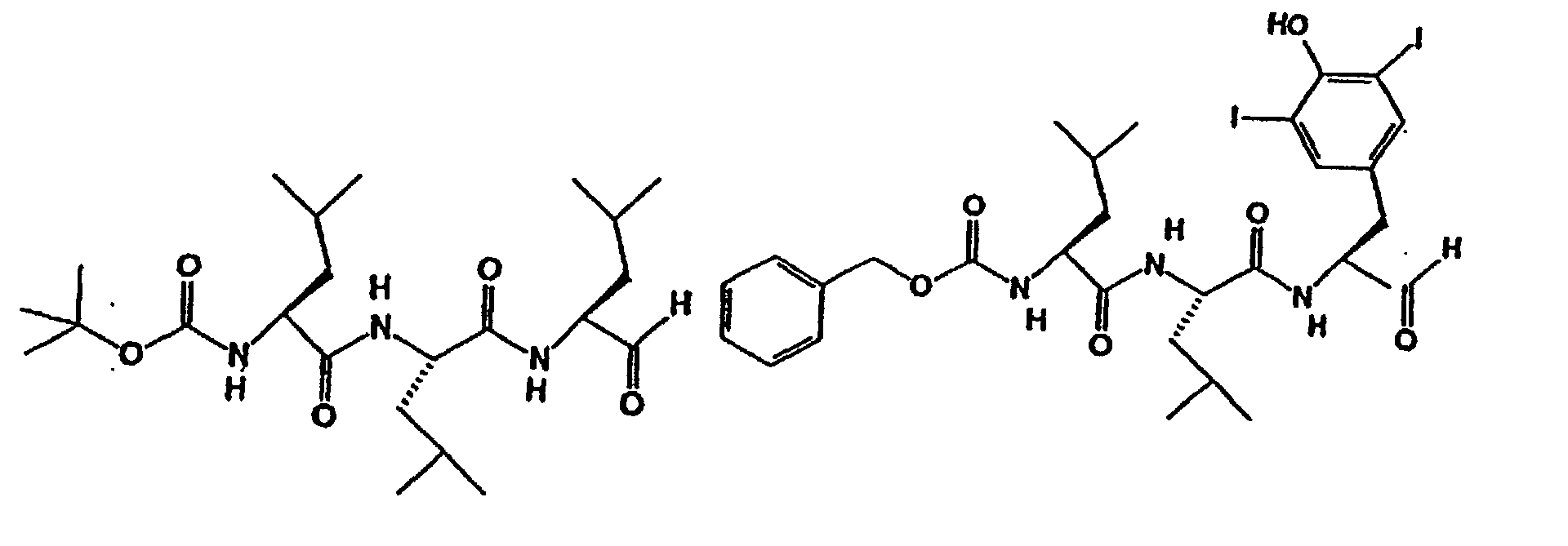

 and
and
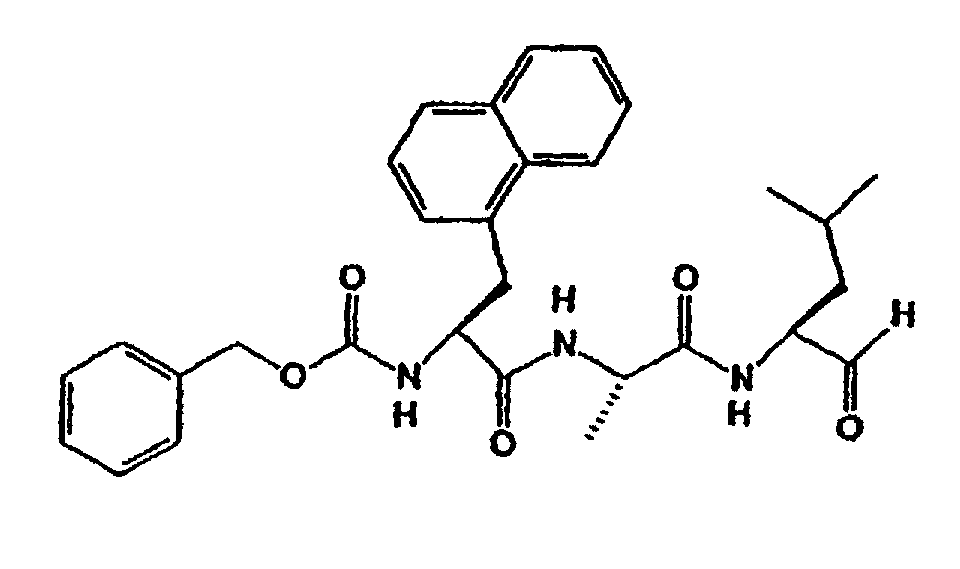
- Use as claimed in any one of claims 1 to 2 of an inhibitor selected from the following:
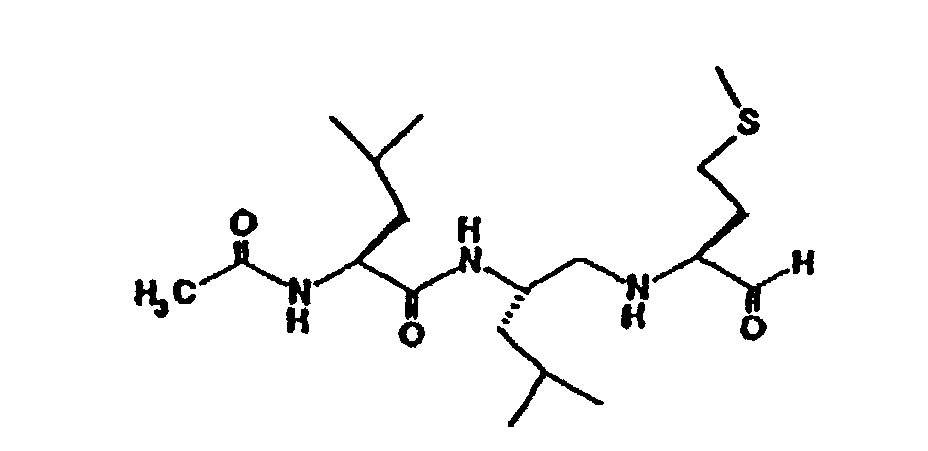
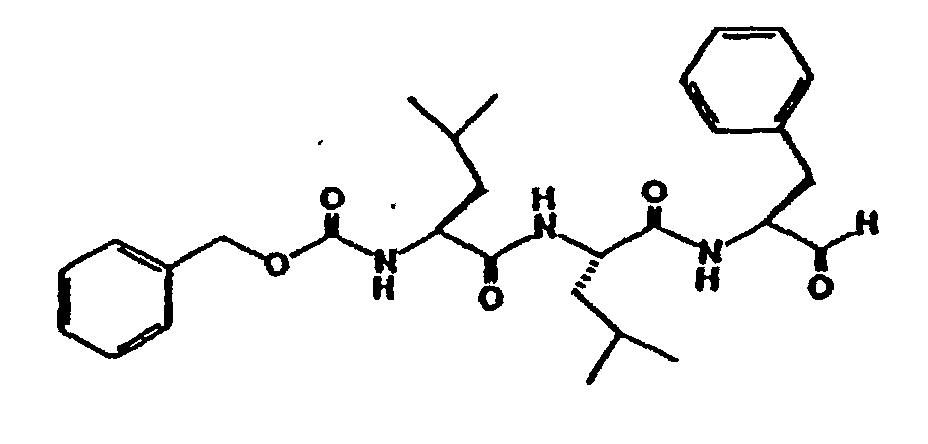
- Use as claimed in any one of the preceding claims of a specific inhibitor of the proteasome.
- Use as claimed in any one of the preceding claims of an inhibitor of ubiquitin conjugation of NF-κB or IκB.
Priority Applications (1)
| Application Number | Priority Date | Filing Date | Title |
|---|---|---|---|
| SI9530636T SI0750507T2 (en) | 1994-03-18 | 1995-03-17 | Proteasome regulation of nf-kappa-b activity |
Applications Claiming Priority (3)
| Application Number | Priority Date | Filing Date | Title |
|---|---|---|---|
| US210381 | 1994-03-18 | ||
| US08/210,381 US6660268B1 (en) | 1994-03-18 | 1994-03-18 | Proteasome regulation of NF-KB activity |
| PCT/US1995/003315 WO1995025533A1 (en) | 1994-03-18 | 1995-03-17 | PROTEASOME REGULATION OF NF-λB ACTIVITY |
Publications (4)
| Publication Number | Publication Date |
|---|---|
| EP0750507A1 EP0750507A1 (en) | 1997-01-02 |
| EP0750507A4 EP0750507A4 (en) | 1999-03-31 |
| EP0750507B1 true EP0750507B1 (en) | 2002-11-20 |
| EP0750507B2 EP0750507B2 (en) | 2006-03-01 |
Family
ID=22782682
Family Applications (1)
| Application Number | Title | Priority Date | Filing Date |
|---|---|---|---|
| EP95914075A Expired - Lifetime EP0750507B2 (en) | 1994-03-18 | 1995-03-17 | Proteasome regulation of nf-kappa-b activity |
Country Status (11)
| Country | Link |
|---|---|
| US (2) | US6660268B1 (en) |
| EP (1) | EP0750507B2 (en) |
| JP (1) | JPH09510710A (en) |
| AT (1) | ATE228002T1 (en) |
| CA (1) | CA2184727C (en) |
| DE (1) | DE69528888T3 (en) |
| DK (1) | DK0750507T4 (en) |
| ES (1) | ES2182897T5 (en) |
| PT (1) | PT750507E (en) |
| SI (1) | SI0750507T2 (en) |
| WO (1) | WO1995025533A1 (en) |
Families Citing this family (49)
| Publication number | Priority date | Publication date | Assignee | Title |
|---|---|---|---|---|
| US6083903A (en) | 1994-10-28 | 2000-07-04 | Leukosite, Inc. | Boronic ester and acid compounds, synthesis and uses |
| US6838477B2 (en) * | 1995-04-12 | 2005-01-04 | President And Fellows Of Harvard College | Lactacystin analogs |
| US5834487A (en) * | 1996-09-24 | 1998-11-10 | Cv Therapeutics | Inhibition of 26S and 20S proteasome by indanones |
| ATE240113T1 (en) | 1997-02-15 | 2003-05-15 | Millennium Pharm Inc | TREATMENT OF INFARCTS BY INHIBITING NF-KAPPAB |
| US6831057B2 (en) | 1997-10-28 | 2004-12-14 | The University Of North Carolina At Chapel Hill | Use of NF-κB inhibition in combination therapy for cancer |
| US6207412B1 (en) * | 1997-11-13 | 2001-03-27 | The Regents Of The University Of California | Identification of a G protein-coupled receptor transcriptionally regulated by protein tyrosine kinase signaling in hematopoietic cells |
| US6075150A (en) | 1998-01-26 | 2000-06-13 | Cv Therapeutics, Inc. | α-ketoamide inhibitors of 20S proteasome |
| US6617171B2 (en) * | 1998-02-27 | 2003-09-09 | The General Hospital Corporation | Methods for diagnosing and treating autoimmune disease |
| US6462019B1 (en) | 1998-07-10 | 2002-10-08 | Osteoscreen, Inc. | Inhibitors of proteasomal activity and production for stimulating bone growth |
| US6838436B1 (en) | 1998-07-10 | 2005-01-04 | Osteoscreen Inc. | Inhibitors of proteasomal activity for stimulating bone growth |
| US6902721B1 (en) | 1998-07-10 | 2005-06-07 | Osteoscreen, Inc. | Inhibitors of proteasomal activity for stimulating bone growth |
| EP0982317A1 (en) * | 1998-08-26 | 2000-03-01 | Max-Planck-Gesellschaft zur Förderung der Wissenschaften e.V. | Bivalent inhibitors of the proteasome |
| EP0995757A3 (en) * | 1998-08-26 | 2002-05-22 | Max-Planck-Gesellschaft zur Förderung der Wissenschaften e.V. | Bivalent inhibitors of the proteasome |
| AU762373B2 (en) | 1998-10-20 | 2003-06-26 | Millennium Pharmaceuticals, Inc. | Method for monitoring proteasome inhibitor drug action |
| US6599710B1 (en) | 1999-03-10 | 2003-07-29 | The General Hospital Corporation | Treatment of autoimmune disease |
| US20030165492A1 (en) * | 2000-06-08 | 2003-09-04 | Alberto Panerai | Method of treatment of alzheimer's disease with a protein extractable from mammalian organs |
| US7628988B2 (en) | 2002-06-27 | 2009-12-08 | The General Hospital Corporation | Methods and compositions for treating type 1 diabetes |
| US7582313B2 (en) | 2002-06-27 | 2009-09-01 | The General Hospital Corporation | Methods of organ regeneration using Hox 11-expressing pluripotent cells |
| CA2504933C (en) | 2002-11-06 | 2012-10-16 | Dana-Farber Cancer Institute, Inc. | Methods and compositions for treating cancer using proteasome inhibitors |
| EP1581629B1 (en) | 2002-12-06 | 2015-04-01 | Millennium Pharmaceuticals, Inc. | Methods for the identification, assessment, and treatment of patients with proteasome inhibition therapy |
| US7223745B2 (en) | 2003-08-14 | 2007-05-29 | Cephalon, Inc. | Proteasome inhibitors and methods of using the same |
| US7576206B2 (en) | 2003-08-14 | 2009-08-18 | Cephalon, Inc. | Proteasome inhibitors and methods of using the same |
| CA2558618A1 (en) * | 2004-02-06 | 2005-08-25 | The University Of Chicago | An anti-inflammatory, cytoprotective factor derivable from a probiotic organism |
| US20060167106A1 (en) * | 2004-11-19 | 2006-07-27 | Mei Zhang | Compounds acting at the centrosome |
| US7468383B2 (en) | 2005-02-11 | 2008-12-23 | Cephalon, Inc. | Proteasome inhibitors and methods of using the same |
| DE102005009784B4 (en) * | 2005-03-03 | 2009-06-18 | Technische Universität Darmstadt | Peptide mimetics, process for their preparation, pharmaceutical compositions containing them and their use as inhibitors of proteasomes and for the induction of apoptosis |
| JP5436860B2 (en) | 2005-11-09 | 2014-03-05 | オニキス セラピューティクス, インク. | Compounds for enzyme inhibition |
| NZ573759A (en) | 2006-06-19 | 2012-03-30 | Proteolix Inc | Peptide epoxyketones for proteasome inhibition |
| EA018973B1 (en) | 2007-10-04 | 2013-12-30 | Оникс Терапьютикс, Инк. | Crystalline peptide epoxy ketone protease inhibitors and the synthesis of amino acid keto-epoxides |
| MX2010010348A (en) * | 2008-03-26 | 2010-11-09 | Novozymes As | COMPOSITIONS OF STABILIZED LIQUID ENZYMES. |
| BRPI0919668A2 (en) | 2008-10-21 | 2018-05-29 | Onyx Therapeutics, Inc. | peptide epoxy ketone combination therapy |
| AR075899A1 (en) | 2009-03-20 | 2011-05-04 | Onyx Therapeutics Inc | PROTEASA INHIBITING CRYSTALLINE EPOXYCETON TRIPEPTIDES |
| EP2498793B1 (en) | 2009-11-13 | 2019-07-10 | Onyx Therapeutics, Inc. | Oprozomib for use in metastasis suppression |
| WO2011087822A1 (en) | 2009-12-22 | 2011-07-21 | Cephalon, Inc. | Proteasome inhibitors and processes for their preparation, purification and use |
| PH12012501719A1 (en) | 2010-03-01 | 2012-11-12 | Onyx Therapeutics Inc | Compounds for immunoproteasome inhibition |
| US8697646B2 (en) | 2010-04-07 | 2014-04-15 | Onyx Therapeutics, Inc. | Crystalline peptide epoxyketone immunoproteasome inhibitor |
| CA2855368A1 (en) | 2011-11-11 | 2013-05-16 | Millennium Pharmaceuticals, Inc. | Biomarkers of response to proteasome inhibitors |
| JP5540340B2 (en) * | 2012-02-29 | 2014-07-02 | 独立行政法人理化学研究所 | Determination method of inflammatory diseases |
| US9309283B2 (en) | 2012-07-09 | 2016-04-12 | Onyx Therapeutics, Inc. | Prodrugs of peptide epoxy ketone protease inhibitors |
| WO2014124134A1 (en) | 2013-02-07 | 2014-08-14 | The General Hospital Corporation | Methods for expansion or depletion of t-regulatory cells |
| CN111879948A (en) | 2013-10-17 | 2020-11-03 | 综合医院公司 | Methods of identifying subjects responsive to treatment for autoimmune disease and compositions for treating the disease |
| CA2985816A1 (en) | 2015-05-15 | 2016-11-24 | The General Hospital Corporation | Antagonistic anti-tumor necrosis factor receptor superfamily antibodies |
| EP3340999A4 (en) | 2015-08-28 | 2019-06-12 | The General Hospital Corporation | TYPE II ANTI-RECEPTOR AGONISTIC ANTIBODIES OF TUMOR NECROSIS FACTOR |
| EP3355914B1 (en) | 2015-09-29 | 2024-03-06 | The General Hospital Corporation | A composition comprising bcg for reducing cholesterol. |
| CA3253342A1 (en) | 2016-05-13 | 2026-03-02 | The General Hospital Corporation | Antagonistic anti-tumor necrosis factor receptor superfamily antibodies |
| CA3109954A1 (en) | 2018-08-20 | 2020-02-27 | The General Hospital Corporation | Antagonistic anti-tumor necrosis factor receptor superfamily polypeptides |
| JP7652690B2 (en) | 2018-11-15 | 2025-03-27 | ザ ジェネラル ホスピタル コーポレイション | Agonistic tumor necrosis factor receptor superfamily polypeptides |
| KR20230156016A (en) * | 2020-11-24 | 2023-11-13 | 프로게라이프 | Compounds for the treatment of segmental progeroid syndrome |
| EP4251635A2 (en) * | 2020-11-24 | 2023-10-04 | Progelife | Compounds for treating enveloped virus infections |
Family Cites Families (16)
| Publication number | Priority date | Publication date | Assignee | Title |
|---|---|---|---|---|
| US4510130A (en) | 1983-05-20 | 1985-04-09 | Genetic Diagnostics Corporation | Promoting animal and plant growth with leupeptin |
| US6410516B1 (en) | 1986-01-09 | 2002-06-25 | President & Fellows Of Harvard College | Nuclear factors associated with transcriptional regulation |
| SE8702550D0 (en) | 1987-06-18 | 1987-06-18 | Anders Grubb | CYSTEINPROTEASHEMMARE |
| WO1989008147A1 (en) | 1988-03-01 | 1989-09-08 | Whitehead Institute For Biomedical Research | ACTIVITION OF NF-kB PRECURSOR |
| ZA897515B (en) | 1988-10-07 | 1990-06-27 | Merrell Dow Pharma | Novel peptidase inhibitors |
| JP2701932B2 (en) | 1989-04-10 | 1998-01-21 | サントリー株式会社 | Protease inhibitor |
| HUT62312A (en) | 1990-03-05 | 1993-04-28 | Cephalon Inc | Process for producing chymotrypsin-like proteases and their inhibitors |
| WO1992011850A2 (en) | 1990-12-28 | 1992-07-23 | Cortex Pharmaceuticals, Inc. | Use of calpain inhibitors in the inhibition and treatment of neurodegeneration |
| CA2098702A1 (en) | 1990-12-28 | 1992-06-29 | James C. Powers | Peptide ketoamides, ketoacids, and ketoesters |
| WO1992013549A1 (en) * | 1991-02-07 | 1992-08-20 | Research Corporation Technologies, Inc. | Inhibition of cell proliferation by hydrophobic peptides |
| EP0504938A3 (en) * | 1991-03-22 | 1993-04-14 | Suntory Limited | Prophylactic and therapeutic agent for bone diseases comprising di- or tripeptide derivative as active ingredient |
| WO1992020795A1 (en) | 1991-05-17 | 1992-11-26 | Cetus Oncology Corporation | INHIBITOR OF NF-λB TRANSCRIPTIONAL ACTIVATOR AND USES THEREOF |
| EP0650368A1 (en) * | 1992-06-24 | 1995-05-03 | Cortex Pharmaceuticals, Inc. | Use of calpain inhibitors in the inhibition and treatment of medical conditions associated with increased calpain activity |
| DE4311835A1 (en) | 1993-04-07 | 1994-10-13 | Boehringer Ingelheim Int | Method for inhibiting gene transcription |
| US5693617A (en) * | 1994-03-15 | 1997-12-02 | Proscript, Inc. | Inhibitors of the 26s proteolytic complex and the 20s proteasome contained therein |
| KR970060809A (en) * | 1996-01-19 | 1997-08-12 | 김광호 | How to send registered voice message at reservation time on answering machine |
-
1994
- 1994-03-18 US US08/210,381 patent/US6660268B1/en not_active Expired - Lifetime
-
1995
- 1995-03-17 AT AT95914075T patent/ATE228002T1/en active
- 1995-03-17 DK DK95914075T patent/DK0750507T4/en active
- 1995-03-17 WO PCT/US1995/003315 patent/WO1995025533A1/en not_active Ceased
- 1995-03-17 SI SI9530636T patent/SI0750507T2/en unknown
- 1995-03-17 ES ES95914075T patent/ES2182897T5/en not_active Expired - Lifetime
- 1995-03-17 PT PT95914075T patent/PT750507E/en unknown
- 1995-03-17 CA CA002184727A patent/CA2184727C/en not_active Expired - Lifetime
- 1995-03-17 EP EP95914075A patent/EP0750507B2/en not_active Expired - Lifetime
- 1995-03-17 JP JP7524716A patent/JPH09510710A/en active Pending
- 1995-03-17 DE DE69528888T patent/DE69528888T3/en not_active Expired - Lifetime
-
2003
- 2003-01-28 US US10/352,512 patent/US20040097420A1/en not_active Abandoned
Also Published As
| Publication number | Publication date |
|---|---|
| JPH09510710A (en) | 1997-10-28 |
| DE69528888T3 (en) | 2006-10-05 |
| CA2184727A1 (en) | 1995-09-28 |
| SI0750507T1 (en) | 2003-04-30 |
| ATE228002T1 (en) | 2002-12-15 |
| US20040097420A1 (en) | 2004-05-20 |
| AU682264B2 (en) | 1997-09-25 |
| CA2184727C (en) | 2007-08-28 |
| US6660268B1 (en) | 2003-12-09 |
| DK0750507T4 (en) | 2006-07-03 |
| EP0750507A4 (en) | 1999-03-31 |
| EP0750507A1 (en) | 1997-01-02 |
| DE69528888D1 (en) | 2003-01-02 |
| AU2121595A (en) | 1995-10-09 |
| EP0750507B2 (en) | 2006-03-01 |
| WO1995025533A1 (en) | 1995-09-28 |
| DE69528888T2 (en) | 2003-10-23 |
| PT750507E (en) | 2003-04-30 |
| DK0750507T3 (en) | 2003-02-17 |
| SI0750507T2 (en) | 2006-08-31 |
| ES2182897T3 (en) | 2003-03-16 |
| ES2182897T5 (en) | 2006-10-16 |
Similar Documents
| Publication | Publication Date | Title |
|---|---|---|
| US6660268B1 (en) | Proteasome regulation of NF-KB activity | |
| US5693617A (en) | Inhibitors of the 26s proteolytic complex and the 20s proteasome contained therein | |
| Li et al. | Peptide. alpha.-keto ester,. alpha.-keto amide, and. alpha.-keto acid inhibitors of calpains and other cysteine proteases | |
| EP0364344B1 (en) | Novel peptidase inhibitors | |
| EP0915700B1 (en) | Use of beta-sheet mimetics as protease and kinase inhibitors and as inhibitors of transcription factors | |
| CZ298625B6 (en) | Inhibitors of interleukin-1 beta converting enzyme, method of their selection and pharmaceutical compositions in which the inhibitors are comprised | |
| CA2138124A1 (en) | Use of calpain inhibitors in the inhibition and treatment of medical conditions associated with increased calpain activity | |
| AU604944B2 (en) | Cysteine proteinase inhibitor | |
| EP1076563A1 (en) | Dipeptide caspase inhibitors and the use thereof | |
| EP0817642A1 (en) | $g(b)-SHEET MIMETICS AND USE THEREOF AS INHIBITORS OF BIOLOGICALLY ACTIVE PEPTIDES OR PROTEINS | |
| CA2227198A1 (en) | Cysteine protease inhibitors for use in treatment of ige mediated allergic diseases | |
| US20040048327A1 (en) | Aza-peptide epoxides | |
| US4552866A (en) | Use of diamino alcohols as analgesic agents | |
| AU682264C (en) | Proteasome regulation of NF-kappa B activity | |
| Baldisserotto et al. | C-terminal constrained phenylalanine as a pharmacophoric unit in peptide-based proteasome inhibitors | |
| EP0979241B1 (en) | (3r)-3-amino-4-carboxybutyraldehyde derivatives inhibiting the release of interleukin-1/beta | |
| Piccinini et al. | Proteasomes as drug targets | |
| US6632921B1 (en) | Seryl-lysyl-based peptide and peptidomimetic inhibitors of N-myristoyl transferase as anti-infective agents | |
| Fisher et al. | Synthetic inhibitors of carboxypeptidase N | |
| CA2403836A1 (en) | Dipeptide caspase inhibitors and the use thereof |
Legal Events
| Date | Code | Title | Description |
|---|---|---|---|
| PUAI | Public reference made under article 153(3) epc to a published international application that has entered the european phase |
Free format text: ORIGINAL CODE: 0009012 |
|
| 17P | Request for examination filed |
Effective date: 19960903 |
|
| AK | Designated contracting states |
Kind code of ref document: A1 Designated state(s): AT BE CH DE DK ES FR GB GR IE IT LI LU MC NL PT SE |
|
| AX | Request for extension of the european patent |
Free format text: LT PAYMENT 960903;SI PAYMENT 960903 |
|
| A4 | Supplementary search report drawn up and despatched |
Effective date: 19990216 |
|
| AK | Designated contracting states |
Kind code of ref document: A4 Designated state(s): AT BE CH DE DK ES FR GB GR IE IT LI LU MC NL PT SE |
|
| 17Q | First examination report despatched |
Effective date: 20000229 |
|
| GRAG | Despatch of communication of intention to grant |
Free format text: ORIGINAL CODE: EPIDOS AGRA |
|
| RTI1 | Title (correction) |
Free format text: PROTEASOME REGULATION OF NF-KAPPA-B ACTIVITY |
|
| RIC1 | Information provided on ipc code assigned before grant |
Free format text: 7A 61K 38/06 A, 7A 61K 38/07 B, 7C 07K 5/08 B, 7A 61P 29/00 B, 7A 61P 31/18 B |
|
| RTI1 | Title (correction) |
Free format text: PROTEASOME REGULATION OF NF-KAPPA-B ACTIVITY |
|
| GRAG | Despatch of communication of intention to grant |
Free format text: ORIGINAL CODE: EPIDOS AGRA |
|
| GRAH | Despatch of communication of intention to grant a patent |
Free format text: ORIGINAL CODE: EPIDOS IGRA |
|
| GRAH | Despatch of communication of intention to grant a patent |
Free format text: ORIGINAL CODE: EPIDOS IGRA |
|
| GRAA | (expected) grant |
Free format text: ORIGINAL CODE: 0009210 |
|
| AK | Designated contracting states |
Kind code of ref document: B1 Designated state(s): AT BE CH DE DK ES FR GB GR IE IT LI LU MC NL PT SE |
|
| AX | Request for extension of the european patent |
Free format text: LT PAYMENT 19960903;SI PAYMENT 19960903 |
|
| REF | Corresponds to: |
Ref document number: 228002 Country of ref document: AT Date of ref document: 20021215 Kind code of ref document: T |
|
| REG | Reference to a national code |
Ref country code: GB Ref legal event code: FG4D |
|
| REG | Reference to a national code |
Ref country code: CH Ref legal event code: EP |
|
| REG | Reference to a national code |
Ref country code: IE Ref legal event code: FG4D |
|
| REG | Reference to a national code |
Ref country code: CH Ref legal event code: NV Representative=s name: A. BRAUN, BRAUN, HERITIER, ESCHMANN AG PATENTANWAE |
|
| REF | Corresponds to: |
Ref document number: 69528888 Country of ref document: DE Date of ref document: 20030102 |
|
| REG | Reference to a national code |
Ref country code: DK Ref legal event code: T3 |
|
| REG | Reference to a national code |
Ref country code: ES Ref legal event code: FG2A Ref document number: 2182897 Country of ref document: ES Kind code of ref document: T3 |
|
| REG | Reference to a national code |
Ref country code: GR Ref legal event code: EP Ref document number: 20030400472 Country of ref document: GR |
|
| ET | Fr: translation filed | ||
| REG | Reference to a national code |
Ref country code: PT Ref legal event code: SC4A Free format text: AVAILABILITY OF NATIONAL TRANSLATION Effective date: 20030219 |
|
| PLBQ | Unpublished change to opponent data |
Free format text: ORIGINAL CODE: EPIDOS OPPO |
|
| PLBI | Opposition filed |
Free format text: ORIGINAL CODE: 0009260 |
|
| PLBQ | Unpublished change to opponent data |
Free format text: ORIGINAL CODE: EPIDOS OPPO |
|
| PLAX | Notice of opposition and request to file observation + time limit sent |
Free format text: ORIGINAL CODE: EPIDOSNOBS2 |
|
| PLAB | Opposition data, opponent's data or that of the opponent's representative modified |
Free format text: ORIGINAL CODE: 0009299OPPO |
|
| 26 | Opposition filed |
Opponent name: BAYER AG Effective date: 20030813 |
|
| R26 | Opposition filed (corrected) |
Opponent name: BAYER AG, BAYER HEALTHCARE Effective date: 20030813 |
|
| NLR1 | Nl: opposition has been filed with the epo |
Opponent name: BAYER AG, BAYER HEALTHCARE Opponent name: BAYER AG |
|
| PLAX | Notice of opposition and request to file observation + time limit sent |
Free format text: ORIGINAL CODE: EPIDOSNOBS2 |
|
| PLAX | Notice of opposition and request to file observation + time limit sent |
Free format text: ORIGINAL CODE: EPIDOSNOBS2 |
|
| PLBB | Reply of patent proprietor to notice(s) of opposition received |
Free format text: ORIGINAL CODE: EPIDOSNOBS3 |
|
| PLAY | Examination report in opposition despatched + time limit |
Free format text: ORIGINAL CODE: EPIDOSNORE2 |
|
| REG | Reference to a national code |
Ref country code: SI Ref legal event code: IF |
|
| PLAY | Examination report in opposition despatched + time limit |
Free format text: ORIGINAL CODE: EPIDOSNORE2 |
|
| PLAY | Examination report in opposition despatched + time limit |
Free format text: ORIGINAL CODE: EPIDOSNORE2 |
|
| PLBC | Reply to examination report in opposition received |
Free format text: ORIGINAL CODE: EPIDOSNORE3 |
|
| PUAH | Patent maintained in amended form |
Free format text: ORIGINAL CODE: 0009272 |
|
| STAA | Information on the status of an ep patent application or granted ep patent |
Free format text: STATUS: PATENT MAINTAINED AS AMENDED |
|
| 27A | Patent maintained in amended form |
Effective date: 20060301 |
|
| AK | Designated contracting states |
Kind code of ref document: B2 Designated state(s): AT BE CH DE DK ES FR GB GR IE IT LI LU MC NL PT SE |
|
| AX | Request for extension of the european patent |
Extension state: LT SI |
|
| REG | Reference to a national code |
Ref country code: CH Ref legal event code: AEN Free format text: AUFRECHTERHALTUNG DES PATENTES IN GEAENDERTER FORM |
|
| NLR2 | Nl: decision of opposition |
Effective date: 20060301 |
|
| REG | Reference to a national code |
Ref country code: SE Ref legal event code: RPEO |
|
| REG | Reference to a national code |
Ref country code: GR Ref legal event code: EP Ref document number: 20060401584 Country of ref document: GR |
|
| REG | Reference to a national code |
Ref country code: DK Ref legal event code: T4 |
|
| NLR3 | Nl: receipt of modified translations in the netherlands language after an opposition procedure | ||
| REG | Reference to a national code |
Ref country code: ES Ref legal event code: DC2A Date of ref document: 20060529 Kind code of ref document: T5 |
|
| ET3 | Fr: translation filed ** decision concerning opposition | ||
| REG | Reference to a national code |
Ref country code: CH Ref legal event code: PFA Owner name: THE PRESIDENT AND FELLOWS OF HARVARD COLLEGE Free format text: THE PRESIDENT AND FELLOWS OF HARVARD COLLEGE#17 QUINCY STREET#CAMBRIDGE, MA 02114 (US) -TRANSFER TO- THE PRESIDENT AND FELLOWS OF HARVARD COLLEGE#17 QUINCY STREET#CAMBRIDGE, MA 02114 (US) |
|
| PGFP | Annual fee paid to national office [announced via postgrant information from national office to epo] |
Ref country code: IE Payment date: 20140327 Year of fee payment: 20 Ref country code: MC Payment date: 20140304 Year of fee payment: 20 Ref country code: SE Payment date: 20140327 Year of fee payment: 20 Ref country code: CH Payment date: 20140327 Year of fee payment: 20 Ref country code: DK Payment date: 20140325 Year of fee payment: 20 Ref country code: NL Payment date: 20140326 Year of fee payment: 20 |
|
| PGFP | Annual fee paid to national office [announced via postgrant information from national office to epo] |
Ref country code: IT Payment date: 20140324 Year of fee payment: 20 Ref country code: FR Payment date: 20140317 Year of fee payment: 20 Ref country code: ES Payment date: 20140326 Year of fee payment: 20 Ref country code: AT Payment date: 20140305 Year of fee payment: 20 Ref country code: GR Payment date: 20140327 Year of fee payment: 20 Ref country code: LU Payment date: 20140407 Year of fee payment: 20 |
|
| PGFP | Annual fee paid to national office [announced via postgrant information from national office to epo] |
Ref country code: PT Payment date: 20140310 Year of fee payment: 20 Ref country code: GB Payment date: 20140327 Year of fee payment: 20 |
|
| REG | Reference to a national code |
Ref country code: CH Ref legal event code: PCAR Free format text: NEW ADDRESS: HOLBEINSTRASSE 36-38, 4051 BASEL (CH) |
|
| PGFP | Annual fee paid to national office [announced via postgrant information from national office to epo] |
Ref country code: BE Payment date: 20140328 Year of fee payment: 20 |
|
| PGFP | Annual fee paid to national office [announced via postgrant information from national office to epo] |
Ref country code: DE Payment date: 20140327 Year of fee payment: 20 |
|
| REG | Reference to a national code |
Ref country code: DE Ref legal event code: R071 Ref document number: 69528888 Country of ref document: DE |
|
| REG | Reference to a national code |
Ref country code: DK Ref legal event code: EUP Effective date: 20150317 |
|
| REG | Reference to a national code |
Ref country code: NL Ref legal event code: V4 Effective date: 20150317 Ref country code: PT Ref legal event code: MM4A Free format text: MAXIMUM VALIDITY LIMIT REACHED Effective date: 20150317 |
|
| REG | Reference to a national code |
Ref country code: CH Ref legal event code: PL |
|
| REG | Reference to a national code |
Ref country code: GB Ref legal event code: PE20 Expiry date: 20150316 |
|
| PG25 | Lapsed in a contracting state [announced via postgrant information from national office to epo] |
Ref country code: PT Free format text: LAPSE BECAUSE OF EXPIRATION OF PROTECTION Effective date: 20150325 |
|
| REG | Reference to a national code |
Ref country code: SE Ref legal event code: EUG |
|
| REG | Reference to a national code |
Ref country code: IE Ref legal event code: MK9A |
|
| REG | Reference to a national code |
Ref country code: AT Ref legal event code: MK07 Ref document number: 228002 Country of ref document: AT Kind code of ref document: T Effective date: 20150317 |
|
| REG | Reference to a national code |
Ref country code: GR Ref legal event code: MA Ref document number: 20060401584 Country of ref document: GR Effective date: 20150318 |
|
| PG25 | Lapsed in a contracting state [announced via postgrant information from national office to epo] |
Ref country code: GB Free format text: LAPSE BECAUSE OF EXPIRATION OF PROTECTION Effective date: 20150316 |
|
| REG | Reference to a national code |
Ref country code: ES Ref legal event code: FD2A Effective date: 20150826 |
|
| PG25 | Lapsed in a contracting state [announced via postgrant information from national office to epo] |
Ref country code: IE Free format text: LAPSE BECAUSE OF EXPIRATION OF PROTECTION Effective date: 20150317 |
|
| PG25 | Lapsed in a contracting state [announced via postgrant information from national office to epo] |
Ref country code: ES Free format text: LAPSE BECAUSE OF EXPIRATION OF PROTECTION Effective date: 20150318 |