EP0748613B1 - Surgical pins - Google Patents
Surgical pins Download PDFInfo
- Publication number
- EP0748613B1 EP0748613B1 EP96304446A EP96304446A EP0748613B1 EP 0748613 B1 EP0748613 B1 EP 0748613B1 EP 96304446 A EP96304446 A EP 96304446A EP 96304446 A EP96304446 A EP 96304446A EP 0748613 B1 EP0748613 B1 EP 0748613B1
- Authority
- EP
- European Patent Office
- Prior art keywords
- pin
- membrane barrier
- profile
- tissue structure
- head
- Prior art date
- Legal status (The legal status is an assumption and is not a legal conclusion. Google has not performed a legal analysis and makes no representation as to the accuracy of the status listed.)
- Expired - Lifetime
Links
- 230000008384 membrane barrier Effects 0.000 claims abstract description 24
- 229920000642 polymer Polymers 0.000 claims abstract description 9
- 238000010276 construction Methods 0.000 claims abstract description 8
- 229920002463 poly(p-dioxanone) polymer Polymers 0.000 claims abstract description 7
- 239000000622 polydioxanone Substances 0.000 claims abstract description 7
- 239000007787 solid Substances 0.000 claims abstract description 4
- 238000004519 manufacturing process Methods 0.000 claims description 4
- 125000006850 spacer group Chemical group 0.000 claims description 4
- 230000004323 axial length Effects 0.000 claims description 3
- VPVXHAANQNHFSF-UHFFFAOYSA-N 1,4-dioxan-2-one Chemical compound O=C1COCCO1 VPVXHAANQNHFSF-UHFFFAOYSA-N 0.000 claims description 2
- RKDVKSZUMVYZHH-UHFFFAOYSA-N 1,4-dioxane-2,5-dione Chemical compound O=C1COC(=O)CO1 RKDVKSZUMVYZHH-UHFFFAOYSA-N 0.000 claims description 2
- LCSKNASZPVZHEG-UHFFFAOYSA-N 3,6-dimethyl-1,4-dioxane-2,5-dione;1,4-dioxane-2,5-dione Chemical group O=C1COC(=O)CO1.CC1OC(=O)C(C)OC1=O LCSKNASZPVZHEG-UHFFFAOYSA-N 0.000 claims description 2
- JJTUDXZGHPGLLC-IMJSIDKUSA-N 4511-42-6 Chemical compound C[C@@H]1OC(=O)[C@H](C)OC1=O JJTUDXZGHPGLLC-IMJSIDKUSA-N 0.000 claims description 2
- 229920001577 copolymer Polymers 0.000 claims description 2
- -1 poly[oxy(1-oxoethylene)oxyethylene] Polymers 0.000 claims description 2
- 210000000988 bone and bone Anatomy 0.000 description 13
- 239000012528 membrane Substances 0.000 description 13
- 210000001519 tissue Anatomy 0.000 description 12
- 238000001356 surgical procedure Methods 0.000 description 10
- 239000000463 material Substances 0.000 description 7
- 210000003128 head Anatomy 0.000 description 5
- 230000010478 bone regeneration Effects 0.000 description 3
- 230000007547 defect Effects 0.000 description 3
- 238000000034 method Methods 0.000 description 3
- 230000008929 regeneration Effects 0.000 description 3
- 238000011069 regeneration method Methods 0.000 description 3
- 230000008439 repair process Effects 0.000 description 3
- 230000017423 tissue regeneration Effects 0.000 description 3
- 229910001069 Ti alloy Inorganic materials 0.000 description 2
- 230000003416 augmentation Effects 0.000 description 2
- 210000004027 cell Anatomy 0.000 description 2
- 230000014759 maintenance of location Effects 0.000 description 2
- 230000008569 process Effects 0.000 description 2
- 206010009269 Cleft palate Diseases 0.000 description 1
- 208000024779 Comminuted Fractures Diseases 0.000 description 1
- 208000032170 Congenital Abnormalities Diseases 0.000 description 1
- 206010011732 Cyst Diseases 0.000 description 1
- 241000333074 Eucalyptus occidentalis Species 0.000 description 1
- 206010017088 Fracture nonunion Diseases 0.000 description 1
- FAPWRFPIFSIZLT-UHFFFAOYSA-M Sodium chloride Chemical compound [Na+].[Cl-] FAPWRFPIFSIZLT-UHFFFAOYSA-M 0.000 description 1
- 208000007536 Thrombosis Diseases 0.000 description 1
- 230000004888 barrier function Effects 0.000 description 1
- 238000005056 compaction Methods 0.000 description 1
- 150000001875 compounds Chemical class 0.000 description 1
- 230000006835 compression Effects 0.000 description 1
- 238000000748 compression moulding Methods 0.000 description 1
- 238000007596 consolidation process Methods 0.000 description 1
- 238000002316 cosmetic surgery Methods 0.000 description 1
- 208000031513 cyst Diseases 0.000 description 1
- 230000001419 dependent effect Effects 0.000 description 1
- 238000002283 elective surgery Methods 0.000 description 1
- 238000002474 experimental method Methods 0.000 description 1
- 238000002682 general surgery Methods 0.000 description 1
- 238000002513 implantation Methods 0.000 description 1
- 238000001727 in vivo Methods 0.000 description 1
- 238000001746 injection moulding Methods 0.000 description 1
- 208000014674 injury Diseases 0.000 description 1
- 210000004086 maxillary sinus Anatomy 0.000 description 1
- 238000012986 modification Methods 0.000 description 1
- 230000004048 modification Effects 0.000 description 1
- 210000000492 nasalseptum Anatomy 0.000 description 1
- 238000012829 orthopaedic surgery Methods 0.000 description 1
- 230000011164 ossification Effects 0.000 description 1
- 210000004409 osteocyte Anatomy 0.000 description 1
- 230000002188 osteogenic effect Effects 0.000 description 1
- 230000001737 promoting effect Effects 0.000 description 1
- 239000011780 sodium chloride Substances 0.000 description 1
- 210000000130 stem cell Anatomy 0.000 description 1
- 239000000126 substance Substances 0.000 description 1
- 238000011477 surgical intervention Methods 0.000 description 1
- 230000008733 trauma Effects 0.000 description 1
- UONOETXJSWQNOL-UHFFFAOYSA-N tungsten carbide Chemical compound [W+]#[C-] UONOETXJSWQNOL-UHFFFAOYSA-N 0.000 description 1
- 239000011800 void material Substances 0.000 description 1
Images
Classifications
-
- A—HUMAN NECESSITIES
- A61—MEDICAL OR VETERINARY SCIENCE; HYGIENE
- A61B—DIAGNOSIS; SURGERY; IDENTIFICATION
- A61B17/00—Surgical instruments, devices or methods
- A61B17/064—Surgical staples, i.e. penetrating the tissue
-
- A—HUMAN NECESSITIES
- A61—MEDICAL OR VETERINARY SCIENCE; HYGIENE
- A61F—FILTERS IMPLANTABLE INTO BLOOD VESSELS; PROSTHESES; DEVICES PROVIDING PATENCY TO, OR PREVENTING COLLAPSING OF, TUBULAR STRUCTURES OF THE BODY, e.g. STENTS; ORTHOPAEDIC, NURSING OR CONTRACEPTIVE DEVICES; FOMENTATION; TREATMENT OR PROTECTION OF EYES OR EARS; BANDAGES, DRESSINGS OR ABSORBENT PADS; FIRST-AID KITS
- A61F2/00—Filters implantable into blood vessels; Prostheses, i.e. artificial substitutes or replacements for parts of the body; Appliances for connecting them with the body; Devices providing patency to, or preventing collapsing of, tubular structures of the body, e.g. stents
- A61F2/0063—Implantable repair or support meshes, e.g. hernia meshes
-
- A—HUMAN NECESSITIES
- A61—MEDICAL OR VETERINARY SCIENCE; HYGIENE
- A61B—DIAGNOSIS; SURGERY; IDENTIFICATION
- A61B17/00—Surgical instruments, devices or methods
- A61B17/064—Surgical staples, i.e. penetrating the tissue
- A61B17/0642—Surgical staples, i.e. penetrating the tissue for bones, e.g. for osteosynthesis or connecting tendon to bone
-
- A—HUMAN NECESSITIES
- A61—MEDICAL OR VETERINARY SCIENCE; HYGIENE
- A61B—DIAGNOSIS; SURGERY; IDENTIFICATION
- A61B17/00—Surgical instruments, devices or methods
- A61B2017/00004—(bio)absorbable, (bio)resorbable or resorptive
-
- A—HUMAN NECESSITIES
- A61—MEDICAL OR VETERINARY SCIENCE; HYGIENE
- A61B—DIAGNOSIS; SURGERY; IDENTIFICATION
- A61B17/00—Surgical instruments, devices or methods
- A61B17/064—Surgical staples, i.e. penetrating the tissue
- A61B2017/0647—Surgical staples, i.e. penetrating the tissue having one single leg, e.g. tacks
-
- A—HUMAN NECESSITIES
- A61—MEDICAL OR VETERINARY SCIENCE; HYGIENE
- A61B—DIAGNOSIS; SURGERY; IDENTIFICATION
- A61B90/00—Instruments, implements or accessories specially adapted for surgery or diagnosis and not covered by any of the groups A61B1/00 - A61B50/00, e.g. for luxation treatment or for protecting wound edges
- A61B90/08—Accessories or related features not otherwise provided for
- A61B2090/0815—Implantable devices for insertion in between organs or other soft tissues
- A61B2090/0816—Implantable devices for insertion in between organs or other soft tissues for preventing adhesion
-
- Y—GENERAL TAGGING OF NEW TECHNOLOGICAL DEVELOPMENTS; GENERAL TAGGING OF CROSS-SECTIONAL TECHNOLOGIES SPANNING OVER SEVERAL SECTIONS OF THE IPC; TECHNICAL SUBJECTS COVERED BY FORMER USPC CROSS-REFERENCE ART COLLECTIONS [XRACs] AND DIGESTS
- Y10—TECHNICAL SUBJECTS COVERED BY FORMER USPC
- Y10S—TECHNICAL SUBJECTS COVERED BY FORMER USPC CROSS-REFERENCE ART COLLECTIONS [XRACs] AND DIGESTS
- Y10S606/00—Surgery
- Y10S606/907—Composed of particular material or coated
- Y10S606/908—Bioabsorbable material
-
- Y—GENERAL TAGGING OF NEW TECHNOLOGICAL DEVELOPMENTS; GENERAL TAGGING OF CROSS-SECTIONAL TECHNOLOGIES SPANNING OVER SEVERAL SECTIONS OF THE IPC; TECHNICAL SUBJECTS COVERED BY FORMER USPC CROSS-REFERENCE ART COLLECTIONS [XRACs] AND DIGESTS
- Y10—TECHNICAL SUBJECTS COVERED BY FORMER USPC
- Y10S—TECHNICAL SUBJECTS COVERED BY FORMER USPC CROSS-REFERENCE ART COLLECTIONS [XRACs] AND DIGESTS
- Y10S606/00—Surgery
- Y10S606/907—Composed of particular material or coated
- Y10S606/91—Polymer
Definitions
- the present invention relates to pins for attaching a surgical membrane barrier to tissue structure of a patient.
- membrane barriers exclude cell types such as epithelial elements, thereby promoting "productive" cell lines with the aim of encouraging qualitative and quantitative regeneration of functional tissue.
- the current systems available for providing membrane support are constructed from highly engineered medical grade titanium alloys. Apart from the disadvantages of requiring secondary surgery, as mentioned above, such titanium alloy systems are extremely expensive and require expensive manipulating instruments, such as drivers, graspers and surgical mallets. In addition, there is considerable difficulty with handling and manipulating such systems. Furthermore, the size constraints of existing designs can render it difficult to obtain adequate purchase in spongy cancellous bone.
- Bone pins have therefore been made from synthetic resorbable polymers so as to overcome the need for secondary surgery.
- bone pins have relied upon screw threading for retention, and this presents a major inherent problem in that they are unable to resist the high torque forces produced when attempting to fix them into dense bone.
- Pins made from synthetic resorbable polymers are known. These are of hollow construction to allow the pins to become infiltrated by, incorporated by, and ultimately resorbed by host tissue. However, this construction necessarily complicates the manufacturing process and is not feasible for pins having small dimensions. Furthermore, such a hollow construction is not necessary for facilitating the processes of guided tissue and/or bone regeneration.
- EP-A-0 613 657 describes a fastening nail for fixing a cover membrane to a bone void which surrounds the bone of the body itself and is filled with an ossiferous material.
- the nail has a head with a larger diameter which enable pressure to be applied from an impact tool for inserting a nail shaft with a smaller diameter into the bone.
- the profile is advantageously provided by a serrated edge to the pin.
- a suitable material for the resorbable pin is a polymer of p-dioxanone or poly[oxy(1-oxoethylene)oxyethylene], such as PDS Polydioxanone (R.T.M.), although a copolymer of glycolide with L (-) lactide, such as Vicryl Polyglactin 910 (R.T.M.) may alternatively be used.
- PDS Polydioxanone R.T.M.
- a copolymer of glycolide with L (-) lactide such as Vicryl Polyglactin 910 (R.T.M.
- the chemical structures of these compounds are described in GB 1 540 053 and GB 1 416 196 respectively.
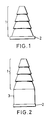
- the membrane barrier support pin comprises a pin body 1 of substantially solid construction throughout in the form of a sequence of truncated circular cones which are arranged so as to provide a serrated profile which can frictionally grip the sides of a pre-drilled hole in underlying body tissue, such as bone.
- the angle of each truncated cone is 70.6°.
- the minimum diameters of the truncated cones are respectively 0.5mm, 0.7mm, 0.9mm and 1.1mm, the maximum diameters being respectively 1.2mm, 1.4mm, 1.6mm and 1.8mm.
- the larger end of the pin body is provided with a circularly cylindrical head 2 having a diameter of 3.0mm. This head serves to secure a resorbable membrane barrier in position on underlying body tissue.
- FIG. 2 An alternative embodiment is shown in Figure 2, wherein, between the largest truncated cone and the head 2 there is provided a circularly cylindrical extension 3 having a length of 2mm and a diameter of 1.8mm. This serves to maintain an adequate spacing beneath the membrane barrier to allow consolidation and subsequent organisation of the blood clot, which is believed to be fundamental to the osteogenic process, since the osteocyte progenitor cells are contained therein. As with the embodiment shown in Figure 1, the head 2 serves to retain the membrane barrier above the underlying body tissue.
- the pin is made from PDS Polydioxanone. This material advantageously provides residual intrinsic strength for up to six weeks after implantation.
- the pins may be conveniently inserted by compaction into a pre-drilled 1mm diameter channel in underlying tissue.
- Such channels are advantageously countersunk and made using a tungsten carbide tapered fissure bur running at low speed and continuously irrigated with sterile saline.
- Membrane barrier pins in accordance with the present invention can conveniently be manufactured using compression or injection moulding techniques and can be conveniently manufactured in the form of a group of four such pins attached to a small removable stalk of PDS Polydioxanone to facilitate ease of handling by the clinician.
- Membrane Support to facilitate guided bone regeneration for bony defects such as mandibular cyst cavities; congenital defects, such as cleft palates; maxillary sinus augmentation lifting; orbital floor repairs (severe comminuted fractures).
- the present invention has been described with reference to preferred embodiments, it will be appreciated that numerous modifications and/or variations are contemplated by the present invention.
- the angle of each truncated cone could take any value within the range 67.5° to 75°; the profile could extend over any length between 2mm and 10mm; the spacer portion, if such is provided, could have any axial length within the range 2mm to 5mm; the minimum diameter of the pin could have any value between 0.5mm and 2.0mm; and the maximum diameter of the pin could have any value between 2mm and 10mm.
- the membrane barrier pins of the present invention have been described in relation to the attaching of resorbable membrane barriers, it will be appreciated that advantages of the invention may still be gained even if a non-resorbable membrane barrier is attached using such pins.
- the pins are preferably made from PDS Polydioxanone, it will be appreciated that any suitable resorbable polymer could be used, the choice of material being dependent on the strength retention profile required of the particular clinical application.
Landscapes
- Health & Medical Sciences (AREA)
- Life Sciences & Earth Sciences (AREA)
- General Health & Medical Sciences (AREA)
- Public Health (AREA)
- Engineering & Computer Science (AREA)
- Biomedical Technology (AREA)
- Heart & Thoracic Surgery (AREA)
- Surgery (AREA)
- Veterinary Medicine (AREA)
- Animal Behavior & Ethology (AREA)
- Vascular Medicine (AREA)
- Cardiology (AREA)
- Oral & Maxillofacial Surgery (AREA)
- Nuclear Medicine, Radiotherapy & Molecular Imaging (AREA)
- Transplantation (AREA)
- Medical Informatics (AREA)
- Molecular Biology (AREA)
- Prostheses (AREA)
- Materials For Medical Uses (AREA)
- Amplifiers (AREA)
- Surgical Instruments (AREA)
- Acyclic And Carbocyclic Compounds In Medicinal Compositions (AREA)
Abstract
Description
- Implantology :
- a membrane support for guided regeneration.
- Periodontology :
- a membrane support for guided bone and tissue regeneration.
Claims (23)
- A pin for attaching a surgical membrane barrier to tissue structure of a patient, the pin (1) being of substantially solid construction throughout and having a circumferentially continuous profile which enables the pin to engage the membrane barrier and to be push-fitted into the tissue structure, in combination with a said surgical membrane barrier for use therewith, characterised in that the pin is formed from a resorbable polymer, in that the profile is defined by a sequence of substantially coaxial truncated cones, and in that the pin comprises a circularly cylindrical head (2).
- A pin as claimed in claim 1, wherein said surgical membrane barrier is formed from a resorbable polymer.
- A pin as claimed in claim 1 or claim 2, wherein the profile is tapered.
- A pin as claimed in any preceding claim, wherein the profile is serrated.
- A pin as claimed in any preceding claim, wherein said sequence comprises four truncated cones.
- A pin as claimed in any preceding claim, wherein the radial cross-section of said cones is substantially circular.
- A pin as claimed in any preceding claim, wherein the angle of each cone is in the range 67.5 degrees to 75 degrees.
- A pin as claimed in claim 7, wherein said angle is substantially 70.6 degrees.
- A pin as claimed in any preceding claim, wherein the profile extends axially over a length of between 2mm and 10mm.
- A pin as claimed in claim 9, wherein said length is substantially 4.0mm.
- A pin as claimed in any preceding claim, comprising a head and a spacer portion between said head and said profile.
- A pin as claimed in claim 11, wherein said spacer portion has an axial length of between 2mm and 5mm.
- A pin as claimed in claim 12, wherein said axial length of said spacer portion is substantially 2.0mm.
- A pin as claimed in any preceding claim and having a substantially circular radial cross-section.
- A pin as claimed in claim 14 and having a minimum diameter of between 0.5mm and 2.0mm.
- A pin as claimed in claim 15, and having a minimum diameter of substantially 0.5mm.
- A pin as claimed in any one of claims 14 to 16, and having a maximum diameter of between 2mm and 10mm.
- A pin as claimed in claim 16 and having a maximum diameter of substantially 3.0mm.
- A pin as claimed in any preceding claim and made from a polymer of p-dioxanone or poly[oxy(1-oxoethylene)oxyethylene].
- A pin as claimed in claim 19 and made from PDS Polydioxanone (R.T.M.).
- A pin as claimed in any one of claims 1 to 18 and made from a copolymer of glycolide with L(-) lactide.
- A pin as claimed in claim 21 and made from Vicryl Polyglactin 910 (R.T.M.).
- A method of manufacturing a pin for attaching a surgical membrane barrier to tissue structure of a patient, the pin being of substantially solid construction throughout and having a circumferentially continuous profile which enables the pin to engage the membrane barrier and to be push-fitted into the tissue structure, characterised in that the pin is formed from a resorbable polymer, in that the profile is defined by a sequence of substantially coaxial truncated cones, and in that the pin comprises a circularly cylindrical head.
Applications Claiming Priority (2)
| Application Number | Priority Date | Filing Date | Title |
|---|---|---|---|
| GBGB9512128.1A GB9512128D0 (en) | 1995-06-15 | 1995-06-15 | Surgical pins |
| GB9512128 | 1995-06-15 |
Publications (2)
| Publication Number | Publication Date |
|---|---|
| EP0748613A1 EP0748613A1 (en) | 1996-12-18 |
| EP0748613B1 true EP0748613B1 (en) | 2003-11-26 |
Family
ID=10776081
Family Applications (1)
| Application Number | Title | Priority Date | Filing Date |
|---|---|---|---|
| EP96304446A Expired - Lifetime EP0748613B1 (en) | 1995-06-15 | 1996-06-14 | Surgical pins |
Country Status (11)
| Country | Link |
|---|---|
| US (1) | US5895396A (en) |
| EP (1) | EP0748613B1 (en) |
| JP (1) | JPH09617A (en) |
| AT (1) | ATE254883T1 (en) |
| AU (1) | AU708562B2 (en) |
| BR (1) | BR9602805A (en) |
| CA (1) | CA2179085C (en) |
| DE (1) | DE69630835T2 (en) |
| GB (1) | GB9512128D0 (en) |
| NO (1) | NO962483D0 (en) |
| ZA (1) | ZA965104B (en) |
Families Citing this family (56)
| Publication number | Priority date | Publication date | Assignee | Title |
|---|---|---|---|---|
| US6200323B1 (en) | 1998-12-04 | 2001-03-13 | Pierson, Iii Raymond H. | Bone depth resection guide and method |
| US6042584A (en) * | 1998-12-04 | 2000-03-28 | Pierson, Iii; Raymond H. | Bone depth resection guide and method |
| US6689153B1 (en) | 1999-04-16 | 2004-02-10 | Orthopaedic Biosystems Ltd, Inc. | Methods and apparatus for a coated anchoring device and/or suture |
| US6096060A (en) * | 1999-05-20 | 2000-08-01 | Linvatec Corporation | Bioabsorbable threaded soft tissue anchor system |
| US6623492B1 (en) | 2000-01-25 | 2003-09-23 | Smith & Nephew, Inc. | Tissue fastener |
| US6743233B1 (en) | 2000-08-02 | 2004-06-01 | Orthopaedic Biosystems, Ltd., Inc. | Medical screw and method of installation |
| BR0017331A (en) * | 2000-09-07 | 2003-06-03 | Synthes Ag | Device for treating bone fractures and / or for fixing surgical implants |
| US20030125750A1 (en) * | 2001-11-05 | 2003-07-03 | Zwirnmann Ralph Fritz | Spring loaded fixation element insertion device |
| US7147641B2 (en) | 2001-05-30 | 2006-12-12 | Chen Michael C | Fixation element insertion device |
| US10285694B2 (en) | 2001-10-20 | 2019-05-14 | Covidien Lp | Surgical stapler with timer and feedback display |
| US7464847B2 (en) | 2005-06-03 | 2008-12-16 | Tyco Healthcare Group Lp | Surgical stapler with timer and feedback display |
| US7449025B1 (en) | 2002-12-17 | 2008-11-11 | O'donnell Pat D | Surgical instrument to secure body tissues |
| ITBS20030028A1 (en) * | 2003-03-13 | 2004-09-14 | Physioplant S R L | MICRO NAIL AND METHOD FOR ITS USE IN THE FIXING OF A PROTECTIVE MEMBRANE FOR DENTAL USE. |
| CA2527778C (en) * | 2003-06-13 | 2011-11-08 | Tyco Healthcare Group Lp | Multiple member interconnect for surgical instrument and absorbable screw fastener |
| US8926637B2 (en) | 2003-06-13 | 2015-01-06 | Covidien Lp | Multiple member interconnect for surgical instrument and absorbable screw fastener |
| CH697414B1 (en) * | 2005-05-13 | 2008-09-30 | Synthes Gmbh | Device for the temporary splinting of toes. |
| US11291443B2 (en) | 2005-06-03 | 2022-04-05 | Covidien Lp | Surgical stapler with timer and feedback display |
| AU2006255303B2 (en) | 2005-06-03 | 2011-12-15 | Covidien Lp | Battery powered surgical instrument |
| US8128552B2 (en) * | 2005-08-22 | 2012-03-06 | O'donnell Pat D | Surgical instrument for treating female pelvic prolapse |
| US20070162030A1 (en) * | 2006-01-06 | 2007-07-12 | Ernest Aranyi | Multi-pronged compressive absorbable tack |
| US7431188B1 (en) | 2007-03-15 | 2008-10-07 | Tyco Healthcare Group Lp | Surgical stapling apparatus with powered articulation |
| US11259801B2 (en) | 2007-04-13 | 2022-03-01 | Covidien Lp | Powered surgical instrument |
| US8800837B2 (en) | 2007-04-13 | 2014-08-12 | Covidien Lp | Powered surgical instrument |
| US7950560B2 (en) | 2007-04-13 | 2011-05-31 | Tyco Healthcare Group Lp | Powered surgical instrument |
| US20080255413A1 (en) | 2007-04-13 | 2008-10-16 | Michael Zemlok | Powered surgical instrument |
| US7823760B2 (en) | 2007-05-01 | 2010-11-02 | Tyco Healthcare Group Lp | Powered surgical stapling device platform |
| US20080277445A1 (en) * | 2007-05-07 | 2008-11-13 | Zergiebel Earl M | Single fire tacker instrument |
| US7931660B2 (en) | 2007-05-10 | 2011-04-26 | Tyco Healthcare Group Lp | Powered tacker instrument |
| US7922063B2 (en) | 2007-10-31 | 2011-04-12 | Tyco Healthcare Group, Lp | Powered surgical instrument |
| US8821514B2 (en) | 2009-06-08 | 2014-09-02 | Covidien Lp | Powered tack applier |
| USD831213S1 (en) * | 2016-12-06 | 2018-10-16 | Thomas Kuun | Depth adjustable surgical pin |
| US11311295B2 (en) | 2017-05-15 | 2022-04-26 | Covidien Lp | Adaptive powered stapling algorithm with calibration factor |
| US12185949B2 (en) | 2017-10-30 | 2025-01-07 | Covidien Lp | Apparatus for endoscopic procedures |
| US10987104B2 (en) | 2017-10-30 | 2021-04-27 | Covidien Lp | Apparatus for endoscopic procedures |
| US11207066B2 (en) | 2017-10-30 | 2021-12-28 | Covidien Lp | Apparatus for endoscopic procedures |
| US11497490B2 (en) | 2018-07-09 | 2022-11-15 | Covidien Lp | Powered surgical devices including predictive motor control |
| US12137902B2 (en) | 2018-07-25 | 2024-11-12 | Covidien Lp | Adaptive anti-twitch algorithm for powered surgical devices |
| US11197734B2 (en) | 2018-10-30 | 2021-12-14 | Covidien Lp | Load sensing devices for use in surgical instruments |
| US11369372B2 (en) | 2018-11-28 | 2022-06-28 | Covidien Lp | Surgical stapler adapter with flexible cable assembly, flexible fingers, and contact clips |
| US11202635B2 (en) | 2019-02-04 | 2021-12-21 | Covidien Lp | Programmable distal tilt position of end effector for powered surgical devices |
| US11376006B2 (en) | 2019-02-06 | 2022-07-05 | Covidien Lp | End effector force measurement with digital drive circuit |
| US11219461B2 (en) | 2019-03-08 | 2022-01-11 | Covidien Lp | Strain gauge stabilization in a surgical device |
| US11458244B2 (en) | 2020-02-07 | 2022-10-04 | Covidien Lp | Irrigating surgical apparatus with positive pressure fluid |
| US11553913B2 (en) | 2020-02-11 | 2023-01-17 | Covidien Lp | Electrically-determining tissue cut with surgical stapling apparatus |
| US12029470B2 (en) | 2020-05-21 | 2024-07-09 | Covidien Lp | Simultaneous RF monopolar calibration using a shared return electrode |
| US11622768B2 (en) | 2020-07-13 | 2023-04-11 | Covidien Lp | Methods and structure for confirming proper assembly of powered surgical stapling systems |
| US12193884B2 (en) | 2020-11-17 | 2025-01-14 | Covidien Lp | Contactless force measurement of motor torque in powered surgical device |
| US11653919B2 (en) | 2020-11-24 | 2023-05-23 | Covidien Lp | Stapler line reinforcement continuity |
| US11744580B2 (en) | 2020-11-24 | 2023-09-05 | Covidien Lp | Long stapler reloads with continuous cartridge |
| US12016556B2 (en) | 2021-05-03 | 2024-06-25 | Covidien Lp | Handheld electromechanical surgical system |
| US11684362B2 (en) | 2021-06-07 | 2023-06-27 | Covidien Lp | Handheld electromechanical surgical system |
| US11771432B2 (en) | 2021-06-29 | 2023-10-03 | Covidien Lp | Stapling and cutting to default values in the event of strain gauge data integrity loss |
| US12161341B2 (en) | 2021-09-07 | 2024-12-10 | Covidien Lp | Slow speed staple and staple relaxation for stapling optimization |
| US11832823B2 (en) | 2022-02-08 | 2023-12-05 | Covidien Lp | Determination of anvil release during anastomosis |
| US12613134B2 (en) | 2022-03-31 | 2026-04-28 | Covidien Lp | System and method for color sensor characterization, calibration and threshold-setting |
| US12616474B2 (en) | 2023-10-17 | 2026-05-05 | Covidien Lp | Robotic or powered surgical stapler with predictive stapling end stop |
Family Cites Families (12)
| Publication number | Priority date | Publication date | Assignee | Title |
|---|---|---|---|---|
| US4873976A (en) * | 1984-02-28 | 1989-10-17 | Schreiber Saul N | Surgical fasteners and method |
| CA1329089C (en) * | 1987-09-02 | 1994-05-03 | Russell Warren | Surgical fastener |
| FR2623082B1 (en) * | 1987-11-16 | 1990-03-09 | Laboureau Jacques | ARTIFICIAL ANKLE BY THE INTRA-BONE FASTENING OF PROSTHESIS AND LIGAMENTARY REINFORCEMENTS, AS WELL AS THE ASSOCIATED IMPACTOR PROVIDED WITH MEANS FOR MAINTAINING THE SAME |
| EP0548998A1 (en) * | 1989-02-22 | 1993-06-30 | United States Surgical Corporation | Skin fastener |
| WO1992006638A1 (en) * | 1990-10-10 | 1992-04-30 | W.L. Gore & Associates, Inc. | A laparoscopy surgical instrument |
| US5108422A (en) * | 1990-10-22 | 1992-04-28 | United States Surgical Corporation | Skin fastener |
| US5282829A (en) * | 1991-08-15 | 1994-02-01 | United States Surgical Corporation | Hollow body implants |
| DE4132855A1 (en) * | 1991-10-02 | 1993-04-08 | Wisap Gmbh | INSTRUMENT FOR APPLICATION OF AN ADHAESION PROPHYLAXE FOR ENDOSCOPIC INTERVENTIONS |
| US5333624A (en) * | 1992-02-24 | 1994-08-02 | United States Surgical Corporation | Surgical attaching apparatus |
| US5236438A (en) * | 1992-09-10 | 1993-08-17 | Wilk Peter J | Method and assembly for repairing liver laceration |
| DE4300039C1 (en) * | 1993-01-04 | 1994-06-09 | Imz Fertigung Vertrieb | Fixture nail for attachment of cover membrane to bone surrounding defect point filled with bone structural material - has nail head of large dia. and shaft of smaller dia. which has cylindrical retention part and conical point part |
| US5500000A (en) * | 1993-07-01 | 1996-03-19 | United States Surgical Corporation | Soft tissue repair system and method |
-
1995
- 1995-06-15 GB GBGB9512128.1A patent/GB9512128D0/en active Pending
-
1996
- 1996-05-31 AU AU54670/96A patent/AU708562B2/en not_active Expired
- 1996-06-11 JP JP8170737A patent/JPH09617A/en active Pending
- 1996-06-12 NO NO962483A patent/NO962483D0/en unknown
- 1996-06-13 CA CA002179085A patent/CA2179085C/en not_active Expired - Lifetime
- 1996-06-14 BR BR9602805A patent/BR9602805A/en not_active Application Discontinuation
- 1996-06-14 US US08/663,494 patent/US5895396A/en not_active Expired - Lifetime
- 1996-06-14 EP EP96304446A patent/EP0748613B1/en not_active Expired - Lifetime
- 1996-06-14 ZA ZA9605104A patent/ZA965104B/en unknown
- 1996-06-14 DE DE69630835T patent/DE69630835T2/en not_active Expired - Lifetime
- 1996-06-14 AT AT96304446T patent/ATE254883T1/en not_active IP Right Cessation
Also Published As
| Publication number | Publication date |
|---|---|
| CA2179085C (en) | 2006-12-05 |
| GB9512128D0 (en) | 1995-08-16 |
| DE69630835D1 (en) | 2004-01-08 |
| ATE254883T1 (en) | 2003-12-15 |
| ZA965104B (en) | 1997-12-15 |
| BR9602805A (en) | 1998-04-22 |
| AU5467096A (en) | 1997-01-02 |
| US5895396A (en) | 1999-04-20 |
| CA2179085A1 (en) | 1996-12-16 |
| AU708562B2 (en) | 1999-08-05 |
| EP0748613A1 (en) | 1996-12-18 |
| JPH09617A (en) | 1997-01-07 |
| NO962483D0 (en) | 1996-06-12 |
| DE69630835T2 (en) | 2004-11-04 |
Similar Documents
| Publication | Publication Date | Title |
|---|---|---|
| CA2179085C (en) | Surgical pins | |
| US11766283B2 (en) | Bone screws and methods of use thereof | |
| EP1864616B1 (en) | A bone fixation device | |
| US7727235B2 (en) | Medical fixation devices with improved torsional drive head | |
| US6293950B1 (en) | Resorbable pin systems | |
| AU672596B2 (en) | Polymeric screws and coatings for surgical uses | |
| EP0449867B1 (en) | Polymeric fixation plate for surgical use | |
| JP4231696B2 (en) | Distal bone anchor for bone fixation with secondary compression | |
| Tiainen et al. | Bioabsorbable ciprofloxacin-containing and plain self-reinforced polylactide-polyglycolide 80/20 screws: pullout strength properties in human cadaver parietal bones | |
| EP0471334B1 (en) | Absorbable surgical fastener with bone penetrating elements | |
| Tunc | Orientruded polylactide based body-absorbable osteosynthesis devices: A short review | |
| US20250275778A1 (en) | Set for the Endoscopic Fixation of an Implant in an Intervertebral Disk by Means of a Nail or Pin | |
| CA2750254C (en) | Bone screws and methods of use thereof | |
| Hutmacher et al. | The clinical evaluation of a bioresorbable minipin | |
| AU2013201365A1 (en) | Medical fixation devices with improved torsional drive head | |
| HK1034434A (en) | Resorbable pin systems | |
| RU2169539C1 (en) | Surgical method for treating medial femur neck fracture |
Legal Events
| Date | Code | Title | Description |
|---|---|---|---|
| PUAI | Public reference made under article 153(3) epc to a published international application that has entered the european phase |
Free format text: ORIGINAL CODE: 0009012 |
|
| AK | Designated contracting states |
Kind code of ref document: A1 Designated state(s): AT CH DE DK FI FR GB IT LI SE |
|
| 17P | Request for examination filed |
Effective date: 19970528 |
|
| 17Q | First examination report despatched |
Effective date: 20000801 |
|
| GRAH | Despatch of communication of intention to grant a patent |
Free format text: ORIGINAL CODE: EPIDOS IGRA |
|
| GRAS | Grant fee paid |
Free format text: ORIGINAL CODE: EPIDOSNIGR3 |
|
| GRAA | (expected) grant |
Free format text: ORIGINAL CODE: 0009210 |
|
| AK | Designated contracting states |
Kind code of ref document: B1 Designated state(s): AT CH DE DK FI FR GB IT LI SE |
|
| PG25 | Lapsed in a contracting state [announced via postgrant information from national office to epo] |
Ref country code: LI Free format text: LAPSE BECAUSE OF FAILURE TO SUBMIT A TRANSLATION OF THE DESCRIPTION OR TO PAY THE FEE WITHIN THE PRESCRIBED TIME-LIMIT Effective date: 20031126 Ref country code: FI Free format text: LAPSE BECAUSE OF FAILURE TO SUBMIT A TRANSLATION OF THE DESCRIPTION OR TO PAY THE FEE WITHIN THE PRESCRIBED TIME-LIMIT Effective date: 20031126 Ref country code: CH Free format text: LAPSE BECAUSE OF FAILURE TO SUBMIT A TRANSLATION OF THE DESCRIPTION OR TO PAY THE FEE WITHIN THE PRESCRIBED TIME-LIMIT Effective date: 20031126 Ref country code: AT Free format text: LAPSE BECAUSE OF FAILURE TO SUBMIT A TRANSLATION OF THE DESCRIPTION OR TO PAY THE FEE WITHIN THE PRESCRIBED TIME-LIMIT Effective date: 20031126 |
|
| REG | Reference to a national code |
Ref country code: GB Ref legal event code: FG4D |
|
| REG | Reference to a national code |
Ref country code: CH Ref legal event code: EP |
|
| REF | Corresponds to: |
Ref document number: 69630835 Country of ref document: DE Date of ref document: 20040108 Kind code of ref document: P |
|
| PG25 | Lapsed in a contracting state [announced via postgrant information from national office to epo] |
Ref country code: SE Free format text: LAPSE BECAUSE OF FAILURE TO SUBMIT A TRANSLATION OF THE DESCRIPTION OR TO PAY THE FEE WITHIN THE PRESCRIBED TIME-LIMIT Effective date: 20040226 Ref country code: DK Free format text: LAPSE BECAUSE OF FAILURE TO SUBMIT A TRANSLATION OF THE DESCRIPTION OR TO PAY THE FEE WITHIN THE PRESCRIBED TIME-LIMIT Effective date: 20040226 |
|
| REG | Reference to a national code |
Ref country code: CH Ref legal event code: PL |
|
| ET | Fr: translation filed | ||
| PLBE | No opposition filed within time limit |
Free format text: ORIGINAL CODE: 0009261 |
|
| STAA | Information on the status of an ep patent application or granted ep patent |
Free format text: STATUS: NO OPPOSITION FILED WITHIN TIME LIMIT |
|
| 26N | No opposition filed |
Effective date: 20040827 |
|
| REG | Reference to a national code |
Ref country code: FR Ref legal event code: PLFP Year of fee payment: 20 |
|
| PGFP | Annual fee paid to national office [announced via postgrant information from national office to epo] |
Ref country code: GB Payment date: 20150610 Year of fee payment: 20 Ref country code: DE Payment date: 20150609 Year of fee payment: 20 |
|
| PGFP | Annual fee paid to national office [announced via postgrant information from national office to epo] |
Ref country code: FR Payment date: 20150608 Year of fee payment: 20 |
|
| PGFP | Annual fee paid to national office [announced via postgrant information from national office to epo] |
Ref country code: IT Payment date: 20150625 Year of fee payment: 20 |
|
| REG | Reference to a national code |
Ref country code: DE Ref legal event code: R071 Ref document number: 69630835 Country of ref document: DE |
|
| REG | Reference to a national code |
Ref country code: GB Ref legal event code: PE20 Expiry date: 20160613 |
|
| PG25 | Lapsed in a contracting state [announced via postgrant information from national office to epo] |
Ref country code: GB Free format text: LAPSE BECAUSE OF EXPIRATION OF PROTECTION Effective date: 20160613 |