EP0746539B1 - Process for the preparation of cinnamic acid derivatives - Google Patents
Process for the preparation of cinnamic acid derivatives Download PDFInfo
- Publication number
- EP0746539B1 EP0746539B1 EP95908267A EP95908267A EP0746539B1 EP 0746539 B1 EP0746539 B1 EP 0746539B1 EP 95908267 A EP95908267 A EP 95908267A EP 95908267 A EP95908267 A EP 95908267A EP 0746539 B1 EP0746539 B1 EP 0746539B1
- Authority
- EP
- European Patent Office
- Prior art keywords
- alkyl
- aryl
- employed
- palladium
- process according
- Prior art date
- Legal status (The legal status is an assumption and is not a legal conclusion. Google has not performed a legal analysis and makes no representation as to the accuracy of the status listed.)
- Expired - Lifetime
Links
- 238000000034 method Methods 0.000 title claims abstract description 33
- 150000001851 cinnamic acid derivatives Chemical class 0.000 title claims abstract description 8
- 238000002360 preparation method Methods 0.000 title claims abstract description 6
- KDLHZDBZIXYQEI-UHFFFAOYSA-N Palladium Chemical compound [Pd] KDLHZDBZIXYQEI-UHFFFAOYSA-N 0.000 claims abstract description 34
- 229910052763 palladium Inorganic materials 0.000 claims abstract description 17
- 150000001252 acrylic acid derivatives Chemical class 0.000 claims abstract description 12
- 239000003054 catalyst Substances 0.000 claims abstract description 11
- XYFCBTPGUUZFHI-UHFFFAOYSA-N Phosphine Chemical compound P XYFCBTPGUUZFHI-UHFFFAOYSA-N 0.000 claims description 28
- 150000001875 compounds Chemical class 0.000 claims description 17
- 229910000073 phosphorus hydride Inorganic materials 0.000 claims description 14
- 125000003837 (C1-C20) alkyl group Chemical group 0.000 claims description 7
- 125000000041 C6-C10 aryl group Chemical group 0.000 claims description 6
- 125000004191 (C1-C6) alkoxy group Chemical group 0.000 claims description 4
- 125000004169 (C1-C6) alkyl group Chemical group 0.000 claims description 4
- 125000006564 (C4-C8) cycloalkyl group Chemical group 0.000 claims description 4
- 238000003756 stirring Methods 0.000 claims description 4
- 125000001931 aliphatic group Chemical group 0.000 claims description 3
- 125000000113 cyclohexyl group Chemical group [H]C1([H])C([H])([H])C([H])([H])C([H])(*)C([H])([H])C1([H])[H] 0.000 claims description 3
- 125000000008 (C1-C10) alkyl group Chemical group 0.000 claims description 2
- 125000006736 (C6-C20) aryl group Chemical group 0.000 claims description 2
- 239000007789 gas Substances 0.000 claims description 2
- 239000001257 hydrogen Substances 0.000 claims description 2
- 229910052739 hydrogen Inorganic materials 0.000 claims description 2
- 125000004435 hydrogen atom Chemical group [H]* 0.000 claims description 2
- 150000007529 inorganic bases Chemical class 0.000 claims description 2
- 230000003647 oxidation Effects 0.000 claims description 2
- 238000007254 oxidation reaction Methods 0.000 claims description 2
- 150000002941 palladium compounds Chemical class 0.000 claims description 2
- 230000001681 protective effect Effects 0.000 claims description 2
- 125000000876 trifluoromethoxy group Chemical group FC(F)(F)O* 0.000 claims description 2
- MVPPADPHJFYWMZ-UHFFFAOYSA-N chlorobenzene Chemical compound ClC1=CC=CC=C1 MVPPADPHJFYWMZ-UHFFFAOYSA-N 0.000 claims 2
- 150000001491 aromatic compounds Chemical class 0.000 abstract 1
- 238000006243 chemical reaction Methods 0.000 description 12
- ZMXDDKWLCZADIW-UHFFFAOYSA-N N,N-Dimethylformamide Chemical compound CN(C)C=O ZMXDDKWLCZADIW-UHFFFAOYSA-N 0.000 description 9
- YRGAYAGBVIXNAQ-UHFFFAOYSA-N 1-chloro-4-methoxybenzene Chemical compound COC1=CC=C(Cl)C=C1 YRGAYAGBVIXNAQ-UHFFFAOYSA-N 0.000 description 8
- 239000003446 ligand Substances 0.000 description 8
- -1 alkali metal carboxylates Chemical class 0.000 description 7
- 239000002585 base Substances 0.000 description 7
- 239000002904 solvent Substances 0.000 description 7
- IJGRMHOSHXDMSA-UHFFFAOYSA-N Atomic nitrogen Chemical compound N#N IJGRMHOSHXDMSA-UHFFFAOYSA-N 0.000 description 6
- OTMSDBZUPAUEDD-UHFFFAOYSA-N Ethane Chemical compound CC OTMSDBZUPAUEDD-UHFFFAOYSA-N 0.000 description 6
- CDBYLPFSWZWCQE-UHFFFAOYSA-L Sodium Carbonate Chemical compound [Na+].[Na+].[O-]C([O-])=O CDBYLPFSWZWCQE-UHFFFAOYSA-L 0.000 description 6
- ZMANZCXQSJIPKH-UHFFFAOYSA-N Triethylamine Chemical compound CCN(CC)CC ZMANZCXQSJIPKH-UHFFFAOYSA-N 0.000 description 6
- 150000003003 phosphines Chemical class 0.000 description 5
- GOXQRTZXKQZDDN-UHFFFAOYSA-N 2-Ethylhexyl acrylate Chemical compound CCCCC(CC)COC(=O)C=C GOXQRTZXKQZDDN-UHFFFAOYSA-N 0.000 description 4
- BAPJBEWLBFYGME-UHFFFAOYSA-N Methyl acrylate Chemical compound COC(=O)C=C BAPJBEWLBFYGME-UHFFFAOYSA-N 0.000 description 4
- SECXISVLQFMRJM-UHFFFAOYSA-N N-Methylpyrrolidone Chemical compound CN1CCCC1=O SECXISVLQFMRJM-UHFFFAOYSA-N 0.000 description 4
- YBGZDTIWKVFICR-JLHYYAGUSA-N Octyl 4-methoxycinnamic acid Chemical compound CCCCC(CC)COC(=O)\C=C\C1=CC=C(OC)C=C1 YBGZDTIWKVFICR-JLHYYAGUSA-N 0.000 description 4
- ATUOYWHBWRKTHZ-UHFFFAOYSA-N Propane Chemical compound CCC ATUOYWHBWRKTHZ-UHFFFAOYSA-N 0.000 description 4
- 239000000047 product Substances 0.000 description 4
- WLPUWLXVBWGYMZ-UHFFFAOYSA-N tricyclohexylphosphine Chemical compound C1CCCCC1P(C1CCCCC1)C1CCCCC1 WLPUWLXVBWGYMZ-UHFFFAOYSA-N 0.000 description 4
- RIOQSEWOXXDEQQ-UHFFFAOYSA-N triphenylphosphine Chemical compound C1=CC=CC=C1P(C=1C=CC=CC=1)C1=CC=CC=C1 RIOQSEWOXXDEQQ-UHFFFAOYSA-N 0.000 description 4
- WEVYAHXRMPXWCK-UHFFFAOYSA-N Acetonitrile Chemical compound CC#N WEVYAHXRMPXWCK-UHFFFAOYSA-N 0.000 description 3
- BZLVMXJERCGZMT-UHFFFAOYSA-N Methyl tert-butyl ether Chemical compound COC(C)(C)C BZLVMXJERCGZMT-UHFFFAOYSA-N 0.000 description 3
- KWYHDKDOAIKMQN-UHFFFAOYSA-N N,N,N',N'-tetramethylethylenediamine Chemical compound CN(C)CCN(C)C KWYHDKDOAIKMQN-UHFFFAOYSA-N 0.000 description 3
- OAICVXFJPJFONN-UHFFFAOYSA-N Phosphorus Chemical compound [P] OAICVXFJPJFONN-UHFFFAOYSA-N 0.000 description 3
- YXFVVABEGXRONW-UHFFFAOYSA-N Toluene Chemical compound CC1=CC=CC=C1 YXFVVABEGXRONW-UHFFFAOYSA-N 0.000 description 3
- 229910052783 alkali metal Inorganic materials 0.000 description 3
- WDIIYWASEVHBBT-UHFFFAOYSA-N di(propan-2-yl)phosphane Chemical compound CC(C)PC(C)C WDIIYWASEVHBBT-UHFFFAOYSA-N 0.000 description 3
- HDULBKVLSJEMGN-UHFFFAOYSA-N dicyclohexylphosphane Chemical compound C1CCCCC1PC1CCCCC1 HDULBKVLSJEMGN-UHFFFAOYSA-N 0.000 description 3
- 238000004817 gas chromatography Methods 0.000 description 3
- 239000000203 mixture Substances 0.000 description 3
- OFBQJSOFQDEBGM-UHFFFAOYSA-N n-pentane Natural products CCCCC OFBQJSOFQDEBGM-UHFFFAOYSA-N 0.000 description 3
- 229910052757 nitrogen Inorganic materials 0.000 description 3
- YJVFFLUZDVXJQI-UHFFFAOYSA-L palladium(ii) acetate Chemical compound [Pd+2].CC([O-])=O.CC([O-])=O YJVFFLUZDVXJQI-UHFFFAOYSA-L 0.000 description 3
- 229910052698 phosphorus Inorganic materials 0.000 description 3
- 239000011574 phosphorus Substances 0.000 description 3
- 239000003880 polar aprotic solvent Substances 0.000 description 3
- NLKNQRATVPKPDG-UHFFFAOYSA-M potassium iodide Chemical compound [K+].[I-] NLKNQRATVPKPDG-UHFFFAOYSA-M 0.000 description 3
- 239000011541 reaction mixture Substances 0.000 description 3
- 229910000029 sodium carbonate Inorganic materials 0.000 description 3
- IGNTWNVBGLNYDV-UHFFFAOYSA-N triisopropylphosphine Chemical compound CC(C)P(C(C)C)C(C)C IGNTWNVBGLNYDV-UHFFFAOYSA-N 0.000 description 3
- XLYOFNOQVPJJNP-UHFFFAOYSA-N water Substances O XLYOFNOQVPJJNP-UHFFFAOYSA-N 0.000 description 3
- SYSZENVIJHPFNL-UHFFFAOYSA-N (alpha-D-mannosyl)7-beta-D-mannosyl-diacetylchitobiosyl-L-asparagine, isoform B (protein) Chemical compound COC1=CC=C(I)C=C1 SYSZENVIJHPFNL-UHFFFAOYSA-N 0.000 description 2
- QJPJQTDYNZXKQF-UHFFFAOYSA-N 4-bromoanisole Chemical compound COC1=CC=C(Br)C=C1 QJPJQTDYNZXKQF-UHFFFAOYSA-N 0.000 description 2
- RTZKZFJDLAIYFH-UHFFFAOYSA-N Diethyl ether Chemical compound CCOCC RTZKZFJDLAIYFH-UHFFFAOYSA-N 0.000 description 2
- IAZDPXIOMUYVGZ-UHFFFAOYSA-N Dimethylsulphoxide Chemical compound CS(C)=O IAZDPXIOMUYVGZ-UHFFFAOYSA-N 0.000 description 2
- WYURNTSHIVDZCO-UHFFFAOYSA-N Tetrahydrofuran Chemical compound C1CCOC1 WYURNTSHIVDZCO-UHFFFAOYSA-N 0.000 description 2
- 150000001340 alkali metals Chemical class 0.000 description 2
- 229910052784 alkaline earth metal Inorganic materials 0.000 description 2
- 150000001336 alkenes Chemical class 0.000 description 2
- 238000006254 arylation reaction Methods 0.000 description 2
- 125000001309 chloro group Chemical class Cl* 0.000 description 2
- 239000000284 extract Substances 0.000 description 2
- VEZIKIAGFYZTCI-VMPITWQZSA-N methyl 4-methoxycinnamate Chemical compound COC(=O)\C=C\C1=CC=C(OC)C=C1 VEZIKIAGFYZTCI-VMPITWQZSA-N 0.000 description 2
- VEZIKIAGFYZTCI-UHFFFAOYSA-N methyl ester of p-methoxycinnamic acid Natural products COC(=O)C=CC1=CC=C(OC)C=C1 VEZIKIAGFYZTCI-UHFFFAOYSA-N 0.000 description 2
- BHAAPTBBJKJZER-UHFFFAOYSA-N p-anisidine Chemical compound COC1=CC=C(N)C=C1 BHAAPTBBJKJZER-UHFFFAOYSA-N 0.000 description 2
- LXNAVEXFUKBNMK-UHFFFAOYSA-N palladium(II) acetate Substances [Pd].CC(O)=O.CC(O)=O LXNAVEXFUKBNMK-UHFFFAOYSA-N 0.000 description 2
- 239000001294 propane Substances 0.000 description 2
- 238000011084 recovery Methods 0.000 description 2
- 150000003839 salts Chemical class 0.000 description 2
- YWWDBCBWQNCYNR-UHFFFAOYSA-N trimethylphosphine Chemical compound CP(C)C YWWDBCBWQNCYNR-UHFFFAOYSA-N 0.000 description 2
- AFDXODALSZRGIH-QPJJXVBHSA-N (E)-3-(4-methoxyphenyl)prop-2-enoic acid Chemical compound COC1=CC=C(\C=C\C(O)=O)C=C1 AFDXODALSZRGIH-QPJJXVBHSA-N 0.000 description 1
- AVPYQKSLYISFPO-UHFFFAOYSA-N 4-chlorobenzaldehyde Chemical compound ClC1=CC=C(C=O)C=C1 AVPYQKSLYISFPO-UHFFFAOYSA-N 0.000 description 1
- NLHHRLWOUZZQLW-UHFFFAOYSA-N Acrylonitrile Chemical compound C=CC#N NLHHRLWOUZZQLW-UHFFFAOYSA-N 0.000 description 1
- PMZURENOXWZQFD-UHFFFAOYSA-L Sodium Sulfate Chemical compound [Na+].[Na+].[O-]S([O-])(=O)=O PMZURENOXWZQFD-UHFFFAOYSA-L 0.000 description 1
- 239000006096 absorbing agent Substances 0.000 description 1
- 239000002253 acid Substances 0.000 description 1
- 150000007513 acids Chemical class 0.000 description 1
- 229910000288 alkali metal carbonate Inorganic materials 0.000 description 1
- 150000008041 alkali metal carbonates Chemical class 0.000 description 1
- 229910001516 alkali metal iodide Inorganic materials 0.000 description 1
- 125000003545 alkoxy group Chemical group 0.000 description 1
- 125000000217 alkyl group Chemical group 0.000 description 1
- 150000001412 amines Chemical class 0.000 description 1
- 239000008346 aqueous phase Substances 0.000 description 1
- 238000009835 boiling Methods 0.000 description 1
- 150000003842 bromide salts Chemical class 0.000 description 1
- 239000001273 butane Substances 0.000 description 1
- 239000006227 byproduct Substances 0.000 description 1
- YKPUWZUDDOIDPM-SOFGYWHQSA-N capsaicin Chemical compound COC1=CC(CNC(=O)CCCC\C=C\C(C)C)=CC=C1O YKPUWZUDDOIDPM-SOFGYWHQSA-N 0.000 description 1
- BVKZGUZCCUSVTD-UHFFFAOYSA-N carbonic acid Chemical class OC(O)=O BVKZGUZCCUSVTD-UHFFFAOYSA-N 0.000 description 1
- 150000004649 carbonic acid derivatives Chemical class 0.000 description 1
- 238000006555 catalytic reaction Methods 0.000 description 1
- 150000008422 chlorobenzenes Chemical class 0.000 description 1
- 239000002537 cosmetic Substances 0.000 description 1
- 230000008878 coupling Effects 0.000 description 1
- 238000010168 coupling process Methods 0.000 description 1
- 238000005859 coupling reaction Methods 0.000 description 1
- PTLIZOFGXLGHSY-UHFFFAOYSA-N dibutylphosphane Chemical compound CCCCPCCCC PTLIZOFGXLGHSY-UHFFFAOYSA-N 0.000 description 1
- 150000004816 dichlorobenzenes Chemical class 0.000 description 1
- VZZJVOCVAZHETD-UHFFFAOYSA-N diethylphosphane Chemical compound CCPCC VZZJVOCVAZHETD-UHFFFAOYSA-N 0.000 description 1
- YOTZYFSGUCFUKA-UHFFFAOYSA-N dimethylphosphine Chemical compound CPC YOTZYFSGUCFUKA-UHFFFAOYSA-N 0.000 description 1
- MTWCVKTUVWXLFS-UHFFFAOYSA-N dipropylphosphane Chemical compound CCCPCCC MTWCVKTUVWXLFS-UHFFFAOYSA-N 0.000 description 1
- 150000002170 ethers Chemical class 0.000 description 1
- 238000000605 extraction Methods 0.000 description 1
- 239000000706 filtrate Substances 0.000 description 1
- 238000001914 filtration Methods 0.000 description 1
- GNOIPBMMFNIUFM-UHFFFAOYSA-N hexamethylphosphoric triamide Chemical compound CN(C)P(=O)(N(C)C)N(C)C GNOIPBMMFNIUFM-UHFFFAOYSA-N 0.000 description 1
- 229930195733 hydrocarbon Natural products 0.000 description 1
- 150000002430 hydrocarbons Chemical class 0.000 description 1
- 125000001972 isopentyl group Chemical group [H]C([H])([H])C([H])(C([H])([H])[H])C([H])([H])C([H])([H])* 0.000 description 1
- 125000000956 methoxy group Chemical group [H]C([H])([H])O* 0.000 description 1
- IJDNQMDRQITEOD-UHFFFAOYSA-N n-butane Chemical compound CCCC IJDNQMDRQITEOD-UHFFFAOYSA-N 0.000 description 1
- 229940065472 octyl acrylate Drugs 0.000 description 1
- ANISOHQJBAQUQP-UHFFFAOYSA-N octyl prop-2-enoate Chemical compound CCCCCCCCOC(=O)C=C ANISOHQJBAQUQP-UHFFFAOYSA-N 0.000 description 1
- 239000012074 organic phase Substances 0.000 description 1
- 239000003960 organic solvent Substances 0.000 description 1
- 125000002524 organometallic group Chemical group 0.000 description 1
- AFDXODALSZRGIH-UHFFFAOYSA-N p-coumaric acid methyl ether Natural products COC1=CC=C(C=CC(O)=O)C=C1 AFDXODALSZRGIH-UHFFFAOYSA-N 0.000 description 1
- PIBWKRNGBLPSSY-UHFFFAOYSA-L palladium(II) chloride Chemical compound Cl[Pd]Cl PIBWKRNGBLPSSY-UHFFFAOYSA-L 0.000 description 1
- QJPQVXSHYBGQGM-UHFFFAOYSA-N palladium;triphenylphosphane Chemical compound [Pd].C1=CC=CC=C1P(C=1C=CC=CC=1)C1=CC=CC=C1.C1=CC=CC=C1P(C=1C=CC=CC=1)C1=CC=CC=C1 QJPQVXSHYBGQGM-UHFFFAOYSA-N 0.000 description 1
- 239000003444 phase transfer catalyst Substances 0.000 description 1
- 125000001997 phenyl group Chemical group [H]C1=C([H])C([H])=C(*)C([H])=C1[H] 0.000 description 1
- 229910052938 sodium sulfate Inorganic materials 0.000 description 1
- 235000011152 sodium sulphate Nutrition 0.000 description 1
- YLQBMQCUIZJEEH-UHFFFAOYSA-N tetrahydrofuran Natural products C=1C=COC=1 YLQBMQCUIZJEEH-UHFFFAOYSA-N 0.000 description 1
- XTTGYFREQJCEML-UHFFFAOYSA-N tributyl phosphite Chemical compound CCCCOP(OCCCC)OCCCC XTTGYFREQJCEML-UHFFFAOYSA-N 0.000 description 1
- IMFACGCPASFAPR-UHFFFAOYSA-N tributylamine Chemical compound CCCCN(CCCC)CCCC IMFACGCPASFAPR-UHFFFAOYSA-N 0.000 description 1
- TUQOTMZNTHZOKS-UHFFFAOYSA-N tributylphosphine Chemical compound CCCCP(CCCC)CCCC TUQOTMZNTHZOKS-UHFFFAOYSA-N 0.000 description 1
- FICPQAZLPKLOLH-UHFFFAOYSA-N tricyclohexyl phosphite Chemical compound C1CCCCC1OP(OC1CCCCC1)OC1CCCCC1 FICPQAZLPKLOLH-UHFFFAOYSA-N 0.000 description 1
- RXJKFRMDXUJTEX-UHFFFAOYSA-N triethylphosphine Chemical compound CCP(CC)CC RXJKFRMDXUJTEX-UHFFFAOYSA-N 0.000 description 1
- CYTQBVOFDCPGCX-UHFFFAOYSA-N trimethyl phosphite Chemical compound COP(OC)OC CYTQBVOFDCPGCX-UHFFFAOYSA-N 0.000 description 1
- SJHCUXCOGGKFAI-UHFFFAOYSA-N tripropan-2-yl phosphite Chemical compound CC(C)OP(OC(C)C)OC(C)C SJHCUXCOGGKFAI-UHFFFAOYSA-N 0.000 description 1
- QOPBTFMUVTXWFF-UHFFFAOYSA-N tripropyl phosphite Chemical compound CCCOP(OCCC)OCCC QOPBTFMUVTXWFF-UHFFFAOYSA-N 0.000 description 1
- KCTAHLRCZMOTKM-UHFFFAOYSA-N tripropylphosphane Chemical compound CCCP(CCC)CCC KCTAHLRCZMOTKM-UHFFFAOYSA-N 0.000 description 1
- 239000002351 wastewater Substances 0.000 description 1
Classifications
-
- C—CHEMISTRY; METALLURGY
- C07—ORGANIC CHEMISTRY
- C07C—ACYCLIC OR CARBOCYCLIC COMPOUNDS
- C07C51/00—Preparation of carboxylic acids or their salts, halides or anhydrides
- C07C51/347—Preparation of carboxylic acids or their salts, halides or anhydrides by reactions not involving formation of carboxyl groups
-
- C—CHEMISTRY; METALLURGY
- C07—ORGANIC CHEMISTRY
- C07C—ACYCLIC OR CARBOCYCLIC COMPOUNDS
- C07C67/00—Preparation of carboxylic acid esters
- C07C67/30—Preparation of carboxylic acid esters by modifying the acid moiety of the ester, such modification not being an introduction of an ester group
- C07C67/333—Preparation of carboxylic acid esters by modifying the acid moiety of the ester, such modification not being an introduction of an ester group by isomerisation; by change of size of the carbon skeleton
- C07C67/343—Preparation of carboxylic acid esters by modifying the acid moiety of the ester, such modification not being an introduction of an ester group by isomerisation; by change of size of the carbon skeleton by increase in the number of carbon atoms
Definitions
- the present invention relates to a process for the preparation of cinnamic acid derivatives.
- olefins can be arylated by bromoaromatic compounds in the presence of palladium catalysts, phosphine ligands and a base (see R.F. Heck, Org. React. 27, 345-391 (1982)).
- the reaction is frequently carried out with various amines (e.g. triethylamine, tributylamine, tetramethylethylenediamine), which may serve simultaneously as solvent.
- the bases employed may include alkali metal carboxylates in dimethylformamide (see EP-A 78 768) or alkali metal carbonates or hydrogen carbonates, given the simultaneous presence of a polar aprotic solvent (e.g. dimethylformamide, hexamethylphosphoric triamide, acetonitrile) and a phase transfer catalyst (see Tetrahedron Lett. 26, 2667-2670 (1985) and J. Org. Chem. 56, 1289-1293 (1991)).
- a polar aprotic solvent e.g. dimethylformamide, hexamethylphosphoric triamide, acetonitrile
- phase transfer catalyst see Tetrahedron Lett. 26, 2667-2670 (1985) and J. Org. Chem. 56, 1289-1293 (1991)).
- This process involves a large number of steps and requires the recovery of alkali metal iodide.
- DE 42 11 608 proposes the reaction of bromoaromatic compounds with acrylic acid derivatives in the presence of palladium catalysts and a large excess of phosphines, based on palladium.
- the phosphine produced in relatively large quantities in this reaction creates additional difficulties in isolating the product.
- EP 0 509 426 describes the preparation of octyl p-methoxycinnamate from p-bromoanisole and octyl acrylate in the presence of a base and of a coupling catalyst in a polar aprotic solvent. All of the processes which have been disclosed to date produce bromide salts as by-products, resulting in a considerable pollution of the waste water or in a laborious recovery procedure. None of the processes known to date has a successful outcome with the corresponding chlorine derivative.
- EP 103 544 describes a process for the arylation of acrylonitrile with p-chlorobenzaldehyde in the presence of chloro(4-formylphenyl)bis(triphenylphosphine)palladium(II), the product being obtained in a yield of only 18%.
- the quantity of palladium can be chosen such that, based on the chloroaromatic compound employed, its proportion is from 0.0001 to 1 mol%, preferably from 0.005 to 0.05 mol%.
- the acrylic acid derivatives employed may, for example, be those of the formula (III): in which
- Chloroaromatic compounds which can be employed are, for example, chlorobenzenes of the formula (IV) in which
- the molar ratio of chloroaromatic compound to acrylic acid derivative can be chosen as desired. Preference is given to working at a molar ratio of chloroaromatic compound to acrylic acid derivative which is in the range from 1:0.7 to 1:3. With particular preference this ratio is from 1:0.8 to 1:1.5.
- the process of this invention is also characterised in that the palladium catalysts employed are palladium compounds in oxidation state 0 and/or +2 in quantities of from 0.0001 to 1 mol% of palladium (based on chloroaromatic compounds employed).
- Suitable inorganic bases for the process according to the invention are, for example, alkali metal and alkaline earth metal salts of weak acids, preferably alkali metal and alkaline earth metal hydrogen carbonates and/or carbonates. Particular preference is given to the use of sodium carbonate.
- the ratio of chloroaromatic compound to base is preferably chosen such that from 0.3 to 2, particularly preferably from 0.4 to 1.3, equivalents of base are employed per mole of chloroaromatic compound.
- the lipophilic, aliphatic phosphine ligands of the formula I are obtainable commercially or can be prepared in analogy to processes which are known per se.
- the radicals R 1 and R 2 are identical and have a branched alkyl or alkoxy group or a cyclohexyl group.
- preferred monodentate phosphine ligands are: trimethylphosphine, triethylphosphine, tripropylphosphine, triisopropylphosphine, tributylphosphine, tricyclohexylphosphine, trimethyl phosphite, tripropyl phosphite, triisopropyl phosphite, tributyl phosphite and tricyclohexyl phosphite, in particular triisopropylphosphine or tricyclohexylphosphine.
- R 1 are in each case identical, and R 2 is a radical of formula (II) in which R 3 is preferably divalent C 2-6 -alkylene.
- preferred bidentate phosphine ligands are: 1,2-bis(dimethylphosphine)ethane, 1,2-bis(diethylphosphine)ethane, 1,2-bis(dipropylphosphine)ethane, 1,2-bis(diisopropylphosphine)ethane, 1,2-bis(dibutylphosphine)ethane, 1,2-bis(dicyclohexylphosphine)ethane, 1,3-bis(dicyclohexylphosphine)propane, 1,3-bis(diisopropylphosphine)propane, 1,4-bis(diisopropylphosphine)butane and 2,4-bis(dicyclohexylphosphine)pentane.
- Phosphines can be employed in the process according to the invention, for example, in a molar ratio of palladium:phosphorus of from 1:0.8 to 1:2.5. This ratio is preferably from 1:0.9 to 1:2.3 and particularly preferably about 1:2.
- the ratios indicated relate to the monodentate phosphines of the formula I; in the case of the bidentate phosphines the palladium:phosphine ratios generally employed are from 1:0.4 to 1:1.25.
- the process according to the invention can be carried out, for example, at temperatures in the range from 50 to 180°C. Preferred temperatures are in the range from 80 to 150°C, and with particular preference are in the region of the boiling point of the solvent employed.
- the process according to the invention is usually carried out at atmospheric pressure. However, it can also be carried out at reduced or elevated pressure. The application of elevated pressure is particularly appropriate when it is desired to work at a reaction temperature at which individual components of the reaction mixture would boil at atmospheric pressure.
- the process according to the invention is generally carried out under a protective gas, for example nitrogen, and with stirring.
- a protective gas for example nitrogen
- Suitable solvents are hydrocarbons such as, for example, toluene, ethers such as tetrahydrofuran, polar aprotic solvents such as, for example, N-methyl-pyrrolidone, dimethylformamide, N,N-dimethylacetonitrile or dimethyl sulfoxide.
- the inorganic salts formed can be separated off, for example, by simple filtration, with or without suction. It is also possible to leave the salts to settle and to decant the rest of the reaction mixture.
- the process according to the invention makes it possible to prepare cinnamic acid derivatives, especially 2-ethylhexyl p-methoxycinnamate and isoamyl 4-methoxycinnamate, under advantageous reaction conditions, with no particular expenditure being necessary for the handling of auxiliaries (bases, solvents).
- auxiliaries bases, solvents.
- the bases, solvents and phosphines required are readily accessible and inexpensive.
- the process according to the invention is significantly more economical and, in comparison with the processes of the prior art, achieves a higher space-time yield.
- Cinnamic acid derivatives especially the 2-ethylhexyl and isoamyl esters of p-methoxycinnamic acid, can be employed, for example, as UV absorbers in cosmetics (see US-A 5 008 100 and US-A 4 610 490).
- Example 1 The procedure of Example 1 was followed, but adding 2.1 g of triphenylphosphine. After 60 hours the conversion according to gas chromatography was 0.5%, based on the 4-chloroanisole employed.
- Example 1 The procedure of Example 1 was followed, but adding 1.5 mg of triisopropylphosphine instead of tricyclohexylphosphine. After 60 hours the conversion according to gas chromatography was 65%, based on the 4-chloroanisole employed.
Landscapes
- Chemical & Material Sciences (AREA)
- Organic Chemistry (AREA)
- Chemical Kinetics & Catalysis (AREA)
- Engineering & Computer Science (AREA)
- Oil, Petroleum & Natural Gas (AREA)
- Organic Low-Molecular-Weight Compounds And Preparation Thereof (AREA)
- Low-Molecular Organic Synthesis Reactions Using Catalysts (AREA)
Abstract
Description
- The present invention relates to a process for the preparation of cinnamic acid derivatives.
- It is already known that olefins can be arylated by bromoaromatic compounds in the presence of palladium catalysts, phosphine ligands and a base (see R.F. Heck, Org. React. 27, 345-391 (1982)).
- According to Y. Ben-David et al., Organometallics 11, 1995 (1992) the arylation of alkenes using chloroaromatic compounds can only be carried out in the presence of bidentate phosphine ligands.
- The reaction is frequently carried out with various amines (e.g. triethylamine, tributylamine, tetramethylethylenediamine), which may serve simultaneously as solvent. The bases employed may include alkali metal carboxylates in dimethylformamide (see EP-A 78 768) or alkali metal carbonates or hydrogen carbonates, given the simultaneous presence of a polar aprotic solvent (e.g. dimethylformamide, hexamethylphosphoric triamide, acetonitrile) and a phase transfer catalyst (see Tetrahedron Lett. 26, 2667-2670 (1985) and J. Org. Chem. 56, 1289-1293 (1991)).
- Furthermore, the patent application WO 90/10617 discloses that, in a two-step process, p-methoxyaniline (= p-anisidine) can first of all be diazotized, and then the product can be converted using potassium iodide into 4-iodanisole. This product can subsequently be reacted with 2-ethylhexyl acrylate, in the presence of triethylamine and a palladium catalyst, to give 2-ethylhexyl 4-methoxycinnamate. This process involves a large number of steps and requires the recovery of alkali metal iodide.
- The reaction of 4-iodoanisole with methyl acrylate and a stoichiometric quantity of tetramethylethylenediamine in the presence of 1 mol% of palladium(II) acetate results, after 5 hours at 100°C, in a yield of only 68% of methyl 4-methoxycinnamate (J. Org. Chem. 37, 2320-2322 (1972)).
- The reaction of 4-bromoanisole with methyl acrylate and a stoichiometric quantity of tetramethylethylenediamine in the presence of from 1 to 2 mol% of palladium(II) acetate and 2 to 4 mol% of triphenylphosphine gives, after 36 hours at 135°C, a yield of methyl 4-methoxycinnamate of 54% (J. Am. Chem. Soc. 96, 1133-1136 (1974)).
- DE 42 11 608 proposes the reaction of bromoaromatic compounds with acrylic acid derivatives in the presence of palladium catalysts and a large excess of phosphines, based on palladium. The phosphine produced in relatively large quantities in this reaction creates additional difficulties in isolating the product.
- EP 0 509 426 describes the preparation of octyl p-methoxycinnamate from p-bromoanisole and octyl acrylate in the presence of a base and of a coupling catalyst in a polar aprotic solvent. All of the processes which have been disclosed to date produce bromide salts as by-products, resulting in a considerable pollution of the waste water or in a laborious recovery procedure. None of the processes known to date has a successful outcome with the corresponding chlorine derivative.
- EP 103 544 describes a process for the arylation of acrylonitrile with p-chlorobenzaldehyde in the presence of chloro(4-formylphenyl)bis(triphenylphosphine)palladium(II), the product being obtained in a yield of only 18%.
- There is therefore a need for a process which can be used to react the chloroaromatic compounds, which are less reactive but easier to prepare, in the presence of palladium catalysts with acrylic acid derivatives in high space-time yields and without the use of auxiliaries requiring any particular complexity.
- A process has now been found for the preparation of cinnamic acid derivatives from chloroaromatic compounds and acrylic acid derivatives in the presence of palladium catalysts and a phosphine, which process is characterized in that a lipophilic, aliphatic phosphine is employed of the formula Iin which

- R1
- at each occurrence independently of one another is straight-chain or branched C1-6-alkyl, C1-6-alkoxy, C4-8-cycloalkyl or C4-8-cycloalkoxy, preferably branched C3-6-alkyl, C3-6-alkoxy or cyclohexyl, and
- R2
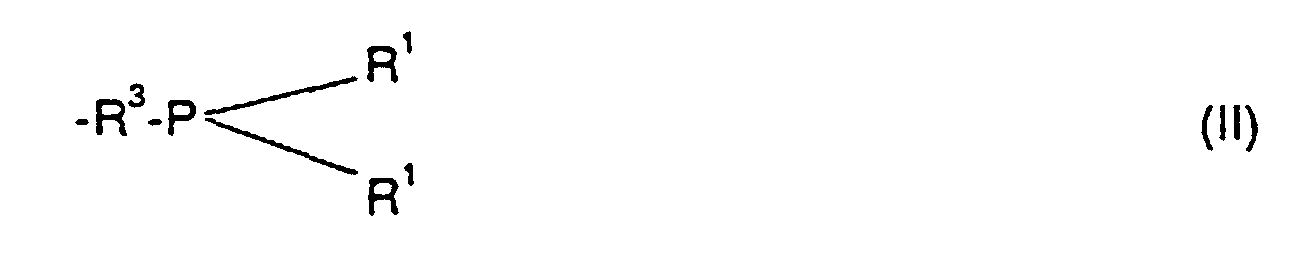
- is straight-chain or branched C1-6-alkyl, C1-6-alkoxy, C4-8-cycloalkyl or C4-8-cycloalkoxy or a radical of the formula II
- R3
- is divalent C1-20-alkylene, and
- R1
- is as defined above.
- The quantity of palladium can be chosen such that, based on the chloroaromatic compound employed, its proportion is from 0.0001 to 1 mol%, preferably from 0.005 to 0.05 mol%.
- The acrylic acid derivatives employed may, for example, be those of the formula (III):in which

- R
- is CN or COR4, where R4 is OH, O-C6-C10-aryl, O-C1-C20-alkyl, NH2, NH-C6-C10-aryl, NH-C1-C20-alkyl, N-di-C6-C10-aryl, N(C1-C20-alkyl)(C6-C10-aryl) or N-di-C1-C20-alkyl, and
- R'
- is H, C1-C20-alkyl, C6-C20-aryl or R.
- In the formula (III) R is preferably COR4 with R4 = O-C1-C20-alkyl, particularly preferably O-C1-C10-alkyl and, in particular, 2-ethylhexyloxy. Chloroaromatic compounds which can be employed are, for example, chlorobenzenes of the formula (IV)in which
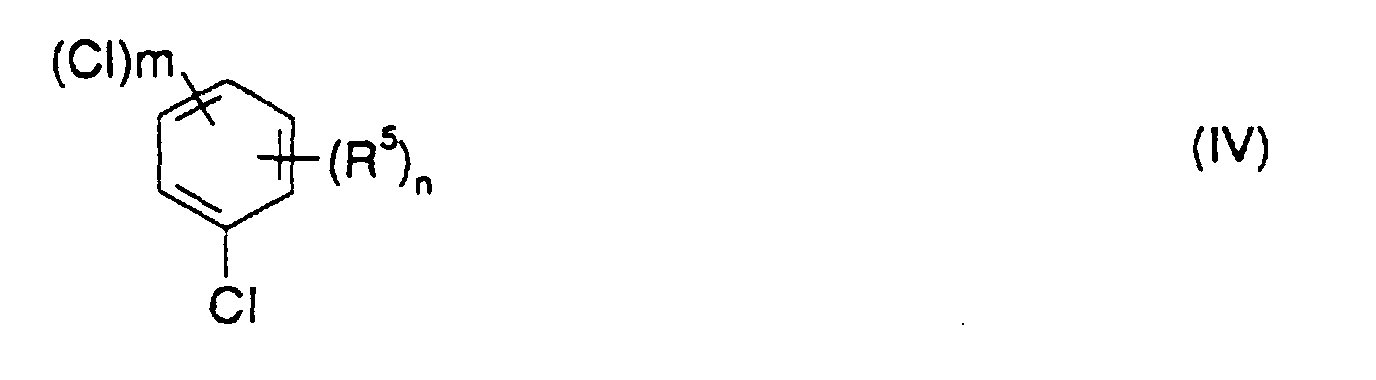
- R5
- is C6-C10-aryl, C1-20-alkyl, CN, S-R6, CO-OR6, -F, -OCF3, OR6 or NR6 2 where R6 is hydrogen, C6-C10-aryl or C1-20-alkyl,
- m
- is 0 or 1,
- n
- is 1 to 5, and
- n + m
- is 1 to 5.
- In the formula (IV) R5 is preferably OR6 or NR6 2 where R6 = phenyl or C1-10-alkyl; R5 is particularly preferably methoxy. m is preferably 0, and n is preferably 1.
- The molar ratio of chloroaromatic compound to acrylic acid derivative can be chosen as desired. Preference is given to working at a molar ratio of chloroaromatic compound to acrylic acid derivative which is in the range from 1:0.7 to 1:3. With particular preference this ratio is from 1:0.8 to 1:1.5.
- Generally, in the case of dichlorobenzene derivatives (m = 1), double the quantity of acrylic acid derivative is employed.
- The process of this invention is also characterised in that the palladium catalysts employed are palladium compounds in oxidation state 0 and/or +2 in quantities of from 0.0001 to 1 mol% of palladium (based on chloroaromatic compounds employed).
- Suitable inorganic bases for the process according to the invention are, for example, alkali metal and alkaline earth metal salts of weak acids, preferably alkali metal and alkaline earth metal hydrogen carbonates and/or carbonates. Particular preference is given to the use of sodium carbonate. The ratio of chloroaromatic compound to base is preferably chosen such that from 0.3 to 2, particularly preferably from 0.4 to 1.3, equivalents of base are employed per mole of chloroaromatic compound.
- The lipophilic, aliphatic phosphine ligands of the formula I are obtainable commercially or can be prepared in analogy to processes which are known per se.
- In the preferred monodentate phosphine ligands of formula I the radicals R1 and R2 are identical and have a branched alkyl or alkoxy group or a cyclohexyl group.
- Accordingly, preferred monodentate phosphine ligands are:
trimethylphosphine, triethylphosphine, tripropylphosphine, triisopropylphosphine, tributylphosphine, tricyclohexylphosphine, trimethyl phosphite, tripropyl phosphite, triisopropyl phosphite, tributyl phosphite and tricyclohexyl phosphite, in particular triisopropylphosphine or tricyclohexylphosphine. - In the preferred bidentate phosphine ligands of formula (I) the radicals R1 are in each case identical, and R2 is a radical of formula (II) in which R3 is preferably divalent C2-6-alkylene.
- Accordingly, preferred bidentate phosphine ligands are:
1,2-bis(dimethylphosphine)ethane, 1,2-bis(diethylphosphine)ethane, 1,2-bis(dipropylphosphine)ethane, 1,2-bis(diisopropylphosphine)ethane, 1,2-bis(dibutylphosphine)ethane, 1,2-bis(dicyclohexylphosphine)ethane, 1,3-bis(dicyclohexylphosphine)propane, 1,3-bis(diisopropylphosphine)propane, 1,4-bis(diisopropylphosphine)butane and 2,4-bis(dicyclohexylphosphine)pentane. - Phosphines can be employed in the process according to the invention, for example, in a molar ratio of palladium:phosphorus of from 1:0.8 to 1:2.5. This ratio is preferably from 1:0.9 to 1:2.3 and particularly preferably about 1:2.
- It is self-evident that the ratios indicated relate to the monodentate phosphines of the formula I; in the case of the bidentate phosphines the palladium:phosphine ratios generally employed are from 1:0.4 to 1:1.25.
- The process according to the invention can be carried out, for example, at temperatures in the range from 50 to 180°C. Preferred temperatures are in the range from 80 to 150°C, and with particular preference are in the region of the boiling point of the solvent employed. The process according to the invention is usually carried out at atmospheric pressure. However, it can also be carried out at reduced or elevated pressure. The application of elevated pressure is particularly appropriate when it is desired to work at a reaction temperature at which individual components of the reaction mixture would boil at atmospheric pressure.
- The process according to the invention is generally carried out under a protective gas, for example nitrogen, and with stirring.
- Suitable solvents are hydrocarbons such as, for example, toluene, ethers such as tetrahydrofuran, polar aprotic solvents such as, for example, N-methyl-pyrrolidone, dimethylformamide, N,N-dimethylacetonitrile or dimethyl sulfoxide.
- Using the process according to the invention it is possible, for example, to prepare cinnamic acid derivatives of the formula (V)in which the symbols used have the meaning indicated in the case of the formulae (III) and (IV).

- After the process according to the invention has been carried out, the inorganic salts formed can be separated off, for example, by simple filtration, with or without suction. It is also possible to leave the salts to settle and to decant the rest of the reaction mixture.
- One possible embodiment of the process according to the invention is described below by way of example of the reaction of 4-chloroanisole with 2-ethylhexyl acrylate:
trialkylphosphine and palladium(II) chloride are added in a molar ratio of palladium:phosphorus of 1:2 to an initial charge of 4-chloroanisole, 2-ethylhexyl acrylate, sodium carbonate and N-methylpyrrolidone (NMP). The sequence of addition of these components can be altered as desired. The mixture is then heated at 140 to 150°C under nitrogen and with vigorous stirring. After it has been determined that no further 4-chloroanisole is reacting, the reaction is terminated: that is, the reaction mixture is cooled to room temperature and poured into water. The aqueous phase is then separated off and extracted with an organic solvent (e.g. methyl tert.-butyl ether (MTB)). The combined extracts obtained are freed from the solvent and distilled in vacuo. - It is surprising that the palladium-catalysed reaction, according to the invention, of relatively unreactive chloroaromatic compounds with acrylic acid derivatives, with the use of very small quantities of palladium catalyst having a phosphorus ligand of the formula I, gives high space-time yields.
- The process according to the invention makes it possible to prepare cinnamic acid derivatives, especially 2-ethylhexyl p-methoxycinnamate and isoamyl 4-methoxycinnamate, under advantageous reaction conditions, with no particular expenditure being necessary for the handling of auxiliaries (bases, solvents). The bases, solvents and phosphines required are readily accessible and inexpensive.
- The process according to the invention is significantly more economical and, in comparison with the processes of the prior art, achieves a higher space-time yield.
- Cinnamic acid derivatives, especially the 2-ethylhexyl and isoamyl esters of p-methoxycinnamic acid, can be employed, for example, as UV absorbers in cosmetics (see US-A 5 008 100 and US-A 4 610 490).
- 24.8 ml of 4-chloroanisole, 52.3 ml of 2-ethylhexyl acrylate, 10.6 g of sodium carbonate and 200 ml of NMP are placed in a four-necked round-bottomed flask, and 2.3 mg of tricyclohexylphosphine and 0.9 mg of palladium acetate (2.0 mol% based on 4-chloroanisole) were added. The mixture was heated at 140-150°C under nitrogen and with stirring. After 60 hours the conversion according to gas chromatography was 68%, based on the 4-chloroanisole employed.
- The mixture is cooled and poured into water. After extraction with 3 x 200 ml of MTB ether, the organic phase formed by combination of the extracts is washed with water, dried over sodium sulfate and filtered. After removal of the solvent the filtrate is distilled under reduced pressure. The yield of isolated 2-ethylhexyl p-methoxycinnamate is 14.5 g.
- The procedure of Example 1 was followed, but adding 2.1 g of triphenylphosphine. After 60 hours the conversion according to gas chromatography was 0.5%, based on the 4-chloroanisole employed.
- The procedure of Example 1 was followed, but adding 1.5 mg of triisopropylphosphine instead of tricyclohexylphosphine. After 60 hours the conversion according to gas chromatography was 65%, based on the 4-chloroanisole employed.
Claims (6)
- Process for the preparation of cinnamic acid derivatives from chloroaromatic compounds and acrylic acid derivatives in the presence of an inorganic base, a palladium catalyst and a phosphine, characterised in that the employed phosphine is a monodentate lipophilic aliphatic phosphine of the formula Iin which

- R1
- at each occurrence independently of one another is straight-chain or branched C1-6-alkyl, C1-6-alkoxy, C4-8-cycloalkyl or C4-8-cycloalkoxy, preferably branched C3-6-alkyl, C3-6-alkoxy or cyclohexyl, and
- R2
- is straight-chain or branched C1-6-alkyl, C1-6-alkoxy, C4-8-cycloalkyl or C4-8-cycloalkoxy.
- Process according to Claim 1, characterised in that the palladium catalysts employed are palladium compounds in oxidation state 0 and /or +2 in quantities of from 0.0001 to 1 mol% of palladium (based on chloroaromatic compounds employed).
- Process according to Claims 1 or 2, characterised in that an acrylic acid derivative is employed of the formula (III)in which

- R
- is CN or COR4, where R4 is OH, O-C6-C10-aryl, O-C1-C20-alkyl, NH2, NH-C6-C10-aryl, NH-C1-C20-alkyl, N-di-C6-C10-aryl, N(C1-C20-alkyl)(C6-C10-aryl) or N-di-C1-C20-alkyl and
- R1
- is H, C1-C10-Alkyl, C6-C20-aryl or R.
- Process according to Claims 1 to 3 characterised in that the chloroaromatic compound employed is a chlorobenzene of the formula (IV)in which

- R5
- C6-C10-aryl, C1-C20-alkyl, CN, S-R6, CO-OR6, -F, -OCF3, OR6, NR6 2, where R6 is hydrogen, C6-C10-aryl or C1-C20-alkyl,
- m
- is 0 or 1,
- n
- is 1 to 5, and
- n + m
- is 1 to 5,
- Process according to Claims 1 to 4, characterised in that it is carried out at temperatures in the range from 50 to 180 °C.
- Process according to Claims 1 to 5, characterised in that it is carried out under protective gas and with stirring.
Applications Claiming Priority (3)
| Application Number | Priority Date | Filing Date | Title |
|---|---|---|---|
| DE4405830A DE4405830C2 (en) | 1994-02-23 | 1994-02-23 | Process for the preparation of cinnamic acid derivatives |
| DE4405830 | 1994-02-23 | ||
| PCT/EP1995/000428 WO1995023126A1 (en) | 1994-02-23 | 1995-02-07 | Process for the preparation of cinnamic acid derivatives |
Publications (2)
| Publication Number | Publication Date |
|---|---|
| EP0746539A1 EP0746539A1 (en) | 1996-12-11 |
| EP0746539B1 true EP0746539B1 (en) | 1999-10-06 |
Family
ID=6510999
Family Applications (1)
| Application Number | Title | Priority Date | Filing Date |
|---|---|---|---|
| EP95908267A Expired - Lifetime EP0746539B1 (en) | 1994-02-23 | 1995-02-07 | Process for the preparation of cinnamic acid derivatives |
Country Status (7)
| Country | Link |
|---|---|
| US (1) | US5817862A (en) |
| EP (1) | EP0746539B1 (en) |
| JP (1) | JP3833700B2 (en) |
| AU (1) | AU1665195A (en) |
| DE (2) | DE4405830C2 (en) |
| ES (1) | ES2139189T3 (en) |
| WO (1) | WO1995023126A1 (en) |
Families Citing this family (12)
| Publication number | Priority date | Publication date | Assignee | Title |
|---|---|---|---|---|
| DE19712388A1 (en) * | 1997-03-25 | 1998-10-01 | Studiengesellschaft Kohle Mbh | Process for the synthesis of aromatically substituted olefins |
| US6110922A (en) | 1998-12-29 | 2000-08-29 | Abbott Laboratories | Cell adhesion-inhibiting antiinflammatory and immune-suppressive compounds |
| US6867203B2 (en) | 1998-12-29 | 2005-03-15 | Abbott Laboratories | Cell adhesion-inhibiting antiinflammatory and immune-suppressive compounds |
| US6878700B1 (en) | 1998-12-29 | 2005-04-12 | Abbott Laboratories | Cell adhesion-inhibiting antiinflammatory and immune-suppressive compounds |
| CN1705649A (en) | 2000-06-29 | 2005-12-07 | 艾伯特公司 | Aryl phenylheterocyclyl sulfide derivatives and their use as cell adhesion-inhibiting anti-inflammatory and immune-suppressive agents |
| US6521619B2 (en) | 2000-06-29 | 2003-02-18 | Icos Corporation | Aryl phenylcyclopropyl sulfide derivatives and their use as cell adhesion inhibiting anti-inflammatory and immune suppressive agents |
| US6602515B2 (en) | 2001-07-16 | 2003-08-05 | Em Industries | Photo stable organic sunscreen compounds with antioxidant properties and compositions obtained therefrom |
| US6831191B2 (en) | 2001-12-20 | 2004-12-14 | Em Industries | Photo stable organic sunscreen compounds with antioxidant properties and compositions obtained therefrom |
| US6699463B2 (en) | 2002-04-10 | 2004-03-02 | Em Industries | Photostable cationic organic sunscreen compounds with antioxidant properties and compositions obtained therefrom |
| US6936735B2 (en) * | 2002-08-27 | 2005-08-30 | Emd Chemicals, Inc. | Photostable cationic organic sunscreen compounds and compositions obtained therefrom |
| DE10258168B4 (en) * | 2002-12-12 | 2005-07-07 | Infineon Technologies Ag | Integrated DRAM semiconductor memory and method of operating the same |
| JP5330066B2 (en) * | 2009-04-13 | 2013-10-30 | 富士フイルム株式会社 | Method for producing triarylamine compound |
Family Cites Families (3)
| Publication number | Priority date | Publication date | Assignee | Title |
|---|---|---|---|---|
| EP0103544A1 (en) * | 1982-09-08 | 1984-03-21 | Ciba-Geigy Ag | Method for the arylation of olefines with aryl chlorides catalysed by Pd |
| DE4211608C2 (en) * | 1992-04-07 | 2000-08-10 | Bayer Ag | Process for the preparation of cinnamic acid derivatives |
| DE59301869D1 (en) * | 1992-09-09 | 1996-04-18 | Hoechst Ag | Process for the production of aromatically substituted olefins from chloroaromatics |
-
1994
- 1994-02-23 DE DE4405830A patent/DE4405830C2/en not_active Expired - Fee Related
-
1995
- 1995-02-07 DE DE69512639T patent/DE69512639T2/en not_active Expired - Fee Related
- 1995-02-07 AU AU16651/95A patent/AU1665195A/en not_active Abandoned
- 1995-02-07 EP EP95908267A patent/EP0746539B1/en not_active Expired - Lifetime
- 1995-02-07 US US08/702,471 patent/US5817862A/en not_active Expired - Fee Related
- 1995-02-07 WO PCT/EP1995/000428 patent/WO1995023126A1/en not_active Ceased
- 1995-02-07 ES ES95908267T patent/ES2139189T3/en not_active Expired - Lifetime
- 1995-02-07 JP JP52209595A patent/JP3833700B2/en not_active Expired - Fee Related
Also Published As
| Publication number | Publication date |
|---|---|
| DE4405830C2 (en) | 1995-11-30 |
| JP3833700B2 (en) | 2006-10-18 |
| WO1995023126A1 (en) | 1995-08-31 |
| US5817862A (en) | 1998-10-06 |
| DE69512639D1 (en) | 1999-11-11 |
| JPH09509420A (en) | 1997-09-22 |
| AU1665195A (en) | 1995-09-11 |
| DE69512639T2 (en) | 2000-03-16 |
| ES2139189T3 (en) | 2000-02-01 |
| EP0746539A1 (en) | 1996-12-11 |
| DE4405830A1 (en) | 1995-08-24 |
Similar Documents
| Publication | Publication Date | Title |
|---|---|---|
| US5817862A (en) | Process for the preparation of cinnamic acid derivatives | |
| Badone et al. | Palladium-catalyzed coupling of aryl arenesulfonates with organostannanes | |
| KR100880787B1 (en) | 3,3 ', 5,5', 6,6'-hexaalkyl-2,2'-biphenol, 3,3 ', 4,4', 5,5'-hexaalkyl-2,2'-ratio Process for preparing phenol and 3,3 ', 4,4', 5,5 ', 6,6'-octaalkyl-2,2'-biphenol | |
| JPH0867639A (en) | Preparation of aromatic olefin using paradacycle catalyst | |
| CN103980109B (en) | Process for preparing (2, 4-dimethylbiphenyl-3-yl) acetic acid, esters thereof and intermediate compounds | |
| US5334750A (en) | Process for the preparation of cinnamic acid derivatives | |
| US6291383B1 (en) | Process for preparing aromatic olefins in the presence of palladium catalysts comprising phosphite ligands | |
| EP0032548B1 (en) | Process for preparing aryl and heteroaryl hexadienoic acids | |
| SU1521280A3 (en) | Method of obtaining beta-ketoesters | |
| CA2378877C (en) | Phosphonium salts and processes for production of and uses for the same, and phosphines deriving the same and processes for production of the phosphines | |
| KR20000075730A (en) | Process to prepare a pentenoic acid derivative | |
| US4709087A (en) | Process for the synthesis of isocyanates and of isocyanate derivatives | |
| CN109942361A (en) | A kind of preparation method and applications for the Sanya benzene-like compounds that aryl replaces | |
| EP1484304A1 (en) | Process for the preparation of fluorophenylalkylene acid derivatives | |
| JP4374407B2 (en) | Method for producing 3-isochromanone derivative | |
| US6268527B1 (en) | Method for producing benzoic acid derivatives | |
| US5639883A (en) | Process for preparing substituted 4-methylidenecinnamic acid derivatives | |
| JP5402286B2 (en) | Method for producing phosphorus compound and method for producing allyl compound derivative | |
| US6147238A (en) | Process for the preparation of octa-2,7-dienyl-1-amine from butadiene and ammonia in the presence of palladium complex catalyst | |
| US6153810A (en) | Highly selective process for making o-arylbenzonitriles | |
| US6150298A (en) | Process for telomerizing dienes | |
| EP4464685B1 (en) | Process for preparing 17-methylalkane compound | |
| WO1999019289A1 (en) | Recovery and recycle of catalyst components used in palladium-catalyzed preparation of arylcarboxylic acids | |
| CN117659065A (en) | A method for preparing β-boryl-substituted aldehyde derivatives | |
| US20040133047A1 (en) | Synthesis of 2-aryl-1-naphthol derivatives via a tandem palladium catalyzed arylation and dehydrogenation |
Legal Events
| Date | Code | Title | Description |
|---|---|---|---|
| PUAI | Public reference made under article 153(3) epc to a published international application that has entered the european phase |
Free format text: ORIGINAL CODE: 0009012 |
|
| 17P | Request for examination filed |
Effective date: 19960626 |
|
| AK | Designated contracting states |
Kind code of ref document: A1 Designated state(s): DE ES FR GB |
|
| 17Q | First examination report despatched |
Effective date: 19970801 |
|
| GRAG | Despatch of communication of intention to grant |
Free format text: ORIGINAL CODE: EPIDOS AGRA |
|
| GRAG | Despatch of communication of intention to grant |
Free format text: ORIGINAL CODE: EPIDOS AGRA |
|
| GRAH | Despatch of communication of intention to grant a patent |
Free format text: ORIGINAL CODE: EPIDOS IGRA |
|
| GRAH | Despatch of communication of intention to grant a patent |
Free format text: ORIGINAL CODE: EPIDOS IGRA |
|
| GRAA | (expected) grant |
Free format text: ORIGINAL CODE: 0009210 |
|
| AK | Designated contracting states |
Kind code of ref document: B1 Designated state(s): DE ES FR GB |
|
| RIN1 | Information on inventor provided before grant (corrected) |
Inventor name: SEUBERT, JUERGEN Inventor name: CHRIST, RAINER Inventor name: HEYWANG, ULRICH Inventor name: MEYER, VOLKER Inventor name: POETSCH, EIKE |
|
| REF | Corresponds to: |
Ref document number: 69512639 Country of ref document: DE Date of ref document: 19991111 |
|
| ET | Fr: translation filed | ||
| REG | Reference to a national code |
Ref country code: ES Ref legal event code: FG2A Ref document number: 2139189 Country of ref document: ES Kind code of ref document: T3 |
|
| PLBE | No opposition filed within time limit |
Free format text: ORIGINAL CODE: 0009261 |
|
| STAA | Information on the status of an ep patent application or granted ep patent |
Free format text: STATUS: NO OPPOSITION FILED WITHIN TIME LIMIT |
|
| 26N | No opposition filed | ||
| REG | Reference to a national code |
Ref country code: GB Ref legal event code: IF02 |
|
| PGFP | Annual fee paid to national office [announced via postgrant information from national office to epo] |
Ref country code: DE Payment date: 20070201 Year of fee payment: 13 |
|
| PGFP | Annual fee paid to national office [announced via postgrant information from national office to epo] |
Ref country code: GB Payment date: 20070207 Year of fee payment: 13 |
|
| PGFP | Annual fee paid to national office [announced via postgrant information from national office to epo] |
Ref country code: ES Payment date: 20070327 Year of fee payment: 13 |
|
| PGFP | Annual fee paid to national office [announced via postgrant information from national office to epo] |
Ref country code: FR Payment date: 20070208 Year of fee payment: 13 |
|
| GBPC | Gb: european patent ceased through non-payment of renewal fee |
Effective date: 20080207 |
|
| REG | Reference to a national code |
Ref country code: FR Ref legal event code: ST Effective date: 20081031 |
|
| PG25 | Lapsed in a contracting state [announced via postgrant information from national office to epo] |
Ref country code: DE Free format text: LAPSE BECAUSE OF NON-PAYMENT OF DUE FEES Effective date: 20080902 |
|
| PG25 | Lapsed in a contracting state [announced via postgrant information from national office to epo] |
Ref country code: FR Free format text: LAPSE BECAUSE OF NON-PAYMENT OF DUE FEES Effective date: 20080229 |
|
| REG | Reference to a national code |
Ref country code: ES Ref legal event code: FD2A Effective date: 20080208 |
|
| PG25 | Lapsed in a contracting state [announced via postgrant information from national office to epo] |
Ref country code: GB Free format text: LAPSE BECAUSE OF NON-PAYMENT OF DUE FEES Effective date: 20080207 |
|
| PG25 | Lapsed in a contracting state [announced via postgrant information from national office to epo] |
Ref country code: ES Free format text: LAPSE BECAUSE OF NON-PAYMENT OF DUE FEES Effective date: 20080208 |