EP0745061B1 - Conductive cement-based compositions - Google Patents
Conductive cement-based compositions Download PDFInfo
- Publication number
- EP0745061B1 EP0745061B1 EP95906869A EP95906869A EP0745061B1 EP 0745061 B1 EP0745061 B1 EP 0745061B1 EP 95906869 A EP95906869 A EP 95906869A EP 95906869 A EP95906869 A EP 95906869A EP 0745061 B1 EP0745061 B1 EP 0745061B1
- Authority
- EP
- European Patent Office
- Prior art keywords
- conductive
- composition
- cement
- water
- cement binder
- Prior art date
- Legal status (The legal status is an assumption and is not a legal conclusion. Google has not performed a legal analysis and makes no representation as to the accuracy of the status listed.)
- Expired - Lifetime
Links
- 239000000203 mixture Substances 0.000 title claims description 106
- 239000004568 cement Substances 0.000 title claims description 72
- 239000000835 fiber Substances 0.000 claims description 54
- 239000011230 binding agent Substances 0.000 claims description 42
- XLYOFNOQVPJJNP-UHFFFAOYSA-N water Substances O XLYOFNOQVPJJNP-UHFFFAOYSA-N 0.000 claims description 36
- 239000004567 concrete Substances 0.000 claims description 34
- 239000002245 particle Substances 0.000 claims description 26
- 239000007787 solid Substances 0.000 claims description 18
- 238000000034 method Methods 0.000 claims description 16
- 239000002002 slurry Substances 0.000 claims description 14
- 239000004570 mortar (masonry) Substances 0.000 claims description 13
- 239000004576 sand Substances 0.000 claims description 12
- 239000002518 antifoaming agent Substances 0.000 claims description 8
- 239000000571 coke Substances 0.000 claims description 8
- 239000007788 liquid Substances 0.000 claims description 7
- 239000002270 dispersing agent Substances 0.000 claims description 6
- 239000004575 stone Substances 0.000 claims description 6
- 239000006260 foam Substances 0.000 claims description 4
- 239000004088 foaming agent Substances 0.000 claims description 4
- 238000005266 casting Methods 0.000 claims description 2
- 229920000049 Carbon (fiber) Polymers 0.000 description 20
- 239000004917 carbon fiber Substances 0.000 description 19
- 239000011398 Portland cement Substances 0.000 description 14
- VNWKTOKETHGBQD-UHFFFAOYSA-N methane Chemical compound C VNWKTOKETHGBQD-UHFFFAOYSA-N 0.000 description 14
- VYPSYNLAJGMNEJ-UHFFFAOYSA-N Silicium dioxide Chemical compound O=[Si]=O VYPSYNLAJGMNEJ-UHFFFAOYSA-N 0.000 description 12
- 239000006072 paste Substances 0.000 description 11
- 229910000831 Steel Inorganic materials 0.000 description 10
- 238000002360 preparation method Methods 0.000 description 10
- 239000002131 composite material Substances 0.000 description 9
- 229920000126 latex Polymers 0.000 description 9
- 239000004816 latex Substances 0.000 description 9
- 239000010959 steel Substances 0.000 description 9
- 239000000463 material Substances 0.000 description 7
- 239000000047 product Substances 0.000 description 7
- 238000001764 infiltration Methods 0.000 description 5
- 230000008595 infiltration Effects 0.000 description 5
- 239000008030 superplasticizer Substances 0.000 description 5
- 210000001170 unmyelinated nerve fiber Anatomy 0.000 description 5
- OKTJSMMVPCPJKN-UHFFFAOYSA-N Carbon Chemical compound [C] OKTJSMMVPCPJKN-UHFFFAOYSA-N 0.000 description 4
- 238000001723 curing Methods 0.000 description 4
- 238000005325 percolation Methods 0.000 description 4
- 235000019738 Limestone Nutrition 0.000 description 3
- 239000000654 additive Substances 0.000 description 3
- 239000003795 chemical substances by application Substances 0.000 description 3
- 230000000694 effects Effects 0.000 description 3
- 239000004615 ingredient Substances 0.000 description 3
- 239000006028 limestone Substances 0.000 description 3
- 238000004519 manufacturing process Methods 0.000 description 3
- 229910021487 silica fume Inorganic materials 0.000 description 3
- UIIMBOGNXHQVGW-UHFFFAOYSA-M Sodium bicarbonate Chemical compound [Na+].OC([O-])=O UIIMBOGNXHQVGW-UHFFFAOYSA-M 0.000 description 2
- 239000006230 acetylene black Substances 0.000 description 2
- 239000012615 aggregate Substances 0.000 description 2
- 239000003513 alkali Substances 0.000 description 2
- 230000001419 dependent effect Effects 0.000 description 2
- 239000006185 dispersion Substances 0.000 description 2
- 238000009408 flooring Methods 0.000 description 2
- 239000003365 glass fiber Substances 0.000 description 2
- 239000011178 precast concrete Substances 0.000 description 2
- 230000005855 radiation Effects 0.000 description 2
- 230000002787 reinforcement Effects 0.000 description 2
- 239000000377 silicon dioxide Substances 0.000 description 2
- 239000002893 slag Substances 0.000 description 2
- 229920000914 Metallic fiber Polymers 0.000 description 1
- 229920001410 Microfiber Polymers 0.000 description 1
- 229920002125 Sokalan® Polymers 0.000 description 1
- 238000005299 abrasion Methods 0.000 description 1
- 239000011358 absorbing material Substances 0.000 description 1
- 230000003213 activating effect Effects 0.000 description 1
- 230000000996 additive effect Effects 0.000 description 1
- 229910000288 alkali metal carbonate Inorganic materials 0.000 description 1
- 150000008041 alkali metal carbonates Chemical class 0.000 description 1
- 229910052782 aluminium Inorganic materials 0.000 description 1
- XAGFODPZIPBFFR-UHFFFAOYSA-N aluminium Chemical compound [Al] XAGFODPZIPBFFR-UHFFFAOYSA-N 0.000 description 1
- PNEYBMLMFCGWSK-UHFFFAOYSA-N aluminium oxide Inorganic materials [O-2].[O-2].[O-2].[Al+3].[Al+3] PNEYBMLMFCGWSK-UHFFFAOYSA-N 0.000 description 1
- 239000007767 bonding agent Substances 0.000 description 1
- 239000006227 byproduct Substances 0.000 description 1
- ZOMBKNNSYQHRCA-UHFFFAOYSA-J calcium sulfate hemihydrate Chemical compound O.[Ca+2].[Ca+2].[O-]S([O-])(=O)=O.[O-]S([O-])(=O)=O ZOMBKNNSYQHRCA-UHFFFAOYSA-J 0.000 description 1
- 229910052799 carbon Inorganic materials 0.000 description 1
- 239000010962 carbon steel Substances 0.000 description 1
- 238000004210 cathodic protection Methods 0.000 description 1
- 239000003638 chemical reducing agent Substances 0.000 description 1
- 238000005056 compaction Methods 0.000 description 1
- 229920001940 conductive polymer Polymers 0.000 description 1
- 239000004020 conductor Substances 0.000 description 1
- 238000010276 construction Methods 0.000 description 1
- 230000003247 decreasing effect Effects 0.000 description 1
- 150000002148 esters Chemical class 0.000 description 1
- 239000011405 expansive cement Substances 0.000 description 1
- 238000002474 experimental method Methods 0.000 description 1
- 239000002360 explosive Substances 0.000 description 1
- 238000005187 foaming Methods 0.000 description 1
- NVVZQXQBYZPMLJ-UHFFFAOYSA-N formaldehyde;naphthalene-1-sulfonic acid Chemical compound O=C.C1=CC=C2C(S(=O)(=O)O)=CC=CC2=C1 NVVZQXQBYZPMLJ-UHFFFAOYSA-N 0.000 description 1
- 239000010439 graphite Substances 0.000 description 1
- 229910002804 graphite Inorganic materials 0.000 description 1
- 239000008240 homogeneous mixture Substances 0.000 description 1
- 230000036571 hydration Effects 0.000 description 1
- 238000006703 hydration reaction Methods 0.000 description 1
- 239000002440 industrial waste Substances 0.000 description 1
- 229910052500 inorganic mineral Inorganic materials 0.000 description 1
- 238000010030 laminating Methods 0.000 description 1
- 229920003008 liquid latex Polymers 0.000 description 1
- 229910052751 metal Inorganic materials 0.000 description 1
- 239000002184 metal Substances 0.000 description 1
- 239000005300 metallic glass Substances 0.000 description 1
- 239000013528 metallic particle Substances 0.000 description 1
- 239000003658 microfiber Substances 0.000 description 1
- 239000011707 mineral Substances 0.000 description 1
- 239000000615 nonconductor Substances 0.000 description 1
- 230000003287 optical effect Effects 0.000 description 1
- 238000005457 optimization Methods 0.000 description 1
- 230000037361 pathway Effects 0.000 description 1
- 239000004584 polyacrylic acid Substances 0.000 description 1
- 229920000642 polymer Polymers 0.000 description 1
- 239000000843 powder Substances 0.000 description 1
- 229910000030 sodium bicarbonate Inorganic materials 0.000 description 1
- 239000000126 substance Substances 0.000 description 1
- 238000006467 substitution reaction Methods 0.000 description 1
- 239000006228 supernatant Substances 0.000 description 1
- 239000011410 supersulfated cement Substances 0.000 description 1
- 239000004094 surface-active agent Substances 0.000 description 1
- 229920003051 synthetic elastomer Polymers 0.000 description 1
- 229920003002 synthetic resin Polymers 0.000 description 1
- 239000000057 synthetic resin Substances 0.000 description 1
- 239000005061 synthetic rubber Substances 0.000 description 1
- 238000009827 uniform distribution Methods 0.000 description 1
- 230000000007 visual effect Effects 0.000 description 1
Images


Classifications
-
- C—CHEMISTRY; METALLURGY
- C04—CEMENTS; CONCRETE; ARTIFICIAL STONE; CERAMICS; REFRACTORIES
- C04B—LIME, MAGNESIA; SLAG; CEMENTS; COMPOSITIONS THEREOF, e.g. MORTARS, CONCRETE OR LIKE BUILDING MATERIALS; ARTIFICIAL STONE; CERAMICS; REFRACTORIES; TREATMENT OF NATURAL STONE
- C04B28/00—Compositions of mortars, concrete or artificial stone, containing inorganic binders or the reaction product of an inorganic and an organic binder, e.g. polycarboxylate cements
- C04B28/02—Compositions of mortars, concrete or artificial stone, containing inorganic binders or the reaction product of an inorganic and an organic binder, e.g. polycarboxylate cements containing hydraulic cements other than calcium sulfates
-
- C—CHEMISTRY; METALLURGY
- C04—CEMENTS; CONCRETE; ARTIFICIAL STONE; CERAMICS; REFRACTORIES
- C04B—LIME, MAGNESIA; SLAG; CEMENTS; COMPOSITIONS THEREOF, e.g. MORTARS, CONCRETE OR LIKE BUILDING MATERIALS; ARTIFICIAL STONE; CERAMICS; REFRACTORIES; TREATMENT OF NATURAL STONE
- C04B40/00—Processes, in general, for influencing or modifying the properties of mortars, concrete or artificial stone compositions, e.g. their setting or hardening ability
- C04B40/0028—Aspects relating to the mixing step of the mortar preparation
-
- C—CHEMISTRY; METALLURGY
- C04—CEMENTS; CONCRETE; ARTIFICIAL STONE; CERAMICS; REFRACTORIES
- C04B—LIME, MAGNESIA; SLAG; CEMENTS; COMPOSITIONS THEREOF, e.g. MORTARS, CONCRETE OR LIKE BUILDING MATERIALS; ARTIFICIAL STONE; CERAMICS; REFRACTORIES; TREATMENT OF NATURAL STONE
- C04B2111/00—Mortars, concrete or artificial stone or mixtures to prepare them, characterised by specific function, property or use
- C04B2111/90—Electrical properties
- C04B2111/94—Electrically conducting materials
Definitions
- This invention relates to conductive cement-based compositions yielding concrete and related composites, i.e. mortar and cement paste of relatively high electrical conductivity (or low electrical resistivity) combined with high mechanical strength.
- Conventional concrete consisting of hydrated Portland cement with silica sand as fine aggregate and limestone, stone or other coarse aggregate, is a good electrical insulator.
- the electrical resistivity of concrete usually ranges from 6.54 x 10 5 ⁇ cm to 11.4 x 10 5 ⁇ cm for dried concrete and 2.5 to 4.5 x 10 3 ⁇ cm for moist concrete.
- electromagnetic shielding It is often required in the design and construction of facilities and equipment to protect electrical systems or electronic components from the effects of unwanted electromagnetic energy. Other applications are radiation shielding in the nuclear industry; antistatic flooring in the electronic instrumentation industry and hospitals; and cathodic protection of steel reinforcement in concrete structures.
- a mixture of 60 parts EVA, 120 parts water, water-reducing agent and surfactant was mixed with 14 parts PAL fiber (alkali-resistant glass fiber) and kept still for at least 2 weeks.
- the supernatant of the solution was mixed with carbon fiber (3 parts), portland cement (400 parts) and silica sand (300 parts), and then the precipitated glass fiber was added to give a mixture which was cured 7 days to give a test piece having surface resistivity (JIS K611) 1.8 x 10 6 ncm and abrasion loss (JIS A1451) of 0.30 mm.
- Katsumi et al, Japanese Application (Kokai) JP 89 14,137 describe electrically conductive concrete containing chopped strands of curved C (carbon) fibers having aspect ratio ⁇ 50 and a higher specific volume than straight carbon fibers.
- Hideo Japanese Application (Kokai) No. 89 72,947, proposed an electrically conductive cement composition containing C fibers and an alkali metal carbonate and/or hydrocarbonate.
- the C fibers are uniformly dispersed in the cement powder.
- the cement compositions have high electrical conductivity and are useful as grounding resistance-decreasing and radiation absorbing materials.
- a mixture containing portland cement 100, C fibers 2, and NaHCO 3 2 wt. parts was mixed with 80 wt. parts water, and the resulting mixture was used as a grounding resistance-decreasing agent for encapsulating a Cu lightning rod in the ground.
- Hideo et al described a number of electroconductive cement compositions, Japanese Kokai No. No. 89 131,042; 89 141,852; and 89 141,853.
- composition will be used throughout to denote both the mixture after the addition of water and the product in the final, hardened state unless indicated otherwise.
- the present invention is based on the realization of the influence of two factors on the electrical properties of cement-based compositions. These factors are, firstly, the minimum (threshold) values of the content of the conductive phases, as discussed in more detail hereinbelow, and secondly, the uniformity of dispersion of the conductive phase throughout the volume of the composite, both before and after hardening. Without proper, uniform distribution of the conductive fibers/particles throughout the volume of the composition, even the optimum mixture content is not likely to produce the results as obtained in the present work.
- a conductive cement-based composition comprising a cement binder,
- cement-based composition encompasses concrete, mortar and paste. It is understood, according to accepted terminology in the art that concrete includes cementitious materials and both fine and coarse aggregates; mortar includes cementitious materials and fine aggregates but not coarse aggregates; and paste contains no aggregates.
- cement binder encompasses a cement, e.g. Portland cement, and an optical binder containing in addition to the cement a supplementary cementitious material, for instance silica fume or another pozzolanic binder known in the art.
- Paste Conductive fibers 0.5%-15% by volume of the composition (by vol.) Water/cement binder ratio 0.20 - 0.65 Mortar Conductive fibers 0%-15% by vol. Conductive particles 0%-80% by vol. Water/cement binder ratio 0.20-0.75 by weight Sand/cement binder ratio 0.0-2.0 by weight Dispersant/cement binder ratio 0.1%-5% by weight; Concrete Conductive fibers 0%-8% by vol. Conductive particles 0%-80% by vol. Water/cement binder ratio 0.35-0.75 by weight Sand/cement binder ratio 0-2.0 by weight Stone/cement binder ratio 0-2.0 by weight Dispersant/cement binder ratio 0.1%-5% by weight.
- additives for instance latex and a defoaming agent may be added to the compositions in the preparation process and their exemplary content will be illustrated in the examples hereinbelow.
- compositions are important for at least their electrical properties.
- Exemplary preparation methods conventional mixing and slurry infiltration, will be described hereinbelow in more detail,
- Preparation of highly conductive concrete requires selection of proper conductive materials, optimization of theoretical and experimental parameters, proper mix proportions and production procedures.
- important design parameters are the size of conductive fibers, flakes and/or particles and their relative contents. These parameters can not be predicted through theoretical calculations but must be obtained by experiment.
- Fig. 1 represents a model of highly conductive concrete. It shows a combination of fibrous and granular conductive media besides non-conductive aggregates and particles. It is known that longer fibers provide better electrical conductivity than shorter fibers; in some cases, however, longer fibers can be partially substituted by shorter fibers and/or small size conductive flakes to improve mixing conditions. Longer fibers form a conductive network. Short fibers and/or flakes function as electrical bridges in the long fiber network and increase the number of network branches. The conductive particles function similarly to the short fibers (and/or flakes). They are a partial or complete substitution for fine aggregates and coarse aggregates, i.e. sands and stone, in concrete. The importance of granular conductive particles is tied to their role in increasing the contact area of the conductive phase through fiber-particle-fiber or fiber-particle-particle-fiber pathways.
- the present invention is based on the study of a so-called percolation phenomenon.
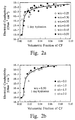
- the phenomenon is illustrated in Fig. 2a relating to paste systems and Fig. 2b relating to mortar systems. It can be seen in both graphs that there is a threshold value for the content of the conductive phase.
- the conductivity of the respective composite shows a dramatic change, by several orders of magnitude, around the threshold.
- This phenomenon can be expressed by the following equation: ⁇ ⁇ ⁇ m ( ⁇ - ⁇ c ) t where ⁇ and ⁇ m are the conductivities of composite and conductive phase, ⁇ c is the threshold value of the volumetric fraction of the conductive phase, and t is a constant that is independent of the microstructure of the material.
- the threshold value, ⁇ c is a microstructure-dependent parameter. The most important factor influencing this parameter is the size of the conductive phase.
- ⁇ c increases with decreasing carbon fiber size. If the carbon fiber size is the same, the value of ⁇ c does not change with water/cement ratio and sand/cement ratio, see Figs. 2a and 2b.
- clusters consisting of conductive particles in the composite when the volumetric fraction of the conductive phase is less than the threshold value, i.e. ⁇ ⁇ ⁇ c .
- the average size of clusters can be expressed as follows: L av ⁇ 1 ( ⁇ c - ⁇ ) v where L av is the average size of all clusters, and v is a positive constant.
- the composites of the present invention comprise hydraulic binders (also called cement binders), conductive phase, admixtures or additives and optional aggregates. These components are all commercially available.
- All types of clinker-based cement e.g. Portland cement and high alumina cement, all types of expansive cement, alkali-activated slag cements, supersulfated cements, calcium sulphate hemihydrate etc, can be used as cement binders, or hydraulic binders, for preparing conductive concrete.
- the aggregates, fine and coarse, are generally the same as in conventional concrete.
- All types of mineral admixtures, chemical admixtures and polymers that are used in conventional concrete can be used in the conductive concrete compositions of the present invention subject to comments hereinbelow.
- All types of dispersing agents, solid and liquid latex and air-entraining agents can be used for making a mixture containing uniformly distributed conductive fibers.
- defoaming agents can be used to defoam the mixture, with the content of the defoaming agents being from 0.05% to 0.1% by weight of the cement binder.
- Fibers All types of metallic fiber, e.g. steel fiber, aluminum fiber etc., metallic glass fibers and carbon fibers can be used for preparing the compositions of the invention.
- the use of metal fibers is generally preferred over carbon fibers because of the price difference.
- conductive fibers apparently enhances not only compressive strength, but also other mechanical properties such as flexural and tensile strength, toughness etc.
- High volumetric fractions of steel fibers give concrete products with high explosive resistance. Steel fibers are a good substituent for carbon fibers.
- Particles All types of solid conductive particles, for example metallic particles, carbonaceous particles and conductive polymers can be used for preparing conductive cement-based compositions of the invention.
- the particle size (diameter) may range from 5 ⁇ m to 25 mm.
- coke breeze as granular conductive phase is recommended.
- the coke breeze used in the instant tests is a by-product of the steel industry and is currently being treated as an industrial waste.
- Flakes Metallic flakes and graphite flakes can be used for preparing conductive cement-based compositions of the invention.
- the acceptable dimensions are as follows: diameter from 0.5 mm to 10 mm; thickness from 5 ⁇ m to 1 mm.
- Admixtures This group consists of a foaming agent, liquid or solid, for instance latex the use of which as a polymeric binder is known in the art; it also produces foam when added to a cement-based composition; further, so-called superplasticizer, liquid or solid, which is a dispersant and its use reduces water content requirement; and a defoaming agent.
- a foaming agent facilitates the mixing of the compositions, but the resulting foam must subsequently be removed to achieve a greater density of the compositions of the invention.
- Curing methods employed in making conventionl precast concrete products are also suitable for making precast conductive compositions of the invention.
- the latter is suitable for making precast cement-based compositions with, on average, higher conductivity and higher mechanical strength than with conventional mixing.
- Conventional mixing is used for preparing both massive concrete structures and precast concrete products.
- compositions with resistivity and compressive strength in the following approximate ranges: Resistivity 1 - 100 ⁇ cm Compressive strength 30 - 50 MPa.
- timing of the above steps is commonly known in the art, and is of the order of a few minutes each step, depending of course on the volume of the batch and the efficiency of the mixing equipment.
- Latex (and a defoaming agent) is used with the conventional mixing method only.
- Slurry Infiltration is used, according to the invention, for preparing conductive compositions with the following properties: resistivity 0.1 - 10 ⁇ cm compressive strength 40 - 100 MPa.
- Table 1 illustrates the broad and optimum content ranges of specific ingredients of the compositions of the invention as divided into the three above-discussed categories - concrete, mortar and paste.
- Table 2 lists exemplary compositions prepared and tested to validate the instant invention. The ingredients and their content as well as the respective resistivity and compressive strength values are indicated. The preparation type, conventional mixing or slurry infiltration, is also identified.
- latex is used both as a bonding agent and as a foaming additive. Where latex is used, the resulting foam should be subsequently removed by adding small amounts of a defoaming agent in the order of 0.05% by weight of the cement binder.
- resistivity 12.1 ⁇ cm. 28-day compressive strength: 35 MPa.
Landscapes
- Chemical & Material Sciences (AREA)
- Engineering & Computer Science (AREA)
- Ceramic Engineering (AREA)
- Materials Engineering (AREA)
- Structural Engineering (AREA)
- Organic Chemistry (AREA)
- Chemical Kinetics & Catalysis (AREA)
- Inorganic Chemistry (AREA)
- Curing Cements, Concrete, And Artificial Stone (AREA)
Description
- This invention relates to conductive cement-based compositions yielding concrete and related composites, i.e. mortar and cement paste of relatively high electrical conductivity (or low electrical resistivity) combined with high mechanical strength.
- Conventional concrete, consisting of hydrated Portland cement with silica sand as fine aggregate and limestone, stone or other coarse aggregate, is a good electrical insulator. The electrical resistivity of concrete usually ranges from 6.54 x 10⁵ Ωcm to 11.4 x 10⁵ Ωcm for dried concrete and 2.5 to 4.5 x 10³ Ωcm for moist concrete. There are several uses, however, for a concrete that is electrically conductive. One of these uses is electromagnetic shielding. It is often required in the design and construction of facilities and equipment to protect electrical systems or electronic components from the effects of unwanted electromagnetic energy. Other applications are radiation shielding in the nuclear industry; antistatic flooring in the electronic instrumentation industry and hospitals; and cathodic protection of steel reinforcement in concrete structures.
- These needs have been recognized for a number of years and some conductive concrete compositions and articles have been described in the technical and patent literature. Banthia et al, Cem. Concr. Res., 22(5), 804-814 (1992), studied the electrical resistivity of carbon fiber and steel micro-fiber reinforced cements. The content of conductive fiber ranged from 1 to 5% by volume. The resistivity at 28 days of hydration ranged from 78 Ωcm to 31.92 kΩcm.
- Kojima et al, CAJ Proceedings of Cement & Concrete, The Cement Association of Japan, No. 43, 560-565 (1989), prepared a highly conductive carbon fiber/cement composite by laminating six sheets of carbon fiber paper impregnated with Portland cement paste. The product was 3 mm thick and had a resistivity value of 0.7 Ωcm. The material was highly effective in electromagnetic shielding, but very expensive and not suitable for load-bearing applications.
- Chiou et al, Composites, 20(4), 379-381 (1989), reported work on carbon fiber reinforced cement for electromagnetic shielding, with results resembling those of Banthia et al.
- Japanese patent application No. (Kokai) JP 63,215,542, Akira et al, describes fiber-reinforced conductive concrete articles, useful for anti-static flooring, as comprising conductive fibers, reinforcement fibers, cement aggregates and synthetic resins or rubbers. Thus, a mixture of 60 parts EVA, 120 parts water, water-reducing agent and surfactant was mixed with 14 parts PAL fiber (alkali-resistant glass fiber) and kept still for at least 2 weeks. The supernatant of the solution was mixed with carbon fiber (3 parts), portland cement (400 parts) and silica sand (300 parts), and then the precipitated glass fiber was added to give a mixture which was cured 7 days to give a test piece having surface resistivity (JIS K611) 1.8 x 10⁶ ncm and abrasion loss (JIS A1451) of 0.30 mm.
- Katsumi et al, Japanese Application (Kokai) JP 89 14,137 describe electrically conductive concrete containing chopped strands of curved C (carbon) fibers having aspect ratio ≥ 50 and a higher specific volume than straight carbon fibers. A mixture of Portland cement 100, Donacarbo S-231 (curved C fibers, aspect ratio 222, sp. vol. 11 cm3/g) 2, sand 150, water 70, polyacrylic acid ester 15, and naphthalenesulfonic acid-formalin condensate (15 parts) was molded and hardened to give a concrete sample having intrinsic volume resistivity 7.5 x 10³ and 5.2 x 10⁶ Ωcm in the longitudinal and lateral direction, respectively, vs. 6.9 x 10⁶ and 3.1 x 10⁷ Ωcm for one with straight C fibers.
- Hideo, Japanese Application (Kokai) No. 89 72,947, proposed an electrically conductive cement composition containing C fibers and an alkali metal carbonate and/or hydrocarbonate. The C fibers are uniformly dispersed in the cement powder. The cement compositions have high electrical conductivity and are useful as grounding resistance-decreasing and radiation absorbing materials. According to the specification, a mixture containing portland cement 100,
C fibers 2, andNaHCO 3 2 wt. parts, was mixed with 80 wt. parts water, and the resulting mixture was used as a grounding resistance-decreasing agent for encapsulating a Cu lightning rod in the ground. - Toshio et al, Japanese Kokai No. 89 126,248, describe electroconductive cement compositions containing acetylene black. Mortar prepared from Portland cement 100, sand 300, partially oxidized acetylene black 50 and water 90 parts, gave concrete having electrical resistance from 7 days to 6 mo after curing 30 Ω, and after 1 year 25 Ω, and flexural and compressive strengths 43 and 190 kgcm2, respectively.
- Hideo et al described a number of electroconductive cement compositions, Japanese Kokai No. No. 89 131,042; 89 141,852; and 89 141,853.
- Other prior art compositions have been described by: Junichi et al, Kokai 89 234,347; Tadashi et al, Kokai 88 215,544; Tadayuki et al, Kokai 90 172,846; Chinese Patent 1,048,696 to Xia Guirong et al; Japanese Kokai No. 92 02,637 (Hiroharu et al); German OS 4,201,871 (W. Jaschinski et al); and Japanese Kokai No. 92 74,747 (Y. Sasagawa et al).
- While these prior art compositions may be useful for specific purposes, it is noted that, where sufficient details are available, a compromise between high mechanical strength and relatively low electrical resistivity has not been achieved by any of the subject compositions. Many of the prior art conductive concrete (or mortar) recipes use a significant amount of carbon fiber which is relatively expensive.
- Accordingly, there is still a need for low-cost conductive concrete compositions combining good mechanical strength and high electrical conductivity.
- For the purpose of the present specification, the term "composition" will be used throughout to denote both the mixture after the addition of water and the product in the final, hardened state unless indicated otherwise.
- The present invention is based on the realization of the influence of two factors on the electrical properties of cement-based compositions. These factors are, firstly, the minimum (threshold) values of the content of the conductive phases, as discussed in more detail hereinbelow, and secondly, the uniformity of dispersion of the conductive phase throughout the volume of the composite, both before and after hardening. Without proper, uniform distribution of the conductive fibers/particles throughout the volume of the composition, even the optimum mixture content is not likely to produce the results as obtained in the present work.
- According to the invention, there is provided a conductive cement-based composition comprising a cement binder,
- water, at the weight ratio relative to cement binder from 0.2 to 0.75, and
- a conductive phase distributed substantially uniformly throughout the volume of the composition to provide electrical conductivity of the composition, the composition characterized in that the content of the conductive phase is at least equal to but not substantially greater than a threshold value above which further increase of the content does not substantially increase the electrical conductivity of the composition, wherein the 28-day compressive strength of the composition, when cured, is at least 30 Mpa and the resistivity thereof is below about 43 Ωcm.
-
- The term "cement-based composition" encompasses concrete, mortar and paste. It is understood, according to accepted terminology in the art that concrete includes cementitious materials and both fine and coarse aggregates; mortar includes cementitious materials and fine aggregates but not coarse aggregates; and paste contains no aggregates.
- The term "cement binder" encompasses a cement, e.g. Portland cement, and an optical binder containing in addition to the cement a supplementary cementitious material, for instance silica fume or another pozzolanic binder known in the art.
- While the broad ranges outlined above apply for the overall concept of the invention, narrower content ranges can be identified specifically for the concrete, mortar or paste compositions as follows, the optimum areas of these ranges being further dependent on the method of preparation of the composition:
Paste Conductive fibers 0.5%-15% by volume of the composition (by vol.) Water/cement binder ratio 0.20 - 0.65 Mortar Conductive fibers 0%-15% by vol. Conductive particles 0%-80% by vol. Water/cement binder ratio 0.20-0.75 by weight Sand/cement binder ratio 0.0-2.0 by weight Dispersant/cement binder ratio 0.1%-5% by weight; Concrete Conductive fibers 0%-8% by vol. Conductive particles 0%-80% by vol. Water/cement binder ratio 0.35-0.75 by weight Sand/cement binder ratio 0-2.0 by weight Stone/cement binder ratio 0-2.0 by weight Dispersant/cement binder ratio 0.1%-5% by weight. - Commonly known additives, for instance latex and a defoaming agent may be added to the compositions in the preparation process and their exemplary content will be illustrated in the examples hereinbelow.
- It will be understood that sand and stone are short definitions for fine and coarse aggregates.
- As mentioned above, proper preparation of the compositions is important for at least their electrical properties. Exemplary preparation methods, conventional mixing and slurry infiltration, will be described hereinbelow in more detail,
- The invention will be explained by the following description to be taken in conjunction with the drawings in which
- Fig. 1 is a graph visualizing the structure of conductive conrete;
- Fig. 2a is a graph illustrating the percolation phenomenon in a paste system containing carbon (conductive) fibers;
- Fig. 2b is a graph illustrating the percolation phenomenon in a mortar system containing carbon fibers; and
- Fig. 3 is a graph illustrating the effect of carbon fiber length on the conductivity threshold of a conductive composition.
-
- Preparation of highly conductive concrete requires selection of proper conductive materials, optimization of theoretical and experimental parameters, proper mix proportions and production procedures. Among important design parameters are the size of conductive fibers, flakes and/or particles and their relative contents. These parameters can not be predicted through theoretical calculations but must be obtained by experiment.
- Equally important, however, are the preparation procedures leading to the hardened cement-based conductive product, i.e. concrete, mortar and paste with the conductive phase distributed substantially uniformly throughout the volume of the composition. It will be appreciated that the proper ingredient content without correct preparation procedures leading to uniform dispersion of the conductive phase may not, or is not likely to, result in at least optimum electrical properties of the compositions. Thus, while some prior art compositions may appear to come within the content ranges as claimed herein, it is the combination of the selection of materials, their relative contents and preparation procedures that makes for electrical and mechanical property combination unmatched by the prior art.
- Fig. 1 represents a model of highly conductive concrete. It shows a combination of fibrous and granular conductive media besides non-conductive aggregates and particles. It is known that longer fibers provide better electrical conductivity than shorter fibers; in some cases, however, longer fibers can be partially substituted by shorter fibers and/or small size conductive flakes to improve mixing conditions. Longer fibers form a conductive network. Short fibers and/or flakes function as electrical bridges in the long fiber network and increase the number of network branches. The conductive particles function similarly to the short fibers (and/or flakes). They are a partial or complete substitution for fine aggregates and coarse aggregates, i.e. sands and stone, in concrete. The importance of granular conductive particles is tied to their role in increasing the contact area of the conductive phase through fiber-particle-fiber or fiber-particle-particle-fiber pathways.
- The present invention is based on the study of a so-called percolation phenomenon. The phenomenon is illustrated in Fig. 2a relating to paste systems and Fig. 2b relating to mortar systems. It can be seen in both graphs that there is a threshold value for the content of the conductive phase. The conductivity of the respective composite shows a dramatic change, by several orders of magnitude, around the threshold. This phenomenon can be expressed by the following equation:
- The threshold value, ϕc, is a microstructure-dependent parameter. The most important factor influencing this parameter is the size of the conductive phase.
- The effect of the carbon fiber size on the threshold is demonstrated in Fig. 3. It can be seen that ϕc increases with decreasing carbon fiber size. If the carbon fiber size is the same, the value of ϕc does not change with water/cement ratio and sand/cement ratio, see Figs. 2a and 2b.
- According to percolation theory, there are many clusters consisting of conductive particles in the composite when the volumetric fraction of the conductive phase is less than the threshold value, i.e. ϕ < ϕc. The average size of clusters can be expressed as follows:
- It can be seen that Lav → ∞ when ϕ → ϕc. This implies that the conductive phase will become a continuous phase when the threshold value of ϕ is reached. The composite will then become conductive. It can be deduced from Figs. 2a and 2b that conductivity increases only marginally with increasing content of the conductive phase in the post-threshold region.
- Generally, the composites of the present invention comprise hydraulic binders (also called cement binders), conductive phase, admixtures or additives and optional aggregates. These components are all commercially available.
- All types of clinker-based cement e.g. Portland cement and high alumina cement, all types of expansive cement, alkali-activated slag cements, supersulfated cements, calcium sulphate hemihydrate etc, can be used as cement binders, or hydraulic binders, for preparing conductive concrete.
- The aggregates, fine and coarse, are generally the same as in conventional concrete.
- All types of mineral admixtures, chemical admixtures and polymers that are used in conventional concrete can be used in the conductive concrete compositions of the present invention subject to comments hereinbelow. All types of dispersing agents, solid and liquid latex and air-entraining agents can be used for making a mixture containing uniformly distributed conductive fibers.
- All types of defoaming agents can be used to defoam the mixture, with the content of the defoaming agents being from 0.05% to 0.1% by weight of the cement binder.
- The conductive phase will now be described in more detail.
- Fibers: All types of metallic fiber, e.g. steel fiber, aluminum fiber etc., metallic glass fibers and carbon fibers can be used for preparing the compositions of the invention. The use of metal fibers is generally preferred over carbon fibers because of the price difference.
- Length of the fibers: 100µm - 100mm
- Diameter: 5µm - 1 mm.
-
- The addition of conductive fibers apparently enhances not only compressive strength, but also other mechanical properties such as flexural and tensile strength, toughness etc. High volumetric fractions of steel fibers give concrete products with high explosive resistance. Steel fibers are a good substituent for carbon fibers.
- Particles: All types of solid conductive particles, for example metallic particles, carbonaceous particles and conductive polymers can be used for preparing conductive cement-based compositions of the invention. The particle size (diameter) may range from 5µm to 25 mm.
- The use of coke breeze as granular conductive phase is recommended. The coke breeze used in the instant tests is a by-product of the steel industry and is currently being treated as an industrial waste.
- Flakes: Metallic flakes and graphite flakes can be used for preparing conductive cement-based compositions of the invention. The acceptable dimensions are as follows: diameter from 0.5 mm to 10 mm; thickness from 5µm to 1 mm.
- Admixtures: This group consists of a foaming agent, liquid or solid, for instance latex the use of which as a polymeric binder is known in the art; it also produces foam when added to a cement-based composition; further, so-called superplasticizer, liquid or solid, which is a dispersant and its use reduces water content requirement; and a defoaming agent. A foaming agent facilitates the mixing of the compositions, but the resulting foam must subsequently be removed to achieve a greater density of the compositions of the invention.
- All types of equipment used for mixing, vibrating and compaction in the production of conventional concrete can also be used in the production of conductive compositions of the instant invention.
- Curing methods employed in making conventionl precast concrete products are also suitable for making precast conductive compositions of the invention.
- Two basic methods for producing conductive compositions are described hereinbelow by way of an example:
- conventional mixing and
- slurry infiltration.
-
- The latter is suitable for making precast cement-based compositions with, on average, higher conductivity and higher mechanical strength than with conventional mixing. Conventional mixing is used for preparing both massive concrete structures and precast concrete products.
- Conventional mixing is used, according to the invention, for preparing compositions with resistivity and compressive strength in the following approximate ranges:
Resistivity 1 - 100 Ωcm Compressive strength 30 - 50 MPa. - The steps of this method can be described as follows:
- a) mix the cement binder, solid admixtures, aggregates (if any), and conductive particles (and/or flakes) in dry condition until a homogeneous blend is obtained;
- b) add water and liquid admixtures (if no solid admixtures have been used) into the dry mixture and keep mixing;
- c) add conductive fibers in small batches and mix until a homogeneous mixture is obtained;
- d) add defoaming agent if necessary and mix for a few minutes;
- e) mold with slight vibration and tamping if necessary;
- f) cure specimens under conditions of high relative humidity.
-
- The timing of the above steps is commonly known in the art, and is of the order of a few minutes each step, depending of course on the volume of the batch and the efficiency of the mixing equipment.
- Latex (and a defoaming agent) is used with the conventional mixing method only.
- Slurry Infiltration is used, according to the invention, for preparing conductive compositions with the following properties:
resistivity 0.1 - 10 Ωcm compressive strength 40 - 100 MPa. - The steps of this method can be described as follows:
- a) uniformly distributing conductive fibers manually or mechanically into moulds;
- b) mixing the cement binder, solid admixtures (e.g. solid superplasticizer), aggregates (if any) and conductive particles (and/or flakes) in dry condition until a homogeneous blend is obtained;
- c) adding water and liquid admixtures (if solid admixtures have not been added) into the dry mixture and continue mixing;
- d) casting the slurry into the moulds filled with conductive fibers under vibration and slight ramming if needed, according to visual assessment;
- e) curing the resulting specimens under conditions of high relative humidity.
-
- An alternative to the above slurry infiltration procedure comprises the following steps:
- a) mixing the cement binder, conductive particles, any admixtures and aggregates in dry condition until a homogeneous blend is obtained,
- b) adding water and any liquid admixtures into the dry mixture of step a) and continue mixing to yield a slurry,
- c) placing fiber clusters in which fibers are interlocked with one another into the slurry and vibrating it,
- d) placing the fiber clusters with the slurry into a mould under slight ramming or vibration, and
- e) curing the resulting specimens under high ambient relative humidity.
-
- The following Table 1 illustrates the broad and optimum content ranges of specific ingredients of the compositions of the invention as divided into the three above-discussed categories - concrete, mortar and paste.

- It will be appreciated that a certain degree of routine experimentation, combined with a general knowledge of cement and concrete products, may be needed to fine-tune the compositions of the invention according to very specific needs.
- It must be emphasized that the instant invention is a result of proper mix proportions combined with adequate mixing procedures. Also, it will be recognized that the content of conductive phase should be kept at a reasonable minimum to maintain the sufficient mechanical strength of the composition.
- The following examples are indicative of the variety of mix proportions and resulting properties of the compositions of the invention.
- The following Table 2 lists exemplary compositions prepared and tested to validate the instant invention. The ingredients and their content as well as the respective resistivity and compressive strength values are indicated. The preparation type, conventional mixing or slurry infiltration, is also identified.
- In the present invention, latex is used both as a bonding agent and as a foaming additive. Where latex is used, the resulting foam should be subsequently removed by adding small amounts of a defoaming agent in the order of 0.05% by weight of the cement binder.
- The applicability of the invention has been described in the "Background Art" above.
Examplary Electrically Conductive Compositions COMPOSITION TYPE COMPONENTS MIXING TYPE MIX PROPORTIONS & COMPOSITION PROPERTIES Conductive Paste 1 CM Portland cement 100; carbon fiber (33 mm long): 2.72% (by volume); water: 50. 28-day d.c. resistivity: 43 Ω· cm. 28-day compressive strength: 41 MPa. 2 SI Portland cement: 100; steel fiber (30 mm long): 6% (by volume); water: 30. 28-day d.c. resistivity: 0.71 Ω· cm. 28-day compressive strength: 75 MPa. Conductive Mortar 3 CM Portland cement 100; steel fiber (10 mm long): 1.6% (by volume); coke breeze (0.1-2.5 mm): 51% (by volume); silica fume: 3; solid latex: 5; water: 42; solid superplasticizer: 0.75. 28-day d.c. resistivity: 6.91 Ω· cm. 28-day compressive strength: 47.5 MPa. 4 CM Blast furnace slag: 100; activating agent: 12.2; coke breeze (0.1-2.5 mm): 58% (by volume); carbon fiber (3 mm): 0.7% (by volume); water: 55; solid latex: 5. 28-day d.c. resistivity: 15 Ω· cm. 28-day compressive strength: 44 MPa. 5 SI Portland cement: 100; coke breeze (0.1-2.5 mm): 27% (by volume); steel fiber (50 mm): 2.5% (by volume); water: 30; solid superplasticezer: 1.5. 28-day d.c. resistivity: 0.46 Ω· cm. 28-day compressive strength: 71 MPa. Conductive Concrete 6 CM Portland cement: 100; steel fiber (diameter: 0.2 mm, length: 2 cm): 0.61% (by volume); carbon fiber (diameter: 18 µm, length: 3 mm): 1.1% (by volume); coke breeze (0.1-2.5 mm): 50.6%; limestone: 50; solid latex: 5; water: 50; solid superplasticizer: 0.75. 28-day d.c. resistivity: 12.1 Ω· cm. 28-day compressive strength: 35 MPa. 7 CM Portland cement: 100; carbon fiber (diameter: 18 µm, length: 3 mm): 1.22% (by volume); coke breeeze (0.1-2.5 mm): 45.2%; limestone: 100; silica fume: 5; solid latex: 2.5; water: 55; solid superplasticizer: 0.5. 28-day d.c. resistivity: 14.2 Ω· cm. 28-day compressive strength: 43 MPa.
Claims (13)
- A conductive cement-based composition comprisinga cement binder,water, at the weight ratio relative to cement binder from 0.2 to 0.75, anda conductive phase distributed substantially uniformly throughout the volume of the composition to provide electrical conductivity of the composition, the composition characterized in that the content of the conductive phase is at least equal but not substantially greater than a threshold value above which further increase of the content does not substantially increase the electrical conductivity of the composition, wherein the 28-day compressive strength of the composition, when cured, is at least 30 MPa and the resistivity thereof is below about 43 Ωcm.
- The conductive cement composition according to claim 1 further characterized by that it comprises a foaming agent in an amount sufficient to facilitate mixing of the composition, and a defoaming agent in an amount sufficient to remove the foam resulting from the use of the foaming agent.
- A conductive cement-based composition according to claim 1 comprisinga cement bindera conductive phase consisting of one or more of the following:conductive fibers in the amount from 0% to 15 % by volume of the composition,conductive particles in the amount from 0 to 80 % by volume of the composition,water, at the weight ration relative to the cement binder from 0.2 to 0.75,fine aggregates at the weight ration relative to the cement binder from 0.0 to 2,0, andcoarse aggregates at the weight ratio relative to the cement binder from 0.0 to 2.0.
- The composition according to claim 3 wherein the conductive particles are coke breeze.
- The composition according to claim 3 or 4 wherein up to 50% by volume of conductive particles is constituted by conductive flakes.
- The composition according to claim 3 wherein the composition is a paste comprising:conductive fibers in the length range 0.1-100 mm, 0.5%-15% by volume of composition, andwater, wherein the water/cement binder ratio is from 0.2 to 0.65.
- The composition according to claim 3 wherein the composition is a mortar comprising:conductive fibers in the length range 0.1-100 mm, 0%-15%,conductive particles in the diameter range 0.01-5 mm, 0%-80%,water, the water/cement binder ratio being from 0.20 to 0.75,sand, the sand/cement binder ratio being from 0.0 to 2.0, anda dispersant, 0.1-5% by weight of cement binder.
- The composition according to claim 3 wherein the composition is a concrete comprising:conductive fibers in the length range 0.1-50 mm, 0%-5%;conductive particles in the diameter range 0.01-25 mm, 40%-80%,water, with the water/cement binder ratio being from 0.35 to 0.75,sand, the sand/cement binder ratio being from 0.0 to 2.0,stone, the stone/cement binder ratio being from 0 to 2.0, anda dispersant, 0.1-5% by weight of cement binder.
- The composition according to claim 6 comprising:conductive fibers in the length range 3-50 mm, 1.5-7%, andwater, with water/cement binder ratio 0.25 - 0.50.
- The composition according to claim 7 comprising:conductive fibers in the length range 3-50 mm, 0.6-7%,conductive particles in the diameter range 0.1-2.5 mm, 15-75%, andwater, the water/cement binder ratio being 0.25-0.65.
- The composition as claimed in claim 8 comprising:conductive fibers in the length range 3-30 mm, 0.6-2.5%;conductive particles in the diameter range 0.1-20 mm, 40-75%, andwater, with the ratio to cement binder being 0.40-0.65.
- A method of preparing a cement-based conductive composition which, when cured, has a compressive strength of at least 30 MPa and electrical resistivity of not more than about 43 Ωcm, the method comprising the steps of:wherein the total content of said conductive fibers and said conductive particles is at least equal to but not substantially greater than a threshold value above which further increase of the content does not substantially increase the electrical conductivity of the composition.a) uniformly distributing conductive fibers into a mould,b) mixing cement binder and any solid admixtures, aggregates and conductive particles in dry condition until a homogeneous blend is obtained,c) adding water and any liquid admixtures into the dry mixture of step b) and continue mixing to yield a slurry,d) casting the slurry into the mould containing the fibers, with vibration and optional ramming, ande) curing the resulting mixture under high ambient relative humidity,
- A method of preparing a cement-based conductive composition which, when cured, has a compressive strength of at least 30 MPa and electrical resistivity of not more than about 43 ncm, the method comprising the steps of:wherein the total content of said conductive fibers and said conductive particles is at least equal to but not substantially greater than a threshold value above which further increase of the content does not substantially increase the electrical conductivity of the composition.a) mixing the cement binder, conductive particles, any admixtures and aggregates in dry condition until a homogeneous blend is obtained,b) adding water and any liquid admixtures into the dry mixture of step a) and continue mixing to yield a slurry,c) placing fiber clusters in which fibers are interlocked with one another into the slurry and vibrating it,d) placing the fiber clusters with the slurry into a mould under optional slight ramming or vibration, ande) curing the mixture of step d) under high ambient relative humidity,
Applications Claiming Priority (3)
| Application Number | Priority Date | Filing Date | Title |
|---|---|---|---|
| US08/197,270 US5447564A (en) | 1994-02-16 | 1994-02-16 | Conductive cement-based compositions |
| US197270 | 1994-02-16 | ||
| PCT/CA1995/000052 WO1995022511A1 (en) | 1994-02-16 | 1995-01-23 | Conductive cement-based compositions |
Publications (2)
| Publication Number | Publication Date |
|---|---|
| EP0745061A1 EP0745061A1 (en) | 1996-12-04 |
| EP0745061B1 true EP0745061B1 (en) | 1999-04-28 |
Family
ID=22728707
Family Applications (1)
| Application Number | Title | Priority Date | Filing Date |
|---|---|---|---|
| EP95906869A Expired - Lifetime EP0745061B1 (en) | 1994-02-16 | 1995-01-23 | Conductive cement-based compositions |
Country Status (5)
| Country | Link |
|---|---|
| US (1) | US5447564A (en) |
| EP (1) | EP0745061B1 (en) |
| AU (1) | AU1530595A (en) |
| ES (1) | ES2130588T3 (en) |
| WO (1) | WO1995022511A1 (en) |
Cited By (2)
| Publication number | Priority date | Publication date | Assignee | Title |
|---|---|---|---|---|
| US7968624B2 (en) | 2006-10-23 | 2011-06-28 | Lord Corporation | Highly filled polymer materials |
| US10648174B2 (en) * | 2016-02-17 | 2020-05-12 | Spie Batignolles Genie Civil | Architectural assembly forming an electromagnetic radiation shielding |
Families Citing this family (50)
| Publication number | Priority date | Publication date | Assignee | Title |
|---|---|---|---|---|
| CH688475A5 (en) * | 1994-06-24 | 1997-10-15 | Elfinco Sa | Building material electrically conductive. |
| CN1039506C (en) * | 1994-09-12 | 1998-08-12 | 宝山钢铁(集团)公司 | Indoor space static prevention and leakage method |
| FR2729658B1 (en) * | 1995-01-25 | 1997-04-04 | Lafarge Nouveaux Materiaux | COMPOSITE CONCRETE |
| US5707171A (en) * | 1995-09-26 | 1998-01-13 | Zaleski; Peter L. | Electrically conductive paving mixture and pavement system |
| US6214454B1 (en) * | 1996-09-25 | 2001-04-10 | Nippon Paint Co., Ltd. | Electromagnetic wave absorbing material |
| NO310394B1 (en) * | 1997-09-18 | 2001-07-02 | Applied Plasma Physics As | Process for regulating the amount of ionized gases and / or particles over roads, streets, places or the like |
| FR2778654B1 (en) * | 1998-05-14 | 2000-11-17 | Bouygues Sa | CONCRETE COMPRISING ORGANIC FIBERS DISPERSED IN A CEMENTITIOUS MATRIX, CONCRETE CEMENTITIOUS MATRIX AND PREMIXES |
| US6825444B1 (en) | 1999-01-29 | 2004-11-30 | Board Of Regents Of University Of Nebraska | Heated bridge deck system and materials and method for constructing the same |
| US6379031B1 (en) | 2000-01-20 | 2002-04-30 | Aggregate Research Industries, Llc | Method for manufacturing concrete |
| US6503318B2 (en) | 2000-03-29 | 2003-01-07 | National Research Council Of Canada | Conductive concrete composition |
| US6461424B1 (en) | 2001-02-21 | 2002-10-08 | Wisconsin Electric Power Company | Electrically conductive concrete and controlled low-strength materials |
| EP1236699A1 (en) * | 2001-03-01 | 2002-09-04 | Sika AG, vorm. Kaspar Winkler & Co. | Composite material and shaped article with thermal conductivity and specific gravity on demand |
| EP2292091A1 (en) | 2002-02-13 | 2011-03-09 | Anthrogenesis Corporation | Embryonic-like stem cells derived from post-partum mammalian placenta and uses and methods of treatment using said cells |
| US6749682B2 (en) | 2002-04-29 | 2004-06-15 | Ut-Battelle, Llc | Controlling the set of carbon-fiber embedded cement with electric current |
| US7578910B2 (en) * | 2002-08-19 | 2009-08-25 | Sae Inc. | Deep well anodes for electrical grounding |
| US20040099982A1 (en) * | 2002-08-19 | 2004-05-27 | Sirola D. Brien | Conductive concrete compositions and methods of manufacturing same |
| JP4437084B2 (en) * | 2002-10-07 | 2010-03-24 | イビデン株式会社 | Honeycomb structure |
| US6821336B1 (en) | 2003-08-15 | 2004-11-23 | Wisconsin Electric Power Co. | Electrically conductive concrete and controlled low strength materials having carbon fibers |
| DE10341393B3 (en) | 2003-09-05 | 2004-09-23 | Pierburg Gmbh | Air induction port system for internal combustion engines has exhaust gas return passage made in one piece with casing, and exhaust gas return valve and throttle valve are constructed as cartridge valve for insertion in holes in casing |
| US7178597B2 (en) | 2004-07-02 | 2007-02-20 | Halliburton Energy Services, Inc. | Cement compositions comprising high aspect ratio materials and methods of use in subterranean formations |
| US6990698B2 (en) * | 2004-05-12 | 2006-01-31 | Wall Sr Daniel P | UPS shippable adjustable articulating bed |
| US20060157244A1 (en) * | 2004-07-02 | 2006-07-20 | Halliburton Energy Services, Inc. | Compositions comprising melt-processed inorganic fibers and methods of using such compositions |
| US7537054B2 (en) * | 2004-07-02 | 2009-05-26 | Halliburton Energy Services, Inc. | Cement compositions comprising high aspect ratio materials and methods of use in subterranean formations |
| US20060037514A1 (en) * | 2004-08-20 | 2006-02-23 | Leif Hermansson | Chemically bonded ceramic material |
| US7174961B2 (en) * | 2005-03-25 | 2007-02-13 | Halliburton Energy Services, Inc. | Methods of cementing using cement compositions comprising basalt fibers |
| CN1298663C (en) * | 2005-04-18 | 2007-02-07 | 蔡庆宗 | Pren process of graphite-mixing conductive concrete |
| US7578881B2 (en) * | 2006-04-12 | 2009-08-25 | Wisconsin Electric Power Company | Electrically conductive concrete and controlled low strength materials having spent carbon sorbent |
| BRPI0915516A2 (en) | 2008-06-13 | 2018-02-06 | J. Parrella Michael | geothermal heat capture system and method from within a drilled well to generate electricity |
| US20100270001A1 (en) * | 2008-08-05 | 2010-10-28 | Parrella Michael J | System and method of maximizing grout heat conductibility and increasing caustic resistance |
| US9423158B2 (en) | 2008-08-05 | 2016-08-23 | Michael J. Parrella | System and method of maximizing heat transfer at the bottom of a well using heat conductive components and a predictive model |
| US8211227B2 (en) * | 2009-11-24 | 2012-07-03 | Deborah D. L. Chung | Cement-graphite composite materials for vibration damping |
| CN103377739A (en) * | 2012-04-18 | 2013-10-30 | 苏州麦奇新型材料有限公司 | Nuclear radiation proofing mortar |
| US8617309B1 (en) | 2013-02-08 | 2013-12-31 | Superior Graphite Co. | Cement compositions including resilient graphitic carbon fraction |
| US9060501B2 (en) * | 2013-10-01 | 2015-06-23 | Edward Temple | Fishing sinker |
| US10333234B2 (en) * | 2017-08-14 | 2019-06-25 | Shore Acres Enterprises Inc. | Corrosion-protective jacket for electrode |
| US11121482B2 (en) | 2017-10-04 | 2021-09-14 | Shore Acres Enterprises Inc. | Electrically-conductive corrosion-protective covering |
| WO2019140264A1 (en) * | 2018-01-12 | 2019-07-18 | Massachusetts Institute Of Technology | Electron conducting carbon-based cement, method of making it and supercapacitator |
| GB2570465B (en) * | 2018-01-25 | 2022-06-15 | Lateral Logic Ltd | Strain method |
| US10669436B1 (en) | 2018-11-16 | 2020-06-02 | Conductive Composites Company Ip, Llc | Multifunctional paints and caulks with controllable electromagnetic properties |
| US20200157002A1 (en) * | 2018-11-16 | 2020-05-21 | George Clayton Hansen | Conductive Cementitious Material |
| US11753337B2 (en) | 2019-02-14 | 2023-09-12 | Iowa State University Research Foundation, Inc. | Electrically conductive concrete composition and system design for resistive heating of pavements with low volume fractions of carbon microfiber |
| US12234190B2 (en) | 2019-07-26 | 2025-02-25 | Iowa State University Research Foundation, Inc. | Electrically-conductive asphalt concrete containing carbon fibers |
| CA3092850A1 (en) | 2019-12-18 | 2021-06-18 | Shore Acres Enterprises Inc. | Metallic structure with water impermeable and electrically conductive cementitious surround |
| CN111268978A (en) * | 2020-03-13 | 2020-06-12 | 青岛理工大学 | Carbon fiber doped conductive cement-based material and preparation method and application thereof |
| CN111620626A (en) * | 2020-06-04 | 2020-09-04 | 广东复特新型材料科技有限公司 | Anti-static mortar |
| WO2022061360A1 (en) | 2020-09-17 | 2022-03-24 | American University Of Sharjah | Conductive concrete compositions for infrastructure applications |
| KR102455466B1 (en) * | 2020-12-23 | 2022-10-17 | 한국세라믹기술원 | Cement-based conductive composite controlled the expansion by aluminum |
| FR3145940B1 (en) * | 2023-02-20 | 2025-04-11 | Spie Batignolles Genie Civil | ARCHITECTURAL ASSEMBLY WITH A PARTICULAR GEOMETRY OF FIBERS FORMING SHIELDING AGAINST ELECTROMAGNETIC RADIATION |
| US20250095926A1 (en) * | 2023-09-20 | 2025-03-20 | Nanotek Instruments Group, Llc | Mechanical Load-Bearing Supercapacitor and Electrode Having Cement-Spaced Graphene Sheets and Production Process |
| CN117401944A (en) * | 2023-11-06 | 2024-01-16 | 广州航海学院 | A kind of cement-based intelligent material and preparation method |
Family Cites Families (20)
| Publication number | Priority date | Publication date | Assignee | Title |
|---|---|---|---|---|
| US3650785A (en) * | 1970-04-16 | 1972-03-21 | United States Steel Corp | Portland cement compositions reinforced with non-round filaments |
| US3941918A (en) * | 1973-01-22 | 1976-03-02 | Canadian Porcelain Company Limited | Electrical insulator including an insulation shell having hardware members secured thereto by cement containing graphite fibers |
| CA997015A (en) * | 1973-01-23 | 1976-09-14 | Olaf Nigol | Conductive cement for electrical insulators |
| GB1445611A (en) * | 1973-02-07 | 1976-08-11 | Marconi Co Ltd | Electrically conducting arrangements |
| US4062913A (en) * | 1975-07-17 | 1977-12-13 | Ab Institutet For Innovationsteknik | Method of reinforcing concrete with fibres |
| JPS52144424A (en) * | 1976-05-24 | 1977-12-01 | Takeo Nakagawa | Manufacture of steel fiber for reinforcing concrete |
| JPS5387532A (en) * | 1976-07-24 | 1978-08-02 | Shiyunichi Akazawa | Method of mixing steel fibers within concrete or mortar |
| JPS53105646A (en) * | 1977-02-25 | 1978-09-13 | Asahi Seiko Co Ltd | Balllanddroller bearing |
| US4513040A (en) * | 1983-04-22 | 1985-04-23 | Ribbon Technology, Inc. | Highly wear-resistant steel fiber reinforced concrete tiles |
| US4883713A (en) * | 1986-04-28 | 1989-11-28 | Eurosteel S.A. | Moldable material reinforcement fibers with hydraulic or non-hydraulic binder and manufacturing thereof |
| DK271386D0 (en) * | 1986-06-09 | 1986-06-09 | Aalborg Portland Cement | COMPACT ARMED STRUCTURE |
| JPS62297265A (en) * | 1986-06-14 | 1987-12-24 | 大成建設株式会社 | Carbon fiber composite high strength refractory |
| US4780141A (en) * | 1986-08-08 | 1988-10-25 | Cemcom Corporation | Cementitious composite material containing metal fiber |
| JP2680822B2 (en) * | 1987-11-26 | 1997-11-19 | 電気化学工業株式会社 | Conductive cement |
| JP2624274B2 (en) * | 1987-12-04 | 1997-06-25 | 電気化学工業株式会社 | Conductive hydraulic composition |
| US5032181A (en) * | 1988-04-20 | 1991-07-16 | Chung Deborah D L | Carbon fiber reinforced cement concrete composites improved by using chemical agents |
| US4908157A (en) * | 1988-05-26 | 1990-03-13 | The United States Of America As Represented By The Department Of Energy | Electrically conductive polymer concrete coatings |
| GB9001799D0 (en) * | 1990-01-26 | 1990-03-28 | Blue Circle Ind Plc | Cementitious composition and making concrete therefrom |
| JPH042637A (en) * | 1990-04-16 | 1992-01-07 | Osaka Gas Co Ltd | Electrically conductive cement and electrically conductive structure therefrom |
| JPH0550410A (en) * | 1991-08-21 | 1993-03-02 | Sekisui Chem Co Ltd | Method for producing hydraulic inorganic molded body |
-
1994
- 1994-02-16 US US08/197,270 patent/US5447564A/en not_active Expired - Lifetime
-
1995
- 1995-01-23 EP EP95906869A patent/EP0745061B1/en not_active Expired - Lifetime
- 1995-01-23 ES ES95906869T patent/ES2130588T3/en not_active Expired - Lifetime
- 1995-01-23 AU AU15305/95A patent/AU1530595A/en not_active Abandoned
- 1995-01-23 WO PCT/CA1995/000052 patent/WO1995022511A1/en not_active Ceased
Cited By (3)
| Publication number | Priority date | Publication date | Assignee | Title |
|---|---|---|---|---|
| US7968624B2 (en) | 2006-10-23 | 2011-06-28 | Lord Corporation | Highly filled polymer materials |
| US10648174B2 (en) * | 2016-02-17 | 2020-05-12 | Spie Batignolles Genie Civil | Architectural assembly forming an electromagnetic radiation shielding |
| EP3417120B1 (en) * | 2016-02-17 | 2022-06-01 | Spie Batignolles Genie Civil | Architectural assembly forming a shield against electromagnetic radiation |
Also Published As
| Publication number | Publication date |
|---|---|
| EP0745061A1 (en) | 1996-12-04 |
| ES2130588T3 (en) | 1999-07-01 |
| US5447564A (en) | 1995-09-05 |
| WO1995022511A1 (en) | 1995-08-24 |
| AU1530595A (en) | 1995-09-04 |
Similar Documents
| Publication | Publication Date | Title |
|---|---|---|
| US5447564A (en) | Conductive cement-based compositions | |
| EP1268360B1 (en) | Conductive concrete composition | |
| US6887309B2 (en) | Highly resistant and ductile fiber concrete | |
| EP1368283B1 (en) | Composite material and shaped article with thermal conductivity and specific gravity on demand | |
| US6080234A (en) | Composite concrete | |
| Hou et al. | Electrical conductivity of the carbon fiber conductive concrete | |
| EP1260492A1 (en) | Electrically conductive concrete and controlled low-strength materials | |
| CA2477539A1 (en) | Electrically conductive concrete and controlled low strength materials having carbon fibers | |
| KR20090036952A (en) | Concrete composition for tunnel lining | |
| KR102246779B1 (en) | An electromagnetic wave shielding ultra high performance concrete composition having superior compressive strength by comprising conductive carbon, and a manufacturing method thereof | |
| EP0425711B1 (en) | An electrically conductive cement composition and an electrically conductive mass prepared from the composition | |
| KR102361125B1 (en) | An electric curing method of ultra high performance concrete composition under high temperature | |
| CN105060779B (en) | A fiber-reinforced cement-based composite material for reinforcement of reinforced concrete structures | |
| Singniao et al. | Effect of silica fume and limestone powder on mechanical properties of ultra-high performance concrete | |
| KR100217312B1 (en) | Antistatic conductive cement mortar composition | |
| KR100281697B1 (en) | Conductive composite | |
| Bayasi et al. | Optimum use of pozzolanic materials in steel fiber reinforced concrete | |
| EP0219726B1 (en) | Grain for construction material | |
| EP0950033B1 (en) | Process for producing coated aggregates for construction concrete and thus improving the fresh and/or set concrete properties | |
| KR100622567B1 (en) | Hydraulic composition for shielding electromagnetic waves and a cured product manufactured using the same | |
| KR100842823B1 (en) | Mixing Design Method of Self-Filling High Flow Fiber Reinforced Concrete | |
| KR0183430B1 (en) | Composition of electronically conductive mortar and concrete | |
| CN109574601B (en) | A kind of building graphite concrete and preparation method thereof | |
| Wise et al. | Cropped steel fiber reinforced chemically bonded ceramic (CBC) composites | |
| Khan et al. | Effect of High-Volume Metakaolin Replacement on the Performance of Fibre Reinforced Concrete with Manufactured Sand |
Legal Events
| Date | Code | Title | Description |
|---|---|---|---|
| PUAI | Public reference made under article 153(3) epc to a published international application that has entered the european phase |
Free format text: ORIGINAL CODE: 0009012 |
|
| 17P | Request for examination filed |
Effective date: 19960913 |
|
| AK | Designated contracting states |
Kind code of ref document: A1 Designated state(s): ES FR GB IT |
|
| 17Q | First examination report despatched |
Effective date: 19970902 |
|
| GRAG | Despatch of communication of intention to grant |
Free format text: ORIGINAL CODE: EPIDOS AGRA |
|
| GRAG | Despatch of communication of intention to grant |
Free format text: ORIGINAL CODE: EPIDOS AGRA |
|
| GRAH | Despatch of communication of intention to grant a patent |
Free format text: ORIGINAL CODE: EPIDOS IGRA |
|
| GRAH | Despatch of communication of intention to grant a patent |
Free format text: ORIGINAL CODE: EPIDOS IGRA |
|
| GRAA | (expected) grant |
Free format text: ORIGINAL CODE: 0009210 |
|
| ITF | It: translation for a ep patent filed | ||
| AK | Designated contracting states |
Kind code of ref document: B1 Designated state(s): ES FR GB IT |
|
| ET | Fr: translation filed | ||
| REG | Reference to a national code |
Ref country code: ES Ref legal event code: FG2A Ref document number: 2130588 Country of ref document: ES Kind code of ref document: T3 |
|
| PLBE | No opposition filed within time limit |
Free format text: ORIGINAL CODE: 0009261 |
|
| STAA | Information on the status of an ep patent application or granted ep patent |
Free format text: STATUS: NO OPPOSITION FILED WITHIN TIME LIMIT |
|
| 26N | No opposition filed | ||
| REG | Reference to a national code |
Ref country code: GB Ref legal event code: IF02 |
|
| PGFP | Annual fee paid to national office [announced via postgrant information from national office to epo] |
Ref country code: GB Payment date: 20101220 Year of fee payment: 17 |
|
| PGFP | Annual fee paid to national office [announced via postgrant information from national office to epo] |
Ref country code: IT Payment date: 20110111 Year of fee payment: 17 Ref country code: FR Payment date: 20110126 Year of fee payment: 17 |
|
| PGFP | Annual fee paid to national office [announced via postgrant information from national office to epo] |
Ref country code: ES Payment date: 20110103 Year of fee payment: 17 |
|
| GBPC | Gb: european patent ceased through non-payment of renewal fee |
Effective date: 20120123 |
|
| REG | Reference to a national code |
Ref country code: FR Ref legal event code: ST Effective date: 20120928 |
|
| PG25 | Lapsed in a contracting state [announced via postgrant information from national office to epo] |
Ref country code: GB Free format text: LAPSE BECAUSE OF NON-PAYMENT OF DUE FEES Effective date: 20120123 |
|
| PG25 | Lapsed in a contracting state [announced via postgrant information from national office to epo] |
Ref country code: IT Free format text: LAPSE BECAUSE OF NON-PAYMENT OF DUE FEES Effective date: 20120123 |
|
| PG25 | Lapsed in a contracting state [announced via postgrant information from national office to epo] |
Ref country code: FR Free format text: LAPSE BECAUSE OF NON-PAYMENT OF DUE FEES Effective date: 20120131 |
|
| REG | Reference to a national code |
Ref country code: ES Ref legal event code: FD2A Effective date: 20130705 |
|
| PG25 | Lapsed in a contracting state [announced via postgrant information from national office to epo] |
Ref country code: ES Free format text: LAPSE BECAUSE OF NON-PAYMENT OF DUE FEES Effective date: 20120124 |